


Abstract
Chinese fir (Cunninghamia lanceolata) is one of the most important fast-growing timber species in southern China and plays a critical role in regional carbon sequestration and timber production. Soil organic carbon (SOC) is a key component of the terrestrial ecosystem carbon pool, and its content, composition, and stability directly affect soil fertility, ecosystem service functions, and the ability to cope with climate change. This review summarizes the mechanisms by which density regulation and conifer–broadleaf mixed forest management affect the content, fractions and stability of SOC in Chinese fir plantations. Density regulation changes stand structure, litterfall, and roots, which can impact soil microbial activity, litter decomposition, and mineralization of soil organic matter. Conifer–broadleaf mixed planting and broader mixed-forest reconstruction, through introducing functionally distinct tree species, can optimize stand microenvironments, increase species diversity, improve litter quantity and quality, and diversify root exudates. These changes further regulate soil organic carbon (SOC) accumulation and its physicochemical stability. Based on the latest literature reports, we demonstrate that mixed-species stands with a moderate broadleaf proportion significantly enhance SOC sequestration relative to pure stands, driven by improved litter quality and soil pH neutralization that promote microbial necromass formation and aggregate-associated carbon stabilization. Optimal density regulation complements these benefits by facilitating understory development and root carbon input. Current research indicates that both density reduction and species mixing, as two independent silvicultural measures, can individually enhance soil organic carbon (SOC) stability in Chinese fir plantations. This review identifies key research gaps and provides theoretical foundations for carbon-oriented sustainable management of Chinese fir plantations.
1. Introduction
Forest soil represents the largest carbon pool in terrestrial ecosystems, and its capacity to sequester and stabilize organic carbon directly influences the global carbon cycle balance and the trajectory of climate change mitigation [1]. Afforestation for degraded land restoration can mitigate climate change by enhancing soil organic carbon (SOC) storage and improving soil biological properties [2,3]. Chinese fir (Cunninghamia lanceolata) is the tree species with the largest planted area in China and one of the most extensively cultivated native coniferous plantation species globally, holding prominent ecological and economic value in subtropical regions [4,5]. To date, the national management area of Chinese fir plantations in China has exceeded 11 million hectares, accounting for 17.4% of China’s total artificial forest area [6]. These plantations play a pivotal role in alleviating the rapid depletion of global forest resources and improving regional ecological conditions [7,8,9].
Since the 1970s, to meet the rapidly growing demand for timber, China has adopted intensive management practices for Chinese fir plantations, including the establishment of high-density monocultures, successive multi-generation rotations, full reclamation of barren hills, and short rotation cycles of 15–20 years. While this regime ensured high and stable timber yields in the short term, its long-term continuous application has triggered severe ecological degradation and production-related challenges [10,11]. Existing studies conducted in subtropical China (e.g., Guangdong and Fujian provinces) have documented that, compared with first-rotation stands at maturity (20–25 years old), soil organic matter content in Chinese fir plantations under three successive rotations (i.e., third rotation) declines by 15%–48% [11], stand volume decreases by 29%–39% [12], accompanied by soil acidification, deterioration of soil microbial community structure, and progressive weakening of soil carbon pool stability. These changes collectively drive a vicious cycle: declining soil fertility leads to reduced productivity, and further increases in management intensity result in continued loss of soil fertility. Among these interrelated issues, the depletion and reduced stability of SOC represent the core mechanism underlying this vicious cycle and have become a key bottleneck restricting the sustainable management of Chinese fir plantations [12,13,14].
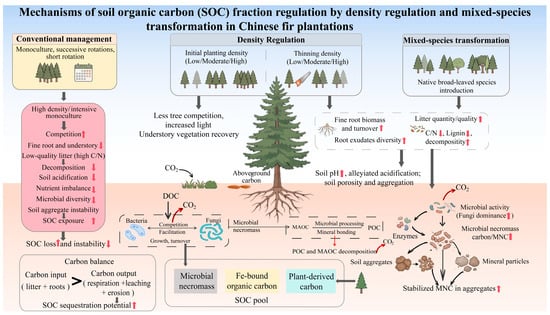
Forest management practices serve as the primary approach for regulating the structure and function of plantation ecosystems. Density control based on thinning and pruning, as well as tree species adjustment via the establishment of coniferous–broad-leaved mixed forests, represent two core strategies for alleviating soil fertility decline and improving SOC sequestration capacity in Chinese fir plantations [15,16,17]. In recent years, researchers have extensively examined how stand density regulation and conversion to coniferous–broad-leaved mixed forests influence SOC dynamics in Chinese fir plantations. These studies have consistently confirmed that moderate thinning [17,18] and mixed forest configuration [15,19] significantly promote SOC sequestration, and have preliminarily revealed key driving mechanisms, including substrate input [20] and microbial-mediated transformation processes [21]. However, most existing studies focus on the effects of single management measures, with inadequate attention paid to the synergistic effects of density optimization and mixed-species planting [16]. Summarizes investigations into the internal coupling mechanisms by which these two strategies regulate SOC sequestration remain limited. Furthermore, key processes such as deep soil carbon pool turnover [22] and microbial necromass carbon (MNC) stabilization—i.e., the physico-chemical process by which carbon from dead microbial cells becomes protected from rapid decomposition via binding to soil minerals and entrapment within aggregates—have not yet been thoroughly analyzed [23], which hinders the development of integrated management practices aimed at enhancing carbon sequestration and sustaining soil fertility in forest plantations. To ensure comprehensive coverage of relevant literature, we conducted a literature search using a two-step strategy: database retrieval followed by manual screening. First, we searched the Web of Science Core Collection, Scopus, PubMed, and China National Knowledge Infrastructure (CNKI) for publications from January 2000 to April 2026, using Boolean search strings that combined terms related to tree species (Cunninghamia lanceolata OR Chinese fir), soil carbon (soil organic carbon OR SOC OR soil carbon sequestration), and stand management (mixed plantation OR species mixing OR broadleaf–conifer mixed forest OR density control OR thinning). Second, we manually screened the retrieved articles against the following criteria: (1) peer-reviewed original research or review articles; (2) studies comparing pure Chinese fir plantations with mixed stands or different density regimes; (3) studies reporting at least one soil carbon-related parameter (e.g., SOC stock, fractions, microbial biomass, or aggregate stability). In addition, we performed a complementary manual snowballing search by cross-checking the reference lists of the selected articles to identify foundational studies not captured by the initial database queries. Against this background, this paper synthesizes recent research advances to review the effects and underlying regulatory mechanisms of density control and mixed forest establishment on SOC content, composition, and stability in Chinese fir plantations. We also identify current research gaps and propose future research priorities, with the aim of providing a scientific basis for establishing theoretical frameworks and technical models that collaboratively optimize stand structure, enhance soil carbon sequestration, and maintain soil fertility in Chinese fir plantations. The integrated regulatory mechanisms of density modification and mixed-species transformation on SOC dynamics are summarized in Figure 1.
Figure 1.
Integrated regulatory mechanisms of soil organic carbon (SOC) fractions and stability by density modification and mixed-species transformation in Chinese fir plantations. Notes: Red upward arrows (↑) indicate an increase in the corresponding index, and red downward arrows (↓) indicate a decrease.
2. Soil Carbon Storage and SOC Stability in Chinese Fir Plantation
Soil organic carbon (SOC) dynamics in forest ecosystems are governed by a complex interplay of stand structure, management practices, site conditions, and stand age, typically exhibiting a distinct vertical distribution with significant accumulation in the topsoil (0–20 cm) [10,24,25,26]. In forest ecosystems globally, SOC typically exhibits a distinct vertical distribution, with over 50% of the total stock in the 0–100 cm profile concentrated in the 0–20 cm topsoil layer [27]. This pattern is primarily driven by surface carbon inputs from litter decomposition and fine root turnover, coupled with intense microbial activity and aggregate formation that facilitate SOC stabilization [28]. Meanwhile, intense microbial activity and well-developed soil aggregates in topsoil create favorable conditions for SOC stabilization [29]. Stand age is a key factor influencing SOC accumulation in Chinese fir plantations [10]. In young stands, SOC input is limited and carbon loss is substantial due to disturbances such as site preparation, prescribed burning, and understory removal, leading to relatively low SOC stocks. The claim that SOC content reaches its minimum in middle-aged stands is not universally supported; nevertheless, under specific conditions (e.g., first-rotation, conventional short-rotation management), some studies have observed a mid-rotation low point [30,31]. From pre-mature to mature stands, SOC stocks gradually recover as litter return increases, understory vegetation develops, and soil conditions improve. Both SOC stock and stability reach optimal levels in over-mature stands [32,33,34].
Modern soil biogeochemical frameworks have moved beyond traditional binary classifications of “labile” and “stable” carbon, adopting a two-pool model comprising particulate organic carbon (POC) and mineral-associated organic carbon (MAOC) [35,36]. POC consists primarily of partially decomposed plant residues and is characterized by rapid turnover and high sensitivity to land-use changes and management interventions [37]. In contrast, MAOC is formed through the binding of low-molecular-weight organic compounds to soil mineral surfaces or their physical occlusion within microaggregates, representing the core pool for long-term carbon sequestration [29,38]. However, it is critical to recognize that the “stability” of MAOC is not an inherent chemical property but a context-dependent state reliant on the integrity of soil structure. Intensive management practices common in monoculture Chinese fir plantations, such as clear-cutting and heavy machinery site preparation, can disrupt soil aggregate structure, exposing previously protected MAOC to microbial decomposition and significantly shortening its residence time [39]. Therefore, the persistence of MAOC is contingent upon management strategies that preserve soil structural integrity and minimize physical disturbance [35].
The impact of forest management practices on SOC is not isolated but is strongly modulated by regional environmental gradients. Climate factors (such as mean annual temperature and precipitation), topography (slope position, elevation), and parent material constitute the boundary conditions for SOC accumulation, determining the spatial heterogeneity of carbon turnover rates and stabilization potential under different site conditions [24,25,40]. Recent global syntheses indicate that the interaction between tree functional traits and site properties explains more than half of the local variability in forest SOC [41]. SOC content in Chinese fir plantations also exhibits significant regional and site-dependent variability [40]. SOC content is notably higher in core mid-subtropical production areas than in marginal distribution zones. Favorable site conditions, including lower slope positions, low-to-moderate elevations, and deep, loose soil profiles, promote SOC accumulation, whereas steep slopes, high elevations, and infertile soils correspond to considerably lower carbon stocks [24,25]. This regional variation suggests that the same management measures (such as thinning or mixing) may yield vastly different SOC responses under different climate-soil backgrounds. For instance, in the mid-subtropical zone, favorable hydrothermal conditions promote litter decomposition and microbial activity. Optimizing stand density and interplanting broadleaf species can significantly enhance SOC sequestration by increasing litter input and promoting the formation of microbial residue-derived stable carbon [15]. Topographic factors, particularly slope position and elevation, further regulate these responses. Lower slope positions, characterized by deeper soil layers and nutrient enrichment due to sedimentation, typically exhibit a stronger positive response to mixed planting compared to upper slopes [16]. At higher elevations, thermal limitations restrict microbial activity; thus, the primary benefit of mixed planting shifts towards improving substrate quality to facilitate carbon input, although the magnitude of SOC increment tends to decrease with increasing elevation due to temperature gradients [42]. Compared to general forest patterns, Chinese fir plantations exhibit unique SOC dynamics, driven primarily by species-specific traits and intensive management histories. A critical issue facing Chinese fir plantations is severe SOC depletion caused by successive cropping. Studies have shown that SOC stocks in third-rotation middle-aged stands decrease by up to 64% compared with first-rotation stands, accompanied by a 25% reduction in annual net carbon sequestration [43]. For instance, Yu et al. [30] reported that continuous planting led to a significant decline of up to 48% in soil organic matter content in the surface layer (0–20 cm) [12]. This degradation is exacerbated by the acidic nature of Chinese fir litter, which has a high C:N ratio and releases organic acids during decomposition [39]. These acids lower soil pH and reduce base cation availability, thereby impairing the capacity of Fe/Al oxides and clay minerals to stabilize MAOC through chemical adsorption [34]. Selvalakshmi et al. [44] further confirmed that soil physicochemical properties progressively deteriorate with increasing rotation frequency, directly threatening the mineral matrix on which MAOM stability depends [45]. This depletion initially manifests in the labile particulate organic matter (POM) pool, as POM is highly sensitive to land use change and disturbance [46]. However, long-term acidification weakens the soil mineral matrix’s capacity to stabilize MAOC, threatening long-term carbon persistence. Chinese fir litter and roots possess allelopathic potential that can suppress microbial community diversity and activity, limiting the efficiency of the microbial carbon pump and reducing the production of stable microbial necromass [6,15].
To mitigate these negative trends, targeted management strategies such as species mixing and density regulation are essential. Mixed-species plantations, particularly those incorporating broadleaf or nitrogen-fixing trees, have been shown to improve litter quality, neutralize soil acidity, and stimulate microbial biomass turnover [15,47,48]. This enhancement reinforces the microbial carbon pump, leading to greater accumulation of microbial necromass and its subsequent stabilization within soil aggregates [22,49]. Specifically, soil microorganisms take up labile organic carbon and convert it into their own biomass through anabolic metabolism. Upon cell death, microbial necromass (e.g., amino sugars, peptidoglycans) is released. This necromass can then be physically protected within soil aggregates (the “entombing effect”) or chemically stabilized via binding to mineral surfaces, thereby contributing to persistent SOC pools [45]. Global meta-analyses confirm that mixed forestation significantly increases SOC, POC, and MAOC by promoting niche complementarity and improving soil aggregate stability, thereby protecting MAOC from disturbance-induced decomposition [15,28]. Specifically, planting nitrogen-fixing species increases SOC stock by 16% compared with non-nitrogen-fixing species, demonstrating the tangible impact of improved microbial processes [50]. Furthermore, mixed plantations enhance soil aggregation and carbon strage, providing physical protection for this newly formed MAOC [51]. Based on the provided paper data, this specific figure cannot be obtained regarding the exact percentage of MAOC increase solely from density regulation and mixing, but synergistic effects are well-documented [52]. Nevertheless, available evidence demonstrates that moderate thinning and mixing can indirectly facilitate the stabilization of soil organic carbon (SOC) by optimizing tree growth and ameliorating soil microenvironments. Future research should further quantify the specific variations in particulate organic matter (POM) and mineral-associated organic carbon (MAOC) under divergent thinning intensities, and integrate microbial community profiling with mineralogical characterization to unravel the underlying mechanisms governing soil carbon stability in Chinese fir plantations.
3. Regional Climate, Site and Soil Effects on SOC Heterogeneity to Density and Mixed Transformation in Chinese Fir
The response of SOC in Chinese fir plantations to density regulation and mixed-species transformation exhibits significant spatial heterogeneity, primarily modulated by the interplay of site conditions and regional climate [41,53]. This heterogeneity underscores the necessity for differentiated management strategies [54,55]. In the mid-subtropical zone, favorable hydrothermal conditions promote efficient litter decomposition and microbial activity [56]. Here, optimizing stand density and interplanting broadleaved species significantly enhance SOC sequestration by increasing litter input and promoting the formation of microbial residue-derived stable carbon [57,58].
Site factors, particularly slope position and elevation, further regulate these responses. Lower slope positions, characterized by deeper soil layers and nutrient enrichment due sedimentation, typically exhibit a stronger positive response to mixed planting compared to upper slopes, where erosion risks are higher [42]. Moderate thinning combined with mixed species can mitigate carbon loss on steep slopes by enhancing understory cover. Regarding elevation, thermal limitations at higher altitudes restrict microbial activity; thus, the primary benefit of mixed planting shifts towards improving substrate quality to facilitate carbon input, although the magnitude of SOC increment tends to decrease with increasing elevation due to temperature gradients [56].
Crucially, climate change scenarios—including warming, drought, and extreme rainfall events—pose new challenges to SOC persistence. Warming generally accelerates SOC mineralization, but mixed-species stands can buffer this effect by enhancing soil water retention and aggregate stability [28,42]. For instance, species mixing has been shown to significantly improve soil water holding capacity, which is vital for maintaining microbial activity and SOC stability during drought periods [59,60]. Furthermore, the enhanced formation of mineral-associated organic carbon (MAOC) and microbial necromass in mixed forests provides a more persistent carbon pool that is less susceptible to temperature-driven decomposition compared to particulate organic carbon (POC). In regions prone to extreme rainfall, the improved soil aggregate stability in mixed stands reduces physical erosion and subsequent carbon loss [39]. Therefore, future management should prioritize strategies that not only maximize SOC stocks but also enhance the stability of carbon pools against climate-induced disturbances, such as promoting broadleaf species that favor MAOC formation and resilient soil structures [37,61].
4. Effects of Stand Density Regulation on Soil Carbon Storage in Chinese Fir Plantations
4.1. Effects of Initial Planting Density on Soil Carbon Storage
Initial planting density is a fundamental determinant of stand structure formation in Chinese fir plantations. It indirectly regulates the input flux and turnover processes of SOC by influencing the growing space of individual trees, the intensity of intraspecific competition, and the patterns of resource acquisition [62]. In subtropical humid climate regions with medium or higher site conditions, multiple studies on Chinese fir (Cunninghamia lanceolata) plantations have demonstrated that maintaining an initial planting density within the range of 2500 to 3333 trees·ha−1 generally achieves a favorable balance between early canopy closure and individual tree growth [55,63,64]. Wang et al. reported that when the planting density exceeds 3333 trees·ha−1, competition for light, water, and nutrients intensifies dramatically, which suppresses individual tree growth, reduces the quantity and quality of litter, and impairs the development of understory vegetation. These conditions lead to persistent insufficient carbon input, deteriorated soil aeration and permeability, and collectively result in a significant reduction in SOC content [65]. Conversely, on high-productivity site types, a planting density below 1667 trees·ha−1 results in insufficient utilization of both spatial resources and light energy, hindering the full expression of the species’ fast-growing potential. Consequently, biomass accumulation and carbon sequestration are limited within the rotation period, which in turn imposes negative effects on SOC accumulation [63]. Research on 8-year-old young Chinese fir stands indicated that the stand volume reaches its peak at a planting density of 4200 trees·ha−1, whereas a further increase in density restricts tree growth and exerts adverse impacts on SOC accumulation [63,64]. From the perspective of the ecological mechanism of carbon allocation, low-density stands effectively weaken intraspecific competition, significantly promoting the growth of tree diameter at breast height and the accumulation of fine root biomass, thereby increasing the proportion of belowground carbon allocation at the individual tree level [66]. However, before canopy closure, low-density stands exhibit slow total biomass accumulation, and the overall carbon input from litter and roots is insufficient to drive rapid SOC accumulation. This phenomenon can be explained by the resource competition theory: when the intensity of intraspecific competition falls below a critical threshold, the individual carbon investment strategy prioritizes aboveground growth and structural construction over increasing root carbon input to enhance the efficiency of soil nutrient acquisition [67].
High-density stands achieve higher total stand productivity and greater short-term carbon input before canopy closure, but long-term intense intraspecific competition triggers significant negative feedback effects. These include severe inhibition of individual tree growth, continuous decline in belowground carbon allocation, and marked restriction of fine root biomass and understory vegetation development [18,68]. Excessively high-density stands not only cause stand growth stagnation but also induce enhanced soil respiration and nutrient depletion due to overcrowded roots, leading to significant reductions in SOC content across the entire 0–100 cm soil profile [69]. Existing studies have demonstrated that the SOC content in Chinese fir plantations is the highest in the 0–15 cm soil layer and decreases with increasing soil depth, and the effects of different initial planting densities on soil nutrients exhibit significant soil-layer dependence [70,71]. The regulatory effect of initial planting density on SOC is theoretically expected to follow a nonlinear, inverted U-shaped response, wherein intermediate densities (e.g., 2500–3333 trees·ha−1) maximize SOC accumulation by balancing high carbon inputs from productivity with efficient microbial stabilization, whereas both low densities (insufficient inputs) and excessively high densities (resource competition, soil degradation) suppress SOC stocks [72,73]. Meanwhile, moderate-density stands provide suitable understory light conditions, which facilitate the development of the understory vegetation layer, increase litter diversity and the heterogeneity of organic matter sources, thereby promoting the functional diversity of soil microbial communities and optimizing the coupling between organic matter input and decomposition processes [74]. Therefore, a moderate initial planting density represents the optimal strategy for sustaining long-term stable SOC accumulation in Chinese fir plantations, a conclusion that has been preliminarily verified across diverse site conditions and climatic gradients [71]. Owing to differences in site conditions, stand age, and other factors, the optimal density reported in different studies varies. To date, no summarizes review has synthesized the effects of planting density on soil carbon stocks.
4.2. Effects of Thinning Intensity on Soil Carbon Storage
Thinning is a pivotal silvicultural practice for regulating stand density and optimizing stand structure, particularly during the middle-aged stage of Chinese fir plantations [75,76]. However, its effects on soil organic carbon (SOC) dynamics are contingent upon the stand age at which thinning occurs, as early-stage disturbances may exacerbate carbon loss while mid-stage interventions often enhance SOC stability by promoting understory vegetation and root biomass accumulation [77]. By altering microenvironmental conditions within the stand (light, temperature, moisture), thinning affects understory vegetation growth and soil ecological processes, which in turn regulate SOC levels [18,78,79]. Low-intensity thinning exerts limited improvements on the stand microenvironment and carbon input, leading to no significant enhancement of SOC [18]. In contrast, moderate thinning effectively opens the canopy, increases understory light availability, and promotes the restoration and development of understory vegetation [79,80]. This significantly increases aboveground litter return and fine root biomass, providing sufficient carbon substrates for SOC accumulation; thus, moderate thinning is widely recognized as the optimal intensity for enhancing SOC stocks [22,79]. High-intensity thinning, however, may result in excessive exposure of the forest floor, exacerbating soil and water loss and erosion, and thereby causing substantial short-term SOC depletion [25]. Although the soil ecosystem may gradually recover in the long term, high-intensity thinning is unfavorable for the stable maintenance of SOC storage. From a carbon sequestration perspective, low-to-moderate thinning is more conducive to the long-term accumulation of ecosystem carbon stocks in Chinese fir plantations [18], a conclusion that has been preliminarily verified across diverse site conditions and climatic gradients [71]. For example, He et al. reported that moderate-intensity thinning (30%, MIT) serves as the optimal silvicultural regime for improving soil multifunctionality and promoting microbial residue carbon sequestration in Chinese fir plantations, as it balances soil nutrient supply, microbial biomass, and SOC stabilization [81].
Regulating stand density not only influences total SOC stocks but also profoundly modifies the chemical composition and stability of SOC [43]. Appropriate stand density configuration and moderate thinning significantly increase the contents of labile SOC fractions, including microbial biomass carbon, dissolved organic carbon, and particulate organic carbon [18,65]. These fractions provide sufficient substrates for soil microbial activity, thereby facilitating soil carbon cycling and nutrient transformation [65,79]. Conversely, in high-density stands, intense interplant competition accelerates the consumption of labile SOC, reducing its proportion in total SOC and rendering SOC more susceptible to microbial decomposition and loss [65]. Meanwhile, optimal stand density effectively promotes soil aggregate development, strengthens the physical protection of SOC by aggregates [29,82], and increases the proportion of mineral-associated organic carbon (MAOC), thereby significantly enhancing SOC stability. Lei et al. found that density regulation may indirectly affect the binding capacity of organic matter to mineral particles by modifying soil pH, clay mineral composition, and iron and aluminum oxide contents [63]. Such mineral adsorption and chemical protection mechanisms enhance the chemical stabilization and mineral association of SOC, thereby increasing the proportion of MAOC [34,38]. Ke et al. demonstrated that microorganisms convert plant-derived carbon into more stable microbial residues and metabolites, forming persistent mineral-associated organic matter (MAOM) [29]. In a chronosequence study of Chinese fir plantations, Lei et al. observed that MNC contributed an average of 31% to SOC in 8-year-old young stands. Notably, although fungi accounted for only 14% of the living microbial biomass, fungal residues contributed 85% of MNC. Furthermore, the positive correlation between MAOC and fungal residues was significantly stronger than that between MAOC and bacterial residues [83], indicating the dominant role of fungal residues in the formation of stable MAOM.
A large-scale meta-analysis based on 533 paired observations across various plantation types confirmed that thinning generally increases dissolved organic carbon (DOC) content by 10%, whereas its effect on total SOC is highly dependent on thinning intensity. While these findings originate from a broader plantation context, they provide a general mechanistic framework for understanding how thinning modifies soil carbon dynamics—specifically, through altered substrate availability and microbial activity [84]. Moderate thinning (approximately 30%, within the 30%–60% intensity range) significantly increases SOC content in the 0–40 cm soil layer of Chinese fir plantations, with the most pronounced effects in the 0–20 cm topsoil (Table 1) [70,81]. In Chinese fir plantations in eastern China, Cheng et al. found that thinning had no significant effect on the total amounts of DOC, light-fraction organic carbon (LFOC), and heavy-fraction organic carbon (HFOC) [17]. However, heavy thinning significantly reduced soil bulk density and increased water-holding capacity and porosity in the 0–20 cm topsoil. This seemingly contradictory result suggests that the effect of thinning on SOC is not merely a quantitative change but also a qualitative shift in the composition and stability of SOC fractions. The improved soil physical structure creates favorable conditions for long-term SOC stabilization, which requires a longer time scale to be reflected in total SOC stocks. Therefore, it is essential to distinguish between short-term carbon dynamic responses and long-term carbon stabilization when evaluating the effects of thinning [85]. The effects of thinning on the vertical distribution of SOC also exhibit significant soil-layer dependence. Huang and Zhou established six density gradients (300–1650 trees·ha−1) in large-diameter Chinese fir plantations and found that thinning had the strongest impact on the physicochemical properties and microbial communities of the topsoil (0–20 cm) [70]. This topsoil enrichment effect is closely associated with the spatial patterns of litter decomposition and root carbon input: fine roots of Chinese fir are mainly distributed in the 0–30 cm soil layer, and thinning directly enhances the SOC replenishment flux in the topsoil by promoting fine root biomass and turnover rate [66]. Nevertheless, from the perspective of long-term SOC stability, the response of deep soil carbon deserves equal attention. MAOM accounts for a higher proportion in deep soils, and its sensitivity to thinning disturbance and recovery pathways may differ substantially from those of the top [86]. Table 2 presents an overview of how stand density regulation and thinning intensity influence SOC dynamics in Chinese fir plantations, highlighting the effects on SOC pools, key mechanisms, and cited references.
Table 1.
Synthesis of Thinning Intensity and Soil Organic Carbon (SOC) Response in Chinese Fir Plantations.
Table 2.
Effects of stand density regulation and thinning intensity on soil organic carbon (SOC) dynamics in Chinese fir plantations.
5. Effects of Mixed-Species Transformation on Soil Carbon Storage in Chinese Fir Plantations
Successive monoculture of Chinese fir is a key driver of soil carbon storage degradation. In Chinese fir plantations under multiple successive rotations, the contents of soil total organic carbon, total nitrogen, and available nitrogen are significantly lower than those in first-generation stands [88,89]. With an increase in rotation number, the soil C/N ratio increases, accompanied by deteriorated soil organic matter quality, a reduced proportion of labile carbon fractions (which are prone to decomposition), and weakened stability of soil carbon storage [6,15,35]. This phenomenon is mainly caused by the continuous input of coniferous litter, which degrades the quality of soil organic matter inputs. Meanwhile, soil acidification and nutrient imbalance further inhibit the microbial transformation of organic matter, forming a vicious cycle characterized by reduced organic matter input, impeded decomposition, and declined carbon pool quality [26,43]. To address this issue, mixed-species management serves as an important strategy for the sustainable management of plantations [90,91], and its effectiveness is constrained by multiple factors, including mixed tree species selection, site conditions, and silvicultural practices [58,92]. Compared with pure Chinese fir stands, mixed-species stands generally increase soil organic carbon (SOC) stocks. Global meta-analyses indicate that mixed forestation can increase SOC by approximately 16% to 64%, depending on species composition and environmental conditions [28,37,58]. In subtropical Chinese fir plantations, species mixing has been shown to significantly enhance SOC sequestration, with reported increments often ranging from 15% to 40% [58,93]. These values exhibit obvious regional differences and species specificity, influenced by factors such as nitrogen availability and litter quality [41]. Mixed forests may also have advantages in litter layer decomposition and can enhance aboveground tree productivity on nutrient-poor soils [16]. Mixed-species stands exhibit markedly higher leaf litter inputs relative to root-derived carbon inputs, with SOC accumulation being more pronounced in surface horizons than in subsoil layers. Accordingly, the enhanced aboveground litter input in mixed plantations drives preferential carbon stabilization in the topsoil. Notably, the magnitude of the positive mixture effect on SOC in Chinese fir plantations increases concomitantly with both tree species richness and stand age [15,94].
The effects of mixed-species management on SOC stability are mediated by changes in the quality of carbon input to soils. Wang et al. found that broadleaved tree species can enhance carbon sequestration, which is mainly attributed to increased biomass carbon [95]. Similarly, Wang et al. (2010) previously reported that the total carbon content in Chinese fir–Alnus cremastogyne mixed stands was significantly higher than that in pure Chinese fir stands [96]. This is associated with the general characteristics of broadleaved litter, such as high nitrogen and calcium concentrations, low lignin content, and high decomposability [92]. For example, litter from broadleaved species (e.g., Michelia macclurei, Castanopsis fissa, Schima superba) has a low C/N ratio and is theoretically more susceptible to microbial degradation, thereby promoting SOC accumulation [21,97]. However, SOC storage also depends on SOC decomposition rates and stabilization mechanisms [98]. Although introducing broadleaved species into coniferous plantations increases soil carbon inputs, it may accelerate the decomposition of both SOC and fresh detritus via priming effects, potentially offsetting high carbon inputs [99]. The actual decomposition efficiency is further regulated by environmental factors, such as soil temperature, moisture, and pH [92,100].
Crucially, the net effect on SOC is mediated by mycorrhizal associations and microbial community structure. Mixed-species stands often exhibit greater functional diversity in root traits, such as specific root length and root tissue density, which influences the ‘root economics spectrum’ and carbon allocation strategies [11,16]. Broadleaf species, particularly those forming arbuscular mycorrhizal (AM) associations, can alter the fungal:bacterial ratio in the soil, shifting microbial community composition towards bacteria-dominated systems that favor rapid nutrient cycling but may reduce the formation of stable mineral-associated organic carbon (MAOC) compared to ectomycorrhizal (ECM)-dominated coniferous systems [37]. However, the complementary resource use in mixed stands enhances overall microbial biomass and enzymatic activities, which facilitates the transformation of labile carbon into stabilized forms through microbial necromass accumulation [15,51]. Published data indicate that mixed-species stands can increase forest floor carbon inputs by 1.4–2.3 times [92], and this increased input, combined with enhanced soil aggregate stability driven by diverse root architectures, protects SOC from decomposition [101]. Relative to total organic carbon and non-labile carbon, changes in the carbon pool are mainly dominated by labile SOC fractions, but the long-term stabilization is increasingly recognized as dependent on the interplay between root trait economics and mycorrhizal-mediated soil structure formation [11,102].
Some studies have demonstrated that mixed-species conversion affects SOC stability. For instance, Wang et al. noted that introducing the broadleaved species Michelia macclurei into pure Chinese fir stands to construct mixed forests significantly enhanced ecosystem carbon stocks (with increments mainly derived from biomass carbon), whereas SOC stocks and overall stability in the 0–40 cm soil layer showed no significant changes [95]. Shu et al. (2022) found that the close-to-nature conversion of Chinese fir plantations reduced SOC stability to a certain extent [102]. However, this advantage may be weakened in regions with severe soil acidification, thereby lowering SOC accumulation efficiency [103]. In addition, complementary and expanded root niches can theoretically expand the scope of organic carbon input, but their realization depends on the coordination of root growth rhythms between broadleaved and Chinese fir trees. Most broadleaved species exhibit deep-rooted growth traits, whereas Chinese fir is mainly shallow-rooted [92]. The differentiated root architectures of these species effectively expand the spatial distribution of roots along the soil profile and increase carbon inputs throughout the profile [21]. Deep roots can deliver plant residues and nutrients to deep soil layers, improving soil structure and porosity and providing favorable conditions for SOC accumulation [29]. Meanwhile, mixed-species stands significantly increase the species richness of understory shrubs and herbs, thereby enhancing carbon return, mitigating soil erosion, and reducing the risk of SOC loss [80]. For example, in red soil regions, artificial mixed reforestation increases the concentrations of soil aggregate-associated organic carbon, a process mainly driven by the metabolic activities of soil microbial communities [29,104]. Studies have indicated that mixed-species stands effectively regulate soil pH, cation exchange capacity (CEC), and porosity, alleviating soil acidification caused by the long-term successive monoculture of Chinese fir and creating a favorable environment for SOC accumulation [39,61]. Furthermore, fine root turnover rates are significantly accelerated in mixed-species stands, with marked increases in the diversity and quantity of root exudates, which sustainably activate soil microbial activity and promote SOC formation and stabilization [92]. The above results demonstrate that mixed-species transformation significantly alters SOC accumulation and stability compared with conventional pure Chinese fir plantations. Table 3 summarizes the comparative effects of pure and mixed stands on SOC dynamics from five key dimensions, including carbon input, SOC fractions, stability, and soil microenvironment, along with their underlying regulatory mechanisms.
Table 3.
Comparative effects of mixed-species transformation and pure planation on SOC dynamics.
6. Limitations of Current Research and Future Perspectives
Future research on soil organic carbon (SOC) sequestration in Chinese fir plantations urgently needs to transcend traditional single-dimensional ecological paradigms, transitioning towards an integrated system that combines digital precision management, deep mechanistic analysis, and synergistic socio-economic value assessment. At the technical level, it is essential to deeply integrate frontier digital forestry technologies. By utilizing Unmanned Aerial Vehicles (UAVs) equipped with LiDAR and hyperspectral imaging systems, researchers can non-destructively acquire high-resolution spatial data on stand structural parameters and leaf functional traits, serving as key proxy indicators for belowground processes [41]. Combining Artificial Intelligence (AI) and Machine Learning (ML algorithms such as Random Forest and Deep Learning) to integrate multi-source heterogeneous data (climate, topography, remote sensing imagery, and soil properties) will enable the construction of high-precision SOC spatial mapping and dynamic prediction models. This approach overcomes the limitations of traditional soil sampling in spatial representativeness, facilitating a shift from static empirical management to real-time data-driven precision silviculture, thereby optimizing thinning intensity and mixing ratios to maximize carbon sink potential [37]. In terms of mechanistic analysis, it is imperative to delve into the microbial driving mechanisms within the “black box.” Specifically, multi-omics technologies—including metagenomics, metatranscriptomics, and metabolomics—should be employed to precisely identify key functional genes and metabolic pathways regulating the formation and stabilization of microbial necromass. This will help elucidate the relative contributions of root exudates and litter input to the formation of Mineral-Associated Organic Carbon (MAOC) and their molecular-level stabilization mechanisms [50]. Simultaneously, the research scope must expand from surface soil to deep soil (>60 cm). Establishing long-term in situ monitoring networks is crucial to capture the spatiotemporal dynamics of SOC throughout entire rotation cycles and even multiple rotations, addressing the cumulative effects and lagged responses of deep carbon pools that short-term experiments fail to reflect [11,50].
At the level of socio-economic and policy application, the quantified results of biophysical processes need to be translated into ecosystem service valuation systems. Priority should be given to developing standardized Measurement, Reporting, and Verification (MRV) protocols for the SOC sequestration effects of mixed forests, clearly defining the asset attributes of Chinese fir mixed forests in carbon credit markets. By coupling biogeochemical models with economic valuation models, the long-term carbon sink benefits derived from enhanced SOC stability can be quantified, providing a scientific basis for formulating policies that incentivize sustainable forest management. This achieves the multi-objective synergy of timber production, biodiversity conservation, and climate mitigation. Furthermore, in the face of global climate change challenges, future research must summarizes assess the impacts of warming, drought, and extreme rainfall events on SOC persistence. It is vital to reveal the ecological resilience mechanisms by which mixed forests buffer climate stress and maintain SOC stability through improved soil aggregate structure and water retention capacity. In summary, the future of Chinese fir plantation research lies in the organic integration of digital technological innovation, deepening of microscopic mechanisms, and macroscopic policy applications. The goal is to construct a precision management system that is regionally adaptive, climate-resilient, and economically viable, providing Chinese solutions and scientific support for enhancing global forest carbon sink functions [15].
7. Conclusions
This review synthesizes extensive empirical evidence to demonstrate that moderate thinning (low-to-moderate thinning) and mixed-species management are pivotal strategies for enhancing soil organic carbon (SOC) sequestration and stability in Chinese fir (Cunninghamia lanceolata) plantations. Established knowledge confirms that these practices optimize stand structure, mitigate soil acidification, and promote the accumulation of both plant-derived and microbially derived carbon pools. Specifically, species mixing leverages niche complementarity to enhance litter quality and root exudation, thereby driving the formation of mineral-associated organic carbon (MAOC) and improving aggregate stability, which are critical for long-term carbon persistence. Furthermore, the integration of nitrogen-fixing broadleaf species has been shown to alleviate nutrient limitations, stimulating microbial biomass turnover and reinforcing the “microbial carbon pump” efficiency.
However, significant uncertainties remain regarding the mechanistic drivers of SOC dynamics under changing environmental conditions. Current literature lacks sufficient long-term in situ monitoring data to fully elucidate the temporal lag effects of deep-soil (>60 cm) carbon responses to silvicultural interventions. Moreover, the resilience of SOC pools to extreme climate events—such as prolonged droughts and intense rainfall—remains poorly quantified, particularly concerning the stability of particulate organic carbon (POC) versus MAOC fractions. The intrinsic regulatory mechanisms linking root–microbe–mineral interactions at the molecular level also constitute a critical knowledge gap, limiting our ability to predict carbon sink potential under future warming scenarios.
Future research priorities must therefore shift towards integrating precision forestry technologies with mechanistic ecological models. The application of digital monitoring tools, including UAV-based LiDAR and hyperspectral imaging, combined with machine learning algorithms, offers promising avenues for high-resolution spatial mapping of SOC and real-time optimization of management practices. Additionally, multi-omics approaches should be employed to decode the genetic and metabolic pathways governing microbial necromass stabilization. From a policy perspective, developing standardized Measurement, Reporting, and Verification (MRV) protocols for mixed-plantation carbon sinks is essential for integrating forest management into global climate change mitigation frameworks and carbon markets. Ultimately, achieving the coordinated development of productivity, carbon sequestration, and ecosystem multifunctionality in Chinese fir plantations requires a holistic approach that bridges microscopic biological mechanisms with macroscopic digital management systems, ensuring region-specific adaptability and climate resilience.
Author Contributions
Conceptualization, S.W. and L.H.; methodology, S.W.; software, S.W.; validation, S.W., Q.S. and L.H.; formal analysis, Y.D.; investigation, S.W.; resources, W.W. and X.L.; data curation, Y.D.; writing—original draft preparation, L.H. and X.L.; writing—review and editing, S.W.; visualization, S.W.; supervision, Y.D.; project administration, L.H.; funding acquisition, L.H. All authors have read and agreed to the published version of the manuscript.
Funding
This research was funded by the Fundamental Research Funds of CAF (CAFYBB2025ZA017-01).
Data Availability Statement
Data sharing is not applicable.
Conflicts of Interest
The authors declare no conflict of interest.
References
- Sheng, W.T. On the maintenance of long-term productivity of plantation in China. For. Res. 2018, 31, 1–14. [Google Scholar] [CrossRef]
- Bastin, J.-F.; Finegold, Y.; Garcia, C.; Mollicone, D.; Rezende, M.; Routh, D.; Zohner, C.M.; Crowther, T.W. The Global Tree Restoration Potential. Science 2019, 365, 76–79. [Google Scholar] [CrossRef] [Scilit] [PubMed]
- Wang, Y.; Chen, L.; Xiang, W.; Zhang, X.; Ren, Y.; Guo, Z.; Gunina, A. Regulation of Soil Organic Carbon Dynamics by Microbial Communities during Reforestation of Chinese Fir Plantations after Clear-cutting. Land Degrad. Dev. 2024, 35, 3539–3551. [Google Scholar] [CrossRef] [Scilit]
- Wei, S.; Sun, Q.; Hou, L.; Dong, Y.; Liu, X. A Bibliometric Analysis of Research on the Nutrient Cycling of Chinese Fir (Cunninghamia lanceolata (Lamb.) Hook) (1996–2024). Land Degrad. Dev. 2026, 37, ldr.70460. [Google Scholar] [CrossRef] [Scilit]
- Hu, Y.; Jiang, Y.; Chhin, S.; Liu, N.; Pan, H.; Zhang, J.; Zhu, G.; Zhang, X. Alleviating Monoculture-Induced Soil Degradation in Chinese Fir Plantations in Southern China: Optimizing Understory Mixtures Balances Stoichiometry and Microbial Diversity. Ind. Crops Prod. 2025, 232, 121254. [Google Scholar] [CrossRef] [Scilit]
- Lai, S.; Berg, B.; Lin, Y.; Rashid, H.; Wu, F.; Wu, Q.; Zhang, Q.; Zhang, X.; Zhu, J.; Ni, X. Chinese Fir Litter Decomposition and Its Response to Global Change: A Meta-Analysis across China’s Forests. J. Plant Ecol. 2025, 18, rtaf024. [Google Scholar] [CrossRef] [Scilit]
- Lin, J.G.; Bian, Y.J. Chinese Forest Resources Report; China Forestry Publishing House: Beijing, China, 2019. [Google Scholar]
- Liu, Z.; Zhong, Y.; Chen, Z.; Wei, J.; Li, D.; Zhang, S. Landscape Dynamics, Succession, and Forecasts of Cunninghamia lanceolata in the Central Producing Regions of China. Forests 2024, 15, 1817. [Google Scholar] [CrossRef] [Scilit]
- Jiang, Y.; Hu, Z.; Han, Z.; Zhang, J.; Han, S.; Hao, L. Growth Characteristics of Cunninghamia lanceolata in China. Sci. Rep. 2022, 12, 18179. [Google Scholar] [CrossRef] [Scilit] [PubMed]
- Wang, H.; Wang, J.; Zhang, Y.; He, G.; Wen, S. Spatial Distribution of Soil Organic Carbon and Its Response to Forest Growth and Soil Layer in Cunninghamia lanceolata Plantations in Mid-Subtropical China. For. Ecol. Manag. 2023, 545, 121302. [Google Scholar] [CrossRef] [Scilit]
- Xu, Y.; Cheng, J.; Zhang, R.; Hou, L.; Dong, Y.; Liu, L.; Sun, Q. Successive Planting Changes the C:N:P Stoichiometry of the Leaf-Litter-Soil-Microbial Biomass System in Chinese Fir (Cunninghamia lanceolata) Plantations in China: A Meta-Analysis. For. Ecol. Manag. 2026, 599, 123278. [Google Scholar] [CrossRef] [Scilit]
- Yu, Z.; Zhou, G.; Liu, S.; Sun, P.; Agathokleous, E. Impacts of forest management intensity on carbon accumulation of China’s forest plantations. For. Ecol. Manag. 2020, 472, 118252. [Google Scholar] [CrossRef] [Scilit]
- Farooq, T.H. Chinese fir (Cunninghamia lanceolata) a green gold of China with continues decline in its productivity over the successive rotations: A Review. Appl. Ecol. Env. Res. 2019, 17, 11055–11067. [Google Scholar] [CrossRef] [Scilit]
- Wu, Z.; Li, J.; Zheng, J.; Liu, J.; Liu, S.; Lin, W.; Wu, C. Soil Microbial Community Structure and Catabolic Activity Are Significantly Degenerated in Successive Rotations of Chinese Fir Plantations. Sci. Rep. 2017, 7, 6691. [Google Scholar] [CrossRef] [Scilit] [PubMed]
- Guo, J.; Feng, H.; McNie, P.; Liu, Q.; Xu, X.; Pan, C.; Yan, K.; Feng, L.; Adehanom Goitom, E.; Yu, Y. Species Mixing Improves Soil Properties and Enzymatic Activities in Chinese Fir Plantations: A Meta-Analysis. CATENA 2023, 220, 106723. [Google Scholar] [CrossRef] [Scilit]
- Mo, X.; Lu, J.; Lin, J.; Huo, C.; Zhang, W. The Effect of Mixed Plantations on Chinese Fir Productivity: A Meta-Analysis. Forests 2025, 16, 105. [Google Scholar] [CrossRef] [Scilit]
- Cheng, X.; Yu, M.; Wang, G.G. Effects of Thinning on Soil Organic Carbon Fractions and Soil Properties in Cunninghamia Lanceolata Stands in Eastern China. Forests 2017, 8, 198. [Google Scholar] [CrossRef] [Scilit]
- Cheng, X.; Yu, M.; Li, Z. Short Term Effects of Thinning on Soil Organic Carbon Fractions, Soil Properties, and Forest Floor in Cunninghamia Lanceolata Plantations. J. Soil. Sci. Environ. Manag. 2018, 9, 21–29. [Google Scholar] [CrossRef] [Scilit]
- Sun, C.C.; Wang, Z.Q.; Pan, C.; Song, Y.Q.; Yu, Y.C. Effects of Cunninghamia lanceolata and Schima superba mixed forest on soil nutrients and enzyme activities. J. Jiangxi Agric. Univ. 2023, 45, 517–525. [Google Scholar] [CrossRef]
- Xu, B.; Wang, F.; Liang, K.; Liu, R.; Hu, X.; Wang, H.; Chen, F.; Yu, M. Understory Vegetation Preservation Offsets the Decline in Soil Organic Carbon Stock Caused by Aboveground Litter Removal in a Subtropical Chinese Fir Plantation. Forests 2024, 15, 2204. [Google Scholar] [CrossRef] [Scilit]
- Deng, C.; Lyu, M.; Sardans, J.; Peñuelas, J.; Lu, Y.; Jiang, Y.; Yang, Y.; Xie, J. Promoting Effect of Tree Mixture on Litter Quality and Microbial Diversity Governs Microbial Necromass Accrual in Previously Degraded Soils. For. Ecol. Manag. 2025, 593, 122918. [Google Scholar] [CrossRef] [Scilit]
- Chen, X.; Chen, S.; Arthur, M.A.; McCulley, R.L.; Liu, X.; Xiong, D.; Xu, C.; Yang, Z.; Yang, Y. Primary Productivity Regulates Rhizosphere Soil Organic Carbon: Evidence from a Chronosequence of Subtropical Chinese Fir (Cunninghamia lanceolata) Plantation. Sci. Total Environ. 2024, 955, 177082. [Google Scholar] [CrossRef] [Scilit] [PubMed]
- Li, J.; Zhao, J.; Liao, X.; Hu, P.; Wang, W.; Ling, Q.; Xie, L.; Xiao, J.; Zhang, W.; Wang, K. Pathways of Soil Organic Carbon Accumulation Are Related to Microbial Life History Strategies in Fertilized Agroecosystems. Sci. Total Environ. 2024, 927, 172191. [Google Scholar] [CrossRef] [Scilit] [PubMed]
- Wu, G.; Huang, G.; Lin, S.; Huang, Z.; Cheng, H.; Su, Y. Changes in Soil Organic Carbon Stocks and Its Physical Fractions along an Elevation in a Subtropical Mountain Forest. J. Environ. Manag. 2024, 351, 119823. [Google Scholar] [CrossRef] [Scilit] [PubMed]
- Lu, G.C.; Xue, Y.; Xue, L.; Shao, Y.R. Distribution characteristics of soil organic carbon in cutover land of a Cunninghamia lanceolata stand. J. Anhui Agric. Univ. 2014, 41, 126–129. [Google Scholar] [CrossRef]
- Yuan, Y.; Li, J.; Yao, L. Soil Microbial Community and Physicochemical Properties Together Drive Soil Organic Carbon in Cunninghamia Lanceolata Plantations of Different Stand Ages. PeerJ 2022, 10, e13873. [Google Scholar] [CrossRef] [Scilit] [PubMed]
- Yuan, J.; Zhang, Y.; You, C.; Cao, R.; Tan, B.; Li, H.; Jiang, Y.; Yang, W. The Three-Dimension Zonal Pattern of Soil Organic Carbon Density in China’s Forests. CATENA 2021, 196, 104950. [Google Scholar] [CrossRef] [Scilit]
- Xiang, Y.; Li, Y.; Luo, X.; Liu, Y.; Huang, P.; Yao, B.; Zhang, L.; Li, W.; Xue, J.; Gao, H.; et al. Mixed Plantations Enhance More Soil Organic Carbon Stocks than Monocultures across China: Implication for Optimizing Afforestation/Reforestation Strategies. Sci. Total Environ. 2022, 821, 153449. [Google Scholar] [CrossRef] [Scilit] [PubMed]
- Ke, Y.; Li, H.; Luo, T.; Chen, B.; Wang, Q.; Jiang, X.; Liu, W. Reforestation Increases the Aggregate Organic Carbon Concentration Induced by Soil Microorganisms in a Degraded Red Soil, Subtropical China. Microorganisms 2023, 11, 2008. [Google Scholar] [CrossRef] [Scilit] [PubMed]
- Yu, Y.; Yang, J.; Zeng, S.; Wu, D.; Jacobs, D.F.; Sloan, J.L. Soil pH, Organic Matter, and Nutrient Content Change with the Continuous Cropping of Cunninghamia lanceolata Plantations in South China. J. Soils Sediments 2017, 17, 2230–2238. [Google Scholar] [CrossRef] [Scilit]
- Xiang, W.; Xu, L.; Lei, P.; Ouyang, S.; Deng, X.; Chen, L.; Zeng, Y.; Hu, Y.; Zhao, Z.; Wu, H.; et al. Rotation Age Extension Synergistically Increases Ecosystem Carbon Storage and Timber Production of Chinese Fir Plantations in Southern China. J. Environ. Manag. 2022, 317, 115426. [Google Scholar] [CrossRef] [Scilit] [PubMed]
- Chen, M.; Yuan, C.; He, S.; Chen, J.; Luo, J.; Ding, F.; Yan, G. Effects of Soil Microorganisms on Carbon Sequestration under Different Mixed Modification Models in Pinus massoniana L. Plantation. For. 2024, 15, 1053. [Google Scholar] [CrossRef] [Scilit]
- Paul-Limoges, E.; Black, T.A.; Christen, A.; Nesic, Z.; Jassal, R.S. Effect of Clearcut Harvesting on the Carbon Balance of a Douglas-Fir Forest. Agric. For. Meteorol. 2015, 203, 30–42. [Google Scholar] [CrossRef] [Scilit]
- Su, F.; Xu, S.; Sayer, E.J.; Chen, W.; Du, Y.; Lu, X. Distinct Storage Mechanisms of Soil Organic Carbon in Coniferous Forest and Evergreen Broadleaf Forest in Tropical China. J. Environ. Manag. 2021, 295, 113142. [Google Scholar] [CrossRef] [Scilit] [PubMed]
- Chen, G.; Yang, Y.; Yang, Z.; Xie, J.; Guo, J.; Gao, R.; Yin, Y.; Robinson, D. Accelerated Soil Carbon Turnover under Tree Plantations Limits Soil Carbon Storage. Sci. Rep. 2016, 6, 19693. [Google Scholar] [CrossRef] [Scilit] [PubMed]
- Li, H.; Wang, B.; Zhou, Y.; Zhang, H.; Liu, C.; Yang, X.; Zhu, Z.; Bai, X.; Toor, G.S.; An, S. Soil Organic Carbon Formation from Plant and Microbial Residual Carbon: Effects of Home-Field Advantage and Root Litter Quality. CATENA 2025, 254, 108985. [Google Scholar] [CrossRef] [Scilit]
- Shu, X.; Chen, D.; Chen, J.; Zhou, Z.; Luo, Y.; Zhang, Y.; Tang, H.; Deng, D.; Xia, L. Mixed Forestation Outperforms Pure Stands in Soil Carbon Sequestration and Stability. Glob. Change Biol. 2026, 32, e70812. [Google Scholar] [CrossRef] [Scilit] [PubMed]
- Zhang, Y.; Tang, Z.; You, Y.; Guo, X.; Wu, C.; Liu, S.; Sun, O.J. Differential Effects of Forest-Floor Litter and Roots on Soil Organic Carbon Formation in a Temperate Oak Forest. Soil Biol. Biochem. 2023, 180, 109017. [Google Scholar] [CrossRef] [Scilit]
- Tang, L.; Mao, L.; Wang, Z.; Ye, S.; Wang, S. Mixed with Broadleaf Tree Species Improved Soil Aggregate Stability in Chinese Fir (Cunninghamia lanceolata) Plantations: Based on the Le Bissonnais Method. J. Soil Sci. Plant Nutr. 2023, 23, 2110–2121. [Google Scholar] [CrossRef] [Scilit]
- Zhang, B.W.; Jin, S.R.; Deng, Q.H.; Ouyang, X.Z.; He, Q.F.; Ding, S.; Han, T.Y.; Xiao, X. Analysis of the effects of multiple factors on forest soil organic carbon density based on quantification theory I. Acta Agric. Univ. Jiangxiensis 2017, 39, 1205–1211. [Google Scholar] [CrossRef]
- Augusto, L.; Boča, A. Tree Functional Traits, Forest Biomass, and Tree Species Diversity Interact with Site Properties to Drive Forest Soil Carbon. Nat. Commun. 2022, 13, 1097. [Google Scholar] [CrossRef] [Scilit] [PubMed]
- Huang, M.; Peng, C.; Liu, Q.; Feng, H.; Qu, X.; Pan, C.; Yang, M.; Zhang, H.; Guo, J. Positive Effects of Species Mixing on Soil Carbon Sequestration and Water Retention in Global Forest Plantations. J. Ecol. 2026, 114, e70321. [Google Scholar] [CrossRef] [Scilit]
- Zhang, J.; Wang, S.; Feng, Z.; Wang, Q. Stability of Soil Organic Carbon Changes in Successive Rotations of Chinese Ffir (Cunninghamia lanceolata (Lamb.) Hook) Plantations. J. Environ. Sci. 2009, 21, 352–359. [Google Scholar] [CrossRef] [Scilit] [PubMed]
- Selvaraj, S.; Duraisamy, V.; Huang, Z.; Guo, F.; Ma, X. Influence of Long-Term Successive Rotations and Stand Age of Chinese Fir (Cunninghamia lanceolata) Plantations on Soil Properties. Geoderma 2017, 306, 127–134. [Google Scholar] [CrossRef] [Scilit]
- Liang, C.; Amelung, W.; Lehmann, J.; Kästner, M. Quantitative Assessment of Microbial Necromass Contribution to Soil Organic Matter. Glob. Change Biol. 2019, 25, 3578–3590. [Google Scholar] [CrossRef] [Scilit] [PubMed]
- Luan, J.; Xiang, C.; Liu, S.; Luo, Z.; Gong, Y.; Zhu, X. Assessments of the Impacts of Chinese Fir Plantation and Natural Regenerated Forest on Soil Organic Matter Quality at Longmen Mountain, Sichuan, China. Geoderma 2010, 156, 228–236. [Google Scholar] [CrossRef] [Scilit]
- Liao, C.; Luo, Y.; Fang, C.; Chen, J.; Li, B. The Effects of Plantation Practice on Soil Properties Based on the Comparison between Natural and Planted Forests: A Meta-analysis. Glob. Ecol. Biogeogr. 2012, 21, 318–327. [Google Scholar] [CrossRef] [Scilit]
- Wang, Y.; Chen, L.; Xiang, W.; Ouyang, S.; Zhang, T.; Zhang, X.; Zeng, Y.; Hu, Y.; Luo, G.; Kuzyakov, Y. Forest Conversion to Plantations: A Meta-analysis of Consequences for Soil and Microbial Properties and Functions. Glob. Change Biol. 2021, 27, 5643–5656. [Google Scholar] [CrossRef] [Scilit] [PubMed]
- Guo, X.W.; Zhang, Y.X.; You, Y.M.; Sun, J.X. Research progress on the effects of litter input on soil organic carbon transformation and stability in forest ecosystems. Chin. J. Appl. Ecol. 2024, 35, 2352–2361. [Google Scholar] [CrossRef] [Scilit] [PubMed]
- Zhou, T.; Wang, C.; Zhou, Z. Nitrogen Availability Regulates Tree Mixture Effects on Soil Organic Carbon in Temperate Forests: Insights from a Meta-Analysis and Long-Term Experiment. Glob. Ecol. Biogeogr. 2025, 34, e70073. [Google Scholar] [CrossRef] [Scilit]
- Li, M.; Ding, X.; Chen, M.; Zhang, X.; Zhao, Y.; Meng, M.; Zhang, G.; Cao, Y. Mixed Plantations Enhance Soil Aggregation and Carbon Storage: A Global Meta-Analysis. CATENA 2025, 254, 109013. [Google Scholar] [CrossRef] [Scilit]
- Li, X.; Wang, R.; Liu, K.; Zhou, Y.; Hu, J. Effects of Thinning on Tree Growth and Soil Physiochemical Properties in Cunninghamia Lanceolata Plantation. J. For. Res. 2023, 28, 251–259. [Google Scholar] [CrossRef] [Scilit]
- Shen, C.; Xiao, W.; Chen, J.; Hua, L.; Huang, Z. Climate-Sensitive Spatial Variability of Soil Organic Carbon in Multiple Forests, Central China. Glob. Ecol. Conserv. 2023, 46, e02555. [Google Scholar] [CrossRef] [Scilit]
- Wang, J.; Wang, H.; Li, X.; Nie, X.; Liu, S. Effects of Environmental Factors and Tree Species Mixtures on the Functional Groups of Soil Organic Carbon across Subtropical Plantations in Southern China. Plant Soil 2022, 480, 265–281. [Google Scholar] [CrossRef] [Scilit]
- Zhang, X.; Song, X.; Lou, Y.; Leng, C.; Huang, J.; Cheng, X.; Yin, P.; Zhu, X.; Xiao, F. Converting Chinese Fir Plantations into Mixed Stands: Effects of Density on Soil Organic Carbon Mineralization and Its Temperature Sensitivity. Trees For. People 2026, 23, 101160. [Google Scholar] [CrossRef] [Scilit]
- Ganatsas, P.; Tsakaldimi, M.; Petaloudi, L.-M. Factors Affecting Long-Term Soil Organic Carbon Storage in Greek Forests. Forests 2023, 14, 1518. [Google Scholar] [CrossRef] [Scilit]
- Cao, X.; Zhang, Z.; Yan, W.; Mo, Y.; Wu, S.; Wang, M.; Peng, Y. Assessment of Soil Quality in the Transformation from Pure Chinese Fir Plantation to Mixed Broad-Leaved and Cunninghamia lanceolata Plantation in Subtropical China. Forests 2023, 14, 1867. [Google Scholar] [CrossRef] [Scilit]
- Yu, Z.; Wang, K.; Li, J.; Shangguan, Z.; Deng, L. Mixed Plantations Have More Soil Carbon Sequestration Benefits than Pure Plantations in China. For. Ecol. Manag. 2023, 529, 120654. [Google Scholar] [CrossRef] [Scilit]
- Li, F.; Liu, L.; Hai, L.; Yang, H.; Zhao, K.; Di, Q.; Wang, Z. Stand Density Drives Soil Microbial Community Structure in Response to Nutrient Availability in Larix gmelinii Var. Principis-rupprechtii (Mayr) Pilger Plantations. Plants 2025, 14, 3737. [Google Scholar] [CrossRef] [Scilit] [PubMed]
- Wang, B.; Chen, W.; Tian, D.; Li, Z.; Wang, J.; Fu, Z.; Luo, Y.; Piao, S.; Yu, G.; Niu, S. Dryness Limits Vegetation Pace to Cope with Temperature Change in Warm Regions. Glob. Change Biol. 2023, 29, 4750–4757. [Google Scholar] [CrossRef] [Scilit] [PubMed]
- Ouyang, S.; Tie, L.; Rao, X.; Cai, X.; Liu, S.; Vitali, V.; Wei, L.; Yu, Q.; Sun, D.; Lin, Y.; et al. Mixed-Species Acacia Plantation Decreases Soil Organic Carbon and Total Nitrogen Concentrations but Favors Species Regeneration and Tree Growth over Monoculture: A Thirty-Three-Year Field Experiment in Southern China. Forests 2023, 14, 968. [Google Scholar] [CrossRef] [Scilit]
- Li, X.; Duan, A.; Zhang, J. Influence of Stand Density, Site, Age, and Competition on the Timber Assortment Structure of Chinese Fir Plantations. Sci. Rep. 2024, 14, 29056. [Google Scholar] [CrossRef] [Scilit] [PubMed]
- Lei, J.; Du, H.; Duan, A.; Zhang, J. Effect of Stand Density and Soil Layer on Soil Nutrients of a 37-Year-Old Cunninghamia Lanceolata Plantation in Naxi, Sichuan Province, China. Sustainability 2019, 11, 5410. [Google Scholar] [CrossRef] [Scilit]
- Xu, Z.; Fan, F.; Lin, Q.; Guo, S.; Li, S.; Zhang, Y.; Feng, Z.; Wang, X.; Rensing, C.; Cao, G.; et al. Effects of Different Stand Densities on the Composition and Diversity of Soil Microbiota in a Cunninghamia lanceolata Plantation. Plants 2025, 14, 98. [Google Scholar] [CrossRef] [Scilit] [PubMed]
- Wang, C.; Xue, L.; Dong, Y.; Jiao, R. Soil Organic Carbon Fractions, C-Cycling Hydrolytic Enzymes, and Microbial Carbon Metabolism in Chinese Fir Plantations. Sci. Total Environ. 2021, 758, 143695. [Google Scholar] [CrossRef] [Scilit] [PubMed]
- Wang, Z.; Liu, M.; Chen, F.; Li, H. Variation in Fine Root Traits with Thinning Intensity in a Chinese Fir Plantation Insights from Branching Order and Functional Groups. Sci. Rep. 2021, 11, 22710. [Google Scholar] [CrossRef] [Scilit] [PubMed]
- Cardoso, D.J.; Lacerda, A.E.B.; Rosot, M.A.D.; Garrastazú, M.C.; Lima, R.T. Influence of Spacing Regimes on the Development of Loblolly Pine (Pinus taeda L.) in Southern Brazil. For. Ecol. Manag. 2013, 310, 761–769. [Google Scholar] [CrossRef] [Scilit]
- Dong, T.; Zhang, Y.; Zhang, Y.; Zhang, S. Continuous Planting under a High Density Enhances the Competition for Nutrients among Young Cunninghamia lanceolata Saplings. Ann. For. Sci. 2016, 73, 331–339. [Google Scholar] [CrossRef] [Scilit]
- Liu, L.; Li, Y.; Zhang, J.; Sun, H. Impact of Initial Planting Density on the Optimal Economic Rotation of Chinese Fir (Cunninghamia lanceolata (Lamb.) Hook) in an Experimental Forest Plantation. Forests 2019, 10, 713. [Google Scholar] [CrossRef] [Scilit]
- Huang, L.; Zhou, Y. Influence of Thinning on Carbon Storage Mediated by Soil Physicochemical Properties and Microbial Community Composition in Large Chinese Fir Timber Plantation. Carbon Balance Manag. 2024, 19, 29. [Google Scholar] [CrossRef] [Scilit] [PubMed]
- Wang, S.; Zhang, W.; Chen, L.; Yang, Q.; Wang, Q. Effects of Forest Management on Soil Organic Carbon Stability and Dynamics in Chinese Fir Plantation. In Forest Management for Climate Change Mitigation: Recent Innovations and Research Needs; Wang, Y., Lucas Borja, M.E., Sun, Z., Pereira, P., Eds.; Springer International Publishing: Cham, Switzerland, 2024; pp. 65–82. [Google Scholar]
- Boyden, S.; Binkley, D.; Stape, J.L. Competition among Eucalyptus Trees Depends on Genetic Variation and Resource Supply. Ecology 2008, 89, 2850–2859. [Google Scholar] [CrossRef] [Scilit] [PubMed]
- Peng, J.; Jiang, Y.; Shi, L.; Xie, S.; Zhang, X.; Wu, P.; Ma, X.; Li, M. Effects of Planting Density on Branch Development and Spatial Distribution in Two Elite Chinese Fir (Cunninghamia lanceolata (Lamb.) Hook.) Clones. Forests 2025, 16, 63. [Google Scholar] [CrossRef] [Scilit]
- Liao, X.; Chen, Y.; Huang, H.; Zhang, H.; Su, Y.; Zheng, D.; Jin, S. Response of Soil Microbial Community in Different Forest Management Stages of Chinese Fir Plantation. Forests 2024, 15, 1107. [Google Scholar] [CrossRef] [Scilit]
- Lin, N.; Deng, N.; Lu, D.; Xie, H.; Feng, M.; Chen, S. Short-Term Effects of Thinning on Tree Growth and Soil Nutrients in the Middle-Aged Chinese Fir (Cunninghamia lanceolata (Lamb.) Hook.) Plantations. Forests 2023, 14, 74. [Google Scholar] [CrossRef] [Scilit]
- Chen, X. Effects of Thinning on Soil Nutrients in a Chronosequence of Chinese Fir in Subtropical Chinaforests. Ann. For. Res. 2021, 64, 13–30. [Google Scholar] [CrossRef] [Scilit]
- Li, Z.; Chen, Y.; Hong, Y.; Xue, K.; Li, T.; Zheng, M.; Wu, H.; Liao, X.; Jin, S.; Zheng, D. Linking Soil Nutrients and Carbon Source Composition to Forest Thinning Intensity: Evidence from a Chinese Fir Plantation. Plant Soil 2026, 518, 1885–1900. [Google Scholar] [CrossRef] [Scilit]
- Hou, M.; Zhang, G.; Li, Y.; Xie, J.; Zang, L.; Liu, Q.; Chen, D.; Sui, M.; He, Y. The Effects of Canopy Gaps on Soil Nutrient Properties: A Meta-Analysis. Eur. J. For. Res. 2024, 143, 861–873. [Google Scholar] [CrossRef] [Scilit]
- Wang, L.; Deng, D.; Feng, Q.; Xu, Z.; Pan, H.; Li, H. Changes in Litter Input Exert Divergent Effects on the Soil Microbial Community and Function in Stands of Different Densities. Sci. Total Environ. 2022, 845, 157297. [Google Scholar] [CrossRef] [Scilit] [PubMed]
- Song, R.; Han, X.; Yang, Q.; Zheng, Z.; Xi, D. Effects of Understory Vegetation Heterogeneity on Soil Organic Carbon Components in Cunninghamia lanceolata Plantation. Land 2022, 11, 2300. [Google Scholar] [CrossRef] [Scilit]
- He, T.; Lei, J.; Peng, Y.; Wang, R.; Chen, X.; Liu, Z.; Gao, X.; Dang, P.; Yan, W. Thinning Intensity Enhances Soil Multifunctionality and Microbial Residue Contributions to Organic Carbon Sequestration in Chinese Fir Plantations. Plants 2025, 14, 579. [Google Scholar] [CrossRef] [Scilit] [PubMed]
- Ma, Y.; Wu, H.; Hu, B.; Cheng, X.; Kang, F.; Han, H. Effects of Betula Platyphylla Invasion in North China on Soil Aggregate Stability, Soil Organic Carbon and Active Carbon Composition of Larch Plantation. Plant Soil 2023, 486, 337–359. [Google Scholar] [CrossRef] [Scilit]
- Lei, J.; Xie, F.; Peng, Y.; Liang, X.; Dang, P.; Chen, X.; Yan, W. Temporal Dynamics of Microbial Residues and Their Role in Soil Organic Carbon Sequestration across a Chronosequence of Chinese Fir Plantations in Subtropical China. CATENA 2026, 267, 110025. [Google Scholar] [CrossRef] [Scilit]
- Zhang, X.; Chen, L.; Wang, Y.; Jiang, P.; Hu, Y.; Ouyang, S.; Wu, H.; Lei, P.; Kuzyakov, Y.; Xiang, W. Plantations Thinning: A Meta-Analysis of Consequences for Soil Properties and Microbial Functions. Sci. Total Environ. 2023, 877, 162894. [Google Scholar] [CrossRef] [Scilit] [PubMed]
- Zhang, M.; He, H.; Brandt, M.; Zhang, L.; Ren, X.; Tong, X.; Yu, S.; Lv, Y.; Yu, K.; Huang, Y.; et al. Enhanced Forest Management Rather than Afforestation Has Dominated China’s Carbon Sink over Recent Decades. Commun. Earth Env. 2026, 7, 153. [Google Scholar] [CrossRef] [Scilit]
- Du, X.; Wang, H.Y. Active organic carbon fractions in forest soils of China and their influencing factors: A review. World For. Res. 2022, 35, 76–81. [Google Scholar] [CrossRef]
- Ye, Y.; Sun, X.; Zhao, J.; Wang, M.; Guan, Q. Establishing a Soil Quality Index to Assess the Effect of Thinning on Soil Quality in a Chinese Fir Plantation. Eur. J. For. Res. 2022, 141, 999–1009. [Google Scholar] [CrossRef] [Scilit]
- Chen, G.-S.; Yang, Z.-J.; Gao, R.; Xie, J.-S.; Guo, J.-F.; Huang, Z.-Q.; Yang, Y.-S. Carbon Storage in a Chronosequence of Chinese Fir Plantations in Southern China. For. Ecol. Manag. 2013, 300, 68–76. [Google Scholar] [CrossRef] [Scilit]
- Hu, Z.; He, Z.; Huang, Z.; Fan, S.; Yu, Z.; Wang, M.; Zhou, X.; Fang, C. Effects of Harvest Residue Management on Soil Carbon and Nitrogen Processes in a Chinese Fir Plantation. For. Ecol. Manag. 2014, 326, 163–170. [Google Scholar] [CrossRef] [Scilit]
- Cremer, M.; Kern, N.V.; Prietzel, J. Soil Organic Carbon and Nitrogen Stocks under Pure and Mixed Stands of European Beech, Douglas Fir and Norway Spruce. For. Ecol. Manag. 2016, 367, 30–40. [Google Scholar] [CrossRef] [Scilit]
- Zhou, L.; Sun, Y.; Saeed, S.; Zhang, B.; Luo, M. The Difference of Soil Properties between Pure and Mixed Chinese Fir (Cunninghamia lanceolata) Plantations Depends on Tree Species. Glob. Ecol. Conserv. 2020, 22, e01009. [Google Scholar] [CrossRef] [Scilit]
- Yao, Y.; He, Y.; Wang, P.; Liu, R.; Fu, M.; Feng, J.; He, Y.; Hu, H.; Zhang, S. Soil Microbes Benefit Enhancing Stability of Soil Organic Carbon Pools under Mixed-Species Plantations. J. Environ. Manag. 2025, 395, 127808. [Google Scholar] [CrossRef] [Scilit] [PubMed]
- Chomel, M.; Guittonny-Larchevêque, M.; DesRochers, A.; Baldy, V. Home Field Advantage of Litter Decomposition in Pure and Mixed Plantations Under Boreal Climate. Ecosystems 2015, 18, 1014–1028. [Google Scholar] [CrossRef] [Scilit]
- Zhang, Y.; Chen, H.Y.H.; Reich, P.B. Forest Productivity Increases with Evenness, Species Richness and Trait Variation: A Global Meta-analysis. J. Ecol. 2012, 100, 742–749. [Google Scholar] [CrossRef] [Scilit]
- Wang, Q.-K.; Wang, S.-L.; Zhong, M.-C. Ecosystem Carbon Storage and Soil Organic Carbon Stability in Pure and Mixed Stands of Cunninghamia lanceolata and Michelia Macclurei. Plant Soil 2013, 370, 295–304. [Google Scholar] [CrossRef] [Scilit]
- Wang, S.; Zhang, W.; Sanchez, F. Relating Net Primary Productivity to Soil Organic Matter Decomposition Rates in Pure and Mixed Chinese Fir Plantations. Plant Soil 2010, 334, 501–510. [Google Scholar] [CrossRef] [Scilit]
- Wu, W.; Zhou, X.; Wen, Y.; Zhu, H.; You, Y.; Qin, Z.; Li, Y.; Huang, X.; Yan, L.; Li, H.; et al. Coniferous-Broadleaf Mixture Increases Soil Microbial Biomass and Functions Accompanied by Improved Stand Biomass and Litter Production in Subtropical China. Forests 2019, 10, 879. [Google Scholar] [CrossRef] [Scilit]
- Qin, Z.; Liu, R.; He, P.; Wang, C.; Nie, Y.-X.; Shen, W.-J. Effects of Mixed Broadleaved Tree Species with Pure Pinus massoniana Plantation on Soil Microbial Necromass Carbon and Organic Carbon Fractions. Ying Yong Sheng Tai Xue Bao = J. Appl. Ecol. 2024, 35, 141–152. [Google Scholar] [CrossRef] [Scilit] [PubMed]
- Raich, J.W.; Russell, A.E.; Kitayama, K.; Parton, W.J.; Vitousek, P.M. Temperature Influences Carbon Accumulation in Moist Tropical Forests. Ecology 2006, 87, 76–87. [Google Scholar] [CrossRef] [Scilit] [PubMed]
- Zarafshar, M.; Vincent, G.; Korboulewsky, N.; Bazot, S. The Impact of Stand Composition and Tree Density on Topsoil Characteristics and Soil Microbial Activities. CATENA 2024, 234, 107541. [Google Scholar] [CrossRef] [Scilit]
- Wang, H.; Liu, S.; Song, Z.; Yang, Y.; Wang, J.; You, Y.; Zhang, X.; Shi, Z.; Nong, Y.; Ming, A.; et al. Introducing Nitrogen-Fixing Tree Species and Mixing with Pinus massoniana Alters and Evenly Distributes Various Chemical Compositions of Soil Organic Carbon in a Planted Forest in Southern China. For. Ecol. Manag. 2019, 449, 117477. [Google Scholar] [CrossRef] [Scilit]
- Shu, W.; Ming, A.; Zhang, J.; Li, H.; Min, H.; Ma, J.; Yang, K.; Li, Z.; Zeng, J.; Wei, J.; et al. Effects of Close-to-Nature Transformation on Soil Enzyme Activities and Organic Carbon Fractions in Cuninghamia lanceolata and Pinus massoniana Plantations. Forests 2022, 13, 872. [Google Scholar] [CrossRef] [Scilit]
- Wang, J.; Guan, X.; Huang, K.; Duan, X.; Chen, B.-H.; Zhang, W.; Yang, Q. Effects of Acid Rain and Root Exclusion on Soil Organic Carbon in Cunninghamia lanceolata and Michelia macclurei Plantations. Ying Yong Sheng Tai Xue Bao = J. Appl. Ecol. 2023, 34, 937–945. [Google Scholar] [CrossRef] [Scilit] [PubMed]
- Zheng, Y.; Wang, Y.; Zhang, Y.; Zhang, J.; Wang, Y.; Zhu, J. Broadleaf Trees Increase Soil Aggregate Stability in Mixed Forest Stands of Southwest China. Forests 2023, 14, 2402. [Google Scholar] [CrossRef] [Scilit]

Disclaimer/Publisher’s Note: The statements, opinions and data contained in all publications are solely those of the individual author(s) and contributor(s) and not of MDPI and/or the editor(s). MDPI and/or the editor(s) disclaim responsibility for any injury to people or property resulting from any ideas, methods, instructions or products referred to in the content. |
© 2026 by the authors. Licensee MDPI, Basel, Switzerland. This article is an open access article distributed under the terms and conditions of the Creative Commons Attribution (CC BY) license.