


Abstract
Global forest ecosystems face growing threats from land use change, climate and weather extremes, and insects and diseases. Managing these threats is difficult due to the time, cost, and human error associated with the quality and quantity of data required for research and assessment. While conventional analytical methods are being improved constantly, they are often slow in providing information needed to respond promptly to unprecedented changes driven by both natural and anthropogenic alterations to forest ecosystems. For this reason, potential applications of artificial intelligence (AI) have attracted increasing attention in the field. Here, we examine the benefits and challenges of using AI in near-term forest health monitoring (surveillance, mostly over small scales) and discuss the need for long-term and larger-scale assessment. Abundant evidence shows that existing AI methods already facilitate the rapid collection, compilation, and synthesis of available data from diverse sources. Furthermore, emerging technologies (e.g., agentic AI) are building these capabilities into autonomous systems. However, every AI tool has advantages and limitations. With constant improvements, integrative AI-driven approaches that simultaneously deal with multiple and cross-scale interacting factors are expected to deliver actionable insights about forest health better than any single AI tool. Consequently, they can enhance decision-making processes, reduce monitoring costs, and help mitigate the impacts of forest health threats. As AI continues to evolve, it is essential to circumscribe its role in forest health monitoring. Most importantly, AI should not define what humans value regarding forest health but instead should be applied to help us evaluate data about our chosen value targets.
1. Background
Forests in the US and around the world face multiple and often interactive threats to their health, including insects and diseases, land use change, and extreme weather. To date, enormous efforts have been made to tackle these related issues worldwide. To manage forests and their health effectively, timely and accurate evaluation of forest threats is necessary. This can be enabled in part by improving the identification of forest threats and interpretation of related measures—whether quantitative or qualitative—that can serve to characterize key aspects of forest health in the face of these threats [1,2,3]. However, considering time and cost constraints, among many other factors, it is clear that conventional approaches for forest health monitoring can be improved further [4]. To tackle these challenges, recent advances in artificial intelligence (AI) have attracted broad attention [4]. For example, Amoah-Nuamah et al. [5] completed a systematic review that showed increasing applications of AI for real-time and near-real-time forest health surveillance. Nevertheless, despite many case studies that have used specific AI tools to accomplish analytical tasks and/or focused on particular species or species groups, broader use of AI, including integrative models (i.e., models with multiple AI components or, in some cases, combining AI and non-AI components), in forest health monitoring across large regions has not been well-synthesized or discussed [4].
In this article, we focus on current and potential applications of AI, specifically with respect to forest health monitoring. We first discuss forest health and potential threats and then highlight some key AI technologies and recent developments. Next, we provide an overview of how AI is transforming conventional approaches to forest health monitoring—especially in near-term surveillance tasks—and discuss the capacity of AI models and AI-powered decision support systems to facilitate long-term forest health and resilience. We recommend “integrative AI” over individual tools in the field of forest health monitoring. We particularly focus on high-level benefits and the potential drawbacks of applying the available AI tools, along with associated challenges and future directions. Finally, we discuss AI as a broad concept and make a case for declaring some aspects of forest health monitoring—especially our value choices regarding forest health—as effectively off-limits from AI applications (Box 1).
Box 1. Summary of the key messages advocated in this study.
- •
- AI applications in forest health monitoring should advance from individual tools to integrative AI platforms.
- •
- We encourage the application of integrative AI platforms for long-term and large-scale forest health monitoring (i.e., assessment) tasks.
- •
- The multidimensional AI–forest health monitoring framework must incorporate human values and delineate the boundaries of AI.
1.1. Forest Health and Its Drivers
There is no universally accepted definition for “forest health”, but we consider a healthy forest to be resilient, diverse, and sustainable [6]. Forest health is often regarded as a qualitative term that describes the condition of a forest ecosystem and its ability to function, maintain its complexity, and remain resilient to disturbances over time [3]. It also reflects a forest’s ability to sustain ecological processes while providing ecosystem services, such as timber production, wildlife habitat, recreation, and air and water protection [7,8]. While contingent on forest stand age and management objectives, a healthy forest typically exhibits consistent, reliable performance across the following attributes:
- •
- Ecological integrity: A healthy forest exhibits species composition, age structure, and/or function within an acceptable range of variation.
- •
- Productivity: Often supported by both species and structural diversity, a healthy forest offers goods and services that meet the needs of both humans and the ecosystem itself.
- •
- Resistance: It has the capacity to withstand, absorb, or persist through disturbances such as fires, droughts, or pest outbreaks.
- •
- Resilience: It can recover from negative effects caused by disturbances.
- •
- Long-term sustainability: It can maintain its health and function over the long term, ensuring the continuation of its ecosystem services.
The major factors that can affect forest health include the following:
- •
- Biotic stressors: These include insect infestations, diseases, and non-native plant invasions, which may interact with each other or form co-invasions.
- •
- Abiotic disturbances: These include wildfires and extreme weather events such as severe heat or frost, drought, and hurricanes. These factors can exacerbate many existing biotic threats and often interact with each other, making forests less healthy and more vulnerable to stress.
- •
- Human activities: Land use and management practices, pollution, and the introduction and spread of invasive species can all have an impact on forest health.
In reality, the above factors jointly and simultaneously affect forest health, making forest health monitoring extremely complex and future predictions very difficult.
1.2. Forest Health Monitoring
Forest health monitoring is an umbrella term that encompasses a suite of activities occurring at different timescales. For simplicity, these can be divided into near-term, medium-term, and long-term activities. Near-term forest health monitoring activities are oriented towards providing real-time or near-real-time and actionable information for management, such as disturbance agent detection, diagnostics, and causal attribution. Medium-term activities build upon this near-term foundation, identifying and characterizing any patterns and trends in forest health attributes and stressors that may emerge at broader (i.e., regional) geographic scales. Long-term activities go even further, projecting future trajectories for forest ecosystems with respect to those emerging patterns and trends.
Near-term forest health monitoring might alternatively be called forest health surveillance (see [5]), while medium- and long-term monitoring activities are oriented towards broader-scale forest health assessment. Both surveillance and assessment are critically important for forest management, but for the moment we will focus on the latter. The primary objective of broad-scale forest health assessment is to identify if, when, and where forest ecological resources are changing in ways that depart from baseline conditions; ultimately, this requires consistent and often large-scale analysis and reporting that—to be efficient—requires the use of representative indicators [9]. The forest health attributes and stressors named above can be characterized using a wide variety of measures informed by both field-collected and remotely sensed data. For instance, depending on how they are quantified and interpreted, metrics such as tree density, size, growth rate, and crown condition can serve as meaningful indicators of forest productivity, resistance, or resilience. Other methods of evaluation include measuring species diversity among plants, animals, and fungi, as well as structural diversity [10], genetic connectivity [11], soil conditions [12], and pollutant levels [13].
Indeed, indicator-based forest health assessments are common, and include multi-national frameworks like the criteria and indicators adopted by nations in the Conservation and Sustainable Management of Temperate and Boreal Forests Group [14], as well as more locally developed and implemented indicators [15]. While important, one limitation of these indicator frameworks is that they do not typically account for the interaction of agents and processes, like insects, diseases, fire, and drought, that impact forest health nor directly assess how forest ecosystems respond to them.
1.3. Conventional Approach in Forest Health
In both the surveillance and assessment contexts, forest health monitoring fundamentally depends on data. Conventional methods of acquiring forest health data in the U.S. and the rest of the world primarily involve “boots-on-the-ground” fieldwork, along with aerial surveys and optical remote sensing (including hyperspectral imaging), primarily targeted at data relevant for forest management and using methods such as national forest inventories and physical observations [15,16]. While these approaches are useful, there are limitations in terms of feasibility and spatiotemporal coverage due to lack of funding, time, and personnel [17,18,19]. For example, severe weather conditions and limited field site accessibility may restrict scheduled sampling efforts and thus create large data gaps [4,20].
Historically, data used in forest health monitoring have come from one of two primary data sources:
- Ground-based sample plots: Field foresters conduct site-based measurements on a network of sample plots to collect data on specific tree attributes. The measurements usually focus on commercial indicators like tree species, diameter at breast height (DBH), height, and the overall volume and growth rates of trees. It also includes observations of visible damages from major insect outbreaks, diseases, or environmental factors (e.g., drought) at a local level.
- Aerial and/or satellite-based photography and optical remote sensing (RS): Such conventional approaches have relied on available RS and GIS applications to fill in some data/information gaps. This category also includes aerial surveys; that is, observers in aircraft conduct aerial surveys to map and document large-scale disturbances caused by insects, diseases, or fires, complementing the ground data.
These field-based and image-based observations in forest health often contain variable human bias/errors and are generally processed using human-directed analytical tools that are often rule-based, rather than data-driven. The limitations of such tools are compounded by the fact that—as noted previously—forests often face multiple interacting threats simultaneously; indeed, such interactions appear to be occurring more frequently worldwide [21,22]. Given the complex issues associated with forest health, conventional analytical methods need help from emerging tools and technologies, especially for near-term surveillance tasks [23], but also for longer-term assessment. Abundant data are now available but not always fit for specific purpose, and analyzing large and heterogenous datasets is often beyond our capability to sift through, summarize, and evaluate them. In this regard, AI tools could be very helpful.
2. Applying AI in Forest Health Monitoring
As the defining innovation driving the Fourth Industrial Revolution [24], AI is an expanding set of technologies that fundamentally transforms scientific research and applications through its unparalleled cognitive computing capabilities, multimodal pattern recognition, and automated, data-driven decision-making. By leveraging technologies including deep learning, computer vision, and natural language processing, contemporary AI enables the extraction of hidden patterns from massive heterogeneous datasets (e.g., field, satellite, genomic data) through data/information mining with significantly reduced uncertainty [25]. AI excels at data outlier and anomaly detection, including extreme events, by automatically identifying subtle or complex deviations in large datasets much faster and more accurately than traditional methods [26,27]. It has demonstrated successful applications in many sectors, including general forestry through decoding forest phenology in multispectral imagery and the establishment of early warning systems for both biotic and abiotic disturbances, collectively shifting forestry management paradigms from reactive responses to proactive prevention strategies [23].
2.1. AI-Driven Tools for Forest Health Monitoring
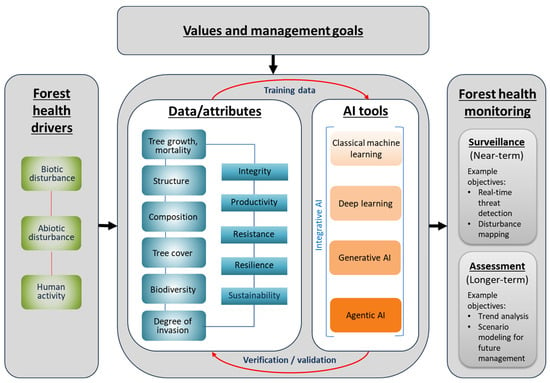
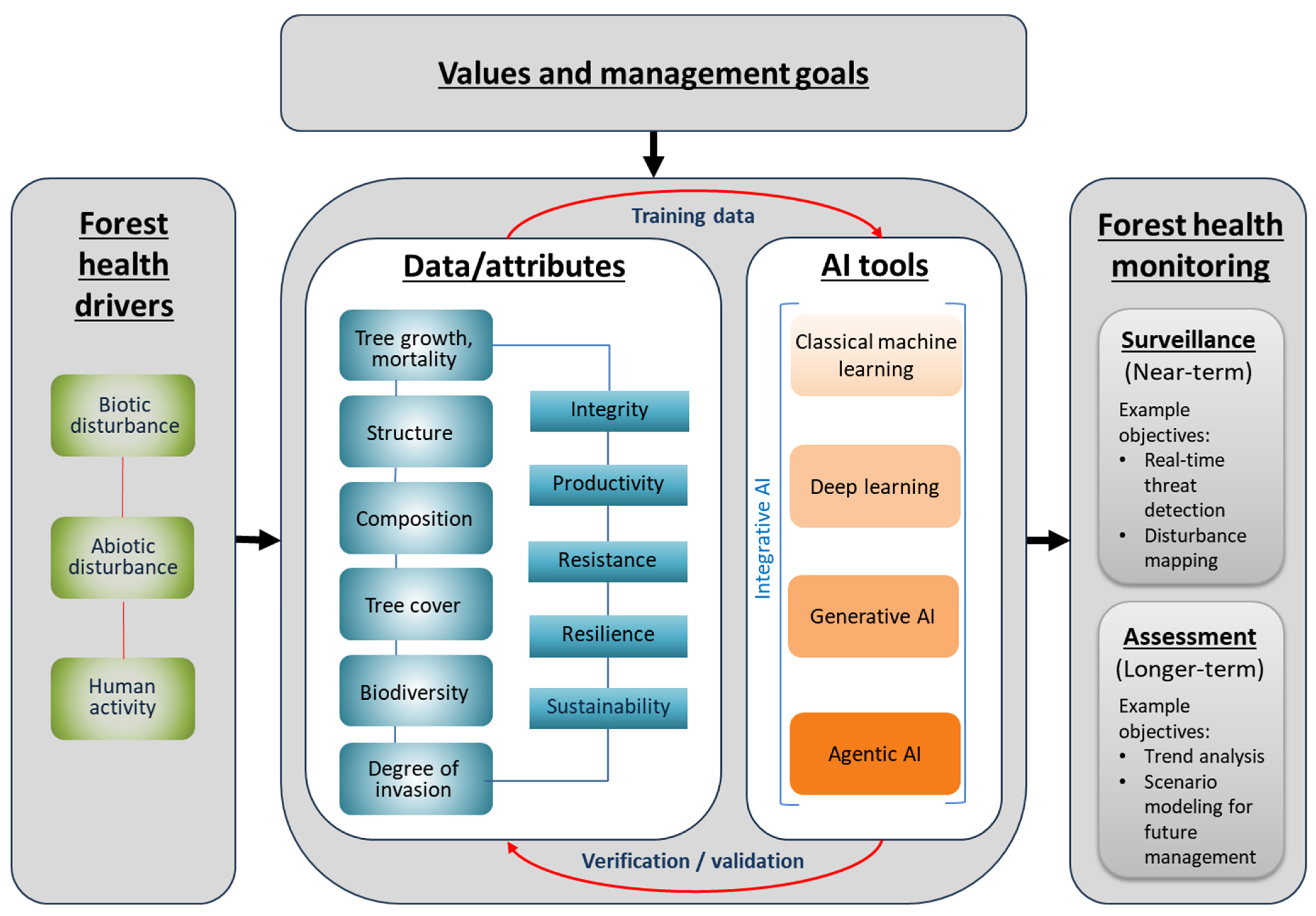
Below, we briefly describe a few categories of AI tools that are commonly used to assist real-time and near real-time forest health monitoring, i.e., surveillance. Many AI tools are already being utilized for forest health surveillance tasks. Moreover, new AI-driven tools are being developed constantly and used to process data through multi-source data fusion to create detailed maps and 3D models, among many other products. Like any other tool or model, each one has certain advantages and can perform unique functions but also has limitations. Within the context of forest health monitoring, these tools can be used to analyze and/or synthesize data collected to assess the impacts of forest health drivers; their use is informed by management goals and values (Figure 1).
Figure 1.
Potential framework for use of AI in forest health monitoring. The left-hand box shows the principal categories of forest health drivers, while the right-hand box shows what we consider the two main types of forest health monitoring activities: those related to surveillance and those related to assessment. The center-left box shows connections between essential attributes of healthy forests (e.g., resilience) and characteristics that can be measured to evaluate them, while the center-right box shows categories of AI—in ascending order of their degree of autonomy—that can be applied for forest health monitoring in the surveillance or assessment contexts (or both); these two boxes are grouped together to represent the interchange between forest health monitoring and AI. The development and improvement of AI models rely on high-quality, high-volume training data from the field or experiments. At the same time, the actual performance of these models needs to be validated and verified using the accumulated data from the field. The nature and bounds of the forest health-AI interchange are defined by human values regarding forest health as well as management objectives.
- •
- Classical Machine Learning: (1) Random Forest (RF): As a subset of classical machine learning (ML), RF is an ensemble learning algorithm widely used for classification, regression, and various other tasks. It operates by building multiple decision trees (a “forest”): in classification, it predicts the class that appears most frequently across the trees, while in regression, it calculates the average prediction across all the trees. RF can make accurate predictions while limiting overfitting to the training data. For example, Fraser and Congalton [28] used RF and multispectral Unmanned Aircraft System (UAS) imagery to classify five forest health classes with improved accuracy over high-resolution airborne imagery. RF can be applied in several ways, including mapping fire severity, evaluating the effects of environmental factors, prioritizing conservation areas, and guiding sustainable forest management strategies. (2) Support Vector Machines (SVM): Another subset of classical ML [29] that finds the optimal boundary in a multidimensional space to separate data into different classes. It has gained significant popularity since the mid-1990s because of its effectiveness in nonlinear classification, regression, and density estimation [30]. For example, in forest-health related tasks, SVMs can effectively use multispectral (MSI) or hyperspectral images (HSI) for forest cover classification, species identification, and deforestation detection [31]. Used jointly with RF, SVM analysis can reveal significant structural variation across sites (tree density, species richness, and seedling recruitment) associated with various disturbances, thus facilitating structure-based monitoring [32].
- •
- Deep Learning: (1) Convolutional Neural Networks (CNN): CNNs were specifically designed for processing visual data like images and videos. They use a series of convolutional layers (filters or kernels) applied to the input data to detect features such as edges, textures, and shapes. In forest health, CNNs can be applied to detect pests and diseases with high precision by analyzing UAV imagery to identify subtle anomalies and are particularly effective at spotting early signs of pest and disease infections; for instance, they can detect pest-induced stress through changes in leaf color and canopy structure [33]. In addition to CNN applications for satellite, aerial, or UAV RS imagery, Luo et al. [34] recently developed the CNN-based CALDS-RTDETR tool specifically for detecting instances of particular pests of interest in complex forest environments. This tool serves as an alternative to labor-intensive manual inspections that can better help pest monitoring and practical deployment. (2) Long Short-Term Memory (LSTM): LSTM systems can predict environmental stress using sensor data, offering high accuracy in forecasting various metrics related to forest health. These systems are particularly valuable for anticipating climate-induced stressors such as drought and extreme temperatures, which are becoming increasingly critical as climate change affects global forest ecosystems. By identifying vulnerable areas before the full impact of drought and associated pests and diseases is evident, this approach enables forest managers to implement preventative measures, such as irrigation and pest control. A good example is from Chen et al. [35] who successfully used a LSTM network to identify the correlation between forest pest infestation and underlying environmental factors by analyzing time-series or otherwise time-dependent data.
- •
- Generative AI (GenAI): GenAI-driven tools include large language model (LLM) chatbots (e.g., ChatGPT or Claude) and image generators (e.g., GPT Image 2, Nano Banana). They have the potential to revolutionize forest health monitoring by automating remote sensing analysis, performing real-time diagnostics, predicting species invasions such as disease and pest outbreaks, and streamlining ecological planning. These capabilities can enable transformation of raw environmental data into actionable insights, allowing foresters to act before localized issues become widespread. For example, based on Generative Adversarial Networks (GANs), Zhao et al. [36] developed an “image super-resolution” model to convert low-resolution remote sensing images to high-resolution ones. This makes it possible to detect small-scale disturbances. Another example is the UN Food and Agriculture Organization (FAO)’s Open Foris Whisp initiative, which provides automated, AI-generated summaries, i.e., standardized and easily interpretable reports regarding land use and deforestation risk (see https://www.openforis.org/whisp/) (accessed on 22 May 2026).
- •
- Agentic AI: These systems are designed to autonomously make decisions, with the ability to pursue complex goals with limited supervision. Such systems could transform forest health by shifting away from management actions based on reactive and labor-intensive manual surveys and towards adaptive management informed by continuous, autonomous monitoring. Connected, self-correcting, and goal-oriented AI agents could be implemented to autonomously synthesize satellite imagery, UAV data, and Light Detection and Ranging (LiDAR) to predict pest and disease outbreaks and wildfire risks, map deforestation, and assess forest health at various scales with minimal human intervention [5,37].
- •
- Integrative AI: Primarily this refers to the synthesis of multiple AI methods and data types into a unified system. Perhaps most commonly, this refers to a multimodal or fusion approach that employs different combinations of AI technologies (and data streams) to take advantage of and overcome limitations of individual models such as those listed above. For example, one integrative AI platform leverages the complementary strengths of four component models—RF for general classification, SVM for identifying complex patterns, CNNs for detailed pest and disease detection, and LSTM for predicting environmental stress—to offer a comprehensive, scalable solution for monitoring and managing forest health. For particular tasks (e.g., wide-scale rapid detection of tree disease symptoms), such tools enable early detection of pest and disease outbreaks, demonstrating the ability to monitor forest health in real time continuously and over large scales [38]. Integrative AI thus improves the adaptability of forest management practices and facilitates proactive responses to emerging threats. However, as pointed out in this article, integrative AI has not been applied broadly in forest health-related work. This issue was also raised by Amoah-Nuamah et al. [5], who highlighted the potential of multimodal data fusion from UAVs, LiDAR, Internet of Things (IoT) sensors, and satellite imagery in improving early detection accuracy. Ultimately, integrative AI systems could also include statistical models (both frequentist and Bayesian), mechanistic models, or simulations, thus having inferential capabilities that would not be available from ML or DL models alone. Furthermore, by facilitating the synthesis of disparate data streams and model types, integrative AI also provides a foundation for agentic AI systems that—in the near future—could perform a range of forest health monitoring tasks autonomously [39].
2.2. Specific AI Applications in Forest Health Monitoring
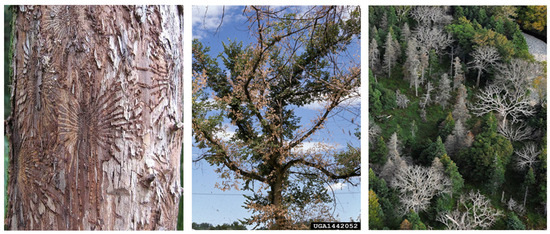
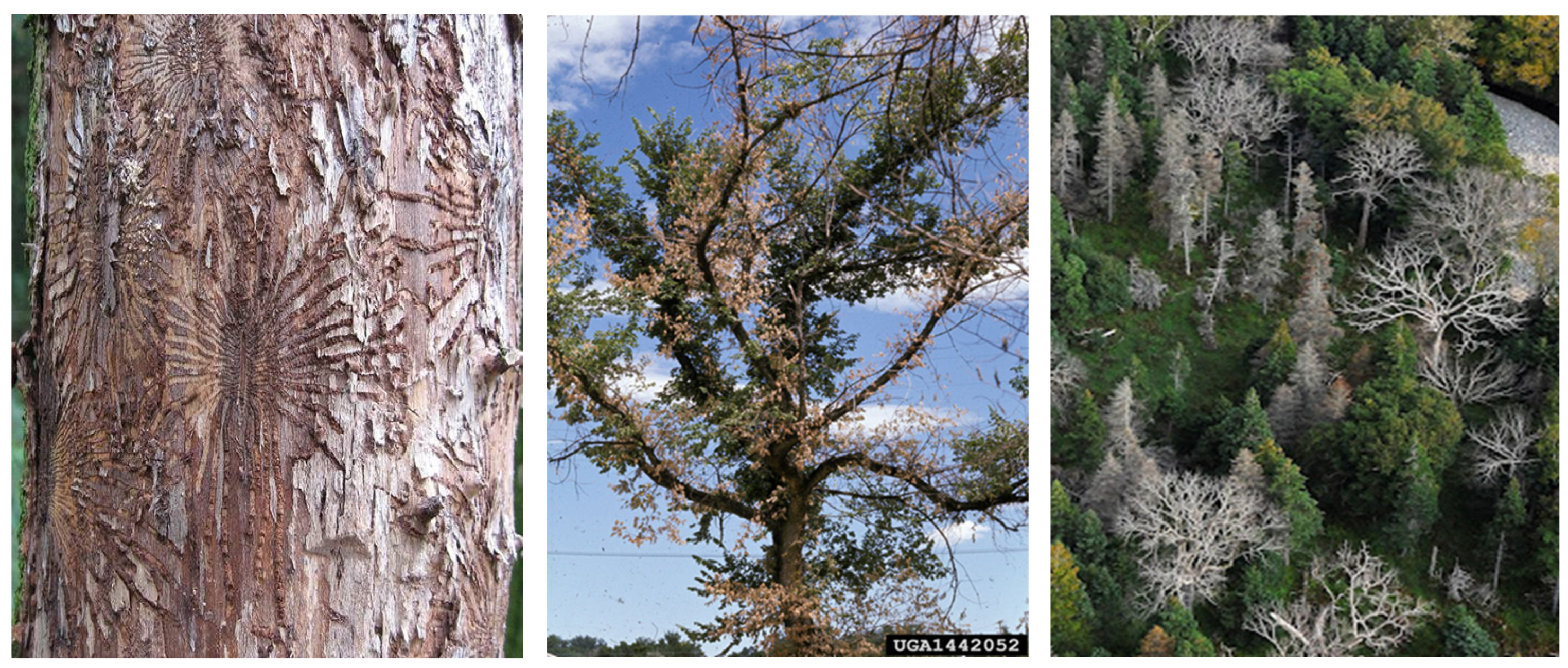
Currently, AI is increasingly used in forest health monitoring. AI tools have greatly enabled analyses of the diverse data streams that we now have at our disposal, including analyses across data streams. The primary data sources for forest health applications of AI include satellites, satellite imagery, UAVs, and in situ sensors (RGB, MSI, HSI, and LiDAR), as well as ground-based IoT sensors. To date, multispectral aerial imaging processed by the deep learning algorithms Faster R-CNN and YOLOv4 were successfully used to classify pine wilt disease (caused by the nematode Bursaphelenchus xylophilus) in a mixed species stand [40]. Similarly, HSI and MSI systems combined with machine learning demonstrate strong efficacy in detecting Dutch elm disease (DED; Figure 2) [41].
Figure 2.
An example of a hard-to-detect forest disease showing the interactive nature of Dutch elm disease (DED), which could be identified early with AI tools [41]. This disease is caused by Ophiostoma novo-ulmi, a fungal pathogen vectored by elm bark beetles (Scolytus spp.) that can spread quickly when humans move infested elm firewood, logs, or wood debris into new areas. The disease has decimated elms across the United States, Europe, and New Zealand since its introduction. It is a deadly vascular disease that clogs the tree’s water-conducting tissues (xylem), causing wilting, yellowing, and browning leaves (flagging), often leading to tree death [41]. This disease usually occurs in the unseen roots or wood, blocking water/nutrients before symptoms become apparent, so it can take a long time to detect before substantial damage is done, e.g., thinning canopies or sudden branch/trunk death (trunk photo on the left by Ronnie Nijboer; tree photo in the middle by USDA Forest Service—Rocky Mountain Region; and forest stand photo on the right from: Cape Breton © J-F Bergeron, Envirofoto: https://nsinvasives.ca/dutch-elm-disease/ (accessed on 15 December 2025). Indeed, modern AI solutions have transformed early detection methods through advanced computer vision and spectral imaging techniques. AI can analyze data from multispectral and hyperspectral cameras to assess many other biotic and physical conditions, such as chlorophyll content, water absorption patterns, and leaf nitrogen content, which are key indicators of plant stress or disease before they are visible to the human eye [42].
Below are some common forest health conditions that conventional approaches assess but for which AI may be able to facilitate more effective assessment (Figure 1):
- •
- Tree conditions (e.g., growth and mortality): A healthy forest is composed of healthy trees with a balance between tree growth and natural mortality associated with changes in tree cover. High or unusual mortality rates relative to growth can signal underlying problems like disease, insect outbreaks, nonnative plant invasions, and environmental stress (e.g., drought) [43,44,45,46]. Healthy trees often have large, dense crowns (the upper part of the tree with branches and leaves) with minimal dieback or discolored foliage. Sparse crowns or yellowing/purplish needles can indicate nutrient deficiencies or other stressors [47].
- •
- Structure and composition: Healthy forests are usually resilient to stressors and disturbances (e.g., drought, fire), productive, and sustainable [48]. The presence of young trees (seedlings and saplings) of various sizes and ages indicates that the forest can naturally regenerate and thus sustain itself over time.
- •
- Biodiversity and associated environments: This may include tree genetic diversity, species diversity, structural diversity, and underlying habitat conditions (i.e., soil, water, and air quality [49,50]).
- •
- Degree of invasion (DI): A healthy forest has low invasibility and DI. A high proportion of non-native invasive plants in a less healthy forest can outcompete native species and alter the natural ecosystem [51]. In addition to invasive plants, DI should also be assessed by the level of the presence of pests and diseases. While some level of damage is natural, widespread evidence of insect damage or disease (such as cankers, abnormal growths, or extensive bark damage) on many trees is a sign of poor health [52].
Conventionally used forest health indicators, such as species diversity and tree growth rates, can now be monitored and analyzed with greater efficiency and accuracy using AI-powered systems. AI tools can explore imagery and sensor data for the early detection of specific biotic disturbances, often before visible symptoms appear. In particular, AI advances enable more accurate recognition and identification of forest pathogens, which historically has been a weak spot for forest health monitoring [52]. AI can help us manage healthier forests by analyzing satellite imagery and other newly available data to detect hotspots of vulnerability [53]. Overall, AI uses data from diverse sources to monitor and analyze forest health indicators, providing real-time, actionable insights that enable early detection and proactive management strategies to mitigate ecological and economic impacts [38].
In the forest health monitoring context, most AI applications to date have been limited to applying ML/DL algorithms for surveillance tasks. There are still gaps in making these activities more automated and less dependent on human input, e.g., a system to continually read satellite images (or any other regular data feeds) [54]. Better analyzing forest structural changes and identifying anomalies, or even causal agents, are needed from improved AI tools [55,56]. The recent integration of RF, SVM, CNN, and LSTM models into a unified platform, i.e., integrative AI (also sometimes referred to as multimodal, holistic, fusion AI) for assessing forest health represents a significant advancement in forest health and management. For forest health issues, emerging applications of AI span decoding forest phenology in multispectral imagery to establishing early warning systems for biotic disturbances, collectively shifting forestry management paradigms from reactive responses to proactive prevention strategies [38].
A bibliometric analysis (a network analysis of keywords-based co-occurrence) conducted here shows that application remains limited among the 1340 articles published since 2000 that have broadly linked AI to forest ecology. Co-occurrences of keywords in these fields most frequently mention computing, environmental science, sensing, and computer vision, while a relatively small fraction specifically use the keywords “forest” or “forest health” (Figure S1). A wide range of keywords have been used in studies on AI and environmental science that also mention “forest” or “forest health”. Currently AI use in this field remains underdeveloped and is mostly used in the initial detection of forest health concerns. This is reflected by the low co-occurrence of concepts/terms related to ecological interpretation, narrative, integration, holism, or values. Still, the rapidly accumulating case studies plus more extensive applications of AI-driven tools anticipated in the future suggest the potential for the development of more effective and efficient forest health monitoring using AI technologies, including broad-scale forest health assessment.
With respect to the assessment topic, the current U.S. Forest Service Forest Health Monitoring (FHM) Program’s indicator-based approach recognizes that forest health is not solely determined by the presence or absence of disturbance agents and processes, but also by the ability of forests to respond and adapt to them. As such, indicators representing stressors alone are insufficient to describe status and trends in forest health. FHM’s indicator framework adopts a holistic view of forest health; that is, indicators represent a range of forest attributes as well as a range of agents and processes, encompassing both biotic factors (e.g., insects, diseases, and invasive plants), abiotic factors (e.g., extreme weather events, fire, land use changes), and interactions among these agents. To achieve the goal of holistically assessing the ability of forests to respond and adapt to stressors, a key aspect is to identify and develop representative narratives that highlight significant forest health issues at a regional (and possibly national or even continental) scale. Given the complex nature of broad-scale assessment, approaches that integrate multiple AI tools and technologies, and even non-AI tools, could be very helpful in establishing these narratives.
3. AI for Forest Protection and Management
In addition to their strong application potential for forest health monitoring, AI-powered models have broader potential in forest conservation and management. For example, AI has been used for rare species identification [57], tracking wildlife populations through camera traps, and optimizing reforestation efforts by identifying ideal planting locations and monitoring seedling growth [29]. AI can also analyze environmental data (climate, soil) to predict wildfire risks (real-time fire detection and monitoring [58]) and provide other assessments for optimizing and implementing adaptive management strategies [58,59]. Other related broad applications include the following:
- •
- AI-powered systems (e.g., using bioacoustics to detect chainsaws or analyzing satellite imagery for change detection) enhance real-time monitoring and law enforcement efforts. AI tools can be used to continuously analyze satellite and UAV imagery to detect subtle changes in forest cover caused by deforestation (e.g., due to expanding roads or illegal logging activities), providing real-time alerts to authorities (e.g., Global Forest Watch; https://www.globalforestwatch.org/ (accessed on 21 March 2026)).
- •
- Biodiversity conservation, such as analyzing data from camera traps and satellite imagery for species identification (especially new or invading species recognition) [49,60] and habitat monitoring. AI processes data from acoustic sensors (bioacoustics analysis) to identify animal calls and sounds, providing indicators of species diversity and ecosystem health [61]. Camera traps also utilize AI for efficient wildlife monitoring. LiDAR technology, processed by AI, creates detailed 3D models to measure tree height, trunk diameter (breast height diameter), canopy size, and the overall role of structural diversity in resilience, recovery, and stress resistance [48].
- •
- Monitoring forest carbon dynamics: AI models help in the accurate estimation of forest carbon stocks and the prediction of forest dynamics under climate change scenarios [62]. The use of AI with LiDAR and satellite technology allows for precise forest mapping and for detecting changes in forest health and productivity [63].
4. Limitations and Challenges
Currently, AI is rapidly evolving and gaining broad application, with new tools constantly being developed and improved. While AI can help overcome many limitations of conventional methods in forest health, in addition to the environmental costs, such as high energy consumption, and other concerns [64], it presently still has its own limitations in application that span technical and practical domains [16].
First, the application of AI in forest health monitoring is still at its early stages and current AI-driven systems still rely heavily on human involvement for design, data curation and standardization, performance evaluation, and intervention in complex cases that they cannot handle. Second, they operate based on pattern recognition in data and lack a deep, intuitive understanding of the world, common sense, and contextual awareness that humans possess. In other words, AI, as ever-evolving technology, should not be expected to tell us what we should value regarding forest health. Instead, we should set those values ourselves and have AI help us measure where things are relative to our value targets (Figure 1). Third, over time, since AI models use algorithms that have been trained on past or historical forest health data, they cannot detect new and emerging forest pathogens or diseases under conditions that differ radically from anything they have experienced previously. In other words, while AI can generate novel content, it primarily synthesizes what is currently available with many realized and unidentified data/information gaps. Similarly, models trained using regional data from one part of the world might not be effectively applied to other regions without significant re-evaluation and modification. Fourth, the performance of AI models is heavily reliant on the quantity and quality of the training data; biased, incomplete, or low-quality datasets can lead to inaccurate outputs. Subtly altered input data can yield erroneous outputs. Fifth, many advanced AI models remain “black boxes,” as their decision-making processes are complex and challenging to interpret. New efforts are now underway to develop and improve explainable artificial intelligence (XAI) to explore its applications in specific fields [65].
To better use AI to monitor forest health, we will need to overcome difficulties detecting inconspicuous diseases (e.g., wood decay, root rot) and develop large, high-quality datasets to train models and improve cross-ecological model generalization and computational efficiency. This is particularly needed in underdeveloped regions, where data are insufficient in both quality and quantity.
Although AI tools are making significant progress in species identification [50], challenges remain for species with very low detectability and/or abundance. Sometimes, different algorithms/approaches applied to different datasets could lead to different results for the same task. This is why there is much interest in harmonization (e.g., adopting common metrics/indicators) and benchmark datasets [66]. The utilization of multiple instruments (e.g., LiDAR, Terrestrial Laser Scanning, and Mobile Laser Scanning) and instrument platforms (e.g., satellites equipped with multispectral imagers, such as Sentinel-2, and UAVs) could help (up to a certain level: for example, some related plant taxa require close inspection of morphological traits—some present only in flowers or fruits during a limited part of the growing season—to establish species identity).
Finally, a timely, improved feedback loop between AI improvements and field data should always be in place. While advances in AI can greatly aid forest health monitoring, the pivotal role of conventional and improved field data collection and experiments cannot be fully replaced (except in self-supervised learning) [16]. The improvement and verification of AI models still depend on large quantities of high-quality field or observational and experimental data for ground truth and for model training [52]. Therefore, it is still crucial to collect as much field and experimental data as possible to complete the feedback loop. Also, based on the model outcome, adjusted and alternative data-collection tools and procedures may be needed to better train future AI models (Figure 1). Furthermore, forest health experts can also provide critical and specific guidance to AI models that are tasked with handling the workload. In other words, human experts must define what represents useful training data, as AI works best when operating from well-specified prompts. Indeed, developing good AI prompts might be a key area of responsibility for future forest health scientists. Ultimately, the performance of AI or integrative AI models should be evaluated in terms of detection accuracy, predictive power, and model interpretability. Thus, future efforts should focus on coordinated, improved data infrastructures to deliver interpretable results and scalable solutions for forest health monitoring.
5. Multidimensionality and Human Values
We want to emphasize the importance of establishing appropriate bounds for the application of AI in forest health monitoring. Like many topic areas in forest science and forestry, forest health has multiple dimensions involving ecological, social (human values), and economic factors. Therefore, the integrative application of AI needs to be regulated within human-defined boundaries. As we asserted earlier, we should not expect AI to tell us what to value with respect to forest health. Rather, we should decide those values for ourselves and use AI to help us measure and evaluate data about our chosen value targets. In our view, this is not a controversial proposition. In fact, it can be seen as a restatement of ideas laid out by Holzinger et al. [39] for the broader forestry sector, although the ideas transfer straightforwardly to forest health monitoring. Essentially, their proposition was this: While the Fourth Industrial Revolution has seen the widespread implementation of AI to replace and automate human effort, forestry should join other sectors in embracing the Fifth Industrial Revolution, which advances Human-Centered AI, an approach that is not intended to replace humans but instead augment them, such that AI is a collaborator in joint activities. In particular, Holzinger et al. [39], (p. 442) argued that, “human-centered AI puts humans in control of AI, aligning AI with human intelligence, social values, ethical principles, and legal requirements to ensure secure, safe, trustworthy and controllable AI [39].” We are optimistic that future AI advances for forest health monitoring will abide by this proposition.
6. Outlook
6.1. AI for Longer-Term, Larger-Scale Assessment
Application of AI technologies for medium- to long-term forest health monitoring activities—what we categorize as “forest health assessment” activities—remains limited, at least as documented in research literature. Moreover, despite the growing number of AI tools available for forest health surveillance tasks, applications over large spatial scales are also limited. In the future, greatly improved and newly developed AI tools should aim at more comprehensive, large-scale, and longer-term forest health assessments. To do this, hybrid and integrative AI models (e.g., combining CNNs with Vision Transformers and others) and the further integration of Edge AI for real-time, on-site data processing could better facilitate broader applications with greater confidence. Emerging innovations such as forest digital twins (i.e., dynamic, virtual replicas of forest ecosystems), which are already being used in forest planning [67], could facilitate simulation-based evaluation of a range of “what-if” forest health scenarios. Regardless, since not all AI tools are created equal and there is no agreed method for a systematic evaluation of how well the available AI models fare for forest health, we also urgently need benchmarking standards to assess the capacity of AI models, something similar to that being developed for remote sensing [66]. Some of the recently emerged generative AI tools, such as Large Language Models (LLMs), could help develop those representative narratives mentioned earlier. Regardless, we should take full advantage of integrative AI in analyzing long-term data (in addition to real-time monitoring) to understand long-term forest responses to stressors.
It is important to note that, at present, AI applications over large scales, especially those crossing international and landownership borders, face data-sharing issues. For example, global forest health AI applications increasingly intersect with and constantly have major challenges with data sovereignty (i.e., ownership of satellite data collected from sovereign territory), Indigenous and private land rights (e.g., AI-enabled monitoring of Indigenous forests without community consent), and international data-sharing restrictions.
6.2. From Individual Tools to Integrative AI
The evolving role of AI in forest health monitoring goes together with the rapid evolution and development of AI technology. While individual, standalone AI tools are useful and can optimize quick, isolated tasks, integrative AI platforms can offer superior practical value by improving context-awareness, consistency, and reliability [68,69,70,71]. They also allow for seamless data sharing, context retention, and automated collaboration between specialized tools. By adopting an integrative approach, one could eliminate the friction of switching between multiple platforms, ensure uniform output quality, and leverage enhanced data security across all functions [72,73]. For this reason, we strongly recommend using integrative AI whenever possible for sustainable, large-scale, and more efficient monitoring and accurate assessment.
In short, although the deployment of AI in forest health monitoring is still in the early stages and the applications remain underdeveloped, integrative AI’s ability to process large datasets quickly will revolutionize forest management, shifting it from a reactive to a proactive, predictive approach. It offers forest managers real-time information and thus optimizes resource allocation for actionable strategies and effective decision-making.
7. Conclusions
By leveraging machine learning models, remote sensing, and other emerging technologies, new and improved AI tools can deliver accurate, real-time, and scalable solutions to the challenges of modern forest conservation. The evolution and integration of AI into forest health monitoring provide an efficient, cost-effective, and accurate solution for tracking and assessing changes in forested areas over time and at broad scales. In addition to commonly adopted AI for short-term and small-scale surveillance, new and improved AI-driven tools are urgently needed for longer-term and larger-scale monitoring and assessment. Given the high complexity associated with forest health and the advantages and limitations of individual AI tools, we strongly urge the use of a holistic approach based on integrative AI in the future. Such evolving roles of AI include paradigm shifts from post-event reporting to real-time alerts, and from expert experience to human–machine collaborative decision-making. At the same time, it is important to stress the fundamental guiding principle that human values should drive this evolution. Future human-centered AI research should also aim at breakthroughs in explainable AI, digital twin systems, and interdisciplinary collaborations. Evolving and constantly improving integrative AI tools with enhancement from platforms or data sources such as iNaturalist, Pl@ntNet, eBird/Merlin [74] can provide robust and scalable data-driven solutions that enable a shift from reactive to proactive forest management strategies, ultimately improving forest resilience and supporting conservation goals.
Supplementary Materials
The following supporting information can be downloaded at: https://www.mdpi.com/article/10.3390/f17060700/s1.
Author Contributions
Conceptualization, Q.G., F.H.K.; writing—original draft preparation, Q.G. with extensive input from F.H.K.; writing—review and editing, Q.G., F.H.K., K.M.P., K.P., S.L.-H., E.R.M.. All authors have read and agreed to the published version of the manuscript.
Funding
This work was supported by USDA Forest Service; K.P. and S.L.-H. were supported by challenge cost-share agreement 23-CS-11330180-068 between North Carolina State University and USDA Forest Service, Southern Research Station.
Data Availability Statement
No new data were used in this work.
Acknowledgments
Any use of trade, firm, or product names is for descriptive purposes only and does not imply endorsement by the U.S. Government.
Conflicts of Interest
The authors declare no conflicts of interest.
Abbreviations
The following abbreviations are used in this manuscript:
| AI | Artificial Intelligence |
| BERT | Bidirectional Encoder Representations from Transformers |
| CNN | Convolutional Neural Network |
| DED | Dutch elm disease |
| DL | Deep Learning |
| FIA | Forest Inventory and Analysis |
| GAN | Generative Adversarial Network |
| GIS | Geographic Information System |
| GPT | Generative Pre-trained Transformer |
| HSI | Hyperspectral Imagery |
| IoT | The Internet of Things |
| LiDAR | Light Detection and Ranging |
| LLM | Large Language Model |
| LSTM | Long Short-Term Memory |
| ML | Machine Learning |
| MSI | Multispectral Imagery |
| RGB | Red, Green, and Blue |
| RNN | Recurrent Neural Network |
| RF | Random Forest |
| RS | Remote Sensing |
| RT-DETR | Real-Time Detection Transformer |
| SVM | Support Vector Machine |
| UAS | Unmanned Aircraft Systems |
| UAV | Unmanned Aerial Vehicle |
| XAI | Explainable Artificial Intelligence |
| YOLO | You Only Look Once |
References
- Woodall, C.W.; Amacher, M.C.; Bechtold, W.A.; Coulston, J.W.; Jovan, S.; Perry, C.H.; Randolph, K.C.; Schulz, B.K.; Smith, G.C.; Tkacz, B. Status and future of the forest health indicators program of the USA. Environ. Monit. Assess. 2011, 177, 419–436. [Google Scholar] [CrossRef] [Scilit]
- Haq, S.M.; Waheed, M.; Khoja, A.A.; Amjad, M.S.; Bussmann, R.W.; Ali, K.; Jones, D.A. Measuring forest health at stand level: A multi-indicator evaluation for use in adaptive management and policy. Ecol. Indic. 2023, 150, 110225. [Google Scholar] [CrossRef] [Scilit]
- Pandit, K.; Lim-Hing, S. (Eds.) Forest Health Monitoring: National Status, Trends, and Analysis 2024; U.S. Department of Agriculture, Forest Service: Washington, DC, USA, 2026; Volume Gen. Tech. Rep. WO-109.
- Yan, J.; Lou, B.; He, X. Forest ecosystem health assessment: Frameworks, challenges, and strategies for the future. Ecosyst. Health Sustain. 2025, 11, 0414. [Google Scholar] [CrossRef] [Scilit]
- Amoah-Nuamah, J.; Child, B.; Okyere, E.Y.; Adams, O.; Danquah, J.A. Applications of artificial intelligence in forest health surveillance and management. Discov. For. 2025, 1, 56. [Google Scholar] [CrossRef] [Scilit]
- Potter, K.M.; Pandit, K.; Conkling, B.L. Introduction. In Forest Health Monitoring: National Status, Trends, and Analysis; Pandit, K., Conkling, B., Eds.; US Department of Agriculture, Forest Service: Washington, DC, USA, 2024; Volume Gen. Tech. Rep. WO-105, pp. 5–21. [Google Scholar]
- Kolb, T.; Wagner, M.; Covington, W.W. Concepts of forest health: Utilitarian and ecosystem perspectives. J. For. 1994, 92, 10–15. [Google Scholar] [CrossRef] [Scilit]
- Raffa, K.F.; Aukema, B.; Bentz, B.J.; Carroll, A.; Erbilgin, N.; Herms, D.A.; Hicke, J.A.; Hofstetter, R.W.; Katovich, S.; Lindgren, B.S. A literal use of “forest health” safeguards against misuse and misapplication. J. For. 2009, 107, 276–277. [Google Scholar] [CrossRef] [Scilit]
- Riitters, K.; Tkacz, B. The US forest health monitoring program. In Environmental Monitoring; CRC Press: Boca Raton, FL, USA, 2004; pp. 669–683. [Google Scholar]
- Crockett, E.T.; Guo, Q.; Atkins, J.W.; Sun, G.; Potter, K.M.; Costanza, J.K.; Ollinger, S.V.; Woodall, C.W.; McNulty, S.; Trettin, C. Influences of Structural and Species Diversity on Forest Resistance to Drought. Ecol. Lett. 2026, 29, e70351. [Google Scholar] [CrossRef] [Scilit] [PubMed]
- Gál-Babicz, Á.; Cseke, K.; Pintér, B.; Bordács, S. Forest Genetic Monitoring: A Global Review on Methods, Results and Consequences of Genetic Studies and Long-Term Monitoring Projects. Forests 2026, 17, 165. [Google Scholar] [CrossRef] [Scilit]
- Wadoux, A.M.C. Artificial intelligence in soil science. Eur. J. Soil Sci. 2025, 76, e70080. [Google Scholar] [CrossRef] [Scilit]
- Ye, Z.; Yang, J.; Zhong, N.; Tu, X.; Jia, J.; Wang, J. Tackling environmental challenges in pollution controls using artificial intelligence: A review. Sci. Total Environ. 2020, 699, 134279. [Google Scholar] [CrossRef] [Scilit] [PubMed]
- Conservation and Sustainable Management of Temperate and Boreal Forests Group. Criteria and Indicators for the Conservation and Sustainable Management of Temperate and Boreal Forests: The Montreal Process; Conservation and Sustainable Management of Temperate and Boreal Forests Group: Geneva, Switzerland, 1995. [Google Scholar]
- Potter, K.M.; Canavin, J.C.; Koch, F.H. A forest health retrospective: National and regional results from 20 years of Insect and Disease Survey data. In Forest Health Monitoring: National Status, Trends, and Analysis; Potter, K.M., Conkling, B.L., Eds.; US Department of Agriculture, Forest Service: Asheville, NC, USA, 2020; Volume Gen. Tech. Rep. SRS-250, pp. 125–149. [Google Scholar]
- Xu; Jiang, D. AI-Powered Plant Science: Transforming Forestry Monitoring, Disease Prediction, and Climate Adaptation. Plants 2025, 14, 1626. [Google Scholar] [CrossRef] [Scilit] [PubMed]
- Torres, P.; Rodes-Blanco, M.; Viana-Soto, A.; Nieto, H.; García, M. The role of remote sensing for the assessment and monitoring of forest health: A systematic evidence synthesis. Forests 2021, 12, 1134. [Google Scholar] [CrossRef] [Scilit]
- Lausch, A.; Erasmi, S.; King, D.J.; Magdon, P.; Heurich, M. Understanding forest health with remote sensing-part I—A review of spectral traits, processes and remote-sensing characteristics. Remote Sens. 2016, 8, 1029. [Google Scholar] [CrossRef] [Scilit]
- Yuan, Q.; Zou, S.; Wang, H.; Luo, W.; Zheng, X.; Liu, L.; Meng, Z. A lightweight pine wilt disease detection method based on vision transformer-enhanced YOLO. Forests 2024, 15, 1050. [Google Scholar] [CrossRef] [Scilit]
- Joshi, H.; Rani, M.; Kumar, K. Geospatial and ground-based techniques in forest monitoring: Present perspective, challenges, and future aspects. In Advanced Geospatial and Ground Based Techniques in Forest Monitoring; Elsevier: Amsterdam, The Netherlands, 2026; pp. 345–364. [Google Scholar]
- Burton, P.J.; Jentsch, A.; Walker, L.R. The ecology of disturbance interactions. Bioscience 2020, 70, 854–870. [Google Scholar] [CrossRef] [Scilit]
- Canelles, Q.; Aquilué, N.; James, P.M.; Lawler, J.; Brotons, L. Global review on interactions between insect pests and other forest disturbances. Landsc. Ecol. 2021, 36, 945–972. [Google Scholar] [CrossRef] [Scilit]
- Pang, Y.; Shang, H.; Ren, X.; Liu, M.; Wang, M.; Li, G.; Chen, G.; Wang, Y.; Wang, H. Temporal and spatial characteristics of forest pests in China and their association with large-scale circulation indices. Environ. Entomol. 2024, 53, 1051–1061. [Google Scholar] [CrossRef] [Scilit]
- Oosthuizen, R.M. The fourth industrial revolution–smart technology, artificial intelligence, robotics and algorithms: Industrial psychologists in future workplaces. Front. Artif. Intell. 2022, 5, 913168. [Google Scholar] [CrossRef] [Scilit]
- Datcu, M.; Daschiel, H.; Pelizzari, A.; Quartulli, M.; Galoppo, A.; Colapicchioni, A.; Pastori, M.; Seidel, K.; Marchetti, P.G.; d’Elia, S. Information mining in remote sensing image archives: System concepts. Ieee T Geosci. Remote 2003, 41, 2923–2936. [Google Scholar] [CrossRef] [Scilit]
- Huang, H.; Wang, P.; Pei, J.; Wang, J.; Alexanian, S.; Niyato, D. Deep learning advancements in anomaly detection: A comprehensive survey. IEEE Internet Things J. 2025, 12, 44318–44342. [Google Scholar] [CrossRef] [Scilit]
- Nikravan, M.; Kashani, M.H.; Abkenar, S.B. Anomaly Detection with Artificial Intelligence. In Handbook of AI-Driven Threat Detection and Prevention; CRC Press: Boca Raton, FL, USA, 2025; pp. 59–78. [Google Scholar]
- Fraser, B.T.; Congalton, R.G. Monitoring fine-scale forest health using unmanned aerial systems (UAS) multispectral models. Remote Sens. 2021, 13, 4873. [Google Scholar] [CrossRef] [Scilit]
- Estrada, J.S.; Fuentes, A.; Reszka, P.; Auat Cheein, F. Machine learning assisted remote forestry health assessment: A comprehensive state of the art review. Front. Plant Sci. 2023, 14, 1139232. [Google Scholar] [CrossRef] [Scilit] [PubMed]
- Chowdhury, M.S. Comparison of accuracy and reliability of random forest, support vector machine, artificial neural network and maximum likelihood method in land use/cover classification of urban setting. Environ. Chall. 2024, 14, 100800. [Google Scholar] [CrossRef] [Scilit]
- Maurya, N.K.; Pandey, M.K. Application of machine learning in forest monitoring: Recent progress and future challenges. In Advanced Geospatial and Ground Based Techniques in Forest Monitoring; Elsevier: Amsterdam, The Netherlands, 2026; pp. 273–299. [Google Scholar]
- Khan, R.W.A.; Shaheen, H.; Islam Dar, M.E.U.; Habib, T.; Manzoor, M.; Gillani, S.W.; Al-Andal, A.; Ayoola, J.O.; Waheed, M. A data-driven approach to forest health assessment through multivariate analysis and machine learning techniques. BMC Plant Biol. 2025, 25, 915. [Google Scholar] [CrossRef] [Scilit]
- Bai, L.; Huang, X.; Dashzebeg, G.; Ariunaa, M.; Yin, S.; Bao, Y.; Bao, G.; Tong, S.; Dorjsuren, A.; Davaadorj, E. Erannis jacobsoni disturbance detection based on unmanned aerial vehicle red edge spectral features. Front. Plant Sci. 2025, 16, 1619695. [Google Scholar] [CrossRef] [Scilit]
- Luo, W.; Zhang, H.; Xu, L. CALDS-RTDETR: A robust forestry pest detection model for small targets in complex environments. Comput. Electron. Agric. 2026, 244, 111482. [Google Scholar] [CrossRef] [Scilit]
- Chen, C.-J.; Li, Y.-S.; Tai, C.-Y.; Chen, Y.-C.; Huang, Y.-M. Pest incidence forecasting based on internet of things and long short-term memory network. Appl. Soft Comput. 2022, 124, 108895. [Google Scholar] [CrossRef] [Scilit]
- Zhao, Y.; Zhang, S.; Hu, J. Forest single-frame remote sensing image super-resolution using GANs. Forests 2023, 14, 2188. [Google Scholar] [CrossRef] [Scilit]
- Pati, A.K. Agentic AI: A comprehensive survey of technologies, applications, and societal implications. IEEE Access 2025, 13, 151824–151837. [Google Scholar] [CrossRef] [Scilit]
- Ye, W.; Lao, J.; Liu, Y.; Chang, C.-C.; Zhang, Z.; Li, H.; Zhou, H. Pine pest detection using remote sensing satellite images combined with a multi-scale attention-UNet model. Ecol. Inform. 2022, 72, 101906. [Google Scholar] [CrossRef] [Scilit]
- Holzinger, A.; Schweier, J.; Gollob, C.; Nothdurft, A.; Hasenauer, H.; Kirisits, T.; Häggström, C.; Visser, R.; Cavalli, R.; Spinelli, R. From industry 5.0 to forestry 5.0: Bridging the gap with human-centered artificial intelligence. Curr. For. Rep. 2024, 10, 442–455. [Google Scholar] [CrossRef] [Scilit]
- Yu, R.; Luo, Y.; Zhou, Q.; Zhang, X.; Wu, D.; Ren, L. Early detection of pine wilt disease using deep learning algorithms and UAV-based multispectral imagery. For. Ecol. Manag. 2021, 497, 119493. [Google Scholar] [CrossRef] [Scilit]
- Wei, X.; Zhang, J.; Conrad, A.O.; Flower, C.E.; Pinchot, C.C.; Hayes-Plazolles, N.; Chen, Z.; Song, Z.; Fei, S.; Jin, J. Machine learning-based spectral and spatial analysis of hyper-and multi-spectral leaf images for Dutch elm disease detection and resistance screening. Artif. Intell. Agric. 2023, 10, 26–34. [Google Scholar] [CrossRef] [Scilit]
- Wei, S.; Cheng, S.T. An artificial intelligence approach for identifying efficient urban forest indicators on ecosystem service assessment. Front. Environ. Sci. 2022, 10, 994389. [Google Scholar] [CrossRef] [Scilit]
- Guo, Q.; Fei, S.; Potter, K.M.; Liebhold, A.M.; Wen, J. Tree diversity regulates forest pest invasion. Proc. Natl. Acad. Sci. USA 2019, 116, 7382–7386. [Google Scholar] [CrossRef] [Scilit] [PubMed]
- Guo, Q.; Potter, K.M.; Ren, H.; Zhang, P. Impacts of exotic pests on forest ecosystems: An update. Forests 2023, 14, 605. [Google Scholar] [CrossRef] [Scilit]
- Mahanta, D.K.; Bhoi, T.K.; Komal, J.; Samal, I.; Mastinu, A. Spatial, spectral and temporal insights: Harnessing high-resolution satellite remote sensing and artificial intelligence for early monitoring of wood boring pests in forests. Plant Stress 2024, 11, 100381. [Google Scholar] [CrossRef] [Scilit]
- Mahanta, D.K.; Bhoi, T.K.; Samal, I.; Komal, J. Mapping the research landscape on forest insects: Bibliometric approach from 2010 to 2024. Discov. For. 2025, 1, 5. [Google Scholar] [CrossRef] [Scilit]
- Ecke, S.; Stehr, F.; Frey, J.; Tiede, D.; Dempewolf, J.; Klemmt, H.-J.; Endres, E.; Seifert, T. Towards operational UAV-based forest health monitoring: Species identification and crown condition assessment by means of deep learning. Comput. Electron. Agric. 2024, 219, 108785. [Google Scholar] [CrossRef] [Scilit]
- Crockett, E.T.; Atkins, J.W.; Guo, Q.; Sun, G.; Potter, K.M.; Ollinger, S.; Silva, C.A.; Tang, H.; Woodall, C.W.; Holgerson, J. Structural and species diversity explain aboveground carbon storage in forests across the United States: Evidence from GEDI and forest inventory data. Remote Sens. Environ. 2023, 295, 113703. [Google Scholar] [CrossRef] [Scilit]
- Fricker, G.A.; Ventura, J.D.; Wolf, J.A.; North, M.P.; Davis, F.W.; Franklin, J. A convolutional neural network classifier identifies tree species in mixed-conifer forest from hyperspectral imagery. Remote Sens. 2019, 11, 2326. [Google Scholar] [CrossRef] [Scilit]
- Liu, Y.; Zhao, Q.; Wang, X.; Sheng, Y.; Tian, W.; Ren, Y. A tree species classification model based on improved YOLOv7 for shelterbelts. Front. Plant Sci. 2024, 14, 1265025. [Google Scholar] [CrossRef] [Scilit]
- Potter, K.M.; Iannone, B.V., III; Riitters, K.H.; Guo, Q.; Pandit, K.; Oswalt, C.M. United States forests are increasingly invaded by problematic non-native plants. For. Ecol. Manag. 2026, 599, 123281. [Google Scholar] [CrossRef] [Scilit]
- Hessenauer, P. Artificial Intelligence in Forest Pathology: Opportunities and Challenges. Forests 2025, 16, 1714. [Google Scholar] [CrossRef] [Scilit]
- Leidemer, T.; Lopez Caceres, M.L.; Diez, Y.; Ferracini, C.; Tsou, C.-Y.; Katahira, M. Evaluation of Temporal Trends in Forest Health Status Using Precise Remote Sensing. Drones 2025, 9, 337. [Google Scholar] [CrossRef] [Scilit]
- Wang, Y.; Zhang, W.; Gao, R.; Jin, Z.; Wang, X. Recent advances in the application of deep learning methods to forestry. Wood Sci. Technol. 2021, 55, 1171–1202. [Google Scholar] [CrossRef] [Scilit]
- Buchelt, A.; Adrowitzer, A.; Kieseberg, P.; Gollob, C.; Nothdurft, A.; Eresheim, S.; Tschiatschek, S.; Stampfer, K.; Holzinger, A. Exploring artificial intelligence for applications of drones in forest ecology and management. For. Ecol. Manag. 2024, 551, 121530. [Google Scholar] [CrossRef] [Scilit]
- Wang, T.; Zuo, Y.; Manda, T.; Hwarari, D.; Yang, L. Harnessing artificial intelligence, machine learning and deep learning for sustainable forestry management and conservation: Transformative potential and future perspectives. Plants 2025, 14, 998. [Google Scholar] [CrossRef] [Scilit] [PubMed]
- Cui, Z.; Li, X.; Li, T.; Li, M. Improvement and assessment of convolutional neural network for tree species identification based on bark characteristics. Forests 2023, 14, 1292. [Google Scholar] [CrossRef] [Scilit]
- Yang, Z.; Ren, W.; Liu, S.; Wei, H. Artificial intelligence in forest management and tree health protection. In Forest Microbiology; Elsevier: Amsterdam, The Netherland, 2025; pp. 433–446. [Google Scholar]
- Kalita, A.J.; Deka, J.; Devi, C.; Kalita, P. Importance of AI-Tech in Managing a Protected Area: Considering Forest Health Dynamics. In Artificial Intelligence and Animal Ecology; Ghosh, L., De, A., Eds.; CRC Press: Boca Raton, FL, USA, 2025; pp. 193–220. [Google Scholar]
- Lu, Y.; Li, J.; Zhao, Z.; Zhang, Y.; Tong, Y.; Teng, B.; Liu, N.; Shaw, J.J.; Bai, M. Accelerating the discovery of biodiversity by detecting “new” species based on machine learning method. Res. Sq. 2024. [Google Scholar] [CrossRef] [Scilit]
- Lesmeister, D.B.; Ruff, Z.; Duarte, A.; Kohlberg, A.B.; Levi, T.; Sullivan, C.M. PNW-Cnet: An evolving convolutional neural network to support broad-scale passive acoustic monitoring. Ecol. Inform. 2026, 94, 103657. [Google Scholar] [CrossRef] [Scilit]
- Akinbiola, S.; Akinsola, J.E.T.; Ajagbe, S.A.; Salami, A.; Olubaju, A.; Awotoye, O.; Awoleye, O.M. Artificial intelligence technique for prediction of carbon stocks and uncertainty estimates in tropical forests. SN Comput. Sci. 2025, 6, 342. [Google Scholar] [CrossRef] [Scilit]
- Nitoslawski, S.A.; Wong-Stevens, K.; Steenberg, J.W.; Witherspoon, K.; Nesbitt, L.; Konijnendijk Van Den Bosch, C. The digital forest: Mapping a decade of knowledge on technological applications for forest ecosystems. Earth’s Future 2021, 9, e2021EF002123. [Google Scholar] [CrossRef] [Scilit]
- Norman, K.E.; Boettiger, C.; Poisot, T.; Jones, G.M. The role of AI in ecology’s computational carbon footprint. Front. Ecol. Environ. 2025, e70021. [Google Scholar] [CrossRef] [Scilit]
- Love, P.E.; Fang, W.; Matthews, J.; Porter, S.; Luo, H.; Ding, L. Explainable artificial intelligence (XAI): Precepts, models, and opportunities for research in construction. Adv. Eng. Inform. 2023, 57, 102024. [Google Scholar] [CrossRef] [Scilit]
- Lines, E.R.; Allen, M.; Cabo, C.; Calders, K.; Debus, A.; Grieve, S.W.; Miltiadou, M.; Noach, A.; Owen, H.J.; Puliti, S. AI applications in forest monitoring need remote sensing benchmark datasets. In Proceedings of the 2022 IEEE International Conference on Big Data (Big Data), Osaka, Japan, 17–20 December 2022; pp. 4528–4533. [Google Scholar]
- Qiu, H.; Zhang, H.; Lei, K.; Zhang, H.; Hu, X. Forest digital twin: A new tool for forest management practices based on Spatio-Temporal Data, 3D simulation Engine, and intelligent interactive environment. Comput. Electron. Agric. 2023, 215, 108416. [Google Scholar] [CrossRef] [Scilit]
- Reichstein, M.; Benson, V.; Blunk, J.; Camps-Valls, G.; Creutzig, F.; Fearnley, C.J.; Han, B.; Kornhuber, K.; Rahaman, N.; Schölkopf, B. Early warning of complex climate risk with integrated artificial intelligence. Nat. Commun. 2025, 16, 2564. [Google Scholar] [CrossRef] [Scilit] [PubMed]
- Wang, G.G.; Lu, D.; Gao, T.; Zhang, J.; Sun, Y.; Teng, D.; Yu, F.; Zhu, J. Climate-smart forestry: An AI-enabled sustainable forest management solution for climate change adaptation and mitigation. J. For. Res. 2024, 36, 7. [Google Scholar] [CrossRef] [Scilit]
- Damaševičius, R.; Maskeliūnas, R. Enhancing smart forestry through AI-driven knowledge management: A synergistic approach to efficiency and sustainability. J. Sustain. For. 2025, 44, 1–31. [Google Scholar] [CrossRef] [Scilit]
- Liu, H.; Shu, L.; Liu, X.; Cheng, P.; Wang, M.; Huang, Y. Advancements in artificial intelligence applications for forest fire prediction. Forests 2025, 16, 704. [Google Scholar] [CrossRef] [Scilit]
- Höök, C.; Mendoza-Trejo, O.; Häggström, C.; Lindroos, O. A data integration methodology for combining visual representations and operations data for applications in forestry. Int. J. For. Eng. 2026, 37, 55–66. [Google Scholar] [CrossRef] [Scilit]
- Kumari, P.; Lavania, P.; Dobriyal, M.; Srivastav, M.; Kumar, P. Artificial intelligence and forest management. In Advanced Geospatial and Ground Based Techniques in Forest Monitoring; Elsevier: Amsterdam, The Netherlands, 2026; pp. 255–272. [Google Scholar]
- Soacha-Godoy, K.; López-Borrull, A.; Serrano, F.; Piera, J. The Backbone of Participatory Science: Reframing Citizen Observatories as Research Infrastructures. Sustainability 2025, 17, 4608. [Google Scholar] [CrossRef] [Scilit]
Disclaimer/Publisher’s Note: The statements, opinions and data contained in all publications are solely those of the individual author(s) and contributor(s) and not of MDPI and/or the editor(s). MDPI and/or the editor(s) disclaim responsibility for any injury to people or property resulting from any ideas, methods, instructions or products referred to in the content. |
© 2026 by the authors. Licensee MDPI, Basel, Switzerland. This article is an open access article distributed under the terms and conditions of the Creative Commons Attribution (CC BY) license.