


Abstract
The unprecedented 2022 wildfire season in Navarra, northern Spain, marked a turning point in regional wildfire management, when seven simultaneous large fires during a June heatwave burned more than 17,000 ha in just a few days, overwhelming suppression capacity and highlighting the limits of a strategy based primarily on ignition prevention and fire suppression. In this study, we implemented a stochastic wildfire modeling system based on the Minimum Travel Time algorithm, historical ignition patterns, spatial fuel data, and spatiotemporal weather variability to assess community and protected area exposure to wildfire. We simulated more than 50,000 fire season replicates under extreme fire weather conditions, estimating annual burn probability across fire intensity classes at 50 m spatial resolution. We then intersected modeled fire perimeters with building footprints representing residential and industrial structures, as well as protected areas, to assess the spatial distribution of exposure across the region. Results showed strong concentration of community exposure, with three fourths of residential and industrial exposure concentrated in just over one third of the total municipal area. Across Navarra, mean annual modeled exposure summed to 120 residential buildings and 16 industrial structures. Across the protected area network, mean annual burned area summed to 90 ha year−1, including 68 ha year−1 at flame lengths greater than 2.5 m, while burned forest area was 16 ha year−1. Protected areas in southern Navarra and forested protected areas in central and northern Navarra showed the highest modeled exposure, identifying priority landscapes where prevention, restoration, and evaluation of managed fire options could support more resilient ecosystems. This study provides a scientific basis for improving wildfire risk governance and strengthening the resilience of communities and protected areas under increasing wildfire pressure in the region.
1. Introduction
Wildfire activity in southern Europe has heightened concern over the exposure of human and ecological assets to large, high-severity fire events [1,2,3]. Across Europe, a relatively small proportion of fires accounts for most of the total area burned, and Spain is among the countries most affected by large wildfires [4,5,6]. In Navarra, this pattern became especially evident during the 2022 fire season, when a June heatwave coincided with seven simultaneous large wildfires that burned more than 17,000 ha within a few days. The event overwhelmed regional suppression and emergency response capacity. Of the 20 fires from Navarra notified to the National Emergency Center in 2022, 19 required state resources, and 4 of the largest June fires required deployment of the Military Emergency Unit [7]. The same episode led to the evacuation of at least 2590 people. Together, these impacts exposed the limitations of a wildfire management strategy centered primarily on ignition prevention and fire suppression. In this sense, the 2022 season marked a turning point for wildfire management in Navarra by underscoring the need to complement suppression capacity with landscape-scale prevention, strategic fuel management, and community adaptation to future extreme wildfire events.
The increasing likelihood of extreme wildfire in Mediterranean regions of southern Europe is linked to both climatic and landscape drivers [8,9]. Prolonged drought, low fuel moisture, and strong wind events create favorable conditions for rapid fire growth, long-distance spread, crown fire activity, and spotting [10,11]. At the same time, rural depopulation, reduced grazing, agricultural abandonment, limited forest management, and long-term fire exclusion have increased fuel loads and both horizontal and vertical fuel continuity across much of the landscape [12,13]. As a result, former agricultural and pastoral mosaics that once constrained fire spread have progressively transitioned toward more continuous and hazardous fuel configurations [14,15]. Although open valleys and southern agricultural plains remain actively managed, including widespread conversion to irrigated agriculture, foothills and mountain slopes have experienced substantial fuel accumulation associated with the abandonment of marginal agricultural lands [16,17]. Together, these changes favor a fire regime increasingly driven by extreme weather, with a greater likelihood of large wildfires that exceed suppression capacity, spread over long distances, and increase exposure of communities and protected areas [18,19,20].
Reducing the impacts of extreme wildfire requires a shift from reactive emergency response to proactive risk management [21]. Current wildfire science emphasizes three complementary strategies: creating fire-resilient landscapes, fostering fire-adapted communities, and maintaining safe and effective suppression operations [22,23,24]. Within this framework, fuel treatments in strategic locations and around populated areas are a primary measure for moderating wildfire spread and reducing extreme fire behavior [25,26,27]. However, preventive resources are limited, and treatments must be prioritized where they are most likely to reduce exposure of valued resources and assets [28,29,30,31]. In practice, regional fuel treatment programs often emphasize treatment prescriptions and implementation costs while giving less attention to the need to aggregate treatments at sufficient scale and intensity in high-priority areas to effectively reduce risk. Addressing this challenge requires spatially explicit information on where large wildfires are most likely to occur, how they are likely to spread under adverse fire weather conditions, and which communities and protected areas are most exposed [32].
Stochastic wildfire simulation provides an effective framework for predicting spatial patterns of wildfire likelihood, intensity, and exposure [33,34,35,36,37]. Fire spread models have been widely used to estimate burn probability, characterize expected fire behavior, and evaluate wildfire exposure across large landscapes [38,39,40]. By integrating ignition probability, fuels, topography, and representative fire weather scenarios, these models generate large numbers of plausible fire events and support probabilistic inference on wildfire likelihood and intensity [41,42]. In operational settings, simulation outputs can be used to identify areas where fire behavior is likely to exceed suppression capacity, evaluate the spatial effectiveness of fuel treatments, and prioritize mitigation actions for communities and ecological resources [43,44]. This approach is particularly relevant in Mediterranean regions, where most ignitions are human-caused and fire regimes vary strongly along climatic and topographic gradients [45,46,47,48,49].
In this study, we implemented a regional stochastic wildfire modeling system for Navarra to assess exposure of communities and protected areas to large wildfires under representative extreme fire weather conditions. Despite the need for regional-scale probabilistic assessments that capture potential fire spread and fire intensity patterns, no previous study has addressed wildfire exposure at this scale in Navarra. Earlier applications of stochastic wildfire modeling in the region have been limited to smaller study areas [50,51]. Specifically, we combined historical ignition patterns, spatial fuel and canopy data, topography, and pyrome-specific weather scenarios within a batch fire spread modeling framework to estimate annual burn probability across fire intensity classes at fine spatial resolution. We then intersected simulated fire footprints with residential and industrial structures, forested areas, and protected area designations to identify spatial patterns of exposure across the region. The objectives of this study were to (i) estimate the regional distribution of annual burn probability and high-intensity fire potential; (ii) characterize exposure of community assets and forested areas to simulated wildfire; and (iii) evaluate exposure of protected areas and their forested lands across Navarra. Finally, we discuss how these results can inform ongoing risk mitigation programs and help identify priority areas where prevention and mitigation efforts may provide the greatest benefit for wildfire risk governance in Navarra.
2. Materials and Methods
2.1. Study Area
The study area comprises Navarra, located in northern Spain (Figure 1). Navarra spans a pronounced environmental gradient over a relatively small area of 10,391 km2, from the Pyrenean mountains in the north and northeast to the Ebro basin in the south. Climate conditions range from oceanic in the north to Mediterranean and semi-arid in the south, with mountain conditions occurring in the Pyrenean sectors along the border with France. Elevation and topography vary substantially across the region, creating strong spatial contrasts in vegetation, fuel structure, and potential fire behavior. As a result, Navarra includes a broad range of land covers and fuel types, from humid forested landscapes in the north to drier agricultural and shrub-dominated areas in the south. These environmental gradients are mirrored by marked variation in settlement patterns.
Figure 1.
Protected areas classified by IUCN category (a) and municipal boundaries, forest land, and large fire perimeters (>100 ha) recorded during 1986–2024 in Navarra (10,391 km2), northern Spain (b).
Main urban centers, including Pamplona and its metropolitan area, together with Tudela, Estella, and Tafalla, collectively account for more than 60% of the population of Navarra. Outside of this urban core, settlement patterns are more dispersed, with small rural communities predominating in the northern and northwestern pre-Pyrenean mountains and larger settlements concentrated in the southern lowlands and along the main north–south transportation corridors. Together, these biophysical and settlement patterns strongly influence the occurrence and spread of predominantly human-caused wildfires across the region.
Wildfire ignitions in Navarra are predominantly human-caused, with lightning ignitions accounting for only 1.8% of total ignitions and 2.7% of total burned area in the 1984–2024 historical fire record. The largest burned areas are concentrated in the central mountainous sectors, whereas the northern part of the region is characterized by recurrent small pastoral fires [52]. The 2022 fire season was exceptional, with more than 17,000 ha burned and eight fires exceeding 250 ha. The largest events included the Arguedas fire on 19 June, which burned 2060 ha, the Legarda fire on 19 June, which burned 6248 ha, and the Gallipienzo fire on 20 June, which burned 6599 ha. These fires exhibited rapid growth, extreme behavior, and head-fire spread distances exceeding 10 km.
2.2. Fire Weather Conditions
To represent spatial variation in fire weather conditions across Navarra, the study area was divided into 20 pyromes (Appendix A). Pyrome delineation was based on physiographic, administrative, fire history, and landscape information, including watershed boundaries (n = 6313; mean area = 165 ha), the main river network, municipal and local administrative boundaries, climate, and historical large fire perimeters from 1986 to 2024. Pyromes were produced by progressively aggregating the watersheds into units of approximately 50,000 ha based on similarities across these variables and informed by expert knowledge from wildfire managers in the regional forest service. Outer boundaries were defined by major watershed divides or mountain ranges, large rivers, and administrative boundaries (Figure A1).
For each pyrome, the wildfire season was defined as the set of dates accounting for most of the burned area (>80% of the total burned area) based on 1986–2024 historical fire records (Table A1). The automatic weather station selected for each pyrome was the one with the longest record and valid hourly observations for at least 85% of the time series. When no station was available within the pyrome, stations located in neighboring regions with comparable physiographic and climatic conditions were used (Table A2). Hourly records of wind direction, wind speed, temperature, solar radiation, precipitation, and fuel moisture variables were compiled from the selected stations.
Extreme fire weather scenarios used to model large fire spread were derived separately for each pyrome from the meteorological conditions observed during its wildfire season. Only records between 10:00 and 18:00 were used for wind characterization, as this interval represents the period of most active fire spread. Wind direction was summarized as the observed frequency of eight direction classes (45°, 90°, 135°, 180°, 225°, 270°, 315°, and 360°), and each direction class was assigned its corresponding 97th percentile wind speed (Table A3). Thus, wind direction was sampled according to observed wildfire season frequencies, whereas wind speed represented extreme active spread conditions within each direction class.
Fuel moisture scenarios were derived from the distribution of the Energy Release Component for fuel model G (ERC-G) for each pyrome. Fire Family Plus was used to estimate dead and live fuel moisture contents from the selected automatic weather station records [53,54]. Three ERC-G percentile scenarios were retained: the 70th, 85th, and 97th percentiles. Each scenario included separate fuel moisture values for 1 h, 10 h, and 100 h dead fuels and for live herbaceous and live woody fuels (Table A4). These scenarios were later sampled probabilistically during fire spread simulation, as described in Section 2.4 and Appendix D.
2.3. Landscape Fuels and Topography
The landscape file used for fire simulation was assembled at 50 m resolution from spatial fuel, canopy, and topographic layers. Surface fuels were first mapped by classifying vegetation according to shrub and forest height and composition, as described in Appendix B. Standard fuel models were then assigned to each vegetation type following Scott and Burgan [55], accounting for mean fuel height or depth, forest type (coniferous or broadleaved), climate zone (humid, Mediterranean, or semi-arid), and fire severity in areas affected by fires larger than 100 ha during the 2016–2024 period. Fire severity was classified into moderate- and high-severity classes to account for post-disturbance changes that occurred after the LiDAR acquisition used to characterize vegetation.
Canopy metrics were estimated at 50 m resolution by applying existing models based on 2016 LiDAR ALS data from the National Plan for Aerial Orography (PNOA) survey [56]. These models used LiDAR-derived metrics to estimate canopy cover (%), tree height (m), canopy base height (m), and canopy bulk density (kg m−3) [57,58,59]. These metrics were subsequently adjusted in areas affected by moderate- and high-severity large fires. Topographic variables required for fire simulation, including slope, aspect, and elevation, were also derived. Finally, the fuel model, topographic, and canopy metric rasters were assembled into a multiband GeoTIFF landscape file at 50 m resolution within a 6 km buffer around the administrative boundary of Navarra. This extended domain improved model calibration and allowed the simulation of incoming fires originating beyond the study area limits.
2.4. Wildfire Modeling
Wildfire spread was simulated using the Minimum Travel Time (MTT) algorithm [60], implemented in the command-line version FConstMTT [61]. FConstMTT allows fire modeling conditions to be randomly sampled from observed probabilistic scenarios combining wind speed, wind direction, fuel moisture content, and fire duration, while ignition locations are distributed across the landscape using a spatially explicit ignition probability grid. The MTT algorithm models two-dimensional fire growth by identifying the set of pathways with minimum travel time from cell corners at a user-defined spatial resolution. Fire spread is then calculated using Rothermel’s surface fire spread model, and fireline intensity is converted to flame length using Byram’s equation [62,63]. FConstMTT has been widely used in fire-prone regions to model wildfire spread and behavior across large landscapes and to assess wildfire exposure and risk to valued resources and assets [64,65].
The IP grid was generated at 50 m resolution using a logit occurrence model previously developed for central Navarra, with model performance of AUC = 0.772 and overall accuracy = 71% [51]. In this model, ignition probability is estimated as a function of distance to settlements, distance to power lines, population density, distance to railways, distance to roads, and land use. The resulting ignition probability surface showed the highest values near the road network and the most densely populated settlements, and it was used to distribute seed ignitions across the landscape. Because this ignition probability model was originally developed for central Navarra, we evaluated its regional transferability before applying it to the full simulation domain. The results of this external assessment, based on temporal and spatial holdout ignition datasets and random background points, are provided in Appendix C.
Simulations were performed at 50 m spatial resolution and organized by macroareas or pyroregions. Each macroarea was composed of one or several neighboring pyromes with similar fuels, topography, fire size distributions, and mean annual burned area. Fire-spread modeling was conducted independently for each macroarea, and the number of modeled years and simulated ignitions varied among macroareas to obtain spatially continuous and stable burn probability surfaces. Details on the macroarea structure, number of simulated ignitions, modeled years, historical annual burned area, and calibrated fire-spread durations are provided in Appendix D.
Ignitions were sampled from the ignition probability grid within each macroarea. For each simulated fire, fuel moisture conditions were randomly selected from the pyrome-specific ERC-G percentile scenarios, with 60% of fires assigned to the 97th percentile scenario, 30% to the 85th percentile scenario, and 10% to the 70th percentile scenario. Wind direction was sampled from the observed wildfire season frequency distribution for each pyrome, and wind speed was assigned as the 97th percentile value corresponding to the sampled wind direction. This configuration was designed to represent active fire spread conditions associated with large fire growth in Navarra rather than the full distribution of daily fire weather conditions.
Fire spread duration was calibrated independently for each macroarea to reproduce the historical fire size distribution and mean annual burned area derived from 38 years of fire records. Calibration was evaluated by comparing observed and modeled fire size distributions using fixed fire size classes, as reported in Appendix D. Annual burn probability layers were produced independently for each macroarea using macroarea-specific denominators and then assembled into the final regional mosaic.
Three burn probability metrics were derived from the simulations for each pixel i. Fireline intensity was first converted to flame length as
where FL is flame length (m) and I is fireline intensity (kW m−1) [62]. Annual burn probability was then calculated as the proportion of modeled fire seasons in which pixel i burned under a given flame length threshold,
where is the annual burn probability for pixel i under flame length threshold in macroarea m, is the number of modeled years in which pixel i burned with flame length greater than , and is the macroarea-specific number of modeled years. The flame length thresholds were defined as . For , corresponds to annual burn probability. For , it corresponds to annual medium- and high-intensity burn probability. For , it corresponds to annual high-intensity burn probability. Thus, the three metrics quantify the expected annual likelihood of burning at increasing intensity levels, and, by definition,
2.5. Community Assets and Protected Areas
For the community-level analysis, spatial data included vector polygons representing the administrative boundaries of municipalities and other supramunicipal units without permanent settlements, including Bardenas Reales and Urbasa y Andía, across the entire territory of Navarra (10,391 km2; n = 342; mean area about 3000 ha). Built assets were obtained from the Spanish National Topographic Database and included residential buildings (n = 228,005) and industrial structures (n = 21,987). The 2016 LiDAR data were used to build the fire simulation landscape file, whereas the 2024 LiDAR data were used to map current forest cover for exposure analysis. Forested areas within each administrative unit were delineated using a 25 m normalized digital surface model of vegetation height derived from the 2024 PNOA LiDAR dataset [66]. Areas with vegetation height greater than 3 m were classified as forested. These datasets were used to estimate exposure of built assets and forest land and to aggregate results at the municipal level.
For protected areas, spatial data consisted of vector polygons representing protected natural areas in Navarra (n = 172; mean area 540 ha). The dataset included Strict Nature Reserves, Natural Parks, Nature Reserves, Natural Enclaves, Protected Landscapes, Recreational Natural Areas, and their Peripheral Protection Zones and was compiled in accordance with the current regional legal framework governing protected areas in Navarra, including associated Natura 2000 sites. For each protected area, the analysis included the protected area code, name, type, and management category according to the IUCN classification system, with Peripheral Protection Zones assigned to Category VI. Forested areas within protected areas were delineated using the same 25 m normalized digital surface model of vegetation height, and areas with vegetation height greater than 3 m were classified as forested. These data were used to quantify wildfire exposure across the protected area network and its forested component.
2.6. Exposure Analysis
Wildfire exposure was assessed by intersecting simulated fire perimeters with community assets and protected areas across the study area. Exposure describes the spatial coincidence of values at risk with simulated fire footprints, but it does not quantify fire damage or loss [67]. All exposure metrics were calculated from the macroarea-specific annualized simulation outputs. Burned area, burned forest area, and estimated exposed structures were first averaged over the modeled years within each macroarea and then assembled or summed across macroareas to obtain regional and administrative unit summaries. This avoided pooling simulations under a single regional denominator and ensured that macroareas contributed according to their calibrated burned area regime rather than according to the raw number of simulated ignitions. Hereafter, all quantities expressed in year−1 refer to mean annual modeled values derived from the macroarea-specific annualized simulations.
For communities, exposure was quantified as the mean annual number of exposed residential buildings and industrial structures within each municipality using structure centroids derived from the Spanish National Topographic Database [68]. For a given spatial unit , annual exposure of structures was calculated as
where is the mean annual number of exposed structures of class in community , is the number of macroareas intersecting unit , is the macroarea-specific number of modeled years in macroarea , and is the number of centroids of structure class intersected by simulated fire perimeters in unit , macroarea , and modeled year . Structure class corresponds to residential buildings or industrial structures. Forest exposure within each community unit was quantified as mean annual burned forest area and calculated as
where is the mean annual burned forest area in community , with and as defined above, and is the forested area burned in unit , macroarea , and modeled year . Forested area was defined as vegetation taller than 3 m and mapped at 25 m resolution using a 2024 LiDAR-derived digital surface model [66].
For protected areas, exposure was quantified as mean annual burned area for the total protected area and for its forested component. To account for fire intensity, burned area was also calculated for flame length thresholds of 1.5 m and 2.5 m. For a protected area , annual burned area was calculated as
where is the mean annual burned area in protected area under flame length threshold , is the number of macroareas intersecting protected area , is the macroarea-specific number of modeled years, and is the area burned in protected area , macroarea , and modeled year with flame length exceeding threshold , using the same flame length thresholds defined above. The term refers to a burned area where simulated flame length was greater than ; therefore, the condition is included in the threshold-specific burned area variables. Burned forested area within protected areas was calculated analogously as
where is the mean annual burned forest area in protected area under flame length threshold , with and as defined above, and is the forested area burned in protected area , macroarea , and modeled year with flame length exceeding threshold . The term refers to burned forest area where simulated flame length was greater than ; therefore, the condition is included in the threshold-specific burned forest area variables. Exposure metrics were annualized within each macroarea using macroarea-specific denominators and then summarized separately for communities and protected areas.
3. Results
3.1. Burn Probabilities and High-Intensity Fire Potential
Burn probability exhibited complex spatial patterns across Navarra as a result of the interaction among ignition source areas, fire weather conditions, and the simulated distributions of fire size and frequency (Figure 2a). The highest values were concentrated in central–eastern Navarra, where complex terrain, fuel accumulation, and severe fire weather conditions favored the occurrence and spread of large fires, consistent with the distribution of observed large fire perimeters (Figure 1). Within this area, some recently burned zones showed lower burn probability because reduced fuel loads limited subsequent fire spread, particularly in the core of the central burned areas where modeled fires showed limited penetration. In southern Navarra, extensive irrigated agricultural lands substantially constrained fire spread, whereas higher burn probability values were concentrated in adjacent rainfed agricultural areas. Additional high-probability patches occurred in northern sectors, particularly on slopes and higher-elevation pastoral areas, where shrub-dominated fuels and high ignition frequency along mountain ridges produced locally elevated burn probability. The lowest burn probability values were found in the northeastern Pyrenees, where fire frequency is low and large fires are rare.
Figure 2.
Modeled maps of annual burn probability (a) and the percentage of burn occurrences with flame length below 2.5 m (b) across Navarra. Annual burn probability showed clear hotspots in central Navarra, whereas the highest proportions of lower-intensity burning occurred in the northern and Pyrenean sectors.
The conditional fire intensity metric identifies where, given that a pixel burned, simulated fire more often remained below the 2.5 m flame length threshold; higher values indicate a greater proportion of lower-intensity burning, whereas lower values indicate a greater tendency toward high-intensity fire (Figure 2b). This pattern was especially evident in timber litter fuels and grasslands of the northern sectors, where comparable burn probability levels were associated with lower modeled fire intensity. In contrast, complex terrain produced sharp local transitions in high-intensity burn probability, reflecting the interactions among slope, aspect, and fire spread direction. These contrasts were most evident between areas burned under head fire conditions and adjacent locations where flanking and backing fire produced substantially lower intensity. Similar sharp transitions were also associated with abrupt changes in fuel conditions, particularly along boundaries between grasslands and highly hazardous shrublands, where high-intensity burn probability increased markedly.
3.2. Community Exposure to Wildfire
Exposure of residential structures to simulated wildfire was highly uneven across Navarra (Appendix E; Figure 3a). The mean annual number of exposed residential buildings summed to 120 structures yr−1, with values ranging from 0 to 4.7 structures yr−1 among administrative units. The highest residential exposure occurred in municipalities located in fire-prone sectors of central, central–eastern, and northwestern Navarra, including Valle de Yerri in the west–central region, Baztan in the northwest, Cizur in the central Pamplona corridor, Ultzama in the north–central sector, and Ujué and Tafalla in the central–eastern and south–central sectors, respectively. Additional high values were observed in San Martín de Unx and Galar. In contrast, the lowest residential exposure values were concentrated in the northeastern Pyrenees and other low-fire-activity sectors, including municipalities such as Garde and Urzainqui. High residential exposure did not necessarily occur in the municipalities with the largest building inventories. For example, major urban municipalities such as Pamplona and Tudela contained much larger numbers of residential structures than many of the most exposed municipalities, yet their modeled annual exposure was lower. This pattern indicates that residential exposure was driven more strongly by the spatial interaction between settlement location and modeled fire transmission than by structure abundance alone. Residential exposure was strongly concentrated across administrative units: 68 municipalities accounted for 75% of the modeled annualized exposure of residential buildings while covering 37% of the total municipal area and containing 37% of the regional residential building stock. This indicates that modeled residential exposure was not simply proportional to either municipal area or the number of residential buildings (Figure 4a).
Figure 3.
Wildfire exposure of (a) residential structures, (b) industrial structures, and (c) forest land across Navarra. See Table A8 for community-level exposure data for structures and forest land.
Figure 4.
Cumulative modeled annualized wildfire exposure and structure counts for (a) residential buildings and (b) industrial structures across municipalities in Navarra. Municipalities are ranked by decreasing wildfire exposure per unit area. The black line represents cumulative exposure, and the gray line represents cumulative structure counts. The curves distinguish concentration of exposure, municipal area, and structure inventory, showing that exposure is more spatially concentrated than either area or asset abundance alone.
A similar pattern was observed for industrial structures, although overall values were lower (Appendix E; Figure 3b). The mean annual number of exposed industrial structures summed to 15.74 structures yr−1, with values ranging from 0 to 0.63 structures yr−1. The highest industrial exposure occurred in municipalities distributed across central and south–central Navarra, including Tafalla, Artajona, Leoz, Cizur, and Ujué, together with north–central municipalities such as Ultzama and west–central units such as Valle de Yerri. Elevated values were also observed in Barásoain and Caparroso. The lowest industrial exposure values were concentrated in the northeastern Pyrenees and other low-fire-activity sectors, including Urzainqui, Uztárroz, Esparza de Salazar, and Garde. As with residential exposure, municipalities with the largest industrial building inventories did not necessarily show the highest modeled exposure. For example, Tudela and other municipalities with large industrial inventories ranked below several smaller municipalities embedded within landscapes characterized by higher burn probability and stronger simulated fire transmission. Industrial exposure showed a similar administrative concentration: 56 municipalities accounted for 75% of the modeled annualized exposure of industrial structures while covering 35.8% of the total municipal area and containing 50.6% of the industrial structure stock. As with residential exposure, municipalities with the largest industrial inventories were not necessarily those with the highest modeled wildfire exposure (Figure 4b).
Exposure of forest land, expressed as mean annual burned forest area, also showed strong spatial concentration (Appendix E; Figure 3c). Across Navarra, mean annual burned forest area summed to 235 ha yr−1. The highest values were found in municipalities of the central–eastern and northwestern mountain landscapes, including Ujué, Leoz, and Olóriz in the central-eastern sector and Baztan, Ultzama, Basaburua, Goizueta, and Esteribar in the northern and northwestern sectors. Additional high values occurred in west–central municipalities such as Valle de Yerri and Cirauqui. In contrast, the lowest forest exposure values were generally associated with densely urbanized municipalities and southern agricultural landscapes, where limited forest cover and strong landscape discontinuities constrained modeled fire spread. Overall, the municipal pattern of forest exposure was consistent with the regional burn probability patterns, with the highest values concentrated in mountainous areas with greater fuel continuity and recurrent large fire transmission (Figure 3c).
3.3. Protected Area Exposure to Wildfire
Wildfire exposure across the protected area network was highly uneven and concentrated in a limited number of large units and protected area types (Appendix F; Table 1). Across all protected areas, mean annual burned area summed to 90 ha yr−1 after counting overlapping protected area polygons only once. Of this total, 81 ha yr−1 occurred at flame lengths greater than 1.5 m and 68 ha yr−1 at flame lengths greater than 2.5 m. At the type level, Natural Parks accounted for the largest share of total exposure, with 56 ha yr−1, followed by Protected Landscapes, with 29 ha yr−1. Peripheral Protection Zones and Nature Reserves contributed substantially lower totals, whereas Natural Enclaves, Recreational Natural Areas, and Strict Nature Reserves showed very limited annual burned area. This pattern indicates that total protected area exposure was dominated by a small number of extensive units embedded within landscapes of high burn probability and recurrent large fire transmission.
Table 1.
Summary of modeled wildfire exposure by protected area type in Navarra. Values are summed across all units within each protected area type and include total mean annual burned area, burned area at flame lengths greater than 1.5 m and 2.5 m, and the corresponding burned forest area metrics. Abbreviations: aBA = mean annual burned area; aBFA = mean annual burned forest area. In the Total row, overlapping areas among protected area types were counted only once to avoid double-counting exposure across the regional protected area network.
At the unit level, the highest total exposure occurred in Bardenas Reales, located in southern Navarra, with 50 ha yr−1 burned on average (Figure 5). This value was markedly higher than for any other protected area and was also associated with very high modeled fire intensity, with 49 ha yr−1 burned at flame lengths greater than 1.5 m and 45 ha yr−1 at flame lengths greater than 2.5 m. The second highest total exposure was observed in Montes de Valdorba, a Protected Landscape in central–eastern Navarra, with 16.23 ha yr−1, followed by Robledales de Ultzama y Basaburua in north–central Navarra, with 12.26 ha yr−1, and Sierras de Urbasa y Andía in west–central Navarra, with 5 ha yr−1. Additional units with comparatively elevated exposure included surroundings of Laguna de Pitillas, Monte del Conde, and Vedado de Eguaras, although values dropped sharply below those of the four most exposed areas. In contrast, the lowest exposure values were found in small reserves, recreational natural areas, and peripheral units located in the northeastern Pyrenees and in low-fire-activity riparian or wetland environments.
Figure 5.
Scatterplot of mean annual burned area versus mean annual burned forest area at flame lengths greater than 2.5 m for protected areas in Navarra. Bubble color indicates IUCN category, and bubble size represents the area of protected areas. See Table A9 for protected area exposure data for total and forested area across different fire intensity classes.
Exposure of forested land within protected areas followed a different pattern from that observed for total burned area (Figure 5). Across the protected area network, mean annual burned forest area summed to 16 ha yr−1 after counting overlapping protected area polygons only once, including 11 ha yr−1 at flame lengths greater than 1.5 m and 7 ha yr−1 at flame lengths greater than 2.5 m. In this case, Protected Landscapes accounted for the largest share of forest exposure, with 13 ha yr−1, clearly exceeding Natural Parks (2.1 ha yr−1) and Nature Reserves (1.7 ha yr−1). The highest burned forest area occurred in Montes de Valdorba, with 7 ha yr−1, followed by Robledales de Ultzama y Basaburua, with 4.92 ha yr−1, and Sierras de Urbasa y Andía, with 0.96 ha year−1. Although Bardenas Reales dominated total protected area exposure, its burned forest area was comparatively low (0.8 ha yr−1), reflecting the predominance of open dryland vegetation rather than extensive tree cover. High-intensity burned forest area was concentrated in the same wooded units, particularly Montes de Valdorba, which also showed the highest values for forest area burned at flame lengths greater than 1.5 m and 2.5 m. Overall, the protected areas with the highest total burned area were not necessarily those with the highest burned forest area. This contrast was especially evident between Bardenas Reales, which dominated total exposure, and Montes de Valdorba and Robledales de Ultzama y Basaburua, which dominated exposure of forested land. The results therefore show that total protected area exposure and forest exposure were only partially coincident across the network and that fire intensity adds an important dimension for distinguishing protected areas exposed primarily to extensive burning from those exposed to higher-severity impacts on forest ecosystems.
4. Discussion
This study provides the first regional-scale assessment of wildfire exposure to communities and protected areas throughout Navarra, Spain. By integrating pyrome-specific fire weather conditions, historical ignition patterns, spatial fuels, and topography within a fire modeling framework, the analysis captured strong spatial variability in wildfire likelihood, expected fire intensity, and structure exposure across the region. This represents an important advance over historical event-based assessments, as simulations can predict potential burn patterns, fire intensity, and exposure in areas where future fires may differ from the limited historical record [39,45,46]. While empirical assessments of wildfire activity rely on smoothed maps of spatial patterns of historical ignitions, simulations provide fine-scale burn probability and intensity maps that can be used to identify where communities, forest land, and protected areas are more likely to be affected by large fire events, thereby accounting for transmission pathways that are not captured by ignition location alone [36,50,69]. The Navarra case study demonstrates the integration of regional fire history data, spatial fuels, weather scenarios, and asset layers to support risk-based prioritization of community protection, protected area management, and landscape-scale fuel treatments.
Although this study focused on the province of Navarra, the modeling framework is relevant to other fire-prone regions globally where extreme fire weather, fuel accumulation, land use change, and expanding wildland–urban interfaces are all contributing to a rapid increase in wildfire impacts to a wide range of human and ecological values [70]. We used a pyrome framework to stratify Navarra into homogeneous zones with respect to fire regime across a highly heterogeneous region. Pyromes with the highest burned area and strongest concentration of large fire activity are the locations where simulation outputs are likely to be most useful for treatment design, contingency planning, and evaluation of landscape interventions. In this sense, the study provides not only exposure estimates but also a spatial framework for future scenario analysis and management testing.
We found that the highest wildfire exposure in Navarra is strongly concentrated in central–eastern sectors where complex terrain, fuel accumulation, and severe fire weather conditions contribute to higher burn probability. In contrast, simulation outputs predicted relatively low burn probability in the northeastern Pyrenees and in the extensive irrigated agricultural areas to the south. These spatial patterns were consistent with the historical distribution of large fire perimeters and highlight the combined influence of ignition sources, fire weather, landscape configuration, and post-fire fuel conditions on modeled fire transmission. The concentration of burn probability and high-intensity burn probability in a limited fraction of the territory suggests that regional prevention efforts are likely to be most effective when directed to specific zones rather than distributed evenly across the landscape [71]. As suggested in several other studies, burn probability hotspots can identify priorities where strategic fuel treatments and other mitigation actions are most likely to reduce wildfire exposure and transmission [43,44,71,72,73].
For residential and industrial structures, the results indicate that wildfire exposure is concentrated in a relatively small portion of Navarra. Three fourths of modeled residential and industrial exposure was concentrated in 68 and 56 municipalities, respectively, covering about 37% and 36% of the total municipal area. Both residential and industrial exposure were higher in municipalities located in central, central–eastern, north–central, and northwestern Navarra and lower in the northeastern Pyrenees. Predicted exposure did not always coincide with municipalities with the largest numbers of structures (Table A8). Large urban centers such as Pamplona and Tudela have a higher number of buildings than other municipalities with higher overall exposure, a finding that underscores the importance of building arrangement and density in relation to wildland fuels [74,75]. Prior work to understand and classify WUIs based on their permeability to fire has led to WUI archetypes and the finding of particular densities that optimize wildfire exposure to buildings [76].
Our results are broadly consistent with the planning logic of INFONA 2022, Navarra’s civil protection emergency plan for forest fires, which uses relatively coarse municipal-scale risk and vulnerability zoning to determine where municipal wildfire action plans are mandatory or recommended [77]. These plans define local preparedness, emergency organization, evacuation procedures, interface area identification, and available suppression resources. Agreement between the two approaches is strongest in municipalities where buildings are intermixed with fuels in higher burn probability areas, whereas discrepancies were most apparent in higher-density, larger municipalities with lower predicted exposure. Wildfire protection planning in Navarra can benefit from future work to integrate information from wildfire simulation into INFONA and thus potentially refine territorial civil protection zoning and local planning using predicted fire events to prioritize fuel treatments and other protection investments.
Our results can also inform the Government of Navarra’s Subregional Forest Plans (PFCs), which define forest management guidelines and planning priorities across broader forest-management regions. The PFCs are organized into separate reference documents for the Cantabrian, Pyrenean, and Middle Zone–Ribera subregions. In this context, our fine-scale maps of burn probability and fire intensity exposure can help identify where forest management could be prioritized within each planning region to reduce impacts to forest resources. For instance, simulation outputs predicted higher burn probability and intensity in central–eastern and northwestern mountain landscapes corresponding to the Middle Zone subregion. Similarly, the results can also inform fire management to conserve protected areas where we observed substantial variability among the different parcels and protected-area types. Total exposure was dominated by Natural Parks and, at the unit level, by Bardenas Reales, which substantially exceeded all other protected areas in mean annual burned area, and in burned area at moderate and high intensity. However, the pattern changed when only forested land was considered, with burned forest area concentrated mainly in protected landscapes, such as Montes de Valdorba. This contrast shows that total protected area exposure and forest exposure were only partially coincident, highlighting the need to separate total burned area from burned forest area, especially in dryland protected areas with limited tree cover. Fire intensity adds an important dimension because high-intensity burned forest area identifies wooded protected areas where fire may produce substantial structural effects, while lower-intensity burning may contribute to vegetation renewal and fuel regulation in Mediterranean fire-adapted systems [78]. Thus, burn probability and fire intensity outputs can identify candidate areas for restoration-oriented fuel management or managed fire evaluation, but any fire reintroduction would require local assessment of conservation status, ecosystem-specific effects, and appropriate burn magnitude, seasonality, and recurrence [79,80,81].
We recognize several limitations in the application of wildfire simulation models and the underlying uncertainty in the outputs [82,83,84]. Although simulated fire events were calibrated to reproduce observed fire size distributions and mean annual burned area by macroarea, the resulting annual burn probabilities and exposure estimates should be interpreted as model-based decision support estimates rather than independently validated predictions. The outputs are conditioned on the historical fire occurrence record, the transferred ignition probability surface, the fuel and canopy layers, the pyrome-specific fire weather and fuel moisture scenarios, and the calibration assumptions used for each macroarea. In addition, fuels and canopy attributes were derived from LiDAR and subsequently adjusted for recent disturbances, which means that exposure estimates remain dependent on the quality and temporal accuracy of those inputs [85]. Fuel conditions and canopy structure will continue to change in the region in response to wildfires, land use change, vegetation growth, and forest management [86]. Therefore, continued application of the modeling framework will require periodic updates, preferably at intervals shorter than 10 years or after major disturbance events. Despite these limitations, the outputs provide useful spatially explicit information to support wildfire management decisions at multiple scales within Navarra.
5. Conclusions
This study contributes to improving wildfire management in Navarra by using wildfire simulation modeling to map potential wildfire exposure, thereby providing a basis for transitioning from a reactive response to risk-informed prevention. Overall, the approach provides a scalable decision support framework for prioritizing mitigation, preparedness, and landscape planning under increasing wildfire pressure in Navarra. Future work can use these simulation outputs for strategic fuel treatment design and project prioritization in Navarra [87]. Fire simulations can be refined for local areas and used to test alternative landscape treatment configurations by simulating fuel management on the ground and re-simulating large numbers of wildfire scenarios. Likewise, ongoing fuel management activities in Navarra can use the existing simulation outputs to examine the extent to which predicted fire events will intersect with treated areas, thereby potentially improving the scheduling and prioritization of strategic management areas and fuel breaks across the region [88].
Author Contributions
Conceptualization, F.A., A.A., C.M., and M.R.; methodology, F.A. and A.A.; software, A.A.; model calibration and evaluation, F.A.; formal analysis, F.A., J.L., and I.P.; resources, P.G. and I.G.; data curation, P.G., I.G., J.L., and I.P.; writing—original draft preparation, F.A.; writing—review and editing, A.A. and P.G.; visualization, J.L. and I.P.; project administration, F.A.; funding acquisition, F.A., C.M., and M.R. All authors have read and agreed to the published version of the manuscript.
Funding
This research was funded by the ANDIA 2023 Senior Talent Attraction call, Grant No. 0011-3947-2022-000001, funded by the Government of Navarra, and by LIFE-IP NAdapta-CC, Grant No. LIFE16 IPC/ES/000001, funded by the European Commission.
Data Availability Statement
Stochastic wildfire modeling probabilistic risk estimates can be downloaded at https://zenodo.org/records/14615748 (Accessed on 11 November 2025.). Exposure to communities can be downloaded at https://zenodo.org/records/17495885 (Accessed on 11 November 2025). Exposure to protected areas can be downloaded at https://zenodo.org/records/17583829 (Accessed on 11 November 2025.).
Acknowledgments
The authors thank Stuart Brittain, of Alturas Solutions, for adapting the FConstMTT wildfire simulator, developed by the Missoula Fire Sciences Laboratory of the USDA Forest Service, for use in this study. The simulator is available at Missoula Fire Lab Command Line Applications: https://www.alturassolutions.com/FB/FB_API.htm. The authors also thank MeteoNavarra for providing complete hourly records from the automatic weather station network in Navarra and the Department of Rural Development and Environment of the Government of Navarra for providing the regional fire reports and ignition records used in this study.
Conflicts of Interest
The authors declare no conflicts of interest.
Abbreviations
The following abbreviations are used in this manuscript:
| IUCN | International Union for Conservation of Nature |
| MTT | Minimum Travel Time |
| LiDAR | Light Detection and Ranging |
| ERC | Energy Release Component |
| I | Fireline intensity |
| FL | Flame length |
| E | Exposed structures |
| aBP | Annual burn probability |
| aBA | Annual burned area |
| aBFA | Annual burned forest area |
| PAMIF | Planes de Actuación Municipales por Incendios Forestales |
| PFC | Planes Forestales Comarcales |
Appendix A. Fire Regime Description and Weather Conditions in the Pyromes
The study area was divided into pyromes with homogeneous fire regime conditions to characterize fire weather conditions and support wildfire modeling (Figure A1). Most of the observed burned area was concentrated in central and northern Navarra, particularly in pyromes 1, 14, and 15, where the mean annual burned area exceeded 0.4% of the pyrome area (Table A1). In pyromes 16 and 11, lightning-caused fires accounted for more than 10% of the total burned area. Pyromes 1 and 20 had the highest ignition densities. The recurrence of fires larger than 100 ha varied among pyromes, while fires larger than 1000 ha were infrequent. Seasonal patterns of fire occurrence also differed across the study area. In northern Navarra, fires occurred mainly in autumn and winter, whereas in central Navarra fire activity was concentrated in the summer months. In southern Navarra, fire occurrence was distributed across most of the year.
The automatic weather stations used in the analysis are listed in Table A2. Stations located on ridges, summits, or ravine bottoms were excluded, and preference was given to stations in open valleys outside of urban areas. The data series were reviewed and converted to the text format (*.fw9) required for processing in Fire Family Plus [53]. For some pyromes, no suitable internal weather station was available within the pyrome. In these cases, the nearest station with comparable physiographic and climatic conditions was used; pyromes 4 and 8 inherited the weather scenarios from pyrome 7.
Figure A1.
Delineation of 20 pyromes with homogeneous fire regime conditions in Navarra (mean area = 52,000 ha). This segmentation was used to characterize historical fire size distributions and associated fire weather scenarios for wildfire simulation with FConstMTT.
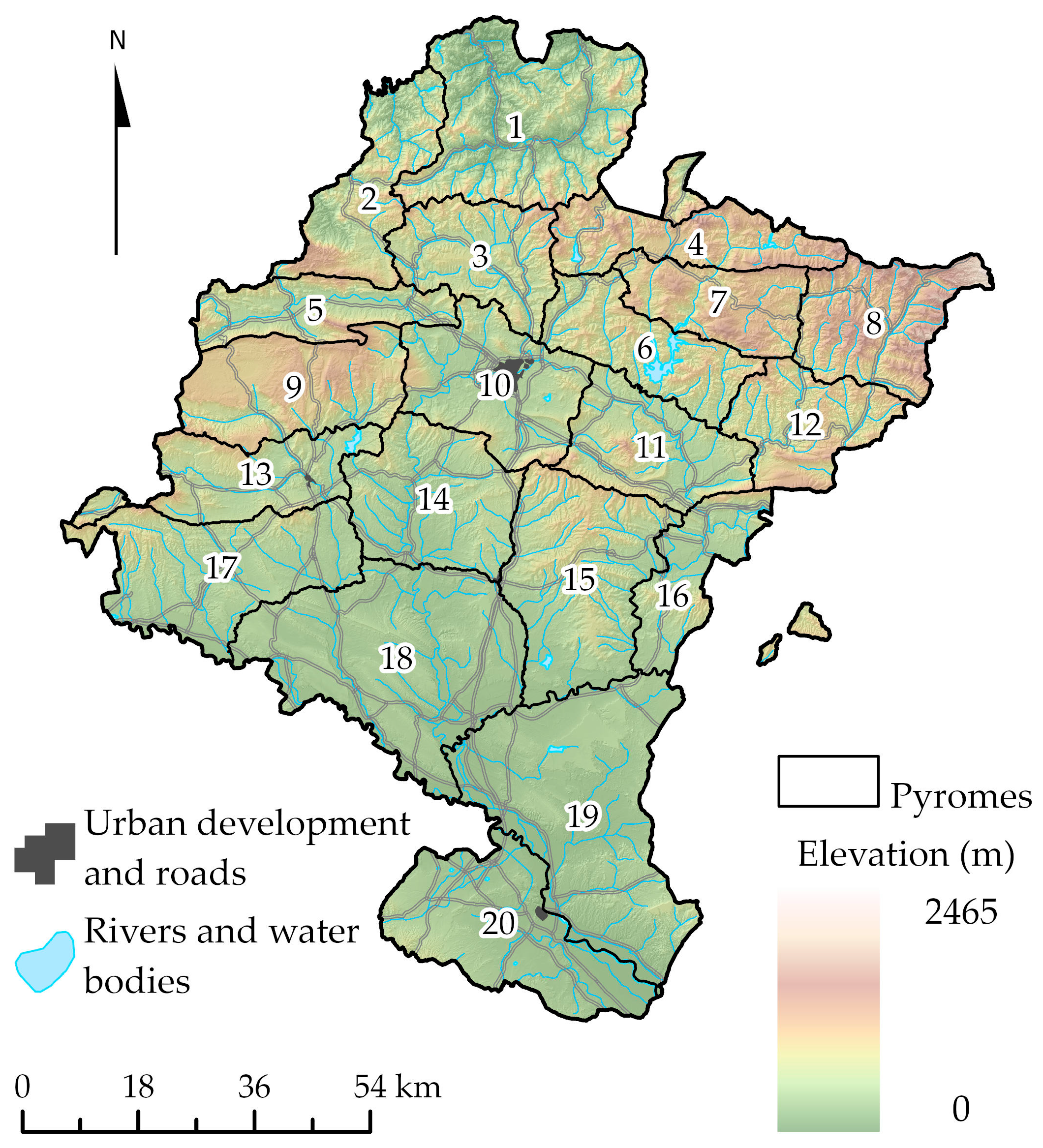
Table A1.
Fire regime characteristics of the 20 pyromes defined in Navarra. Burned area is expressed as the mean annual percentage of pyrome area burned; values in parentheses indicate the percentage of total burned area attributed to lightning-caused fires. Ignition density is expressed as the annual number of ignitions per km2, and large wildfires are defined as fires larger than 100 ha. The wildfire season corresponds to the dates accounting for more than 80% of the total burned area.
For pyromes without a suitable internal automatic weather station, weather and fuel moisture scenarios were assigned from the nearest neighboring pyrome with comparable elevation, vegetation, and fire weather conditions. This applied to pyromes 4 and 8, which inherited the wind and fuel moisture scenarios used for their corresponding neighboring pyrome, rather than being treated as independent weather station records.
Table A2.
Automatic weather stations used to characterize meteorological conditions for each pyrome. The number of years with at least 90% of hourly records is indicated. Pyromes 4 and 8 did not have suitable internal station records and were assigned weather scenarios from pyrome 7 due to comparable physiographic and fire weather conditions.
Wind frequency during the fire period was calculated for eight wind directions (45°, 90°, 135°, 180°, 225°, 270°, 315°, and 360°) within the 10:00–18:00 time window, along with the corresponding 97th percentile wind speeds (Table A3).
Table A3.
Wind frequency (%), with 97th percentile wind speed (km h−1, in parentheses), for each wind direction in each pyrome. Pyromes without suitable internal weather station records are shown explicitly and report the wind scenarios inherited from their assigned neighboring pyrome, as indicated in Table A2.
Fuel moisture scenarios were derived for each pyrome from the distribution of the Energy Release Component for fuel model G (ERC-G). For the 70th, 85th, and 97th ERC-G percentiles, Fire Family Plus was applied to the weather records from the selected automatic weather stations (Table A2) to estimate dead and live fuel moisture values. The resulting percentile-specific inputs are reported in Table A4.
Table A4.
Pyrome-specific fuel moisture contents (%) for the 70th, 85th, and 97th ERC-G percentile scenarios. Values are reported for 1, 10, and 100 h dead fuels and for live herbaceous and live woody fuels. Pyromes 4 and 8 inherited the wind and fuel moisture scenarios from their assigned neighboring pyrome 7, as indicated in Table A2.
Appendix B. Assignment of Standard Fuel Models to Vegetation Types
The assignment of standard fuel models used in this study reflects the variability in vegetation types across the study area (Table A5). Shrub strata were classified as low shrub (h < 0.75 m), medium shrub (0.75 ≤ h < 1.5 m), and tall shrub (1.5 ≤ h < 3 m). Forest classes were differentiated into coniferous and broadleaved types and further subdivided according to understory height, including forests with low understory (h < 0.75 m), medium understory (0.75 ≤ h < 1.5 m), and tall understory (1.5 ≤ h < 3 m). This classification was based on the 2016 PNOA LiDAR flight and required an accumulation of at least 75% of LiDAR returns within the defined height ranges. The 2016 PNOA LiDAR flight for Navarra was acquired between September and November 2017 using a Leica SPL100 sensor (a Leica SPL100 sensor (Leica Geosystems AG, Heerbrugg, Switzerland)), with a point density of 14 points m−2, horizontal and vertical accuracies of 0.20 m and 0.15 m RMSE, respectively, and simultaneous acquisition of RGB and infrared imagery [56]. A canopy cover greater than 15% was used as the threshold to identify forest fuels. Additional masks were used to delineate herbaceous fuel models, including rainfed cereal fields and grasslands, and non-burnable areas, including rivers, rocky outcrops, irrigated land, and intensively tilled cropland, using SIGPAC 2024 [89]. Three climate zones were considered in the fuel model assignment: humid (H), Mediterranean (M), and semi-arid (S).
Table A5.
Assignment table of Scott and Burgan (2005) standard fuel models to vegetation types.
Appendix C. Applicability Assessment of the Ignition Probability Model
The stochastic simulations used an ignition probability (IP) grid derived from a logit fire occurrence model previously developed for central Navarra [51]. Because that model was calibrated within a smaller central Navarra frame, we evaluated its applicability before using it across the full regional modeling domain. The IP grid was used as a relative spatial weighting surface for sampling ignition locations in the simulations.
The original occurrence model was based mainly on anthropogenic predictors, including distance to settlements, roads, railways, and power lines, population density, and land use. This is consistent with the predominantly human-caused ignition regime in Navarra. To assess transferability, we extracted predicted IP values for two independent observed ignition datasets: (i) ignitions recorded after the original calibration period, from 2014 to 2024, and (ii) ignitions recorded up to 2013 but located outside of the original calibration frame. These observed points were compared with a random background sample distributed across the analysis domain.
We evaluated model discrimination using presence background AUC, with observed ignitions treated as presences and random points as background points. In this context, AUC represents the probability that a randomly selected ignition point has a higher predicted IP value than a randomly selected background point. We also compared observed and random IP distributions using the Mann–Whitney U test and assessed ignition concentration in the highest-ranked portions of the IP surface. AUC confidence intervals were estimated through non-parametric bootstrap resampling.
Observed ignitions were consistently associated with higher predicted IP values than random background points (Figure A2a). The median IP value was 0.731 for the 2014–2024 temporal holdout and 0.728 for the pre-2013 outside-frame spatial holdout, compared with 0.675 for random background points. AUC values were similar for both independent evaluations, 0.622 and 0.621, respectively, and the combined observed dataset produced an AUC of 0.622 (Table A6; Figure A2b). Mann–Whitney tests confirmed that observed ignitions had significantly higher IP values than random points. The highest 30% of the background IP distribution contained 47.4% of post-2014 ignitions and 48.2% of pre-2013 outside-frame ignitions, while the highest 50% contained approximately 69% of ignitions in both datasets.
Figure A2.
External applicability assessment of the ignition probability (IP) surface. Distribution of predicted IP values extracted at post-2014 observed ignitions, pre-2013 ignitions outside of the original calibration frame, and random background points (a). Presence-background receiver operating characteristic curves comparing observed ignition datasets with random background points. The AUC values indicate modest but consistent rank discrimination, supporting use of the IP surface as a relative ignition sampling grid for regional stochastic simulations (b).
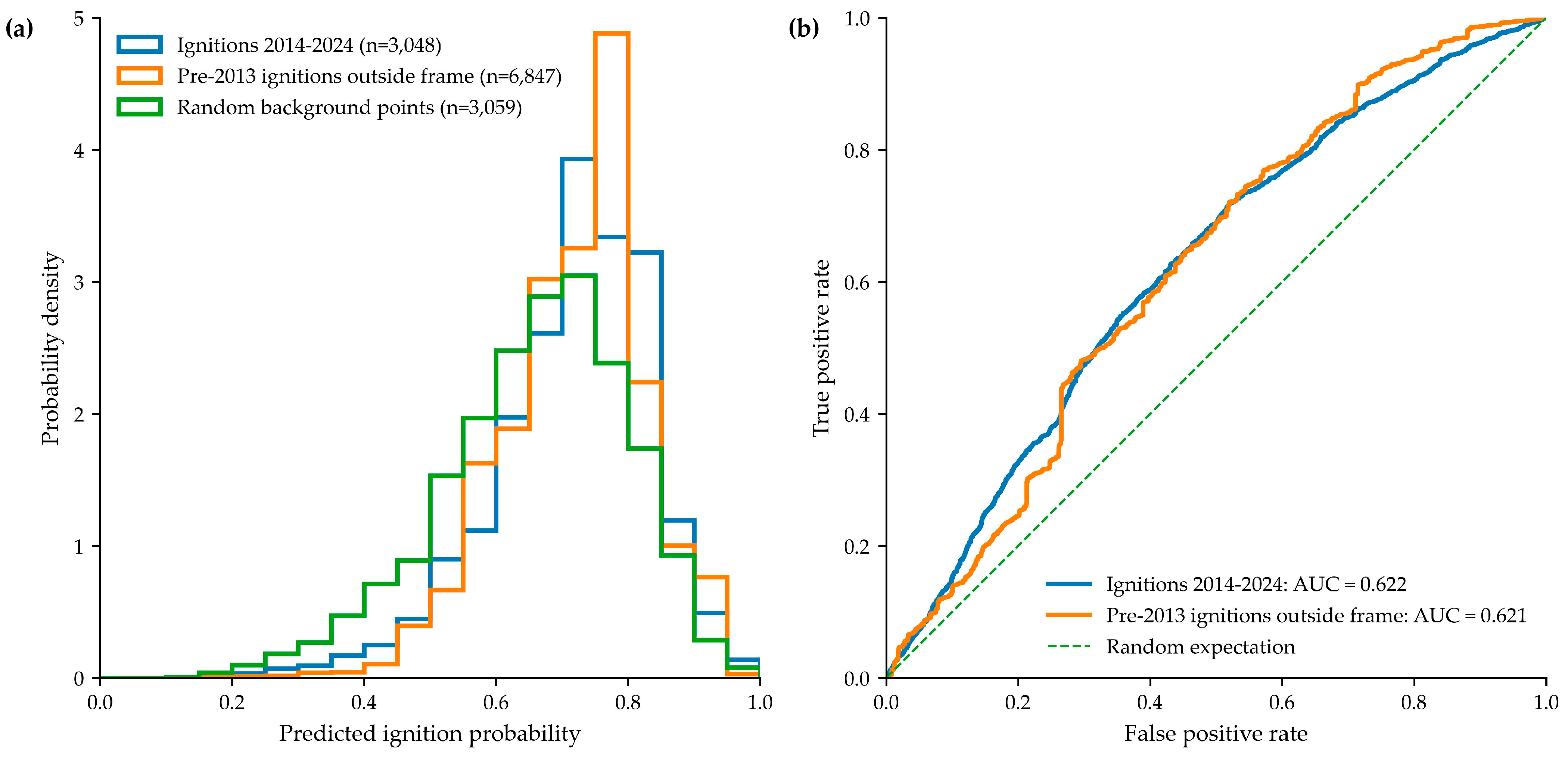
Table A6.
External assessment of the ignition probability (IP) surface used for stochastic ignition placement. Observed ignitions were compared with random background points. The 2014–2024 dataset provides a temporal holdout, the pre-2013 outside-frame dataset provides a spatial transfer test, and the combined dataset summarizes the overall external check. The column n indicates the number of observed ignition points in each evaluation dataset. AUC values indicate presence-background rank discrimination and are followed by 95% bootstrap confidence intervals.
These results indicate that the transferred IP grid retained useful regional rank discrimination. The AUC values were lower than those reported for the original model calibration, as expected when applying a model outside of its calibration frame and across a larger, more heterogeneous region. Nevertheless, the consistency between temporal and spatial holdout tests supports using the IP surface as a practical relative ignition sampling grid. Remaining uncertainty is acknowledged for pyromes where local ignition processes differ from the anthropogenic gradients represented by the model.
Appendix D. Fire Spread Model Calibration and Annualization
Fire spread model calibration and annualization were conducted independently for 10 macroareas or pyroregions, each composed of one or several neighboring pyromes with similar landscape fuels, topography, observed fire size distributions, and mean annual burned area (Figure A1; Table A7). Simulations were run separately within each macroarea. The number of modeled years and simulated ignitions varied among macroareas to obtain spatially continuous and stable burn probability surfaces. Therefore, unequal simulation numbers were used to improve Monte Carlo convergence and were not used as weights when merging the regional outputs. Larger simulation libraries were required in low-frequency mountainous and eastern macroareas, where historical fires rarely exceeded 100 ha, because repeated sampling was needed to stabilize burn probabilities across the landscape.
Table A7.
Fire spread calibration and simulation design by macroarea. Fire spread modeling was conducted independently for 10 macroareas or pyroregions. Historical burned area corresponds to the mean annual burned area calculated from 38 years of fire records and was used as the macroarea-specific annualization target. The number of modeled years and simulated ignitions varied among macroareas to obtain stable burn probability surfaces, while fire spread duration mixtures were calibrated to reproduce observed fire size distributions.
Ignition locations were sampled within each macroarea using the ignition probability grid. For each simulated fire, fuel moisture conditions were randomly assigned from the pyrome-specific ERC-G percentile scenarios reported in Table A4 using 60% of fires under the 97th percentile, 30% under the 85th percentile, and 10% under the 70th percentile. Wind direction was sampled from the observed wildfire season frequency distribution for each pyrome during the 10:00–18:00 active spread period, whereas wind speed was represented by the corresponding 97th percentile value for each direction. This design was intended to represent the active spread conditions associated with large fire growth in Navarra rather than the full distribution of daily fire weather conditions. Fire spread duration was calibrated by macroarea using the combinations shown in Table A7. These duration mixtures were selected to reproduce the observed fire size distribution and historical mean annual burned area in each macroarea.
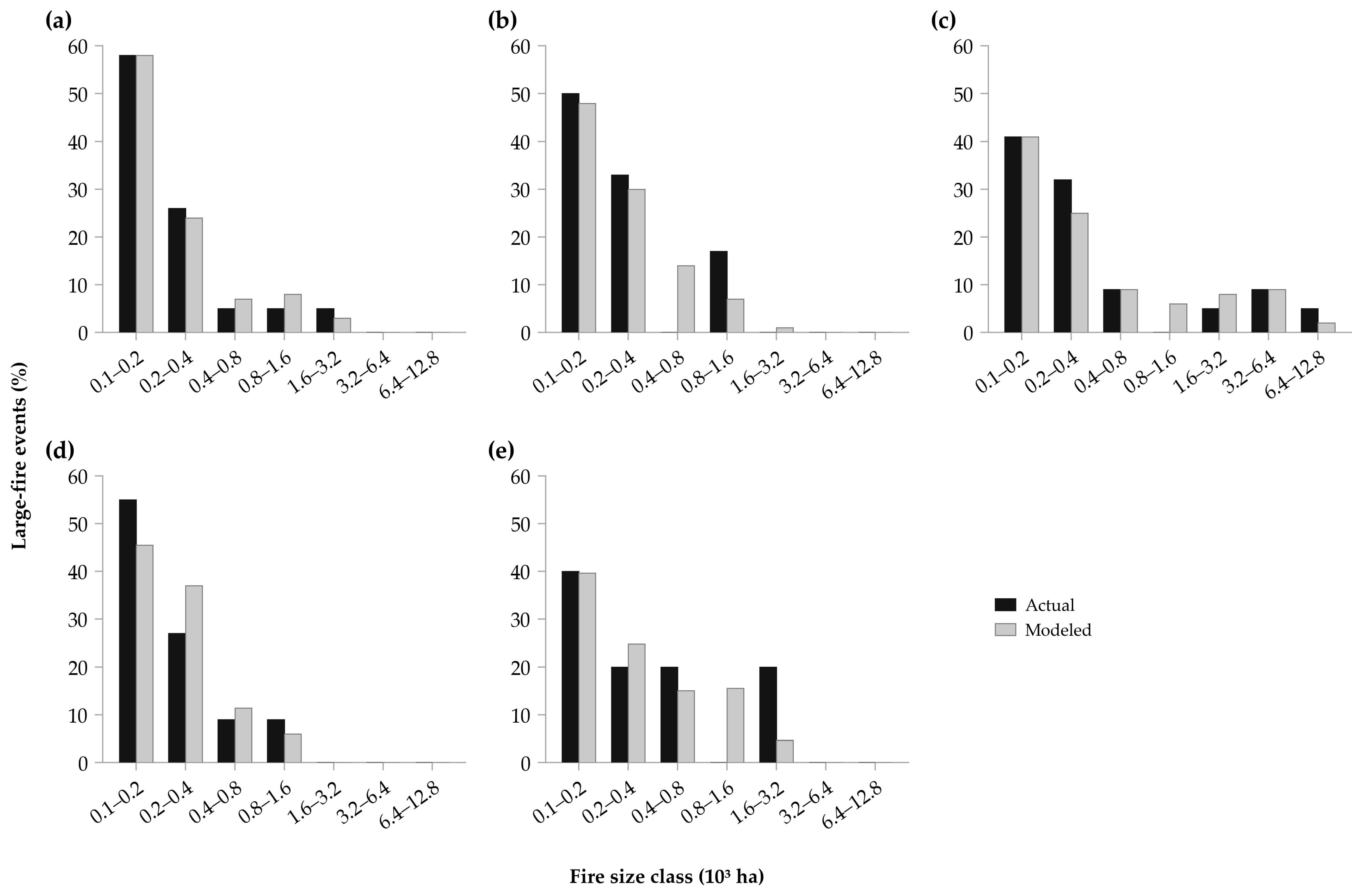
For calibration, observed and simulated fires were assigned to the macroarea where the ignition point was located. Observed and modeled fire size distributions were then compared by macroarea using fixed fire size classes (Figure A3). Macroareas with multi-class large fire distributions showed close agreement between observed and modeled fire size frequencies. Macroareas not shown in Figure A3 had observed and modeled fires concentrated in the smallest fire size class, from 0.1 to 0.2 thousand ha.
Figure A3.
Observed and modeled fire size distributions for Macroarea 1 (a), Macroarea 6 (b), Macroarea 7 (c), Macroarea 8 (d), and Macroarea 9 (e). Fire size classes are expressed in thousand ha. Macroareas not shown had observed and modeled fires concentrated in the smallest fire size class, from 0.1 to 0.2 thousand ha.
Annualization was performed within each macroarea before assembling the regional products. The historical mean annual burned area calculated from 38 years of fire records (1985 to 2022) was used as the macroarea-specific annualization target (Table A7), and fire spread durations were adjusted so that simulated fire size distributions reproduced the observed burned area regime. For each macroarea, burn probability was calculated using the macroarea-specific number of modeled years as the denominator, rather than pooling simulations across macroareas under a common denominator. Exposure metrics were calculated analogously by averaging burned area, burned forest area, and exposed structures over the modeled years within each macroarea. The final regional layers and summary tables were then produced by mosaicking or summing these macroarea-specific annualized outputs. Thus, macroareas with larger simulation libraries contributed according to their calibrated annual fire occurrence and burned area regime, not according to the raw number of simulated ignitions.
Appendix E. Community Exposure to Wildfires
Table A8.
Community-level wildfire exposure across municipalities and supramunicipal units in Navarra. Values include population, mean annual burned area in cropland, pasture, shrubland, tall shrubland and young woodland, and forest land, together with the mean annual number of exposed residential buildings and industrial structures, total structure counts, and unit area. Abbreviations: aBA = mean annual burned area; aBFA = mean annual burned forest area.
Appendix F. Protected Area Exposure to Wildfires
This appendix summarizes modeled wildfire exposure for each protected area in Navarra, including total and forested burned area for all fires, medium- and high-intensity fires, and high-intensity fires only.
Table A9.
Protected area exposure to wildfire in Navarra. Values include total protected area extent, mean annual burned area, mean annual burned area at flame lengths greater than 1.5 m and 2.5 m, and the corresponding metrics for forested land only. Abbreviations: aBA = mean annual burned area; aBFA = mean annual burned forest area; SNR = Strict Nature Reserve; NP = Natural Park; NR = Nature Reserve; NE = Natural Enclave; PL = Protected Landscape; RNA = Recreational Natural Area; and PPZ = Peripheral Protection Zone.
Figure A4.
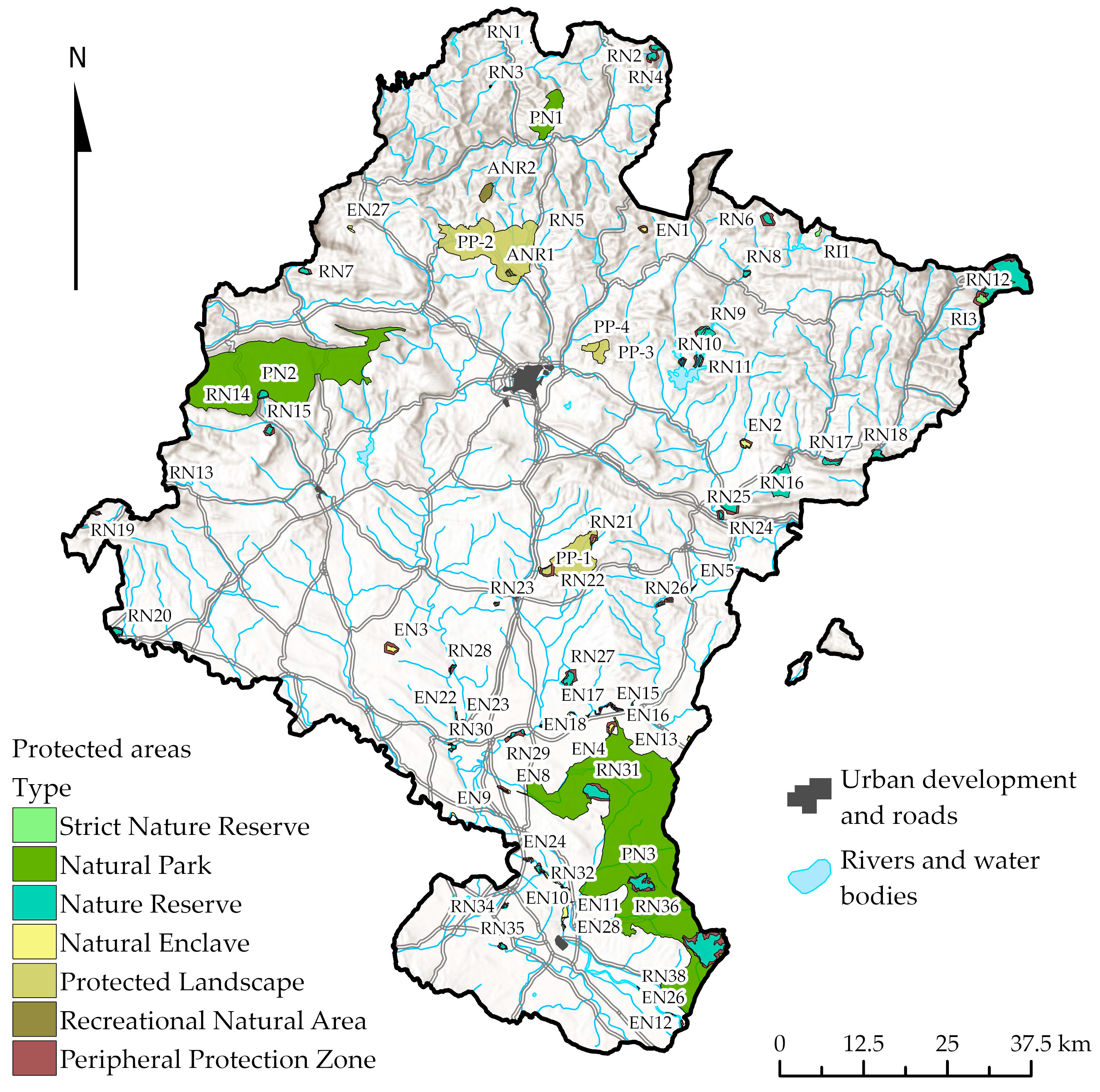
Protected areas in Navarra colored by protected area type. Table A9 provides the correspondence between protected area abbreviations and exposure results. Note that some protected areas include a Peripheral Protection Zone, which is represented separately from the core protected area.
References
- Benali, A.; Guiomar, N.; Gonçalves, H.; Mota, B.; Silva, F.; Fernandes, P.M.; Mota, C.; Penha, A.; Santos, J.; Pereira, J.M.C.; et al. The Portuguese Large Wildfire Spread Database (PT-FireSprd). Earth Syst. Sci. Data 2023, 15, 3791–3818. [Google Scholar] [CrossRef] [Scilit]
- Chas-Amil, M.-L.; García-Martínez, E.; Touza, J. Iberian Peninsula October 2017 Wildfires: Burned Area and Population Exposure in Galicia (NW of Spain). Int. J. Disaster Risk Reduct. 2020, 48, 101623. [Google Scholar] [CrossRef] [Scilit]
- Castellnou, M.; Bachfischer, M.; Miralles, M.; Ruiz, B.; Stoof, C.R.; Vilà-Guerau De Arellano, J. Pyroconvection Classification Based on Atmospheric Vertical Profiling Correlation With Extreme Fire Spread Observations. JGR Atmos. 2022, 127, e2022JD036920. [Google Scholar] [CrossRef] [Scilit]
- San-Miguel-Ayanz, J.; Durrant, T.; Boca, R.; Maianti, P.; Liberta, G.; Oom, D.J.F.; Branco, A.; De Rigo, D.; Suarez-Moreno, M.; Ferrari, D.; et al. Forest Fires in Europe, Middle East and North Africa 2023; European Union: Luxemburg, 2024; p. 198. [Google Scholar]
- San-Miguel-Ayanz, J.; Moreno, J.M.; Camia, A. Analysis of Large Fires in European Mediterranean Landscapes: Lessons Learned and Perspectives. For. Ecol. Manag. 2013, 294, 11–22. [Google Scholar] [CrossRef] [Scilit]
- Moreira, F.; Viedma, O.; Arianoutsou, M.; Curt, T.; Koutsias, N.; Rigolot, E.; Barbati, A.; Corona, P.; Vaz, P.; Xanthopoulos, G.; et al. Landscape–Wildfire Interactions in Southern Europe: Implications for Landscape Management. J. Environ. Manag. 2011, 92, 2389–2402. [Google Scholar] [CrossRef] [Scilit]
- DGPCE. Informe de Incendios Forestales 2022; Dirección General de Protección Civil y Emergencias: Madrid, Spain, 2022; p. 39. [Google Scholar]
- El Garroussi, S.; Di Giuseppe, F.; Barnard, C.; Wetterhall, F. Europe Faces up to Tenfold Increase in Extreme Fires in a Warming Climate. npj Clim. Atmos. Sci. 2024, 7, 30. [Google Scholar] [CrossRef] [Scilit]
- Jones, M.W.; Abatzoglou, J.T.; Veraverbeke, S.; Andela, N.; Lasslop, G.; Forkel, M.; Smith, A.J.P.; Burton, C.; Betts, R.A.; Van Der Werf, G.R.; et al. Global and Regional Trends and Drivers of Fire Under Climate Change. Rev. Geophys. 2022, 60, e2020RG000726. [Google Scholar] [CrossRef] [Scilit]
- Ellis, T.M.; Bowman, D.M.J.S.; Jain, P.; Flannigan, M.D.; Williamson, G.J. Global Increase in Wildfire Risk Due to Climate-Driven Declines in Fuel Moisture. Glob. Change Biol. 2021, 28, 1544–1559. [Google Scholar] [CrossRef] [Scilit] [PubMed]
- Jain, P.; Castellanos-Acuna, D.; Coogan, S.C.P.; Abatzoglou, J.T.; Flannigan, M.D. Observed Increases in Extreme Fire Weather Driven by Atmospheric Humidity and Temperature. Nat. Clim. Change 2022, 12, 63–70. [Google Scholar] [CrossRef] [Scilit]
- Ameztegui, A.; Morán-Ordóñez, A.; Márquez, A.; Blázquez-Casado, Á.; Pla, M.; Villero, D.; García, M.B.; Errea, M.P.; Coll, L. Forest Expansion in Mountain Protected Areas: Trends and Consequences for the Landscape. Landsc. Urban Plan. 2021, 216, 104240. [Google Scholar] [CrossRef] [Scilit]
- Gelabert, P.J.; Rodrigues, M.; de la Riva, J.; Ameztegui, A.; Sebastià, M.T.; Vega-Garcia, C. LandTrendr Smoothed Spectral Profiles Enhance Woody Encroachment Monitoring. Remote Sens. Environ. 2021, 262, 112521. [Google Scholar] [CrossRef] [Scilit]
- Salis, M.; Del Giudice, L.; Jahdi, R.; Alcasena, F.; Scarpa, C.; Pellizzaro, G.; Bacciu, V.; Schirru, M.; Ventura, A.; Casula, M.; et al. Spatial Patterns and Intensity of Land Abandonment Drive Wildfire Hazard and Likelihood in Mediterranean Agropastoral Areas. Land 2022, 11, 1942. [Google Scholar] [CrossRef] [Scilit]
- Pausas, J.G.; Fernández-Muñoz, S. Fire Regime Changes in the Western Mediterranean Basin: From Fuel-Limited to Drought-Driven Fire Regime. Clim. Change 2012, 110, 215–226. [Google Scholar] [CrossRef] [Scilit]
- Cervera, T.; Pino, J.; Marull, J.; Padró, R.; Tello, E. Understanding the Long-Term Dynamics of Forest Transition: From Deforestation to Afforestation in a Mediterranean Landscape (Catalonia, 1868–2005). Land Use Policy 2019, 80, 318–331. [Google Scholar] [CrossRef] [Scilit]
- Lasanta, T.; Cortijos-López, M.; Errea, M.P.; Khorchani, M.; Nadal-Romero, E. An Environmental Management Experience to Control Wildfires in the Mid-Mountain Mediterranean Area: Shrub Clearing to Generate Mosaic Landscapes. Land Use Policy 2022, 118, 106147. [Google Scholar] [CrossRef] [Scilit]
- Ribeiro, L.M.; Rodrigues, A.; Lucas, D.; Viegas, D.X. The Impact on Structures of the Pedrógão Grande Fire Complex in June 2017 (Portugal). Fire 2020, 3, 57. [Google Scholar] [CrossRef] [Scilit]
- Vacca, P.; Caballero, D.; Pastor, E.; Planas, E. WUI Fire Risk Mitigation in Europe: A Performance-Based Design Approach at Home-Owner Level. J. Saf. Sci. Resil. 2020, 1, 97–105. [Google Scholar] [CrossRef] [Scilit]
- Duane, A.; Moghli, A.; Coll, L.; Vega, C. On the Evidence of Contextually Large Fires in Europe Based on Return Period Functions. Appl. Geogr. 2025, 176, 103539. [Google Scholar] [CrossRef] [Scilit]
- Bacciu, V.; Salis, M.; Arca, B.; Pellizzaro, G.; Ascoli, D.; Delogu, G.; Eftychidis, G.; Chuvieco, E.; Gitas, I.; Viegas, D. Shifting to a Holistic Approach in National Wildfire Management Policies: The Italian Case. iForest 2025, 18, 163–175. [Google Scholar] [CrossRef] [Scilit]
- USDA. The National Strategy, The Final Phase in the Development of the National Cohesive Wildland Fire Management Strategy; Forest Service; U.S. Department of Agriculture: Washington, DC, USA, 2014; p. 93.
- Wunder, S.; Calkin, D.E.; Charlton, V.; Feder, S.; Martínez de Arano, I.; Moore, P.; Rodríguez y Silva, F.; Tacconi, L.; Vega-García, C. Resilient Landscapes to Prevent Catastrophic Forest Fires: Socioeconomic Insights towards a New Paradigm. For. Policy Econ. 2021, 128, 102458. [Google Scholar] [CrossRef] [Scilit]
- Moreira, F.; Ascoli, D.; Safford, H.; Adams, M.A.; Moreno, J.M.; Pereira, J.M.C.; Catry, F.X.; Armesto, J.; Bond, W.; González, M.E.; et al. Wildfire Management in Mediterranean-Type Regions: Paradigm Change Needed. Environ. Res. Lett. 2020, 15, 011001. [Google Scholar] [CrossRef] [Scilit]
- Castellnou, M.; Prat-Guitart, N.; Arilla, E.; Larrañaga, A.; Nebot, E.; Castellarnau, X.; Vendrell, J.; Pallàs, J.; Herrera, J.; Monturiol, M.; et al. Empowering Strategic Decision-Making for Wildfire Management: Avoiding the Fear Trap and Creating a Resilient Landscape. Fire Ecol. 2019, 15, 31. [Google Scholar] [CrossRef] [Scilit]
- Gonzalez-Olabarria, J.R.; Reynolds, K.M.; Larrañaga, A.; Garcia-Gonzalo, J.; Busquets, E.; Pique, M. Strategic and Tactical Planning to Improve Suppression Efforts against Large Forest Fires in the Catalonia Region of Spain. For. Ecol. Manag. 2019, 432, 612–622. [Google Scholar] [CrossRef] [Scilit]
- North, M.P.; Bisbing, S.M.; Hankins, D.L.; Hessburg, P.F.; Hurteau, M.D.; Kobziar, L.N.; Meyer, M.D.; Rhea, A.E.; Stephens, S.L.; Stevens-Rumann, C.S. Strategic Fire Zones Are Essential to Wildfire Risk Reduction in the Western United States. Fire Ecol. 2024, 20, 50. [Google Scholar] [CrossRef] [Scilit]
- Carrasco, J.; Gonzalez-Olabarria, J.R.; Palacios, D.; Mahaluf, R.; Garcia-Gonzalo, J.; Weintraub, A. Multicriteria Firebreak Planning for Protecting Ecological and Cultural Values under Wildfire Risk: A Case Study in Catalonia. Environ. Sustain. Indic. 2025, 28, 100956. [Google Scholar] [CrossRef] [Scilit]
- Oliveira, S.; Gonçalves, A.; Benali, A.; Sá, A.; Zêzere, J.L.; Pereira, J.M. Assessing Risk and Prioritizing Safety Interventions in Human Settlements Affected by Large Wildfires. Forests 2020, 11, 859. [Google Scholar] [CrossRef] [Scilit]
- Thompson, M.; Riley, K.; Loeffler, D.; Haas, J. Modeling Fuel Treatment Leverage: Encounter Rates, Risk Reduction, and Suppression Cost Impacts. Forests 2017, 8, 469. [Google Scholar] [CrossRef] [Scilit]
- Penman, T.D.; Bradstock, R.A.; Price, O.F. Reducing Wildfire Risk to Urban Developments: Simulation of Cost-Effective Fuel Treatment Solutions in South Eastern Australia. Environ. Model. Softw. 2014, 52, 166–175. [Google Scholar] [CrossRef] [Scilit]
- Scott, J.H.; Thompson, M.P.; Gilbertson-Day, J.W. Examining Alternative Fuel Management Strategies and the Relative Contribution of National Forest System Land to Wildfire Risk to Adjacent Homes—A Pilot Assessment on the Sierra National Forest, California, USA. For. Ecol. Manag. 2016, 362, 29–37. [Google Scholar] [CrossRef] [Scilit]
- Parisien, M.-A.; Dawe, D.A.; Miller, C.; Stockdale, C.A.; Armitage, O.B. Applications of Simulation-Based Burn Probability Modelling: A Review. Int. J. Wildland Fire 2020, 28, 913–926. [Google Scholar] [CrossRef] [Scilit]
- Kalabokidis, K.; Palaiologou, P.; Gerasopoulos, E.; Giannakopoulos, C.; Kostopoulou, E.; Zerefos, C. Effect of Climate Change Projections on Forest Fire Behavior and Values-at-Risk in Southwestern Greece. Forests 2015, 6, 2214–2240. [Google Scholar] [CrossRef] [Scilit]
- Lautenberger, C. Mapping Areas at Elevated Risk of Large-Scale Structure Loss Using Monte Carlo Simulation and Wildland Fire Modeling. Fire Saf. J. 2017, 91, 768–775. [Google Scholar] [CrossRef] [Scilit]
- Palaiologou, P.; Kalabokidis, K.; Ager, A.A.; Day, M.A. Development of Comprehensive Fuel Management Strategies for Reducing Wildfire Risk in Greece. Forests 2020, 11, 789. [Google Scholar] [CrossRef] [Scilit]
- Oliveira, S.; Rocha, J.; Sá, A. Wildfire Risk Modeling. Curr. Opin. Environ. Sci. Health 2021, 23, 100274. [Google Scholar] [CrossRef] [Scilit]
- Carlson, A.R.; Hawbaker, T.J.; Bair, L.S.; Hoffman, C.M.; Meldrum, J.R.; Baggett, L.S.; Steblein, P.F. Evaluating a Simulation-Based Wildfire Burn Probability Map for the Conterminous US. Int. J. Wildland Fire 2025, 34, WF23196. [Google Scholar] [CrossRef] [Scilit]
- Haas, J.R.; Calkin, D.E.; Thompson, M.P. A National Approach for Integrating Wildfire Simulation Modeling into Wildland Urban Interface Risk Assessments within the United States. Landsc. Urban Plan. 2013, 119, 44–53. [Google Scholar] [CrossRef] [Scilit]
- Kearns, E.J.; Saah, D.; Levine, C.R.; Lautenberger, C.; Doherty, O.M.; Porter, J.R.; Amodeo, M.; Rudeen, C.; Woodward, K.D.; Johnson, G.W.; et al. The Construction of Probabilistic Wildfire Risk Estimates for Individual Real Estate Parcels for the Contiguous United States. Fire 2022, 5, 117. [Google Scholar] [CrossRef] [Scilit]
- Bar Massada, A.; Syphard, A.D.; Hawbaker, T.J.; Stewart, S.I.; Radeloff, V.C. Effects of Ignition Location Models on the Burn Patterns of Simulated Wildfires. Environ. Model. Softw. 2011, 26, 583–592. [Google Scholar] [CrossRef] [Scilit]
- Finney, M.; McHugh, C.W.; Grenfell, I.C.; Riley, K.L.; Short, K.C. A Simulation of Probabilistic Wildfire Risk Components for the Continental United States. Stoch. Environ. Res. Risk Assess. 2011, 25, 973–1000. [Google Scholar] [CrossRef] [Scilit]
- Aparício, B.A.; Alcasena, F.; Ager, A.; Chung, W.; Pereira, J.M.C.; Sá, A.C.L. Evaluating Priority Locations and Potential Benefits for Building a Nation-Wide Fuel Break Network in Portugal. J. Environ. Manag. 2022, 320, 115920. [Google Scholar] [CrossRef] [Scilit] [PubMed]
- Thompson, M.P.; Vogler, K.C.; Scott, J.H.; Miller, C. Comparing Risk-Based Fuel Treatment Prioritization with Alternative Strategies for Enhancing Protection and Resource Management Objectives. Fire Ecol. 2022, 18, 26. [Google Scholar] [CrossRef] [Scilit]
- Salis, M.; Arca, B.; Del Giudice, L.; Palaiologou, P.; Alcasena, F.; Ager, A.; Fiori, M.; Pellizzaro, G.; Scarpa, C.; Schirru, M.; et al. Application of Simulation Modeling for Wildfire Exposure and Transmission Assessment in Sardinia, Italy. Int. J. Disaster Risk Reduct. 2021, 58, 102189. [Google Scholar] [CrossRef] [Scilit]
- Palaiologou, P.; Ager, A.A.; Nielsen-Pincus, M.; Evers, C.R.; Kalabokidis, K. Using Transboundary Wildfire Exposure Assessments to Improve Fire Management Programs: A Case Study in Greece. Int. J. Wildland Fire 2018, 27, 501. [Google Scholar] [CrossRef] [Scilit]
- Oliveira, S.; Oehler, F.; San-Miguel-Ayanz, J.; Camia, A.; Pereira, J.M.C. Modeling Spatial Patterns of Fire Occurrence in Mediterranean Europe Using Multiple Regression and Random Forest. For. Ecol. Manag. 2012, 275, 117–129. [Google Scholar] [CrossRef] [Scilit]
- Jiménez-Ruano, A.; Mimbrero, M.R.; De La Riva Fernández, J. Understanding Wildfires in Mainland Spain. A Comprehensive Analysis of Fire Regime Features in a Climate-Human Context. Appl. Geogr. 2017, 89, 100–111. [Google Scholar] [CrossRef] [Scilit]
- Gonzalez-Olabarria, J.R.; Mola-Yudego, B.; Pukkala, T.; Palahi, M. Using Multiscale Spatial Analysis to Assess Fire Ignition Density in Catalonia, Spain. Ann. For. Sci. 2011, 68, 861–871. [Google Scholar] [CrossRef] [Scilit]
- Alcasena, F.; Salis, M.; Ager, A.; Castell, R.; Vega-García, C. Assessing Wildland Fire Risk Transmission to Communities in Northern Spain. Forests 2017, 8, 30. [Google Scholar] [CrossRef] [Scilit]
- Alcasena, F.; Salis, M.; Nauslar, N.J.; Aguinaga, A.E.; Vega-García, C. Quantifying Economic Losses from Wildfires in Black Pine Afforestations of Northern Spain. For. Policy Econ. 2016, 73, 153–167. [Google Scholar] [CrossRef] [Scilit]
- Coughlan, M.R. Traditional Fire-Use, Landscape Transition, and the Legacies of Social Theory Past. Ambio 2015, 44, 705–717. [Google Scholar] [CrossRef] [Scilit]
- Jolly, M.; Freeborn, P.H.; Bradshaw, L.S.; Wallace, J.; Brittain, S. Modernizing the US National Fire Danger Rating System (Version 4): Simplified Fuel Models and Improved Live and Dead Fuel Moisture Calculations. Environ. Model. Softw. 2024, 181, 106181. [Google Scholar] [CrossRef] [Scilit]
- Nelson, R.M. A Method for Describing Equilibrium Moisture Content of Forest Fuels. Can. J. For. Res. 1984, 14, 597–600. [Google Scholar] [CrossRef] [Scilit]
- Scott, J.H.; Burgan, R.E. Standard Fire Behavior Fuel Models: A Comprehensive Set for Use with Rothermel’s Surface Fire Spread Model; USDA Forest Service, Rocky Mountain Research Station: Fort Collins, CO, USA, 2005; p. 72.
- Instituto Geográfico Nacional; Organismo Autónomo Centro Nacional de Información Geográfica. LiDAR-PNOA 2a Cobertura (2015–2021): Comunidad Foral de Navarra 2017. Available online: https://centrodedescargas.cnig.es/CentroDescargas/lidar-segunda-cobertura (accessed on 1 January 2024).
- González-Ferreiro, E.; Diéguez-Aranda, U.; Crecente-Campo, F.; Barreiro-Fernández, L.; Miranda, D.; Castedo-Dorado, F. Modelling Canopy Fuel Variables for Pinus Radiata D. Don in NW Spain with Low-Density LiDAR Data. Int. J. Wildland Fire 2014, 23, 350–362. [Google Scholar] [CrossRef] [Scilit]
- Botequim, B.; Fernandes, P.M.; Borges, J.G.; González-Ferreiro, E.; Guerra-Hernández, J. Improving Silvicultural Practices for Mediterranean Forests through Fire Behaviour Modelling Using LiDAR-Derived Canopy Fuel Characteristics. Int. J. Wildland Fire 2019, 28, 823–839. [Google Scholar] [CrossRef] [Scilit]
- González-Olabarria, J.-R.; Rodríguez, F.; Fernández-Landa, A.; Mola-Yudego, B. Mapping Fire Risk in the Model Forest of Urbión (Spain) Based on Airborne LiDAR Measurements. For. Ecol. Manag. 2012, 282, 149–156. [Google Scholar] [CrossRef] [Scilit]
- Finney, M. Fire Growth Using Minimum Travel Time Methods. Can. J. For. Res. 2002, 32, 1420–1424. [Google Scholar] [CrossRef] [Scilit]
- Brittain, S. Missoula Fire Lab Command Line Applications (unpublished). Available online: https://www.alturassolutions.com/FB/FB_API.htm (accessed on 16 March 2026).
- Byram, G.M. Forest Fire Behaviour. In Forest Fire Control and Use; Davis, K., Ed.; McGraw-Hill: New York, NY, USA, 1959; pp. 90–123. [Google Scholar]
- Rothermel, R.C. A Mathematical Model for Predicting Fire Spread in Wildland Fuels; USDA Forest Service, Intermountain Forest and Range Experiment Station: Ogden, UT, USA, 1972; p. 40.
- Palaiologou, P.; Giannakopoulos, C.; Vasilakos, C.; Sakellariou, S.; Rodrigues, M.; Karali, A.; Katavoutas, G.; Varotsos, K.V.; Roussou, O.; Gelabert, P.J.; et al. A Dataset to Support Wildland Fire and Fuel Management in Greece Created with Stochastic Wildfire Simulations. Data Brief 2025, 64, 112304. [Google Scholar] [CrossRef] [Scilit]
- Benali, A.; Benhalima, Y.; Aparício, B.; Timilsina, S.; Keizer, J.; Ager, A. Comparing Pre- and Post-Fire Strategies to Mitigate Wildfire-Induced Soil Erosion in Two Mediterranean Watersheds. Forests 2025, 16, 1202. [Google Scholar] [CrossRef] [Scilit]
- Instituto Geográfico Nacional; Organismo Autónomo Centro Nacional de Información Geográfica. LiDAR-PNOA 3a Cobertura (2022–2025): Comunidad Foral de Navarra 2024. Available online: https://centrodedescargas.cnig.es/CentroDescargas/lidar-tercera-cobertura (accessed on 16 March 2026).
- Miller, C.; Ager, A.A. A Review of Recent Advances in Risk Analysis for Wildfire Management. Int. J. Wildland Fire 2013, 22, 1–14. [Google Scholar] [CrossRef] [Scilit]
- Instituto Geográfico Nacional; Centro Nacional de Información Geográfica, O.A. Puntos de interés de la Base Topográfica Nacional (BTN-POI). Edificios 2024. Available online: https://centrodedescargas.cnig.es/CentroDescargas/btn (accessed on 16 March 2026).
- Aparício, B.A.; Ager, A.A.; Day, M.A. Maximizing Opportunities for Co-Implementing Fuel Break Networks and Restoration Projects. Front. For. Glob. Change 2024, 7, 1419288. [Google Scholar] [CrossRef] [Scilit]
- Teymoor Seydi, S.; Abatzoglou, J.T.; Jones, M.W.; Kolden, C.A.; Filippelli, G.; Hurteau, M.D.; AghaKouchak, A.; Luce, C.H.; Miao, C.; Sadegh, M. Increasing Global Human Exposure to Wildland Fires despite Declining Burned Area. Science 2025, 389, 826–829. [Google Scholar] [CrossRef] [Scilit]
- Ager, A.; Evers, C.; Day, M.; Alcasena, F.; Houtman, R. Planning for Future Fire: Scenario Analysis of an Accelerated Fuel Reduction Plan for the Western United States. Landsc. Urban Plan. 2021, 215, 104212. [Google Scholar] [CrossRef] [Scilit]
- Alcasena, F.; Ager, A.; Belavenutti, P.; Krawchuk, M.; Day, M. Contrasting the Efficiency of Landscape versus Community Protection Fuel Treatment Strategies to Reduce Wildfire Exposure and Risk. J. Environ. Manag. 2022, 309, 114650. [Google Scholar] [CrossRef] [Scilit]
- Jouibary, S.S.; Jahdi, R.; Khalaf, W.A.; Eshaghi, M.A. Burn Probability and Wildfire Risk Modeling of the Protected Areas in Golestan Province, NE Iran. Geoenviron. Disasters 2026, 13, 32. [Google Scholar] [CrossRef] [Scilit]
- Carlson, A.R.; Hawbaker, T.J.; Mockrin, M.H.; Radeloff, V.C.; Bair, L.S.; Caggiano, M.D.; Meldrum, J.R.; Alexandre, P.M.; Kramer, H.A.; Steblein, P.F. Rising Rates of Wildfire Building Destruction in the Conterminous United States. Proc. Natl. Acad. Sci. USA 2025, 122, e2505886122. [Google Scholar] [CrossRef] [Scilit]
- Syphard, A.D.; Rustigian-Romsos, H.; Keeley, J.E. Multiple-Scale Relationships between Vegetation, the Wildland–Urban Interface, and Structure Loss to Wildfire in California. Fire 2021, 4, 12. [Google Scholar] [CrossRef] [Scilit]
- Ager, A.; Day, M.; Alcasena, F.; Evers, C.; Short, K.; Grenfell, I. Predicting Paradise: Modeling Future Wildfire Disasters in the Western US. Sci. Total Environ. 2021, 784, 147057. [Google Scholar] [CrossRef] [Scilit]
- GN. Plan Especial de Protección Civil de Emergencia Por Incendios Forestales En La Comunidad Foral de Navarra. INFONA 2022; Departamento de Presidencia, Función Pública, Interior y Justicia: Pamplona, Spain, 2022; p. 162.
- Fernandes, P.M.; Davies, G.M.; Ascoli, D.; Fernández, C.; Moreira, F.; Rigolot, E.; Stoof, C.R.; Vega, J.A.; Molina, D. Prescribed Burning in Southern Europe: Developing Fire Management in a Dynamic Landscape. Front. Ecol. Environ. 2013, 11, e4–e14. [Google Scholar] [CrossRef] [Scilit]
- Fernandes, P.M.; Vega, J.A.; Jiménez, E.; Rigolot, E. Fire Resistance of European Pines. For. Ecol. Manag. 2008, 256, 246–255. [Google Scholar] [CrossRef] [Scilit]
- Oliveres, J.; Castellnou, M.; Castellarnau, X.; Rosas-Casals, M.; Brotons, L.; Duane, A. The Path to Strategic Fire Management Planning in the Aran, Pyrenees. Fire Ecol. 2025, 21, 9. [Google Scholar] [CrossRef] [Scilit]
- Ascoli, D.; Bovio, G. Prescribed Burning in Italy: Issues, Advances and Challenges. iForest—Biogeosci. For. 2013, 6, 79–89. [Google Scholar] [CrossRef] [Scilit]
- Thompson, M.P.; Calkin, D.E. Uncertainty and Risk in Wildland Fire Management: A Review. J. Environ. Manag. 2011, 92, 1895–1909. [Google Scholar] [CrossRef] [Scilit]
- Riley, K.; Thompson, M. An Uncertainty Analysis of Wildfire Modeling. In Natural Hazard Uncertainty Assessment: Modeling and Decision Support, Geophysical Monograph 223; Riley, K., Webley, P., Thompson, M., Eds.; John Wiley & Sons: Hoboken, NJ, USA, 2017; pp. 193–212. [Google Scholar]
- Benali, A.; Sa, A.C.; Ervilha, A.R.; Trigo, R.M.; Fernandes, P.M.; Pereira, J.M. Fire Spread Predictions: Sweeping Uncertainty under the Rug. Sci. Total Environ. 2017, 592, 187–196. [Google Scholar] [CrossRef] [Scilit] [PubMed]
- Mauro, F.; Hudak, A.T.; Fekety, P.A.; Frank, B.; Temesgen, H.; Bell, D.M.; Gregory, M.J.; McCarley, T.R. Regional Modeling of Forest Fuels and Structural Attributes Using Airborne Laser Scanning Data in Oregon. Remote Sens. 2021, 13, 261. [Google Scholar] [CrossRef] [Scilit]
- Mauro, F.; Ritchie, M.; Wing, B.; Frank, B.; Monleon, V.; Temesgen, H.; Hudak, A. Estimation of Changes of Forest Structural Attributes at Three Different Spatial Aggregation Levels in Northern California Using Multitemporal LiDAR. Remote Sens. 2019, 11, 923. [Google Scholar] [CrossRef] [Scilit]
- Alcasena, F.; Vega-García, C.; Ager, A.A.; Salis, M.; Nauslar, N.J.; Mendizabal, F.J.; Castell, R. Metodología de evaluación del riesgo de incendios forestales y priorización de tratamientos multifuncionales en paisajes mediterráneos. CIG 2019, 45, 571–600. [Google Scholar] [CrossRef] [Scilit]
- Ager, A.; Aparício, B.A.; Pereira, J.M.C. Optimizing the Portuguese Wildfire Fuel Reduction Program. Cell Rep. Sustain. 2025, 2, 100361. [Google Scholar] [CrossRef] [Scilit]
- Fondo Español de Garantía Agraria (FEGA); Ministerio de Agricultura, Pesca y Alimentación. Recintos del Sistema de Información Geográfica de Parcelas Agrícolas (SIGPAC) 2024. Available online: https://data.europa.eu/data/datasets/spasitnasigpac_pol_recinto_v2024n-xml?locale=en (accessed on 16 March 2026).
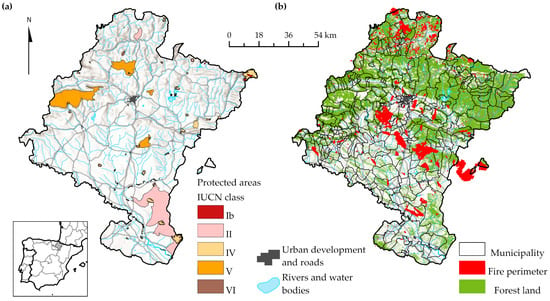
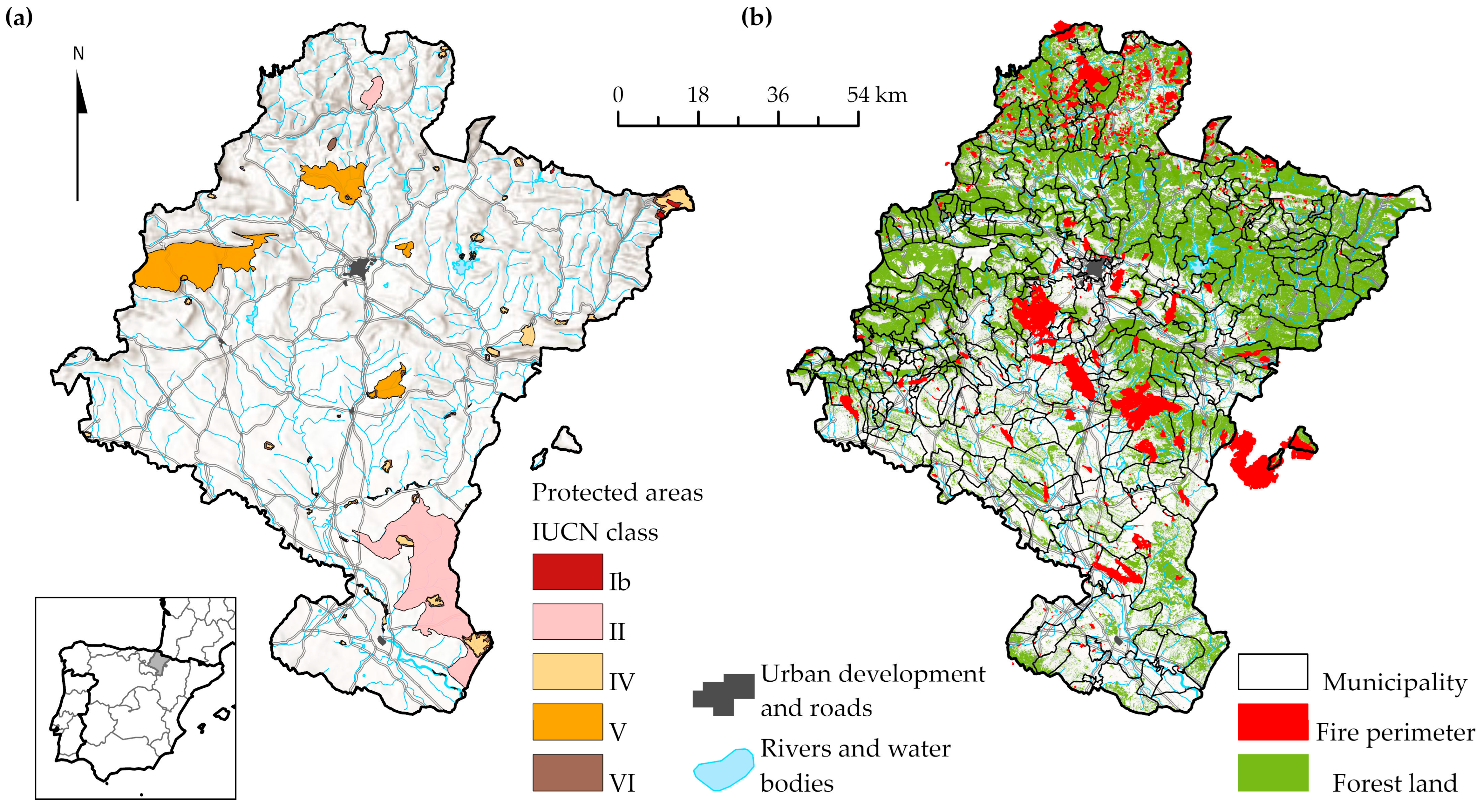
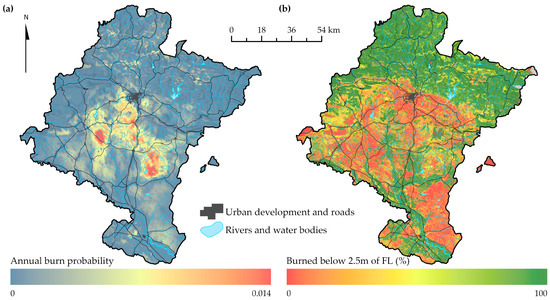
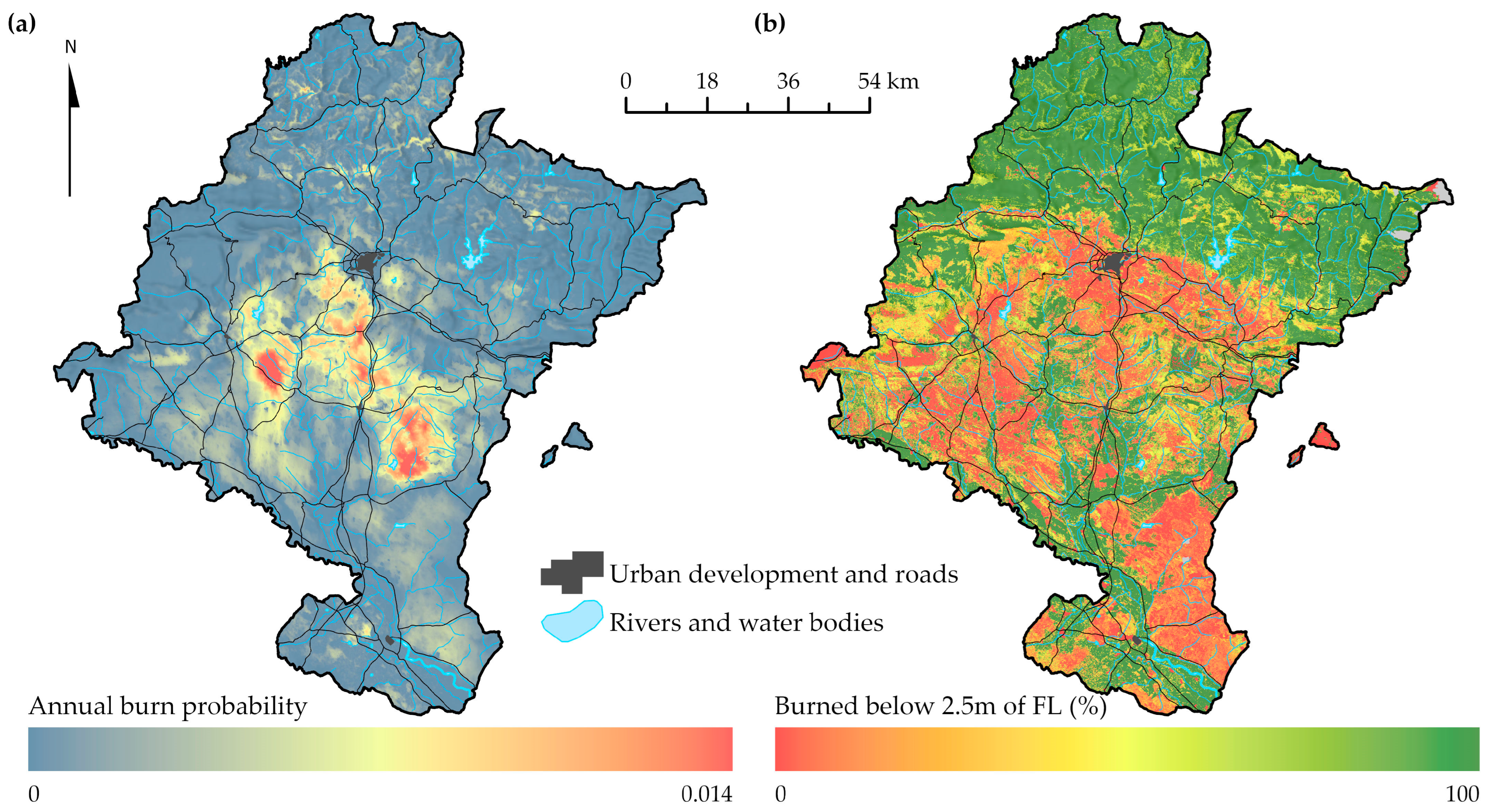
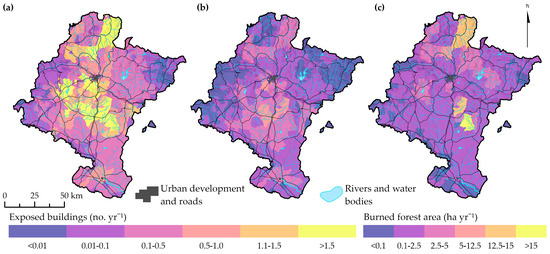
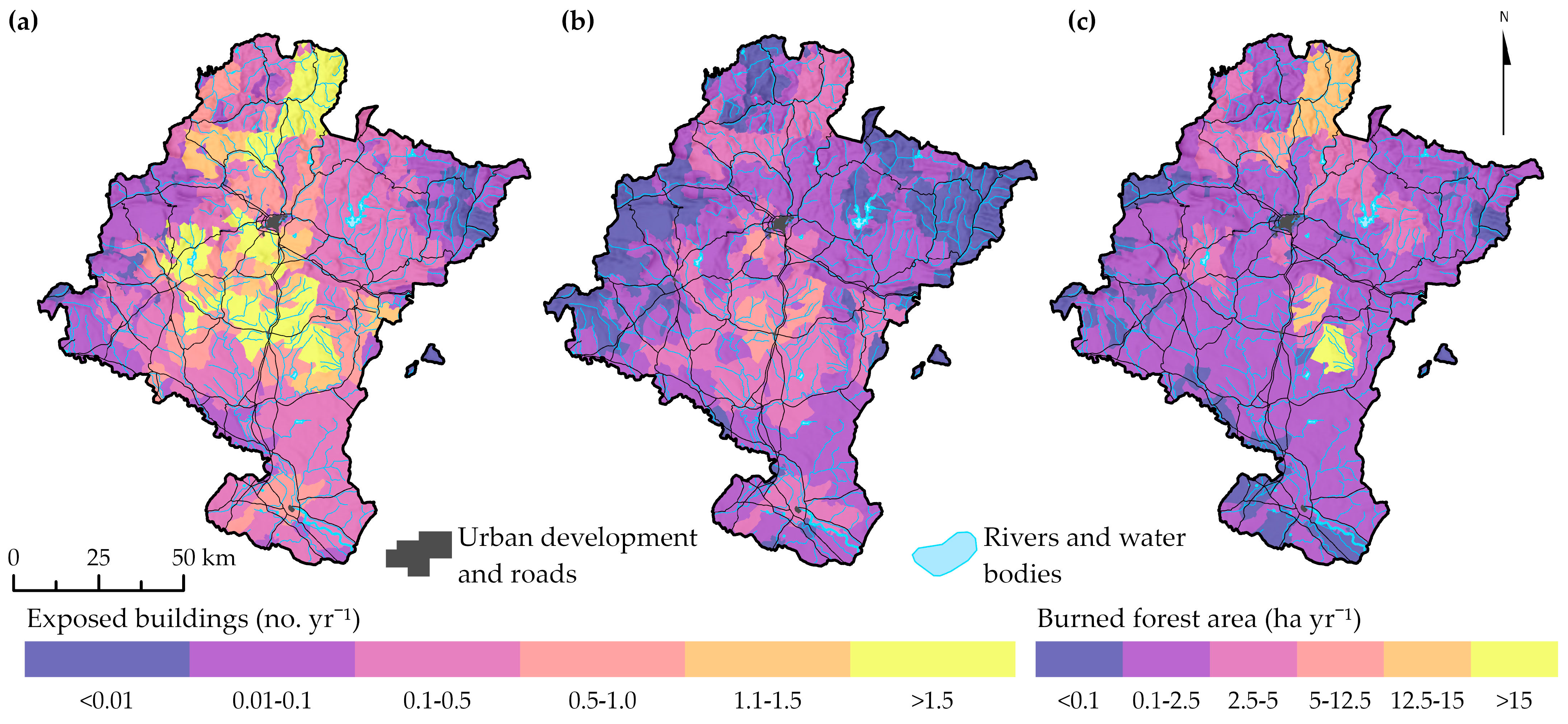
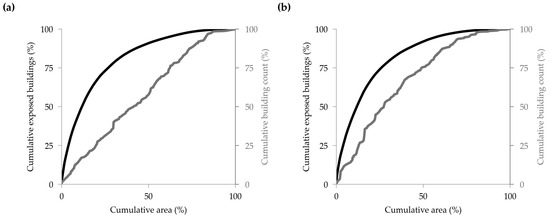
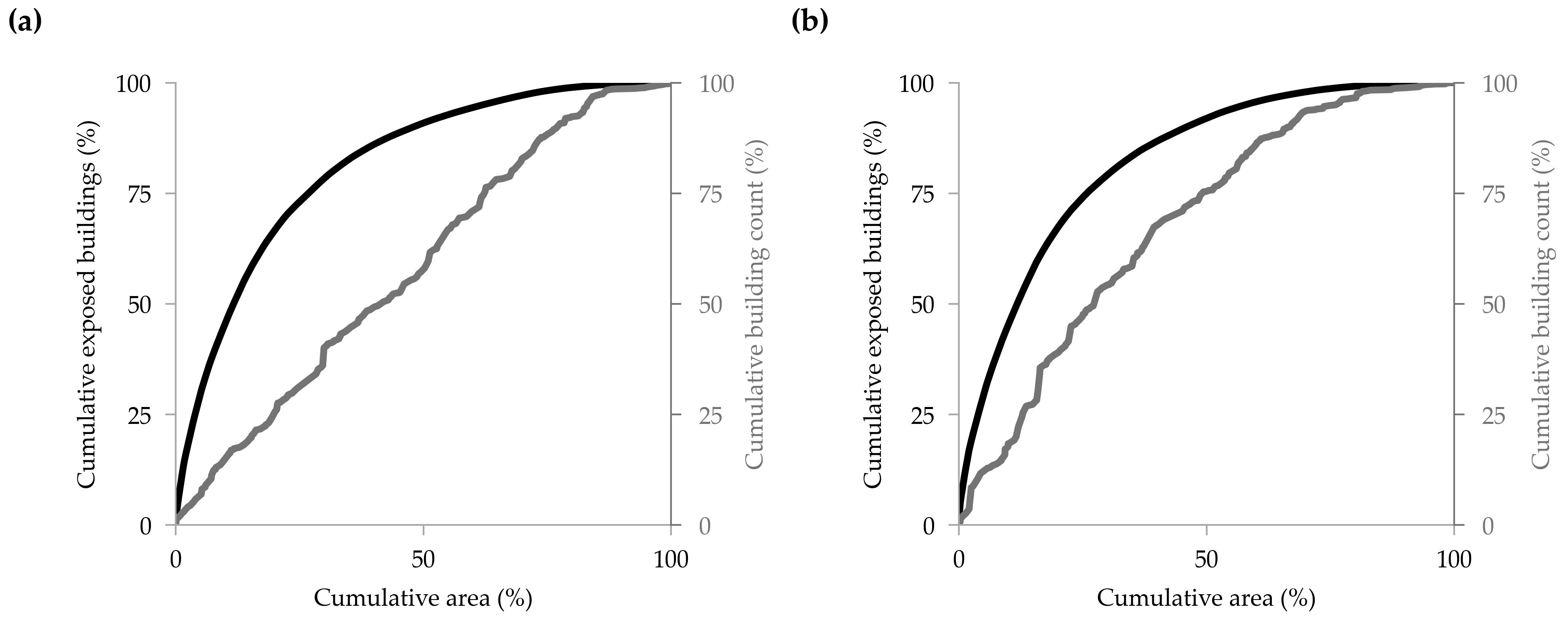
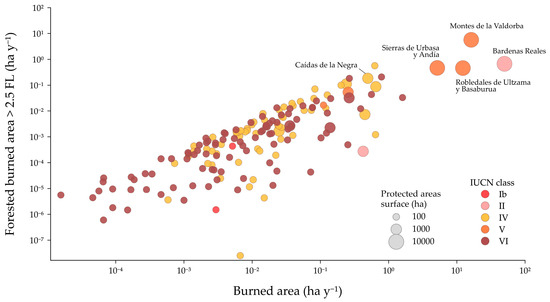
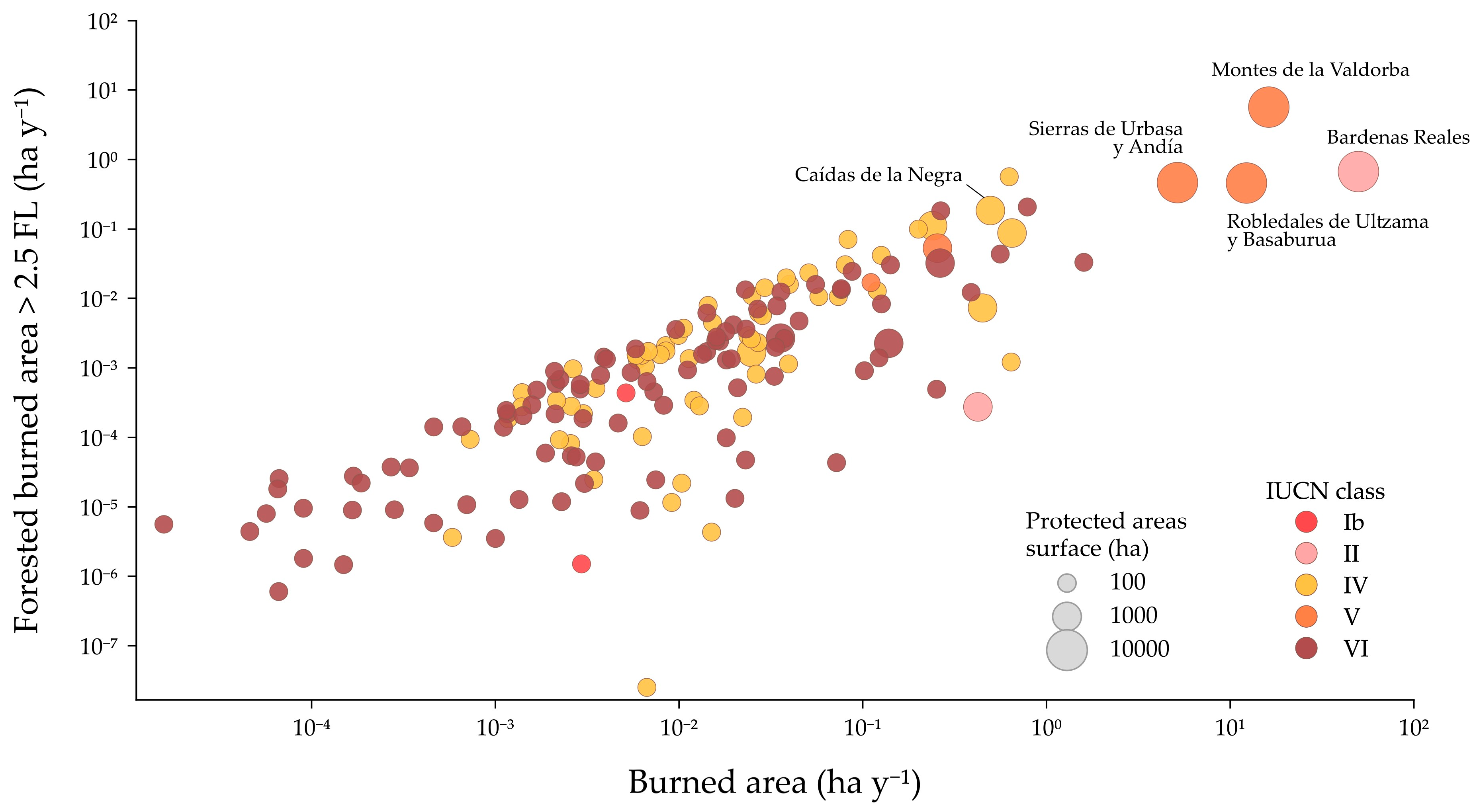

Disclaimer/Publisher’s Note: The statements, opinions and data contained in all publications are solely those of the individual author(s) and contributor(s) and not of MDPI and/or the editor(s). MDPI and/or the editor(s) disclaim responsibility for any injury to people or property resulting from any ideas, methods, instructions or products referred to in the content. |
© 2026 by the authors. Licensee MDPI, Basel, Switzerland. This article is an open access article distributed under the terms and conditions of the Creative Commons Attribution (CC BY) license.