


Abstract
Vegetation restoration is an effective measure to improve soil carbon storage in rocky desertification areas. However, the underlying mechanisms driving differences in soil carbon storage among different vegetation types remain unclear. In this study, we selected four typical vegetation types (monospecific broadleaf plantation, mixed conifer–broadleaf plantation, monospecific coniferous plantation, and natural shrubland) from the comprehensive control zone for moderately rocky desertification of Xuyong County in the Chishui River Basin. We investigated the effects of vegetation patterns on soil carbon storage through tree layer functional traits, tree diversity, shrub layer functional traits, shrub diversity, and soil fungal/bacterial diversity. The results showed that soil carbon storage was highest in monospecific broadleaf plantations, followed by mixed conifer–broadleaf plantations, then natural shrubland, and it was lowest in monospecific coniferous plantations. Significant differences were mainly observed in the 0–10 cm and 10–20 cm soil layers, while no significant difference was found in the 20–30 cm layer. Tree layer community-weighted mean of leaf nitrogen content, soil fungal Shannon–Wiener index, and shrub layer community-weighted mean of specific leaf area were the core positive drivers of soil carbon differentiation. Among these, tree layer community-weighted mean of leaf nitrogen content was the most important factor, whereas the regulatory effect of shrub layer community-weighted mean of specific leaf area intensified with increasing soil depth. Furthermore, tree layer community-weighted mean of leaf nitrogen content and shrub layer community-weighted mean of specific leaf area not only directly promoted soil carbon accumulation but also indirectly promoted it by enhancing soil fungal diversity. In contrast, the effects of tree and shrub layer diversity and soil bacterial diversity were negligible. This study demonstrates that increasing soil carbon storage in rocky desertification ecosystems depends on the direct effect of soil fungal diversity, as well as the direct effects of tree and shrub layer functional traits and their indirect effects via regulating soil fungal diversity. We recommend that in moderately rocky desertified areas, priority should be given to tree species with high leaf nitrogen content; on sites unsuitable for afforestation, promoting natural shrublands with high specific leaf area can effectively enhance carbon sequestration capacity.
1. Introduction
Currently, global ecological and environmental issues are becoming increasingly severe. Problems such as climate change, biodiversity loss, and land degradation pose serious threats to human survival and development [1,2]. As an extreme form of land degradation, rocky desertification is characterized by reduced vegetation cover, simple vegetation structure, severe soil erosion, and extensive bedrock exposure, which leads to the degradation of ecosystem functions such as soil carbon cycling and storage [3,4]. Rocky desertified lands cover millions of hectares across the region, with large areas already under targeted ecological management. Although expansion trends have been curbed to some extent, ecosystem restoration remains an urgent priority for affected areas [5,6].
Vegetation restoration is an effective measure to curb the deterioration of the ecological environment, improve rocky desertification ecosystem function, and significantly increase soil carbon storage [7,8]. In recent years, large-scale vegetation restoration has been carried out in rocky desertification areas, playing an important role in promoting community succession and increasing carbon storage [9,10]. However, variation in vegetation patterns leads to differential effects on soil carbon storage. A large number of studies have found that tree species diversity can promote key forest ecosystem functions, including soil carbon storage [11,12,13]. Nevertheless, it is not the number of species itself that affects ecosystem functions, but rather the tree species functional traits closely associated with ecosystem functions [14,15]. To a large extent, tree species diversity influences ecosystem functions through the compositional characteristics of tree species functional traits [16,17,18]. Functional traits refer to a series of plant attributes that potentially have significant impacts on plant colonization, survival, growth, and mortality, and these attributes can exert strong effects on ecosystem processes [19,20]. Plant community functional traits can be quantified with community-weighted mean trait values [21], which are reformulated from the “Mass Ratio Hypothesis” [22]: this hypothesis holds that different species have varying competitive abilities for resources. Dominant species with stronger competitiveness can acquire more resources, thereby exerting important impacts on the ecosystem functions. Therefore, ecosystem functions are mainly determined by the functional traits of dominant species [21,23,24,25,26,27]. Apart from the trait effects of dominant species, ecosystem function can also be explained from the perspective of species diversity. However, the “Complementarity Hypothesis” establishes functional diversity as a key driver of ecosystem function. It argues that functional trait differences among co-existing species reduce competition by enabling divergent resource-acquisition strategies, thereby facilitating complementary resource use and enhancing ecosystem functions. Notably, previous studies have largely focused on the tree layer, while the potential role of the shrub layer in soil carbon accumulation has been largely overlooked. Shrubs are often considered to have low biomass and limited contribution to ecosystem carbon pools. However, in rocky desertification ecosystems where tree growth is constrained, shrubs may play a non-negligible role in soil carbon dynamics. A recent meta-analysis showed that shrub restoration increased soil organic carbon by 59.2% in karst rocky desertification areas [28]. Another meta-analysis comparing different vegetation types found that shrubs exhibited the highest surface soil organic carbon stock (2.66), even higher than that of trees (2.34) and grasses (1.37) in China [29].
Regarding soil carbon storage, soil microbial communities, particularly fungi, are key regulators of organic matter decomposition and carbon cycling [30,31]. More labile plant litter can be decomposed by a wider range of microorganisms, whereas lignin is recalcitrant to bacterial decomposition and is primarily broken down by fungal heterotrophs. Growing evidence indicates that aboveground vegetation not only directly affects soil carbon storage but also indirectly influences it by modulating soil microbial diversity [32]. However, how aboveground vegetation and belowground soil microbes jointly regulate soil carbon storage across different vegetation patterns in rocky desertification ecosystems remains poorly understood.
Therefore, this study selected four typical vegetation types (monospecific broadleaf plantation, mixed conifer–broadleaf plantation, monospecific coniferous plantation, and natural shrubland) in the comprehensive rocky desertification management area of the Chishui River Basin. The objectives of this study were to (1) compare the differences in soil carbon storage among different vegetation restoration patterns and their vertical distribution characteristics; (2) elucidate the direct and indirect regulatory mechanisms of tree and shrub layer functional traits, species/functional diversity, and soil fungal/bacterial diversity on soil carbon storage; and (3) identify the core driving factors of soil carbon differentiation, thereby providing scientific guidance for optimizing vegetation restoration strategies and enhancing carbon sequestration capacity in rocky desertification areas.
2. Materials and Methods
2.1. Study Area
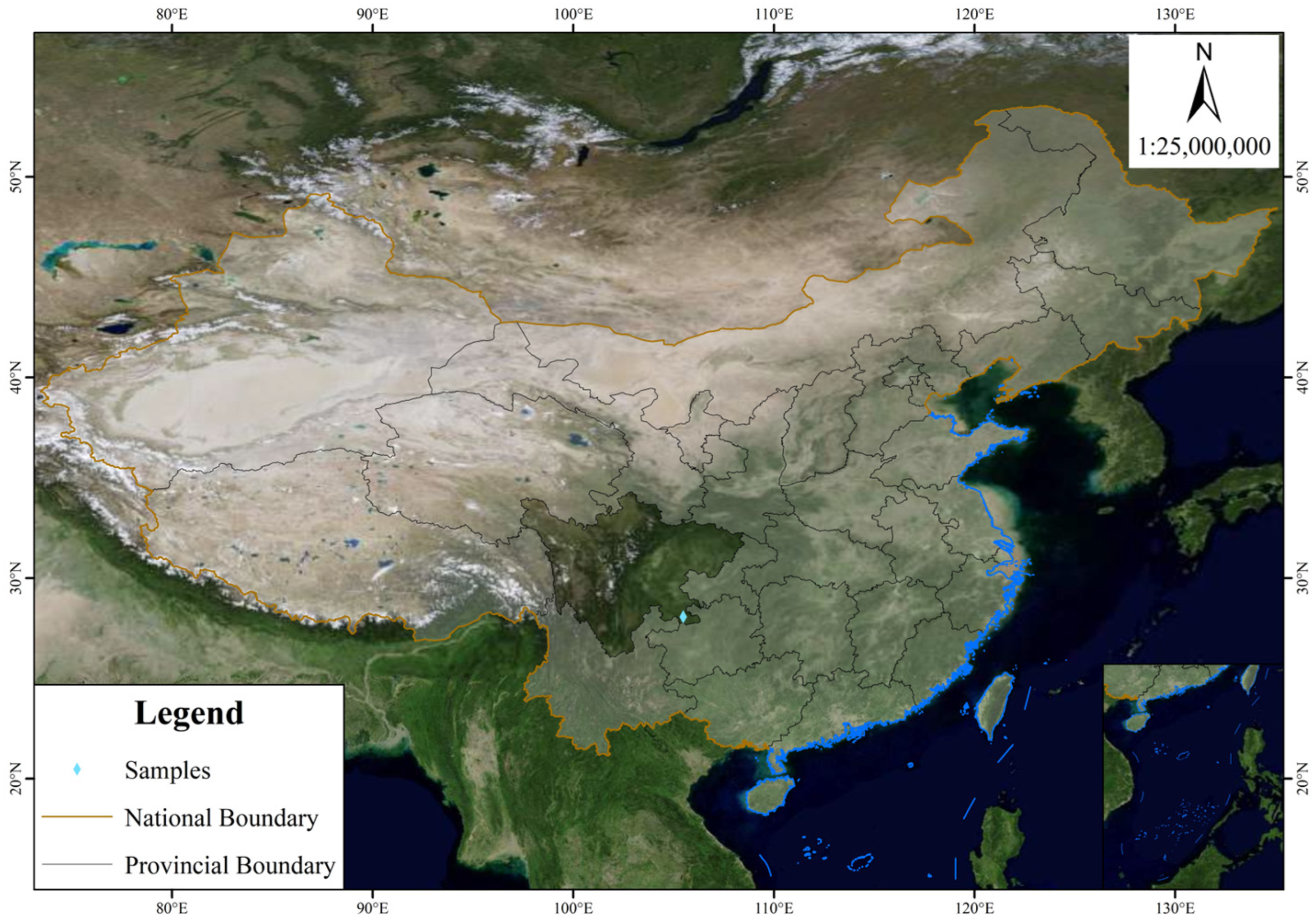
This study was conducted in the comprehensive rocky desertification control zone of Xuyong County, Chishui River Basin (Figure 1). It spans geographic coordinates of 105°28′47″–105°28′49″ E and 28°3′43″–28°3′45″ N, with an elevation range of 538–561 m. The area has a subtropical humid monsoon climate, characterized by abundant precipitation, relatively low sunshine hours, an annual sunshine of 1127 h, a mean annual temperature of 17.4 °C, and an annual precipitation of 1072.2 mm. The bedrock consists mainly of limestone, while the soil is dominated by yellow soil.
Figure 1.
Survey map of study area.
2.2. Experimental Design
In summer 2024, a total of 21 plots from 3 typical plantations and one control group of natural shrublands were selected in study area (Table 1). All plots had similar slope position, aspect, gradient, stand density, elevation, and stand age. The stand density of all arbor forest plots was approximately 1300 trees per hectare. A total of 3 sample plots (20 m × 20 m each) were set up for each plantation type, and 3 sample plots (10 m × 10 m each) were established in the shrubland.
Table 1.
Main features of sampling.
2.3. Selection and Measurement of Plant Functional Traits
We measured the plant functional traits of the tree layer and the shrub layer (including forest plots and the natural shrubland plots). On each plot, five healthy individuals per species were randomly selected from both the tree layer and the shrub layer, and their healthy leaves were collected to measure the following functional traits: specific leaf area, leaf nitrogen content, leaf phosphorus content, wood density, and leaf dry matter content. These functional traits correlate with plant relative growth rate, nutrient acquisition and utilization [33], and competitiveness [34,35]. We measured the plant functional traits of the tree layer and the shrub layer. Leaf phosphorus content was determined by the molybdenum-antimony anti-colorimetric method. Leaf nitrogen content was measured using an ECS4010/4024 elemental analyzer (NC Technologies S.R.L., Bussero, Italy). Wood density was obtained via the water displacement method.
2.4. Calculation of Tree Diversity and Community Functional Traits
Tree diversity was calculated from two dimensions: species classification and functional traits. Species classification diversity was quantified using species richness and Shannon–Wiener diversity index. Functional diversity (FD) was quantified using the functional dispersion index, and five functional traits were used to calculate functional diversity. Plant community functional traits are typically quantified using the community-weighted mean (CWM), and the calculation formula is as follows:
n refers to the number of species with a specific trait in the community, pi denotes the relative abundance of species i within the community, and traiti represents the functional trait value of species i for that specific trait. FD and CWM were calculated separately using the FD package [36] in R 4.4.1.
2.5. Soil Microbial Diversity and Soil Carbon Content
This study primarily focuses on the diversity of soil fungi and bacteria, employing the Shannon–Wiener diversity index to characterize the alpha diversity of soil bacteria and fungi. High-quality sequences were clustered into operational taxonomic units (OTUs) at a 97% similarity threshold using Usearch (v12) software. Based on the OTUs’ clustering results, multiple diversity indices of OTUs were analyzed. The Shannon–Wiener indices for soil bacteria and fungi were calculated using QIIME (Version 1.7.0) software, utilizing the OTU abundance information from the sample libraries.
Soil carbon storage was represented by the soil total carbon content in the 1–10 cm, 10–20 cm, and 20–30 cm layers. Total soil carbon content was measured with a Vario ELIII elemental analyzer (Elementar Analysensysteme GmbH, Langenselbold, Germany).
2.6. Statistical Analysis
We employed one-way ANOVA with Tukey’s HSD test to compare differences in soil total carbon content among different vegetation types in the 0–10 cm, 10–20 cm, and 20–30 cm soil layers. Stepwise regression analysis was used to examine whether and how tree species richness, functional diversity of the tree layer (FD_T), functional diversity of the shrub layer (FD_S), tree layer community-weighted mean of specific leaf area (CWM_SLA_T), tree layer community-weighted mean of wood density (CWM_WD_T), tree layer community-weighted mean of leaf nitrogen content in the tree layer (CWM_LN_T), tree layer community-weighted mean leaf of phosphorus content (CWM_LP_T), tree layer community-weighted mean of leaf dry matter content (CWM_LDCM_T), shrub layer community-weighted mean of specific leaf area (CWM_SLA_S), shrub layer community-weighted mean of wood density (CWM_WD_S), shrub layer community-weighted mean of leaf nitrogen content (CWM_LN_S), shrub layer community-weighted mean of leaf phosphorus content (CWM_LP_S), shrub layer community-weighted mean of leaf dry matter content (CWM_LDCM_S), and belowground microbial diversity influence soil total carbon content in the 0–10 cm, 10–20 cm, and 20–30 cm layers. The Akaike Information Criterion was applied for optimal model selection. Variance partitioning was used to quantify the proportion of total variation explained by soil carbon content in the optimal model. Finally, piecewise structural equation modeling was employed to test direct and indirect causal relationships between factors and soil total carbon. All data were standardized prior to modeling. All statistical analyses were performed in R 4.4.1 using the ‘vegan’, ‘MASS’, ‘ggplot2’, ‘car’, ‘relaimpo’, and ‘piecewiseSEM’ packages.
3. Results
3.1. Variations in Soil Carbon Storage
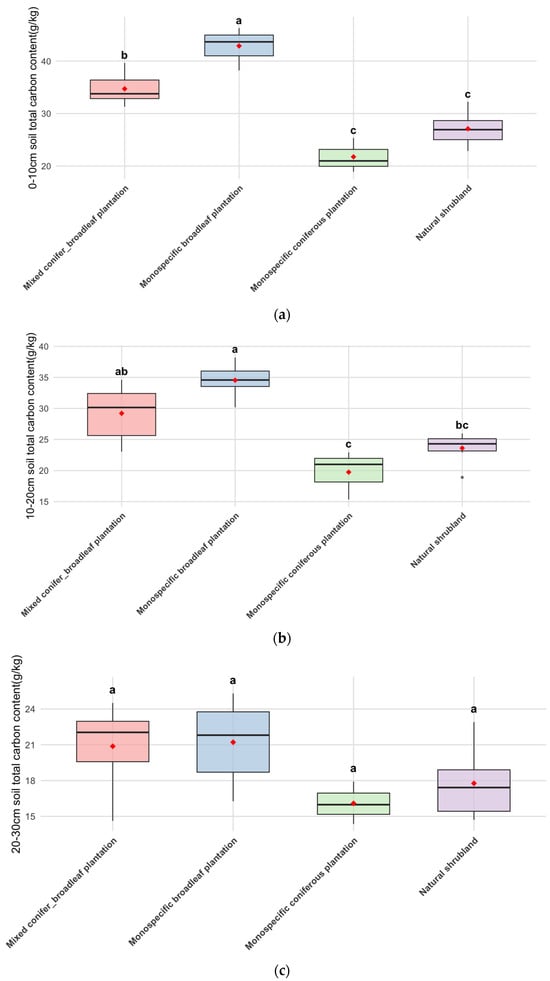
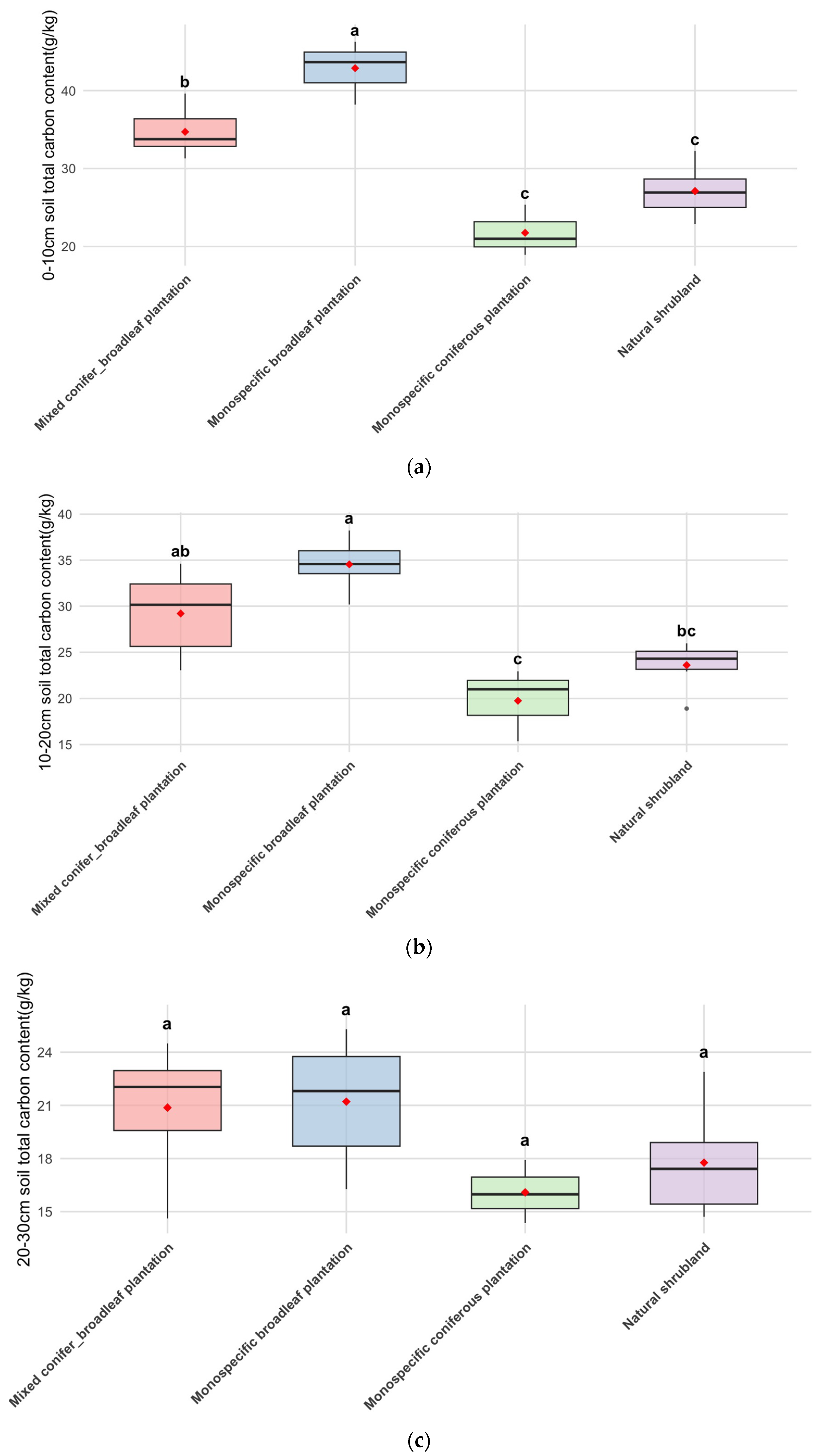
According to the results, soil carbon content differed significantly among different vegetation types. These differences were most pronounced in the surface (0–10 cm) and middle (10–20 cm) soil layers, and weakened in the deeper (20–30 cm) soil layer. In the 0–10 cm surface soil layer, monospecific broadleaf plantations had the highest soil total carbon content, which was significantly higher than that of all other vegetation types (p < 0.05) (Figure 2a). Mixed conifer–broadleaf plantations ranked second, with carbon content significantly higher than that of monospecific coniferous plantations and natural shrubland (p < 0.05) (Figure 2a). Monospecific coniferous plantations and natural shrubland had the lowest carbon contents, and there was no significant difference between them (p > 0.05) (Figure 2a). In the 10–20 cm middle soil layer, monospecific broadleaf plantations still had the highest carbon content, which was significantly higher than that of monospecific coniferous plantations and natural shrubland (p < 0.05) (Figure 2b). Mixed conifer–broadleaf plantations showed intermediate levels, with no significant difference compared to monospecific broadleaf plantations or natural shrubland (p > 0.05), but significantly higher than monospecific coniferous plantations (p < 0.05) (Figure 2b). Monospecific coniferous plantations remained the lowest in carbon content in this layer (Figure 2b). In the 20–30 cm deep soil layer, the differences among vegetation types were no longer statistically significant (p > 0.05) (Figure 2c). Although monospecific broadleaf plantations and mixed conifer–broadleaf plantations had relatively higher carbon contents, while natural shrubland and monospecific coniferous plantations had lower values, the carbon levels of the four vegetation types tended to be consistent in this layer (Figure 2c).
Figure 2.
Differences in soil total carbon content among different vegetation patterns at depths of (a) 0–10 cm, (b) 10–20 cm, and (c) 20–30 cm. Different lowercase letters (a, b, c) indicate statistically significant differences between groups (p < 0.05). In the boxplot, the horizontal line inside each box represents the median, and the red dot represents the mean.
Overall, monospecific broadleaf plantations showed the strongest soil carbon sequestration potential throughout the soil profile, followed by mixed conifer–broadleaf plantations, while monospecific coniferous plantations and natural shrubland had relatively weak carbon storage capacity.
3.2. Key Factors Regulating Soil Carbon Storage
Stepwise regression analysis revealed that community-weighted plant functional traits of the tree and shrub layers, together with soil fungal diversity, jointly regulated the variation in soil total carbon content among vegetation types.
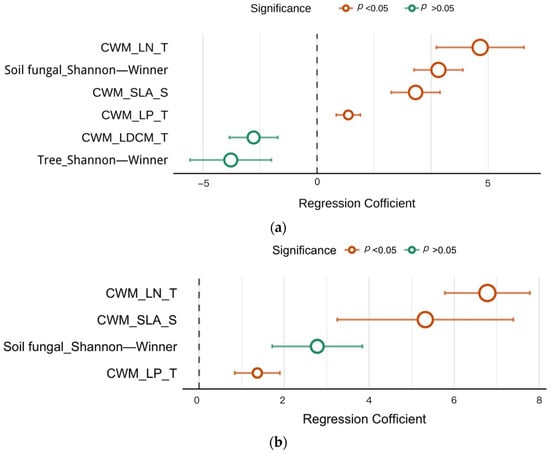
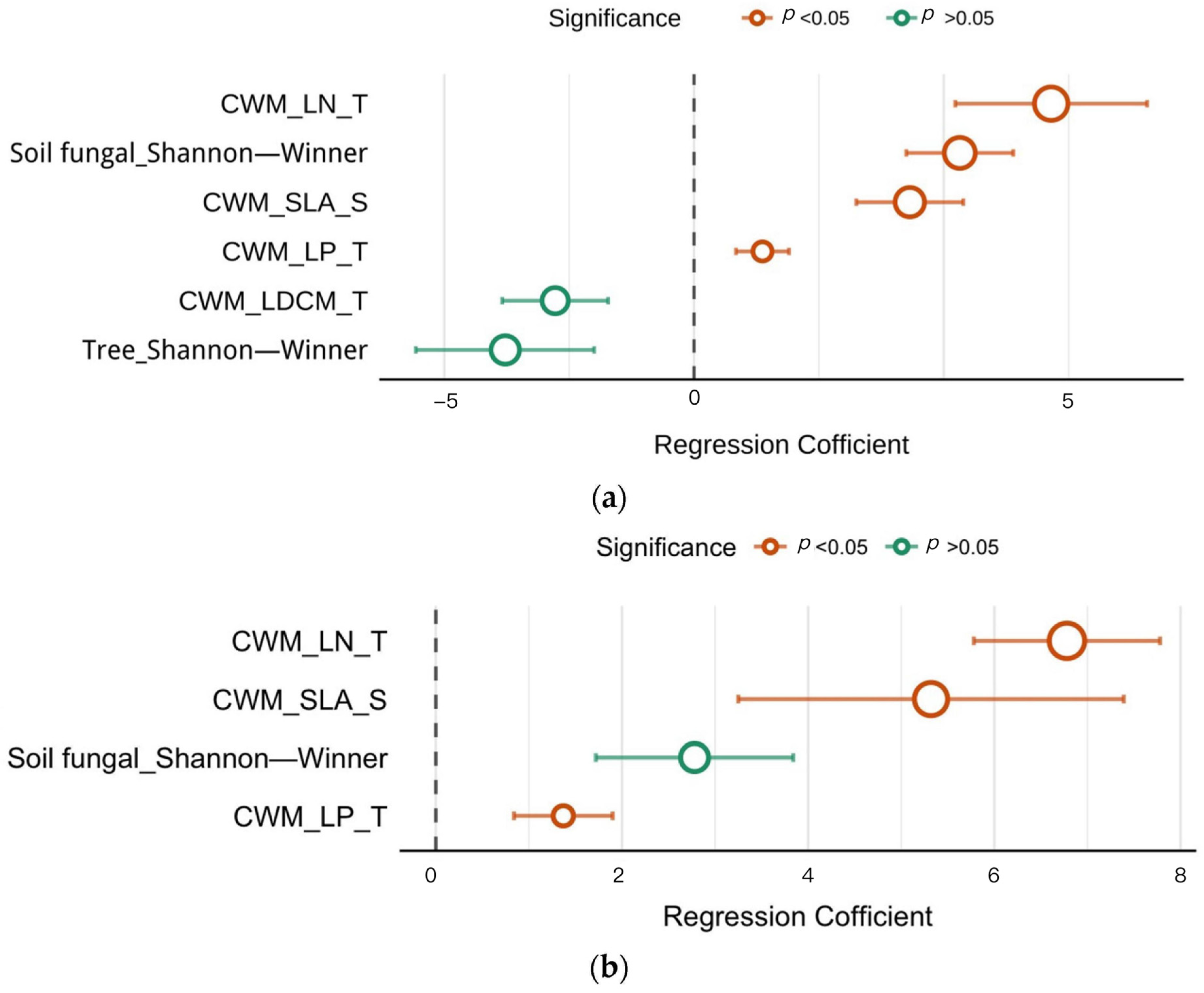
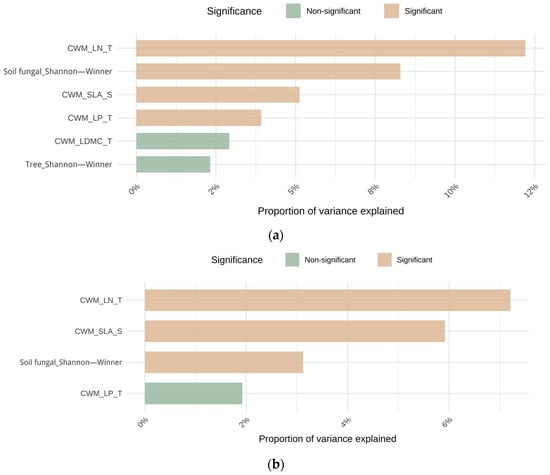
In the 0–10 cm soil layer, the soil fungal Shannon–Wiener index, CWM_LN_T, CWM_LP_T, and CWM_SLA_S all exerted significant positive effects on soil total carbon content (p < 0.05) (Figure 3a). Among these, CWM_LN_T was the primary driving factor, explaining 12% of the variation in soil total carbon content among vegetation types, followed by the soil fungal Shannon–Wiener index, which accounted for 9% of the total variation. CWM_SLA_S and CWM_LP_T showed relatively low contribution rates of only 5% and 3%, respectively (Figure 3b). Both CWM_LDMC_T and the tree layer Shannon–Wiener index exhibited non-significant negative correlations with the differences in soil total carbon content among vegetation types (p > 0.05) (Figure 3a), each explaining less than 3% of the total variation (Figure 3b).
Figure 3.
Effects of various factors on soil total carbon content at depths of (a) 0–10 cm and (b) 10–20 cm. CWM_LN_T: tree layer community-weighted mean of leaf nitrogen content; CWM_LDMC_T: tree layer community-weighted mean of leaf dry matter content; CWM_LP_T: tree layer community-weighted mean of leaf phosphorus content; CWM_SLA_S: shrub layer community-weighted mean of specific leaf area. Dashed grey line indicates a coefficient of zero.
In the 10–20 cm middle soil layer, the relative importance and contribution of each factor to the differences in soil carbon among vegetation types changed markedly. CWM_LN_T retained a significant positive dominant effect (p < 0.05) (Figure 4a), with a contribution rate of 7% (Figure 4b). Compared with the surface layer, the influence and explanatory power of CWM_SLA_S increased (Figure 4a), and its contribution rate rose to 6% (Figure 4b), making it the second most important factor regulating the variation in soil total carbon content among vegetation types in this layer. The soil fungal Shannon–Wiener index still exhibited a significant positive regulatory effect on the differences in soil total carbon content in the 10–20 cm layer (p < 0.05) (Figure 4a), whereas CWM_LP_T no longer showed a significant effect in this layer (p > 0.05).
Figure 4.
Importance of various factors on soil total carbon content at depths of (a) 0–10 cm and (b) 10–20 cm. CWM_LN_T: tree layer community-weighted mean of leaf nitrogen content; CWM_LDMC_T: tree layer community-weighted mean of leaf dry matter content; CWM_LP_T: tree layer community-weighted mean of leaf phosphorus content; CWM_SLA_S: shrub layer community-weighted mean of specific leaf area.
Overall, CWM_LN_T served as the core factor driving the differentiation of soil total carbon content among vegetation types. With increasing soil depth, the contribution proportion of CWM_SLA_S increased obviously and became a key dominant factor controlling soil carbon variation among vegetation types in the middle layer, while the soil fungal Shannon–Wiener index maintained significant regulatory effects in both the 0–10 cm and 10–20 cm soil layers.
3.3. The Direct and Indirect Effects of Various Factors on Soil Carbon Storage
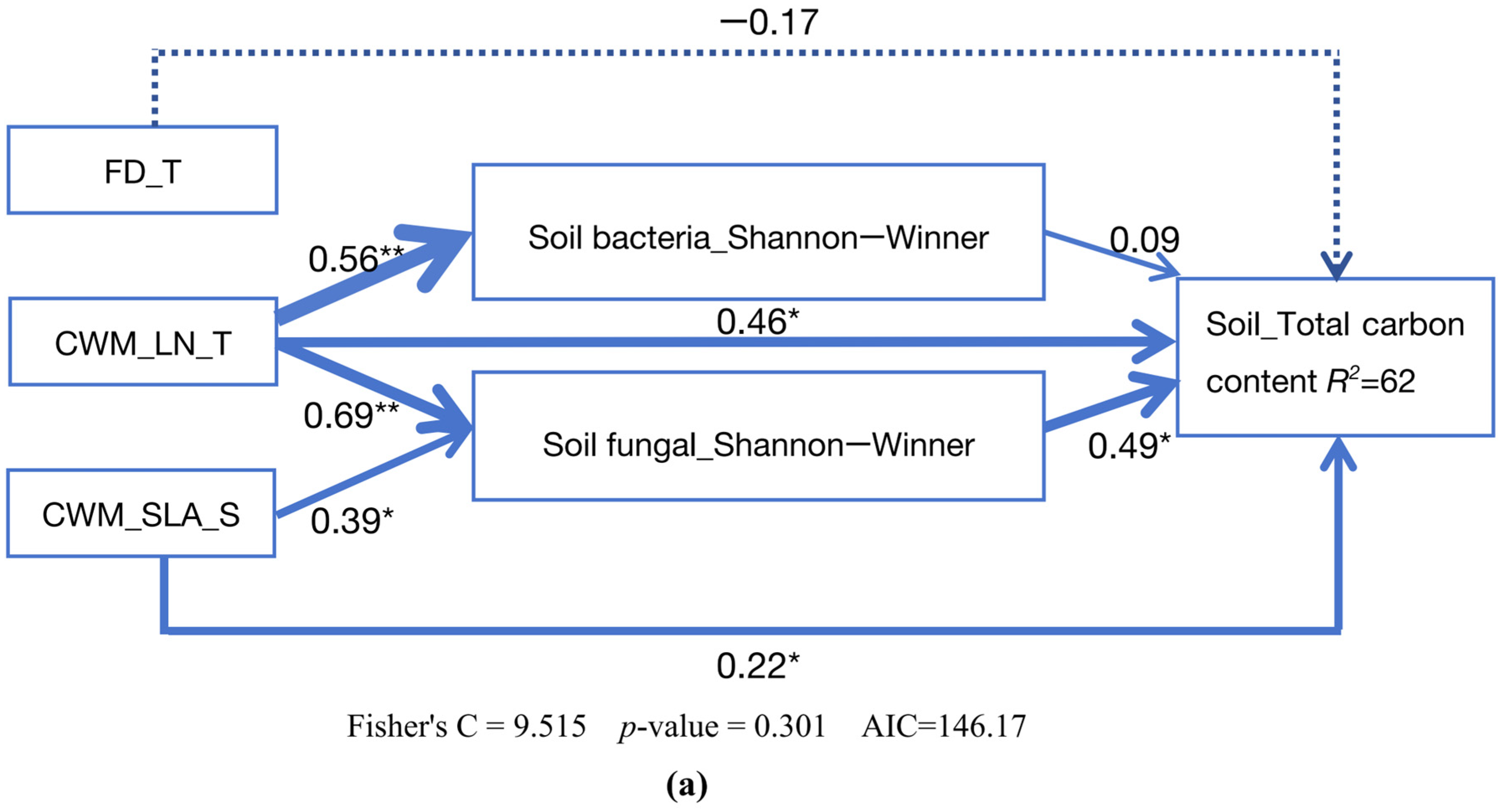
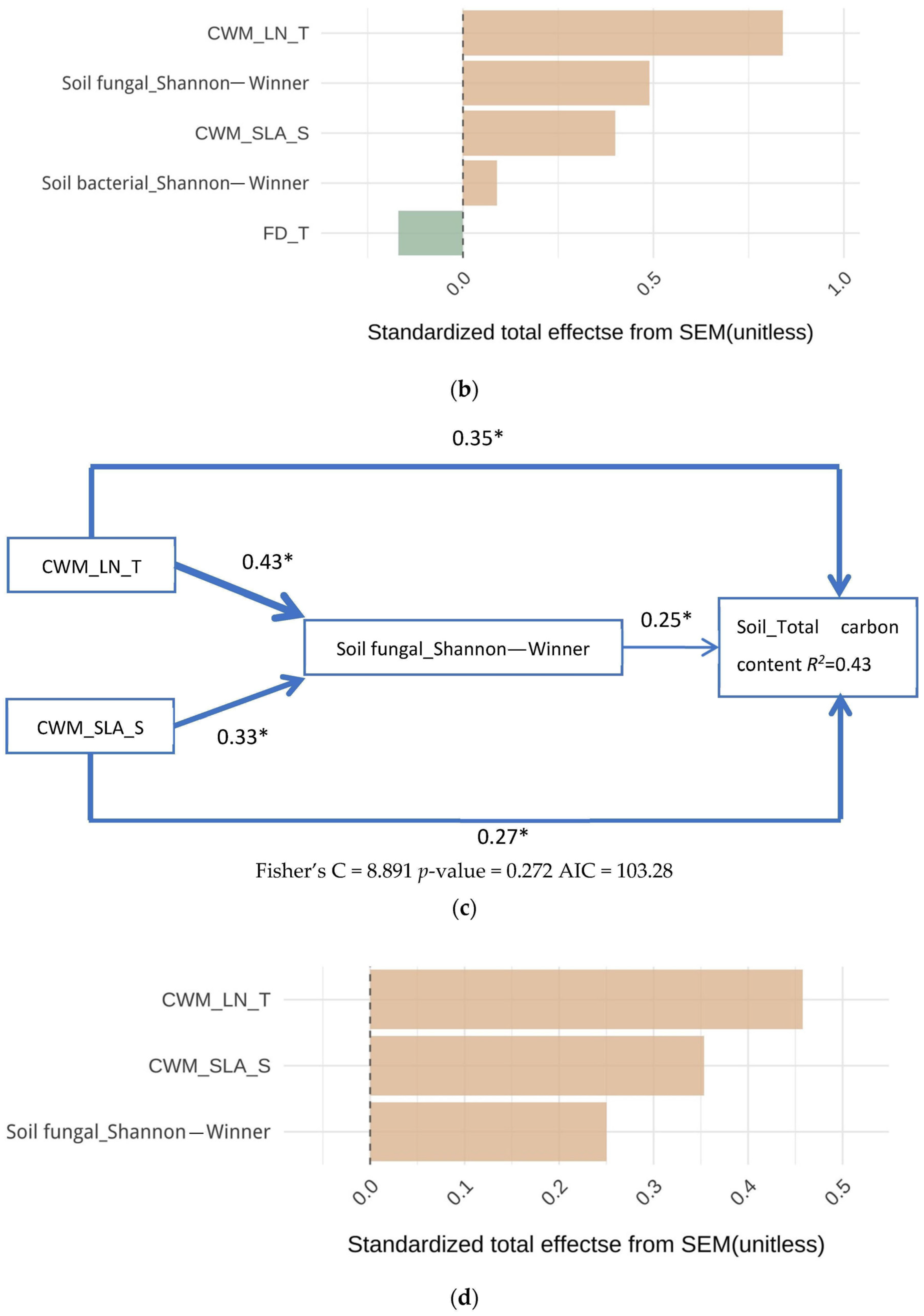
The piecewise structural equation model explained 62% and 43% of the variance in soil total carbon content among different vegetation types for the 0–10 cm and 10–20 cm soil layers, respectively, and all models achieved good fitting performance (0–10 cm: Fisher’s C = 9.515, p = 0.301, AIC = 146.17 Figure 5a; 10–20 cm: Fisher’s C = 8.891, p = 0.272, AIC = 103.28 Figure 5c).
In the 0–10 cm surface soil layer, plant functional traits and soil microbial diversity collectively regulated the differentiation of soil total carbon across vegetation types via both direct and indirect pathways. Among these factors, CWM_LN_T showed the strongest positive direct effect on inter-vegetation differences in soil total carbon content (β = 0.46, p < 0.05) (Figure 5a,b). It also significantly increased the Shannon–Wiener indices of soil fungi (β = 0.69, p < 0.01) and bacteria (β = 0.56, p < 0.01), thereby indirectly enlarging the divergence of soil carbon accumulation among vegetation types through regulating soil microbial diversity. Similarly, CWM_SLA_S exerted a significant positive direct effect on inter-vegetation variation in soil carbon content (β = 0.22, p < 0.05) and further widened such differences by promoting soil fungal diversity (β = 0.39, p < 0.05) (Figure 5a,b). The soil fungal Shannon–Wiener index presented a significant positive direct control over inter-vegetation heterogeneity of soil total carbon (β = 0.49, p < 0.05), whereas soil bacterial diversity exhibited a weak and non-significant direct influence (β = 0.09, p > 0.05) (Figure 5a,b). Tree layer functional diversity (FD_T) had a non-significant negative direct effect on soil carbon differentiation among vegetation types (β = −0.17, p > 0.05) (Figure 5a,b).
In the 10–20 cm middle soil layer, the dominant drivers and regulatory pathways governing inter-vegetation variation in soil total carbon displayed clear vertical stratification. CWM_LN_T still maintained a significant positive direct effect (β = 0.35, p < 0.05) and indirectly mediated inter-vegetation differences in soil carbon accumulation by enhancing soil fungal diversity (β = 0.43, p < 0.05) (Figure 5c,d). CWM_SLA_S also retained a significant positive direct impact on soil carbon divergence among vegetation types (β = 0.27, p < 0.05) and further regulated such differences by modulating soil fungal community composition (β = 0.33, p < 0.05) (Figure 5c,d). Likewise, the soil fungal Shannon–Wiener index continued to impose a significant positive direct effect on the spatial differentiation of soil total carbon among vegetation types in the middle soil layer (β = 0.25, p < 0.05) (Figure 5c,d).
Figure 5.
Direct and indirect effects of various factors on soil total carbon content at depths of (a,b) 0–10 cm and (c,d) 10–20 cm. Solid blue arrows indicate positive relationships (p < 0.05), and dashed arrows represent negative relationships. Standardized total effects in the structural equation model. * and ** indicate significant relationships between variables at the p = 0.05 and p = 0.01 levels, respectively. CWM_LN_T: tree layer community-weighted mean of leaf nitrogen content; CWM_SLA_S: shrub layer community-weighted mean of specific leaf area; FD_T: functional diversity of tree layer. Green represents ‘Not significant’. Red represents ‘Significant’. Dashed grey line indicates a coefficient of zero.
4. Discussion
4.1. Effects of CWM_LN_T, CWM_SLA_S and Soil Fungal_Shannon–Wiener Index on Soil Carbon Storage
The results showed that soil total carbon content in both the 0–10 cm surface layer and the 10–20 cm subsurface layer was significantly and positively correlated with CWM_LN_T, CWM_SLA_S, and the soil fungal Shannon–Wiener index (p < 0.05). These three factors collectively constituted the core drivers regulating the spatial variation of soil total carbon content across different vegetation types. Notably, compared with the surface soil, the explanatory power and contribution of CWM_SLA_S to soil carbon storage in the 10–20 cm subsurface layer increased markedly, occupying a more dominant position in deep-soil carbon variation. Our results support the Mass Ratio Hypothesis, which states that ecosystem functioning is primarily determined by the functional traits of dominant species in the community [22]. CWM_LN_T was a key factor affecting soil carbon accumulation. Global multi-site studies have confirmed that community-weighted leaf nitrogen content significantly promotes litter decomposition and soil organic carbon inputs, maintaining a stable positive association with soil carbon storage [37]. Forest communities with higher leaf nitrogen content exhibit faster material turnover and are more likely to sustain greater soil carbon sequestration capacity [18,38]. Studies on the conversion of subtropical forest plantations further verify that tree assemblages with high leaf nitrogen traits effectively enhance soil carbon sequestration potential in forestlands [39,40,41]. This is because leaf nitrogen content is closely related to litter decomposition rate; species with high leaf nitrogen produce more easily decomposable litter, which facilitates the input of exogenous carbon sources into the soil [42,43]. In addition, plants with high leaf nitrogen content usually possess stronger resource capture capacity and faster growth rates, producing abundant litter that continuously supplies organic carbon to the soil, thereby increasing soil carbon storage [44,45].
Beyond tree functional traits, this study further demonstrates that CWM_SLA_S is an indispensable key factor regulating soil carbon storage, and its influence gradually strengthens with soil depth. Previous studies have suggested that shrubs with high specific leaf area may generally adopt a resource-acquisitive strategy characterized by rapid growth, low photosynthetic cost, and relatively fast tissue turnover [19,33]. Such shrubs may produce labile litter and potentially exhibit higher fine-root turnover, which could contribute to organic matter inputs and root exudation into deeper soil layers [46]. Surface soil organic matter is more dominated by tree canopy litter, with relatively limited contributions from shrub litter and fine roots. However, in the 10–20 cm subsurface layer, the downward input of tree litter gradually declines. According to previous studies, the proportion of shrub fine-root distribution, the contribution of root exudates, and the leaching of understory litter may become important carbon sources for the subsurface soil [47,48]. It is worth pointing out that we did not measure root-related indicators in the current study. Accordingly, the explanations here are inferred from previous studies. To make up for this deficiency, our subsequent research will systematically investigate fine-root distribution, root turnover rate and root exudation characteristics, so as to more accurately confirm the mechanisms driving soil carbon storage. Shrublands with high specific leaf area can improve understory microenvironments and soil physicochemical properties, optimize fungal community structure and diversity, and amplify the promotion of organic carbon accumulation in the subsurface soil. This is also an important reason why the regulatory effect of CWM_SLA_S on soil carbon storage gradually strengthens with increasing soil depth.
Soil microorganisms are the core mediators of nutrient cycling and organic matter decomposition in terrestrial ecosystems, sustaining key ecological functions such as vegetation productivity maintenance, soil carbon and nitrogen cycling, and organic matter degradation [30]. Our study found that soil total carbon content in both the 0–10 cm and 10–20 cm layers increased significantly with the soil fungal Shannon–Wiener index (p < 0.05), indicating that fungal diversity exhibits a stable positive regulatory effect across different soil layers. This finding indicates that fungal communities can optimize their overall functions through interspecific niche differentiation and complementary resource utilization, thereby improving soil carbon accumulation and sequestration capacity. Large-scale European forest plot surveys have similarly confirmed that fungal community composition and diversity are highly coupled with soil carbon storage [49]. Higher fungal diversity may improve microbial carbon use efficiency, accelerate the processes of organic matter decomposition and humification, and promote the retention and accumulation of soil organic carbon [50,51,52]. This is mainly because fungi are more capable of decomposing lignin-rich low-quality litter, which is difficult for bacteria to break down. Spatial differences in fungal community structure are also an important biological mechanism explaining the variation in soil carbon storage across different vegetation types [53,54,55]. Additionally, we found that the regulatory strength of fungal diversity on soil total carbon tended to increase along the soil depth gradient. This may be because soils at different depths differ in temperature, moisture, oxygen content, substrate composition and physicochemical properties. Such environmental differences could alter the living conditions and interspecific interaction patterns of fungal communities, which might lead to variations in the diversity-driven soil carbon cycling across the vertical scale [56,57,58].
Contrary to most previous findings, functional diversity and species richness had no significant effect on soil total carbon content in this study. Most studies have reported that tree species diversity positively promotes soil carbon sequestration [18,59]. This discrepancy is mainly attributed to the relatively simple tree species composition of our study sites, which are mostly two-species mixed stands; previous studies often included multi-species mixtures and higher diversity gradients. This also reflects certain limitations of the present study; future research should incorporate a broader range of vegetation types and tree diversity patterns.
4.2. CWM_SLA_S and CWM_LN_T Regulate Soil Carbon Stock Through Microbial Diversity
In recent years, the interactions between aboveground and underground ecosystems [60,61,62,63] as well as the mutual feedback between plants and soil microorganisms [33,64,65,66] have been extensively explored in ecological research. Among these interactions, the synergistic effect of aboveground plant functional traits and soil microbial diversity has been identified as a core link in regulating the spatial variation of soil carbon storage.
In the surface soil layer, plant functional traits and soil microbial diversity work together to regulate the differentiation of soil carbon content among different vegetation types through both direct and indirect synergistic effects, which is consistent with the close coupling relationship between aboveground plant traits and underground microbial communities reported in numerous previous studies [27,66]. CWM_LN_T is recognized as a core direct driver of carbon accumulation in the surface soil. It not only exerts a direct regulatory effect on soil carbon storage but also indirectly influences the process of carbon accumulation by modulating the diversity of soil microbial communities. As a key indicator reflecting plant leaf economic strategies, CWM_LN_T directly determines the nutritional quality and decomposability of leaf litter [33,42]. Specifically, litter derived from plants with high leaf nitrogen content is more easily decomposable, which can supply sufficient nutrients for soil microorganisms, effectively increase microbial diversity, and further accelerate the accumulation of soil organic carbon [67,68,69,70]. This process ultimately forms a clear cascading regulatory pathway of “plant functional traits—soil microbial diversity—soil carbon storage”.
CWM_SLA_S also plays an important role in regulating the differentiation of surface soil carbon content. Its direct regulatory effect and indirect effect (by promoting soil fungal diversity) jointly amplify the differences in soil carbon content among different vegetation types. Shrublands with high specific leaf area typically adopt a typical resource-acquisition growth strategy [71], which is characterized by rapid growth rate, short tissue turnover cycle, and efficient fine-root renewal [72,73,74]. Moreover, their larger leaf area can shade the soil surface, which may increase soil moisture and further affect soil carbon turnover. This growth strategy enables them to continuously input organic matter and root exudates into the soil environment, creating favorable conditions for the growth and reproduction of soil fungi [75,76,77], thereby increasing microbial diversity and significantly enhancing soil organic carbon content [78,79].
Notably, there is a significant difference in the regulatory roles of soil fungi and bacteria in surface soil carbon cycling: compared with bacteria, fungal diversity plays a more prominent direct role in carbon regulation, which further confirms the core position of fungi in the global soil carbon cycle [80,81]. In addition, tree layer functional diversity has no significant regulatory effect on the differentiation of surface soil carbon content, which is consistent with the overall conclusion of this study that tree diversity has no significant impact on soil carbon storage [82].
In the subsurface soil layer, the regulatory patterns of various factors on soil carbon storage show obvious vertical stratification characteristics. This stratification is mainly derived from the vertical heterogeneity of carbon source distribution and microbial community structure in the soil profile [83]. Compared with the surface soil layer, the direct regulatory effect of CWM_LN_T on soil carbon content is weakened, but it can still indirectly participate in the process of carbon accumulation by regulating soil fungal diversity [84]. This phenomenon indicates that the regulatory effect of CWM_LN_T on soil carbon storage is stable across different soil layers, and only the intensity of its regulatory effect changes adaptively with the increase in soil depth [84]. Importantly, this difference in regulatory intensity also provides sufficient space for the subsequent enhancement of the regulatory effect of CWM_SLA_S in the subsurface soil.
Unlike CWM_LN_T, the regulatory effect of CWM_SLA_S is enhanced in the subsurface soil layer, which may render it an important driver of subsurface soil carbon differentiation, second only to CWM_LN_T [85]. As a core indicator of shrub community functional traits, CWM_SLA_S may mediate the transformation of soil carbon source supply patterns by effectively characterizing the growth strategies of shrub communities [33]. Specifically, the downward input of tree canopy litter in the subsurface soil layer decreases, which could trigger a distinct shift in the carbon source supply pattern that was originally dominated by tree litter [83]. As a core characterization index of shrub layer community functional traits, CWM_SLA_S can directly reflect the resource-acquisition capacity and growth characteristics of shrublands. Shrubs with high specific leaf area may generally exhibit faster growth rates, shorter tissue turnover cycles, and higher fine-root turnover potential [86,87]. This unique growth strategy enables shrubs to indirectly increase the input of soil organic carbon through fine-root renewal and litter return, thereby possibly reducing the carbon source contribution of tree litter in the subsurface soil [87]. At the same time, shrublands with high specific leaf area may also help improve the understory microenvironment and soil physicochemical properties, optimize the structure and diversity of soil fungal communities, and further potentially amplify the promotion effect on the accumulation of subsurface soil organic carbon [85,88]. Ultimately, these comprehensive effects might account for the finding that the regulatory effect of CWM_SLA_S increases with soil depth. In addition, soil fungal diversity still has a significant regulatory effect on carbon differentiation in the subsurface soil layer, but its effect intensity is lower than that in the surface soil layer. This may be related to the relatively low nutrient availability and microbial activity in the subsurface soil environment [89], which possibly reflects the restrictive effect of the soil environment on the regulatory function of microorganisms.
5. Conclusions
This study investigated different vegetation restoration patterns in the rocky desertification area of the Chishui River Basin, aiming to clarify the differences in soil total carbon content and the underlying regulatory mechanisms. The results showed that monospecific broadleaf plantations exhibited the highest soil total carbon content, followed by mixed conifer–broadleaf plantations, then natural shrubland, and, lastly, monospecific coniferous plantation, with the differences mainly occurring in the 0–20 cm soil layer. CWM_LN_T, soil fungal diversity, and CWM_SLA_S were the core factors driving soil carbon differentiation, and the regulatory effect of CWM_SLA_S intensified with increasing soil depth. Further analysis revealed that CWM_LN_T and CWM_SLA_S not only directly promoted soil carbon accumulation but also indirectly amplified carbon differentiation by enhancing soil fungal diversity. Accordingly, our findings suggest that in moderately rocky desertified ecosystems, priority should be given to tree species with high leaf nitrogen content to maximize soil carbon sequestration. For sites where poor conditions preclude afforestation, promoting natural shrublands with high specific leaf area can effectively enhance carbon sequestration capacity.
Author Contributions
Data curation, X.L., W.Q. and J.B.; investigation, X.L. and Y.L.; methodology, X.L. and W.Z.; resources, A.A. and J.W.; validation, X.L. and W.Q.; visualization, X.L. and J.L.; writing—original draft preparation, X.L. and J.B.; writing—review and editing, X.L. and W.Z.; project administration, W.Z. All authors have read and agreed to the published version of the manuscript.
Funding
1. This research was supported by the Internal Research Fund of Sichuan Forestry and Grassland Survey and Planning Institute. (Project: Tianfu Forest Carbon Pool—Digital Forest and Grass Monitoring and Forest and Grass Carbon Sink Innovation Team Project). 2. This research was supported by the Internal Research Fund of Sichuan Forestry and Grassland Survey and Planning Institute. (Project: Mechanisms Underlying the Effects of Vegetation Restoration Models on Multiple Ecosystem Functions in Rocky Desertification Ecosystems of the Chishui River Basin).
Data Availability Statement
The data presented in this study are available on request from the corresponding author. Due to privacy concerns, the data is not publicly available.
Conflicts of Interest
The authors declare no conflicts of interest.
Abbreviations
The following abbreviations are used in this manuscript:
| CWM_LN_T | tree layer community-weighted mean of leaf nitrogen content |
| CWM_LDCM_T | tree layer community-weighted mean of leaf dry matter content |
| CWM_SLA_T | tree layer community-weighted mean of specific leaf area |
| CWM_WD_T | tree layer community-weighted mean of wood density |
| CWM_LP_T | tree layer community-weighted mean of leaf phosphorus content |
| CWM_LN_S | shrub layer community-weighted mean of leaf nitrogen content |
| CWM_LDCM_S | shrub layer community-weighted mean of leaf dry matter content |
| CWM_SLA_S | shrub layer community-weighted mean of specific leaf area |
| CWM_WD_S | shrub layer community-weighted mean of wood density |
| CWM_LP_S | shrub layer community-weighted mean of leaf phosphorus content |
| FD_T | functional diversity of the tree layer |
| FD_S | functional diversity of the shrub layer |
| OTUs | operational taxonomic units |
| CWM | community-weighted mean |
References
- Gomiero, T. Soil degradation, land scarcity and food security: Reviewing a complex challenge. Sustainability 2016, 8, 281. [Google Scholar] [CrossRef] [Scilit]
- Akshaya Kumar, V.; Prangya Ranjan, R.; Eunseok, L.; Puspendu, B.; Jaeho, B.; Xianhui, L.; Tian, C.Z.; Tyagi, R.D.; Pengzhi, L.; Yu, C. Biodiversity and sustainability. In Sustainability: Fundamentals and Applications; Wiley: Hoboken, NJ, USA, 2020; pp. 255–275. [Google Scholar]
- Zhou, J.; Xiong, K.; Wang, Q.; Tang, J.; Lin, L. A review of ecological assets and ecological products supply: Implications for the karst rocky desertification control. Int. J. Environ. Res. Public Health 2022, 19, 10168. [Google Scholar] [CrossRef] [Scilit] [PubMed]
- Tang, J.; Tang, X.; Qin, Y.; He, Q.; Yi, Y.; Ji, Z. Karst rocky desertification progress: Soil calcium as a possible driving force. Sci. Total Environ. 2019, 649, 1250–1259. [Google Scholar] [CrossRef] [Scilit] [PubMed]
- Jiang, Z.; Lian, Y.; Qin, X. Rocky desertification in Southwest China: Impacts, causes, and restoration. Earth-Sci. Rev. 2014, 132, 1–12. [Google Scholar] [CrossRef] [Scilit]
- Chang, J.; Li, Q.; Zhai, L.; Liao, C.; Qi, X.; Zhang, Y.; Wang, K. Comprehensive assessment of rocky desertification treatment in Southwest China karst. Land Degrad. Dev. 2024, 35, 3461–3476. [Google Scholar] [CrossRef] [Scilit]
- Guo, B.; Yang, F.; Fan, Y.; Zang, W. The dominant driving factors of rocky desertification and their variations in typical mountainous karst areas of Southwest China in the context of global change. Catena 2023, 56, 106–113. [Google Scholar] [CrossRef] [Scilit]
- Ma, T.; Deng, X.; Chen, L.; Xiang, W. The soil properties and their effects on plant diversity in different degrees of rocky desertification. Sci. Total Environ. 2020, 736, 139–146. [Google Scholar] [CrossRef] [Scilit]
- Luo, D.; Zhou, Z.; Zhang, L.; Chen, Q.; Huang, D.; Feng, Q.; Wu, T.; Wu, L. Evolution and driver analysis of forest carbon stocks in karst mountainous areas of southwest China in the context of rocky desertification management. Catena 2024, 246, 108–114. [Google Scholar] [CrossRef] [Scilit]
- Li, J.; Yuan, X.; Ge, L.; Li, Q.; Li, Z.; Wang, L.; Liu, Y. Rhizosphere effects promote soil aggregate stability and associated organic carbon sequestration in rocky areas of desertification. Agric. Ecosyst. Environ. 2020, 304, 107–126. [Google Scholar] [CrossRef] [Scilit]
- Poorter, L.; van der Sande, M.T.; Thompson, J.; Arets, E.J.; Alarcón, A.; Álvarez-Sánchez, J.; Ascarrunz, N.; Balvanera, P.; Barajas-Guzmán, G.; Peña-Claros, M.; et al. Diversity enhances carbon storage in tropical forests. Glob. Ecol. Biogeogr. 2015, 24, 1314–1328. [Google Scholar] [CrossRef] [Scilit]
- Handa, I.T.; Aerts, R.; Berendse, F.; Berg, M.P.; Bruder, A.; Butenschoen, O.; Chauvet, E.; Gessner, M.O.; Jabiol, J.; Makkonen, M.; et al. Consequences of biodiversity loss for litter decomposition across biomes. Nature 2014, 509, 218–221. [Google Scholar] [CrossRef] [Scilit] [PubMed]
- Chen, S.; Wang, W.; Xu, W.; Wang, Y.; Wang, H.; Chen, D.; Tang, Z.; Tang, X.; Zhou, G.; Xie, Z.; et al. Plant diversity enhances productivity and soil carbon storage. Proc. Natl. Acad. Sci. USA 2018, 115, 4027–4032. [Google Scholar]
- Ackerly, D.D.; Cornwell, W.K. A trait-based approach to community assembly: Partitioning of species trait values into within-and among-community components. Ecol. Lett. 2007, 10, 135–145. [Google Scholar] [CrossRef] [Scilit]
- Étienne, L.; Pierre, L. A distance-based framework for measuring functional diversity from multiple traits. Ecology 2010, 91, 299–305. [Google Scholar]
- Lars, V.; Nicholas, C.; Bjarni, D.S.; Per, G. Do tree species influence soil carbon stocks in temperate and boreal forests? For. Ecol. Manag. 2013, 309, 4–18. [Google Scholar]
- Seid Muhie, D.; Karsten, R.R.; Timo, D.; Leena, F.; Bogdan, J.; Lars, V. Is tree species diversity or species identity the more important driver of soil carbon stocks, C/N ratio, and pH? Ecosystems 2016, 19, 645–660. [Google Scholar] [CrossRef] [Scilit]
- Laurent, A.; Antra, B. Tree functional traits, forest biomass, and tree species diversity interact with site properties to drive forest soil carbon. Nat. Commun. 2022, 13, 1097–1102. [Google Scholar] [CrossRef] [Scilit]
- Cornelissen, J.H.; Lavorel, S.; Garnier, E.; Díaz, S.; Buchmann, N.; Gurvich, D.E.; Reich, P.B.; Steege, H.T.; Morgan, H.D.; Heijden, M.V.D.; et al. A handbook of protocols for standardised and easy measurement of plant functional traits worldwide. Aust. J. Bot. 2003, 51, 335–380. [Google Scholar] [CrossRef] [Scilit]
- Reich, P.B.; Wright, I.J.; Cavender-Bares, J.; Craine, J.M.; Oleksyn, J.; Westoby, M.; Walters, M.B. The evolution of plant functional variation: Traits, spectra, and strategies. Int. J. Plant Sci. 2003, 164, S143–S164. [Google Scholar] [CrossRef] [Scilit]
- Mokany, K.; Ash, J.; Roxburgh, S. Functional identity is more important than diversity in influencing ecosystem processes in a temperate native grassland. J. Ecol. 2008, 96, 884–893. [Google Scholar] [CrossRef] [Scilit]
- Grime, J.P. Benefits of plant diversity to ecosystems: Immediate, filter and founder effects. J. Ecol. 1998, 86, 902–910. [Google Scholar] [CrossRef] [Scilit]
- Cadotte, M.W. Functional traits explain ecosystem function through opposing mechanisms. Ecol. Lett. 2017, 20, 989–996. [Google Scholar] [CrossRef] [Scilit]
- Faucon, M.-P.; Houben, D.; Lambers, H. Plant functional traits: Soil and ecosystem services. Trends Plant Sci. 2017, 22, 385–394. [Google Scholar] [CrossRef] [Scilit]
- de Bello, F.; Lavorel, S.; Hallett, L.M.; Valencia, E.; Garnier, E.; Roscher, C.; Conti, L.; Galland, T.; Goberna, M.; Májeková, M.; et al. Functional trait effects on ecosystem stability: Assembling the jigsaw puzzle. Trends Ecol. Evol. 2021, 36, 822–836. [Google Scholar] [CrossRef] [Scilit]
- Chillo, V.; Vázquez, D.P.; Amoroso, M.M.; Bennett, E.M. Land-use intensity indirectly affects ecosystem services mainly through plant functional identity in a temperate forest. Funct. Ecol. 2018, 32, 1390–1399. [Google Scholar] [CrossRef] [Scilit]
- Enrique, V.; Nicolas, G.; José, L.Q.; Carlos, P.C.; Victoria, O.; Beatriz, G.; Manuel, D.B.; Kenneth, D.; Kelly, H.; Brajesh, K.S.; et al. Cascading effects from plants to soil microorganisms explain how plant species richness and simulated climate change affect soil multifunctionality. Glob. Change Biol. 2018, 24, 5642–5654. [Google Scholar]
- Zheng, W.; Guo, X.; Zhou, P.; Tang, L.; Lai, J.; Dai, Y.; Yan, W.; Wu, J. Vegetation restoration enhancing soil carbon sequestration in karst rocky desertification ecosystems: A meta-analysis. J. Environ. Manag. 2024, 370, 122530. [Google Scholar] [CrossRef] [Scilit]
- Cui, G.; Li, W.; Meng, Y.; Dong, L. Differential effects of vegetation types on regional carbon stocks in china: A meta-analysis-based integrated assessment of above-ground and surface soil carbon pools. Environ. Dev. 2026, 57, 101377. [Google Scholar] [CrossRef] [Scilit]
- Manuel, D.B.; Peter, B.R.; Chanda, T.; David, J.E.; Sebastián, A.; Fernando, D.A.; Felipe, B.; Asmeret Asefaw, B.; Nick, A.C.; Antonio, G.; et al. Multiple elements of soil biodiversity drive ecosystem functions across biomes. Nat. Ecol. Evol. 2020, 4, 210–220. [Google Scholar] [CrossRef] [Scilit]
- Crowther, T.W.; Van den Hoogen, J.; Wan, J.; Mayes, M.A.; Keiser, A.D.; Mo, L.; Averill, C.; Maynard, D.S. The global soil community and its influence on biogeochemistry. Science 2019, 365, 6455–6459. [Google Scholar] [CrossRef] [Scilit]
- Bastida, F.; Eldridge, D.J.; García, C.; Kenny Png, G.; Bardgett, R.D.; Delgado-Baquerizo, M. Soil microbial diversity–biomass relationships are driven by soil carbon content across global biomes. ISME J. 2021, 15, 2081–2091. [Google Scholar] [CrossRef] [Scilit]
- Ian, J.W.; Peter, B.R.; Mark, W.; David, D.A.; Zdravko, B.; Frans, B.; Jeannine, C.B.; Terry, C.; Johannes, H.C.C.; Matthias, D.; et al. The worldwide leaf economics spectrum. Nature 2004, 428, 821–827. [Google Scholar] [CrossRef] [Scilit]
- Niinemets, Ü.; Valladares, F. Tolerance to shade, drought, and waterlogging of temperate northern hemisphere trees and shrubs. Ecol. Monogr. 2006, 76, 521–547. [Google Scholar] [CrossRef] [Scilit]
- Anderegg, L.D.; Berner, L.T.; Badgley, G.; Sethi, M.L.; Law, B.E.; HilleRisLambers, J. Within-species patterns challenge our understanding of the leaf economics spectrum. Ecol. Lett. 2018, 21, 734–744. [Google Scholar] [CrossRef] [Scilit] [PubMed]
- Laliberté, E.; Legendre, P.; Shipley, B. FD:Measuring functional diversity from multiple traits, and other tools for functional ecology. 2014. Version 1.0-12.3.
- Jenny, O.; Peter, M.v.B.; Jan-Philip, M.W.; Ian, J.W.; Peter, B.R.; Rien, A. A global study of relationships between leaf traits, climate and soil measures of nutrient fertility. Glob. Ecol. Biogeogr. 2008, 18, 137–149. [Google Scholar]
- Conti, G.; Díaz, S. Plant functional diversity and carbon storage–an empirical test in semi-arid forest ecosystems. J. Ecol. 2012, 101, 18–28. [Google Scholar] [CrossRef] [Scilit]
- Wang, H.; Liu, S.; Wang, J.; Shi, Z.; Lu, L.; Zeng, J.; Ming, A.; Tang, J.; Yu, H. Effects of tree species mixture on soil organic carbon stocks and greenhouse gas fluxes in subtropical plantations in China. For. Ecol. Manag. 2013, 300, 4–13. [Google Scholar] [CrossRef] [Scilit]
- Huang, X.; Liu, S.; You, Y.; Wen, Y.; Wang, H.; Wang, J. Microbial community and associated enzymes activity influence soil carbon chemical composition in Eucalyptus urophylla plantation with mixing N2-fixing species in subtropical China. Plant Soil 2016, 414, 199–212. [Google Scholar] [CrossRef] [Scilit]
- Ming, A.; Yang, Y.; Liu, S.; Wang, H.; Li, Y.; Li, H.; Nong, Y.; Cai, D.; Jia, H.; Tao, Y.; et al. Effects of near natural forest management on soil greenhouse gas flux in Pinus massoniana (Lamb.) and Cunninghamia lanceolata (Lamb.) Hook. plantations. Forests 2018, 9, 229. [Google Scholar] [CrossRef] [Scilit]
- William, K.C.; Johannes, H.C.C.; Kathryn, L.A.; Ellen, D.; Valerie, T.E.; Óscar, G.; Sarah, E.H.; Bart, H.; Hiroko, K.; Natalia Pérez, H.; et al. Plant species traits are the predominant control on litter decomposition rates within biomes worldwide. Ecol. Lett. 2008, 11, 1065–1071. [Google Scholar] [CrossRef] [Scilit]
- Raoul, H.; Vincent, P.; Malo, Y.B.; Catherine, R.; Stephan, H.; Nathalie, F.; Alison, D.M.; Grégoire, T.F. Plant litter chemistry controls coarse-textured soil carbon dynamics. J. Ecol. 2022, 110, 2911–2928. [Google Scholar]
- Huang, J.; Gao, Y.; Peng, Y.; Chang, P.; Wu, Y.; Guo, L.; Luo, J.; Liu, L. Influences of plant functional traits on soil organic carbon stocks: The roles of carbon input quality and diversity. Ecology 2025, 106, e70148. [Google Scholar] [CrossRef] [Scilit]
- Dang, Y.; Ren, X.; Ding, Z.; Zhou, X.; Li, F.; Xia, J.; Zhang, Y. Effects of forest-floor litter manipulations on soil organic carbon pools in a temperate mixed forest: A stoichiometric perspective. Biogeochemistry 2025, 168, 70–74. [Google Scholar] [CrossRef] [Scilit]
- Gang, H.; Zhao, X.; Li, Y.; Cui, J. Restoration of shrub communities elevates organic carbon in arid soils of northwestern China. Soil Biol. Biochem. 2012, 47, 123–132. [Google Scholar] [CrossRef] [Scilit]
- Brooker, R.W.; Maestre, F.T.; Callaway, R.M.; Lortie, C.L.; Cavieres, L.A.; Kunstler, G.; Liancourt, P.; Tielbörger, K.; Travis, J.; Anthelme, F.; et al. Facilitation in plant communities: The past, the present, and the future. J. Ecol. 2009, 97, 24–37. [Google Scholar] [CrossRef] [Scilit]
- Sun, Y.F.; Liu, Z.; Zhang, Y.Q.; Lai, Z.; She, W.; Bai, Y.; Feng, W.; Qin, S. Microbial communities and their genetic repertoire mediate the decomposition of soil organic carbon pools in revegetation shrublands in northern China. Eur. J. Soil Sci. 2020, 71, 95–106. [Google Scholar] [CrossRef] [Scilit]
- Anthony, M.A.; Tedersoo, L.; De Vos, B.; Croisé, L.; Meesenburg, H.; Wagner, M.; Andreae, H.; Jacob, F.; Lech, P.; Kowalska, A.; et al. Fungal community composition predicts forest carbon storage at a continental scale. Nat. Commun. 2024, 15, 2385. [Google Scholar] [CrossRef] [Scilit]
- De Graaff, M.A.; Adkins, J.; Kardol, P.; Throop, H.L. A meta-analysis of soil biodiversity impacts on the carbon cycle. Soil 2015, 1, 257–271. [Google Scholar] [CrossRef] [Scilit]
- Luiz, A.D.H.; Grace, P.; Xiao-Jun Allen, L.; Serita, D.F.; Jerry, M.M.; Kristen, M.D. Microbial diversity drives carbon use efficiency in a model soil. Nat. Commun. 2020, 11, 3684. [Google Scholar] [CrossRef] [Scilit]
- Wagg, C.; Schlaeppi, K.; Banerjee, S.; Kuramae, E.E.; van der Heijden, M.G. Fungal-bacterial diversity and microbiome complexity predict ecosystem functioning. Nat. Commun. 2019, 10, 4841. [Google Scholar] [CrossRef] [Scilit]
- van der Wal, A.; Ottosson, E.; De Boer, W. Neglected role of fungal community composition in explaining variation in wood decay rates. Ecology 2015, 96, 124–133. [Google Scholar] [CrossRef] [Scilit]
- Karolina, J.; Gustaf, G.; Joachim, S.; Björn, D.L. Links between boreal forest management, soil fungal communities and below-ground carbon sequestration. Funct. Ecol. 2021, 36, 392–405. [Google Scholar]
- Björn, D.L.; Julia, K.; Kerstin, V.; Karina, E.C.; Anders, D.; Erik, K.; Johan, S. A group of ectomycorrhizal fungi restricts organic matter accumulation in boreal forest. Ecol. Lett. 2021, 24, 1341–1351. [Google Scholar] [CrossRef] [Scilit]
- Rovira, P.; Vallejo, V.R. Organic carbon and nitrogen mineralization under Mediterranean climatic conditions: The effects of incubation depth. Soil Biol. Biochem. 1997, 29, 1509–1520. [Google Scholar] [CrossRef] [Scilit]
- Frey, B.; Walthert, L.; Perez-Mon, C.; Stierli, B.; Köchli, R.; Dharmarajah, A.; Brunner, I. Deep soil layers of drought-exposed forests harbor poorly known bacterial and fungal communities. Front. For. Glob. Chang. 2021, 12, 674160. [Google Scholar] [CrossRef] [Scilit]
- Ding, S.; Wei, S.; Lin, H.; Rong, L.; Zhang, E.; Yang, X.; Lv, H.; Duan, X. Depth-coupling pattern between forest soil microorganisms and carbon mineralization in southwestern China. Catena 2026, 268, 110089. [Google Scholar] [CrossRef] [Scilit]
- Chen, X.; Anthony, R.T.; Peter, B.R.; Masumi, H.; Han, Y.H.C.; Scott, X.C. Tree diversity increases decadal forest soil carbon and nitrogen accrual. Nature 2023, 618, 94–101. [Google Scholar] [CrossRef] [Scilit] [PubMed]
- Wardle, D.A.; Bardgett, R.D.; Klironomos, J.N.; Setala, H.; Van Der Putten, W.H.; Wall, D.H. Ecological linkages between aboveground and belowground biota. Science 2004, 304, 1629–1633. [Google Scholar] [CrossRef] [Scilit] [PubMed]
- Richard, D.B.; David, A.W. Aboveground-Belowground Linkages: Biotic Interactions, Ecosystem Processes, and Global Change; Oxford University Press: Oxford, UK, 2010. [Google Scholar]
- Bardgett, R.D.; Van Der Putten, W.H. Belowground biodiversity and ecosystem functioning. Nature 2014, 515, 505–511. [Google Scholar] [CrossRef] [Scilit]
- Chen, L.; Jiang, L.; Jing, X.; Wang, J.; Shi, Y.; Chu, H.; He, J.S. Above-and belowground biodiversity jointly drive ecosystem stability in natural alpine grasslands on the Tibetan Plateau. Glob. Ecol. Biogeogr. 2021, 30, 1418–1429. [Google Scholar] [CrossRef] [Scilit]
- Bardgett, R.D.; Bowman, W.D.; Kaufmann, R.; Schmidt, S.K. A temporal approach to linking aboveground and belowground ecology. Trends Ecol. Evol. 2005, 20, 634–641. [Google Scholar] [CrossRef] [Scilit]
- Wim, H.v.d.P.; Richard, D.B.; James, D.B.T.; Martijn, B.; Brenda, B.C.; Tadashi, F.; Paul, K.; John, N.K.; Andrew, K.; Jennifer, A.S.; et al. Plant–soil feedbacks: The past, the present and future challenges. J. Ecol. 2013, 101, 265–276. [Google Scholar] [CrossRef] [Scilit]
- Huang, W.; Kuzyakov, Y.; Niu, S.; Luo, Y.; Sun, B.; Zhang, J.; Liang, Y. Drivers of microbially and plant-derived carbon in topsoil and subsoil. Glob. Change Biol. 2023, 29, 6188–6200. [Google Scholar] [CrossRef] [Scilit]
- Mark, O.G.; Christopher, M.S.; Christian, K.D.; Brendan, G.M.; Richard, D.B.; Diana, H.W.; Stephan, H. Diversity meets decomposition. Trends Ecol. Evol. 2010, 25, 372–380. [Google Scholar] [CrossRef] [Scilit]
- Joanna, R.; Ember, M.M.; Edward, B. Plant litter traits control microbial decomposition and drive soil carbon stabilization. Soil Biol. Biochem. 2022, 175, 108857. [Google Scholar] [CrossRef] [Scilit]
- Dafydd, E.; Kelly, M.; Tim, G.; Ashley, C.T.; Pengzhi, Z.; Alba, O.-F.; Hongmei, C.; Caroline, L.P.; Nick, O.; Robert, I.G.; et al. Microbial and mineral interactions decouple litter quality from soil organic matter formation. Nat. Commun. 2024, 15, 10063. [Google Scholar] [CrossRef] [Scilit]
- Wei, Y.; Xiong, X.; Ryo, M.; Badgery, W.B.; Bi, Y.; Yang, G.; Zhang, Y.; Liu, N. Repeated litter inputs promoted stable soil organic carbon formation by increasing fungal dominance and carbon use efficiency. Biol. Fertil. Soils 2022, 58, 619–631. [Google Scholar] [CrossRef] [Scilit]
- Gross, N.; Suding, K.N.; Lavorel, S.; Roumet, C. Complementarity as a mechanism of coexistence between functional groups of grasses. J. Ecol. 2007, 95, 1296–1305. [Google Scholar] [CrossRef] [Scilit]
- Enrique, V.; Marcos, M.; Noelia, S.; Fernando, T.M. Plant size and leaf area influence phenological and reproductive responses to warming in semiarid Mediterranean species. Perspect. Plant Ecol. Evol. Syst. 2016, 21, 31–40. [Google Scholar] [CrossRef] [Scilit]
- He, N.; Yan, P.; Liu, C.; Xu, L.; Li, M.; Van Meerbeek, K.; Zhou, G.; Zhou, G.; Liu, S.; Zhou, X.; et al. Predicting ecosystem productivity based on plant community traits. Trends Plant Sci. 2023, 28, 43–53. [Google Scholar] [CrossRef] [Scilit]
- Markus, L.; Nico, E.; Carlos, A.S.; Holger, B.; Christoph, E.; Robert, I.G.; Perla Griselle, M.-V.; Ashish, M.; Jacques, R.; Stefan, S.; et al. Plant diversity increases soil microbial activity and soil carbon storage. Nat. Commun. 2015, 6, 6707. [Google Scholar] [CrossRef] [Scilit]
- Nico, E.; Arnaud, L.; Tanja, S.; Stefan, S.; Katja, S.; Madhav, P.T.; Liesje, M. Root biomass and exudates link plant diversity with soil bacterial and fungal biomass. Sci. Rep. 2017, 7, 44641. [Google Scholar] [CrossRef] [Scilit]
- Perla Griselle, M.-V.; Markus, L.; Dörte, B.; Annette, G.; Stefan, K.; Alexandru, M.; Clément, P.; Christiane, R.; Jacques, R.; Gerd, G. Plant diversity generates enhanced soil microbial access to recently photosynthesized carbon in the rhizosphere. Soil Biol. Biochem. 2015, 94, 122–132. [Google Scholar]
- Poonam, P.; Catherine, P.; Josep, P.; Jitender, G. Soil carbon sequestration by root exudates. Trends Plant Sci. 2022, 27, 749–757. [Google Scholar] [CrossRef] [Scilit]
- Manuel, D.B.; Fernando, T.M.; Peter, B.R.; Pankaj, T.; Yui, O.; Yu-Rong, L.; Kelly, H.; Thomas, C.J.; Brajesh, K.S. Carbon content and climate variability drive global soil bacterial diversity patterns. Ecol. Monogr. 2016, 86, 373–390. [Google Scholar] [CrossRef] [Scilit]
- Fernando, T.M.; Manuel, D.B.; Thomas, C.J.; David, J.E.; Victoria, O.; Beatriz, G.; José, L.Q.; Miguel, G.G.; Antonio, G.; Werner, U.; et al. Increasing aridity reduces soil microbial diversity and abundance in global drylands. Proc. Natl. Acad. Sci. USA 2015, 112, 15684–15689. [Google Scholar]
- Wardle, D.A. The influence of biotic interactions on soil biodiversity. Ecology letters 2006, 7, 870–886. [Google Scholar] [CrossRef] [Scilit]
- Wagg, C.; Bender, S.F.; Widmer, F.; van der Heijden, M.G.A. Soil biodiversity and soil community composition determine ecosystem multifunctionality. Proc. Natl. Acad. Sci. USA 2014, 111, 5266–5270. [Google Scholar] [CrossRef] [Scilit]
- Siyum, Z.G.; Aerts, R.; Haileselasie, T.H. Monodominance in semi-arid woodlands results in neutral biodiversity-ecosystem functioning relationships. For. Ecol. Manag. 2025, 577, 122490. [Google Scholar]
- Schmidt, M.W.I.; Torn, M.S.; Abiven, S.; Dittmar, T.; Guggenberger, G.; Janssens, I.A.; Kleber, M.; Kögel-Knabner, I.; Lehmann, J.; Trumbore, S.E. Persistence of soil organic matter as an ecosystem property. Nature 2011, 478, 49–56. [Google Scholar] [CrossRef] [Scilit]
- Pei, J.; Li, J.; Luo, Y. Patterns and drivers of soil microbial carbon use efficiency across soil depths in forest ecosystems. Nat. Commun. 2025, 16, 5218. [Google Scholar] [CrossRef] [Scilit]
- Chen, K.; Pan, Y.; Li, Y. Slope position-mediated soil environmental filtering drives plant community assembly processes in hilly shrublands of Guilin, China. Front. Plant Sci. 2022, 13, 1074191. [Google Scholar] [CrossRef] [Scilit]
- Reich, P.B. The world-wide ‘fast–slow’ plant economics spectrum: A traits manifesto. J. Ecol. 2014, 102, 275–301. [Google Scholar] [CrossRef] [Scilit]
- Freschet, G.T.; Roumet, C. Sampling root traits: Challenges and opportunities for the plant and soil sciences. In The Rooting Systems of Agricultural Plants; Ritz, K., Ed.; Burleigh Dodds: Cambridge, UK, 2021. [Google Scholar]
- Kong, L.; Fang, X.; Zhang, X. Traits of dominant species and soil properties co-regulate soil microbial communities across land restoration types in a subtropical plateau region of Southwest China. Ecol. Eng. 2020, 153, 105897. [Google Scholar] [CrossRef] [Scilit]
- Fierer, N.; Allen, A.S.; Schimel, J.P. Controls on microbial CO2 production: A comparison of surface and subsurface soil horizons. Glob. Change Biol. 2003, 9, 1322–1332. [Google Scholar] [CrossRef] [Scilit]

Disclaimer/Publisher’s Note: The statements, opinions and data contained in all publications are solely those of the individual author(s) and contributor(s) and not of MDPI and/or the editor(s). MDPI and/or the editor(s) disclaim responsibility for any injury to people or property resulting from any ideas, methods, instructions or products referred to in the content. |
© 2026 by the authors. Licensee MDPI, Basel, Switzerland. This article is an open access article distributed under the terms and conditions of the Creative Commons Attribution (CC BY) license.