Article

Transverse Mechanical Properties of Moso Bamboo Internodes and Nodes: The Effects of Heat Treatment and Radial Gradient


1
Jiangsu Co-Innovation Center of Efficient Processing and Utilization of Forest Resources, Nanjing Forestry University, Nanjing 210037, China
2
Bamboo Industry Institute, Zhejiang A&F University, Hangzhou 311300, China
*
Authors to whom correspondence should be addressed.
Forests 2026, 17(5), 583; https://doi.org/10.3390/f17050583
Submission received: 6 April 2026 / Revised: 7 May 2026 / Accepted: 8 May 2026 / Published: 10 May 2026
(This article belongs to the Special Issue Functionalization and Valorization of Wood and Bamboo Materials)

Abstract

Bamboo flattening technology provides an efficient approach for improving bamboo utilization, but the heterogeneous stress response and the mechanism of bamboo nodes during the flattening process remain insufficiently understood. In this study, a universal mechanical testing machine equipped with a temperature-controlled chamber was used to simulate the stress state during the flattening process. The effects of different heat treatment temperatures on the transverse mechanical response and chemical properties of different layers of bamboo internodes and nodes were systematically investigated. The results showed that at room temperature, the transverse strength of bamboo exhibited a gradient characteristic of outer layer bamboo (OB) > middle layer bamboo (MB) > inner layer bamboo (IB). Nodes showed higher transverse strength than internodes. As the temperature increased, the transverse properties of all layers significantly declined, with transverse tensile strength showing higher sensitivity. The IB exhibited the poorest thermal stability. Chemical analysis revealed the continuous degradation of cellulose and hemicellulose, while the relative lignin content and relative crystallinity of cellulose increased. This study clarifies the mechanism of heat treatment temperature on the physicochemical characteristics of different parts of bamboo, providing a scientific theoretical basis for temperature control in the industrial production of crack-free flattened bamboo boards.

1. Introduction

Bamboo is a renewable, high-strength, high-toughness and environmentally friendly biomass resource [1,2,3]. Its utilization has made positive contributions to alleviating the global timber shortage, responding to the “Bamboo as a Substitute for Plastic” initiative, reducing plastic consumption and promoting sustainable development [4,5,6]. However, the inherent hollow cylindrical structure and radial gradient characteristics of bamboo pose significant challenges to its industrial processing [7,8]. Traditional bamboo processing methods are generally confined to decomposing bamboo into intermediate units, such as strips or bundles, which are then bonded with adhesives to manufacture products. These methods inevitably result in substantial planing waste, numerous saw kerfs, and tedious processing procedures [9]. Therefore, the development of crack-free bamboo flattening technology that preserves the original thickness and width of bamboo is of great significance for improving bamboo utilization efficiency, reducing adhesive consumption, and promoting the transformation and upgrading of the bamboo industry.
To achieve crack-free flattening of bamboo, the inherent radial gradient structure poses a critical mechanical challenge that must be overcome [10,11,12]. During the flattening process, the bamboo culm undergoes intense transverse deformation, where the outer surface is subjected to compressive stress and the inner surface to tensile stress [13]. This heterogeneous stress state triggers differentiated mechanical responses across the outer, middle, and inner layers of the bamboo culm. Without appropriate softening treatment, the instantaneous transverse stress will exceed the ultimate strength of bamboo, leading to the failure of the flattening process [14,15]. Based on the viscoelastic characteristics of bamboo, suitable thermal treatment enables the transition of bamboo from a glassy state to a rubbery state, which is the key to achieving crack-free flattening [16,17]. Thus, investigating the regulatory effects of heat treatment on the transverse mechanical properties of different layers of bamboo holds both theoretical and practical significance. Moreover, bamboo nodes, due to the distinct anatomical structure, are critical sites for stress concentration and crack initiation during flattening [18,19,20]. Significant differences exist between bamboo internodes and nodes in terms of chemical composition, cellulose crystallinity, and functional group distribution [21,22].
Dixon and Gibson studied the relationship between the radial density gradients and mechanical properties, and found that the mechanical properties show significant variation with radial position, while the transverse compressive strength shows little variation [23]. Chang et al. adopted two micromechanical modeling approaches (the Chamis model and the Reuss model) and FEM to determine the transverse elastic moduli and stress distributions of bamboo veneer. The results showed that the Chamis model had the best prediction performance, followed by the FEM and then the Reuss model [24]. Xu et al. tested the tensile and compressive strength of bamboo scrimber at elevated temperatures (20–270 °C), which indicated that the tensile stress–strain perpendicular to grain direction exhibited nonlinear behavior, and the ultimate strengths were very small [25]. Zhao et al. investigated the transverse mechanical properties of flattened bamboo and unflattened bamboo samples, and the flattened bamboo exhibited higher transverse compression, tension, and specific strength [26]. These studies indicate that current research mainly focuses on the transverse mechanical properties of full-thickness bamboo culms or engineered bamboo under elevated temperatures. However, the effects of radial gradient and temperature, especially the in situ transverse responses of different layers in bamboo internodes and nodes during high-temperature flattening, remain insufficiently understood. This limits a deeper understanding of the bamboo flattening mechanism.
In this study, to understand the heterogeneous stress response and the mechanism of bamboo during the flattening process, the effects of heat treatment and radial gradient on the transverse mechanical responses in bamboo internodes and nodes were investigated. Chemical composition, cellulose crystalline structure, and Fourier transform infrared spectroscopy analyses were further used to clarify the relationship between heat-treatment-induced chemical and transverse mechanical changes. This research aims to provide reliable fundamental theoretical data for understanding transverse mechanical variations during the bamboo flattening process.

2. Materials and Methods

2.1. Materials

Four-year-old Moso bamboo (Phyllostachys edulis) culms were collected from the bamboo forest in Gaofu Town, Zixi County, Fuzhou City, Jiangxi Province, China. The selected ten bamboo culms were free from defects, such as drying cracks, mildew, insect infestation, and mechanical damage, and no preservative treatment was applied before testing. The bamboo culms were first cut at a position approximately 1.5 m above their bases, with a length of 1050 mm, a diameter of 12.0 to 13.0 cm and a thickness of 11.5 to 12.4 mm, and the apparent density was approximately 0.7–0.8 g/cm3. The initial moisture content of the bamboo culms was approximately 70%–80%, and the equilibrium moisture content was approximately 11%–12%. The bamboo culms were stripped of the outer waxy layer and the inner nodes. Then, the bamboo culms were fed into a fully automated splitter to be longitudinally divided into four equal arc bamboo strips.

2.2. Method

2.2.1. Transverse Compressive Property Testing

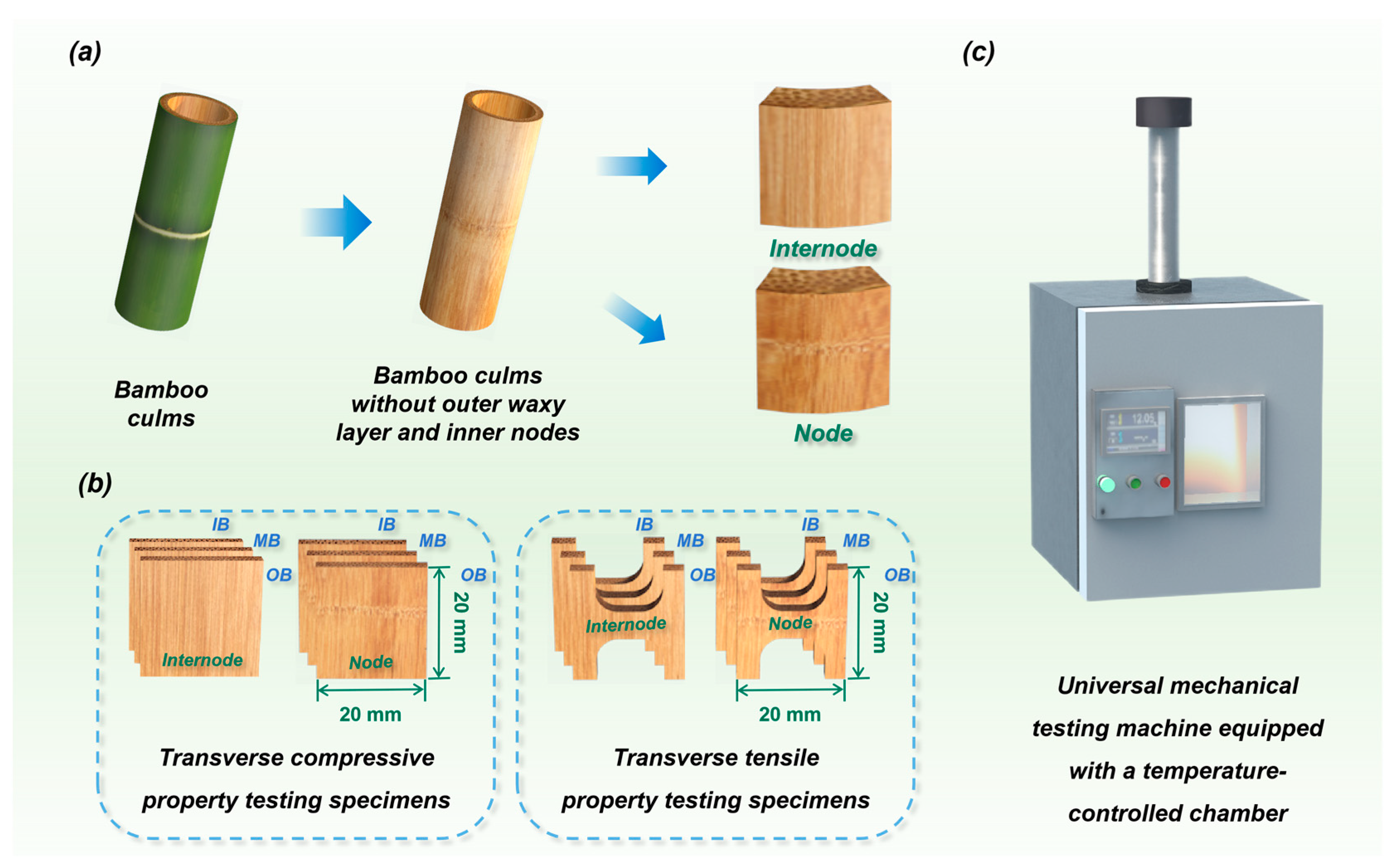
A schematic diagram of the preparation process for transverse mechanical specimens of different layers of bamboo internodes and nodes was displayed in Figure 1a,b. Due to the lack of standards for testing the transverse mechanical strength of bamboo, the testing method was designed with reference to relevant wood standards. Existing bamboo standards, GB/T 15780-1995, provide test methods for several basic physical and mechanical properties of bamboo, but it does not include specific procedures for transverse compressive or tensile testing [27]. ISO 22157:2019 mainly focuses on the physical and mechanical testing of bamboo culms for structural applications [28], while ISO 22156:2021 is intended for the structural design of bamboo culms [29]. Therefore, these bamboo standards are not directly applicable to the present study. Since bamboo and wood are both anisotropic lignocellulosic biomass materials, the wood standards for perpendicular-to-grain properties were used as the closest available methodological reference. Accordingly, the transverse compressive and tensile tests were conducted with reference to GB/T 1927.12-2021 and GB/T 1927.15-2022, respectively [30,31].
The arc bamboo strips were processed into specimens with dimensions of 20 mm (length) × 20 mm (width) × t mm (thickness) by a miniature band saw equipped with a 0.4 mm-thick blade (MBS 240/E, Proxxon GmbH, Föhren, Germany) and categorized into two types: internodes and nodes (Figure 1a). For the node specimens, the bamboo node was positioned in the middle, as shown in Figure 1a. To investigate the effects of heterogeneous stress during the flattening process on the transverse mechanical properties of various layers, both internodes and node specimens were equally divided into three sections by a miniature band saw (Figure 1b). The three sections were defined as the outer layer bamboo (OB), middle layer bamboo (MB), and inner layer bamboo (IB), corresponding to the vascular bundle (VB) contents, respectively.
To simulate the MC during the flattening process, all specimens were immersed in deionized water until reaching an MC of 80% and conditioned to moisture equilibrium. As shown in Figure 1c, to reveal the real-time effects of elevated temperatures on the mechanical properties of bamboo, transverse mechanical tests were conducted using a universal mechanical testing machine (QJCK348A, Shanghai Qingji Instrument Technology Co., Ltd., Shanghai, China) equipped with a 5 kN load cell and a temperature-controlled chamber. For the transverse compressive test, the load was applied perpendicular to the longitudinal direction of the bamboo. The tests were conducted under displacement-control mode at a crosshead speed of 0.8 mm/min. The specimens were tested at room temperature and after heating to target temperatures of 140 °C, 160 °C, and 180 °C. For the high-temperature tests, the specimens were placed in the temperature-controlled chamber and held at the target temperature for 10 min before loading. Ten specimens were tested for each group.

2.2.2. Transverse Tensile Property Testing

Transverse tensile specimens were prepared from the same internode and node sections described in Section 2.2.1. The bamboo culms were first sawn into block specimens with dimensions of 20 mm (length) × 20 mm (width) × t mm (thickness). The block specimens were then further machined into dumbbell-shaped specimens using a miniature band saw, as shown in Figure 1b. During testing, the tensile load was applied perpendicular to the longitudinal direction of the bamboo under displacement-control mode at a crosshead speed of 0.4 mm/min. The same universal mechanical testing machine, temperature-controlled chamber, moisture conditions, temperature conditions, time conditions and specimen number as those described for the transverse compressive tests were adopted.

2.2.3. Vascular Bundle (VB) Content Testing

The VB content of bamboo is determined by the percentage of the area occupied by VB on the cross-section. In this study, the VB content of different layers of both internodes and nodes cross-sections was measured, analyzed, and calculated using a stereomicroscope (Motic ECO-SZ-745, Motic China Group Co., Ltd., Xiamen, China) combined with Image J software (v1.54g, National Institutes of Health, Bethesda, MD, USA).

2.2.4. Major Chemical Composition Testing

The major chemical composition (cellulose, hemicellulose, and lignin) of bamboo before and after different heat treatments was measured according to the National Renewable Energy Laboratory (NREL) method [32]. The internodes and nodes of OB, MB, and IB were ground into powder with a high-speed crusher (HC-700Y, Wuyi Haina Electric Appliance Co., Ltd., Jinhua, China). Sulfuric acid with a concentration of 72% was added to the powder, and the mixture was hydrolyzed in a water bath at 30 °C for 60 min. Subsequently, deionized water was added to dilute the sulfuric acid to 4%, followed by secondary hydrolysis at 121 °C for 1 h. The hydrolysate was filtered through a G3 glass filter. Then, 50 mL of the filtrate was collected, and the acid-soluble lignin content was determined by measuring the absorbance at 205 nm using a UV spectrophotometer (UV-1780, Suzhou Shimadzu Instruments Co., Ltd., Suzhou, China), with 4% sulfuric acid as the blank. For cellulose and hemicellulose determination, the filtrate was first adjusted to pH 1–3 using 50% sodium hydroxide, filtered through a 0.22 μm membrane, and then analyzed by high-performance liquid chromatography (ACQUITY Arc, Waters, Milford, MA, USA). The cellulose content was calculated from the corrected glucose concentration, while the hemicellulose content was calculated from the corrected xylose and arabinose concentrations. Finally, the filtered residue was washed with hot deionized water, dried to constant weight at 105 °C, and then combusted in a muffle furnace (MFLHGKD415-12, Shanghai Muffle Furnace Technology Instrument Co., Ltd., Shanghai, China) at 600 °C for 24 h. The acid-insoluble lignin content was calculated from the mass difference between the dried residue and the ash.

2.2.5. Cellulose Crystalline Structure Testing

The cellulose crystalline structure of bamboo before and after different heat treatments was analyzed using the X-ray powder diffractometer (Ultima IV, Rigaku, Tokyo, Japan). The internodes and nodes of OB, MB, and IB were ground into powder with a high-speed crusher (HC-700Y, Wuyi Haina Electric Appliance Co., Ltd., China) and tested. The XRD scanning was performed from 10° to 80° at a speed of 10°/min, with a voltage of 40 kV and a current of 40 mA.
The relative crystallinity (CrI) was calculated based on the Segal method according to Equation (1):
CrI = (I002 − Iam)/I002 × 100%
where the CrI is the relative crystallinity (%); I002 is the maximum intensity of the lattice diffraction; and Iam is the minimum intensity corresponding to the amorphous cellulose component.
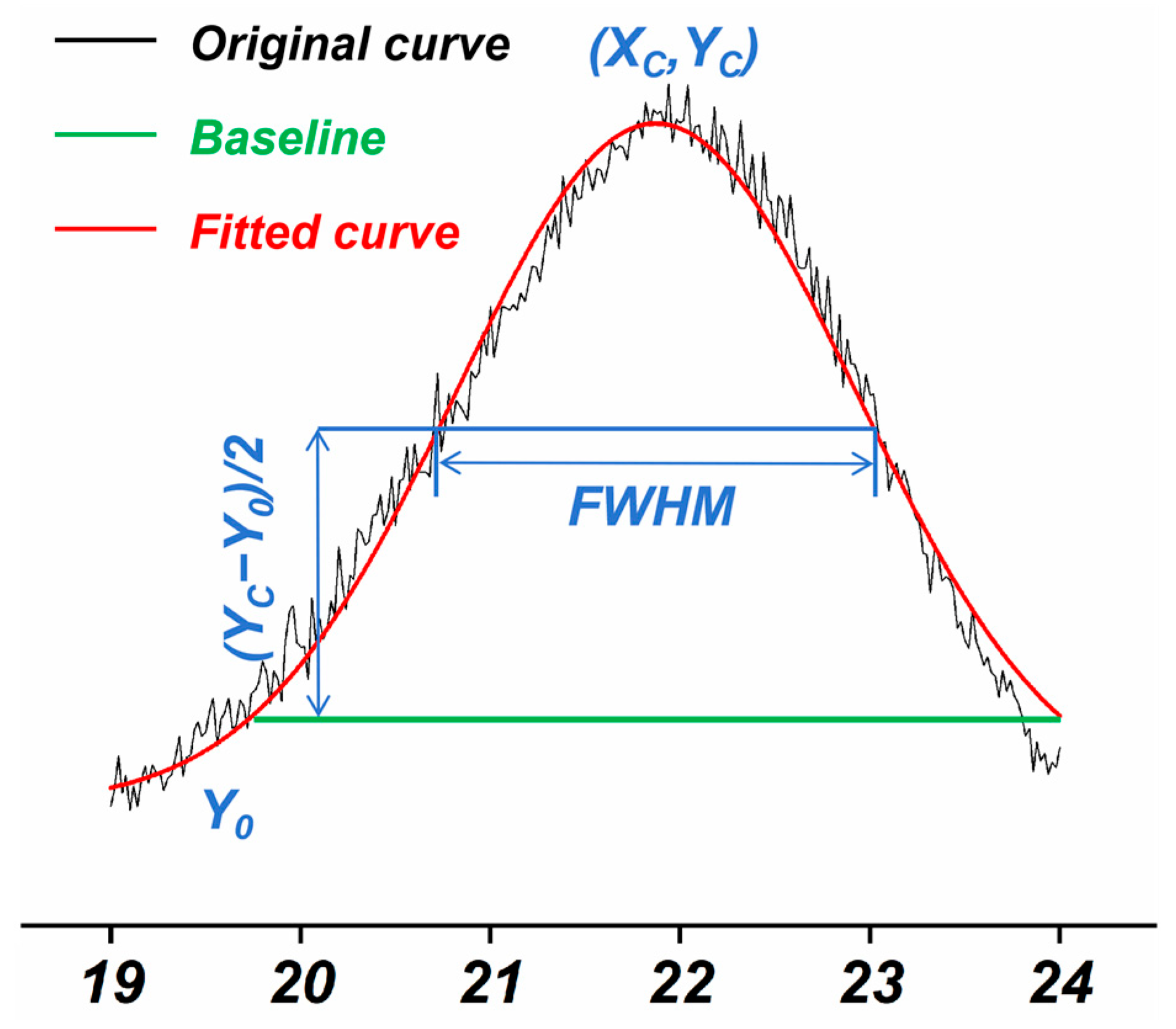
The full width at half maximum (FWHM) of the 002 diffraction peak was determined using Origin software (v9.0, OriginLab Corporation, Northampton, MA, USA), and a typical curve is shown in Figure 2.
The crystal size ( D h k l ) was calculated using the Scherrer equation, as shown in Equation (2):
D h k l = k λ β 1 / 2 c o s θ
where the D h k l is the crystal size (nm); k is the diffraction constant (0.89); λ is the incident wavelength (0.154 nm); β 1 / 2 is the FWHM of the diffraction peak (rad); and θ is the diffraction angle (°).

2.2.6. Fourier Transform Infrared Spectroscopy (FTIR) Testing

The chemical functional groups of bamboo before and after different temperature heat treatments were analyzed using an FTIR spectrometer (VERTEX-80V, Bruker, Bremen, Germany). The internodes and nodes of OB, MB, and IB were ground into powder with a high-speed crusher (HC-700Y, Wuyi Haina Electric Appliance Co., Ltd., China) and tested. Infrared test samples were prepared using the potassium bromide (KBr) pellet method. For each spectrum, 32 scans were performed at a spectral resolution of 16 cm−1 to obtain infrared spectra within the wavenumber range of 4000 cm−1–400 cm−1.

2.2.7. Statistical Analysis

Statistical analysis of the transverse mechanical properties of different layers at different temperatures was performed using SPSS software (v27.0, IBM Corporation, Armonk, NY, USA). Different lowercase letters indicate significant differences among different temperatures within the same layer (p < 0.05). Different uppercase letters indicate significant differences among different layers at the same temperature (p < 0.05). Ten replicate specimens were used to determine the average values of the transverse mechanical properties. For the main chemical components, XRD, and FTIR, three replicate samples were used. All figures in this study were generated using Origin v9.0 software.

3. Results and Discussion

3.1. Anatomical Structure

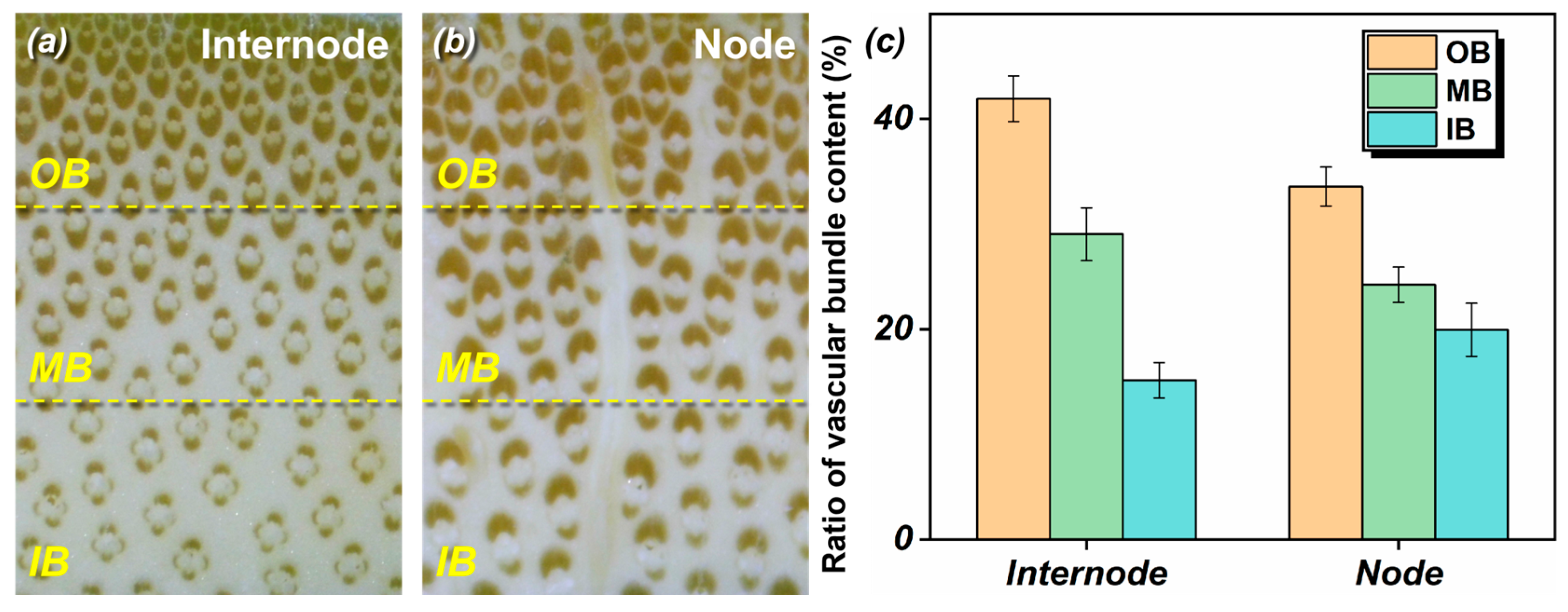
There were significant differences in the shape, size, and quantity distribution of VB between internodes and nodes of bamboo. As shown in Figure 3a, the VB structure of internodes gradually transitioned from semi-open to open from the OB to the IB. The shape of VB in the MB was similar to a plum blossom, with an increased individual area and a gradually sparse arrangement. The morphology of VB in the IB was similar to that in the MB, but with a longer dimension in the tangential direction, further increased individual area, and the sparsest distribution; this structural change caused the mechanical properties of internodes to show a decreasing trend from the outside to the inside. The differences in VB in nodes were smaller, mostly spindle-shaped, as shown in Figure 3b. Figure 3c displays the VB content of different layers. The VB content of internodes decreased from 41.91% in OB to 29.03% in MB and 15.14% in IB; for nodes, the content decreased from 33.57% in OB to 24.22% in MB and 19.94% in IB.

3.2. Effects of Heat Treatment and Radial Gradient on Transverse Compressive Properties of Bamboo Internodes and Nodes

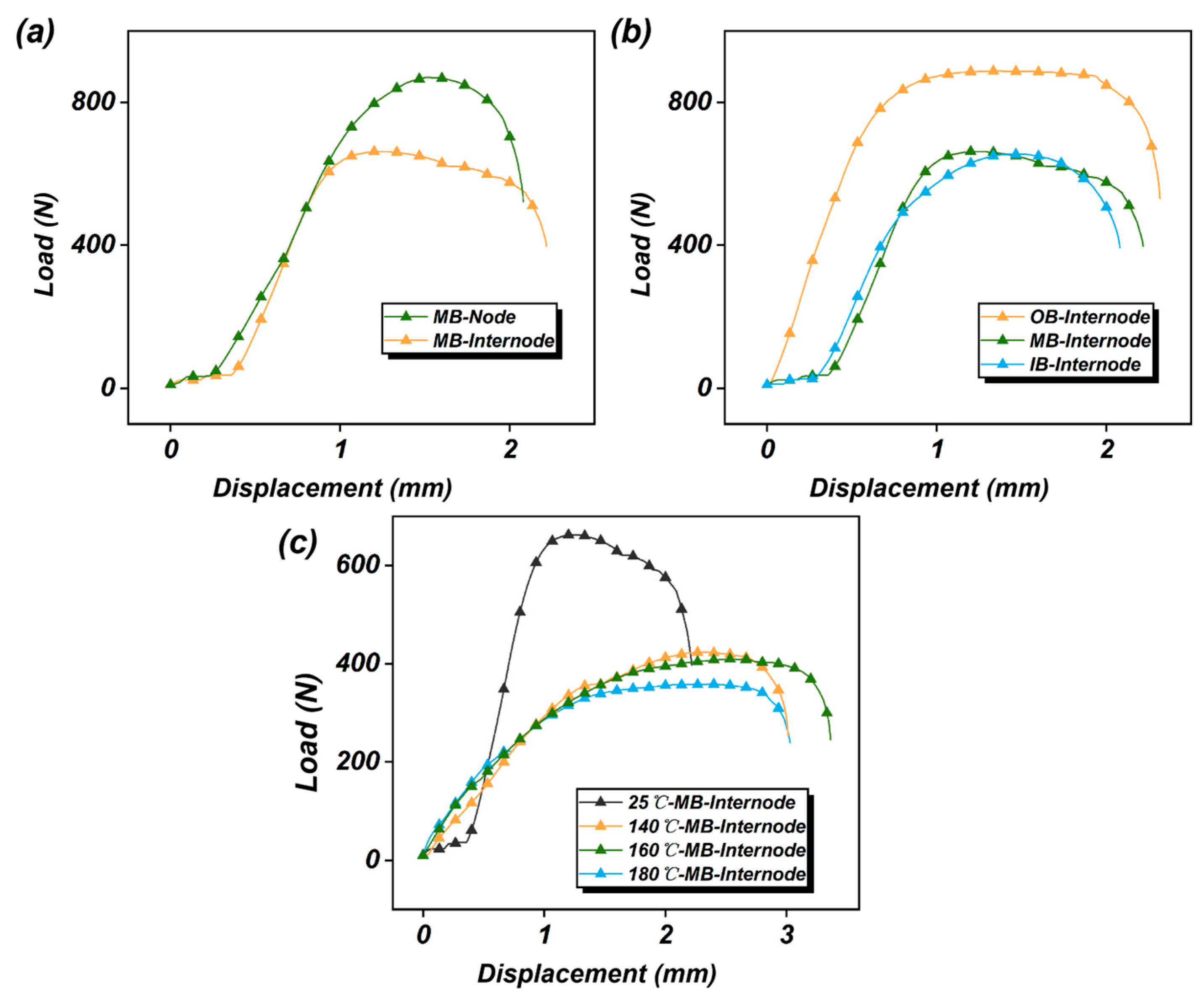
Figure 4a shows the transverse compressive load–displacement curves for the MB samples of internodes and nodes. In the elastic stage, the maximum linear loads of the MB for internodes and nodes were 495.60 N and 722.40 N, respectively. In the plastic stage, the maximum loads for the MB of internodes and nodes were 662.20 N and 869.40 N, respectively. The complex structural characteristics of the nodes enabled the nodes to have significantly higher load values in all stages, with larger displacements, demonstrating stronger mechanical properties and deformation capacity [33].
Figure 4b shows typical transverse compressive load–displacement curves for the OB, MB, and IB of internodes. The curve trends for different layers are similar, with an elastic stage, a plastic stage, and a failure stage. In the elastic stage, the maximum linear loads for the OB, MB, and IB of internodes were 691.21 N, 495.60 N, and 439.60 N. In the plastic stage, the maximum load values for each layer were 877.40 N, 662.20 N, and 654.59 N. The variation in VB content of different layers is identified as the primary driver for the changes in the transverse compressive mechanical properties of the OB, MB, and IB.
Figure 4c shows the transverse compressive load–displacement curves for the MB of internodes at different heat treatments. In the elastic stage, the maximum linear loads were 551.40 N, 459.60 N, 153.39 N, and 147.60 N, and the maximum linear displacements were 0.79 mm, 0.91 mm, 0.41 mm, and 0.37 mm, respectively. In the plastic stage, the maximum load values were 662.20 N, 423.40 N, 409.39 N, and 358.39 N, and the maximum displacements were 1.53 mm, 2.32 mm, 2.49 mm, and 2.38 mm, respectively. As the temperature increased, both the maximum linear load and the maximum load in the plastic stage of bamboo decreased significantly, while the displacement showed an increasing trend. This may be due to the degradation of hemicellulose and softening of lignin caused by high temperatures, which reduced the stiffness and strength of the bamboo while improving its deformation capacity [34,35].
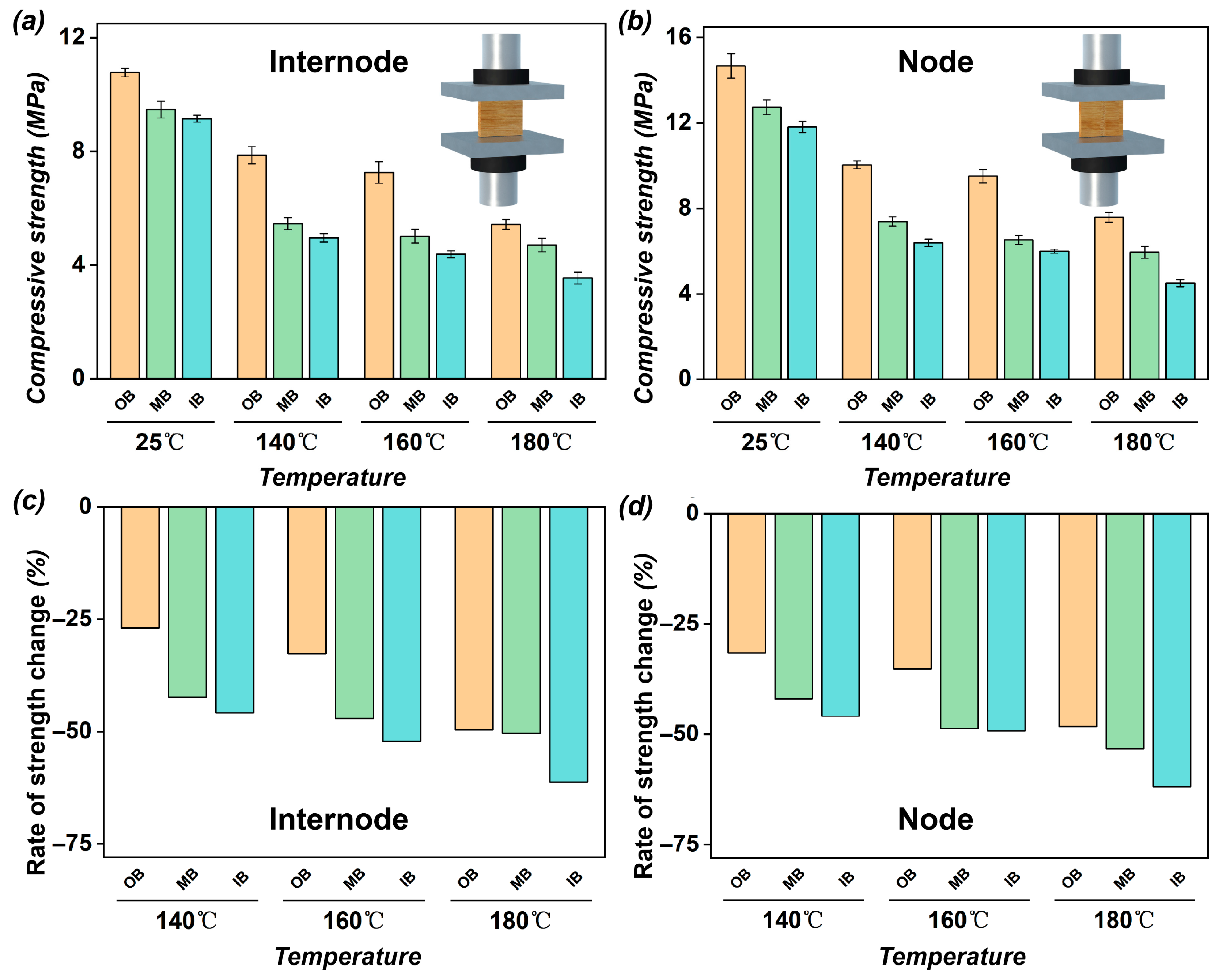
Table 1 and Table 2 and Figure 5a,b show the transverse compressive mechanical properties of different layers of bamboo under different temperatures, while Figure 5c,d presents the corresponding strength change rates. Statistical analysis (p < 0.05) indicated that both temperature and layer had significant effects on the transverse compressive properties. At room temperature, the transverse compressive properties for both types of specimens followed the pattern OB > MB > IB, and significant differences were observed among the three layers. This trend is consistent with previous studies showing that the radial variation in bamboo mechanical properties is closely related to the distribution of vascular bundles and density gradient, where the outer layer exhibits higher strength due to its higher fiber content [23]. From the MB to the IB, the VB content gradually decreased and parenchyma cells increased, leading to a corresponding decrease in mechanical strength. Comparing data for the same layer between internodes and nodes, it reveals that the compressive strength of the nodes was 1.2–1.4 times that of the internodes. This agrees with previous findings that the interwoven vascular bundle structure in nodes enhances transverse load-bearing capacity [36,37,38].
Within each layer for both the internodes and the nodes, the transverse compressive strength decreased significantly with increasing temperature (p < 0.05). Taking the MB as an example, as the heat-treatment temperature increased to 180 °C, the transverse compressive strength of the internode decreased from 9.47 MPa to 4.70 MPa, corresponding to a reduction of 50.37%. For the node, it decreased from 12.73 MPa to 5.95 MPa, corresponding to a reduction of 53.26%. This reduction is consistent with previous studies reporting that heat treatment weakens bamboo mechanical properties due to hemicellulose degradation and lignin softening. However, unlike some studies where increased crystallinity was associated with improved mechanical properties, the present results show a clear decline in compressive strength with increasing temperature. This is due, on the one hand, to the weakening of cell wall strength and intercellular bonds caused by the pyrolysis of the amorphous components; on the other hand, bamboo is an amorphous polymeric material, and high temperatures cause lignin to soften [36,37]. The combined effect of these two factors leads to thermal degradation of bamboo’s transverse compressive properties.
In addition, high-temperature treatment has different influences on the different layers of bamboo, and significant differences were observed among different layers (p < 0.05). At 180 °C, the OB demonstrates superior thermal stability: the transverse compressive strength of the OB with a node is found to decrease to 7.59 MPa, representing a reduction rate of 48.28%, while the strength of the internode OB declines to 5.43 MPa with a reduction rate of 49.59%. In contrast, the IB is identified as the most sensitive region to heat treatment. The rate of decline in transverse compressive strength increased significantly as the vascular bundle content rose from the outer layer to the inner layer. Previous studies have shown that a high vascular bundle content is associated with higher cellulose content and lower hemicellulose content [38]. This suggests that the outer layer is better able to retain the physicochemical structure of the cell walls during pyrolysis and thus exhibits greater resistance to thermal damage.

3.3. Effects of Heat Treatment and Radial Gradient on Transverse Tensile Properties of Bamboo Internodes and Nodes

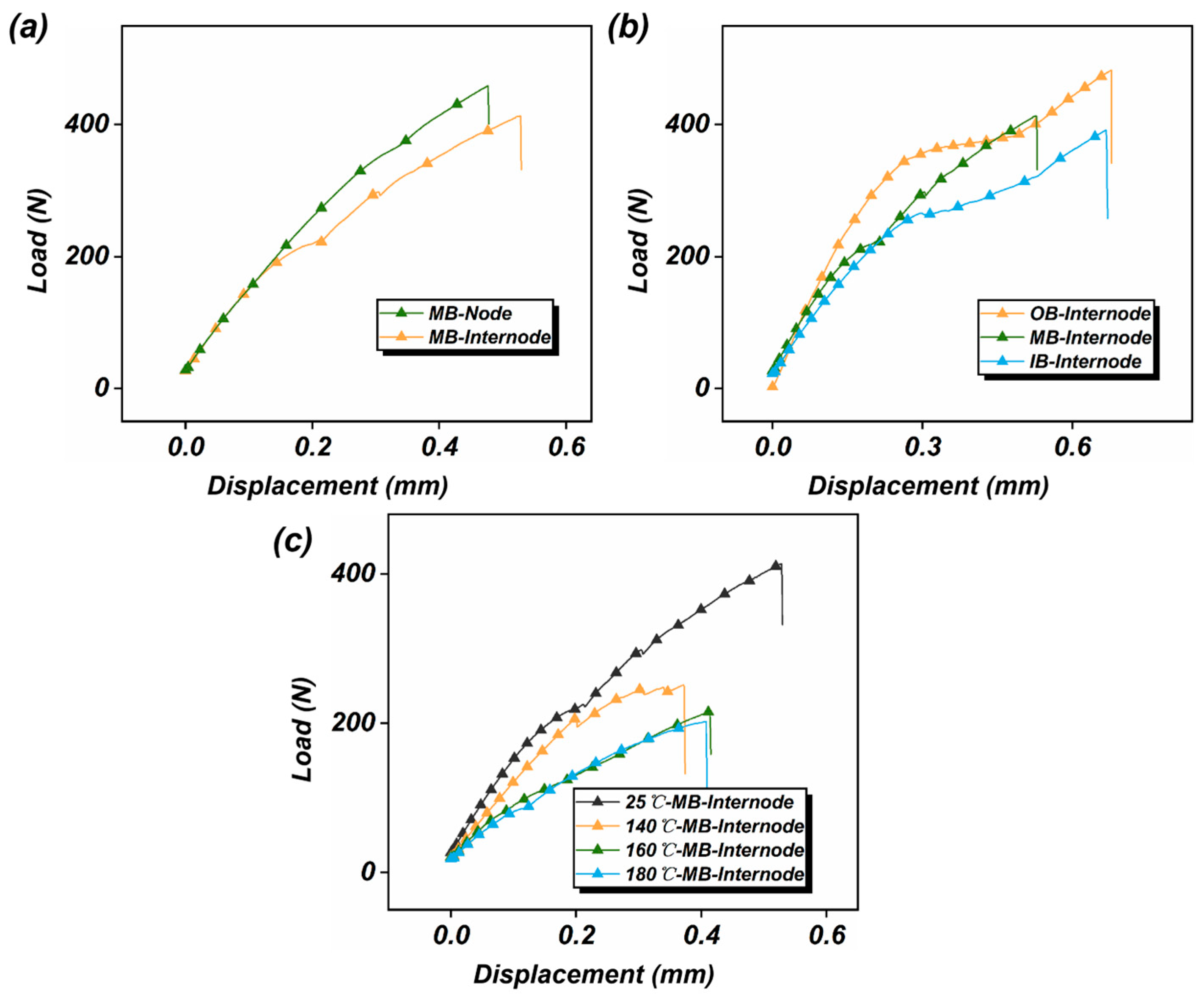
Figure 6a shows the transverse tensile load–displacement curves for the MB of internodes and nodes. The maximum load values for the MB of internodes and nodes were 413.39 N and 458.60 N. The load value for the MB of the node was significantly higher than that of the MB of the internode, and the displacement was larger. Similar to the changes in transverse compressive properties of internodes and nodes, the complex vascular bundle in the node enabled the node to exhibit stronger tensile strength.
Figure 6b shows typical load–displacement curves for the OB, MB, and IB of the internode. The curve shows the same growth pattern for different layers: in the initial stage of loading, displacement increased with load; when the load reached its maximum value, it dropped rapidly, where the brittle fracture occurred. The maximum load values for the OB, MB, and IB of the internode were 482.60 N, 413.39 N, and 391.60 N. This is consistent with the changes in transverse compressive strength of different layers.
Figure 6c shows the load–displacement curves for the MB of internode at different temperatures. The maximum load values at different temperatures were 413.39 N, 250.60 N, 215.12 N, and 202.36 N, and the maximum displacements were 0.53 mm, 0.37 mm, 0.41 mm, and 0.40 mm, respectively. As the temperature increased, the degradation of hemicellulose and softening of lignin in bamboo led to a significant decrease in the maximum linear load, as well as reduced stiffness and strength of bamboo.
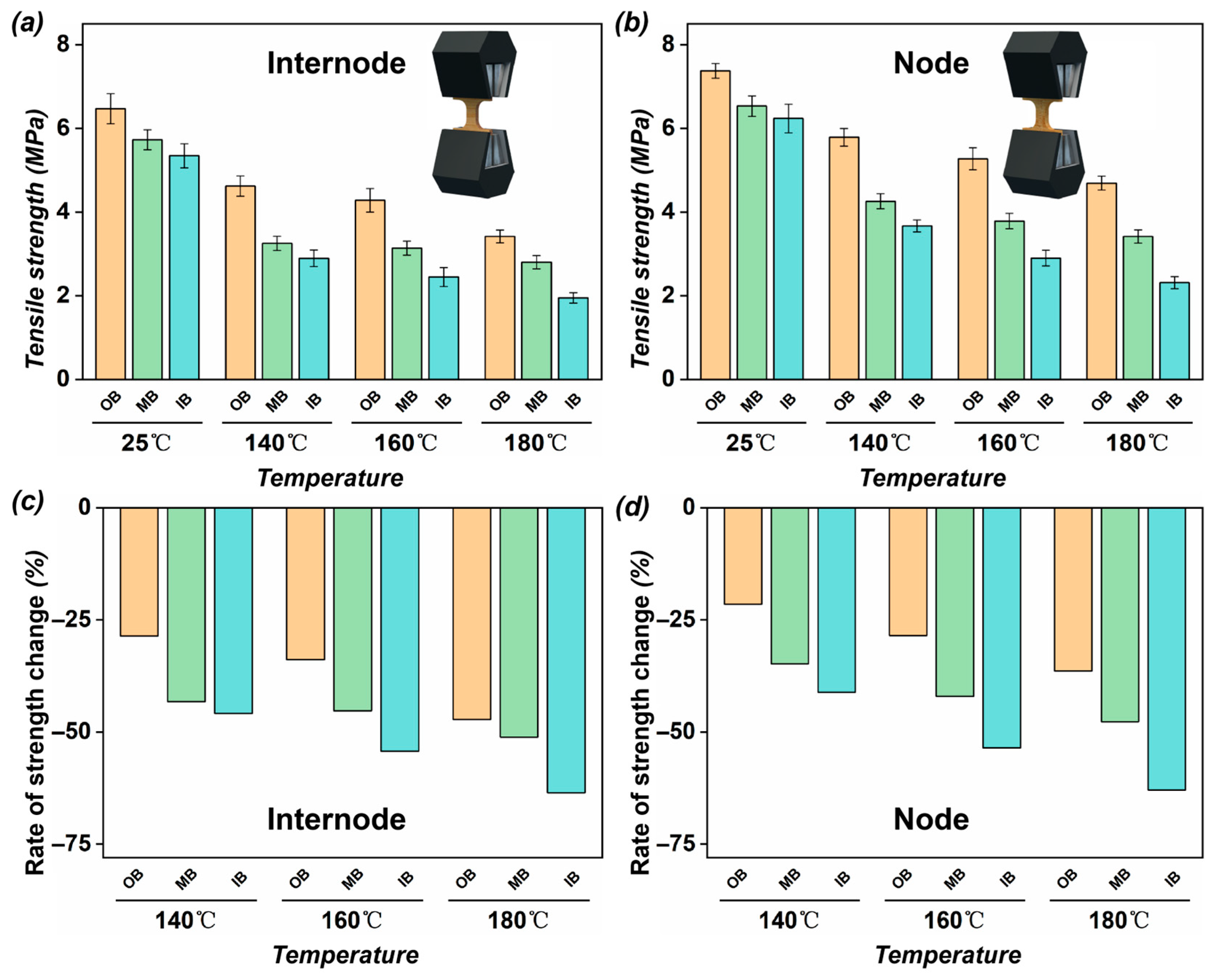
Table 3 and Table 4 and Figure 7a,b show the transverse tensile mechanical properties of different layers of bamboo under different temperatures, while Figure 7c,d present the corresponding strength change rates. Statistical analysis indicated that both temperature and wall layer had significant effects on the transverse tensile strength of bamboo (p < 0.05). At room temperature, similar to the transverse compressive strength, the transverse tensile strength of both internodes and nodes follows the pattern OB > MB > IB. This radial trend is consistent with previous studies showing that the transverse mechanical properties of bamboo are strongly dependent on the vascular bundle distribution and interfacial bonding between cells. However, the transverse tensile strength is much lower than the compressive strength, which agrees with previous findings that transverse tension is governed by interfacial bonding rather than cell-wall buckling [39].
Within each layer for both the internodes and the nodes, the transverse tensile strength decreased significantly with increasing temperature (p < 0.05). Taking the MB layer as an example, as the temperature increased to 180 °C, the transverse tensile strength of internodes decreased from 5.73 MPa to 2.80 MPa, representing a reduction of 51.12%. This reduction is more pronounced than that observed in compression, which is consistent with previous studies reporting that tensile properties are more sensitive to thermal degradation due to their dependence on interfacial bonding [20,39]. Heat treatment leads to hemicellulose degradation and lignin rearrangement, weakening the interfacial bond and promoting micro-crack initiation and propagation. Similar behavior has been reported in bamboo and other lignocellulosic materials under thermal or moisture-induced softening conditions [40,41,42].
High-temperature treatment has an influence on the transverse tensile strength of different layers of bamboo, and significant differences were observed among different layers (p < 0.05). At 180 °C, the IB shows the most severe strength reduction, while the OB retains relatively higher strength. This is also attributed to the degradation of bamboo components and the weakening of intercellular interfaces [36]. In contrast, the node specimens exhibit higher tensile strength than internodes, which further supports the reinforcing role of the interwoven vascular bundle structure in resisting crack propagation.

3.4. Effects of Heat Treatment and Radial Gradient on Main Chemical Components of Bamboo Internodes and Nodes

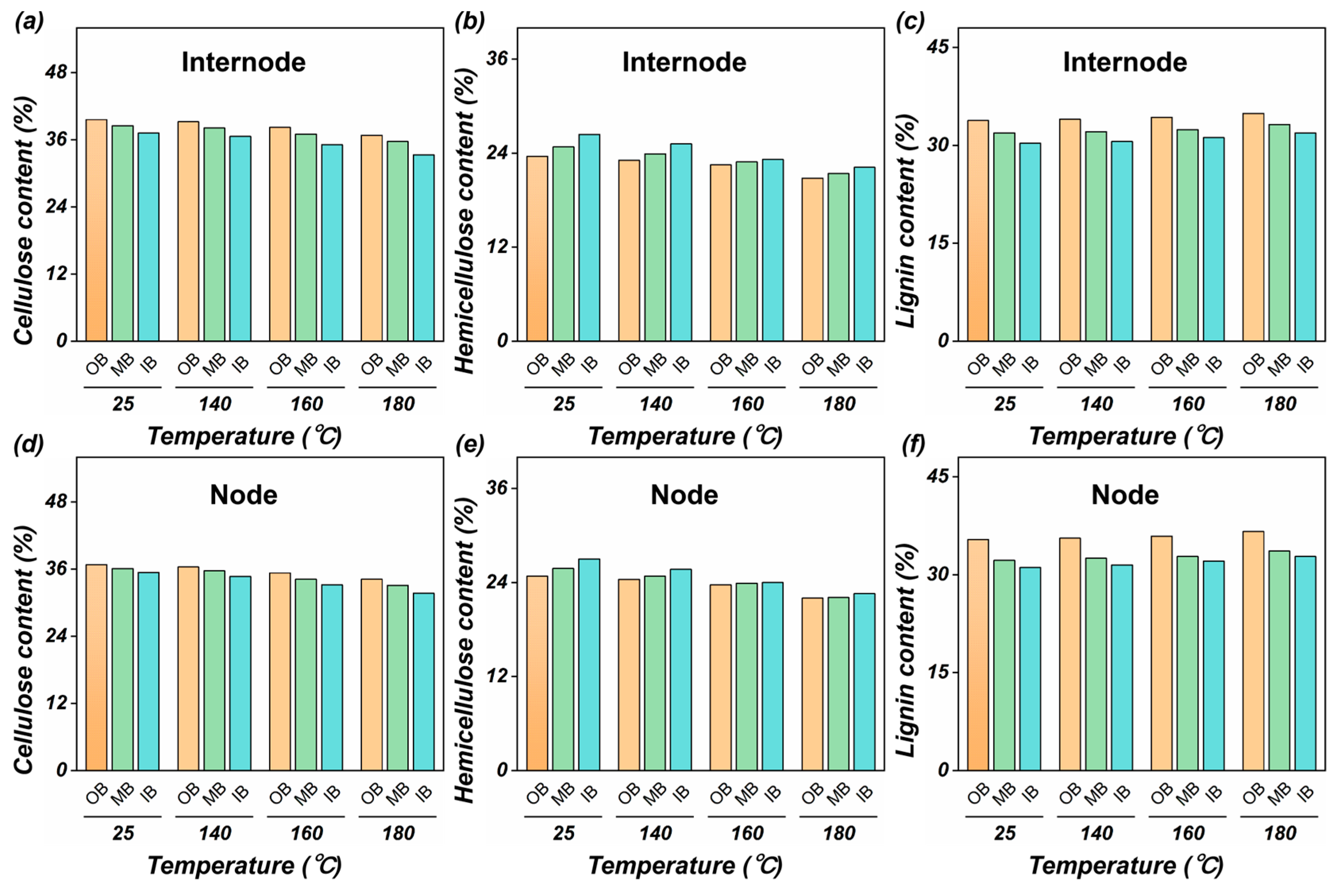
The macroscopic mechanical properties of bamboo are the result of synergistic action between its three major chemical components: cellulose, hemicellulose, and lignin. The cellulose forms the cell wall skeleton structure and provides rigidity; hemicellulose and lignin act as the matrix, serving as the adhesive and filler between fibers. The contents of the major chemical components of different layers of bamboo internodes and nodes are presented in Figure 8a–c and d–f, respectively, illustrating the variations observed both before and after heat treatments at different temperatures. The interwoven and twisted vascular bundles at the node contain a higher proportion of parenchyma tissue. Since hemicellulose and lignin are mainly distributed in the middle lamella and the secondary wall matrix of parenchyma cells, untreated bamboo nodes exhibit relatively higher hemicellulose and lignin contents but lower cellulose content. The relative contents of the main chemical components in untreated bamboo internodes and nodes exhibit a clear radial gradient from OB to IB, with cellulose and lignin contents decreasing, while hemicellulose content increases. This is attributed to the higher vascular bundle content in the OB and the greater proportion of parenchyma tissue in the IB.
Heat treatment affects the major components of both bamboo internodes and nodes to varying degrees, and this gradient variation in chemical composition is the fundamental origin of the changes in transverse mechanical properties. As the temperature increases from 25 °C to 180 °C, a declining trend is observed in the cellulose and hemicellulose contents of all layers for both internodes and nodes. Conversely, the relative lignin content increased due to condensation reactions and the relative concentration effect caused by the decomposition of cellulose and hemicellulose [43]. The temperature of 160 °C marks a turning point for the intensity of component degradation, with the maximum degradation reached at 180 °C. The hemicellulose content of the MB in the internode decreased by 13.71%, while a higher reduction of 14.34% was recorded in the node. Similarly, cellulose content decreased by 7.27% in the internode compared to 8.31% in the node. The degradation of hemicellulose far exceeded that of cellulose, mainly due to its amorphous structure and lower thermal stability. In addition, the presence of xylan in hemicellulose makes its molecular structure more susceptible to hydrolysis and thermal decomposition under high temperatures [35,44]. In contrast, the glycosidic bonds in cellulose are relatively stable, making acid diffusion within the cellulose structure more difficult. As a result, the reduction in cellulose content is relatively gradual [45,46]. It is noteworthy that although the degradation of chemical components in the node was slightly greater than in the internode, the strength reduction rates of macroscopic mechanical strength in the node were lower. This phenomenon indicates that the higher initial lignin content at the bamboo node acts as a natural binder. Combined with the special physical configuration of an interlaced and woven vascular bundle, this effect largely offsets the negative impacts brought by chemical component degradation. This mechanism effectively inhibits interface failure, allowing the bamboo node to exhibit superior transverse mechanical stability despite undergoing more intense pyrolysis reactions.
The response of chemical components to the heat treatment of different layers also showed significant variability. For the internode treated at 180 °C, the cellulose and hemicellulose contents in the OB were 36.8% and 20.8%, representing decreases of 7.07% and 11.86%, respectively, compared to untreated bamboo. The lignin content reached 34.9%, showing an increase of 3.25%. In the IB, the cellulose and hemicellulose contents were 33.3% and 22.2%, representing more substantial decreases of 10.48% and 15.90%, while the lignin content increased by 5.28% to reach 31.9%. The rate of change in the IB was significantly higher than in the OB. This gradient pattern stems from the microscopic structural differences between the two layers. The IB contains more parenchyma cells with higher hemicellulose content in the cell walls, making it more susceptible to decomposition during heat treatment. In contrast, the OB is dominated by thick-walled fiber cells with higher cellulose and lignin contents, which possess relatively better thermal stability. The chemical composition results are consistent with the observed mechanical trends and provide a direct explanation for the decrease in transverse mechanical properties discussed above. In the IB, the substantial loss of hemicellulose weakens the matrix phase and intercellular bonding, making this layer more susceptible to compressive and tensile failure after heat treatment. In contrast, the OB retains relatively higher cellulose and lignin contents, which helps maintain a denser and more stable cell-wall structure. As a result, the OB exhibits better thermal stability, whereas the IB shows the greatest reduction in transverse strength.

3.5. Effects of Heat Treatment and Radial Gradient on Crystalline Characteristics of Bamboo Internodes and Nodes

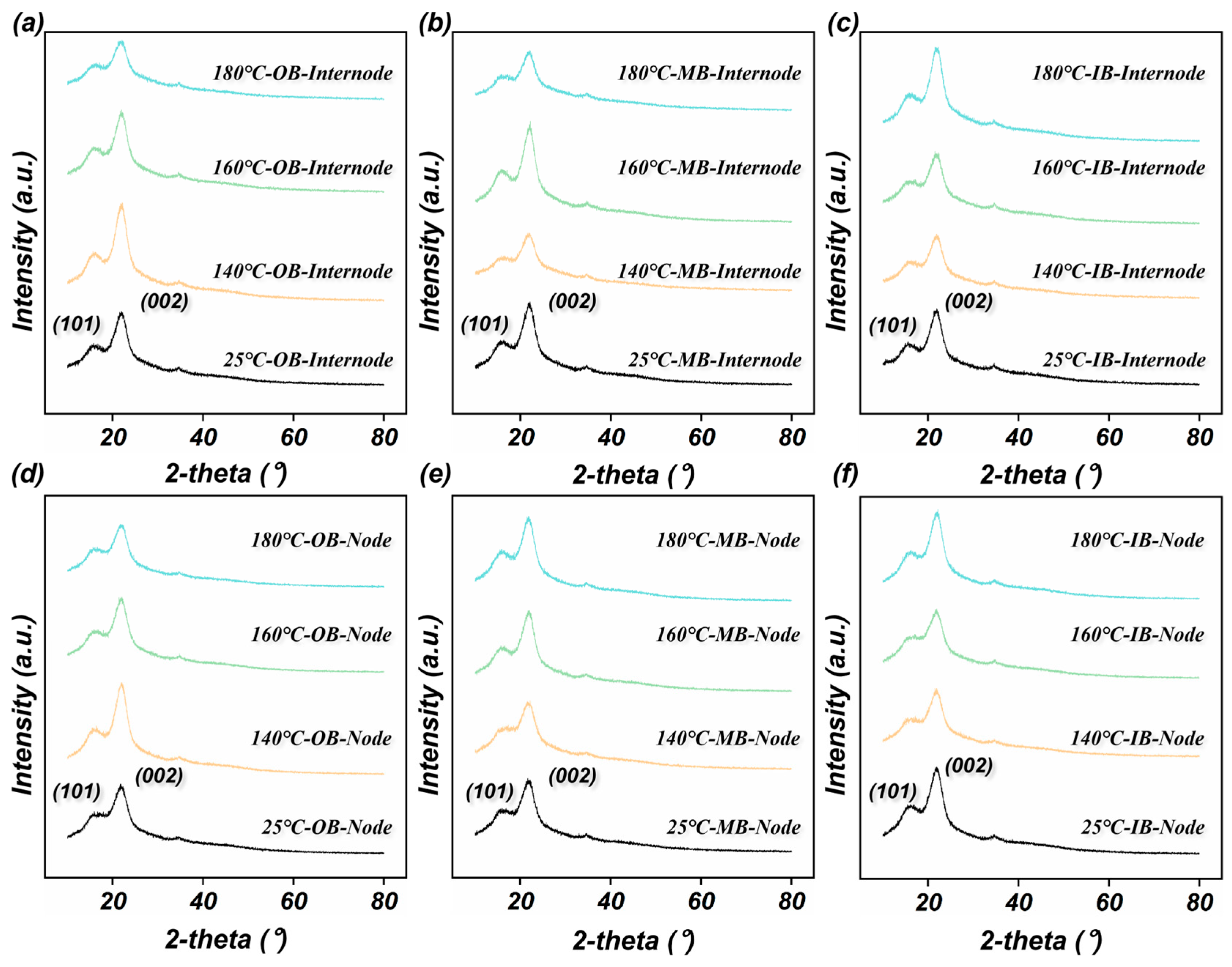
Figure 9 illustrates the X-ray diffraction curves of the bamboo internodes and nodes from different layers before and after heat treatment at different temperatures. Cellulose in bamboo features a dual-phase structure consisting of crystalline and amorphous regions, with diffraction occurring in the crystalline regions to produce distinct peaks. Before and after heat treatment, three distinct diffraction peaks were observed near 2θ values of 16°, 22°, and 35° for all layers of both internodes and nodes. These peaks correspond to the (101), (002), and (040) crystal planes of the bamboo cellulose crystals, respectively [47]. The diffraction intensity curves of all specimens are similar. No new diffraction peaks appeared in the spectra, indicating that the crystal structure types and crystalline morphologies of cellulose of different layers remained unchanged and still represented the typical cellulose Iβ structure.
Table 5 lists the 002 peak positions, the full width at half maximum (FWHM) of the 002 peak, crystal size, and relative crystallinity of the bamboo internodes and nodes of different layers before and after heat treatment. For the untreated bamboo, a gradient pattern was observed from the IB to the OB, characterized by a gradual increase in FWHM, a decrease in average crystal size, and an increase in relative crystallinity. This phenomenon is attributed to the increased degree of lignification and cellulose content, along with a decrease in hemicellulose content from the IB to the OB [48]. Furthermore, the initial crystallinity of the internode was generally higher than that of the node, reflecting the interference of the interlaced and twisted vascular bundle at the bamboo node on the ordering of cellulose molecular arrangement.
As the heat treatment temperature increased from 140 °C to 180 °C, the 002 crystal plane diffraction peak positions for all specimens remained stably distributed between 21.56° and 22.20°. This indicates that no fundamental change occurs in the cellulose Iβ crystalline structure. For both the internodes and nodes, the FWHM of the 002 peak gradually decreased, the average crystal size steadily and the relative crystallinity increased. The increase in cellulose crystallinity did not lead to an improvement in transverse mechanical properties. Similar phenomena have been reported in heat-treated bamboo, where the increase in relative crystallinity is mainly associated with the preferential degradation of amorphous components rather than an actual enhancement of mechanical performance. The substantial loss of hemicellulose, which acts as an important bonding matrix, weakens intercellular adhesion [46]. For transverse mechanical behavior, especially transverse tensile strength, the integrity of the amorphous matrix and intercellular bonding appears to be more critical than the relative increase in cellulose crystallinity.

3.6. Effects of Heat Treatment and Radial Gradient on Chemical Functional Groups of Bamboo Internodes and Nodes

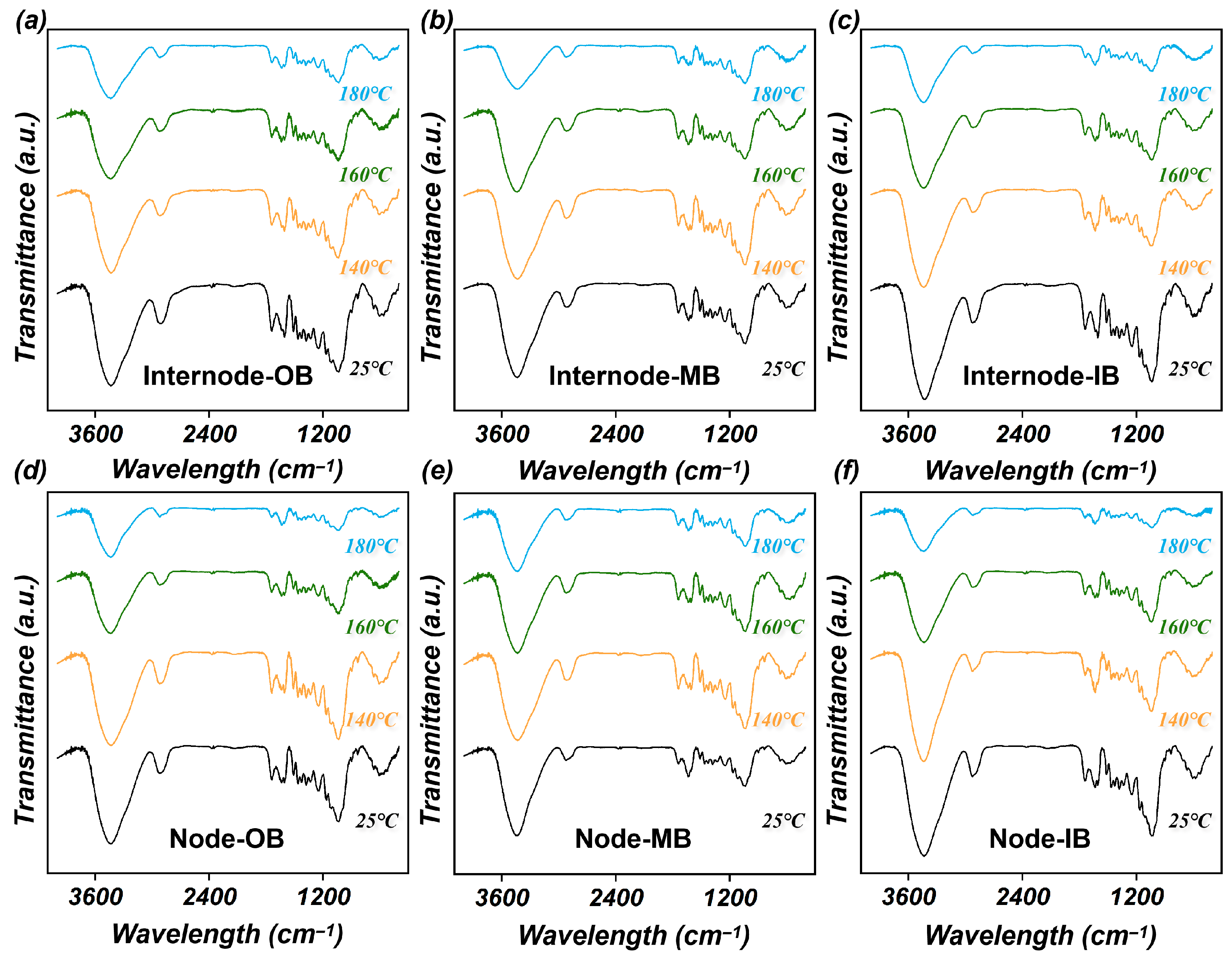
Figure 10 illustrates the FTIR spectra of different layers of bamboo internodes and nodes before and after heat treatment at different temperatures. The absorption peaks for different layers of both internodes and nodes were essentially consistent. This indicates that the similar chemical constituents consisting of internodes and nodes align with the chemical composition analysis results. The peaks at 1166 cm−1 for C-O-C stretching vibration and 1046 cm−1 for C-O stretching vibration are characteristic of cellulose [47]. The absorption peak at 1741 cm−1 for C=O stretching vibration and the peak at 1259 cm−1 for acetyl group stretching vibration represent hemicellulose [48]. Meanwhile, the peaks near 1633 cm−1 and 1509 cm−1 originate from the C=O stretching and aromatic skeletal vibrations of lignin [49,50,51]. The characteristic peak intensities of cellulose and lignin decreased gradually from OB to IB, whereas the hemicellulose peak intensity increased. Compared to the node specimens, the internode specimens exhibited significantly higher cellulose and lignin peak intensities but lower hemicellulose peak intensities. These findings are highly consistent with the results of the chemical composition tests.
The FTIR spectra of bamboo after heat treatment exhibit high consistency with only minor differences in absorption intensity and peak positions. This suggests that heat treatment only modifies the content of chemical components rather than altering their internal chemical structures. The intensity of the O-H stretching vibration peak near 3420 cm−1 decreased after heat treatment in all layers of both internode and node specimens. On one hand, the oxidation of cellulose in the amorphous regions under high temperatures converts hydroxyl groups into carboxyl groups, which leads to cellulose degradation and a significant reduction in hydroxyl content. On the other hand, the decomposition of cellulose produces acetic acid, while the esterification of lignin in an acidic environment further reduces the number of hydroxyl groups. The carbonyl vibration peak of hemicellulose at 1734 cm−1 tended to flatten as the treatment intensity increased. This phenomenon stems from the degradation of acetyl groups on the hemicellulose molecular chains under high-temperature treatment, which causes the breaking and recombination of carbonyl groups. Additionally, the acetic acid generated during this process accelerates the reaction. The peak at 1318 cm−1 represents the stretching vibration of hydroxyl groups in hemicellulose, while the peak at 1159 cm−1 represents the ether bonds in the xylose and pyranose ring structures of hemicellulose. The gradual reduction in these two peaks further confirmed the degradation of hemicellulose after heat treatment. The peak at 897 cm−1 originates from the glycosidic bonds of cellulose. Heat treatment caused this peak to flatten, indicating a certain degree of degradation in cellulose. The FTIR analysis reveals that heat treatment reduces the content of hemicellulose and cellulose while simultaneously increasing the relative content of lignin. These findings are consistent with the results of the bamboo chemical composition tests described in Section 3.4 and further support the conclusion discussed above regarding the decline in transverse mechanical properties. The weakening of hydroxyl, carbonyl, and glycosidic bond-related absorption peaks indicates the degradation of cell-wall polysaccharides and the reduction of hydrogen-bonding interactions. This weakens the bonding between fibers and parenchyma cells, thereby promoting interfacial debonding under transverse tensile stress and reducing the load-bearing capacity under transverse compression.

4. Conclusions

This study investigated the effects of heat treatment on the transverse mechanical properties and physicochemical characteristics of different layers in bamboo internodes and nodes.
At room temperature, both transverse compressive and tensile strengths decreased from the OB to the MB and IB. The transverse strength of node specimens was approximately 1.2–1.4 times higher than that of internode specimens, indicating the reinforcing effect of bamboo nodes.
Heat treatment significantly reduced the transverse compressive and tensile strengths of both internodes and nodes. The transverse tensile strength was more sensitive to heat treatment than the transverse compressive strength. The thermal stability differed among layers. The IB exhibited the poorest thermal stability, whereas the OB showed relatively higher resistance to thermal degradation. At 180 °C, the transverse compressive and tensile strengths of the internode IB decreased by 61.26% and 63.55%, respectively.
Heat treatment altered the physicochemical characteristics of bamboo. The contents of cellulose and hemicellulose decreased with increasing temperature, while the relative lignin content increased. XRD analysis showed that the cellulose crystallinity increased and the cellulose crystalline structure remained unchanged, while FTIR results further confirmed the heat-treatment-induced changes in chemical components.
This study acknowledges that a dedicated standard for transverse mechanical testing of bamboo is still lacking, and the relationships among anatomical structure, chemical composition, and mechanical performance were mainly interpreted qualitatively. Future work will further integrate structural, chemical, and mechanical analyses to better clarify the structure-property relationships of bamboo under heat-treatment conditions.

Author Contributions

Q.W.: Methodology, Investigation, Formal Analysis, Visualization, and Writing—Original Draft Preparation; Z.X.: Methodology, Writing—Original Draft Preparation, and Writing—Review and Editing; H.H.: Formal Analysis and Visualization; X.W.: Conceptualization, Supervision, Investigation, and Writing—Review and Editing; Y.L.: Conceptualization, Supervision, Project Administration, Funding Acquisition, and Writing—Review and Editing. All authors have read and agreed to the published version of the manuscript.

Funding

This research was funded by the project of the National Natural Science Foundation of China (32371972 and 32371974), the “Fourteenth Five-Year Plan” National Key R&D Program Funded Project (2023YFD2202103), the Forestry Science and Technology Project of Provincial-Institutional Co-operation between Zhejiang Province and the Chinese Academy of Forestry (2024SY07), the Postgraduate Student Research Innovation Program of Jiangsu Province (KYCX25_1421), and the Talent Launching Project of the Scientific Research and Development Fund of Zhejiang Agriculture and Forestry University (2023LFR053).

Data Availability Statement

Data is contained within the article.

Conflicts of Interest

The authors declare no conflicts of interest.

References

  1. Huang, Y.; Hu, J.; Zhang, Y.; Yu, Y.; Zhang, D.; Jing, Q.; Shahzad, M.W.; Donkor, S.; Chen, C.; Zhang, C.W.; et al. Multifunctional Bamboo Based Materials Empowered by Multiscale Hierarchical Structures—A Critical Review. Adv. Mater. 2026, 38, e07844. [Google Scholar] [CrossRef] [Scilit]
  2. Khan, A.; Sapuan, S.M.; Zainudin, E.S.; Zuhri, M.Y.M. Hybridization and Its Transformative Role in Bamboo Fiber Reinforced Polymer Composites: A Review. Adv. Compos. Hybrid Mater. 2024, 7, 164. [Google Scholar] [CrossRef] [Scilit]
  3. Wang, G.; Fei, B.; Fang, C.; Yang, S.; Ma, Q.; Cheng, H.; Fu, J.; Chen, X. Implement “the Bamboo as a Substitute for Plastic Initiative” to Help the Bamboo Industry to Speed up and Improve the Efficiency. World Bamboo Ratt. 2000, 20, 1–4. Available online: https://journals.caf.ac.cn/sjzttx/article/doi/10.12168/sjzttx.2022.04.001 (accessed on 1 April 2026).
  4. Fei, B.; Huang, Y.; Ji, C. Connotation and Significance of National-Timber-Storage Construction. Chin. J. Wood Sci. Technol. 2022, 36, 103–108. [Google Scholar] [CrossRef]
  5. Ye, H.; Fu, J.; Cheng, H.; Chen, F.; Yang, S.; Wang, G. The Current Status and Market Development Potential of Processing Technology and Products Using Bamboo as a Substitute for Plastic. Sci. Silvae Sin. 2024, 60, 129–141. [Google Scholar] [CrossRef]
  6. Shen, G.; Guo, Z.; Liu, J.; Fu, J. China’s Policies of “Bamboo as a Substitute for Plastic”: Effectiveness and Progress. World Bamboo Ratt. 2024, 22, 1−6+11. Available online: https://journals.caf.ac.cn/sjzttx/article/doi/10.12168/sjzttx.2024.09.12.001 (accessed on 1 April 2026).
  7. Feng, P.; Li, Y. China’s Bamboo Resources in 2021. World Bamboo Ratt. 2023, 21, 100–103. Available online: https://journals.caf.ac.cn/sjzttx/article/doi/10.12168/sjzttx.2023.02.019 (accessed on 1 April 2026).
  8. Zhang, Q.; Jiang, S. Opportunities and Challenges Faced by China’s Bamboo Processing Industry. World Bamboo Ratt. 2003, 1, 1–5. [Google Scholar] [CrossRef]
  9. Zhang, J.; Wang, K.; Li, Q.; Hua, X. Status Analysis and Suggestions for Bamboo Utilization Rate in China. For. Mach. Woodwork. Equip. 2006, 34, 7–10. [Google Scholar] [CrossRef]
  10. Liese, W. The Anatomy of Bamboo Culms; BRILL: Leiden, The Netherlands, 1998. [Google Scholar]
  11. Wang, X.; Chen, X.; Huang, B.; Chen, L.; Fang, C.; Ma, X.; Fei, B. Gradient Changes in Fiber Bundle Content and Mechanical Properties Lead to Asymmetric Bending of Bamboo. Constr. Build. Mater. 2023, 395, 132328. [Google Scholar] [CrossRef] [Scilit]
  12. Chen, X.; Wang, X.; Luo, X.; Chen, L.; Li, Y.; Xu, J.; Liu, Z.; Dai, C.; Miao, H.; Liu, H. Bamboo as a Naturally-Optimized Fiber-Reinforced Composite: Interfacial Mechanical Properties and Failure Mechanisms. Compos. B Eng. 2024, 279, 111458. [Google Scholar] [CrossRef] [Scilit]
  13. Fang, C.H.; Jiang, Z.H.; Sun, Z.J.; Liu, H.R.; Zhang, X.B.; Zhang, R.; Fei, B.H. An Overview on Bamboo Culm Flattening. Constr. Build. Mater. 2018, 171, 65–74. [Google Scholar] [CrossRef] [Scilit]
  14. Hu, G.; Li, Y.; Du, L.; Yao, C. Application and Prospect of Dynamic Mechanical Analysis in Wood Science. For. Mach. Woodwork. Equip. 2011, 39, 9–12. [Google Scholar]
  15. Xing, D.; Niu, G. Study on Influence of Heat Treatment for the Wood Powder to Glass Transition Temperature. China For. Prod. Ind. 2021, 58, 24–26. [Google Scholar] [CrossRef]
  16. Cheng, R.; Zhang, Q. Glass Transition Temperature of Bamboo after Softening Treatment at High Temperature. Sci. Silvae Sin. 2006, 42, 87–89. [Google Scholar] [CrossRef]
  17. Huang, X.; Jiang, Z.; Chen, L.; Ren, H. Instruments as Reinforcement Materials Study on Bamboo Samples of Various Ages Tested by Dynamic Mechanical Thermal Analysis. World Bamboo Ratt. 2008, 6, 10–13. [Google Scholar] [CrossRef]
  18. He, Y. 3D Characterization of Moso Bamboo (Phyllostachys Edulis) Node and Its Shrinkage and Cracking Properties. Master’s Thesis, Sichuan Agricultural University, Ya’an, China, 2024. [Google Scholar]
  19. Jia, S.; Wei, P.; Wu, Y.; Wang, Y.; Ma, X. Structure and Mechanical Properties of Bamboo Nodes: A Review of Current Research. World Bamboo Ratt. 2024, 22, 90–99. Available online: https://journals.caf.ac.cn/article/doi/10.12168/sjzttx.2024.05.07.001 (accessed on 1 April 2026).
  20. Wang, F.; Shao, Z.; Wu, Y.; Wu, D. The Toughness Contribution of Bamboo Node to the Mode I Interlaminar Fracture Toughness of Bamboo. Wood Sci. Technol. 2014, 48, 1257–1268. [Google Scholar] [CrossRef] [Scilit]
  21. Su, N.; Yan, Q.; Li, Y.; Xu, H.; Fang, C.; Su, W. A Multiscale and Integrative Review of Bamboo Permeability: Structural Mechanisms, Detection Techniques, and Enhancement Approaches. Forests 2025, 16, 1744. [Google Scholar] [CrossRef] [Scilit]
  22. Li, P.; Ji, S.; Mou, Q.; Zheng, X.; Li, X.; Li, X. Variations of the Fundamental Chemical Components in Moso Bamboo (Phyllostachys Pubescens). Wood Mater. Sci. Eng. 2025, 20, 248–256. [Google Scholar] [CrossRef] [Scilit]
  23. Dixon, P.G.; Gibson, L.J. The Structure and Mechanics of Moso Bamboo Material. J. R. Soc. Interface 2014, 11, 20140321. [Google Scholar] [CrossRef] [Scilit]
  24. Chang, C.-W.; Lin, C.-Y.; Kao, H.-W.; Chang, F.-C. Micromechanical Analytical and Inverse Numerical Modeling Methods for Determining the Transverse Elastic Modulus of Bamboo. Wood Sci. Technol. 2023, 57, 75–92. [Google Scholar] [CrossRef] [Scilit]
  25. Xu, M.; Cui, Z.; Chen, Z.; Xiang, J. Experimental Study on Compressive and Tensile Properties of a Bamboo Scrimber at Elevated Temperatures. Constr. Build. Mater. 2017, 151, 732–741. [Google Scholar] [CrossRef] [Scilit]
  26. Zhao, Y.; Ma, L.; Xie, X.; Yuan, T.; Yu, X.; Chen, L.; Li, Y. Mechanisms of Two Types of Flattening Treatments on the Bonding Characteristics of Bamboo and the Effect of Laminate Design on Flexural Properties. Constr. Build. Mater. 2023, 408, 133673. [Google Scholar] [CrossRef] [Scilit]
  27. GB/T 15780-1995; Testing Methods for Physical and Mechanical Properties of Bamboos. The State Bureau of Quality and Technical Supervision: Beijing, China, 1995.
  28. ISO 22157:2019; Bamboo Structures—Determination of Physical and Mechanical Properties of Bamboo Culms—Test Methods. International Organization for Standardization: Geneva, Switzerland, 2019.
  29. ISO 22156:2021; Bamboo Structures—Bamboo Culms—Structural Design. International Organization for Standardization: Geneva, Switzerland, 2021.
  30. GB/T 1927.12-2021; Test Methods for Physical and Mechanical Properties of Small Clear Wood Specimens—Part 12: Determination of Strength in Compression Perpendicular to Grain. State Administration for Market Regulation: Beijing, China; Standardization Administration of China: Beijing, China, 2021.
  31. GB/T 1927.15-2022; Test Methods for Physical and Mechanical Properties of Small Clear Wood Specimens—Part 15: Determination of Tensile Strength Perpendicular to Grain. State Administration for Market Regulation: Beijing, China; Standardization Administration of China: Beijing, China, 2022.
  32. Michel, K.P.; Sluiter, J.B.; Payne, C.; Ness, R.; Thornton, B.; Reed, M.; Schwartz, A.; Wolfrum, E.J. Determination of Cellulosic Glucan Content in Starch Containing Feedstocks Laboratory Analytical Procedure (LAP); National Renewable Energy Laboratory (NREL): Golden, CO, USA, 2021. [Google Scholar]
  33. Chen, G.; Luo, H. Effects of Moisture Content and Fibrous Structure on the Uniaxial Compression Behavior of Natural Bamboo. Constr. Build. Mater. 2023, 408, 133711. [Google Scholar] [CrossRef] [Scilit]
  34. Huang, M. Study on the Softened Process and Flattened Board Performance of Moso Bamboo Tube. Master’s Thesis, Zhejiang A&F University, Hangzhou, China, 2016. [Google Scholar]
  35. Kumar, R.; Bhagia, S.; Smith, M.D.; Petridis, L.; Ong, R.G.; Cai, C.M.; Mittal, A.; Himmel, M.H.; Balan, V.; Dale, B.E.; et al. Cellulose–Hemicellulose Interactions at Elevated Temperatures Increase Cellulose Recalcitrance to Biological Conversion. Green. Chem. 2018, 20, 921–934. [Google Scholar] [CrossRef]
  36. Li, Z.; Luan, Y.; Hu, J.; Fang, C.; Liu, L.; Ma, Y.; Liu, Y.; Fei, B. Bamboo Heat Treatments and Their Effects on Bamboo Properties. Constr. Build. Mater. 2022, 331, 127320. [Google Scholar] [CrossRef] [Scilit]
  37. Nakajima, M.; Furuta, Y.; Ishimaru, Y. Thermal-Softening Properties and Cooling Set of Water-Saturated Bamboo within Proportional Limit. J. Wood Sci. 2008, 54, 278–284. [Google Scholar] [CrossRef] [Scilit]
  38. Li, J.; Xu, H.; Zhang, Y.; Zhong, T.; Semple, K.; Nasir, V.; Wang, H.; Dai, C. Radial Distribution of Vascular Bundle Morphology in Chinese Bamboos: Machine Learning Methodology for Rapid Sampling and Classification. Holzforschung 2023, 77, 468–483. [Google Scholar] [CrossRef] [Scilit]
  39. Shao, Z.; Wu, Y.; Wang, F. The Physical Model and Energy Absorbing Mechanism of Bamboo Transverse Fracture: The Cracking of Parenchyma Tissue and Layering of Interface. Sci. Silvae Sin. 2012, 48, 108–113. [Google Scholar] [CrossRef]
  40. Zhang, Z.; Wei, Y.; Yuan, Z.; Yi, J.; Chen, S.; Chen, J. Flexural Modeling and Failure Criteria of Thermal Modified Laminated Bamboo Beams. Constr. Build. Mater. 2024, 435, 136885. [Google Scholar] [CrossRef] [Scilit]
  41. Blokland, J.; Olsson, A.; Oscarsson, J.; Daniel, G.; Adamopoulos, S. Crack Formation, Strain Distribution and Fracture Surfaces around Knots in Thermally Modified Timber Loaded in Static Bending. Wood Sci. Technol. 2020, 54, 1001–1028. [Google Scholar] [CrossRef] [Scilit]
  42. Zhou, S. The Research on the Longitudinal Slicing Mechanism of Bamboo by Saturated Steam Softening. Master’s Thesis, Central South University of Forestry & Technology, Changsha, China, 2025. [Google Scholar]
  43. Wang, X.; Song, L.; Cheng, D.; Liang, X.; Xu, B. Effects of Saturated Steam Pretreatment on the Drying Quality of Moso Bamboo Culms. Eur. J. Wood Wood Prod. 2019, 77, 949–951. [Google Scholar] [CrossRef] [Scilit]
  44. Wu, J.; Wang, X.; Fei, B.; Xu, X.; Lian, C.; Chen, H. The Mechanical Properties and Thermal Conductivity of Bamboo with Freeze–Thaw Treatment. J. Wood Sci. 2021, 67, 66. [Google Scholar] [CrossRef] [Scilit]
  45. Zhang, H.; Pang, H.; Shi, J.; Fu, T.; Liao, B. Investigation of Liquefied Wood Residues Based on Cellulose, Hemicellulose, and Lignin. J. Appl. Polym. Sci. 2012, 123, 850–856. [Google Scholar] [CrossRef] [Scilit]
  46. Chen, Q.; Wang, G.; Ma, X.; Chen, M.; Fang, C.; Fei, B. The Effect of Graded Fibrous Structure of Bamboo (Phyllostachys Edulis) on Its Water Vapor Sorption Isotherms. Ind. Crops Prod. 2020, 151, 112467. [Google Scholar] [CrossRef] [Scilit]
  47. Liu, D.; Song, J.; Anderson, D.P.; Chang, P.R.; Hua, Y. Bamboo Fiber and Its Reinforced Composites: Structure and Properties. Cellulose 2012, 19, 1449–1480. [Google Scholar] [CrossRef] [Scilit]
  48. Ren, H.; Zhang, S.; Wang, C.; Wu, Y. Effects of Delignification on Fiber Morphology and Chemical Components of Moso Bamboo Timber. World Bamboo Ratt. 2021, 19, 34–38+48. Available online: https://journals.caf.ac.cn/sjzttx/article/doi/10.12168/sjzttx.2021.04.006 (accessed on 1 April 2026).
  49. Heng, Y.; Feng, N.; Liang, Y.; Hu, D. Lignin-retaining Porous Bamboo-based Reversible Thermochromic Phase Change Energy Storage Composite Material. Int. J. Energy Res. 2020, 44, 5441–5454. [Google Scholar] [CrossRef] [Scilit]
  50. Zuo, S.; Gao, S.; Yuan, X.; Xu, B. Carbonization Mechanism of Bamboo (Phyllostachys) by Means of Fourier Transform Infrared and Elemental Analysis. J. For. Res. 2003, 14, 75–79. [Google Scholar] [CrossRef] [Scilit]
  51. Sun, S.; Wen, J.; Ma, M.; Sun, R.; Jones, G.L. Structural Features and Antioxidant Activities of Degraded Lignins from Steam Exploded Bamboo Stem. Ind. Crops Prod. 2014, 56, 128–136. [Google Scholar] [CrossRef] [Scilit]
Figure 1. Schematic illustration: (a) preparation process of internode and node specimens; (b) transverse compressive and tensile property testing specimens prepared from different layers of internodes and nodes, including the OB, MB and IB; (c) universal mechanical testing machine.
Forests 17 00583 g001
Figure 2. Typical curve for FWHM derivation of the 002 diffraction peak.
Forests 17 00583 g002
Figure 3. (a,b) The cross-sectional optical graph and (c) the ratio of VB content of different layers of bamboo internodes and nodes.
Forests 17 00583 g003
Figure 4. The transverse compressive load–displacement curves. (a) MB of internodes and nodes at room temperature; (b) OB, MB and IB of internodes at room temperature; (c) MB of internodes under heat treatment at different temperatures.
Forests 17 00583 g004
Figure 5. The transverse compressive properties of different layers of bamboo internodes and nodes: (a,b) strength under different temperatures; (c,d) corresponding strength change rates.
Forests 17 00583 g005
Figure 6. The transverse tensile load–displacement curves: (a) MB of internodes and nodes at room temperature; (b) OB, MB and IB of internodes at room temperature; (c) MB of internodes under heat treatment at different temperatures.
Forests 17 00583 g006
Figure 7. The transverse tensile properties of different layers of bamboo internodes and nodes: (a,b) strength under different temperatures; (c,d) corresponding strength change rates.
Forests 17 00583 g007
Figure 8. The major chemical component contents of different layers of bamboo before and after heat treatment at different temperatures: (ac) internodes; (df) nodes.
Forests 17 00583 g008
Figure 9. The XRD curves of different layers of bamboo before and after heat treatment at different temperatures: (ac) internodes; (df) nodes.
Forests 17 00583 g009
Figure 10. The FTIR spectra of different layers of bamboo before and after heat treatment at different temperatures: (ac) internodes; (df) nodes.
Forests 17 00583 g010
Table 1. The transverse compressive properties of different layers of bamboo internodes.
LayerTemperature
(°C)
Average
(MPa)
Standard Deviation
(MPa)
Number of
Specimens
InternodeOB2510.77 aA0.4810
1407.87 bA0.9610
1607.25 cA1.2110
1805.43 dA0.5710
MB259.47 aB0.9310
1405.45 bB0.6710
1605.01 cB0.7410
1804.70 dB0.7410
IB259.15 aC0.3710
1404.95 bC0.4710
1604.38 cC0.3910
1803.55 dC0.6610
Note: Different lowercase letters indicate significant differences among different temperatures within the same layer (p < 0.05). Different uppercase letters indicate significant differences among different layers at the same temperature (p < 0.05).
Table 2. The transverse compressive properties of different layers of bamboo nodes.
LayerTemperature
(°C)
Average
(MPa)
Standard Deviation
(MPa)
Number of
Specimens
InternodeOB2514.67 aA1.8110
14010.04 bA0.6010
1609.51 cA1.0010
1807.59 dA0.7710
MB2512.73 aB1.1110
1407.40 bB0.6910
1606.53 cB0.6910
1805.95 dB0.8610
IB2511.81 aC0.8410
1406.39 bC0.5410
1606.00 cC0.3110
1804.50 dC0.5310
Note: Different lowercase letters indicate significant differences among different temperatures within the same layer (p < 0.05). Different uppercase letters indicate significant differences among different layers at the same temperature (p < 0.05).
Table 3. The transverse tensile properties of different layers of bamboo internodes.
LayerTemperature
(°C)
Average
(MPa)
Standard Deviation
(MPa)
Number of
Specimens
InternodeOB256.47 aA1.1410
1404.62 bA0.7510
1604.28 bA0.8910
1803.42 cA0.4810
MB255.73 aB0.7610
1403.25 bB0.5310
1603.14 bB0.5310
1802.80 cB0.4910
IB255.34 aC0.9110
1402.89 bC0.6410
1602.44 bC0.7110
1801.95 cC0.3910
Note: Different lowercase letters indicate significant differences among different temperatures within the same layer (p < 0.05). Different uppercase letters indicate significant differences among different layers at the same temperature (p < 0.05).
Table 4. The transverse tensile properties of different layers of bamboo nodes.
LayerTemperature
(°C)
Average
(MPa)
Standard Deviation
(MPa)
Number of
Specimens
InternodeOB257.38 aA0.5510
1405.79 bA0.6610
1605.27 cA0.8310
1804.69 dA0.5210
MB256.53 aB0.7710
1404.26 bB0.5710
1603.79 cB0.8910
1803.42 dB0.5010
IB256.24 aC1.0910
1403.67 bC0.4510
1602.90 cC0.5910
1802.31 dC0.4510
Note: Different lowercase letters indicate significant differences among different temperatures within the same layer (p < 0.05). Different uppercase letters indicate significant differences among different layers at the same temperature (p < 0.05).
Table 5. Peak positions, FWHM of 002 peak, average grain size and relative crystallinity of different layers of bamboo internodes and nodes under heat treatment at different temperatures.
PartsTemperature (°C)002 Peak Positions (°)002 FWHM (rad)Crystal Size (nm)Relative Crystallinity (%)
InternodeOBUntreated22.022.610.053452.77
14022.102.590.053954.10
16021.902.610.053654.29
18022.162.520.055459.82
MBUntreated21.982.700.051648.38
14021.922.600.053749.88
16022.022.480.056353.18
18022.182.480.056357.03
IBUntreated21.582.780.050247.49
14022.042.800.049947.75
16022.022.630.053048.11
18021.562.570.054356.73
NodeOBUntreated21.822.580.054145.56
14021.682.710.051648.91
16021.922.580.055050.88
18021.942.480.056455.26
MBUntreated22.202.740.051043.27
14021.922.680.052148.35
16022.082.740.053350.65
18022.042.550.054753.37
IBUntreated21.942.750.050842.67
14021.762.620.053346.12
16021.822.750.054949.29
18022.182.530.055252.95
Disclaimer/Publisher’s Note: The statements, opinions and data contained in all publications are solely those of the individual author(s) and contributor(s) and not of MDPI and/or the editor(s). MDPI and/or the editor(s) disclaim responsibility for any injury to people or property resulting from any ideas, methods, instructions or products referred to in the content.