


Abstract
Wildfires are key drivers of Mediterranean forest dynamics, yet post-fire recovery and carbon cycling in coastal dune systems remain poorly understood, particularly under invasive species pressure. This study quantified how microtopography and dominant woody species shape vegetation recovery, carbon stocks, and soil CO2 efflux in a Pinus pinaster plantation burned in 2017 in coastal Portugal, during the fifth post-fire hydrological year (2021–2022). Vegetation composition, aboveground biomass, litter, soil organic matter and total organic carbon were measured across dune crests and slacks, and soil respiration was repeatedly assessed under native—Halimium halimifolium—and exotic invasive—Acacia longifolia—woody species using a closed-chamber system. Woody cover was higher on crests, whereas slacks supported greater herbaceous cover and stronger increases in soil organic matter, with litter dominating biomass and carbon pools in all microsites. A. longifolia showed marked demographic expansion and higher soil respiration than the native shrub, while mixed-effects models revealed non-linear, interacting effects of soil moisture and temperature on CO2 efflux. Overall, post-fire recovery and carbon dynamics were spatially heterogeneous and increasingly controlled by invasion, underscoring the need for microsite-specific restoration and early invasive control to safeguard carbon sequestration and native forest resilience in Mediterranean coastal dunes.
1. Introduction
Wildfires have long been recognized as a significant ecosystem disturbance, exerting a profound influence on forest ecosystem dynamics across various biomes [1]. These disturbances can significantly impact the genetic variability of plant communities and alter the overall structure of ecosystems. Over evolutionary timescales, plant communities in fire-prone regions have developed adaptive traits that enable rapid post-fire recovery, including resprouting capabilities, thick bark, elevated crown bases, early reproductive maturity, and serotine or heat-shock-triggered germination [2,3,4]. With the growing prevalence of high-severity wildfires, knowledge gaps arise regarding post-fire ecosystem resilience and dynamics, particularly in the context of changing fire regimes. These changes can lead to unpredictable and significant alterations in plant communities, potentially compromising the ability of the ecosystem to recover after fire events across various temporal scales and geographical locations [1,5].
Depending on the level of degradation, landscape context, and restoration goals, there are typically three main strategies for post-fire regeneration: passive (or natural) regeneration, assisted natural regeneration, and active reforestation [6]. Passive restoration is a viable and often preferable strategy for forest recovery due to its cost-effectiveness, scalability, and ability to restore biodiversity and ecosystem functions. Nevertheless, its success depends on site-specific conditions, such as the intensity of prior disturbance, landscape connectivity, topography, and the presence of seed sources and dispersal agents like birds [7]. In this context, fire refugia areas, defined as areas that escape fire or experience lower fire severity than the surrounding landscape, play a critical role in post-fire recovery, as they act as reservoirs that can facilitate recolonization of burnt areas and enhance landscape resilience. These areas can accelerate natural regeneration process, promote spatial heterogeneity and support biodiversity following fire events [8].
By preserving the natural regeneration potential and avoiding unnecessary soil disturbance, passive approaches may better support long-term ecosystem recovery and biodiversity conservation [9]. While native species are well adapted to local environmental conditions and play critical roles in supporting native biodiversity, including plant–animal interactions such as pollination and seed dispersal, exotic or invasive species can outcompete the former, disrupting the ecosystem balance and potentially changing wildfire regimes [7,10,11]. The topography can also explain the ecological recovery rate due to the impacts that have on local microclimatic conditions. In lower areas of the dunes, greater moisture retention favours the regeneration of vegetation cover, promoting greater diversity and ecological resilience [12]. In contrast, the upper areas, which are more exposed to solar radiation and subject to greater evapotranspiration, have drier soils and less vegetation recovery capacity [13].
Mediterranean forest ecosystems dominated by Pinus pinaster Ait. (maritime pine) have long been subject to wildfires, which play a crucial role in their dynamics [14,15]. Acacia longifolia Andrews Willd., an aggressive invader native to southeastern Australia, was introduced to coastal areas of Portugal in the late 19th century for dune stabilization. Since then, it has spread to adjacent environments, including P. pinaster forests, where it can significantly alter ecosystem structure and function [16,17]. The invasion of burnt areas by A. longifolia is particularly concerning, as fire can promote its seed germination and rapid establishment [18]. The invasion of burnt P. pinaster forests by A. longifolia, a nitrogen-fixing plant, can lead to significant changes in soil properties and belowground processes by altering the nutrient cycles, potentially facilitating its growth, and hindering the recovery of native species [16,18,19]. The impact of A. longifolia invasion on native vegetation recovery is well documented, with studies showing negative correlations between invasive flora cover and pine regeneration [19]. This creates a feedback loop where fire-enhanced invasion further compromises native ecosystem recovery, potentially leading to alternative stable states dominated by invasive species.
The role of vegetation composition in post-fire carbon dynamics represents a critical research frontier with significant implications for climate change mitigation. Forest ecosystems are recognized as important carbon sinks, with carbon sequestration identified as an effective strategy to help mitigate global climate change effects [20], while fires directly affect carbon sequestration through combustion of vegetation, litter, and soil organic matter. Although their indirect effects emerge during recovery, changes in how energy and matter move in the ecosystem are still not well understood. This knowledge gap is critical because post-fire carbon fluxes vary during the distinct stages of recovery, with ecosystems potentially acting as carbon sources for years to decades following severe fires [21]. Adding to this, the relationship between post-fire plant community composition and carbon flux dynamics remains poorly quantified, particularly in invaded ecosystems. Soil respiration reflects the combined contributions of root respiration and microbial decomposition of organic matter, making it a key indicator of carbon cycling. Comparing the soil respiration of native and invasive plant species can help determine how these species influence carbon release back into the atmosphere in an ecosystem regenerating after fire [22,23].
The EU Nature Restoration Regulation and the broader European Green Deal have increased the urgency of understanding post-fire ecosystem recovery, as forest ecosystems are central to climate mitigation and adaptation goals. However, the EU forest carbon sink has shown a declining trend in recent years, while post-fire recovery—an essential component of climate adaptation and long-term ecosystem resilience—remains comparatively under-researched relative to fire prevention and suppression measures [24,25]. Limited attention has been given to how post-fire vegetation trajectories influence carbon sequestration capacity over time. Bridging the gap between post-fire carbon dynamics and species composition is essential to providing the scientific foundation required for evidence-based restoration under these new legal frameworks.
This study addresses critical knowledge gaps in Mediterranean forest post-fire ecosystem dynamics by pursuing three primary objectives that are essential for understanding the invasion pressure:
- characterizing the species composition and abundance of plant communities;
- quantifying carbon stocks and fluxes as an indicator of cycling dynamics, comparing areas dominated by native species versus those invaded;
- integrating species composition and carbon dynamics data to evaluate the role of plant communities and topography in ecosystem recovery and their implications for carbon sequestration.
It is hypothesized that plant community composition, carbon stocks, and carbon fluxes differ significantly between native and invasive, dominated post-fire areas, and these differences interact with topography to influence ecosystem recovery, with direct implications for the effectiveness and prioritization of restoration actions under emerging ecosystem restoration regulations.
2. Materials and Methods
2.1. Study Area
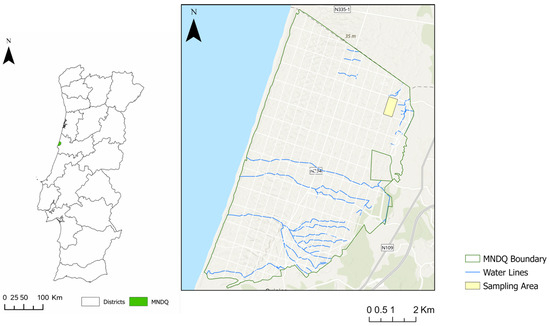
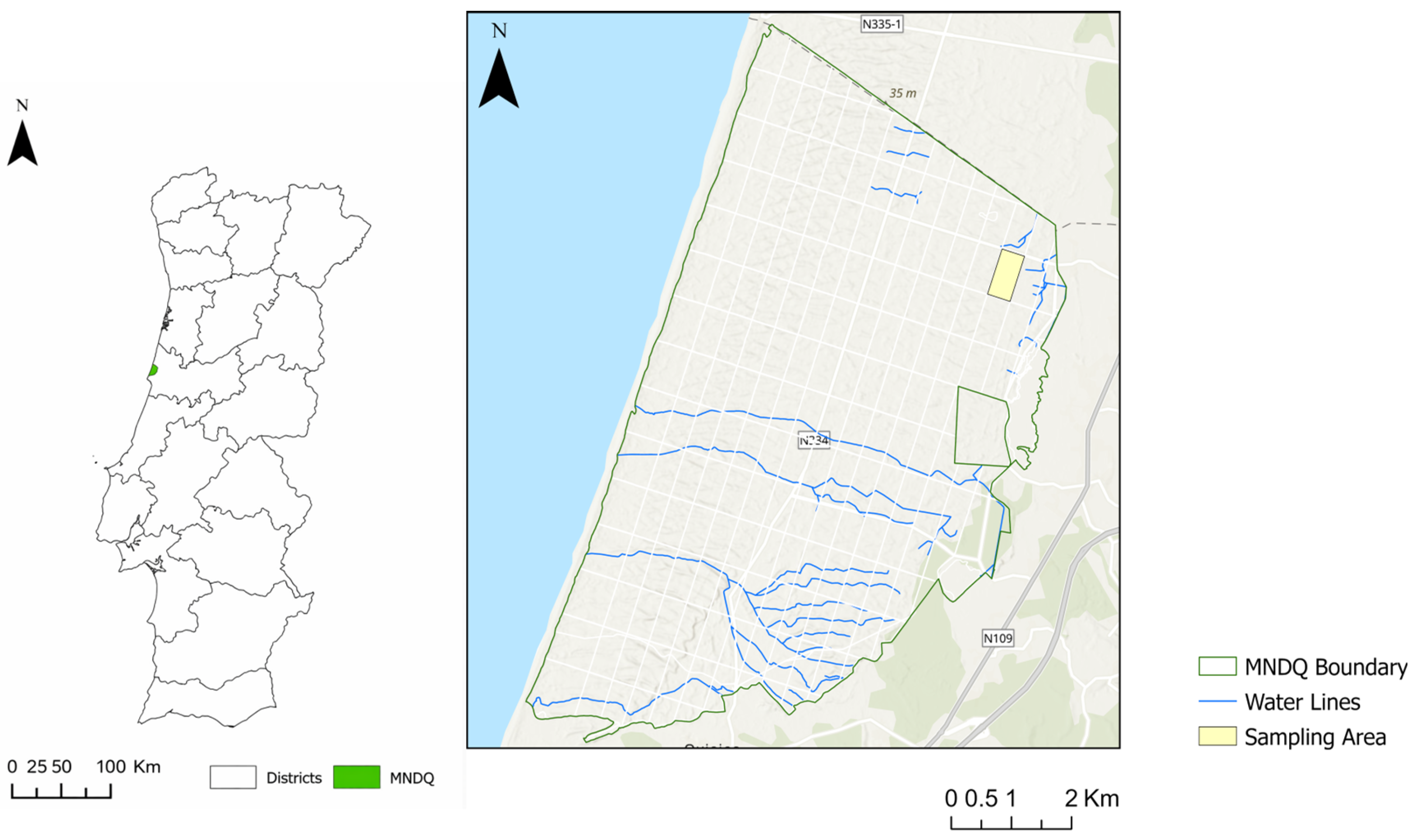
The study area is located in the National Woodland of the Dunes of Quiaios (Mata Nacional das Dunas de Quiaios—MNDQ) in Coastal Portugal (Figure 1) which was affected by a high-severity wildfire in October 2017 [26]. The MNDQ is divided in rectangular stands with an area of approximately 0.35 km2 each, hereafter named plots. These are defined by tracks, oriented N-S and E-W, that have the main purpose to allow physical definition and access to the plots and fire prevention [27]. The dominant pre-fire vegetation was P. pinaster. with ages ranging from 10 to 80 years old with a plant community corresponding to the high priority Natura 2000 habitat code 2270* (wooded dunes with P. pinea and/or P. pinaster) [28] often degraded, to greater or lesser extent, by A. longifolia. In MNDQ, A. longifolia is an exotic invasive species, introduced by forestry services for dune fixation and afforestation programs in late 19th century. Once introduced, the species progressively spread to the P. pinaster plantations, having their biggest dispersion after the fires in 1993 and 2017 that triggered the massive germination from seed banks [29].
Figure 1.
Location and spatial context of the study area in the Mata Nacional das Dunas de Quiaios (MNDQ), Tocha, Coastal Central Portugal.
According to the Köppen–Geiger classification, this region is included in the Mediterranean Csb climate zone (IPMA, 2013) [30], a temperate climate with dry and mild summers. This woodland is established on dunes with soils that vary between regosols and podzols, with coarse sandy textures, characterized by low organic matter contents and low water retention capacity [31]. This study focuses on the fifth post-fire hydrological year, starting on 1 October 2021 (t0) and ending on 30 September 2022 (t1). The selected plot was occupied by a 22-year-old Pinus pinaster stand prior to the fire. The five-year post-fire timeframe was chosen because ecosystem recovery trajectories, including vegetation re-establishment and shifts in species dominance, become more apparent during this stage [32], providing essential information for adaptive management and restoration planning within current EU environmental policy priorities [24,25,32]. Burnt pine trees were mechanically removed from the study area in 2019, after which the site was left undisturbed.
2.2. Experimental Design and Sample Analysis
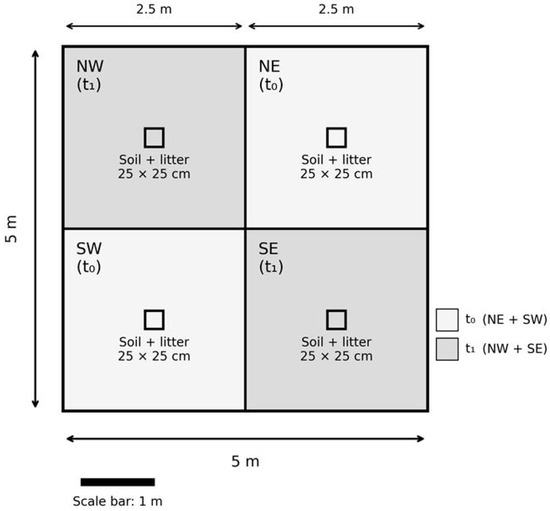
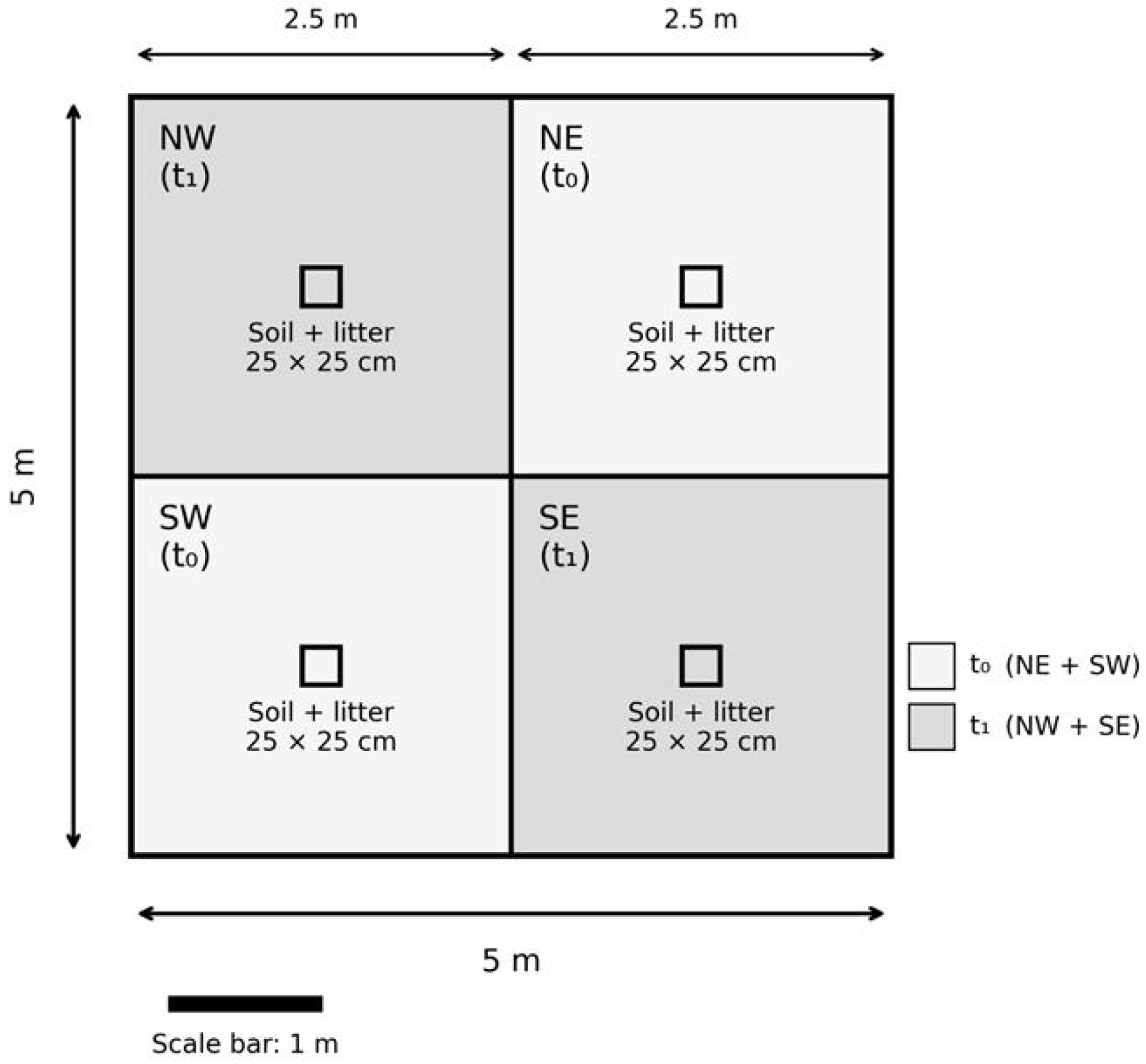
For the vegetation inventory and sampling, conducted both in t0 and t1, ten sub-plots (25 m2 each) were selected within the study area (0.35 km2) and subdivided into four parcels (6.25 m2), and a systematic quadrant-based sampling design was used to minimize repeated disturbance. Destructive sampling was carried out in the NE and SW quadrants at t0 and in the NW and SE quadrants at t1 (Figure 2), ensuring that vegetation sampled at t1 reflected post-fire regeneration rather than regrowth induced by previous cutting. Five sub-plots were located on five different dune crests (C) and the other five sub-plots located on five dune slacks (S) between the dune crests. The vegetation cover percentage was assessed for woody and herbaceous species. For the soil cover, the percentage of coverage by moss, litter, lichen and bare soil was estimated. The plant community was evaluated using the Braun–Blanquet cover–abundance scale [33].
Figure 2.
Schematic overview of the sampling of soils and vegetation. The sampling area consisted of a 5 × 5 m plot subdivided into four 2.5 × 2.5 m quadrants. The vegetation was destructively sampled from quadrants NE and SW at t0, and NW and SE at t1 (shaded accordingly). In the center of each quadrant, litter and soil were sampled from a 25 × 25 cm square.
The above-ground vegetation biomass (herbaceous, shrubs and trees) was measured in terms of height and diameter and then destructively sampled in the designated sample quadrants (NE and SW in t0 and NW and SE in t1). The sampled vegetation was taken to the laboratory and kept in a dry, ventilated room for three months, until a constant mass was reached to determine the dry biomass [34]. The litter biomass and soil were sampled from 25 × 25 cm squares (0.0625 m2) at the canter of each of the ten plots [35]. The litter samples were oven-dried at 65 °C for 48 h to determine the dry litter biomass [34]. The 0–2 cm of the soil layer of the 25 × 25 cm square was sampled completely (a volume of 1250 cm3), corresponding to the biologically active surface layer in these sandy, poorly developed soils, where organic matter accumulation and post-fire microbial and root activity are concentrated [35]. The soil was dried for 24 h at 105 °C and the organic matter content was determined following the loss-on-ignition standard method (ISO 10694:1995) [36]. The sample dry weight was used to determine bulk density, knowing the fixed sampling volume. Soil sub-samples were finely ground in a mechanical mill to ensure homogenization prior to the determination of total organic carbon (TOC) by dry combustion using a TOC analyzer, following standard soil analytical procedures [37]. Above-ground vegetation and litter biomass were assumed to have carbon contents of 50% and 37% of their dry weights, respectively [38].
2.3. Soil Respiration
Soil respiration (CO2 efflux) was measured using a LI-8100A Automated Soil CO2 Flux System (LI-COR Biosciences, St, Lincoln, NE, USA) equipped with a 20 cm portable survey chamber. The measurements were performed in soil collars made of PVC, with a diameter of 20 cm and a height of 13 cm and inserted 11 to 12 cm into the soil to ensure stability and isolate the soil surface. The collars remained fixed throughout the study to minimise disturbance and standardise measurements over time. Any spontaneous vegetation growing inside the collars was removed before the measurements to limit plant influence. Before each set of measurements, the mean height between the chamber and the soil surface inside the collar was measured and used to correct the volume of air inside the chamber (chamber offset). In each campaign, five 60 s measurements were performed in each collar with a 10 s pre-purge between them. This procedure ensured consistency across replicates and reduced potential feedback effects from CO2 accumulation [39]. The locations to measure soil respiration were selected to represent the four combinations of topographical relief and the dominant woody invasive and native species, i.e., dune crests (C), dune slacks (S), A. longifolia (A) (the dominant invasive woody species), and H. halimifolium (L.) Wilk. (H) (the dominant native woody species). In total, five collars per site per species [(CA; SA; CH; SH) × 5] were installed to measure soil respiration.
The measured soil respiration was processed with SoilFluxPro® (LI-COR Biosciences, USA), using the linear model due to its reliability for very low fluxes, reproducibility with repeated and replicate measurements, and short measurement durations where CO2 accumulation in the chamber remains minimal [39]. After the initial processing, data were filtered by excluding fluxes with an R2 < 0.7, coefficient of variation > 20%, negative fluxes, and fluxes beyond the mean ± 2 × standard deviation (outliers). The replicate measurements per date were treated all together and not per collar.
Four TEROS-12 soil moisture and temperature probes (METER Group, Pullman, WA, USA) were installed at 5 cm depth in the soil and connected to a ZL6 datalogger (METER Group, USA), recording at 60 min intervals. Two of these sensors were installed near the root system of A. alongifolia, and the other two near the root system of H. halimifolium.
2.4. Statistical Analysis
All statistical analyses were conducted in R v4.3.0 (R Core Team, 2023, Boston, MA, USA). To determine relationships among tree density and height, soil properties, vegetation cover, dry biomass, and biomass carbon content, the choice of statistical test depended on whether the data met the assumptions of normality (assessed using the Shapiro–Wilk test in the stats package) and homogeneity of variance (evaluated with Levene’s test in the car package). For datasets meeting these assumptions, one-way Analysis of Variance (ANOVA) was performed using the stats package. When these assumptions were violated, non-parametric alternatives were applied: Kruskal–Wallis tests (via the stats package) for comparing more than two groups and Permutational Multivariate Analysis of Variance (PERMANOVA) (using the vegan package) for multivariate analyses. Post hoc analyses were conducted to identify specific group differences. Following significant ANOVA results, Tukey’s Honest Significant Difference (HSD) test (from the stats package) was applied. For significant Kruskal–Wallis tests, pairwise Wilcoxon rank sum tests (with Bonferroni correction in the stats package) were performed.
Prior to model fitting, the assumptions of normality and homogeneity of variance for the soil respiration data were assessed. The Shapiro–Wilk test (implemented via the stats package) revealed significant non-normality (W = 0.918, p < 2.2 × 10⁻¹⁶), and Levene’s test (using the car package) confirmed heteroscedasticity (F = 5.21, p = 2.096 × 10⁻⁶). Given these violations of parametric assumptions, non-parametric alternatives were used the Kruskal–Wallis test (for group differences) and post hoc Dunn’s test (for pairwise comparisons), implemented via the FSA and dunn.test packages, respectively. To evaluate how soil volumetric water content (VWC) and temperature (T) influence soil respiration, a series of linear mixed-effects models were done using the lme4 package linear relationships between respiration (response variable) and centered (mean-subtracted) VWC and T (fixed effects), with random intercepts for species (H or A) to account for repeated measurements across plant types. Model assumptions were verified using residual diagnostics from the performance package. After detecting potential nonlinear patterns in initial analyses, the model was expanded to include quadratic terms (VWC2 and T2) while maintaining the random effects’ structure. Model comparisons were performed using likelihood ratio tests with maximum likelihood (ML) estimation, with the anova function providing AIC/BIC values and significance testing between nested models. Finally, the interaction effects between VWC and T were tested by incorporating multiplicative terms (VWC × T, VWC × T2) to assess whether their combined influence on respiration was synergistic or antagonistic. Predictor variables were standardized (cantered and scaled to unit variance) to mitigate multicollinearity between main and interaction terms.
3. Results
3.1. Vegetation Inventory and Composition
3.1.1. Cover
Five years after the wildfire, both woody and herbaceous vegetation demonstrated notable yet distinct patterns of recovery across the two study locations (Table 1). Woody species cover increased in both C and S points from t0 to t1, with C points consistently exhibiting higher mean cover (38.0% at t0 and 40.0% at t1), compared to S points (14.0% at t0 and 26.0% at t1). Statistical analysis confirmed significant differences in woody cover between locations (F = 7.431, p ≤ 0.05), particularly between t0-S and t0-C, and between t0-S and t1-C, indicating persistent spatial heterogeneity in woody recovery trajectories.
Table 1.
Vegetation and soil cover percentage (mean ± sd) on t0 and t1 for S and C points. Different letters indicate significant differences (p ≤ 0.05) based on 3-way ANOVA fitted separately for vegetation cover (%) and soil cover (%). The test included time, location, and cover type and their interactions. Post hoc pairwise comparisons were performed using pos hoc pairwise comparisons with Tukey test. Lichen was constant (0%) and therefore not included in the inferential.
The herbaceous layer responded differently: S points showed an increase in mean cover from 14.0% at t0 to 20.0% at t1, while C points remained unchanged at 10.0% across both years. Herbaceous cover was consistently higher in S points. Statistically significant differences in herbaceous cover were found between t0-C and t1-C (F = 3.435, p ≤ 0.05). Within-treatment comparisons revealed robust differences between herbaceous and woody layers (F = 83.142, p ≤ 0.05), emphasizing the distinct recovery pathways for these functional groups.
Litter was the predominant soil cover category at most sites and time points, except at t1 in C points, where bare soil was dominant (52.0%). Litter cover was consistently higher in S points (58.3% at t0 and 52.5% at t1) than in T points (54.0% at t0 and 46.0% at t1). Moss cover, though generally low, was higher in V points on both measurement times.
Bare soil cover exhibited notable temporal and spatial variation. At t0, C points had higher bare soil percentage (42.0%) compared to S points (36.6%), but by t1, bare soil increased in both locations, 52.0% in C points and reaching 42.6% in S points. The higher standard deviation associated with bare soil in C points suggests greater heterogeneity in soil exposure. No significant differences were detected between locations for the same soil cover type; however, within-location comparisons revealed significant differences among cover types (F = 13.754, p ≤ 0.05). At t0 in S points, significant differences were observed among cover categories (F = 13.776, p ≤ 0.05). Similarly, at t0 in C points, mosses and lichens differed from litter and bare soil (F = 13.552, p ≤ 0.05), and at t1 in C points, litter and bare soil also showed significant differences (F = 14.468, p ≤ 0.05).
3.1.2. Plant Community
The post-fire plant community comprises species of different growth forms, including woody natives, woody invasives, and herbaceous taxa. Among the woody native species, Ulex spp. (Fabaceae) increased in cover from 1 to 2 on the Braun–Blanquet scale (Table 2). Corema album (Ericaceae) also expanded from 1 to 2. H. halimifolium (Cistaceae) displayed a similar increase (1 to 2), confirming its effectiveness in post-fire establishment. In contrast, Cistus crispus (Cistaceae) disappeared by t1, while Helichrysum italicum (Asteraceae) was rare, reflecting limited persistence. P. pinaster (Pinaceae) remained stable at low cover (1–1), consistent with its slower post-fire dynamics. Within the woody invasive category, A. longifolia (Fabaceae) showed a marked increase (2 to 3), reinforcing its dominance and expansion. The herbaceous group presented more heterogeneous responses. Scirpoides holoschoenus (Cyperaceae) maintained stable cover (1–1), Corynephorus canescens (Poaceae) increased from 1 to 2, while several short-lived species declined or disappeared. These included Agrostis curtisii (Poaceae), Andryala integrefolia and Reichardia sp. (Asteraceae), which dropped from 1 to “rare”, and Leontodon sp. (Asteraceae), which vanished entirely by t1. Senecio gallicus (Asteraceae) persisted but remained stable at low cover (1–1).
Table 2.
Vegetation cover on t0 and t1 by growth form (woody and herbaceous), woody plants were separated by native and invasive. Braun–Blanquet plant cover index: r= rare (<1%); 1 = 1–5% cover; 2 = 6–25% cover; 3 = 26–50%.
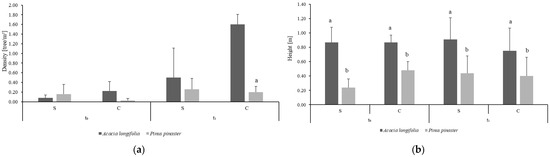
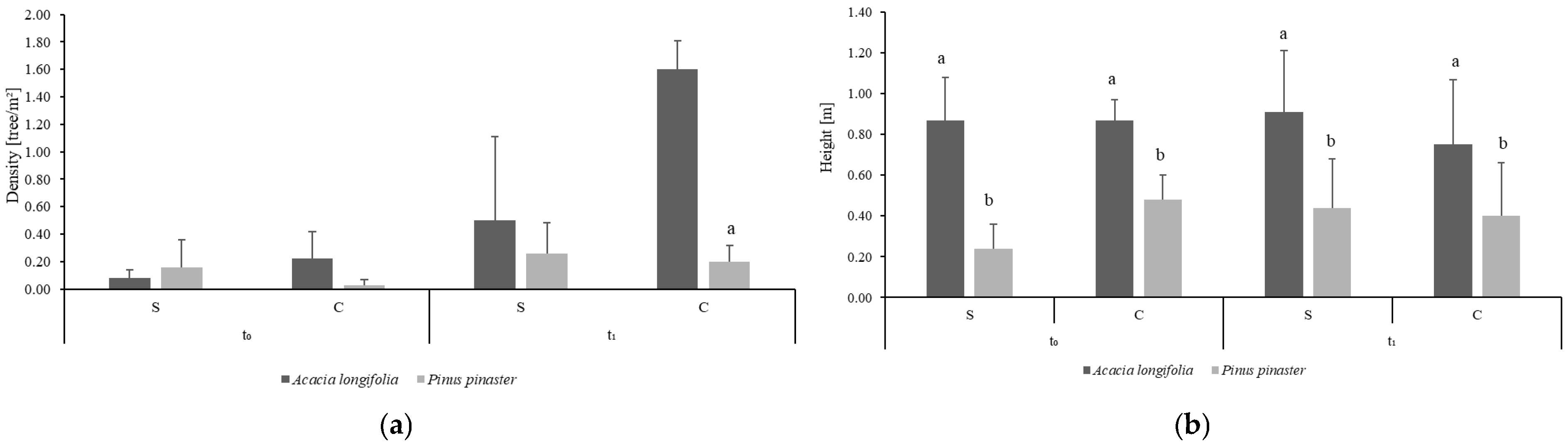
P. pinaster regeneration remained low and unchanged, highlighting limited pine recruitment five years after fire. By contrast, in A. longifolia, the dominant invasive woody species, the results (Figure 3) evidence a notable recruitment and height of the invasive plant, especially in comparison with the pre-fire dominant species, P. pinaster. At t0, both species exhibited minimal establishment, with densities below 0.2 m−2. However, by t1, A. longifolia demonstrated dramatic demographic expansion, reaching densities of 1.6 m−2 at the dune crests (C) and 0.5 m−2 in dune slacks (S), confirming the species’ colonization capacity in perturbed areas. In contrast, P. pinaster density remained consistently low throughout the study period. A one-way ANOVA confirmed a significant effect of topographic position on A. longifolia density (F = 4.635, p ≤ 0.05), whereas P. pinaster density differences across positions and times were not significant. The height measurements indicate that A. longifolia remained significantly taller than P. pinaster across locations and time (F = 11.742, p ≤ 0.05). Although P. pinaster achieved its greatest average height in dune slack points, these differences did not reach statistical significance.
Figure 3.
(a) Density and (b) height of the dominant woody species t0 (1 October 2021) and t1 (31 September 2022) in S and C points. Different letters indicate significant differences among groups based on one-way ANOVA followed by Tukey’s HSD post-hoc test (p ≤ 0.05).
3.1.3. Carbon Stocks
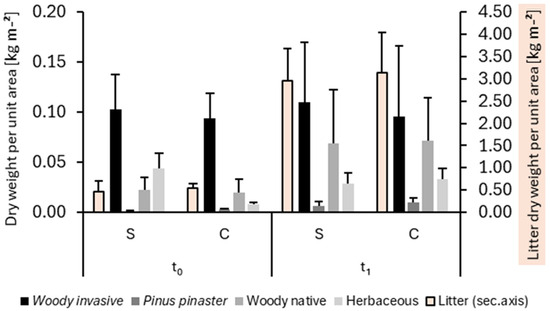
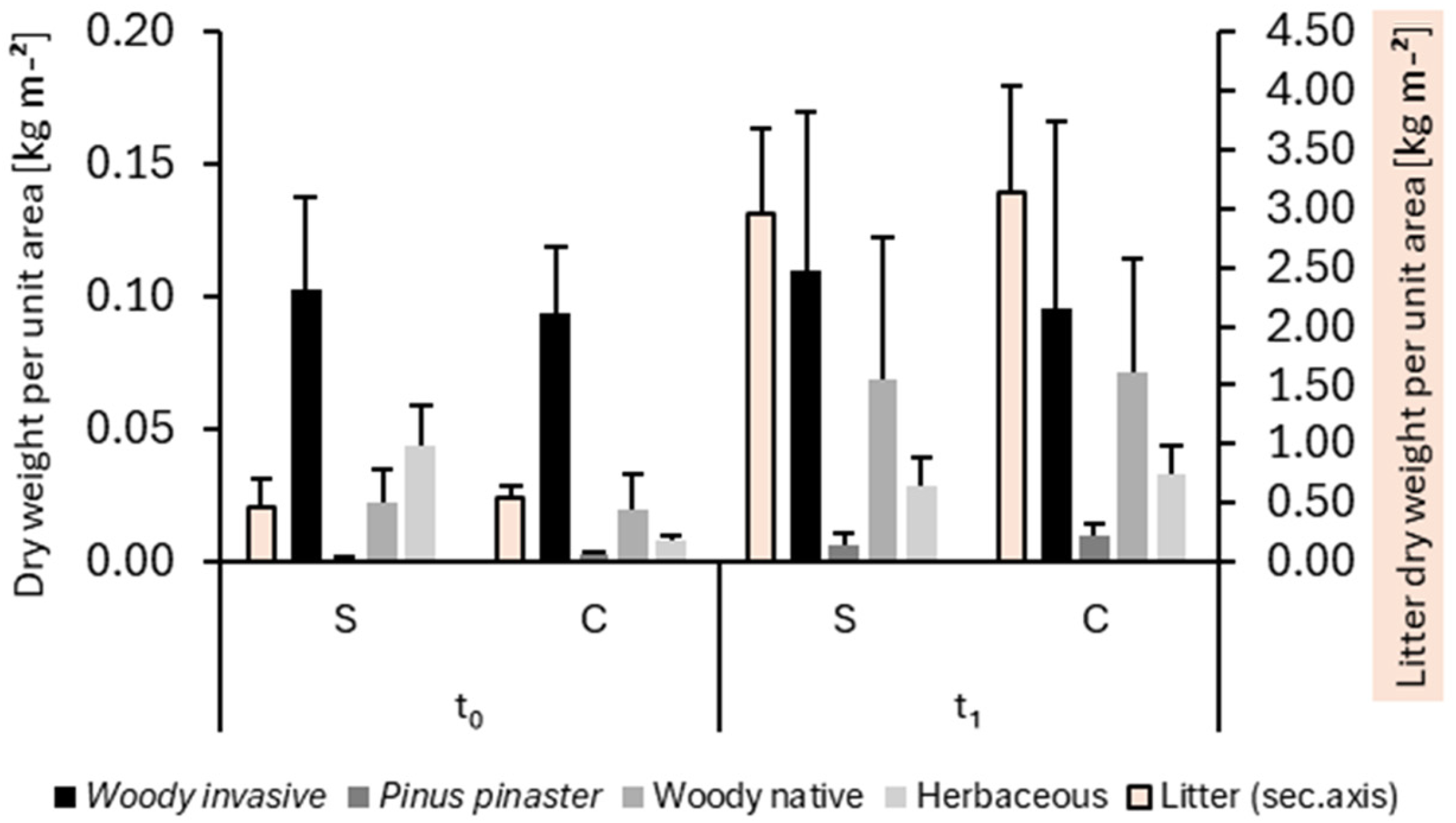
At the beginning of the fifth post-fire hydrological year (t0), litter represented the largest biomass pool (0.454 ± 0.486 kg m−2 in dune slacks; 0.535 ± 0.257 kg m−2 in the dune crest) exceeding all other vegetation types across both dune slacks and crests (Figure 4). In contrast, herbaceous vegetation represented the lowest biomass values, with 0.044 ± 0.038 kg m−2 in dune slacks and 0.008 ± 0.005 kg m−2 in dune crests, with no significant differences between positions. One year later (t1), there was significant higher across all groups (χ2 = 42.14, p ≤ 0.05), with litter maintaining statistically higher values than all other vegetation types (Figure 4), with values of 2.953 ± 1.356 kg m−2 in dune slacks and 3.127 ± 1.950 kg m−2 in dune crests. Among live vegetation, woody invasive species biomass in slacks (0.110 ± 0.121 kg m−2) surpassed the woody native (0.068 ± 0.098 kg m−2) and herbaceous species (0.029 ± 0.020 kg m−2), though differences were not consistently significant (χ2 = 11.96; p ≥ 0.05).
Figure 4.
Dry biomass per unit area of the woody invasive, woody native, and herbaceous species, and of the soil litter layer t0 and t1 in S and C points. Litter contribution in biomass is reflected in the secondary axis.
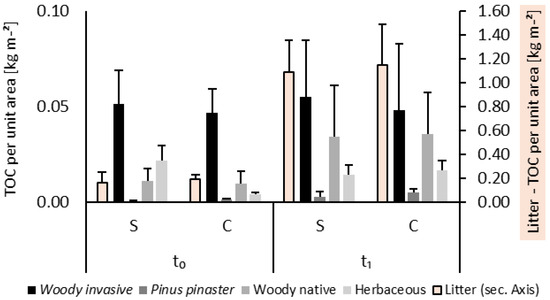
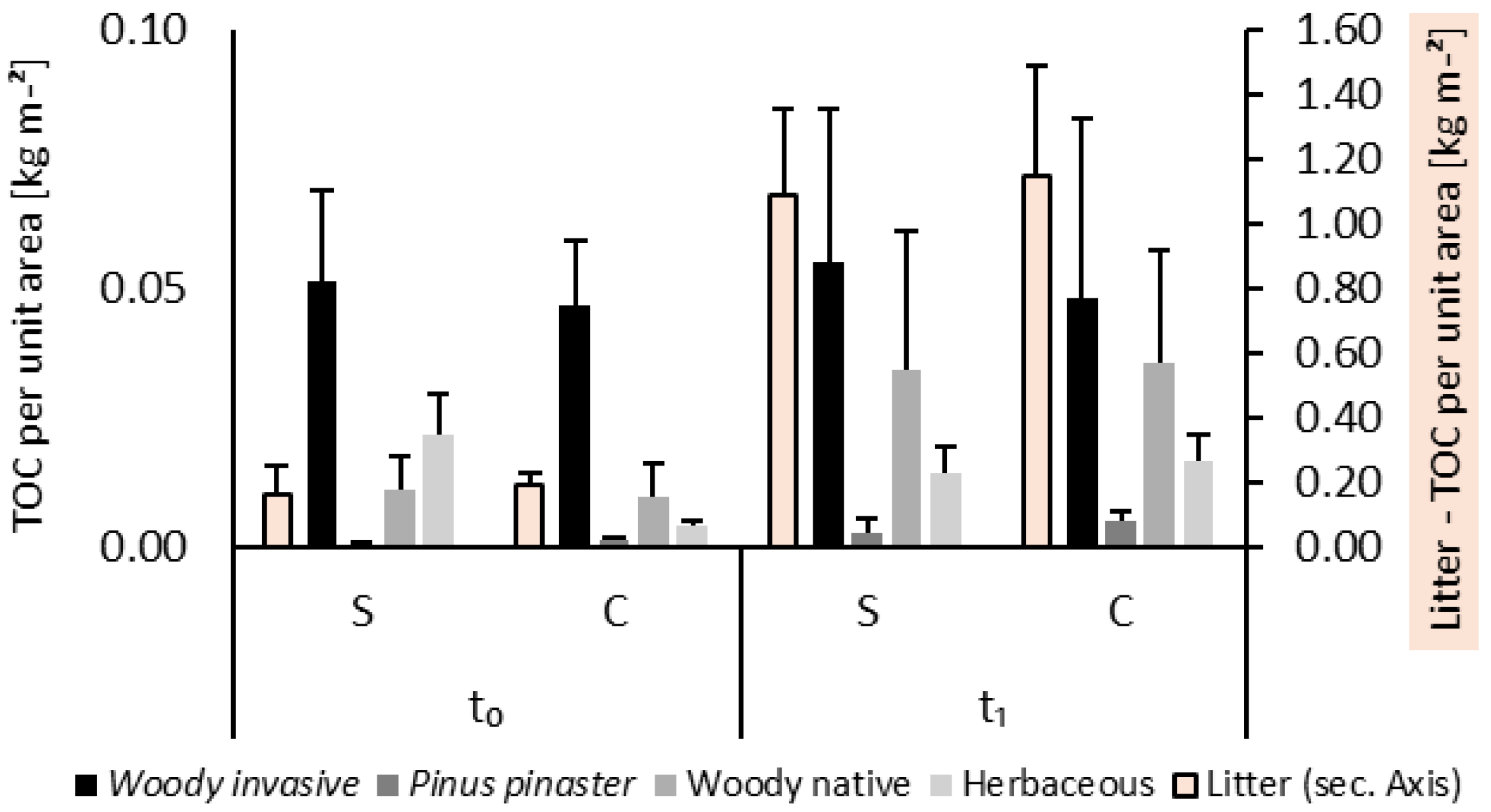
The layer type had a significant effect on biomass pools (χ2 = 78.12, p ≤ 0.05), primarily due to the consistently higher values observed for the litter layer. The three vegetation groups did not differ significantly from one another (χ2 = 4.88, p ≥ 0.05). Location alone did not significantly influence biomass, neither within vegetation types nor within each year. However, the interaction between time, position, and vegetation type was significant (χ2 = 88.32, p ≤ 0.05), indicating that biomass dynamics varied depending on the specific combination of factors. The woody invasive species biomass remained relatively stable across time and position, without significant variation (χ2 = 13.70; p ≥ 0.05). The biomass of native vegetation, especially the woody component, increased markedly from t0 to t1, rising from 0.0222 to 0.0686 kg/m2 in S points, and from 0.0197 to 0.0716 kg/m2 in C points. Carbon content followed the same overall pattern. Carbon stocks (Figure 5) increased significantly from t0 to t1 (χ2 = 24.9, p ≤ 0.05) and varied significantly by vegetation type (χ2 = 69.5, p ≤ 0.05), again with litter presenting the highest pool. A significant interaction between time, vegetation type, and location (χ2 = 78.19, p ≤ 0.05) further confirmed that the observed patterns in carbon mirrored those of biomass, with the dominant influence of litter across all conditions.
Figure 5.
Total organic carbon (TOC) per unit area of the woody invasive, woody native, and herbaceous species, and of the soil litter layer for t0 and t1 in S and C points. Litter contribution in TOC is reflected in the secondary axis.
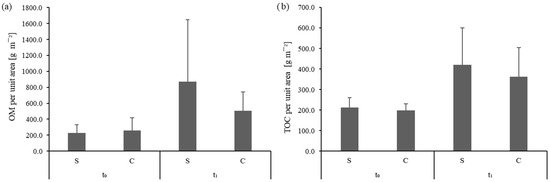
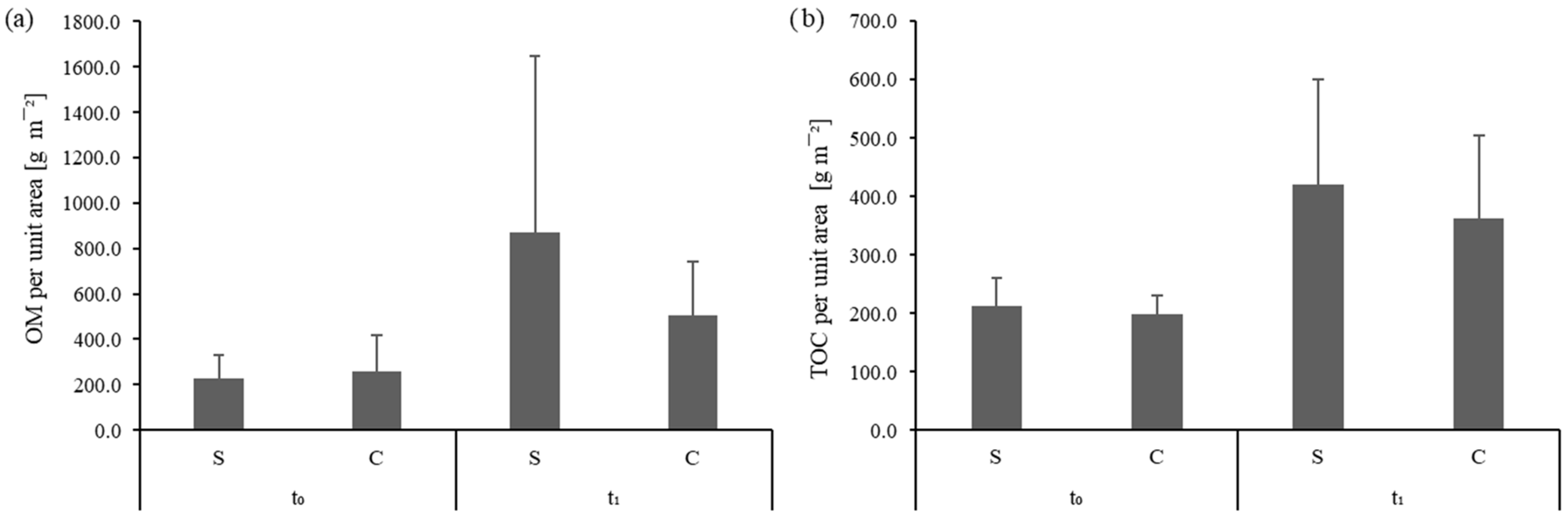
At time t0, the mean soil organic matter (OM) content for the dune slacks (S) was 227.4 ± 101.5 g/m2 (Figure 6a), and 259.3 ± 160.2 g/m2 for the dune crests (C). At t1, values increased markedly, with the dune slacks reaching 872.5 ± 773.5 g/m2, and the dune crests reaching 504.8 ± 237.1 g/m2. While the trend at t0 showed slightly higher organic matter in the dune crests, this pattern was reversed at t1, with a notably higher accumulation in the dune slacks.
Figure 6.
(a) Organic matter (OM) per unit area. (b) Total organic carbon (TOC) per unit area for t0 and t1 in S and C points.
A Kruskal-Wallis test revealed statistically significant differences in OM content among the groups (χ2 = 12.93, p ≤ 0.05). Post hoc Dunn’s test indicated that the difference between t0-S and t1-S was significant (p ≤ 0.05), suggesting a meaningful increase in organic matter in dune slacks. All other comparisons were not statistically significant (p ≥ 0.05). For total organic carbon (TOC), the mean content at t0 was 211.5 ± 96.6 g/m2 (Figure 6b) for the dune slacks and 197.7 ± 66.3 g/m2 for the dune crests. In t1, the values increased to 419.2 ± 360.2 g/m2 for the slacks and 361.6 ± 285.1 g/m2 for the crests. Despite these apparent increases, a Kruskal-Wallis test detected no statistically significant differences between groups (χ2 = 1.12, p ≥ 0.0.5). All pairwise comparisons, conducted via Dunn’s test, returned p ≥ 0.05, confirming the lack of significant change in TOC levels across time and location.
3.2. Carbon Fluxes
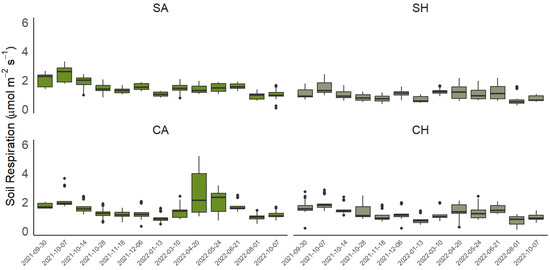
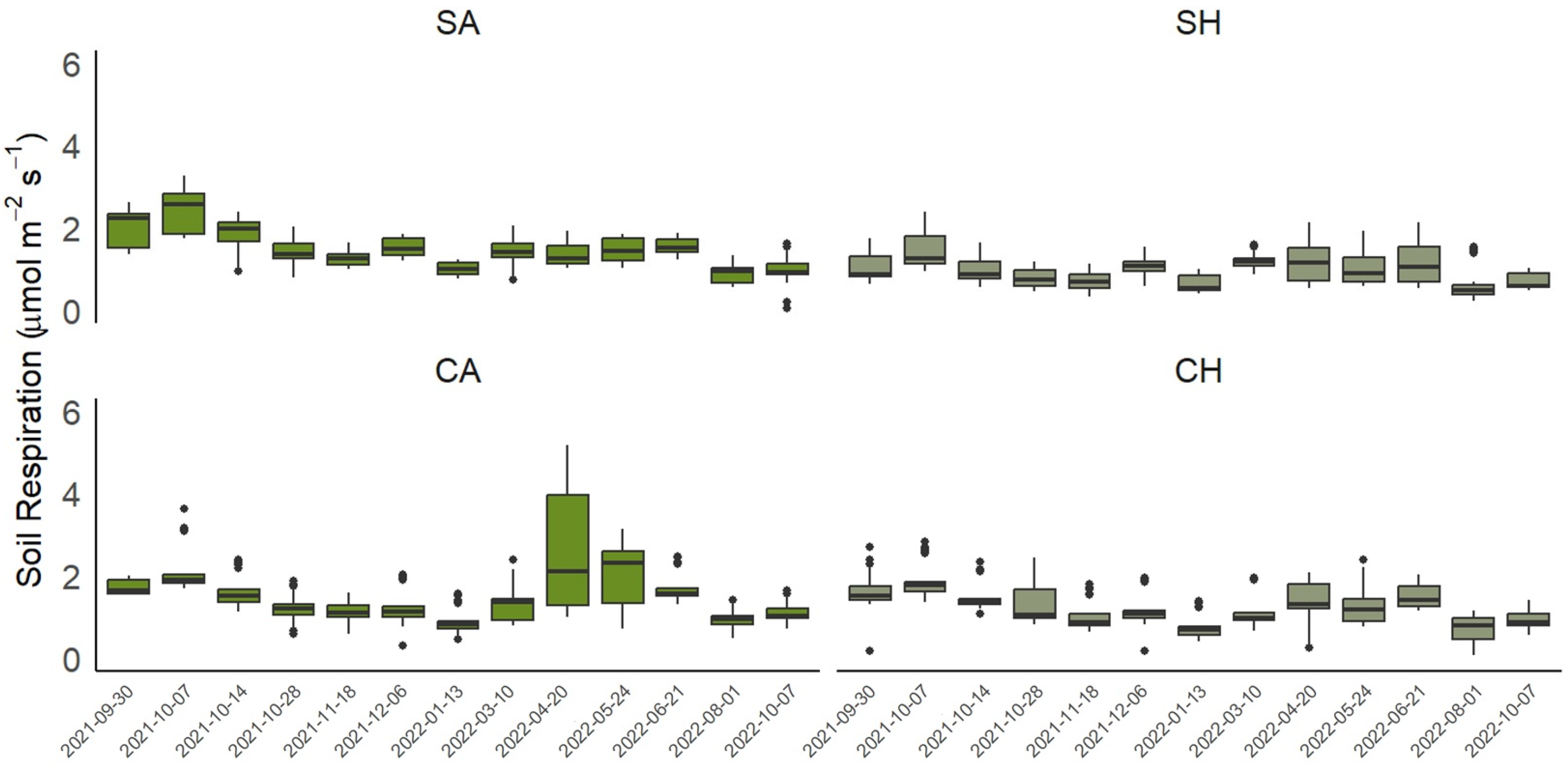
Soil respiration measurements were performed 13 times in the studied period (Figure 7) near the roots of the dominant woody native species—H. halimifolium; H—and the dominant woody invasive species—A. longifolia; A. The results suggest clear patterns in soil respiration across topographic positions and plant species. Dune slacks (S) exhibited lower respiration rates compared to dune crests (C), particularly for H. halimifolium (SH vs. CH), suggesting that slack conditions may constrain metabolic activity. In contrast, crest locations (CA, CH) showed higher respiration, likely due to better drainage or more favourable microclimatic conditions. Species-specific trends were prominent: A. longifolia (SA/CA) demonstrated consistently higher respiration than H. halimifolium in both topographic positions, with minimal difference between slacks and crests (SA ≈ CA), suggesting resilience to elevation changes. H. halimifolium, however, displayed strong topographic sensitivity, with dune slacks (SH) showing the lowest respiration of all groups (SH ≪ CH), possibly due to waterlogging stress.
Figure 7.
Soil respiration near the roots of the dominant woody native species—Halimium halimifolium (H, gray boxplots)—and the dominant woody invasive species—Acacia longifolia (A, green boxplots); both in dune slacks (S) and dune crests (C). In each boxplot, the central horizontal line represents the median and dots indicate outlier values.
The result of the Kruskal-Wallis test (χ2 = 180.24, df = 3, p < 0.001) indicates highly significant differences in soil respiration among the four locations (SA, SH, CA, CH). Post hoc Dunn’s tests with Bonferroni correction revealed that A. longifolia in dune slacks (SA) had significantly higher respiration than H. halimifolium in dune slacks (SA ≫ SH; p.adj < 0.001) and H. halimifolium in crests (SA > CH; p.adj < 0.001) but was similar to A. longifolia in crests (SA ≈ TA; p.adj = 1.0). H. halimifolium in dune slacks showed the lowest respiration, differing significantly from both crest locations (SH ≪ CA, SH ≪ TH; p.adj < 0.001). In dune crests, A. longifolia (CA) had higher respiration than H. halimifolium (CA > TH; p.adj = 0.0007). The annual fluctuation, such as elevated respiration during warmer months due to increased microbial activity, further highlights the role of weather and soil conditions.
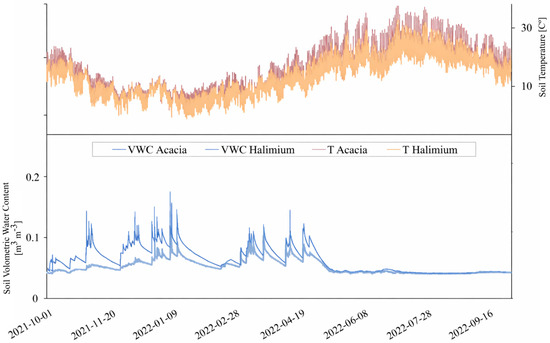
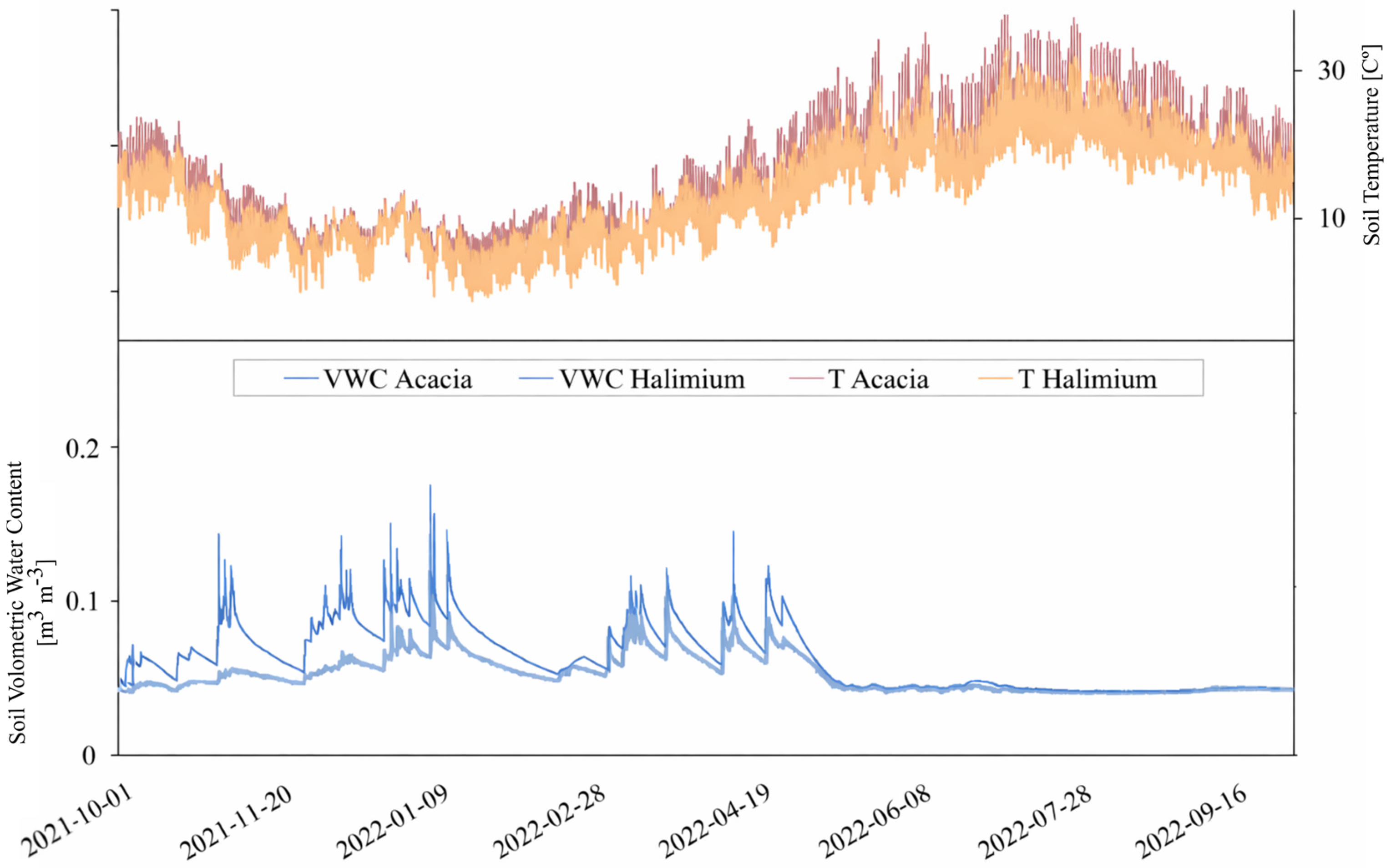
The annual fluctuation in soil respiration (Figure 7), with higher median fluxes in autumn and spring, suggests that soil water availability might be limiting respiration more than soil temperature. Autumn and spring coincide with the first major rains after the dry summer and with late-winter recharge, respectively. These moisture pulses rapidly increase soil volumetric water content (VWC) (Figure 8, blue spikes) and trigger bursts of microbial respiration and root activity. During summer, VWC often falls below 5% and respiration declines to <1 µmol m−2 s−1, despite soil temperatures close to the annual optimum for microbial metabolism. The soil temperature ranged from ≈8 °C in mid-winter to >30 °C in midsummer (Figure 8, right axis, orange lines). Overall, VWC was significantly higher near the roots of H. halimifolium than A. longifolia (Wilcoxon W = 4.56 × 10⁸, p < 0.001; Cliff’s delta = −0.29, small effect). In contrast, soil temperature did not differ meaningfully between species (delta = 0.08, negligible).
Figure 8.
Soil volumetric water content [m3 m−3] (primary axis), and temperature [°C] (secondary axis), measured in dune crests during the study period.
The linear mixed effects model to assess the effect of the average VWC and T on the day of soil respiration measurement shows a marginally significant negative effect of VWC on soil respiration (p ≈ 0.049, based on t-values) and no significant effect of temperature (p > 0.05). Looking into the VWC and T measured at 13:00 UTC, considering that soil respiration was always measured between 11:00 and 15:00 UTC, gives the same results for VWC (p ≈ 0.049) and T (p > 0.05), explaining limited variation in respiration rates (residual variance = 0.24). The incorporation of quadratic terms dramatically improved model fit (ΔAIC = 425.1, p < 2.2 × 10⁻¹⁶), revealing strong non-linear relationships. Both VWC and temperature exhibited significant quadratic responses (VWC2: β = −248.8, t = −3.74; T2: β = −0.0079, t = −22.20), demonstrating characteristic hump-shaped curves with optimal intermediate values for microbial activity. The quadratic model explained substantially more variation (residual variance = 0.17), with temperature effects particularly strong. The full interaction model, incorporating both quadratic terms and their interactions, provided the best fit (REML criterion = 1412.7). This model identified significant synergistic effects between moisture and temperature (VWC × T: β = 5.78, t = 2.97, p < 0.01), indicating that warmer temperatures amplify moisture effects on respiration. Additionally, a significant VWC × T2 interaction (β = 0.52, t = 3.03, p < 0.01) revealed that soil moisture modifies the curvature of the temperature response. The pure quadratic terms became non-significant when interactions were included, suggesting their apparent effects in simpler models represent more complex, interdependent relationships between environmental drivers. These results collectively demonstrate that soil respiration responds not to individual environmental factors in isolation, but rather to their interactive effects, with optimal conditions occurring at intermediate levels of both moisture and temperature.
4. Discussion
Four years following the 2017 wildfire and two years after the mechanical dead wood clearance in 2019, distinct ecological trajectories emerged in the Mata Nacional das Dunas de Quiaios (MNDQ), shaped by three interacting drivers: disturbance (fire and clearance), strong topographic gradients and the rapid expansion of the invasive A. longifolia. Together, these factors redirected successional pathways and amplified spatial heterogeneity across the dune system.
The increase in woody species cover observed at both dune positions and time of indicates ongoing secondary succession, consistent with patterns documented in Mediterranean pine ecosystems where woody regeneration accelerates during the mid-recovery phase [40]. The dead wood removal conducted in 2019 represents a significant management intervention that altered the natural post-fire recovery trajectory. Research on post-fire dead wood management indicates that removal of coarse woody debris can have profound ecological consequences, affecting soil properties, microhabitat availability, and plant establishment patterns [41]. The timing of this intervention, occurring two years post-fire when initial colonization processes were still ongoing, may have disrupted natural succession patterns and created novel ecological conditions that influenced the vegetation recovery patterns observed during the fifth post-fire year. The pronounced difference in woody cover between dune crests (38–40%) and dune slacks (14–26%) underscores the critical role of microhabitat in influencing recovery trajectories [42,43]. Studies in Mediterranean coastal dunes show that xeric conditions—characterized by greater temperature extremes, higher wind exposure, and poor moisture retention—dominate the crests, favouring drought-tolerant woody species. Conversely, the mesic conditions of the slacks, with enhanced water and nutrient availability, support a more robust and rapid recuperation of the general ecosystem [44,45].
Herbaceous vegetation showed contrasting trends across topographic positions. Cover increased in dune slacks but remained low and unchanged on dune crests, suggesting that slack microhabitats provided more favourable conditions for herbaceous establishment. This is consistent with evidence that post-fire herbaceous recovery is strongly controlled by water availability, soil fertility, and competition with woody species [46]. Although the fifth post-fire year is often described as a transition toward perennial dominance in favourable microsites [47], the continued rise of pioneer herbaceous cover here may indicate delayed succession, potentially linked to disturbance resetting associated with the large-scale dead-wood clearance. However, the system shows signs of typical mid-term successional shift toward woody dominance, with the recovery of native H. halimifolium and C. canescens in dune slacks leading to the decline of short-lived herbaceous species (Reichardia picroides, Andryala integrifolia, Leontodon sp.) via competitive exclusion [48,49].
The physical processes occurring in coastal dunes further influenced soil surface cover. The shift to bare soil dominance (52%) at dune crests (c) may be interpreted not only as a result of low vegetation cover, but as a consequence of litter redistribution [50], rather than solely a breakdown in stabilization processes or secondary disturbance events. The large standard deviations in bare soil cover at the crests, further underscore heterogeneous wind exposure, where microtopographic features create both wind-sheltered pockets and highly exposed zones, associated with reduced water infiltration and delayed plant recruitment [51]. In contrast, sheltered dune slacks (S) maintain high litter accumulation, and higher, albeit low, moss cover. These emerging biological soil crusts can enhance water retention, stabilize sediments, and facilitate seed germination of vascular plants, thereby accelerating and supporting long term ecosystem recovery in wind-buffered dune hollows [52].
The marked increase in the dominant woody invasive (A. longifolia) cover from Braun-Blanquet Class 2 to Class 3 between t0 and t1 confirms its competitive superiority over native taxa, driven by efficient nitrogen fixation and rapid growth [48,49].
The rapid expansion of A. longifolia, however, is not reflected in the biomass data, suggesting that at lower densities, individuals growing in the more favourable conditions develop denser, heavier architecture, maximizing resource use where moisture is higher.
In contrast, the pre-fire dominant woody native, P. pinaster, exhibits higher density (although not statistically different that crests) in the dune slacks at t1, suggesting a possible early competition with Acacia at its higher regeneration densities, where it is well adapted to the xeric environmental conditions of dune crests, including high wind exposure, salinity shallow and dry soils, and direct sunlight [53,54].
Beyond its structural dominance, the presence of A. longifolia significantly influences soil properties by altering moisture availability, water-holding capacity, and nutrient cycling [16]. Its dense canopy and litter layer contribute to microclimatic shifts that can restrict light penetration and water availability, thereby suppressing the recruitment and growth of P. pinaster seedlings [54]. This competitive dynamic is driven primarily by resource input rather than direct allopathy, although both processes may act synergistically. Even though nitrogen fixation by A. longifolia can improve soil fertility, this potential benefit is offset by its intense competition for water and light, particularly in dry dune crest environments [53].
P. pinaster exhibited slightly better regeneration in dune slacks than in dune crests, likely due to facilitative interactions with native shrubs and improved microclimatic buffering in slacks. However, the modest increase in density between t0 and t1 was insufficient to meet silvicultural benchmarks for productive reforestation (~3000 seedlings/ha) [54]. Woody native and herbaceous biomass did not exhibit strong spatial or temporal variation, with both groups remaining subordinate to invasive biomass in slacks. Despite exhibiting higher mean density (0.75 ± 1.15 trees/m2) and significantly greater height on dune crests, A. longifolia accumulated more above-ground biomass in dune slacks, where both density and height were comparatively lower. This apparently paradoxical pattern can be attributed to the interaction between plant architecture and microclimatic conditions, which is especially pronounced in heterogeneous dune systems [54]. These findings show how A. longifolia physiological traits allow the species to thrive across a range of stress gradients and responses plastically to microtopographic variations, often producing greater biomass in sheltered habitats, regardless the population density or plant height [17,55,56]. The persistence and stability of A. longifolia biomass indicate that, without active intervention, successional trajectories may compromise ecosystem resilience by favouring the persistence of invasive over native assemblages [57].
The observed biomass and carbon dynamics over the fifth post-fire hydrological year reveal key patterns in ecosystem recovery within P. pinaster plantations. Across time, litter consistently accounted for the largest biomass and carbon pool, regardless of topographic location. This finding aligns with previous research highlighting the dominant role of litter in post-fire dune ecosystems, where coarse and fine detritus accumulate rapidly and contribute significantly to carbon cycling [58,59]. From t0 to t1, there was a statistically significant increase in total biomass across all vegetation categories (χ2 = 42.14, p ≤ 0.05), though litter remained the dominant contributor, the consistent dominance of this pool reinforces its ecological importance in carbon sequestration and surface stabilization.
These results strongly suggest that post-fire biomass and carbon dynamics in coastal are dominated by litter pools and increasingly influenced by invasive species, particularly A. longifolia. The differential response of vegetation types between dune slacks and crests underscores the importance of microtopography and functional traits in shaping recovery outcomes. From a restoration perspective, these findings reinforce the need for adaptive management strategies that prioritize early invasive control and litter management while harnessing microclimatic advantages in dune slacks to support native regeneration and carbon sequestration.
In one year, the increase in organic matter within Mediterranean coastal dunes indicates a system undergoing biogeochemical development and natural succession, reinforcing the role of these ecosystems as vital carbon sinks [60,61,62]. This accumulation is ecologically critical for low-fertility, coarse substrates, as organic matter enhances soil function, water retention, and the microbial diversity that regulates decomposition and nutrient cycling [63,64,65]. However, while mean total organic carbon (TOC) levels increased across both dune slacks and crests, the lack of statistical significance suggests high spatial variability and slower stabilization of carbon pools [66]. This decoupling between organic matter accumulation and TOC indicates that organic residues may not yet be fully processed into persistent soil carbon due to decomposition dynamics or leaching [61].
The substantial standard deviations, particularly in dune slacks at t1, suggest that localized vegetation patches or detrital hotspots may be disproportionately contributing to organic inputs. Such patchiness is a hallmark of coastal dune ecosystems, especially following disturbance events like fire [53]. It is also plausible that increased litter production, particularly from A. longifolia and native shrubs, contributed to the observed OM rise without fully translating into stabilized TOC due to different decomposition rates or leaching dynamics typical of coarse-textured soils [67]. In sum, the increase in OM in dune slacks suggests that the ecosystem is in a state of active recovery and development, with enhanced ecosystem function and resilience, especially under more favourable microclimatic conditions. This is particularly significant in the context of coastal dune restoration and its potential for carbon sequestration. Recent studies have highlighted the importance of coastal ecosystems, including dunes, as carbon sinks with high carbon sequestration rates [53]. The observed increases in both organic matter content and TOC indicate a positive trajectory for soil development and ecosystem functioning.
The patterns observed in soil respiration reflect a strong interaction between species, topographic location, and environmental variables such as soil moisture and temperature. The dominant woody invasive species (A. longifolia) consistently exhibited higher respiration rates than the dominant woody native species (H. halimifolium), regardless of topographic location, indicating its greater metabolic activity and higher belowground biomass and root turnover. This is consistent with studies that have documented the high rhizosphere activity and nitrogen-fixing capability of A. longifolia, which contributes to increased microbial respiration and carbon cycling [53].
In dune slacks (S), the dominant woody invasive presented the lowest respiration rates, likely due to increased soil moisture and reduced oxygen availability, a condition common in shallow, poorly drained dune depressions. Conversely, the higher respiration near H. halimifolium in dune crests (C) reflects more aerated and drier conditions that favour microbial activity and root respiration [67]. The lack of topographic sensitivity in A. longifolia respiration (SA ≈ CA) suggests greater physiological plasticity and deeper rooting, which allows this invasive species to maintain high respiration across gradients of moisture and temperature, as previously noted in [68].
The significant differences in respiration between the species and locations reinforce the dominant role of the dominant woody invasive in shaping belowground carbon fluxes across the landscape. These findings suggest that A. longifolia dominates carbon cycling across elevations, likely due to nitrogen-fixing capabilities and deeper root systems, whereas H. halimifolium is more sensitive to slacks conditions, where anaerobic soils or other stressors may suppress respiration. The invasion by A. longifolia has been shown to shift carbon inputs and alter microbial community structure, promoting short-term increases in soil respiration but potentially leading to long-term shifts in organic matter dynamics and nutrient cycling [16].
Furthermore, the strong seasonal fluctuation in soil respiration, with peaks during spring and autumn, supports the hypothesis that water availability, rather than temperature alone, is the primary limiting factor in these Mediterranean systems. Despite high summer temperatures, respiration declined due to extremely low soil moisture (<5% VWC), consistent with results from other drought-prone coastal ecosystems [66].
Interestingly, soil moisture was significantly higher near the dominant woody native roots, suggesting potential differences in transpiration demand, rooting depth, or canopy interception between species. Yet, this did not translate into higher respiration due to anaerobic suppression in slacks, where the dominant woody native was more frequently associated with waterlogged conditions. This aligns with findings in [56], where authors showed that native shrubs like Halimium sp. may be physiologically constrained under excessive soil moisture, contrasting with the invasive A. longifolia ability to maintain gas exchange and microbial stimulation under both wet and dry conditions.
In summary, these results suggest that A. longifolia have considerable influence on carbon fluxes across dune systems, enhancing respiration rates independent of topographic constraints. This underscores the importance of considering species identity and invasive dynamics when assessing post-fire carbon cycling and ecosystem recovery trajectories. The interactive effects of soil moisture and temperature further highlight the non-linearity of ecosystem responses in Mediterranean dunes, with implications for carbon budgeting under future climate variability.
The dominance of A. longifolia has significant implications for ecosystem recovery, being a critical threat to native biodiversity and ecosystem function. This species alters ecosystem structure and functioning by forming dense stands that outcompete native vegetation, leading to biotic homogenization and reduced biodiversity [69]. Its competitive advantages, along with the accumulation of large soil seed banks, sustain their dominance. Over time, this can cross critical ecological thresholds, making the natural recovery of the ecosystem impossible without active intervention [70]. To manage this invasive species, it is essential to implement control measures through mechanical or biological methods. Promoting the recovery of native vegetation involves reintroducing native species and restoring soil to mitigate the imbalances and competitive advantages of A. longifolia. Although this species contributes significantly to carbon storage due to its high biomass production, this comes at the cost of ecosystem resilience, services, and functions [69].
5. Conclusions
This study demonstrates that post-fire recovery in Mediterranean coastal dunes is strongly shaped by topographic heterogeneity rather than uniform successional trajectories. Overall, the hypothesis was confirmed: plant community composition, carbon stocks, and carbon fluxes differed between native and invasive dominated areas, and these differences interacted with topography to influence ecosystem recovery trajectories. Findings reveal that xeric dune crests favour woody species assembly, while mesic slacks serve as critical refugia for herbaceous diversity and soil organic matter accumulation.
The carbon storage analysis revealed that litter pools dominate biomass and carbon stocks across all topographic positions, with statistically significant increases in total biomass during the fifth post-fire year. However, the expansion of A. longifolia emerged as a critical factor reshaping carbon dynamics, with this invasive species accumulating greater above-ground biomass in dune slacks despite lower density and height compared to crest populations. This finding highlights the species’ physiological plasticity and superior competitive ability across environmental gradients. The observed increase in soil organic matter in slacks (246.5 to 945.1 g/m2) compared to more modest gains at crests (281.3 to 547.4 g/m2) indicates that topographic position influences not only vegetation recovery but also fundamental biogeochemical processes.
The integration of vegetation composition and carbon dynamics data demonstrates that post-fire ecosystem recovery in Mediterranean coastal systems is governed by complex interactions between topographic heterogeneity, species functional traits, and disturbance legacies. Although a high degree of variability was observed among sampling points, as reflected in elevated standard deviation values, this variability is an inherent characteristic of the ecosystems under study. To adequately capture this natural heterogeneity and derive representative mean values, this research employed a robust and intensive sampling design, with multiple sampling points. Within this framework, the research established that dune slacks represent critical refugia for both native species regeneration and carbon accumulation, while crest environments favour invasive species establishment and expansion. These findings indicate that effective post-fire restoration strategies must account for spatial heterogeneity in environmental conditions and implement targeted management approaches that leverage favourable microsites while controlling invasive species expansion. The observed patterns suggest that without active intervention, the studied ecosystem may transition toward alternative stable states dominated by invasive species, fundamentally altering carbon sequestration potential and biodiversity conservation outcomes in Mediterranean coastal forest systems.
Author Contributions
D.R.: Data curation; Investigation; Formal analysis; Methodology; Visualization; Writing—original draft; T.v.d.W.d.S.: Investigation; Writing—review and editing; P.M.: Investigation; Methodology; Formal analysis; Supervision; Validation; Writing—review & editing; B.R.F.O.: Conceptualization; Investigation; Formal analysis; Methodology; Funding acquisition; Project administration; Resources; Supervision; Validation; Visualization; Writing—original draft; Writing—review and editing. All authors have read and agreed to the published version of the manuscript.
Funding
This work was supported by the project CCforBio [2023.10050.PRIZE], funded by the Belmiro de Azevedo Foundation and by the Portuguese Foundation for Science and Technology, I.P., through the 2023 Belmiro de Azevedo Foundation Prize. Bruna R. F. Oliveira was funded by national funds through the Portuguese Foundation for Science and Technology, I.P., and by FEDER COMPETE 2020 funds, in the scope of the Stimulus for Scientific Employment—Individual Call [2021. 00785.CEECIND], (https://doi.org/10.54499/2021.00785.CEECIND/CP1659/CT0028). Diana Rodrigues was funded by FCT-ECIU, “ForTree: FOResT management to enhance the REcovEry of recently burnt Pinus pinaster woodlands”, [PRT/BD/154850/2023], (doi: https://doi.org/10.54499/PRT/BD/154850/2023). Tiago van der Worp Silva was funded by national funds through the Portuguese Foundation for Science and Technology, I.P., in the form of a Ph.D. Grant [2023.01767.BDANA].
Data Availability Statement
All links to input data are reported in the manuscript and all output data are available upon request to the authors.
Acknowledgments
We acknowledge the financial support to CESAM-Centro de Estudos do Ambiente e do Mar by national funds through the Portuguese Foundation for Science and Technology, I.P., under the references UID/50017/2025 (https://doi.org/10.54499/UID/50017/2025) and LA/P/0094/2020 (https://doi.org/10.54499/LA/P/0094/2020). The authors thank Guido Martini and Rebecca Rodiño for their support on field and laboratory activities.
Conflicts of Interest
The authors declare no conflicts of interest.
References
- Haas, O.; Keeping, T.; Gomez-Dans, J.; Prentice, I.C.; Harrison, S.P. The Global Drivers of Wildfire. Front. Environ. Sci. 2024, 12, 1438262. [Google Scholar] [CrossRef] [Scilit]
- Torres, J.; Marques, J.; Alves, P.; Costa, H.; Honrado, J. Local Lithological Drivers of Post-Fire Vegetation Recovery and Implications for Fire-Prone Regions. Ecol. Res. 2017, 32, 37–49. [Google Scholar] [CrossRef] [Scilit]
- Moya, D.; Fonturbel, M.T.; Lucas-Borja, M.E.; Peña, E.; Alfaro-Sanchez, R.; Plaza-Álvarez, P.A.; González-Romero, J.; de Las Heras, J. Burning Season and Vegetation Coverage Influenced the Community-Level Physiological Profile of Mediterranean Mixed-Mesogean Pine Forest Soils. J. Environ. Manag. 2021, 277, 111405. [Google Scholar] [CrossRef] [Scilit]
- Fernández-Guisuraga, J.M.; Fernandes, P.M.; Tárrega, R.; Beltrán-Marcos, D.; Calvo, L. Vegetation Recovery Drivers at Short-Term after Fire Are Plant Community-Dependent in Mediterranean Burned Landscapes. For. Ecol. Manag. 2023, 539, 121034. [Google Scholar] [CrossRef] [Scilit]
- Doerr, S.H.; Santín, C. Global Trends in Wildfire and Its Impacts: Perceptions versus Realities in a Changing World. Philos. Trans. R. Soc. B Biol. Sci. 2016, 371, 20150345. [Google Scholar] [CrossRef] [Scilit]
- Lucas-Borja, M.E.; Delgado-Baquerizo, M.; Muñoz-Rojas, M.; Plaza-Álvarez, P.A.; Gómez-Sanchez, M.E.; González-Romero, J.; Peña-Molina, E.; Moya, D.; de las Heras, J. Changes in Ecosystem Properties after Post-Fire Management Strategies in Wildfire-Affected Mediterranean Forests. J. Appl. Ecol. 2021, 58, 836–846. [Google Scholar] [CrossRef] [Scilit]
- Atkinson, J.; Brudvig, L.A.; Mallen-Cooper, M.; Nakagawa, S.; Moles, A.T.; Bonser, S.P. Terrestrial Ecosystem Restoration Increases Biodiversity and Reduces Its Variability, but Not to Reference Levels: A Global Meta-Analysis. Ecol. Lett. 2022, 25, 1725–1737. [Google Scholar] [CrossRef] [Scilit]
- Meddens, A.J.H.; Kolden, C.A.; Lutz, J.A.; Smith, A.M.S.; Cansler, C.A.; Abatzoglou, J.T.; Meigs, G.W.; Downing, W.M.; Krawchuk, M.A. Fire Refugia: What Are They, and Why Do They Matter for Global Change? Bioscience 2018, 68, 944–954. [Google Scholar] [CrossRef] [Scilit]
- Pons, P.; Rost, J.; Tobella, C.; Puig-Gironès, R.; Bas, J.M.; Franch, M.; Mauri, E. Towards Better Practices of Salvage Logging for Reducing the Ecosystem Impacts in Mediterranean Burned Forests. IForest Biogeosci. For. 2020, 13, 360–368. [Google Scholar] [CrossRef] [Scilit]
- Potter, K.M.; Riitters, K.H.; Guo, Q. Non-Native Tree Regeneration Indicates Regional and National Risks from Current Invasions. Front. For. Glob. Change 2022, 5, 966407. [Google Scholar] [CrossRef] [Scilit]
- Brooks, M.L.; D’Antonio, C.M.; Richardson, D.M.; Grace, J.B.; Keeley, J.E.; DiTomaso, J.M.; Hobbs, R.J.; Pellant, M.; Pyke, D. Effects of Invasive Alien Plants on Fire Regimes. Bioscience 2004, 54, 677–688. [Google Scholar] [CrossRef] [Scilit]
- Miller, T.E.; Gornish, E.S.; Buckley, H.L. Climate and Coastal Dune Vegetation: Disturbance, Recovery, and Succession. Plant Ecol. 2010, 206, 97–104. [Google Scholar] [CrossRef] [Scilit]
- Zuo, X.; Zhao, X.; Zhao, H.; Zhang, T.; Guo, Y.; Li, Y.; Huang, Y. Spatial Heterogeneity of Soil Properties and Vegetation-Soil Relationships Following Vegetation Restoration of Mobile Dunes in Horqin Sandy Land, Northern China. Plant Soil 2009, 318, 153–167. [Google Scholar] [CrossRef] [Scilit]
- Maia, P.; Pausas, J.G.; Vasques, A.; Keizer, J.J. Fire Severity as a Key Factor in Post-Fire Regeneration of Pinus pinaster (Ait.) in Central Portugal. Ann. For. Sci. 2012, 69, 489–498. [Google Scholar] [CrossRef] [Scilit]
- Maia, P.; Pausas, J.G.; Arcenegui, V.; Guerrero, C.; Pérez-Bejarano, A.; Mataix-Solera, J.; Varela, M.E.T.; Fernandes, I.; Pedrosa, E.T.; Keizer, J.J. Wildfire Effects on the Soil Seed Bank of a Maritime Pine Stand—The Importance of Fire Severity. Geoderma 2012, 191, 80–88. [Google Scholar] [CrossRef] [Scilit]
- Marchante, E.; Kjøller, A.; Struwe, S.; Freitas, H. Short- and Long-Term Impacts of Acacia longifolia Invasion on the Belowground Processes of a Mediterranean Coastal Dune Ecosystem. Appl. Soil Ecol. 2008, 40, 210–217. [Google Scholar] [CrossRef] [Scilit]
- Marchante, E.; Kjøller, A.; Struwe, S.; Freitas, H. Invasive Acacia longifolia Induce Changes in the Microbial Catabolic Diversity of Sand Dunes. Soil Biol. Biochem. 2008, 40, 2563–2568. [Google Scholar] [CrossRef] [Scilit]
- Vicente, S.; Máguas, C.; Trindade, H. Genetic Diversity and Differentiation of Invasive Acacia longifolia in Portugal. Web Ecol. 2018, 18, 91–103. [Google Scholar] [CrossRef] [Scilit]
- Rodrigues, D.; Corticeiro, S.; Maia, P. Maritime Pine Natural Regeneration in Coastal Central Portugal: Effects of the Understory Composition. For. Syst. 2022, 31, eSC06. [Google Scholar] [CrossRef] [Scilit]
- O’Sullivan, M.; Sitch, S.; Friedlingstein, P.; Luijkx, I.T.; Peters, W.; Rosan, T.M.; Arneth, A.; Arora, V.K.; Chandra, N.; Chevallier, F.; et al. The Key Role of Forest Disturbance in Reconciling Estimates of the Northern Carbon Sink. Commun. Earth Environ. 2024, 5, 705. [Google Scholar] [CrossRef] [Scilit]
- Oliveira, B.R.F.; Schaller, C.; Keizer, J.J.; Foken, T. Estimating Immediate Post-Fire Carbon Fluxes Using the Eddy-Covariance Technique. Biogeosciences 2021, 18, 285–302. [Google Scholar] [CrossRef] [Scilit]
- Yan, G.; Fan, C.; Zheng, J.; Liu, G.; Yu, J.; Guo, Z.; Cao, W.; Wang, L.; Wang, W.; Meng, Q.; et al. Forest Carbon Stocks Increase with Higher Dominance of Ectomycorrhizal Trees in High Latitude Forests. Nat. Commun. 2024, 15, 5959. [Google Scholar] [CrossRef] [Scilit] [PubMed]
- Clason, A.J.; Farnell, I.; Lilles, E.B. Carbon 5–60 Years After Fire: Planting Trees Does Not Compensate for Losses in Dead Wood Stores. Front. For. Glob. Change 2022, 5, 868024. [Google Scholar] [CrossRef] [Scilit]
- European Parliament and Council. Regulation (Eu) 2024/1991 of the European Parliament and of the Council of 24 June 2024 on Nature Restoration and Amending Regulation (EU) 2022/869; European Parliament and Council: Strasbourg, France, 2024. [Google Scholar]
- Gonçalves, J.; Portela, A.P.; Regos, A.; Sil, Â.; Marcos, B.; Alonso, J.; Honrado, J. Fostering Post-Fire Research Towards a More Balanced Wildfire Science Agenda to Navigate Global Environmental Change. Fire 2025, 8, 51. [Google Scholar] [CrossRef] [Scilit]
- European Forest Fire Information System (EFFIS) Burnt Area and Fire Severity Maps—2017 Fire Season [Map]. Available online: https://forest-fire.emergency.copernicus.eu/ (accessed on 26 June 2025).
- Comissão Científica do Programa de Recuperação das Matas Litorais. Programa de Recuperação Das Matas Litorais; Científica do Programa de Recuperação das Matas Litorais: Lisboa, Portugal, 2018. [Google Scholar]
- The Council of the European Union. Council Directive 92/43/EEC on the Conservation of Natural Habitats and of Wild Fauna and Flora; The Council of the European Union: Brussels, Belgium, 1992. [Google Scholar]
- DRGVF—ICNF. Plano de Gestão Florestal Da Mata Nacional Das Dunas de Quiaios (2020–2038); ICNF: Coimbra, Portugal, 2023. [Google Scholar]
- IPMA. Classificação Climática de Köppen-Geiger Para Portugal Continental (1981–2010). IPMA—Instituto Português do Mar e da Atmosfera. 2013. Available online: https://www.ipma.pt/pt/educativa/clima.pt/ (accessed on 25 April 2026).
- ICNF. Estratégia Para a Gestão Das Matas Nacionais. Relatório. Versão Preliminar [Strategy for National Forests Management. Report. Preliminary Version]; ICNF: Coimbra, Portugal, 2012. [Google Scholar]
- Rossetti, I.; Calderisi, G.; Cogoni, D.; Fenu, G. Post-Fire Vegetation (Non-)Recovery across the Edges of a Wildfire: An Unexplored Theme. Fire 2024, 7, 250. [Google Scholar] [CrossRef] [Scilit]
- Braun-Blanquet, J. Plant Sociology: The Study of Plant Communities. Nature 1933, 132, 300. [Google Scholar] [CrossRef] [Scilit]
- Santana, V.M.; González-Pelayo, O.; Maia, P.A.A.; Varela, T.M.E.; Valdecantos, A.; Ramón Vallejo, V.; Jacob Keizer, J. Effects of Fire Recurrence and Different Salvage Logging Techniques on Carbon Storage in Pinus pinaster Forests from Northern Portugal. Eur. J. For. Res. 2016, 135, 1107–1117. [Google Scholar] [CrossRef] [Scilit]
- Fontúrbel, M.T.; Jiménez, E.; Merino, A.; Vega, J.A. Contrasting Immediate Impact of Prescribed Fires and Experimental Summer Fires on Soil Organic Matter Quality and Microbial Properties in the Forest Floor and Mineral Soil in Mediterranean Black Pine Forest. Sci. Total Environ. 2024, 907, 167669. [Google Scholar] [CrossRef] [Scilit]
- ISO 10694:1995; Soil Quality—Determination of Organic and Total Carbon After Dry Combustion (Elementary Analysis). International Organization for Standardization: Geneva, Switzerland, 1995.
- Schumacher, B.A. Methods for the Determination of Total Organic Carbon (TOC) in Soils and Sediments; US Environmental Protection Agency, Office of Research and Development, Ecological Risk Assessment Support Center: Cincinnati, OH, USA, 2002. [Google Scholar]
- IPCC. Chapter 4: Forest Land. In Guidelines for National Greenhouse Gas Inventories; IPCC: Geneva, Switzerland, 2006. [Google Scholar]
- Baneschi, I.; Raco, B.; Magnani, M.; Giamberini, M.; Lelli, M.; Mosca, P.; Provenzale, A.; Coppo, L.; Guidi, M. Non-Steady-State Closed Dynamic Chamber to Measure Soil CO2 Respiration: A Protocol to Reduce Uncertainty. Front. Environ. Sci. 2023, 10, 1048948. [Google Scholar] [CrossRef] [Scilit]
- Viana-Soto, A.; Aguado, I.; Salas, J.; García, M. Identifying Post-Fire Recovery Trajectories and Driving Factors Using Landsat Time Series in Fire-Prone Mediterranean Pine Forests. Remote Sens. 2020, 12, 1499. [Google Scholar] [CrossRef] [Scilit]
- Bombino, G.; D’Agostino, D.; Marziliano, P.A.; Pérez Cutillas, P.; Praticò, S.; Proto, A.R.; Manti, L.M.; Lofaro, G.; Zimbone, S.M. A Nature-Based Approach Using Felled Burnt Logs to Enhance Forest Recovery Post-Fire and Reduce Erosion Phenomena in the Mediterranean Area. Land 2024, 13, 236. [Google Scholar] [CrossRef] [Scilit]
- Gao, J.; Chen, Y.; Xu, B.; Li, W.; Ye, J.; Kou, W.; Xu, W. Post-Fire Forest Ecological Quality Recovery Driven by Topographic Variation in Complex Plateau Regions: A 2006–2020 Landsat RSEI Time-Series Analysis. Forests 2025, 16, 502. [Google Scholar] [CrossRef] [Scilit]
- Zahura, F.T.; Bisht, G.; Li, Z.; McKnight, S.; Chen, X. Impact of Topography and Climate on Post-Fire Vegetation Recovery across Different Burn Severity and Land Cover Types through Random Forest. Ecol. Inform. 2024, 82, 102757. [Google Scholar] [CrossRef] [Scilit]
- Camarero, J.J.; Díaz-Delgado, R.; Colangelo, M.; Valeriano, C.; Sánchez-Salguero, R.; Madrigal, J. Differential Post-Fire Recovery of Tree and Shrub Growth and Water-Use Efficiency in a Mediterranean Coastal Dune System. Fire 2022, 5, 135. [Google Scholar] [CrossRef] [Scilit]
- Jung, C.G.; Keyser, A.R.; Remy, C.C.; Krofcheck, D.; Allen, C.D.; Hurteau, M.D. Topographic Information Improves Simulated Patterns of Post-Fire Conifer Regeneration in the Southwest United States. Glob. Change Biol. 2023, 29, 4342–4353. [Google Scholar] [CrossRef] [Scilit] [PubMed]
- Hao, B.; Xu, X.; Wu, F.; Tan, L. Long-Term Effects of Fire Severity and Climatic Factors on Post-Forest-Fire Vegetation Recovery. Forests 2022, 13, 883. [Google Scholar] [CrossRef] [Scilit]
- De Vega, S.G.; de las Heras, J.; Moya, D. Post-Fire Regeneration and Diversity Response to Burn Severity in Pinus halepensis Mill. Forests. Forests 2018, 9, 299. [Google Scholar] [CrossRef] [Scilit]
- Pausas, J.G.; Lloret, F. Spatial and Temporal Patterns of Plant Functional Types under Simulated Fire Regimes. Int. J. Wildland Fire 2007, 16, 484–492. [Google Scholar] [CrossRef] [Scilit]
- Pausas, J.G.; Keeley, J.E. Evolutionary Ecology of Resprouting and Seeding in Fire-Prone Ecosystems. New Phytol. 2014, 204, 55–65. [Google Scholar] [CrossRef] [Scilit]
- Soares, P.M.M.; Cardoso, R.M.; Semedo, Á.; Chinita, M.J.; Ranjha, R. Climatology of the Iberia Coastal Low-Level Wind Jet: Weather Research Forecasting Model High-Resolution Results. Tellus Ser. A Dyn. Meteorol. Oceanogr. 2014, 66, 22377. [Google Scholar] [CrossRef] [Scilit]
- Farrell, E.J.; Delgado Fernandez, I.; Smyth, T.; Li, B.; Swann, C. Contemporary Research in Coastal Dunes and Aeolian Processes. Earth Surf. Process. Landf. 2024, 49, 108–116. [Google Scholar] [CrossRef] [Scilit]
- Chowaniec, K.; Zubek, S.; Zalewska-Gałosz, J.; Stanek, M.; Skubała, K. Mosaic of Biological Soil Crusts and Vascular Plants Contributes to the Spatial Heterogeneity of Key Soil Properties at Different Successional Stages of Restored Inland Sand Dunes. Plant Soil 2024, 510, 603–626. [Google Scholar] [CrossRef] [Scilit]
- Rascher, K.G.; Große-Stoltenberg, A.; Máguas, C.; Werner, C. Understory Invasion by Acacia longifolia Alters the Water Balance and Carbon Gain of a Mediterranean Pine Forest. Ecosystems 2011, 14, 904–919. [Google Scholar] [CrossRef] [Scilit]
- Rascher, K.G.; Große-Stoltenberg, A.; Máguas, C.; Meira-Neto, J.A.A.; Werner, C. Acacia longifolia Invasion Impacts Vegetation Structure and Regeneration Dynamics in Open Dunes and Pine Forests. Biol. Invasions 2011, 13, 1099–1113. [Google Scholar] [CrossRef] [Scilit]
- Lazzaro, L.; Giuliani, C.; Fabiani, A.; Agnelli, A.E.; Pastorelli, R.; Lagomarsino, A.; Benesperi, R.; Calamassi, R.; Foggi, B. Soil and Plant Changing after Invasion: The Case of Acacia Dealbata in a Mediterranean Ecosystem. Sci. Total Environ. 2014, 497–498, 491–498. [Google Scholar] [CrossRef] [Scilit]
- Marchante, E.; Kjøller, A.; Struwe, S.; Freitas, H. Soil Recovery after Removal of the N2-Fixing Invasive Acacia longifolia: Consequences for Ecosystem Restoration. Biol. Invasions 2009, 11, 813–823. [Google Scholar] [CrossRef] [Scilit]
- Stape, J.L.; Fonseca, S.; Loos, R.A.; Takahashi, E.N.; Silva, C.R.; Silva, S.R.; Hakamada, R.E.; Ferreira, J.M.; Lima, A.M.N.; Gava, J.L.; et al. Factors Controlling Eucalyptus Productivity: How Water Availability and Stand Structure Alter Production and Carbon Allocation. For. Ecol. Manag. 2010, 259, 1695–1703. [Google Scholar] [CrossRef] [Scilit]
- Jones, M.L.M.; Sowerby, A.; Williams, D.L.; Jones, R.E. Factors Controlling Soil Development in Sand Dunes: Evidence from a Coastal Dune Soil Chronosequence. Plant Soil 2008, 307, 219–234. [Google Scholar] [CrossRef] [Scilit]
- Kooijman, A.; Morriën, E.; Jagers op Akkerhuis, G.; Missong, A.; Bol, R.; Klumpp, E.; van Hall, R.; van Til, M.; Kalbitz, K.; Bloem, J. Resilience in Coastal Dune Grasslands: PH and Soil Organic Matter Effects on P Nutrition, Plant Strategies, and Soil Communities. Ecosphere 2020, 11, e03112. [Google Scholar] [CrossRef] [Scilit]
- Gibson, R.K.; White, L.A.; Hislop, S.; Nolan, R.H.; Dorrough, J. The Post-Fire Stability Index; a New Approach to Monitoring Post-Fire Recovery by Satellite Imagery. Remote Sens. Environ. 2022, 280, 113151. [Google Scholar] [CrossRef] [Scilit]
- Certini, G. Effects of Fire on Properties of Forest Soils: A Review. Oecologia 2005, 143, 1–10. [Google Scholar] [CrossRef] [Scilit] [PubMed]
- Yost, J.L.; Hartemink, A.E. Chapter Four—Soil Organic Carbon in Sandy Soils: A Review. In Advances in Agronomy; Sparks, D.L., Ed.; Academic Press: Cambridge, MA, USA, 2019; Volume 158, pp. 217–310. [Google Scholar]
- Machado, A.; Serpa, D.; Santos, A.K.; Gomes, A.P.; Keizer, J.J.; Oliveira, B.R.F. Effects of Different Amendments on the Quality of Burnt Eucalypt Forest Soils—A Strategy for Ecosystem Rehabilitation. J. Environ. Manag. 2022, 320, 115766. [Google Scholar] [CrossRef] [Scilit]
- Oliveira, B.R.F.; van Laarhoven, K.; Smit, M.P.J.; Rijnaarts, H.H.M.; Grotenhuis, T. Impact of Compost and Manure on the Ripening of Dredged Sediments. J. Soils Sediments 2017, 17, 567–577. [Google Scholar] [CrossRef] [Scilit]
- Maun, M.A. The Biology of Coastal Sand Dunes; Oxford University Press: Oxford, UK, 2009. [Google Scholar]
- Berhe, A.A.; Harte, J.; Harden, J.W.; Org, E.; Berhe, A.A.; Harte, J.; Harden, J.W.; Torn, M.S. The Significance of the Erosion-Induced Terrestrial Carbon Sink. BioScience 2007, 57, 337–346. [Google Scholar] [CrossRef] [Scilit]
- Peperkorn, R.; Werner, C.; Beyschlag, W. Phenotypic Plasticity of an Invasive Acacia versus Two Native Mediterranean Species. Funct. Plant Biol. 2005, 32, 933–944. [Google Scholar] [CrossRef] [Scilit] [PubMed]
- Le Maitre, D.C.; Gaertner, M.; Marchante, E.; Ens, E.J.; Holmes, P.M.; Pauchard, A.; O’Farrell, P.J.; Rogers, A.M.; Blanchard, R.; Blignaut, J.; et al. Impacts of Invasive Australian Acacias: Implications for Management and Restoration. Divers. Distrib. 2011, 17, 1015–1029. [Google Scholar] [CrossRef] [Scilit]
- Vieites-Blanco, C.; González-Prieto, S.J. Invasiveness, Ecological Impacts and Control of Acacias in Southwestern Europe—A Review. Web Ecol. 2020, 20, 33–51. [Google Scholar] [CrossRef] [Scilit]
- Antunes, C.; Pereira, A.J.; Fernandes, P.; Ramos, M.; Ascensão, L.; Correia, O.; Máguas, C. Understanding Plant Drought Resistance in a Mediterranean Coastal Sand Dune Ecosystem: Differences between Native and Exotic Invasive Species. J. Plant Ecol. 2018, 11, 26–38. [Google Scholar] [CrossRef] [Scilit]

Disclaimer/Publisher’s Note: The statements, opinions and data contained in all publications are solely those of the individual author(s) and contributor(s) and not of MDPI and/or the editor(s). MDPI and/or the editor(s) disclaim responsibility for any injury to people or property resulting from any ideas, methods, instructions or products referred to in the content. |
© 2026 by the authors. Licensee MDPI, Basel, Switzerland. This article is an open access article distributed under the terms and conditions of the Creative Commons Attribution (CC BY) license.