


Abstract
This study investigates the structural misalignment between official wage benchmarks and actual market wages in the Republic of Korea to establish an independent, forestry-specific wage system essential for labor sustainability. Historically, the Republic of Korea forestry project costs have relied on construction industry benchmarks, leading to a “diverging hypothesis” where official rates fail to reflect the specialized risks and technical skills required in forest operations. To address this, a comprehensive wage survey was conducted in 2025 across 13 specialized forestry occupations. Utilizing a sampling frame of 7555 sites, 1044 units were selected via stratified sampling with square-root proportional allocation, ensuring a relative standard error (RSE) of 2.5%. The findings reveal that market wages consistently exceed construction benchmarks by 4.5% to 41.0%. The most significant disparities were observed in leadership and mechanized roles, reflecting substantial “risk–responsibility” and “skill premiums”. Furthermore, the study identifies a structural shift toward risk-transfer strategies, such as stumpage sales, in response to the Serious Accidents Punishment Act (SAPA). These results underscore the urgent need for a specialized wage framework to ensure safety and long-term resilience. Ultimately, such institutional refinement is a prerequisite for securing the high-quality human capital necessary for a sustainable circular bioeconomy.
1. Introduction
Forest resources are indispensable for providing essential ecosystem services and supporting sustainable global economic development [1,2]. As a cornerstone of the global bioeconomy, the forestry sector directly supports approximately 33 million formal jobs, a figure that nearly doubles when accounting for informal labor and subsistence activities [3,4]. Empirical evidence suggests that active participation in forest management significantly alleviates rural poverty and reduces regional income inequality by providing stable livelihoods for rural communities [5]. However, despite its immense socio-economic value, the global forestry labor market continues to face a persistent “decent work deficit,” characterized by seasonal instability, inadequate labor protection, and chronic wage suppression compared to other industrial sectors [6,7,8,9].
A fundamental determinant of labor sustainability and the retention of professional expertise in forestry is economic compensation [10,11,12,13]. Extensive research conducted across diverse geographical contexts ranging from the Hindu Kush Himalaya to the European Alps consistently identifies wage levels as the primary extrinsic motivator for worker retention and job satisfaction [14,15]. When the “living wage” in forestry fails to keep pace with the increasing physical and psychological demands of the work, turnover rates rise significantly, leading to a permanent loss of specialized human capital [16,17]. This trend is particularly critical given the global demographic crisis, where the rapid aging of the rural workforce and the mass out-migration of younger populations to urban centers are depleting forest labor pools [18,19,20,21]. Furthermore, recent studies emphasize that specialized labor allocation is essential to counteract these shifts and improve overall economic efficiency in forestry [22]. Such demographic shifts have been shown to inhibit the economic resilience of forest management, necessitating strategic policy interventions to recalibrate national wage structures [13,20,23].
Occupational safety and health (OSH) risks further complicate the labor landscape. Forest operations are characterized by steep terrain, extreme climatic conditions, and high-intensity musculoskeletal strain, particularly during manual harvesting and silvicultural tasks [7,17,24,25]. While the global transition toward high-performance mechanization, such as harvesters and forwarders, has the potential to mitigate physical trauma, it requires significantly higher levels of technical proficiency and introduces new cognitive stressors [13,26,27,28,29,30,31]. Consequently, modern forestry demands a wage system that accounts for both the traditional “risk premium” of forest work and the emerging “skill premium” required for mechanized operations [13,16,32,33].
The importance of such a system extends beyond mere labor economics; it is a fundamental prerequisite for the circular bioeconomy [34]. Specifically, the theoretical foundation of a circular bioeconomy posits that an industry’s sustainable performance is inextricably linked to the stability and professional quality of its human capital, as the workforce acts as the primary driver for resource efficiency and innovation [34]. Furthermore, understanding the behavioral and innovation drivers of the workforce is essential for ensuring that forest policies are effectively supported and implemented on the ground [35]. Without a fair and realistic compensation structure, the transition to a sustainable forestry model is fundamentally hindered [34,35].
In the Republic of Korea, the forestry sector mirrors these global challenges but faces a unique institutional misalignment. Forestry operations in Korea are conducted on steep and irregular terrain, yet national policy has long utilized wage benchmarks derived from the construction industry to determine labor costs. This reliance has given rise to a “diverging hypothesis” in labor policy: while official regulations assume that forestry and construction labor are interchangeable, actual market dynamics suggest that the unique risks and specialized skills of forest labor require substantially higher compensation [20,23]. Previous studies have identified structural failures in this construction-based model, but there is a lack of rigorous, large-scale statistical evidence reflecting the market realities following the economic shifts of 2024.
To address these critical gaps, this study seeks to answer the following research questions: (1) To what extent do actual market wages for 13 specialized forestry occupations deviate from the construction industry benchmarks currently used in national policy? (2) How do factors such as occupational risk, technical specialization, and management responsibility manifest as specific wage premiums in the market? and (3) What are the structural implications of legal frameworks like the Serious Accidents Punishment Act (SAPA) on the forestry labor market composition? Therefore, the primary aim of this work is to analyze the occupational wage status of Korean forest workers across 13 specialized job categories, including tree planters, forest keepers, and mechanization specialists, using a comprehensive stratified survey conducted in 2025. By utilizing a sampling frame of 7555 forest work sites and applying a square-root proportional allocation for 1044 samples [36,37], this study establishes a scientific foundation for an independent forestry-specific wage system.
2. Materials and Methods
2.1. Definition and Operational Scope of Job Categories
To address the unique operational characteristics and specialized labor structure of the forestry sector, this study identified 13 specialized job categories through a systematic multi-stage task analysis and expert consultation process. A panel of seven experts was convened, comprising one researcher, one academic, and five industry specialists, to ensure a balance between theoretical frameworks and field practicality.
Over five rounds of intensive, iterative consultation, the job categories were refined and categorized. Given the practical nature of forestry labor, the study focused on reaching a unanimous consensus regarding the functional boundaries, required skill sets, and operational risks associated with each role. This qualitative refinement process allowed for the capture of nuanced distinctions in modern forestry work, such as high-performance machinery and drone operations, which are often overlooked in standard occupational classifications like the Korean Standard Occupational Classification (KSOC) [38]. Establishing such standardized occupational classifications is recognized as a crucial step for improving work quality and ensuring operational safety in the rapidly modernizing forest industry [2,8,25].
The finalized categorization was validated through a formal administrative review and consultation with the Korea Research Institute for Vocational Education and Training (KRIVET). The specific definitions, mechanized work types, and associated exposure factors for these strata are detailed in Table 1.
Table 1.
Systematized definitions and exposure factors of the 13 specialized forestry job categories.
2.2. Survey Instrument Development
A specialized survey instrument was developed to capture the actual wage status of forest workers, modeled after existing standards from construction and manufacturing sectors, adapting them to the forest environment. To ensure reproducibility, the instrument included standardized operational definitions for each of the 13 job categories, thereby ensuring that respondents reported wages for the correct functional roles. The instrument consists of four primary domains as detailed in Table 2. Wage data were collected based on gross daily pay, including all functional allowances, to provide a consistent basis for comparison. The complete survey instrument, including the specific questions and reporting protocols used in this study, is provided in Appendix A.
Table 2.
Components of the Forestry Occupational Wage Status Survey.
2.3. Population and Sampling Framework
The target population for this study comprised the total labor force employed by forest work units (business entities) engaged in South Korean forest resource establishment projects during the 2024 fiscal year. The sampling frame was constructed using the 2024 registry of forest work units that participated in national projects, totaling 7555 unique work sites. To ensure comprehensive representation across varying operational environments, the population was stratified using a multi-level approach: (1) nine geographical regions (provinces), (2) four major forest project categories (reforestation, forest weeding/thinning, pest control, and timber production), and (3) three types of implementing entities (Forest Business Corporations, Skilled Forest Management Units, and Local Forestry Cooperatives). This multi-layered stratification strategy is consistent with rigorous sampling designs used to capture diverse socio-economic dynamics in forest-dependent regions [36,37].
2.4. Sample Size and Allocation
The total sample size () was determined to achieve a target relative standard error (RSE) of 2.5%, resulting in a final selection of 1044 sampling units. The required sample size was calculated using the square-root proportional allocation formula [36]:
where is the number of strata, is the number of units in stratum , is the stratum population variance, and (with representing the allowable error). Sample allocation across strata followed the square-root proportional allocation method (), which was selected for its ability to balance variance across diverse strata compared to simple proportional or Neyman allocation [37].
In particular, a complete enumeration was applied to the timber harvesting category. Given its small population size ( = 7), this approach was necessary to capture the specific wage dynamics of harvesting labor, which would otherwise be statistically underrepresented or omitted due to sampling error. Consequently, the final sample composition included 510 silviculture units, 279 reforestation units, 248 pest control units, and all 7 available harvesting sites.
2.5. Sampling and Data Collection
Within each stratum, samples were selected using systematic sampling after sorting the sampling frame by the type of implementing entity to ensure internal representativeness. In cases of non-response due to business closure or refusal, a substitution protocol was implemented where the adjacent unit on the sampling list was designated as a replacement. Data collection was conducted by a team of five trained professional interviewers. The survey was conducted via structured telephone interviews with business representatives, who reported actual daily wages derived from 2024 payroll records. Each interview followed a standardized protocol to minimize measurement error and ensure that the reported wages accurately corresponded to the defined occupational categories. Quality control was maintained through rigorous interviewer training and real-time monitoring of data entry. The implementation of such intensive monitoring and validation protocols is essential for mitigating measurement errors and maintaining data integrity in large-scale socio-economic surveys [10,39].
2.6. Weighting Adjustment
A three-stage weighting process was applied to derive unbiased population estimates:
- Design Weight (): Calculated as the inverse of the inclusion probability for each stratum ().
- Non-response Adjustment (): Applied to account for the actual number of responding units () [40].
- Post-stratification Weight (): The final weight was derived by aligning the weighted sample totals with the adjusted population counts () excluding non-eligible units:
2.7. Parameter Estimation and Reliability
To mitigate the estimation bias associated with simple arithmetic averaging, a weighted mean () was calculated for each job category using complex estimators designed for complex survey analysis [41,42,43]. This process integrated the three-stage weights design, non-response, and post-stratification to align the sample data with the adjusted 2024 population totals provided by the contract database [41,42]. This rigorous approach ensured that the influence of larger strata, such as those managed by Local Forestry Cooperatives, was accurately balanced against smaller, specialized private corporations [43]. The mean estimator was defined as:
where is the wage value for the -th unit in stratum . The precision of these estimates was assessed using variance (()) and relative standard error (()) analyses. In accordance with national statistical guidelines [38], estimates with an RSE of below 30% were deemed sufficiently robust for official policy recommendations.
2.8. Ethical Considerations
The study was conducted in accordance with the ethical principles of the Declaration of Helsinki. Ethical review and approval were waived for this study as it involved an anonymous survey of business representatives regarding corporate wage structures. The research posed minimal risk to the participants and did not collect any sensitive personally identifiable information (PII) of individual workers. Prior to the survey, informed consent was obtained from all business representatives, and they were explicitly informed that the collected data would be used solely for academic research and policy development and that it would be handled with strict confidentiality.
2.9. Framework for Occupational Alignment and Benchmarking
A fundamental challenge in the Korean forestry sector has been the lack of a dedicated wage statistics system, necessitating the long-standing use of construction industry labor rates as proxies for project cost estimation. To evaluate the validity of this proxy system, this study systematically aligned the 13 specialized forestry occupations and their nearest equivalents in the national construction wage table, following the functional framework of the Korean Standard Occupational Classification (KSOC) [38].
The alignment was based on high-level task similarities and required skill sets:
- Manual Forest Workers and Tree Planters were compared to General Laborers
- Specialized silvicultural and extraction roles (e.g., Forest Keepers, Pest Control Workers) were compared to Special Laborers
- Mechanized roles (e.g., Harvester Operators) were aligned with Construction Machine Operators.
This benchmarking framework enables an empirical analysis of the “Diverging Hypothesis” [20]. This hypothesis suggests that the specific operational stressors, such as steep terrain and extreme climatic conditions and the specialized technical demands of forestry, are not adequately captured by urban-centric construction benchmarks. By identifying these structural failures in the existing construction-based model [20,23], this framework establishes the necessity for a recalibrated, forestry-specific compensation structure that accounts for the unique “risk” and “skill” premiums of the sector [13].
3. Results
3.1. Detailed Analysis of Population and Sample Characteristics
3.1.1. Structural Distribution of the Population
The project-based distribution of the population revealed a heavily skewed structure toward forest establishment rather than harvesting. Silviculture accounted for the largest share at 66% (4967 sites), followed by “Reforestation” at 18% (1386 sites) and “Forest Pest Control” at 16% (1195 sites). In contrast, the “Timber Harvesting” category represented only 0.1% of the total population with 7 sites.
3.1.2. Regional and Organizational Distribution
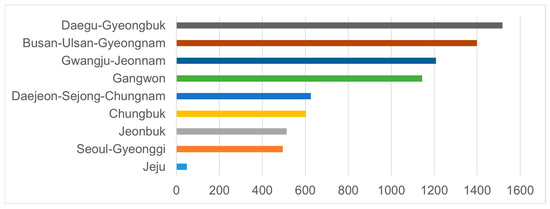
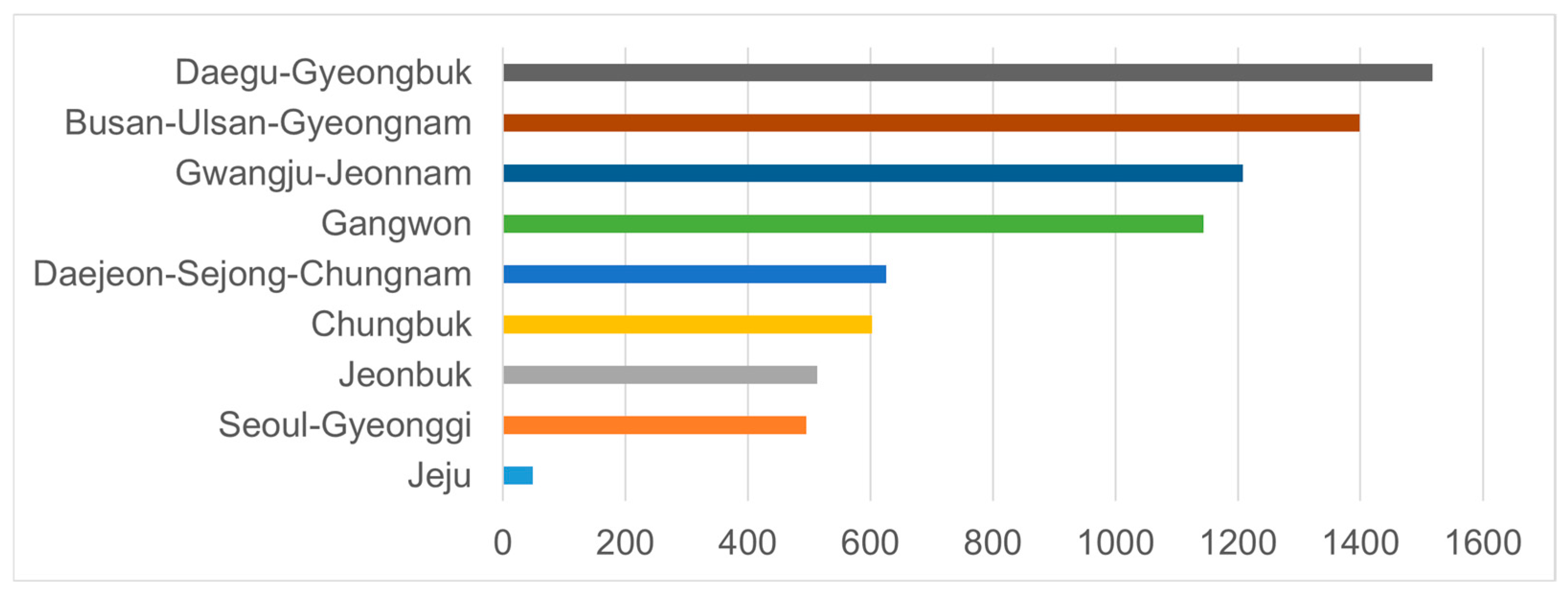
The spatial distribution of the 7555 forest work units in the sampling frame highlights significant regional variance, reflecting the diverse topographical and ecological characteristics of the Korean Peninsula. Geographically, the Daegu–Gyeongbuk region exhibited the highest concentration of forest operations, accounting for 1518 sites (20.1% of the population). This was closely followed by the Busan–Ulsan–Gyeongnam region with 1399 sites (18.5%), Gwangju–Jeonnam with 1208 sites (16.0%), and Gangwon with 1144 sites (15.1%). This geographic concentration in the southeastern and eastern mountainous regions is consistent with the distribution of major national forest resource development projects. Conversely, regions with lower forest density, such as Jeju (49 sites) and the Seoul–Gyeonggi Metropolitan area (495 sites), represented the smallest proportions of the sampling frame (Figure 1).
Figure 1.
Regional distribution of forest work units in the Republic of Korea (N = 7555).
3.1.3. Sample Allocation and Representativeness
The detailed allocation of this sample across the four project categories is presented in Table 3, reflecting the structural characteristics of the population.
Table 3.
Distribution of the population and sample allocation by forestry project type.
3.2. Analysis of Occupational Wage Levels
3.2.1. Wage Levels by Technical Specialization
The analysis revealed a distinct wage hierarchy based on technical complexity, occupational risk, and managerial responsibility within the forestry labor market.
- Leadership and Management Roles: These categories exhibited the highest wage levels within the sector, reflecting a significant responsibility premium driven by the oversight of complex field logistics and compliance with stringent safety regulations [13,44]. Forest Work Leaders and Timber Harvesting Work Leaders earned a weighted mean daily wage of 302,760 KRW and 296,670 KRW, respectively. The compensation for these roles reflects the high cognitive load and legal accountability associated with supervising work crews in remote and hazardous terrain [13].
- High-Tech and Mechanized Roles: Reflecting the global industry’s shift toward advanced forestry systems [29], High-performance forestry machine operators (e.g., harvester and forwarder operators) recorded the highest mean daily wage at 322,710 KRW. This finding underscores a clear skill premium for operators who possess the technical proficiency to manage sophisticated machinery while mitigating physical trauma through mechanization [27,33]. However, the high wage also reflects the mental fatigue and intense concentration required for automated processing tasks [31]. Unmanned aerial vehicle (UAV) operators also earned a competitive rate, although this category exhibited higher variance due to its relatively recent integration into silvicultural monitoring and pest control.
- Silvicultural and Manual Labor: Roles involving primarily manual tools and physical labor, such as Tree planters (189,640 KRW) and Manual forest workers (178,750 KRW), represented the baseline of the forestry wage structure. While these tasks are fundamental to forest establishment, their compensation remains significantly lower than mechanized or leadership roles, highlighting a widening wage gap between traditional manual labor and specialized technical roles in the circular bioeconomy framework [34].
3.2.2. Statistical Reliability (RSE Analysis)
The majority of the 13 specialized forestry categories, particularly the dominant roles in silviculture and reforestation, exhibited RSE values well below 10%, indicating high statistical precision [38].
3.2.3. Comprehensive Wage Status of 13 Specialized Forestry Occupations
The comprehensive results of the 2025 wage status survey for all 13 specialized forestry occupations are presented in Table 4.
Table 4.
Comprehensive 2025 wage status and reliability analysis for 13 specialized forestry occupations.
The comprehensive data in Table 4 demonstrates significant wage variation across the functional boundaries of the forestry sector. Role-specific daily wages ranged from 178,750 KRW for manual forest workers to 322,710 KRW for high-performance forestry machine operators. The RSE for all categories remained below the 30% threshold established by national statistical guidelines [38], confirming that the estimates are robust enough for formal policy-making and project cost estimation.
Specifically, the robustness of the estimates for Local Forestry Cooperatives and other implementing entities confirms that the skill premium for mechanized roles and the “risk premium” for leadership roles are consistently recognized in the current market [13,33]. This comprehensive dataset serves as the empirical foundation for comparing the industry with construction benchmarks and underscores the necessity of a dedicated forestry wage statistical system to address the structural limitations of the existing construction-based labor cost estimation model [20].
3.3. Comparison Between Forestry Market Wages and Construction Industry Benchmarks
3.3.1. Quantitative Evidence of Wage Divergence
The results of the comparative analysis provide compelling empirical evidence that forestry market wages consistently exceed construction benchmarks, validating the “Diverging Hypothesis” previously proposed in Korean labor policy literature [20]. As detailed in Table 5, the disparity is not uniform but varies significantly across job categories, ranging from a marginal difference of 4.5% to a substantial peak of 41.0%.
Table 5.
Detailed wage gap analysis between forestry and construction benchmarks.
The minimum divergence (4.5%) was observed in entry-level manual roles, such as “Manual Forest Workers,” whose tasks most closely align with general construction labor. However, even in these categories, the higher market rate reflects the added physical strain of navigating steep, irregular terrains compared to level urban construction sites [7,17]. The maximum divergence (41.0%) was identified in high-tech mechanized roles, specifically “High-performance forestry machine operators”.
3.3.2. Analysis of the Management Complexity and Risk Premium
The comparative analysis highlights a significant wage disparity in management roles. The most pronounced divergence was identified in the field management roles, where a 41.0% gap exists for Forest Work Leaders, followed by a 38.2% gap for Timber Harvesting Leaders (Table 5). These figures demonstrate that the market valuation for forestry leadership consistently outpaces the current construction-based benchmarks.
3.3.3. Analysis of Technical Specialization and Skill Premium in Mechanized Operations
The significant divergence identified for Timber Extraction Workers (30.3%) and High-performance forestry machine operators (15.3%) further exemplifies the substantial skill premium required in modern forest operations [29,33].
Timber extraction in forestry involves the operation of complex, multi-span cable-based systems and the precise movement of heavy timber on unstable, steep slopes—tasks that carry a significantly higher occupational risk profile than those of special laborers in the construction sector [13,17]. The market recognizes this complexity through higher compensation, whereas construction-based benchmarks overlook for the specialized rigging and tensioning skills unique to mountainous timber harvesting.
Similarly, high-performance machinery, such as harvesters and forwarders, requires a level of technical dexterity and simultaneous multi-functional coordination that often exceeds the requirements for conventional construction equipment [31]. The mental workload and cognitive demands of managing automated harvesting cycles in unstructured forest environments necessitate a premium that is currently missing from urban-centric wage tables [13,31]. The systematic nature of these wage gaps across all mechanized roles confirms that forestry labor is not a direct substitute for construction labor, but rather a specialized trade requiring a distinct, industry-specific valuation framework [20].
3.3.4. Institutional Burden on Local Forestry Cooperatives
The systematic undervaluation highlighted in this analysis imposes a direct institutional and financial burden on implementing entities, particularly Local Forestry Cooperatives and private forest business corporations. Since national project budgets are primarily calculated based on lower construction benchmarks, these entities are forced to cover the “wage deficit”—the gap between the official government cost estimation and the actual market rates to recruit and retain skilled labor in an increasingly competitive rural market [11,20].
This financial strain is further exacerbated by escalating regulatory pressures, most notably the Serious Accidents Punishment Act (SAPA) of the Republic of Korea. Compliance with SAPA has significantly increased the overhead costs associated with safety management, risk mitigation, and legal insurance, effectively compressing the profit margins of forest contractors [12,44].
The current misalignment between policy benchmarks and market realities not only threatens the financial stability of these organizations but also undermines the long-term sustainability and quality of the forest workforce. Consequently, these findings underscore the urgent necessity for a transition toward an independent, forestry-specific wage statistical system. Such a system is a fundamental prerequisite for ensuring the economic resilience of the sector and supporting the broader objectives of a sustainable circular bioeconomy [20,34].
4. Discussion
4.1. The Systematic Undervaluation and Structural Shifts in Forestry Labor
The High statistical precision observed in this study confirms the robustness of the stratified sampling design and the effectiveness of the square-root proportional allocation method in minimizing variance across diverse strata [36,37]. These quantitative findings provide a solid empirical foundation for the study’s central finding: a significant divergence (4.5% to 41.0%) between actual market wages and the construction industry proxies currently used in national cost estimation [20]. This systematic undervaluation is not unique to the Republic of Korea; global research indicates that rural labor markets often face persistent wage suppression when urban-centric industrial benchmarks are applied to forestry contexts [9,13]. Even at the baseline skill level, the 4.5% gap identified for manual workers confirms that forestry labor requires an “environmental hardship premium” to compensate for the physical demands of steep terrain and adverse climatic exposure [7,17].
Critically, this economic undervaluation exists alongside a significant structural shift in the industry’s operational composition. The scarcity of “Timber Harvesting” sites captured in the sampling frame—comprising a mere 0.1% of the population—is not a statistical anomaly but is indicative of a strategic withdrawal from high-risk operations following the implementation of the Serious Accidents Punishment Act (SAPA). Faced with heightened legal liability and inadequate official wage benchmarks that fail to offset the costs of enhanced safety management, forest business entities—including Local Forestry Cooperatives—have proactively decreased “direct logging” to mitigate liability. Instead, there is a prevailing trend toward selling standing timber (stumpage sales) to specialized contractors.
This transition parallels international trends where stringent occupational safety and health (OSH) regulations and rising compliance costs drive forest owners toward risk-transfer strategies, such as outsourcing [2,44]. Scholars have noted that increased legal accountability often triggers a restructuring of the forestry supply chain, favoring specialized contractors who can better absorb operational risks through technical expertise and economies of scale [11,12,44]. Furthermore, the financial burden of adhering to comprehensive safety codes, such as those established by the ILO [25], incentivizes managers to disengage from direct labor involvement to mitigate direct legal exposure in cases of fatal accidents.
Consequently, the Korean forestry sector faces a “dual crisis”: a “decent work deficit” caused by persistent wage suppression, and a “structural erosion” of direct management precipitated by escalating legal pressures. These factors fundamentally undermine the socio-economic resilience of the circular bioeconomy, as the industry struggles to attract and retain the human capital necessary for sustainable resource management [20,34].
4.2. Management Complexity and the Risk–Responsibility Premium
The analysis revealed a distinct wage hierarchy based on technical complexity, occupational risk, and management responsibility within the forestry labor market. The most pronounced divergence identified in this study was the 41.0% wage gap for “Forest Work Leaders”. This disparity underscores a substantial “responsibility and risk premium” that is unique to the forestry sector and currently unaccounted for by construction-based field management rates [13,44]. This stratified structure reflects the evolving requirements of modern forest operations, where compensation is increasingly aligned with specialized human capital and the ability to manage complex operational risks.
The fundamental cause of this divergence lies in the stark contrast between the operational environments of the two industries. In the construction sector, field managers typically operate in centralized, well-structured urban environments with immediate access to safety infrastructure and standardized logistical support. Conversely, forest work leaders must navigate and manage decentralized work units across rugged, isolated, and steep terrains, where they shoulder the primary responsibility of real-time risk mitigation and complex logistical problem-solving [7,17,25]. Recent studies in European forest operations confirm that the cognitive load and legal accountability of field supervisors have increased significantly following the adoption of stricter safety protocols [13]. This aligns with the Korean context, where the role of the leader is pivotal in maintaining safety performance in high-risk environments, particularly under the stringent liability framework of the Serious Accidents Punishment Act (SAPA) [44].
The market has dynamically adapted to this operational complexity by offering higher wages to retain professional expertise and account for the high cognitive load associated with remote site management [13]. However, the official government benchmarks, which remain tethered to urban-centric construction rates, have failed to reflect this Sectoral divergence. These findings suggest that the current proxy-based estimation model systematically suppresses the legal accountability and specialized human capital required for sustainable forest management [20].
Critically, this identified gap acts as a significant systemic behavioral disincentive. Understanding the behavioral and innovation drivers of the workforce is essential for ensuring that forest policies are effectively supported and implemented [35]. If the market-recognized “risk–responsibility premium” is not reflected in official policy, it erodes the incentive for experienced workers to take on leadership roles, potentially leading to a breakdown of safety management and innovation at the field level [35].
Finally, while certain categories like UAV operators showed relatively higher RSE values due to inherently smaller sample sizes, they remained within the acceptable 30% reliability threshold. Although these specific estimates require caution for direct policy implementation, they remain statistically representative within their defined operational strata and serve as essential empirical indicators of the sector’s technological transition toward “Smart Forestry”.
Furthermore, institutional and safety factors provide critical context for these wage disparities. Unlike the South Korean construction sector, which is characterized by centralized collective bargaining and highly organized trade unions that standardize labor costs, the forestry labor market is predominantly decentralized. Forest work units typically operate in small, isolated groups where union-driven wage floors are virtually non-existent. Thus, the observed wage premiums reflect an autonomous market-driven adjustment to secure specialized labor rather than institutional restrictions. Regarding occupational safety, mortality rates in forestry are not only distinct from construction but consistently higher, driven by the extreme hazards of steep terrain, falling objects, and high-intensity musculoskeletal strain during felling. This elevated mortality risk, combined with the lack of immediate safety infrastructure in remote areas, justifies the substantial “risk–responsibility premium”—particularly the 41.0% gap identified for leadership roles under the SAPA framework.
4.3. Regulatory Pressure and the Structural Shift Under SAPA
The scarcity of direct timber harvesting sites (0.1% of the population) reflects a profound structural shift in the industry. The implementation of the Serious Accidents Punishment Act (SAPA) of the Republic of Korea has escalated legal liability exposure for business owners, driving many entities, including Local Forestry Cooperatives, to shift toward stumpage sales rather than direct logging [20,44].
This risk-transfer strategy aligns with global trends where stringent occupational safety and health (OSH) regulations incentivize forest owners to outsource high-risk tasks to specialized contractors [2,11]. While this shift may mitigate direct liability for Local Forestry Cooperatives, it represents a fragile structural transition that could lead to a fragmented labor market. From the perspective of the circular bioeconomy, such fragmentation undermines the stability of the human capital required for long-term sectoral resilience [34]. Therefore, a more robust wage system is a prerequisite to ensure that the remaining labor force, which now often operates as specialized contractors, is fairly compensated for increased operational risks, thereby preventing the hollowing-out of the forestry workforce [20,34].
4.4. The “Skill Premium” in the Era of Mechanization
The 15.3% wage gap identified for high-performance machine operators confirms a distinct “skill premium” in modern forest engineering. Unlike conventional construction machinery operation, which typically operates in stable environments, forest harvester operation requires specialized technical dexterity to manage complex, multi-functional tasks in rugged terrain [29,31]. This disparity highlights that current construction-based wage tables, optimized for urban-centric tasks, fail to account for the real-time spatial analysis and precision required in forestry [29,31,33].
As the sector transitions toward “Smart Forestry,” the demand for such highly skilled labor is driving market wages above traditional engineering rates, placing a fiscal strain on Local Forestry Cooperatives [20]. When official project budgets—derived from undervalued construction proxies—fail to meet these market demands, it creates a systemic economic barrier to innovation. Specifically, fair compensation acts as a primary driver for technical advancement [35]; thus, the current misalignment not only hinders the adoption of advanced technologies but also discourages the recruitment of elite operators essential for long-term efficiency [34,35]. Therefore, recalibrating wage benchmarks to reflect technical complexity is a fundamental prerequisite for successful “Smart Forestry” integration.
4.5. Toward Labor Sustainability and Independent Statistics
The persistent undervaluation of forest labor poses a direct threat to the socio-economic resilience of the sector. Without a realistic wage system, the forestry sector in the Republic of Korea will continue to hemorrhage professional human capital to more lucrative industrial sectors, exacerbating the rural demographic crisis. Research suggests that establishing transparent and independent wage statistical systems is essential for improving the professional prestige of the forestry sector and attracting younger generations [6,35]. This shift is vital because economic rewards and fair valuation act as key behavioral drivers that influence the career choices and retention of the future workforce [35].
Ultimately, institutionalizing a forestry-specific wage system is not merely an administrative requirement but a strategic imperative to ensure that the forestry sector functions as a resilient pillar of the sustainable global economy [20,34]. This aligns with the critical literature review by Karuppiah et al. [34], which identifies human capital as a core determinant of sustainable industrial performance within the circular bioeconomy framework. If the Korean forestry sector fails to rectify the wage disparities identified in this study, the resulting loss of specialized labor will undermine the long-term socio-economic resilience and innovative capacity required for a sustainable bio-based future [34,35].
4.6. Limitations and Future Research Directions
Despite the significance of the findings, this study has methodological constraints that should be addressed in future research. First, the analysis is based on cross-sectional data from the 2025 fiscal year, which provides a comprehensive snapshot of the current market but may not fully capture long-term structural changes or cyclical economic fluctuations in the forestry sector. Second, although the survey employed a standardized protocol to minimize measurement error, the reliance on structured telephone interviews with business representatives introduces the possibility of response bias during the reporting of wage data and operational risks. Future research should utilize longitudinal datasets to track wage evolution over multiple years and incorporate objective field-based metrics to validate the self-reported data from business entities.
5. Conclusions
This study provides empirical validation for the “Diverging Hypothesis”: actual market wages for the Republic of Korea’s forestry sector are 4.5% to 41.0% higher than the construction industry proxies currently mandated in national policy. Our analysis of 1044 samples across 13 specialized occupations reveals that administrative benchmarks systematically undervalue forest labor, particularly for high-risk leadership (41.0% gap) and mechanized extraction roles (30.3% gap).
The findings indicate that current policy imposes a direct financial burden on implementing entities, such as Local Forestry Cooperatives, while the structural shift toward risk-transfer strategies under the Serious Accidents Punishment Act (SAPA) further destabilizes the labor market. To ensure the long-term sustainability of the forest bioeconomy and the retention of specialized human capital amidst a rural demographic crisis, it is a strategic imperative to institutionalize an independent, forestry-specific wage statistical system. Future research should utilize longitudinal data to refine these benchmarks and evaluate the long-term impact of equitable compensation on operational safety and productivity.
Funding
This research was supported by the Korea Forest Service (KFS) through two main programs: (1) the R&D Program for Forest Science Technology (Project No. 2022463A00-2224-0201) managed by the Korea Forestry Promotion Institute (KoFpi), as part of the project “Establishing an appropriate wage labor system to expand forest management and development of safety management system”, and (2) the 2025 project funded by the Korea Forest Service titled “Study on the Development and Implementation of Specialized Occupations in the Forestry Sector”. The APC was funded by internal research funds from the Korea Forest Engineer Institute.
Data Availability Statement
The data presented in this study is available on request from the corresponding author.
Acknowledgments
The authors would like to express their sincere gratitude to the panel of experts for their invaluable time and professional expertise during the multi-stage task analysis and the development of specialized forestry job categories. Their insights were essential in ensuring the functional validity and practical applicability of the occupational classifications established in this study.
Conflicts of Interest
The author declares no conflicts of interest.
Abbreviations
The following abbreviations are used in this manuscript:
| SAPA | Serious Accidents Punishment Act |
| RSE | Relative Standard Error |
| OSH | Occupational Safety and Health |
| ILO | International Labour Organization |
| KRIVET | Korea Research Institute for Vocational Education and Training |
| UAV | Unmanned Aerial Vehicle |
| PII | Personal Identifiable Information |
Appendix A. Survey Instrument for the Forestry Occupational Wage Status Survey
Below is the translated structure of the survey questionnaire used to collect the actual wage data from forest work units in 2024.
Table A1.
General information of the enterprise.
Table A2.
Project performance and operational status.
Table A3.
Daily wage status by occupational category.
References
- Lippe, R.S.; Cui, S.; Schweinle, J. Estimating Global Forest-Based Employment. Forests 2021, 12, 1219. [Google Scholar] [CrossRef] [Scilit]
- Marchi, E.; Chung, W.; Visser, R.; Abbas, D.; Nordfjell, T.; Mederski, P.S.; McEwan, A.; Brink, M.; Laschi, A. Sustainable Forest Operations (SFO): A New Paradigm in a Changing World and Climate. Sci. Total Environ. 2018, 634, 1385–1397. [Google Scholar] [CrossRef] [Scilit]
- FAO. The State of the World’s Forests 2024: Forest-Sector Innovations Towards a More Sustainable Future; FAO: Rome, Italy, 2024. [Google Scholar] [CrossRef] [Scilit]
- FAO; ILO. Contribution of the Forest Sector to Total Employment in National Economies: Estimating the Number of People Employed in the Forest Sector; FAO: Rome, Italy; ILO: Geneva, Switzerland, 2022. [Google Scholar] [CrossRef] [Scilit]
- Angelsen, A.; Jagger, P.; Babigumira, R.; Belcher, B.; Hogarth, N.J.; Bauch, S.; Börner, J.; Smith-Hall, C.; Wunder, S. Environmental Income and Rural Livelihoods: A Global-Comparative Analysis. World Dev. 2014, 64, S12–S28. [Google Scholar] [CrossRef] [Scilit]
- ILO. Decent Work in the Rural Economy; International Labour Office: Geneva, Switzerland, 2017; Available online: https://www.ilo.org/media/49326/download (accessed on 12 April 2026).
- Schettino, S.; Minette, L.J.; Lima, R.C.A.; Nascimento, G.S.P.; Caçador, S.S.; Vieira, M.P.L. Forest Harvesting in Rural Properties: Risks and Worsening to the Worker’s Health under the Ergonomics Approach. Int. J. Ind. Ergon. 2021, 82, 103087. [Google Scholar] [CrossRef] [Scilit]
- Cho, M.-J.; Choi, Y.-S.; Lee, E. Identifying Risk Factors and Evaluating Occupational Safety in South Korean Forestry Sector. Forests 2023, 14, 851. [Google Scholar] [CrossRef] [Scilit]
- Cui, S.; Lippe, R.S.; Schweinle, J. Informal Employment in the Forest Sector: A Scoping Review. Forests 2022, 13, 460. [Google Scholar] [CrossRef] [Scilit]
- Mylek, M.R.; Schirmer, J.; Morozov, A. Beyond Physical Health and Safety: Supporting the Wellbeing of Workers Employed in the Forest Industry. Forestry 2015, 88, 391–406. [Google Scholar] [CrossRef] [Scilit]
- Kim, K.D.; Jung, B.H.; Kim, C.S.; Lee, J.H. A Study on the Job Satisfaction and Turnover of the Forest Workers. J. Korean For. Soc. 2009, 98, 690–695. [Google Scholar]
- Penttinen, M.; Rummukainen, A.; Mikkola, J. Profitability, Liquidity and Solvency of Wood Harvesting Contractors in Finland. Small-Scale For. 2011, 10, 211–229. [Google Scholar] [CrossRef] [Scilit]
- Naskrent, B.; Grzywiński, W.; Polowy, K.; Tomczak, A.; Jelonek, T. Eye-Tracking in Assessment of the Mental Workload of Harvester Operators. Int. J. Environ. Res. Public Health 2022, 19, 5241. [Google Scholar] [CrossRef] [Scilit]
- Ullah, A.; Bavorova, M.; Verner, V. Determinants of Job Satisfaction and Motivation among Community Forest Workers: Insights from the Hindu Kush Himalaya, Pakistan. Local Environ. 2025, 30, 1178–1192. [Google Scholar] [CrossRef] [Scilit]
- Hitka, M.; Lorincova, S.; Gejdos, M.; Lipoldova, M. Employee Motivation during the Time of the Crisis in Agricultural and Forestry Organizations: Case Study. Agric. Econ. Czech 2022, 68, 271–281. [Google Scholar] [CrossRef] [Scilit]
- Lee, C.; Kim, K. Analysis of Job Satisfaction and Turnover Intention According to the Characteristics of Forest Industry Workers. Forests 2024, 15, 1899. [Google Scholar] [CrossRef] [Scilit]
- Gerasimov, Y.; Sokolov, A. Ergonomic Evaluation and Comparison of Wood Harvesting Systems in Northwest Russia. Appl. Ergon. 2014, 45, 318–338. [Google Scholar] [CrossRef] [Scilit] [PubMed]
- Šporčić, M.; Landekić, M.; Šušnjar, M.; Pandur, Z.; Bačić, M.; Mijoč, D. Deliberations of Forestry Workers on Current Challenges and Future Perspectives on Their Profession—A Case Study from Bosnia and Herzegovina. Forests 2023, 14, 817. [Google Scholar] [CrossRef] [Scilit]
- Blombäck, P.; Poschen, P.; Lövgren, M. Employment Trends and Prospects in the European Forest Sector. In Geneva Timber and Forest Discussion Paper 29; United Nations: Geneva, Switzerland, 2003; Available online: https://www.unece.org/fileadmin/DAM/timber/docs/efsos/03-sept/dp-29.pdf (accessed on 12 April 2026).
- Park, H.-I.; Kim, C.; Choi, S. Estimation of Appropriate Wage by Development of Wage Survey Framework for Forest Workers. J. Korean Soc. For. Sci. 2023, 112, 217–229. [Google Scholar] [CrossRef]
- Xie, F.; Zhu, S.; Cao, M.; Kang, X.; Du, J. Does Rural Labor Outward Migration Reduce Household Forest Investment? The Experience of Jiangxi, China. For. Policy Econ. 2019, 101, 62–69. [Google Scholar] [CrossRef] [Scilit]
- Hong, Y.-Z.; Chang, H.-H.; Dai, Y.-W. Is Deregulation of Forest Land Use Rights Transactions Associated with Economic Well-Being and Labor Allocation of Farm Households? Empirical Evidence in China. Land Use Policy 2018, 75, 694–701. [Google Scholar] [CrossRef] [Scilit]
- Lee, C.; Kim, K. Analysis of Factors Affecting Job Stress on Turnover Intention Among Forest Industry Workers. J. Korean Inst. For. Recreat. 2023, 27, 37–51. [Google Scholar] [CrossRef]
- Jankovský, M.; Allman, M.; Allmanová, Z. What Are the Occupational Risks in Forestry? Results of a Long-Term Study in Slovakia. Int. J. Environ. Res. Public Health 2019, 16, 4931. [Google Scholar] [CrossRef] [Scilit]
- ILO. Safety and Health in Forestry Work: ILO Code of Practice, Revised Edition; International Labour Office: Geneva, Switzerland, 2025; Available online: https://www.ilo.org/sites/default/files/2025-03/2025%20Code%20of%20practice%20forestry%20-%20EN_1.pdf (accessed on 12 April 2026).
- Błuszkowska, U.; Nurek, T. Effect of Mechanization Level on Manpower Needs in Forestry. Folia For. Pol. Ser. A 2014, 56, 194–201. [Google Scholar] [CrossRef] [Scilit]
- Kim, S.; Nussbaum, M.A.; Schoenfisch, A.L.; Barrett, S.M.; Bolding, M.C.; Dickerson, D.E. Occupational Safety and Health Concerns in Logging: A Cross-Sectional Assessment in Virginia. Forests 2017, 8, 440. [Google Scholar] [CrossRef] [Scilit]
- Jiang, L.; Wang, S.; Li, Y. Forestry 5.0 and the Human Factor: A Critical Review of Digital Technologies in Occupational Safety and Health Management. Front. For. Glob. Change 2026, 9, 1758933. [Google Scholar] [CrossRef] [Scilit]
- Spinelli, R.; Lombardini, C.; Magagnotti, N. The Effect of Mechanization Level and Harvesting System on the Thinning Cost of Mediterranean Softwood Plantations. Silva Fenn. 2014, 48, 1003. [Google Scholar] [CrossRef] [Scilit]
- Garland, J.; Belart, F.; Crawford, R.; Chung, W.; Cushing, T.; Fitzgerald, S.; Green, P.; Kincl, L.; Leshchinsky, B.; Morrissette, B.; et al. Safety in Steep Slope Logging Operations. J. Agromed. 2019, 24, 138–145. [Google Scholar] [CrossRef] [Scilit]
- Szewczyk, G.; Spinelli, R.; Magagnotti, N.; Tylek, P.; Sowa, J.M.; Rudy, P.; Gaj-Gielarowiec, D. The Mental Workload of Harvester Operators Working in Steep Terrain Conditions. Silva Fenn. 2020, 54, 10355. [Google Scholar] [CrossRef] [Scilit]
- Harrington, M.J. Forestry—Integrating Safety in a Time of Rapid Change. J. Agromed. 2021, 26, 88–91. [Google Scholar] [CrossRef] [Scilit]
- Purfürst, F.T.; Erler, J. The Human Influence on Productivity in Harvester Operations. Int. J. For. Eng. 2011, 22, 15–22. [Google Scholar] [CrossRef] [Scilit]
- Karuppiah, K.; Sankaranarayanan, B.; Ali, S.M.; Santibanez Gonzalez, E.D.R. Impact of Circular Bioeconomy on Industry’s Sustainable Performance: A Critical Literature Review and Future Research Directions Analysis. Sustainability 2023, 15, 10759. [Google Scholar] [CrossRef] [Scilit]
- Dessart, F.J.; Barreiro-Hurlé, J.; van Bavel, R. Behavioural Factors Affecting the Adoption of Sustainable Farming Practices: A Policy-Oriented Review. Eur. Rev. Agric. Econ. 2019, 46, 417–471. [Google Scholar] [CrossRef] [Scilit]
- Cochran, W.G. Sampling Techniques, 3rd ed.; John Wiley & Sons: New York, NY, USA, 1977. [Google Scholar]
- Lohr, S.L. Sampling: Design and Analysis, 2nd ed.; Cengage Learning: Boston, MA, USA, 2010. [Google Scholar]
- Statistics Korea. Korean Standard Classification of Occupations (KSCO), 7th ed.; Statistics Korea: Daejeon, Republic of Korea, 2017. [Google Scholar]
- Groves, R.M.; Fowler, F.J.; Couper, M.P.; Lepkowski, J.M.; Singer, E.; Tourangeau, R. Survey Methodology, 2nd ed.; Wiley: Hoboken, NJ, USA, 2009. [Google Scholar]
- Little, R.J.A.; Rubin, D.B. Statistical Analysis with Missing Data, 2nd ed.; Wiley: Hoboken, NJ, USA, 2002. [Google Scholar]
- Lumley, T. Complex Surveys: A Guide to Analysis Using R; Wiley: Hoboken, NJ, USA, 2010. [Google Scholar] [CrossRef] [Scilit]
- Heeringa, S.G.; West, B.T.; Berglund, P.A. Applied Survey Data Analysis; Chapman & Hall/CRC: Boca Raton, FL, USA, 2010. [Google Scholar] [CrossRef] [Scilit]
- Särndal, C.-E.; Swensson, B.; Wretman, J. Model Assisted Survey Sampling; Springer: New York, NY, USA, 1992. [Google Scholar]
- Choi, J.; Lim, S.; Park, S.; Roh, H.; Jin, H.; Lee, C. The Serious Accidents Punishment Act of South Korea and Its Impact on the Shipping Industry: Toward Sustainability. Sustainability 2022, 14, 8936. [Google Scholar] [CrossRef] [Scilit]
- Bank of Korea. Economic Statistics System (ECOS): Average Exchange Rate of Won to US Dollar (Annual). Available online: https://ecos.bok.or.kr/ (accessed on 12 April 2026).

Disclaimer/Publisher’s Note: The statements, opinions and data contained in all publications are solely those of the individual author(s) and contributor(s) and not of MDPI and/or the editor(s). MDPI and/or the editor(s) disclaim responsibility for any injury to people or property resulting from any ideas, methods, instructions or products referred to in the content. |
© 2026 by the author. Licensee MDPI, Basel, Switzerland. This article is an open access article distributed under the terms and conditions of the Creative Commons Attribution (CC BY) license.