Article

Spatiotemporal Dynamics and Driving Mechanisms of Ecosystem Service Values in China’s Southern Collective Forest Region

School of Economics, Sichuan University of Science & Engineering, Zigong 643000, China
*
Author to whom correspondence should be addressed.
Forests 2026, 17(4), 501; https://doi.org/10.3390/f17040501
Submission received: 14 February 2026 / Revised: 14 April 2026 / Accepted: 14 April 2026 / Published: 18 April 2026
(This article belongs to the Section Forest Ecology and Management)

Abstract

As a crucial national ecological barrier, China’s Southern Collective Forest Region (SCFR) plays an essential role in maintaining regional ecological security and promoting sustainable development. Understanding the mechanisms driving the evolution of its ecosystem service value (ESV) is of great significance. Based on county-level data from 2000 to 2023, this study integrated the equivalent factor method, spatial autocorrelation analysis, the XGBoost-SHAP model, geographically and temporally weighted regression (GTWR), and partial least squares structural equation modeling (PLS-SEM) to examine the spatio-temporal evolution patterns and driving mechanisms of ESV in the SCFR. The results showed that ESV in the SCFR exhibited an overall downward trend, with a cumulative loss of 1973.77 × 108 CNY. This was primarily due to marked reductions in hydrological and climate regulation services. The spatial distribution of ESV exhibited a significant heterogeneity—higher in the southwestern and southeastern mountainous regions, and lower in the northern plains and coastal zones, with the center of gravity shifting first to the northeast and then to the southwest. Local spatial autocorrelation revealed relatively stable “High–High” and “Low–Low” clustering characteristics, where high-value clusters were consistently distributed in core forest zones, while low-value clusters overlapped highly with urban agglomerations. Socio-economic factors exerted a significantly stronger influence on ESV than natural factors. Population density (POP), land use intensity (LUI), and gross domestic product (GDP) were identified as the dominant drivers, exhibiting distinct non-linear threshold effects and significant spatio-temporal heterogeneity. PLS-SEM analysis further quantified LUI as the dominant direct inhibitory pathway on ESV, highlighting urbanization’s indirect negative effect mediated through intensified LUI. Meanwhile, terrain effects were confirmed to positively influence ESV indirectly by constraining LUI and modulating local climate. The analytical framework of “threshold identification–spatio-temporal heterogeneity–causal pathway analysis” proposed in this study elucidated the complex driving mechanisms of ESV evolution, providing valuable guidance for ecological restoration evaluation and differentiated environmental governance.

1. Introduction

Forest ecosystems not only provide provisioning services such as timber and non-timber forest products, but also play indispensable regulatory and supporting roles in carbon sequestration, water conservation, soil retention, and biodiversity maintenance. These ecosystem services are fundamental to maintaining regional ecological security and enhancing human well-being [1,2]. As essential components of natural capital, these are crucial for addressing climate change and achieving sustainable development goals. The assessment of ESV translates these multidimensional ecological functions into quantifiable economic indicators, thereby informing ecological compensation schemes, land-use planning, natural capital accounting, and forest management decisions [3,4,5]. However, forest ESV is not static; rather, it undergoes continuous transformation under the combined influence of natural and anthropogenic factors, such as urbanization, land-use change, evolving forest management practices, and climate variability [6,7]. Therefore, effective forest ecosystem management requires a deep analysis of the spatiotemporal dynamics of ESV and the identification of the underlying mechanisms driven by natural and socio-economic factors.
Scholars domestically and internationally have conducted extensive research on the valuation, spatio-temporal evolution, and driving mechanisms of ESV in forest regions (or forest-dominated areas). In terms of valuation, commonly employed methods include market pricing, substitute market, shadow engineering, and contingent valuation [8]. The “equivalent factor method” modified based on China’s specific conditions has been widely used for large-scale ESV assessment in forest regions due to its strong comparability across different regions or ecosystems and its suitability for long time-series data analysis [9,10,11]. Regarding spatio-temporal patterns, numerous studies have demonstrated that the spatial distribution of forest ESV exhibits pronounced heterogeneity and spatial clustering characteristics [12,13]. In terms of driving mechanisms, substantial research has confirmed that land use change, urbanization, topography, and climatic factors are the primary drivers of ESV changes in forest regions [13,14,15,16]. Meanwhile, scholars have proposed policy recommendations focusing on ecological red line control, land use structure optimization, forest management, and ecological compensation.
Despite the growing body of research on forest ESV, three notable gaps remain. First, most studies rely on linear models such as ordinary least squares (OLS) or panel regression, which overlook the “tipping point” behavior commonly observed in ecosystems. Consequently, they fail to identify the complex non-linear relationships and threshold effects among human activities, natural factors, and ESV [17,18]. Second, although methods such as Geodetector and geographically weighted regression (GWR) have been employed to address spatial heterogeneity, they fall short in capturing temporal variability. In regions undergoing rapid urbanization and institutional change, the magnitude and direction of driving forces can vary substantially across different stages. Existing approaches are limited in their ability to simultaneously track the evolving influence of these drivers over time. Third, most studies focus on identifying the direct effects of individual factors, while neglecting the indirect pathways through which they influence ESV. This omission restricts a comprehensive understanding of the mechanisms behind ESV’s spatiotemporal differentiation and limits the development of precise regulation and differentiated management strategies.
In recent years, with the rapid advancement of machine learning (ML) techniques, models such as XGBoost have been widely adopted due to their strong capacity for capturing complex nonlinear relationships [19]. When combined with the SHAP interpretation method, this approach effectively addresses the “black box” issue of models, enabling the quantification of each driver’s contribution to ESV variation, as well as their non-linear characteristics and threshold effects [20]. The GTWR model incorporates both spatial and temporal weighting and is capable of capturing the spatiotemporal heterogeneity of driving forces [21]. In addition, PLS-SEM can effectively quantify both direct and indirect effects among multiple factors, overcoming limitations of traditional regression models like OLS and panel regression that mainly capture direct linear effects and struggle to identify complex causal paths [22]. Accordingly, this study first employs the XGBoost-SHAP model to identify the importance and non-linear response characteristics of various driving factors regarding ESV. Subsequently, GTWR is incorporated to reveal their spatio-temporal heterogeneity. Finally, the PLS-SEM model is utilized to elucidate the causal pathways of natural geographical and socio-economic factors on ESV. This multi-model integrated framework aims to provide a comprehensive, multi-dimensional analysis of the underlying mechanisms driving changes in ESV.
As one of China’s three major forest regions, the Southern Collective Forest Region (SCFR) serves as a critical ecological security barrier, playing key roles in water conservation, soil retention, and biodiversity protection [23]. Characterized by high forest coverage, diverse ecological service types, and high intensity of population aggregation and economic activity, the SCFR represents a typical coupled system of “high ecological supply—high development pressure”. In recent years, rapid urbanization and the expansion of socio-economic activities have led to the conversion of grassland, cropland, and forested areas into urban construction land. This land-use transformation has degraded ecological functions and posed serious ecological risks to regional sustainable development. However, research on ecosystem service values in China’s Southern Collective Forest Region remains limited. Therefore, this study adopts the county as the basic spatial unit to investigate the spatiotemporal evolution patterns and complex driving mechanisms of ESV in the SCFR from 2000 to 2023. The specific objectives of this study are to (1) calculate the ESV of the SCFR using the equivalent factor method and characterize its spatiotemporal evolution using standard deviational ellipse (SDE) and spatial autocorrelation analysis; (2) quantify the relative contributions of driving factors to ESV and identify nonlinear response thresholds using the XGBoost–SHAP model; (3) explore the spatio-temporal heterogeneity of the impacts of various factors on ESV changes using the GTWR model; (4) elucidate the direct and indirect impact pathways of these factors on ESV changes using PLS-SEM. The innovations of this study are reflected in the following aspects: (1) focusing on the specific and critical study area of the SCFR, the study integrates multiple spatial analysis methods to examine the spatio-temporal evolution characteristics of ESV from multiple perspectives; (2) o address limitations in existing ESV driver research, this study introduces a combination of advanced models—XGBoost–SHAP, GTWR, and PLS-SEM—to simultaneously ascertain the nonlinear effects, spatiotemporal heterogeneity, and causal pathways of influencing factors. This integrated approach enhances understanding of the complex mechanisms driving ESV changes and provides a robust scientific basis for formulating forest ecological compensation and differentiated management strategies.

2. Materials and Methods

2.1. Study Area

The southern collective forest region of China is located south of the Qinling–Huaihe line and east of the Yunnan–Guizhou Plateau (105–116° E, 24–32° N), covering ten provinces and autonomous regions: Jiangxi, Guizhou, Fujian, Zhejiang, Hubei, Hunan, Guangdong, Guangxi Zhuang Autonomous Region, Hainan, and Anhui (Figure 1). The region is characterized by a predominantly subtropical monsoon climate, with tropical monsoon conditions in the southernmost areas. This climate regime features warm, humid conditions with synchronized rainfall and heat. The average annual temperature exceeds 15 °C, and the annual precipitation ranges from 1000 to 2000 mm, with favorable sunlight conditions conducive to plant growth.
The terrain is mainly mountainous and hilly, with significant topographical variation and a complex network of mountain ranges. As one of the three major forest regions in China, it serves as a crucial ecological security barrier. The SCFR accounts for 55.29% of the national forest area and 47.87% of the national forest stock, with an average forest coverage rate of 48.34% [23]. The dominant forest types include evergreen broadleaf, coniferous, and mixed forests, which play essential roles in climate regulation, water retention, soil conservation, and biodiversity protection. In recent years, policy initiatives such as the “Collective Forest Rights Reform Plan” and a series of ecological compensation programs have promoted institutional innovation and modernization of forest management in the region. Furthermore, the SCFR overlaps with some of the most densely populated and economically active areas in China, making it strategically important for balancing ecological conservation and sustainable development.

2.2. Data Sources

The datasets used in this study include land use, temperature, precipitation, normalized difference vegetation index (NDVI), net primary productivity (NPP), digital elevation model (DEM), slope, population density (POP), nighttime light index (NI), and gross domestic product (GDP). The land-use datasets were obtained from the CLCD Dataset of Huang Xin’s Team, Wuhan University (https://zenodo.org/records/15853565 (accessed on 2 August 2025)), covering the years 2000, 2005, 2010, 2015, 2020, and 2023, with a spatial resolution of 30 m. Climatic variables, including mean annual temperature (Tem) and annual precipitation (Pre), were sourced from the National Tibetan Plateau Data Center (https://data.tpdc.ac.cn). NDVI and NPP data were obtained from the MOD13A1 and MOD17A3HGF products with a spatial resolution of 500 m on the Google Earth Engine platform (https://earthengine.google.com). DEM data were obtained from the Shuttle Radar Topography Mission (SRTM) DEM product provided by the OpenTopography platform (https://portal.opentopography.org). Slope refers to the degree of terrain incline, representing the steepness of the land surface. It was derived from DEM data using the ArcGIS 10.8 Spatial Analyst tool, which calculates slope in degrees. POP data were sourced from the LandScan global population database (https://landscan.ornl.gov/), while NI data were obtained from the National Earth System Science Data Center (https://www.geodata.cn). The GDP data (https://zenodo.org/records/16741980 (accessed on 20 November 2025)) were derived from the study published by Kummu et al. (2025) [24].

2.3. Research Methods

2.3.1. Land Use Transition Matrix

The land use transition matrix, derived from the Markov model, was applied to quantitatively characterize the transfer directions and area changes among different land use types over the study period [25]. The calculation formula is expressed as follows:
S i j = s 11 s 12 s 1 n s 21 s 22 s 2 n s n 1 s n 2 s n n
where Sij represents the area converted from land use type i at the initial stage to land use type j at the final stage, and n denotes the total number of land use types.

2.3.2. Calculation of ESV

This study employs the modified “Equivalent Factor Method” proposed by Xie et al. (2015) [9] to estimate ESV. The method constructs standard equivalent factors to monetize the ecosystem service functions of different land use types, offering strong comparability and operability. It has been widely applied in large-scale regional ESV assessments due to its simplicity, consistency, and suitability for long-term and multi-region analyses.
(1)
Determination of the Standard Equivalent Factor Economic Value
According to the method proposed by Xie et al. (2015) [9], the economic value of a standard ESV equivalent factor is equal to 1/7 of the annual economic value of food production per hectare. Considering the main food crops in the study area, rice, maize, and soybean were selected as the primary crops. The economic value of a standard equivalent factor was then adjusted based on the planting area and yield data for rice, maize, and soybean in the various provinces of the study area. The specific calculation formula is as follows:
E a = 1 7 i = 1 n m i p i q i M
where Ea is the economic value of a standard equivalent factor (CNY·ha−1); i represents the crop type; pi is the average price of crop i in a given year (CNY·kg−1); qi is the yield per unit area of crop i (kg·ha−1); mi is the planting area of crop i (ha); and M is the total planting area of all crops (ha).
To enhance the comparability and operational consistency of ecosystem service value (ESV) estimates across different years, this study does not account for price fluctuations and inflation during the study period, and instead uses the average prices of major food crops in 2023 as a fixed baseline for calculating ESV for all years from 2000 to 2023 Based on this, the economic value of a standard equivalent factor in the SCFR is calculated as 2367.39 CNY·ha−1. Moreover, based on the ESV equivalent factor table proposed by Xie et al. (2015) [9], the original standard equivalent factors were adjusted according to the actual land use types in the study area. The adjusted equivalent factors are shown in Table A1. Finally, the ecosystem service value coefficients in the SCFR were calculated by multiplying the adjusted equivalent factors by the economic value of a standard equivalent factor (2367.39 CNY ha−1). The final ecosystem service value coefficients for the SCFR are presented in Table 1.
(2)
Ecosystem Service Value Calculation
The ecosystem service value is calculated based on the ecosystem service value coefficient table for the study area and the area of different land use types. The calculation formula is as follows:
E S V = k = 1 m ( A k × V C k )
where ESV is the ecosystem service value (CNY); Ak is the area of land use type k (ha); and VCk is the unit area ecosystem service value coefficient for land use type k (CNY·ha−1).

2.3.3. Standard Deviation Ellipse

The standard deviation ellipse is an effective tool for characterizing the spatial clustering and directional distribution of data [26]. In this study, ArcGIS 10.8 software was employed to calculate the geometric center of ecosystem service value and its corresponding standard deviation ellipse, including the major and minor axes, as well as the orientation. This methodology facilitates a quantitative analysis of the spatial distribution patterns and temporal trends of ESV.

2.3.4. Spatial Autocorrelation Analysis

Spatial autocorrelation models were employed to analyze the spatial characteristics of ecosystem service value in the collective forest areas of southern China. Spatial autocorrelation was divided into global and local spatial autocorrelation analyses, with Moran’s I index commonly used for testing [27]. The calculation formulas used are expressed as follows:
G l o b a l   M o r a n s   I = n i = 1 n j = 1 n w i j ( y i y ¯ ) ( y j y ¯ ) i = 1 n j = 1 n w i j i = 1 n ( y i y ¯ ) 2
L o c a l   M o r a n s   I i = n y i y ¯ i = 1 n y i y ¯ 2 j = 1 n w i j ( y j y ¯ )
where n is the number of spatial units, yi or yj is the ESV of region i or j. y ¯ is the average ESV of CFRS. wij is the spatial weight matrix based on the adjacent relationship of each county. The value of the Global Moran’s I ranges from −1 to 1. A positive Moran’s I indicates positive spatial autocorrelation and clustered ESV patterns, whereas a negative value suggests negative spatial autocorrelation and a dispersed distribution; values close to zero imply a random spatial pattern.

2.3.5. Driving Mechanisms

(1)
XGBoost-SHAP model
This study employs the XGBoost model combined with SHAP to quantitatively analyze the driving factors of ESV in the SCFR. XGBoost is an advanced ensemble learning algorithm based on gradient-boosted decision trees. It offers high computational efficiency, strong predictive accuracy, and robust handling of complex nonlinear relationships, making it highly effective across a wide range of machine learning tasks [28]. In the field of ecology, XGBoost has been successfully applied to predict gross primary productivity and to analyze the driving factors of ecosystem service supply [29]. The model is constructed by sequentially adding decision trees and optimizing through the first- and second-order derivatives of the loss function, allowing it to more accurately approximate the target function during training and to give more attention to hard-to-classify samples. Moreover, XGBoost introduces a regularization term to effectively control the model’s complexity, reduce the risk of overfitting, and enhance the model’s generalization ability. In this study, ESV is treated as the target variable, with selected input features including 10 factors such as temperature, precipitation, and POP. To ensure the independence of the selected driving factors and the accuracy of the analysis results in the XGBoost-SHAP model, this study performed a collinearity diagnostic on all candidate factors prior to model construction. The variance inflation factor (VIF) values for all driving factors were well below 10, indicating that no significant multicollinearity issues exist among the selected factors. In addition, this study employs a combination of grid search (GridSearchCV) and cross-validation to search for the optimal hyperparameter combination within a predefined parameter range, thereby improving the model’s robustness and predictive performance.
Although the XGBoost model exhibits strong predictive capabilities, its “black-box” nature limits a deep understanding of the driving mechanisms. To address this limitation, this study introduces the SHAP method, a local interpretability technique based on cooperative game theory [30]. SHAP values fairly and uniquely attribute the model’s predictions to each input feature, quantifying the contribution of each feature to the model’s prediction. This approach helps to reveal complex nonlinear relationships between predictors and ESV. The sign of the SHAP value indicates whether a given feature has a positive (promoting) or negative (inhibiting) influence on ESV, while the absolute value reflects the strength of that influence.
(2)
GTWR model
ESV is influenced by a combination of natural conditions and human activities, and it may vary depending on geographical location and the observation time point. Traditional geographic weighted regression models (e.g., OLS, GWR) are limited in their ability to fully capture spatial heterogeneity across both temporal and spatial dimensions. To address this limitation, this study adopts the GTWR method. As an extension of the spatial geographic weighted regression model, GTWR is a spatiotemporal nonstationary regression model that incorporates temporal factors into the spatial geographic weighted regression framework. This approach effectively captures the local effects of influencing factors across both spatial and temporal dimensions [31,32].
In this study, the GTWR model was employed to thoroughly analyze the driving factors behind the spatiotemporal evolution of ecosystem service value in the collective forest areas of southern China. The specific formula is as follows:
Y it = β 0 u i , v t + k β k u i , v t x ik + ε i
where Yit epresents the observed value of ecosystem service value in the collective forest areas of southern China; ui and vt denote the characteristics of spatial location and time point, respectively; the independent variables Xik include various factors influencing ecosystem service value in the region; the coefficients β0 (ui,vt) and βk (ui,vt) are parameters that vary with spatial location and time (ui,vt), revealing the driving effects of different factors on ecosystem service value at different locations and time points; εi is the error term.
(3)
PLS-SEM model
PLS-SEM is a powerful, variance-based multivariate statistical technique, particularly suitable for handling complex models, non-normal data distributions, and exploratory research [33]. It is also less susceptible to multicollinearity issues [34]. PLS-SEM can simultaneously analyze multiple causal paths and quantify direct, indirect, and total effects, making it an effective tool for revealing the complex driving mechanisms behind changes in ecosystem service value. The PLS-SEM model consists of a measurement model and a structural model. The measurement model is used to identify latent variables, while the structural model represents the causal relationships between these latent variables [35]. To further explore the direct and indirect effects of terrain, climate, urbanization, land use intensity and vegetation cover on the variations in ESV, PLS-PM was performed using the “plspm” package in R 4.5.1.

2.4. Research Framework

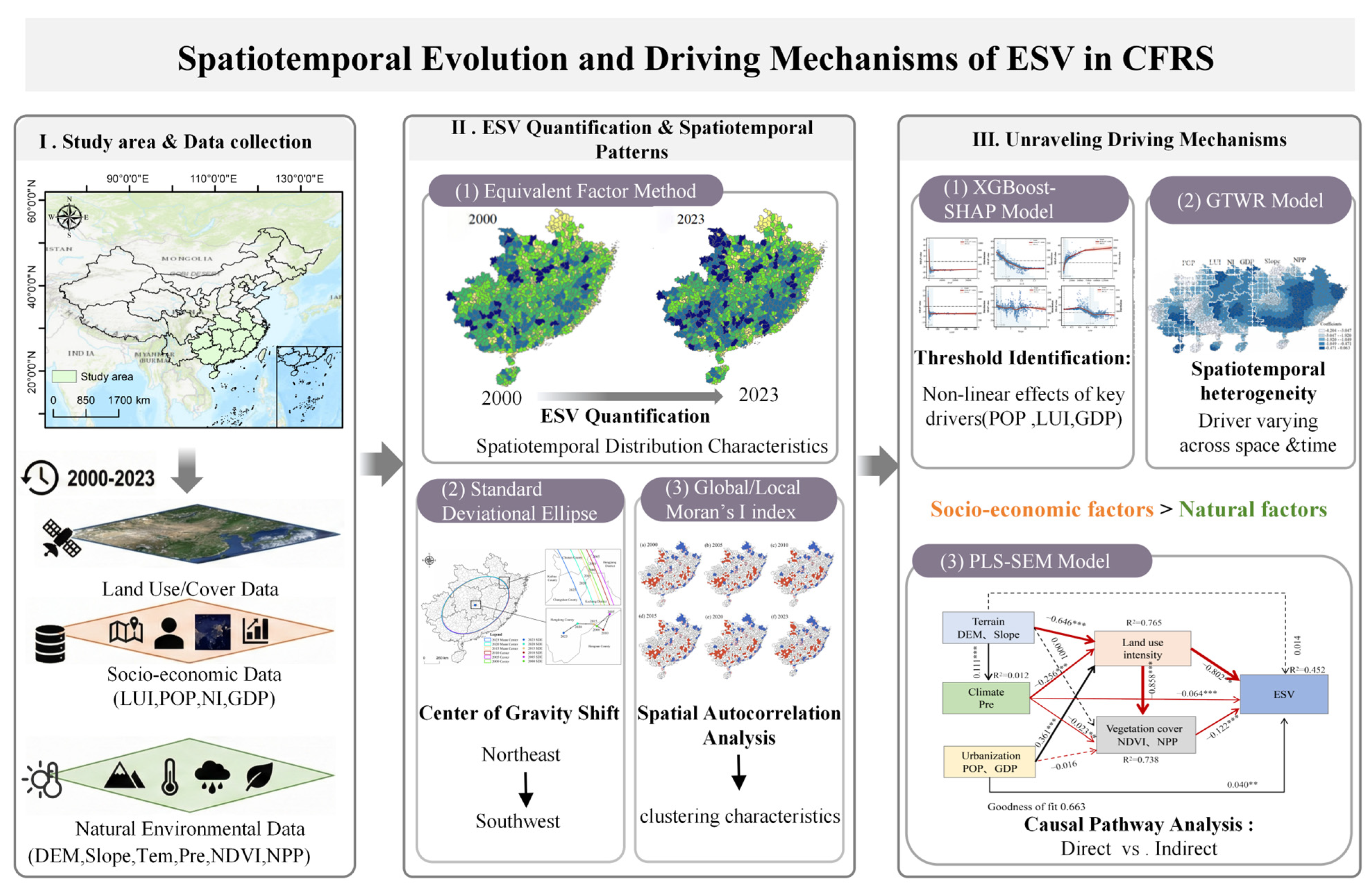
This study focuses on the Southern Collective Forest Region (SCFR) of China to investigate the spatiotemporal evolution and driving mechanisms of ESV. The research framework primarily consists of three modules (Figure 2): (1) Data Foundation: The SCFR is analyzed at the county level over the period from 2000 to 2023. Land use/Land cover (LULC) data, socio-economic variables (including land-use intensity [LUI], POP, NI, and GDP), and natural environmental factors (such as DEM, slope, Tem, Pre, NDVI, and NPP) were collected to support ESV estimation and driver analysis. (2) Spatiotemporal Evolution Analysis: The equivalent factor method was used to calculate ESV. Standard deviational ellipse (SDE) and spatial autocorrelation techniques were then applied to assess the spatiotemporal evolution and spatial clustering characteristics of ESV. (3) Driving Mechanism Analysis: A multi-model analytical framework was constructed to comprehensively examine the driving mechanisms of ESV. Firstly, the XGBoost–SHAP model was used to detect the nonlinear responses and critical thresholds of key driving factors. Secondly, the GTWR model was employed to explore the spatiotemporal non-stationarity of these factors. Finally, PLS-SEM was applied to elucidate the direct and indirect causal pathways among terrain, climate, urbanization, LUI, vegetation cover, and ESV.

3. Results

3.1. Characteristics of Land Use Change

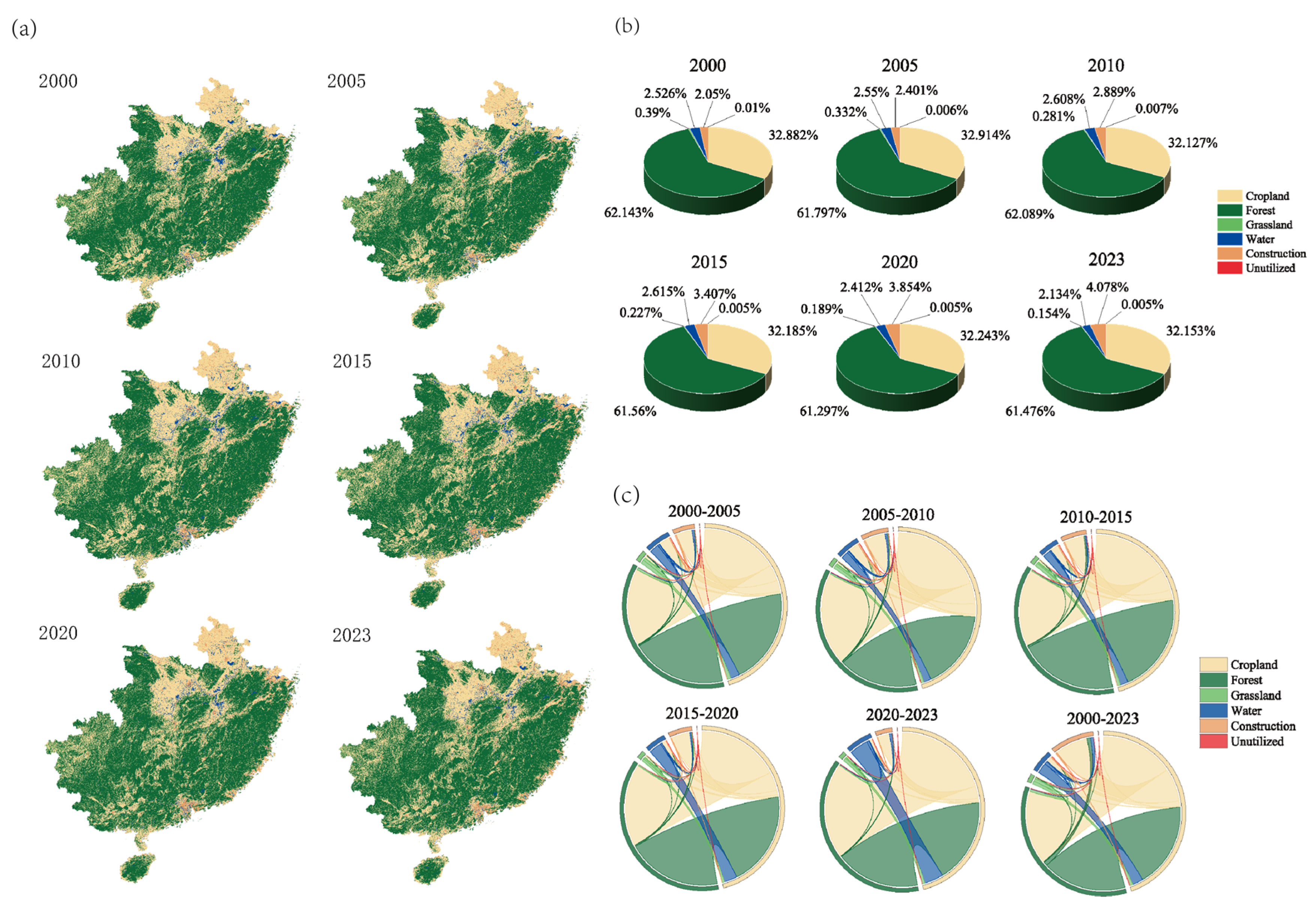
From 2000 to 2023, forest and cropland were the dominant land-use types in the SCFR, approximately accounting for over 94.14% of the total area (Figure 3a,b). Specifically, forest comprised 61.73%, while cropland accounted for 32.42%. In comparison, construction land occupied 3.11%, water 2.47%, grassland 0.26%, and unutilized land only 0.006%. Over the past 23 years, the areas of all land use types in the SCFR showed a declining trend with the exception of construction land (Table A1). Specifically, compared to 2000, the areas of cropland, forestland, grassland, water, and unutilized land in 2023 decreased by 2.21% (11,306.05 km2), 1.07% (10,353.57 km2), 60.45% (3661.60 km2), 15.53% (6090.64 km2), and 52.33% (77.99 km2), respectively. In contrast, construction land increased by 98.93% (31,493.67 km2).
As shown in Figure 3c, during the period from 2000 to 2023, cropland, forest, and water were the primary outflow land use types. Specifically, a total of 92,577.96 km2 of cropland was converted to other land use types, predominantly to forest and construction land, with conversions of 60,295.00 km2 and 27,052.91 km2, respectively. A total of 73,267.06 km2 of forest was converted, with 69,549.29 km2 and 3023.98 km2 transferred to cropland and construction land, respectively. For water, 11,586.09 km2 was converted, mainly to cropland (8880.33 km2) and construction land (2312.48 km2). Notably, construction land increased by 32,616.35 km2, primarily derived from the conversion of cropland, accounting for 82.94% of the total increase.

3.2. Temporal Variation Characteristics of ESV

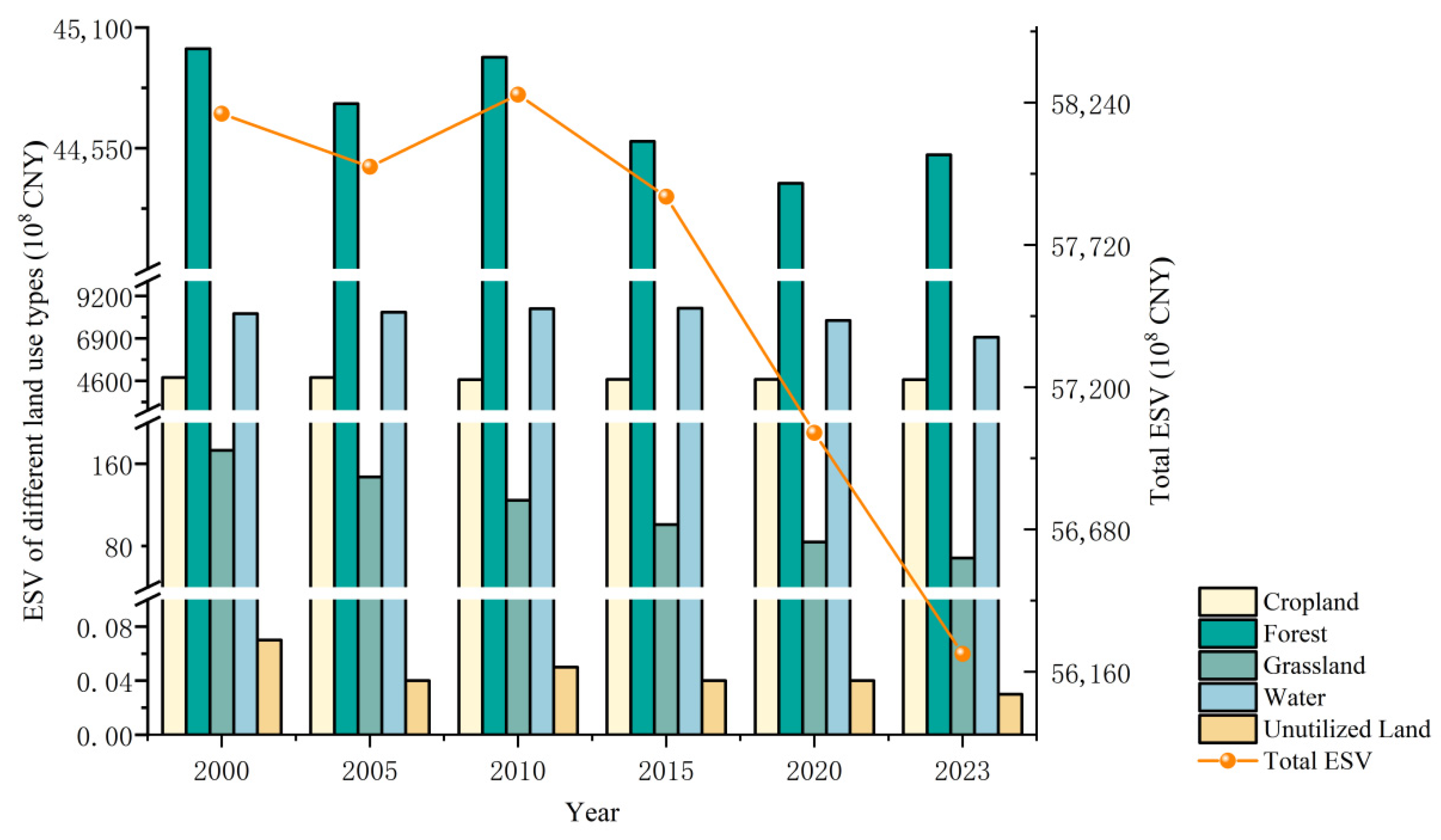
As shown in Figure 4, the total ESV of SCFR exhibited an overall downward trend from 2000 to 2023, decreasing from 58,199.59 × 108 CNY to 56,225.82 × 108 CNY. This represents a cumulative loss of 1973.77 × 108 CNY, with a decline rate of approximately 3.39%. Among all land use types, forest made the largest contribution to ESV (accounting for 76.90%–79.18%), followed by water (12.39%–14.75%) and cropland (8.01%–9.30%). The contributions from grassland, unutilized land, and construction land were relatively small. From 2000 to 2023, ESV declined across nearly all land-use types. Notably, water experienced the most significant decrease, with a total loss of 1280.62 × 108 CNY, accounting for 64.9% of the overall reduction. As the dominant contributor to ESV, forest showed a fluctuating downward trend, declining from 45,003.38 × 108 CNY in 2000 to 44,520.57 × 108 CNY in 2023, resulting in a cumulative decrease of 482.81 × 10⁸ CNY. The ESV of cropland and grassland also declined by 105.73 × 10⁸ CNY and 104.57 × 10⁸ CNY, respectively. Due to its small area, the change in ESV associated with unutilized land was negligible.
In terms of ecosystem service functions, the ESV ranking for the SCFR from 2000 to 2023 followed the order: regulating services > supporting services > provisioning services > cultural services (Table 2). Among individual services, hydrological regulation, climate regulation, soil conservation, gas regulation, and biodiversity protection were the dominant contributors, indicating the region’s critical role in water conservation, soil retention, and local climate regulation. With the exception of a temporary increase in certain services in 2010, the values of individual ecosystem services generally exhibited a downward trend. Notably, hydrological regulation and climate regulation (within regulating services), and biodiversity protection (within supporting services) experienced the most significant declines, decreasing by 1063.61 × 108 CNY, 222.46 × 10⁸ CNY, and 143.10 × 10⁸ CNY, respectively, from 2000 to 2023. In addition, the value of water resource supply (within provisioning services) remained consistently negative and decreased further between 2020 and 2023, indicating increasing water consumption or depletion. These findings indicate a decline in the capacity of the ecosystem to provide various services. Therefore, strengthening the protection and restoration of priority ecological functions—particularly hydrological regulation, climate regulation, biodiversity protection, and water resource supply—is urgently needed to safeguard the ecological security of the SCFR.

3.3. Spatial Characteristics of ESV

3.3.1. Spatial Distribution of Ecosystem Service Value

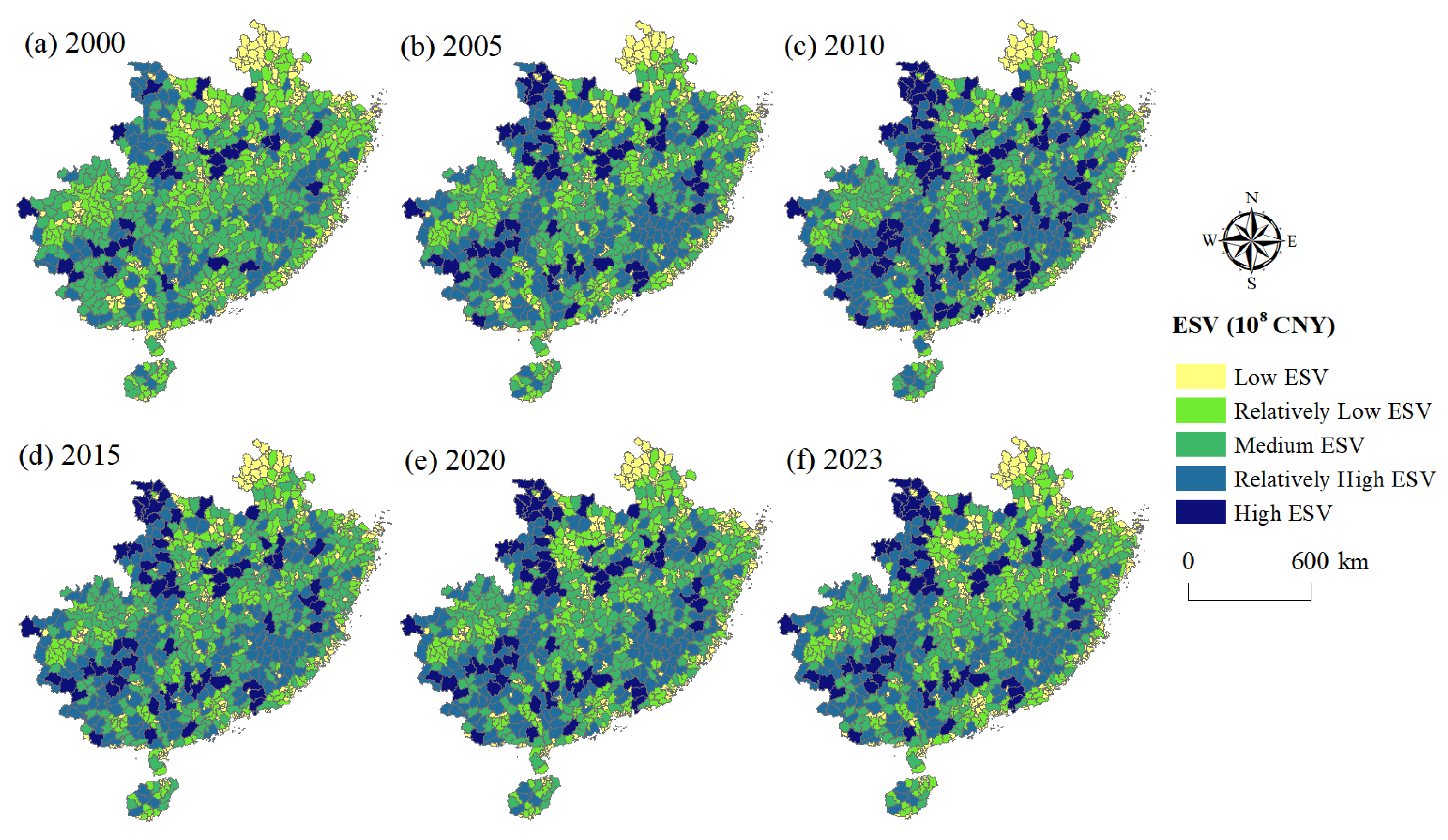
To illustrate the spatial heterogeneity of ESV, the continuous county-level ESVs were categorized into five hierarchical classes using the Natural Breaks (Jenks) method in ArcGIS 10.8. This method was selected because it identifies natural groupings within the dataset by maximizing between-class variance and minimizing within-class variance, thereby providing a robust delineation of the spatial distribution of regional ESV. From 2000 to 2023, the spatial distribution of ESV in the SCFR exhibited significant spatial heterogeneity (Figure 5). The overall pattern remained relatively stable throughout the study period, with higher ESV values concentrated in the southwestern and southeastern regions, and lower values observed in the northern plains. High-value and relatively high-value zones exhibited spatially contiguous clustered distributions, primarily concentrated in mountainous areas of the southwest and southeast. Specifically, these high-value clusters were predominantly distributed across three key areas: the junction zone between western Fujian Province and eastern Jiangxi Province; the tri-provincial interface encompassing southern Hunan Province, northern Guangdong Province, and northeastern Guangxi Zhuang Autonomous Region; and the bordering region between eastern Guizhou Province and western Hunan Province. In contrast, low-value and relatively low-value zones exhibited a mixed pattern comprising both contiguous and patchy distributions. These areas were predominantly located in the northern plains and economically developed coastal zones. Low-value zones were particularly concentrated in the plains regions of northern Hubei Province and northern Anhui Province, and relatively low-value zones were distributed in the Pearl River Delta urban agglomeration in southern Guangdong Province, the southwestern regions of Guizhou Province, the Hangzhou-Jiaxing-Huzhou Plain in northern Zhejiang Province, and the peripheral urban areas surrounding provincial capitals including Wuhan, Changsha, and Nanchang, exhibiting a pronounced fragmented spatial pattern.

3.3.2. Standard Deviational Ellipse and Center of Gravity Migration

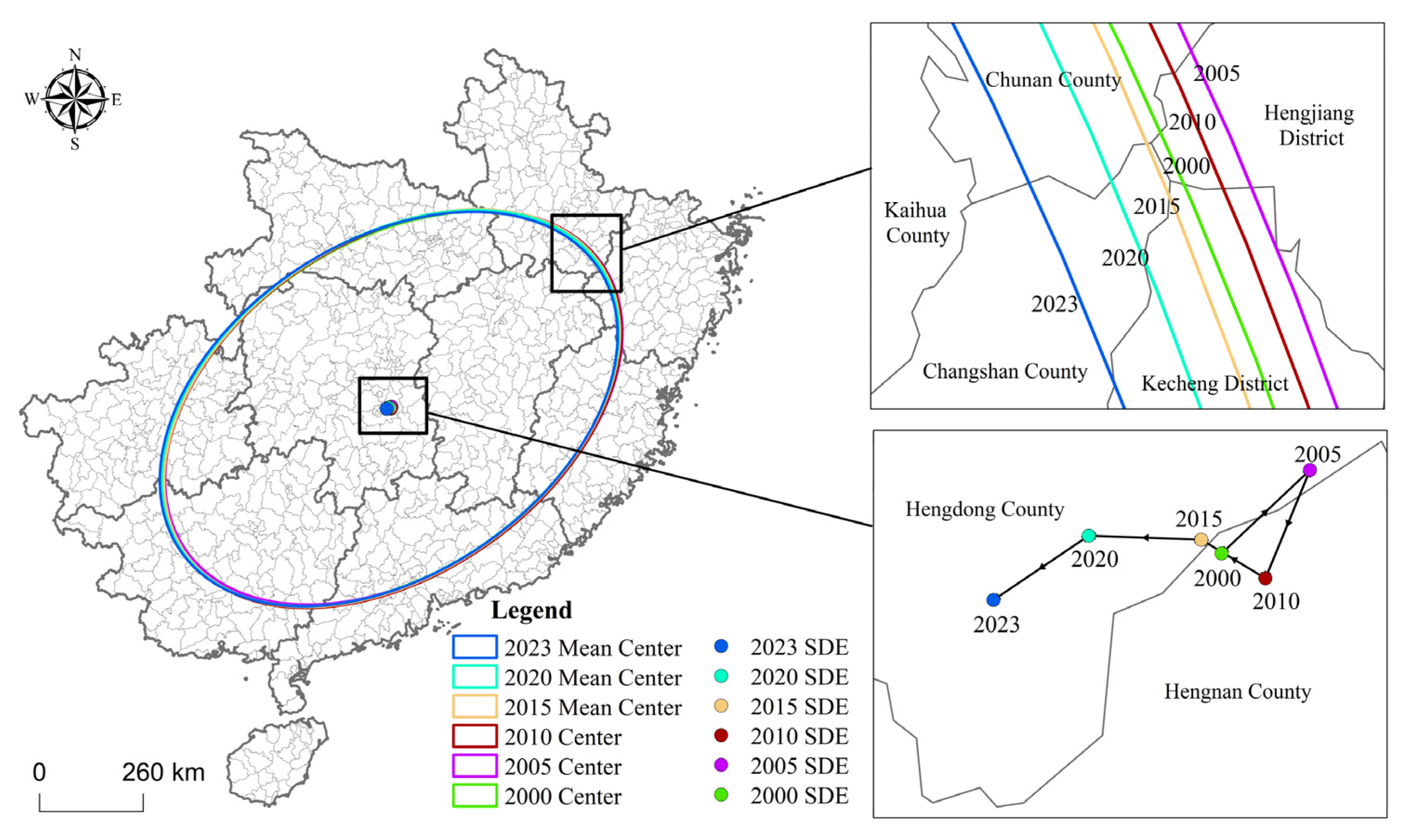
To further clarify the spatial dynamic evolution characteristics and directionality of ESV distribution in the SCFR, ArcGIS 10.8 software was employed to investigate the standard deviation ellipse and the migration of the center of gravity based on ESV data from six time points: 2000, 2005, 2010, 2015, 2020, and 2023. According to the centroid shift trajectory, the ESV centroid was persistently located within Hengyang City, Hunan Province, specifically in the boundary area between Hengdong County and Hengnan County (Figure 6). From 2000 to 2023, the ESV centroid exhibited a fluctuating pattern, first shifting northeast and then continuously reverting southwest. Specifically, from 2000 to 2005, the centroid shifted 4.61 km to the northeast, with coordinates migrating from 112.98° E, 26.93° N to 113.02° E, 26.96° N (Table 3). However, since 2010, the centroid has continuously shifted southwest with a cumulative displacement of 15.93 km. This migration pattern reflects the spatial redistribution of high-value ESV areas within the region, with the southwestward shift indicating a gradual transfer of ecosystem service concentration toward the southwestern portion of the study area. From 2000 to 2023, the ESV standard deviation ellipse exhibited a northeast-southwest orientation, with the azimuth angle stabilized between 54.98° and 55.13°. The semi-major axis of the standard deviation ellipse from 2000 to 2023 showed a fluctuating downward trend. The semi-minor axis of the standard deviation ellipse fluctuated and increased from 408.49 km in 2000 to 411.79 km in 2023, indicating a weak expansion trend of ESV in the northwest-southeast direction. Furthermore, the ellipse area exhibited a fluctuating increasing trend, indicating that the spatial dispersion of ESV increased, presenting an outward diffusion development pattern and reduced agglomeration. These results indicate that ESV distribution in SCFR underwent a spatial restructuring process from 2000 to 2023, characterized by a southwestward shift in the centroid and increased spatial dispersion.

3.3.3. Spatial Autocorrelation Analysis

The spatial autocorrelation of county-level ESV in the SCFR was assessed using the Global Moran’s I index (Table A2). From 2000 to 2023, the Global Moran’s I values consistently ranged from 0.463 to 0.494 (P < 0.001), indicating significant spatial autocorrelation of ESV in the SCFR. Moreover, Moran’s I index exhibited a steady increase from 0.463 in 2000 to 0.494 in 2023, reflecting a progressively strengthening spatial agglomeration effect of ESV in the SCFR.
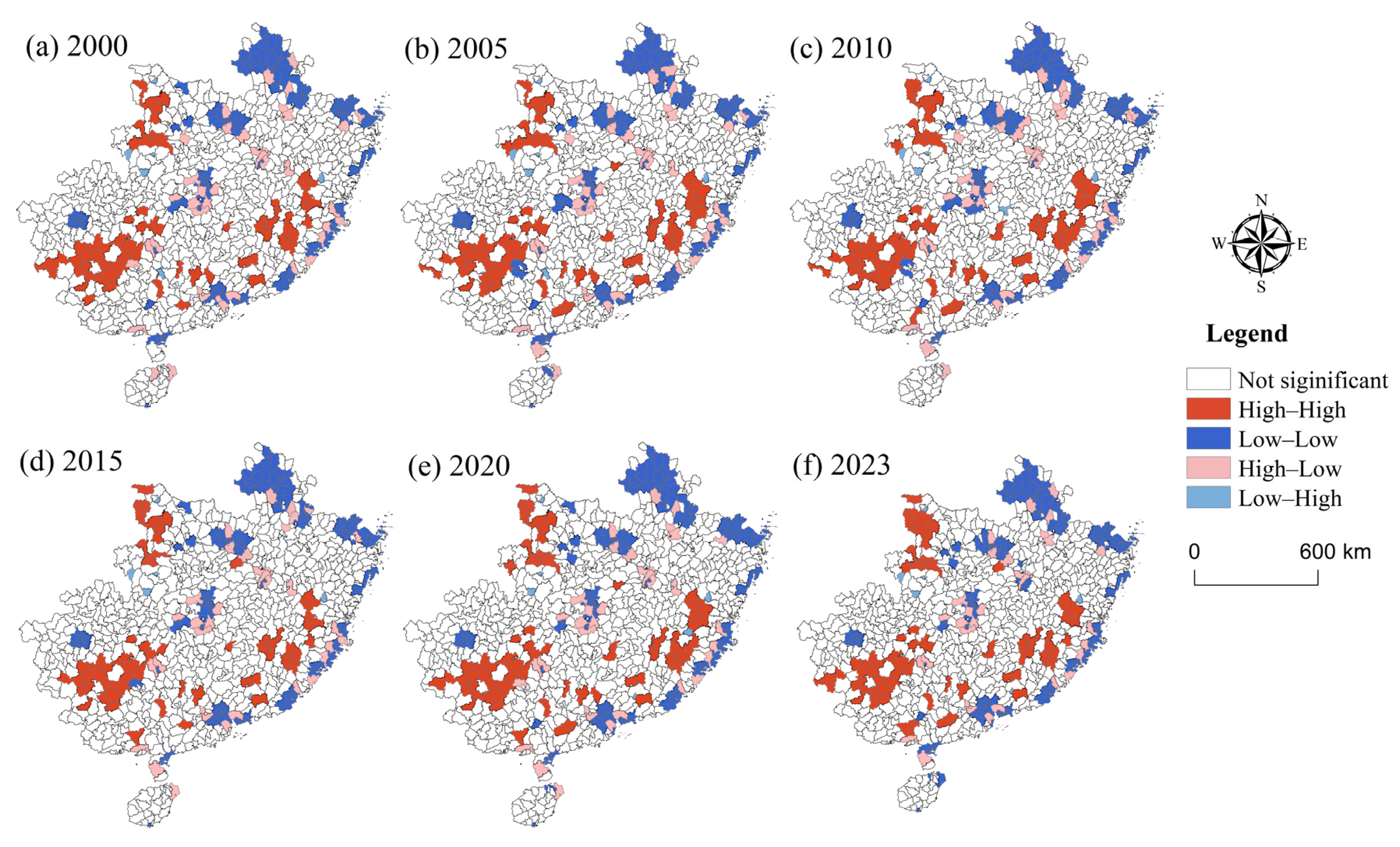
To further elucidate the local spatial clustering patterns of ESV, a Local Indicators of Spatial Association (LISA) cluster analysis was conducted. As shown in Figure 7, the spatial pattern of ESV maintained a relatively stable configuration, characterized by contiguous high-value clusters in the central and southwestern regions and low-value clusters along the northern and southern margins. The High–High (HH) clustering was predominantly distributed in the central and southwestern regions, encompassing the central and eastern parts of Guizhou, northern Guangxi, western Hunan, and the Wuyi Mountain range along the Fujian–Jiangxi border. These regions are located in the core zone of southern collective forest areas, characterized by high-altitude mountainous and hilly terrain with high forest coverage and strong landscape connectivity, serving as the most critical ecological barrier in the study region. Over the 23-year study period, the HH clustering areas maintained high spatial stability, with localized expansion in certain areas, reflecting the positive effects of China’s collective forest tenure reform and ecological protection policies such as the Grain for Green Program implemented in these core forest regions.
Low–Low (LL) clustering was concentrated in the peripheral zones of the study region, primarily including the plains of northern Hubei and Anhui, the Pearl River Delta urban agglomeration in Guangdong, and the northern plains of Zhejiang. These regions are characterized by low-altitude plains or basins with intensive human activities, where land use is predominantly dominated by cropland and built-up areas due to agricultural development and urbanization pressures. As a result, ecosystem service values in these areas have remained persistently low over time, forming contiguous “ecological service value depressions” with significantly reduced ecosystem functions.

3.4. Driving Mechanism of ESV

3.4.1. XGBoost-SHAP Model

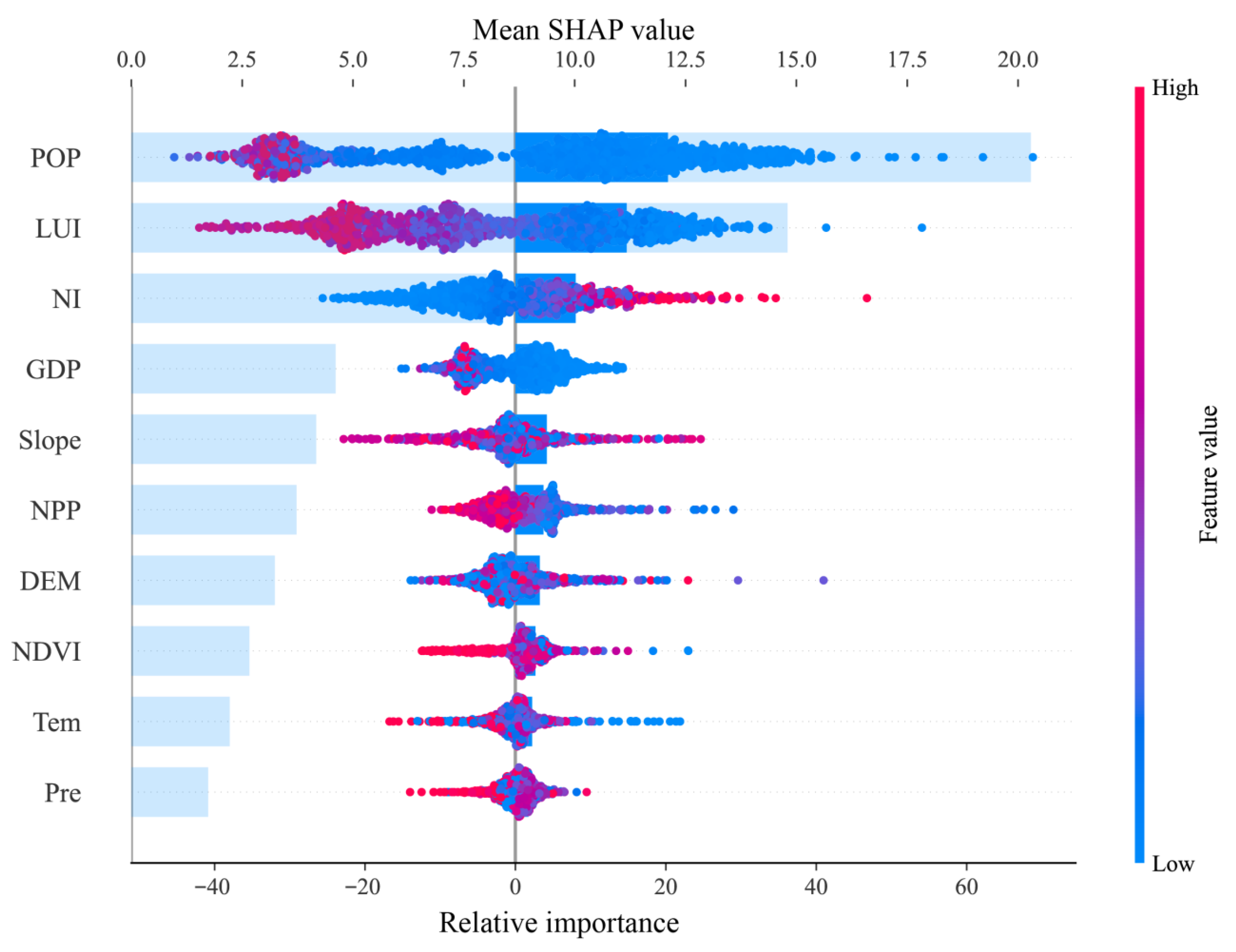
The XGBoost-SHAP model was employed to elucidate the relative importance and directional effects of various driving factors affecting ESV in the SCFR (Figure 8). As shown in Figure 8, the six most influential factors were POP, LUI, NI, GDP, Slope, and NPP. In contrast, mean annual temperature and precipitation had relatively minor effects on ESV. These results indicate that socioeconomic factors collectively exerted a stronger influence on ESV than natural geographic factors. When considering the driving direction, POP, LUI, and GDP have a significantly negative effect on ESV, while NI, NPP, and NDVI exhibited positive impacts. The effect of the Slope, DEM, Mean annual temperature and precipitation was more complex.
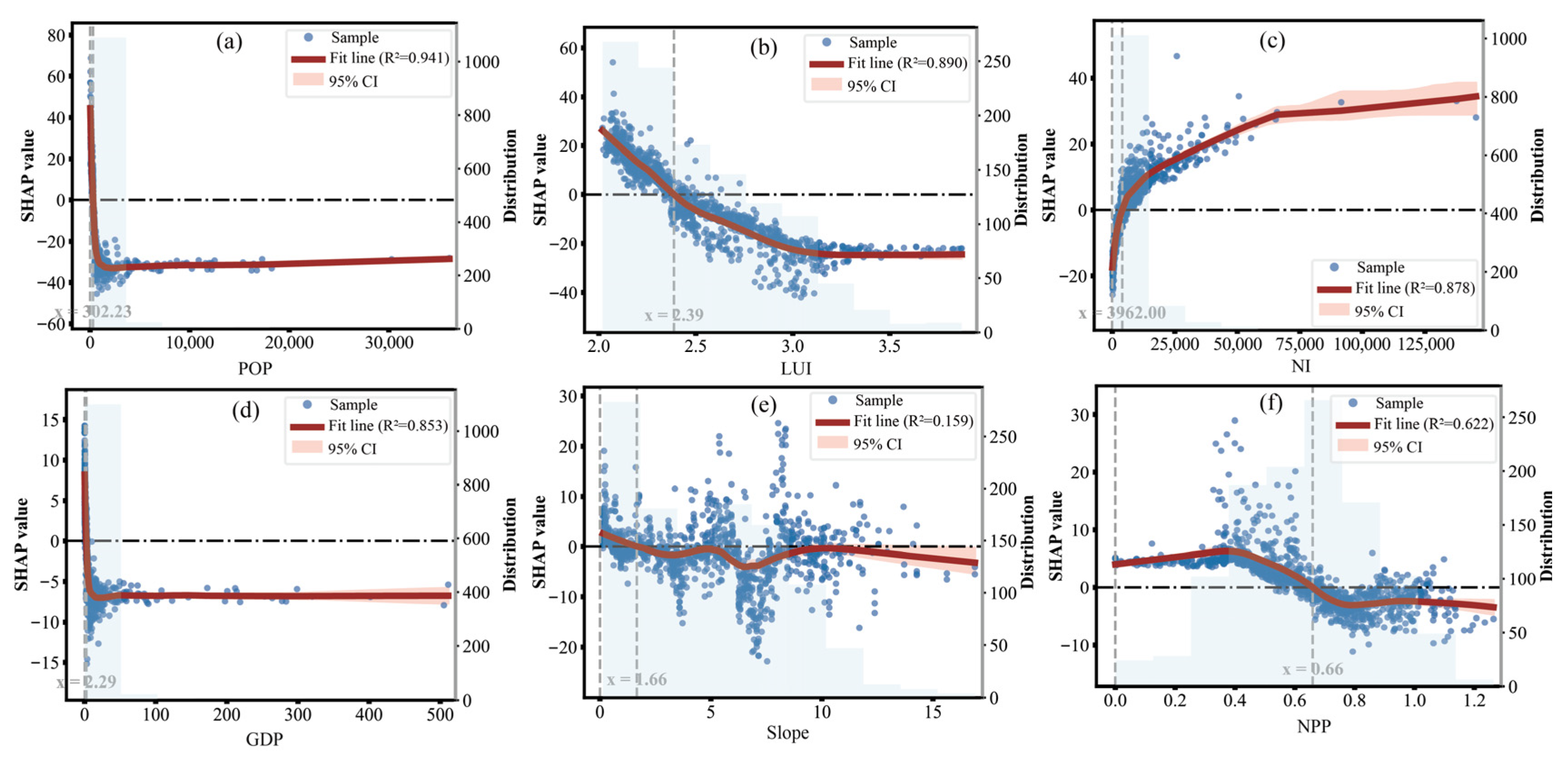
Based on the SHAP value importance ranking from the previous section, this study selected the top six key driving factors and plotted the SHAP value dependency graphs (Figure 9). As shown in Figure 9, the response of ESV to these driving factors demonstrated nonlinear patterns and exhibited a threshold effect. For instance, the POP exhibited a significant threshold effect on ESV, with a threshold value of 302 persons·km−2. When POP is less than 302 persons·km−2, it has a positive effect on ESV. When POP exceeds 302 persons·km−2, the SHAP value rapidly falls below zero and stabilizes, indicating a negative impact on ESV. LUI also exhibits an evident threshold effect on ESV. LUI promoted ESV when it fell between the ranges of 2.00 and 2.39. Conversely, when LUI was higher than 2.39, its effect on the ESV shifted from positive to negative. Notably, NI exhibited a positive nonlinear correlation with ESV. Below 3962, NI has a negative impact on the ESV. Once NI exceeded 3962, its effect on the ESV shifted from negative to positive. GDP between 0 and 2.29 million USD promoted ESV, whereas GDP below 2.29 million USD inhibited ESV. Slope displayed a complex nonlinear relationship with ESV, characterized by a fluctuating downward trend. Finally, NPP has a significant threshold effect on ESV. When the NPP exceeds 0.66 g·m−2, ESV demonstrates a synergistic effect, whereas NPP below 0.66 g·m−2 inhibits ESV.

3.4.2. GTWR Model

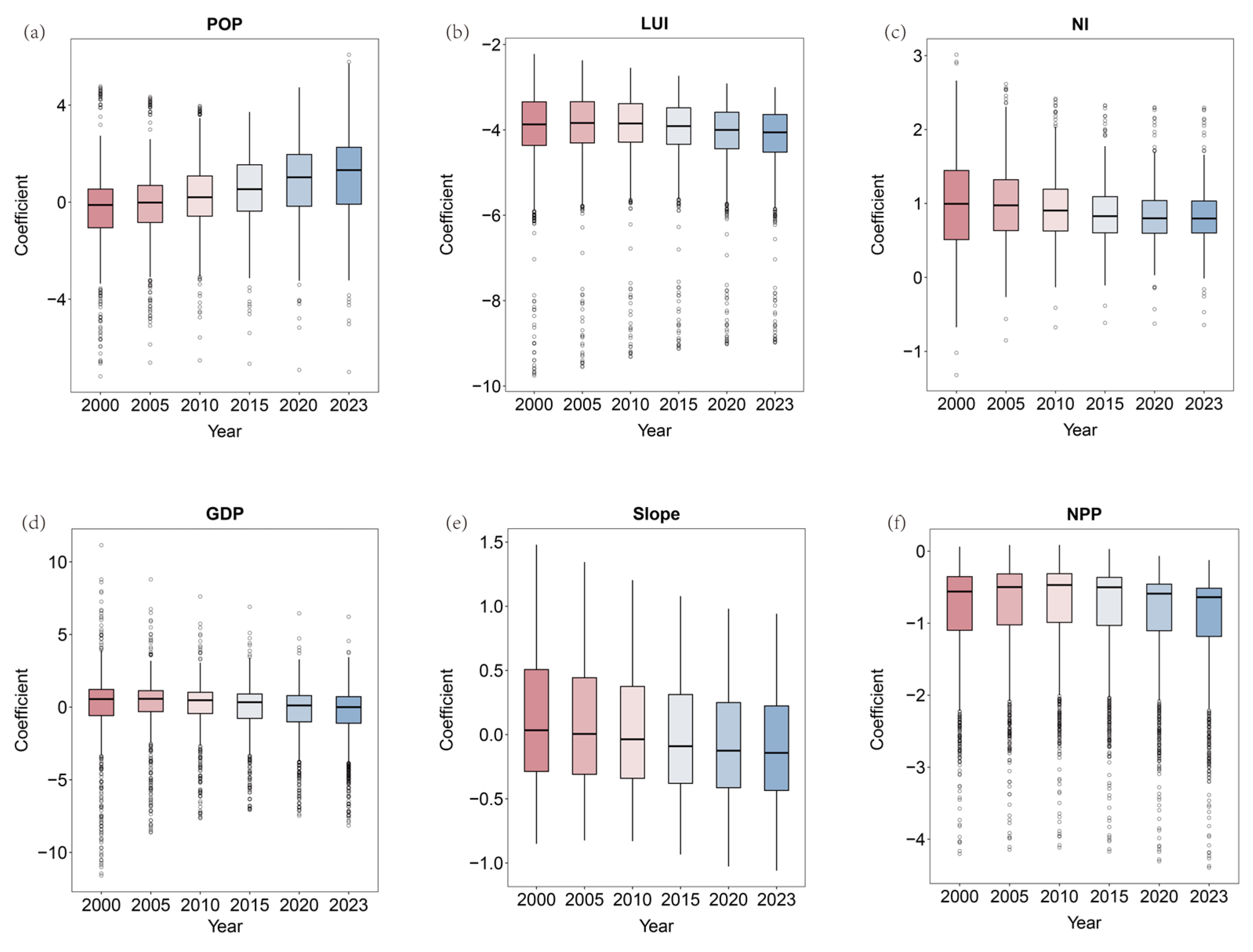
As shown in Figure 10, the coefficient for NI remained consistently positive but showed a gradual downward trend from 2000 to 2023, indicating that the promoting effect of NI on ESV in the Southern Collective Forest Region has continuously diminished. From 2000 to 2010, the average regression coefficient of GDP was positive, suggesting that GDP played a promoting role in ESV during this period. However, between 2015 and 2023, this coefficient dropped to a negative value and continued to decrease. This indicates that after 2015, GDP exerted an inhibitory effect on ESV, with the intensity of inhibition gradually strengthening. The temporal trend of the Slope regression coefficient was similar to that of GDP. This result suggests that Slope had a promoting effect on ESV before 2015, whereas from 2015 to 2023, its influence shifted from promotion to inhibition. The regression coefficient for NPP remained negative, with its absolute value showing a slightly fluctuating increasing trend.
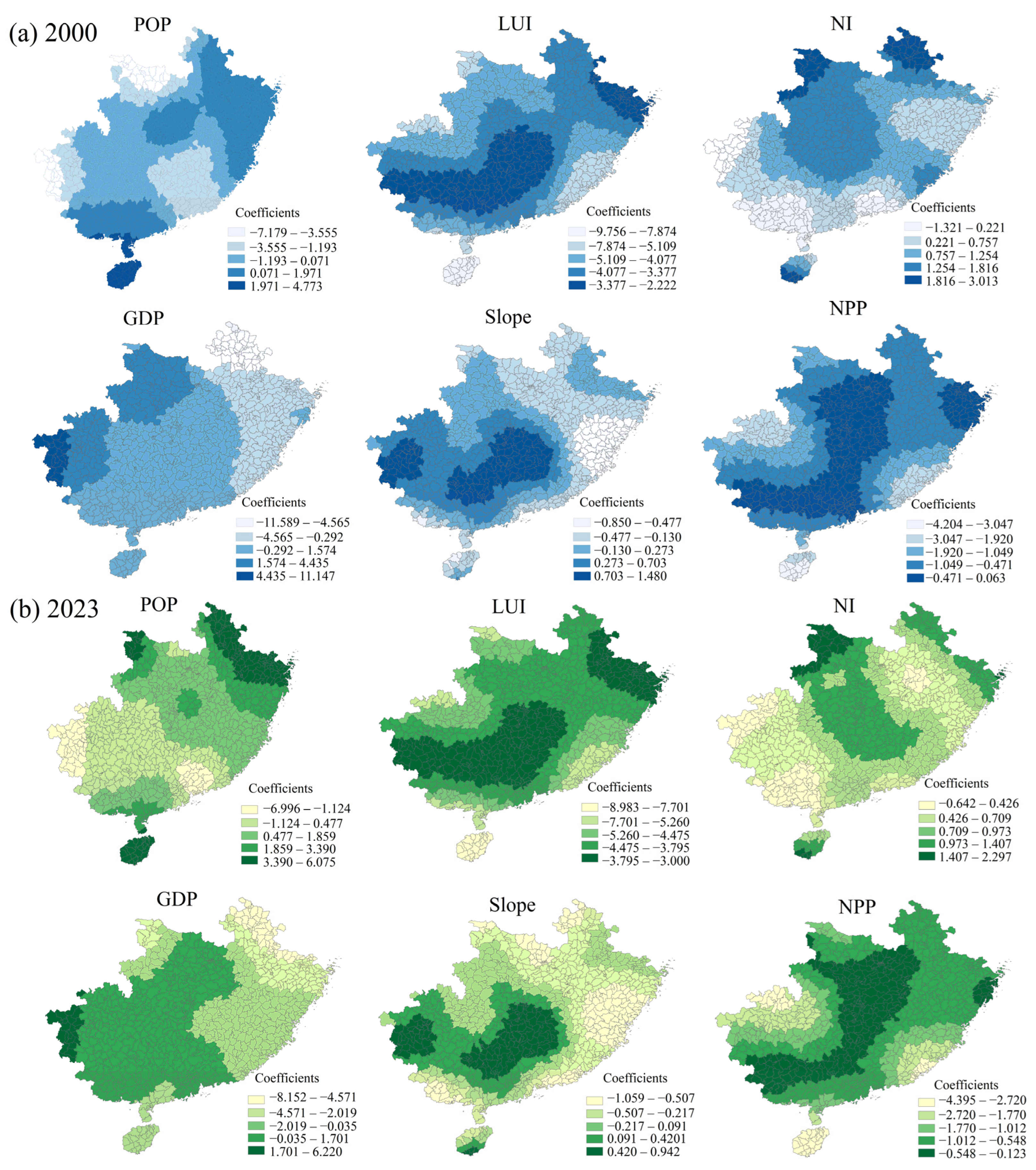
As illustrated in Figure 11, the correlation between POP and ESV displays a distinct spatial pattern characterized by “negative in the northwest and positive in the southeast.” In 2000, negative correlations were predominantly distributed in western Guizhou Province, Hubei Province, northeastern Guangdong Province, and southwestern Jiangxi Province. Notably, regression coefficients in western Guizhou and northern Hubei reached as low as −7.179 to −3.555, indicating that population density exerted a significant suppressive effect on ESV in these regions. In contrast, positive correlations were primarily concentrated in coastal areas, including southern Guangxi, Hainan Province, southwestern Guangdong, Fujian Province, Zhejiang Province, and Anhui Province. By 2023, the influence of POP on ESV exhibited positive correlations. High positive-value zones expanded significantly northward, mainly concentrating in Anhui Province, western Hubei Province, and Zhejiang Province. The area of negative correlations contracted in 2023, with the distribution of low negative-value zones shifting primarily to western Guizhou Province and central Guangdong cities.
In both 2000 and 2023, LUI exhibited a negative correlation with ESV across the study region. High negative-value zones were concentrated in Guangxi, Jiangxi, Anhui, and Zhejiang Provinces. Low negative-value zones were primarily distributed throughout Hainan Province and southern Fujian Province, indicating that LUI exerted a stronger suppressive effect on ESV in Hainan and Fujian during these periods. Furthermore, compared to 2000, the negative-value zones in central regions showed an outward expansion trend in 2023, suggesting a weakening of LUI’s negative effects on ESV in central areas. In both 2000 and 2023, NI exhibited an overall positive correlation with ESV; however, negative correlations were observed in localized areas, such as western Guizhou and southern Guangxi, indicating significant spatial heterogeneity in the NI-ESV relationship. Compared to 2000, the spatial extent of high-value NI zones demonstrated a convergent trend in 2023. Overall, NI facilitated ESV enhancement, with suppressive effects observed only in localized regions. In both 2000 and 2023, GDP displayed a distinctive spatial pattern characterized by “positive in the west and negative in the east.” Guizhou Province and western Guangxi Zhuang Autonomous Region consistently exhibited significant positive correlations, while economically developed regions such as Zhejiang, Anhui, and Fujian Provinces demonstrated negative correlations. Compared with 2000, the negative effects in central provinces in 2023 gradually diminished.
The correlation between slope and ESV exhibited a spatial pattern characterized by positive correlations in western and central regions and negative correlations in eastern and coastal areas. High positive-value zones were primarily distributed in provinces with substantial topographic relief, including Guizhou, Hunan, and Guangxi Zhuang Autonomous Region. Conversely, coastal areas such as coastal Zhejiang and eastern Fujian demonstrated negative correlations, with regression coefficients declining from 1.48 in 2000 to 0.942 in 2023. From 2000 to 2023, NPP exhibited weak negative correlations with ESV across the vast majority of regions, with only a small fraction of areas showing weak positive correlations in 2000. The strongest negative suppressive effects were concentrated in Guizhou and Hainan Provinces.

3.4.3. PLS-PM Model

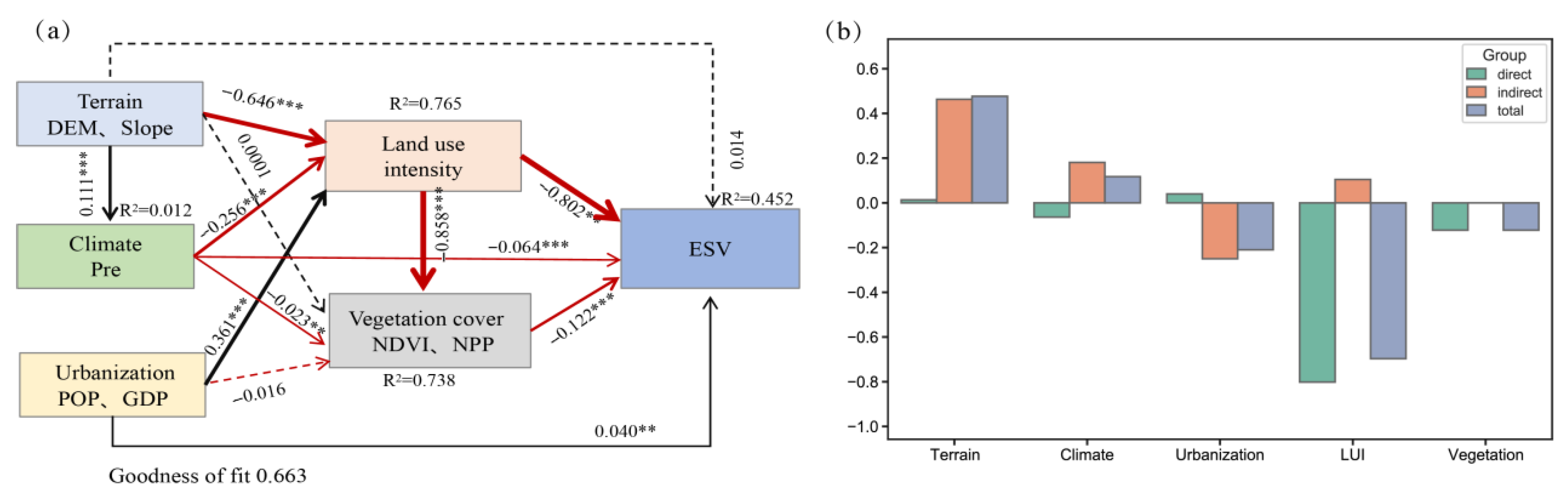
PLS-PM analysis was fulfilled to ascertain the direct and indirect influences of terrain, climate, urbanization, land use intensity, and vegetation cover on ESV (Figure 12). LUI (the total effects = −0.697) showed the largest negative impact on ESV, followed by terrain (the total effects = 0.477) and urbanization (the total effects = −0.210, Figure 12b). LUI exerted a significant direct negative impact on ESV, with a direct effect reaching −0.802. However, the positive effect on ESV through influencing vegetation coverage was relatively weak (0.1049). Terrain has a relatively weak direct positive impact on ESV (0.014), but it exerted a considerable indirect effect (0.463) by its influence on climate and land use intensity. Similarly, urbanization negatively impacts ESV indirectly by enhancing land use intensity; its indirect effect is −0.250.

4. Discussion

4.1. Analysis of Spatio-Temporal Evolution Characteristics of ESV in the SCFR

4.1.1. Analysis of Temporal Variation Characteristics of ESV

This study demonstrates that the total ESV in the SCFR exhibited an overall downward trend from 2000 to 2023. This finding is consistent with prior research on the degradation of ecosystem services within China’s forested landscapes [5,36]. The rapid expansion of construction land (an increase of 98.93%) has led to a substantial increase in regional impervious surfaces, thereby weakening various ecological regulation functions [37]; this has become the primary driver of the overall decline in ESV in the region. Forest remained the dominant contributor to ESV, which is closely associated with the region’s land use pattern characterized by forest ecosystems. However, despite the relative stability of the forest area over the 23-year period (a decrease of only 1.07%), its contribution to ESV showed a fluctuating downward trend. This may be attributed to two factors: (1) The degradation of forest quality, primarily driven by the widespread replacement of diverse, natural forests with monoculture fast-growing plantations [38,39]. Such plantations typically have simplified stand structures and markedly reduced species diversity, which leads to diminished ecosystem services, including hydrological regulation, biodiversity conservation, and climate regulation [40]. The reduction in canopy complexity and understory vegetation decreases water interception and soil moisture retention, weakening the forest’s capacity to regulate hydrological processes [41]. (2) The forested areas lost were mostly mature forests with high ecological value, often converted to cropland, whereas newly gained forest land mainly consisted of young stands established through afforestation programs such as the Grain for Green initiative. These young forests possess substantially lower capacity for maintaining biodiversity and regulating climate compared to the mature or natural forests they replaced, contributing further to the decline in ecosystem service values [5]. Moreover, although plantation forest expansion can significantly boost short-term timber production, it often entails trade-offs by compromising critical ecosystem services such as water regulation, soil conservation, and biodiversity protection. This underscores that relying solely on plantation expansion is unlikely to simultaneously achieve economic growth and ecological sustainability. Hence, future forest management strategies must prioritize a balanced approach that integrates multiple ecosystem functions to promote long-term sustainable development [42].
Similarly, the contributions of water and cropland to total ESV also declined substantially. Although water bodies constitute a relatively small proportion of the SCFR (~2.5%), they possess exceptionally high per-unit-area ESV—particularly in terms of hydrological regulation and water purification. As such, even modest reductions in water area can lead to substantial losses in total ESV [43]. Between 2000 and 2023, water area decreased by 2.78%, primarily due to wetland encroachment and the reclamation of lakes for agricultural use (Table A1; Land Use Transition Matrix). These losses, driven by rapid urban expansion and increased agricultural pressures, have severely disrupted natural hydrological cycles through reduced water retention, groundwater recharge, and flood mitigation capacities [6]. The degradation and fragmentation of wetlands, which are critical regulators of the hydrological balance, intensify surface runoff and reduce groundwater recharge, thereby explaining the pronounced decline in hydrological regulation [44]. In addition, artificial impermeable surfaces associated with construction land expansion exacerbate these hydrological disruptions by increasing surface runoff and reducing infiltration [45]. Meanwhile, the decline in cropland area reflects the encroachment of construction land on arable land, a trend particularly pronounced in economically advanced areas such as the middle and lower Yangtze River Basin and the Pearl River Delta. This ongoing land conversion not only threatens food production capacity but also undermines the balance between food security and ecological security [37]. Moreover, although plantation forest expansion can significantly boost short-term timber production, it often entails trade-offs by compromising critical ecosystem services such as water regulation, soil conservation, and biodiversity protection. This underscores that relying solely on plantation expansion is unlikely to simultaneously achieve economic growth and ecological sustainability. Hence, future forest management strategies must prioritize a balanced approach that integrates multiple ecosystem functions to promote long-term sustainable development [37].

4.1.2. Analysis of Spatial Distribution Characteristics of ESV

Our study reveals significant spatial heterogeneity in the ESV of the Southern Collective Forest Region, characterized by an overall pattern of “high in the southwest and southeast mountainous areas, and low in the northern plains and coastal regions”. This spatial pattern is closely correlated with the region’s topography, climatic conditions, and socio-economic development levels [46]. High-value areas are primarily concentrated in the contiguous mountainous regions of western Hunan–Hubei, the Fujian–Jiangxi border, and the intersection of Guizhou, Hunan, and Guangxi. These areas frequently host national or provincial nature reserves and forest parks, subject to strict ecological protection policies. In contrast, low-value areas are distributed in patches across the plains of northern Hubei and northern Anhui, as well as the Pearl River Delta urban agglomeration. The lower ESV in these regions is mainly attributed to the following: the economically developed urban agglomerations in the Pearl River Delta and the middle and lower reaches of the Yangtze River exhibit high urbanization levels and intense human activity, leading to severe fragmentation of natural ecosystems. Furthermore, the land use transition matrix indicates that the expansion of construction land was concentrated in these low-value zones. Notably, 85.6% of the newly added construction land originated from the conversion of cropland, further exacerbating the degradation of ecosystem service functions in these areas.
Spatial autocorrelation analysis confirmed a strong spatial dependency in the distribution of ESV across the Southern Collective Forest Region, with evident spatial clustering patterns. The “High–High” (HH) clusters remained spatially stable throughout the study period, primarily located in ecologically critical forest core areas such as central and eastern Guizhou, northern Guangxi, western Hunan, and the Fujian–Jiangxi border zone. These contiguous mountainous and hilly regions serve as key ecological barriers, featuring high forest coverage, limited human disturbance, and stringent ecological protection measures. The persistence and local expansion of HH clusters during 2000–2023 likely reflect the long-term positive effects of ecological restoration initiatives, including the Grain for Green Program and collective forest tenure reforms [47]. For instance, within the Fujian–Jiangxi border zone’s HH cluster, Changting County in Fujian Province—once plagued by severe red soil erosion—has transformed into a national model for ecological restoration. Sustained afforestation and forest tenure reforms in Changting have significantly boosted local forest coverage and ecosystem service values [48,49]. Similarly, in the HH clusters of the southwest, counties such as Huanjiang in Guangxi and Libo in Guizhou have demonstrated remarkable ecosystem recovery. Driven by comprehensive rocky desertification control and the Grain for Green Program, these counties have successfully expanded high-value ecological patches and improved overall ESV [50,51]. In contrast, the “Low–Low” (LL) clusters were consistently distributed in the northern plains and coastal regions, particularly in the Pearl River Delta and the middle and lower reaches of the Yangtze River. These areas are among China’s most economically developed and urbanized zones, characterized by rapid land-use conversion, urban sprawl, and the widespread loss of natural ecosystems. The extensive expansion of construction land in these regions has intensified habitat fragmentation and significantly impaired ecological service functions. The persistent spatial concentration of LL clusters indicates the formation of long-standing ecological “depression zones” that are increasingly decoupled from natural support systems. Moreover, under the prevailing high-intensity development models, reversing ecological degradation in these regions remains a substantial challenge in the near term.
Furthermore, the identified ecological service value depressions represented by persistent Low–Low clusters in urbanized areas reflect the combined effects of intense land-use change, habitat loss and the expansion of impervious surfaces. These factors substantially reduce key ecosystem services such as air and water purification, microclimate regulation and biodiversity support [52]. To address these depressions, urban green infrastructure strategies, including parks, street trees, green roofs, urban wetlands and forest patches, have shown significant potential in restoring and enhancing ecosystem service functions within densely built urban environments [53]. By improving landscape connectivity, enhancing stormwater management and mitigating urban heat island effects, urban green infrastructure can help to break up spatial clusters of low ecosystem service values [54]. Therefore, the implementation of integrated green infrastructure planning in rapidly urbanizing areas, such as the Pearl River Delta and the middle and lower Yangtze River Basin, is a key approach to balancing urban development with ecological sustainability

4.2. Driving Mechanisms of the Spatio-Temporal Evolution of ESV in the SCFR

4.2.1. Identification of Key Driving Factors and Analysis of Threshold Effects

The results of the XGBoost-SHAP model indicate that the top six driving factors affecting changes in ESV in the SCFR are, in descending order of importance: POP, LUI, NI, GDP, slope, and NPP. In contrast, mean annual temperature and precipitation contributed relatively little to ESV variation. This suggests that socio-economic factors exert a substantially stronger influence on ESV than natural geographical variables—an outcome consistent with findings from the Changsha–Zhuzhou–Xiangtan urban agglomeration [55]. Moreover, the SHAP dependence plots reveal pronounced non-linear responses and threshold effects in ESV’s reaction to key drivers, supporting the hypothesis that ecosystems are undergoing non-equilibrium transitions [56]. Specifically, distinct inflection points were identified for POP (302 persons·km−2), LUI (2.39), and GDP (229 million USD), beyond which the impact on ESV changes significantly. Below these thresholds, these factors exert a promoting effect on ESV. This supports the “Intermediate Disturbance Hypothesis”, which suggests that moderate population agglomeration and low-intensity land use may promote ESV by increasing landscape heterogeneity and enhancing provisioning services [57]. Furthermore, early-stage economic growth is often accompanied by improved resource use efficiency and investment in ecological construction, thereby achieving a synergistic enhancement of socio-economic development and ESV. However, once these thresholds are exceeded, the rate of resource consumption by human activities outpaces the ecosystem’s recovery rate. This leads to a sharply intensifying inhibitory effect on ESV, indicating that the regional ecosystem carrying capacity has reached a critical limit. Notably, the NI, a key proxy for human activity intensity, did not exhibit the expected negative trend consistent with GDP; instead, it showed an overall positive effect. This finding challenges conventional understanding, and the underlying mechanisms warrant further in-depth investigation in future research.

4.2.2. Analysis of Spatio-Temporal Heterogeneity of Driving Factors

This study utilized the GTWR model to further elucidate the spatio-temporal heterogeneity of the driving mechanisms. POP exhibited a spatial differentiation pattern characterized by a negative effect in the northwest and positive effect in the southeast. In ecologically fragile areas such as western Guizhou, population growth was often accompanied by the excessive reclamation of marginal lands, leading to a significant inhibitory effect. Conversely, in developed coastal regions like northern Zhejiang and Hainan, population agglomeration was associated with intensified land use and heightened awareness of ecological protection, thereby manifesting a promoting effect. Over time, this promoting effect strengthened in Anhui and Zhejiang, a trend attributed to improved regional environmental management, land use intensification, and increased ecological investment [58,59]. Furthermore, our study found that Hubei and southern Jiangxi shifted from a negative effect in 2000 to a positive one in 2023. This indicates that with the improvement of urbanization quality, the negative pressure of population agglomeration on the ecosystem is being mitigated through technological progress and planning optimization. Since 2015, the GDP in the Southern Collective Forest Region has increasingly inhibited ESV due to faster industrialization and urbanization, which converted farmland and natural areas into construction land and reduced ecological capacity [60]. Economic growth in this stage led to higher resource use and pollution, exceeding the ecosystem’s recovery ability and creating an inverted U-shaped relationship between economy and ecosystem services, consistent with the Environmental Kuznets Curve [61]. This includes excessive land development, more industrial waste, and fragmentation, which together degrade ecosystem functions and suppress ESV growth. In addition, it consistently exhibited a promoting effect in Guizhou Province, likely benefiting from the region’s long-term implementation of the “ecological industrialization” strategy. However, in eastern coastal areas such as Fujian and Zhejiang, the inhibitory effect of GDP gradually diminished, which is related to industrial restructuring and stricter environmental regulations. LUI exerted an inhibitory effect on ESV across the entire study area, particularly in Hainan and Fujian provinces. As a tropical island ecosystem, Hainan is highly sensitive to land use changes; the rapid expansion of rubber plantations and tourism development has led to substantial losses of natural forests and wetlands [62]. Similarly, rapid urbanization and industrialization in the coastal areas of Fujian precipitated a sharp rise in land use intensity, placing severe pressure on the ecosystem. These findings suggest that in regions like Hainan and Fujian, land development intensity must be strictly controlled, and ecological protection red lines must be delineated and rigorously observed.

4.2.3. Path Analysis of Influencing Factors Based on PLS-SEM

The PLS-SEM model was employed to elucidate the causal pathways linking natural and anthropogenic factors to ESV. The results reveal that ESV changes are not driven directly by a single factor but involve complex direct and indirect pathways, as well as interactions among factors. LUI was identified as the primary direct pathway exerting a negative impact on ESV. In contrast, urbanization factors (POP and GDP) showed relatively weak direct effects on ESV; instead, they primarily inhibited ESV indirectly by intensifying LUI. This indicates that the impact of urbanization on ecosystems is largely mediated by changes in land use modes. Topographic factors (Slope and DEM) exhibited significant positive effects, influencing ESV mainly through two indirect pathways: (1) Exerting a positive effect by constraining LUI; areas with steep slopes have retained relatively intact natural ecosystems due to the difficulty of development. (2) Promoting vegetation growth and ecosystem function maintenance by influencing climate conditions (e.g., precipitation) [63]. These mechanisms further explain the spatial distribution pattern observed in this study, where high ESVs are concentrated in the contiguous mountainous regions of western Hunan–Hubei, the Fujian–Jiangxi border, and the Guizhou–Hunan–Guangxi junction.

4.3. Limitations and Future Research

Although this study integrated XGBoost-SHAP, GTWR, and PLS-SEM models to elucidate the spatio-temporal evolution and complex driving mechanisms of ESV in the SCFR, several limitations remain. First, ESV was estimated using the equivalent factor method based on Level I land use categories (LULC). While localization adjustments were made based on regional grain yields, this method struggles to capture the internal heterogeneity within the same land use type (e.g., natural vs. plantation forests, coniferous vs. broadleaf forests), potentially leading to estimation biases in forest ESV. Future research should introduce multi-source high-resolution remote sensing data (such as LiDAR or hyperspectral imagery) to achieve fine-grained identification of internal forest structures. Additionally, cross-validation using the InVEST model and the value equivalent method is recommended to enhance assessment accuracy. Second, the driver indicator system primarily covered natural geographical and socio-economic variables, excluding quantitative indicators for institutional factors (e.g., tenure reform, forest certification) and policy variables (e.g., eco-compensation standards, protection zone management intensity). This limits a profound understanding of the driving mechanisms within the unique institutional context of the collective forest region. Future studies could employ quasi-experimental methods, such as the Difference-in-Differences (DID) model, to quantify the net effects of specific policy interventions. Third, although the XGBoost-SHAP model is highly effective in capturing the complex nonlinear relationships between driving factors and ecosystem service values, it has certain limitations. These uncertainties stem from factors such as data quality, parameter tuning, sample size, and potential overfitting, all of which may affect the interpretability and reliability of the results. To enhance the robustness and predictive performance of the model, future studies should focus on addressing these uncertainties through techniques such as bootstrap resampling, sensitivity analysis, and validation with independent datasets. These approaches will help improve both the stability and the reliability of the model’s outcomes. Finally, while the analysis based on historical data reveals past patterns, it lacks predictions regarding future climate change and socio-economic development scenarios. Future work should incorporate land use simulation models, such as PLUS or FLUS, to predict ESV evolution trends under different development scenarios. This would provide a scientific basis for formulating prospective regional ecological management strategies.

5. Conclusions and Policy Implications

5.1. Conclusions

By integrating multi-source data with XGBoost-SHAP, GTWR, and PLS-SEM models, this study systematically elucidates the complex driving mechanisms of the spatio-temporal evolution of ESV in the SCFR from 2000 to 2023. The analysis was conducted from three dimensions: non-linear thresholds, spatio-temporal heterogeneity, and causal pathways. The results reveal an overall downward trend in ESV across the SCFR, with the degradation of regulating services—particularly hydrological and climate regulation—being the most severe. This is primarily attributed to the expansion of construction land and the reduction in high-ecological-value water and forest areas. Spatially, the ESV distribution exhibits significant heterogeneity and clustering, characterized by a pattern of higher values in the southwest and southeast mountainous areas, and lower values in the northern plains and coastal regions. “High–High” clusters were stably distributed in core forest areas, such as central-eastern Guizhou, northern Guangxi, western Hunan, and the Fujian-Jiangxi border, while Low–Low clusters were concentrated in the northern plains and economically developed coastal areas. Socio-economic factors had a markedly stronger influence on ESV dynamics than natural geographic conditions. Among them, population density, land use intensity, and GDP exhibited clear non-linear threshold effects: these variables promoted ESV below certain thresholds but became inhibitory beyond them. GTWR results further demonstrated significant spatio-temporal heterogeneity, with the same factor exerting varying magnitudes and even opposite effects across space and time. PLS-SEM identified land use intensity as the most direct driver of ESV changes. Urbanization factors (population density and GDP) primarily inhibited ESV indirectly by intensifying land use intensity. In contrast, terrain factors exerted positive effects by constraining land use intensity and mediating climatic conditions. These findings provide critical insights for developing threshold-based early warning systems, implementing regionally differentiated management strategies, and optimizing land use structures. Together, they provide a robust scientific foundation for enhancing ecological security and promoting sustainable development in the SCFR.

5.2. Policy Implications

(1)
Establish an ecological early warning and tiered management mechanism based on critical thresholds. Given the significant non-linear relationships and threshold effects of key driving factors (e.g., population density, land use intensity, and GDP) on ESV, differentiated management strategies are essential. For areas exceeding critical thresholds (e.g., population density > 302 people/km2 and LUI > 2.39), ecological risk warnings should be implemented. These areas should be designated as key regulation zones, where land development and resource consumption intensity are strictly restricted. Conversely, for areas below these thresholds, orderly development should be guided within a sustainable management framework to fully leverage the potential promoting effects of ‘intermediate disturbance’ on ecosystem services.
(2)
Implement differentiated zoning ecological management strategies. The spatio-temporal heterogeneity of driving factors indicates that a uniform management model is ill-suited to the diverse ecological-development relationships across regions. For ecologically fragile areas in the west (e.g., western Guizhou, southern Guangxi), strategies should rely on topographic barriers to implement strict policies for closing hills for afforestation and ecological compensation. It is crucial to control the excessive reclamation of marginal lands and improve ecological compensation mechanisms. For developed coastal areas in the east (e.g., Zhejiang, Fujian), these regions should leverage their economic and technological advantages to enhance regional ecosystem services through measures such as constructing urban green systems, restoring degraded wetlands, and establishing ecological corridors. The goal is to achieve the ‘decoupling’ of economic growth from ecological pressure through technological innovation. For ecologically sensitive areas (e.g., Hainan), strict controls must be imposed on the interference caused by the disorderly expansion of rubber plantations and tourism real estate. For agriculture-dominated plains (e.g., northern Anhui), given that ESV has long been low in these areas, priority should be given to restoring farmland shelterbelt networks and river wetland corridors, as well as constructing urban green infrastructure to enhance ecological service functions.
(3)
Construct a multi-factor collaborative regulation system centered on the optimization of land use structure. The PLS-SEM analysis reveals that Land Use Intensity (LUI) is the most direct driver inhibiting ESV enhancement, whereas urbanization factors primarily exert indirect influence by altering land use intensity. Therefore, traditional “expansion-oriented” urbanization must transition to “stock-oriented” urban redevelopment. Strict LUI thresholds should be explicitly incorporated into China’s “Three Zones and Three Lines” spatial planning framework, with rigorous enforcement of Urban Development Boundaries to prevent the irreversible encroachment of impervious surfaces into high-ESV ecological land, particularly wetlands, water bodies, and core forest areas. This is especially critical in regions characterized by persistent Low–Low clusters, including the Pearl River Delta, the middle and lower reaches of the Yangtze River, and ecologically sensitive coastal provinces such as Fujian and Hainan. Furthermore, given the significant degradation of hydrological and climate regulation services driven by the historical proliferation of monoculture plantations, we recommend reforming collective forest management policies. Financial eco-compensation and afforestation subsidies (e.g., the Grain for Green program) should pivot from incentivizing simple area expansion toward supporting Sustainable Forest Management. This includes funding the transformation of fast-growing pure stands into mixed-species, multi-layered forests.

Author Contributions

Conceptualization, M.Z. and Y.D.; methodology, M.Z. and Y.D.; software, M.Z. and L.M.; validation, M.Z., L.M. and C.J.; formal analysis, M.Z., L.M., Y.W. and M.P.; data curation, M.Z., L.M., Y.W., D.J. and P.H.; investigation, J.L. and C.J.; resources, L.M., Y.W., J.L. and D.J.; visualization, M.Z., L.M., M.P., C.J. and P.H.; writing—original draft preparation, M.Z.; writing—review and editing, M.Z., L.M., Y.W., J.L., M.P., D.J. and Y.D.; supervision, Y.D.; project administration, M.Z.; funding acquisition, M.Z. All authors have read and agreed to the published version of the manuscript.

Funding

This research was supported by the Sichuan Science and Technology Program, China (No. 2026NSFSC1059), the Opening Fund of Sichuan Key Provincial Research Base of Intelligent Tourism (No. ZHYR24-02), and the Engineering Research Center of Chuanxibei Rural Human Settlements Construction in Sichuan Provincial College (No. RSH2025YB04).

Data Availability Statement

Data are available from the authors.

Conflicts of Interest

The authors declare no conflicts of interest.

Appendix A

Table A1. Areas of different land use types in the SCFR from 2000 to 2023.
Land Use TypesArea/km2
200020052010201520202023
Cropland510,650.44511,153.30498,924.84499,835.10500,741.44499,344.39
Forest965,080.37959,711.54964,244.12956,032.47951,934.98954,726.79
Grassland6057.695151.004356.833531.872935.402396.09
Water39,227.3239,598.1940,499.5540,617.8237,459.9533,136.68
Construction land31,835.4637,295.0344,873.2752,904.4259,847.5163,329.13
Unutilized land149.0491.25101.7078.6381.0271.04

Appendix B

Table A2. Global Moran’s I of ESV in the SCFR from 2000 to 2023.
200020052010201520202023
Moran’s I0.463 0.466 0.470 0.470 0.479 0.494
Z-Score22.138 22.271 22.479 22.466 22.901 23.613
P-value0.0000.0000.0000.0000.0000.000
Note: ESV, ecosystem service value; SCFR, China’s Southern Collective Forest Region.

References

  1. Pan, Y.D.; Birdsey, R.A.; Fang, J.Y.; Houghton, R.; Kauppi, P.E.; Kurz, W.A.; Phillips, O.L.; Shvidenko, A.; Lewis, S.L.; Canadell, J.G.; et al. A large and persistent carbon sink in the world’s forests. Science 2011, 333, 988–993. [Google Scholar] [CrossRef]
  2. Brockerhoff, E.G.; Barbaro, L.; Castagneyrol, B.; Forrester, D.I.; Gardiner, B.; González-Olabarria, J.R.; Lyver, P.O.; Meurisse, N.; Oxbrough, A.; Taki, H.; et al. Forest biodiversity, ecosystem functioning and the provision of ecosystem services. Biodivers. Conserv. 2017, 26, 3005–3035. [Google Scholar] [CrossRef]
  3. Costanza, R.; d’Arge, R.; de Groot, R.; Farber, S.; Grasso, M.; Hannon, B.; Limburg, K.; Naeem, S.; O’Neill, R.V.; Paruelo, J.; et al. The value of the world’s ecosystem services and natural capital. Nature 1997, 387, 253–260. [Google Scholar] [CrossRef]
  4. de Groot, R.; Brander, L.; van der Ploeg, S.; Costanza, R.; Bernard, F.; Braat, L.; Christie, M.; Crossman, N.; Ghermandi, A.; Hein, L.; et al. Global estimates of the value of ecosystems and their services in monetary units. Ecosyst. Serv. 2012, 1, 50–61. [Google Scholar] [CrossRef]
  5. Ouyang, Z.Y.; Zheng, H.; Xiao, Y.; Polasky, S.; Liu, J.G.; Xu, W.H.; Wang, Q.; Zhang, L.; Xiao, Y.; Rao, E.M.; et al. Improvements in ecosystem services from investments in natural capital. Science 2016, 352, 1455–1459. [Google Scholar] [CrossRef]
  6. Foley, J.A.; DeFries, R.; Asner, G.P.; Barford, C.; Bonan, G.; Carpenter, S.R.; Chapin, F.S.; Coe, M.T.; Daily, G.C.; Gibbs, H.K.; et al. Global consequences of land use. Science 2005, 309, 570–574. [Google Scholar] [CrossRef] [PubMed]
  7. Song, X.P.; Hansen, M.C.; Stehman, S.V.; Potapov, P.V.; Tyukavina, A.; Vermote, E.F.; Townshend, J.R. Global land change from 1982 to 2016. Nature 2018, 560, 639–643. [Google Scholar] [CrossRef] [PubMed]
  8. Chen, Y.; Kou, W.L.; Ma, X.G.; Wei, X.Y.; Gong, M.J.; Yin, X.; Li, J.T.; Li, J.Q. Estimation of the value of forest ecosystem services in Pudacuo National Park, China. Sustainability 2022, 14, 10550. [Google Scholar] [CrossRef]
  9. Xie, G.D.; Zhang, C.X.; Zhang, L.M.; Chen, W.H.; Li, S.M. Improvement of the evaluation method for ecosystem service value based on per unit area. J. Nat. Resour. 2015, 30, 1243–1254. [Google Scholar]
  10. Shao, Y.T.; Xiao, Y.; Kou, X.Y.; Sang, W.G. Sustainable land use scenarios generated by optimizing ecosystem distribution based on temporal and spatial patterns of ecosystem services in the southern China hilly region. Ecol. Inform. 2023, 78, 102275. [Google Scholar] [CrossRef]
  11. Zhang, B.; Li, L. Evaluation of ecosystem service value and vulnerability analysis of China national nature reserves: A case study of Shennongjia Forest Region. Ecol. Indic. 2023, 149, 110188. [Google Scholar] [CrossRef]
  12. Wang, Y.R.; Li, Q.Q.; Geng, J.J.; Bie, X.J.; Peng, P.H.; Wu, G.F. Spatio-temporal changes in forest area and its ecosystem service value in Ganzi Prefecture, China, in the period 1997–2017. Forests 2023, 14, 1731. [Google Scholar] [CrossRef]
  13. Shi, J.; Gao, Y.J.; Zou, Y.Y. Dynamic changes and driving factors of ecosystem service value (ESV) in the Northeast Forest Belt of China. J. For. Res. 2024, 36, 18. [Google Scholar] [CrossRef]
  14. Xu, Y.Q.; Xiao, F.J. Assessing changes in the value of forest ecosystem services in response to climate change in China. Sustainability 2022, 14, 4773. [Google Scholar] [CrossRef]
  15. Tolessa, T.; Senbeta, F.; Kidane, M. The impact of land use/land cover change on ecosystem services in the central highlands of Ethiopia. Ecosyst. Serv. 2017, 23, 47–54. [Google Scholar] [CrossRef]
  16. Li, L.M.; Tang, H.N.; Lei, J.R.; Song, X.Q. Spatial autocorrelation in land use type and ecosystem service value in Hainan Tropical Rain Forest National Park. Ecol. Indic. 2022, 137, 108727. [Google Scholar] [CrossRef]
  17. Groffman, P.M.; Baron, J.S.; Blett, T.; Gold, A.J.; Goodman, I.; Gunderson, L.H.; Levinson, B.M.; Palmer, M.A.; Paerl, H.W.; Peterson, G.D.; et al. Ecological thresholds: The key to successful environmental management or an important concept with no practical application? Ecosystems 2006, 9, 1–13. [Google Scholar] [CrossRef]
  18. Lei, J.J.; Liu, X.L.; Wang, L.N.; Li, X.D.; Ma, J.; Zhang, L.D.; Yang, H.Y. Study on the relationship between intensive land use and ecosystem service value in Gansu Province. Ecol. Model. 2026, 511, 111379. [Google Scholar] [CrossRef]
  19. Liu, Z.T.; Wu, R.; Chen, Y.X.; Fang, C.L.; Wang, S.J. Factors of ecosystem service values in a fast-developing region in China: Insights from the joint impacts of human activities and natural conditions. J. Clean. Prod. 2021, 297, 126588. [Google Scholar] [CrossRef]
  20. Li, Z.Q. Extracting spatial effects from machine learning model using local interpretation method: An example of SHAP and XGBoost. Comput. Environ. Urban Syst. 2022, 96, 101845. [Google Scholar] [CrossRef]
  21. Sun, Y.; Fang, X.X.; Tang, D.W.; Hu, Y.B. Spatiotemporal evolution and multi-scale driving mechanisms of ecosystem service value in Wuhan, China. Sustainability 2025, 17, 8676. [Google Scholar] [CrossRef]
  22. Xiong, L.; Li, R. Assessing and decoupling ecosystem services evolution in karst areas: A multi-model approach to support land management decision-making. J. Environ. Manag. 2024, 350, 119632. [Google Scholar] [CrossRef]
  23. Cao, L.F.; Xiao, Q.Q.; Zeng, Y.L. A study on heterogeneous farmers’ forestry production behavior, performance and differences in southern collective forest areas: Based on 7 years of continuous observation data in Hunan Province. Environ. Dev. Sustain. 2025, 27, 27905–27922. [Google Scholar] [CrossRef]
  24. Kummu, M.; Kosonen, M.; Sayyar, S.M. Downscaled gridded global dataset for gross domestic product (GDP) per capita PPP over 1990–2022. Sci. Data 2025, 12, 178. [Google Scholar] [CrossRef]
  25. Weng, Q. Land use change analysis in the Zhujiang Delta of China using satellite remote sensing, GIS and stochastic modelling. J. Environ. Manag. 2002, 64, 273–284. [Google Scholar] [CrossRef]
  26. Hai, Y.F.; Deng, Y.J.; Chen, H.; Jize, D.D.; Luo, J. Spatial pattern of the Chinese economy and spatial heterogeneity of its influential factors: An empirical study based on nighttime lighting data. Chin. J. Popul. Resour. Environ. 2025, 23, 220–235. [Google Scholar] [CrossRef]
  27. Anselin, L. Local indicators of spatial association—LISA. Geogr. Anal. 1995, 27, 93–115. [Google Scholar] [CrossRef]
  28. Qi, M.J.; Guo, L.; Liu, W.S.; Wang, W.Y.; Jiang, C.Q.; Bai, Y.F. Climate drivers of forest ecosystem services supply in the hilly mountainous regions of Southern China based on SHAP-enhanced machine learning. Ecol. Indic. 2025, 178, 114085. [Google Scholar]
  29. Zhang, J.H.; Liu, M.; Li, Y.T. Evaluation framework and characterization based on XGBoost-SHAP models. In Proceedings of the 2024 IEEE 2nd International Conference on Electrical, Automation and Computer Engineering (ICEACE); IEEE: Piscataway, NJ, USA, 2024; pp. 725–731. [Google Scholar] [CrossRef]
  30. Pramanik, P.; Jana, R.K.; Ghosh, I. AI readiness enablers in developed and developing economies: Findings from the XGBoost regression and explainable AI framework. Technol. Forecast. Soc. Change 2024, 205, 123482. [Google Scholar] [CrossRef]
  31. Fotheringham, A.S.; Crespo, R.; Yao, J. Geographical and temporal weighted regression (GTWR). Geogr. Anal. 2015, 47, 431–452. [Google Scholar] [CrossRef]
  32. Dang, H.E.; Deng, Y.J.; Hai, Y.F.; Chen, H.; Wang, W.J.; Zhang, M.; Liu, X.Y.; Yang, C.; Peng, M.; Jize, D. Integrating Geodetector and GTWR to unveil spatiotemporal heterogeneity in China’s agricultural carbon emissions under the dual carbon goals. Agriculture 2025, 15, 1302. [Google Scholar] [CrossRef]
  33. Leguina, A. A primer on partial least squares structural equation modeling (PLS-SEM). Int. J. Res. Method Edu. 2015, 38, 220–221. [Google Scholar] [CrossRef]
  34. Wu, L.F.; Chen, C.X. Does pattern matter? Exploring the pathways and effects of urban green space on promoting life satisfaction through reducing air pollution. Urban For. Urban Green. 2023, 82, 127890. [Google Scholar] [CrossRef]
  35. Hair, J.F.; Howard, M.C.; Nitzl, C. Assessing measurement model quality in PLS-SEM using confirmatory composite analysis. J. Bus. Res. 2020, 109, 101–110. [Google Scholar] [CrossRef]
  36. Xie, G.D.; Zhang, C.X.; Zhen, L.; Zhang, L.M. Dynamic changes in the value of China’s ecosystem services. Ecosyst. Serv. 2017, 26, 146–154. [Google Scholar] [CrossRef]
  37. Long, H.L.; Zhang, Y.N.; Ma, L.; Tu, S.S. Land use transitions: Progress, challenges and prospects. Land 2021, 10, 903. [Google Scholar] [CrossRef]
  38. Liu, J.G.; Li, S.X.; Ouyang, Z.Y.; Tam, C.; Chen, X.D. Ecological and socioeconomic effects of China’s policies for ecosystem services. Proc. Natl. Acad. Sci. USA 2008, 105, 9477–9482. [Google Scholar] [CrossRef] [PubMed]
  39. Bryan, B.A.; Gao, L.; Ye, Y.Q.; Sun, X.F.; Connor, J.D.; Crossman, N.D.; Stafford-Smith, M.; Wu, J.G.; He, C.Y.; Yu, D.Y.; et al. China’s response to a national land-system sustainability emergency. Nature 2018, 559, 193–204. [Google Scholar] [CrossRef] [PubMed]
  40. Hua, F.; Bruijnzeel, L.A.; Meli, P.; Martin, P.A.; Zhang, J.; Nakagawa, S.; Balmford, A. The biodiversity and ecosystem service contributions and trade-offs of forest restoration approaches. Science 2022, 376, 839–844. [Google Scholar] [CrossRef] [PubMed]
  41. Bruijnzeel, L.A. Hydrological functions of tropical forests: Not seeing the soil for the trees? Agric. Ecosyst. Environ. 2004, 104, 185–228. [Google Scholar] [CrossRef]
  42. Brockerhoff, E.G.; Jactel, H.; Parrotta, J.A.; Quine, C.P.; Sayer, J. Plantation forests and biodiversity: Oxymoron or opportunity? Biodivers. Conserv. 2008, 17, 925–951. [Google Scholar] [CrossRef]
  43. Mitsch, W.J.; Gosselink, J.G. The value of wetlands: Importance of scale and landscape setting. Ecol. Econ. 2007, 63, 211–223. [Google Scholar] [CrossRef]
  44. Bullock, A.; Acreman, M. The role of wetlands in the hydrological cycle. Hydrol. Earth Syst. Sci. 2003, 7, 358–389. [Google Scholar] [CrossRef]
  45. Wei, L.; Jinyan, Z.; Fen, Z.; Haiming, Y.; Fan, Z.; Xiaoqing, W. Impacts of urbanization-induced land-use changes on ecosystem services: A case study of the Pearl River Delta metropolitan region, China. Ecol. Indic. 2018, 98, 228–238. [Google Scholar]
  46. Li, S.N.; Zhao, X.Q.; Pu, J.W.; Miao, P.P.; Wang, Q.; Tan, K. Optimize and control territorial spatial functional areas to improve the ecological stability and total environment in karst areas of Southwest China. Land Use Policy 2021, 100, 104940. [Google Scholar] [CrossRef]
  47. Yin, R.S.; Yin, G.P. China’s primary programs of terrestrial ecosystem restoration: Initiation, implementation, and challenges. Environ. Manag. 2009, 45, 429–441. [Google Scholar] [CrossRef]
  48. Cao, S.; Chen, L.; Yu, Z. Development and testing of a sustainable environmental restoration policy on eradicating the poverty trap in China’s Changting County. Proc. Natl. Acad. Sci. USA 2009, 106, 10712–10716. [Google Scholar] [CrossRef]
  49. Jiang, H.; Lin, J.; Liu, B.; Yue, H.; Lin, J.; Shui, W.; Chen, Y. Discovering the Ecosystem Service Value Growth Characteristics of a Subtropical Soil Erosion Area Using a Remote-Sensing-Driven Mountainous Equivalent Factor Method. Remote Sens. 2024, 16, 3700. [Google Scholar] [CrossRef]
  50. Tong, X.; Brandt, M.; Yue, Y.; Tong, Q.; Tian, F.; Jepsen, M.R.; Horion, S.; Fensholt, R. Increased vegetation growth and carbon stock in China karst via ecological engineering. Nat. Sustain. 2018, 1, 44–51. [Google Scholar] [CrossRef]
  51. Hu, P.; Wang, K.; Zhang, C.; Wang, Y.; Zhang, M. Rural–Urban Migration and Conservation Drive the Ecosystem Services Improvement in China Karst: A Case Study of HuanJiang County, Guangxi. Remote Sens. 2021, 13, 566. [Google Scholar]
  52. Gómez-Baggethun, E.; Barton, D.N. Classifying and valuing ecosystem services for urban planning. Ecol. Econ. 2013, 86, 235–245. [Google Scholar] [CrossRef]
  53. Tzoulas, K.; Korpela, K.; Venn, S.; Yli-Pelkonen, V.; Kaźmierczak, A.; Niemela, J.; James, P. Promoting ecosystem and human health in urban areas using green infrastructure: A literature review. Landsc. Urban Plan. 2007, 81, 167–178. [Google Scholar] [CrossRef]
  54. Demuzere, M.; Orru, K.; Heidrich, O.; Olazabal, E.; Geneletti, D.; Orru, H.; Bhave, A.G.; Mittal, N.; Faehnle, M.; Grafakos, S. Mitigating and adapting to climate change: Multi-functional and multi-scale assessment of green urban infrastructure. J. Environ. Manag. 2014, 146, 107–115. [Google Scholar] [CrossRef] [PubMed]
  55. Chen, R.; Yang, C.; Tong, J.; Jiang, X.P.; Ling, X.Y.; Ouyang, H. The impact of new urbanization of Changsha-Zhuzhou-Xiangtan urban agglomeration on the spatial differentiation of ecosystem service values. J. Cent. South Univ. For. Technol. 2023, 43, 158–167. [Google Scholar]
  56. Scheffer, M.; Carpenter, S.; Foley, J.A.; Folke, C.; Walker, B. Catastrophic shifts in ecosystems. Nature 2001, 413, 591–596. [Google Scholar] [CrossRef] [PubMed]
  57. Fischer, J.; Brosi, B.; Daily, G.C.; Ehrlich, P.R.; Goldman, R.; Goldstein, J.; Lindenmayer, D.B.; Manning, A.D.; Mooney, H.A.; Pejchar, L.; et al. Should agricultural policies encourage land sparing or wildlife-friendly farming? Front. Ecol. Environ. 2007, 6, 380–385. [Google Scholar] [CrossRef]
  58. Liu, Y.S.; Li, J.T.; Yang, Y.Y. Strategic adjustment of land use policy under the economic transformation. Land Use Policy 2018, 74, 5–14. [Google Scholar] [CrossRef]
  59. Angel, S.; Parent, J.; Civco, D.L.; Blei, A.; Potere, D. The dimensions of global urban expansion: Estimates and projections for all countries, 2000–2050. Prog. Plan. 2011, 75, 53–107. [Google Scholar] [CrossRef]
  60. He, C.; Liu, Z.; Tian, J.; Ma, Q. Urban expansion dynamics and natural habitat loss in China: A multiscale landscape perspective. Glob. Change Biol. 2014, 20, 2886–2902. [Google Scholar] [CrossRef] [PubMed]
  61. Grossman, G.M.; Krueger, A.B. Economic growth and the environment. Q. J. Econ. 1995, 110, 353–377. [Google Scholar] [CrossRef]
  62. Li, H.Y.; Man, W.D.; Li, X.Y.; Ren, C.Y.; Wang, Z.M.; Li, L.; Jia, M.M.; Mao, D.H. Remote sensing investigation of anthropogenic land cover expansion in the low-elevation coastal zone of Liaoning Province, China. Ocean Coast. Manag. 2017, 148, 245–259. [Google Scholar] [CrossRef]
  63. Piao, S.L.; Ciais, P.; Huang, Y.; Shen, Z.H.; Peng, S.S.; Li, J.S.; Zhou, L.P.; Liu, H.Y.; Ma, Y.C.; Ding, Y.H.; et al. The impacts of climate change on water resources and agriculture in China. Nature 2010, 467, 43–51. [Google Scholar] [CrossRef] [PubMed]
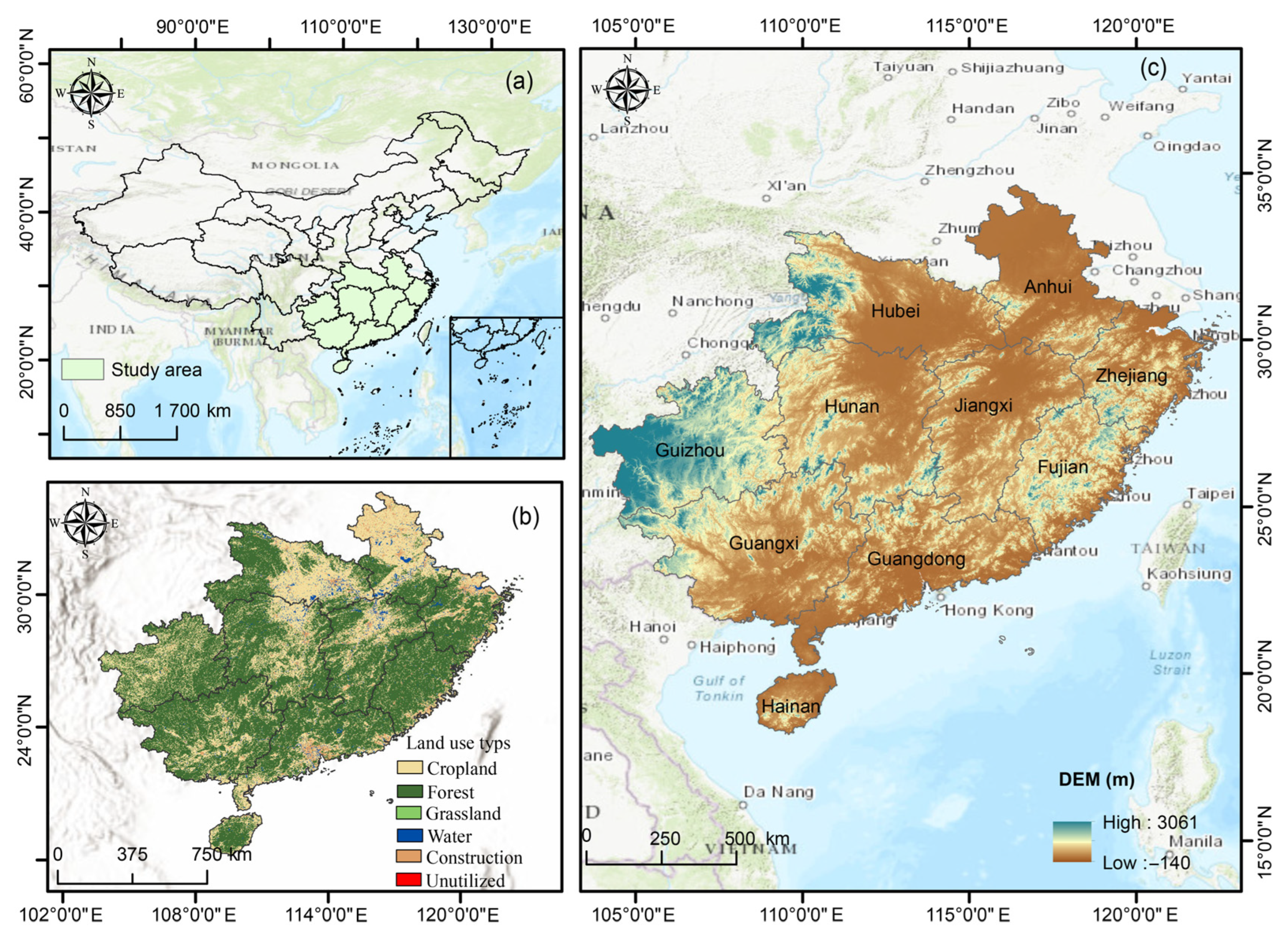
Figure 1. Location and basic characteristics of the study area. (a) Geographical location of the SCFR; (b) land use distribution in the SCFR; (c) DEM of the SCFR. SCFR, China’s Southern Collective Forest Region; DEM, digital elevation model.
Forests 17 00501 g001
Figure 2. Research framework of this study. The framework comprises three components: (I) data collection, including land use/cover, socio-economic, and natural environmental data for 2000–2023; (II) ESV quantification and spatiotemporal analysis using the equivalent factor method, standard deviational ellipse (SDE), and Moran’s I index; and (III) driving mechanism analysis using a multi-model approach, incorporating the XGBoost–SHAP model, GTWR model, and PLS-SEM. ESV, ecosystem service value; SDE, standard deviational ellipse.
Forests 17 00501 g002
Figure 3. Spatiotemporal patterns of land use change in the SCFR from 2000 to 2023: (a) spatial distribution of land use types in different years; (b) area proportions of different land use types; (c) land use transition matrix during 2000–2023. SCFR, China’s Southern Collective Forest Region.
Forests 17 00501 g003
Figure 4. Changes in ESV for different land use types in the SCFR from 2000 to 2023. ESV, ecosystem service value; SCFR, China’s Southern Collective Forest Region.
Forests 17 00501 g004
Figure 5. Spatial distribution of ESV in the SCFR from 2000 to 2023. ESV, ecosystem service value; SCFR, China’s Southern Collective Forest Region.
Forests 17 00501 g005
Figure 6. Movement of the ESV centroid and standard deviation ellipse from 2000 to 2023. ESV, ecosystem service value.
Forests 17 00501 g006
Figure 7. LISA cluster diagram of ESV in the SCFR from 2000 to 2023. LISA, Local Indicators of Spatial Association; ESV, ecosystem service value; SCFR, China’s Southern Collective Forest Region.
Forests 17 00501 g007
Figure 8. Relative importance of driving factors influencing ESV based on the XGBoost-SHAP model. POP, population density; LUI, land use intensity; NI, nighttime light index; GDP, gross domestic product; NPP, net primary productivity; DEM, digital elevation model; NDVI, normalized difference vegetation index; Tem, temperature; Pre, annual precipitation; ESV, ecosystem service value.
Forests 17 00501 g008
Figure 9. SHAP dependence plots illustrating the effects of driving factors on ESV in the SCFR from 2000 to 2023. ESV, ecosystem service value; SCFR, China’s Southern Collective Forest Region.
Forests 17 00501 g009
Figure 10. Temporal trends of GTWR coefficients. POP, population density; LUI, land use intensity; NI, nighttime light index; GDP, gross domestic product; NPP, net primary productivity; GTWR, geographically and temporally weighted regression.
Forests 17 00501 g010
Figure 11. Spatial distribution of GTWR coefficients. POP, population density; LUI, land use intensity; NI, nighttime light index; GDP, gross domestic product; NPP, net primary productivity; GTWR, geographically and temporally weighted regression.
Forests 17 00501 g011
Figure 12. Causal pathways and effects of socio-ecological factors on ESV. (a) Pathways and intensities of factors influencing ESV; (b) Direct and indirect effects of factors influencing ESV. POP, population density; GDP, gross domestic product; NPP, net primary productivity; DEM, digital elevation model; NDVI, normalized difference vegetation index; Pre, annual precipitation; ESV, ecosystem service value.
Forests 17 00501 g012
Table 1. Ecosystem service value coefficients for different land use types in the SCFR (CNY·ha−1).
Types of Ecosystem ServiceClassificationCroplandForestGrasslandWaterConstruction LandUnutilized Land
Provisioning serviceFood production2615.97597.77552.391550.6400
Raw material production580.011373.09812.81864.100
Water supply−3089.45710.22449.812,878.6200
Regulating serviceGas regulation2106.984515.82856.663160.47047.35
Climate regulation1100.8413,511.97551.996971.9700
Clean up the environment319.63959.472493.6510,830.830236.74
Hydrological regulation3539.258842.225531.81149,702.15071.02
Supporting serviceSoil conservation1231.045498.273480.073835.18047.35
Maintaining nutrient cycling366.95420.21268.3295.9200
Biodiversity402.465007.043164.4212,334.12047.35
Cultural serviceEsthetics177.552195.761396.767836.07023.67
Note: SCFR, China’s Southern Collective Forest Region.
Table 2. ESV of ecological service functions in the SCFR from 2000 to 2023 (108 CNY).
Types of Ecosystem ServiceClassification2000200520102015202020232000–2023
Provisioning serviceFood production1976.911975.091946.771943.971938.671929.68−47.23
Raw material production1660.141652.651651.911640.61632.281631.13−29.01
Water supply−384.29−385.29−333.04−340.53−387.18−436.8−52.51
Regulating serviceGas regulation5575.335550.735546.015508.865480.585475.04−100.29
Climate regulation13,921.4513,845.213,893.2713,777.9113,697.0213,698.99−222.46
Clean up the environment4424.414405.064426.884393.884342.254304.69−119.72
Hydrological regulation16,246.7116,251.5116,378.8516,322.6115,813.5515,183.1−1063.61
Supporting serviceSoil conservation6106.446075.86086.376039.926004.325999.49−106.95
Maintaining nutrient cycling606.15603.95601.42598.12595.63594.87−11.28
Biodiversity5540.725515.745542.125500.225439.235397.62−143.1
Cultural serviceEsthetics2525.62515.542529.282511.182476.772448.02−77.58
Note: ESV, ecosystem service value.
Table 3. Parameters of the standard deviational ellipse and centroid shift in ESV in the SCFR.
YearSemi-Major Axis (km)Semi-Minor Axis(km)Centroid CoordinatesCentroid Migration Distance/kmAzimuth Angle/(°)Area/km2
Central X (°)Central Y (°)
2000624.55408.49112.9826.9354.98801,430.90
2005624.27410.66113.0226.964.6154.86805,336.72
2010626.63411.74113.0026.924.4354.20810,508.62
2015624.98411.04112.9826.942.8454.09807,005.77
2020625.10410.91112.9326.944.2954.62806,892.17
2023623.80411.79112.8926.924.3755.13806,933.10
Note: ESV, ecosystem service value; SCFR, China’s Southern Collective Forest Region.
Disclaimer/Publisher’s Note: The statements, opinions and data contained in all publications are solely those of the individual author(s) and contributor(s) and not of MDPI and/or the editor(s). MDPI and/or the editor(s) disclaim responsibility for any injury to people or property resulting from any ideas, methods, instructions or products referred to in the content.