


Abstract
The variation in annual cone and seed production was examined for three natural seed stands of Taurus cedar (Cedrus libani A. Rich., Pinaceae), each with distinct structural characteristics, sampled from 35 trees for three consecutive years. Fertility variation (Ψ), estimated by cone (ΨC) and seed (ΨS) yields per tree, was also analyzed to contribute to the management and development of silvicultural practices for the seed stands of the species. Significant differences (p < 0.05) were recorded in cone and seed production across years, between populations, and between trees within a population. Population x year interactions were also significant (p < 0.05), highlighting the importance of seed harvesting year in cone collection. Fertility variation in cones and filled seeds showed only small deviation [ΨC = 1.10 (91% of census number)–1.71 (59%), Ψs = 1.25 (80%)–1.71 (59%)] among the seed stands in different years, except ΨS = 2.38 (42%) in a population in one year. The cone and seed fertility were at acceptable levels for an ideal natural population (Ψ ≤ 3). Figures of parental balance curves showed that the contribution to the gamete gene pool was much closer to equal for cone production across the years than for filled seed production in both individual stands and pooled stands, suggesting that the number of cones is a good indicator of overall seed production. Difference in gene diversity (GD) was 0.005 from individual year (GD = 0.992 and 0.993) to pooled years of the populations (GD = 0.997 and 0.998) for both cone and seed yields, while it was higher among years within population (e.g., 0.017 for cone yield and 0.026 for seed yield in a population).
1. Introduction
Taurus cedar (Cedrus libani A. Rich., Pinaceae), also called the cedar of Lebanon, can grow up to 50 m in height and 2.5 m in diameter, with some growing even bigger in old forests and monumental forests over 1000 years old and occurring in various natural ecological conditions, mainly between 800 m and 2100 m asl [1,2]. Taurus cedar is an important forest tree species in its native habitat range, and is an important exotic species in Bulgaria [3], Argentina [4], Italy [5], Iran [6], and France [7]. It is valued for timber; resin production from its seeds, cones, and wood; landscape purposes; and socio-cultural importance (i.e., ethnobotany, symbol of the Lebanese flag). Natural forests of the species occur in the Taurus Mountains in southern Türkiye, with remnant populations in Lebanon and Syria [1,2].
Taurus cedar has been widely used in afforestation, reforestation, and restoration practices in Turkish forestry. Over the past decade, its distribution area has increased from 463,521 ha to 580,515 ha (of which 42.8% was unproductive) through seeding and planting practices [8]. A total of 60 million seedlings were produced from 20 tons of seed harvested from trees selected phenotypically in 21 seed stands (3304.2 ha) identified by the General Directorate of Forestry [8,9]. There are seven seed orchards (46.4 ha) that are still juvenile [8,9] and not used yet for seed production. It is therefore important to estimate long-term fecundity, fertility variation, and genetic parameters to manage seed stands for the seed production of C. libani.
The species. C. libani generally bears cones by 30 years old in natural stands [10]. Male strobili appear in July and elongate 3–5 cm in August, while female strobili can be seen in September, depending on location and altitude, in C. libani. The female strobili convert to brown mature cones of 8.46 cm length and 4.9 cm width [11,12]. The opening of the cone scales begins in October, and seed dispersal occurs 25–26 months after fertilization [2]. Seed dispersal starts by the end of November and continues during the winter in natural stands. However, seeds of 23–24-month-old cones, collected in August, also have a high germination rate [11]. The frequency of good seed years in this species is generally two to three years and varies with biological characteristics, stand structure (i.e., tree density, crown closure), altitude, and related parameters such as edaphic and climatic [12,13]. However, the occurrence of good seed years is also highly variable between locations, ranging from intervals of two years to three or even six years [2,11]. The cone and seed yields also vary among provenances of C. libani [11,14,15].
Fertility variation (Ψ) is defined as the difference in the ability to produce progeny (i.e., reproductive success) among individuals [16]. Fertility variation is commonly estimated based on pollen, strobili, flower, cone, fruit, and seed production [17,18,19], and it approaches 1 when individuals contribute equally to the gamete gene pool of a population. It is used for various purposes in plant science, such as genetic management, breeding, population, and species conservation [20,21,22]. Although fertility variation and cone and seed yields have been studied in natural populations of C. libani [23] using short-term data, annual variation in cone and seed yields and related parameters have not been examined in detail using long-term data for this species.
This study aims to (i) assess annual variation in cone and seed yields and associated parameters like fertility variation among seed trees and gene diversity of seed crops in seed stands of Cedrus libani, (ii) compare these patterns across three consecutive years in three seed stands with different silvicultural characteristics, and (iii) provide recommendations for the cone harvest strategy and management of the seed stands.
2. Materials and Methods
2.1. Estimation of Parental Cone and Seed Production
Mature cones of Taurus cedar were collected during October for three consecutive years (2023–2025) from three seed stands where the seed harvesting area was selected phenotypically from natural forests in the largest natural distribution range in the Mediterranean region of Türkiye (Table 1). Although the seed stands occur at the same altitude, they exhibit distinct structural characteristics like differences in tree age, height, and stem density per hectare (Table 1) [9]. Thirty-five trees that were at least 100 m apart [23,24], with mature cones, were selected phenotypically (i.e., tree height, diameter at breast height, stem straightness) [25] from each seed stand. The total number of mature cones was counted visually in the same selected and marked trees during the study period.
Table 1.
Geographic information (latitude, longitude, altitude), age, tree height, size, stand density, and soil type of the seed stands (populations P1, P2, and P3) of Cedrus libani.
Average temperatures (°C) were 12.4, 11.6, and 14.4, while annual precipitation (mm = kg/m2) was 448.7, 456.9, and 336.1 for populations (i.e., seed stands) P1, P2, and P3, respectively, during the study period [26].
The average number and percentage of filled seeds per cone were calculated from four healthy cones harvested from the four directions of each tree before the opening of the cone scales. The cones were stored (at about 20 °C) indoors, with seed extraction occurring after two weeks. All cones were thoroughly dissected to count the number of seeds produced per cone. The cutting test method was used for assessing whether the seeds were filled or empty/damaged [27]. The average number of filled seeds per tree was estimated by the average number of filled seeds/cone multiplied by the number of mature cones per tree.
The parental balance curves were plotted as the cumulative proportion of reproductive output (e.g., cones, seed) against the cumulative proportion of parental seed trees [28,29]. The curves were used to identify highly fertile, underperforming, or infertile trees to guide the management of seed stands to ensure maximum genetic diversity, which is crucial for establishing resilient forests.
2.2. Data Analysis
The differences among populations and among years for the cone and seed characteristics were calculated by the following model of ANOVA [30]:
where Yijk is the observation from the kth tree of the jth stand in the ith year, μ is the overall mean of a characteristic, Fi is the effect of the ith year, B(F)j(i) is the effect of the jth population in the ith year, and eijk is the random error.
Differences between the seed trees in a cone and the seed yield per year in a stand were also compared using the following model of one-way analysis of variance:
where Yij is the observation from the ith tree of the jth stand, μ is the overall mean of the cone or seed yields, Pi is the yield of the ith tree, and eij is the random error.
The fertility variation (also known as the sibling coefficient, Ψ) among seed trees was estimated based on the proportion of cone and filled seed/tree (ΨC & ΨS), representing the total contribution as zygotic parents within the population for the years [31], as
where Conei and Seedi represent the cone and seed fertility (relative proportion of cone and seed production in the seed stand) of the ith tree, and CVC and CVS stand for the coefficients of variation in cone and seed production, respectively.
The effective number of parents for cone (NP(C)) and seed (NP(S)) production was calculated based on the fertility variation (ΨC & ΨS) and the census number (N) of seed trees, respectively [32], as
The effective number of parents (NP(C) & NP(S)) is also related to gene diversity (GD) for cone and seed production (GDC & GDS) according to Lindgren et al. [33] and Lindgren and Mullin [34], and is calculated as
3. Results
3.1. Cone and Seed Productions, and Parental Balance Curve
Cone and seed production showed variation between populations (seed stands) across years, and also between trees within populations (Table 2). The reproductive output increased with stand age but showed a negative relationship with stand density (see Table 1 for details of the stand). Among the seed stands, the cone production per tree, filled seeds per cone, and total filled seeds per tree were highest in the oldest stand (145 years), P3, with the lowest stocking (450 trees ha−1).
Table 2.
Mean, coefficient variation (CV), and range for the characteristics in the populations (P1, P2, and P3) during the study period (2023–2025).
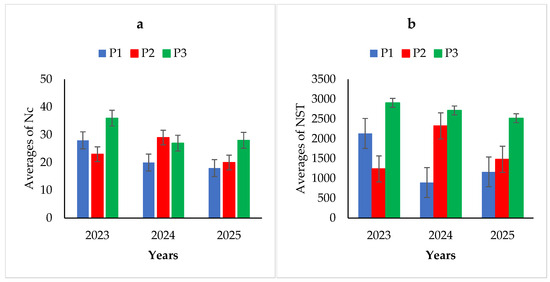
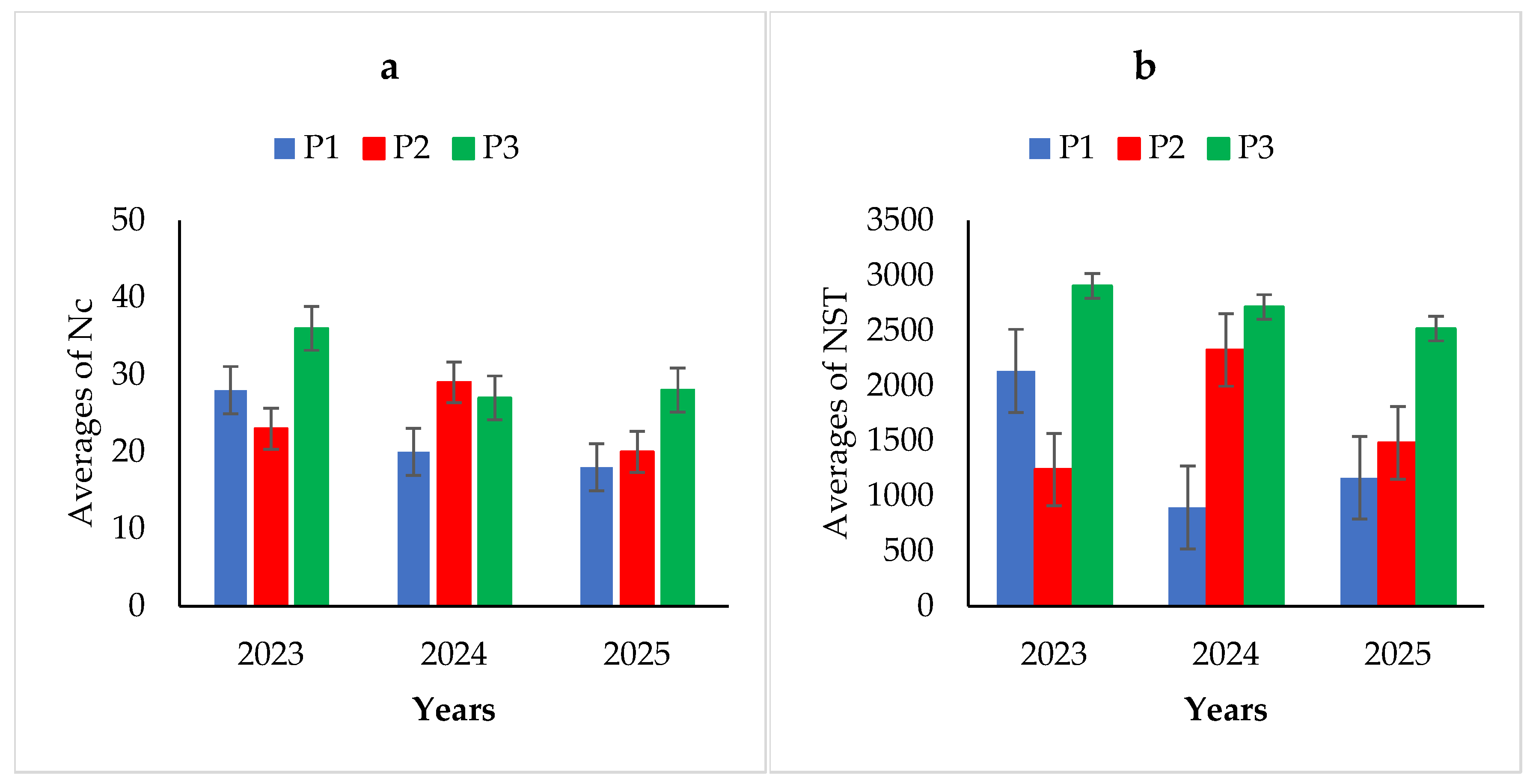
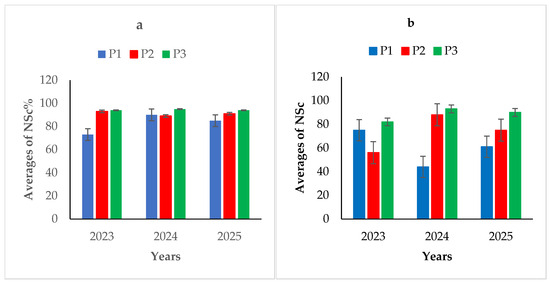
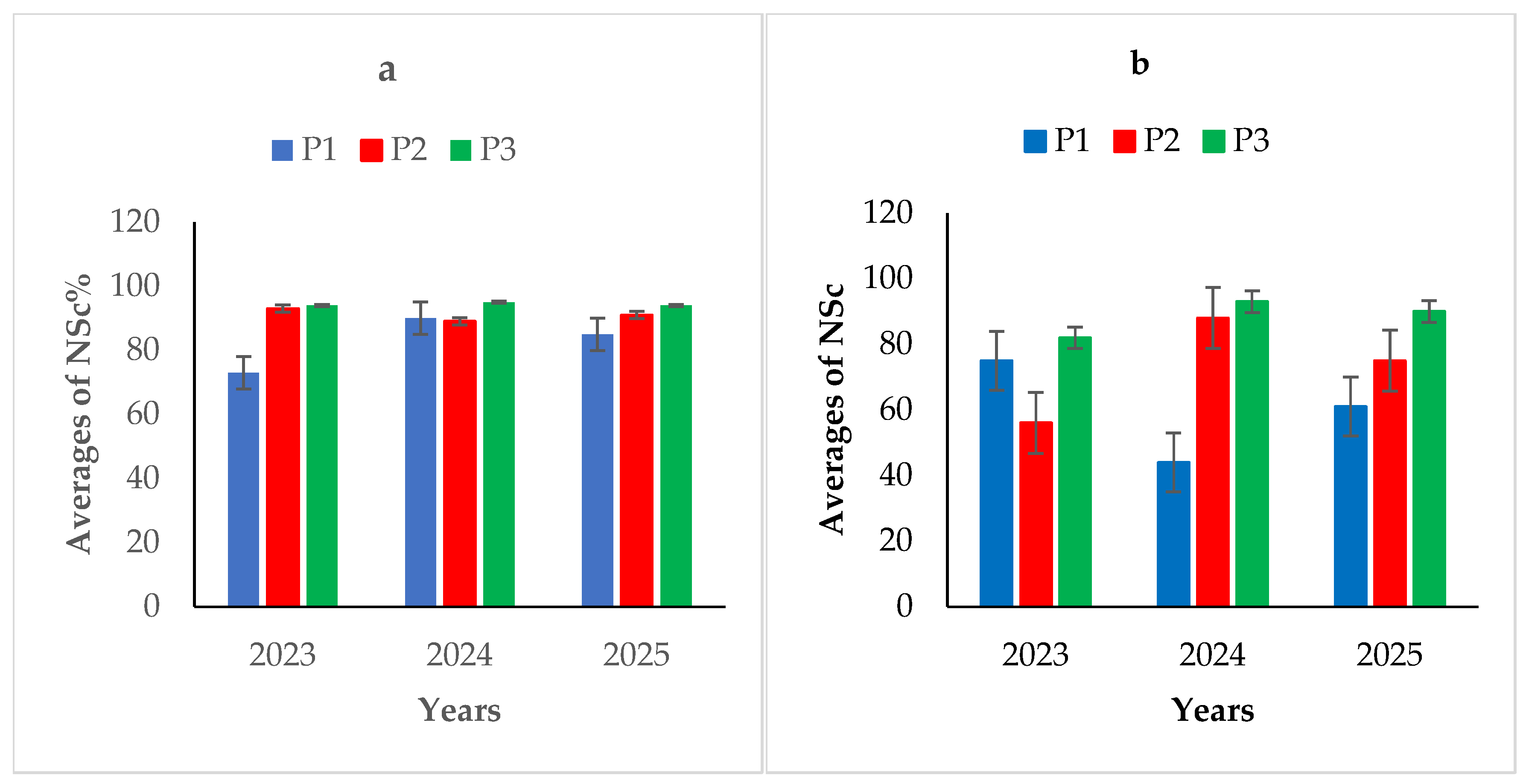
The highest cone production (NC) was recorded in P3 in 2023, while the lowest was observed in P1 in 2024. Similarly, the percentage of filled seeds per cone (NSC%) and the total number of filled seeds per tree (NST) were also the highest in P3 in 2023 (Table 2, Figure 1 and Figure 2). All cones from the P3 seed stand had 100% filled seed production in 2023 (149% higher than the lowest value recorded in P1 in 2025). The percentage of filled seeds per cone (NSC%) ranged from 73% in P1 in 2023 to 95% in P3 in 2024 (Table 2).
Figure 1.
Number of cones (NC) (a) and number of filled seeds per tree (NST) (b) in the populations (P1, P2, and P3) of C. libani during the study period (2023–2025).
Figure 2.
The percentage of filled seeds per cone (NSC%) (a), and number of filled seeds per cone (NSC) (b) in the populations (P1, P2, and P3) of C. libani during the study period (2023–2025).
In the year 2023, the three seed stands had the highest pooled mean number of cones (29) and the filled seeds per tree (2094), while the percentage of filled seeds per cone (NSC%) and number of filled seeds per cone (NSC) were the lowest, i.e., 87% and 71%, respectively (Table 2, Figure 1 and Figure 2).
There were significant differences (p < 0.05) in cone production and seed yield per tree, whereas the effect of year was significant only for the number of cones (NC) and the percentage of filled seeds per cone (NSC%) (Table 3). Population x year interactions were significant (p < 0.01 or p < 0.05) for the reproductive output (Table 3).
Table 3.
Analysis of variance (ANOVA) for the characteristics among years and populations.
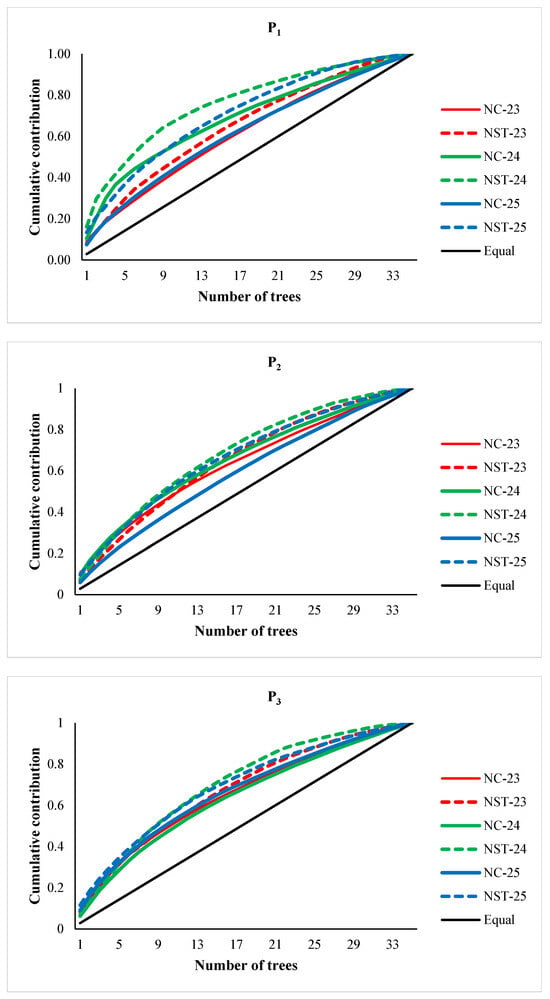
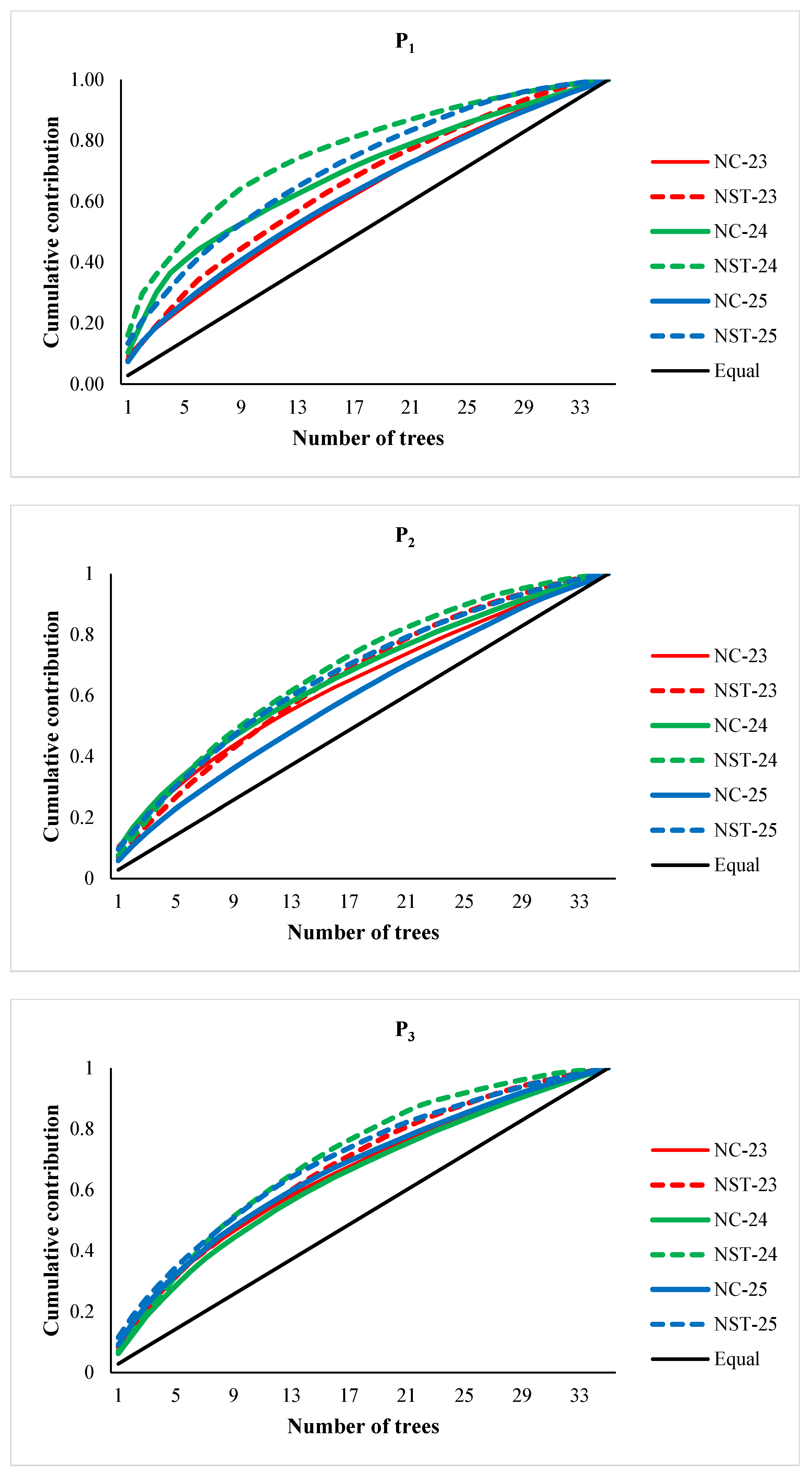
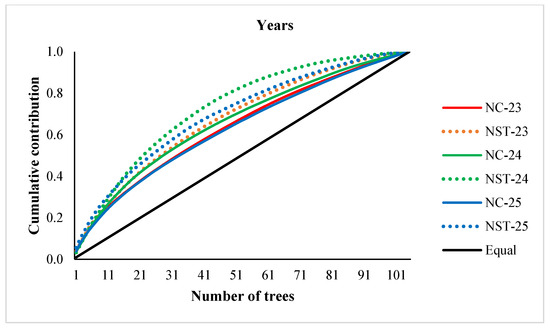
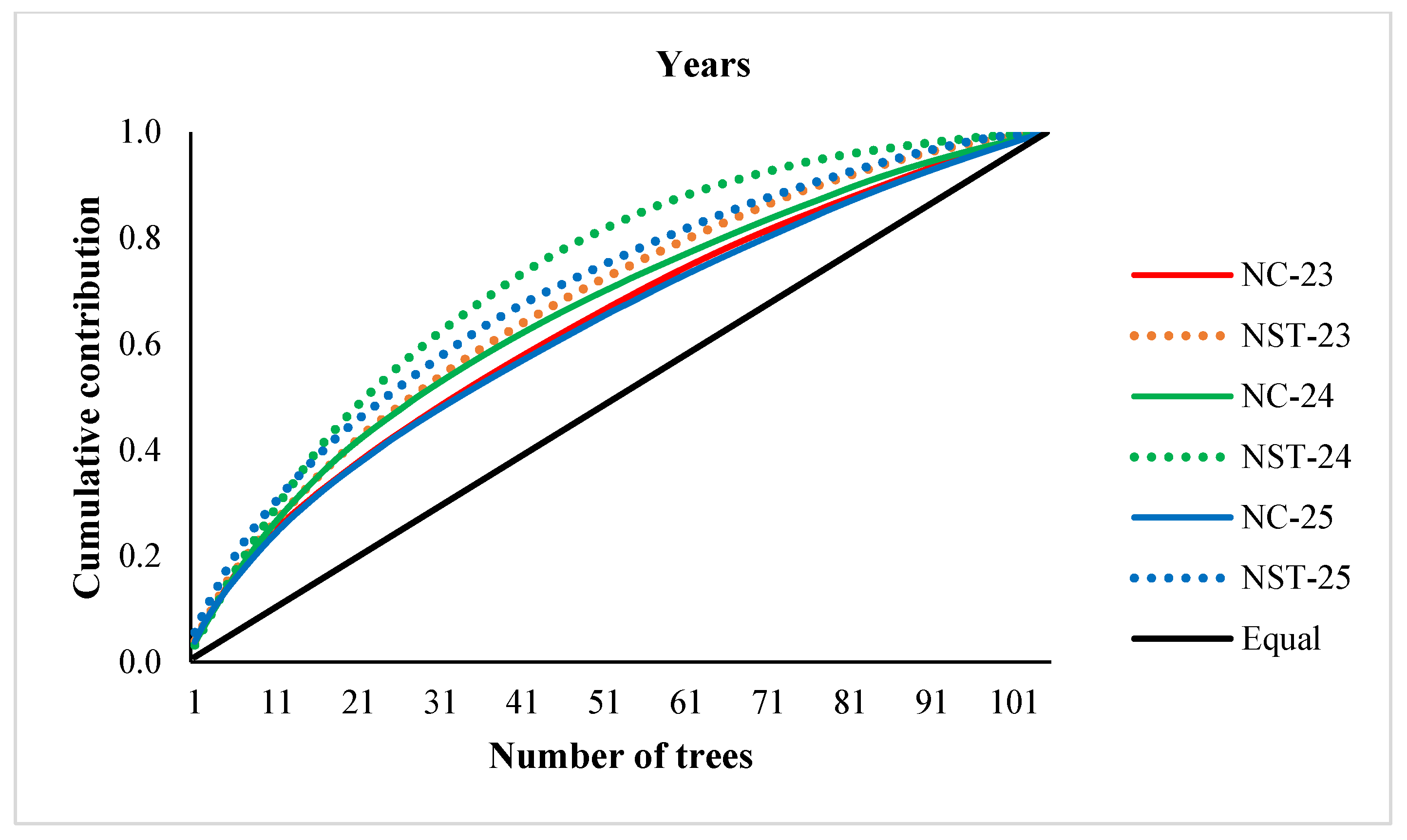
The parental balance curves in P1 showed more deviation from the equal contribution for cone and seed characteristics compared to the stands of P2 and P3 (Figure 3). The observed parental balance curves of all stands pooled for the number of cones (NC) and filled seeds per tree (NST) did not deviate substantially from the equal production line, while they showed differences for the individual seed stands (Figure 3 and Figure 4). For instance, the cone production over the years for pooled populations was much closer to having an equal contribution to the gamete gene pool than that of filled seeds (Figure 4).
Figure 3.
Parental balance curves for cone number (NC) per tree, and total number of filled seeds per tree (NST) in the populations (P1, P2, and P3) of C. libani during the study period (2023–2025).
Figure 4.
Parental balance curve in the bulked individuals and years of the three C. libani seed stands for cone number (NC) per tree, and total number of filled seeds per tree (NST) during the study period (2023–2025) of the three seed stands.
3.2. Fertility Variation, Effective Number of Parents, and Gene Diversity
The fertility variation in cone (ΨC) and filled seed (ΨS) did not vary substantially among populations across years, nor across years within the population (Table 4). For instance, the pooled-year seed fertility (ΨS) in P2 was 1.46 (NP(S) = 72.0, 69% of census number in the population), ranging from 1.25 (28.0, 80% in year 23) to 1.38 (25.4, 73%) in year 24. For the data pooled across years and populations, the ΨC values were 1.36 (231.5, 74% of the census number in the year 23), 1.32 (79.6, 76% in year 25), and 1.42 (74.0, 71% in year 24) (Table 4).
Table 4.
Fertility variation among seed trees in cone (ΨC) and filled seed (ΨS) fertility, effective number of parents for cone (NP(C)) and filled seed (NP(S)), and gene diversity for cone (GDC) and seed (GDS) in the populations (P1, P2, and P3) during the study period (2023–2025).
Depending on fertility variation, the effective number of parents and gene diversity of the seed crop varied across years and populations, and across years within populations (Table 2 and Table 4).
In P2, the effective number of parents NP(C) was 18% higher in the highest crop year (year 24), compared to the poorest seed year (year 25), while for NP(S), it was 7% lower in the highest crop year (year 24) than the poor seed year (year 23) (Table 4). Similar results were also obtained for the other populations. NP(C) decreased by 2% and NP(S) increased by 9% in the populations between the highest (year 23) and lowest (year 25) production years. The results indicated the importance of selecting the year for seed harvesting.
The highest gene diversity (GD) was estimated for pooled seed crops of all populations (0.998 for GDC and 0.997 for GDS) and for different years within population for both cone (GDC) and seed (GDS) than for the individual population and year (Table 4). As seen from Table 4, the lowest gene diversity (GDC = 0.976 and GDS = 0.966) was in year 23 for P1, which increased to 0.993 (GDC) and 0.992 (GDS) when the seed crops of the population from different years were analyzed together.
4. Discussion
The present study demonstrates pronounced variation in cone and seed production between individual trees and among seed stands across years and individual trees, highlighting the complex and heterogeneous nature of reproductive output. The variability at the population (seed stand) level and within populations across years indicates that several stand-level characteristics and temporal factors influence the reproductive potential of trees. The reproductive characteristics of forest tree species are influenced by many biotic (e.g., species, tree growth, age, tree density, and crown closure) [35,36,37] and abiotic factors (e.g., light, temperature, year, humidity, and site quality) [25,38,39], as well as a combination of the two [24,40,41] or forestry practices [42].
In natural C. libani stands, good seed years occur approximately every two to three years [1], and the position of individual trees within the stand can also affect species reproductive output [11]. It has been reported that even during good seed years, not all trees in a population are expected to produce abundant seed crops [11]. Similar variation in cone and seed production was reported in C. libani by Bilir et al. [23], with higher cone (90) and seed production (5321) per tree in two populations compared to the present study (33 and 3115, respectively).
The reproductive output increased with stand age and exhibited a clear negative relationship with stand density. The consistently higher cone production per tree, filled seeds per cone, and total filled seeds per tree observed in the P3 seed stand throughout the whole study period suggest that older seed stands with lower tree density provide more favorable conditions for reproductive development. Reduced competition for resources like light, water, and nutrients enhances individual tree vigor in low-density stands, which supports increased reproductive investment. The high reproductive output of the P3 seed stand, particularly during 2023, underscores the importance of stand structure in determining fecundity. Previous studies have reported that tree size, age, and provenance could impact cone and seed yields [11] and the percentage of filled seed and germination [14,15,43].
Interannual variation was also substantial, with the highest cone and filled seed production per tree in the three seed stands in 2023. However, this year was also characterized by a lower proportion of filled seeds per cone, indicating a trade-off between cone output and seed quality.
The significant population × year interaction (p < 0.05) observed for reproductive output (Table 3) underscores the importance of the environmental conditions, which may vary from ‘year to year’ within a forest stand, and the ‘temporal variation’ that affects the reproductive performance of populations [32]. Multiplying the tree density (Table 1) and total number of filled seeds per tree (NST) (Table 2), the number of filled seeds was estimated to be 1.119,200, 1.093,200, and 1.220,850 per hectare, assuming the seed productivity of all trees in the populations P1, P2, and P3, respectively. Given that 13 kg seeds ha−1 are required at a spacing of 1.5 m × 3 m (~2222 seedlings ha−1) for reforestation, afforestation, and restoration practices for C. libani [13], the abundant seed production of particular trees or stands will skew the representation (Table 2) in future planting. It is also important to collect as much seed as possible from low-flowering trees. Guidelines and training for simple, cost-effective seed harvesting, the selection of mother trees, and the management of seed stands are necessary for abundant seed collection from a large number of superior parent trees.
Coefficients of variation in cone and seed production (Table 2) were at acceptable levels for an ideal natural population (CV < 140%) [44]. However, cone output gives a more balanced picture of the contribution to the gamete gene pool than the number of filled seeds (Figure 3 and Figure 4). Genetic contributions can be explained by the parental balance curve, and the cumulative percentage curve is often used to quantify fertility variation in forest populations [17,29]. Unequal contributions of seed parents to the gamete gene pool were not pronounced, indicating that they can be balanced through silvicultural practices, such as tending or equal seed collection from parent trees.
The parental balance curve helps to assess the gene diversity of the resulting seed crop. The sibling coefficient (Ψ) is a related measure that quantifies this variation in fertility, indicating greater disparity in contribution with greater deviation of values from 1. This study clearly shows that gene diversity can be improved when the cones (seeds) are pooled across seed stands and/or collection years (Figure 3 and Figure 4).
Variation in fertility (cone ΨC, and filled seed ΨS) among populations across years (Table 4) was within the acceptable limits (below the threshold of Ψ ≤ 3) for natural stands [35]. However, the results indicate the importance of identifying good seed stands and the seed harvesting year. Loss of gene diversity can be mitigated by pooling seeds from different populations and years to support afforestation practices in adaptive areas, thereby enhancing the resistance to biotic and abiotic stresses. This approach relies on the greater adaptability of seed crops due to higher gene diversity when seeds are mixed from different native regions of the species [45]. However, we suggest that a balance between the effective number of parents (gene diversity) and the number of populations and/or years should be carefully considered to ensure a sustained seed supply from the seed stands of Taurus cedar. The long-term seed storage capacity of the species, up to 5–6 years [11,43], could be considered for this purpose.
5. Conclusions
Low fertility variation across consecutive years in the three seed stands indicates that abundant seed collection is possible annually for afforestation with this species. Additionally, the option of mixing seed from different seed stands and harvest years would ensure adequate diversity in the planting stock even during low-flowering years. Marking good parent trees and collecting seeds with parent identity would help to maintain the effective population size of seed crops. As seed output increases with reduced stocking and the seed germination rate differs only marginally, it would be worth culling inferior trees to improve the genetic quality and seed output. Simplifying the guidelines and harvest methods would help to provide easy and cheap selection, management, and harvesting practices for forest managers. Proper records of the seed collection area and year should be maintained to ensure the genetic quality of the seed crop. Since the CVs of cone and seed output are at acceptable levels, it would be easy to quantify the seed output by making a quick estimate of the cone production per tree.
Author Contributions
N.B. conducted data collection. K.-S.K., M.T. and N.B. conducted data validation. K.-S.K. and N.B. performed data analysis. M.T., K.-S.K. and N.B. prepared the draft manuscript, figures, and tables. M.T., K.-S.K. and N.B. conducted review and editing. All authors have read and agreed to the published version of the manuscript.
Funding
This study was carried out with the support of ‘R&D Program for Forest Science Technology (Project No. RS-2024-00404133)’ provided by Korea Forest Service (Korea Forestry Promotion Institute).
Institutional Review Board Statement
Not applicable.
Data Availability Statement
The data presented in this study are available on request from the corresponding author.
Acknowledgments
The authors would like to thank the anonymous reviewers who made valuable comments that helped to improve the manuscript. The authors are also thankful to the graduate students and the regional forest directorate in Türkiye for their help in data collection. The authors would like to acknowledge Mohan Varghese from India for his helpful comments on the manuscript.
Conflicts of Interest
The authors declare no conflicts of interest.
References
- Boydak, M. Regeneration of Lebanon cedar (Cedrus libani A. Rich.) on karstic lands in Turkey. For. Ecol. Manag. 2003, 178, 231–243. [Google Scholar] [CrossRef] [Scilit]
- Boydak, M.; Çalıkoğlu, M. Biology and Silviculture of Cedar of Lebanon (Cedrus libani A. Rich.); Ministry of Forestry Publication: Ankara, Turkey, 2008. [Google Scholar]
- Tsanov, T.S.; Naidenov, Y.; Kalmoukov, K. Le Cedre (Cedrus) en Bulgarie Etat et Perspectives. In Proceedings of the International Cedar Symposium, Ankara, Turkey, 22–27 October 1990; pp. 308–324. [Google Scholar]
- Ottone, R.J.; Carloni, C. Aspects of cedar cultivation in the Argentine Republic. In Proceedings of the International Cedar Symposium, Ankara, Turkey, 22–27 October 1990; pp. 260–265. [Google Scholar]
- Fusaro, E. Characteristics and distribution of cedar in Italy. In Proceedings of the International Cedar Symposium, Antalya, Turkey, 22–27 October 1990; pp. 273–285. [Google Scholar]
- Assadullahi, F.; Hedayati, M.A. Cedrus plantation experiments in Iran. In Proceedings of the International Cedar Symposium, Ankara, Turkey, 22–27 October 1990; pp. 266–273. [Google Scholar]
- Bariteau, M.; Pommery, J.; Vauthier, D. Adaptation of Cedrus provenances tested in France in comparative plantations. In Proceedings of the Conference of Adaptation and Selection of Mediterranean Pinus and Cedrus for Sustainable Afforestations of Marginal Lands, Mytilene, Greece, 2–6 June 2000; pp. 15–19. [Google Scholar]
- OGM. Forest Inventory of Türkiye; General Directorate of Forestry: Ankara, Turkey, 2025.
- ORTOHUM. Seed Production Areas; Research Directorate of Forest Tree Seeds and Tree Breeding: Ankara, Turkey, 2025. Available online: https://www.ogm.gov.tr/ortohum (accessed on 8 August 2025).
- Anonymous. Nursery Practices; General Directorate of Forestry Press: Ankara, Turkey, 1986. [Google Scholar]
- Odabaşı, T. Research on Cone and Seed Characters of Cedrus libani; General Directorate of Forestry Press: Ankara, Turkey, 1990. [Google Scholar]
- Boydak, M. Ecology and Silviculture of Cedar of Lebanon (Cedrus libani A. Rich.) and Conservation of Its Natural Forest; Ministry of Forestry Publication: Ankara, Turkey, 1996. [Google Scholar]
- Saatçioğlu, F. Silviculture-I; Forestry Faculty of Istanbul University Press: Istanbul, Turkey, 1976; Available online: https://cerrahpasa.iuc.edu.tr/ (accessed on 5 June 2025).
- Dirik, H. Effect of osmotic water stress on germination of Lebanon Cedar (Cedrus libani A. Rich.) seeds from the provenances of Turkey. Ann. For. Sci. 2000, 57, 361–367. [Google Scholar] [CrossRef] [Scilit]
- Ayrancı, A.; Öner, M.N. Effect of some pretreatments of seeds on germination of different Taurus cedar (Cedrus libani A. Rich.) origins. Anatol. J. For. Res. 2019, 5, 61–70. [Google Scholar]
- Bila, A.D. Fertility Variation and Its Effects on Gene Diversity in Forest Tree Populations. Ph.D. Thesis, Swedish University of Agricultural Science, Umeå, Sweden, 2000. Available online: https://www.upsc.se (accessed on 25 November 2025).
- Griffin, A.R. Clonal variation in Radiata pine seed orchards. I. Some flowering, cone and seed production traits. Aust. For. Res. 1982, 12, 295–302. [Google Scholar]
- Roeder, K.; Devlin, B.; Lindsay, B.G. Application of maximum likelihood methods to population genetic data for the estimation of individual fertilities. Biometrics 1989, 45, 363–379. [Google Scholar] [CrossRef] [Scilit]
- El-Kassaby, Y.A.; Cook, C. Female reproductive energy and reproductive success in a Douglas-fir seed orchard and its impact on genetic diversity. Silvae Genet. 1994, 43, 243–246. [Google Scholar]
- El-Kassaby, Y. Evaluation of the tree-improvement delivery system: Factors affecting genetic potential. Tree Physiol. 1995, 15, 545–550. [Google Scholar] [CrossRef] [Scilit]
- Shea, K.L. Effects of population structure and cone production on out crossing rates in Engelmann spruce and Subalpine fir. Evolution 1987, 41, 124–136. [Google Scholar] [CrossRef] [Scilit]
- Xie, C.Y.; Knowles, P. Male fertility variation in an open-pollinated plantation of Norway spruce (Picea abies). Can. J. For. Res. 1992, 22, 1463–1468. [Google Scholar] [CrossRef] [Scilit]
- Bilir, N.; Novikova, T.P.; Novikov, A.I. Variation in cone and seed productions of Taurus cedar (Cedrus libani A. Rich.) Populations. Geogr. Environ. Sustain. 2025, 18, 63–69. [Google Scholar] [CrossRef] [Scilit]
- Ganatsas, P.; Tsakaldimi, M.; Thanos, C. Seed and cone diversity and seed germination of Pinus pinea in Strofylia Site of the Natura 2000 Network. Biodivers. Conserv. 2008, 17, 2427–2439. [Google Scholar] [CrossRef] [Scilit]
- Zobel, B.J.; Talbert, J. Applied Forest Tree Improvement; John Wiley & Sons: New York, NY, USA, 2003. [Google Scholar]
- MGM. Meteorology of Türkiye; General Directorate of Meteorology: Ankara, Turkey, 2026. Available online: https://www.mgm.gov.tr (accessed on 22 January 2026).
- ISTA. International Seed Testing Association; The International Seed Testing Association (ISTA): Bassersdorf, Switzerland, 2005. [Google Scholar]
- El-Kassaby, Y.A.; Reynolds, S. Reproductive phenology, parental balance and supplemental mass pollination in a Sitka spruce seed orchard. For. Ecol. Manag. 1990, 31, 45–54. [Google Scholar] [CrossRef] [Scilit]
- Chaisurisri, K.; El-Kassaby, Y.A. Estimation of clonal contribution to cone and seed crops in a Stika spruce seed orchard. Ann. Sci. For. 1993, 50, 461–467. [Google Scholar] [CrossRef] [Scilit]
- SAS Institute Inc. SAS/STAT User’s Guide, Release 6.03 ed.; SAS Institute Inc.: Cary, NC, USA, 1988. Available online: https://www.sas.com (accessed on 1 December 2025).
- Kang, K.S.; Lindgren, D. Fertility variation among clones of Korean pine (Pinus koraiensis S. et Z.) and its implications on seed orchard management. For. Genet. 1999, 6, 191–200. [Google Scholar]
- Kamalakannan, R.; Varghese, M.; Park, J.M.; Kwon, S.H.; Song, J.H.; Kang, K.S. Fertility variation and its impact on effective population size in seed stands of Tamarindus indica and Azadirachta indica. Silvae Genet. 2015, 64, 91–99. [Google Scholar] [CrossRef] [Scilit]
- Lindgren, D.; Gea, L.; Jefferson, P. Loss of genetic diversity monitored by status number. Silvae Genet. 1996, 45, 52–59. [Google Scholar]
- Lindgren, D.; Mullin, T.J. Relatedness and status number in seed orchard crops. Can. J. For. Res. 1998, 28, 276–283. [Google Scholar] [CrossRef]
- Kang, K.S.; Bila, A.D.; Harju, A.M.; Lindgren, D. Estimation of fertility variation in forest tree populations. Forestry 2003, 76, 329–344. [Google Scholar] [CrossRef] [Scilit]
- Oktan, E. Impact of thinning levels on cone production in natural stands of Scots pine (Pinus sylvestris L.). BioResources 2026, 21, 3506–3517. [Google Scholar] [CrossRef] [Scilit]
- Almqvist, C. High stand density improves seed production in seed orchards of the masting species Picea abies. Silva Fenn. 2024, 58, 23073. [Google Scholar] [CrossRef] [Scilit]
- Eser, Y. Variation in cone production of Anatolian black pine [Pinus nigra Arnold. subsp. pallasiana (Lamb.) Holmboe] over habitat classes. Biol. Bull. Russ. Acad. Sci. 2024, 51, 121–127. [Google Scholar] [CrossRef] [Scilit]
- Teodosiu, M.; Botezatu, A.; Ciocîrlan, E.; Mihai, G. Variation of cones production in a Silver fir (Abies alba Mill.) clonal seed Orchard. Forests 2023, 14, 17. [Google Scholar] [CrossRef] [Scilit]
- Kaytanlioğlu, E.H.T. Microhabitat-driven variation in fruit yield of Cornelian cherry (Cornus mas L.) in a Mediterranean ecosystem. BioResources 2026, 21, 2948–2959. [Google Scholar] [CrossRef] [Scilit]
- Prescher, F. Seed Orchards—Genetic Considerations on Function, Management and Seed Procurement. Ph.D. Thesis, Swedish University of Agricultural Science, Umeå, Sweden, 2007. Available online: https://pub.epsilon.slu.se/1517/1/FPfin0.pdf (accessed on 15 December 2025).
- Heuchel, A.; Hall, D.; Almqvist, C.; Wennström, U.; Persson, T. Topgrafting as a tool in operational Scots pine breeding. J. For. Res. 2024, 35, 111. [Google Scholar] [CrossRef] [Scilit]
- Takos, I.; Merou, T. Effect of storage conditions and treatment on germination of Cedrus deodara Loud. and Cedrus libani A. Rich. Silvae Genet. 2001, 50, 5–6. [Google Scholar]
- Kang, K.S.; Bilir, N.; Jeon, K.; Kim, Y.-J. Fertility variation and gene diversity in forest populations. Forests 2023, 14, 2172. [Google Scholar] [CrossRef] [Scilit]
- Atalay, I. General Ecological Properties of Natural Occurrence Areas of Cedar (Cedrus libani A. Rich.) Forests and Regioning of Seed Transfer of Cedar in Turkey; General Directorate of Forestry Press: Ankara, Turkey, 1987. [Google Scholar]

Disclaimer/Publisher’s Note: The statements, opinions and data contained in all publications are solely those of the individual author(s) and contributor(s) and not of MDPI and/or the editor(s). MDPI and/or the editor(s) disclaim responsibility for any injury to people or property resulting from any ideas, methods, instructions or products referred to in the content. |
© 2026 by the authors. Licensee MDPI, Basel, Switzerland. This article is an open access article distributed under the terms and conditions of the Creative Commons Attribution (CC BY) license.