


Abstract
Timber sale prices are influenced by multiple tract, product, and transaction characteristics. This study evaluates the effects of species composition, product class, sale method, harvest type, timber quality, and average tree diameter on timber stumpage prices using timber sale records from Alabama between 1 January 2010 and 31 December 2019. Prices were modeled on a per weight unit basis using a generalized linear model with a Gamma distribution and logarithmic link. Results indicate that larger average diameters were consistently associated with higher prices across most product classes. Harvest type also influenced prices, with salvage operations yielding prices approximately 8.3% lower than thinning operations. Timber quality had a moderate effect: good-to-excellent quality timber sold for about 4.8% higher prices than poor-to-fair quality timber. Sale method was an important determinant of price outcomes. Negotiated sales generated significantly lower prices than sealed-bid sales, averaging approximately 17% lower overall. However, interaction analysis revealed that negotiated sales produced higher prices for mixed hardwood sawtimber, likely reflecting the diverse end uses of these products. Regional effects were also evident, with higher prices observed in the southwestern portion of the state, likely due to proximity to the Port of Mobile and associated export markets. These findings highlight the importance of both tract and transaction characteristics in determining timber prices and provide guidance for landowners and forest managers when selecting sale strategies and management practices.
1. Introduction
Forest resources in the United States represent a major component of global timber production. The country is among the world’s leading producers of industrial roundwood, harvesting more than 400 million cubic meters annually and supplying a wide range of forest products, including lumber, wood panels, and pulp and paper products [1]. The southeastern United States accounts for a substantial share of this production due to favorable growing conditions, intensive forest management, and the predominance of private forest ownership [2].
Within this regional context, Alabama is consistently ranked among the leading timber-producing states in the United States. According to the USDA Forest Service Forest Inventory and Analysis (FIA) program, Alabama contains more than 9.3 million hectares of forest land, representing approximately 70% of the state’s total land area [1,3]. Alabama is characterized by exceptional floristic diversity and a wide range of forest types distributed across its physiographic provinces. The state’s forests are dominated by upland and bottomland hardwoods, planted pine, natural pine, and oak–pine forests [3], which together constitute some of the most productive forest ecosystems in the United States.
Annual timber removals in Alabama in 2024 totaled approximately 36 million cubic meters of roundwood, supporting a large and diverse forest products industry that includes sawmills, pulp and paper mills, and wood panel manufacturers [4]. The forest sector is one of Alabama’s most important manufacturing industries, contributing billions of dollars annually to the state economy and supporting tens of thousands of jobs [5]. As a result, efficient timber markets and informed timber sale decisions are essential for sustaining both forest management and the economic viability of the forest products sector.
Forest land ownership patterns strongly influence how timber markets operate in the region. Most forest land in Alabama is owned by a diverse group of non-industrial private forest (NIPF) owners [6]. These landowners are often relatively inexperienced participants in the stumpage market because of the long rotations required to grow timber, the diversity of ownership objectives, and limited market knowledge or technical expertise [7]. Consequently, information asymmetries between buyers and sellers may arise, potentially affecting timber transaction outcomes and stumpage prices.
Because of these concerns, extension service publications throughout the United States have historically advised landowners to avoid negotiated timber sales and instead rely on competitive bidding procedures [8,9,10,11]. Competitive sale formats, particularly sealed-bid auctions, are commonly recommended because they may attract a larger pool of buyers and encourage price competition. For example, Munn and Franklin [12], in their investigation of private forestry consultants and timber sale outcomes in North Carolina, reported that timber sale prices increased by an average of $220 per hectare when tracts were marketed through sealed-bid auctions.
In recent years, however, timber markets have become increasingly dynamic and complex, reflecting evolving contractual requirements, market interactions, and product specifications. Recent research has highlighted the importance of timber sale practices, transaction designs, and consulting forester involvement in influencing price outcomes in southern timber markets [13]. In addition, econometric analyses indicate that timber stumpage prices in the southern United States exhibit regional spillover effects, affirming the interconnected nature of timber markets across states [14].
More broadly, empirical studies of timber markets have demonstrated that stumpage prices are influenced by a variety of factors. For example, sawmills in the southeastern United States have expressed a willingness to pay price premiums for higher quality sawtimber produced through longer rotations and improved forest management practices [15]. Assogba and Zhang [16] found that conservation policies affecting timber supply can influence stumpage price dynamics in southern markets. Other studies emphasize that timber price behavior is shaped by forest product demand, harvest levels, and structural changes in the forest sector [17]. Together, these findings suggest that stumpage prices are determined not only by forest tract or stand attributes, such as species composition, diameter distribution, and timber quality, but also by transaction characteristics, including sale method and harvesting system, and regional market conditions, such as regional supply conditions, government policies, and shifts in processing capacity.
Despite the economic importance of timber harvesting in Alabama and the broader southeastern United States, relatively few studies have jointly examined stand characteristics and transaction attributes using comprehensive sale-level datasets. Understanding these relationships is particularly important in regions where private landowners dominate forest ownership and must periodically decide when and how to market timber.
Therefore, the objective of this study was to analyze and evaluate the factors influencing timber prices in Alabama. Specifically, we have developed an empirical model that integrates species composition, average tree diameter, product class, harvesting method, and sale method attributes. By quantifying the relative importance of these factors, this study provides guidance for landowners, forest managers, and market participants seeking to improve decision-making in timber sales.
2. Materials and Methods
The analysis of our data is based on hedonic pricing theory, which defines the value of a product as an overall function of its attributes [18] and is an approach that has been used extensively in the forestry literature [19,20,21,22,23]. This method is based on the premise that the importance of timber sale characteristics can be defined by regressing sale price on different markets and production factors. The estimated regression coefficient for each variable (characteristic) gives the marginal value of that characteristic to the sale price.
The estimates were obtained from a single model. The statistical model applied was a Generalized Linear Model on a Gamma-distributed response variable:
where
Yi ~ Gamma(k, θ),
Yi is the price of timber per weight unit of record i;
k and θ are the shape and scale parameters of the Gamma distribution, respectively.
Parameter estimation was realized via a logarithm link function, such as:
where
E[Y|γ] = g−1(XB + Zγ) =g−1(η) = μ
g(.) is the natural logarithm link function;
X is a matrix of observable explanatory variables;
B is the vector of parameters to be estimated;
Z is the design matrix of random imputation and county effects;
η is the linear combination of random and fixed effects;
μ is the true mean of the population of timber price per weight unit.
Variables and Data
Empirical data for the study were obtained from Fastmarkets (www.fastmarkets.com/forest-products/wood-products, accessed on 2 February 2024), which includes a member-based subscription service. Timber sales data were voluntarily submitted by buyers and sellers, with no compensation. Submissions were uploaded using a standard questionnaire, and the resulting data can be retrieved in tabular form for several states through queries on their website [24].
We used data recorded and reported for 6476 timber sales from 1 January 2010 through 31 December 2019. The sale data included region of the state where the harvesting track was located, county, date of the sale, submitting entity (e.g., TIMO, consultant, dealer), role at the sale (seller, buyer), business type (e.g., corporation, TIMO, forest products company, logger, dealer/broker), total price of the sale, area of the tract, sale type (auction, negotiated, sealed bid), harvesting method, payment (lump sum, pay-as-you-cut), logging conditions (the length of the time in months that the tract can be harvested during a year grouped by three-month periods), regeneration (natural, planted), product species, product category, timber quality, cruise volume/weight, product price per ton, and average diameter at breast height, and the price of the bids.
The data used in this study reflect market conditions prior to the COVID-19 pandemic. Because the pandemic introduced substantial volatility into timber markets, these data represent the most recent period for which complete and internally consistent information was available across all product categories and sale methods. Importantly, the structural determinants of relative price variation, including tract characteristics, species composition, product classes, harvesting systems, and sale methods, have remained stable over time. Therefore, although absolute price levels may differ in more recent years, the relationships examined in this study are expected to remain robust.
Because this study focuses on timber markets in the United States, all data were processed and reported in English units to align with conventions commonly used by American landowners, consulting foresters, and timber buyers. Presenting results in the units routinely used in U.S. economic analyses facilitates interpretation by the primary audience and maintains consistency with the original data sources. For the benefit of international readers, the corresponding conversions are 1 ton = 907.18 kg, 1 inch = 2.54 cm, and 1 acre = 0.405 hectare.
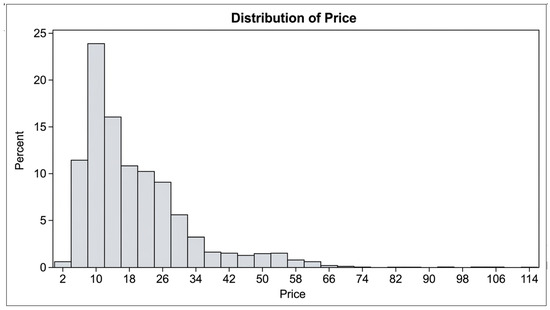
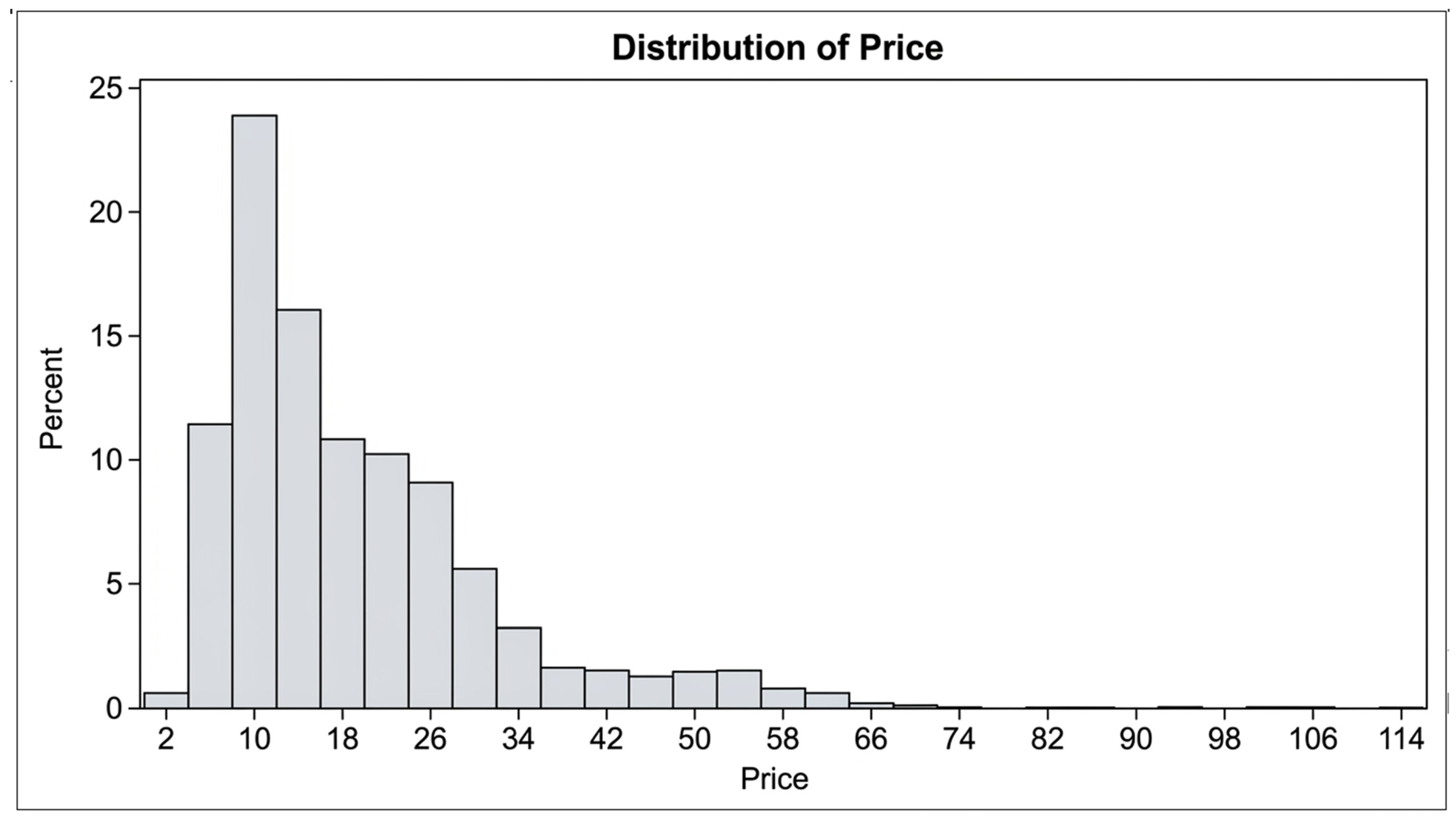
The response variable, timber price, was defined and reported as the price of a timber product at the stump in US dollars per ton. Only 9 sales were reported in MBF (thousand board feet), which were converted to tons accordingly. Timber price data were trimmed to 115 dollars per ton to exclude non-representative values of the response variable; therefore, the domain of the price in the model data is {0, 115}. Its distribution in quantiles and its histogram are given in Table 1 and Figure 1, respectively. It was expected that this variable would have a non-symmetrical distribution on a positive domain.
Table 1.
Quantiles of the response variable, timber price per ton.
Figure 1.
Histogram of the distribution of the response variable, timber price in USD per ton.
Timber prices can be affected by market factors, such as location, species, product type, sale method, and land ownership, as well as production factors, such as tract attributes, harvesting method, timber volume, and average diameter. The definitions, ranges, and possible values of the explanatory variables we identified and considered relevant to the response variable are as follows.
For each sale, product species were reported into the following classes based on group species:
- Hardwood—Mixed;
- Oak—Red (Quercus spp., section Lobatae, mainly Q. falcata Michx. and Q. rubra L.);
- Oak—White (Quercus spp., section Albae, mainly Q. alba L.);
- Pine (Pinus spp.);
- Yellow Poplar (Liriodendron tulipifera L.);
- Softwood—Mixed.
Meanwhile, product category was reported based on specifications of the receiving mill as one of the following nine:
- Chip-N-Saw (dbh 8–12 in, some mills up to 14 in);
- Chip-N-Saw—Small (Canter/Super Pulp) (dbh 8–11 in);
- Plylogs (dbh ≥ 12, logs with a top diameter ≥ 10 in);
- Poles (dbh ≥ 14 in);
- Poles—Small (dbh 10–12 in);
- Pulpwood (dbh ≥ 5 and trees not suitable for other products);
- Sawtimber (dbh ≥ 14 in);
- Sawtimber—Small (dbh 12–14 in);
- Topwood (top diameter ≥ 4 in, primary pulpwood, sometimes biomass or fuel chips).
The state of Alabama was divided into five geographic regions, as defined by the Alabama Department of Transportation [25]:
- East Central;
- North;
- Southeast;
- Southwest;
- West Central.
Sale method defines the way transactions were concluded:
- Negotiated sales;
- Sealed bid sales.
In negotiated sales, the seller negotiates directly with one buyer or a small group of buyers. On the other hand, in sealed bid sales, buyers submit confidential bids by a specified deadline, and the seller opens all bids simultaneously.
Timber quality was classified into three levels based on the submitter’s judgment:
- Poor to Fair;
- Average;
- Good to Excellent.
Harvesting method was one of the following:
- Clearcut;
- Salvage;
- Thinning.
In the questionnaire, thinning encompassed all harvesting methods that leave residual trees within a stand or tract, including commercial thinning, shelterwood cuts, and group-selection cuts. As a result, we were unable to distinguish true thinnings from other forms of partial cuts. Salvage cuts were defined as the removal of trees that had been killed or damaged, conducted to recover merchantable wood before it was lost to decay. Across the dataset, clearcuts and thinnings were far more common than salvage cuts.
Average diameter is the mean diameter at breast height (DBH—measured at 1.37 m above the ground) in inches obtained from measurements in the field. Cruise volume is the total volume of the tract sale in tons. Unlike previous variables, which are categorical (discrete) and some also ordinal, both average diameter and cruise volume are numeric (continuous) variables.
The explanatory variables were tested for outliers, and some extreme values were excluded from the analysis. Specifically, the average diameter was trimmed to 40.2 inches (102.1 cm), records with a price of timber per acre of $10,945 or greater, and a reported timber age of 100 years or more were removed from the analytical dataset. The average diameter (DBH) was not reported in 49.2% of the sales, likely reflecting the time and effort required to estimate it. We addressed missing diameter observations using multiple imputation implemented with the PROC MI procedure in SAS 9.4 [26]. The missing values were deemed missing at random (MAR). Under MAR, multiple imputation provides unbiased parameter estimates even when the proportion of missing data is substantial [27]. Although logging conditions and timber age were excluded from the final model during variable selection, they were retained as screening criteria in constructing the analytical dataset to remove atypical sales and influential outliers that could otherwise bias parameter estimates. Finally, year of sale and county were treated as a random effect.
3. Results
Model parameters were estimated using maximum likelihood methods implemented in the GENMOD procedure in SAS version 9.4 [26]. The procedure applies a ridge-stabilized Newton–Raphson algorithm to maximize the log-likelihood function with respect to the regression coefficients. The response variable was timber product price per ton, which was non-negative and exhibited a right-skewed distribution (Figure 1). The asymmetric density with a pronounced right tail suggested that a Gamma distribution with a natural logarithmic link function would be appropriate. The distributional assumption for the response variable was evaluated by comparing alternative distributions, including Poisson, Negative Binomial, and Normal. Model performance was assessed using Akaike’s Information Criterion (AIC), Schwarz’s Bayesian Criterion (SBC), and log-likelihood values. Among the candidate models, the Gamma distribution with a logarithmic canonical link provided the best overall fit and was therefore selected.
Because the logarithmic link implies multiplicative effects, the model is interpreted on an exponential scale. The linear predictor consists of a linear combination of explanatory variables, and exponentiating this sum yields the product of the individual effects. For continuous predictors, the exponentiated coefficient represents the multiplicative change in timber price associated with a one-unit increase in the explanatory variable. For categorical predictors, the exponentiated coefficient reflects the multiplicative change relative to a designated reference category, whose coefficient is set to zero and thus equals one on the exponential scale (i.e., exp(0) = 1). The estimated effects of two continuous explanatory variables on timber price are reported in Table 2.
Table 2.
Effect of price of timber per acre and cruise volume on timber price per ton.
To better understand the tables provided, their columns are described as follows. The effect is the description of the variable included in the model. The estimate is the coefficient parameter value estimated in the model. Std Err is the standard error of the estimate. Df are the degrees of freedom of the estimate. The t-value and the associated p-value are the outputs of the t-test used to assess the statistical significance of the estimate (i.e., whether it differs from 0). Exp represents the exponent of the estimate. For example, the value of the intercept shows the base price on which the regression “builds up” the predicted price, depending on the values of the equation terms, whereas for the other two continuous variables, it shows by how much the price changes with a one-unit increase in the variable value. The model estimates that a one-dollar increase in price of timber per acre is associated with a 0.007% increase in price, whereas an increment of one ton in cruise volume increases the price by 0.0004%. Finally, the standardized regression coefficient estimates (STB Estimate), which are expressed in terms of standard deviations for both response and explanatory variables, are independent of the units of the variables and can be compared directly by their magnitudes (absolute values of estimates) in terms of the statistical importance in explaining the response variability. By their comparison, price of timber per acre is more important than cruise volume.
Table 3 presents the estimated effect of average diameter on timber price. For the majority of sales in the dataset, a larger average diameter is associated with higher prices, although several exceptions emerge due to interactions between diameter and product species. Specifically, average diameter has a positive effect on price for Hardwood—Mixed, Oak—White, Pine, and Softwood—Mixed products, whereas a negative relationship is observed for Oak—Red and Tulip/Yellow Poplar.
Table 3.
Effect of average diameter by product species on timber price per ton.
Although the negative coefficients are counterintuitive within the observed diameter range, their magnitude is small (approximately 0.3%). In addition, Oak—Red and Tulip/Yellow Poplar were the dominant species in only 57 and 58 sales, respectively, which may partially account for these results. Differences in timber quality are unlikely to explain this pattern, as nearly all these sales were classified as average quality. Rather, unobserved external factors—such as proximity to processing facilities, transportation costs, or localized market conditions—may have influenced the estimated relationships.
Based on the standardized estimates, Pine was the most sensitive species where diameter affects price, followed by Oak—White. A one-inch increase in average diameter was associated with a 4.5% price increase in Oak—White, as compared to 1.6% for Pine, but diameters across sales varied more in Pine than in Oak—White sales; therefore, the overall effect of diameter was more significant for Pine sales (as shown by the STB estimate).
While the effect of the counties was random, the effect of the regions was fixed (Table 4). Sales in the North and East–Central regions yielded lower prices than in the West–Central region, which was arbitrarily chosen as the reference category. These regions are relatively more urbanized and, in some areas, located farther from major timber markets. However, the associated coefficients were not statistically significant at conventional probability levels. In contrast, higher prices were observed in the southern portion of the state, particularly in the Southwest region, which includes the Port of Mobile. This pattern likely reflects improved market access and export opportunities associated with coastal infrastructure.
Table 4.
Effect of the region on timber price per ton.
Except for five auction sales, all transactions were conducted through negotiated (46%) or sealed-bid (54%) sales. Overall, negotiated sales yielded significantly lower prices than sealed-bid sales. The estimated coefficient for negotiated sales was −0.1852 (SE = 0.06189; df = 6105; t = −2.9; p = 0.0028), with sealed bids specified as the reference category (Table 5). On the exponential scale, this corresponds to a standardized estimate of −7.2712, indicating that, on average, negotiated sale prices were approximately 83% of those obtained through sealed-bid sales.
Table 5.
Effect of sales type on timber price per ton.
Among the explanatory variables considered, the sale method represents a management decision that can be altered more readily than biological or stand characteristics such as species composition, average diameter, or timber quality. To further evaluate its role, we examined the statistical significance of the three-way interaction among species, product category, and sale method using Least Squares Means (LSM) comparisons (Table 6).
Table 6.
Effect of sales type on timber price per ton by timber product and species.
The results indicate that sealed-bid sales generated significantly higher prices for pine Chip-N-Saw, sawtimber, and topwood products. In contrast, negotiated sales yielded significantly higher prices for mixed hardwood sawtimber. One possible explanation is that mixed hardwood sawtimber encompasses a diverse array of specialized end uses—such as flooring, staves, tool handles, and railroad ties—which may facilitate more flexible pricing arrangements under negotiated contracts.
In several instances, no statistically significant difference in timber prices was detected between average- and poor-to-fair quality timber. In contrast, good-to-excellent timber quality was associated with prices approximately 4.8% higher than those for poor-to-fair quality timber (p = 0.0023) (Table 7).
Table 7.
Effect of timber quality on timber price per ton.
Contrary to expectations, no significant price difference was observed between thinning and clearcut harvesting methods (Table 8). As anticipated, however, salvage harvests generated prices approximately 8.3% lower than thinnings.
Table 8.
Effect of harvesting method on timber price per ton.
With respect to market participants, the general business classification of sellers in private landowner or Timberland Investment Management Organization (TIMO) did not significantly influence price outcomes. The exception was Financial Institutions, which received prices roughly 3% lower than those obtained by other seller categories (Table 9).
Table 9.
Effect of business type on timber price per ton.
4. Discussion
Although the scope of this study was limited to Alabama, the methodological framework and empirical findings are broadly consistent with, and contribute to, the growing body of literature on timber price formation in the southeastern United States. As in previous studies, our results confirm that both tract characteristics and transaction-specific factors jointly influence stumpage prices, though their relative importance varies across product classes and market conditions.
Variation in timber prices across regions of the state, particularly the higher prices observed in southwestern Alabama, supports the hypothesis that proximity to processing facilities and export infrastructure plays a critical role in determining stumpage prices. This finding is consistent with spatial market analyses showing that timber prices are influenced by transportation costs, mill competition, and access to export markets [14]. The presence of the Port of Mobile likely enhances demand for timber in the region by facilitating international trade, a pattern documented in other coastal timber markets in the U.S. South [2].
The observed price premium for higher-quality timber is also well supported by existing literature. Studies in the southeastern United States have shown that mills are willing to pay higher prices for timber with superior form, fewer defects, and greater suitability for high-value products [15]. The relatively modest magnitude of the premium in this study (approximately 4.8%) suggests that quality effects, while significant, may be moderated by other factors such as market saturation or product substitution.
Contrary to expectations, the absence of a significant difference between thinning/partial cuts and clearcuts is somewhat inconsistent with earlier findings that harvesting method can influence operational efficiency and buyer willingness to pay. Previous studies have suggested that clearcuts may attract higher bids due to lower harvesting costs and greater operational flexibility [10]. The lack of such an effect in this study may reflect the increasing efficiency of modern harvesting systems and the influence of unobserved factors, such as whether stands were plantations or naturally regenerated.
The negative price effect associated with salvage harvesting is consistent with prior research, which indicates that salvage timber often commands lower prices due to quality degradation, uncertainty in volume estimates, and higher operational risks [28]. This finding reinforces the importance of timely management interventions following disturbance events.
With respect to business type, the limited impact observed in this study aligns with previous research suggesting that market outcomes are driven more by tract characteristics and market conditions than by business type or ownership class. However, the lower prices received by financial institutions may reflect differences in management objectives, timing of sales, or reliance on less competitive marketing strategies. Earlier work has highlighted the role of professional assistance, particularly consulting foresters, in improving timber sale value for landowners [12,13].
The positive relationship observed between timber price and both price per acre and cruise volume is consistent with earlier findings that larger and more valuable tracts tend to yield higher unit prices. Previous research has also shown that timber buyers often exhibit economies of scale, whereby larger sale volumes reduce per-unit harvesting and transportation costs, allowing higher timber bids [6,7]. However, the relatively small marginal effect of cruise volume observed in this study suggests diminishing returns at higher volumes, which aligns with more recent analyses indicating that volume effects may be secondary to other variables in mature southern timber markets [17].
The effect of average diameter on timber prices observed here is also largely consistent with the literature. Numerous studies have documented that increases in diameter are associated with higher-value products and improved recovery rates, particularly for sawtimber [14,15]. Our findings for pine and white oak are in line with these studies, which report significant price premiums for larger-diameter trees due to their suitability for higher-grade lumber and specialty products. The weak or negative diameter effects observed for red oak and yellow poplar, although counterintuitive, may reflect localized market conditions, species-specific demand fluctuations, or small sample sizes. Similar inconsistencies have been noted in other empirical studies where species-specific demand and mill preferences influence price formation independently of tree size [29].
The findings contribute to a broader understanding of the determinants of timber prices across a range of sale scenarios and provide guidance for forest management decisions. In particular, the results may inform investments in tract accessibility and the implementation of silvicultural practices designed to accelerate growth and improve diameter uniformity. Consistent with recent literature, delaying harvest to achieve larger diameters and higher product grades may enable landowners to capture price premiums that can exceed the costs of delaying the final harvest [30]. The analysis also offers insight into the selection of timber sale methods. Contrary to conventional expectations and much of the earlier literature, some negotiated sales in this study performed more favorably than anticipated. As noted by W. B. Stuart (personal communication), negotiated transactions may encompass more than just stumpage price. Ancillary services—such as culvert installation and maintenance, road construction, or fenceline clearing—may be incorporated into negotiated contracts, thereby increasing total realized value. Moreover, given the prominence of timber production in Alabama, many sellers may possess sufficient market knowledge to negotiate effectively. Recent research further emphasizes the importance of consulting forester practices and contract design in shaping price outcomes [9,12,13], as well as the role of spatial market interdependence, which may expose Alabama landowners to competitive pressures extending beyond state boundaries [14].
Earlier studies have frequently reported higher revenues from sealed-bid auctions relative to open auctions [31,32]. In the present study, however, the number of open auction sales was too small to support meaningful statistical inference regarding auction performance.
The finding that negotiated sales outperformed sealed-bid sales for mixed hardwood sawtimber likely reflects the inherently heterogeneous and less standardized nature of hardwood markets. Unlike pine products, which are often graded and traded within relatively uniform specifications, mixed hardwood sawtimber encompasses a wide range of species, grades, and end-use requirements, including flooring, furniture components, tool handles, staves, and railroad ties. This diversity undermines the effectiveness of standardized bidding formats, in which buyers must submit offers based on limited pre-sale information and generalized expectations about product recovery. In contrast, negotiated sales allow for more flexible interactions between buyers and sellers, enabling buyers to more accurately assess species composition, log quality, and tract characteristics. This flexibility may facilitate better matching timber attributes and specialized processing needs, particularly for mills targeting niche or high-value products. As a result, negotiated transactions may capture price premiums that are not fully realized in competitive auctions, especially when buyer expertise, prior relationships, or specific procurement needs play a critical role. This interpretation is consistent with previous research indicating that the effectiveness of timber sale methods depends on product heterogeneity, market structure, and the degree of information asymmetry among participants [12,13].
Despite the comparatively favorable performance of certain negotiated sales observed here, sellers should consider context-specific, difficult-to-quantify factors, such as familiarity with local market conditions and the reliability of prospective buyers. Additional considerations not explicitly examined in this study include the administrative costs of conducting auctions, operational constraints associated with specific harvest systems, and the potential benefits of employing consulting foresters. Collectively, these findings underscore the multifaceted nature of sale-method selection and highlight the need for further investigation using expanded datasets, additional explanatory variables, and alternative modeling frameworks—particularly considering recent evidence documenting the effects of supply-side shocks [16] and regional price spillovers [14] on timber stumpage markets.
Finally, although improved logging conditions were hypothesized to increase timber prices, the empirical results did not support this expectation. This outcome may reflect the influence of external constraints, such as mill quotas, as well as the subjective nature of the logging-conditions variable, which may have attenuated its estimated effect on price.
Despite the insights provided, several limitations should be acknowledged. Some variables, such as logging conditions, were subjectively defined and may not fully capture operational realities, potentially attenuating their estimated effects. In addition, the dataset did not include detailed information on contract terms, road conditions, distance from mills, and buyer characteristics, which have been shown to influence timber sale outcomes [13]. Future research should incorporate these factors, expand the geographic scope, and explore alternative modeling approaches to better capture market complexity.
5. Conclusions
This study identifies the key determinants of timber stumpage prices in Alabama by quantifying the effects of tract characteristics, product attributes, and transaction variables. The main findings are summarized as follows:
- Timber price per acre and cruise volume were both positively associated with timber stumpage prices; however, price per acre exerted a substantially stronger influence, indicating that overall tract value is a primary driver of unit price.
- Average tree diameter had a positive, statistically significant effect on prices across most product categories, particularly pine and mixed softwood products, confirming the importance of diameter growth in producing higher-value timber.
- Regional effects showed that stumpage prices were highest in the southwestern region of Alabama, approximately 18% higher than in the reference region, likely reflecting proximity to the Port of Mobile and improved access to export markets.
- Sale method significantly influenced price outcomes: negotiated sales yielded prices approximately 17% lower than sealed-bid sales on average, confirming the advantage of competitive bidding in most cases.
- The interaction between species, product, and sale method revealed that sealed-bid sales produced higher prices for most pine products, while negotiated sales performed better for mixed hardwood sawtimber, likely due to product heterogeneity and specialized markets.
- Timber quality influenced price: good-to-excellent quality timber received approximately 4.8% higher prices than poor-to-fair quality timber, while differences between average and lower-quality timber were not statistically significant.
- Harvesting method had a limited influence on price, as no significant difference was observed between thinning and clearcut systems; however, salvage harvesting yielded lower prices by approximately 8.3%, reflecting quality degradation and higher operational risks.
- Business type had a minimal overall impact, although timber sold by financial institutions was associated with prices approximately 3% lower than those for other business types.
The modeling framework developed in this study can be used to evaluate alternative timber sale scenarios and support decision-making related to marketing strategies, silvicultural investments, and harvest planning. From a management perspective, the results of this study provide several practical guidelines for selecting timber sale methods under varying conditions. In general, sealed-bid sales are recommended for relatively homogeneous timber stands—particularly pine-dominated tracts and standardized products such as sawtimber, chip-n-saw, and pulpwood—where competition among buyers can be maximized, and product specifications are well understood. In contrast, negotiated sales may be more advantageous for heterogeneous stands, especially those dominated by mixed hardwood sawtimber, where species composition, log quality, and end-use potential vary substantially and where flexible, information-rich transactions can better match timber attributes with specific buyer requirements. Landowners and managers should also consider local market conditions, including proximity to mills or export facilities, as well as the number and specialization of potential buyers, when selecting a sale method. In markets with strong competition and multiple buyers, competitive bidding is likely to yield higher prices, whereas in more specialized markets, negotiated sales may allow sellers to capture premiums through tailored agreements. Finally, the use of consulting foresters and detailed pre-sale inventories is strongly recommended to reduce information asymmetry, improve marketing strategies, and enhance overall sales outcomes.
In summary, this study confirms many of the key relationships identified in previous timber market research while also highlighting important context-specific variations. The findings underscore the importance of integrating attributes of forest tract, economic factors, and transaction method when evaluating timber sale performance and provide a foundation for more refined analyses of timber stumpage price dynamics in the southeastern United States.
Author Contributions
Conceptualization, K.N.; Methodology, K.N., S.C. and T.B.; Software, S.C. and T.B.; Validation, S.C.; Formal Analysis, S.C.; Investigation, K.N.; Resources, K.N.; Data Curation, S.C.; Writing—Original Draft Preparation, K.N. and S.C.; Writing—Review and Editing, T.B. and K.N.; Visualization, K.N.; Supervision, K.N.; Project Administration, K.N.; Funding Acquisition, K.N. All authors have read and agreed to the published version of the manuscript.
Funding
This research was funded by two USDA NIFA McIntire-Stennis grants (ALAX-011-4415 and ALAX-011-M112).
Data Availability Statement
The data were obtained through a subscription service and remain accessible to anyone who maintains an active subscription. We can share the data upon request; however, recipients may be required to sign a non-disclosure agreement.
Conflicts of Interest
Shkelqim Cela is a Data Scientist Senior Advisor at NTT Data Group Corporation. His employer was not involved in this study, and there is no relationship between this research and the company. The remaining authors declare that the research was conducted in the absence of any commercial or financial relationships that could be construed as a potential conflict of interest. The funders had no role in the design of the study, the collection, analysis, or interpretation of the data, the writing of the manuscript, or the decision to publish the results.
References
- Oswalt, S.N.; Smith, W.B.; Miles, P.D.; Pugh, S.A. Forest Resources of the United States, 2017: A Technical Document Supporting the Forest Service 2020 RPA Assessment; General Technical Report WO-97; USDA Forest Service: Washington, DC, USA, 2019. Available online: https://www.fs.usda.gov/research/publications/gtr/gtr_wo97.pdf (accessed on 28 March 2026).
- Wear, D.N.; Greis, J.G. The Southern Forest Futures Project; Gen. Tech. Rep. SRS-GTR-178; USDA Forest Service, Southern Research Station: Asheville, NC, USA, 2019. [CrossRef] [Scilit]
- Alabama Forestry Commission. Alabama Forest Facts; Alabama Forestry Commission: Montgomery, AL, USA, 2022. Available online: https://www.forestry.alabama.gov/Pages/Education/PDFs/ForestFacts.pdf (accessed on 18 March 2026).
- USDA Forest Service. Forests of Alabama, 2024: FIA Annual Snapshot; USDA Forest Service, Southern Research Station: Asheville, NC, USA, 2025. [CrossRef] [Scilit]
- Underwood, J. Alabama’s $36 Billion Forestry Industry Powers Rural Growth and Innovation; Alabama Department of Commerce: Montgomery, AL, USA, 2021. Available online: https://www.madeinalabama.com/2025/01/alabamas-36-billion-forestry-industry-powers-rural-growth-and-innovation (accessed on 28 March 2026).
- Wear, D.N. Forest Management and Timber Production in the U.S. South; SCFER Working Paper No. 82; Southeastern Center for Forest Economics Research: Asheville, NC, USA, 1996. Available online: https://www.srs.fs.usda.gov/econ/pubs/scfer/scfer82.pdf (accessed on 28 March 2026).
- Hubbard, W.G.; Abt, R.C. The effect of timber sale assistance on returns to landowners. Resour. Manag. Optim. 1989, 6, 225–234. [Google Scholar]
- Gardner, W.E.; Stanton, W.M. Before You Sell Your Timber; North Carolina Cooperative Extension Service: Raleigh, NC, USA, 1995. [Google Scholar]
- Brinker, R.W.; Bliss, J.C. Selling Timber Successfully; ANR-626; Alabama Cooperative Extension System Publication: Auburn, AL, USA, 1996. [Google Scholar]
- Blinn, C.R.; Hendricks, L.T. Marketing Timber from the Private Woodland; CD-FO-02723; University of Minnesota Extension Service Publication: St. Paul, MN, USA, 1997. [Google Scholar]
- Savelle, W.; Daniels, B. Marketing Your Timber: The Bidding Process; 1620; Mississippi State University Extension Service Publication: Starkville, MS, USA, 2004. [Google Scholar]
- Munn, I.A.; Franklin, E.C. Do consultants really generate higher timber prices? Consultant 1995, 40, 26–29. Available online: https://goforthforest.com/wp-content/uploads/2015/04/DO-CONSULTANTS-GENERATE-HIGHER-PRICES.pdf (accessed on 28 March 2026).
- Grove, P.M.; Conrad, J.L.; Harris, T.G.; Dahlen, J. Consulting forester timber sale practices in the US South. For. Sci. 2020, 66, 221–229. [Google Scholar] [CrossRef] [Scilit]
- Lamichhane, S.; Mei, B.; Siry, J. Spatial spillover effects of pine sawtimber stumpage prices in the U.S. South. For. Sci. 2023, 69, 230–240. [Google Scholar] [CrossRef] [Scilit]
- Regmi, A.; Grebner, D.L.; Willis, J.L.; Grala, R.K. Sawmill willingness to pay price premiums for higher quality pine sawtimber in the southeastern United States. Forests 2022, 13, 662. [Google Scholar] [CrossRef] [Scilit]
- Assogba, N.P.; Zhang, D. The conservation reserve program and timber prices in the southern United States. For. Policy Econ. 2022, 140, 102752. [Google Scholar] [CrossRef] [Scilit]
- Guo, J.; Prestemon, J.; Johnston, C. Forest market outlook in the Southern United States. For. Policy Econ. 2023, 157, 103091. [Google Scholar] [CrossRef] [Scilit]
- Lancaster, K.J. A new approach to consumer theory. J. Polit. Econ. 1964, 74, 132–156. [Google Scholar] [CrossRef] [Scilit]
- Jackson, D.H.; McQuillan, A.G. A technique for estimating timber value based on tree size, management variables, and market conditions. For. Sci. 1979, 25, 620–626. [Google Scholar] [CrossRef] [Scilit]
- Buongiorno, J.; Young, T. Statistical appraisal of timber with an application to the Chequamegon National Forest. North. J. Appl. For. 1984, 2, 72–76. [Google Scholar] [CrossRef] [Scilit]
- Jackson, D.H. Why stumpage prices differ between ownerships: A statistical examination of state and forest service sales in Montana. For. Ecol. Manag. 1987, 18, 219–236. [Google Scholar] [CrossRef] [Scilit]
- Puttock, G.D.; Prescott, D.M.; Meilke, K.D. Stumpage prices in southwestern Ontario: A hedonic function approach. For. Sci. 1990, 36, 1119–1132. [Google Scholar] [CrossRef] [Scilit]
- Munn, I.A.; Rucker, R.R. An economic analysis of the differences between bid prices on Forest Service and private timber. For. Sci. 1995, 41, 823–840. [Google Scholar] [CrossRef] [Scilit]
- Fastmarkets. North America Timber and Biomass Markets Price Assessment Methodology. Fastmarkets. 2025. Available online: https://www.fastmarkets.com/methodology/forest-products/north-america-timber-and-biomass-markets/ (accessed on 18 October 2025).
- Alabama Department of Transportation. ALDOT Maps; Alabama DOT: Montgomery, AL, USA, 2014; Available online: https://www.dot.state.al.us/maps/pdf/DistrictRegionMap.pdf (accessed on 28 March 2026).
- SAS Institute Inc. SAS/ACCESS 9.4 Interface to ADABAS: Reference; SAS Institute Inc.: Cary, NC, USA, 2023; Available online: https://documentation.sas.com (accessed on 3 March 2024).
- Madley-Dowd, P.; Hughes, R.; Tilling, K.; Heron, J. The proportion of missing data should not be used to guide decisions on multiple imputation. J. Clin. Epidemiol. 2019, 110, 63–73. [Google Scholar] [CrossRef] [Scilit] [PubMed]
- Prestemon, J.P.; Holmes, T.P. Timber Salvage Economics. In The Economics of Forest Disturbances; Holmes, T.P., Prestemon, J.P., Abt, K.L., Eds.; Springer: Dordrecht, The Netherlands, 2008; Volume 79. [Google Scholar] [CrossRef] [Scilit]
- McConnell, T.E.; Da Silva, B.K.; Sun, C.; Tanger, S.M. Forest to mill timber price trends and volatility for Mississippi timber products. For. Prod. J. 2021, 71, 177–187. [Google Scholar] [CrossRef] [Scilit]
- Regmi, A.; Grebner, D.L.; Willis, J.L.; Grala, R.K. Price premium requirements for growing higher-quality pine sawtimber in even-aged systems in the southeastern United States. J. For. 2022, 120, 133–144. [Google Scholar] [CrossRef] [Scilit]
- Schuster, E.; Niccolucci, M. Sealed-bid versus oral-auction timber offerings: Implications of imperfect data. Can. J. For. Res. 1994, 24, 87–91. [Google Scholar] [CrossRef] [Scilit]
- Stone, J.; Rideout, D. Does sealed bidding promote competition in the auctioning of public timber? J. For. Econ. 1997, 3, 133–142. [Google Scholar]

Disclaimer/Publisher’s Note: The statements, opinions and data contained in all publications are solely those of the individual author(s) and contributor(s) and not of MDPI and/or the editor(s). MDPI and/or the editor(s) disclaim responsibility for any injury to people or property resulting from any ideas, methods, instructions or products referred to in the content. |
© 2026 by the authors. Licensee MDPI, Basel, Switzerland. This article is an open access article distributed under the terms and conditions of the Creative Commons Attribution (CC BY) license.