


Abstract
Glued-laminated timber (GLT) and cross-laminated timber (CLT) panels are increasingly used as exposed structural elements in representative buildings. These structures are often part of public-use areas, which require the application of restrictive fire-safety measures without significantly affecting the color of exposed wooden surfaces during the service life of these building elements. The effect of fire-retardant treatments on the color of Scots pine (Pinus sylvestris L.) wood was evaluated using five impregnation agents with different active substances. Changes in gloss and color characteristics—lightness (L*), green-red coordinate (a*), and blue-and-yellow coordinate (b*)—were measured sequentially directly after impregnation, after exposure to variable humidity conditions and after exposure to UV radiation. The total color difference (ΔE*) ranged from 2.82 to 17.76 after impregnation and increased to 6.31–20.71 after aging, indicating a risk of aesthetic deterioration of fire-retardant-treated wood surfaces under typical service conditions for timber structures in representative buildings. The most pronounced color changes were observed for the fire retardant containing potassium and copper compounds (FR4) and the combination of 2-aminoethanol with boric acid (FR5).
1. Introduction
Recent bibliometric studies indicate a significant rise in research and application of timber construction in mid- and high-rise buildings, reflecting increasing interest in timber as a sustainable alternative to steel and concrete structures in the 21st century [1]. These research trends correspond to legislative activities and the current state of development of wooden construction worldwide. In 2021, the International Building Code (IBC) introduced provisions for buildings up to 12 stories with ceilings and walls containing a limited amount of exposed timber and a fire resistance rating of 120–180 min (Type IV-B), as well as buildings up to 9 stories with exposed solid timber and a fire resistance rating of 120 min (Type IV-C) [2]. Technological advancements have driven the evolution of timber structures from light-frame elements to a range of engineered wood products, such as glulam and cross-laminated timber (CLT) [1]. The new possibilities for using exposed wooden surfaces in representative buildings offer an opportunity to assess color changes in fire-retardant-treated wood as an aesthetic feature in the architectural design of modern timber-structured buildings.
In architectural design, it is recommended to consider variations in the color tones of exposed structural elements, as well as differences in individual partitions depending on their location and the interior layout [3]. Furthermore, color and its brightness are recognized as significant factors influencing users’ well-being and performance—psychological factors should be taken into account in architectural design. A number of psychological studies investigating the effects of wood color, surface finishing, and its combination with other materials on user comfort and well-being indicate a significant role of visible timber structures in the perception of buildings as attractive and human-friendly [4,5]. In modern architecture, color imitation is abandoned in favor of the “truth of materials” in harmony with the composition of spaces and forms [6]. Multicultural analyses of wood color in architectural design in countries such as Poland, Finland, and Italy highlight significant cultural preferences for implementing wooden elements in their natural color. Simultaneously, these studies emphasize that material protection against fire and biological degradation should take precedence over aesthetic color value [7].
Maintaining the natural color of glue-laminated timber in public buildings, considering current architectural trends and fire safety regulations, requires the use of fire-retardant treatments that do not significantly change the color or aesthetics of the visible surface. The most commonly used salt agents that reduce wood flammability and biological corrosion, such as quaternary ammonium compounds, orthoboric acid, and urea, can be applied as surface protection or through deep impregnation of the material [8]. Different researchers refer to surface impregnation as a process that meets one of the following conditions: no pressure or vacuum, short processing time, partial coverage of the sample volume, and low impregnation depth (a few millimeters into the wood’s cross-section) [9]. The preservative penetration and retention classification outlined in EN 351-1 [10] identifies two penetration classes to help determine surface impregnation characteristics. For penetration class NP1, there are no specific requirements for penetration depth. The subsequent class, NP2, requires a minimum penetration depth of 3 mm into the sapwood. According to literature, the thickness of impregnation through painting or brushing generally does not exceed 1–3 mm; thus, these methods cannot meet the NP2 requirements [8]. Among European wood species used in structural applications, the sapwood of Scots pine (Pinus sylvestris L.) demonstrates treatability two to four times higher than other species such as Picea abies (L.) Karst., Abies alba Mill., and Larix decidua Mill. [11]. According to current standards, pine heartwood is considered poorly treatable, and surface impregnation with water-soluble agents does not effectively protect it from fire. The use of engineered wood permits the use of lower-quality timber than solid wood. When a significant portion of the timber is heartwood, surface impregnation for fire protection should be avoided due to its limited penetration and effectiveness. Therefore, the sapwood of Scots pine (Pinus sylvestris L.) was selected as a reference species for evaluating the performance of fire-retardant treatments according to European standards [10,11,12].
Current studies on fire protection treatments for structural wood primarily focus on the physical properties of treated wood, including its reaction-to-fire classification and resistance to various degradation factors [9]. The present study aims to assess the effects of commercial wood-impregnating agents on the color and gloss of building elements, a topic of increasing importance given the rising aesthetic demands and the expanding use of massive timber structures in modern buildings. Specifically, the study quantitatively investigates how multilayer surface impregnation with fire retardants, applied through methods corresponding to brushing or spraying, influences changes in the color parameters (L*, a*, b*) and gloss of Scots pine (Pinus sylvestris L.) sapwood compared to untreated wood. It hypothesizes that fire-retardant treatments can significantly influence the perceived color change of wood in tangential and radial sections, depending on the chemical composition of the agents. Furthermore, exposure to different humidity levels and UV radiation in indoor settings may further increase the overall color difference (ΔE*) of wood treated with fire-retardant agents.
2. Materials and Methods
2.1. Fire-Retardant Treatment of Wood
Samples of Scots pine wood, representing the radial and tangential sections of sapwood, with dimensions of 40 mm × 40 mm × 10 mm, an average density of 52,874 kg/m3, and a moisture content of 8%–10% were used for the study. The moisture content of the samples was determined using the oven-dry method. A total of 120 samples were prepared for testing, divided into 6 groups (20 in each): control (untreated) samples (C0) and samples for each fire retardant (FR1-FR5). In each group, 50% of the samples were prepared with tangential (T) and radial (R) wood sections. All cross-sectional surfaces of the samples were sealed with paraffin to limit longitudinal penetration of the impregnant and to reflect the conditions of surface impregnation on a construction site.
Application of fire-retardant agents by brushing or spraying on a construction site was simulated by immersing each sample in a solution of fire-retardant agents for 15 s [8]. Impregnation conditions were as follows: wood moisture content 9 ± 1%, working solution temperature 19 ± 2 °C, air temperature 21 ± 3 °C, and air relative humidity (RH) 46 ± 12%. After immersion, the samples were air-dried for approximately 1.5 h to reach an air-dry condition. The mass difference in samples before and after a single cycle was used to quantify the retention of the fire retardants and their increase in subsequent treatments. All impregnation agents were applied cyclically to the wood surface to achieve the required retention, in accordance with the manufacturer’s technical instructions.
Five commercially available, salt-based, water-soluble, and transparent flame retardants were used for the impregnation tests. The main active compounds, working solution concentrations, required and achieved retention (as concentrated solution or solid salt per square meter of wood), and the number of necessary impregnation cycles to achieve it are presented in Table 1. The detailed chemical composition of the impregnating formulations is confidential and cannot be disclosed for proprietary reasons. All used agents, according to the manufacturer’s declarations, reduce the flammability of wood to class C or B reaction-to-fire according to EN 13501-1:2018 [13] and are approved for use inside buildings for humans.
Table 1.
Characteristics and applied amounts of fire retardants.
2.2. Exposure to Variable Humidity Conditions
To simulate service conditions of fire-retardant-treated wood used indoors with possible exposure to high humidity, a weathering test based on EAD 350865-00-1106 was performed [14]. Humidity changes were achieved using chambers containing saturated salt solutions: potassium sulfate (K2SO4), which at 25 °C maintains a relative humidity of 96.9% above the solution, and magnesium nitrate hexahydrate (Mg(NO3)2·6H2O), which at 20 °C maintains a relative humidity of 54.9% [15].
After stabilizing the moisture content of the fire-retardant-treated wood at 10 ± 1%, samples were conditioned for 10 cycles of humidity change, consisting of 8 h in a chamber with saturated K2SO4 solution at 27 ± 2 °C and 16 h in a chamber with saturated Mg(NO3)2·6H2O solution at 20 ± 1 °C. The variable humidity cycles were conducted without interruption for mass measurements, in accordance with EAD 350865-00-1106. The average moisture content after the cycles was 12 ± 1%. The maximum recorded humidity fluctuation was 44%, corresponding to category Z1 of EAD 350865-00-1106, which includes wood elements intended for indoor use under high-humidity conditions [14].
2.3. Exposure to UV Radiation
Immediately after exposure to variable humidity, the samples were subjected to testing simulating the effects of solar radiation, in accordance with EN 15187:2006, a dedicated standard for assessing long-term light exposure of interior furnishings [16]. The UV aging of fire-retardant-treated wood for indoor applications was conducted in a Solarbox 1500 chamber (CO.FO.ME.GRA, Milan, Italy) equipped with a 1500 W xenon lamp. The irradiance was set to 550 W/m2, and the Black Standard Thermometer (B.S.T.) temperature was maintained at 80 °C. The exposure time was 48 h, resulting in a total radiation dose of 94 MJ/m2. Based on literature values of indoor solar radiation intensity, ranging from 1.0 W/m2 (in a room with diffused light) to 18.3 W/m2 (directly near the window), it can be assumed that the simulated conditions correspond to approximately 2 months of sun exposure at the windows and 3 years inside the room [17].
2.4. Color and Gloss Measurement
The color change in control and impregnated wood samples was determined according to ISO 7724-2 [18] using a Datacolor ColorReaderPRO spectrophotometer (Datacolor Technology, Suzhou, China). The data obtained were exported using the ColorReader application (Datacolor, Inc., Lawrenceville, NJ, USA). The gloss of control and impregnated wood samples at 85° was determined according to PN-EN ISO 2813:2014 using a Gloss Meter DT-268 Advanced (Anticorr, Gdańsk, Poland) [19]. Three measurements of color and one of gloss were taken on the upper surface of each sample at the following stages of the research:
- 0.
- Before impregnation;
- 1.
- After impregnation;
- 2.
- After impregnation and exposure to variable humidity conditions;
- 3.
- After impregnation and exposure to variable humidity conditions and UV radiation.
After impregnation, samples were conditioned at an air temperature of 20 ± 5 °C and an air relative humidity (RH) of 45 ± 13%. Measurements were performed after conditioning.
The following parameters were determined: L* (lightness), a* (chromaticity coordinate on the red-green axis), and b* (chromaticity coordinate on the yellow-blue axis). The total color difference (ΔE*) was calculated in accordance with ISO 7724-3 as the average value for each sample group [20]. The interpretation of ΔE* values was based on perceptibility thresholds reported in color science literature [21,22] according to the following criteria:
0 < ΔE* ≤ 1—imperceptible difference
1 < ΔE* ≤ 2—difference perceptible to an experienced observer
2 < ΔE* ≤ 3.5—difference perceptible to an inexperienced observer
3.5 < ΔE* ≤ 5—clear difference in color
5 < ΔE*—significant color change
2.5. Statistical Analysis
Statistical analyses were performed using STATISTICA 13.3 (TIBCO Software Inc., Palo Alto, CA, USA). Due to the multifactorial experimental design, univariate general linear models (GLM) were applied to assess the significance of the effects of the experimental factors and their interactions. The assumptions of the model were verified based on residual diagnostics. The percentage contribution of each factor to the total variance was calculated based on the ratio of its sum of squares (SS) to the total SS in the ANOVA model. Tukey’s HSD test (α = 0.05) was applied to identify statistically significant differences between fire-retardant treatments. Post hoc comparisons were performed separately for each treatment stage on the averaged ΔE* results across radial and tangential sections.
3. Results
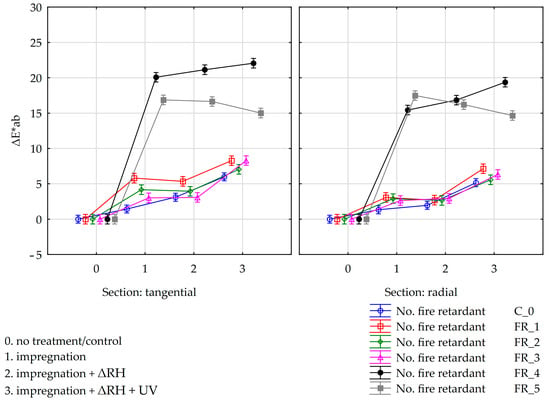
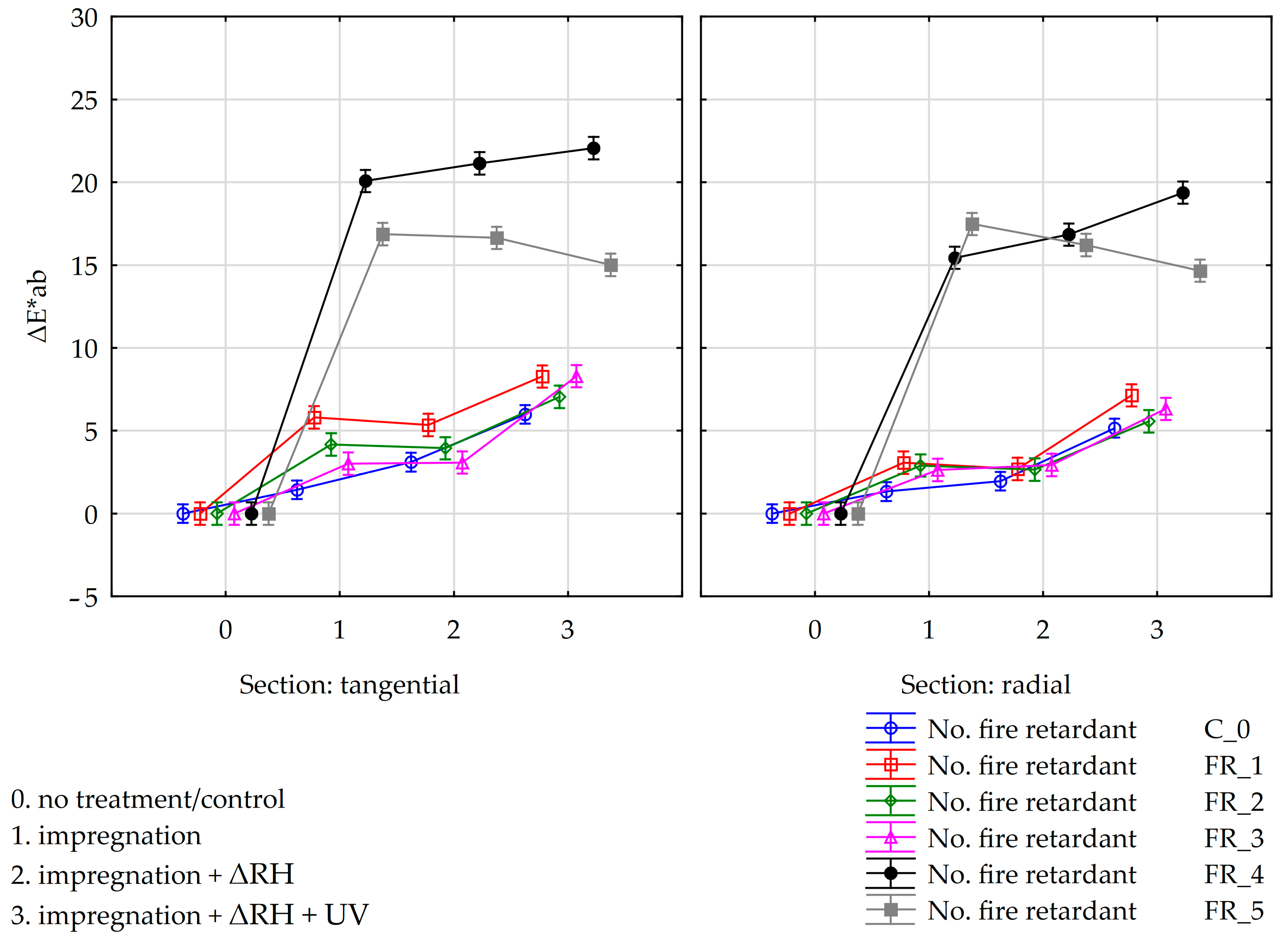
The evaluation of the color coordinates L*, a*, b*, expressed in terms of the total color difference (ΔE*), is presented in Figure 1. The ΔE* values were calculated both relative to the initial state (0) and between successive stages of the aging process. Samples from all groups (C0-FR5) noticeably changed color during aging, simulating the internal conditions of wood exposure. The largest change in wood surface color after impregnation was recorded for fire retardants FR4 and FR5. The color differences were clearly perceptible to the human eye. For FR1, FR2, and FR3, distinct color changes were observed after impregnation and subsequent UV exposure. In untreated wood, a noticeable color change occurred only after UV exposure.
Figure 1.
Color differences after impregnation (1), humidity changes (2) and UV exposure (3).
Wood treated with the fire retardant FR5 exhibited negligible color changes under UV exposure (ΔE* < 1.62 between impregnation and aging). This indicates that some fire retardants may improve resistance to UV-induced color changes.
The results for color changes after exposure to varying relative humidity indicate that this stage has only a minor effect on the color of wooden surfaces—color changes in about half of the tested groups are perceptible only occasionally and mainly to an experienced observer (1 < ΔE* < 2).
In the tangential section of the wood, color differences after impregnation and UV exposure were higher than in the radial section in five of the six sample groups; however, the difference was perceptible to the observer only for FR2 and FR4. The statistical analysis presented in Table 2 indicates that the wood section has a negligible influence on color changes. Within the adopted experimental design, the successive aging stages were treated as levels of a single factor (stage of treatment), which allowed for the evaluation of their combined effect on color change. The analysis further shows that the type of fire-retardant, stage of treatment and interaction between these factors are the most important factors affecting detectable color differences. Therefore, further studies should consider a more detailed analysis of the individual contributions of specific treatment stages to better isolate their effects on color change.
Table 2.
Statistical analysis of the ΔE* parameter.
Due to the negligible influence of wood section on ΔE* values (contribution < 1%), the results were averaged across radial and tangential sections to simplify the interpretation. In Table 3, Tukey’s HSD post hoc test (α = 0.05) was then applied to the averaged ΔE* values separately for cumulative and consecutive stages (ΔE* 0–1, 0–2, 0–3, 1–2, 2–3, 1–3). Homogeneous groups were identified to determine statistically significant differences between fire-retardant treatments. To avoid misinterpretation of homogeneous groups across multiple treatment stages, independent Tukey HSD analyses were clearly distinguished using superscript notation.
Table 3.
Color differences calculated for cumulative and consecutive stages: impregnation (1), humidity changes (2) and UV exposure (3) averaged across wood sections.
It is noteworthy that untreated wood over a period between measures changes color by ΔE* < 1.5, which can only be noticed by an experienced observer; these samples were classified as Group A at the impregnation stage. Group B comprised fire retardants with a moderate effect on color change (ΔE* ranging from 2.82 to 4.44 for FR 1–3). Group C included fire retardants with a pronounced effect on color change (ΔE* ranging from 17.17 to 17.76 for FR 4–5). In stages 1–2 (humidity changes), all samples exhibited similar color variations, indicating that impregnation had no significant effect on color changes resulting from fluctuations in wood moisture content. In stage 2–3 (UV exposure), one particular impregnant could be distinguished as it amplified the effects of UV radiation on color change after impregnation (ΔE* = 6.15 for FR5). After impregnation and all aging processes (stage 0–3), statistical analysis identified two impregnations (FR4—group C and FR5—group B) that differed significantly from the remaining wood samples (both treated and untreated).
The influence values of individual factors on changes in color coordinates (L, a, b) are shown in Table 4. To better understand how impregnation treatment affects wood color, an analysis of individual L*a*b* components was carried out. The results indicate that the b* coordinate was the most sensitive parameter to the type of fire retardant (factor A), with the highest percentage contribution (53.26%), followed by L* (41.94%), while the a* coordinate was affected to a much lesser extent (11.79%). In the case of the stage of treatment (factor C), the strongest effect was observed for L (17.46%), with a smaller contribution for b (8.62%), whereas the effect on a* was statistically non-significant.
Table 4.
Statistical analysis of the coordinates of the color system.
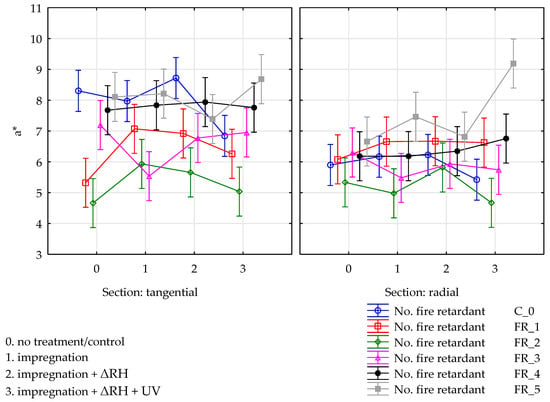
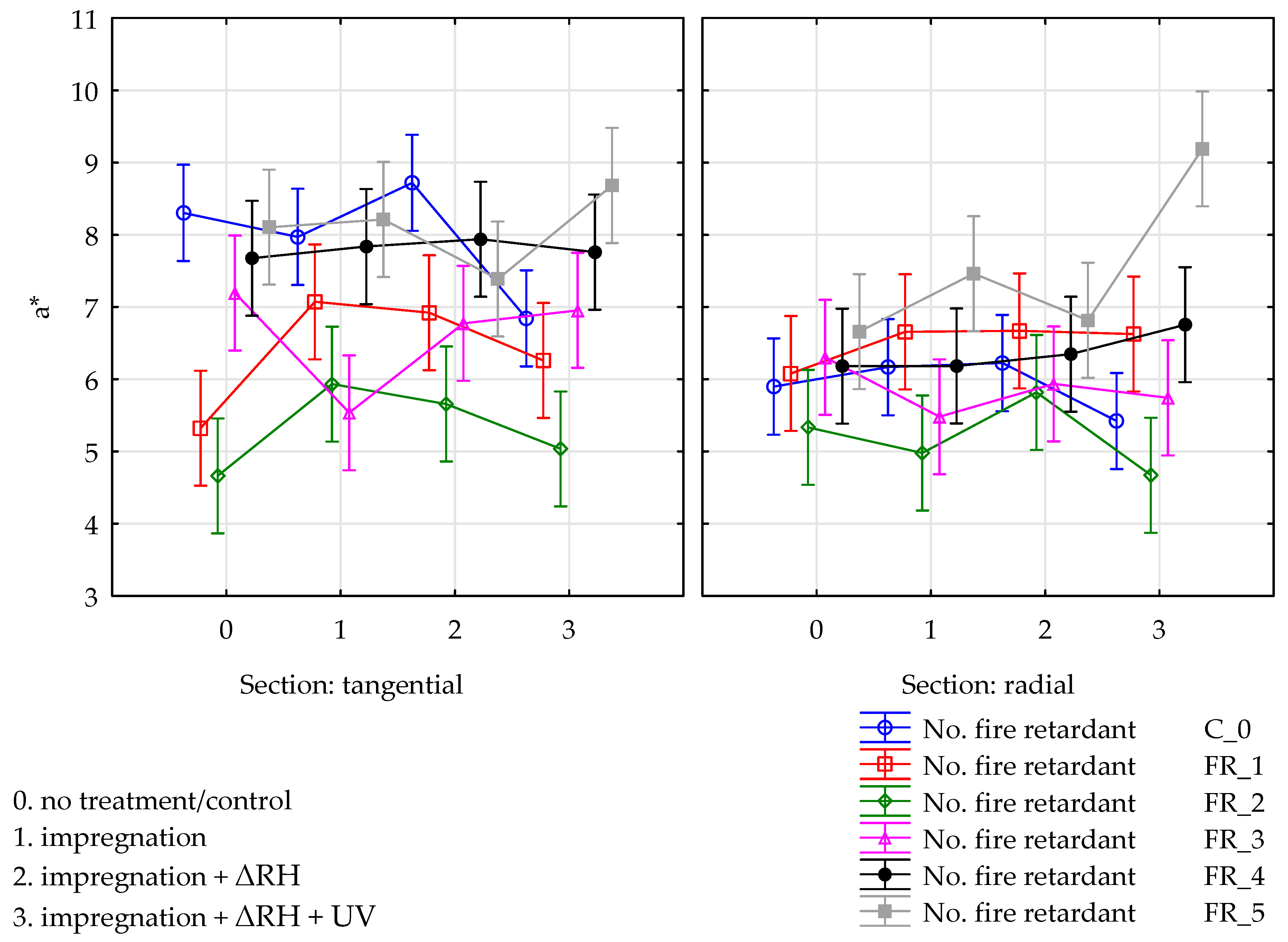
Overall, the a* coordinate showed limited sensitivity to the applied experimental factors and was significantly influenced only by factor B and its interaction with factor A. Combined with its variability (error = 76.55%), this reduces its relevance for interpreting color changes in the present study. This is also evident in the component plot (Figure 2), where the measurement variability masks any meaningful differences compared to the other color components. Given that the observed variation is small relative to the magnitude of the error, the interpretation of the results for this component is unreliable.
Figure 2.
Red-green component (a*) changes after impregnation (1), humidity changes (2), and UV exposure (3). High measurement variability prevents a reliable interpretation of these results.
Therefore, in interpreting color changes, the focus is on the L* (lightness) and b* (yellow–blue) components, which show consistent and meaningful trends. The a* component, due to its high variability, is mentioned only for completeness and is not used to draw conclusions or guide decision-making in this study.
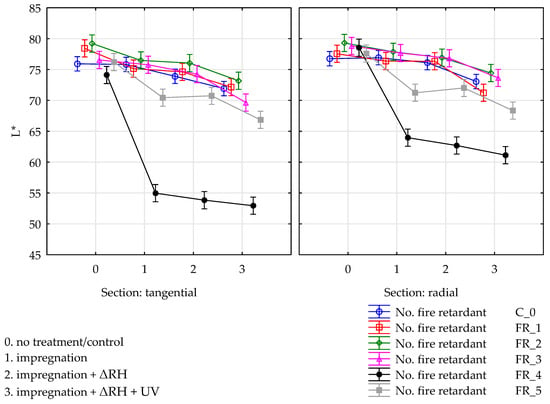
Much more reliable results were obtained for the L* (lightness) component, as presented in Figure 3.
Figure 3.
Changes in lightness L* after impregnation (1), humidity changes (2), and UV exposure (3).
The baseline values of 75–80 for all samples after the impregnation process with FR1 and FR2 decreased by approximately 4 units. For FR4, L* values dropped to 55–65, while FR5-treated samples reached around 70. In contrast, samples treated with FR3 showed no significant change in surface lightness. Exposure to humidity variations resulted in an L* change of approximately 1 unit for most samples, whereas UV exposure caused a reduction of 1–5 units across all samples.
The differences among the impregnating treatments indicate that the choice of protective agent significantly affects wood lightness. The treatments vary in their impact on appearance: FR4 causes the most pronounced darkening, while FR3 has no visual effect on L*. Natural aging factors, such as humidity changes and UV exposure, have a smaller impact on lightness than some impregnants (FR4, FR5). However, UV exposure can induce additional darkening that may become noticeable over time.
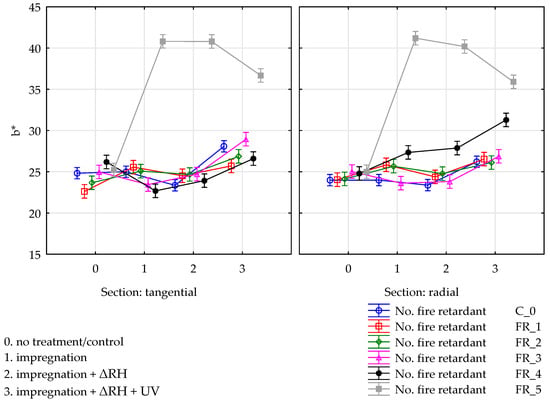
The b* component parameters presented in Figure 4 increased significantly under the FR5 treatment, from 25 to 40 units, indicating pronounced yellowing of the material and a potential deterioration in the appearance of wood in buildings. Among the environmental factors, UV exposure was the most noticeable contributor to yellowing; however, the observed increase of 3–4 units is much smaller compared to the effect of the FR5 impregnation. Moreover, for samples treated with the other impregnating agents, the UV-induced change in b* was comparable to that of the untreated samples.
Figure 4.
Changes in blue-and-yellow (b*) coordinate after impregnation (1), humidity changes (2) and UV exposure (3).
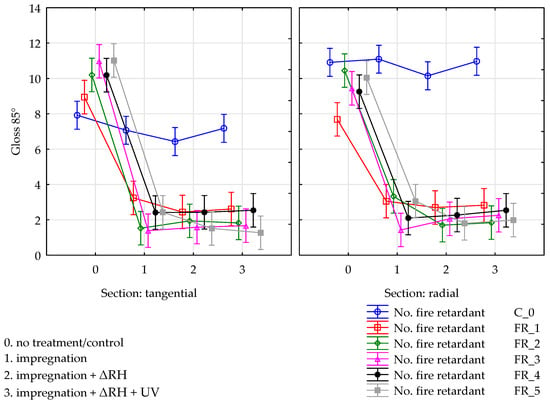
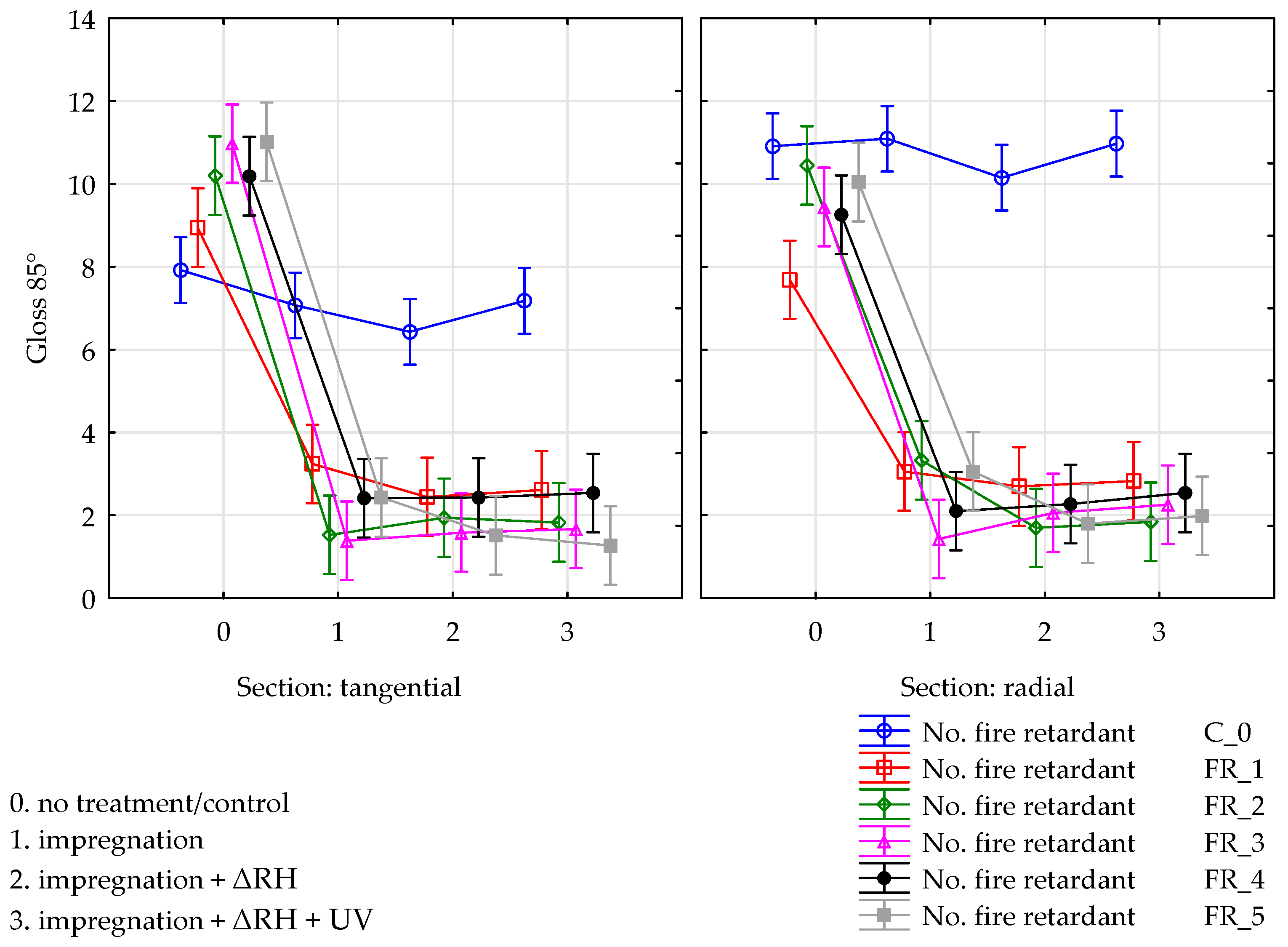
An additional parameter measured to assess the effect of fire-retardant impregnation on the appearance of exposed wood structures was gloss at an 85° angle. As shown in Figure 5, gloss decreased by approximately 6 units following fire-retardant treatment across all tested formulations. Variations in humidity and UV exposure did not significantly affect gloss values.
Figure 5.
Changes in gloss (85°) after impregnation (1), humidity changes (2) and UV exposure (3).
Fire-retardant impregnation reduces wood’s gloss, which should be considered when designing interiors and selecting surface finishes. Compared with artificial aging factors such as humidity changes and UV exposure, which did not significantly affect gloss, the impregnation treatment is the primary factor influencing appearance changes.
4. Discussion
The primary method of applying fire-retardant impregnation under construction conditions is surface treatment by brushing or spraying. According to the literature, the conditions for single-surface impregnation of a vertical element were simulated by immersing the element in the impregnating solution for 15 s [8]. Other impregnation techniques, such as vacuum and pressure impregnation, are commonly used in research and industry but may damage glue joints in engineered wood and cannot be applied on a construction site [23]. The obtained results suggest that the method of introducing the impregnation agent into the wood may have only a marginal effect on color change. The influence of the method of impregnation appears to be comparable to that of the wood section (influence factor: 0.63), because of the low penetration depth in surface application. Nevertheless, it would be valuable to consider applying other fire-retardant treatment methods in subsequent studies to confirm the limited influence of impregnation techniques on wood color change. In the present study, surface impregnation was used due to the manufacturers’ requirements for the applied fire retardants, whcih did not recommend any other application methods.
All water-soluble impregnating agents penetrate wood via capillary action (transport through tracheids) and diffusion (equalization of concentration gradients). Capillary penetration occurs only in air-dry wood, which is free of liquid water. The penetration depth then depends on the capillary diameter, the liquid’s viscosity, surface tension, capillary wall wetting, and the immersion time of the wood in the impregnating solution [8]. Additionally, wood anisotropy significantly affects impregnation depth, with the greatest penetration occurring along the longitudinal direction [8]. To minimize the influence of anisotropy on the investigated parameters, the end-grain surfaces of the samples were sealed with paraffin, and the study was limited to radial and tangential sections, which are less susceptible to deep impregnation. Color measurements were performed on one surface of the samples; due to the specimens’ thickness (10 mm), differences between the upper and lower surfaces were considered negligible. Furthermore, the influence of the wood section on color variation was evaluated statistically and found to be not significant (0.63), confirming that this factor did not substantially affect the results. According to the statistical analysis, the type of water-based fire retardant used had the greatest influence on color change (factor: 45.45%), followed by the exposure conditions (factor: 30.73%). The results indicate that color changes in wood are mainly determined by chemical reactions occurring in the material’s surface layer, which is confirmed by similar studies [21].
Color changes in wood are primarily associated with chemical transformations occurring in lignin [24]. These processes involve the formation of free radicals, which subsequently lead to the generation of ortho- and/or para-quinone structures in both monomeric and oligomeric forms. The presence of these chromophoric structures is the main factor responsible for the discoloration of wood surfaces [24]. Phosphorus compounds (FR1 and FR2), such as phosphoric acid, react with wood polysaccharides via esterification, potentially contributing to darkening [25]. Urea (FR3) interacts with wood by forming hydrogen bonds and reacting with surface functional groups, often in combination with phosphoric acid [26]. Copper compounds (FR4) bind to wood through complexation with lignin and cellulose, darkening the wood surface, often with ethanolamine or ammonium-based formulations [26]. Monoethanolamine (FR5), often used in copper-based preservatives, interacts with wood by forming complexes with extractives and functional groups [27]. Boron compounds (FR2, FR3, FR5) may accelerate the darkening of wood surfaces under weathering conditions by catalyzing dehydration [24]. The reduction in gloss observed in the present study (approximately 6 units) corresponds with that reported in similar research on Scots pine samples impregnated with borates [24,28]. Results of this study indicate that the greatest color changes are achieved with fire-retardant potassium and copper compounds (FR4) and with the combination of 2-aminoethanol and boric acid (FR5). The interaction mechanisms of the applied chemical agents related to color changes can be studied using spectroscopic methods, such as Fourier Transform Infrared Spectroscopy (FTIR), especially for base fire-retardant compounds like urea, in further studies. The commercial nature of the agents used prevents a detailed analysis of their mechanism of action in this study.
The reference color data for untreated wood species reported in the study for 24 prominent central European wood species provide a reference point for evaluating the present results for wood before impregnation. For Scots pine sapwood, the reported values are L* = 74.8, a* = 12.2, b* = 32.4, and a gloss of approximately 20 at 85° [29]. In the present study, the initial L* values were comparable, suggesting similar lightness of the material. However, the a* and b* values were noticeably lower, indicating that the investigated wood surfaces were less reddish and less yellow than the reference material used by other authors. The measured gloss of the untreated samples was approximately two times lower, suggesting a more matte surface. These differences may be related to the origin of the raw material, as wood color and surface properties are known to depend on growth conditions, site characteristics, and timber provenance, which can influence the wood’s anatomical structure and chemical composition. In subsequent studies, the use of wood in a specific color, in accordance with architectural requirements, may be considered. In the present study, greater emphasis was placed on the effect of the fire retardant itself while keeping the type of reference wood constant.
In a study about surface changes in beech and pine wood under the influence of UV radiation, it was reported that after 150 min of intense UV exposure of Scots pine heartwood, L* decreased from 81.9 to 72.7 (an 11% reduction), a* increased from 4.5 to 8.7, and b* increased from 21.9 to 33.0, resulting in a total color difference (ΔE*) of 15.0 [30]. Although the magnitude of changes in our study was slightly lower for L* and b*, the overall pattern of surface darkening combined with minor shifts in chromatic coordinates is similar, indicating that even relatively short-term UV exposure can induce perceptible color changes in pine wood. In the present work, ΔE* due to UV exposure increased approximately 1–4 units over a longer (48 h) period in the previous stage of research. These values were observed for both impregnated and non-impregnated samples, suggesting that UV radiation alone had a relatively minor effect on color change. In contrast, the application of fire retardant had a much greater influence on color changes than UV exposure. Differences in methodology, such as the source of pine wood, exposure time, and the use of heartwood, may account for the observed variations. This indicates that using sapwood instead of heartwood can significantly affect the susceptibility of pine to UV-induced color changes. Therefore, the type of wood tissue (sapwood or heartwood) is an important factor that, in the present study, was not investigated in detail in favor of other variables. In subsequent studies, it is worth considering using a larger number of samples from different collection sites and dividing them into heartwood and sapwood. In the present study, the methodology for selecting samples was adopted in accordance with European standards on the durability of impregnation [12,14]. This approach is justified by the similarity between accelerated aging processes used in practice and normative tests of fire-retardant impregnation durability.
Similar changes in L*, a*, and b* values under the influence of impregnation and UV exposure were reported in studies on vacuum-impregnated pine wood samples with graphene oxide [21]. The addition of graphene oxide primarily affected the earlywood zone, causing a noticeable decrease in lightness (L*) of approximately 10 units [21]. In the present study, lightness (L*) decreased from 75–80 to 70–75 for most samples, which is comparable. Pine samples impregnated with graphene oxide exhibited ΔE* values above 14 after 48 h of UV exposure, while for non-impregnated samples, the total color difference (ΔE*) after 48 h of UV exposure was less than 3.5, indicating that the color change is minimal and may not be noticeable to the untrained observer. In the present study, the total color difference (ΔE*) after 48 h of UV exposure of all tested pine samples increased by approximately 3–6 units, indicating noticeable color changes. This confirms that the impregnation treatment was the most influential factor in the color change and can influence the durability to color change under UV exposure.
Color and its stability are not considered essential characteristics for construction purposes due to the CPR Regulation (EU) and cannot be declared by manufacturers in accordance with European harmonized technical specifications [31]. Despite the lack of a formal possibility to determine the influence of fire retardants on color change in the products’ Declaration of Performance, the European technical specifications for fire retardants include ranges of color of fire-retardant-treated materials, measured according to the CIELAB methodology, in the classification of fire-protection properties [14]. This study confirms that some fire retardants may enhance resistance to UV-induced color changes, such as FR2 and FR4 (ΔE*2–3 < 3.67 between impregnation and aging), compared to non-impregnated wood (ΔE*2–3 = 5.48). Applying a testing methodology similar to that used in this study may encourage investors and designers to select fire-retardant products with the least impact on the color of exposed wooden structures. The results obtained in this study indicate that determining the effect of a fire-retardant on color change (ΔE*) at the stages from raw wood to impregnation and from impregnation to UV exposure can be used by manufacturers for marketing purposes in the Technical Data Sheets of fire retardants.
5. Conclusions
This study investigated the effects of fire-retardant treatment, humidity changes, and UV radiation on the color changes of Scots pine (Pinus sylvestris L.) wood surfaces; therefore, the results specifically refer to this species. The following conclusions can be drawn:
- Applying commercial fire-retardant to wood surfaces in laboratory tests significantly alters the wood’s color, with the total color difference (ΔE*) ranging from 2.82 to 17.76 after impregnation. Treated and untreated wood within the same building space can be visibly different in color, which is noticeable to observers and should be considered in architectural design and historical building renovations.
- Some fire retardants cause notable changes in wood appearance: for instance, FR5 induces strong yellowing (change in b* from 25.22 to 40.81), while FR4 mainly causes darkening (change in L* from 74.12 to 54.97), affecting the visual look of wood.
- Commercial fire-retardant impregnation reduces the 85° gloss of wood from 9.59 to 4.63.
- Exposure to UV radiation causes noticeable changes in the color of wood surfaces (ΔE*2–3 > 3.47).
- Exposure to humidity changes did not appear to cause significant color changes in either treated or untreated samples (ΔE*1–2 < 2.48).
- The wood section did not have a relevant influence on color changes under treatment, humidity variations, or UV exposure (influence factor of wood section: 0.03).
Author Contributions
Conceptualization, M.R., P.B., K.L. and I.B.; methodology, M.R.; validation, M.R.; formal analysis, K.L.; investigation, M.R.; resources, M.R. and P.B.; data curation, M.R. and K.L.; writing—original draft preparation, M.R.; writing—review and editing, P.B., K.L. and I.B.; visualization, K.L.; supervision, P.B. and I.B.; funding acquisition, P.B. All authors have read and agreed to the published version of the manuscript.
Funding
This research received no external funding.
Data Availability Statement
The original data presented in this study are included in the article. Further inquiries can be directed to the corresponding author.
Conflicts of Interest
The authors declare no conflicts of interest.
References
- Wenzel, A.; Guindos, P.; Carpio, M. Using Timber in Mid-Rise and Tall Buildings to Construct Our Cities: A Science Mapping Study. Sustainability 2025, 17, 1928. [Google Scholar] [CrossRef] [Scilit]
- Breneman, S.; Timmers, M.; Martin, J.; Richardson, D. Tall Wood Buildings in the 2021 IBC: Up to 18 Stories of Mass Timber; WoodWorks–Wood Products Council: Washington, DC, USA, 2019. [Google Scholar]
- Neufert, E.; Neufert, P. Architects’ Data, 3rd ed.; Wiley-Blackwell: Hoboken, NJ, USA, 2000. [Google Scholar]
- Wan, Q.; Li, X.; Zhang, Y.; Song, S.; Ke, Q. Visual perception of different wood surfaces: An event-related potentials study. Ann. For. Sci. 2021, 78, 25. [Google Scholar] [CrossRef] [Scilit]
- Kwak, S.; Choi, K. Visual perceptions of wood-integrated material combinations: Effects on psychological and physiological responses. J. Wood Sci. 2025, 71, 20. [Google Scholar] [CrossRef] [Scilit]
- Serra, J.; García, Á.; Torres, A.; Llopis Verdú, J. Color Composition Features in Modern Architecture. Color Res. Appl. 2012, 37, 126–133. [Google Scholar] [CrossRef] [Scilit]
- Kmita, A.; Pyykkö, S.; Valan, F. Wood colours in contemporary architecture: A comparison in three European countries. In Proceedings of the International Colour Association (AIC) Conference, Toronto, ON, Canada, 12–16 June 2022. [Google Scholar]
- Krajewski, A.; Witomski, P. Ochrona Drewna Surowca i Materiału, 3rd ed.; Wydawnictwo SGGW: Warszawa, Poland, 2023. [Google Scholar]
- Blanchet, P.; Pepin, S. Trends in Chemical Wood Surface Improvements and Modifications: A Review of the Last Five Years. Coatings 2021, 11, 1514. [Google Scholar] [CrossRef] [Scilit]
- EN 351-1:2023; Durability of Wood and Wood-Based Products—Preservative-Treated Solid Wood—Part 1: Classification of Preservative Penetration and Retention. European Committee for Standardization: Brussels, Belgium, 2023.
- EN 350:2016; Durability of Wood and Wood-Based Products—Testing and Classification of the Durability to Biological Agents of Wood and Wood-Based Materials. European Committee for Standardization: Brussels, Belgium, 2016.
- EN 16755:2017; Durability of Reaction to Fire Performance—Classes of Fire-Retardant Treated Wood Products in Interior and Exterior end Use Applications. European Committee for Standardization: Brussels, Belgium, 2017.
- EN 13501-1:2018; Fire Classification of Construction Products and Building Elements—Part 1: Classification Using Data from Reaction to Fire Tests. European Committee for Standardization: Brussels, Belgium, 2018.
- EAD 350865-00-1106; Fire Retardant Products. EOTA: Brussels, Belgium, 2018.
- OIML R 92; Wood-Moisture Meters—Verification Methods and Equipment: General Provisions. International Organization of Legal Metrology: Paris, France, 1989.
- EN 15187:2006; Furniture—Assessment of the Effect of Light Exposure. CEN: Brussels, Belgium, 2006.
- Zhou, S.; Kowal, S.F.; Cregan, A.R.; Kahan, T.F. Factors affecting wavelength-resolved ultraviolet irradiance indoors and their impacts on indoor photochemistry. Indoor Air 2021, 31, 1187–1198. [Google Scholar] [CrossRef] [Scilit] [PubMed]
- PN-ISO 7724-2:2003; Paints and Varnishes—Colorimetry—Part 2: Colour Measurement. Polish Committee for Standardization: Warsaw, Poland, 2003.
- PN-EN ISO 2813:2014; Paints and Varnishes—Determination of Gloss Value at 20°, 60° and 85°. Polish Committee for Standardization: Warsaw, Poland, 2003.
- SIST ISO 7724-3:2021; Paints and Varnishes—Colorimetry—Part 3: Calculation of Colour Differences. Slovenski Inštitut za Standardizacijo: Ljubljana, Slovenia, 2021.
- Betlej, I.; Bombalska, A.; Lipska, K.; Kaliszewski, M.; Borysiuk, P. The Effect of UV Exposure on Selected Surface Parameters of Wood Containing Graphene Oxide. Molecules 2025, 30, 4730. [Google Scholar] [CrossRef] [Scilit] [PubMed]
- Mokrzycki, W.S.; Tatol, M. Colour Difference ΔE—A Survey. Mach. Graph. Vis. 2011, 20, 383–411. [Google Scholar]
- Lowden, L.A.; Hull, T.R. Flammability behaviour of wood and a review of the methods for its reduction. Fire Sci. Rev. 2013, 2, 4. [Google Scholar] [CrossRef] [Scilit]
- Simsek, H.; Baysal, E. An investigation on colour and gloss changes of wood impregnated with borates. Wood Res. 2012, 57, 271–278. [Google Scholar]
- Tsapko, Y.; Tsapko, A.; Zhartovskyi, S.; Likhnyovskyi, R.; Kravchenko, M.; Lialina, N.; Berezovskyi, Y.; Kaveryn, K.; Sarapin, Y. Establishing fire protection patterns in wood using impregnation compositions from inorganic salts. East.-Eur. J. Enterp. Technol. 2024, 5, 62–70. [Google Scholar]
- Humar, M.; Žlindra, D.; Pohleven, F. Fixation of copper-ethanolamine wood preservatives to Norway spruce sawdust. Acta Chim. Slov. 2007, 54, 154–159. [Google Scholar]
- Lupsea, M.; Mathies, H.; Schoknecht, U.; Tiruta-Barna, L.; Schiopu, N. Biocide leaching from CBA treated wood—A mechanistic interpretation. Sci. Total Environ. 2013, 444, 522–530. [Google Scholar] [CrossRef] [Scilit] [PubMed]
- Can, A.; Sivrikaya, H. Surface characterization of wood treated with boron compounds combined with water repellents. Color Res. Appl. 2019, 44, 462–472. [Google Scholar] [CrossRef] [Scilit]
- Meints, T.; Teischinger, A.; Stingl, R.; Hansmann, C. Wood colour of central European wood species: CIELAB characterisation and colour intensification. Eur. J. Wood Wood Prod. 2017, 75, 499–509. [Google Scholar] [CrossRef] [Scilit]
- Geffert, A.; Geffertová, J.; Výbohová, E. Surface changes of beech and pine wood under the influence of UV radiation. Acta Fac. Xylologiae Zvolen 2020, 62, 5–18. [Google Scholar]
- European Parliament and the Council of the European Union. Regulation (EU) 2024/3110 of 27 November 2024 laying down harmonised rules for the marketing of construction products and repealing Regulation (EU) No 305/2011. Off. J. Eur. Union 2024, L 2024/3110. [Google Scholar]

Disclaimer/Publisher’s Note: The statements, opinions and data contained in all publications are solely those of the individual author(s) and contributor(s) and not of MDPI and/or the editor(s). MDPI and/or the editor(s) disclaim responsibility for any injury to people or property resulting from any ideas, methods, instructions or products referred to in the content. |
© 2026 by the authors. Licensee MDPI, Basel, Switzerland. This article is an open access article distributed under the terms and conditions of the Creative Commons Attribution (CC BY) license.