


Abstract
Electrification of professional forestry operations has been extensively studied in motor-manual operations involving chainsaws. Recent studies have highlighted that the main limitation to the widespread adoption of battery-powered chainsaws in professional forestry work is their limited autonomy. In the present study, this issue was addressed from an economic perspective, with the objective of determining how many years are required to offset the high initial investment in batteries through the lower operating costs associated with electricity compared to petrol. To carry out this study, different battery-powered chainsaws were compared with equivalent petrol-powered chainsaws under identical workloads across different forest types. To assess these comparisons, electricity consumption (Wh) and petrol consumption were measured to determine machine autonomy. The results showed a clear advantage of electricity in terms of energy cost per tree cut, meaning that the high initial investment in batteries (approximately €4000–6000 and 8–10 batteries per working day) can be recovered within 3–4 years. Battery-powered chainsaws proved economically competitive, recovering the initial investment within a relatively short period. However, further studies are necessary to evaluate a wider range of operating conditions, to test chainsaws with different power levels, and to assess the potential impact of future battery developments.
1. Introduction
In recent years, interest in the electrification of forest operations has increased progressively, focusing on decreasing emissions and enhancing the energy efficiency of the whole timber chain. This involves distinct harvesting systems and machinery, such as harvesters, forwarders, skidders, cable yarders and specially chainsaws [1,2].
Motor-manual forest operations are still widely applied in many regions of Europe due to terrain conditions and small-sized forest properties. One of the key pieces of equipment for carrying out manual work, specifically cutting and processing operations, is the chainsaw, mainly for its versatility and its relatively low financial investment. Common professional chainsaws are powered by two-stroke combustion engines, and are deployed in tasks such as wood harvesting, pruning and professional green maintenance. However, many studies have shown several hazards which forest operators are directly exposed to, such as noise, hand–arm vibrations (HAVs) and exhaust gases [3,4]. In contrast, battery-powered chainsaws can significantly reduce or even eliminate many of these health risks [5]. In addition, they offer lower maintenance requirements and produce no direct air pollution compared with conventional combustion-engine chainsaws [6]. Despite these advantages, battery chainsaws are not commonly used in professional forest operations due to their expected lower cutting speed and limited battery life [6].
Over the past few decades, battery technology has been highly improved, allowing the design of powerful, compact and lightweight manual tools also for the forest sector, which requires tough tools with high energy output [7]. The energy density of rechargeable batteries has improved by nearly ten times, evolving from Ni-MH technology to today’s advanced Li-ion cells [8]. Currently, lithium-ion batteries dominate the market due to their high energy and power density, long lifespan, and much lower weight compared to previous generations of batteries.
Despite all these innovative improvements, the energy density of batteries—ranging between 130 and 200 Wh·kg−1—remains significantly lower than that of gasoline, which reaches approximately 12,890 Wh·kg−1 [9]. Even when accounting for the relatively low efficiency of two-stroke internal combustion engines (20%–25% [10]), this disparity persists. Consequently, battery-powered chainsaws require heavier energy storage systems to achieve performance levels comparable to those of petrol-powered models. This increases their weight, which reduces their suitability for high-intensity and continuous forestry operations.
Additionally, battery-powered chainsaws exhibit different torque–speed characteristics from petrol-powered models, and some studies have reported lower power output for electric chainsaws [11]. These differences may affect cutting performance under demanding conditions. Despite this limitation, several studies have concluded that there is no significant difference in overall productivity (felling and processing) between battery- and petrol-powered chainsaws. The key factor influencing the adoption of battery-powered chainsaws in the professional forestry sector is battery autonomy management [7,12,13].
In this context, and considering the current limitations of electric chainsaws, their introduction into professional forestry operations can be understood as an economic issue, where the challenge of battery autonomy is addressed through increased investment in a larger number of batteries. This requirement is strongly dependent on the workload carried out in professional forestry environments and the battery-powered chainsaw technology. Accordingly, the aim of the present study is to compare the costs of battery- and petrol-powered chainsaws as a function of petrol or electricity consumption during forest operations. Based on these operating fuel costs and the additional investment required for the battery-powered system, an economic analysis is conducted to determine the time required for the savings in energy costs to offset the initial investment and identify the break-even year between battery- and petrol-powered chainsaws.
2. Materials and Methods
2.1. Study Area
The study was carried out in two different forests with the purpose of including a wider range of tree sizes and forestry treatments. One forest was in the municipality of Navès (386,311 m E, 4,657,850 m N, UTM Zone 31N, Catalonia, Spain), a juvenile growth stage, featuring high densities and thin diameters (hereinafter “Juvenile Forest”). The second forest, located in the municipality of Alins (365,553 m E, 4,711,049 m N, UTM Zone 31N, Catalonia, Spain), was a more mature stand, with lower densities and largest diameters (hereinafter “Advanced Forest”).
2.2. Description of Equipment
Given the aim of representing a broad range of battery- and petrol-powered technologies, chainsaws from a well-established manufacturer (Stihl, S.A., Manresa, Catalonia, Spain) and a newer battery-powered chainsaw manufacturer with recognized expertise in electrical tools (Milwaukee Electric Tool Corporation, Madrid, Spain) were evaluated. From Stihl, an MSA 300 C-O (indicated as BatS) powered by an AP battery system and petrol-powered MS 261 C-M (indicated as PetS) were tested. BatS is one of the best-known battery-powered chainsaws in the market and PetS is the equivalent petrol-powered chainsaw according to the manufacturer. From Milwaukee, an M18 FuelTM F2CHS50 (indicated as BatM) powered by FORGETM batteries was chosen, being one of the most powerful battery-powered chainsaws on the market, with the purpose of analyzing a wide battery power range under different operation demands. Table 1 shows the technical specifications of the tested models.
Table 1.
Specifications of tested chainsaws.
2.3. Equipment and Fuel Costs
The material costs are shown in Table 2. The increment of equipment cost was considered equivalent among the different materials over the years.
Table 2.
Equipment cost.
The fuel price tendency was obtained according to Excel’s FORECAST.ETS function based on the price with taxes and levies from Spain for both electricity [14] and gasoline [15] prices, representing the longest possible data series available. The price of the oil was considered to be 26€/L (HP Mineral by Stihl). The fuel prices have been treated as real prices according to Gregersen (1975) [16] considering the Spain GDP deflator based on 2020 [17].
2.4. Study Design
To conduct a proper economic assessment of different fuel-powered chainsaws, a comparative fuel consumption study was designed. In each forest, sets of trees with equivalent total volume were marked for felling and processing, ensuring a similar workload for each chainsaw. In the Juvenile Forest (JF), the tasks were felling, delimbing, and topping commercial trees, reducing all residues to 50 cm sections to be left on-site. Similarly, non-commercial trees were felled and the whole stem and larger branches were reduced to 50 cm sections directly at the stump. Each of the tested chainsaws felled and processed 10 commercial trees and 14 non-commercial trees. In the Advanced Forest (AF), each chainsaw processed a set of 8 commercial trees. To ensure the comparability of these tree sets by forest for the different chainsaws, preliminary dendrometry measurements were done using the Tree Scanner app [18]. The app automatically recorded the position, diameter at breast height, height and volume of each tree, associating the data with the ID of RFID tags applied on the stump of each standing tree. Within each forest type, all chainsaws were assessed under comparable terrain and felling conditions.
The test was conducted by trainers from the local forestry school, all featuring a similar working experience with manual operations. Both petrol and battery systems were fully charged and thoroughly maintained at the beginning of the operations, ensuring identical starting conditions for all chainsaws.
During the test, each chainsaw performance was recorded with a GoPro Hero 10 to determinate the effective cutting time (ECT) per tree, defined as the sum of time in seconds during which the chain was engaged in the wood. The ECT was calculated with separated time lapses corresponding to each throttle acceleration (TA), also counted in the video. The RFID identification number was recorded in the videos to link ECT and TA with the dendrometric characteristics of each felled and processed tree. Moreover, the chainsaw productive time, which corresponds to an operative time with delays of less than 15 min (CPT15), was calculated as a basis for extrapolating results to a full working day. Video and audio analysis was performed using DaVinci Resolve software (version 18.1.2 build 6).
Energy consumption of electric chainsaws was measured by recharging all the batteries fully or partially discharged during the test and measuring the charged energy (Wh) with a plug-in energy meter. For the petrol-powered chainsaw, fuel consumption was quantified by measuring the milliliters (ml) of fuel refilled with a graduated flask. Considering the ECT per tree, the energy and ml consumption per tree was estimated based on the total consumption for each set of trees cut by a chainsaw.
A one-way ANOVA and post hoc Tukey’s honestly significant difference (HSD) test were used to investigate the mean difference. Assumptions of normality and homogeneity of variance were tested to ensure the validity of the results. The software used was R Studio (2024.09.0 + 375).
2.5. Economic Analysis Calculation
The economic comparison between battery-powered and petrol-powered chainsaws was performed using the net present value (NPV), calculated according to the following equation:
where
- -
- CFt is the cash flow.
- -
- r is the discount rate.
- -
- t is the year number.
- -
- n is the time horizon.
To compare investments with distinct time horizons (n), the least-common-multiple method was applied [19]. For each chainsaw tested, the time horizon chosen corresponds to the longest useful life of the material into the initial cost.
A discount rate of 3.1% was adopted, based on the sustainability financing program of the Catalan Financial Institute, which applies a margin of 0.9% over the average 2025 EURIBOR rate of 2.2% [20].
To calculate the cash flows (CF) of the chainsaw, it is necessary to measure the initial cost, which will vary according to the power source of the chainsaw. For the petrol-powered ones, it is just the chainsaw cost, while the initial cost for battery-powered chainsaws is given by the cost of (1) the batteries necessary to complete a working year, (2) the chargers and (3) the chainsaw. Furthermore, the annual fuel and electricity cost must be considered. The following assumptions were adopted to perform those calculations: 200 working days per year, a 1-year service life for the chainsaw, and a 4-year service life for the charger. Battery useful life was estimated from the number of charging cycles specified by the manufacturer (Table 1).
To estimate the number of batteries and petrol consumed per day, the data extracted for each set of trees (test period) must be extrapolated to the entire working day. The number of batteries used during the test was estimated by dividing the total energy consumed by the average energy per battery charged. Petrol tank refills during the test were estimated by dividing the petrol consumed by the tank capacity of the PetS.
Since the present study was not designed to quantify gross productivity time under the full range of operational activities (e.g., wedge use, movement between trees, and other non-cutting tasks), the “Use Chainsaw” time proportions reported by Laschi et al. (2023) [7] were used to extrapolate the number of batteries or fuel tanks required to complete a full working day. The extrapolation assumed an 8 h working day and was based on the CPT15 measured in the present study, due to the similitudes between both times. According to Laschi et al. (2023) [7], the “Use Chainsaw” time accounted for 48% and 52% of the total gross working time for battery- and petrol-powered chainsaws, respectively. Assuming that these proportions are representative of the working conditions in the present study, the number of batteries or fuel tanks required per working day was estimated using Equation (2).
where
- fUseChainsaw = proportion of gross working time spent using the chainsaw (0.48 for battery-powered chainsaws and 0.52 for petrol chainsaws).
- ntest = number of batteries or fuel tanks consumed during the test.
To estimate the economic break-even between battery- and petrol-powered chainsaws, the difference in net present value (ΔNPV) was calculated. The break-even year was defined as the first year in which the cumulative ΔNPV became positive, indicating that the additional investment in batteries had been fully recovered.
3. Results
During the study, a total of 96 trees were felled, representing an overall volume of 22.05 m3. Of these, 72 trees (7.84 m3) were harvested in the JF, and 24 trees (14.21 m3) in the AF. In the JF, the felled trees had a mean DBH of 15.01 ± 5.61 cm and a mean stem volume of 0.11 ± 0.08 m3. In the AF, the mean DBH was 32.01 ± 5.16 cm, and the mean stem volume was 0.59 ± 0.19 m3. No significant differences were found among the trees felled with the different chainsaws tested in terms of DBH and stem volume within each forest.
To explain variation in fuel cost per tree in euro cents (c€), a linear model was fitted using log-transformed variables (Table 3). Tree DBH and throttle activations (TA) were included as continuous explanatory variables, while fuel type (battery or petrol) was included as a fixed effect.
Table 3.
Parameter estimates of the linear model explaining fuel cost per tree.
The model fitted is shown in the following equation:
Fuel cost (c€ · tree−1) = 0.0262 · DBH1.0516 · TA0.46 · FactorFuel
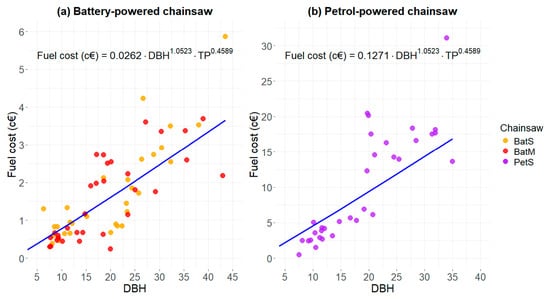
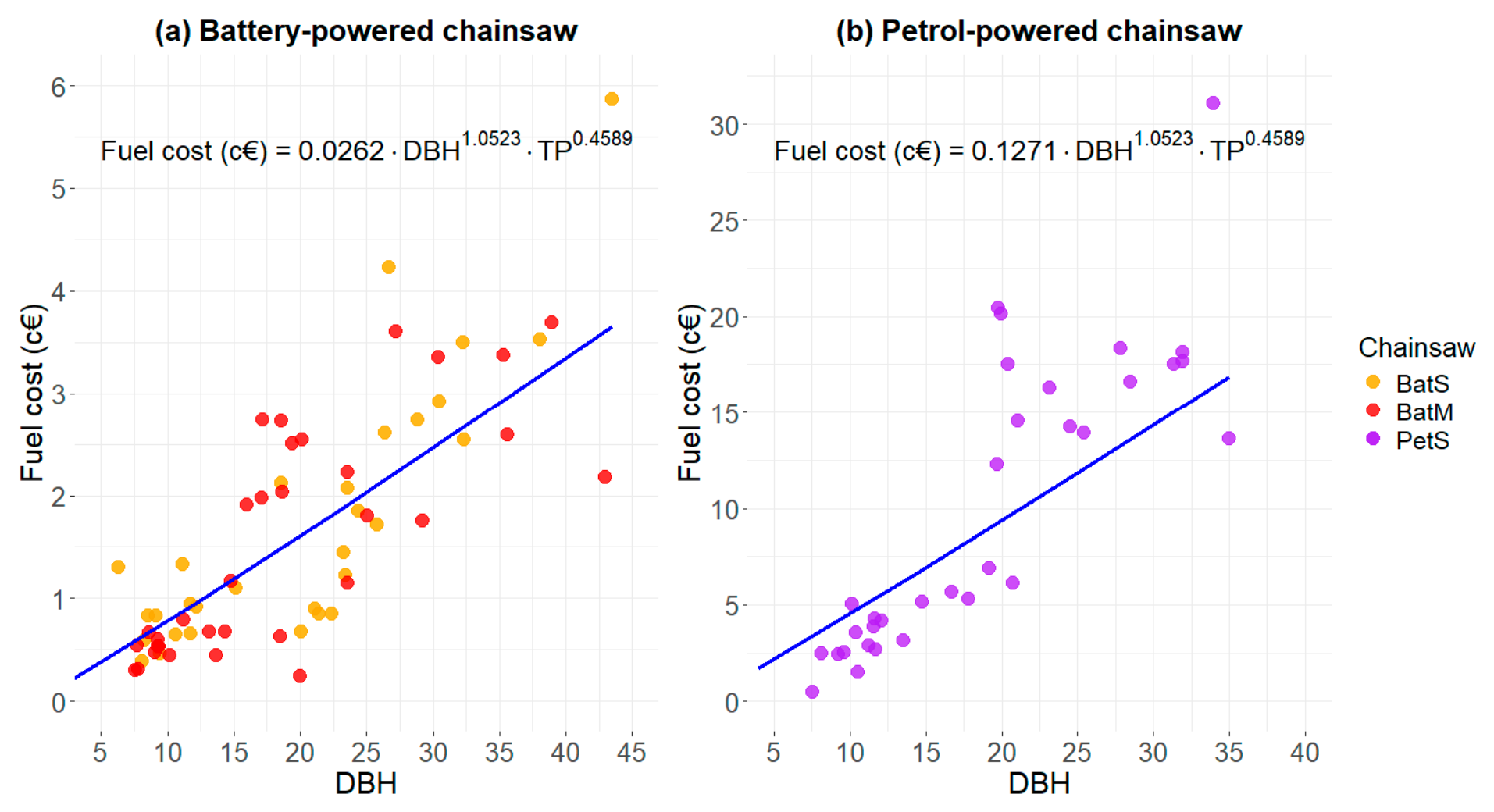
The fitted model indicates that DBH exhibits an approximately one-to-one proportional relationship with fuel cost, meaning that fuel cost increases almost linearly with tree size. This result confirms that cutting larger trees is associated with higher fuel consumption, as also illustrated in Figure 1. The number of throttle accelerations (TA) was also identified as a significant predictor, although with a weaker effect compared to DBH, indicating that a higher number of TAs leads to increased fuel cost.
Figure 1.
Relationship between DBH and fuel cost (c€) for battery-powered chainsaws (a) and petrol-powered chainsaws (b). The blue line represents the linear model prediction, adjusted for the fuel factor and mean TA for both fuel-powered chainsaws.
DBH, TA and fuel type were all highly significant predictors of fuel cost per tree. The linear model explained 88.3% of the variance in log-transformed fuel cost (Adjusted R2 = 0.883). The significant effect of fuel type indicates clear differences in fuel cost between battery-powered and petrol chainsaws, for a given DBH and number of throttle activations. This result highlights that fuel-powered plays a dominant role in determining fuel cost per tree, beyond the effects of tree size.
In the JF, significant differences were observed in fuel cost per tree (df = 2, F = 22.6, p = 2.81 × 10⁻⁸) and TA (df = 2, F = 7.31, p = 0.001). For both variables, PetS showed significantly higher values than BatS and BatM. Regarding fuel cost per tree, on average, PetS is 84.1% higher. In the AF, significant differences were also found for fuel cost per tree (df = 2, F = 59.37, p = 2.27 × 10⁻⁹), with PetS presenting an 83.75% higher value, and additionally for ECT (df = 2, F = 4.30, p = 0.027), where BatS and BatM differed significantly, while PetS showed intermediate values (Table 4).
Table 4.
ECT, fuel cost and throttle acceleration mean and SD by chainsaw in JF and AF. Values with different letters within the same forest and variable indicate significant differences among chainsaw types (Tukey’s HSD test, α = 0.05).
Table 5 shows the data necessary to estimate the number of batteries and tank refills for a full working day. The calculated mean electricity charges per battery were 371.4 and 519.4 Wh for BatS and BatM, respectively. The estimated petrol fuel tank capacity was 500 mL.
Table 5.
Reference data to calculate the daily fuel consumption.
Regarding discharge times (CPT15), battery-powered chainsaws operated for 0.43 h (BatS) and 0.80 h (BatM) in the AF, and for 0.64 h (BatS) and 1.22 h (BatM) in the JF. The PetS required refueling after 0.65 h in the AF and 0.82 h in the JF. In terms of trees felled and processed per battery or petrol tank, the values were 2.67 and 4.25 trees per battery for BatS and BatM, respectively, in the AF. For the same stand, the petrol-powered chainsaw consumed a tank per five trees. On the other hand, the numbers of trees processed per battery or petrol tank were increased in the JF to 7.12 and 10.3 trees per battery for BatS and BatM, respectively, and 12.5 trees per petrol tank.
The calculation of the overall investment needed was based on the cost of single items (Table 2) and the quantity needed estimated according to the working-day data (Table 5). In the AF, two multi-chargers and two single chargers were needed for BatS and two multi-chargers for BatM. In the JF, two multi-chargers for both battery-powered chainsaws were sufficient. The initial investment calculated was (AF) 5730.95 and 4401.8€, and (JF) 4672.7 and 3804€, respectively, for BatS and BatM. The initial petrol investment was 1069€ for both forests, considering only the cost of the chainsaw.
According to manufacturers, the full charging cycle lifespan for the batteries is 2500 and 1700, respectively, for BatS and BatM. Considering 200 charging cycles per year, this results in a useful life of about 12 and 8 years, respectively, for BatS and BatM. Those years and 1 year of PetS were considered as time horizons for each chainsaw, where 24 years is the least common multiple and was taken to perform the economic assessment (Table 6).
Table 6.
Economic assessment results by forest and chainsaw.
The economic results show cost savings for the battery-powered chainsaw against the petrol one: in 3–4 years, the highest initial investment for batteries is compensated for due to the high petrol fuel cost. Cost savings were higher with BatM in the AF and with BatS in the JF, corresponding to 33.07%–36.7% in AF and 34%–33.9% in JF for BatS and BatM, respectively, calculated relative to the PetS cost.
4. Discussion
In terms of operating fuel costs, the battery-powered chainsaw exhibited a significant advantage over the petrol-powered chainsaw. Although previous studies have reported that battery-powered chainsaws exhibit lower efficiency under high-load cutting conditions [11], this potential limitation did not affect their economic advantage under the operating conditions evaluated in the present study. The substantially lower cost of electricity compared with petrol was the primary factor driving the lower operating costs of the battery-powered chainsaws.
Beyond the type of power source, the fitted linear model indicated that tree size had a strong influence on fuel consumption and cost per tree. Fuel consumption increased proportionally with DBH, in agreement with previous studies [21]. Although to a lesser extent, the number of throttle accelerations was also identified as a significant predictor of fuel consumption per tree. This effect may be explained by the transient operating characteristics of the engine during acceleration. Each throttle acceleration requires a transition from idle to the operating engine speed. Compared with steady-state conditions, transient operation has been shown to be less energy-efficient and to require additional fuel to achieve the requested engine response [22,23]. Therefore, a higher number of trigger activations may increase fuel consumption independently of tree size.
Quantifying the number of batteries or petrol tanks required to ensure full-day autonomy was a key aspect of the economic comparison between battery- and petrol-powered chainsaws. Therefore, a principal limitation of the present study was the lack of an assessment of daily energy consumption under all operating conditions. Despite this limitation, the present study showed similar daily autonomy to that reported in previous studies [7,12].
However, a direct comparison with these studies is only possible for the AF, given the similarities in tree size and treatment conditions, and for BatS, as it was the same chainsaw used in the previous studies. For the battery-powered chainsaw, the present study shows slightly higher autonomy than the 2.45 and 2.37 trees per battery reported by Laschi et al. (2023) [7] and Neri et al. (2023) [5], respectively. For the petrol-powered chainsaw, in the present study, autonomy per tree was almost twofold, with 2.67 and 2.58 trees per tank reported by Laschi et al. (2023) [7] and Neri et al. (2023) [5], respectively.
This discrepancy could be partly explained by differences in study design. The studies by Laschi et al. (2023) [7] and Neri et al. (2023) [5] focused on comparing the productivity of battery- and petrol-powered chainsaws, whereas the present study was designed to compare fuel consumption under the same workload. Consequently, the tests in the present study were conducted on a limited set of trees with more specific cutting characteristics, whereas full-day studies encompass greater variability in working conditions. Furthermore, the lower autonomy reported in the previous studies could be partially explained by the additional cross-cutting task performed on each tree, which would result in additional fuel consumption per tree.
A similar pattern was observed for the operating time per battery or petrol tank. The present study showed similar autonomy for the battery-powered chainsaw (BatS) but higher autonomy for the petrol-powered chainsaw compared with the values reported by Laschi et al. (2023) [7] and Neri et al. (2023) [5]: 0.40 and 0.45 h for batteries and 0.50 and 0.47 h for petrol tanks, respectively. A consistent finding across studies was that a petrol tank provided a longer operating time than a battery. The operating time observed in all studies was also broadly consistent with the 44 min of effective cutting time reported by the battery manufacturer [13]. Comparing the two battery-powered chainsaws evaluated in the present study, BatM had approximately twice the autonomy of BatS thanks to the deployment of two batteries (Table 1).
Thus far, comparisons of autonomy in the present study have focused on the AF stand. However, when the two stands were compared, the JF showed lower energy demand for all three chainsaws used (Table 5). This difference may be related to the lower workload associated with the tests in the JF, where trees were smaller and had thinner branches. As discussed above, tree size was an important factor influencing fuel consumption. The lower energy demand in the JF resulted in lower costs in the economic assessment, but was not sufficient to alter the break-even year, at which the lower electricity cost offsets the higher investment required for the battery systems, for either BatS or BatM (Table 6).
BatS delivered a higher amount of energy than BatM under the same workload conditions (Table 5), despite BatM being the more powerful machine. This difference was more pronounced in the AF than in the JF, where the workload requirement was higher. The difference in energy delivered may be related to limitations in the electric motor system designed to prevent overheating. Supporting this interpretation, the empty BatS batteries immediately removed from the chainsaw were noticeably hotter than those of BatM. Consequently, BatM batteries began charging immediately after being placed in the charger, whereas BatS batteries required approximately 1 h of cooling before charging could begin.
Regarding the economic comparison between battery- and petrol-powered chainsaws, the petrol-powered system showed a significantly higher NPV24 than the battery-powered systems. The economic savings (ΔNPV24) associated with battery-powered chainsaws were greater in the AF because of the higher petrol costs incurred in this stand compared with the JF. Comparing the two battery-powered chainsaws, BatS required one additional year to reach the break-even point relative to BatM in both stands and achieved a higher NPV24 in the AF. These results were directly associated with the higher energy delivered by BatS. Although BatM required two battery replacements during the 24-year analysis period, compared with only one for BatS due to its larger assumed number of charging cycles (Table 1), the higher battery cost and greater electricity consumption of BatS resulted in a higher NPV24. However, the NPV24 values were almost identical in the JF, where BatM achieved a slightly higher value. In this case, the higher operating energy costs of BatS did not offset the additional battery replacement costs of BatM, mainly because the difference in energy consumption between the two battery-powered chainsaws was considerably smaller in the JF (660 Wh day−1) than in the AF (1080 Wh day−1) (Table 5).
Despite its lower fuel cost per tree, BatM may not be the most efficient battery-powered chainsaw for professional forest harvesting. This may be related to its lower power-to-weight ratio compared with BatS. As discussed above, BatM delivered less energy despite having a higher ECT (Table 4) and was by far the heaviest chainsaw evaluated (Table 1). Therefore, although BatM provides greater economic savings in the AF, its higher weight combined with its lower energy delivery may limit its operational efficiency under professional harvesting conditions.
5. Conclusions
This study presents an economic comparison between battery- and petrol-powered chainsaws under two forest conditions with distinct workloads. The main aim was to estimate the time required for the economic savings generated by the lower fuel costs of battery-powered chainsaws to offset their higher initial investment on several batteries.
The results highlighted the substantial influence of fuel costs on the overall economic performance of the chainsaws. The energy cost per felled and processed tree was approximately 84% lower for the battery-powered chainsaws than for the petrol-powered chainsaw. The economic assessment showed approximate savings of 35% for the battery-powered system over a 24-year period.
The battery-powered chainsaw proved economically competitive, with the initial battery investment recovered within a relatively short period of 3–4 years. However, a major limitation of this study is that daily autonomy was estimated based on chainsaw use time reported in previous studies. Therefore, the estimated number of batteries or fuel tank refills required for a full working day should be interpreted with caution, as differences in productivity and operating conditions may affect daily energy consumption.
Future studies should compare battery-powered chainsaws with more powerful petrol-powered models. Although petrol chainsaws may achieve higher productivity, their greater acquisition and fuel costs could make battery-powered chainsaws a more cost-effective alternative, particularly under low-workload conditions. In addition, ongoing improvements in battery technology are expected to enhance the performance and economic competitiveness of battery-powered chainsaws in the coming years.
Author Contributions
Conceptualization, G.A., G.P. and D.T.; methodology, G.A. and G.P.; validation, G.P. and A.R.; formal analysis, G.A. and A.R.; investigation, G.A., G.P. and D.T.; resources, A.R. and D.T.; data curation, G.A. and A.R.; writing—original draft preparation, G.A. and G.P.; writing—review and editing, G.A., G.P. and A.R.; visualization, G.A., G.P. and D.T.; supervision, G.P. and A.R.; project administration, A.R.; funding acquisition, A.R. and G.P. All authors have read and agreed to the published version of the manuscript.
Funding
This research received no external funding.
Data Availability Statement
Data are contained within the article.
Acknowledgments
The authors would like to thank the Agricultural School of Solsonès for providing the chainsaw trainers from the Occupational Certificate of Forest Management (AGAR0108) who participated in the chainsaw test. Special thanks are extended to Eduard Busquets for facilitating the organization of the test and to Sobirana Forest SL for their valuable support in carrying out the field trial and ensuring the rigorous implementation of the experimental protocol. During the preparation of this manuscript, the authors used Microsoft 365 Copilot (based on GPT-5 Chat) to improve and proofread the manuscript text. The authors have reviewed and edited the output and take full responsibility for the content of this publication.
Conflicts of Interest
The authors declare no conflicts of interest.
Abbreviations
The following abbreviations are used in this manuscript:
| BatS | Battery-powered chainsaw from Stihl manufacturer (MSA 300 C-O) |
| BatM | Battery-powered chainsaw from Milwaukee manufacturer (M18 FuelTM F2CHS50) |
| PetS | Petrol-powered chainsaw from Stihl manufacturer (MS 261 C-M) |
| AF | Advanced Forest |
| JF | Juvenile Forest |
| ECT | Effective cutting time |
| TA | Throttle acceleration |
| CPT15 | Chainsaw productive time with delays of less than 15 min |
| NPV | Net present value |
| ΔNPV | Difference in net present value |
References
- Mergl, V.; Zeizinger, L.; Kománek, M. Advancing sustainability in forestry machinery: Electro-Hybrid drives for greenhouse gas reduction and enhanced energy efficiency. Cent. Eur. For. J. 2024, 70, 41–50. [Google Scholar] [CrossRef] [Scilit]
- Rong-Feng, S.; Xiaozhen, Z.; Chengjun, Z. Study on Drive System of Hybrid Tree Harvester. Sci. World J. 2017, 2017, 8636204. [Google Scholar] [CrossRef] [Scilit]
- Gulci, S.; Gulci, N.; Abbas, D.; Serin, H.; Yuksel, K. Evaluating the carbon monoxide mission from chainsaw exhaust outlet. Šumar. List 2023, 147, 121–128. [Google Scholar] [CrossRef] [Scilit]
- Thaper, R.; Sesek, R.; Garnett, R.; Acosta-Sojo, Y.; Purdy, G.T. The Combined Impact of Hand-Arm Vibration and Noise Exposure on Hearing Sensitivity of Agricultural/Forestry Workers-A Systematic Literature Review. Int. J. Environ. Res. Public Health 2023, 20, 4276. [Google Scholar] [CrossRef] [Scilit]
- Neri, F.; Laschi, A.; Bertuzzi, L.; Galipò, G.; Frassinelli, N.; Fabiano, F.; Marchi, E.; Foderi, C.; Marra, E. A Comparison between the Latest Models of Li-Ion Batteries and Petrol Chainsaws Assessing Noise and Vibration Exposure in Cross-Cutting. Forests 2023, 14, 898. [Google Scholar] [CrossRef] [Scilit]
- Neri, F.; Laschi, A.; Marchi, E.; Marra, E.; Fabiano, F.; Frassinelli, N.; Foderi, C. Use of Battery-vs. Petrol-Powered Chainsaws in Forestry: Comparing Performances on Cutting Time. Forests 2022, 13, 683. [Google Scholar] [CrossRef] [Scilit]
- Laschi, A.; Neri, F.; Marra, E.; Fabiano, F.; Frassinelli, N.; Marchi, E.; Paoloni, R.; Foderi, C. Comparing the Productivity of the Latest Models of Li-Ion Battery and Petrol Chainsaws in a Conifer Clear-Cut Site. Forests 2023, 14, 585. [Google Scholar] [CrossRef] [Scilit]
- Pandur, Z.; Šušnjar, M.; Bačić, M. Battery Technology. Croat. J. For. Eng. 2021, 42, 135–148. [Google Scholar] [CrossRef] [Scilit]
- Fang, H. Challenges with the Ultimate Energy Density with Li-ion Batteries. In Proceedings of the 5th International Symposium on Resource Exploration and Environmental Science, Ordos, China, 24–25 April 2021; Volume 781. [Google Scholar] [CrossRef] [Scilit]
- Sandoval, E.M.S. Energy efficiency: Internal combustion engines vs. electric motors. Rev. Estud. Gen. (REG) 2023, 2, 18–27. [Google Scholar]
- Poje, A.; Mihelič, M. Influence of chain sharpness, tension adjustment and type of electric chainsaw on energy consumption and cross-cutting time. Forests 2020, 11, 1017. [Google Scholar] [CrossRef] [Scilit]
- Neri, F.; Laschi, A.; Frassinelli, N.; Fabiano, F.; Foderi, C.; Marchi, E.; Marra, E. Battery- and Petrol-Powered Chainsaws: An Investigation of Productivity in Conifer Thinning. Forests 2023, 14, 183. [Google Scholar] [CrossRef] [Scilit]
- Poje, A.; Potočnik, I.; Mihelič, M. Comparison of Electric and Petrol Chainsaws in Terms of Efficiency and Safety When Used in Young Spruce Stands in Small-Scale Private Forests. Small-Scale For. 2018, 17, 411–422. [Google Scholar] [CrossRef] [Scilit]
- Eurostat. Electricity Prices for Household Consumers—Bi-Annual Data (from 2007 Onwards). Available online: https://ec.europa.eu/eurostat/databrowser/view/nrg_pc_204/default/table?lang=en (accessed on 23 February 2026).
- Ministerio Para la Transición Ecológica y el Reto Demográfico. Spain Fuel Prices: Monthly Reports. Available online: https://www.miteco.gob.es/es/energia/hidrocarburos-nuevos-combustibles/petroleo/informes/informes-mensuales.html (accessed on 3 September 2025).
- Gregersen, H.M. Effect of Inflation on Evaluation of Forestry Investment. J. For. 1975, 73, 570–572. [Google Scholar] [CrossRef] [Scilit]
- Raddi, A. An approach to forest products price series analysis in Catalonia: The example of the Scots pine trend. Quad. Agrar. 2023, 54–55, 29–45. [Google Scholar] [CrossRef]
- Toaza, J.M.M.; Picchi, G.; Nati, C.; Borz, S.A. Accuracy and time efficiency of a new app developed to source and map single tree data: A comparison to state-of-art LiDAR data collectors in terms of basal area estimates. Ecol. Inform. 2025, 91, 103417. [Google Scholar] [CrossRef] [Scilit]
- Rose, D.W.; Blinn, C.R.; Brand, G.J. A Guide to Forestry Investment Analysis; NC-284; U.S. Department of Agriculture, Forest Service, North Central Forest Experiment Station: St. Paul, MN, USA, 1988; p. 23.
- Global-Rates. Tasas Euribor en 2025. Available online: https://www.global-rates.com/es/tipos-de-interes/euribor/historico/2025/?utm_source=chatgpt.com (accessed on 4 September 2026).
- Antonić, S.; Danilović, M.; Stojnić, D.; Dražić, S. Impact of Chainsaw Power on Fuel and Oil Consumption. Sustainability 2023, 15, 2795. [Google Scholar] [CrossRef] [Scilit]
- Manz, P.-W. Influence of a Rapid Throttle Opening on the Transient Behaviour of an Otto Engine. In Proceedings of the International Fuels & Lubricants Meeting & Exposition, San Francisco, CA, USA, 19 October 1992. [Google Scholar] [CrossRef] [Scilit]
- Dekraker, P.; Stuhldreher, M.; Kim, Y. Characterizing Factors Influencing SI Engine Transient Fuel Consumption for Vehicle Simulation in ALPHA. SAE Int. J. Engines 2017, 10, 529–540. [Google Scholar] [CrossRef] [Scilit]

Disclaimer/Publisher’s Note: The statements, opinions and data contained in all publications are solely those of the individual author(s) and contributor(s) and not of MDPI and/or the editor(s). MDPI and/or the editor(s) disclaim responsibility for any injury to people or property resulting from any ideas, methods, instructions or products referred to in the content. |
© 2026 by the authors. Licensee MDPI, Basel, Switzerland. This article is an open access article distributed under the terms and conditions of the Creative Commons Attribution (CC BY) license.