


Abstract
Urban trees and green spaces provide a wide range of ecosystem services. Among urban green infrastructures, monumental trees represent key elements in these environments. Despite the growing recognition of their value, monumental trees in urban areas face multiple challenges, underscoring the need for targeted research to inform conservation and management strategies. This study investigates the ecological role of 124 urban monumental trees in the Veneto region (Italy) using tree-related microhabitats (TreMs) as a proxy for potential biodiversity support. Our analysis demonstrated that dendrometric characteristics (namely, diameter at breast height) and monumental tree configuration (namely, individual trees vs. those in groups) strongly affect the richness, abundance and composition of TreMs, highlighting that both native and non-native species contribute substantially to urban ecosystem functioning. Furthermore, complex relationships between monumentality criteria and TreMs were observed. These results are intended to support the management of urban green spaces, helping to enhance the biodiversity potential of monumental trees while preserving their multifaceted values.
1. Introduction
Urban trees and green spaces play a crucial role in providing a wide range of ecosystem services, including climate regulation, air purification, and human well-being [1,2,3], while also contributing to the ecological integrity and livability of cities [4]. Among urban green infrastructures, monumental trees, including veteran, ancient, or remarkable trees [5], represent key elements in their respective environments, distinguished by their important ecological, historical, cultural, and landscape values [6].
In recent years, the scientific community has shown growing interest in urban monumental trees, investigating their potential role in supporting urban biodiversity and ecosystem functionality [7,8,9]. Trees can support biodiversity through the presence of tree-related microhabitats (hereafter, TreMs). TreMs are distinct morphological structures (e.g., cavities, injuries and exposed wood, and fresh exudates) on trees, providing habitat for a diverse set of species during at least a part of their life cycle [10,11]. Due to their large size and advanced age, as well as other factors linked to the urban context, monumental trees can serve as habitat trees, enhancing structural complexity and biological heterogeneity in urban landscapes. For instance, large and old trees provide a wide range of TreMs both in urban and forested areas [12,13]. However, cavities and other TreMs may negatively affect the mechanical stability of trees, constituting a potential threat to urban inhabitants [14].
Despite the growing recognition of their value, monumental trees in urban areas face multiple threats, ranging from climate and land-use change to pollution, improper management, and insufficient legal protection [15]. Therefore, the risk of losing these living monuments is increasing, highlighting an urgent need for integrative approaches that recognize and safeguard both their cultural and ecological importance [16]. Monumental trees, thanks to their various morphological features can support a wide range of organisms. Therefore, integrating the conservation of monumental trees into urban planning will both protect historical and cultural landmarks and serve to conserve biodiversity hotspots within urban green spaces. While several countries have inventoried these trees, and developed conservation strategies for them [5,17,18], a proper investigation of their ecological functioning in the urban environment remains limited. Little is known about how different attributes of monumentality (i.e., the criteria defining a monumental tree) may relate to the ecological functions of these specimens. TreMs can be used to assess these trees’ potential biodiversity [5,19]. For example, monumental trees with TreMs are considered crucial for the conservation of saproxylic biodiversity [20]. Moreover, monumental trees host many species thanks to these structures [21]. However, factors influencing the presence of TreMs on urban trees have received little attention to date. Therefore, further research is needed to better understand the role of monumental trees in urban areas in supporting biodiversity conservation.
Few studies have been carried out on TreMs in urban settings. Specifically, tree size (i.e., diameter at breast height) influences TreMs in urban trees [22,23,24,25,26]. Nevertheless, it remains unclear whether this relationship also applies within the specific population of monumental trees, which generally have larger DBHs than the average urban tree. Another important factor shaping the presence of TreMs may be tree management. The occurrence of specific TreMs was shown to be linked with spatial variation in accident hazards [24]. Management intensity has been connected to higher TreMs richness in urban forests [22]; however, this relationship should be further investigated as TreMs were negatively related to pruning intensity [23]. Furthermore, cavity availability has been shown to change with urban context and time [27]. Hence, different reasons for the identification of a monumental tree could influence TreMs presence. For example, differences in TreMs could be related to species origin (i.e., native vs. non-native) and monumental tree configuration (i.e., single vs. grouped), which may influence competition and management intensity. Furthermore, even the reasons for being selected as a monumental tree (i.e., the monumentality criterion) could influence the availability of TreMs. Indeed, little is known about the extent to which urban monumental trees function as providers of TreMs and, consequently, support urban biodiversity.
Based on these premises, we hypothesized that urban monumental trees play a key role in supporting biodiversity, with size and spatial configuration influencing such function. Therefore, in this study we aimed to fill these gaps by investigating the ecological role of urban monumental trees in the Veneto region (Italy), adopting TreMs as a proxy for potential biodiversity support. Our objectives were to investigate (1) the influence of species origin, monumental tree configuration, and size of trees on potential biodiversity support; and (2) the relationship between monumentality criteria (i.e., age, architectural value, species rarity, circumference, crown size, ecological value, height, historical relevance, landscape value, and shape) and the presence and abundance of TreMs. This study advances our understanding of the ecological significance of monumental trees in urban environments, aiming to inform future conservation and planning strategies that incorporate ecological considerations within their management.
2. Materials and Methods
2.1. Data Selection and Survey
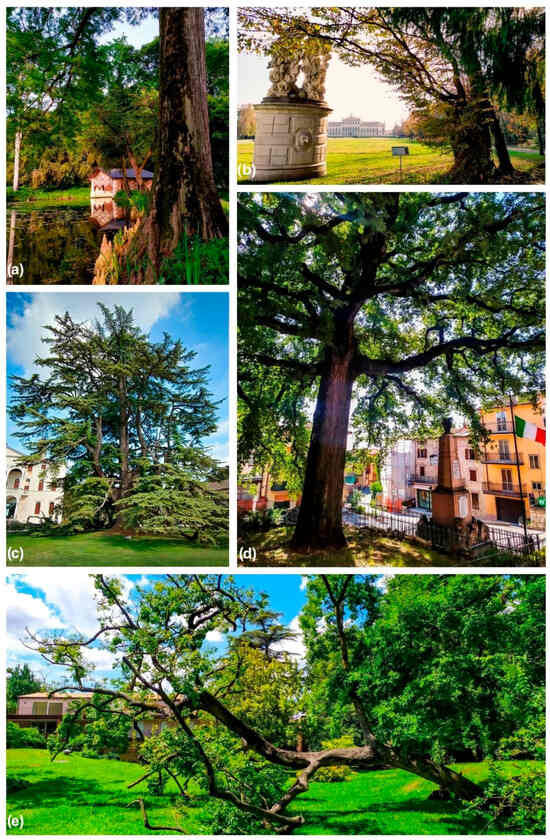
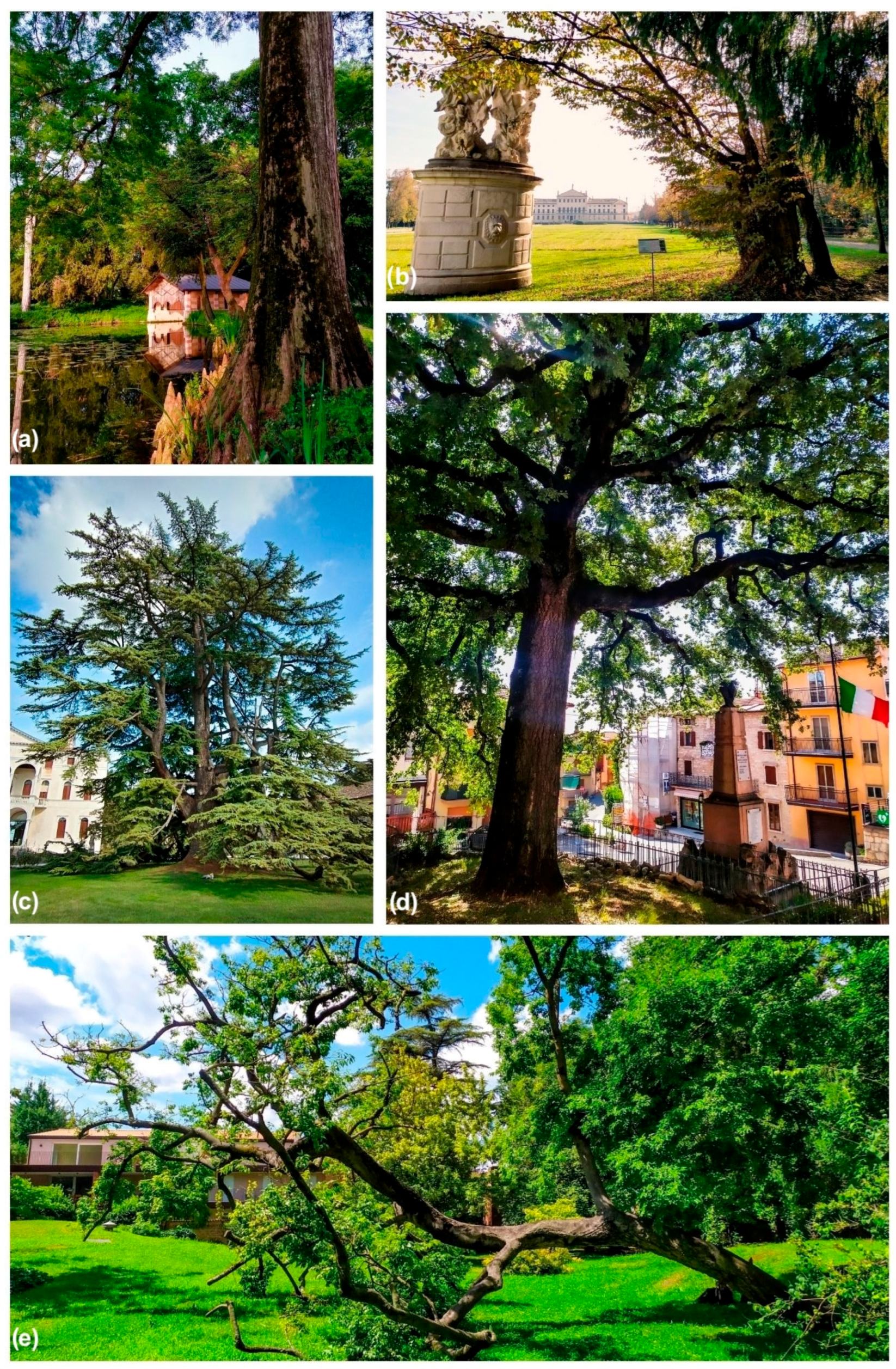
Monumental trees were identified based on the List of Monumental Trees of Italy [28], specifically the version updated at the time of the field survey, approved by executive decree n. 330,598 on 26 July 2022. According to the interministerial decree of 23 October 2014, monumental entities can be identified based on one or more of the following ten criteria: (1) age, (2) architectural value, (3) botanical rarity, (4) circumference, (5) crown size, (6) ecological value, (7) height, (8) historical relevance, (9) landscape values, and (10) tree shape. We standardized the nomenclature of species using the Plants of the World Online database [29] to ensure taxonomic consistency. From the 2022 List of Monumental Trees of Italy, 114 monumental entities, located in urban areas of the Veneto region, were selected (see Figure 1 for some examples). The classification into “urban” and “non-urban” was based on the 2018 CORINE Land Cover data [30]. “Urban” contexts were defined as cases where “artificial surfaces” covered more than 50% of a 500 m radius buffer around the location of each monumental entity. All other conditions were categorized as “non-urban”. The biogeographic origin (i.e., native or non-native) of each species was assigned through the Portal of the Flora of Italy [31] and recorded at the regional level.
Figure 1.
Examples of urban monumental trees. (a) Taxodium distichum (L.) Rich. in the historical park of Villa Revedin Bolasco, Castelfranco Veneto, Veneto (IT) (photo N. Menon). (b) Carpinus betulus L. in the historical park of Villa Pisani, in Stra, Veneto (IT) (photo N. Menon). (c) Cedrus libani A. Rich. in Castello di Roncade, Roncade, Veneto (IT) (photo M. Bedin). (d) Quercus x hispanica Lam. shading a war memorial, in Cerro Veronese, Veneto (IT) (photo N. Menon). (e) Celtis australis L. in Treves public park, Padova, Veneto (IT) (photo N. Menon).
Monumental entities can be formed by single trees or a group of trees identified as monumental. In the summer of 2023, we surveyed 93 of the 114 urban monumental entities due to accessibility issues, for a total of 223 monumental trees (Figure 1). We recorded the diameter at breast height (DBH) and TreMs presence, including type and relative abundance, for each individual tree within the monumental entity. We adapted the TreMs classification consisting of 47 TreM types proposed by Larrieu et al. [11] and Bütler et al. [32] by adding artificial (i.e., derived from active human intervention such as pruning) stem breakage (IN21A) and artificial limb breakage (IN22A) to distinguish them from stem breakage (IN21B) and limb breakage (IN22B) of natural origin, respectively. TreMs were evaluated over three sections of the tree (i.e., base, trunk and branches). TreMs characterized by percentage threshold values (i.e., EP31, EP32, EP33) were converted into a 0–3 range based on their presence (cover above 10%) in the three sections of the tree. Crown, bark, and inter-bark microsoil were assessed on a presence/absence basis for both TreMs richness and abundance estimations. Our classification allowed for the creation of discrete classes and allowed us to include such TreMs in the estimation of abundance. The DBH of multistem trees was standardized as the unified DBH (DBHms) according to the formula proposed by Bernhardt and Swiecki [33]:
where DBHi is the DBH of the i-th stem.
DBHms = √ΣDBHi2
To avoid oversampling trees from monumental entities represented by groups of trees located at the same place, we randomly selected three individuals (i.e., the median number of monumental individuals within grouped monumental entities) out of the 101 monumental trees included in the monumental tree line group in Castelfranco Veneto (Treviso). Moreover, we excluded the monumental Chamaerops humilis L. subsp. humilis in Padua (Palm of Goethe), as it is isolated from the surrounding environment in a special octagonal greenhouse and because of its main life form. Therefore, the analysis of TreMs in relation to species origin, monumental tree configuration, and size, as well as criteria of monumentality, was conducted on a subset of 124 monumental trees.
2.2. Statistical Analysis
All statistical analyses were performed with the R Statistical software 4.4.1 [34]. To investigate the influence of species origin (native vs. non-native), tree grouping type (single tree vs. group of trees), and size (DBH) on biodiversity potential (tree-level richness and abundance of TreMs), we applied generalized linear mixed models (hereafter, GLMMs; “glmmTMB” function of the “glmmTMB” R package; [35]). Richness and abundance of TreMs were modelled as count response variables in two distinct GLMMs with Poisson error distribution, after testing for residual dispersion (“testDispersion” function of the “DHARMa” R package [36]). Plant genus, rather than plant species given the low replication at the species level, and the group to which grouped individuals belonged (i.e., accounting for spatial clustering of grouped individuals while assigning single trees to unique independent levels) were included as random intercept factors in the models. The small-sample corrected Akaike Information Criteria (hereafter, AICc) selection method was applied to identify the best combination of predictors and their interaction effects (“dredge” function of the “MuMIn” R package [37]). Collinearity (the “check_collinearity” function of the “performance” R package [38]) of the final models was tested. Adequacy of the final GLMMs was assessed through residual diagnostics, including tests for dispersion, zero-inflation, uniformity, and outliers (“simulateResiduals”, “testDispersion”, “testZeroInflation”, “testUniformity”, and “testOutliers” functions of the “DHARMa” R package [36]). Although DHARMa diagnostics indicated minor quantile deviations, sensitivity analyses using non-linear formulations (i.e., generalized additive models and polynomial regressions for continuous predictors) did not improve model fit (i.e., AICc). Given the robustness of the linear GLMM formulation, it was retained for final inference. Singularity (“check_singularity” function of the “performance” R package [38]) of the model was tested. Model explanatory power was quantified using conditional and marginal R2 (“model_performance” function of the “performance” R package [38]).
To represent and estimate the compositional difference in TreMs between tree grouping types, we performed a non-metric multidimensional scaling (hereafter, NMDS; “metaNMDS” function of the “vegan” R package [39]). We applied Sørensen dissimilarity as the distance metric, based on the presence/absence of TreMs, and set the dimensionality to two axes (k = 2). To ensure a stable solution, we allowed up to 100 random starts. After producing a dissimilarity matrix (“vegdist” function of the “vegan” R package; Oksanen et al., 2024), we conducted a PERMANOVA test (“adonis2” function of the “vegan” R package [39]) to test whether there were differences between grouping types and tree species origin in TreMs composition. We tested for the homogeneity of multivariate dispersions to test for within-group variability of TreMs composition (“betadisper” function of the “vegan” R package [39]).
Similarity Percentages (SIMPER) analysis was conducted to identify TreMs that contribute most to the dissimilarity between groups (“simper” function of the “vegan” R package [39]). To identify TreMs that are frequent and restricted to specific groups (i.e., fidelity and specificity), Indicator Species Analysis (ISA) was performed using the IndVal.g method (999 permutations; “multipatt” function of the “indicspecies” R package [40]) as it accounts for unequal group sizes.
To test whether certain criteria were associated with high potential biodiversity, we performed GLMMs investigating the relationship between the richness and abundance of TreMs (as count response variables) and the application of the ten criteria of monumentality (as binary explanatory variables). The crown size criterion was excluded from this analysis due to its limited representation in the dataset (one record). After testing for overdispersion, we applied Poisson error distribution to the GLMMs. The group to which grouped individuals belonged was added as random intercept factors. Given the limited literature on the potential relationships between TreMs and criteria of monumentality, we initially included all nine monumentality criteria in the GLMMs. Subsequently, we applied the AICc-selection method to identify the most informative predictors within the GLMMs for the abundance and richness of TreMs. Collinearity and model metrics (i.e., conditional and marginal R2, mean absolute error, root mean squared error, and Pearson’s correlation of predicted values) were estimated. The same ISA approach used to assess differences between different origins and configurations was applied to identify TreMs (presence/absence) that were frequent and specific to each monumentality criterion.
3. Results
3.1. Biodiversity Potential Across Species Origin, Tree Grouping Type and Size of Monumental Trees
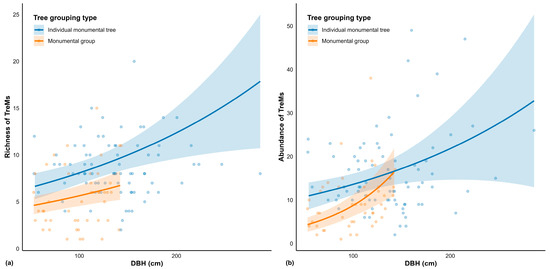
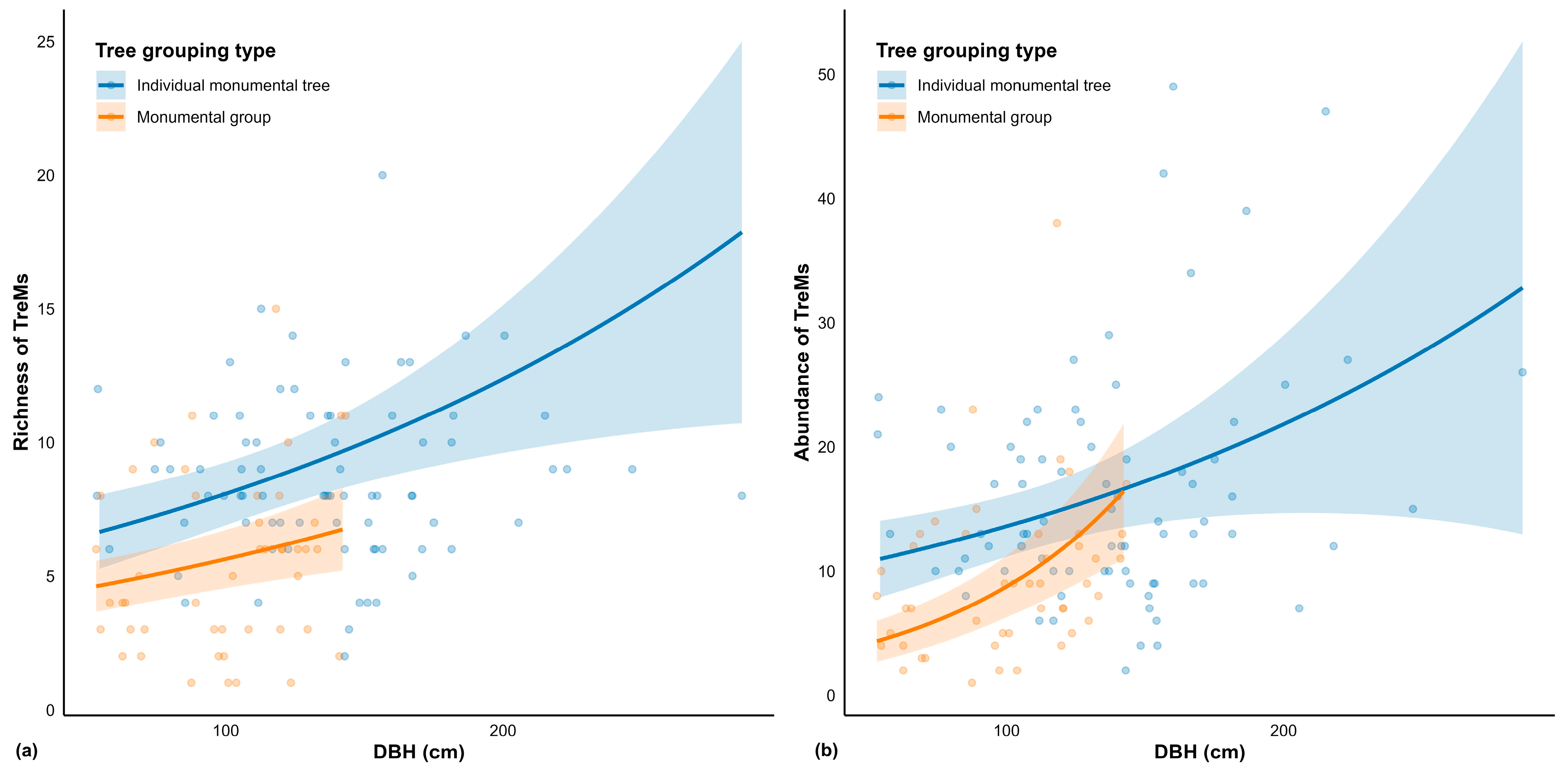
We did not observe significant effects of species origin (i.e., native vs. non-native species) on the richness or abundance of TreMs, nor did we observe any significant interaction effects (Table 1). Moreover, the interaction effect between DBH and tree grouping type was not significantly associated with the richness of TreMs and was therefore excluded from the GLMM. The scaled DBH had a positive influence on both TreM richness (p < 0.001) and abundance (p = 0.007) (Figure 2). For individual monumental trees, TreM richness and abundance increased by 4.38% and 4.68%, respectively, for every 10 cm increment in DBH. In contrast, monumental trees located in groups exhibited lower values of richness (−30.08%) and abundance (−20.39%) of TreMs, with only the former being statistically significant (p < 0.001). However, we detected a significant interaction effect of DBH and tree grouping type on the abundance of TreMs (p < 0.001). The positive effect of DBH on the abundance of TreMs was amplified in grouped trees compared to single trees.
Table 1.
Results of the GLMMs using Poisson error distribution, after the AICc-selection method, of the influence of scaled DBH and tree grouping type (monumental group vs. individual monumental trees) on the richness (AICc = 613.3) and abundance (AICc = 822.7) of TreMs of 124 urban monumental trees of the Veneto region. Estimated metrics of the GLMMs can be found in Table S1.
Figure 2.
Representation of the GLMMs with a Poisson error distribution of the richness (a) and abundance (b) of TreMs across DBH values, for 124 urban monumental trees of the Veneto region. Regression curves are distinguished between individual monumental trees (blue) and monumental groups (orange). Points represent the observed values.
3.2. Compositional Differences in Tree-Related Microhabitats Based on Origin and Monumental Tree Configuration
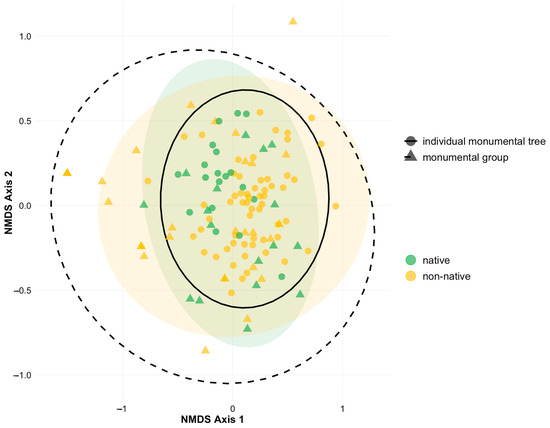
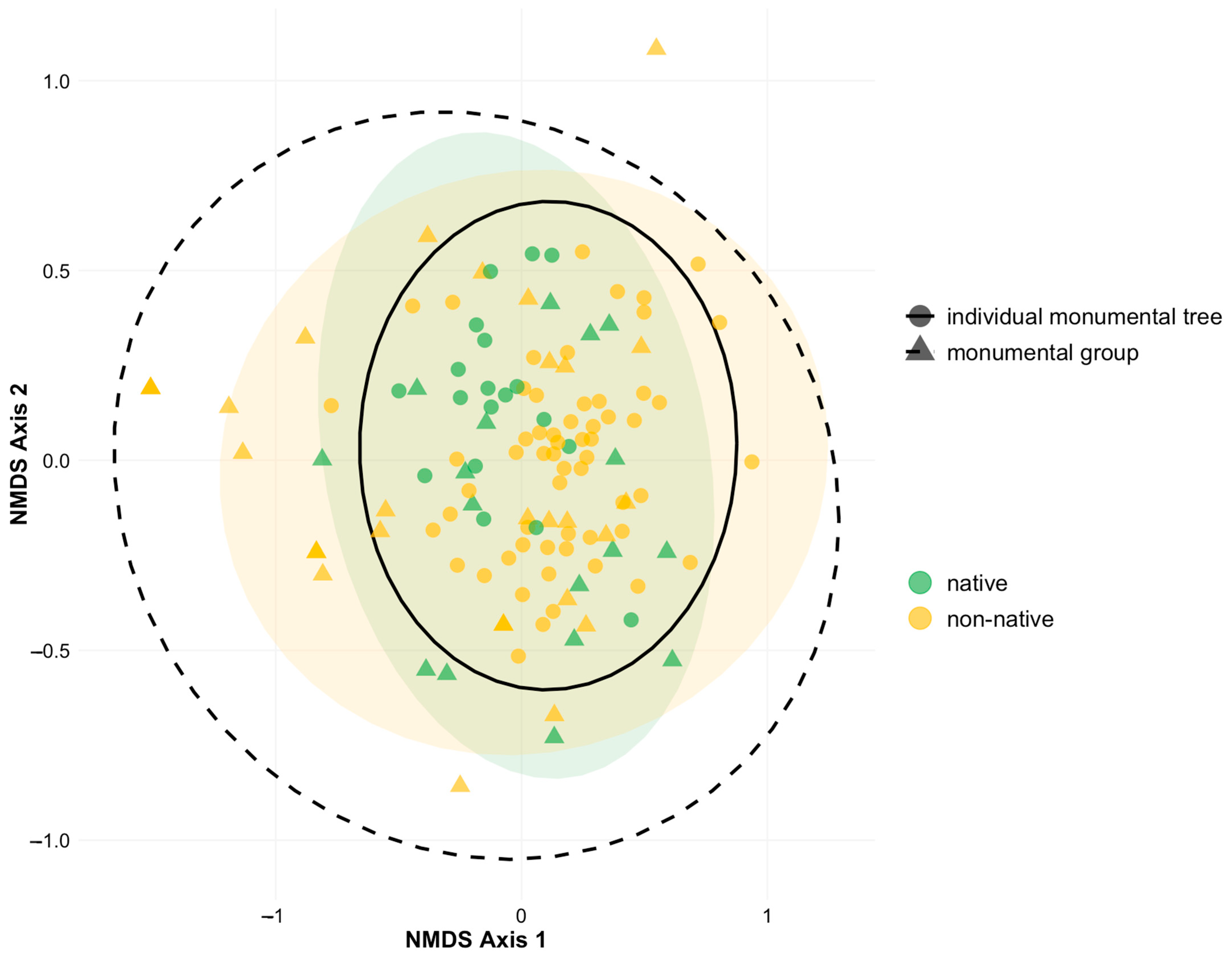
Native and non-native monumental trees showed significant differences in TreMs composition (Figure 3, PERMANOVA: R2 = 0.022, p = 0.005). No difference was recorded for within-group variability of TreM composition between the two groups (p = 0.233). Hence, the observed difference was due to changes in species composition; however, origin explained a relatively small fraction of the composition variability. Individual monumental trees and monumental tree groups displayed significant differences in the average composition of TreMs; however, monumental tree configuration explained a relatively small fraction of composition variability (PERMANOVA: R2 = 0.050, p < 0.001). Dispersal analysis revealed a significant difference in within-group heterogeneity (p < 0.001) with the monumental tree group being more dispersed.
Figure 3.
NMDS based on Sørensen dissimilarity of TreMs (stress = 0.243). Circles refer to individual monumental trees, triangles refer to trees in monumental groups, green symbols refer to native trees, and yellow symbols refer to non-native trees. Ellipses represent the 95% confidence regions around the centroid of each group. Coloured ellipses refer to tree origin, while the solid line refers to individual monumental trees and the dotted line to monumental groups.
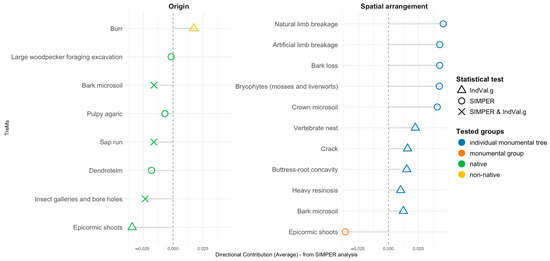
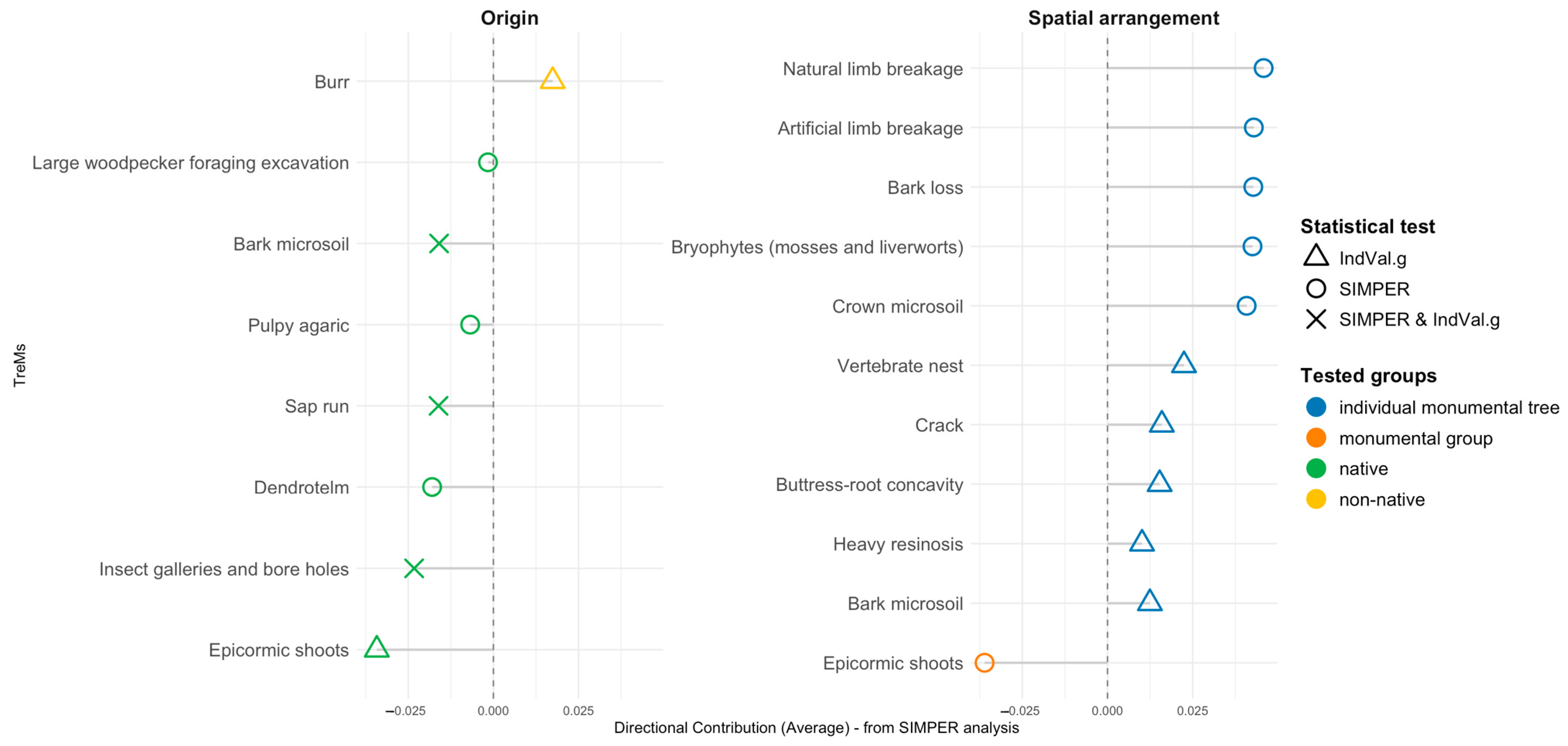
Certain TreM types contributed most to differences in TreM composition according to tree origin and monumental tree configuration (Figure 4, Tables S2–S5). SIMPER analyses identified seven significant TreMs based on origin—all related to native trees (Table S2)—and six based on monumental tree configuration, of which five were related to individual monumental trees and one to monumental groups (Table S3). The Indicator Value analyses (IndVal.g) identified four indicator TreMs based on origin (three for native and one for non-native trees; Table S4) and five based on monumental tree configuration, all associated with individual monumental trees (Table S5).
Figure 4.
Key TreMs across tree origin (native vs. non-native) and monumental tree configuration (individual monumental tree vs. monumental group). The x-axis represents the directional contribution of each TreM to total dissimilarity (SIMPER average): positive values indicate association with the first group of each comparison (non-native or individual monumental tree), while negative values indicate association with the second group (native or monumental group). Crosses (×) indicate TreMs significant in both SIMPER and IndVal.g tests (p < 0.05); triangles (Δ) indicate significance only in IndVal.g; open circles (o) indicate significance only in SIMPER.
Considering both analyses, only bark microsoil, dendrotelm (a small, water-filled tree concavity), and insect galleries and bore holes were consistently associated with native monumental trees. Burr was an indicator of non-native trees, while epicormic shoot type was an indicator of native trees. Vertebrate nest, crack, buttress-root concavity, trunk-base rot-hole, and bark microsoil were indicators of individual monumental trees. According to SIMPER, large woodpecker foraging excavation, pulpy agaric, bark-lined trunk concavity and sap run were the top contributors to the dissimilarity between native and non-native trees. Natural limb breakage, artificial limb breakage, bark loss, bryophytes and crown microsoil were the top contributors to the dissimilarity of individual monumental trees relative to monumental groups, whereas epicormic shoot type was a top contributor characterizing monumental groups.
3.3. Criteria of Monumentality and Their Relationship with Biodiversity Potential
Overall, age (no. = 109 records) and tree circumference (no. = 91) were the most frequently assigned criteria for monumentality within the surveyed monumental tree community.
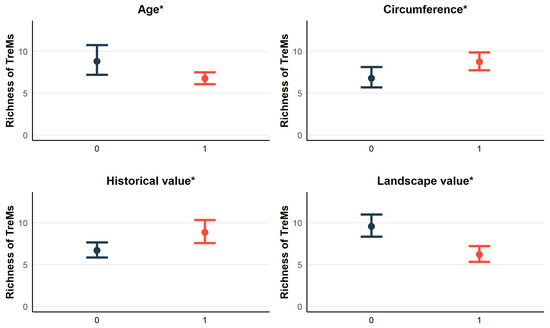
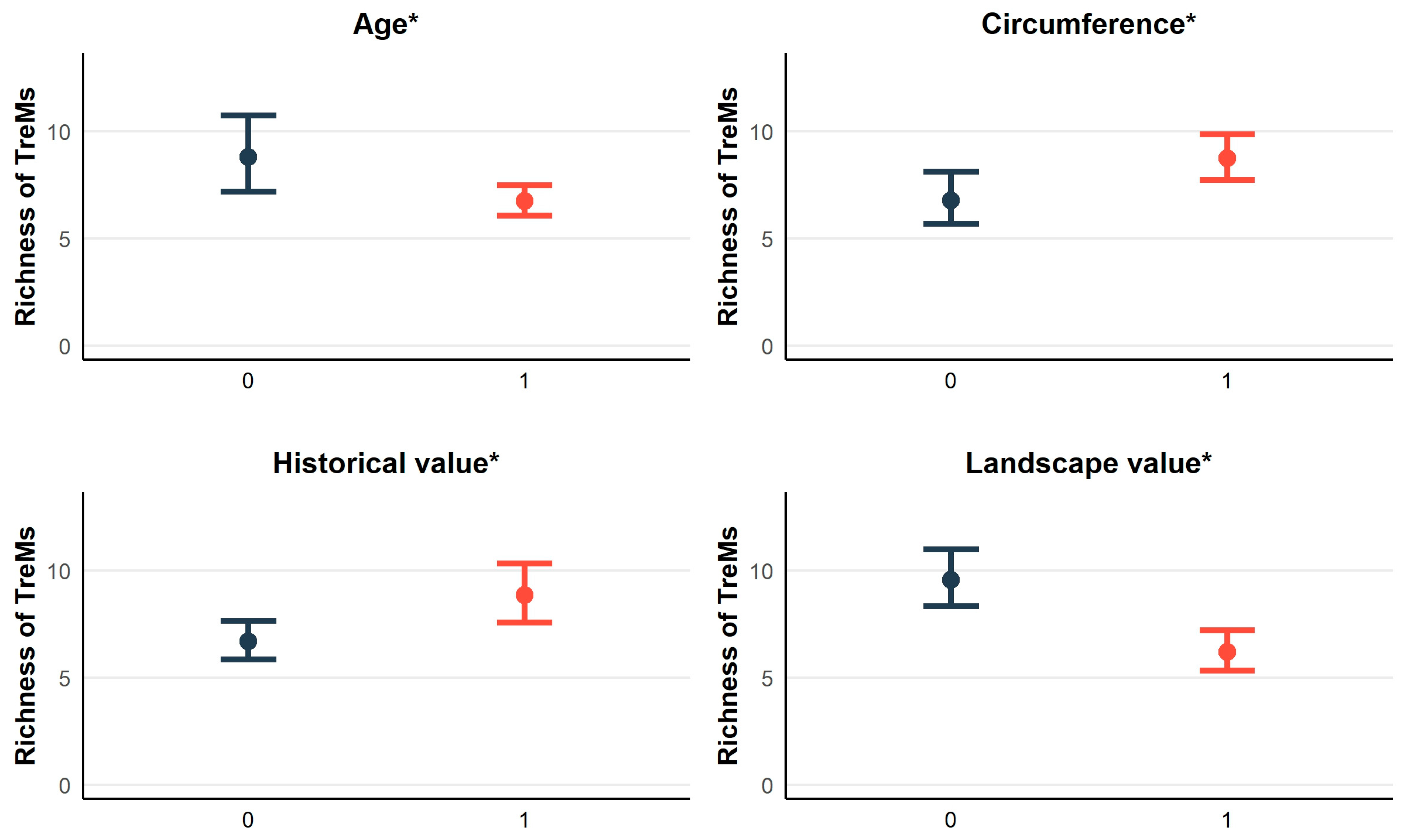
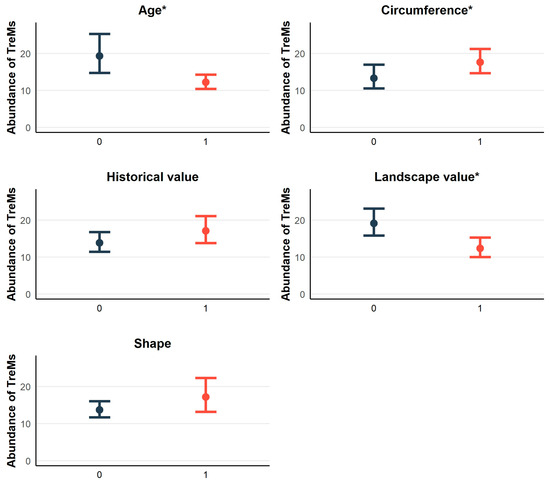
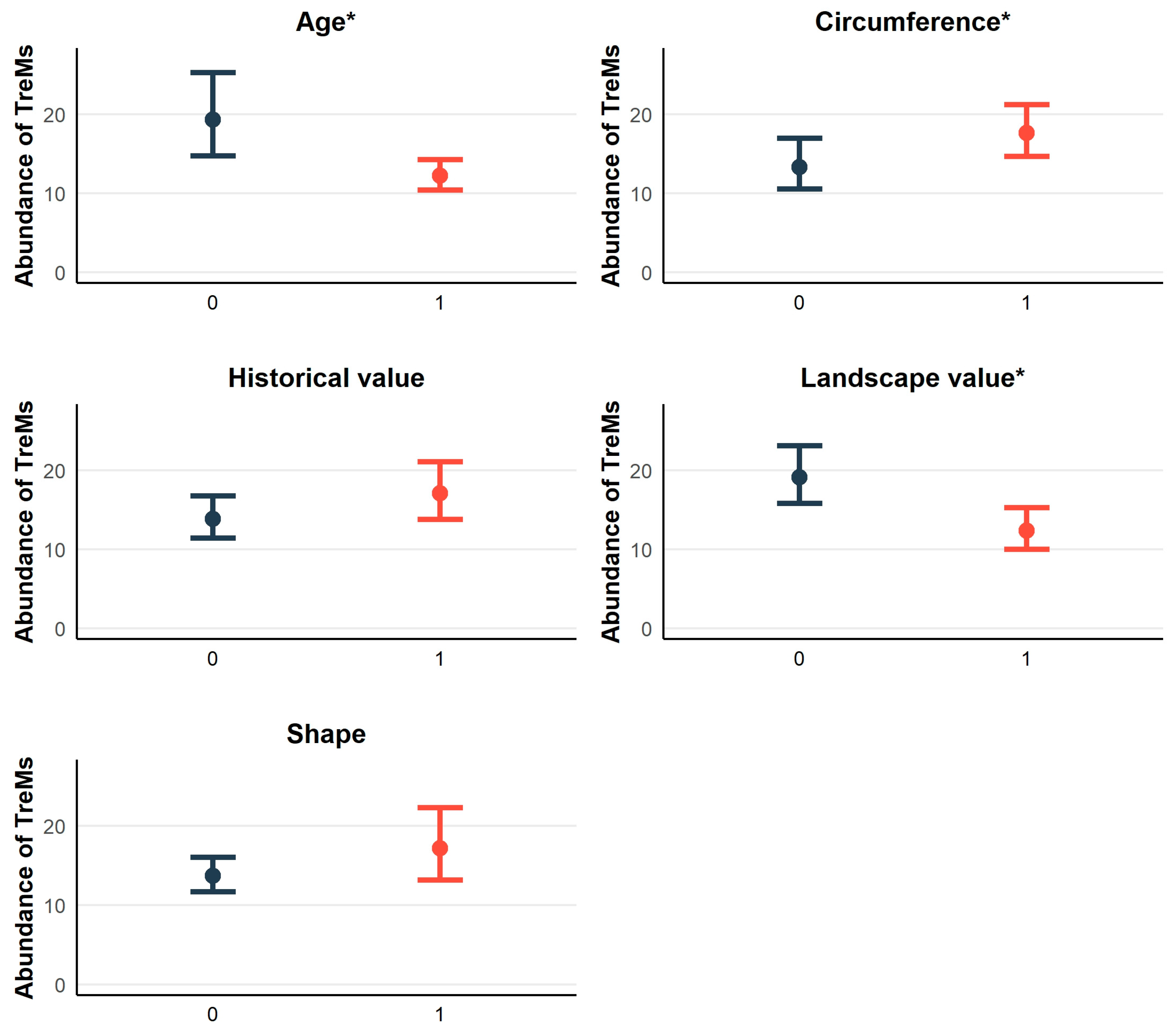
Landscape value exhibited a significantly negative association with both TreMs richness (p < 0.001) and abundance (p < 0.001) (Table S6). In contrast, historical value was significantly positively associated with the richness of TreMs (p = 0.001) and marginally positively associated with the abundance of TreMs (p = 0.072). Age was negatively associated with both the richness (p = 0.02) and abundance (p = 0.003) of TreMs. Circumference revealed a significantly positive association with richness (p = 0.014) and was marginally positively associated with the abundance of TreMs (p = 0.062). Botanical rarity was marginally positively associated with the abundance of TreMs (p = 0.095). The remaining criteria (i.e., height, ecological value, shape, and architectural value) did not display significant associations with biodiversity potential values (Figure 5 and Figure 6).
Figure 5.
Barplots displaying the richness of TreMs across the four criteria of monumentality included in the GLMM model (see Table S7). Differences in richness values are highlighted between cases where a specific criterion was applied (1, red) or not applied (0, blue). * Refers to significant or marginally significant criteria included in the GLMM (see Table S6).
Figure 6.
Barplots displaying the abundance of TreMs across the five criteria of monumentality included in the GLMM model (see Table S7). Differences in abundance values are highlighted between cases where a specific criterion was applied (1, red) or not applied (0, blue). * Refers to significant or marginally significant criteria included in the GLMM (see Table S6).
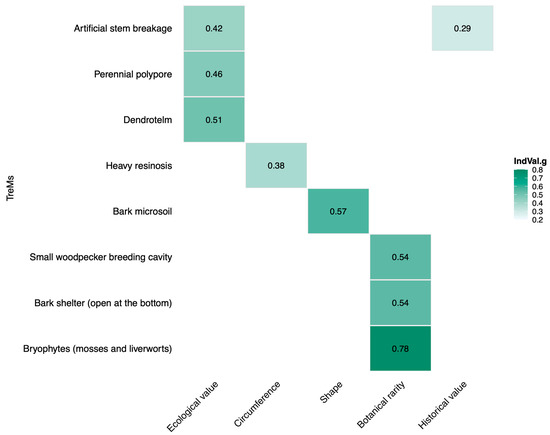
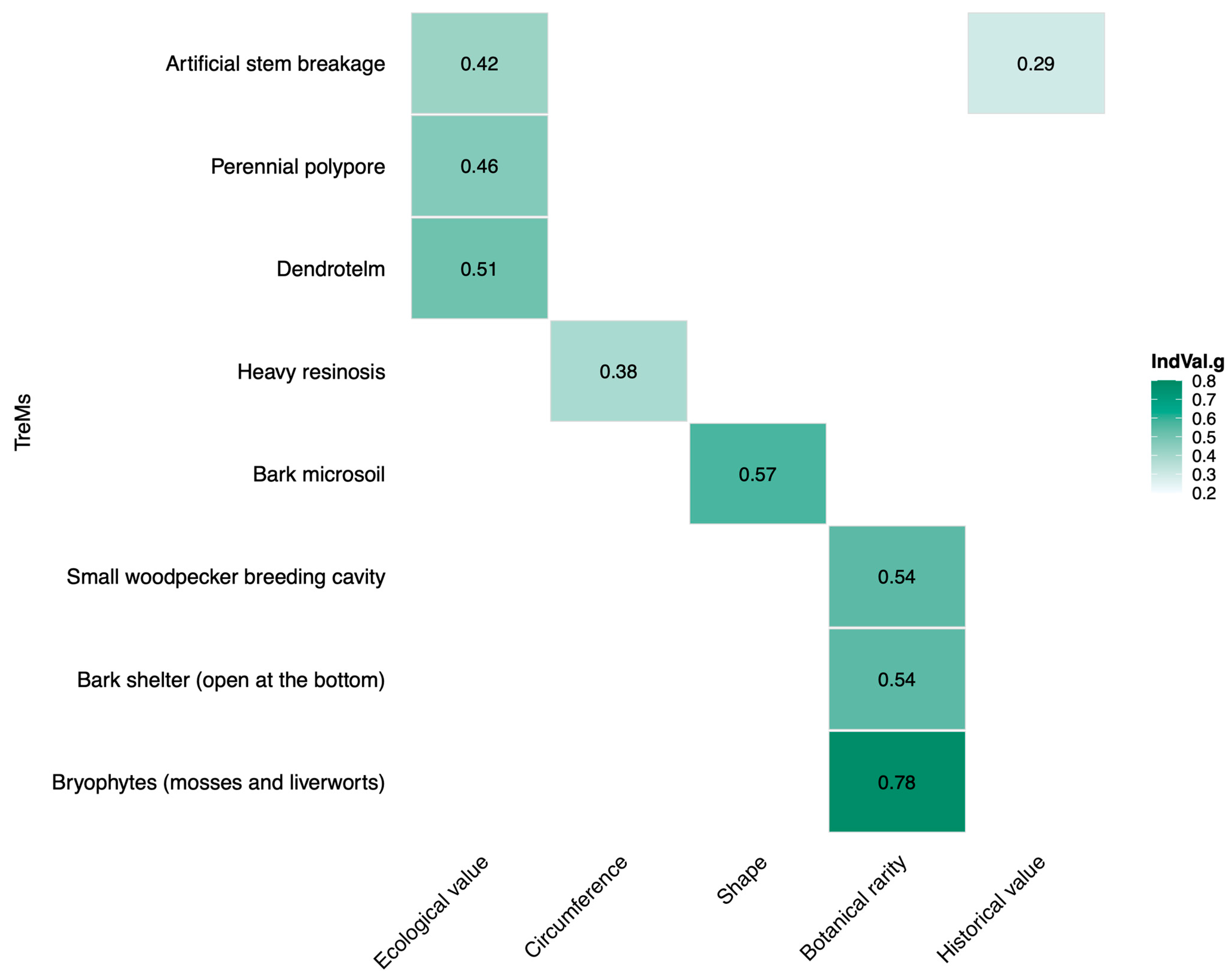
The Indicator Species Analysis showed relationships between monumentality criteria and specific TreMs (Figure 7; Table S8). Not all criteria had a TreM indicator. A limited number of TreMs were indicators (no. = 8) of a subset of criteria (no. = 5). Dendrotelm, perennial polypore, and artificial stem breakage were indicators of ecological value. Heavy resinosis was an indicator of circumference. Bryophytes, small woodpecker breeding cavities and bark shelters (open at the bottom) were indicators of botanical rarity. Bark microsoil and artificial stem breakage were indicators of shape and historical value, respectively.
Figure 7.
Heatmap of significant indicator values (IndVal.g) for tree-related microhabitats (TreMs) associated with the presence of the assessed criteria (p ≤ 0.05). Cell colour intensity and the numeric labels correspond to the IndVal.g value, with higher values indicating stronger indicator relationships. Only significant TreM–criterion combinations are shown.
4. Discussion
We investigated the influence of species origin, tree size, and tree grouping type on the biodiversity potential of urban monumental trees in the Veneto region of Italy. Biodiversity potential was evaluated based on the richness and abundance of TreMs, serving as proxies of ecological support for various taxa.
4.1. Large Individual and Grouped Monumental Trees Are Crucial for Urban Biodiversity Support
Contrary to other studies [23,25,26], species origin (i.e., native vs. non-native) did not significantly influence the richness and abundance of TreMs on monumental trees in Veneto. These findings underscore that dendrometric parameters (e.g., DBH) are more relevant in determining biodiversity potential than species origin of monumental trees in our study. From a conservation and management perspective, these findings indicate that both non-native and native monumental trees contribute to urban biodiversity by providing essential habitat features [41].
Our analysis confirmed the pivotal role of tree size (i.e., DBH) in influencing both the richness and abundance of TreMs. The strong positive relationship between biodiversity potential and DBH is consistent with the existing literature, as larger trees typically exhibit higher structural complexity, hosting a greater diversity and density of TreMs [7,12,13,42,43]. Large trees are usually older individuals, favouring the accumulation of age-related TreMs (e.g., cavities, deadwood, injuries, and exposed wood) that develop over time and provide key resources for a broad range of organisms [44]. Interestingly, our study shows that trees in monumental groups do not reach high DBH values as compared to single monumental trees.
The richness of TreMs was significantly higher in isolated trees compared to individuals growing in groups. Isolated trees may be more likely to have a variety of TreMs as these trees are exposed more to biotic and abiotic factors. This pattern may be attributed to greater light availability around isolated trees, facilitating the lateral expansion of the crown and the development of larger branches [45,46]. Nevertheless, the influence of DBH on TreM abundance was more pronounced in grouped trees. This may indicate that, despite spatial constraints, large trees in within-group configurations represent critical biodiversity reservoirs in urban environments. Specific dynamics within tree groups, such as self-pruning or competition-induced decay, may contribute to this increase in TreM abundance.
4.2. TreM Composition: Monumental Ecological and Configuration Characteristics Matter
Interestingly, TreM composition was influenced by ecological and spatial characteristics of monumental trees. Native and non-native trees were compositionally different in terms of their TreM assemblages. Monumental tree configuration also revealed different TreM communities; however, this differentiation may be linked to the varying levels of dispersion observed between individual and grouped trees.
Native monumental trees had a higher number of associated types of TreMs compared to non-native monumental trees. Burr, the only TreM associated with non-native species, is somehow linked to stress, indicating possible responses of trees to unsuitable conditions. The wider range of TreMs associated with native species—including cavities, epixylic structures, fungal fruiting bodies, and exudates—indicates their important role in representing important ecological structures. Interestingly, some of these are considered quite infrequent and have a slow replacement rate, such as bark-lined trunk concavities and bark microsoils. This reinforces the role of native monumental trees for biodiversity.
Individual monumental trees had a higher number of associated TreMs compared to groups of trees. Only epicormic shoots were associated with groups of monumental trees, indicating a possible effect of shading and self-pruning driven by the vicinity of other trees. Individual monumental trees show a wide variety of associated TreMs (cavities, tree injuries, epiphytic structures, and exudates). Interestingly, artificial limb breakage was associated with individual monumental trees, which can be linked to tree management, and may indicate the role of intervention frequency and intensity. Furthermore, many associated TreMs are within the tree injury TreM category. Finally, many TreMs, such as bryophytes, may be considered relatively frequent.
4.3. Criteria of Monumentality Provide Little Insight on the Richness and Abundance of TreMs
The dominance of age and circumference criteria in the urban monumental tree community of the Veneto region likely reflects the ease with which these criteria can be measured and evaluated. The high frequency of the age criterion could also be related to the prevalence of old trees. This pattern could be related to trees planted in historically relevant areas, public parks, and private gardens, which are locations often spared from urbanization and land reclamation [47].
Our findings showed mixed results regarding the association of monumentality criteria with the richness and abundance of TreMs. While old trees are expected to host a greater variety and abundance of TreMs [44], we found a negative association with tree age. This could be related to the high degree of protection and sanitation (e.g., deadwooding) of old trees in urban settings. Moreover, being environmentally isolated could limit the formation and accumulation of certain TreMs.
In contrast, monumental trees recognized for their historical value were positively associated with the richness and abundance of TreMs. This emphasizes how historically significant individuals can simultaneously provide cultural and ecological services in urban ecosystems [48]. Such trees often undergo less intensive structural “cleaning” over decades, allowing for natural decay processes to occur.
The positive association between the circumference criterion and TreMs richness and abundance strengthens the argument that larger trees offer a wider variety of morphological structures functioning as TreMs [13,44]. Interestingly, monumentality criteria such as architectural value, botanical rarity, ecological value, and height did not reveal any significant association with biodiversity metrics. While this may be due to the ecological irrelevance of some criteria to TreM formation, it also points to a potential knowledge gap in the application and evaluation of these criteria in relation to ecological functions. The lack of certain relationships may also be attributed to the absence of standardized protocols for criteria selection, rendering the identification of certain criteria subjective. For instance, the absence of a relationship between ecological value and TreMs metrics might suggest that further studies on how trees manifest their ecological relevance are required. The standardized assignment of ecological value could represent an effective tool for identifying and conserving functionally valuable trees in urban landscapes. Therefore, specific training on TreMs for personnel involved in identifying and surveying monumental trees would help in assigning appropriate ecological values to trees.
Only a limited number of TreMs were linked to specific monumental tree criteria. These associations likely reflect both the intrinsic characteristics of the TreMs and the rationale underlying the assignment of each criterion.
TreMs associated with the ecological value criterion are particularly relevant from a biodiversity perspective. Dendrotelms, i.e., water-filled tree cavities, represent small aquatic habitats embedded within terrestrial ecosystems and support many species; their occurrence is therefore consistent with high biodiversity potential [49,50]. In addition, management practices, which are often required to preserve monumental trees, may influence this TreM formation [22,51]. Polypores, another TreM associated with the ecological value criterion, frequently co-occur with other TreMs [52], suggesting that they may act as proxies for broader habitat complexity. Artificial stem breakages, which reflect past management interventions, could also be associated with a wide range of taxa.
Specific TreMs were also associated with the botanical rarity criterion. This pattern may be related to species-specific traits, such as bark structure and dynamics, as well as to microclimatic conditions. For example, bryophytes are generally favoured by humid microsites and by the accumulation of organic matter, conditions that may occur more frequently in some tree species included under this criterion. Likewise, bark heterogeneity may reflect species-specific bark properties, while the presence of breeding cavities used by small woodpeckers may be linked to wood-density characteristics.
Heavy resinosis was associated with circumference probably due to the high number of conifers identified based on such a criterion. The shape criterion is used to identify monumental trees with distinctive architecture, including crown form. Bark microsoils may be associated with thick, well-developed bark showing deep furrows and fissures; such features are more likely to occur in trees with unusual or highly developed stem and crown architecture. By contrast, artificial stem breakage associated with the historical value criterion may reflect management requirements, especially in trees exposed to high visitor pressure and managed according to a risk-averse approach.
4.4. Limitations of the Study
This research provides valuable information on factors influencing the biodiversity potential of monumental trees in urban areas of the Veneto region. Nevertheless, some limitations should be acknowledged.
First, the analysis was based on a relatively small sample size (124 monumental trees) and scale (Veneto region), which may not capture the full variability of TreMs. Although most monumental entities (93 out of 114) in urban areas of the region were sampled, the low representation of some criteria, such as crown size, may have limited the comprehensiveness of relationships between monumentality criteria and biodiversity potential. Lastly, this study did not include other environmental or management-related variables (e.g., soil conditions, pollution levels, pruning intensity, and surrounding habitat quality). These factors may influence the development of urban trees and, consequently, associated TreMs. Further studies are required to address these limitations, including monumental trees from different locations and different environmental conditions, as well as incorporating comparative analysis with non-monumental trees sharing similar traits (e.g., species identity and DBH), thereby improving our understanding of the ecological role of urban monumental trees and providing actionable information for conservation strategies in urban forestry.
5. Conclusions
This study provides new evidence on the ecological role of urban monumental trees, using TreM richness and abundance as proxies for potential biodiversity support. DBH and tree configuration were more strongly associated with TreM richness and abundance than species origin, indicating that both tree size and spatial configuration are important predictors of microhabitat provision. These results demonstrate that morphological characteristics and monumental tree configuration strongly affect their biodiversity potential, and that both native and non-native species can contribute substantially to urban ecosystem functioning. Consequently, targeted management aiming at preserving large individual and grouped monumental trees is essential to promote TreMs diversity within urban environments.
Our analysis revealed limited and occasionally contrasting relationships between monumentality criteria and TreMs. Specific monumentality criteria, such as historical value and tree circumference, showed positive associations with TreM abundance and richness. In contrast, other criteria, such as tree age and ecological value, demonstrated unexpected negative or non-significant relationships. Furthermore, few TreMs were specific to monumentality criteria. Future studies should integrate these results by comparing monumental trees with other types of urban trees (e.g., different protection levels).
Our results support evidence-based management of urban green spaces by elucidating the significance of monumental trees as hosts for TreMs, thereby offering habitat for a wide range of species and preserving their multifaceted values. Although focused on the Veneto region, this work provides valuable insights for decision-making in the planning and management of monumental trees in urban spaces. Maintaining a community of monumental trees with variable characteristics (i.e., origin, monumental tree configuration, criterion) will help support a large variety of TreM types, including relatively rare ones. These insights can be integrated into municipal management plans for the retention of highly valuable trees to enhance urban biodiversity networks. Future investigations should aim to further clarify the ecological role of urban monumental trees relative to non-monumental urban trees and support integrated conservation strategies in urban forestry.
Supplementary Materials
The following supporting information can be downloaded at https://www.mdpi.com/article/10.3390/f17101160/s1, Table S1: Model metrics estimated for the GLMMs, presented in Table 1, testing the richness (formula: Richness of TreMs ~ D_scaled + Tree grouping type + (1|id_group) + (1|genus)) and abundance (formula: Abundance of TreMs ~ D_scaled + Tree grouping type + D_scaled: Tree grouping type + (1|id_group) + (1|genus)) of TreMs across DBH and monumental tree configuration (single vs. grouped monumental tree), Table S2: Results of the SIMPER analysis showing the TreMs that significantly contributed to the Sørensen dissimilarity between native and non-native monumental trees. Average contribution represents the mean contribution of each TreM to the overall dissimilarity. Non-native and Native represent the mean abundance of each TreM in the origin type. Only significant TreMs (p-value < 0.05) are reported, Table S3: Results of the Indicator Species Analysis (IndVal.g) identifying TreMs significantly associated with native and non-native monumental trees. Origin indicates the monumental tree type with which each TreM is significantly associated. Only TreMs with significant indicator values (p < 0.05) are reported, Table S4: Results of the SIMPER analysis showing the TreMs that significantly contributed to the Sørensen dissimilarity between individual and monumental group trees. Average contribution represents the mean contribution of each TreM to the overall dissimilarity. Individual monumental tree and monumental group represent the mean abundance of each TreM in the monumental tree configuration. Only significant TreMs (p-value < 0.05) are reported, Table S5: Results of the Indicator Species Analysis (IndVal.g) identifying TreMs significantly associated with individual and monumental group trees. Tree configuration indicates the monumental tree type with which each TreM is significantly associated. Only TreMs with significant indicator values (p < 0.05) are reported, Table S6: Results of the final GLMMs with Poisson error distribution, using the AICc-selection method, of the relationships between criteria of monumentality and the richness (AICc = 618.6) and abundance (AICc = 858.5) of tree-related microhabitats (TreMs) for 124 urban monumental trees of the Veneto region, Table S7: Metrics for the GLMMs testing the richness (formula: Richness of TreMs ~ Age + Circumference + Landscape value + Historical value +(1|id_group)) and abundance (formula: Abundance of TreMs ~ Age + Circumference + Landscape value + Historical value + Botanical rarity + (1|id_group)) of TreMs across 10 criteria of monumentality. The metrics refer to the final model, including the criteria of monumentality as predictors based on AICc-selection methods, Table S8: Results of the Indicator Species Analysis (IndVal.g) identifying TreMs significantly associated with each criterion. Only TreMs with significant indicator values (p < 0.05) are reported, Table S9: Structure of the GLMMs describing associated model types, error distributions, and formulas implemented in this study.
Author Contributions
Conceptualization: T.C.; Methodology: N.M., G.B., Y.P. and T.C.; Formal analysis: N.M., Y.P. and T.C.; Investigation: N.M., M.B. and T.C.; Resources: T.C.; Data curation: N.M., M.B., G.B., Y.P. and T.C.; Visualization: N.M., Y.P. and T.C.; Supervision: T.C.; Project administration: N.M. and T.C.; Funding acquisition: T.C.; Writing—original draft preparation: N.M. and T.C.; Writing—review and editing: N.M., M.B., G.B., D.C., D.J.K., Y.P., P.S., T.S. and T.C. All authors have read and agreed to the published version of the manuscript.
Funding
This work was financed by the BIRD 2022 project of the Dept. TESAF, Università degli Studi di Padova—Italy.
Data Availability Statement
The official dataset of the Italian monumental trees used in this article is available upon request at the website of the Ministero dell’agricoltura, della sovranità alimentare e delle foreste—Direzione generale dell’economia montana e delle foreste (https://www.masaf.gov.it/flex/cm/pages/ServeBLOB.php/L/IT/IDPagina/11260, accessed on 14 April 2024). Data collected in this study will be made available upon request.
Acknowledgments
The authors thank the Ministero dell’agricoltura, della sovranità alimentare e delle foreste—Direzione generale dell’economia montana e delle foreste for sharing the official dataset of the Italian monumental trees.
Conflicts of Interest
The authors declare no conflicts of interest.
References
- Nowak, D.J.; Greenfield, E.J.; Hoehn, R.E.; Lapoint, E. Carbon storage and sequestration by trees in urban and community areas of the United States. Environ. Pollut. 2013, 178, 229–236. [Google Scholar] [CrossRef] [Scilit] [PubMed]
- Nowak, D.J.; Hirabayashi, S.; Bodine, A.; Greenfield, E. Tree and forest effects on air quality and human health in the United States. Environ. Pollut. 2014, 193, 119–129. [Google Scholar] [CrossRef] [Scilit] [PubMed]
- Savo, V.; D’Amato, L.; Bartoli, F.; Zappitelli, I.; Caneva, G. Evaluation of main regulating, provisioning, and supporting ecosystem services of urban street trees: A literature review. Ecosyst. Serv. 2025, 71, 101690. [Google Scholar] [CrossRef] [Scilit]
- Tyrväinen, L.; Pauleit, S.; Seeland, K.; De Vries, S. Benefits and uses of urban forests and trees. In Urban Forests and Trees: A Reference Book; Konijnendijk, C., Nilsson, K., Randrup, T., Schipperijn, J., Eds.; Springer: Heidelberg, Germany, 2005; pp. 81–114. [Google Scholar] [CrossRef] [Scilit] [PubMed]
- Menon, N.; Brundu, G.; Kotze, D.J.; La Porta, N.; Monteverdi, M.C.; Paillet, Y.; Semenzato, P.; Sitzia, T.; Campagnaro, T. Native and non-native monumental trees in cultural landscapes: A spatially heterogeneous source of biodiversity. Trees For. People 2025, 22, 101030. [Google Scholar] [CrossRef] [Scilit]
- Lonsdale, D. Ancient and Other Veteran Trees: Further Guidance on Management; The Tree Council: London, UK, 2013. [Google Scholar]
- Stagoll, K.; Lindenmayer, D.B.; Knight, E.; Fischer, J.; Manning, A.D. Large trees are keystone structures in urban parks. Conserv. Lett. 2012, 5, 115–122. [Google Scholar] [CrossRef] [Scilit]
- Jim, C.Y. Urban heritage trees: Natural-cultural significance informing management and conservation. In Greening Cities; Tan, P., Jim, C., Eds.; Springer: Singapore, 2017; pp. 279–305. [Google Scholar] [CrossRef] [Scilit]
- Lindenmayer, D.B.; Laurance, W.F. The ecology, distribution, conservation and management of large old trees. Biol. Rev. 2017, 92, 1434–1458. [Google Scholar] [CrossRef] [Scilit] [PubMed]
- Bütler, R.; Lachat, T.; Larrieu, L.; Paillet, Y. Habitat trees: Key elements for forest biodiversity. In Integrative Approaches as an Opportunity for the Conservation of Forest Biodiversity; Kraus, D., Krumm, F., Eds.; European Forest Institute: Freiburg, Germany, 2013; pp. 84–91. [Google Scholar]
- Larrieu, L.; Paillet, Y.; Winter, S.; Bütler, R.; Kraus, D.; Krumm, F.; Lachat, T.; Michel, A.K.; Regnery, B.; Vandekerkhove, K. Tree-related microhabitats in temperate and Mediterranean European forests: A hierarchical typology for inventory standardization. Ecol. Indic. 2018, 84, 194–207. [Google Scholar] [CrossRef] [Scilit]
- Großmann, J.; Schultze, J.; Bauhus, J.; Pyttel, P. Predictors of microhabitat frequency and diversity in mixed mountain forests in South-Western Germany. Forests 2018, 9, 104. [Google Scholar] [CrossRef] [Scilit]
- Paillet, Y.; Debaive, N.; Archaux, F.; Cateau, E.; Gilg, O.; Guilbert, E. Nothing else matters? Tree diameter and living status have more effects than biogeoclimatic context on microhabitat number and occurrence: An analysis in French forest reserves. PLoS ONE 2019, 14, e0216500. [Google Scholar] [CrossRef] [Scilit] [PubMed]
- Żuraw, B.; Durlak, W.; Dudkiewicz, M.; Nowak, D. Assessment of the health of monumental trees growing in a historic park in Zwierzyniec using an acoustic tomograph. Tech. Trans. 2016, 1-A, 217–236. [Google Scholar] [CrossRef]
- Lindenmayer, D.B.; Laurance, W.F.; Franklin, J.F. Global decline in large old trees. Science 2012, 338, 1305–1306. [Google Scholar] [CrossRef] [Scilit] [PubMed]
- Lindenmayer, D.B.; Laurance, W.F.; Franklin, J.F.; Likens, G.E.; Banks, S.C.; Blanchard, W.; Gibbons, P.; Ikin, K.; Blair, D.; McBurney, L.; et al. New policies for old trees: Averting a global crisis in a keystone ecological structure. Conserv. Lett. 2014, 7, 61–69. [Google Scholar] [CrossRef] [Scilit]
- Fay, N. Environmental arboriculture, tree ecology and veteran tree management. Arboric. J. 2002, 26, 213–238. [Google Scholar] [CrossRef] [Scilit]
- Nolan, V.; Reader, T.; Gilbert, F.; Atkinson, N. The Ancient Tree Inventory: A summary of the results of a 15 year citizen science project recording ancient, veteran and notable trees across the UK. Biodivers. Conserv. 2020, 29, 3103–3129. [Google Scholar] [CrossRef] [Scilit]
- MIPAAF. Alberi Monumentali—Criterio Ecologico. 2017. Available online: https://www.masaf.gov.it/flex/cm/pages/ServeBLOB.php/L/IT/IDPagina/11276 (accessed on 29 November 2025).
- Zapponi, L.; Mazza, G.; Farina, A.; Fedrigoli, L.; Mazzocchi, F.; Roversi, P.F.; Sabbatini Peverieri, G.; Mason, F. The role of monumental trees for the preservation of saproxylic biodiversity: Re-thinking their management in cultural landscapes. Nat. Conserv. 2017, 19, 231–243. [Google Scholar] [CrossRef] [Scilit]
- Millán, J.M.B.; Daniёls, P.J.P.; Vidal, I.A.; Zabia, J.L.; Martín, D.M.; Martín, L.Ó.A.; Manjón, J.L.; Gómez-Meana, I.T.; Derqui, C.C. Assessing biodiversity associated with four monumental trees in Madrid Region (Spain). Arboric. Urban For. 2025, 51, 252–273. [Google Scholar] [CrossRef] [Scilit]
- Großmann, J.; Pyttel, P.; Bauhus, J.; Lecigne, B.; Messier, C. The benefits of tree wounds: Microhabitat development in urban trees as affected by intensive tree maintenance. Urban For. Urban Green. 2020, 55, 126817. [Google Scholar] [CrossRef] [Scilit]
- Laux, M.; Lv, H.; Entling, M.H.; Schirmel, J.; Narang, A.; Köhler, M.; Saha, S. Native pedunculate oaks support more biodiversity than non-native oaks, but non-native oaks are healthier than native oaks: A study on street and park trees of a city. Sci. Total Environ. 2022, 853, 158603. [Google Scholar] [CrossRef] [Scilit] [PubMed]
- Fröhlich, A.; Przepióra, F.; Drobniak, S.; Mikusiński, G.; Ciach, M. Public safety considerations constraint the conservation of large old trees and their crucial ecological heritage in urban green spaces. Sci. Total Environ. 2024, 948, 174919. [Google Scholar] [CrossRef] [Scilit] [PubMed]
- Beckmann-Wübbelt, A.; Addo-Danso, S.D.; Schmidtlein, S.; Saha, S. Tree size, species composition, and tree-related microhabitats: Implications for urban forest management in a Sub-Saharan African city. Urban For. Urban Green. 2025, 112, 128994. [Google Scholar] [CrossRef] [Scilit]
- Thomas, M.; Tripathi, A.K.; Sood, R.; Saha, S.; Dhyani, S. Exploring the relationship between tree traits and microhabitat richness in urban greenspaces of Nagpur city, India. Arboric. J. 2025, 48, 112–129. [Google Scholar] [CrossRef] [Scilit]
- Hohl, D.; Stoycheva, T.; Kilgour, R.J.; Anderson, E.C.; LaMontagne, J.M. Changes over time in tree cavity availability across urban habitats. Urban For. Urban Green. 2023, 84, 127926. [Google Scholar] [CrossRef] [Scilit]
- MASAF. Elenco degli Alberi Monumentali d’Italia—List of Monumental Trees of Italy. 2025. Available online: https://www.politicheagricole.it/flex/cm/pages/ServeBLOB.php/L/IT/IDPagina/11260#main (accessed on 7 January 2025).
- POWO. Plants of the World Online. Facilitated by the Royal Botanic Gardens, Kew. Available online: http://www.plantsoftheworldonline.org (accessed on 14 April 2024).
- European Environmental Agency. Corine Land Cover Data. European Union, Copernicus Land Monitoring Service. 2020. Available online: https://land.copernicus.eu/pan-european/corine-land-cover/clc2018 (accessed on 20 April 2024).
- Martellos, S.; Nimis, P.L. Portal of the Flora of Italy. 2024. Available online: https://dryades.units.it/floritaly/index.php (accessed on 14 April 2024).
- Bütler, R.; Lachat, T.; Krumm, F.; Kraus, D.; Larrieu, L. Field Guide to Tree-Related Microhabitats: Descriptions and Size Limits for Their Inventory in Temperate and Mediterranean Forests; Swiss Federal Institute for Forest, Snow and Landscape Research (WSL): Birmensdorf, Switzerland, 2020. [Google Scholar]
- Bernhardt, E.A.; Swiecki, T.J. Guidelines for Developing and Evaluating Tree Ordinances; The International Society of Arboriculture: Atlanta, GA, USA, 2001; Available online: https://ir.library.oregonstate.edu/concern/defaults/rj430940h (accessed on 10 July 2026).
- R Core Team. R: A Language and Environment for Statistical Computing, version 4.4.1; R Foundation for Statistical Computing: Vienna, Austria, 2024. Available online: https://www.r-project.org/ (accessed on 31 July 2026).
- Brooks, M.E.; Kristensen, K.; van Benthem, K.J.; Magnusson, A.; Berg, C.W.; Nielsen, A.; Skaug, H.J.; Maechler, M.; Bolker, B.M. glmmTMB balances speed and flexibility among packages for zero-inflated generalized linear mixed modeling. R J. 2017, 9, 378–400. [Google Scholar] [CrossRef] [Scilit]
- Hartig, F. DHARMa: Residual Diagnostics for Hierarchical (Multi-Level/Mixed) Regression Models. R Package Version 0.4.6. 2022. Available online: https://CRAN.R-project.org/package=DHARMa (accessed on 31 July 2026).
- Bartoń, K. MuMIn: Multi-Model Inference. R Package Version 1.48.4. 2024. Available online: https://CRAN.R-project.org/package=MuMIn (accessed on 31 July 2026).
- Lüdecke, D.; Ben-Shachar, M.S.; Patil, I.; Waggoner, P.; Makowski, D. Performance: An R package for assessment, comparison and testing of statistical models. J. Open Source Softw. 2021, 6, 3139. [Google Scholar] [CrossRef] [Scilit]
- Oksanen, J.; Simpson, G.; Blanchet, F.; Kindt, R.; Legendre, P.; Minchin, P.; O’Hara, R.; Solymos, P.; Stevens, M.; Szöcs, E.; et al. vegan: Community Ecology Package. R Package Version 2.6-8. 2024. Available online: https://CRAN.R-project.org/package=vegan (accessed on 31 July 2026).
- De Cáceres, M.; Legendre, P. Associations between species and groups of sites: Indices and statistical inference. Ecology 2009, 90, 3566–3574. [Google Scholar] [CrossRef] [Scilit] [PubMed]
- Sjöman, H.; Morgenroth, J.; Sjöman, J.D.; Sæbø, A.; Kowarik, I. Diversification of the urban forest—Can we afford to exclude exotic tree species? Urban For. Urban Green. 2016, 18, 237–241. [Google Scholar] [CrossRef] [Scilit]
- Larrieu, L.; Cabanettes, A. Species, live status, and diameter are important tree features for diversity and abundance of tree microhabitats in subnatural montane beech–fir forests. Can. J. For. Res. 2012, 42, 1433–1445. [Google Scholar] [CrossRef] [Scilit]
- Vuidot, A.; Paillet, Y.; Archaux, F.; Gosselin, F. Influence of tree characteristics and forest management on tree microhabitats. Biol. Conserv. 2011, 144, 441–450. [Google Scholar] [CrossRef] [Scilit]
- Kozák, D.; Svitok, M.; Zemlerová, V.; Mikoláš, M.; Lachat, T.; Larrieu, L.; Paillet, Y.; Buechling, A.; Bače, R.; Keeton, W.S.; et al. Importance of conserving large and old trees to continuity of tree-related microhabitats. Conserv. Biol. 2023, 37, e14066. [Google Scholar] [CrossRef] [Scilit] [PubMed]
- Franceschi, E.; Moser-Reischl, A.; Rahman, M.A.; Pauleit, S.; Pretzsch, H.; Rötzer, T. Crown shapes of urban trees—Their dependences on tree species, tree age and local environment, and effects on ecosystem services. Forests 2022, 13, 748. [Google Scholar] [CrossRef] [Scilit]
- Yazdi, H.; Moser-Reischl, A.; Rötzer, T.; Petzold, F.; Ludwig, F. Machine learning-based prediction of tree crown development in competitive urban environments. Urban For. Urban Green. 2024, 101, 128527. [Google Scholar] [CrossRef] [Scilit]
- Jim, C.Y. Outstanding remnants of nature in compact cities: Patterns and preservation of heritage trees in Guangzhou city (China). Geoforum 2005, 36, 371–385. [Google Scholar] [CrossRef] [Scilit]
- Blicharska, M.; Mikusiński, G. Incorporating social and cultural significance of large old trees in conservation policy. Conserv. Biol. 2014, 28, 1558–1567. [Google Scholar] [CrossRef] [Scilit] [PubMed]
- Kitching, R.L. An ecological study of water-filled tree-holes and their position in the woodland ecosystem. J. Anim. Ecol. 1971, 40, 281–302. [Google Scholar] [CrossRef] [Scilit] [PubMed]
- Petermann, J.S.; Gossner, M.M. Aquatic islands in the sky: 100 years of research on water-filled tree holes. Ecol. Evol. 2022, 12, e9206. [Google Scholar] [CrossRef] [Scilit] [PubMed]
- Courbaud, B.; Larrieu, L.; Kozak, D.; Kraus, D.; Lachat, T.; Ladet, S.; Müller, J.; Paillet, Y.; Sagheb-Talebi, K.; Schuck, A.; et al. Factors influencing the rate of formation of tree-related microhabitats and implications for biodiversity conservation and forest management. J. Appl. Ecol. 2022, 59, 492–503. [Google Scholar] [CrossRef] [Scilit]
- Larrieu, L.; Cabanettes, A.; Courbaud, B.; Goulard, M.; Heintz, W.; Kozák, D.; Kraus, D.; Lachat, T.; Ladet, S.; Müller, J.; et al. Co-occurrence patterns of tree-related microhabitats: A method to simplify routine monitoring. Ecol. Indic. 2021, 127, 107757. [Google Scholar] [CrossRef] [Scilit]

Disclaimer/Publisher’s Note: The statements, opinions and data contained in all publications are solely those of the individual author(s) and contributor(s) and not of MDPI and/or the editor(s). MDPI and/or the editor(s) disclaim responsibility for any injury to people or property resulting from any ideas, methods, instructions or products referred to in the content. |
© 2026 by the authors. Licensee MDPI, Basel, Switzerland. This article is an open access article distributed under the terms and conditions of the Creative Commons Attribution (CC BY) license.