Abstract
Accurately estimating the forest farmers’ protection costs for forest ecosystem services has become a hot issue in ecological economics. In this research, we propose a novel method of using an auction price model to evaluate the forest ecosystem services. We establish a functional relationship between forest farmers and the forestland that belongs to them based on experimental data from Xin’an River Basin in China. The results indicate that the average willingness of farmers to accept payment for forest ecosystem service protection in the low, middle, and high levels of forest quality is 17,123.10, 23,493.75, and 31,064.40 yuan/ha/year, respectively. Moreover, farmers with different individual characteristics, household characteristics, planting characteristics, policy cognition, and ecological awareness are also willing to be paid differently. This research can provide a reference for forest ecosystem protection policies and assist the sustainable forestry development.
1. Introduction
Providing forest ecosystem service performance rewards is an alternative to command-and-control or indirect conservation incentives [1,2,3]. By compensating forest owners for conservation costs, the private and public benefits of conservation can be reconciled [4,5,6,7,8,9]. The use of payment requires accurate estimations of private costs, in particular the willingness of forest owners to accept protection contracts [10,11,12,13,14]. This insufficient compensation will not result in behavioral changes due to the high violation rates for forest owners [15]. If these owners are not compensated accurately, the approach would not maximize conservation benefits [16,17,18].
The basic concept of forest ecosystem services is defined as public goods that are easily overused and underestimated, which will lead to the loss of service value, exploitation, and fragmentation, and seriously reduce service functions [19,20,21]. Therefore, forest ecological compensation is of great importance for the rational use of forest resources and the effective protection of forest ecology [22,23,24]. According to the policy, stakeholders’ interests are adjusted by means of economics and are compensated for the costs (or losses caused by the destruction of resources and the environment) of their protection, to achieve the purpose of preserving the ecosystem [25,26,27]. Payment for Ecosystem Services (PES) is a project tool that is widely used internationally [28,29,30]. PES projects compensate for the reconstruction of ecosystem services caused by improving the damaged environmental conditions [31,32,33,34].
A literature review of ecological economics shows that conservation benefits can be obtained by incorporating cost measures into conservation planning processes [23]. Nevertheless, conservation planners do not know what the opportunity cost of conservation is for forest owners. Consequently, there are a variety of methods for estimating these costs [35,36].
In the past few years, scholars found that the current payment option in PES projects cannot accommodate information asymmetry, which can result in the loss of some protectors. A lack of adequate compensation leads to an uneven distribution of compensation funds and social injustice [37]. Thus, some studies use auctions to deal with information asymmetry [38]. In contrast, the Contingent Valuation Method (CVM) [39,40] and Choice Experiments (CE) [41,42] are widely used and highly recognized. A CVM method was first proposed and used by Davis in 1963 to evaluate the recreational value of forestland in Maine [43]. In recent years, the CVM method has been widely applied to measure both the use value and non-use value of environmental goods. However, there are some limitations, such as the fact that only one environmental attribute can be measured at one time [44] and that inaccurate results can easily occur as a result of inherent bias [43]. A CE method is based on Lancaster’s characteristics theory of value [45] and random utility theory [46,47]. Originally developed by Louvier [48,49] and others [50], it allows participants to establish a selection set by setting different attribute combinations so that each attribute can be weighed and the most preferred combination scheme can be chosen. Nevertheless, both the CE and the CVM are essentially based on hypothetical markets. In the hypothetical market, it is common for consumers to overestimate or underestimate their actual willingness to pay (or accept) for goods and services. Since the ecological compensation program in China will establish a market mechanism for adjusting interests and allocating resources, experimental economics should be used to simulate the market environment and achieve compensation standards that are more adaptable with the market prices of forest ecosystem services.
The auction price method is widely used as a representative method to evaluate commodities in non-market transactions. The effectiveness of experimental auction methods depends mainly on the choice of auction mechanism. Vickrey auction mechanisms [50], BDM (Becker-DeGroot-Marschak) mechanisms [51], and random n-price auction mechanisms [52] are currently widely used. Vickrey auctions require all participants to bid simultaneously. The highest bidder wins and only has to pay the second highest, which generally satisfies the principle of incentive compatibility, although there may be an issue with low bids in the implementation and cannot be implemented in individual experiments. BDM does not require group participation and it is suitable for individual experiments, which provides the assurance of randomness in sampling, as well as the avoidance of the information association defect caused by group auctions. Thus, the “insincere” nature of bidding can be effectively eliminated by Random n-price auctions, which combine the advantages of Vickrey auctions and BDM mechanisms and comply with the principle of incentive compatibility, overcome competitive bias, and obtain the most accurate data [53]—but they have the disadvantage of being difficult to explain to participants and difficult to organize. In the experiment, the auction mechanism is introduced and the participants’ real preferences can be gathered; the rigorous experimental procedures and the repeated experimental process make the experimental environment more like the real market: the participants can be familiar with the auctioned items and the experimental process ensures data authenticity and prevents the problem of non-response bias. Recent studies have concentrated on the design and cost-effectiveness of ecological service auctions. Lewis et al. have tried to build an auction mechanism in the context of climate change [54]. Sharma et al. have examined forest carbon sequestration service payments under discriminatory price auctions [55]. Lundberg et al. have explored fixed payments and the procurement cost-effectiveness of payments for ecosystem services under two mechanisms of auction [28].
Therefore, we investigate the minimum price they require for the contract activities for the provision of forest ecosystem services using an experimental auction method based on the BDM mechanism. Moreover, we establish the multivariant probit model (MVP), which aims to obtain the farmers’ characteristics, household characteristics, policy cognition, and ecological cognition to explore differences in the farmers’ willingness to accept a contract (WTA) for forest ecosystem services at different quality levels. Additionally, we compare their influencing factors. Finally, we calculate a reasonable range of ecological compensation standards. This research makes the following contributions to the previous literature: (i) exploring the underlying theory of forest ecosystem service measurement and its connection with farmers. In this study, we discuss the auction price method and the advantages of the BDM approach compared to the conventional methods; (ii) regarding real marketing among farmers, it is meaningful to explain the differences in economic value that are attributable to the different farmers’ groups; and (iii) it is expected that the analytical results will have implications for forest ecosystem management regarding ecological transfer payments and its budget allocation.
2. Methodology
2.1. Sampling and Research Area
We designed a questionnaire that involved two aspects: one related to the individual characteristics, household and planting characteristics, and the social capital of farmers. The other regarded simulating the form of forestland lease auction contract. The experiment was conducted in two groups for household research. Firstly, the head of the household (or a family member who knew about the production of forestland) was asked to fill out a basic questionnaire. Then, the researcher introduced and briefly demonstrated the auction processes and rules. In the end, the experiment was conducted by simulating forestland lease auction contracts. A total of 300 farmers were invited for this experiment, with a valid sample size of 272. The efficiency of the questionnaire reached 90.67%.
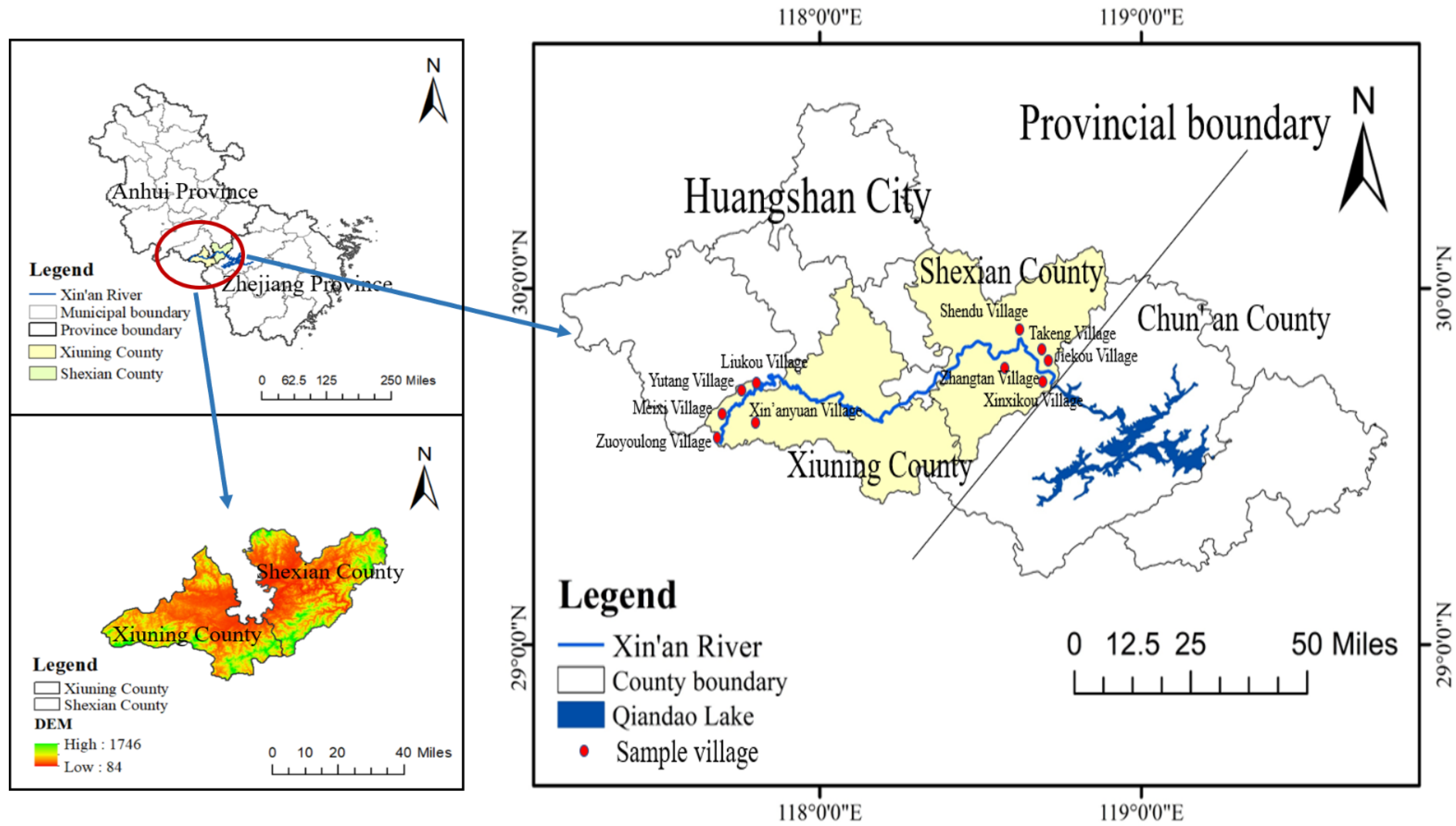
As shown in Figure 1, the study sample covered ten villages in Anhui province in China, and thus represented a typical range of conditions in the ecological management of the Xin’an River and its core areas for implementing an ecological compensation policy. The whole survey process lasted about six months—from June to December in 2020. The sample in our study was randomly selected from Xiuning County and She County of Huangshan City. Xiuning County is the fountainhead of Xin’an River. She County is located at the junction of Anhui and Zhejiang province, where the water quality data of the station in Jiekou Town is a key judgement criterion for compensation implementation. For each county, we selected 2–3 townships and 2–3 villages, which were randomly selected from the selected townships. Furthermore, we investigated 30 farmers in each village.
Figure 1.
Study area in China.
2.2. Auction Method
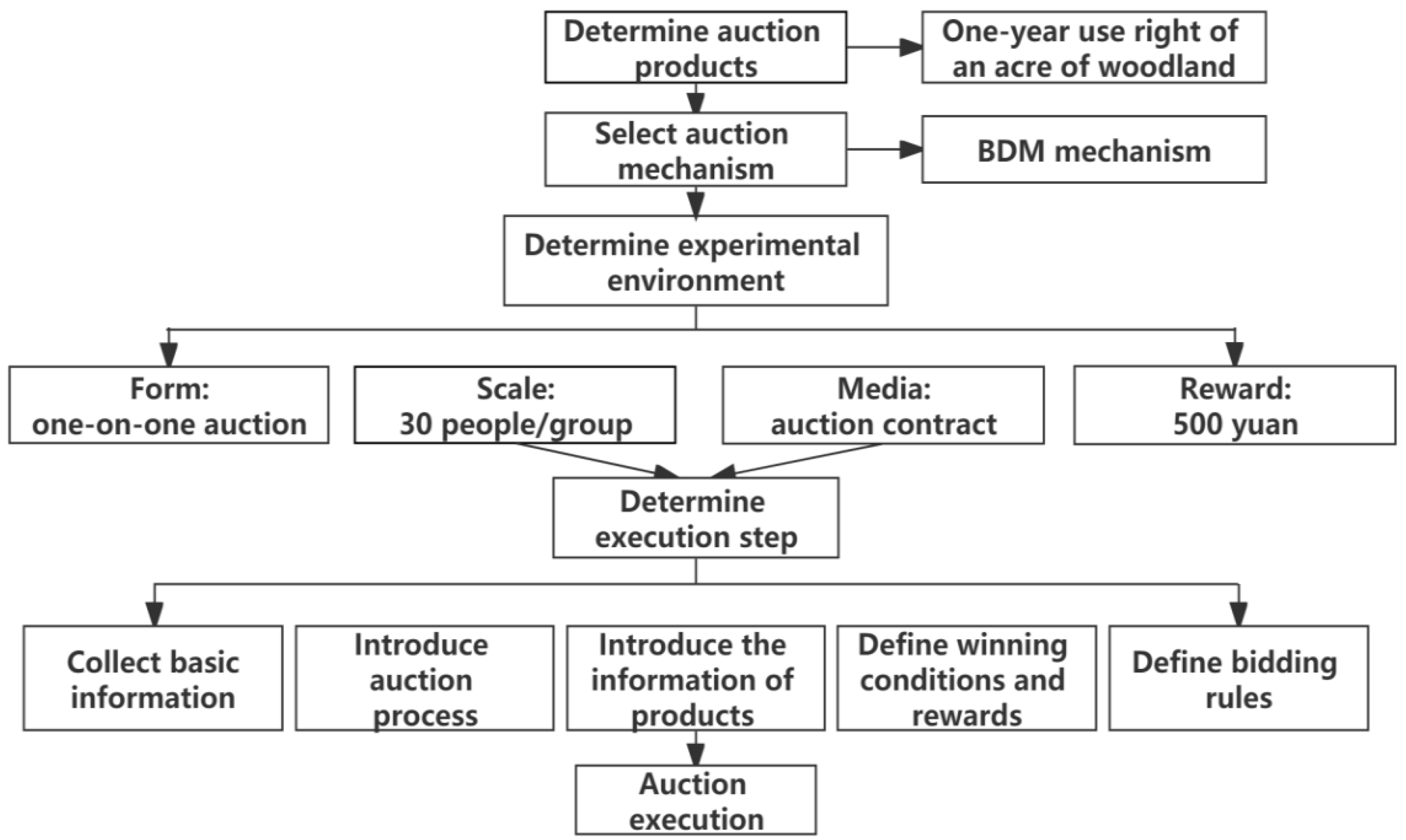
BDM auctions can better reveal the willingness preferences of farmers for its uses with real monetary incentives by setting up a real market environment. In order to achieve more accurate results, the whole experimental process must be rigorously designed. The experiment includes several components, such as determining the auction product, selecting the auction mechanism, and determining the experimental environment and execution steps. Each step must be carefully considered to guarantee the validity of the experimental auction results. The specific design framework is shown in Figure 2.
Figure 2.
Auction experimental design framework.
2.2.1. Auction Products
Forest ecosystem services, as intangible ecological products, are difficult to understand for farmers unless they are directly used as the auction products. Therefore, the selection of reasonable alternatives has a key impact on the experimental auction. Xiuning County and She County are located in the mountainous areas of southern Anhui, with undulating terrain and limited arable land. Farmers take forestry activities (tea and fruit trees) as their main income resources. At the end of 2019, the tea garden area of the two counties was 10,751 hectares and 17,142 hectares, respectively, accounting for 20.69% and 32.99% of the total tea garden area of Huangshan City, respectively. This study is based on the natural and economic situation of this area, and then combined with the existing research. In addition, the basic idea of the equivalence factor method is applied to the experiment. It should be noted that the auction products need not only reflect the value of forest ecosystem services, but also the differences in farmers’ characteristics. Hence, the one-year use right of farmers’ operating on forestland is selected as the auction product. The bid of rent is used as the compensation price for the value of forest ecosystem services per unit area when farmers participate in ecological compensation projects.
In addition, in order to simulate the actual market environment, we classified forestland into high quality, middle quality, and low quality, including the expression of the farmer as well as the slope of the land, fertility, irrigation, and transport conditions (Table 1). Bidders needed to report their bids for the lease amount of forestland of different qualities during the experimental auction, respectively. We could explore farmers’ willingness to accept (WTP) for different levels of forest ecosystem services based on their bids.
Table 1.
Classification of forest quality levels.
2.2.2. Auction Selection Mechanism
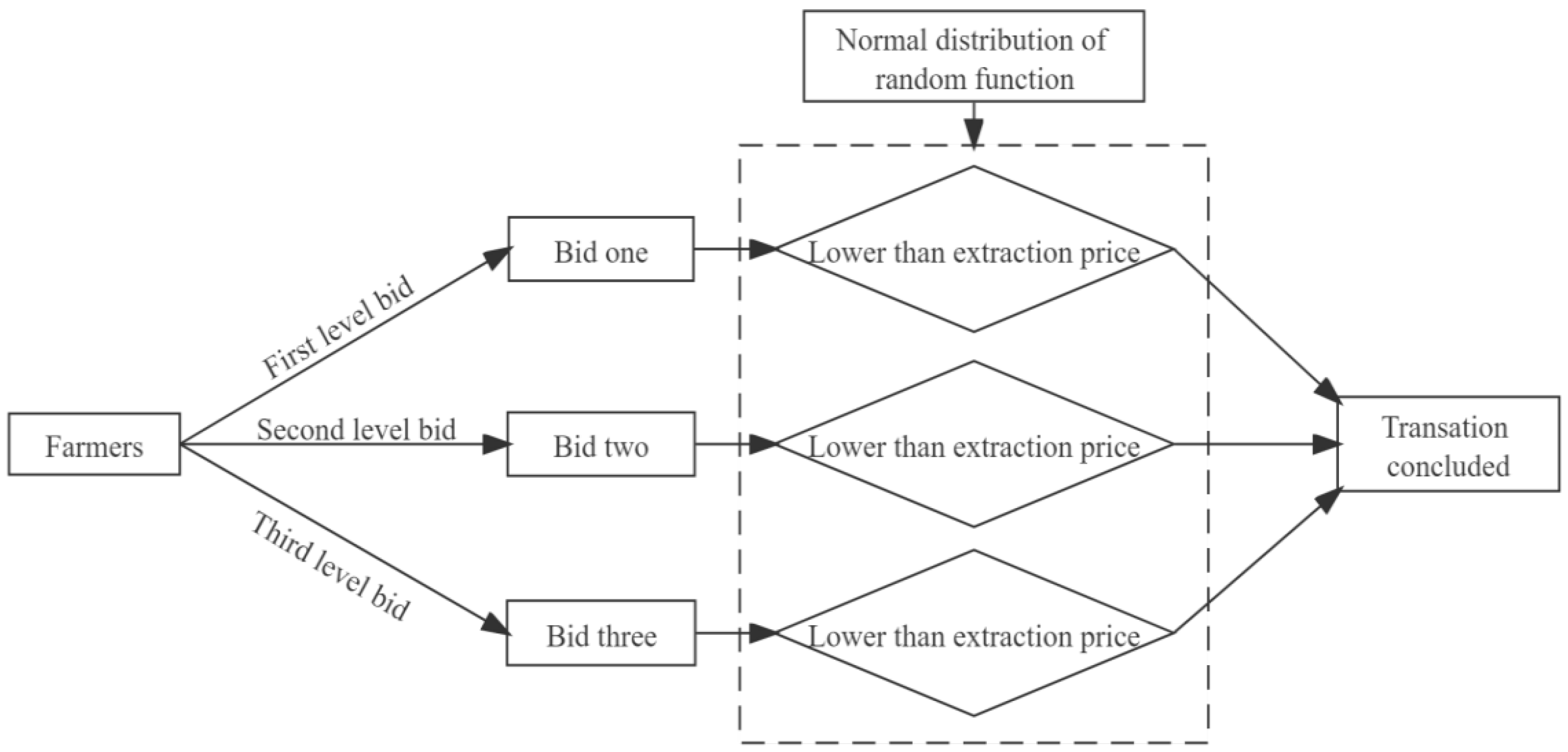
For it is difficult to organize large-scale centralized auctions in the scattered households in mountainous areas, this study conducts the experimental auction by simulating a forestland lease contract in a household. Without reference to others, the farmer made an independent valuation of the auction products. This could be seen as organizing a sealed auction [32]. In addition, due to the establishment of three levels of auction products, the auction was a multi-item auction. A BDM mechanism was chosen as the experimental auction mechanism to prevent the “insincerity” of farmers’ bids and take into account the “randomness” of sampling. We set up a normally-distributed function based on the bid interval of participants. In each round of different levels of auctions, if the farmers’ bids are lower than the randomly selected price, the forest lease contract will be effective, otherwise it will fail. Moreover, the BDM mechanism does not require group participation. It is suitable for individual experiments with a stratified random sampling method. Meanwhile, under the BDM mechanism, participants have a chance to win regardless of their valuation.
2.2.3. Auction Procedures
Considering that the natural environment and socio-economic conditions vary greatly from different regions, local farmers’ production operations will also vary widely. Therefore, this study took administrative villages as a basic unit. We selected 30 farmers in each village randomly to conduct a three-round sealed auction with one-on-one household offers. Briefly, the BDM auction was implemented as follows: firstly, in each round of the auction, farmers needed to bid on the corresponding level of forestland in this round. Then, a normal-distribution random function generated the transaction price for this round. If the farmer’s bid for this round was lower than or equal to the randomly generated transaction price, the transaction would be concluded. After three rounds of auction, the computer randomly selected one round from the three rounds of auctions as the final settlement round. If the farmers could reach a deal in the settlement round, they would be included in the winning group. Then, the farmers in the winning group were ranked in order of their bids. The farmer with the highest bid won and received a cash prize of 500 yuan. The related experimental procedure is shown in Figure 3.
Figure 3.
BDM mechanism program.
2.3. Statistical Modeling
2.3.1. Multivariant Probit (MVP) Model
According to Lancaster’s utility theory [45], let be the utility of the attribute obtained by the ith farmer for selecting the jth level of forest ecosystem service, including two components. The first is the deterministic component , the second is the stochastic term , as below:
Moreover, if the market value of forest ecosystem services at the jth level is , the remaining willingness of the ith farmer to be paid for forest ecosystem services at the jth level is , which can be expressed as:
Based on the incentive compatibility properties of the revealed preference approach and the BDM mechanism, there exists . , which is the bid that the ith farmer wants for the jth level of forest ecosystem services. In addition, since the market price of forest ecosystem services does not have an exact value, the average value of farmers’ bids for different levels of forest ecosystem services is used as a proxy for the market price , which is shown as below:
is the arithmetic mean of all farmers for the ecological services at the jth level and is a random parameter. If , then the ith farmer desires a higher compensation for the ecological service at the jth level and vice versa. Accordingly, a binary discrete choice model is constructed:
denotes a high willingness of the ith farmer to be paid for the jth level of ecosystem services, otherwise . It can be further expressed as:
In addition,
denotes that the mth characteristic variable of the ith farmer in the jth bid. is the parameter vector to be estimated and is the residual term.
Therefore, the probability that the farmer hopes to obtain a higher WTA for the jth level of ecological services is calculated as:
If obeys, the normal distribution is obeyed and the assumptions of the MVP model are satisfied, so the function is:
There are three hierarchical subjects in this study, so . Since the MVP model assumes that the residual terms obey a joint normal distribution, therefore , then , where .
If the three bids are not correlated, then . To detect the correlation of the three bids, this study assumes that ,, and are not zero [35]. Then, based on the benchmark model proposed by Chib et al. [36], the MVP model can be obtained as:
is the joint probability density function and is the integration interval.
The likelihood function of the model can be obtained as:
The log-likelihood function is:
while is the parameter space.
2.3.2. Variable Definition
Referring to the previous literature [15,20], this study used “whether the bid for ecological services at three different levels was higher than the average of all bids at each time” as the dependent variable. In order to investigate the influencing factors of farmers’ WTA for ecological services at different levels, independent variables from multiple aspects were set up as following: (1) farmers’ characteristics variables, including gender, age, education, health status, and occupations; (2) farmers’ household characteristics and planting characteristics variables, including per capita income, household size, forestland area, average cost per hectare, and average output per hectare, etc; and (3) farmers’ policy perceptions and ecological perceptions, including policy cognition, policy satisfaction, policy support, and ecological awareness. The details are shown in Table 2.
Table 2.
Variable definitions and assignments.
3. Results
3.1. Descriptive Statistics
Table 3 summarizes the characteristics of the farmers. Respondents were familiar with the PES policy and satisfied with the PES Programs in the Xin’an River. Most respondents both support the policy and are aware of the ecological environment. As can be seen in Table 1, the demographic characteristics of the samples are very similar to the local statistics data. Our sample is representative of the education composition of the true population, but has a higher mean age compared to the general population. The results demonstrate that the proportion of males is higher than that of females, accounting for 63.60% and 36.40%, respectively. The age of the participants is mainly above 40-years old. It reflects that the local farmers are mainly middle-aged and elderly.
Table 3.
Statistics of basic characteristics of peasant households.
In Table 4, we can see that the annual average cost range of farmers operating forestland is [0, 43,500] yuan/ha, the annual average output per hectare range is [0, 112,500] yuan/ha, and the annual average net income per hectare range is [−2250, 97,500] yuan/ha. In addition, the annual average cost is 6075 yuan/ha, the annual average output is 31,800 yuan/ha, and the annual average net income is 25,725 yuan/ha.
Table 4.
Basic situation of farmers’ forestland.
3.2. Bids Prices in Experiments
The basic information of farmers’ bids for forestland of different quality levels is shown in Table 5. It can be seen that the range for different quality levels of forestland are low-quality forestland ([0, 112,500] yuan/ha/year), middle-quality forestland ([1500, 150,000] yuan/ha/year), and high-quality forestland ([7500, 225,000] yuan/ha/year), respectively. Furthermore, the mean offers submitted at different levels are 17,123.1, 23,493.75, and 31,064.40 yuan/ha/year, respectively. The spillover of farmers’ bids compared with the average output are −28.48%, −1.65%, and 28.09%, respectively. Compared to the average net income, the spillover prices are −14.16%, 18.54%, and 54.74%, respectively.
Table 5.
Basic situation of auction quotation.
The bids for middle-quality forestland are lower than the actual output of forestland and higher than the net income of forestland, which matches the rules of marketing. However, the bids for low-quality forestland are much lower than the actual output and net income of forestland. These farmers are willing to contract to others for free and only require that the use of the forestland not fall into waste. This may be because the profit of low-quality forestland is low. It is not convenient for farming operations such as planting and irrigation, and part of the land is already in a semi-deserted state. As expected, farmers generally charge higher prices for high-quality forestland, which is much higher than the actual output and net income of the forestland. Due to the harsh natural conditions in mountainous areas, high-quality forestland is a scarce resource in the local area. The tea revenues are a major source of income for farmers. It also indicates that farmers have a strong relationship with the forestland and are unwilling to lease out high-quality forestland. Compared to the forestland market in our survey, the actual transaction price is 30,000–90,000 yuan/ha/year.
3.3. Model Analysis
We analyze the survey data using STATA 15.0, and the results are shown in Table 6. σ12, σ13, and σ23 are significant and not a zero value. This indicates that the three bids of farmers are highly correlated, which is suitable for MVP model analysis.
Table 6.
MVP model results.
3.3.1. Influence of Farmers’ Characteristics
The results of the model demonstrated that gender and education level have no influence on WTA. Given that they are probably influenced by mountainous terrain and economic conditions, the education level of local farmers is generally low. Moreover, due to the implementation requirements and difficult operation of the experimental auction method, the sample size we can obtain is small. Given this, it has a certain impact on the regression results. The results also show that age, health, and job type have significant effects on the three levels of WTA. From the aspect of age, there is no difference on WTA between farmers aged over 40 and those aged below 40 in the first level of ecological service. While the WTA of farmers who are above 40 years old is significantly higher in the second and third levels, the reason may be that the middle-aged and elderly people’s own labor ability is limited; they lack employment opportunities and depend on the forest land income. Hence, they hope to receive higher compensation. Our results also show that, for second-level ecological services, farmers in good health hope to achieve more compensation. It may be that the healthier the farmers are, the stronger their labor capacity and the higher yield from production work. In terms of occupations, the WTA of farmers working in forestry was significantly higher than that of farmers working in non-forestry work in the first and second levels. We conclude that farmers working in forestry are highly dependent on land and forestry income. Hence, they want more compensation in order to make up for the losses caused by the implementation of the ecological compensation policy.
3.3.2. Influence of Household and Planting Characteristics
Among the farm household characteristics, household per capita income has no significant difference on WTA for the three levels of ecosystem services. We find that farmers with larger household sizes have significantly higher WTA, except in the second level. It is possible that the larger the household size, the higher the cost of living. Farmers wish to obtain higher compensation for their families to gain benefits.
There is no significant difference in WTA between farmers with different forest area, and there is significant difference between farmers with different costs and outputs. Firstly, there is no significant difference in the WTA of the first level of farmers with different costs, and the WTA of the second and third levels of farmers with higher costs is significantly lower than that of farmers with low costs. The reason is that, as the average cost is high, the general planting scale is small. Therefore, the WTA of farmers is lower. Secondly, the WTA of farmers with high output is significantly higher than that of farmers with low output. The reason is that, when the level of land output is high, farmers have a higher income and they perceive a higher ecosystem service value.
3.3.3. Influence of Farmers’ Policy and Ecological Perceptions
The results show that different policy cognition, policy satisfaction, and policy support have a significant influence on WTA. In terms of policy cognition, farmers who are familiar with the ecological compensation policy have a significantly lower WTA. Typically, if farmers are familiar with this policy, they will be confident in policy implementation and have a lower estimate of risk loss. With respect to policy satisfaction, farmers who are satisfied with the policy implementation have a significantly higher WTA. The reason may be that their estimation of the value of ecological services is correspondingly increased along with their satisfaction. Regarding policy support, farmers who support policies have a lower WTA, suggesting that they are more likely to recognize the long-term benefits of policies and are willing to abandon certain economic benefits to improve the forest ecosystem services.
Farmers who think ecological protection is necessary exhibit significantly higher than farmers who do not in both the low and high levels. It may be that the stronger the farmers’ awareness of ecological conservation, the higher the estimation of the value of ecological services; they prefer to put ecological conservation into practice. It also indicates that the farmers who rent forestland with low and high levels in this area are more sensitive than those who rent middle-level forestland.
4. Discussions, Conclusions and Policy Implications
4.1. Discussions
Basically, ecological compensation standards are established based on the WTA. The upper limit can be used as the compensation standard agreed upon by the respondent. Our study showed how an auction price model can be used to estimate the compensation standard in a PES program. Even in the absence of well-functioning markets, the auction price approach overcomes the weaknesses of existing valuation methodologies. Analyzing the potential impacts of different PES targeting programs provides the opportunity to achieve ecological and socio-economic goals.
The value of the research extends beyond the limitations of local considerations. By conducting similar auctions at different locations and for multiple services around the globe, scientists, practitioners, and policy-makers can gain a better understanding of what budget is necessary to pay for ecosystem services on a global scale. Additionally, our experimental auction price design will reduce the opportunity costs of environmental conservation. Field auctions, for instance, may be used to illustrate whether educating or influencing factors can lower the opportunity costs farmers face when using ecosystem services. As a result, we recommend continued experimentation with auction price models as a method of revealing the preference for PES program design, which is necessary and will improve the success of ecosystem service conservation.
According to the research, the evaluation of the effectiveness of PES policies should be based on the preferences of stakeholders, and only policies that meet the needs of most stakeholders are effective. It is important to note that although the experimental auction method is consistent with the actual WTA in theory, it requires further confirmation in the trading market.
4.2. Conclusions
This study uses a Becker-DeGroote-Marshack (BDM) auction method to estimate the willingness to accept (WTA) for different levels of ecosystem services. In the background of the implementation of Xin’an River ecological compensation policy, this study explores the accuracy of the forest ecological compensation standard in Huangshan City. Subsequently, we investigate the differences in farmers’ preferences for different levels of ecosystem services and the factors affecting them with a sample of 272 farmers.
In Table 7, the auction experiment indicates that farmers have a lower average bid for low-quality forestland (17,123.1 yuan/ha/year) and a higher average bid for middle-quality forestland (23,493.75 yuan/ha/year) and high-quality forestland (31,064.4 yuan/ha/year). The BDM mechanism implements a one-to-one multi-round sealed auction that requires realistic monetary incentives and simulates a real market environment. Such an auction mechanism allows farmers’ bids to truly reflect their preferences for forest ecosystem services. Given this, their bids can be an important reference for ecological compensation standards.
Table 7.
Summary of calculation results (Unit: Yuan/ha/year).
The MVP model is constructed to analyze the differences in farmers’ bids and the factors influencing their preferences. The results show that there are significant differences on WTA among farmers with different individual characteristics, household characteristics, planting characteristics, policy cognition, and ecological awareness. Age, health status, and occupations have significant positive effects on farmers’ WTA. In terms of the family characteristics, household size is found to have a positive effect on farmers’ WTA. With planting characteristics, the average cost and average output have significant negative and positive effects on WTA, respectively. Policy cognition and policy satisfaction have significant positive effects on farmers’ WTA. Policy support has a significant negative effect on WTA. Ecological awareness has a significant positive effect on WTA.
Lastly, this study takes the lowest of the average bid of farmers at each level as the lowest limit of the compensation standard and the highest as the upper limit of the compensation standard. As a result, we deduce that the reasonable range of the current forest ecological compensation standard in Huangshan City is [17,123.1, 31,064.4] (yuan/ha/year).
4.3. Policy Implications
This research provides three main implications to policymakers.
Farmers generally reflect that the current low standard of ecological compensation is difficult to make up for the loss of economic benefits by the limited development of livelihoods. This indicates that the existing compensation standard should be raised and government departments should implement diversified compensation methods. Our findings indicate that farmers generally have a higher acceptance of non-direct monetary compensation. They also have a higher willingness to participate in technical training, industrial support, and other projects. Thus, local governments should pay attention to farmers’ anticipation and adopt diversified compensation methods, such as employment technology training and improving village infrastructure conditions.
The results show that farmers’ WTA and their willingness to participate in policy are strongly related to their policy cognition and ecological consciousness. It is advisable that education should be strengthened to improve farmers’ policy awareness and ecological consciousness. Due to the constraints of natural geography and socio-economic conditions in mountainous areas, farmers are less educated to obtain more information. Given this, their average policy awareness and ecological consciousness are limited. We can fundamentally improve the policy cognition and ecological awareness of farmers and promote ecological compensation policy implementation by increasing education and popularizing policy information and ecological knowledge.
Lastly, it is imperative to create a market-based compensation mechanism and introduce social capital. As an important method for allocating resources and determining prices, the auction mechanism has been widely implemented in PES projects worldwide. In China, the auction mechanism has been used in many fields such as emission rights, water rights, and land-use rights. Meanwhile, this study has tried the application of an auction mechanism and the results are more valid and accurate than other revealed preference methods. Hence, it is highly feasible to apply the auction mechanism in ecological compensation in developing countries.
Author Contributions
Conceptualization, T.L. and T.C.; methodology, T.C.; software, B.H. and L.Z.; validation, L.Z., B.H. and T.C.; formal analysis, B.H. and L.Z.; investigation, B.H. and T.Z.; writing—original draft preparation, B.H. and L.Z.; writing, review and editing, T.L. and C.S.; project administration, T.L.; funding acquisition, T.L. All authors have read and agreed to the published version of the manuscript.
Funding
This research was funded by the National Natural Science Foundation of China, grant number 71873003, 71503004.
Data Availability Statement
No new data were created or analyzed in this study. Data sharing is not applicable to this article.
Conflicts of Interest
The authors declare no conflict of interest.
References
- Jack, B.K.; Leimona, B.; Ferraro, P.J. A Revealed preference approach to estimating supply curves for ecosystem services: Use of auctions to set payments for soil erosion control in Indonesia. Conserv. Biol. 2009, 23, 359–367. [Google Scholar] [CrossRef] [PubMed]
- Engel, S.; Pagiola, S.; Wunder, S. Designing payments for environmental services in theory and practice: An overview of the issues. Ecol. Econ. 2008, 65, 663–674. [Google Scholar] [CrossRef]
- Muradian, R.; Corbera, E.; Pascual, U.; Kosoy, N.; May, P. Reconciling theory and practice: An alternative conceptual framework for understanding payments for environmental services. Ecol. Econ. 2010, 69, 1202–1208. [Google Scholar] [CrossRef]
- Pattanayak, S.K.; Wunder, S.; Ferraro, P.J. Show me the money: Do payments supply environmental services in developing countries? Rev. Environ. Econ. Policy 2010, 4, 254–274. [Google Scholar] [CrossRef]
- Bo, S.; Yue, Z.; Lixiao, Z.; Fan, Z. A top-down framework for cross-regional payments for ecosystem services. J. Clean. Prod. 2018, 182, 238–245. [Google Scholar]
- Isabel, V. Payments for ecosystem services in the context of adaptation to climate change. Ecol. Soc. 2012, 17, 11. [Google Scholar]
- Jindal, R.; Kerr, J.M.; Ferraro, P.J.; Swallow, B.M. Social dimensions of procurement auctions for environmental service contracts: Evaluating tradeoffs between cost-effectiveness and participation by the poor in rural Tanzania. Land Use Policy 2013, 31, 71–80. [Google Scholar] [CrossRef]
- Ingram, J.C.; Wilkie, D.; Clements, T.; Mcnab, R.B.; Foley, C.A.H. Evidence of payments for ecosystem services as a mechanism for supporting biodiversity conservation and rural livelihoods. Ecosyst. Serv. 2014, 7, 10–21. [Google Scholar] [CrossRef]
- Brockerhoff, E.G.; Barbaro, L.; Castagneyrol, B.; Forrester, D.I.; Gardiner, B.; Gonza’lez-Olabarria, J.R.; Lyver, P.O.B.; Meurisse, N.; Oxbrough, A.; Taki, H.; et al. Forest biodiversity, ecosystem functioning and the provision of ecosystem services. Biodivers. Conserv. 2017, 26, 3005–3035. [Google Scholar] [CrossRef] [Green Version]
- Matthies, B.D.; Kalliokoski, T.; Ekholm, T.; Hoen, H.F.; Valsta, L.T. Risk, Reward, and payments for ecosystem services: A portfolio approach to ecosystem services and forestland investment. Ecosyst. Serv. 2015, 16, 1–12. [Google Scholar] [CrossRef]
- Martin-Ortega, J.; Dekker, T.; Ojea, E.; Lorenzo-Arribas, A. Dissecting price setting efficiency in Payments for Ecosystem Services: A meta-analysis of payments for watershed services in Latin America. Ecosyst. Serv. 2019, 38, 100961. [Google Scholar] [CrossRef]
- Müller, A.; Olschewski, R.; Unterberger, C. The valuation of forest ecosystem services as a tool for management planning—A choice experiment. J. Environ. Manag. 2020, 271, 111008. [Google Scholar] [CrossRef]
- Roesch-McNally, G.E.; Rabotyagov, S.S. Paying for forest ecosystem services: Voluntary versus mandatory payments. Environ. Manag. 2016, 57, 585–600. [Google Scholar] [CrossRef] [PubMed]
- Rabotyagov, S.S.; Lin, S.J. Small forest landowner preferences for working forest conservation contract attributes: A case of Washington State, USA. J. For. Econ. 2013, 19, 307–330. [Google Scholar] [CrossRef]
- Vedel, S.E.; Jacobsen, J.B.; Thorsen, B.J. Forest owners’ willingness to accept contracts for ecosystem service provision is sensitive to additionality. Ecol. Econ. 2015, 113, 15–24. [Google Scholar] [CrossRef]
- Leimona, B.; Carrasco, L.R. Auction winning, social dynamics and non-compliance in a payment for ecosystem services scheme in Indonesia. Land Use Policy 2017, 63, 632–644. [Google Scholar] [CrossRef]
- Ferguson, I.; Levetan, L.; Crossman, N.; Lauren, B. Financial Mechanisms to Improve the Supply of Ecosystem Services from Privately-Owned Australian Native Forests. Forests 2016, 7, 34. [Google Scholar] [CrossRef] [Green Version]
- Cook, D.C.; Kristensen, N.P.; Liu, S. Coordinated service provision in payment for ecosystem service schemes through adaptive governance. Ecosyst. Serv. 2016, 19, 103–108. [Google Scholar] [CrossRef]
- Tóth, S.F.; Ettl, G.J.; Könnyű, N.; Rabotyagov, S.S.; Rogers, L.W.; Comnick, J.M. ECOSEL: Multi-Objective Optimization to Sell Forest Ecosystem Services. For. Policy Econ. 2013, 35, 73–82. [Google Scholar] [CrossRef]
- Ninan, K.N.; Inoue, M. Valuing Forest Ecosystem Services: What We Know and What We Don’t. Ecol. Econ. 2013, 93, 137–149. [Google Scholar] [CrossRef]
- Roesch-McNally, G.E.; Rabotyagov, S.; Tyndall, J.C.; Ettl, G.; Tóth, S.F. Auctioning the Forest: A Qualitative Approach to Exploring Stakeholder Responses to Bidding on Forest Ecosystem Services. Small Scale For. 2016, 15, 321–333. [Google Scholar] [CrossRef]
- Fujii, H.; Sato, M.; Managi, S. Decomposition Analysis of Forest Ecosystem Services Values. Sustainability 2017, 9, 687. [Google Scholar] [CrossRef] [Green Version]
- McDermott, M.; Mahanty, S.; Schreckenberg, K. Examining Equity: A Multidimensional Framework for Assessing Equity in Payments for Ecosystem Services. Environ. Sci. Policy 2013, 33, 416–427. [Google Scholar] [CrossRef] [Green Version]
- Ouyang, Z.; Hua, Z.; Yang, X.; Polasky, S.; Daily, G.C. Improvements in ecosystem services from investments in natural capital. Science 2016, 352, 1455–1459. [Google Scholar] [CrossRef] [PubMed]
- Fiorini, A.O.; Mullally, C.; Swisher, M.; Putz, F.E. Forest cover effects of payments for ecosystem services: Evidence from an impact evaluation in Brazil. Ecol. Econ. 2020, 169, 106522. [Google Scholar]
- Palomo, I. Climate Change Impacts on Ecosystem Services in High Mountain Areas: A Literature Review. Mt. Res. Dev. 2017, 37, 179–187. [Google Scholar] [CrossRef] [Green Version]
- Rabotyagov, S.S.; Tóth, S.F.; Ettl, G.J. Testing the Design Variables of ECOSEL: A Market Mechanism for Forest Ecosystem Services. For. Sci. 2013, 59, 303–321. [Google Scholar] [CrossRef]
- Lundberg, L.; Persson, U.M.; Alpizar, F.; Lindgren, K. Context Matters: Exploring the Cost-Effectiveness of Fixed Payments and Procurement Auctions for PES. Ecol. Econ. 2018, 146, 347–358. [Google Scholar] [CrossRef]
- McGrath, F.L.; Carrasco, L.R.; Leimona, B. How auctions to allocate payments for ecosystem services contracts impact social equity. Ecosyst. Serv. 2017, 25, 44–55. [Google Scholar] [CrossRef]
- Wunder, S.; Börner, J.; Ezzine-de-Blas, D.; Feder, S.; Pagiola, S. Payments for Environmental Services: Past Performance and Pending Potentials. Annu. Rev. Resour. Econ. 2020, 12, 209–234. [Google Scholar] [CrossRef]
- Van Hecken, G.; Bastiaensen, J.; Windey, C. Towards a Power-Sensitive and Socially-Informed Analysis of Payments for Ecosystem Services (PES): Addressing the Gaps in the Current Debate. Ecol. Econ. 2015, 120, 117–125. [Google Scholar] [CrossRef]
- Farley, J.; Costanza, R. Payments for ecosystem services: From local to global. Ecol. Econ. 2010, 69, 2060–2068. [Google Scholar] [CrossRef]
- Salzman, J.; Bennett, G.; Carroll, N.; Goldstein, A.; Jenkins, M. The global status and trends of Payments for Ecosystem Services. Nat. Sustain. 2018, 1, 136–144. [Google Scholar] [CrossRef]
- Etchart, N.; Freire, J.L.; Holland, M.B.; Jones, K.W.; Naughton-Treves, L. What Happens When the Money Runs out? Forest Outcomes and Equity Concerns Following Ecuador’s Suspension of Conservation Payments. World Dev. 2020, 136, 105124. [Google Scholar] [CrossRef]
- Phan, T.-H.D.; Brouwer, R.; Hoang, L.P.; Davidson, M.D. A comparative study of transaction costs of payments for forest ecosystem services in Vietnam. For. Policy Econ. 2017, 80, 141–149. [Google Scholar] [CrossRef]
- Chib, S.; Greenberg, E. Analysis of Multivariate Probit Models. Biometrika 1998, 85, 347–361. [Google Scholar] [CrossRef] [Green Version]
- Bingham, L.R.; Riccardo, R.D.; José, G.B. Ecosystem Services Auctions: The Last Decade of Research. Forests 2021, 12, 578. [Google Scholar] [CrossRef]
- Persson, U.M.; Alpízar, F. Conditional cash transfers and payments for environmental services—A conceptual framework for explaining and judging differences in outcomes. World Dev. 2013, 43, 124–137. [Google Scholar] [CrossRef]
- Brown, L.K.; Troutt, E.; Edwards, C.; Gray, B.; Wanjing, H. A uniform price auction for conservation easements in the Canadian prairies. Environ. Resour. Econ. 2011, 50, 49–60. [Google Scholar] [CrossRef]
- Naime, J.; Mora, F.; Sánchez-Martínez, M.; Arreola, F.; Balvanera, P. Economic valuation of ecosystem services from secondary tropical forests: Trade-offs and implications for policy making. For. Ecol. Manag. 2020, 473, 118294. [Google Scholar] [CrossRef]
- Oh, C.O.; Lee, S.; Kim, H.N. Economic Valuation of Conservation of Inholdings in Protected Areas for the Institution of Payments for Ecosystem Services. Forests 2019, 10, 1122. [Google Scholar] [CrossRef] [Green Version]
- Richards, R.C.; Petrie, R.; Christ, J.B.; Ditt, E.; Kennedy, C.J. Farmer preferences for reforestation contracts in Brazil’s Atlantic Forest. For. Policy Econ. 2020, 118, 102235. [Google Scholar] [CrossRef]
- Ranjan, R. Protecting warming lakes through climate-adaptive PES mechanisms. Ecol. Econ. 2020, 177, 106782. [Google Scholar] [CrossRef]
- Davis, R.K. Recreation Planning as An Economic Problem. Nat. Resour. J. 1963, 3, 239–249. [Google Scholar]
- Lancaster, K.J. A New Approach to Consumer Theory. J. Polit. Econ. 1966, 74, 132–157. [Google Scholar] [CrossRef]
- Cane, V.; Luce, R.D. Individual Choice Behavior: A Theoretical Analysis. J. R. Stat. Soc. Ser. A (Gen.) 1960, 123, 486–488. [Google Scholar] [CrossRef]
- Mcfadden, D. Conditional Logit Analysis of Qualitative Choice Behavior. In Frontiers of Econometrics; Zarembka, P.E., Ed.; Academic Press: New York, NY, USA, 1973. [Google Scholar]
- Louviere, J.; Hensher, D.A. On the design and analysis of simulated choice or allocation experiments in travel choice modeling. Transp. Res. Rec. 1982, 890, 11–17. [Google Scholar]
- Louviere, J.J.; Woodworth, G. Design and Analysis of Simulated Consumer Choice or Allocation Experiments: An Approach Based on Aggregate Data. J. Mark. Res. 1983, 20, 350–367. [Google Scholar] [CrossRef]
- Vickrey, W. Counter speculation, auctions, and competitive sealed tenders. J. Financ. 1961, 16, 8–37. [Google Scholar] [CrossRef]
- Becker, G.M.; DeGroot, M.H.; Marschak, J. Measuring utility by a single-response sequential method. Behav. Sci. 1964, 9, 226–232. [Google Scholar] [CrossRef]
- Shogren, J.F.; Margolis, M.; Koo, C.; List, J.A. A random nth price auction. J. Econ. Behav. Organ. 2001, 46, 409–421. [Google Scholar] [CrossRef]
- Lusk, J.L.; Alexander, C.; Rousu, M.C. Designing Experimental Auctions for Marketing Research: The Effect of Values, Distributions and Mechanisms on Incentives for Truthful Bidding. Rev. Mark. Sci. 2011, 5, 1546–5616. [Google Scholar] [CrossRef] [Green Version]
- Lewis, D.J.; Polasky, S. An auction mechanism for the optimal provision of ecosystem services under climate change. J. Environ. Econ. Manag. 2018, 92, 20–34. [Google Scholar] [CrossRef]
- Sharma, B.P.; Cho, S.H.; Yu, T.E. Designing cost-efficient payments for forest-based carbon sequestration: An auction-based modeling approach. For. Policy Econ. 2019, 104, 182–194. [Google Scholar] [CrossRef]
Publisher’s Note: MDPI stays neutral with regard to jurisdictional claims in published maps and institutional affiliations. |
© 2022 by the authors. Licensee MDPI, Basel, Switzerland. This article is an open access article distributed under the terms and conditions of the Creative Commons Attribution (CC BY) license (https://creativecommons.org/licenses/by/4.0/).