


Abstract
This study addresses the Multi-Skill Resource-Constrained Project Scheduling Problem (MSRCPSP) by investigating the simultaneous effects of workforce skill proficiency (depth) and skill versatility (breadth) on project makespan reduction. Two state-of-the-art techniques, the ACO algorithm integrated with the parallel scheduling approach (PSS) and LINGO, were implemented to solve a known dataset. The results indicate that LINGO’s performance improves compared to the ACO algorithm with increasing resource levels and provides higher solution quality at higher resource availability. On the other hand, with limited resource availability, the ACO algorithm performs better at lower SP levels (0.1 and 0.3). However, as the SP level increases, LINGO outperforms the ACO algorithm, especially for SP values of 0.5, 0.7, and 0.9. Furthermore, it is also observed that there is a positive correlation between resource level and optimality percentage. The results indicate that ACO may be more competitive for scenarios with limited SP and few resources, while LINGO is more effective in instances with greater resource amounts and larger SP values.
1. Introduction
In the contemporary corporate landscape, organizations are increasingly implementing strategic cost-reduction measures by downsizing their workforce and, at the same time, upgrading the skills of the remaining employees through continuous human resource development and specific training programs [1]. Therefore, workers who possess a variety of skills are in great demand in many project-based industries. This change reflects the need to study the combined effect of workforce multi-skilling and project time management [2]. This is necessary to optimize project duration and costs of operations for better project performance. The classical Resource-Constrained Project Scheduling Problem (RCPSP) becomes a far more complex optimization problem, formally called the Multi-Skill Resource-Constrained Project Scheduling Problem (MSRCPSP), when multi-skilling dynamics are incorporated into traditional resource allocation. MSRCPSP is an NP-hard problem because of the combinatorial difficulty of routing tasks and allocating heterogeneous skills at the same time, and thus, it is one of the most studied and difficult problems in the current literature of project scheduling. The availability of resources and environments vary widely depending on the unique and specific nature and operating requirements of each project. The Multi-Skilled Resource-Constrained Project Scheduling Problem (MSRCPSP) has been widely applied in many fields, such as in engineering and construction for assigning qualified personnel to project phases [3], in software engineering for assigning developers and testers based on skill levels [4], in manufacturing for coordinating specialized workers and equipment [5] and in healthcare for scheduling specialized medical staff [6]. These multiple real-world applications underscore the need for advanced optimization approaches to deal with the NP-hard nature of the MSRCPSP [7]. The MSRCPSP is complex in nature and can be solved efficiently only by advanced optimization paradigms. Literature typically divides these approaches into three major categories:
- Exact Methods: Approaches such as Integer Linear Programming (ILP) and Constraint Programming (CP) guarantee optimal solutions for small-scale project instances [8].
- Metaheuristic Frameworks: Metaheuristics, often specialized for the problem domain, are commonly used to produce high-quality near-optimal schedules for large-scale instances in reasonable computational time. Prominent examples include Genetic Algorithms [9], Particle Swarm Optimization [10], and Simulated Annealing [11].
- Hybrid Approaches: The recent trend is to combine heuristic-based mechanisms with exact mathematical programming models to achieve a synergistic trade-off between exploration and exploitation capabilities [12].
This methodological diversity has led to considerable academic interest in the MSRCPSP. Typically, the investigations are concerned with critical operational objectives such as minimizing the total project makespan, minimizing overall expenses, balancing the bi-objective trade-offs between the time and cost parameters, and maximizing the utilization rates of resources. These models have high practical relevance in the current project-oriented context, where good solutions allow the workforce to effectively deploy, reduce systemic scheduling delays and optimally allocate human resources. Each project is characterized by a unique network of dependent activities, and each task requires a specific architectural skill profile. The limited availability of qualified personnel combined with different levels of competency leads to very complex constraints on workforce capability. Building on the structural framework of [9], workforce capability is critically evaluated along two particular operational dimensions: depth and breadth. Skill depth is the level of proficiency employees have in a particular skill, and skill breadth is the number of different skills they have. The main objective of this paper is to propose a hybrid optimization framework which is a combination of a Parallel Scheduling Scheme (PSS) and an Ant Colony Optimization (ACO) algorithm to solve the Multi-Skill Resource-Constrained Project Scheduling Problem (MSRCPSP) with the objective of effectively minimizing the makespan of the project considering both skill depth and skill breadth. The performance of the proposed framework is compared with LINGO solutions for a known dataset generated by [9] using the RanGen tool. To solve the developed problem formulation, a mixed-solution framework is developed and implemented in the current study. First, a feasible sequencing of project activities is generated through the use of the Ant Colony Optimization (ACO) metaheuristic. The outcome of the previous stage is used to develop a list of activities, which is then scheduled using a Parallel Scheduling Scheme (PSS). In the next stage, the employees are allocated tasks by matching task-based skill requirements with personal skill portfolios, with the main objective being to ensure that the overall project makespan is minimized. The same dataset is also applied to LINGO under a fixed computational time limit to determine and compare the quality of the solution and the performance of the computational methods of the metaheuristic and the exact optimization paradigm systematically.
2. Literature Review of MSRCPSP
The Multi-Skill Resource-Constrained Project Scheduling Problem (MSRCPSP) is computationally and structurally complex, which has inspired extensive academic research. This section reviews the evolutionary history of solution methodologies, classifies their industrial uses, and details the crucial architectural dimensions of workforce capabilities to provide a rigorous basis for the proposed methodology.
2.1. Recent Developments in Solution Approaches
The MSRCPSP is an NP-hard problem in essence and is computationally intractable, and this has encouraged a persistent evolution in optimization methodologies. As systematically synthesized in Table 1, previous academic efforts can be broadly classified into three interlinked paradigms: exact methods, metaheuristic frameworks, and hybrid configurations. Traditionally, the optimization of MSRCPSP has been tackled using exact methods such as Mixed-Integer Linear Programming (MILP), Integer Linear Programming (ILP) and Branch-and-Bound (B&B) algorithms, focusing mainly on the minimization of the absolute makespan (M) or the cost (C) [13,14,15]. While these mathematical programming models guarantee exact global optimal schedules by examining the entire solution space in a structured manner, their practical applicability is severely limited by problem size. The exponential computational overhead makes exact solvers mathematically intractable for large project networks or environments with highly dense, multi-skilled workforce profiles. Therefore, exact procedures are mainly used in the current literature to validate the performance of heuristics on small to medium-size benchmark instances, but not for operational scheduling. Therefore, the academic focus has moved significantly on metaheuristic frameworks to address these scalability limitations. These population-based and trajectory-driven algorithms do not guarantee absolute optimality but are able to identify high-quality near-optimal schedules in computationally feasible times. The Genetic Algorithms (GAs) [16,17] were one of the first metaheuristics to cope with the combinatorial complexity of routing tasks with skills constraints. The strict parameter tuning required by GAs led to the introduction of trajectory-based methods such as Simulated Annealing (SA), which provide robust hill-climbing capabilities to escape local optima in rugged landscapes [11]. More recently, swarm intelligence paradigms like Particle Swarm Optimization (PSO) and Ant Colony Optimization (ACO) are becoming popular due to their decentralized and constructive learning mechanisms [10]. In particular, ACO frameworks use a path-based pheromone memory, which is well suited for discrete scheduling environments where activities need to be routed sequentially under immediate skill-matching constraints. However, individual metaheuristics often suffer from operational trade-offs between exploration and exploitation, which sometimes results in premature convergence. This challenge has resulted in the creation of hybrid approaches. Contemporary scheduling frameworks tend to combine the global search abilities of metaheuristics with the fine local exploitation features of exact methods or focused neighborhood search heuristics [9,18]. Hybrid frameworks provide a better trade-off between computational efficiency and solution quality by embedding exact sub-problems inside a metaheuristic wrapper, e.g., an ILP solver is used to optimize local resource assignments, while a metaheuristic controls the overall sequence of activities.
Table 1.
Literature review of MSRCPSP.
2.2. Applications and Case Studies
The MSRCPSP’s theoretical framework has crucial operational significance in a wide variety of project-oriented industries. As organizations become increasingly focused on cross-functional agility and resource optimization, practical uses for multi-skill scheduling can be classified into four main industrial sectors:
- IT Project Management and Software Engineering: In typical software development environments, areas like system architecture, front-end/back-end development and quality assurance need very specialized and overlapping human resource skills. The MSRCPSP formulations allow project managers to adjust to different sprint cycles by reallocating cross-trained engineers, thus reducing bottlenecks from the lack of specialized developers and maintaining a trade-off between project velocity and cost constraints [14,18].
- High-Tech Manufacturing and Assembly Line Balancing: Modern manufacturing systems, particularly those employing Just-In-Time (JIT) or flexible manufacturing approaches, require a multi-skilled workforce capable of managing a variety of machinery, maintenance schemes, and quality checks. The implementation of the MSRCPSP in the practical scenario of this sector has proven that the modeling of skill depths and breadths can help to avoid production delays on the shop floor, optimize utilization of technicians and address sudden breakdowns of machines or absenteeism of the workforce [10,22].
- Healthcare Operations and Clinical Scheduling: A classic example of a highly constrained application of multi-skill scheduling is the management of medical staff (e.g., cross-trained nurses, specialized surgeons, and technicians). MSRCPSP models are used in practice with the goal of optimizing the staffing of emergency rooms, the scheduling of operating rooms, and the assignment of intensive care units, where regulatory shift constraints and different levels of proficiency of the practitioners and unpredictable inflows of patients must all be synchronized at the same time [17,20].
- Construction and Infrastructure Engineering at Scale: Construction projects involve intricate networks of sequential activities that are overseen by tradespeople (such as welders, electricians, and civil engineers) who possess different levels of certifications and skill proficiencies. Optimal workforce routing to multiple physical sites, strict enforcement of safety and technical precedence constraints, and substantial reduction of expensive systemic project delays are possible with the adoption of advanced MSRCPSP scheduling schemes in this context [9,19].
2.3. Identification of Research Gap
Although extensive research has been carried out on metaheuristic frameworks for the MSRCPSP, a significant research gap persists: there are few studies that have successfully synchronized the global pheromone learning of ACO with the strict, time-dynamic constraints of a Parallel Scheduling Scheme (PSS) that explicitly deals with skill depth and breadth and assess scheduling scenarios based on network complexity (e.g., the Serial/Parallel SP factor). Most of the current approaches either compromise on computational time or reduce proficiency levels of the multi-skills. To overcome this limitation, this study proposes a hybridized PSS-ACO framework that is specifically designed for enabling real-time skill matching and precedence compliance, and for speeding up solution convergence. Furthermore, in line with the methodological trends found in the literature [14,22], this study compares the proposed ACO framework with LINGO. LINGO uses exact mathematical methods (ILP) to find the true global optimum baseline (ground truth) for small-to-medium instances. This comparison provides clear mathematical justification for the use of the developed metaheuristic by quantitatively defining the optimality gap and demonstrating the scalability of the heuristic for large-scale, industry-level problem instances where exact solvers are computationally intractable.
3. Problem Description and Formulation
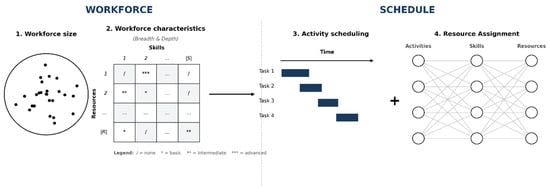
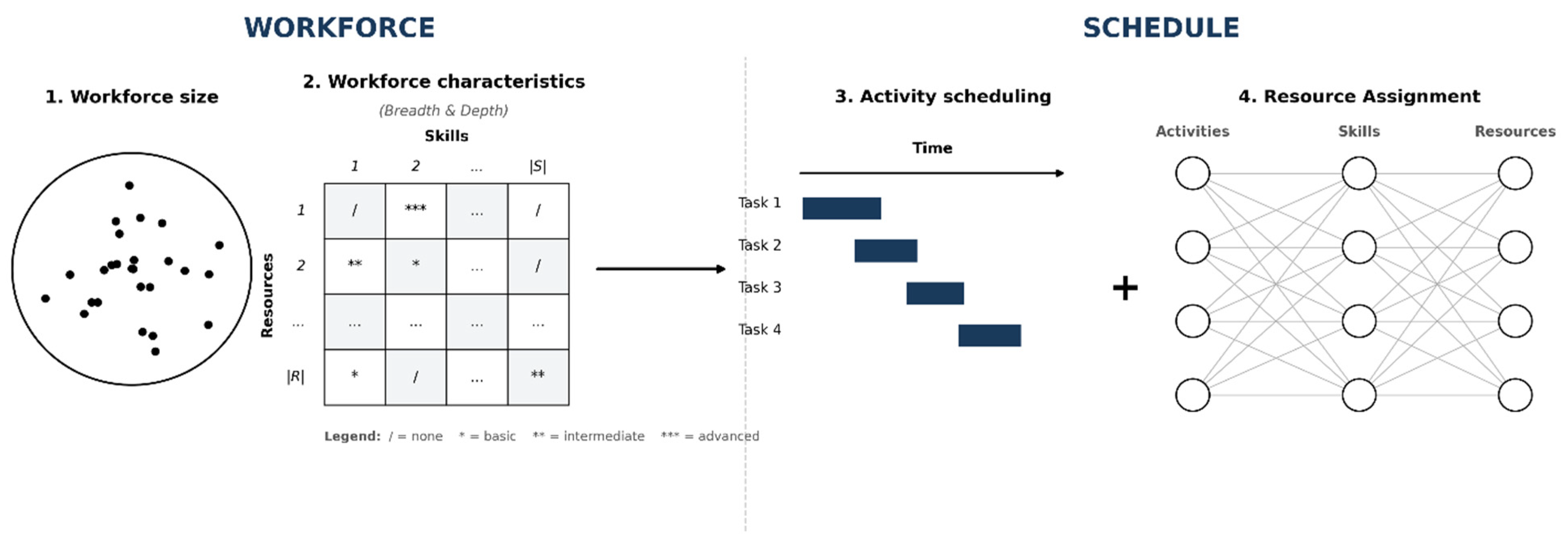
MSRCPSP, an extension of the classic Resource-Constrained Project Scheduling Problem (RCPSP), considers not only the activity schedule but also any number of skills and competency levels considered as constraints or inputs for optimizing the function. Each project activity requires a certain set of skills, and it is challenging to assign a suitable combination of resources to tasks while taking care of other constraints like limited availability of resources and task precedence. The current study considered the five levels of worker proficiency (depth levels), where the standard depth value equals 1. If the worker has the standard depth value for a certain skill, he can do it at the normal time assigned to that activity. The higher the worker’s proficiency level in a certain skill, the less time it takes to complete it, and vice versa. The goal of this problem is to schedule each activity in the project considering precedence constraints and then assign the required number of workers to it, provided that they master the skills required to conduct that activity. As shown in Figure 1, the leftmost circle represents the pool of available workers (resources). Each dot symbolizes a worker, and the pool size reflects the number of available resources for the project. The table shows the skill matrix, where resources are given in rows and skills in columns. Each cell indicates a worker’s proficiency in a particular skill. The Gantt chart-style illustration shows the sequence and timing of project tasks (Task 1, Task 2, etc.). Each black bar represents the duration of a task. The sequence ensures that task dependencies and timing constraints are met. On the right side, a network diagram shows relations between activities, skills, and resources. Relations make it clear that every activity requires particular skills that must be satisfied by allocating the corresponding people. It is necessary to allocate activities in such a way that these activities are optimally executed with available skills.
Figure 1.
Multi-skilled resources in project scheduling [9].
Mathematical Model
The current study adopted the mathematical model developed by [9]. The objective function of this model is to minimize the total project makespan that gives the fastest completion time. The model relies on eight main rules to do so: Constraint (1) ensures that all required manpower needs for each task are fully met; Constraint (2) preserves the strict order of the workflow so that dependent tasks wait for their predecessors; Constraint (3) avoids conflicts by defining a clear order of tasks; Constraint (4) ensures that no worker is assigned to two tasks at the same time; Constraint (5) prevents workers from claiming multiple skill credits for a task; Constraint (6) determines the duration of a task by using the average experience level of the slowest skill group; Constraint (7) is a qualification check, to ensure that the assigned workers have a mastery level greater than zero; and finally, Constraint (8) defines the mathematical bounds for the time and the binary decision variables. The basic elements of the proposed formulation, such as parameters, sets and decision variables, are summarized in Table 2.
Table 2.
Details of the mathematical model.
Mathematical Model Formulation
Objective Function:
Subject to:
Skill Depth and Breadth Impact on Makespan:
Skill Depth vs. Makespan: An increase in the skill depth () of an allocating resource increases the rate of progression of the task based on Constraint (6), which directly reduces the duration of individual activities (), and hence, reduces the total project makespan ().
Skill Breadth vs. Makespan: Under Constraint (1), the Parallel Scheduling Scheme (PSS) benefits from higher skill breadth, as it enhances scheduling flexibility. Multi-skilled workers can be flexibly deployed to satisfy different task requirements, preventing resource bottlenecks and waiting periods for faster project completion.
4. Solution Approach
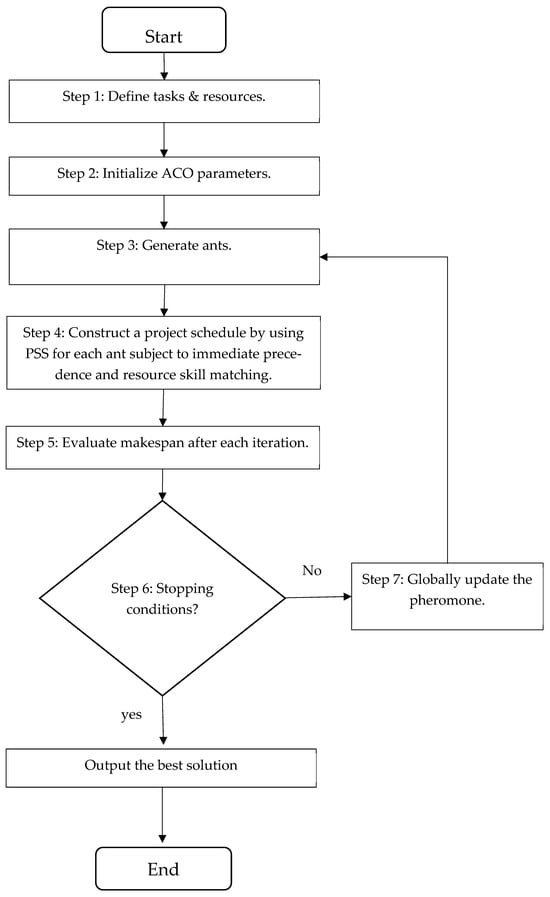
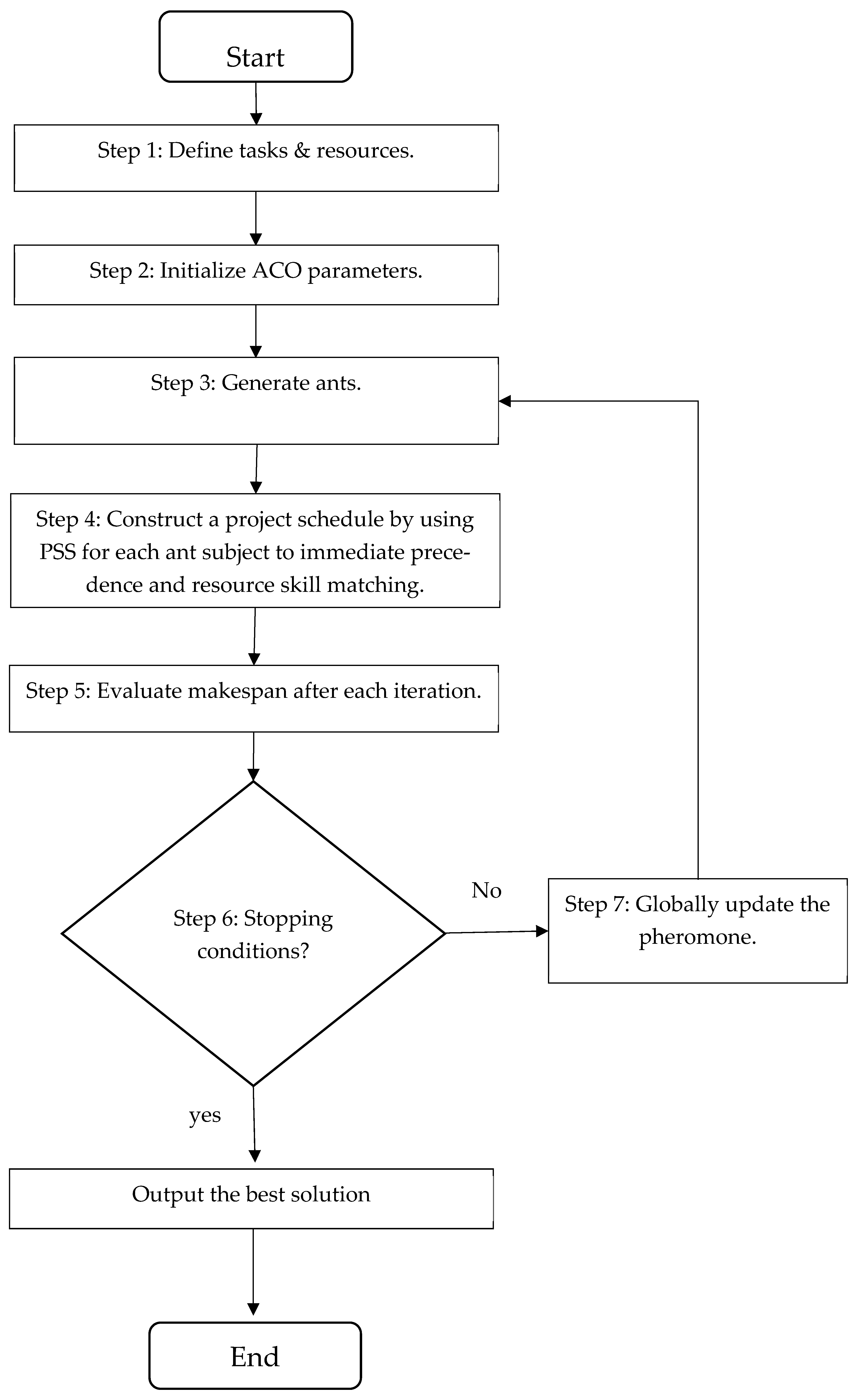
A challenging problem in MSRCPSP is that tasks involving multiple skills must be scheduled by taking into account limited resource constraints. This problem can also be solved using the Ant Colony Optimization (ACO) technique. The ACO approach simulates artificial ants that rely on pheromone trails and heuristic data to create viable solutions. This approach helps in searching for a vast solution space with improved efficiency. A Parallel Scheduling Scheme (PSS) utilizes distributed computing or multi-threading techniques to evaluate a few proposed solutions simultaneously may also be applied to schedule tasks with improved computational efficiency. This helps to reduce computational time and also enables a comprehensive analysis of a proposed schedule. Figure 2 illustrates the Ant Colony Optimization (ACO) algorithm applied to task scheduling and resource allocation.
Figure 2.
ACO flowchart integrated with PSS.
Steps for Applying ACO Integrated with PSS to Solve MSRCPSP
The Ant Colony Optimization (ACO) algorithm is implemented for the Multi-Skill Resource-Constrained Project Scheduling Problem (MSRCPSP) within a four-stage framework: Problem Representation, where the project network is converted into an ant graph; Initialization, where the main parameters of the algorithm are defined; Ant Generation, which carries out the operational functions based on the initial parameters; and Schedule Construction, which provides the final project schedule. Moreover, the efficiency of this optimization process is significantly improved by combining it with a Parallel Scheduling Scheme (PSS). The details of each stage are described below:
Step 1. Defining the tasks & resources
- Task and Constraint Modeling: Model the tasks of the project with multi-skill requirements and the capacity constraints of available resources.
- Project Network Graphing: The project schedule is represented as a directed graph, with nodes representing tasks and edges indicating the technological precedence relationships between them.
- Pheromone Matrix Initialization: Initialize a pheromone matrix based on task relationships and resource availability metrics.
Step 2. Initialization of ACO parameters
- Parameter Configuration: Define the basic ACO control parameters (alpha, beta, rho…).
- Baseline Pheromone Allocation: Initially, all feasible task transitions are assigned an equal baseline pheromone level to avoid biased exploration.
- Ant Colony Generation: Generate a population of artificial ants; each of them is assigned to build a candidate schedule solution.
Step 3. Generation of ants
- Probabilistic Schedule Generation: Each artificial ant constructs a candidate schedule by selecting tasks and assigning multi-skilled resources in a sequential manner based on a stochastic decision rule.
- Rule for Selecting the Task Probabilities: The probability of assigning resource to task is controlled by the standard ACO transition rule, which is defined as:
- : Represents the value of the pheromone corresponding to the assignment of task to resource .
- : Heuristic visibility value (reciprocal of the task duration).
- α, β: Meta-control parameters that govern the relative importance of the pheromone trail and the heuristic information.
Step 4. Construction of project schedule by using PSS based on Ant outcome for Skill match
The Step 4 in proposed methodology consists of two main components first Schedule Building and second PSS-ACO Scheme, each of them is explained in detail as follows:
Schedule Building (Ant-Based Parallel Schedule Building)
In the last step, each artificial ant builds feasible candidate schedules for the project by sequentially selecting eligible activities and assigning multi-skilled resources. The Ant Colony Optimization (ACO) algorithm is combined with a rigorous Parallel.
Scheduling Scheme (PSS) to maximize computational performance and minimize resource idle times. The mathematical framework that describes the state of the project at any stage n is defined by the following sets and variables:
- : Set of active tasks at stage n that are being executed.
- : Set of all tasks that have already been performed.
- : Set of decisions with all tasks that can be scheduled (precedence and resource constraints satisfied).
- : Available capacity of renewable resource r R at the schedule decision time , formally defined as:where is the total capacity of resource r and is the resource demand of task j. Thus, the decision set can be mathematically written as:where is the set of immediate predecessors of task j.
Algorithmic Procedure of the PSS-ACO Scheme:
The integrated parallel schedule construction is done iteratively by a chronological time advance mechanism and performs the following stages until all tasks are scheduled (i.e., until is not true):
- Initialization: We start the stage counter , the decision time , the initial decision set , and the active and complete sets and assign full initial capacities for all resources . Then, we proceed to the task assignment routine.
- Step (1): Time Advance, State Update: When no more tasks can be scheduled at the current decision point, the schedule time moves forward to the earliest finish time of the tasks currently active:
Then, the sets are updated by transferring the completed tasks () from the active set to the complete set . The resource capacities and the new set of decisions are recomputed.
- Step (2) Stochastic Task Selection and Resource Allocation:
An ant selects the next task to be scheduled according to the probabilistic transition rule (combination of the pheromone trail and the dynamic priority heuristics, e.g., Earliest Start Time). The selected task is dynamically assigned to the multi-skilled resources that are qualified and available. The completion time of is defined as:
where is the duration of the chosen task. Then the task is added to the active set () and the remaining resource capacities as well as the decision set are instantaneously updated.
- Conditional Loop: If the updated decision set is non-empty (), then the algorithm loops back to Step (2) to schedule other eligible parallel activities simultaneously. Otherwise, the stage counter is incremented () and the framework proceeds with Step (1).
Step 5. Makespan and stopping criteria evaluation
At the end of each iteration, the generated project schedules are evaluated based on their final makespan performance. The algorithm checks the following termination criteria to decide whether to stop the search or go to the next cycle.
- Maximum Iterations: The maximum number of algorithmic cycles has been reached.
- Solution Convergence: The global best makespan does not statistically improve for a specified number of consecutive iterations.
Conditional branches:
- If the termination criteria are NOT met (No): The algorithm increments the iteration counter and repeats the sequence from task generation and schedule building (Steps 3–5).
- If the termination criteria ARE met (Yes): The search loop of the algorithm terminates, and the final optimized schedule configuration is saved.
Global Pheromone Update
- At the end of each iteration, a global pheromone update is performed to dynamically steer the ant colony to promising regions of the solution space and avoid premature convergence to local optima. This process involves two main actions: evaporation of pheromones and reinforcement of the path.
- The mathematical expression for the global pheromone update is given as follows [23]:where: The pheromone intensity on the transition path between task and resource/task at iteration .: The pheromone evaporation rate (), which controls the forgetting mechanism of past sub-optimal choices.: The quantity of new pheromone to be laid down on the path, reinforcing successful trails.
- To ensure a good reinforcement for the best schedules, the pheromone deposition is directly proportional to the best makespan found in the current iteration () and is given by:where is a positive scaling constantly controlling the strength of the reinforcement. This balanced evaporation-reinforcement scheme allows the algorithm to effectively consolidate past scheduling success by updating the pheromone matrix but also to have sufficient exploration flexibility.
5. Case Study and Results
5.1. Dataset
The study utilized a previously available dataset provided by [9] for implementing the proposed framework. The dataset instances were generated using RanGen2 and include 50 projects derived from the RG30 dataset [24]. Each instance features a network comprising 30 activities, and the network structure is characterized by the SP indicator, which varies from 0.1 to 0.9 in increments of 0.2. Depth values for each resource are created randomly from 0.5 to 1.5 (with a variation step of 0.25). The problems solved are categorized into four different levels of resources: 4, 6, 12 and 24. Exactly 25 different project scheduling problems were solved and analyzed for each of these resource levels. These 25 problems are evenly split according to network complexity (SP), with five problems evaluated at each of the five SP levels: 0.1, 0.3, 0.5, 0.7, and 0.9.
5.2. Tuning of the Proposed Algorithm
The significance of tuning metaheuristics is well recognized in scientific literature [25], as effectively applying these algorithms to real-world problems requires identifying suitable initial parameter values, which are often complex and time-consuming. In particular, the performance of an ant algorithm largely depends on how its parameters are configured: α, β, τ, . The computational analysis of our experimental results reveals the optimal parameter configuration for our algorithm, which is shown in Table 3.
Table 3.
Tuned ACO algorithm parameters.
5.3. Results and Discussion
The performance of the Ant Colony Optimization (ACO) metaheuristic is rigorously compared with that of the exact LINGO solver for the MSRCPSP in Table 4. In an effort to assess the stability, robustness, and stochastic behavior of the metaheuristic method, the table summarizes the statistical metrics obtained from five independent runs of the ACO algorithm, where each individual run consists of 10,000 generated solution evaluations. The ACO algorithm performance is evaluated using four main statistics: the maximum (Max), minimum (Min), average (Avg) and standard deviation (SD) of the computed project makespans. In contrast, the exact solutions obtained from the LINGO solver are reported according to the results of the solver’s computation within a strict time limit of 600 s for execution. Table 5 is a detailed and statistical analysis of the experimental results described in Table 4.
Table 4.
Results of ACO algorithm and LINGO.
Table 5.
ACO and LINGO results analysis.
Formula used for % Deviation
Notes: (1) % Deviation is calculated per problem instance using the formula above, where is the minimum (best) makespan found by the Ant System over its five runs, and the LINGO result is the makespan returned by LINGO within the 600 s time limit. A negative value indicates ACO found a better (lower) makespan than LINGO; a positive value indicates ACO’s best makespan was higher (worse) than LINGO’s.
(2) Average % Deviation is the arithmetic mean of the % Deviation values of the five problem instances within each SP block, i.e., Average % Deviation = (1/5) Σ % Deviation. The shaded summary row below each resource level reports the overall average across all five SP values (0.1, 0.3, 0.5, 0.7, 0.9) for that resource level.
(3) Type: “Optimal” indicates LINGO reached proven global optimality within the 600 s limit; “Time-limited” indicates the 600 s limit was reached before optimality could be confirmed—for these instances, the LINGO makespan is a feasible upper bound, not a proven optimum.
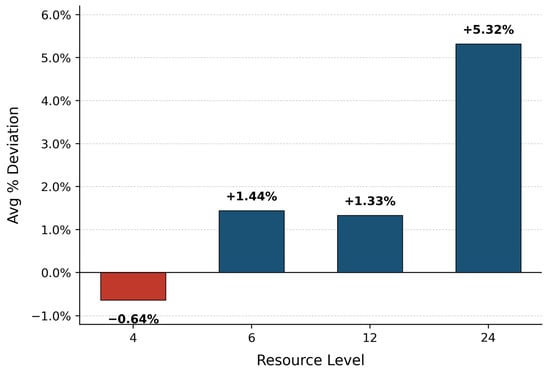
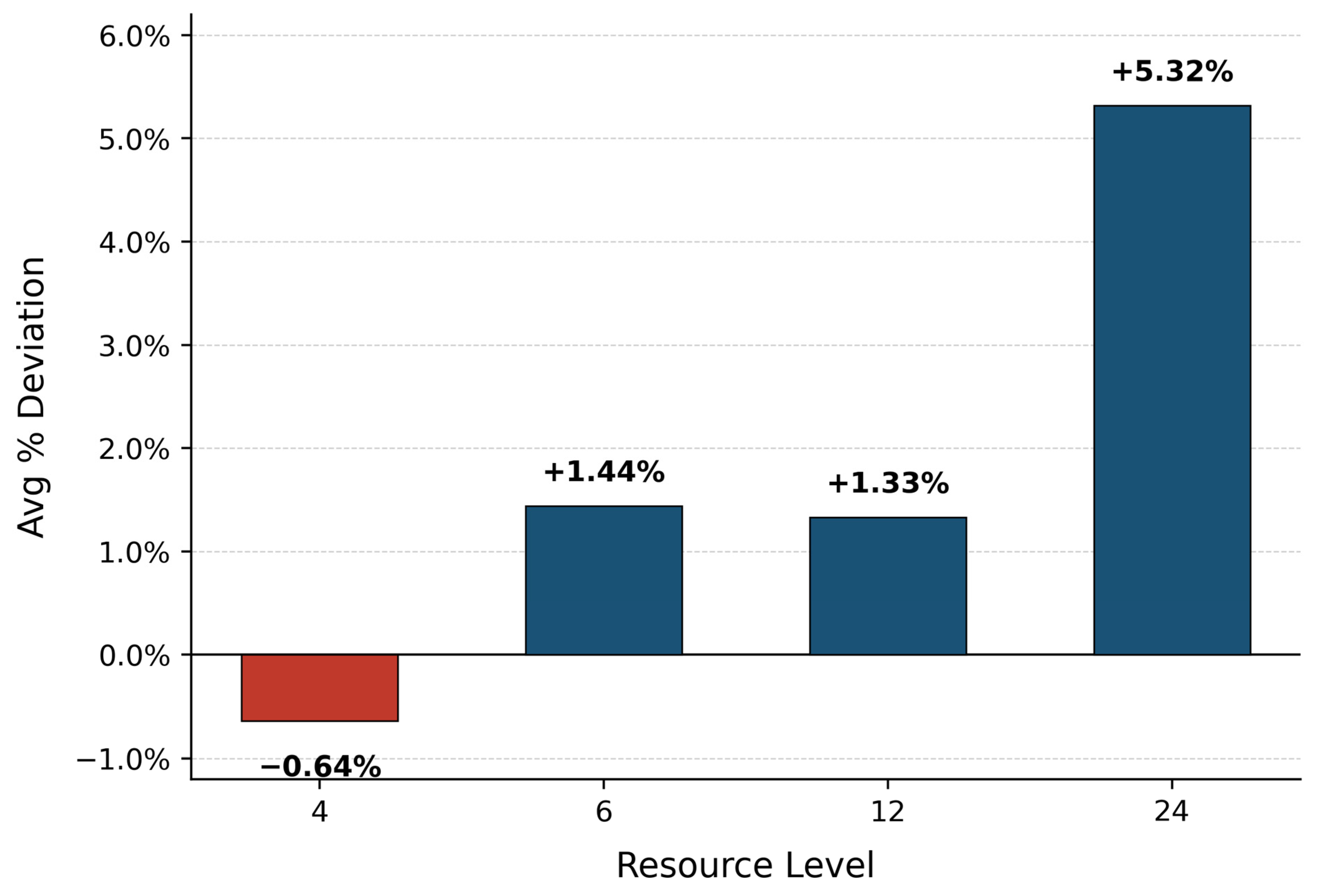
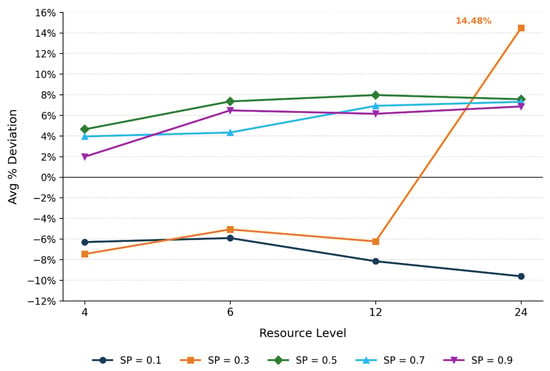
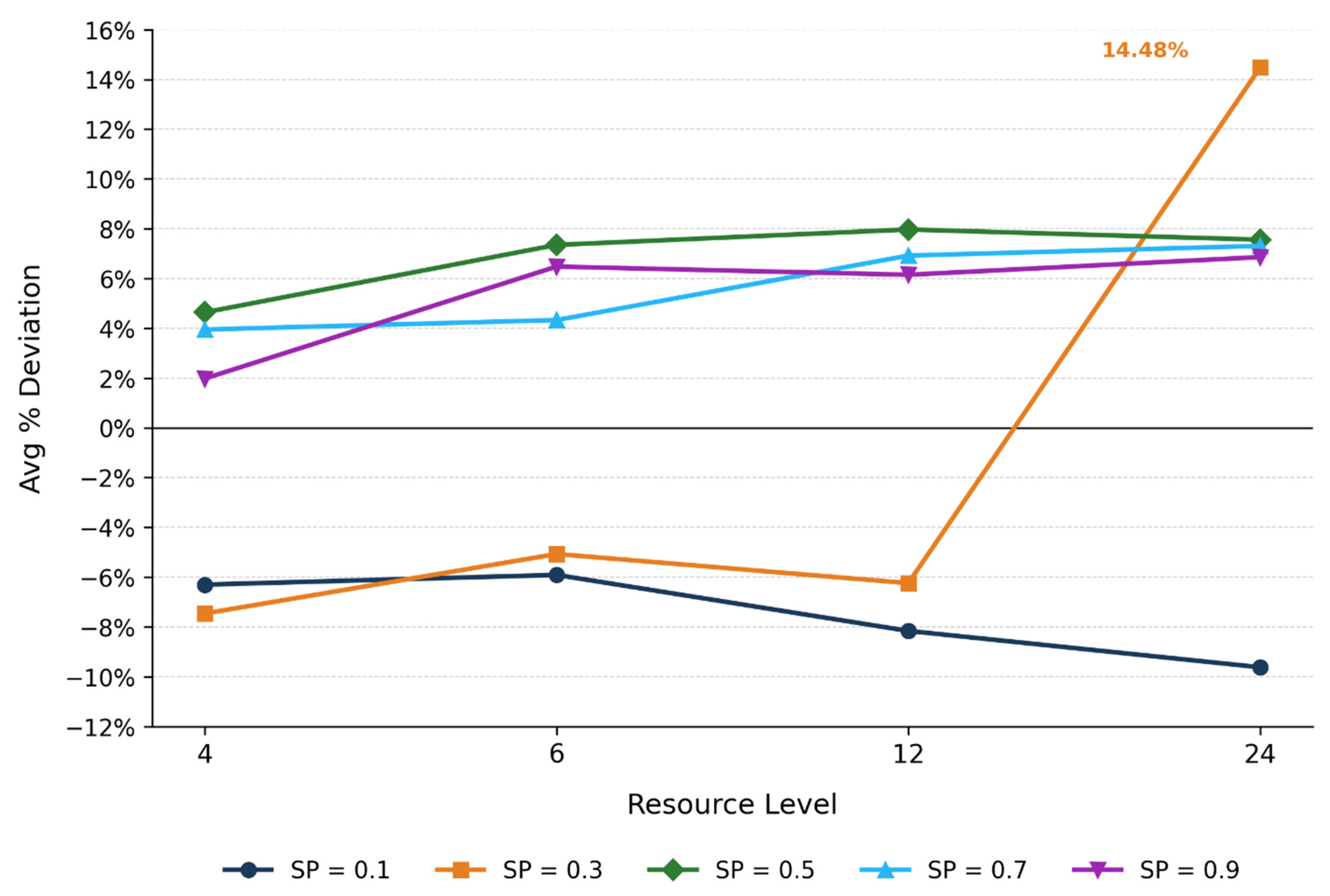
Figure 3 and Figure 4 show the relationship between resource level and the average percentage deviation between the ACO algorithm performance and LINGO software version 22.0 performance at various SP levels. These results indicate that as the resource level increases, LINGO’s performance becomes superior to that of the ACO algorithm, with LINGO achieving better solution quality at higher resource levels.
Figure 3.
Impact of resource level on average percentage deviation.
Figure 4.
Influence of resource levels on average percentage deviation at various SP levels.
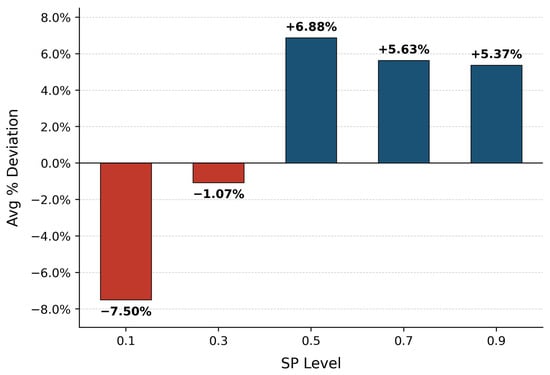
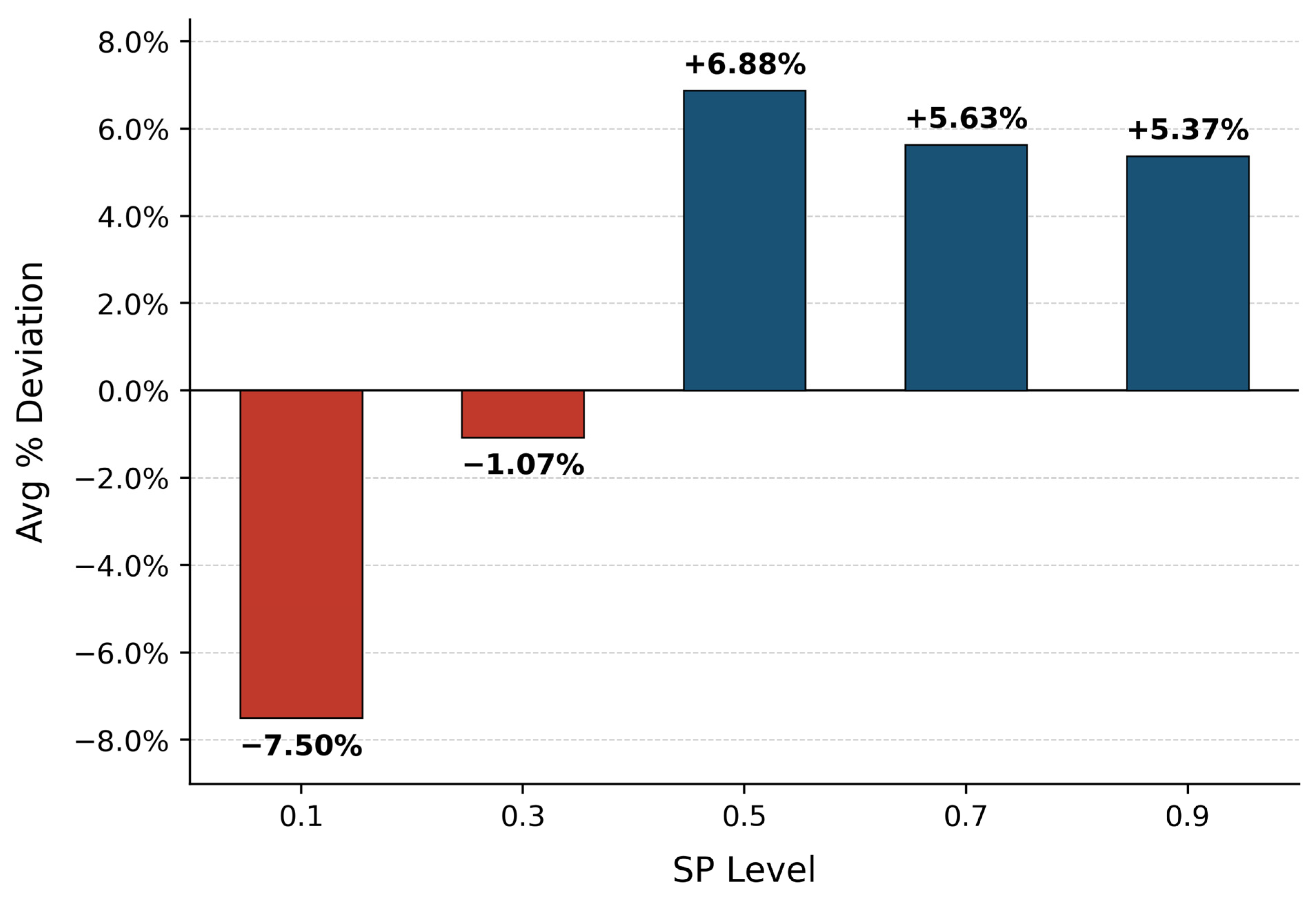
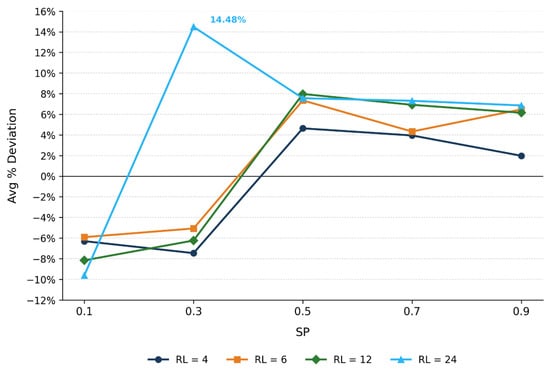
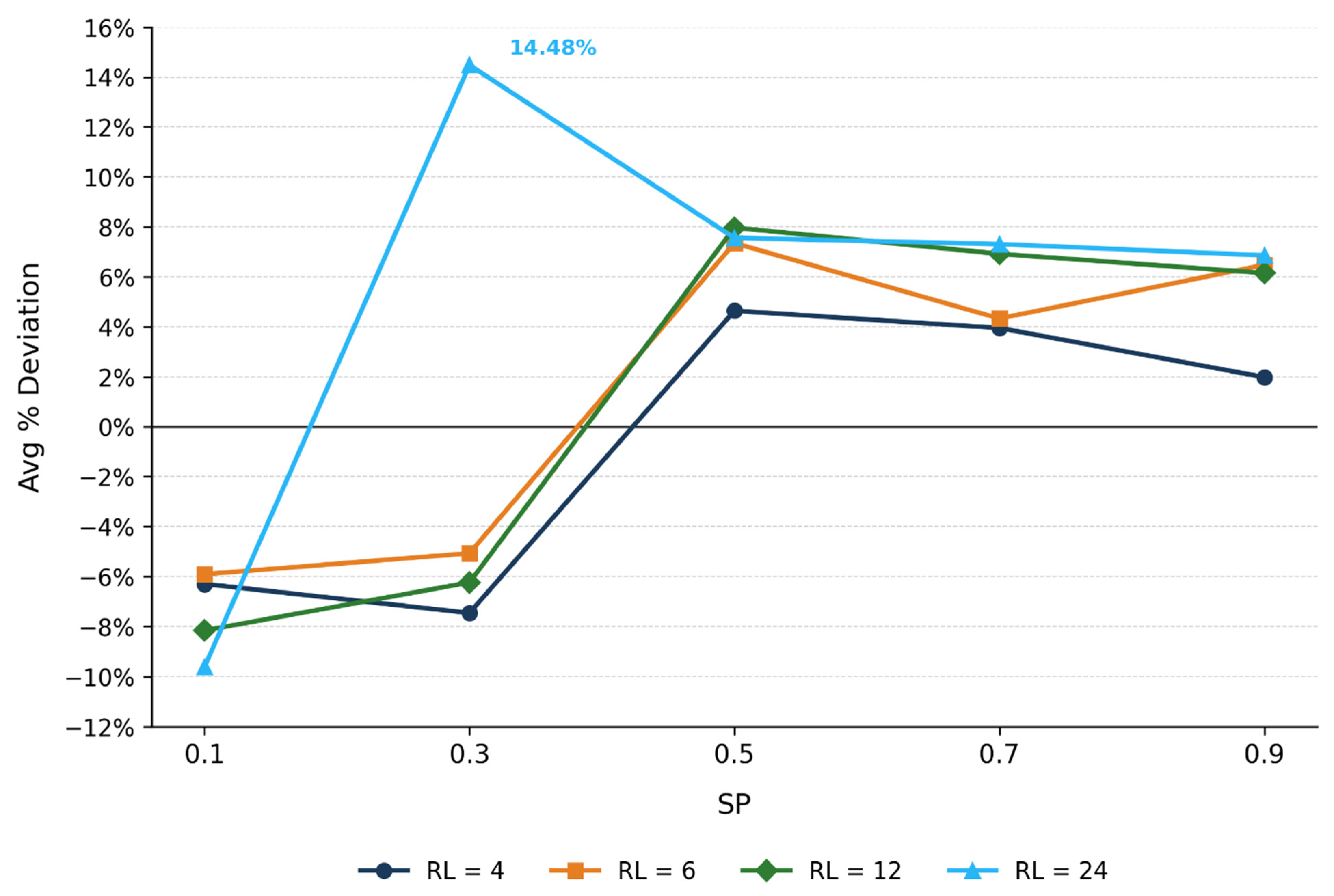
Figure 5 and Figure 6 present the relationship between SP level and average percentage deviation between the ACO algorithm and the LINGO software. These outcomes reflect that the ACO algorithm performs better at low SP levels, especially at SP = 0.1 and 0.3, at which its solutions are closer to the optimal benchmark. Conversely, when the SP level increases, LINGO demonstrates superior performance, outperforming the ACO algorithm at SP values of 0.5, 0.7, and 0.9.
Figure 5.
Impact of SP level on average percentage deviation.
Figure 6.
Influence of SP levels on average percentage deviation at various resource levels.
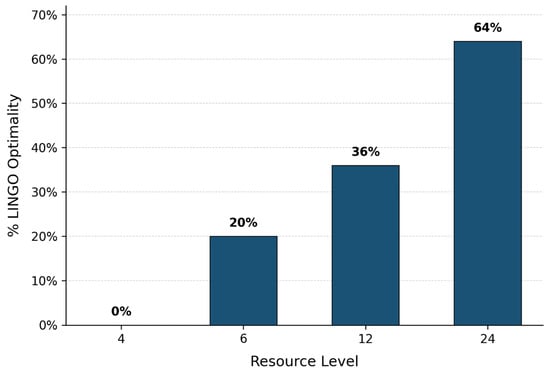
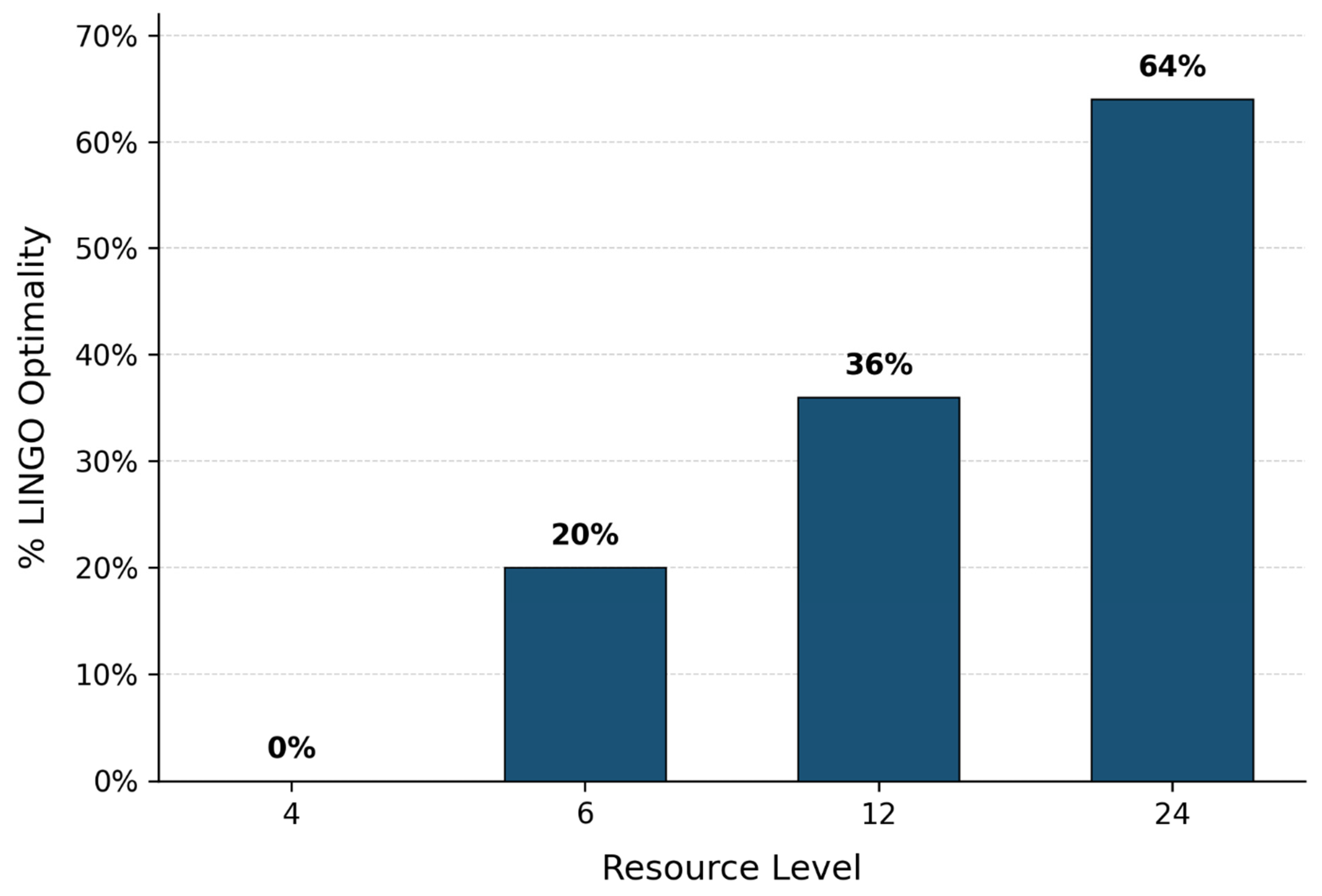
This trend suggests that LINGO is more effective in handling problem instances with higher SP levels, while ACO is more competitive in scenarios with smaller SP values, but when the resource level becomes large, LINGO consistently outperforms the ACO algorithm regardless of the SP value, as shown in Figure 3. Figure 7 illustrates that there is a positive correlation between resource level and optimality percentage. A comprehensive study of the experimental results unveils the underlying optimization mechanisms driving the performance trends of both methods. The Ant Colony Optimization (ACO) algorithm outperforms LINGO in scenarios with low network complexity (low SP factor) and scarce resource availability. This is because of its low structural complexity, which highlights the clear advantage of metaheuristics in achieving fast and high-quality optimization by efficiently exploiting the limited search space without getting caught up in heavy computational overhead. In contrast, when resource availability is increased and network complexity is increased (high SP factor), LINGO shows better performance. Under these complicated conditions, the exact mathematical programming approach of LINGO, with its stronger systematic exploration and bounding ability, can search large decision spaces more efficiently with enough time. This trade-off demonstrates that ACO performs fast and high-quality heuristic routes in constrained environments, while LINGO is more suitable for exploiting wider search spaces as problem density increases.
Figure 7.
Influence of resource level on optimality percentage.
6. Conclusions and Future Work
6.1. Main Research Conclusions
This study systematically investigated the Multi-Skill Resource-Constrained Project Scheduling Problem (MSRCPSP) with the main objective of minimizing the project makespan. The proposed framework was able to capture realistic industrial constraints by incorporating both workforce skill depth and breadth. The rigorous comparative analysis between the Ant Colony Optimization (ACO) algorithm and LINGO indicated that the performance of the algorithm is highly dependent on the structural characteristics of the problem. Instead of having one methodology prevailing over the other, the computational trade-offs showed that metaheuristics and exact mathematical solvers are complementary instruments, with network complexity (SP factor) and resource density determining the best boundaries for solution quality and computational efficiency.
6.2. Future Research Directions
Although this study provides a solid optimization framework for MSRCPSP, there are still a number of promising directions for future research. First, adding dynamic uncertainty such as stochastic task durations, sudden worker absenteeism, or equipment failures would greatly enhance the practical robustness of the model. Second, future extensions should extend the current single-objective model to a multi-objective model, which should evaluate makespan minimization, economic project costing, and workforce utilization balance simultaneously. Finally, a crucial step forward is the hybridization of the ACO algorithm with exact local search operators for the treatment of massive, ultra-large-scale industrial datasets. Although the current study utilized standard test datasets, the proposed approach will be tested on real-world industrial projects in future work. This will enable an evaluation of how well it handles unexpected challenges, such as equipment failures or staffing changes.
6.3. Managerial Insights
The results of the experiments allow drawing several main managerial insights for project planners and industrial managers:
- Strategic Resource Allocation: Project managers should focus on cross-training and multi-skilling strategies for human resources. Having multi-skilled staff will simplify bottlenecks within high-density project schedules considerably.
- Algorithmic Tool Selection: Managers can use metaheuristics like ACO for projects with tight constraints and immediate deadlines to achieve high-quality routing in almost no time. For strategic, long-term planning with high availability of resources, mathematical solvers like LINGO should be employed to achieve absolute optimization.
- Complexity Awareness: As network complexity (SP) increases, managers should expect longer computational bounds and should adaptively balance the trade-off between solution time and optimality.
Author Contributions
M.F.: Conceptualization, M.F.; methodology, M.F.; software, M.F.; validation, M.F. and R.E.; formal analysis, M.F.; investigation, M.F.; resources, M.F.; data curation, M.F.; writing—original draft preparation, M.F.; writing—review and editing, M.F., R.E., B.A.C. and G.A.; visualization, M.F. and R.E.; supervision, R.E. and G.A.; project administration, R.E.; funding acquisition, R.E. All authors have read and agreed to the published version of the manuscript.
Funding
This research was funded by the Deanship of Research and Graduate Studies at King Khalid University, Kingdom of Saudi Arabia, under grant number RGP2/513/46.
Data Availability Statement
The dataset used in this study is available to the public from the Project Scheduling Research Group, Ghent University, and can be accessed at: MSRCPSP|Operations Research & Scheduling Research Group.
Acknowledgments
The authors extend their appreciation to the Deanship of Research and Graduate Studies at King Khalid University for funding this work through the Large Research Project under grant number RGP2/513/46.
Conflicts of Interest
The authors declare no conflicts of interest.
References
- Datta, D.K.; Guthrie, J.P.; Basuil, D.; Pandey, A. Causes and effects of employee downsizing: A review and synthesis. J. Manag. 2010, 36, 281–348. [Google Scholar] [CrossRef] [Scilit]
- Manyi, T.; Sibanda, R.; Katrodia, A. The Effect of Using Multi-Skilled Workforce on the Flexibility of Project Resource Scheduling and Project Costs. J. Econ. Behav. Stud. 2018, 10, 235–251. [Google Scholar] [CrossRef] [Scilit] [PubMed]
- Fozveh, I.; Salehi, H.; Mogharehabed, K. Presentation of Multi-Skill Workforce Scheduling Model and Solving the Model Using Meta-Heuristic Algorithms. Mod. Appl. Sci. 2016, 10, 194. [Google Scholar] [CrossRef] [Scilit]
- Al-Anzi, F.S.; Al-Zame, K.; Allahverdi, A. Weighted Multi-Skill Resources Project Scheduling. J. Softw. Eng. Appl. 2010, 3, 1125–1130. [Google Scholar] [CrossRef]
- Caricato, P.; Grieco, A.; Arigliano, A.; Rondone, L. Workforce influence on manufacturing machines schedules. Int. J. Adv. Manuf. Technol. 2021, 115, 915–925. [Google Scholar] [CrossRef] [Scilit]
- Patel, V.; Deodhar, A.; Birru, D. A Multi-Objective Genetic Algorithm for Healthcare Workforce Scheduling. arXiv 2025, arXiv:2508.20953. [Google Scholar]
- Bahroun, Z.; As’Ad, R.; Tanash, M.; Athamneh, R. The Multi-Skilled Resource-Constrained Project Scheduling Problem: A Systematic Review and an Exploration of Future Landscapes. Manag. Syst. Prod. Eng. 2024, 32, 108–132. [Google Scholar] [CrossRef] [Scilit]
- Ao, S.I. International MultiConference of Engineers and Computer Scientists: IMECS 2012: 14–16 March 2012, the Royal Garden Hotel, Kowloon, Hong Kong; Newswood Ltd.: Hong Kong, China; International Association of Engineers: Hong Kong, China, 2012. [Google Scholar]
- Snauwaert, J.; Vanhoucke, M. A new algorithm for resource-constrained project scheduling with breadth and depth of skills. Eur. J. Oper. Res. 2021, 292, 43–59. [Google Scholar] [CrossRef] [Scilit]
- Dang Quoc, H.; Nguyen The, L.; Nguyen Doan, C. An Effective Hybrid Algorithm Based on Particle Swarm Optimization with Migration Method for Solving the Multiskill Resource-Constrained Project Scheduling Problem. Appl. Comput. Intell. Soft Comput. 2022, 2022, 6230145. [Google Scholar] [CrossRef] [Scilit]
- Bouleimen, K.; Lecocq, H. A new efficient simulated annealing algorithm for the resource-constrained project scheduling problem and its multiple mode version. Eur. J. Oper. Res. 2003, 149, 268. [Google Scholar] [CrossRef] [Scilit]
- Quoc, H.D. MEMINV: A hybrid efficient approximation method solving the multi skill-resource constrained project scheduling problem. Math. Biosci. Eng. 2023, 20, 15407–15430. [Google Scholar] [CrossRef] [Scilit] [PubMed]
- Bellenguez-Morineau, O.; Néron, E. A branch-and-bound method for solving multi-skill project scheduling problem. RAIRO—Oper. Res. 2007, 41, 155–170. [Google Scholar] [CrossRef] [Scilit]
- Heimerl, C.; Kolisch, R. Scheduling and staffing multiple projects with a multi-skilled workforce. OR Spectr. 2010, 32, 343–368. [Google Scholar] [CrossRef] [Scilit]
- Correia, I.; Saldanha-da-Gama, F. The impact of fixed and variable costs in a multi-skill project scheduling problem: An empirical study. Comput. Ind. Eng. 2014, 72, 230–238. [Google Scholar] [CrossRef] [Scilit]
- Alba, E.; Francisco Chicano, J. Software project management with GAs. Inf. Sci. 2007, 177, 2380–2401. [Google Scholar] [CrossRef] [Scilit]
- Yannibelli, V.; Amandi, A. A knowledge-based evolutionary assistant to software development project scheduling. Expert Syst. Appl. 2011, 38, 8403–8413. [Google Scholar] [CrossRef] [Scilit]
- Gómez Sánchez, M.; Lalla-Ruiz, E.; Fernández Gil, A.; Castro, C.; Voß, S. Resource-constrained multi-project scheduling problem: A survey. Eur. J. Oper. Res. 2023, 309, 958–976. [Google Scholar] [CrossRef] [Scilit]
- Tarek Hegazy, B.; Karim Shabeeb, A.; Elbeltagi, E.; Cheema, T. Algorithm for Scheduling with Multiskilled Constrained Resources. J. Constr. Eng. Manag. 2000, 126, 414–421. [Google Scholar] [CrossRef] [Scilit]
- Néron, E. Lower Bounds for the Multi-Skill Project Scheduling Problem. Proceeding of the Eighth International Workshop on Project Management and Scheduling, Valencia, Spain, 3–5 April 2002. [Google Scholar]
- Bellenguez, O.; Néron, E. Lower Bounds for the Multi-skill Project Scheduling Problem with Hierarchical Levels of Skills. In Practice and Theory of Automated Timetabling V; Burke, E., Trick, M., Eds.; Springer: Berlin/Heidelberg, Germany, 2005; pp. 229–243. [Google Scholar]
- Correia, I.; Lourenço, L.L.; Saldanha-da-Gama, F. Project scheduling with flexible resources: Formulation and inequalities. OR Spectr. 2012, 34, 635–663. [Google Scholar] [CrossRef] [Scilit]
- Hu, X.; Luo, P.; Zhang, X.; Wang, J. Improved Ant Colony Optimization for Weapon-Target Assignment. Math. Probl. Eng. 2018, 2018, 6481635. [Google Scholar] [CrossRef] [Scilit]
- Vanhoucke, M.; Coelho, J.; Debels, D.; Maenhout, B.; Tavares, L.V. An evaluation of the adequacy of project network generators with systematically sampled networks. Eur. J. Oper. Res. 2008, 187, 511–524. [Google Scholar] [CrossRef] [Scilit]
- Boussaïd, I.; Lepagnot, J.; Siarry, P. A survey on optimization metaheuristics. Inf. Sci. 2013, 237, 82–117. [Google Scholar] [CrossRef] [Scilit]

Disclaimer/Publisher’s Note: The statements, opinions and data contained in all publications are solely those of the individual author(s) and contributor(s) and not of MDPI and/or the editor(s). MDPI and/or the editor(s) disclaim responsibility for any injury to people or property resulting from any ideas, methods, instructions or products referred to in the content. |
© 2026 by the authors. Licensee MDPI, Basel, Switzerland. This article is an open access article distributed under the terms and conditions of the Creative Commons Attribution (CC BY) license.