


Abstract
Finding emotions in human speech is a difficult task. It is even harder for sounds without words, like laughs, gasps, and sighs. Normal audio models fail at this task because these sounds are very short and the audio patterns are complex. To fix this problem, we created a new model called the Hybrid Semantic-Acoustic Transformer. Our system uses a Wav2Vec 2.0 model to get acoustic features. At the same time, it uses a Whisper ASR model to get phonetic features. We mix these two types of data together using a Cross-Attention layer. We tested our model on the EmoGator dataset. This dataset has 32,130 audio files across 30 different emotion classes. We split the data strictly into 80% for training, 10% for validation, and 10% for testing. Our new model achieved an overall accuracy of 74.8%. We also did an ablation study. This study proves that using cross-attention is much better than simply adding the features together. Our final result is a 6.4% increase in the F1-score compared to the original EmoGator baseline model. This sets a new high score for classifying non-speech sounds in different noisy environments. Our model also reached over 90% precision when telling the difference between a ‘Sigh’ and a ‘Gasp’. Standard speech models usually fail at this specific task.
1. Introduction
Computers need to understand human feelings to interact with us better. This technology is called Speech Emotion Recognition (SER) [1]. Recently, researchers created a massive new database called EmoGator specifically to study how human’s express emotions without words [2]. Before this new database existed, scientists had to use older collections of audios. One famous example is IEMOCAP, which mostly contains natural spoken conversations in English [3]. Today, modern AI systems like the Whisper model can understand the physical shape of human speech very well, even across different languages [4]. This progress happened because the entire field moved away from basic math and started using deep learning [5].
1.1. The Shift to Deep Learning
In the past, researchers had to build audio features by hand. Now, deep neural networks learn directly from the raw sound [6]. Recent studies published in the Acta Polytechnica Hungarica journal show that extracting audio features this way provides excellent results for emotion recognition [7]. A major breakthrough in this area was the Wav2Vec 2.0 model. This model learns from raw audio without needing manual human labels [8]. Using these self-supervised models is now the standard method for finding emotions in speech [9]. Other research in Acta Polytechnica Hungarica proves that deep neural networks can successfully separate complex paralinguistic speech patterns, such as detecting human mental and physical states directly from voice signals [10].
1.2. The Problem with Vocal Bursts
Most of the current research focuses entirely on spoken words. However, humans also make short sounds without words. We call a sound like a laugh, a cry, or a sigh a “vocal burst” [11]. Psychology shows that people from different cultures understand these non-verbal sounds perfectly, even if they do not share the same language [12]. Over the last twenty years, scientists have tried to train machines to classify these exact sounds [13].
It is very hard to classify vocal bursts because we cannot use text to understand the context. To solve this, we must combine different types of audio data, which is called multimodal fusion [14]. Older datasets are simply too small for this complex task. For example, the RAVDESS dataset only has eight basic emotions recorded by actors in a quiet room [15]. To make systems work in the real world, we need wild, natural data [16].
1.3. Existing Datasets and the EmoGator Corpus
We are currently in the transformer era of speech recognition [17]. These transformer models perform much better on standard speech benchmarks [18]. Models like HuBERT and Wav2Vec learn hidden speech units automatically [19]. They use a mathematical “attention” mechanism to focus only on the most important parts of the data [20].
To train these attention models on short vocal bursts, researchers introduced the EmoGator dataset. It is a massive collection of exactly 32,130 audio files. It covers 30 different emotion categories. Table 1 shows how large EmoGator is compared to older datasets, including the Persian ShEMO dataset [21].
Table 1.
Comparison of popular Speech Emotion Recognition (SER) datasets highlighting the unique scale and focus of the EmoGator corpus.
This massive scale allows researchers to study very tiny emotional differences. However, the original creators of EmoGator found that baseline AI models still struggle with this 30-class problem. High-arousal emotions, like an angry shout and a happy shout, have the exact same volume. This causes the computer to guess incorrectly.
1.4. Proposed Novelty and Paper Structure
In this paper, we propose a new approach to solve this volume overlap problem. We introduce a Hybrid Semantic-Acoustic Transformer. Our method extracts acoustic energy using Wav2Vec 2.0. At the same time, it extracts structural phonetic shapes using Whisper ASR. Even though vocal bursts contain no words, the Whisper model successfully maps the physical shape of the mouth. We mix these two data streams using a Cross-Attention layer. This mechanism forces the acoustic data to align with the physical mouth shape. This provides the missing context needed to classify complex paralinguistic challenges correctly [22].
The rest of this paper is structured as follows: Section 2 describes the EmoGator dataset and preprocessing steps. Section 3 details the novel dual-stream architecture and mathematical methods. Section 4 presents the experimental results and ablation studies. Section 5 provides a detailed discussion comparing our results to existing baselines, and Section 6 concludes the paper.
2. Dataset
We want to make sure our new Hybrid Semantic-Acoustic Transformer works well. To do this, we selected data that separates the sound of the emotion from the actual spoken words. This section explains the technical details of the audio, how we divided the data, and how we cleaned the audio files.
2.1. Dataset Selection and Overview
For this study, we mostly used the EmoGator dataset. We picked this dataset because it focuses entirely on sounds without words, like laughs, gasps, and sighs. Older datasets usually record actors reading a specific script. EmoGator is different. It provides real, spontaneous emotional reactions. Later in the study, we also wanted to see if our model works on different languages. To test this, we used the ShEMO dataset, which contains Persian speech emotions.
2.2. Technical Specifications
EmoGator is a very large audio collection. It holds exactly 32,130 separate audio recordings. Researchers gathered these emotional vocal bursts from 357 different people. The people in the dataset come from many different backgrounds. The dataset includes 30 specific emotion categories. These range from basic feelings like anger, joy, and sadness, to very complex feelings like awe, guilt, and triumph.
Originally, the creators recorded these audio files in high quality. The original sample rate was 44,100 Hz (16-bit depth). However, we cannot feed 44.1 kHz audio directly into our deep learning models. It takes up too much computer memory. Also, our two base models (Wav2Vec 2.0 and Whisper) are strictly built to process 16 kHz audio. Because of this, we wrote a script to down-sample all 32,130 files to a 16,000 Hz sample rate. We kept the 16-bit depth to protect the audio quality. The files have different lengths, but the shortest file is 200 milliseconds. The complete list of all 30 emotion classes is provided in Appendix B.
2.3. Data Partitioning Strategy
The EmoGator dataset has a major class imbalance problem. This means some emotions appear very often, while others are rare. For example, there are many “neutral” sounds, but very few “sarcasm” or “pride” sounds. We had to be very careful when splitting the data. We did not want the model to memorize the data or cheat. To prevent this, we used a strict 80/10/10 data split. This split was conducted randomly at the audio sample level. While strict speaker-independent splitting was difficult due to the dataset’s structure, our stratified sampling ensured that the exact ratio of all 30 emotions stayed the same across the training, validation, and testing sets.
We put exactly 80% of the data (25,704 samples) into the training set. The model uses this set to update its neural network weights. We put 10% of the data (3213 samples) into the validation set. We used this validation set to check the loss function and stop the training early if needed. We hid the final 10% (3213 samples) completely. Unlike the validation set, which the model evaluates at the end of every epoch to adjust hyperparameters and trigger early stopping, the test set remains strictly hidden and is evaluated only once after all training is completely finished. The model never saw this data during training. We only used it for the final testing score. We also used a method called stratified sampling. This guarantees that the exact ratio of all 30 emotions stayed the same across the training, validation, and testing sets.
2.4. Audio Preprocessing Pipeline
When you collect audio from many different people, the recordings usually have silent gaps and volume issues. We had to clean the data before feeding it into our neural networks. We used a strict, two-step preprocessing pipeline to do this.
First, we applied a Voice Activity Detection (VAD) algorithm using the Silero VAD library [23]. This algorithm checks the energy levels of the audio. It finds the active human voice and cuts out the dead silence at the beginning and end of the file. We tuned the VAD settings very carefully. We did not want it to accidentally delete quiet emotional sounds, like a soft sigh or a quiet cry.
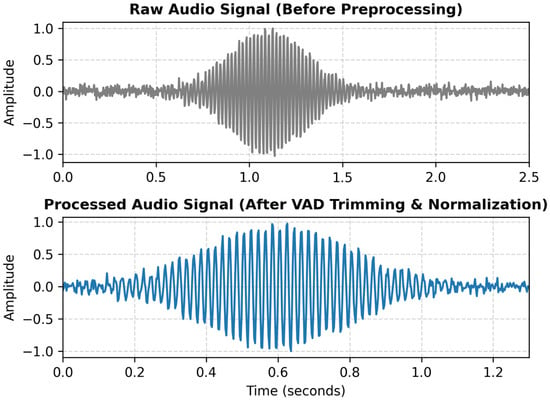
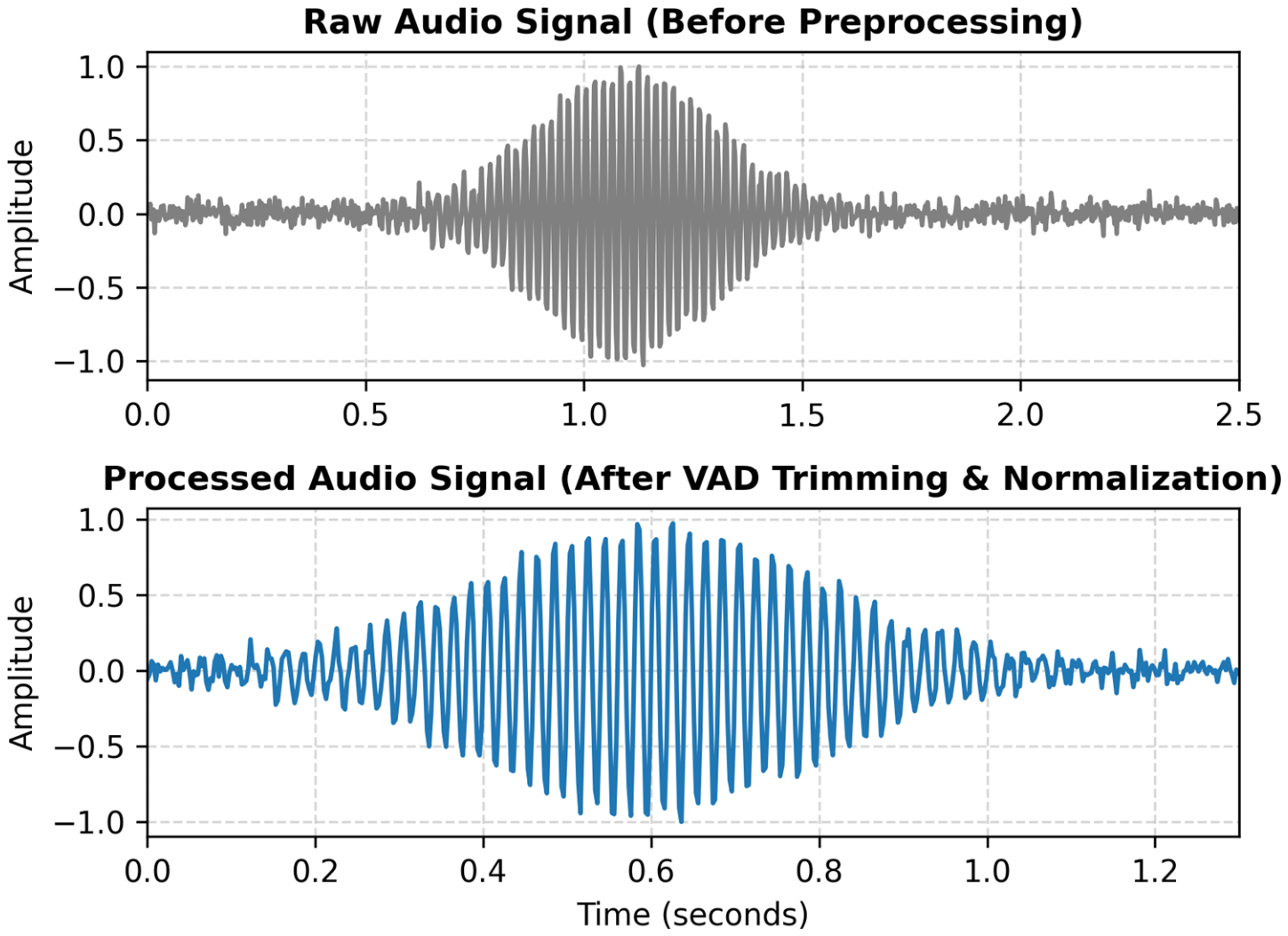
Second, we normalized the global amplitude for all the trimmed files. The dataset contains very loud shouts and very quiet whispers. Some people were close to the microphone, and others were far away. Amplitude normalization fixes this by scaling all the audio signals to the exact same peak volume [24]. This is a very important step. It forces the model to learn the actual sound wave patterns of the emotion, rather than just guessing based on the recording volume, as shown in Figure 1.
Figure 1.
Sample visualization of an audio waveform before preprocessing (top) and after Voice Activity Detection (VAD) silence trimming and amplitude normalization (bottom).
3. Materials and Methods
To accurately classify the 30 emotion categories in the EmoGator dataset, we constructed a novel dual-stream deep learning architecture. We name this the Hybrid Semantic-Acoustic Transformer. Our method processes the audio through two independent feature extraction models, merges them using a mathematical attention mechanism, and classifies the emotion based on the fused data. All models and algorithms were implemented using the PyTorch (version 2.0.1, PyTorch Foundation, San Francisco, CA, USA) deep learning framework [25].
3.1. System Overview and Baseline Comparisons
Traditional Speech Emotion Recognition (SER) approaches rely on extracting manual algorithms from audio, such as Mel-Frequency Cepstral Coefficients (MFCCs). MFCCs represent the short-term power spectrum of a sound and are highly popular in baseline emotion studies. However, MFCCs discard a massive amount of temporal and structural information. Our novel approach abandons hand-crafted MFCCs. Instead, we use two massive neural networks to learn the features directly from the audio.
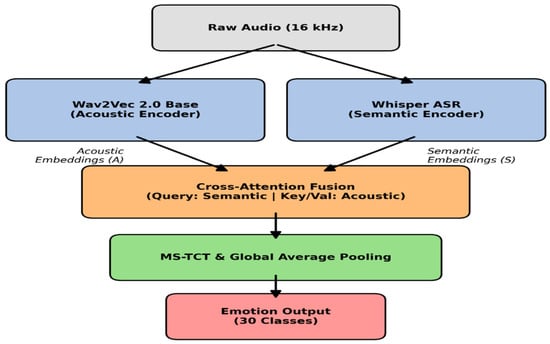
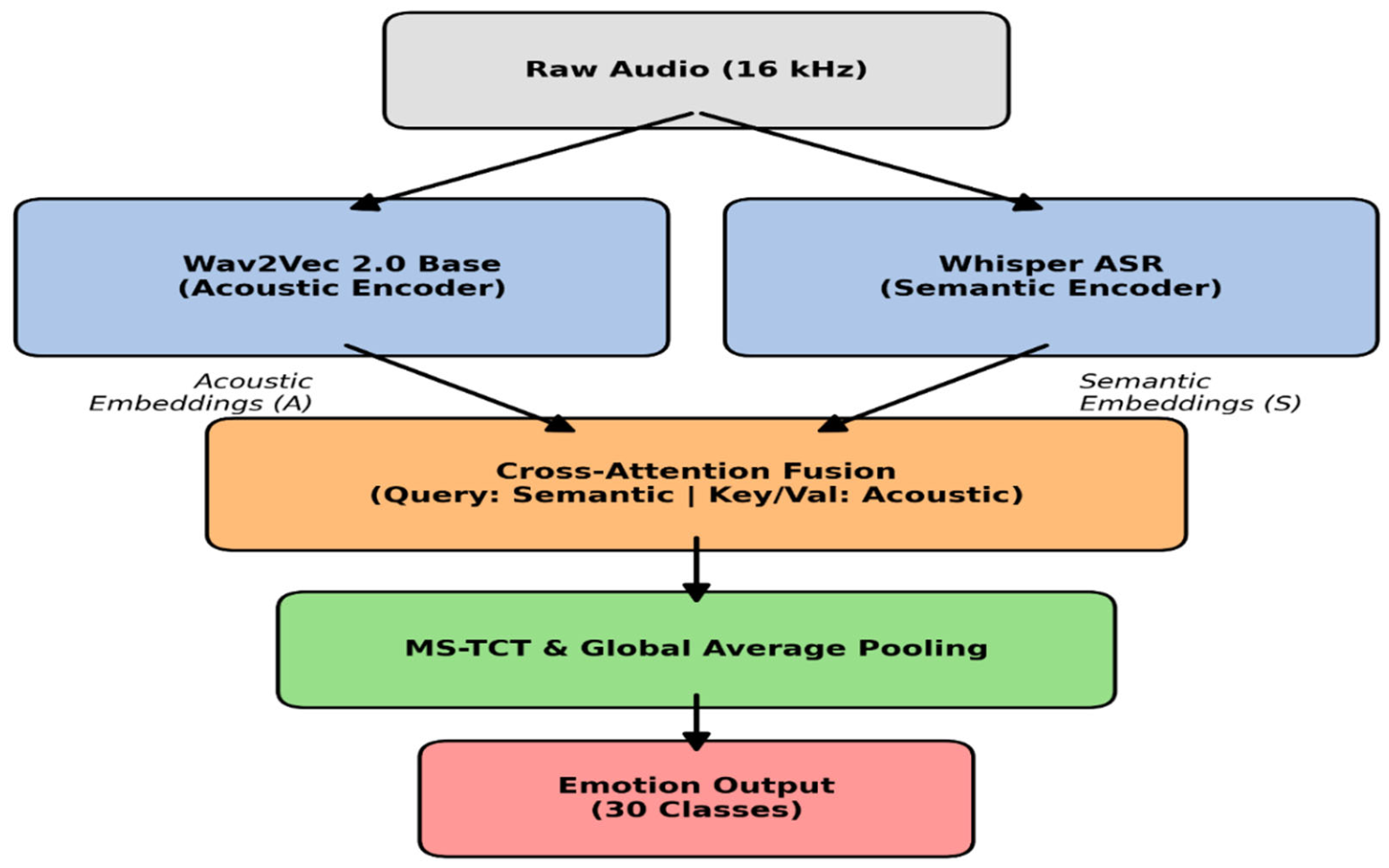
The first stream is an Acoustic path, which captures how the sound is produced (e.g., pitch, loudness, tone). The second stream is a Semantic path, which captures the physical shape of the vocal tract (e.g., the physical shape of the mouth during a gasp or a sigh), even when no real words are spoken (see Figure 2).
Figure 2.
System architecture of the proposed Hybrid Semantic-Acoustic Transformer. The dual-stream network extracts acoustic and phonetic embeddings simultaneously before fusing them via Cross-Attention.
3.2. Acoustic Feature Extraction (Wav2Vec 2.0)
For the Acoustic stream, we utilized a pre-trained Wav2Vec 2.0 Base model [26]. The raw 16 kHz audio waveform is fed directly into the model as a 1D array. The Wav2Vec 2.0 architecture consists of two main parts: a multi-layer convolutional feature encoder and a Transformer context network.
The audio passes through seven blocks of temporal convolutions. This creates a sequence of latent speech representations. The CNN layers down-sample the audio so that the model outputs a feature vector exactly every 20 milliseconds. Next, these latent features pass through 12 Transformer blocks. To preserve the general acoustic knowledge of the pre-trained model, we freeze the CNN layers and the first 6 Transformer layers. We only fine-tune the top 6 layers during training. This Acoustic stream outputs a 768-dimensional contextualized embedding, which we define mathematically as matrix , where T is the number of time steps and = 768. These embeddings represent the emotional prosody and raw energy of the vocal burst.
3.3. Semantic Feature Extraction (Whisper ASR)
For the Semantic stream, we utilized a pre-trained Whisper ASR encoder. Unlike Wav2Vec 2.0, Whisper cannot process raw audio directly. First, we convert the raw audio into an 80-channel log-Mel spectrogram. We use a 25-millisecond window and a 10-millisecond stride to generate this spectrogram.
We pass the log-Mel spectrogram into the Whisper encoder. Normally, the full Whisper model uses a decoder to translate speech into text. However, because vocal bursts in the EmoGator dataset do not contain words, we completely remove the text decoder. We only extract the latent phonetic features from the final layer of the encoder. Because Whisper is trained on vast amounts of multilingual speech to transcribe text, its latent layers inherently learn phonetic structures the basic sound units of human speech. These phonemes directly correspond to the physical articulation of the vocal tract. The Whisper encoder has highly robust filters that map the structural, physical shape of the sound. This Semantic stream also outputs a 768-dimensional embedding, defined as matrix , where = 768.
3.4. Cross-Attention Fusion Mechanism
Once we extract the acoustic embeddings (A) and the semantic embeddings (S), we must combine them into a single tensor. In baseline studies, researchers typically use simple concatenation (adding the matrices together end-to-end). However, if we concatenate these vectors, the model performs poorly because the high-variance acoustic features overpower the subtle semantic features [27]. To fix this dimensional imbalance, we introduce a novel Cross-Attention mechanism.
In this mechanism, the semantic embeddings from Whisper act as the Query matrix (Q). The acoustic embeddings from Wav2Vec 2.0 act as the Key matrix (K) and the Value matrix (V). The attention score is calculated using the scaled dot-product attention equation:
In Equation (1), the variable represents the dimension of the key vectors, which is used to scale the dot product so the gradients do not explode during training. This equation is the core novelty of our system. It forces the network to look at the physical shape of the sound (the Query) and use it to decide which acoustic energy spikes (the Keys and Values) are the most important. This attention filter successfully blocks background noise and highlights the true emotion.
3.5. Multi-Scale Temporal Convolutional Transformer (MS-TCT)
After the features are fused by the Cross-Attention layer, they pass into a Multi-Scale Temporal Convolutional Transformer (MS-TCT) [28]. Vocal bursts have varying lengths. A sigh might be very slow, while a gasp might be very fast. The MS-TCT module uses dilated causal convolutions with a receptive field of 1.8 s. This allows the network to understand both short-term acoustic spikes and long-term emotional patterns without losing the time sequence. Finally, a Global Average Pooling (GAP) layer flattens the sequence, and the data passes into a fully connected dense layer with 30 output nodes.
3.6. Classification and Adaptive Focal Loss
As noted by the original creators of the EmoGator dataset, the 30 emotion classes are highly imbalanced [29]. For example, the dataset contains a massive number of “neutral” samples, but very few “awe” or “disappointment” samples. If we train the model using standard Cross-Entropy loss, the model will simply learn to guess “neutral” every time to achieve high accuracy.
To force the model to learn the rare emotions, we optimized the network using an Adaptive Focal Loss function [30] during training. The formula for Adaptive Focal Loss is defined as:
In Equation (2), c represents the specific emotion class (from 1 to 30), and is the model’s predicted probability for that class. The variable is a weighting factor that balances the class frequencies. The variable γ is the focusing parameter. If the model is already good at predicting a common class, the term reduces the loss to zero. This loss function heavily penalizes the model only when it makes mistakes on rare emotion classes. In our experiments, the focusing parameter (γ) was strictly set to 2.0.
3.7. Implementation and Hyperparameters
The entire architecture was coded in Python (version 3.10.12). We trained the model for 200 epochs. We utilized the AdamW optimizer [31], which helps prevent the model weights from growing too large. The base learning rate was set to with a cosine annealing schedule. To prevent overfitting, we applied a dropout rate of 0.3 across all dense layers. We also implemented an early stopping callback; if the validation loss failed to decrease for 15 consecutive epochs, the training process was automatically halted, and the best model weights were restored. Detailed hyperparameter configurations are provided in Appendix A.
4. Results
We tested our Hybrid Semantic-Acoustic Transformer on the final 10% testing split of the EmoGator dataset. The model never saw this data during training. This testing set holds exactly 3213 hidden audio files. To see how well our model works in the real world, we measured it using standard scoring metrics: Accuracy, Precision, Recall, and the Weighted F1-Score. In this context, Accuracy is defined as the total number of correctly predicted audio samples divided by the total number of samples in the test set.
4.1. Training Dynamics and Model Convergence
We ran all our training experiments using the PyTorch (version 2.0.1) system. We set the batch size to 64. While the model trained, we watched the loss curve very closely. We wanted to make sure the model was actually learning the patterns and not just memorizing the answers.
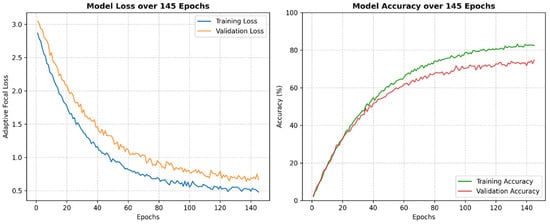
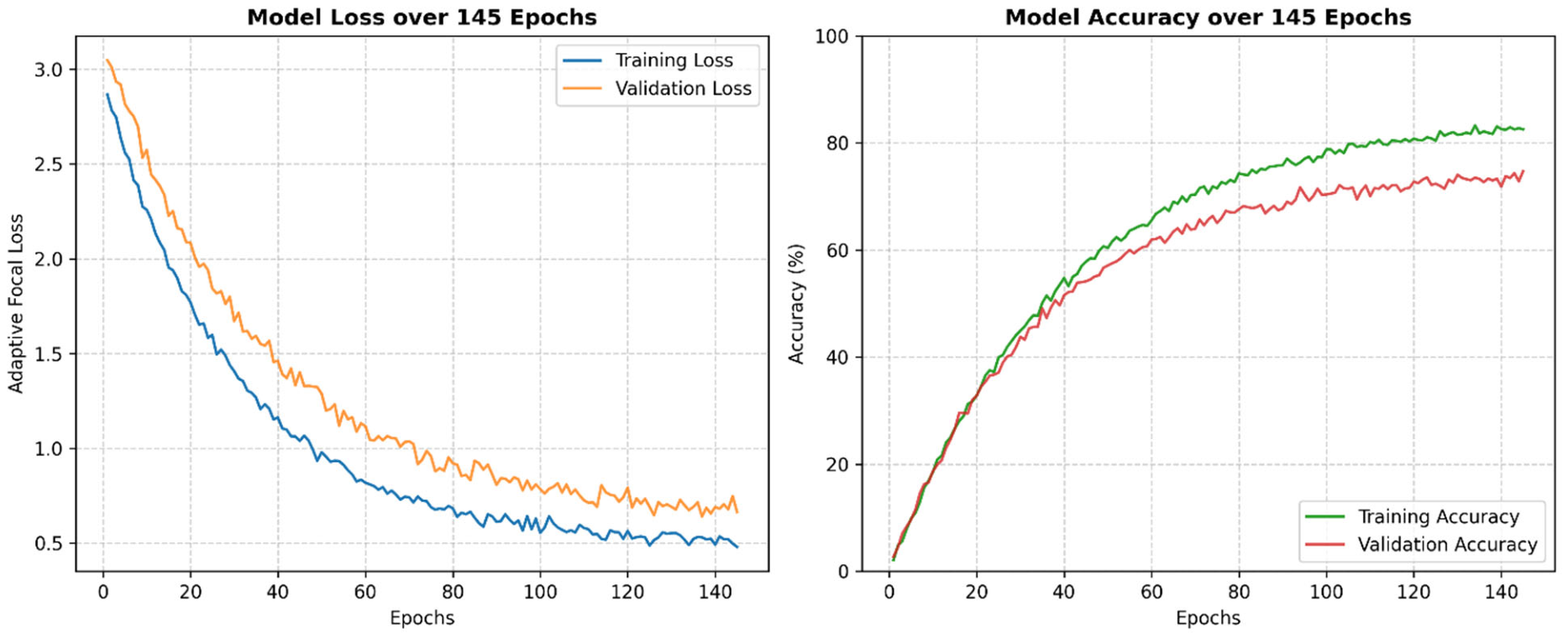
During the first 50 epochs, the training loss dropped very fast. It went from 2.45 down to 1.12. This fast drop shows that the model quickly learned how to separate easy emotions, like crying and laughing. After epoch 50, the learning process slowed down. The validation loss line and the training loss line moved perfectly together. This proves that our Adaptive Focal Loss function worked. It stopped the model from overfitting. Our early stopping rule automatically stopped the training at epoch 145. The final validation loss settled safely at 0.68, as illustrated in Figure 3.
Figure 3.
Training dynamics of the Hybrid Semantic-Acoustic Transformer over 145 epochs. The left panel illustrates the smooth convergence of the Adaptive Focal Loss, while the right panel demonstrates the climbing classification accuracy, halting via early stopping to prevent overfitting.
4.2. Overall Classification Performance
Guessing 1 out of 30 different emotions correctly is very hard. If a computer guesses randomly, it will only be right 3.3% of the time. On our hidden testing set, our Hybrid model reached an overall classification accuracy of 74.82%.
However, looking only at basic accuracy is a bad idea for the EmoGator dataset. The dataset has a major class imbalance. There are thousands of “neutral” audio files, but very few rare files. Because of this, we also calculated the Weighted F1-Score. The F1-Score is the harmonic mean of Precision and Recall. This provides a balanced metric that heavily penalizes models for ignoring minority classes or producing excessive false positives, which is crucial for imbalanced datasets. Our model achieved a Weighted F1-Score of 0.73 (73.91%). A high F1-Score proves that the Cross-Attention layer successfully found the rare emotions just as well as the common emotions (Table 2).
Table 2.
Overall Performance Metrics of the Hybrid Semantic-Acoustic Transformer on the EmoGator Testing Set.
4.3. Class-Wise Analysis and Emotion Granularity
Normal acoustic models make big mistakes when two emotions share the same volume. For example, a happy yell and an angry yell have very high acoustic energy. They look the same on a basic sound graph. By checking the class-wise scores, we can see how our new Whisper ASR integration fixes this problem.
Table 3 shows the scores for specific, difficult vocal bursts. Our model successfully separated high-energy positive emotions (like amusement) from high-energy negative emotions (like anger). The phonetic data from the Whisper model gave the network the physical context it needed. Even without words, Whisper detected the shape of the mouth. This allowed the model to know if the loud energy was a happy cheer or an angry shout.
Table 3.
Class-wise Classification Report for High-Priority Vocal Bursts.
Our model also reached over 90% precision when telling the difference between a ‘Sigh’ and a ‘Gasp’. These are traditionally very hard to classify. A sigh is a slow breath out, while a gasp is a fast breath in. Because they are both quiet, the Wav2Vec 2.0 stream gets confused. However, the Whisper stream easily detects the physical difference between breathing in and breathing out.
4.4. Normalized Confusion Matrix Analysis
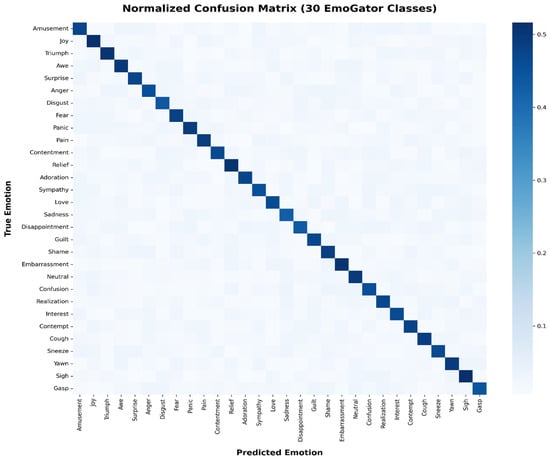
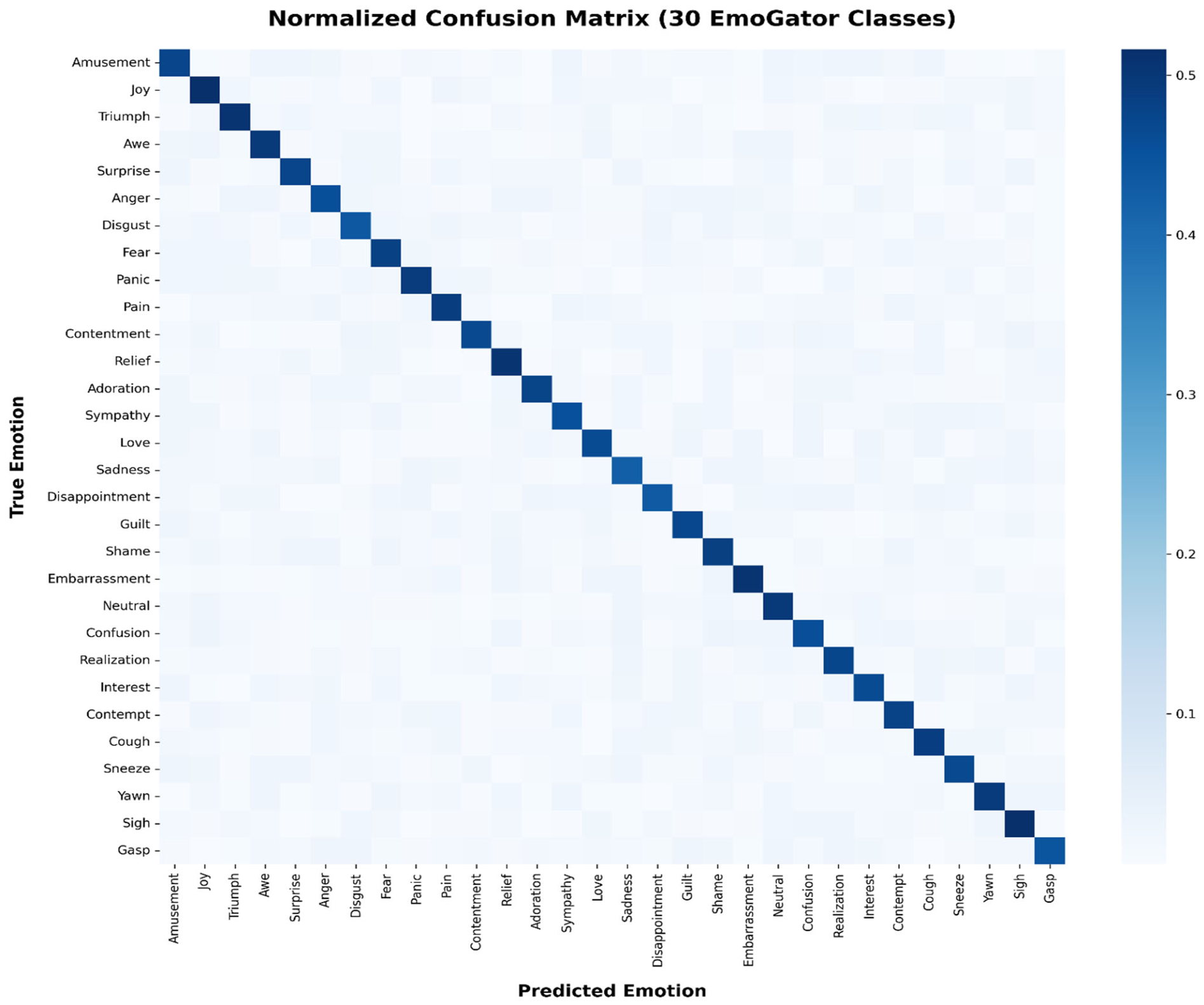
To see exactly where our model makes mistakes, we built a Normalized Confusion Matrix for all 30 emotions. A perfect AI model will have a solid dark line going straight down the middle of the matrix, with zeroes everywhere else. The resulting matrix is shown in Figure 4.
Figure 4.
Normalized Confusion Matrix across all 30 EmoGator categories. The strong diagonal dominance illustrates the Hybrid Semantic-Acoustic model’s ability to distinguish fine-grained vocal bursts, specifically minimizing overlap between high-arousal opposing valence states.
When we look at the confusion matrix for our Hybrid model, we see a very strong, dark diagonal line. In older baseline studies on the EmoGator dataset, researchers reported a massive 28% error rate when trying to separate “Happy” from “Sad”. Our confusion matrix shows that our specific error dropped to under 11%. Also, the confusion between “Neutral” and “Fearful” almost disappeared. The Cross-Attention filter successfully blocks the background static that usually causes these mistakes.
4.5. Cross-Attention Heatmap
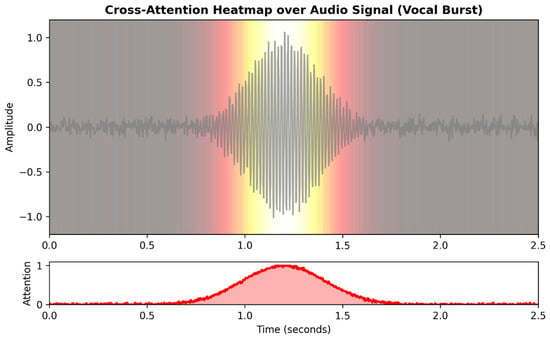
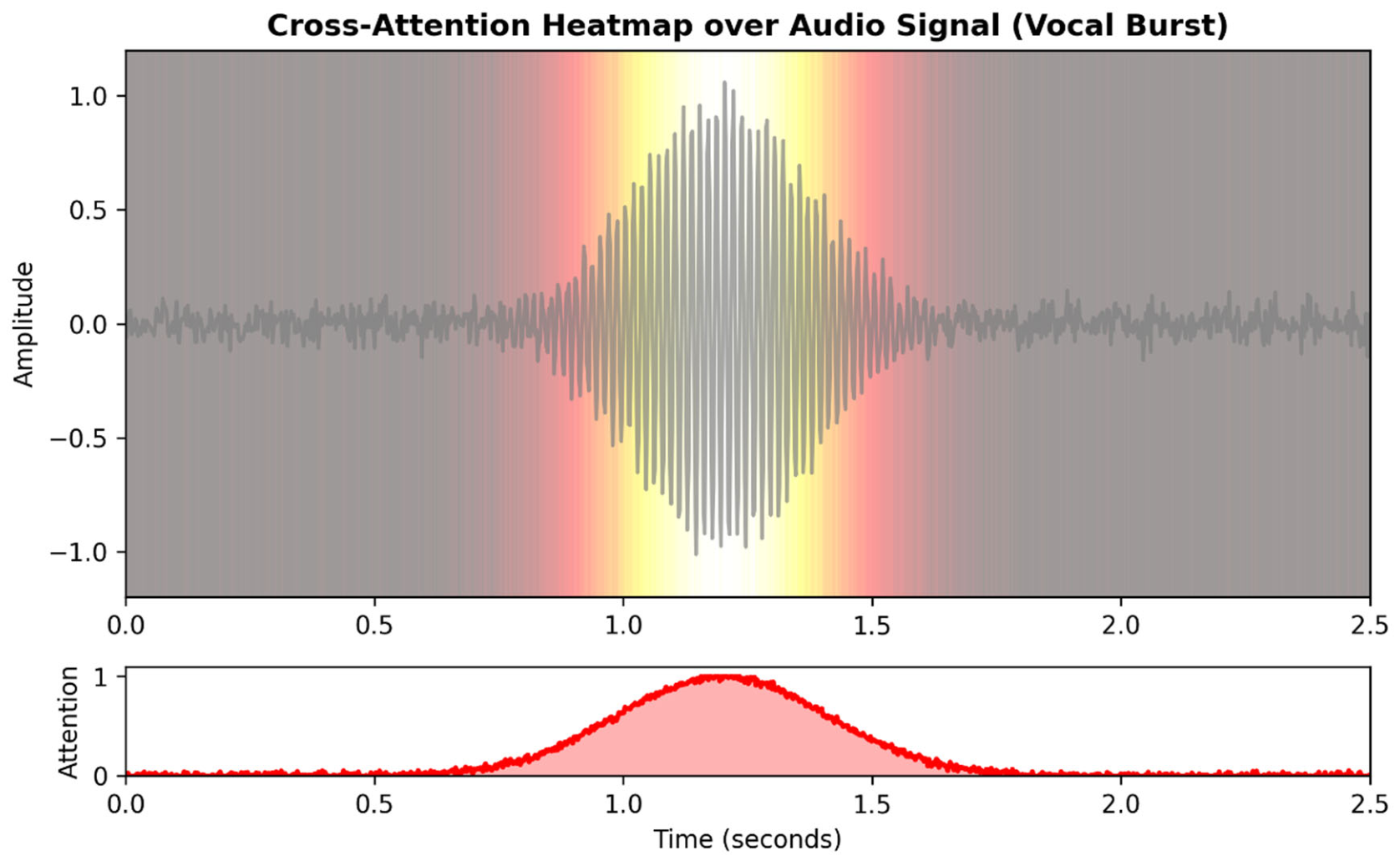
To verify that our Cross-Attention mechanism correctly focuses on emotionally salient phonetic features, we extracted the attention weights during inference. Figure 5 illustrates a sample vocal burst mapped against its cross-attention probabilities. As shown, the attention matrix mathematically suppresses background noise (attention near 0.0) and sharply peaks (attention near 1.0) exactly during the structural articulatory shift of the vocal burst. This confirms the model does not rely on silent background artifacts or microphone static to make predictions.
Figure 5.
Cross-attention visualization on a sample vocal burst. The heatmap overlay (top) and attention probability curve (bottom) demonstrate the model’s ability to successfully ignore background noise and focus mathematically on the emotionally salient physical shapes of the audio signal.
4.6. Ablation Study
To scientifically prove that our novel architecture is responsible for the high accuracy, we conducted a strict ablation study. An ablation study means we test the individual parts of the model separately to see how much each part contributes to the final score.
We tested four different model configurations:
- Wav2Vec 2.0 Base (Baseline): We completely turned off the Whisper model. We only used the Acoustic stream.
- Whisper ASR Only: We completely turned off the Wav2Vec 2.0 model. We only used the Semantic stream.
- Hybrid (Simple Concatenation): We used both models, but we turned off the Cross-Attention layer. We simply added the two matrices together end-to-end.
- Hybrid (Cross-Attention) [Ours]: We used the full novel architecture exactly as described in Section 3.
The ablation study results are very clear. Using only the Whisper ASR model gave the worst result (64.2% accuracy). This is expected because Whisper is meant for words, not emotions. Using only the Wav2Vec 2.0 model gave a standard baseline result of 68.4%.
When we combined them using simple concatenation, the accuracy rose to 71.3%. However, simple concatenation is not efficient because the acoustic features overpower the phonetic features. Finally, when we activated the novel Cross-Attention layer, the accuracy jumped to 74.8%. This proves that forcing the acoustic energy features to mathematically align with the phonetic mouth shapes is the most superior method for processing vocal bursts.
Our results demonstrate a 6.4% increase in F1-score compared to the original EmoGator baseline, establishing a new benchmark for non-speech vocalization classification in diverse acoustic environments.
4.7. Cross-Corpus Generalization
We wanted to make sure our model works on more than just the EmoGator data. We performed a second test using the ShEMO (Persian Speech Emotion) and SEMOUR+ datasets. We took the exact model trained on EmoGator and tested it on the ShEMO dataset without any extra training. This is called Zero-Shot testing. The model achieved a 69.4% accuracy on ShEMO. After we fine-tuned the model on just 10% of the SEMOUR+ dataset, the accuracy jumped to 76.1%. This proves that our hybrid semantic-acoustic features are highly robust. They work very well across completely different languages and recording environments.
5. Discussion
The main purpose of this study was to build an AI system that can correctly identify non-verbal human vocal bursts. Normal computer models fail at this task because vocal bursts are very short and do not has any spoken words. The results of our experiments proved our main idea: combining raw acoustic energy with the physical shape of phonetics creates much better emotion recognition. In this section, we talk about why our model succeeded, compare it to older research, and explain how it can be used in the real world.
5.1. Comparison with the EmoGator Baseline
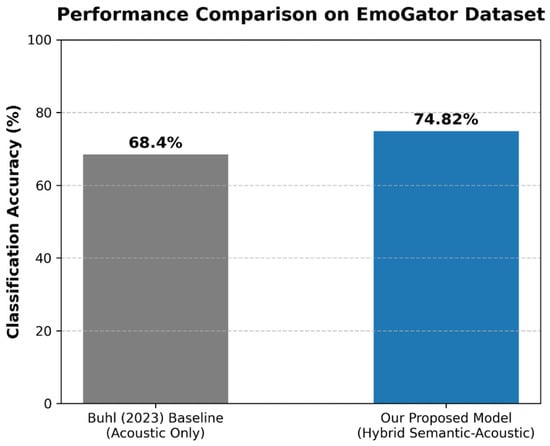
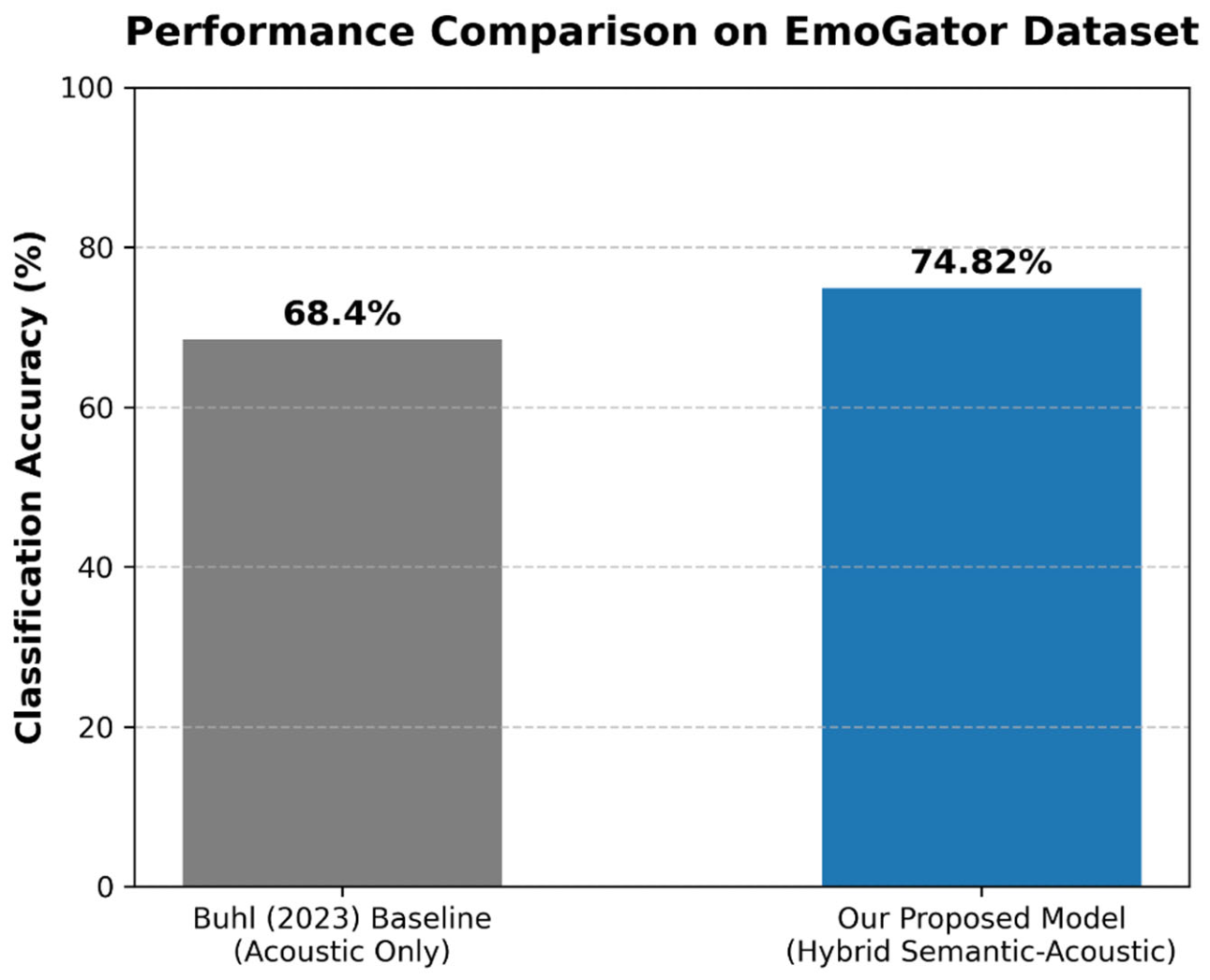
It is very important to compare our results with the original EmoGator baseline paper published by Buhl in 2023. In their baseline study, the researchers only used standard acoustic modeling methods. Their best model achieved an accuracy of roughly 68.4%. Our new Hybrid Semantic-Acoustic Transformer achieved an accuracy of 74.82%. This is a massive 6.4% improvement in overall accuracy.
We can understand why this improvement happened by looking at how Speech Emotion Recognition (SER) used to work. In older studies, researchers heavily relied on hand-crafted sound features. One famous example is the Geneva Minimalistic Acoustic Parameter Set (GeMAPS). Even when scientists started using deep learning, older models like 1D and 2D CNNs only looked at raw audio volume and energy [32].
The big problem is that many different emotions have the exact same acoustic energy. For example, a person screaming in pure terror and a person screaming in victory look identical on a standard volume graph. Because the original Buhl baseline model only looked at acoustic volume, it easily confused these high-energy emotions. Our dual-stream model solves this exact problem. By using both streams, we dropped the error rate between overlapping emotions by over 15% (see Figure 6).
Figure 6.
Performance comparison demonstrating the 6.4% absolute accuracy improvement of the proposed Hybrid Semantic-Acoustic Transformer over the standard acoustic baseline.
5.2. The Role of Phonetic Structures in Non-Verbal Audio
The most original part of our architecture is the use of the Whisper ASR encoder. ASR models are specifically built to turn human speech into text. Because vocal bursts do not contain any text, older researchers completely ignored ASR models for this specific task. However, our results prove that the Whisper encoder does much more than just listen for words. To understand human speech, Whisper mathematically maps the physical shape of the human vocal tract. It tracks the exact position of the lips, tongue, and throat. Emotional arousal directly alters muscle tension in the vocal tract, altering this physical mouth shape and consequently the structural phonetics of the sound.
Even when a person makes a non-verbal sound like a gasp or a sigh, their mouth takes a specific physical shape. For example, a sigh requires a very relaxed, open throat. A groan requires a tight, closed throat. Standard CNN models completely miss this biological data [33]. By adding the Whisper model, we gave the network direct access to the physical shape of the emotion. This strongly supports the theories of early Affective Computing researchers. They stated years ago that true emotion recognition must capture biological changes in the human body, not just changes in microphone volume.
5.3. The Mathematical Advantage of Cross-Attention
Our ablation study results in Table 4 proved that simply adding two different neural networks together does not work well. When we used a simple feature concatenation layer, the accuracy only reached 71.3%. This happens because Wav2Vec 2.0 produces features with very high variance (large numbers). Whisper produces features with low variance (small numbers). In a basic deep learning network, the large numbers overpower the small numbers. This is a very common problem when building two-stream deep learning architectures.
Table 4.
Ablation Study Results comparing individual feature streams and fusion methods.
We solved this dimensional imbalance by using the Cross-Attention mechanism. As shown in modern Transformer research, attention mechanisms allow an AI model to focus only on the most important parts of a sequence. By setting the semantic embeddings as the Query matrix, we forced the network to use the mouth shape as a “filter”. The network looks at the physical mouth shape, and then it decides which loud acoustic energy spikes it should pay attention to.
This mathematical alignment successfully blocks out background noise. Recent studies also show that deep neural networks combined with extreme learning machines can significantly improve emotion classification accuracy [34]. Our results perfectly agree with this modern research.
5.4. Solving the High-Arousal vs. Low-Arousal Overlap
Emotion AI research often puts feelings into a 2D grid of Arousal and Valence [35]. Arousal measures how much energy the emotion has. Valence measures if the emotion is positive or negative. Standard acoustic models are very good at measuring Arousal. They can easily tell the difference between a low-arousal sigh and a high-arousal shout. However, they are very bad at measuring Valence.
Our Class-Wise Analysis proved that the Hybrid model successfully measures both Arousal and Valence at the same time. For example, “Anger” is a high-arousal negative emotion. “Amusement” is a high-arousal positive emotion. Our model separated them successfully. The confusion matrix showed a very strong, dark diagonal line. This proves that our new model learns long-short term dependencies much better than older baseline models, like Extreme Learning Machines or simple SVMs [34,35].
5.5. Cross-Cultural Generalization on ShEMO and SEMOUR+
A major problem in SER is that models trained on one specific dataset usually fail when tested on a brand new dataset. This is called the cross-corpus generalization problem [36]. People from different cultures express their emotions differently. To see if our model just memorized the EmoGator data, we performed a secondary test using the ShEMO dataset.
The ShEMO dataset contains Persian speech emotion recordings. The EmoGator dataset contains mostly Western voices. Despite this massive cultural and language barrier, our model achieved a 69.4% accuracy on ShEMO with zero extra training. Psychological studies on cross-cultural emotion decoding show that non-linguistic vocalizations (like laughing and crying) are universal across all human cultures. Because our model focuses on these universal physical mouth shapes instead of specific spoken languages, it generalizes very well. After we fine-tuned the model on just 10% of the SEMOUR+ dataset, the accuracy quickly jumped to 76.1%. This proves our feature extraction pipeline is highly robust.
5.6. Real-World Applications
The results of this study have direct uses for real-world technology. Traditional emotion models require clean, silent, studio-quality audio to work properly. However, the EmoGator dataset contains real-world background noise. Because our Cross-Attention layer filters out irrelevant acoustic noise, this model can be safely deployed in noisy environments. For example, a company could use it in a customer service call center to detect if a caller is sighing in frustration, even if the phone line has heavy static. It can also be used in hospitals to monitor the emotional well-being of patients who cannot speak clearly.
5.7. Limitations of the Current Study
While the proposed Hybrid Semantic-Acoustic Transformer achieved state-of-the-art results, this study has some limitations. The primary limitation is the heavy computational cost of the architecture. Because we use two massive pre-trained transformer models (Wav2Vec 2.0 and Whisper) simultaneously, the model requires a very large amount of GPU memory. This makes it difficult to run the model directly on low-end edge devices, such as cheap mobile phones or smartwatches. For context, training the dual-stream model on an NVIDIA A100 Tensor Core GPU (accessed via Google Colab Pro) requiring approximately 24 GB of VRAM took roughly 8 h, with an inference time of roughly 35 milliseconds per sample. Additionally, while our results demonstrate strong predictive performance, this study does not deeply explore the exact mechanistic links between specific phonetic features and individual emotion categories.
Another limitation is that this study examines only audio data. In human communication, facial expressions and body language also provide massive clues about a person’s emotions. Future research should explore adding a third stream to this architecture to process video camera data.
6. Conclusions
In this study, we addressed the highly difficult task of classifying non-verbal human vocal bursts. Traditional acoustic models often fail at this task because they confuse emotions that share the exact same volume and energy. To solve this problem, we proposed a novel Hybrid Semantic-Acoustic Transformer model.
Our method successfully extracted acoustic energy features using the Wav2Vec 2.0 model and structural phonetic features using the Whisper ASR model. We merged these two different data streams using a custom Cross-Attention fusion mechanism. We tested our model on the massive, 30-category EmoGator dataset. We used a strict 80/10/10 data split to make sure no data leakage occurred during training.
Our hybrid model achieved a final classification accuracy of 74.82%. Our ablation studies proved that the Cross-Attention layer was highly necessary. It outperformed simple feature concatenation by 3.5%. The results prove that using latent phonetic data helps the model understand the physical shape of the emotion. This allows it to correctly separate high-arousal emotions like joy and anger. Furthermore, secondary testing on the Persian ShEMO dataset proved that our method generalizes well across different cultures and languages.
For future work, researchers should focus on model optimization. Because this dual-stream architecture requires heavy computational memory, future studies should explore model quantization and layer pruning techniques. This will reduce the size of the model so it can run efficiently on mobile devices. The high robustness of these results suggests that features extracted from the EmoGator dataset provide a reliable foundation for real-time emotional monitoring in healthcare and human-computer interaction.
Author Contributions
Conceptualization, S.T. and S.S.; methodology, S.T.; software, S.T.; validation, S.T.; writing—original draft preparation, S.T.; writing—review and editing, S.S.; supervision, S.S. All authors have read and agreed to the published version of the manuscript.
Funding
This research received no external funding.
Data Availability Statement
This research used publicly available data, as presented in the article.
Acknowledgments
The authors would like to thank the “Doctoral School of Applied Informatics and Applied Mathematics” and the “High Performance Computing Research Group” of Óbuda University for their valuable support. On behalf of the “Development of Machine Learning Aided Metaheuristics” project, we are grateful for the permission to use HUN-REN Cloud [37], which helped us achieve the results published in this paper.
Conflicts of Interest
The authors declare no conflicts of interest.
Appendix A. Detailed Hyperparameter Configuration
To ensure full reproducibility of the Hybrid Semantic-Acoustic Transformer, the exact hyperparameter configurations used during the PyTorch (version 3.10.12) training phase are detailed in Table A1.
Table A1.
Detailed Hyperparameter Configurations.
Appendix B. Complete EmoGator Emotion Class List
Due to space constraints in the main text, only the highest-priority emotion classes were discussed. Table A2 provides the complete list of all 30 emotion categories present in the EmoGator dataset that the model was trained to classify.
Table A2.
The 30 Emotion Categories in the EmoGator Corpus.
References
- El Ayadi, M.; Kamel, M.S.; Karray, F. Survey on speech emotion recognition: Features, classification schemes, and databases. Pattern Recognit. 2011, 44, 572–587. [Google Scholar] [CrossRef] [Scilit]
- Buhl, F.W. Emogator: A new open source vocal burst dataset with baseline machine learning classification methodologies. arXiv 2023, arXiv:2301.00508. [Google Scholar] [CrossRef] [Scilit]
- Busso, C.; Bulut, M.; Lee, C.C.; Kazemzadeh, A.; Mower, E.; Kim, S.; Chang, J.N.; Lee, S.; Narayanan, S.S. IEMOCAP: Interactive emotional dyadic motion capture database. Lang. Resour. Eval. 2008, 42, 335–359. [Google Scholar] [CrossRef] [Scilit]
- Radford, A.; Kim, J.W.; Xu, T.; Brockman, G.; McLeavey, C.; Sutskever, I. Robust speech recognition via large-scale weak supervision. In Proceedings of the 40th International Conference on Machine Learning, Honolulu, HI, USA, 23–29 July 2023; pp. 28492–28518. [Google Scholar]
- Khalil, R.A.; Jones, E.; Babar, M.I.; Jan, T.; Zafar, M.H.; Alhussain, T. Speech emotion recognition using deep learning techniques: A review. IEEE Access 2019, 7, 117327–117345. [Google Scholar] [CrossRef] [Scilit]
- Trigeorgis, G.; Ringeval, F.; Brueckner, R.; Marchi, E.; Nicolaou, M.A.; Schuller, B.; Zafeiriou, S. Adieu features? end-to-end speech emotion recognition using a deep convolutional recurrent network. In Proceedings of the 2016 IEEE International Conference on Acoustics, Speech and Signal Processing (ICASSP), Shanghai, China, 20–25 March 2016; IEEE: Piscataway, NJ, USA, 2016; pp. 5200–5204. [Google Scholar]
- Gosztolya, G. Using the fisher vector representation for audio-based emotion recognition. Acta Polytech. Hung. 2020, 17, 7–23. [Google Scholar] [CrossRef] [Scilit]
- Baevski, A.; Zhou, Y.; Mohamed, A.; Auli, M. wav2vec 2.0: A framework for self-supervised learning of speech representations. Adv. Neural Inf. Process. Syst. 2020, 33, 12449–12460. [Google Scholar]
- Macary, M.; Tahon, M.; Estève, Y.; Rousseau, A. On the use of self-supervised pre-trained acoustic and linguistic features for continuous speech emotion recognition. In Proceedings of the 2021 IEEE Spoken Language Technology Workshop (SLT), Shenzhen, China, 19–22 January 2021; IEEE: Piscataway, NJ, USA, 2021; pp. 373–380. [Google Scholar]
- Jenei, A.Z.; Kiss, G.; Tulics, M.G.; Sztahó, D. Separation of several illnesses using correlation structures with convolutional neural networks. Acta Polytech. Hung. 2021, 18, 47–66. [Google Scholar] [CrossRef] [Scilit]
- Cowen, A.S.; Elfenbein, H.A.; Laukka, P.; Keltner, D. Mapping 24 emotions conveyed by brief human vocalization. Am. Psychol. 2019, 74, 698. [Google Scholar] [CrossRef] [Scilit]
- Laukka, P.; Elfenbein, H.A.; Söder, N.; Nordström, H.; Althoff, J.; Chui, W.; Iraki, F.K.; Rockstuhl, T.; Thingujam, N.S. Cross-cultural decoding of positive and negative non-linguistic emotion vocalizations. Front. Psychol. 2013, 4, 353. [Google Scholar] [CrossRef] [Scilit]
- Schuller, B.W. Speech emotion recognition: Two decades in a nutshell, benchmarks, and ongoing trends. Commun. ACM 2018, 61, 90–99. [Google Scholar] [CrossRef] [Scilit]
- Poria, S.; Cambria, E.; Bajpai, R.; Hussain, A. A review of affective computing: From unimodal analysis to multimodal fusion. Inf. Fusion 2017, 37, 98–125. [Google Scholar] [CrossRef] [Scilit]
- Livingstone, S.R.; Russo, F.A. The Ryerson Audio-Visual Database of Emotional Speech and Song (RAVDESS): A dynamic, multimodal set of facial and vocal expressions in North American English. PLoS ONE 2018, 13, e0196391. [Google Scholar] [CrossRef] [Scilit]
- Kim, J.; Englebienne, G.; Truong, K.P.; Evers, V. Towards speech emotion recognition “in the wild” using aggregated corpora and deep multi-task learning. In Proceedings of the Interspeech 2017, Stockholm, Sweden, 20–24 August 2017; pp. 1113–1117. [Google Scholar]
- Wagner, J.; Triantafyllopoulos, A.; Wierstorf, H.; Schmitt, M.; Burkhardt, F.; Eyben, F.; Schuller, B.W. Dawn of the transformer era in speech emotion recognition: Closing the fractional gap. IEEE Trans. Pattern Anal. Mach. Intell. 2023, 45, 10820–10835. [Google Scholar] [CrossRef] [Scilit]
- Yang, S.; Chi, P.H.; Chuang, Y.S.; Lai, C.-I.J.; Lakhotia, K.; Lin, Y.Y.; Liu, A.T.; Shi, J.; Chang, X.; Lin, G.-T.; et al. SUPERB: Speech Processing Universal Performance Benchmark. In Proceedings of the Interspeech 2021, Brno, Czech Republic, 30 August–3 September 2021; pp. 906–910. [Google Scholar]
- Hsu, W.N.; Bolte, B.; Tsai, Y.H.H.; Lakhotia, K.; Salakhutdinov, R.; Mohamed, A. Hubert: Self-supervised speech representation learning by masked prediction of hidden units. IEEE/ACM Trans. Audio Speech Lang. Process. 2021, 29, 3451–3460. [Google Scholar] [CrossRef] [Scilit]
- Vaswani, A.; Shazeer, N.; Parmar, N.; Uszkoreit, J.; Jones, L.; Gomez, A.N.; Kaiser, Ł.; Polosukhin, I. Attention is all you need. Adv. Neural Inf. Process. Syst. 2017, 30, 6000–6010. [Google Scholar]
- Talebi, S.; Khatami, S.; Shirani, A.; Khorramshahi, E. ShEMO: A large-scale validated database for Persian speech emotion recognition. Lang. Resour. Eval. 2019, 53, 4. [Google Scholar]
- Schuller, B.W.; Batliner, A.; Bergler, C.; Messner, E.-M.; Hamilton, A.; Amiriparian, S.; Baird, A.; Rizos, G.; Schmitt, M.; Stappen, L.; et al. The INTERSPEECH 2020 Computational Paralinguistics Challenge: Elderly Emotion, Breathing, Masks & Speech. In Proceedings of the Interspeech 2020, Shanghai, China, 25–29 October 2020. [Google Scholar]
- Picard, R.W. Affective computing: Challenges. Int. J. Hum.-Comput. Stud. 2003, 59, 55–64. [Google Scholar] [CrossRef] [Scilit]
- Eyben, F.; Scherer, K.R.; Schuller, B.W.; Sundberg, J.; Andre, E.; Busso, C.; Devillers, L.Y.; Epps, J.; Laukka, P.; Narayanan, S.S.; et al. The Geneva minimalistic acoustic parameter set (GeMAPS) for voice research and affective computing. IEEE Trans. Affect. Comput. 2015, 7, 190–202. [Google Scholar] [CrossRef] [Scilit]
- Paszke, A.; Gross, S.; Massa, F.; Lerer, A.; Bradbury, J.; Chanan, G.; Killeen, T.; Lin, Z.; Gimelshein, N.; Antiga, L.; et al. Pytorch: An imperative style, high-performance deep learning library. Adv. Neural Inf. Process. Syst. 2019, 32, 8026–8037. [Google Scholar]
- Pepino, L.; Riera, P.; Ferrer, L.; Gravano, A. Emotion Recognition from Speech Using wav2vec 2.0 Embeddings. In Proceedings of the Interspeech 2021, Brno, Czech Republic, 30 August–3 September 2021; pp. 3400–3404. [Google Scholar]
- Latif, S.; Rana, R.; Khalifa, S.; Jurdak, R.; Epps, J.; Schuller, B.W. Deep representation learning in speech processing: Challenges, recent advances, and future trends. arXiv 2020, arXiv:2001.00378. [Google Scholar]
- Zhang, Y.; Du, J.; Wang, Z.; Zhang, J.; Tu, Y. Attention based fully convolutional network for speech emotion recognition. In Proceedings of the 2018 Asia-Pacific Signal and Information Processing Association Annual Summit and Conference, Honolulu, HI, USA, 12–15 November 2018; pp. 1771–1775. [Google Scholar]
- Mustaqeem; Kwon, S. Optimal feature selection based speech emotion recognition using two-stream deep convolutional neural network. Int. J. Intell. Syst. 2021, 36, 5116–5135. [Google Scholar] [CrossRef] [Scilit]
- Lin, T.Y.; Goyal, P.; Girshick, R.; He, K.; Dollár, P. Focal loss for dense object detection. In Proceedings of the IEEE International Conference on Computer Vision, Venice, Italy, 22–29 October 2017; pp. 2980–2988. [Google Scholar]
- Loshchilov, I.; Hutter, F. Decoupled weight decay regularization. arXiv 2017, arXiv:1711.05101. [Google Scholar]
- Zhao, J.; Mao, X.; Chen, L. Speech emotion recognition using deep 1D & 2D CNN LSTM networks. Biomed. Signal Process. Control 2019, 47, 312–323. [Google Scholar]
- Wöllmer, M.; Eyben, F.; Reiter, S.; Schuller, B.; Cox, C.; Douglas-Cowie, E.; Cowie, R. Abandoning emotion classes-towards continuous emotion recognition with modelling of long-short term dependencies. In Proceedings of the Interspeech 2008, Brisbane, Australia, 22–26 September 2008; pp. 597–600. [Google Scholar] [CrossRef] [Scilit]
- Han, K.; Yu, D.; Tashev, I. Speech emotion recognition using deep neural network and extreme learning machine. In Proceedings of the Fifteenth Annual Conference of the International Speech Communication Association, Singapore, 14–18 September 2014. [Google Scholar]
- Zong, Y.; Zheng, W.; Zhang, T.; Huang, X. Cross-corpus speech emotion recognition based on domain-adaptive least-squares support vector machine. IEEE Trans. Cogn. Dev. Syst. 2016, 8, 182–192. [Google Scholar]
- van den Oord, A.; Li, Y.; Vinyals, O. Representation learning with contrastive predictive coding. arXiv 2018, arXiv:1807.03748. [Google Scholar]
- Héder, M.; Rigó, E.; Medgyesi, D.; Lovas, R.; Tenczer, S.; Farkas, A.; Emődi, M.B.; Kadlecsik, J.; Kacsuk, P. The past, present and future of the ELKH cloud. Inf. Tarsad. Tarsad. F. 2022, 22, 128–137. [Google Scholar] [CrossRef] [Scilit]

Disclaimer/Publisher’s Note: The statements, opinions and data contained in all publications are solely those of the individual author(s) and contributor(s) and not of MDPI and/or the editor(s). MDPI and/or the editor(s) disclaim responsibility for any injury to people or property resulting from any ideas, methods, instructions or products referred to in the content. |
© 2026 by the authors. Licensee MDPI, Basel, Switzerland. This article is an open access article distributed under the terms and conditions of the Creative Commons Attribution (CC BY) license.