


Abstract
This review examines the transformative interplay between computing chips and Artificial Intelligence (AI), driving a revolution across various industries. First, the broader artificial intelligence and semiconductor ecosystem is analyzed, including hardware manufacturers, software frameworks, and system integration. Next, the development prospects are examined, revealing current challenges such as power consumption, manufacturing complexity, supply chain constraints, and ethical considerations. Further discussion focuses on cloud-edge collaboration in relation to system architecture and workload allocation strategies. Then, cutting-edge AI technologies are analyzed, and key insights are summarized. Finally, the overall trends in artificial intelligence and the chip industry are summarized, clearly presenting the findings for the future and making a unique contribution to this review.
1. Introduction
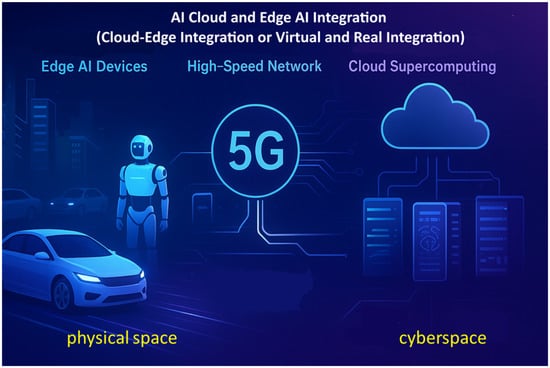
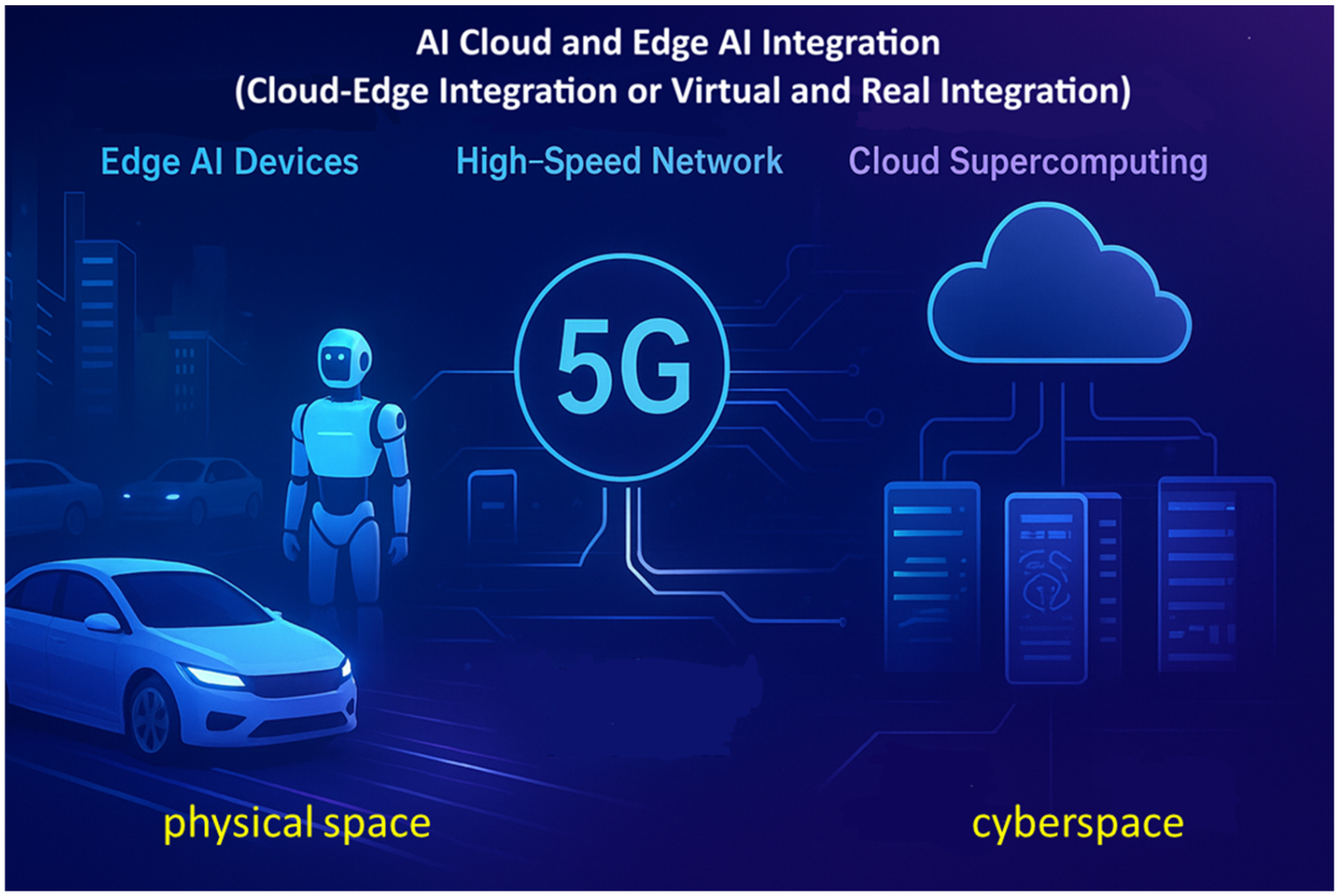
Artificial intelligence applications leverage massive computational power to run complex, challenging operations autonomously on machines. For example, nowadays, how can a humanoid robot utilize its dexterous hands to perform tasks similar to those of a human hand? How can a fully autonomous vehicle be precisely controlled to avoid accidents, or how can we optimize machine operating parameters to achieve the best yield in semiconductor smart manufacturing? AI utilizes enormous computing power to detect, identify, track, and perform automated inference or reasoning, enabling applications such as prediction, generation, classification, and clustering. Based on factor correlation analysis, it ultimately yields cases for decision or diagnosis. While AI is technically capable of making final decisions and diagnoses in cases, in high-risk scenarios, institutional, responsibility, and ethical considerations still require that “humans be the last line of defense.” The recognition of AI infrastructure necessitates a shift in human capital allocation towards specialized, high-leverage functions that leverage AI capabilities, predicated on the judicious division and seamless integration of cloud-edge collaborative processing units, referred to as cloud-edge integration [1], as illustrated in Figure 1. In Figure 1, the AI cloud-based analytics engine builds behavioral models and simulates operations in various scenarios. In the example of a virtual–physical integration environment in a cyber–physical system, once AI application simulations have completed, the cloud platform in cyberspace, via a high-speed network (e.g., 5G), deploys the application programs and their related data to edge AI systems, such as humanoid robots or self-driving cars, for execution. This integration has contributed to significant progress in recent AI developments in these applications and other areas.
Figure 1.
A brief example of cloud-edge integration, where the cloud deploys AI application programs and their related data to edge AI systems.
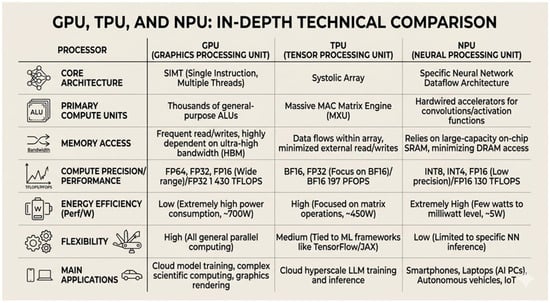
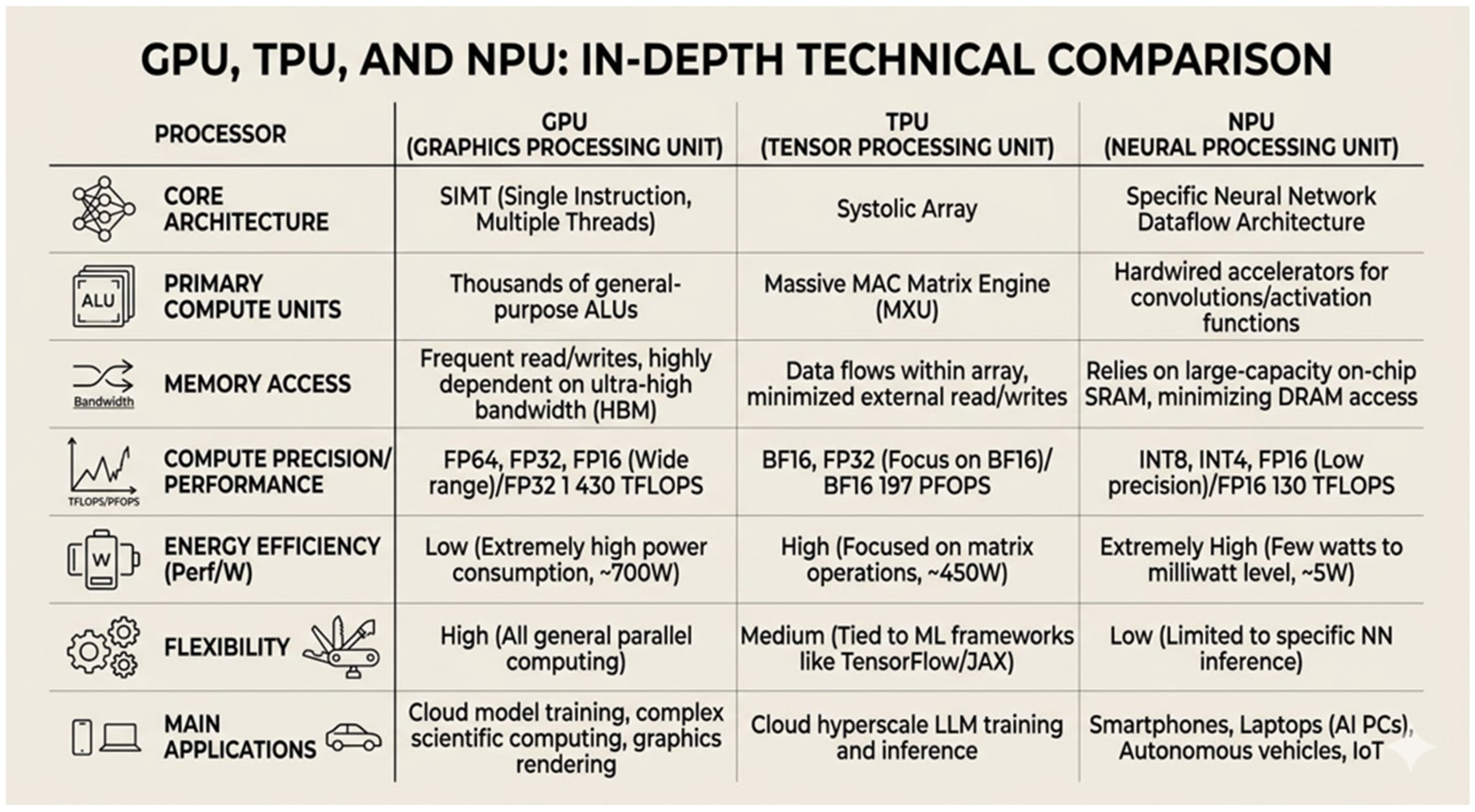
This deeper meaning helps us understand the concept of AI: the trend in AI development is a gradual shift toward unmanned operation, where systems can operate autonomously without direct human control. Examples include self-driving cars and humanoid robots. AI applications are increasingly shifting towards high-performance computing. This requirement underscores the need for massive computing resources for complex AI tasks, such as AI data centers and high-performance edge AI [2]. Therefore, the development and deployment of AI depend on a convergence of five critical resources, which often induce the five factors [3]: (1) Brain Power: Intellectual capital and research expertise (e.g., algorithms, model design). (2) Computing Power: The hardware infrastructure (GPUs, CPUs, specialized accelerators). (3) Financial Power: The capital investment required for research and infrastructure buildout. (4) Electricity: The immense energy needed to run large-scale AI Data Centers and compute it. (5) Data Power: The vast datasets necessary for training and continuous learning. Moreover, Figure 2 gives GPU, TPU, and NPU in-depth technical comparison summary to explain the differences in processor architecture.
Figure 2.
GPU, TPU, and NPU in-depth technical comparison summary.
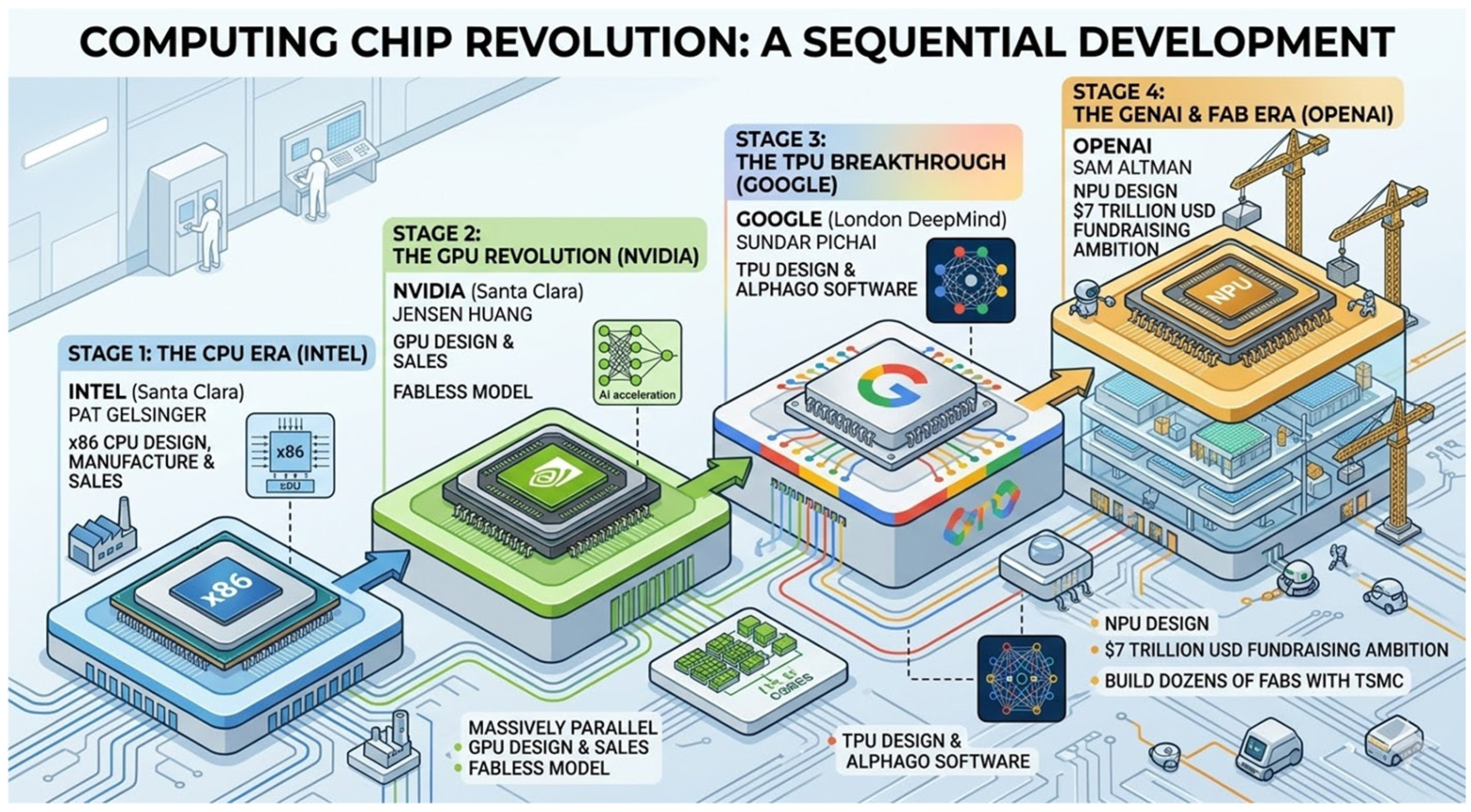
The benefits of AI performance depend on the execution of high-performance computing chips. In Figure 3, The high-performance computing chip revolution is a defining feature of the modern AI landscape. Key players in this revolution include:
- Intel: Focusing on the CPU, which processes complex logic problems.
- NVIDIA: Designing and selling GPUs that handle heavy computing work (e.g., massive parallel computing) is described as a power-hungry monster.
- Google: Developing the TPU for massive computations and software like AlphaGo.
- OpenAI: Seeking to develop the NPU, designed for the complex mathematical calculations required by neural networks, with features such as fast computing, low power consumption, and low cost.
Figure 3.
Computing chip revolution.
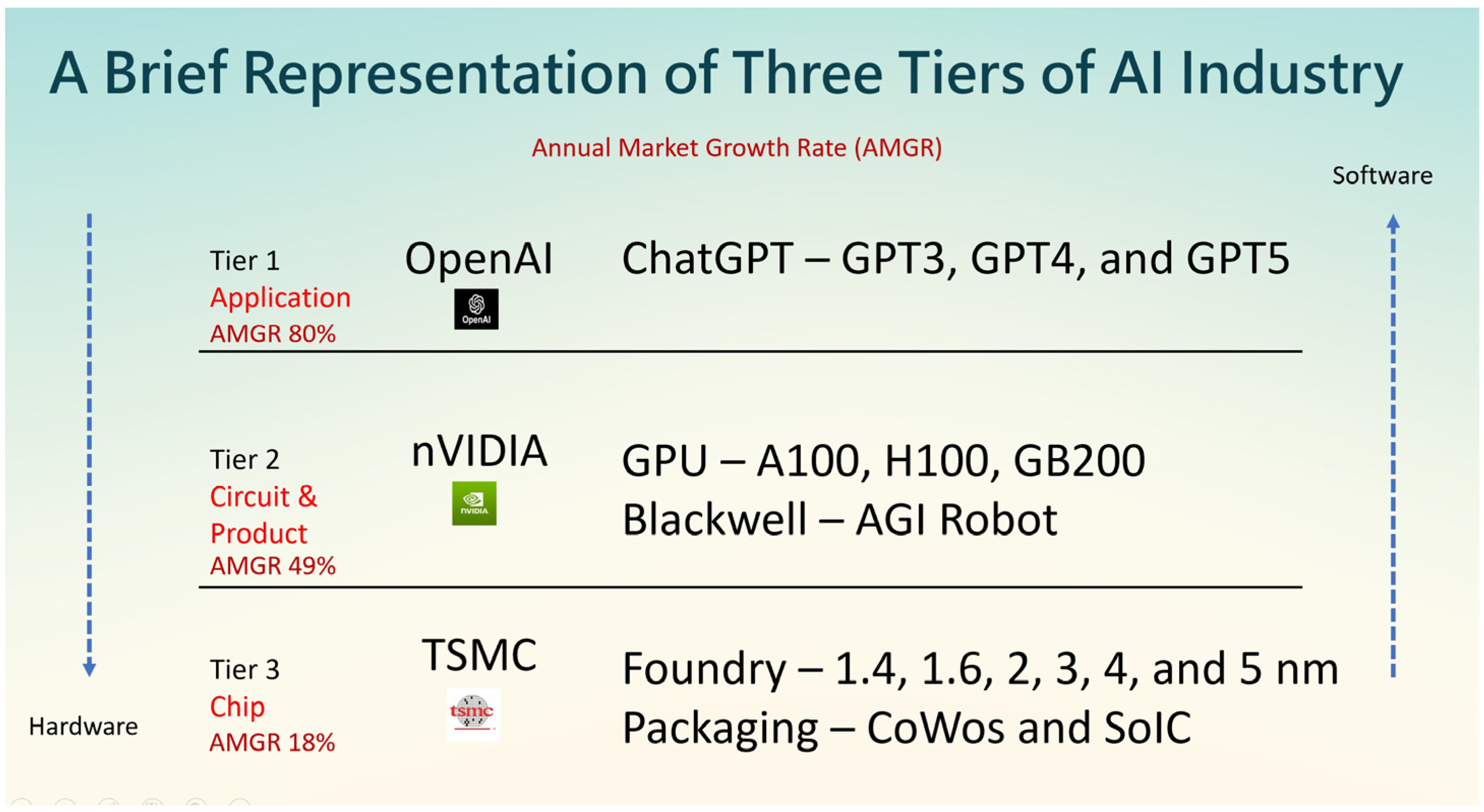
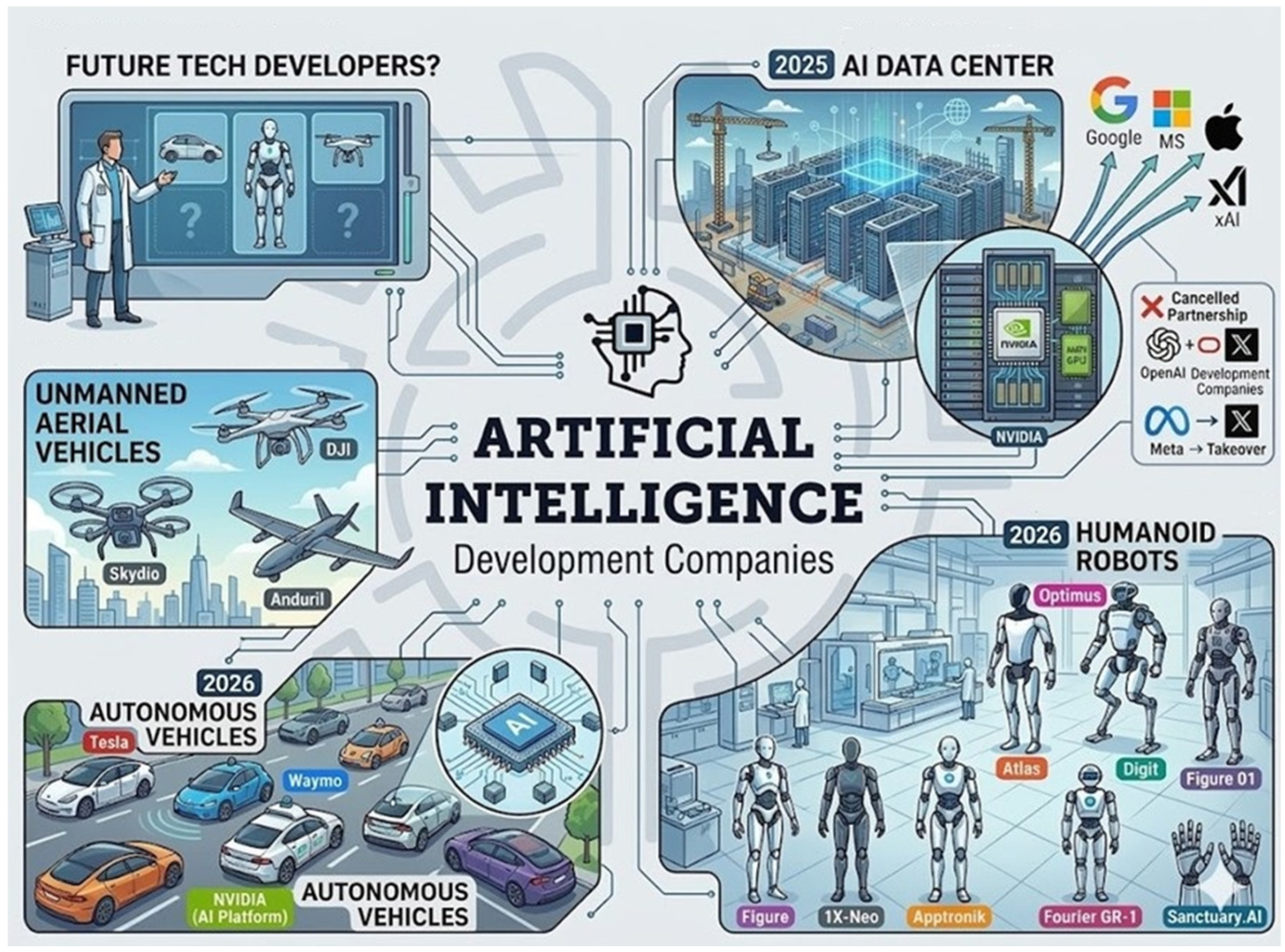
In terms of chip and AI applications, we can divide industry tasks into three layers: the first layer comprises service applications, the second layer involves circuit design, and the third layer encompasses hardware manufacturing. Figure 4 presents the market dominance in 2025 and a brief overview of the three tiers of the AI industry, illustrated with examples from three corporations. Figure 5 shows which companies are developing self-driving cars, humanoid robots, and drones.
- Tier 1: Integrating AI into broad user services and cloud platforms defines the Tier 3 application leaders, including Microsoft, Alphabet (Google), Tesla, Amazon, Meta (formerly Facebook), and OpenAI. ChatGPT, an OpenAI chatbot, is currently the world’s most widely used service platform in 2025.
- Tier 2: The chip design of hardware and platform giants, such as NVIDIA, Tesla, Broadcom, Samsung Electronics, Advanced Micro Devices (AMD), and Qualcomm, primarily resides within Tier 2, focusing on core processing unit design and specialized platform development. NVIDIA boasts the world’s largest market capitalization and the most advanced GPU chip design.
- Tier 3: The top 5 global semiconductor foundries by market share are Taiwan Semiconductor Manufacturing (TSMC), Samsung Foundry, United Microelectronics Corporation (UMC), GlobalFoundries (GF), and Semiconductor Manufacturing International Corporation (SMIC). TSMC (Taiwan Semiconductor Manufacturing Company) is generally positioned as the Tier 1 enabler, commanding a critical monopoly in advanced semiconductor manufacturing that underpins all high-performance AI hardware.
Figure 4.
A brief representation of the three tiers of the AI industry, with an example of taking three corporations. AMGR Sources: https://www.fortunebusinessinsights.com/industry-reports/artificial-intelligence-market-100114 (accessed on 24 March 2026); https://www.grandviewresearch.com/industry-analysis/artificial-intelligence-of-things-aiot-market-report; https://www.precedenceresearch.com/artificial-intelligence-chip-market (accessed on 24 March 2026).
As the strategic foundation for training and deploying next-generation AI models, the construction of big data facilities (i.e., AI factories) has rapidly consolidated this multi-layered industrial structure. For instance, NVIDIA is actively building AI Data Centers for US enterprises in 2025 to solidify its market dominance in computational hardware [4]. The geographical distribution and multi-gigawatt power requirements of these AI Factories underscore the intensifying global infrastructure race, posing significant challenges to energy supply chains and the stability of electrical grids.
The recent evolution of AI has been characterized by four conceptual waves: Perceptive AI, Generative AI, Agentic AI, and Physical AI [5]. Each building upon the capabilities of the last to achieve increasingly complex forms of autonomy and interaction.
- Perceptive AI serves as the sensory layer, focusing on perceiving, identifying, and understanding the environment using technologies such as computer vision and Speech Recognition. This aspect is primarily characterized by machine interaction, as seen in applications such as medical image analysis and foundational systems within self-driving cars.
- Generative AI represents the creative layer, leveraging techniques such as Generative Adversarial Networks and Transformer models to facilitate imitation, creation, and data amplification, ultimately leading to applications in AI drawing and video synthesis.
- Agentic AI introduces an action-oriented layer that grants systems autonomy through capabilities such as task decomposition, memory, and multi-step reasoning. These digital robots and intelligent assistants can plan and control complex processes, marking a shift toward autonomous task management.
- Physical AI, which materializes AI actions in real space through technologies such as robotics control and Mechatronics. The integration of Machine Learning with mechanical systems enables direct intervention in the physical world, as exemplified by humanoid robots, logistics systems, and the fully autonomous operational phase of self-driving cars.
Figure 5.
Which companies are developing self-driving cars, humanoid robots, and drones.
Our key technological categorizations that address critical national, ethical, and functional imperatives: Sovereign AI, Sustainable AI, Safe AI, and Agentic AI [6] define the strategic landscape of advanced AI development. Sovereign AI focuses on achieving Data Sovereignty, guaranteeing Algorithmic Sovereignty, and establishing Model Sovereignty. Simultaneously, Sustainable AI addresses environmental responsibility by prioritizing energy efficiency and designing AI systems for general ecological sustainability. Green computing implements measures such as using renewable energy, optimizing data centers, employing green AI algorithms and hardware, adopting efficient cooling technologies, using non-potable water sources, extending equipment lifespans, and promoting green manufacturing and recycling. It can significantly reduce the environmental impact of AI factories and help achieve sustainable AI carbon emissions. Furthermore, safe AI is crucial to developing robust AI models, promoting explainability and interpretability, implementing privacy protection technologies, and establishing accountability, fairness, accuracy, reliability, and transparency. Ultimately, Agentic AI develops intelligent, adaptable, and mobile agent systems that facilitate natural human–computer interaction.
The following paragraphs of this review are arranged as follows. In Section 2, the related work on AI and chips will be described, including various developments in the cutting-edge AI industry. We present advanced AI technologies to illustrate the leading AI technologies in Section 3. The review’s addressed discussion and perspectives are found in Section 4 and Section 5. Finally, we drew a brief conclusion in Section 6.
2. Related Work of AI and Chips
In the following section, we will present a structured literature review that transitions from chip manufacturing processes to edge AI and AI data centers, and then further explores advanced AI and its key applications.
2.1. Advanced Semiconductor Processes
In 2025, key developments in advanced semiconductor manufacturing include TSMC’s cutting-edge 3-nanometer manufacturing chips and advanced 3D stacking and packaging technologies. Additionally, the development of new materials, such as silicon carbide, is being pursued to improve yield and expand into new application areas. For example, TSMC, a leader in the chip tier, is rapidly advancing its manufacturing processes. Key future chips include N2, N2P, A16, and A14 [7]. TSMC expects to begin mass production of N2 (2 nm) in the second half of 2025, marking the first GAAFET (Gate-All-Around FET) transistor process for TSMC. It promises a 10–15% speed improvement at the same power or 20–30% power improvement at the same speed, with increased chip density, compared to N3. N2P is an upgraded version of N2 produced in the second half of 2026. TSMC expects A16 for mass production in the second half of 2026, and this process is best suited for high-performance computing (HPC) products featuring superpower rail (SPR) technology. It offers an 8–10% speed improvement or 15–20% power improvement over N2P. TSMC expects the A14 for mass production in 2028, adopting the second-generation GAAFET architecture, which is expected to provide a 10–15% speed increase or a 20–30% power increase, along with an approximate 20% increase in chip density compared to N2. Therefore, TSMC’s global expansion strategy (by 2026) aims to (1) mitigate geopolitical risks, (2) strengthen supply chain resilience, (3) create value in a secure environment, (4) expand production capacity to meet customer demand, and (5) control the market and establish pricing power.
However, TSMC faces significant challenges [8], including elevated costs, operational risks stemming from geopolitical tensions, supply chain complexities resulting from de-globalization efforts, and compliance with new regulations. First, advancements in AI, quantum computing, and cloud computing technologies, coupled with geopolitical tensions, have exacerbated cybersecurity risks, exacerbating security vulnerabilities in the semiconductor ecosystem and infrastructure (power and telecommunications). Next, growing national security concerns have accelerated semiconductor self-sufficiency efforts, prompting major economies to implement export restrictions, tariffs, and protectionist policies. Then, TSMC’s facilities are primarily located in Taiwan, where limited renewable energy infrastructure hinders the transition process and impacts the goal of achieving net-zero emissions by 2050. After that, the departure of retired personnel to competitor companies raises concerns about the leakage of manufacturing secrets and may lead to legal proceedings, thereby raising ethical concerns. Finally, in terms of overcoming the limitations of traditional Moore’s Law, can it meet the challenges of mass production in the next generation of wafer foundry processes below 1 nanometer, and how should the development of quantum chip wafer foundries be accelerated?
2.2. The Edge vs. Data Center
The system distinguishes between two primary environments for AI processing: Edge AI and AI Data Center. The AI Data Center serves as the central processing unit when edge AI computing cannot perform spatial processing of Big Data. Its primary functions involve running high-level simulations and models to inform localized Edge AI systems. It runs Spatial Intelligence to perform simulated spatial computing, which the Edge AI systems then import. Similarly, it runs the world model to perform simulated action calculations, to which the Edge AI systems import. This picture indicates a clear division of labor: the Data Center handles the computationally intensive training and the creation of the fundamental “intelligence” (spatial intelligence/world model). In contrast, the Edge system handles real-time execution.
Edge AI systems—the actual unmanned equipment, such as a self-driving car’s control system or a robot’s brain—are composed of integrated modules designed for localized, real-time operation: Computing, Memory, Communication, Sensor, and Management systems. These edge systems utilize the models calculated in the Data Center to determine the surrounding environment and initiate preset continuous movement. Based on energy consumption benchmarks, people generally compare efficiency improvements, energy consumption, and idle power consumption. In terms of efficiency improvements (AI training), the RTX 4090 (TGP 450 W) achieves 40% higher TFLOPS per watt in FP32 operations compared to the RTX 3090 (TGP 350 W). Regarding energy consumption (AI inference), running a large language model (LLM) inference task using an H100 GPU (TGP 700 W) consumes 30% less energy than an A100 GPU (TGP 400 W). In terms of idle power consumption, enterprise-grade GPUs (such as the NVIDIA L40S) consume only 10% of their TGP (approximately 35 W) when idle (approximately 35 W). A significant industry trend indicates that by 2025, major players such as Google, Meta, Microsoft (MS), Apple, and OpenAI will be actively building large-scale AI Data Centers, with the majority relying on NVIDIA chips for their core high-performance computing. Massive power demands are characteristic of notable large-scale AI infrastructure projects. NVIDIA is actively building AI Data Centers/AI Factories for US enterprises, with key projects including CoreWeave (220 MW), Oracle Cloud (260 MW), xAI (150 MW), and Stargate (scaling to 1.2 GW).
2.3. Unmanned System Driven by Advanced AI
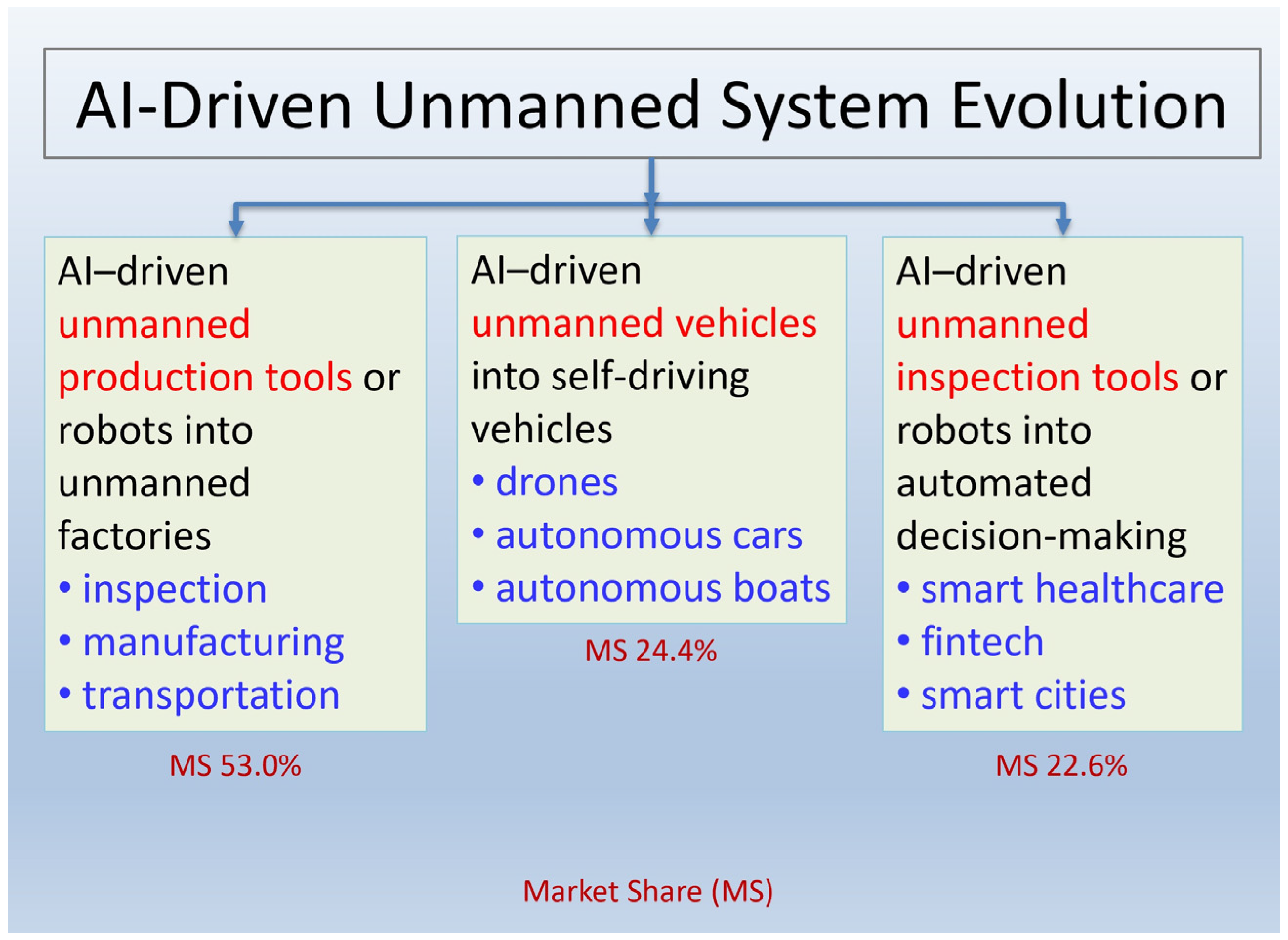
The deployment of cutting-edge AI applications fundamentally transforms operational paradigms by enabling widespread unmanned and automated operations across various sectors. This shift centers on applying advanced computational capabilities, notably digital twins, to achieve truly unmanned operations in complex environments [9], as shown in Figure 6 with market share information.
- AI algorithms facilitate the integration of unmanned production tools, such as robots, into sophisticated automated systems, resulting in fully automated factories that encompass robotic inspection, manufacturing, and transportation processes [10].
- AI extends this autonomy to mobile systems. This scope encompasses the rapid maturation of unmanned vehicles, ranging from self-driving cars to aerial and maritime platforms, including drones and autonomous boats [11].
- AI drives the transition from physical inspection tools (such as robots) to advanced, automated, and unmanned systems equipped with decision-making capabilities. This capability is crucial for implementing intelligent decision layers in high-stakes service sectors, including smart healthcare, fintech, and the operational management of smart cities [12].
Figure 6.
AI-Driven Unmanned System Evolution. MS Sources: https://www.giiresearch.com/report/ires1677140-autonomous-manufacturing-robots-market-by-robot.html (accessed on 24 March 2026); https://www.grandviewresearch.com/industry-analysis/autonomous-vehicles-market (accessed on 24 March 2026); https://www.factmr.com/report/autonomous-inspection-robots-market (accessed on 24 March 2026).
Ultimately, the integration of AI is ushering in a new era of systemic autonomy, enhanced efficiency, reduced human intervention, and complex, data-driven decision-making capabilities across both the physical and digital realms.
2.4. High Computing Power of Advanced AI
There are two categories of AI. Artificial Weak Intelligence (ANI) lacks consciousness or self-awareness. It operates primarily on algorithms rooted in machine learning and deep learning, with cognitive capacities limited to pattern recognition and execution within its programmed domain. In contrast, Artificial General Intelligence (AGI) [13] would possess general cognitive abilities, including self-awareness and an understanding of its own existence. This level of intelligence would enable it to operate and make decisions independently, learning from experience and applying knowledge across various fields. However, AGI’s realization presents significantly more complex grand ethical challenges compared to the less intricate moral issues associated with Weak AI.
The development of high computing power (HCP) [14] is critical to advancing cutting-edge AI technology, as shown in Figure 7 with energy consumption percentage. This capability is not merely an incremental improvement in processing power but a systemic integration of key technological components:
- AI-driven high-performance algorithms.
- Specialized, high-speed parallel computing chips including GPUs, NPUs, and Quantum-GPUs (QPUs).
- Ultra-large High-Bandwidth Memory (HBM3 and above).
- Big data storage infrastructure in a data center.
- Ultra-high-speed network between devices.
Figure 7.
High computing power. ECP Sources: https://docs.nvidia.com/dgx/dgxh100-user-guide/index.html (accessed on 24 March 2026); https://semiengineering.com/ (accessed on 24 March 2026); https://uptimeinstitute.com/ (accessed on 24 March 2026).
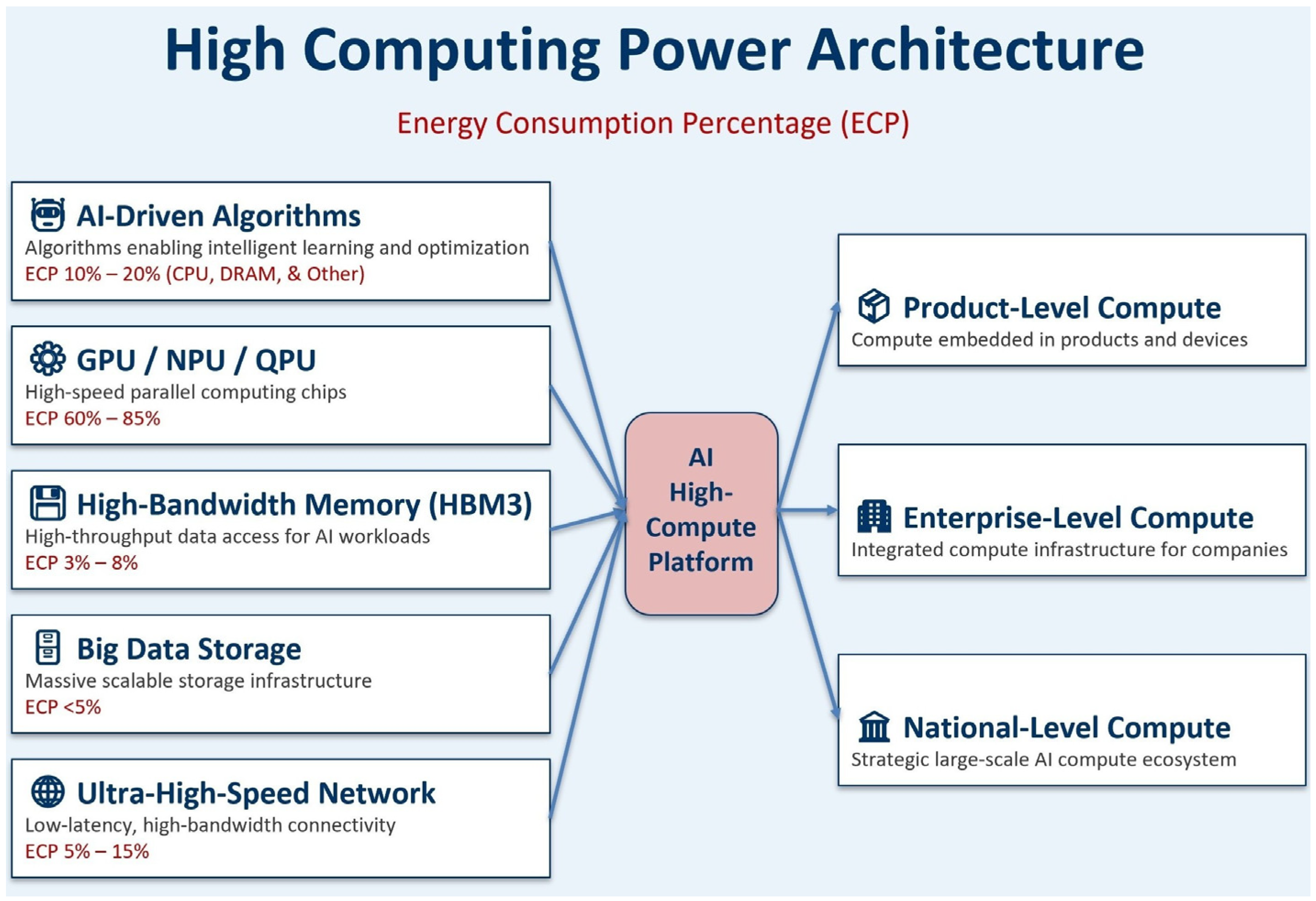
The scale of this computational power is evolving rapidly, escalating from product-level to enterprise-level, and ultimately becoming a national-level strategic asset. Core infrastructure elements, including AI Cloud Computing, Edge Computing, and dedicated AI Data Centers [15], form the backbone for training and deploying modern, large-scale AI models.
Globally, major economies are engaged in a strategic race to secure this computational dominance. Taiwan, for instance, has deployed a Supercomputer Cluster in Kaohsiung. In Europe, nations are committed to massive scaling: France, with initiatives like Mistral Compute, is targeting a 10-fold increase (10 times of computing power) in capacity; Germany is developing its Industrial AI Cloud, also aiming for a 10 times of computing power increase; and the United Kingdom has committed to a substantial investment in Supercomputer and AI infrastructure, targeting a 20 times of computing power increase, complemented by an ambitious plan to train 7.5 million people in AI skills. These collective, large-scale investments underscore the recognition of high computing power as the foundational strategic pillar for driving AI innovation and maintaining technological leadership.
2.5. Cutting-Edge AI Industry
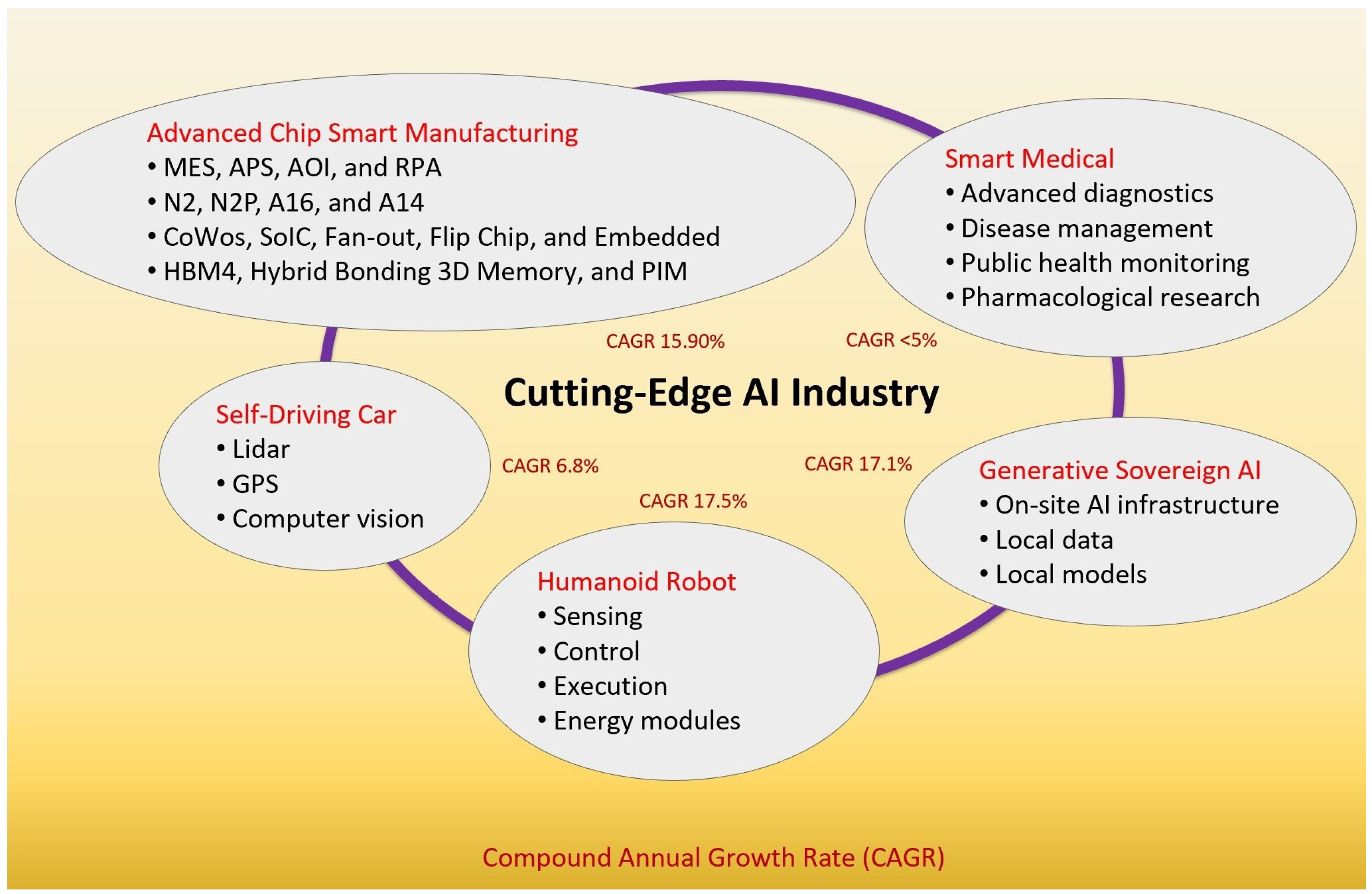
In Figure 8, the integration of AI into the global industrial framework with compound annual growth rate (CAGR) has catalyzed the emergence of high-value frontier sectors, defined by a convergence of intelligent manufacturing and autonomous systems.
- Advanced Chip Smart Manufacturing Artificial Intelligence: Facilitates intelligent manufacturing processes within the semiconductor industry [16], encompassing systems such as Manufacturing Execution Systems (MES), Advanced Planning and Scheduling System (APS), Automated Optical Inspection (AOI), and Robotic Process Automation (RPA). Furthermore, it integrates cutting-edge technologies, including A16, A14, Chip-on-Wafer-on-Substrate (CoWoS), System on Integrated Chips (SoIC), Fan-out Packaging, Flip Chip Packaging, Embedded Die, High BandWidth Memory4 (HBM4), Hybrid Bonding 3D Memory, and Processing-in-Memory (PIM).
- Self-Driving Vehicles (Autonomous Vehicles): Autonomous driving systems utilize a sophisticated suite of technologies—specifically LiDAR, advanced sensors, GPS, and computer vision—to perceive and interpret their surroundings in real time.
- The development of Humanoid Robotics integrates advanced sensing, control systems, and execution mechanisms, alongside low-power-consumption simulations, to enable autonomous locomotion that mimics human movement.
- Generative Sovereign AI refers to the localized management and governance of AI technologies and datasets, ensuring that nations or organizations maintain technological autonomy and data integrity.
- Smart Healthcare (Intelligent Medicine): The application of AI in healthcare precipitates transformative innovations across clinical practice, patient care, chronic disease management, public health surveillance, and the accelerated discovery of novel pharmaceuticals.
Figure 8.
Cutting-Edge AI Industry. CAGR Sources: https://www.fortunebusinessinsights.com/smart-manufacturing-market-103594 (accessed on 24 March 2026); https://www.precedenceresearch.com/autonomous-vehicle-market (accessed on 24 March 2026); https://www.fortunebusinessinsights.com/humanoid-robots-market-110188 (accessed on 24 March 2026); https://www.grandviewresearch.com/industry-analysis/generative-ai-market-report (accessed on 24 March 2026); https://www.fortunebusinessinsights.com/industry-reports/artificial-intelligence-in-healthcare-market-100534 (accessed on 24 March 2026).
3. Advanced AI Technology
Next, we will outline a transparent and methodical approach. The technological frontier of AI in 2025 is moving beyond pure generation towards robust, embodied intelligence in many aspects. First, the ascendancy of Multimodal AI [17], which integrates diverse data streams. Moving on to the specialized fusion of perception and language inherent in the Vision-Language Models (VLMs) [18]. Critically, a Vision-Language-Action (VLA) paradigm [19] enables systems to translate complex, high-level commands into actionable steps. Further Spatial Intelligence and World Models [20], providing the AI with sophisticated 3D comprehension and an internal, predictive simulation of its surroundings, optimizing real-time decision-making. Multi-agent robots [21] see the ultimate realization of this synthesis. Digital Twins [22] and Physical AI [23], which create high-fidelity, virtual representations of physical systems. Finally, Explainable AI (XAI) [24] ensures that the complex, autonomous actions taken across all layers of these integrated systems remain transparent, auditable, and trustworthy.
3.1. Cross-Multimodal AI
Multimodal AI is an AI system that uses various types of data (including text, images, videos, and voice) to form insights, make predictions, and generate content [17]. Most AI models can only process data from a single modality. Multimodal AI imitates the human ability to integrate sensory input data, such as vision, sound, and touch, into a single model, forming a more detailed perception of the real environment. This capability enables embodied AI to exhibit more human-like behaviors and capabilities. Embodied Intelligence refers to the integration of artificial intelligence into physical entities, such as robots, allowing them to perceive, learn, and interact dynamically with their environments as humans do. Large companies and startups are exploring the potential business opportunities of combining multimodal AI with embodied intelligence. Multimodal robots can integrate multiple sensory data (visual, auditory, tactile, etc.). Processing the alignment and fusion of various data streams from different modalities, identifying the relationships between modalities, and integrating data into a single model are key to realizing the multimodal inference capabilities of AI robots [25]. Multiple challenges include multiple modules, computing power costs, practical training, synthetic data, lightweight resources, cloud-ground integration, small models, domain knowledge, software and hardware integration, alignment strategy, deep learning, task understanding, model accuracy, reliability, security, reducing AI illusions, and security and privacy.
Large corporate entities, capitalizing on vast resources, are establishing the necessary infrastructure for scalable robotic intelligence: NVIDIA is dedicated to developing a universal AI foundational model specifically for humanoid robots, aiming for wide-ranging application; Tesla is focused on building AI autonomous operation systems capable of self-directed functionality across its fleet; and Meta is working to create a common embedding space for multimodal data, enabling machines to perform integrated, global analysis akin to human cognition. Concurrently, specialized startups are pioneering new creation paradigms: OpenAI is leveraging its scale to build a Multimodal AI general machine brain, positioning the technology as a core operational model; World Labs is tackling the fundamental challenge of generalization by developing a large-world model for spatial perception in unstructured environments; and Skild AI is addressing practical deployment by training AI models for outsourcing companies, ensuring models are adaptable to diverse operational tasks. Together, these efforts define the current trajectory toward generalized, competent machine intelligence.
3.2. Vision-Language Model
The Visual Language Model (VLM) can understand the semantic description of image output, identify abnormal situations, and generate event summaries and structured data. It can also enable users to conduct image-based question-based queries and engage in dialogs with AI. This function allows users to grasp the overall situation without needing to view each image individually. Understanding specific field contexts requires local adjustment and continuous training [18]. Example: Solutions in areas such as industrial safety surveillance and traffic management not only focus on image recognition but also incorporate event understanding, semantic response, and instant warnings, enabling smart security to make real-time decisions and manage risks.
The utility of Vision-Language Models (VLMs) extends beyond basic multimodal understanding, serving as the core engine for advanced AI architectures that transform raw visual data into actionable real-world insights [26]. This capability is fundamental to two emerging paradigms reshaping the field of artificial intelligence: Sovereign AI and Agentic AI. Sovereign AI: This model addresses critical concerns regarding data governance and control. (1) Sovereign AI refers to the strategy where an entity (such as a corporation or government) trains and utilizes its own VLM. This case ensures complete control over the entire intelligence pipeline, from the proprietary data used for training to the final model’s behavior, aligning it with specific security protocols, values, and national or organizational regulations. (2) Agentic AI: This paradigm represents the shift from passive tools to autonomous, goal-directed intelligence. Agentic AI systems augment the VLM’s core multimodal perception with advanced cognitive functions, including planning, reflection, and tool invocation. The VLM supports inter-agent collaboration by grounding communication and shared understanding in perceived reality, enabling multiple specialized agents to work together and achieve complex goals with high autonomy.
3.3. Vision-Language-Action Model
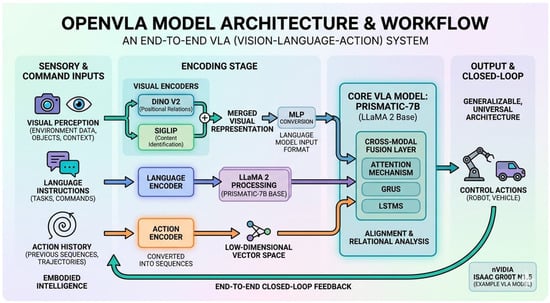
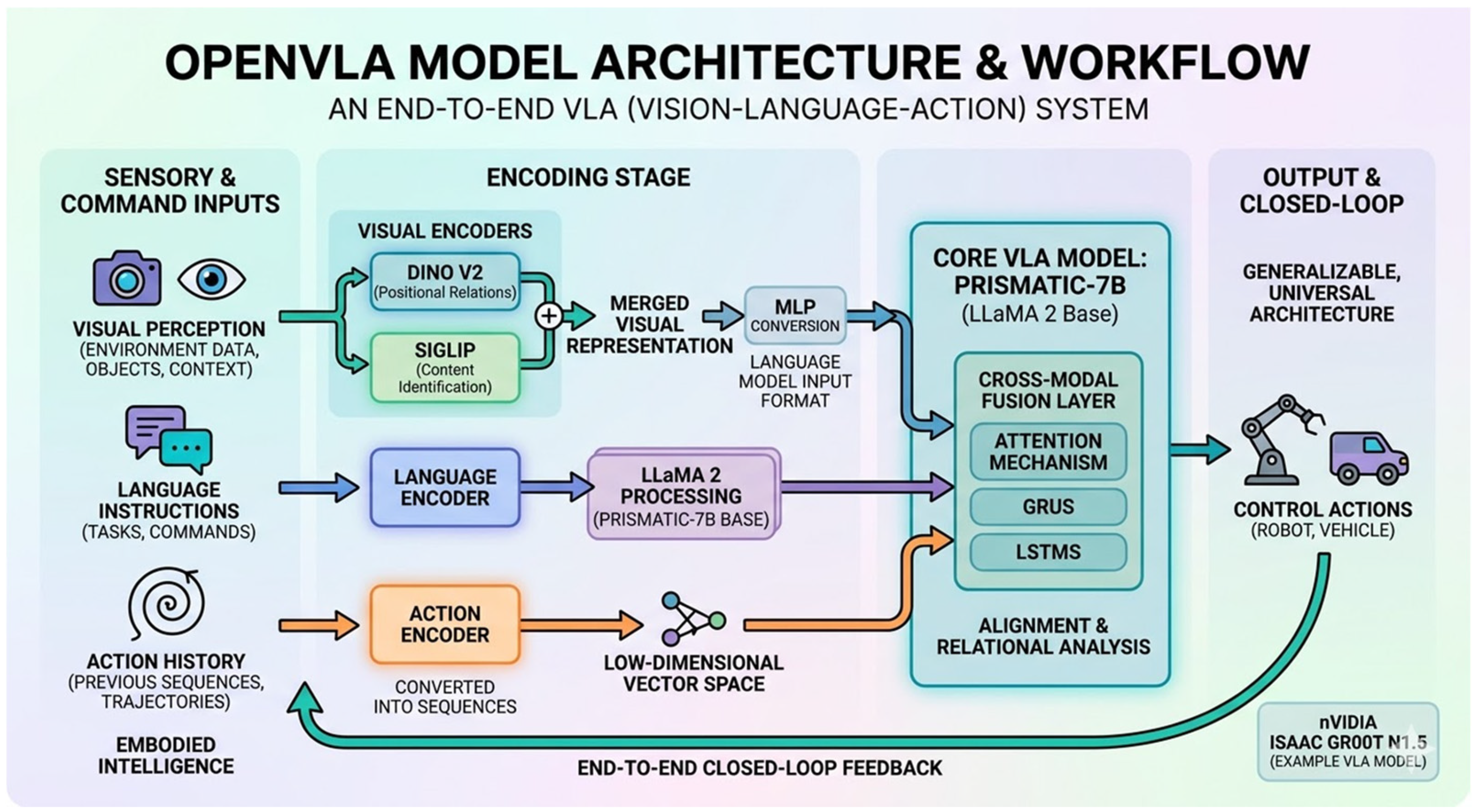
The Vision-Language-Action (VLA) model is developed based on the VLM and solves the command-following task in embodied intelligence. It is an advanced multimodal model that combines vision, language, and action to achieve a complete closed-loop capability, from the direct mapping of sensory input to robot or self-driving car control actions—NVIDIA’s open-source Vision-Language-Action (VLA) model, Isaac GR00T N1.5 [19]. Dino V2 understands the positional relationship of objects and SigLIP. The two feature vectors are concatenated and combined with a comprehensive visual representation. The MLP converts the vectors into a language model input format, and then we feed them into LLaMA along with the instruction text for a machine-readable representation. The action encoder converts historical trajectories or other action sequences into a low-dimensional vector space representation. VLA employs multiple methods for cross-modal fusion, including attention mechanisms, gated recurrent units (GRUs), and long short-term memory (LSTM) networks, enabling different input types to be compared and analyzed in a common space.
Robust, open-source architectural frameworks actively support the development of state-of-the-art Vision-Language-Action (VLA) models. The Prismatic VLM is a notable example of a powerful multimodal VLM that leverages Llama 2 as its large language model (LLM) backbone, providing a strong foundation for language reasoning and general knowledge. In Figure 9, this model represents a significant step for the embodied AI community, as retraining the pre-trained VLM Prismatic-7B is a key aspect of its development. The developers designed the architecture of OpenVLA for end-to-end operational capacity, featuring a comprehensive structure that includes a visual encoder, a language encoder, an action encoder, and a dedicated cross-modal fusion layer. This design choice endows the system with strong generalization capabilities and high versatility, positioning OpenVLA as a flexible platform for developing agents capable of real-world control and autonomy.
Figure 9.
OpenVLA model architecture and workflow.
3.4. Spatial Intelligence and World Model
Spatial intelligence is the ability of an AI system to understand, interpret, and navigate the physical, three-dimensional world [20]. A “world model” is the underlying mechanism or internal simulation that an AI builds to achieve spatial intelligence. It is an AI’s internal “physics engine” that allows it to predict what will happen next based on the rules of the real world [20]. The easiest way to think about the relationship is this: A World Model is the engine, and Spatial Intelligence is the resulting capability. The World Model computes the physic. It knows the person’s feet must touch the ground, raindrops should fall downward, and the camera perspective changes naturally as it moves forward. The result of that accurate calculation is Spatial Intelligence, i.e., an output that flawlessly mimics the spatial reality we live in, without glitching or morphing into physically impossible shapes.
Training a world model is challenging, as it relies on numerous existing high-quality videos that enable the model to learn physical properties, such as consistency. Still, the grasp of spatial interaction may be insufficient [27]. World Labs utilizes text or image commands to generate native 3D reproductions, and its technology creates a 3D environment from a single image. High-quality 3D data is limited and difficult to label, and stereoscopic data is difficult to formalize and transmit. For example, filmmakers can create virtual scenes through instructions and images to test atmospheric feelings, mechanical engineers can train care robots in virtual hospitals, and urban planners can simulate urban landscapes and infrastructure.
Spatial Intelligence is the foundational cognitive capacity that underpins advanced autonomy, defined as the robust ability to connect perception and action through a deep understanding of three-dimensional (3D) structures. This capability is essential for promoting autonomous learning and facilitating meaningful human–machine collaboration. The primary technical instrument for achieving this is the World Model, a sophisticated internal simulation designed to comprehend the structure and dynamic representation of the environment. By analyzing text or images, the World Model deduces the geometric shapes, positions, and relationships of objects in 3D space, which is crucial for predicting future changes and the outcomes of potential actions. This core predictive mechanism drives two distinct applications [28]: (1) in the physical world, the World Model is vital for high-stakes implementations like Autonomous Driving and general Embodied Intelligence; (2) conversely, in the virtual world, spatial intelligence is realized through 3D Generation techniques, which translate input into native 3D reproductions, thereby supporting the interactive, spatially accurate experiences required by XR (Extended Reality) technologies.
3.5. Multi-Agent Robots
2025 marks the first year of AI Agent, as OpenAI and Google assert that AI is transitioning from an auxiliary tool to a capable digital executor. The AI Agent will first understand the current environment, then break down and plan the instructions, proactively arrange each step, and decide how to execute them. If you encounter variables in the middle, you can adjust the strategy based on the known information and even learn from the experience during the execution process to improve next time. A group of AIs collaborates to complete tasks. Each agent can operate independently but will share information, help one another, and even pursue different goals. A multi-agent system requires high flexibility, fast response, and the ability to add or remove agents instantly, based on the tasks at hand. In an intelligent transportation system, traffic lights are considered agents, each car is also an agent, and the parking lot is also an agent. After everyone exchanges information in real time, they can adjust the lights to match dynamic traffic flow and guide vehicles to avoid traffic jams.
The evolution of artificial intelligence from AI Assistant systems, such as basic large language models, to sophisticated AI Agents represents a fundamental paradigm shift from a reactive utility to proactive autonomy [29]. (1) An AI Assistant operates on a reactive cycle, requiring manual instructions for each step and limiting interaction to simple question-and-answer formats, often remaining contextually empty as it typically lacks persistent memory. (2) In contrast, the AI Agent possesses executive function, which allows it to comprehend the overarching purpose of a task and proactively arrange and execute the entire process following only a single high-level instruction. The Agent’s inherent Task Decomposition capability—the ability to break down a complex goal into manageable, scheduled steps—and its integration with Long-Term Memory enable it to recall user preferences, habits, and past behaviors for personalized decision-making. Moreover, while proactively making decisions and integrating a comprehensive suite of digital tools, including calendars, email, and file systems, enabling it to orchestrate and complete multi-domain tasks autonomously, restricts the AI Assistant to single-function tool use (e.g., translation or search), the Agent achieves real-world utility.
While an “AI Agent” refers to a specific system architecture or software framework, “Agentic AI” represents a broader classification of artificial intelligence capabilities. AI Agents are predominantly task-driven entities designed to execute automated decisions and actions within specific, predefined scenarios. Consequently, they typically possess limited autonomy, exhibit weaker generalization capabilities, and use world models merely as optional components. Common implementations of AI Agents include robotic process automation (RPA) tools and intelligent customer service bots. In contrast, Agentic AI is a fundamentally goal-driven paradigm characterized by high-level autonomy. Unlike traditional agents, Agentic AI can autonomously generate its own objectives, formulate long-term strategic plans, and adapt robustly to unknown environments. To achieve this, Agentic AI fundamentally requires integrating multimodal perception with comprehensive world models, which facilitate strong generalization and cross-task decision-making. Ultimately, an AI Agent operates primarily as a proxy for task execution, whereas Agentic AI functions as a truly autonomous entity capable of self-directed goal formulation and pursuit.
The distinction between AI agents and Agentic AI centers on the degree of autonomy and cognitive sophistication. AI agents execute predefined tasks with instruction-driven behavior, such as automated scheduling assistants or navigation modules in advanced driver-assistance systems. In contrast, Agentic AI using Multi-Agent Robots enables goal-directed planning and adaptive learning through internal world models, allowing systems such as Level-4 autonomous vehicles or self-optimizing manufacturing robots to operate robustly under uncertainty and dynamically adjust their strategies to achieve long-horizon objectives. Thus, while people can instantiate Agentic AI through agent architectures, only systems capable of persistent objective pursuit and self-directed action can be classified as truly Agentic AI.
3.6. Digital Twins
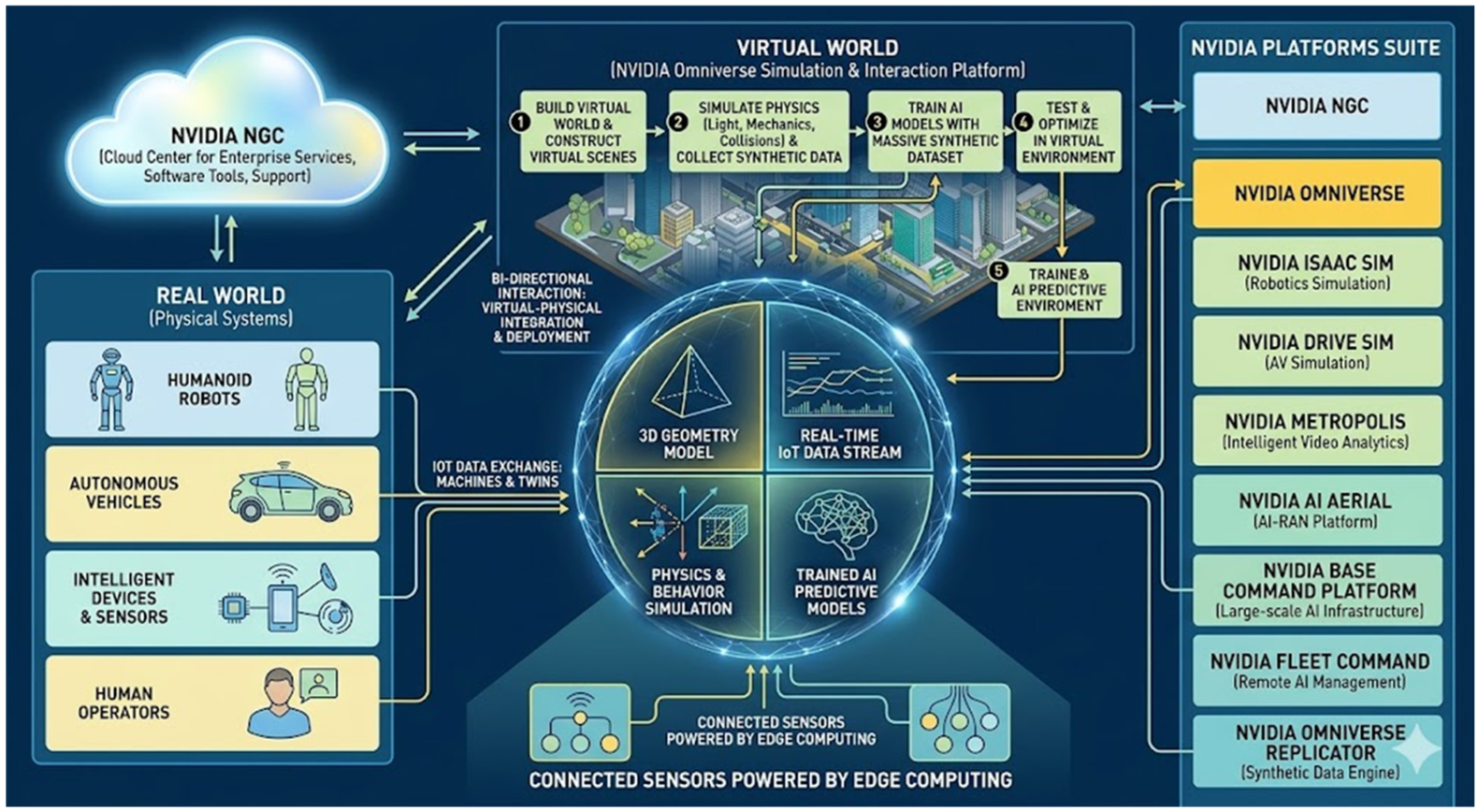
In Figure 10, the digital twins capture a virtual representation of the structure’s physics and the changing internal and external conditions, measured by a large number of connected sensors driven by edge computing, called “cloud-edge integration”. Simulations are performed in a virtual environment to identify problems and opportunities for improvement through service updates [22]. IoT helps connect machines and devices to share data with their digital twins. Digital twins are always connected to the real world and are computer simulations of physical objects or processes. They can safely train in virtual environments and then transfer their intelligence to real-world humanoid robots and self-driving cars [30]. Specifically, NVIDIA provides numerous tools and platforms for training and simulating real-world humanoid robots and self-driving cars, which are highly beneficial for the practical application of digital twins.
- NVIDIA Omniverse [31], the world’s first scalable, multi-GPU, physically accurate, world-class simulation platform;
- NVIDIA NGC [32], (NVIDIA GPU Cloud, NGC) Cloud Center (a platform that provides enterprise services, software, management tools, and support for end-to-end AI and digital twins workflows);
- Omniverse Replicator [33], synthetic data engine;
- NVIDIA Isaac Sim [34], Robot Digital Twins simulator;
- NVIDIA DRIVE Sim [35], Self-driving car Digital Twins simulator;
- NVIDIA Isaac [36], Robotic Platform;
- NVIDIA Metropolis [37], intelligent image analysis platform;
- NVIDIA AI Aerial [38], intelligent radio access network (AI-RAN) technology platform;
- NVIDIA Base Command Platform [39], deploys large-scale AI infrastructure (manage GPUs, select libraries, workspaces, and container images);
- NVIDIA Fleet Command [40], remote AI management cloud service (end-to-end across edge-connected systems and devices to deploy, manage, scale, and update AI applications).
Figure 10.
Cutting-Edge AI Industry.
3.7. Physical AI
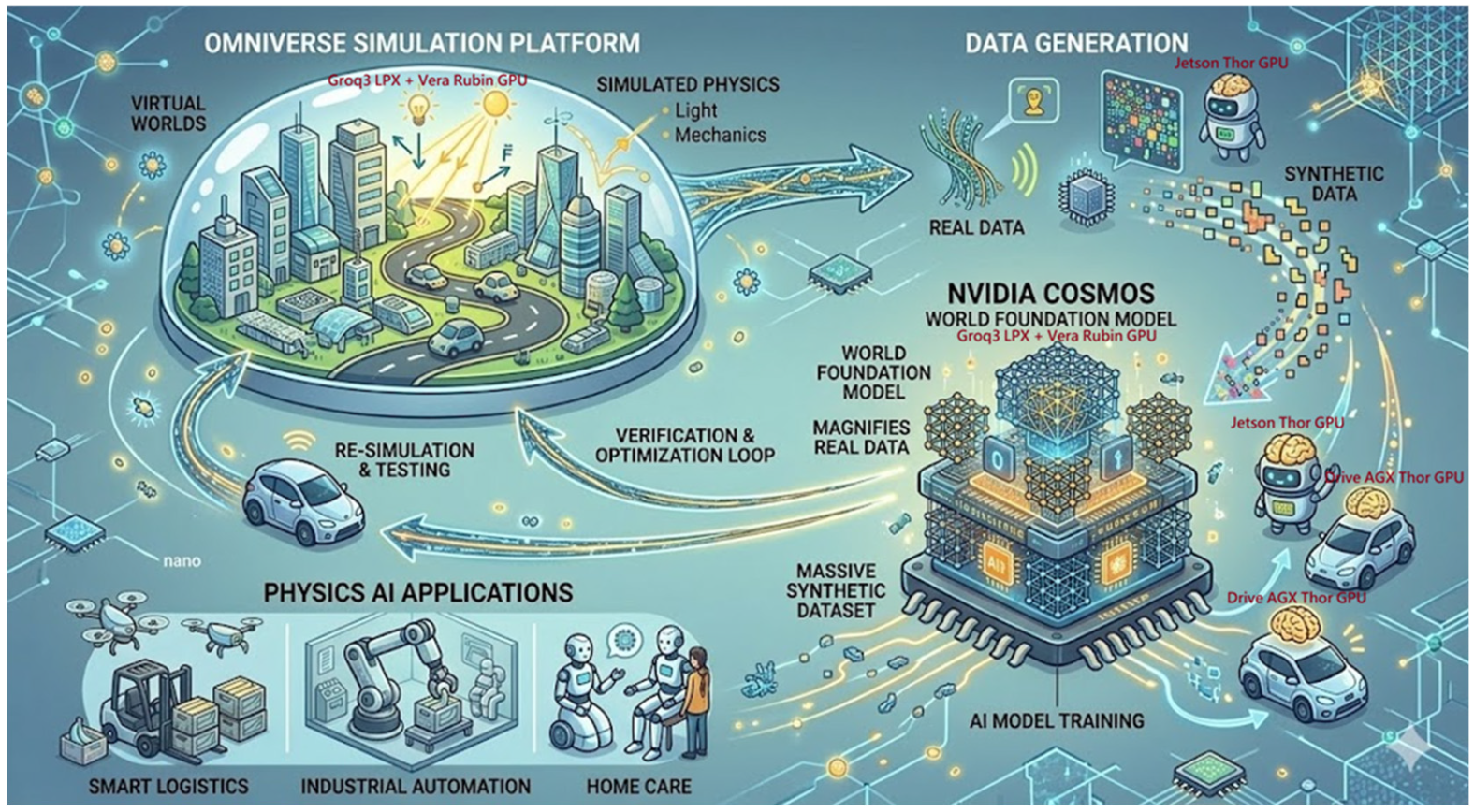
Physical AI relies on real-world data, but obtaining, organizing, and labeling it can be difficult. To overcome these limitations, NVIDIA Cosmos provides a World Foundation Model. Through simulation and AI augmentation, it can “amplify” a small amount of real data into a large volume of synthetic data, providing the necessary training data for machine learning and reinforcement learning [23]. The simulation platform Omniverse constructs virtual scenes and simulates various physical elements, including light, collision, and mechanics. It tests (real) autonomous driving systems and robot movements to collect corresponding synthetic data, in conjunction with more advanced AI training (virtual). The AI model is verified and optimized through multiple two-way interactions, referred to as “virtual-real integration” [41] and “cloud-edge integration” [42]. The two-way integration of virtual and real worlds accelerates the implementation and popularization of physical AI, from smart logistics and industrial automation to home care [43]. The two-way operations are as follows. (1) Simulation construction: Omniverse builds realistic virtual worlds with all physical details. (2) Data generation: The sensor information and environmental interaction data generated in the simulation are input into Cosmos, which generates large amounts of synthetic data to train AI models. (3) AI training: Cosmos uses massive, diverse datasets to train physical AI models for autonomous driving and robotics, enabling them to grasp the real world’s complexities better. (4) Re-simulation test: System puts the trained AI model back into Omniverse to conduct further testing and evaluation and generates feedback to generate new simulation data. For physical AI, Figure 11 presents an example of an integrated cloud-edge intelligence system using the Nvidia solution. This figure demonstrates three chip sets, including in-cloud Groq3 LPX + Vera Rubin GPU for Omniverse and Cosmos, in-edge Drive AGX Thor GPU for self-driving cars, and in-edge Jetson Thor GPU for humanoid robots.
Figure 11.
An example of an integrated cloud-edge intelligence system using the Nvidia solution.
3.8. Explainable AI
Explainable AI (XAI) aims to enable people to understand and trust the results, output processes, and methods produced by machine learning algorithms. The goal is to make the AI decision-making process transparent and easy to understand, ensuring that humans can comprehend it and that AI systems are used safely and responsibly in various fields, thereby facilitating effective collaboration with humans. Through XAI, people can understand the expected impact, potential bias, accuracy, fairness, and transparency of AI models. Challenges: Overly complex explanations of transparency may be difficult to understand and lose their meaning. The detailed information on the complete explanation may infringe on trade secrets [24]. Methods of interpretation [44] are as follows. (1) Explain the model: Provides information about the model itself, such as the model type, an overview of the training data, and which factors in the model are most important. (2) Explanatory subject: Provide a case study similar to the affected person’s own situation to illustrate the AI’s decision-making process in that situation. (3) Transparency methods: Use transparency techniques, such as decomposition or agent modeling, to achieve understanding of AI models.
4. Discussion
4.1. Key Cutting-Edge Real-World Applications
This AI evolution directly drives the shift from Industry 4.0 to Industry 5.0 [45]. While foundational digital technologies like the Cloud, IoT, and Big Data built Industry 4.0, Industry 5.0 leverages advanced AI for intelligent manufacturing and human–machine co-working. The emergence of Physical AI—manifested in systems such as self-driving cars and advanced robots—is key to this transition, leading to the development of highly automated AI facilities and factories with embodied intelligence, where AI can perform cognitive and physical work autonomously and collaboratively. This behavior involves utilizing Digital Twins technology, which connects the World Model’s virtual world with robots’ physical actions to optimize entire industrial processes. AI is driving a new wave of industrial innovation through unmanned operations. Key cutting-edge real-world applications include:
- Semiconductor Smart Manufacturing: Implementation of equipment anomaly detection, virtual metrology, defect classification, unmanned wafer logistics, reinforcement learning dispatch, wafer inspection, edge-cloud fab integration, and energy optimization.
- Self-Driving Cars: Use of autonomous ride-hailing/robo-taxi, autonomous freight and delivery, last-mile delivery, public transit automation, highway/platooning assistance, autonomous parking, mining and industrial vehicles, emergency and safety vehicles, mobility-as-a-service (MaaS), and autonomous data collection/mapping.
- Humanoid Robots: Simulation of customer service/reception, healthcare assistance, research and education, entertainment/hospitality, manufacturing support, public safety/disaster response, home assistance/personal robotics, and remote telepresence.
- Smart Medical: Leveraging remote patient monitoring (RPM), telemedicine/virtual care, AI diagnostics and imaging, predictive healthcare/risk assessment, robotic surgery and assistance, smart drug delivery, personalized medicine, hospital automation, rehabilitation and assistive robotics, and public health and epidemic monitoring.
- Generative Sovereign AI: Scheduling on national security and defense planning, autonomous intelligence analysis, policy and governance modeling, secure knowledge synthesis, national digital twins, sensitive content generation, autonomous cybersecurity, and defense R&D acceleration.
4.2. Cyber-Physical Integration
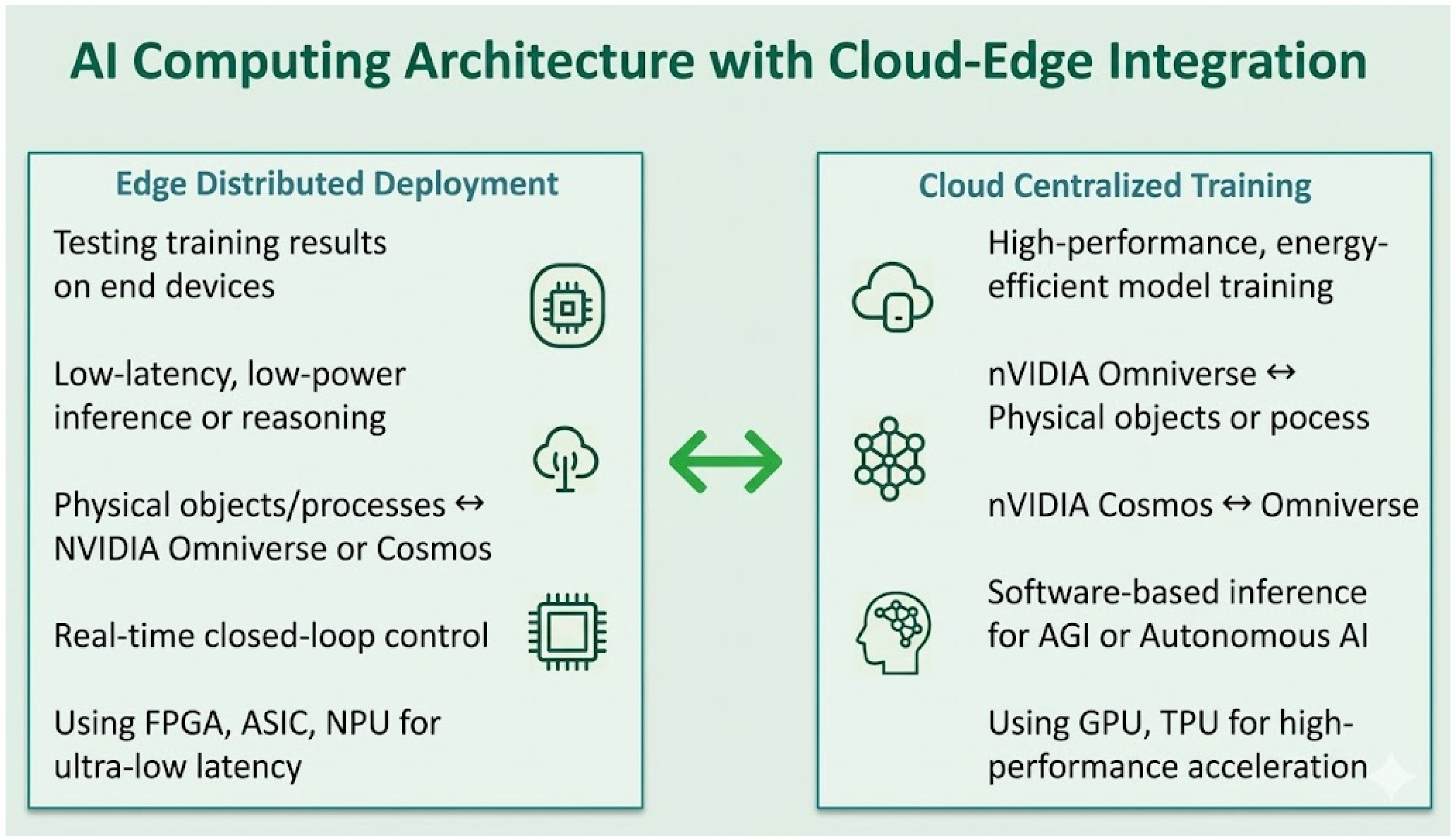
Just as the experience of implementing perceptive AI in large-scale edge computing will later fuel the development of generative AI in cloud computing, Cyber–Physical Systems (CPS) and Digital Twins serve as the core interface and physical actuator, connecting cloud intelligence with physical reality and implementing the actions of Agentic AI in the cloud within the Physical AI wave. This complete overhaul of the intelligence infrastructure necessitates a shift in human labor toward high-value work that complements and leverages AI’s capabilities, founded on the strategic division and integration of heterogeneous Cloud-Edge chips. In Figure 12, the AI computing architecture has distinctly formed a cloud-edge integration dual structure:
- Cloud Centralized Training: This dedicated work aims to achieve high-performance, energy-efficient training of complex models, such as NVIDIA Omniverse versus physical objects or processes, and NVIDIA Cosmos versus Omniverse. It seeks to develop software-based inference or reasoning for artificial general intelligence (AGI) or autonomous AI. This AI involves high-fidelity cloud-based simulations (e.g., training models at CPS, digital twins, or physical AI) and relies on general-purpose, high-performance accelerators such as GPUs and TPUs.
- Edge Distributed Deployment: This allows training results to be tested on end devices, enabling low-latency, low-power inference or reasoning applications, such as those involving physical objects or processes, versus NVIDIA Omniverse and/or NVIDIA Omniverse versus Cosmos. Real-time closed-loop control at the edge (e.g., entity execution on edge-deployed CPS, digital twins, or physical AI) relies on ultra-low-latency specialized chips, such as FPGAs, ASICs, and NPUs, to ensure the safety and reliability of the physical world.
Figure 12.
AI computing architecture with cloud-edge integration, where a hybrid edge-cloud (HEC) design can save up to 75% more energy than a fully centralized cloud system.
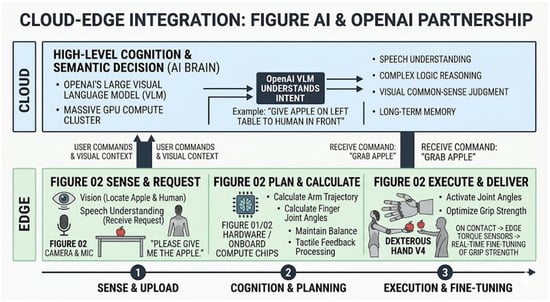
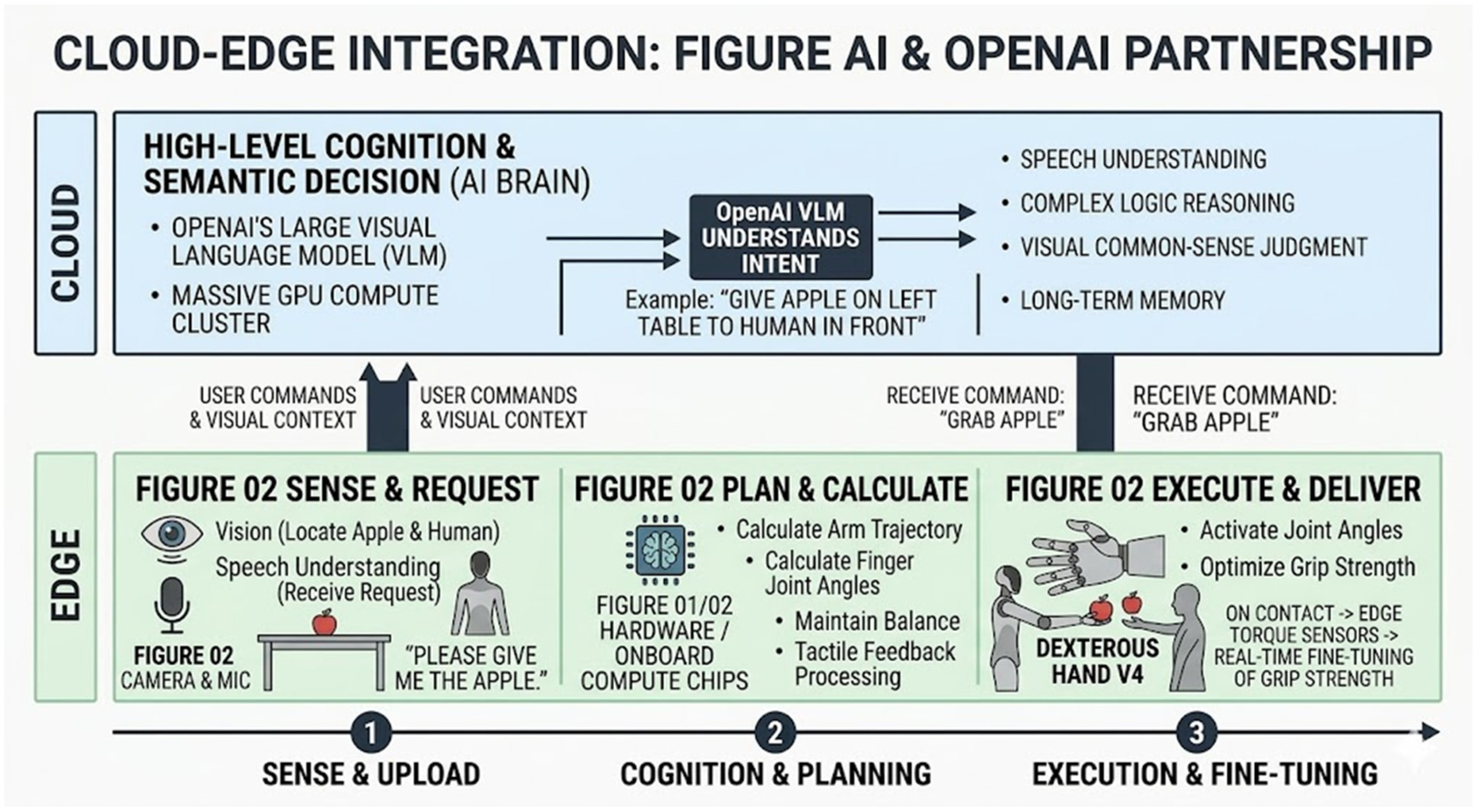
Looking towards the future of cloud-based cyberspace, we can expect to combine quantum computing [46] simulation with powerful artificial intelligence to create even greater computing power. In such an environment, the high computing power for large cutting-edge real-world AI models in key applications within an AI Data Center can significantly optimize industrial production. Figure 13 presents detailed real-world case studies that demonstrate how artificial intelligence chips can achieve practical applications.
Figure 13.
Illustration of humanoid robot Figure 02 collaborating with OpenAI VLM to realize an integrated cloud-edge intelligence system.
4.3. Challenges Facing the Development of AI
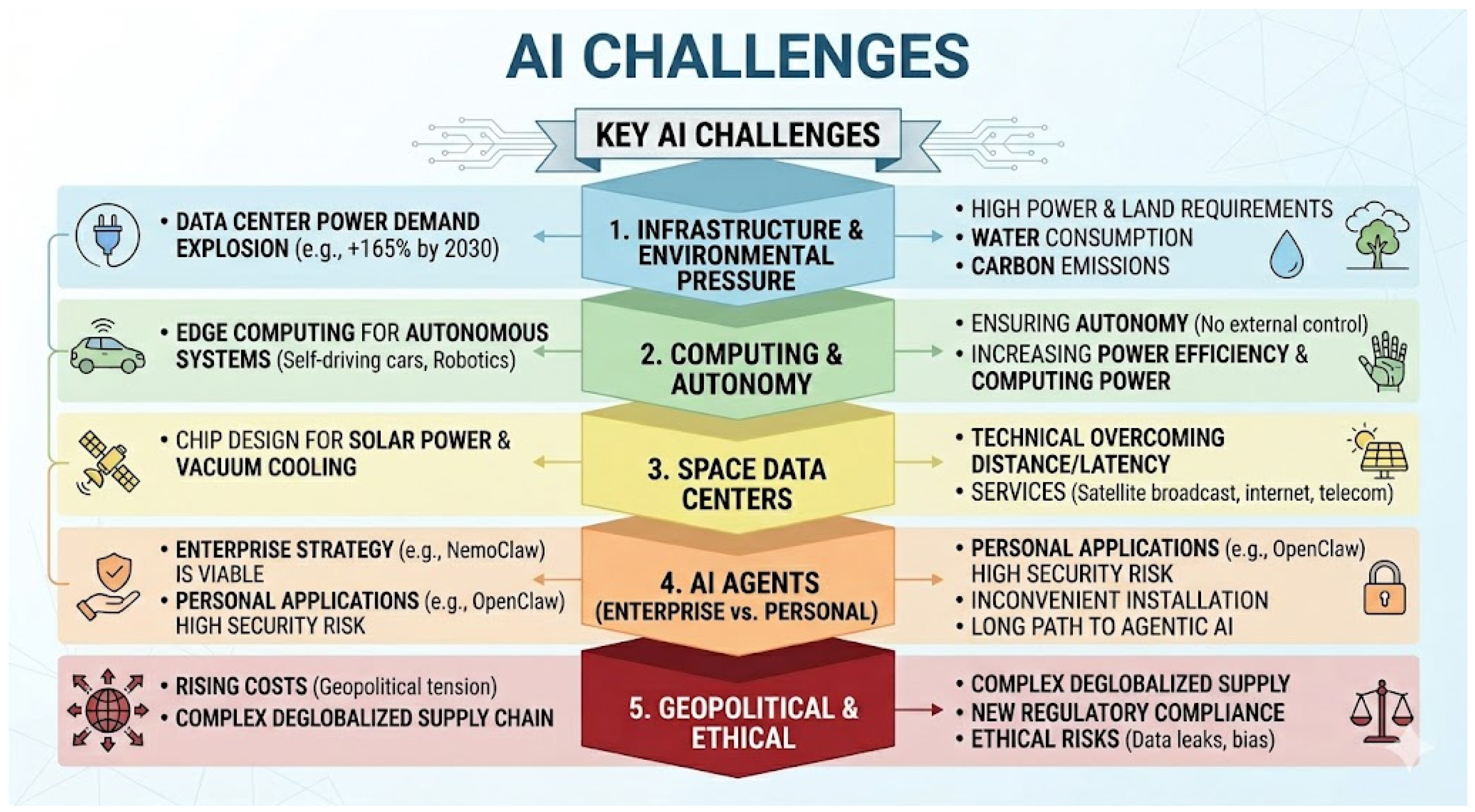
The exponential growth of AI and hyperscale data centers has introduced formidable systemic challenges, primarily centered on resource scarcity and environmental sustainability. Figure 14 addresses the connection between AI challenges.
- Goldman Sachs predicts that by 2030, global data center electricity demand will surge by 165% [47]. How can we overcome the environmental pressures brought about by the large amount of land and electricity required for high-density computing equipment, as well as water consumption and carbon emissions?
- How can self-driving cars, humanoid robots, and drones achieve autonomous edge computing without backdoor control? And how can we improve power saving and computing power?
- How can we design server chips suitable for space data centers powered by solar energy and cooled by orbital vacuum? Can we overcome the technological challenges of providing broadcasting, television, internet access, and telephone services through satellite signals in space data centers?
- Although there are enterprise-level strategic AI agents (e.g., NemoClaw), AI agents (e.g., OpenClaw) have high security risks in personal applications that cannot be overcome. In addition, the installation and integration process is very inconvenient. It is a long way to go before we can enter the field of agentic AI.
- How can we address the rising costs caused by geopolitical tensions, the complexity of deglobalized supply chains, compliance with new regulations, and ethical issues arising from the leakage of confidential information?
Figure 14.
AI challenges.
4.4. Impact of AI on Employment and Workforce Transformation
The disruptive impact of AI on the contemporary labor market is increasingly characterized by a dual outcome: AI either functions as a technological equalizer or as a catalyst for professional displacement [47]. For individuals who cultivate critical inquiry and the capacity for nuanced problem formulation—effectively ‘asking the right questions’—AI serves as a leveling agent, democratizing creative production and allowing those from non-technical backgrounds to bridge the gap toward high-level synthesis. Conversely, technical workers confined to executing standardized, routine instructions face a significant risk of obsolescence. As AI systems achieve superior speed and precision in performing algorithmic tasks, the professional utility of those bound by rigid operational paradigms is expected to decline precipitously.
Consequently, the pedagogical essence of ‘programming’ is undergoing a fundamental shift. The focus is transitioning from the mastery of syntax-heavy coding toward the refinement of natural language proficiency—particularly in English—integrated with computational thinking. This evolution underscores a future where the ability to articulate strategic intent and complex requirements precisely becomes the primary interface for human–machine collaboration. Ultimately, the demarcation between technical and non-technical domains will blur, as proficiency in steering AI models becomes a universal prerequisite for high-efficiency professional agency.
5. Perspectives
5.1. Future Development Priorities
The trajectory of high-end industrial sectors is increasingly predicated on the evolution of AI and High-Performance Computing (HPC) technologies. The immense capital expenditure and energy intensity required to train sophisticated AI models have catalyzed a radical transformation across the semiconductor value chain. Development priorities include next-generation computational units, such as the NVIDIA Vera Rubin NVL72, alongside pioneering nanometer-scale fabrication chips, including TSMC’s A16 and A14 processes. Furthermore, innovations in advanced packaging—encompassing Fan-out, Flip Chip, and Embedded architectures—are being integrated with revolutionary memory paradigms, specifically Hybrid Bonding 3D Memory and Processing-in-Memory (PIM), to overcome existing bandwidth and efficiency bottlenecks.
This technological synergy, enabled by Digital Twins and hyperscale AI data centers, facilitates seamless cyber–physical integration and a cloud-to-edge continuum. Such advancements are poised to revolutionize applications in autonomous mobility and humanoid robotics, signaling a transformative shift from Industry 4.0 toward Industry 5.0, where cognitive computing and human-centric collaboration predominate. Consequently, a paradigm shift is occurring within the engineering profession: the focus is shifting from traditional hardware-centric development to the use of virtualized environments to manifest Physical AI. In this emerging landscape, AI serves as a high-efficiency collaborative agent, redefining the interface between digital intelligence and physical execution.
5.2. What Will AI Robots Do for You in the Future?
The advancement of next-generation robotics is predicated on the transition toward Artificial General Intelligence (AGI), enabling autonomous agents to navigate tasks of increasing complexity—ranging from standardized industrial assembly and logistics to highly unstructured environments such as domestic labor, geriatric care, and tactical combat. Future robotic systems are envisioned as multi-domain assets capable of executing diverse functions: they will provide domestic and pedagogical assistance, manage complex logistical and manufacturing operations, and assume control of autonomous navigation across terrestrial, maritime, and aerospace platforms. Furthermore, the integration of AI into specialized professional fields will enhance diagnostic precision in healthcare and automate pharmaceutical dispensing, while simultaneously streamlining administrative workflows and generative creative processes. This evolution signifies a shift where AI transcends its role as a tool, becoming a high-autonomy collaborator across the full spectrum of human labor.
5.3. From Digital Transformation to AI Empowerment
The paradigm shift from digital transformation to AI-empowerment necessitates the development of user-centric intelligent operational models.
- While contemporary AI architectures demonstrate proficiency in processing visual, auditory, and tactile modalities for repetitive tasks, they remain deficient in replicating the full spectrum of human sensorium, including olfaction, gustation, and complex socio-emotional constructs such as trust and physiological affect.
- Consequently, AI exhibits significant limitations in managing highly intricate design and manufacturing workflows that require heuristic judgment—notably in Extreme Ultraviolet (EUV) lithography within semiconductor fabrication and the engineering of sixth-generation fighter aircraft.
- To address these constraints, the Human–AI Collaboration (HAI) framework emerges as a critical synthesis, merging human cognitive attributes—creativity, empathy, and qualitative judgment—with the computational velocity and precision of AI. By mastering High-Performance Computing (HPC) tools, human operators can leverage this symbiotic relationship to catalyze innovation in high-value asset management, sophisticated architectural design, and advanced industrial applications.
5.4. Strategies and Thinking on AI and Chips
The contemporary strategic landscape of AI represents a fundamental paradigm shift, in which the primary objective transcends mere hardware commercialization to focus on establishing global technical standards. This competition is characterized not merely by a race for raw computational power but as a multidimensional struggle to command the underlying technological ecosystems, algorithmic languages, and creative frameworks. By institutionalizing these platforms as industry standards, firms can effectively steer the trajectory of future innovations, such as the transition from 5G to 6G infrastructures.
Upon successful standardization of an AI technical platform, value is created through the deployment of high-utility applications—most notably in autonomous mobility and humanoid robotics. These products are increasingly distributed via Product-as-a-Service (PaaS) or leasing models, enabling optimized value capture and sustainable revenue streams across diverse organizational and consumer sectors. In the realm of High-Performance Computing (HPC), the industry operates under a ‘winner-take-most’ dynamic; achieving frontier-level yields and cost efficiencies is the prerequisite for maintaining an oligopolistic market position. Conversely, firms that fall behind the technological frontier face a precipitous, non-linear decline in market performance. To solidify this dominance, market leaders must leverage global scalability and decentralized manufacturing architectures, continuously refining advanced process chips to capitalize on economies of scale and reinforce their market share through a self-perpetuating cycle of innovation and standard setting.
5.5. Insight
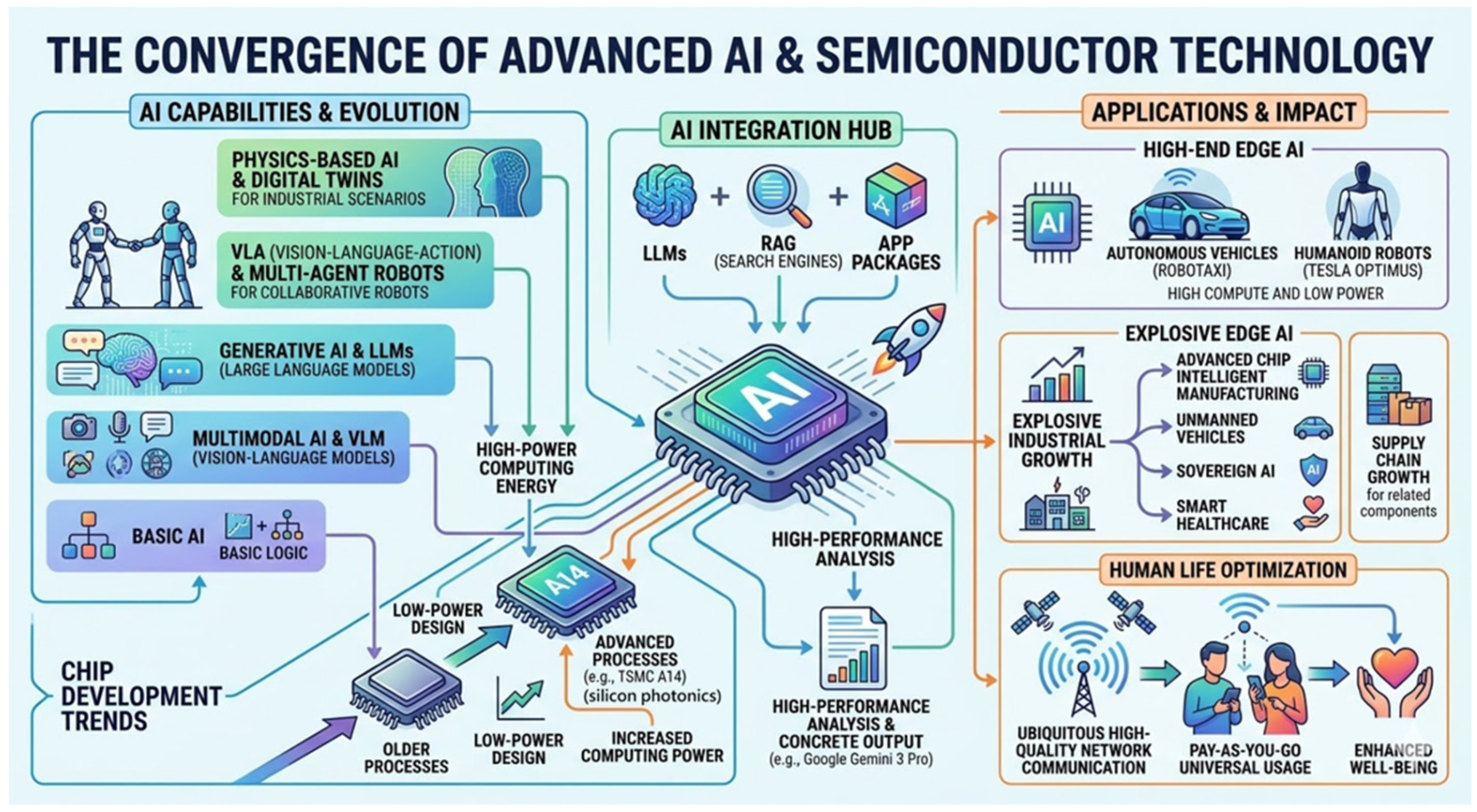
Insight into the correlation and evolution between AI and semiconductor technologies, as shown in Figure 15, is as follows:
- This study investigates the hierarchical classification of AI development alongside the evolving trajectories of advanced semiconductor fabrication processes.
- ➢
- High-end Edge AI devices, such as autonomous vehicles and humanoid robots, require advanced process chips (e.g., TSMC’s A14 process) and silicon photonics data transmission to achieve high computational throughput while maintaining low power consumption.
- Elucidating the Capabilities, Applications, and Substantive Significance of AI
- ➢
- To achieve peak performance and deliver substantive, analytical responses, Generative AI models (e.g., Google Gemini 3 Pro) must integrate Large Language Models (LLMs) with Retrieval-Augmented Generation (RAG) and orchestrate diverse application suites.
- Delineating the Necessity of Autonomous Systems and High-Performance Computing (HPC) Power
- ➢
- The transition of AI toward autonomous, high-compute commercial products, coupled with ubiquitous high-quality network connectivity, facilitates the realization of on-demand utility models, thereby optimizing human living standards (e.g., Tesla Optimus and Robotaxi).
- Identifying Cutting-edge AI Applications and Understanding the Evolutionary Paradigms of AI
- ➢
- A period of exponential industrial growth is anticipated within the supply chains of advanced semiconductor smart manufacturing, autonomous vehicles, Generative Sovereign AI, and intelligent healthcare.
- Describing Pivotal Applied Technologies of AI and chips in the Current Industrial Landscape
- ➢
- Prominent technological frontiers currently include Multimodal AI, Vision-Language Models (VLM), Vision-Language-Action (VLA) models, Multi-Agent Robotics, Digital Twins, and Physics-informed AI.
Figure 15.
The convergence of advanced AI and semiconductor technology.
6. Conclusions
6.1. Findings
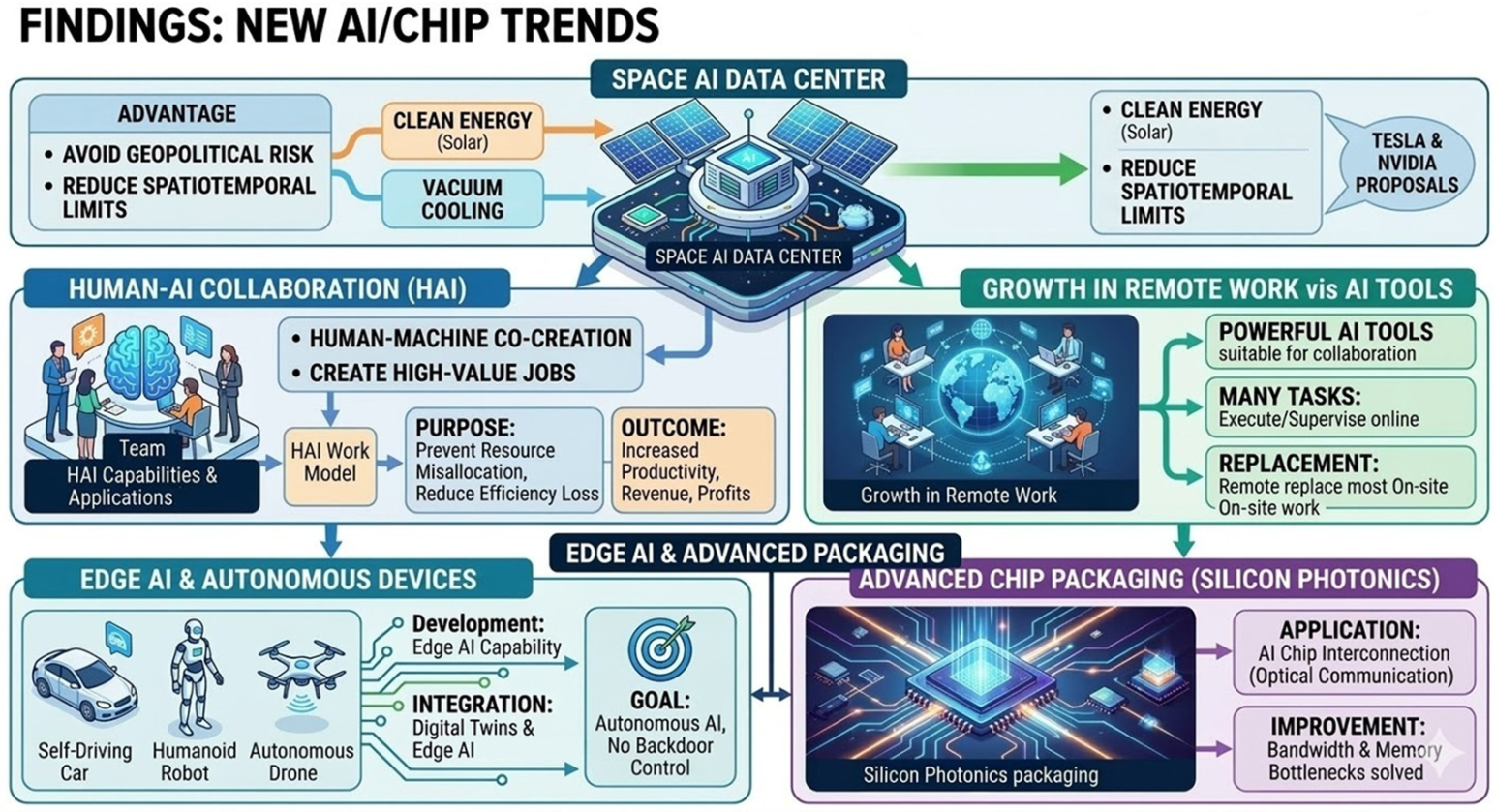
New trends in AI and chips from 2026 to 2030, as shown in Figure 16, are as follows:
- The trend towards developing edge AI-enabled devices.
- ➢
- The development and application of integrated Digital Twins and Edge AI intelligent systems, deployed in edge devices (e.g., self-driving cars, humanoid robots, drones), require autonomous AI capabilities, freeing them from constant backdoor control. In addition to GPU-based training, the Edge-AI system also incorporates data processing units (DPUs) and language processing units (LPUs) for high-speed data processing and rapid token-level language inference.
- By shaping HAI capabilities and applications, human–machine collaboration will create high-value benefits.
- ➢
- To avoid resource misallocation and reduce efficiency losses, future work models will adopt HAI to improve productivity, revenue, and profits for firms and personnel. In addition to personal computers, HAI’s system must also be implemented on wearable devices such as mobile phones, tablets, and smartwatches.
- Establishing space-based AI data centers is an inevitable future path.
- ➢
- Space AI data centers use clean energy (solar and vacuum cooling) to reduce carbon emissions, mitigate geopolitical risks, and overcome the spatial and temporal limitations of AI applications. For example, low-cost, 24/7 bioscience or medical computing to identify the genetic structure of deadly diseases.
- Advanced packaging technology using silicon photonics has become a hot topic in data transmission.
- ➢
- Advanced packaging technology based on silicon photonics (e.g., Co-Packaged Optics, CPO) has become a hot topic in data transmission, especially for A14 chips and hybrid bonding 3D memories or processing-in-memory.
- Mature AI tools are driving the booming development of remote work.
- ➢
- As AI tools become more powerful and suitable for collaborative work with humans, many tasks that can be performed or supervised online are being replaced by in-person tasks, such as remote work, remote care, remote learning, and telemedicine.
Figure 16.
New trends in AI and chips.
6.2. Value and Contribution
This review systematically elucidates the evolving trends of AI and chip-based information and communication technology (ICT) products, providing a comprehensive framework for industry, academia, research institutions, and governmental agencies to strategically integrate the product supply chain and guide the development of technologically and commercially relevant innovations. It further offers critical insights into the inherent challenges and current limitations of AI, enabling stakeholders to assess their operational and technological capacities critically and to formulate adaptive strategies for innovation and sustained competitiveness. Moreover, the review analyzes prospective strategies and underlying strategic considerations for AI and chips development, thereby equipping stakeholders with the conceptual tools, knowledge base, and analytical resources to anticipate and prepare for future technological competition and market dynamics.
Author Contributions
B.R.C. conceived and designed the experiments, H.-F.T. collected the dataset and proofread the manuscript, and B.R.C. wrote the paper. All authors have read and agreed to the published version of the manuscript.
Funding
The National Science and Technology Council fully supports this work in Taiwan, the Republic of China, under grant numbers NSTC 114-2221-E-390-003 and NSTC 114-2622-E-390-002.
Data Availability Statement
Data is contained within the article.
Conflicts of Interest
The authors declare no conflicts of interest.
References
- Yao, J.; Zhang, S.; Yao, Y.; Wang, F.; Ma, J.; Zhang, J.; Chu, Y.; Ji, L.; Jia, K.; Shen, T.; et al. Edge-cloud polarization and collaboration: A comprehensive survey for AI. IEEE Trans. Knowl. Data Eng. 2022, 35, 6866–6886. [Google Scholar] [CrossRef] [Scilit]
- Chang, Z.; Liu, S.; Xiong, X.; Cai, Z.; Tu, G. A survey of recent advances in edge-computing-powered artificial intelligence of things. IEEE Internet Things J. 2021, 8, 13849–13875. [Google Scholar] [CrossRef] [Scilit]
- Aleskog, C.; Grahn, H.; Borg, A. Recent Developments in Low-Power AI Accelerators: A Survey. Algorithms 2022, 15, 419. [Google Scholar] [CrossRef] [Scilit]
- Jensen Huang’s COMPUTEX 2025 Keynote: Building the Era of AI Factories. In Proceedings of the COMPUTEX 2025, Taipei, Taiwan, 20–23 May 2025; Available online: https://ai-stack.ai/en/jensen-huang-computex (accessed on 24 October 2025).
- Wu, J.; You, H.; Du, J. AI generations: From AI 1.0 to AI 4.0. Front. Artif. Intell. 2025, 8, 1585629. [Google Scholar] [CrossRef] [Scilit] [PubMed]
- Albaroudi, E.; Elbehairy, M.; Al Hinnawi, M.N.E.; Hatamleh, M.; Mansouri, T.; Alameer, A. Empowering data sovereignty through artificial intelligence: A framework for sustainable smart energy systems in Saudi. Curr. J. Appl. Sci. Technol. 2025, 44, 77–88. [Google Scholar] [CrossRef] [Scilit]
- TSMC Unveils A14 Process at Technology Symposium to Advance the AI Future. 4 August 2025. Available online: https://esg.tsmc.com/en-US/articles/366 (accessed on 24 October 2025).
- Risk Management, Corporate Governance, Investors, TSMC. 2025. Available online: https://investor.tsmc.com/english/risk-management (accessed on 24 October 2025).
- Nordin, M.H.; Sharma, S.; Khan, A.; Gianni, M.; Rajendran, S.; Sutton, R. Collaborative unmanned vehicles for inspection, maintenance, and repairs of offshore wind turbines. Drones 2022, 6, 137. [Google Scholar] [CrossRef] [Scilit]
- Dai, Y.; Lee, K. Deep reinforcement learning-based autonomous docking with multi-sensor perception in sim-to-real transfer. Processes 2025, 13, 2842. [Google Scholar] [CrossRef] [Scilit]
- Unmanned Vehicles & Platforms. Unmanned Systems Technology. 2025. Available online: https://www.unmannedsystemstechnology.com/expo/unmanned-vehicles-platforms/ (accessed on 24 October 2025).
- AI Robotics, Digital Twins, and MONAI Contributions Highlight Hon Hai Foxconn’s Smart Healthcare Vision at GTC Taipei 2025. 21 May 2025. Available online: https://www.foxconn.com/en-us/press-center/press-releases/latest-news/1605 (accessed on 24 October 2025).
- Yenduri, G.; Murugan, R.; Maddikunta, P.K.R.; Bhattacharya, S.; Sudheer, D.; Savarala, B.B. Artificial general intelligence: Advancements, challenges, and future directions in AGI research. IEEE Access 2025, 13, 134325–134356. [Google Scholar] [CrossRef] [Scilit]
- Vaghasia, P.; Goswami, A.; Patel, D.; Patel, R.; Patel, R.; Vaghasia, R. Improving predictive accuracy with cloud-based machine learning models for big data analytics. In Proceedings of the 2025 International Conference on Computing Technologies (ICOCT), Bengaluru, India, 13–14 June 2025; pp. 1–7. [Google Scholar]
- Available’s $5B Project Qestrel Aims to Roll out 1,000 AI-Ready Edge Data Centers by Year’s End. Network World. Available online: https://www.linkedin.com/posts/network-world_availables-5b-project-qestrel-aims-to-roll-activity-7439575572181274624-_6OC (accessed on 16 March 2026).
- Chen, R.; Chen, X.; Wang, L.; Li, J. The core industry manufacturing process of electronics assembly based on smart manufacturing. ACM Trans. Manag. Inf. Syst. 2023, 13, 1–19. [Google Scholar] [CrossRef] [Scilit]
- Zhao, F.; Zhang, C.; Geng, B. Deep multimodal data fusion. ACM Comput. Surv. 2024, 56, 1–36. [Google Scholar] [CrossRef] [Scilit]
- Zhang, J.; Huang, J.; Jin, S.; Lu, S. Vision-language models for vision tasks: A survey. IEEE Trans. Pattern Anal. Mach. Intell. 2024, 46, 5625–5644. [Google Scholar] [CrossRef] [Scilit] [PubMed]
- nVIDIA/GR00T-N1.5-3B. 2025. Available online: https://huggingface.co/nVIDIA/GR00T-N1.5-3B (accessed on 24 October 2025).
- Feng, J.; Zeng, J.; Long, Q.; Chen, H.; Zhao, J.; Xi, Y.; Zhou, Z.; Yuan, Y.; Wang, S.; Zeng, Q.; et al. A survey of large language model-powered spatial intelligence across scales: Advances in embodied agents, smart cities, and earth science. arXiv 2025, arXiv:2504.09848. [Google Scholar] [CrossRef] [Scilit]
- Orr, J.; Dutta, A. Multi-agent deep reinforcement learning for multi-robot applications: A survey. Sensors 2023, 23, 3625. [Google Scholar] [CrossRef] [Scilit] [PubMed]
- Jwo, J.S.; Lee, C.H.; Lin, C.S. Data twin-driven cyber-physical factory for smart manufacturing. Sensors 2022, 22, 2821. [Google Scholar] [CrossRef] [Scilit]
- Agarwal, N.; Ali, A.; Bala, M.; Balaji, Y.; Barker, E.; Cai, T.; Chattopadhyay, P.; Chen, Y.; Cui, Y.; Ding, Y.; et al. Cosmos world foundation model platform for physical ai. arXiv 2025, arXiv:2501.03575. [Google Scholar] [CrossRef] [Scilit]
- Saeed, W.; Omlin, C. Explainable AI (XAI): A systematic meta-survey of current challenges and future opportunities. Knowl. Based Syst. 2023, 263, 110273. [Google Scholar] [CrossRef] [Scilit]
- Song, Y.; Sun, P.; Liu, H.; Li, Z.; Song, W.; Xiao, Y.; Zhou, X. Scene-driven multimodal knowledge graph construction for embodied AI. IEEE Trans. Knowl. Data Eng. 2024, 36, 6962–6976. [Google Scholar] [CrossRef] [Scilit]
- Wu, W.; Sun, Z.; Song, Y.; Wang, J.; Ouyang, W. Transferring vision-language models for visual recognition: A classifier perspective. Int. J. Comput. Vis. 2024, 132, 392–409. [Google Scholar] [CrossRef] [Scilit]
- Robine, J.; Uelwer, T.; Harmeling, S. Smaller world models for reinforcement learning. Neural Process. Lett. 2023, 55, 11397–11427. [Google Scholar] [CrossRef] [Scilit]
- Fung, P.; Bachrach, Y.; Celikyilmaz, A.; Chaudhuri, K.; Chen, D.; Chung, W.; Dupoux, E.; Gong, H.; Jégou, H.; Lazaric, A.; et al. Embodied AI agents: Modeling the world. arXiv 2025, arXiv:2506.22355. [Google Scholar] [CrossRef] [Scilit]
- Zhang, Y.; Liu, Z.; Wen, Q.; Pang, L.; Liu, W.; Yu, P.S. Ai agent for information retrieval: Generating and ranking. In Proceedings of the 33rd ACM International Conference on Information and Knowledge Management, Boise, ID, USA, 21–25 October 2024; pp. 5605–5607. [Google Scholar]
- Liu, X.; Jiang, D.; Tao, B.; Xiang, F.; Jiang, G.; Sun, Y.; Kong, J.; Li, G. A systematic review of digital twin about physical entities, virtual models, twin data, and applications. Adv. Eng. Inf. 2023, 55, 101876. [Google Scholar] [CrossRef] [Scilit]
- Omniverse, nVIDIA. 2025. Available online: https://www.nVIDIA.com/en-us/omniverse/ (accessed on 24 October 2025).
- NGC, nVIDIA. 2025. Available online: https://www.nVIDIA.com/en-us/gpu-cloud/ (accessed on 24 October 2025).
- Replicator, Omniverse, nVIDIA. 2025. Available online: https://docs.omniverse.nVIDIA.com/extensions/latest/ext_replicator.html (accessed on 24 October 2025).
- Isaac Sim, nVIDIA. 2025. Available online: https://developer.nVIDIA.com/isaac/sim (accessed on 24 October 2025).
- DRIVE Sim, nVIDIA. 2025. Available online: https://www.nVIDIA.com/en-us/solutions/autonomous-vehicles/ai-training/ (accessed on 24 October 2025).
- Isaac Robotic Platform, nVIDIA. 2025. Available online: https://developer.nVIDIA.com/isaac (accessed on 24 October 2025).
- Metropolis, nVIDIA. 2025. Available online: https://www.nVIDIA.com/en-us/autonomous-machines/intelligent-video-analytics-platform/ (accessed on 24 October 2025).
- AI Aerial, nVIDIA. 2025. Available online: https://developer.nVIDIA.com/aerial (accessed on 24 October 2025).
- Base Command Platform, nVIDIA. 2025. Available online: https://docs.nVIDIA.com/base-command-platform/index.html (accessed on 24 October 2025).
- Fleet Command, nVIDIA. 2025. Available online: https://www.nVIDIA.com/en-us/data-center/products/fleet-command/ (accessed on 24 October 2025).
- nVIDIA Opens Portals to World of Robotics with New Omniverse Libraries, Cosmos Physical AI Models and AI Computing Infrastructure. 11 August 2025. Available online: https://nVIDIAnews.nVIDIA.com/news/nVIDIA-opens-portals-to-world-of-robotics-with-new-omniverse-libraries-cosmos-physical-ai-models-and-ai-computing-infrastructure (accessed on 24 October 2025).
- Hlophe, M.C.; Maharaj, B.T. From cyber–physical convergence to digital twins: A review on edge computing use case designs. Appl. Sci. 2023, 13, 13262. [Google Scholar] [CrossRef] [Scilit]
- nVIDIA Isaac Sim, Omniverse, and Cosmos—The Robotics & AI Simulation Ecosystem Explained. RidgeRun.ai. 6 June 2025. Available online: https://www.ridgerun.ai/post/nVIDIA-isaac-sim-omniverse-and-cosmos-the-robotics-ai-simulation-ecosystem-explained (accessed on 24 October 2025).
- Hassija, V.; Chamola, V.; Mahapatra, A.; Singal, A.; Goel, D.; Huang, K.; Scardapane, S.; Spinelli, I.; Mahmud, A.; Hussain, A. Interpreting black-box models: A review on explainable artificial intelligence. Cogn. Comput. 2024, 16, 45–74. [Google Scholar] [CrossRef] [Scilit]
- Dmitrieva, E.; Balmiki, V.; Lakhanpal, S.; Lavanya, G.; Bhandari, P. AI evolution in Industry 4.0 and Industry 5.0: An experimental comparative assessment. BIO Web Conf. 2024, 86, 01069. [Google Scholar] [CrossRef] [Scilit]
- Ajagekar, A.; You, F. Quantum computing based hybrid deep learning for fault diagnosis in electrical power systems. Appl. Energy 2021, 303, 117628. [Google Scholar] [CrossRef] [Scilit]
- Zarifhonarvar, A. Economics of ChatGPT: A labor market view on the occupational impact of artificial intelligence. J. Electron. Bus. Digit. Econ. 2024, 3, 100–116. [Google Scholar] [CrossRef] [Scilit]
Disclaimer/Publisher’s Note: The statements, opinions and data contained in all publications are solely those of the individual author(s) and contributor(s) and not of MDPI and/or the editor(s). MDPI and/or the editor(s) disclaim responsibility for any injury to people or property resulting from any ideas, methods, instructions or products referred to in the content. |
© 2026 by the authors. Licensee MDPI, Basel, Switzerland. This article is an open access article distributed under the terms and conditions of the Creative Commons Attribution (CC BY) license.