


Abstract
Organic dye pollution in industrial wastewater poses a serious environmental challenge, with methylene blue (MB) serving as a typical persistent pollutant due to its stable chemical structure, recalcitrance to degradation, and eco-toxicity. Conventional physical, chemical, and biological treatment methods suffer from limitations such as insufficient efficiency, high cost, or the tendency to generate secondary pollution. Based on green and sustainable photocatalysis technology, this study designed and prepared a NiO/SrTiO3 p-n heterojunction photocatalysts, aiming to broaden the light-response range and enhance charge-carrier separation efficiency. The optimal sample (NiO (10%)/SrTiO3) achieved complete photocatalytic degradation of MB within 9 min, with an apparent rate constant 34.6 times that of pure SrTiO3. It also showed good cyclic stability. Trapping experiments confirmed that •OH and •O2− were the key active species in the degradation process. Combined with band structure and PL analyses, an S-scheme charge-transfer mechanism was proposed, clarifying the critical role of the built-in electric field at the heterojunction interface in promoting carrier separation while maintaining high redox capability. This work not only provides a new pathway for developing efficient and stable SrTiO3-based photocatalysts but also offers theoretical and experimental support for the practical application of p-n heterojunction photocatalysts in environmental pollution control.
1. Introduction
Industrial development, while promoting social progress, has also intensified environmental pollution. Among various issues, water contamination caused by organic dyes, pesticides, and other chemicals is particularly severe and has become a global challenge [1,2]. As a fundamental industry, the textile sector has emerged as one of the major sources of water pollution due to its large-scale production [3]. The wastewater discharged contains a significant amount of refractory organic compounds, especially synthetic dyes, posing a persistent threat to aquatic ecosystems [4]. Among these, the cationic dye Methylene Blue (MB) is widely used owing to its vivid color and strong fixation properties, leading to its frequent presence in various water bodies [5]. MB belongs to the phenothiazine class of dyes, characterized by a stable tricyclic conjugated π-structure and hydrophilic dimethylamino groups. These features grant it both good water solubility and chemical stability, classifying it as a typical “persistent” pollutant [6,7]. Its environmental hazards are multifaceted: ecologically, even low concentrations of MB can increase water color, hinder light transmission, inhibit photosynthesis, and disrupt dissolved oxygen levels and primary productivity in aquatic systems [8,9]; in terms of health risks, MB can cause irritation through skin contact, and its metabolites may interfere with cellular redox processes, leading to potential in vivo toxicity [10,11]. Therefore, developing efficient, economical, and environmentally friendly technologies for MB removal holds significant importance for water environment remediation and public health protection.
Currently, the treatment of MB-containing wastewater primarily relies on physical, chemical, and biological methods. Physical approaches such as adsorption [12,13], precipitation [14], and membrane separation [15,16] remove pollutants through phase separation. While these methods are relatively simple and low-cost, they face challenges including difficult adsorbent regeneration, membrane fouling, and the need for secondary treatment of concentrated waste streams, failing to achieve complete degradation of pollutants. Chemical methods like advanced oxidation [17,18], ozonation [19], and electrochemical processes [20] can break down dye molecules via strong oxidation. However, they often suffer from limitations such as high reagent consumption, elevated costs, the potential generation of toxic by-products, or electrode passivation. Biological methods utilize microorganisms or plants to metabolize and degrade pollutants [21,22,23]. Although environmentally friendly and energy-efficient, they generally involve long treatment cycles, are sensitive to water quality conditions, and often exhibit limited degradation efficiency for dyes like MB, which exhibits strong biotoxicity. In summary, conventional methods present shortcomings in terms of efficiency, cost, or environmental compatibility.
In contrast, semiconductor photocatalysis technology, which utilizes solar energy as the driving force, can generate reactive species to degrade organic pollutants under mild conditions without causing secondary pollution. It is thus regarded as a green and sustainable approach for pollution remediation [24]. The core of this technology lies in the design and preparation of high-performance photocatalytic materials. Among the various photocatalysts, the perovskite oxide strontium titanate (SrTiO3) has attracted considerable attention due to its excellent chemical stability, tunable band structure, low environmental toxicity, and cost-effectiveness [25]. The positions of its conduction and valence bands endow it with the potential to drive both oxidation and reduction reactions, making it suitable for pollutant degradation. However, pristine SrTiO3 possesses a relatively wide band gap (approximately 3.2 eV), enabling it to harness only about 5% of the ultraviolet region in the solar spectrum. Furthermore, its rapid recombination rate of photogenerated charge carriers severely limits its practical application efficiency [26].
To overcome these limitations, constructing heterojunctions represents one of the effective strategies. By coupling SrTiO3 with another semiconductor, its light absorption range can be extended into the visible region. Moreover, the built-in electric field at the interface can promote the separation and migration of photogenerated electron-hole pairs, thereby significantly enhancing the photocatalytic performance [27]. For instance, the MoS2/SrTiO3 Z-scheme heterojunction constructed by Rezaei et al. [28] exhibited an 8-fold higher degradation efficiency for Rhodamine B compared to pure SrTiO3; the SrTiO3/BiOBr heterojunction reported by Wang et al. [29] achieved a 94.8% degradation rate for oxytetracycline under visible light. These studies confirm the effectiveness of heterojunction engineering in improving the photocatalytic activity of SrTiO3. Among various candidate semiconductors, nickel oxide (NiO), a p-type semiconductor, has attracted widespread interest in photoelectrics and catalysis due to its suitable band gap, high hole mobility, and good photochemical stability [30,31]. Combining p-type NiO with n-type SrTiO3 to form a p-n heterojunction is expected to create a stronger built-in electric field, further accelerating charge separation. Furthermore, appropriate band alignment may facilitate the formation of S-scheme or Z-scheme charge transfer pathways, which can inhibit recombination while maintaining high redox capabilities, ultimately enabling efficient pollutant degradation [32].
This study reports the rational design and fabrication of NiO/SrTiO3 p-n heterojunction photocatalysts for MB degradation. In contrast to conventional mechanical mixing or coprecipitation methods, a stepwise hydrothermal-controlled coupling strategy was adopted to construct a tightly bonded NiO/SrTiO3 heterointerface. We systematically investigate the structure, interfacial properties, and the degradation performance of this heterojunction towards MB under visible light and further elucidate the underlying photocatalytic reaction mechanism. This research not only provides a novel strategy for developing highly efficient and stable SrTiO3-based photocatalysts but also offers experimental evidence for constructing high-performance p-n heterojunction systems, demonstrating potential application value in the field of environmental pollution control.
2. Experiment and Characterization
2.1. Reagents
All chemicals used in this study were of analytical grade. Tetrabutyl titanate (C16H36O4Ti, TBOT, 98%), ethylene glycol (C2H6O2, EG), sodium hydroxide (NaOH), absolute ethanol (C2H5OH), oxalic acid dihydrate (H2C2O4·2H2O), isopropanol (IPA), and benzoquinone (BQ) were purchased from China National Pharmaceutical Group Chemical Reagent (Shanghai, China) Co., Ltd. Strontium nitrate (Sr(NO3)2) and nickel nitrate hexahydrate (Ni(NO3)2·6H2O) were obtained from Aladdin Reagent (Shanghai, China) Co., Ltd. Deionized water was produced in the laboratory.
2.2. Synthesis of NiO/SrTiO3 Photocatalysts
2.2.1. Preparation of SrTiO3
A total of 2.5 mmol of tetrabutyl orthotitanate (TBOT) was added to 60 mL of ethylene glycol (EG) under stirring. Meanwhile, 2.5 mmol of Sr(NO3)2 was dissolved in 5 mL of deionized water with thorough mixing. The Sr(NO3)2 aqueous solution was then slowly dripped into the TBOT/EG mixture under continuous stirring, followed by the addition of 2.5 mL of a 10 M NaOH solution. The resulting homogeneous mixture was transferred into a Teflon-lined autoclave and reacted under hydrothermal conditions at 180 °C for 24 h. Finally, the product was collected and washed repeatedly with deionized water and ethanol via centrifugation, and then dried at 80 °C to obtain SrTiO3 powder.
2.2.2. Preparation of NiO/SrTiO3
An appropriate amount of nickel nitrate hexahydrate (Ni(NO3)2·6H2O) was dissolved in 20 mL of deionized water, followed by the addition of 30 mL of ethylene glycol (EG) under continuous stirring. A suitable quantity of H2C2O4·2H2O was then introduced. After thorough stirring, a predetermined amount of the as-synthesized SrTiO3 powder was added to the solution. The homogeneous mixture was transferred into a Teflon-lined autoclave and reacted under hydrothermal conditions at 120 °C for 12 h. The resulting product was collected, repeatedly washed via centrifugation with deionized water and ethanol, and dried at 80 °C. The obtained powder was placed in a crucible and annealed at 450 °C for 2 h in air with a heating rate of 5 °C·min−1, yielding the final NiO/SrTiO3 catalysts.
2.3. Characterization
X-ray diffraction (XRD) patterns of the samples were obtained from a Bruker D8 Advance diffractometer (Karlsruhe, Germany) with Cu Kα radiation at a rated power of 3 kW. Data were collected over a 2θ range of 10–80° with a scanning speed of 10° min−1. The morphology of the samples was characterized by field emission scanning electron microscopy (FESEM) on a Zeiss Ultra Plus microscope (Carl Zeiss AG, Oberkochen, Germany). The microstructure and elemental distribution were further analyzed using field-emission high-resolution transmission electron microscopy (HRTEM, JEM-2100F, JEOL, Tokyo, Japan) equipped with an energy-dispersive X-ray spectroscopy (EDS) system. X-ray photoelectron spectroscopy (XPS) measurements were performed on a Thermo Scientific K-Alpha spectrometer (FL, USA). Ultraviolet-visible (UV-Vis) diffuse reflectance spectra (DRS) were collected on a PerkinElmer Lambda 750 S spectrophotometer (CT, USA). Photoluminescence (PL) spectra were obtained on a time-resolved fluorescence spectrometer (QM/TM/NIR).
2.4. Photocatalytic Experiments
A total of 50 mg of the photocatalyst was dispersed in a quartz glass reactor containing 50 mL of an aqueous methylene blue (MB) solution (initial concentration: 10 mg L−1, pH = 7). A 500 W xenon lamp equipped with a 420 nm cut-off filter was used as the simulated solar light source. The mixture was first stirred in the dark for 30 min to establish an adsorption–desorption equilibrium. During the illumination period, approximately 3 mL of the suspension was sampled at 3 min intervals and immediately filtered through a syringe filter with a 0.22 μm membrane to remove the catalyst particles. The degradation of methylene blue was evaluated by monitoring the decrease of its characteristic absorption peak at 667 nm using a UV-Vis spectrophotometer (UV-2600, Shimadzu, Kyoto, Japan).
3. Results and Discussion
3.1. Structural Characterization of NiO/SrTiO3 Series Samples
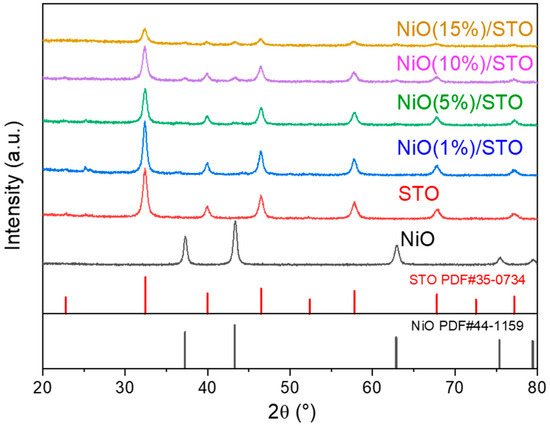
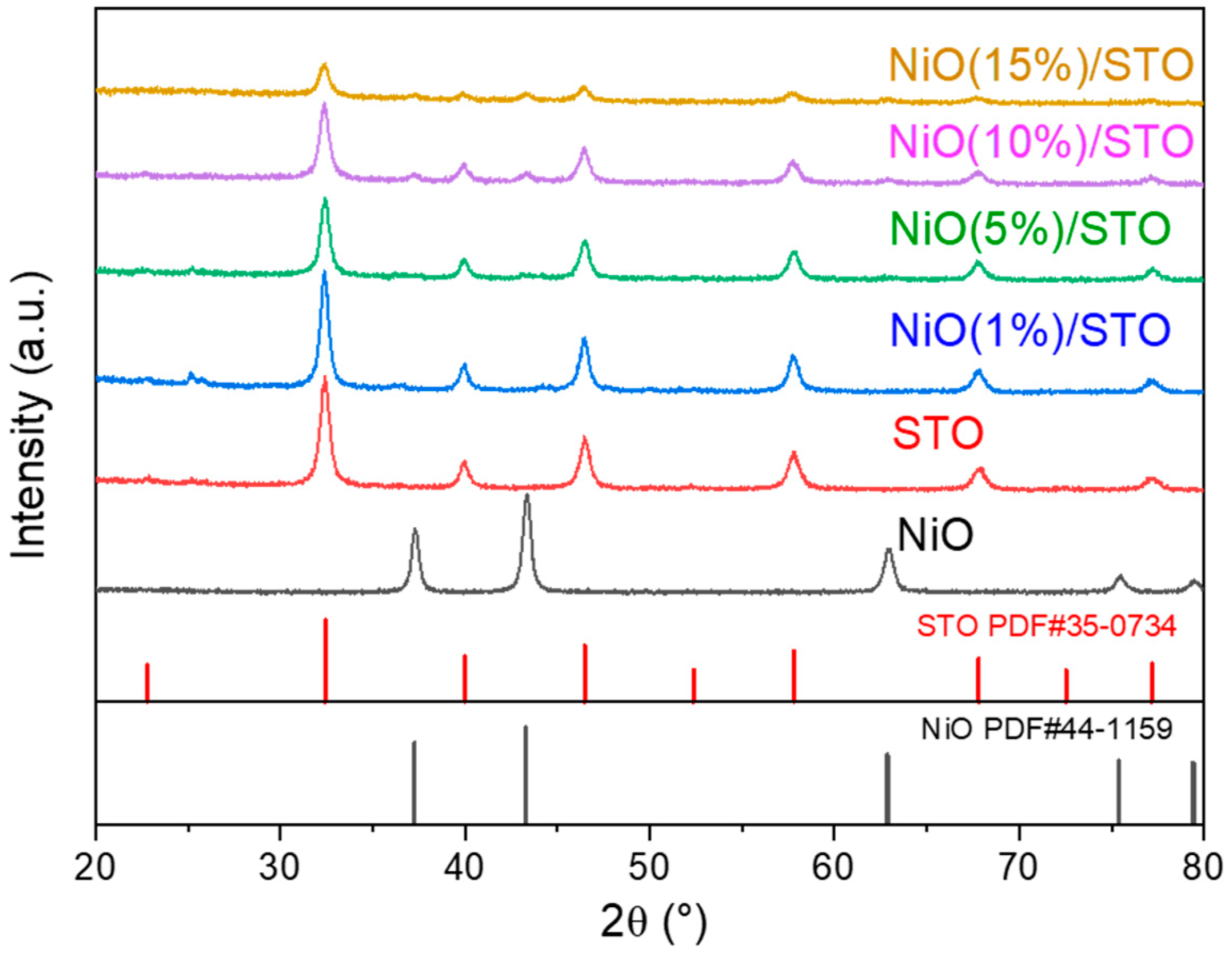
Figure 1 shows the XRD patterns of the NiO/SrTiO3 samples. All samples exhibit distinct diffraction peaks at 2θ of 32.35°, 39.91°, 46.42°, 57.72°, 67.74°, and 77.09°, which correspond to the (110), (111), (200), (211), (220), and (310) crystal planes of the cubic SrTiO3 structure (JCPDS card no. 05-0734) [33], confirming the successful synthesis of pure-phase cubic SrTiO3. Furthermore, the pure NiO sample shows five prominent diffraction peaks at 2θ of 37.25°, 43.29°, 62.85°, 75.40°, and 79.37°, corresponding to the (101), (012), (110), (113), and (202) planes of cubic-phase NiO (JCPDS#44-1159) [32]. In the XRD patterns of the NiO/SrTiO3 samples, diffraction peaks at 37.25°, 43.29°, and 62.85° are observed, which correspond to the (101), (012), and (110) crystal planes of NiO, respectively. This indicates the coexistence of NiO and SrTiO3 in the sample. With increasing NiO content, the characteristic diffraction peaks of SrTiO3 show no obvious shift, while their intensities gradually decrease, which can be attributed to surface coverage by NiO and compositional effects rather than lattice distortion. These XRD features demonstrate that the introduction of NiO mainly affects the interfacial structure instead of the bulk crystal structure of SrTiO3. Furthermore, the weak diffraction peaks observed at approximately 25° and 36° can be attributed to trace SrCO3 ((JCPDS#05-0418), likely formed due to surface reaction of residual ethylene glycol with Sr species during annealing. The impurity phase is present in a negligible amount and does not affect the primary crystal structure.
Figure 1.
XRD patterns of the NiO/SrTiO3 samples.
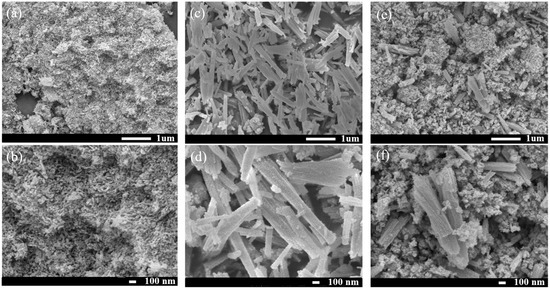
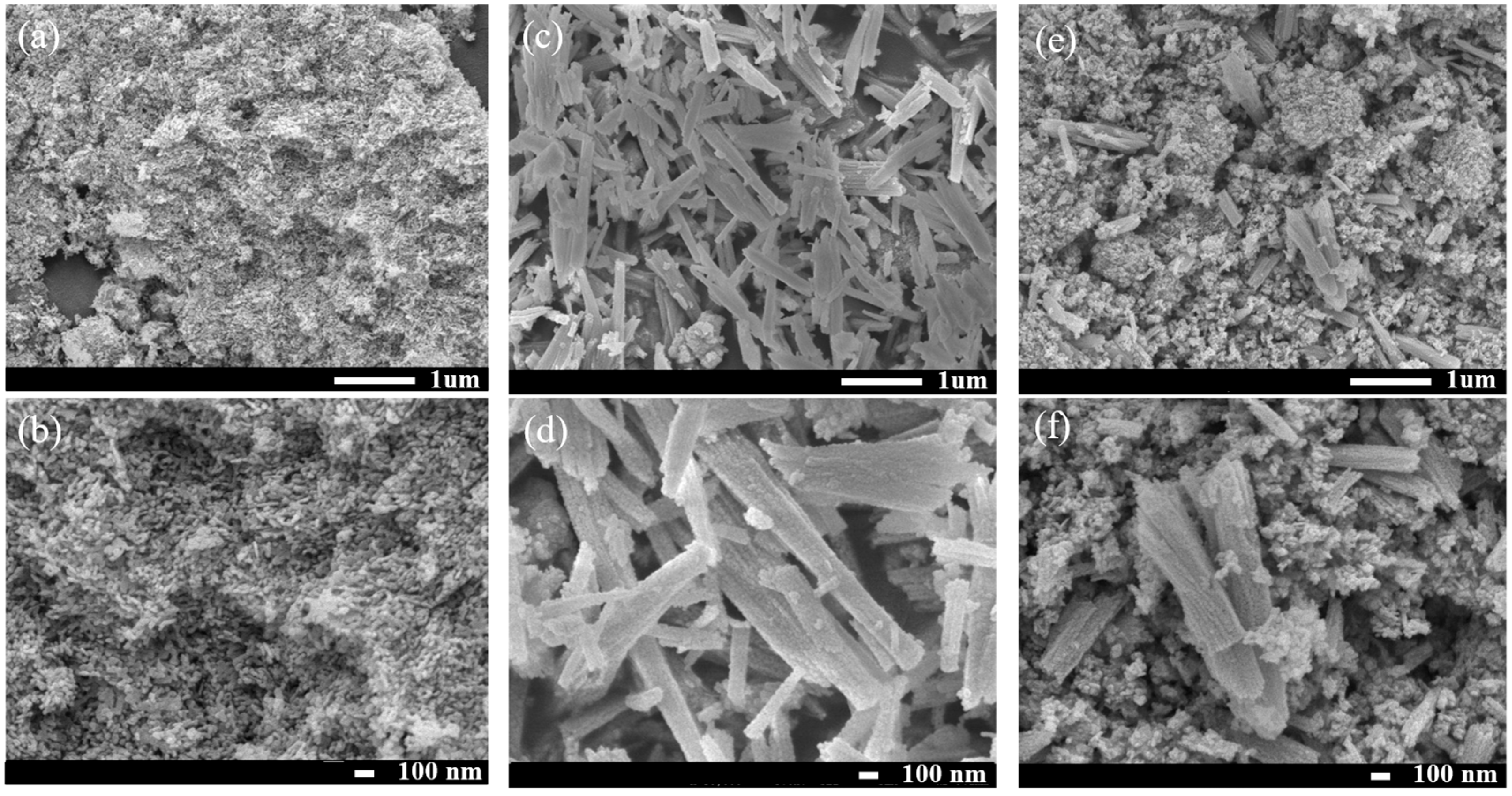
SEM results (Figure 2) clearly reveal the surface morphology and microstructure of the different samples. The SrTiO3 sample (Figure 2a,b) exhibits an irregular sheet-like morphology formed by the agglomeration of short rod-shaped particles. The NiO sample (Figure 2c,d) displays a typical plate-like structure with thin layers and distinct edges. At the micrometer scale (~1 μm), the NiO predominantly exhibits a plate-like morphology with a size of approximately 700 nm. Upon higher-magnification observation (~100 nm), the surfaces of the NiO plates display a distinct rough texture with irregular protrusions, resembling a bitter-gourd-like morphology. The short rod-like features observed in the SEM images are attributed to incompletely grown NiO rather than to the presence of a separate crystalline phase. Moreover, a statistical particle size analysis (sample size > 200) was carried out for both SrTiO3 and NiO. The resulting histogram (Figure S1) indicates that SrTiO3 particles have an average size of ~60 nm, while NiO mainly forms plate-like structures with characteristic dimensions of approximately 700 nm. In the NiO (10%)/SrTiO3 sample (Figure 2e,f), the coexistence and integration of both characteristic morphologies can be observed: the agglomerated short rod-shaped SrTiO3 and the plate-like NiO are interwoven and in close contact.
Figure 2.
SEM images of the samples: (a,b) SrTiO3; (c,d) NiO; (e,f) NiO (10%)/SrTiO3 (hereinafter abbreviated as NiO (10%)/STO).
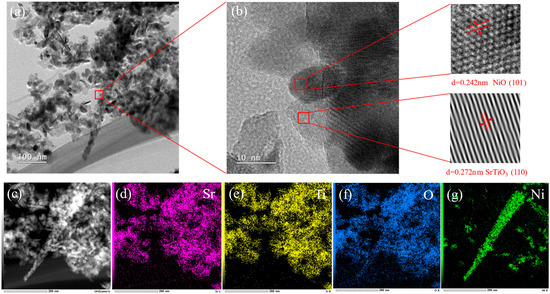
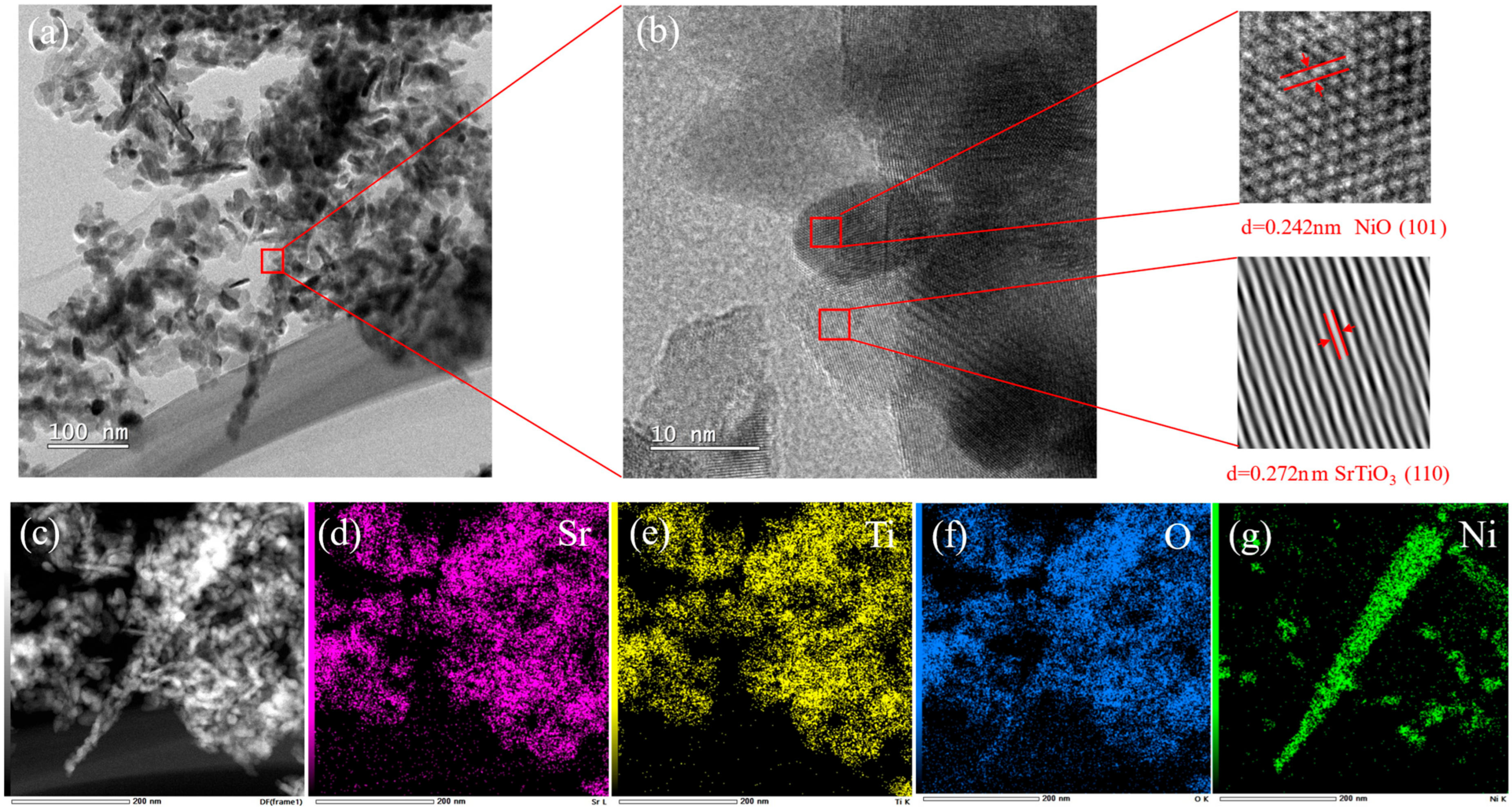
Figure 3a presents the TEM image of NiO (10%)/STO sample, in which the composite morphology of short rod-like SrTiO3 agglomerates and sheet-like NiO can be clearly distinguished. The SrTiO3 particles exhibit a relatively small size, suggesting a potentially high specific surface area and abundant surface active sites. NiO shows a typical two-dimensional sheet-like structure, interwoven and in intimate contact with SrTiO3. Moreover, the NiO plates exhibit a rough surface texture characterized by irregular nanoscale protrusions, resembling a bitter-gourd-like morphology. The HRTEM image (Figure 3b) further reveals the lattice structure at the interface. Clear lattice fringes with spacings of 0.272 nm and 0.242 nm are observable, corresponding to the (110) plane of cubic SrTiO3 [34] and the (101) plane of cubic NiO [35], respectively. This result provides direct evidence for the successful construction of the NiO/SrTiO3 heterojunction. The EDS elemental mapping images (Figure 3d–g) show the distribution of four elements (Sr, Ti, O, and Ni) within the NiO (10%)/STO sample. The signals for Sr, Ti, and O are uniformly distributed across the observed region, and their spatial coverage closely matches the morphology of the short rod-like agglomerates seen in the TEM image, corresponding to SrTiO3. In contrast, the distribution of Ni exhibits a distinct sheet-like pattern, consistent with the plate-like NiO morphology observed in the TEM results. This directly confirms the successful loading of NiO onto the SrTiO3 surface and their intimate spatial combination at the nanoscale, further supporting the construction of the NiO/SrTiO3 heterojunction structure. Such an intimate interfacial contact is crucial for promoting charge separation, which directly contributes to the enhanced photocatalytic activity.
Figure 3.
(a) TEM image, (b) HRTEM image, and (c–g) EDS elemental mapping of NiO (10%)/STO sample: (d) Sr, (e) Ti, (f) O, (g) Ni.
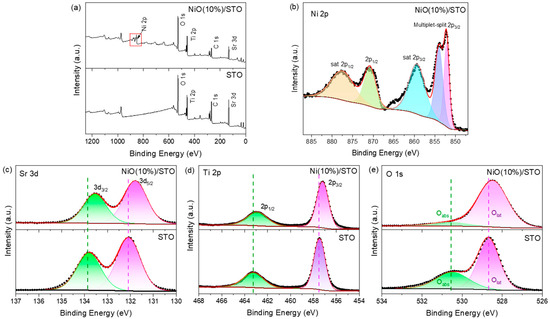
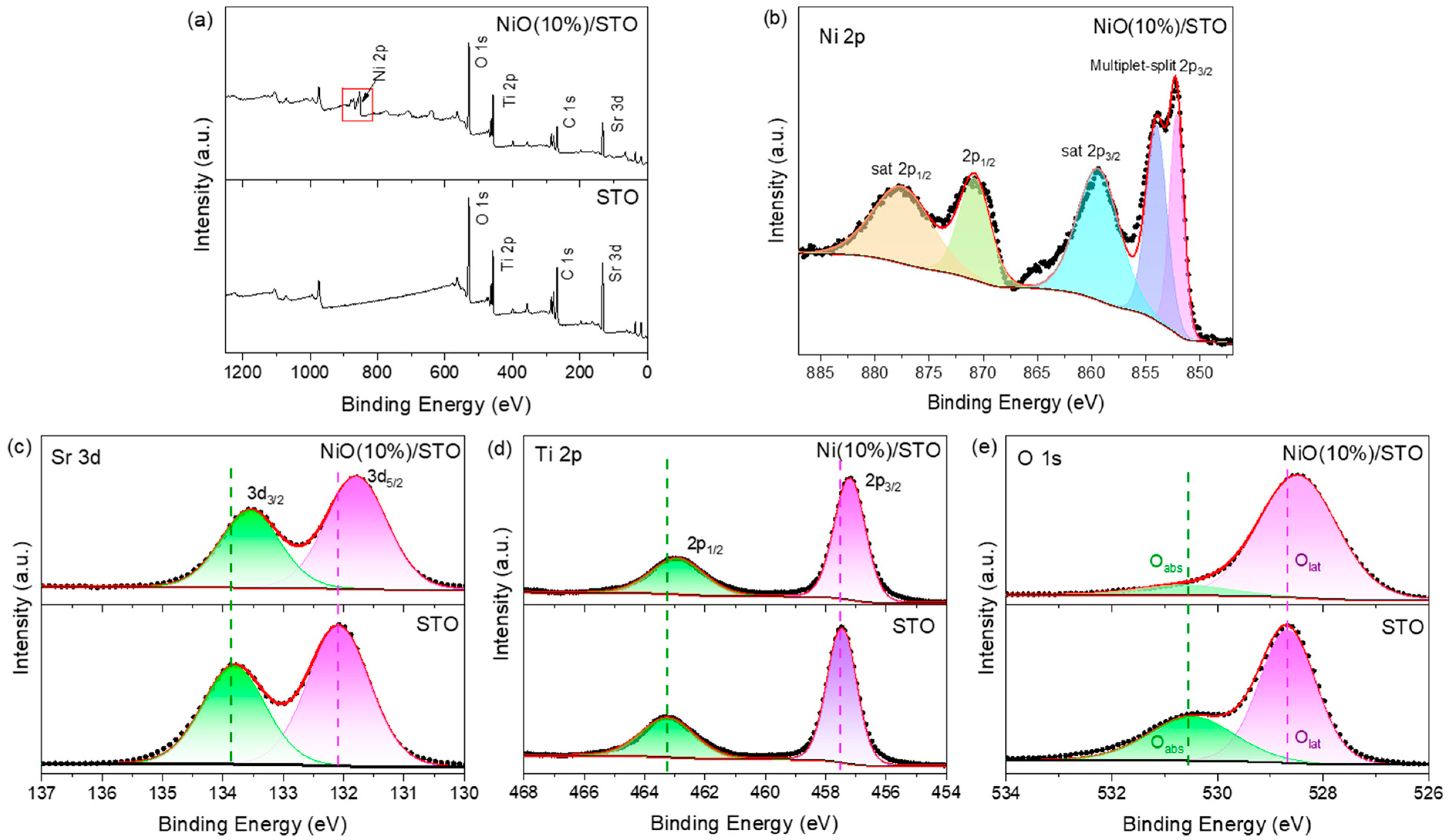
XPS analysis was conducted to investigate the surface chemical states of the samples. All spectra were charge-corrected by C 1s peak at 284.80 eV. The XPS survey spectra (Figure 4a) confirm the presence of C, Sr, Ti, and O elements in both the pure SrTiO3 and NiO (10 wt%)/SrTiO3 samples. The NiO (10 wt%)/SrTiO3 sample exhibits a distinct Ni 2p characteristic peak at approximately 854 eV, indicating the introduction of NiO. The high-resolution Ni 2p spectrum is displayed in Figure 4b. The Ni 2p3/2 region shows two peaks at 852.5 eV and 854.1 eV, which correspond to multiplet-split of Ni2+ 2p3/2, along with a satellite peak at 859.6 eV. The peaks at 872.2 eV and 878.5 eV are attributed to Ni2+ 2p1/2 and its associated satellite peak, respectively [36], indicating that nickel predominantly exists in the form of NiO. Figure 4c shows the Sr 3d XPS peaks at 132.1 eV and 139.8 eV, corresponding to the Sr 3d5/2 and Sr 3d3/2 electronic states of Sr2+ [37]. In the high-resolution Ti 2p spectrum (Figure 4d), the double peaks at 463.3 eV and 457.4 eV can be assigned to the Ti 2p1/2 and Ti 2p3/2 states of Ti4+ [38,39]. Notably, compared to pure SrTiO3, the NiO (10 wt%)/SrTiO3 sample shows discernible shifts in the binding energies of both the Sr 3d and Ti 2p peaks, suggesting electronic interaction between NiO and SrTiO3. In the O 1s spectrum (Figure 4e), the peaks at 528.8 eV and 530.6 eV are attributed to lattice oxygen (Olat) and adsorbed oxygen species (Oads), respectively [40]. The shift in the lattice oxygen peak of the NiO (10 wt%)/SrTiO3 sample compared to pure SrTiO3 further indicates an alteration in the local electronic environment around the oxygen atoms resulting by the introduction of NiO [41]. The binding energy shifts observed in the Sr 3d, Ti 2p, and O 1s spectra indicate strong interfacial electronic coupling between NiO and SrTiO3, providing chemical-state evidence for Fermi level equilibration and the establishment of a built-in electric field at the heterointerface. Collectively, the XPS results confirm the successful construction of the NiO/SrTiO3 heterojunction and substantiate the presence of pronounced interfacial charge redistribution. Such electronic coupling is crucial for facilitating efficient charge separation and suppressing carrier recombination, thereby accounting for the significantly enhanced photocatalytic performance.
Figure 4.
(a) XPS survey spectra of SrTiO3 and the NiO (10%)/STO sample. (b) High-resolution Ni 2p spectrum of the NiO (10%)/STO sample. (c–e) High-resolution Sr 3d, Ti 2p, and O 1s spectra of pure SrTiO3 and the NiO (10%)/STO sample, respectively.
3.2. Optical and Photocatalytic Properties
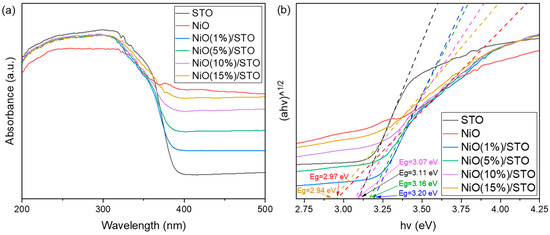
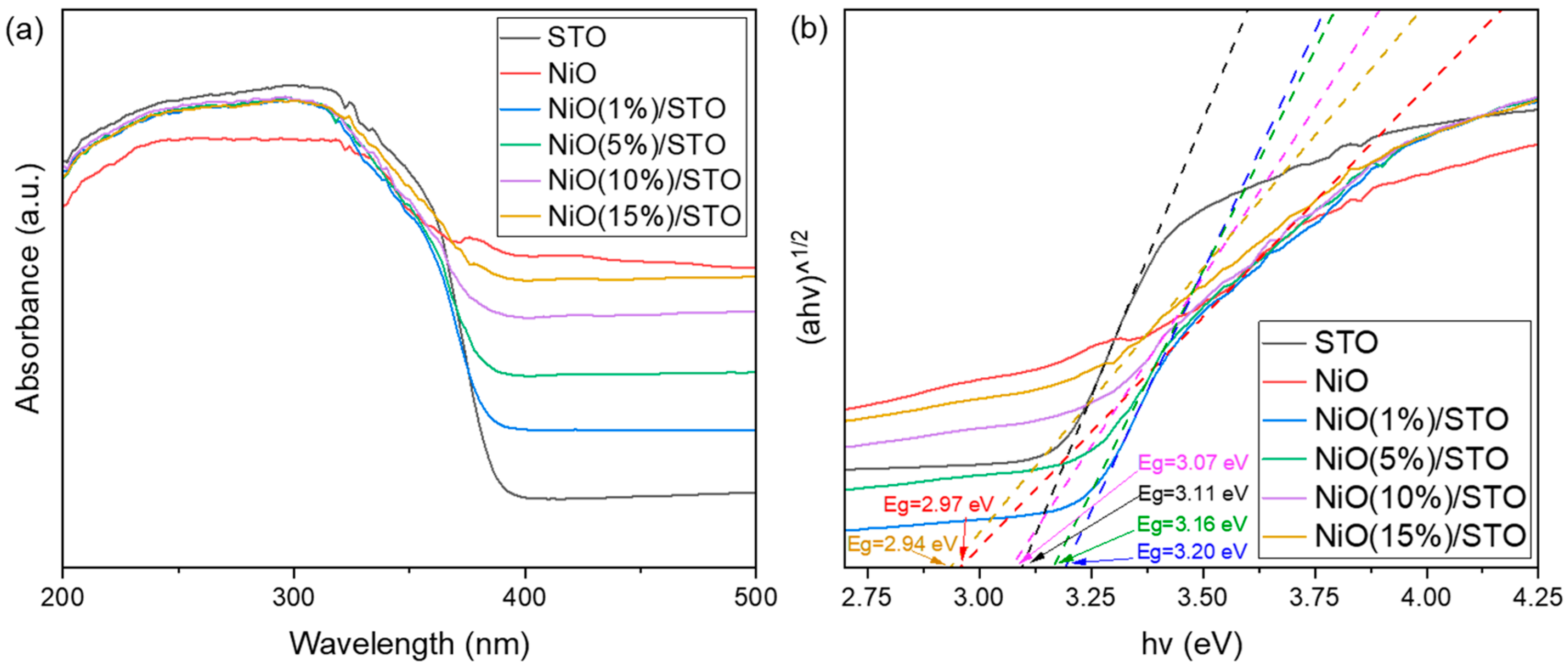
The optical absorption properties of pure SrTiO3, NiO, and NiO/SrTiO3 samples were investigated using DRS. As shown in Figure 5a, pure SrTiO3 exhibits absorption only below 400 nm, indicating its responsiveness solely to ultraviolet light. In contrast, the NiO/SrTiO3 samples display enhanced absorption intensity in the visible-light region (>400 nm), demonstrating that the formation of the heterojunction effectively extends the light-response range of the material [42]. The bandgap energies (Eg) of the samples were estimated by extrapolating the linear portion of plots based on the Kubelka-Munk function versus photon energy [43]. The optical bandgap of pure SrTiO3 is 3.11 eV, close to its theoretical value (3.2 eV), while that of NiO is 2.97 eV. With increasing NiO loading, the bandgap of the composite materials shows a gradual narrowing trend. This variation indicates that the introduction of NiO modifies the band structure of SrTiO3, which contributes to improved visible-light harvesting capacity and thereby provides an optical foundation for enhanced photocatalytic activity [35].
Figure 5.
(a) UV-Vis absorption spectra and, (b) the derived optical band gaps of the NiO/SrTiO3 samples.
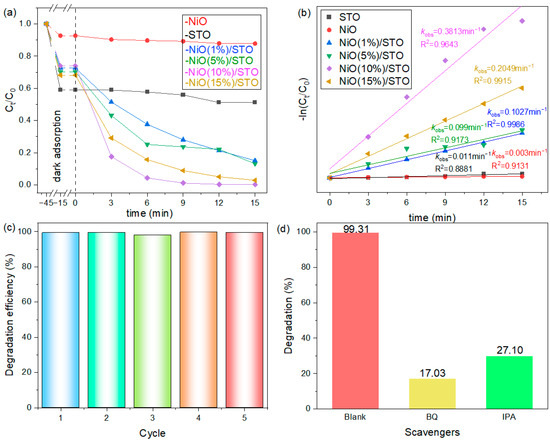
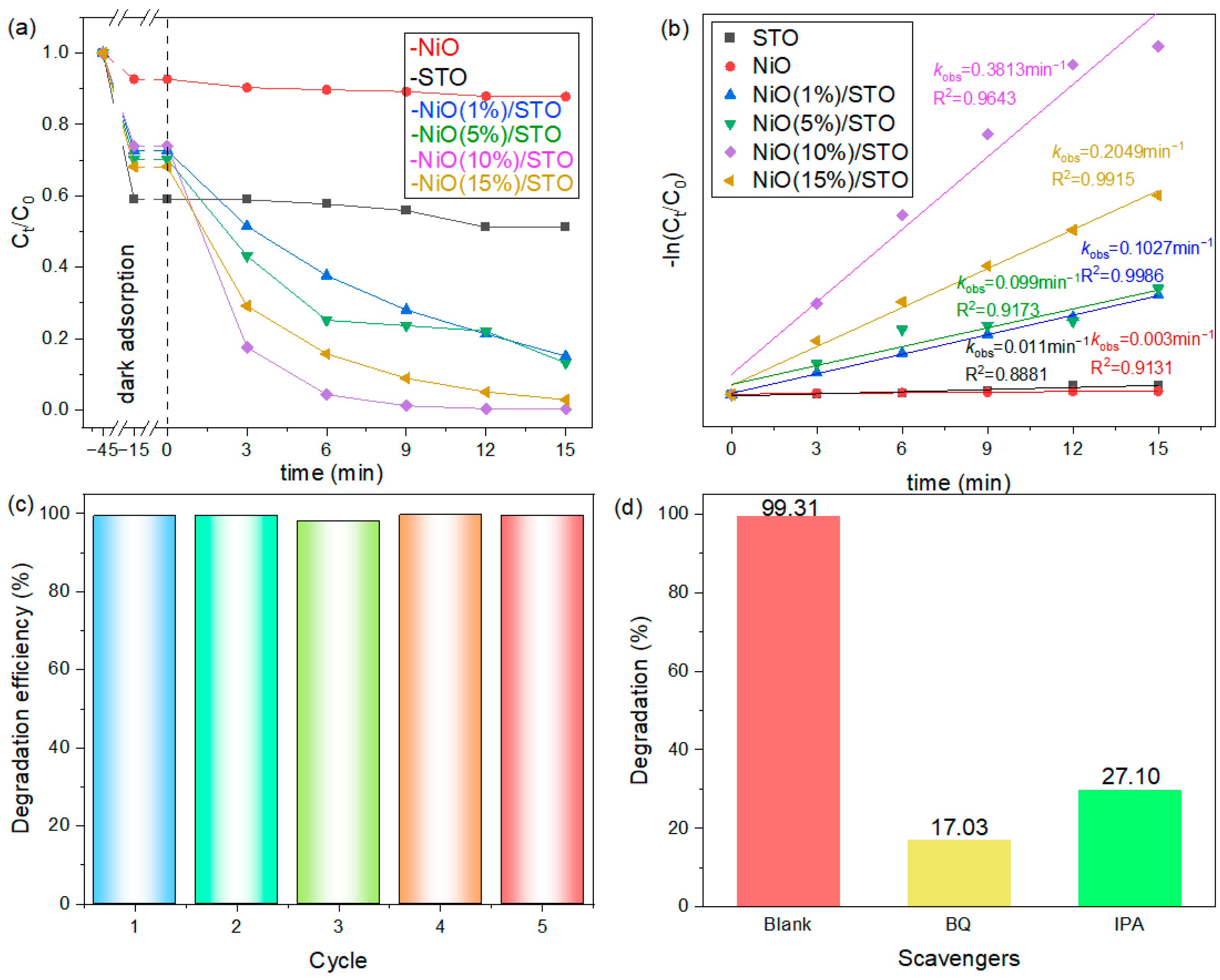
Figure 6a compares the photocatalytic degradation performance of different samples towards methylene blue (MB). Prior to irradiation, the suspension was stirred in the dark to establish adsorption–desorption equilibrium, thereby eliminating the influence of physical adsorption to the photocatalytic degradation. After 15 min of irradiation, almost no degradation activity for MB was observed with either pure SrTiO3 or pure NiO samples. In contrast, the photocatalytic performance of the NiO/SrTiO3 samples initially increased and then decreased with the increasing NiO loading. Among them, NiO (1%)/STO and NiO (5%)/STO degraded approximately 67% of MB within 15 min. The optimal sample, NiO (10%)/STO, achieved complete degradation of MB in just 9 min. When the NiO loading was further increased to 15%, the degradation rate decreased, requiring 15 min for complete degradation of MB. The corresponding apparent photocatalytic rate constants (k) were calculated using the pseudo-first-order kinetics model [44]: −ln(Ct/C0) = kt, where Ct and C0 represent the MB concentration at time t and the initial concentration, respectively. As shown in Figure 6b, the NiO (10%)/STO sample exhibited the highest k value (0.3813 min−1), which is approximately 34.6 times that of the pure SrTiO3 sample (k = 0.011 min−1), highlighting the significant catalytic enhancement effect of the heterojunction structure. Cycling results (Figure 6c) further confirmed the high stability of the catalyst, as no significant activity loss was observed after five consecutive runs, indicating its promising application potential in photocatalytic wastewater treatment. Since hydroxyl radicals (•OH) and superoxide anion radicals (•O2−) are the primary reactive species involved in the photocatalytic degradation of pollutants [45], isopropanol (IPA) and benzoquinone (BQ) were introduced into the reaction system as scavengers for •OH and •O2−, respectively, to identify the dominant active species [46]. As shown in Figure 6d, the degradation efficiency of MB reached 99.31% in the absence of any scavenger. When IPA and BQ were added, the degradation efficiency decreased to 27.10% and 17.03%, respectively, indicating that both •OH and •O2− play active roles in the process [47]. (Detailed experimental procedures for the reactive species trapping experiments are available in the Supporting Information). Furthermore, the prepared NiO (10 wt%)/SrTiO3 sample exhibits superior catalytic activity for organic pollutant degradation compared with other reported SrTiO3-based heterojunction photocatalysts in Table 1. (Due to variations in experimental conditions among different studies, the data listed below are intended for qualitative comparison of performance trends.)
Figure 6.
(a) Adsorption and photodegradation capabilities of the samples for MB. (b) Plots of −ln(Ct/C0) versus irradiation time (t) for the samples. (c) Cycling performance of the NiO (10%)/STO sample. (d) Trapping experiments using different scavengers for the NiO (10%)/STO catalyst.
Table 1.
Comparison of the photocatalytic performance of SrTiO3-based photocatalysts for organic pollutant degradation.
3.3. Photocatalytic Mechanism
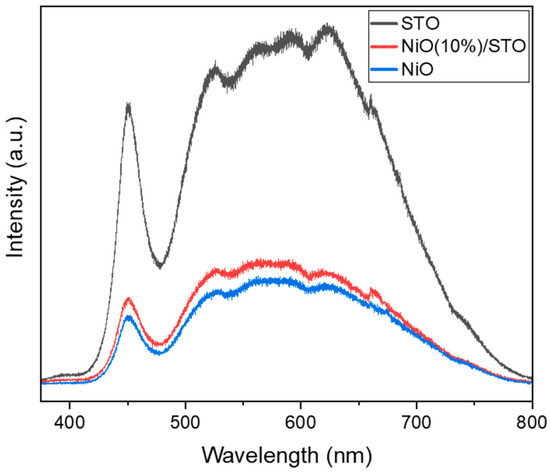
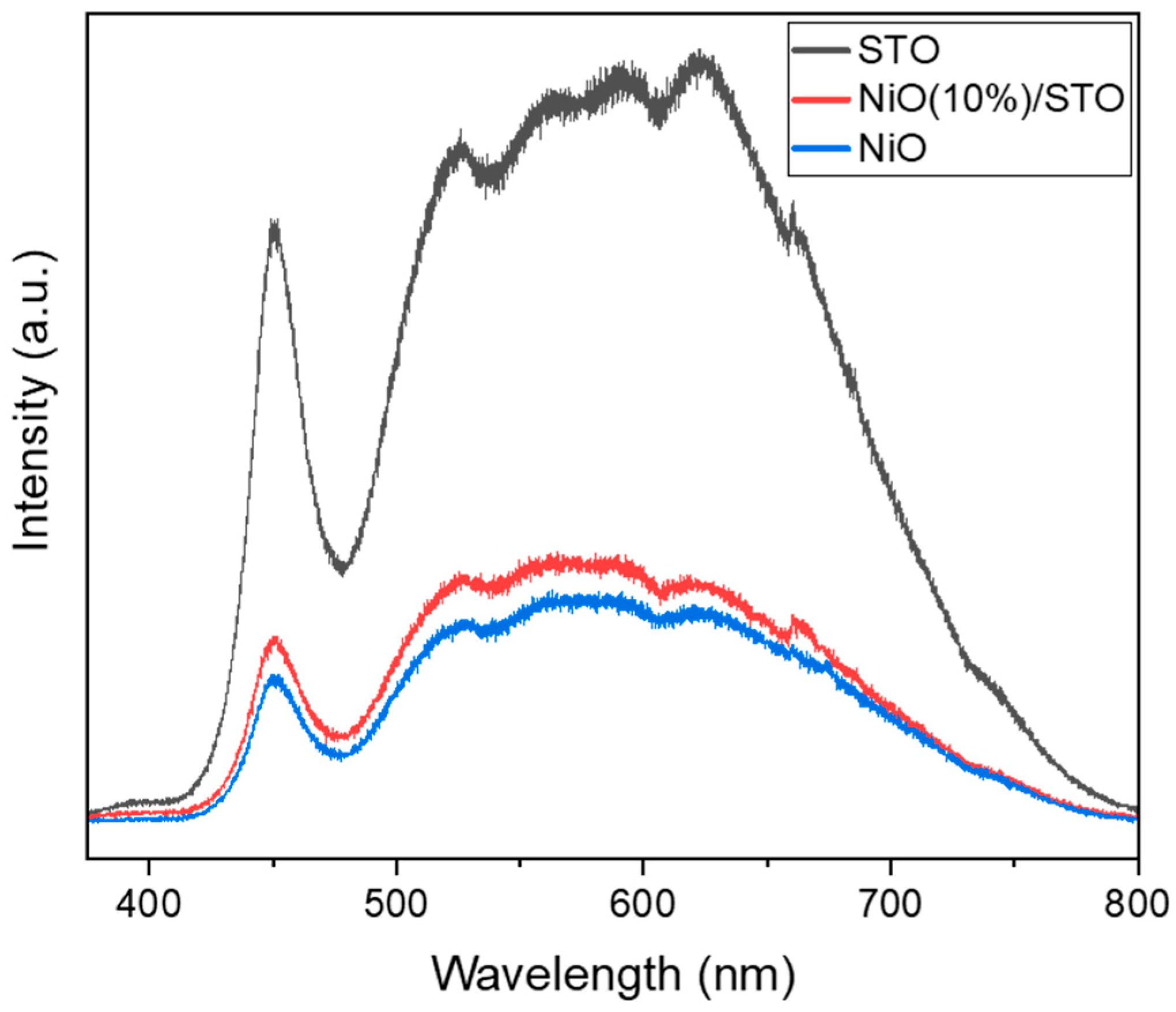
The PL spectra of SrTiO3, NiO, and NiO (10%)/STO were collected to investigate the behavior of charge carriers (Figure 7). The strong emission peak around 450 nm is attributed to band-to-band recombination, consistent with the intrinsic emission of SrTiO3 [55]. NiO exhibits low luminescence intensity, aligning with previous reports [41]. Notably, the PL intensity of the NiO (10 wt%)/SrTiO3 sample is significantly lower than that of pure SrTiO3. Since a lower PL intensity typically indicates a higher charge separation efficiency [56], this suggests that the recombination of photogenerated electrons and holes is effectively suppressed in the NiO (10 wt%)/SrTiO3 sample. This is probably attributed to the formation of an S-scheme charge transfer pathway at the NiO/SrTiO3 junction [32]. Consequently, more charge carriers become available to participate in photocatalytic reactions.
Figure 7.
PL spectra of SrTiO3, NiO, and NiO (10%)/STO.
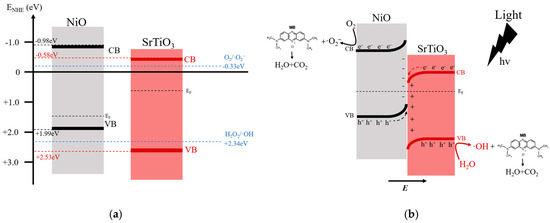
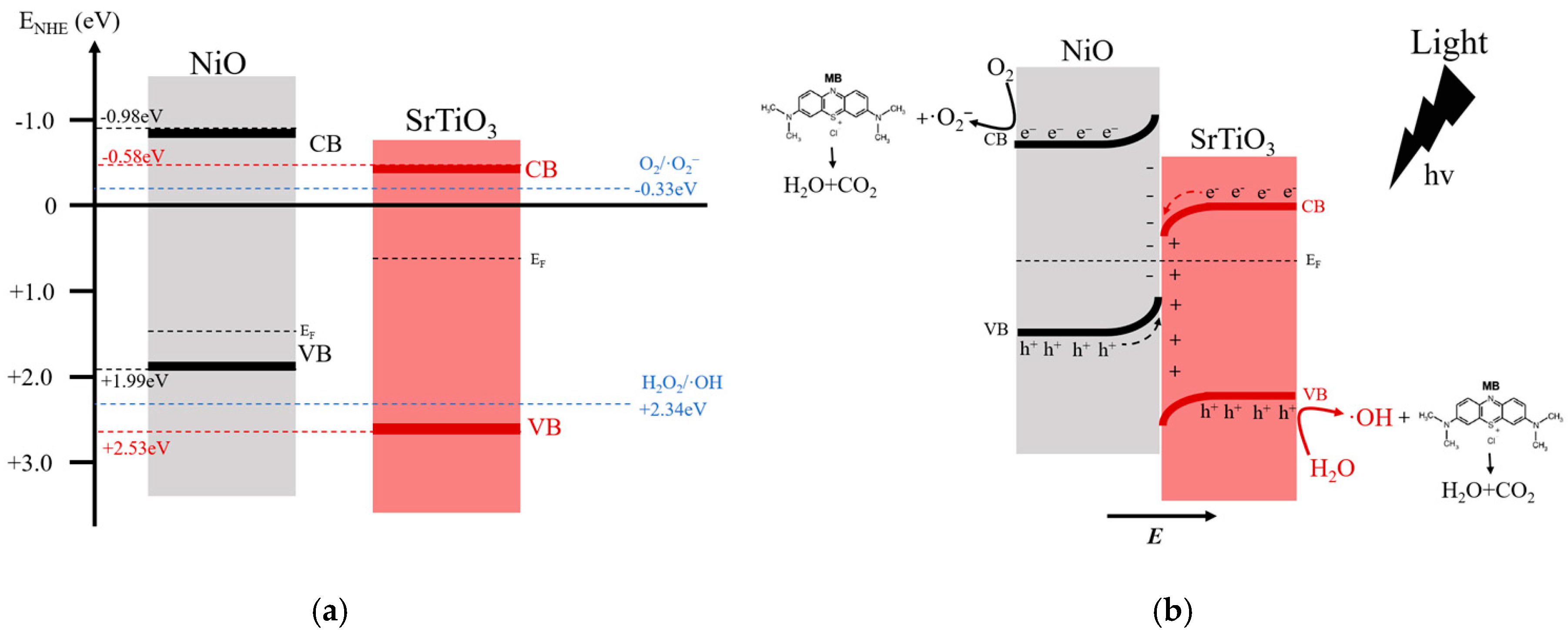
Based on the above results, a possible photocatalytic mechanism is proposed. Figure 8 shows the schematic illustration of energy band positions before and after junction formation [51,57]. When NiO and SrTiO3 contact, a p-n heterojunction is established. Electrons (e−) migrate from SrTiO3 to NiO, while holes (h+) move in the opposite direction. This bidirectional charge transfer generates a built-in electric field at the interface [36]. Due to the mismatch of Fermi levels (EF), band bending occurs at the interface until EF reaches equilibrium, resulting in an upward bending of the bands in NiO and a downward bending in SrTiO3. Under light irradiation, electrons (e−) are excited from the valence band (VB) to the conduction band (CB), generating holes (h+) in the VB [57]. The formation of the built-in electric field facilitates the recombination of low-energy photogenerated carriers [32]. This means that the electrons (e−) in the CB of SrTiO3 recombine with the holes (h+) in the VB of NiO, leaving behind electrons in the CB of NiO (−0.98 eV) and holes in the VB of SrTiO3 (+2.53 eV). Both types of carriers possess strong redox potentials, making them suitable for photocatalytic reactions. The e− in the CB of NiO can react with dissolved O2 molecules in the MB solution, reducing them to superoxide radicals (•O2−), while the h+ in the VB of SrTiO3 can oxidize H2O to generate hydroxyl radicals (•OH) [58]. These reactive oxygen species subsequently attack the complex structure of MB, breaking it down into CO2 and water. The standard redox potentials for the O2/•O2− pair and the H2O/•OH pair are −0.33 eV and +2.34 eV (vs. NHE), respectively. Therefore, the conduction band electrons must possess a potential more negative than −0.33 eV to effectively reduce oxygen, and the valence band holes must have a potential more positive than +2.34 eV to oxidize water [59]. In the NiO (10 wt%)/SrTiO3 heterojunction system, the potential of the conduction band minimum of NiO and the valence band maximum of SrTiO3 meet these requirements, enabling the generation of both superoxide ions and hydroxyl radicals. This strongly supports the operation of an S-scheme charge transfer pathway, where charge separation is enhanced while high redox capability is maintained [60,61].
Figure 8.
(a) Schematic diagram of the band structure of NiO (10%)/STO. (b) Proposed photocatalytic mechanism for MB degradation over NiO (10%)/STO.
4. Conclusions
This study proposed a NiO/SrTiO3 p-n heterojunction photocatalyst to photodegrade the refractory organic pollutant methylene blue (MB) from water bodies. A series of NiO/SrTiO3 samples with different NiO loadings were successfully prepared via a hydrothermal method combined with thermal treatment. The heterojunction structure is formed between NiO and SrTiO3, which extends the light-response range into the visible region and significantly suppresses the recombination of photogenerated charge carriers. The optimal sample, NiO (10%)/SrTiO3, achieved complete degradation of MB within 9 min, with an apparent rate constant of 0.3813 min−1—34.6 times that of pure SrTiO3—while demonstrating good cycling stability. Radical trapping experiments confirmed that •OH and •O2− are the primary active species in the degradation process. Based on band structure analysis and photoluminescence spectroscopy, an S-scheme charge-transfer mechanism is proposed, elucidating the critical role of the built-in electric field at the heterojunction interface in promoting carrier separation while maintaining high redox capability. Overall, the photocatalytic enhancement originates from the synergistic interplay between preserved crystal structure, interfacial electronic interaction, and heterojunction-driven charge separation. This research provides a new pathway for designing efficient and stable SrTiO3-based heterojunction photocatalysts, showing promising application potential for the treatment of organic wastewater.
Supplementary Materials
The following supporting information can be downloaded at: https://www.mdpi.com/article/10.3390/ma19050845/s1, Figure S1. Statistical analysis of particle size: (a) SrTiO3; (b) NiO; Figure S2. The TEM image of SrTiO3 sample; Figure S3. Photocatalytic degradation performance of NiO/SrTiO3 samples: (a) SrTiO3; (b) NiO; (c) NiO (1%)/SrTiO3; (d) NiO (5%)/SrTiO3; (e) NiO (10%)/SrTiO3; (f) NiO (15%)/SrTiO3.
Author Contributions
H.W.: Formal analysis, Investigation, Data curation, Writing—Original draft, Visualization. Y.G.: Visualization, Investigation, Data curation. S.W.: Validation, Writing—review and editing, Supervision. X.Z.: Supervision, Writing—review and editing. Y.X.: Supervision, Writing—review and editing. S.T.: Conceptualization, Writing—review and editing, Supervision, Methodology. All authors have read and agreed to the published version of the manuscript.
Funding
This work was supported by the Natural Science Foundation of Hubei Province (No. 2023AFD055), the National Natural Science Foundation of China (No. 51772229) and 111 project (No. B18038).
Data Availability Statement
The raw data supporting the conclusions of this article will be made available by the authors on request.
Conflicts of Interest
The authors declare no conflicts of interest.
References
- Mahalingam, S.; Charmakani, J.; Ramu, R.; Elumalai, B.; Almutairi, S.M.; Muniyandi, G.R.; Kim, J.; Srinivasan, A.; Bakthavatchalam, S.; Atchudan, R. Emerging silver-doped strontium titanate nanostructures as photocatalysts for the degradation of organic pollutants under visible light. J. Mol. Struct. 2024, 1306, 137854. [Google Scholar] [CrossRef] [Scilit]
- Xie, T.; Ma, X.; Li, Q.; Tian, X.; Si, J. Construction of γ-graphyne and strontium titanate heterostructures for highly efficient photocatalytic degradation. J. Solid State Chem. 2024, 337, 124793. [Google Scholar] [CrossRef] [Scilit]
- Bhava, A.; Shenoy, U.S.; Bhat, D.K. Silver doped barium titanate nanoparticles for enhanced visible light photocatalytic degradation of dyes. Environ. Pollut. 2024, 344, 123430. [Google Scholar] [CrossRef] [Scilit]
- Yavuz, S.C.; Yavuz, E.; Ozdokur, K.V. Superior photocatalytic performance of ZnMoO4/Ag2WO4 for degradation of trimethoprim and methylene blue. Int. J. Environ. Anal. Chem. 2024, 105, 1957–1972. [Google Scholar] [CrossRef] [Scilit]
- Siddeeg, S.M.; Tahoon, M.A.; Mnif, W.; Ben Rebah, F. Iron Oxide/Chitosan Magnetic Nanocomposite Immobilized Manganese Peroxidase for Decolorization of Textile Wastewater. Processes 2019, 8, 5. [Google Scholar] [CrossRef] [Scilit]
- Fujisawa, J.-i. The structure and optical properties of methylene blue dimers. Chem. Phys. Lett. 2025, 883, 142529. [Google Scholar] [CrossRef] [Scilit]
- Huang, S.; Ma, P.; Huang, X.; Huang, G.; Niu, Q.; Luo, F.; Wei, L.; Song, Y.; Chen, S. Preparation of bis (8-hydroxyquinoline) manganese (Mnq2) and study on its photocatalytic degradation performance of methylene blue. React. Kinet. Mech. Catal. 2025, 138, 4339–4351. [Google Scholar] [CrossRef] [Scilit]
- Houas, A.; Lachheb, H.; Ksibi, M.; Elaloui, E.; Guillard, C.; Herrmann, J.-M. Photocatalytic degradation pathway of methylene blue in water. Appl. Catal. B Environ. 2001, 31, 145–157. [Google Scholar] [CrossRef] [Scilit]
- Zhou, S.; Du, Z.; Li, X.; Zhang, Y.; He, Y.; Zhang, Y. Degradation of methylene blue by natural manganese oxides: Kinetics and transformation products. R. Soc. Open Sci. 2019, 6, 190351. [Google Scholar] [CrossRef] [Scilit] [PubMed]
- Cusioli, L.F.; Quesada, H.B.; Baptista, A.T.A.; Gomes, R.G.; Bergamasco, R. Soybean hulls as a low-cost biosorbent for removal of methylene blue contaminant. Environ. Prog. Sustain. Energy 2019, 39, e13328. [Google Scholar] [CrossRef] [Scilit]
- Jawad, A.H.; Abdulhameed, A.S.; Mastuli, M.S. Acid-factionalized biomass material for methylene blue dye removal: A comprehensive adsorption and mechanism study. J. Taibah Univ. Sci. 2020, 14, 305–313. [Google Scholar] [CrossRef] [Scilit]
- Wang, Z.; Gao, M.; Li, X.; Ning, J.; Zhou, Z.; Li, G. Efficient adsorption of methylene blue from aqueous solution by graphene oxide modified persimmon tannins. Mater. Sci. Eng. C 2020, 108, 110196. [Google Scholar] [CrossRef] [Scilit] [PubMed]
- Gopalakrishnan, A.; Singh, S.P.; Badhulika, S. Reusable, few-layered-MoS2 nanosheets/graphene hybrid on cellulose paper for superior adsorption of methylene blue dye. New J. Chem. 2020, 44, 5489–5500. [Google Scholar] [CrossRef] [Scilit]
- Lau, Y.-Y.; Wong, Y.-S.; Teng, T.-T.; Morad, N.; Rafatullah, M.; Ong, S.-A. Degradation of cationic and anionic dyes in coagulation–flocculation process using bi-functionalized silica hybrid with aluminum-ferric as auxiliary agent. RSC Adv. 2015, 5, 34206–34215. [Google Scholar] [CrossRef] [Scilit]
- Kim, S.; Yu, M.; Yoon, Y. Fouling and Retention Mechanisms of Selected Cationic and Anionic Dyes in a Ti3C2Tx MXene-Ultrafiltration Hybrid System. ACS Appl. Mater. Interfaces 2020, 12, 16557–16565. [Google Scholar] [CrossRef] [Scilit]
- Kong, G.; Pang, J.; Tang, Y.; Fan, L.; Sun, H.; Wang, R.; Feng, S.; Feng, Y.; Fan, W.; Kang, W.; et al. Efficient dye nanofiltration of a graphene oxide membrane via combination with a covalent organic framework by hot pressing. J. Mater. Chem. A 2019, 7, 24301–24310. [Google Scholar] [CrossRef] [Scilit]
- Krishnan, S.; Rawindran, H.; Sinnathambi, C.M.; Lim, J.W. Comparison of various advanced oxidation processes used in remediation of industrial wastewater laden with recalcitrant pollutants. IOP Conf. Ser. Mater. Sci. Eng. 2017, 206, 012089. [Google Scholar] [CrossRef] [Scilit]
- Leonel, A.G.; Alcamand, H.A.; Diniz, M.P.V.; Gastelois, P.L.; Krambrock, K.; Houmard, M.; Nunes, E.H.M. Influence of B-site cation on the structural and catalytic properties of LaBO3 (B = Fe, Cu, Co, or Fe + Cu) perovskites. J. Alloys Compd. 2024, 1005, 176260. [Google Scholar] [CrossRef] [Scilit]
- Khan, I.; Saeed, K.; Ali, N.; Khan, I.; Zhang, B.; Sadiq, M. Heterogeneous photodegradation of industrial dyes: An insight to different mechanisms and rate affecting parameters. J. Environ. Chem. Eng. 2020, 8, 104364. [Google Scholar] [CrossRef] [Scilit]
- Zhang, J.; Xu, J. Fabrication of spent FCC catalyst TiO2-V2O5 composite material and its electrocatalytic performance. Braz. J. Chem. Eng. 2024, 42, 647–656. [Google Scholar] [CrossRef] [Scilit]
- Kasbaji, M.; Mennani, M.; Boussetta, A.; Grimi, N.; Barba, F.J.; Mbarki, M.; Moubarik, A. Bio-adsorption performances of methylene blue (MB) dye on terrestrial and marine natural fibers: Effect of physicochemical properties, kinetic models and thermodynamic parameters. Sep. Sci. Technol. 2022, 58, 221–240. [Google Scholar] [CrossRef] [Scilit]
- Alabssawy, A.N.; Hashem, A.H. Bioremediation of hazardous heavy metals by marine microorganisms: A recent review. Arch. Microbiol. 2024, 206, 103. [Google Scholar] [CrossRef] [Scilit]
- Bhatia, D.; Sharma, N.R.; Singh, J.; Kanwar, R.S. Biological methods for textile dye removal from wastewater: A review. Crit. Rev. Environ. Sci. Technol. 2017, 47, 1836–1876. [Google Scholar] [CrossRef] [Scilit]
- Pattanayak, P.; Singh, P.; Bansal, N.K.; Paul, M.; Dixit, H.; Porwal, S.; Mishra, S.; Singh, T. Recent progress in perovskite transition metal oxide-based photocatalyst and photoelectrode materials for solar-driven water splitting. J. Environ. Chem. Eng. 2022, 10, 108429. [Google Scholar] [CrossRef] [Scilit]
- Kumar, A.; Kumar, A.; Krishnan, V. Perovskite Oxide Based Materials for Energy and Environment-Oriented Photocatalysis. ACS Catal. 2020, 10, 10253–10315. [Google Scholar] [CrossRef] [Scilit]
- Yu, K.; Zhang, C.; Chang, Y.; Feng, Y.; Yang, Z.; Yang, T.; Lou, L.-L.; Liu, S. Novel three-dimensionally ordered macroporous SrTiO3 photocatalysts with remarkably enhanced hydrogen production performance. Appl. Catal. B Environ. 2017, 200, 514–520. [Google Scholar] [CrossRef] [Scilit]
- Sohrabian, M.; Mahdikhah, V.; Alimohammadi, E.; Sheibani, S. Improved photocatalytic performance of SrTiO3 through a Z-scheme polymeric-perovskite heterojunction with g-C3N4 and plasmonic resonance of Ag mediator. Appl. Surf. Sci. 2023, 618, 156682. [Google Scholar] [CrossRef] [Scilit]
- Rezaei, M.; Ensafi, A.A.; Heydari-Bafrooei, E. MoS2/SrTiO3-x perovskite heterostructure: Fabrication, characterization, and comprehensive photodegradation study towards Rhodamine B. Colloids Surf. A Physicochem. Eng. Asp. 2025, 708, 135993. [Google Scholar] [CrossRef] [Scilit]
- Wang, K.; Yu, X.; Liu, Z.; Yang, F.; Zhang, J.; Niu, J.; Yao, B. Reconstruction of interface band structure to construct SrTiO3/BiOBr Z-scheme heterojunction for efficient oxytetracycline degradation and hydrogen recovery. Appl. Surf. Sci. 2025, 684, 161977. [Google Scholar] [CrossRef] [Scilit]
- Hu, X.; Wang, G.; Wang, J.; Hu, Z.; Su, Y. Step-scheme NiO/BiOI heterojunction photocatalyst for rhodamine photodegradation. Appl. Surf. Sci. 2020, 511, 145499. [Google Scholar] [CrossRef] [Scilit]
- Ku, Y.; Lee, P.-C.; Luong, G.K.T. Photocatalytic reduction of gaseous carbon dioxide over NiO/TiO2 under UV light illumination. J. Taiwan Inst. Chem. Eng. 2021, 125, 291–296. [Google Scholar] [CrossRef] [Scilit]
- Soni, V.; Sonu; Singh, P.; Thakur, S.; Ahamad, T.; Nguyen, V.-H.; Chaudhary, V.; Kumar, N.; Kaya, S.; Hussain, C.M.; et al. Oxygen vacancy enriched SrTiO3 and NiO-based S-scheme heterojunction moored on activated carbon from exhausted water filter batteries for ameliorated photodegradation of doxycycline hydrochloride and methyl orange degradation. J. Taiwan Inst. Chem. Eng. 2024, 159, 105419. [Google Scholar] [CrossRef] [Scilit]
- Anitha, B.G.; Devi, L.G. Study of reaction dynamics of photocatalytic degradation of 4-chlorophenol using SrTiO3, sulfur doped SrTiO3, silver metallized SrTiO3 and silver metallized sulfur doped SrTiO3 catalysts: Detailed analysis of kinetic results. Surf. Interfaces 2019, 16, 50–58. [Google Scholar] [CrossRef] [Scilit]
- Su, Z.; Fang, F.; Li, X.; Han, W.; Liu, X.; Chang, K. Synergistic surface oxygen defect and bulk Ti3+ defect engineering on SrTiO3 for enhancing photocatalytic overall water splitting. J. Colloid Interface Sci. 2022, 626, 662–673. [Google Scholar] [CrossRef] [Scilit]
- Xu, Y.; Liu, J.; Cao, H.; Zhang, Q. CdS Nanocrystal/NiO nanosheet heterojunction for enhanced visible-light photocatalytic H2 production. Compos. Commun. 2025, 55, 718–728. [Google Scholar] [CrossRef] [Scilit]
- Wang, X.; Ge, L.; Wei, K.; Xing, Z.; Feng, S. Fabrication of S-scheme Zn1-xCdxS/NiO heterojunction for efficient photocatalytic hydrogen evolution. Int. J. Hydrogen Energy 2024, 55, 718–728. [Google Scholar] [CrossRef] [Scilit]
- Bai, P.; Lei, K.; Xie, J.; Wang, H.; Kang, X.; Wang, X. Pd/Ni bimetallic modification of SrTiO3 for enhancement of photocatalytic water splitting. Nanotechnology 2023, 34, 465404. [Google Scholar] [CrossRef] [Scilit] [PubMed]
- Ruan, J.; Zhong, T.; Guo, Y. Enhanced water splitting over ethylenediaminetetraacetate treated SrTiO3 photocatalysts with high crystallinity, reduced size, and surface nanostructure. J. Colloid Interface Sci. 2023, 650, 1424–1433. [Google Scholar] [CrossRef] [Scilit]
- Li, R.; Takata, T.; Zhang, B.; Feng, C.; Wu, Q.; Cui, C.; Zhang, Z.; Domen, K.; Li, Y. Criteria for Efficient Photocatalytic Water Splitting Revealed by Studying Carrier Dynamics in a Model Al-doped SrTiO3 Photocatalyst. Angew. Chem. Int. Ed. 2023, 62, e202313537. [Google Scholar] [CrossRef] [Scilit] [PubMed]
- Xie, J.; Bai, P.; Wang, C.; Chen, N.; Chen, W.; Duan, M.; Wang, H. Enhancing H2 Evolution by Adjusting Oxygen Species at Perovskite SrTiO3. ACS Appl. Energy Mater. 2022, 5, 9559–9570. [Google Scholar] [CrossRef] [Scilit]
- Lu, Y.; Younis, S.A.; Chen, C.; Lu, Z.; Kim, K.-H. Unveiling an inverted S-scheme pathway in nickel oxide/titanium dioxide for enhanced photocatalytic oxidation of gaseous formaldehyde. Compos. Part B Eng. 2025, 306, 112834. [Google Scholar] [CrossRef] [Scilit]
- Khaing, K.K.; Yin, D.; Ouyang, Y.; Xiao, S.; Liu, B.; Deng, L.; Li, L.; Guo, X.; Wang, J.; Liu, J.; et al. Fabrication of 2D–2D Heterojunction Catalyst with Covalent Organic Framework (COF) and MoS2 for Highly Efficient Photocatalytic Degradation of Organic Pollutants. Inorg. Chem. 2020, 59, 6942–6952. [Google Scholar] [CrossRef] [Scilit]
- Wu, Y.; He, T. Ag loading induced visible light photocatalytic activity for pervoskite SrTiO3 nanofibers. Spectrochim. Acta Part A Mol. Biomol. Spectrosc. 2018, 199, 283–289. [Google Scholar] [CrossRef] [Scilit] [PubMed]
- Liu, Z.; Ma, Z. Ag-SrTiO3/TiO2 composite nanostructures with enhanced photocatalytic activity. Mater. Res. Bull. 2019, 118, 110492. [Google Scholar] [CrossRef] [Scilit]
- Zhu, L.; Liu, Z.; Xia, P.; Li, H.; Xie, Y. Synthesis of hierarchical ZnO&Graphene composites with enhanced photocatalytic activity. Ceram. Int. 2018, 44, 849–856. [Google Scholar]
- Chen, S.; Hu, Y.; Meng, S.; Fu, X. Study on the separation mechanisms of photogenerated electrons and holes for composite photocatalysts g-C3N4-WO3. Appl. Catal. B Environ. 2014, 150–151, 564–573. [Google Scholar] [CrossRef] [Scilit]
- Nuengmatcha, P.; Porrawatkul, P.; Chanthai, S.; Sricharoen, P.; Limchoowong, N. Enhanced photocatalytic degradation of methylene blue using Fe2O3/graphene/CuO nanocomposites under visible light. J. Environ. Chem. Eng. 2019, 7, 103438. [Google Scholar] [CrossRef] [Scilit]
- Xu, X.; Chen, C.; Shu, L.; Cheng, C.; Tang, Z.; Wang, Y.; Pan, L.; Guan, Z. Anchoring SrTiO3 nanoparticles on layered ZnIn2S4 to construct S-scheme heterojunctions as novel photocatalysts for efficient degradation of MO dye. FlatChem 2023, 41, 100526. [Google Scholar] [CrossRef] [Scilit]
- Feng, Y.; Hou, Y.; Liao, L.; Li, Z.; Wang, D.-D.; Liu, S.; Zhou, W.; Guo, L. Construction of SrTiO3/TiO2 assembly towards optimized photocatalytic performance. J. Photochem. Photobiol. A Chem. 2026, 470, 116674. [Google Scholar] [CrossRef] [Scilit]
- Xia, Y.; He, Z.; Hu, K.; Tang, B.; Su, J.; Liu, Y.; Li, X. Fabrication of n-SrTiO3/p-Cu2O heterojunction composites with enhanced photocatalytic performance. J. Alloys Compd. 2018, 753, 356–363. [Google Scholar] [CrossRef] [Scilit]
- Li, L.; Li, J.; Xi, W.; Shu, J. Preparation of SrTiO3/PPy Composites and Photocatalytic Degradation of RhB. Catal. Lett. 2025, 155, 291. [Google Scholar] [CrossRef] [Scilit]
- Zhang, W.; Xiang, Y.; Li, X.; Huang, X.; Qian, X. Construction of oxygen vacancy mediated direct Z scheme Bi2WO6/SrTiO3 hybrid on cellulose fibers for high-performance and recyclable photocatalytic paper. J. Colloid Interface Sci. 2022, 622, 40–49. [Google Scholar] [CrossRef] [Scilit] [PubMed]
- Hosseinzadeh, G.; Sajjadi, S.M.; Mostafa, L.; Yousefi, A.; Vafaie, R.H.; Zinatloo-Ajabshir, S. Synthesis of novel direct Z-scheme heterojunction photocatalyst from WO3 nanoplates and SrTiO3 nanoparticles with abundant oxygen vacancies. Surf. Interfaces 2023, 42, 103349. [Google Scholar] [CrossRef] [Scilit]
- Wen, M.; Guo, Q.; Liu, X.; Li, X.; Li, H.; Zhan, H.; Liu, W. Constructing nanoflower-like semiconductor–insulator SrCO3/SrTiO3 heterojunction photocatalyst for the efficient removal of TC by the synergistic effect of adsorption and photocatalysis. Polyhedron 2025, 271, 117420. [Google Scholar] [CrossRef] [Scilit]
- Chen, X.; Zhang, L.; Liu, Q.; Li, B.; Wu, S.; Tian, S. Enhanced photocatalytic properties of MWCNTs-decorated SrTiO3–SrCO3 hierarchical structures achieved by efficient charge transfer. Ceram. Int. 2024, 50, 10232–10240. [Google Scholar] [CrossRef] [Scilit]
- Zhuang, S.; Xu, X.; Feng, B.; Hu, J.; Pang, Y.; Zhou, G.; Tong, L.; Zhou, Y. Photogenerated Carriers Transfer in Dye–Graphene–SnO2 Composites for Highly Efficient Visible-Light Photocatalysis. ACS Appl. Mater. Interfaces 2013, 6, 613–621. [Google Scholar] [CrossRef] [Scilit]
- Lee, F.; Abdullah, L.C.; Ramli, I.; Shamsuri, A.A.; Daik, R.; Mohd Noor, I.S.; Md Jamil, S.N.A. Biogenic fabrication of S-scheme NiO–FeWO4 heterojunction nanocomposite using Cassava (Manihot esculenta Crantz) leaf extract for visible-light-driven dye degradation: Synthesis, characterisation and photocatalytic evaluation. Ceram. Int. 2025, 51, 60217–60233. [Google Scholar] [CrossRef] [Scilit]
- Wu, Y.; Guo, Y.; Gao, Y.; Ma, B.; Xu, Y.; Yang, S.; Wang, X.; Zhao, W.; Liu, Y. Dual-function reusable substrates based on magnetic S-scheme ZnFe2O4-Cu2O-Au nanocomposites: Efficient photocatalytic degradation and sensitive SERS detection of ciprofloxacin. Ceram. Int. 2025, 51, 48806–48816. [Google Scholar] [CrossRef] [Scilit]
- Salazar-Marín, D.; Oza, G.; Real, J.A.D.; Cervantes-Uribe, A.; Pérez-Vidal, H.; Kesarla, M.K.; Torres, J.G.T.; Godavarthi, S. Distinguishing between type II and S-scheme heterojunction materials: A comprehensive review. Appl. Surf. Sci. Adv. 2024, 19, 100536. [Google Scholar] [CrossRef] [Scilit]
- Alsaggaf, W.T.; Mohamed, R.M. Constructing a robust mesoporous S-scheme heterojunction AgVO3/ZnWO4 for visible-light-driven oxidation of atrazine. Ceram. Int. 2025, 51, 40193–40203. [Google Scholar] [CrossRef] [Scilit]
- Alomayri, T. Enhanced interfacial charge transfer in BiVO4/rGO/FeVO4 heterojunction composite for improved photocatalysis water purification. Ceram. Int. 2025, 51, 10193–10199. [Google Scholar] [CrossRef] [Scilit]

Disclaimer/Publisher’s Note: The statements, opinions and data contained in all publications are solely those of the individual author(s) and contributor(s) and not of MDPI and/or the editor(s). MDPI and/or the editor(s) disclaim responsibility for any injury to people or property resulting from any ideas, methods, instructions or products referred to in the content. |
© 2026 by the authors. Licensee MDPI, Basel, Switzerland. This article is an open access article distributed under the terms and conditions of the Creative Commons Attribution (CC BY) license.