


Abstract
Based on a thermodynamic approach, a unified formula was proposed to describe distinct Hall–Petch relationships (HPRs) of unalloyed nanostructured materials (u-NSs: Fe, Cu, Ni, Pd, and Mo) and alloyed ones with low- or high-melting temperature alloying metals (low-Tm or high-Tm a-NSs: NixMo1−x, FexZr1−x, NixCu1−x, and FexCu1−x). As the grain size decreases to several nanometers, the yield strength first increases and then decreases for u-NSs and low-Tm a-NSs, obeying the inverse HPR (IHPR), while it monotonically increases for high-Tm a-NSs. For the former, the decrease is induced by the reduction in activation energies of interface migration and dislocation gliding, along with the thermally driven decline, lattice expansion, and bond weakening of interface atoms. In the latter case, the monotonic increase or the elimination of IHPR is relevant to the negative interface energy induced by the segregation of alloying atoms at grain boundaries. Our predictions are validated by the available experimental results.
1. Introduction
Nanostructured materials (NSs) are commonly used in various fields due to their high strength/weight ratio compared to coarse-grained counterparts [1,2,3]. The mechanical properties of unalloyed NSs (u-NSs) have aroused much attention thanks to their high strength, which is linked to their small grain size (D) [4]. When D > 30 nm, for example, the yield strength (σ) increases with lowering D. This is the Hall–Petch relationship (HPR) [5,6], and, considering the temperature effect, it can be given as [7,8,9]
where T is the working temperature, σ(T,∞) is the friction stress with bulk ∞, and kd(T) is a constant depending on the resistance to dislocation movement at grain boundaries (GBs). As D decreases, the GB/volume ratio increases, resulting in enhanced dislocation pile-ups at GBs, and then increased σ(T,D) [10,11]. As D decreases further, however, σ(T,D) does not always increase but can begin to decrease below a critical size (Dc), which is the inverse HPR (IHPR) [11]. IHPR has also been observed for alloyed NSs with low-melting-temperature (Tm) alloying metals (low-Tm a-NSs) [12,13]. However, such a decrease in σ(T,D) is absent for a-NSs with high-Tm alloying metals (high-Tm a-NSs) [14,15]. To further our understanding of the strengthening mechanisms of NSs, it is necessary to elucidate distinct relationships for u-NSs and a-NSs. Several classical models have been proposed for IHPR, such as the dislocation-based model [7,16], the diffusion-based model [17], the GB-shearing model [18], and the grain-boundary phase or bonding model [19,20], but they fail to elucidate the elimination of IHPR for high-Tm a-NSs.
Based on Lindemann’s melting criterion and Mott’s expression of vibrational entropy (Svib), our group proposed that the decrease in Tm(D) of nanocrystals (NCs) induced by surface coordination imperfection can be modeled as (D)/Tm(∞) = exp[(−2Svib/3R)/(D/D0 − 1)] [21,22], where Svib ≈ Sm = Hm/Tm, with Sm being the melting entropy and Hm the melting enthalpy; R is the ideal gas constant; and D0 = 6h denotes the critical diameter, with h as the atomic diameter, where almost all atoms of the NC are located on the surface and the crystalline structure is no longer stable. Using such a D-dependent (D) formula and a phenomenological equation with σ(T,D) relying on the conventional GB gliding through boundary diffusion [9,23], where boundary diffusion or analogous behavior is also important at room temperature for NSs [24,25,26], a thermodynamic model for σ(T,D) of NSs at room temperature and above was proposed as [27]
where σ′(∞) is a T-independent term, kt is a constant, and kd′(T) = kd(T)/exp[(D)/(2T)]. The σ′(∞), kt, and kd′(T) values can be figured out by fitting results from the literature. However, since the grains of NSs are different to those of NCs with free surfaces, the aforesaid (D) formula in Equation (2) is inappropriate for plotting the HPR or IHPR curves of NSs. Specifically, the grains of NSs possess weaker bond deficits with a lower interface energy compared to free NCs, resulting in the variation in thermal properties of NSs differing to that of free NCs [28,29]. Moreover, Equation (2) also fails to elucidate the elimination of IHPR for high-Tm a-NSs. A comprehensive model effective to elucidate distinct relationships between D and σ(T,D) of u-NSs and a-NSs is still required.
Attempts have been made to study the Young’s modulus (Y) of NSs, and it was found that the Y(T,D) of NSs decreases on lowering D, and that such a decrease is smaller than that of free NCs [30,31]. Using in situ tensile tests, moreover, Zhu et al. [32] found that the Y(T,D), σ(T,D), and ultimate tensile strength of Ag nanowires increase on lowering D, and proposed that the D-dependence of σ(T,D) is mainly caused by the stiffening size effect of Y(T,D). One may thus expect that the σ(T,D) of NSs can be worked out by solving the D-dependent Y(T,D). By considering the effects of thermally driven effect, lattice expansion, and bond weakening concerning the coordination imperfection of GBs, a model regarding the D-dependent Y(T,D) of NSs was proposed as [29]
where YT(T,D)/Y(T,∞) denotes the thermally driven effect associated with (D), and YB(0,D)/Y(0,∞) denotes the effects of lattice expansion and bond weakening. Equation (3) indicates the importance of the thermally driven effect, lattice expansion and bond weakening in σ(T,D) variation in NSs. In addition, since the local energy density decreases as the bond energy declines, σ(T,D) should also decrease according to the proportional relationship between σ(T,D) and energy density [33]. Furthermore, in a-NSs, alloying atoms tend to aggregate at GBs, where they form new bonds and thereby alter the nature of the GBs [14,34]. Specifically, when these newly formed bonds are weaker than the interior bonds of the base metal (e.g., in low-Tm a-NSs), the GB energy (γgb) is positive, indicating that additional energy is required to form such GBs. In contrast, when GB bonds are stronger than interior bonds (e.g., in high-Tm a-NSs), γgb becomes negative, implying that the GBs are energetically more stable than the bulk of the base metals. This fundamental change in GB energetics leads to distinct variation trends for σ(T,D). However, these contributions have not previously been considered in evaluating the σ(T,D) of NSs. It is notable that this linkage between the Tm of alloying elements and the sign of γgb should be regarded as a first-order approximation. In real NSs, γgb is also strongly influenced by segregation chemistry, complexion transitions, and interfacial phases. Incorporating such effects would be a valuable direction for future refinement of the framework.
In this contribution, we developed a unified formula to predict the σ(T,D) values of u-NSs and a-NSs by considering the interface energy based on presently available theories of fine grain strengthening, solid solution strengthening, and alloying strengthening. The roles of γgb, lattice expansion, and bond weakening were also evaluated by considering the alloying effect. The predictions are in good agreement with the experimental results.
2. Methods
Referencing Equations (1)–(3) and combining the aforesaid proportional relationship between σ(T,D) and Y(T,D), σ(T,D) of NSs can be evaluated by
where k(T) is a constant; σT(T,D)/σ(T,∞) = [(D) − T]/[Tm(∞) − T], denoting the thermally driven effect; and σB(0,D)/σ(0,∞) = [h(∞)3ε(D)]/[h(D)3ε(∞)] denoting the effects of lattice expansion and bond weakening, with h being the lattice constant and ε the bond energy. The k(T)D−1/2exp [2(D)/T] term covers the contributions from the activation energies of interface migration and dislocation gliding [20,27].
The (D), h(D), and ε(D) values should be known to obtain σ(T,D) using Equation (4). Based on the aforementioned (D) equation and considering the role of γgb, (D) was explored with [28]
where δ is the additional term induced by the difference between the free surface and the solid–solid interface, which can be given as
where γsv is the surface energy. Meanwhile, h(D) and ε(D) can be worked out using a hard-sphere approach and the D-dependent interface energy [35], as follows:
where
Here, Ec(D) is the cohesive energy of NSs, and Zb and Zgb denote the atomic coordination numbers of bulk and GBs, respectively. Zb = 8 and Zgb = 7 for body-centered cubic (BCC) crystals, and Zb = 12 and Zgb = 11 for face-centered cubic (FCC) and hexagonal close-packed (HCP) crystals. Sb = Hb/Tb is the bulk solid–vapor transition entropy, with Hb being the heat of vaporization and Tb the boiling point.
In addition, Y(T,D) declines as the difference between T and (D) decreases [36]. On lowering D, the velocity of atomic movement accelerates through the thermally driven effect, altering the degree of plastic deformation. It is thus necessary to consider the influence from T and (D) suppression using the thermally driven term. Substituting the D-dependent (D) in Equation (5) into Equation (4), a unified formula can be developed as
Here, k(T) can be obtained by fitting experimental results regarding σ(T,D) as the function of D at a certain T using the least-squares method in order to ensure consistency across a wide range of reported experiments. k(T) represents an effective parameter integrating several physically meaningful contributions, similar to the classical Hall–Petch coefficient. Hence, even with only a small number of data points, Equation (10) can be adopted to predict the σ(T,D) values of u-NSs and a-NSs at any D in the full size range from micrometer to nanometer, including the maximums of σ(T,D) at Dc.
To work out σ(T,D) with Equation (10), the δ term should be solved with the γgb associated with Equation (6). For u-NSs, γgb(∞) = 4hHmSvib/(3VsR) with Vs being the molar volume [37]. For a-NSs, γgb(∞) = Ecb(∞) − Ecgb(∞) [38], where Ecb(∞) and Ecgb(∞) denote the cohesive energies of bulk atoms and GB atoms, respectively. Also, Ecb = Zbεb/2 and Ecgb = [Zgbεgb + (Zb − Zgb)εb]/2 with Zgb = Zsv, where Zsv is the atomic coordination number of a surface, εb and εgb are the bond energies of the bulk and GBs, respectively. Generally, NCs consist of (111) facets with Zsv = 9 and (100) facets with Zsv = 8 [37]. Zgb = (N100Z100 + N111Z111)/(N100 + N111) is thus used, where N100 and N111 are the numbers of (100) and (111) facets, respectively. NCs can be described by the Wulff construction developed by minimizing γsv with a given enclosed volume [37,39,40,41], where truncated octahedra with regular hexagonal facets are regarded as the regular one [42]. Upon this, N100/N111 = 3(n2 − 4n + 4)/[4(3n2 − 9n + 7)], and Ntotal = 16n3 − 33n2 + 24n − 6, where Ntotal is the total number of atoms and n is the number of atoms at the edge. As n or N increases, N100/N111 increases by up to 25%. Accordingly, the equivalent D of the faceted cluster can be given as D = Ntotal1/3h [42]. Moreover, the case of N100/N111 = 0, with the assumption that the surface consists only of (111) facets, is also calculated for comparison. For a-NSs, γgb(∞) is positive for low-Tm a-NSs since Ecb(∞) > Ecgb(∞), but it becomes negative for high-Tm a-NSs since Ecb(∞) < Ecgb(∞).
3. Results and Discussion
Figure 1 plots the σ(T,D) curves for u-NSs of Fe, Cu, Ni, Pd, and Mo. On lowering D, σ(T,D) increases and then reaches a maximum value when D = Dc, where Dc is about 10–30 nm. Below Dc, the further decrement of D leads to a shrinkage of σ(T,D). As D > Dc, (D) approximately equals to Tm(∞). The excess volume at GBs and the interface energy are both large [43], enhancing the dislocation pile-ups and hindering the dislocation movement at GBs. This results in the increase in σ(T,D) with lowering D. As D < Dc, however, (D) decreases accompanied by interface softening [26]. As a result, the boundary diffusion or gliding begins to dominate the deformation, and σ(T,D) starts to decrease. Meanwhile, the thermally driven decline can be enhanced by the decrease in (D), while lattice expansion and bond weakening may also enhance interface softening. All these effects lead to a reduction in σ(T,D) below Dc. Notably, currently available experimental data for σ(T,D) in u-NSs and a-NSs cover only limited D ranges; however, the variation trends predicted by our model are broadly consistent with the experimentally observed trends within the accessible ranges.
Figure 1.
σ(T,D) as a function of D−1/2 for u-NSs of (a) Fe, (b) Cu, (c) Ni, (d) Pd, and (e) Mo using Equation (10). T = 300 K in (a–d), and T = 293 K in (e). Symbols are experimental results with ▲ [44], ★ [44], and ● [45] in (a) for u-NSs of Fe, ▲ [44], ▽ [25], ○ [46], and ● [45] in (b) for Cu u-NSs, ◇ [47], ▽ [47], ■ [48], △ [49], and ● [48] in (c) for u-NSs of Ni, ● [25] and □ [50] in (d) for u-NSs of Pd, and ■ [45] in (e) for u-NSs of Mo. ▽ in (b) is a theoretical result from ref. [51]. See Table 1 for the necessary parameters.
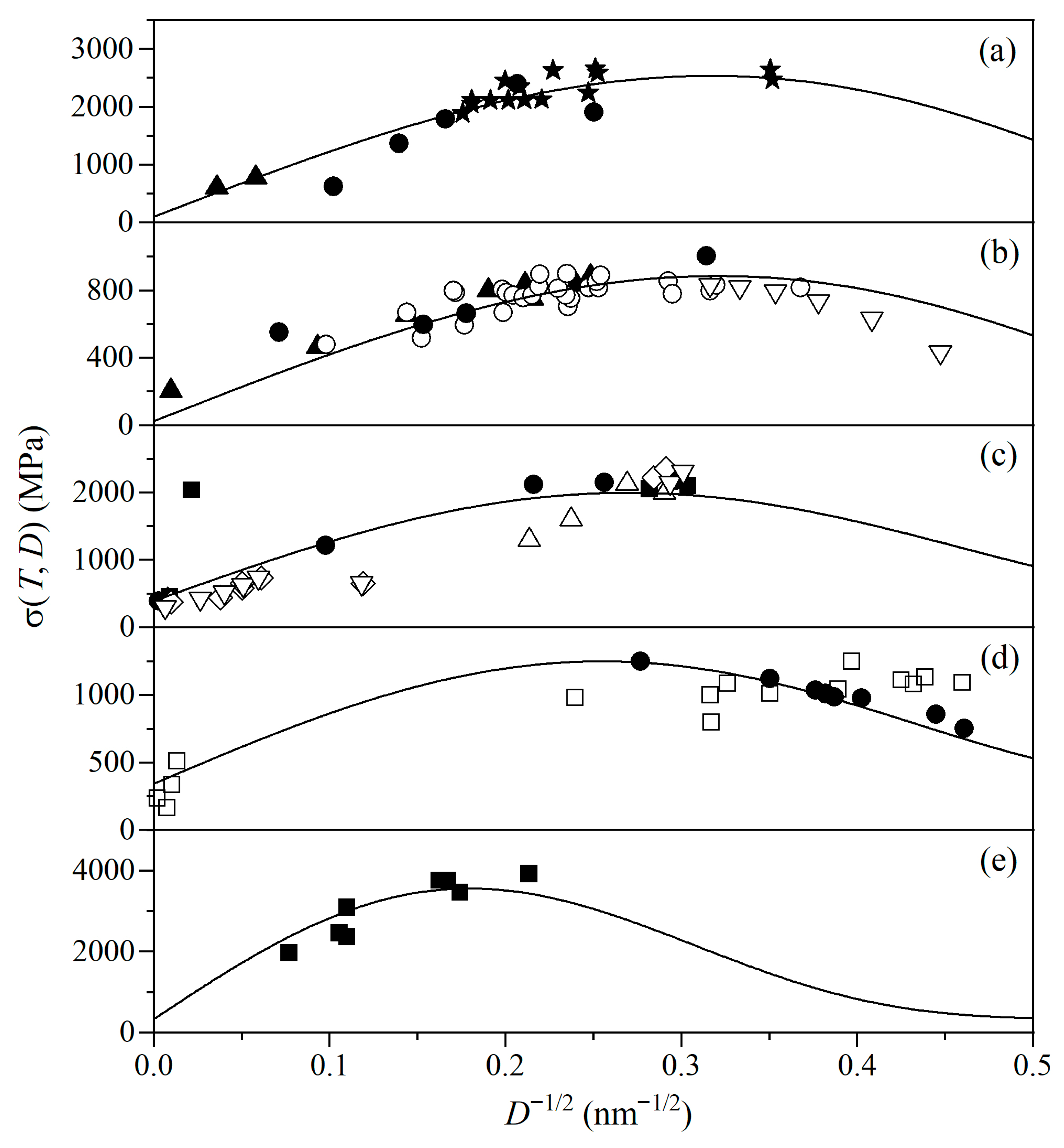
Table 1.
Parameters of the selected metals used in the model calculation.
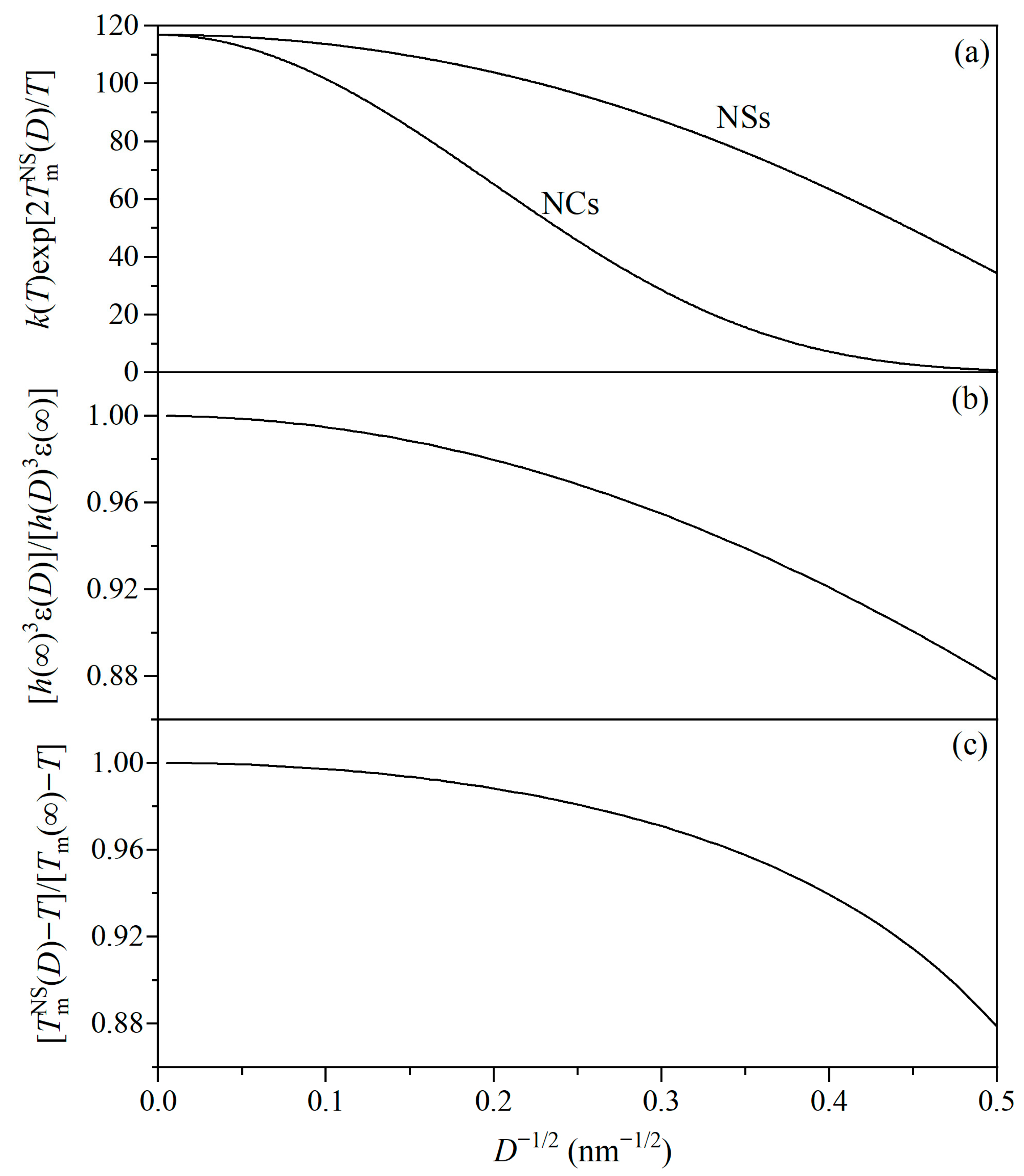
To further understand the roles of activation energy, lattice expansion and bond weakening, and thermally driven effects in the reduction in σ(T,D), Figure 2 gives the curves of k(T)exp [2(D)/T], [h(∞)3ε(D)]/[h(D)3ε(∞)], and [(D) − T]/[Tm(∞) − T] as functions of D−1/2 for u-NSs of Fe, where the case of free NCs is also given in Figure 2a. From Figure 2a, the contribution of activation energy to the reduction in σ(T,D) increases on lowering D for u-NSs and free NCs. At temperatures far below Tm(∞), GBs are hard and exist as barriers to the dislocation movement. However, GBs start to soften due to the (D) suppression, and the activation energy of GBs migration decreases, resulting in the reduction in σ(T,D). Moreover, the variation in u-NSs is weaker than that of free NCs because γgb/γsv < 1. Figure 2b shows that the effects of lattice expansion and bond weakening on the reduction in σ(T,D) increase with lowering D. The lattice expansion of u-NSs at small D values leads to Y(T,D) suppression at room temperature [29]. As there is a proportional relationship between the shear modulus (G) and Y(T,D), G(T,D) also decreases with lowering D. Moreover, h(D) increases with lowering D, and thus the lattice resistance decreases accordingly, leading to easier dislocation movement and plastic deformation [55]. Moreover, the single bond energy weakening of u-NSs brings about a decline of local energy density. Due to the proportional relationship between Y(T,D) and the bond energy density [33], Y(T,D) and σ(T,D) also decrease. The thermally driven effect on the reduction in σ(T,D) is found to become more obvious with lowering D from Figure 2c. As D decreases, the ratio of low-coordination atoms at GBs to total atoms increases, resulting in the decrement of (D). This means that u-NSs have high-temperature properties with lowering D, leading to the further reduction in σ(T,D).
Figure 2.
(a) k(T)exp [2(D)/T], (b) [h(∞)3ε(D)]/[h(D)3ε(∞)], and (c) [(D) − T]/[Tm(∞) − T] as functions of D−1/2 for u-NSs of Fe using Equations (5)–(9) with T = 300 K, where the case of free NCs with (D) is also plotted in (a) for comparison. See Table 1 for the necessary parameters.
As regards the strength of contributions from different effects, the contribution of activation energy to the reduction in σ(T,D) is up to 70% at D−1/2 = 0.5 nm−1/2 from Figure 2a, and the combined contribution of lattice expansion and bond weakening and the thermally driven effect increases up to around 24% at D−1/2 = 0.5 nm−1/2 from Figure 2b,c. This infers that the effects of lattice expansion and bond weakening and the thermally driven effect are relatively weak but cannot be neglected.
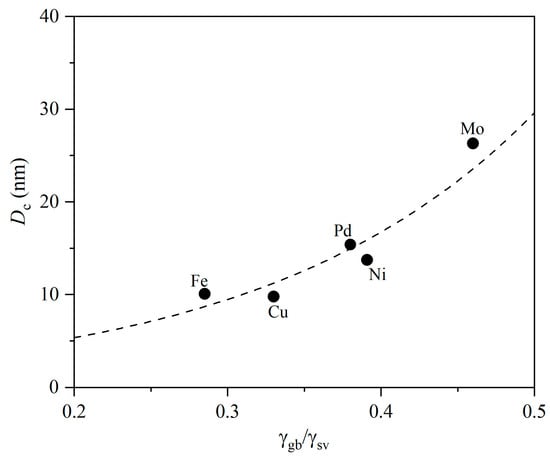
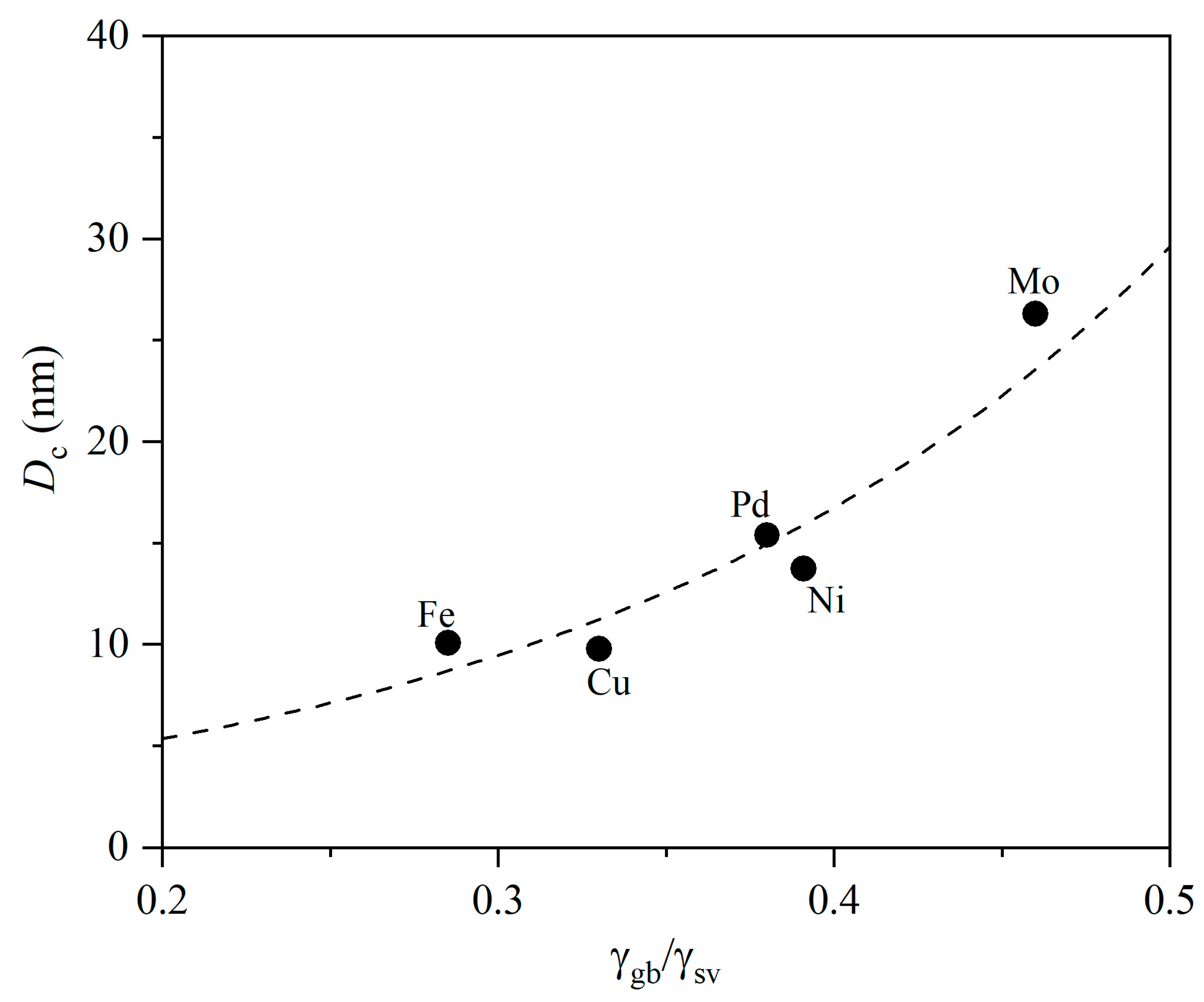
Figure 3 exhibits the curve of Dc as a function of γgb/γsv for u-NSs of Fe, Cu, Ni, Pd, and Mo to reveal the role of γgb. The plot shows that Dc increases significantly with increasing γgb/γsv and Dc is about 10–30 nm, which is consistent with experimental results [27]. This suggests the vital and non-negligible role of γgb on Dc and σ(T,D).
Figure 3.
Dc as a function of γgb/γsv for u-NSs of Fe, Cu, Ni, Pd, and Mo with T = 300 K. The dashed line is the exponential fit to the data. See Table 1 for the necessary parameters.
Different γgb values are relevant to different alloying metals for a-NSs, and one can thus speculate that the variation in σ(T,D) with lowering D will be complicated. Figure 4 shows the σ(T,D) curves for a-NSs of Ni-Cu, Fe-Cu, Ni-Mo, and Fe-Zr. For the a-NSs of Ni-Cu and Fe-Cu shown in Figure 4a,b, σ(T,D) increases with lowering D and begins to decrease when D < Dc, suggesting that the σ(T,D) of low-Tm a-NSs also follows the IHPR. In this case, the weak bonds of alloying atoms segregated at GBs result in the relaxation of local pressure and positive γgb values. Similarly to the IHPR of u-NSs, therefore, GBs become easier to move with lowering D, leading to the reduction in σ(T,D). For the a-NSs of Ni-Mo and Fe-Zr shown in Figure 4c,d, interestingly, σ(T,D) increases monotonically with lowering D, demonstrating the elimination of IHPR for high-Tm a-NSs. In this case, the segregation of alloying atoms also occurs at GBs. However, γgb becomes negative, and (D) is increased, leading to the interface stiffening and thus an increase in the activation energy of boundary diffusion. Similarly to the dislocation pile-ups, this will also hinder the GBs’ movement, and subsequently σ(T,D) increases continuously with lowering D even below 10 nm, eliminating the IHPR observed for u-NSs and low-Tm a-NSs. Within the experimentally accessible D ranges, our model predictions show reasonable consistency with observed trends.
Figure 4.
σ(T,D) as a function of D−1/2 for a-NSs of (a) Ni0.56Cu0.44, (b) Fe99.985Cu0.015, (c) Ni0.86Mo0.14 and Ni0.78Mo0.22, and (d) Fe0.99Zr0.01 using Equation (10) with T = 300 K. Symbols are experimental results with ★ [56] in (a) for a-NSs of Ni0.56Cu0.44, ● [12] in (b) for a-NSs of Fe99.985Cu0.015, ■ [14] in (c) for a-NSs of Ni0.86Mo0.14 and Ni0.78Mo0.22, respectively, and ▲ [15] in (d) for a-NSs of Fe0.99Zr0.01. Ni alloyed with other Mo contents (Ni0.81Mo0.19, Ni0.87Mo0.13, Ni0.91Mo0.09, Ni0.94Mo0.06, Ni0.97Mo0.03, and Ni0.99Mo0.01) denoted by ○ [14] is also shown in (c) for reference. See Table 2 for the necessary parameters.
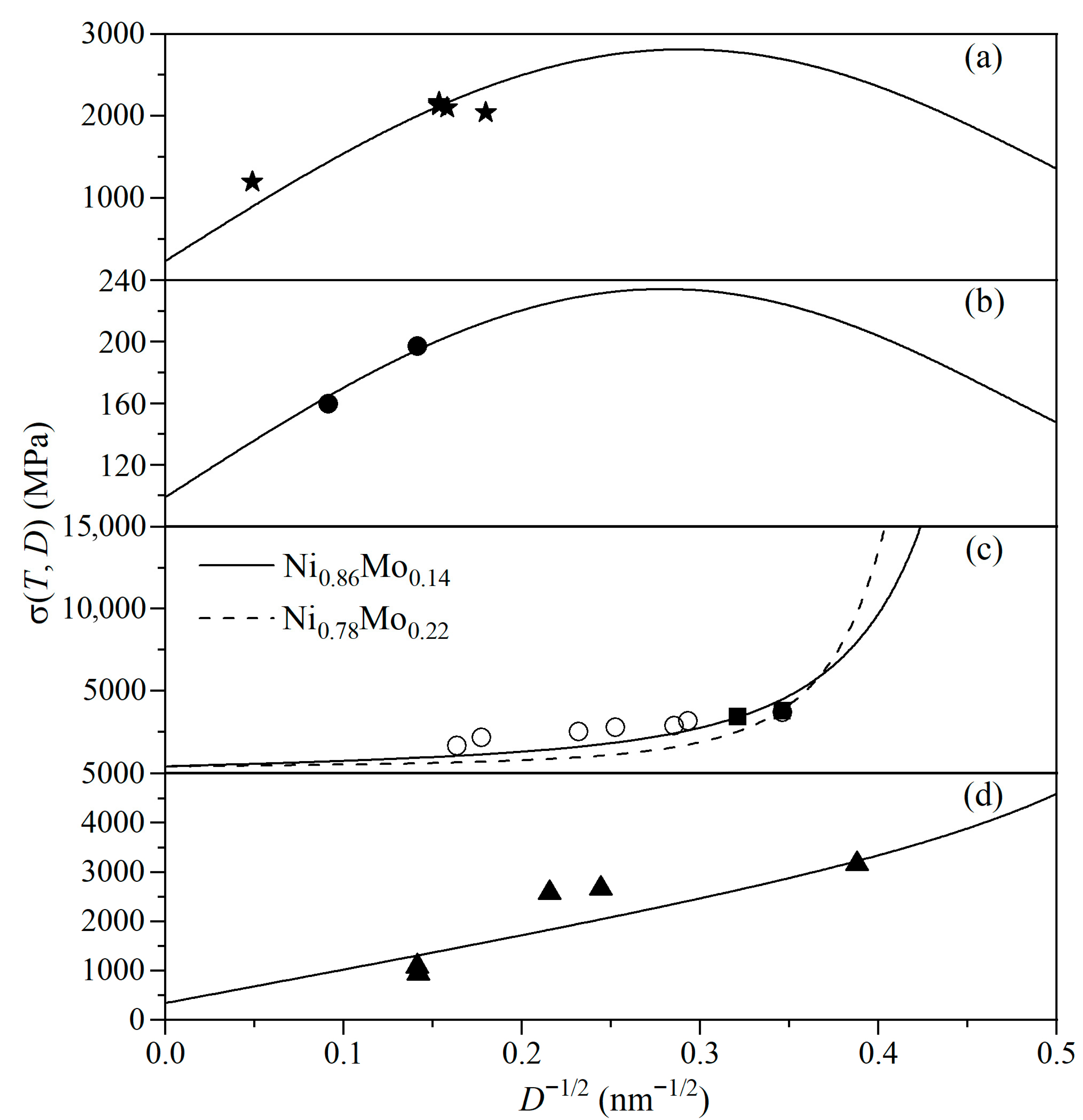
Table 2.
Parameters of the selected alloys used in the model calculation.
The present validation of Equation (10) is primarily based on room temperature datasets for simple metals and binary alloys. Application to chemically complex alloys, high-entropy systems, or thermally stabilized nanocrystalline materials will require extended parameterization that explicitly accounts for segregation thermodynamics and interface phase behavior.
4. Conclusions
In summary, based on the interface migration of atoms and D-dependent (D), a unified thermodynamic formula was developed for distinct HPR and IHPR of u-NSs, low-Tm a-NSs, and high-Tm a-NSs. This formula predicts that the σ(T,D) of u-NSs increases with lowering D and begins to decrease when D < Dc, following the IHPR. The reduction in σ(T,D) below Dc is attributed to the combining effect of activation energy, the thermally driven effect, and lattice expansion and bond weakening. For low-Tm a-NSs, σ(T,D) also follows the IHPR. However, the IHPR is eliminated for high-Tm a-NSs, where σ(T,D) monotonically increases with lowering D due to the negative interface energy induced by the aggregation of high-Tm alloying atoms at GBs. To verify the predictions, σ(T,D) values were compared with available experimental results, and good agreement can be found.
Author Contributions
Conceptualization, H.L. and Y.Z.; methodology, H.L.; software, H.L.; validation, H.L. and Y.Z.; formal analysis, H.L.; investigation, H.L.; resources, Y.Z.; data curation, H.L.; writing—original draft preparation, H.L.; writing—review and editing, H.L., F.J. and Y.Z.; visualization, H.L.; supervision, F.J. and Y.Z.; project administration, F.J. and Y.Z.; funding acquisition, F.J. and Y.Z. All authors have read and agreed to the published version of the manuscript.
Funding
This research was funded by the National Natural Science Foundation of China (52271217 and 52130101) and the the Project of the Jilin Provincial Department of Education (JJKH20240319CY).
Institutional Review Board Statement
Not applicable.
Informed Consent Statement
Not applicable.
Data Availability Statement
The original contributions presented in this study are included in the article. Further inquiries can be directed to the corresponding author.
Conflicts of Interest
The authors declare no conflict of interest.
References
- Konstantatos, G.; Sargent, E.H. Nanostructured materials for photon detection. Nat. Nanotechnol. 2010, 5, 391–400. [Google Scholar] [CrossRef] [Scilit]
- Kuchibhatla, S.V.; Karakoti, A.; Bera, D.; Seal, S. One dimensional nanostructured materials. Prog. Mater Sci. 2007, 52, 699–913. [Google Scholar] [CrossRef] [Scilit]
- Guo, Y.G.; Hu, J.S.; Wan, L.J. Nanostructured materials for electrochemical energy conversion and storage devices. Adv. Mater. 2008, 20, 2878–2887. [Google Scholar] [CrossRef] [Scilit]
- Gertsman, V.Y.; Birringer, R.; Gleiter, H.; Valiev, R.Z. On the structure and strength of ultrafine-grained copper produced by severe plastic deformation. Scr. Metall. Mater. 1994, 30, 229–234. [Google Scholar] [CrossRef] [Scilit]
- Hall, E.O. The Deformation and Ageing of Mild Steel: III Discussion of Results. Proc. Phys. Soc. London Sect. B 1951, 64, 747–753. [Google Scholar] [CrossRef] [Scilit]
- Petch, N.J. The Cleavage Strength of Polycrystals. J. Iron Steel Inst. 1953, 174, 25–28. [Google Scholar]
- Carlton, C.; Ferreira, P. What is behind the inverse Hall–Petch effect in nanocrystalline materials? Acta Mater. 2007, 55, 3749–3756. [Google Scholar] [CrossRef] [Scilit]
- Ono, N.; Nowak, R.; Miura, S. Effect of deformation temperature on Hall–Petch relationship registered for polycrystalline magnesium. Mater. Lett. 2004, 58, 39–43. [Google Scholar] [CrossRef] [Scilit]
- Qin, X.; Zhu, X.; Gao, S.; Chi, L.; Lee, J. Compression behaviour of bulk nanocrystalline Ni-Fe. J. Phys. Condens. Matter 2002, 14, 2605. [Google Scholar]
- Cordero, Z.C.; Knight, B.E.; Schuh, C.A. Six decades of the Hall–Petch effect–a survey of grain-size strengthening studies on pure metals. Int. Mater. Rev. 2016, 61, 495–512. [Google Scholar] [CrossRef] [Scilit]
- Naik, S.N.; Walley, S.M. The Hall–Petch and inverse Hall–Petch relations and the hardness of nanocrystalline metals. J. Mater. Sci. 2020, 55, 2661–2681. [Google Scholar] [CrossRef] [Scilit]
- Maruyama, N.; Sugiyama, M.; Hara, T.; Tamehiro, H. Precipitation and Phase Transformation of Copper Particles in Low Alloy Ferritic and Martensitic Steels. Mater. Trans. 1999, 40, 268–277. [Google Scholar] [CrossRef] [Scilit]
- Shen, T.; Schwarz, R.; Feng, S.; Swadener, J.; Huang, J.; Tang, M.; Zhang, J.; Vogel, S.; Zhao, Y. Effect of solute segregation on the strength of nanocrystalline alloys: Inverse Hall–Petch relation. Acta Mater. 2007, 55, 5007–5013. [Google Scholar] [CrossRef] [Scilit]
- Hu, J.; Shi, Y.N.; Sauvage, X.; Sha, G.; Lu, K. Grain boundary stability governs hardening and softening in extremely fine nanograined metals. Science 2017, 355, 1292. [Google Scholar] [CrossRef] [Scilit] [PubMed]
- Darling, K.A.; VanLeeuwen, B.K.; Koch, C.C.; Scattergood, R.O. Thermal stability of nanocrystalline Fe–Zr alloys. Mater. Sci. Eng. A 2010, 527, 3572–3580. [Google Scholar] [CrossRef] [Scilit]
- Scattergood, R.O.; Koch, C.C. A modified model for hall-petch behavior in nanocrystalline materials. Scr. Metall. Mater. 1992, 27, 1195–1200. [Google Scholar] [CrossRef] [Scilit]
- Masumura, R.A.; Hazzledine, P.M.; Pande, C.S. Yield stress of fine grained materials. Acta Mater. 1998, 46, 4527–4534. [Google Scholar] [CrossRef] [Scilit]
- Van Swygenhoven, H.; Spaczer, M.; Caro, A. Microscopic description of plasticity in computer generated metallic nanophase samples: A comparison between Cu and Ni. Acta Mater. 1999, 47, 3117–3126. [Google Scholar] [CrossRef] [Scilit]
- Konstantinidis, D.A.; Aifantis, E.C. On the “Anomalous” hardness of nanocrystalline materials. Nanostruct. Mater. 1998, 10, 1111–1118. [Google Scholar] [CrossRef] [Scilit]
- Sun, C.Q.; Li, S.; Li, C.M. Impact of Bond Order Loss on Surface and Nanosolid Mechanics. J. Phys. Chem. B 2005, 109, 415–423. [Google Scholar] [CrossRef] [Scilit]
- Jiang, Q.; Shi, H.; Zhao, M. Melting thermodynamics of organic nanocrystals. J. Chem. Phys. 1999, 111, 2176–2180. [Google Scholar] [CrossRef] [Scilit]
- Jiang, Q.; Zhang, S.; Zhao, M. Size-dependent melting point of noble metals. Mater. Chem. Phys. 2003, 82, 225–227. [Google Scholar] [CrossRef] [Scilit]
- Sherby, O.D.; Wadsworth, J. Superplasticity-Recent advances and future directions. Prog. Mater. Sci. 1989, 33, 169–221. [Google Scholar] [CrossRef] [Scilit]
- Herzig, C.; Mishin, Y. Grain boundary diffusion in metals. In Diffusion in Condensed Matter; Heitjans, P., Kärger, J., Eds.; Springer: Berlin/Heidelberg, Germany, 2005; pp. 337–366. [Google Scholar]
- Chokshi, A.H.; Rosen, A.; Karch, J.; Gleiter, H. On the validity of the Hall-Petch relationship in nanocrystalline materials. Scr. Metall. 1989, 23, 1679–1683. [Google Scholar] [CrossRef] [Scilit]
- Meyers, M.A.; Mishra, A.; Benson, D.J. Mechanical properties of nanocrystalline materials. Prog. Mater. Sci. 2006, 51, 427–556. [Google Scholar] [CrossRef] [Scilit]
- Zhao, M.; Li, J.C.; Jiang, Q. Hall–Petch relationship in nanometer size range. J. Alloy. Compd. 2003, 361, 160–164. [Google Scholar] [CrossRef] [Scilit]
- Zhu, Y.F.; Lian, J.S.; Jiang, Q. Modeling of the Melting Point, Debye Temperature, Thermal Expansion Coefficient, and the Specific Heat of Nanostructured Materials. J. Phys. Chem. C 2009, 113, 1261–1264. [Google Scholar]
- Zhu, Y.F.; Zheng, W.T.; Jiang, Q. Distinct Young’s modulus of nanostructured materials in comparison with nanocrystals. Phys. Chem. Chem. Phys. 2011, 13, 21328. [Google Scholar] [CrossRef] [Scilit]
- Guisbiers, G.; Herth, E.; Buchaillot, L.; Pardoen, T. Fracture toughness, hardness, and Young’s modulus of tantalum nanocrystalline films. Appl. Phys. Lett. 2010, 97, 143115. [Google Scholar] [CrossRef] [Scilit]
- Schiøtz, J.; Tolla, F.D.D.; Jacobsen, K.W. Softening of nanocrystalline metals at very small grain sizes. Nature 1998, 391, 561–563. [Google Scholar] [CrossRef] [Scilit]
- Zhu, Y.; Qin, Q.; Xu, F.; Fan, F.; Ding, Y.; Zhang, T.; Wiley, B.J.; Wang, Z.L. Size effects on elasticity, yielding, and fracture of silver nanowires: In situ experiments. Phys. Rev. B 2012, 85, 045443. [Google Scholar] [CrossRef] [Scilit]
- Liu, X.J.; Li, J.W.; Zhou, Z.F.; Yang, L.W.; Ma, Z.S.; Xie, G.F.; Pan, Y.; Sun, C.Q. Size-induced elastic stiffening of ZnO nanostructures: Skin-depth energy pinning. Appl. Phys. Lett. 2009, 94, 131902. [Google Scholar] [CrossRef] [Scilit]
- Duscher, G.; Chisholm, M.F.; Alber, U.; Rühle, M. Bismuth-induced embrittlement of copper grain boundaries. Nat. Mater. 2004, 3, 621–626. [Google Scholar] [CrossRef] [Scilit]
- Zhu, Y.F.; Zheng, W.T.; Jiang, Q. Modeling lattice expansion and cohesive energy of nanostructured materials. Appl. Phys. Lett. 2009, 95, 083110. [Google Scholar] [CrossRef] [Scilit]
- Ao, Z.M.; Li, S.; Jiang, Q. The determination of Young’s modulus in noble metal nanowires. Appl. Phys. Lett. 2008, 93, 081905. [Google Scholar] [CrossRef] [Scilit]
- Jiang, Q.; Lu, H.M. Size dependent interface energy and its applications. Surf. Sci. Rep. 2008, 63, 427–464. [Google Scholar] [CrossRef] [Scilit]
- Chattopadhyay, K.; Goswami, R. Melting and superheating of metals and alloys. Prog. Mater. Sci. 1997, 42, 287–300. [Google Scholar] [CrossRef] [Scilit]
- Shao, M.; Peles, A.; Shoemaker, K. Electrocatalysis on Platinum Nanoparticles: Particle Size Effect on Oxygen Reduction Reaction Activity. Nano Lett. 2011, 11, 3714–3719. [Google Scholar] [CrossRef] [Scilit]
- Li, H.; Zhao, M.; Jiang, Q. Cohesive Energy of Clusters Referenced by Wulff Construction. J. Phys. Chem. C 2009, 113, 7594–7597. [Google Scholar] [CrossRef] [Scilit]
- Tritsaris, G.A.; Greeley, J.; Rossmeisl, J.; Nørskov, J.K. Atomic-Scale Modeling of Particle Size Effects for the Oxygen Reduction Reaction on Pt. Catal. Lett. 2011, 141, 909–913. [Google Scholar] [CrossRef] [Scilit]
- Baletto, F.; Ferrando, R. Structural properties of nanoclusters: Energetic, thermodynamic, and kinetic effects. Rev. Mod. Phys. 2005, 77, 371–423. [Google Scholar] [CrossRef] [Scilit]
- Lu, K.; Lück, R.; Predel, B. The interfacial excess energy in nanocrystalline Ni-P materials with different grain sizes. Scr. Metall. Mater. 1993, 28, 1387–1392. [Google Scholar] [CrossRef] [Scilit]
- Fu, H.H.; Benson, D.J.; Meyers, M.A. Analytical and computational description of effect of grain size on yield stress of metals. Acta Mater. 2001, 49, 2567–2582. [Google Scholar] [CrossRef] [Scilit]
- Wu, D.; Zhang, J.; Huang, J.C.; Bei, H.; Nieh, T.G. Grain-boundary strengthening in nanocrystalline chromium and the Hall–Petch coefficient of body-centered cubic metals. Scr. Mater. 2013, 68, 118–121. [Google Scholar] [CrossRef] [Scilit]
- Sanders, P.G.; Eastman, J.A.; Weertman, J.R. Elastic and tensile behavior of nanocrystalline copper and palladium. Acta Mater. 1997, 45, 4019–4025. [Google Scholar] [CrossRef] [Scilit]
- Hughes, G.D.; Smith, S.D.; Pande, C.S.; Johnson, H.R.; Armstrong, R.W. Hall-Petch strengthening for the microhardness of twelve nanometer grain diameter electrodeposited nickel. Scr. Metall. 1986, 20, 93–97. [Google Scholar] [CrossRef] [Scilit]
- El-Sherik, A.M.; Erb, U.; Palumbo, G.; Aust, K.T. Deviations from Hall-Petch behaviour in as-prepared nanocrystalline nickel. Scr. Metall. Mater. 1992, 27, 1185–1188. [Google Scholar] [CrossRef] [Scilit]
- Schuh, C.A.; Nieh, T.G.; Yamasaki, T. Hall–Petch breakdown manifested in abrasive wear resistance of nanocrystalline nickel. Scr. Mater. 2002, 46, 735–740. [Google Scholar] [CrossRef] [Scilit]
- Nieman, G.W.; Weertman, J.R.; Siegel, R.W. Microhardness of nanocrystalline palladium and copper produced by inert-gas condensation. Scr. Metall. Mater. 1989, 23, 2013–2018. [Google Scholar] [CrossRef] [Scilit]
- Mohammadabadi, A.S.; Dehghani, K. A new model for inverse Hall-Petch relation of nanocrystalline materials. J. Mater. Eng. Perform. 2008, 17, 662–666. [Google Scholar] [CrossRef] [Scilit]
- The periodic table of the elements. Available online: https://www.webelements.com/ (accessed on 6 September 2025).
- Tyson, W.; Miller, W. Surface free energies of solid metals: Estimation from liquid surface tension measurements. Surf. Sci. 1977, 62, 267–276. [Google Scholar] [CrossRef] [Scilit]
- Yoder, K.B.; Elmustafa, A.A.; Lin, J.C.; Hoffman, R.A.; Stone, D.S. Activation analysis of deformation in evaporated molybdenum thin films. J. Phys. D Appl. Phys. 2003, 36, 884–895. [Google Scholar] [CrossRef] [Scilit]
- Ohsawa, K.; Koizumi, H.; Kirchner, H.O.K.; Suzuki, T. The critical stress in a discrete Peierls–Nabarro model. Philos. Mag. A 1994, 69, 171–181. [Google Scholar] [CrossRef] [Scilit]
- Pellicer, E.; Varea, A.; Sivaraman, K.M.; Pané, S.; Suriñach, S.; Baró, M.D.; Nogués, J.; Nelson, B.J.; Sort, J. Grain Boundary Segregation and Interdiffusion Effects in Nickel–Copper Alloys: An Effective Means to Improve the Thermal Stability of Nanocrystalline Nickel. ACS Appl. Mater. Inter. 2011, 3, 2265–2274. [Google Scholar] [CrossRef] [Scilit] [PubMed]
- Cai, S.; Daymond, M.; Khan, A.; Holt, R.; Oliver, E. Elastic and plastic properties of β-Zr at room temperature. J. Nucl. Mater. 2009, 393, 67–76. [Google Scholar] [CrossRef] [Scilit]
Disclaimer/Publisher’s Note: The statements, opinions and data contained in all publications are solely those of the individual author(s) and contributor(s) and not of MDPI and/or the editor(s). MDPI and/or the editor(s) disclaim responsibility for any injury to people or property resulting from any ideas, methods, instructions or products referred to in the content. |
© 2026 by the authors. Licensee MDPI, Basel, Switzerland. This article is an open access article distributed under the terms and conditions of the Creative Commons Attribution (CC BY) license.