


Highlights
- With total acid fixed at 1.2%, shifting the FAc:HAc ratio from 1:3 to 3:1 lowered 97 d UCS from 6.87 to 3.91 MPa.
- The strength-retention factor KFH decoupled age-related strength gain from ac-id-induced attenuation (R2 = 0.92).
- A composition- and time-dependent KW linked immersed UCS to its age-matched chamber-cured baseline (R2 = 0.94).
- After immersion, the FAc-rich mixture showed poorer interparticle bond continuity and greater pore connectivity.
- Long-term performance assessment of CGF-stabilised soil should account for acid composition, not total dosage alone.
Abstract
For use as engineered fill, stabilised soil must develop adequate strength and retain it during water exposure. How fulvic acid (FAc) and humic acid (HAc) jointly affect these properties remains unclear. Twenty-five mixtures were prepared at varying acid dosages and a fixed carbide slag–ground granulated blast-furnace slag–fly ash (CGF) dosage. After 7 d of initial curing, unconfined compressive strength (UCS) was measured during continued chamber curing or immersion for up to 90 d. At 1.2% total acid, increasing FAc from 1:3 to 3:1 reduced 97 d UCS from 6.87 to 3.91 MPa. The corresponding UCS retention after 28 d of immersion decreased from 45.09% to 3.36% relative to age-matched chamber-cured controls. The chamber-curing model combined age-dependent strength development with an acid-dependent strength-retention factor, KFH (R2 = 0.92). The composition- and time-dependent immersion coefficient KW linked immersed UCS to age-matched chamber-cured strength (R2 = 0.94). Microscopy and tomography showed less continuous cementation and greater pore interconnection in the FAc-rich mixture. Calcium binding by FAc and HAc may alter calcium availability for cementitious reactions and affect the formation of interparticle bonds. During immersion, the migration of dissolved constituents may further weaken these bonds. Acid composition should therefore inform assessments of CGF-stabilised fill exposed to water.
1. Introduction
Dredged soil is generated in large quantities during the maintenance and restoration of rivers, lakes, ports and waterways, and its beneficial reuse has therefore received increasing attention [1,2,3,4]. Reuse as engineered fill or pavement material can reduce disposal demand and provide an alternative source of earth material for geotechnical and road construction [3,4,5,6]. However, fine-grained dredged soils commonly have high compressibility, low bearing capacity and variable engineering properties, which restrict their direct use in road subgrades [5,6,7,8]. Stabilisation is therefore generally required before engineering use [5,7,8]. Solid-waste-based and alkali-activated binders have been widely investigated for this purpose [9,10,11,12]. In calcium-rich systems, carbide slag (CS) supplies alkalinity and calcium, while ground granulated blast-furnace slag (GGBS) and fly ash (FA) provide reactive silicate and aluminate constituents [13,14,15,16,17]. Wu et al. [18] systematically investigated a ternary CS–GGBS–FA binder, hereafter referred to as CGF, and evaluated its mechanical behaviour and reaction mechanism in stabilised soils. Chan et al. [19] further applied CGF to dredged soil and demonstrated favourable bearing capacity, resilient response and durability under wet–dry and freeze–thaw cycling for road applications.
Despite the demonstrated potential of CGF for dredged-soil stabilisation, its performance is governed jointly by binder formulation and the properties of the treated soil. Activator dosage and precursor proportion control the reaction environment and the availability of reactive Ca, Si and Al for the formation of cementitious products [13,14,15,16,17]. Changes in these factors can produce different strength-development patterns even when similar binder constituents are used [20,21]. However, binder chemistry alone does not fully explain stabilised-soil behaviour. Studies of CS-based systems in different clayey soils have reported clear differences in strength, compressibility and permeability despite similar binder compositions [22,23,24,25]. Li et al. [26] showed that conclusions drawn from CS–GGBS binder paste did not transfer directly to stabilised clay slurry, indicating that the soil matrix changes binder performance. Toda et al. [27] found that some mixtures developed little strength despite sufficient Si- and Ca-bearing constituents, indicating that other soil constituents also influenced hardening. Accordingly, binder composition and inorganic reactants should be evaluated together with relevant soil constituents when interpreting stabilisation performance.
Among these soil constituents, organic matter (OM) has been associated with variations in strength development [27,28,29,30]. Toda et al. [27] found that the strength of steel-slag–dredged-soil mixtures could not be explained simply by the bulk amount of extracted humic material. Wattez et al. [28] further showed that humic fractions could interact with Ca-, Al- and soluble Si-bearing species in alkali-activated GGBS systems and thereby change soil–binder reactivity. These results support consideration of specific humic fractions rather than bulk organic indices alone. Humic acid (HAc) and fulvic acid (FAc) are two humic fractions of sediment OM [14,15,16]. Differences in molecular size and oxygen-containing functional groups may affect the association of humic fractions with calcium-bearing species and the subsequent formation and distribution of cementitious products [28]. Their effects on stabilised soils have been examined in a range of binder systems [31,32,33,34,35,36,37,38]. Tremblay et al. [39] showed that the effect of organic compounds on cement-treated fine soils depended strongly on their chemical nature, while Li et al. [32] reported a clear influence of HAc on solidified dredged material. Kang et al. [34] found that the strength of HAc-containing cement-treated clay varied with HAc content, binder dosage and curing age, and Lang et al. [40] reported clear changes in the strength development of HAc-containing dredged sludge as HAc dosage increased. Similar effects have been reported in other binder systems. Yuan et al. [35] observed longer setting times, lower hydration temperatures and lower strength with increasing HAc content in magnesium-phosphate-cement-treated dredged sludge, while Su et al. [31] reported strength reduction in HAc-containing slag–FA-based stabilised organic clay. FAc also affects strength development. Wang et al. [36] found that increasing FAc dosage reduced the strength and hydration-related temperature rise in cement-solidified dredged sludge and reduced the formation of cementitious products. Taken together, these studies suggest that organic-acid species can interfere with binder reactions and limit strength development, although the magnitude depends on the binder and soil system. Direct comparisons show that HAc and FAc do not produce equivalent responses. Shao et al. [37] varied HAc–FAc composition at a fixed total dosage and found that mechanical performance changed with the relative proportions of the two acids. Luo and Zhang [38] varied HAc and FAc separately in sodium-activated slag–FA-stabilised soft soil and reported different dosage-dependent strength and durability responses. These studies establish distinct HAc and FAc effects, but separate-acid designs do not directly establish responses to simultaneous variation in both acid dosages, while comparisons at a single total dosage do not show how composition effects vary with total dosage. Their combined influence on strength development over curing time in a CGF system therefore remains unclear.
Durability is also important because stabilised soils must retain their performance during environmental exposure. Wet–dry and freeze–thaw cycles have been used to assess the cyclic durability of CGF and related stabilised soils [19,41], while sulphate exposure has been used to examine chemical deterioration in HAc- or FAc-containing alkali-activated soils [38]. Studies of HAc-containing cemented soils exposed to FAc environments have reported changes in strength, microstructure and permeability during prolonged exposure [42,43,44]. Water-related durability has also been examined through water-stability tests, repeated wetting and drying, and continuous immersion [41,45,46]. Wu et al. [41] related water stability to changes in reaction products and microstructure, while studies on alkali-activated slag showed that continued immersion can change gel structure, pore characteristics and cracking behaviour [45,46]. These studies show that durability depends on both material composition and exposure condition, and that water-related deterioration can develop with time. However, the dependence of long-term immersion resistance on FAc–HAc composition has not been systematically resolved for the CGF-stabilised soil investigated here.
Considering the above discussion, this study investigates the effects of HAc and FAc dosage and composition on the strength development and water stability of CGF-stabilised soil. A low-OM base soil was amended with HAc and FAc at five levels each, giving 25 mixtures in a two-factor full-factorial design while the CGF formulation remained fixed. This design allows individual-acid dosage, total acid dosage and relative HAc–FAc composition to be examined within the same binder system. UCS was measured at several total curing ages, and empirical relationships were examined for the age-dependent strength response. After 7 d of chamber curing, companion specimens were immersed in water for up to 90 d to examine immersion-induced strength loss with immersion time and acid composition. Representative mixtures with the same total acid dosage but interchanged HAc and FAc dosages were selected for structural comparison. XRD, SEM and CT were used to characterise crystalline phases, interparticle bonding and three-dimensional pore connectivity, respectively. Surface products formed during immersion were also examined as supplementary evidence. Overall, this framework links acid dosage and composition with strength development, long-term water stability and structural evolution within a CGF-stabilised soil.
2. Materials and Methods
2.1. Materials
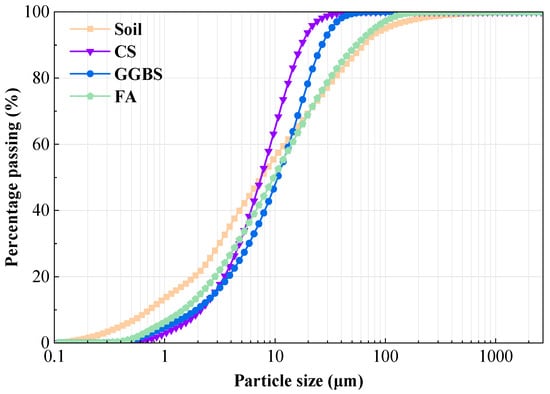
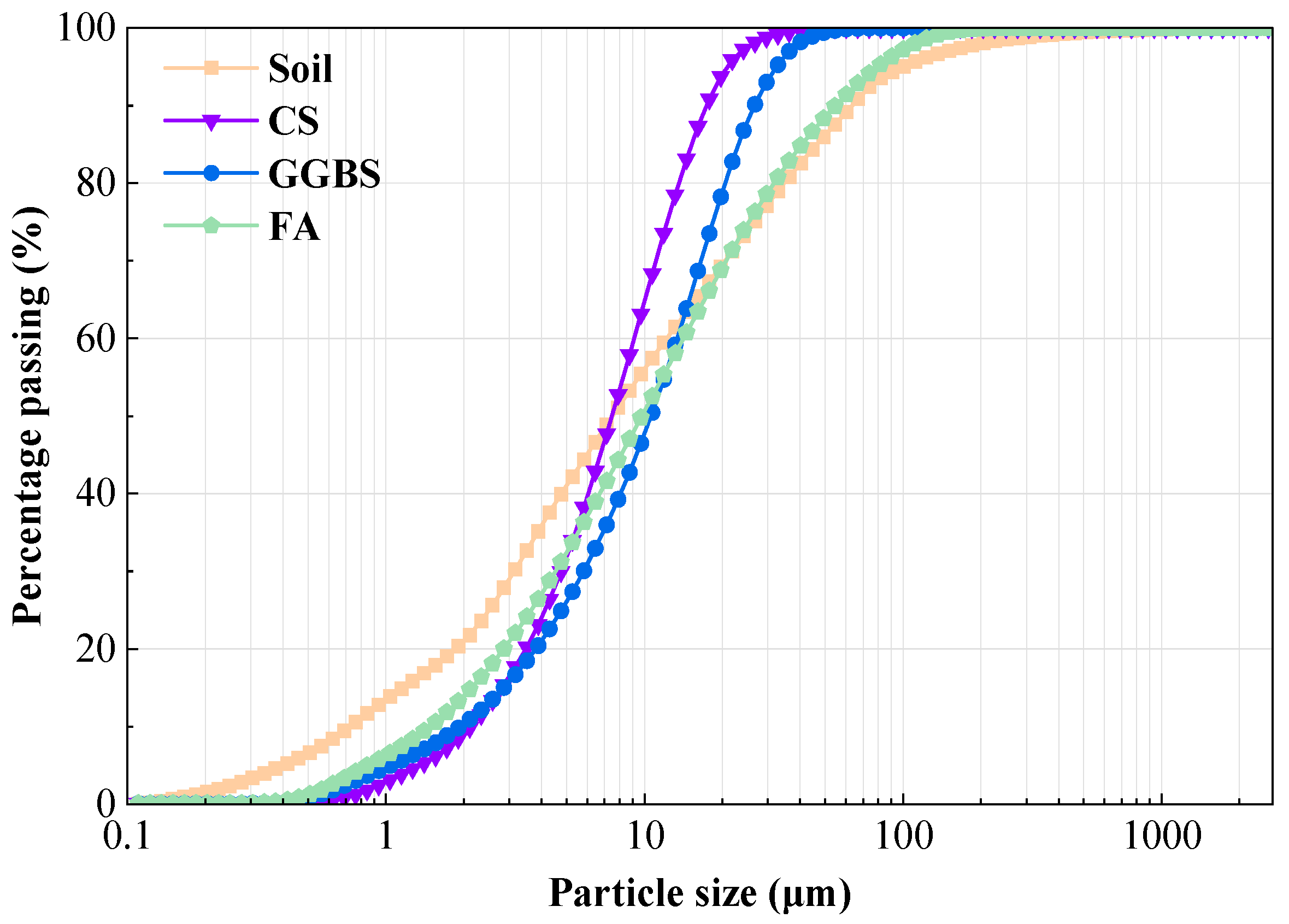
Natural dredged sediments exhibit substantial spatial variability in organic matter composition. Because native FAc and HAc contents can vary spatially, a homogenised low-OM soil was used as the base material for establishing controlled acid-addition gradients. The collected soil was air-dried, passed through a 2 mm sieve and thoroughly mixed to reduce within-batch heterogeneity. Its liquid limit and plastic limit were 36.01% and 18.04%, respectively, giving a plasticity index of 17.97%. The soil was classified as a low-liquid-limit clay (CL) according to GB/T 50145–2007 [47]. Its total OM content was 0.04%, which is well below the 5% threshold for organic soil specified in the same Standard and therefore corresponds to an inorganic soil in engineering classification. Specific gravity, Atterberg limits, and particle-size distribution were determined in accordance with GB/T 50123–2019 [48]. Additional physicochemical and mineralogical properties are summarised in Table 1, and the particle-size distribution is shown in Figure 1.
Table 1.
The physicochemical and mineralogical properties of the soil.
Figure 1.
The particle-size distributions of the soil and CGF constituents.
To characterise the native humic fractions of the prepared base soil, multiple independent subsamples were analysed in accordance with LY/T 1238–1999 [49]. The replicate measurements showed only small variation. The mean native FAc, HAc and humin contents were 0.02%, 0.01% and 0.01% of dry soil mass, respectively, giving a combined content of 0.04%, consistent with the total OM content. The minimum added dosage of each acid was 0.3% of dry soil mass, compared with a combined native FAc and HAc content of 0.03%. As all formulations were prepared using the same homogenised base soil, humin was not treated as an independent experimental variable. Commercial FAc and HAc reagents with specified compositions were used throughout the study to provide a consistent source for controlled acid addition.
CS was obtained from an acetylene production plant in Weifang, Shandong Province. Its activity met the Grade II technical requirements specified in JTG/T F20–2015 [50]. GGBS was supplied by an ironmaking plant in Jinan, Shandong Province, China, and met the S95 grade requirements specified in GB/T 18046–2017 [51]. FA was obtained from a coal-fired power plant in Jinan, Shandong Province, China, and was classified as Class F in accordance with GB/T 1596–2017 [52]. Their particle-size distributions are shown in Figure 1, and their major chemical compositions are listed in Table 2.
Table 2.
The chemical compositions of the CGF constituents.
Preliminary binder-composition experiments identified a CS:GGBS:FA mass ratio of 2:7:1, which exhibited the highest compressive strength among the investigated formulations at both 7 and 28 d. Subsequent comparisons at different CGF dosages showed that the 12% dosage provided a relatively high baseline strength while exhibiting pronounced strength reduction under the investigated exposure conditions. Supported also by previous research on CGF-stabilised dredged soil [19], this formulation and dosage were adopted to investigate the individual and combined effects of FAc and HAc.
FAc and HAc were supplied by Tianjin Huasheng Chemical Reagent Factory (Tianjin, China) and Tianjin Bailens Biotechnology Co., Ltd. (Tianjin, China), respectively. Their nominal active-component contents were 98.0% and 81.7%, respectively. The elemental compositions, functional-group densities and molecular-weight characteristics are summarised in Table 3. According to the suppliers, C, H, N, O and S contents were expressed on a dry, ash-free basis, whereas carboxylic- and phenolic-hydroxyl-group densities were reported per gram of dry reagent.
Table 3.
Physicochemical properties reported by the suppliers for commercial FAc and HAc products.
Compared with HAc, FAc had a higher O content and carboxylic-group density and lower number-average and weight-average molecular weights, whereas HAc had a higher C content and phenolic hydroxyl-group density. These properties characterise the two organic fractions and provide a physicochemical basis for interpreting their different mechanical responses in the CGF-stabilised soil system.
The FAc and HAc dosages were expressed as the effective acid mass relative to the dry soil mass. The weighed reagent masses were adjusted using the suppliers’ nominal effective-acid contents of 98.0% for FAc and 81.7% for HAc.
2.2. Experimental Programme
A two-factor, five-level full-factorial design was adopted, with FAc and HAc each set at 0, 0.3, 0.9, 1.8 and 2.7% while the CGF dosage was kept constant at 12%, giving 25 formulations. The investigated dosage levels were informed by Luo and Zhang [38], who reported diminishing additional UCS changes above approximately 4.5% HAc and 3.5% FAc in a different geopolymer-stabilised soft-soil system. Accordingly, the maximum individual dosage of HAc and FAc was set at 2.7%, below their respective reported limits, giving a maximum total acid dosage of 5.4% in the full-factorial design. The full-factorial arrangement included single-acid, equal-dosage and mixed-acid combinations, allowing the effects of total acid dosage and relative proportions of FAc and HAc to be evaluated. Mixtures were designated FxxHyy, where xx and yy represent ten times the numerical FAc and HAc percentages, respectively; for example, F03H09 denotes 0.3% FAc and 0.9% HAc.
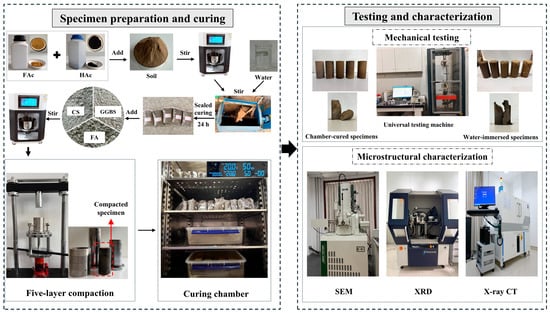
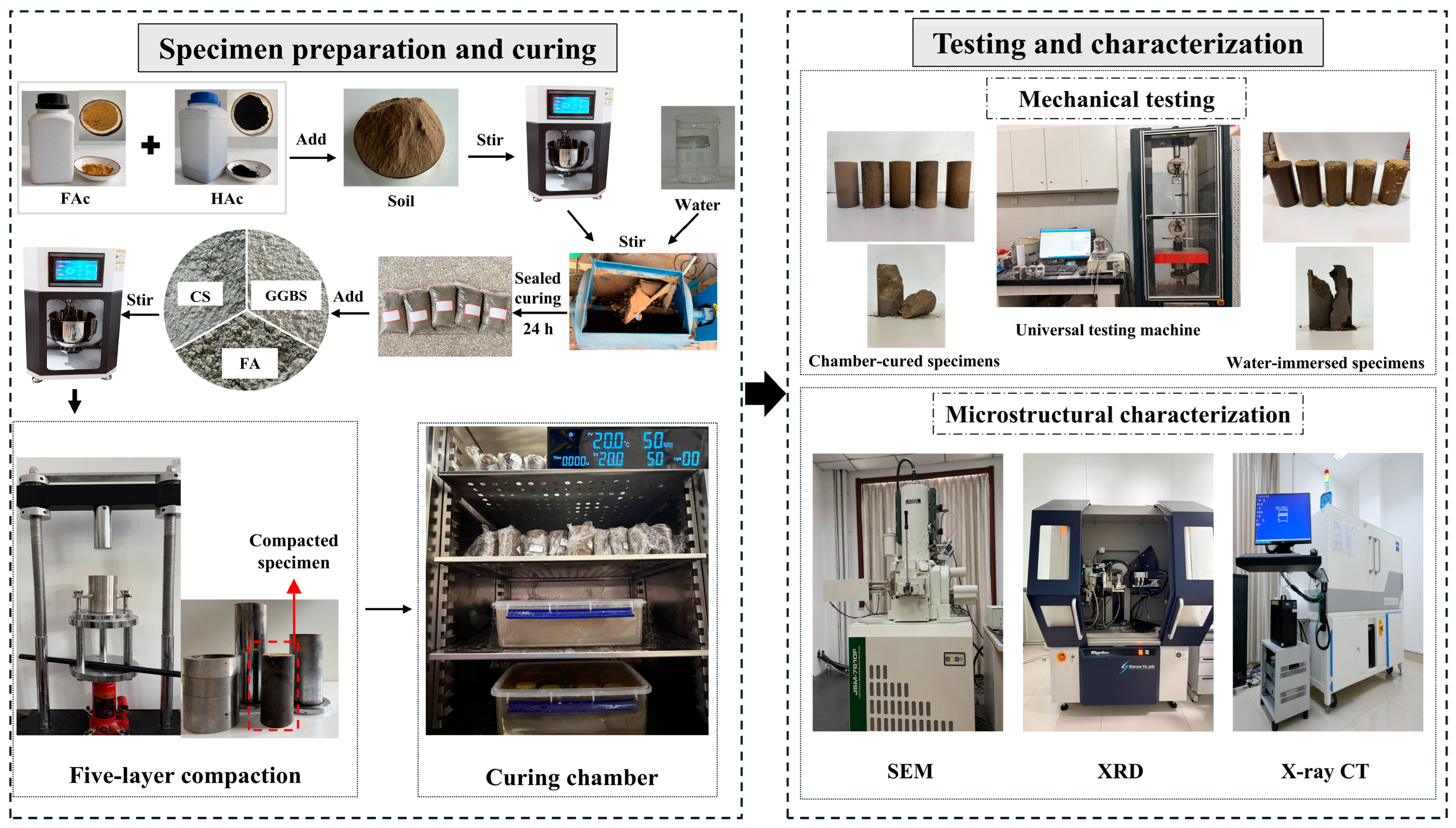
For each formulation, compaction tests were first conducted to determine the optimum moisture content (OMC) and maximum dry density (MDD). Considering the compaction requirements of road construction, a target degree of compaction of 94% was adopted for specimen preparation. Accordingly, specimens were prepared at their respective OMCs, with the target dry density of each formulation set at 94% of its MDD. The specimen preparation procedure followed the target-compaction principle specified in Test Method T 0843–2009 of JTG 3441–2024 [53], in which the mixture-specific OMC, MDD and prescribed degree of compaction are used to calculate the required specimen mass, providing a consistent relative compaction criterion for comparing the mechanical performance of different formulations. FAc and HAc were mixed with the soil, followed by water addition and mixing for 7 min. The moistened mixture was sealed for 24 h to facilitate uniform moisture redistribution and acid–soil contact while preventing moisture loss. CGF was subsequently incorporated and mixed for a further 5 min. The mixture was then compacted in five layers into cylindrical specimens 50 mm in diameter and 100 mm in height. After moulding, the specimens were wrapped in plastic film and cured initially for 7 d at 20 ± 1 °C in a chamber maintained at 50% relative humidity. The mixture compositions and compaction parameters are given in Table 4, and the preparation procedure is illustrated in Figure 2.
Table 4.
The mixture compositions and compaction parameters.
Figure 2.
The experimental workflow for specimen preparation and testing.
Following the common 7 d initial curing period, the specimens were divided into chamber-curing and water-immersion regimes. Chamber-cured specimens were tested at total ages of 7, 10, 14, 21, 35, 63 and 97 d. For the immersion regime, specimens were transferred to water after 7 d and tested after immersion periods of 3, 7, 14, 28, 56 and 90 d, corresponding to total ages of 10, 14, 21, 35, 63 and 97 d. All immersion tests were conducted using deionised water without water replacement throughout the exposure period. The immersion water was not chemically buffered. Three replicate specimens were tested for each formulation at each condition and age. Age-matched comparisons between immersed and chamber-cured specimens were used to evaluate the net effect of water immersion on UCS.
2.3. Testing Methods
UCS was determined in accordance with ASTM D2166/D2166M–24 [54] using a microcomputer-controlled electronic universal testing machine (WDW-100M, Jinan, China). Specimens were loaded axially at 1 mm min−1 until peak stress or failure.
F03H09 and F09H03 were selected for SEM, XRD and CT analyses because a total acid dosage of 1.2% retained moderate strength while revealing distinct effects of acid composition on immersion resistance. Both mixtures were examined at a total age of 35 d to relate their microstructural differences to the corresponding UCS results.
SEM (JSM-7610F, Tokyo, Japan) was conducted on F03H09 and F09H03 specimens after 35 d of chamber curing and after 7 d of chamber curing followed by 28 d of water immersion. Fragments collected from the specimen interior were dried, mounted and conductively coated before observation. Representative surface products formed during immersion were also examined.
XRD (Rigaku SmartLab, 9 kW, Tokyo, Japan) was used for qualitative phase analysis of F03H09 and F09H03 specimens under the same curing and immersion conditions. Dried and ground samples were scanned over a 2θ range of 10–90° at 15° min−1. Three representative immersion-induced surface products, namely a soft lamellar film, a hard, brittle film, and discrete crystalline deposits, were separately collected using clean glass microscope slides and subsequently analysed via XRD. The XRD patterns were analysed using SmartLab Studio II software (Rigaku, Japan), and qualitative phase identification was performed by comparison with standard reference patterns in the ICDD PDF-5+ database.
CT analysis of F03H09 and F09H03 was performed using a Zeiss Xradia 510 Versa system, Pleasanton, CA, USA. For each immersed mixture, three specimens were independently prepared. Three cylindrical subsamples (10 mm in diameter × 10 mm in height) were extracted from the upper, middle and lower central regions of each specimen, yielding nine CT observations per mixture. The original specimens constituted independent experimental replicates (n = 3), while the subsamples were treated as nested observations. Scanning at 20× and 40× yielded voxel sizes of 0.65–0.68 μm and 0.34 μm, respectively. Following the greyscale-based phase-identification method described by Dong et al. [55], reconstructed images were processed in Avizo 3D using a 3 × 3 × 3 median filter, greyscale thresholding and six-neighbour connectivity. Segmentation thresholds were determined from greyscale intensity distributions. Total and connected porosities were calculated from the corresponding pore-volume fractions within selected regions of interest (ROIs). Geometric tortuosity was determined from the ratio of pore-path length to straight-line distance, while crack-like pores were identified using a minor-to-major axis ratio threshold of 0.20. Threshold-sensitivity tests and comparisons of ROI sizes from 5123 to 10243 voxels showed variations within 5% in the evaluated pore parameters. Differences in connected porosity among sampling positions were below 0.2 percentage points.
3. Results
3.1. Strength Behaviour
3.1.1. Single-Acid Effects
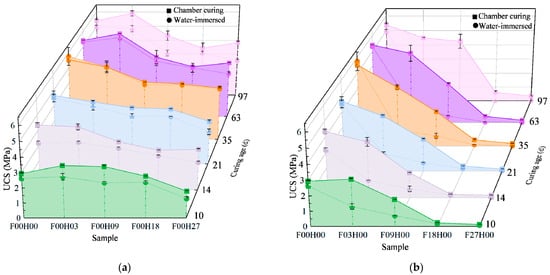
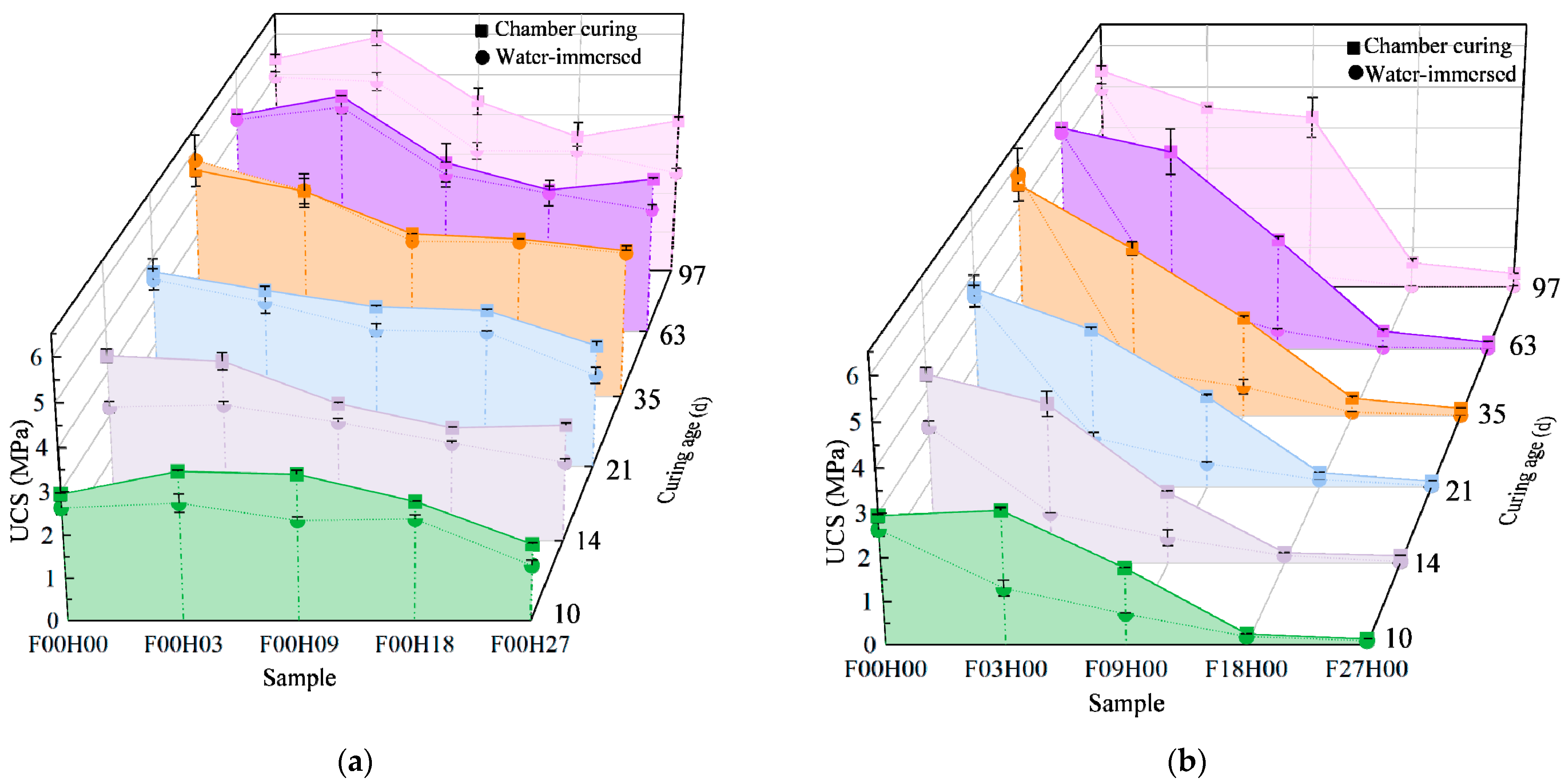
Figure 3a shows that UCS generally decreased with increasing HAc dosage, whereas Figure 3b exhibits a much steeper decline with increasing FAc dosage, with the most pronounced reduction occurring between 0.9% and 1.8%. At 35 d, increasing HAc from 0.3% to 2.7% reduced UCS from 5.03 to 3.61 MPa, with a strength decrease of 28.3%, whereas increasing FAc from 0.9% to 1.8% reduced UCS from 2.38 to 0.43 MPa, with a strength decrease of 81.8%. At the same dosage of 2.7%, the 35 d UCS was 3.61 MPa for HAc but only 0.18 MPa for FAc, corresponding to a 94.9% lower UCS in the FAc-containing specimens. These results indicate that the UCS of CGF-stabilised soil was substantially more sensitive to FAc than to HAc.
Figure 3.
The UCS development with single-acid dosage: (a) HAc; (b) FAc.
Acid dosage affected both the attained UCS and its development with curing age, with substantially lower strengths at the higher FAc dosages. At 2.7% HAc, UCS increased only from 3.61 MPa at 35 d to 3.84 MPa at 97 d. At 0.9% FAc, UCS increased from 2.38 MPa at 35 d to 4.25 MPa at 97 d. At FAc dosages of 1.8% and 2.7%, the corresponding 97 d strengths remained low, at 0.61 and 0.34 MPa, respectively, despite some strength gain after 35 d.
To quantify the dosage responses of HAc and FAc, UCS retention was calculated at each curing age relative to the age-matched control without added acid. For each single-acid dosage, the retention percentages were averaged across the seven curing ages, and Gaussian-decay functions were fitted to the resulting mean values, as expressed in Equations (1) and (2).
where PHAc and PFAc represent the mean UCS retention percentages for HAc-only and FAc-only mixtures, respectively, and H and F denote the corresponding acid dosages (%). The fitted relationships yielded R2 values of 0.96 and 0.99, respectively. Differentiation of the fitted curves identified the steepest declines in mean UCS retention at approximately 1.12% HAc and 0.74% FAc, with maximum rates of 19.7 and 79.3 percentage points per percentage-point increase in acid dosage, respectively. FAc therefore exhibited its greatest dosage sensitivity at a lower dosage, with a maximum rate of decline approximately four times that of HAc. Beyond these dosages, mean UCS retention continued to decrease, but at progressively lower rates. Luo and Zhang [38] similarly reported diminishing effects on UCS beyond 3.5% FAc and 4.5% HAc.
3.1.2. Dosage and Composition
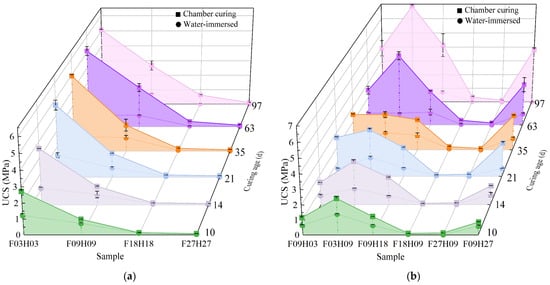
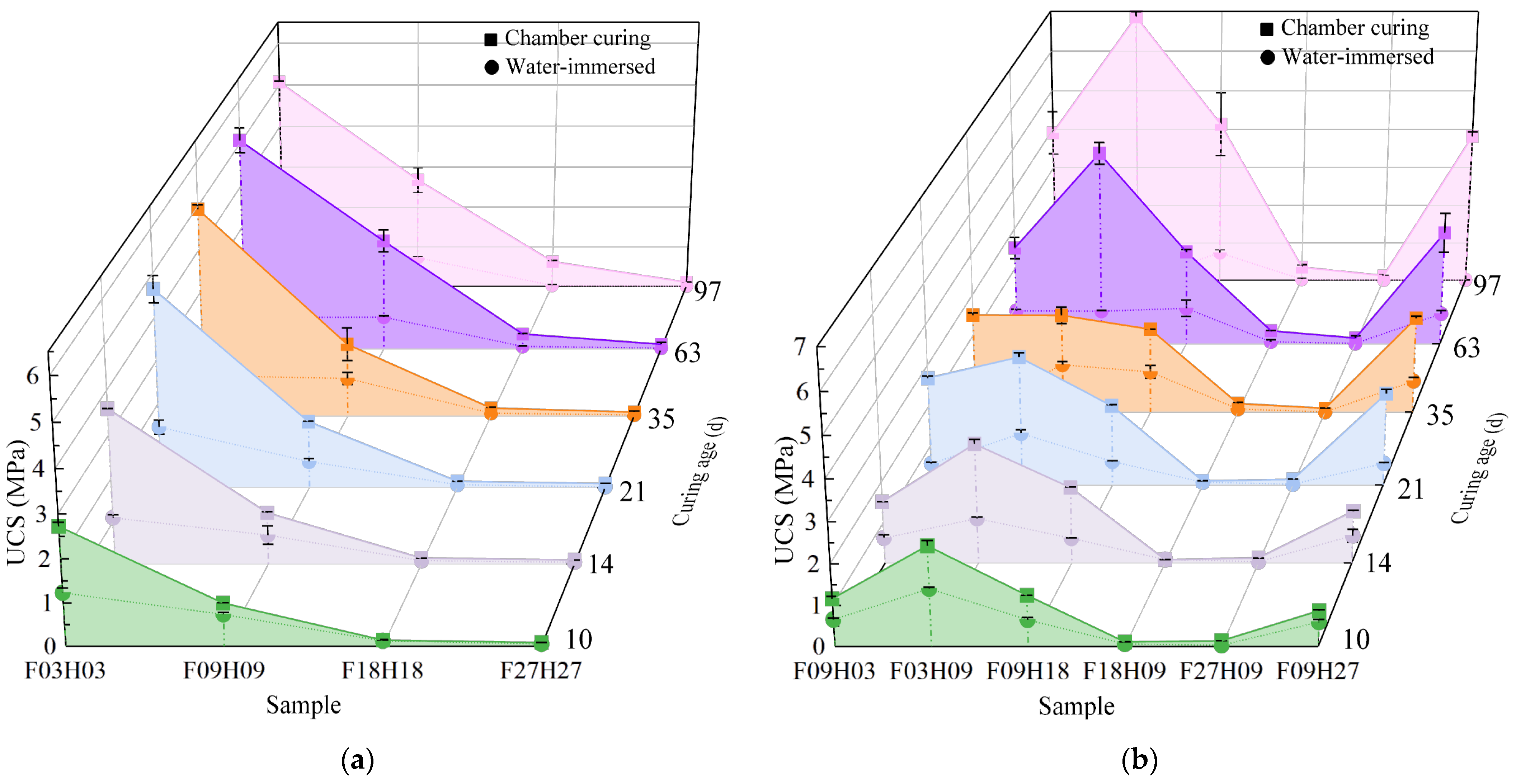
Figure 4a shows that UCS decreased sharply with increasing total acid dosage at FAc:HAc = 1:1. Increasing the total acid dosage from 0.6% (F03H03) to 3.6% (F18H18) reduced the 35 d UCS from 4.94 to 0.19 MPa and the 97 d UCS from 5.07 to 0.62 MPa, corresponding to reductions of 96.1% and 87.7%, respectively. When the total dosage reached 5.4% (F27H27), UCS was approximately 0.10 MPa at both ages, indicating that subsequent strength development had essentially ceased.
Figure 4.
The UCS development with acid dosage and composition: (a) equal FAc and HAc dosages; (b) interchanged FAc and HAc dosages.
Figure 4b further shows that UCS depended strongly on acid composition even at the same total dosage. At a total dosage of 1.2%, F03H09 and F09H03 had nearly identical 35 d UCS values of 2.49 and 2.50 MPa, respectively, whereas their 97 d UCS values were 6.87 and 3.91 MPa, giving a 43.1% lower strength for the FAc-dominant mixture. Within the rapid strength-decay range, this compositional effect became more pronounced as the total acid dosage increased. At a total dosage of 3.6%, changing the composition from F09H27 to F27H09 reduced UCS by 95.9% at 35 d and 97.0% at 97 d. The pronounced UCS minima observed for F18H09 and F27H09 are mainly associated with their higher FAc contents, which exert a stronger inhibitory effect on strength development; in contrast, the relatively higher UCS at F09H27 is related to its lower FAc proportion. Factorial ANOVA confirmed significant main and interaction effects of FAc dosage, HAc dosage and curing age on UCS under both curing conditions (all p < 0.001). FAc dosage accounted for the largest proportion of UCS variation, with η2 values of 0.7997 and 0.8516 under chamber curing and water immersion, respectively. The significant interaction effects further confirmed that UCS development depended on both organic-acid composition and curing age.
To quantify the effects of curing age and the actual FAc and HAc dosages, an empirical relationship was fitted to the 175 mixture–age mean UCS values under chamber curing as follows:
Accordingly, the acid-dependent strength-retention factor, KFH, was defined as
The power-law terms were selected to describe the nonlinear effects of curing age and organic-acid dosage, while the exponential form ensures a positive KFH value normalised to unity in the absence of added organic acids. Equation (3) can therefore be rewritten as
where qN is the chamber-cured UCS and T is curing age. The term 1.88T0.25 represents the baseline strength developed with curing age in the absence of added acid, whereas KFH represents the fraction of this baseline strength retained at specified FAc and HAc dosages. Accordingly, KFH = 1 when F = H = 0, and decreasing KFH directly represents increasing acid-induced strength attenuation.
The FAc attenuation term, 0.73F2.37, increased rapidly with dosage, whereas the HAc attenuation term, 0.09H0.66, increased much more gradually. At equal FAc and HAc dosages of 0.3%, 0.9%, and 1.8%, the ratio of the two attenuation terms increased from 1.04 to 6.77 and 22.16, respectively, showing that acid-related strength attenuation became increasingly dominated by FAc as the dosage increased. The model yielded R2 = 0.92 and RMSE = 0.52 MPa. At the same total acid dosage of 2.7%, KFH decreased from 0.50 for F09H18 to 0.05 for F18H09, corresponding to a modelled UCS reduction of 90.2%. This closely matched the measured reductions of 89.5% and 91.7% at 35 and 97 d, respectively. Parameter uncertainty was assessed using 2000 fixed-design bootstrap refits, with 95% confidence intervals determined using the percentile method. The 95% confidence intervals of the curing-age exponent and FAc dosage exponent were 0.199–0.305 and 1.907–2.984, respectively. The latter interval remained above unity, supporting the superlinear increase in the fitted FAc attenuation term with increasing dosage. Parameter sensitivity analysis further showed that the predicted UCS was more sensitive to the FAc-related attenuation coefficient than to the corresponding HAc-related coefficient, consistent with the experimentally observed differences in their effects on strength development. The chamber-curing model achieved a range-normalised RMSE of approximately 7.7%. For UCS below 0.5 MPa, the median absolute prediction error was 0.0942 MPa, with an approximate 95% prediction-interval half-width of 0.3329 MPa for formulations containing at least 1.8% FAc. Supplementary age-specific regressions detected no significant incremental predictive contribution from OMC or target dry density to chamber-cured UCS after accounting for acid composition, with all p > 0.05.
3.1.3. Water-Immersion Response
Water immersion produced contrasting UCS responses in the two single-acid mixtures. Following the common 7 d initial curing period, the UCS of the HAc-only mixture F00H09 increased from 2.34 MPa after 3 d of immersion to 3.95 MPa after 56 d, an increase of 68.6% (Figure 3a). In contrast, the UCS of the FAc-only mixture F09H00 decreased from 0.72 to 0.48 MPa over the same period, a reduction of 33.6% (Figure 3b). At the same acid dosage of 0.9%, the two acids therefore produced opposing trends in strength development during immersion.
At a fixed FAc:HAc ratio of 1:1, immersed UCS decreased markedly with increasing total acid dosage (Figure 4a). After 14 d of immersion, increasing the total dosage from 0.6% (F03H03) to 1.8% (F09H09) reduced UCS from 1.453 to approximately 0.122 MPa, a reduction of 91.6%. However, UCS did not change monotonically with immersion duration for all mixtures. For F03H03, UCS increased from 1.093 MPa after 7 d of immersion to 1.453 MPa after 14 d, before decreasing to 0.792 MPa after 56 d. Figure 4b further shows that mixtures with identical total acid dosages but different FAc:HAc ratios exhibited different strength responses. These results indicate that immersed UCS depended on acid dosage, composition and exposure duration.
To quantify the effects of curing age, acid dosage and immersion duration on UCS, a water-immersion coefficient, KW, was incorporated into the chamber-curing strength relationship:
where qW is the predicted immersed UCS in MPa, t is the immersion duration in days, and 7 + t is the total curing age. The water-immersion coefficient KW describes the modification of predicted strength under immersion relative to the age-matched chamber-curing relationship. It is expressed empirically as
Equation (7) describes the dependence of the immersion response on exposure duration and individual acid dosages. The coefficients of FAc and HAc dosage in the immersion attenuation exponent were 1.138 and 0.040, with corresponding 95% bootstrap confidence intervals of 0.927–1.384 and 0.022–0.053, respectively. The larger FAc coefficient indicates a stronger dosage dependence of the modelled immersion attenuation exponent within the investigated composition range. The time-dependent term also accommodates the non-monotonic strength changes observed in some mixtures. Within the investigated ranges of organic-acid dosage and immersion duration, the proposed equation satisfies KW = 1 at t = 0, remains positive, and yields a maximum value of 1.119 for the acid-free formulation.
Substituting Equation (7) into Equation (6) gives the complete immersed-UCS relationship:
Equation (8) combines age-dependent strength development, acid-related strength attenuation and the additional influence of water immersion. The corresponding single-acid relationships are obtained by setting the dosage of the other acid to zero, whereas both dosages enter the relationship for binary-acid mixtures. After 28 d of immersion, the measured UCS values of F03H09 and F09H03 were 1.123 and 0.084 MPa, respectively. Increasing the FAc ratio from 1:3 to 3:1 resulted in a predicted UCS reduction of 93.3%, closely agreeing with the measured reduction of 92.5%. After 90 d of immersion, the corresponding predicted values are 0.7832 and 0.0247 MPa, giving a reduction of 96.8%. Thus, the modelled relative strength difference between the two compositions becomes more pronounced with prolonged immersion.
Fitting Equation (8) to the 150 mixture UCS values yielded R2 = 0.94, RMSE = 0.34 MPa and MAE = 0.24 MPa, indicating good overall agreement between predicted and measured immersed UCS. The relationship provides a unified empirical description of the effects of curing age, acid dosage, composition and immersion duration on the strength of stabilised soil under both single-acid and binary-acid conditions. To evaluate the predictive performance of the proposed models within the investigated experimental domain, leave-one-mixture-out cross-validation (LOMO-CV) was conducted across the 25 FAc–HAc combinations. The cross-validated R2 values were 0.892 and 0.922 for chamber-cured and immersed UCS, respectively, with corresponding RMSE values of 0.598 and 0.382 MPa. The immersion model achieved a range-normalised RMSE of no greater than approximately 6.1%. For UCS below 0.5 MPa, the median absolute prediction error was 0.0413 MPa, with an approximate 95% prediction-interval half-width of 0.1761 MPa for formulations containing at least 1.8% FAc.
3.2. Structural Evolution
3.2.1. Surface Products
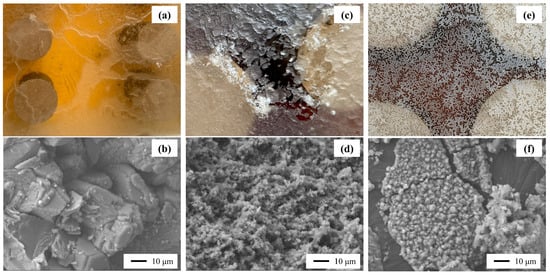
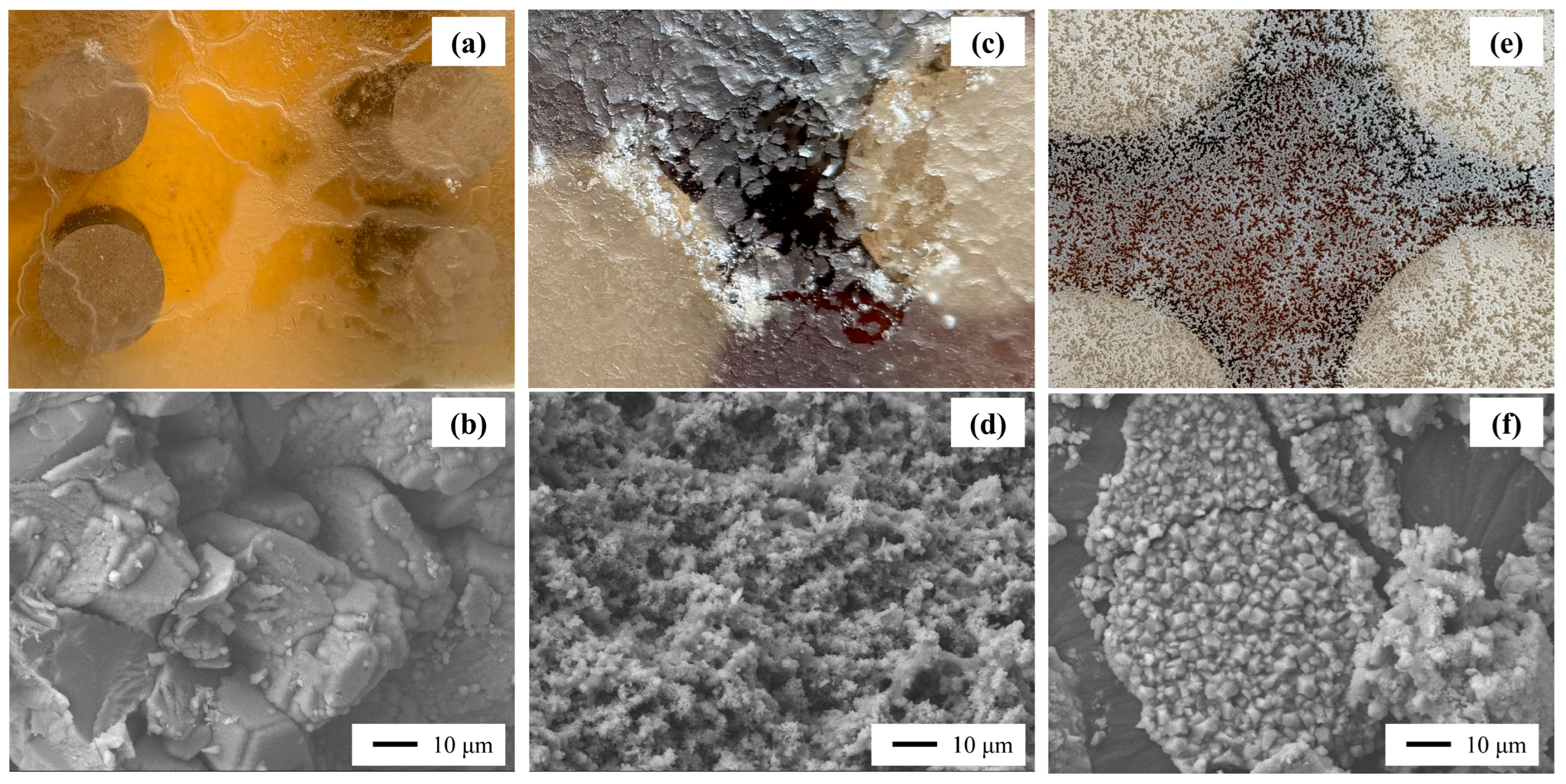
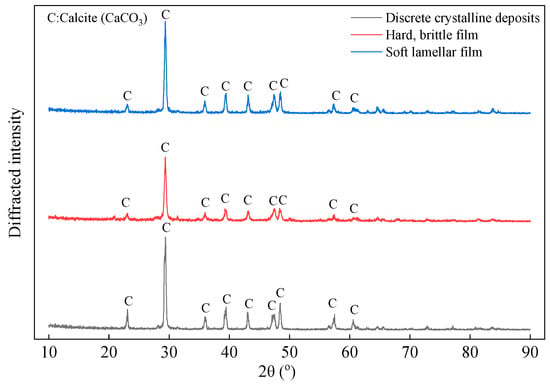
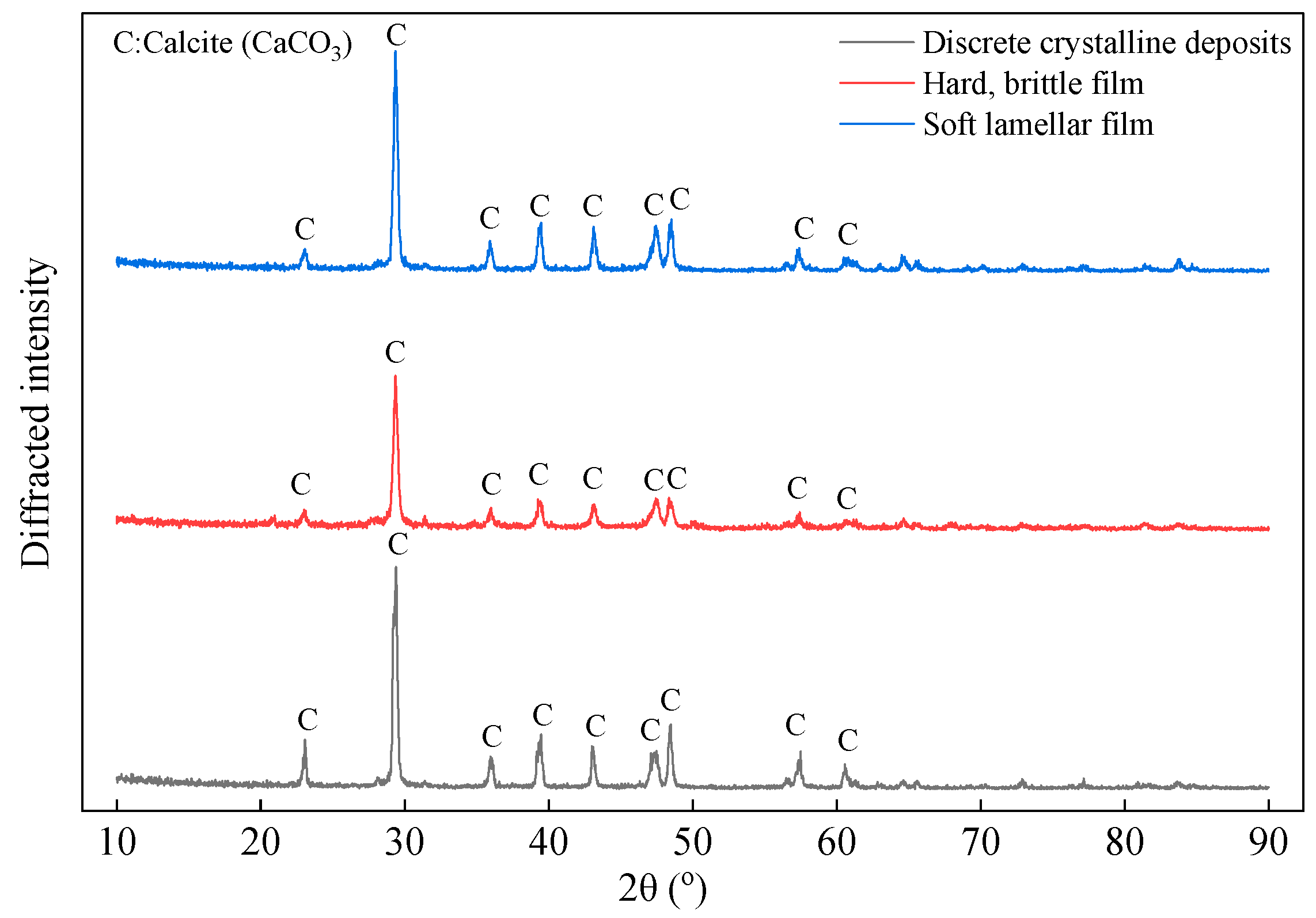
Figure 5 shows three characteristic precipitate morphologies formed at the air–water interface during static immersion under different HAc–FAc conditions. The HAc-dominant mixture F03H18 produced a soft lamellar film (Figure 5a,b), whereas F09H09, containing equal dosages of both acids, developed a hard, brittle film (Figure 5c,d). At the lower acid dosage, F03H03 formed discrete crystallite aggregates (Figure 5e,f). Despite their distinct morphologies and aggregation patterns, all three products exhibited calcite as the principal identifiable crystalline phase (Figure 6). These observations indicate that HAc and FAc influence not only the migration of calcium-bearing constituents during immersion but also their subsequent crystallisation and aggregation.
Figure 5.
Photographs and SEM images of precipitates collected from the air–water interface: (a) F03H18 soft lamellar film; (b) SEM morphology of the F03H18 film; (c) F09H09 hard, brittle film; (d) SEM morphology of the F09H09 film; (e) F03H03 discrete crystalline aggregates; (f) SEM morphology of the F03H03 aggregates.
Figure 6.
The XRD patterns of surface products after water immersion.
These morphological differences are associated with the chemical interactions of the two acids. Carboxylic and other oxygen-containing functional groups in HAc and FAc bind Ca2+, thereby affecting its availability in the immersion solution, while adsorption onto crystal surfaces modifies calcite growth. Reddy and Leenheer [56] and Reddy [57] demonstrated the inhibitory effects of organic acids on calcite growth, while Lebron and Suarez [58] reported changes in carbonate crystallisation and particle aggregation in the presence of dissolved organic matter. In F03H18, HAc-dominant conditions restricted further calcite growth, favouring lamellar deposits. In F09H09, the combined presence of HAc and FAc modified crystal growth and aggregation, producing an interconnected but porous precipitate structure. By contrast, the lower acid content in F03H03 reduced interference with crystal growth, allowing local crystallisation and aggregation into discrete clusters. The three morphologies therefore reflect differences in crystallisation and aggregation under varying acid conditions rather than changes in the dominant mineral phase.
During immersion, soluble constituents migrate from the stabilised soil into the surrounding water, where part of the released calcium subsequently precipitates as calcite at the air–water interface. Liu et al. [45] reported the release of multivalent ions under FAc exposure, while Wattez et al. [28] described the effects of organic matter on alkali-activated reactions. The identified calcite precipitates, microstructural observations and UCS results provide complementary evidence for interpreting the composition-dependent changes in interparticle cementation and immersion-strength response. Nevertheless, as the pH, electrical conductivity and dissolved calcium concentration of the immersion water were not monitored, the temporal evolution of aqueous chemistry and calcium-release behaviour associated with the proposed leaching process could not be directly characterised.
3.2.2. Interfacial Structure and Pore Network
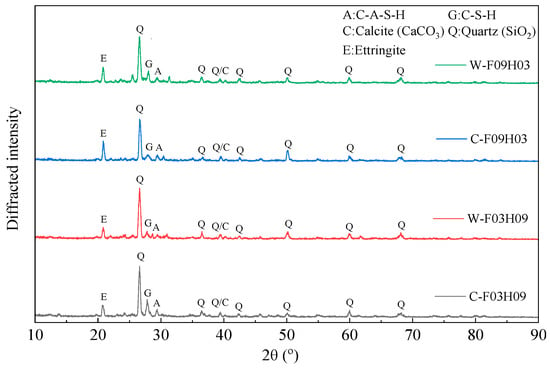
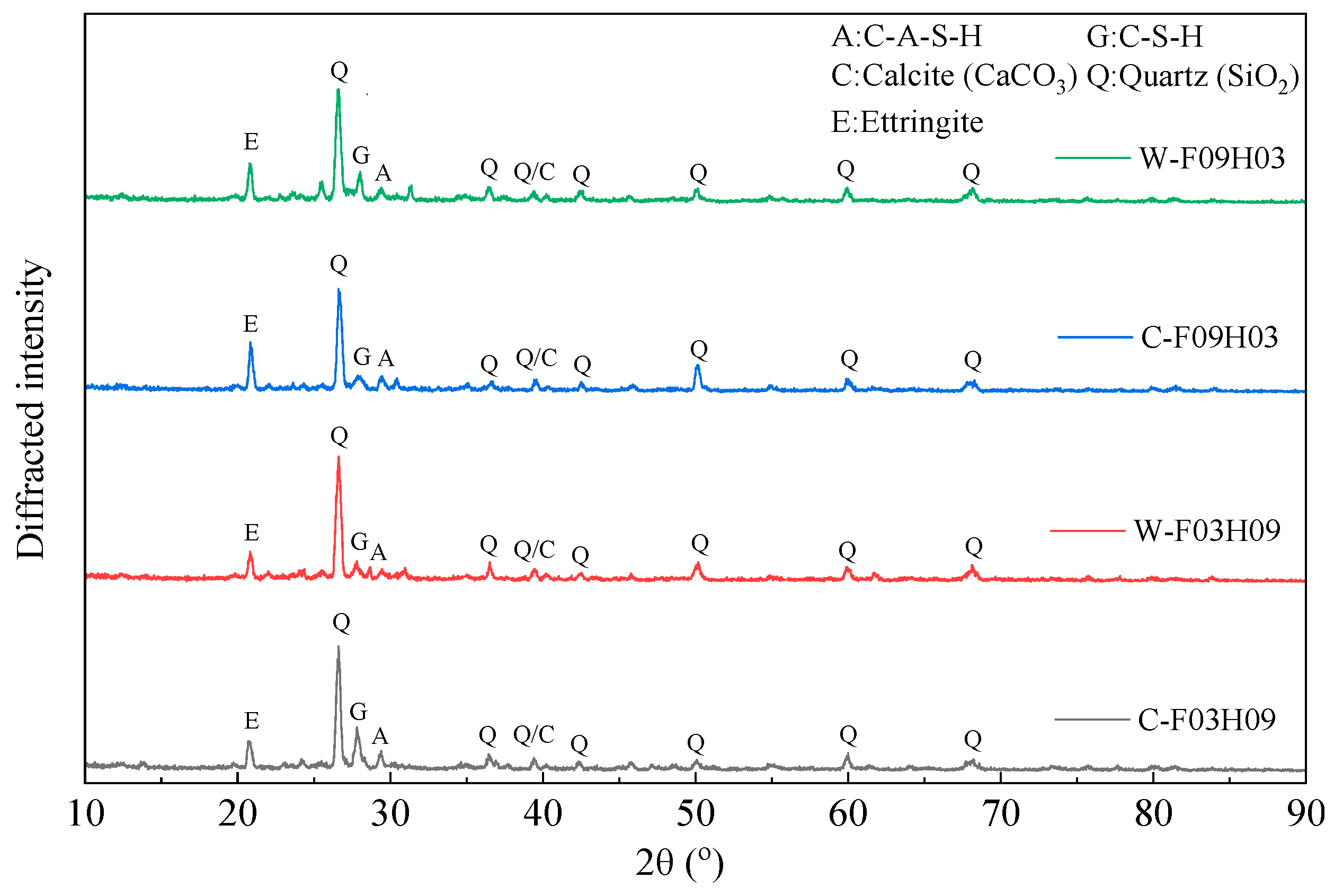
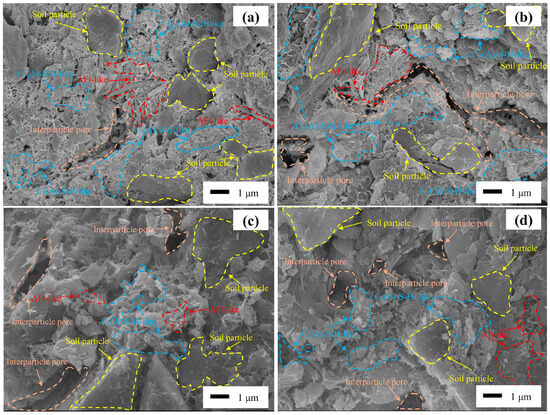
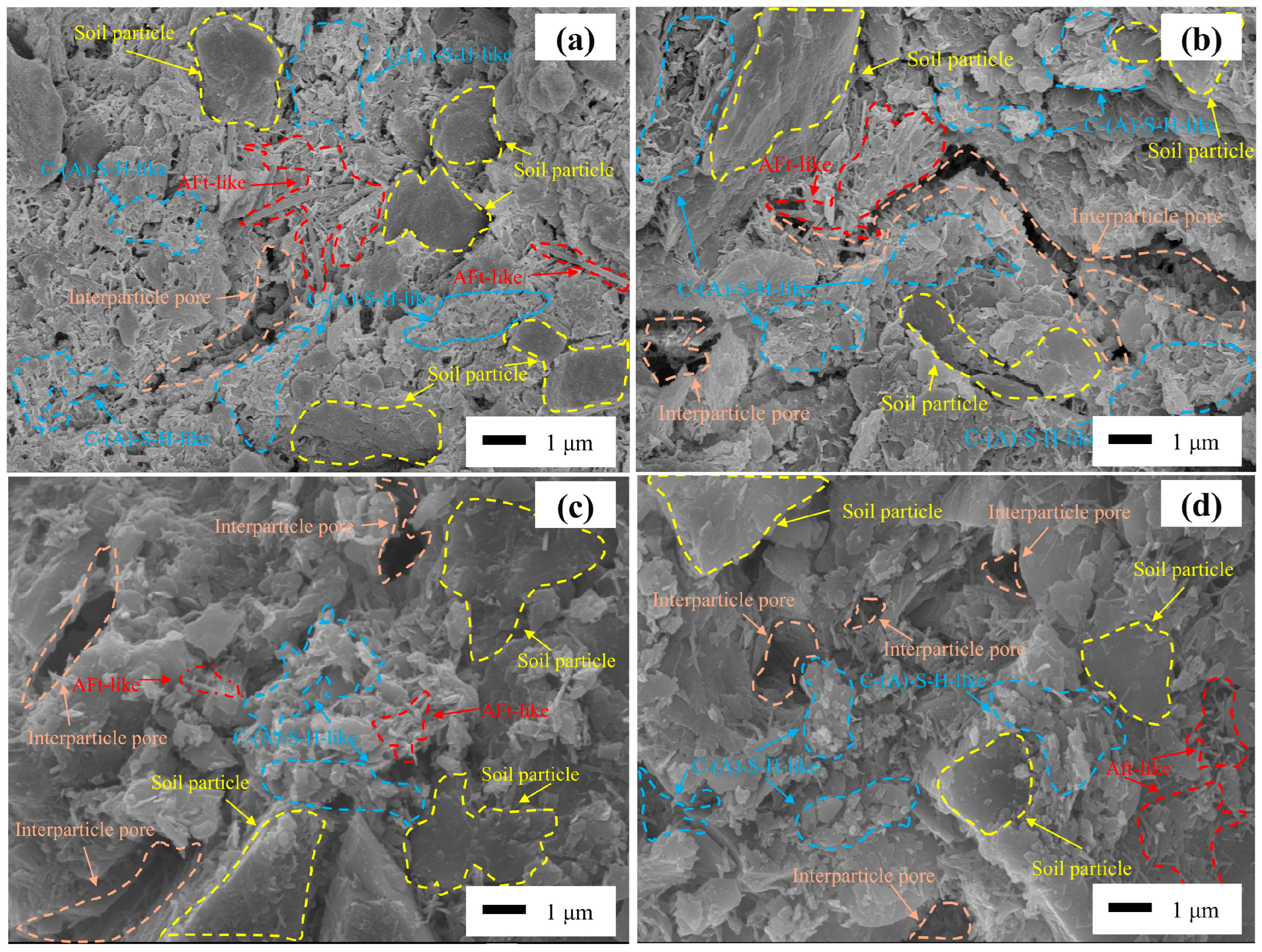
At a fixed total acid dosage of 1.2%, the FAc:HAc ratios were 1:3 in F03H09 and 3:1 in F09H03. The principal diffraction peaks of quartz and calcite remained evident in both mixtures under chamber curing and after water immersion (Figure 7). Under chamber curing, flocculent and foil-like deposits resembling C–(A)–S–H in the HAc-dominant F03H09 were distributed along soil particle boundaries and interwoven with AFt-like acicular structures, forming relatively continuous interparticle cementation (Figure 8a). By contrast, cementitious products in the FAc-dominant F09H03 occurred as localised clusters, leaving exposed particle boundaries and interparticle voids between product-rich regions (Figure 8c). Increasing FAc:HAc from 1:3 to 3:1 therefore reduced the continuity of product coverage and interparticle bridging.
Figure 7.
XRD patterns of F03H09 and F09H03 specimens under chamber curing (C) and water immersion (W).
Figure 8.
SEM images of F03H09 and F09H03 under chamber curing and after water immersion: (a) F03H09 under chamber curing, showing relatively continuous flocculent and foil-like deposits interwoven with AFt-like acicular structures; (b) F03H09 after 28 d of water immersion, showing partially exposed soil particles, open interparticle gaps, and residual cementitious deposits and AFt-like acicular structures; (c) F09H03 under chamber curing, showing locally clustered cementitious products and discontinuous interparticle bridging; (d) F09H03 after 28 d of water immersion, showing locally distributed cementitious products, open interparticle voids, and discontinuous interparticle contacts.
After 28 d of water immersion, F03H09 showed partial exposure of platy soil particles and open gaps along particle boundaries (Figure 8b). C–(A)–S–H-like deposits still covered parts of the particle surfaces and partially filled interparticle voids, while bundles of AFt-like acicular structures remained within the cemented regions. Compared with the chamber-cured specimen, product coverage across some particle contacts was less continuous. F09H03 also retained C–(A)–S–H-like deposits and AFt-like acicular structures after immersion, but the cementitious products remained locally distributed (Figure 8d). Open interparticle voids separated adjacent product-rich regions, and some particle contacts lacked continuous product bridges. Thus, immersion locally reduced cementation continuity in F03H09, whereas F09H03 remained characterised by a more discontinuous interparticle cementation pattern.
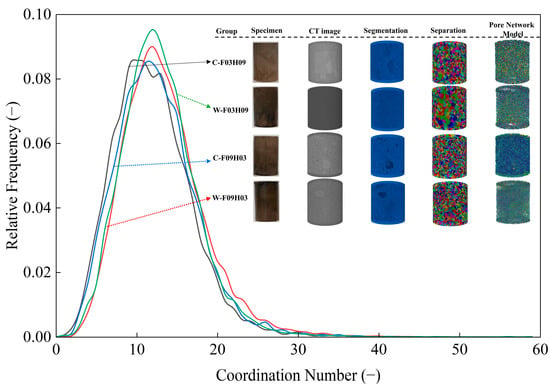
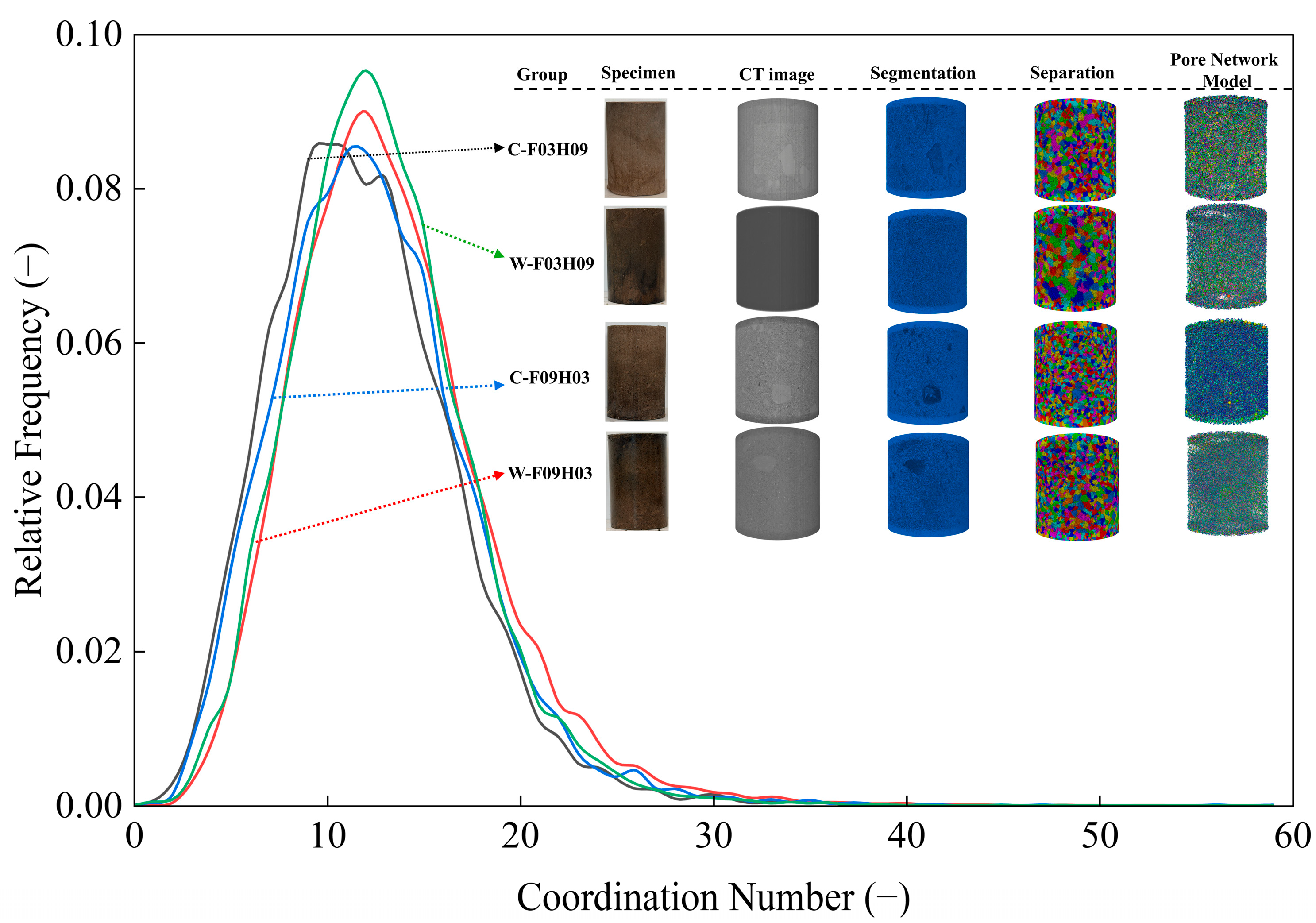
CT analysis characterised the differences in pore structure associated with immersion (Figure 9). After 28 d of immersion, corresponding to a total age of 35 d, connected porosity increased by 23.9% in F03H09 and 45.0% in F09H03 compared with their respective age-matched chamber-cured controls. The corresponding increases in the volume fraction of crack-like pores were 28.9% and 51.2%. Pore-network tortuosity was lower in the immersed specimens, at 2.17 and 1.97, respectively. The coordination-number distributions remained unimodal, with peaks near 10–13 and only minor shifts in peak position after immersion. The greater increases in connected porosity and crack-like pore volume fraction in F09H03 indicate more pronounced changes in its pore structure following immersion. Across the two mixtures, the coefficients of variation for the six CT-derived parameters ranged from 1.65% to 3.55%, indicating relatively low dispersion among CT observations. Although local spatial variability was observed, F09H03 consistently exhibited higher connected porosity than F03H09 across the upper, middle and lower sampling positions, supporting the observed difference in pore structure after immersion.
Figure 9.
The CT-derived pore structures of F03H09 and F09H03 under chamber curing and water immersion.
Taken together, the SEM observations and CT measurements suggest that less continuous interparticle bonding and greater changes in pore structure contributed to the lower UCS retention of F09H03 after immersion. The strength evolution of immersed specimens reflects the combined effects of continued cementitious reactions and immersion-related structural deterioration. The increased connected porosity observed after immersion, particularly in the FAc-dominant mixture, suggests that immersion-associated structural changes may partially offset the strength development associated with continued cementitious reactions.
4. Discussion
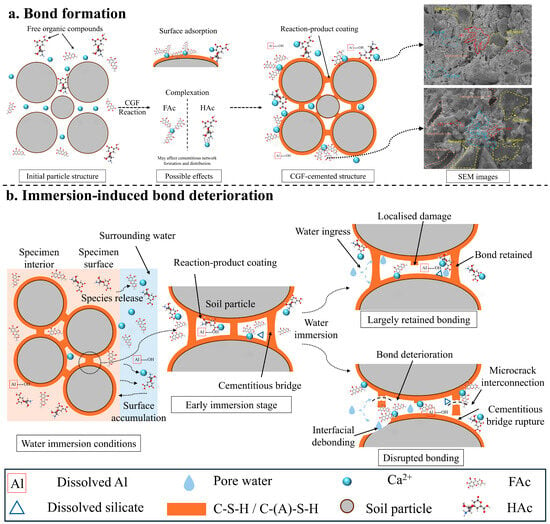
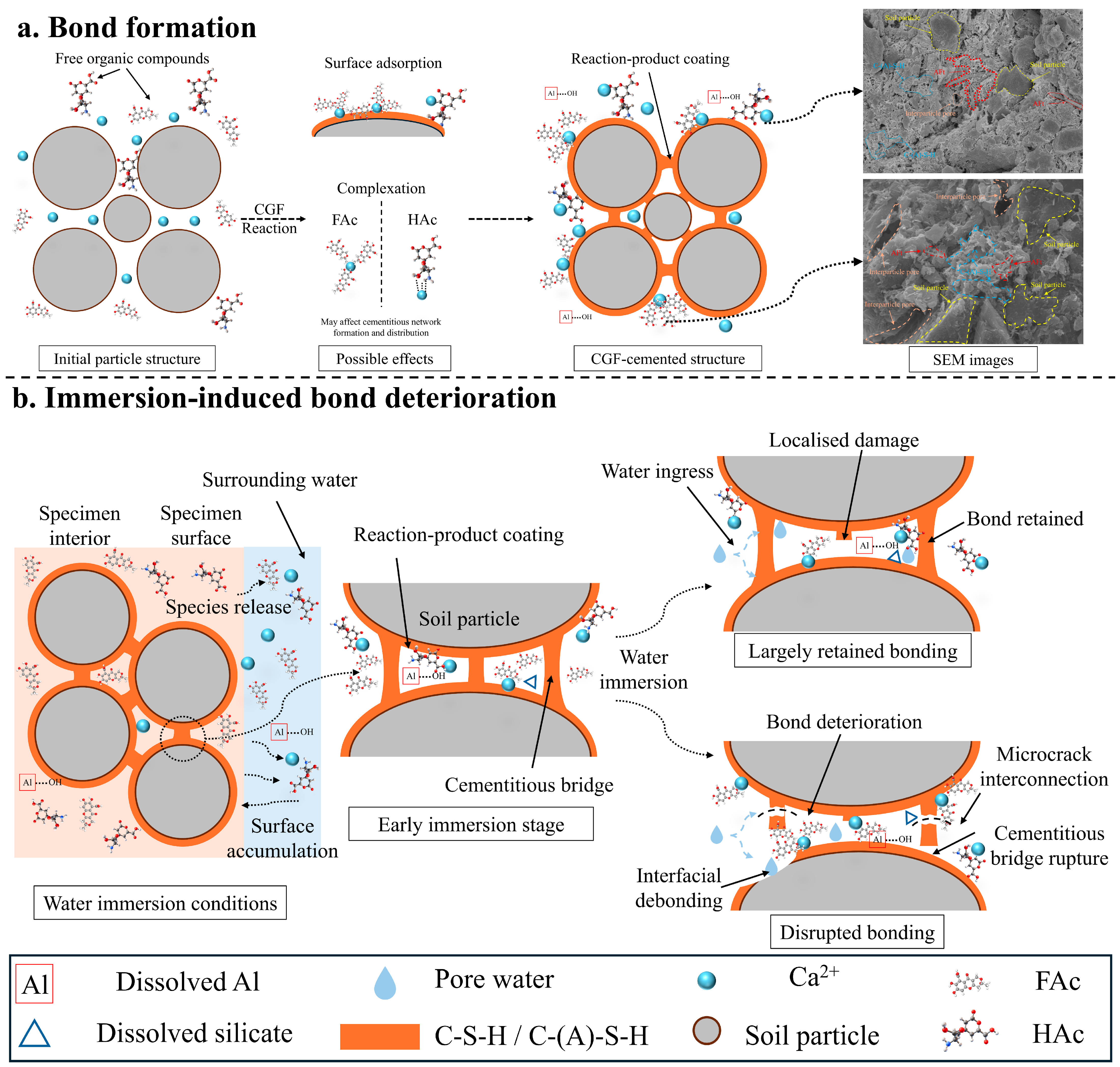
Figure 10 proposes a mechanism linking HAc–FAc composition to bond formation, immersion-induced deterioration and surface-product development. Both acids were introduced into the soil before CGF addition. After wetting, they could remain adsorbed on particle surfaces or enter the pore solution, with adsorption and desorption allowing exchange between these fractions. CGF then established an alkaline environment, favouring carboxyl-group deprotonation and Ca2+ coordination. FAc had a higher carboxyl-group density and lower molecular weight than HAc, whereas Ca2+-mediated association provided a route for local HAc aggregation. These contrasting interactions influence how Ca-bearing constituents are partitioned between organic association and cementitious reactions [28,59].
Figure 10.
Schematic illustration of acid-modified bonding and water-induced structural evolution: (a) bond formation under acid modification; (b) bond deterioration under water immersion.
At particle contacts, this competition influences the formation and distribution of C–(A)–S–H and related cementitious products (Figure 10a). At a fixed total acid dosage, a higher FAc proportion increases the abundance of potential carboxylate binding sites, modifying the local availability of Ca-bearing constituents. Product deposition contributes to strength when it establishes effective bridges between neighbouring particles. Acid composition therefore affects strength through both cementitious-product formation and the spatial continuity of the resulting bonds.
During immersion, water enters connected pores and exchanges with the pore solution (Figure 10b). Particle-associated organic constituents can desorb or dissolve, then readsorb, bind metal ions or migrate into the surrounding water. Ca-mediated HAc aggregation may favour local association, while both FAc and HAc may participate in calcium complexation and constituent redistribution during immersion [42,60]. Dissolution of Ca-bearing binding phases can supply additional mobile species. Together, these processes redistribute constituents away from some particle contacts and weaken the bridges that sustain load transfer.
The mechanical consequence depends on the location and extent of bridge damage. Deterioration confined to bridge margins can leave a load-bearing connection intact, whereas damage across the bridge neck or along the particle–product interface reduces the effective contact area (Figure 10b). Debonding and bridge rupture then interrupt load-transfer paths, while connected cracks increase access for water and dissolved species. F03H09 retains more continuous bonding after immersion. In F09H03, the initially less continuous structure undergoes greater disruption, allowing local bond loss and pore interconnection to reinforce one another.
Acid composition thus affects water stability through both the continuity of interparticle bonds established during curing and their persistence during immersion. This distinction matters when estimating the strength of CGF-stabilised fill after water exposure. At 1.2% total acid, F03H09 and F09H03 retained 45.09% and 3.36% of their respective age-matched chamber-cured UCS after 28 d of immersion. Applying the retention measured for the HAc-rich mixture to the FAc-rich mixture would therefore overestimate the latter’s remaining strength. Total acid content alone is consequently insufficient for assigning an immersion-related strength reduction.
For the tested CGF formulation, the proposed relationships account for acid-related attenuation of chamber-cured strength through KFH and the subsequent immersion response through the composition- and time-dependent KW. They provide a basis for estimating immersed UCS without assuming that mixtures with similar total acid contents undergo the same relative strength loss. Within the calibrated range, these estimates can inform laboratory mix trials for water-exposed subgrades and backfills by indicating the strength margin above a specified immersed-UCS requirement. Acid compositions for which the tested formulation is predicted to fall below this requirement can then be prioritised for further mix trials and confirmatory immersion testing. This helps avoid selecting a treatment that develops adequate chamber-cured strength but leaves insufficient strength after water exposure. The identified calcite precipitates, microstructural observations and UCS results provide complementary evidence for interpreting the composition-dependent changes in interparticle cementation and immersion-strength response. Nevertheless, as the pH, electrical conductivity and dissolved calcium concentration of the immersion water were not monitored, the temporal evolution of aqueous chemistry and calcium-release behaviour associated with the proposed leaching process could not be directly characterised.
5. Conclusions
This study investigated the effects of FAc and HAc dosage and composition on the strength and water stability of CGF-stabilised soil. The main conclusions are as follows.
(1) FAc and HAc both reduced UCS nonlinearly, but FAc produced a markedly stronger response. The steepest decline in UCS retention occurred at approximately 0.74% FAc and 1.12% HAc, and high FAc dosages also strongly suppressed later-age strength development.
(2) At the same total acid dosage, increasing the FAc proportion intensified UCS attenuation. An empirical model described chamber-cured UCS as the product of age-dependent strength without added acid and an acid-dependent retention factor, KFH with R2 = 0.92.
(3) Immersion responses varied with acid composition, and some mixed-acid mixtures showed a decline, partial recovery and renewed decline in UCS. The water-immersion coefficient, KW, expressed modelled immersed UCS relative to the modelled chamber-cured UCS of the same mixture at the same total age. Incorporating KW into the chamber-curing relationship described the overall immersed UCS dataset with R2 = 0.94.
(4) At a total acid dosage of 1.2%, the greater strength attenuation of the FAc-dominant mixture after 28 d of immersion was associated with more pronounced interfacial debonding and pore-network interconnection than in the HAc-dominant mixture. Connected porosity increased by 45.0% and 23.9%, respectively, relative to the corresponding age-matched chamber-cured controls, while the principal crystalline phases remained essentially unchanged.
The proposed relationships were developed using a predominantly silty soil with a fixed CGF formulation to quantify FAc- and HAc-induced strength attenuation and immersion responses. As soil mineralogy, natural organic-matter characteristics and binder content were not independently varied, their effects on the fitted parameters and model transferability remain unquantified.
The mechanical and microstructural changes were experimentally characterised, whereas calcium-related interactions and constituent redistribution remain literature-supported mechanistic interpretations without direct chemical verification.
Author Contributions
Conceptualisation, X.X. and Q.C.; methodology, Q.C., C.D., and K.Y.; data curation, X.X., Q.C., and C.D.; investigation, X.X. and K.Y.; writing—original draft preparation, X.X. and K.Y.; writing—review and editing, X.X. and Q.C.; funding acquisition, K.Y. All authors have read and agreed to the published version of the manuscript.
Funding
This research was funded by the Regional Collaborative Innovation Program of Changji Hui Autonomous Prefecture (2025X02).
Institutional Review Board Statement
Not applicable.
Informed Consent Statement
Not applicable.
Data Availability Statement
The original contributions presented in this study are included in the article. Further inquiries can be directed to the corresponding author.
Conflicts of Interest
Authors Qigang Chan and Changjiang Dong were employed by Jining Hongxiang Highway Survey Design & Research Institute Co., Ltd., Jining, China. The remaining authors declare no commercial or financial relationships that could be construed as potential conflicts of interest.
References
- Arreola, D.; Hernandez, J.; Vesco, V.; Reddy, K.R. Dredged material decision tool (DMDT) for sustainable beneficial reuse applications. J. Mar. Sci. Eng. 2022, 10, 178. [Google Scholar] [CrossRef] [Scilit]
- Svensson, N.; Norén, A.; Modin, O.; Karlfeldt Fedje, K.; Rauch, S.; Strömvall, A.M.; Andersson-Sköld, Y. Integrated cost and environmental impact assessment of management options for dredged sediment. Waste Manag. 2022, 138, 30–40. [Google Scholar] [CrossRef] [Scilit] [PubMed]
- Dong, Y.; Xu, F.; Liang, X.; Huang, J.; Yan, J.; Wang, H.; Hou, Y. Beneficial use of dredged sediments as a resource for mine reclamation: A case study of Lake Dianchi’s management in China. Waste Manag. 2023, 167, 81–91. [Google Scholar] [CrossRef] [Scilit] [PubMed]
- Bortali, M.; Rabouli, M.; Yessari, M.; Hajjaji, A. Characterizing harbor dredged sediment for sustainable reuse as construction material. Sustainability 2023, 15, 1834. [Google Scholar] [CrossRef] [Scilit]
- Yoobanpot, N.; Jamsawang, P.; Simarat, P.; Jongpradist, P.; Likitlersuang, S. Sustainable reuse of dredged sediments as pavement materials by cement and fly ash stabilization. J. Soils Sediments 2020, 20, 3807–3823. [Google Scholar] [CrossRef] [Scilit]
- Barciela-Rial, M.; Vardon, P.J.; Van Kessel, T.; Griffioen, J.; Winterwerp, J.C. Effect of composition on the compressibility and shear strength of dredged cohesive sediment. Front. Earth Sci. 2022, 10, 786108. [Google Scholar] [CrossRef] [Scilit]
- Wang, D.; Abriak, N.E.; Zentar, R. Strength and deformation properties of Dunkirk marine sediments solidified with cement, lime and fly ash. Eng. Geol. 2013, 166, 90–99. [Google Scholar] [CrossRef] [Scilit]
- Wang, H.; Wang, Z.; Yang, W.; Jia, H.; You, Z. Characterization, pollution, and beneficial utilization assessment of dredged sediments from coastal ports in China. Mar. Pollut. Bull. 2025, 211, 117389. [Google Scholar] [CrossRef] [Scilit] [PubMed]
- Coudert, E.; Deneele, D.; Russo, G.; Vitale, E.; Tarantino, A. Microstructural evolution and mechanical behaviour of alkali activated fly ash binder treated clay. Constr. Build. Mater. 2021, 285, 122917. [Google Scholar] [CrossRef] [Scilit]
- Cristelo, N.; Glendinning, S.; Fernandes, L.; Pinto, A.T. Effects of alkaline-activated fly ash and Portland cement on soft soil stabilisation. Acta Geotech. 2013, 8, 395–405. [Google Scholar] [CrossRef] [Scilit]
- Arulrajah, A.; Yaghoubi, M.; Disfani, M.M.; Horpibulsuk, S.; Bo, M.W.; Leong, M. Evaluation of fly ash- and slag-based geopolymers for the improvement of a soft marine clay by deep soil mixing. Soils Found. 2018, 58, 1358–1370. [Google Scholar] [CrossRef] [Scilit]
- Chen, R.; Zhu, Y.; Lai, H.P.; Bao, W. Stabilization of soft soil using low-carbon alkali-activated binder. Environ. Earth Sci. 2020, 79, 510. [Google Scholar] [CrossRef] [Scilit]
- Yi, Y.; Gu, L.; Liu, S.; Puppala, A.J. Carbide slag–activated ground granulated blastfurnace slag for soft clay stabilization. Can. Geotech. J. 2015, 52, 656–663. [Google Scholar] [CrossRef] [Scilit]
- Lang, L.; Chen, B.; Li, N. Utilization of lime/carbide slag-activated ground granulated blast-furnace slag for dredged sludge stabilization. Mar. Georesources Geotechnol. 2021, 39, 659–669. [Google Scholar] [CrossRef] [Scilit]
- Yang, J.; Zhang, Q.; He, X.; Su, Y.; Zeng, J.; Xiong, L.; Zeng, L.; Yu, X.; Tan, H. Low-carbon wet-ground fly ash geopolymer activated by single calcium carbide slag. Constr. Build. Mater. 2022, 353, 129084. [Google Scholar] [CrossRef] [Scilit]
- Li, H.; Wang, R.; Wei, M.; Lei, N.; Wei, T.; Liu, F. Characteristics of carbide-slag-activated GGBS–fly ash materials: Strength, hydration mechanism, microstructure, and sustainability. Constr. Build. Mater. 2024, 422, 135796. [Google Scholar] [CrossRef] [Scilit]
- Liu, X.; Xiao, G.; Yang, D.; Dai, L.; Tang, A. Sustainable cementitious materials: Strength and microstructural characteristics of calcium carbide residue-activated ground granulated blast furnace slag–fly ash composites. Sustainability 2024, 16, 11168. [Google Scholar] [CrossRef] [Scilit]
- Wu, Y.; Yang, J.; Chang, R. The design of ternary all-solid-waste binder for solidified soil and the mechanical properties, mechanism and environmental benefits of CGF solidified soil. J. Clean. Prod. 2023, 429, 139439. [Google Scholar] [CrossRef] [Scilit]
- Chan, Q.; Guo, J.; Liu, C.; Ju, C.; Dong, C.; Mao, S.; Yao, K. Road performance and durability of dredged soil stabilized using a calcium carbide slag–GGBS–fly ash binder. Sustainability 2026, 18, 6690. [Google Scholar] [CrossRef] [Scilit]
- Phetchuay, C.; Horpibulsuk, S.; Arulrajah, A.; Suksiripattanapong, C.; Udomchai, A. Strength development in soft marine clay stabilized by fly ash and calcium carbide residue based geopolymer. Appl. Clay Sci. 2016, 127–128, 134–142. [Google Scholar] [CrossRef] [Scilit]
- Li, W.; Yi, Y. Estimating the optimum addition of carbide sludge for enhancing strength development of ground-granulated blast furnace slag-treated slurry based on initial pH. J. Mater. Civ. Eng. 2023, 35, 04022400. [Google Scholar] [CrossRef] [Scilit]
- Li, W.; Yi, Y. Compressibility and permeability of carbide sludge–ground granulated blast furnace slag-treated clay slurry. Int. J. Geomech. 2022, 22, 04022238. [Google Scholar] [CrossRef] [Scilit]
- Xi, L.; Zhou, F.; Ma, Q.; Li, W.; Xiao, H.; Zhang, D. Investigation on strength properties of phosphogypsum-dredged soil stabilized by carbide slag activated ground granulated blast-furnace slag. Constr. Build. Mater. 2024, 457, 139427. [Google Scholar] [CrossRef] [Scilit]
- Qi, Z.; Li, J.; Lang, L.; Xue, Q. Development of ternary all-solid-waste cementitious materials and utilization in engineering sediment waste stabilization. J. Rock Mech. Geotech. Eng. 2026, 18, 2288–2299. [Google Scholar] [CrossRef] [Scilit]
- Jiang, N.J.; Du, Y.J.; Liu, S.Y.; Wei, M.L.; Horpibulsuk, S.; Arulrajah, A. Multi-scale laboratory evaluation of the physical, mechanical, and microstructural properties of soft highway subgrade soil stabilized with calcium carbide residue. Can. Geotech. J. 2016, 53, 373–383. [Google Scholar] [CrossRef] [Scilit]
- Li, W.; Yi, Y.; Puppala, A.J. Comparing carbide sludge-ground granulated blastfurnace slag and ordinary Portland cement: Different findings from binder paste and stabilized clay slurry. Constr. Build. Mater. 2022, 321, 126382. [Google Scholar] [CrossRef] [Scilit]
- Toda, K.; Kikuchi, R.; Otake, T.; Nishimura, S.; Akashi, Y.; Aimoto, M.; Kokado, T.; Sato, T. Effect of soil organic matters in dredged soils to utilization of their mixtures made with a steel slag. Materials 2020, 13, 5450. [Google Scholar] [CrossRef] [Scilit] [PubMed]
- Wattez, T.; Patapy, C.; Frouin, L.; Waligora, J.; Cyr, M. Interactions between alkali-activated ground granulated blastfurnace slag and organic matter in soil stabilization/solidification. Transp. Geotech. 2021, 26, 100412. [Google Scholar] [CrossRef] [Scilit]
- Amiri, A.; Toufigh, M.M.; Toufigh, V. Stabilisation of organic soils with alkali-activated binders. Int. J. Pavement Eng. 2023, 24, 2104844. [Google Scholar] [CrossRef] [Scilit]
- Zhong, Y.; Cai, G.; Wang, S.; Qin, H.; Zhang, C.; Li, J. Influence of organic content on the mechanical properties of organic-rich soils stabilized with CaO-GGBS binder and PC. Water 2022, 14, 3053. [Google Scholar] [CrossRef] [Scilit]
- Su, Y.; Luo, B.; Luo, Z.; Xu, F.; Huang, H.; Long, Z.; Shen, C. Mechanical characteristics and solidification mechanism of slag/fly ash-based geopolymer and cement solidified organic clay: A comparative study. J. Build. Eng. 2023, 71, 106459. [Google Scholar] [CrossRef] [Scilit]
- Li, D.; Lang, L.; Dong, M.; Hu, Z. Stabilization of dredged sediments containing humic acid with nano-modified ordinary Portland cement-sulphoaluminate cement. J. Soils Sediments 2025, 25, 1040–1055. [Google Scholar] [CrossRef] [Scilit]
- Zhu, W.; Chiu, C.F.; Zhang, C.L.; Zeng, K.L. Effect of humic acid on the behaviour of solidified dredged material. Can. Geotech. J. 2009, 46, 1093–1099. [Google Scholar] [CrossRef] [Scilit]
- Kang, G.-O.; Tsuchida, T.; Kim, Y.-S.; Baek, W.-J. Influence of humic acid on the strength behavior of cement-treated clay during various curing stages. J. Mater. Civ. Eng. 2017, 29, 04017057. [Google Scholar] [CrossRef] [Scilit]
- Yuan, X.; Peng, L.; Chen, B. Investigation of magnesium phosphate cement on river dredged sludge with varying humic acid content and solidification mechanism. J. Rock Mech. Geotech. Eng. 2025, 17, 573–585. [Google Scholar] [CrossRef] [Scilit]
- Wang, S.; He, X.; Gong, S.; Cai, G.; Lang, L.; Ma, H.; Niu, Z.; Zhou, F. Influence mechanism of fulvic acid on the strength of cement-solidified dredged sludge. Water 2022, 14, 2616. [Google Scholar] [CrossRef] [Scilit]
- Shao, L.; Ding, Z.; Wang, S.; Pan, K.; Hu, C. Effect of organic matter components on the mechanical properties of cemented soil. Materials 2023, 16, 5889. [Google Scholar] [CrossRef] [Scilit] [PubMed]
- Luo, Z.; Zhang, B. Effect of humic acid and fulvic acid on mechanical and durability properties of geopolymer stabilized soft soil. Constr. Build. Mater. 2023, 409, 133875. [Google Scholar] [CrossRef] [Scilit]
- Tremblay, H.; Duchesne, J.; Locat, J.; Leroueil, S. Influence of the nature of organic compounds on fine soil stabilization with cement. Can. Geotech. J. 2002, 39, 535–546. [Google Scholar] [CrossRef] [Scilit]
- Lang, L.; Liu, N.; Chen, B. Strength development of solidified dredged sludge containing humic acid with cement, lime and nano-SiO2. Constr. Build. Mater. 2020, 230, 116971. [Google Scholar] [CrossRef] [Scilit]
- Wu, D.; Zhang, Z.; Chen, K.; Xia, L. Experimental investigation and mechanism of fly ash/slag-based geopolymer-stabilized soft soil. Appl. Sci. 2022, 12, 7438. [Google Scholar] [CrossRef] [Scilit]
- Liu, W.; Cao, J.; Song, Y.; Sui, S.; Xu, H.; Guo, Y.; Ding, W.; Huang, S. Study on the corrosion behavior of cemented organic soil in Dianchi Lake, China. Materials 2023, 16, 5951. [Google Scholar] [CrossRef] [Scilit] [PubMed]
- Cao, J.; Lei, S.; Liu, W.; Song, Y.; Sui, S.; Xu, H.; Guo, Y.; Ding, W. Experimental study on the corrosion of fulvic acid to cement-soil and its microstructures in the peat soil environment. Coatings 2023, 13, 1366. [Google Scholar] [CrossRef] [Scilit]
- Zhang, X.W.; Cao, J.; Lei, S.Y.; Li, Y.H.; Cheng, Y.; Zhang, N.R. Effect of fulvic acid environment on the structure and permeability of cement-soil containing humic acid. Rock Soil Mech. 2025, 46, 249–261. [Google Scholar] [CrossRef]
- Liu, C.; Liang, X.; Chen, Y.; Li, Z.; Ye, G. Degradation of alkali-activated slag subjected to water immersion. Cem. Concr. Compos. 2023, 142, 105157. [Google Scholar] [CrossRef]
- Liu, C.; Xie, J.; Li, Z.; Ye, G. An experimental and numerical study on the cracking of alkali-activated slag pastes induced by water immersion. Cem. Concr. Res. 2025, 193, 107877. [Google Scholar] [CrossRef] [Scilit]
- GB/T 50145—2007; Standard for Engineering Classification of Soil. China Planning Press: Beijing, China, 2007.
- GB/T 50123–2019; Standard for Geotechnical Testing Method. China Planning Press: Beijing, China, 2019.
- LY/T 1238—1999; Determination of Humus Fractionation in Forest Soil. China Standards Press: Beijing, China, 1999.
- JTG/T F20—2015; Technical Guidelines for Construction of Highway Roadbases. China Communications Press: Beijing, China, 2015.
- GB/T 18046—2017; Ground Granulated Blast Furnace Slag Used for Cement, Mortar and Concrete. China Standards Press: Beijing, China, 2017.
- GB/T 1596—2017; Fly Ash Used for Cement and Concrete. China Standards Press: Beijing, China, 2017.
- JTG 3441—2024; Test Methods of Materials Stabilized with Inorganic Binders for Highway Engineering. China Communications Press: Beijing, China, 2024.
- ASTM D2166/D2166M—24; Standard Test Method for Unconfined Compressive Strength of Cohesive Soil. ASTM International: West Conshohocken, PA, USA, 2024.
- Dong, X.; Bao, X.; Cui, H.; Xu, C.; Chen, X. Macro-porosity and skeleton of a cement-gravel-treated granite residual soil for subgrade from CT scanning. Constr. Build. Mater. 2023, 371, 130703. [Google Scholar] [CrossRef] [Scilit]
- Reddy, M.M.; Leenheer, J. Calcite growth-rate inhibition by fulvic acids isolated from Big Soda Lake, Nevada, USA, the Suwannee River, Georgia, USA, and by polycarboxylic acids. Ann. Environ. Sci. 2011, 5, 41–53. [Google Scholar]
- Reddy, M.M. Calcite growth-rate inhibition by fulvic acid and magnesium ion—Possible influence on biogenic calcite formation. J. Cryst. Growth 2012, 352, 151–154. [Google Scholar] [CrossRef] [Scilit]
- Lebron, I.; Suarez, D.L. Calcite nucleation and precipitation kinetics as affected by dissolved organic matter at 25 °C and pH > 7.5. Geochim. Cosmochim. Acta 1996, 60, 2765–2776. [Google Scholar] [CrossRef] [Scilit]
- Hakim, A.; Suzuki, T.; Kobayashi, M. Strength of humic acid aggregates: Effects of divalent cations and solution pH. ACS Omega 2019, 4, 8559–8567. [Google Scholar] [CrossRef] [Scilit] [PubMed]
- Weng, L.; Fest, E.P.M.J.; Fillius, J.; Temminghoff, E.J.M.; van Riemsdijk, W.H. Transport of humic and fulvic acids in relation to metal mobility in a copper-contaminated acid sandy soil. Environ. Sci. Technol. 2002, 36, 1699–1704. [Google Scholar] [CrossRef] [Scilit] [PubMed]

Disclaimer/Publisher’s Note: The statements, opinions and data contained in all publications are solely those of the individual author(s) and contributor(s) and not of MDPI and/or the editor(s). MDPI and/or the editor(s) disclaim responsibility for any injury to people or property resulting from any ideas, methods, instructions or products referred to in the content. |
© 2026 by the authors. Licensee MDPI, Basel, Switzerland. This article is an open access article distributed under the terms and conditions of the Creative Commons Attribution (CC BY) license.