


Highlights
- Several granite-based sawing sludges can effectively be used in metakaolin-based geopolymers;
- The presence of calcium carbonates in sawing sludges may lead to the formation of C(N)-A-S-H gel phases;
- Both mineralogy and granulometry of sawing sludges filler affect geopolymer properties.
Abstract
The stone industry generates a large amount of sawing sludge (SS). Geopolymers (GPs) offer a circular pathway by incorporating SS into their aluminosilicate networks, helping to mitigate the environmental impact on the construction industry. This preliminary study addresses the feasibility of using four types of SS (SS1–SS4) in metakaolin-based GP formulation, evaluating the effect of two granulometries (75 µm < x < 125 µm and 125 µm < x < 300 µm) on GP properties. Geopolymerization is confirmed through Fourier-transform infrared (FT-IR) spectroscopy, while integrity and boiling water tests confirm that all samples maintained their integrity under the selected preliminary experimental conditions. Microstructural and mineralogical characteristics, investigated by scanning electron microscopy (SEM) and wide-angle X-ray diffraction (WAXD), respectively, reveal heterogeneous microstructures characterized by the presence of unreacted crystalline particles. Thermal behavior, examined through thermogravimetric analysis (TGA) and derivative thermogravimetry (DTG), reveals total mass losses of approximately 15–18% up to 1000 °C, with an additional loss in the 500–800 °C range associated with carbonate decomposition, which is particularly evident in SS2, GP2/1, and GP2/2. Mechanical properties, through compressive strength tests, reveal higher values for GP2/1 (24.1 ± 0.4 MPa) and GP4/2 (24.7 ± 1.7 MPa) than for the GP0 control (22.5 ± 0.2 MPa). These preliminary findings support further investigations concerning the use of sawing sludges as fillers in sustainable alkali-activated materials.
1. Introduction
The stone industry represents a major sector of the economy of many countries, including Italy, where local geo-resources are mainly exploited for construction, urbanization, and decorative purposes. However, the finished product is only the final step in a process that begins with the extraction of the rock outcrop, i.e., the primary raw material [1]. Recently, multiwire machines have increasingly replaced traditional stone gang saw cutting technology. Their advantages include high efficiency, high performance, flexibility of use, high-quality cut surfaces, and a very low environmental impact (low energy consumption, lower concentration of heavy metals in the sludge, and less waste) [2].
Sawing sludges (SSs) are waste products generated by stone-cutting processes resulting from the mixing of rock powder with the water used to cool the cutting blades. They can be classified into two categories: sludges containing residual metal grit (abrasive sawing sludge) and those without metal grit [1,2]. This operation is carried out under wet conditions to limit blade damage by overheating due to friction, as well as to reduce the generation of potentially hazardous dust dispersed into the air during operations. These processes generate approximately 63.5 × 10⁶ tons of sawing sludge [3], an equivalent amount to approximately 50% of the volume of each quarried ornamental rock block.
Solid waste management affects public health, environmental sustainability, and economic development [4]. The disposal of sawing sludges is regulated by EWC code 010413, which assigns them to dedicated landfills for non-hazardous waste (Commission of the European Communities, 2010). When disposal is not carried out in accordance with the relevant standards, sludge is improperly accumulated in open areas, occupying land, damaging the landscape, and potentially posing a risk to hydrogeological balance due to infiltration into the subsoil [5]. The mineralogical composition of sawing sludges depends on the type of rock being processed: basaltic, carbonatic, granitic, quartz-based, or mixed when no specific lithology is processed. Among these sludges, those with an aluminosilicate composition are suitable for producing alkali-activated materials (AAMs), particularly geopolymers (GPs) [6,7,8]. This approach offers a potential route for valorizing sawing sludges as secondary raw materials in the development of innovative materials. Alkali-activated materials are a class of inorganic ceramic binding materials obtained through the reaction of an aluminosilicate source (precursor) with an alkaline activator [6,9]. Their potential environmental benefits and versatility are associated with the possibility of incorporating recycled waste materials as precursors. Geopolymers represent a subclass of AAMs characterized by high aluminum and low calcium contents and are generally obtained through activation with alkaline solutions, such as KOH, NaOH, sodium silicate, and potassium silicate [10]. The core mechanism underlying the effectiveness of GPs lies in the chemical process known as geopolymerization. Alkaline attack is the first step, leading to the dissolution of aluminosilicate precursors. This step is followed by the reorganization of Si and Al atoms into a dense three-dimensional network, a gel-like structure primarily composed of sodium aluminosilicate hydrate (N-A-S-H) or calcium aluminosilicate hydrate (C-A-S-H), depending on the source material. This network contributes to the high compressive and tensile strengths observed in GPs. The resulting matrix is not only dense and robust but also exhibits excellent resistance to several degradation processes affecting cement-based materials, such as chloride ingress and carbonation, which negatively affect material durability [11]. The synthesis process involves stirring, molding and, finally, curing and aging. During this phase, the material hardens at room temperature and/or at temperatures below 100 °C. From an environmental perspective, geopolymers have attracted considerable interest as potential alternatives to traditional cement-based materials [12,13]. The choice to synthesize GPs is motivated by their low environmental impact and their ability to incorporate different types of waste [14,15]. These promising materials allow for a reduction in CO2 emissions and raw materials consumption [16,17], and require temperatures less than half of those required for Ordinary Portland Cement (calcination of the raw material below 800 °C). The latter constitutes the most widely used construction material in the world due to its excellent performance. However, it is responsible for approximately 7–8% of global carbon dioxide emissions [18,19].
In response to these environmental concerns, previous studies have demonstrated the feasibility of partially incorporating SSs derived from granites of Cuasso al Monte (Italy) into geopolymer matrices, at contents of up to 20 wt.% of the total formulation [8]. Other studies have investigated the use of basalt-based SS as filler in geopolymers for building and restoration purposes [20], as well as the suitability of slate stone-cutting sludge for this application [21]. To the best of our knowledge, neither the use of several granite-based SSs nor the use of SS fillers with different particle sizes has been investigated.
In this context, the use of four granite-based sawing sludge wastes, namely SS1, SS2, SS3 and SS4, as fillers in metakaolin (MK)-based geopolymer was investigated. Moreover, the effect of two SS filler particle size ranges (75 µm < x < 125 µm and 125 µm < x < 300 µm) was evaluated. Before their use, SS fillers were characterized by wide-angle X-ray diffraction (WAXD), Fourier-transform infrared spectroscopy (FT-IR), and thermogravimetric analysis (TGA). The morphology of the synthesized geopolymers was investigated by scanning electron microscopy (SEM). Furthermore, geopolymerization was confirmed through FT-IR, while preliminary macroscopic performance was assessed through integrity and boiling tests. Water leachates from the integrity tests were used to measure both pH and ionic conductivity. Finally, the physicochemical properties were investigated through TGA, derivative thermogravimetry (DTG), and compressive strength tests.
2. Materials and Methods
2.1. Raw Materials
Metakaolin (MK), purchased from IMCD Deutschland GmbH & Co., Koln, Germany, was used as the precursor for geopolymer synthesis. The MK employed in this research is characterized by (i) an amorphous structure with some crystalline impurities related to quartz, anatase, rutile and illite phases; (ii) a d50 of 3.6 μm; (iii) a BET surface area of 12 m2/g; and (iv) the following chemical composition: 53 wt.% SiO2, 40.5 wt.% Al2O3, 5 wt.% TiO2, and 1.5 wt.% minor oxides [22]. The four types of SS employed in this study are listed and described in Table 1. These SSs originate geologically from the Crevoladossola Valley (Piemonte, Italy) and are mineralogically composed of quartz, K-feldspars, plagioclases, dark biotites (mica) and muscovites [23].
Table 1.
Sample label and description of the SSs.
SS1–SS4 samples underwent manual sieving before being employed as fillers in alkali-activated metakaolin prepared with a NaOH/Na2SiO3 solution. Two different particle size ranges were collected and used: (i) 75 μm < x < 125 μm (labeled/1); (ii) 125 μm < x < 300 μm (labeled/2). A sodium silicate solution (pH = 12.5, SiO2/Na2O molar ratio = 2.6) was provided by Prochin S.r.l., Caserta, Italy. Its chemical composition was: 27.10 wt.% SiO2, 8.85 wt.% Na2O, and 64.05 wt.% H2O. Sodium hydroxide pellets and potassium bromide (KBr) were purchased from Sigma-Aldrich in Milan, Italy.
2.2. Raw Materials Analysis
Mineral phases were identified by wide-angle X-ray diffraction (WAXD) patterns using an automatic Bruker D2 phaser diffractometer (Bruker Corporation, Östliche Rheinbrückenstr, Germany) operating in reflection mode at 35 kV and 40 mA, using nickel-filtered Cu Kα radiation (1.5418 Å). The scans were performed from 5° to 90° (2θ), with 2000 acquisition steps (time/step = 0.200 s).
FT-IR analysis was performed using the Prestige21 Shimadzu system (Shimadzu Italia S.R.L., Milan, Italy), equipped with a DTGS KBr (Deuterated TriGlycine Sulfate with potassium bromide windows) detector (Shimadzu Italia S.R.L., Milan, Italy). A resolution of 2 cm−1 and 60 scans were used. The spectra were acquired over the range of 400–4000 cm−1 by analyzing KBr disks (4.00 mg of sample and 196.00 mg of KBr) with the setup reported elsewhere [24]. The FT-IR spectra were processed using IRsolution (v.160, Shimadzu, Milan, Italy) and Origin 2024 (v.2024b, OriginLab Corporation, Northampton, MA, USA).
The TGA/DTG analysis was conducted using the TA Instruments model SDT 650 (TA Instruments, New Castle, DE, USA). Approximately 14.00 mg of powder was weighed and placed into an alumina crucible. The temperature range for the analysis was 30–1000 °C, with a heating rate of 10 °C/min. A nitrogen (N2) atmosphere was used with a flow rate of 100 mL/min. The results were analyzed using TRIOS software (version 5.1, TA Instruments, New Castle, DE, USA) and processed with Origin 2024.
2.3. Preparation of Geopolymer Specimens
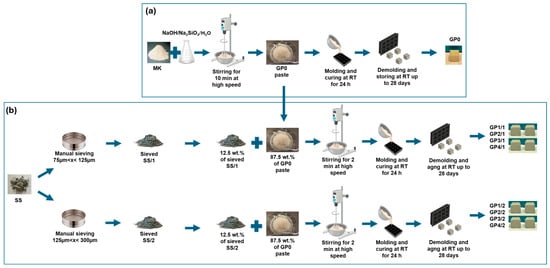
The synthesis of the GPs was performed using an AUCMA SM-1815Z electric mixer (AUCMA Co., Ltd., Qingdao, China). The GP0 composition was based on the following ratios: SiO2/Al2O3 = 4, Na2O/Al2O3 = 1, and H2O/Al2O3 = 14. To reach these molar ratios, NaOH pellets were mixed with sodium silicate solution 24 h before use, without adding water. For each synthesized geopolymer, 87.5 wt.% of the final formulation consisted of activated MK (i.e., GP0 fresh paste) and 12.5 wt.% consisted of SS filler. The amounts of each component required to prepare 100 g of the final geopolymer are listed in Table 2.
Table 2.
Geopolymer composition based on 100 g of final product.
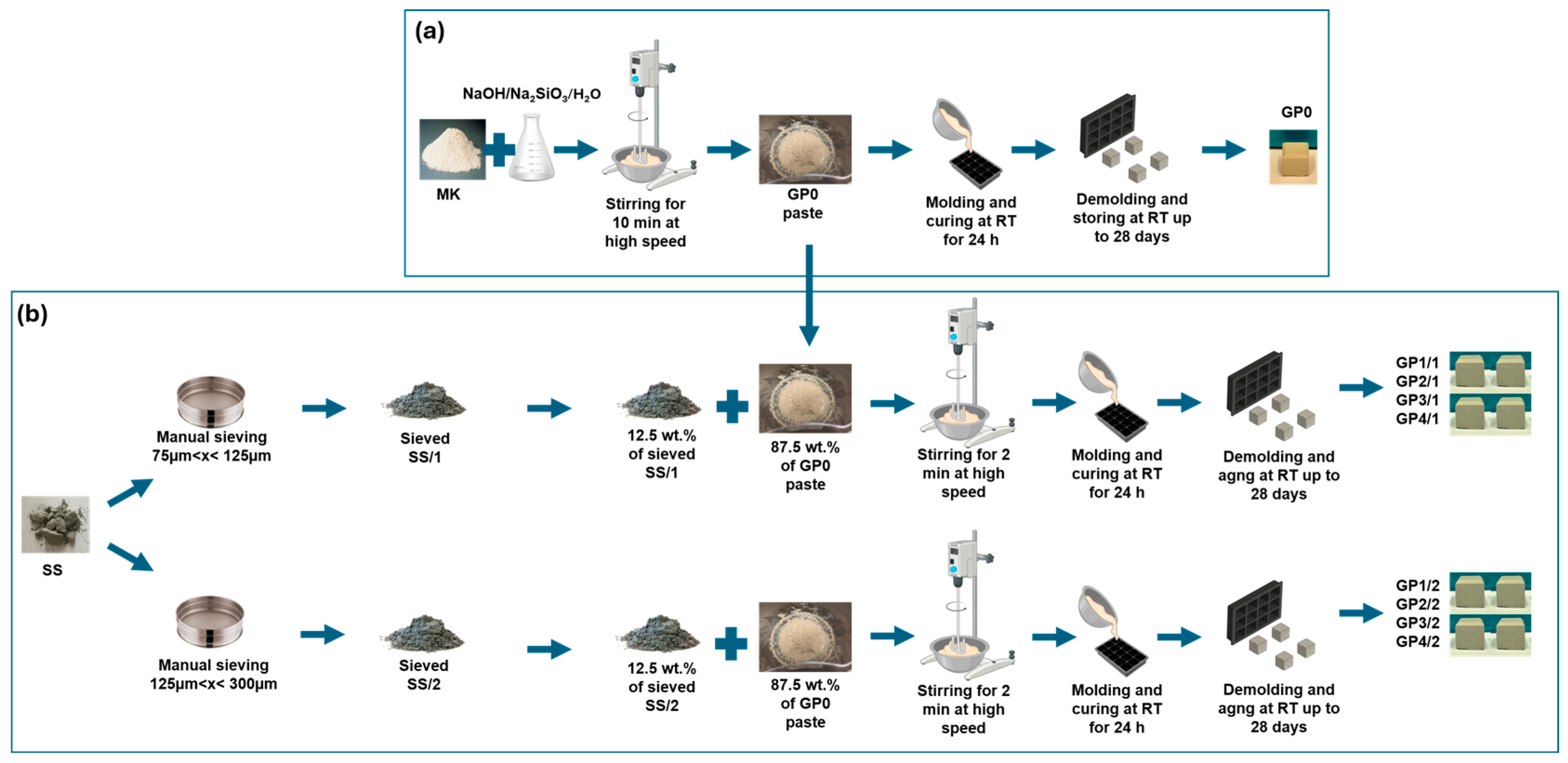
The synthesis procedure is illustrated in Figure 1. Briefly, the GP0 reference sample was prepared by mixing MK with the activating solution for 10 min at high speed. The resulting fresh paste was sealed in plastic molds and cured at 25 °C for 24 h. After 24 h, the samples were demolded and left to age at room temperature for up to 28 days (the steps are reported in Figure 1a). Regarding geopolymers filled with the two SS particle size ranges, after the production of the GP0 fresh paste, 87.5 wt.% of the fresh paste was mixed with 12.5 wt.% of sieved SS for 2 min. The curing and aging temperatures were the same as those described above (see Figure 1b).
Figure 1.
Flowchart of the geopolymer synthesis procedure for (a) GP0 reference, and (b) SSs-filled geopolymers.
2.4. Geopolymer Characterizations
Scanning electron microscopy images of GP0 and GP samples containing SS fillers with two particle size ranges were obtained using a Zeiss Supra 35 (Zeiss Group, Oberkochen, Germany) system. Images were acquired at an accelerating voltage of 10 kV, using a 30 µm aperture and an InLens detector, and at a 2 µm magnification in high-vacuum mode.
Mineral phases of GP0 and GP samples containing SS fillers with two particle size ranges were identified by WAXD following the protocol reported in Section 2.2.
FT-IR analysis was performed using the protocol reported in Section 2.2.
The boiling water test was performed according to Refs. [6,25] by immersing the samples (after 28 days of curing) in boiling water for about 15 min and assessing their durability through a qualitative evaluation of their structural integrity.
The integrity test was performed on 28-day-old specimens by soaking the geopolymers in Milli-Q water (at a mass-to-volume ratio of 1 g/100 mL) for 24 h, following the protocol reported in [26]. Water leachates from the integrity tests were used to measure ionic conductivity (IC) and pH using Hanna Instruments pH (Hanna Instruments Italia srl, Ronchi Di Villafranca Padovana, Italy) and conductivity meters.
The TGA/DTG analysis was conducted using the protocol reported in Section 2.2.
The compressive strength was measured using a Dual Column Testing System (INSTRON, Series 5967, INSTRON, Norwood, MA, USA) configured with a crosshead speed of 1 mm/min. The test was conducted on five specimens (n = 5) (cylindrical specimens measuring 27 mm × 54 mm) for each geopolymer. Compressive strength values were reported as mean ± standard deviation (SD).
2.5. Statistical Analysis on Compressive Strength Values
All statistical calculations were executed using Python (v3.10) with the scipy.stats and statsmodels statistical packages. Data normality and variance homogeneity across groups were assessed prior to parametric testing. A one-way analysis of variance (ANOVA) was conducted on the full dataset (N = 45) to detect global variance differences among all geopolymer specimens. To control the Family-Wise Error Rate (FWER = 0.05), Tukey’s Honestly Significant Difference (HSD) post hoc test was performed to establish pairwise differences. Games–Howell post hoc tests were additionally calculated to account for heterogeneity of variances. To investigate the main structural factors and their interaction, a 4 × 2 factorial two-way ANOVA was applied to GP1 to GP4 speciment with the lower (/1) and higher (/2) particle size ranges (total N = 40). The independent variables were SS fillers (4 levels) and particle size ranges (2 levels). Statistical significance was evaluated at α = 0.05.
3. Results and Discussion
3.1. SS1-SS4 Characterization
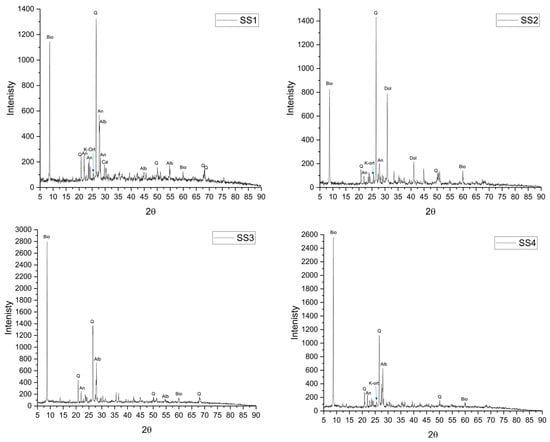
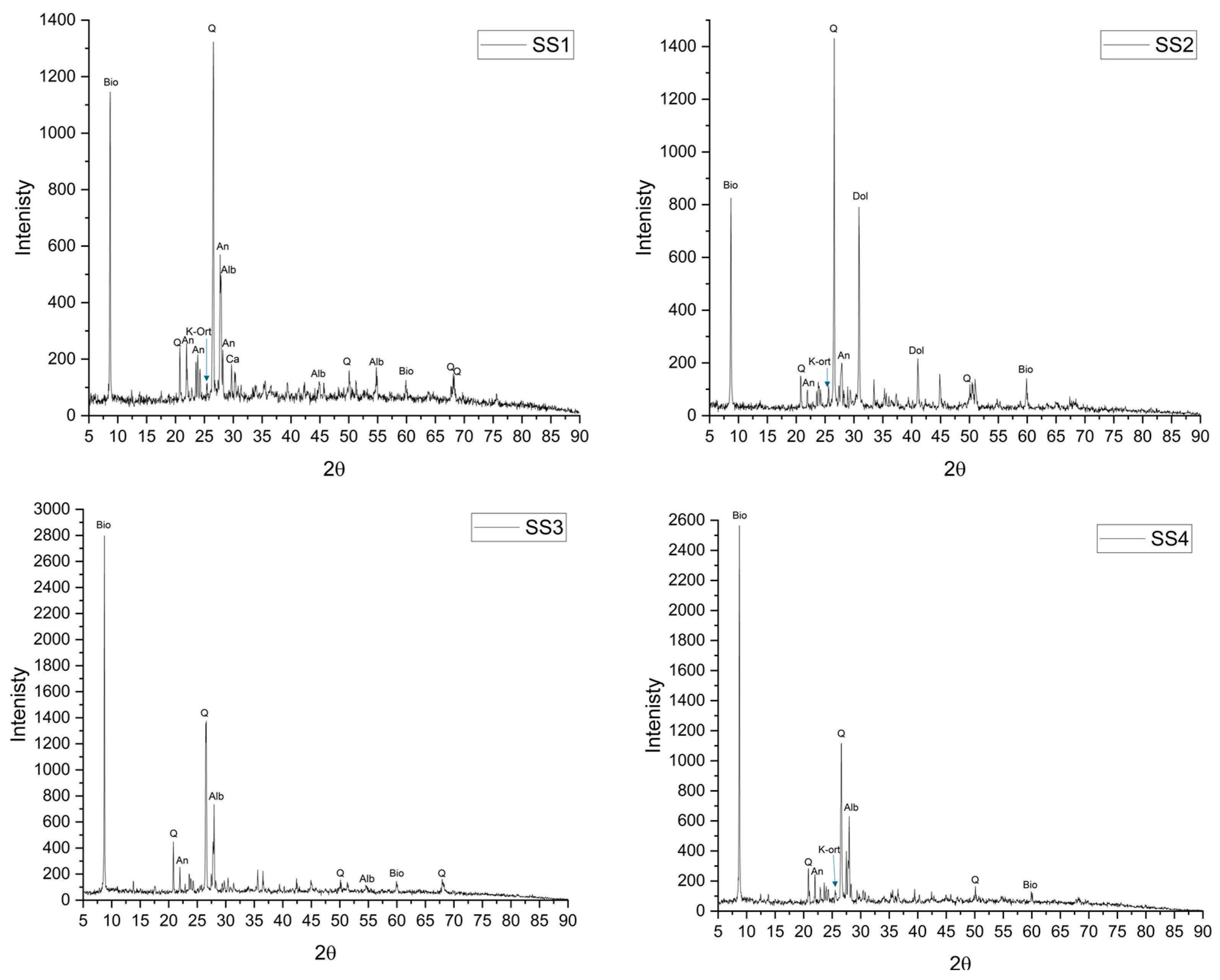
Figure 2 reports the WAXD patterns of the SS fillers. SS1, SS2, SS3 and SS4 are characterized by crystalline WAXD patterns in which biotite, quartz, albite and anorthite are the main phases [27,28,29]. Moreover, SS2 is also characterized by the presence of a dolomite phase (with high magnesium content, as indicated by the peaks at 30.8 and 41.7° [30]). Furthermore, the WAXD patterns show that SS1 and SS2 have high-intensity quartz peaks, whereas SS3 and SS4 show higher biotite peak intensities.
Figure 2.
WAXD patterns of SS1, SS2, SS3 and SS4 fillers. Legend: Q—quartz; An—anorthite; K-ort—K-orthoclase; Alb—albite; Bio—biotite; Ca—calcite; Dol—dolomite.
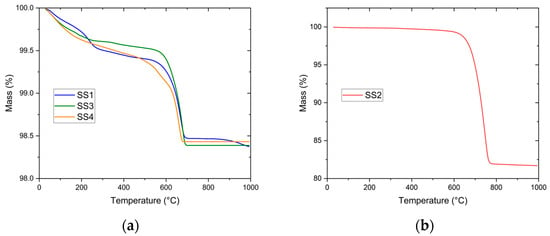
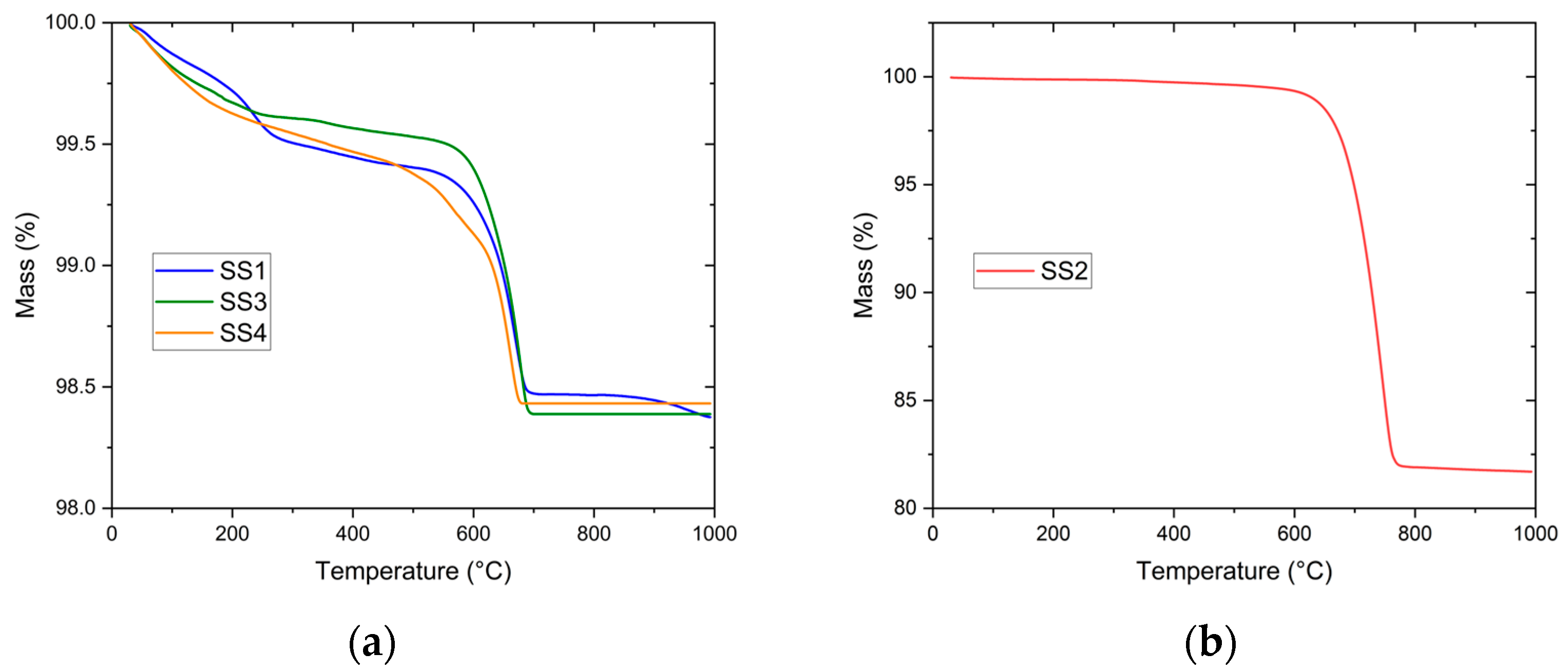
The presence of a dolomite phase in the SS2 sample is also confirmed by a mass loss of 18 wt.% in the 500–800 °C range [8,31] (Figure 3b). In contrast, in the SS1, SS2, and SS3 samples, the thermal degradation of this phase accounts for only 1 wt.% (Figure 3a).
Figure 3.
TGA curves of (a) SS1-SS3 and (b) SS4 wastes from 30 °C up to 1000 °C at a heating rate of 10 °C/min under a ni-trogen atmosphere with a flow rate of 100 mL/min.
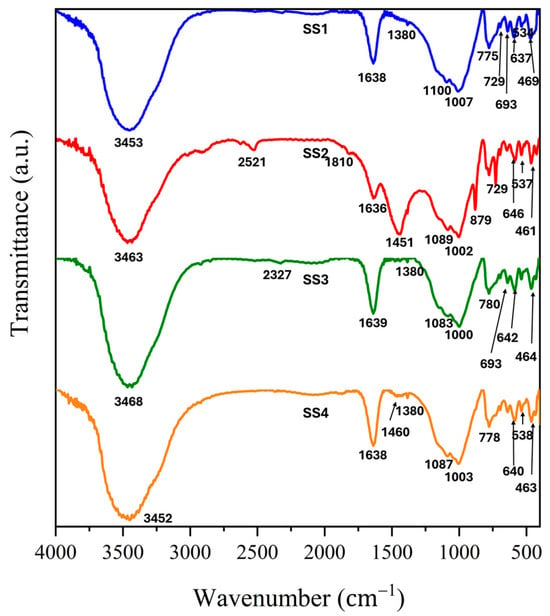
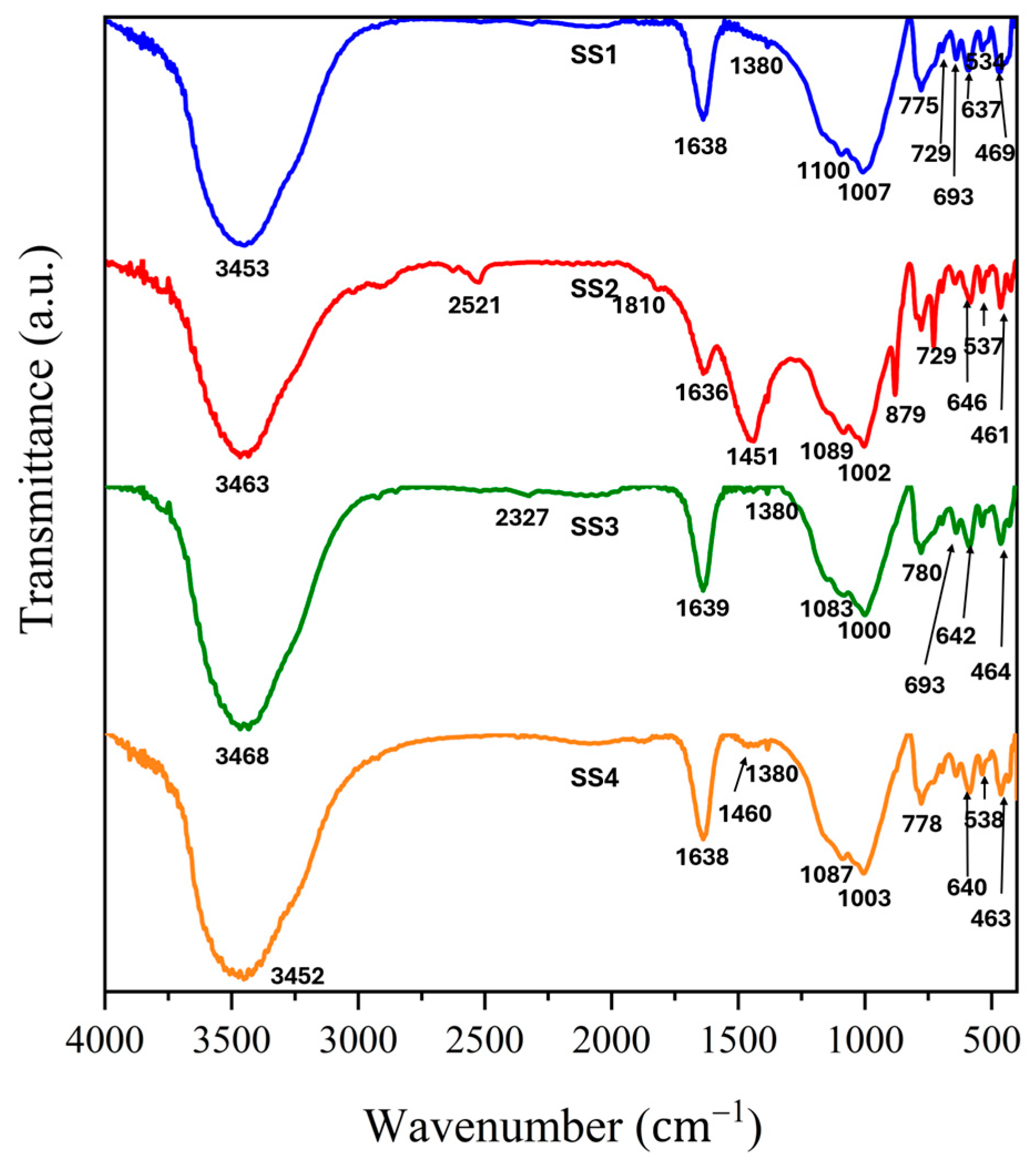
The FT-IR spectra of the SS1–SS4 wastes are reported in Figure 4. The SS1 spectrum is characterized by bands at 3453, 1638, 1380, 1100, 1007, 775, 729, 637, 534 and 469 cm−1. The bands at 3453 and 1638 cm−1 are assigned to water molecules adsorbed onto the surface of SS1. The band at 1380 cm−1 is assigned to the C-O vibration from Na2CO3, and the bands at 1100 and 1007 cm−1 are assigned to Si-O-Si vibrations from biotite [32], anorthite [33,34] and albite [35], and quartz [36]. The transmittance band at 775 cm−1 could be assigned to Si-Si vibration from K-orthoclase [37], and the band at 729 cm−1 is assigned to the vibration of Al-O-Si (from the biotite phase [32]) or to Si-Al (from K-orthoclase [37]). The bands at 637 and 463 cm−1 are assigned to Si-O bending, while the band at 534 cm−1 could be assigned to O-Si-O vibration with Na-O deformation [35]. The SS2 spectrum reveals additional transmittance bands that may be assigned to C-O vibration (i.e., 2521, 1810, 1451, 1089, 879, and 729 cm−1) and Si-O-Mg vibration (i.e., 646 cm−1) from the dolomite phase [38]. Moreover, the peak at 646 cm−1 could be assigned to O-Si(Al)-O vibration from K-orthoclase [37]. SS3 and SS4 spectra show transmittance bands related to crystalline phases also reported for SS1 and SS2 samples. The band at 1380 cm−1 is also present in the SS3 and SS4 spectra, suggesting the presence of carbonates.
Figure 4.
FT-IR spectra of SS1, SS2, SS3, and SS4.
3.2. Geopolymer Morphology and Mineralogy
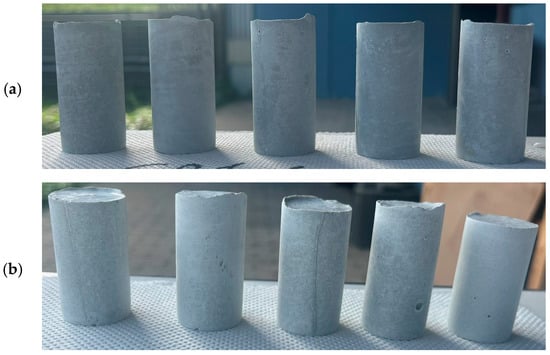
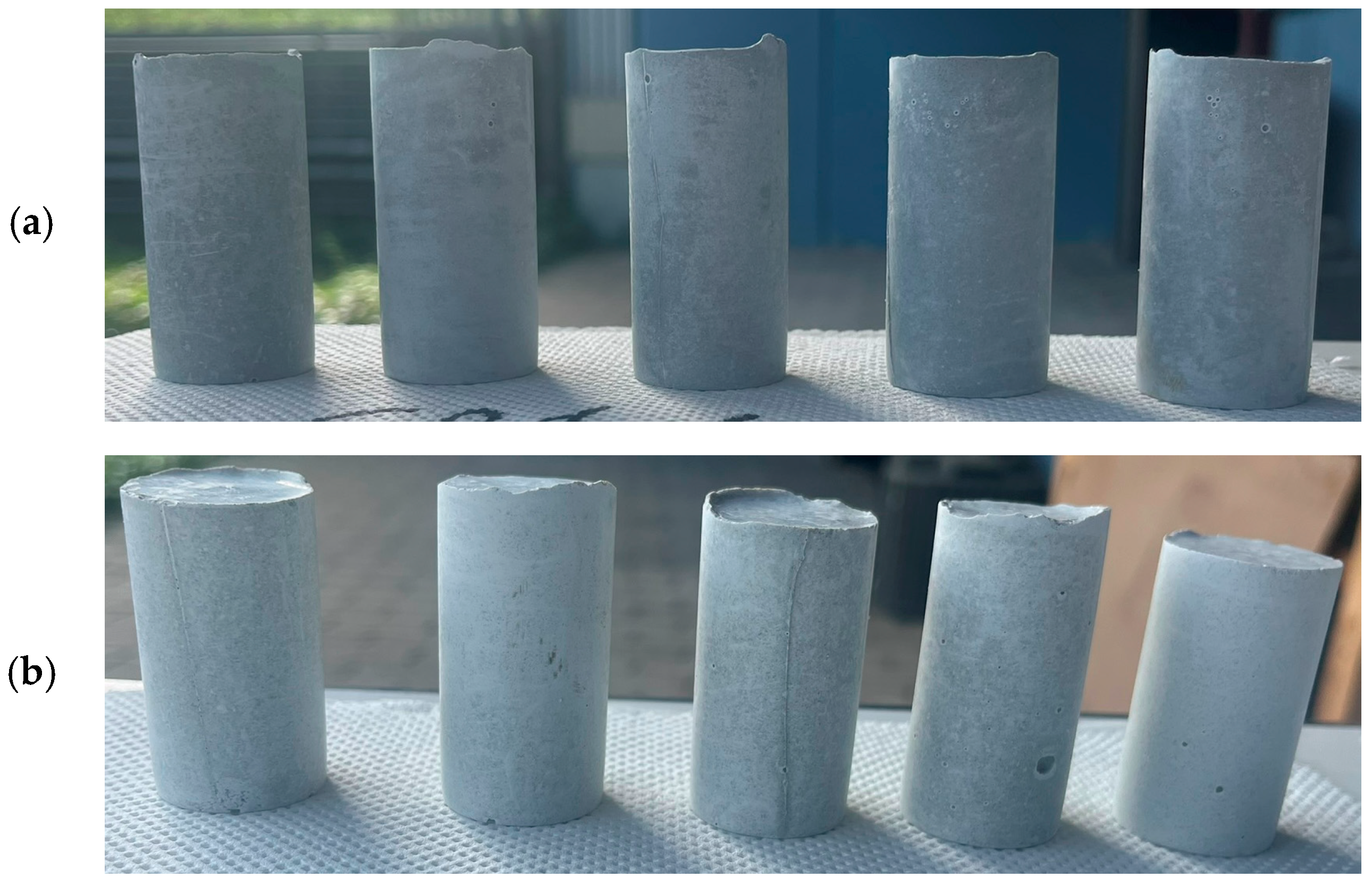
Figure 5a shows representative images of GP1/1 filled with SS1 in the lower particle size range. Unlike the GP control, which is white, all of the other GP samples show gray hues, reflecting the color of the SS used. In general, all samples macroscopically appear well consolidated, with few bubbles dispersed across their surfaces. Some visible white spots may be related to the efflorescence phenomenon [39].
Figure 5.
Representative images of (a) GP1/1 and (b) GP2/1 series.
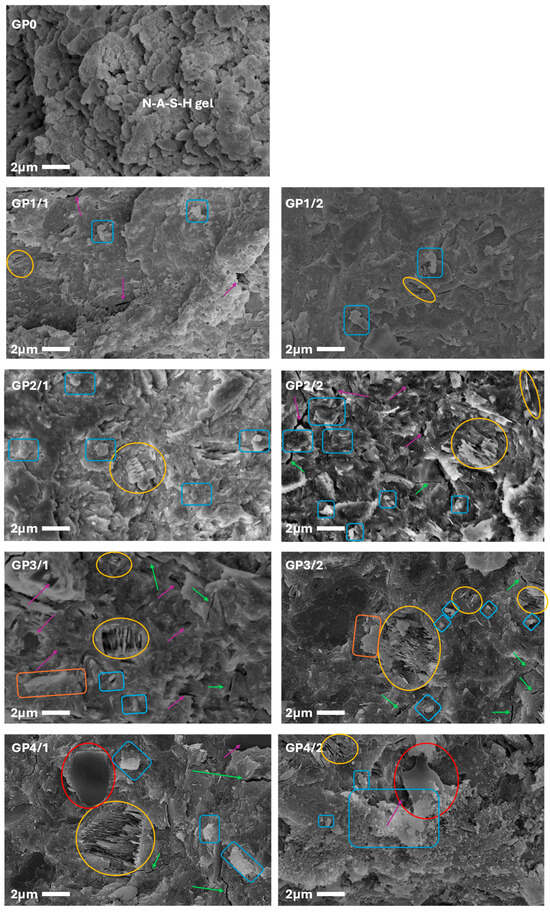
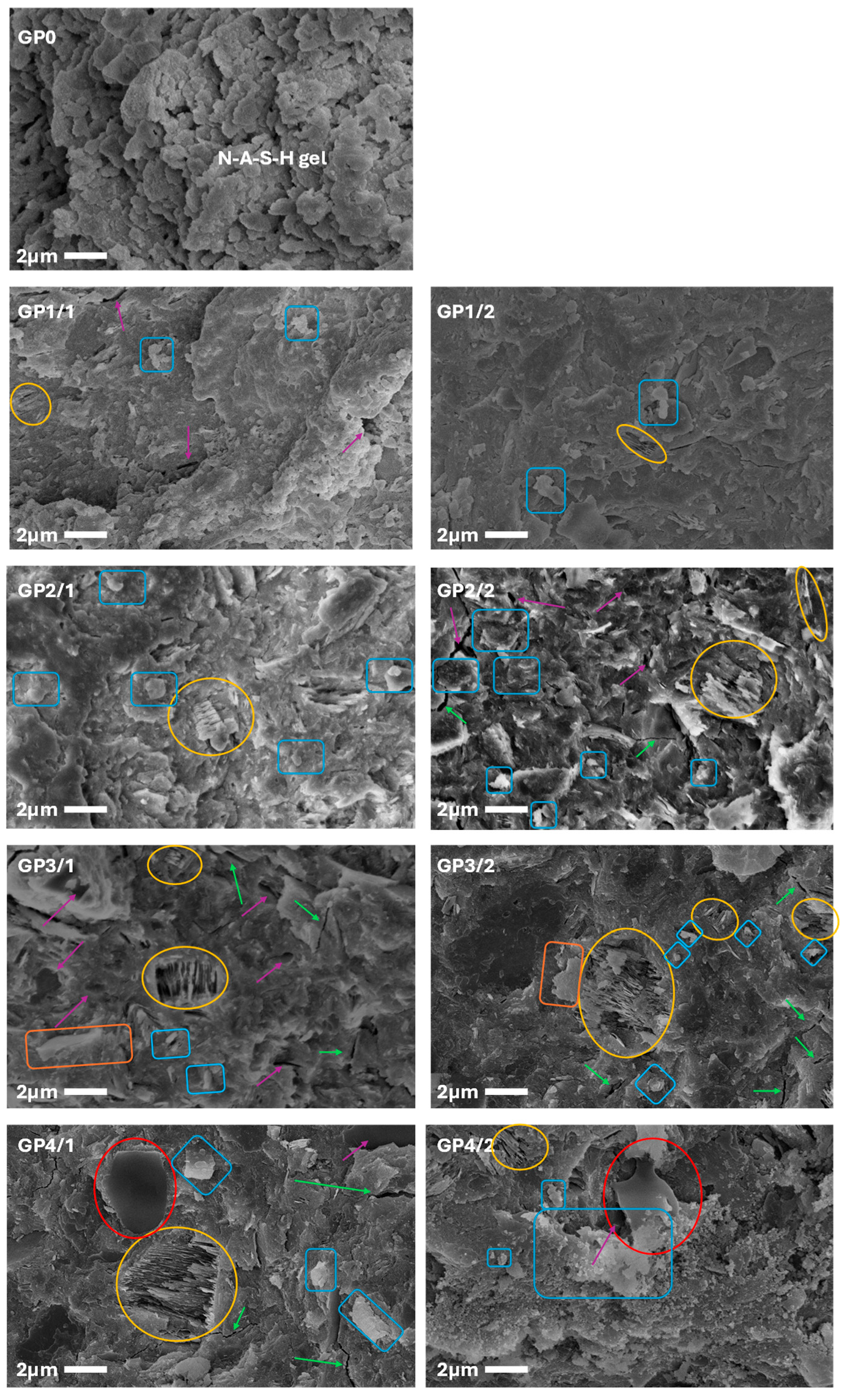
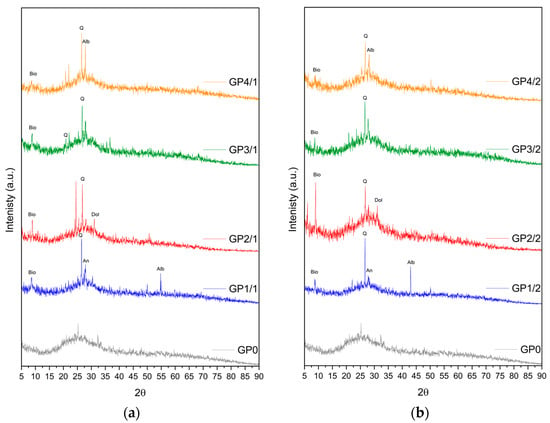
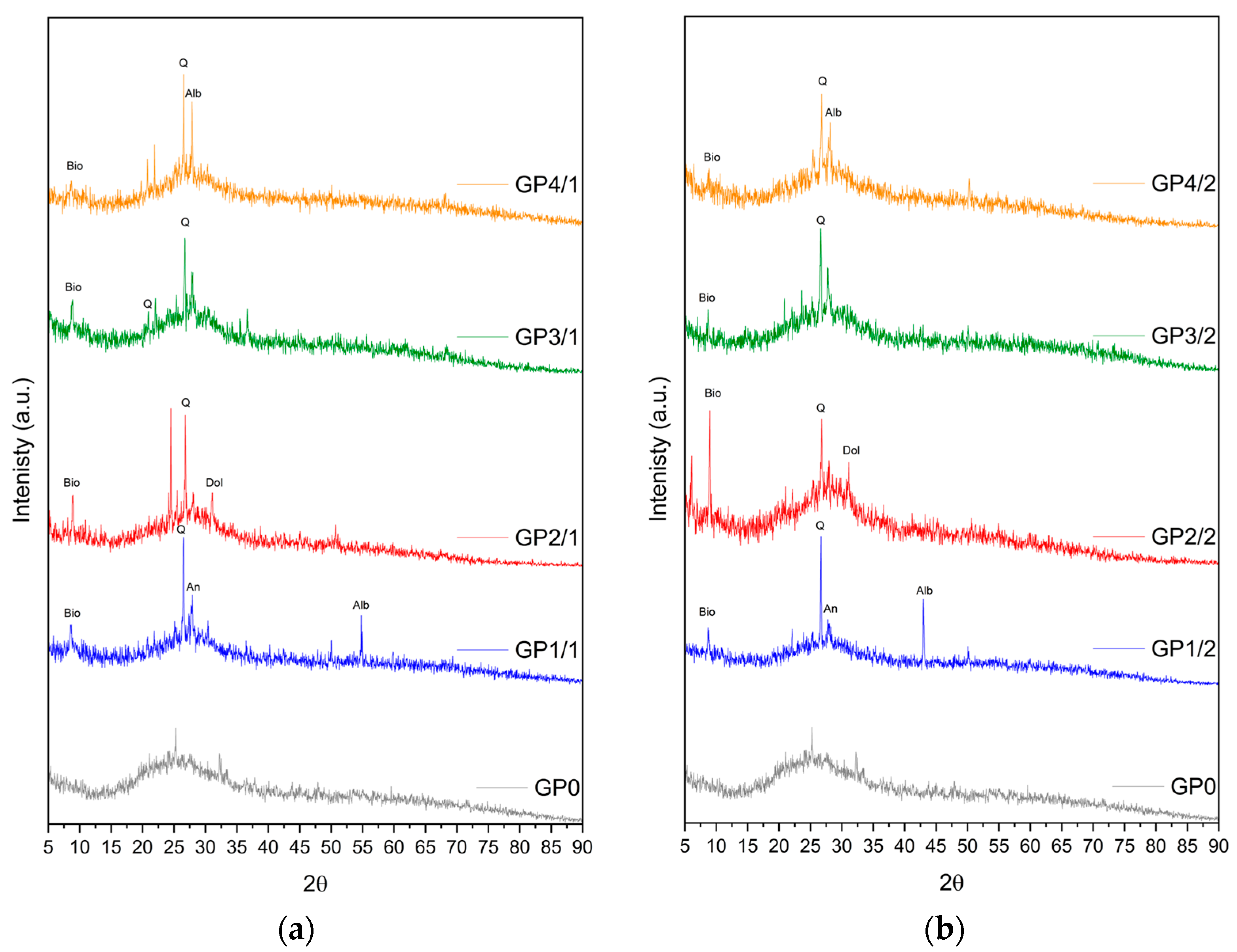
Figure 6 shows SEM images of GP0 and SS-filled geopolymer samples containing fillers in the lower (75 µm < x < 125 µm) and higher (125 µm < x < 300 µm) particle size ranges. The reference sample (GP0) displays a characteristic highly porous, globular, and discontinuous texture. The GP0 matrix is composed of loosely packed, submicron clusters of N-A-S-H gel alongside partially dissolved metakaolin flakes. This arrangement results in a significant network of interconnected open micro-porosity across the surface [40]. The addition of SS fillers affects the morphology of the samples. The SEM micrograph of GP1/1 shows a rough surface with fibrous, unreacted crystalline phases and several microcracks, while GP1/2 shows a more compact morphology, with some aggregates dispersed over the surface. These crystalline particles are also visible in all GP samples filled with SS (see yellow circles), suggesting that the highly crystalline phases are not degraded under the alkaline environment of the fresh activated GP0. This is also confirmed by the WAXD patterns of the consolidated geopolymers (see Figure 7), in which crystalline peaks of quartz, biotite and dolomite are still present. Moreover, the SEM micrograph of GP2/2 (Figure 6) shows particles that could be related to the presence of C-A-S-H phases that may be produced from calcium species from dolomite phases [41]. GP3 samples with both lower and higher particle size range fillers show geopolymer surfaces rich in unreacted crystalline particles, microcracks, pores, aggregates and particles, which may be potentially related to traces of C-A-S-H gel phases [42]. Phases possibly associated with the C-A-S-H gel formation are also present within unreacted particles in the GP4/1 and GP4/2 samples. The latter also shows a larger region with submicron clusters of N-A-S-H, like those observed in the reference GP0. Larger unreacted particles are also present.
Figure 6.
SEM images of GP0 and GP samples with SS fillers. Yellow circles indicate unreacted crystalline biotite phases, red circles indicate unreacted particles, light blue squares indicate C-A-S-H gels, orange squares indicate partially reacted crystalline phases, green arrows indicate microcracks, and violet arrows indicate pores.
Figure 7.
WAXD patterns of GP0 and SS-filled GPs with fillers in the (a) lower and (b) higher particle size ranges.
3.3. FT-IR Analysis
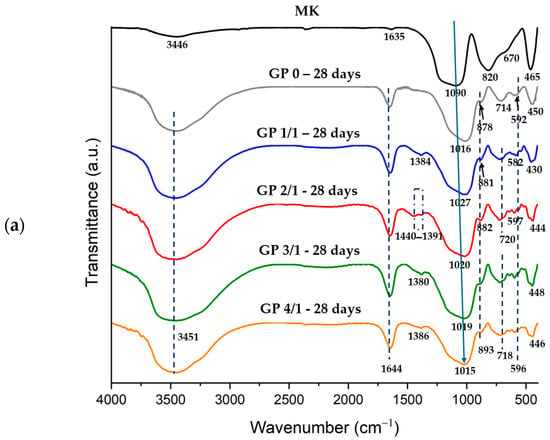
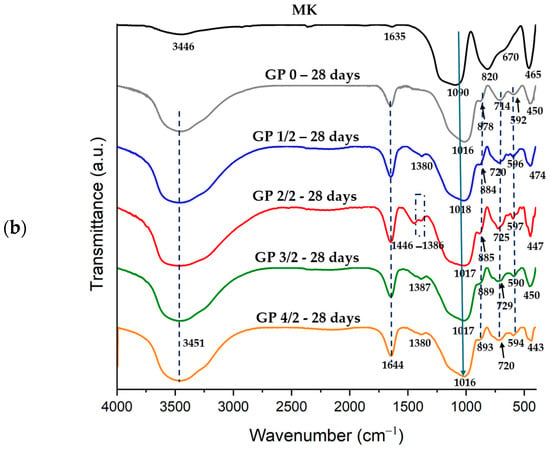
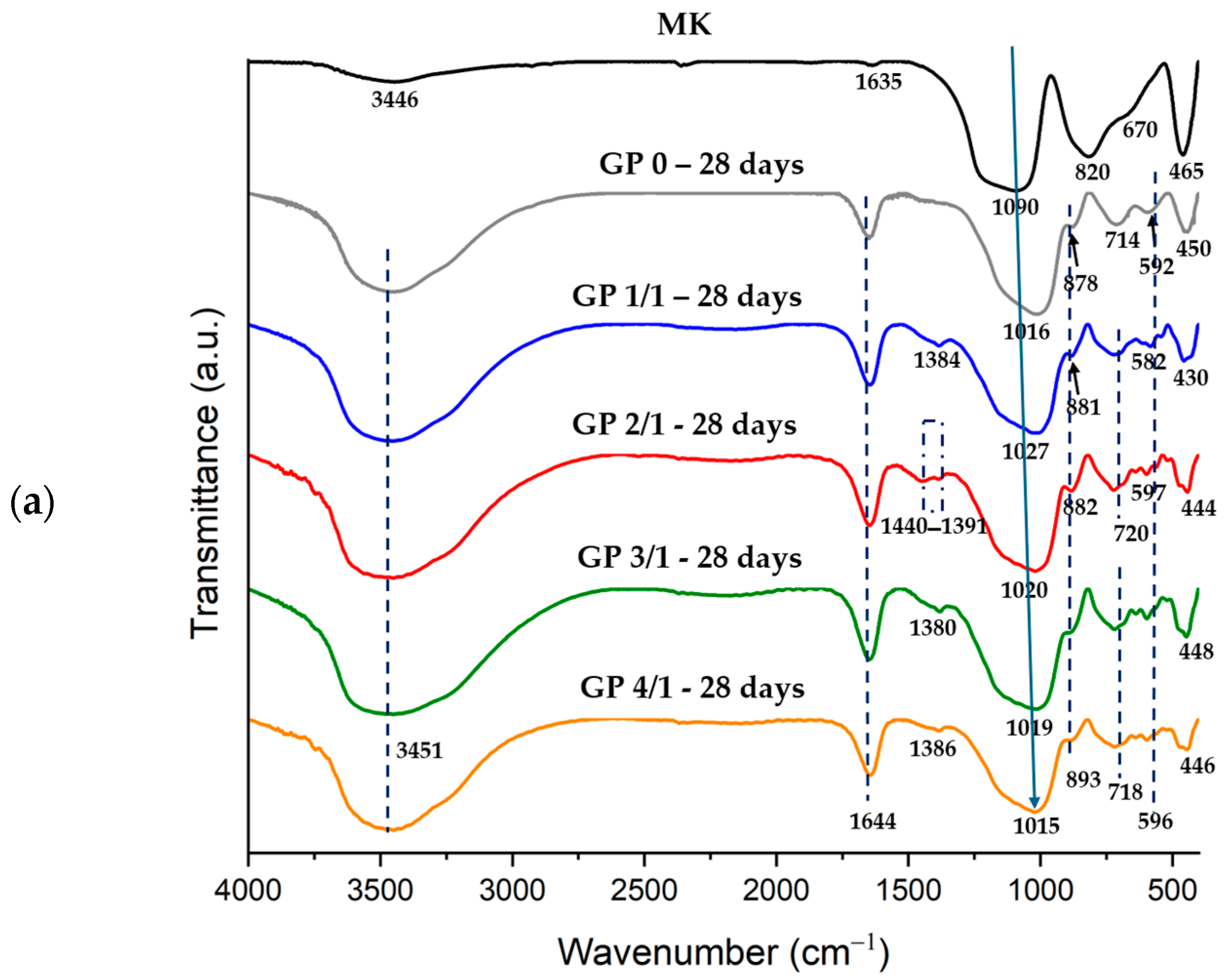
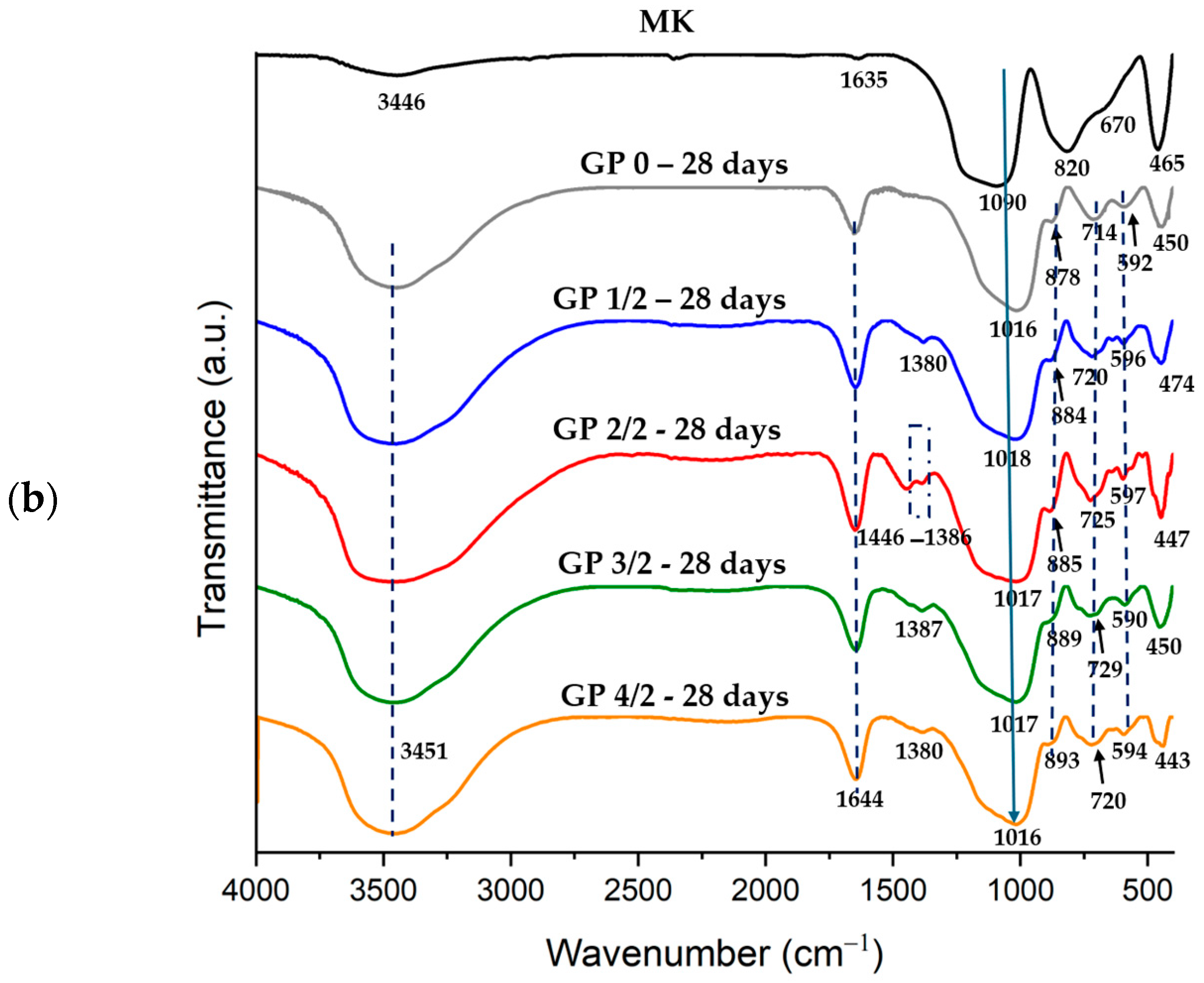
FT-IR analysis was employed to verify the occurrence of geopolymerization by monitoring the satellite peak at 1090 cm−1 of MK, assigned to the asymmetric stretching of Si–O–T bonds (where T = Si or Al) [24], which shifts toward lower wavenumbers as Al atoms are incorporated into the main three-dimensional network during geopolymerization. Indeed, the band centered at 1090 cm−1 indicates a higher proportion of Si–O–Si covalent bonds relative to Si–O–Al bonds. After 28 days of aging, all GP spectra (Figure 8a,b) showed a shift in this band toward lower wavenumbers, thus confirming the increasing presence of Si–O–Al bonds, which vibrate at lower frequencies and are typical of the N-A-S-H gel constituting the geopolymer network [43,44,45]. This suggests that the presence of SS fillers, at both particle size ranges, does not affect the occurrence of geopolymerization.
Figure 8.
FT-IR comparison between the MK and geopolymer spectra at 28 days of aging employing (a) 75 µm < x < 125 µm and (b) 125 µm < x < 300 µm SS mesh sizes.
The spectra of GP0 and the SS-filled GPs show –OH stretching and bending bands at approximately 3450 cm−1 and 1640 cm−1, respectively. These bands may be attributed to water released during condensation and adsorbed onto the geopolymer surfaces. In most GPs, the bands at approximately 1390–1380 cm−1 can be assigned to carbonate vibrations, particularly the C–O stretching vibrations of carbonate ions (CO32−) [46], as a consequence of sodium-containing alkaline species interacting with atmospheric carbon dioxide. Furthermore, the GP2/1 and GP2/2 samples show additional carbonate peaks at approximately 1446–1440 cm−1, which can be attributed to calcium carbonates. Indeed, thermal analysis (see the following subparagraph) shows significant mass loss in the 500–800 °C range, attributed to calcium carbonate thermal decomposition [47]. The presence of this peak may also suggest the presence of dolomite traces (see the WAXD patterns of SS2 in Figure 2 and GP2/1 and GP2/2 in Figure 7) that could lead to the formation of C-A-S-H gel [31].
In the spectra of the consolidated samples, the appearance of shoulder peaks at around 880 cm−1 is related to the structural rearrangement and coordination shift in aluminum from the higher-coordinated states Al(VI) and Al(V) in the unreacted raw materials to tetrahedrally coordinated Al(IV) within the crosslinked geopolymer gel network. According to the literature, peaks at around 720 cm−1 represent strong indicators of the symmetric stretching or bending vibrations of Al–O bonds within the aluminosilicate geopolymer network [48]. These peaks often reflect the degree of geopolymerization, as aluminum ions replace silicon in the structural framework, generating Si–O–Al linkages.
The FT-IR analysis conducted in this study reveals that the broad peak at 817 cm−1, attributed to the stretching vibrations of hexa-coordinated Al(VI)–OH and Al(VI)–O in MK, disappeared following geopolymerization. A new peak at approximately 710–720 cm−1 appears in the FT-IR spectra of the products. This peak may be correlated with the bending vibrations of tetra-coordinated Al(IV)–O–Si in a cyclic geopolymer structure. This phenomenon can be interpreted as evidence of the formation of aluminosilicate networks through the transition from hexa-coordinated Al(VI) to tetra-coordinated Al(IV) during the geopolymerization process, as reported by Sitarz et al. [49,50]. However, these bands may also include contributions from the out-of-plane bending vibrations of carbonate ions (CO32−), typically observed in the 850–880 cm−1 region. Similarly, the bands detected at approximately 715–730 cm−1 may partially be attributed to the in-plane bending vibrations of carbonate ions, generally occurring in the 700–750 cm−1 region [51]. Furthermore, FT-IR analysis reveals the appearance of transmittance bands in the fingerprint region, particularly between 690 and 400 cm−1, which could be related to metal oxides originating from both MK and the wastes. In particular, the peaks located at approximately 690, 640, 590, and 530 cm−1 may be assigned to the bond vibrations of Fe–O, Ca–O, Mg–O, and Ti–O, respectively [46,52], as these oxides may come from residual crystalline phases after geopolymerization (as also confirmed by the WAXD patterns of geopolymer specimens; see Figure 7). Finally, the peaks at approximately 460 cm−1 are related to Si–OH bending vibrations.
3.4. Integrity and Boiling Tests
To verify the preliminary macroscopic stability of the synthesized GPs, both integrity and boiling tests were performed. The latter consisted of samples soaking in boiling water for 15 min. According to the literature, a well-formed geopolymer can withstand boiling water for 15 min [6]. In all the tests performed, none of the samples underwent structural degradation, thus further confirming the occurrence of geopolymerization.
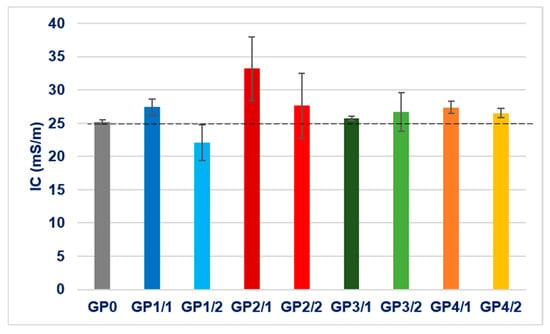
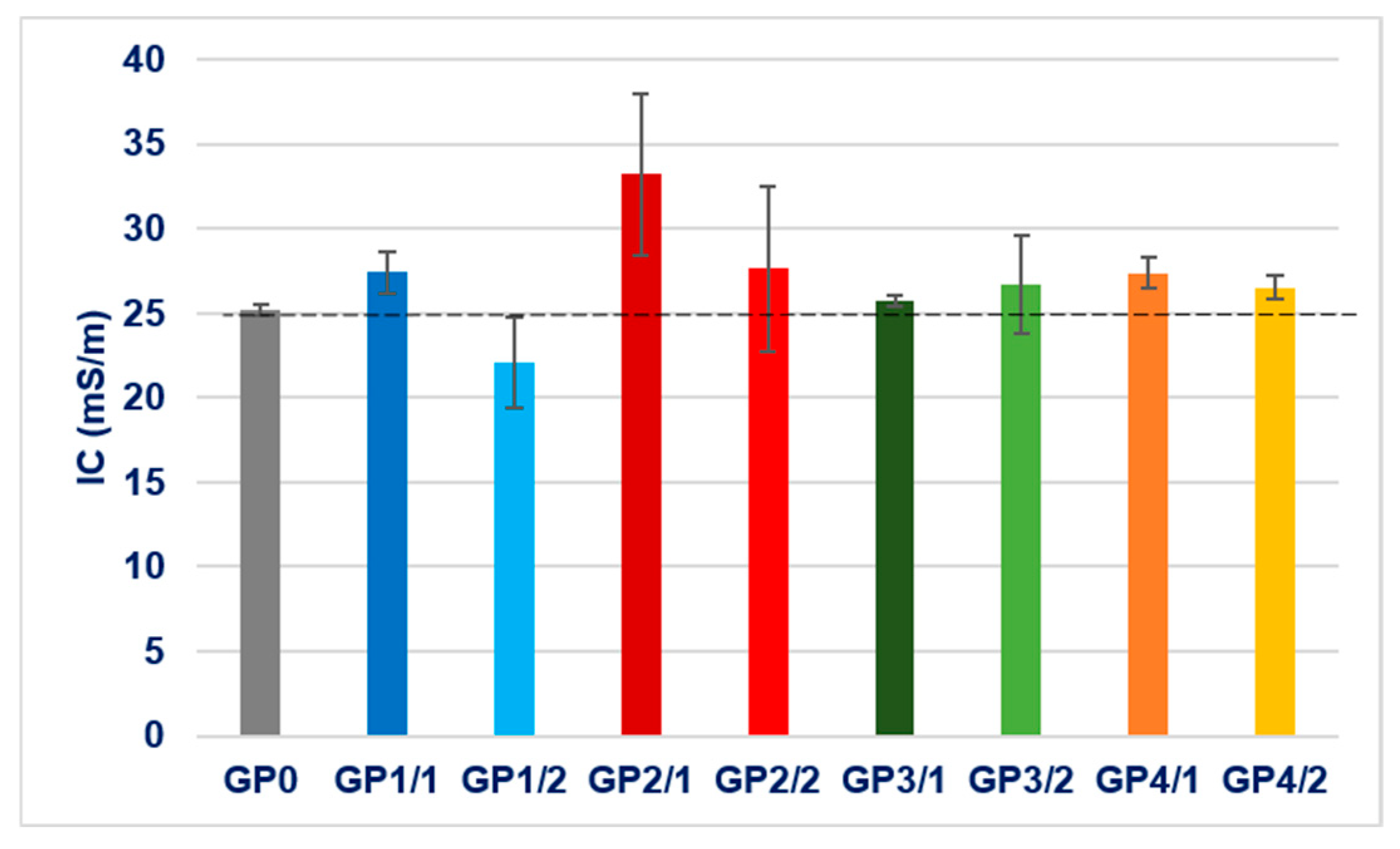
The preliminary integrity test further confirms the macroscopic stability of the samples. This test consists of soaking GP samples in deionized water for 24 h and evaluating the presence of any macroscopic fractures. Similarly, none of the specimens undergo degradation, nor do they show visible fragments in the leachates after water exposure, suggesting that the consolidated samples possess macroscopic stable structures [53]. Moreover, pH measurements of the leachates revealed the high alkalinity of the GPs (pH ≅ 11), which is consistent with the typical values reported for MK-based geopolymers [54]. Regarding the IC values, the typical range reported in the literature is approximately 10–200 mS/m [24]. The GPs show IC values in agreement with the literature, ranging from approximately 20 to 30 mS/m (Figure 9). These values are influenced by the filler particle size. Indeed, GP1/1, GP2/1, and GP4/1 showed the highest IC values, suggesting greater ion release when the filler was characterized by the lower particle size range.
Figure 9.
IC values of GPs.
3.5. TGA/DTG Analysis
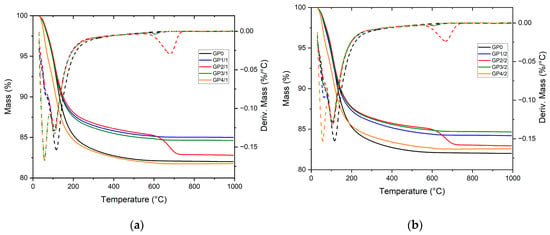
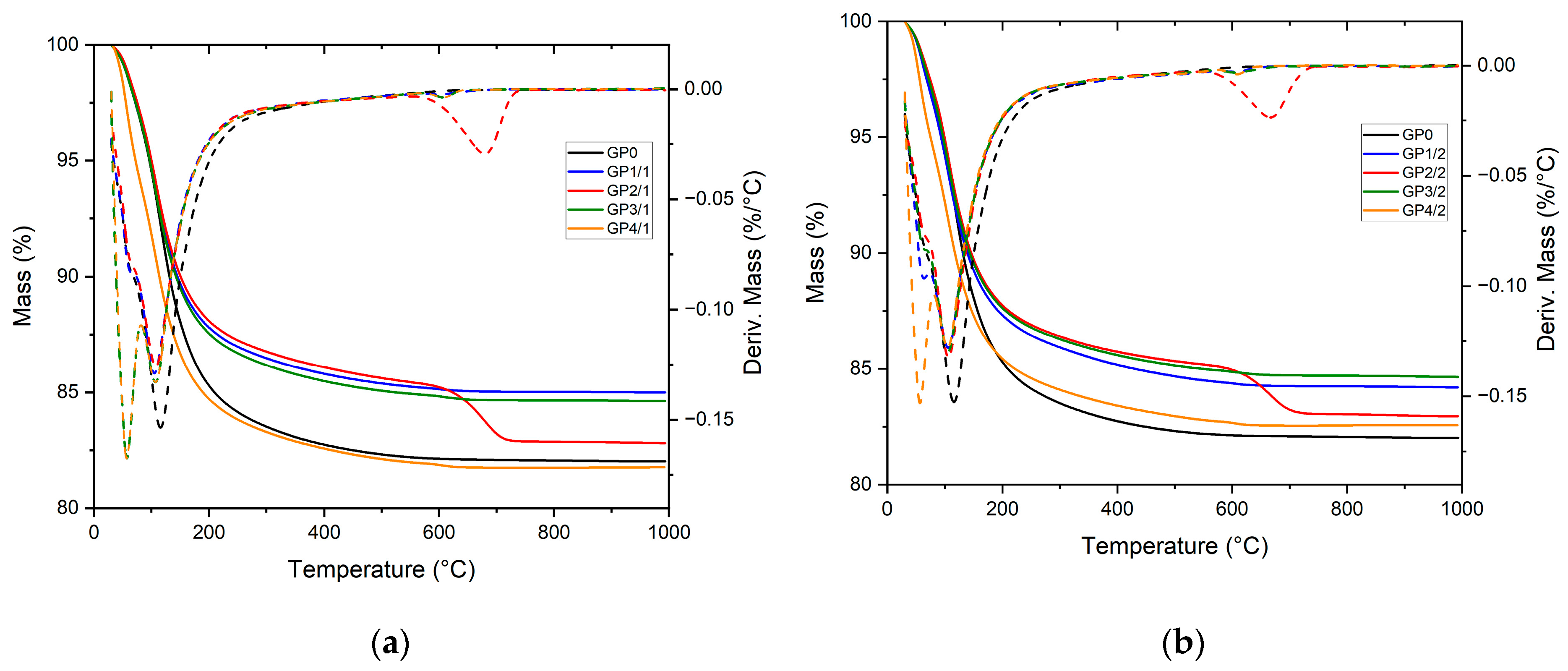
TGA and DTG analyses were performed to evaluate the thermal decomposition behavior of MK-based geopolymers containing 12.5 wt.% waste filler. The TGA curves (solid lines in Figure 10a,b) show that the different geopolymers exhibit a relatively limited mass loss upon heating up to 1000 °C. Indeed, all the GPs show a total mass loss ranging from approximately 15% to 18%. According to the literature, a mass loss lower than 20% may be associated with a well-formed geopolymer network [55,56]. The GP0 control exhibits a mass loss of 17.5%, whereas GP1 and GP3, with both filler particle size ranges, showed a mass loss of approximately 15% at 600 °C, which remained nearly constant up to 1000 °C. GP2/1 and GP2/2 exhibit a mass loss of approximately 17% up to 1000 °C, whereas the GP4 series show a mass loss slightly higher than 18%.
Figure 10.
TGA and DTG curves of GPs with filler mesh sizes (a) 75 µm < x < 125 µm and (b) 125 µm < x < 300 µm from 10 °C up to 1000 °C at a heating rate of 10 °C/min under a nitrogen atmosphere with a flow rate of 100 mL/min. Solid curves denote TGA; dashed curves denote DTG analysis.
The TGA curve of GP0 shows the three typical mass-loss steps of an MK-based geopolymer. The first step, occurring between 30 and 100 °C, is associated with physically adsorbed water; the second, between 100 and 300 °C, is associated with chemically bound water; and the third, between 300 and 600 °C, is attributed to –OH dehydroxylation [31,56,57,58]. During the first step, GP0 exhibits a mass loss of 5.46%, associated with a broad, low-intensity DTG peak centered at 69.6 °C. The second mass-loss step (100–300 °C) corresponds to 11.04% and is associated with a sharp, intense DTG peak centered at 115.9 °C, indicating the larger amount of chemically bound water incorporated within the N-A-S-H gel [57,58,59,60]. The third mass-loss step accounts for approximately 1.50%, indicating only a small amount of free –OH groups undergoing dehydroxylation. GP1/1 and GP2/1 showed very similar DTG profiles (dashed curves in Figure 10a), with minima centered at 62.0 and 64.6 °C for the first mass-loss step and at 105.1 and 107.3 °C for the second step. Unlike GP0, GP3/1 and GP4/1 exhibited very sharp and intense DTG peaks centered at 56.5 °C during the first mass-loss step (30–100 °C), revealing a higher amount of physically adsorbed water and a lower amount of chemically bound water. All of these GPs exhibited thermal behavior similar to that of GP0 up to approximately 550 °C. An additional mass loss of approximately 2.55% is clearly visible in the TGA curve of GP2/1 (Figure 10a, red line) and is only slightly visible in the other samples. This additional mass loss is attributed to the thermal decomposition of calcium carbonates originating from the SS filler [8,31]. Indeed, the TGA curve of SS2 showed greater mass loss in the 550–750 °C range than those of SS1, SS3, and SS4 (see Figure 3a,b), due to the presence of dolomite phases which are rich in carbonates (see Figure 2). Moreover, the presence of calcium carbonates may suggest the formation of C(N)-A-S-H gel phases, which could contribute to the enhancement of the mechanical properties [61].
Unlike GP1/1, GP1/2 showed a more intense DTG peak (Figure 10b), centered at 63.6 °C, which can be attributed to an increase in the amount of physically adsorbed water. Whereas GP2/2 exhibited the same thermal behavior as GP2/1, GP3/2 showed a decrease in the amount of physically adsorbed water. Indeed, its DTG curve displayed a very low-intensity minimum at 63 °C and an intense DTG peak at 105.2 °C, suggesting an increase in the amount of chemically bound water within the three-dimensional geopolymer network. As regards GP4/2, a decrease in the intensity of the DTG peak centered at 56.6 °C, associated with physically adsorbed water, is also observed compared with GP4/1 (yellow dashed lines in Figure 10a,b). These changes in the DTG minima suggest that SS particle size influences the thermal behavior of the synthesized geopolymers.
3.6. Compressive Strength and Statistical Analysis
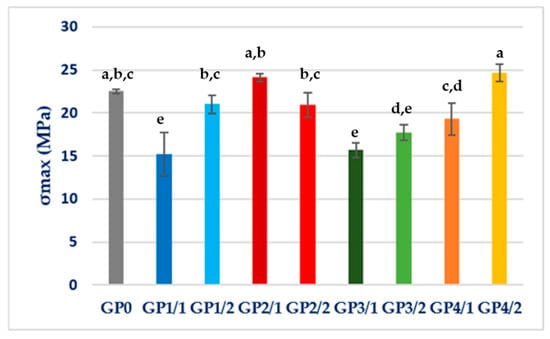
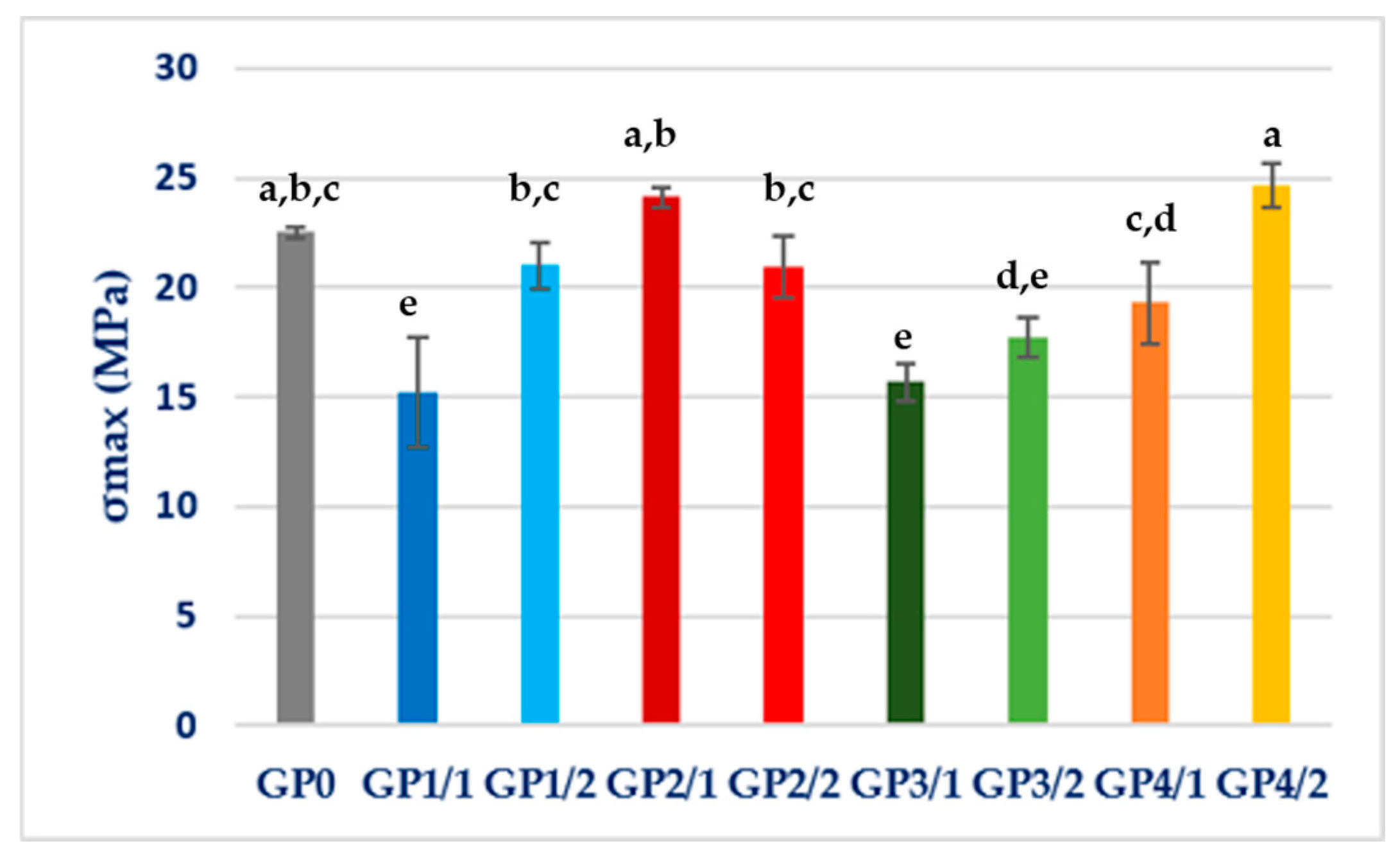
Figure 11 reports the compressive strength of geopolymer samples after 28 days of aging at room temperature. All of the samples exhibit a favorable response in terms of mechanical properties, in agreement with the compressive strength values reported in the literature for Ordinary Portland Cement (OPC) [62,63]. GP1/2, GP2/1, GP2/2 and GP4/2 exhibited compressive strength values of 21.01 ± 1.06 MPa, 24.1 ± 0.4 MPa, 20.94 ± 1.44 MPa and 24.7 ± 1.7 MPa, respectively, which are comparable to the GP0 control (22.5 ± 0.2 MPa). The highest compressive strength values were recorded for the GP2/1 sample (GP filled with SS2 in the lower particle size range) and GP4/2 (GP filled with SS4 in the higher particle size range). These results may suggest that both the mineralogical composition (in the case of SS2) and particle size range (in the case of SS4) may influence the compressive properties of the resulting geopolymers. Indeed, the WAXD pattern of SS2 shows the presence of dolomite phases, which, at smaller particle size ranges, can release calcium species that may take part in the geopolymerization reaction and lead to the formation of C(N)-A-S-H gel (see the SEM micrographs in Figure 6) [64]. At larger particle size ranges, crystalline phases are less reactive in alkaline environments and larger particles may act as inert fillers, making the samples more compact [65]. This latter effect could explain why, in the histogram in Figure 11, larger particle sizes are associated with higher compressive strength values, as observed for GP1/2, GP3/2, and GP4/2.
Figure 11.
Mechanical compressive strength values of GPs. Tukey’s HSD post hoc grouping (α = 0.05). Sample values sharing a letter are not significantly different (p > 0.05).
The one-way ANOVA revealed statistically significant differences in compressive strength across the evaluated geopolymer groups (F(8, 36) = 24.91, p = 1.76 × 10⁻¹²). Mean compressive strength values ranged from 15.20 ± 2.50 MPa (GP1/1) to 24.70 ± 1.70 MPa (GP4/2). Tukey’s HSD post hoc test identified a critical difference of 3.21 MPa at α = 0.05. Sample classification based on compact letter display (Tukey’s HSD post hoc grouping; α = 0.05) is summarized in Figure 11. The highest compressive strengths were exhibited by GP4/2 (24.70 MPa) and GP2/1 (24.10 MPa), both remaining statistically equivalent to the control GP0 (22.50 MPa, p > 0.05). Conversely, GP1/1 (15.20 MPa), GP3/1 (15.67 MPa), and GP3/2 (17.73 MPa) exhibited significant reductions in strength compared to GP0 (p < 0.001).
The two-way ANOVA (4 × 2 factorial; see summary in Table 3) confirmed significant main effects for both SS filler (p = 1.35 × 10⁻⁹) and particle size ranges (p = 2.67 × 10⁻⁵). Moreover, a significant interaction between SS filler and particle size range was observed (F(3, 32) = 16.16, p = 1.42 × 10⁻⁶). Indeed, from GP1/1, GP3/1, and GP4/1 to GP1/2, GP3/2 and GP3/2, there was an increase in mechanical strength values of +5.81 MPa, +2.06 MPa, and 5.39 MPa, respectively. Conversely, from GP2/1 to GP2/2, there was a reduction of −3.16 MPa.
Table 3.
Two-way ANOVA results for “Type of SS filler” and “Particle size range” (N = 40).
4. Conclusions
This study investigated the feasibility of using sawing sludges (SSs) as fillers at 12.5 wt.% in MK-based geopolymers, with particular attention to the effect of filler particle size (75 µm < x < 125 µm and 125 µm < x < 300 µm) on the structural, thermal, and mechanical properties of the resulting geopolymers.
The macroscopic analysis revealed that the incorporation of SS did not affect the consolidation of the geopolymer matrices. SEM observations revealed that all synthesized samples exhibited a heterogeneous morphology, with unreacted crystalline particles originating from SS1–SS4 fillers and morphological differences related to the filler source and particle size. WAXD analysis confirmed the persistence of crystalline phases, including quartz, biotite, and dolomite, suggesting their limited reactivity during geopolymerization.
Moreover, all GP samples maintained their integrity during both the boiling water test and the integrity test, indicating resistance to the applied water exposure conditions.
FT-IR analysis confirmed the occurrence of geopolymerization, independently of filler particle size, as suggested by the shift in the main Si–O–T band toward lower wavenumbers, indicating the formation of Si–O–Al bonds and the development of the geopolymer network.
TGA/DTG analyses demonstrated that all geopolymers exhibited mass losses lower than 20%, consistent with the thermal behavior of well-developed MK-based geopolymer networks. An additional mass loss in the range of 500–800 °C, which could be associated with the decomposition of calcium carbonate phases, was observed in GP2/1 and GP2/2 due to the presence of the dolomite-rich SS2 filler.
Finally, the mechanical characterization showed that the addition of SS maintained or improved the compressive strength of the geopolymer samples compared with that of the control sample. The highest compressive strength values were obtained for GP2/1 and GP4/2, exceeding the reference GP0 sample. The results, as also confirmed by the one-way and two-way ANOVA, suggested that both the type of filler and the filler particle size range influence the mechanical properties. Indeed, larger SS particles generally promoted higher compressive strength, potentially acting as an inert filler and making the structure more compact. However, the behavior of SS2 showed a different trend, likely due to the higher availability of calcium species, which may contribute to geopolymerization reactions and slightly improve the mechanical performance.
Overall, the results demonstrate that sawing sludges can be successfully incorporated into metakaolin-based geopolymers as sustainable fillers without substantially compromising their consolidation. The particle size of SS influences the final properties of the materials, suggesting that an appropriate selection of filler particle size could enhance geopolymer performance. These findings highlight the potential of SS valorization and represent a starting point for further investigations into the use of sawing sludges in the production of sustainable alkali-activated materials and reductions in the environmental impact associated with stone-processing waste disposal.
Author Contributions
Conceptualization, M.C. and A.D.; methodology, A.D., L.V. and R.S.; software, S.F., M.Z., A.D. and R.S.; validation, L.V., A.D. and R.S.; formal analysis, R.S., A.D. and D.N.; investigation, A.D., R.S., L.V.; resources, M.C. and M.Z.; data curation, A.D., R.S., D.N.; writing—original draft preparation, R.S. and A.D.; writing—review and editing, All.; visualization, R.S., A.D., L.V., L.M.; supervision, M.C. and A.D.; project administration, M.C.; funding acquisition, M.C. All authors have read and agreed to the published version of the manuscript.
Funding
This research received no external funding.
Institutional Review Board Statement
Not applicable.
Informed Consent Statement
Not applicable.
Data Availability Statement
The original contributions presented in this study are included in the article. Further inquiries can be directed to the corresponding authors.
Acknowledgments
The authors thank Prochin Italia s.r.l. for the kind donation of sodium silicate used in this study. The authors thank Nunzio Cennamo and Francesco Arcadio from the University of Campania “Luigi Vanvitelli” for SEM micrograph acquisition.
Conflicts of Interest
The authors declare no conflicts of interest.
Abbreviations
The following abbreviations are used in this manuscript:
| MK | Metakaolin |
| AAM | Alkali-Activated Material |
| GP | Geopolymer |
| SS | Sawing Sludge |
| N-A-S-H | Sodium Alumino Silicate Hydrate |
| C-A-S-H | Calcium Alumino Silicate Hydrate |
| C(N)-A-S-H | Calcium (Sodium) Alumino Silicate Hydrate |
| FT-IR | Fourier-Transform InfraRed |
| TGA/DTG | Thermogravimetric Analysis—Derivative Thermogravimetric Analysis |
| RT | Room Temperature |
| IC | Ionic Conductivity |
References
- Portale, S.; Mazzoleni, P.; Barone, G. Alkali Activated Binders Based on Rock Sawing Sludges: Synthesis, Characterization and Future Perspectives. Constr. Build. Mater. 2024, 450, 138669. [Google Scholar] [CrossRef] [Scilit]
- Zichella, L.; Bellopede, R.; Spriano, S.; Marini, P. Preliminary Investigations on Stone Cutting Sludge Processing for a Future Recovery. J. Clean. Prod. 2018, 178, 866–876. [Google Scholar] [CrossRef] [Scilit]
- Portale, S.; Felter, M.; Zisi, A.; Steindal, C.C.; De Ferri, L.; Mazzoleni, P.; Barone, G. Preliminary Study of Stone Sawing Sludges-Based Alkali Activated Materials (AAMs) for the Conservation of Archaeological Ceramics. Geoheritage 2024, 16, 101. [Google Scholar] [CrossRef] [Scilit]
- Voccia, D.; Abdel Sater, S.; Demichelis, F.; Froldi, F.; Savorani, F.; Tommasi, T.; Wachongkum, S.; Lamastra, L. Unlocking the Power of Italy’s Bioeconomy: A Comparative Analysis of Immediate vs. Deferred Impact on Energy Generation through Straw Valorisation. J. Environ. Manag. 2025, 380, 125056. [Google Scholar] [CrossRef] [Scilit] [PubMed]
- Piccini, L.; Di Lorenzo, T.; Costagliola, P.; Galassi, D.M.P. Marble Slurry’s Impact on Groundwater: The Case Study of the Apuan Alps Karst Aquifers. Water 2019, 11, 2462. [Google Scholar] [CrossRef] [Scilit]
- Davidovits, J. Geopolymer: Chemistry & Applications, 5th ed.; Institut Géopolymère: Saint-Quentin, France, 2020; ISBN 978-2-9544531-1-8. [Google Scholar]
- Cigala, R.M.; Papanikolaou, G.; Lanzafame, P.; Sabatino, G.; Tripodo, A.; La Ganga, G.; Crea, F.; Ielo, I.; De Luca, G. Transforming Waste into Sustainable Construction Materials: Resistant Geopolymers from Recycled Sources. Recycling 2025, 10, 118. [Google Scholar] [CrossRef] [Scilit]
- Zafarana, S.E.; Achilli, A.; Barone, G.; Bersani, D.; Finocchiaro, C.; Fornasini, L.; Portale, S.; Mazzoleni, P. Exploring the Potential of Granite Sawing Sludge from Cuasso Al Monte (Italy) for the Development of Aluminosilicate Gel for a Sustainable Industry. Minerals 2025, 15, 718. [Google Scholar] [CrossRef] [Scilit]
- Provis, J.L. Alkali-Activated Materials. Cem. Concr. Res. 2018, 114, 40–48. [Google Scholar] [CrossRef] [Scilit]
- Catauro, M.; D’Angelo, A.; Genua, F.; Giovini, M.; Silva Ferraz, J.M.; Vecchio Ciprioti, S. The Behavior of Industrial Wastes as a Replacement for Metakaolin Before Geopolymerization: A Comparative Study. Materials 2025, 18, 4035. [Google Scholar] [CrossRef] [Scilit] [PubMed]
- Makul, N. Dictionary of Concrete Technology; Springer: Singapore, 2025; ISBN 978-981-97-2997-5. [Google Scholar]
- Jalal, P.S.; Srivastava, V.; Tiwari, A.K. Geopolymer Concrete: An Alternative to Conventional Concrete for Sustainable Construction. J. Environ. Nanotechnol. 2025, 13, 218–225. [Google Scholar] [CrossRef] [Scilit]
- Adnan; Anas, M. Geopolymer Concrete as a Sustainable Alternative to OPC. J. Umm Al-Qura Univ. Eng. Archit. 2025, 16, 1223–1245. [Google Scholar] [CrossRef] [Scilit]
- Arias, A.; Feijoo, G.; Moreira, M.T.; Tukker, A.; Cucurachi, S. Advancing Waste Valorization and End-of-Life Strategies in the Bioeconomy through Multi-Criteria Approaches and the Safe and Sustainable by Design Framework. Renew. Sustain. Energy Rev. 2025, 207, 114907. [Google Scholar] [CrossRef] [Scilit]
- Obah, E.T.; Martin, I.M. Advancing Waste Valorization Techniques for Sustainable Industrial Operations and Improved Environmental Safety. Int. J. Sci. Res. Arch. 2025, 14, 127–149. [Google Scholar] [CrossRef] [Scilit]
- Carollo, F.; Rienzo, E.D.; D’Angelo, A.; Sgarbossa, P.; Barbieri, L.; Leonelli, C.; Lancellotti, I.; Catauro, M.; Bernardo, E. Cold Consolidation of Waste Glass by Alkali Activation and Curing by Traditional and Microwave Heating. Materials 2025, 18, 2628. [Google Scholar] [CrossRef] [Scilit] [PubMed]
- Ricciotti, L.; Frettoloso, C.; Franchino, R.; Pisacane, N.; Aversa, R. Geopolymer Materials: Cutting-Edge Solutions for Sustainable Design Building. Sustainability 2025, 17, 7483. [Google Scholar] [CrossRef] [Scilit]
- Coppola, L.; Coffetti, D.; Crotti, E. Pre-Packed Alkali Activated Cement-Free Mortars for Repair of Existing Masonry Buildings and Concrete Structures. Constr. Build. Mater. 2018, 173, 111–117. [Google Scholar] [CrossRef] [Scilit]
- Hoyos-Alayo, W.M. Construction Project Management with a Circular Economy and Waste Minimisation Focus. A Bibliometric Analysis of Its Evolution and Research Trends. Rev. Ing. Constr. 2026, 41, 1–17. [Google Scholar] [CrossRef] [Scilit]
- Portale, S.; Finocchiaro, C.; Occhipinti, R.; Mazzoleni, P.; Barone, G. Feasibility Study about the Use of Basalt Sawing Sludge in Building and Restoration. Mater. Lett. 2023, 333, 133624. [Google Scholar] [CrossRef] [Scilit]
- Carrillo Beltran, R.; Picazo Camilo, E.; Perea Toledo, G.; Corpas Iglesias, F.A. Study of Novel Geopolymer Concrete Prepared with Slate Stone Cutting Sludge, Chamotte, Steel Slag and Activated with Olive Stone Bottom Ash. Materials 2025, 18, 1974. [Google Scholar] [CrossRef] [Scilit] [PubMed]
- D’Angelo, A.; Vertuccio, L.; Leonelli, C.; Alzeer, M.I.M.; Catauro, M. Entrapment of Acridine Orange in Metakaolin-Based Geopolymer: A Feasibility Study. Polymers 2023, 15, 675. [Google Scholar] [CrossRef] [Scilit] [PubMed]
- Available online: https://www.pietredelvco.it/ (accessed on 31 October 2026).
- D’Angelo, A.; Dal Poggetto, G.; Piccolella, S.; Leonelli, C.; Catauro, M. Characterisation of White Metakaolin-Based Geopolymers Doped with Synthetic Organic Dyes. Polymers 2022, 14, 3380. [Google Scholar] [CrossRef] [Scilit] [PubMed]
- Catauro, M.; Viola, V.; D’Amore, A. Mosses on Geopolymers: Preliminary Durability Study and Chemical Characterization of Metakaolin-Based Geopolymers Filled with Wood Ash. Polymers 2023, 15, 1639. [Google Scholar] [CrossRef] [Scilit] [PubMed]
- Sgarlata, C.; Formia, A.; Siligardi, C.; Ferrari, F.; Leonelli, C. Mine Clay Washing Residues as a Source for Alkali-Activated Binders. Materials 2021, 15, 83. [Google Scholar] [CrossRef] [Scilit] [PubMed]
- Zhu, L.; Feng, C.; Peng, B.; Hui, X.; Bai, X.; Yu, Z. Performance Research of Natural Mica Modified with Zirconium-Based Metal–Organic Frameworks for an Epoxy Resin Anti-Corrosion Coating. Molecules 2023, 28, 7106. [Google Scholar] [CrossRef] [Scilit] [PubMed]
- Chang, T.; Shen, J.; Ying, D.; Wu, Y.; Yang, H.; Feng, Q.; Tuo, X.; Zhang, X. Green and Scalable Processing Aramid Nanofiber and Mica into a Bioinspired Fire-Resistant Insulation Paper. Compos. Part B Eng. 2026, 324, 113923. [Google Scholar] [CrossRef] [Scilit]
- Zhang, K.; Liu, M.; Han, Z.; Sun, H.; Li, X.; Bai, J.; Du, Q.; Li, C. Enhanced Mechanical Properties for Porous Ceramics with an in Situ Formation of Anorthite Crystals during Vitrification. Int. J. Appl. Ceram. Technol. 2023, 20, 1701–1714. [Google Scholar] [CrossRef] [Scilit]
- Gregg, J.M.; Bish, D.L.; Kaczmarek, S.E.; Machel, H.G. Mineralogy, Nucleation and Growth of Dolomite in the Laboratory and Sedimentary Environment: A Review. Sedimentology 2015, 62, 1749–1769. [Google Scholar] [CrossRef] [Scilit]
- Viola, V.; Allah, P.; Perumal, P.; Catauro, M. Alkali Activation of Metakaolin and Wollastonite: Reducing Sodium Hydroxide Use and Enhancing Gel Formation through Carbonation. Materials 2024, 17, 4910. [Google Scholar] [CrossRef] [Scilit] [PubMed]
- Singha, M.; Singh, L. Vibrational Spectroscopic Study of Muscovite and Biotite Layered Phyllosilicates. Indian J. Pure Appl. Phys. 2016, 54, 120–122. [Google Scholar]
- Radosavljevic-Mihajlovic, A.; Mitic, V.; Saponjic, A.; Kasic, V. Thermally Induced Phase Transformation of Mn-LTA and Mn-FAU Zeolite to Anorthite Phases. Sci. Sinter. 2021, 53, 397–406. [Google Scholar] [CrossRef] [Scilit]
- Mrosko, M.; Koch-Müller, M.; Hartmann, K.; Wirth, R.; Dörsam, G. Location and Quantification of Hydrogen in Ca- and Sr-Anorthite. Eur. J. Mineral. 2010, 22, 103–112. [Google Scholar] [CrossRef] [Scilit]
- Zhang, W.; Zhang, S.; Wang, J.; Dong, J.; Cheng, B.; Xu, L.; Shan, A. A Novel Adsorbent Albite Modified with Cetylpyridinium Chloride for Efficient Removal of Zearalenone. Toxins 2019, 11, 674. [Google Scholar] [CrossRef] [Scilit] [PubMed]
- Quartz Spectrum. Available online: https://spectrabase.com/spectrum/LsDplXnidEj (accessed on 31 October 2026).
- Theodosoglou, E.; Koroneos, A.; Soldatos, T.; Zorba, T.; Paraskevopoulos, K.M. Comparative Fourier Transform Infrared and X-Ray Diffraction Analysis of Naturally Occurred K-Feldspars. Geosociety 2017, 43, 2752. [Google Scholar] [CrossRef] [Scilit]
- Manni, A.; Matadi Boumbimba, R.; Mikdam, A.; El Bouari, A.; Addiego, F.; Meziani, J.; Wary, M. Magnesite and Dolomite Micro-Particles: Preparation, Physical Properties and Application in Bio-Based Polymer Composite. Polym. Bull. 2022, 79, 2149–2171. [Google Scholar] [CrossRef] [Scilit]
- Longhi, M.A.; Zhang, Z.; Walkley, B.; Rodríguez, E.D.; Kirchheim, A.P. Strategies for Control and Mitigation of Efflorescence in Metakaolin-Based Geopolymers. Cem. Concr. Res. 2021, 144, 106431. [Google Scholar] [CrossRef] [Scilit]
- Nikolić, N.M.; Ivanović, M.; Nenadović, S.; Potočnik, J.; Dolenec, S.; Bučevac, D.; Kandić, A.; Kljajević, L. Alkali-Activated Materials from Diverse Solid Precursors: Structural, Mechanical and Radiological Properties. Gels 2026, 12, 200. [Google Scholar] [CrossRef] [Scilit] [PubMed]
- Prabha, V.C.; Revathi, V.; Sivamurthy Reddy, S. Ambient Cured High Calcium Fly Ash Geopolymer Concrete with Dolomite Powder. Eur. J. Environ. Civ. Eng. 2022, 26, 7857–7877. [Google Scholar] [CrossRef] [Scilit]
- Li, C.; Zhang, N.; Zhang, J.; Song, S.; Zhang, Y. C-A-S-H Gel and Pore Structure Characteristics of Alkali-Activated Red Mud–Iron Tailings Cementitious Mortar. Materials 2021, 15, 112. [Google Scholar] [CrossRef] [Scilit] [PubMed]
- Chen, L.; Wang, Z.; Wang, Y.; Feng, J. Preparation and Properties of Alkali Activated Metakaolin-Based Geopolymer. Materials 2016, 9, 767. [Google Scholar] [CrossRef] [Scilit] [PubMed]
- Kamath, M.; Prashant, S.; Ralegaonkar, R. Microstructure Properties of Popular Alkali-Activated Pastes Cured in Ambient Temperature. Buildings 2023, 13, 858. [Google Scholar] [CrossRef] [Scilit]
- Duxson, P.; Lukey, G.C.; Van Deventer, J.S.J. Evolution of Gel Structure during Thermal Processing of Na-Geopolymer Gels. Langmuir 2006, 22, 8750–8757. [Google Scholar] [CrossRef] [Scilit] [PubMed]
- Razeghi Tehrani, P.; Arjomand, M.; Behbahaninia, A.; Kargari, N. Compatibility Studies of N-A-S-H and C-A-S-H Gels in Alkali-Activated Geopolymer Mortar. Iran. J. Chem. Chem. Eng. 2024, 43, 3737–3747. [Google Scholar] [CrossRef]
- Zushi, Y.; Iwasaki, S.; Koga, N. Thermogravimetric Approach to Efflorescence of Sodium Carbonate Decahydrate. Thermochim. Acta 2023, 724, 179503. [Google Scholar] [CrossRef] [Scilit]
- Patrisia, Y.; Law, D.W.; Gunasekara, C.; Wardhono, A. Long-Term Durability of Iron-Rich Geopolymer Concrete in Sulphate, Acidic and Peat Environments. J. Build. Eng. 2024, 97, 110744. [Google Scholar] [CrossRef] [Scilit]
- Sitarz, M.; Handke, M.; Mozgawa, W. Identification of Silicooxygen Rings in SiO2 Based on IR Spectra. Spectrochim. Acta Part A Mol. Biomol. Spectrosc. 2000, 56, 1819–1823. [Google Scholar] [CrossRef] [Scilit] [PubMed]
- Sitarz, M.; Handke, M.; Mozgawa, W.; Galuskin, E.; Galuskina, I. The Non-Ring Cations Influence on Silicooxygen Ring Vibrations. J. Mol. Struct. 2000, 555, 357–362. [Google Scholar] [CrossRef] [Scilit]
- Elgayyar, T.; Azzolina-Jury, F.; Thibault-Starzyk, F. Infrared Spectroscopy at the Surface of Carbonates. Phys. Chem. Chem. Phys. 2025, 27, 22871–22879. [Google Scholar] [CrossRef] [Scilit] [PubMed]
- Makreski, P.; Jovanovski, G.; Kaitner, B.; Stafilov, T.; Boev, B.; Cibrev, D. Minerals from Macedonia. X. Separation and Identification of Some Oxide Minerals by FT IR Spectroscopy, AAS, AES-ICP and Powder XRD. Neues Jahrb. Mineral.-Abh. 2004, 180, 215–243. [Google Scholar] [CrossRef] [Scilit]
- Sgarlata, C.; Leonelli, C.; Lancellotti, I.; Mortalò, C.; Berrettoni, M.; Fattobene, M.; Zamponi, S.; Giorgetti, M. Sustainable Chromium Encapsulation: Alkali Activation Route. Front. Mater. 2022, 9, 904580. [Google Scholar] [CrossRef] [Scilit]
- Sgarlata, C.; Formia, A.; Ferrari, F.; Leonelli, C. Effect of the Introduction of Reactive Fillers and Metakaolin in Waste Clay-Based Materials for Geopolymerization Processes. Molecules 2021, 26, 1325. [Google Scholar] [CrossRef] [Scilit] [PubMed]
- Jin, G.; Wang, X.; Mao, H.; Ji, S.; Shi, Q. Preparation and Properties of Metakaolin-Fumed-Silica Geopolymer Modified with Sodium Silicate and Potassium Silicate Activators. Chin. J. Anal. Chem. 2024, 52, 100352. [Google Scholar] [CrossRef] [Scilit]
- Kim, G.; Cho, S.; Im, S.; Yoon, J.; Suh, H.; Kanematsu, M.; Machida, A.; Shobu, T.; Bae, S. Evaluation of the Thermal Stability of Metakaolin-Based Geopolymers According to Si/Al Ratio and Sodium Activator. Cem. Concr. Compos. 2024, 150, 105562. [Google Scholar] [CrossRef] [Scilit]
- He, R.; Dai, N.; Wang, Z. Thermal and Mechanical Properties of Geopolymers Exposed to High Temperature: A Literature Review. Adv. Civ. Eng. 2020, 2020, 7532703. [Google Scholar] [CrossRef] [Scilit]
- Haha, M.B.; Lothenbach, B.; Le Saout, G.; Winnefeld, F. Influence of Slag Chemistry on the Hydration of Alkali-Activated Blast-Furnace Slag—Part I: Effect of MgO. Cem. Concr. Res. 2011, 41, 955–963. [Google Scholar] [CrossRef] [Scilit]
- Haha, M.B.; Lothenbach, B.; Le Saout, G.; Winnefeld, F. Influence of Slag Chemistry on the Hydration of Alkali-Activated Blast-Furnace Slag—Part II: Effect of Al2O3. Cem. Concr. Res. 2012, 42, 74–83. [Google Scholar] [CrossRef] [Scilit]
- Luo, Y.; Klima, K.M.; Melzer, S.; Brouwers, H.J.H.; Yu, Q. Uncover the Thermal Behavior of Geopolymer: Insights from in-Situ High Temperature Exposure. Cem. Concr. Compos. 2025, 164, 106282. [Google Scholar] [CrossRef] [Scilit]
- Hou, D.; Sun, M.; Wang, M.; Chen, Z.; Wang, X.; Zhang, Y.; Wang, P. The Inhibitory Effect of Excess Calcium Ions on the Polymerization Process of Calcium Aluminate Silicate Hydrate (CASH) Gel. Phys. Chem. Chem. Phys. 2023, 25, 30349–30360. [Google Scholar] [CrossRef] [Scilit] [PubMed]
- Verma, N.K.; Rao, M.C.; Kumar, S. Effect of Curing Regime on Compressive Strength of Geopolymer Concrete. IOP Conf. Ser. Earth Environ. Sci. 2022, 982, 012031. [Google Scholar] [CrossRef] [Scilit]
- Tararushkin, E.V.; Shchelokova, T.N. Daily Strength Testing of the Portland Cement Mortars. IOP Conf. Ser. Mater. Sci. Eng. 2020, 862, 022031. [Google Scholar] [CrossRef] [Scilit]
- Galí, S.; Ayora, C.; Alfonso, P.; Tauler, E.; Labrador, M. Kinetics of Dolomite–Portlandite Reaction. Cem. Concr. Res. 2001, 31, 933–939. [Google Scholar] [CrossRef] [Scilit]
- Scanferla, P.; Conte, A.; Sin, A.; Franchin, G.; Colombo, P. The Effect of Fillers on the Fresh and Hardened Properties of 3D Printed Geopolymer Lattices. Open Ceram. 2021, 6, 100134. [Google Scholar] [CrossRef] [Scilit]

Disclaimer/Publisher’s Note: The statements, opinions and data contained in all publications are solely those of the individual author(s) and contributor(s) and not of MDPI and/or the editor(s). MDPI and/or the editor(s) disclaim responsibility for any injury to people or property resulting from any ideas, methods, instructions or products referred to in the content. |
© 2026 by the authors. Licensee MDPI, Basel, Switzerland. This article is an open access article distributed under the terms and conditions of the Creative Commons Attribution (CC BY) license.