


Abstract
The evolving awareness related to environmental protection can be observed in all aspects of life. While making efforts to limit the use of synthetic coatings, it is necessary to find sustainable alternatives for wood surface preservation. By comparing the properties of natural substances, it is possible to determine if and to what extent they can be used as alternatives. The aim of this study was to compare the effects of tung, coconut, palm and linseed oils, as well as a commercial formulated oil-based finish, on colour change, gloss, scratch resistance, abrasion resistance and surface hardness of oak wood. Untreated wood served as a control group. The measured properties included colour parameters in the CIE Lab* space, gloss at 60° angle, scratch resistance, mass loss in the Taber abrasion test, as well as Brinell hardness. All the systems under study caused a visible darkening of the surface (ΔE*ab = 11.83–17.33). The most significant change in colour took place after the application of palm oil, while coconut oil was the only one that increased gloss. The formulated oil-based finish provided the best overall mechanical effect: the smallest increase in mass loss during abrasion, and hardness improved by 11% compared with untreated wood. The results suggest that finishing properties depend on the complete system, its curing degree and method of application, and not only the plant-based origin of the oil.
1. Introduction
Increasing environmental awareness has stimulated interest in sustainable wood protection methods that can extend product service life and reduce material consumption [1,2]. The growing interest in reducing the environmental impact of wood products is driving research on novel finishing methods that would combine the required durability with the use of bio-based raw materials [3]. Surface protection can reduce moisture-related deterioration and mechanical wear, thereby extending the service life of wood products [4,5,6]. Nonetheless, it cannot be assumed that the origin of plant-based oil itself determines its environmental sustainability or preservation efficiency. The properties of a finished system depend on, among others, the preparation’s ingredients, the presence of siccatives (dryers) and solvents, the degree of wood penetration, the amount remaining on the surface, and the curing process.
Wood coatings and finishing products play both a protective and an aesthetic function. They limit direct exposure to environmental and mechanical factors while influencing colour, gloss and grain contrast. These requirements are often contradictory in practical applications. A system that clearly highlights the pattern might not provide a sufficiently cohesive protective layer, while a coating with high mechanical properties may significantly alter the natural character of the surface. Therefore, properties of finishing systems should be analysed using both optical and mechanical criteria, including scratch resistance, abrasion resistance and surface hardness [4,5,7].
Vegetable oils used for wood finishing can differ in terms of the composition of fatty acids, the degree of unsaturation, viscosity, penetration capacity and the oxidative curing process. Vegetable oils can be used directly for wood impregnation and finishing or as an ingredient of more complex coating systems. Differences in curing mechanisms and rates influence the formation of the protective layer and its resistance to mechanical damage [8]. Arminger et al. [3] demonstrated that the drying of linseed oil, tung oil and their mixtures applied to a wooden surface depends on both the type of oil and the presence of siccatives. The authors stressed that the evaluation of a finished surface requires a distinction between the quantity of the preparation that penetrates into the structure of wood and the fraction that remains near the surface and forms the hardened top layer.
Therefore, the properties of surfaces treated with oil do not depend solely on the declared finish penetration. If the substance penetrates too deeply, the amount of material remaining on the surface might not be enough to create a continuous coating, while an excessive amount left on the top might cause uneven drying, excessive surface viscosity and reduced resistance to damage. Achieving a satisfactory balance between hydrophobisation, change in appearance and mechanical resistance depends on the finishing product’s composition, wood species, surface preparation, the number of layers and amount of product applied, as well as conditioning parameters. Consequently, differences in substrates, application methods and curing times must be considered when comparing published results [6].
Studies on linseed and tung oils have primarily investigated their ability to reduce water uptake and biological degradation of wood. Humar and Lesar [9] demonstrated that the effectiveness of both oils in limiting water absorption and protecting wood against fungi depends on the type of oil used, the treatment method and the microorganism under study. Their results indicate that improved hydrophobicity does not always entail full biological protection. Similarly, Janesch et al. [10] demonstrated the possibility of achieving significant wood hydrophobisation thanks to the application of vegetable oil emulsions, making use of the natural roughness of the material. In another study, the same authors obtained hydrophobic wood coatings based on vegetable oil and natural wax [11]. Their work confirms the potential of bio-based systems for the adjustment of wood wettability, but provides limited information on their mechanical surface performance, particularly scratch and abrasion resistance.
Another important direction of research involves oil modifications aimed at improving the durability of surface coatings. Yoo and Youngblood [12] demonstrated that adding cellulose nanocrystals to a system based on tung oil can influence the coating’s scratch resistance, as well as its durability and ageing. On the other hand, Roșu et al. [13] developed epoxy-based coating systems making use of modified vegetable oils, designed to protect wood surfaces against biological degradation. Their studies demonstrate that vegetable oils can be used not only as standalone penetrating finishes, but also as components of more complex coating systems. At the same time, their results cannot be directly extrapolated to surfaces finished with pure oils, because chemical modification, the presence of polymers or nano-additives can significantly change coating formulation and surface properties.
A separate group consists of oil–wax systems that are widely used for finishing furniture, floors and internal carpentry elements. Depending on the proportions between ingredients, such a system can provide impregnation, create a thin surface layer, or combine both mechanisms. Vidholdová et al. [14], tested thermally modified oak wood finished with oils and waxes, and demonstrated that the type of system can have varying effects on parameters such as colour, gloss, hardness and abrasion resistance. Their findings indicate that improvements in individual surface properties do not necessarily occur simultaneously. The results obtained for thermally modified wood should be interpreted with caution when compared with unmodified wood, because thermal modification changes the chemical composition, hygroscopicity, colour, and the way wood interacts with finishing products.
The evaluation of finished wooden surfaces should include parameters that are directly linked to the intended use. Colour and gloss are the main visual determinants of surface quality, but they should be interpreted in combination with information about roughness, coating uniformity and its changes over time. Salca et al. [15] indicated that the gloss of coated wooden surfaces depends both on the type of lacquer and the exposure conditions. Meanwhile, Kržišnik et al. [16] demonstrated that changes in colour of different wood species and wood derivative materials depend on the natural and artificial exposure conditions. For oil-finished furniture, countertops and flooring, visual changes should therefore be considered alongside resistance to scratching, abrasion and local deformation. These parameters depend on wood properties, the quality of surface preparation, the degree of penetration of the wood structure by the protective agent, as well as the continuity and thickness of the cured layer and curing conditions. Research conducted on natural resins and alternative finishing systems confirms that changes in hygroscopicity or colour can happen independently of the changes in mechanical properties of the surface [17,18,19].
The resistance of wooden surfaces should also be considered in view of exposure to moisture and ageing. Studies conducted on oak wood and other wood species show that the durability of transparent coatings depends on the type of coating, the application of hydrophobic layers, the presence of stabilisers, and the exposure conditions [20,21,22,23]. Pánek et al. [21,22] stressed the importance of hydrophobic top layers in the protection of coatings applied to oak wood, while Oberhofnerová et al. [20] compared the behaviour of different external coatings on oak during natural and accelerated ageing. Although these studies addressed exterior exposure, they further demonstrate that coating performance depends on several independent degradation mechanisms. However, their findings do not directly establish the mechanical resistance of oil-finished wood intended for interior applications.
Oak wood, due to its high aesthetic value, durability and widespread use in furniture, interior joinery and flooring, is an interesting material for evaluating the effects of oil-based finishing systems on surface properties [24]. In commerce, the common name “European oak” usually refers to pedunculate oak (Quercus robur L.) and sessile oak (Quercus petraea (Matt.) Liebl), which are similar to each other in terms of their appearance, structure, properties and practical applications [25,26]. The ring-porous structure of oak wood may contribute to uneven penetration of finishing products, which is why both the visual effect and the mechanical response of the surface should be assessed quantitatively.
Despite the growing number of publications about bio-based wood protection systems, comparative studies evaluating the optical and mechanical performance of different vegetable oils applied to unmodified oak wood under consistent experimental conditions remain limited. Existing studies often focus on water uptake, wettability, biological resistance, and exterior ageing, or on systems modified by adding polymers, waxes or nanoparticles. Comparative data on the effects of tung, linseed, coconut and palm oils on the simultaneously assessed optical and mechanical properties of oak wood surfaces are particularly scarce. In particular, the mechanical performance of coconut and palm oils, compared directly with conventional drying oils, has received relatively little attention. These oils differ in their curing behaviour and ability to form a protective surface layer. Consequently, similar changes in appearance may not correspond to comparable resistance to mechanical damage.
The aim of this study was to compare the effects of tung, coconut, palm and linseed oils, as well as a formulated oil-based finish, on colour change, gloss, scratch resistance, abrasion resistance and surface hardness of oak wood. The results were compared to wood without any finish applied. The main contribution of this study is the direct comparison of vegetable oils with different curing characteristics, including the less frequently investigated coconut and palm oils, together with a formulated commercial finish, using the same wood substrate preparation, application and conditioning conditions. Unlike previous studies focusing predominantly on hydrophobicity, biological protection or modified coating systems, this work provides a combined assessment of optical changes and mechanical surface resistance on unmodified oak wood. We hypothesised that oil-based systems would affect the optical and mechanical surface properties to different extents, and that changes in colour and gloss would not necessarily correspond to improvements in scratch and abrasion resistance.
2. Materials and Methods
2.1. Wood Material
The study was performed on European oak wood (Quercus sp.) obtained from Kleniewski Tartak, Bondyrz, Poland. According to the information provided by the supplier, the lumber used for specimen preparation originated from the Mazowiecko-Podlaska Forest Region of Poland. Boards were selected to ensure a uniform visual quality and to minimise the influence of knots, checks, resin pockets and other defects. The samples were taken from the heartwood. The average annual ring width was 2.1 mm (minimum 1 mm, maximum 3.9 mm), of which the earlywood accounted for 0.9 mm and the latewood for 1.2 mm. The specimens were prepared with dimensions of 100 × 100 × 25 mm, with the longitudinal axis parallel to the wood grain. The pool of 60 samples was randomly divided into six groups, with 10 samples each. The samples were marked with consecutive numbers, but they were tested in a random order. Their surfaces were smoothed with a plane and sanded using 180-grit abrasive paper. The density of each sample was determined with the stereometric method. Subsequently, with the use of a wood Forstner bit, a 30 mm-diameter recess and an approximately 7 mm-diameter through-hole were made in each sample (which enabled the samples to be mounted in the testing machines used for abrasion resistance and scratch resistance tests on Taber equipment).
The entire testing procedure, starting from the preparation of samples for oiling, through the finishing itself, and ending with the testing of surface properties, was carried out under controlled laboratory conditions (at 20 ± 2 °C and 65 ± 5% relative humidity) until constant mass was achieved. The moisture content of wood at the time of testing was 10%, determined by the oven dry method in accordance with PN-EN 13183-1:2004 [27].
2.2. Oil-Based Finishing Systems
Five oil-based finishing systems (Table 1) were evaluated: linseed oil (O1), palm oil (O2), formulated oil-based finish (O3), tung oil (O4) and coconut oil (O5). In the surface appearance tests, untreated wood samples (O0) were first examined, then coated with oil and tested again. A control group of untreated wood samples (C) was used for mechanical surface properties. The commercial product was identified by its manufacturer, trade name and batch number to ensure the reproducibility of the study.
Table 1.
Oil-based finishing systems and their principal application parameters.
Tung oil (100%) has an intense, slightly orange colour and characteristic smell. The density of the tested oil was 0.94 g cm−3. It is acquired mainly from the seeds of Aleurites fordii Hemsl. Produced in Brno, Czech Republic.
Coconut oil (100%, unrefined, cold-pressed) is white in colour; at room temperature it has a solid consistency (paste). The density of the tested oil was 0.97 g cm−3. The oil used in the study was produced in Koryciny, Poland by Dary Natury, and the coconuts were sourced from Sri Lanka.
Palm oil (100%) has a dark orange colour and a dense, semi-solid consistency at room temperature, but slight heating is sufficient to liquefy it. The density of the tested oil was 0.91 g cm−3. Produced by Afroase, country of origin: Accra, Ghana.
Linseed oil (100% refined extract from linseeds) is a plant oil with a characteristic yellow-golden colour, a slightly greasy consistency, and a density of 0.94 g cm−3. Produced by Roman Szmal Art., made in Kraków, Poland.
Oil by Osmo called TOPOIL for kitchen worktops—referred to in this paper as the ‘formulated oil-based finish’—is a mixture of plant oils (sunflower, soybean and thistle), natural waxes, paraffin, siccatives, water-repellent additives and white spirit. It is widely available in retail outlets and is intended for interior applications. It is transparent-white in colour and has a liquid consistency. The oil was produced in Germany.
After sanding, the wood was cleaned of dust using compressed air. Before application, the oils were stirred with a plastic spatula to achieve a uniform consistency. The finishes were applied to the wood surface using a brush. Each system was applied in two layers, until the wood surfaces were completely saturated, with an application rate specified in Table 1 [g m−2] per layer. Excess oil was removed after 30 min after the last application, using a cotton cloth. Between successive applications, the specimens were allowed to dry for 10–36 h under laboratory conditions, to obtain a touch-dry surface effect. In the final stage of the oiling process, the surfaces were polished using clean cotton cloths. At least 14 days elapsed between completing the oil application process and starting the tests. Drying times and application rates have been adjusted in accordance with the manufacturers’ recommendations.
The test groups and the principal application parameters are presented in Table 1.
Particular care was taken to ensure the repeatability of the test conditions and eliminate any bias arising from the order in which the individual systems were tested (see the section on colour measurement, gloss, abrasion, hardness and scratch resistance methodology).
2.3. Visual and Organoleptic Assessment
A qualitative visual and organoleptic assessment was performed to characterise the appearance and sensory properties of the treated wood surfaces, including colour, gloss, odour, and tactile characteristics. The observations were descriptive and were not used for quantitative comparisons between finishing systems. The samples were subjected to macro- and microscopic visual analysis, assessing colour, gloss and surface texture based on sensory analysis. Visual evaluation allowed to assess the aesthetically perceived colour change in comparison to untreated wood. We also evaluated to what extent the smell of each product was pleasant or irritating to the nose because it can affect the comfort of the user. Evaluation with the sense of touch was used to assess the surface’s greasiness and viscosity.
2.4. Colour Measurements
The colour measurements were carried out using a spherical spectrophotometer X-Rite SP64 (X-Rite, Inc., Grand Rapids, MI, USA). After calibrating the device in accordance with the user manual, measurements were performed in the CIE Lab* colour space. Four measurements were taken on each specimen, twice perpendicular and twice parallel to the grain. The total colour difference (ΔE*ab) was calculated according to PN-ISO 7724-3:2003 [28], based on differences in the L, a*, and b* coordinates between oil-treated and untreated oak wood. The ΔE*ab values were determined separately for each specimen using the corresponding reference colour coordinates of untreated wood. Mean values and standard deviations were then calculated for each finishing variant based on 10 independent specimens (n = 10). The individual ΔE*ab values were also used for statistical comparisons between the finishing systems, as described in Section 2.9.
2.5. Gloss Measurements
Gloss measurements were performed using the PICOGLOSS 503 Gloss meter (Erichsen GMBH and CO K, Hemer, Germany). The device was calibrated according to the user manual, after which gloss measurements were carried out at a 60° angle. Untreated wood samples (O0) were first examined, then coated with oils and tested again. The measurements were performed four times at the same location on each sample, twice in parallel and twice perpendicular to the grain.
Gloss was measured in accordance with the PN-EN ISO 2813:2014-11 standard [29].
2.6. Scratch Resistance
The tests were carried out on the basis of the PN-EN 438-2 + A1:2019-01 standard [30] at forces of 1–5 N. The scratches were made using the Taber Industries—Shear/Scratch Tester, model 551 (Taber Industries, North Tonawanda, NY, USA). After mounting the samples on the device, the load was measured each time with a dynamometer and additional synthetic weights were placed to supplement the load. However, the PN-EN 438-2 standard itself proved insufficient to differentiate adequately between the systems under study. Therefore, the data-reading method was modified, and since the Taber needle stylus is cone-shaped, the width of each scratch was measured at each applied load. This approach provided precise information pertaining to the individual oil coatings and how they affected scratch resistance for low, medium and high loads. In order to measure the width of the scratches, we used a Nikon SMZ 1500 (Nikon Instech Co., Ltd. Kanagawa, Japan) stereo microscope connected to a digital camera and to the NIS-Elements D 2.30 software. Under the microscope, we measured the width of each of the five grooves separately, with an accuracy of 0.01 µm, in the four corners of each sample—with oblique grain direction, within the latewood zone. The selection of an oblique grain direction was related to the stability of the groove width (the width of scratches running parallel to the grain decreased over time due to wood sorption, while at a transverse grain orientation, the grooves were discontinuous due to the stylus ‘jumping’).
2.7. Abrasion Resistance
Resistance to abrasion was measured using the Taber Model 5130 (Taber Industries, North Tonawanda, NY, USA), according to mass loss, on the basis of ISO 7784-2:2023 and ASTM D4060-19 standard [31,32]. After weighing the samples on laboratory scale with accuracy up to 0.001 g, their surface was abraded by performing 100 cycles with H-18 abrasive discs and with the load of 1000 g applied to the surface. Due to the samples’ thickness, the load was measured each time with a dynamometer and additional synthetic weights were added to supplement the load. During the tests, dust was being removed using a dust extraction system. After each test, the device was cleaned with a small brush and the abrasive discs were cleaned with sandpaper, in order to ensure reproducible test conditions for each sample, regardless of the testing order.
After abrading the surface, samples were cleaned of excess dust and weighed once more, to an accuracy of 0.001 g, to determine the mass loss.
2.8. Surface Hardness
Hardness was tested using the CV-3000LDB (manufactured by C.V. Instruments Ltd., Sheffield, UK) hardness meter and the Nikon SMZ 1500 stereo microscope equipped with a digital camera and NIS-Elements D 2.30 software.
Indentations were made with the Brinell method, pressing down a steel ball indenter, 10 mm in diameter, into the material with a force of 100 N for 15 s. Four indentations were made on each sample, keeping the distance from the sample’s edges and between indentations as required by the standard. The test was performed in accordance with the PN-EN 1534:2020-06 standard [33].
2.9. Statistical Analysis
Percentage differences (change vs. O0/C [%]) were calculated between untreated wood and wood finished with each oil, for each wood property under study, with the value for untreated oak taken as 100%. The calculations were performed to the precision specified in the methodology for each test. The results are presented in the tables for each property.
Statistical analyses were performed using the Statistica 13 software. A total of 60 independent oak wood specimens were randomly allocated to six surface-finishing variants (O0–O5), with 10 specimens per variant (n = 10). Repeated readings or indentations taken on the same specimen were treated as within-specimen measurements rather than independent experimental replicates. The results are presented as means and standard deviations (SD).
Depending on the experimental design, one-way or two-way analysis of variance (ANOVA) was used. Two-way ANOVA was used to evaluate the effects of surface-finishing category (untreated versus oil-treated wood), measurement direction (parallel versus perpendicular to the grain), and their interaction on the colour parameters (L*, a*, and b*) and gloss. One-way ANOVA was used to compare the six finishing variants (untreated wood, tung oil, coconut oil, palm oil, linseed oil, and formulated oil-based finish) in terms of colour, gloss, abrasion-related mass loss, surface hardness, and scratch width at each applied load (1–5 N).
The total colour difference (ΔE*ab), calculated from the L*, a*, and b* coordinates relative to the reference wood surface, was analysed separately using one-way ANOVA, with the type of oil-based finishing system as the independent factor. This analysis was performed to assess statistically significant differences in the overall colour change between the finishing variants.
Statistical significance was assessed at α = 0.05. Where appropriate, pairwise comparisons of means were conducted using Tukey’s honestly significant difference (HSD) post hoc test. Homogeneous groups, including those determined for ΔE*ab, are indicated by letters in the corresponding tables: means sharing at least one letter are not significantly different, whereas means with no letters in common differ significantly (p < 0.05).
3. Results
3.1. Density of Oak Wood
The density of the oak specimens was determined before the application of the finishing systems. The density values ranged from 553 to 601 kg m−3, with a mean value of 578 ± 13 kg m−3 (n = 60). The relatively low variability of density among specimens supported their use for comparative surface testing.
3.2. Visual and Organoleptic Assessment
All oil-based systems visibly modified the appearance of oak wood relative to untreated specimens. The changes included the darkening of the surface and increased contrast of the anatomical pattern. The magnitude and character of these changes differed between the finishes and are quantified by the colour and gloss measurements presented below.
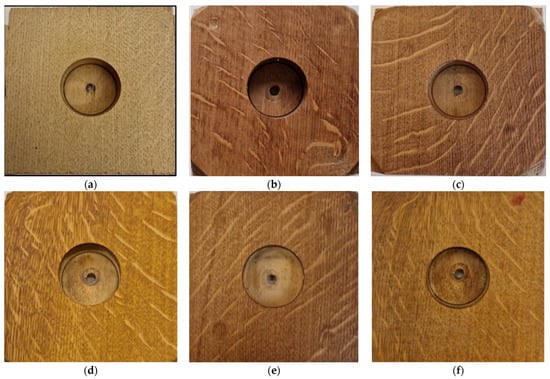
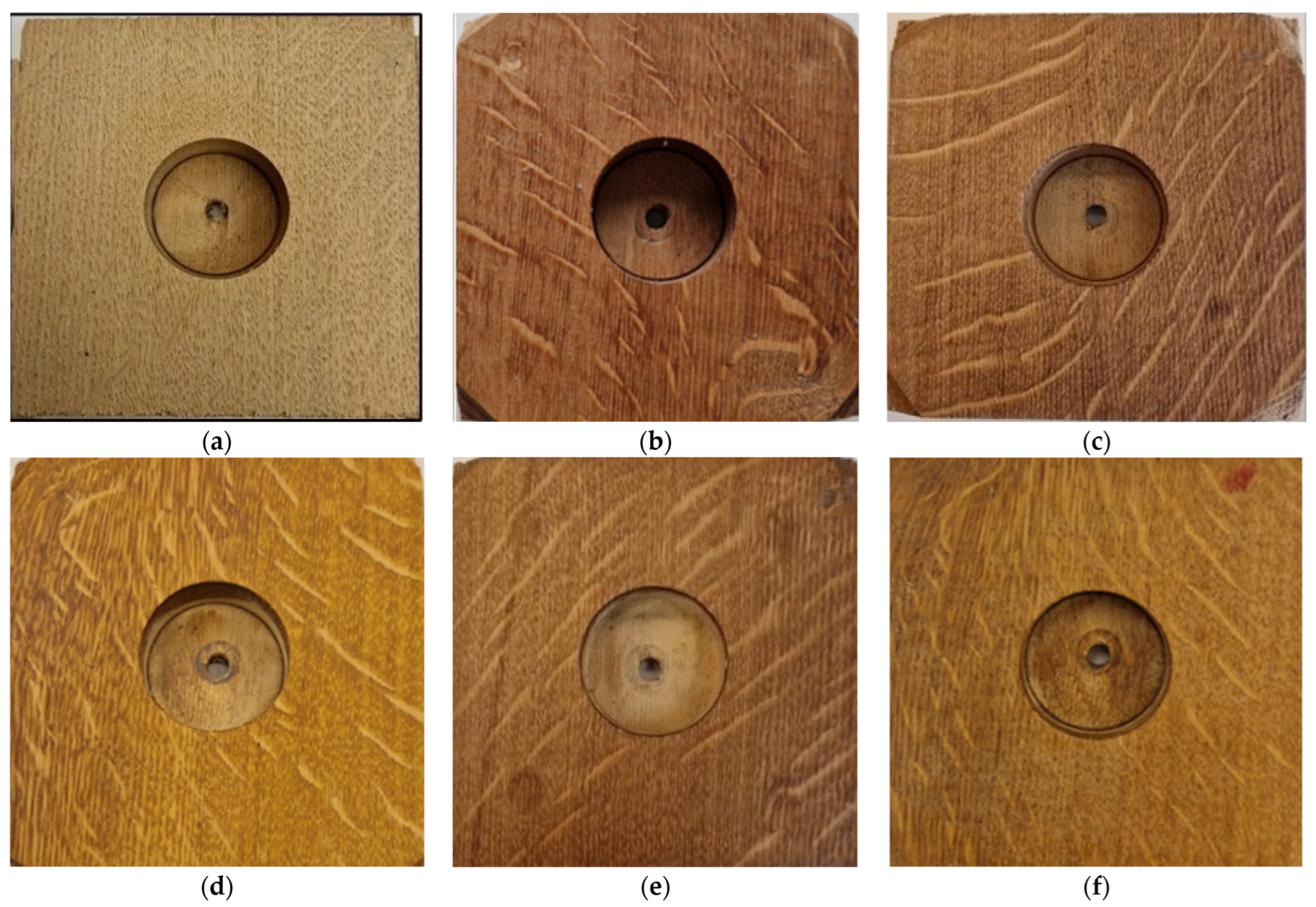
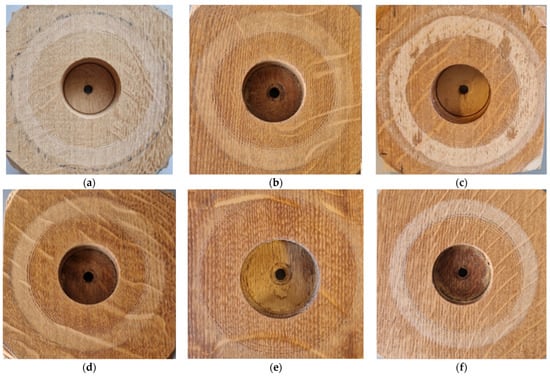
Tung oil stands out among all the tested oils due to its darker orange colour, strong smell and visibly higher density and viscosity than, for example, linseed oil (Figure 1c). Tung oil dries quickly and polymerises, creating a hard, glossy and watertight coating. Its application in wood processing has a long tradition in China, reaching the Han dynasty [34]. Other advantages of tung oil include biocompatibility, biodegradability and good resistance to biological degradation [35]. When applied to oak wood, the surface created by tung oil had a delicate shine, so it can be potentially used for the finishing of, for example, furniture. Its disadvantages include oily feel noticeable to the touch and a characteristic, intense smell that may be considered unpleasant and may be bothersome for the users.
Figure 1.
Visual differences in colour of samples: (a) without finish, (b) treated with linseed oil, (c) tung oil, (d) palm oil, (e) coconut oil, (f) formulated oil-based finish.
Coconut oil applied at room temperature had white colour and paste-like consistency resembling lard, while a slight increase in temperature due to friction or contact with a hand caused it to melt (Figure 1e). When the temperature is raised to 30 °C, the oil becomes liquid. It is biodegradable and has been tested for the protection of lignocellulosic fibres [36], but the coatings created with pure coconut oil are not as durable as those formed by tung oil or linseed oil. During application to oak wood, the observer noted a characteristic coconut odour, which fades over time after the application, which might be considered an additional, secondary advantage. After application, the oak surface acquired a pleasant satin-like finish, and the grain pattern gained depth. In most samples, coconut oil seemed to provide a better light reflectivity and a more intense gloss than other oils. Unfortunately, freshly applied oil felt slightly greasy to the touch and left a thin layer of residue on the hand.
Palm oil used in the presented study underwent refining (which involved the removal of free fatty acids, colourants and volatile compounds), giving it a more neutral smell and taste. It had a golden colour, and after application to oak, the wood acquired an intense yellow colour that gradually faded over time (Figure 1d). Palm oil created the impression of a subtle shine, enhancing the appearance of ray fleck. When touched, palm oil left a greasy residue on the fingers, while the surface itself was not smooth. This oil had an intense, slightly earthy smell that lingered for a long time after application, but it was not unpleasant.
Linseed oil had a yellowish colour before application. After application to oak wood, it released a slightly pungent smell which lingered for a long time, possibly causing discomfort for people sensitive to aromas. In terms of its visual characteristics, it darkened the colour of wood more than other tested oils, additionally highlighting the ray fleck, and after drying it created a satin-like surface (even though this effect was not subtle). The rough surface became slightly smoother to the touch, creating an effect similar to a thin coating, but initially it was noticeably greasy, which can cause discomfort for some people planning to use linseed oil to protect their furniture or parquet flooring (Figure 1b).
Formulated oil-based finish had a translucent, pale white colour before application, and afterwards oak wood colour became a bit darker and acquired a subtly matte appearance (Figure 1f). With this finish, the wood surface was the least greasy out of all the tested oils, and it did not leave a fatty residue on the hands. The odour was nice and light.
Figure 1 presents representative photographs of untreated oak and oak treated with selected finishing systems.
Natural oils visibly change and darken the colour of oak wood, and the effect is the most pronounced in case of palm oil, linseed oil and coconut oil.
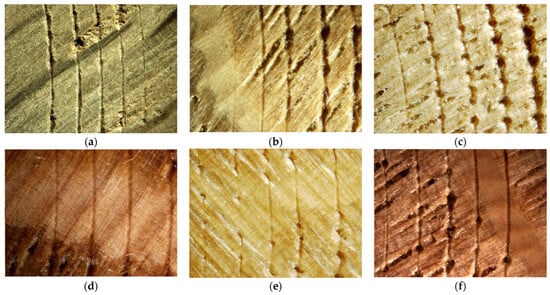
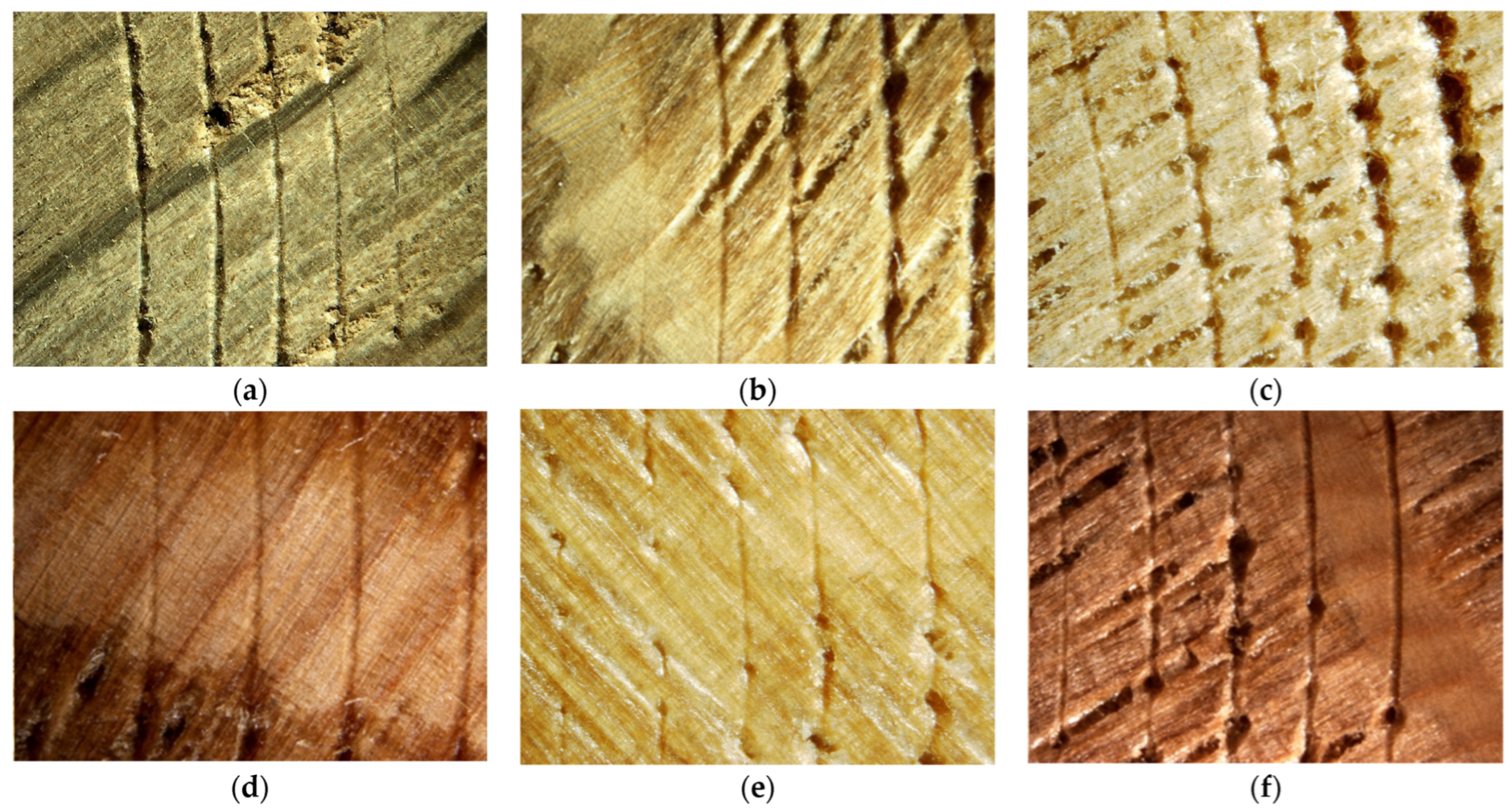
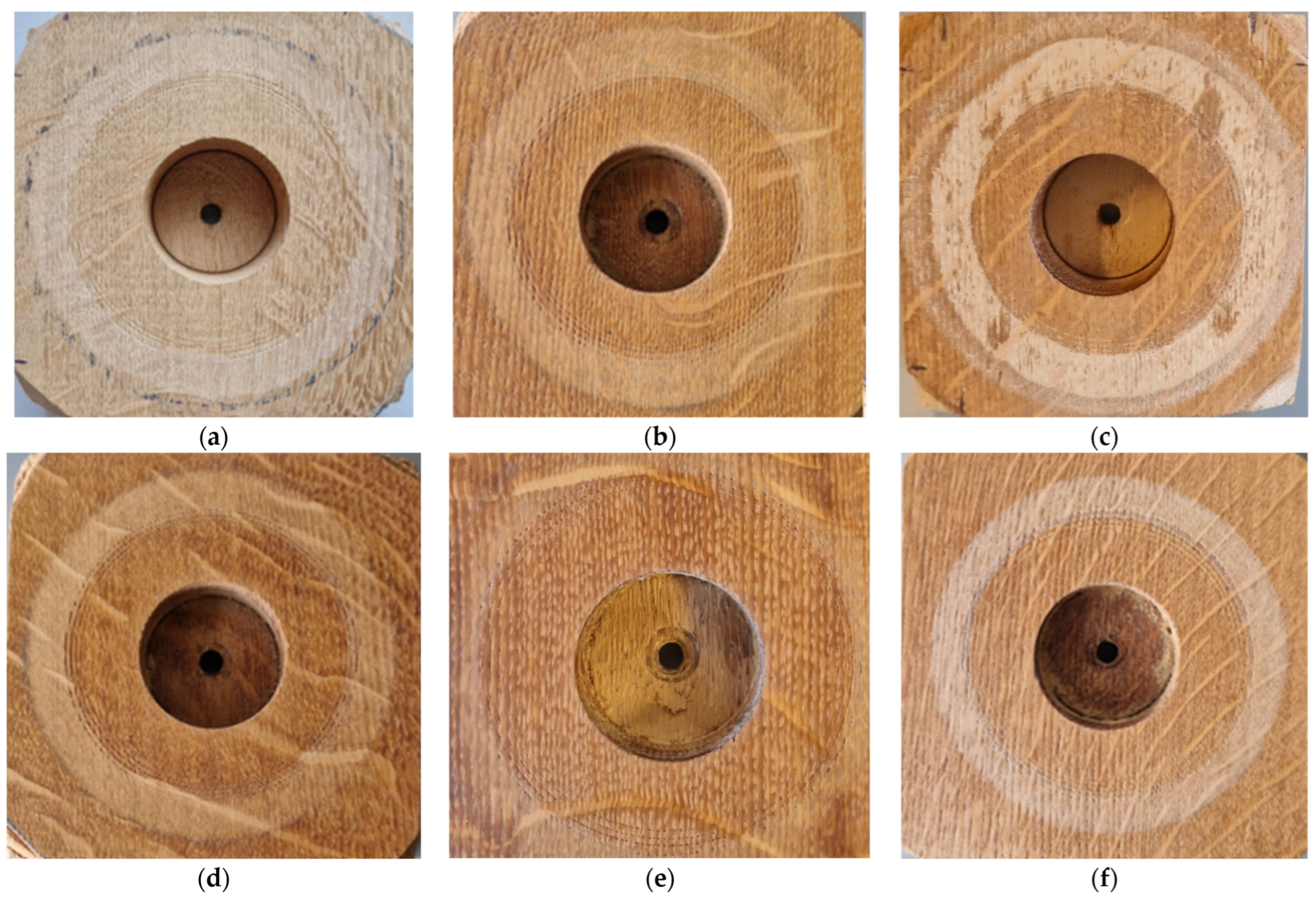
The results of visual evaluation of the differences in scratch continuity and width on oak wood samples that were either untreated or covered with natural oils (Figure 2) demonstrated that scratches made on all the samples were quite similar to each other, but not identical. The scratches were uneven, with varied depth, discontinuous, but the scratched mark became more uniform in the places where ray fleck was apparent. Visual analysis revealed that the thinnest and, at the same time, most clearly visible scratches were left by the stylus on samples treated with formulated oil-based finish. Less visible, but still thin and regular were the scratches made on samples treated with coconut oil. On the other hand, samples protected with palm oil and tung oil produced thicker scratches, which corresponds to the numerical values obtained during tests. On the surface of oak wood covered with linseed oil, the scratches were the widest and had the largest number of undesirable indentations and tear-outs, especially at loads of 4 N and 5 N.
Figure 2.
Visual differences in scratches on: (a) without finish, (b) treated with linseed oil, (c) tung oil, (d) palm oil, (e) coconut oil, (f) formulated oil-based finish.
Visual assessment during hardness tests did not reveal any important differences between untreated oak wood and wood covered with different kinds of oil. Nonetheless, many broken fibres were noticed in the indentations created on samples treated with palm oil, coconut oil and formulated oil-based finish. Samples covered with tung oil had fewer of those broken fibres and the break-outs were less pronounced.
After conducting abrasion resistance tests on all samples treated with natural oils, as well as on untreated samples (Figure 3), visible marks from the abrasive discs were observed. Additionally, contact with the Taber machine left greyish-black circles on the untreated samples. The most subtle abrasion marks were identified in the case of oak samples covered with formulated oil-based finish and coconut oil, and they were barely visible, especially after cleaning excess dust with a small brush. Relatively, the most visible abrasion marks were left on samples finished with tung oil.
Figure 3.
Visual differences in abrasion observed for: (a) without finish. (b) treated with linseed oil, (c) tung oil, (d) palm oil, (e) coconut oil, (f) formulated oil-based finish.
3.3. Colour Change of Oak Wood
All selected oil-based finishing systems visibly modified the colour of oak wood. The treatments caused a reduction in lightness and a shift towards red and yellow tones, although the magnitude of these changes differed among the tested systems (Table 2).
Table 2.
Colour parameters and gloss results.
Palm oil produced the greatest decrease in lightness, amounting to 24%. Coconut, linseed and tung oils reduced lightness by 21%, 20% and 19%, respectively. The commercial worktop oil caused the lowest decrease in lightness, of 17%. Nevertheless, all treatments substantially darkened the oak surface relative to the untreated control samples.
The differences between the lightness of wood finished with all types of oils and untreated wood are statistically significant, as are the differences between palm oil and all other systems. The degree of change in lightness between coconut oil and linseed oil is similar and statistically insignificant, as is the lightness of tung oil compared to linseed and formulated oil-based finish.
The strongest increase in the red tones was observed after palm oil application (76%), followed by coconut oil (70%), tung oil (59%), linseed oil (52%) and the formulated oil-based finish (49%). The differences between all tested systems are statistically significant.
Palm oil also caused the largest increase in the yellow component (28%). The remaining treatments produced smaller changes in yellowness, ranging from 7% for coconut oil, 11% for linseed oil, to 12% for tung oil and 14% for the formulated oil-based finish. The differences between yellow tones of wood finished with all types of oils and untreated wood are statistically significant, as are the differences between palm and coconut oil and the other systems. Tung oil, linseed oil and formulated oil-based finish coatings do not differ statistically significantly from each other.
The total colour difference confirmed that all treatments produced clearly perceptible changes in surface appearance. The highest ΔE value was recorded for palm oil (17.33), followed by coconut oil (14.63), linseed oil (13.43) and tung oil (12.81). The formulated oil-based finish produced the lowest total colour difference (ΔE = 11.83).
In terms of total colour difference, only the palm oil differed statistically significantly from the other finishes. Tung oil results were similar to formulated oil-based finish and linseed oil, and linseed oil to coconut oil (statistically insignificant differences).
3.4. Gloss of Finished Surfaces
The effect of the tested oil-based finishing systems on gloss differed among the treatments (Table 2). Coconut oil was the only finish that increased gloss, by approximately 46%, and it differed statistically significantly from the gloss of untreated wood and wood finished with other oils. In contrast, tung oil, linseed oil, palm oil and the formulated oil-based finish reduced gloss by 22%, 17%, 9% and 12%, respectively, and the differences between them are not statistically significant. Compared to the untreated control samples, only the aforementioned coconut oil and tung oil and linseed oil differ statistically significantly in gloss. Palm oil and formulated oil-based finish did not significantly affect the gloss.
These results indicate that colour modification and gloss development were not directly related. Palm oil produced the strongest colour change but did not increase gloss, whereas coconut oil increased gloss despite causing a lower total colour difference than palm oil.
3.5. Scratch Resistance
Scratch resistance depended on both the finishing system and applied load (Table 3). Coconut oil produced small changes in scratch width, ranging from approximately a 5% reduction to a 1% reduction relative to untreated oak, with no statistically significant differences observed.
Table 3.
Scratch resistance results.
The formulated oil-based finish and palm oils had only a marginal effect on scratch resistance. For formulated oil-based finish, a slight improvement was observed under loads of 1–3 N (2–5%), whereas a small reduction occurred at a force of 4–5 N (1–3%), but differences are not statistically significant. Palm oil showed a comparable pattern, with minor improvement at intermediate loads (2%) and a slight reduction at higher loads (1% for 4 N and 10% for 5 N forces). In the range of forces of 4 N and 5 N, palm oil differs statistically significantly from untreated wood.
Tung and linseed oils reduced scratch resistance. For tung oil, the reduction ranged from 7 to 10% at low loads to 12% at 4 N and 5 N forces. Linseed oil reduced scratch resistance by 11–23%, depending on the applied load (16% at 1 N force, 11% at 2 N force, 15% at 3 N force, 20% at 4 N force, 23% at 5 N force). The greatest reduction in scratch resistance was therefore associated with tung and linseed oil treatments, and they are statistically significant compared to untreated wood in the 2–5 N range for tung oil and 1–5 N for linseed oil.
Tung oil and linseed oil differ statistically significantly from all tested systems in the 2 N–3 N range. In the 4 N and 5 N range tung oil does not differ statistically from palm oil, while linseed oil does not differ statistically from tung oil in the 4 N range.
3.6. Abrasion Resistance
Finishing wood with oils increases the mass loss of the samples (Table 4). Abrasion resistance varied considerably among the examined finishing systems. The formulated oil-based finish produced the most favourable result, decreasing abrasion resistance only by 5% relative to untreated oak, but the differences are not statistically significant. Tung oil and linseed oil had a statistically significant effect, with a change of approximately 155% and 77%.
Table 4.
Abrasion-related mass loss and hardness results.
Palm oil and coconut oil decreased abrasion resistance by 39% and 23%, but the differences are not statistically significant. Therefore, it can be considered that formulated oil-based finish, coconut, and palm oils have no potential impact on abrasion resistance. The tung oil differs statistically significantly from other tested systems, as does the linseed oil compared to untreated wood, formulated oil-based finish and tung oil.
3.7. Surface Hardness
The tested oil-based finishing systems caused only small changes in the surface hardness of oak wood (Table 4). Coconut oil, tung oil, palm oil and linseed oil reduced hardness by 30%, 29%, 20% and 11%, respectively, whereas the formulated oil-based finish produced changes of 11%, statistically significantly increasing the hardness of the samples. In the remaining systems tested, the observed differences were not statistically significant from each other, with the exception of the reduction in oak hardness caused by coconut oil. Consequently, surface hardness was not considered a discriminating parameter for the evaluated tung, palm and linseed finishing systems. There were statistically significant differences between the formulated oil-based finish and the untreated samples, coconut, tung and palm oils, and the coconut oil and untreated samples, linseed and formulated oil-based finish.
In the case of hardness tests, unfinished oak samples and those covered with formulated oil-based finish exhibited the greatest variability between individual measurements. Tung and coconut oil finishes reduced the dispersion of test results significantly.
3.8. Statistical Analysis
The results of the analysis of variance of the effects of surface finishing and wood section on colour parameters and gloss have been presented in Table 5. The analysis of variance showed that surface finish (Variant A), including untreated wood and wood finished with various kinds of oil, had a statistically significant effect on all the colour parameters under analysis: L*, a* and b* (p < 0.001). The highest contribution of this factor to the total variance of results was identified for the L* and a* parameters, accounting for 89.9% and 89.4%, respectively. For the b* parameter, the contribution of surface finish was lower and amounted to 43.7%. These results indicate that the use of oils had the greatest influence on changes in surface lightness and the a* colour component. In case of gloss, no significant influence of surface finish was identified (p = 0.562), and the contribution of this factor to the result variance was only 0.2%.
Table 5.
Results of the analysis of variance of the effects of surface finish and wood section on colour parameters and gloss.
Measurement direction (B), parallel or perpendicular to the grain did not have a statistically significant influence on the colour parameters L*, a*, and b* (p > 0.05), and the contribution of this factor to their total variance was very small and ranged between 0.1 and 0.2%. A different trend was found for gloss, in which case the influence of wood section was statistically significant (p = 0.003), and the contribution of this factor to the total variance was 6.1%.
The interaction between surface finish and wood section (A × B) was not statistically significant for any of the analysed features (p > 0.05), and its contribution to the total variance of results accounted for as little as 0.1–0.2%. This means that the effect of surface finish on the analysed parameters was not significantly dependent on the direction of the wood section.
The share of “error” in the total variance of results was 9.8% for the L* parameter and 10.4% for the a* parameter, which indicates that the variability of these characteristics was largely explained by factors included in the model, primarily the surface finish. For the b* parameter, the share of “error” was much higher, and amounted to 55.9%, while in the case of gloss it reached as much as 93.5%. Such a high share of unexplained gloss variability indicates that factors included in the model explained only a small part of the variability of this characteristic. This might stem, among others, from the natural lack of wood homogeneity, local variations in surface properties, and other factors that were not taken into account in this analysis.
The analysis of variance of the effect of the wood surface finishing method on colour parameters and gloss (Table 6) showed a statistically significant effect of the surface finish variant on all analysed colour parameters and on gloss (p < 0.001). The highest contribution of this factor to the total variance of results was identified for the a* parameter, accounting for 98.6%, and for the L* parameter: 94.0%. A high contribution of the surface finish type was also observed for the b* parameter (80.9%). This means that the type of oil used, as well as the lack of an oil finish in the control group, determined the surface colour parameters to a very large extent.
Table 6.
Results of the analysis of variance of the effect of wood surface finish on colour parameters and gloss.
The influence of the finish variant on gloss was also statistically significant (p < 0.001), but the contribution of this factor to the total variance of results was much smaller and amounted to 59.7%. The share of “error” amounted to 6.0% for L*, 1.4% for a*, 19.1% for b*, and 40.3% for gloss, respectively. The particularly low share of “error” in L* and a* parameters indicates that their variance was almost entirely explained by the type of finish applied. On the other hand, the high share of unexplained variability in the case of gloss may suggest a greater susceptibility of this parameter to local differences in surface properties and other factors that were not considered in this model.
The results of the analysis of variance of the effect of wood surface finish type on abrasion resistance and hardness are presented in Table 7, while its influence on scratch width can be found in Table 8.
Table 7.
Results of the analysis of variance of the effect of wood surface finish on abrasion and hardness.
Table 8.
Results of the analysis of variance of the effect of wood surface finish on the width of scratches.
The analysis of variance revealed that the type of surface finish had a statistically significant influence on all the mechanical properties under analysis, including abrasion resistance, hardness, and resistance to scratches at loads from 1 to 5 N (p < 0.001). In the case of abrasion resistance, the share of the finish variant in the total variance of results amounted to 49.7%, and in the case of hardness—to 34.1%. This means that the type of surface finish was a significant factor determining its mechanical properties, while its influence was more pronounced for abrasion resistance than for hardness.
A significant effect of the finish variant was also observed for resistance to scratches for all the loads applied. The share of that factor in the total variance of results was 40.1% at a load of 1 N, 38.1% at 2 N, 51.7% at 3 N and 58.6% at both 4 N and 5 N. The results suggest that at higher loads, the significance of the finish type for resistance to scratches became more pronounced, especially at loads from 3 to 5 N.
The share of “error” in the case of abrasion resistance and hardness amounted to, respectively, 50.3% and 65.9%, which indicates an important contribution of other variability sources, beyond the surface finishing method itself. For resistance to scratches, the share of “error” was gradually becoming lower as the load increased: from 59.9% at 1 N and 61.9% at 2 N, to 48.3% at 3 N and 41.4% at 4 and 5 N. This may indicate that, at higher loads, the influence of the finish variant on the mechanical behaviour of the surface became more clearly apparent, whereas at lower loads, other sources of variability may have been more significant, including the natural heterogeneity of wood and local variations in surface properties.
4. Discussion
4.1. Surface Appearance: Colour and Gloss
The results obtained indicate that the properties of oil-based finishing systems cannot be evaluated solely on the basis of what the oil is derived from or its main component. The response of the surface depends on the amount of finish penetrating into the wood structure, and the amount that stays near the surface and creates a coating after curing. Other important factors include viscosity, the volume of finish applied, the number of layers, the method used to remove the excess, and the curing conditions. Therefore, the results should be considered in relation to specific systems used on untreated oak wood in specific application conditions and not be treated as a universal characteristic of individual oils. The properties of the oak substrate must also be considered, as its anatomical structure may influence oil penetration and the resulting surface response.
This reservation is particularly important when comparing the results with those reported in the literature. Plant oils are often used as ingredients in formulations containing siccatives, resins, waxes, photoinitiators, nano-additives or polymers. Such ingredients may affect the curing process, the continuity of the layer and its mechanical properties. For example, Yoo et al. demonstrated an improvement in scratch resistance and durability of a tung-oil-based system after adding cellulose nanocrystals [12]. However, these results should not be directly attributed to pure tung oil. Similarly, oil–wax systems and chemically modified oils constitute a separate group of finishing products [10,14,37]. These differences between finishing systems provide a relevant context for interpreting the colour and gloss changes observed in the present study.
All the systems under evaluation caused a visible and statistically significant darkening of oak wood. The decrease in lightness was between 17% for the formulated oil-based finish and 24% for palm oil, while ΔE*ab fell within the range of 11.83–17.33. These values confirm that all the applied oils significantly changed the natural appearance of oak. The greatest colour change occurred after applying palm oil; it was accompanied by the largest lightness reduction and the largest increase in the share of red and yellow components, which suggests that the colour shifted towards warm, orange-brown hues.
The optical effect of oil application is determined by more than just the colour of the finishing product itself. It also depends on its retention and distribution in the near-surface zone, including the vessels and other anatomical elements of the wood, as well as the extent to which it fills surface irregularities. Žlahtič et al. demonstrated that the distribution and depth of penetration of tung oil depend on the wood species and the method of application [38]. In the case of oak, characterised by a ring-porous structure, the difference between earlywood and latewood and the presence of large vessels can contribute to a locally uneven penetration of oil. Therefore, more intense darkening after the application of palm oil should not be attributed solely to its orange colour; it can also depend on the differences in the product’s retention and distribution within the structure of the wood. Because such parameters were not measured, this interpretation needs to be verified in further studies.
The changes in lightness after applying tung oil and linseed oil are in line with their practical applications aimed at highlighting the wood grain pattern and producing a warmer hue. Arminger et al. demonstrated that the drying of tung oil and linseed oil depends on the type of oil, the wood species, and the presence of siccatives, while tung oil acquired its hydrophobic properties faster than linseed oil [3]. This suggests that the optical properties of a finished surface depend on the processes of finish penetration and curing, and not only on the chemical classification of the oil used.
Changes in colour are related to the absorption, refraction and scattering of light by wood and the finishing layer, while gloss depends strongly on surface topography, especially its roughness and uniformity. Hauptmann et al. demonstrated a relationship between the changes in wood surface nanostructure caused by, among others, oil application, and the changes in lightness [39]. The authors stressed the importance of chemical changes and optical phenomena occurring in the near-surface region. Meanwhile, Yong et al. confirmed the strong dependence of gloss on the roughness parameters of coatings [40]. Even though their study concerned a polyurethane coating, the mechanism of light reflection remains important for oil finishes as well: a smoother and more uniform surface contributes to directional reflection of light, while surface irregularities increase the proportion of diffuse reflection.
The increase in gloss after applying coconut oil can suggest a partial equalisation of surface microgeometry or the creation of a more uniform external layer. However, it is not possible to confirm this mechanism without conducting measurements of surface roughness and layer thickness. Importantly, coconut oil did not cause the most significant change in colour, while palm oil did not increase gloss—even though it darkened the colour the most. This confirms that colour change and gloss variations are not directly linked and should be interpreted as two separate aspects of surface appearance. Moreover, neither parameter alone indicates whether the treated surface is more resistant to mechanical damage, as discussed below.
4.2. Mechanical Surface Performance: Scratch Resistance, Abrasion Resistance and Hardness
As indicated by the optical results, the effect of a finishing system depends on its interaction with the wood surface. This relationship is also relevant to mechanical performance, where both the finishing layer and the near-surface structure of oak contribute to the response under loading. The obtained results indicate that the influence of the oil systems under study on the mechanical properties of oak wood surface was not unidirectional. The type of finish had a significant impact on the width of scratches, mass loss during abrasion, and Brinell hardness, but the direction and scale of these changes depended on the parameter under analysis. This means that the service life of a given surface cannot be assessed solely on the basis of a single characteristic. Resistance to scratches, abrasion and local indentations describe different mechanisms of damage, and an improvement in one of these parameters does not necessarily lead to improvements in the remaining ones.
In the case of scratch resistance, the width of scratches increased at higher loads in all the variants. The least favourable effect was identified in the case of linseed oil and tung oil, respectively, with scratch width being 11–23% and 7–12% greater than for untreated wood at all the loads that were applied. Therefore, in these test conditions, we cannot determine whether any of the systems actually increased the scratch resistance of oak wood. We can only say that coconut oil and the formulated oil-based finish for countertops did not visibly worsen it, contrary to linseed oil and tung oil.
A seemingly unfavourable response to pure linseed oil and tung oil might seem contradictory to their widespread use in wood finishing. However, we need to take into account that mechanical resistance depends not only on the type of oil, but also on the degree of curing, the amount of material remaining on the surface, the presence of siccatives and reinforcing additives. Yoo et al. demonstrated an improvement in scratch resistance and durability of a system based on tung oil after adding cellulose nanocrystals [12]. Nonetheless, their results concerned a composite coating system, and not pure tung oil. Moreover, Arminger et al. demonstrated that the drying process of tung oil and linseed oil depends on the kind of oil, the wood species, and the presence of siccatives [3]. Therefore, it is possible that the conditions of application, curing and conditioning did not allow the oils to create coatings with properties that would provide effective protection against scratches.
The resistance to abrasion, assessed on the basis of mass loss, revealed even greater differences between the variants. It should be stressed that a higher loss of mass means a lower resistance to abrasion. The largest mass loss was observed for wood covered with tung oil; it was by 155% higher than in the control group, and the difference was statistically significant. Linseed oil also increased the mass loss significantly, by 77%. These results indicate that linseed oil and tung oil in the systems used herein did not create a layer with sufficient resistance to abrasion. A possible explanation is that a greater proportion of the finish penetrated into the wood rather than remaining on the surface and creating a compact surface layer, or that the oil remaining near the surface was not hardened enough. This mechanism cannot be evaluated conclusively without assessing the depth of penetration, the thickness and homogeneity of the layer, as well as the chemical changes taking place during the curing process. In the case of penetrating oils, it is important whether, after removing the excess finish, the product remaining on the surface is able to create a cohesive, continuous layer capable of transferring abrasive loads, or whether most of the oil soaks into the structure of wood. In the second case, abrasive discs can operate mostly in the near-surface area of the wood, whose properties were not sufficiently reinforced by the cured finish. This possible explanation also highlights the role of the wood substrate: the distribution of oil within its near-surface structure may affect the amount of material available to resist abrasive wear. Vidholdová et al. demonstrated that the resistance to abrasion and the hardness of finished surfaces depend on the interaction between the type of finish and the substrate properties [14]. In their study, they evaluated native (unmodified) and thermally modified oak wood finished with linseed oil, an oil-wax system, and wax. The differences in mechanical properties that were observed indicate that the surface response depends not only on the composition of the finish, but also on the state of the substrate, which affects penetration, adhesion and load transfer of the finish. Thermal modification changes the chemical composition of wood, its hygroscopicity, mechanical properties and interactions with finishing products. Therefore, the differences in abrasion resistance should not be interpreted as a discrepancy between studies, but rather as the result of differences in the system itself: the kind of wood, its modification and the formulation of the finish applied. In future studies, it would be useful to complement the abrasion evaluation with oil retention measurements, microscopic evaluation of sample sections, and chemical analysis of the near-surface layer, e.g., with the FTIR method.
The results of this study are also in line with the observation that “oil finish” may refer to systems with vastly different properties. Ślusarczyk and Różańska, when studying oak parquet flooring finished with contemporary single-ingredient and two-ingredient oils, as well as oil–wax systems, demonstrated different changes in abrasion resistance, depending on the type of product used [41]. The differences between results obtained in this study and the results obtained by the cited authors should be attributed to the different types of products, the manner of their application, the number of layers and the conditions during the curing process. This study evaluated the effects of single plant oils and a formulated oil-based finish on untreated oak wood. On the other hand, the studies conducted by Ślusarczyk and Różańska analysed finishing systems intended for parquet flooring, used with different combinations of materials and applications. Therefore, the results of those studies should not be treated as directly comparable, but rather as a confirmation that the abrasion resistance of oak surfaces is susceptible to the specific characteristics of the finishing system used.
The contribution of substrate properties to wear resistance is also illustrated by the studies by Waßmann and Ahmed, who analysed the tribological properties of wood that underwent compression, thermal modification and impregnation with waxes [42]. The authors demonstrated that the most favourable mechanical surface performance was obtained when the wood was successively compressed, thermally modified and then impregnated with wax. Compression increased the share of wooden material per volume unit and limited the susceptibility of the surface to mechanical particle removal, thermal processing influenced the dimensional stability, while impregnation with wax reduced friction during sliding contact. These results demonstrate that resistance to wear does not depend on a single property, but rather on the combined effects of the wood’s structure, density, stability and the material present in the near-surface area.
In this study, the increased mass loss after the application of tung oil and linseed oil indicates that this kind of finish did not ensure such a protective effect in these application conditions. However, this does not rule out the usefulness of these oils, but rather points out their limitations for surfaces exposed to intense abrasion.
While scratch and abrasion tests involve material displacement or removal, the Brinell test examines the response to local indentation. This distinction is important when interpreting the influence of both the finish and the underlying oak substrate. The obtained results indicate that oil application does not always increase wood hardness directly. Brinell hardness is a property that depends, most of all, on the response of the surface and the near-surface zone of the wood to static loads. Therefore, the results were affected not only by the properties of the cured product, but also by the characteristics of the substrate itself, such as its density, anatomical structure, moisture, and the local share of earlywood and latewood. In the case of oak, an additional source of variability may be the presence of broad wood rays and vessels that influence the shape and size of the marks left by the indenter.
Lack of significant changes in hardness after the application of most oils under study is consistent with the results obtained by Kozakiewicz et al. [43] The authors evaluated the Brinell hardness of different wood species finished with oil and lacquer, and concluded that surface finish itself does not significantly change hardness in most of the cases analysed. At the same time, oak wood that underwent thermal modification and was later finished with oil exhibited a significant increase in hardness, which confirms that the effects of surface finish also depend on the properties of the substrate.
The increase in hardness after applying the formulated oil-based finish did not translate into a significant improvement of resistance to scratches or abrasion. This confirms that Brinell hardness cannot be treated as a standalone indicator of the overall resistance of a finished surface. Hardness determined with the Brinell method describes the resistance to static indentation, while scratching and abrasion involve different damage mechanisms [44]. Moreover, in floor applications, resistance to abrasion may provide more direct information on the surface durability than hardness itself [45]. The functional properties of finished wood depend on the interaction between the substrate and the finishing layer, and not on a single mechanical parameter [46].
From a practical perspective, hardness results do not allow for a simple classification of the systems under study as more or less durable. The formulated oil-based finish can be considered in situations when a greater resistance to local indentations is needed, but one should not expect a simultaneous improvement in resistance to abrasion and scratches. For elements subjected to intensive use, the selection of the finish should be based on a comprehensive evaluation of hardness, resistance to scratches, resistance to abrasion and ageing behaviour. The combined optical and mechanical results thus point to the importance of interactions between the applied finish and the oak substrate.
The wettability of the wood surface and the interaction between the oil and the wood substrate are important factors that can influence the properties of the finished surfaces. However, the study focused on the comparative assessment of the optical and mechanical properties of oak wood finished with different oils. To ensure the comparability of results, wood materials with similar properties and identical sample preparation and finishing conditions were used. Although the study did not include direct assessment of wettability, oil penetration, and adhesion, these issues represent an interesting avenue for further research that could contribute to a more comprehensive explanation of the obtained results.
Several limitations should be considered when interpreting the results. The investigated finishing systems differed not only in their oil composition but also in application rate, curing time, and formulation. In particular, the formulated commercial product contained waxes, siccatives, and other additives, which may have influenced its mechanical performance. As these variables were not independently controlled, the observed differences cannot be attributed exclusively to the chemical composition of the base oils. Furthermore, the degree of curing, oil retention, coating thickness, and surface wettability were not directly measured. Consequently, the findings should be interpreted as a comparison of specific finishing systems under the investigated application conditions rather than as a general ranking of individual vegetable oils.
Future studies should focus on measuring the depth of penetration of oils, the thickness and homogeneity of the near-surface layer, as well as the chemical changes related to curing. Complementary measurements of roughness, wettability and microscopic observations would allow for a better understanding of the interdependence between appearance and the mechanical properties of the surface. It would also be important to conduct ageing tests, exposing wood to repeatable cycles of moisture, temperature and UV light. This kind of approach would make it possible to evaluate the durability of the systems under study in conditions resembling actual use. The results can be used as a basis for further studies on bio-based wood finishes, combining the desired aesthetic effect with greater functional durability.
5. Conclusions
The study demonstrated that the tested oil-based finishing systems significantly modified both the appearance and selected mechanical properties of oak wood. The following conclusions can be drawn:
- All the oil systems under study significantly changed the appearance of oak wood, causing its colour to darken and shifting it towards red and yellow hues. The greatest change in colour was caused by palm oil, while coconut oil was the only finish that increased gloss.
- Tung oil and linseed oil caused wider scratches and a greater mass loss in abrasion tests, suggesting a less favourable mechanical response of the surface under the specific conditions in this study.
- Coconut oil and the formulated oil-based finish did not differ significantly from untreated wood in terms of scratch width and abrasion resistance.
- Formulated oil-based finish increased Brinell hardness, while coconut oil reduced it. Changes in hardness did not directly correspond to changes in scratch and abrasion resistance.
- When selecting the type of wood finishing oil, the desirable visual effects should be assessed alongside the expected service loads. The mechanical properties of the surface should be evaluated considering multiple criteria, using complementary test methods.
Author Contributions
Conceptualisation, A.R. and K.K.; methodology, A.R. and W.K.; software, P.B.; validation, I.B.; formal analysis, W.K. and I.B.; investigation, K.K., A.R. and W.K.; resources, W.K.; data curation, P.B.; writing—original draft preparation, A.R. and I.B.; writing—review and editing, W.K.; supervision, A.R.; project administration, A.R. All authors have read and agreed to the published version of the manuscript.
Funding
This research received no external funding.
Institutional Review Board Statement
Not applicable.
Informed Consent Statement
Not applicable.
Data Availability Statement
The original contributions presented in this study are included in the article. Further inquiries can be directed to the corresponding author.
Conflicts of Interest
The authors declare no conflicts of interest.
References
- Potkány, M.; Gejdoš, M.; Debnár, M. Sustainable Innovation Approach for Wood Quality Evaluation in Green Business. Sustainability 2018, 10, 2984. [Google Scholar] [CrossRef] [Scilit]
- Svobodová, H.; Hlaváčková, P. Forest as a Source of Renewable Material to Reduce the Environmental Impact of Buildings. J. For. Sci. 2023, 69, 451–462. [Google Scholar] [CrossRef] [Scilit]
- Arminger, B.; Jaxel, J.; Bacher, M.; Gindl-Altmutter, W.; Hansmann, C. On the Drying Behavior of Natural Oils Used for Solid Wood Finishing. Prog. Org. Coat. 2020, 148, 105831. [Google Scholar] [CrossRef] [Scilit]
- De Meijer, M. Review on the Durability of Exterior Wood Coatings with Reduced VOC-Content. Prog. Org. Coat. 2001, 43, 217–225. [Google Scholar] [CrossRef] [Scilit]
- Evans, P.; Vollmer, S.; Kim, J.; Chan, G.; Kraushaar Gibson, S. Improving the Performance of Clear Coatings on Wood through the Aggregation of Marginal Gains. Coatings 2016, 6, 66. [Google Scholar] [CrossRef] [Scilit]
- Calovi, M.; Zanardi, A.; Rossi, S. Recent Advances in Bio-Based Wood Protective Systems: A Comprehensive Review. Appl. Sci. 2024, 14, 736. [Google Scholar] [CrossRef] [Scilit]
- Teacă, C.-A.; Roşu, D.; Mustaţă, F.; Rusu, T.; Roşu, L.; Roşca, I.; Varganici, C.-D. Natural Bio-Based Products for Wood Coating and Protection against Degradation: A Review. BioResources 2019, 14, 4873–4901. [Google Scholar] [CrossRef] [Scilit]
- Cirule, D.; Andersone, I.; Kuka, E.; Andersons, B. Recent Research on Linseed Oil Use in Wood Protection—A Review. Sci 2024, 6, 54. [Google Scholar] [CrossRef] [Scilit]
- Humar, M.; Lesar, B. Efficacy of Linseed- and Tung-Oil-Treated Wood against Wood-Decay Fungi and Water Uptake. Int. Biodeterior. Biodegrad. 2013, 85, 223–227. [Google Scholar] [CrossRef] [Scilit]
- Janesch, J.; Arminger, B.; Gindl-Altmutter, W.; Hansmann, C. Superhydrophobic Coatings on Wood Made of Plant Oil and Natural Wax. Prog. Org. Coat. 2020, 148, 105891. [Google Scholar] [CrossRef] [Scilit]
- Janesch, J.; Gusenbauer, C.; Mautner, A.; Gindl-Altmutter, W.; Hansmann, C. Efficient Wood Hydrophobization Exploiting Natural Roughness Using Minimum Amounts of Surfactant-Free Plant Oil Emulsions. ACS Omega 2021, 6, 22202–22212. [Google Scholar] [CrossRef] [Scilit] [PubMed]
- Yoo, Y.; Youngblood, J.P. Tung Oil Wood Finishes with Improved Weathering, Durability, and Scratch Performance by Addition of Cellulose Nanocrystals. ACS Appl. Mater. Interfaces 2017, 9, 24936–24946. [Google Scholar] [CrossRef] [Scilit] [PubMed]
- Rosu, L.; Varganici, C.; Mustata, F.; Rosu, D.; Rosca, I.; Rusu, T. Epoxy Coatings Based on Modified Vegetable Oils for Wood Surface Protection against Fungal Degradation. ACS Appl. Mater. Interfaces 2020, 12, 14443–14458. [Google Scholar] [CrossRef] [Scilit] [PubMed]
- Vidholdová, Z.; Slabejová, G.; Šmidriaková, M. Quality of Oil- and Wax-Based Surface Finishes on Thermally Modified Oak Wood. Coatings 2021, 11, 143. [Google Scholar] [CrossRef] [Scilit]
- Salca, E.-A.; Krystofiak, T.; Lis, B.; Hiziroglu, S. Glossiness Evaluation of Coated Wood Surfaces as Function of Varnish Type and Exposure to Different Conditions. Coatings 2021, 11, 558. [Google Scholar] [CrossRef] [Scilit]
- Kržišnik, D.; Lesar, B.; Thaler, N.; Humar, M. Influence of Natural and Artificial Weathering on the Colour Change of Different Wood and Wood-Based Materials. Forests 2018, 9, 488. [Google Scholar] [CrossRef] [Scilit]
- Liu, M.; Tu, X.; Liu, X.; Wu, Z.; Lv, J.; Vorodi, A.M. A Comparative Study on the Effects of Linseed Oil and Shellac Treatment on the Hygroscopicity, Dimensional Stability, and Color Changes of Chinese Ash Wood. BioResources 2020, 15, 8085–8092. [Google Scholar] [CrossRef] [Scilit]
- Liu, M.; Xu, G.; Wang, J.; Tu, X.; Liu, X.; Wu, Z.; Lv, J.; Xu, W. Effects of Shellac Treatment on Wood Hygroscopicity, Dimensional Stability and Thermostability. Coatings 2020, 10, 881. [Google Scholar] [CrossRef] [Scilit]
- Zeng, Q.; Yu, X.; Wei, N.; Wu, Z.; Liu, Q.; Chen, N.; Zhao, W. Effect of Impregnation with Natural Shellac Polymer on the Mechanical Properties of Fast-Growing Chinese Fir. Polymers 2022, 14, 3871. [Google Scholar] [CrossRef] [Scilit] [PubMed]
- Oberhofnerová, E.; Šimůnková, K.; Dvořák, O.; Štěrbová, I.; Hiziroglu, S.; Šedivka, P.; Pánek, M. Comparison of Exterior Coatings Applied to Oak Wood as a Function of Natural and Artificial Weathering Exposure. Coatings 2019, 9, 864. [Google Scholar] [CrossRef] [Scilit]
- Pánek, M.; Oberhofnerová, E.; Zeidler, A.; Šedivka, P. Efficacy of Hydrophobic Coatings in Protecting Oak Wood Surfaces during Accelerated Weathering. Coatings 2017, 7, 172. [Google Scholar] [CrossRef] [Scilit]
- Pánek, M.; Dvořák, O.; Oberhofnerová, E.; Šimůnková, K.; Zeidler, A. Effectiveness of Two Different Hydrophobic Topcoats for Increasing of Durability of Exterior Coating Systems on Oak Wood. Coatings 2019, 9, 280. [Google Scholar] [CrossRef] [Scilit]
- Nejad, M.; Dadbin, M.; Cooper, P. Coating Performance on Exterior Oil-Heat Treated Wood. Coatings 2019, 9, 225. [Google Scholar] [CrossRef] [Scilit]
- Afshar, R.; Ahlgren, A.; Gamstedt, E.K. Characterization of Mechanical Properties of Vasa Oak and Their Application in a Full-Scale Numerical Model for Support Assessment; ICOM-CC: Portsmouth, UK, 2019. [Google Scholar]
- Nicolescu, V.-N.; Vor, T.; Brus, R.; Đodan, M.; Perić, S.; Podrázský, V.; Andrašev, S.; Tsavkov, E.; Ayan, S.; Yücedağ, C.; et al. Management of Sessile Oak (Quercus Petraea (Matt.) Liebl.), a Major Forest Species in Europe. J. For. Res. 2025, 36, 78. [Google Scholar] [CrossRef] [Scilit]
- Smolarek, E.; Kowalska, J.; Pałubicki, B.; Wieruszewski, M. The Habitats of European Oak (Quercus) in Poland and General Oak Wood Color Issues. Forests 2025, 16, 1063. [Google Scholar] [CrossRef] [Scilit]
- PN-EN 13183-1:2004; Moisture Content of Timber—Part 1: Determination of Moisture Content by the Oven-Dry Method. Polish Committee for Standardization (PKN): Warsaw, Poland, 2004.
- PN-ISO 7724-3:2003; Paints and Varnishes. Colorimetry. Part 3: Calculation of Colour Differences. Polish Committee for Standardization (PKN): Warsaw, Poland, 2003.
- PN-EN ISO 2813:2014-11; Paints and Varnishes—Determination of Specular Gloss of Non-Metallic Paint Films at 20°, 60° and 85. Polish Committee for Standardization (PKN): Warsaw, Poland, 2014.
- PN-EN 438-2+A1:2019-01; High-Pressure Decorative Laminates (HPL)—Sheets Based on Thermosetting Resins (Usually Called Laminates)—Part 2: Determination of Properties. Polish Committee for Standardization (PKN): Warsaw, Poland, 2019.
- ISO 7784-2:2023; Paints and Varnishes—Determination of Resistance to Abrasion Part 2: Method with Abrasive Rubber Wheels and Rotating Test Specimen. International Organization for Standardization: Geneva, Switzerland, 2023.
- ASTM D4060-19; Standard Test Method for Abrasion Resistance of Organic Coatings by the Taber Abraser. ASTM International: West Conshohocken, PA, USA, 2019.
- PN-EN 1534:2020-06; Wood Flooring—Determination of Resistance to Indentation—Test Method. Polish Committee for Standardization (PKN): Warsaw, Poland, 2020.
- Liu, X.-Y.; Timar, M.C.; Vorodi, A.M.; Yi, S.L. Tung Oil and Linseed Oil as Traditional Finishing Materials Important for Furniture Conservation. PRO LINGO 2015, 11, 571–579. [Google Scholar]
- Zhang, D.; Song, K. Effects of Photoinitiators on Curing Performance of Wood Wax Oil Coating on Wood. Coatings 2023, 14, 2. [Google Scholar] [CrossRef] [Scilit]
- Farrahnoor, A.; Sazali, N.A.A.; Yusoff, H.; Zhou, B.T. Effect of Beeswax and Coconut Oil as Natural Coating Agents on Morphological, Degradation Behaviour, and Water Barrier Properties of Mycelium-Based Composite in Modified Controlled Environment. Prog. Org. Coat. 2024, 196, 108763. [Google Scholar] [CrossRef] [Scilit]
- Alam, M.; Akram, D.; Sharmin, E.; Zafar, F.; Ahmad, S. Vegetable Oil Based Eco-Friendly Coating Materials: A Review Article. Arab. J. Chem. 2014, 7, 469–479. [Google Scholar] [CrossRef] [Scilit]
- Žlahtič, M.; Mikac, U.; Serša, I.; Merela, M.; Humar, M. Distribution and Penetration of Tung Oil in Wood Studied by Magnetic Resonance Microscopy. Ind. Crops Prod. 2017, 96, 149–157. [Google Scholar] [CrossRef] [Scilit]
- Hauptmann, M.; Müller, U.; Obersriebnig, M.; Gindl-Altmutter, W.; Beck, A.; Hansmann, C. The Optical Appearance of Wood Related to Nanoscale Surface Roughness. BioResources 2013, 8, 4038–4045. [Google Scholar] [CrossRef] [Scilit]
- Yong, Q.; Chang, J.; Liu, Q.; Jiang, F.; Wei, D.; Li, H. Matt Polyurethane Coating: Correlation of Surface Roughness on Measurement Length and Gloss. Polymers 2020, 12, 326. [Google Scholar] [CrossRef] [Scilit] [PubMed]
- Ślusarczyk, K.; Różanska, A. An Influence of Contemporary Oil Coatings on the Aesthetical Properties and Abrasion Resistance of Oak Wood Parquets. Ann. WULS For. Wood Technol. 2020, 111, 83–93. [Google Scholar] [CrossRef] [Scilit]
- Waßmann, O.; Ahmed, S.I.-U. Tribological Properties and Related Effects of Compressed, Thermally Modified and Wax-Impregnated Wood. Eur. J. Wood Wood Prod. 2024, 82, 2155–2168. [Google Scholar] [CrossRef] [Scilit]
- Kozakiewicz, P.; Laskowska, A.; Drożdżek, M.; Zawadzki, J. Influence of Thermal Modification in Nitrogen Atmosphere on Physical and Technological Properties of European Wood Species with Different Structural Features. Coatings 2022, 12, 1663. [Google Scholar] [CrossRef] [Scilit]
- Koczan, G.; Karwat, Z.; Kozakiewicz, P. An Attempt to Unify the Brinell, Janka and Monnin Hardness of Wood on the Basis of Meyer Law. J. Wood Sci. 2021, 67, 7. [Google Scholar] [CrossRef] [Scilit]
- Millaniyage, K.; Kotlarewski, N.; Taoum, A.; Wallis, L. The Role of Abrasion Resistance in Determining Suitability of Low-Density Plantation Timber for Engineered Flooring. Forests 2023, 14, 1309. [Google Scholar] [CrossRef] [Scilit]
- Pavlič, M.; Petrič, M.; Žigon, J. Interactions of Coating and Wood Flooring Surface System Properties. Coatings 2021, 11, 91. [Google Scholar] [CrossRef] [Scilit]

Disclaimer/Publisher’s Note: The statements, opinions and data contained in all publications are solely those of the individual author(s) and contributor(s) and not of MDPI and/or the editor(s). MDPI and/or the editor(s) disclaim responsibility for any injury to people or property resulting from any ideas, methods, instructions or products referred to in the content. |
© 2026 by the authors. Licensee MDPI, Basel, Switzerland. This article is an open access article distributed under the terms and conditions of the Creative Commons Attribution (CC BY) license.