


Abstract
The corrosion evolution of pipeline steel was investigated in NaCl + 0.75 M NaHCO3 solutions with different chloride concentrations using potentiodynamic polarization, electrochemical impedance spectroscopy (EIS), Mott–Schottky analysis, X-ray photoelectron spectroscopy (XPS), and surface characterization techniques. The results demonstrated that chloride concentration was a critical factor governing the transition of corrosion behavior from a relatively stable oxide-film-controlled state to active dissolution. At low Cl− concentrations, a stable current-density region was observed, indicating the formation of a protective oxide film. With increasing Cl− concentration, the stable current region gradually disappeared, accompanied by a continuous decrease in polarization resistance and oxide-film resistance, revealing the progressive deterioration of corrosion resistance. Mott–Schottky analysis showed that the oxide film formed in 0.5 wt.% NaCl + 0.75 M NaHCO3 solution (pH ≈ 8.3) exhibited n-type semiconductor characteristics, with a donor density of 8.69 × 1021 cm−3. XPS analysis revealed that the oxide film mainly consisted of Fe2+-related oxides. The experimental results indicate that the corrosion evolution was associated with the competitive interaction between and Cl−, where bicarbonate favored oxide-film stabilization at low chloride concentrations, whereas chloride enrichment promoted oxide-film deterioration and accelerated active dissolution. This study establishes the relationship between chloride concentration variation, oxide-film degradation, and corrosion evolution of pipeline steel in high-bicarbonate alkaline environments, providing experimental insights for corrosion assessment and control under chloride-enriched service conditions.
1. Introduction
Carbon steel due to its low cost, excellent mechanical properties, and good processability remains one of the most widely used structural materials in pipeline systems for oil and gas transportation, chemical processing, and marine engineering applications [1,2]. However, during long-term service, pipeline steels are inevitably exposed to complex corrosive environments, and corrosion failures may significantly reduce service life and lead to leakage, environmental pollution, and safety hazards [3]. Therefore, understanding corrosion behavior and mechanisms under realistic service conditions is of great importance.
In industrial systems such as petroleum extraction, oil and gas transportation, and chlor-alkali brine purification, bicarbonate ions () are widely present in service environments [4]. participates in ion regulation and is often used as a buffering agent to control corrosion within acceptable limits [4,5]. On the other hand, chloride ions (Cl−), as typical aggressive anions, are widely present in industrial environments and often coexist with [6]. The Cl− concentration can vary significantly depending on service conditions, and in localized regions such as crevices and corrosion product-covered areas, chloride enrichment may occur due to restricted mass transport [7]. Therefore, chloride concentration variation is a key factor influencing corrosion behavior. The chloride concentration may vary over a wide range (approximately 0.5–20 wt.%) depending on environmental conditions [4]. For example, seawater contains about 3.5 wt.% NaCl, while in confined regions such as under-deposit zones, chloride ions may become highly concentrated due to local accumulation effects [7,8].
Extensive studies have investigated the effects of and Cl− on pipeline steel corrosion. has been reported to influence corrosion processes and induce transitions between active dissolution and passivation states [9]. It may also act as an additional proton source, accelerating corrosion reactions [10]. Moreover, can compete with chloride ions for adsorption sites on steel surfaces, thereby reducing corrosion activity [11]. At higher concentrations, promotes the formation of Fe (II)/Fe (III)-based oxide films, improving film compactness and stability and reducing corrosion rates [12,13]. In contrast, Cl− tends to preferentially adsorb on the oxide film surface and penetrate through the oxide film to the metal/film interface, inducing defect formation and localized dissolution [13,14]. This weakens the protective ability of the oxide film and promotes localized corrosion [14,15]. In /Cl− coexisting systems, competitive adsorption and synergistic interactions jointly influence film formation and electrochemical behavior, indicating that corrosion behavior depends on their interaction rather than a single ion effect [11,16].
However, in real pipeline service environments, Cl− concentration is not constant but dynamically varies due to crevice effects, deposits, and local ion accumulation [8]. Therefore, chloride concentration variation represents an important environmental parameter influencing corrosion behavior. In high- alkaline environments, the interfacial chemistry of pipeline steel is strongly buffered, facilitating the formation of a relatively stable oxide film prior to chloride exposure. Under such conditions, progressive chloride enrichment may alter oxide film stability, defect characteristics, and the subsequent corrosion evolution. Although the effects of Cl− on steel corrosion have been widely investigated, previous studies have mainly focused on the presence of Cl− or fixed Cl− concentrations. The influence of continuously varying Cl− concentrations on the evolution of oxide-film properties and the transition of corrosion behavior under high-bicarbonate alkaline conditions remains insufficiently understood. This knowledge gap is particularly important for understanding the transition from an oxide-film-controlled relatively stable state to an active corrosion state induced by Cl− enrichment.
Based on this consideration, this study investigates the corrosion evolution of pipeline steel in 0.75 M NaHCO3 solutions with different Cl− concentrations, aiming to clarify the role of Cl− concentration variation under high-bicarbonate alkaline conditions. Electrochemical measurements, including potentiodynamic polarization, electrochemical impedance spectroscopy (EIS), and Mott–Schottky analysis, were employed to characterize the evolution of oxide-film properties, while surface morphology and corrosion product analyses were conducted to correlate interfacial changes with corrosion behavior. This work is to experimentally establish the relationship between Cl− concentration variation, oxide-film stability, semiconductor characteristics, and corrosion evolution of pipeline steel, providing mechanistic insights and experimental guidance for corrosion control in chloride-enriched alkaline service environments.
2. Materials and Methods
2.1. Materials and Solutions
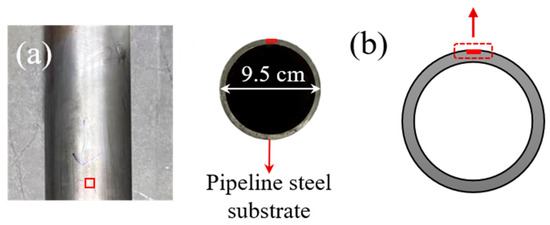
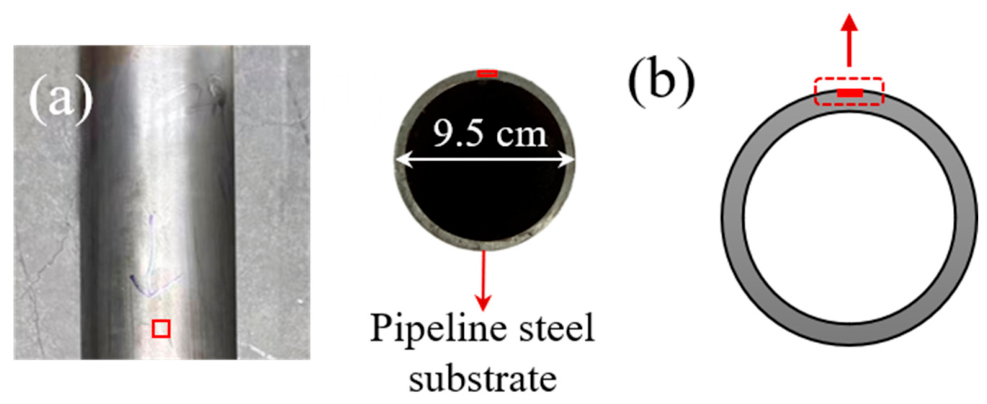
The pipeline steel used in this study was manufactured from 20 steel, and its chemical composition is listed in Table 1. A schematic illustration of the sampling procedure is shown in Figure 1. All specimens were machined into square coupons with dimensions of 10 mm × 10 mm × 3 mm. Before electrochemical testing, the exposed surfaces were sequentially ground using SiC abrasive papers up to 2000 grit to obtain a uniform surface finish. The specimens were then degreased in ethanol, thoroughly rinsed with deionized water, and dried in cold air before testing.
Table 1.
The elemental composition of the experimental materials [17].
Figure 1.
Experimental materials and sampling schematic (the red square indicates the sampling region): (a) the pipeline steel; (b) sampling schematic.
To simulate different service environments, two groups of electrolytes were prepared: NaCl solutions with concentrations of 0.5 wt.%, 3.5 wt.%, and 5.5 wt.%, and corresponding solutions containing the same NaCl concentrations supplemented with 0.75 M NaHCO3. During the electrochemical measurements, the pH of the NaCl solutions was maintained at a neutral level, whereas the pH of the NaCl + NaHCO3 solutions was approximately 8.3. All test solutions were freshly prepared using ultrapure water before each experiment to ensure the reproducibility of the results.
2.2. Surface Morphology Analysis
A 4% HNO3 alcohol solution was used to etch the polished specimens. Subsequently, the specimen surfaces were rinsed with deionized water and ethanol, dried with air, and examined using a ZEISS AxioCam MRc5 optical microscope (Carl Zeiss AG, Oberkochen, Germany) and a ZEISS crossbeam 350 scanning electron microscope (Carl Zeiss AG, Oberkochen, Germany). The particle size was statistically measured using the ImageJ software (v1.54m). The three-dimensional surface morphology and corrosion depth of the specimens after electrochemical polarization tests were characterized using a scanning laser confocal microscope, Keyence VK-X250 (Keyence Corporation, Osaka, Japan). A Bruker MultiMode 8 Scanning Kelvin Probe Force Microscope (SKPFM) (Bruker Corporation, Billerica, MA, USA) was employed to analyze the microstructure morphology and potential distribution.
2.3. Electrochemical Tests
All electrochemical measurements were conducted in an aerated solution at room temperature under quiescent conditions. Electrochemical measurements were carried out by CS310 electrochemical workstation (CorrTest Instrument Co., Ltd., Wuhan, China) using a conventional three-electrode electrochemical cell, where the pipeline steel specimen, with an exposed area of 1 cm2, served as the working electrode, a platinum sheet acted as the counter electrode, and a saturated calomel electrode (SCE) was used as the reference electrode. All potentials reported in this work are referenced to the SCE. Before each measurement, the working electrode was cathodically polarized at −1.3 VSCE for 3 min to remove the air-formed oxide film from the surface. Subsequently, the open circuit potential (OCP) was monitored for 0.5 h. After the OCP reached a relatively stable value, electrochemical impedance spectroscopy (EIS) and potentiodynamic polarization tests were conducted. EIS measurements were performed at the stabilized OCP over a frequency range from 100 kHz to 0.01 Hz with an AC perturbation amplitude of 5 mV. The initial potential was the OCP. The impedance data were analyzed using appropriate equivalent circuit models implemented in the ZSimpWin software (v3.6). Potentiodynamic polarization curves were recorded from −1.0 VSCE to 0.5 VSCE at a scan rate of 0.5 mV s−1. Each experiment was repeated at least three times under identical conditions to ensure reproducibility.
For Mott–Schottky analysis, according to the potentiodynamic polarization results, the surface oxide layer was formed potentiostatically at −0.4 VSCE for 1 h. Subsequently, measurements were performed over a potential range from −0.4 to −0.1 VSCE with a potential step of 20 mV and a fixed frequency of 1 kHz. All measurements were repeated multiple times under the same conditions to ensure reproducibility. Each experiment was repeated at least three times under identical conditions to ensure reproducibility.
2.4. X-Ray Photoelectron Spectroscopy
The chemical composition of the oxide film on specimens after potentiostatic polarization in the 0.5 wt.% NaCl + NaHCO3 solution for 1 h was examined by XPS using an ESCALAB 250Xi (Thermo Fisher Scientific, Waltham, MA, USA), with an Al Kα (hα = 1486.6 eV) operated at 300 W. After polarization, the specimens were rinsed with deionized water, dried, and stored under vacuum before XPS analysis to minimize oxidation during sample handling. The charge shift in the spectra was corrected assuming the C 1s peak was at 284.8 eV.
3. Results and Discussion
3.1. Microstructural Observation and Analysis
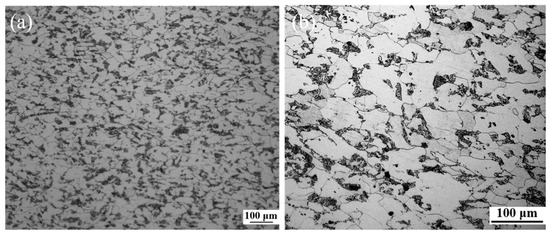
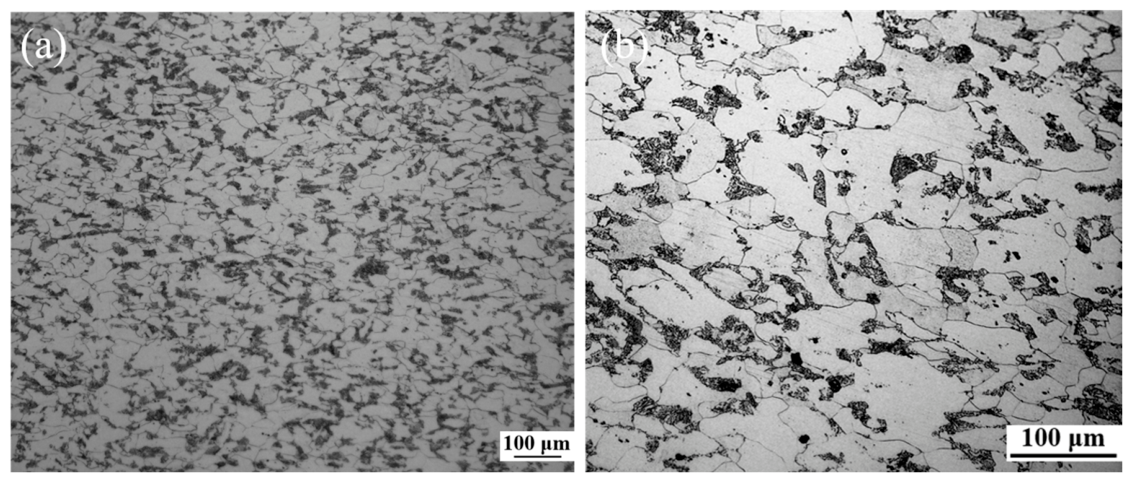
To characterize the microstructure of the pipeline steel, Figure 2 presents its optical microscopy (OM) images. The microstructure is primarily composed of pearlite and ferrite. The average grain size was statistically analyzed using ImageJ software, and the results indicate that the average grain size of the pipeline steel is approximately 26.48 ± 6.54 μm. In addition, quantitative image analysis was performed, revealing that the pearlite area fraction in the pipeline steel is approximately 24.45%.
Figure 2.
Microstructural observation of pipeline steel: (a) 100×; (b) 200×.
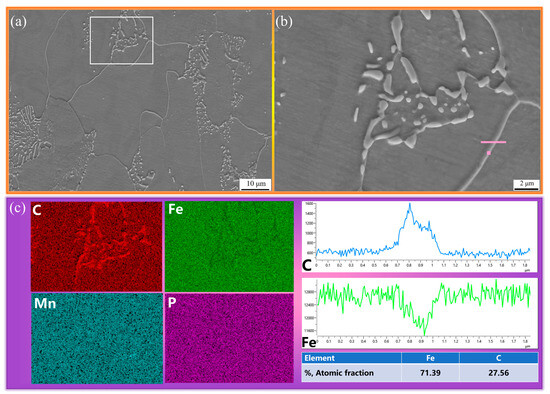
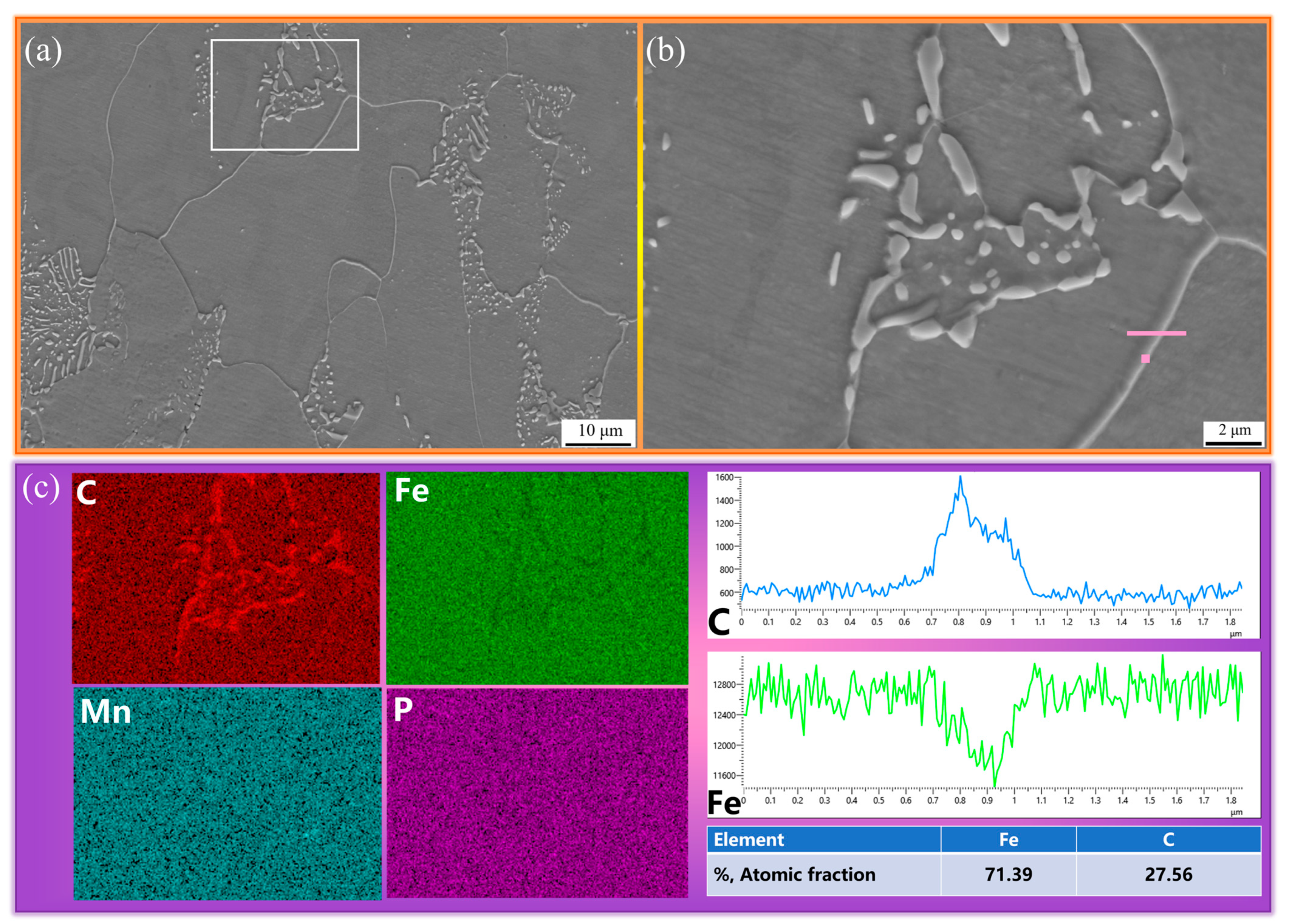
Figure 3 presents the scanning electron microscopy (SEM) micrographs and elemental distribution of the pipeline steel specimen. It can be observed that the microstructure is mainly composed of ferrite and lamellar pearlite. EDS analysis was performed on the carbide region marked by the white rectangle. Meanwhile, line scan analysis of carbon and iron was conducted along the pink line at the grain boundary, revealing a noticeable concentration gradient of cementite at the grain boundary. Elemental analysis indicates that these carbides are primarily iron-based carbides, with an atomic ratio of iron to carbon of approximately 3:1. Considering the composition of the investigated pipeline steel, these carbides are inferred to be cementite (Fe3C).
Figure 3.
Microstructural analysis of pipeline steel: (a) SEM image of the microstructure; (b) enlarged detail of the white-boxed region in (a); (c) EDS mapping, line scan (pink line), and quantitative point analysis (pink dots) of region (b).
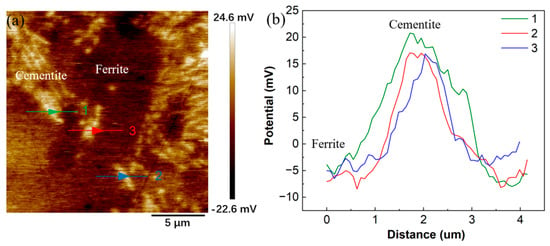
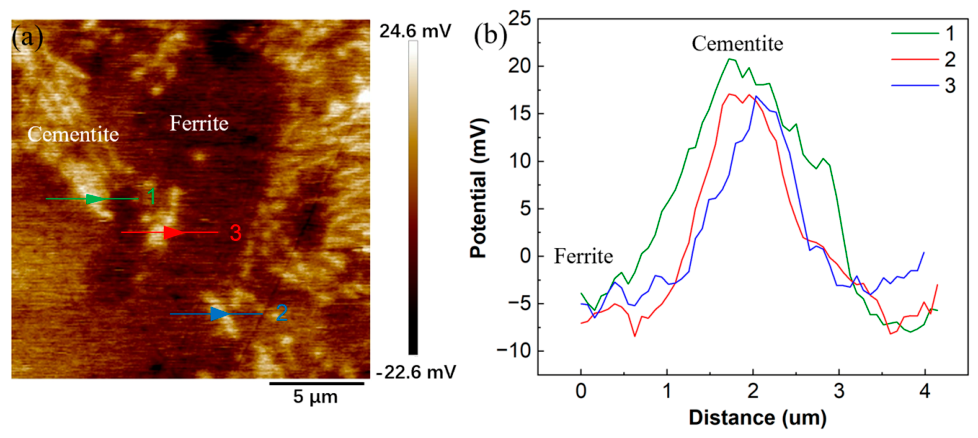
The microstructure of the pipeline steel was further characterized. Figure 4 shows the surface morphology and corresponding SKPFM potential distribution of the pipeline steel. In Figure 4a, the dark regions correspond to ferrite, while the light lamellar structures correspond to pearlite, in which ferrite and cementite are arranged in an alternating lamellar configuration. As shown in Figure 4b, a clear potential difference exists between ferrite and pearlite. Specifically, a potential difference is observed between cementite and ferrite within the pearlitic colonies, where cementite acts as the cathode and ferrite acts as the anode. In a corrosive environment, the two phases form micro-galvanic couples, which promote the preferential dissolution of ferrite and accelerate the initiation and propagation of localized corrosion [18,19].
Figure 4.
Surface morphology and corresponding SKPFM potential distribution of the pipeline steel: (a) SKPFM potential map; (b) potential profile along the line marked in (a).
3.2. Electrochemical Testing and Corrosion Morphology Analysis
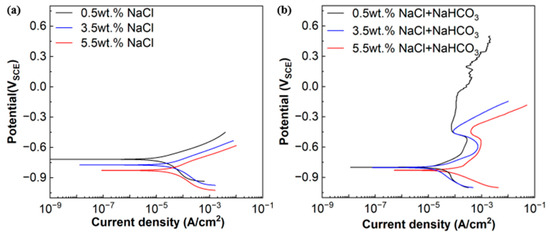
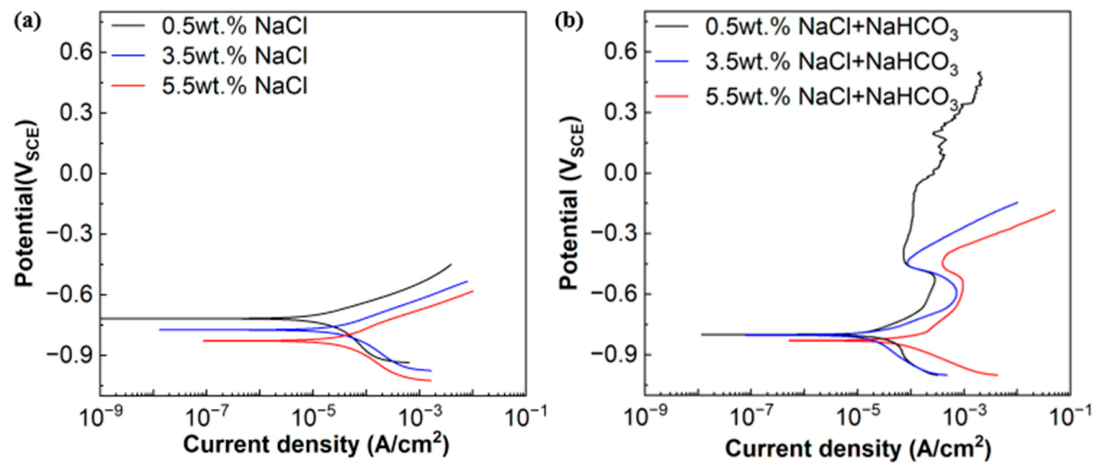
Figure 5 presents the potentiodynamic polarization curves of the pipeline steel specimens in different test solutions, while the electrochemical parameters obtained from Tafel linear fitting of the activation region are summarized in Table 2. As shown in the figure, the anodic polarization behavior of the pipeline steel exhibits significant variations with solution composition. In NaCl solutions without the addition of bicarbonate ions (), the anodic reaction is entirely governed by activation-controlled dissolution. In the 0.5 wt.% NaCl + NaHCO3 solution, an anodic current peak appears at approximately −0.50 VSCE, followed by a gradual decrease in anodic current density. Within the potential range from −0.45 to −0.05 VSCE, the anodic current density remains nearly constant at approximately 1.05 × 10⁻⁴ A·cm−2. A further increase in anodic current is observed only when the potential exceeds −0.05 VSCE, indicating the formation of a protective oxide film on the pipeline steel surface within this potential interval. Similar behavior has been reported for pipeline steels exposed to chloride-free NaHCO3 solutions, where one or two anodic current peaks are typically observed before the current enters a stable region [20]. With increasing NaCl concentration, the /Cl− molar ratio in the solution decreases continuously. Correspondingly, the anodic Tafel slope βa decreases from 0.101 to 0.080 V·dec−1, and further to 0.045 V·dec−1 in the 5.5 wt.% NaCl + NaHCO3 solution, indicating accelerated anodic reaction kinetics. Under these conditions, the anodic process gradually shifts toward active dissolution, and no stable current-density region is observed. Nevertheless, a local decrease in current density still appears near −0.60 VSCE, forming an anodic current peak characterized by an initial increase followed by a subsequent decrease in current density. The peak current density increases with increasing NaCl concentration, suggesting that chloride enrichment progressively weakens the stability of the surface film and promotes active anodic dissolution.
Figure 5.
Potentiodynamic polarization curves of pipeline steels in NaCl solutions (a) and NaCl + 0.75 M NaHCO3 solutions (b) with different NaCl concentrations.
Table 2.
The electrochemical parameters derived from polarization curves in Figure 5.
As summarized in Table 2, increasing the Cl− concentration results in a negative shift in the corrosion potential (Ecorr) and an increase in the corrosion current density (icorr) for specimens exposed to the same solution environment. This behavior indicates that the higher Cl− concentration enhances the electrical conductivity of the solution, thereby accelerating the corrosion rate of the pipeline steel. A comparison of the results further reveals that, in alkaline chloride-containing environments, the variation in Ecorr with Cl− concentration is relatively small, remaining within the range of −0.79 to −0.80 VSCE. In contrast, the corrosion potential in neutral NaCl solutions exhibits a much greater dependence on Cl− concentration.
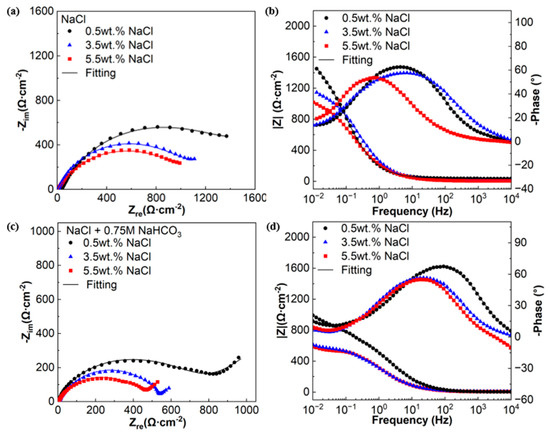
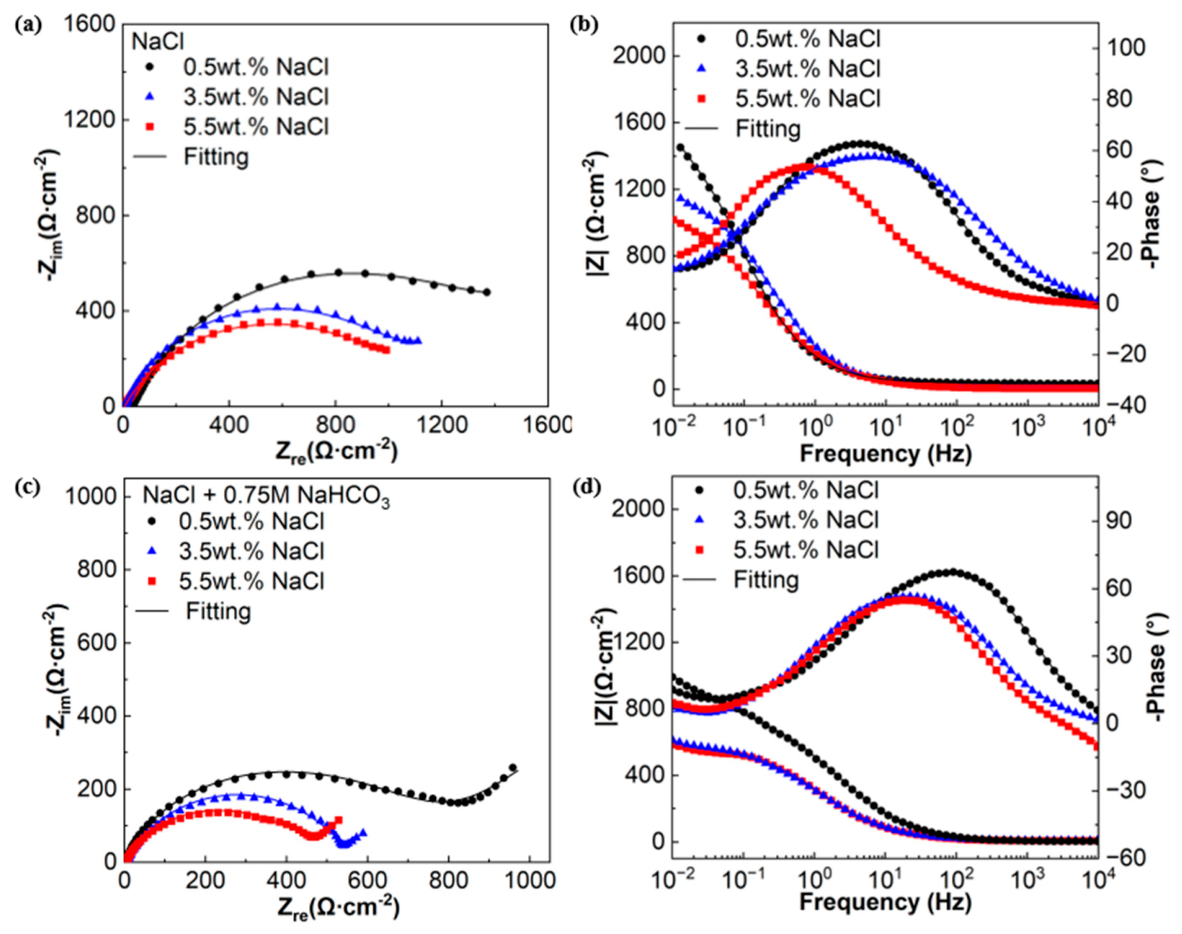
Figure 6 presents the electrochemical impedance spectroscopy (EIS) results of pipeline steel in mixed NaCl + NaHCO3 solutions with different NaCl concentrations, including the Nyquist and Bode plots. The solid lines represent the fitted curves obtained using the corresponding equivalent electrical circuits. Under the same solution environment, the Nyquist plots exhibit similar characteristics. In NaCl solutions, the Nyquist plots display depressed capacitive semicircles. In contrast, for the NaCl + NaHCO3 solutions, the high-frequency region consists of a capacitive semicircle, while the low-frequency region exhibits a Warburg-type linear tail, indicating that the reaction mechanism gradually transitions from electrochemical activity control to diffusion control at lower frequencies. The capacitive arc is associated with the response of the interfacial double layer, and its radius is generally correlated with the corrosion resistance of the material. In general, a larger capacitive arc radius corresponds to a lower corrosion rate and superior corrosion resistance [21]. As the NaCl concentration increases, the radius of the capacitive arc progressively decreases for all specimens. This trend is further confirmed by the corresponding Bode plots. Under the same solution conditions, specimens exposed to higher Cl− concentrations exhibit lower impedance modulus values in the low-frequency region and smaller maximum phase angles, indicating a deterioration in corrosion resistance. These observations are consistent with the polarization results.
Figure 6.
Nyquist plots and Bode plots of pipeline steels in NaCl solutions (a,b) and NaCl + 0.75 M NaHCO3 solutions (c,d) with different NaCl concentrations.
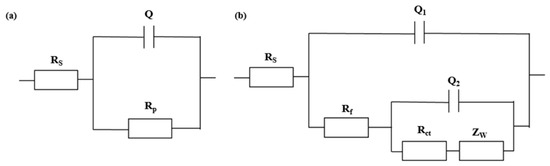
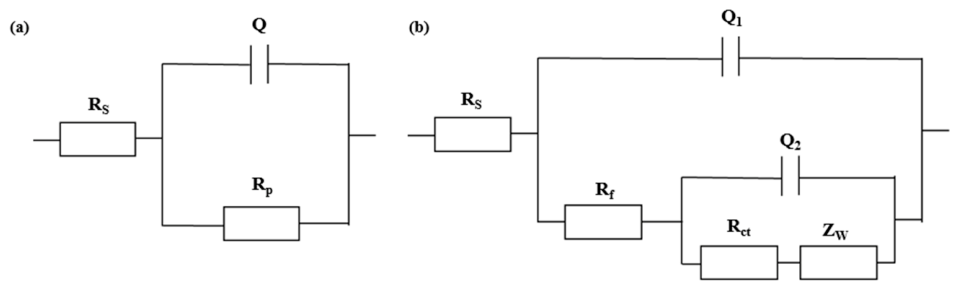
The Bode plots obtained in the same solution environment exhibit similar impedance and phase-angle responses, suggesting comparable electrochemical behaviors. Accordingly, the equivalent circuits used to fit the EIS data of specimens in NaCl solutions and NaCl + NaHCO3 solutions are shown in Figure 7a and Figure 7b, respectively [22]. In NaCl solutions, the Nyquist plots show a single capacitive arc over the entire frequency range, indicating that the corrosion process is dominated by active dissolution. Accordingly, the equivalent circuit shown in Figure 7a was employed for fitting. In this circuit, Rs represents the solution resistance, Q is a constant phase element (CPE) accounting for dispersion effects arising from surface roughness and compositional heterogeneity, and R represents the resistance associated with charge transfer and anodic dissolution. In NaCl + NaHCO3 solutions, a relatively stable protective oxide film forms on the specimen surface; therefore, the equivalent circuit shown in Figure 7b was used. In this circuit, Rs corresponds to the solution resistance between the working electrode and the reference electrode. The parallel combination of Qf and Rf represents the oxide film formed on the pipeline steel surface. The parallel combination of Qdl and Rct is used to describe the electrochemical charge-transfer process occurring at the metal/electrolyte interface, where Qdl corresponds to the non-ideal double-layer capacitance, and Rct represents the charge-transfer resistance governing the kinetics of the corrosion reaction. Zw denotes the Warburg impedance associated with mass transport by diffusion.
Figure 7.
Electrical equivalent circuit for simulating the impedance response of the pipeline steel in NaCl solutions (a) and NaCl + 0.75 M NaHCO3 solutions (b) with different NaCl concentrations.
The CPE is widely employed to describe frequency dispersion associated with interfacial inhomogeneity, replacing an ideal capacitor to more accurately characterize non-uniform surface behavior [23]. Its impedance can be expressed as [24]:
where Q is the admittance constant, ω is the angular frequency (rad s−1), i is the imaginary unit (i2 = −1), and n is the CPE exponent ranging from 0 to 1. When n = 1, the CPE reduces to an ideal capacitor; when 0.5 < n < 1, it indicates a distribution of relaxation times in the frequency domain; and when n approaches 0.5, diffusion-related processes become significant, resembling Warburg-type impedance behavior [25,26].
The fitted parameters are summarized in Table 3 and Table 4, and the χ2 values of all EIS fittings were lower than 10−3, indicating good fitting quality and reliability of the equivalent circuit model. Variations in surface condition are reflected in changes in the polarization resistance (Rp), which is inversely proportional to the corrosion rate [27]. The overall Rp can be approximated as the sum of Rf and Rct under the assumption that both processes contribute additively to the total impedance response. A larger Rf value indicates the formation of a dense and protective oxide film, whereas a higher Rct corresponds to greater resistance to charge transfer across the metal/solution interface and thus slower corrosion kinetics. As shown in Table 3, the Rp decreases from 1623 to 1095 Ω·cm−2 with increasing Cl− concentration, indicating a progressive deterioration in the corrosion resistance of the pipeline steel. According to Table 4, the charge-transfer resistance Rct is substantially higher than the film resistance Rf, suggesting that the corrosion process is predominantly governed by the charge-transfer step. Although a surface oxide film capable of maintaining a stable current density can form on the pipeline steel under alkaline conditions with low Cl− concentrations, the film is relatively porous and provides only limited protection against corrosion. As the Cl− concentration increases from 0.5 to 5.5 wt.%, the Rf decreases markedly from 77.42 to 8.11 Ω·cm−2, indicating a substantial decline in the protective ability of the oxide film, which suggests increased film defects and reduced compactness.
Table 3.
Fitting results of measured EIS data in NaCl solutions with different NaCl concentrations.
Table 4.
Fitting results of measured EIS data in NaCl + 0.75 M NaHCO3 solutions with different NaCl concentrations.
Previous studies have shown that promotes the formation of protective oxide films on pipeline steel, whereas Cl− facilitates film destabilization and anodic dissolution [28,29]. Therefore, the corrosion behavior in NaCl + NaHCO3 mixed solutions is governed by the competing effects of -assisted film formation and Cl−-induced film degradation [4]. At lower Cl− concentrations, is preferentially adsorbed onto the surface of the pipeline steel, promoting the formation of an oxide film that protects the steel substrate. As the Cl− concentration increases, Cl− preferentially reacts at the steel surface, leading to the breakdown of the oxide film and causing the specimen to enter an active dissolution state. This behavior indicates that the corrosion process gradually becomes dominated by activation-controlled dissolution as the Cl− concentration increases. However, excessively high concentrations of can increase the conductivity of the solution and enhance the cathodic oxygen reduction reaction [30]. Therefore, the Rp values of the specimens in the NaCl + 0.75 M NaHCO3 mixed solutions are lower than those of the specimens in NaCl solutions with the same Cl− concentration.
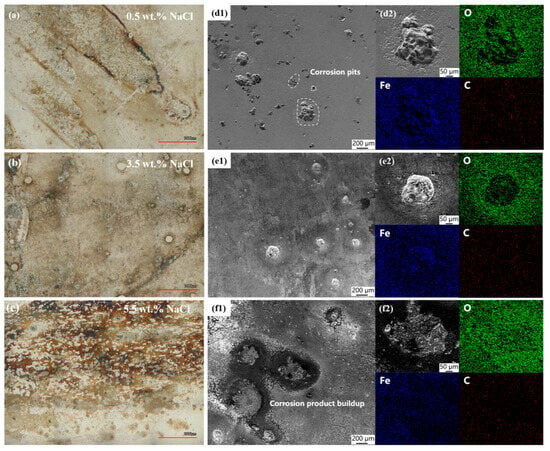
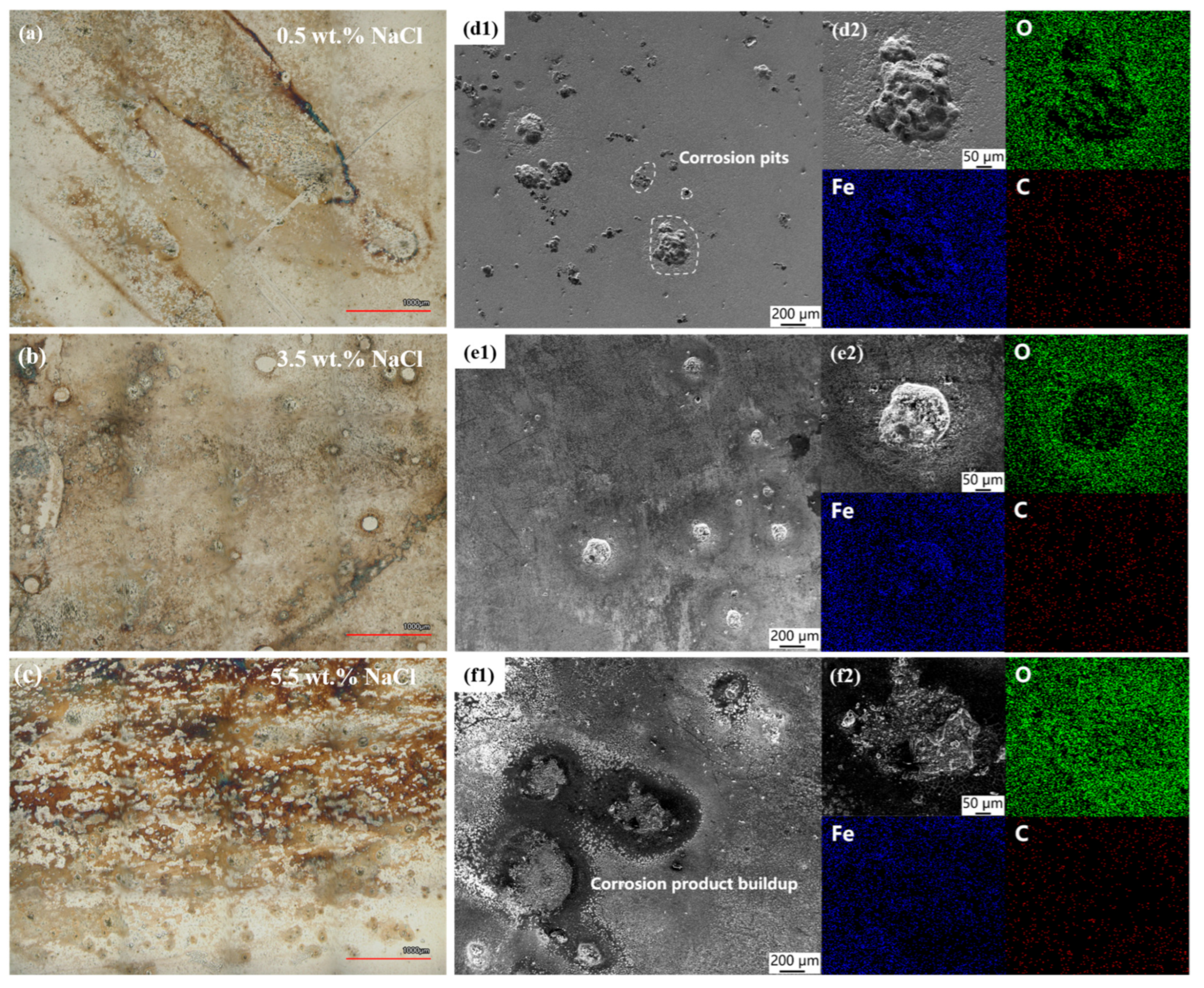
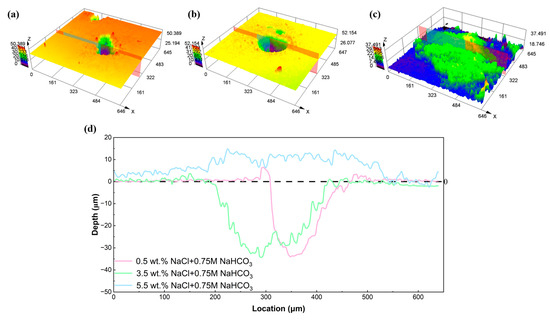
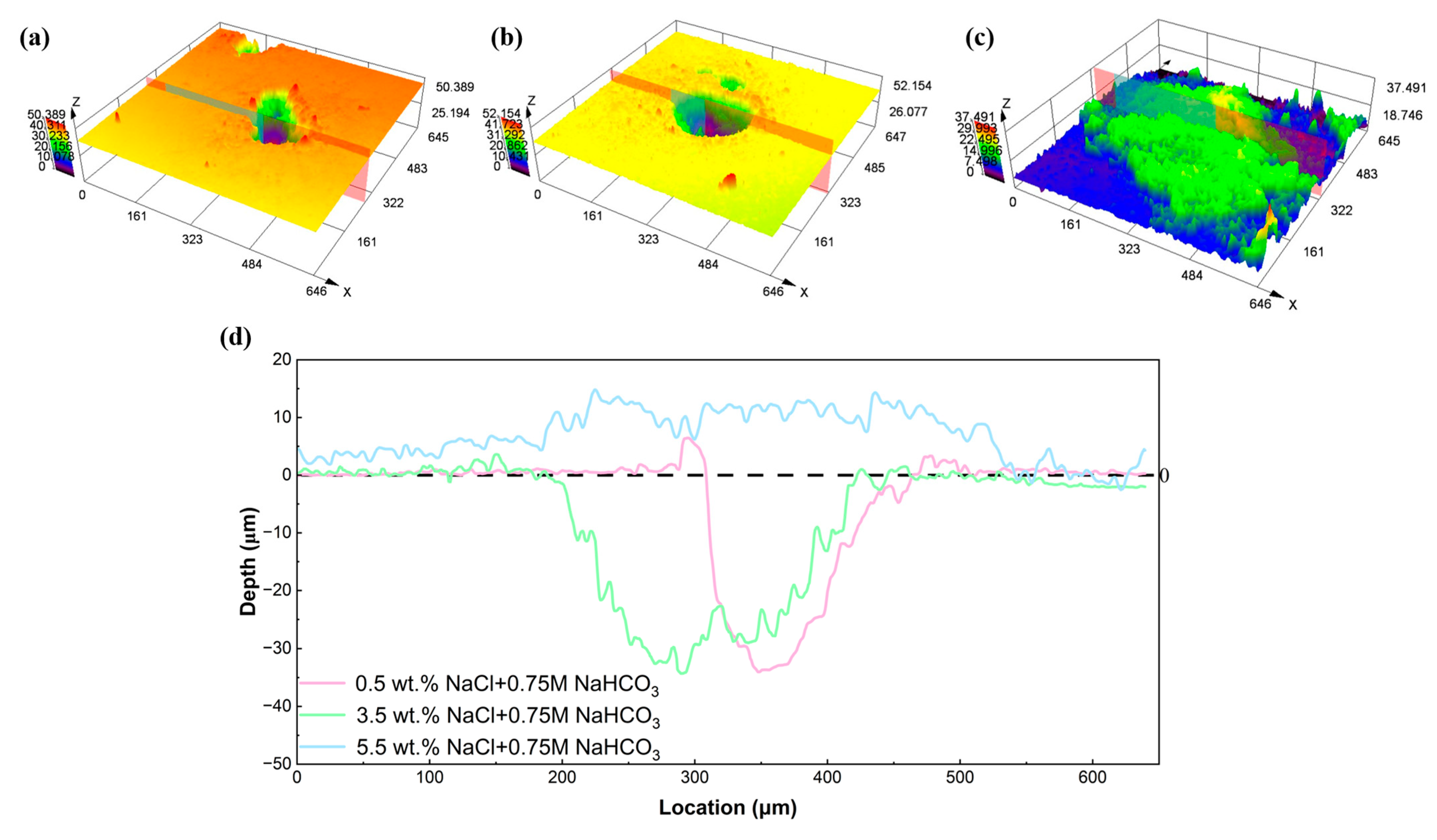
The corrosion morphologies of the pipeline steel specimens after potentiodynamic polarization were analyzed. As shown in Figure 8, all specimens in the NaCl solutions exhibited uniform corrosion. With increasing NaCl concentration, the surface coverage of corrosion products gradually increased. Among all test conditions, the specimen exposed to the 5.5 wt.% NaCl solution experienced the most severe corrosion. In contrast, the specimen in the 0.5 wt.% NaCl solution exhibited a relatively lower degree of corrosion. In the NaCl + 0.75 M NaHCO3 mixed solutions, when the NaCl concentration was 0.5 wt.%, localized corrosion was observed on the surface of the pipeline steel, with relatively small corrosion pits of approximately 100 μm in diameter and about 30 μm in depth (Figure 9). When the NaCl concentration increased to 3.5 wt.%, the diameter of the corrosion pits further increased to nearly 200 μm. As the NaCl concentration increased to 5.5 wt.%, the surface of the pipeline steel exhibited uniform corrosion, with no obvious corrosion pits observed, and the surface was covered with corrosion products. This morphological transition from localized corrosion at low Cl− concentration to uniform corrosion at high Cl− concentration further supports the previously discussed mechanism involving the competition between the -assisted film-forming effect and the Cl−-induced film-destabilizing effect, with the corrosion process gradually shifting toward Cl−-dominated active dissolution as the Cl− concentration increases.
Figure 8.
Corrosion morphologies of pipeline steel after potentiodynamic polarization in different solutions: (a–c) Laser confocal microscopy in 0.5, 3.5, and 5.5 wt.% NaCl; (d1,e1,f1) SEM images in 0.5, 3.5, and 5.5 wt.% NaCl with 0.75 M NaHCO3; (d2,e2,f2) Corresponding EDS elemental maps (O, Fe, and C).
Figure 9.
Corrosion morphologies of pipeline steel specimens after potentiodynamic polarization in NaCl + 0.75 M NaHCO3 solutions with varying NaCl concentrations: (a–c) 3D corrosion morphology; (d) comparison of cross-sectional depth profiles.
3.3. Surface Oxide Film Analysis
Considering that the anodic reaction of pipeline steel exhibits a stable current region in alkaline environments with low Cl− concentrations, a relatively stable oxide film can form on the steel surface. This oxide film can significantly affect the corrosion behavior of pipeline steel in alkaline chloride-containing environments [31]. Therefore, to further evaluate the corrosion resistance of pipeline steel in an alkaline environment with low chloride concentration, Mott–Schottky analysis was performed to characterize the semiconducting properties of the oxide film. According to Mott–Schottky theory, the space charge capacitance of an n-type semiconductor electrode can be expressed by Equation (2), while that of a p-type semiconductor is described by Equation (3) [32]:
In these equations, ε represents the dielectric constant of the oxide film at room temperature, which is taken as 15.6 in this study [33]; ε0 is the vacuum permittivity (8.85419 × 10⁻¹⁴ F·cm−1); ND and NA denote the donor and acceptor densities, respectively; e is the elementary charge (1.6 × 10⁻¹⁹ C); EFB is the flatband potential; k is the Boltzmann constant (1.38 × 10⁻²³ J·K−1); and T is the absolute temperature (K). According to the above equations, a larger absolute value of the slope corresponds to a lower carrier density in the film. Therefore, the electrochemical behavior of the metal can be inferred from the semiconductor type and the carrier concentration of the oxide film.
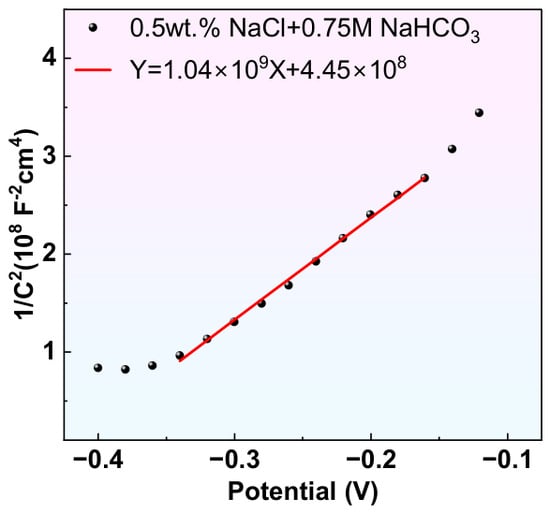
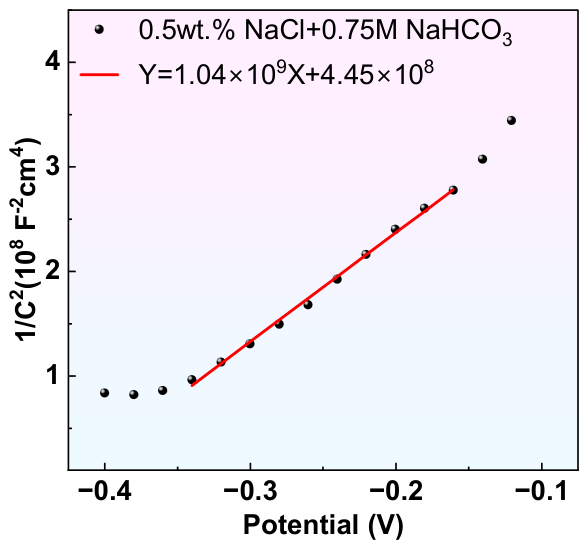
Figure 10 shows the Mott–Schottky plots of pipeline steel in the 0.5 wt.% NaCl + 0.75 M NaHCO3 solution. The curve exhibits a good linear relationship within the potential range from −0.35 to −0.15 VSCE, with a fitting coefficient R2 higher than 0.99. The curves exhibit predominantly linear regions with positive slopes, indicating that the corrosion product films formed on the surfaces of the specimens possess n-type semiconducting characteristics. This behavior is associated with the formation of oxide films composed of iron oxides, in which the defects may exist in the form of Fe2+ ions or oxygen vacancies, both of which can act as donor states [34]. According to Equation (2), the donor density of the oxide film formed on the pipeline steel in the 0.5 wt.% NaCl + 0.75 M NaHCO3 solution was calculated to be 8.69 × 1021 cm−3. This value is comparable in order of magnitude to those reported in previous studies. However, compared with the oxide films formed on pipeline steels in NaHCO3 solutions reported in the literature, the ND of the film formed in the NaCl + NaHCO3 mixed solution is approximately eight times higher than that of the film formed in the chloride-free NaHCO3 solution. A higher carrier density generally indicates a less stable oxide-film structure with a higher concentration of defects. This suggests that, under the alkaline low-chloride condition, the oxide film formed on the pipeline steel surface is a defective surface film with limited protectiveness rather than an ideal compact film [35,36].
Figure 10.
Mott–Schottky plots of the oxide film formed on pipeline steels after potentiostatic polarization in 0.5 wt.% NaCl + NaHCO3 solution.
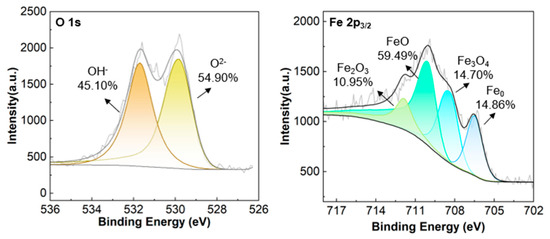
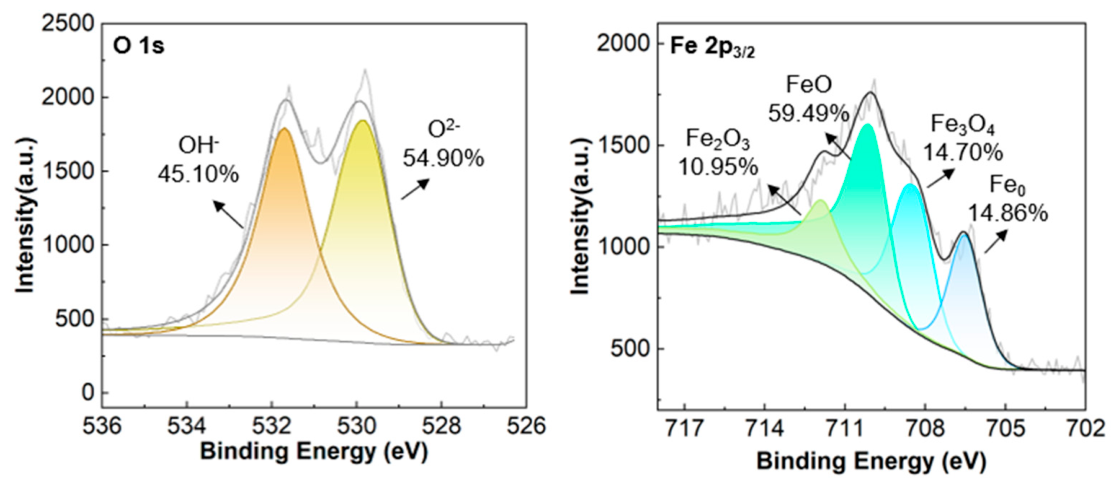
For further analysis of the oxide film characteristics, the oxide film formed on the pipeline steel in the 0.5 wt.% NaCl + 0.75 M NaHCO3 solution was characterized by X-ray photoelectron spectroscopy (XPS), and the corresponding spectra are shown in Figure 11. High-resolution spectra of Fe 2p3/2 and O 1s were obtained. The main constituents of the oxide film include OH−, O2−, Fe (II), and Fe (III). According to the literature [37], the O 1s spectrum was deconvoluted into a peak at 529.85 eV corresponding to O2− and a peak at 531.70 eV corresponding to OH−. The Fe 2p3/2 spectrum was deconvoluted into four peaks: one peak located at 706.7 eV corresponding to Fe0, and three peaks located at 708.3, 709.4, and 711.0 eV, corresponding to Fe3O4, FeO, and Fe2O3, respectively. These results indicate that the oxide film mainly consists of Fe2+- and Fe3+-related oxides, which is consistent with the Mott–Schottky results discussed above.
Figure 11.
The detailed XPS spectra of Fe 2p3/2, O 1s of the oxide film formed on pipeline steel after polarization in 0.5 wt.% NaCl + 0.75 M NaHCO3 solution.
Previous studies have shown that the oxide film formed on pipeline steel in alkaline chloride-containing environments typically consists of an Fe2+-rich inner layer, an Fe3O4-rich intermediate layer, and an outer layer enriched in Fe3+ oxides/hydroxides [38]. In the 0.5 wt.% NaCl + 0.75 M NaHCO3 solution, Fe2+-related oxide species account for a relatively high fraction in the oxide film formed on the pipeline steel surface. It has been reported that the formation of Fe3+ oxides in the outer oxide layer essentially involves the oxidation of Fe2+ to Fe3+. The relatively high concentration of in the solution adsorbs at local defects within the oxide film and inhibits the migration of dissolved oxygen toward oxygen vacancies. Owing to the insufficient oxygen supply, the formation of Fe3+ oxides in the oxide film is suppressed. Meanwhile, a large amount of unreacted Fe2+ is retained in the inner layer of the oxide film, resulting in an increased content of Fe2+-related oxide species within the oxide film [39].
Based on the above results, it can be concluded that the anodic behavior of pipeline steel is strongly influenced by the solution environment and is closely related to the solution pH, concentration, and Cl− concentration. In pure NaCl solutions, the primary anodic reaction is:
In NaCl + 0.75 M NaHCO3 mixed solutions, the addition of a high concentration of favors the formation of oxides/hydroxides on the pipeline steel surface, thereby reducing the anodic dissolution rate. This corresponds to the anodic current peak observed at relatively low potentials in the polarization curve. The possible reactions are as follows [40]:
In the mixed solution, Fe(OH)2 may form on the pipeline steel surface during the initial stage of corrosion, while Fe2+ may also interact locally with carbonate species to generate FeCO3-related intermediate species under favorable conditions. In an alkaline environment, as the corrosion reaction proceeds, carbonate-related Fe species may further transform into Fe(OH)2 or Fe(OH)3 and remain attached to the pipeline steel surface [41].
When the Cl− concentration is low, a stable current-density region appears as the potential gradually increases, indicating the formation of a protective oxide film on the pipeline steel surface. The possible reactions are as follows [40]:
When the Cl− concentration was further increased to 3.5 and 5.5 wt.%, icorr increased, whereas βa and Rf decreased, indicating a substantial acceleration of the corrosion rate. The deterioration in corrosion resistance is mainly associated with accelerated anodic dissolution kinetics. Previous studies have shown that Cl− preferentially interacts with structural defects in the oxide film at relatively low chloride concentrations, resulting in localized film breakdown while the majority of the surface film remains intact. As the Cl− concentration increases, progressive film destabilization exposes an increasing number of electrochemically active sites, thereby facilitating Fe dissolution and accelerating the anodic dissolution kinetics, as evidenced by the decreases in βa and Rf. Consequently, the corrosion mode changes from a localized attack to a more extensive uniform dissolution [42]. For oxide films formed on pipeline steel in alkaline environments, Fe2+ oxide species have been reported to protect the metal substrate, whereas the Fe3+-rich oxide/hydroxide outer layer is relatively loose and less effective in blocking the transport of aggressive ions [43]. It has also been reported that Cl− can promote the degradation of defective oxide films by enhancing defect generation and ionic transport within the Fe3+-rich oxide/hydroxide outer layer, which may further affect the stability of the protective Fe2+ oxide inner layer and promote its conversion into Fe3+ oxide/hydroxide species [44]. This process is consistent with the changes in the anodic polarization curves, the decrease in Rf, and the observed transition in corrosion morphology from localized corrosion to more widespread corrosion.
4. Conclusions
Based on the systematic investigation of corrosion behavior, electrochemical behavior, oxide-film characteristics, and surface morphology of pipeline steel in NaCl + 0.75 M NaHCO3 solutions with different Cl− concentrations, the following conclusions can be drawn:
- (1)
- The corrosion evolution of pipeline steel under high-bicarbonate alkaline conditions was strongly influenced by chloride concentration variation. Increasing Cl− concentration resulted in increased corrosion current density and decreased polarization resistance and oxide-film resistance, indicating the progressive deterioration of corrosion resistance. The stable current-density region observed at low Cl− concentrations gradually disappeared with increasing chloride concentration, demonstrating the transition from a relatively stable oxide-film-controlled state to an active corrosion state. This evolution was related to the different effects of and Cl− on oxide-film stability under alkaline conditions.
- (2)
- The oxide film formed on pipeline steel in 0.5 wt.% NaCl + 0.75 M NaHCO3 solution exhibited n-type semiconductor characteristics, with a donor density of 8.69 × 1021 cm−3. XPS analysis revealed that the oxide film mainly consisted of iron oxides, including FeO, Fe3O4, and Fe2O3, with Fe2+-containing oxide species as the dominant components. The results provide experimental evidence for the relationship between oxide-film composition, semiconductor properties, and corrosion resistance under chloride-containing alkaline conditions.
Author Contributions
Conceptualization, D.L., P.C., and H.Z.; methodology, D.J., and X.L.; software, Y.H.; validation, D.L., D.J., and Y.H.; formal analysis, P.C.; investigation, X.L.; data curation, X.L., K.G., and P.C.; writing—original draft preparation, D.L.; writing—review and editing, D.L., and H.Z.; visualization, Y.H.; project administration, K.G. All authors have read and agreed to the published version of the manuscript.
Funding
This research received no external funding.
Data Availability Statement
The original contributions presented in this study are included in the article. Further inquiries can be directed to the corresponding author.
Conflicts of Interest
The authors declare no conflicts of interest.
References
- Shamsa, A.; Barker, R.; Hua, Y.; Barmatov, E.; Hughes, T.L.; Neville, A. The role of Ca2+ ions on Ca/Fe carbonate products on X65 carbon steel in CO2 corrosion environments at 80 and 150 °C. Corros. Sci. 2019, 156, 58–70. [Google Scholar] [CrossRef] [Scilit]
- Bian, C.; Wang, Z.M.; Han, X.; Chen, C.F.; Zhang, J. Electrochemical response of mild steel in ferrous ion enriched and CO2 saturated solutions. Corros. Sci. 2015, 96, 42–51. [Google Scholar] [CrossRef] [Scilit]
- Li, Q.; Xia, X.J.; Pei, Z.B.; Cheng, X.Q.; Zhang, D.W.; Xiao, K.; Wu, J.; Li, X.G. Long-term corrosion monitoring of carbon steels and environmental correlation analysis via the random forest method. npj Mater. Degrad. 2022, 6, 1. [Google Scholar] [CrossRef] [Scilit]
- Zhang, S.H.; Hou, L.F.; Du, H.Y.; Wei, H.; Liu, B.S.; Wei, Y.H. An electrochemical study on the effect of bicarbonate ion on the corrosion behaviour of carbon steel in CO2 saturated NaCl solutions. Vacuum 2019, 167, 389–392. [Google Scholar] [CrossRef] [Scilit]
- Li, Y.X.; Wang, G.; Zhang, C.B.; Ma, B.; Yang, Z.F.; Guo, H.R.; Miao, J.X.; Duan, Z.Y.; Cheng, H.R.; Bi, H.S. Synergistic effect of Cl− and on the corrosion of X90 pipeline steel in an alkaline soil environment. AIP Adv. 2026, 16, 025012. [Google Scholar] [CrossRef] [Scilit]
- Tang, M.Y.; Du, K.F.; Chen, X.; Li, J.J.; Yin, H.Y.; Wang, D.H. Bulk pH-dependent failure mechanisms of transition metal anodes in seawater electrolysis. J. Mater. Sci. Technol. 2026, 275, 97–106. [Google Scholar] [CrossRef] [Scilit]
- Peng, H.P.; Lyu, W.T.; Wu, C.J.; Wang, J.H.; Su, X.P.; Zhao, Y.G.; Xu, S.W.; Li, Z.W. Study on the corrosion failure mechanism of X80 pipeline steel by chloride ion at different concentrations. Eng. Fail. Anal. 2025, 179, 109784. [Google Scholar] [CrossRef] [Scilit]
- Dong, B.J.; Liu, W.; Chen, L.J.; Zhang, T.Y.; Fan, Y.M.; Zhao, Y.G.; Li, H.; Yang, W.J.; Sun, Y.P. Unraveling the effect of chloride ion on the corrosion product film of Cr-Ni-containing steel in tropical marine atmospheric environment. Corros. Sci. 2022, 209, 110741. [Google Scholar] [CrossRef] [Scilit]
- Han, J.; Nešić, S.; Yang, Y.; Brown, B.N. Spontaneous passivation observations during scale formation on mild steel in CO2 brines. Electrochim. Acta 2011, 56, 5396–5404. [Google Scholar] [CrossRef] [Scilit]
- Sridhar, N. Local corrosion chemistry: A review. Corrosion 2016, 73, 18–30. [Google Scholar] [CrossRef] [Scilit]
- Davies, D.H.; Burstein, G.T. The effects of bicarbonate on the corrosion and passivation of iron. Corrosion 1980, 36, 416–422. [Google Scholar] [CrossRef] [Scilit]
- Xie, F.; Wang, Z.Q.; Wang, D.; Yin, S.W. A synergistic effect of dissolved oxygen, , and Cl− on the electrochemical corrosion behavior of X70 pipeline steel in the oilfield soil environment. Appl. Phys. A 2020, 126, 868. [Google Scholar] [CrossRef] [Scilit]
- Ghods, P.; Isgor, O.B.; Bensebaa, F.; Kingston, D. Angle-resolved XPS study of carbon steel passivity and chloride-induced depassivation in simulated concrete pore solution. Corros. Sci. 2012, 58, 159–167. [Google Scholar] [CrossRef] [Scilit]
- Gao, M.; Wang, H.; Song, Y.; Han, E.H. Corrosion behavior on carbon steel in a simulated soil solution under the interaction effect of chloride and bicarbonate ions. J. Mater. Res. Technol. 2022, 21, 3014–3024. [Google Scholar] [CrossRef] [Scilit]
- Xu, P.; Zhao, M.H.; Fu, X.; Zhao, C. Effect of chloride ions on the corrosion behavior of carbon steel in an iron bacteria system. RSC Adv. 2022, 12, 15158–15166. [Google Scholar] [CrossRef] [Scilit] [PubMed]
- Liu, X.Y.; Wu, M.; Gong, K.; Du, J.; Sun, D.X.; Wang, X.; Huang, J.C. Stress corrosion cracking behavior on carbon steel under the synergistic effect of chloride and bicarbonate ions in alternating wet-dry environment. Corros. Sci. 2023, 225, 111624. [Google Scholar] [CrossRef] [Scilit]
- Chen, X.Y.; Cui, Y.K.; Wang, S.J. Corrosion Behavior of Carbon Steel in Diethylenetriamine Solution for Post-combustion CO2 Capture. ACS Omega 2024, 9, 13067–13080. [Google Scholar] [CrossRef] [Scilit] [PubMed]
- Liu, H.; Wei, J.; Dong, J.H.; Chen, Y.Q.; Wu, Y.M.; Zhou, Y.T.; Babu, S.D.; Ke, W. Influence of cementite spheroidization on relieving the micro-galvanic effect of ferrite-pearlite steel in acidic chloride environment. J. Mater. Sci. Technol. 2021, 61, 234–246. [Google Scholar] [CrossRef] [Scilit]
- Hao, X.; Dong, J.H.; Etim, I.I.N.; Wei, J.; Ke, W. Sustained effect of remaining cementite on the corrosion behavior of ferrite-pearlite steel under the simulated bottom plate environment of cargo oil tank. Corros. Sci. 2016, 110, 296–304. [Google Scholar] [CrossRef] [Scilit]
- Eliyan, F.F.; Mahdi, E.S.; Alfantazi, A. Electrochemical evaluation of the corrosion behaviour of API-X100 pipeline steel in aerated bicarbonate solutions. Corros. Sci. 2012, 58, 181–191. [Google Scholar] [CrossRef] [Scilit]
- Wei, L.; Pang, X.L.; Liu, C.; Gao, K.W. Formation mechanism and protective property of corrosion product scale on X70 steel under supercritical CO2 environment. Corros. Sci. 2015, 100, 404–420. [Google Scholar] [CrossRef] [Scilit]
- Xu, Y.Z.; Zhang, Q.L.; Chen, H.; Zhao, Y.B.; Huang, Y. Experimental study on erosion-corrosion of carbon steel in flowing NaCl solution of different pH. J. Mater. Res. Technol. 2022, 20, 4432–4451. [Google Scholar] [CrossRef] [Scilit]
- Martini, E.M.A.; Muller, I.L. Characterization of the film formed on iron in borate solution by electrochemical impedance spectroscopy. Corros. Sci. 2000, 42, 443–454. [Google Scholar] [CrossRef] [Scilit]
- Cheng, H.X.; Liu, Z.Z.; Luo, H.; Pan, Z.M.; Wang, X.F.; Zhao, Q.C.; Qi, X.H.; Li, X.G. Tuning the microstructure to improve corrosion resistance of additive manufacturing high-entropy alloy in proton exchange membrane fuel cells environment. Corros. Sci. 2023, 213, 110969. [Google Scholar] [CrossRef] [Scilit]
- Shukla, A.K.; Balasubramaniam, R. Effect of surface treatment on electrochemical behavior of CP Ti, Ti–6Al–4V and Ti–13Nb–13Zr alloys in simulated human body fluid. Corros. Sci. 2006, 48, 1696–1720. [Google Scholar] [CrossRef] [Scilit]
- Ikeuba, A.I. AFM and EIS investigation of the influence of pH on the corrosion film stability of Al4Cu2Mg8Si7 intermetallic particle in aqueous solutions. Appl. Surf. Sci. Adv. 2022, 11, 100291. [Google Scholar] [CrossRef] [Scilit]
- Sun, J.B.; Zhang, G.A.; Liu, W.; Lu, M.X. The formation mechanism of corrosion scale and electrochemical characteristic of low alloy steel in carbon dioxide-saturated solution. Corros. Sci. 2012, 57, 131–138. [Google Scholar] [CrossRef] [Scilit]
- Liang, P.; Li, X.G.; Du, C.W.; Chen, X.; Liu, Z.Y. Electrochemical characterisation of passive films formed on X80 and X70 pipeline steels in NaHCO3. J. Petrochem. Univ. 2008, 21, 1. [Google Scholar] [CrossRef] [Scilit]
- Zhang, S.H.; Hou, L.F.; Du, H.Y.; Wei, H.; Liu, B.S.; Wei, Y.H. A study on the interaction between chloride ions and CO2 towards carbon steel corrosion. Corros. Sci. 2020, 167, 108531. [Google Scholar] [CrossRef] [Scilit]
- Linter, B.R.; Burstein, G.T. Reactions of pipeline steels in carbon dioxide solutions. Corros. Sci. 1999, 41, 117–139. [Google Scholar] [CrossRef] [Scilit]
- Li, Y.; Cheng, Y.F. In-situ characterization of the early stage of pipeline steel corrosion in bicarbonate solutions by electrochemical atomic force microscopy. Surf. Interface Anal. 2017, 49, 133–139. [Google Scholar]
- Jangde, A.; Kumar, S.; Blawert, C. Correlative study of Mott–Schottky analysis and corrosion behaviour of plasma electrolytic oxidation treated magnesium alloy: Effect of Cl− concentrations. Corros. Sci. 2024, 240, 112386. [Google Scholar] [CrossRef] [Scilit]
- Lv, S.; Li, K. Semiconducting behaviour and corrosion resistance of passive film on corrosion-resistant steel rebars. Materials 2022, 15, 7644. [Google Scholar] [CrossRef] [Scilit] [PubMed]
- Stimming, U. Photoelectrochemical studies of passive films. Electrochim. Acta 1986, 31, 415–429. [Google Scholar] [CrossRef] [Scilit]
- Liang, P.; Li, X.G.; Du, C.W.; Chen, X.; Zhang, L. Influence of chloride ions on the corrosion resistance of X80 pipeline steel in NaHCO3 solution. Chin. J. Eng. 2008, 30, 735–739. [Google Scholar]
- Cui, Y.W.; Chen, L.Y.; Chu, Y.H.; Zhang, L.; Li, R.; Lu, S.; Wang, L.; Zhang, L.C. Metastable pitting corrosion behavior and characteristics of passive film of laser powder bed fusion produced Ti–6Al–4V in NaCl solutions with different concentrations. Corros. Sci. 2023, 215, 111017. [Google Scholar] [CrossRef] [Scilit]
- Biesinger, M.C.; Payne, B.P.; Grosvenor, A.P.; Lau, L.W.M.; Gerson, A.R.; Smart, R.S.C. Resolving surface chemical states in XPS analysis of first row transition metals, oxides and hydroxides: Cr, Mn, Fe, Co and Ni. Appl. Surf. Sci. 2011, 257, 2717–2730. [Google Scholar] [CrossRef] [Scilit]
- DorMohammadi, H.; Pang, Q.; Murkute, P.; Árnadóttir, L.; Burkan Isgor, O. Investigation of iron passivity in highly alkaline media using reactive-force field molecular dynamics. Corros. Sci. 2019, 157, 31–40. [Google Scholar] [CrossRef] [Scilit]
- Fan, L.; Li, X.G.; Du, C.W.; Liu, Z.Y. Electrochemical behavior of passive films formed on X80 pipeline steel in various concentrated NaHCO3 solutions. J. Chin. Soc. Corros. Prot. 2012, 32, 322–326. [Google Scholar]
- Zhou, J.; Li, Y. Anodic electrochemical behavior of X80 pipeline steel in NaHCO3 solution. Acta Metall. Sin. 2010, 46, 251–256. [Google Scholar] [CrossRef] [Scilit]
- Zhang, Q.L.; Xue, M.H.; Wang, D.; Zi, Y.; Zhou, J. Effect of Concentration on the Corrosion Behavior of X80 Pipeline Steel in Simulated Soil Solution. Int. J. Electrochem. Sci. 2020, 15, 4592–4601. [Google Scholar] [CrossRef] [Scilit]
- Wang, Y.; Cheng, G.; Wu, W.; Qiao, Q.; Li, Y.; Li, X. Effect of pH and chloride on the micro-mechanism of pitting corrosion for high strength pipeline steel in aerated NaCl solutions. Appl. Surf. Sci. 2015, 349, 746–756. [Google Scholar] [CrossRef] [Scilit]
- Colliex, C.; Manoubi, T.; Ortiz, C. Electron-energy-loss-spectroscopy near-edge fine structures in the iron-oxygen system. Phys. Rev. B 1991, 44, 11402. [Google Scholar] [CrossRef] [Scilit]
- Gunay, H.B.; Ghods, P.; Isgor, O.B.; Carpenter, G.J.C.; Wu, X. Characterization of atomic structure of oxide films on carbon steel in simulated concrete pore solutions using EELS. Appl. Surf. Sci. 2013, 274, 195–202. [Google Scholar] [CrossRef] [Scilit]

Disclaimer/Publisher’s Note: The statements, opinions and data contained in all publications are solely those of the individual author(s) and contributor(s) and not of MDPI and/or the editor(s). MDPI and/or the editor(s) disclaim responsibility for any injury to people or property resulting from any ideas, methods, instructions or products referred to in the content. |
© 2026 by the authors. Licensee MDPI, Basel, Switzerland. This article is an open access article distributed under the terms and conditions of the Creative Commons Attribution (CC BY) license.