


Abstract
This study assesses the durability of self-cleaning and antimicrobial activities of dishcloths made of 100% cotton woven fabric modified with TiO2 nanoparticles (NPs) and zinc pyrithione particles (ZnPt). The self-cleaning properties were measured as the ability to decompose staining particles via photocatalytic action under UV/VIS light irradiation and confirmed by colour measurements (K/S values, colour differences, and colour changes ΔL*, Δa*, Δb*). The SEM micrographs confirmed the long-term durability of the modification process, and ICP-OES analysis confirmed the presence of Ti and Zn elements on and within the fabric. The amounts of TiO2 and ZnPt decreased by 2.2–2.5 times after the first 5 washings and by 2.1–1.2 times after the subsequent 45 washings. Antimicrobial activity was tested against Staphylococcus aureus ATCC 6538, Escherichia coli ATCC 11229 and Candida albicans ATCC 10231. The results indicate that the material maintains excellent self-cleaning properties and good antimicrobial activity for up to 50 washings; however, activity against E. coli remains weak after 30 and 50 washings.
1. Introduction
Dishcloths, due to their high moisture absorption, relatively low cost, wide availability, and common use, are predominantly made of cotton. They are used to wipe dishes, hands, countertops, and other work surfaces. Cotton contains hydrophilic groups (such as hydroxyl groups) that can absorb moisture. Therefore, kitchen dishcloths, being particularly exposed to moisture and food residue, provide ideal conditions for microbial growth, especially for foodborne bacteria. Coliform, Escherichia coli (E. coli), Staphylococcus aureus (S. aureus), Staphylococcus spp., Salmonella spp., and Listeria monocytogenes are predominantly isolated from household dishcloths [1,2,3]. Thus, dishcloths are among the most microorganism-contaminated items in the kitchen and may contribute to the transfer of microorganisms to other surfaces and food, as well as to foodborne infections. Several decontamination methods for kitchen cloths are known, including hypochlorite and peroxide disinfection, high-temperature washing, soaking in vinegar or lemon juice, and microwaving, with microwaving being the most effective disinfection method [1]. Additionally, antimicrobial treatment can be used to prevent microbial growth on the dishcloth.
Moreover, kitchen dishcloths used in household conditions are often stained by various coloured liquids, such as coffee, tea, and fruit juices. Removing such stains poses many difficulties and often requires special cleaning methods, such as hypochlorite or peroxide discharge or high-temperature washing with a bath containing active oxygen stain removers. Unfortunately, some stains, especially on coloured kitchen cloths, may sometimes be impossible to remove. The problems associated with the formation and removal of coloured stains can be addressed by modifying textile surfaces with substances imparting self-cleaning properties. Ideally, the kitchen dishcloth would possess a surface characterised by both antimicrobial (to prevent bacterial growth) and self-cleaning properties (to remove coloured stains).
Zinc pyrithione (ZnPt) is a complex of zinc and pyrithione. ZnPt has antibacterial activity toward E. coli, S. aureus, Klebsiella pneumoniae, Enterococcus faecium, and Enterococcus faecalis [4] and antifungal activity toward Pityrosporum ovale and Pityrosporum pachydermatis [5]. ZnPt has been extensively used as an antifungal agent in shampoos, skin care products and in technical applications worldwide [6,7]. However, due to its classification as a substance of concern, ZnPt has been prohibited in cosmetic products in the European Union (EU) since 2022 [8,9]. The regulatory approaches differ globally. ZnPt may still be permitted outside the EU, such as in the United States [10,11]. In the European context, the current regulatory status of ZnPt in technical and industrial applications is complex and application-dependent, requiring consideration of specific legal frameworks.
Self-cleaning finishes can be split into three main categories: (1) superhydrophobic finishes, (2) superhydrophilic finishes and (3) photocatalytic finishes. Water droplets on superhydrophobic surfaces assume nearly perfect spherical shapes, allowing them to roll off and carry away all contaminants. Superhydrophobic finishes are achieved through the synergistic action of substances giving the fabric low surface tension and materials that create a complex, rough surface structure. On the contrary, the wettability of a superhydrophilic surface is extremely high. Water lies flat on the surface rather than forming droplets, cleaning the surface alongside the photocatalysis process [12,13]. Superhydrophobic finishes, due to their lack of surface wettability, cannot be used for finishing cotton fabrics intended for domestic textiles, such as cloths or kitchen towels. Self-cleaning finishes with superhydrophilic properties rely on the photocatalytic properties of semiconductors, which additionally exhibit photo-induced superhydrophilicity.
Photocatalysis is a process in which the rate of a chemical reaction changes under the action of ultraviolet, visible, or infrared radiation in the presence of a photocatalyst [14]. Semiconductors used in the photocatalytic processes are metal oxides (TiO2, Zn, SnO2, WO3, CeO2, ZrO2, Fe2O3), sulphides (Cd, ZnS, PbS, MoS2), selenides (CdSe) and tellurides (CdTe) [15]. TiO2 is the most widely used photocatalytic material in surface coatings such as glass, paint, cement, ceramics, textiles, etc. [16]. TiO2 occurs naturally in three crystalline forms: anatase, rutile, and brookite, where the anatase form shows the highest photocatalytic activity [17]. TiO2 NPs, under exposure to light (mainly UV light), are converted into positively charged holes (h+) and negatively charged electrons (e−). Electrons during contact with oxygen form a superoxide anion radical (O2−˙), whereas holes in the presence of water form hydroxyl radicals (˙OH) [18]. Generated reactive oxygen species (ROS) decompose organic contaminants, including coloured stains, through oxidation.
Recent studies [19,20,21,22,23] show an increasing interest in multifunctional textiles that combine self-cleaning properties, antimicrobial activity, and UV protection. However, most of these works focus on the initial performance of the materials, while industrial application and long-term durability are often omitted [23]. Many developed systems rely on laboratory techniques, such as sol–gel processing or in situ growth. These techniques are difficult to implement on an industrial scale [23]. Therefore, there is still a need to evaluate coatings produced using industrial finishing techniques under realistic conditions of use [23].
In previous studies, authors described the photocatalytic and antimicrobial activities of 100% cotton terry fabric finished with TiO2 N-doped NPs, ZnO NPs, and a binder system to improve durability. The material was characterised by significant antibacterial and antifungal activities, as well as greater photocatalytic efficiency, up to 15 washing cycles [21,22].
The aim of the present study is to evaluate the durability of the antimicrobial and self-cleaning properties of 100% cotton woven fabric and dishcloths made from it. The modification process was conducted under industrial conditions using a continuous padding-squeezing method in a bath containing dispersions of commercially available TiO2 nanoparticles (NPs) and zinc pyrithione particles (ZnPt). Particular attention was given to the retention of functional properties after multiple domestic washing cycles (up to 50 washes) and under selected conditions simulating domestic use (repeated washing cycles). To the best of our knowledge, few studies have addressed the long-term durability of TiO2/ZnPt systems applied using industrial techniques in real textile products, such as dishcloths.
2. Materials and Methods
2.1. Textile Modification
A 100% cotton woven fabric with a diagonal weave and a surface mass of 200 g/m2, made from chemically bleached and optically brightened cotton yarn, was purchased from ZWOLTEX Sp. z o.o., Zduńska Wola, Poland. TiO2 NPs (anatase crystal structure, average crystallite size of 10 nm and specific surface area > 250 m2/g) as a 20–22% water dispersion and zinc pyrithione particles (ZnPt) (high-fine particles) as a 48% water dispersion were purchased from Cinkarna (Celje, Slovenia) and The Thomson Research Associates Group (Canada), respectively. The crystalline structure of the TiO2 NPs in the commercial dispersion was verified by XRD analysis, conforming to the specification. No further structural analysis was performed, as both dispersions were used as received.
The cotton woven fabric was submitted to a functionalization process under industrial conditions using a continuous padding-squeezing method. The fabric was padded and squeezed in open-width form using the Bianco M15/2019 Padder Model RW2800/2600 FWMM (Bianco S.P.A., Alba, India) in a bath containing 10 g/L of nano TiO2 and 2.9 g/L of ZnP. The pressure of the squeezing shafts was 3 atm. Subsequently, the fabric was dried at 150 °C for 5 min in open-width form using the continuous tumbler dryer Penteck Energy X-Stream 3000/2800 (Penteck Textile Machinery Srl, Alba, Italy). All finishing processes were carried out in ZWOLTEX Sp. z o.o., Zduńska Wola, Poland. The finishing process is protected by Polish patent No. 235990. Next, a 50 × 70 cm dishcloth was made from modified cotton fabric.
Textile Material Characterisation
Changes in the surface topography of finished fabric before and after laundering were estimated using a Scanning Electron Microscope (SEM) VEGA3-SBU (Tescan, Brno, Czech Republic). The distribution of the elements on the fabric’s surface was estimated before and after 5 washings. The procedure for sample preparation and measurement was described in our previous works [21,22].
The durability of the obtained properties was tested after multiple washing and drying cycles. A household automatic washing machine (Indesit, Italy) with a 5 kg load capacity and typical commercial washing powder for white goods from a reputable company was used to carry out the washing process. A single washing and drying process was as follows:
- Washing powder concentration of 5 g/L;
- Washing temperature 60 °C, time 30 min, multiple rinses in cold water, spinning at 1000 rpm, ready-to-use washing machine program for cotton goods;
- Air-drying by hanging.
The dried fabric was subjected to the subsequent washing and drying process.
The designations of the tested cotton woven fabrics are shown in Table 1.
Table 1.
Designations of the tested dishcloths.
The ability of a cotton fabric surface functionalised with photocatalytic compounds to decompose staining particles was tested. To evaluate the self-cleaning properties, blackcurrant nectar containing 25% blackcurrant juice (Hortex Sp. z o.o., Warszawa, Poland) was selected. The self-cleaning properties were evaluated according to a procedure described previously [21,22].
The light reflectance R (%) was measured over a range of 400–700 nm. The self-cleaning action was evaluated by comparing the RK/S values, colour differences (E*), and colour changes (ΔL*, Δa*, Δb*) between irradiated and unirradiated stained samples. K/S values were determined according to the well-known Kubelka–Munk equation [24]. Finally, the K/S reduction (RK/S) values were calculated using the following formula:
where (K/S)bw is the value measured for stained samples before UV/VIS light irradiation, and (K/S)aw is the value measured for stained samples after UV/VIS light irradiation.
R(K/S) = [1 − (K/S)aw/(K/S)bw)] · 100%
Quantitative determination of titanium (Ti) and zinc (Zn) concentrations in the modified goods before and after multiple washing/drying processes was carried out using the Inductively Coupled Plasma–Optical Emission spectrometer ICP-OES (PlasmaQuant PQ 9000, Analytik Jena, Jena, Germany). Before the measurements, 0.2 g of fabric samples were digested in a two-step procedure using an Anton Paar Multiwave 3000 microwave reaction system (Anton Paar GmbH, Graz, Austria). The first step was digestion with a mixture of concentrated acids HNO3 and HF applied together with H2O2 (30%) (3:1:1, v/v). The next step was complexation with a saturated H3BO3 solution, which complexes free fluoride ions and facilitates the dissolution of precipitated fluorides.
Based on the Ti and Zn concentrations, the content of the modifier per single modified dishcloth was calculated according to the following formulas:
where
TiO2 = 1.33 · CTi · mdc
ZnPt = 4.86 · CZn · mdc
% RTiO2(ZnPt) = [1 − (TiO2(ZnPt)aw/TiO2(ZnPt)bw)] · 100
TiO2 and ZnPt are the calculated contents of modifier particles (TiO2 or ZnPt) in the fabric, respectively.
CTi and CZn are the quantitatively determined concentrations of Ti or Zn in the fabric, respectively.
mdc is the mass of one dishcloth with dimensions of 50 × 70 cm.
% RTiO2(ZnPt) is the percentage release of modifier particles (TiO2 or ZnPt) from the fabric.
bw and aw refer to measurements taken before washing and after washing, respectively.
Antibacterial and antifungal properties were tested at the Laboratorium Badań Włókienniczych Wyrobów Medycznych, Instytut Włókiennictwa, Poland. Antibacterial activity was assessed using the absorption method in accordance with PN-EN ISO 20743:2013-10 [25] while antifungal activity was assessed in accordance with AATCC Test Method 100-2004 [26]. S. aureus (ATCC 6538) and E. coli (ATCC 11229) were used for antibacterial tests, and C. albicans (ATCC 10231) for antifungal tests.
3. Results and Discussion
The objective of the study was to evaluate the durability of self-cleaning and biological activities in 100% cotton woven fabrics. Cotton fabric was surface functionalised under industrial conditions using a patented finishing technology and commercial dispersions of TiO2 and ZnPt particles. The concentrations of commercial modifiers were selected after preliminary studies.
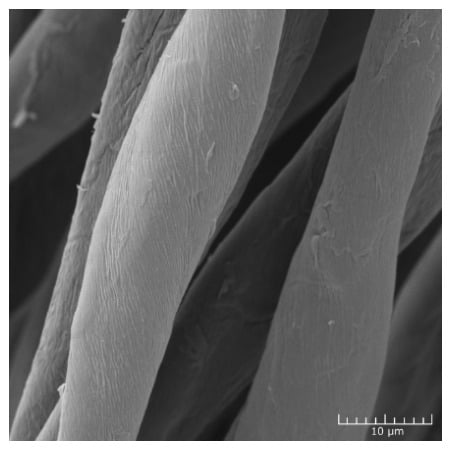
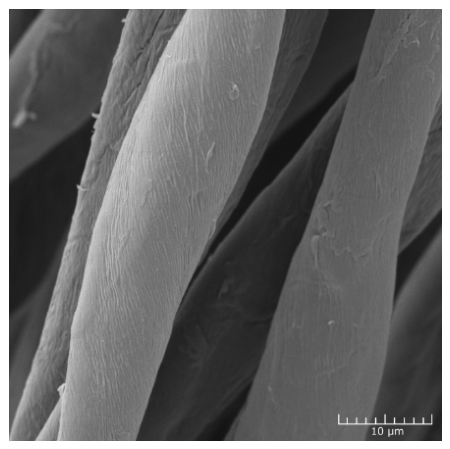
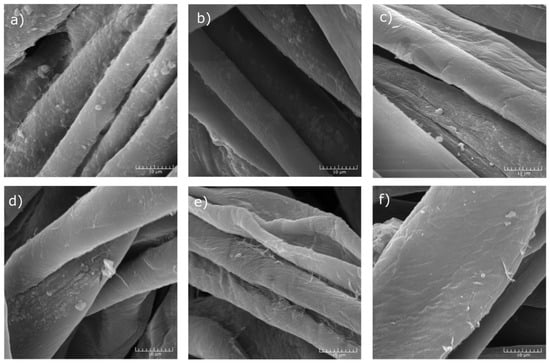
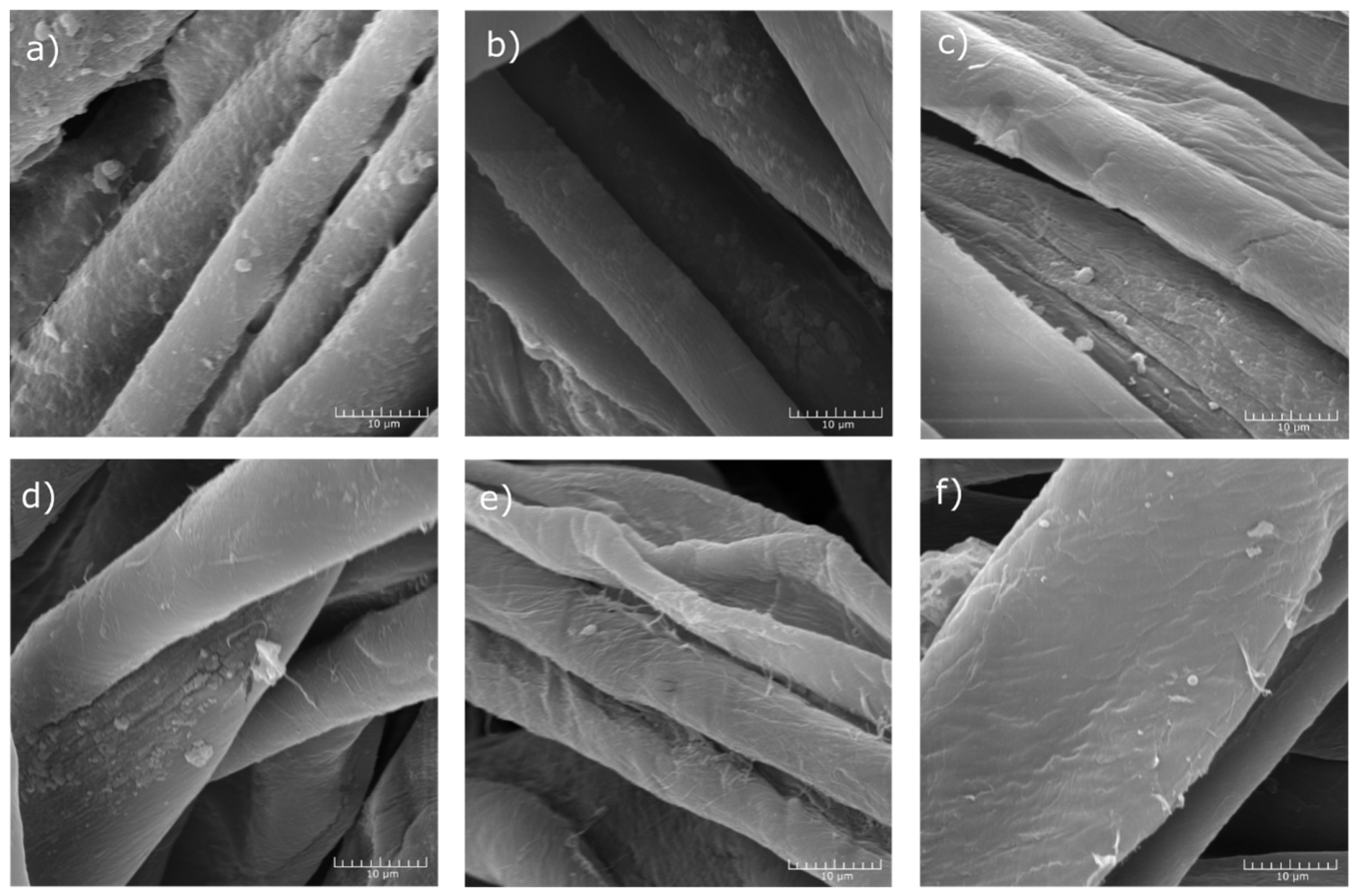
Scanning electron microscopy (SEM) enables observation of the topography of modified cotton fabric before and after multiple washing and drying cycles. Figure 1 and Figure 2 show the SEM micrographs (with a magnification of ×10,000) of untreated and functionalised cotton fabric, respectively.
Figure 1.
SEM image of untreated fabric (magnification ×10,000).
Figure 2.
SEM images of modified fabric (magnification ×10,000): (a) before washing, (b) after 5 washing/drying cycles, (c) after 10 washing/drying cycles, (d) after 20 washing/drying cycles, (e) after 30 washing/drying cycles, and (f) after 50 washing/drying cycles.
High-magnification SEM imaging of natural fibres, such as cotton, is highly susceptible to electron-beam-induced thermal degradation and structural loss. To preserve the integrity of the observed fibre morphology and prevent the formation of artificial artefacts caused by beam damage, we maintained a magnification level that ensured the most realistic representation of the surface.
Additional material can be observed on the surface of all modified fabrics (Figure 2a–f) compared to the unmodified fabric surface (Figure 1). It results from the deposition of TiO2 and ZnPt particles onto the surface of cotton fibres during the padding-squeezing finishing process. Dozens of particles, almost homogeneously distributed, are observed on the surface of the modified material before and after 5 washing and drying cycles. However, the irregular morphology of particle grains may be a consequence of the agglomeration of individual modifier particles. As expected, a decrease in the number of modifier particles on the fibre surface is observed after subsequent washing cycles (from 10 to 50 washings—Figure 2c–f), resulting from particles leaching out during laundering processes. Several modifier particles of different sizes and shapes can be seen on the surface of selected fibres after 10 and 20 washing cycles, whereas only single particles are present on the fibres’ surface after 30 and 50 washing and drying cycles. Also, partial damage to the cotton fibres’ surface can be seen (Figure 2e,f). Unfortunately, the SEM’s magnification did not allow the entire set of modifier particles present on the fibre surface to be shown.
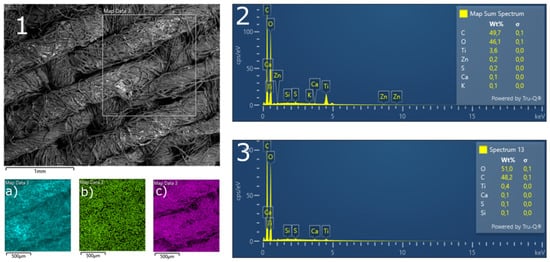
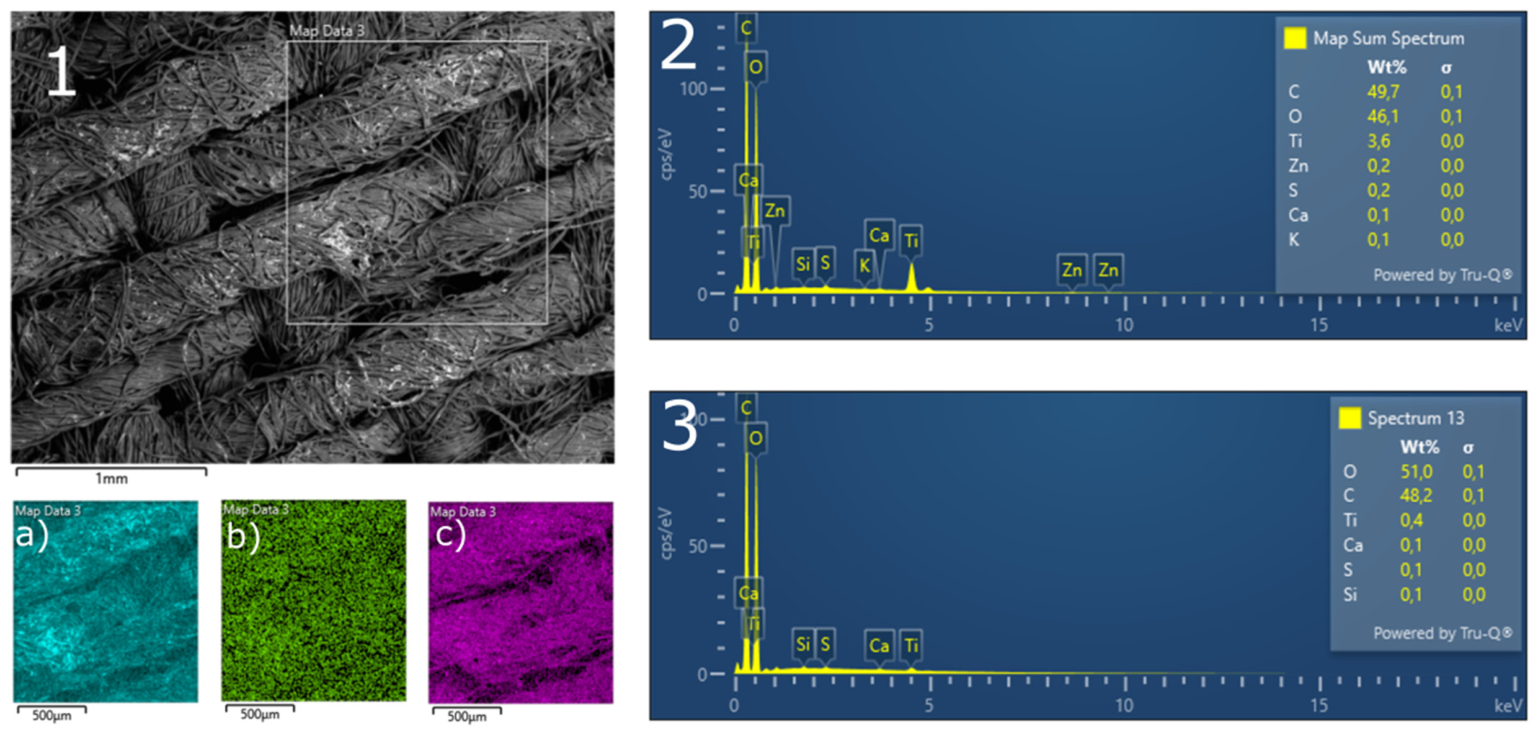
To verify the distribution of modifiers on the fibre surface, EDX analysis was performed. Elemental mapping (Figure 3(1,a–c)) confirmed the presence and relatively uniform distribution of Ti, Zn, and S across the analysed area of unwashed samples. The Ti signal showed local areas of higher intensity, which are compatible with the presence of TiO2 agglomerates observed in SEM images.
Figure 3.
EDX-mapping of modified fabric before washing, (1)—modified fabric, (a)—titanium, (b) zinc, and (c) sulfur; and EDX spectra of (2)—modified fabric before washing and (3)—modified fabric after 5 washings.
Quantitative EDX analysis showed surface concentrations of approximately 3.6 wt% Ti, 0.2 wt% Zn, and 0.2 wt% S for the unwashed sample (Figure 3(2)). After repeated washing cycles (Figure 3(3)), the surface concentration of Ti decreased significantly (to ca. 0.4 wt%), while S remained at 0.1 wt%, and Zn was below the detection limit. This indicates significant removal of ZnPt from the fibre surface.
The self-cleaning properties of the finished fabric were evaluated. The colour changes between irradiated and unirradiated samples were assessed using RK/S, colour changes (ΔL*, Δa*, Δb*) and the colour differences (ΔE*). The ΔL* value refers to the difference in lightness from darker (−ΔL*) to lighter (+ΔL*), whereas Δa*and Δb* values refer to red/green differences from greener/less red (−Δa*) to redder/less green (+Δa*) and yellow/blue differences from bluer/less yellow (−Δb*) to yellower/less blue (+Δb*), respectively. The K/S value is linearly related to colourant concentration in the fabric, and ΔE* determines the total colour differences (the higher the ΔE* value, the greater the colour difference). The organoleptic observation of colour changes is not straightforward, as each observer’s perception of colour is unique. It can be assumed that a typical observer perceives the colour difference as follows: 0 ≤ ΔE* < 1 no notice of the colour difference; 1 ≤ ΔE* < 2 the colour difference noticed by a qualified observer, 2 ≤ ΔE* < 3.5 the colour difference is noticed by an unqualified observer, 3.5 ≤ ΔE* < 5 notice of a clear colour difference, ΔE* > 5 impression of two different colours.
The results of self-cleaning properties are shown in Table 2. It is indicated, based on RK/S and ΔL* estimations, that all stained samples became lighter after exposure to UV/VIS light (ΔL* assumes positive values). It should be noted that all samples modified after light exposure are considerably lighter than the unmodified ones. An almost 70% K/S reduction (RK/S) was observed in the finished fabric after 5 washing cycles, compared to a ca. 46% reduction on the unwashed modified sample. Enhancement of photocatalytic properties may result from the removal of larger particles from the fabric surface. The RK/S values for all modified samples are ca. 10 times greater (ranging from 9.2 for sample 2 to 13.9 for sample 3) than that of the control one, confirming the decomposition of colour compounds. Significant colour changes are observed in all samples, but the light-exposed, modified samples (before and after washing) appear to be two different colours (ΔE* > 5). Immense hue shifts from red to yellow (negative a* and positive b* values), resulting from the photocatalytic degradation of colour compounds, are shown for all finished samples. On the contrary, the untreated fabric shows only a slight colour difference after UV/VIS light exposure (ΔE* ca. 1.8), indicating a lack of photocatalytic properties. However, colour measurements indicated that the sample was slightly darker, less red, and yellower after UV/VIS irradiation.
Table 2.
Self-cleaning properties.
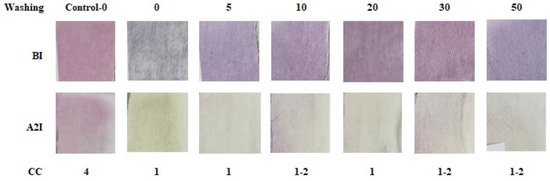
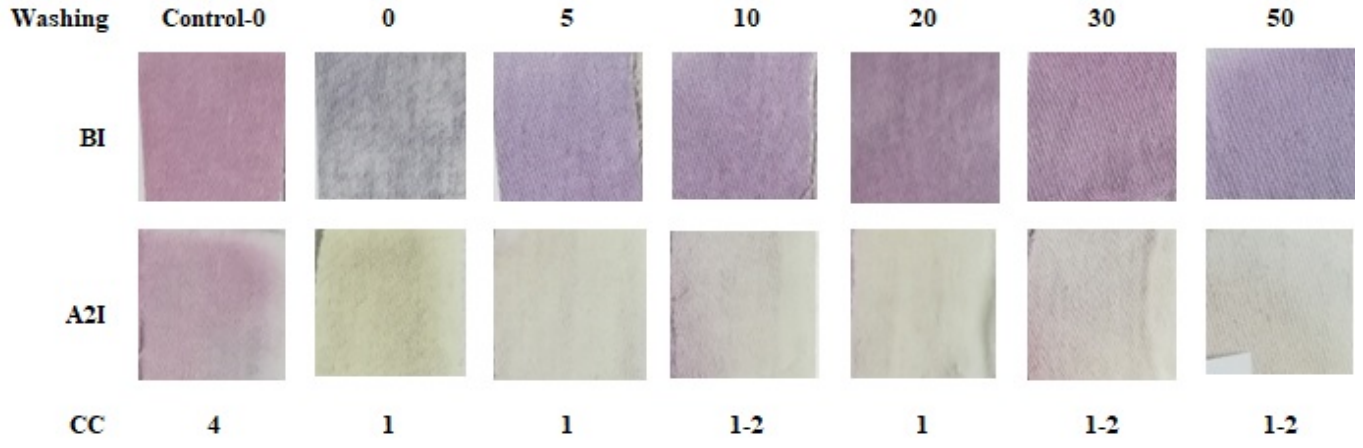
Figure 4 shows images of stained samples (control and modified) before and after 2 h and 15 min of UV/VIS light exposure.
Figure 4.
Pictures of stained samples before (top) and after (bottom) UV/VIS light exposure. BI—before irradiation, A2I—after 2 h and 15 min of irradiation, CC—the degree of change in colour.
Prominent shade changes (significantly yellower and much less red) are visible in all light-irradiated modified samples, even in fabric subjected to 50 washing/drying cycles. However, the unwashed modified sample appears more lime-green, while samples subjected to 30 and 50 washes appear bluer. In contrast to ΔL* estimation, the irradiated stained control sample appears slightly lighter, with a slight shift toward less red, according to organoleptic assessment. The degree of change in colour (CC) for stained irradiated samples, according to greyscales, was calculated from colour measurements. It allows us to eliminate the inaccuracy of organoleptic assessment. The CC parameter was calculated as the degree of greyscale from 1 (great change in colour—excellent self-cleaning properties) to 5 (no colour change—lack of self-cleaning properties). The CC for all finished samples ranged from 1 to 1–2, indicating strong self-cleaning properties of the modified fabric. In contrast, the CC of the control sample, estimated at 4, indicates a lack of self-cleaning properties.
Table 3 shows the average concentration of Ti and Zn in cotton fabric determined by ICP-OES measurements, as well as the calculated amount of modifier in one dishcloth and the amount of modifier washed out from one dishcloth after washing cycles.
Table 3.
Average concentration of Ti and Zn in the cotton fabric as stated by ICP-OES measurement (mean ± SD; n = 3), as well as the calculated amount of modifier in one dishcloth and the amount of modifier washed out from one dishcloth after repeated washing cycles.
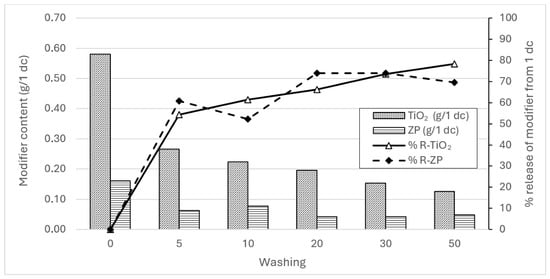
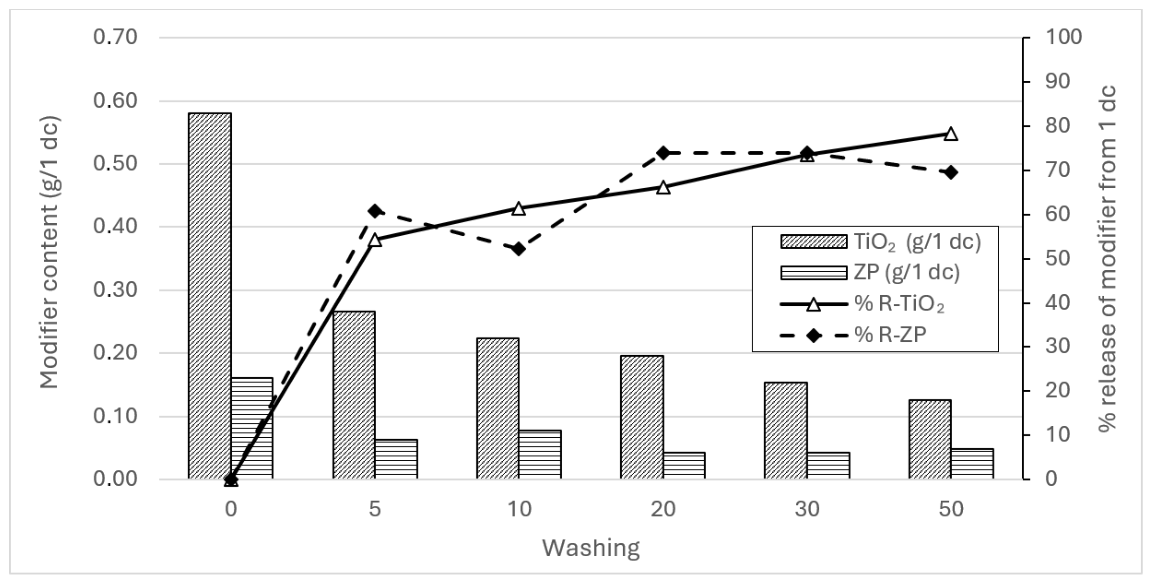
The quantitative results of modifiers concentration in the cotton fabric, as expected, show a reduction in the content of both modifiers (TiO2 and ZnPt) after the subsequent washing and drying cycles. It can be stated that ca. 54% and ca. 60% of the modifier particles (TiO2 and ZnPt, respectively) deposited on and into cotton fibres were released from dishcloths during the first 5 washings. Based on our long-term experience with the evaluation of silver-finished textiles [27,28], we can assume that most of the modifier particles were released during the 1st washing cycle. We observed similar results during our previous work [22]. The level of ZnPt particles release (Figure 5) remains almost stable (almost no release of ZnPt) from the 20th to 50th washings, whereas a small amount of TiO2 is still leaking out from the cotton fabric during the 5th to 50th washings. The total loss of TiO2 NPs from the dishcloth across all 50 washing cycles is ca. 0.45 g, which represents ca. 78% of the total amount of TiO2 introduced into cotton fibres during the finishing process. In the case of ZnPt, total release amounted to ca. 0.11 g, which constitutes ca. 70% of the total ZnPt amount in the cotton fabric. Average loss of TiO2 NPs and ZnPt modifiers during subsequent 50 washing and drying cycles throughout a single washing amounts to ca 0.009 g/1 dc for TiO2 NPs and ca. 0.002 g/1 dc for ZnPt. It must be underscored that the average release of both modifiers during a single wash after the 5th wash amounts to ca. 0.003 g/1 dc. It should be emphasised that only a small amount of TiO2 NPs (ca 0.27 g/m2—amount after 50 washes) gives the fabric surface extremely strong self-cleaning properties. Although laundering is a major source of NPs emissions into the environment, the potential impact of sweat and mechanical friction (e.g., Martindale test) remains an important direction for future evaluation. The duration of skin contact with the kitchen dishcloth differs from that of direct-wear garments, thereby reducing the potential risk of exposure. The application of binders or cross-linking agents during the finishing process could improve the fixation of NPs with the textile structure. This would reduce initial NPs leaching and extend the lifetime of the items under repeated laundering cycles. Future research should explore such strategies.
Figure 5.
TiO2 NP and ZnPt concentrations on and in the cotton fibres, as stated by ICP measurements and percentage release of modifiers from textile goods.
The release of NPs requires a careful evaluation of their environmental and regulatory implications. NPs incorporated into commercial products are released into the environment, and their effects on living organisms, such as plants, should be thoroughly investigated [29,30]. Their impact depends on particle properties, plant species, and exposure conditions, leading to both beneficial and adverse outcomes [31,32,33]. While low concentrations of TiO2 can promote seed germination and enhance photosynthesis [34,35], the negative effects at high levels cannot be neglected and require further investigation [36].
In the case of ZnPt, it should be noted that it is a biologically active substance with a complex regulatory status in the EU [9]. While its use in cosmetics is prohibited [8], its application in textiles and industrial applications remains subject to strict regulation. The present study focuses on material durability rather than on regulatory compliance. As only the total zinc content was determined, no direct conclusions can be drawn regarding extractable zinc, which limits the assessment of dermal exposure and compliance with certification schemes based on extractable substances. However, the observed reduction in ZnPt content after initial washing cycles suggests the removal of loosely bound particles, which may be beneficial from a safety perspective.
Our results show the durability of the coating. However, further studies on extractability, washing-induced release, and long-term environmental impact are required to fully assess the safety of this technology.
The antimicrobial properties of functionalised dishcloths, before and after several washings, are presented in Table 4. The antimicrobial efficacy was assessed as a biostatic activity A and is interpreted according to ISO 20743 (Annex F) as follows: A < 0.5—lack of activity; 0.5 ≤ A < 2—slight activity; 2 ≤ A < 3—significant activity; and A ≥ 3—strong activity. A value of A = 1 corresponds to a one-log reduction in the microbial population [21].
Table 4.
Antimicrobial properties against S. aureus and E. coli bacteria strains and C. albicans fungi.
The modified cotton dishcloths exhibit strong antimicrobial activity against S. aureus and E. coli strains for up to 20 washing cycles at 60 °C. While significant antibacterial activity was maintained against S. aureus after 30 to 50 wash cycles, the efficacy against E. coli weakened significantly (A = 0.69 and 1.27). It must be noted that all functionalised dishcloths (before and after washings) show strong activity against C. albicans. Furthermore, at a concentration of only ca. 50 mg ZnPt/1 dc, the system enables strong to excellent antimicrobial activity against S. aureus and C. albicans, but only slight activity against E. coli.
This study focuses on the assessment of hybrid finishing applied under industrial conditions, rather than on analysing the action of individual components (coatings consisting solely of TiO2 or ZnPt). This approach is important for evaluating functional durability in an industrial context.
The antimicrobial activity appears to result from two complementary pathways: the light-induced oxidative stress caused by TiO2 and the “dark-active” inhibitory effect of ZnPt. This combination enables sustained control of microorganisms even when photocatalytic activity is limited by light availability. Although the quantitative contribution of each pathway remains to be determined, the results indicate the presence of a dual-action mechanism effective in textile applications.
Furthermore, the assessment of the antimicrobial activity of photocatalytic systems involves methodological challenges that may limit the direct evaluation of photocatalytically induced antimicrobial effects [37]. In the present study, the standard test methods (ISO 20743, AATCC 100) do not allow for direct assessment of the antimicrobial activity induced by photocatalysis. Therefore, while ROS-related processes may contribute to the overall efficiency of the system, their contribution cannot be directly distinguished under the experimental conditions used.
4. Conclusions
The results of the study indicate that the deposition of TiO2 NPs and ZnPt particles using the padding-squeezing technique is a simple and effective approach to achieving photocatalytic and antimicrobial properties in 100% cotton woven fabric and the dishcloths made of it.
SEM micrographs confirmed that both modifiers (TiO2 and ZnPt) remain on the fabric surface after multiple washing and drying cycles (even after 50 washes). ICP analysis also validated the presence of modifier particles on and in the cotton fibres. The amounts of TiO2 and ZnPt decreased by 4.6 and 3.3 times, respectively, compared to the initial level.
The results indicate that TiO2/ZnPt finishing provides durable self-cleaning properties and partial antimicrobial activity after repeated washing cycles. However, antimicrobial effectiveness, particularly against E. coli, decreases with increasing numbers of washing cycles.
From an application perspective, further optimisation is required to improve particle retention and balance functional performance with safety and environmental considerations. In particular, additional studies on extractable Zn and washing-induced release are necessary to assess the suitability of ZnPt-treated textiles for practical use.
Author Contributions
Conceptualization, E.M.-Z.; Data curation, E.M.-Z. and P.K.; Formal analysis, E.M.-Z. and E.S.; Funding acquisition, A.S.S.; Investigation, E.M.-Z. and E.S.; Methodology, E.M.-Z., P.K. and E.S.; Resources, A.S.S.; Supervision, P.K. and A.S.S.; Validation, E.M.-Z. and E.S.; Visualisation, E.M.-Z. and M.P.; Writing—original draft, E.M.-Z.; Writing—review and editing, P.K., E.M.-Z. and E.S. All authors have read and agreed to the published version of the manuscript.
Funding
The project was co-financed by the European Union within the program “The European Funds for Śląsk (Silesia) 2021–2027”.
Data Availability Statement
The original contributions presented in this study are included in the article. Further inquiries can be directed to the corresponding author.
Acknowledgments
The authors would like to express their gratitude to B. Januszkiewicz from the Institute of Materials Science and Engineering, Lodz University of Technology, for consultation on the EDX results.
Conflicts of Interest
The authors declare no conflicts of interest.
References
- Gillies, E. Determining the most effective common household disinfection method to reduce the microbial load on domestic dishcloths: A pilot study. Environ. Health Rev. 2021, 63, 101–106. [Google Scholar] [CrossRef] [Scilit]
- Gerba, C.P.; Tamimi, A.H.; Maxwell, S.; Sifuentes, L.Y.; Hoffman, D.R.; Koenig, D.W. Bacterial Occurrence in Kitchen Hand Towels. Food Prot. Trends 2014, 34, 312–317. [Google Scholar]
- IFH—Home Hygiene & Health The Infection Risks Associated with Clothing and Household Linens in Home and Everyday Life Settings, and the Role of Laundry. 2011. Available online: http://www.ifh-homehygiene.org/IntegratedCRD.nsf/eb85eb9d8ecd365280257545005e8966/d0e3b0f361079f1780257865003d43b1?OpenDocument (accessed on 28 June 2026).
- Blanchard, C.; Brooks, L.; Ebsworth-Mojica, K.; Didione, L.; Wucher, B.; Dewhurst, S.; Krysan, D.; Dunman, P.M.; Wozniak, R.A.F. Zinc Pyrithione Improves the Antibacterial Activity of Silver Sulfadiazine Ointment. Ther. Prev. 2016, 1, 14. [Google Scholar] [CrossRef] [Scilit] [PubMed]
- Cutsem, J.V.; Gerven, F.V.; Fransen, J.; Schrooten, P.; Janssen, P.A. The in vitro antifungal activity of ketoconazole, zinc pyrithione, and selenium sulfide against Pityrosporum and their efficacy as a shampoo in the treatment of experimental pityrosporosis in guinea pigs. J. Am. Acad. Dermatol. 1990, 22, 993. [Google Scholar] [CrossRef] [Scilit] [PubMed]
- Kumari, N.; Bhattacharya, S.N.; Das, S.; Datt, S.; Singh, T.; Jassal, M.; Agrawal, A.K. In Situ Functionalization of Cellulose with Zinc Pyrithione for Antimicrobial Applications. ACS Appl. Mater. Interfaces 2021, 13, 47382–47393. [Google Scholar] [CrossRef] [Scilit] [PubMed]
- Rayana, H.B.; Dhouib, S.; Babay, A.; Chaouch, W.; Djelassi, B.; Zouari, R. Study of the Antibacterial Efficiency of Zinc Pyrithione Treated Cotton Fabric for Shoe Insoles: Optimizing the Zinc Content and Developing a Spectrophotometric Method. J. Nat. Fibers 2022, 19, 10210–10226. [Google Scholar] [CrossRef] [Scilit]
- Regulation (EU) 2021/1902 of the European Parliament and of the Council of 29 October 2021 amending Annexes II, III and V to Regulation (EC) No 1223/2009 of the European Parliament and of the Council as Regards the Use in Cosmetic Products of Certain Substances Classified as Carcinogenic, Mutagenic or Toxic for Reproduction (Text with EEA Relevance). Available online: https://eur-lex.europa.eu/eli/reg/2021/1902/oj/eng (accessed on 14 June 2026).
- Opinion on Zinc Pyrithione (ZPT) (P81) CAS N° 13463-41-7—Submission III (SCCS/1614/19 Final Opinion). Available online: https://health.ec.europa.eu/document/download/aa535110-c020-4924-8507-5f867adc9972_en (accessed on 14 June 2026).
- U.S. Food and Drug Administration. Over-the-Counter (OTC) Monograph M032: Drug Products for the Control of Dandruff, Seborrheic Dermatitis, and Psoriasis for Over-the-Counter Human Use (Posted 16 December 2021). Available online: https://www.accessdata.fda.gov/drugsatfda_docs/omuf/monographs/OTC%20Monograph_M032-Drug%20Products%20for%20the%20Control%20of%20Dandruff%20Seborrheic%20Dermatitis%20and%20Psoriasis%2012.16.2021.pdf (accessed on 14 June 2026).
- U.S. Environmental Protection Agency (EPA). Pesticide Product Label System (PPLS), Registration No. 92760-11. Available online: https://ordspub.epa.gov/ords/pesticides/f?p=PPLS:8:16897659424880::NO::P8_PUID,P8_RINUM:522362,92760-11 (accessed on 14 June 2026).
- Krishna, M.G.; Vinjanampati, M.; Purkayastha, D.D. Metal Oxide Tin films and nanostructures for self-cleaning applications: Current status and future prospects. Eur. Phys. J. Appl. Phys. 2013, 62, 30001. [Google Scholar] [CrossRef] [Scilit]
- Saad, S.R.; Mahmed, M.; Abdullah, M.M.M.A.B.; Sandu, A.V. Self-Cleaning Technology in Fabric: A Review. IOP Conf. Ser. Mater. Sci. Eng. 2016, 133, 012028. [Google Scholar] [CrossRef] [Scilit]
- Wu, J.; Zheng, W.; Chen, Y. Definition of photocatalysis: Current understanding and perspective. Curr. Opin. Green Sustain. Chem. 2022, 33, 100580. [Google Scholar] [CrossRef] [Scilit]
- Pelizzetti, E.; Carlin, V.; Minero, C.; Grätzel, M. Enhancement of the rate of photocatalytic degradation on TiO2 of 2-chlorophenol, 2,7-dichlorodibenzodioxin and atrazine by inorganic oxidizing species. New J. Chem. 1991, 15, 351–359. [Google Scholar]
- Foster, H.A.; Ditta, I.B.; Varghese, S.; Steele, A. Photocatalytic disinfection using titanium dioxide: Spectrum and mechanism of antimicrobial activity. Appl. Microbiol. Biotechnol. 2011, 90, 1847–1868. [Google Scholar] [CrossRef] [Scilit] [PubMed]
- Luttrell, T.; Halpegamage, S.; Tao, J.; Kramer, A.; Sutter, E.; Batzill, M. Why is anatase a better photocatalyst than rutile?—Model studies on epitaxial TiO2 films. Sci. Rep. 2014, 4, 4043. [Google Scholar] [CrossRef] [Scilit] [PubMed]
- Nuaim, M.A.A.; Alwasiti, A.A.; Shnain, Z.Y. The photocatalytic process in the treatment of polluted water. Chem. Pap. 2023, 77, 677–701. [Google Scholar] [CrossRef] [Scilit] [PubMed]
- Salama, K.F.; AiJindan, R.; Alfadehel, A.; Akhar, S.; Al-Suhaimi, E.A. Enhanced antimicrobial performance of textiles coated with TiO2 nanoparticles. J. Ind. Text. 2024, 54. [Google Scholar] [CrossRef] [Scilit]
- Pakdel, E.; Daoud, W.A.; Kashi, S.; Gashti, M.P.; Wang, X. Superhydrophilic self cleaning fabric with enhanced antibacterial and UV protection properties. Cellulose 2025, 32, 1937–1958. [Google Scholar] [CrossRef] [Scilit]
- Gutarowska, B.; Szulc, J.; Matyjas-Zgondek, E.; Kulpiński, P.; Pielech-Przybylska, K.; Rygala, A.; Jachowicz, A.; Rutkowski, E. Cotton terry textiles with photo- and bio-activity in a model study and real conditions. Materials 2020, 13, 3334. [Google Scholar] [CrossRef] [Scilit] [PubMed]
- Gutarowska, B.; Matyjas-Zgondek, E.; Kulpiński, P.; Mroczyńska-Florczak, M.; Rutkowski, E. Long-Lasting Photocatalytic and Antimicrobial Activity of Cotton Towels Modified with TiO2 and ZnO Nanoparticles. Catalysts 2021, 11, 952. [Google Scholar] [CrossRef] [Scilit]
- Lee, J.-C.; Huh, M.-W.; Hou, Y.-L.; Kim, W.-J. Complex Challenges in the Textile Industry and Potential Solutions in Photocatalytic Coating Technology: A Systematic Literature Review. Materials 2025, 18, 810. [Google Scholar] [CrossRef] [Scilit] [PubMed]
- Pruś, S.; Kulpiński, P.; Matyjas-Zgondek, E. Comparison of the effects of the cationization of raw, bio- and alkali-scoured cotton knitted fabric with different surface charge density. AUTEX Res. J. 2021, 21, 255–264. [Google Scholar] [CrossRef] [Scilit]
- ISO 20743:2013; Textiles-Determination of Antibacterial Activity of Textile Products. ISO: Geneva, Switzerland, 2013.
- AATCC Test Method 100-2004; Antibacterial Finishes on Textile Materials: Assessment of. AATCC: Durham, NC, USA, 2004.
- Bacciarelli-Ulacha, A.; Rybicki, E.; Matyjas-Zgondek, E.; Pawlaczyk, A.; Szynkowska, M.I. A New Method of Finishing of Cotton Fabric by in Situ Synthesis of Silver Nanoparticles. Ind. Eng. Chem. Res. 2014, 53, 4147–4155. [Google Scholar] [CrossRef] [Scilit]
- Bacciarelli-Ulacha, A.; Matyjas-Zgondek, E.; Puchowicz, D.; Cieślak, M. Comparison of Innovative Silver Nanoparticles Finishing Technologies to Obtain Antibacterial Properties of Cotton Fabric. Fibers Polym. 2022, 23, 2606–2615. [Google Scholar] [CrossRef] [Scilit]
- Tong, T.; Wilke, C.M.; Wu, J.; Binh, C.T.T.; Kelly, J.J.; Gaillard, J.F.; Gray, K.A. Combined Toxicity of Nano-ZnO and Nano-TiO2: From Single- to Multi nanomaterial Systems. Environ. Sci. Technol. 2015, 49, 8113–8123. [Google Scholar] [CrossRef] [Scilit] [PubMed]
- Nthunya, L.N.; Mosai, A.K.; López-Maldonado, E.A.; Bopape, M.; Dhibar, S.; Nuapia, Y.; Ajiboye, T.O.; Buledi, J.A.; Solangi, A.R.; Sherazi, S.T.H.; et al. Unseen threats in aquatic and terrestrial ecosystems: Nanoparticle persistence, transport and toxicity in natural environments. Chemosphere 2025, 382, 144470. [Google Scholar] [CrossRef] [Scilit] [PubMed]
- Skiba, E.; Adamczyk-Szabela, D.; Wolf, W.M. Metal based nanoparticles interactions with plants. In Plant Responses to Nanomaterials: Recent Interventions and Physiological and Biochemical Responses; Singh, V.P., Singh, S., Prasad, S.M., Chauhan, D.K., Tripathi, D.K., Eds.; Springer: New York, NY, USA, 2020. [Google Scholar] [CrossRef] [Scilit]
- Kandhil, U.; Singh, G.; Rani, A.; Dang, A.S.; Giri, S.K.; Dhiman, S.S.; Verma, N.; Kumar, A. Soil–microbe–plant continuum under ZnO and TiO2 nanoparticle stress: An insight into toxicological implications, risk evaluation and management strategies. Plant Nano Biol. 2025, 14, 100201. [Google Scholar] [CrossRef] [Scilit]
- Shah, M.A.; Shahnaz, T.; Zehab-ud-Din; Masoodi, J.H.; Nazir, S.; Qurashi, A.; Ahmed, G.H. Application of nanotechnology in the agricultural and food processing industries: A review. Sustain. Mater. Technol. 2024, 39, e00809. [Google Scholar] [CrossRef] [Scilit]
- Li, C.-C.; Jhou, S.-M.; Li, Y.-C.; Ciou, J.-W.; Lin, Y.-Y.; Hung, S.-C.; Chang, J.-H.; Chang, J.-C.; Sun, D.-S.; Chou, M.-L.; et al. Exposure to low levels of photocatalytic TiO2 nanoparticles enhances seed germination and seedling growth of amaranth and cruciferous vegetables. Sci. Rep. 2022, 12, 18228. [Google Scholar] [CrossRef] [Scilit] [PubMed]
- Skiba, E.; Pietrzak, M.; Michlewska, S.; Gruszka, J.; Malejko, J.; Godlewska-Żyłkiewicz, B.; Wolf, W.M. Photosynthesis Governed by Nanoparticulate Titanium Dioxide. The Pisum sativum L. Case Study. Environ. Pollut. 2024, 340, 122735. [Google Scholar] [CrossRef] [Scilit] [PubMed]
- Tan, W.; Peralta-Videa, J.R.; Gardea-Torresdey, J.L. Interaction of titanium dioxide nanoparticles with soil components and plants: Current knowledge and future research needs—A critical review. Environ. Sci. Nano 2018, 5, 257. [Google Scholar] [CrossRef] [Scilit]
- Cunliffe, A.J.; Askew, P.; Iredale, G.; Marchant, A.; Redfern, J. Methods to assess antibacterial, antifungal and antiviral surfaces in relation to touch and droplet transfer: A review, gap-analysis and suggested approaches. Access Microbiol. 2024, 6, 000804.v3. [Google Scholar] [CrossRef] [Scilit] [PubMed]

Disclaimer/Publisher’s Note: The statements, opinions and data contained in all publications are solely those of the individual author(s) and contributor(s) and not of MDPI and/or the editor(s). MDPI and/or the editor(s) disclaim responsibility for any injury to people or property resulting from any ideas, methods, instructions or products referred to in the content. |
© 2026 by the authors. Licensee MDPI, Basel, Switzerland. This article is an open access article distributed under the terms and conditions of the Creative Commons Attribution (CC BY) license.