


Highlights
- Photoinduced WO3-based sensor exhibited good selectivity and stability for NO gas with ppb level.
- Doped Ni accelerated the electron transfer to form superoxide radicals.
- Layer-like Ni-doped WO3 was synthesized through the spraying-calcination method.
Abstract
Nitric oxide (NO) detection at low concentrations was of significant practical importance for the screening and monitoring of certain respiratory diseases, driving the demand for gas sensors with enhanced performance and reduced power consumption. This study presented a photoinduced NO gas sensor based on layer-like Ni-doped WO3 nanomaterials operating at room temperature (RT). The synergistic effect of Ni doping and photoactivation enabled remarkable gas sensitivity across a low concentration range (10~100 ppb), achieving rapid response/recovery times (28 s/50 s) at 50 ppb under RT. The limit of detection (LOD) for NO molecule could reach below 8.29 ppb. A good linear correlation between the response value and NO concentration was demonstrated under a wide relative humidity range (20~90%). Ni doping induced oxygen vacancies while simultaneously facilitating photoinduced electron transfer for surface oxygen activation. The optimized sensor maintained good response stability after three months of ambient storage, demonstrating excellent operational durability. In situ experimental results further elucidated that the doped Ni site enhanced electron transfer from the surface to adsorbed oxygen molecules, generating superoxide radicals. This work provided fundamental insights into surface engineering strategies for developing optically modulated gas sensors and proposed a viable pathway for constructing energy-efficient exhalation monitoring systems.
1. Introduction
With the rapid development of industry and society, human health monitoring and disease screening have gradually attracted attention [1,2]. Since exhaled breath contains gas molecules characteristic of various diseases, breath analysis has become an ideal non-invasive measurement [3]. For example, the NO molecule was a crucial indicator of some respiratory diseases [1]. However, the concentration of exhaled NO was typically on the order of several tens of ppb [1,3]. Due to its low concentration, traditional detection techniques often require expensive equipment, such as gas chromatography (GC) and liquid chromatography [4]. Recently, the development of low-cost gas sensors has increasingly focused on medical diagnosis [3,5]. Yet, the selectivity, stability, and sensitivity (3S) of gas sensors are mainly influenced by the sensing materials [1,3,5]. In contrast, owing to their low-cost fabrication, material stability, and scalable manufacturing processes, semiconductor-based chemiresistive sensors have garnered significant research interest.
WO3 material, composed of W-O octahedra connected by shared oxygen atoms, exhibited an alterable surface structure [6,7]. A series of WO3-based materials have demonstrated excellent gas-sensitive properties for NO, NO2, C2H2, H2S, and acetone molecules [6,8,9,10,11]. To further promote their performance, various methods, including metal loading, heterojunction construction, and organic surface modification, have been employed to enhance the content of active electrons on the surface, leading to improved sensitivity towards low-concentration gas molecules [9,12]. In particular, ion doping not only improves electron transfer at the interface but also introduces oxygen defects on the surface, thereby reducing the activation energy barrier for adsorbed oxygen molecules [10]. Y. Xia et al. synthesized Ta-doped WO3 materials with enriched oxygen vacancies, achieving excellent NO discrimination at ultralow concentrations of 50 ppb [13]. Variable valence transition metal doping, such as with Ni, Fe, and Co, has consistently played a key role in electron transfer on semiconductor surfaces in electrocatalytic and photocatalytic processes [14]. J.M. Song proved that Ni doping promoted electron transfer on the W18O49 surface, reducing the response–recovery time of an n-butanol gas sensor [10]. Ni-doped WO3-based gas sensors have achieved the best target gas selectivity for 2 ppm acetone at RT [14]. Additionally, Ni doping not only constructs electron transfer channels on the surface but also introduces oxygen vacancies in WO3, thereby adjusting the surface adsorption capacity and selectivity. The design of Ni-doped WO3 materials could potentially contribute to highly sensitive gas sensors for low-concentration NO detection.
Furthermore, the excellent light absorption capacity of WO3 should not be overlooked, as it can serve as an effective alternative to thermal activation, promoting the activation of adsorbed molecules and generating more photoinduced active electrons for gas sensing of ppb-level NO [15,16]. In the context of the high-humidity testing environment associated with NO detection in exhaled air, light illumination could reduce the operating temperature of the gas sensor, thereby extending the device’s service life [12,15,16,17]. J.W. Yoon et al. reported that Zn-doped WO3 materials achieved reliable ppb-level NO2 detection under specific visible-light activation [18]. Therefore, the synergistic combination of defect-engineered WO3 nanostructures and photoactivation offered a promising strategy for developing an energy-efficient NO sensor operating at room temperature.
In this regard, a series of layer-like Ni-doped WO3 (Ni-WO3) materials were synthesized and employed as sensing materials for NO detection under blue LED light illumination. The photoactivated Ni-WO3 exhibited significantly enhanced NO-sensitive performance at room temperature, with a low concentration range, from 10 ppb to 100 ppb. Such excellent gas sensitivity was attributed to the combined effects of Ni doping and light illumination. The linear correlation between the response value and NO concentration of the photoinduced gas sensor was investigated under different humidity and subsequently compared with that of GC measurements. The influence of Ni doping on the surface structure was characterized by ESR and TEM. Moreover, through in situ X-ray photoelectron spectroscopy (XPS) and electron spin resonance (ESR), the possible mechanism for NO detection was inferred and subsequently confirmed.
2. Materials and Methods
The Ni-doped WO3 sample (Ni-WO3) was synthesized via a spraying-calcination method. Ammonium metatungstate hydrate and nickel(II) nitrate hexahydrate (Shanghai Macklin Biochemical Technology Co., Ltd., Shanghai, China) were adopted as W and Ni sources. The precursor powder was obtained from spraying method with the above mixed solution as the spray solution. The final sample was attained after calculation and denoted as xNi-WO3, where x represented the ideal mol/mol % ratio between Ni and W atoms. The morphology and composition of the obtained samples were characterized using XRD (D8 Advance, Bruker, Karlsruhe, Germany), XPS (Escalab 250XI+, Thermo Fisher Scientific, Waltham, MA, USA), TEM (Tecnai G2 F20 S-TWIN, FEI, Hillsboro, OR, USA), and SEM (Quanta250 FEG, FEI, USA), and their electron transfer properties were investigated by DRS (Cary-5000 UV-Vis-NIR, Agilent, Santa Clara, CA, USA), photoinduced curve (CHI660E, Shanghai CH Instruments Ins., Shanghai, China), ESR (EPR200-plus, CIQTEK, Hefei, China), EIS (CHI660E, Shanghai CH Instruments Ins., China), and in situ XPS (Escalab 250XI+, Thermo Fisher Scientific, USA) measurements. The NO gas-sensitive property was measured using reconstructive gas-sensitive equipment (Figure S1). The experimental and testing processes were detailed into Supplementary Materials S1–S3.
3. Results
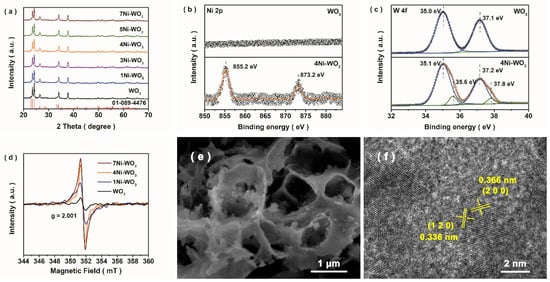
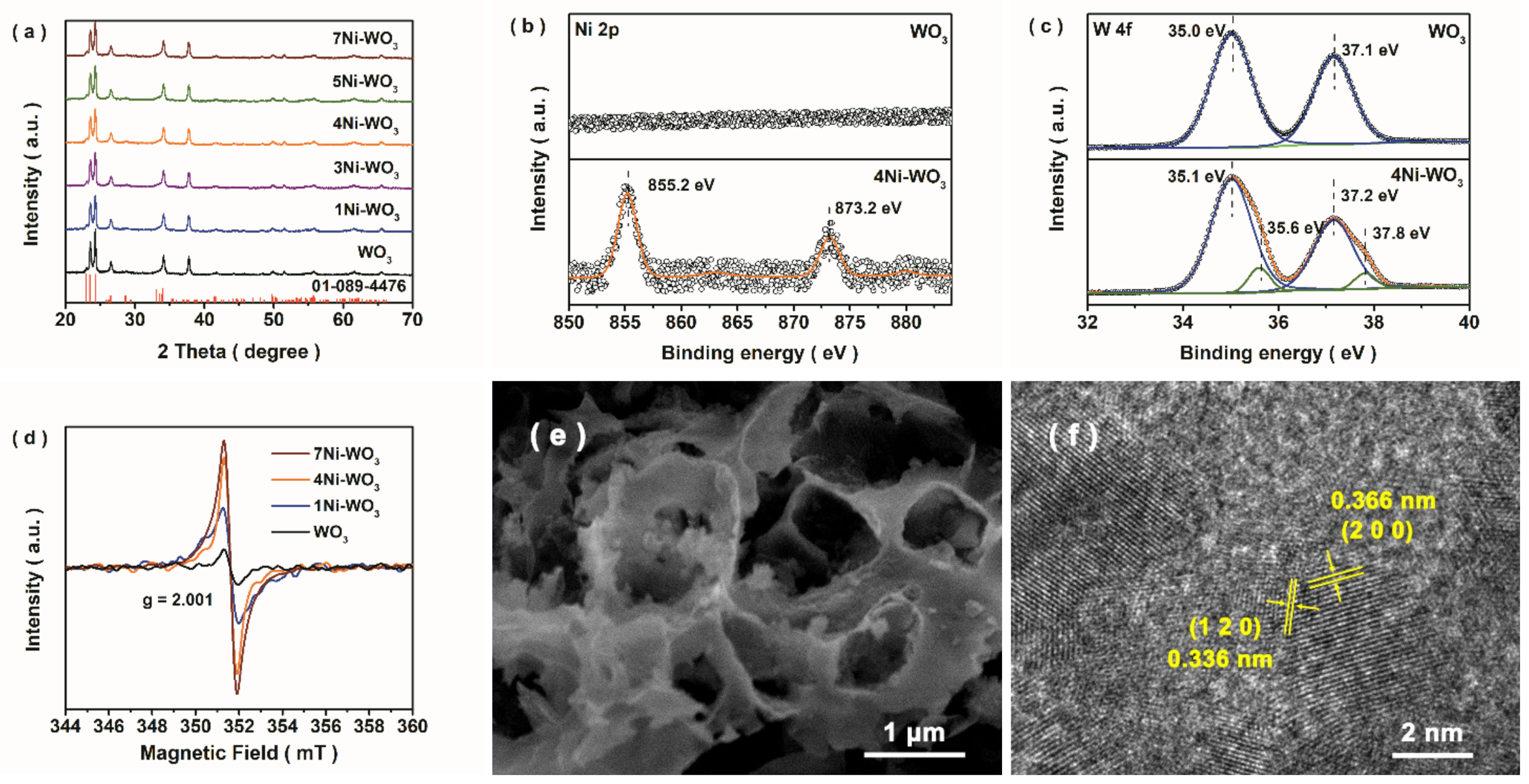
As shown in Figure 1a, the observed diffraction peaks of all obtained samples corresponded to the characteristic peaks of monoclinic phase WO3. No additional diffraction peaks were detected upon Ni doping. Compared with the standard card (PDF No. 01-089-4476), the intensity of the (0 0 2) characteristic peak at 23.0° was weaker, while that of the (1 3 0) characteristic peak at 37.7° was stronger, indicating anisotropic growth with inhibition along the [0 0 1] direction. This may lead to the formation of layer-like WO3 with a higher surface area. As summarized in Table S1, the Ni content in the doped WO3 samples gradually increased with the designed Ni/W molar ratio during synthesis. In Figure 1b, only two strong peaks at 855.2 eV and 873.2 eV were observed for the 4Ni-WO3 sample, corresponding to the characteristic peaks of Ni(II) 2p1/2 and 2p3/2, respectively [10]. As shown in Figure 1c, apart from two strong peaks of W(VI), two weak peaks at 35.6 eV and 37.8 eV appeared, indicating the generation of W(V) induced by Ni doping [19]. Meanwhile, the ESR results (Figure 1d and Figure S2) showed that the signal intensity changed, suggesting that oxygen vacancy was generated and increased with increasing Ni doping content [20]. In Figure 1e and Figure S3, the 4Ni-WO3 samples exhibited a layer-like morphology, and the average thickness could be calculated to be about 6.8 nm. Furthermore, clear lattice fringes with spacings of 0.366 and 0.336 nm were observed in the TEM image (Figure 1f), corresponding to the (2 0 0) and (1 2 0) crystal planes of monoclinic WO3, respectively. Based on the above results and analysis, Ni-doped WO3 layers with oxygen vacancy were successfully synthesized via the spraying-calcination method.
Figure 1.
XRD pattern (a), XPS spectra of (b) Ni 2p and (c), W 4f (blue/green curve: W(VI)/W(V)), ESR spectrum (d), SEM (e), and TEM (f) of the obtained samples.
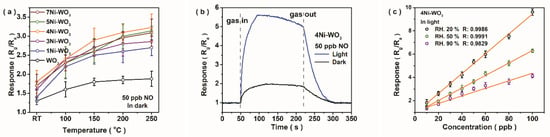
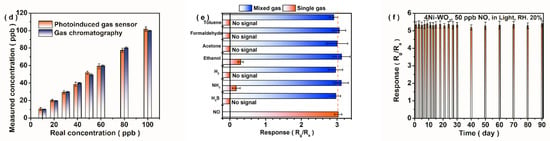
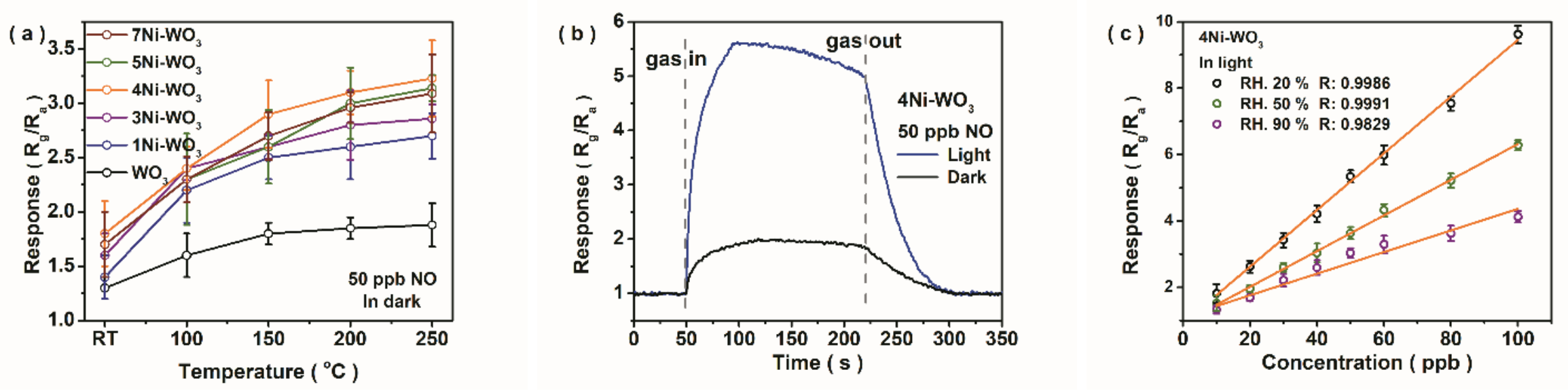
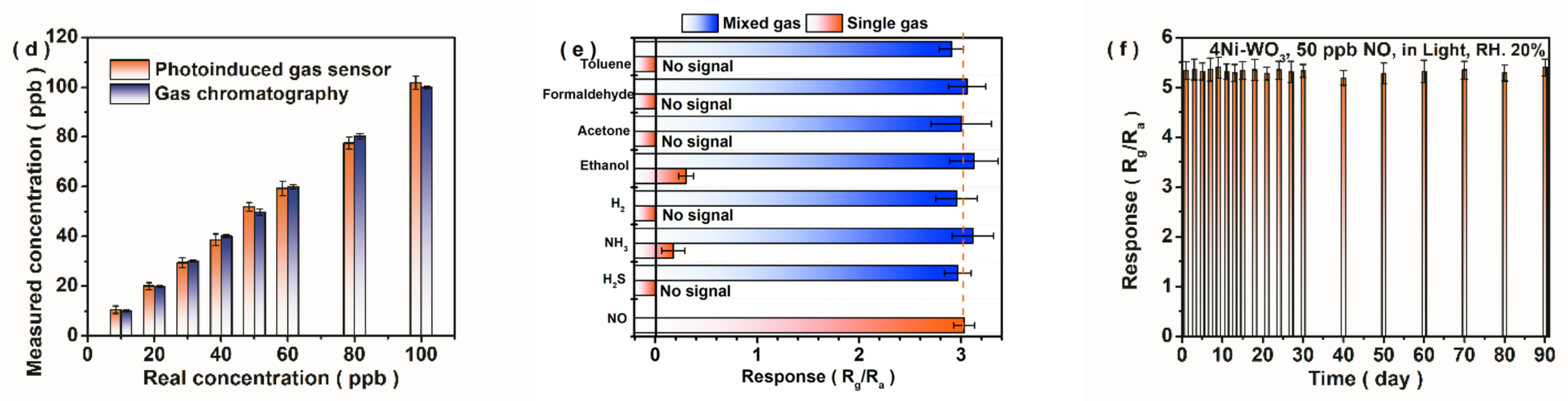
The NO gas-sensitive performance of the obtained Ni-WO3 samples was investigated. As shown in Figure 2a, the response of the NO gas sensor increased with the operating temperature, and the 4Ni-WO3 sample exhibited the highest performance among all Ni-WO3 samples. In Figure 2b, the response value for NO gas at RT was significantly enhanced under blue LED light illumination. Meanwhile, the response and recovery times were all markedly shortened from 39 s/73 s to 28 s/50 s, attributed to the photoinduced generation of abundant active electrons on the WO3 surface. As shown in Figure 2c, a good linear correlation between the response value and NO concentration (10~100 ppb) was observed, although the response intensity decreased as the relative humidity (R.H.) increased from 20% to 90%. The LOD value for NO molecules could reach 1.75 ppb, 2.79 ppb and 8.29 ppb, respectively. Furthermore, the NO content measured by the photoinduced gas sensor was in basic agreement with that obtained by gas chromatography (Figure 2d), indicating its practicality for NO gas-sensitive applications. When exposed to other target gas molecules commonly present in breath testing (Figure 2e), the 4Ni-WO3 gas sensor still exhibited excellent selectivity. Even for simulated exhaled breath (Figure S4), the optimized gas sensor still showed the good gas-sensing for ppb-level NO detection. In a 3-month cycling experiment (Figure 2f), the stability of the photoinduced gas sensor was demonstrated. In conclusion, the photoinduced gas sensor assembled with 4Ni-WO3 materials can be effectively used for detecting NO in exhaled breath.
Figure 2.
Gas-sensitive performance of the obtained Ni-WO3 sample. (a) Operating temperature, (b) response curve in light/dark, (c) linear correlation with different concentration and relative humidity, (d) comparison test between sensor and GC, (e) gas-sensitive selectivity in 90 RH and 50 ppb NO gas, and (f) cycling stability of 3 months.
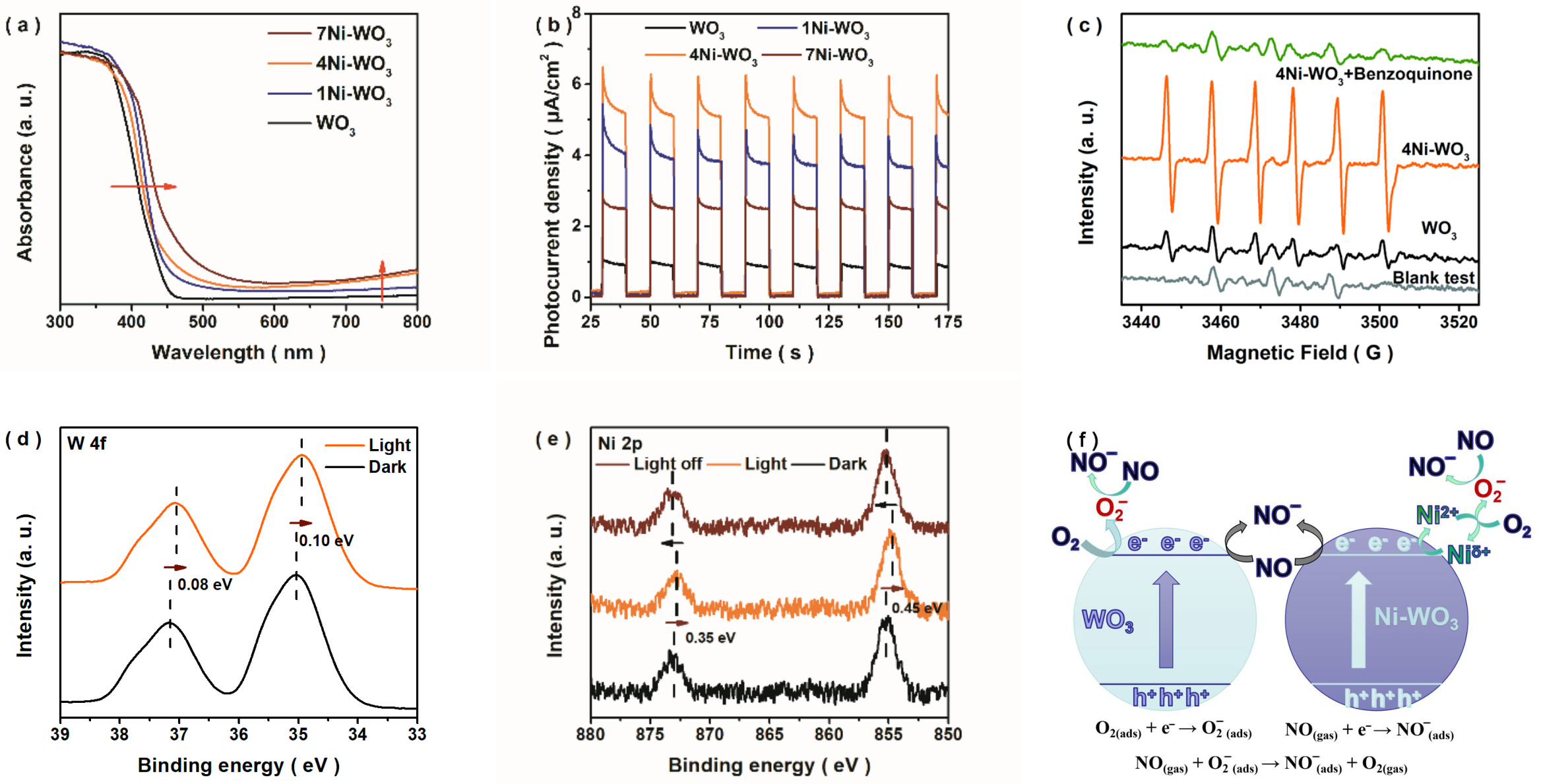
To explore the enhanced sensitivity performance of the photoinduced gas sensor, the band structure and electron transfer behavior of the Ni-doped WO3 samples were systematically investigated. As shown in Figure 3a, the Ni-WO3 samples exhibited a broader light-response range compared to the undoped WO3. Notably, the light absorption ability of the 4Ni-WO3 and 7Ni-WO3 samples in the 550~800 nm range was stronger than that of undoped WO3 and 1Ni-WO3, due to the generation of oxygen vacancies. As shown in Figure 3b, a photoinduced current curve was generated under light illumination and rapidly weakened after the light was turned off. The intensity of this curve was stronger for the 4Ni-WO3 sample than for the others, indicating that more active photoinduced electrons could be generated within the WO3 materials through Ni doping and oxygen vacancies [21,22]. However, excessive oxygen vacancies led to the recombination of photoinduced electrons and holes, resulting in the decreased performance of the 7Ni-WO3 sample. As shown in Figure S5, the impedance spectroscopy (EIS) proved that the doped Ni site could facilitate the charge transfer of WO3 materials. In Figure S6, the ability for O2 adsorption of Ni-WO3 was obviously higher than in undoped WO3. Especially for the WO3-O sample, the generation of oxygen vacancy played a positive role for O2 adsorption in the WO3 surface. In addition to sufficient active electrons, the influence of the superoxide radical (O2−) on NO gas sensing could not be ignored. As shown in Figure 3c, the characteristic signal of O2− over 4Ni-WO3 was much stronger than that over WO3, suggesting that more O2− radicals could be generated from adsorbed oxygen molecules on the Ni-doped WO3 surface [22,23]. To further explore the effect of doped Ni sites on electron transfer, in situ XPS measurements were conducted, and the results are shown in Figure 3d,e. No prominent difference in the W 4f characteristic peaks was observed between light and dark conditions. Notably, the two peak positions of Ni 2p shifted toward lower energy under illumination and returned to their original positions after the light was turned off, indicating that photoinduced electrons accumulated around the doped Ni sites under illumination and that these sites could revert to their original state [21,24]. Combined with the ESR result showing an increase in O2− radicals under light, it was inferred that doped Ni sites with variable charge states could transfer electrons from the WO3 surface to adsorbed oxygen molecules, thereby enhancing gas-sensitive performance. In other words, Ni doping not only introduced oxygen defects to promote oxygen adsorption ability but also constructed a fast electron transfer channel between the surface and adsorbed molecules. The proposed mechanism for NO gas sensing is illustrated in Figure 3f.
Figure 3.
Light absorbed property (a), photoinduced curve (b), ESR spectra (c), in situ XPS ((d) W 4f and (e) Ni 2p), and schematic diagram (f) of the obtained Ni-doped WO3 sample.
4. Conclusions
A series of Ni-doped WO3 materials were synthesized via the spraying-calcination method. The optimal 4Ni-WO3 sample exhibited improved NO gas-sensitive performance. Notably, the photoinduced gas sensor based on the Ni-WO3 sample demonstrated a linear response in the NO concentration range of 10 to 100 ppb under varying humidity levels (20%~90%). Meanwhile, its response and recovery time under light illumination was significantly shortened from 39 s/73 s in the dark to 28 s/50 s, and the LOD value for the NO molecules could reach below 8.29 ppb at 20~90% R.H. The sensor also showed good selectivity towards various exhaled target molecules. The Ni-doped WO3 photoinduced gas sensor exhibited NO detection capabilities comparable to those of GC. ESR and in situ XPS results confirmed that Ni doping not only generated abundant photoinduced active electrons but also constructed a fast electron transfer channel between the surface and adsorbed molecules. The findings of this study may provide insights into the design of photoinduced gas sensors for NO detection in breath testing.
Supplementary Materials
The following supporting information can be downloaded at: https://www.mdpi.com/article/10.3390/ma19132771/s1, S1. Sample characterization. S2. Gas sensing characterization. S3. Gas sensing characterization. Figure S1. Schematic diagram of testing system for NO-gas-sensitivity performance. Figure S2. EPR spectra of 4Ni-WO3, WO3 and WO3-O samples. Figure S3. TEM image of 4Ni-WO3 sample. Figure S4. Gas-sensing performance of 4Ni-WO3 gas sensor for NO detection in simulated exhaled breath. Figure S5. EIS Nyquist plots of WO3 and 4Ni-WO3 sample. Figure S6. O2 adsorption curve of 4Ni-WO3, WO3 and WO3-O samples. Table S1. Element content of obtained doped WO3 sample by XPS measurement. Table S2. Gas sensing performance of WO3-based sensor for NO or NO2 detection in previous research and studies. References [25,26,27,28,29,30,31,32] are cited in the supplementary materials.
Author Contributions
Conceptualization, J.W., X.S. and S.W.; methodology, J.W.; software, N.F. and H.M.; validation, S.W.; formal analysis, N.F. and H.M.; investigation, L.Z.; data curation, S.W. and H.M.; writing—original draft preparation, L.Z. and J.W.; writing—review and editing, J.W.; project administration, J.W.; funding acquisition, J.W. and S.W. All authors have read and agreed to the published version of the manuscript.
Funding
This research was funded by the Scientific and Technological Research Project of Henan Province (No. 262102320142), Natural Science Foundation of Henan Province (No. 262300421336), and Training Program for Young Backbone Teachers in Higher Education Institutions in Henan Province (No. 2024GGJS101).
Data Availability Statement
The original contributions presented in this study are included in the article/Supplementary Material. Further inquiries can be directed to the corresponding authors.
Conflicts of Interest
The authors declare no conflicts of interest.
References
- Zhao, J.; Xu, Y.; Ye, Z.; Zhang, Q.; Zhang, Y.; Xu, Z.; Zhang, C.; Peng, N.; Ren, H.; Li, P.; et al. Heterostructure aerogels with a hole-rich medium enable portable, sub-ppb FeNO detection toward home respiratory care. ACS Sens. 2026, 11, 2636–2647. [Google Scholar] [CrossRef] [Scilit] [PubMed]
- Singh, S.; Saggu, I.S.; Chen, K.; Xuan, Z.; Swihart, M.T.; Sharma, S. Humidity-tolerant room-temperature selective dual sensing and discrimination of NH3 and NO using a WS2/MWCNT composite. ACS Appl. Mater. Interfaces 2022, 14, 40382–40395. [Google Scholar] [CrossRef] [Scilit] [PubMed]
- Jiang, H.; Zhang, J.; Li, W. Ultrasensitive nitric oxide gas sensor based on gold/tin oxide composite nanofibers prepared by electrospinning. Sens. Actuators B 2025, 427, 137225. [Google Scholar] [CrossRef] [Scilit]
- Yin, P.; You, X.; Cui, X.; Tang, Z.; Yu, S.; Fu, H.; Song, F.; Zhang, K.; Zhao, X.; Wang, L.; et al. Clinically diagnose asthma and monitor its severity using an ultrasensitive chemiresistive nitric oxide (NO) gas sensor via exhaled breath analysis assisted by pattern recognition. ACS Sens. 2025, 10, 4491–4505. [Google Scholar] [CrossRef] [Scilit] [PubMed]
- Zhu, R.; Gao, J.; Tian, Q.; Li, M.; Gao, Q.; Wu, X.; Xu, S.; Zhang, Y. Optical chemical gas sensor based on spectral autocorrelation: A method for online detection of nitric oxide and ammonia in exhaled breath. Sens. Actuators B 2025, 422, 136694. [Google Scholar] [CrossRef] [Scilit]
- Zhang, J.; Gao, H.; Leng, D.; Liu, J.; Li, T.; Pan, C.; Yu, B.; Zhang, X.; Guo, J.; Yang, Z.; et al. Atomic-level tuning of mass-selected Ag clusters for surface functionalization of porous WO3 nanofibers to enhance NO2 sensing properties. Chem. Eng. J. 2026, 537, 176649. [Google Scholar] [CrossRef] [Scilit]
- Kumar, A.; Mazumder, J.T.; Joyen, K.; Favier, F.; Mirzaei, A.; Kim, J.-Y.; Kwoka, M.; Bechelany, M.; Jha, R.K.; Kumar, M.; et al. Defect engineering approaches for metal oxide semiconductor-based chemiresistive gas sensing. Coord. Chem. Rev. 2025, 541, 216836. [Google Scholar] [CrossRef] [Scilit]
- Hossain, M.; Chatterjee, K.; Mohanty, K.; Tarafder, K.; Sen, S.; Kundu, S.; Varrla, E.; Satpati, B.; Pal, P. Unconventional gas sensing mechanism in phase-separated n-type mixed tungsten oxide 2D-nanosheets compared against Tungsten (VI) oxide. Small 2026, 22, e13074. [Google Scholar] [CrossRef] [Scilit] [PubMed]
- Zhang, Y.; Hu, W.; Dai, J.; Zhou, T.; Wu, C.; Yang, M. Phase-stabilized hexagonal WO3 nanotube arrays with Pd-Pt dual-catalysts for high-performance fiber optic hydrogen sensing. Sens. Actuators B 2026, 462, 139982. [Google Scholar] [CrossRef] [Scilit]
- Wu, R.; Guo, S.-Q.; Li, Y.-C.; Qi, M.-Y.; Ge, B.-H.; Song, J.-M. Improving the sensing performance of rambutan-like W18O49 based gas sensor for n-butanol by Ni doping. Sens. Actuators B 2024, 410, 135671. [Google Scholar] [CrossRef] [Scilit]
- Wang, Y.; Li, J.; Zhou, T.; Sun, M.; Chen, S.; Sun, M. Modulation law theory for WO3-based semiconductor gas sensors detecting H2S gas. Chem. Eng. J. 2026, 536, 175930. [Google Scholar] [CrossRef] [Scilit]
- Ying, Z.; Zhong, Y.; Liu, Y.; Yan, W. Construction of WO3/InWO4 heterojunction for NO2 detection at room temperature under UV activation. Anal. Chim. Acta 2026, 1384, 344938. [Google Scholar] [CrossRef] [Scilit] [PubMed]
- Chen, R.; Si, R.; Dai, Q.; Yang, L.; Hou, M.; He, S.; Li, X.; Zhang, S.; Xiang, L.; Guo, S.; et al. Oxygen vacancy-engineered WO3 sensors with chemoselective gating for ultralow NO breathomics: Towards point-of-care asthma diagnostics. Chem. Eng. J. 2026, 533, 174759. [Google Scholar] [CrossRef] [Scilit]
- Pi, M.; Zheng, L.; Luo, H.; Duan, S.; Li, C.; Yang, J.; Zhang, D.; Chen, S. Improved acetone gas sensing performance based on optimization of a transition metal doped WO3 system at room temperature. J. Phys. D Appl. Phys. 2021, 54, 155107. [Google Scholar] [CrossRef] [Scilit]
- Lee, J.; Kim, M.; Park, S.; Ahn, J.; Kim, I.-D. Materials engineering for light-activated gas sensors: Insights, advances, and future perspectives. Adv. Mater. 2025, 37, e08204. [Google Scholar] [CrossRef] [Scilit] [PubMed]
- Wang, S.; Shi, X.; Fang, N.; Ma, H.; Wang, J. Dual effects of Ag doping and S vacancies on H2 detection using SnS2-based photo-induced gas sensor at room temperature. Materials 2025, 18, 2687. [Google Scholar] [CrossRef] [Scilit] [PubMed]
- Ling, J.; Zhang, T.; Li, D.; Zhang, H.; Tong, Y.; Jin, L.; Ji, X.; Zhang, K.; Zhang, M. Constructing S-scheme charge migration in a self-assembled In2O3/WO3 heterojunction for photothermal-driven dual-gas detection. ACS Sens. 2025, 10, 7874–7885. [Google Scholar] [CrossRef] [Scilit] [PubMed]
- Do, N.T.T.; Yu, B.-H.; Lee, S.-W.; Yu, Y.-T.; Yoon, J.-W. Atypical humidity-enhanced NO2 sensing in WO3 via Zn doping and visible-light activation: Mechanistic elucidation and application to breath analysis. Chem. Eng. J. 2026, 530, 173549. [Google Scholar] [CrossRef] [Scilit]
- Wang, J.-C.; Shi, W.; Sun, X.-Q.; Wu, F.-Y.; Li, Y.; Hou, Y. Enhanced photo-assisted acetone gas sensor and efficient photocatalytic degradation using Fe-doped hexagonal and monoclinic WO3 phase-junction. Nanomaterials 2020, 10, 398. [Google Scholar] [CrossRef] [Scilit] [PubMed]
- Abdullah, S.A.; Sahdan, M.Z.; Nayan, N.; Embong, Z.; Hak, C.R.C.; Adriyanto, F. Neutron beam interaction with rutile TiO2 single crystal (1 1 1): Raman and XPS study on Ti3+-oxygen vacancy formation. Mater. Lett. 2020, 263, 127143. [Google Scholar] [CrossRef] [Scilit]
- Wang, L.; Cheng, B.; Zhang, L.; Yu, J. In situ irradiated XPS investigation on S-scheme TiO2@ZnIn2S4 photocatalyst for efficient photocatalytic CO2 reduction. Small 2021, 17, 2103447. [Google Scholar] [CrossRef] [Scilit] [PubMed]
- Wang, J.-C.; Ma, H.; Shi, W.; Li, W.; Zhang, Z.; Hou, Y.; Zhang, W.; Chen, J. Designed synthesized step-scheme heterojunction of Bi2WO6 nanosheet supported on CuBi2O4 nanorod with remarkable photo-assisted gas sensing for N-butyl alcohol. J. Environ. Chem. Eng. 2024, 12, 112698. [Google Scholar] [CrossRef] [Scilit]
- Sun, T.; Wang, R.; Guan, R.; Wang, L.; Zhong, T.; Liu, C.; Cheng, X.; Fang, Q. Design strategies and application progress of covalent organic frameworks in photocatalytic oxidation reactions. Chem. Sci. 2026, 17, 1964–2000. [Google Scholar] [CrossRef] [Scilit] [PubMed]
- Shi, W.; Zhang, L.; Zhang, R.; Yang, B.; Guo, J.; Guo, X.; Ma, H.; Wang, J.-C. Construction of S-scheme CuBi2O4/BiOI heterojunction with oxygen vacancy for efficient photocatalytic CO2-to-CH4 conversion. Chin. J. Struct. Chem. 2026, 100913. [Google Scholar] [CrossRef] [Scilit]
- Dhall, S.; Prakash, J.; Nigam, A.; Astakala, A.; Sood, K. WO3-based Chemiresistive sensors for NO detection at low temperatures. Microchem. J. 2025, 215, 114366. [Google Scholar] [CrossRef] [Scilit]
- Su, P.G.; Li, M.C. Recognition of binary mixture of NO2 and NO gases using a chemiresistive sensors array combined with principal component analysis. Sens. Actuators A Phys. 2021, 331, 112980. [Google Scholar] [CrossRef] [Scilit]
- Cai, Z.X.; Li, H.Y.; Ding, J.C.; Guo, X. Hierarchical flowerlike WO3 nanostructures assembled by porous nanoflakes for enhanced NO gassensing. Sens. Actuators B Chem. 2017, 246, 225–234. [Google Scholar]
- Yu, S.; Liu, X.; Wang, J.; Li, Q.; Pang, Y.; Zhang, L.; Yang, C.; Meng, Q.; Wang, C.; Jing, Q.; et al. A Room-temperature, high-ppb-level NO gas sensor based on Pt/WO3 co-decorated carbon nanofibers towards asthma-relevant breath analysis application. Sensors 2026, 26, 1069. [Google Scholar] [PubMed]
- Wu, Z.-J.; Chen, G.-L.; Li, Q.-S.; Lv, W.-C.; Xin, J.-J.; Song, K. WO3 microtubules supported by nanoparticles to construct high response and low-temperature nitric oxide sensor from discarded cotton towels. Microchim. Acta 2026, 193, 454. [Google Scholar] [CrossRef] [Scilit]
- Bai, H.; Guo, R.; Zhou, Y.; Feng, C.; Chen, Y.; Zhang, S.; Feng, Y.; Liu, W.; Liu, K.; Guo, F.; et al. A room-temperature wireless NO2 gas sensor enabled by WO3 modified V2CTx nanosheets. Chem. Eng. J. 2026, 534, 174763. [Google Scholar]
- Singh, S.; Gurawal, P.; Malik, G.; Adalati, R.; Kaur, D.; Chandra, R. Highly responsive and selective NO gas sensing based on room temperature sputtered nanocrystalline WO3/Si thin films. Micro Nanostruct. 2024, 188, 207794. [Google Scholar] [CrossRef] [Scilit]
- Singh, S.; Adalati, R.; Gurawal, P.; Devi, R.; Malik, G.; Kaur, D.; Chandra, R. Nano-interfaced WxMoyO3 heterostructure based highly selective and sensitive NO gas sensor. Sens. Actuators B 2026, 451, 139436. [Google Scholar]
Disclaimer/Publisher’s Note: The statements, opinions and data contained in all publications are solely those of the individual author(s) and contributor(s) and not of MDPI and/or the editor(s). MDPI and/or the editor(s) disclaim responsibility for any injury to people or property resulting from any ideas, methods, instructions or products referred to in the content. |
© 2026 by the authors. Licensee MDPI, Basel, Switzerland. This article is an open access article distributed under the terms and conditions of the Creative Commons Attribution (CC BY) license.