


Highlights
- The PZBLC–Tm3+ glass demonstrates enhanced optical performance, with a gain bandwidth (GBW = σem × Δλeff) calculated as 16.7 × 10⁻²⁶ cm3.
- The PZBLC–Eu3+ glasses are promising candidates for red visible-light emission under 395 nm excitation.
- The PZBLC–Tm3+ glasses, excited at 357 nm, exhibit broadband near-infrared (NIR) emission suitable for optical amplification.
- These glasses emit blue light, making them useful as standard light sources.
Abstract
The PZBLC glass system, with the molar composition 40P2O5–30ZnO–10BaF2–18LiCl–2.0CdO (mol%), was fabricated and subsequently doped with Eu2O3 and Tm2O3 using a melt-quenching technique. The thermal stability (ΔT), glass transition temperature (Tg), and linear refractive indices of the fabricated glass were evaluated. The spectroscopic parameters Ω2, Ω4, and Ω6, and the measured visible and near-infrared photoluminescence at the excitation wavelength depend on the type of rare-earth ions in the doped glasses and were estimated. The lifetimes of the relevant transition levels and the gain bandwidths (σem × Δλeff) of the fabricated glasses were evaluated. The PZBLC–Eu3+ glass, excited at 395 nm, exhibits an intense, high-purity red emission, whereas the PZBLC–Tm3+ glass, excited at 357 nm, shows a strong blue emission. The fabricated glasses are promising candidates as a solid source for visible-light emission with a high emission cross-section prepared by a low-cost technique.
1. Introduction
Rare-earth (RE) ion–doped glass is a highly promising host material due to its characteristic visible emissions, cost-effectiveness, straightforward fabrication, and improved thermal stability [1]. It has been widely applied across a range of optical technologies, including lasers, white-light-emitting diodes (W-LEDs), and optical amplifiers [2]. Over the past few decades, considerable research has been devoted to understanding the luminescence behavior and underlying mechanisms of various rare-earth (RE) ion-doped glass systems, including , , , , , , , and doped glasses [3,4,5,6,7,8,9,10]. Among the various RE ions, Eu3+ is regarded as one of the most significant activators in luminescent materials due to its relatively simple energy-level configuration, sharp and well-defined emission bands in the UV–Vis region, and intense red emission [11]. The luminescence of Eu3+ ions is largely independent of the crystal-field environment and is primarily governed by intra-configurational f–f transitions [12]. The electric-dipole transition near 612 nm (5D0 → 7F2) is sensitive to the host matrix ionicity and local symmetry, whereas the magnetic-dipole transition around 592 nm (5D0 → 7F1) remains essentially unaffected by changes in the surrounding environment. Consequently, the intensity ratio between magnetic-dipole and electric-dipole transitions is commonly used as a sensitive indicator of structural variations [13]. In this regard, Eu3+ ions play an essential role in luminescent materials, and their characteristic pure red emission has been extensively employed in spectral probes, white-light-emitting diodes (W-LEDs), and display technologies [14]. Meanwhile, trivalent thulium (Tm3+) ions exhibit emission over a broad spectral range, extending from the near-infrared (NIR) to the ultraviolet (UV) region. Tm3+—doped glasses have therefore gained considerable interest for several important reasons. Notably, the emission band centered at approximately 1460 nm, corresponding to the 3H4 → 3F4 transition, shows strong potential for use in fiber-optic amplifiers designed for telecommunication applications. The low-loss transmission window of optical fibers (1400–1600 nm) enables spectral extension into the S-band amplifier region, which lies on the shorter-wavelength side of the conventional erbium-doped fiber amplifier C-band (1530–1570 nm). Another emission band, centered near 1800 nm and associated with the 3F4 → 3H6 transition, is well suited for the development of lasers for medical applications as well as for atmospheric and chemical sensing [15,16,17]. Furthermore, the significant 1D2 → 3F4 transition of the Tm3+ ion produces blue emission around 450 nm through both down-conversion and up-conversion processes [18,19], making it valuable for high-capacity optical data storage technologies. It is well established that the luminescent behavior of glasses depends strongly on the chemical composition, structure, and overall characteristics of the host matrix. Among various glass systems, phosphate glass is regarded as an excellent host for RE-ion doping because of its favorable optical properties, moderate phonon energy, low melting temperature, low refractive index and dispersion, and its ability to accommodate high dopant concentrations [20]. However, the relatively poor thermal stability of pure phosphate glass restricts its practical use. To overcome this limitation, additional oxides are introduced to enhance structural stability.
ZnO functions as a network modifier within the glass system, decreasing hygroscopicity while improving mechanical strength. Incorporating zinc oxide into phosphate glasses lowers phonon energy, enhances transparency in the UV–visible range, and increases the solubility of rare-earth ions in the host matrix [2,8,21,22]. Studies by Zheng et al. [23] and Oueslati-Omrani et al. [24] demonstrated that ZnO can significantly improve the chemical durability of phosphate glass. It may also behave as a network former by generating [ZnO4] tetrahedral units or forming P–O–Zn linkages through ionic cross-linking, thereby strengthening and stabilizing the glass network. The CdO was intentionally introduced to modify the local phosphate network and improve the optical performance of the glass matrix. In phosphate glasses, CdO can act as a network modifier/intermediate, promoting the formation of non-bridging oxygens and altering the glass connectivity through Cd–O interactions. These structural changes may influence the local symmetry, phonon energy, and polarizability of the glass network, which are key factors governing luminescence efficiency and non-radiative relaxation processes [1,2].
Compared with the previously investigated CdO-free matrix, the incorporation of Cd2+ ions provides a more polarizable environment and may improve thermal stability and emission characteristics without significantly disturbing glass formation. Therefore, the introduction of CdO represents a targeted compositional modification aimed at tuning the structural and spectroscopic properties of the glass system, which strengthens the novelty of the present work [25,26].
For fluorescence and laser applications, dehydration of phosphate glasses—i.e., reducing the OH content—is essential. This is typically achieved through several methods, including the incorporation of chlorides or fluorides [27,28]. The addition of halides such as F− and Cl− enhances the phosphate glass matrix by increasing rare-earth ion solubility and creating multiple local environments for electric-dipole transitions [29].
As a result, hybrid glass structures can exhibit modified fluorescence line shapes along with altered radiative and nonradiative transition rates. Moreover, these halide ions help suppress OH− incorporation into lattice sites. The presence of F− and Cl− also increases the ionicity and reduces the covalency of the glass network, leading to a wider optical band gap compared with purely oxide-based phosphate glasses [30].
The novelty of our work lies in the development of a phosphate-based PZBLC singly doped with rare-earth ions, namely Eu3+ or Tm3+, in separate glass compositions. This system exhibits tunable visible emission (red from Eu3+ and blue from Tm3+) alongside broadband near-infrared (NIR) luminescence, enhanced thermal stability, and promising characteristics for wavelength-division-multiplexed (WDM) optical amplification. Importantly, this study establishes a comprehensive correlation between the glass structure, spectroscopic parameters, and luminescence behavior, providing new insights into the design of multi-functional rare-earth-doped glasses for advanced photonic applications. F−, Cl−, Eu3+, and Tm3+ were incorporated into phosphate-zinc glasses to enhance both their luminescence and thermal properties. The optical energy gap and linear refractive index of the fabricated glasses were calculated using multiple methods. Additionally, visible and near-infrared (NIR) emission spectra and the decay lifetimes of the relevant transition levels were measured under specific excitation wavelengths. The results demonstrate that these fabricated glasses are promising candidates for advanced photonic applications.
2. Materials and Methods
2.1. Materials and Glass Preparation
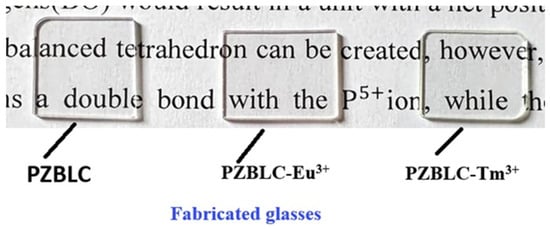
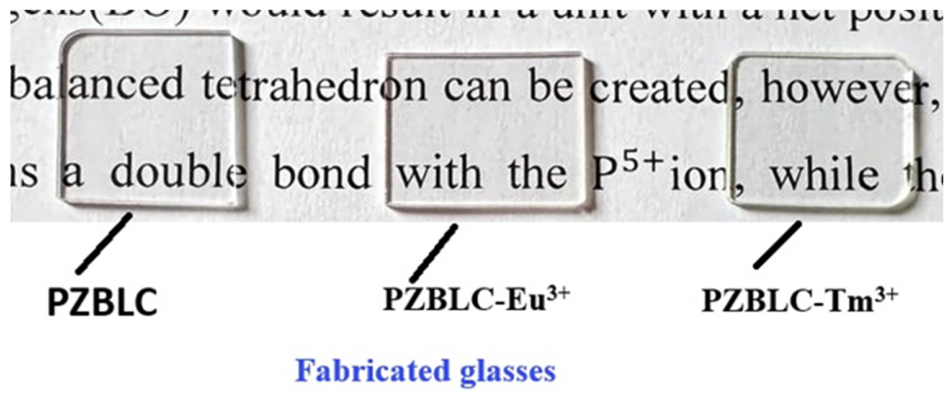
The studied glasses, with compositions 40P2O5–30ZnO–10BaF2–18LiCl–2.0Cd (PZBLC), 40P2O5–30ZnO–10BaF2–18LiCl–2.0Cd–35,000 ppm Eu2O3 (PZBLC–Eu), and 40P2O5–30ZnO–10BaF2–18LiCl–2.0Cd–35,000 ppm Tm2O3 (PZBLC–Tm), exhibited high homogeneity and transparency and were found to be non-hygroscopic (see Figure 1). Using the melt-quenching technique, the batches were melted in a muffle furnace at 1050 °C for 60 min, with continuous stirring in a platinum crucible to ensure homogeneity. Then the molten cast was poured into a copper mold and subsequently put in an annealing furnace, where the samples were kept at 430 °C. Annealing begins with a 2 h heat treatment to relieve strain.
Figure 1.
Fabricated glasses PZBLC, PZBLC-Eu3+ and PZBLC-Tm3+.
The density of the glass samples was determined using a gas pycnometer (UltraPyc 1200e, Anton Paar QuantaTec Inc., Boynton Beach, FL, USA). The thermal properties of the obtained glasses, the optical absorption spectra of the prepared glasses, the luminescence decay curves, and the photoluminescence spectra were determined using the same equipment described in Article [31].
2.2. X-Ray Diffraction Analysis
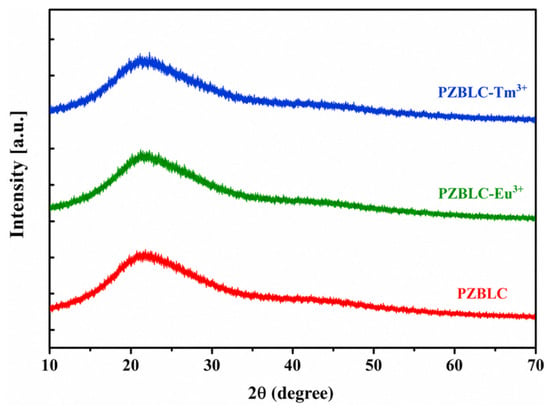
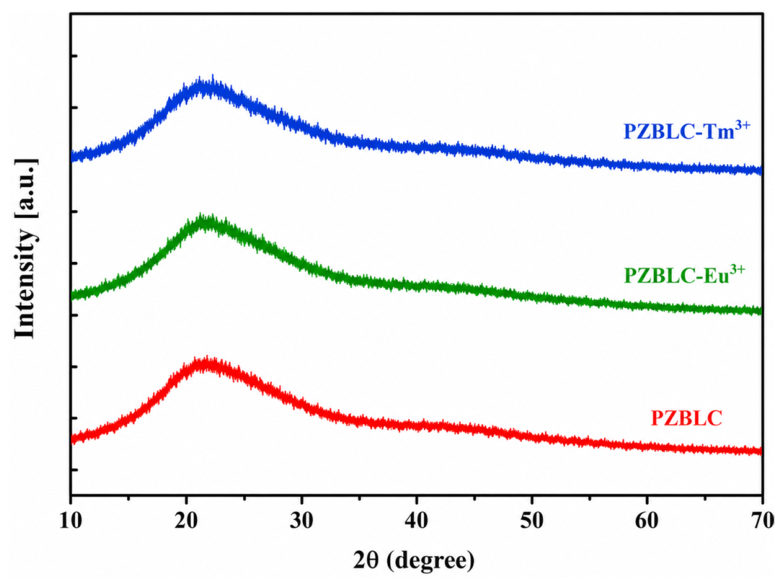
XRD analysis (Figure 2) was performed to confirm the amorphous nature of the studied glasses. The X-ray diffraction patterns exhibited broad diffuse halos without any sharp crystalline peaks, indicating the absence of long-range structural order and confirming the glassy nature of the samples. The XRD measurements were carried out using a X-ray diffraction patterns were recorded using a PANalytical X-ray diffractometer (PANalytical B.V., Almelo, The Netherlands) equipped with Cu Kα radiation.
Figure 2.
An X-ray diffraction (XRD) of the investigated glasses.
2.3. Refractive Index
The refractive index dispersion of the prepared bulk glasses was investigated by means of spectroscopic ellipsometry (SE). Measurements were carried out using a Woollam M-2000 ellipsometer (Woollam Co. Inc., Lincoln, NE, USA), operating within the wavelength range of 200–1700 nm. Spectroscopic ellipsometry is a non-destructive optical technique that determines changes in the polarization state of light upon reflection from a sample surface. During the measurements, the ellipsometric parameters Ψ and Δ were recorded. These parameters provide a complete description of the polarization state of the reflected light and define the polarization ellipse in the plane perpendicular to the propagation direction.
Previous investigations have demonstrated that the refractive index dispersion of tellurite-based glasses can be accurately modeled using the Sellmeier equation (see Ref. [29] and references therein). Accordingly, the experimental data were fitted using the Sellmeier dispersion model, expressed as follows [1]:
where A represents the refractive index offset, B corresponds to the oscillator strength (amplitude), C denotes the resonance position, and D is associated with the infrared pole contribution.
3. Results and Discussion
3.1. Physical and Structural Properties
The molar volume, ; , oxygen mole refraction, ; ; ; were evaluated, where is the molecular weight of the glass composition, is the density, is the molar fraction, and is the number of oxygen atoms in each oxide. Table 1 lists the values of (ρ), (), (), (OPD). The highest density was observed for the undoped PZBLC glass (ρ = 3.2573 g·cm−3), whereas the lowest density was recorded for the PZBLC–Eu3+ glass (ρ = 3.1046 g·cm−3), indicating a decrease in density upon incorporation of Eu2O3. The lowest values of molar volume (Vₘ) and oxygen packing density (Vₒ) were obtained for the PZBLC glass, while the highest values were estimated for the PZBLC–Tm3+ glass. The variations in density (ρ), molar volume (Vₘ), and oxygen packing density (Vₒ) do not exhibit linear behavior upon incorporation of the rare-earth ions Eu3+ and Tm3+. This nonlinearity may be associated with structural rearrangements within the glass network and possible changes in the local environment of the rare-earth ions. Furthermore, the oxygen packing density (OPD) decreases with increasing Tm2O3 content, indicating progressive structural rearrangement within the glass network.
Table 1.
The density (ρ) molar volume (), oxygen molar volume (), Oxygen packing density (OPD), molar refractivity, , and molar polarizability.
This variation may suggest structural modifications that could involve changes in network connectivity and the distribution of oxygen species.
Furthermore, the increase in density may be consistent with stronger rare-earth–oxygen interactions and possible changes in network connectivity. This variation indicates that the structure becomes increasingly distorted due to the rise in the number of non-bridging oxygens (NBOs) generated by the cleavage of P–O–P bridges as Eu3+ and Tm3+ ions are progressively incorporated, leading to a decrease in the OPD values. However, the molar volume (Vₘ) is observed to increase with the addition of rare-earth oxides (Eu2O3 and Tm2O3) in the polyphosphate series, suggesting an increase in the average chain length of the metaphosphate glass network. Nevertheless, the magnitude of the variation in Vₘ is less significant than that observed for OPD. Lorentz-Lorenz the fallowing pattern was used to determine the molar refractivity, , , and molar polarizability. The molar refractivity (Rₘ) and molar polarizability (αₘ), which are characteristic parameters of the investigated phosphate glasses, range from 17.15 to 21.08 m3/mol and from 6.8 to 8.04 Å3, respectively. Both parameters exhibit an inverse correlation with glass density, further supporting the occurrence of structural rearrangement within the phosphate network. The optical properties and thermal stability of these glasses are governed by several interrelated factors, including density, the polarizability of the first-neighbor coordinated anions, the coordination environment of the modifier cations, along with the inherent electronic polarizability of the oxide ions [24,32,33].
3.2. Thermal Properties
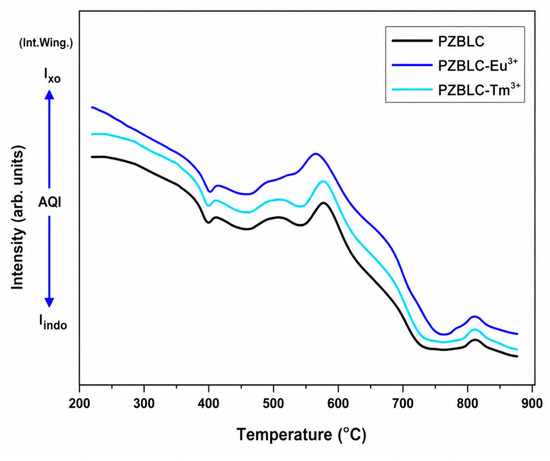
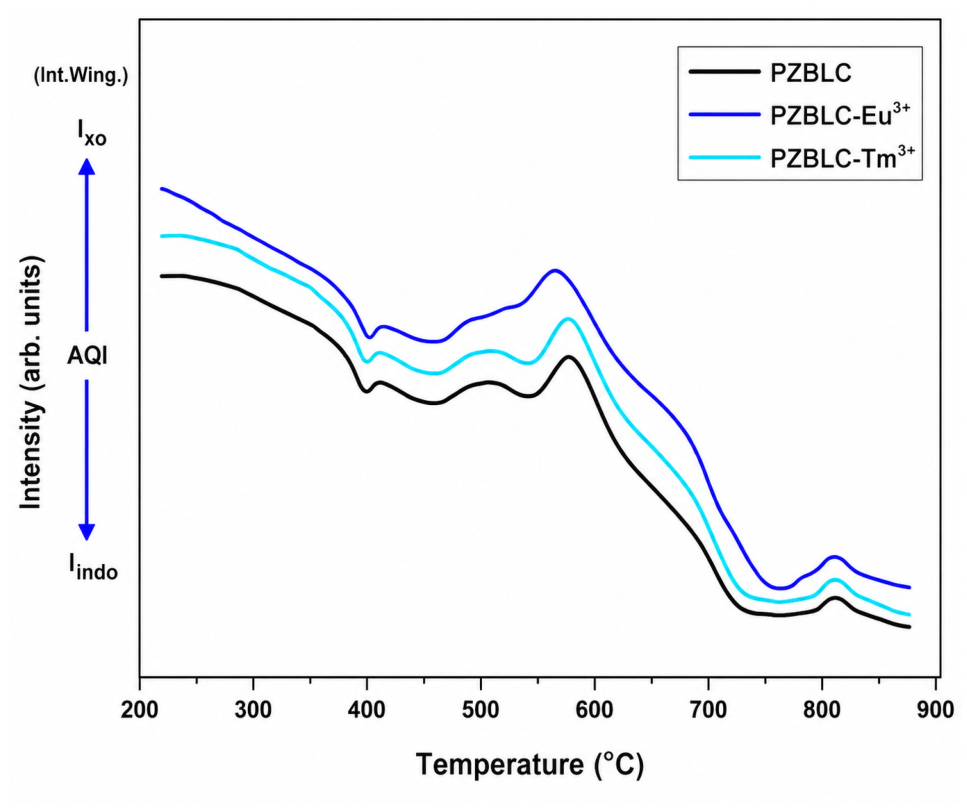
As shown in Figure 3, the DTA curves were employed to evaluate the glass transition temperature (Tg), the onset of crystallization temperature (Tx), and the peak crystallization temperature (Tp) of the synthesized glasses. The thermal stability of the glasses is often measured using the criteria ΔT= Tx − Tg. As ΔT increases, anti-crystallization performance improves. The results are summarized in Table 2. The glass transition temperature (Tg) ranges from 360 to 376 °C, while the crystallization temperature (Tx) lies between 434 and 455 °C. The thermal stability parameter (ΔT = Tx − Tg) varies from 74 to 79 °C. Finally, the specific heat capacity (Cp) ranges from 0.237 to 0.361 J·mol−1·K−1. The high thermal stability indicates that the fabricated glasses exhibit lower crystal nucleation and a lower growth rate during fiber-drawing reheating. Furthermore, glasses studied have a suitable Tg, indicating a high resistance to thermal damage. The increase in ΔT indicates that the glasses incorporating Eu3+/Tm3+ ions exhibit enhanced thermal stability, thereby providing stronger resistance to nucleation and crystallization compared to the undoped glass. In contrast, the rare-earth-free glass, which exhibits the lowest ΔT value, demonstrates reduced thermal stability and a greater tendency toward crystallization. Notably, the incorporation of Eu3+ and Tm3+ ions significantly affects the thermal properties of the 40P2O5–30ZnO–10BaF2–18LiCl–2.0Cd (PZBLC) glass system, leading to an increase in glass transition temperature (Tg) and enhanced thermal stability.
Figure 3.
DTA curve of PZBLC, PZBLC-Eu3+, PZBLC-Tm3+.
Table 2.
The glass transition temperature (), glass onset temperature (), and thermal stability () of fabricated glasses.
This enhancement may be related to stronger rare-earth–oxygen interactions and structural rearrangements within the phosphate network. The higher field strength of the rare-earth ions may contribute to increased network rigidity, thereby strengthening the glass structure and inhibiting crystallization processes. This behavior can also be explained by factors related to the strength and nature of the chemical bonds formed with oxygen atoms. The incorporation of rare-earth ions leads to the formation of relatively strong and predominantly ionic Eu–O and Tm–O bonds in the PZBLC–Eu and PZBLC–Tm glasses, respectively. These stronger ionic interactions increase network rigidity and reduce structural mobility. As the rigidity of the glass network increases, a higher energy input is required to convert the rigid structure into a viscoelastic state, resulting in a glass transition at a raised temperature. Depending on the rare-earth oxide concentration and the composition of the glass matrix. RE3+ ions may enter the phosphate network and participate in the formation of P–O–RE–O–P linkages, although direct structural evidence is not available in the present study. These bonds, which may exhibit varying degrees of ionic or covalent character, act as ionic cross-links (P–O–RE), thereby reinforcing the glass structure and enhancing its thermal stability.
3.3. Optical and Spectroscopic Properties
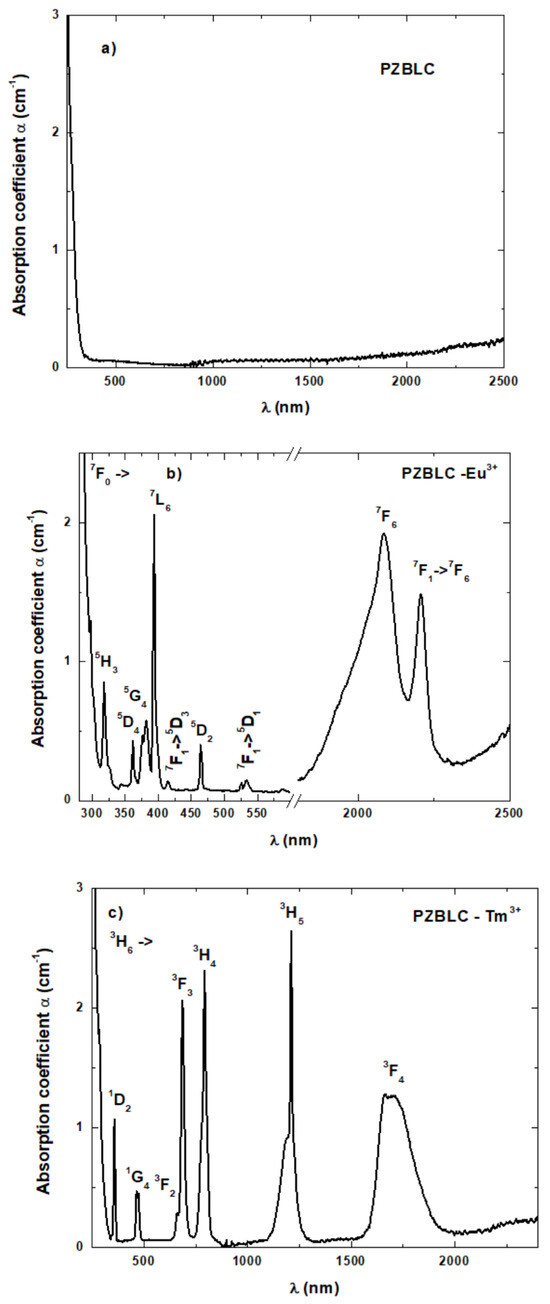
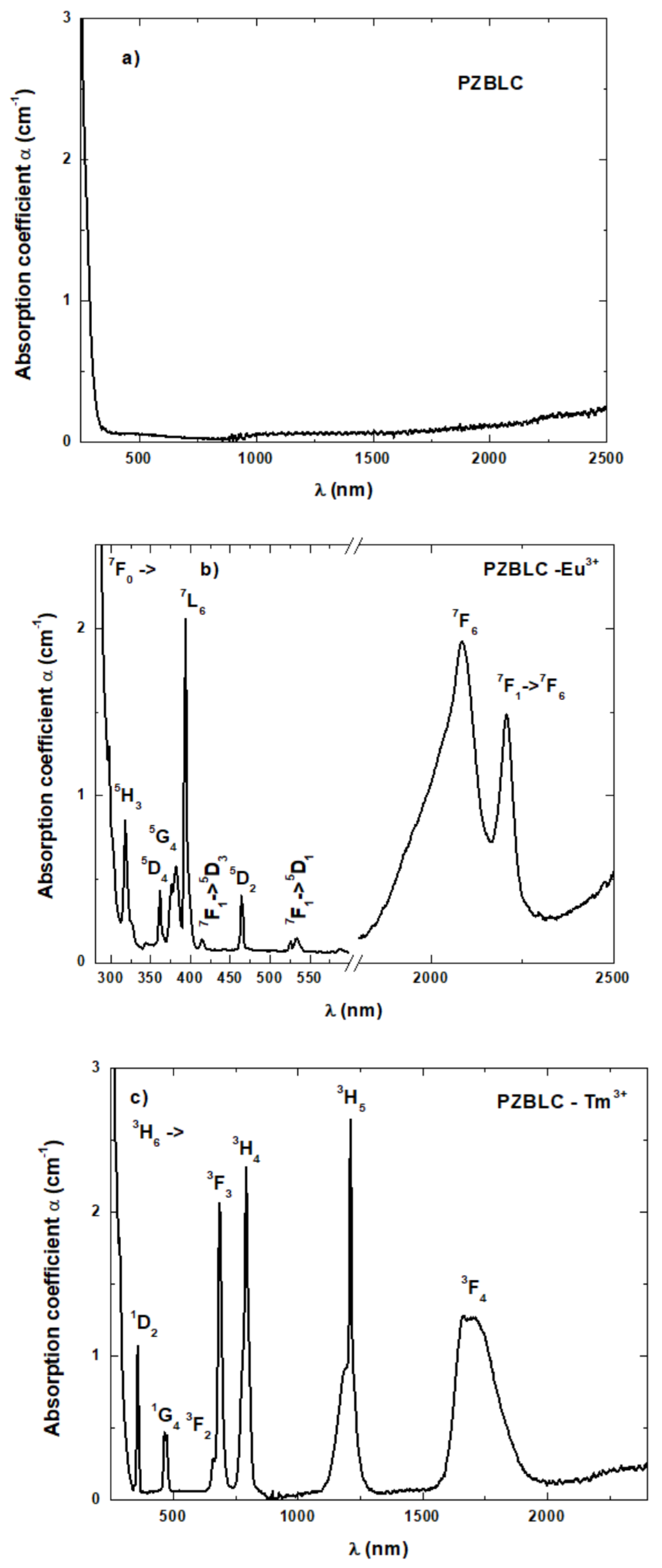
Optical absorption measurements provide insight into the electronic transitions of glass materials. As shown in Figure 4a, the undoped PZBLC glass exhibits no significant absorption bands. In contrast (Figure 4b), the Eu2O3-doped glass (PZBLC–Eu3+) displays well-defined peaks corresponding to Eu3+ electronic transitions: 7F0 → 5D4 (362 nm), 7F0 → 5G4 (381nm), 7F0 → 6L5 (397 nm), 7F1 → 5L6 (414 nm), 7F0 → 5D2 (465 nm), 7F1 → 5D1 (533 nm), and 7F1 → 7F6 (2080 and 2206 nm). These observations are consistent with previous studies [7,12,16,21], confirming the introduction of Eu3+ ions into the phosphate glass network. The UV-Vis-NIR absorption spectra of fabricated glasses PZBLC- (see Figure 4c) exhibits peaks attributed to excited transition levels from 3H6 → 1D2 (356 nm), 3H6 → 1G4 (470 nm), 3H6 → 3F3 (688 nm), 3H6 → 3H4 (787 nm), 3H6 → 3H5 (1210 nm) and 3H6 → 3F4 (1726 nm), which is similar to many other phosphate and fluorophosphate glasses doped with Tm3+ [34]. The incorporation of halide-containing oxides such as LiCl and BaF2, along with CdO, serves to enhance the ionic character of the host–ligand environment. This increases the crystal field strength of the Tm3+ 3H4 → 3F4 transition, thereby promoting near-infrared (NIR) emissions, as will be demonstrated later for the fabricated Tm3+-doped glass [23,35,36].
Figure 4.
UV-Vis-NIR absorption spectra of fabricated glasses: (a) PZBLC, (b) PZBLC-Eu3+, (c) PZBLC-Tm3+.
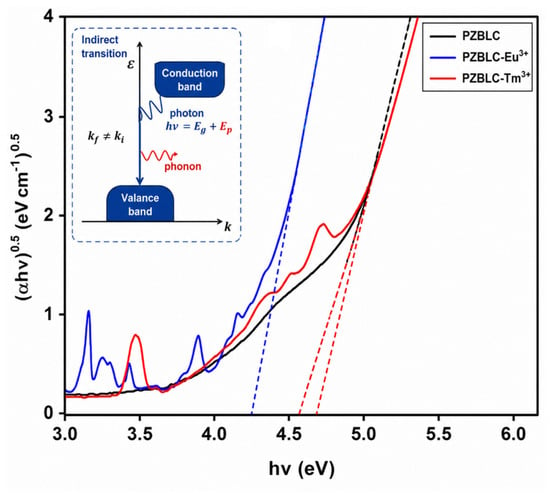
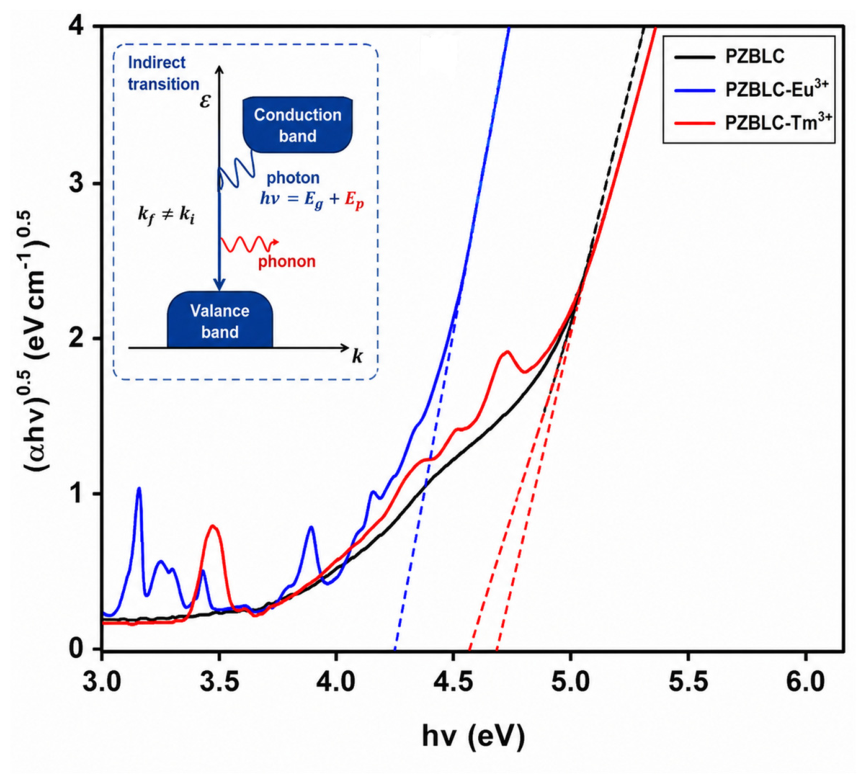
It is well established that, in insulators and semiconductors, the band gap represents the energy difference between the conduction band minimum and the valence band maximum. Based on the UV–Vis absorption spectra of all three samples, the optical band gap (Eopt) was evaluated using the model proposed by Tauc [37], according to the relation:
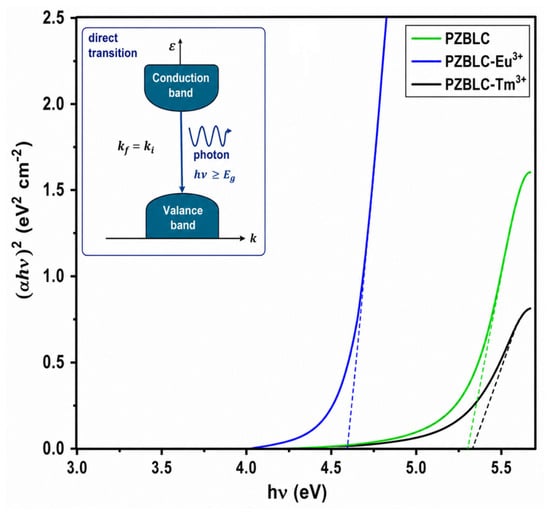
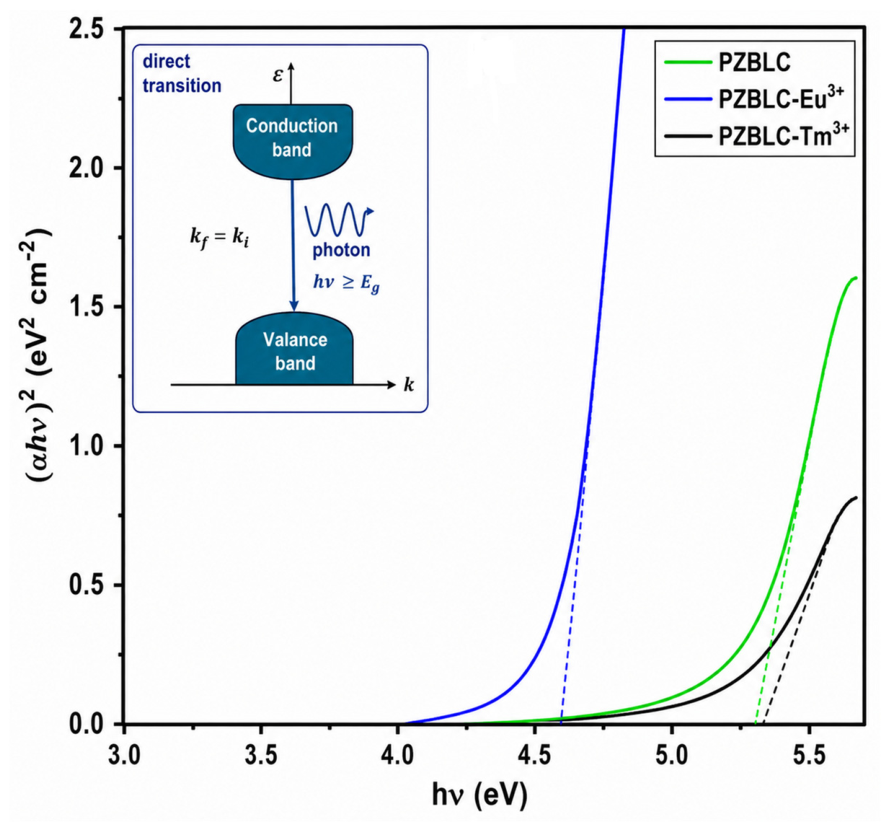
In this equation, B represents a constant often referred to as the band tailing parameter, r denotes the exponent related to the type of electronic transition, and Eg corresponds to the energy gap. The value of indicates the nature of the electronic transition: for direct allowed transitions, : for direct forbidden transitions: : for indirect allowed transitions: and for indirect forbidden transitions: . The value of the indirect optical energy gap,, and direct optical gap, , were determined by using the absorption coefficient (α) and the photon energy (hν), which are illustrated in Figure 5 and Figure 6. The results obtained are listed in Table 3 and show that the value of is in the range (4.236 to 4.749 eV) and within (4.639–5.320 eV). The glass (PZBLC) doped with has the lowest value of both and other than the (PZBLC) glass, which has the highest value. The undoped 40P2O5–30ZnO–10BaF2–18LiCl–2.0Cd glass exhibits the highest optical energy gap, whereas the glass doped with 35,000 ppm Eu2O3 (PZBLC–Eu3+) shows the lowest optical energy gap. Moreover, when the replacement of Eu3+ ions by Tm3+ led to an increase in the value of from 4.236 to 4.663 eV and from 4.638 to 5.291 eV. This behavior suggests that the measured enhancement in the optical energy gap of the Tm3+ ion is due to a structural modification.
Figure 5.
Variation of (αhυ)0.5 vs. hυ (eV) of fabricated glasses.
Figure 6.
Variation of (αhυ)2 vs. (hυ) of fabricated glasses.
Table 3.
Direct optical energy gap, , indirect optical energy gap, , , and in eV of fabricated glasses.
The observed reduction in the optical band gap may be associated with modifications of the local electronic structure and changes in the glass network. The optical energy gap is primarily determined by the energy level of the upper valence band edge, which depends on the separation of the oxygen-related states. The lower optical band-gap value observed for the Eu3+-doped glass may indicate increased electronic delocalization or modifications of the local bonding environment.
The higher optical band gap observed for the Tm3+-doped glass may be consistent with a different modification of the glass network and local electronic environment.
Occupation of such sites strengthens the cross-linking density of the glass network, reduces the NBO population, and consequently leads to higher values of both and .
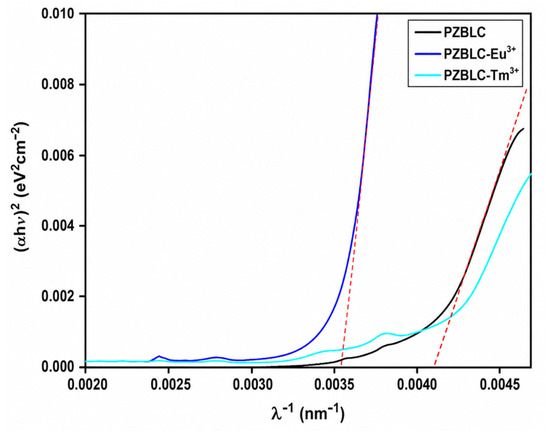
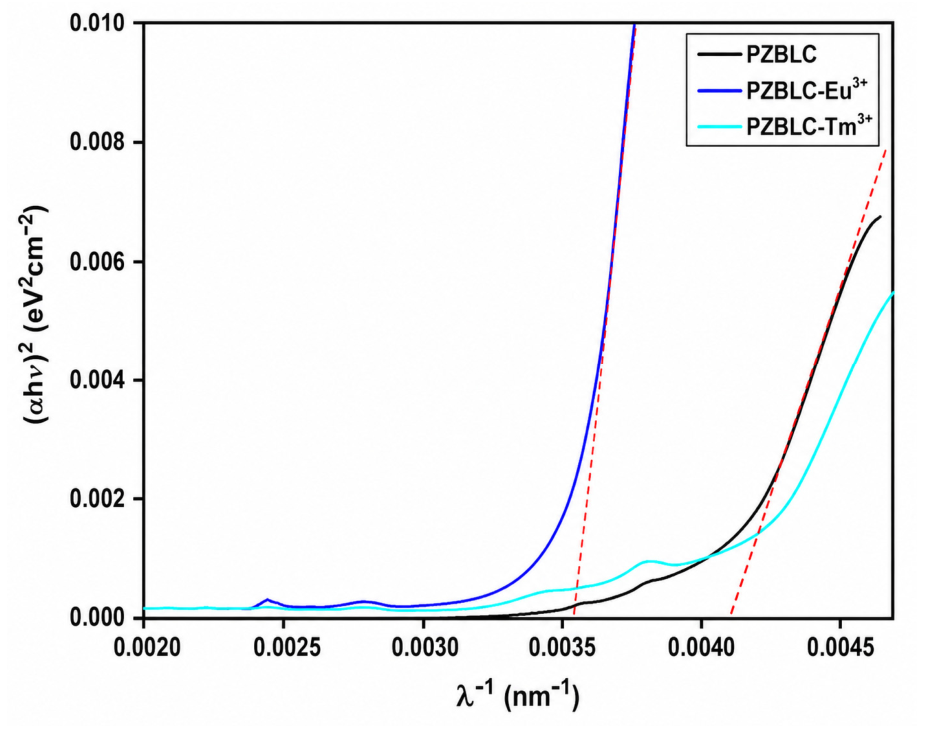
Furthermore, the absorption spectrum fitting (ASF) method proposed by Escobar-Alarcón et al. [38] and Souri and Shomalian [39] was applied, in which the optical energy gap can be calculated directly from the absorption spectra without requiring knowledge of the sample thickness or preparation as a thin film. For all samples, is determined using the following equation:
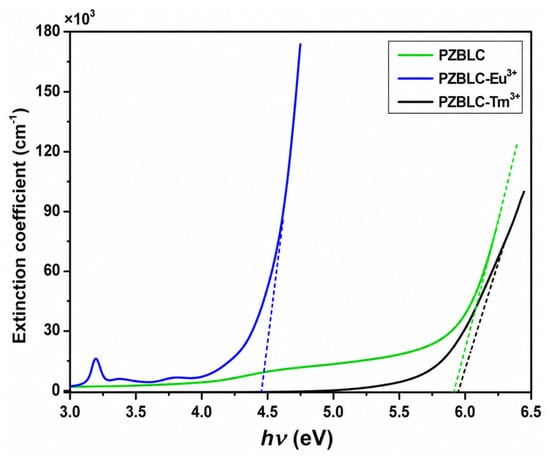
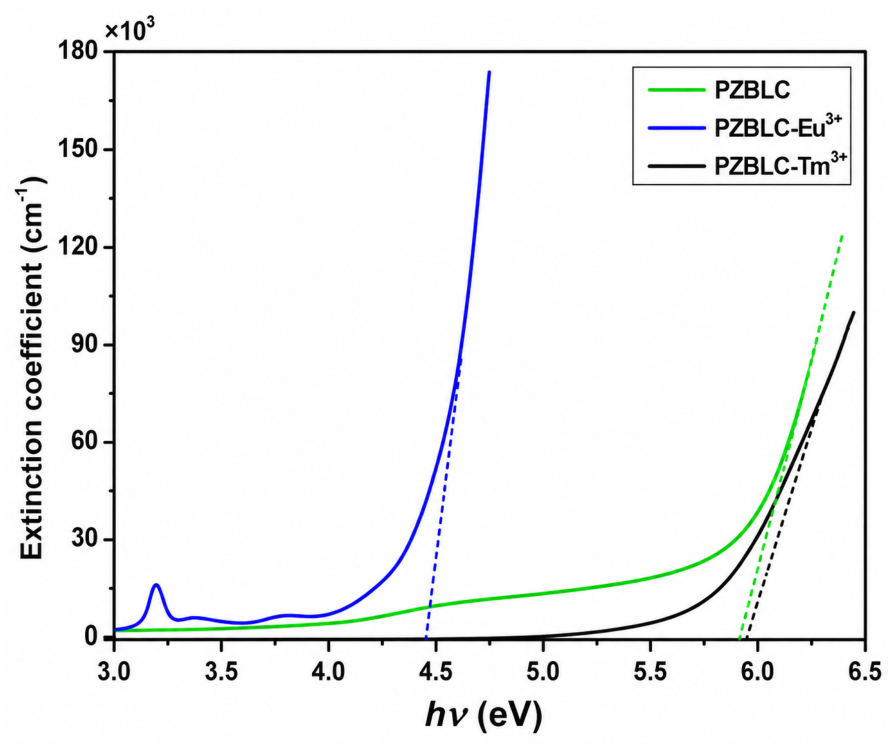
where represents the wavelength corresponding to . Figure 7 exhibits the plots of versus (with denoting absorbance) used to estimate for by extrapolating the linear portion of the curves to . The resulting values of , λg, and (in eV) for all synthesized glasses, obtained via the ASF method, are summarized in Table 3. Following this, the relationship between the absorption coefficient (α) and the extinction coefficient (κ) was employed as described in [40]:
the experimental optical energy gap for all three samples was estimated via extrapolation of the linear portion of the κ versus photon energy (hν) plot to Figure 8 shows the versus hν plots for all three glasses, and the corresponding values are summarized in Table 3. In conclusion, the values of and , for the fabricated glasses, follow the same trend as and (see Table 3). The fabricated glass with composition 40P2O5-30ZnO-10BaF2-18LiCl-2.0CdO has the highest optical energy gap, making it a superior medium for doping with rare-earth ions to obtain a solid-state laser source. For numerous amorphous semiconductors, the absorption coefficient (α) exhibits an exponential increase with photon energy (hν) near the optical absorption edge, following the Urbach rule [41]:
Figure 7.
Variation of (aλ−1)0.5 vs. (λ)−1 of fabricated glasses.
Figure 8.
Variation in Extinction coefficient (k) vs. hυ (eV) of fabricated glasses.
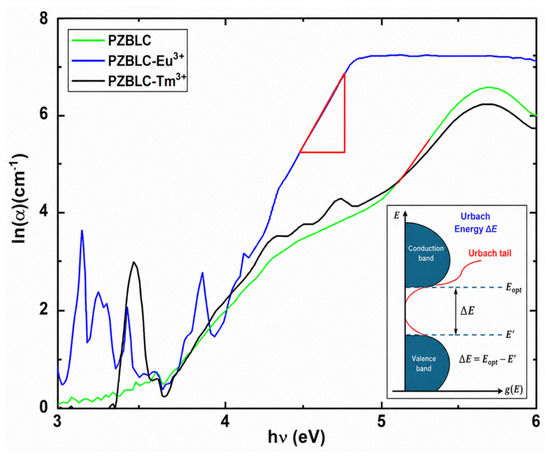
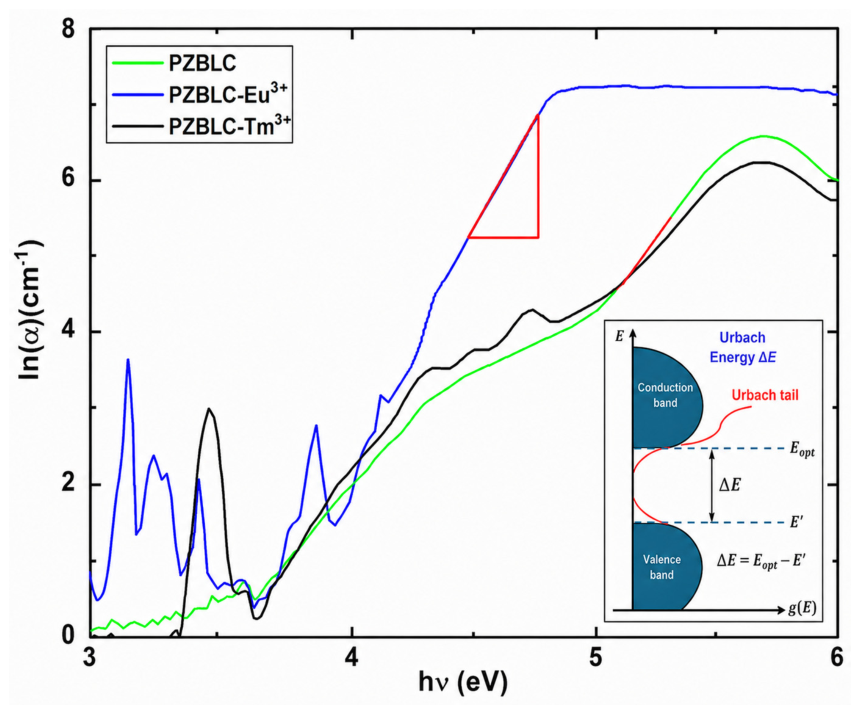
In this expression, α0 is a constant, and ΔE represents the Urbach energy, which quantifies the width of the band tails associated with localized states within the band gap. This parameter reflects transitions involving localized tail states adjacent to the valence and conduction bands that extend into the band gap. ΔE can be determined from the inverse of the slopes of the linear regions in plots of ln(α) versus hν. Figure 9 presents the Urbach plots for all three glass samples, and the corresponding ΔE values obtained from these plots are summarized in Table 3.
Figure 9.
Plot of ln(α) vs. hυ of fabricated glasses.
As is well established, the Urbach energy provides insight into the degree of structural order or disorder in amorphous materials. The observed decrease in Urbach energy (ΔE = 0.155 eV) for the PZBLC–Eu3+ glass can be attributed to a reduction in network depolymerization caused by Eu2O3 doping, which in turn lowers the extent of structural disorder and the concentration of lattice defects. In contrast, the PZBLC–Tm3+ glass exhibits an increased Urbach energy (ΔE = 0.288 eV) upon incorporation of Tm2O3, indicating an increase in the degree of disorder within the glass matrix. These variations depend on the type, nature, and concentration of the introduced trivalent cations (Eu2O3 or Tm2O3), which modify the glass structure and lead to localized band-tail states in the optical gap, thereby altering the value of ΔE. The Urbach energy results indicate differences in the degree of structural disorder introduced by Eu3+ and Tm3+ ions. However, owing to the absence of direct structural characterization, these changes cannot be unambiguously correlated with specific variations in NBO concentration or network connectivity. The observed variations are therefore discussed in terms of modifications of the local electronic and structural environment induced by the rare-earth ions.
In glassy materials, the refractive index is a key parameter that critically affects the performance and reliability of optical devices. In the present study, the refractive index of the glasses synthesized was estimated using the models proposed by Moss [42], Dimitrov–Sakka (D–S) [41], and Reddy et al. [43]. The empirical relationships linking the refractive index to the optical band gap energy are expressed as follows:
- Moss model:
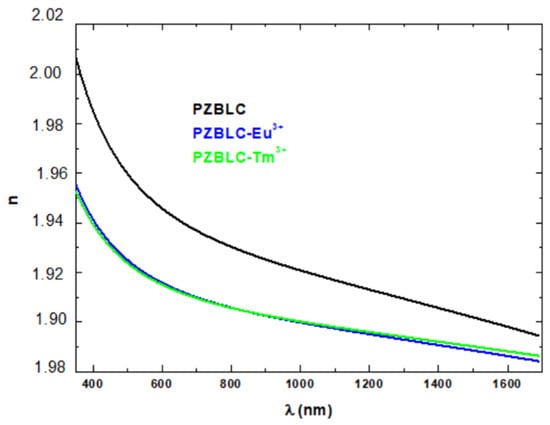
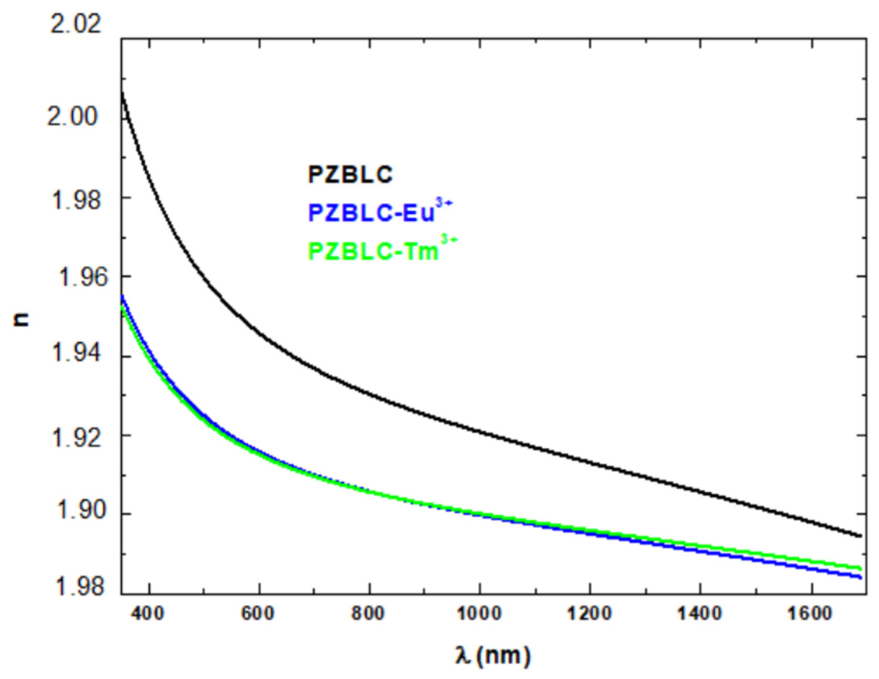
The refractive index values obtained from the experimental measurements and the theoretical models, namely the Moss model , Dimitrov–Sakka model , and Reddy model , are presented in Table 4. The values, , , and of PZBLC, PZBLC-Eu3+ and PZBLC-Tm3+ follow the same trend across all samples (see Table 4). Among the fabricated glasses, PZBLC–Eu3+ exhibits the highest refractive index (), whereas the undoped PZBLC glass has the lowest value (). This behavior is generally observed to follow an inverse trend with the optical energy gap. The refractive index of a glass is affected by several factors, including its density, the polarizability of nearest-neighbor anions, the coordination number of the cations, the intrinsic electronic polarizability of oxide ions, and the optical basicity of the glass network. The experimentally measured refractive indices for PZBLC, PZBLC–Eu3+ and PZBLC–Tm3+ glasses were found to be 1.946, 1.916, and 1.910, respectively (Figure 10). In contrast, the theoretical models generally predicted higher refractive-index values.
Table 4.
Linear refractive index, Moss model, nmos, Dimitrov–Sakka Model, nDS, Reddy Model, nRD, -measured spectroscopic parameters, Ωλ ( = 2, 4, 6), the value of the root mean square deviation δRMS of fabricated glasses.
Figure 10.
Refractive index dispersion of Eu3+ and Tm3+-doped glass samples in the BZBLC system.
The differences between the measured refractive index () and the theoretical values (, , ) arise because each model is based on different assumptions about the electronic structure and optical behavior of the glass [44].
The measured refractive index reflects the real optical response of the glass network. A noticeable difference between the experimentally measured and theoretically estimated refractive indices was observed for all investigated glass samples. Among the theoretical approaches, the Moss model yielded the highest refractive-index values, ranging from 2.115 to 2.176. This overestimation can be attributed to the fundamental assumptions of the Moss relation, which correlates the refractive index with the optical band gap. The Moss model was originally developed for crystalline semiconductors and assumes that the electronic polarization is primarily governed by the band-gap energy. However, phosphate-based glasses possess a highly disordered amorphous structure containing non-bridging oxygens, mixed ionic environments, and local structural heterogeneity. The Dimitrov–Sakka model produced comparatively lower values than the Moss model but still overestimated the measured refractive index. This model relates the refractive index to oxide-ion polarizability and optical band gap. Since phosphate glasses containing halides such as BaF2 and LiCl exhibit complex mixed-anion environments, the assumption of uniform electronic polarization becomes less accurate. Furthermore, the incorporation of Eu3+ and Tm3+ ions introduces localized 4f electronic states and modifies the local field environment, which cannot be completely accounted for within the simplified theoretical framework. Among all theoretical approaches, the Reddy model exhibited the closest agreement with the experimental refractive-index values. For the undoped PZBLC glass, the calculated value exactly matched the experimental result ( = = 1.946), while only small deviations were observed for the rare-earth-doped samples. The improved agreement is likely due to the semi-empirical nature of the Reddy model, which incorporates parameters associated with glass density, molar volume, and structural disorder, making it more suitable for amorphous phosphate glass systems. The lower experimental refractive-index values compared with the theoretical predictions can also be explained by the presence of halide components (BaF2 and LiCl), which reduce the overall electronic polarizability of the glass matrix.
In our previous studies [39,40,41], the Judd–Ofelt (JO) theory was successfully employed to determine the spectroscopic parameters, Ωλ (λ = 2, 4, 6), for rare-earth-ion-doped glass matrices. In the work reported here, these parameters were determined for PZBLC–Eu3+ and PZBLC–Tm3+ glasses, which depend on both the type of rare-earth ion and the host glass composition [45]. The results presented in Table 5 and Table 6 show the oscillator strengths of Eu3+ and Tm3+ ions in the investigated glass matrix. The obtained values were determined using the same methodology as that reported in Ref. [46].
Table 5.
Experimental and calculated values of the oscillator of electron transition of Eu3+ ions in PZBLC glasses from the P2O5–ZnO–BaF2–LiCl–CdO system.
Table 6.
Experimental and calculated values of the oscillator strength of the electron transition of Tm3+ ions in PZBLC glasses from the P2O5–ZnO–BaF2–LiCl–CdO system.
For PZBLC–Eu3+ glasses, the JO parameters follow the trend Ω2 > Ω4 > Ω6, whereas for PZBLC–Tm3+ glasses, the trend is Ω2 > Ω4 > Ω6 the same [47,48]. The relatively large value of Ω2 in PZBLC–Tm3+ indicates a stronger covalent character of Tm–O bonds and lower site symmetry around the Tm3+ ions. Furthermore, the Ω2 value of PZBLC–Eu3+ is larger than that of PZBLC–Tm3+, suggesting that Eu–O bonds exhibit a stronger covalent character within the same host glass matrix. For sample PZBLC-Eu3+, the highest oscillator strengths are observed for the hypersensitive transitions: 7F0 → 5L6 and 7F0 → 5D2, indicating an asymmetric and partially covalent local environment around the Eu3+ ions in the glass matrix.
Based on the presented experimental () and calculated () oscillator strengths for the electronic transitions of Eu3+ ions in the investigated glasses, an excellent agreement between the experimental and theoretical oscillator strength values can be observed. This finding confirms the validity of the applied Judd–Ofelt (J–O) model as well as the high quality of the intensity parameter fitting procedure. The differences between the and values remain very small for all analyzed transitions, indicating that the obtained Ω2, Ω4, and Ω6 parameters accurately describe the optical behavior of the Eu3+ ion system embedded in the PZBLC glass matrix. Particularly good agreement is observed for the intense absorption transition: 7F0- > 5L6, for which the oscillator strengths and indicate only a minor fitting deviation and therefore demonstrate the high reliability of the theoretical calculations. This transition exhibits the highest oscillator strength among all analyzed transitions. Similar behavior has been reported for modern lanthanide-doped phosphate glasses, where intense electric-dipole transitions were attributed to enhanced asymmetry of the local ligand field and to the partially covalent character of RE–O bonds [49].
The presence of phosphate and halide constituents within the P2O5–ZnO–BaF2–LiCl–CdO glass matrix contributes to the reduction in the phonon energy of the host material, thereby suppressing non-radiative relaxation processes and enhancing luminescence efficiency. Such low-phonon glass systems are considered particularly favorable for rare-earth-doped photonic applications due to their ability to improve radiative emission probabilities and prolong excited-state lifetimes. Furthermore, the literature emphasizes that Judd–Ofelt parameters are highly sensitive to the local chemical structure of the glass network [50]. Studies on rare-earth-doped phosphate glasses have demonstrated that an increase in the asymmetry surrounding rare-earth ions leads to higher Ω2 values and enhanced hypersensitive transition intensities. An analogous phenomenon can be observed in the investigated PZBLC glass system, where the relatively high oscillator strengths of Eu3+ transitions suggest that europium ions occupy sites of low local symmetry and are strongly coupled to the glass network.
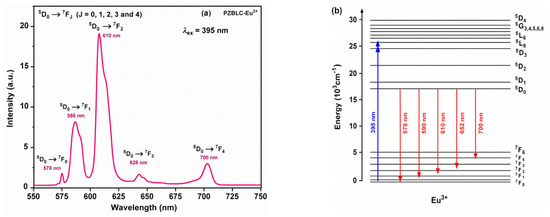
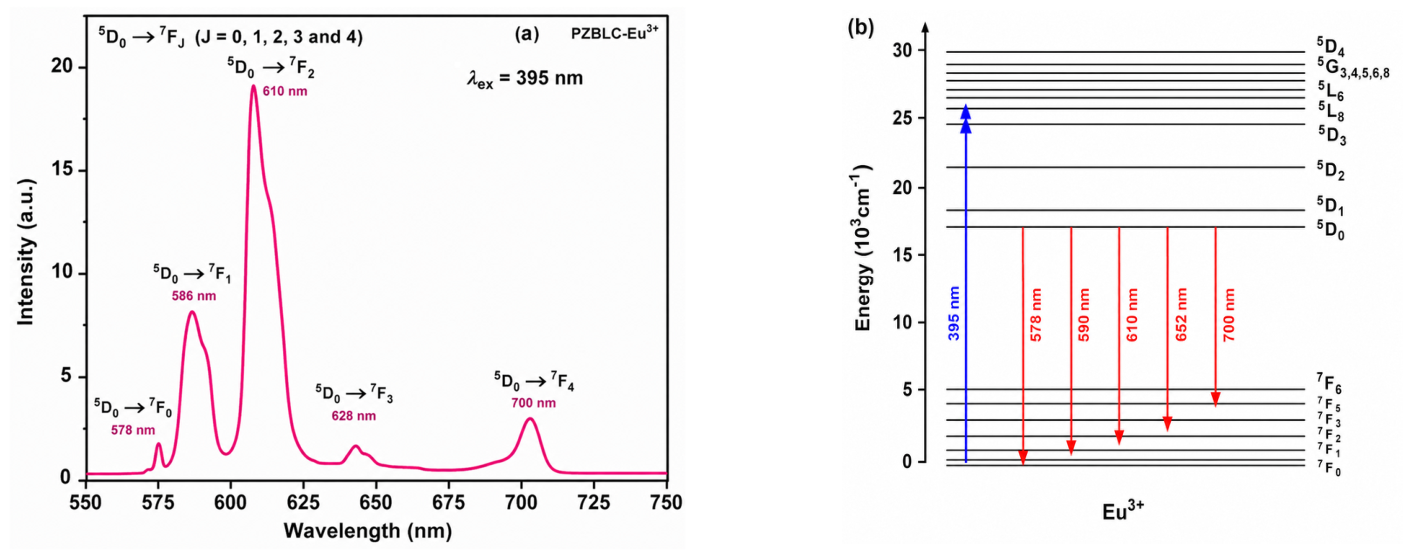
The room-temperature emission spectrum of the fabricated PZBLC–Eu3+ glass is shown in Figure 11a. The spectrum exhibits characteristic Eu3+ emission bands corresponding to the 5D0 → 7FJ transitions (J = 0, 1, 2, 3, 4), specifically: 5D0 → 7F0 (578 nm), 5D0 → 7F1 (590 nm), 5D0 → 7F2 (610 nm), 5D0 → 7F3 (652 nm), and 5D0 → 7F4 (700 nm). These transitions are attributed to Eu3+ ions in the glass matrix. The corresponding energy-level diagram of these transitions is presented in Figure 11b. As a result, the PZBLC–Eu3+ glasses exhibit intense red luminescence at room temperature. We note that the fabricated glass, PZBLC-Eu3+, exhibits intense brightness and orangish-red luminescence at 590–720 nm, corresponding to the 5D0 → 7F2 transition. This material may find potential applications in LEDs and field-emission devices, owing to its high luminescence efficiency, characterized by narrow monochromatic emission around 610 nm and a long radiative lifetime of PZBLC–Eu3+ (τ= 2590 μs, see Figure 13). These fabricated glasses may be used in therapeutic and clinical applications, as they exhibit maximal absorption bands suitable for photosensitizer activation.
Figure 11.
Visible emission spectra of rare earth doped samples (a) PZBLC-Eu3+, (b) Energy diagram of PZBLC-Eu3+.
The visible luminescence emission spectrum of the ion is characterized by the transitions (j = 0 to 6) from the exited state to the J levels of the ground state term . In particular, the most intense emission peak is around 610 nm (electrical dipole transition that ensures a red luminescence. The magnetic dipole transition (590 nm) is independent of the symmetry of the local environment. Many studies have investigated the factors influencing specific luminescence in glasses, particularly the role of glass composition [51]. These studies concluded that incorporating cations of lighter elements into the host glass enhances the red fluorescence associated with the 5D0 → 7F2 transition by facilitating cross-relaxation processes between Eu3+ ions. However, at high Eu3+ concentrations, these same processes can lead to fluorescence quenching. Babu et al. [16] investigated the optical absorption and photoluminescence behavior of Eu3+ ions in phosphate and fluorophosphate glasses. They found that a larger value of the intensity parameter Ω2 signifies the hypersensitive character of the 5D0 → 7F2 transition, suggesting that Eu3+ ions reside in a highly polarizable environment within the glass matrix. Furthermore, the addition of BaF2 to the phosphate glass reduced the non-radiative decay rate, causing a slight enhancement in quantum efficiency. However, modifying the phosphate glass with BaF2 did not result in a significant change in the experimentally measured lifetime.
In fluoroaluminate glass matrices, the highly ionic character imparted by fluorine ligands has been observed to stabilize the Eu3+ ions, resulting in an extended fluorescence lifetime of approximately 7.0 ms [52]. Increasing the concentrations of in phosphate and zinc fluorophosphate glasses might increase the intensity of absorption and emission, while the fluorescence lifetime or decay rate was independent of concentrations, although it does depend on the host material and the probability of non-radiative energy transfer between ions [17,52].
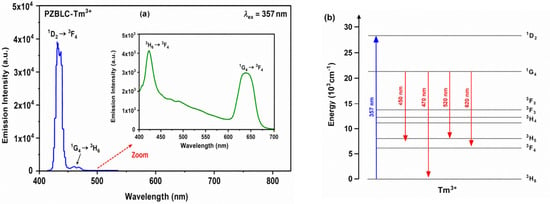
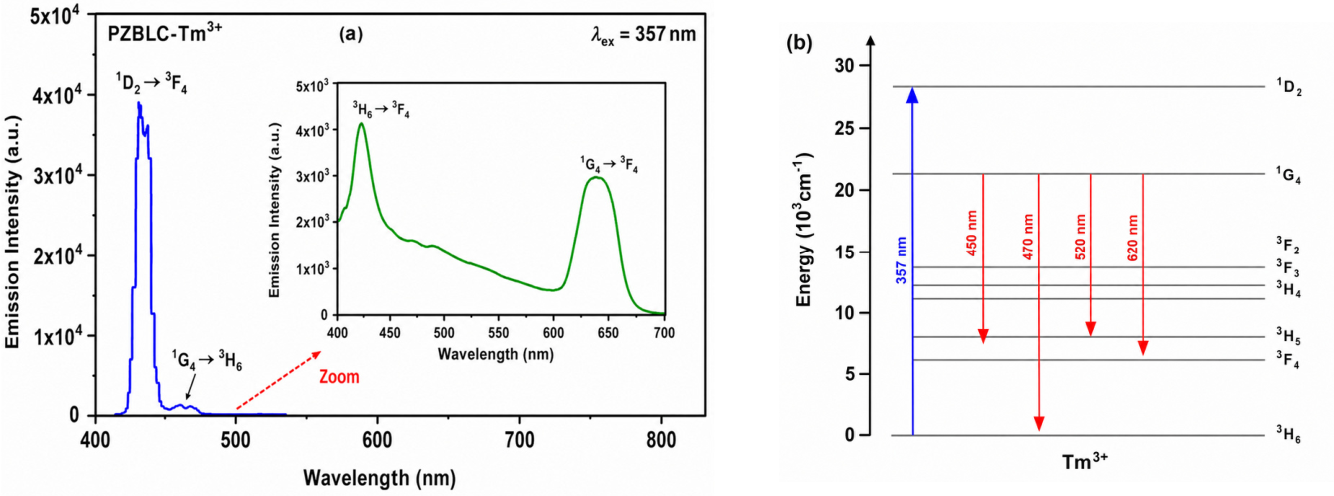
The photoluminescence (PL) emission characteristics of the fabricated PZBLC glasses doped with Tm3+ ions, shown in Figure 12a, were measured at an excitation wavelength of 357 nm, revealing four emission bands as follows: two in blue 1D2 → 3F4 (450 nm) and 1G4 → 3H6 (476 nm), green 1D2 → 3H5 (520 nm), and red 1G4 → 3F4 (660 nm). The intensity of the emission transitions (1G4 → 3H6, 1D2 → 3H5, and 1G4 → 3F4) is low compared with that of the 1D2 → 3F4 transition, but the blue emission at 450 nm is very intense. The corresponding energy-level transitions in this glass are illustrated in the energy diagram shown in Figure 12b.
Figure 12.
Visible emission spectra of rare earth doped samples (a) PZBLC-Tm3+, (b) Energy diagram of PZBLC-Tm3+.
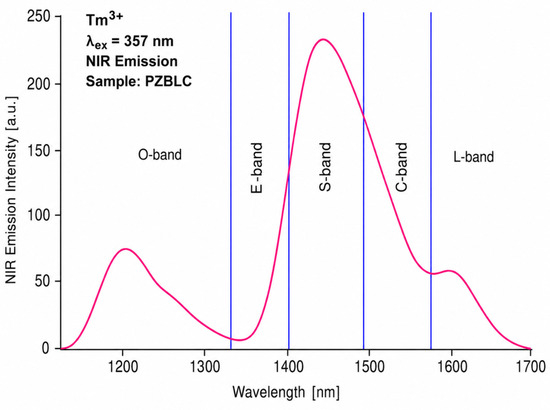
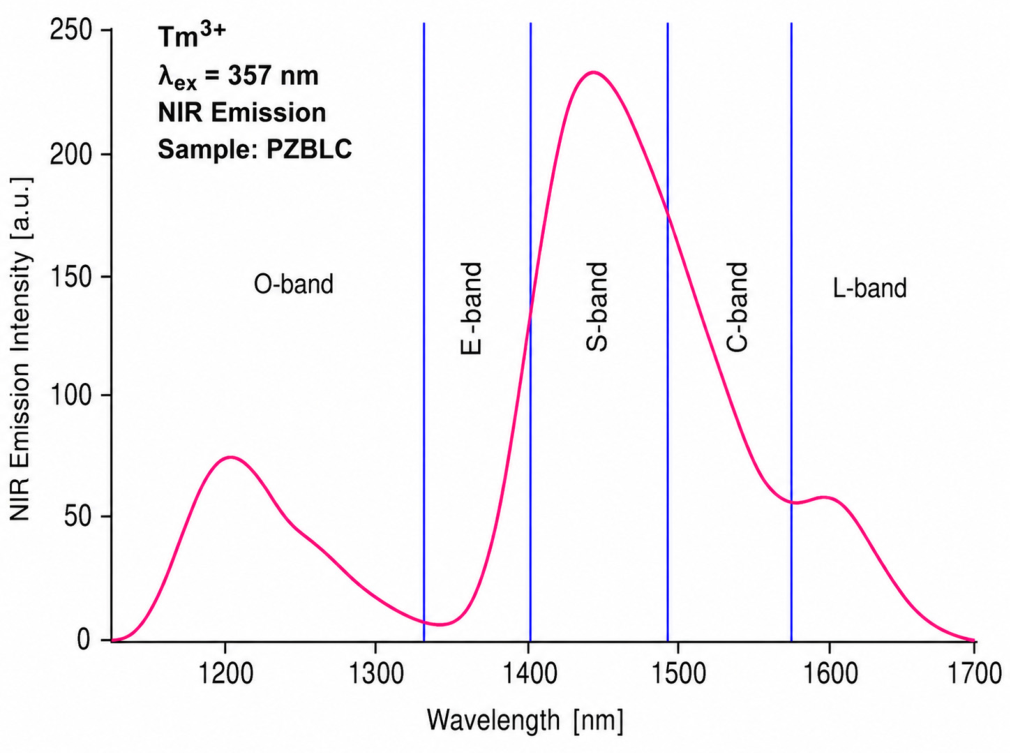
The near-infrared (NIR) luminescence spectra of the fabricated PZBLC–Tm3+ glasses were recorded under excitation at 357 nm and are shown in Figure 13. A broad NIR emission band is observed in the range of 1350–1700 nm. In these glasses, the strong local field around Tm3+ ions leads to pronounced splitting of the 3H6 → 3F4 transition, resulting in enhanced NIR emission and further broadening of the band. Consequently, the 3H6 → 3F4 transition spans from 1.35 μm to 1.7 μm, covering the E-, S-, C-, and L-bands for optical amplification, with an effective bandwidth of Δλeff = 141 nm, making it suitable for wavelength-division-multiplexed (WDM) communication applications. Wideband fiber amplifiers offer the advantage of operating in the NIR region, with emission shifted toward longer wavelengths, covering the C and L communication bands. Consequently, the fabricated PZBLC–Tm3+ glasses are well-suited for WDM systems, providing broad gain bandwidths and potentially reducing overall system costs. As shown in Figure 13, a strong and broad emission is observed at 1200 nm, corresponding to the 1G4 → 3H4 transition of Tm3+ ions. Additional overlapping emission bands are present at approximately 1452, 1514, and 1620 nm, assigned to the 3H4 → 3F4, 1G4 → 3F2, and 3F4 → 3H6 transitions, respectively. Therefore, the synthesized Tm3+-doped glasses are expected to exhibit up-conversion (UC) luminescence spanning multiple spectral regions, including red emissions , blue emissions , ultraviolet emissions , and near-infrared (NIR) emission under visible or near-infrared excitation. Such broadband UC emissions are of considerable interest for applications in color displays, optical data storage, underwater optical communication, visible lasers, and biomedical technologies.
Figure 13.
NIR-PL emission spectra of glasses PZBLC-Tm3+ under excitation at 357 nm.
In the fabricated glasses, the experimental lifetimes were previously determined by our research group using the same methodology [29], where
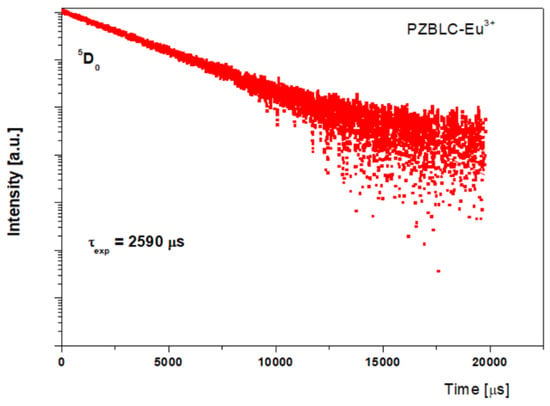
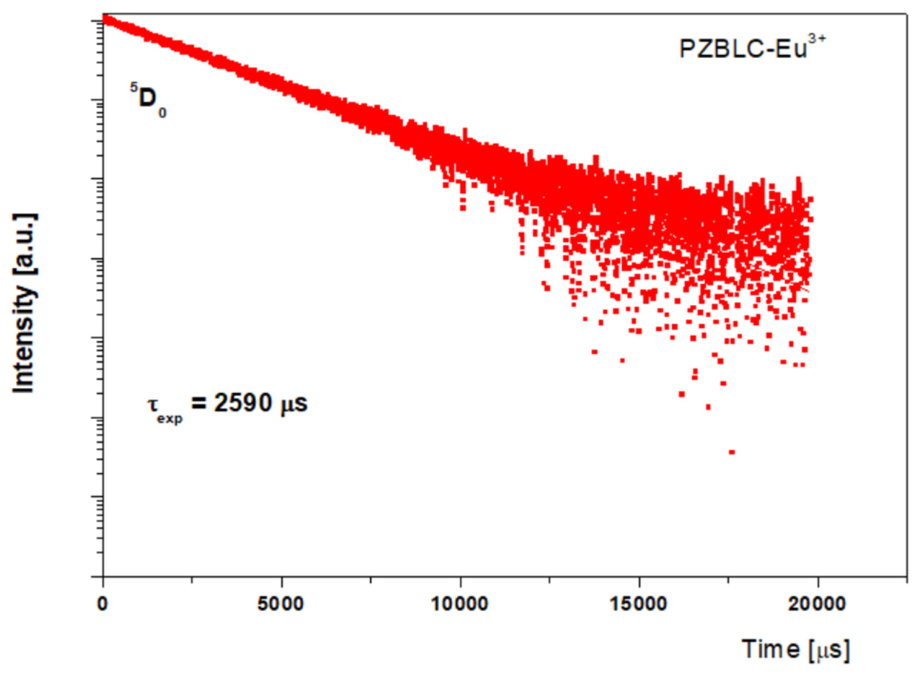
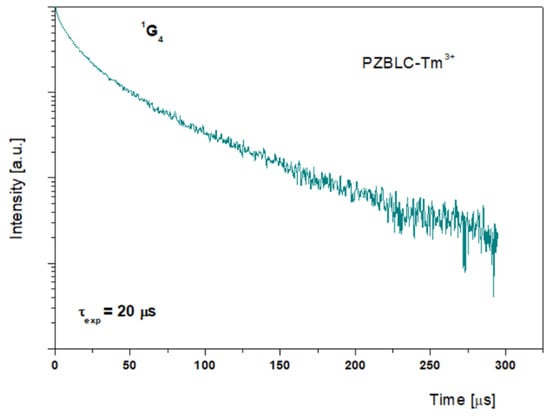
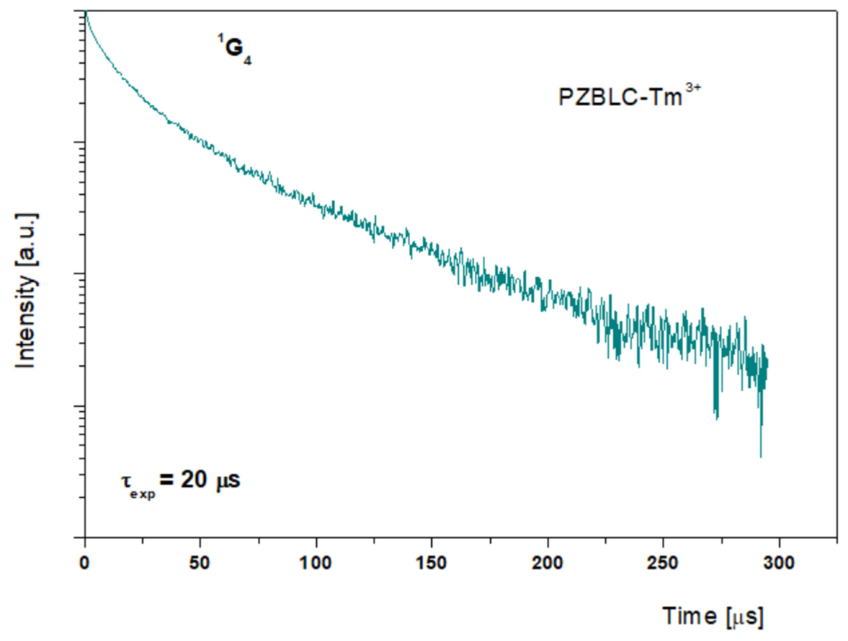
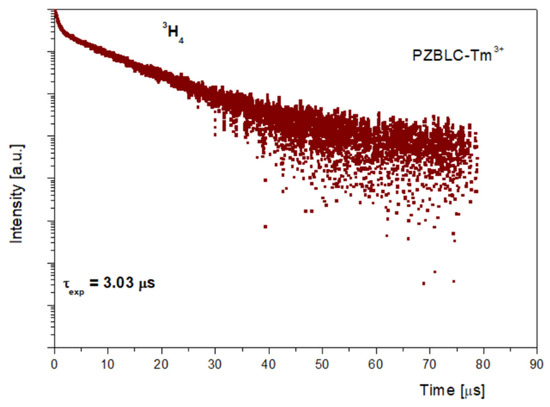
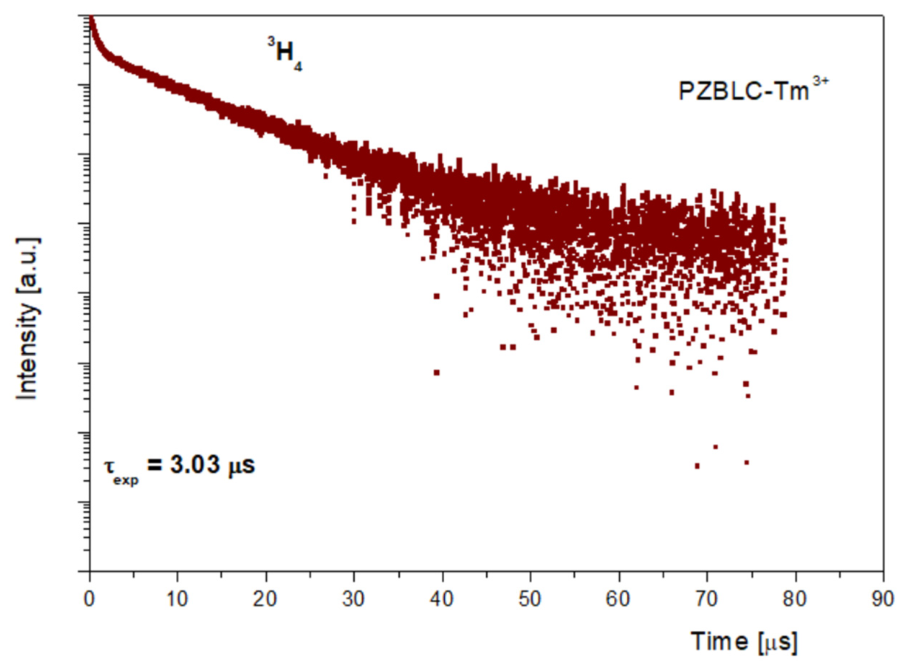
and the results are presented in Figure 14, Figure 15 and Figure 16. The radiative lifetimes estimated for the prepared glasses are as follows: τexp = 20 μs for the 1G4 level of PZBLC–Tm3+, τexp = 3.03 μs for the 3H4 level of PZBLC–Tm3+, and τexp = 2590 μs for the 5D0 level of PZBLC–Eu3+. It is well established that the presence of hydroxyl (OH) groups induces luminescence quenching via non-radiative relaxation pathways, which originate from O–H stretching vibrations in the frequency range of 3500–3900 cm−1 [53]. Consequently, lifetime measurements of the 5D0 excited state of Eu3+ ions can be employed to estimate the average number of water molecules coordinated in the first coordination sphere of the europium ion [54].
Figure 14.
Fluorescence decay lifetime level (5D0) of glass PZBLC-Eu3+.
Figure 15.
Fluorescence decay lifetime level (1G4) of glass PZBLC-Tm3+.
Figure 16.
Fluorescence decay lifetime level (3H4) of glass PZBLC-Tm3+.
The radiative lifetimes were presented in Table 7 for all investigated samples. Radiative lifetimes of the (5D0) level of Eu3+ ions were estimated to be approximately 4 ms, which is characteristic of phosphate-based glass systems. In conjunction with the experimentally determined lifetime of 2.59 ms, this result indicates a relatively high emission quantum efficiency. Furthermore, the comparison between the experimental and radiative lifetimes suggests a limited contribution of non-radiative relaxation processes and confirms the good optical quality of the glass matrix.
Table 7.
Lifetimes of the Eu3+ and Tm3+ emission bands in halidephosphate glasses determined experimentally (τexp) and those calculated within the Judd-Ofelt approach (τrad), along with quantum efficiencies (η = τexp/τrad).
The lifetime data of the excited states of Tm3+ ions reveal a significant contribution of non-radiative processes in the investigated glass system. This effect is particularly pronounced for the 1G4 level, for which the experimental lifetime was found to be only τexp = 20 μs, whereas the corresponding radiative lifetime was estimated to be τrad = 0.777 ms. Consequently, the emission quantum efficiency is very low, reaching only η = 2%. Such a substantial reduction in the experimental lifetime indicates the predominance of non-radiative relaxation mechanisms, including multiphonon relaxation, energy transfer between Tm3+ ions, concentration quenching, as well as quenching induced by OH− groups present in the glass matrix. The 1G4 state is a highly excited energy level and is therefore particularly susceptible to non-radiative losses in phosphate-based glasses, which are characterized by relatively high phonon energies.
Moreover, the 3H4 level plays a crucial role in near-infrared emission processes; therefore, such pronounced quenching of this excited state may significantly limit the laser and photonic potential of the investigated Tm3+-doped glass system.
Phosphate-based PZBLC glasses doped with Eu3+ ions represent promising materials for red visible-light emission under 395 nm excitation. Moreover, the investigated system exhibits a relatively high quantum efficiency of approximately 65%, indicating efficient radiative relaxation and favorable optical quality of the host matrix.
In contrast, PZBLC glasses doped with Tm3+ ions, excited at 357 nm, demonstrate broadband near-infrared (NIR) emission, which is suitable for optical amplification applications. However, the experimentally determined lifetimes are significantly shorter than the radiative ones, primarily due to strong multiphonon relaxation processes within the glass matrix. As a consequence, the overall luminescence efficiency is considerably reduced, which limits their applicability as efficient standard light sources.
The absorption cross-section (σₐ) of the doped rare-earth ions can be determined from the measured absorption spectrum according to the Beer-Lambert formula.
where I0 is the optical intensity, and I is the optical intensity throughout the sample. The emission cross-section is an interesting parameter related to laser performance. Using the McCumber theory [5,41], the stimulated emission cross section σe can be measured using the absorption cross section as follows:
Here, and indicate the distribution functions of the lower and upper states, respectively, with their ratio given as 1.488. denotes the temperature, is the Boltzmann constant, and , the zero-phonon line, corresponds to the wavelength associated with the transition between the lower Stark sublevels of the emitting state and those of the receiving state. In the present study, was taken as 1767 nm for the calculation of the emission cross-section [41].
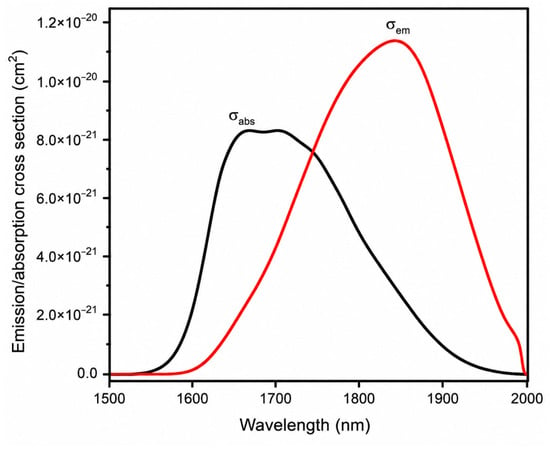
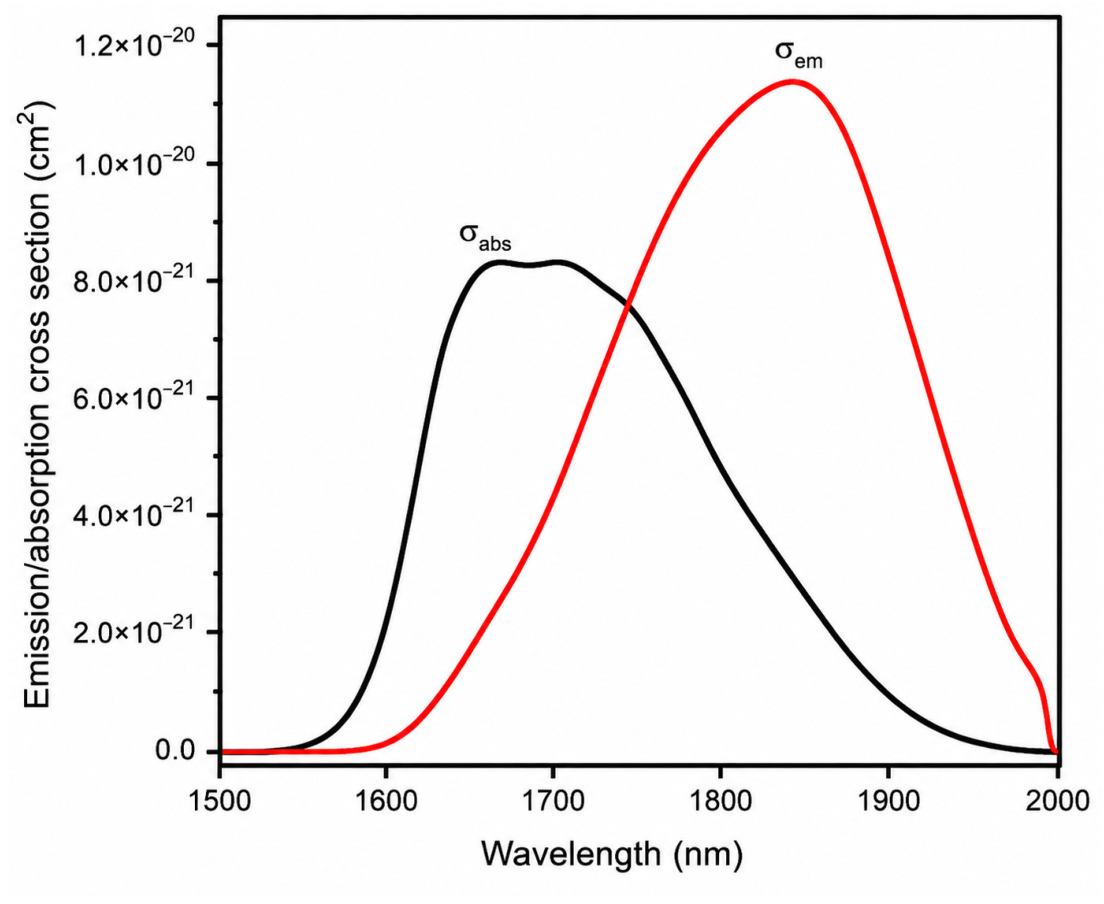
As shown in Figure 17, the maximum emission cross-section (σem) of the glass was determined at 1.84 μm, yielding a value of σem = 1.18 × 10⁻²⁰ cm2 with an effective bandwidth of Δλeff = 141.7 nm for the 3F4 → 3H6 transition, corresponding to near-infrared (NIR) emission. This transition is widely recognized as one of the most important radiative channels of Tm3+ ions for eye-safe laser systems and near-infrared photonic applications.
Figure 17.
Emission cross section, σem, and absorption cross section, σabs, of PZBLC-Tm3+ glasses.
The emission cross-section is an important spectroscopic parameter used to evaluate the gain bandwidth (GBW = σem × Δλeff), which is directly related to the tunability and amplification potential of laser materials. For the investigated glass, the gain bandwidth was calculated to be 16.7 × 10⁻²⁶ cm3.
A relatively large gain bandwidth is highly desirable for tunable and ultrashort-pulse laser systems because it supports broader emission spectra and wider wavelength tuning ranges. The obtained GBW value is comparable to those reported for several Tm3+-doped phosphate and fluorophosphate glass systems, suggesting that the fabricated PZBLC–Tm3+ glass is a promising candidate for near-infrared photonic applications [55,56].
The favorable spectroscopic performance may be associated with the mixed halide–phosphate glass matrix, which combines relatively low phonon energy with good rare-earth ion solubility and high optical transparency.
In addition, the presence of BaF2 and LiCl in the glass composition may contribute to reduced multiphonon relaxation rates, thereby supporting enhanced radiative transitions associated with the 3F4 → 3H6 emission band of Tm3+ ions near 1.8 μm. This near-infrared transition is widely recognized as an important emission channel for eye-safe laser systems, optical amplifiers, and infrared sensing technologies.
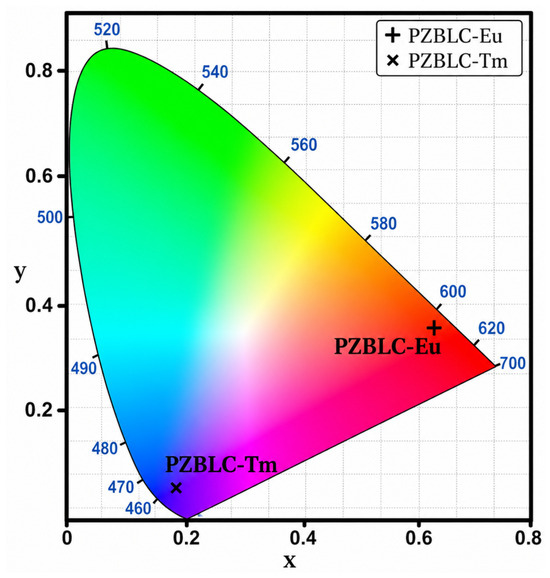
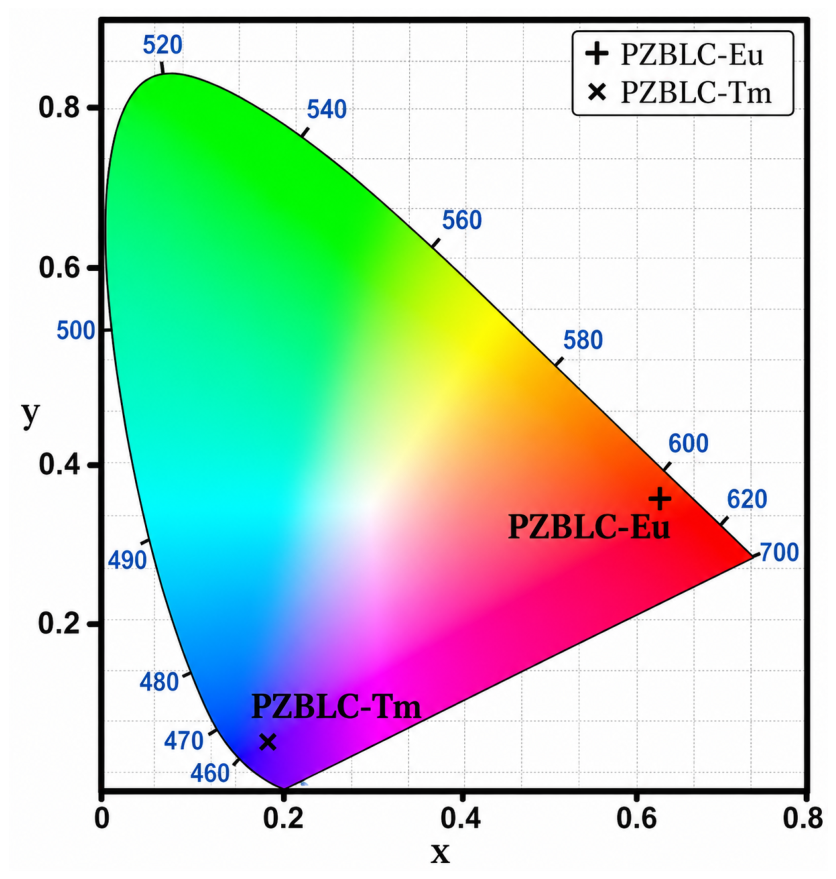
The visible luminescence properties of the glasses were further evaluated using chromaticity coordinates. For PZBLC–Eu3+ glasses, the coordinates were calculated from emission spectra under 395 nm excitation, while for PZBLC–Tm3+ glasses, 357 nm excitation was used. The emission coordinates were mapped onto the Commission Internationale de l’Éclairage (CIE) 1931 chromaticity diagram (Figure 18), indicating high color purity and well-defined emission hues. These characteristics make the fabricated glasses promising candidates for photonic applications, including solid-state lighting, display technologies, and optical signaling devices.
Figure 18.
The CIE 1931 chromaticity diagram for the investigated glasses under an excitation wavelength of 357 nm (for Tm3+ ions) and 395 nm (for Eu3+ ions).
The determined chromaticity coordinates (x, y) for the red-emitting glasses were (0.64, 0.36), indicating an emission very close to the standard red reference. In contrast, the PZBLC-Tm3+ glass exhibited blue emission with coordinates of (x = 0.158, y = 0.041), demonstrating the tunable luminescence properties of the fabricated glass systems.
The CIE chromaticity coordinates confirm the generation of highly saturated red and blue emissions. Therefore, the investigated glasses may be considered promising red-and blue-emitting photonic materials.
4. Conclusions
A host glass 40P2O5-30ZnO-10BaF2-18LiCl-2.0Cd (PZBLC) has the highest density (3.2573 g/cm3). Incorporation of Eu3+ and Tm3+ ions into the host glass leads to an increase in thermal stability from 74 to 79 °C and glass transition temperature from 360 to 376 °C. The host glass (PZBLC) has the highest value of indirect optical gap (= 4.749 eV); otherwise, the host glass doped with Eu3+ ions has the lowest value (= 4.234 eV). According to the spectroscopic ellipsometry analysis, the refractive index of the Eu3+-doped glass reached nRD = 2.04. Overall, the obtained results demonstrate that although theoretical models provide useful insight into the optical behavior of halide phosphate glasses, the experimentally measured refractive index remains the most reliable parameter for practical optical characterization. Among the investigated models, the Reddy model provides the best approximation for the PZBLC glass system. Moreover, the PZBLC-Eu3+ glass exhibits a low Urbach energy (ΔE = 0.155 eV), indicating reduced depolymerization, lower structural disorder, and fewer lattice defects in the fabricated glass. In contrast, the PZBLC-Tm3+ glass exhibits favorable spectroscopic properties, with a gain bandwidth (GBW = σem × Δλeff) of 16.7 × 10⁻²⁶ cm3. The combination of a broad emission band and a relatively high emission cross-section suggests its potential for near-infrared optical applications. In addition, the PZBLC-Eu3+ glass shows promising red emission under 395 nm excitation. The Eu3+-doped phosphate-based PZBLC glasses exhibit considerable potential as red-emitting materials under 395 nm excitation. Furthermore, the investigated glass system demonstrates a relatively high quantum efficiency of approximately 65%, indicating efficient radiative relaxation processes and favorable optical quality of the host matrix. These characteristics highlight the suitability of the developed glasses for visible-light photonic applications and red-light-emitting devices. In contrast, the PZBLC-Tm3+ glasses, excited at 357 nm, exhibit broadband near-infrared (NIR) emission suitable for optical amplification. Additionally, these glasses emit blue light, making them useful as standard light sources. The structural interpretations proposed in this work are based on indirect evidence derived from density, thermal, optical and spectroscopic measurements. Since no direct structural characterization (FTIR, Raman, XPS, MAS-NMR or EXAFS) was performed, the proposed changes in NBO concentration, network connectivity and possible P–O–RE interactions should be considered as plausible interpretations rather than direct confirmation. Future studies will focus on advanced structural investigations to verify these hypotheses.
Author Contributions
R.D.A.: Conceptualization, Methodology, Investigation, Writing—original draft, Formal analysis; A.M.A.: Conceptualization, Methodology, Investigation, Writing—original draft, Formal analysis, Writing—review and editing; B.S.: Conceptualization, Methodology, Formal analysis, Investigation, Writing—original; Z.S.A.A.: Conceptualization, Methodology, Formal analysis, Investigation; K.I.H.: Conceptualization, Methodology, Investigation, Writing—original draft, Formal analysis, Writing—review and editing; M.S.A.: Conceptualization, Methodology, Investigation, Writing—original draft, Writing—review and editing; B.B.-G.: Conceptualization, Methodology, Investigation, Writing—original draft; M.R.: Conceptualization, Methodology, Investigation, Visualization; E.S.Y.: Methodology, Investigation, Visualization. All authors have read and agreed to the published version of the manuscript.
Funding
The authors extend their appreciation to the University Higher Education Fund for funding this research work under the Research Support Program for Central labs at King Khalid University through the project number CL/PRI/B/3.
Institutional Review Board Statement
Not applicable.
Data Availability Statement
The original contributions presented in this study are included in the article. Further inquiries can be directed to the corresponding author.
Conflicts of Interest
The authors declare no conflicts of interest.
References
- Kindrat, I.I.; Padlyak, B.V.; Kukliński, B.; Drzewiecki, A.; Adamiv, V.T. Enhancement of the Eu3+ luminescence in Li2B4O7 glasses co-doped with Eu and Ag. J. Lumin. 2018, 204, 122–129. [Google Scholar] [CrossRef] [Scilit]
- Hegde, V.; Viswanath, C.S.D.; Upadhyaya, V.; Mahato, K.K.; Kamath, S.D. Red light emission from europium doped zinc sodium bismuth borate glasses. Phys. B Condens. Matter 2017, 527, 35–43. [Google Scholar] [CrossRef] [Scilit]
- Zhao, J.; Huang, L.; Liang, T.; Zhao, S.; Xu, S. Luminescent properties of Eu3+ doped heavy tellurite scintillating glasses. J. Lumin. 2019, 205, 342–345. [Google Scholar] [CrossRef] [Scilit]
- Mariselvam, K.; Kumar, R.A.; Rao, V.R. Concentration-dependence and luminescence studies of erbium doped barium lithium fluoroborate glasses. Opt. Laser Technol. 2019, 118, 37–43. [Google Scholar] [CrossRef] [Scilit]
- Lachheb, R.; Damak, K.; Assadi, A.; Herrmann, A.; Yousef, E.; Rüssel, C.; Maâlej, R. Characterization of Tm3+ doped TNZL glass laser material. J. Lumin. 2015, 161, 281–287. [Google Scholar] [CrossRef] [Scilit]
- Yuliantini, L.; Djamal, M.; Hidayat, R.; Boonin, K.; Yasaka, P.; Kaewnuam, E.; Venkatramu, V.; Kaewkhao, J. Optical and X-ray induced luminescence of Sm3+-doped borotellurite and fluoroborotellurite glasses: A comparative study. J. Lumin. 2019, 213, 19–28. [Google Scholar] [CrossRef] [Scilit]
- Said, H.; Omrani, R.O.; Arana, L.R.; El Bahri, D.; Boussen, S.; Bouzidi, C.; Terraschke, H.; Hamzaoui, A.H.; M’Nif, A. The effect of silica additive on the structural and luminescence properties of Eu3+/Tb3+ co-doped metaphosphate glasses. J. Mol. Struct. 2019, 1192, 42–48. [Google Scholar] [CrossRef] [Scilit]
- Zekri, M.; Herrmann, A.; Turki, R.; Rüssel, C.; Maâlej, R.; Damak, K. Experimental and theoretical studies of Dy3+ doped alkaline earth aluminosilicate glasses. J. Lumin. 2019, 212, 354–360. [Google Scholar] [CrossRef] [Scilit]
- Nayab, R.S.; T, S.; Babu A, M.; Moorthy L, R.; C.K., J. Optical spectroscopy, 1.06 μm emission properties of Nd3+-doped phosphate based glasses. Spectrochim. Acta Part A Mol. Biomol. Spectrosc. 2017, 180, 193–197. [Google Scholar] [CrossRef] [Scilit] [PubMed]
- Jamalaiah, B.C.; Gopal, K.R.; Kumar, M.V.V.; Reddy, G.V.L. Optical properties of Yb3+-doped NBSAZB glasses for IR lasers. J. Lumin. 2017, 187, 378–382. [Google Scholar] [CrossRef] [Scilit]
- Gökçe, M. Development of Eu3+ doped bismuth germanate glasses for red laser applications. J. Non-Cryst. Solids 2019, 505, 272–278. [Google Scholar] [CrossRef] [Scilit]
- Yao, L.-Q.; Chen, G.-H.; Cui, S.-C.; Zhong, H.-J.; Wen, C. Fluorescence and optical properties of Eu3+-doped borate glasses. J. Non-Cryst. Solids 2016, 444, 38–42. [Google Scholar] [CrossRef] [Scilit]
- Ebendorff-Heidepriem, H.; Seeber, W.; Ehrt, D. Dehydration of phosphate glasses. J. Non-Cryst. Solids 1993, 163, 74–80. [Google Scholar] [CrossRef] [Scilit]
- Karmakar, B.; Kundu, P.; Chaudhuri, A.K.; Annapurna, K.; Kumar, A.; Dwivedi, R.N. Effect of hydroxyl content on the physical properties of calcium metaphosphate glasses. Bull. Mater. Sci. 1999, 22, 115–119. [Google Scholar] [CrossRef] [Scilit]
- Charfi, B.; Damak, K.; Maâlej, R.; Alqahtani, M.S.; Hussein, K.I.; Alshehri, A.M.; Hussain, A.M.; Burtan-Gwizdala, B.; Reben, M.; Yousef, E.S. Enhancement of Optical Telecommunication Bands: Pr3+-Doped Halide Phosphate Glasses Display Broadband NIR Photoluminescence Emission. Materials 2022, 15, 6518. [Google Scholar] [CrossRef] [Scilit] [PubMed]
- Babu, S.S.; Babu, P.; Jayasankar, C.K.; Sievers, W.; Tröster, T.; Wortmann, G. Optical absorption and photoluminescence studies of Eu3+-doped phosphate and fluorophosphate glasses. J. Lumin. 2007, 126, 109–120. [Google Scholar] [CrossRef] [Scilit]
- Linganna, K.; Jayasankar, C. Optical properties of Eu3+ ions in phosphate glasses. Spectrochim. Acta Part A Mol. Biomol. Spectrosc. 2012, 97, 788–797. [Google Scholar] [CrossRef] [Scilit] [PubMed]
- Vijaya, N.; Jayasankar, C.K. Structural and spectroscopic properties of Eu3+-doped zinc fluorophosphate glasses. J. Mol. Struct. 2013, 1036, 42–50. [Google Scholar] [CrossRef] [Scilit]
- Kesavulu, C.; Kumar, K.K.; Vijaya, N.; Lim, K.-S.; Jayasankar, C.K. Thermal, vibrational and optical properties of Eu3+-doped lead fluorophosphate glasses for red laser applications. Mater. Chem. Phys. 2013, 141, 903–911. [Google Scholar] [CrossRef] [Scilit]
- Maity, A.; Jana, S.; Ghosh, S.; Sharma, S. Spectroscopic investigation on Europium (Eu3+) doped strontium zinc lead phosphate glasses with varied ZnO and PbO compositions. J. Non-Cryst. Solids 2020, 550, 120322. [Google Scholar] [CrossRef] [Scilit]
- Han, L.; Zhang, Q.; Song, J.; Xiao, Z.; Qiang, Y.; Ye, X.; You, W.; Lu, A. A novel Eu3+-doped phosphate glass for reddish orange emission: Preparation, structure and fluorescence properties. J. Lumin. 2020, 221, 117041. [Google Scholar] [CrossRef] [Scilit]
- Kermaoui, A.; Pellé, F. Synthesis and infrared spectroscopic properties of Tm3+-doped phosphate glasses. J. Alloys Compd. 2009, 469, 601–608. [Google Scholar] [CrossRef] [Scilit]
- Zheng, J.; Wang, H.; Lin, S.; Pan, Z.; Yang, Q.; Liu, J. Spectral characteristics of highly thermally stable Eu3+-doped P2O5-B2O3-ZnO-BaO glasses for tricolor WLEDs and red lasers. J. Alloys Compd. 2024, 1010, 177668. [Google Scholar] [CrossRef] [Scilit]
- Oueslati-Omrani, R.; Hamzaoui, A.H.; Chtourou, R.; M’Nif, A. Structural, thermal and optical properties of phosphate glasses doped with SiO2. J. Non-Cryst. Solids 2018, 481, 10–16. [Google Scholar] [CrossRef] [Scilit]
- Brow, R.K. Review: The structure of simple phosphate glasses. J. Non-Cryst. Solids 2000, 263–264, 1–28. [Google Scholar] [CrossRef] [Scilit]
- Higazy, A.A.; Ouis, M.A. Influence of heavy metal oxides on the structural and optical properties of phosphate glasses. J. Mater. Sci. Mater. Electron. 2017, 28, 17123–17131. [Google Scholar]
- Li, R.; Tian, C.; Tian, Y.; Wei, T.; Li, B.; Jing, X.; Ruan, F.; Wang, F. Mid-infrared emission properties and energy transfer evaluation in Tm3+ doped fluorophosphate glasses. J. Lumin. 2015, 162, 58–62. [Google Scholar] [CrossRef] [Scilit]
- Binnemans, K.; Van Deun, R.; Görller-Walrand, C.; Adam, J. Spectroscopic properties of trivalent lanthanide ions in fluorophosphate glasses. J. Non-Cryst. Solids 1998, 238, 11–29. [Google Scholar] [CrossRef] [Scilit]
- Burtan-Gwizdala, B.; Cisowski, J.; Lisiecki, R.; Kowalska, K.J.; Jarzabek, B.; Nosidlak, N.; Reben, M.; Alshehri, A.M.; Hussein, K.I.; Yousef, E.S. Thermal, Optical, and Emission Traits of SM3+-Ion-Doped Fluoride/Chloride/Oxide Glass for Red/Orange Laser Fiber Applications. Fibers 2024, 12, 100. [Google Scholar] [CrossRef] [Scilit]
- Tian, Y.; Xu, R.; Zhang, L.; Hu, L.; Zhang, J. 1.8 μm emission of highly thulium doped fluorophosphate glasses. J. Appl. Phys. 2010, 108, 083504. [Google Scholar] [CrossRef] [Scilit]
- Burtan-Gwizdala, B.; Reben, M.; Cisowski, J.; Yousef, E.S.; Lisiecki, R.; Nosidlak, N. Strong emission at 1000 nm from Pr3+/Yb3+-codoped multicomponent tellurite glass. Pure Appl. Chem. 2021, 94, 147–156. [Google Scholar] [CrossRef] [Scilit]
- Zaid, M.H.M.; Matori, K.A.; Aziz, S.H.A.; Zakaria, A.; Ghazali, M.S.M. Effect of ZnO on the physical properties and optical band gap of soda lime silicate glass. Int. J. Mol. Sci. 2012, 13, 7550–7558. [Google Scholar] [CrossRef] [Scilit] [PubMed]
- Ghauri, M.A.; Siddiqi, S.A.; Shah, W.A.; Ashiq, M.G.B.; Iqbal, M. Optical properties of zinc molybdenum phosphate glasses. J. Non-Cryst. Solids 2009, 355, 2466–2471. [Google Scholar] [CrossRef] [Scilit]
- Lakshminarayana, G.; Caldiño, U.; Meza-Rocha, A.; Lira, A.; Rao, P.V.; Singh, V.; Dahshan, A.; Kityk, I.; Lee, D.-E.; Yoon, J.; et al. Fluorescence features of Tm3+-doped multicomponent borosilicate and borotellurite glasses for blue laser and S-band optical amplifier applications. Opt. Mater. 2019, 96, 109354. [Google Scholar] [CrossRef] [Scilit]
- Qi, F.; Huang, F.; Lei, R.; Tian, Y.; Zhang, L.; Zhang, J.; Xu, S. Emission properties of 1.8 and 2.3 μm in Tm3+-doped fluoride glass. Glas. Phys. Chem. 2017, 43, 340–346. [Google Scholar] [CrossRef] [Scilit]
- Li, M.; Bai, G.; Guo, Y.; Hu, L.; Zhang, J. Investigation on Tm3+-doped silicate glass for 1.8μm emission. J. Lumin. 2012, 132, 1830–1835. [Google Scholar] [CrossRef] [Scilit]
- Davis, E.A.; Mott, N.F. Conduction in non-crystalline systems V. Conductivity, optical absorption and photoconductivity in amorphous semiconductors. Philos. Mag. 1970, 22, 0903–0922. [Google Scholar] [CrossRef] [Scilit]
- Escobar-Alarcón, L.; Arrieta, A.; Camps, E.; Muhl, S.; Rodil, S.; Vigueras-Santiago, E. An alternative procedure for the determination of the optical band gap and thickness of amorphous carbon nitride thin films. Appl. Surf. Sci. 2007, 254, 412–415. [Google Scholar] [CrossRef] [Scilit]
- Souri, D.; Shomalian, K. Band gap determination by Absorption Spectrum Fitting method (ASF) and structural properties of different compositions of (60 − x) V2O5–40TeO2–xSb2O3 glasses. J. Non-Cryst. Solids 2009, 355, 1597–1601. [Google Scholar] [CrossRef] [Scilit]
- Damak, K.; Maâlej, R.; Yousef, E.S.; Qusti, A.H.; Rüssel, C. Thermal and spectroscopic properties of Tm3+ doped TZPPN transparent glass laser material. J. Non-Cryst. Solids 2012, 358, 2974–2980. [Google Scholar] [CrossRef] [Scilit]
- Dimitrov, V.; Sakka, S. Linear and nonlinear optical properties of simple oxides. II. J. Appl. Phys. 1996, 79, 1741–1745. [Google Scholar] [CrossRef] [Scilit]
- Moss, T.S. Relations between the Refractive Index and Energy Gap of Semiconductors. Phys. Status Solidi 1985, 131, 415–427. [Google Scholar] [CrossRef] [Scilit]
- Reddy, R.R.; Gopal, K.R.; Ahammed, Y.N.; Narasimhulu, K.; Reddy, L.S.S.; Reddy, C.V.K. Correlation between optical electronegativity, molar refraction, ionicity and density of binary oxides, silicates and minerals. Solid State Ion. 2005, 176, 401–407. [Google Scholar] [CrossRef] [Scilit]
- Ain, A.M.N.; Sahar, M.R.; Sazali, E.S.; Azman, K.; Yahya, N. Study on Optical Absorption and Structural Bonding of Lithium Zinc Phosphate Glasses. Solid State Phenom. 2017, 268, 54–61. [Google Scholar] [CrossRef] [Scilit]
- Spector, N.; Reisfeld, R.; Boehm, L. Eigenstates and radiative transition probabilities for Tm3+ (4f12) in phosphate and tellurite glasses. Chem. Phys. Lett. 1977, 49, 49–53. [Google Scholar] [CrossRef] [Scilit]
- Burtan-Gwizdala, B.; Reben, M.; Yousef, E.S.; Lisiecki, R.; Grelowska, I.; Nosidlak, N.; Jarząbek, B. Er3+-Doped Fluorotellurite–Phosphate Glasses for Efficient Green Light Emission. J. Lumin. 2026, 293, 121814. [Google Scholar] [CrossRef] [Scilit]
- Szymański, D.; Sobczyk, M.; Lisiecki, R. A study of optical properties of Tm3+ ions in Y2Te4O11 microcrystalline powder. J. Lumin. 2018, 202, 354–362. [Google Scholar] [CrossRef] [Scilit]
- Abbas, J.; Zaman, F.; Khan, A.; Saqib, N.U.; Rooh, G.; Choodam, K.; Kanjanaboos, P.; Intachai, N.; Kothan, S.; Albargi, H.B.; et al. Judd-Ofelt (J-O) Parameterization: Tuning optical and luminescent features of Dy3+-doped phosphate glasses for W-LEDs and laser applications. Opt. Mater. 2025, 167, 117311. [Google Scholar] [CrossRef] [Scilit]
- Pisarska, J.; Pisarski, W. Samarium-Doped Lead Phosphate Glass: Optical Experiments and Calculations Using the Judd–Ofelt Theory. Materials 2025, 18, 5254. [Google Scholar] [CrossRef] [Scilit] [PubMed]
- Charfi, B.; Damak, K.; Alqahtani, M.S.; Hussein, K.I.; Alshehri, A.M.; Elkhoshkhany, N.; Assiri, A.L.; Alshehri, K.F.; Reben, M.; Yousef, E.S. Luminescence and Gamma Spectroscopy of Phosphate Glass Doped with Nd3+/Yb3+ and Their Multifunctional Applications. Photonics 2022, 9, 406. [Google Scholar] [CrossRef] [Scilit]
- Herrmann, A.; Fibikar, S.; Ehrt, D. Time-resolved fluorescence measurements on Eu3+- and Eu2+-doped glasses. J. Non-Cryst. Solids 2009, 355, 2093–2101. [Google Scholar] [CrossRef] [Scilit]
- Kam, C.H.; Buddhudu, S. Emission analysis of Eu3+:Bi2O3–B2O3–R2O (R = Li,Na,K) glasses. J. Quant. Spectrosc. Radiat. Transf. 2004, 87, 325–337. [Google Scholar] [CrossRef] [Scilit]
- Armellini, C.; Del Longo, L.; Ferrari, M.; Montagna, M.; Pucker, G.; Sagoo, P. Effect of Pr3+ doping on the OH content of silica xerogels. J. Sol-Gel Sci. Technol. 1998, 13, 599–603. [Google Scholar] [CrossRef] [Scilit]
- Tran, T.N.L.; Chiasera, A.; Lukowiak, A.; Ferrari, M. Eu3+ as a Powerful Structural and Spectroscopic Tool for Glass Photonics. Materials 2022, 15, 1847. [Google Scholar] [CrossRef] [Scilit] [PubMed]
- Zou, X.; Gao, Y.; Yang, Z.; Ren, J. Near-infrared emission and gain properties of Tm3+-doped phosphate glasses for laser appli-cations. Ceram. Int. 2018, 44, 12063–12070. [Google Scholar]
- Huerta, E.; Buendía-Rodríguez, J.; González-Suárez, E.; Meza-Rocha, A.; Milan, E.; Speghini, A.; Caldiño, U. Blue and white light emissions and energy transfer in Tm3+ and Dy3+/Tm3+ doped lithium-aluminum-zinc phosphate glasses. Ceram. Int. 2024, 51, 16691–16699. [Google Scholar] [CrossRef] [Scilit]

Disclaimer/Publisher’s Note: The statements, opinions and data contained in all publications are solely those of the individual author(s) and contributor(s) and not of MDPI and/or the editor(s). MDPI and/or the editor(s) disclaim responsibility for any injury to people or property resulting from any ideas, methods, instructions or products referred to in the content. |
© 2026 by the authors. Licensee MDPI, Basel, Switzerland. This article is an open access article distributed under the terms and conditions of the Creative Commons Attribution (CC BY) license.