


Abstract
Vanadium dioxide (VO2) is a phase-change material, which changes its properties under thermal or optical stimuli. Thanks to the fact that the material phase transition appears at conditions which are close to environmental ones, VO2 has been widely used in diverse structures, including metasurfaces, that acquire switching and reconfigurability capabilities. In this paper, we numerically study the functionality-enabling properties of dielectric resonator-based nondiffractive meta-atoms that comprise small VO2 components, i.e., covers or drops, in switchable coding and wavefront-manipulating scenarios at THz frequencies. The goal is to unveil the potential of these meta-atoms in switching the reflected wave’s phase coverage under temperature variations. The main attention is paid to how the shape and size of the VO2 components affect the functionality switching that is enabled by the changes in coverage. It is shown that metallic and insulator states of VO2 can play different roles in diverse switching scenarios. Different resonance regimes exert different influences on the resulting capability of switching, while contributing to multifunctional operating scenarios. Possible roles of state-dependent absorption are clarified.
1. Introduction
Vanadium dioxide (VO2) is a PCM, which changes from the amorphous to crystalline phase under thermal or optical stimuli [1,2,3,4,5,6,7]. In a wide frequency range, including the THz range, it corresponds to the transition from the insulator state (i-VO2) to the metallic state (m-VO2). A significant advantage of VO2 is that the transition can occur under conditions that are close to environmental ones. The insulating state can be observed, for instance, when the temperature is T = 310 K, while the metallic state does so at T = 365 K. The T-dependence of the VO2 conductivity, σVO2, exhibits hysteresis, such that transition occurs at a slightly larger T-value during heating. The material phase transition can be obtained for VO2 using a conventional heater/cooler.
The above-mentioned features make VO2 a promising material for switchable applications in various parts of the electromagnetic spectrum [8,9]. First, we should mention metasurfaces, known also as quasiplanar metamaterials, that are composed of identical (equal) or nonidentical meta-atoms based on dielectric or quasiplanar metallic resonators, or simple nanoantennas [10,11,12,13,14,15,16,17,18,19,20,21,22,23,24]. The achievable switching scenarios are pre-determined by the way in which VO2 is incorporated into the meta-atoms. Indeed, it can be used in the form of thin uniform spacer layers or inserts or pads for the resonance components or serve as a material for the entire resonance component. It depends on the available fabrication techniques, on the one hand, and on the targeted functionality, on the other hand.
Other tunable materials, e.g., graphene [25,26], ITO [27], InSb [28,29,30,31,32], and phase-change chalcogenides like GST [33,34,35,36,37], have been successfully utilized in metasurfaces and meta-gratings. In turn, VO2 can be incorporated into core–shell scatterers [31,32,38,39,40]. From the metasurface perspective, it is worth mentioning that for the supercell-based approach for wavefront-manipulating metasurfaces, e.g., for deflection or focusing, the functionality is pre-determined by a specific gradual variation in EM wave’s phase from one unit cell (meta-atom) to another [41,42,43,44,45,46,47]. In coding metasurfaces, the phase variation on coordinate(s) can be based on different principles than in the wavefront-manipulating ones [18,48,49,50,51,52,53]. Nevertheless, for both coding and wavefront-manipulating metasurfaces, switching between the operating regimes is possible due to the incorporation of PCM components. Moreover, programmable and intelligent metasurfaces should be mentioned [33,54,55]. Notably, switchable metasurface-based absorbers [36,56,57] and color filters [58] do not need the supercell design, so they may consist of identical (equal) meta-atoms.
In this paper, we numerically study the effects of the material phase of VO2 that is incorporated into the meta-atoms based on dielectric resonators for use in reflection mode coding and wavefront-manipulating metasurfaces in the THz range. This frequency range is likely the most promising for exploiting the switching potential of VO2. While the circuit-based design solutions, e.g., those using multiple individually controlled diodes, have been shown to be very efficient for switching, mainly, at microwave frequencies [51], they are unlikely to be useful for metasurfaces in the THz range and at higher frequencies. Typically, coding metasurfaces for GHz and THz ranges are based on quasiplanar metallic resonators [48,49,50,51,52,53]. At the same time, dielectric resonators have already been used in THz metasurfaces beyond the coding ones, e.g., see [59,60]. The potential of dielectric resonators in coding metasurfaces for THz range remains unexplored, despite the promise of a rich variety of resonance regimes and a high level of knowledge accumulated for dielectric resonators [42,43,44,45,46]. This work aims to partly fill this gap.
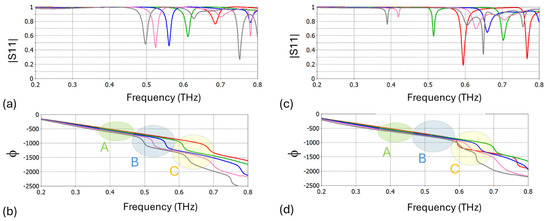
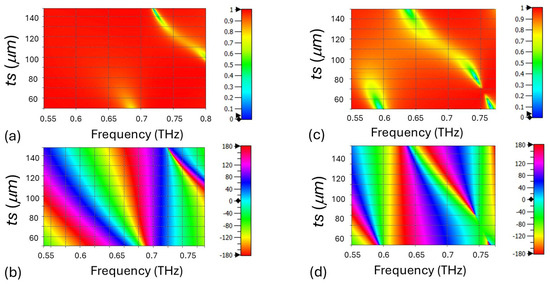
This study is dedicated to dielectric (Mie-type) cylindrical resonators, assuming that the resonances of other types (i.e., not Mie-type) can also contribute to the resulting resonance regimes. Structures with two different thicknesses of small VO2 components will be compared. They are realizable by using fabrication techniques consistent with the required structural sizes. The main goal is to unveil the potential of the switchable meta-atoms based on simple dielectric resonators in coding metasurfaces and other metasurfaces that need switchable coverage of the reflected wave’s phase as the basis for functionality switching. The applied mechanism of the phase range switching exploits the changes in the material properties of VO2 that are enabled by the transition from i-VO2 to m-VO2, or vice versa.
It will be clarified how the thickness/shape of the VO2 components may affect the resulting properties of the switchable meta-atoms and related switchable functionalities. Moreover, the role of various resonance regimes in the functionality switching scenarios enabled by variations in T will be studied. The role of different resonance regimes will be considered from the multifunctionality perspective, assuming that different functionality switching scenarios can be achieved at different frequencies due to the simultaneous use of two different resonance regimes. It will be demonstrated which functionality switching scenarios can be achieved in the case of dielectric resonators, whereas optimization of the structure design is beyond the scope. The presented results are obtained by using CST Studio Suite 2020 [61].
2. Basics
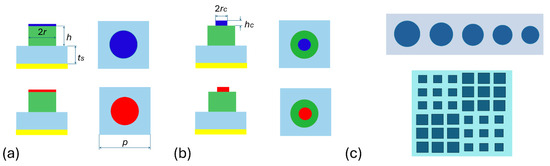
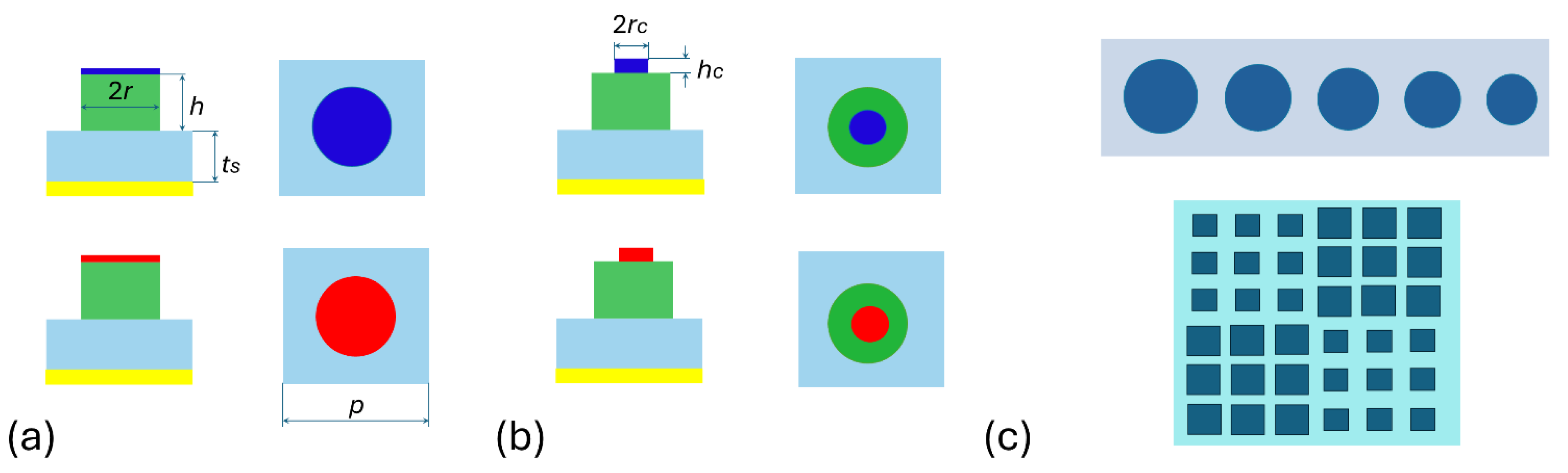
The EM wave’s phase coverage that occurs due to the supercell’s meta-atoms with different geometrical parameters and the nearly constant and high magnitude are known as the key characteristic, which determine the capability of coding and wavefront-manipulating metasurfaces that operate in reflected mode [40,41]. The changes in the material phase of VO2 is expected to lead to those in phase range coverage and, hence, to the changes in terms of functionality and functionality switching. The key component of the structural design of meta-atoms in this work is a cylindrical dielectric resonator, which can host low-order Mie-type resonances, while intra-array coupling and effects exerted by other resonances also contribute to the resulting regimes. The individual meta-atoms are diffraction-free. The supercells composed of the meta-atoms are diffractive, but they are not the subject of this study. The simplest structural design of meta-atoms is considered. Compared to quasiplanar metallic resonators, dielectric resonators involve the third dimension to allow for hosting more diverse resonances. This can be very crucial for multifunctional/multiband operation. Figure 1 shows the schematics of the studied meta-atoms and exemplified fragments of metasurfaces.
Figure 1.
Meta-atoms comprising (a) cylindrical dielectric resonators with VO2 covers of the same radii as resonators, or (b) cylindrical dielectric resonators with VO2 covers of smaller radii. (c) Exemplified geometries of (upper plot) a supercell containing meta-atoms with different cylinder radii and (lower plot) fragment of a simple coding metasurface with two different meta-atoms.
Each meta-atom contains (1) a cylindrical dielectric microresonator made of a high-permittivity material like Si; (2) a VO2 cover or drop placed atop the resonator; (3) a spacer made of a low-permittivity dielectric material; and (4) a back-side metallic reflector. Functionality switching scenarios are expected to depend on variations in the radius of the dielectric resonators and the width and thickness of VO2 covers/drops. When T is varied VO2 changes the state from insulator to metallic, or vice versa [1,2,3,4,5,6], the boundary conditions atop the dielectric resonators are also changed; see Figure 1a. In fact, two different sets of resonance modes should correspond to the two cases of effective boundary conditions at the upper resonator surface. Some modes can be weakly affected but the others strongly affected by this change. It is worth noting that the surface control of wave guiding by means of thin covers has been implemented in diverse metastructures [62,63], a larger part of which are not tunable. However, formalization of the effective boundary conditions can be complicated, because of the finite thickness of the conformal VO2 cover (rc = r). The same is true in the case of VO2 drops (rc < r). Moreover, in the i-VO2 case, the cover is not expected to function as a perturbation for all modes, and the same can be said about the dielectric resonators having “drops” on top; see Figure 1a,b.
In the studied designs, resonators are asymmetric along the cylinder axis (z-axis) owing to the different boundary conditions at their top and bottom. Generally speaking, this asymmetry does not differ from that in most of the dielectric resonator-based metasurfaces, in which resonators are bound by a dielectric substrate or spacer at one side but have air or another host dielectric at the other, e.g., see [42,43,44,45]. At the same time, resonators show infinite-order rotational symmetry in the metasurface plane, i.e., in the (x,y)-plane. The structure’s symmetry properties result in the absence of cross-polarized components. Notably, metasurfaces with Mie-type resonators comprising VO2 components have been studied earlier at the near-infrared and visible ranges [64,65,66].
For the full-scale gradient metasurfaces enabling wavefront manipulation, a proper distribution of the EM wave’s phase along the x (and y) direction(s) is required. Therefore, the supercells of metasurfaces are composed of different meta-atoms that may have rather closely spaced frequencies, while |S11| keeps nearly the same value, which is aimed to be close to unity. In the case of the deflecting metasurfaces, the EM waves’ phase gradients, dϕ/dx or/and dϕ/dy, should be linear, while the whole phase range (ϕ-range) extended from 0° to 360° is covered. The phase variation is usually connected with Snell’s law written in the 1D-case in the generalized form [40,41]:
where λ stands for the EM wave’s length; ni and nt mean refractive indices in the incidence/reflection and transmission regions, respectively; ai and at represent incidence and refraction angles, respectively. For the purely reflective configuration, nt in (1) should be substituted by nr = ni, so that the phase gradient is still responsible for possible deviations from specular reflection. In the case of the focusing gradient metasurfaces, a parabolic distribution of the phase is needed, which is given in the 1D-case by [40,41]:
where F stands for the focal length. For the coding metasurfaces [48,49,50,51,52,53], the continuous EM wave’s phase distribution is replaced with discrete phase values, so that each of these values is associated with a particular EM state. From this perspective, even a simple binary phase set may yield a shaped scattering pattern due to the interference of the encoded elements. Phase profiles may be more arbitrary than for the gradient wavefront-manipulating metasurfaces. In the 1-bit coding scheme (0 and 1), two different meta-atoms (known as coding particles) enable binary phase coding, i.e., ϕ = 0° and ϕ = 180° [50]. In the 2-bit coding scheme (00, 01, 10, and 11), four different meta-atoms are needed, which should correspond to ϕ = 0°, ϕ = 90°, ϕ = 180°, and ϕ = 270° [50]. In the 3-bit coding scheme (000, 001, 010, 011, 100, 101, 110, and 111), eight meta-atoms are required to obtain the phase values of 0°, 45°, 90°, 135°, 180°, 225°, 270°, and 315° [50]. The pattern function of the entire coding metasurface under plane–wave illumination can be written as follows [49]:
where , β and mean elevation and azimuthal angles, respectively, and are dimensions of each meta-atom lattice, k is the free-space wavenumber, and N is the number of lattices over x and y directions. Figure 1c presents two examples of simple building blocks for coding and wavefront-manipulating metasurfaces.
The energy balance can be introduced as R + A = 1, where R and A are reflectance (reflection efficiency) and absorptance, assuming that the back-side reflector’s thickness is chosen so that the transmission is equal to zero. Absorption is enhanced at the resonances, while the extent of possible enhancement needs detailed analysis. Therein, R can take (much) smaller values than the minimal acceptable ones. Reflection efficiency can be written as R = |S11|2, where S11 is the S-parameter responsible for co-polarized reflection [61]. For instance, if the lower limit is set as min|S11| > 0.85, then R > 0.72.
At least three idealized scenarios of the change in EM wave’s phase coverage at the transition from i-VO2 to m-VO2 can be distinguished:
- (1)
- for i-VO2/m-VO2 and for m-VO2/i-VO2.
- (2)
- for i-VO2/m-VO2 and for m-VO2/i-VO2.
- (3)
- Absorption and, hence, no real coverage for one of the m-VO2 and i-VO2 states and 180° or 360° coverage for the other.
The third scenario may have significant limitations, because should be achieved for one of m-VO2 and i-VO2 states simultaneously at different values of r or rc. However, if absorber functionality is targeted, switchable minimums of R may enable a switchable absorber, provided that the metasurface comprises all the same meta-atoms with VO2 components. Fortunately, the phase ϕ should be discretized in both coding and wavefront-manipulating metasurfaces; this makes minimization of the unwanted effects of narrowband absorption possible.
In line with [11], permittivity of VO2 is introduced as , where is high-frequency permittivity, is angular plasma frequency for m-VO2, is angular plasma frequency for i-VO2, and is collision frequency. The back-side reflector’s material, Cu, has conductivity . The permittivity of Si is taken as , and that of a spacer material as . For dielectric cylindrical resonators, a microfabrication approach that combines SU-8 assisted bonding, photolithography, and deep reactive ion etching can be used [59,60]. This fabrication procedure has tolerances in the order μm for resonator diameter. The VO2 layer of nanometer thickness (e.g., 200 nm) can be deposited by using magnetron sputtering [67] before patterning. In the case of micrometer thickness (e.g., 2 microns), the microcrystal-based approach [68] or the nanocrystal-array-based approach [69] is needed. Notably, VO2 films being up to 2000 nm thick have been realized earlier by using fabrication steps which can differ from those required for the VO2 crystals [70].
3. Results and Discussion
Magnitudes and phases of S11 are presented in this section for different parameter sets. The basic features observed in the magnitude results include the minimums, whose spectral locations indicate the presence of resonances. At the sharp minimums of |S11|, strong absorption is achieved. The resonances usually create jumps in the EM wave’s phase to cover either the full or the partial range of phase variation, depending on the demanded functionality. The values of frequencies and radii that correspond to the strong or even moderate minimums should be avoided, except for the designs in which near-unity absorption plays the role of the OFF state in ON/OFF switching scenarios.
3.1. Varying Radius of Cylindrical Dielectric Resonators for Thick Conformal VO2 Covers
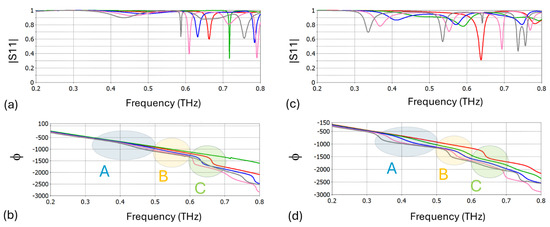
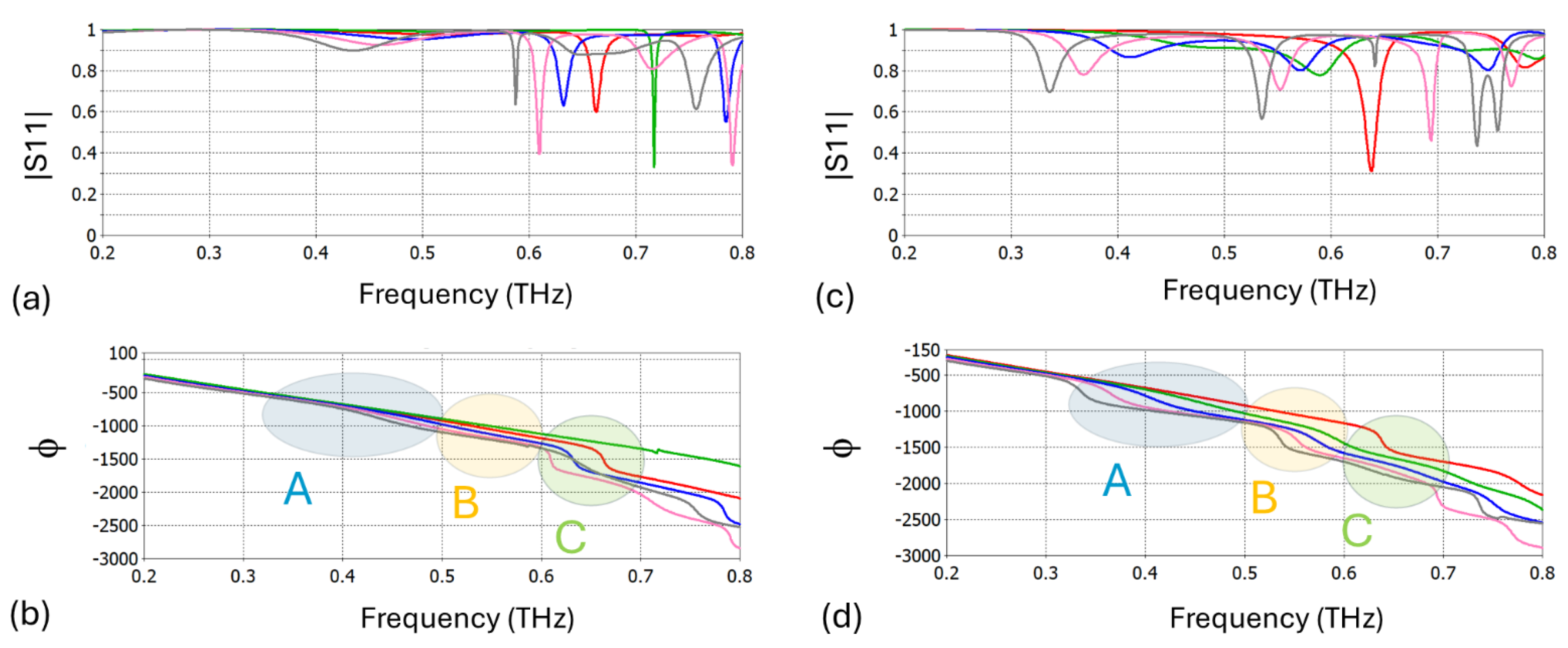
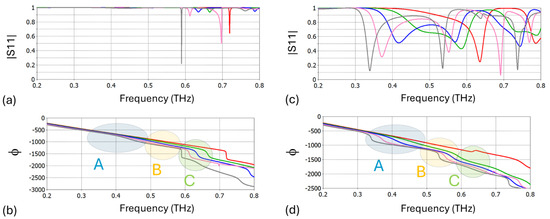
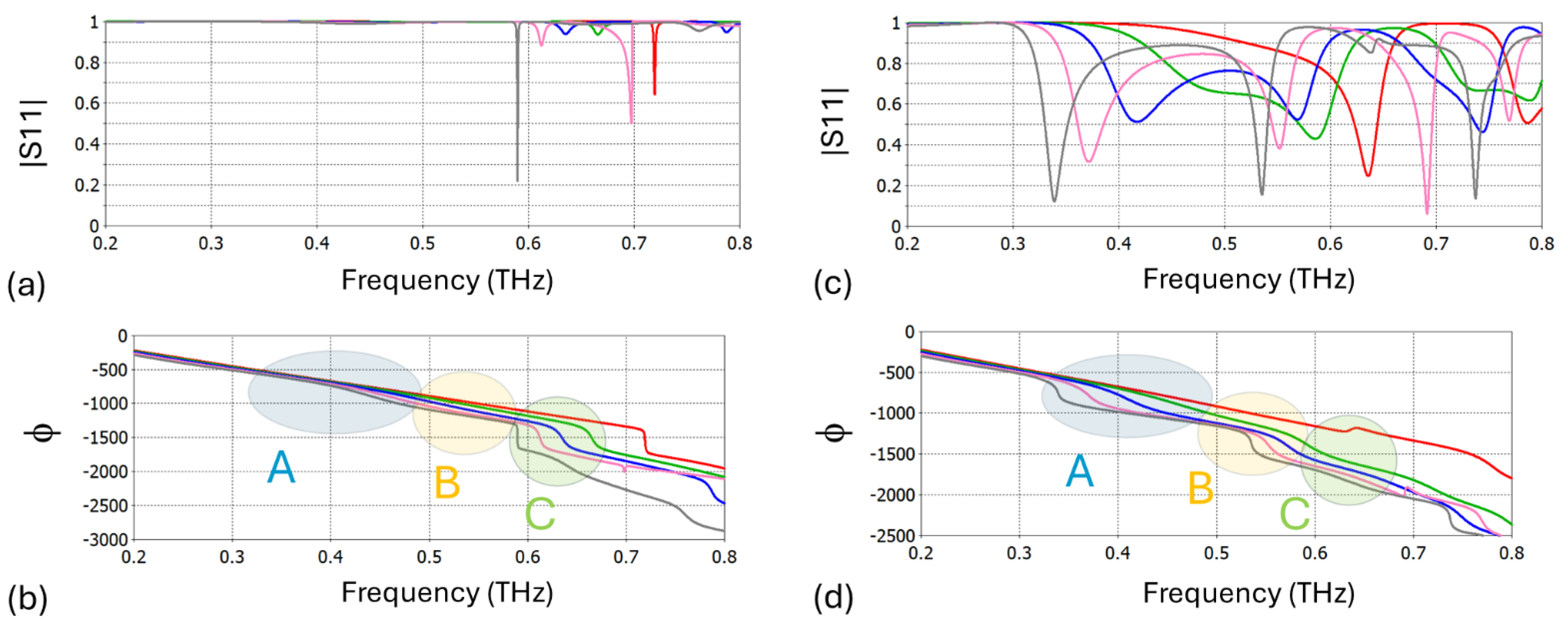
In Figure 2, the results are presented for the selected values of r, which are swept from 50 to 90 μm, while the VO2 components fully cover the tops of cylinders. The VO2 thickness is taken here as 3 μm, for which the fabrication procedures are available [68,69]. In the case of i-VO2, Δϕ is about 50° in the vicinity of f = 0.35 THz for the lowest-f resonance range (denoted by A). Therefore, it cannot be used even for 1-bit coding, i.e., the functionality that needs the smallest Δϕ-range. However, it is increased up to 180° at f = 0.465 THz while min|S11| > 0.92, so it is a candidate for 1-bit coding. Similarly, for the second range (denoted by B), Δϕ is achieved at f = 0.57 THz while min|S11| > 0.98. For the third range (denoted by C), Δϕ >360° is achieved, if using the entire range of r variation, for which min|S11| > 0.4. If the case of r = 90 μm is excluded, then min|S11| > 0.6 at 0.61< f < 0.67 THz. Therefore, range C can be potentially applicable to 2-bit and 3-bit coding and wavefront-manipulation functionalities, provided that the deep minimums of |S11| are avoided due to the properly selected discrete values of r. Higher resonances arising at f > 0.7 THz can also be utilized.
Figure 2.
Magnitude (a) and phase in degrees (b) for S11 in the case of i-VO2; magnitude (c) and phase in degrees (d) for S11 in the case of m-VO2 at h = 130 μm, ts = 150 μm, hc = 3 μm, and normal incidence (θ = 0°) for five values of r = rc: red line—r = 50 μm, green—r = 60 μm, blue line—r = 70 μm, light-rose line—r = 80 μm, and gray line—r = 90 μm. A, B, and C indicate three ranges which differ in resonance properties and expected functionality.
Spectral location and manifestations of resonance regimes can be changed when T is increased and the metallic state of VO2 is achieved, because the effective boundary conditions at the upper resonator surface are changed; see Figure 2c,d. For the resonance range denoted by A, Δϕ from 250° to 310° is achieved. Notably, Δϕ > 250° is kept in a wide band, i.e., at 0.35 < f < 0.50 THz. This range can be a candidate for 2-bit coding, offering the bandwidth which is about 35%. For the range denoted by B, Δϕ > 360° at f = 0.57 THz, where min|S11| > 0.8, so it can be used for 3-bit coding. When r is swept only from 50 to 70 mm, |S11| > 0.85 and Δϕ . Finally, for the range C, Δϕ can be close to 360° while min|S11| > 0.8 at 0.6 < f < 0.68 THz. It corresponds to the 12.5% bandwidth, but it can be difficult to realize it because of the minimums of A. Sweeping over r from 60 to 90 μm leads to Δϕ = 290° at f = 0.663 THz, whereas min|S11| > 0.94. Involvement of r = 50 μm allows us to increase Δϕ up to 360°. The two above-mentioned ranges, i.e., 0.35 < f < 0.50 THz and 0.6 < f < 0.68 THz, can be considered as the wideband operation ranges, wherein Δϕ is weakly or gradually variable. The obtained results show that both states of VO2 may yield the coverage of the entire phase range or a required part of it, but the metallic state suggests more options. Typically, the resonance regimes leading to larger bandwidths create worse phase coverage but suffer less from enhanced absorption.
Design strategy can be based on the choice of metallic state operating frequencies, and the double checking of scenarios arising at these frequencies for i-VO2. Table 1 presents a few examples. Evaluation of their applicability for coding and wavefront manipulation can be carried out based on the results obtained for Δϕ and min|S11|.
Table 1.
Examples of phase range coverage and expected switching scenarios in reflection mode in the case of thick conformal covers at f < 0.62 THz; ΩΔϕ = Δϕmet/Δϕins is the phase coverage contrast.
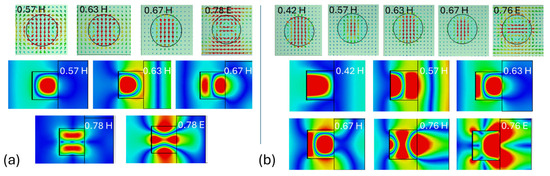
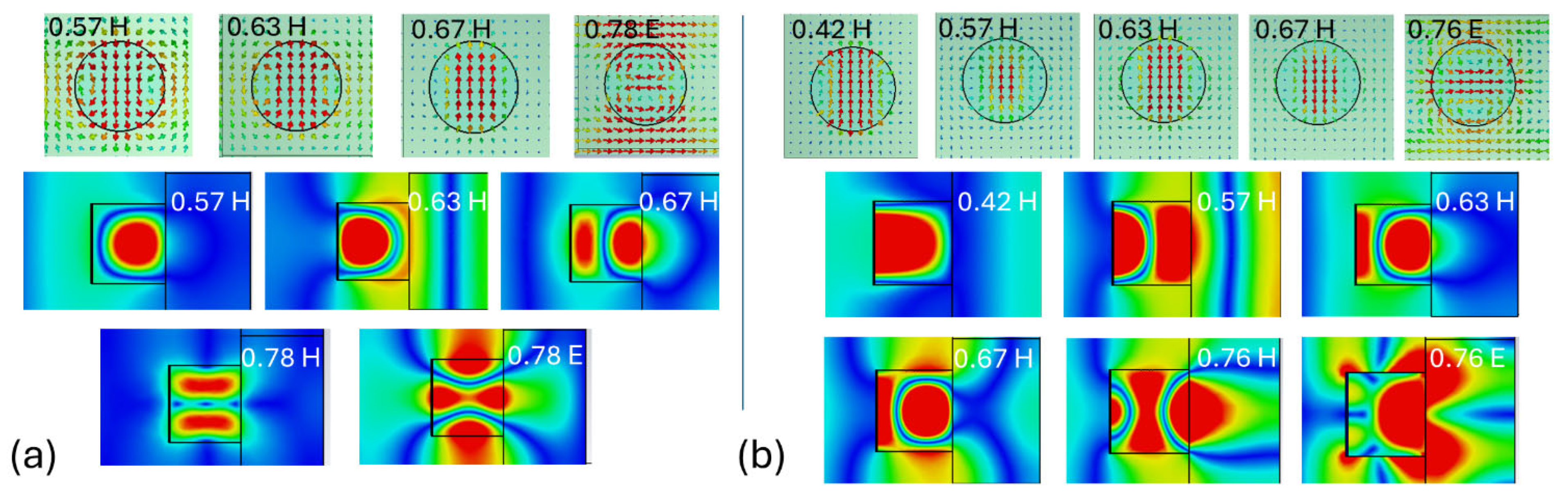
Figure 3 presents the examples of field distribution for two f-values taken from Table 1 (0.42 and 0.57 THz) and other resonance regimes observed in Figure 2. The contribution of magnetic-dipole resonance is obvious in most of the presented field plots. However, its functionality-enabling properties that are connected with magnitude and phase of S11 may differ because (1) the fields created by different resonances can be localized within different (and poorly predictable) regions in the same resonator, so that the field localization region can be shifted towards the upper or the lower part of the cylinder, depending on f; (2) fields created by two different resonances can be simultaneously present, occupying different regions. The effect of changing VO2 state is observed in Figure 3 at f = 0.57, 0.63, and 0.67 THz. It leads not only to the field changes near the cover, but also within the subregions which are quite far from the cover. The largest region for magnetic-dipole resonance has been observed at f = 0.57 THz and 0.6 THz for the i-VO2 and f = 0.63 THz and 0.67 THz for the m-VO2. The magnetic-dipole resonance is expected to yield the jumps of ϕ at f = 0.63 THz in the i-VO2 case and at f = 0.42 and 0.57 THz in the m-VO2 case, while the spacer resonances may also contribute to the resulting resonance regimes.
Figure 3.
A few examples of the field distribution for (a) i-VO2 and (b) m-VO2, at the same geometric parameters as in Figure 2. In each plot, the frequency value is given in THz (0.42, 0.57, etc.); letters H and E denote magnetic and electric fields, respectively. Vector maps are presented for the selected cross-sections over the cylinder height. Color maps correspond to the mid-cross-section of the cylinder); EM wave is incident from the left side.
In the case of i-VO2, the electric-dipole resonance starts to contribute at f = 0.62 THz, when the field only occupies the region that is close to the spacer. This region gradually extends with increasing f, so the effect of the electric-dipole is observed over the entire height of the cylinder, e.g., at 0.76 and 0.78 THz. Electric-dipole resonance is responsible for the phase jump of ϕ that appears near 0.78 THz (see Figure 2), but the effect of magnetic resonance becomes significant at 0.79 THz (it is localized in the lower part of the cylinder). In the case of m-VO2, contribution of the electric-dipole resonance was observed starting from f = 0.7 THz, when it occupies the part of the cylinder that is closest to the spacer. Similarly to the i-VO2 case, the occupied region is increased with f, achieving the maximal volume at f > 0.75 THz. Electric-dipole resonance is expected to be responsible for the phase jump near 0.76 THz, whereas the effect of magnetic resonance is observed in the region adjacent to the cover.
In addition, effects of vertical electric dipoles (in contrast with horizontal dipoles in Figure 3), or more advanced resonances, can be expected at 0.6 THz for m-VO2 and at 0.67 THz for i-VO2, but it requires a deeper study. Intra-array coupling may also contribute to the resulting resonance features. Notably, proper use of multipole decomposition and other techniques can be complicated due to the ambiguity of choosing the effective distance from the spacer, possible contribution of spacer resonances, and a way of formalization of intra-array coupling.
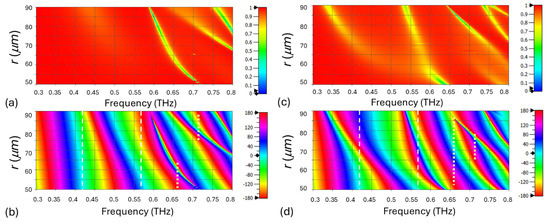
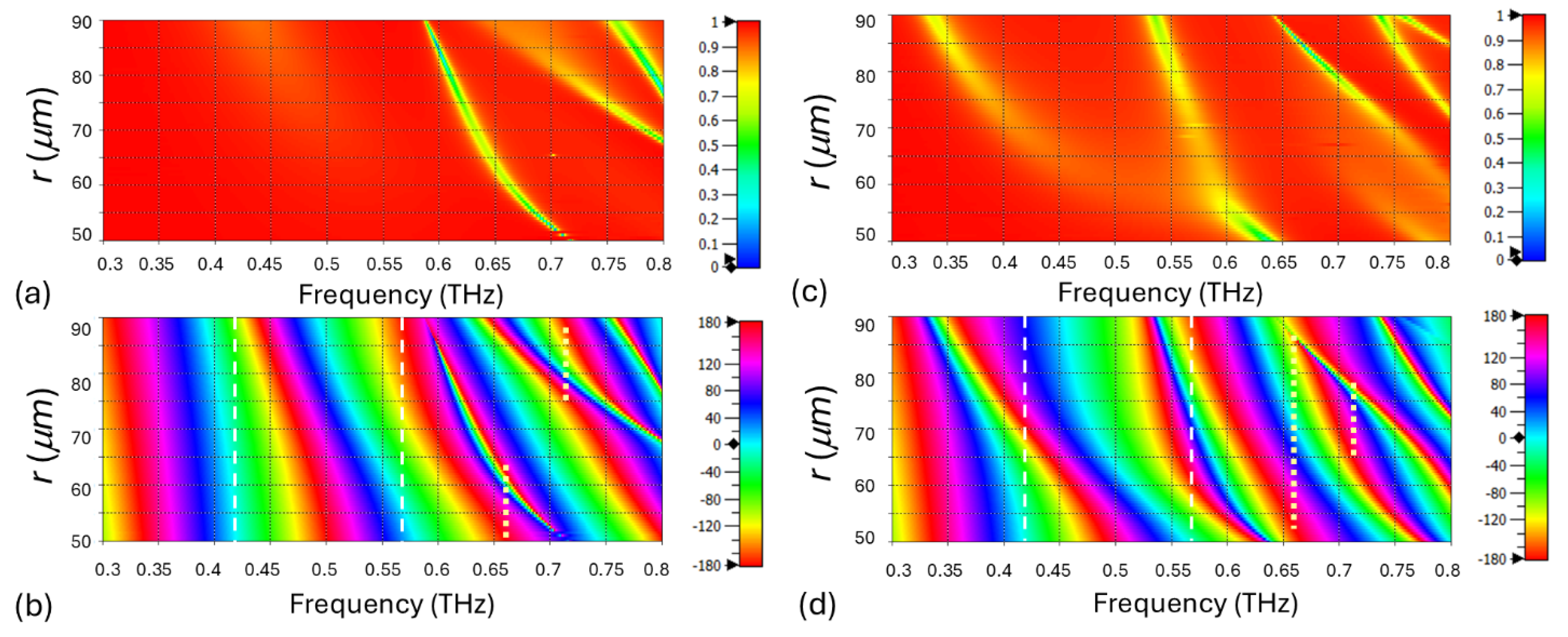
For the design purposes, presentation of results on magnitude and phase results on the frequency–geometric parameter plane can be advantageous. Figure 4 presents the results when r is gradually swept from 50 to 90 μm, while the remaining parameters are kept the same as in Figure 2. To use these results for the entire 2π-range coverage, two criteria should be satisfied simultaneously:
Figure 4.
Magnitude (a) and phase in degrees (b) for S11 on (f,r)-plane in the case of i-VO2; magnitude (c) and phase in degrees (d) for S11 on (f,r)-plane in the case of m-VO2, at h = 130 μm, ts = 150 μm, rc = r, hc = 3 μm, and normal incidence. Dashed white lines indicate two cases taken from Table 1. Dotted yellow lines indicate the ranges of r possible for covering the full range of ϕ for the selected values of f.
- (1)
- In the phase plots, it should be possible to pass from red to red through all other colors, at a given f and VO2 state; it determines the range of r variation which is potentially applicable to cover the entire range of ϕ; accordingly, a pass from red to cyan is needed for the 180° coverage.
- (2)
- In the magnitude plots, the chosen r-ranges and f-values should be checked, i.e., whether the condition |S11| > Smin is satisfied, where Smin is taken, for instance, as 0.8.
To estimate the capability of the selected range of r at chosen value of f in switching, it is necessary to compare magnitude and phase results for the m-VO2 and i-VO2 cases in Figure 4. An important advantage of the use of the (f,r)-plane is that the required range of r variation can be directly evaluated for each value of f, for which desired phase and, hence, color changes are achieved. For instance, it can be used when the entire phase range should be covered, i.e., Δϕ = 2π for one of the VO2 states, while it is either small (no more than several tens of degrees) or close to π for the other. As observed, sharper resonances may yield a narrower range of the required variation in r. It is recommended to select wider ranges of r (i.e., the ones for which the colors are changed slowly while r is varied), since fabrication imperfections are expected to be within μm for the cylinder diameter [59,60]. Two examples of the potentially applicable range of r are shown by dashed yellow lines for each of the two VO2 states.
Precise discretization of the ϕ-profile is crucial if narrow resonances, like the resonances in range C in Figure 2b,d, are involved. However, since the required number of discrete values of ϕ is typically not larger than eight, it should not be an unsolvable problem. The other situation may occur if a larger number of discrete values of ϕ is needed. A noticeable feature is that maxA can be achieved at rather arbitrary values of r, for both cases of i-VO2 and m-VO2 [see the small blue and green regions in Figure 4a,c]. For instance, one of the regimes of is achieved for i-VO2 when THz and r = 85 μm. The slopes of the “valleys” of maxA are different for different resonance regimes, which are pre-determined by the specifics of the field distribution.
3.2. Varying Radii of Cylindrical Dielectric Resonators for Thin Conformal VO2 Covers
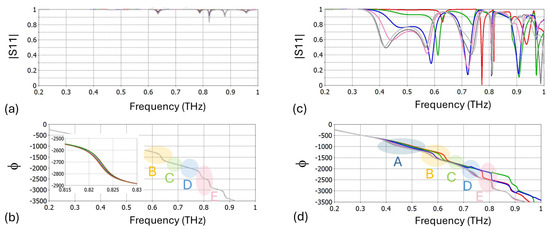
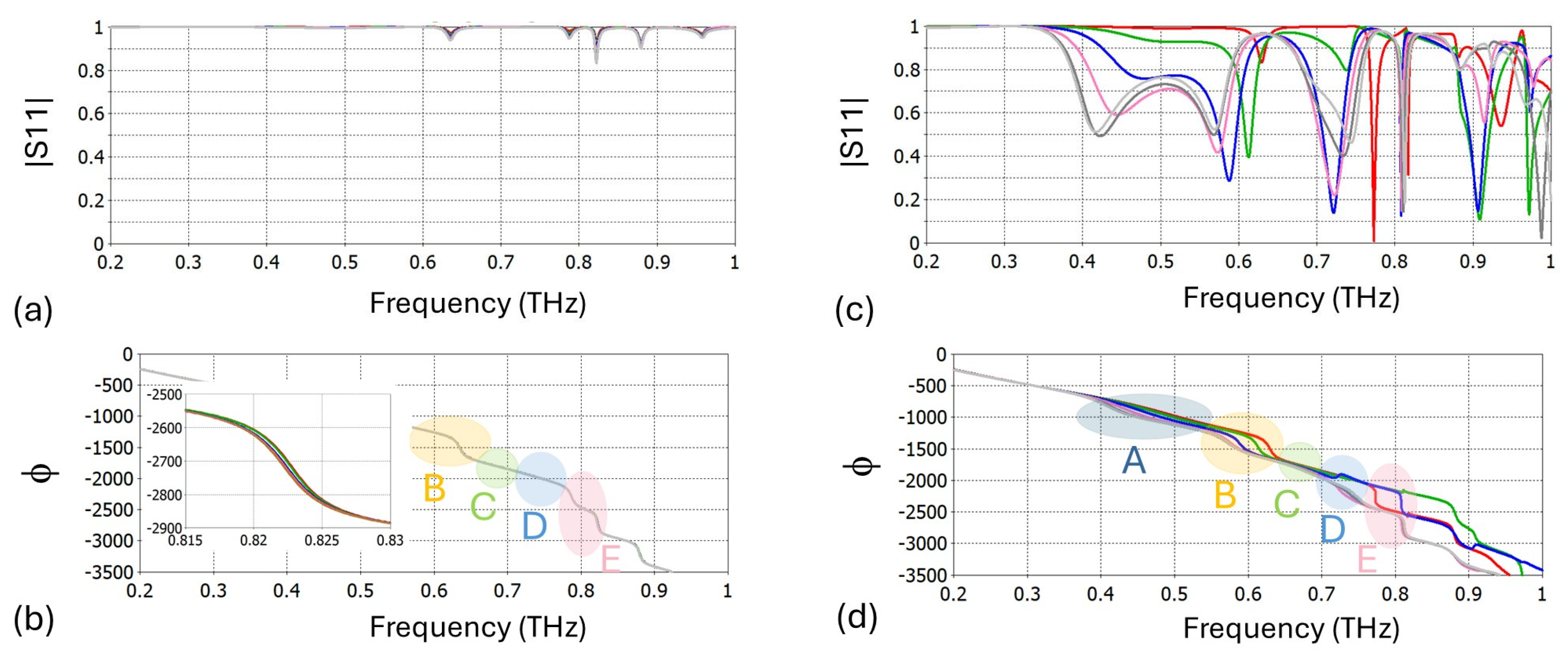
To compare with the results from Section 3.1, Figure 5 presents |S11| and ϕ vs. f for the case of hc = 300 nm. Such a thickness of VO2 is widely used in tunable and switchable metasurfaces. Sputtering [67] or chemical vapor deposition [70] can be used to obtain a thickness of this order. Three typical frequency ranges can be distinguished depending on the behavior of |S11| and ϕ. Similarly to the case of hc = 3 μm, they are denoted by A, B, and C. For the case of i-VO2, typical values of ϕ are, respectively, tens to 180, 200, and 360 degrees. In range C, the use of r which varies from 50 μm to 80 μm can be sufficient to cover the entire phase range. For the two remaining ranges, the use of the whole range of r, i.e., from 50 μm to 90 μm, can also be superfluous. The presented results indicate that the spectral locations of the resonances for the two used values of hc can be close to each other but their widths and depths can differ. As follows from the comparison of the results in Figure 2 and Figure 5, not only the 3 μm thick covers but also 300 nm thick ones may enable various ranges of ϕ coverage in the i-VO2 state, while absorption depends on the thickness. Indeed, deeper maximums are observed for some values of r when hc is smaller, but shallower maximums appear for the others. The impedance matching technique can be used to explain the appearance of the absorption maximums [71], which correspond to the reflection-free regime.
Figure 5.
Magnitude (a) and phase in degrees (b) for S11 in the case of i-VO2; magnitude (c) and phase in degrees (d) for S11 in the case of m-VO2 at h = 130 μm, ts = 150 μm, hc = 300 nm and angle of incidence θ = 0°, for five values of r = rc; red line—r = 50 μm, green—r = 60 μm, blue line—r = 70 μm, light-rose line—r = 80 μm, and gray line—r = 90 μm. A, B, and C indicate three ranges which differ in resonance properties and expected functionality.
Also, in the case of m-VO2, the features observed in Figure 5 look like the ones in Figure 2 but typically show stronger minimums of |S11|. This makes the bands for possible wideband operation narrower and the overall design more complicated, because it becomes more difficult to overcome the ranges of strong absorption when discrete values of r are selected. Notably, absorption is generally not proportional to the volume of the absorbing material (e.g., see [71]), so it is not surprising that the minimums of |S11| in Figure 5c are deeper than in Figure 2c. This may occur due to the specific phase and impedance conditions leading to such a field localization which results in higher absorptance at smaller hc.
If a strong absorption regime is planned to be incorporated into the switching scenario as the OFF state, i.e., in line with scenario 3 listed in Section 2, then hc = 300 nm may be preferable. However, it is better suited for equal meta-atom metasurfaces, but not for supercell-based metasurfaces. It can be said that the larger thickness of VO2 components can provide some protection against stronger absorption at 0.3 < f < 0.6 THz. It is worth noting that the approach based on the results of the (f,r)-plane, like in Figure 4, can also be used for thin covers. Table 2 presents a few examples of the phase range coverage that is associated with different functionalities and different functionality switching scenarios. The range 0.35 < f < 0.465 THz can be considered as a band suitable for 2-bit coding, which has a bandwidth of 28%, but the switching scenario depends on the choice of f-value. Note that the fact that min(ΩΔϕ, 1/ΩΔϕ) is of the order of unity at f > 0.465 THz (see Table 2) does not mean that this range cannot be used in the switching scenarios, but values of f and r should be carefully selected in this case.
Table 2.
Examples of phase range coverage and expected switching scenarios in reflection mode at the selected frequencies in case of thin conformal covers at f < 0.63 THz; ΩΔϕ = Δϕmet/Δϕins is the phase coverage contrast.
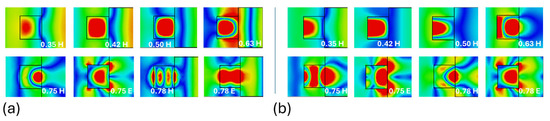
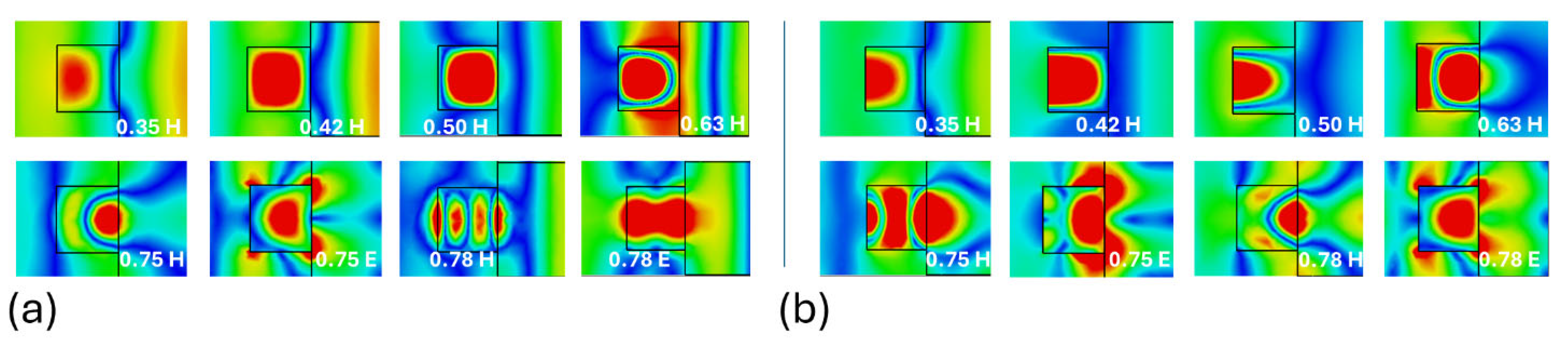
Examples of field distributions corresponding to the selected spectral regimes from Figure 5 and Table 2 are presented in Figure 6 for r = 70 μm. From the comparison of Figure 6a,b, effects exerted on the field by the change in VO2 state are evident. Similarly to the case of hc = 3 mm in Figure 3, a magnetic resonance is dominant at the frequencies, where larger values of ΩΔϕ can be obtained. For i-VO2, it occurs, for instance, at f = 0.63 THz. For m-VO2, it happens at f = 0.42 and 0.63 THz. Also, the effects related to intra-array coupling and spacer resonances can be significant. The electric-dipole resonance comes into play at higher frequencies. For i-VO2 and m-VO2, its effect starts to appear at least from 0.66 THz and 0.75 THz, respectively. At other values of r like 50 μm and 90 μm, sharper resonances may occur in range C and close to it [see Figure 5b].
Figure 6.
A few examples of the field distribution for (a) i-VO2 and (b) m-VO2, at the same geometric parameters as in Figure 5. In each plot, the frequency value is given in THz (0.35, 0.42, etc.); letters H and E denote magnetic and electric fields, respectively. Color maps correspond to the mid-cross-section (side view); EM wave is incident from the left side.
3.3. Effect of Spacer Thickness
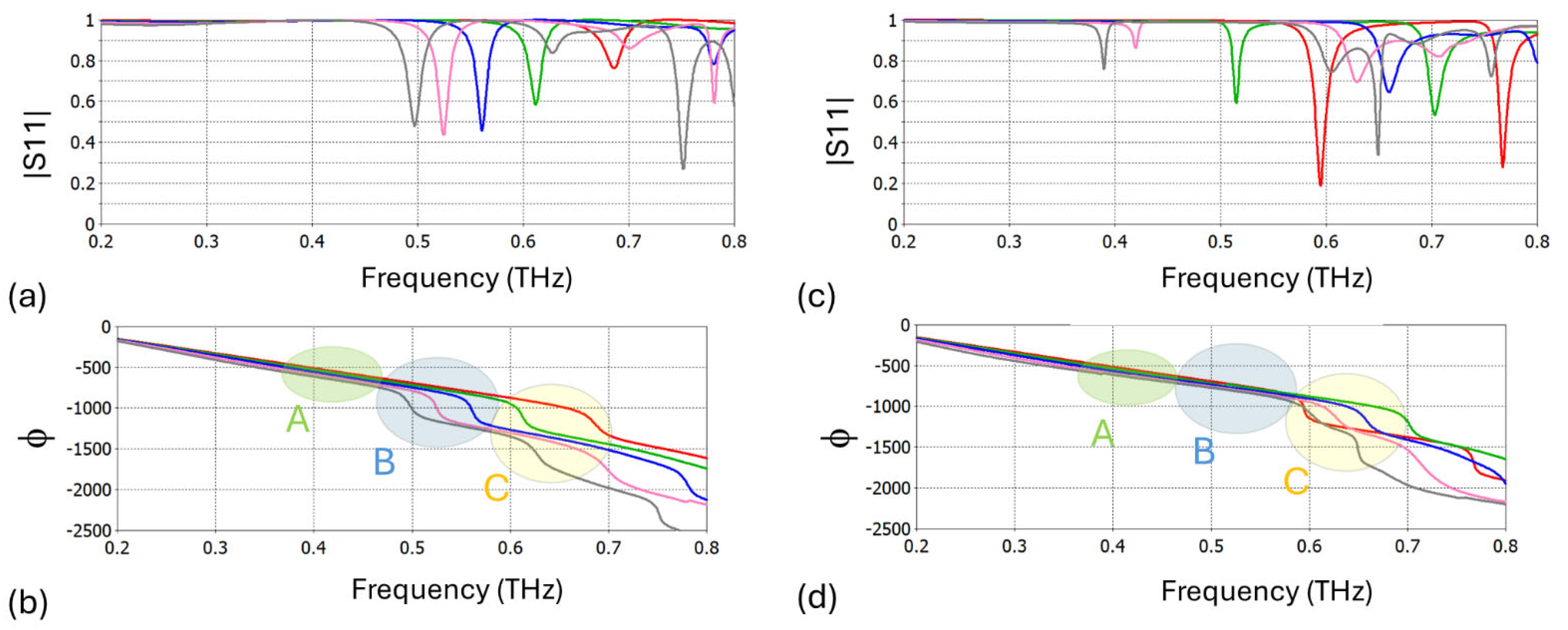
The spacer thickness is another important parameter that may affect metasurface performance. The results are presented in this section for values of ts that can be chosen. Clearly, ts should be the same for all meta-atoms in each supercell. Figure 7 presents the results for |S11| and ϕ for five selected values of r, when ts is chosen as 50 μm. These results show that |S11| and ϕ still strongly depend on r, while the effect exerted by ts is significant. Three typical ranges, A, B, and C, are distinguishable. It is worth comparing two ranges, B and C. For range C, a strong dependence of the spectral locations of min|S11| on r occurs for the both cases of m-VO2 and i-VO2, but it looks more regular and better predictable for m-VO2. In turn, range B looks more suitable for ON/OFF switchable scenarios because well-pronounced resonances that are strongly sensitive to the variations in r appear only for i-VO2. As a result, we can obtain here a higher contrast between two states of VO2. Finally, no useful switching regimes can be obtained for range A, where Δf only achieves several tens of degrees for both i-VO2 and m-VO2. Notably, not all of the minimums of |S11| yield the jumps of ϕ. For i-VO2, the first jump that may enable Δf = 360° is spectrally shifted from 0.5 to 0.68 THz, while r is increased from 50 up to 90 μm. It remains true for m-VO2 starting from r = 60 μm, whereas the jump’s spectral location for r = 50 μm nearly coincides with that for r = 90 mm. As a result, the well-pronounced phase jumps start to appear at 0.6 THz for m-VO2, instead of 0.5 THz for i-VO2. Note that the results presented may significantly differ not only from those in Figure 2 but also from the ones for other values of ts.
Figure 7.
Magnitude (a) and phase in degrees (b) for S11 in case of i-VO2; magnitude (c) and phase in degrees (d) for S11 in case of m-VO2, at h = 130 μm, ts = 50 μm, hc = 3 μm, θ = 0°, for five values of r = rc: red line—r = 50 μm, green—r = 60 μm, blue line—r = 70 μm, light-rose line—r = 80 μm, and gray line—r = 90 μm. A, B, and C indicate three ranges which differ in their resonance properties.
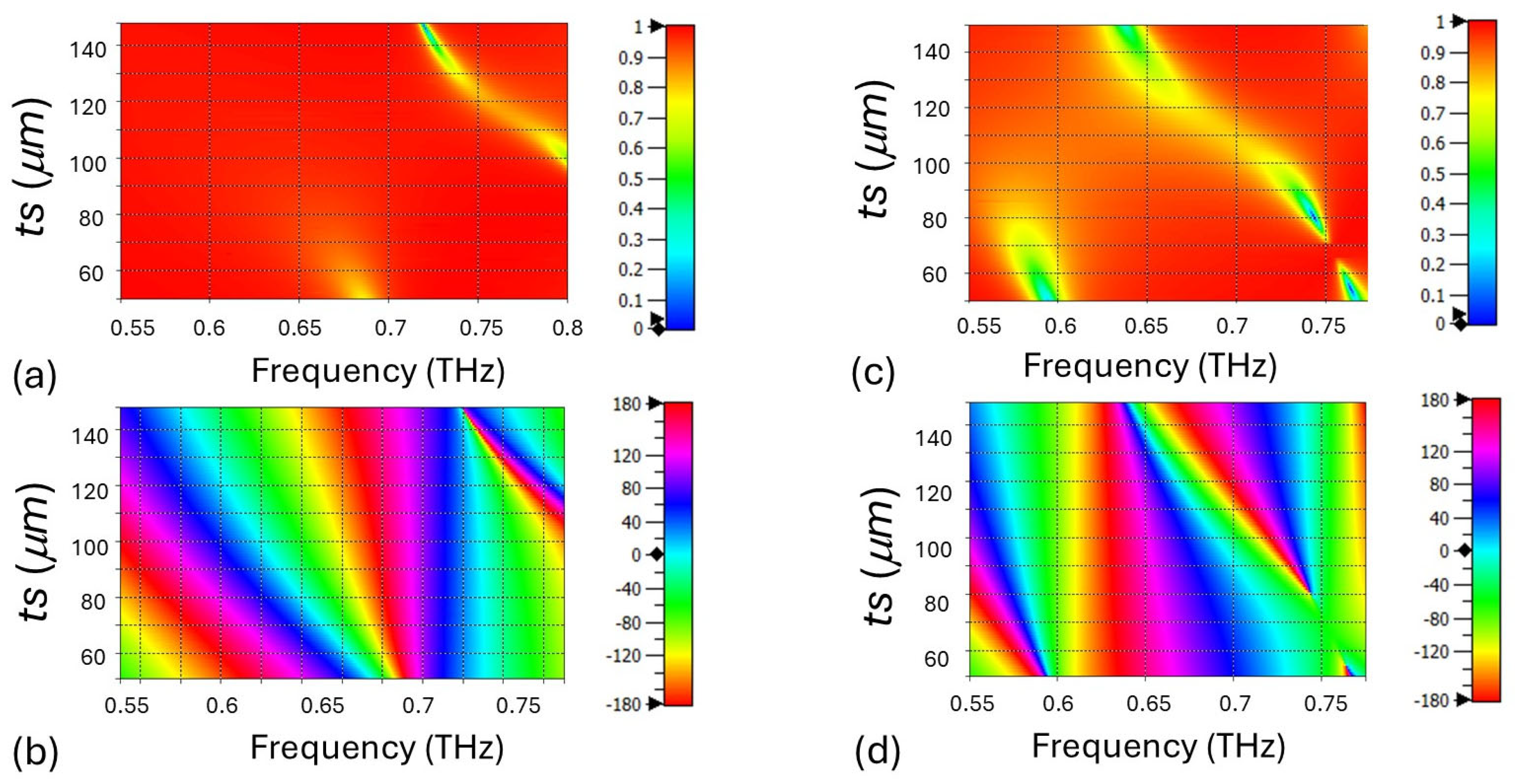
Figure 8 presents the results on the (f,ts)-plane, i.e., in a similar manner like in Figure 4. The radius r = 50 μm is chosen here. The small dark-blue regions in Figure 8a,c correspond to the case of , and should be avoided in designs of supercell-based metasurfaces. Clearly, such regions appear for m-VO2 and i-VO2 at different f and ts. Note that there are ϕ ranges in which the phase weakly depends on ts, while strong sensitivity to the variations in ts occurs for the others. Moreover, the features associated with BIC [72] are recognizable in both magnitude and phase plots. For instance, it happens for m-VO2 [see Figure 8d] in the vicinity f = 0.75 THz when ts = 70 μm. The presence of BIC may affect the possible choice of ts, which will be studied in detail in the next steps of this research program.
Figure 8.
Magnitude (a) and phase in degrees (b) for S11 on (f,ts)-plane in the case of i-VO2; magnitude (c) and phase in degrees (d) for S11 on (f,ts)-plane in the case of m-VO2; h = 130 μm, r = rc = 50 μm, hc = 3 μm, and θ = 0°.
3.4. Varying Size of Non-Conformal VO2 Drops/Covers
Besides variations in the sizes of dielectric microresonators, there is one more way to design different phases of EM waves and, hence, different meta-atoms in one supercell. It can be done by means of size variations in the VO2 components, i.e., drops or covers. At the micrometer scale, it might be possible to place these components atop the resonators in a controlled way. It can be difficult to provide eight different meta-atoms (with different radii of rc) in one supercell or in the entire structure. However, using two different values of rc in switchable 1-bit coding or four for switchable 2-bit coding may look realistic.
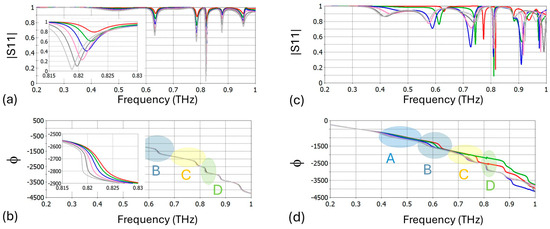
Figure 9 presents the magnitude and phase of S11 vs. f for five meta-atoms, which differ in the value of rc, while tc = 3 μm is kept constant. Both |S11| and ϕ remain without significant change beyond the resonance regions, but they can differ near the resonances so that the resonance frequencies and EM wave’s phase can be slightly different at different values of rc. In the case of i-VO2, the difference is significant for the resonance observed at f = 0.82 THz (within the range denoted by D), at which Δϕ > 200°. At the same time, Δϕ does not exceed a few tens of degrees for the lower-f ranges. Due to this feature, they are expected to be suitable rather for the OFF state, in line with scenario 3 from Section 2. The magnitude plot clearly shows the deep minimums for the resonances arising in range D, which contribute simultaneously to the phase range coverage and high absorption. Hence, they are also usable in the OFF state. Absorption strongly depends on rc, whereas the spectral shift in resonances is relatively small. This regime can be used in metasurfaces comprising all the same meta-atoms, as applicable for switchable absorption, at least if the resonance is shifted while changing from i-VO2 to m-VO2.
Figure 9.
Magnitude (a) and phase in degrees (b) for S11 in the case of i-VO2; magnitude (c) and phase in degrees (d) for S11 in the case of m-VO2 at r = 70 μm, h = 130 μm, ts = 150 μm, hc = 3 μm, and θ = 0°, for five values of rc: red line—rc = 20 μm, green—rc = 30 μm, blue line—rc = 40 μm, light-rose line—rc = 50 μm, gray line—rc = 60 μm, and light-gray line—rc = 70 μm. A, B, C, and D indicate four ranges which differ in resonance properties and expected functionality.
In the case of m-VO2, the results are similar, in some sense, to the results presented in Figure 2 for the meta-atoms using the same VO2 state. In Figure 9, Δϕ = 200° is achieved for range A and Δϕ = 300° for range B. The range 0.42 < f < 0.56 THz constitutes a band with a width of 28.5%, in which |S11| is kept without significant changes. A careful adjustment of the values of rc is needed in the m-VO2 case to avoid significant absorption at the minimums of |S11|. As said above, the resulting absorption is not proportional, in the general case, to the volume occupied by VO2, which is typical for absorbers of different types; for example, see ref. [71]. Furthermore, spectral locations of the resonances in ranges A and B are sensitive to the variations in rc, even if small portions of VO2 are used. On the other hand, just a weak dependence of spectral locations of resonances on rc is observed in ranges C and D. For instance, resonances in range D are just slightly shifted when i-VO2 is changed for m-VO2, or vice versa. In many cases, the difference between strong sensitivity in the m-VO2 case and weak sensitivity in the i-VO2 case can be more pronounced when variations in r are substituted by the ones in rc.
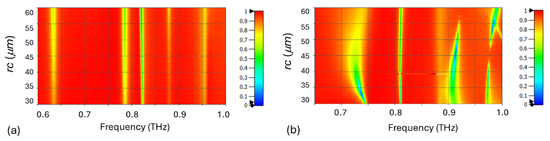
Next, Figure 10 shows |S11| on the (f,rc)-plane. The results are presented for the case when hc = 3 μm, rc is varied, while the remaining parameters are the same as in Figure 9. Similarly to Figure 4, these results can be directly used for design purposes, i.e., for supercells containing meta-atoms with different rc. The key feature observed in the case of i-VO2 is that absorption is monotonously increased at resonances with rc. However, for m-VO2, the minimums of |S11| are observed at intermediate values of rc. Therefore, the optimal values of rc can be found for narrowband absorption with .
Figure 10.
Magnitude of S11 on (f,rc)-plane in the case of (a) i-VO2 and in the case of (b) m-VO2, when rc is varied from 30 to 60 μm, h = 130 μm, ts = 150 mm, r = 70 μm, hc = 3 μm, and θ = 0°.
To compare, Figure 11 presents the results for the case when hc = 300 nm, and the remaining parameters are the same as in Figure 9. A weak sensitivity to the applied variations in rc is observed in the case of i-VO2. In other words, the covers/drops work as weak perturbations that do not affect the EM wave’s phase, whereas min|S11| > 0.82 is kept for all values of rc within the entire f-range. Therefore, it can serve as an OFF state (corresponding to specular reflection), as in scenario 3 in Section 2. In the case of m-VO2, the observed behavior of ϕ vs. f is similar to Figure 2 and Figure 5, at least for ranges A and B. Accordingly, Δϕ that is close to 200° and 350° can be achieved.
Figure 11.
Magnitude (a) and phase in degrees (b) for S11 in the case of i-VO2; magnitude (c) and phase in degrees (d) for S11 in the case of m-VO2 at r = 70 μm, h = 130 μm, ts = 150 μm, hc = 300 nm, and θ = 0°, for five values of rc: red line—rc = 20 μm, green—rc = 30 μm, blue line—rc = 40 μm, light-rose line—rc = 50 μm, gray line—rc = 60 μm, and light-gray line—rc = 70 μm. A, B, C, D, and E indicate five ranges which differ in resonance properties and expected functionality.
The results obtained in the case of m-VO2 confirm that even thin and small VO2 components may exert a strong effect on |S11| and ϕ. However, absorption can be undesirably high, as observed for the range extended from 0.4 to 0.6 THz; see Figure 11c,d. This can be a serious restriction for use in coding metasurfaces. Nevertheless, it is still possible to select the case with min|S11| > 0.7, which occurs at f = 0.5 THz, for operation in equal meta-atom metasurfaces. Supercell metasurfaces can be designed, but with a relatively low efficiency, in which m-VO2 serves as the ON state for 1-bit coding, while i-VO2 is responsible for the OFF state. At the same time, narrow resonances in ranges C and D correspond to a nearly perfect absorption and can be used for ON/OFF switchable absorption. Hence, at least two switchable scenarios are still possible in the case of rc < r, i.e., for switchable 1-bit coding and switchable narrowband absorption. Finally, the possibility of using range E remains under question.
4. Concluding Remarks
The performed study has unveiled the effects exerted by variations in geometric parameters of meta-atoms comprising dielectric microcylinders and small VO2 components. It is shown that a variety of switching scenarios is possible even for a simple design that is based on the dielectric resonators of the cylindrical shape. The basic differences between the cases of m-VO2 and i-VO2 were compared in terms of coverage of the reflected wave’s phase range and related functionalities. As expected, functionality-enabling resonances can be controlled by varying boundary conditions atop the dielectric resonators while applying heating or cooling. It enables switchable coverage of the EM wave’s phase that is necessary in switchable coding functionalities. The sensitivity to the transition of VO2 from the insulating to the metallic state depends on the chosen resonance regime that may yield diverse switching scenarios, which serves as a prerequisite for switchable multifunctional operation. Typical scenarios include switching between 1-bit coding and 3-bit coding, and between ON/OFF switching of 2-bit coding. While magnetic resonances are the key enablers of the desired functionality, their joint effect with other resonance effects may enforce the performance.
The microcyliner radius is the basic parameter whose variation allows for obtaining different phases for supercell-based designs. In this case, the achievable functionalities and functionality switching scenarios may depend on the thickness of the conformal VO2 cover in such a way that may look unexpected at first glance. A larger thickness of VO2 can be preferable, since it allows for reducing absorption within the frequency and geometric parameter ranges, which are suitable for coding and wavefront manipulation at THz frequencies.
Varying the size and shape of the VO2 components at a given size of dielectric resonators formally gives one more degree of freedom for obtaining the switchable phase coverage. Similarly to the case when cylinder radius is varied, the phase range coverage differs from one resonance regime to another, when the neighboring meta-atoms have the VO2 covers of different radii. The most interesting feature in this case is that the strong sensitivity of the EM wave’s phase and spectral locations of resonances to the variations in cover/drop radius may occur in the m-VO2 case, while the same variations only lead to insignificant changes in the EM wave’s phase in the i-VO2 case. The results show that the functionality switching scenarios can be obtained by using small non-conformal VO2 components. For larger thicknesses of VO2, larger diversity of functionality switching scenarios can be obtained, while efficiency is a weaker restriction than in the case of smaller thicknesses. Different resonance regimes and the specifics of their modification under temperature variations correspond to different functionality switching scenarios. Usually, electric- and magnetic-dipole resonances are considered as the basic resonances in dielectric cylinders. However, spacer resonances and intra-array coupling may also contribute to the resulting functionality.
In turn, a proper choice of spacer thickness can help to avoid strong absorption for all discrete values of the radius of the cylinder or cover that are required within one supercell for phase coverage. In realistic cases, fabrication imperfections should just slightly affect the coverage ranges. However, sharp resonances are more sensitive and, hence, are worth overcoming. The unwanted parameter sets can be detected by using the frequency –geometric parameter plane or geometric–parameter plane at a given frequency for reflected wave magnitude and phase. In fact, this way of presenting the results is very efficient regardless of which geometric parameter is varied. So, it can be recommended for a wide class of metasurfaces based on subwavelength resonators. At oblique incidence, two linear polarizations can be used for coding independently of each other. It should be noted that when the EW wave’s phases are well adjusted for one of the VO2 states, they can be just approximately adjustable for the other. Therefore, a device-oriented design procedure can be more complicated than the presented one, whose aim was to retrieve basic features and provide suitable entry-point information for future (pre-)prototype designs. At the same time, the results obtained provide proper guidelines for next-stage studies of subwavelength meta-atoms.
Comparison of the capability of subwavelength dielectric and quasiplanar metallic resonators in functionality-enabling switchable scenarios will be a subject of future studies. The concept of switchable functionality, which depends on the chosen resonance regime, can be replicated in other frequency ranges, assuming that different sizes and, likely, other tunable materials are utilized. Moreover, it is planned to be examined for possible use in devices exploiting magneto-optical effects and spin waves.
Author Contributions
Conceptualization, A.E.S. and A.O.C.; simulations, A.E.S. and K.F.; results analysis, A.E.S., K.F. and E.C.; writing, A.E.S., A.O.C. and E.C. All authors have read and agreed to the published version of the manuscript.
Funding
The contribution of A.E.S. was funded by Narodowe Centrum Nauki, Project UMO-2020/39/I/ST3/02413.
Data Availability Statement
The original contributions presented in this study are included in the article. Further inquiries can be directed to the corresponding author.
Conflicts of Interest
The authors declare no conflicts of interest.
Abbreviations
The following abbreviations are used in this manuscript:
| PCM | phase-change material |
| BIC | bound states in the continuum |
| EM | electromagnetic |
References
- Krpenský, J.; Horák, M.; Kabát, J.; Planer, J.; Kepič, P.; Křápek, V.; Konečná, A. Analytical electron microscopy analysis of insulating and metallic phases in nanostructured vanadium dioxide. Nanoscale Adv. 2024, 6, 3338–3346. [Google Scholar] [CrossRef] [Scilit]
- Ahmad, I.; Kachiraju, S.R.; Kunwar, S.; Brown, Z.M.; Roy, P.; Gaddy, M.; Kuryatkov, V.; Kwon, Y.; Bernussi, A.A.; Murphy, J.P.; et al. Temperature-dependent optical constants of vanadium dioxide thin films deposited on polar dielectrics. Opt. Mater. 2024, 154, 115733. [Google Scholar] [CrossRef] [Scilit]
- Dicken, M.J.; Aydin, K.; Pryce, I.M.; Sweatlock, L.A.; Boyd, E.M.; Walavalkar, S.; Ma, J.; Atwater, H.A. Frequency tunable near-infrared metamaterials based on VO2 phase transition. Opt. Express 2009, 17, 18330–18339. [Google Scholar] [CrossRef] [Scilit]
- Wan, C.; Zhang, Z.; Woolf, D.; Hessel, C.M.; Rensberg, J.; Hensley, J.M.; Xiao, Y.; Shahsafi, A.; Salman, J.; Richter, S.; et al. On the optical properties of thin-film vanadium dioxide from the visible to the far infrared. Ann. Der Phys. 2019, 531, 1900188. [Google Scholar] [CrossRef] [Scilit]
- Cakir, M.C.; Kocer, H.; Durna, Y.; Yildirim, D.U.; Ghobadi, A.; Hajian, H.; Aydin, K.; Kurt, H.; Saglam, N.; Ozbay, E. Unveiling the optical parameters of vanadium dioxide in the phase transition region: A hybrid modeling approach. RSC Adv. 2020, 10, 29945–29955. [Google Scholar] [CrossRef] [Scilit]
- Kepic, P.; Horák, M.; Kabat, J.; Hájek, M.; Konečná, A.; Šikola, T.; Ligmajer, F. Coexisting phases of individual VO2 nanoparticles for multilevel nanoscale memory. ACS Nano 2025, 19, 1167–1176. [Google Scholar] [CrossRef] [Scilit]
- Otto, M.R.; René de Cotret, L.P.; Valverde-Chavez, D.A.; Tiwari, K.L.; Émond, N.; Chaker, M.; Cooke, D.G.; Siwick, B.J. How optical excitation controls the structure and properties of vanadium dioxide. Proc. Natl. Acad. Sci. USA 2019, 116, 450–455. [Google Scholar] [CrossRef] [Scilit]
- Wang, J.; Wang, L.; Liu, J. Overview of phase-change materials based photonic devices. IEEE Access 2020, 8, 121211–121245. [Google Scholar] [CrossRef] [Scilit]
- Ko, B.; Badloe, T.; Rho, J. Vanadium dioxide for dynamically tunable photonics. ChemNanoMat 2021, 7, 713–727. [Google Scholar] [CrossRef] [Scilit]
- Serebryannikov, A.E.; Lakhtakia, A.; Ozbay, E. Thermally switchable, bifunctional, scalable, mid-infrared metasurfaces with VO2 grids capable of versatile polarization manipulation and asymmetric transmission. Opt. Mater. Express 2022, 12, 4594–4605. [Google Scholar] [CrossRef] [Scilit]
- Serebryannikov, A.E.; Lakhtakia, A.; Vandenbosch, G.A.E.; Ozbay, E. Transmissive terahertz metasurfaces with vanadium dioxide split-rings and grids for switchable asymmetric polarization manipulation. Sci. Rep. 2022, 12, 3518. [Google Scholar] [CrossRef] [Scilit] [PubMed]
- Kim, K.; Choi, T.; Choi, S.; Kim, H.; Lee, Y.W.; Kim, S.-J.; Lee, B.; Jeong, Y. Multi-objective optimization of dynamic VO2 metagrating: Broadband polarization-independent transmission modulator. Opt. Express 2024, 32, 32680–32690. [Google Scholar] [CrossRef] [Scilit] [PubMed]
- Tripathi, A.; Ugwu, C.F.; Asadchy, V.S.; Faniayeu, I.; Kravchenko, I.; Fan, S.; Kivshar, Y.; Valentine, J.; Kruk, S.S. Nanoscale optical nonreciprocity with nonlinear metasurfaces. Nat. Commun. 2024, 15, 5077. [Google Scholar] [CrossRef] [Scilit]
- Kang, T.; Zhang, T.; Zhang, F.; Pu, M.; Chen, L.; Bao, H.; Chen, S.; Du, A.; Long, L.; Guo, Y.; et al. Broadband High-Efficiency Nonreciprocal Transmission Enabled by Silicon/Vanadium Dioxide Catenary Metasurfaces. Adv. Funct. Mater. 2025, 35, 2504593. [Google Scholar] [CrossRef] [Scilit]
- Oguntoye, I.O.; Padmanabha, S.; Hinkle, M.; Koutsougeras, T.; Ollanik, A.J.; Escarra, M.D. Continuously tunable optical modulation using vanadium dioxide Huygens metasurfaces. ACS Appl. Mater. Interfaces 2023, 15, 41141–41150. [Google Scholar] [CrossRef] [Scilit] [PubMed]
- Liu, M.; Wei, R.; Taplin, J.; Zhang, W. Terahertz metasurfaces exploiting the phase transition of vanadium dioxide. Materials 2023, 16, 7106. [Google Scholar] [CrossRef] [Scilit]
- Kim, M.; Jeong, J.; Poon, J.K.; Eleftheriades, G.V. Vanadium-dioxide-assisted digital optical metasurfaces for dynamic wavefront engineering. J. Opt. Soc. Am. B 2016, 33, 980–988. [Google Scholar] [CrossRef] [Scilit]
- Akyurek, B.; Noori, A.; Demirhan, Y.; Ozyuzer, L.; Guven, K.; Altan, H.; Aygun, G. VO2-Based Dynamic Coding Metamaterials for Terahertz Wavefront Engineering. J. Infrared Millim. Terahertz Waves 2025, 46, 5. [Google Scholar] [CrossRef] [Scilit]
- Gao, F.; Zhou, J.; Liu, H.; Deng, J.; Yan, B. Topological metasurface of tunable, chiral VO2-based system with exceptional points in the dual band. J. Appl. Phys. 2024, 135, 063104. [Google Scholar] [CrossRef] [Scilit]
- Li, B.; Camacho-Morales, R.; Li, N.; Tognazzi, A.; Gandolfi, M.; de Ceglia, D.; De Angelis, C.; Sukhorukov, A.A.; Neshev, D.N. Fundamental limits for transmission modulation in VO2 metasurfaces. Photon. Res. 2022, 11, B40–B49. [Google Scholar] [CrossRef] [Scilit]
- Yogitha, S.N.; Acharyya, N.; Mishra, A.; Akkanaboina, M.; Verma, A.; Rana, D.S.; Chowdhury, D.R. Thermally tunable dual channel toroidal metasurface on VO2 platform. J. Appl. Phys. 2025, 137, 193105. [Google Scholar] [CrossRef] [Scilit]
- Urade, Y.; Fukawa, K.; Miyamaru, F.; Okimura, K.; Nakanishi, T.; Nakata, Y. Dynamic inversion of planar-chiral response of terahertz metasurface based on critical transition of checkerboard structures. Nanophotonics 2022, 11, 2057–2064. [Google Scholar] [CrossRef] [Scilit] [PubMed]
- Nakata, Y.; Fukawa, K.; Nakanishi, T.; Urade, Y.; Okimura, K.; Miyamaru, F. Reconfigurable terahertz quarter-wave plate for helicity switching based on Babinet inversion of an anisotropic checkerboard metasurface. Phys. Rev. Appl. 2019, 11, 044008. [Google Scholar] [CrossRef] [Scilit]
- Zhao, J.; Zhang, R.; Cao, S.; Zhuang, M.; Song, Z. Broadband terahertz holography using isotropic VO2 metasurfaces. Sci. Rep. 2025, 15, 702. [Google Scholar] [CrossRef] [Scilit]
- Serebryannikov, A.E.; Hajian, H.; Beruete, M.; Ozbay, E.; Vandenbosch, G.A.E. Tunable deflection and asymmetric transmission of THz waves using a thin slab of graphene-dielectric metamaterial, with and without ENZ components. Opt. Mater. Express 2018, 8, 3887–3898. [Google Scholar] [CrossRef] [Scilit]
- Xing, Q.; Wang, C.; Huang, S.; Liu, T.; Xie, Y.; Song, C.; Wang, F.; Li, X.; Zhou, L.; Yan, H. Tunable graphene split-ring resonators. Phys. Rev. Appl. 2020, 13, 041006. [Google Scholar] [CrossRef] [Scilit]
- Cheng, L.; Huang, K.; Wang, Y.; Wu, F. ITO Dynamic Tunable Deflection of Radiation Based on Epsilon-Near-Zero Material. Photonics 2023, 10, 688. [Google Scholar] [CrossRef] [Scilit]
- Serebryannikov, A.E.; Lakhtakia, A.; Aalizadeh, M.; Ozbay, E.; Vandenbosch, G.A.E. Temperature-mediated invocation of the vacuum state for switchable ultrawide-angle and broadband deflection. Sci. Rep. 2018, 8, 15044. [Google Scholar] [CrossRef] [Scilit]
- Serebryannikov, A.E.; Lakhtakia, A.; Ozbay, E. Thermally mediated transmission-mode deflection of terahertz waves by lamellar metagratings containing a phase-change material. Opt. Mater. Express 2024, 14, 745–758. [Google Scholar] [CrossRef] [Scilit]
- Wan, B.; Zhang, H.; Wang, P. Nonreciprocal absorber with a narrow band of angular polarization sensitive regions based on a quasi-periodic structure. Opt. Lett. 2021, 46, 1934–1937. [Google Scholar] [CrossRef] [Scilit]
- Serebryannikov, A.E.; Alici, K.B.; Ozbay, E.; Lakhtakia, A. Thermally sensitive scattering of terahertz waves by coated cylinders for tunable invisibility and masking. Opt. Express 2018, 26, 1–14. [Google Scholar] [CrossRef] [Scilit]
- Serebryannikov, A.E.; Ozbay, E. Exploring localized ENZ resonances and their role in superscattering, wideband invisibility, and tunable scattering. Sci. Rep. 2024, 14, 1580. [Google Scholar] [CrossRef] [Scilit]
- Leitis, A.; Heßler, A.; Wahl, S.; Wuttig, M.; Taubner, T.; Tittl, A.; Altug, H. All-dielectric programmable Huygens’ metasurfaces. Adv. Funct. Mater. 2020, 30, 1910259. [Google Scholar] [CrossRef] [Scilit]
- Raeis-Hosseini, N.; Rho, J. Metasurfaces based on phase-change material as a reconfigurable platform for multifunctional devices. Materials 2017, 10, 1046. [Google Scholar] [CrossRef] [Scilit]
- Chu, C.H.; Tseng, M.L.; Chen, J.; Wu, P.C.; Chen, Y.-H.; Wang, H.-C.; Chen, T.-Y.; Hsieh, W.T.; Wu, H.J.; Sun, G.; et al. Active dielectric metasurface based on phase-change medium. Laser Photon. Rev. 2016, 10, 986–994. [Google Scholar] [CrossRef] [Scilit]
- Li, C.; Pan, R.; Geng, G.; Zheng, R.; Gu, C.; Guo, H.; Li, J. Strong and omnidirectional light absorption from ultraviolet to near-infrared using GST metasurface. Laser Photon. Rev. 2023, 17, 2200364. [Google Scholar] [CrossRef] [Scilit]
- Ding, F.; Yang, Y.; Bozhevolnyi, S.I. Dynamic metasurfaces using phase-change chalcogenides. Adv. Opt. Mater. 2019, 7, 1801709. [Google Scholar] [CrossRef] [Scilit]
- Cakmak, A.O.; Colak, E.; Serebryannikov, A.E. Using thin films of phase-change material for active tuning of terahertz waves scattering on dielectric cylinders. Materials 2024, 17, 260. [Google Scholar] [CrossRef] [Scilit]
- Rahimi, E.; Balazadeh Koucheh, A.; Sendur, K. Temperature assisted reflection control using VO2/Si core-shell nanoparticles. Opt. Mater. Express 2022, 12, 2974–2981. [Google Scholar] [CrossRef] [Scilit]
- Wu, X.; Yuan, L.; Weng, X.; Qi, L.; Wei, B.; He, W. Passive smart thermal control coatings incorporating CaF2/VO2 core–shell microsphere structures. Nano Lett. 2021, 21, 3908–3914. [Google Scholar] [CrossRef] [Scilit]
- Yu, N.; Genevet, P.; Kats, M.A.; Aieta, F.; Tetienne, J.-P.; Capasso, F.; Gaburro, Z. Light propagation with phase discontinuities: Generalized laws of reflection and refraction. Science 2011, 334, 333–337. [Google Scholar] [CrossRef] [Scilit]
- Kang, M.; Feng, T.; Wang, H.T.; Li, J. Wave front engineering from an array of thin aperture antennas. Opt. Express 2012, 20, 15882–15890. [Google Scholar] [CrossRef] [Scilit]
- Chong, K.E.; Staude, I.; James, A.; Dominguez, J.; Liu, S.; Campione, S.; Subramania, G.S.; Luk, T.S.; Decker, M.; Neshev, D.N.; et al. Polarization-independent silicon metadevices for efficient optical wavefront control. Nano Lett. 2015, 15, 5369–5374. [Google Scholar] [CrossRef] [Scilit]
- Ding, F.; Pors, A.; Bozhevolnyi, S.I. Gradient metasurfaces: A review of fundamentals and applications. Rep. Prog. Phys. 2017, 81, 026401. [Google Scholar] [CrossRef] [Scilit]
- Arbabi, A.; Faraon, A. Advances in optical metalenses. Nat. Photon. 2023, 17, 16–25. [Google Scholar] [CrossRef] [Scilit]
- Wang, S.; Wu, P.C.; Su, V.C.; Lai, Y.C.; Chen, M.-K.; Kuo, H.Y.; Chen, B.H.; Chen, Y.H.; Huang, T.-T.; Wang, J.-H.; et al. A broadband achromatic metalens in the visible. Nat. Nanotechnol. 2018, 13, 227–232. [Google Scholar] [CrossRef] [Scilit] [PubMed]
- Yin, X.; Ye, Z.; Rho, J.; Wang, Y.; Zhang, X. Photonic spin Hall effect at metasurfaces. Science 2013, 339, 1405–1407. [Google Scholar] [CrossRef] [Scilit]
- Zhang, Z.; Gao, L. 2-bit coding metasurface with a double layer random flip structure for wide band diffuse reflection and reciprocity protected transmission. Opt. Express 2023, 31, 32253–32262. [Google Scholar] [CrossRef] [Scilit]
- Wan, X.; Qi, M.Q.; Chen, T.Y.; Cui, T.J. Field-programmable beam reconfiguring based on digitally controlled coding metasurface. Sci. Rep. 2016, 6, 20663. [Google Scholar] [CrossRef] [Scilit] [PubMed]
- Gao, L.H.; Cheng, Q.; Yang, J.; Ma, S.J.; Zhao, J.; Liu, S.; Chen, H.-B.; He, Q.; Jiang, W.-X.; Ma, H.-F.; et al. Broadband diffusion of terahertz waves by multi-bit coding metasurfaces. Light Sci. Appl. 2015, 4, e324. [Google Scholar] [CrossRef] [Scilit]
- Cui, T.J.; Qi, M.Q.; Wan, X.; Zhao, J.; Cheng, Q. Coding metamaterials, digital metamaterials and programmable metamaterials. Light Sci. Appl. 2014, 3, e218. [Google Scholar] [CrossRef] [Scilit]
- Zhang, X.G.; Tang, W.X.; Jiang, W.X.; Bai, G.D.; Tang, J.; Bai, L.; Qiu, C.; Cui, T.J. Light-controllable digital coding metasurfaces. Adv. Sci. 2018, 5, 1801028. [Google Scholar] [CrossRef] [Scilit]
- Zhang, L.; Cui, T.J. Space-time-coding digital metasurfaces: Principles and applications. Research 2021, 2021, 9802673. [Google Scholar] [CrossRef] [Scilit]
- Pan, T.; Liu, C.; Peng, S.; Lu, H.; Zhang, H.; Xu, X.; Yang, F. A Terahertz Programmable Digital Metasurface Based on Vanadium Dioxide. Photonics 2024, 11, 527. [Google Scholar] [CrossRef] [Scilit]
- Matos, R.; Pala, N. A review of phase-change materials and their potential for reconfigurable intelligent surfaces. Micromachines 2023, 14, 1259. [Google Scholar] [CrossRef] [Scilit]
- Xie, Q.; Sun, J.; Su, C.; Xia, F.; Wang, M.; Zhang, K.; Yun, M. Multifunctional metasurface for broadband absorption and polarization conversion based on graphene-VO2. Diam. Relat. Mater. 2023, 137, 110119. [Google Scholar] [CrossRef] [Scilit]
- Han, J.; Chen, R. Tunable broadband terahertz absorber based on a single-layer graphene metasurface. Opt. Express 2020, 28, 30289–30298. [Google Scholar] [CrossRef] [Scilit]
- Lin, Y.S.; Ruan, T.; Zhu, Y. Tunable color switch and sensor using a cross-shaped metasurface. J. Mater. Chem. C 2026, 14, 4337–4346. [Google Scholar] [CrossRef] [Scilit]
- Headland, D.; Carrasco, E.; Nirantar, S.; Withayachumnankul, W.; Gutruf, P.; Schwarz, J.; Abbott, D.; Bhaskaran, M.; Sriram, S.; Perruisseau-Carrier, J.; et al. Dielectric resonator reflectarray as high-efficiency nonuniform terahertz metasurface. ACS Photon. 2016, 3, 1019–1026. [Google Scholar] [CrossRef] [Scilit]
- Lee, W.S.; Kaltenecker, K.; Nirantar, S.; Withayachumnankul, W.; Walther, M.; Bhaskaran, M.; Fischer, B.M.; Sriram, S.; Fumeaux, C. Terahertz near-field imaging of dielectric resonators. Opt. Express 2017, 25, 3756–3764. [Google Scholar] [CrossRef] [Scilit]
- Electromagnetic Simulation Solvers. Available online: https://www.3ds.com/products-services/simulia/products/cst-studio-suite/solvers/ (accessed on 25 May 2026).
- Vashistha, V.; Krawczyk, M.; Serebryannikov, A.E.; Vandenbosch, G. Light guiding, bending, and splitting via local modification of interfaces of a photonic waveguide. Opt. Lett. 2019, 44, 4725–4728. [Google Scholar] [CrossRef] [Scilit]
- Meng, Y.; Chen, Y.; Lu, L.; Ding, Y.; Cusano, A.; Fan, J.A.; Hu, Q.; Wang, K.; Xie, Z.; Liu, Z.; et al. Optical meta-waveguides for integrated photonics and beyond. Light Sci. Appl. 2021, 10, 235. [Google Scholar] [CrossRef] [Scilit]
- Mao, L.; Toftul, I.; Balendhran, S.; Taha, M.; Kivshar, Y.; Kruk, S. Switchable Optical Trapping of Mie-Resonant Phase-Change Nanoparticles. Laser Photon. Rev. 2025, 19, 2400767. [Google Scholar] [CrossRef] [Scilit]
- Tripathi, A.; John, J.; Kruk, S.; Zhang, Z.; Nguyen, H.S.; Berguiga, L.; Romeo, P.R.; Orobtchouk, R.; Ramanathan, S.; Kivshar, Y.; et al. Tunable Mie-resonant dielectric metasurfaces based on VO2 phase-transition materials. ACS Photon. 2021, 8, 1206–1213. [Google Scholar] [CrossRef] [Scilit]
- Kepic, P.; Ligmajer, F.; Hrton, M.; Ren, H.; Menezes, L.D.S.; Maier, S.A.; Sikola, T. Optically tunable Mie resonance VO2 nanoantennas for metasurfaces in the visible. ACS Photon. 2021, 8, 1048–1057. [Google Scholar] [CrossRef] [Scilit]
- Motyka, M.A.; Gauntt, B.D.; Horn, M.W.; Dickey, E.C.; Podraza, N.J. Microstructural evolution of thin film vanadium oxide prepared by pulsed-direct current magnetron sputtering. J. Appl. Phys. 2012, 112, 093504. [Google Scholar] [CrossRef] [Scilit]
- Yoon, J.; Kim, H.; Chen, X.; Tamura, N.; Mun, B.S.; Park, C.; Ju, H. Controlling the Temperature and Speed of the Phase Transition of VO2 Microcrystals. ACS Appl. Mater. Interfaces 2016, 8, 2280−2286. [Google Scholar] [CrossRef] [Scilit] [PubMed]
- Ke, Y.; Wen, X.; Zhao, D.; Che, R.; Xiong, Q.; Long, Y. Controllable Fabrication of Two-Dimensional Patterned VO2 Nanoparticle, Nanodome, and Nanonet Arrays with Tunable Temperature Dependent Localized Surface Plasmon Resonance. ACS Nano 2017, 11, 7542−7551. [Google Scholar] [CrossRef] [Scilit]
- Binions, R.; Hyett, G.; Piccirillo, C.; Parkin, I.P. Doped and un-doped vanadium dioxide thin films prepared by atmospheric pressure chemical vapour deposition from vanadyl acetylacetonate and tungsten hexachloride: The effects of thickness and crystallographic orientation on thermochromic properties. J. Mater. Chem. 2007, 17, 4652–4660. [Google Scholar] [CrossRef] [Scilit]
- Rodríguez-Ulibarri, P.; Beruete, M.; Serebryannikov, A.E. One-way quasiplanar terahertz absorbers using nonstructured polar dielectric layers. Phys. Rev. B 2017, 96, 155148. [Google Scholar] [CrossRef] [Scilit]
- Kang, M.; Liu, T.; Chan, C.T.; Xiao, M. Applications of bound states in the continuum in photonics. Nat. Rev. Phys. 2023, 5, 659–678. [Google Scholar] [CrossRef] [Scilit]

Disclaimer/Publisher’s Note: The statements, opinions and data contained in all publications are solely those of the individual author(s) and contributor(s) and not of MDPI and/or the editor(s). MDPI and/or the editor(s) disclaim responsibility for any injury to people or property resulting from any ideas, methods, instructions or products referred to in the content. |
© 2026 by the authors. Licensee MDPI, Basel, Switzerland. This article is an open access article distributed under the terms and conditions of the Creative Commons Attribution (CC BY) license.