Thermally Assisted Optically Stimulated Luminescence (TA-OSL) from Commercial BeO Dosimeters


Abstract
1. Introduction
2. Materials and Methods
2.1. Materials and Apparatus
2.2. Experimental Protocols
2.3. RTL Deconvolution and PSM
2.4. Thermal Quenching and Reconstruction
3. Results
3.1. Shapes of TL, TA-OSL, and RTL Glow Curves
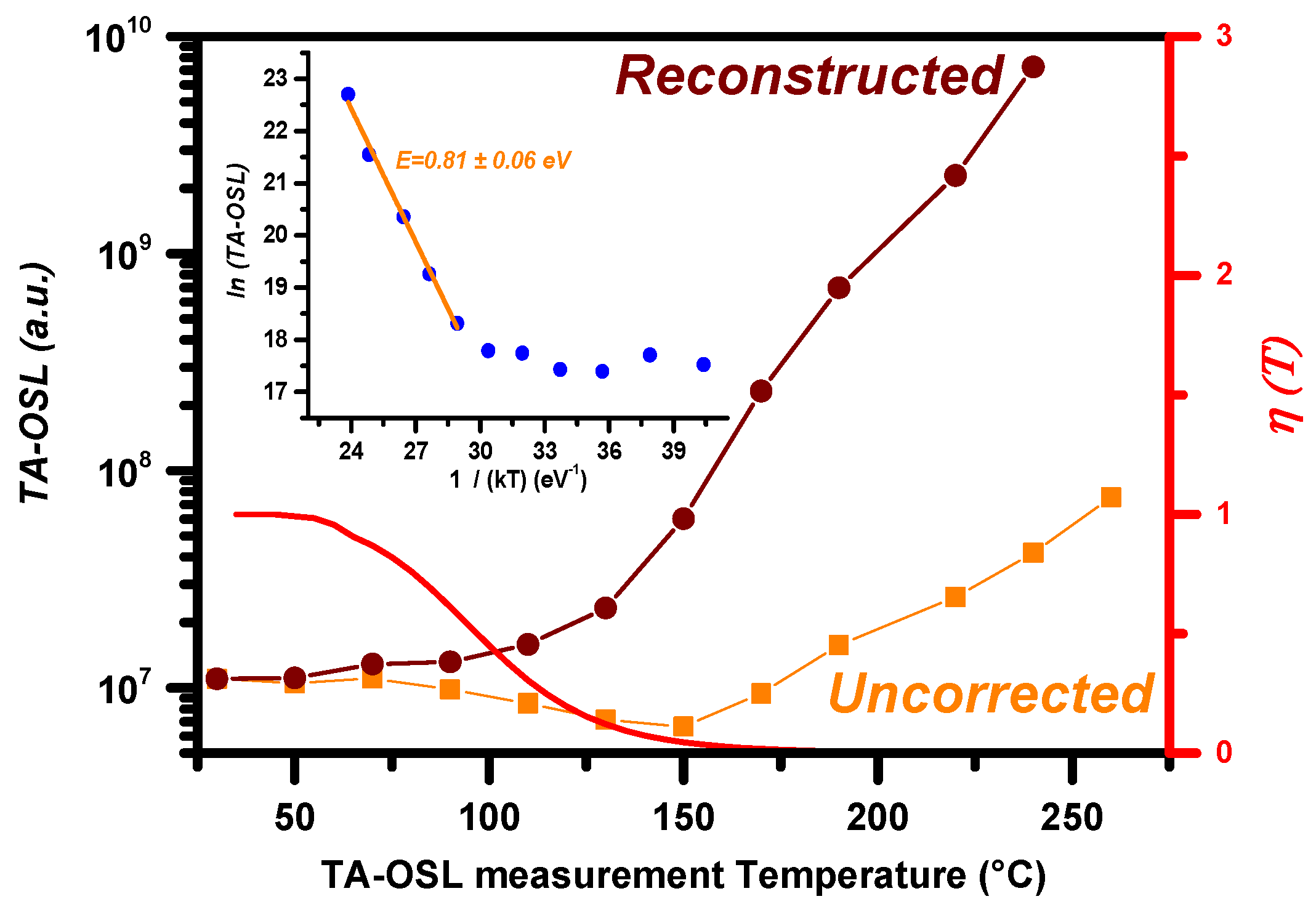
3.2. TA-OSL versus Stimulation Temperature
3.3. TL Sensitivity Changes following TA-OSL at Various Stimulation Temperatures
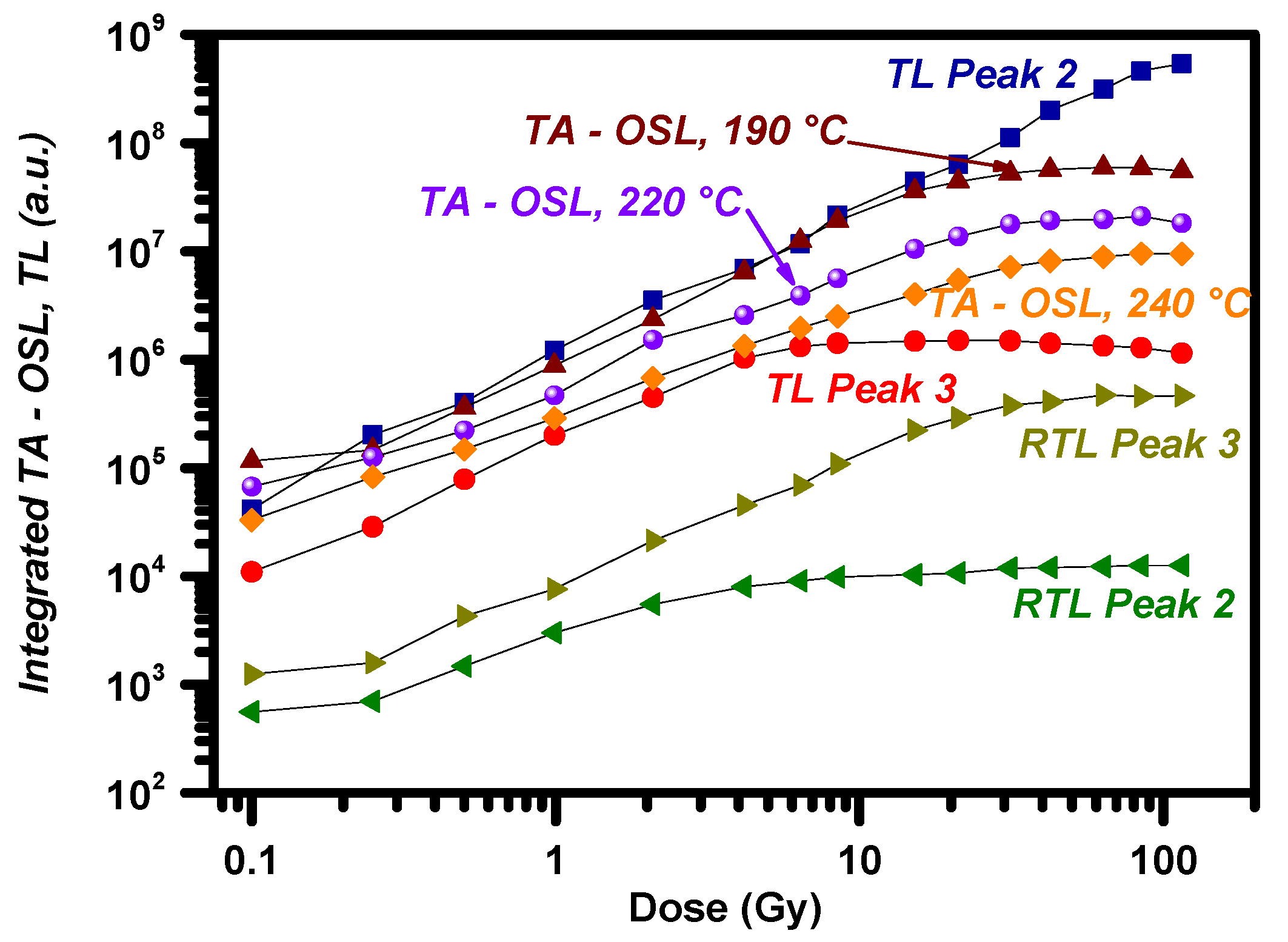
3.4. TL and TA-OSL Dose–Responses
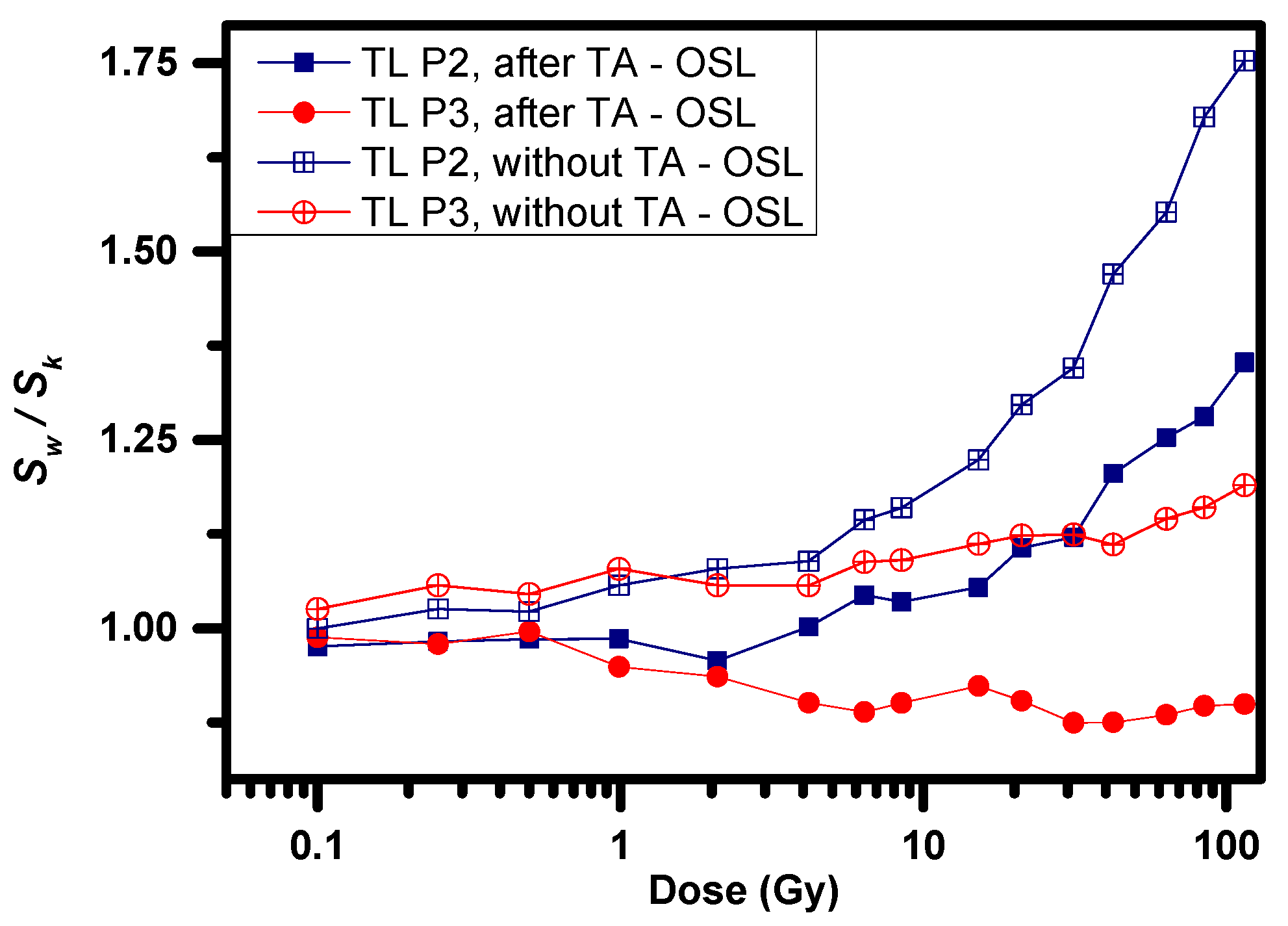
3.5. TL Sensitivity Changes following TA-OSL at Incremental Doses
4. Discussion
5. Conclusions
Funding
Institutional Review Board Statement
Informed Consent Statement
Data Availability Statement
Conflicts of Interest
References
- Bos, A.J.J. High Sensitivity thermoluminescence dosimetry. Nucl. Instrum. Methods Phys. Res. Sect. B 2001, 184, 3–28. [Google Scholar] [CrossRef] [Scilit]
- Sommer, M.; Henniger, J. Investigation of a BeO-based optically stimulated luminescence dosimeter. Radiat. Protect. Dosim. 2006, 119, 394–397. [Google Scholar] [CrossRef] [Scilit]
- Yukihara, E.G. Observation of strong thermally transferred optically stimulated luminescence (TT-OSL) in BeO. Radiat. Meas. 2019, 121, 103–108. [Google Scholar] [CrossRef] [Scilit]
- Aşlar, E.; Şahiner, E.; Polymeris, G.S.; Meriç, N. Feasibility of determining Entrance Surface Dose (ESD) and mean glandular dose (MGD) using OSL signal from BeO dosimeters in mammography. Radiat. Phys. Chem. 2020, 177, 109151. [Google Scholar] [CrossRef] [Scilit]
- Aşlar, E.; Şahiner, E.; Polymeris, G.S.; Meriç, N. Determination of trapping parameters in BeO ceramics in both quenched as well as reconstructed thermoluminescence glow using various analysis methods. Appl. Radiat. Isot. 2012, 129, 142–151. [Google Scholar] [CrossRef] [Scilit]
- Polymeris, G.S.; Kitis, G. Thermally Assisted Optically Stimulated Luminescence (TA-OSL) from Very Deep Traps. In Advances in Physics and Applications of Optically and Thermally Stimulated Luminescence; Chen, R., Pagonis, V., Eds.; World Scientific: Singapore, 2019; Chapter 4. [Google Scholar]
- McKeever, S.W.S.; Moscovitch, M.; Townsend, P.D. Thermoluminescence Dosimetry Materials: Properties and Uses; Nuclear Technology Publishing: Ashford, UK, 1995. [Google Scholar]
- Bulur, E.; Göksu, H.Y. OSL from BeO ceramics: New observations from an old material. Radiat. Meas. 1998, 29, 639–650. [Google Scholar] [CrossRef] [Scilit]
- Sommer, M.; Freudenberg, R.; Henniger, J. New aspects of a BeO-based optically stimulated luminescence dosimeter. Radiat. Meas. 2007, 42, 617–620. [Google Scholar] [CrossRef] [Scilit]
- Sommer, M.; Jahn, A.; Henniger, J. Beryllium oxide as optically stimulated luminescence dosimeter. Radiat. Meas. 2008, 43, 353–356. [Google Scholar] [CrossRef] [Scilit]
- Jahn, A.; Sommer, M.; Ulrich, W.; Wickert, M.; Henniger, J. The BeOmax system—Dosimetry using OSL of BeO for several applications. Radiat. Meas. 2013, 56, 324–327. [Google Scholar] [CrossRef] [Scilit]
- Jahn, A.; Sommer, M.; Henniger, J. Environmental dosimetry with the BeO OSL personal dosimeter—State of the art. Radiat. Meas. 2014, 71, 438–441. [Google Scholar] [CrossRef] [Scilit]
- Bulur, E.; Saraç, B.E. Time-resolved OSL studies on BeO ceramics. Radiat. Meas. 2013, 59, 129–138. [Google Scholar] [CrossRef] [Scilit]
- Aşlar, E.; Meriç, N.; Şahiner, E.; Erdem, O.; Kitis, G.; Polymeris, G.S. A correlation study on the TL, OSL and ESR signals in commercial BeO dosimeters yielding intense transfer effects. J. Lumin. 2019, 24, 116533. [Google Scholar] [CrossRef] [Scilit]
- Polymeris, G.S.; Çoskun, S.; Tsoutsoumanos, E.; Konstantinidis, P.; Aşlar, E.; Şahiner, E.; Meriç, N.; Kitis, G. Dose response features of quenched and reconstructed, TL and deconvolved OSL signals in BeO. Results Phys. 2021, 25, 104222. [Google Scholar] [CrossRef] [Scilit]
- Yukihara, E.G. Characterization of the thermally transferred optically stimulated luminescence (TT-OSL) of BeO. Radiat. Meas. 2019, 126, 106132. [Google Scholar] [CrossRef] [Scilit]
- Yukihara, E.G. A review on the OSL of BeO in light of recent discoveries: The missing piece of the puzzle? Radiat. Meas. 2020, 134, 106291. [Google Scholar] [CrossRef] [Scilit]
- Bulur, E. Photo-transferred luminescence from BeO ceramics. Radiat. Meas. 2007, 42, 334–340. [Google Scholar] [CrossRef] [Scilit]
- Yukihara, E.G.; Andrad, A.B.; Eller, S. BeO optically stimulated luminescence dosimetry using automated research readers. Radiat. Meas. 2016, 94, 27–34. [Google Scholar] [CrossRef] [Scilit]
- Polymeris, G.S.; Raptis, S.; Afouxenidis, D.; Tsirliganis, N.C.; Kitis, G. Thermally assisted OSL from deep traps in Al2O3: C. Radiat. Meas. 2010, 45, 519–522. [Google Scholar] [CrossRef] [Scilit]
- Polymeris, G.S.; Kitis, G. Thermally assisted photo transfer OSL from deep traps in Al2O3:C grains exhibiting different TL peak shapes. Appl. Radiat. Isot. 2012, 70, 2478–2487. [Google Scholar] [CrossRef] [Scilit]
- Polymeris, G.S. Thermally assisted OSL (TA-OSL) from various luminescence phosphors; an overview. Radiat. Meas. 2016, 90, 145–152. [Google Scholar] [CrossRef] [Scilit]
- Wintle, A.G.; Adamiec, G. Optically stimulated luminescence signals from quartz: A review. Radiat. Meas. 2017, 98, 10–33. [Google Scholar] [CrossRef] [Scilit]
- Polymeris, G.S.; Giannoulatou, V.; Sfampa, I.K.; Tsirliganis, N.C.; Kitis, G. Search for stable energy levels in materials exhibiting strong anomalous fading: The case of apatites. J. Lumin. 2014, 153, 245–251. [Google Scholar] [CrossRef] [Scilit]
- Polymeris, G.S.; Sfampa, I.K.; Niora, M.; Stefanaki, E.C.; Malletzidou, L.; Giannoulatou, V.; Pagonis, V.; Kitis, G. Anomalous fading in TL, OSL and TA-OSL signals of Durango apatite for various grain size fractions; from micro to nano scale. J. Lumin. 2018, 195, 216–224. [Google Scholar] [CrossRef] [Scilit]
- Polymeris, G.S.; Şahiner, E.; Meriç, N.; Kitis, G. Experimental features of natural thermally assisted OSL (NTA-OSL) signal in various quartz samples; preliminary results. Nucl. Instrum. Methods Phys. Res. Sect. B 2015, 349, 24–30. [Google Scholar] [CrossRef] [Scilit]
- Şahiner, E.; Polymeris, G.S.; Meriç, N. Thermally assisted OSL application for equivalent dose estimation; comparison of multiple equivalent dose values as well as saturation levels determined by luminescence and ESR techniques for a sedimentary sample collected from a fault gauge. Nucl. Instrum. Methods Phys. Res. Sect. B 2017, 392, 21–30. [Google Scholar] [CrossRef] [Scilit]
- Majgier, R.; Biernacka, M.; Palczewski, P.; Mandowski, A.; Polymeris, G.S. Investigation on thermally assisted optically stimulated luminescence (TA-OSL) signal in various sodium chloride samples. Appl. Radiat. Isot. 2019, 143, 98–106. [Google Scholar] [CrossRef] [Scilit]
- Kitis, G.; Kiyak, N.G.; Polymeris, G.S. Temperature lags of luminescence measurements in a commercial luminescence reader. Nucl. Instrum. Methods Phys. Res. Sect. B 2015, 359, 60–63. [Google Scholar] [CrossRef] [Scilit]
- Kitis, G.; Polymeris, G.S.; Pagonis, V. Stimulated luminescence emission: From phenomenological models to master analytical equations. Appl. Radiat. Isot. 2019, 153, 108797. [Google Scholar] [CrossRef] [Scilit]
- Kitis, G.; Vlachos, N.D. General semi-analytical expressions for TL, OSL and other luminescence stimulation modes derived from the OTOR model using the Lambert W-function. Radiat. Meas. 2012, 48, 47–54. [Google Scholar] [CrossRef] [Scilit]
- Corless, R.M.; Gonnet, G.H.; Hare, D.G.E.; Jeffrey, D.J.; Knuth, D.E. On the Lambert W function. Adv. Comput. Math. 1996, 5, 329–359. [Google Scholar] [CrossRef] [Scilit]
- Sadek, A.M.; Eissa, H.M.; Basha, A.M.; Kitis, G. Development of the peak fitting and peak shape methods to analyze the thermoluminescence glow-curves generated with exponential heating function. Nucl. Instrum. Methods Phys. Res. B 2014, 330, 103–107. [Google Scholar] [CrossRef] [Scilit]
- Konstantinidis, P.; Kioumourtzoglou, S.; Polymeris, G.S.; Kitis, G. Stimulated luminescence; Analysis of complex signals and fitting of dose response curves using analytical expressions based on the Lambert W function implemented in a commercial spreadsheet. Radiat. Phys. Chem. 2021, 176, 109870. [Google Scholar] [CrossRef] [Scilit]
- Balian, H.G.; Eddy, N.W. Figure-of-merit (FOM), an improved criterion over the normalized chi-squared test for assessing goodness-of-fit of gamma-ray spectral peaks. Nucl. Instrum. Methods 1977, 145, 389–395. [Google Scholar] [CrossRef] [Scilit]
- Kitis, G.; Pagonis, V. Peak shape methods for general order thermoluminescence glow-peaks: A reappraisal. Nucl. Instrum. Methods Phys. Res. B 2007, 262, 313–322. [Google Scholar] [CrossRef] [Scilit]
- Kitis, G.; Chen, R.; Pagonis, V. Thermoluminescence glow-peak shape methods based on mixed order kinetics. Phys. Stat. Solidi (a) 2008, 205, 1181–1189. [Google Scholar] [CrossRef] [Scilit]
- Curie, D. Luminescence in Crystals; Methuen: London, UK, 1963. [Google Scholar]
- Pagonis, V.; Ankjærgaard, C.; Murray, A.S.; Jain, M.; Chen, R.; Lawless, J.; Greilich, S. Modelling the thermal quenching mechanism in quartz based on time-resolved optically stimulated luminescence. J. Lumin. 2010, 130, 902–909. [Google Scholar] [CrossRef] [Scilit]
- Aşlar, E.; Şahiner, E.; Polymeris, G.S.; Meriç, N. Calculation of thermal quenching parameters in BeO ceramics using solely TL measurements. Radiat. Meas. 2017, 103, 13–25. [Google Scholar] [CrossRef] [Scilit]
- Polymeris, G.S.; Tsirliganis, N.C.; Kitis, G. TL and OSL properties of CaF2:N. Nucl. Instrum. Methods Phys. Res. B 2016, 251, 133–142. [Google Scholar] [CrossRef] [Scilit]
- Nikiforov, S.V.; Pagonis, V.; Merehnikov, A.S. Sublinear dose dependence of thermoluminescence as a result of copetition between electron and hole trapping centers. Radiat. Meas. 2017, 105, 54–61. [Google Scholar] [CrossRef] [Scilit]
- Chen, R.; McKeever, S.W.S. Theory of Thermoluminescence and Related Phenomena; World Scientific: Singapore, 1997. [Google Scholar]
- Yukihara, E.; McKeever, S.W.S. Optically Stimulated Luminescence: Fundamentals and Applications; John Wiley and Sons: Hoboken, NJ, USA, 2011. [Google Scholar]
- Kitis, G.; Pagonis, V. On the Need for Deconvolution Analysis of Experimental and Simulated Thermoluminescence Glow Curves. Materials 2023, 16, 871. [Google Scholar] [CrossRef] [Scilit]
- Polymeris, G.S.; Şahiner, E.; Aşlar, E.; Kitis, G.; Meriç, N. Deconvolution of isothermal TA-OSL decay curves from sedimentary quartz using combinations of various contemporary models. Radiat. Meas. 2018, 119, 93–101. [Google Scholar] [CrossRef] [Scilit]
- Nyirenda, A.N.; Chithambo, M.L.; Polymeris, G.S. On luminescence stimulated from deep traps in α-Al2O3:C. Radiat. Meas. 2016, 90, 109–112. [Google Scholar] [CrossRef] [Scilit]
- Milman, I.I.; Kortov, V.S.; Nikiforov, S.V. An interactive process in the mechanism of the thermally stimulated luminescence of anion-defective α-Al2O3 crystals. Radiat. Meas. 1998, 29, 401–410. [Google Scholar] [CrossRef] [Scilit]
- Kortov, V.S.; Nikiforov, S.V.; Milman, I.I.; Moyseikin, E.V. Specific features of luminescence of radiation-colored α-Al2O3 single crystals. Radiat. Meas. 2004, 38, 451–454. [Google Scholar] [CrossRef] [Scilit]
- Meriç, N.; Şahiner, E.; Polymeris, G.S. Thermally assisted OSL (TA-OSL) reproducibility in Al2O3:C and its implication on the corresponding thermoluminescence (TL) reproducibility. Radiat. Meas. 2016, 90, 269–273. [Google Scholar] [CrossRef] [Scilit]


| Step No. | Action | Comments and Technical Specifications |
|---|---|---|
| Step 1: | TL measurement | Remove any prior existing signal |
| Step 2: | Irradiation using 5 Gy dose | Populate all traps, including the VDTs |
| Step 3: | TL measurement | Empty shallow, dosimetric, and deep traps and monitor initial sensitivity S0 |
| Step 4: | Isothermal TL (ITL) (at room temperature for 60 s) | Check for possible overflow of the PMT |
| Step 5: | OSL measurement at temperatures Tst ranging from 30 °C up to 270 °C (in steps of 20 °C) over a period of 500 s | Measure the TA-OSL curves for various stimulation temperatures |
| Step 6: | TL measurement | Obtain the Residual TL (RTL) curves |
| Step 7: | Irradiation using 5 Gy dose | Populate all traps |
| Step 8: | TL measurement | Monitor final sensitivity Sf |
| Step No. | Action | Comments and Technical Specifications |
|---|---|---|
| Step 1: | TL measurement | Remove any prior existing signal |
| Step 2: | Irradiation using 0.1 Gy dose | Populate shallow, dosimetric, and deep traps using the minimum dose |
| Step 3: | TL measurement | Empty shallow, dosimetric, and deep traps and monitor initial sensitivity Sk |
| Step 4: | Irradiation with a dose Di * | Populate all traps, including the VDTs |
| Step 5: | TL measurement | Empty shallow, dosimetric, and deep traps and monitor high-dose sensitivity Sd |
| Step 6: | Isothermal TL (ITL) (at room temperature for 60 s) | Check for possible overflow of the PMT following the TL measurement |
| Step 7: | OSL measurement at the optimum stimulation temperature Tst over a period of 500 s | Measure the TA-OSL curves for various doses |
| Step 8: | Isothermal TL (ITL) (at room temperature for 60 s) | Check for possible overflow of the PMT following the TA-OSL measurement |
| Step 9: | TL measurement | Obtain the Residual TL (RTL) curves |
| Step 10: | Irradiation using 0.1 Gy dose | Populate shallow, dosimetric, and deep traps using the minimum dose |
| Step 11: | TL measurement | Monitor final sensitivity SW |
| Protocol | RTL Peak Tm (°C) | EDec (eV) | R | ω (°C) | EPSM (eV) | b |
|---|---|---|---|---|---|---|
| A | 203.0 ± 1.0 | 1.21 ± 0.14 | 0.11 ± 0.03 | 43.0 | 1.09 ± 0.09 | 1.15 ± 0.06 |
| A | 329.5 ± 0.5 | 1.32 ± 0.12 | 0.09 ± 0.02 | 54.0 | 1.16 ± 0.11 | 1.09 ± 0.04 |
| B | 202.0 ± 1.5 | 1.18 ± 0.15 | 0.15 ± 0.02 | 41.5 | 1.14 ± 0.12 | 1.14 ± 0.08 |
| B | 328.5 ± 1.5 | 1.27 ± 0.15 | 0.11 ± 0.01 | 54.5 ± 0.5 | 1.20 ± 0.12 | 1.07 ± 0.05 |
| Lum. Signal | TL Peak 2 | TL Peak 3 | TA-OSL, 190 °C | TA-OSL, 220 °C | TA-OSL, 240 °C | RTL Peak 2 | RTL Peak 3 |
|---|---|---|---|---|---|---|---|
| Saturation Dose (Gy) | - | 13 ± 1 | 35 ± 3 | 52 ± 3 | 67 ± 4 | 7 ± 1 | 42 ± 4 |
Disclaimer/Publisher’s Note: The statements, opinions and data contained in all publications are solely those of the individual author(s) and contributor(s) and not of MDPI and/or the editor(s). MDPI and/or the editor(s) disclaim responsibility for any injury to people or property resulting from any ideas, methods, instructions or products referred to in the content. |
© 2023 by the author. Licensee MDPI, Basel, Switzerland. This article is an open access article distributed under the terms and conditions of the Creative Commons Attribution (CC BY) license (https://creativecommons.org/licenses/by/4.0/).
Share and Cite
Polymeris, G.S. Thermally Assisted Optically Stimulated Luminescence (TA-OSL) from Commercial BeO Dosimeters. Materials 2023, 16, 1494. https://doi.org/10.3390/ma16041494
Polymeris GS. Thermally Assisted Optically Stimulated Luminescence (TA-OSL) from Commercial BeO Dosimeters. Materials. 2023; 16(4):1494. https://doi.org/10.3390/ma16041494
Chicago/Turabian StylePolymeris, Georgios S. 2023. "Thermally Assisted Optically Stimulated Luminescence (TA-OSL) from Commercial BeO Dosimeters" Materials 16, no. 4: 1494. https://doi.org/10.3390/ma16041494
APA StylePolymeris, G. S. (2023). Thermally Assisted Optically Stimulated Luminescence (TA-OSL) from Commercial BeO Dosimeters. Materials, 16(4), 1494. https://doi.org/10.3390/ma16041494