Article

Biogas in The Netherlands: Hesitant Adoption on Many Levels

by
Gideon A. H. Laugs
and
Henny J. van der Windt
*
Integrated Research on Energy, Environment and Society, University of Groningen, Nijenborgh 6, 9747 AG Groningen, The Netherlands
*
Author to whom correspondence should be addressed.
Energies 2026, 19(9), 2037; https://doi.org/10.3390/en19092037
Submission received: 10 February 2026 / Revised: 1 April 2026 / Accepted: 15 April 2026 / Published: 23 April 2026
(This article belongs to the Special Issue Renewable Fuels: A Key Step Towards Global Sustainability)

Abstract

Energy transition includes the substitution of centralized energy systems with decentralized variable renewable energy sources (vRES), the growth of which brings drawbacks such as grid congestion and intermittency. These issues are increasingly troublesome in many local energy systems, including in The Netherlands. Biogas may provide options to provide backup renewable energy in times of energy supply uncertainty. In The Netherlands, the consideration of biogas in such functions is limited. Meanwhile, local energy initiatives (LEIs) are spearheading the adoption of vRES. Because of concern over local grid balancing, LEIs may want or need to innovate and diversify their activities. Such innovation could include bioenergy in general, and biogas specifically. However, only a small number of LEIs consider bioenergy, and Dutch LEIs seem hesitant to venture into biogas specifically. In this paper we explore the question of what hinders adoption of biogas in The Netherlands in general, and by LEIs specifically, deploying an approach based on the technological innovation systems (TIS) concept. In that approach, we take insights from current and expected policy in The Netherlands juxtaposed with insights from similar countries surrounding The Netherlands. We conclude that historic developments in biogas already created a moderately supportive platform for large-scale biogas development, but some essential factors remain inadequately developed. Key barriers to biogas innovation, especially for LEIs, are insufficient mobilization of financial and knowledge resources, and insufficient attention to alleviating preconceptions. Dependable support and attention for socio-economic factors in policymaking would improve conditions associated with resources, preconceptions and resistance, and the situation for LEIs to explore the potential of biogas. However, it remains uncertain whether such measures would be sufficient to improve the potential of local biogas utilization in The Netherlands in a way that opens a role for biogas in solving energy transition challenges such as energy system balancing.

1. Introduction

Energy transition requires a substantial paradigm shift with regard to energy system organization [1,2,3,4]. Part of this paradigm shift is a change from top-down organized centralized energy supply systems based on fossil fuels to decentralized energy systems based on renewable energy technology. The development of decentralized renewable energy technology in The Netherlands shows convergence towards a limited selection of preferred energy technologies, such as solar PV, wind and biomass.
Such increasingly decentralizing energy systems often come with more prominent roles for local-scale peer-to-peer exchanges in energy [5,6,7]. As such, local energy initiatives (LEIs) may be significant actors in energy transition, serving as innovation incubators and as selection portals for technologies worthwhile of further development into larger scale manifestations [8,9,10,11,12,13].
However, the convergence in decentralized energy technology preferences visible in The Netherlands also applies to Dutch LEIs. The vast majority of local energy initiatives in The Netherlands focus strongly on solar PV, wind or both [14,15]. Only a small number of LEIs show interest in diversifying their energy portfolios, although during the last decade an increasing number of LEIs has become involved in district heating [16] and energy storage [17]. Along those lines, some LEIs are also involved in deployment of solid biomass combustion to provide renewable heat.
One form of biomass-based renewable energy technology of the technologies that is almost absent, is biogas. The limited interest in biogas from LEIs is noteworthy, considering the potential and advantages of biogas in decentralized energy systems and energy transition contexts [18,19]. Moreover, especially in The Netherlands, the omnipresent natural gas infrastructure would imply that gaseous renewable energy technology could be met with more interest and enthusiasm than it currently elicits.
While development of solar PV and wind benefitted from the widespread attention of stimulating actors such as LEIs, such support remained limited for biogas. The comparatively slow development of biogas in general, and in the context of LEIs specifically, may be a result of that limited support. Although biogas was (and is) featured in some stimulus programs and has grown to play a small role in the Dutch energy supply system at large [20], explicit integration of biogas in the context of local energy initiatives and community-scale energy systems is limited. Biogas in the context of LEIs can thus be seen as an innovation challenge [18,21].
Biogas by itself is a well-researched topic, including through the lens of innovation studies. However, to the authors’ knowledge, no research has specifically deployed innovation theory to explore barriers that hamper the potential development of biogas in The Netherlands specifically in the context of LEIs. With this work, we venture into that terrain to explore advances made and challenges to negotiate if biogas is to play a more substantial role in the context of LEIs.

2. Background

The development of biogas in The Netherlands is comparatively slow relative to other decentralized renewable energy technologies, and relative to developments in comparable countries. This especially holds for biogas in the context of LEIs. In this section, we look into the intersection of LEIs and biogas in The Netherlands, but also include insights from regions with similar characteristics. First, we take a look the potential of biogas in decentralized systems and challenges associated with its deployment. We then take a look at the role LEIs play in reshaping energy systems vis-à-vis energy transition, and address the extent to which biogas augments LEI energy technology considering needs and challenges with regard to decentralized energy systems with a large share of renewable energy with variable supply patterns (high-vRES systems).

2.1. Decentralized Systems with Biogas?

The decentralized energy technology currently most popular with LEIs, solar PV and wind energy, comes with inherent variability in their supply patterns as a consequence of day–night rhythms, seasonal variation or weather circumstances. That variability hampers the integration of large shares of such technology in decentralized energy systems. The simultaneousness of supply dynamics in decentralized settings intensifies the load peaks the electricity grids have to handle. Large shares of vRES in the energy system lead to systemic imbalance and concerns over system stability. This issue has recently become sufficiently prominent to cause a review and adaptation of regulations with regard to netting and the costs associated with grid balancing [22]. For a 100% renewable energy system, a more diversified approach is necessary, incorporating cross-sectoral and multi-scale perspectives [23,24]. Moreover, the strategic use of combinations of centralized and decentralized balancing options can help to maintain overall grid balance [25,26]. One option for decentralized mitigation of variable supply issues associated with vRES, is the use of biogas as a reserve renewable energy source [27,28,29].
Biogas is a gaseous carbohydrate fuel derived from biomass. Although a variety of raw resources and processing technologies exists to produce biogas from biomass [30,31,32,33], for this research we only consider biogas derived via anaerobic digestion of biomass residues (AD biogas).
Biogas can offer the flexibility required for accelerated energy transition [34]. In decentralized grids, biogas may assist in maintaining grid balance and ensuring security-of supply [27]. In addition to production of renewable energy, it offers versatility and environmental benefits to energy systems, including nutrient and waste management [27,35,36,37]. Several researchers have found that although capital expenses are high [28,38], decentralized hybrid energy systems including energy storage combining biogas and batteries offer a variety of benefits compared to both conventional carbon-intensive systems as well as non-hybrid renewable energy systems: lower operational costs [38], substantial reduction of carbon emissions [29,38,39], attractive long-term energy storage potential [29], and robustness towards energy price fluctuations [38].
In practice, most AD biogas in The Netherlands is produced in the agricultural sector on farm-sites, but production in non-agricultural settings is also a possibility. In The Netherlands, most biogas is the result of sideline activities of agricultural enterprises, but standalone companies, sewage processing plants and landfills also provide part of the AD biogas supply in The Netherlands. Only a small fraction of the gross biogas supply is upgraded to natural gas quality and injected into the national gas grid. Most biogas is used on-site to fuel a generator to provide mainly power and some residual heat to the company itself, or to neighboring consumers [40]. Most of the AD biogas production in The Netherlands—especially farm-based manure digestion—can be considered more an element of the agricultural sector than of the energy sector.
Biogas can play a role as a non-fossil fallback option in decentralized energy supply systems with a high share of variable renewable energy. Such hybrid local energy systems involving a combination of solar PV, wind and biogas have been proposed and analyzed in earlier research, but the typical setting of such research was in developing countries’ rural communities, e.g., [41]. Only more recently, some researchers have proposed biogas in local energy system settings in developed countries, e.g., [19,21,25,29,42,43]. The idea to deploy biogas exclusively as a decentralized backup option lies perpendicular to proposals currently prevailing in The Netherlands to use biogas in a bulk-supply role. Such limited perspectives on biogas pass by on the potential of decentralized biogas deployment to offer strategic support in furthering energy transition.
By having a biogas facility at hand as part of a local network, biogas can readily be used to generate electricity, heat, or both. In a role as a backup energy source, it would solely be used to compensate for the intermittency of solar PV and wind energy. Smaller quantities of biogas would be required compared to the bulk-supply role, and biogas in a backup role would deliver a higher-value service. Current research and policy often assumes that backup for decentralized intermittent generation is to be delivered by the peripheral electricity grid, or by batteries if a grid connection is undesired or impossible. The benefits of such options, such as scalability, accessibility and simplicity, are offset by substantial drawbacks for which no readily available, universal solution is currently present, such (remaining) net congestion and costs, respectively [44,45,46]. For the use of biogas as a fallback technology, the benefits and drawbacks are characterized differently. Although biogas installations are large, complicated and difficult to scale up or down, it can offer a cost-effective alternative renewable energy source and buffer with less or no ties to the electricity grid [38,47].
Facilities for AD biogas are not as easily deployable as rooftop solar PV. Limited scalability makes that even small initiatives require large investments. AD biogas facilities typically come with minimum size and associated investment requirements beyond single or even multiple household-scale. From a practical perspective, both wind turbines and biogas digesters have a comparatively large physical footprint. The infrastructural requirements with regard to wind turbines or digesters are of a substantially higher degree of complexity as well as longevity than those of solar PV. Although practical requirements can be considered barriers to deployment, earlier research suggests that market aspects and competition issues are more likely to explain stagnation or advance of the technology diffusion process [48,49,50]. However, those findings were based on the premise of biogas gaining a large share of the energy supply market—which more current research shows is not a likely scenario within limits of sustainable resource use to begin with [51]. Our perspective is that biogas should not be considered an option to provide large quantities of energy, or to provide a large share of energy demand. Instead, it should merely be deployed to provide ‘specialty supportive services’ for ‘mainstream’ renewable energy technology at much smaller scales, and different factors may drive or hamper adoption of biogas in that context.
Although most of the literature suggests the inclusion of battery electricity storage to improve grid balance [52,53,54,55], some also suggest biogas may serve as a buffering technology as well [19,43,56,57]. As such, biogas may be an option to provide backup renewable energy in case of supply from vRES not being able to meet demand, and as such fit in decentralized energy systems at a community scale. This community-centered perspective on biogas is currently neither the norm nor seems to be the expectation.
Biomass-based energy in general and biogas specifically comes with preconceptions that do not align with ideas of sustainability, efficiency and profitability [21,58]. Despite the absence of reliable scientific data, there are strong indications that much of the negative perception of biogas in The Netherlands stems from past failures of biogas projects [21]. These preconceptions form adoption barriers which need to be lowered or removed to improve the acceptability of biogas as a renewable energy technology option [17]. Part of the process to improve acceptance of biogas could be explicit involvement of local stakeholders. Earlier research indicates that local stakeholder involvement in renewable energy projects helps to improve bottom-up support for developments pertaining to energy transition [59,60,61,62,63,64]. Deployment of biogas in a community-centered setting may therefore have mutual benefits: not only can decentralized energy systems benefit from biogas in providing manageable energy supply, biogas as an energy technology can benefit from improved bottom-up support.

2.2. Energy Transition in LEIs: Stagnant Niche Development

The community-scale perspective in energy transition is reflected in the emergence of local energy initiatives (LEIs): citizen cooperations collaborating in the implementation of decentralized renewable energy. According to the multi-level perspective (MLP) framework, the operationalization of technology transition starts with implementation of niche technology in limited-scale settings. From small-scale niche developments, technologies mature to challenge the existing regime and eventually induce changes in the energy landscape [65]. In the context of energy transition, local energy initiatives can (still) be ranked in the niche development category—even though their potential is considered substantial [13,66]. Local energy initiatives can be considered seedbeds of innovation [8,67], from which effective technology can stem and grow beyond niche level developments [68]. In a more abstract sense, LEIs can be starting points for shifts towards more effective manifestations of decentralized renewable energy systems, potentially mobilizing actors and resources across sectors and scales [69]. In The Netherlands, the number of LEIs has grown to over 700 by 2024, spanning a variety of manifestations [70].
Despite general consensus on the potential of LEIs, there seems to be little consensus on related typologies, definitions and blueprints. LEIs come in a wide range of sizes and shapes, differing across characteristics such as organizational structure, technology, impact potential, financial capacity and support requirements [70,71,72]. Because of those differences, this paper takes on an abstract and more conceptual notion of LEIs as decentralized collective citizen-based structures that deploy renewable energy systems on a local scale.
Otto et al. [7] indicate that further emphasis on energy system decentralization is an essential element of curbing climate change by 2050. But for that to happen, actors related to those niche developments need to be willing to stimulate and invest in their initiative. Whether LEIs are able to meet such requirements, is subject to a variety of circumstantial conditions [73]. In contrast with its theoretical potential, the current state of local energy initiatives appears to be losing momentum and gradually becoming stagnant in a niche potential, showing very little signs of becoming a sufficiently dominant development to challenge existing regimes in the electricity sector [74,75]. However, changes in legislation in and across the European Union could provide new stimuli [13].
In terms of technology, LEIs in Northwestern Europe are converging to solar PV and wind energy, both of which are variable renewable energy sources (vRES) of which supply varies depending on weather circumstances. Other energy sources, such as hydropower, biomass in general, or biogas as a specific version of biomass-based energy options, only find adoption in a fraction of the local energy initiatives [15,76,77]. The scalability of wind turbines and solar PV is an attractive characteristic that enables widespread deployment, but explicit day/night supply patterns of solar PV and irregular supply patterns for wind are a major drawback. For LEIs, a large reliance on local vRES may be troublesome as it implies reliance on external grids to match demand and supply patterns.
As the evolving energy transition challenge manifests itself in local settings as a need for decentralized system balancing, LEIs are in a logical position to play a role in that. LEIs playing advanced roles in system balancing may be inevitable, and as such force LEIs to revise their strategy to become improved versions of themselves. Reconsideration of their roles may elevate the impact LEIs can have on energy transition [78]. Future LEIs may be involved with more diverse activities and technologies, including energy storage, sector coupling and extended system integration [79,80,81,82,83].
Save for a few exceptions, LEIs in The Netherlands generally seem reluctant to embrace such diversification. Thus far, LEIs in The Netherlands have shown little signs of devising strategies to cope with system imbalance issues and associated regulatory change, or more generally, furthering local deployment of renewable energy deployment beyond the ‘low hanging fruit’. To continue their current rise to success, LEIs have to diversify their activities and perhaps technology portfolios, or they risk stagnation as a non-regime challenging niche development [22,84].
Expanding a LEI’s portfolio with advanced energy system activities such as energy buffering comes with different types of investment, associated responsibilities, risk and overall systemic complexity. Moreover, LEIs regulating local energy systems implies playing the role of DSOs, perhaps even requiring access to local and peripheral network infrastructure and thus cooperation with current DSO’s. LEIs generally appear interested yet hesitant to raise the bar and expand the role they play in the energy market. That hesitation can be linked to blind spots in the ambitions of LEIs [85]. In addition, current energy policy is not adjusted to and supportive for advanced roles of LEIs in the energy system [22]. Another factor behind that hesitation is the extent to which a LEI is capable of managing more complex technological innovations, which strongly depends on a number of organizational strengths—or absence thereof [14,16,73,86].
One weakness that applies to most Dutch LEIs is their relatively small scale, which translates into small leverage and bargaining capacity. As a result, LEIs often struggle to acquire funding in traditional ways, leading some of them to experiment with alternative funding means such as crowdsourcing [87]. Some of the more successful LEIs are the ones that succeeded to scale up and improve their resilience; the case of wind energy cooperation Zeeuwind is an example this [14]. Large-scale biogas producers are limited to a small number commercial, industrial endeavors, supported by large energy companies [88,89]. Two rare cooperatively operated biogas facilities are still in early development phases [90,91], with a third struggling to gain approval to get started [92].
The extend to which actors are willing to ‘raise the bar’ beyond entry level can be a factor that affects the development of LEIs [61,93]. Reasons for people to participate in local energy initiatives are diverse, but may be satisfied fairly easily at entry-level ventures already. This lowers the incentive to keep investing in further growth of the initiative. After all, if essential benefits and desires are fulfilled, furthering the initiative may only draw away from that. Another part of the reluctance of local energy initiatives to become involved with energy system balancing stems from risk aversion, possibly associated with long-term agreements and higher investments [94,95].
Basically, (re-)monetizing incentives for advanced sustainable technology in decentralized situations, and recalibration of norms and value systems along the lines of the social tipping incentives suggested by Otto et al. [7]. Given sufficient momentum and diversified support, technology transitions may become self-reinforcing [96]. Combinations of LEIs in general with typical renewable energy technology such as solar PV and wind appears to be approaching such self-reinforcing states. For biogas, however, it appears that some initial push is given, but the self-supporting transition so far does not seem to have taken off—especially not for biogas in the role of decentralized energy system balancing deployed by local energy initiatives.

2.3. Biogas Development in Comparative Countries

Although the European Union has set out long-term overall sustainability targets, country-specific energy transition policy in Europe is designed by each country individually. The consequence of that is a wide variety of national policy on renewable energy in general, and biogas specifically [97]. This has led to varied application of different biogas technology across countries [37,98], but non-technical aspects such as societal acceptance, government support and socio-economical evolution trajectories also differ between countries [99,100]. Since policy and local circumstances can have substantial and long-term effects on the development and role of biogas, insights from similar countries can help understand the situation in The Netherlands. Denmark and Germany are both geographically close to The Netherlands, and share similar socio-economic and climate characteristics that relate to biogas potential. Nevertheless, Denmark, Germany and The Netherlands do not share similar development pathways with regard to biogas or LEIs. A juxtaposition of relevant policy history of these countries helps to illustrate the potential of leveraging supportive conditions.
Germany and Denmark are amongst the largest producers of biogas in Europe. Germany is the top biogas producer and consumer in Europe in both an absolute and relative sense. In 2018, Germany was home to 11,084 biogas plants, together producing 320 PJ of biogas, per capita equivalent to 1072 kWh/year. That same year, 141 biogas plants existed in Denmark, producing 13 PJ of biogas, per capita equivalent to 644 kWh/year. In terms of biogas plants and final consumption, The Netherlands is mostly comparable to Denmark, with larger absolute but smaller relative numbers. In The Netherlands in 2018, 268 biogas plants produced 14 PJ of biogas, equivalent to 221 kWh/year per capita. It should be noted that for Germany and Denmark, over 90% of the reported biogas production came from anaerobic digestion; for The Netherlands, that was 78%. Germany is further distinguished by a comparatively large (approximately 50%) share of energy crops as biogas feedstock [40,101].
The relevance of biogas in Germany originates from natural and socio-economic factors combined with effective policy stimulation. From a natural perspective, Germany’s large biomass potential played an important role in the initial policy support and growth of bioenergy. Already the early versions of Germany’s Erneubare Energie Gesetz (EEG), the policy framework guiding Germany’s energy transition, included explicit support for electricity generation from farm-scale biogas. Part of this support scheme were a long-term guarantee of attractive feed-in tariffs for energy from biogas. Later amendments to the EEG have provided additional stimulus for farmers to expand their generation capacity, leading to a strong increase in both number of biogas plants as well as installed capacity. Over the course of the last two decades, the number of operational biogas plants increased tenfold [97,102].
In addition to the EEG, entrepreneurs in the biogas sector could depend on the support and expertise of the FNR, a government office dedicated to anything related to bioenergy [103]. The FNR also initiated the Bioenergy village (‘Bioenergiedörfer’) concept. Bioenergy villages are centers of innovation staged in decentralized community settings. Through local and regional cooperation, actors are encouraged to use the potential of locally available bioenergy resources to improve energy self-sufficiency. This approach operationalizes social motives such as regional added value, community strengthening, energy independence and a general notion of self-sustainability. Although the bioenergy village concept includes biogas as a possible technology, the concept is not limited to biogas alone and includes a wide range of other biomass-based energy technologies as well. With this approach, the FNR aims to increase the support base for decentralized climate change mitigation [104].
Despite the large biomass potential, controversy over the use of first-generation biomass led to policy adjustments. More recent policy only allows second generation biomass (biomass waste, agricultural residue) for the production of biogas. The adjusted support system will no longer offer a fixed feed-in tariff by default, but requires new plants to focus on remuneration strategies incorporating strategic flexibility [102,105]. In addition, the initial policy focus on farm-scale development of biogas appears to be making way for a focus on industrial-scale development to enable biogas to play a more substantial role in the national energy supply system. The transition to this more stringent policy, from 2017 onwards, combined with a gradual reduction in the allowance of feed-in tariffs, initially resulted in a stagnation of the growth of the German biogas sector [106,107]. However, more recent analysis of the effect of these changes indicate that it spurs successful and existing local energy initiatives into a ‘professionalization’ transition with a whole system approach, seeking cooperation with sector/industry partners to improve/consolidate their position in the energy market [12].
The Danish agricultural sector is characterized by high-intensity farming, similar to The Netherlands. High intensity agriculture typically coincides with local availability of large quantities of agricultural residues suitable for production of biogas. Denmark has a decades-long history of local production of biogas using local agricultural residues, in farm-based digesters serving local needs. However, biogas only gained real traction after 2012, when the Danish government set-up renewable energy policy offering an attractive feed-in-tariff-structure. This stimulated construction of farm-based digester for the production of biogas, and the development of advanced processing methods, such as upgrading to green gas and grid injection.
From a technical perspective, proposals for extended material cascades and sectoral integration indicate that the Danish system still ample room for further improvement [43]. However, supporting further advance of the Danish bioenergy sector would require a shift in policy focus, away from the technology-centered approach and more towards an approach that includes socio-economic aspects [108]. Different from The Netherlands, Denmark has a long history in local ownership of energy infrastructure and (associated) support for renewable energy—mainly wind. Although policy support for local sourcing and utilization of energy in general and biogas specifically is not as strong today as it was around the turn of the millennium, conditions appear to remain favorable for further advances of local energy initiatives in that area [109].
The successes of the development of biogas in both Germany and Denmark can be traced back to similar origins: strong and clear policy explicitly designed to support the adoption of farm-scale biogas production. Implicit in the message that policy conveyed was a drive for self-reliance: a stimulus to focus local consumption and utilization of resources available locally. In both countries, the combination of local circumstances and favorable policy stimulated the adoption of biogas technology in local energy systems. Although local endeavors remain eligible for support, current changes in policy attempts to curb the costs of feed-in tariffs spiraling out of control, and seems to withdraw some focus from that local character of biogas in favor of large-scale applications [110]. Moreover, current policy for renewable energy pays additional attention to professionalization, but also seems to directly address solar PV and wind energy only. Whether the professionalization effect extends to LEIs involved with or interested in biogas, and in what way, remains unclear. Nevertheless, the past and current situations around biogas in Germany and Denmark provide clear pointers on what circumstantial factors may be supportive of biogas development. In this research, we will explore whether similar circumstances (can) exist in The Netherlands, and the extent to which those factors can drive similar biogas development. Specifically, we aim to identify elements of those circumstances that are insufficiently present to support further development of biogas in The Netherlands—specifically for biogas deployed in context of Dutch LEIs.

3. Methodology

With this research, we aim to improve the understanding of biogas development dynamics in The Netherlands, with specific interest in the potential and role of biogas in the context of LEIs. We identify (elements of) supporting circumstances that are insufficiently present, guided by the following question:
What are key barriers that keep biogas from adoption in general, and in particular by local energy initiatives in The Netherlands?
We apply analysis based on the Technology Innovation System (TIS)-framework on data and insights gathered through from literature analysis. Details of the literature analysis are explained in Section 3.1. The rationale for using analysis based on TIS is explained in Section 3.2.

3.1. Literature Analysis

Historic and current developments as well as factors determining the future outlook of biogas in the context of LEIs in The Netherlands are explored primarily through literature analysis. The insights gathered also form the key input to the TIS-based analysis. The literature in question is in part scientific literature published in peer-reviewed journals, and in part the non-peer-reviewed literature such as public policy documentation and newspaper articles.
We uncovered the relevant literature by querying literature databases and search engines with an exhaustive and uniform list of keywords. The search engines queried are Google Scholar, ScienceDirect and Web of Science for the academic literature, and Google and Nexis Uni for the non-scientific literature, in the period 2021–2023. The keywords with which these databases were queried include gas, biogas, anaerobic digestion (ad), green gas, renewable(s), community, local, small-scale, grassroots, innovation, energy, technology, and combinations of these terms. In addition to literature databases, we have also used these keywords to explore subsidy and project databases of relevant public or (non)governmental organizations within The Netherlands and the European Union. Through qualitative review, the longlist of publications and other information was condensed into a pool of relevant and useful resources. Key criteria for positive selection were publication after 1995, coverage/inclusion of The Netherlands, and explicit consideration of either LEIs or bioenergy in general, biomass, biogas, or combinations including at least biogas. All selected publications are cited in this work.

3.2. Analysis Based on Technological Innovation Systems (TIS)

The Technological Innovation Systems (TIS) framework is often used in innovation studies as a method to structurally analyze the speed, potential and characteristics of technological change [111]. Carlsson & Stankiewicz [112] define a technological system as “a dynamic network of agents interacting in a specific economic/industrial area under a particular institutional infrastructure and involved in the generation, diffusion, and utilization of technology.” This definition aligns with our approach to view the agent network as the nexus of a technological system, rather than the technology itself.
Typical TIS analysis involves the dissection of the systems of actors, institutions and technologies associated with an emerging technology. The functions responsible for changes in that system are the focal point of TIS analysis [96]. Typical application of TIS analysis revolves around the diffusion of emerging technology in known markets, such as biogas development in Austria [113] and Switzerland [49], Solar PV in Iran [114], and renewable energy in the shipping industry [115].
The application of the TIS approach in our research focuses on the diffusion of a known technology in a market largely unfamiliar with that technology. Although this application setting may seem a-typical, the notion of technology and markets being known or emergent is context-dependent. In our case, both the technology and the socio-economic context central to our research are both fairly well-understood, only the combination of those less so. Since our focus technology is almost entirely new to the known context central to this research, we can still consider it an emerging technology in a known market, aligning with common application of TIS. In addition, critical reflection on the potential of TIS analysis in earlier research indicates that it is sufficiently robust for the application in this research, and the focused topical and geographical scope of our research meets common TIS application conditions [111,116,117]. Moreover, TIS aligns with our attention to policy and socio-economic drivers of technology diffusion and the supportive role associated systems may play [118].
TIS describes a set of functions which drive technological development. Fulfillment of the functions stems from involvement of an associated network of actors and institutions. The functions can be fulfilled in many ways, leaning to non-uniform definitions and interpretations of the functions. Several authors have ventured to make overviews and bring structure to the TIS approach by defining seven core functions applied to typical case examples [48,96,116,119]. Feedback loops between functions reflect the potential emergence of self-reinforcing innovation motors. Under specific conditions, such motors may drive innovation [96].
The application of TIS in the context of this research means that in some cases, a range of fulfillment characteristics for specific functions may be found. We limit the bandwidth of possible meanings and interpretations by normalizing TIS-function fulfillment through the use of indicators drawn from the literature at the intersection of biogas and TIS [120,121]. Recent research identified similar functions and indicators as enabling conditions of biogas in LEI-context [73]. Table 1 provides an overview of the indicators associated with their relative TIS function.
Current developments in biogas in The Netherlands tend to focus on large-scale applications, while the focus of our research places biogas in a more small-scale, decentralized context. Innovation and technology diffusion dynamics differ depending on the scale context, potentially giving way to different incentives and systemic mechanisms that drive development pathways [121,122]. In this research, we distinguish between biogas in general context (C1) and biogas in LEI-context (C2) as follows:
  • C1: Biogas in general is biogas deployed in a nation-wide energy system context, with the intent to fulfill a certain share of overall energy demand. This may involve single large-scale biogas plants, or aggregated smaller plants.
  • C2: Biogas in LEI context is biogas deployed specifically for the supply of renewable energy/heat to local communities. Those communities would typically be those nearby the plant.
We analyze biogas in general and biogas in the context of LEIs side-by-side, assessing the level of fulfillment of each of the indicators in Table 1 for both biogas contexts at the same time. To facilitate comparison of the differences in fulfillment of the function indicators, we translate our insights to a qualitative scale on which function indicator fulfillment can be labeled as none, minimal, moderate, and high. In addition, we extend those labels with an indication of the direction in which that fulfillment appears to be changing: decrease, stable, increase, transition/unclear.
To accommodate the explorative nature of this work as well as variation in phrasing and implications across source material, we have refrained from defining explicit rules or boundary conditions to separate between different labels. Instead, the operationalization of label assignment involved iterative interpretation and consideration of implications of source material, guided by the rationales specified in Table 2. Although this approach may introduce subjectivity to the analysis, we consider the overall impact of that on the results acceptable since this research primarily aims for higher-level insights whereby we assume interpretation sensitivity is covered by broad labeling ranges. The sources consulted to determine fulfillment labels are incorporated as in-text citations in their respective sections, along with the interpretation thereof.
Not all analyzed publications cover the whole range of indicators, and different publications use different phrasing to communicate indicator status. The rationale to apply certain labels to indicators specified in Table 2 accommodates for those differences. Moreover, different publications carry different relevance or authority with regard to different (sub)functions. In our analysis, we provide an evidence strength (ES) indicator in a range weak-moderate-strong to declare our perceived (un)certainty of elements of our analysis on the basis of source density and relevance.
Through weighing of fulfillment statuses we can position the fulfillment of TIS functions for both applications of biogas considered in this research on the same relative scale. For that we followed a multi-criteria analysis approach and assigned weighted scores to each (sub)function fulfillment status on a 0–4 scale for the ‘None’–‘High’ range of statuses, respectively. Most (sub)functions are weighed equally; (sub)functions 1.1, 2.2, 3.3, and 6.1 are weighed double to represent the relative importance of actors and funding in the context of biogas developments in The Netherlands.

4. TIS-Based Analysis of Biogas in The Netherlands

In this section, we position insights and information from the available public and academic literature in a TIS-based framework to assess the extent to which each of the TIS-functions is fulfilled for each of the two applications of biogas we focus on in this work. Each TIS-function is discussed in a separate subsection.

4.1. Entrepreneurial Activities

The entrepreneurial activities-function relates to how biogas technology is being put to practice. It is a function that has a high degree of pragmatism associated with it, involving practical details around day-to-day operation of biogas facilities and process improvement attempts.
Between the 1970s and early 2000s, anaerobic digestion of agricultural waste products was mainly practiced by a small number of farms, primarily for reasons of smell reduction and high energy prices related to the era’s infamous oil crises. New laws regulating manure introduced in 1986 further increased interest in anaerobic digestion as a manure processing option [123,124]. Until the 2000s, the main entrepreneurs in AD biogas were several water purification plants [125]. Further development of controlled anaerobic digestion with the intent of producing biogas for energy purposes took off following stimulus programs for renewable energy [126].
Currently, the majority of AD biogas production sites involve farm-based facilities focusing on co-digestion of manure and other (agricultural) biomass waste [40,127,128]. These entrepreneurs typically operate on a fairly small, local scale, with only a small number of entrepreneurs scaling up beyond the extent of only their own farm. Upscaling requires importing manure and co-digestion biomass from elsewhere, which means additional complexity of supply networks, dependency on third parties, and financial risk. An example of an early adopter successfully upscaling over time is Schaap Bioenergie, which started out as a farm-scale manure processing initiative and has now grown to a large, independent biogas and green gas supplier to third parties processing biogenic waste products from external parties into green gas fed into the national gas grid [129].
System optimization can be done by varying input, processing, biogas utilization, or combinations thereof. At the input side, optimization may involve experimentation with different co-digestion feedstock compositions through a trial-and-error process [130,131]. Although academic research shows further process optimization potential via advanced technology routes [132,133], the farm-based AD sector in The Netherlands seems slow to incorporate high-tech processes. However, debate around the sustainability of co-digestion feedstock sparked interest in monomanure digestion—a type of AD biogas production that involves only manure. Limited efficiency of this process notwithstanding, monomanure digestion comes with advantages as well, such as not requiring co-digestion products (reducing system complexity) and improved handling and utilization options for digestate [36]. Interest in monomanure digestion is increasing, as evident from the large share of bioenergy subsidies allocated to monomanure digestion, but actual deployment is still limited to only a small number of entrepreneurs involved in AD biogas.
The efficiency and type of use of output has changed over time. The earliest financial support schemes incentivized mainly electricity generation. Up until 2010, the vast majority of bioenergy subsidy was awarded to initiatives explicitly focusing on generating renewable electricity through biogas. Only recently, production of green gas and renewable heat have become incentivized, leading to an increasing number of entrepreneurs diversifying their output. Since about 2010, bioenergy-related projects receiving government support increasingly focus on renewable gas or renewable heat—albeit often still in combination with renewable electricity.
The early focus on electricity generation was a consequence of the incentives provided for venturing into AD biogas. Current developments show a notable trend towards increased effective utilization of (waste) heat associated with electricity generation. In addition, upgrading of biogas into green gas fed into the natural gas infrastructure has increased an order of magnitude since early 2010s [128]. These developments can largely be ascribed to changes in the support schemes, making for more favorable conditions for biogas-related initiatives less related to manure issues but more to renewable energy production. Most of the successful subsidy applications, especially with regard to green gas production, involve large-scale projects.
From the analysis above, we can conclude that the entrepreneurial activities-function is fairly well-fulfilled, but only for general and large(r)-scale applications, including those in the agricultural sector connected to national energy grids. Entrepreneurial activities directly related to decentralized energy supply or even participation in LEIs seem minimal to nonexistent. For general applications, most entrepreneurial activities focus on optimization of current endeavors through benefits of scale rather than initializing new experimental operations. See Table 3.

4.2. Knowledge Development

The knowledge development function is centered around R&D related to biogas. It comprises indicators on ongoing research and research funding in academic and non-academic contexts.
As the key financial support institution for scientific research in The Netherlands, NWO is involved with a large number of projects associated with biogas and green gas. Querying their database with keywords biogas, green gas and groen gas [Dutch] yields a total of 178 associated projects over the last two decades. Only 29 of those projects are currently still active, and only two of those active projects can be explicitly linked to a decentralization perspective. Conversely, querying the database with keywords associated with decentralization and local cooperatives yields a multitude of active projects, but only the same two projects as identified above are both active and involve biogas. Several more decentralization projects are involved with a broader spectrum of biomass and bioenergy, but none explicitly associated with AD biogas [140] and therefore left out of the equation.
The limited presence of publicly funded research projects around decentralized biogas in the NWO-database implies that academic interest in biogas is small. This is reflected in the diminishing growth of the scientific literature centered around AD biogas. Recent reviews of current developments and future potential of biogas indicate a tendency to use an increasingly small resolution with regard to technological improvements—the biggest leaps forward have been made in the past two decades already [138]. The potential of methane production from AD biogas is constrained by natural processes and parameters that determine the theoretical maximum methane yield. Further optimization of the production process seems to show a diminishing-returns dynamic: increasingly advanced technology, bringing smaller improvements. Reduced research interest in AD biogas, or shifting focus towards alternative production and consumption routes, is an expected consequence of that. Nevertheless, AD biogas all but disappeared from research agendas—the interest in it merely shifted context. It is increasingly coupled to hydrogen as an increasing topic of interest with regard to energy buffering required in energy systems with increasingly substantial roles for variable renewable energy technology [139].
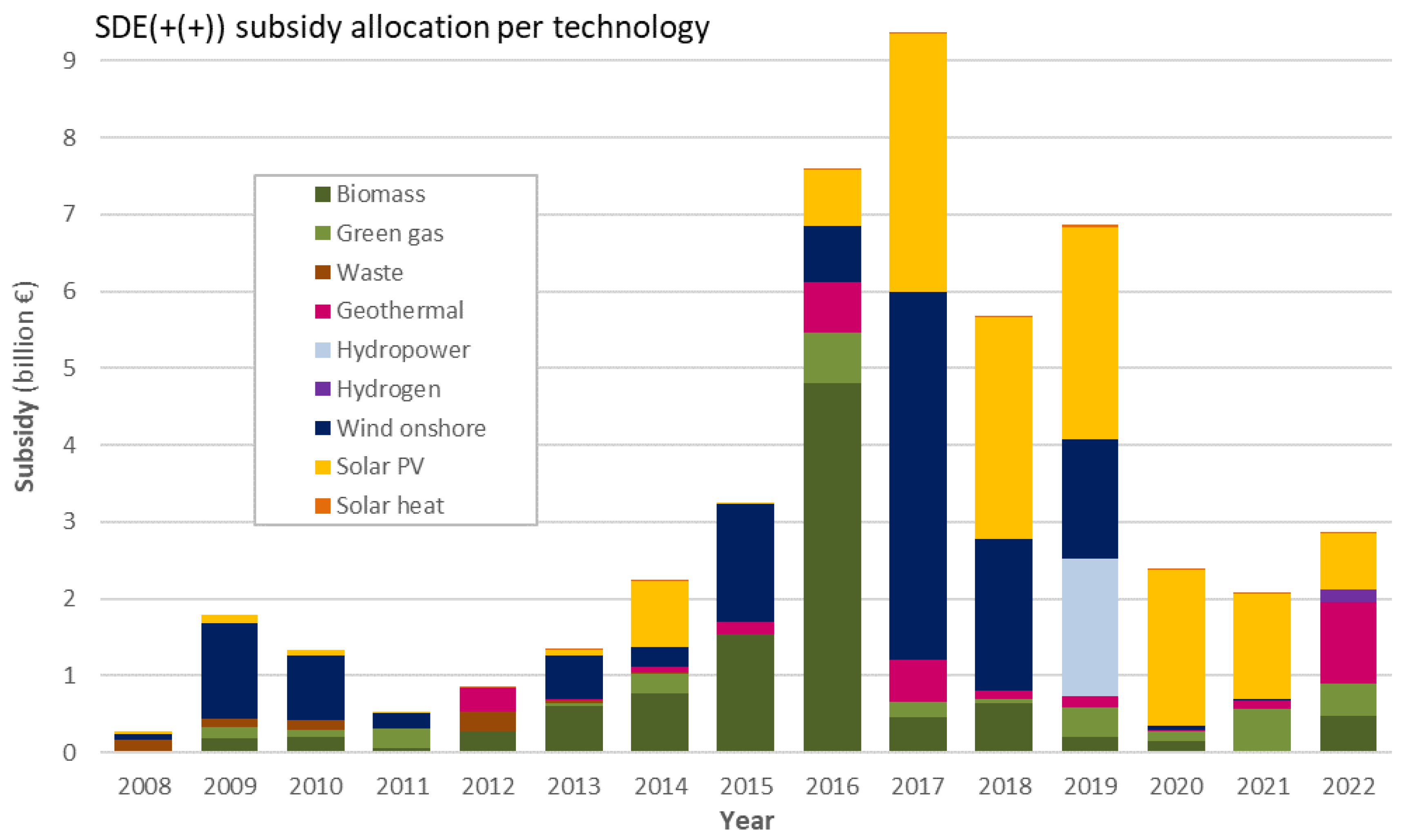
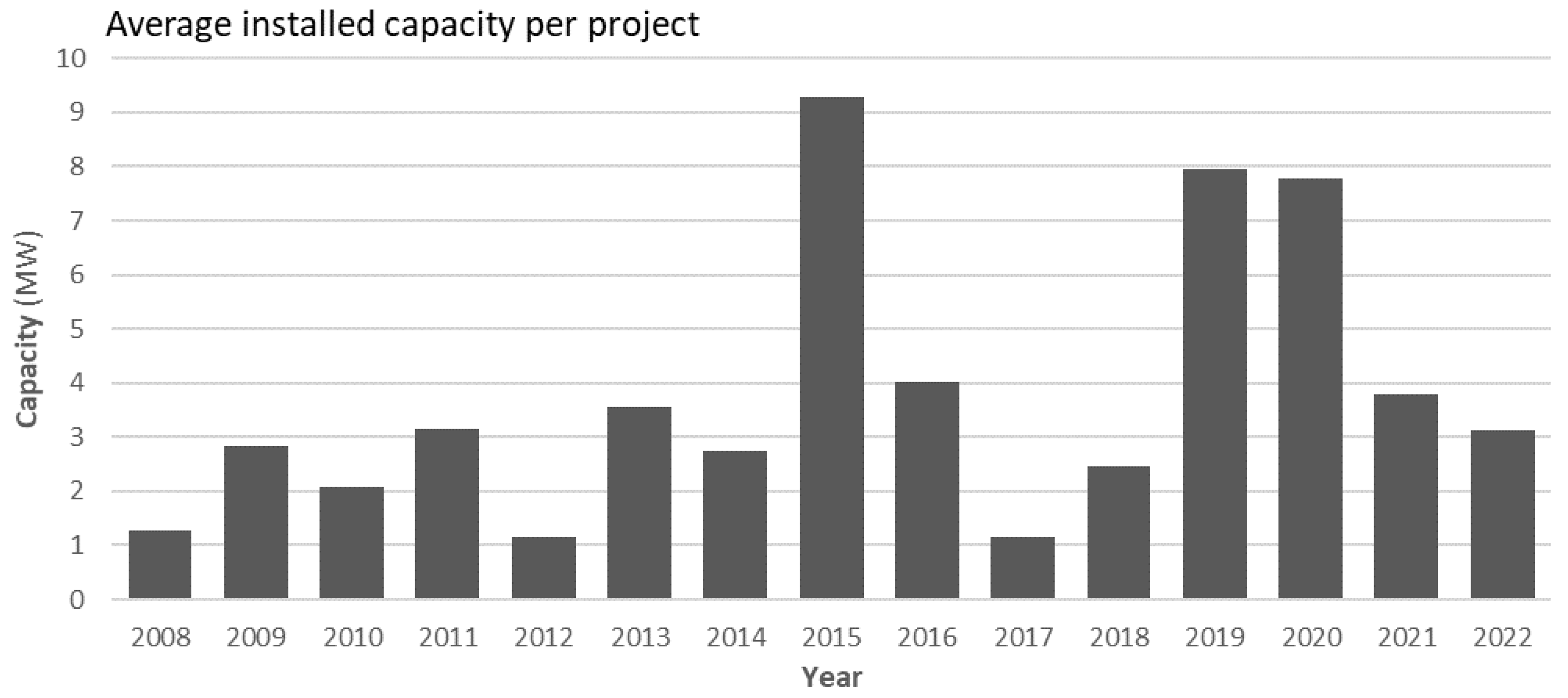
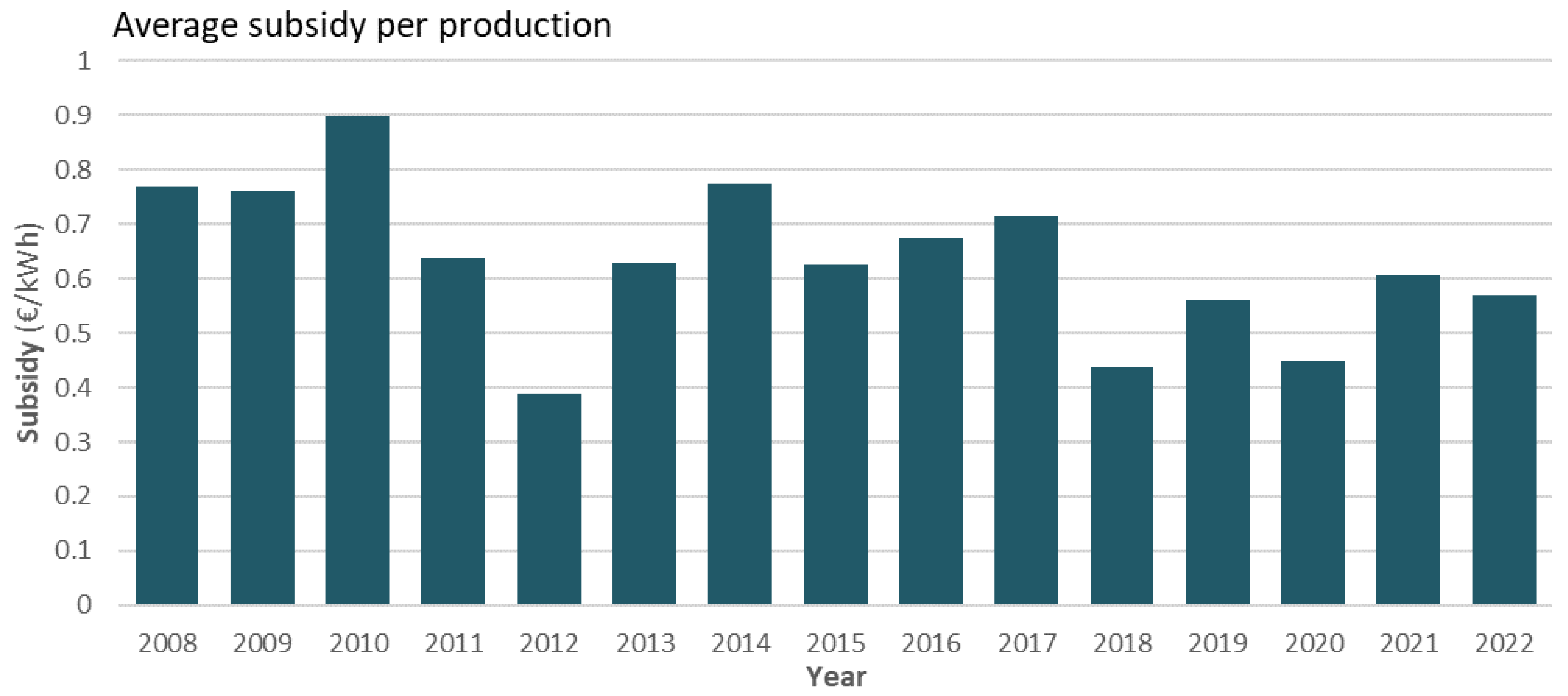
Outside the academic realm, financial support for energy-related projects (including biogas) is provided by RVO (The Netherlands Enterprise Agency, a government agency that provides financial and strategic support for entrepreneurs and organizations). Since the initialization of the funding structure SDE (“Stimuleringsregeling Duurzame Energieproductie”) in 2008, available financial support by RVO has always been in the range between 1 and 10 billion euros, but with some degree of fluctuation within that range (see Figure 1). Available SDE(+(+)) subsidy (Sustainable Energy Production and Climate Transition Incentive Scheme) for biomass and green gas projects has shrunk substantially since 2016. This coincides with a trend towards larger biogas project scales (see Figure 2). Bigger installed capacities offers benefits from economies of scale, which fits with the decreasing subsidy per unit of (expected) energy production (see Figure 3). Less SDE(+(+)) subsidy ends up with small-scale projects. In terms of absolute financial support, the trend seems to be downward: compared to the first half of the past decade, a smaller share of the available subsidy ends up in the bioenergy sector in the second half of the past decade.
From the developments in the financial support of research and (pilot) projects involved with biogas we can conclude that interest in biogas remains, especially in a general context. Targeted research continues to explore further potential of biogas technology, but large-scale application remains the preferred context. Some interest in smaller-scale decentralized deployment of biogas exists and is growing, but for the time being that remains a niche interest. The fulfillment of the knowledge development function thus shows an image similar to entrepreneurial activities: fairly well-fulfilled for biogas in general, and small (but growing) fulfillment for specific application in smaller-scale contexts (see Table 4).

4.3. Knowledge Diffusion

Changing interests in biogas research include increasing interest in applications for renewable gases, including biogas. Part of that stems from explicit or implicit attention for practical application of biogas in decentralized energy system contexts, such as self-sufficiency and diversification. Moreover, pre-existing gas infrastructure and presence of associated industrial partners add potential for cooperation between LEIs and industry. A handful of initiatives, such as Duurzaam Ameland, Wijnjewoude Energie Neutraal and Duurzaam Noord Deurningen, cooperate with industrial partners to explore the potential of biogas. The island of Ameland aims to deploy locally produced biogas to complement a wide spectrum of decentralized energy sources in order to transition towards full energy autarchy [135]. Actual operational potential remains uncertain, since elsewhere the proposed technology was reason to put biogas endeavors on hold [137]. In the Duurzaam Noord Deurningen project, local livestock farmers, bundle their biogas production to supply renewable gas to local industrial partners via their own pipeline [136]. Although initial progress was slow and hampered by a variety of challenges, eventually the outcome was quite positive and the initiative can, by now, be considered a success. Several factors were found to be conductive to the initiatives’ success, including perseverance by key stakeholders, an intrinsic connection between stakeholders, and cooperation with partners which brought in essential expertise [21].
LEIs are considered effective platforms for innovation and knowledge diffusion [86]. LEIs support knowledge diffusion through implementation and involvement of local stakeholders. Entrepreneurs taking initiatives to set pilot projects in motion, or stakeholders bringing essential human resources and capital together, provide for knowledge diffusion through cooperation. LEIs may take the lead in setting up cooperative agreements with and between partners in industry and policy sectors, or sector partners could initiate this by themselves. Cases that involve biogas are few, but the cooperation between Duurzaam Noord Deurningen, IJskoud and Cogas is an example of a successful initiative.
Knowledge diffusion seems fairly well-fulfilled for biogas in general, benefiting from historical developments and earlier policy support around interest in biogas as a potential large-scale substitute for natural gas in a gas-dependent country. For LEIs, however, those developments appear to offer little support. Only a small handful of actors and partnerships integrate biogas with LEIs, implying only limited fulfillment of knowledge diffusion for biogas in LEI context. See Table 5.

4.4. Guidance of the Search

Many active projects exist on various scales to promote/stimulate further investigation into the most promising pathways of and applications for AD biogas; the vast majority revolves around biogas in general. At the highest level, the European Union supports a variety of research, development and implementation projects on climate change and sustainability transition. Between 2016 and 2018, the BiogasAction research and stimulus program was part of the Horizon 2020 financial support structure driving innovation. The follow-up Horizon Europe program does not have a specific biogas-centered agenda, but facilitates biogas-related initiatives more implicitly under sustainability and technology development agendas [145]. This means a reduction in the explicit exposure of biogas in research and development programs, but aligns with aforementioned insights that attention is shifting towards more integrated energy technology development strategies.
The Dutch government implements EU energy transition strategy on smaller spatial scales. Mid/long-term outlooks include explicit attention for the possibilities of biogas. The focus of attention is on biogas in large-scale applications such as upgrading to green gas quality and subsequent injection into the national gas grid. In ambitious projections, a tenfold production increase to 2 bcm/year is assumed, equivalent to 5% of the current annual consumption of natural gas. This scenario depends on strong governmental support and the implementation of new production techniques and upscaling benefits. Despite explicit attention for constraints associated with the decentralized nature of biogas, decentralized consumption is not explicitly considered [149].
The perspective on the development of biogas to its maximum potential revolves around minimizing technological and practical constraints and selective application. The constraints in focus include (but are not limited to) resource availability [149] in both quantitative and qualitative terms. To tackle quantitative constraints, stakeholders are being approached for the definition of a route map towards increasing the amount of available bioresources. The qualitative aspects focus on the sustainability of the bioresource supply chains. The Dutch government clearly expressed a desire to only and exclusively rely on bioresources of which the entire production chain is free of adverse environmental effects. Selective application involves focusing on the utilization of bioresources solely in those parts of the energy system in which no realistic alternative is available. Although the Dutch government does not explicitly mention any role of local energy initiatives, it does highlight the potential use of biogas in the supply of household heat—especially in case of difficult-to-isolate houses and/or no possibility to connect to a heat grid [151].
Especially for biogas in general, the government as well as relevant subsidy partners appear enthusiastic about careful application of biogas, and willing to support research and development of such systems. Several support programs are already up and running, while others are under construction. Nevertheless, the search for a definitive form remains unfinished, and as such, clear policy on what is and what is not possible with regard to biogas application remains uncertain. As a consequence, the TIS function guidance of the search appears fulfilled to a large extent for biogas in general. For biogas in LEI context, the occasional implication of biogas as niche decentralized solutions implies that such roles are part of the future outlook as well, albeit not a key focal point. Guidance of the search specific for biogas in LEI context seems reasonably fulfilled but not to the extent it is for biogas in general. However, to fully capitalize on the potential of biogas, guidance of the search needs radical change to reset focus specific areas of application [100]. See Table 6.

4.5. Market Formation

The interest in AD biogas as a potential element in a renewable energy supply only gained momentum relatively recently. Before that, most AD biogas projects were rooted in the agriculture sector and involved farmers handling manure surpluses within policy constraints. Despite inclusion in renewable energy support schemes, most AD biogas projects remained mainly revolved around manure processing via co-digesting, with the resulting subsidy on renewable energy production being a welcome compensation for the costs of manure-related waste management. The consequence of this is that most biogas production and conversion infrastructure is located on farm sites [20].
Although a variety of lobby organizations is actively involved with the promotion of biogas and green gas, some even with a focus on decentralized application, the ingrained disconnect between the agriculture and the energy sector seems to frustrate formation of a decentralized biogas energy market. As a consequence of tightened manure regulations, some farmers turned to biogas as an alternative way to monetize on manure surpluses. Past technical issues and unfavorable monetization developments brought only limited success [153], but recent developments may renew interest in the potential of biogas to manage environmental impacts from agriculture [36]. Nevertheless, as much as the general public does not play any role (nor has expressed any interest in becoming involved) in manure processing, farmers seem reluctant to add additional stakeholders to their processes, which already hang from fragile social acceptance threads [130]. Most market formation is currently limited to a small number of large-scale initiatives; market development for biogas in LEI context is potentially large, but currently can only be considered stagnant at best. See Table 7.

4.6. Resource Mobilization

The resources considered in the TIS-function “Resource mobilization” typically involve financial and material resources. For biogas, the former relates to profitability and financial support, whereas the latter relates to feedstock and the costs and availability thereof. Historic developments have shown that financial support alone is insufficient to carry the development of biogas forward, but adequate and dependable financial support is crucial for biogas projects to be successful. Especially in comparison to neighboring countries, financial support offered to biogas projects in The Netherlands in the past has been haphazard and volatile, which held back biogas development [144].
Financial support schemes for energy transition in general typically also extend to and include bioenergy in general, and biogas specifically. Nevertheless, the absolute amount of funding available for bioenergy projects tends to fluctuate between different iterations of funding packages. The consequence is that with every funding iteration, some projects can be greenlighted but no long-term trust is instilled. For investors in biogas, the whimsical nature of Dutch renewable energy funding schemes has led to long-term distrust and unwillingness to become involved, develop long-term visions and implement biogas-oriented strategies [144].
Increasing concern about climate change, renewable energy targets, and changes in the global energy market have recreated a more favorable setting for biogas [152]. In The Netherlands, this is reflected in a more attractive and generous financial support climate emerging from renewed appreciation of the potential of biogas in future-proof energy systems [142].
Feedstock is ubiquitously listed as a critical resource associated with complex supply issues. Availability of and access to feedstock is a key element in many research and policy agendas. Debates around the sustainability of bioenergy resources are all but settled, adding to the uncertainty surrounding long-term visions on biogas. Moreover, ongoing debates can be coupled to perceptions of the general public of biogas as unsustainable. The sustainability characteristics are therefore deservedly prominent on the agenda in any future development of bioenergy systems. The Dutch government stated that any long-term use of bioresources, can and should only involve biomass that meets all relevant sustainability criteria. This also includes a desire to work towards a de-coupling of biogas production from manure processing [149,151].
Both biogas in general as well as biogas in LEI context are subject to similar material resource constraints. However, innovation support and resource-rich actors seem to be more prevalent for biogas in general than for biogas in LEI context. The overall implication is that the TIS indicator resource mobilization is not fulfilled in a promising way for either application context, bit slightly better for biogas in general. See Table 8.

4.7. Counteracting Resistance

Growing awareness of challenges in energy transition, such as hard-to-abate sectors and energy system balancing, is reviving interest in biogas [154]. However, that interest remains curbed by several barriers in the procedural realm [143] and societal realm [155]. On the public side, perception/acceptance issues stemming from preconceptions create resistance to biogas development in local settings. Biogas is often associated with issues such as smell and general nuisance [155], mixed sustainability characteristics [150], and uncertainty about financial viability [148].
The negative connotations and persistent public image of biogas are often the lingering heritage from failed or badly managed initiatives reported in public media. Examples include smell hindrance from biogas plants in Bunschoten [156,157] and Bemmel [158,159], leaking facilities in Harderwijk [160] and Coevorden [161], and cases of misconduct in Eerbeek [162] and several other places in The Netherlands [163]. A biogas facility in Holwerd is subject to environmental concerns [164] and in Wijnjewoude, general nuisance concerns are preventing the development of a biogas facility [92]. Local opposition to expansion plans combined with deteriorating financial viability were factors in the closure of a biogas plant in Nistelrode [165].
The potentially disruptive effects of the public opinion about biogas can be seen from the hesitant development of a biogas plant in Wijnjewoude. The LEI Wijnjewoude Energie Neutraal (WEN) is aiming for a medium-sized biogas facility as part of their ambition towards a high degree of energy self-sufficiency while reducing environmental impacts of agricultural processes [36]. A group of opponents has concerns about the environmental and logistical impact of such a facility. Some part of the opposition may be ascribed to technology misunderstanding, and another part may be related to aggravating societal discord [166,167]. Although the number of opponents is said to be small, their hesitation affects both timelines and ambitions [141] and challenges the perseverance on the side of the LEI [168].
On the corporate side, energy sector stakeholders are wary of the relatively high investment risk stemming from complex infrastructure combined with uncertain policy futures. Past experiences cast a shadow of doubt on the longevity of financial support systems. The consequence of disappointing support may be investment payback times increasing beyond what is considered acceptable. A few intrepid stakeholders are taking some interest in biogas, also in decentralized settings, but so far the development of their initiatives is either lagging behind expectations, of insufficiently high-profile to set things in motion on a higher level [21,135].
Meanwhile, several lobby organizations draw increasing attention to biogas, highlighting the potential and advantages [20,147]. With some actors in these organizations having a background in relevant sectors such as agriculture, waste treatment and energy, and other actors associated with government offices and consultants, these lobbyists are in an excellent position to forge new and consolidate existing connections between biogas stakeholders.
Despite awareness of the biogas sector of the negative public image issues, few successful attempts have been made to change the public perception of biogas. Although several lobby groups and energy sector stakeholders (such as Groen Gas Nederland and Platform Groen Gas) continue actively putting biogas and its potential benefits on policy makers’ agendas, most of those efforts remain in the formal realm and make little attempt to include the general public. As a consequence, public acceptance and support for biogas projects remains a challenge for further development of the biogas sector [169,170,171,172].
Lobby organizations so far have not managed to incite a trustworthy course change with regard to trust in support systems, neither on the side of the industry actors nor on the side of the government. Nevertheless, the message of the lobby organizations is getting stronger, and attracting support of a growing body of industry stakeholders. A growing presence of biogas advocates is indicative of some progress related to visibility and acceptance but progress so far is too small to make substantial waves. Recent research indicates that counteracting resistance to biogas can be strengthened by redesigning communication strategies to be more informative to and inclusive of the general public as well [173,174]. These strategies should take into consideration social drivers for participation in sustainability initiatives [175,176,177], and the potential environmental benefits of biogas [178].
The overall impression (see Table 9) is that the extent to which the TIS function counteracting resistance is fulfilled, is strongly dominated by critical and negative perceptions of biogas by relevant stakeholders. The few entrepreneurs that form the exceptions struggle to counteract the negative tendency.

5. Discussion and Conclusions

The central question in this research was how the slow adoption of biogas in the context of local energy initiatives (LEIs) in The Netherlands can be explained using a TIS-based approach. To answer that question, we performed an explorative analysis of the literature from both academic and non-academic backgrounds to gauge the extent to which different TIS-functions are fulfilled for biogas in general, and for biogas in the context of LEIs. In this research, we consider biogas a complementary energy technology to even out local energy supply variation. Since this application of biogas is fairly rare, especially in LEI-context, the literature covering that intersection is sparse. Instead, the majority of our insights are derived through exploration and interpretation of the proxy literature covering elements of our focus topic separately.
Considering biogas an established technology in a market that is relatively new for that technology, rather than the other way around, our application of TIS is somewhat a-typical. Nevertheless, the TIS-framework provides an analysis structure that straddles technical and non-technical dimensions which fits the aim of our study. We tailored our TIS-based analysis to facilitate the comparison of biogas in a general context, and biogas in LEI-context, aiming to identify differences in the status of TIS functions.
The combination of explorative literature interpretation and a-typical TIS application results in limited precision of our findings. Differences in type, quantity and quality of evidence result in structural evidence asymmetry. While biogas in general context is supported by evidence from technical studies, policy reports and market data, biogas in LEI context relies more on case studies, the social science literature and the local reports/gray literature. The differences in evidence strength this results in, is reflected the evidence strength indications in Table 3, Table 4, Table 5, Table 6, Table 7, Table 8 and Table 9.
Evidence strength uncertainty notwithstanding, our approach is sufficiently functional to determine the extent to which the seven TIS functions are fulfilled, and with that paint a broad-strokes picture of key systemic barriers for different biogas application contexts. Table 10 provides an overview of those findings. Our analysis indicates that big differences exist in the level with which various TIS functions are fulfilled between biogas in general and biogas in the context of LEIs. For a forward innovation direction, TIS functions essential for innovation motors should be in a promising state of fulfillment. Thus, the pattern of fulfillment (or lack thereof) of the TIS functions and associated indicators provides clear indication of where and why stagnation of biogas innovation occurs.
It should be noted that in general, the function fulfillment pattern for biogas in general is similar to the pattern for biogas in the context of LEIs, albeit with an overall reduction in fulfillment level. Functions with higher fulfillment level for biogas in general, are also the functions with the higher fulfillment level for biogas in LEI context, but where that may mean those functions are at a promising fulfillment level for biogas in general, they may still be in unsupportive fulfillment levels for biogas in LEI context. This implies biogas in general is in a more favorable innovation position than biogas in the context of LEIs.
Through numerical representation of that analysis, we can project the function fulfillment statuses on a gradient for easier comparison (see Figure 4).
Current critical perceptions of biogas in general notwithstanding, the heritage of over a decade of government push and support have paved the way for further adoption. Many of the policies and support systems set up before still exist in one form or another, serving as a foundation for policy supporting new perspective on biogas. In our TIS analysis, this is evident from the fairly complete fulfillment of the function ‘guidance of the search’ (F4): policy is not a key barrier for biogas in general. Of the seven TIS functions associated with biogas in general, six can be considered in a fairly advanced state of fulfillment (F1–F6). This means biogas in general is also part of ongoing research, adopted by entrepreneurs, marketable, and covered by supportive resources such that general-context biogas should not be ruled out from playing a role in short- to medium-term developments in the energy sector.
For biogas in general, limited fulfillment of function ‘counteracting resistance’ (F7) indicates lagging societal acceptance, legitimacy and support. Whether the persistence of resistance has a negative influence on the further development of biogas in general depends on the interplay between functions. In that interplay, resistance can play an inhibiting role with regard to establishing self-reinforcing feedback loops (‘innovation motors’). Resistance can thus remain a barrier for further development of biogas in general, despite all other TIS-functions being fulfilled.
For biogas in the context of LEIs, the outlook is different. The analysis of TIS-function fulfillment from this perspective indicates that the fulfillment level is far from promising for all seven functions. Especially entrepreneurship in LEI-context biogas is not indicative of positive development—as shown by the weak fulfillment level of function ‘entrepreneurial activities’ (F1). Entrepreneurial activities play an essential role in innovation [96], and limited fulfillment of F1 may therefore be considered a bottleneck and key barrier in the further development of biogas in LEI-context—even if the other functions may reach higher levels of fulfillment. Although biogas-related entrepreneurial activities are all but non-existent, our research indicates that virtually none of those entrepreneurial activities relate to biogas in the context of LEIs.
Much of the attention biogas has had in The Netherlands in recent years, placed it in a large-scale context. Even pragmatic financial support systems such as the SDE(+(+)) that were (also) aimed at small- and medium-scale entrepreneurs, were designed with large-scale systemic change and energy transition in mind. The long-term effect of that is that large-scale biogas applications already have existing policy in favor, implying a form of policy-based path-dependency. In one form or the other, many of the earlier support programs are still around. Entrepreneurs that caught on with those support programs still form the most visible (and only) examples of successful innovation. Many of the patrons of earlier programs thus contribute to the fulfillment of TIS function ‘entrepreneurial activities’ (F1). Moreover, early entrepreneurship often has brought advanced entrepreneurship later on, as a consequence of which all TIS functions, aside from function ‘counteracting resistance’ (F7), are fairly well fulfilled for biogas in general.
This notion also aligns with insights from the development of biogas in Denmark and Germany: early developments paved the way for further developments in the same line, but are not necessarily supportive for developments that deviate from the earlier paths. In comparison to The Netherlands, the biogas sectors in Germany and Denmark have developed under circumstances different from The Netherlands. Whereas biogas policy in Germany and Denmark incorporated notions of self-reliance and local value (a positive stimulus), the development of biogas in The Netherlands was largely centered around mitigation of agricultural issues around manure surpluses (a negative stimulus). Differences in the perspectives on biogas may be linked to certain socio-economic circumstances during initial development of biogas. Current circumstances may be different. For instance: a need for predictable renewable energy supply or demand for renewable heat may affect (financial) support systems.
For biogas specifically in the context of LEIs, there is little existing policy framework to support further development. Existing frameworks are mostly geared towards large-scale development, and translating that to community-scale development requires functional examples and/or a supportive network. Links between entrepreneurial activities, resource mobilization and counteracting resistance are essential in several innovation motors as defined by Suurs [96]: self-reinforcing feedback cycles. Setting those cycles in motion requires more than just redirecting funds explicitly to stimulating development of biogas in LEI context (improving fulfillment of ‘resource mobilization’ (F6)). Only a market-oriented innovation motor could be set in motion by just improving on resource mobilization [96], but especially for biogas in the LEI context, the usefulness of such a motor remains questionable. Instead, activating innovation motors centered around entrepreneurial activities or system building processes might be considered valuable development for biogas in LEI context, and the only function that separates those motors is TIS function ‘counteracting resistance’ (F7)—the one function that is most poorly fulfilled. Although Mitzinneck et al. [73] suggest that LEIs might be able to circumvent certain unfulfilled enabling conditions, the combination of these three factors creates a self-locking system that is challenging to circumvent.
Current policy seems to extend previous policy in favoring large-scale development. As a consequence, many TIS functions for biogas in large-scale roles are (being) fulfilled to a large extent. Under currently prevailing deployment strategies, the benefits of biogas do not end up locally. That means the (perceived) local nuisance related to biogas activities is not compensated by local benefits, as a consequence of which local resistance remains unchanged.
To answer the main question of this research, we note that the outlook on biogas potential in The Netherlands is more promising for biogas in general, than for biogas in the context of LEIs. Table 11 provides a summary of key factors we found to affect the potential of biogas in general or in the context of LEIs. Weak fulfillment of essential TIS functions for biogas in LEI context (especially in contrast to biogas in general) may hamper activation of innovation motors to further the adoption of biogas in LEI context without intervention. Useful intervention would include substantial (re)direction of financial support to decentralized application (improving ‘resource mobilization’ (F6)) coupled with qualitative support in favor of community biogas (improving ‘counteracting resistance’ (F7)). Following the composition of the innovation motors, sufficient fulfillment of ‘resource mobilization’ (F6) and ‘counteracting resistance’ (F7) might improve financial and societal attractiveness of biogas, which may stimulate entrepreneurship (improving ‘entrepreneurial activities’ (F1)). That may lower barriers to more widespread adoption of biogas, and perhaps even initiate self-reinforcing mechanisms.
Current pilot projects are rare, but indicate that biogas aligns with views on local embedding of local resources, and the possibility of LEI involvement with biogas. Since bottom-up support for renewable energy technology improves technology acceptance and accelerates innovation, energy transition policy might recognize and foster ambitions of local stakeholders to explore the potential of biogas and diversification of decentralized energy technology.
However, there does not seem to be a blueprint for success. The system-technical characteristics typical to The Netherlands are not uniformly in favor of biogas, especially not in the context of LEIs. Policy interventions might not be able to compensate for that. This leads us to conclude that the situation in The Netherlands may hold some potential for biogas in general, but it remains uncertain whether adoption of biogas by LEIs can increase in a timely and sufficient manner to contribute to a bottom-up energy transition. However, our perception of limited potential of biogas, especially in the LEI context, may not only point at system weakness. It is also indicative of knowledge and evidence gaps with regard to biogas-related TIS function fulfillment. We therefore suggest additional research on biogas-related TIS functions to close knowledge gaps and improve the reliability of intervention suggestions to stimulate the role of biogas in energy transition.

Author Contributions

Conceptualization, G.A.H.L.; Investigation, G.A.H.L.; Resources, G.A.H.L. and H.J.v.d.W.; Writing—original draft, G.A.H.L.; Writing—review & editing, H.J.v.d.W.; Supervision, H.J.v.d.W. All authors have read and agreed to the published version of the manuscript.

Funding

This research received no external funding.

Data Availability Statement

The original contributions presented in this study are included in the article. Further inquiries can be directed to the corresponding author.

Conflicts of Interest

The authors declare no conflict of interest.

References

  1. Smil, V. Grand Transitions: How the Modern World Was Made; Oxford University Press: Oxford, UK, 2021. [Google Scholar]
  2. Lavoine, O. Thoughts on an Electricity System and Grid Paradigm Shift in Response to the EU Energy Transition and the Clean Energy Package. 2018. Available online: https://hdl.handle.net/1814/59293 (accessed on 29 June 2023).
  3. Edenhofer, O.; Grimm, V.; Haug, G.; Marotzke, J.; Marquardt, W.; Schlögl, R.; Schmidt, C.M.; Schüth, F.; Wagner, U. Den Kritischen Zeitpunkt Nicht Verpassen: Leitideen für die Transformation des Energiesystems; Nationale Akademie der Wissenschaften Leopoldina: Halle (Saale), Germany, 2023. [Google Scholar]
  4. Voulvoulis, N.; Giakoumis, T.; Hunt, C.; Kioupi, V.; Petrou, N.; Souliotis, I.; Vaghela, C.; Binti Wan Rosely, W.I.H. Systems thinking as a paradigm shift for sustainability transformation. Glob. Environ. Change 2022, 75, 102544. [Google Scholar] [CrossRef] [Scilit]
  5. Crespo Del Granado, P.; Resch, G.; Holz, F.; Welisch, M.; Geipel, J.; Hartner, M.; Forthuber, S.; Sensfuss, F.; Olmos, L.; Bernath, C.; et al. Energy Transition Pathways to a Low-carbon Europe in 2050: The Degree of Cooperation and the Level of Decentralization. Econ. Energy Environ. Policy 2020, 9, 121–135. [Google Scholar] [CrossRef] [Scilit]
  6. Heldeweg, M.A.; Saintier, S. Renewable energy communities as ‘socio-legal institutions’: A normative frame for energy decentralization? Renew. Sustain. Energy Rev. 2020, 119, 109518. [Google Scholar] [CrossRef] [Scilit]
  7. Otto, I.M.; Donges, J.F.; Cremades, R.; Bhowmik, A.; Hewitt, R.J.; Lucht, W.; Rockström, J.; Allerberger, F.; McCaffrey, M.; Doe, S.S.P.; et al. Social tipping dynamics for stabilizing Earth’s climate by 2050. Proc. Natl. Acad. Sci. USA 2020, 117, 2354–2365. [Google Scholar] [CrossRef] [Scilit]
  8. Arentsen, M.; Bellekom, S. Power to the people: Local energy initiatives as seedbeds of innovation? Energy. Sustain. Soc. 2014, 4, 2. [Google Scholar] [CrossRef] [Scilit]
  9. De Boer, J.; Zuidema, C.; Gugerell, K. New interaction paths in the energy landscape: The role of local energy initiatives. Landsc. Res. 2018, 43, 489–502. [Google Scholar] [CrossRef] [Scilit]
  10. Hasanov, M.; Zuidema, C. The transformative power of self-organization: Towards a conceptual framework for understanding local energy initiatives in The Netherlands. Energy Res. Soc. Sci. 2018, 37, 85–93. [Google Scholar] [CrossRef] [Scilit]
  11. Schmid, B.; Meister, T.; Klagge, B.; Seidl, I. Energy Cooperatives and Municipalities in Local Energy Governance Arrangements in Switzerland and Germany. J. Environ. Dev. 2020, 29, 123–146. [Google Scholar] [CrossRef] [Scilit]
  12. Ehrtmann, M.; Holstenkamp, L.; Becker, T. Regional Electricity Models for Community Energy in Germany: The Role of Governance Structures. Sustainability 2021, 13, 2241. [Google Scholar] [CrossRef] [Scilit]
  13. Vansintjan, D.; Pappa, S.; Kriedemann, F. EU Energy Communities legislation 2.0: An upwards trend. REScoop.eu for European Commission, 14 March 2024.
  14. Maqbool, A.S.; Van der Waal, E.; Van der Windt, H.J. ‘Luctor et emergo’. how a community energy initiative survived the changing policy and technology landscape of the Dutch energy system? Energy Policy 2023, 177, 113528. [Google Scholar] [CrossRef] [Scilit]
  15. Schwenke, A.M. Lokale Energie Monitor 2021; HIER/RVO: The Hague, The Netherlands, 2022. [Google Scholar]
  16. Van der Schoor, T.; Van der Windt, H.J. Negotiating Dutch citizen-led district heating projects: Managing internal, external, and material networks to achieve successful implementation. Energy Res. Soc. Sci. 2023, 102, 103166. [Google Scholar] [CrossRef] [Scilit]
  17. Koirala, B.P.; Van Oost, E.; Van der Windt, H.J. Innovation Dynamics of Socio-Technical Alignment in Community Energy Storage: The Cases of DrTen and Ecovat. Energies 2020, 13, 2955. [Google Scholar] [CrossRef] [Scilit]
  18. RVO. Groen Gas Voor Energiecoöperaties; N-TRA icw EnergieKansen, Thuysgas & HIER for RVO: The Hague, The Netherlands, 2018. [Google Scholar]
  19. Venus, T.E.; Strauss, F.; Venus, T.J.; Sauer, J. Understanding stakeholder preferences for future biogas development in Germany. Land Use Policy 2021, 109, 105704. [Google Scholar] [CrossRef] [Scilit]
  20. Groen Gas Nederland. Groen Gas Nederland Helpt de Productie en Afzet van Groen Gas Vooruit. Online Resource, 2021. Available online: https://groengasnl.nl/ (accessed on 30 September 2021).
  21. Van der Windt, H.; Pierie, F. Biogas en Lokale Energie-Initiatieven, Meer Mogelijkheden voor Bijdragen aan de Energietransitie? University of Groningen: Groningen, The Netherlands, 2021. [Google Scholar]
  22. Verkade, N.; Höffken, J. Collective energy practices: A practice-based approach to civic energy communities and the energy system. Sustainability 2019, 11, 3230. [Google Scholar] [CrossRef] [Scilit]
  23. Hansen, K.; Breyer, C.; Lund, H. Status and perspectives on 100% renewable energy systems. Energy 2019, 175, 471–480. [Google Scholar] [CrossRef] [Scilit]
  24. Laugs, G.A.; Benders, R.M.; Moll, H.C. Maximizing self-sufficiency and minimizing grid interaction: Combining electric and molecular energy storage for decentralized balancing of variable renewable energy in local energy systems. Renew. Energy 2024, 229, 120703. [Google Scholar] [CrossRef] [Scilit]
  25. Pierie, F.; van Someren, C.E.; Kruse, S.N.; Laugs, G.A.; Benders, R.M.; Moll, H.C. Local balancing of the electricity grid in a renewable municipality; analyzing the effectiveness and cost of decentralized load balancing looking at multiple combinations of technologies. Energies 2021, 14, 4926. [Google Scholar] [CrossRef] [Scilit]
  26. Manjula, A.; Niraimathi, R.; Rajarajeswari, M.; Devi, S.C. Grid integration of renewable energy sources: Challenges and solutions. In Green Machine Learning and Big Data for Smart Grids; Elsevier: Amsterdam, The Netherlands, 2025; pp. 263–286. [Google Scholar]
  27. Villadsen, S.N.; Fosbøl, P.L.; Angelidaki, I.; Woodley, J.M.; Nielsen, L.P.; Møller, P. The potential of biogas; The solution to energy storage. ChemSusChem 2019, 12, 2147–2153. [Google Scholar] [CrossRef] [Scilit]
  28. Liu, Y.; Zhang, Y. Economic and environmental assessment of different energy storage methods for hybrid energy systems. Sci. Rep. 2025, 15, 25592. [Google Scholar] [CrossRef] [Scilit] [PubMed]
  29. Harutyunyan, A.; Badyda, K.; Szablowski, Ł. Integrated Biogas–Hydrogen–PV–Energy Storage–Gas Turbine System: A Pathway to Sustainable and Efficient Power Generation. Energies 2026, 19, 387. [Google Scholar] [CrossRef] [Scilit]
  30. Aghbashlo, M.; Khounani, Z.; Hosseinzadeh-Bandbafha, H.; Gupta, V.K.; Amiri, H.; Lam, S.S.; Morosuk, T.; Tabatabaei, M. Exergoenvironmental analysis of bioenergy systems: A comprehensive review. Renew. Sustain. Energy Rev. 2021, 149, 111399. [Google Scholar] [CrossRef] [Scilit]
  31. Bauen, A.; Berndes, G.; Junginger, M.; Londo, M.; Vuille, F.; Ball, R.; Bole, T.; Chudziak, C.; Faaij, A.; Mozaffarian, H. Bioenergy—A Sustainable and Reliable Energy Source: A Review of Status and Prospects. IEA Bioenergy 2009. Available online: https://publications.tno.nl/publication/34627904/P1i42V/b10011.pdf (accessed on 5 May 2021).
  32. Horvath, I.S.; Tabatabaei, M.; Karimi, K.; Kumar, R. Recent updates on biogas production—A review. Biofuel Res. J. 2016, 10, 394–402. [Google Scholar] [CrossRef] [Scilit]
  33. Padilla-Rivera, A.; Paredes, M.G.; Güereca, L.P. A systematic review of the sustainability assessment of bioenergy: The case of gaseous biofuels. Biomass Bioenergy 2019, 125, 79–94. [Google Scholar] [CrossRef] [Scilit]
  34. Schipfer, F.; Mäki, E.; Schmieder, U.; Lange, N.; Schildhauer, T.; Hennig, C.; Thrän, D. Status of and expectations for flexible bioenergy to support resource efficiency and to accelerate the energy transition. Renew. Sustain. Energy Rev. 2022, 158, 112094. [Google Scholar] [CrossRef] [Scilit]
  35. Hagman, L.; Eklund, M. The Role of Biogas Solutions in the Circular and Bio-Based Economy; Linköping University Electronic Press: Linköping, Sweden, 2016. [Google Scholar]
  36. Verdoes, N.; Casu, F.; van Gastel, J.; Hekkert, G. Berekeningen over Emissies, Massabalansen en Economie bij Gezamenlijke Monomestvergisting: Scenariostudie voor Energiecoöperatie Wijnjewoude; Rapport/Wageningen Livestock Research; No. 1449; Wageningen Livestock Research: Wageningen, The Netherlands, 2023. [Google Scholar] [CrossRef] [Scilit]
  37. Pilarski, K.; Pilarska, A.A.; Pietrzak, M.B. Biogas production in agriculture: Technological, environmental, and socio-economic aspects. Energies 2025, 18, 5844. [Google Scholar] [CrossRef] [Scilit]
  38. Wegener, M.; Villarroel Schneider, J.; Malmquist, A.; Isalgue, A.; Martin, A.; Martin, V. Techno-economic optimization model for polygeneration hybrid energy storage systems using biogas and batteries. Energy 2021, 218, 119544. [Google Scholar] [CrossRef] [Scilit]
  39. Ennemiri, N.; Berrada, A.; Emrani, A.; Abdelmajid, J.; El Mrabet, R. Optimization of an off-grid PV/biogas/battery hybrid energy system for electrification: A case study in a commercial platform in Morocco. Energy Convers. Manag. X 2024, 21, 100508. [Google Scholar] [CrossRef] [Scilit]
  40. Bioenergy Europe. Statistical Report 2020; Bioenergy Europe: Brussels, Belgium, 2020. [Google Scholar]
  41. Sigarchian, S.G.; Paleta, R.; Malmquist, A.; Pina, A. Feasibility study of using a biogas engine as backup in a decentralized hybrid (PV/wind/battery) power generation system–Case study Kenya. Energy 2015, 90, 1830–1841. [Google Scholar] [CrossRef] [Scilit]
  42. Pierie, F. How to Measure and Optimize the Sustainability of Complex (Renewable) Energy Production Pathways: Applied to Farm Scale Biogas Production Pathways. Ph.D. Thesis, University of Groningen, Groningen, The Netherlands, 2018. [Google Scholar]
  43. Lybæk, R.; Kjær, T. How circular bio-economy can be adopted within the agro-industry in Denmark by cascading and coupling biomass residues. GMSARN Int. J. 2022, 16, 93–98. [Google Scholar]
  44. Laugs, G.A.; Benders, R.M.; Moll, H.C. Balancing responsibilities: Effects of growth of variable renewable energy, storage, and undue grid interaction. Energy Policy 2020, 139, 111203. [Google Scholar] [CrossRef] [Scilit]
  45. Hannan, M.A.; Wali, S.B.; Ker, P.J.; Abd Rahman, M.S.; Mansor, M.; Ramachandaramurthy, V.K.; Muttaqi, K.M.; Mahlia, T.M.I.; Dong, Z.Y. Battery energy-storage system: A review of technologies, optimization objectives, constraints, approaches, and outstanding issues. J. Energy Storage 2021, 42, 103023. [Google Scholar] [CrossRef] [Scilit]
  46. Zsiborács, H.; Pintér, G.; Vincze, A.; Birkner, Z.; Hegedűsné Baranyai, N. Grid balancing challenges illustrated by two European examples: Interactions of electric grids, photovoltaic power generation, energy storage and power generation forecasting. Energy Rep. 2021, 7, 3805–3818. [Google Scholar] [CrossRef] [Scilit]
  47. Pulazza, G.; Orozco, C.; Borghetti, A.; Tossani, F.; Napolitano, F. Procurement Cost Minimization of an Energy Community with Biogas, Photovoltaic and Storage Units. In Proceedings of the 2021 IEEE Madrid PowerTech, Madrid, Spain, 28 June–2 July 2021; pp. 1–6. [Google Scholar] [CrossRef] [Scilit]
  48. Hekkert, M.P.; Suurs, R.A.; Negro, S.O.; Kuhlmann, S.; Smits, R.E. Functions of innovation systems: A new approach for analysing technological change. Technol. Forecast. Soc. Change 2007, 74, 413–432. [Google Scholar] [CrossRef] [Scilit]
  49. Markard, J.; Stadelmann, M.; Truffer, B. Prospective analysis of technological innovation systems: Identifying technological and organizational development options for biogas in Switzerland. Res. Policy 2009, 38, 655–667. [Google Scholar] [CrossRef] [Scilit]
  50. Wirth, S.; Markard, J. Context matters: How existing sectors and competing technologies affect the prospects of the Swiss Bio-SNG innovation system. Technol. Forecast. Soc. Change 2011, 78, 635–649. [Google Scholar] [CrossRef] [Scilit]
  51. Junginger, H.M.; Mai-Moulin, T.; Daioglou, V.; Fritsche, U.; Guisson, R.; Hennig, C.; Thrän, D.; Heinimö, J.; Hess, J.R.; Lamers, P.; et al. The future of biomass and bioenergy deployment and trade: A synthesis of 15 years IEA Bioenergy Task 40 on sustainable bioenergy trade. Biofpr 2019, 13, 247–266. [Google Scholar] [CrossRef] [Scilit]
  52. Müller, S.C.; Welpe, I.M. Sharing electricity storage at the community level: An empirical analysis of potential business models and barriers. Energy Policy 2018, 118, 492–503. [Google Scholar] [CrossRef] [Scilit]
  53. Kalkbrenner, B.J. Residential vs. community battery storage systems–consumer preferences in Germany. Energy Policy 2019, 129, 1355–1363. [Google Scholar] [CrossRef] [Scilit]
  54. Gährs, S.; Knoefel, J. Stakeholder demands and regulatory framework for community energy storage with a focus on Germany. Energy Policy 2020, 144, 111678. [Google Scholar] [CrossRef] [Scilit]
  55. Hann, V. Transition to decentralized electricity storage: The complexities of consumer decision-making and cost-benefit analyses. Energy Policy 2020, 147, 111824. [Google Scholar] [CrossRef] [Scilit]
  56. Chodkowska-Miszczuk, J.; Martinat, S.; Kulla, M.; Novotný, L. Renewables projects in peripheries: Determinants, challenges and perspectives of biogas plants—Insights from Central European countries. Reg. Stud. Reg. Sci. 2020, 7, 362–381. [Google Scholar] [CrossRef] [Scilit]
  57. Chrispim, M.C.; Scholz, M.; Nolasco, M.A. Biogas recovery for sustainable cities: A critical review of enhancement techniques and key local conditions for implementation. Sustain. Cities Soc. 2021, 72, 103033. [Google Scholar] [CrossRef] [Scilit]
  58. Baasch, S. Energy transition with biomass residues and waste: Regional-scale potential and conflicts. A case study from North Hesse, Germany. J. Environ. Policy Plan. 2021, 23, 243–255. [Google Scholar] [CrossRef] [Scilit]
  59. Rogers, J.C.; Simmons, E.A.; Convery, I.; Weatherall, A. Public perceptions of opportunities for community-based renewable energy projects. Energy Policy 2008, 36, 4217–4226. [Google Scholar] [CrossRef] [Scilit]
  60. Roseland, M. Sustainable community development: Integrating environmental, economic, and social objectives. Prog. Plan. 2000, 54, 73–132. [Google Scholar] [CrossRef] [Scilit]
  61. Seidl, R.; von Wirth, T.; Krütli, P. Social acceptance of distributed energy systems in Swiss, German, and Austrian energy transitions. Energy Res. Soc. Sci. 2019, 54, 117–128. [Google Scholar] [CrossRef] [Scilit]
  62. Međugorac, V.; Schuitema, G. Why is bottom-up more acceptable than top-down? A study on collective psychological ownership and place-technology fit in the Irish Midlands. Energy Res. Soc. Sci. 2023, 96, 102924. [Google Scholar] [CrossRef] [Scilit]
  63. Van der Schoor, T.; Scholtens, B. Power to the people: Local community initiatives and the transition to sustainable energy. Renew. Sustain. Energy Rev. 2015, 43, 666–675. [Google Scholar] [CrossRef] [Scilit]
  64. Van der Waal, E.C.; Van der Windt, H.J.; Botma, R.; Van Oost, E.C.J. Being a Better Neighbor: A Value-Based Perspective on Negotiating Acceptability of Locally-Owned Wind Projects. Sustainability 2020, 12, 8767. [Google Scholar] [CrossRef] [Scilit]
  65. Geels, F.W. Technological transitions as evolutionary reconfiguration processes: A multi-level perspective and a case-study. Res. Policy 2002, 31, 1257–1274. [Google Scholar] [CrossRef] [Scilit]
  66. Kampman, B.E.; Blommerde, J.; Afman, M.R. The Potential of Energy Citizens in the European Union; Ce Delft: Delft, The Netherlands, 2016. [Google Scholar]
  67. Wittmayer, J.M.; De Geus, T.; Pel, B.; Avelino, F.; Hielscher, S.; Hoppe, T.; Mühlemeier, S.; Stasik, A.; Oxenaar, S.; Rogge, K.S.; et al. Beyond instrumentalism: Broadening the understanding of social innovation in socio-technical energy systems. Energy Res. Soc. Sci. 2020, 70, 101689. [Google Scholar] [CrossRef] [Scilit]
  68. Backe, S.; Zwickl-Bernhard, S.; Schwabeneder, D.; Auer, H.; Korpås, M.; Tomasgard, A. Impact of energy communities on the European electricity and heating system decarbonization pathway: Comparing local and global flexibility responses. Appl. Energy 2022, 323, 119470. [Google Scholar] [CrossRef] [Scilit]
  69. Creamer, E.; Eadson, W.; van Veelen, B.; Pinker, A.; Tingey, M.; Braunholtz-Speight, T.; Markantoni, M.; Foden, M.; Lacey-Barnacle, M. Community energy: Entanglements of community, state, and private sector. Geogr. Compass 2018, 12, e12378. [Google Scholar] [CrossRef] [Scilit]
  70. Hier. Lokale Energie Monitor 2024; Hier.nu: The Hague, The Netherlands, 2024; Available online: https://www.hier.nu/lokale-energie-monitor-2024 (accessed on 10 December 2025).
  71. Dujany, N.; Perotti, F.A.; Sohag, K. Exploring governance for sustainable transitions in renewable energy communities: A comparative inquiry of private and public initiatives. Energy Policy 2026, 212, 115183. [Google Scholar] [CrossRef] [Scilit]
  72. Teladia, A.; van der Windt, H. Lights, Policy, Action: A Multi-Level Perspective on Policy Instrument Mix Interactions for Community Energy Initiatives. Energies 2025, 18, 2823. [Google Scholar] [CrossRef] [Scilit]
  73. Mitzinneck, B.C.; Coenen, J.; Noseleit, F.; Rupietta, C. Impact creation approaches of community-based enterprises: A configurational analysis of enabling conditions. J. Bus. Ventur. 2024, 39, 106420. [Google Scholar] [CrossRef] [Scilit]
  74. Wierling, A.; Schwanitz, V.J.; Zeiß, J.P.; Bout, C.; Candelise, C.; Gilcrease, W.; Gregg, J.S. Statistical evidence on the role of energy cooperatives for the energy transition in European countries. Sustainability 2018, 10, 3339. [Google Scholar] [CrossRef] [Scilit]
  75. Roggema, R. Planning for the energy transition and how to overcome the misfits of the current paradigm. World 2020, 1, 264–282. [Google Scholar] [CrossRef] [Scilit]
  76. Rescoop. REScoop.eu Network. Online Resource. 2022. Available online: https://www.rescoop.eu/network (accessed on 5 May 2022).
  77. Wierling, A.; Schwanitz, V.J.; Zeiss, J.P.; von Beck, C.; Paudler, H.A.; Koren, I.K.; Kraudzun, T.; Marcroft, T.; Müller, L.; Andreadakis, Z.; et al. A Europe-wide inventory of citizen-led energy action with data from 29 countries and over 10000 initiatives. Sci. Data 2023, 10, 9. [Google Scholar] [CrossRef] [Scilit] [PubMed]
  78. Broska, L.H.; Vögele, S.; Shamon, H.; Wittenberg, I. On the Future(s) of Energy Communities in the German Energy Transition: A Derivation of Transformation Pathways. Sustainability 2022, 14, 3169. [Google Scholar] [CrossRef] [Scilit]
  79. Blasch, J.; Van der Grijp, N.M.; Petrovics, D.; Palm, J.; Bocken, N.; Darby, S.; Barnes, J.; Hansen, P.; Kamin, T.; Golob, U.; et al. New clean energy communities in polycentric settings: Four avenues for future research. Energy Res. Soc. Sci. 2021, 82, 102276. [Google Scholar] [CrossRef] [Scilit]
  80. Bovera, F.; Lo Schiavo, L. From energy communities to sector coupling: A taxonomy for regulatory experimentation in the age of the European Green Deal. Energy Policy 2022, 171, 113299. [Google Scholar] [CrossRef] [Scilit]
  81. Lode, M.L.; Te Boveldt, G.; Coosemans, T.; Ramirez Camargo, L. A transition perspective on Energy Communities: A systematic literature review and research agenda. Renew. Sustain. Energy Rev. 2022, 163, 112479. [Google Scholar] [CrossRef] [Scilit]
  82. Nagpal, H.; Avramidis, I.-I.; Capitanescu, F.; Madureira, A.G. Local Energy Communities in Service of Sustainability and Grid Flexibility Provision: Hierarchical Management of Shared Energy Storage. IEEE Trans. Sustain. Energy 2022, 13, 1523–1535. [Google Scholar] [CrossRef] [Scilit]
  83. Pastore, L.M.; Lo Basso, G.; Ricciardi, G.; De Santoli, L. Synergies between Power-to-Heat and Power-to-Gas in renewable energy communities. Renew. Energy 2022, 198, 1383–1397. [Google Scholar] [CrossRef] [Scilit]
  84. Van Summeren, L.F.M.; Wieczorek, A.J.; Bombaerts, G.J.T.; Verbong, G.P.J. Community energy meets smart grids: Reviewing goals, structure, and roles in Virtual Power Plants in Ireland, Belgium and the Netherlands. Energy Res. Soc. Sci. 2020, 63, 101415. [Google Scholar] [CrossRef] [Scilit]
  85. Bukovski, V.; Magyari, A.; Braun, M.K.; Pardi, K.; Reith, A. Energy Modelling as a Trigger for Energy Communities: A Joint Socio-Technical Perspective. Energies 2020, 13, 2274. [Google Scholar] [CrossRef] [Scilit]
  86. Van der Waal, E.C.; Van der Windt, H.J.; Van Oost, E.C. How local energy initiatives develop technological innovations: Growing an actor network. Sustainability 2018, 10, 4577. [Google Scholar] [CrossRef] [Scilit]
  87. Van der Waal, E.C.; Teladia, A. Social business models for local energy cooperatives. In Proceedings of the Presented at the SSE Academy Presentation, IREES/University of Groningen, Groningen, The Netherlands, 11 November 2021. [Google Scholar]
  88. PGG. Gesprek met VARO: Waarom ze 80% van de Aandelen van Bio Energy Coevorden Overnamen. Platform Groen Gas. Published on 9 March 2023. Available online: https://www.platformgroengas.nl/2023/03/09/waarom-neemt-varo-80-van-de-aandelen-van-bio-energy-coevorden-over/ (accessed on 18 March 2024).
  89. Windhorst, P.P. Mestfabriek in Sterksel Levert Biogas aan het Landelijke Gasnet, Nederland legt Miljoenen bij. Omroep Brabant. Published on 24 February 2021. Available online: https://www.omroepbrabant.nl/nieuws/3347861/mestfabriek-in-sterksel-levert-biogas-aan-het-landelijke-gasnet-nederland-legt-miljoenen-bij (accessed on 18 March 2024).
  90. Van Raaij, L. Dankzij Varkens- en Koeienmest Blijven ook huizen in Noordoost Twente Straks Warm. Tubantia. Published on 7 October 2021. Available online: https://www.tubantia.nl/almelo-e-o/dankzij-varkens-en-koeienmest-blijven-ook-huizen-in-noordoost-twente-straks-warm~a47962158 (accessed on 18 March 2024).
  91. RESWO. ‘Oxe geeft gas’ zet koeienmest om in biogas. RES West Overijssel. Published on 11 July 2023. Available online: https://www.reswestoverijssel.nl/nieuws+homepagina/2511215.aspx (accessed on 18 March 2024).
  92. SA24. Buurt en WEN liggen ver uit elkaar. Sa24.nl. Published on 3 November 2022. Available online: https://www.sa24.nl/nieuws/nieuws/25510/buurt-en-wen-liggen-ver-uit-elkaar (accessed on 18 March 2024).
  93. Bauwens, T.; Huybrechts, B.; Dufays, F. Understanding the diverse scaling strategies of social enterprises as hybrid organizations: The case of renewable energy cooperatives. Organ. Environ. 2020, 33, 195–219. [Google Scholar] [CrossRef] [Scilit]
  94. Berka, A.L.; Harnmeijer, J.; Roberts, D.; Phimister, E.; Msika, J. A comparative analysis of the costs of onshore wind energy: Is there a case for community-specific policy support? Energy Policy 2017, 106, 394–403. [Google Scholar] [CrossRef] [Scilit]
  95. Kuiken, D.; (New Energy Coalition, Groningen, The Netherlands). Perspective of New Energy Coalition on biogas and green gas in The Netherlands. Personal communication, 8 December 2021. [Google Scholar]
  96. Suurs, R.A.A. Motors of Sustainable Innovation: Towards a Theory on the Dynamics of Technological Innovation Systems. Ph.D. Thesis, Utrecht University, Utrecht, The Netherlands, 2009. [Google Scholar]
  97. Gustafsson, M.; Anderberg, S. Dimensions and characteristics of biogas policies–Modelling the European policy landscape. Renew. Sustain. Energy Rev. 2021, 135, 110200. [Google Scholar] [CrossRef] [Scilit]
  98. Scarlat, N.; Dallemand, J.F.; Fahl, F. Biogas: Developments and perspectives in Europe. Renew. Energy 2018, 129, 457–472. [Google Scholar] [CrossRef] [Scilit]
  99. Panori, A.; Kostopoulos, I.; Karampinis, E.; Altsitsiadis, A. New path creation in energy transition: Exploring the interplay between resource formation and social acceptance of biomass adoption in Europe. Energy Res. Soc. Sci. 2022, 86, 102400. [Google Scholar] [CrossRef] [Scilit]
  100. Achinas, S.; Euverink, G.J.W. Rambling facets of manure-based biogas production in Europe: A briefing. Renew. Sustain. Energy Rev. 2020, 119, 109566. [Google Scholar] [CrossRef] [Scilit]
  101. Eurostat. Population on 1 January. Online Resource. 2024. Available online: https://ec.europa.eu/eurostat/databrowser/product/page/TPS00001 (accessed on 18 March 2024).
  102. Daniel-Gromke, J.; Rensberg, N.; Denysenko, V.; Stinner, W.; Schmalfuss, T.; Scheftelowitz, M.; Nelles, M.; Liebetrau, J. Current developments in production and utilization of biogas and biomethane in Germany. Chem. Ing. Tech. 2018, 90, 17–35. [Google Scholar] [CrossRef] [Scilit]
  103. FNR. Biogas. Fachagentur Nachwachsende Rohstoffe e. V. (FNR)/Federal Ministry of Food and Agriculture. Online Resource. 2021. Available online: https://biogas.fnr.de/ (accessed on 27 October 2021).
  104. FNR. Bioenergiedörfer: Leitfaden für eine praxisnahe Umsetzung. Fachagentur Nachwachsende Rohstoffe e. V. (FNR)/Federal Ministry of Food and Agriculture. 2014. Available online: https://www.fnr.de/fileadmin/Projekte/2021/Mediathek/bioenergiedoerfer_2014.pdf (accessed on 27 October 2021).
  105. Daniel-Gromke, J.; Kornatz, P.; Dotzauer, M.; Stur, M.; Denysenko, V.; Stelzer, M.; Hahn, H.; Krautkremer, B.; von Bredow, H.; Antonow, K. Leitfaden Flexibilisierung der Strombereitstellung von Biogasanlagen (LF Flex); Deutsches Biomasseforschungszentrum (DBFZ): Leipzig, Germany; Fraunhofer IEE: Kassel, Germany; von Bredow Valentin Herz: Berlin, Germany, 2019. [Google Scholar]
  106. Torrijos, M. State of development of biogas production in Europe. Procedia Environ. Sci. 2016, 35, 881–889. [Google Scholar] [CrossRef] [Scilit]
  107. Auer, A.; Vande Burgt, N.H.; Abram, F.; Barry, G.; Fenton, O.; Markey, B.K.; Nolan, S.; Richards, K.; Bolton, D.; De Waal, T.; et al. Agricultural anaerobic digestion power plants in Ireland and Germany: Policy and practice. J. Sci. Food Agric. 2017, 97, 719–723. [Google Scholar] [CrossRef] [Scilit] [PubMed]
  108. Petersen, J.P. The application of municipal renewable energy policies at community level in Denmark: A taxonomy of implementation challenges. Sustain. Cities Soc. 2018, 38, 205–218. [Google Scholar] [CrossRef] [Scilit]
  109. Kooij, H.J.; Oteman, M.; Veenman, S.; Sperling, K.; Magnusson, D.; Palm, J.; Hvelplund, F. Between grassroots and treetops: Community power and institutional dependence in the renewable energy sector in Denmark, Sweden and the Netherlands. Energy Res. Soc. Sci. 2018, 37, 52–64. [Google Scholar] [CrossRef] [Scilit]
  110. Eyl-Mazzega, M.A.; Mathieu, C. Biogas and Biomethane in Europe. Lessons from Denmark, Germany and Italy; IFRI: Paris, France, 2019. [Google Scholar]
  111. Markard, J.; Hekkert, M.; Jacobsson, S. The technological innovation systems framework: Response to six criticisms. Environ. Innov. Soc. Transit. 2015, 16, 76–86. [Google Scholar] [CrossRef] [Scilit]
  112. Carlsson, B.; Stankiewicz, R. On the nature, function and composition of technological systems. J. Evol. Econ. 1991, 1, 93–118. [Google Scholar] [CrossRef] [Scilit]
  113. Truffer, B.; Rohracher, H.; Markard, J. The Analysis of Institutions in Technological Innovation Systems-A conceptual framework applied to biogas development in Austria. In Proceedings of the DRUID Summer Conference, Copenhagen Business School, Copenhagen, Denmark, 17–19 June 2009. [Google Scholar]
  114. Sadabadi, A.A.; Rahimi Rad, Z.; Azimzadeh, H. Photovoltaic technological innovation system (PV TIS) in Iran: Identifying barriers, incentives, dynamics and developing policies. J. Environ. Plan. Manag. 2023, 66, 1938–1961. [Google Scholar] [CrossRef] [Scilit]
  115. Steen, M.; Bach, H.; Bjørgum, Ø.; Hansen, T.; Kenzhegaliyeva, A. Greening the Fleet: A Technological Innovation System (TIS) Analysis of Hydrogen, Battery Electric, Liquefied Biogas, and Biodiesel in the Maritime Sector; Foundation for Scientific and Industrial Research (SINTEF): Trondheim, Norway, 2019. [Google Scholar]
  116. Bergek, A.; Jacobsson, S.; Carlsson, B.; Lindmark, S.; Rickne, A. Analyzing the functional dynamics of technological innovation systems: A scheme of analysis. Res. Policy 2008, 37, 407–429. [Google Scholar] [CrossRef] [Scilit]
  117. Ulmanen, J.; Bergek, A. Influences of technological and sectoral contexts on technological innovation systems. Environ. Innov. Soc. Transit. 2021, 40, 20–39. [Google Scholar] [CrossRef] [Scilit]
  118. Bergek, A.; Hekkert, M.; Jacobsson, S.; Markard, J.; Sandén, B.; Truffer, B. Technological innovation systems in contexts: Conceptualizing contextual structures and interaction dynamics. Environ. Innov. Soc. Transit. 2015, 16, 51–64. [Google Scholar] [CrossRef] [Scilit]
  119. Carlsson, B.; Jacobsson, S.; Holmén, M.; Rickne, A. Innovation systems: Analytical and methodological issues. Res. Policy 2002, 31, 233–245. [Google Scholar] [CrossRef] [Scilit]
  120. Miedema, J.H.; Van der Windt, H.J.; Moll, H.C. Opportunities and barriers for biomass gasification for green gas in the dutch residential sector. Energies 2018, 11, 2969. [Google Scholar] [CrossRef] [Scilit]
  121. Nevzorova, T. Functional analysis of technological innovation system with inclusion of sectoral and spatial perspectives: The case of biogas industry in Russia. Environ. Innov. Soc. Transit. 2022, 42, 232–250. [Google Scholar] [CrossRef] [Scilit]
  122. Hansen, U.E.; Gregersen, C.; Lema, R.; Samoita, D.; Wandera, F. Technological shape and size: A disaggregation perspective on sectoral innovation systems in renewable electricity pathways. Energy Res. Soc. Sci. 2018, 42, 13–22. [Google Scholar] [CrossRef] [Scilit]
  123. Negro, S.O.; Hekkert, M.P.; Smits, R.E. Explaining the failure of the Dutch innovation system for biomass digestion—A functional analysis. Energy Policy 2007, 35, 925–938. [Google Scholar] [CrossRef] [Scilit]
  124. Meststoffenwet. Den Haag, 27 November 1986. Available online: https://wetten.overheid.nl/BWBR0004054/2021-01-01 (accessed on 27 October 2021).
  125. CBS. Biomassa; verbruik en energieproductie uit biomassa per techniek. Statistics Netherlands. 2023. Available online: https://www.cbs.nl/nl-nl/cijfers/detail/82004NED?q=biogas (accessed on 20 September 2023).
  126. Zwarts, K.B.; Kuikman, P.J. Co-Digestion of Animal Manure and Maize: Is It Sustainable? Alterra Report 2169; Alterra/WUR: Wageningen, The Netherlands, 2011. [Google Scholar]
  127. Weiland, P. Biogas production: Current state and perspectives. Appl. Microbiol. Biotechnol. 2010, 85, 849–860. [Google Scholar] [CrossRef] [Scilit]
  128. Panorama Groen Gas 2021. Groen Gas Nederland. February 2021. Available online: https://www.newenergycoalition.org/custom/uploads/2025/02/Panorama_GroenGas_brochure_interactief.pdf (accessed on 27 September 2022).
  129. Schaap Bioenergie. Schaap Biogas Tirns. Online Resource. 2023. Available online: https://biovalue.nl/projecten/schaap-bio-energie/ (accessed on 11 April 2023).
  130. Hartlief Lammers; (Bio Energy Hartlief Lammers, Donderen, The Netherlands). Operational practicalities with regard to farm-site anaerobic digestion. Personal communication, 4 February 2015. [Google Scholar]
  131. Bruin, D. On the Case of Dutch Biogas. Exploring Current Problems and Opportunities for Dutch Biogas. Master’s Thesis, University of Groningen, Groningen, The Netherlands, 2014. [Google Scholar]
  132. Achinas, S.; Achinas, V.; Euverink, G.J.W. A technological overview of biogas production from biowaste. Engineering 2017, 3, 299–307. [Google Scholar] [CrossRef] [Scilit]
  133. Luo, G.; Angelidaki, I. Integrated biogas upgrading and hydrogen utilization in an anaerobic reactor containing enriched hydrogenotrophic methanogenic culture. Biotechnol. Bioeng. 2012, 109, 2729–2736. [Google Scholar] [CrossRef] [Scilit]
  134. RVO. SDE Viewer: Database SDE(+(+)) Supported Projects. Online Resource. 2024. Available online: https://www.rvo.nl/subsidies-financiering/sde/aanvragen/feiten-en-cijfers (accessed on 11 April 2024).
  135. Duurzaam Ameland. Projecten. Online Resource. 2021. Available online: https://www.duurzaamameland.nl/projects/ (accessed on 18 March 2024).
  136. IJskoud. Boereninitiatief voor Circulaire Biogasproductie. 2021. Available online: https://ijskoud.eu/ (accessed on 27 October 2021).
  137. Pekela. Pekela Geeft Gas! zoekt nieuwe mogelijkheden groengasproductie. Municipality of Pekela, 27 December 2021. Available online: https://www.pekela.nl/Homepage/Actueel/Archief/2021/Pekela_Geeft_Gas_zoekt_nieuwe_mogelijkheden_groengasproductie (accessed on 10 December 2022).
  138. Grando, R.L.; de Souza Antune, A.M.; Da Fonseca, F.V.; Sánchez, A.; Barrena, R.; Font, X. Technology overview of biogas production in anaerobic digestion plants: A European evaluation of research and development. Renew. Sustain. Energy Rev. 2017, 80, 44–53. [Google Scholar] [CrossRef] [Scilit]
  139. Farghali, M.; Osman, A.I.; Umetsu, K.; Rooney, D.W. Integration of biogas systems into a carbon zero and hydrogen economy: A review. Environ. Chem. Lett. 2022, 20, 2853–2927. [Google Scholar] [CrossRef] [Scilit]
  140. NWO. List of Projects in SDE(+) Database Associated with Biogas as Keyword. 2021. Available online: https://www.nwo.nl/projecten (accessed on 26 May 2021).
  141. Chávez Hernández, J.G. Renewable Energy Communities as a Tool for the Democratization of the Local Energy Transition in the Province of Fryslân, The Netherlands. Master’s Thesis, Environmental and Energy Management, University of Twente, Enschede, The Netherlands, 2021. [Google Scholar]
  142. RVO. Stimulation of Sustainable Energy Production and Climate Transition (SDE++). Netherlands Enterprise Agency, 15 September 2023. Available online: https://english.rvo.nl/subsidies-financiering/sde (accessed on 25 October 2023).
  143. De Boer, S.; Van den Boom, H. Nederlandse groengasambitie stuit op veel barrières. Rabobank, 4 May 2023. Available online: https://www.rabobank.nl/kennis/d011364178-nederlandse-groengasambitie-stuit-op-veel-barrieres (accessed on 25 October 2023).
  144. Pfau, S.F.; Hagens, J.E.; Dankbaar, B. Biogas between renewable energy and bio-economy policies—Opportunities and constraints resulting from a dual role. Energy Sustain. Soc. 2017, 7, 17. [Google Scholar] [CrossRef] [Scilit]
  145. EC. Horizon Europe. Online Resource. 2021. Available online: https://research-and-innovation.ec.europa.eu/funding/funding-opportunities/funding-programmes-and-open-calls/horizon-europe_en (accessed on 24 August 2021).
  146. PBE. Over PBE|Platform Bio-Economie. Online Resource. 2020. Available online: https://platformbioeconomie.nl/over/ (accessed on 11 April 2021).
  147. TKI Nieuw Gas. TKI Nieuw Gas/Topsector Energie. Online Resource. 2021. Available online: https://energy-innovation.nl/nl/over-ons/nieuw-gas (accessed on 24 August 2021).
  148. RoyalHaskoningDHV. Mestvergisting Deurne. RoyalHaskoningDHV, BJ1057, 12 December 2023. Available online: https://www.deurne.nl/onderzoek-mestvergisting (accessed on 11 April 2024).
  149. Van der Veen, R.; Naber, N.; Leguijt, C. Potentieel van lokale biomassa en invoedlocaties van groengas. Een verkenning voor 2030. CE Delft for Netbeheer Nederland, January 2020. Available online: https://ce.nl/wp-content/uploads/2021/03/CE_Delft_190281_Potentieel_lokale_biomassa_en_invoedlocaties_groengas_DEF.pdf (accessed on 24 August 2021).
  150. Croezen, H.J.; Odegard, I.Y.R.; Bergsma, G.C. Hoe duurzaam is biogas? Evaluatie van biogasproductie en -gebruik vanuit ecologisch en economisch perspectief. CE Delft, October 2013. Available online: https://ce.nl/wp-content/uploads/2021/03/CE_Delft_2905_Hoe_duurzaam_is_biogas_eindrapport.pdf (accessed on 17 August 2021).
  151. Van Veldhoven–Van der Meer, S.; Wiebes, E. Kamerbrief over duurzaamheidskader biogrondstoffen. Ministerie van Infrastructuur en Waterstaat, 16 October 2020.
  152. Sulewski, P.; Ignaciuk, W.; Szymańska, M.; Wąs, A. Development of the biomethane market in Europe. Energies 2023, 16, 2001. [Google Scholar] [CrossRef] [Scilit]
  153. Veenstra, A.J. Mestvergisting, toekomst of niet? LTO Ledenvoordeel, 29 April 2015. Available online: https://ltoledenvoordeel.nl/nieuws/ (accessed on 25 October 2023).
  154. Hoogervorst, N. Toekomstbeeld Klimaatneutrale Warmtenetten in Nederland; PBL: Den Haag, The Netherlands, 2017. [Google Scholar]
  155. Wiekens, C.; Harmelink, M.; Beeksma, J.; Heijne, L.; Klarenbeek, A.; Poelarends, P. Maatschappelijk Draagvlak voor Biovergisters: De Casussen Coevorden en Foxhol; Public Acceptance of Biogas; Hanzehogeschool Groningen: Groningen, The Netherlands, 2015. [Google Scholar]
  156. Schong, P.; Van Dijk, P. Nog geen dwangsom voor biogascentrale in Bunschoten. Algemeen Dagblad, 2 April 2019. Available online: https://www.ad.nl/amersfoort/nog-geen-dwangsom-voor-biogascentrale-in-bunschoten~a9675f14 (accessed on 18 March 2024).
  157. DGE. Biogascentrale Bunschoten moet dicht en krijgt van de rechter zes weken om te stoppen. Provincie heeft vergunningen terecht geweigerd en ingetrokken. De Gooi- en Eemlander, 26 March 2021. Available online: https://gooieneemlander.nl/cnt/dmf20210326_84691678 (accessed on 18 March 2024).
  158. Van Onna, M. Bemmelaren zijn stank van biocentrale helemaal zat. De Gelderlander, 22 February 2018. Available online: https://www.gelderlander.nl/betuwe/bemmelaren-zijn-stank-van-biocentrale-helemaal-zat~a74e0900/ (accessed on 18 March 2024).
  159. Reith, J. ‘Een kadaverlucht’: Wéér veel stankoverlast door biogascentrale Bemmel. De Gelderlander, 14 February 2023. Available online: https://www.gelderlander.nl/lingewaard/een-kadaverlucht-weer-veel-stankoverlast-door-biogascentrale-bemmel~a82f6e1c/ (accessed on 18 March 2024).
  160. NOS. Lek bij Bio Energie Centrale in Harderwijk. NOS Nieuws, 11 December 2018. Available online: https://nos.nl/artikel/2263023-lek-bij-bio-energie-centrale-in-harderwijk (accessed on 18 March 2024).
  161. Hagens, W.I.; Heezen, P.A.M.; Ter Burg, W. Biogaslekkage Coevorden: Verspreidingsberekeningen en gezondheidseffecten. RIVM. 2012. Available online: https://www.rivm.nl/bibliotheek/rapporten/609400005.pdf (accessed on 18 March 2024).
  162. Beumer, W. Forse boete voor Industriewater Eerbeek. Brummens Nieuws, 19 December 2023. Available online: https://www.brummensnieuws.nl/algemeen/algemeen/27712/forse-boete-voor-industriewater-eerbeek (accessed on 18 March 2024).
  163. Hofs, Y. Gesjoemel met mestboekhouding: Inspectie onderzoekt mogelijke fraude met biogas. De Volkskrant, 19 July 2023. Available online: https://www.volkskrant.nl/nieuws-achtergrond/gesjoemel-met-mestboekhouding-inspectie-onderzoekt-mogelijke-fraude-met-biogas~b6be50b4/ (accessed on 18 March 2024).
  164. Van der Meulen, A.D. Waarom mestvergistingsbedrijf Bio Energie Holwerd onder vuur ligt bij milieuorganisatie MOB en het dorp. Leeuwarder Courant, 18 October 2022. Available online: https://lc.nl/economie/Mestvergister-Holwerd-onder-vuur-27992750.html (accessed on 18 March 2024).
  165. Van den Hurk, M. Mestverwerker Groengas Brabant blijft nog zeker half jaar buiten bedrijf, omwonenden voelen zich gesterkt. BN De Stem, 17 October 2023.
  166. WEN. Correspondentie bezwaren tegen zonneweide en mestvergister. Wijnjewoude Energie Neutraal. Online Resource. 2020. Available online: https://www.wen.frl/correspondentie-bezwaren-tegen-zonneweide-en-mestvergister/ (accessed on 11 April 2022).
  167. Moes, Y. Unraveling Banners of Resistance—A Case Study on the Sustainable Energy Transition in Wijnjewoude (Friesland, The Netherlands). Master’s Thesis, University of Utrecht, Utrecht, The Netherlands, 2021. [Google Scholar]
  168. Albers, M. Groen gas uit koeienpoep: In Wijnjewoude willen ze wel aan de mestvergister. De Volkskrant, 4 February 2026.
  169. Mazzanti, M.; Modica, M.; Rampa, A. The biogas dilemma: An analysis on the social approval of large new plants. Waste Manag. 2021, 133, 10–18. [Google Scholar] [CrossRef] [Scilit] [PubMed]
  170. Capodaglio, A.G.; Callegari, A.; Lopez, M.V. European framework for the diffusion of biogas uses: Emerging technologies, acceptance, incentive strategies, and institutional-regulatory support. Sustainability 2016, 8, 298. [Google Scholar] [CrossRef] [Scilit]
  171. Schumacher, K.; Schultmann, F. Local acceptance of biogas plants: A comparative study in the Trinational Upper Rhine Region. Waste Biomass Valorization 2017, 8, 2393–2412. [Google Scholar] [CrossRef] [Scilit]
  172. Dobers, G.M. Acceptance of biogas plants taking into account space and place. Energy Policy 2019, 135, 110987. [Google Scholar] [CrossRef] [Scilit]
  173. Lisiak-Zielińska, M.; Jałoszyńska, S.; Borowiak, K.; Budka, A.; Dach, J. Perception of biogas plants: A public awareness and preference—A case study for the agricultural landscape. Renew. Energy 2023, 217, 119212. [Google Scholar] [CrossRef] [Scilit]
  174. Bharadwaj, B.; Kambo, A.; Arratia-Solar, A.; Ashworth, P. Awareness of biogas increases its social acceptance. J. Clean. Prod. 2023, 421, 138432. [Google Scholar] [CrossRef] [Scilit]
  175. Hajarini, M.S.; Zuiderwijk, A.M.G.; Diran, D.D.D.; Chappin, E.J.L. Energy users’ social drivers to transition from natural gas: A Dutch municipality case study. IOP Conf. Ser. Earth Environ. Sci. 2022, 1085, 012045. [Google Scholar] [CrossRef] [Scilit]
  176. Sovacool, B.K.; Brugger, H.; Brunzema, I.; Dańkowska, A.; Wemyss, D.; Vernay, A.L.; Betz, R.; Avelino, F.; de Geus, T.; Dembek, A.; et al. Social innovation supports inclusive and accelerated energy transitions with appropriate governance. Commun. Earth Environ. 2023, 4, 289. [Google Scholar] [CrossRef] [Scilit]
  177. Brisbois, M.C.; Cantoni, R. Coping with decarbonisation: An inventory of strategies from resistance to transformation. Glob. Environ. Change 2025, 90, 102968. [Google Scholar] [CrossRef] [Scilit]
  178. Van Dijk, M.; Smit, A.-J.; Nap, J.-P. Message Framing and Attitudes Toward Green Gas Facilities in Rural Communities of The Netherlands. SAGE Open 2023, 13. [Google Scholar] [CrossRef] [Scilit]
Figure 1. Overview of subsidy per energy technology category per application year, 2008–2022 (data from [134]). The trend shows a noticeable decline in biomass/biogas-related expenditure after 2016.
Energies 19 02037 g001
Figure 2. Installed capacity per project receiving SDE(+(+)) subsidy, 2008–2022 (data from [134]).
Energies 19 02037 g002
Figure 3. SDE(+(+)) subsidy per (expected) energy production, 2008–2022 (data from [134]).
Energies 19 02037 g003
Figure 4. TIS-function fulfillment level for biogas in general and biogas in LEI-context on poor-complete scale. Conversion of qualitative scores to scale by assigning weighted status scores for each (sub)function. The positioning of the fulfillment statuses on this gradient is subject to a degree of uncertainty linked to evidence strength as indicated in Table 3, Table 4, Table 5, Table 6, Table 7, Table 8 and Table 9.
Energies 19 02037 g004
Table 1. TIS functions and associated indicators.
TIS Function
[48]
Indicators Associated with Biogas
(Adapted from [120])
F1 (Entrepreneurial activities)F1.1 Entrepreneurs involved w/AD
F1.2 Experimentation w/AD
F1.3 Technological performance research
F2 (Knowledge development)F2.1 Science: theory and experiments
F2.2 Actors in financial space
F2.3 Applied research projects
F2.4 National programs
F2.5 Pilots and demonstrators
F3 (Knowledge diffusion)F3.1 Partnerships
F3.2 Feasibility assessments
F3.3 Actors
F4 (Guidance of the search)F4.1 Policy documents, strategies, agreements
F4.2 Induced government activities
F4.3 Technological expectations
F5 (Market formation)F5.1 Market size
F5.2 Current and potential users
F5.3 Leading parties
F5.4 Institutional incentives
F6 (Resource mobilization)F6.1 Adequate funding options
F6.2 Actors with resources and capabilities
F6.3 Supportive networks for innovation
F6.4 Feedstock supply/expectations/prices
F7 (Creation of legitimacy)F7.1 Supportive bottom-up initiatives
F7.2 Legitimate investment decision
Table 2. Specification of rationales for the application of TIS indicator fulfillment status and change direction.
Fulfillment StatusRationale
NoneNo meaningful mention of fulfillment of the indicator in any of the relevant publications
MinimalThe indicator is associated with large degrees of fulfillment in a few publications only, or is associated with no/limited fulfillment in most relevant publications
SmallSeveral publications indicate large degrees of fulfillment, or large numbers of publications indicate limited fulfillment
ModerateDifferent publications associate different degrees of fulfillment with this indicator, or most publications agree in promising but not large degrees of fulfillment
HighThe indicator is associated with very large degrees of fulfillment in several relevant publications, or is associated with large degrees of fulfillment in the majority of relevant publications
Change directionRationale
StableThe observed level of fulfillment for a specific indicator does not show substantial changes in either direction across different publications over time, or the coverage of the indicator does not signal or foresee any recent or imminent change
IncreaseDifferent publications from different years indicate increasing fulfillment of a specific indicator leading up to the most current publications, or recent publications suggest ongoing or imminent increasing fulfillment
DecreaseDifferent publications from different years indicate decreasing fulfillment of a specific indicator leading up to the most current publications, or recent publications suggest ongoing or imminent decline in fulfillment
TransitionRecent publications suggest some ongoing or imminent change in fulfillment of specific indicators, but do not provide a consistent image with regard to the direction of change, or relevant publications indicate substantial levels of uncertainty on magnitude and/or direction of change
Table 3. Overview of key sources, fulfillment status (FS), evidence strength (ES), rationale for F1 subfunctions.
SubfunctionC1 SourcesC2 SourcesRationale
F1.1 Entrepreneurs involved w/AD[40,123,125,126,127,128,129][18,21,91]Multiple empirical sources document C1. Emerging interest in C2, but limited empirical depth.
FS: Moderate; ES: Moderate FS: Minimal; ES: Moderate
F1.2 Experimentation with AD[36,126,128,130,131,132,134][21,36,135,136,137]Broad indirect confirmation of active experimentation for C1. Mostly anecdotal evidence for C2, including negative-outcome case.
FS: High; ES: Moderate FS: Minimal; ES: Weak
F1.2.1 Varying input/output[36,126,130,131,132,133][21,36]Technical diversity mainly industrial. Limited C1 input variation addressed in various sources. No source explicitly documents input/output experimentation for C2.
FS: Moderate; ES: Moderate FS: None; ES: Weak
F1.2.2 Varying scales[89,102,110,125,127,128,129,134][21,135]Scale variation for C1 well-documented. For C2 no evidence of scale variation beyond single-case anecdotes. Lack of scaling pathways for C2.
FS: High; ES: Strong FS: None; ES: Moderate
F1.3 Technological performance research[30,32,36,42,132,133,138,139][21,140]Extensive and high quality academic literature for C1. Minimal indication of C2 biogas research; no dedicated performance research for cooperatives.
FS: High; ES: Strong FS: None; ES: Strong
Table 4. Overview of key sources, fulfillment status (FS), evidence strength (ES), rationale for F2 subfunctions.
SubfunctionC1 SourcesC2 SourcesRationale
F2.1 Science: theory & experiments[32,37,42,98,100,127,132,133,138,139][21,36,140,141]Extensive peer-reviewed academic literature on biogas science. Limited but directly relevant evidence for C2. Science exists but only partly applied to C2.
FS: High; ES: StrongFS: Moderate; ES: Moderate
F2.2 Actors in financial space[88,123,128,134,140,142,143,144][18,21,70,140,141]Funding biased toward large-scale biogas deployment. Strong empirical basis from subsidy data and policy analyses for C1; narrow evidence base for C2.
FS: High; ES: StrongFS: Small; ES: Moderate
F2.3 Applied research projects[36,42,49,105,126,134,138,139,140][21,36,140]Confirmation of ongoing applied projects, but trend shows declining share for bioenergy. Applied research exists, but limited novelty for AD and very few C2-specific projects.
FS: Moderate; ES: ModerateFS: Small; ES: Weak
F2.4 National programs[123,128,134,140,142,144,145][18,21,140,141]Strong evidence for national program presence, but noted fluctuations and declining bioenergy shares. Overall weak inclusion of C2.
FS: Moderate; ES: StrongFS: Minimal; ES: Moderate
F2.5 Pilots and demonstrators[42,89,102,125,128,129,134][21,36,91,135,136,137]Multiple documented large-scale pilots/demonstrators. C1 pilots scale up; C2 pilots exist but remain isolated and niche.
FS: High; ES: StrongFS: Small; ES: Moderate
Table 5. Overview of key sources, fulfillment status (FS), evidence strength (ES), rationale for F3 subfunctions.
SubfunctionC1 SourcesC2 SourcesRationale
F3.1 Partnerships[20,128,144,146,147][21,70,76,77,86,135,136]Industry and lobby organizations (self)report C1 partnerships. Some direct and relevant evidence for small-level C2 partnerships. Parallel but weakly connected networks.
FS: Moderate; ES: ModerateFS: Small; ES: Moderate
F3.2 Feasibility assessments[128,143,148,149,150][21,36,137,148]Multiple independent, feasibility studies for C1. Mixed and sparse evidence for C2. Lack of standardized C2 feasibility tools.
FS: High; ES: StrongFS: Unclear; ES: Weak
F3.3 Actors[20,88,125,128,146,147][21,70,77,86,109,135,136,141]C1 actor landscape well-documented across multiple organizational and academic sources. Some C2 actors identified in case study and thesis literature. Actor density is much higher in C1.
FS: High; ES: Strong FS: Small; ES: Moderate
Table 6. Overview of key sources, fulfillment status (FS), evidence strength (ES), rationale for F4 subfunctions.
SubfunctionC1 SourcesC2 SourcesRationale
F4.1 Policy documents, strategies, agreements[97,128,142,144,145,149,151][18,21,72,141]Dutch/EU policy documents directly accessible and applicable. Explicit C2 address rare. Most C2 evidence inferred from broader policy texts. Policy favors centralized systems.
FS: High; ES: StrongFS: Small; ES: Moderate
F4.1.1 Technology specific policy[97,123,124,142,144][18,21]Well-documented AD-specific policy history. Policy gaps rather than evidence gaps. Weak targeting for cooperative technology.
FS: Moderate; ES: Strong FS: Small; ES: Moderate
F4.1.2 Renewable gas policy[20,125,128,143,145,149,152][18,20,125,143,149,151]Policy is extensively documented at national and EU level, applicable to C1 and C2. Thinner evidence for C2-specific implementation.
FS: High; ES: Strong FS: High; ES: Moderate
F4.1.3 Policy documents from regime[144,145,151][141,145,151]Dutch/EU policy documents limited yet directly accessible and applicable across C1 and C2.
FS: High; ES: ModerateFS: High; ES: Moderate
F4.2 Induced government activities[89,128,134,142,149][18,21,140]C1 extensively documented. Negligible government-induced activity for C2.
FS: High; ES: StrongFS: None; ES: Strong
F4.3 Technological expectations[34,98,128,138,139,143,149][21,36,100,135]Future outlooks and expectation-setting documents are plentiful for C1. Only some sources address C2 expectations. Lower expectations for C2.
FS: High; ES: Strong FS: Moderate; ES: Moderate
Table 7. Overview of key sources, fulfillment status (FS), evidence strength (ES), rationale for F5 subfunctions.
SubfunctionC1 SourcesC2 SourcesRationale
F5.1 Market size[40,98,125,128,149][21,70,141]Solid empirical base for C1 market size estimates. No dedicated market size studies for C2; evidence extrapolated from general reports. Small C2 niche.
FS: Moderate; ES: Strong FS: Small; ES: Weak
F5.2 Current and potential users[20,125,127,128,143,149,152][18,21,90,135,141]Well-mapped user landscape for C1. Only a few case studies identify potential C2 users.
FS: High; ES: Strong FS: Small; ES: Moderate
F5.3 Leading parties[20,88,128,129,147][21,74,76,91,135,136]C1 leading parties documented across multiple sources. Only small set of C2 leading parties identifiable from case literature. Weak leadership in C2.
FS: High; ES: Strong FS: Small; ES: Moderate
F5.4 Institutional support[128,134,142,144,147][18,21,141]Institutional support for C1 well documented. Minimal dedicated support for C2, in limited coverage.
FS: High; ES: Strong FS: Minimal; ES: Moderate
Table 8. Overview of key sources, fulfillment status (FS), evidence strength (ES), rationale for F6 subfunctions.
SubfunctionC1 SourcesC2 SourcesRationale
F6.1 Adequate funding options[134,142,143,144][18,21,70,141,144]Well-documented C1 funding landscape, explicit volatility and constraints analysis. Funding difficulties for smaller actors; available but limited options.
FS: Moderate; ES: Strong FS: Small; ES: Moderate
F6.2 Actors with resources and capabilities[20,88,125,128,138,147,148][17,21,86,141]C1 resource-rich actors documented across multiple sector sources. C2 capacity building covered in several publications. Capability gap between C1 and C2.
FS: High; ES: Strong FS: Small; ES: Moderate
F6.3 Supportive networks for innovation[20,128,144,146,147][21,70,76,86,135,136]Innovation support networks for C1 well-documented. C2 innovation documented, but biogas-specific coverage limited. Strong but separate networks.
FS: High; ES: Strong FS: Small; ES: Moderate
F6.4 Feedstock supply/expectations/prices[36,100,126,149,150,151][21,36,148]Feedstock issues well-covered in C1 policy and research literature. C1. Mixed and limited evidence for C2.
FS: Moderate; ES: Strong FS: Unclear; ES: Weak
Table 9. Overview of key sources, fulfillment status (FS), evidence strength (ES), rationale for F7 subfunctions.
SubfunctionC1 SourcesC2 SourcesRationale
F7.1 Supportive bottom-up initiatives[20,88,128,147,155,174][8,14,21,63,91,135,136,141,166,167,168]Lobby organizations (self)report bottom-up support for C1. C2 bottom-up initiatives extensively documented in diverse sources. Acceptance potential C2 high but unfulfilled.
FS: Moderate; ES: Moderate FS: Small; ES: Strong
F7.2 Legitimate investment decision[88,143,144,148,152,164,169,172][21,92,141,144,165,167]Investment legitimacy issues documented across multiple independent analyses. Ongoing uncertainty more relevant than evidence gaps. C2 evidence reflects constrained conditions, failures.
FS: Moderate; ES: Moderate FS: Minimal; ES: Moderate
Table 10. Fulfillment of TIS functions associated with biogas in general, and biogas in LEI context.
TIS FunctionFulfillment *
IndicatorBiogas generalBiogas in LEIs
F1. Entrepreneurial activities
F1.1 Entrepreneurs involved w/ADModerate, transitionMinimal, stable
F1.2 Experimentation w/ADHigh, stableMinimal, stable
F1.2.1 Varying input/outputModerate, increaseNone
F1.2.2 Varying scalesHigh, stableNone
F1.3 Technological performance researchHigh, stableNone
F2. Knowledge development
F2.1 Science: theory & experimentsHigh, transitionModerate, stable
F2.2 Actors in financial spaceHigh, stableSmall, increase
F2.3 Applied research projectsModerate, transitionSmall, increase
F2.4 National programsModerate, stableMinimal, stable
F2.5 Pilots and demonstratorsHigh, stableSmall, increase
F3. Knowledge diffusion
F3.1 PartnershipsModerate, increaseSmall, increase
F3.2 Feasibility assessmentsHigh, stableUnclear
F3.3 ActorsHigh, stableSmall, stable
F4. Guidance of the search
F4.1 Policy documents, strategies, agreementsHigh, transitionSmall, increase
F4.1.1 Technology specific policyModerate, transitionSmall, transition
F4.1.2 Renewable gas policyHigh, transitionHigh, increase
F4.1.3 Policy documents from regimeHigh, transitionHigh, increase
F4.2 Induced government activitiesHigh, decreaseNone
F4.3 Technological expectationsHigh, transitionModerate, transition
F5. Market formation
F5.1 Market sizeModerate, increaseSmall, increase
F5.2 Current and potential usersHigh, increaseSmall, increase
F5.3 Leading partiesHigh, stableSmall, stable
F5.4 Institutional supportHigh, transitionMinimal, stable
F6. Resource mobilization
F6.1 Adequate funding optionsModerate, transitionSmall, stable
F6.2 Actors with resources and capabilitiesHigh, stableSmall, increase
F6.3 Supportive networks for innovationHigh, stableSmall, increase
F6.4 Feedstock supply/expectations/pricesModerate, transitionUnclear
F7. Counteracting resistance
F7.1 Supportive bottom-up initiativesModerate, stableSmall, increase
F7.2 Legitimate investment decisionModerate, transitionMinimal, increase
* Color scales represent current outlook: red/orange is troublesome, (dark) yellow is interesting, shades of green are promising. The first word indicates the current extent to which the function is fulfilled; the second word represents the direction of change. Italics were used to indicate a table entry outside of the regular table entries.
Table 11. Summary of findings for different application contexts of biogas.
C1: Biogas in GeneralC2: Biogas in LEI Context
Key barriersSocietal resistance and negative perceptionsSocietal resistance and negative perceptions
Limited entrepreneurial activities
Limited support systems
OpportunitiesPre-existing policy to support large-scale biogas
Potential national-scale synergy with nutrient-related environmental issues
Potential local-scale synergy with nutrient-related environmental issues
Overall potentialModerate: some interest in national-scale energy strategyLimited: unfavorable interplay of barriers
Disclaimer/Publisher’s Note: The statements, opinions and data contained in all publications are solely those of the individual author(s) and contributor(s) and not of MDPI and/or the editor(s). MDPI and/or the editor(s) disclaim responsibility for any injury to people or property resulting from any ideas, methods, instructions or products referred to in the content.