


Abstract
Partial discharge (PD) measurements are crucial for evaluating the condition of the insulation systems of medium-voltage (MV) cables and their accessories. However, identifying PD defect types from phase-resolved partial discharge (PRPD) patterns still largely relies on expert knowledge. In this paper, the authors critically evaluate lightweight deep neural network architectures for automated classification of insulation defects from PRPD patterns: YOLOv8n, the MobileNetV2–YOLO hybrid network, and a compact SqueezeNet-based model. PD measurements were performed in a controlled environment in a factory laboratory for MV power cables in order to better evaluate the capability of the investigated models. The results demonstrate that lightweight deep neural architectures can effectively classify PRPD patterns and be deployed in a real measurement environment. The proposed approach has been integrated with the OMICRON MPD Suite measurement system, enabling automated defect recognition and visualisation during routine testing of MV cable.
1. Introduction
The present study investigates the feasibility of implementing lightweight one-stage YOLO-inspired neural architectures for PRPD-based defect classification across multiple experimental stages. The evaluation strategy was structured progressively:
- First, controlled high-voltage laboratory data from MV switchgear were collected for two defect mechanisms (Corona and Pollution). Three image-based architectures (YOLOv8n, MobileNet-YOLO, and SqueezeNet-YOLO) were trained and validated to benchmark classification performance.
- Next, based on both accuracy and computational efficiency, the MobileNetYOLO architecture was selected and extended by introducing a third “zero” class to represent background or defect-free PRPD conditions, which is essential for realistic deployment.
- Finally, the selected model was evaluated on real industrial measurements acquired during MV cable factory routine tests, including a four-class defect dataset and a real-time monitoring scenario integrated with OMICRON MPD Suite.
This multi-stage validation framework enables assessment of model generalization from controlled laboratory conditions to realistic industrial environments and supports the main objective of this work: to determine whether a lightweight MobileNetV2+YOLO-head architecture can provide robust, real-time PRPD classification suitable for deployment across multiple stages of cable testing and diagnostics.
This study also examines whether a YOLO-inspired formulation can provide advantages over conventional CNN classifiers in PRPD monitoring scenarios, particularly in terms of spatial representation and deployment flexibility.
2. The Impact of Effective Insulation Defect Classification on the Diagnostic Process
Electrical insulation systems in power equipment, such as rotating machines, transformers, switchgear, and cables, are continuously exposed to thermal, electrical, mechanical, and environmental stresses, which may locally distort the electrical field distribution and initiate partial discharge activity that ultimately destroys insulation and leads to dielectric failure. Partial discharges are widely recognized as one of the earliest diagnostic indicators of insulation deterioration and frequently precede catastrophic failures [1,2]. Early detection and accurate classification of insulation defects therefore play a key role in modern condition-based maintenance strategies.
Traditionally, PD diagnostics have relied heavily on expert interpretation of PRPD patterns. PRPD analysis represents one of the most widely used diagnostic tools for identifying discharge mechanisms, as different defect types generate characteristic phase–amplitude distributions of discharge pulses [3]. However, manual interpretation of PRPD patterns is inherently subjective and strongly dependent on the operator’s experience and expertise [4]. This has stimulated research into automated approaches for PD pattern recognition. In recent years, AI techniques—particularly machine learning (ML) and deep learning (DL)—have emerged as promising tools for the automated classification of PD signals.
These approaches can identify complex nonlinear relationships in diagnostic data and significantly reduce the need for manual feature extraction. Convolutional neural networks (CNNs), in particular, have demonstrated high effectiveness in recognizing PRPD patterns represented as two-dimensional images, enabling automatic extraction of spatial features related to specific discharge mechanisms [5,6]. Several studies have shown that deep learning models can achieve high classification accuracy for various PD sources, including corona discharge, internal void discharge, and surface discharges. Furthermore, recent research indicates that AI-based diagnostic systems can support the transition from traditional reactive maintenance to predictive maintenance in modern power systems [7]. The integration of automated classification techniques into the PD diagnostic workflow has significant practical implications. Intelligent diagnostic systems can support faster and more consistent decision-making during field measurements, enable continuous monitoring of defect evolution, and contribute to the standardization of diagnostic procedures across utilities and laboratories. As a consequence, AI-assisted PD diagnostics are increasingly considered a key component of future smart monitoring systems for infrastructure with automatic risk assessment [8,9].
3. Challenges in Automated PRPD Classification
Although automated classification of phase-resolved partial discharge (PRPD) patterns using artificial intelligence has shown promising results, several challenges still limit the direct deployment of such systems in practical diagnostic environments.
One of the most important issues is the variability of measurement conditions. PRPD patterns are influenced not only by the physical characteristics of the insulation defect itself but also by the acquisition setup, sensor type, signal conditioning stage, and the level of electromagnetic interference. Consequently, patterns acquired using different sensing principles or measurement circuits may exhibit noticeable morphological differences, even when originating from similar discharge mechanisms. This variability may reduce the generalization capability of models trained under laboratory conditions when they are transferred to industrial measurements.
Another major challenge is the presence of multiple discharge sources and external noise. In practical measurements, several PD mechanisms may occur simultaneously, leading to overlapping PRPD distributions that are difficult to separate. Moreover, noise originating from switching devices, radio-frequency interference, or other sources may resemble PD activity and distort the apparent discharge structure. This problem has motivated the development of methods dedicated not only to classification, but also to source separation, denoising, and handling of multi-source PRPD patterns [10].
A further limitation concerns the availability and representativeness of training datasets. A substantial part of the published research is still based on artificially generated defects under controlled laboratory conditions. Although such datasets are valuable for benchmarking algorithms, they may not fully represent the variability observed in field or factory measurements. This issue has been highlighted in review papers and remains a major obstacle to robust industrial deployment of AI-based PRPD classification systems. In addition, class imbalance is frequently encountered in PD diagnostics, because some defect types are rare or difficult to reproduce, which may negatively affect model performance [11].
Another challenge concerns model interpretability. Deep learning architectures can learn highly discriminative features directly from PRPD images, but the model’s internal reasoning process is often difficult to explain physically. In engineering diagnostics, however, it is important that classification outcomes can be related to identifiable discharge mechanisms and trusted by domain experts. This is especially relevant when AI-assisted tools are intended to support maintenance decisions in high-voltage systems.
Finally, real-time deployment imposes additional constraints associated with computational complexity and integration into existing measurement platforms. Diagnostic systems operating in industrial environments must provide stable predictions with low latency while coexisting with proprietary acquisition software and heterogeneous measurement hardware. Therefore, efficient architectures and lightweight inference pipelines remain essential for the practical implementation of AI-assisted PRPD monitoring [12].
Addressing these challenges requires further work on robust cross-domain learning, larger and more representative datasets, multi-source separation methods, and improved interpretability of deep neural networks. Such developments are necessary to move AI-based PRPD classification from controlled laboratory demonstrations toward reliable deployment in industrial high-voltage testing and monitoring environments.
4. Neural Networks in Insulation Defect Classification
The interpretation of partial discharge measurements has traditionally relied on expert analysis of characteristic patterns, such as PRPD distributions. Although this approach is widely used in industrial diagnostics, it is inherently subjective and heavily dependent on the operator’s experience. Consequently, automated classification methods have attracted significant research interest in recent years.
Early attempts to automate PD pattern recognition relied on classical machine learning algorithms applied to manually extracted signal features. Multilayer perceptrons, radial basis function networks, and support vector machines were commonly used to classify different discharge mechanisms based on statistical descriptors derived from PRPD patterns. While these approaches demonstrated promising results, their performance depended heavily on the quality of the selected feature set.
Recent advances in deep learning have enabled the development of end-to-end classification systems capable of learning relevant features directly from measurement data. In particular, convolutional neural networks (CNNs) have proven effective in analyzing image-based representations of PD activity, including PRPD histograms and time–frequency maps [13]. By learning hierarchical feature representations, CNN-based models can capture complex spatial relationships within discharge patterns that may be difficult to describe using handcrafted features.
These developments reflect a broader shift in insulation diagnostics toward data-driven approaches that can handle nonlinear relationships and measurement variability. Deep neural networks have demonstrated improved robustness and classification accuracy compared with traditional machine learning methods, particularly when applied to large datasets. Moreover, the computational efficiency of modern architectures enables real-time implementation in monitoring systems, supporting continuous condition assessment of high-voltage equipment.
In this study, three lightweight convolutional architectures were investigated for automated PRPD classification: the YOLO detection framework, a MobileNetV2-based hybrid architecture, and an ultra-compact SqueezeNet-based variant. The following subsections briefly describe these architectures and their suitability for real-time diagnostic applications.
Although standard CNN classifiers are commonly used for PRPD-based classification tasks, they produce a single global prediction for the entire input image and do not explicitly account for spatial variability of discharge patterns.
In contrast, YOLO-inspired architectures preserve a grid-based representation of the input, enabling spatially localized feature analysis. This is particularly relevant for PRPD data, where discharge activity may be concentrated in specific regions of the phase–amplitude domain and may evolve over time.
In the present study, the YOLO-style formulation is not used for full object localization but rather as a structured classification mechanism operating on predefined regions of interest. This design allows the model to identify the most informative spatial regions while maintaining compatibility with real-time monitoring scenarios.
Furthermore, the adopted architecture facilitates future extensions toward multi-region or multi-source PRPD analysis without requiring structural modifications of the network, which is advantageous for practical deployment in industrial diagnostic systems.
4.1. YOLO
YOLO is a one-stage object detection framework that performs localization and classification within a single forward pass of the neural network. The original concept, introduced by Redmon et al., reformulated detection as a regression problem, allowing the network to predict bounding boxes and class probabilities simultaneously for the entire image [14]. This end-to-end formulation significantly increased inference speed compared with earlier multi-stage detectors based on region proposal mechanisms.
In the classical YOLO paradigm, the input image is divided into a grid and, for each spatial region, the model predicts bounding box coordinates, objectness scores, and class probabilities. This design enables global image reasoning and makes the architecture particularly attractive for applications that require low latency and real-time decision-making. Subsequent developments in the YOLO family introduced improved backbone networks, multi-scale feature extraction, and more advanced detection heads, enhancing detection accuracy while preserving high inference speed [15].
From a power engineering perspective, YOLO-based architectures have become increasingly relevant for automated visual inspection tasks, particularly for defect detection in transmission-line insulators and substation equipment. Recent studies have shown that lightweight YOLO derivatives can achieve high detection precision while remaining suitable for edge deployment in practical inspection systems [16]. In addition, survey papers on deep learning-based insulator defect detection indicate that YOLO-type detectors are among the most widely adopted real-time frameworks in power system inspection, owing to their favorable balance between accuracy and computational efficiency [17].
Despite these advantages, YOLO-based models also present several limitations. Their grid-based prediction mechanism may lead to reduced performance for small targets or densely packed objects, and localization accuracy may, in some cases, remain inferior to that of more complex two-stage detectors [14,15]. Nevertheless, the YOLO family remains highly attractive for industrial diagnostics where speed, compactness, and straightforward deployment are critical.
4.2. MobileNetV2
MobileNetV2 is a lightweight convolutional neural network architecture designed for applications constrained by computational power, memory footprint, and inference latency. Proposed by Sandler et al. as an improvement over the original MobileNet family, the architecture was specifically developed for mobile and embedded computer vision applications [18,19]. Its main objective is to preserve discriminative feature extraction capability while significantly reducing the number of trainable parameters and floating-point operations.
The central component of MobileNetV2 is the inverted residual block combined with a linear bottleneck. In contrast to conventional residual structures, the block first expands the number of channels using a pointwise convolution, then applies a depthwise convolution for spatial filtering, and finally projects the representation back into a lower-dimensional feature space. This design enables efficient extraction of spatial features while avoiding excessive computational overhead [19]. An important aspect of the architecture is the use of linear bottlenecks, which reduce information loss during projection from high-dimensional to low-dimensional latent spaces.
Another key mechanism is the use of depthwise separable convolutions, which decompose a standard convolution into a depthwise operation followed by a pointwise operation. This significantly reduces computational complexity compared to conventional convolutional layers while maintaining competitive performance [18,19]. Owing to these properties, MobileNetV2 has become a common backbone in lightweight detection and classification systems.
In the context of insulation diagnostics, MobileNet-based architectures are especially relevant because they offer a favorable trade-off between accuracy and efficiency for pattern recognition tasks that must be performed in real-time operation. A particularly important example is the transformer PD pattern recognition study by Sun et al., where a MobileNets-based convolutional neural network was applied directly to PRPD spectra and shown to provide low computational complexity, fast inference, and strong recognition performance [20]. This is especially relevant to the present work, where PRPD images are also used as the primary representation of insulation defect activity.
More broadly, studies on PRPD image transformation and source classification indicate that image-based representations of PD activity are well suited to convolutional backbones and can benefit from compact architectures when deployment on industrial or embedded systems is required [21,22]. For this reason, MobileNetV2 constitutes a particularly suitable backbone for real-time PRPD classification frameworks operating under practical industrial constraints.
4.3. SqueezeNet
SqueezeNet is a compact convolutional neural network architecture proposed by Iandola et al. as a lightweight alternative to large-scale classification networks such as AlexNet [23]. The original motivation for SqueezeNet was to minimize the number of model parameters while preserving classification accuracy at a competitive level. The resulting model achieved AlexNet-level ImageNet performance with dramatically fewer parameters, which made it attractive for memory-constrained and edge-oriented applications.
The core building block of SqueezeNet is the Fire module, which consists of a squeeze layer followed by an expand layer. The squeeze layer uses convolutions to reduce channel dimensionality, thereby limiting the computational burden of subsequent operations. The expand layer then combines and convolutions to recover representational richness and capture more complex spatial dependencies [23]. Through this design, SqueezeNet achieves high parameter efficiency while maintaining sufficient expressive power for image analysis tasks.
Compared with heavier backbones, SqueezeNet requires less memory and storage and typically offers shorter inference time. These properties make it an attractive candidate for real-time or embedded diagnostic systems, especially where model compactness is a higher priority than maximum representational depth. In the broader defect detection literature, SqueezeNet and related lightweight CNNs are frequently discussed as suitable backbones for resource-constrained inspection tasks [24].
Within energy-related applications, lightweight SqueezeNet-based models have also been investigated for fault diagnosis. For example, Jian et al. proposed a lightweight SqueezeNet-based framework for wind turbine fault diagnosis, highlighting the usefulness of compact CNN models for industrial fault detection where efficient inference and reduced data redundancy are important [25]. This broader evidence supports the use of SqueezeNet as a meaningful lightweight baseline in engineering diagnostics.
At the same time, compared with MobileNetV2, the application of SqueezeNet to PRPD-based insulation defect classification remains relatively limited in the published literature. Therefore, in the present study, SqueezeNet is primarily treated as an ultra-compact reference architecture used to evaluate the lower bound of model complexity in PRPD classification tasks.
5. Measurement Data
5.1. High-Voltage Laboratory Measurements
The initial dataset was collected in a high-voltage laboratory at a low background noise (BN) level of approximately 1 pC of apparent charge [26]. Two types of PD defects were simulated:
- Corona discharge—a copper wire was attached to one of the copper bars.
- Surface discharge—a copper tape was placed around one of the insulators.
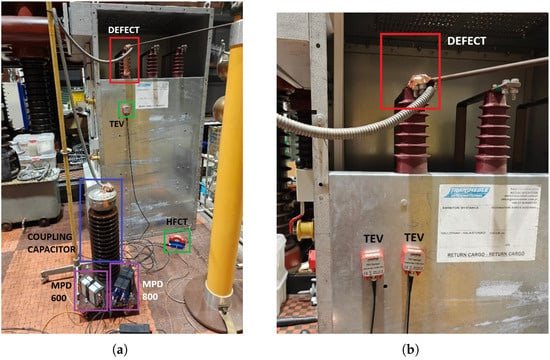
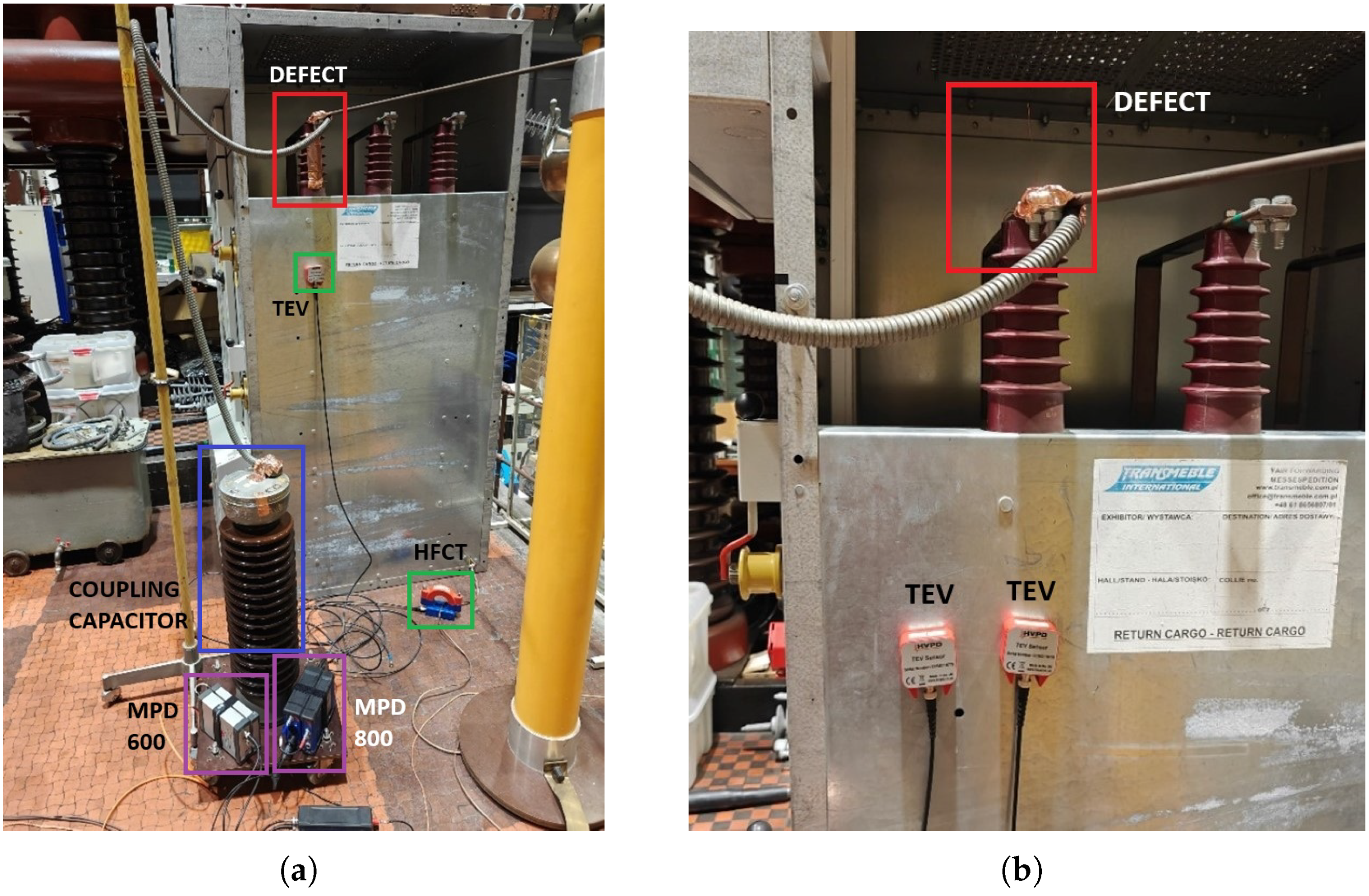
In Figure 1, a 3-channel PD measurement with an AIR-insulated MV switchgear is shown.
Figure 1.
Three-channel partial discharge (PD) measurement setup in an air-insulated MV switchgear. (a) Overview of the experimental setup, including the test object, coupling capacitor, and measurement instrumentation. The MPD600 system (IEC 60270-based measurement) and the MPD800 system (TEV/HFCT sensors) are indicated. (b) Close-up view of the defect location marked in red, showing the source of PD activity (surface or corona discharge). The measurement configuration enables simultaneous acquisition of PD signals using multiple sensing methods. Colored annotations indicate the main components of the measurement system: MPD600, MPD800, coupling capacitor, and the test object.
Two measuring devices, MPD800 and MPD600 (OMICRON Energy Solutions GmbH, Berlin, Germany), were used for the measurements. The PD activity was recorded with a coupling capacitor by MPD600 according to the charge-based measurement method (IEC 60270). An alternative method of using the PD measurement channel and an alternative method using a TEV and HFCT sensor (in various combinations) were used—two MPD800 channels [27,28,29,30,31,32].
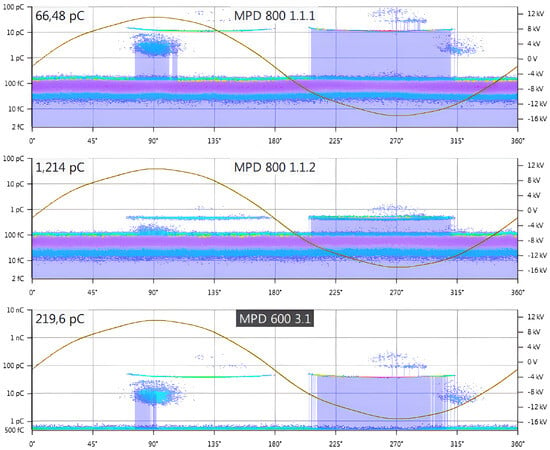
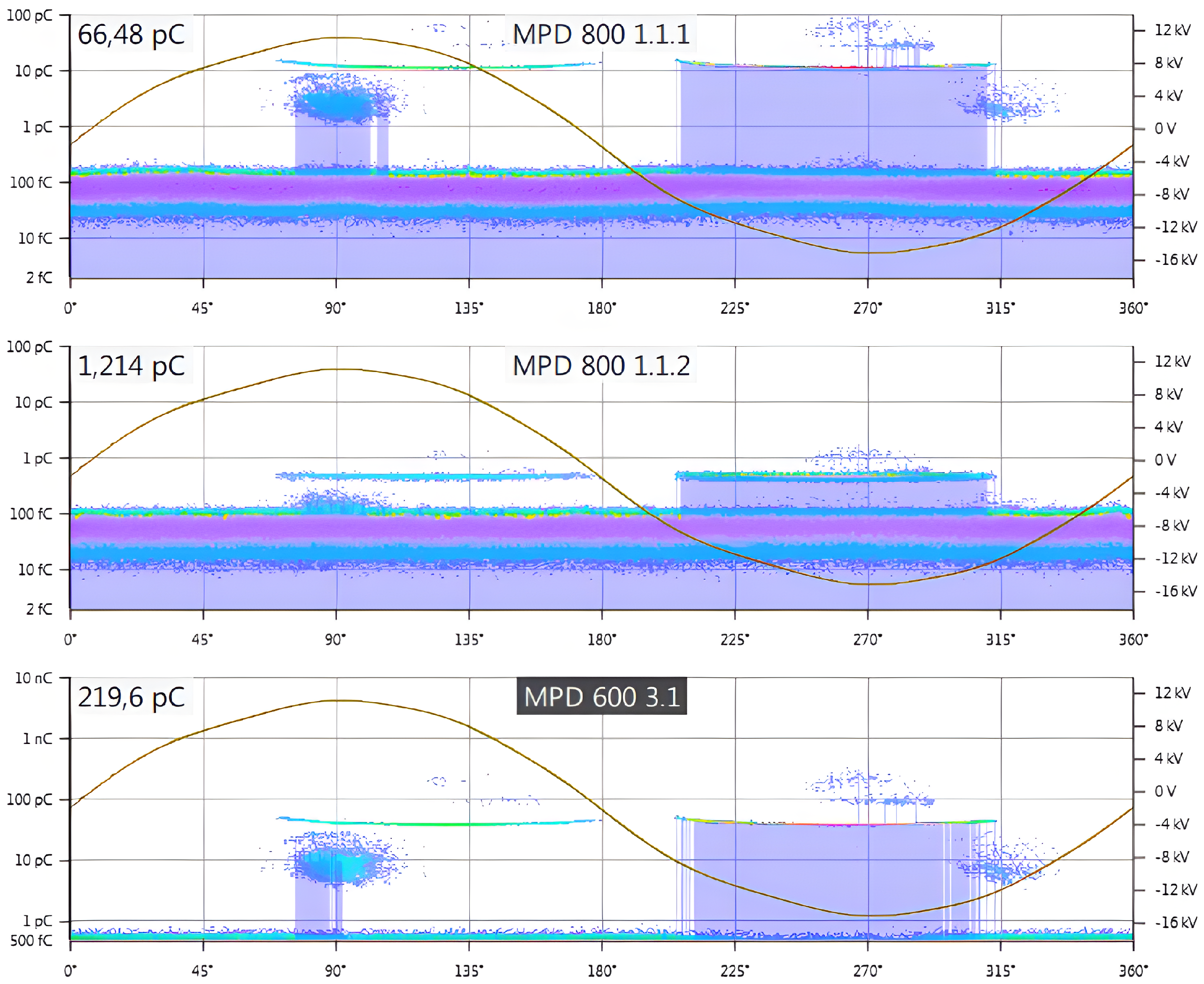
The plots (Figure 2) present PRPD patterns obtained using MPD Suite software system from MPD800 and MPD600. The different colored regions represent the intensity distribution of PD events (from low to high density), where warmer colors correspond to higher PD activity and background noise.
Figure 2.
PD recording during 3-channel measurement using various methods (MPD Suite program).
Additionally, a “zero” reference class was introduced to represent background conditions without active defect-related PD. This class is critical for realistic classification systems because it reflects normal operational states. Each measurement was segmented into 5-s windows, and PRPD histograms were generated for each window. The laboratory dataset served as the primary environment for initial model training and methodological validation.
5.2. Tests at MV Cable Factory
The second dataset was obtained during factory tests of medium-voltage cables. In contrast to laboratory conditions, factory measurements introduce additional sources of variability, including environmental noise, differences in measurement channel coupling, and longer acquisition intervals. More information about the data can be found in the publication [33].
Four simulated insulation defects were introduced into MV cable samples during production-stage testing:
- 1.
- Defect 1. Scratched insulation/outer semiconductive layer—mechanical damage leading to localized field enhancement.
- 2.
- Defect 2. Puncture in outer semiconductive layer—disruption of field grading, producing concentrated discharge zones.
- 3.
- Defect 3. Metallic particle with contact to cable screen—strong field concentration and high amplitude PD activity.
- 4.
- Defect 4. Metallic particle without contact to cable screen—localized internal field distortion with different phase symmetry characteristics.
The segmentation process resulted in the following number of PRPD samples per class: Defect 1: 100, Defect 2: 100, Defect 3: 99, Defect 4: 97. The dataset was divided into training and validation subsets using an 80/20 split.
Importantly, segmentation was performed prior to dataset splitting, and all PRPD windows originating from a single continuous measurement were assigned exclusively to either the training or validation subset. This ensured that no data leakage occurred between subsets.
6. Classification Methods Used
6.1. Image-Based Deep Architectures
The measurement datasets described in Section 5 were transformed into image representations suitable for deep learning-based classification. In particular, phase-resolved partial discharge (PRPD) histograms obtained from the laboratory and factory measurements were converted into grayscale images representing the distribution of apparent charge as a function of the phase angle.
Each PRPD image corresponds to a fixed acquisition interval of 5 s, ensuring temporal consistency across all measurements and compatibility with real-time monitoring scenarios. This representation preserves the two-dimensional morphological structure of discharge activity, which contains key diagnostic information related to the underlying physical discharge mechanisms.
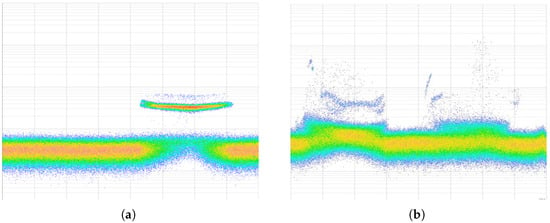
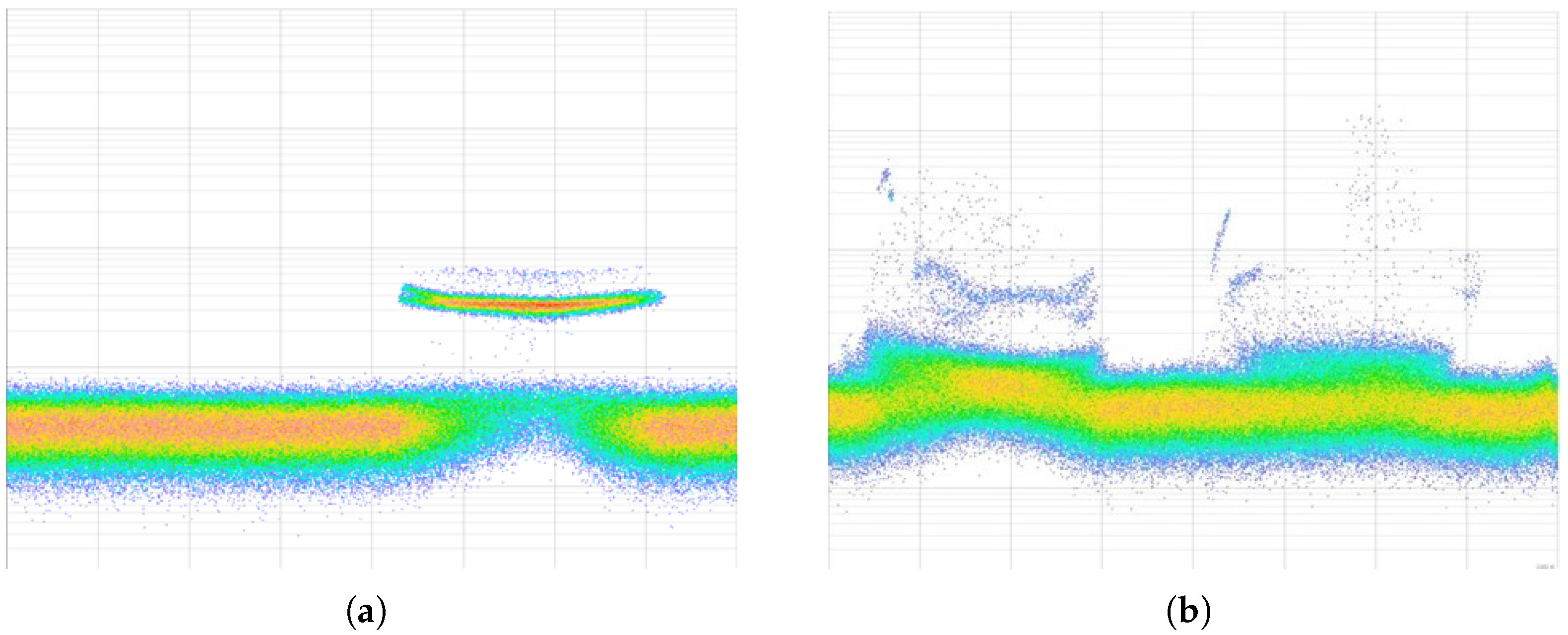
Examples of PRPD patterns used for the training process are presented in Figure 3. The Corona discharge pattern exhibits a relatively narrow phase distribution typically concentrated near the voltage peaks, while contamination-related discharges show a wider phase spread and increased variability due to surface conduction effects. The color scale represents the density of discharge events (from low to high intensity), with warmer colors indicating higher activity.
Figure 3.
PRPD images used during classification—artificially simulated: (a) Corona. (b) Contamination.
Three image-based deep learning architectures were investigated for PRPD classification:
- YOLOv8n as a reference one-stage detector.
- SqueezeNetYOLO as an ultra-compact variant based on SqueezeNet 1.1.
- MobileNetYOLO (proposed), combining a MobileNetV2 backbone with a simplified YOLO-like prediction head.
These architectures were selected to represent different points on the complexity spectrum: a standard real-time detector (YOLOv8n), a lightweight hybrid architecture (MobileNetYOLO), and an ultra-compact model with minimal parameter count (SqueezeNetYOLO).
6.2. Proposed SqueezeNetYOLO Architecture
As an alternative lightweight architecture, a hybrid model termed SqueezeNetYOLO was also investigated. The proposed architecture combines a compact SqueezeNet-based feature-extraction backbone with a simplified YOLO-inspired prediction head for PRPD-based insulation defect classification.
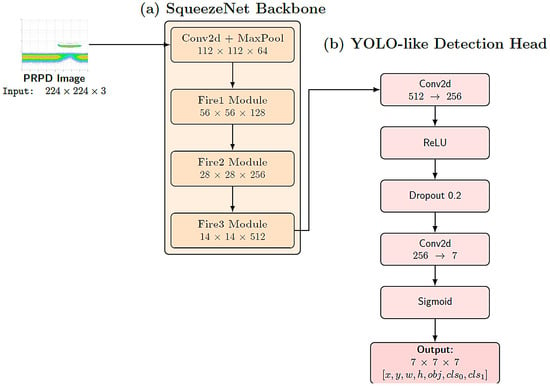
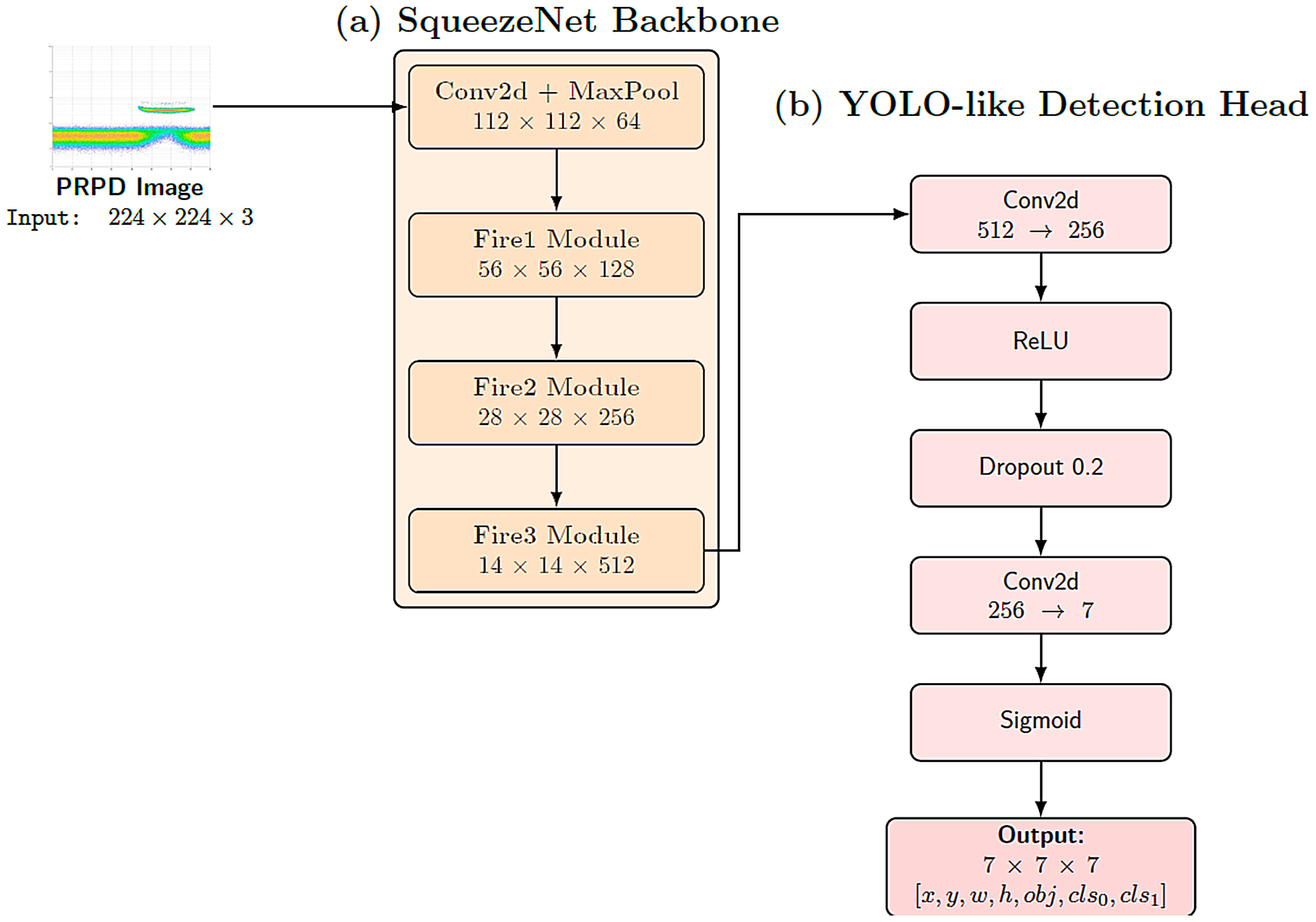
SqueezeNet was selected due to its extremely low parameter count and efficient Fire module structure, which enable a substantial reduction in model complexity while maintaining sufficient representational capacity for image-based classification tasks. In the proposed implementation, the backbone consists of an initial convolutional layer followed by a sequence of Fire modules that extract hierarchical features from PRPD images.
Similarly to the MobileNet-based architecture, the input PRPD images were resized to pixels and converted to three-channel representations in order to match the expected input format of standard convolutional backbones.
The prediction head follows a simplified YOLO-like design and consists of two convolutional layers. The first convolution reduces the number of feature channels from 512 to 256 and is followed by a ReLU activation function and a dropout layer with a probability of 0.2, introduced to reduce potential overfitting. The second convolution maps the feature representation to the final output tensor, followed by a sigmoid activation function.
The output of the network is defined analogously to the MobileNetYOLO model:
where represent normalized bounding-box parameters, o corresponds to the objectness score, and denote class probabilities. Although the architecture preserves the detection-style output formulation, the model’s main objective in this study is PRPD-based defect classification rather than precise object localization.
In the present study, the bounding-box parameters and objectness score are not used for explicit localization, as the model operates on predefined PRPD regions. The final classification decision is based solely on the class probability components.
Due to the compact SqueezeNet backbone structure and the simplified detection head, the proposed SqueezeNetYOLO architecture offers extremely low computational complexity and reduced memory requirements. This makes the model particularly suitable for real-time deployment in embedded diagnostic systems or edge computing environments with limited computational resources. The topology of this hybrid network is shown in the Figure 4:
Figure 4.
Structure of the proposed SqueezeNetYOLO architecture. The model combines a lightweight SqueezeNet backbone with Fire modules and a simplified YOLO-inspired prediction head for PRPD-based defect classification.
6.3. Proposed MobileNetYOLO Architecture
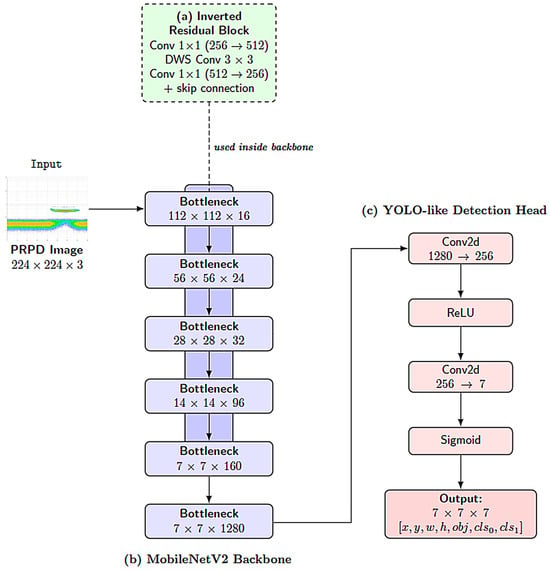
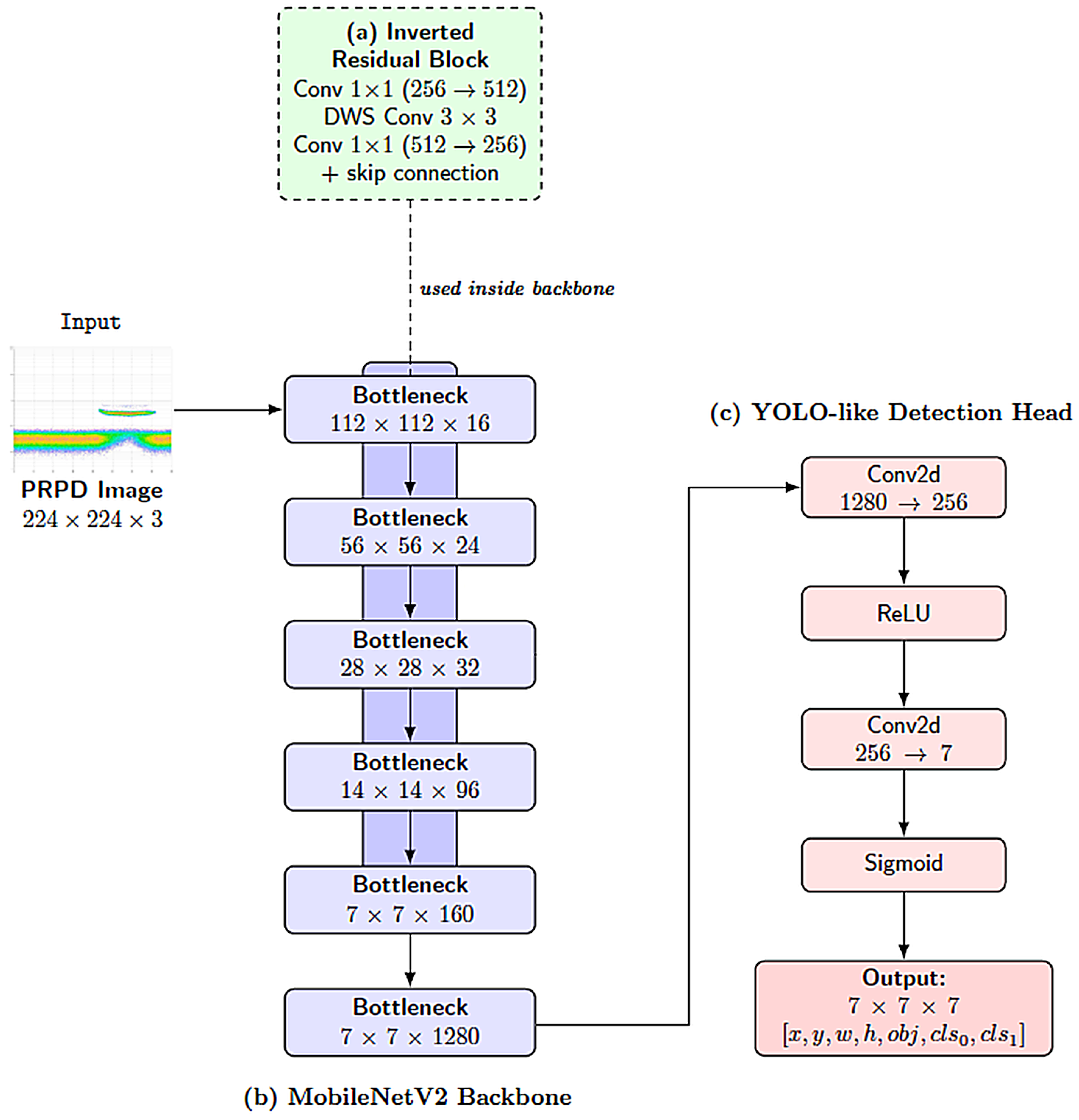
A lightweight hybrid architecture, denoted as MobileNetYOLO, was developed for PRPD-based insulation defect classification. The model combines a MobileNetV2 backbone with a simplified YOLO-inspired prediction head. MobileNetV2 was selected for its efficient use of depthwise separable convolutions and inverted residual blocks, which enable low computational cost while preserving discriminative feature extraction.
PRPD images were resized to pixels and converted to three-channel inputs. The prediction head consisted of two convolutional layers followed by ReLU and sigmoid activations. The network output was expressed as:
The output representation follows the same formulation as in Equation (1). The difference between the two models lies in the backbone architecture used for feature extraction, while the prediction head and output formulation remain identical.
The model was trained using the Adam optimizer and a composite loss function including bounding-box, objectness, and class terms. Owing to its low complexity and high classification capability, the proposed architecture is suitable for real-time deployment in industrial diagnostic environments.
All architectures operated directly on PRPD images, allowing the networks to learn characteristic spatial patterns associated with different insulation defects.
The models were first trained and validated on the laboratory dataset, which consisted of two discharge mechanisms (Corona and Pollution). Based on the obtained accuracy and computational efficiency, the MobileNetYOLO architecture was selected for further experiments. The selected model was subsequently extended by introducing an additional “zero” class representing background conditions without active discharge activity.
In the final stage of the study, the trained MobileNetYOLO model was evaluated using the MV cable factory dataset, which contains four simulated insulation defects, and was verified under real-world test conditions using a real-time monitoring system integrated with OMICRON MPD Suite.
The architectures (Figure 5) described above were subsequently evaluated using PRPD datasets obtained from controlled high-voltage laboratory experiments and from industrial measurements performed during routine testing of medium-voltage cables.
Figure 5.
Structure of the proposed MobileNetYOLO architecture for PRPD-based defect classification. The model combines a MobileNetV2 backbone with a lightweight YOLO-inspired prediction head.
The experimental analysis aimed to determine whether lightweight convolutional architectures can maintain high classification accuracy under realistic measurement conditions, including multi-channel acquisition and environmental noise. In particular, the study investigates the trade-off between computational efficiency and classification performance, a crucial consideration for real-time diagnostic systems deployed in industrial environments.
The obtained results and comparative performance analysis of the investigated models are presented in the following section.
7. Results
7.1. Laboratory Benchmark: Corona vs. Pollution (MV Switchgear)
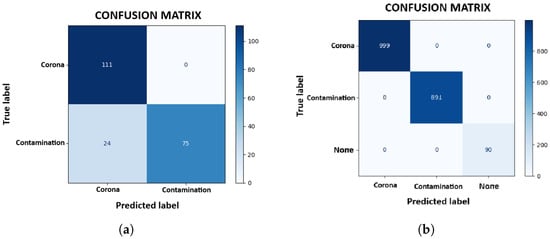
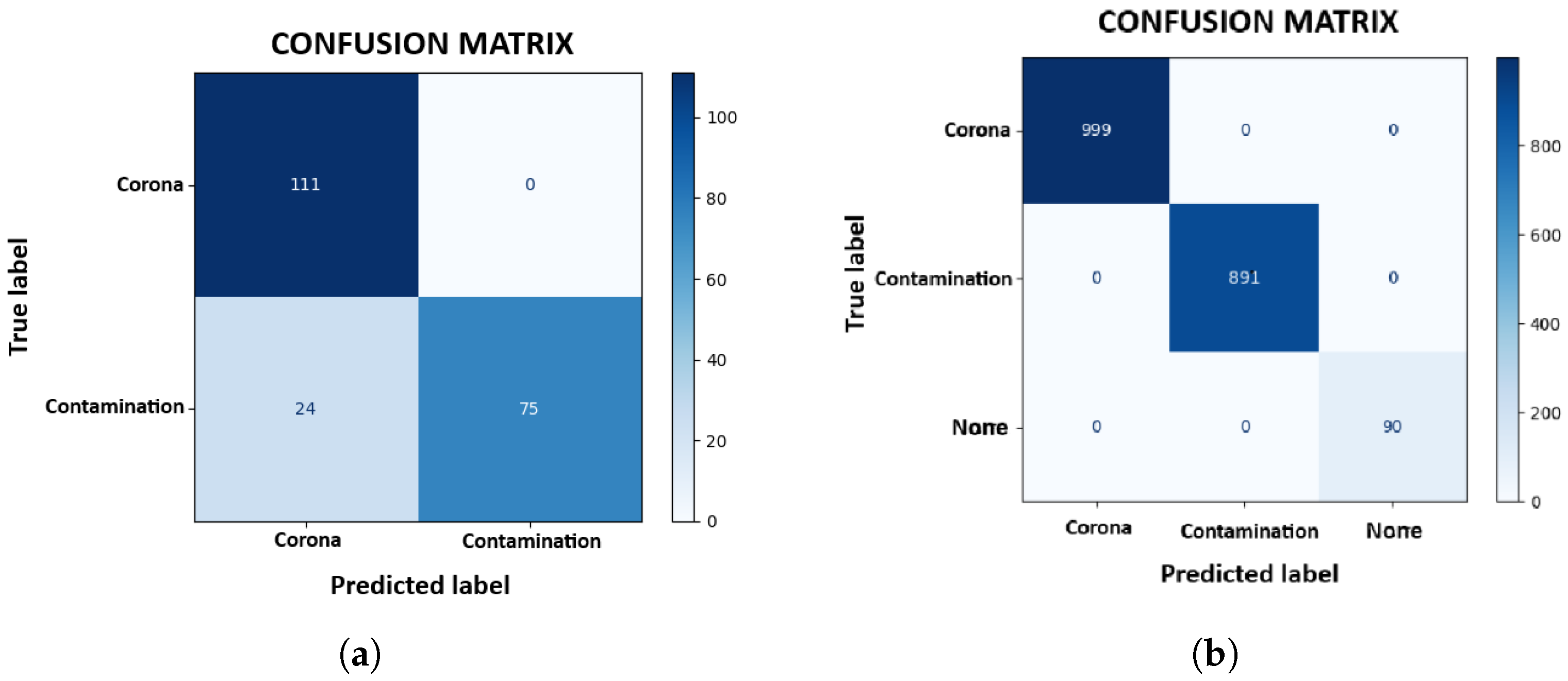
At the laboratory stage, two defect mechanisms were considered in MV switchgear: Corona and Pollution. The benchmark results demonstrate that both YOLOv8n and the proposed MobileNetYOLO achieved 100% classification accuracy for the two-class problem, indicating strong separability. In contrast, SqueezeNetYOLO achieved 88.6% accuracy (Figure 6a). The observed difference in accuracy may be influenced by dataset size and training variability, and therefore should be interpreted with caution. The results indicate a trade-off between model compactness and classification performance rather than a definitive limitation of the SqueezeNet architecture.
Figure 6.
Confusion matrix: (a) SqueezeNetYOLO with 2 insulation defects. (b) MobileNetV2YOLO with 3 insulation defects (plus “zero”).
Given that YOLOv8n and MobileNetYOLO provided identical accuracy (100%) while MobileNetYOLO exhibited substantially lower computational complexity (Table 1), the MobileNetYOLO architecture was selected for subsequent stages. The next experiments, therefore, focused on (i) introducing a third “zero” class for background conditions (Figure 6b) and (ii) extending the classification to four insulation defects observed during MV cable factory tests, followed by verification during routine test measurements.
Table 1.
Comparison of analyzed deep learning architectures.
7.2. Laboratory Dataset Performance—3-Channel Measurement Validation
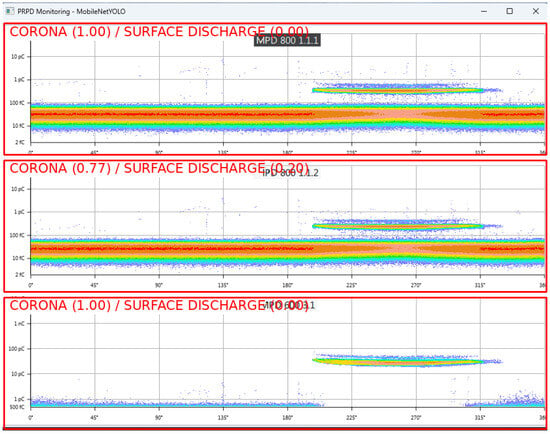
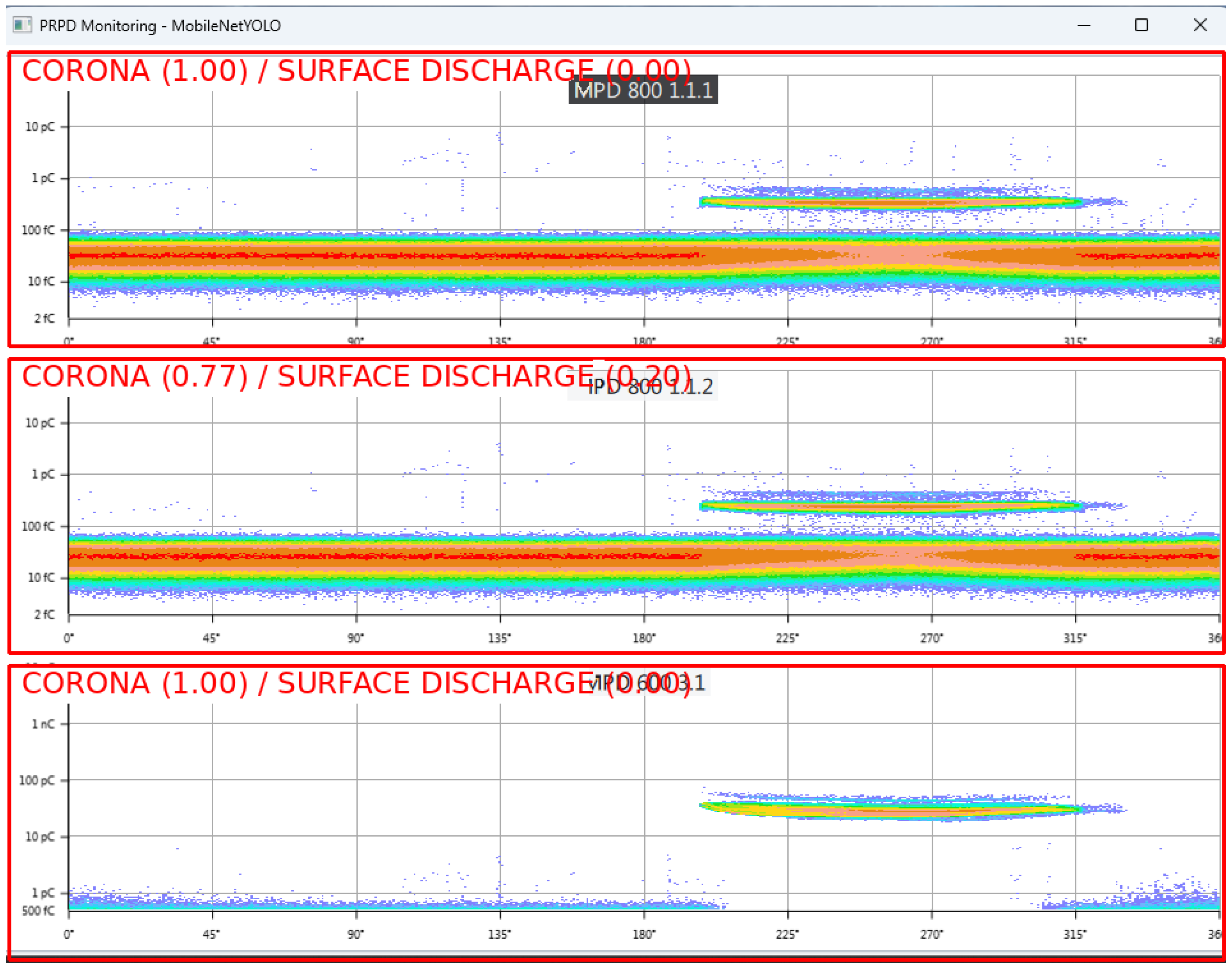
Figure 7 presents the PRPD patterns obtained from the three measurement channels together with the classification results generated by the MobileNetYOLO model in real time.
Figure 7.
Three-channel PRPD measurement obtained using MPD800 (TEV and HFCT sensors) and MPD600 offline measurement. The MobileNetYOLO classifier correctly identified corona discharge across all channels. The color scale represents the density of discharge events (from low to high intensity), with warmer colors indicating higher activity.
For clarity of presentation, the reported probability values are rounded to two decimal places. Values displayed as 1.00 or 0.00 correspond to probabilities close to the limits of the output activation function rather than exact binary outputs.
For the first channel (MPD800 1.1.1), corresponding to one of the online sensors, the classifier identified a corona-type discharge pattern with a probability close to 1.00, while the probability of pollution-related discharge was estimated as 0.00. The PRPD distribution clearly exhibits a characteristic narrow phase-resolved structure confined to a specific phase interval, consistent with corona discharge mechanisms typically observed in air gaps or sharp electrode geometries.
The second channel (MPD800 1.1.2), representing the second sensor connected to the MPD800 system, also indicates corona-type activity. The classifier assigned probabilities of 0.77 to the corona class and 0.20 to the pollution class. The slightly lower confidence level can be attributed to minor differences in signal amplitude distribution and measurement noise inherent to the sensor configuration. Nevertheless, the dominant morphological characteristics of the PRPD pattern remain consistent with corona discharge behavior.
The third channel corresponds to measurements obtained using the MPD600 system (MPD 600 3.1). In this case, the classifier again identified the corona discharge class with full confidence (probability equal to 1.00). The PRPD pattern exhibits a compact cluster localized within a specific phase region, a typical feature of corona-type discharges generated by localized electric-field enhancement.
The consistent classification results across all three channels confirm the robustness of the proposed MobileNetYOLO architecture across different measurement modalities and sensor types. Despite differences in signal acquisition methods and noise characteristics, the model identified the same discharge mechanism across the entire measurement setup.
These results demonstrate that the proposed system is capable of reliable multi-channel PRPD classification and can be effectively integrated into practical diagnostic environments using both MPD800 and MPD600 measurement platforms.
7.3. Factory Dataset Performance
More significant validation was obtained from factory test data. The MobileNetYOLO model achieved 100% classification accuracy for all four simulated MV cable defects. Repeated training runs with different random initializations yielded identical results, resulting in a reported accuracy of 100.0 ± 0.0%. This result should be interpreted in the context of the dataset characteristics. The PRPD images were generated using a consistent rendering pipeline, including logarithmic amplitude compression, percentile-based normalization, and fixed visualization settings. As a result, each defect class produced highly repeatable and visually distinctive patterns, contributing to strong separability under controlled measurement conditions.
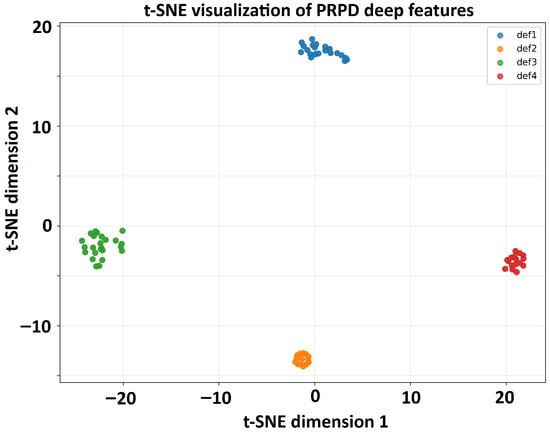
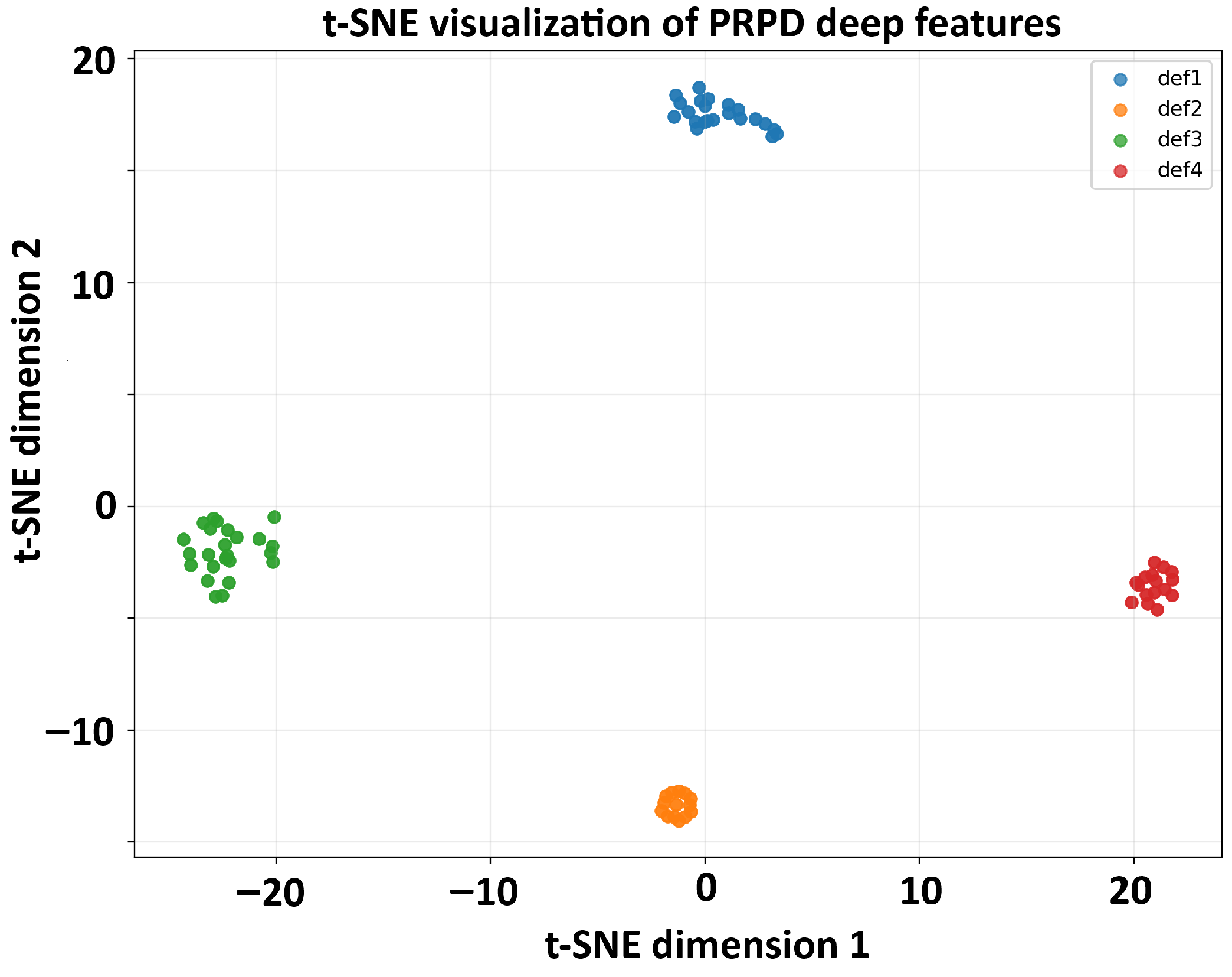
To further support this result, a t-SNE analysis was performed on the deep feature representations extracted by the MobileNetYOLO model. As shown in Figure 8, the PRPD samples corresponding to four defect classes form well-defined and non-overlapping clusters, indicating strong separability in the learned feature space. The separability observed in the feature space is consistent with known PRPD characteristics, where different defect mechanisms produce distinct phase-amplitude distributions related to underlying discharge physics. It should be noted that this separability is observed in the learned feature space rather than in the raw input space.
Figure 8.
t-SNE visualization of deep feature representations extracted by the MobileNetYOLO model for four PRPD defect classes. The distinct clustering of samples confirms strong separability in the learned feature space.
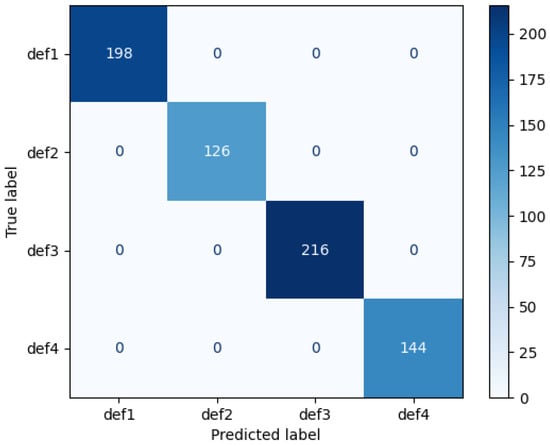
The observed clustering is consistent with the confusion matrix results (Figure 9) and supports the interpretation that the model learns class-specific morphological features. The confusion matrix was strictly diagonal, confirming the correct classification of defect types.
Figure 9.
Confusion matrix MobileNetV2+YOLO-head with 4 insulation defects.
The clustering structure observed for the four-class problem is consistent with the perfect classification accuracy and diagonal confusion matrix. It should be emphasized that the achieved performance reflects controlled measurement conditions and well-defined defect classes. Therefore, the results demonstrate strong separability within the considered dataset rather than universal performance across all possible PRPD scenarios.
All metrics achieved values equal to 1.0 (Table 2), which is consistent with the confusion matrix results. This outcome reflects the strong separability of the considered PRPD patterns under controlled measurement conditions rather than universally perfect classification performance. The perfect scores should therefore be interpreted in the context of the dataset characteristics and controlled experimental setup.
Table 2.
Per-class classification metrics for the four-class PRPD dataset.
7.4. Routine Test Verification
A critical result of this study is the successful classification of real routine test measurements performed according to standards [26,34,35]. In contrast to controlled laboratory conditions, routine test measurements are characterized by increased variability, including longer acquisition times, measurement noise, and differences in sensor coupling.
The MobileNetYOLO model correctly identified the active defect during continuous factory routine tests, despite:
- Extended acquisition duration;
- Measurement noise;
- Channel variability.
Importantly, the defect type present during the routine test was not predefined and was independently assessed by a human expert as defect type DEF1. The model consistently classified the same measurement as DEF1, demonstrating agreement with expert diagnosis.
The trained MobileNetYOLO model was integrated with OMICRON MPD Suite using a non-invasive ROI-based screen capture approach. This integration enables real-time classification without modifying proprietary measurement software, which is a key requirement for practical deployment in industrial environments.
Real-time classification was successfully performed for one simultaneous PRPD window, with stable predictions maintained over time despite dynamic changes in PD activity. The system demonstrated robustness to temporal fluctuations of discharge intensity and pattern evolution.
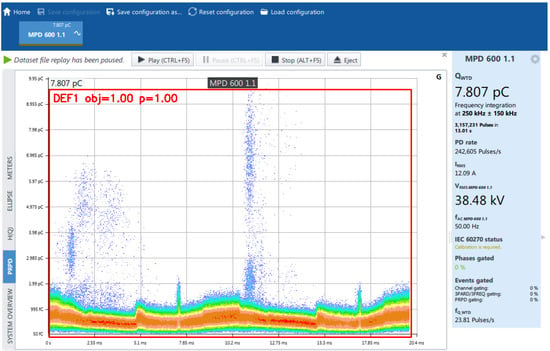
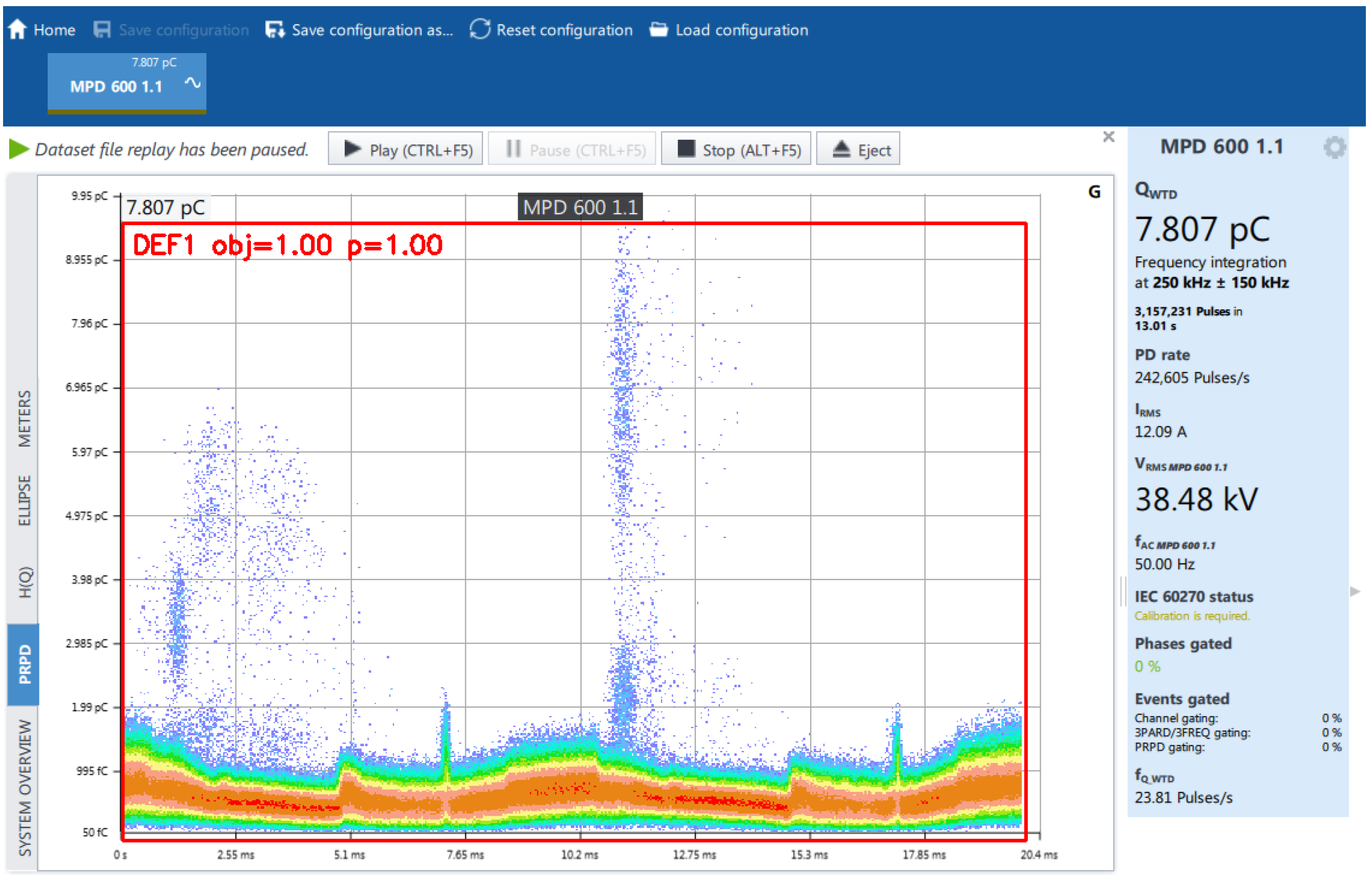
An example of real-time classification during routine testing is shown in Figure 10, where the model correctly identifies the defect type under realistic measurement conditions.
Figure 10.
Example of real-time PRPD classification during a factory routine test using the MobileNetYOLO model integrated with OMICRON MPD Suite. The color scale represents the density of discharge events (from low to high intensity), with warmer colors indicating higher activity.
These results indicate that the proposed approach generalizes beyond laboratory conditions and can support AI-assisted diagnostics in industrial testing workflows. However, it should be noted that the current validation is limited to a single routine test scenario, and further large-scale studies on diverse real-world datasets are required to fully assess generalization capability.
7.5. Real-Time Performance Evaluation
To assess real-time applicability, inference latency was measured on a system equipped with an NVIDIA RTX 3060 GPU using a batch size of 1 and an input resolution of . The mean inference time of the MobileNetYOLO model was 3.94 ms (standard deviation: 1.11 ms), corresponding to approximately 254 frames per second.
It should be noted that this value reflects pure model inference time. When including preprocessing, ROI extraction, and screen capture operations, the total end-to-end pipeline latency remains within the range suitable for real-time monitoring applications.
These results confirm that the proposed lightweight architecture provides substantial computational margin for deployment in continuous PRPD monitoring systems.
All measurements were performed using batch size = 1, reflecting real deployment conditions.
8. Original Scientific Contribution and Novelty
The main scientific contributions of this work can be summarized as follows.
- A lightweight hybrid deep learning architecture combining a MobileNetV2 backbone with a YOLO-inspired prediction head is proposed for automated classification of PRPD patterns. The architecture is designed to provide a favorable balance between classification accuracy and computational efficiency, enabling deployment in real-time diagnostic environments.
- The proposed approach is validated using a multi-stage experimental framework that includes both controlled laboratory measurements and industrial measurements obtained during medium-voltage cable factory tests. Such validation across different experimental environments provides strong evidence of the proposed model’s generalization capability.
- The study introduces an extended classification framework that includes a “zero” background class representing defect-free conditions. This element is critical for realistic industrial deployment, where diagnostic systems must distinguish between active discharge activity and normal operating conditions.
- The proposed system was integrated with the OMICRON MPD Suite measurement platform using a non-invasive region-of-interest monitoring approach. This integration demonstrates the practical feasibility of deploying AI-assisted PRPD classification systems in real industrial testing workflows.
9. Discussion
The results obtained in this study confirm that lightweight one-stage deep neural architectures can successfully extract discriminative information from PRPD distributions and enable reliable insulation defect classification under both laboratory and industrial conditions. The adopted multi-stage validation strategy—from controlled MV switchgear experiments to MV cable factory routine tests—provides evidence of model robustness and practical applicability.
In the laboratory benchmark stage (Corona vs. Pollution), both YOLOv8n and the proposed MobileNetYOLO achieved 100% classification accuracy, indicating that the investigated PRPD morphologies were fully separable using image-based representations. In contrast, the SqueezeNetYOLO variant reached 88.6%, suggesting that aggressive parameter reduction may limit the capacity to represent subtle morphological differences, particularly under measurement variability and noise. These findings highlight that, for PRPD diagnostics, compactness alone is insufficient: the feature extractor must preserve sufficient representational power to distinguish defect-specific phase-amplitude structures.
Since YOLOv8n and MobileNetYOLO achieved the same laboratory accuracy, computational efficiency became the decisive criterion for model selection. MobileNetYOLO leverages depthwise separable convolutions and a lightweight prediction head, reducing FLOPs and the memory footprint while maintaining discriminative performance. This property is critical for real-time diagnostics and potential deployment on edge or embedded platforms, where computational resources and latency constraints are stringent.
A key practical requirement for deployment is the ability to identify background or defect-free states, because industrial measurements often contain long periods without active defect-related PD. The introduction of the “zero” class, therefore, represents an important step toward realistic operation by reducing the likelihood of false alarms and enabling stable decision-making in continuous monitoring scenarios.
The factory-stage evaluation further demonstrated that the selected MobileNetYOLO model generalizes beyond the laboratory environment. The model achieved 100% accuracy for the four-class MV cable defect dataset, and the confusion matrix exhibited a strictly diagonal structure, indicating no confusion between defect categories. From a physical perspective, this suggests that different defect mechanisms generate PRPD patterns with distinct morphological signatures linked to underlying discharge processes such as local field enhancement, disturbance of field grading layers, or conductive particle effects.
Finally, the successful verification during routine test recordings and the integration with OMICRON MPD Suite via a non-invasive ROI-based screen-capture pipeline are strong indicators of industrial readiness. The method enables AI-assisted diagnostics without modifying proprietary measurement software, lowering adoption barriers and enabling gradual integration into established workflows. The three-channel validation (MPD800 TEV+HFCT and MPD600 offline) further supports robustness across different sensing modalities and acquisition paths.
Despite the promising results, certain limitations should be acknowledged. An important limitation of the present study is that the primary datasets consist of controlled laboratory measurements and artificially generated defect scenarios. Although a preliminary validation was performed during a factory Routine Test, including a case with an initially unknown defect confirmed by expert assessment, the study does not include a systematic evaluation on naturally aged cables or field-retrieved defects.
Therefore, the reported results should be interpreted as demonstrating the feasibility and potential of the proposed approach rather than full generalization to all real-world operating conditions. Future work should focus on validating the model using long-term field data and naturally developed insulation defects.
10. Conclusions
This study proposed and validated a lightweight YOLO-inspired deep learning framework for automated PRPD-based insulation defect classification with real-time applicability. The investigation followed a progressive evaluation strategy, starting from controlled MV switchgear laboratory measurements (Corona vs. Pollution), followed by model selection based on the accuracy–efficiency trade-off, and culminating in validation on MV cable factory measurements, including routine test conditions.
In the laboratory benchmark stage, both YOLOv8n and the proposed MobileNetYOLO achieved 100% classification accuracy, whereas the ultra-compact SqueezeNetYOLO reached 88.6%. Because MobileNetYOLO preserved perfect accuracy while substantially reducing computational complexity compared to YOLOv8n, it was selected for subsequent experiments.
The selected model was then extended by introducing a “zero” background class, which is essential for realistic industrial operation where defect-free periods dominate measurement time. Furthermore, the MobileNetYOLO model achieved 100% accuracy for a four-class MV cable factory test dataset comprising typical simulated insulation defects. The strictly diagonal confusion matrix indicates that the model learned stable and separable PRPD representations for all investigated defect categories.
A critical practical outcome is the successful verification of defect recognition during routine test recordings and the integration of the classifier into OMICRON MPD Suite via non-invasive ROI-based screen capture, enabling real-time monitoring of one to three simultaneous PRPD windows. The demonstrated compatibility with multi-channel measurements (MPD800 TEV+HFCT and MPD600 offline) supports robustness across sensing modalities.
Future work should expand the range of defect mechanisms and validate the approach across multiple laboratories and manufacturing facilities. Additionally, extending the framework toward quantitative severity and risk assessment, as well as handling multi-source PD scenarios and sensor fusion, would further increase the industrial value of the proposed solution.
Author Contributions
Conceptualization, P.K.; methodology, P.K., J.S. and W.K.; validation, P.K.; formal analysis, P.K.; investigation, P.K.; resources, P.K., J.S., W.K. and T.B.; data curation, P.K.; writing—original draft preparation, P.K.; writing—review and editing, P.K., J.S., W.K., T.B. and Ł.K.; visualization, P.K.; supervision, J.S., W.K. and Ł.K. All authors have read and agreed to the published version of the manuscript.
Funding
This research received no external funding.
Data Availability Statement
The original contributions presented in this study are included in the article. Further inquiries can be directed to the corresponding author.
Conflicts of Interest
Authors Wojciech Kołtunowicz and Tomasz Bednarczyk are employees of OMICRON Energy Solutions GmbH, Berlin, Germany. The remaining authors declare that the research was conducted in the absence of any commercial or financial relationships that could be construed as a potential conflict of interest.
References
- Kreuger, F.H. Partial Discharge Detection in High-Voltage Equipment; Butterworths: Washington, DC, USA, 1989. [Google Scholar]
- Raymond, W.J.K.; Illias, H.A. Partial discharge classifications: Review of recent progress. Measurement 2015, 68, 164–181. [Google Scholar] [CrossRef] [Scilit]
- Pattanadech, N.; Haller, R.; Kornhuber, S.; Muhr, M. Partial Discharges (PD): Detection, Identification and Localization; Wiley-IEEE Press: Hoboken, NJ, USA, 2023. [Google Scholar]
- Abubakar, A.; Zachariades, C. Phase-Resolved Partial Discharge Pattern Recognition Using Deep Learning. Sensors 2024, 24, 3565. [Google Scholar] [CrossRef] [Scilit] [PubMed]
- Raymond, W.J.K.; Chong, W.X.; Lai, W.K.; Illias, H.A. Noise Invariant Partial Discharge Classification Based on Convolutional Neural Network. Measurement 2021, 177, 109220. [Google Scholar] [CrossRef] [Scilit]
- Srivastava, R.; Avasthi, V. Deep convolutional neural network for partial discharge monitoring system. Adv. Eng. Softw. 2023, 180, 103407. [Google Scholar] [CrossRef] [Scilit]
- Kumar, H.; Shafiq, M.; Kauhaniemi, K.; Elmusrati, M. A Review on the Classification of Partial Discharges in Medium-Voltage Cables: Detection, Feature Extraction, Artificial Intelligence-Based Classification, and Optimization Techniques. Energies 2024, 17, 1142. [Google Scholar] [CrossRef] [Scilit]
- Schichler, U.; Koltunowicz, W.; Endo, F.; Feser, K.; Giboulet, A.; Girodet, A.; Hama, H.; Hampton, B.; Kranz, H.-G.; Lopez-Roldan, J.; et al. Risk Assessment on Defects in GIS based on PD Diagnostics. IEEE Trans. Dielectr. Electr. Insul. 2013, 20, 2165–2172. [Google Scholar] [CrossRef] [Scilit]
- Hussain, G.; Hassan, W.; Mahmood, F.; Kay, J. Partial Discharge Based Risk Assessment Framework for MV Switchgear Containing Electrical Defects. IEEE Trans. Ind. Appl. 2023, 59, 7868–7875. [Google Scholar] [CrossRef] [Scilit]
- Melo, J.V.J.; Lira, G.R.S.; Costa, E.G.; Vilar, P.B.; Andrade, F.L.M.; Marotti, A.C.F.; Costa, A.I.; Leite Neto, A.F.; Santos Júnior, A.C.d. Separation and Classification of Partial Discharge Sources in Substations. Energies 2024, 17, 3804. [Google Scholar] [CrossRef] [Scilit]
- Wang, Y.; Yan, J.; Yang, Z.; Jing, Q.; Wang, J.; Geng, Y. GAN and CNN for Imbalanced Partial Discharge Pattern Recognition in GIS. High Volt. 2022, 7, 452–460. [Google Scholar] [CrossRef] [Scilit]
- Carvalho, I.F.; da Costa, E.G.; Nobrega, L.A.M.M.; Silva, A.D. Identification of Partial Discharge Sources by Feature Extraction from a Signal Conditioning System. Sensors 2024, 24, 2226. [Google Scholar] [CrossRef] [Scilit]
- Sun, C.; Wu, G.; Pan, G.; Zhang, T.; Li, J.; Jiao, S.; Liu, Y.-C.; Chen, K.; Liu, K.; Xin, D.; et al. Convolutional Neural Network-Based Pattern Recognition for Partial Discharge Signals. Sensors 2024, 24, 2660. [Google Scholar] [CrossRef] [Scilit]
- Redmon, J.; Divvala, S.; Girshick, R.; Farhadi, A. You Only Look Once: Unified, Real-Time Object Detection. In Proceedings of the 2016 IEEE Conference on Computer Vision and Pattern Recognition (CVPR), Las Vegas, NV, USA, 27–30 June 2016; pp. 779–788. [Google Scholar] [CrossRef] [Scilit]
- Redmon, J.; Farhadi, A. YOLOv3: An Incremental Improvement. arXiv 2018, arXiv:1804.02767. [Google Scholar] [CrossRef] [Scilit]
- Wang, Q.; Hu, Z.; Li, E.; Wu, G.; Yang, W.; Hu, Y.; Peng, W.; Sun, J. YOLOLS: A Lightweight and High-Precision Power Insulator Defect Detection Network for Real-Time Edge Deployment. Energies 2025, 18, 1668. [Google Scholar] [CrossRef] [Scilit]
- Liu, Y.; Liu, D.; Huang, X.; Li, C. Insulator Defect Detection with Deep Learning: A Survey. IET Gener. Transm. Distrib. 2023, 17, 3541–3558. [Google Scholar] [CrossRef] [Scilit]
- Howard, A.G.; Zhu, M.; Chen, B.; Kalenichenko, D.; Wang, W.; Weyand, T.; Andreetto, M.; Adam, H. MobileNets: Efficient Convolutional Neural Networks for Mobile Vision Applications. arXiv 2017, arXiv:1704.04861. [Google Scholar] [CrossRef] [Scilit]
- Sandler, M.; Howard, A.; Zhu, M.; Zhmoginov, A.; Chen, L.C. MobileNetV2: Inverted Residuals and Linear Bottlenecks. In Proceedings of the IEEE Conference on Computer Vision and Pattern Recognition (CVPR), Salt Lake City, UT, USA, 18–23 June 2018; pp. 4510–4520. [Google Scholar] [CrossRef] [Scilit]
- Sun, Y.; Ma, S.; Sun, S.; Liu, P.; Zhang, L.; Ouyang, J.; Ni, X. Partial Discharge Pattern Recognition of Transformers Based on MobileNets Convolutional Neural Network. Appl. Sci. 2021, 11, 6984. [Google Scholar] [CrossRef] [Scilit]
- Liu, K.; Jiao, S.; Nie, G.; Ma, H.; Gao, B.; Sun, C.; Xin, D.; Saha, T.K.; Wu, G. On Image Transformation for Partial Discharge Source Classification. High Volt. 2024, 9, 1090–1100. [Google Scholar] [CrossRef] [Scilit]
- Fei, Z.; Li, Y.; Yang, S. Partial Discharge Pattern Recognition Based on an Ensemble Learning Methodology. Energies 2024, 17, 2443. [Google Scholar] [CrossRef] [Scilit]
- Iandola, F.N.; Han, S.; Moskewicz, M.W.; Ashraf, K.; Dally, W.J.; Keutzer, K. SqueezeNet: AlexNet-Level Accuracy with 50x Fewer Parameters and <0.5MB Model Size. arXiv 2016, arXiv:1602.07360. [Google Scholar] [CrossRef] [Scilit]
- Tulbure, A.A.; Tulbure, A.; Dulf, E.H. A Review on Modern Defect Detection Models Using DCNNs. J. Adv. Res. 2022, 35, 33–48. [Google Scholar] [CrossRef] [Scilit]
- Jian, T.; Cao, J.; Liu, W.; Xu, G.; Zhong, J. A Novel Wind Turbine Fault Diagnosis Method Based on Compressive Sensing and Lightweight SqueezeNet Model. Expert Syst. Appl. 2025, 260, 125440. [Google Scholar] [CrossRef] [Scilit]
- IEC 60270:2025; High-Voltage Test Techniques—Partial Discharge Measurement. International Electrotechnical Commission: Geneva, Switzerland, 2025.
- Gorgan, B.; Koltunowicz, W.; Ohde, J.; Zander, P. Monitoring and Diagnosis of Electrical Equipment Insulation with the Support of Combined Conventional and Alternative Partial Discharge Methods. In Proceedings of the 2022 9th International Conference on Condition Monitoring and Diagnosis (CMD), Kitakyushu, Japan, 13–18 November 2022; pp. 01–05. [Google Scholar] [CrossRef] [Scilit]
- Gulski, E.; Koltunowicz, W.; Ariaans, T.; Behrmann, G.; Jongen, R.; Garnacho, F.; Kornhuber, S.; Ohtsuka, S.; Petzold, F.; Sanchez-Uran, M.; et al. Guidelines for Partial Discharge Detection Using Conventional (IEC 60270) and Unconventional Methods; Working Group D1.37; CIGRE: Paris, France, 2016. [Google Scholar]
- Fujii, Y.; Cho, H.; Nakamura, Y. Highly sensitive partial discharge detection by TEV method under severe noise conditions. In Proceedings of the 2017 4th International Conference on Electric Power Equipment—Switching Technology (ICEPE-ST), Xi’an, China, 22–25 October 2017; pp. 783–786. [Google Scholar] [CrossRef] [Scilit]
- Zhang, C.; Dong, M.; Ren, M.; Huang, W.; Zhou, J.; Gao, X.; Albarracín, R. Partial Discharge Monitoring on Metal-Enclosed Switchgear with Distributed Non-Contact Sensors. Sensors 2018, 18, 551. [Google Scholar] [CrossRef] [Scilit]
- Álvarez, F.; Garnacho, F.; Ortego, J.; Sánchez-Urán, M.A. Application of HFCT and UHF Sensors in On-Line Partial Discharge Measurements for Insulation Diagnosis of High Voltage Equipment. Sensors 2015, 15, 7360–7387. [Google Scholar] [CrossRef] [Scilit]
- Rodrigo Mor, A.; Castro Heredia, L.C.; Muñoz, F.A. A Novel Approach for Partial Discharge Measurements on GIS Using HFCT Sensors. Sensors 2018, 18, 4482. [Google Scholar] [CrossRef] [Scilit]
- Ranninger, U.; Bednarczyk, T.; Kołtunowicz, W.; Grabowski, P.; Łuszcz, M. Localization and recognition of PD defects in power cables with extruded insulation. In Proceedings of the 11th International Conference on Insulated Power Cables, Lyon, France, 18–22 June 2023. [Google Scholar]
- IEC 60885-3:2015; Electrical Test Methods for Electric Cables—Part 3: Test Methods for Partial Discharge Measurements on Lengths of Extruded Power Cables. International Electrotechnical Commission: Geneva, Switzerland, 2015.
- IEC 60502-1:2021; Power Cables with Extrudedinsulation and Their Accessories for Rated Voltages from 1 kV (Um = 1,2 kV) up to 30 kV (Um = 36 kV)—Part 1: Cables for Rated Voltages of 1 kV (Um = 1,2 kV) and 3 kV (Um = 3,6 kV). International Electrotechnical Commission: Geneva, Switzerland, 2021.

Disclaimer/Publisher’s Note: The statements, opinions and data contained in all publications are solely those of the individual author(s) and contributor(s) and not of MDPI and/or the editor(s). MDPI and/or the editor(s) disclaim responsibility for any injury to people or property resulting from any ideas, methods, instructions or products referred to in the content. |
© 2026 by the authors. Licensee MDPI, Basel, Switzerland. This article is an open access article distributed under the terms and conditions of the Creative Commons Attribution (CC BY) license.