Article

A System Dynamics Evaluation of a Sustainable Energy-Efficiency Business Model Integrating Performance Contracting, Supply Contracting, and Savings Insurance


1
Research and Innovation Services, University of Northumbria, Newcastle-upon-Tyne NE2 1XE, UK
2
Net Zero Industry Innovation Centre, Teesside University, Middlesbrough TS1 3BA, UK
3
Aston Business School, Aston University, Birmingham B4 7ER, UK
4
Faculty of Business, Sohar University, P.O. Box 44, Sohar P.C. 311, Sultanate of Oman
*
Author to whom correspondence should be addressed.
Energies 2026, 19(9), 2030; https://doi.org/10.3390/en19092030
Submission received: 23 December 2025 / Revised: 13 April 2026 / Accepted: 14 April 2026 / Published: 23 April 2026

Abstract

This paper evaluates a Sustainable Energy Efficiency Business Model (SEEBM) for small and medium sized enterprises (SMEs) in the European industrial sector. The sustainability-oriented model, developed by the authors, combines Energy Performance Contracting (EPC), Energy Supply Contracting (ESC), and Energy Saving Insurance (ESI) within a unified framework to support industrial decarbonisation. The study identifies key performance indicators and translates them into a System Dynamics model using a Design-Based Research approach. The model is built from secondary data drawn from 45 SME case studies in the European SMEmPower project and is validated through extreme condition testing and behavioural sensitivity analysis. Results indicate that the integrated model significantly enhances financial performance, reducing the average payback period from average 36 months to 10 months. Sensitivity analysis highlights the influence of contract duration, energy saving rates, and energy prices on both payback and emissions reduction outcomes. This research introduces a novel dynamic framework integrating EPC, ESC, and ESI, enabling time-based evaluation of investment viability and environmental impact. It offers a replicable decision support tool for policymakers and market actors seeking scalable, low risk pathways to SME decarbonisation. Overall, the model provides practical insights for improving investment decisions while accelerating the transition toward sustainable industrial systems across Europe.

1. Introduction

The energy sector is undergoing a profound transformation as the world becomes increasingly aware of the importance of sustainability [1,2]. Energy efficiency has emerged as a cornerstone of sustainable energy systems, driving rapid changes in business models to address this evolving paradigm [1,3]. In particular, sustainable energy efficiency business models within European SMEs are vital to decarbonising the industrial sector, optimising energy consumption, reducing waste, and incorporating renewable sources into industrial processes [4,5].
Energy Efficiency Business Models offer significant advantages to SMEs, enabling them to reduce energy costs, enhance competitiveness, and improve environmental performance. These benefits are often delivered through mechanisms such as energy management systems, audits, and efficient technologies, which drive energy savings and operational improvements [6]. SMEs, defined as enterprises with fewer than 250 employees or annual revenue of less than EUR 50 million [5], can significantly reduce their carbon footprint through Energy Efficiency Business Models, thereby contributing to industrial decarbonisation. Energy Service Companies (ESCO) play a crucial role in this space, mainly through Energy Performance Contracting (EPC) and Energy Supply Contracting (ESC) [7].
Even with the rise of Energy Efficiency Business Models and incentives such as Energy Saving Insurance (ESI), which mitigates the risks associated with adopting Energy Efficiency Measures (EEM) [8], several challenges remain. These challenges include complex contracts, technical issues, stakeholder resistance, and limited successful benchmarks. They also arise from data variability and geographical differences, which impede wider adoption and scalability [7,8,9].
Despite the extensive literature on individual contracting mechanisms, no integrated framework currently exists that combines EPC, ESC, and ESI within a single dynamic model. Most existing studies evaluate these mechanisms independently. This limits understanding of their combined financial and environmental performance over time.
This study evaluates the feasibility of a Sustainable Energy Efficiency Business Model (SEEBM), an integrated new business model combining EPC, ESC, and ESI for scaling EEM across the SME sector, employing system thinking, SD modelling, and sensitivity analysis as the primary analytical tools. The study is based on 45 real-world SME energy-efficiency projects from the EU-funded SMEmPower programme, with data collected through industrial energy audits and technical assessments.
It offers three contributions to research on energy efficiency and sustainable business models. First, this study presents an integrated business model developed by the authors that combines Energy Performance Contracting (EPC), Energy Supply Contracting (ESC), and Energy Saving Insurance (ESI) within a single operational and financial framework for SMEs. Unlike previous studies that examine these mechanisms separately, this model shows how they interact and affect investment risk, cash flow, and emissions reduction. Second, this paper advances research methods by combining Design-Based Research (DBR) with SD modelling to implement energy-efficiency business models and track their performance over time. This method goes beyond static financial measures, allowing the study of feedback, time delays, and behavioural factors that influence long-term results. Third, by analysing data from 45 SME case studies in the UK, the study provides quantitative evidence that the integrated model is both economically and environmentally viable. The results show that average payback periods decrease while achieving concurrent reductions in carbon emissions. This framework assists policymakers, ESCO, and SMEs in finding scalable, low-risk ways to lower industrial emissions.
The remainder of the paper is structured as follows: Section 2 reviews the literature on EPC, ESC, and ESI contracts, discussing their advantages and limitations. Section 3 outlines the DBR methodology, detailing the new integrated model and Key Performance Indicators (KPIs). Section 4 discusses the development of the System Thinking model, its conversion to an SD model, and the validation processes. Section 5 presents and analyses the findings, while Section 6 summarises key conclusions and suggests directions for future research.

2. Literature Review

2.1. Energy Efficiency Business Models

ESCO are key players in delivering and financing energy efficiency projects based on actual savings. As the need for quick and substantial funding grows, this approach has become more common. These companies help save energy and water through contracts like Energy Performance Contracting (EPC) and Energy Supply Contracting (ESC). Some business models also use Energy Saving Insurance (ESI), which guarantees annual savings and reduces performance risk [7]. These models let users save energy without paying up front, making them appealing to policymakers, local authorities, and other stakeholders who often work with these companies to meet energy efficiency goals [7]. However, most studies examine these models separately and do not examine how their combined effects shape long-term financial and environmental outcomes.
Authors in [7] conducted a SWOT analysis of ESCO, highlighting strengths like offering solutions with no upfront costs, expertise in energy management, and guaranteed savings. However, challenges remain. These include complex contract negotiations, difficulties in guaranteeing savings, and limited client trust. The market has growth potential driven by new technologies and a greater sustainability focus. However, it also faces uncertainty, changing regulations, and user scepticism. Most research treats these issues as fixed barriers. It does not examine how these barriers change over time or how they interact with different contracts and stakeholders.
EPC offers a holistic approach, including the design, implementation, operation, and maintenance of EEM, often supported by project financing. EPC models enable SMEs to adopt energy efficiency improvements without incurring initial capital costs, as ESCO recover investments through a share of verified energy savings. While EPC transfers performance and financial risk from clients to service providers, it often results in ESCO retaining a significant portion of savings during the contract period. This delays the full benefits for SMEs. Upon contract completion, clients retain all savings but may incur additional costs for equipment renewal or upgrading [2,7,10,11,12,13]. Although widely studied, EPC-focused research typically evaluates financial outcomes using static indicators such as payback period or net present value. There is limited consideration of feedback effects, behavioural responses, or interactions with parallel energy-supply mechanisms.
ESC focuses on making operations efficient and keeping costs clear, especially in public, industrial, commercial, and large residential buildings. It lets asset owners shift technical and financial risks to specialised providers and treats energy as a commodity, sometimes using new methods like Demand Side Response. However, ESC contracts can be complex and may create long-term reliance on ESCO for energy management [2,7,10,11,12,13]. Most studies on ESC focus on pricing and risk. They rarely analyse how supply-side factors interact with energy-efficiency investments or insurance mechanisms over time.
Uncertainty regarding realised energy savings has historically constrained third-party financing, typically provided by banks or venture capital firms based on expected returns. ESI addresses this challenge by providing technical and credit risk coverage for shortfalls in energy savings or customer default. ESI is particularly valuable for ESCO and SMEs with limited creditworthiness or restricted access to finance. Nevertheless, research on ESI remains comparatively underdeveloped. There is limited innovation in contract design and a lack of empirical evaluation of how ESI integrates within wider Energy Efficiency Business Models [2,7,10,11,12,13]. Most existing studies treat ESI as a standalone risk-mitigation instrument rather than a dynamic component that influences investment behaviour, stakeholder confidence, and system-wide performance.
There are many types of Energy Efficiency Business Models, each with its own contracts and challenges. On-Bill Financing and On-Bill Repayment tie payments to utility bills and often use both EPC and ESI to lower default risk. The Pay As You Save model also eliminates upfront costs but it still struggles with the measurement and verification of savings [2,14,15]. Shared Savings and Guaranteed Savings models encourage companies to be efficient but often involve complicated contracts and checks [2,11,12,16]. Although these models have been widely studied individually, limited research has examined their combined performance across different market conditions.
The Chauffage model provides full energy services, including the operation and maintenance of systems, through long-term contracts with ESCO. The Energy Efficiency as a Service model, on the other hand, places most of the performance and investment risk on the service provider, typically through an EPC [2,11,12]. Demand Response models, often linked to ESCs, help make the grid more flexible and support clean energy, but they face challenges such as market acceptance and data privacy [2,11,12,16,17]. Even though these models are important for reducing carbon emissions, they are rarely examined together to assess their combined financial, operational, and environmental impacts.
Across the literature, Energy Efficiency Business Models exhibit distinct advantages but also recurring limitations. Several studies emphasise the need for simplified contracts, standardised processes, and digital technologies such as IoT to improve measurement and verification of energy savings [18]. Shorter contract durations may enhance SME participation [12], while enhanced risk mitigation strategies, including credit screening and ESI, can increase confidence among financiers and ESCO [14,17]. Supportive government policies, tax incentives, and grants have been shown to accelerate adoption. However, persistent knowledge gaps among stakeholders continue to hinder implementation, especially within the SME sector [2,9,11,12,19,20,21]. However, existing research largely stops short of examining how policy instruments, contractual design, and market behaviour interact dynamically over time.
Even though there is extensive research on Energy Efficiency Business Models, no comprehensive framework exists that shows how EPC, ESC, and ESI interact over time. Studies highlight issues such as contract complexity, stakeholder barriers, and differences in data across regions. However, they rarely provide ways to test how these issues vary across markets [2,10,11,12]. There is a particular need for system-level, dynamic models that integrate performance contracts, energy supply, and insurance within a single framework.
As a result, there is still little evidence about whether a combined Energy Efficiency Business Model that includes EPC, ESC, and ESI is economically and environmentally practical. To fill this gap, we need methods that can show feedback, time delays, and complex interactions between financial, technical, and behavioural factors. This study aims to address this by examining how such an integrated model could work, thereby expanding energy efficiency in the SME sector.
Against this backdrop, the following section outlines the DBR methodology used to develop and evaluate the integrated EPC-ESC-ESI business model.

2.2. System Thinking and SD in Business Modelling

Systems Thinking and SD are well-established approaches for analysing complex socio-technical systems characterised by feedback loops, accumulations, non-linear relationships, and time delays. In energy research, SD has been widely applied to examine how behavioural, technological, financial, and policy variables interact dynamically over time, shaping long-term system behaviour. Reviews of modelling practices confirm the increasing use of SD in energy systems analysis and sustainability studies, particularly where static evaluation methods fail to capture endogenous feedback effects and delayed outcomes [22,23,24,25]. Earlier reviews map the breadth of SD applications across energy-related contexts, highlighting methodological diversity and sector-specific modelling approaches [26].
Recent systematic reviews also emphasise the growing role of SD in sustainable business model research, demonstrating its capacity to simulate strategic decision-making, stakeholder interactions, and circular economy transitions under conditions of uncertainty [27]. These studies highlight SD as a robust platform for testing business model scenarios and identifying leverage points for policy and organisational intervention.
However, within the specific context of energy efficiency business models, peer-reviewed SD applications remain limited and unevenly distributed across contractual mechanisms. To date, Energy Performance Contracting (EPC) is the only model explicitly analysed using SD in a rigorous journal setting. For example, the Author in [28] developed a SD framework to examine the diffusion and viability of EPC-based ESCO ventures, and the model captures feedback mechanisms related to policy support, organisational learning, and market adoption. This work demonstrates SD’s ability to move beyond static financial appraisal by modelling dynamic adoption pathways and changes in long-term performance.
Beyond EPC, there is no comparable evidence of SD models that explicitly incorporate Energy Supply Contracting (ESC) or Energy Saving Insurance (ESI) as endogenous components. Critical reviews of energy system simulations indicate that most SD models focus on demand-side efficiency, technology diffusion, or policy evaluation. At the same time, supply-side contractual arrangements and insurance-based risk transfer mechanisms are either aggregated at a high level or omitted entirely [23]. Similarly, reviews of sustainable business model research report a predominance of single-mechanism models, with limited integration of multiple contractual and financial instruments within a unified analytical structure [27].
This fragmentation is particularly significant for SMEs, where EPC, ESC, and ESI often operate in an interdependent manner. Performance guarantees, energy-supply pricing, and insurance-based risk mitigation jointly influence cash-flow dynamics, investment timing, stakeholder confidence, and environmental outcomes. Despite the extensive literature on energy efficiency business models and SD applications in the energy sector, no prior study has developed a dynamic framework that integrates EPC, ESC, and ESI within a single analytical structure. Existing research predominantly relies on static financial evaluation or focuses on individual contractual mechanisms, leaving the combined economic and environmental implications unexplored. This study addresses this gap by developing and dynamically testing an integrated EPC–ESC–ESI business model tailored to SME decision-making under uncertainty.

3. Methodology

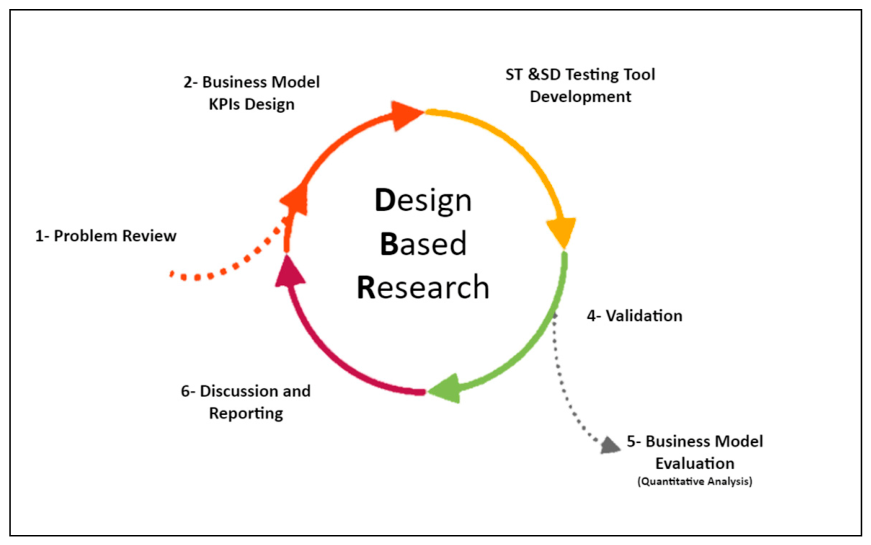
This research employs a DBR methodology, providing a pragmatic, iterative framework that bridges theory and practical application, particularly suited to complex fields such as energy efficiency [29,30,31]. The DBR approach supports a cyclical progression through design, implementation, evaluation, and refinement stages. This iterative cycle helps validate a novel business model in the energy-efficiency market. The model is designed for SMEs and addresses their specific financial, technical, and operational barriers. Figure 1 illustrates this DBR methodology, which unfolds across six stages.
The description of each stage is as follows:

3.1. Problem Review

The first stage involves an in-depth literature review of Energy Efficiency Business Models to identify existing challenges, gaps, and barriers within the energy efficiency sector. This foundational review strengthens understanding of the current landscape and clarifies the specific needs of the SME segment. It also builds on the insights from Section 2, particularly regarding contextual factors and system complexity.
The development of this model is inherently interdisciplinary, drawing on principles from economics, policy analysis, data science, and engineering. Economic theory underpins the financial KPIs and investment logic, while policy frameworks shape the contractual structures and incentive mechanisms embedded in EPC, ESC, and ESI. Data science techniques, including SD and sensitivity analysis, support robust simulation and forecasting. This ensures that decisions are guided by empirical evidence. Engineering and operations management play a crucial role in designing energy systems and integrating renewable technologies. Together, these disciplines ensure the model remains relevant across academic, industrial, and governmental domains.

3.2. Business Model Design and KPI Development

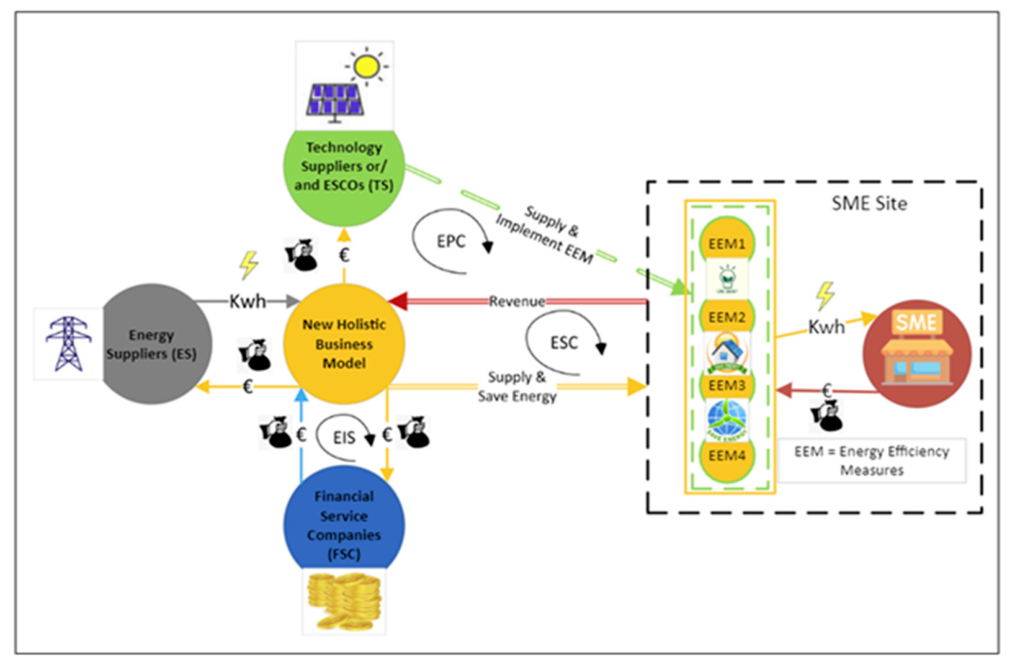
In this phase, an initial business model is designed that integrates the EPC, ESC, and ESI frameworks. The model uniquely sells supplied energy (measured in MWh) and achieved energy savings (measured in NWh) to SMEs. NWh refers to ‘Negative Watt-hours’, a unit used to quantify energy savings resulting from implemented efficiency measures (i.e., avoided electricity consumption). The model also emphasises the interconnections among stakeholders, including TSs and FSCs, to help overcome financing barriers and strengthen trust. Figure 2 visually depicts the model’s structure and outlines the key stakeholder relationships.
In this model, the adopter coordinates various stakeholder relationships, including TSs and FSCs, to facilitate technology, financing, and operational integration, thereby promoting trust and reducing financial and technical barriers [29,30,31]. This coordination strengthens the flow of information and support across the stakeholder network.
KPIs for this business model are selected based on specific criteria that reflect the model’s financial, environmental, and social goals, aligning with the structured selection methodology [32,33]. These KPIs ensure that performance can be evaluated consistently across different implementation contexts.
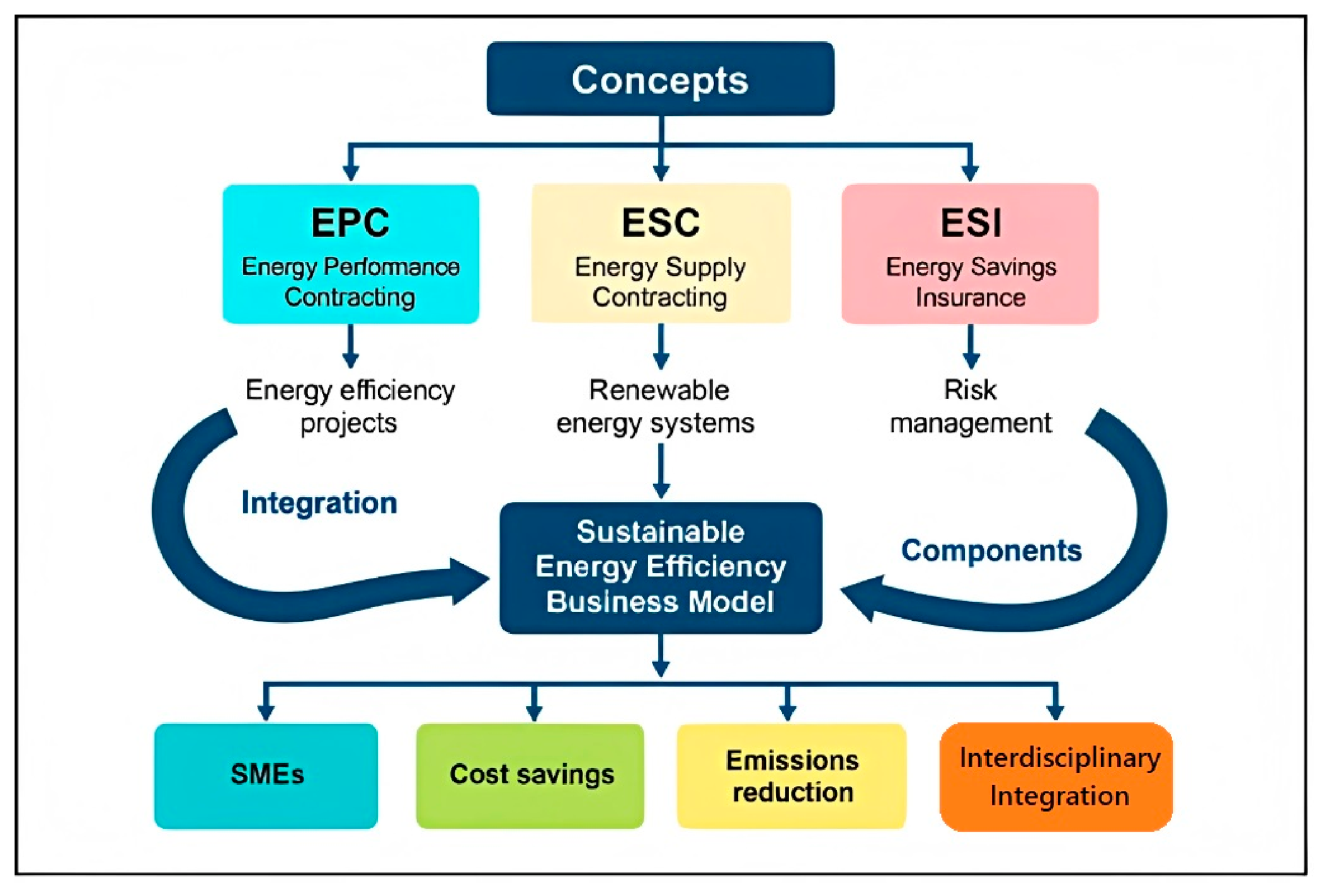
To complement the stakeholder relationship view, Figure 3 presents a conceptual diagram of the integrated EPC–ESC–ESI business model. The diagram highlights the dynamic interactions among contractual mechanisms, stakeholders, and Renewable Energy Systems (RES). It also reinforces the model’s adaptability and its interdisciplinary foundation.
In Figure 3, Energy Performance Contracting (EPC) involves the design, implementation, and operation of energy-efficiency measures, with repayment based on verified savings.
Energy Supply Contracting (ESC) refers to outsourcing the supply of energy (MWh) to a service provider that manages procurement and operational risks.
Energy Saving Insurance (ESI) provides technical and credit-risk protection when expected savings are not achieved.
The model links these three mechanisms to key stakeholders, including technology suppliers or ESCOs, financial service companies, energy suppliers, and SMEs. It shows how energy supply, energy savings (NWh), finance, and risk-mitigation flows interact dynamically.
The diagram also illustrates how the model adapts to renewable systems such as solar PV, wind, and hydrogen. It shows that performance-based contracting and supply optimisation remain valid across these technologies.
This visual summary supports the model’s role as a decision-support tool for operational planning, policy development, and strategic energy management across diverse renewable energy domains. It presents a conceptual diagram of the proposed integrated business model and illustrates the interactions among EPC, ESC, and ESI within an SD framework. It also highlights the model’s adaptability to RES, including solar, wind, and hydrogen.
Building on the conceptual framework, the following KPIs quantify the model’s performance across economic, environmental, and social dimensions. Table 1 details these KPIs and reinforces the discussion on performance metrics.
Energy Efficiency Business Model KPIs measure financial performance, energy savings, and emissions reduction. These KPIs are well-established and factual. However, it is important to clearly connect the wider literature on Energy Efficiency Business Models to the development of these specific KPIs. This connection explains how the KPIs measure and track the performance of the integrated EPC, ESC, and ESI business model. It also shows how they capture both economic and environmental impacts.
Developing these KPIs required a thorough analysis of the economic, environmental, and social dimensions of Energy Efficiency Business Models. The economic KPIs were derived from the main strengths and opportunities of ESCOs. They emphasise financial efficiency, cost savings, and revenue generation. In contrast, the environmental KPIs focus on reducing emissions through improved energy efficiency. Together, these indicators provide a structured basis for evaluating the model’s overall performance.

3.3. Model Implementation

A comprehensive testing tool, rooted in System Thinking and SD modelling, has been developed to examine the feasibility and operational dynamics of SEEBM in simulated environments. This analysis reveals potential dependencies, complexities, and outcomes in real-world scenarios, providing insights into the model’s adaptability and resilience. It also helps identify operational and financial constraints, ensuring alignment with Section 4.1 and Section 4.2.
In addition to financial feasibility, the model supports real-time operational decision-making by simulating dynamic interactions among energy supply, demand, emissions, and stakeholder behaviours. The SD framework enables continuous monitoring of KPIs such as energy savings, local generation rates, and emissions reduction. This allows decision-makers to adjust operational strategies as conditions change. For example, fluctuations in imported energy prices or contract durations can be immediately reflected in the model outputs. These results can then guide tactical decisions regarding energy sourcing, technology deployment, and customer engagement. This real-time adaptability enhances the model’s utility for both operational control and strategic planning.

3.4. Evaluation and Feedback Collection

This phase ensures the integrity of the model’s System Thinking and SD outcomes through rigorous testing and structured validation. Validation methods include behavioural sensitivity and extreme-condition tests, which evaluate the model’s robustness across datasets and ensure operational reliability (Section 4.3). These tests confirm whether the model behaves realistically under different assumptions and stress conditions.

3.5. Refinement

In this stage, the business model undergoes quantitative evaluation using sensitivity analysis. This phase investigates the model’s stability under variable conditions, assesses performance risks, and identifies critical factors for improvement (Section 5.3). Secondary data supports the SD model development and underpins the feasibility analysis described in Section 5.1.

3.6. Model Validation and Recommendations

Finally, the findings are synthesised and interpreted in-depth. This stage emphasises the implications of the research outcomes and provides recommendations for further study. This reflective analysis encapsulates insights from the entire research process, helping pave the way for future DBR cycles to qualitatively validate the model’s social impact.
This comprehensive DBR approach validates the feasibility of a new energy efficiency model for SMEs. It highlights the need for ongoing research into social KPIs, such as market engagement and consumer adoption.
The modelling approach employed in this research is novel in its methodological synthesis. It combines DBR and SD modelling to create a dynamic and testable framework. While previous studies have examined EPC, ESC, and ESI independently, this model unifies them within a single dynamic simulation environment. This integration enables simultaneous financial, environmental, and behavioural analysis of SMEs. These perspectives were not addressed in prior work. The approach thus extends the methodological frontier in energy efficiency research by introducing a replicable framework for testing decarbonisation interventions in complex energy markets.

4. Systems Thinking and SD Modelling

This study adopts a design research approach to evaluate the feasibility of SEEBM, the proposed holistic business model. Section 4.1 presents the translation of the Business Model KPIs into a Systems Thinking model. In contrast, Section 4.2 illustrates the transformation of the System Thinking model into the SD model. Finally, Section 4.3 discusses the validation methods and processes that underpin the model’s robustness and applicability.

4.1. Business Model KPIs to System Thinking Model

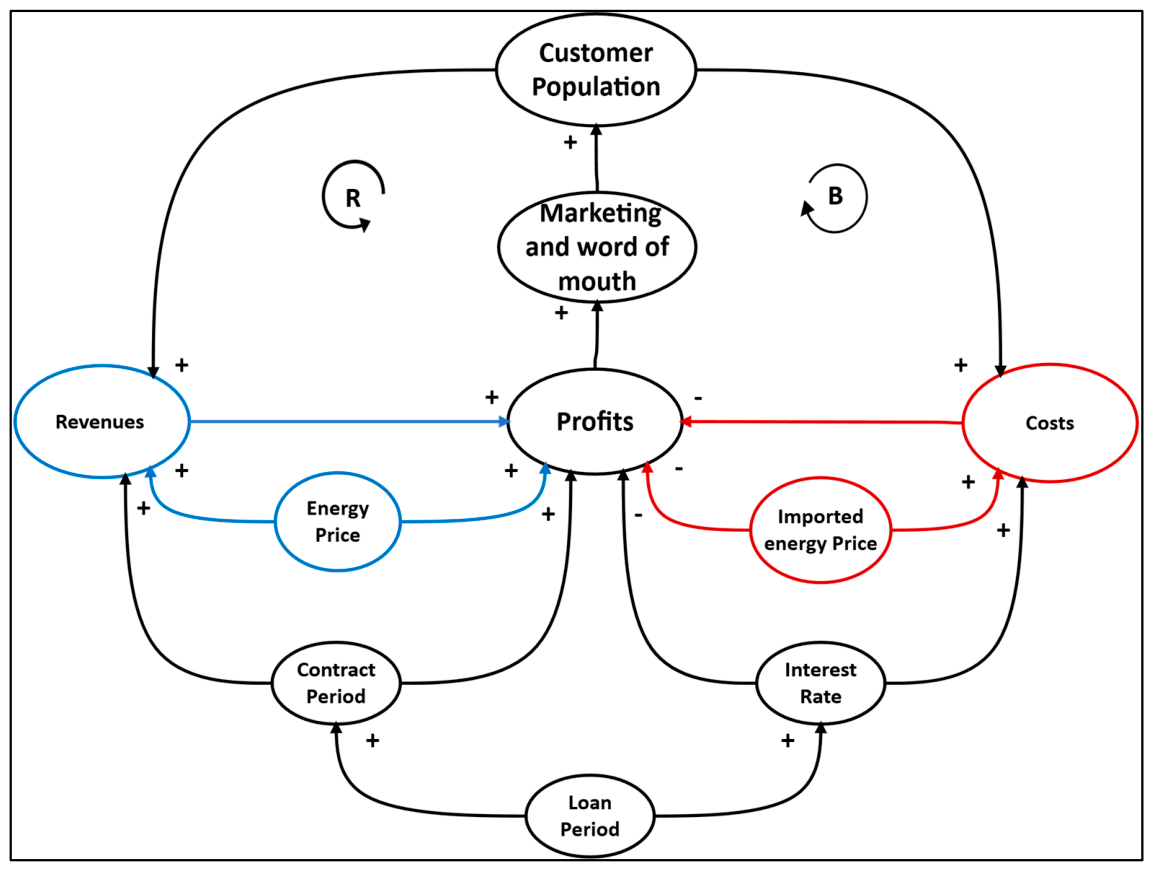
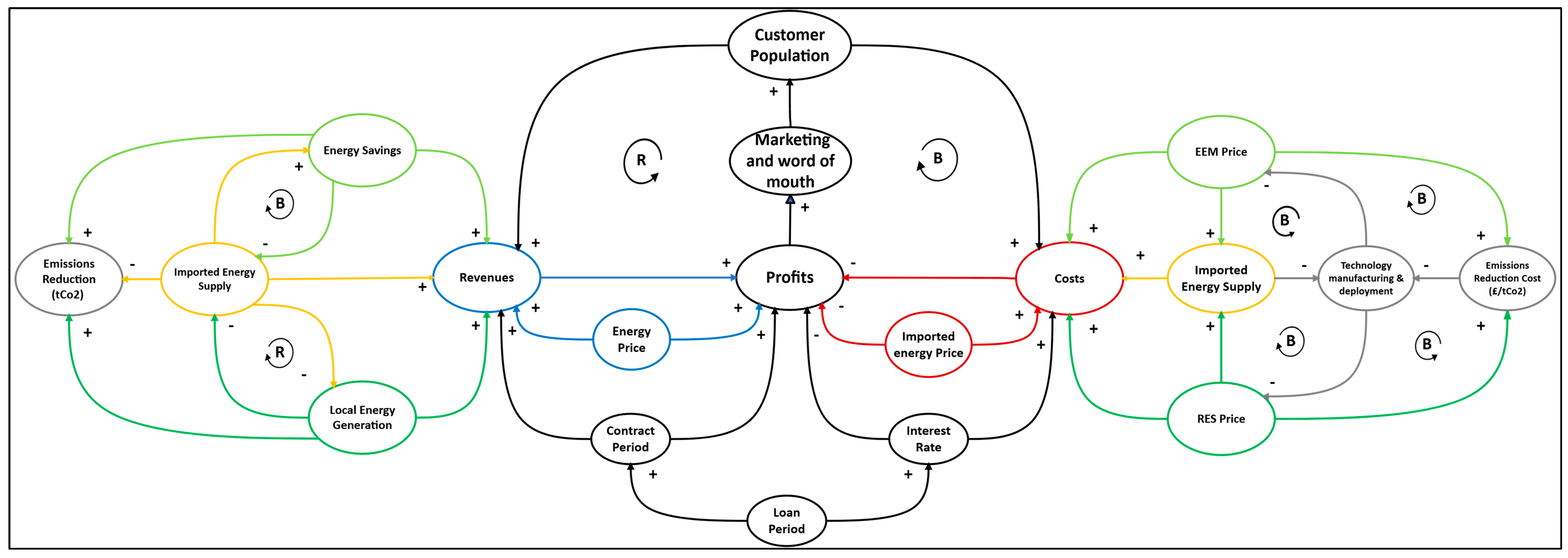
The primary KPIs critical to any business model include Revenues, Costs, Profits, and Customer Population. The System Thinking model is based on the system-as-cause thinking approach, incorporating both dynamic and quantitative thinking [34]. This approach defines the main variables and their dependencies within the Business Model. It sets the groundwork for developing the subsequent SD models. Figure 4 illustrates the System Thinking model, highlighting the balancing and reinforcing feedback loops between KPIs.
Figure 4 shows the Systems Thinking model developed for the integrated business model. It shows the reinforcing (R) and balancing (B) feedback loops linking customer population, revenues, costs, energy savings, imported energy supply, local energy generation, and profits. The model illustrates how changes in one part of the system spread through financial, technical, and operational relationships. These interactions form the foundation for the SD model.
An increase in customer population leads to proportional growth in both revenues and operational costs. This creates reinforcing loops and balancing loops within the system. This growth requires additional deployment of technology and financing. A reinforcing loop emerges as a rising customer base boosts revenue, enhances profits, increases the Business Model’s reliability, and attracts more marketing investment. These effects further expand the customer population. Conversely, a balancing loop emerges when increased customer numbers lead to higher costs, potentially affecting profit margins. However, sustained profits and ongoing customer engagement ensure continued marketing efforts and expansion of the customer base.
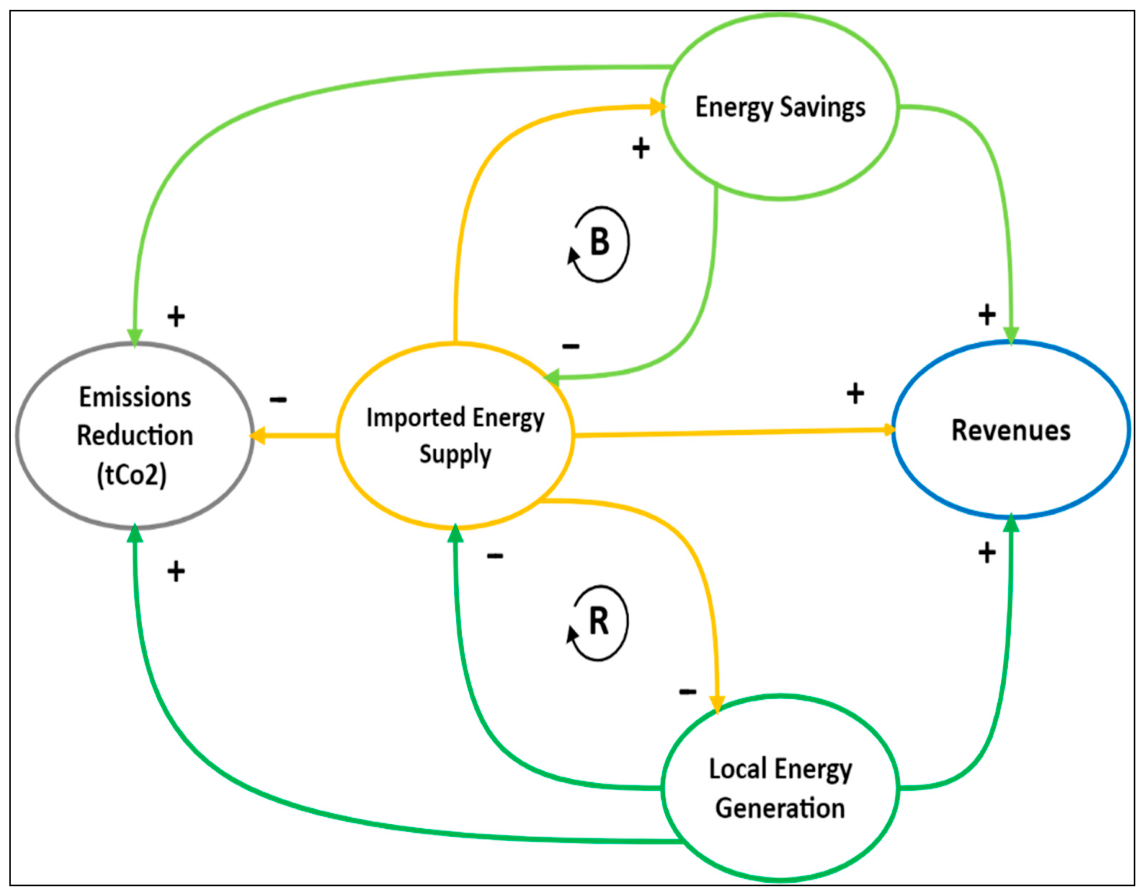
Since the Business Model relies significantly on imported energy for resale, the prices of imported energy and sales directly affect revenue, costs, and profits. Higher sale prices boost revenues and profits, while increased imported energy prices elevate costs and reduce profit margins. Financing factors such as contract periods, loan durations, and interest rates also influence KPIs. Longer contract periods increase cumulative revenue and profit, whereas higher interest rates raise costs and reduce profits. Figure 5 demonstrates that energy savings, imported energy supply, and local energy generation positively influence revenue. Each revenue stream contributes to overall revenue growth.
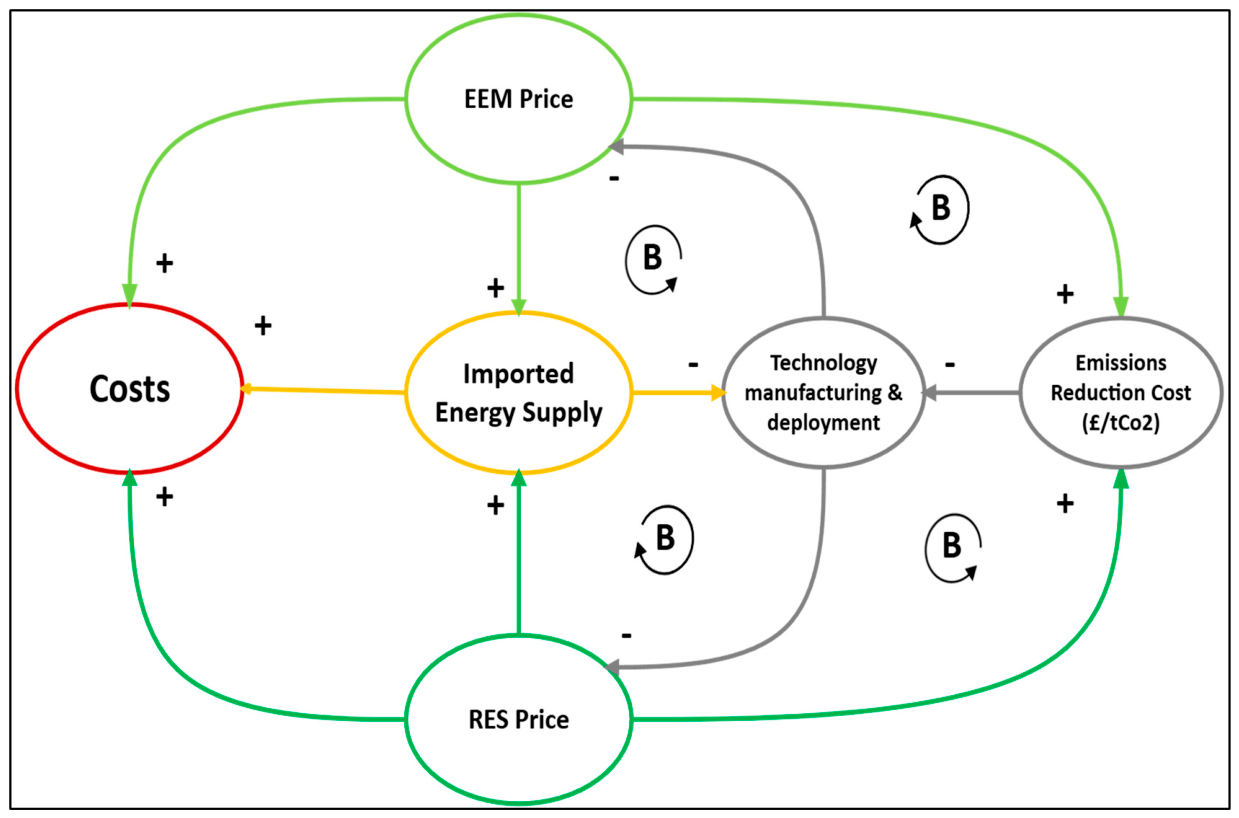
Figure 5 also shows a balancing feedback loop between energy savings and imported energy supply, in which increased energy savings reduce reliance on imported energy. It also shows that local energy generation and imported energy supply form a reinforcing relationship, because higher local generation lowers the need for imported energy. The model further connects emissions reductions to energy savings and local energy generation, thereby positively impacting emissions reductions. In contrast, imported energy, typically associated with high er emissions, negatively affects this relationship. Figure 6 illustrates the primary cost influences, which include EEM price, imported energy supply, and RES price. Higher levels of these elements increase overall costs.
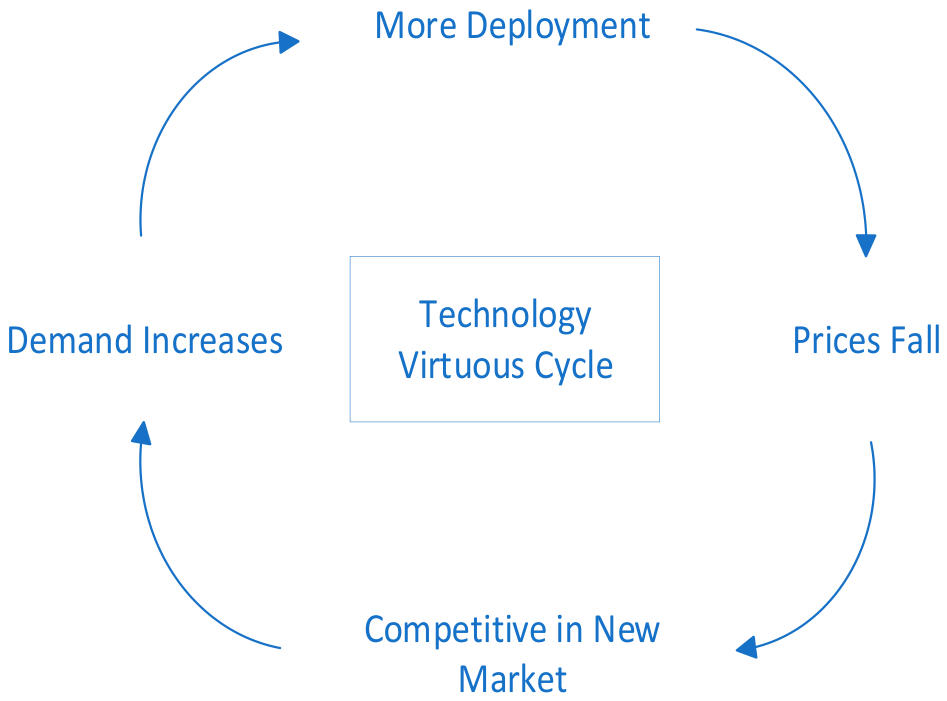
Figure 6 shows the primary cost drivers, including the price of EEM, the price of imported energy supply, and the price of RES. Rising values in these factors increase overall costs. Balancing loops exist between EEM/RES prices, imported energy supply, and technology deployment. These loops influence the costs associated with emissions reduction. As more technology is deployed, the prices of EEM/RES decline, reducing emissions costs. Lower emission-reduction costs increase demand for technology and reliability, which in turn boosts production and further deployment. Figure 7 illustrates the virtuous cycle in which technological advancements lower prices, thereby increasing demand.
The cycle depicted in Figure 7 shows how advancing technology leads to price reductions and increased demand, which then reduces dependence on imported energy and supports sustainable, cost-effective energy solutions. Figure 8 provides a comprehensive view of the System Thinking model, highlighting the interdependencies, balancing loops, and feedback relationships among the various KPIs.
Figure 8 shows a comprehensive overview of the System Thinking model, displaying the interconnections, balancing loops, and feedback mechanisms among various KPIs. It highlights how increased customer numbers, driven by effective marketing and word of mouth, contribute to revenue growth, profit expansion, and higher demand for energy and technology deployment. Cost management is essential as rising energy and technology prices can suppress profits. The model shows the balance required between demand growth and cost-effective supply strategies. It also shows that technology deployment becomes more affordable when implemented at scale. This comprehensive System Thinking model reveals the intricate interplay among model components, demonstrating the need for a holistic approach to managing the business model.

4.2. Business Model to SD Model

In transitioning to an SD model to evaluate the Business Model’s performance and feasibility, Table 2 below organises the business model’s KPIs into a SD framework, comprising a main model and sub-models for each SME. Key organisational details include:
  • KPIs and sub-KPIs are alphabetically indexed with specific sub-metrics (see Figure 9 and Figure 10).
  • Measurement units are specified for each sub-KPI.
  • A “Type in SD” column classifies each KPI’s role within the SD framework.
  • “Flow” represents a rate variable that causes stocks to accumulate or deplete over time.
  • “Variable” represents an auxiliary variable calculated from other model components.
  • “Data Table” represents a lookup function that maps an input value to an output based on empirical or assumed data points.
  • Mathematical formulas are adapted for individual SMEs and the aggregated main model.
  • Input data sources for each KPI are recorded.
  • Each KPI group is colour-coded: green for energy KPIs, orange for financial KPIs, blue for emission-reduction KPIs, and yellow for customer population.
KPIs 17 and 18, related to marketing, word of mouth, technology manufacturing, and deployment volume, are excluded due to data limitations.
This transition from System Thinking to SD modelling provides a robust framework for analysing and validating the Business Model’s feasibility in real-world applications. It balances customer engagement, financial efficiency, and environmental impact through optimised dynamic-modelling techniques.
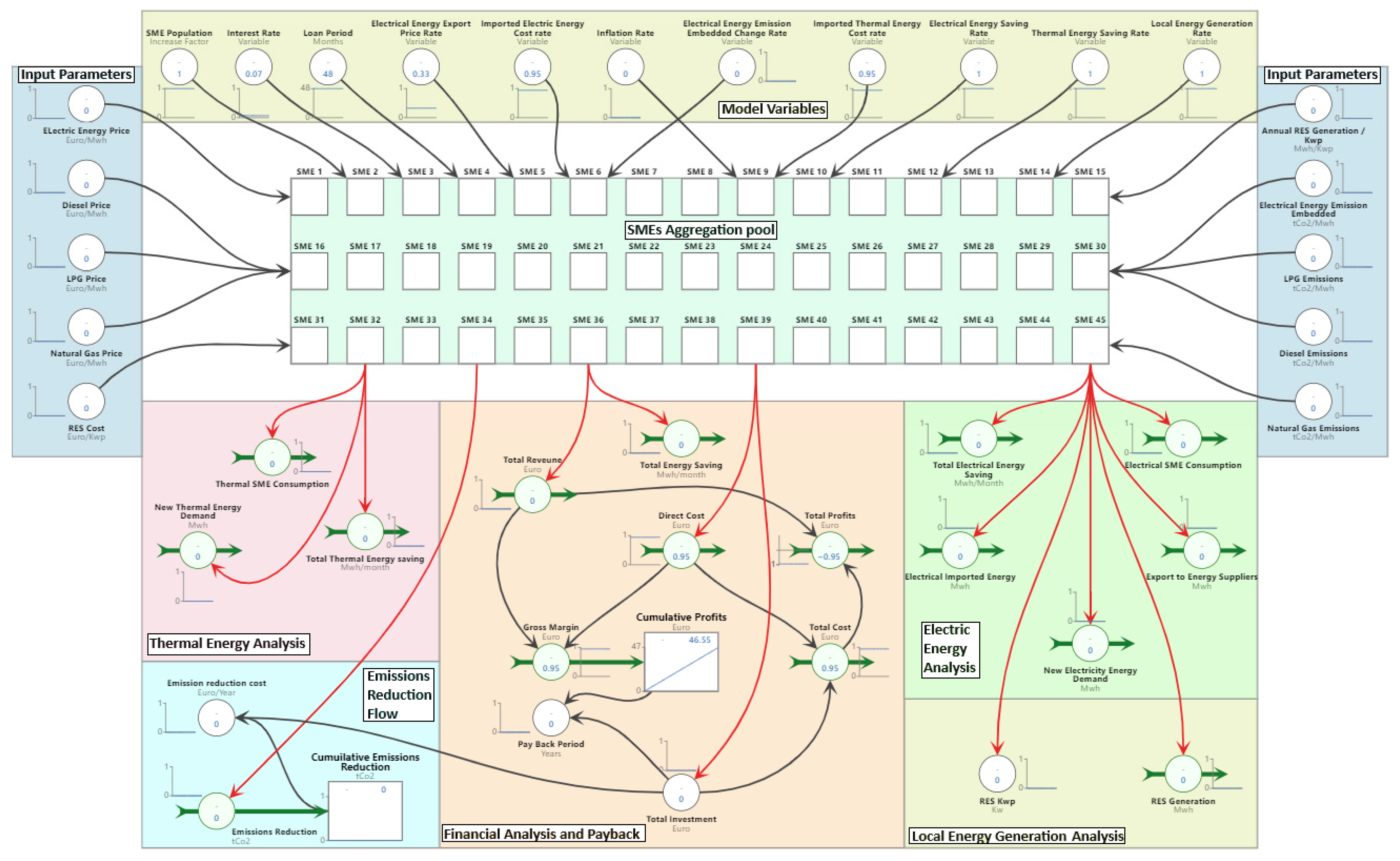
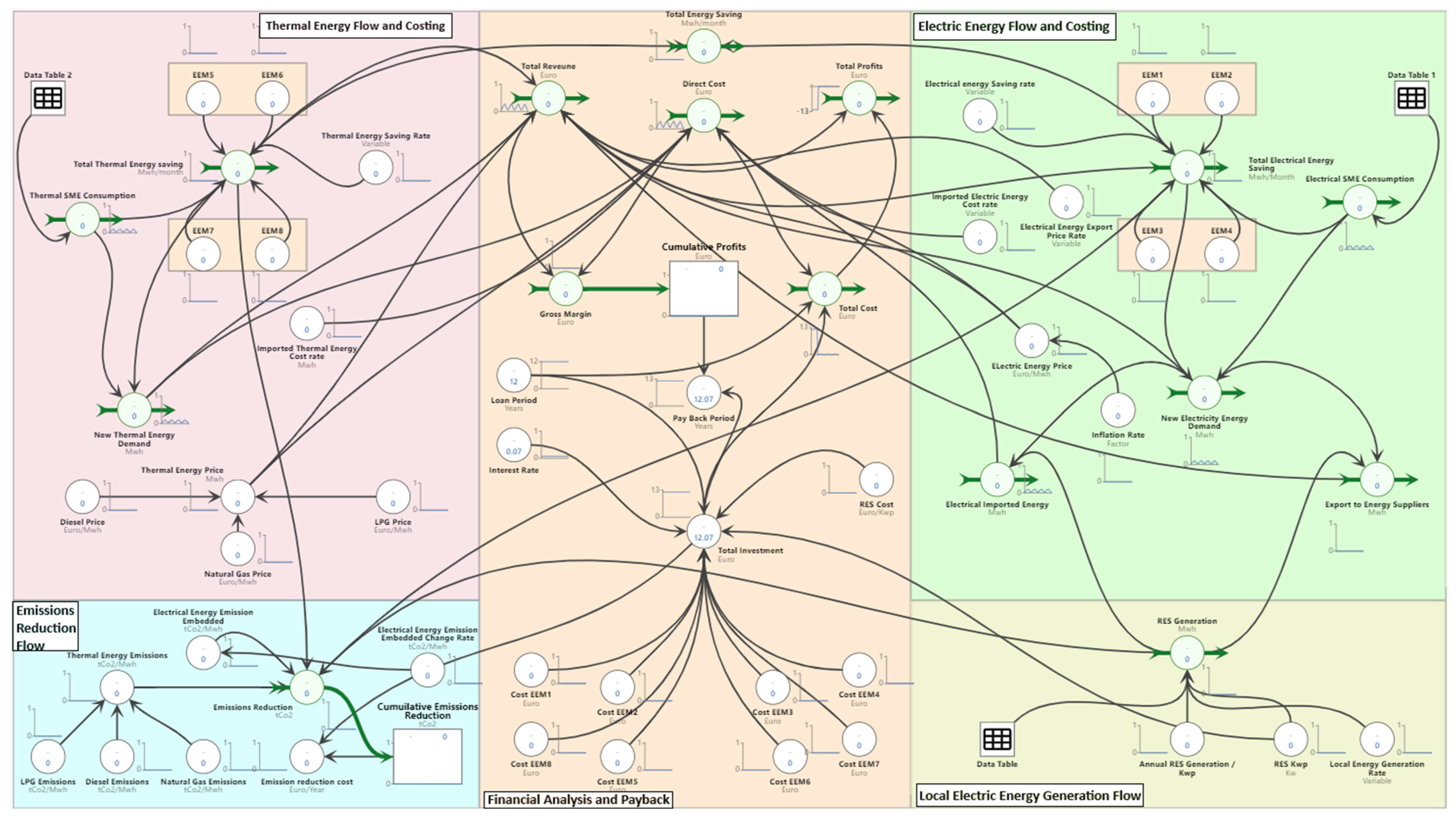
The transition of KPIs to the SD model, as detailed in Table 2, includes an in-depth exploration of the main model shown in Figure 9, along with 45 sub-models developed from case studies within the EU project SMEmPower. Each sub-model, depicted in Figure 10, represents a single SD model that shares structural similarities with the main model. However, some input variables interact only within the sub-models or only within the main model. A significant distinction lies in the main model’s ability to incorporate and “gamify” outputs from the sub-models through its unique variables, thereby aggregating these results into a cohesive main-model output.
Table 2 provides a detailed breakdown, where each KPI is meticulously indexed and labelled, then further divided into precise metrics under the ‘Sub KPIs’ category, offering a mathematical representation for each KPI. The ‘Type in SD’ column categorises each sub-KPI within the SD framework (flow, variable, or data table), and the ‘Unit’ column specifies the measurement standard. This organisation and structure are presented visually in Figure 8 for the main model and in Figure 9 for the sub-models.
Although the sub-model and main model equations may appear different in form, they are mathematically equivalent. The main-model equation aggregates sub-model outputs across all SMEs, typically by multiplying the single-SME value by the number of end consumers or by summing across all sub-models. Two sets of mathematical formulations are included in Table 2. Equations tailored to individual SMEs are presented in the ‘Equation in Sub-Model (Single SME Business Model)’ column. In contrast, the ‘Equation in Main Model’ column outlines the corresponding main model equations. The ‘Input Data Source’ column specifies the origin of input data for each KPI; for instance, if derived from another sub-KPI, it is marked as “Calculated,” while data sourced from secondary reports is directly cited.
The SD model further quantifies key areas. Imported Energy Supply is divided into electrical and thermal components. This is followed by an examination of ‘Energy Saving’, including both electrical and thermal metrics, and then ‘Local Energy Generation’, focusing on renewable sources and their output patterns. From a financial perspective, Energy Price is analysed by considering the costs of diesel, natural gas, and LPG. The Revenues section details inflows influenced by energy prices and savings.
An extensive analysis of costs differentiates direct, indirect, and specific EEM. Additionally, ‘Emissions Reduced per Year’ reflects the SD model’s commitment to environmental considerations, detailing reductions in carbon emissions across various energy sources. The ‘Emission Reduction Cost’ metric assigns a financial value to each ton of CO2 conserved, strengthening the environmental cost-benefit assessment.
Recurrent in Table 2 signifies data flow from the primary main model to the individualised sub-models, highlighting the interconnected nature of the entire framework. For example, the KPI for imported energy supply appears as a ‘Flow’ in both Figure 9 (main model) and Figure 10 (sub-model), with naming conventions kept consistent for clarity.
Concluding this SD model framework, Figure 9 and Figure 10 synthesise insights from all 45 case studies into both individual and aggregated perspectives. Figure 10 displays the main model in Silico with the individual SME sub-models, illustrating the SD model structure. Figure 9 divides the single model into five sections: the dark rose section represents thermal energy flow, the green box denotes electric energy flow, the dark yellow represents local energy generation, the blue shows emissions reduction flow, and the light red in the centre encompasses the financial flow, including revenue, total cost analysis, profits, and payback periods.
In Figure 9, the main aggregation and sensitivity analysis model includes the input variables at the top (in yellow) that gamify the entire model. The green box serves as the SME aggregation pool, while the blue boxes on each side represent input parameters specific to the study’s country, the United Kingdom. Total output analysis covering energy, financial, and emissions metrics is shown in the lower section, using the same reference colours as in Figure 10. Red arrows signify the aggregation of identical flows or variables across all SME models into a cumulative output in the main model. In contrast, black arrows denote internal interconnections within the model.
Figure 9 shows the main SD model, which aggregates outputs from all SME sub-models and highlights key input variables and system interactions. The upper yellow section contains the variable inputs that control the model behaviour. The central green block represents the SME aggregation pool, while the blue side blocks show UK-specific input parameters. Red arrows indicate aggregated flows from sub-models into the main model. Figure 10 shows the SD sub-model for a single SME. The model includes energy flows (thermal and electrical), local renewable generation, emissions calculation, and the financial structure (revenues, costs, profits, and payback). Black arrows show internal causal links, while coloured blocks represent separate sections of the model (energy, financial, emissions).

4.3. SD and Model Validation

The model validation process followed Mark Schwaninger’s quality assurance guidance for SD Model construction [38]. Schwaninger’s ‘Validation Cube’ offers a three-dimensional framework for comprehending various aspects of validation. This approach was adapted to develop the Business Model, the System Thinking model, and the SD model through an interconnected iterative cycle. It supports continuous improvement and comprehensive model structuring. Schwaninger’s process aligns with our need for a robust design framework, addressing multiple validation aspects and reinforcing the interconnected development of models.
Following [38], the validation was conducted in three stages: (A) Model-Related Context, (B) Model Structure, and (C) Model Behaviour.
(A)
Test of Model-Related Context
  • Issue Identification Test: This test assesses the model’s capacity to identify and accurately represent critical issues within the system under study. It ensures the model captures the most relevant aspects of the real problem. This involves examining the model structure, assumptions, and market input data to accurately represent essential system features and business model variables.
  • System Configuration Test: This test validates the model’s structure and its representation of relationships between system components. It ensures the model structure aligns with business model KPIs, System Thinking, and SD models by comparing the SD model structure with the System Thinking model and verifying that algorithms accurately translate required business model functions.
  • System Improvement Test: This test compares the model’s output with historical data or empirical evidence. Data were divided into two sets, one for SD model development and one for validation. Outputs were then compared to available evidence using identical inputs.
(B)
Test of Model Structure and Behaviour
  • Direct Extreme Condition Test: This test subjected the SD model to extreme input values to assess its stability. It ensured the model behaved reasonably and in line with expected system responses. This process identified any issues in the model’s structure, assumptions, or parameters that might not appear under normal conditions. By pushing input parameters to their limits and comparing the model’s responses with the original data from Section 5.1 across case studies and aggregated models, necessary refinements or further validation could be identified.
  • Behaviour Sensitivity Test: Input parameters and assumptions were systematically varied within reasonable ranges to analyse changes in model output. This aimed to evaluate robustness and identify any uncertainties from input variability. This test highlighted variables with strong influence on model behaviour, guiding refinement and supporting decision-making under uncertainty. These validation steps strengthened confidence in the model’s reliability and credibility.

5. Results Analysis and Discussion

5.1. Secondary Data Analysis

Adjusted input parameters from various EU markets were tailored for the UK market across all 48 case studies to align metrics, such as cost savings, payback periods, and emissions, with UK-specific values. Although 48 case studies were initially available, data refinement and relativity checks led to the exclusion of 3 cases, resulting in 45 validated studies. This reduction followed a structured process including reliability checks, relativity filters, and removal of cases with missing consumption data, unrealistic saving rates, or insufficient justification for proposed EEM. These steps ensured that only technically complete and methodologically reliable case studies were retained.
These case studies, derived from the EU-funded SMEmPower project [39], represent audited industrial SMEs and include detailed data on energy consumption, implemented EEM, RES, investment costs, savings, and emissions reductions. The cases were adapted to the UK context to support SD modelling and validation.
Although the data originated from the SMEmPower EU project, focusing on the UK revealed significant variations in these metrics due to distinct energy prices and embedded emissions (further detailed in Section 5.2).
The secondary data used in this study were obtained from the EU-funded SMEmPower project, which originally provided 48 SME energy-efficiency case studies. These case studies included historical electrical and thermal energy consumption, proposed EEM, RES, associated investment costs, and expected energy and emissions savings.
A structured data-processing procedure was applied before constructing the SD model. First, a data refinement stage was conducted to verify the accuracy of cost savings, emissions reduction, and payback values by recalculating them using real-world UK energy prices and embedded emissions factors. Second, a data rectification stage corrected inconsistencies and overestimations found in several case studies, particularly EEM saving rates and solar PV parameters, using trusted sources such as Global Solar Atlas and UK-specific emissions datasets. Third, a relativity check ensured that energy-saving rates did not exceed realistic bounds (maximum 30%) and that payback periods remained within accepted limits (maximum 7 years). Case studies with missing data, unrealistic saving estimates, or insufficient justification for recommended measures were removed. Following these steps, 45 validated studies were retained. This final dataset ensured methodological rigour and provided a reliable foundation for evaluating the EPC, ESC, and ESI integrated business model.
To convert the System Thinking model to the SD model, data from energy audits and efficiency plans, including historical usage, EEM and RES recommendations, and cost assessments, were required to assess feasibility and return on investment. This extensive dataset enriched the SD model and supported evaluation of economic and environmental feasibility [40,41]. Within the research scope, secondary data from SMEmPower [5] were used, covering 48 European SME case studies. A sample data structure is shown in Table 3.
Table 3 presents the data preparation stages, including recalculations for cost savings, emissions reduction, return on investment, and the savings rate (%) per measure, based on real-world energy prices and embedded emissions [36,37]. The data refinement process involved relative and reliability checks, during which overestimations or inconsistencies, especially in solar PV prices and emissions, were corrected using sources such as the Global Solar Atlas and Global Petrol Prices. Missing data for some years were approximated based on neighbouring available data. Table 3 presents the data preparation stages, including recalculations for cost savings, emissions reduction, return on investment, and the savings rate (%) per measure, based on real-world energy prices and embedded emissions [36,37]. The data refinement process involved relative and reliability checks, during which overestimations or inconsistencies, especially in solar PV prices and emissions, were corrected using sources such as the Global Solar Atlas and Global Petrol Prices. Missing data for certain years were approximated using the closest available neighbouring data.
A final relativity check aligned the data with expected trends, applying a savings-rate cap of 30 percent and a maximum payback period of 7 years [4,42]. Outliers were adjusted or flagged as necessary. Case studies lacking sufficient analysis of EEM were excluded, resulting in a dataset of 45 SME case studies. These refined and UK-adjusted data support evaluation of the new integrated business model.

5.2. SD Output Analysis

The SD base case model aggregates the case studies under a new business model, integrating EPC and ESI project components with an ESC energy supply business model. Developed following the data refinement process in Section 5.1, the SD model shows substantial changes compared with the standalone case-study results. Table 4 contrasts key metrics between SMEmPower data and the SD Base Model outputs.
A final relativity check aligned data with expected trends, applying a savings rate cap of 30% and a maximum payback period of 7 years [4,42]. Outliers were adjusted or flagged, and case studies lacking sufficient analysis of EEM were excluded, resulting in a dataset of 45 SME case studies. These refined data were then reinterpreted within a UK context to support the evaluation of the new integrated business model.
The SD base case model aggregates the case studies under a new business model, integrating EPC and ESI project components with an ESC energy supply business model. Developed following the data refinement process in Section 5.1, the SD model demonstrates substantial shifts compared with the standalone case-study results. Table 4 contrasts key metrics between the original SMEmPower data and the SD base-model outputs.
Table 4 highlights notable value shifts due to refined data and UK-specific adjustments. For instance, profits rose from EUR 3,642,457 to EUR 11,087,355 due to UK-specific energy prices, while total saved energy decreased from 42,923 MWh/year to 29,784.8 MWh/year. Emissions reduction also declined, from 21,852.3 tCO2/year to 6555 tCO2/year. The payback period also decreased substantially, falling from an average of 36 months to 10 months. This improvement is attributed to the consolidated EPC and ESC business model, which redirects surplus savings toward longer-term investments in EEM and RES.
It should be noted that the reduction in energy savings and emissions figures reflects the removal of overestimated data during the refinement process and the recalibration to UK-specific conditions, rather than a deterioration in model performance. The substantial increase in profits is attributable to higher UK energy prices, which amplify the financial returns of the integrated model.

5.3. Sensitivity Analysis Results

The sensitivity analysis evaluates how variations in input affect the performance of the main SD model. Using Python, the study analysed key input parameters derived from secondary data sources [5,36,37]. Table 5 defines the variable input ranges and step values applied in the sensitivity analysis.
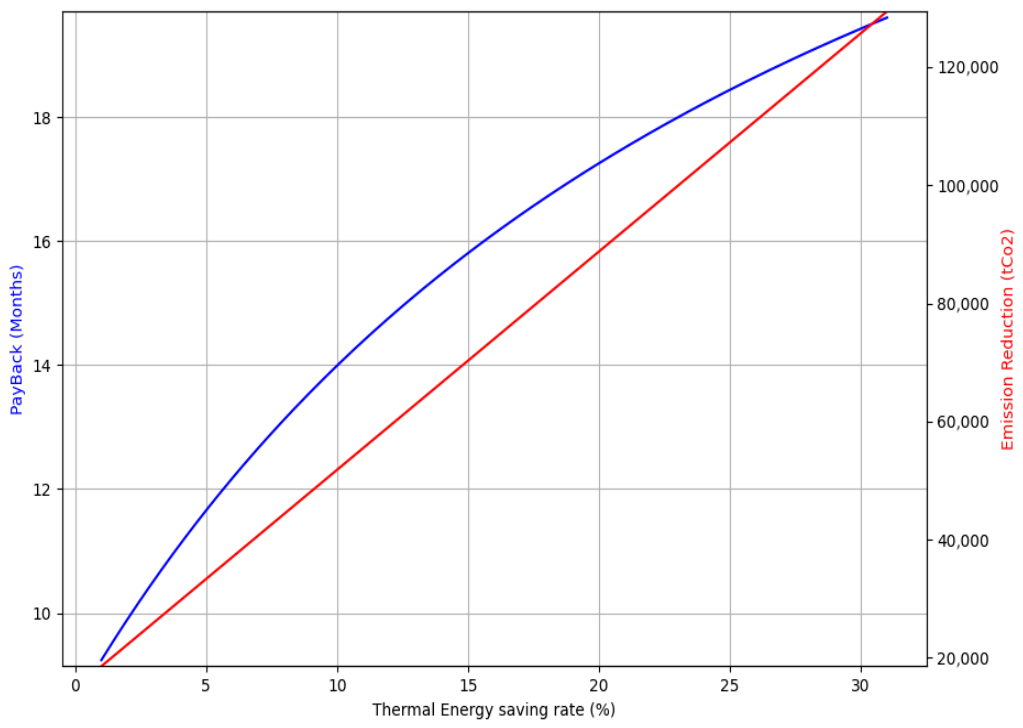
Table 5 (Variable Input Ranges) lists the tested parameters, including contract periods and energy-saving rates, and the outputs are presented in Figure 11, Figure 12, Figure 13, Figure 14, Figure 15, Figure 16, Figure 17 and Figure 18.
For sensitivity analysis, the selected outputs were the payback period and emissions reduction. The payback period represents both investment and cost savings, serving as an economic indicator, while emissions reduction signifies environmental impact. This analysis identifies critical factors that influence business-model performance and supports more informed decision-making among adopters.
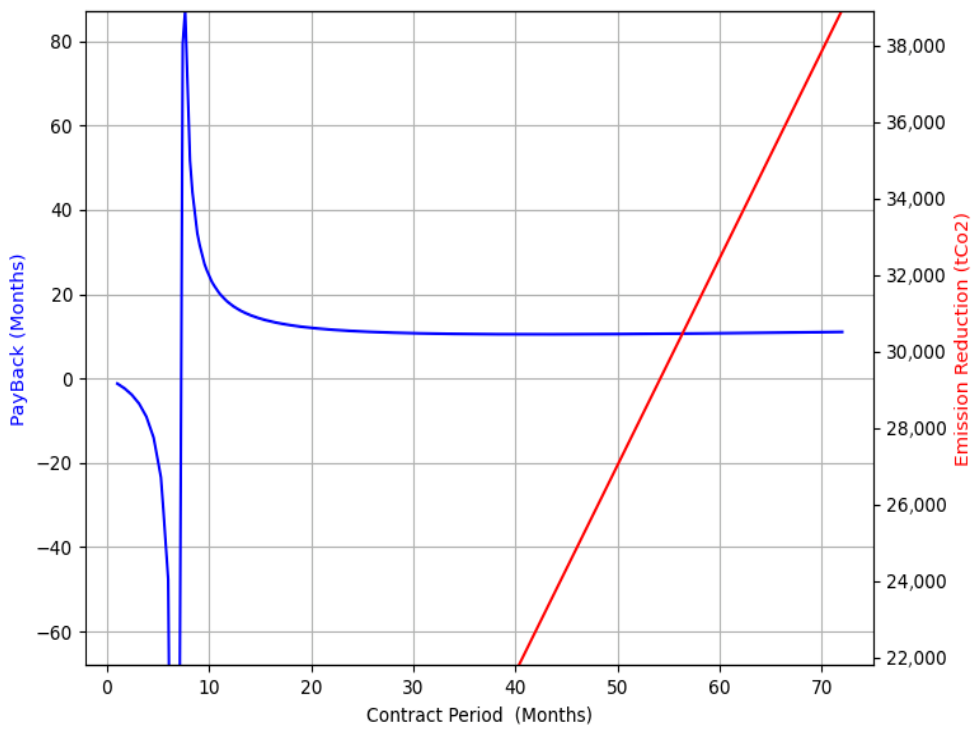
The sensitivity analysis, illustrated in Figure 11, Figure 12, Figure 13, Figure 14, Figure 15, Figure 16, Figure 17 and Figure 18, examines the relationships between the input variables in Table 5 and the primary metrics, “Payback Period” and “Emission Reduction”. Figure 11 shows how varying the contract period affects both the model’s financial viability (payback period) and its environmental impact (emissions reduction).
Figure 11 shows that short contract periods (up to 6 months) result in negative payback, making them financially unviable. As the contract period increases to 8 months, the model shifts sharply into profitability. A 15-month contract marks the breakeven point. For contract periods beyond 24 months, the payback stabilises at around 11 months, indicating a financially stable model with fast returns.
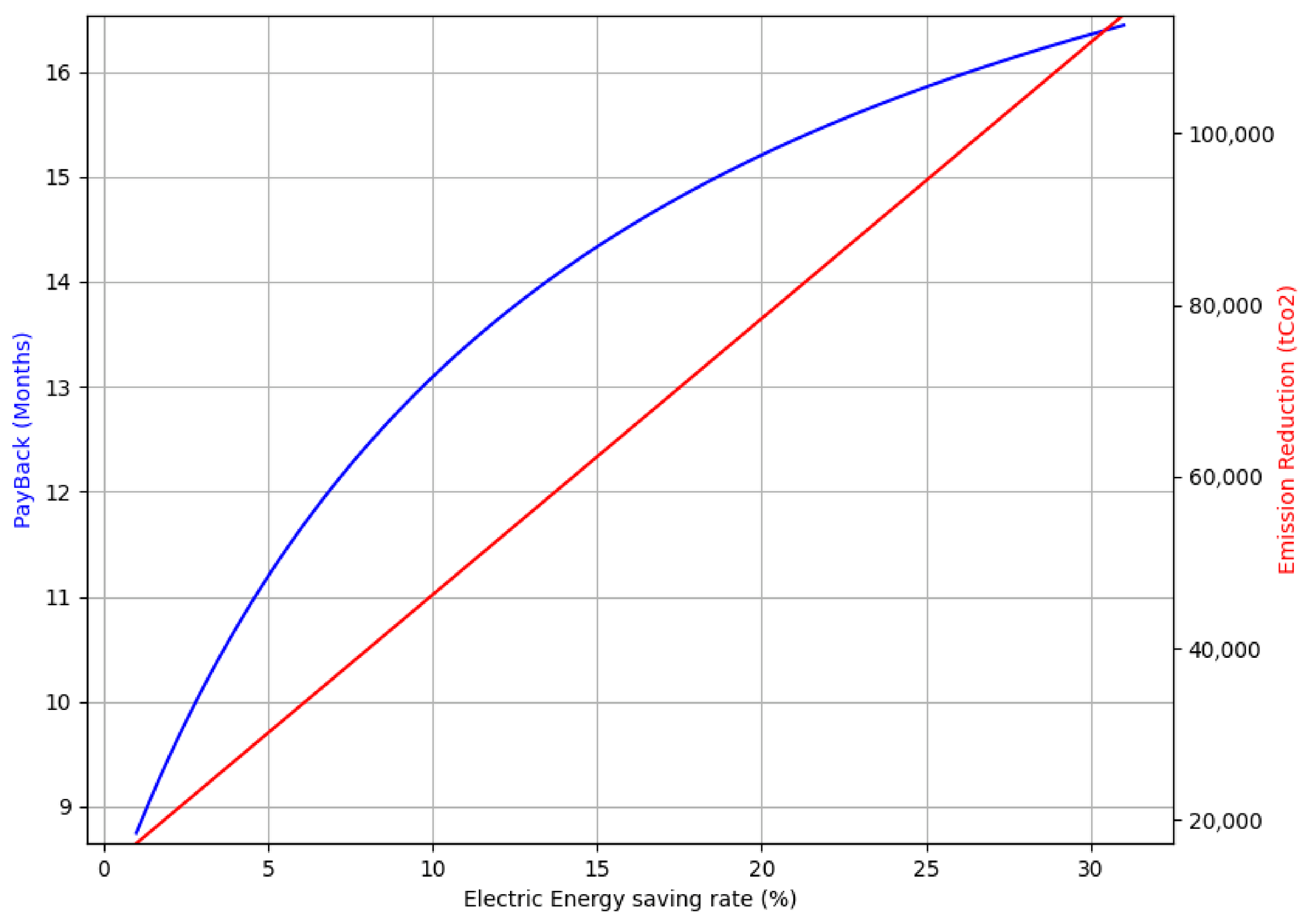
Emission reductions consistently increase with longer contract durations. These benefits support the energy supplier during the contract period and pass additional advantages to the client after the contract ends. Future studies could examine how these post-contract benefits influence client behaviour and adoption. Figure 12 and Figure 13 illustrate the impact of increasing electric and thermal energy-saving rates on emissions reductions and the payback period.
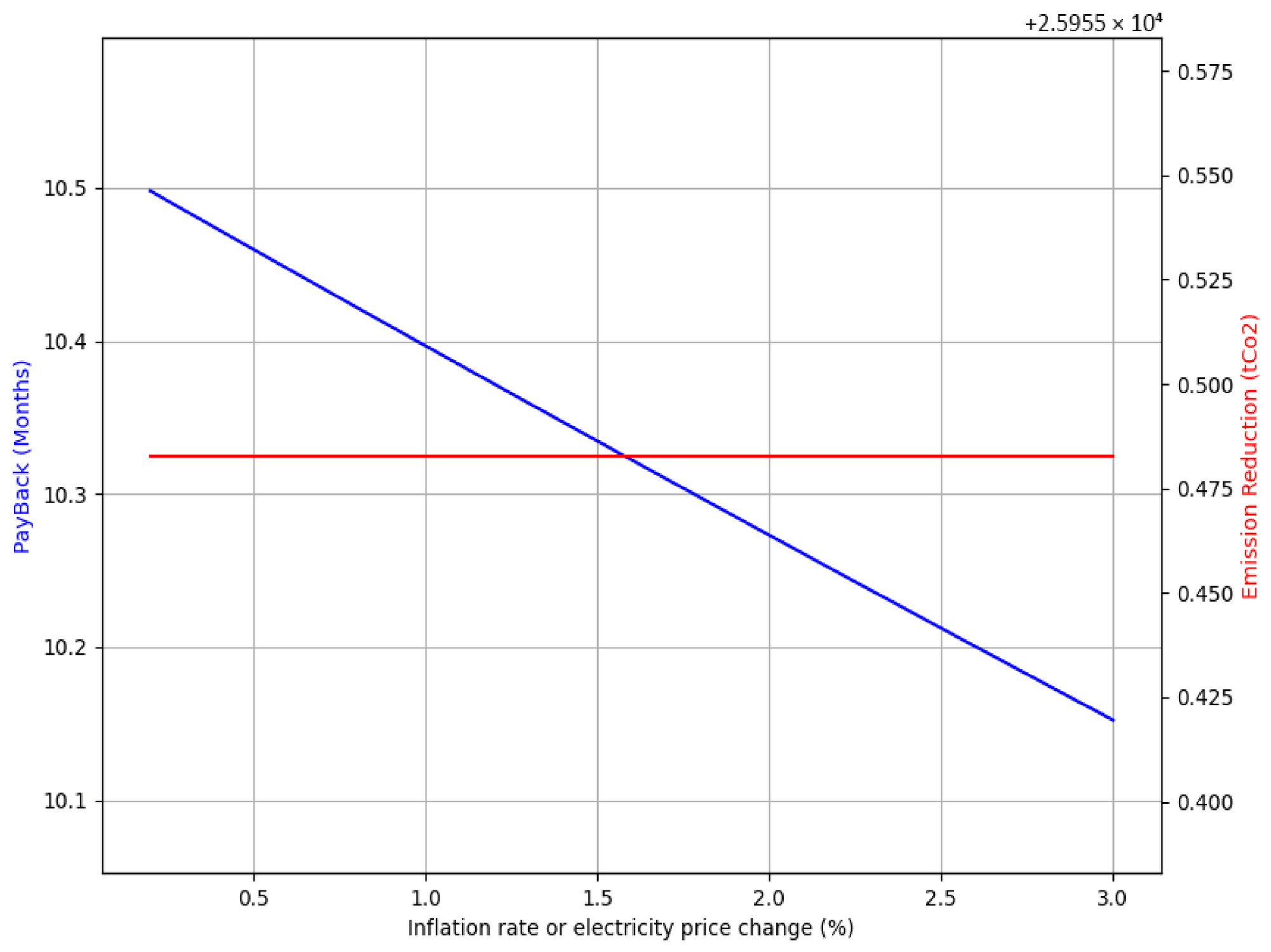
Figure 12 and Figure 13 show that emissions reductions increase by approximately 20,000 tCO2 for every 5% increase in energy-saving rates. At the same time, the payback period also increases due to the higher investments in additional EEM required to reach these higher savings rates. Figure 14 examines how changes in the inflation rate or electricity prices influence both the payback period and emissions reduction, highlighting the financial advantage created by rising energy costs.
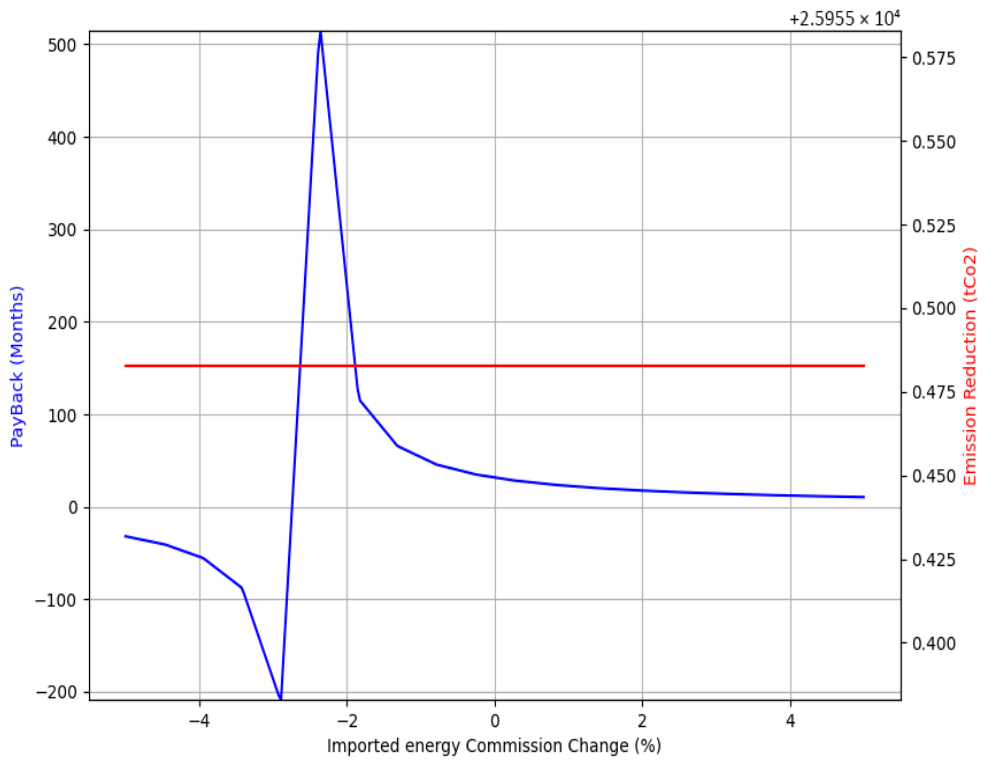
Figure 14 shows that while emissions reduction remains unaffected, the payback period decreases as energy prices or inflation rates increase. This occurs because higher energy prices create increased revenue against static initial investment costs. This result highlights the financial benefit of rising inflation and energy prices within this business model. Figure 15 shows the impact of the commission rate on imported energy prices on the payback period and emissions reduction, demonstrating its crucial role in the model’s overall viability.
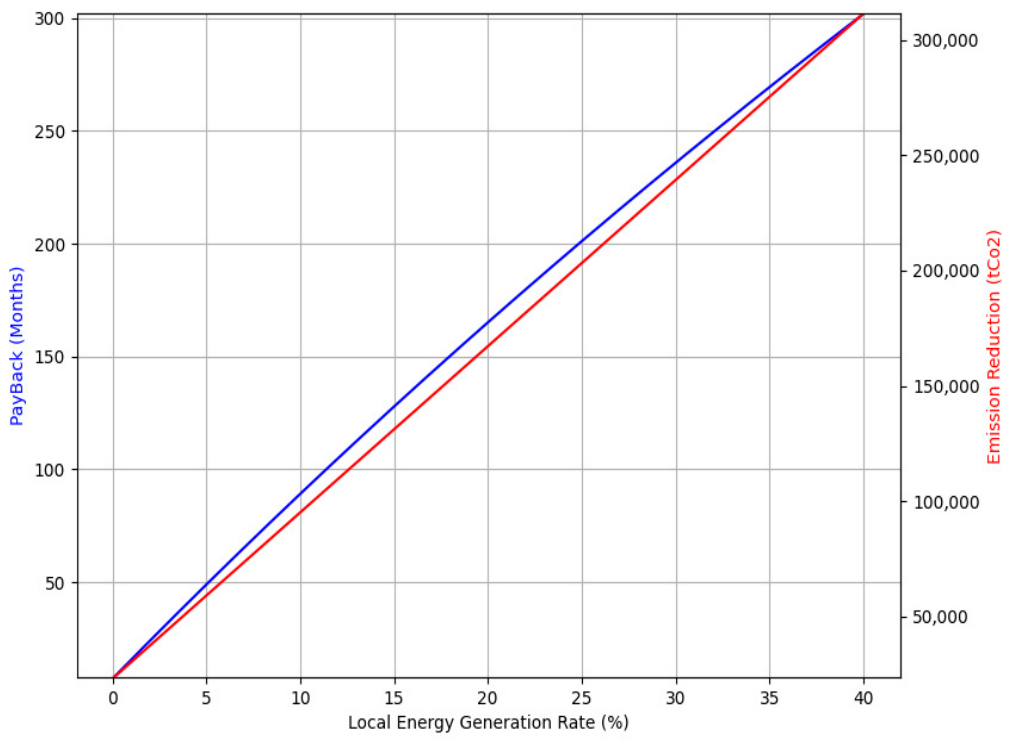
Figure 15 suggests that reducing the commission on imported energy prices below 0.85% leads to losses. However, a 5% commission decreases the payback period to 11 months. This indicates that the commission applied in ESC models is critical to the success of the hybrid EPC–ESC model. It also underscores the importance of stable energy prices for maintaining financial viability. Figure 16 shows the effects of increased local renewable energy generation on financial and environmental metrics, specifically the payback period and emissions reduction.
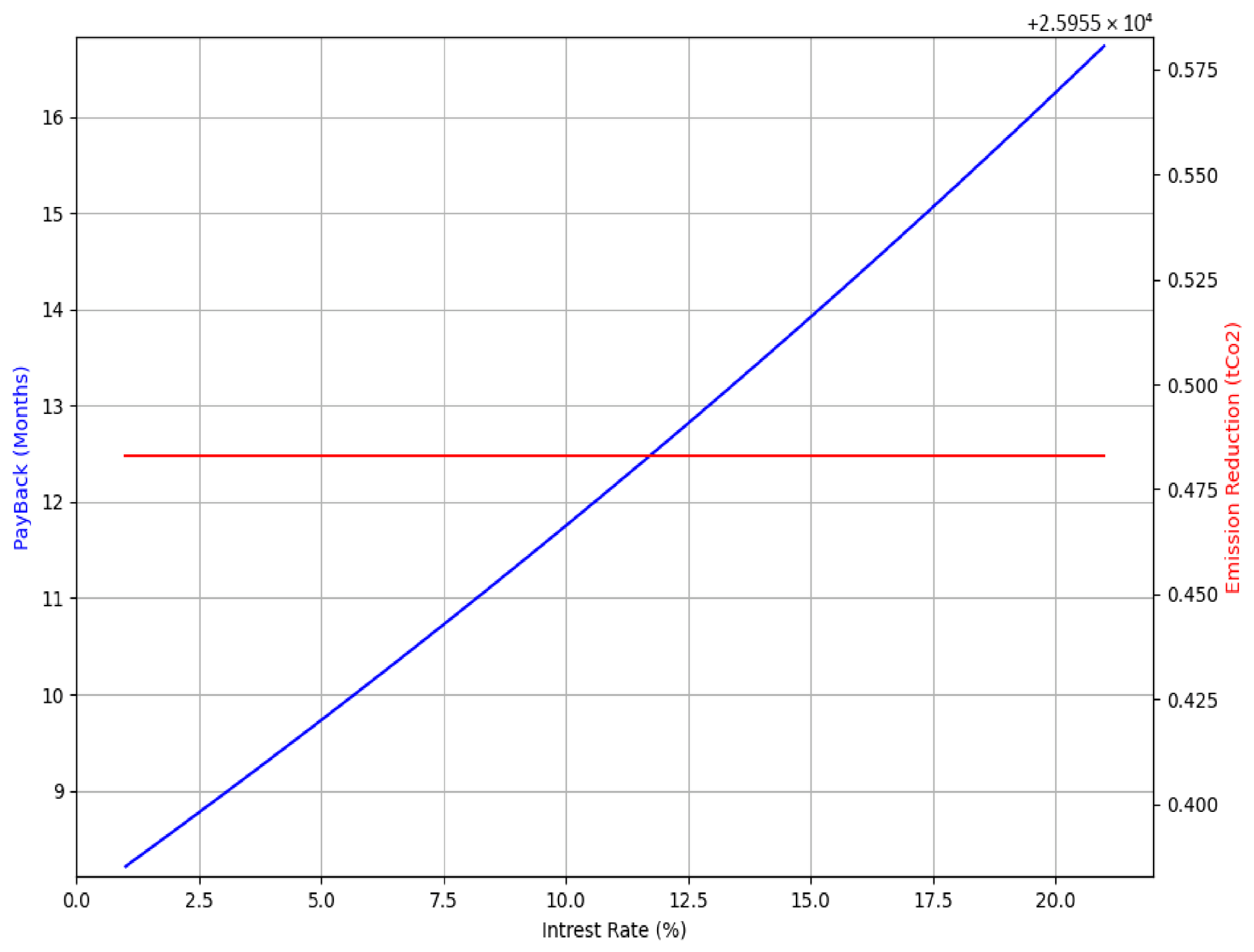
In Figure 16, the payback period and emission reductions increase with rising local renewable energy generation, driven by the significant investments required for renewable installations. A potential area for future research is the effect of decreasing renewable technology prices on payback and demand for these technologies. Figure 17 shows how interest rates influence the payback period, taking into account the model’s short loan term relative to the investment amount.
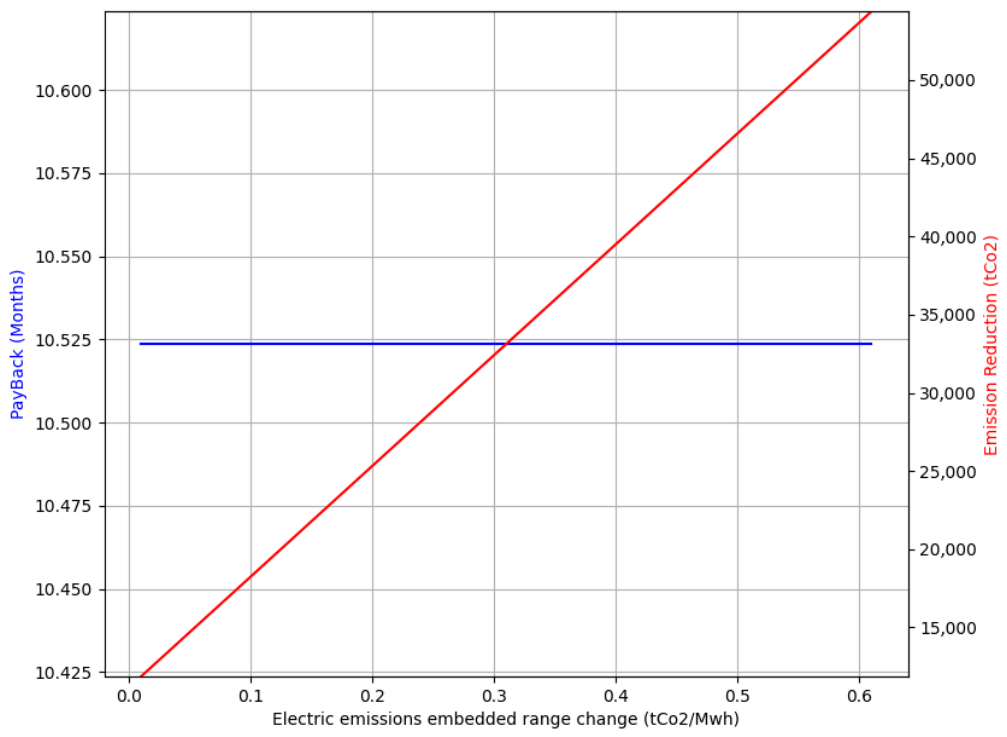
Figure 17 shows the minimal impact of interest rates on the payback period, which is due to the short loan term of 48 months relative to the overall investment amount. Figure 18 explores the impact of embedded emissions in electricity supply on emissions reduction, helping to isolate environmental effects from financial outcomes.
Figure 18 shows that emission reductions correlate positively with embedded emissions in the electricity supply, but the payback period remains unaffected, as this factor is environmental rather than financial. This distinction highlights that embedded emissions influence environmental outcomes without altering investment recovery.
The findings indicate that the payback period is sensitive to contract duration, energy-saving rates, and energy prices. At the same time, emissions reduction is influenced by technical factors, particularly energy savings and embedded emissions. These insights highlight the balance required to integrate economic and environmental considerations into the business model, emphasising the importance of strategic decision-making for sustainable model success.

5.4. Discussion

Although three case studies were excluded during data refinement, total investment in the SD Base Model increased marginally compared to the SMEmPower baseline. This reflects UK-specific market conditions, such as higher solar-panel and equipment costs, which offset the reduced number of projects. Shifts in investment, cost savings, energy savings, emissions reduction, and payback period between the SMEmPower and the new business model highlight the impact of systematic data analysis and case study selection, revealing several discussion points.
Despite excluding several case studies, the slight increase in total investment in transitioning from the SMEmPower model to the SD Base Model underscores the influence of market differences. Localised factors, such as variation in solar-panel costs across the UK and other EU countries, significantly shape model outcomes. The unique geographic and economic contexts of these case studies strongly affect the data and analysis outcomes.
The substantial rise in cost savings and profits within the SD Base Model, driven by differences in energy prices between the UK and other EU countries, underscores the crucial influence of regional energy pricing on financial outcomes in energy-centred business models. These increased savings demonstrate the strategic advantage of combining EPC with ESC to strengthen profit margins and shorten payback periods.
From an energy-economics perspective, the integrated business model links technical efficiency with economic optimisation. It does this by internalising both cost-saving and risk-reduction mechanisms. EPC captures investment and performance economics. ESC incorporates supply-side dynamics that influence marginal energy costs. ESI acts as a financial hedge that reduces market uncertainty and improves credit flows.
Together, these mechanisms reshape SME-level energy demand elasticity. They encourage greater participation in low-carbon transitions by improving returns on investment and shortening payback periods. This aligns with economic-efficiency principles that support sustainable energy transitions.
Despite increased cost savings, the decline in reported annual energy savings and emissions reductions in the SD Base Model underscores the importance of accurate data. This change reflects the correction of initial overestimations rather than poorer performance.
The marked reduction in the payback period in the SD Base Model reinforces the economic viability of integrating EEM and RES within a unified EPC, especially when paired with an ESC strategy. A well-managed ESC profit margin facilitates faster investment recovery, enhancing financial flexibility. Although ESC drives much of the improvement, the EPC component independently contributes to shorter payback periods, demonstrating the layered value of the hybrid approach.
The sensitivity analysis further clarifies the relationships among key variables and performance indicators. Contract length influences financial feasibility, return on investment, and emissions benefits for energy suppliers. Strategic planning of contract duration therefore yields optimised outcomes. Likewise, energy-saving rates and local energy generation affect payback and emissions, highlighting the importance of balanced investment in EEM and RES.
Additionally, the interplay between financial variables such as energy prices, inflation, and payback period shows how external economic factors shape financial outcomes. This reinforces the importance of financial planning and risk management within the business model.
This research advances theory in energy-efficiency and energy-economics domains. By linking business-model innovation with dynamic simulation, it provides a holistic representation of how contractual, financial, and technological variables interact over time to influence SME decarbonisation. Unlike static economic models, this dynamic approach captures feedback loops and non-linear interactions, extending conceptual boundaries in the existing literature.
In response to the research question, the findings confirm that the business model is quantitatively viable. Economic and environmental feasibility is supported by sensitivity analysis, which identifies both success factors and risk factors. The insights advocate a balanced approach that aligns financial gains with environmental impact, accommodating local and global market dynamics. The model offers robustness and adaptability for addressing complex energy-efficiency challenges.
Beyond strategic feasibility, the integrated business model also provides operational decision support. By linking dynamic indicators to operational variables, it helps identify optimal investment sequencing, contract design, and performance-monitoring intervals. The SD model, therefore, acts as both a strategic blueprint and a practical operational tool.
Future research should expand comparative analyses across Europe and develop additional DBR cycles to validate feasibility and market potential. Further work on social KPIs would broaden understanding of stakeholder impacts. Collecting primary data across more regions and integrating real-time market information would enhance accuracy. Piloting the model in real settings would help test its practical performance.

5.5. Policy Implications

The proposed integrated business model offers several policy-relevant insights. First, by combining EPC, ESC, and ESI mechanisms, the model supports the development of flexible and performance-based energy contracts that align with regulatory goals for decarbonisation and energy efficiency. Second, the model’s adaptability to various RES, such as solar, wind, and hydrogen, makes it a valuable tool for informing infrastructure investment and subsidy allocation. Third, the inclusion of risk mitigation through ESI enhances the model’s appeal to SMEs and financial institutions, supporting broader participation in energy transition initiatives. Ultimately, the SD framework allows policymakers to simulate the effects of regulatory changes, pricing strategies, and incentive schemes, offering a robust decision-support tool for shaping future energy policy.
The findings also offer implications for energy economics and policy. By reducing investment risk and improving capital efficiency, the model aligns with the objectives of energy economic frameworks that promote cost-effective decarbonisation. It demonstrates how contract-based mechanisms can stabilise cash flows and support the internalisation of environmental externalities within SME operations. Furthermore, the SD simulation provides insights into price sensitivity, demand responsiveness, and the long-term economic equilibrium of decentralised energy markets, supporting the design of more resilient and economically sustainable energy policies.
While the proposed business model is primarily applied to energy efficiency in SMEs, its structure and simulation framework are highly adaptable to broader RES. For instance, the integration of EPC and ESC mechanisms can be extended to solar and wind energy projects, where performance-based contracting and supply optimisation are essential. The model’s modular design also supports hydrogen systems, particularly in production, storage, and distribution. By incorporating renewable-specific KPIs and adjusting SD parameters, the model can serve as a decision-support tool for operational planning across diverse renewable energy domains.

6. Conclusions and Future Work

This study contributes to the energy-efficiency and energy-economics literature by presenting the first dynamically tested SEEBM that integrates Energy Performance Contracting, Energy Supply Contracting, and Energy Saving Insurance within a unified SD framework. By moving beyond static financial evaluation and isolated contract analysis, the approach shows how contractual design, risk mitigation, and energy-supply mechanisms interact over time to influence SME investment viability and emissions-reduction outcomes. The results confirm that the integrated model is both economically and environmentally feasible, with average payback periods reduced from approximately 36 months to 10 months across 45 SME case studies.
KPIs were identified across economic, environmental, and social dimensions, with emphasis on economic and environmental aspects. The SD model, validated through extensive sensitivity and extreme-condition testing, provides predictive insights that support decision-making across multiple scenarios. The model’s value proposition lies in maximising economic and environmental benefits, increasing profitability and emissions reduction while minimising costs, payback periods, and risks. Developed Systems Thinking and dynamic models are crucial for balancing these factors, ensuring adaptability to both local and global contexts, and integrating sustainable energy management with traditional supply structures.
Findings highlight the strong economic and environmental potential of the integrated model. For example, across 45 case studies, the average payback period dropped from 36 months to 10 months. Sensitivity analysis further underscores the influence of contract duration, energy-saving rates, and prices. While upfront costs are higher, substantial savings and profitability illustrate the impact of regional pricing and the importance of diversified strategies.
The practical implications reveal that merging EPC, ESC, and ESI enhances profitability and shortens payback periods by streamlining energy use, reducing waste, and integrating renewables. This replicable model shows potential for broader European markets with similar structures, such as France and Germany. The SD model provides a new lens for evaluating integrated models, highlighting strategic value even when initial investment costs are high.
Limitations include the primary focus on economic and environmental KPIs, with social KPIs receiving less emphasis. Reliance on secondary data from SMEmPower may limit applicability across diverse European SMEs, and the focus on the UK market narrows cross-regional relevance. The lack of real-time market data further constrains the study, with the first DBR cycle focusing mainly on quantitative feasibility.
In addition to its strategic relevance, the integrated business model provides operational decision support for SMEs and energy service providers. By linking dynamic performance indicators with operational variables, the model helps identify optimal investment timing, contract structuring, and monitoring intervals. It, therefore, serves as both a strategic framework and a practical decision-support tool.
Future research should expand comparative analyses across Europe to address these limitations. Additional DBR cycles, both qualitative and quantitative, could validate feasibility and market potential. Greater focus on social KPIs such as stakeholder engagement and community impact would offer a more holistic view of sustainability. Collecting primary data, expanding regional coverage, incorporating real-time market information, and piloting the model in real-world settings are recommended next steps.

Author Contributions

Conceptualization, U.K.; methodology, U.K.; software, U.K.; validation, U.K. and A.A.-B.; formal analysis, U.K.; investigation, U.K.; resources, U.K.; data curation, U.K.; writing original draft preparation, U.K.; writing review and editing, A.A.-B.; visualization, U.K. and A.A.-B.; supervision, N.D. and O.A.; project administration, U.K.; funding acquisition, U.K. and N.D. All authors have read and agreed to the published version of the manuscript.

Funding

This research was funded by the European Union’s Horizon 2020 research and innovation programme under the Marie Skłodowska-Curie COFUND grant agreement No. 801604 (DTA3—Extended University Alliance Doctoral Training Alliance in Energy, Applied Biosciences for Health and Social Policy).

Institutional Review Board Statement

Not applicable. This study did not involve human participants, human data, or human tissue.

Informed Consent Statement

Not applicable.

Data Availability Statement

The data supporting the findings of this study are available from the corresponding author upon reasonable request.

Conflicts of Interest

The authors declare no conflicts of interest. The funders had no role in the design of the study; in the collection, analyses, or interpretation of data; in the writing of the manuscript; or in the decision to publish the results.

Abbreviations

SEEBMSustainable Energy Efficiency Business Model
SMESmall and Medium-sized Enterprise
EPCEnergy Performance Contracting
ESCEnergy Supply Contracting
ESIEnergy Saving Insurance
SDSystem Dynamics
DBRDesign-Based Research
KPIKey Performance Indicator
RESRenewable Energy Systems
EEMEnergy Efficiency Measures
ESCOEnergy Service Companies
NWhNegative Watt-hours
EUEuropean Union
UKUnited Kingdom
IEAInternational Energy Agency
IoTInternet of Things
SWOTStrengths, Weaknesses, Opportunities, Threats
PAYSPay As You Save
MWhMegawatt-hour
kWpKilowatt-peak
tCO2Tonnes of Carbon Dioxide

References

  1. Backlund, S.; Thollander, P.; Palm, J.; Ottosson, M. Extending the energy efficiency gap. Energy Policy 2012, 51, 392–396. [Google Scholar] [CrossRef]
  2. Zhu, X. Business Models for Energy Efficiency—Energy Performance Contracting Online, Copenhagen Centre on Energy Efficiency. 2020. Available online: https://c2e2.unepccc.org/wp-content/uploads/sites/3/2021/01/business-models-for-energy-efficiency-energy-performance-contracting.pdf (accessed on 31 March 2026).
  3. Papachristos, G. A Modelling framework for the diffusion of low carbon energy performance contracts. Energy Effic. 2020, 13, 767–788. [Google Scholar] [CrossRef]
  4. International Energy Agency (IEA). Energy Efficiency 2019; IEA: Paris, France, 2019; Available online: https://www.iea.org/reports/energy-efficiency-2019 (accessed on 31 March 2026).
  5. SMEmPower. A Holistic Framework for Empowering SMEs’ Capacity to Increase Their Energy Efficiency. 2021. Available online: https://cordis.europa.eu/project/id/847132 (accessed on 31 March 2026).
  6. Backman, F. Local knowledge creation with the use of Industrial Energy Efficiency Networks (IEENs): A Swedish case study. Energy Res. Soc. Sci. 2018, 42, 147–154. [Google Scholar] [CrossRef]
  7. Nurcahyanto; Simsek, Y.; Urmee, T. Opportunities and challenges of ESCO to promote energy efficiency programs in Indonesia. Energy 2020, 205, 117603. [Google Scholar] [CrossRef]
  8. Netto, M.; Mansilla, P.; Chaparro, R.; Magallon, D. Energy Savings Insurance: Advances and Opportunities for Funding Small- and Medium-Sized Energy Efficiency and Distributed Generation Projects in Chile. Inter-Am. Dev. Bank 2020. [Google Scholar] [CrossRef]
  9. Cagno, E.; Trianni, A. Exploring drivers for energy efficiency within small- and medium-sized enterprises: First evidences from Italian manufacturing enterprises. Appl. Energy 2013, 104, 276–285. [Google Scholar] [CrossRef]
  10. Bertoldi, P.; Rezessy, S.; Vine, E. ESCO in European countries: Current status and a strategy to foster their development. Energy Policy 2006, 34, 1818–1832. [Google Scholar] [CrossRef]
  11. De Tommasi, L.P.S.; Agrawal, R.; Lyons, P. Analysis of business models for delivering energy efficiency through smart energy services to the European commercial rented sector. Open Res. Eur. 2024, 2, 131. [Google Scholar] [CrossRef]
  12. European Commission, J.R.C.; Boza-Kiss, B.; Bertoldi, P.; Economidou, M. ESCO in the EU—Status review and recommendations for further market development with a focus on energy performance contracting. Energy Effic. Dir. 2017. Available online: https://op.europa.eu/en/publication-detail/-/publication/116c7561-8165-11e7-b5c6-01aa75ed71a1/language-en (accessed on 31 March 2026).
  13. Yang, E.; Chen, C.; Li, K.; Guo, K.; Hua, Y.; Zhang, L. Challenges and strategies for energy performance contracting: A critical review. J. Build. Des. Environ. 2025, 3, JBDE-202510. [Google Scholar] [CrossRef]
  14. Nadel, S.; Hayes, S. On-Bill Financing for Energy Efficiency Improvements; ACEEE: Washington, DC, USA, 2011. [Google Scholar]
  15. Cilla, P.A.; Lachman, H. Pay-As-You-Save (PAYS). 2025. Available online: https://eeivt.com/DTEpres.pdf (accessed on 31 March 2026).
  16. International Energy Agency (IEA). Energy Service Companies (ESCOs); IEA: Paris, France, 2022; Available online: https://www.iea.org/reports/energy-service-companies-escos-2 (accessed on 31 March 2026).
  17. Gitelman, L.; Kozhevnikov, M. New Business Models in the Energy Sector in the Context of Revolutionary Transformations. Sustainability 2023, 15, 3604. [Google Scholar] [CrossRef]
  18. Lu, Z.; Shao, S. Impacts of government subsidies on pricing and performance level choice in Energy Performance Contracting: A two-step optimal decision model. Appl. Energy 2016, 184, 1176–1183. [Google Scholar] [CrossRef]
  19. Trianni, A.; Cagno, E.; Worrell, E.; Pugliese, G. Empirical investigation of energy efficiency barriers in Italian manufacturing SMEs. Energy 2013, 49, 444–458. [Google Scholar] [CrossRef]
  20. Trianni, A.; Cagno, E.; Farné, S. Barriers, drivers and decision-making process for industrial energy efficiency: A broad study among manufacturing small and medium-sized enterprises. Appl. Energy 2016, 162, 1537–1551. [Google Scholar] [CrossRef]
  21. Trianni, A.; Leak, J.; Hasan, A.S.M.M. Switching on ESCOs: Barriers, challenges and opportunities for the development of Australia’s ESCO market. Energy Policy 2025, 199, 114546. [Google Scholar] [CrossRef]
  22. Ahmad, S.; Mat Tahar, R.; Muhammad-Sukki, F.; Abu Bakar, M.; Rahim, R. Application of SD approach in electricity sector modelling: A review. Renew. Sustain. Energy Rev. 2016, 56, 29–37. [Google Scholar] [CrossRef]
  23. Mundu, M.M.; Nnamchi, S.N.; Sempewo, J.I.; Uti, D.E. Simulation modeling for energy systems analysis: A critical review. Energy Inform. 2024, 7, 75. [Google Scholar] [CrossRef]
  24. Subramanian, A.S.R.; Gundersen, T.; Adams, T.A., II. Modeling and Simulation of Energy Systems: A Review. Processes 2018, 6, 238. [Google Scholar] [CrossRef]
  25. Ke, Z.; Zhang, H.; Jia, X.; Yan, J.; Lv, X.; Yu, H.; Gao, N.; Zeng, W.; Liu, Y.; Wong, N.H. Research on energy efficiency and decarbonization pathway of nearly zero energy buildings based on system dynamic simulation. Dev. Built Environ. 2024, 17, 100310. [Google Scholar] [CrossRef]
  26. Leopold, A. Energy-related system dynamic models: A literature review. Cent. Eur. J. Oper. Res. 2016, 24, 231–261. [Google Scholar] [CrossRef]
  27. Jonsdottir, A.T.; Johannsdottir, L.; Davidsdottir, B. Systematic literature review on system dynamic modeling of sustainable business model strategies. Clean. Environ. Syst. 2024, 13, 100200. [Google Scholar] [CrossRef]
  28. Capelo, C.; Ferreira Dias, J.; Pereira, R. A SD approach to analyse the impact of energy efficiency policy on ESCO ventures in European Union countries: A case study of Portugal. Energy Effic. 2018, 11, 893–925. [Google Scholar] [CrossRef]
  29. Casadesus-Masanell, R.; Ricart, J.E. From Strategy to Business Models and onto Tactics. Long Range Plan. 2010, 43, 195–215. [Google Scholar] [CrossRef]
  30. Alghamdi, A.H.; Li, L. Adapting design-based research as a research methodology in educational settings. Int. J. Educ. Res. 2013, 1, 1–12. [Google Scholar]
  31. Anderson, T.; Shattuck, J. Design-based research: A decade of progress in education research? Educ. Res. 2012, 41, 16–25. [Google Scholar] [CrossRef]
  32. Van de Ven, M.; Lara Machado, P.; Athanasopoulou, A.; Aysolmaz, B.; Turetken, O. Key performance indicators for business models: A systematic review and catalog. Inf. Syst. E-Bus. Manag. 2023, 21, 753–794. [Google Scholar] [CrossRef]
  33. Hristov, I.; Chirico, A. The Role of Sustainability Key Performance Indicators (KPIs) in Implementing Sustainable Strategies. Sustainability 2019, 11, 5742. [Google Scholar] [CrossRef]
  34. Richmond, B. The Thinking in System Thinking: How we can make it easier to Master? Build. Shar. Underst. 1997, 8. Available online: https://thesystemsthinker.com/wp-content/uploads/pdfs/080201p.pdf (accessed on 31 March 2026).
  35. Atlas, G.S. Global Solar Energy Potential. 2023. Available online: https://globalsolaratlas.info/map (accessed on 31 March 2026).
  36. Prices, G.P. Petrol Prices. 2023. Available online: https://www.globalpetrolprices.com/lpg_prices/#hl202 (accessed on 31 March 2026).
  37. Data, O.W.I. Carbon Intensity of Electricity per kWh. 2023. Available online: https://ourworldindata.org/grapher/carbon-intensity-electricity?tab=table (accessed on 31 March 2026).
  38. Schwaninger, M.; Groesser, S. System Dynamics Modeling: Validation for Quality Assurance. In Complex Systems in Finance and Econometrics; Meyers, R., Ed.; Springer: New York, NY, USA, 2009. [Google Scholar] [CrossRef]
  39. CORDIS-European Commission. A Holistic Framework for Empowering SME’s Capacity to Increase Their Energy Efficiency 2022, (Grant No. 847132). CORDIS. Available online: https://cordis.europa.eu/project/id/847132/reporting (accessed on 31 March 2026).
  40. Batini, C.; Cappiello, C.; Francalanci, C.; Maurino, A. Methodologies for data quality assessment and improvement. ACM Comput. Surv. 2009, 41, 1–52. [Google Scholar] [CrossRef]
  41. Wang, R.Y.; Strong, D.M. Beyond accuracy: What data quality means to data consumers. J. Manage. Inf. Syst. 1996, 12, 5–33. [Google Scholar] [CrossRef]
  42. Polzin, F. Mobilizing private finance for low-carbon innovation—A systematic review of barriers and solutions. Renew. Sustain. Energy 2017, 77, 525–535. [Google Scholar] [CrossRef]
Figure 1. Design-based research (DBR) methodology. Source: Authors’ own work.
Energies 19 02030 g001
Figure 2. The new business model. Source: Authors’ own work.
Energies 19 02030 g002
Figure 3. Conceptual diagram of the integrated EPC–ESC–ESI business model and its adaptability to RES. Source: Authors’ own work.
Energies 19 02030 g003
Figure 4. Systems thinking model for the new business model. Source: Authors’ own work. Reinforcing (R) and balancing (B) feedback loops link customer population, revenues, costs, energy prices, and profits. Positive (+) and negative (−) signs indicate the polarity of causal relationships, while arrows represent causal influences among variables affecting the overall business model performance. Blue elements represent revenue-side drivers influencing profits, red elements represent cost-side drivers, and black elements denote external or contextual parameters within the model structure.
Energies 19 02030 g004
Figure 5. Systems thinking model of the revenue model in the new business model. (R: Reinforcing loop; B: Balancing loop) Source: Authors’ own work. Dark green arrows represent relationships associated with local energy generation, while light green represent relationship of energy savings pathways. The yellow arrows indicate interactions related to imported energy supply dependencies, and the blue-highlighted node represents the revenue performance indicator within the model structure.
Energies 19 02030 g005
Figure 6. Systems thinking model of the costs modelling in the new business model. (R: Reinforcing loop; B: Balancing loop) Source: Authors’ own work. Colours distinguish the main subsystems within the causal-loop structure: red represents cost node, light green represents Energy Efficiency Measure (EEM) price effects, dark green represents Renewable Energy System (RES) price effects, and grey represents emissions-reduction cost, technology manufacturing and deployment interactions, while finally yellow represent imported energy supply dependencies. Symbols (+/–) indicate causal polarity and B denotes balancing feedback loops within the system.
Energies 19 02030 g006
Figure 7. Technology virtuous cycle. Source: Authors’ own work.
Energies 19 02030 g007
Figure 8. Full system thinking model of the new business model. (R: Reinforcing loop; B: Balancing loop) Source: Authors’ own work.
Energies 19 02030 g008
Figure 9. Main SD model in silico. Source: Authors’ own work.
Energies 19 02030 g009
Figure 10. Single SME SD model in silico. Source: Authors’ own work.
Energies 19 02030 g010
Figure 11. Contract period versus payback and emissions reduction. Source: Authors’ own work.
Energies 19 02030 g011
Figure 12. Electric energy saving rate versus payback and emissions reduction. Source: Authors’ own work.
Energies 19 02030 g012
Figure 13. Thermal energy saving rate versus payback and emissions reduction. Source: Authors’ own work.
Energies 19 02030 g013
Figure 14. Inflation rate versus electric energy price: payback and emissions reduction. Source: Authors’ own work.
Energies 19 02030 g014
Figure 15. Imported energy commission or imported energy cost rate versus payback and emissions reduction. Source: Authors’ own work.
Energies 19 02030 g015
Figure 16. Local energy generation rate versus payback and emissions reduction. Source: Authors’ own work.
Energies 19 02030 g016
Figure 17. Interest rate versus payback and emissions reduction. Source: Authors’ own work.
Energies 19 02030 g017
Figure 18. Electric energy emissions embedded change versus payback and emissions reduction. Source: Authors’ own work.
Energies 19 02030 g018
Table 1. The new business model KPIs. Source: Authors’ own work.
New Business Model KPIs
Economic KPIsEnvironmental KPIsSocial KPIs
1-
Imported Energy Supply
2-
Energy saving
3-
Local Energy Generation
4-
Energy Price
5-
Revenues
6-
Imported Energy Price
7-
EEM Price
8-
RES Price
9-
Interest Rate
10-
Costs
11-
Profits
12-
Contract period with end customers
13-
Loan Period
14-
Emissions are reduced per year.
15-
Emission Reduction Cost
16-
Number of end consumers (SMEs) subscribing (Customer Population)
17-
Marketing and word of mouth spread.
18-
Technology manufacturing and deployment volume by technology suppliers (TS population)
Table 2. Proposed equations for KPIs and Sub-KPIs in the Main SD model and Single Models. Source: Authors’ own work.
KPIs DescriptionSub KPIsUnit Type in SD Equation in Sub-Model (Single SME BM) Equation in Main Model (Aggregated SME Sub-Models) Input Data ‘‘Source’’
Energy Supply Analysis
1Imported Energy SupplyElectrical Imported Energy Mwh/MonthFlowElectrical Imported Energy = MAX (New Electrical Energy Demand − RES Generation, 0) Total Electrical Imported Energy = Number of End Consumers × SUM (Electrical Imported Energy across SMEs) Calculated
2Energy savingTotal Electrical Energy Saving Mwh/MonthFlowTotal Electrical Energy Saving = Electrical Energy Consumption × Electric Energy Saving RateTotal Electrical Energy Saving = Number of End Consumers × SUM (Total Electrical Energy Saving across SMEs) Calculated
Total Thermal Energy SavingMwh/MonthFlowTotal Thermal Energy Saving = Thermal Energy Consumption × Thermal Energy Saving Rate Total Thermal Energy Saving = Number of End Consumers × SUM (Total Thermal Energy Saving across SMEs) Calculated
Total Energy Saving Mwh/MonthFlowTotal Energy Saving = Total Electrical Energy Saving + Total Thermal Energy Saving Total Energy Saving = Number of End Consumers × SUM (Total Energy Saving across SMEs) Calculated
Electrical energy Saving percentage per measure (EEM 1,2,3 &4)%VariableElectrical Energy Saving Percentage per Measure = Input × Electric Energy Saving Rate -[5]
Electric Energy Saving Rate Unit VariableElectric Energy Saving Rate = Electric Energy Saving Rate (Main Model) Electric Energy Saving Rate (Main Model) = Variable Input 1
Thermal energy Saving percentage per measure (EEM 1,2,3 &4)%VariableThermal Energy Saving Percentage per Measure = Input × Thermal Energy Saving Rate -[5]
Thermal energy Saving rate Unit VariableThermal Energy Saving Rate = Thermal Energy Saving Rate (Main Model) Thermal Energy Saving Rate (Main Model) = Variable Input 1
Electrical Energy ConsumptionMwh/MonthData Table 1 & FlowElectrical Energy Consumption = Value from Electrical Energy Consumption Data Table Total Electrical Energy Consumption = Number of End Consumers × SUM (Electrical Energy Consumption across SMEs) [5]
Thermal Energy ConsumptionMwh/MonthData Table 2 & FlowThermal Energy Consumption = Value from Thermal Energy Consumption Data Table Total Thermal Energy Consumption = Number of End Consumers × SUM (Thermal Energy Consumption across SMEs) [5]
New Electrical Energy DemandMwh/MonthFlowNew Electrical Energy Demand = MAX (Electrical Energy Consumption − Total Electrical Energy Saving, 0) Total New Electrical Energy Demand = Number of End Consumers × SUM (New Electrical Energy Demand across SMEs) Calculated
New Thermal Energy DemandMwh/MonthFlowNew Thermal Energy Demand = MAX (Thermal Energy Consumption − Total Thermal Energy Saving, 0) Total New Thermal Energy Demand = Number of End Consumers × SUM (New Thermal Energy Demand across SMEs) Calculated
3Local Energy GenerationRES KwpKwVariable RES kWp = Input Total RES kWp = Number of End Consumers × SUM (RES kWp across SMEs) [5]
Local Energy Generation RateUnit VariableLocal Energy Generation Rate = Local Energy Generation Rate (Main Model) Local Energy Generation Rate (Main Model) = Variable Input 1
Annual RES Generation/KwpMwhVariableAnnual RES Generation per kWp = Annual RES Generation per kWp (Main Model) Annual RES Generation per kWp (Main Model) = Input [35]
Data Table%/MonthData Table Monthly RES Profile = Input -[35]
RES GenerationMwh/MonthFlowRES Generation = RES kWp × Local Energy Generation Rate × Annual RES Generation per kWp × Monthly RES Profile Total RES Generation = Number of End Consumers × SUM (RES Generation across SMEs) Calculated
Export to Energy SuppliersMwh/MonthFlowExport to Energy Suppliers = MAX (RES Generation − New Electrical Energy Demand, 0) Total Export to Energy Suppliers = Number of End Consumers × SUM (Export to Energy Suppliers across SMEs) Calculated
Financial Analysis
4Energy PriceDiesel PriceVariableDiesel Price = Diesel Price (Main Model) Diesel Price (Main Model) = Input [36]
Natural Gas PriceVariableNatural Gas Price = Natural Gas Price (Main Model) Natural Gas Price (Main Model) = Input [36]
LPG PriceVariableLPG Price = LPG Price (Main Model) LPG Price (Main Model) = Input [36]
Thermal Energy PriceVariableThermal Energy Price = Diesel Price OR Natural Gas Price OR LPG Price -Ref. [5] input by the user, either the Diesel Price
Natural Gas Price
LPG Price
Electric Energy PriceVariableElectric Energy Price = Electric Energy Price (Main Model) × Inflation Rate Electric Energy Price (Main Model) = Input [36]
Inflation Rate, or the electricity price change rateunitVariableInflation Rate = Inflation Rate (Main Model) Inflation Rate (Main Model) = Variable Input 1
Electrical Energy Export Price Rate%VariableExport Price Rate = Export Price Rate (Main Model) Export Price Rate (Main Model) = Input 33%
5RevenuesTotal Revenue€/MonthFlowTotal Revenue = (Electrical Imported Energy + Total Electrical Energy Saving + (Export to Energy Suppliers × Export Price Rate)) × Electric Energy Price + (New Thermal Energy Demand + Total Thermal Energy Saving) × Thermal Energy Price Total Revenue = Number of End Consumers × SUM (Total Revenue across SMEs) Calculated
6Imported Energy Cost RateImported Electrical Energy Cost Rate%VariableImported Electrical Energy Cost Rate = Imported Electrical Energy Cost Rate (Main Model) Imported Electrical Energy Cost Rate (Main Model) = Variable Input 95%
Imported Thermal Energy Cost Rate%VariableImported Thermal Energy Cost Rate = Imported Thermal Energy Cost Rate (Main Model) Imported Thermal Energy Cost Rate (Main Model) = Variable Input 95%
7EEM CostCost EEM (1,2,3…8) VariableEEM Cost = Input -[5]
8RES CostRES Cost€/KwpVariableRES Cost = RES Cost (Main Model) RES Cost (Main Model) = Input [5]
9Interest RateInterest Rate%VariableInterest Rate = Interest Rate (Main Model) Interest Rate (Main Model) = Variable Input 7%
10CostsTotal Investment (Indirect Cost)VariableTotal Investment = (1 + (Interest Rate × Loan Period)) × (EEM Cost + (RES Cost × RES kWp)) Total Investment = Number of End Consumers × SUM (Total Investment across SMEs) Calculated
Direct Cost€/MonthFlowDirect Cost = (Electrical Imported Energy × Electric Energy Price × Imported Electrical Energy Cost Rate) + (New Thermal Energy Demand × Thermal Energy Price × Imported Thermal Energy Cost Rate) Direct Cost = Number of End Consumers × SUM (Direct Cost across SMEs) Calculated
Total Cost€/
Month
FlowTotal Cost = Direct Cost + IF (time < Loan Period, Total Investment/Loan Period, 0) Total Cost = Direct Cost (Main Model) + IF (time < Loan Period, Total Investment (Main Model)/Loan Period, 0) Calculated
11ProfitsTotal Profits€/
Month
FlowTotal Profits = Total Revenue − Total Cost Total Profits = Total Revenue (Main Model) − Total Cost (Main Model) Calculated
Gross Margin€/
Month
FlowGross Margin = Total Revenue − Direct Cost Gross Margin (Main Model) = Total Revenue (Main Model) − Direct Cost (Main Model) Calculated
Cumulative ProfitsStockCumulative Profits = INTEGRAL (Total Profits) Cumulative Profits = INTEGRAL (Total Profits in Main Model) Calculated
Pay Back PeriodMonthVariablePay Back Period = MAX (Cumulative Profits − Total Investment, 0) Pay Back Period = MAX (Cumulative Profits − Total Investment, 0) Calculated
12Contract period with end customersContract PeriodMonthStudy Time FrameContract Period = Contract Period (Main Model) Contract Period (Main Model) = Input 48
13Loan PeriodLoan PeriodMonthVariableLoan Period = Loan Period (Main Model) Loan Period (Main Model) = Input 6 to 48
Emissions Reduction Analysis
14Emissions are reduced per yearDiesel EmissionstCo2/MwhVariableDiesel Emissions = Diesel Emissions (Main Model) Diesel Emissions (Main Model) = Input [37]
Natural Gas EmissionstCo2/MwhVariableNatural Gas Emissions = Natural Gas Emissions (Main Model) Natural Gas Emissions (Main Model) = Input [37]
LPG EmissionstCo2/MwhVariableLPG Emissions = LPG Emissions (Main Model) LPG Emissions (Main Model) = Input [37]
Thermal Energy EmissionstCo2/MwhVariableThermal Energy Emissions = Diesel Emissions OR Natural Gas Emissions OR LPG Emissions -Input by user, either Diesel Emissions or
Natural Gas Emissions or
LPG Emissions
Electrical Energy Emission EmbeddedtCo2/MwhVariableElectrical Energy Emission Embedded = Electrical Energy Emission Embedded (Main Model) × Electrical Energy Emission Embedded Change Rate Electrical Energy Emission Embedded (Main Model) = Input [37]
Electrical Energy Emission Embedded Change RateUnitVariableElectrical Emission Change Rate = Electrical Emission Change Rate (Main Model) Electrical Emission Change Rate (Main Model) = Input 1
Emissions ReductiontCo2/MonthFlowEmissions Reduction = (Total Electrical Energy Saving + RES Generation) × Electrical Energy Emission Embedded + Total Thermal Energy Saving × Thermal Energy Emissions Emissions Reduction = Number of End Consumers × SUM (Emissions Reduction across SMEs) Calculated
Cumulative Emission ReductiontCo2StockCumulative Emission Reduction = INTEGRAL (Emissions Reduction) Cumulative Emission Reduction = INTEGRAL (Emissions Reduction (MM)) Calculated
15Emission Reduction CostEmissions Reduction Cost€/tCo2VariableEmissions Reduction Cost = Total Investment/Cumulative Emission Reduction Emissions Reduction Cost = Total Investment (MM)/Cumulative Emission Reduction (MM) Calculated
16Number of end consumers (SMEs)One Project Lot Factor (45 case studies aggregated). Unit VariableNumber of End Consumers = Number of End Consumers (Main Model) Number of End Consumers (Main Model) = Input 1
Table 3. Data refining process. Source: Authors’ own work.
Case Study Investment Required (€)Saved Energy (MWh/Year)Cost Saving (€)Reduced Emissions (tCO2)Payback Period (Years)EEM Saving Rate (%)
Source of DataData kept the same as the SMEmPower Site Evaluation Report [5]Data kept the same as the SMEmPower Site Evaluation Report [5]Calculated
Data based on actual market energy prices [36]
Calculated
Data based on actual embedded emissions in kWh of energy (Thermal or Electrical) [37]
CalculatedCalculated
Equation UsedN.AN.AEnergy Price × Saved EnergyEmissions embedded in kWh × Saved energyInvestment/Cost SavingSaved Energy MWh in a year/total energy consumption per year
Table 4. Output data from SD base model versus SMEmPower output. Source: Authors’ own work.
OutputUnitSMEmPower DataSD Base Model Data
Total Investment9,699,9779,708,395
Total Profits€/year3,642,45711,087,355
Total Energy SavingMwh/Year42,92329,784.8
Emissions ReductiontCO2/Year21,852.36555
Payback PeriodMonths36 to 7210
Table 5. Variable input ranges. Source: Authors’ own work.
Nb Variable Input RangeStep ValueSensitivity Analysis SD Model InputFigure
1Contract Period (same as loan period) [Months]1 to 720.72[1, 72, 100]Figure 11
2Electric Energy Saving Rate [%]1 to 310.3[1, 31, 100]Figure 12
3Thermal Energy Saving Rate [%]1 to 310.3[1, 31, 100]Figure 13
4Inflation rate and/or electricity price change [%]0.2 to 30.028[0.2, 3, 100]Figure 14
5Imported Energy Cost Rate (Commission Rate) [%]−5 to 5 0.5[−5, 5, 20]Figure 15
6Local Energy Generation Rate [%]0.1 to 400.39[0.1, 40, 100]Figure 16
7Interest Rate [%]1 to 210.2[1, 21, 100]Figure 17
8Electrical Energy Emissions Change Rate [%]1 to 610.6[1, 61, 100]Figure 18
Disclaimer/Publisher’s Note: The statements, opinions and data contained in all publications are solely those of the individual author(s) and contributor(s) and not of MDPI and/or the editor(s). MDPI and/or the editor(s) disclaim responsibility for any injury to people or property resulting from any ideas, methods, instructions or products referred to in the content.