


Abstract
This paper investigates the long-run relationship and short-run price dynamics between the German electricity and natural gas markets to assess market efficiency, with a focus on the impact of the Russia–Ukraine conflict. Employing Johansen cointegration tests and a Vector Error Correction Model (VECM) on weekly data from 2018 to 2025, we find a stable long-run equilibrium between the two prices. The results show that while the electricity market exhibits a self-correcting mechanism, indicating a certain degree of efficiency, this efficiency significantly deteriorated following the conflict’s outbreak. The natural gas market lost its error-correction capability post-conflict, and momentum effects became pronounced, suggesting impaired price discovery and weakened market efficiency under severe geopolitical stress. The findings provide empirical evidence supporting the reform of marginal pricing models in Europe to enhance resilience against geopolitical shocks.
1. Introduction
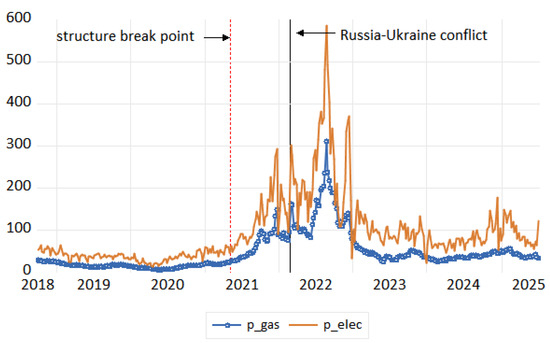
Being the economic locomotive of Europe, Germany is one of the countries most reliant on natural gas for power generation. The outbreak of the Russia–Ukraine conflict beginning in 2022 severely impacted the power market of Europe, especially Germany. As shown in Figure 1, both the German electricity market price and the natural gas price reached their highest levels ever in 2022. Well-functioning electricity markets allow prices to reflect real-time supply and demand, guiding resource allocation. The efficiency of the electricity market is crucial to the energy transition and energy integration of Europe. However, the efficiency of the European electricity market, especially after the Russia–Ukraine conflict, has not yet been thoroughly explored. Using Germany as a research object, this paper attempts to shed some light on this topic by employing the Vector Error Correction Model (VECM) to examine the price dynamics of the German electricity market and then assess the efficiency of the electricity market.
Figure 1.
Time series of prices. and denote the German electricity price and natural gas price, respectively. The two vertical lines indicate the time of the Russia–Ukraine conflict and the structure break point identified by the Bai–Perron test.
Electricity price is influenced by complex market dynamics and external shocks. A core theme in the literature is the marginal pricing role of natural gas. Despite a small share in the generation mix, gas-fired plants often set the wholesale price, driving its level and volatility, especially during peak demand [1]. This effect is nonlinear and asymmetric. Researchers utilize quantile regression to analyze this pass-through effect. They demonstrate that during periods of market distress, the impact of gas prices on electricity prices is significantly stronger at high quantiles. This highlights the tail risk in the electricity price distribution [2,3]. Beyond fuel costs, weather and climate variables exert critical, nonlinear influences. Temperature, wind speed, and precipitation have threshold effects, influencing prices through both demand (e.g., heating/cooling) and supply (renewable generation) [4]. Extreme weather events can trigger price spikes by straining grid infrastructure [5]. Fuel prices, as well as renewable energy factors, explain the volatility of electricity prices [6]. Market structure and design also shape price formation. Studies on price bubbles attribute prolonged explosive periods to monopolistic, unregulated market structures or severe supply crises [7,8]. Furthermore, market integration enhances efficiency and price convergence. Markets like France, Germany, and the Netherlands show high integration, while others like Spain remain distinct, with integration improving efficiency following the coupling reforms [9,10]. Geopolitical and macroeconomic shocks have emerged as paramount factors. The 2021–2022 energy crisis led to unprecedented price surges. This crisis is unequivocally attributed to the weaponization of Russian gas supplies and the post-pandemic economic recovery. Notably, research indicates that it was not caused by the green transition [11].
Natural gas price dynamics are characterized by geopolitical dependency and supply security. Geopolitical conflicts, especially the Russia–Ukraine conflict, and their associated supply fears have been identified as primary drivers of price bubbles and volatility [12,13]. Market fundamentals like storage levels, demand seasonality (heating), and alternative energy output (wind) also play key roles [14]. Europe’s shift from pipeline gas to LNG has prompted the European market to become more globalized and integrated; however, it has also intensified its competition with Asia and Latin America in terms of cargoes. Furthermore, there are long-run equilibrium relationships between gas, electricity, and carbon emission prices [11]. Besides, oil and coal price volatilities significantly increase systemic risk in connected energy markets [15].
The nexus between electricity and natural gas markets is profound and bidirectional, centered on price transmission mechanisms. The dominant channel is cost pass-through in marginal pricing, where gas price shocks instantly and disproportionately affect electricity prices [3]. This vulnerability exists even in countries with a low gas generation share due to market design. However, evidence of reverse causality or bidirectional feedback exists. It is found that power prices Granger cause gas prices in several countries like Germany and France, possibly reflecting the growing influence of renewable generation on system dynamics and gas demand for balancing [14]. Furthermore, a demand-pull effect in the Japanese market is reported, where high electricity prices can pressure market players to secure gas for generation, instantly bidding up gas spot prices due to inelastic short-term demand, creating an instantaneous spillover rather than a delayed cost-based effect [16].
Market efficiency, i.e., the degree to which prices reflect all available information, is assessed through various lenses. Market integration and liberalization are considered key drivers of efficiency gains. Structural reforms such as market coupling have improved efficiency [10]. In contrast, detected price bubbles are signs of inefficiency. The explosive episodes have been linked to market distortions, regulatory failures, or external shocks [7]. Similarly, entropy-based analyses have linked higher energy mix complexity (entropy) to greater systemic risk, suggesting a trade-off between diversification and short-term stability [15]. The 2021–2022 Russia–Ukraine conflict served as a stress test for market design efficiency. Researchers argue that the existing marginal pricing model, while efficient in normal times, exacerbated the crisis by allowing excessive pass-through of gas costs, leading to calls for reforms incorporating more long-term contracts and consumer protections [17,18].
From the above literature, it can be seen that although the gas-to-power price transmission is well-studied, the conditions and magnitude of reverse causality (power-to-gas) require deeper exploration. The finding of this reverse effect needs further validation and a mechanistic explanation [14], particularly regarding the role of rising renewable penetration and its impact on gas demand flexibility and pricing. In addition, most studies on the Russia–Ukraine conflict’s impact focus on price spikes and volatility. A significant gap remains in comprehensively assessing its impact on the long-term efficiency of integrated European electricity and gas markets. Did the crisis temporarily or permanently alter market integration levels, or price convergence dynamics? Some studies provide pre-crisis efficiency baselines, but a post-crisis re-evaluation is needed to understand the resilience and adaptive efficiency of liberalized market designs under sustained systemic stress [10].
This paper aims to fill the research gaps by assessing the market efficiency of the German electricity market from the perspective of the long-term relationship with the natural gas market, as well as the short-run price dynamics. In addition, market efficiency in different periods with respect to the Russia–Ukraine conflict is assessed. Inspired by the literature, we adopt the Johansen cointegration tests to assess the long-run trends among the electricity and natural gas markets and then apply VECM regression to investigate the short-run price dynamics [14]. Considering the huge market shock of the Russia–Ukraine conflict, we study the cointegration relationships and the price dynamics in different subsamples. Our analysis reveals that the efficiency of Germany’s electricity and gas markets deteriorated following the outbreak of the Russia–Ukraine war.
2. Methodology and Data
2.1. Methodology
The primary objective of cointegration testing is to investigate whether a stable, long-run equilibrium relationship exists among two or more non-stationary time series. While individual variables may exhibit stochastic trends, cointegration implies that a specific linear combination of these variables remains stationary, preventing them from diverging indefinitely. The Johansen test has been developed to test the existence and the number of long-run relationships. It offers superior statistical power and the capacity to identify cointegrating vectors. This paper deals with the relationship between the electricity price and the natural gas price. We adopt the Johansen test in line with the literature [19,20].
Let be the two-vector consisting of electricity price and natural gas price. Electricity and gas price series are typically non-stationary, often integrated of order one (I(1)). We therefore begin by specifying a Vector Autoregression Model of order (p + 1), denoted as VAR (p + 1):
where is the 2 × 2 coefficient matrix capturing the influence of lagged values on the current state. is a vector of white noise error terms satisfying standard assumptions.
To explicitly model the long-run equilibrium mechanisms alongside short-run dynamics, we transform the VAR specification into a Vector Error Correction Model (VECM) by applying first differences and re-parameterizing the coefficients:
where , , I is the identity matrix.
Drawing on the theoretical foundations laid by Johansen (1991, 1995) [21,22], the rank r of the matrix determines the number of independent cointegrating relationships within the system. If , it indicates that, although the individual series are non-stationary, there exist r linear combinations that are stationary. These combinations define the long-run equilibrium paths. Economically, this implies a self-correcting mechanism: if external shocks cause prices to deviate from their equilibrium path in the short run, the system inherently generates forces to pull them back. This deviation–correction process is captured by the error correction term. The error term could be corrected gradually according to the short-run adjustment.
The matrix can be decomposed into the product of two matrices, . Each column of represents a distinct cointegrating vector, specifying the weights with which the variables combine to form a stationary long-run relationship. The matrix measures the speed and direction of adjustment. Specifically, it indicates the strength with which each variable reacts to correct deviations from equilibrium in the previous period, thereby restoring long-run balance.
Johansen (1995) [22] proposed a likelihood-based inference procedure to determine the cointegration rank r, utilizing two primary test statistics: the maximum eigenvalue test and the trace test, derived from the eigenvalues of the matrix.
For the maximum eigenvalue test, it evaluates the null hypothesis that there are exactly cointegrating relationships against the alternative hypothesis that there are . The test statistic is constructed as
where is the th largest eigenvalue.
For the trace test, it examines the null hypothesis of at most cointegrating vectors against the alternative of . The test statistic is
2.2. Data
This paper uses weekly data to investigate the relationship between electricity price and natural gas price while controlling for the effects of climate factors, carbon price, and geopolitical risk. We use the German day-ahead electricity price (Germany/Luxembourg bidding zone) obtained from SMARD. For the natural gas price, we use Dutch TTF Natural Gas Futures traded on the Chicago Mercantile Exchange, downloaded from Investing.com. We obtain the carbon price from the International Carbon Action Partnership and geopolitical risk from the database maintained by Caldara and Iacoviello [23].
Following [13], we control for three climate factors: wind speed, precipitation, and temperature. Specifically, wind speed is the wind velocity measured at a height of 10 m using an anemometer. Precipitation is the total depth of rain, snow, sleet, or hail accumulated over a specified period in a given area. Temperature is the ambient air temperature measured at 2 m above ground level. The data on climate factors were downloaded from the Copernicus Data Space Ecosystem. As the German electricity market price is only available from 1 October 2018 and the climate data is updated only up to 30 June 2025, our sample ranges from 1 October 2018 to 30 June 2025, with a total of 353 weekly observations.
The German electricity market price and natural gas price are transformed into the natural logarithm form, denoted with and , respectively. The first difference of the natural log is the return or the growth rate of prices. We use and to denote the returns of electricity price and gas price, respectively. Similarly, we denote the growth rates of carbon price and geopolitical risk with and , respectively. The weekly changes in wind speed, precipitation and temperature are denoted by , , and , correspondingly.
Unit root tests indicate that the two price time series are I(1) processes, while the three climate time series, the growth rate of carbon price, and geopolitical risk are all I(0). Therefore, the two return time series and the five time series of control variables are stationary. Table 1 reports the descriptive statistics for the time series. The average values of and are positive, indicating that the German electricity price tended to have a slightly increasing trend over the sample period, together with the natural gas price. Note that both the magnitudes of the maximum and minimum of are larger than one, suggesting that the electricity market displayed large fluctuations. The large fluctuation is confirmed by the high standard deviation. Regarding the climate factors, the precipitation in Germany has a negative mean, while the temperature has a positive mean, indicating a tendency towards climate warming. In addition, the growth rates of carbon price and geopolitical risk have positive average values, suggesting that both carbon price and geopolitical risk tend to increase over the sample period.
Table 1.
Descriptive statistics.
Table 2 reports the pairwise correlation between the variables. It is found that the electricity market price is positively correlated with the natural gas price, given the positive correlation between and . Another finding is that the electricity market price tends to decrease with wind speed and precipitation, suggesting that a higher renewable energy supply helps reduce the electricity market price with larger wind speeds and precipitation. In addition, the electricity market price positively correlated with carbon price and geopolitical risk level, indicating that carbon price and geopolitical risk played a growing role in influencing electricity market, given the increasing trends of carbon price and geopolitical risk over the sample period. A similar result is also found for the natural gas market.
Table 2.
Pairwise correlation matrix.
Given the two I(1) processes of energy prices, we conduct a cointegration test to examine the potential long-run relationship between the two prices using the technique of Johansen [21,22] and the result is reported in Table 3. Both the trace statistic and the maximum eigenvalue statistic indicate that there is one long-run relationship between the electricity market price and the natural gas price. We name the deviation from the long-run relationship CointEq1.
Table 3.
Johansen cointegration test.
3. Results
In this section, we investigate the relationship between the German electricity market price and the natural gas market using the VECM model. For the specification of the VECM model, the information criterion SIC is utilized to determine the lag order; the optimal lag order, p, is found to be one. Table 4 reports the estimation results. We estimate models both with and without control variables, including climate factors, carbon price, and geopolitical risk, to compare the impact of control variables on the regression results. In both regressions, there is one cointegration relationship between the two prices. The German electricity market price moves together with the gas price in the long run. Regarding the short-run dynamics, an error-correction effect is found in the electricity market. reacts positively to CointEq1, the deviation from the long-run relationship. The response of suggests that the German electricity market price would reduce the deviation in case the electricity market price deviates from the long-run relationship with the natural gas price. The error-correction effect indicates that the electricity market exhibits a certain level of market efficiency in correcting short-run price deviations. However, a similar adjustment is not observed from the natural gas market price, given that the coefficient of CointEq1 in the regression of is insignificant.
Table 4.
VECM estimation result for the whole sample.
Regarding price dynamics, both and are subject to a significant positive effect from the lagged term of . The positive effect on means that the gas price exhibits a momentum pattern. Meanwhile, the electricity market price is subject to the spillover effect from the gas price. According to the efficient market hypothesis of Fama [24], weak-form efficiency requires that historical prices do not impact price formation. Therefore, the short-run price dynamics indicate that both the German electricity market and natural gas market did not satisfy the weak-form market efficiency.
For the effects of control variables, the changes in climate factors do not impact both the natural gas and German electricity markets except for precipitation which negatively influence the German electricity market price. As hydropower is an important component of Germany’s renewable energy system, an increase in precipitation boosts hydropower generation, and, therefore, reduces the electricity market price and subsequently the natural gas price although the effect of on the natural gas market is insignificant. The finding of the negative effect of precipitation is consistent with the literature, such as that of [4].
Carbon price is an important factor in our control variables. It is found that the growth rate of carbon price positively impact both and . The effect is more apparent on the German electricity market price. For power generation companies that rely on fossil fuels, they are required to purchase carbon emission permits. Consequently, the expenditure on carbon emission permits becomes a component of their power generation costs. Therefore, as the carbon price rises, electricity price increases correspondingly.
We also conduct diagnostics tests to ensure the reliability of our estimation. The Ljung–Box test and Breusch–Godfrey LM test are utilized to check the serial correlation of the residuals. As reported in the table, our estimation results pass the diagnostics tests.
Further Analysis with Respect to Russia–Ukraine Conflict
On 24 February 2022, the Russia–Ukraine conflict began, causing a surge in natural gas and electricity prices, as shown in Figure 1. The conflict represents a massive external shock. Consequently, price dynamics and market interactions may differ before and after its onset, especially for Germany, which was the most severely affected country. In view of the potential change in the underlying market logic, we divide the full sample into two subsamples based on 24 February 2022 to explore any differences in the price dynamics and market interactions.
Table 5 reports the estimation result of the first subsample before the conflict. Compared to the baseline result of the full sample, we still find one long-run relationship between the German electricity market and the natural gas market. The electricity price still responds to the short-run deviation by reducing the magnitude of the deviation, exhibiting market efficiency.
Table 5.
VECM estimation result for the first subsample.
The pre-conflict subsample yields several results that differ from the full-sample estimates. The first difference is that the effect of price deviation on turns out to be significant. The natural gas market also displays market efficiency in reducing price deviation from the long-run relationship. The second difference lies in the short-run price dynamics. The lagged term of () imposes a positive (negative) effect on the natural gas price. However, this short-run price dynamics disappear after we include the control variables. Instead, a momentum effect is found in the electricity market, given that the lagged term of has a positive effect on the electricity price. The last difference is related to the control variables. The negative effect of precipitation on is insignificant. Hydropower in Germany did not have an apparent impact on the electricity market. The carbon price also loses its significant effects on both and .
Compared to the first subsample, the estimation result of the second subsample indicates that the efficiency of the two markets has weakened. As reported in Table 6, the effect of price deviation on becomes insignificant. The natural gas price does not adjust to the price deviation from the long-run relationship between the electricity market and the natural gas market. In addition, the natural gas price responds to its lagged term, displaying a momentum pattern. Another difference from the first subsample is that the negative effect of precipitation on becomes significant. An increase in precipitation manages to reduce electricity price. In addition, the positive effect of carbon price on electricity price turns out to be significant. Overall, the estimation result of the full sample is driven by the second subsample, given the consistent results of the two estimations.
Table 6.
VECM estimation result for the second subsample.
Splitting the sample based on the exact date of Russia–Ukraine conflict is intuitive. However, it lacks statistical support. Therefore, as a robustness check, we conduct structural break tests to determine the critical time to divide the sample. Using the Bai–Perron test, the identified break is 3 May 2021, nine months before the outbreak of Russia–Ukraine conflict. Indeed, this break point is reasonable given that in May 2021, there was already news about the coming conflict in the mainstream media (“Inside Putin’s bunker: how he kept the plan to invade Ukraine secret”. The Times. ISSN 0140−0460. Retrieved 13 April 2026). As illustrated in Figure 1, the break point captures the key point of price increase. We re-estimate using 3 May 2021 as a break point to divide the sample. Table 7 and Table 8 report the estimation result for the first and the second subsamples, respectively. It is found that the estimation result using 3 May 2021 is highly consistent with the one using the exact date of Russia–Ukraine conflict.
Table 7.
VECM estimation result for the first subsample using 3 May 2021 as the break point.
Table 8.
VECM estimation result for the second subsample using 3 May 2021 as the break point.
4. Discussion
The empirical findings of this study reveal a complex and evolving relationship between the German electricity and natural gas markets, shaped by both fundamental economic linkages and profound external shocks. Our analysis confirms the existence of a long-run equilibrium relationship between electricity and natural gas prices, a result consistent with the established literature on energy market integration [9]. This cointegration signifies that, despite short-term volatility, the prices of these two critical energy commodities are bound by a common underlying trend, likely driven by the fundamental role of natural gas as the marginal price-setting technology in the European power generation mix [1].
Regarding short-term market efficiency, our results present a nuanced picture. The German electricity market demonstrates a self-correction capability, as evidenced by the significant negative error-correction coefficient. When the electricity price deviates from its long-run equilibrium with the gas price, market forces act to reduce this deviation in subsequent periods. This signals a certain degree of market efficiency within the electricity market. However, a similar error-correction mechanism is not consistently observed for the natural gas price across all sample periods. This asymmetry suggests that while the electricity price adjusts to restore equilibrium with its primary cost driver (gas), the gas market itself may be influenced by a broader, more global set of factors, such as geopolitical supply security and competition for LNG cargoes, that can temporarily decouple it from the local electricity market dynamics.
Short-run price dynamics reveal further inefficiencies. The presence of significant momentum effects—where an increase in the past price predicts future price increases—in the natural gas market, particularly in the full sample and post-conflict period, indicates that historical price information is not fully incorporated into current prices instantaneously. This is a hallmark of markets that have not achieved weak-form efficiency, a conclusion echoed in research on other emerging financial markets like carbon emission trading [25]. The momentum pattern, especially its strengthening after the outbreak of the Russia–Ukraine conflict, points to market overreactions and herding behavior during periods of extreme stress and uncertainty.
Regarding the effect of climate factors, the change in precipitation has a consistent negative impact on the German electricity price. This confirms the established mechanism that increased precipitation boosts hydropower generation, displacing more expensive marginal plants and exerting downward pressure on prices [3,4]. Notably, this effect becomes significant in the post-conflict period, suggesting the marginal value of renewable hydropower for price suppression is magnified during a crisis characterized by scarce and expensive fossil fuels.
The positive impact of carbon price on both electricity and gas prices, with a more pronounced effect on electricity price, highlights the growing importance of carbon price. This aligns with the literature stating that carbon prices influence the relative competitiveness of power generation technologies in the merit order, thereby affecting electricity price formation [1]. The significant effect in the post-conflict subsample suggests that during a gas supply crisis, the carbon cost component of marginal generation becomes more salient, increasing electricity price sensitivity to carbon price fluctuations.
The subsample analysis before and after February 2022 serves as a critical natural experiment, starkly revealing the impact of a systemic geopolitical shock on market functioning. Prior to the conflict, both markets exhibited stronger signs of efficiency: the natural gas price also displayed a significant error-correction response. The outbreak of the conflict fundamentally altered this dynamic. In the post-conflict period, the error-correction mechanism in the gas market vanished, and momentum effects became pronounced. This indicates a severe degradation of market efficiency. The crisis appears to have overwhelmed the normal price discovery and arbitrage mechanisms, with prices becoming more driven by panic, speculative trading, and extreme supply insecurity rather than fundamental cost and demand relationships [8]. This finding aligns with the broader theme in the literature that external shocks can severely undermine the efficiency of even well-established market designs [18].
Our findings provide a direct reference for the ongoing debate on reforming the marginal pricing model in Europe to enhance resilience against geopolitical shocks. The crisis demonstrated that the current design, while efficient in normal times, can excessively transmit gas price volatility, amplified by geopolitical events, to electricity prices, harming consumers and economic stability [17,18]. Our evidence of efficiency loss and momentum effects under stress provides quantitative support for reforms that incorporate more long-term contracts and demand-side flexibility. Such measures can help decouple consumer prices from short-term gas spikes while preserving the merit order’s efficient dispatch signals, thereby strengthening market resilience without sacrificing the benefits of market integration.
5. Conclusions
This study employs cointegration tests and the Vector Error Correction Model (VECM) to investigate the long-run relationship and short-run price dynamics between the German electricity and natural gas markets, with a particular focus on assessing market efficiency before and after the Russia–Ukraine conflict. The empirical results reveal a stable long-run equilibrium between the two markets. This cointegration signifies that, despite short-term volatility, the prices of electricity and its primary marginal fuel are bound by a common underlying trend.
Regarding market efficiency, the findings present a nuanced and evolving picture. The German electricity market consistently demonstrates a self-correction capability, as evidenced by the significant negative error-correction coefficient. This indicates a certain degree of market efficiency, where deviations from the long-run equilibrium are gradually corrected. However, a similar error-correction mechanism is not consistently observed for the natural gas price. More critically, the subsample analysis reveals a significant deterioration in market efficiency following the outbreak of the Russia–Ukraine conflict. In the pre-conflict period, both markets exhibited stronger signs of efficiency, with the natural gas price also displaying a significant error-correction response and fewer momentum effects. With the outbreak of the Russia–Ukraine conflict in 2022, this adjustment mechanism in the gas market vanished, and momentum patterns became more pronounced. This indicates that the extreme geopolitical shock overwhelmed normal price discovery mechanisms, leading to a market where prices were more driven by panic, speculation, and supply insecurity than by fundamental cost relationships.
The presence of significant momentum effects, where an increase in past price predicts future price increments, particularly in the post-conflict period, is a hallmark of markets that have not achieved weak-form efficiency. Additionally, the significant influence of precipitation on electricity prices underscores the growing complexity of market drivers in an energy system with increasing renewable penetration.
The significant influence of carbon price on both electricity and gas prices, particularly in the post-crisis period, underscores its role as a critical cost component. As carbon prices rise, they increase the marginal cost of fossil fuel-based power generation, which is directly transmitted to wholesale electricity prices. This finding aligns with the literature on the merit-order effect and confirms that carbon pricing is an increasingly important factor in price formation.
In conclusion, while the German electricity and gas markets are integrated in the long run, their short-term efficiency is fragile and susceptible to major systemic shocks. The Russia–Ukraine conflict acted as a catalyst, significantly degrading market efficiency, particularly in the natural gas sector. This finding carries important policy implications. It suggests that while liberalized market designs may function efficiently under normal conditions, they require enhanced resilience mechanisms to maintain stability during crises. Policy reforms should consider tools to mitigate extreme volatility, improve transparency in fuel supply markets, and accelerate the deployment of renewables to reduce structural dependency. Future research should continue to monitor whether this efficiency loss is transitory or signifies a more permanent shift, and should explore the microstructural drivers of the observed momentum and bubble-like behaviors during periods of distress.
Author Contributions
Conceptualization, H.X. and Y.G.; methodology, Y.H. and Z.C.; software, Z.W. and Z.C.; data curation, J.Z.; writing—original draft preparation, H.X., Y.H., Z.W., J.Z., Y.G. and Z.C.; and writing—reviewing and editing, Y.G. and Z.C. All authors have read and agreed to the published version of the manuscript.
Funding
This research received no external funding.
Data Availability Statement
The data presented in this study are available on request from the corresponding author. The data are not publicly available due to the need for further relevant research.
Conflicts of Interest
Authors Hongyan Xin, Yan Huang, Zhengdong Wan and Jingsong Zhang were employed by the company Energy Development Research Institute, China Southern Power Grid. The remaining authors declare that the research was conducted in the absence of any commercial or financial relationships that could be construed as potential conflicts of interest.
References
- Zakeri, B.; Staffell, I.; Dodds, P.E.; Grubb, M.; Ekins, P.; Jskelinen, J.; Cross, S.; Helin, K.; Castagneto Gissey, G. The role of natural gas in setting electricity prices in Europe. Energy Rep. 2023, 10, 2778–2792. [Google Scholar] [CrossRef] [Scilit]
- Mosquera-López, S.; Uribe, J.M.; Manotas-Duque, D.F. Nonlinear empirical pricing in electricity markets using fundamental weather factors. Energy 2017, 139, 594–605. [Google Scholar] [CrossRef] [Scilit]
- Uribe, J.M.; Mosquera-Lopez, S.; Arenas, O.J. Assessing the relationship between electricity and natural gas prices in European markets in times of distress. Energy Policy 2022, 166, 113018. [Google Scholar] [CrossRef] [Scilit]
- Mosquera-Lopez, S.; Uribe, J.M.; Joaqui-Barandica, O. Weather conditions, climate change, and the price of electricity. Energy Econ. 2024, 137, 107789. [Google Scholar] [CrossRef] [Scilit]
- Mert Saritas, M.; Konat, G.; Dalyanci, L.; Yilanci, V. An Empirical Investigation of Explosive Price Behavior in U.S. State-Level Electricity Markets Across Consumer Segments. Energies 2025, 18, 5689. [Google Scholar] [CrossRef] [Scilit]
- Gianfreda, A.; Ravazzolo, F.; Rossini, L. Large Time-Varying Volatility Models for Hourly Electricity Prices. Oxf. Bull. Econ. Stat. 2023, 85, 545–573. [Google Scholar] [CrossRef] [Scilit]
- Gupta, R.; Inglesi-Lotz, R. Detection of multiple bubbles in South African electricity prices. Energy Sources Part B Econ. Plan. Policy 2016, 11, 637–642. [Google Scholar] [CrossRef] [Scilit]
- Doran, N.M.; Manta, A.G.; Bădîrcea, R.M.; Berceanu, D.; Băndoi, A.; Badareu, G. Electricity Price Bubbles and Global Crisis: Does Financial Development Make a Difference? Energy J. 2025, 46, 179–202. [Google Scholar] [CrossRef] [Scilit]
- Bosco, B.; Parisio, L.; Pelagatti, M.; Baldi, F. Long-run relations in European electricity prices. J. Appl. Econom. 2010, 25, 805–832. [Google Scholar] [CrossRef] [Scilit]
- Karahan, C.C.; Odabasi, A.; Tiryaki, C.S. Wired together: Integration and efficiency in European electricity markets. Energy Econ. 2024, 133, 107505. [Google Scholar] [CrossRef] [Scilit]
- Emiliozzi, S.; Ferriani, F.; Gazzani, A. The European energy crisis and the consequences for the global natural gas market. Energy J. 2025, 46, 119–145. [Google Scholar] [CrossRef] [Scilit]
- Su, C.W.; Qin, M.; Chang, H.L.; Ran, A.M. Which risks drive European natural gas bubbles? Novel evidence from geopolitics and climate. Resour. Policy 2023, 81, 103381. [Google Scholar] [CrossRef] [Scilit]
- Cincinelli, P.; Pellini, E. The role of geopolitical and climate risk in driving uncertainty in European electricity markets. Energy Econ. 2025, 144, 108276. [Google Scholar] [CrossRef] [Scilit]
- Hudak, M. The European Gas Market Integration During 2018–2024. Comput. Econ. 2025. [Google Scholar] [CrossRef] [Scilit]
- Orozco-Ceron, O.W.; Joaqui-Barandica, O.; Manotas-Duque, D.F. Using Markov Chains and Entropy to Explain Value at Risk in European Electricity Markets. J. Risk Financ. Manag. 2025, 18, 591. [Google Scholar] [CrossRef] [Scilit]
- Rassi, S.; Kanamura, T. Electricity price spike formation and LNG prices effect under gross bidding scheme in JEPX. Energy Policy 2023, 177, 113552. [Google Scholar] [CrossRef] [Scilit]
- Fabra, N. Reforming European electricity markets: Lessons from the energy crisis. Energy Econ. 2023, 126, 106963. [Google Scholar] [CrossRef] [Scilit]
- Pollitt, M.G.; von der Fehr, N.H.M.; Willems, B.; Banet, C.; Le Coq, C.; Chyong, C.K. Recommendations for a future-proof electricity market design in Europe in light of the 2021–23 energy crisis. Energy Policy 2024, 188, 114051. [Google Scholar] [CrossRef] [Scilit]
- Charles, A.; Darné, O.; Fouilloux, J. Market efficiency in the European carbon markets. Energy Policy 2013, 60, 785–792. [Google Scholar] [CrossRef] [Scilit]
- Tang, B.; Shen, C.; Gao, C. The efficiency analysis of the European CO2 futures market. Appl. Energy 2013, 112, 1544–1547. [Google Scholar] [CrossRef] [Scilit]
- Johansen, S. Estimation and Hypothesis Testing of Cointegration Vectors in Gaussian Vector Autoregressive Models. Econometrica 1991, 59, 1551–1580. [Google Scholar] [CrossRef] [Scilit]
- Johansen, S. Likelihood-Based Inference in Cointegrated Vector Autoregressive Models; Oxford University Press: Oxford, UK, 1995. [Google Scholar]
- Caldara, D.; Iacoviello, M. Measuring geopolitical risk. Am. Econ. Rev. 2022, 112, 1194–1225. [Google Scholar] [CrossRef] [Scilit]
- Fama, E.F. Efficient capital markets: A review of theory and empirical work. J. Financ. 1970, 25, 383–417. [Google Scholar] [CrossRef] [Scilit]
- Wu, L.; Huang, Y.; Gu, Y. Fragmented or Unified? The State of China’s Carbon Emission Trading Market. Energies 2023, 16, 2470. [Google Scholar] [CrossRef] [Scilit]

Disclaimer/Publisher’s Note: The statements, opinions and data contained in all publications are solely those of the individual author(s) and contributor(s) and not of MDPI and/or the editor(s). MDPI and/or the editor(s) disclaim responsibility for any injury to people or property resulting from any ideas, methods, instructions or products referred to in the content. |
© 2026 by the authors. Licensee MDPI, Basel, Switzerland. This article is an open access article distributed under the terms and conditions of the Creative Commons Attribution (CC BY) license.