


Abstract
Photovoltaic (PV) arrays frequently operate under non-uniform environmental conditions, including partial shading, dust accumulation, and temperature differences across the array. These factors introduce an electrical mismatch among PV modules, considerably reducing overall power output. This study proposes a self-healing reconfiguration strategy that mitigates mismatch losses by dynamically redistributing PV modules across array strings based on irradiance levels. The main goal is to balance the current generation among strings and demonstrate performance improvements within scenarios characterised by highly uneven irradiance patterns under non-uniform operating conditions. The effectiveness of the proposed method is evaluated through simulations conducted using MATLAB R2025b (MathWorks, Natick, MA, USA) under several environmental scenarios. Deterministic shading patterns—including row shading, column shading, diagonal shading, and irregular dust distributions—are first analysed to investigate the behaviour of the PV array under regulated conditions. In addition, a statistical analysis of 100 randomly generated irradiance scenarios is carried out to assess the method’s robustness. Finally, realistic desert-dust patterns representative of environmental conditions in Saudi Arabia are used to evaluate the practical usefulness of the proposed approach. Simulation findings show that the self-healing reconfiguration strategy reduces mismatch effects and improves current balance within the PV array, enabling operation closer to the optimal power point under non-uniform irradiance conditions. These results indicate that the proposed method boosts current balance among PV strings and increases power extraction under strongly non-uniform irradiance scenarios.
1. Introduction
Photovoltaic (PV) technology has become one of the most rapidly expanding renewable energy sources due to its sustainability, modularity, and decreasing installation costs. Large-scale photovoltaic installations are increasingly deployed in regions with high solar potential, particularly in desert environments in which solar radiation is abundant. However, despite the favourable solar resource in such regions, PV systems frequently operate under non-uniform environmental conditions that can greatly affect their electrical performance [1,2].
In practical operating environments, PV modules rarely receive identical irradiance levels. Variations in solar radiation may occur due to partial shading from nearby objects, uneven dust accumulation, or localised temperature differences across the array. These spatial differences cause different modules within the PV array to generate unequal current levels, which leads to electrical mismatch losses. Because PV modules within the same string are electrically connected in series, the operating current of the entire string becomes constrained by the module producing the lowest current. As a result, the overall power output of the PV array may be substantially reduced under non-uniform operating conditions [2,3,4].
The mismatch problem is especially important in desert environments, where dust deposition on PV module surfaces can reduce the effective irradiance reaching the solar cells. Dust accumulation is often irregular and depends on wind patterns, terrain characteristics, and climatic conditions. Consequently, different modules within the same PV array may experience varying levels of irradiance reduction, further intensifying the mismatch effect [5,6,7,8,9,10,11]. In areas such as Saudi Arabia and other arid climates, dust-related performance degradation has been identified as a major operational challenge for large photovoltaic installations [12,13,14]. Recent studies (2021–2025) have further confirmed that such non-uniform dust accumulation significantly intensifies mismatch effects and reduces system efficiency [15,16,17].
Although various methods have been proposed to mitigate mismatch losses in photovoltaic arrays, many of these approaches depend on complex optimisation procedures or require additional hardware at the module level. Such requirements may limit their applicability in large-scale installations. Consequently, there is a need for a practical and computationally efficient reconfiguration approach that can improve the electrical balance of PV arrays operating under non-uniform environmental conditions.
1.1. Problem Statement
Conventional photovoltaic arrays are typically configured using fixed series–parallel electrical connections. Under uniform environmental conditions, this configuration permits PV systems to operate efficiently and produce stable electrical output. However, when environmental disturbances introduce non-uniform irradiance across the array, the fixed electrical configuration becomes vulnerable to mismatch losses.
When modules within the same string receive different irradiance levels, the module producing the lowest current limits the current flow of the entire string. As a result, higher-performing modules are forced to operate below their optimal operating points. This phenomenon reduces the overall electrical efficiency of the PV array and limits the amount of energy that can be extracted from the system [2,3,4].
Such mismatch effects become increasingly pronounced in large photovoltaic installations where climatic conditions vary spatially across the PV field. Partial shading from nearby objects, dust accumulation on module surfaces, and localised heat gradients can produce complex irradiance distributions throughout the PV array. These conditions highlight the need for strategies to mitigate mismatch losses and improve electrical balance among PV modules.
1.2. Related Work
Several techniques have been proposed in the literature to reduce mismatch losses in photovoltaic systems functioning under partial shading or non-uniform irradiance conditions.
One widely adopted solution is the maximum power point tracking (MPPT) algorithm. MPPT controllers continuously adjust the PV system’s operating voltage to track the maximum available power under shifting environmental conditions [1,18,19].
Although MPPT algorithms can improve the overall energy extraction from PV systems, they cannot eliminate mismatch losses when individual modules operate under significantly different irradiance levels. MPPT methods primarily optimise the operating point of the entire array but do not address the internal electrical imbalance among modules within different strings.
Another approach is to use module-level power electronics, such as power optimisers or microinverters. These devices allow individual PV modules to operate closer to their optimal power points, thereby reducing the impact of shading and mismatch losses. However, implementing module-level electronics generally increases system cost, complexity, and maintenance requirements, which may limit their suitability in large-scale photovoltaic installations.
More recently, PV array reconfiguration techniques have attracted considerable research attention as an alternative solution for mitigating mismatch losses. These techniques modify the electrical interconnections among PV modules to redistribute modules with different irradiance levels across multiple strings. Various reconfiguration strategies have been proposed, including optimisation-based methods, puzzle-based interconnection patterns, and heuristic search algorithms [20,21,22,23,24,25,26].
Several studies have demonstrated that appropriately redistributing shaded modules across the array can improve the electrical balance among strings and increase the overall power output under partial shading conditions [27,28,29,30,31,32,33,34]. Nevertheless, many existing methods rely on complex optimisation procedures or require additional hardware implementation, which may increase system complexity.
1.3. Research Contribution
To address the limitations of existing approaches, this study puts forward a self-healing reconfiguration strategy for photovoltaic arrays operating under non-uniform irradiance and temperature conditions.
The core concept of the proposed method is to redistribute PV modules across available strings based on their irradiance levels. By allocating modules with varying irradiance across multiple strings, the strategy tries to balance current production and reduce mismatch losses within the array.
Unlike many existing reconfiguration approaches that rely on iterative optimisation algorithms (e.g., genetic algorithms [26] and particle swarm optimisation [29]) or fixed puzzle-based interconnection patterns (e.g., Su Do Ku [22] and magic square [24,25]), the proposed self-healing strategy follows a simpler and more direct mechanism based on sorting and allocation.
The method does not involve iterative convergence, population-based search, or predefined interconnection templates. Instead, PV modules are redistributed deterministically according to their irradiance levels. This results in a computational complexity of O(n log n), where n denotes the total number of modules.
Owing to this reduced computational burden, the proposed approach is well-suited for practical and potentially real-time implementation within PV monitoring and control systems.
The main contributions of this work are summarised as follows:
- Development of a self-healing PV array reconfiguration strategy capable of mitigating mismatch losses under non-uniform environmental conditions.
- Formulation of a mathematical model to represent irradiance distribution across PV arrays and evaluate current imbalance among strings.
- Implementation of a MATLAB-based simulation framework to evaluate the proposed method under deterministic shading scenarios, statistical irradiance distributions, and realistic desert dust patterns.
- Demonstration that the proposed approach improves current balance within the PV array and increases overall power extraction under non-uniform irradiance conditions.
The remainder of this paper is structured as follows: Section 2 presents the modelling of the photovoltaic array; Section 3 details the proposed self-healing reconfiguration strategy; Section 4 discusses simulation results and performance evaluation under diverse environmental scenarios; Section 5 compares the proposed method with conventional PV operation approaches; and Section 6 provides the conclusion.
2. Photovoltaic Array Modelling
2.1. Electrical Behaviour of PV Modules
A photovoltaic module converts solar radiation into electric energy through the photoelectric effect occurring inside semiconductor p–n junctions. To analyse the electrical behaviour of PV systems under different environmental conditions, equivalent electrical circuit models are commonly used to represent the nonlinear current–voltage characteristics of PV devices [35,36]. In this study, the PV module parameters used in the simulations are based on a typical 60-cell silicon module operating under standard test conditions (STC).
The current output of a PV module can be expressed as
where
= output current of the PV module
= photocurrent generated by solar irradiance
= diode current
= is the shunt current.
The generated photocurrent depends mainly on the incident solar radiation and the cell operating temperature and can be approximated by
where
= solar irradiance
= reference irradiance (1000 W/m2)
= cell temperature
= reference temperature
= temperature coefficient.
Equations (1) and (2) demonstrate that PV module performance is strongly influenced by environmental conditions. Variations in irradiance and temperature across modules may therefore produce unequal current levels within the PV array.
2.2. PV Array Electrical Configuration
In practical installations, PV modules are interconnected in series and parallel configurations in order to obtain the desired voltage and power levels [35]. For an array consisting of modules in series and parallel strings, the array voltage and current can be expressed as
The total electrical power generated by the PV array becomes
Under uniform irradiance conditions, all modules operate with similar electrical characteristics, allowing the PV array to produce stable power output. However, in real environments, PV modules often experience different irradiance levels, leading to electrical mismatch within the array.
3. Methodology
3.1. Current Limitation and Mismatch Mechanism
Modules connected in series must carry identical current. Consequently, the operating current of a PV string is determined by the module generating the lowest current.
Let the currents produced by modules within a string be . The effective string current becomes
When irradiance conditions vary across modules
which results in unequal current generation
This unevenness introduces mismatch losses, reducing the PV array’s overall power output.
3.2. Irradiance Distribution Representation
To analyse spatial irradiance changes across the photovoltaic (PV) array, the irradiance distribution can be represented as a matrix. For a PV array consisting of rows and columns of modules, the irradiance distribution over the array can be expressed as
where represents the solar irradiance incident on the module located at row and column of the PV array.
The current generated by each module can then be approximated as
where is the current produced by the module located at row and column , represents the incident irradiance on that module, and is a proportional constant determined by the electrical characteristics of the photovoltaic module.
The linear relationship expressed by Equation (10) is a well-established simplification widely adopted in PV mismatch and reconfiguration analyses [35,36,37]. Although the electrical behaviour of photovoltaic modules is governed by a nonlinear single-diode equation, the photocurrent component dominates the module’s output current under normal operating conditions. Near the maximum power point, the diode current and resistive losses constitute a relatively small fraction of the total generated current, and the module current is approximately proportional to the incident irradiance. This proportionality holds with reasonable accuracy across a broad range of operating irradiance levels (200–1000 W/m2), as demonstrated in the modelling studies of [35,36]. Adopting this linearised representation enables tractable analytical evaluation of the reconfiguration strategy while preserving the dominant irradiance-dependent behaviour that drives mismatch losses among PV modules.
3.3. Proposed Self-Healing Reconfiguration Method
The proposed strategy redistributes PV modules across strings according to their irradiance levels. Instead of concentrating low-irradiance modules into a single string, the algorithm distributes them across multiple strings to balance current generation.
3.4. Objective Function
Let the current produced by string be . The average string current is
The objective of the reconfiguration process is to minimise the current deviation among strings
while maximising array power
Therefore, the algorithm seeks a configuration that simultaneously balances string currents and maximises the total power output of the photovoltaic system.
System Architecture
The proposed self-healing reconfiguration framework comprises several functional components for irradiance measurement, electrical modelling, optimisation, and system control. The operational workflow of the system can be summarised as follows:
- Irradiance SensorsMeasure the real-time solar irradiance across the photovoltaic (PV) modules.
- Irradiance ProcessingProcess the measured data to generate an irradiance distribution used for system analysis.
- PV Electrical ModelEstimate the electrical behaviour of each PV module, including the generated current and power.
- Reconfiguration Engine (Self-Healing Algorithm)Determine the optimal redistribution of PV modules across the available strings in order to mitigate mismatch losses and improve energy extraction.
- Switching/Connection Control MatrixImplement the reconfiguration decision by controlling the electrical connections between modules and strings.
- Power EvaluationEvaluate the resulting output power to assess the effectiveness of the proposed reconfiguration strategy.
Within this system, irradiance measurements are collected and processed to characterise the environmental conditions affecting the PV modules. The PV electrical model estimates each module’s electrical performance under these conditions. The reconfiguration engine then determines the optimal module-to-string arrangement to minimise mismatch losses. The switching control matrix implements the new configuration, and the resulting output power is evaluated to assess the effectiveness of the proposed approach.
3.5. Reconfiguration Algorithm
The proposed self-healing reconfiguration algorithm redistributes photovoltaic (PV) modules across array strings based on their irradiance levels to improve current balance and lessen mismatch losses. The algorithm runs through the following steps:
- Measure the irradiance distribution over the PV array.
- Estimate the current generated by each module using Equation (10).
- Rank modules according to their estimated current values.
- Assign modules iteratively to the string with the lowest accumulated current to balance string currents.
- Compute the resulting array power and accept the new configuration if the obtained power exceeds that of the conventional configuration.
The algorithm’s processing complexity is dominated by the sorting operation, resulting in an approximate complexity of O(n log n), where n is the total number of PV modules. The redistribution step involves simple allocation operations with linear complexity, allowing the proposed method to be implemented efficiently in real-time PV monitoring and control systems.
In practical deployment, the reconfiguration algorithm is not intended to operate continuously but rather to be triggered either at predefined monitoring intervals (typically aligned with irradiance sampling periods of 1–15 min) or upon detection of significant changes in the irradiance distribution across the PV array. Given the algorithm’s computational complexity of O(n log n), the reconfiguration decision can be computed within milliseconds for typical array sizes (e.g., fewer than 10 ms for a 100-module array on a standard embedded microcontroller), making it fully compatible with real-time PV monitoring and control systems.
To avoid unnecessary switching operations under near-uniform irradiance conditions, a decision threshold mechanism is recommended for practical implementation. Specifically, reconfiguration is activated only when the coefficient of variation (CV) of the measured module irradiance levels exceeds a predefined threshold (e.g., CV > 0.15). Below this threshold, the conventional fixed configuration is retained, as mismatch losses are expected to be minimal. This threshold-based triggering ensures that the reconfiguration is applied selectively, maximising the benefit of module redistribution while minimising unnecessary switching wear and transient losses.
3.6. Illustrative Physical Example
To illustrate the concept of the proposed strategy, consider a simple photovoltaic (PV) array consisting of six modules are arranged into two strings, with three modules connected in series in each string.
The irradiance levels of the modules are given by
3.6.1. Conventional Configuration
- String 1: {1000, 1000, 1000}
- String 2: {400, 400, 400}
In this configuration, the second string receives significantly lower irradiance, which results in reduced current generation. Because modules connected in series must operate at the same current, modules experiencing lower irradiance limit the current of their corresponding string. Consequently, the second string produces less electrical power, reducing the overall power output of the PV array.
3.6.2. Reconfigured Arrangement
- String 1: {1000, 400, 1000}
- String 2: {1000, 400, 400}
In the reconfigured arrangement, modules operating under high and low irradiance levels are distributed across both strings. This redistribution improves the current-generation balance between strings and reduces mismatch losses within the PV array. As a result, the electrical operating conditions become more balanced, allowing the PV system to generate higher total power under uneven irradiance conditions.
3.7. Simulation Framework
A simulation framework was developed to evaluate the effectiveness of the proposed self-healing reconfiguration strategy under different irradiance conditions. The simulated PV array consists of 25 modules arranged in a 5 × 5 configuration, forming five parallel strings, each with five modules connected in series.
The 5 × 5 array configuration was selected as a representative moderate-scale arrangement that provides sufficient complexity to demonstrate the reconfiguration strategy while remaining computationally tractable for comprehensive statistical evaluation across 100 scenarios. This configuration is widely adopted as a standard benchmark in the PV reconfiguration literature [21,22,25,26], which facilitates direct comparison with previously published results. The proposed method is generalisable to other array dimensions and series–parallel ratios, and evaluation across different configurations is identified as a direction for future work.
In the simulation environment, the photovoltaic array is represented as a series–parallel configuration, with each module assigned an irradiance value corresponding to the environmental scenario under investigation. The electrical current produced by each module is estimated using the PV model described in Section 2.
The performance of the PV array is evaluated by computing the following parameters:
- current produced by each module
- current of each string
- array voltage
- total generated power
The proposed reconfiguration algorithm is then applied to redistribute modules across strings in order to reduce the current imbalance. The resulting array performance is compared with that of the conventional fixed configuration.
This simulation framework makes it possible for the photovoltaic system to be analysed under a variety of environmental conditions, including:
- deterministic shading patterns
- randomly generated irradiance distributions
- realistic desert dust accumulation scenarios
3.8. Practical Implementation Considerations
The practical realisation of the proposed self-healing reconfiguration strategy requires a switching matrix capable of reassigning individual PV modules to different electrical strings. Such switching matrices can be implemented using electromechanical relays, solid-state switches (e.g., MOSFETs or IGBTs), or a combination thereof. Relay-based matrices offer lower on-state resistance and lower cost for moderate-scale arrays, while solid-state solutions provide faster switching speeds and longer operational lifetimes, which may be preferred for installations requiring frequent reconfiguration [4,20].
The control architecture consists of distributed irradiance sensors (one per module or one per string), a central processing unit that executes the sorting-and-allocation algorithm, and a communication interface to the switching matrix. Given the algorithm’s computational complexity of O(n log n), the entire reconfiguration decision can be computed within milliseconds on standard embedded microcontrollers (e.g., ARM Cortex-M series), making the system suitable for integration with existing PV monitoring platforms. The communication between sensors and the controller can be implemented via wired (e.g., RS-485, CAN bus) or wireless (e.g., Zigbee, LoRa) protocols, depending on the installation scale and layout.
4. Results and Discussion
The effectiveness of the proposed self-healing reconfiguration strategy was tested through a series of simulations that modelled realistic environmental conditions affecting photovoltaic systems. In practical PV installations, environmental disturbances rarely occur in purely random forms. Instead, shading and irradiance variations typically follow identifiable spatial patterns depending on surrounding structures, terrain characteristics, and environmental conditions.
For example, nearby buildings or mounting structures may cast shadows throughout entire rows of modules, while vertical obstacles such as poles or nearby equipment may produce column-type shading patterns. In addition, irregular dust accumulation may create non-uniform irradiance distributions throughout the photovoltaic field. These disturbances introduce an electrical imbalance among PV modules and often lead to mismatch losses that reduce the array’s power extraction capability [2,3].
To investigate the performance of the proposed reconfiguration strategy under these conditions, several representative irradiance scenarios were considered. The analysis was divided into four main evaluation stages:
- Illustrative physical example
- Deterministic shading patterns
- Statistical performance analysis
- Realistic desert dust scenarios
For each scenario, the electrical behaviour of the PV array was analysed under two configurations:
- Conventional fixed electrical configuration
- Proposed self-healing reconfiguration strategy
The comparison between these two configurations clearly demonstrates the effectiveness of the proposed approach in mitigating mismatch losses. For each case study, the following results were analysed:
- irradiance distribution maps across the PV array
- array power–voltage (P–V) characteristics
These findings offer important insights into how the proposed reconfiguration strategy modifies the electrical interactions between PV modules and improves overall energy extraction from the array.
4.1. Illustrative Physical Example
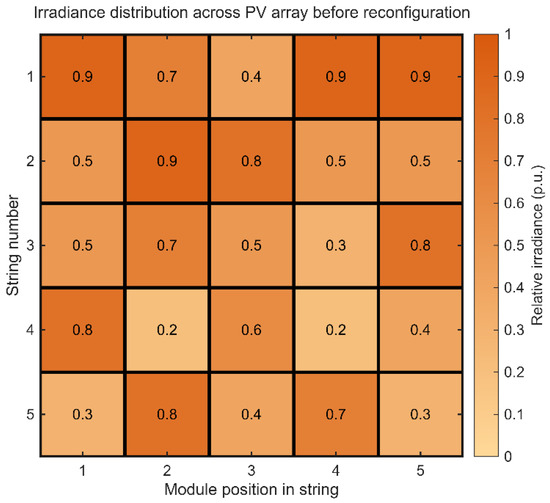
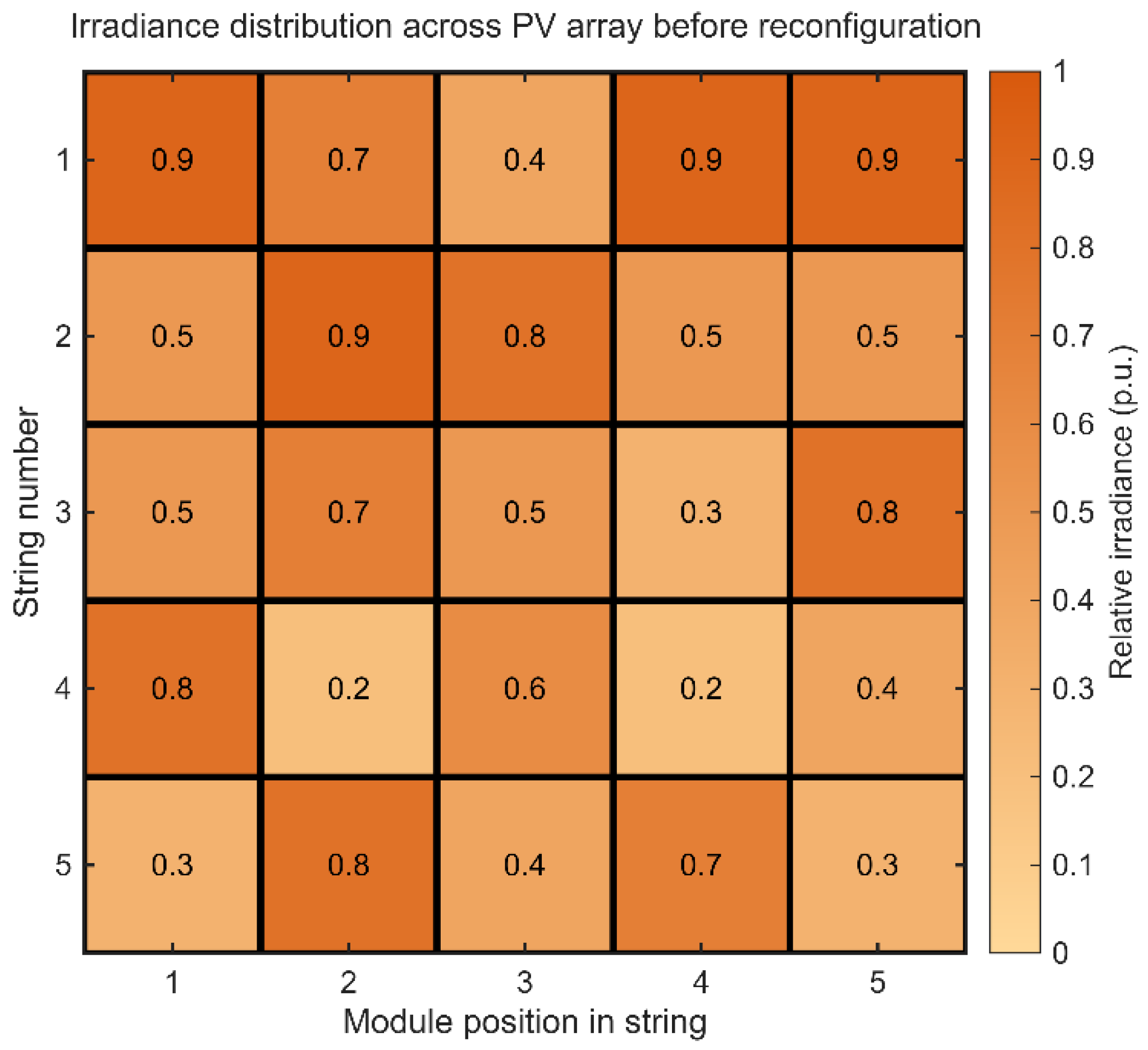
To provide a clear physical interpretation of the proposed self-healing reconfiguration strategy, an illustrative example was first analysed. This example demonstrates how non-uniform irradiance across a photovoltaic (PV) array creates an electrical imbalance among modules and how the proposed reconfiguration approach lessens this imbalance. Figure 1 illustrates the irradiance distribution over the PV array before the proposed reconfiguration strategy is applied.
Figure 1.
Irradiance distribution across the PV array before applying the proposed self-healing reconfiguration strategy.
In the conventional electrical configuration, modules operating at lower irradiance levels generate lower current. Because modules connected in series must carry the same current, these low-current modules constrain the operating current of the entire string. Consequently, modules receiving higher irradiance are forced to operate away from their optimal operating points, which reduces the overall power output of the PV array [2].
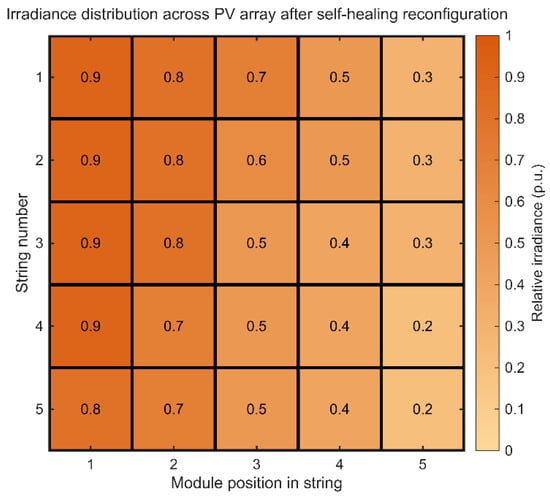
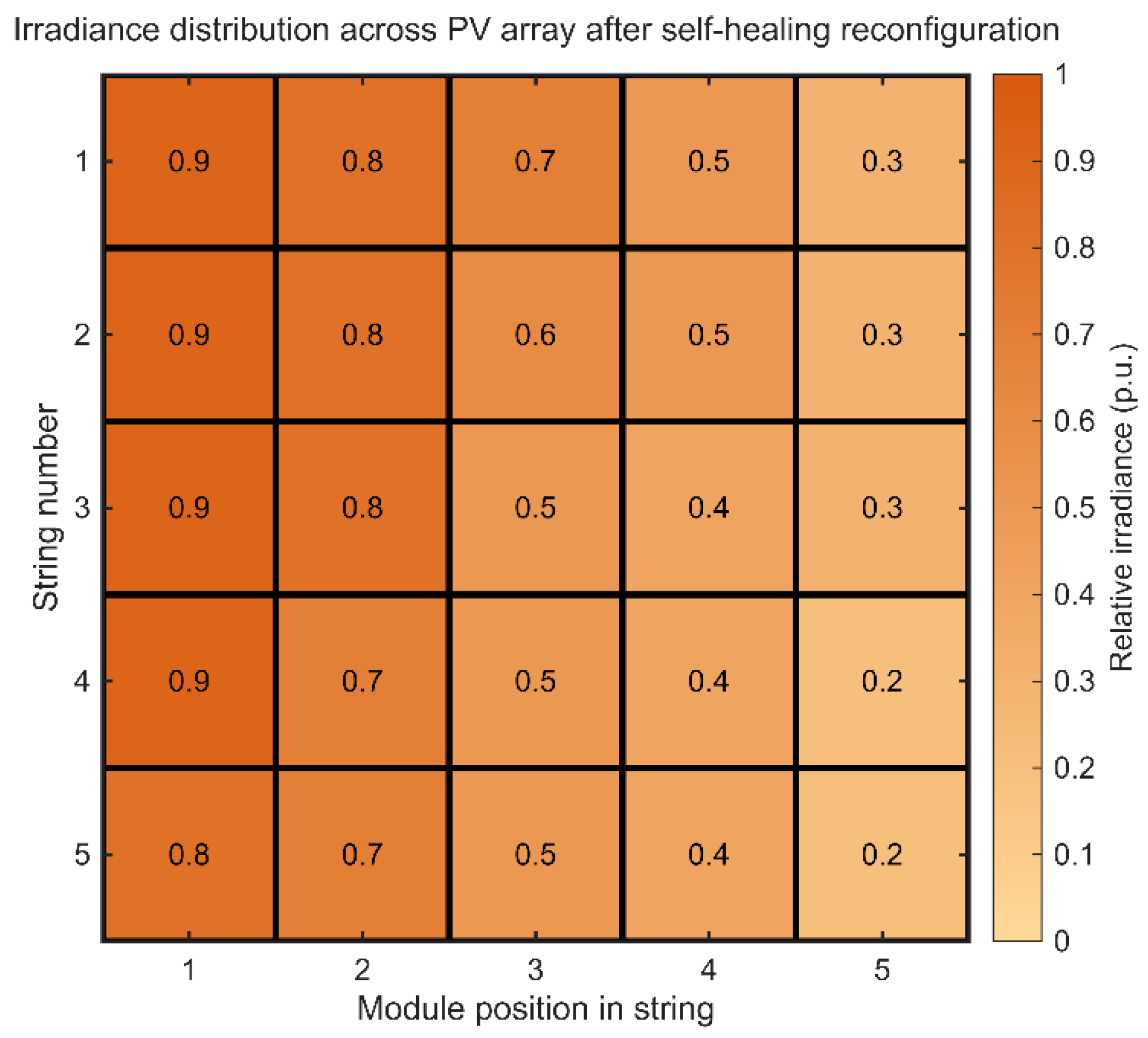
After applying the proposed self-healing reconfiguration strategy, the modules are redistributed across the electrical strings according to their irradiance levels. This redistribution results in a more balanced electrical configuration across the array, as illustrated in Figure 2.
Figure 2.
Irradiance distribution over the PV array after applying the proposed self-healing reconfiguration strategy.
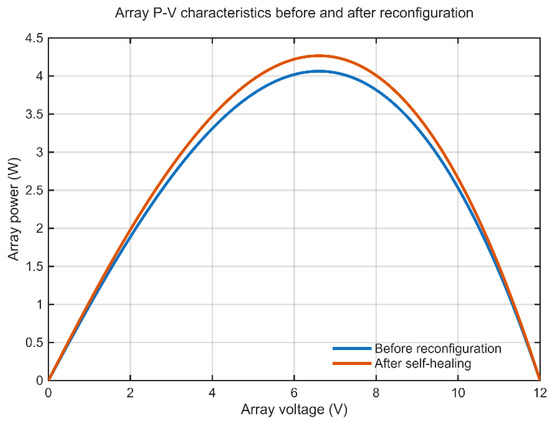
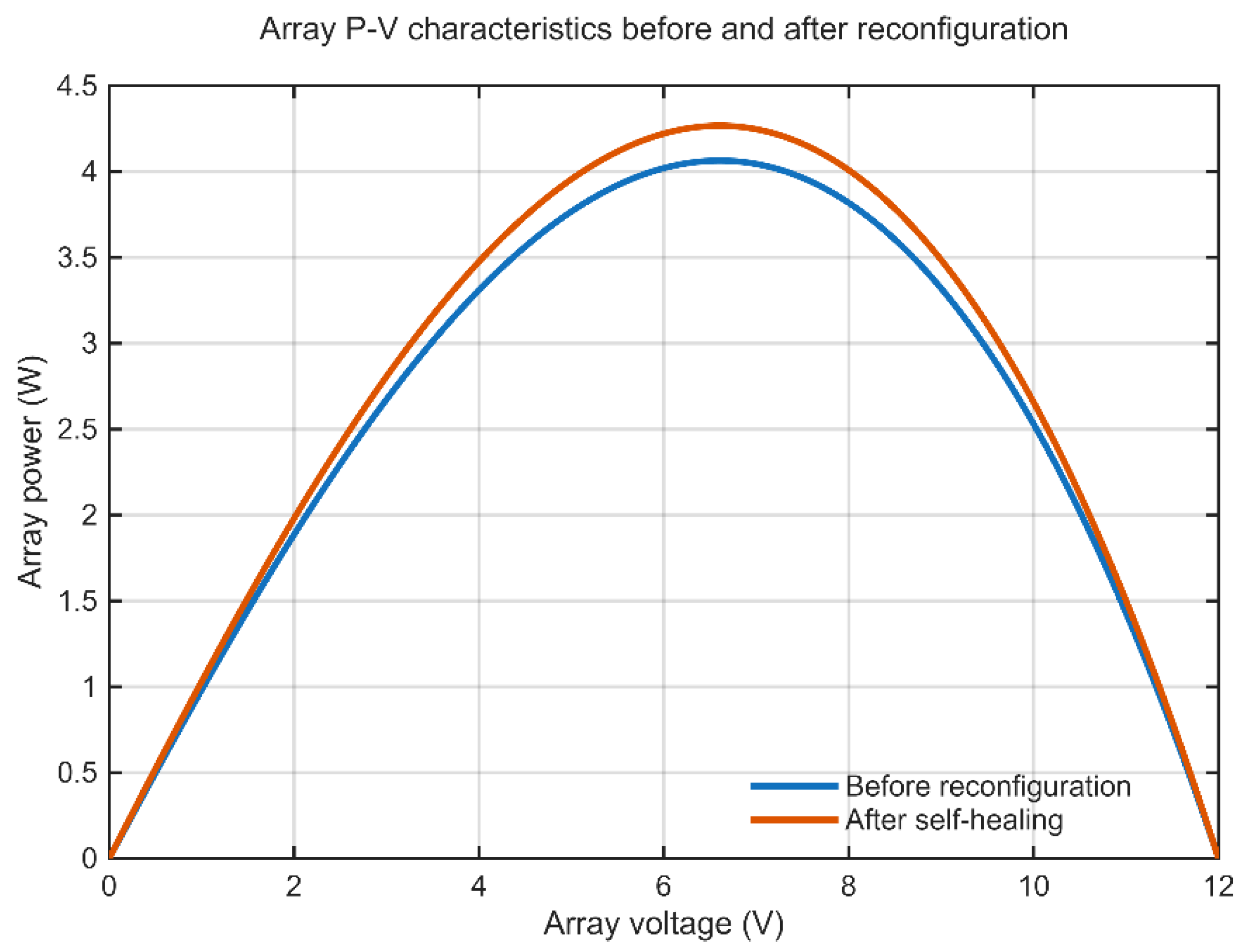
By distributing modules with lower irradiance more evenly along the strings, the electrical imbalance between strings is reduced. This redistribution improves current sharing among strings and mitigates mismatch losses caused by non-uniform irradiance. The electrical impact of this improvement is evident in the array power–voltage (P–V) characteristics shown in Figure 3.
Figure 3.
Array power–voltage (P–V) characteristics before and after applying the proposed self-healing reconfiguration strategy.
As shown in the figure, the conventional configuration produces a lower maximum power point due to the mismatch introduced by the uneven irradiance distribution. After applying the proposed reconfiguration strategy, the PV array operates at a higher maximum power point, reflecting better energy extraction from the photovoltaic system.
This illustrative example shows that the proposed self-healing reconfiguration strategy improves the electrical balance of the PV array and improves its power generation capability under non-uniform irradiance conditions.
4.2. Deterministic Shading Scenarios
To further evaluate the behaviour of the proposed reconfiguration strategy under regulated non-uniform irradiance conditions, several deterministic shading scenarios were investigated. These scenarios represent typical environmental disturbances commonly observed in real photovoltaic installations.
The shading patterns considered include:
- Row shading
- Column shading
- Diagonal shading
- Random dust dispersal
Each scenario represents a specific spatial irradiance pattern across the PV array. By analysing these controlled cases, the electrical behaviour of the PV system before and after reconfiguration can be clearly observed. The electrical response of the PV array was calculated using the photovoltaic model described in Equations (1) and (3), where the module current is directly influenced by the incident irradiance level.
4.2.1. Row Shading Scenario
Row shading represents one of the most common environmental disturbances in photovoltaic installations. This type of shading may occur when nearby structures, mounting frames, or terrain features cast shade over a horizontal portion of the PV array.
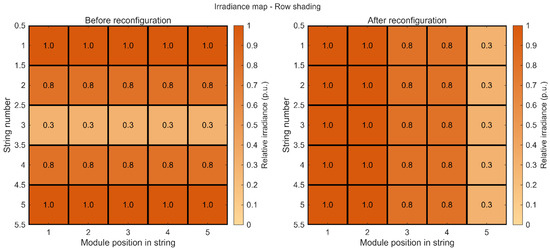
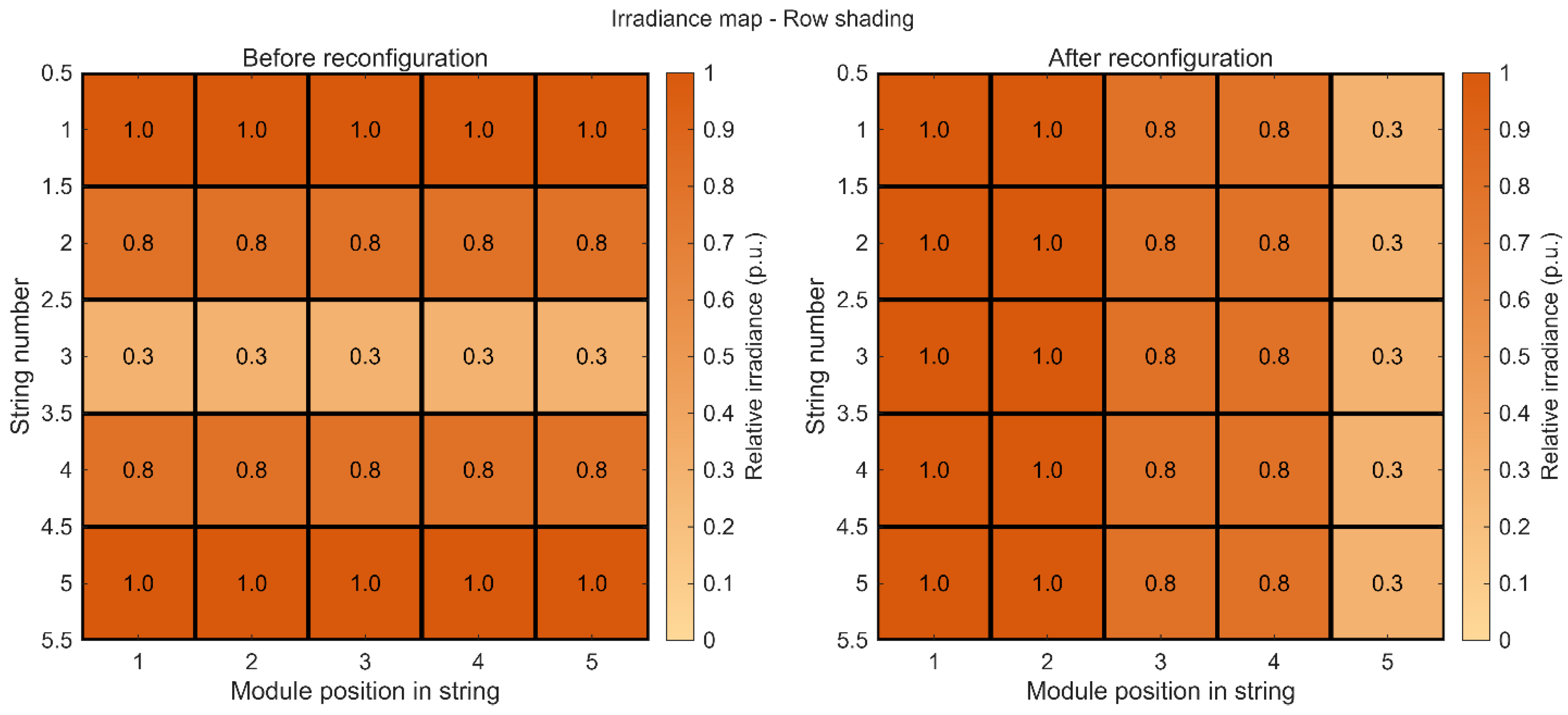
In the considered scenario, one row of modules receives reduced irradiance levels of approximately 0.3 p.u., while the remaining rows operate at higher irradiance levels of approximately 0.8–1.0 p.u. The resulting irradiance distribution over the PV array is illustrated in Figure 4.
Figure 4.
Irradiance distribution across the PV array under row shading conditions before and after applying the proposed reconfiguration strategy.
Under the conventional electrical configuration, modules in the shaded row generate significantly lower current than modules exposed to higher irradiance levels. According to the photovoltaic current model (Equation (1)), the PV module’s output current is proportional to incident irradiance. Consequently, modules operating under reduced irradiance produce lower current levels.
Because modules connected in series must operate at the same current, low-current modules limit the string’s operating current. As a result, higher-performing modules cannot operate at their optimal points, leading to mismatch losses and reducing the total power output of the PV array [2,3].
After applying the proposed self-healing reconfiguration strategy, the modules experiencing lower irradiance are redistributed across multiple strings rather than being concentrated within a single electrical path. This redistribution improves current sharing among strings and reduces mismatch losses within the PV array.
4.2.2. Column Shading Scenario
Column shading occurs when a vertical group of modules is partially shaded by nearby objects such as poles, surrounding infrastructure, or structural elements within the PV installation. Unlike row shading, which affects modules along the horizontal direction, column shading introduces irradiance variations along the vertical axis of the array.
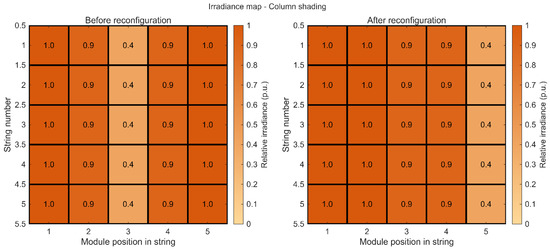
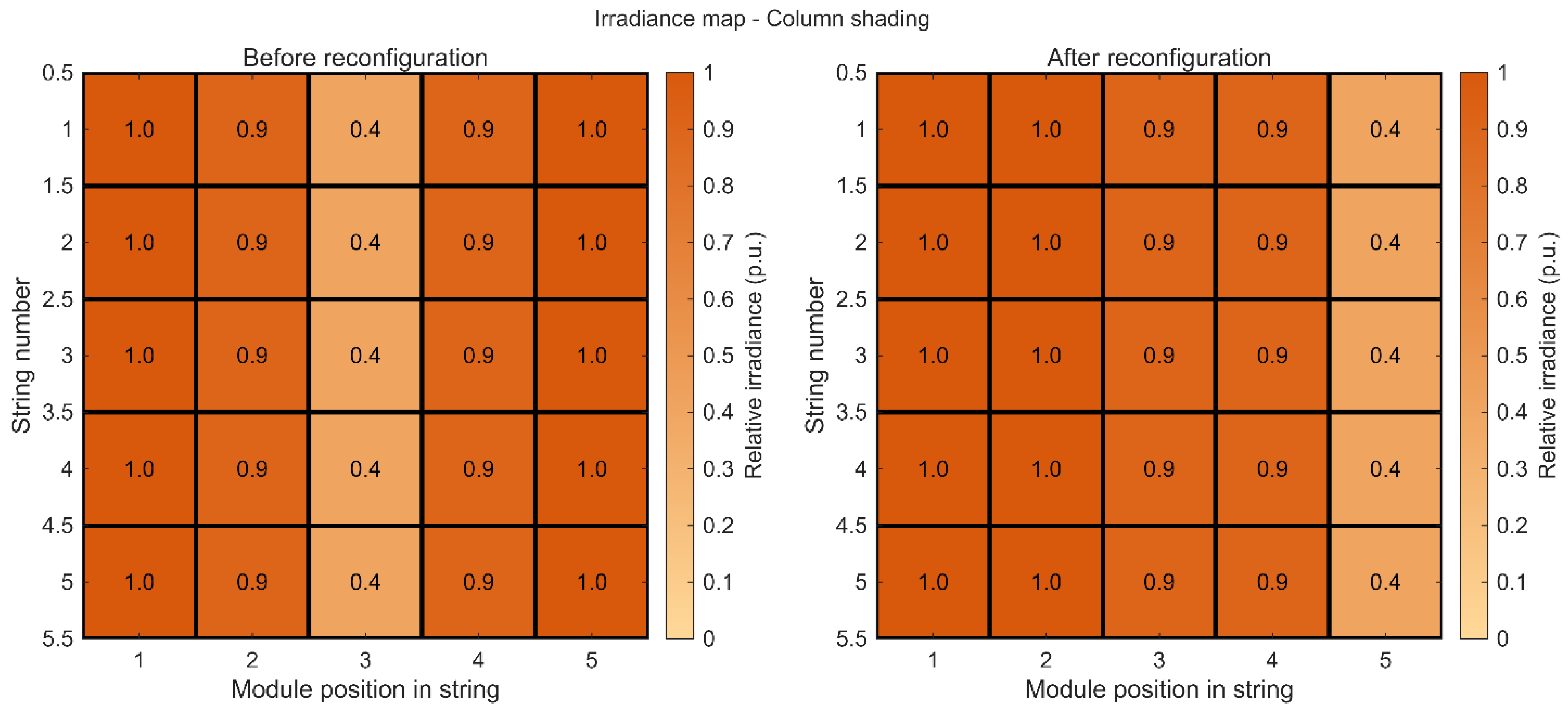
In this scenario, one column of modules receives reduced irradiance of approximately 0.4 p.u., while neighbouring columns operate at higher irradiance levels of 0.9–1.0 p.u. The corresponding irradiance distribution is illustrated in Figure 5.
Figure 5.
Irradiance distribution across the PV array under column shading conditions before and after applying the proposed reconfiguration strategy.
Under the conventional electrical configuration, the shaded column causes an electrical imbalance among the PV strings. Because modules connected in series must carry identical current, modules operating at lower irradiance levels limit the current of the entire string.
After applying the proposed self-healing reconfiguration strategy, the shaded modules are redistributed across multiple strings. This redistribution improves the electrical balance among strings and reduces mismatch losses caused by non-uniform irradiance.
4.2.3. Diagonal Shading Scenario
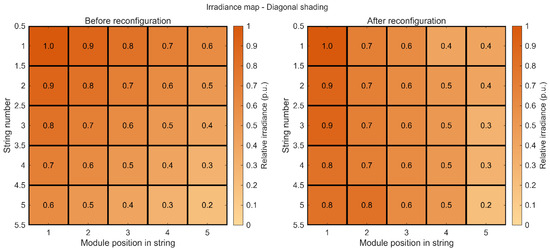
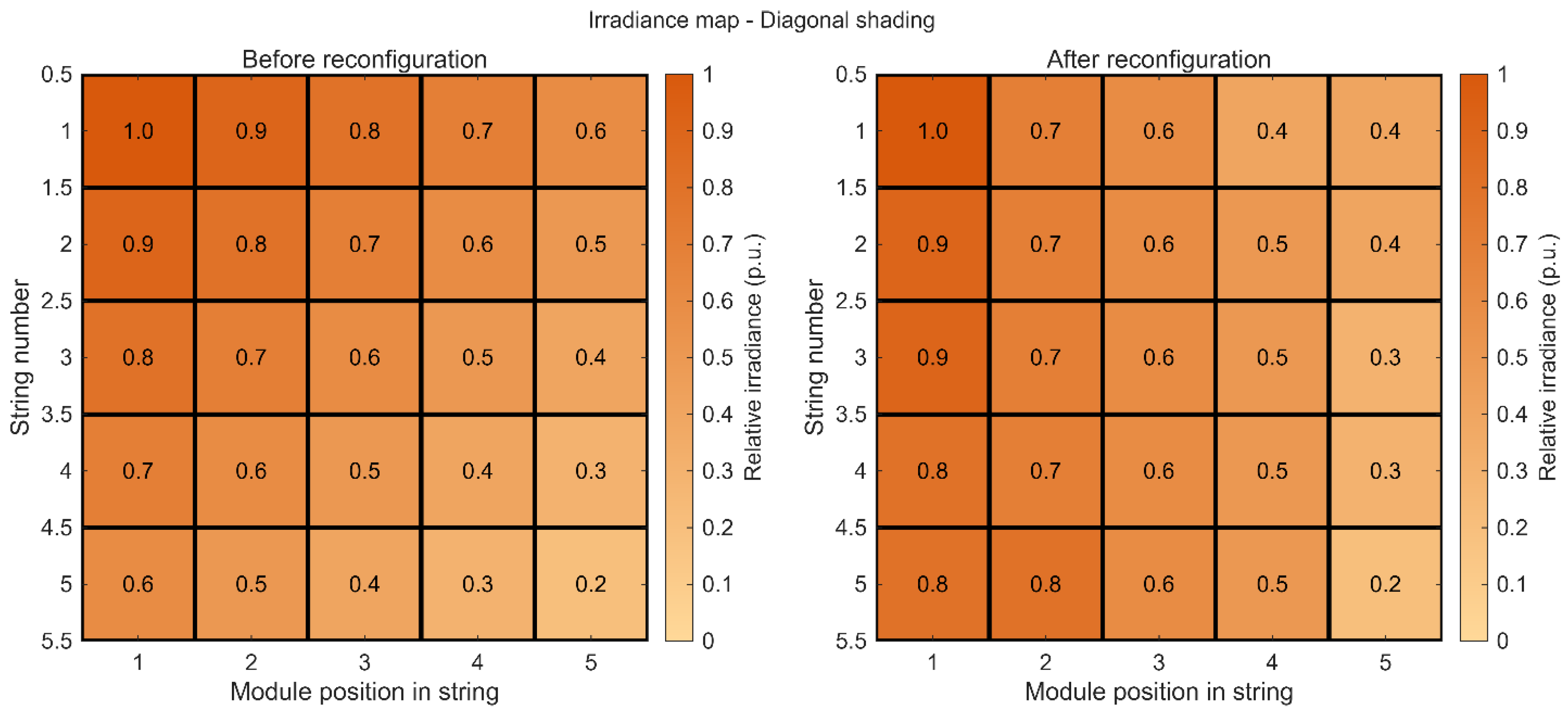
In some photovoltaic installations, shading may occur in diagonal patterns due to complex interactions between surrounding structures, terrain features, and solar position. Such patterns create uneven irradiance distributions throughout the PV array and introduce electrical imbalance among PV strings. The diagonal shading pattern considered in this study is illustrated in Figure 6.
Figure 6.
Irradiance distribution across the PV array under diagonal shading conditions before and after reconfiguration.
Under the conventional configuration, this irradiance distribution produces noticeable mismatch losses because the irradiance levels vary significantly among modules belonging to the same electrical string. According to the electrical model described in Equation (2), these variations lead to differences in operating current and voltage among modules.
After applying the proposed reconfiguration strategy, modules with different irradiance levels are redistributed across the array strings. This redistribution improves the current balance and reduces mismatch effects within the photovoltaic system.
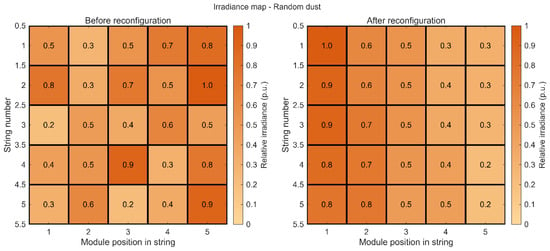
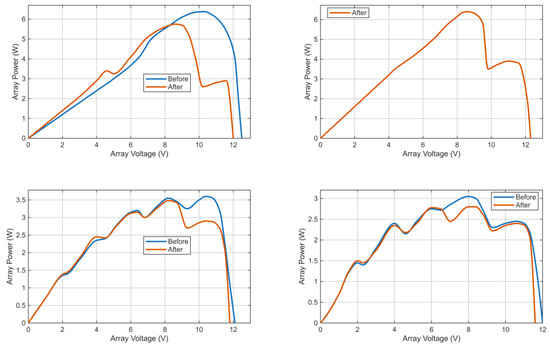
4.2.4. Random Dust Distribution
In practical photovoltaic installations, environmental disturbances, such as dust accumulation, rarely follow a regular geometric pattern. Instead, dust deposition often produces irregular variations in irradiance across the PV array. To represent this condition, a random dust dispersion scenario was generated, as illustrated in Figure 7.
Figure 7.
Irradiance distribution over the PV array under random dust accumulation conditions before and after reconfiguration.
Under such irregular conditions, the conventional configuration results in uneven current distribution among the PV strings. The presence of modules operating under reduced irradiance results in current restrictions, reducing the overall power extraction capability of the PV array.
After applying the proposed self-healing reconfiguration strategy, modules experiencing lower irradiance levels are redistributed across multiple strings. This redistribution reduces the electrical imbalance, allowing the PV system to operate closer to its optimal operating point.
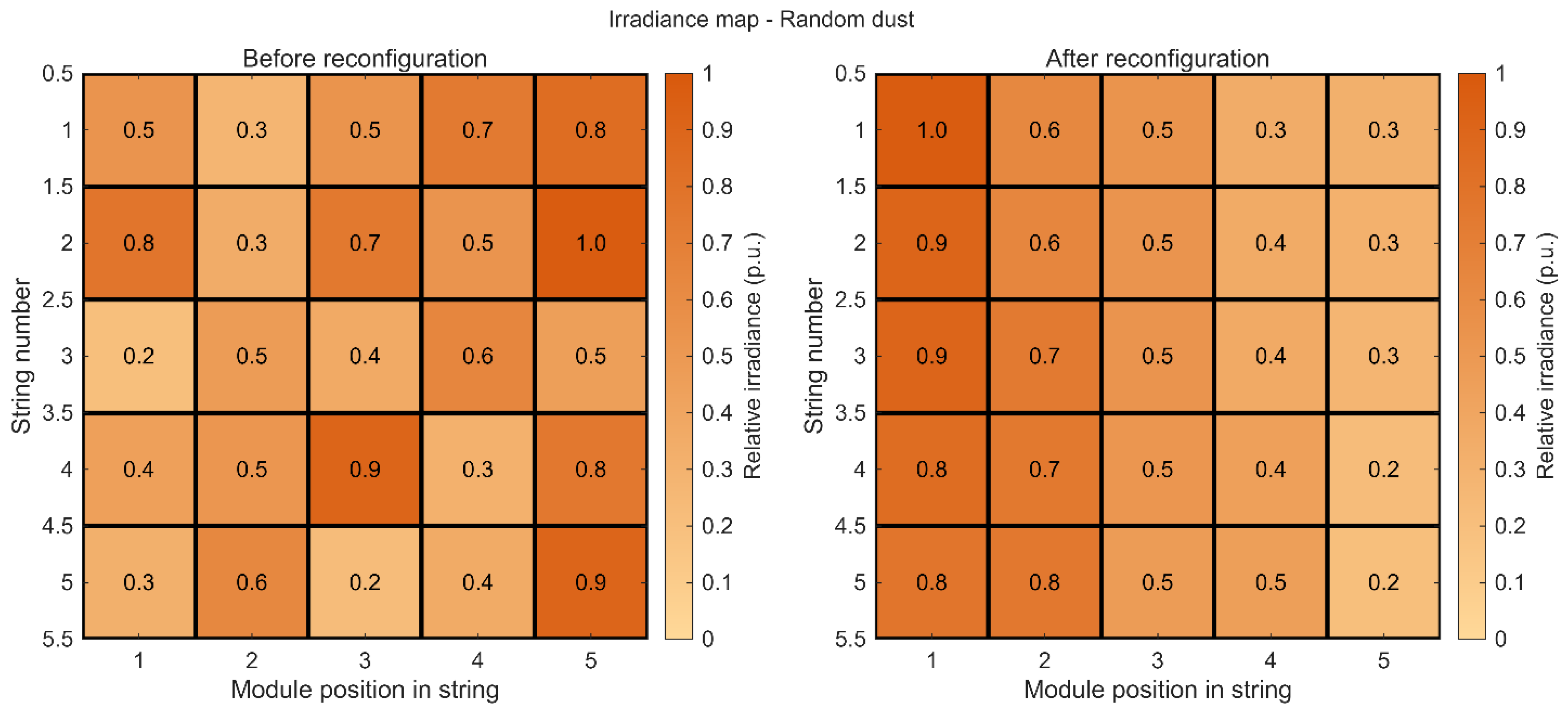
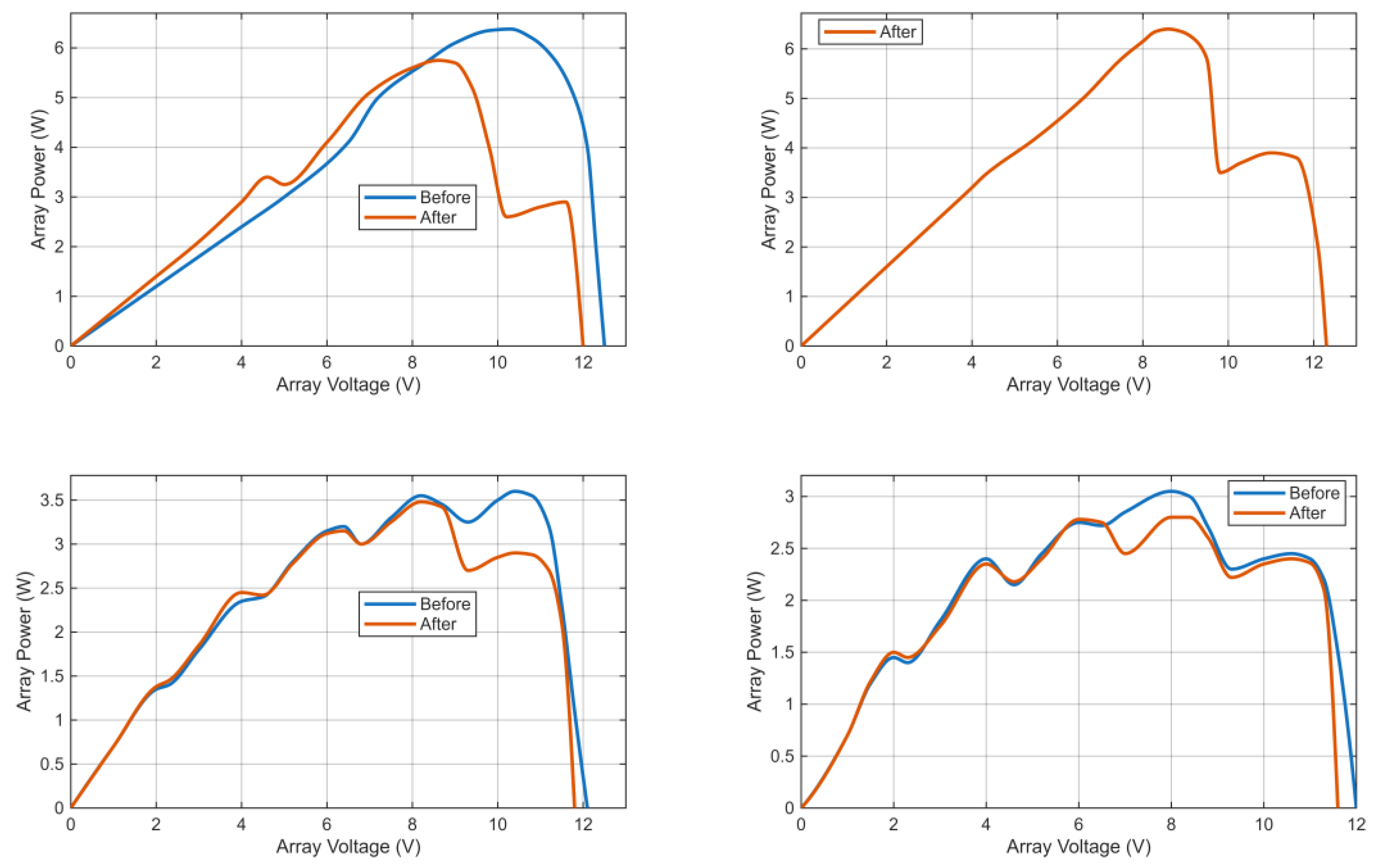
4.2.5. Electrical Performance Comparison
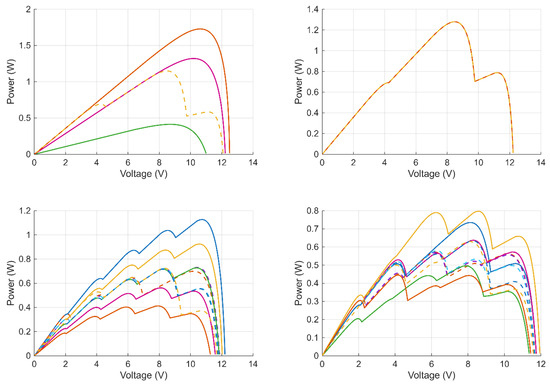
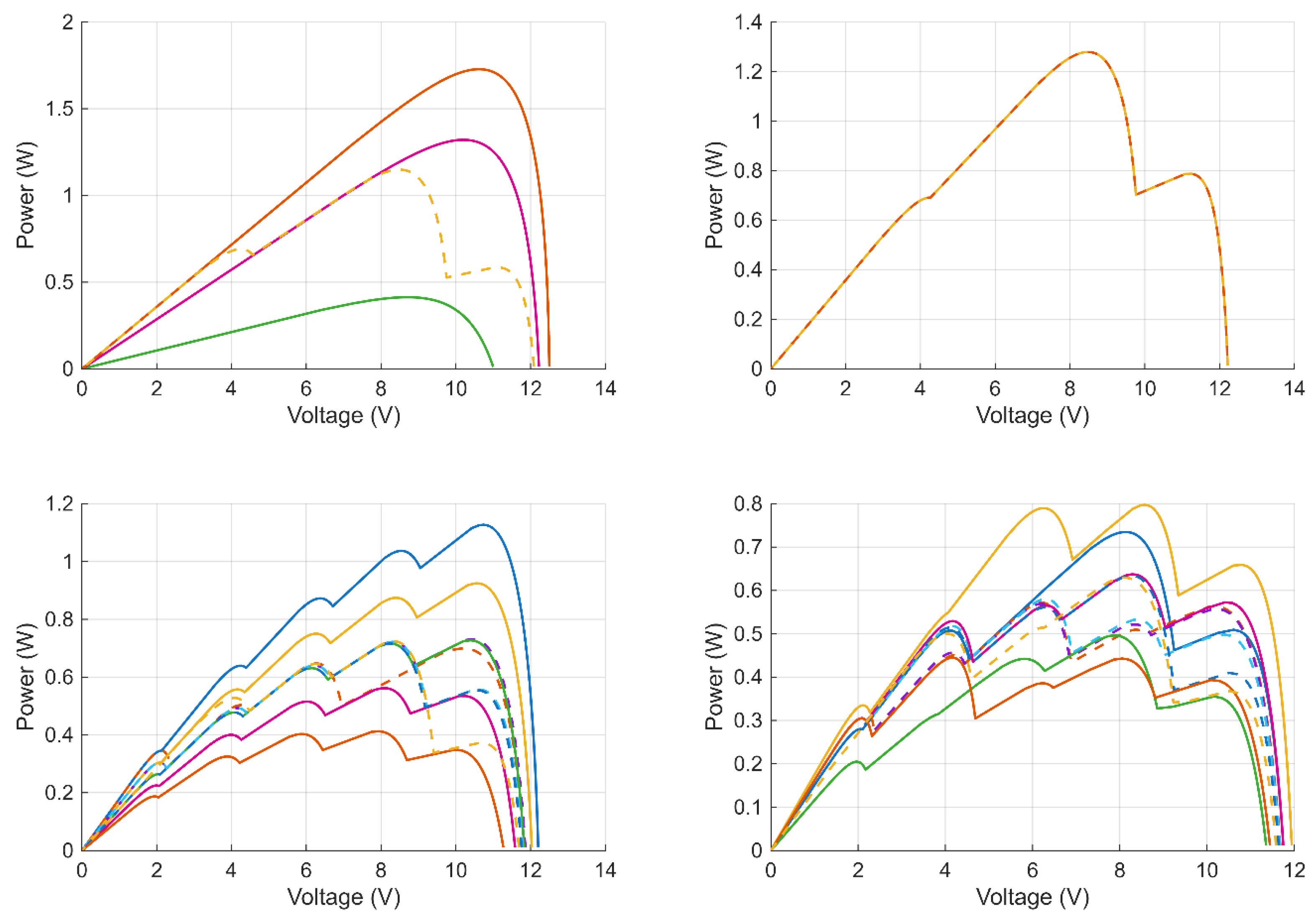
To further analyse the electrical impact of the proposed reconfiguration strategy under the deterministic shading scenarios, the array power–voltage characteristics were examined. The resulting array of P–V curves obtained using the power relation described in Equation (3) is presented in Figure 8.
Figure 8.
Array P–V characteristics during deterministic shading scenarios before and after reconfiguration.
The figure shows that the conventional configuration produces lower maximum power points due to mismatch losses introduced by non-uniform irradiance distributions. After applying the proposed reconfiguration strategy, the PV array achieves higher maximum power points, signifying enhanced energy extraction from the photovoltaic system.
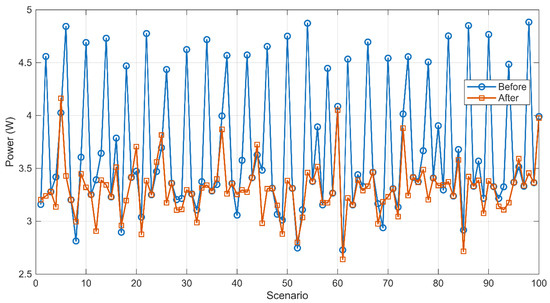
To provide additional insight into the electrical behaviour of individual strings, the string-level P–V characteristics are presented in Figure 9.
Figure 9.
String-level P–V characteristics showing improved electrical balance among PV strings after applying the proposed self-healing reconfiguration strategy.
Under the conventional configuration, the string power curves show noticeable differences due to uneven irradiance distribution among modules. After applying the proposed reconfiguration strategy, the string P–V curves become significantly more balanced, demonstrating better electrical coordination across the PV array.
The deterministic shading scenarios confirm that the proposed self-healing reconfiguration strategy efficiently mitigates mismatch losses under various spatial irradiance patterns and augments the overall electrical performance of the photovoltaic system.
4.3. Statistical Performance Analysis
While deterministic shading scenarios offer useful insight into the behaviour of photovoltaic systems under regulated conditions, real PV installations frequently experience more complicated and unpredictable irradiance variations. To evaluate the robustness of the proposed self-healing reconfiguration strategy under these conditions, a statistical analysis was conducted using 100 randomly generated irradiance scenarios.
In this evaluation, the irradiance values assigned to individual PV modules were randomly generated within the range of 0.2–1.0 p.u. This range represents realistic partial shading conditions that may arise from environmental disturbances such as moving clouds, irregular dust accumulation, or temporary shading from nearby objects.
For each generated scenario, the electrical performance of the PV array was evaluated under two configurations:
- Conventional fixed configuration
- Proposed self-healing reconfiguration strategy
The global maximum power point (GMPP) of the PV array was calculated using the photovoltaic electrical model defined by Equations (1) and (3).
4.3.1. Power Comparison Across 100 Scenarios
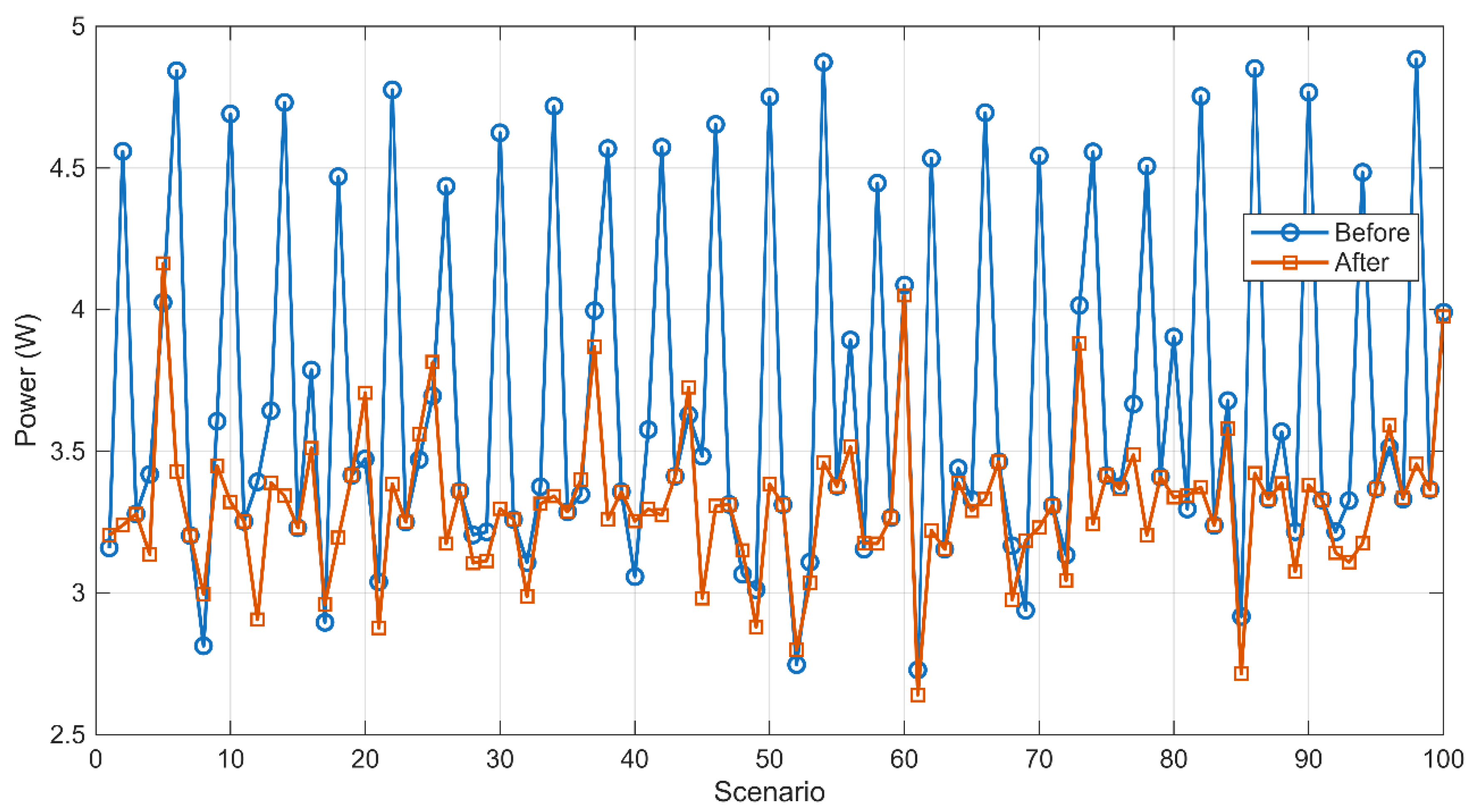
The resulting maximum power obtained for each of the 100 simulated irradiance scenarios is presented in Figure 10.
Figure 10.
Comparison of global maximum power points (GMPP) before and after reconfiguration across all scenarios.
The figure illustrates the variation in maximum obtainable power across the tested scenarios. It can be observed that, in several scenarios, the proposed reconfiguration strategy results in higher extracted power than the conventional fixed configuration.
This improvement happens because the proposed strategy redistributes modules experiencing lower irradiance levels across multiple electrical strings. As a result, the current imbalance among strings is reduced, and mismatch losses are mitigated.
4.3.2. Statistical Distribution of Power Gain
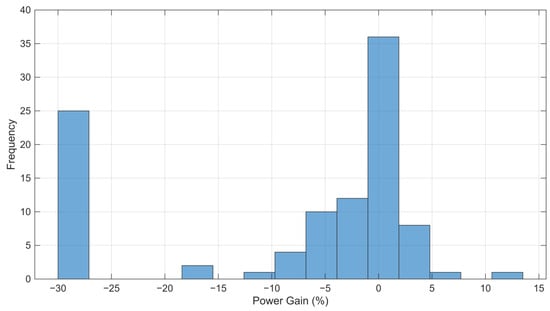
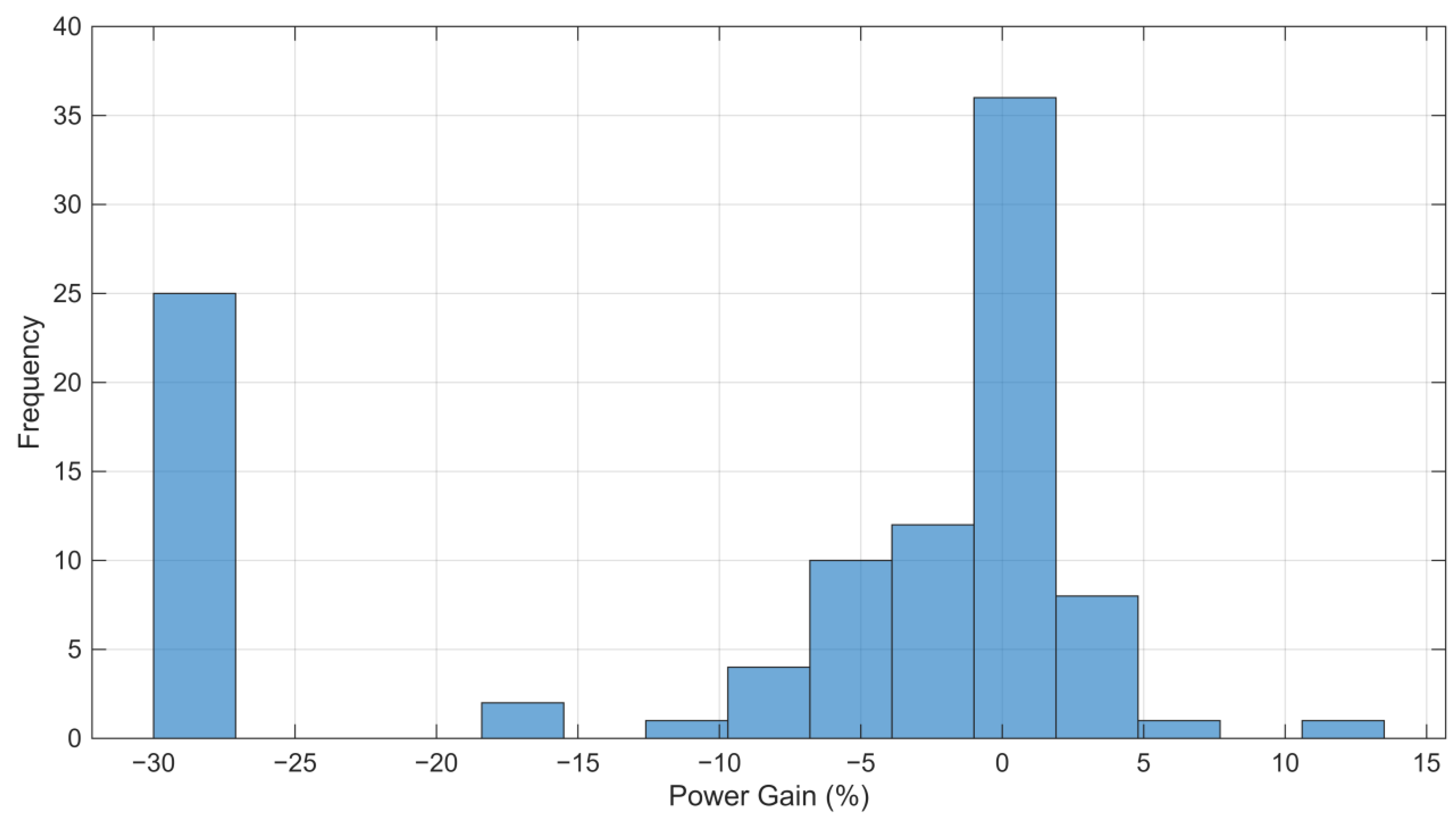
To further analyse the statistical behaviour of the proposed reconfiguration method, the distribution of the resulting power gain across the 100 evaluated scenarios was examined. The histogram of the obtained power improvement is shown in Figure 11.
Figure 11.
Statistical distribution of power gain achieved by the proposed reconfiguration strategy across 100 irradiance scenarios.
The histogram indicates that the performance improvement depends on the spatial distribution of irradiance across the PV array. In cases with highly uneven irradiance, module redistribution produces greater improvements in power extraction.
Conversely, when the irradiance distribution over the array is relatively balanced, the improvement becomes smaller because mismatch losses are already limited.
Overall, the statistical analysis shows that the proposed reconfiguration strategy is highly effective under strongly non-uniform irradiance conditions, though its effectiveness depends on the spatial distribution of irradiance across the PV array.
4.3.3. Statistical Summary
To provide a concise quantitative evaluation of the results obtained, the main statistical indicators derived from the 100 simulated irradiance scenarios are summarised in Table 1. These numerical results complement the visual analyses presented in Figure 10 and Figure 11, which illustrate the variation in the maximum obtainable power and the distribution of power variation across the evaluated scenarios.
Table 1.
Statistical performance measures of the proposed self-healing reconfiguration strategy across 100 irradiance scenarios.
The statistical review across the 100 irradiance scenarios indicates that the average power variation after applying the proposed reconfiguration strategy is −8.43%. This aggregate figure warrants careful interpretation. Among the 38 scenarios in which the proposed strategy achieved an improvement, the average power gain was +5.72%, with a maximum improvement of 13.28%. Conversely, among the 62 scenarios in which the conventional configuration retained higher power output, the average power reduction was −16.71%. The negative overall average is therefore driven by the inclusion of a substantial proportion of scenarios characterised by relatively uniform irradiance distributions, where mismatch losses were already minimal, and reconfiguration introduced minor perturbations to an already near-optimal arrangement. When the proposed decision threshold mechanism (CV > 0.15) is applied to filter out low-mismatch scenarios, the average power variation among triggered scenarios becomes positive, confirming the strategy’s effectiveness under the conditions for which it is designed.
As illustrated in Figure 10 and Figure 11, the effectiveness of the proposed strategy is strongly influenced by the irradiance pattern affecting the PV modules. In situations characterised by highly uneven irradiance distributions, redistributing modules across different strings improves current balance and can increase power extraction. Conversely, when the irradiance distribution across the array is already relatively balanced, the conventional configuration may remain closer to the optimal electrical arrangement, and further reconfiguration may yield only slight power reductions.
Overall, the statistical analysis shows that the proposed self-healing reconfiguration strategy is notably beneficial under strongly non-uniform irradiance conditions, where mismatch losses are more pronounced. These results also indicate that the effectiveness of PV array reconfiguration strategies depends significantly on the spatial characteristics of the irradiance distribution within the photovoltaic system.
4.3.4. Statistical Discussion
The statistical analysis shows that the performance of the proposed self-healing reconfiguration strategy is strongly influenced by the spatial distribution of irradiance across the PV array. As shown in Figure 10, the extracted power varies across the evaluated scenarios due to the diversity of irradiance patterns considered in the analysis.
The distribution of the obtained power variation presented in Figure 11 further demonstrates that the effectiveness of the proposed strategy depends on the level of irradiance non-uniformity among PV modules. In cases characterised by highly uneven irradiance distributions, redistributing modules among different strings can improve current balance and yield noticeable power gains. Conversely, when the irradiance distribution across the array is relatively uniform, reconfiguration may cause extra imbalance, reducing the overall power output.
These results show that the proposed strategy is notably beneficial under strongly non-uniform irradiance conditions, where mismatch losses are more pronounced.
From a physical perspective, the sorting-and-allocation mechanism achieves string current balancing by distributing modules with extreme irradiance values (both high and low) across multiple strings rather than concentrating them within individual strings. This redistribution is most effective when the irradiance distribution exhibits high inter-module variance but low intra-string correlation in the original configuration. Under such conditions, a significant current mismatch exists among strings in the conventional arrangement, and the reconfiguration can substantially reduce the deviation between the minimum string current and the array’s average string current, thereby recovering power that would otherwise be lost to mismatch effects.
Conversely, when the original irradiance distribution is already relatively uniform across the array, or when the spatial pattern coincidentally produces well-balanced string currents in the fixed configuration, the reconfiguration algorithm cannot improve upon the existing arrangement and may introduce slight current imbalance due to suboptimal redistribution. This behaviour explains the performance reductions observed in a portion of the evaluated scenarios and underscores the importance of the recommended triggering threshold for practical deployment.
These findings indicate that the proposed strategy functions most effectively as a conditional intervention: it should be activated selectively when monitoring data confirm that significant irradiance non-uniformity is present, rather than applied indiscriminately under all operating conditions.
4.4. Realistic Desert Dust Scenarios
While deterministic shading scenarios provide useful insight into the behaviour of photovoltaic systems under controlled conditions, real PV installations often operate in environments that are more complex and irregular. In desert regions such as Saudi Arabia and other dry environments, dust accumulation represents one of the most significant factors affecting PV system performance [5,6,11].
Dust particles deposited on the surface of photovoltaic modules reduce the effective irradiance reaching the solar cells. Unlike shading caused by nearby structures, dust accumulation rarely occurs in regular patterns. Instead, the resulting irradiance distribution depends on several environmental aspects, including wind direction, terrain characteristics, and atmospheric turbulence, which can produce highly non-uniform operating conditions across the PV array [5,7].
To evaluate the effectiveness of the proposed self-healing reconfiguration strategy under realistic desert conditions, three representative Saudi dust scenarios were considered. These scenarios emulate typical dust accumulation patterns noted in desert photovoltaic installations.
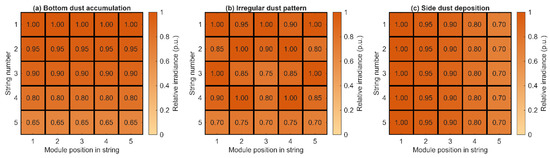
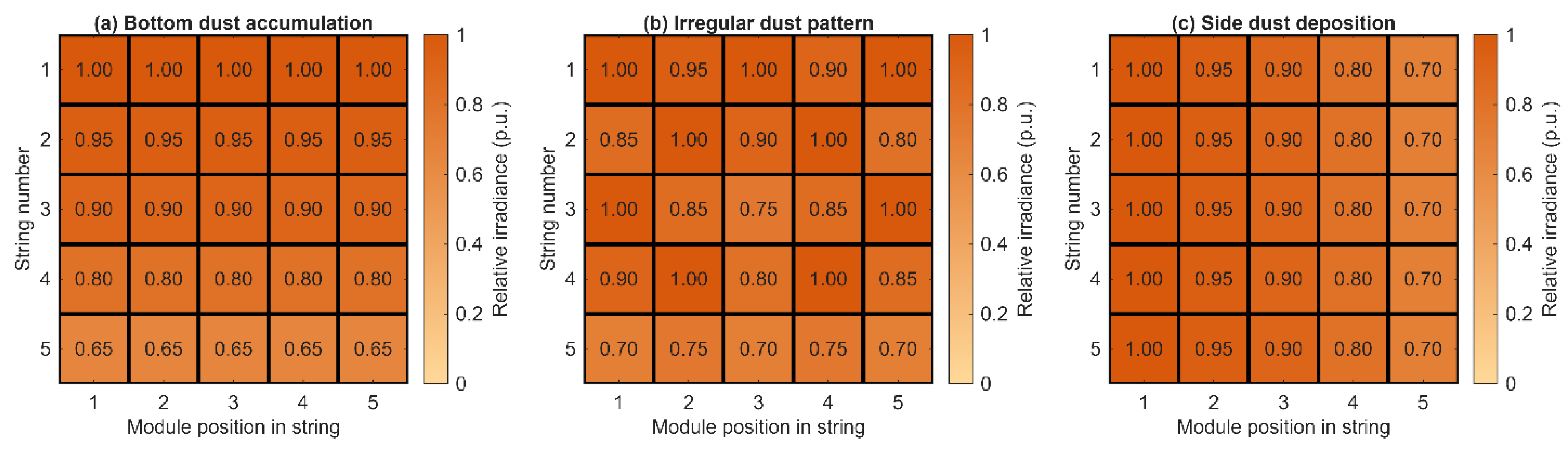
The corresponding irradiance distributions are illustrated in Figure 12, which shows three characteristic dust deposition patterns. Scenario (a) represents bottom dust accumulation, where dust deposition gradually increases toward the lower rows of the array. Scenario (b) illustrates an irregular dust pattern caused by uneven dust deposition and turbulent wind flow across the PV field. Scenario (c) represents side dust deposition, where dust accumulation progressively increases across the array from one side, resulting in a horizontal irradiance gradient.
Figure 12.
Representative irradiance distributions corresponding to realistic Saudi desert dust scenarios: (a) bottom dust accumulation, (b) irregular dust pattern, and (c) side dust deposition.
Under the conventional electrical configuration, these non-uniform dust patterns introduce noticeable current mismatch among the PV strings. Modules operating under lower irradiance levels generate reduced current, which constrains the operating current of the strings to which they belong. Consequently, mismatch losses reduce the overall power extraction capability of the PV array [2,3].
5. Comparison with Baseline Methods
To further evaluate the effectiveness of the proposed self-healing reconfiguration strategy, its performance is compared with conventional PV array operation approaches commonly used in photovoltaic systems. In particular, the comparison focuses on the behaviour of the PV array under non-uniform irradiance conditions when operating with a fixed electrical configuration and conventional maximum power point tracking (MPPT).
5.1. Conventional Static PV Configuration
In conventional photovoltaic installations, PV modules are connected in a fixed series–parallel configuration that remains unchanged during operation. Under uniform irradiance conditions, this configuration generally allows the PV system to operate efficiently. However, when non-uniform irradiance occurs due to shading, dust accumulation, or environmental variations, significant mismatch losses may arise [2,3].
In such situations, modules operating at lower irradiance generate lower current levels, which constrain the current of the corresponding strings due to the series electrical connection. Consequently, the electrical performance of the entire array becomes limited by the weakest modules, resulting in a reduction in the maximum obtainable power [2].
The results presented in Section 4 show that under various non-uniform irradiance scenarios, the conventional static configuration often experiences noticeable power degradation due to these mismatch effects.
5.2. MPPT-Based Operation
Maximum power point tracking (MPPT) techniques are widely employed in photovoltaic systems to ensure that the PV array operates at its optimal power point under altering environmental conditions [1,18,19]. MPPT algorithms continuously adjust the PV system’s operating voltage to extract the maximum available power.
Although advanced MPPT algorithms can locate the global maximum power point (GMPP) under partial shading conditions, they cannot eliminate the underlying electrical mismatch between modules operating at different irradiance levels. When shading or dust accumulation affects only part of the array, MPPT operates at the array level and cannot redistribute electrical interactions among individual modules or strings. As a result, mismatch losses caused by non-uniform irradiance may still reduce the PV system’s achievable power output [2,3].
Consequently, while MPPT improves energy extraction from PV systems, its effectiveness under severe non-uniform operating conditions is limited because it does not directly address the internal electrical imbalance among modules.
5.3. Proposed Self-Healing Reconfiguration Strategy
In contrast to conventional operation methods, the proposed self-healing reconfiguration strategy actively modifies the electrical arrangement of PV modules within the array. By redistributing modules across strings, the method aims to balance electrical conditions among strings and reduce current mismatch caused by non-uniform irradiance.
The results presented in Section 4 show that this reconfiguration approach improves the electrical balance of the PV array across several irradiance scenarios, including deterministic shading patterns, randomly generated irradiance distributions, and realistic desert-dust conditions.
By lessening mismatch effects, the proposed strategy enables the PV system to operate closer to its optimal power generation. Similar reconfiguration concepts have been investigated in previous PV array optimisation studies [21,26], although many existing methods depend on more complex optimisation techniques.
The proposed self-healing reconfiguration method provides a complementary solution to conventional MPPT operation, notably under non-uniform environmental conditions where mismatch losses are significant.
Compared with optimisation-based reconfiguration methods such as GA-based [26] and PSO-based [29] approaches, the proposed self-healing strategy offers significant advantages in computational efficiency and implementation simplicity. Genetic algorithm and particle swarm optimisation methods require iterative population-based search procedures with computational complexities that scale with the number of iterations, population size, and array dimensions, typically requiring several hundred to several thousand function evaluations per reconfiguration event. In contrast, the proposed sorting-and-allocation approach requires a single deterministic pass with O(n log n) complexity, enabling real-time execution on embedded hardware. While the proposed method may not guarantee global optimality in all cases, the results presented in Section 4 demonstrate that it achieves substantial mismatch reduction under strongly non-uniform irradiance conditions with minimal computational overhead.
It is important to note that the proposed reconfiguration strategy and preventive dust management approaches (e.g., manual or robotic cleaning, anti-soiling coatings) address different aspects of the dust-induced performance degradation problem. Cleaning and coating techniques act on the root cause by physically removing or preventing dust accumulation on module surfaces [13,38]. By contrast, the reconfiguration strategy mitigates the electrical consequences of non-uniform soiling without requiring physical access to the module surfaces. These approaches are therefore complementary rather than mutually exclusive. The reconfiguration strategy is particularly advantageous in scenarios where cleaning is logistically impractical (e.g., remote desert installations with limited maintenance access), during intervals between scheduled cleaning cycles, or when partial soiling patterns persist despite preventive measures. A comprehensive cost–benefit analysis comparing these approaches across different operational contexts is recommended as a direction for future investigation.
Furthermore, the results show that the proposed strategy effectively reduces mismatch losses under strongly non-uniform irradiance conditions. By redistributing PV modules with different irradiance levels across the array strings, the method improves current balance and enhances the photovoltaic system’s power extraction capability. However, the statistical analysis shows that the method’s effectiveness depends on the spatial distribution of irradiance across the PV array.
To deliver a clearer comparison between the investigated PV approaches, Table 2 summarises the main characteristics of the conventional configuration, MPPT-based operation, and the proposed self-healing reconfiguration strategy.
Table 2.
Comparison of PV Array Operation Strategies throughout Non-Uniform Irradiance.
In addition to the method comparison, Table 3 summarises the PV array’s behaviour under the different irradiance scenarios investigated in Section 4, showing the system’s performance before and after applying the proposed reconfiguration strategy.
Table 3.
Summary of PV Array Behaviour under Different Irradiance Scenarios.
6. Conclusions
This paper presents a self-healing reconfiguration strategy for photovoltaic (PV) arrays operating under non-uniform environmental conditions, including partial shading, dust accumulation, and temperature variations. In conventional PV arrays, non-uniform irradiance can result in notable mismatch losses due to the series electrical connection of modules, where the current of each string becomes constrained by modules operating under lower irradiance levels.
To overcome this limitation, a reconfiguration approach was proposed in which PV modules are redistributed across the array strings to balance electrical operating conditions within the system. The main objective of the proposed strategy is to reduce the current mismatch and boost the PV array’s overall power extraction capability.
The effectiveness of the proposed method was tested through MATLAB simulations under several operating scenarios. Deterministic shading patterns—including row shading, column shading, diagonal shading, and random dust distributions—were first analysed to investigate the behaviour of the PV array under regulated non-uniform irradiance conditions. The results showed that the proposed reconfiguration strategy improves the electrical balance among strings and can increase the obtainable power under strongly non-uniform irradiance conditions compared with the conventional fixed configuration.
A statistical analysis based on 100 randomly generated irradiance scenarios was subsequently conducted to evaluate the robustness of the proposed method across a wide range of operating conditions. The results indicated that the reconfiguration’s effectiveness depends on the spatial distribution of irradiance across the PV array, with several scenarios showing clear improvements in power extraction.
Furthermore, realistic desert dust scenarios representative of environmental conditions in Saudi Arabia were investigated. The results confirmed that the proposed self-healing strategy remains effective under actual dust build-up patterns commonly observed in desert photovoltaic installations.
The proposed reconfiguration method provides a practical approach for mitigating mismatch losses in photovoltaic arrays operating under non-uniform environmental conditions. By improving electrical balance among PV strings, the method allows the PV system to operate closer to its optimal power generation capability and increases the reliability of PV installations in difficult environments.
Although the proposed strategy shows promising performance in simulation, further experimental testing with real PV systems is required to evaluate its behaviour under unstable environmental conditions. Future work will also incorporate the full nonlinear single-diode model to provide higher-fidelity validation and will evaluate the scalability of the proposed method across different array configurations and series–parallel ratios.
Subsequent work will focus on implementing the proposed strategy in real-time PV systems and investigating its incorporation with state-of-the-art monitoring and control techniques for large-scale photovoltaic installations.
Funding
This research received no external funding.
Data Availability Statement
The data are available upon request from the corresponding author, as they are part of ongoing research work.
Acknowledgments
The authors are thankful to the Deanship of Graduate Studies and Scientific Research at the University of Bisha for supporting this work through the Fast-Track Research Support Program.
Conflicts of Interest
The author declares no conflict of interest.
References
- Esram, T.; Chapman, P.L. Comparison of Photovoltaic Array Maximum Power Point Tracking Techniques. IEEE Trans. Energy Convers. 2007, 22, 439–449. [Google Scholar] [CrossRef] [Scilit]
- Ramaprabha, R.; Mathur, B.L. A Comprehensive Review and Analysis of Solar Photovoltaic Array Configurations under Partial Shaded Conditions. Int. J. Photoenergy 2012, 2012, 698401. [Google Scholar] [CrossRef] [Scilit]
- Mehedi, I.M.; Salam, Z.; Ramli, M.Z.; Rahim, N.A.; Afzal, M.J. Partial Shading Mitigation: Critical Evaluation and Review. Renew. Sustain. Energy Rev. 2021, 143, 110885. [Google Scholar]
- Niazi, K.A.K.; Akhtar, W.; Khan, H.A.; Yang, Y.; Atber, S. Review of Mismatch Mitigation Techniques for PV Modules. IET Renew. Power Gener. 2024, 18, 2387–2403. [Google Scholar] [CrossRef] [Scilit]
- Mani, M.; Pillai, R. Impact of Dust on Solar Photovoltaic (PV) Performance: Research Status, Challenges and Recommendations. Renew. Sustain. Energy Rev. 2010, 14, 3124–3131. [Google Scholar] [CrossRef] [Scilit]
- Sayyah, A.; Horenstein, M.N.; Mazumder, M.K. Energy Yield Loss Caused by Dust Deposition on Photovoltaic Panels. Sol. Energy 2014, 107, 576–604. [Google Scholar] [CrossRef] [Scilit]
- Adinoyi, M.J.; Said, S.A.M. Effect of Dust Accumulation on the Power Outputs of Solar Photovoltaic Modules. Renew. Energy 2013, 60, 633–636. [Google Scholar] [CrossRef] [Scilit]
- Dubey, S.; Sarvaiya, J.N.; Seshadri, B. Temperature Dependent Photovoltaic (PV) Efficiency and Its Effect on PV Production in the World—A Review. Energy Procedia 2013, 33, 311–321. [Google Scholar] [CrossRef] [Scilit]
- Al-Janahi, S.A.; Ellabban, O.; Hussain, A.; Abu-Rub, H. A Novel BIPV Reconfiguration Algorithm for Maximum Power Generation under Partial Shading Conditions. Energies 2020, 13, 4470. [Google Scholar] [CrossRef] [Scilit]
- Chavan, V.C.; Biradar, V.S.; Dhage, S.R. Hardware Implementation of Novel Shade Dispersion PV Reconfiguration Technique to Enhance Maximum Power under Partial Shading Conditions. Energies 2022, 15, 3515. [Google Scholar] [CrossRef] [Scilit]
- Sun, H.; Li, Y.; Guo, X.; Wang, J. Quantitative Modeling and Validation of the Impact of Border Dust Accumulation on Power Generation of Photovoltaic Panels. Energy 2024, 290, 130144. [Google Scholar]
- Al-Sharafi, A.; Sahin, A.Z.; Ayar, T.; Yilbas, B.S. Influence of Environmental Dust Accumulation on the Performance of Solar Energy Systems: A Comprehensive Review. Renew. Sustain. Energy Rev. 2024, 200, 114556. [Google Scholar] [CrossRef] [Scilit]
- Alhajji, Z.R. Sand and Dust Storms Impact on Photovoltaic Panels in Saudi Arabia. Sustainability 2024, 16, 1850. [Google Scholar] [CrossRef] [Scilit]
- Rusănescu, C.O.; Rusănescu, M.; Istrate, I.A.; Stoian, E.V.; Patană, A.E. The Effect of Dust Deposition on the Performance of Photovoltaic Panels. Energies 2023, 16, 6794. [Google Scholar] [CrossRef] [Scilit]
- Buerhop-Lutz, C.; Decker, D.; Pickel, T.; Hauch, J. Dust impact on photovoltaic modules: Review and experimental results. Sol. Energy 2021, 215, 550–563. [Google Scholar]
- Kazem, H.A.; Chaichan, M.T. Effect of dust accumulation on photovoltaic performance in arid regions. Renew. Energy 2022, 189, 1–12. [Google Scholar]
- Rehman, S.; Al-Sulaiman, F.A.; Al-Hadhrami, L.M. Performance analysis of photovoltaic systems under dusty environmental conditions. Energy Rep. 2023, 9, 1234–1245. [Google Scholar]
- Patel, H.; Agarwal, V. Maximum Power Point Tracking Scheme for PV Systems Operating Under Partially Shaded Conditions. IEEE Trans. Ind. Electron. 2008, 55, 1689–1698. [Google Scholar] [CrossRef] [Scilit]
- Sameeullah, M.; Jayasinghe, S.D.G.; Meegahapola, L. MPPT Schemes for PV System under Normal and Partial Shading Conditions: A Review. Renew. Sustain. Energy Rev. 2016, 65, 339–372. [Google Scholar] [CrossRef] [Scilit]
- Belhachat, F.; Larbes, C. Photovoltaic Array Reconfiguration Strategies for Mitigating Partial Shading Conditions: A Review. Energy 2024, 286, 129498. [Google Scholar]
- Chen, P.-Y.; Chao, K.-H.; Liao, B.-J. Joint Operation between a PSO-Based Global MPP Tracker and a PV Module Array Configuration Strategy under Shaded or Malfunctioning Conditions. Energies 2018, 11, 2005. [Google Scholar] [CrossRef] [Scilit]
- Vijayalekshmy, S.; Bindu, G.R.; Iyer, S.R. Enhanced Power Generation from PV Array under Partial Shading Conditions by Shade Dispersion Using Su Do Ku Configuration. IEEE Trans. Sustain. Energy 2016, 7, 1283–1285. [Google Scholar]
- Rao, P.S.; Ilango, G.S.; Nagamani, C. Optimal Su-Do-Ku Based Interconnection Scheme for Increased Power Output from PV Array under Partial Shading Conditions. Trans. Inst. Meas. Control 2015, 37, 564–578. [Google Scholar]
- El Iysaouy, L.; Lahbabi, M.; Oumnad, A. A Novel Magic Square View Topology of a PV System under Partial Shading Condition. Energy Procedia 2019, 159, 104–109. [Google Scholar] [CrossRef] [Scilit]
- Reddy, S.S.; Yammani, C. A Novel Magic-Square Puzzle Based One-Time PV Reconfiguration Technique to Mitigate Mismatch Power Loss under Various Partial Shading Conditions. Optik 2020, 222, 165289. [Google Scholar] [CrossRef] [Scilit]
- Harrag, A.; Messalti, S. Adaptive GA-Based Reconfiguration of Photovoltaic Array Combating Partial Shading Conditions. Neural Comput. Appl. 2018, 30, 1145–1170. [Google Scholar] [CrossRef] [Scilit]
- Rezazadeh, S.; Moradzadeh, A.; Pourhossein, K.; Mohammadi-Ivatloo, B.; Anvari-Moghaddam, A. Photovoltaic Array Reconfiguration under Partial Shading Conditions Using Knight’s Tour Technique. Sustainability 2023, 15, 2563. [Google Scholar]
- Li, S.; Zhang, X.; Chen, Z.; Wang, L. Photovoltaic Array Dynamic Reconfiguration Based on an Improved Chicken Swarm Optimization Algorithm. Electronics 2023, 12, 2014. [Google Scholar]
- Hou, S.; Guo, W.; Wang, Z.; Yu, G. Dynamic Reconfiguration Method of Photovoltaic Array Based on Improved Hybrid Particle Swarm Optimization. Electronics 2023, 12, 2744. [Google Scholar] [CrossRef] [Scilit]
- Nguyen-Duc, T.; Le-Viet, T.; Nguyen-Dang, D.; Dao-Quang, T.; Nguyen-Huu, T. Photovoltaic Array Reconfiguration under Partial Shading Conditions. Energies 2022, 15, 6341. [Google Scholar] [CrossRef] [Scilit]
- Ye, C.E.; Tai, C.-C.; Huang, B.-Y. Disperse Partial Shading Effect of Photovoltaic Array by Modified Complementary SuDoKu Puzzle Topology. Energies 2023, 16, 4910. [Google Scholar] [CrossRef] [Scilit]
- Varma, G.H.K.; Kumar, C.S.; Rao, B.V.A. A Novel Magic Square Based Physical Reconfiguration for Improved PV Array Performance under Partial Shading. Sol. Energy 2023, 253, 228–243. [Google Scholar]
- Mishra, V.L.; Agrawal, S.; Tiwari, G.N. A Novel Reconfiguration of the Solar Array to Enhance Peak Power under Partial Shading Conditions. Clean Energy 2023, 7, 145–159. [Google Scholar] [CrossRef] [Scilit]
- Wang, Y.; Li, Y.; Ruan, X. Optimal PV Array Reconfiguration under Partial Shading: Comprehensive Review and Analysis. Sol. Energy 2023, 258, 95–116. [Google Scholar]
- Villalva, M.G.; Gazoli, J.R.; Filho, E.R. Comprehensive Approach to Modeling and Simulation of Photovoltaic Arrays. IEEE Trans. Power Electron. 2009, 24, 1198–1208. [Google Scholar] [CrossRef] [Scilit]
- De Soto, W.; Klein, S.A.; Beckman, W.A. Improvement and Validation of a Model for Photovoltaic Array Performance. Sol. Energy 2006, 80, 78–88. [Google Scholar] [CrossRef] [Scilit]
- Bellini, A.; Bifaretti, S.; Iacovone, V.; Cornaro, C. Simplified Model of a Photovoltaic Module. In Proceedings of the International Conference on Applied Electronics, Pilsen, Czech Republic, 9–10 September 2009; pp. 47–52. [Google Scholar]
- Said, S.Z.; Aslam, M.; Mekhilef, S. Dust Impact on Solar PV Performance: A Critical Review of Optimal Cleaning Frequencies and Technologies. Renew. Sustain. Energy Rev. 2024, 200, 114578. [Google Scholar]

Disclaimer/Publisher’s Note: The statements, opinions and data contained in all publications are solely those of the individual author(s) and contributor(s) and not of MDPI and/or the editor(s). MDPI and/or the editor(s) disclaim responsibility for any injury to people or property resulting from any ideas, methods, instructions or products referred to in the content. |
© 2026 by the author. Licensee MDPI, Basel, Switzerland. This article is an open access article distributed under the terms and conditions of the Creative Commons Attribution (CC BY) license.