1. Introduction
Power system operation in Europe is undergoing a fundamental transformation driven by the rapid integration of distributed renewable energy sources and increasingly dynamic electricity markets. Transmission and distribution system operators are required to manage growing system complexity while maintaining high standards of reliability, safety, and regulatory compliance. Control rooms, as the operational centres of system supervision and intervention, face escalating demands for anticipatory decision-making, cross-organisational coordination, and sustained situation awareness under persistent uncertainty [
1].
Digitalisation has introduced powerful new capabilities into control room environments, including continuously synchronised Digital Twins, predictive modelling, and artificial intelligence-supported decision processes. These technologies offer significant potential for enhancing monitoring, forecasting, and intervention planning [
2,
3]. However, the mere availability of these technologies does not guarantee effective or trustworthy decision-making in safety-critical contexts. Existing control room architectures often struggle to integrate heterogeneous models, autonomous reasoning components, and human expertise in a coherent and accountable manner [
4].
This challenge is compounded by evolving regulatory expectations within the European context. Grid operators must ensure transparency, traceability, and human oversight in operational decisions, particularly as artificial intelligence becomes more deeply embedded in control room workflows. Regulatory frameworks governing critical infrastructure and artificial intelligence place explicit requirements on accountability, explainability, and auditability, which are not adequately addressed by platform-centric or technology-driven integration approaches [
1].
Against this background, there is a growing gap between the sophistication of digital technologies and the architectural frameworks used to organise their interaction within control rooms. While Digital Twins and Agentic Artificial Intelligence offer complementary capabilities, their effective use requires a structured architectural approach that aligns technical coordination with cognitive, organisational, and regulatory constraints. Without such an approach, control rooms risk increased cognitive load, opaque decision processes, and fragmented responsibility [
4].
Accordingly, this paper does not evaluate existing control room implementations but instead focuses on synthesising architectural requirements for future control rooms in which Digital Twins and Agentic Artificial Intelligence are employed to enhance situation awareness under regulatory and organisational constraints.
This paper addresses this gap by proposing Infostructure as a reference architectural framework for control rooms of the future. Infostructure provides an architectural lens for structuring coordination between Digital Twins, Agentic Artificial Intelligence, and human operators, while embedding governance and regulatory alignment as first-class design concerns. Rather than prescribing specific technologies, software platforms, or implementation blueprints, the framework develops a reference architecture through structured synthesis of operational, regulatory, cognitive, and technological dimensions. The contribution lies in the formalisation of architectural layers, interaction principles, and coordination mechanisms that organise how existing and emerging analytical methods can be coherently integrated under conditions of regulatory constraint, human oversight, and organisational accountability. Accordingly, the objective of this paper is not to introduce a new control algorithm, optimisation method, or automation scheme, but to provide a principled architectural foundation that clarifies system boundaries, preserves human decision authority, and supports transparent and auditable integration of advanced digital intelligence in complex grid operation environments.
The remainder of the paper is organised as follows.
Section 2 describes the research design and framework development methodology, including the PRISMA-ScR-informed scoping review approach and the synthesis process underpinning the development of the proposed framework.
Section 3 reviews the historical evolution of control room concepts in the energy sector, establishing the conceptual context for contemporary control room challenges.
Section 4 analyses the operational challenges faced by transmission and distribution system operators in increasingly complex and dynamic power systems.
Section 5 examines the European regulatory and policy drivers that shape the design of regulation-aligned control room architectures.
Section 6 reviews the state of the art on Digital Twins and Agentic Artificial Intelligence in control room environments, identifying capabilities and persistent gaps.
Section 7 analyses situation awareness and human–AI collaboration requirements, deriving system-level requirements for future control room environments.
Section 8 introduces Infostructure as a concept reference architectural framework, detailing its architectural layers, design principles, and illustrative operational use cases.
Section 9 discusses implementation pathways and alignment with European initiatives, including phased adoption strategies.
Section 10 outlines future research directions structured around the Infostructure framework.
Section 11 concludes the paper.
2. Methodology
This study adopts a PRISMA-ScR-informed scoping review methodology combined with a structured architectural synthesis process to develop Infostructure, a reference architectural framework for situation awareness in future power system control rooms. The methodological design reflects the dual purpose of the paper: first, to systematically identify and synthesise scientific and regulatory knowledge relevant to advanced control room digitalisation; and second, to translate this synthesis into a regulation-aligned reference architectural framework addressing the operational challenges faced by transmission and distribution system operators.
2.1. Research Questions
The objective of this study is to develop a reference architectural framework that supports situation awareness in future power system control rooms through the coordinated use of Digital Twins, Agentic Artificial Intelligence, and human operators under explicit regulatory and governance constraints. To structure the investigation in a manner consistent with scholarly inquiry, the study is guided by four interrelated research questions.
RQ1: What operational challenges emerge in transmission and distribution system control rooms under conditions of high renewable penetration, increasing electrification, and cross-organisational interdependence?
RQ2: How do European regulatory and governance requirements shape architectural constraints on transparency, accountability, human oversight, and interoperability in control room environments?
RQ3: What architectural structure can coherently integrate Digital Twins, Agentic Artificial Intelligence, and human operators while preserving semantic alignment, decision boundary integrity, and governance by design?
RQ4: How can the architectural coherence and practical relevance of the proposed framework be analytically demonstrated and systematically validated through representative operational scenarios?
Together, these research questions guide the scoping review, architectural synthesis, and use case analysis presented in the subsequent sections. Rather than evaluating isolated technologies, the study focuses on architectural coordination as the central analytical unit linking operational complexity, regulatory constraint, and human–AI collaboration.
2.2. Information Sources and Search Strategy
The scoping review was conducted using major scientific databases commonly employed in energy systems research, including Scopus, Web of Science, and IEEE Xplore. The search strategy combined keywords related to power system control rooms, system operation, Digital Twins, artificial intelligence, situation awareness, and decision support. Searches were limited to publications in English and focused on contemporary research reflecting recent digitalisation trends in transmission and distribution system operation.
In addition to peer-reviewed scientific literature, a structured analysis of European Union regulatory and policy documents was conducted. This included EU directives, regulations, and policy frameworks relevant to grid operation, digitalisation, cybersecurity, data governance, and artificial intelligence. Regulatory documents were treated as primary sources and analysed to identify architectural requirements related to accountability, human oversight, traceability, and operational responsibility.
2.3. Eligibility Criteria and Source Selection
Scientific publications were included if they addressed at least one of the following aspects in a power system control room or system operator context: Digital Twin-based modelling, artificial intelligence-driven decision support, human operator interaction, situation awareness, or governance and accountability in operational decision making. Studies focusing exclusively on other sectors, like smart homes and smart cities without a control room or system operator perspective, were excluded, as were purely theoretical artificial intelligence studies lacking operational relevance.
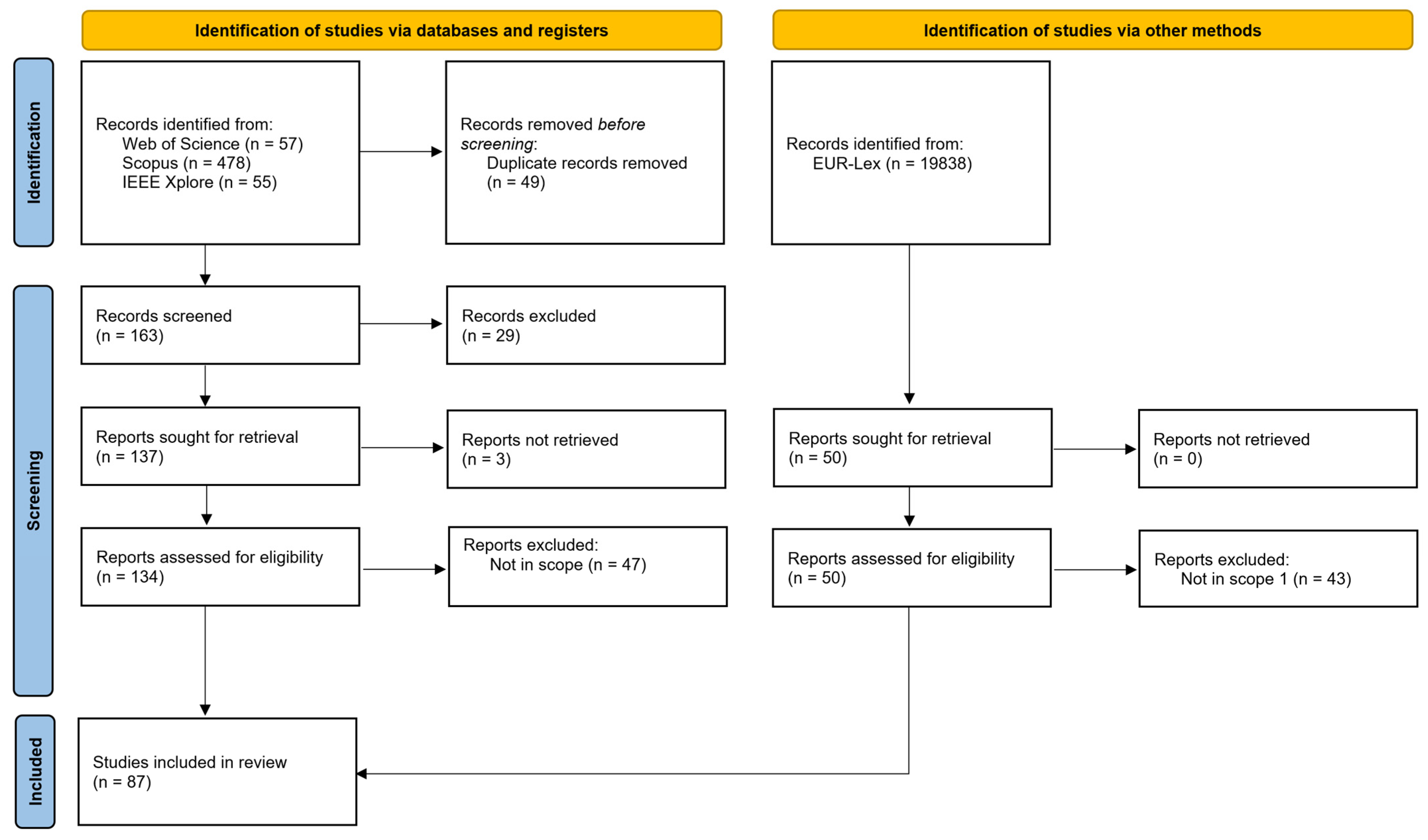
Study selection followed a two-stage screening process. Titles and abstracts were first screened for relevance, followed by full-text assessment to confirm alignment with the review objectives. The selection process prioritised conceptual relevance, architectural insight, and regulatory implications rather than quantitative performance evaluation. The identification, screening, eligibility, and inclusion process is reported using a PRISMA-ScR flow diagram, shown in
Figure 1.
2.4. Data Charting and Synthesis
Data from the selected scientific and regulatory sources were charted using a structured extraction approach, capturing system context, architectural assumptions, roles of Digital Twins and artificial intelligence, human interaction models, and governance or compliance considerations. Rather than aggregating results statistically, the synthesis focused on identifying recurring patterns, gaps, and tensions across technical, organisational, cognitive, and regulatory dimensions.
The synthesis resulted in a consolidated set of operational challenges for transmission and distribution system operators, presented in
Section 4. These challenges were subsequently translated into architectural requirements that guided the development of the Infostructure framework.
The final set of studies included in the PRISMA-ScR flow diagram defines the review corpus used throughout the subsequent narrative synthesis. Because the purpose of the study is architectural synthesis rather than bibliometric cataloguing, the included studies are introduced, cited, and consolidated across the thematic analysis in
Section 3,
Section 4,
Section 5,
Section 6 and
Section 7 and in the synthesis, tables derived from those sections, rather than reproduced in a single exhaustive inclusion table. The tables, therefore, function as structured synthesis artefacts that organise representative evidence and analytical patterns drawn from the full included corpus.
2.5. Framework Development and Analytical Validation
The Infostructure framework was developed through an iterative architectural reasoning process grounded in the synthesis of scientific and regulatory findings. Identified operational challenges and regulatory requirements were mapped to architectural concerns related to semantic alignment, orchestration of intelligent components, human-centred cognition, and governance by design.
The purpose of this synthesis was not to evaluate existing control room implementations, nor to compare individual technologies or algorithms, but to consolidate forward-looking architectural requirements emerging from the literature on Digital Twins, Agentic Artificial Intelligence, and situation awareness in future power system control rooms.
Illustrative operational use cases were employed as an analytical validation mechanism to demonstrate the relevance, coverage, and internal coherence of the proposed framework. These use-cases reflect representative transmission and distribution system operation scenarios, including wide-area disturbances, distribution-level congestion management, and cross-organisational coordination, and serve to assess architectural adequacy rather than to provide empirical validation.
2.6. Derivation of Future Research Directions
The derivation of future research directions is directly grounded in the research questions defined in
Section 2.1. In particular, RQ1 and RQ2 identify operational and regulatory constraints that shape architectural requirements, while RQ3 motivates the formalisation of Infostructure as a coherent coordination framework. RQ4 requires that the proposed architecture be analytically demonstrated and structured in a manner that enables systematic validation.
Accordingly, unresolved tensions and open challenges identified during the scoping review and architectural synthesis were not treated as isolated gaps, but as layer-specific research problems emerging from the interaction between operational complexity, regulatory constraints, and human–AI collaboration requirements. These research problems were then mapped explicitly to the Infostructure architectural layers and to representative transmission and distribution system scenarios introduced in
Section 8.
This ensures analytical traceability from research questions to synthesis, from synthesis to architectural formalisation, and from formalisation to research agenda. The structured validation and research roadmap presented in
Section 10, therefore, represents a logical extension of the framework development process rather than a speculative outlook. In this way, the methodological design preserves coherence across problem identification, architectural abstraction, and future empirical investigation.
5. European Regulatory and Policy Drivers for Regulation-Aligned Control Room Architectures
The architectural constraints identified in RQ2 arise from the evolving European regulatory environment governing grid operation, digitalisation, cybersecurity, data governance, and artificial intelligence. As control rooms integrate Digital Twins and Agentic Artificial Intelligence into safety-critical workflows, compliance can no longer be treated as an external procedural requirement. Instead, regulatory expectations increasingly shape the structural properties that control room architectures must exhibit, including transparency, traceability, human oversight, resilience, and accountability.
This section, therefore, examines European Union-level regulatory instruments not as legal artefacts in isolation, but as sources of architectural constraint. The objective is to translate regulatory principles into structural implications for control room design. By analysing energy market regulation, cybersecurity directives, data governance frameworks, and AI governance requirements through an architectural lens, the section clarifies how governance becomes a first-class design concern rather than an afterthought.
Rather than providing legal interpretation, the analysis abstracts common architectural consequences across regulatory instruments and identifies how they constrain the coordination of Digital Twins, intelligent reasoning components, and human operators within transmission and distribution system environments.
5.1. Scope and Regulatory Perspective
The regulatory analysis presented in this study focuses on European Union-level directives, regulations, and policy frameworks that directly influence the design and operation of control rooms operated by transmission and distribution system operators. This focus reflects the unique role of the European Union as a supranational regulatory environment in which harmonised legal instruments shape grid operation, digitalisation, cybersecurity, and artificial intelligence governance across multiple jurisdictions.
The emphasis is placed on regulatory requirements that have direct architectural implications for control room systems, including operational responsibility, decision authority, accountability, transparency, cybersecurity, and human oversight. National transpositions and country-specific implementations are outside the scope of this paper, as the objective is to identify common architectural drivers rather than implementation details.
Regulatory frameworks from other regions, such as the United States or China, are not included in this analysis. While these jurisdictions are highly relevant in their own right, their regulatory approaches to power system operation and artificial intelligence governance differ substantially in structure, scope, and degree of centralisation, as demonstrated in recent comparative regulatory analyses contrasting European, American, and Chinese governance models for digitalised power systems [
36]. A comparative assessment would therefore require a fundamentally different methodological approach and would extend beyond the architectural focus of this study. Instead, the European regulatory context is treated as a coherent and internally consistent reference environment for developing and analysing regulation-aligned control room architectures.
Rather than providing a legal interpretation, the analysis translates European regulatory requirements into architectural considerations relevant for the design of future control room systems.
5.2. Energy System and Grid Operation Regulation
The European electricity market and grid operation regulation establishes clear responsibilities for system operators regarding secure and reliable system operation. The EU Electricity Regulation (Regulation (EU) 2019/943) [
37] and the EU Electricity Directive (Directive (EU) 2019/944) [
38] define obligations related to operational security, system balancing, cross-border coordination, and incident management. Together with associated network codes and operational guidelines developed under the European Network of Transmission System Operators for Electricity, these instruments implicitly assume that control room decisions are attributable, auditable, and executed by accountable transmission and distribution system operators.
From an architectural perspective, these regulatory requirements imply that control room systems must support explicit responsibility attribution, clear separation between advisory support and decision authority, and traceable operational actions. As grid operation becomes increasingly data-driven and predictive, control room architectures must ensure that advanced decision support does not obscure operator responsibility or undermine established accountability structures.
5.3. Digitalisation, Data Governance, and Cybersecurity Regulation
The digitalisation of control rooms brings them firmly within the scope of European cybersecurity and data governance regulation. The NIS2 Directive (Directive (EU) 2022/2555) [
39] expands cybersecurity obligations for essential entities, including energy system operators, requiring systematic risk management, incident reporting, and organisational accountability. In parallel, the EU Cybersecurity Act (Regulation (EU) 2019/881) [
40] establishes a European framework for cybersecurity certification, reinforcing expectations of secure and resilient digital systems supporting critical infrastructure.
In addition, emerging European data governance legislation promotes controlled data sharing across organisational boundaries while maintaining data sovereignty and security. The Data Governance Act (Regulation (EU) 2022/868) [
41] introduces governance mechanisms for data sharing that are directly relevant to control room architectures relying on distributed data sources and cross-organisational coordination. Architecturally, these regulatory developments imply that cybersecurity and data governance considerations must be embedded across system layers through secure information flows, access control mechanisms, and audit-ready data handling practices, rather than addressed as add-on security controls.
5.4. Artificial Intelligence Governance and Human Oversight
The governance of artificial intelligence in operational contexts is formalised through the EU Artificial Intelligence Act (Regulation (EU) 2024/1689) [
42]. Control room applications of artificial intelligence, particularly those influencing operational decisions in critical infrastructure, are expected to fall within high-risk classifications under this regulatory framework. The regulation emphasises requirements for human oversight, transparency, explainability, robustness, and risk management throughout the AI system lifecycle.
For control rooms integrating Agentic Artificial Intelligence, these requirements have direct architectural implications. AI-based reasoning and recommendation mechanisms must be designed to support human-in-command decision models, ensure that automated outputs can be interpreted and challenged by operators, and provide traceable links between input data, model behaviour, and operational recommendations. These requirements align with the accountability and data protection obligations established under the General Data Protection Regulation (GDPR, Regulation (EU) 2016/679) [
43], which further reinforces the need for traceable and responsible handling of operational data. Architectures that obscure decision logic or delegate decision authority to autonomous systems without clear oversight mechanisms are therefore incompatible with emerging European regulatory expectations.
5.5. Architectural Implications for Control Rooms of the Future
The regulatory analysis presented in
Section 5.2,
Section 5.3 and
Section 5.4 reveals that European energy, cybersecurity, data governance, and artificial intelligence regulation converge on a common set of architectural expectations for control rooms of the future. While these regulatory instruments address different policy objectives, they collectively constrain how operational decision-making, information exchange, and responsibility must be structured in safety-critical control room environments.
At an architectural level, these regulatory expectations do not prescribe specific technologies or system implementations. Instead, they impose structural requirements on control room architectures related to accountability, transparency, human oversight, resilience, and interoperability. Compliance therefore, cannot be achieved through isolated technical controls or procedural measures alone, but must be embedded into the foundational organisation of control room systems.
A central implication is that control room architectures must preserve clear attribution of operational responsibility. Decision support capabilities, including advanced analytics and artificial intelligence, must be architecturally separated from decision authority, ensuring that responsibility for operational actions remains explicitly assigned to human operators. This requirement holds independently of whether decision support is provided by conventional algorithms or more advanced agent-based systems.
In parallel, regulatory convergence around cybersecurity, auditability, and data governance implies that control room architectures must support traceable decision pipelines and controlled information flows across organisational boundaries. Architectural support for logging, provenance tracking, access control, and post-event reconstruction is therefore not optional, but a prerequisite for operating within the European regulatory environment.
Finally, emerging governance frameworks for artificial intelligence reinforce the need for architectural mechanisms that ensure human oversight, interpretability, and contestability of automated reasoning. These requirements further emphasise that intelligence in the control room must be orchestrated in a manner that enhances, rather than replaces, human judgement.
To make this convergence explicit,
Table 2 synthesises the key European regulatory instruments discussed in this section and maps them to their corresponding architectural implications for control rooms. The table does not provide a legal interpretation of individual regulations, but abstracts their shared architectural consequences. In doing so, it establishes a clear bridge between the regulatory drivers analysed in this section and the reference architectural framework introduced in
Section 8.
8. Control Room of the Future
The analyses conducted in
Section 3,
Section 4,
Section 5,
Section 6 and
Section 7 reveal a convergence of operational, regulatory, and cognitive constraints that existing control room paradigms struggle to reconcile. Increasing system complexity, renewable variability, and cross-layer interdependence challenge traditional reactive supervision models. At the same time, European regulatory frameworks impose structural requirements concerning accountability, transparency, human oversight, interoperability, and auditability. In parallel, research on situation awareness and human–AI collaboration demonstrates that increased analytical capability alone does not guarantee improved operational judgement under time pressure and uncertainty.
Taken together, these findings establish the need for a coherent architectural coordination model capable of aligning physical grid behaviour, semantic interpretation, orchestrated reasoning, cognitive mediation, and governance constraints within a unified structural framework. The central question posed in RQ3 is therefore how Digital Twins, Agentic Artificial Intelligence, and human operators can be integrated in a manner that preserves decision boundary integrity, ensures semantic consistency, and embeds compliance by design.
To address this question, this section introduces Infostructure as a normative reference architectural framework for the control room of the future. Infostructure provides a structured architectural model for coordinating Digital Twins, Agentic Artificial Intelligence, and human operators while embedding governance and regulatory alignment as intrinsic architectural properties rather than external compliance mechanisms. In this study, the Control Room of the Future is not defined merely by the presence of advanced analytics or automation, but by a structural reorganisation of how physical system states, semantic representations, orchestrated intelligence, and human judgement are coherently integrated under explicit governance constraints. It represents a transition from tool-centric supervision toward architecturally constrained, human-in-command coordination of distributed digital intelligence across organisational and regulatory boundaries.
The section proceeds by deriving functional coordination requirements from the preceding analyses, formalising Infostructure as a layered reference architecture, and defining regulation-aware design principles that constrain interaction across architectural layers.
8.1. Functional Requirements for Coordinated Decision Making in Future Control Rooms
Future grid control rooms must support decision-making under conditions of increasing uncertainty, system complexity, and operational tempo. These conditions give rise to a set of functional requirements governing how Digital Twins, Agentic Artificial Intelligence, and human operators interact within the control environment.
Digital Twins are required to provide continuously synchronised representations of grid states that reflect both current conditions and plausible future system evolution. This includes the capability to perform predictive simulations under alternative operating assumptions, while explicitly exposing model scope, validity ranges, and uncertainty characteristics relevant for operational decision making.
Agentic Artificial Intelligence must reason over these Digital Twin representations in order to integrate heterogeneous data sources, coordinate analytical processes, and generate anticipatory insights, recommendations, and alerts. At the same time, its reasoning processes and outputs must remain inspectable, contestable, and overridable, ensuring that automated support augments rather than substitutes human judgement in safety-critical situations.
Human operators remain responsible for interpreting system states and decision support outputs, exercising professional judgement, and retaining final decision authority. Control room environments must therefore support operators in maintaining situation awareness across multiple temporal and spatial scales, without imposing excessive cognitive load or relying on opaque algorithmic behaviour.
Effective coordination between these elements further requires clearly defined information flows, decision boundaries, and escalation mechanisms. Control room systems must support shared situational understanding across organisational boundaries and enable traceable post-event analysis, ensuring that operational actions remain accountable and auditable.
It is important to emphasise that Infostructure does not replace established power system control methodologies such as optimal power flow, state estimation, contingency analysis, or dynamic security assessment. These analytical methods remain foundational to grid operation. Rather than introducing a new control law or optimisation technique, Infostructure structures how such methodologies are coordinated, contextualised, and governed within the control room environment, ensuring transparent interaction between analytical processes, intelligent reasoning components, and human decision authority.
Taken together, these functional requirements establish the need for an architectural framework that systematically structures interactions, responsibilities, and information mediation across technical and human components. The following subsections formalise this need through the introduction of the Infostructure framework.
8.2. Definition and Scope of the Infostructure Framework
Infostructure is defined as a normative reference architectural framework that organises the coordination, governance, and regulatory alignment of Digital Twins, Agentic Artificial Intelligence, and human operators within grid control rooms. It provides a shared architectural reference that structures how data, models, reasoning processes, and decisions are integrated and governed across organisational and technological boundaries.
As a reference architectural framework, Infostructure does not prescribe specific technologies, software platforms, or deployment architectures. Instead, it defines architectural concerns, roles, and relationships that must be addressed by any concrete implementation. It is not a middleware layer, a software platform, or a system blueprint. Rather, it serves as a normative and organisational framework that guides the design of control room architectures capable of supporting advanced digital intelligence while maintaining compliance with regulatory and safety requirements.
The scope of Infostructure explicitly includes semantic alignment, model governance, decision traceability, and accountability mechanisms. These aspects are treated as intrinsic architectural concerns rather than secondary properties that emerge from implementation choices. By positioning governance and compliance as architectural primitives, Infostructure enables consistent reasoning about responsibility, transparency, and trust in complex, multi-actor control environments.
8.3. Formal Architectural Abstraction of Infostructure
To clarify the structural logic of Infostructure beyond descriptive layering, the framework can be expressed as an architectural composition of constrained transformations between physical system states, semantic representations, coordinated reasoning processes, and human-centred decision mediation.
Let:
P denote the physical grid state space, comprising measurable system variables, asset states, and operational events.
S denote a semantic mapping function that transforms heterogeneous physical measurements and model outputs into shared, structured representations with explicit ontological alignment and uncertainty annotations.
O denote an orchestration function that coordinates Digital Twin evaluations, agent-based reasoning processes, and information flows under predefined decision boundary constraints.
C denote a cognitive mediation function that transforms orchestrated analytical outputs into interpretable, context-aware representations supporting human situation awareness and anticipatory judgement.
G denote a governance constraint set that enforces regulatory, accountability, traceability, and human-in-command requirements across all transformations.
Infostructure can then be abstracted as a constrained architectural composition:where each transformation operates within governance-imposed constraints rather than independently. Importantly, G does not represent a sequential processing stage but a cross-cutting constraint that bounds permissible operations across all architectural layers.
This abstraction clarifies that Infostructure is not a control algorithm but a coordination architecture governing how state representations are structured, how reasoning components are invoked, and how decision authority is preserved. The formalisation emphasises that semantic alignment, orchestration stability, cognitive interpretability, and governance compliance are interdependent architectural properties rather than isolated system features.
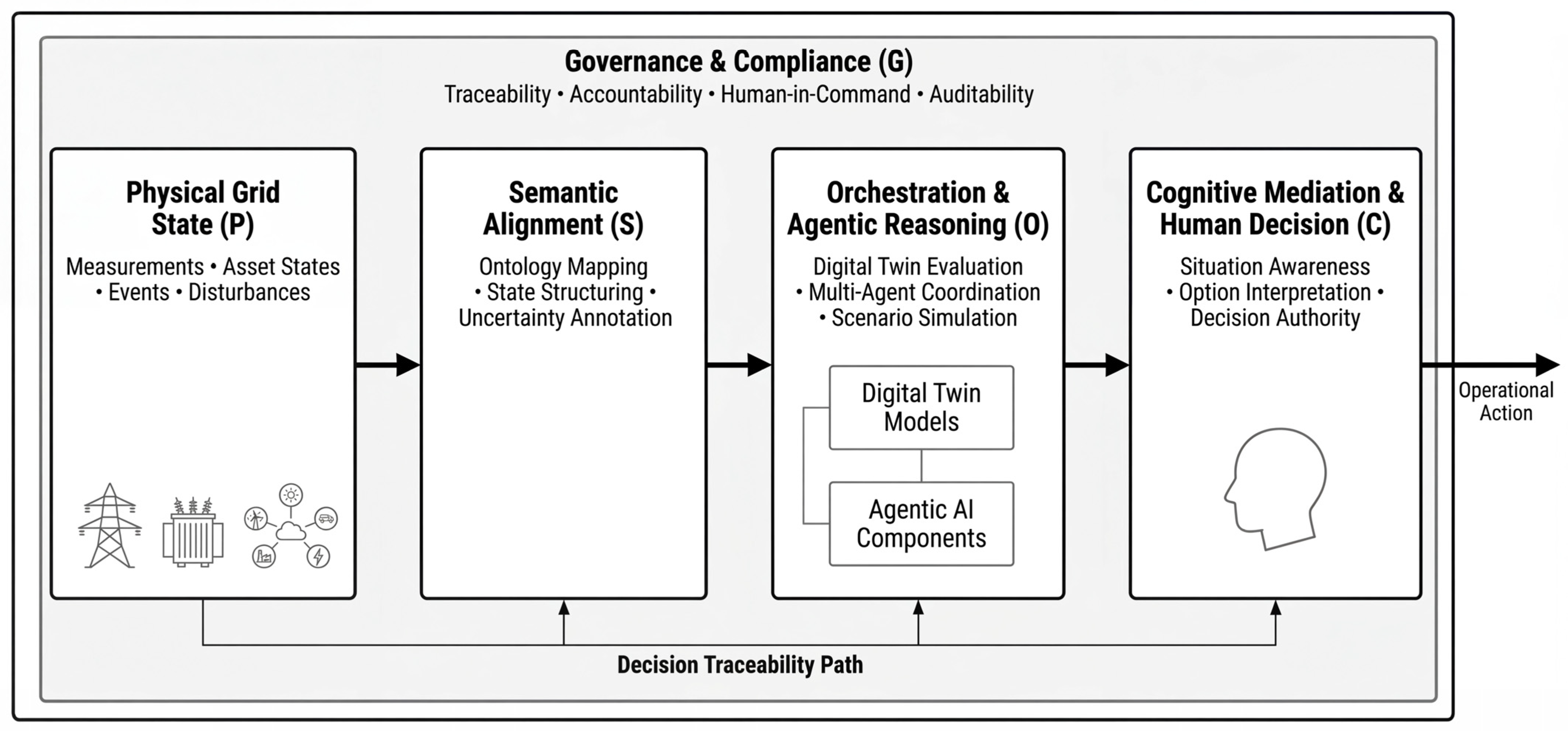
To clarify the dynamic interaction implied by the formal composition
,
Figure 2 visualises the transformation pathway from physical system states to human decision authority under governance constraints. The figure makes explicit how semantic alignment, orchestrated reasoning, and cognitive mediation are bounded by cross-cutting compliance requirements. Rather than depicting governance as an additional layer, the illustration presents it as a structural constraint that envelops all architectural transformations. This visualisation supports the interpretation of Infostructure as a coordination architecture rather than a sequential processing stack.
8.4. Regulation Aware Design Principles
The design of any control room architecture guided by the Infostructure framework must adhere to a set of regulation-aware design principles. These principles reflect both the operational demands of grid management and the regulatory expectations articulated in European frameworks governing critical infrastructure and artificial intelligence. They are derived directly from the European regulatory drivers and associated architectural implications analysed in
Section 5, in particular from the synthesis presented in
Table 2.
Human oversight must be preserved as a fundamental principle. While Agentic Artificial Intelligence may generate recommendations and anticipatory analyses, final decision authority remains with human operators, particularly in safety-critical contexts.
Explainability and transparency are required to ensure that automated reasoning can be understood, questioned, and justified. Models, assumptions, and decision rationales must be accessible to operators and auditors.
Traceability and auditability must be supported across the full decision lifecycle. This includes the ability to reconstruct how specific data inputs, model states, and reasoning processes contributed to operational decisions.
Accountability must be clearly defined across organisational boundaries. The framework must support explicit attribution of responsibilities for model development, system operation, and decision making.
Finally, interoperability and openness are essential to avoid vendor lock-in and to support cross-organizational coordination within the evolving European energy ecosystem.
8.5. Reference Architectural Layers of the Infostructure
The Infostructure framework is organised into a set of reference architectural layers that represent distinct but interrelated concerns in the design of future control room environments. These layers are conceptual in nature and are intended to structure architectural reasoning and design thinking rather than prescribe technologies or implementation stacks.
At the foundation of the framework lies the physical layer, which represents the electricity system itself, including grid infrastructure, generation assets, distributed energy resources, buildings, electric vehicles, and other cyber-physical components that constitute the operational environment. This layer provides the material basis upon which all higher-level digital representations and decision-support capabilities are constructed.
Architecturally, the physical layer anchors the entire Infostructure framework in the material realities of grid operation and prevents abstraction from drifting away from operational constraints. It defines the boundary at which measurements, events, and asset states are exposed to higher layers, while ensuring that physical limits, failure modes, and temporal dynamics remain faithfully represented rather than idealised. By grounding Digital Twin representations and higher-level reasoning in observable system behaviour, the physical layer constrains analytical and cognitive processes to remain consistent with real-world conditions, thereby safeguarding operational relevance and credibility across the control room architecture.
Above the physical layer, the semantic layer establishes shared meaning across data, models, and organisational contexts. It enables consistent interpretation of grid states, events, and predictions across Digital Twins and intelligent agents, supporting interoperability and reducing ambiguity in operational decision making. By providing a common semantic reference, this layer forms the first level of abstraction from the physical system.
Architecturally, the semantic layer decouples operational reasoning from the heterogeneity of underlying data sources and modelling formalisms by externalising assumptions about meaning and interpretation. It prevents analytical components, agentic reasoning processes, and human interfaces from embedding implicit assumptions about data structure, ownership, or modelling scope. By externalising these assumptions into a shared semantic frame, the layer limits tight coupling between tools, reduces propagation of inconsistent interpretations, and enables independent evolution of Digital Twin components without destabilising operational reasoning. In this way, the semantic layer functions as a stabilising boundary that protects situation awareness and coordination from fragmentation as system complexity and organisational diversity increase.
Building on this foundation, the orchestration and coordination layer structures the interaction between Digital Twins, Agentic Artificial Intelligence, and human operators. It governs information flows, synchronisation, and decision handovers, ensuring that autonomous reasoning components operate within clearly defined boundaries and that human oversight is preserved throughout operational workflows.
Architecturally, the orchestration and coordination layer functions as a control boundary that governs how analytical processes, agentic reasoning components, and human interactions are composed and sequenced during operation. Rather than performing analysis or decision making itself, the layer constrains when and how Digital Twin evaluations, agentic reasoning activities, and human interventions are invoked, combined, or escalated. By explicitly structuring these interactions, it prevents uncontrolled coupling between autonomous reasoning components, limits the emergence of opaque decision chains, and ensures that human oversight is preserved at critical decision points. In this way, the orchestration and coordination layer stabilises operational workflows under time pressure while maintaining traceability, predictability, and accountability in complex control room environments.
The cognitive layer sits closest to the human operator and supports the generation and maintenance of situation awareness. It integrates predictive insights, uncertainty representations, and contextual information into forms that can be meaningfully interpreted by operators. In doing so, this layer mediates between algorithmic reasoning and human cognition, enabling informed, timely, and accountable decision making under conditions of uncertainty and time pressure.
Architecturally, the cognitive layer functions as a mediation boundary between algorithmic reasoning and human sense-making. It prevents raw analytical outputs, intermediate model states, and fragmented alerts from being exposed directly to operators in forms that exceed human cognitive capacity or obscure situational relevance. By structuring how predictive insights, uncertainty, and alternative scenarios are synthesised and presented, the layer limits cognitive overload, automation surprise, and miscalibrated trust in automated reasoning. In doing so, it preserves the operator’s ability to form an independent, coherent understanding of system state and to exercise judgement under time pressure, even as underlying analytical complexity increases.
The governance and compliance layer spans and constrains all other layers of the framework. Rather than functioning as a processing layer, it embeds regulatory requirements, organisational policies, and accountability mechanisms across the architectural stack. This layer ensures that decisions can be traced to underlying data and reasoning processes, that responsibilities are clearly assigned, and that system behaviour can be audited both during operation and retrospectively.
Architecturally, the governance and compliance layer functions as a cross-cutting constraint that bounds the behaviour of all other layers, rather than as a standalone operational component. It prevents decision processes, data flows, and automated reasoning activities from evolving in ways that obscure responsibility, undermine auditability, or bypass human authority. By embedding requirements for traceability, accountability, and oversight into the architectural structure itself, the layer ensures that compliance with regulatory and organisational obligations is maintained continuously rather than assessed retrospectively. In this way, governance becomes an intrinsic property of system behaviour, shaping how coordination, reasoning, and human interaction are conducted across the control room environment.
Taken together, these layers provide a coherent reference architecture that clarifies how physical systems, digital intelligence, human cognition, and regulatory governance are aligned within the control room environment. The Infostructure framework thus supports coordinated, transparent, and human-centred decision making without prescribing specific technologies or operational implementations.
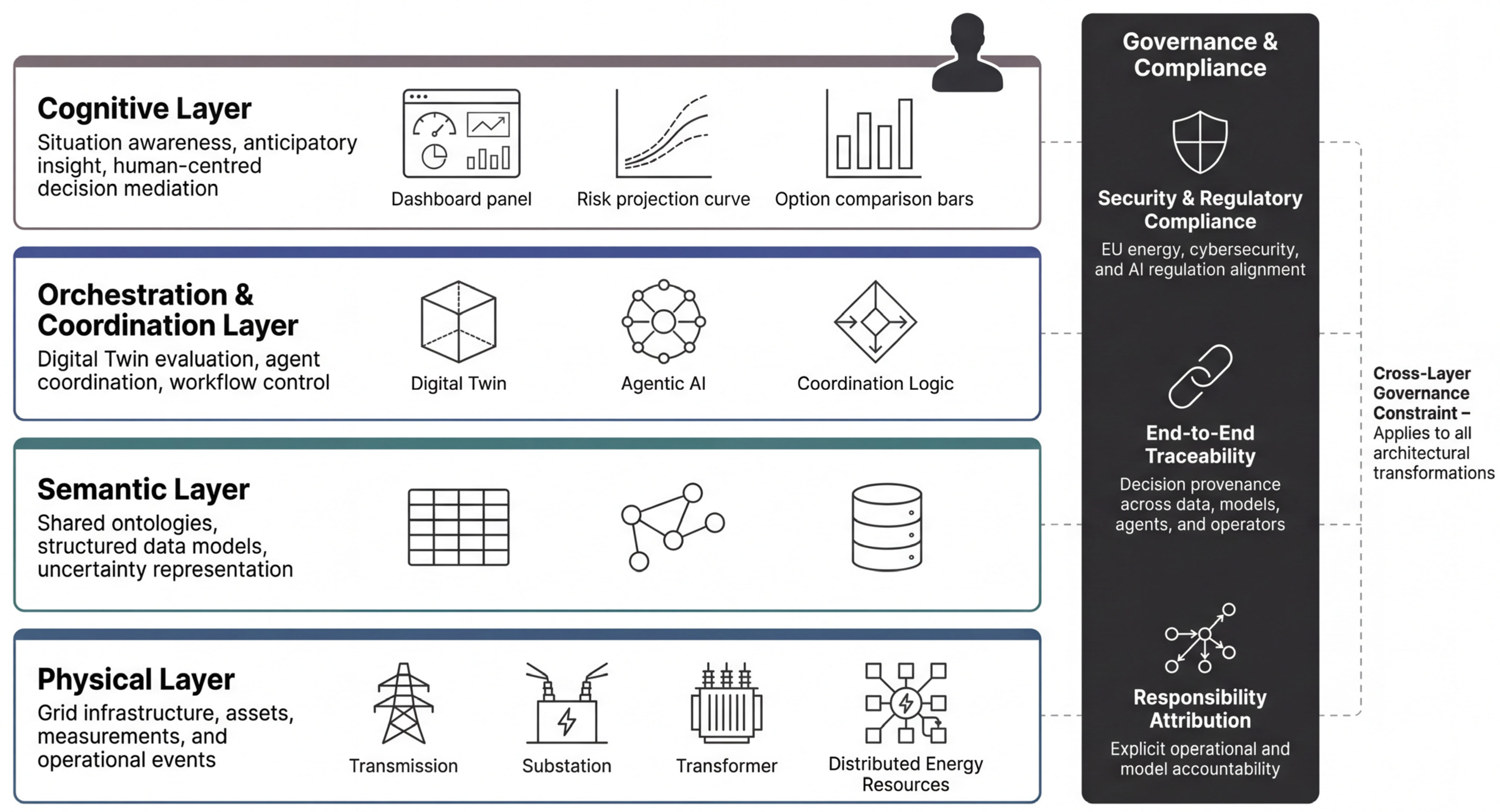
Figure 3 delineates the four horizontal functional layers—Physical, Semantic, Orchestration, and Cognitive—illustrating the progression from raw grid asset data integration (bottom) to strategic, human-centred decision support (top). The vertical Governance & Compliance Layer on the right-hand side emphasizes the overarching operational requirements for traceability, accountability, and adherence to the “human-in-command” principle across the entire technical stack.
To complement the structural representation provided in
Figure 3, it is necessary to illustrate how information and reasoning processes dynamically propagate across the Infostructure layers during operational events. While the layered architecture clarifies architectural separation of concerns, effective control room performance depends on coordinated transformation from physical system states to semantic interpretation, orchestrated analytical reasoning, cognitive mediation, and finally human decision authority under governance constraints.
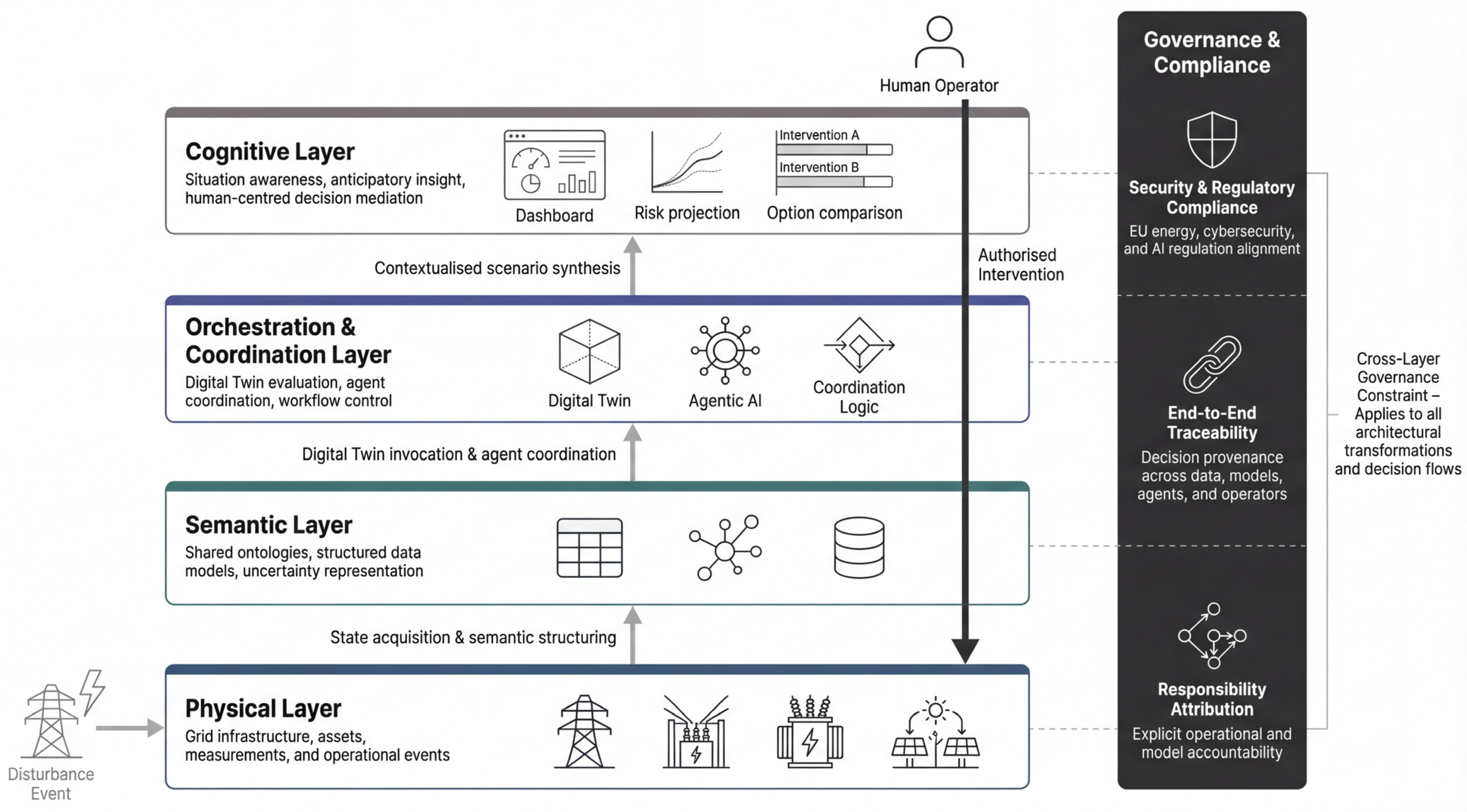
Figure 4, therefore, visualises the operational information flow across the Infostructure stack, highlighting transformation boundaries, decision checkpoints, and traceability pathways that preserve accountability in safety-critical contexts.
Figure 4 shows how a disturbance originating in the physical grid layer is first captured and structured through semantic alignment, ensuring consistent interpretation of measurements, operational constraints, and uncertainty across models. Coordinated Digital Twin evaluations are then invoked within the orchestration layer to simulate potential system evolutions, while agentic reasoning components integrate analytical outputs and generate structured assessments or recommendations. These results are mediated through the cognitive layer, where predictive insights, risk indicators, and alternative scenarios are synthesised into representations that support operator comprehension and projection. At each stage, governance constraints bound permissible transformations, enforce decision boundary integrity, and ensure that final operational authority remains explicitly with the human operator.
8.6. Implications for Implementation and Interoperability
By defining Infostructure as a normative reference architectural framework, concrete implementations retain flexibility while being guided by consistent architectural principles. This enables phased adoption, incremental integration of Digital Twins and Agentic Artificial Intelligence, and alignment with emerging interoperability standards and data space initiatives. The framework provides a stable reference against which implementation choices can be evaluated, ensuring that technological innovation remains aligned with operational safety, regulatory compliance, and human-centred control room practices.
8.7. Illustrative Operational Use Cases for TSOs and DSOs
To demonstrate how the proposed Infostructure framework addresses the operational challenges identified in
Section 4, this subsection presents three illustrative use cases grounded in realistic transmission and distribution system operation scenarios. The purpose of these use cases is not to prescribe implementations, but to analytically map identified challenges to architectural capabilities enabled by the Infostructure framework, thereby closing the conceptual loop between problem identification and solution proposal.
8.7.1. Use Case 1: TSO Wide Area Disturbance Anticipation and Mitigation
Transmission system operators increasingly face wide-area disturbances driven by high system loading, renewable variability, and cross-border power flows. As discussed in
Section 4, such events are characterised by limited observability across control zones, rapidly evolving system states, and strong accountability pressures on operators to act decisively under uncertainty.
Within the Infostructure framework, this challenge is addressed through coordinated use of multiple Digital Twins representing regional grid segments, coupled with Agentic Artificial Intelligence reasoning across these representations. The semantic layer ensures that state variables, contingencies, and uncertainty metrics are interpreted consistently across models, while the orchestration and coordination layer governs how predictive simulations and agent-based reasoning processes are invoked and combined. The cognitive layer supports the presentation of emerging risk patterns to operators in an interpretable manner, enabling timely intervention without obscuring model assumptions.
The governance and compliance layer ensures traceability and regulatory alignment of recommended actions. In this way, the Infostructure framework directly addresses the TSO challenges of situation awareness degradation, time-critical decision making, and responsibility attribution identified in
Section 4.
8.7.2. Use Case 2: DSO Congestion Management Under High Distributed Energy Resource Penetration
Distribution system operators are increasingly confronted with local congestion and voltage stability issues arising from high penetration of distributed energy resources, electric vehicles, and flexible loads.
Section 4 highlights the resulting challenges of fragmented data sources, heterogeneous models, and heightened regulatory expectations regarding transparency and fairness in operational decisions.
In this scenario, Infostructure enables coordination between local Digital Twins of feeder segments, market-related flexibility models, and Agentic Artificial Intelligence tasked with evaluating congestion mitigation options. The semantic layer establishes a shared representation of network states, flexibility bids, and operational constraints across heterogeneous data sources. The orchestration and coordination layer mediates between automated recommendation generation and operator oversight, while the cognitive layer supports operator understanding of trade-offs and implications.
By embedding traceability and accountability within the governance layer, decisions related to curtailment or flexibility activation can be audited and justified, addressing regulatory concerns while reducing operator cognitive burden. This use case illustrates how Infostructure responds directly to DSO-specific challenges related to complexity management, data integration, and regulatory compliance.
8.7.3. Use Case 3: Cross TSO DSO Coordination During Extreme Events
Extreme weather events and large-scale system disturbances increasingly require close coordination between transmission and distribution system operators.
Section 4 identifies the lack of shared situational awareness, organisational boundaries, and fragmented accountability structures as critical barriers to effective joint response.
Within the Infostructure framework, cross-organisational coordination is supported through shared but governed access to Digital Twins and decision support services. The semantic layer establishes a common operational vocabulary, while the orchestration layer manages information exchange and decision escalation paths across organisational boundaries. Agentic Artificial Intelligence can reason across aggregated system representations, supporting joint assessment of cascading risks without exposing unnecessary internal details.
Crucially, the governance and compliance layer constrains and frames information sharing in accordance with regulatory requirements, while preserving clear responsibility attribution. Human operators from both TSOs and DSOs retain authority over decisions within their respective domains, supported by a shared situational picture and traceable decision logic. This use case demonstrates how Infostructure addresses coordination, accountability, and trust challenges highlighted in
Section 4, particularly in high-impact, cross-organizational scenarios.
8.8. Synthesis of the Infostructure Framework and Its Relevance for TSO and DSO Operations
This section has introduced Infostructure as a normative reference architectural framework designed to structure coordination between Digital Twins, Agentic Artificial Intelligence, and human operators in regulation-aligned control rooms. Building on the operational challenges identified in
Section 4, the framework has been defined, structured, and illustrated through representative use cases covering both transmission and distribution system operation contexts.
The illustrative use cases demonstrate how Infostructure addresses key challenges faced by TSOs and DSOs, including limited observability, increasing operational complexity, time-critical decision-making under uncertainty, and heightened regulatory expectations regarding accountability and auditability. Rather than proposing isolated technical solutions, the framework organises these challenges across reference architectural layers that jointly support semantic alignment, coordinated reasoning, human-centred situation awareness, and governance by design.
Table 5 provides an analytical mapping between the operational challenges discussed in
Section 4, the Infostructure reference layers, and the illustrative use cases presented in
Section 8.7. This mapping highlights how multiple challenges are addressed simultaneously through the interaction of architectural concerns, reflecting the systemic nature of modern grid operation. Importantly, the table does not imply one-to-one correspondence between challenges and solutions but instead illustrates coverage and coherence across the framework.
By explicitly linking operational problem statements to architectural principles and illustrative scenarios, this synthesis clarifies the practical relevance of the Infostructure framework for real-world control room environments. It demonstrates how the framework supports both TSO and DSO decision-making while preserving human authority, enabling explainable and traceable use of advanced digital intelligence, and aligning control room evolution with European regulatory requirements. As such, Infostructure provides a coherent architectural reference that bridges strategic digitalisation objectives with the operational realities of secure and accountable grid management.
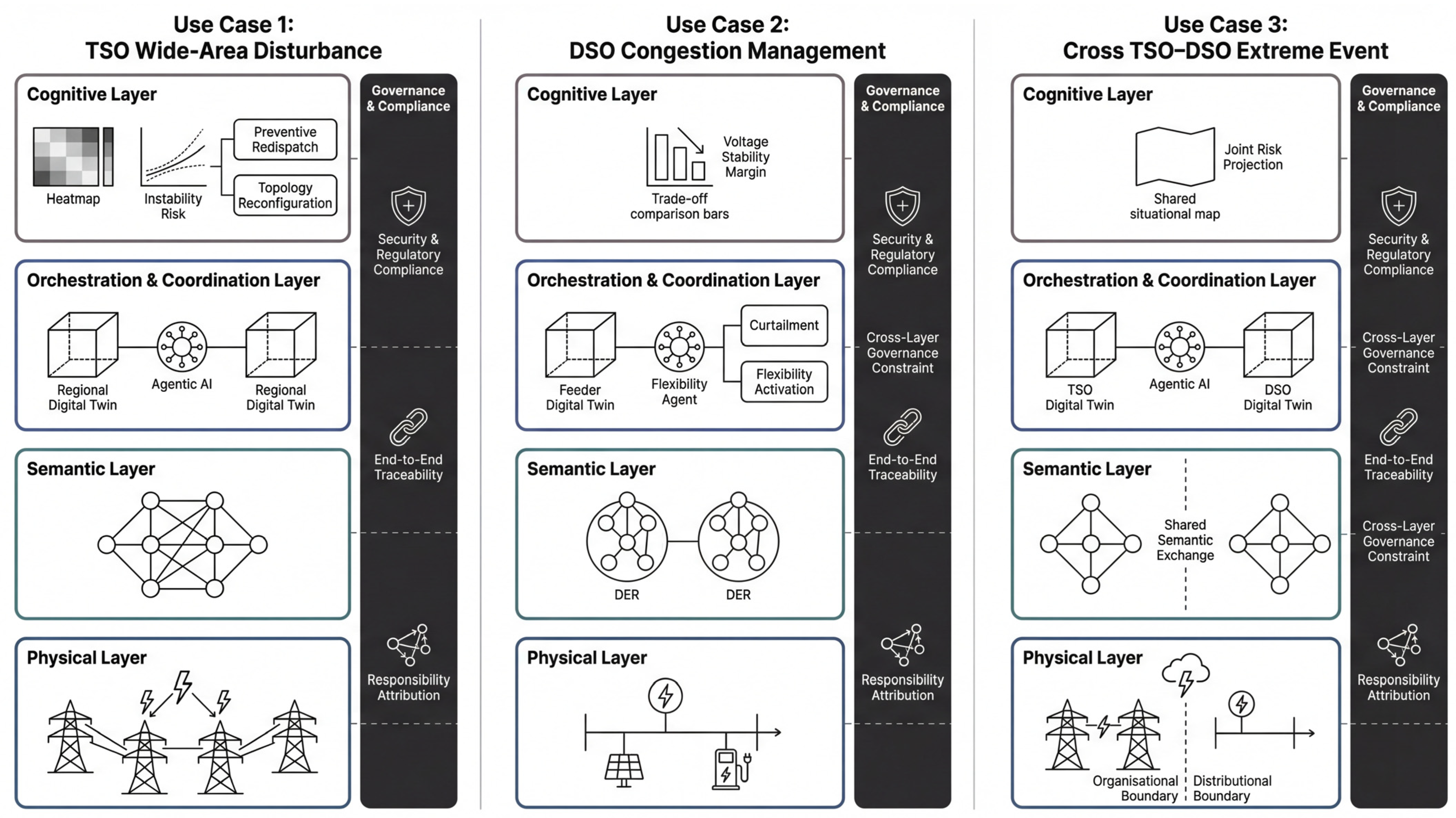
While the preceding subsections describe the three illustrative use cases narratively, it is beneficial to visualise how the Infostructure layers are activated differently across operational contexts.
Figure 5 presents a composite architectural depiction of the three representative scenarios: TSO wide-area disturbance anticipation, DSO congestion management under high distributed energy resource penetration, and cross-organisational coordination during extreme events. The figure highlights which architectural layers are predominantly engaged in each case and how governance constraints frame coordination across transmission and distribution boundaries.
In the first scenario, a wide-area disturbance propagating through the transmission network activates coordinated Digital Twin evaluations across multiple grid segments, with agentic reasoning integrating predictive assessments before mediated presentation to the TSO operator under explicit governance constraints. In the second scenario, distribution-level congestion emerging from high distributed energy resource penetration triggers semantic consolidation of feeder states and flexibility options, followed by orchestrated evaluation of mitigation strategies that are cognitively structured for DSO decision-making. In the third scenario, cross-organisational coordination during extreme events requires federated semantic alignment and synchronised orchestration across TSO and DSO domains, while governance mechanisms preserve responsibility attribution and controlled information exchange. Across all three cases, the figure highlights that different operational challenges activate distinct architectural layers with varying intensity, yet remain bounded by the same cross-cutting compliance structure.
9. Implementation Pathways and Alignment with European Initiatives
Building on the Infostructure reference architectural framework introduced in
Section 8, this section discusses how the proposed architectural principles can be incrementally operationalised within existing control room environments. The focus is not on deployment of specific systems or participation in particular programmes, but on outlining generic implementation pathways that are compatible with prevailing European regulatory frameworks, interoperability standards, and coordination practices. References to European initiatives are therefore used illustratively to contextualise architectural compatibility rather than to imply formal alignment or institutional endorsement.
Accordingly, this section examines how transmission and distribution system operators can incrementally operationalise the Infostructure framework through phased adoption strategies, compatibility with prevailing European data space concepts and interoperability standards, and the progressive integration of Digital Twins and Agentic Artificial Intelligence. Throughout, emphasis is placed on supporting operational safety, preserving human authority, and maintaining regulatory compliance, rather than prescribing specific technologies or deployment solutions.
9.1. Incremental Adoption Within Existing Control Room Infrastructures
Rather than assuming greenfield deployment, Infostructure is designed to be introduced incrementally within existing control room environments. This allows system operators to progressively enhance coordination, cognition, and governance capabilities while maintaining continuity of operations. Incremental adoption also reduces organisational risk and enables learning and adaptation as new digital capabilities are introduced.
From an architectural perspective, this implies coexistence between legacy systems and emerging digital components, with Infostructure providing a reference structure for managing interfaces, responsibilities, and decision boundaries. Such an approach is consistent with regulatory expectations regarding operational reliability and change management in critical infrastructure contexts.
9.2. Interoperability and Alignment with European Data Spaces
Interoperability is a prerequisite for scalable and cross-organisational implementation of Infostructure-enabled control rooms. European data space initiatives and related interoperability frameworks provide a foundation for controlled data sharing, semantic alignment, and federated access across organisational boundaries. Rather than replacing existing systems, Infostructure can leverage these initiatives to support coordinated reasoning and shared situational awareness while respecting data sovereignty and responsibility allocation.
In this context, Digital Twins and Agentic Artificial Intelligence can be progressively integrated as consumers and producers of interoperable data services, operating within governance constraints defined at the architectural level. This approach supports alignment with European digitalisation strategies without introducing new centralised dependencies.
9.3. Standards and Reference Models
Existing standards and reference models in power system operation, automation, and information exchange remain essential enablers for Infostructure implementation. Rather than proposing new standards, the framework is designed to align with and build upon established practices, using them as stable anchors for semantic consistency and system integration.
From an implementation perspective, standards can support predictable interaction between Digital Twins, intelligent agents, and human interfaces, while also facilitating regulatory compliance and auditability. Infostructure provides a means of situating these standards within a broader architectural context that explicitly accounts for cognition and governance.
9.4. Organisational Readiness and Governance Considerations
Successful implementation of Infostructure-enabled control rooms depends not only on technical capabilities, but also on organisational readiness and governance structures. Incremental adoption allows roles, responsibilities, and decision processes to evolve alongside technical systems, reducing the risk of misalignment between automation and organisational practice.
Architecturally, this reinforces the importance of the governance and compliance layer, which structures accountability, traceability, and oversight across both human and automated components. Such considerations are particularly important in multi-actor settings involving both transmission and distribution system operators.
9.5. Phased Implementation Logic
Given the complexity, criticality, and regulatory sensitivity of power system control room operations, the introduction of Infostructure-enabled capabilities cannot be approached as a single-step deployment. Instead, implementation must be understood as a phased architectural progression, in which capabilities are introduced, validated, and governed incrementally.
From a research and design perspective, phased implementation supports controlled learning, risk mitigation, and progressive assurance. Early phases allow foundational architectural concerns such as semantic alignment, interoperability, and enhanced observability to be addressed before more advanced orchestration and agent-based reasoning capabilities are introduced. Subsequent phases can then build on this foundation while preserving human authority and organisational accountability.
Importantly, phased implementation should not be interpreted as a strictly linear or sequential execution model. Phases may overlap, iterate, or progress at different rates across organisational units, operational domains, or national contexts. Rather than representing project milestones, the phases reflect increasing architectural maturity and institutional readiness, allowing system operators to align technical evolution with organisational capacity and regulatory expectations.
9.6. Phased Implementation Pathways
To operationalise the phased logic discussed above,
Table 6 summarises representative implementation phases for Infostructure-enabled control rooms. The table serves as the primary synthesis of implementation considerations discussed in this section, mapping architectural objectives to indicative actors and expected outcomes.
The phases outlined do not prescribe specific technologies, timelines, or governance arrangements. Instead, they represent progressive levels of architectural capability, organisational integration, and governance maturity. Individual transmission and distribution system operators may adopt elements from multiple phases in parallel or pursue hybrid pathways depending on regulatory context, operational priorities, and existing infrastructure.
By framing implementation pathways in this manner, the phased model supports strategic planning and dialogue among technical, operational, and regulatory stakeholders without constraining local implementation choices. This flexibility is essential for accommodating the diversity of control room environments across Europe while maintaining coherence with the Infostructure reference architectural framework. Importantly, continuous validation and assurance in the final phase should not be interpreted as static certification or one-time compliance assessment, but rather as an ongoing process of operational monitoring, model validation, human–AI interaction assessment, and regulatory alignment that evolves alongside system behaviour, organisational practice, and regulatory interpretation.
10. Research and Development Outlook
The Infostructure framework introduced in
Section 8 establishes a normative reference architecture for regulation-aligned and human-centred control rooms integrating Digital Twins and Agentic Artificial Intelligence.
Section 9 outlined phased implementation pathways through which Infostructure may be progressively introduced into operational environments. However, deployment alone does not establish architectural validity. In line with RQ4, the decisive question is how the coherence, robustness, and practical relevance of the proposed framework can be systematically demonstrated and empirically evaluated under realistic transmission and distribution system conditions.
Each stage of adoption must therefore be accompanied by structured evidence generation to determine whether the framework genuinely enhances situation awareness, stabilises coordinated reasoning, preserves explicit human decision authority, and satisfies governance and accountability requirements. Although Infostructure is grounded in a structured synthesis of operational challenges, regulatory drivers, and human–AI collaboration requirements, its scientific contribution ultimately depends on enabling repeatable architectural evaluation and cumulative empirical validation across operational contexts.
This section consequently defines a research and validation agenda that specifies what must be evaluated, why architectural validation in safety-critical control rooms is methodologically demanding, and how future research can operationalise empirical assessment without reducing Infostructure to a technology-specific platform or an algorithmic control proposal.
10.1. Validation and Evaluation of Infostructure-Based Architectures
A central research challenge concerns the empirical validation of control room architectures guided by Infostructure. Validation must be approached as an architectural question rather than a single algorithm benchmark. Accordingly, architectural performance must be evaluated at the workflow level rather than at the component level. In practice, control room performance emerges from interactions between heterogeneous models, data pipelines, orchestration logic, operator cognition, organisational coordination, and governance constraints. Consequently, future evaluation must test whether Infostructure improves situation awareness and decision quality while preserving explicit human authority and regulatory accountability under realistic operational tempo and uncertainty.
To achieve this, future research should establish evaluation designs that compare Infostructure-guided configurations against plausible baselines representing contemporary tool-centric control room integration. The evaluation unit should not be an isolated model or agent, but an operational workflow segment such as disturbance anticipation, congestion mitigation, or cross-organizational escalation. Evaluation must further distinguish between effectiveness, which concerns whether decisions improve, and assurance, which concerns whether decisions remain traceable, contestable, and auditable under regulatory expectations. This dual requirement is essential in regulation-governed control rooms, where an apparently effective intervention may still be unacceptable if accountability cannot be reconstructed.
A further methodological challenge concerns ecological validity. Control room outcomes are sensitive to operator expertise, workload, organisational procedures, and event novelty. Future validation therefore, requires a layered evidence strategy that combines simulation-based experimentation, software in the loop integration testing, and controlled human in the loop studies. Simulation can provide coverage across rare but high-impact scenarios, while human-centred experiments are needed to establish whether cognitive mediation genuinely supports perception, comprehension, and projection rather than increasing information complexity. Finally, governance evaluation must be treated as a first-class empirical dimension, not as a compliance narrative, because auditability and responsibility attribution are measurable system properties when instrumented appropriately.
10.2. Evaluation Criteria and Measurement Logic
For Infostructure to function as more than a conceptual architectural proposal, its claims must be empirically testable. Evaluation criteria must therefore reflect the structural properties asserted by the framework and translate them into measurable characteristics of operational workflows, human–AI interaction patterns, and governance mechanisms. Rather than focusing solely on algorithmic performance, evaluation must assess whether coordinated Digital Twin and Agentic AI integration improves operational reasoning while preserving transparency, accountability, and human authority.
To achieve this, evaluation should be structured across five interrelated dimensions that correspond directly to the Infostructure architectural layers and their cross-cutting governance constraints.
The first dimension concerns situation awareness outcomes. Infostructure asserts that semantic alignment and coordinated orchestration improve perception, comprehension, and projection under dynamic system conditions. Empirical validation must therefore examine whether operators detect emerging instability earlier, construct more accurate mental models of system state under uncertainty, and anticipate cascading developments more reliably than under baseline control room configurations.
The second dimension concerns cognitive load and resilience under escalation. The cognitive layer is intended to mediate analytical outputs in ways that stabilise operator reasoning under stress. Evaluation must therefore assess whether information prioritisation, uncertainty representation, and orchestration logic reduce overload during alarm pressure and time-constrained disturbances, rather than introducing new complexity or automation surprise.
The third dimension concerns workflow-level decision quality. Because Infostructure is not a new optimisation method but an architectural coordination model, evaluation should examine whether combined Digital Twin and agentic reasoning pipelines generate intervention options that preserve security margins, reduce adverse outcomes, and support timely decision making within operational constraints.
The fourth dimension concerns orchestration stability and decision boundary integrity. The framework claims that explicit orchestration constrains autonomous reasoning within safe and predictable boundaries. Validation must therefore test whether coordinated agent behaviour remains stable under stress, whether conflicting recommendations are resolved transparently, and whether safety-critical actions remain subject to explicit human decision authority.
The fifth dimension concerns governance, traceability, and auditability. Architectural alignment with regulatory expectations requires that decisions be reconstructable end-to-end. Evaluation must therefore examine the completeness of decision provenance records, the clarity of responsibility attribution across organisational boundaries, and the ability to reconstruct model states, assumptions, and reasoning steps following operational events.
These evaluation dimensions replace qualitative performance characterisations with measurable architectural properties, thereby enabling structured comparison between Infostructure-guided configurations and baseline control room integrations.
Table 7 summarises these evaluation dimensions and provides representative measurement approaches. The purpose of the table is not to prescribe a single experimental design, but to clarify how architectural claims can be translated into measurable system properties that enable cumulative empirical research.
10.3. Research Challenges at the Semantic Layer
The semantic layer underpins shared interpretation across Digital Twins, agentic reasoning components, and organisational actors. A major research challenge concerns semantic alignment across heterogeneous modelling formalisms, data granularities, and ownership regimes. This is not only an interoperability issue but also a trust issue, because semantic inconsistency produces silent failure modes where components appear to agree while operating on incompatible assumptions.
Future research should therefore address how ontologies and semantic reference models can represent grid states, events, constraints, and uncertainty in a way that remains stable across changing system configurations. This includes the representation of model validity ranges and the explicit propagation of uncertainty through semantic abstractions. A second challenge concerns semantic drift during operational evolution, where new assets, market arrangements, and flexibility services continually change the meaning of operational concepts. Long-lived control room architectures require mechanisms for semantic versioning, governance of semantic change, and controlled rollout of semantic updates without destabilising operational decision support.
10.4. Orchestration and Coordination of Agentic Artificial Intelligence
The orchestration layer raises research questions that are architectural and safety-critical rather than purely algorithmic. Control rooms will increasingly combine multiple models and reasoning services operating at different temporal horizons, from sub-second protection-related assessments to longer horizon planning and coordination. Future research must investigate how orchestration can enforce predictable interaction structures, prevent unstable feedback between agents and models, and maintain traceability of reasoning chains.
A central technical challenge concerns bounded autonomy. Even when agents are restricted to advisory roles, their recommendations can influence human decisions and therefore operational outcomes. Research is needed on decision boundary mechanisms that separate recommendation generation from execution, as well as on escalation logic that determines when uncertainty or conflict requires explicit human resolution. Another challenge concerns graceful degradation. Under partial data loss or model failure, orchestration must preserve a coherent operational picture and avoid cascading analytic failures that increase cognitive burden precisely when resilience is required.
10.5. Human-Centred Cognition and Situation Awareness
The cognitive layer is where architectural promises meet operational reality. Future research must examine how to present uncertainty, alternative scenarios, and agent recommendations in forms that support comprehension and projection without overwhelming operators. This requires research that integrates control room human factors, cognitive systems engineering, and interface design for time-critical reasoning under uncertainty.
Particular emphasis should be placed on trust calibration. Operators must neither over-rely on automated reasoning nor disregard it. Research should therefore investigate interaction patterns that make assumptions visible, communicate confidence and uncertainty faithfully, and support rapid contestability when the operator suspects a mismatch between system behaviour and model reasoning. Another critical challenge concerns the coordination of team cognition across roles and organisations. In practice, situation awareness is distributed across multiple actors. The cognitive layer must therefore support not only individual sense-making but also shared and aligned understanding across TSO and DSO operational contexts.
10.6. Governance, Accountability, and Regulatory Compliance by Design
The governance and compliance layer positions regulation as a cross-cutting architectural constraint rather than an external checklist. Future research should operationalise governance as a set of technical mechanisms that can be evaluated. This includes decision provenance graphs linking data inputs, model versions, reasoning steps, and operator actions. It also includes methods for attributing responsibility across organisational boundaries where data is shared but decision authority remains separated.
Further research needs to concern continuous assurance. Control room systems evolve, models are updated, and regulatory expectations mature over time. Consequently, governance mechanisms must support ongoing validation of models and reasoning pipelines, including monitoring for semantic drift, model performance degradation, and unsafe interaction patterns between agents and operators. Research is needed on assurance regimes that are compatible with critical infrastructure operations, where change must be controlled but innovation cannot be frozen.
10.7. Cross Organisational Deployment and Scalability
Infostructure is motivated by the increasing interdependence between transmission and distribution operations. Cross-organizational deployment introduces technical and institutional challenges that cannot be solved by interoperability alone. Future research must investigate how federated access to Digital Twins and reasoning services can support shared situational awareness while preserving data sovereignty, cybersecurity requirements, and responsibility attribution.
This includes research on controlled information sharing mechanisms that support operational coordination without creating new centralised dependencies. It also includes the development of governance models that clarify which actor is accountable for which part of a decision pipeline, particularly when recommendations are generated through combined reasoning over partially shared representations. Scalability must be treated as both a computational and organisational property, because coordination overhead and trust breakdown can become limiting factors even when technical integration is feasible.
10.8. Architectural Synthesis of Research Directions
While the preceding subsections articulate layer-specific research challenges and validation logic, it remains essential to demonstrate how these research directions are structurally grounded in the Infostructure framework and operationally motivated by realistic control room scenarios. To consolidate this relationship,
Table 8 maps the identified research directions to the Infostructure architectural layers and to the illustrative use cases presented in
Section 8.6.
This synthesis serves two purposes. First, it ensures architectural coherence by making explicit how semantic alignment, orchestration logic, cognitive mediation, and governance mechanisms each generate distinct but interrelated research problems. Second, it demonstrates operational grounding by linking each research direction to concrete transmission and distribution system contexts, including wide area disturbance anticipation, distribution level congestion management, and cross-organizational coordination during extreme events.
By preserving this structural mapping, the research agenda avoids fragmentation into isolated technical themes. Instead, it reinforces the systemic character of control room evolution, where improvements in one layer depend on corresponding advances in adjacent layers and where operational scenarios provide the ultimate test context for architectural adequacy.
11. Conclusions
The transformation of power system operation driven by renewable integration, digitalisation, and increasing system interdependence exposes structural tensions within existing control room paradigms. The analysis of evolving operational practices demonstrates that reactive supervision models are increasingly strained under persistent uncertainty, cross-layer coupling, and time-critical escalation dynamics. In parallel, European regulatory frameworks impose explicit architectural constraints concerning accountability, transparency, human oversight, cybersecurity, and auditability. Together, these operational and regulatory pressures require a re-examination of how Digital Twins, Agentic Artificial Intelligence, and human operators are coordinated within safety-critical environments.
This paper has addressed these challenges by developing Infostructure as a normative reference architectural framework for the control room of the future. Building on a structured synthesis of operational challenges, regulatory drivers, and human–AI collaboration requirements, the framework formalises a layered architecture encompassing Physical, Semantic, Orchestration, and Cognitive concerns, constrained by cross-cutting governance and compliance principles. Rather than introducing a new control algorithm, Infostructure specifies how existing analytical methods and intelligent reasoning components can be coherently integrated while preserving explicit decision boundaries and human-in-command authority.
The framework’s architectural coherence has been analytically demonstrated through representative transmission and distribution system use cases, illustrating how semantic alignment, coordinated reasoning, cognitive mediation, and governance mechanisms jointly address real-world disturbance management, congestion mitigation, and cross-organisational coordination challenges. A structured validation roadmap has further been articulated, clarifying how architectural claims can be empirically assessed through simulation-based experimentation, human-in-the-loop studies, orchestration stress testing, and governance traceability analysis.
By explicitly linking operational complexity, regulatory constraint, architectural formalisation, and validation methodology, Infostructure provides more than a conceptual integration narrative. It establishes a principled and testable foundation for the systematic evolution of transparent, accountable, and human-centred control rooms. In doing so, the framework contributes a coherent architectural reference that supports cumulative research progress and evidence-based deployment in increasingly complex and regulation-sensitive power system environments.