


Abstract
Rapid urbanisation and rising thermal comfort expectations are propelling global energy demand for space cooling and heating in buildings, cementing vapour compression air conditioning as the dominant technology due to its proven simplicity and efficiency. However, conventional mechanical configurations remain constrained by intrinsic thermodynamic irreversibilities and by international protocols mandating the phase-out of high global warming potential refrigerants. While a growing body of research proposes performance-enhancement measures, these advances remain fragmented across technologies and application contexts. This paper critically reviews recent vapour compression cycle developments, structuring the literature around five interrelated thematic pathways: refrigerant-centric strategies, thermodynamic cycle modifications, hybrid system integration, heat exchanger innovations, and control-centric optimisations. The analysis reveals that no single technology can universally optimise vapour compression cycle performance; instead, effective system improvements emerge from context-specific combinations of refrigerant innovation, heat-transfer enhancement, cycle modification, and hybridisation, with the most successful strategies closely aligned to required temperature lifts and regional climatic conditions. This review introduces a simplified constraint–strategy–technology framework in which dominant system constraints (regulatory and proprietary, thermodynamic and climatic conditions, and demand-related) are first identified. Then corresponding technological improvement strategies (cycle modification, hybridisation, material selection, and control optimisation) are mapped out while enabling technologies are evaluated for suitability, scalability, and maturity. Therefore, this framework provides a system-level synthesis that links performance gains to context-specific operating constraints.
1. Introduction
Over the past fifty years, global energy consumption has nearly tripled, reaching 450 EJ in 2024 [1,2]. The building sector presently claims about 30% of this energy demand, with space air-conditioning demand reaching over 70% of the building power demand during peak summer temperatures in hot climates. Space cooling has seen the steepest growth trend, expanding at an annual rate of 4% since 2000 in hot climate regions [1], and sales of air-conditioning systems have reached more than 130 million units in 2024, while the increase in equipment efficiency remains modest, tripling electricity demand to 2000 TWh since 1990 and generating 1.1 Gt of attendant CO2 emissions [3,4]. Consequently, the provision of high-efficiency, low-carbon cooling technologies has transitioned from a motivated target to a climatic priority.
Based on well-established thermodynamic principles, the vapour compression cycle (VCC) remains the workhorse of modern air-conditioning systems in building services engineering. Its continued dominance is attributed to its high efficiency, proven reliability, and scalability across a wide range of applications [5]. Technically, conventional VCC architecture remains constrained by fundamental thermodynamic irreversibilities, including throttling losses, non-isothermal compression, and temperature mismatch in heat exchangers. At the same time, continued reliance on high-GWP refrigerants has increased regulatory pressure on conventional system designs [6].
In response, recent research has moved beyond isolated component-level optimisation to integrated strategies that combine refrigerant innovation, advanced materials, cycle and configuration modifications, and system-level hybridisation. These aim to reduce mechanical compression work, recover expansion losses, exploit low-grade thermal energy, and redistribute compression across multiple stages or subsystems.
Accordingly, this review critically synthesises recent advances in VCC performance enhancement, with emphasis on system-level effectiveness, scalability, and practical deployment rather than isolated laboratory gains. This work emphasises comparative trends, application suitability, technology maturity, and system-level trade-offs. It is structured around key enhancement pathways, including refrigerant-based strategies, nanomaterial applications, cycle and configuration modifications, hybrid system integration, heat exchanger enhancement, and advanced control strategies, with a focus on studies published after 2020 identified through Scopus and Web of Science.
Basic Vapour Compression Cycle (VCC)
The ideal VCC, as illustrated in Figure 1, consists of four primary components: a compressor, a condenser, an evaporator, and an expansion device. The refrigerant enters the compressor at state 1 as saturated vapour and is compressed isentropically to the condenser pressure, causing its temperature to rise above the ambient level. At state 2, the superheated refrigerant vapour enters the condenser and rejects heat to the surroundings at constant pressure, leaving as a saturated liquid. At state 3, the liquid refrigerant is throttled through the expansion device and undergoes an isenthalpic expansion to the evaporator pressure, resulting in a temperature drop below the indoor air temperature. The refrigerant enters the evaporator at state 4 as a low-quality saturated mixture, absorbs heat from the conditioned space, and fully evaporates. It then returns to the compressor as saturated vapour, completing the cycle. The actual VCC differs from the ideal cycle. In practice, it is difficult to ensure that the refrigerant enters the compressor and the expansion device exactly as saturated vapour and saturated liquid, respectively. Instead, systems are typically designed so that the refrigerant enters the compressor in a slightly superheated state to prevent liquid droplets from entering and damaging the compressor. Likewise, it is undesirable for the refrigerant to reach the throttling valve before it is fully condensed. For this reason, the refrigerant is intentionally subcooled before entering the expansion device [7]. In addition to these deviations, real systems also experience pressure drops in heat exchangers and piping, non-isentropic compression in the compressor, and irreversibility in the expansion device due to the isenthalpic throttling process, all of which further shift the actual cycle from the idealised thermodynamic model.
Figure 1.
Schematic diagram of VCC (left); P-h diagram (right).
2. Refrigerant-Based Strategies
The evolution of refrigerants reflects a continuous trade-off between thermodynamic performance, safety, and environmental impact. Early refrigeration systems relied on natural refrigerants such as ammonia (NH3), carbon dioxide (CO2), sulfur dioxide (SO2), and air, which offered favourable thermodynamic properties but were limited by toxicity, flammability, or high operating pressures. The introduction of chlorofluorocarbons (CFCs) in the 1930s enabled widespread adoption of refrigeration and air-conditioning technologies due to their chemical stability and safety; however, their role in stratospheric ozone depletion led to global regulatory intervention through the Montreal Protocol (1987).
Subsequent generations of refrigerants, including hydrochlorofluorocarbons (HCFCs) and hydrofluorocarbons (HFCs), successively addressed ozone depletion concerns but introduced new challenges related to high global warming potential (GWP). As a result, international agreements such as the Kyoto Protocol (1997) and the Kigali Amendment (2016) have accelerated the phase-down of high-GWP refrigerants and driven renewed interest in low-GWP alternatives, including hydrofluoroolefins (HFOs) and next-generation natural refrigerants [8,9,10,11].
This regulatory-driven transition has reshaped refrigerant selection criteria from purely performance-based considerations toward a multi-objective balance encompassing efficiency, safety classification, system compatibility, and environmental compliance. Table 1 summarises the progression of refrigerant generations. Within this context, refrigerant-based strategies are no longer viewed as isolated efficiency enhancements but as enabling constraints that define the feasible design space for advanced VCC systems.
Table 1.
Summarises the evolution of refrigerant generations.
2.1. Low-GWP Refrigerants
The transition toward low-GWP refrigerants has expanded the range of viable working fluids for VCC systems; however, their practical adoption is governed by trade-offs between efficiency, safety, volumetric capacity, and system compatibility. Many low-GWP alternatives exhibit flammability or reduced volumetric capacity, while options such as carbon dioxide require fundamentally different system architectures due to transcritical operation. Consequently, accommodating low-GWP refrigerants often necessitates compressor resizing, enhanced heat exchangers, or advanced controls, which can increase system cost and, in some cases, offset efficiency gains [5].
Among (HFOs), R1234yf has emerged as the most widely studied drop-in replacement for R134a, largely due to its ultra-low GWP and minimal retrofit requirements. Although modest reductions in cooling capacity and COP are commonly reported, its favourable discharge temperature and A2L safety classification make it well-suited for automotive and small-capacity refrigeration applications [12,13,14]. R1234ze(E) exhibits comparable thermodynamic performance to R134a with similarly low GWP, positioning it as a practical option for chilled-water and medium-temperature systems where lower volumetric capacity is acceptable [15].
Higher-efficiency alternatives such as R152a and hydrocarbons consistently outperform R134a in terms of COP; however, these gains are achieved at the expense of increased flammability and higher discharge temperatures. R152a, despite delivering substantial efficiency improvements, remains constrained by A2 flammability and elevated thermal stress on compressors [16,17], while hydrocarbons such as R290 and R600a are limited to low-charge systems with enhanced safety provisions due to their A3 classification [12,17,18,19]. As a result, their application is largely confined to carefully designed systems rather than the broad replacement of legacy refrigerants.
For applications where non-flammability is critical, R513A (A1) serves as a practical interim replacement for R134a, achieving up to 8% COP improvement with minimal system modification [20], while R516A shows advantages at low evaporating temperatures [21,22].
For R410A replacement in air-conditioning applications, R32 has gained widespread acceptance as a transitional refrigerant, offering improved efficiency and capacity but with increased discharge temperature and only moderate GWP reduction. Newer A2L blends, including R454B and R452B, seek to balance these limitations by providing comparable performance with lower GWP and improved safety characteristics, making them more suitable for next-generation air-conditioning systems [23]. At larger capacity and heat-pump applications, R744 (CO2) offers clear advantages under high-temperature lift conditions, particularly where simultaneous heating and cooling are required; however, its performance remains highly sensitive to operating conditions, necessitating careful system optimisation and auxiliary components such as internal heat exchangers [24].
The literature indicates that no low-GWP refrigerant provides a universal replacement for R134a or R410A, and refrigerant selection must therefore be treated as an application-specific design choice rather than a standalone pathway to transformative efficiency improvement. In this context, mildly flammable HFOs like (R1234yf, R1234ze) represent the most realistic near-term option for widespread deployment due to their system compatibility. However, they exhibit moderate penalties, with COP changes from −17% to 2% and cooling capacity reductions of up to 24%, which may necessitate compressor resizing [12,14,15]. Natural refrigerants like (R290 and R600a) can offer COP improvements of up to 6% but are often constrained by higher discharge temperatures of up to 14%, significant capacity reductions of up to 47% for R600, and safety-driven design requirements that increase system cost [12,17,18,19]. CO2 shows a substantial COP increase of about 20% and capacity gain of 11%, yet its high operating pressures and transcritical architecture require fundamentally different system designs, potentially offsetting these benefits outside optimised high-temperature-lift applications.
2.2. Blends for High-GWP Refrigerant Replacement
Refrigerant blending has emerged as an effective strategy to balance efficiency, flammability, and environmental impact when single-component low-GWP refrigerants fail to meet all design constraints. By combining refrigerants with complementary properties, blends can moderate flammability, adjust pressure levels, and tailor volumetric capacity, albeit at the cost of increased compositional complexity and potential glide effects.
For medium-temperature air-conditioning applications, blends combining high-efficiency but flammable components with low-GWP HFOs have shown promising performance. The R152a/R1234ze(E) mixture achieves high COP while reducing flammability compared with pure R152a, making it a viable candidate where safety constraints preclude direct hydrocarbon use [25]. Similarly, R454A and R459B have been proposed as long-term replacements for R404A, although achieving optimal performance often requires enhanced subcooling or system adaptation [26]. Safety-driven formulations further indicate that incorporating low-flammability components, such as R1233zd(E), can effectively suppress flammability in hydrocarbon-based mixtures, expanding their applicability under safety constraints [27].
In transcritical and high-lift applications, CO2-based blends provide an alternative pathway to improve efficiency without abandoning CO2 architectures. Mixtures such as CO2/R32 can increase cycle efficiency when combined with internal heat exchangers, although this improvement is typically accompanied by reduced cooling capacity, highlighting the inherent trade-off between efficiency and capacity in blended systems [24].
Refrigerant blends offer a flexible, application-specific alternative to high-GWP fluids, allowing designers to balance efficiency, safety, and capacity according to system requirements. However, these benefits are often offset by increased system complexity, sensitivity to mixture composition, and limited applicability across operating conditions. As such, blends should be viewed as targeted replacements rather than generic solutions for high-GWP refrigerant phase-out, future refrigeration systems will rely on a portfolio of optimised solutions, ranging from pure HFOs such as R1234ze(E) [13], to natural refrigerants like R290 and CO2 [28,29], and carefully engineered zeotropic blends [12,28,30], selected according to application-specific safety, efficiency, and sustainability requirements.
2.3. Nanofluid Refrigerant and Lubricants
These are engineered fluids created by dispersing nanometre-sized particles (1–100 nm) into conventional refrigerants or compressor lubricants [31,32]. The primary motivation for their use is the enhancement of thermophysical properties, particularly thermal conductivity, due to the nanoparticles’ high surface-area-to-volume ratio [33]. This enhancement improves heat absorption in the evaporator and heat rejection in the condenser, resulting in higher system performance, reducing energy consumption, and enabling more compact refrigeration system designs. Additionally, when dispersed in lubricating oils, nanoparticles reduce friction and wear between moving compressor components, improving system reliability and durability.
Nanomaterials used in refrigeration applications are commonly classified into four categories. Metallic nanoparticles (e.g., Cu, Ag, Al) provide high thermal conductivity but are prone to oxidation. Ceramic nanoparticles (e.g., Al2O3, TiO2, CuO, SiO2, ZnO) are widely used due to their chemical stability and cost-effectiveness. Carbon-based nanomaterials (e.g., SWCNT, MWCNT, graphene, diamond, fullerenes) offer exceptional thermal conduction and tribological performance, but at a higher cost and with more challenging dispersion. Hybrid nanofluids combine two or more nanoparticles to exploit synergistic effects, aiming to achieve superior overall thermophysical properties while improving stability [34].
2.3.1. Nanorefrigerant
The dispersion of nanoparticles into refrigerants has been investigated as a means of enhancing heat transfer in VCC systems without modifying the basic cycle configuration [35]. Nanorefrigerants primarily improve boiling heat-transfer performance and refrigerant circulation through increased thermal conductivity, increased nucleation, and modified density characteristics. These benefits can reduce compressor power and increase COP. However, these advantages are frequently offset by increased viscosity and pressure drop, limiting the net performance improvement at the system level.
Across the literature, CuO-based nanorefrigerants, particularly CuO-R1234yf, consistently demonstrate the most balanced performance. Experimental studies report moderate enhancements in thermal conductivity, density, and flow-boiling heat-transfer coefficients at low nanoparticle concentrations, leading to improved refrigerant flow rate and favourable compressor operating conditions [36,37]. Importantly, when nanoparticle concentration is carefully optimised, the resulting hydraulic penalties remain manageable, making CuO one of the more practical candidates for nanorefrigerant applications.
In contrast, TiO2-based nanorefrigerants can deliver higher boiling heat-transfer enhancement; however, the associated pressure-drop penalties substantially increase pumping and compression requirements [38]. As a result, the pronounced component-level heat-transfer gains reported for TiO2 systems do not necessarily translate into superior cycle performance. Comparative studies further indicate that nanoparticles providing higher density enhancement, such as CuO, are generally more favourable than those offering only thermal conductivity improvement, as refrigerant mass-flow behaviour strongly influences compressor work.
Nanorefrigerants can deliver measurable heat-transfer enhancement when nanoparticle type and concentration are carefully optimised; however, their effectiveness is constrained by unavoidable trade-offs between thermal augmentation and hydraulic losses. Research conducted by Bibin et al. [36,37,38] shows that the point at which viscosity and pressure-drop penalties negate COP gains in nanorefrigerants depends strongly on nanoparticle type, concentration, and refrigerant vapour quality. In general, performance begins to deteriorate once concentrations exceed about 0.3–0.8% volume fraction, where increased viscosity and frictional losses lead to higher compressor power that offsets heat-transfer enhancement. For example, adding 0.2% CuO to R1234yf improves the heat-transfer coefficient by 45% with a 36% increase in pressure drop at a vapour quality of 0.2, whereas increasing the concentration to 1% raises the heat-transfer coefficient by 191% but drives pressure-drop penalties to 340% at a vapour quality of 0.9, a level that would typically negate any system-level COP benefit. Among the investigated materials, CuO offers the most favourable balance for system-level performance, while nanoparticles such as TiO2 are better suited for fundamental heat-transfer studies rather than practical deployment. Large-scale commercial adoption of nanorefrigerants would require coordinated progress across technological, economic, and regulatory domains. Until such developments materialise, they are best regarded as a supplementary enhancement strategy rather than a standalone solution for improving the efficiency of VCC systems. Key performance trends and operating ranges are summarised in Table 2.
Table 2.
Overview of the performance of nanorefrigerant in VCC.
2.3.2. Nanolubricant
The incorporation of nanoparticles into compressor lubricants has been widely investigated as a means of improving VCC performance through enhanced heat transfer and reduced mechanical losses. In nanolubricants, metallic, metal-oxide, or carbon-based nanoparticles are dispersed in conventional oils, increasing thermal conductivity while improving tribological behaviour at compressor contact surfaces. As a result, nanolubricants primarily enhance system efficiency by reducing friction, compressor work, and discharge temperature rather than directly modifying refrigerant thermodynamics [35].
Among carbon-based additives, Raghavulu and Rasu [43] demonstrated that graphene-based POE nanolubricants significantly improve system efficiency in an R134a VCC. At an optimal concentration of 0.10 vol.%, COP increased by approximately 29%, compressor work decreased by 21.7%, and heat-removal capacity rose by 8.9%, primarily due to graphene’s superior thermal conductivity and anti-friction characteristics. Similarly, Kumar et al. [44] reported substantial gains using SiO2/POE nanolubricants with R600a, achieving a 39% increase in COP, a 29% higher refrigeration effect, and a 7% reduction in compressor power at a concentration of 0.1 g/L, accompanied by marked reductions in friction and wear.
Hybrid nanolubricants have also been explored to exploit synergistic effects. Kumar et al. [45] showed that a TiO2–SiO2 hybrid formulation (25% TiO2/75% SiO2 at 0.1 g/L) delivered superior performance compared with mono-nanoparticle oils, improving COP by 23%, reducing compressor power by 8%, and enhancing refrigeration effect by 13%. These improvements were attributed to combined metallic and non-metallic oxide effects, yielding thermal-conductivity enhancements of 40–165% depending on temperature.
Subhedar et al. [46] used Al2O3 nanoparticles dispersed in mineral oil with an R134a vapour compression system in which the baseline operating conditions were kept identical for all tests. The same hermetically sealed compressor, condenser, evaporator tank, and water-flow settings (1.71–3.9 LPM) were used, and nanolubricant concentration was the only variable from 0 to 0.2% volume fraction. COP was calculated from the measured refrigerating effect in the water tank and the compressor power input, with combined standard uncertainties of ±1.58 W for cooling capacity, ±0.014 kW for compressor power, and ±2.49% for COP. At an optimal concentration of 0.075 vol.%, COP increased by up to 85%, compressor power decreased by 27%, and refrigerating effect rose by 35%. The authors of the study attribute the unusually high COP gains primarily to compressor-level effects, including reduced friction, improved lubrication, and partial migration of the nanolubricant into the refrigerant stream, which increased the refrigerating effect. However, performance deteriorated at higher concentrations due to increased viscosity and nanoparticle agglomeration, highlighting the importance of optimal loading. Vijayan et al. [47] applied ANN modelling with SiO2/CuO hybrid nanolubricants in an R600a system, replacing extensive experiments and achieving a 24% COP improvement. Table 3 summarises recent studies on nanolubricants and their reported performance improvements.
The literature indicates that Al2O3 nanolubricants deliver a high COP enhancement, while graphene-based nanolubricants provide the greatest compressor-work reduction due to their superior tribological behaviour. Nevertheless, despite their promising performance, nanolubricants and nanorefrigerants face a major challenge for large-scale adoption. Nanoparticle agglomeration, long-term stability, clogging risks, preparation complexity, and potential health and environmental concerns, particularly for CNTs, Al2O3, CuO, and TiO2, remain critical barriers [31,32,33]. Consequently, identifying optimal nanoparticle type and concentration is essential, as excessive loading increases viscosity and pressure losses, potentially offsetting heat-transfer benefits [48]. While nanorefrigerants and lubricants are widely investigated in recent studies, their technological maturity is still evolving, and the reported performance improvements should generally be viewed as laboratory-scale indicators rather than established system-level benefits.
Table 3.
Overview of the performance of Nano lunanolubricant in VCC.
3. Thermodynamic Cycle and Configuration Modifications
The thermodynamic cycle and configuration modifications involve altering the mechanical structure of VCC, such as adding auxiliary components to enhance heat transfer, reduce throttling losses, improve compressor operating conditions, and increase overall system performance.
3.1. Ejector-Assisted Vapour Compression Cycle
An ejector is a passive momentum-exchange device comprising a converging–diverging nozzle, suction chamber, mixing section, and diffuser (Figure 2a). High-pressure refrigerant expands through the nozzle, entraining a secondary stream and partially recompressing the mixed flow in the diffuser. When used in place of a throttling valve in VCC systems (Figure 2b,c), ejectors recover expansion work, raise compressor suction pressure, reduce throttling irreversibility toward quasi-isentropic behaviour, and enhance evaporator capacity, making them a simple, robust, and cost-effective means of improving system COP [31,63].
Figure 2.
(a) Schematic diagram of the basic ejector design, (b) VCC with ejector cycle, and (c) P-H diagram, where (3-b-a-2) is the basic VCC cycle.
To improve the basic cycle performance, Suthivirode and Thongtip [64] reported COP improvements of 5.3–12.7% in an R134a ejector cycle due to increased cooling capacity, while Fingas et al. [65] demonstrated up to 38% COP enhancement in an 8 kW R290 heat pump, particularly at low ambient temperatures (−7.5 to 13 °C). Pérez-García et al. [66] showed that ejector effectiveness is refrigerant-dependent, achieving a 9.5% COP gain with R516A. Synergistic integration with advanced components was demonstrated by Aktemur and Oztürk [67], who combined a booster compressor, ejector, and R1270/CuO nanorefrigerant to achieve a 9% COP improvement and a 21% reduction in exergy destruction. Currently, no standardised test conditions exist for ejector-assisted VCC systems, and the wide range of COP improvements reported for ejector-assisted VCC systems (5–38%) is largely due to differences in applications and operating conditions across studies. Under typical air-conditioning conditions, with evaporating temperatures between −10 and 10 °C and condensing temperatures of 35–45 °C, COP improvements are generally in the range of 5–13%. In contrast, heat-pump applications operating at higher temperature lifts, such as outdoor air temperatures of −7.5 to 13 °C and condenser outlet temperatures of 55–58 °C, have reported gains of up to 38%. Therefore, meaningful comparison of ejector performance requires aligned boundary conditions, consistent ejector geometry, and identical COP definitions relative to a baseline VCC cycle.
Transcritical CO2 systems often experience substantial losses during the expansion process; some researchers have focused on control strategies and flow physics. Gullo et al. [68] and Gullo and Kærn [69] introduced pulse-width modulation (PWM) control of fixed-geometry ejectors, enabling evaporator overfeeding and yielding energy savings of 7.0–16.3% with COP gains up to 7.9%. Complementary experimental work by Kang and Kim [70] revealed that lubricant oil accumulation can reduce ejector mass flow by 13.6% by constricting the nozzle throat, highlighting the importance of oil–ejector interaction in practical designs. Numerical optimisation by Kareem et al. [71] further showed that constant-area ejectors using R152a outperform constant-pressure designs, achieving 20% higher COP than conventional cycles.
Significant performance gains are also reported in dual-evaporator ejector configurations. Ying et al. [72] demonstrated 4–10% COP improvement and 4–9% compressor power reduction in an R134a system, while Wang et al. [73] extended the concept to CO2 systems, achieving 25% higher COP than conventional dual-evaporator cycles and up to 68.8% improvement over standard CO2 ejector systems. Subsequent studies by Thongtip et al. [74], Jain et al. [75], and Üğüdür and Direk [76] have consistently reported COP increases of 14–30% and substantial cooling capacity enhancements through ejector-based expansion replacement.
Advanced architecture highlights the adaptability of ejector technology. Huang et al. [77] combined dual separators and an IHX in cold-climate heat pumps, improving heating COP by 13.4% and volumetric capacity by 20.4%. Liu et al. [78] emphasised geometric optimisation, identifying a 1.9 mm nozzle throat that delivered 10.2–27.8% COP gains, while Direk et al. [79] demonstrated that low entrainment ratios maximise performance, yielding up to 13.24% COP improvement.
Although ejector-assisted VCC systems offer clear benefits, their performance remains highly sensitive to operating conditions. In particular, system effectiveness is strongly influenced by the pressure ratio, entrainment ratio, and refrigerant state, especially when fixed-geometry ejectors are employed. While pulse-width modulation (PWM) and variable-geometry ejectors enhance operational flexibility, they also introduce additional system complexity and cost. Furthermore, much of the existing literature is based on steady-state or idealised assumptions, with limited attention given to transient behaviour, part-load performance, long-term reliability, oil–ejector interactions, and optimal integration with flash tanks or subcoolers in transcritical CO2 systems. Moreover, experimental work typically relies on simplified single stage rigs, while more advanced configurations require complex control strategies and extended testing periods, making them costly and challenging to implement. Consequently, a significant gap persists between steady-state performance predictions and real operating conditions, underscoring the need for pilot-scale experiments and evaluation across full operating ranges [80]. As a result, large-scale experimental validation and unified design guidelines remain necessary to support reliable commercial deployment.
3.2. Internal Heat Exchanger Subcooling (IHX)
A liquid–suction heat exchanger (LSHX), as shown in Figure 3, thermally couples the condenser outlet with the compressor suction line, simultaneously providing liquid subcooling upstream of the expansion device and vapour superheating at the compressor inlet, representing one of the most straightforward retrofits for improving VCC efficiency. Liquid subcooling reduces the refrigerant’s enthalpy entering the evaporator, thereby increasing the refrigerating effect, while suction superheating enhances operational stability and prevents liquid slugging.
Figure 3.
Scheme of the modelled IHX with VCC (left); P-H diagram (right), where (2′-3-5′-6′) is the basic VCC.
Wang et al. [81] demonstrated that integrating an IHX into a VCC operating with the zeotropic blend R32/R1234yf (0.2/0.8) enhances system performance compared to a pure R32 baseline. Under 5 °C subcooling and superheating and condenser outlet temperatures of 35–55 °C, the IHX configuration increased cooling COP by 1.0–4.7% and heating COP by 4.1–8.4%, while also reducing compressor discharge temperature and pressure ratio. Complementing these findings, Carneiro and Barbosa [82] experimentally found that an IHX applied to a spray-evaporator loop using R1234yf reduced superheating power demand and increased the maximum COP by 46% at a heat flux of 43.9 W cm−2 under a fixed 10 °C compressor inlet superheat. Cabello et al. [83] further examined three IHX layouts, including a novel cross-linked configuration connecting the low-temperature circuit suction line to the high-temperature circuit liquid line, and demonstrated that all configurations improved COP by up to 5.6% across multiple refrigerant pairs (R134a/R744, R290/R744, and R1234ze(E)/R744) at condenser and evaporator temperatures of up to 40 °C and −20 °C, respectively, contradicting earlier theoretical predictions that suggested negligible benefit.
Although IHX integration is among the most practical VCC enhancements due to its simplicity, low cost, and low control sensitivity, excessive suction superheating can limit its performance gains. Elevated suction temperatures reduce refrigerant vapour density at the compressor inlet, decreasing mass flow rate and cooling capacity for a given displacement. Moreover, higher inlet superheat increases discharge temperature, accelerating lubricant degradation and imposing additional thermal stress on compressor valves and seals.
3.3. Mechanical Subcooling (DMS) Subsystem
Dedicated mechanical subcooling (DMS) enhances VCC performance by actively reducing the refrigerant temperature at the condenser outlet, thereby increasing the refrigeration effect and lowering compressor work as illustrated in Figure 4. Solanki et al. [84] first demonstrated this concept by integrating a secondary VCC loop whose evaporator subcools the main cycle liquid line for a 100 kW R134a system operating at a 40 °C condenser and 0–10 °C evaporator temperature; the DMS configuration improved COP by up to 4.6% and exergetic efficiency by 4.38%.
Figure 4.
Schematic diagram of VCR-DMS (left) and a mechanical cycle P-H diagram (right); (1′-3′-5′-6′) is basic VCC.
Extending this work, Solanki et al. [85] showed that the same DMS architecture reduced compressor power by 15.52%, increased COP by 9.5%, improved exergetic efficiency by 8%, and lowered CO2 emissions by 15.55% in 40 °C ambient conditions. Using advanced exergy and structural-bond analysis, Solanki et al. [86] further identified that, in a 100 kW R410A system (40 °C condenser and 5 °C evaporator), DMS raised COP by 8.2% and exergetic efficiency by 7.6%, with 42.9% of total irreversibility deemed avoidable. However, the effectiveness of a subcooler declines with increased subcooling temperature due to capacity limitations, thermal approach effects, insufficient subcooling, and limited heat exchange surface. Simulations indicated that an optimal subcooling degree exists, beyond which the COP and exergetic efficiency begin to decline [84].
Beyond auxiliary subcooling loops, Wang et al. [87] proposed a distributed-compression (DC) transcritical CO2 cycle in which a secondary compression stage and an additional gas cooler are arranged in series to provide subcooling without a lower-temperature heat sink. At evaporation temperatures ranging from −10 to 2 °C and secondary boost ratios of 1.1–1.7, the DC cycle achieved COP improvements of 8.2–10.76% and up to 26% higher cooling capacity, while maintaining secondary discharge temperatures between 46.85 and 61.93 °C.
3.4. Thermoelectric Cooler (TEC) Integration
Thermoelectric cooler modules (TEC) are solid-state Peltier devices that actively pump heat from a cold junction to a hot junction when electrically driven, enabling controlled refrigerant subcooling without moving parts. When integrated into VCC, thermoelectric subcoolers (TECs) are typically placed downstream of the condenser or gas cooler to reduce liquid refrigerant temperature before expansion, thereby increasing the refrigeration effect and cycle COP.
Aranguren et al. [88] numerically analysed R290 heat pump equipped with a TEC and demonstrated that an optimised configuration using 16 TEMs enhanced COP by up to 12.3% at −20 °C ambient temperature, with seasonal COP improvements reaching 9.98% for residential heating applications. Their results highlighted the sensitivity of performance to module number and operating conditions.
Extensive experimental and modelling investigations by Casi et al. [89,90,91] examined thermoelectric subcooling in transcritical CO2 refrigeration systems using bismuth–telluride TECs operating via the Peltier effect, as shown in Figure 5. In their configurations, heat was actively transferred from a cold-side copper subcooling heat exchanger to hot-side aluminium heat sinks with fan-assisted air cooling. A four-block TEC (8 TEMs) increased COP by 14.75% and cooling capacity by 26.3% [91], while combining a TEC with a downstream internal heat exchanger (IHX) yielded up to 22.4% COP and 22.5% capacity improvements under high ambient conditions (35 °C) [89]. Their validated numerical model further predicted that an optimised 16-TECs arrangement could achieve a 13.6% COP enhancement [90]. However, the achievable subcooling depth is constrained by module capacity and thermal resistance, making TEC most suitable for small-scale or niche applications rather than large-capacity systems.
Figure 5.
Thermoelectric–VCC subcooling system schematic (Left); P-H diagram (Right), where (1-2-3-5′) is basic VCC.
3.5. Improving the Basic Thermodynamics Cycle of VCC
3.5.1. Oil-Injected Compression
Oil-injected compression (the isothermal approach) represents a specific type of compressor in which oil is injected directly into the compression chamber along with the refrigerant. The injected oil lubricates as illustrated in Figure 6, reduces mechanical friction, and seals clearances, thereby enhancing compression efficiency [92]. In addition, the injected oil absorbs part of the heat generated during compression, helping to stabilise discharge temperatures and prevent overheating. Oil-injected compressors are therefore equipped with filtration systems to maintain oil purity and ensure clean refrigerant flow, along with temperature-controlled valves that regulate proper oil circulation. These features enable sustained and reliable operation over extended periods [93].
Figure 6.
Schematic diagram of oil-injected compressor.
Wang et al. [94] evaluated a VCC enhanced with combined oil injection and regeneration (IHX); their system incorporates an external oil circuit where cooled oil is injected into the compressor to absorb heat, allowing the refrigerant to compress at nearly constant temperature. A regenerator subcools the liquid and superheats the suction vapour. A hydraulic turbine recovers energy by reducing the oil pressure from discharge to suction levels, converting throttling losses into useful work. This scheme improved COP by approximately 60% for R744 and 27% for R290 relative to standard cycles. However, the proposed cycle faces practical limitations. Its idealised assumptions, such as perfect heat exchange and a 100% efficient turbine, likely overstate real COP gains, while the high oil-injection rates needed raise risks of liquid compression and complicated oil management.
Lee et al. [95] propose a liquid-piston compressor for a transcritical CO2 cycle. Pressurised oil, injected into a vertical microchannel, acts as a piston to compress CO2 vapour inside the same channel, achieving near-isothermal pressurisation via wall cooling, which rejects heat to the ambient. Once the CO2 reaches the required gas-cooler pressure, a discharge valve opens and sends the high-pressure fluid downstream. Two alternating liquid-piston chambers provide quasi-continuous operation. This design reduces compression work by 20–30% compared to an adiabatic compressor. Figure 7 illustrates a transcritical isothermal-compression diagram, where the ideal isothermal compression-condensation process corresponds to points (1–3).
Figure 7.
P-h diagram of isothermal compression (oil-injected compression), where (1-2-3-4) is basic VCC.
3.5.2. Vapour-Injected Compression
Injecting refrigerant vapour into the compressor during the compression process (saturation cycle), as shown in Figure 8, helps regulate discharge temperature, increases cooling capacity, and improves overall efficiency by reducing the effective compression workload [96]. This method cools internal components, preventing overheating and maintaining stable performance, which is crucial in hot climates where conventional compressors may struggle [97]. Injected compressors are specialised compressors used in VCC to provide necessary cooling and lubrication.
Figure 8.
Multi-stage compression heat pump with two-phase refrigerant injection to approach the ideal saturation cycle (left), P-h diagram (right), where (1′-2′-3′-4′) is basic VCC.
Experimental investigations have mainly focused on high-temperature-lift and cold-climate heat-pump applications. Fix et al. [98] developed a multi-stage “saturation cycle” heat pump that approximates saturated-line compression and expansion by using flash-tank-based two-phase injection between compressor stages, as shown in Figure 8. In this configuration, each compressor’s superheated discharge is mixed with a cooler two-phase refrigerant stream, greatly reducing superheat temperature before the next stage, while staged expansion minimises throttling losses. For cold-climate operation (−25 °C to 10 °C) with R-290, the cycle achieved up to 25% lower power consumption relative to a single-stage system and 59% heating-capacity increase at −25 °C. However, the saturation cycle’s feasibility is limited by idealised models and real-world challenges. High two-phase injection risks liquid slugging, while its complex multi-component design overlooks critical practical factors like frost formation and transient operation.
Cui et al. [99] experimentally developed an auto-cascade quasi two-stage compression heating system based on refrigerant separation of the zeotropic mixture R32/R1234ze(E). The system employs a single gas-injected scroll compressor and integrates a flash tank with a cascade internal heat exchanger (IHX). The working principle involves separating the refrigerant into a high-boiling-point (R1234ze(E)) liquid stream and a low-boiling-point (HFC32) vapour stream in the flash tank; the low-boiling-point-enriched vapour flows to the evaporator, while the high-boiling-point-enriched liquid is evaporated in the IHX to provide medium-pressure injection vapour to the compressor, thereby reducing the overall system pressure lift. This configuration achieved a COP improvement of 6.2–9.0% compared to a flash tank system and 1.8–3.5% compared to an IHX-based system, while maintaining equivalent heating capacity.
On the modelling side, Khan and Bradshaw [100] proposed a physics-inspired model for vapour-injected positive-displacement compressors, drawing on the principles of polytropic compression. The model is a pressure-ratio-based formulation that uses suction, injection, and discharge pressures to predict key performance outputs, including evaporator mass flow rate, injection mass flow rate, compressor power consumption, and discharge temperature. It enables system engineers and heat-pump manufacturers to evaluate compressor behaviour across different technologies (rotary and scroll) and under extreme operating conditions, from saturated suction temperatures as low as −34 °C to high condensing temperatures, using refrigerants such as R410A, R454B, and R407C. A notable advantage is its refrigerant-flexibility feature, which allows the model to be trained on one refrigerant (e.g., R410A) and reliably predict performance for another low-GWP alternative (e.g., R454B) on the same compressor. Validation across multiple datasets from different compressor types and refrigerants shows high accuracy, with approximately 2% error for mass flow and power and less than 2 K error for discharge temperature, outperforming comparable models while requiring fewer coefficients.
Khan and Bradshaw [101] conducted a comparative thermodynamic analysis of three high-lift temperature heat pumps: a flash tank economised System (FTES) using two serial compressors to represent the saturation concept, a multiple refrigerant injection System (MRIS) that approximates multi-stage compression via controlled two-phase injection into a single compressor, and an oil-flooded system (OFS) that approaches isothermal compression via high oil-injection rates. For R410A operating at −40 °C to 10 °C evaporation and 50 °C condensation, MRIS with two injection ports delivered the highest COP of 7.9% above FTES and 5% above OFS at −40 °C.
Overall, the available literature shows that vapour injection can significantly enhance high-lift heat-pump performance. However, experimental datasets remain scarce, and validated models are still emerging, largely due to the need for specialised compressors and complex test rigs. Further research is therefore required on transient behaviour, control strategies, and real-world operating conditions.
3.5.3. Constant-Volume Thermal-Assisted Compression
Al Khiro and Boukhanouf [102] investigated a thermo-mechanical vapour compression (TMVC) cooling system, as shown in Figure 9, that integrates a conventional VCC cycle with an ejector and a waste heat-driven constant-volume thermal compressor to reduce mechanical work, where heated water raises the refrigerant pressure inside a sealed vessel to provide a thermally driven second compression stage. Across low GWP refrigerant, R1234yf, yielding up to 44% COP improvement and 31% mechanical energy savings. The performance of the TMVC system is sensitive to heat source availability and operation conditions, where the refrigerant with a high critical temperature and low discharge temperature is preferred.
Figure 9.
P-H diagram of TMVC system, where (4-7′-8-2′) is the basic VCC.
3.6. Advanced Multi-Stage VCC Configurations
Recent studies on multi-stage and cascade VCC show that redistributing compression work and improving temperature matching clearly improve efficiency under high temperature lift. Although outcomes depend strongly on refrigerant selection, intermediate pressure and temperature, and system layout. Figure 10 illustrates the two-stage compression system.
Figure 10.
Schematic diagram of Two-stage VCC (left), P-h diagram (right).
Several studies indicate that a universal optimal intermediate condition does not exist, and system performance remains highly sensitive to refrigerant properties and heat exchangers’ effectiveness. As Mateu-Royo et al. [103] demonstrate, cascade-cycle performance is governed less by individual refrigerant efficiency and more by thermodynamic compatibility between the high- and low-temperature stages. As shown in Figure 11, the superior performance of the HC-601/HFO-1336mzz(Z) pair highlights the importance of matching critical temperature glide and volumetric capacity to the temperature lift distribution across stages. This implies that refrigerant selection for cascade systems should prioritise cross-stage thermodynamic alignment rather than standalone COP metrics, and that alternative pairs may become preferable as the cascade temperature split or heat exchange effectiveness changes.
Figure 11.
Refrigerant pair selection for a two-stage with cascading cycle operating at a high temperature cycle (HTC) of 130 °C and a low temperature cycle (LTC) of 40 °C Data referenced from [103].
Relay-evaporation primarily reduces the compression ratio and discharge temperature. Cui et al. [104] developed a high-efficiency relay-evaporation air-conditioner constructed through graph-theory-driven optimisation. The system features a dual-compressor, recuperator, and a two-section relay evaporator that cools indoor air in successive steps, first through a medium-temperature evaporator and then through a low-temperature evaporator, thereby reducing the temperature mismatch between the refrigerant and airflow. Under-rated temperatures of indoor and outdoor are 27 °C and 35 °C, respectively, achieving an energy efficiency ratio (EER) of 13.3% higher than a conventional single-stage system. Furthermore, Cui et. al. [105] introduced an additional recuperator to superheat the refrigerant stream exiting the low-temperature evaporator before compression in the low-pressure compressor. This modification improved temperature matching within the cycle and resulted in a COP enhancement of 6.8–16.0% compared with a single-stage cycle and 3.4–6.6% relative to a conventional two-stage cycle.
Beyond the traditional two-stage systems, Ma et al. [106] investigated the existence of an optimal intermediate temperature in two-stage VCC using a single refrigerant. The results reveal that intermediate temperature exists only when the isentropic efficiencies of both stages are comparable and not excessively low.
4. Hybrid System Integration
Hybridisation approaches aim to enhance VCC performance by coupling it with complementary thermal systems that utilise waste heat, renewable energy, or auxiliary cooling processes. Such hybrid configurations can reduce condenser pressure and temperature, alleviate compressor load, and improve evaporator operating conditions. These synergistic interactions enable higher COP, reduce energy consumption, and improve overall system sustainability.
4.1. Integration of VCC and Absorption Refrigeration Technologies
An absorption refrigeration system uses low-grade heat to provide cooling. In this cycle, a refrigerant vaporises in the evaporator to absorb heat. A chilled weak solution in the absorber then absorbs the vapour. This diluted solution is pumped to the generator, where thermal desorption takes place, and heat separates the refrigerant vapour. The vapour condenses, expands, and returns to the evaporator, while the strong solution is throttled back to the absorber to repeat the cycle [107]. Common working pairs are H2O/LiBr for air conditioning and NH3/H2O for industrial refrigeration [108]. In a cascade absorption–compression configuration, the evaporator of the absorption subsystem provides condensation and subcooling for the VCC subsystem, as shown in Figure 12, thereby reducing the condensing temperature and compressor pressure ratio, and significantly improving the COP of the VCC stage. In a parallel arrangement, the absorption system can enhance both the subcooled and thermally compressed parts of the refrigerant flow rate, thereby reducing the load on the compressor.
Figure 12.
Absorption–compression cascaded refrigeration system (left); P-h diagram (right), where (1-2′-3′-4) is basic VCC.
Kaneesamkandi and Sayeed [109] showed that a solar-driven absorption unit cooling the VCC condenser significantly reduced the compression ratio and enhanced the VCC cooling capacity by 68%. Chen et al. [110] further confirmed that removing part of the condenser heat load via a solar-assisted absorption subsystem increased the effective refrigeration capacity and improved VCC COP by 18.9%. Similarly, Nagraj et al. [111] employed an absorption-driven subcooler to reduce liquid-line enthalpy, increasing the specific refrigeration effect and system efficiency.
More advanced configurations introduce deeper integration between the two cycles. Peng et al. [112] proposed a hybrid system with parallel absorption-driven subcooling and recooling evaporators, reducing compressor inlet temperature and refrigerant enthalpy before expansion, which lowered compressor power by 9.3% and increased COP by 10.3%. Building on this concept, Zhang et al. [113] introduced a split-compression hybrid cycle, in which part of the refrigerant flow rate is compressed thermally via an NH3/H2O absorption-based thermal compressor, while a multi-stream recuperator recovers heat from mechanical compressors. This configuration reduced power consumption by 33.3%.
Kadam et al. [114] evaluated the performance of a hybrid VCC–absorption system for a district cooling plant in Qatar with a cooling capacity of 132 MW. The proposed configuration integrates a conventional VCC with a double-effect absorption cycle employing an acetaldehyde–N, N-dimethylformamide working pair. The system performance was compared with alternative cascade and parallel VCC–absorption integration schemes. The results indicate that the COP of the VCC unit in the cascade configuration was 252% higher than that of a standalone VCC system.
To address challenges related to power wastage, insufficient thermal energy utilisation, and high compressor power consumption, Khan et al. [115] proposed an advanced LiBr/H2O recompression absorption system operating as a high-temperature circuit and integrated with an enhanced R41 VCC working as the low-temperature circuit. The VCC incorporates an ejector and a mixing chamber, forming an improved cascading vapour-injection compression–recompression absorption cycle.
Recompression technology is employed to recover rejected heat and elevate the solution temperature in the generator, with an auxiliary booster compressor positioned between the cascading generator and the condenser heat exchanger. Under an evaporating temperature of −5 °C, the proposed system achieved a COP improvement of 28% compared to a conventional VCC.
4.2. Integration of VCC and Adsorption Refrigeration Technologies
An adsorption refrigeration cycle typically uses two alternating sorption chambers, an evaporator, and a condenser. Water evaporates at low pressure in the evaporator to provide cooling; the resulting vapour is absorbed by one chamber, while the other is simultaneously regenerated by low-grade heat, releasing vapour to the condenser. By periodically switching the heating and cooling flows between the chambers, the system enables continuous cooling production. Researchers have demonstrated that adsorption cycles can enhance VCC performance through various forms of thermal or mass-flow coupling.
Gado et al. [116] thermally coupled a silica-gel/water adsorption chiller with an R134a VCC using solar PVT heat, where condenser precooling by the adsorption evaporator lowered the condensing pressure, reducing compressor power from 1.37 to 1.00 kW and increasing COP from 2.9 to 5.0, with electricity savings of 22–31%. Alternatively, Mishra et al. [117] implemented a parallel integration in which the adsorption unit extracted additional vapour from the VCC evaporator and thermally recompressed it during desorption, increasing peak cooling capacity by 3–9% and COP by 2–10% without additional mechanical work. A comparative assessment by Zhuang et al. [118] confirmed that parallel configurations offer the most favourable performance, improving overall system efficiency by up to 5.82% through effective utilisation of waste heat. Adsorption systems operate intermittently, have low specific cooling power, and require long cycle times and large system footprints. As a result, despite high theoretical COP enhancements, practical energy savings are typically limited to approximately 20–30%, and real-world deployment remains confined to niche applications. Figure 13 shows the difference between cascading and parallel integration of compression–adsorption.
Figure 13.
Cascaded adsorption–compression (left); parallel adsorption–compression (right).
4.3. Integration of VCC and Desiccant Cooling Technologies
Desiccant–VCC hybrid systems are particularly effective in warm and humid climates, as they decouple latent and sensible cooling loads. In these systems, moisture removal is handled by a desiccant subsystem, while the VCC evaporator provides sensible cooling. This load separation allows the VCC to operate at higher evaporating temperatures, thereby reducing compressor work and improving COP. Thermal integration is commonly achieved by using waste heat from the VCC condenser for desiccant regeneration, eliminating the need for external heat sources and further enhancing system efficiency.
Solid desiccant–VCC configurations, as shown in Figure 14, typically employing a silica-gel rotary desiccant wheel (DW) upstream of the VCC evaporator, are the most widely studied. The DW removes latent load before sensible cooling, while the condenser waste heat regenerates the desiccant. Reported benefits include compressor power reductions of 18–47% [119,120], while COP increases by up to 42.1% when using a solar-assisted regenerator [121]. Koundinya et al. [122] reported energy savings of up to 55.2% when a desiccant system was integrated with a high-temperature heat pump, while Venkatesh et al. [123] found that the same coupling could reduce the required VCC cooling capacity by 37–71%. These results consistently demonstrate that latent-load removal before the compression system evaporator substantially improves system performance. Figure 15 shows the outdoor air process pathway in the desiccant–VCC hybrid cooling system.
Figure 14.
Schematic view of the hybrid solid desiccant wheel with VCC.
Figure 15.
Outdoor-air process path of the hybrid solid desiccant wheel with integrated VCC plotted on the psychrometric chart.
Liquid desiccant–VCC systems achieve similar benefits using sprayed hygroscopic solutions. The liquid desiccant absorbs moisture directly from the air stream, becomes warm and diluted, and is then pumped to a regenerator where heating drives off the absorbed water vapour. The regenerated hot desiccant is subsequently cooled, typically by a cooling tower or chiller, before being reused for dehumidification. When thermally and hydraulically integrated with VCC units, these systems can remove 56.4–88% of the latent load and improve COP by 28.5–74.8%, depending on desiccant type and regeneration strategy [124,125,126,127]. Advanced configurations, such as ionic-liquid desiccants directly sprayed on evaporator surfaces, further increase heat and mass transfer, yielding COP improvements of up to 72% [128].
Desiccant-coated heat exchangers (DCHEs) represent a compact alternative that combines dehumidification and heat exchange in a single component. In DCHE-VCC systems, chilled water from the evaporator cools the exchanger during adsorption, while condenser hot water regenerates the desiccant. This tightly coupled configuration achieves COP improvements of up to 26% [129,130,131], while maintaining continuous dehumidification through alternating adsorption–regeneration cycles.
Overall, the literature confirms that desiccant–VCC integration effectively reduces latent loads, lowers compressor energy consumption, and significantly enhances COP, with performance strongly dependent on desiccant type, regeneration temperature, and the degree of thermal integration.
Compared with absorption or adsorption hybrids, desiccant–VCC systems offer lower capital cost, simpler integration, and faster dynamic response, but their performance is strongly climate-dependent, limiting applicability in low-humidity regions.
4.4. Integration of VCC and Evaporative Cooling Technologies
Evaporative cooling reduces air temperature by absorbing latent heat during water evaporation, a process most effective in dry and semi-arid climates. When coupled with VCC, either through direct or indirect evaporative cooling of the condenser inlet air, the condensing temperature and pressure are reduced, leading to lower compressor work and improved heat-rejection effectiveness due to an increased air–refrigerant temperature gradient [31]. Direct and indirect evaporative cooling are illustrated in Figure 16 and Figure 17.
Figure 16.
Direct evaporative air cooling.
Figure 17.
Indirect evaporative air cooling.
Beyond simple condenser precooling, several studies have proposed advanced hybrid configurations. Yang et al. [132] developed a dual precooled mechanical VCC and indirect evaporative cooling system for transformer cooling rooms in hot and humid climates, where a packed-tower cooler (PTC) precools condenser air and a finned-coil heat exchanger (FCC) precools evaporator intake air, increasing COP by up to 30% and achieving seasonal energy savings of 65.9–74.5%.
In a related configuration, Yang et al. [133] introduced a two-stage evaporative condenser arrangement in which ambient air is sensibly precooled in an FCC, partially dried across the first condenser, and subsequently evaporatively cooled in a PTC before entering a second condenser, yielding up to a 35% increase in exergy efficiency relative to a basic VCC system.
Hybrid indirect evaporative cooling concepts further extend these benefits. Krarti et al. [134] evaluated an indirect evaporative VCC, where outdoor air is sensibly precooled in dry channels before evaporator cooling, while humid exhaust air from wet channels is used for condenser heat rejection, nearly doubling COP under hot Saudi conditions. Using a similar dual-air-stream principle, Somsanuk et al. [135] analysed a dew-point evaporative cooling system integrated with VCC, reducing annual electricity consumption by up to 39.6% compared with a standalone cycle.
De León-Ruiz et al. [136] proposed a concentric vertical-pipe indirect evaporative cooling system that precools and partially dehumidifies return room air using spray-water evaporation in a wet inner channel, while outdoor air flows through a dry outer pipe and rejects heat to the wet channel. The cooled dry air is then supplied to the evaporator. This integration reduced the evaporator load by 19%, compressor power consumption by 29%, system runtime by 40%, and improved the COP by 26–29%.
Relative to absorption and adsorption hybrids, evaporative VCC systems provide lower cost and rapid performance gains but remain highly climate-sensitive, with effectiveness diminishing under humid ambient conditions.
4.5. Integration of VCC and Ejector Cooling Technology
Some studies use a thermally driven ejector cooling cycle (ECC) as the high-temperature circuit to cool or subcool the condenser of a VCC, using a cascade heat exchanger to either absorb condenser heat or liquid subcooling, as illustrated in Figure 18. The ECC replaces the mechanical compressor with an ejector driven by generator-produced high-pressure vapour, which entrains evaporator vapour and discharges the mixture to the condenser [137]. Li et al. [138] evaluated two such integrations: (i) an EC configuration, in which the ECC evaporator cools the VCC condenser via a cascading heat exchanger; (ii) an ES configuration, where the ERC evaporator subcools the VCC liquid line downstream of the VCC condenser outlet. The ES mode performed best, raising COP from 3.20 to 3.65 (14%), while the EC mode achieved an 11–12% gain (COP = 3.57).
Figure 18.
Schematic diagram of ECC-VCC integration.
4.6. Renewable Energy Sources-Assisted VCC System
Solar-assisted VCC systems integrate photovoltaic (PV), solar–thermal collectors, or hybrid solar technologies with conventional compression cycles to reduce electrical demand and enhance thermodynamic performance. Solar energy is exploited either to supply compressor work, recover expansion losses, or thermally condition refrigerant states, with the degree of performance improvement strongly dependent on the mode of integration.
PV-assisted ejector–compression systems primarily aim to reduce electrical demand while benefiting from expansion work recovery. Aktemur and Ozturk [139] combined PV power with a booster–ejector cycle using R152a and a 2 wt% Cu nanorefrigerant, achieving COP improvements of 8.09–14.05%, lower exergy destruction by 18.46 to 34.48%, and a reduction in required PV area by 8.34 to 14.27%. Extending this concept to multi-evaporator architectures, Li et al. [140] developed a PV-assisted ejector-based dual-evaporator refrigeration system (EDERS) enhanced with Al2O3 nanorefrigerant, reporting a substantial COP of 39.63% and volumetric cooling capacity improvement of 50.66% as compared to a conventional R134a system.
Solar–thermal integration, particularly through Brayton sub-cycles, can achieve higher thermodynamic gains by directly reducing the required mechanical compression work. Boupda et al. [141] proposed a dual-compressor system where a portion of the working fluid is heated in a parabolic trough collector (PTC) and expanded in a turbine to fully drive a secondary compressor and assist the main compressor, achieving a maximum COP of 5.88 with R717 and electrical energy savings of up to 73%. In a subsequent configuration, Boupda [142] integrated a two-phase ejector with a Brayton sub-cycle in a transcritical CO2 system, attaining a COP of 2.88 at 300 W m−2 solar irradiation, representing a 30.05% improvement over a conventional ejector cycle, along with energy savings of up to 43% and an exergy efficiency of 25.6%.
More tightly integrated solar utilisation is demonstrated in trigeneration configurations. Zarei et al. [143] developed a solar-trigeneration system combining photovoltaic–thermal collectors (PVT), flat-plate collectors, and an ejector-assisted VCC with a booster compressor; in this configuration, the PVT outlet water was used to cool the condenser and subcool the refrigerant, while the flat-plate collector supplied domestic hot water. Using R600a, the optimised system achieved energy and exergy efficiencies of 90.15% and 12.46%, respectively, increased COP by 96.34%, raised net output power by 121.9%, and reduced annual CO2 emissions by 2504 kg.
Alternative solar–thermal coupling strategies have also been explored. Omgba et al. [144] coupled an open Joule cycle driven by a parabolic trough collector to the high-pressure side of a conventional VCC, where solar-heated refrigerant expands in a turbine to offset compressor work, achieving a COP of 7.56, 45.41% energy savings, and a 27% reduction in CO2 emissions at 1000 W m−2 irradiation. In contrast, Yıldız et al. [145] employed a simpler PVT-based approach, using solar-heated water to superheat the refrigerant at the compressor suction, resulting in a more modest but practical COP improvement of 8.6%.
Fully off-grid operation has been demonstrated by Sulaiman et al. [146], who evaluated a PV-powered air-conditioning system with battery storage using the low-GWP refrigerants R290 and R600a. Compared with R134a, R290 increased COP by 2.42%, reduced compressor work by 2.31%, and improved exergetic efficiency by 2.37%. Powered by two 400 W PV panels and 2 × 130 Ah batteries, the system delivered up to 7 h of nighttime cooling using a sub 1/3 HP compressor.
Tokar et al. [147] experimentally tested an innovative system integrating surface canal water with a water-to-water VCC and PV electricity to provide low-carbon heating and cooling for a laboratory building with an internal volume of 175.7 m3, a heating thermal load of 5.99 kW, and a cooling thermal load of 2.03 kW. The heat pump unit serves as the main heating device in winter, where canal water raises the evaporator temperature, reducing compression work and improving efficiency. In summer, the system mainly operates in free-cooling mode, and the VCC is activated only during very hot conditions, where the canal water lowers the condenser temperature and enhances cooling performance. This configuration achieved high performance, including a 4.17 t/year CO2 reduction and seasonal COPs of 2.32 in heating and 4.13 in cooling.
Solar-assisted systems primarily reduce electrical demand by directly offsetting compression work, albeit at the expense of increased system complexity and integration challenges.
4.7. Thermal Energy Storage (TES) Integrated with VCC System
Thermal energy storage using phase change materials (PCMs) has been widely explored to enhance the operational flexibility of VCC systems rather than solely maximising steady-state COP. By storing and releasing latent heat, PCMs enable thermal stabilisation, peak shaving, and load shifting, particularly under variable demand or renewable-driven operation.
Early studies focused on direct thermal buffering at key cycle components. Biru et al. [148] integrated PCM packs at both the condenser and evaporator, where paraffin wax absorbed condenser heat during operation while a NaCl/CaCl2·6H2O PCM stabilised the evaporator temperature. This dual-PCM strategy improved COP by up to 34% at the condenser, 9% at the evaporator, and 27% overall. Similarly, Ismail and Hassan [149] employed a tubular PCM heat exchanger upstream of the condenser. Ambient air was used at night to solidify the PCM, while during the day the PCM melted to precool the inlet air, resulting in energy savings of up to 10.4%, revealing a slight decrease in temperature when a PCM unit is employed compared to a conventional system.
Beyond passive subcooling, several studies extended PCM functionality toward multifunctional energy recovery and demand management. Nandanwar et al. [150] combined a PCM subcooler with a thermoelectric generator (TEG) downstream of the condenser, where calcium-chloride-hexahydrate PCM provided refrigerant subcooling while recovered heat powered the TEG, reducing network input by 4% and increasing COP by 7%. Riahi et al. [151] emphasised peak-load mitigation, proposing a PCM storage tank charged directly by the refrigerant and discharged via a water loop to assist the evaporator during high-demand periods; although daily average COP decreased under load-shifting operation, peak COP improved by 12.88–70% and peak loads were reduced by up to 67%.
PCM integration is particularly effective when coupled with renewable-driven systems, where thermal storage compensates for power intermittency. Jarimi et al. [152] demonstrated that PCM-based ice-gel storage stabilised cooling performance in a solar-PV-powered VCC system, while Riffat et al. [153] incorporated salt-hydrate PCM into chilled ceiling panels of a PV-driven VCC, maintaining indoor temperatures 2–2.5 °C lower for several hours after compressor shutdown without condensation risk.
At the system scale, Alghamdi et al. [154] advanced PCM integration toward explicit demand-side management by using a three-fluid heat exchanger (air, refrigerant, and water) (TriCoil™) as the indoor evaporator, directly coupling the refrigerant circuit with a water-based thermal energy storage tank. This configuration enabled substantial load shifting, reducing cooling electricity costs by 24% and transferring 80% of peak cooling demand to off-peak periods.
PCM integration enhances system flexibility, peak-load management, and operational stability rather than steady-state COP, with the greatest benefits observed in demand-responsive and renewable-assisted VCC systems.
5. Heat Exchanger Innovations
Enhancing condenser and evaporator heat-transfer performance is a key strategy for reducing irreversibilities and improving the efficiency of VCC. On the condenser side, Bhatkar et al. [155] demonstrated that replacing a conventional condenser with a compact aluminium mini-channel design reduced the condensing temperature by approximately 3 °C, leading to lower exergy losses and a COP increase by 10–15%, with R1234ze showing the best performance as a drop-in refrigerant. Further increasing condenser heat rejection, Hussein et al. [156] combined a nano-CuO/POE lubricant with a fluidised-bed condenser as shown in Figure 19, where air-fluidised sand particles enhanced convective heat transfer around an immersed condenser coil, resulting in a COP improvement of 16% and a reduction in compressor power of up to 50% compared with a baseline VCC system. Complementing active enhancement methods, Wantha. [157] proposed a passive heat-pipe subcooler based on a wickless thermosyphon to subcool refrigerant leaving the condenser by transferring heat directly to ambient air, achieving a COP improvement of up to 30% at a condenser temperature of 42 °C relative to a conventional cycle.
Figure 19.
Schematic diagram for the fluidised bed on the condenser.
On the evaporator side, Ebanesar et al. [158] identified lubricant oil circulation as a major source of performance degradation, showing that oil entrainment in spray-evaporator tube bundles can reduce heat-transfer coefficients by 40–60% at high heat flux due to increased film resistance, foam formation, and partial dry-out. Addressing evaporator enhancement through surface geometry, Kumar et al. [159] experimentally evaluated a newly shaped internally micro-finned copper tube for R407C, reporting a 1.4 to 1.55 increase in flow-boiling heat-transfer coefficient; however, this gain was accompanied by a 1.3 to 1.8 rise in pressure drop, highlighting the trade-off between thermal enhancement and hydraulic performance in evaporator design.
6. Compressor and Control Improvements
Recent advances in VCC emphasise compressor operation and control strategies to improve part-load efficiency, thermal stability, and system responsiveness. Ridwan et al. [160] found that experimentally replacing the conventional on–off control with variable-speed-drive (VSD) fan control for both the evaporator and condenser significantly enhances performance under stepped cooling loads of 5 to 15 kW, reducing power consumption from 0.8 to 0.6 kW and achieving stable evaporator temperatures with COP values of 3.6–4.1.
To address dynamic operating conditions, Lu et al. [161] developed an adaptive control strategy that continuously identifies system behaviour online and adjusts compressor speed and expansion-valve opening in real time. Compared with classical PID control, this approach reduced temperature overshoot and Integral Absolute Error by 2–3 orders of magnitude without degrading COP.
From a compressor design perspective, Li et al. [162] introduced an integrated numerical model for linear-compressor-based refrigeration systems, showing that increased compressor stroke enhances cooling capacity and COP, while also requiring a higher optimal refrigerant charge. Together, these studies demonstrate that advanced control algorithms and optimised compressor operation play a critical role in improving VCR efficiency, stability, and adaptability under variable load conditions.
Maiorino et al. [163] introduced an ANN-based control that optimises the ON/OFF thermostat hysteresis of a fixed-speed compressor, rather than using a conventional mechanical thermostat. The proposed control adapts compressor cycling to ambient and set-point conditions, reducing unnecessary start–stop losses and improving cycle efficiency without modifying the vapour compression hardware. Experimental results show energy savings of 6.8% and up to 13.4% with thermal storage, clearly outperforming the old control strategy.
7. Overall Discussion and Synthesis
Advancements in VCC systems reveal that performance enhancement strategies do not contribute equally across operating systems, capacity scales, and temperature lifts. Rather than representing interchangeable solutions, refrigerant selection, material enhancement, cycle modification, and system hybridisation form a hierarchical design space in which the dominant mechanism for efficiency improvement shifts according to thermodynamic constraints and application requirements.
It should be noted that the reported improvements in COP and energy savings across the reviewed studies are not always referenced to a baseline single-stage VCC; in some cases, performance gains are evaluated relative to the same system configuration without the proposed enhancement or against alternative modified architectures.
7.1. Cycle Modification Strategies
Figure 20 synthesises the reviewed cycle-modification strategies by mapping average COP improvement against energy savings, with bubble size indicating research intensity, where the horizontal and vertical error bars represent the minimum–maximum ranges of COP improvement and energy savings reported across the literature. The distribution highlights that thermodynamic cycle enhancements and multi-stage (cascade) configurations consistently achieve high COP improvements with moderate energy savings, reflecting their effectiveness in steady-state performance enhancement under high temperature lift and ultra-low-temperature conditions.
Figure 20.
Performance comparison of advanced VCC cycle modifications.
Cycle-level interventions, such as ejector expansion, internal heat exchange, and mechanical subcooling, emerge as the most robust and scalable mechanisms for COP improvement in conventional VCC systems. These approaches directly target dominant irreversibilities, including throttling losses, poor temperature matching, and excessive compression ratios.
Ejector-assisted cycles are particularly effective under high pressure ratios and transcritical CO2 operation, where expansion losses are severe. However, their performance remains highly sensitive to operating conditions, entrainment ratio, and oil management, limiting their robustness under part-load and off-design conditions. Internal heat exchangers and mechanical subcooling subsystems offer more stable, yet moderate, performance gains, making them attractive for retrofit and industrial adoption. Thermoelectric subcooling offers precise control and compact integration but is currently best suited to small-capacity or niche applications due to its limited subcooling depth and electrical penalties.
Overall, cycle and configuration modifications represent the dominant efficiency lever for medium-temperature-lift applications where system simplicity, reliability, and scalability are prioritised.
As temperature lift increases, single-stage VCC systems become fundamentally constrained by excessive compression ratios and discharge temperatures. Enhancements like multi-stage configurations consistently outperform single-stage cycles, with COP improvements ranging from approximately 15% to over 28% depending on configuration and refrigerant pairing. Two-stage compression with vapour injection offers a cost-effective transition strategy for high-lift air-conditioning and heat-pump applications by enabling favourable pressure ratios and improved temperature matching across stages. However, no universal optimal architecture exists; system performance remains highly sensitive to intermediate pressure and temperature selection, refrigerant properties, and heat exchangers’ effectiveness. Consequently, architecture selection must be application-specific, guided by temperature lift, capacity, and operational stability rather than maximum theoretical COP alone.
7.2. Hybridisation Strategies
Hybrid VCC integrating with absorption, adsorption, or desiccant technologies provides a fundamentally different pathway by redistributing compression work or decoupling latent and sensible loads. These systems are most advantageous when low-grade thermal energy or waste heat is readily available, enabling reductions in mechanical compression work and condenser pressure and increasing evaporator temperature. Figure 21 indicates that hybridisation generally delivers larger energy savings than most cycle modification retrofits.
Figure 21.
Performance comparison of hybridisation strategies.
VCC–desiccant hybrids are particularly effective in hot and humid climates, where latent-load removal before compression allows higher evaporating temperatures and substantial compressor power reduction. VCC–evaporative hybrids demonstrate strong performance in hot and dry regions by reducing condenser air inlet temperature, often yielding energy savings exceeding those of cycle-modification techniques. Nevertheless, their reliance on water availability and the limited feasibility of condensate reuse represent a critical constraint under arid conditions.
Compression–absorption cascades and thermo-mechanical VCC further demonstrate that hybridisation becomes thermodynamically justified when conventional VCC architectures approach their practical efficiency limits. However, increased system complexity, footprint, and capital cost restrict widespread adoption, confining hybrid systems to large-scale, stationary, or heat-integrated applications rather than general-purpose refrigeration. Thermal energy storage (PCM-integrated VCC) systems contribute less to steady-state COP improvement but play a crucial role in peak-load shaving, demand shifting, and solar-assisted operation. Their value lies in system flexibility rather than intrinsic efficiency enhancement, making them complementary rather than competitive with cycle-modification techniques.
7.3. Refrigerant
Low-GWP refrigerants and nanomaterials primarily act as enabling constraints rather than transformative efficiency solutions. The transition to HFOs, natural refrigerants, and optimised blends is essential for regulatory compliance and environmental sustainability; however, their fundamental impact on system-level COP is generally limited. Mildly flammable HFOs like R1234yf, R1234ze(E) provide the most practical near-term replacements due to system compatibility, while higher-efficiency hydrocarbons and R152a remain restricted by safety and charge limitations.
Similarly, nanorefrigerants and nanolubricants consistently demonstrate localised heat-transfer and friction-reduction benefits under laboratory conditions, but their large reported COP gains rarely translate to scalable, long-term operation due to stability, pressure drop, fouling, and reliability concerns. Consequently, refrigerant and material-level strategies should be viewed as baseline optimisation tools that define feasible system design boundaries, rather than as primary pathways for large efficiency gains.
7.4. Challenge in Heat Exchanger and Control Optimisation
Heat exchanger innovations, particularly mini- and microchannel designs, show strong potential for compactness and heat-transfer enhancement but remain underexplored from a system-level perspective. Pressure-drop penalties, oil distribution, fouling, and long-term reliability are insufficiently addressed, limiting confident extrapolation to real-world operation.
Finally, advanced control strategies are becoming a key tool across all performance improvement approaches. Variable-speed operation and adaptive control are well proven to enhance part-load efficiency and system stability, but the use of artificial intelligence and data-driven optimisation is still limited. Most studies rely on simplified experimental setups, leaving considerable room to explore AI-based control in more complex, multi-stage, hybrid, and climate-adaptive VCR systems.
7.5. Design Roadmap and Technology Framework
The conceptual framework developed in this review integrates the diverse enhancement pathways of VCC into a simplified constraint–strategy–technology model, as shown in Figure 22. By mapping regulatory, thermodynamic, climatic, and demand-driven constraints to corresponding response strategies, the framework clarifies why no single technology can universally optimise VCC performance. Instead, system improvements emerge from context-specific combinations of refrigerant innovation, heat-transfer enhancement, cycle modification, and hybridisation. The framework also highlights clear maturity gradients: low complexity solutions such as HFOs, natural refrigerants, IHX, and mechanical subcooling are immediately deployable, whereas medium-to-high-complexity options, including cascade cycles, desiccant hybrids, PV-assisted VCC, PCM integration, and thermo-mechanical VCC, remain limited by cost, control complexity, and application specificity. Importantly, this structure exposes critical research gaps, particularly in the integration of high lift cycles for extreme climates, stability challenges in nanofluids, and the limited field-scale validation of hybrid systems. Overall, the framework provides a strategic lens for aligning future research with real-world constraints, enabling more targeted and scalable pathways toward high-efficiency, low-GWP cooling technologies.
Figure 22.
Constraint-driven synthesis framework linking operating conditions, system limitations, and appropriate VCC enhancement technologies derived from the past 5 years of literature.
7.6. Economic Analysis
While the technical performance index using COP is a primary driver for research, the real-world adoption of advanced VCC technologies is dictated by economic viability. Al Khiro and Boukhanouf [164], drawing on data from Mortadi and Fadar [165], found that VCC-based solutions such as PV-VCC and a thermo-mechanical vapour compression (TMVC) are economically superior to thermal alternatives cooling systems, offering a significantly lower Levelized Cost of Cooling (LCOC). For example, the solar adsorption (SADC) is the most expensive option at $1.9/kWh, whereas VCC-based solar cooling is nearly 50% more cost-effective, representing a viable path for commercial decarbonisation.
Equally, Mateu-Royo et al. [103] revealed that adding a single-stage (SS) ejector cycle, can reduce total component costs by 11% compared to a two-stage (TS) cycle with an economiser unit. In contrast, high-lift design such as two-stage cascade and two-stage with booster require a 4–9% capital premium, suggesting these complex configurations are best reserved for industrial scales where substantial COP gains can eventually offset the higher initial expenditure.
A techno-economic feasibility study by Reddy and Nassif [166] evaluated a two-stage wet compression (TSWC) high-temperature industrial heat pump that injects liquid refrigerant into both compression stages for steam production. Compared to natural gas boilers, the TSWC configuration achieved the lowest operating costs when the electricity-to-gas price ratio remained below 2.5. Operating-cost savings were found to be sensitive to the temperature lift; however, the system maintained strong efficiency at temperature lifts below 40–50 °C. The study demonstrates that under favourable electricity pricing conditions, the proposed TSWC system can reduce operating costs by 5–8% relative to conventional gas boilers, while achieving a proportional reduction in CO2 emissions.
Similarly, a 15-year lifetime plant cost analysis by Akhtar and Rajput [49] found that pure R600a/MO incurred a $290/year, while adding 0.3 vol% graphene nanosheets reduced this to $204/year, with operating cost contributing roughly 75% of total expenditure across all cases.
Hybrid absorption–compression systems also demonstrate competitive economics. A parallel subcooling/recooling configuration increased total cost by 18% yet achieved a net present value (NPV) of $4800 and a payback period of 3.67 years over a 20-year lifetime when benchmarked against a two-stage VCC [112]. A multi-stage heat-recovery absorption–compression cycle achieved 123.6 MWh/year electricity savings and a 7.43-year payback period relative to a two-stage VCC baseline [113].
Liquid-desiccant/VCC hybrids also show strong economic performance. A comparative assessment of CaCl2, LiBr, and TEG desiccants found that although capital investment increased to 111%, 140%, and 128% of the VCR baseline, the systems delivered 27%, 39%, and 20% energy savings, yielding payback periods of 3.1, 2.95, and 4.77 years, respectively [124]. A KCOOH-based hybrid system achieved a 2.65-year payback despite nearly 100% higher capital cost, enabled by 33% energy savings [125].
Low-grade-heat-driven ejection–compression cycles also show favourable economics. A comparison of evaporator–condenser (EC) and evaporator–subcooler (ES) configurations revealed that ES achieved substantially shorter discounted payback periods of 2.85–12.06 years, compared to 9.24–25.33 years for EC, due to requiring only 20% of the low-grade heat while delivering 2.24 times higher electrical COP [138].
Finally, solar-driven trigeneration systems integrating PVT and flat-plate collectors with ejector-assisted VCC cycles demonstrate strong investment potential in regions with high solar radiation. At the optimal booster pressure ratio, the system achieved a 4.025-year payback period and an internal rate of return (IRR) of 26.67%, confirming economic feasibility for building-scale deployment [143].
Overall, the literature demonstrates that despite higher upfront costs, advanced VCC-based systems can provide substantial operating-cost savings and carbon emission reductions, making them economically attractive for both residential and commercial building cooling and heating applications.
8. Conclusions
This review synthesises recent advances in vapour compression cooling and heating systems, considering energy efficiency enhancement and decarbonisation, focusing on thermodynamic cycle modifications and system hybridisation strategies. Cycle-level interventions primarily aim to improve steady-state performance under high-temperature-lift conditions. Among these, ejector-assisted and multi-stage configurations emerge as the most mature and impactful solutions, consistently reducing throttling irreversibility and effective compression ratios, and thereby offering real efficiency gains compatible with existing system architectures.
Hybridisation strategies extend these benefits by addressing electrical demand reduction, renewable energy utilisation, and climate-resilient operation. Desiccant-assisted and evaporative hybrid systems demonstrate strong potential in hot–humid and hot–dry climates, respectively, while thermal energy storage provides a critical enabler for peak-load shifting and improved alignment with intermittent renewable electricity supply. Adsorption-based hybrid systems report high theoretical coefficients of performance, though they suffer from low specific cooling capacity, intermittent operation, and substantial material footprint.
The transition toward low-GWP refrigerants has further stimulated interest in nanofluid-based refrigerants and lubricants, which deliver modest yet consistent performance improvements through enhanced heat transfer and reduced mechanical losses. Nevertheless, challenges related to long-term stability, pressure-drop penalties, material compatibility, and scalability remain unresolved and must be addressed before large-scale deployment. Concurrent progress in heat exchanger optimisation and advanced control strategies reinforces the importance of balancing thermal enhancement against hydraulic losses and operational reliability, with artificial intelligence-based control frameworks still at an early stage of real-world implementation.
This review demonstrates that the most effective pathways toward a low-carbon VCC system lie in context-specific system design, and accordingly, the following implementation pathways could be adopted:
- Low-complexity cycle modifications (e.g., internal heat exchangers and simple ejectors) offer the most immediate and retrofit-friendly route to efficiency improvement.
- Multi-stage and cascade systems are better aligned with cold climates and high-temperature-lift applications.
- Hybrid cooling architectures should be prioritised where climate conditions, low-carbon energy sources availability, and demand-side flexibility can be jointly exploited.
- Advanced thermodynamic cycles and AI-enabled control strategies represent high-impact long-term opportunities but require comprehensive field-scale validation to demonstrate reliability, cost-effectiveness, and net carbon benefits.
- Nano-enhanced fluids and advanced materials show potential for incremental performance improvement; however, their large-scale deployment requires further investigation of long-term stability and field-scale validation.
- The adoption of flammable low-GWP refrigerants necessitates harmonised safety standards and regulatory frameworks to enable wider implementation in building HVAC systems.
Author Contributions
Conceptualisation, H.A.A.K. and R.B.; methodology, H.A.A.K. and R.B.; software, H.A.A.K.; validation, H.A.A.K.; formal analysis, H.A.A.K.; data curation, H.A.A.K.; writing—original draft preparation, H.A.A.K.; writing—review and editing, H.A.A.K. and R.B.; visualisation, H.A.A.K.; supervision, R.B. All authors have read and agreed to the published version of the manuscript.
Funding
This research received no external funding.
Data Availability Statement
Data available upon request.
Acknowledgments
The authors would like to acknowledge “The Higher Committee for Education Development in Iraq” for providing the financial support through a student scholarship.
Conflicts of Interest
The authors declare no conflicts of interest.
References
- IEA. International Energy Agency. Available online: https://www.iea.org/ (accessed on 5 December 2025).
- Alsouda, F.; Bennett, N.S.; Saha, S.C.; Salehi, F.; Islam, M.S. Vapor Compression Cycle: A State-of-the-Art Review on Cycle Improvements, Water and Other Natural Refrigerants. Clean Technol. 2023, 5, 584–608. [Google Scholar] [CrossRef] [Scilit]
- Refrigeration, J.; Air Conditioning Industry Association. Estimates of World Air Conditioner Demand; The Japan Refrigeration and Air Conditioning Industry Association: Tokyo, Japan, 2025. [Google Scholar]
- Birol, F.J. The Future of Cooling Opportunities for Energy-Efficient Air Conditioning Together Secure Sustainable; International Energy Agency: Paris, France, 2018. Available online: https://www.iea.org/t&c/ (accessed on 15 December 2025).
- Goetzler, W.; Zogg, R.; Young, J.; Johnson, C. Alternatives to Vapor-Compression HVAC Technology Problems with Current Refrigerants. 2014. Available online: https://www.ashrae.org/ (accessed on 15 December 2025).
- Wu, D.; Hu, B.; Wang, R. Vapor compression heat pumps with pure Low-GWP refrigerants. Renew. Sustain. Energy Rev. 2021, 138, 110571. [Google Scholar] [CrossRef] [Scilit]
- Çengel, Y.A.; Boles, M.A.; Kanoğlu, M. Thermodynamics an Engineering Approach; McGraw-Hill Education: New York, NY, USA, 2019. [Google Scholar]
- Kuwar, Y.V. Performance evaluation of VCR system with pure and various blends of R134a, R1234yf, and R1234ze (E) refrigerants. Heat Transf. 2024, 53, 2879–2904. [Google Scholar] [CrossRef] [Scilit]
- Saengsikhiao, P.; Taweekun, J. The Data Mining Technique Using RapidMiner Software for New Zeotropic Refrigerant. J. Adv. Res. Fluid Mech. Therm. Sci. 2021, 83, 70–90. [Google Scholar] [CrossRef] [Scilit]
- Aisyah, N.; Ariyadi, H.M. Performance Evaluation of R1224yd as Alternative to R123 and R245fa for Vapor Compression Heat Pump System. Int. J. Thermodyn. 2024, 27, 13–21. [Google Scholar] [CrossRef] [Scilit]
- Calleja-Anta, D.; Martínez-Ángeles, M.; Llopis, R. RE170 (Dimethyl Ether) and ternary mixtures (R744 / RE170 / R600) as alternatives to R290 for refrigeration and heat pump applications. Int. J. Refrig. 2025, 176, 120–133. [Google Scholar] [CrossRef] [Scilit]
- Shaik, M.H.; Kolla, S.; Katuru, B.P. Exergy and energy analysis of low GWP refrigerants in the perspective of replacement of HFC-134a in a home refrigerator. Int. J. Ambient. Energy 2022, 43, 2339–2350. [Google Scholar] [CrossRef] [Scilit]
- Touaibi, R.; Koten, H. Energy Analysis of Vapor Compression Refrigeration Cycle Using a New Generation Refrigerants with Low Global Warming Potential. J. Adv. Res. Fluid Mech. Therm. Sci. 2021, 87, 106–117. [Google Scholar] [CrossRef] [Scilit]
- Deharkar, R.; Prajapati, P.; Raja, B.D.; Patel, V.K. Advanced exergy analysis of vapor compression systems using low-GWP refrigerants and variable-frequency compressor. Int. J. Thermofluids 2025, 29, 101374. [Google Scholar] [CrossRef] [Scilit]
- Mansouri, R.; Bisulandu, B.J.R.M.; Ilinca, A. Assessing Energy Performance and Environmental Impact of Low GWP Vapor Compression Chilled Water Systems. Energies 2023, 16, 4751. [Google Scholar] [CrossRef] [Scilit]
- Fang, X.; Chiong, M.-C.; Jiang, X.; Yu, L.J.; Chen, X.; Muhieldeen, M.W.; Al-Talib, A.A.M.; Lim, W.H.; Wong, K.Y. Energy-economy-environment assessments of refrigerants R152a and R134a in a vapor compression refrigeration system using a variable displacement oil-free linear compressor. Environ. Sci. Pollut. Res. 2023, 30, 101223–101233. [Google Scholar] [CrossRef] [Scilit]
- Aized, T.; Rashid, M.; Riaz, F.; Hamza, A.; Nabi, H.Z.; Sultan, M.; Ashraf, W.M.; Krzywanski, J. Energy and Exergy Analysis of Vapor Compression Refrigeration System with Low-GWP Refrigerants. Energies 2022, 15, 7246. [Google Scholar] [CrossRef] [Scilit]
- Aissani, H.; Zid, S.; Bencharif, M. Analysis of a simple vapor compression and ejector refrigeration systems working with eco-friendly refrigerants. J. Renew. Energ. 2024, 27. Available online: https://revue.cder.dz/index.php/rer (accessed on 15 December 2025). [CrossRef] [Scilit]
- Ashour, A.M.; Kadhim, S.A.; Jaffar, H.M.; Ibrahim, O.A.A.M.; Mota-Babiloni, A.; Bouabidi, A. Experimental investigation of the performance of vapor compression cycle in a water cooler system with low-GWP alternative refrigerants. Therm. Sci. Eng. Prog. 2025, 62, 103611. [Google Scholar] [CrossRef] [Scilit]
- Skye, H.; Domanski, P.; Brignoli, R.; Lee, S.; Bae, H. Validation of and optimization with a vapor compression cycle model accounting for refrigerant thermodynamic and transport properties. Int. J. Refrig. 2022, 147, 106–120. [Google Scholar] [CrossRef] [Scilit]
- Al-Sayyab, A.K.S.; Navarro-Esbrí, J.; Barragán-Cervera, A.; Kim, S.; Mota-Babiloni, A. Comprehensive experimental evaluation of R1234yf-based low GWP working fluids for refrigeration and heat pumps. Energy Convers. Manag. 2022, 258, 115378. [Google Scholar] [CrossRef] [Scilit]
- Conte, R.; Azzolin, M.; Bernardinello, S.; Del Col, D. Experimental investigation of large scroll compressors working with six low-GWP refrigerants. Therm. Sci. Eng. Prog. 2023, 44, 102043. [Google Scholar] [CrossRef] [Scilit]
- Zaki, O.M.; Abdelaziz, O. Critical assessment of R410A alternatives for mini-split air conditioners in the Egyptian market. Energy Built Environ. 2024, 5, 426–445. [Google Scholar] [CrossRef] [Scilit]
- Sánchez, D.; Larrondo, R.; Vidan-Falomir, F.; Cabello, R. Experimental evaluation of the CO2-based mixtures CO2/R32, CO2/R1234yf and CO2/R1270 in a transcritical refrigerating plant considering the effect of the internal heat exchanger (IHX). Appl. Therm. Eng. 2024, 236, 121473. [Google Scholar] [CrossRef] [Scilit]
- Halon, T.; Gil, B.; Zajaczkowski, B. Comparative investigation of low-GWP binary and ternary blends as potential replacements of HFC refrigerants for air conditioning systems. Appl. Therm. Eng. 2022, 210, 118354. [Google Scholar] [CrossRef] [Scilit]
- Belman-Flores, J.M.; Román-Aguilar, R.; Valle-Hernández, J.; Serrano-Arellano, J. Theoretical Investigation of Low Global Warming Potential Blends Replacing R404A: The Simple Refrigeration Cycle and Its Modifications. J. Therm. Sci. Eng. Appl. 2024, 16, 041002. [Google Scholar] [CrossRef] [Scilit]
- Hao, Z.; Wu, A.; Zhang, Z.; Nong, J.; Tian, Q.; Cai, D. Experimental and theoretical study on flammability and flame retardant mechanism of novel low-GWP zeotropic refrigerant mixtures. Therm. Sci. Eng. Prog. 2025, 66, 104040. [Google Scholar] [CrossRef] [Scilit]
- Mazer, M.F.P.; da Rosa, O.C.; da Silva, A.K. Performance assessment of residential heat pumps operating in extreme cold climates using zeotropic mixtures. Int. J. Refrig. 2024, 168, 220–229. [Google Scholar] [CrossRef] [Scilit]
- Dubey, S.; Guruchethan, A.M.; Reddy, Y.S.K.; Maiya, M.P. Energy, environmental and economic analysis of low GWP refrigerant heat pumps for simultaneous heating and cooling applications. Therm. Sci. Eng. Prog. 2024, 51, 102605. [Google Scholar] [CrossRef] [Scilit]
- Chien, L.H.; Hsu, C.Y.; Dang, C.; Chang, J.C. Pool boiling performance of R32/R290 and R32/R1270 blends as potential alternatives to R410A. Appl. Therm. Eng. 2024, 253, 123733. [Google Scholar] [CrossRef] [Scilit]
- Bahman, A.M. Advancements in vapor compression air conditioning systems for high ambient temperature applications: A comprehensive review. Therm. Sci. Eng. 2025, 67, 104227. [Google Scholar] [CrossRef] [Scilit]
- Venkataiah, S.; Sthithapragna, G. Comprehensive evaluation of nano refrigerants: A review. Mater. Today 2023, 72, 937–942. [Google Scholar] [CrossRef] [Scilit]
- Vamshi, J.; Anand, K.; Sharma, A.; Kumar, A.; Kumar, S.; Kotia, A.; Choudhary, R. A review on the utilization of nanoparticles in the refrigeration system as nano-refrigerant and nano-lubricant. Mater. Today 2021, 50, 782–788. [Google Scholar] [CrossRef] [Scilit]
- Feroskhan, M.; Venugopal, T.; Almakayeel, N.M.; Khan, T.M.Y.; Alghamdi, S.; Almuflih, A.S.; Gobinath, N. Fundamentals, Thermophysical Properties, and Heat Transfer Characteristics of Nanorefrigerants: A Review. J. Nanomater. 2022, 2022, 8618152. [Google Scholar] [CrossRef] [Scilit]
- Raja, N.N.; Khanderao, A.D. A review on performance of refrigeration system using nano-refrigerant & nano-lubricant. Chem. Thermodyn. Therm. Anal. 2025, 20, 100222. [Google Scholar] [CrossRef] [Scilit]
- Bibin, B.S.; Gundabattini, E. Investigation on transport properties, heat transfer characteristics and pressure drop of CuO enhanced R1234yf based refrigerant. Case Stud. Therm. Eng. 2023, 49, 103229. [Google Scholar] [CrossRef] [Scilit]
- BS, B.; Gundabattini, E. Investigation on the density of Al2O3/R1234yf, TiO2/R1234yf and CuO/R1234yf nano-refrigerants. Proc. Inst. Mech. Eng. Part N J. Nanomater. Nanoeng. Nanosyst. 2023, 237, 121–129. [Google Scholar] [CrossRef] [Scilit]
- Bibin, B.S.; Gundabattini, E. Pressure Drop and Heat Transfer Characteristics of TiO2/R1234yf Nanorefrigerant: A Numerical Approach. Sustainability 2023, 15, 12605. [Google Scholar] [CrossRef] [Scilit]
- Yılmaz, M.; Cimşit, C.; Keven, A.; Karaali, R. Energy, exergy, environmental, and enviroeconomic (4E) analysis of cascade vapor compression refrigeration systems using nanorefrigerants. Energy Rep. 2024, 12, 5521–5528. [Google Scholar] [CrossRef] [Scilit]
- Yilmaz, M.; Cimsit, C.; Keven, A.; Karaali, R. Analysis of cascade vapor compression refrigeration system using nanorefrigerants: Energy, exergy, and environmental (3E). Case Stud. Therm. Eng. 2024, 57, 104373. [Google Scholar] [CrossRef] [Scilit]
- Li, S.; Lu, J. A Theoretical Comparative Study of Vapor-Compression Refrigeration Cycle using Al2O3 Nanoparticle with Low-GWP Refrigerants. Entropy 2022, 24, 1820. [Google Scholar] [CrossRef] [Scilit] [PubMed]
- Bibin, B.S.; Bhramara, P.; Mystkowski, A.; Gundabattini, E. Predictive Analysis on the Influence of Al2O3 and CuO Nanoparticles on the Thermal Conductivity of R1234yf-Based Refrigerants. Acta Mech. Autom. 2024, 18, 474–482. [Google Scholar] [CrossRef] [Scilit]
- Raghavulu, K.V.; Rasu, N.G. An Experimental Study on the Improvement of Coefficient of Performance in Vapor Compression Refrigeration System Using Graphene Lubricant Additives. Energy Sources Part A Recovery Util. Environ. Eff. 2025, 47, 6449–6464. [Google Scholar] [CrossRef] [Scilit]
- Kumar, N.; Kumar, P.; Goyal, K. Environmental protection and performance enhancement of hydrocarbon compressor based vapour compression refrigeration system using dry powder SiO2 nanoparticles: An experimental analysis. Appl. Nanosci. 2024, 14, 1035–1051. [Google Scholar] [CrossRef] [Scilit]
- Kumar, N.; Kumar, P.; Goyal, K. A novel approach of using TiO2 and SiO2 nanoparticles and hydrocarbon refrigerant R600a in retrofitted vapour compression refrigeration system for environment protection and system performance enhancement. Appl. Nanosci. 2023, 13, 6299–6317. [Google Scholar] [CrossRef] [Scilit]
- Subhedar, D.G.; Patel, J.Z.; Ramani, B.M. Experimental studies on vapour compression refrigeration system using Al2O3/mineral oil nano-lubricant. Aust. J. Mech. Eng. 2022, 20, 1136–1141. [Google Scholar] [CrossRef] [Scilit]
- Vijayan, D.S.; Senthilkumar, A. Advanced vapour compression refrigeration system dispersed with hybrid Nanolubricants: ANN-Based approach. Therm. Sci. Eng. Prog. 2024, 53, 102779. [Google Scholar] [CrossRef] [Scilit]
- Said, Z.; Rahman, S.M.; Sohail, M.A.; Bahman, A.M.; Alim, M.A.; Shaik, S.; Radwan, A.M.; El-Sharkawy, I.I. Nano-refrigerants and nano-lubricants in refrigeration: Synthesis, mechanisms, applications, and challenges. Appl. Therm. Eng. 2023, 233, 121211. [Google Scholar] [CrossRef] [Scilit]
- Akhtar, M.J.; Rajput, S.P.S. Exergetic, economic and environmental (3E) assessment of vapour compression test rig working with R600a/GNs nano-refrigerant. Int. J. Refrig. 2025, 171, 109–123. [Google Scholar] [CrossRef] [Scilit]
- Jeyakumar, N.; Uthranarayan, C.; Narayanasamy, B. Energy conservation in the refrigeration system through improvement of Coefficient of Performance and power consumption reduction using Nanofluids. Int. J. Ambient. Energy 2022, 43, 1120–1126. [Google Scholar] [CrossRef] [Scilit]
- Bahman, A.M.; Saleh, D. Parametric analysis for nanolubricant in vapor compression refrigeration cycle. J. Eng. Res. 2025, 13, 1215–1222. [Google Scholar] [CrossRef] [Scilit]
- Akhtar, M.J.; Rajput, S.P.S. Energy and exergy analysis of vapour compression test rig using R134a blended with GN-MWCNT/POE hybrid nano-lubricants. Energy Sources Part A Recovery Util. Environ. Eff. 2024, 46, 188–208. [Google Scholar] [CrossRef] [Scilit]
- Sanukrishna, S.S.; Krishnan, S.R.; Prakash, M.J. Thermal, rheological, and tribological characterization of graphene–polyalkylene glycol nanolubricant for improving the overall efficiency of refrigeration systems. J. Braz. Soc. Mech. Sci. Eng. 2023, 45, 296. [Google Scholar] [CrossRef] [Scilit]
- Kumar, A.; Rajput, S.P.S. Performance of a computerized refrigeration cycle test rig for varying concentrations of (CuO-Al2O3/MO) hybrid nano-lubricants and R600a refrigerant charges: An energetic and exergetic approach. Energy Sources Part A Recovery Util. Environ. Eff. 2023, 45, 9975–9992. [Google Scholar] [CrossRef] [Scilit]
- Kumar, A.; Rajput, S.P.S. Energetic and exergetic analysis of a Vapour compression refrigeration test rig in varying concentrations of (TiO2-SiO2/MO) hybrid nano-lubricants and R600a refrigerant charges. Energy Sources Part A Recovery Util. Environ. Eff. 2023, 45, 9118–9132. [Google Scholar] [CrossRef] [Scilit]
- Babarinde, T.O.; Madyira, D.M. Assessment of TiO2, Al2O3, and SiO2 nanolubricant with eco-friendly refrigerant as substitute for R134a in a vapour compression system: An experimental approach. Energy Rep. 2023, 9, 326–331. [Google Scholar] [CrossRef] [Scilit]
- Akkaya, M.; Sarilmaz, A.; Balci, S.; Ozel, F. Numerical and experimental analysis of refrigerating performance for hybrid nanolubricants with sepiolite additives. Therm. Sci. Eng. Prog. 2023, 37, 101576. [Google Scholar] [CrossRef] [Scilit]
- Raghavulu, K.V.; Rasu, N.G.; Jani, S.P. Tribology analysis and the effect of molybdenum disulphide lubricant additive on the performance of VCR system. Adv. Mater. Process. Technol. 2023, 9, 571–592. [Google Scholar] [CrossRef] [Scilit]
- Senthilkumar, A.; Anderson, A.; Sekar, M. Performance analysis of R600a vapour compression refrigeration system using CuO/Al2O3 hybrid nanolubricants. Appl. Nanosci. 2023, 13, 899–915. [Google Scholar] [CrossRef] [Scilit]
- Sanni, S.E.; Olofin, P.; Okoro, E.E.; Oni, B.; Okorie, A. Ultrasonic thermophysical enhancement of a novel nanodoped vapour compression fluid for high cooling efficiency. Therm. Sci. Eng. Prog. 2022, 36, 101485. [Google Scholar] [CrossRef] [Scilit]
- Dağıdır, K.; Bilen, K.; Çolak, A.B.; Dalkılıç, A.S. Experimental energy and exergy assessments of a mechanical vapor compression refrigeration system having low-GWP alternative gas of pure R1234yf and its nanoparticle mixtures using artificial intelligence models. Int. J. Refrig. 2025, 178, 105–121. [Google Scholar] [CrossRef] [Scilit]
- Senthilkumar, A.; Prabhu, L.; Sathish, T.; Saravanan, R.; Jeyaseelan, G.C.; Ağbulut, Ü.; Mahmoud, Z.; Shaik, S.; Saleel, C.A. Enhancement of R600a vapour compression refrigeration system with MWCNT/TiO2 hybrid nano lubricants for net zero emissions building. Sustain. Energy Technol. Assess. 2023, 56, 103055. [Google Scholar] [CrossRef] [Scilit]
- Alawadhi, M.; Phelan, P.E. Review of Residential Air Conditioning Systems Operating under High Ambient Temperatures. Energies 2022, 15, 2880. [Google Scholar] [CrossRef] [Scilit]
- Sutthivirode, K.; Thongtip, T. Experimental investigation of a two-phase ejector installed into the refrigeration system for performance enhancement. Energy Rep. 2022, 8, 7263–7273. [Google Scholar] [CrossRef] [Scilit]
- Fingas, R.; Haida, M.; Smolka, J.; Besagni, G.; Bodys, J.; Palacz, M.; Nowak, A.J. Experimental analysis of the air-to-water ejector-based R290 heat pump system for domestic application. Appl. Therm. Eng. 2024, 236, 121800. [Google Scholar] [CrossRef] [Scilit]
- Pérez-García, V.; Méndez-Méndez, D.; Belman-Flores, J.M. Experimental energy comparison of R516A and R1234ze(E) using ejector and internal heat exchanger in hot climates. Appl. Therm. Eng. 2025, 278, 127486. [Google Scholar] [CrossRef] [Scilit]
- Aktemur, C.; Öztürk, İ.T. Thermodynamic performance enhancement of booster assisted ejector expansion refrigeration systems with R1270/CuO nano-refrigerant. Energy Convers. Manag. 2022, 253, 115191. [Google Scholar] [CrossRef] [Scilit]
- Gullo, P.; Birkelund, M.; Kriezi, E.E.; Kærn, M.R. Comprehensive experimental performance study on a small-capacity transcritical R744 vapour-compression refrigeration unit equipped with an innovative ejector. Int. J. Refrig. 2023, 152, 192–203. [Google Scholar] [CrossRef] [Scilit]
- Gullo, P.; Kærn, M.R. Experimental performance comparison of various expansion devices for small-capacity subcritical R744 vapour-compression refrigeration units. Int. J. Refrig. 2024, 168, 768–776. [Google Scholar] [CrossRef] [Scilit]
- Kang, G.H.; Kim, M.S. Analytical and experimental study of two-phase ejectors considering the influence of lubricant oil. Int. J. Refrig. 2022, 143, 106–117. [Google Scholar] [CrossRef] [Scilit]
- Kareem, F.A.; Alsayah, A.M.; Alshukri, M.J.; Ali, S.; Faraj, J.; Khaled, M. Advancing sustainable refrigeration: Ejector expansion refrigeration cycles for energy efficiency and environmental protection. Results Eng. 2025, 26, 104926. [Google Scholar] [CrossRef] [Scilit]
- Ying, S.; Yin, H.; Liu, G.; Yang, Q.; Zhao, Y.; Li, L. Performance evaluation of dual-evaporator chiller using compressor with gas bearings. Appl. Therm. Eng. 2025, 280, 128021. [Google Scholar] [CrossRef] [Scilit]
- Wang, Z.; Fan, M.; He, G.; Song, H.; Yang, W. Performance analysis of a double-efficient CO2 cooling and heating system using an ejector. Appl. Therm. Eng. 2023, 227, 120434. [Google Scholar] [CrossRef] [Scilit]
- Thongtip, T.; Amornsawaddirak, T.; Singmai, W.; Sutthivirode, K. Experimental investigation of the improvement potential of dual evaporator based refrigeration system equipped with two-phase ejector. Appl. Therm. Eng. 2025, 268, 125914. [Google Scholar] [CrossRef] [Scilit]
- Jain, V.; Khurana, S.; Parinam, A.; Sachdeva, G.; Goel, A.; Mudgil, K. Experimental analysis of an ejector assisted dual-evaporator vapor compression system. Energy Convers. Manag. 2024, 300, 117966. [Google Scholar] [CrossRef] [Scilit]
- Üğüdür, B.; Di, M. Comparative evaluation of experimental ejector refrigeration system for different operating configurations. J. Therm. Eng. 2023, 10, 321–329. [Google Scholar] [CrossRef] [Scilit]
- Huang, Q.; Li, H.; Liu, G.; Yu, J. Thermodynamic assessment of a modified ejector-assisted heat pump cycle with dual-evaporator for cold climates. Appl. Therm. Eng. 2025, 274, 126608. [Google Scholar] [CrossRef] [Scilit]
- Liu, H.; Dang, H.; Jin, Z.; Wei, X.; Li, Z.; Shi, H. Effects of the nozzle throat diameter on a bi-evaporator compression/ejection refrigeration system. Heat Mass Transf. 2022, 58, 2207–2219. [Google Scholar] [CrossRef] [Scilit]
- Direk, M.; İşkan, Ü.; Tunçkal, C.; Mert, M.S.; Yüksel, F. An experimental investigation of ejector employed a dual-evaporator vapor compression refrigeration system under various entrainment ratios using R134a as the refrigerant. Sustain. Energy Technol. Assess. 2022, 52, 102293. [Google Scholar] [CrossRef] [Scilit]
- Gruber, S.; Rola, K.; Urbancl, D.; Goričanec, D. Recent Advances in Ejector-Enhanced Vapor Compression Heat Pump and Refrigeration Systems—A Review. Energies 2024, 17, 4043. [Google Scholar] [CrossRef] [Scilit]
- Wang, K.; Liu, Y.; Yu, J. Performance enhancement of a vapor compression cycle with R32/R1234yf by using internal heat exchanger. Energy 2025, 336, 138431. [Google Scholar] [CrossRef] [Scilit]
- Carneiro, M.V.P.; Barbosa, J.R. Effect of an internal heat exchanger on the performance of a compact refrigeration system with a spray evaporator for high-heat-flux thermal management. Appl. Therm. Eng. 2025, 279, 127507. [Google Scholar] [CrossRef] [Scilit]
- Cabello, R.; Andreu-Nácher, A.; Sánchez, D.; Larrondo, R. Energy influence of the internal heat exchangers placement in a cascade refrigeration plant. A theoretical and experimental analysis. Appl. Therm. Eng. 2024, 244, 122690. [Google Scholar] [CrossRef] [Scilit]
- Solanki, N.; Arora, A.; Singh, R.K. A comprehensive parametric and structural bond analysis of an actual vapor compression refrigeration system with dedicated mechanical subcooled system. J. Mech. Sci. Technol. 2024, 38, 439–452. [Google Scholar] [CrossRef] [Scilit]
- Solanki, N.; Arora, A.; Singh, R.K. Performance enhancement and environmental analysis of vapor compression refrigeration system with dedicated mechanical subcooling. Int. J. Air-Cond. Refrig. 2023, 31, 26. [Google Scholar] [CrossRef] [Scilit]
- Solanki, N.; Arora, A.; Singh, R.K. Advance exergy and coefficient of structural bond analysis of dedicated mechanical subcooled vapor compression refrigeration system. Int. J. Refrig. 2023, 153, 266–280. [Google Scholar] [CrossRef] [Scilit]
- Wang, L.; Zhang, Y.; Ma, G. Theoretical investigation of a novel distributed compression cycle for CO2 trans-critical system. Energy Build. 2024, 304, 113853. [Google Scholar] [CrossRef] [Scilit]
- Aranguren, P.; Sánchez, D.; Haida, M.; Smolka, J.; Cabello, R.; Rodríguez, A.; Astrain, D. Effect of thermoelectric subcooling on COP and energy consumption of a propane heat pump. Appl. Therm. Eng. 2024, 257, 124242. [Google Scholar] [CrossRef] [Scilit]
- Casi, Á.; Aranguren, P.; Araiz, M.; Sanchez, D.; Cabello, R.; Astrain, D. Performance assessment of an experimental CO2 transcritical refrigeration plant working with a thermoelectric subcooler in combination with an internal heat exchanger. Energy Convers. Manag. 2022, 268, 115963. [Google Scholar] [CrossRef] [Scilit]
- Casi, Á.; Aranguren, P.; Sanchez, D.; Araiz, M.; Cabello, R.; Astrain, D. Experimental validation and development of an advanced computational model of a transcritical carbon dioxide vapour compression cycle with a thermoelectric subcooling system. Appl. Therm. Eng. 2022, 206, 118045. [Google Scholar] [CrossRef] [Scilit]
- Casi, Á.; Aranguren, P.; Araiz, M.; Alegría, P.; Astrain, D. Impact of a thermoelectric subcooler heat exchanger on a carbon dioxide transcritical refrigeration facility. Appl. Therm. Eng. 2022, 215, 118866. [Google Scholar] [CrossRef] [Scilit]
- Li, H.Q.; Jin, L.W. Purdue e-Pubs Design Optimization of an Oil-Flooded Refrigeration Single Screw Compressor. Available online: https://docs.lib.purdue.edu/icec (accessed on 15 December 2025).
- Bahman, A.M.; Groll, E.A.; Horton, W.T.; Braun, J.E. Purdue e-Pubs Technologies to Improve the Performance of A/C Systems in Hot Climate Regions. Available online: http://docs.lib.purdue.edu/iracc/1431 (accessed on 15 December 2025).
- Wang, C.; Lei, B.; Zhang, Z.; Liu, Q.; Wu, J. Theoretical study on the vapor compression cycles with nearly isothermal compression for various LGWP refrigerants using oil injection. Appl. Therm. Eng. 2025, 264, 125510. [Google Scholar] [CrossRef] [Scilit]
- Lee, C.Y.; Liu, H.; Gao, L.; Muehlbauer, J.; Hwang, Y.; Radermacher, R. Development of a near-isothermal transcritical CO2 compression system with a liquid piston compressor. Appl. Therm. Eng. 2025, 261, 125108. [Google Scholar] [CrossRef] [Scilit]
- Xu, X.; Hwang, Y.; Radermacher, R. Refrigerant injection for heat pumping/air conditioning systems: Literature review and challenges discussions. Int. J. Refrig. 2011, 34, 402–415. [Google Scholar] [CrossRef] [Scilit]
- Bahman, A.M.; Ziviani, D.; Groll, E.A. Vapor injected compression with economizing in packaged air conditioning systems for high temperature climate. Int. J. Refrig. 2018, 94, 136–150. [Google Scholar] [CrossRef] [Scilit]
- Fix, A.; Kang, D.; Siam, M.M.H.; Hwang, Y.; Radermacher, R. Multi-stage heat pump with two-phase injection for cold climate applications implementing natural refrigerants. Appl. Therm. Eng. 2025, 264, 125474. [Google Scholar] [CrossRef] [Scilit]
- Cui, M.; Cheng, Z.; Wang, B.; Wei, F.; Shi, W. Experimental investigation on an auto-cascade quasi two-stage compression heat pump system. Appl. Therm. Eng. 2023, 219, 119498. [Google Scholar] [CrossRef] [Scilit]
- Khan, A.; Bradshaw, C.R. Physics-inspired reduced order and refrigerant flexible model for the characterization of vapor injected positive displacement compressors. Int. J. Refrig. 2026, 181, 370–383. [Google Scholar] [CrossRef] [Scilit]
- Khan, A.; Bradshaw, C.R. Quantitative comparison of the performance of vapor compression cycles with compressor vapor or liquid injection. Int. J. Refrig. 2023, 154, 386–394. [Google Scholar] [CrossRef] [Scilit]
- Al Khiro, H.A.; Boukhanouf, R. Analytical and computer modelling of a thermo-mechanical vapour compression system for space air conditioning in buildings. Energy Convers. Manag. 2025, 323, 119252. [Google Scholar] [CrossRef] [Scilit]
- Mateu-Royo, C.; Arpagaus, C.; Mota-Babiloni, A.; Navarro-Esbrí, J.; Bertsch, S.S. Advanced high temperature heat pump configurations using low GWP refrigerants for industrial waste heat recovery: A comprehensive study. Energy Convers. Manag. 2021, 229, 113752. [Google Scholar] [CrossRef] [Scilit]
- Cui, M.; Ying, Y.; Gao, Y.; Li, J.; Wang, B. Energy efficiency improvement of market-dominant air conditioners based on GraPHsep method. J. Clean. Prod. 2025, 522, 146348. [Google Scholar] [CrossRef] [Scilit]
- Cui, M.; Wang, B.; Wei, F.; Shi, W. Novel zeotropic refrigeration cycles for air cooling with large temperature decrease. Energy Build. 2022, 274, 112450. [Google Scholar] [CrossRef] [Scilit]
- Ma, C.Y.; Kezier, D.; Zhang, C.L. On the existence of optimal intermediate temperature in two-stage vapor compression systems. Energy 2025, 315, 134481. [Google Scholar] [CrossRef] [Scilit]
- Nikbakhti, R.; Wang, X.; Hussein, A.K.; Iranmanesh, A. Absorption cooling systems—Review of various techniques for energy performance enhancement. Alex. Eng. J. 2020, 59, 707–738. [Google Scholar] [CrossRef] [Scilit]
- Al-Yasiri, Q.; Szabó, M.; Arıcı, M. A review on solar-powered cooling and air-conditioning systems for building applications. Energy Rep. 2022, 8, 2888–2907. [Google Scholar] [CrossRef] [Scilit]
- Kaneesamkandi, Z.; Sayeed, A. Performance of Solar Hybrid Cooling Operated by Solar Compound Parabolic Collectors under Weather Conditions in Riyadh, Kingdom of Saudi Arabia. Appl. Sci. 2023, 13, 7343. [Google Scholar] [CrossRef] [Scilit]
- Chen, E.; Zhao, Y.; Wang, M.; Bian, M.; Cai, W.; Li, B.; Dai, Y. Experimental investigation of a solar-assisted absorption-compression system for heating and cooling. Sol. Energy 2023, 257, 18–33. [Google Scholar] [CrossRef] [Scilit]
- Nagraj, M.S.; Maharana, D.; Kotecha, P.; Anandalakshmi, R. Thermoeconomic and environmental analyses based single objective optimization of subcooled compression-absorption cascaded refrigeration system using evolutionary techniques. Energy Sources Part A: Recovery Util. Environ. Eff. 2023, 45, 10764–10788. [Google Scholar] [CrossRef] [Scilit]
- Peng, Z.; Li, Z.; Zeng, J.; Yu, J.; Lv, S. Thermo-economic analysis of absorption-compression hybrid cooling systems with parallel subcooling and recooling for small scale low-grade heat source and low temperature application. Int. J. Refrig. 2022, 138, 220–232. [Google Scholar] [CrossRef] [Scilit]
- Zhang, Z.; Li, Z.; Chen, H. Parametric study of absorption-compression hybrid refrigeration cycle with multi-stage heat recovery. Appl. Therm. Eng. 2025, 260, 124985. [Google Scholar] [CrossRef] [Scilit]
- Kadam, S.T.; Kyriakides, A.-S.; Khan, M.S.; Shehabi, M.; Papadopoulos, A.I.; Hassan, I.; Seferlis, P. Thermo-economic and environmental assessment of hybrid vapor compression-absorption refrigeration systems for district cooling. Energy 2022, 243, 122991. [Google Scholar] [CrossRef] [Scilit]
- Khan, Y.; Naqib-Ul-Islam, S.M.; Faruque, M.W.; Ehsan, M.M. Advanced Cascaded Recompression Absorption System Equipped with Ejector and Vapor-Injection Enhanced Vapor Compression Refrigeration System: ANN based Multi-Objective Optimization. Therm. Sci. Eng. Prog. 2024, 49, 102485. [Google Scholar] [CrossRef] [Scilit]
- Gado, M.G.; Ookawara, S.; Nada, S.; Hassan, H. Performance assessment of photovoltaic/thermal hybrid adsorption-vapor compression refrigeration system. J. Energy Syst. 2022, 6, 209–220. [Google Scholar] [CrossRef] [Scilit]
- Mishra, V.K.; Dasthagiri, P.; Kumar, E.A.; Mitra, S. Simulation study of R134a based vapour compression-adsorption hybrid chiller with activated carbon as adsorbent. Therm. Sci. Eng. Prog. 2023, 45, 102086. [Google Scholar] [CrossRef] [Scilit]
- Zhuang, Y.; Yu, M.; Cui, P.; Tan, Y.; Liu, W.; Liu, Z. Waste heat recovery adsorption-compression cycle analysis in a PEMFC test system. Appl. Therm. Eng. 2025, 280, 128328. [Google Scholar] [CrossRef] [Scilit]
- Çerçi, K.N.; Silva, I.R.O.; Hooman, K. Investigation of the energetic and exergetic performance of hybrid rotary desiccant-vapor compression cooling systems using different refrigerants. Energy 2024, 302, 131732. [Google Scholar] [CrossRef] [Scilit]
- MAQBOOL, S.; MADDALI, R. Effect of system configuration on the performance of a hybrid air conditioning system based on R-1234yf. Appl. Therm. Eng. 2024, 236, 121624. [Google Scholar] [CrossRef] [Scilit]
- Wu, Y.; Hou, L.; Su, T.; Ma, Y. Simulation Study on Performance of Solar-Powered Desiccant Wheel and Ground Source Heat Pump Air Conditioning in Qingdao. Sustainability 2024, 16, 3105. [Google Scholar] [CrossRef] [Scilit]
- Koundinya, S.; Seshadri, S.; Hafner, A. Numerical investigation of high temperature heat pump integrated hybrid cooling system. J. Build. Eng. 2024, 98, 111037. [Google Scholar] [CrossRef] [Scilit]
- Venkatesh, R.; Ganesh, M.; Rudramoorthy, R. Performance study on a hybrid solid desiccant-vapor compression air-conditioning system for hot-humid ambient conditions. Heat Transf. 2025, 54, 507–529. [Google Scholar] [CrossRef] [Scilit]
- Patel, P.; Patel, R.; Raja, B.; Patel, V.K. Experimental investigation and 4E analysis of liquid desiccant assisted air-conditioning system using different desiccants. Appl. Therm. Eng. 2025, 279, 127496. [Google Scholar] [CrossRef] [Scilit]
- Kumar, K.; Singh, A. Economic and Experimental Assessment of KCOOH Hybrid Liquid Desiccant-Vapor Compression System. Sustainability 2022, 14, 15917. [Google Scholar] [CrossRef] [Scilit]
- Bhowmik, M.; Rath, S.; Varela, R.J.; Muthukumar, P.; Anandalakshmi, R.; Saito, K. Performance assessment of integrated liquid desiccant dehumidification with vapor-compression system for energy-efficient air conditioning applications. Appl. Therm. Eng. 2022, 216, 119118. [Google Scholar] [CrossRef] [Scilit]
- Kumar, K.; Singh, A. Assessment of dehumidification performance of non-corrosive desiccant in hybrid liquid desiccant-vapour compression system. Energy Sources Part A Recovery Util. Environ. Eff. 2022, 44, 6909–6926. [Google Scholar] [CrossRef] [Scilit]
- Chiu, Y.-C.; Gholampour, M.; Chen, C.-H.; Lee, W.-C.; Fang, Y.-H.; Chen, J.-J.; Kang, Y.; Wang, C.-C. Dynamic response and steady-state performance of an internally cooled ionic liquid dehumidification system. Energy Convers. Manag. 2025, 342, 120109. [Google Scholar] [CrossRef] [Scilit]
- Ge, L.; Zhou, X.; Feng, Y.; Ge, T. Design and experimental study of a novel solid desiccant heat pump system based on dual cooling sources. Energy Convers. Manag. 2025, 346, 120523. [Google Scholar] [CrossRef] [Scilit]
- Abishraj, V.R.; Annadurai, G.; Maiya, M.P.; Simonson, C. Performance characterisation of desiccant-coated heat exchanger based hybrid air conditioning system for hot and humid climates. Therm. Sci. Eng. Prog. 2025, 64, 103826. [Google Scholar] [CrossRef] [Scilit]
- Pan, Q.W.; Xu, J.; Wang, R.Z.; Ge, T.S. Analysis on desiccant coated heat exchangers based on a new performance parameter and thermodynamic model. Appl. Therm. Eng. 2023, 222, 119943. [Google Scholar] [CrossRef] [Scilit]
- Yang, Y.; Yang, B.; Chen, H.; Zeng, J.; Hu, J.; Fang, Z.; Liu, L. Energy performance evaluation of a novel dual pre-cooled hybrid air conditioning system for transformer and distribution rooms under hot-humid climates. J. Build. Eng. 2025, 111, 113332. [Google Scholar] [CrossRef] [Scilit]
- Yang, Y.; Yang, B.; Zeng, J.; Yin, L.; Xie, Z. Exergy analysis of hybrid air-conditioning systems with different evaporative-cooling condensers under hot-humid climates. J. Build. Eng. 2024, 97, 110692. [Google Scholar] [CrossRef] [Scilit]
- Krarti, M.; Ybyraiymkul, D.; Ja, M.K.; Burhan, M.; Chen, Q.; Shahzad, M.; Ng, K. Energy performance of hybrid evaporative-vapor compression air conditioning systems for Saudi residential building stocks. J. Build. Eng. 2023, 69, 106344. [Google Scholar] [CrossRef] [Scilit]
- Somsanuk, R.; Kamonsan, T.; Schulz, E.; Koonsrisuk, A. Simulation of a Hybrid Dew-Point Evaporative Cooling System. J. Res. Appl. Mech. Eng. 2020, 8, 114–134. [Google Scholar] [CrossRef]
- De León-Ruiz, J.E.; Carvajal-Mariscal, I.; Venegas, M.; Beltrán-Chacón, R.; De la Cruz-Ávila, M. Efficiency assessments of a compound cooling system for low-humidity applications. Appl. Therm. Eng. 2023, 234, 121355. [Google Scholar] [CrossRef] [Scilit]
- Braimakis, K. Solar ejector cooling systems: A review. Renew. Energy 2021, 164, 566–602. [Google Scholar] [CrossRef] [Scilit]
- Li, S.; Liu, Q.; Lu, J.; Li, X.; Lu, F.; Xie, L.; Chen, J.; Yang, L.; Zeng, Y. Comparative study on two low-grade heat driven ejection-compression refrigeration cycles with evaporator-condenser and evaporator-subcooler. Therm. Sci. Eng. Prog. 2023, 45, 102080. [Google Scholar] [CrossRef] [Scilit]
- Aktemr, C.; Ozturk, İ.T. Thermodynamic optimisation of a booster-ejector vapour compression refrigeration system using solar energy and R152a/Cu nano-refrigerant. Appl. Therm. Eng. 2023, 229, 120553. [Google Scholar] [CrossRef] [Scilit]
- Li, S.; Lu, F.; Xiao, X.; Huang, Z.; Lu, J.; Li, Y.; Yang, L.; Qin, Z.; Zeng, Y. Performance improvement potential of ejector-based dual-evaporator refrigeration system using photovoltaic modules and nano-refrigerant. Appl. Therm. Eng. 2024, 239, 122102. [Google Scholar] [CrossRef] [Scilit]
- Boupda, O.T.; Lontsi, F.; Djiako, T.; Batambock, S.; Omgba, B.S.; Assouo, T.; Mouangue, R.M. Development, exergo-energetic, and environmental analysis of a novel energy-efficient solar-assisted refrigeration system using natural fluids. Energy Rep. 2025, 13, 2624–2636. [Google Scholar] [CrossRef] [Scilit]
- Boupda, O.T.; Lontsi, F.; Djiako, T.; Ekani, R. Development and exergo-energetic analysis of an energy-efficient solar-assisted transcritical CO2 refrigeration system with two-phase ejector. Energy Convers. Manag. X 2025, 25, 100854. [Google Scholar] [CrossRef] [Scilit]
- Zarei, A.; Akhavan, S.; Ghodrat, M.; Behnia, M. Thermodynamic analysis and multi-objective optimization of a modified solar trigeneration system for cooling, heating and power using photovoltaic-thermal and flat plate collectors. Int. Commun. Heat Mass Transf. 2022, 137, 106261. [Google Scholar] [CrossRef] [Scilit]
- Omgba, B.S.; Lontsi, F.; Mayi, O.T.S.; Emani, G.; Boupda, O.; Batambock, S.; Mouangue, R.M. Development and thermodynamic analysis of a novel parabolic trough collector (PTC) based solar-assisted air conditioning system for environmental and energy efficiency interests. Int. J. Thermofluids 2025, 28, 101324. [Google Scholar] [CrossRef] [Scilit]
- Yıldız, G.; Gürel, A.E.; Ceylan, İ.; Ergün, A.; Karaağaç, M.O.; Ağbulut, Ü. Thermodynamic analyses of a novel hybrid photovoltaic-thermal (PV/T) module assisted vapor compression refrigeration system. J. Build. Eng. 2023, 64, 105621. [Google Scholar] [CrossRef] [Scilit]
- Sulaiman, A.Y.; Obasi, G.I.; Chang, R.; Moghaieb, H.S.; Mondol, J.D.; Smyth, M.; Kamkari, B.; Hewitt, N.J. A solar powered off-grid air conditioning system with natural refrigerant for residential buildings: A theoretical and experimental evaluation. Clean. Energy Syst. 2023, 5, 100077. [Google Scholar] [CrossRef] [Scilit]
- Tokar, A.; Muntean, D.; Tokar, D.; Bisorca, D. Experimental Study on the Sustainability of Harnessing the Thermal Potential of Surface Waters for Building Decarbonization. Buildings 2026, 16, 445. [Google Scholar] [CrossRef] [Scilit]
- Biru, F.; Tafesse, G.; Nigussie, S.; Zanj, A. Experimental investigation of phase change material integrated vapor compression refrigeration system. Appl. Therm. Eng. 2025, 270, 126118. [Google Scholar] [CrossRef] [Scilit]
- Ismail, M.; Hassan, H. Influence of coupling air conditioner with hybrid PCMs on building interior conditions and consumed power: Experimental investigation. Energy Build. 2024, 310, 114112. [Google Scholar] [CrossRef] [Scilit]
- Nandanwar, Y.N.; Walke, P.V.; Kalbande, V.P.; Mohan, M. Performance improvement of vapour compression refrigeration system using phase change material and thermoelectric generator. Int. J. Thermofluids 2023, 18, 100352. [Google Scholar] [CrossRef] [Scilit]
- Riahi, A.; Mosleh, H.J.; Shafii, M.B. Experimental evaluation of a vapor compression cycle integrated with a phase change material storage tank based on two strategies. Energy Rep. 2023, 10, 850–863. [Google Scholar] [CrossRef] [Scilit]
- Jarimi, H.; Zheng, T.; Zhang, Y.; Razak, T.R.; Ahmad, E.Z.; Roshdan, W.N.A.W.; Abdullah, A.; Rahman, N.M.A.; Jamaludin, M.H.; Riffat, S. Solar photovoltaic-assisted DC vapour compression with a low-cost ice gel thermal battery for off-grid building cooling. J. Build. Eng. 2024, 91, 109350. [Google Scholar] [CrossRef] [Scilit]
- Riffat, J.; Kutlu, C.; Tapia-Brito, E.; Su, Y.; Riffat, S. A preliminary experimental study of a novel incorporation of chilled ceiling with phase change materials and transparent membrane cover. Int. J. Low-Carbon Technol. 2022, 17, 258–265. [Google Scholar] [CrossRef] [Scilit]
- Alghamdi, K.I.; Moghimi, P.; Bach, C.K.; Spitler, J.D. Model development and validation of a vapor-compression system integrating water-based thermal energy storage using a three-fluid heat exchanger (TriCoilTM). Energy Build. 2024, 320, 114587. [Google Scholar] [CrossRef] [Scilit]
- Bhatkar, V.W.; Sur, A.; Roy, A. Exergy Analysis of a Refrigeration System with a Minichannel Condenser Using R134A Refrigerant. Front. Heat Mass Transf. 2022, 19, 15. [Google Scholar] [CrossRef] [Scilit]
- Hussein, A.T.; Abedalh, A.S.; Alomar, O.R. Enhancement performance of vapor compression system using nano copper oxide lubricant inside compressor and a fluidized bed for condenser cooling. Case Stud. Therm. Eng. 2023, 44, 102819. [Google Scholar] [CrossRef] [Scilit]
- Wantha, C. Performance Enhancement of Refrigeration Systems Using Heat Pipe Subcoolers: An Experimental Investigation. Heat Transf. 2025, 54, 4483–4497. [Google Scholar] [CrossRef] [Scilit]
- Ebanesar, J.R.; Rothe, J.; Cremaschi, L. Spray evaporation of R1234ze(E)/POE-68 refrigerant-oil mixture on enhanced tube bundles. Int. J. Refrig. 2024, 159, 163–175. [Google Scholar] [CrossRef] [Scilit]
- Kumar, A.; Das, D.C.; Das, P. Parametric variation studies of experimental flow boiling heat transfer phenomena using R407c inside an enhanced tube. Heat Mass Transf. 2023, 59, 1353–1363. [Google Scholar] [CrossRef] [Scilit]
- Ridwan, I.; Amin, Z.; Sari, L.P. Evaporator and Condenser Fan Speed Control by Varying Cooling Load in Vapor Compression Refrigeration System. J. Adv. Res. Fluid Mech. Therm. Sci. 2025, 131, 17–25. [Google Scholar] [CrossRef] [Scilit]
- Lu, X.; Li, G.; Zhang, C. Adaptive control for refrigeration via online identification. Int. J. Refrig. 2024, 168, 777–787. [Google Scholar] [CrossRef] [Scilit]
- Li, Z.; Liang, K.; Chen, X.; Zhu, Z.; Zhu, Z.; Jiang, H. A comprehensive numerical model of a vapour compression refrigeration system equipped with a variable displacement compressor. Appl. Therm. Eng. 2022, 204, 117967. [Google Scholar] [CrossRef] [Scilit]
- Maiorino, A.; Del Duca, M.G.; Aprea, C. ART.I.CO. (ARTificial Intelligence for COoling): An innovative method for optimizing the control of refrigeration systems based on Artificial Neural Networks. Appl. Energy 2022, 306, 118072. [Google Scholar] [CrossRef] [Scilit]
- Al Khiro, H.A.; Boukhanouf, R. Performance Analysis of Solar-Integrated Vapour Compression Air Conditioning System for Multi-Story Residential Buildings in Hot Climates: Energy, Exergy, Economic, and Environmental Insights. Energies 2025, 18, 2781. [Google Scholar] [CrossRef] [Scilit]
- Mortadi, M.; El Fadar, A. Performance, economic and environmental assessment of solar cooling systems under various climates. Energy Convers. Manag. 2022, 252, 114993. [Google Scholar] [CrossRef] [Scilit]
- Reddy, Y.S.K.; Nassif, N. Thermodynamic analysis of wet vs. Dry compression in R718 heat pumps: Operating cost and environmental benefits of wet compression cycle for industrial applications. Therm. Sci. Eng. Prog. 2025, 65, 103933. [Google Scholar] [CrossRef] [Scilit]
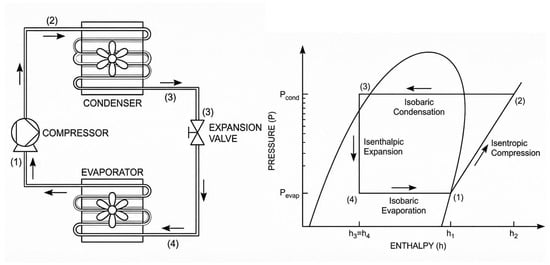
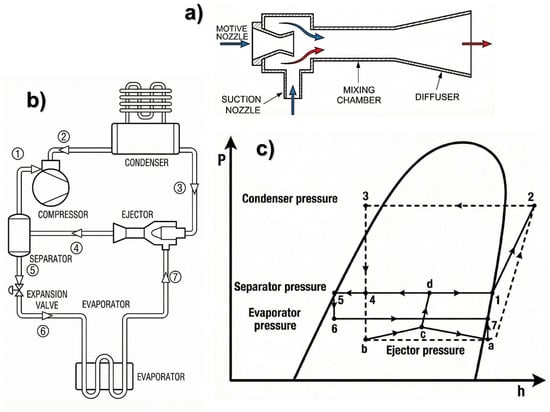
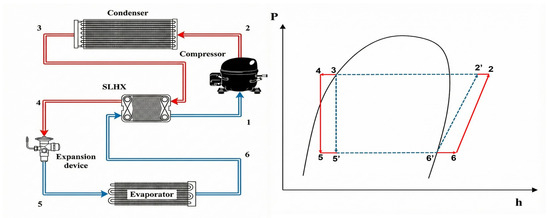
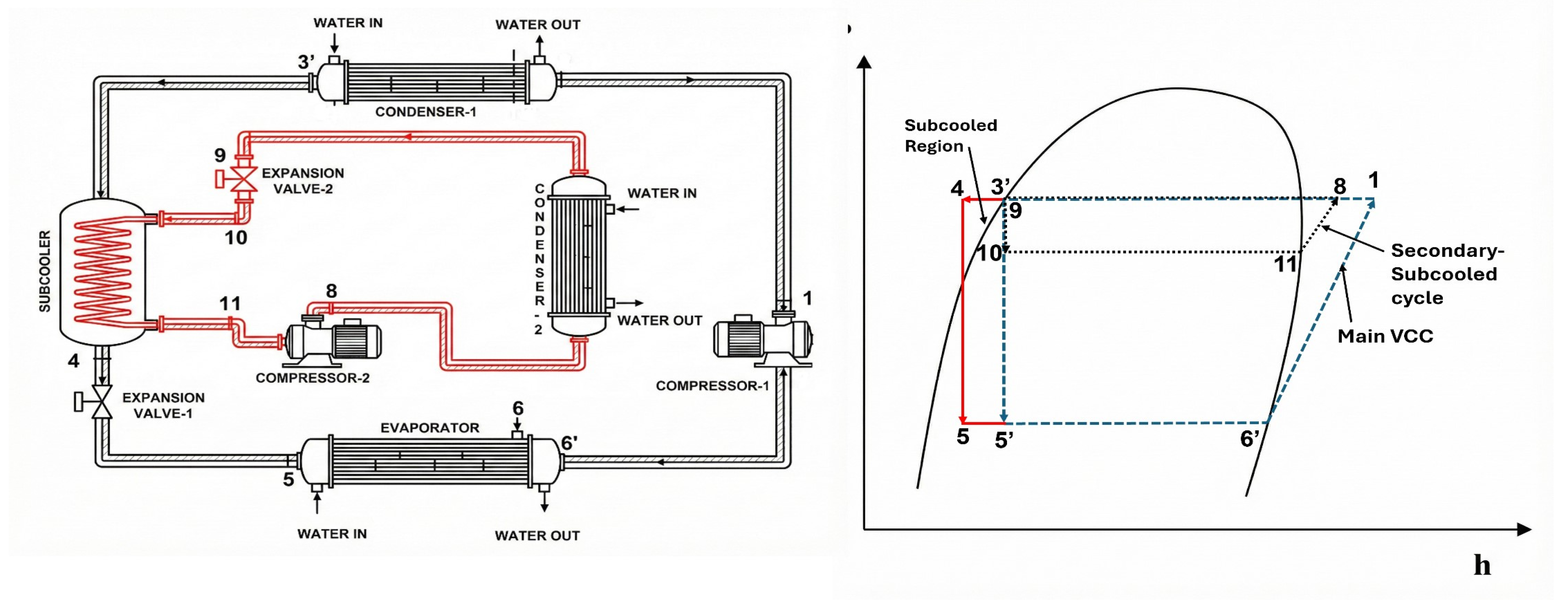
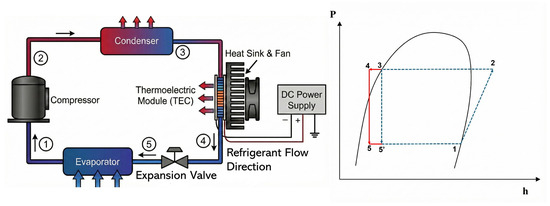
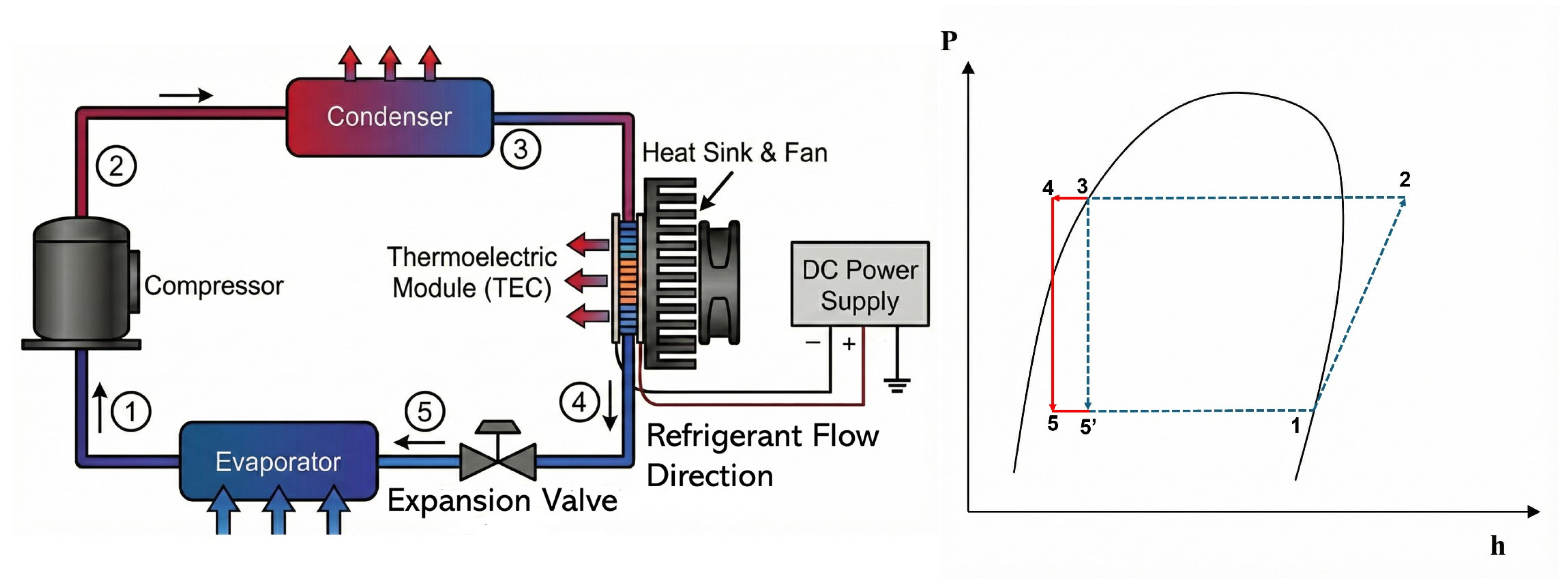
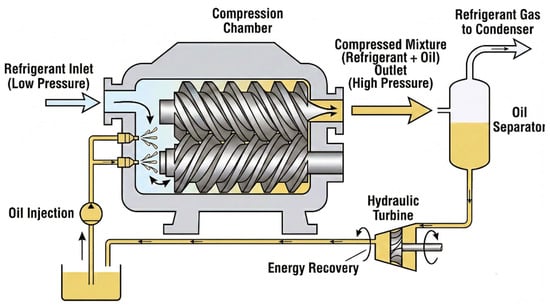
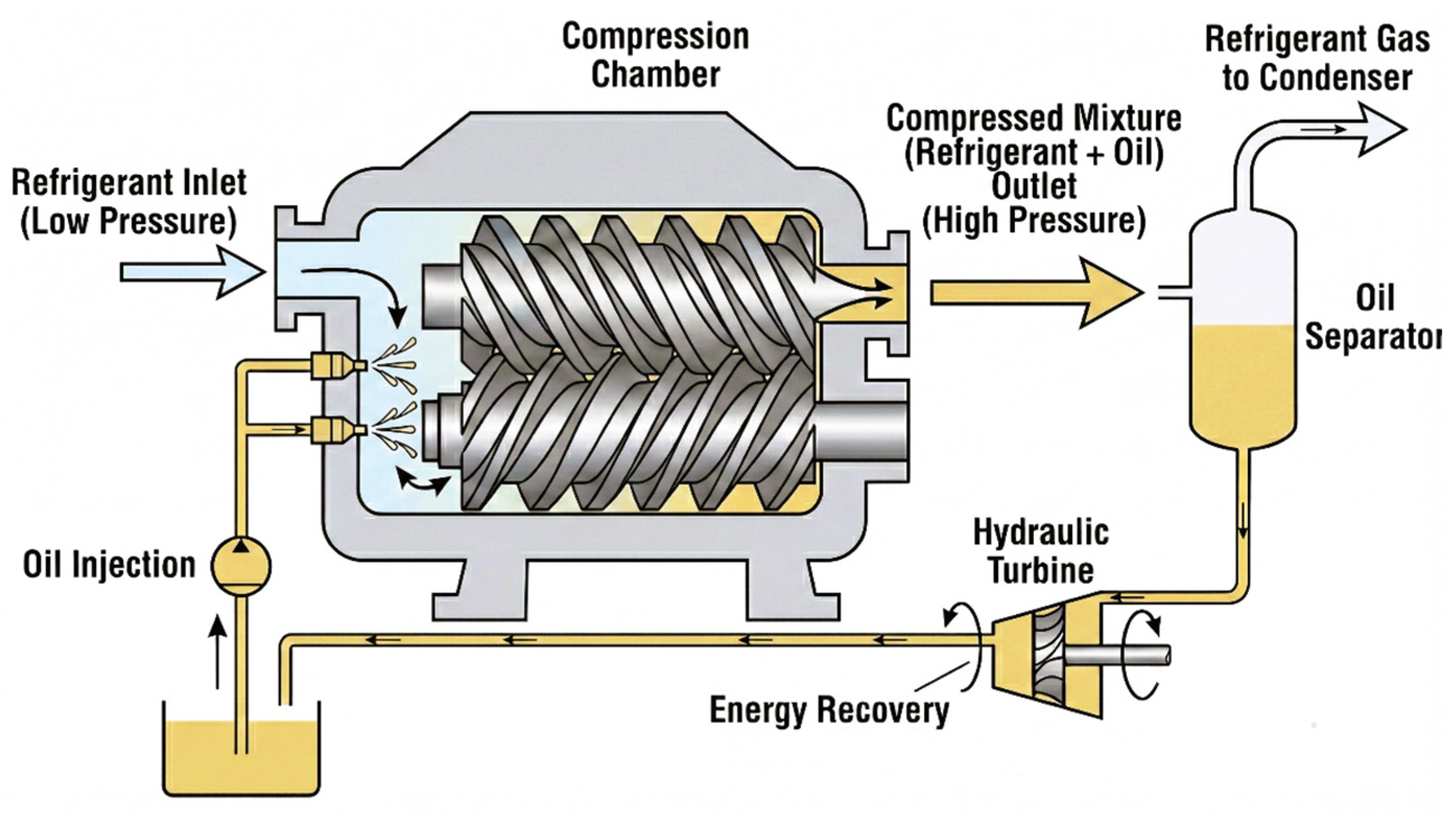
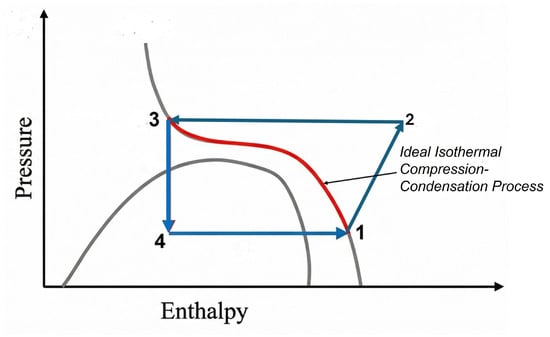
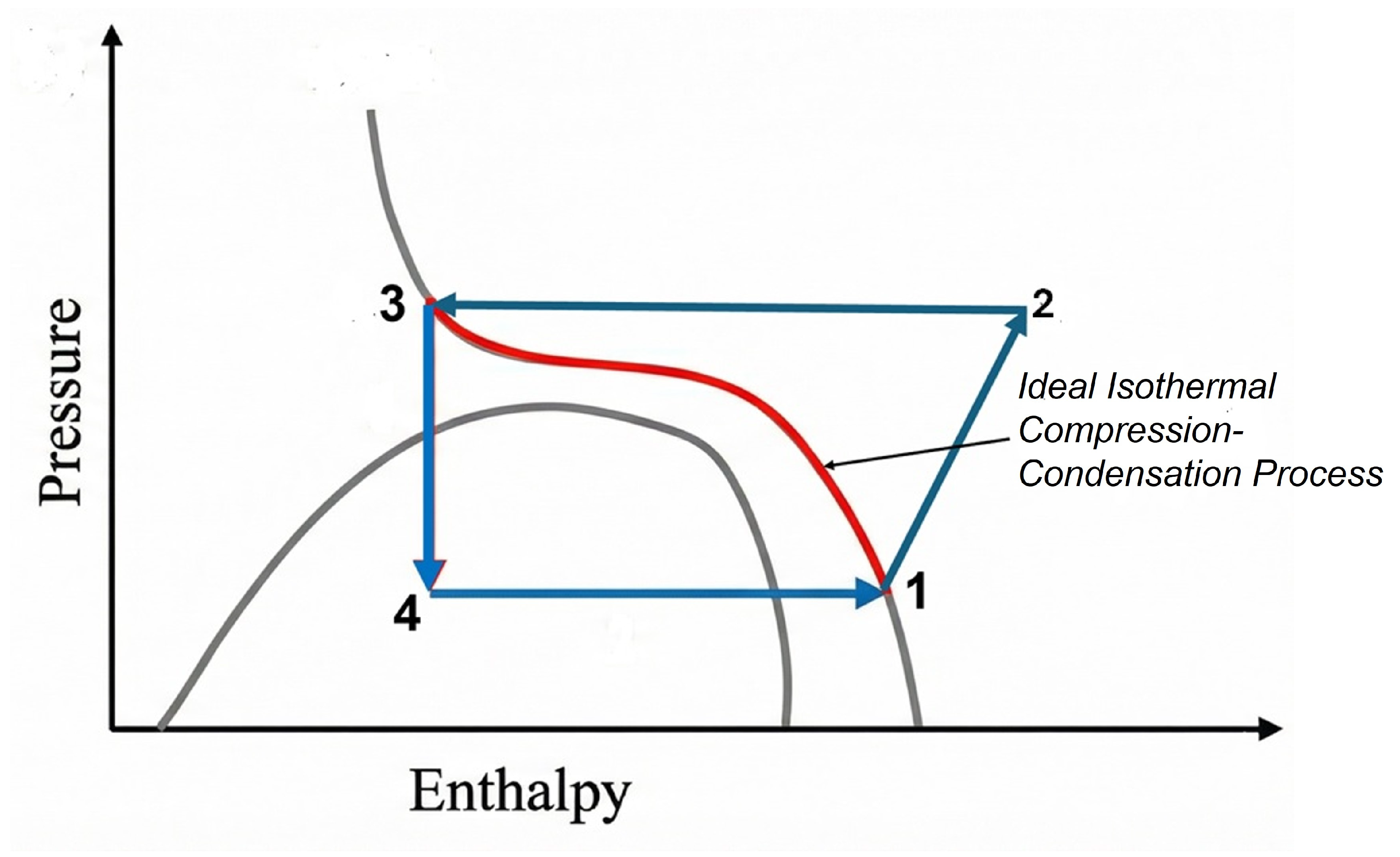
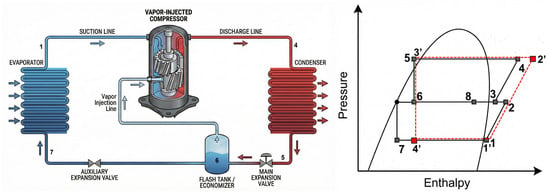
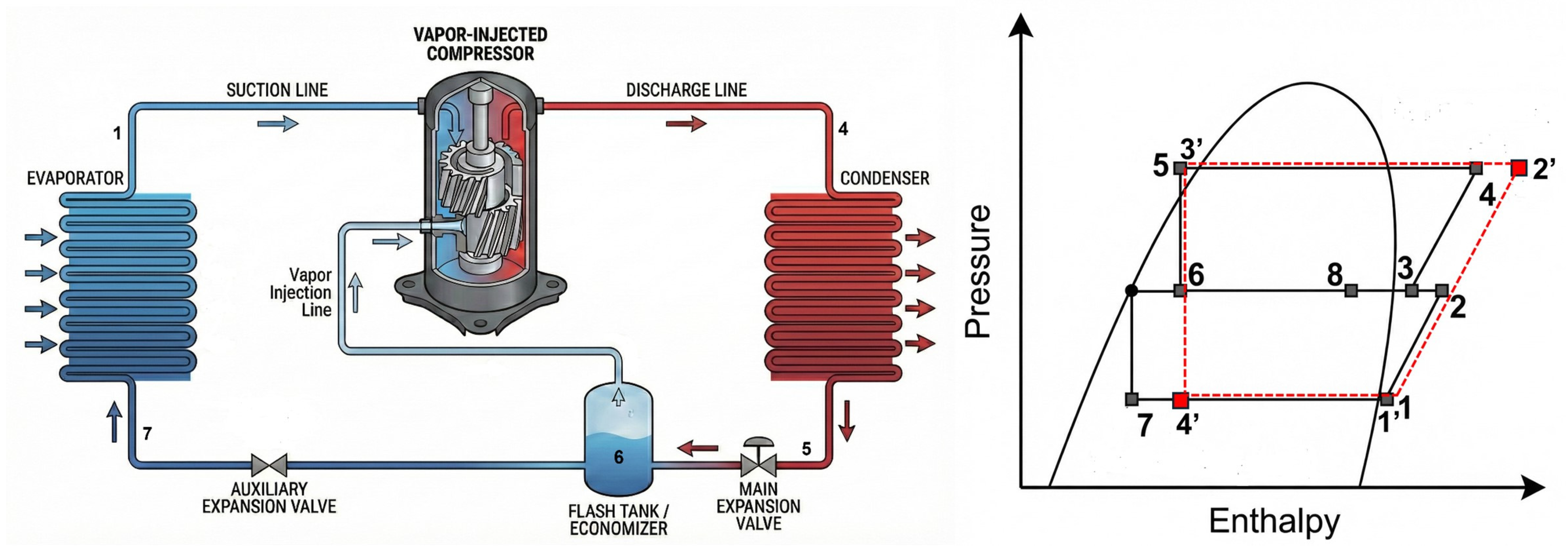
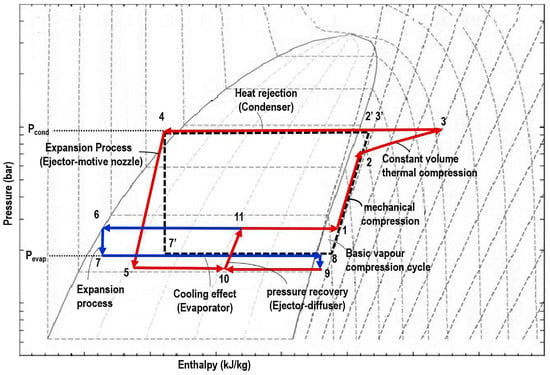
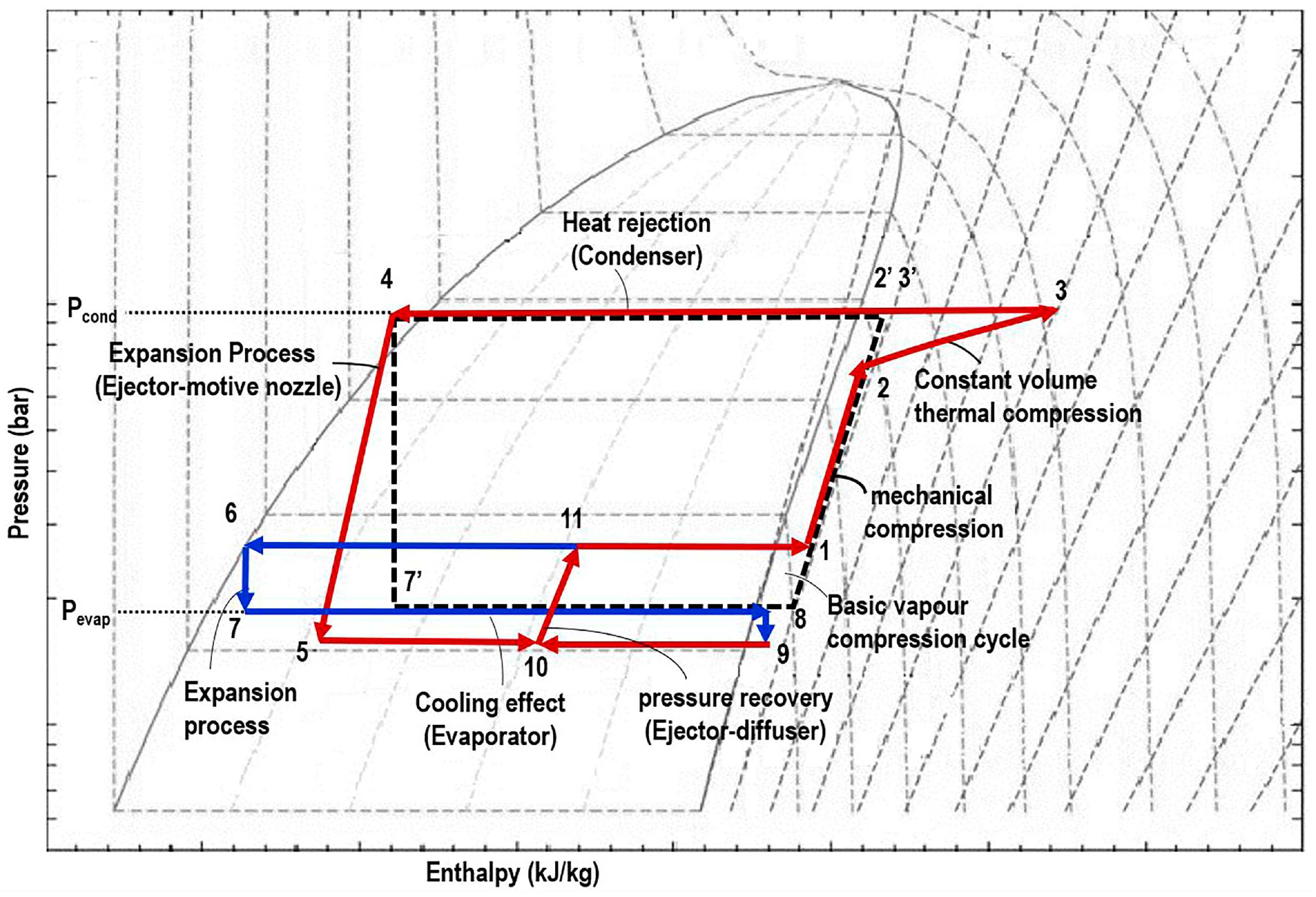
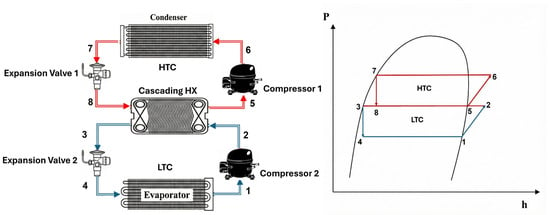
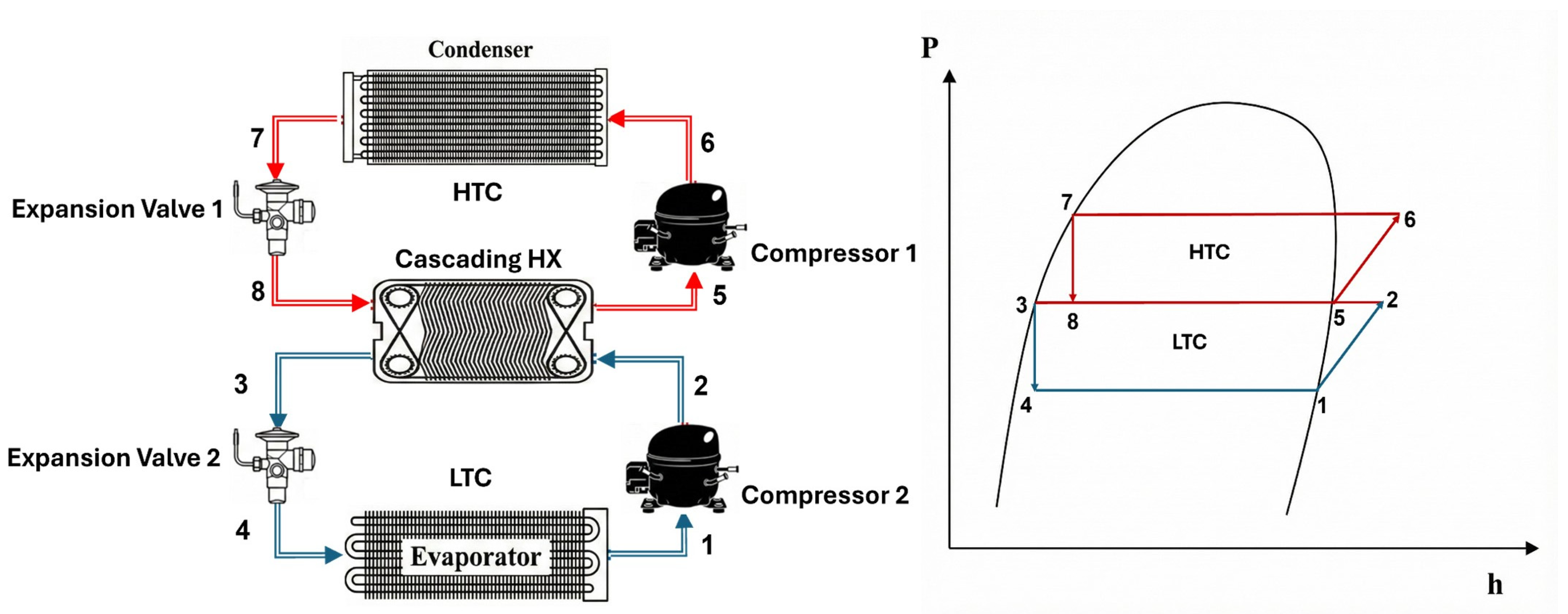
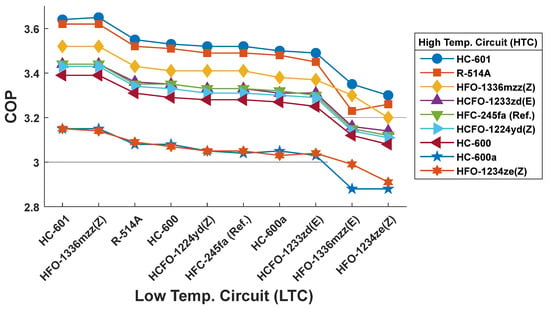
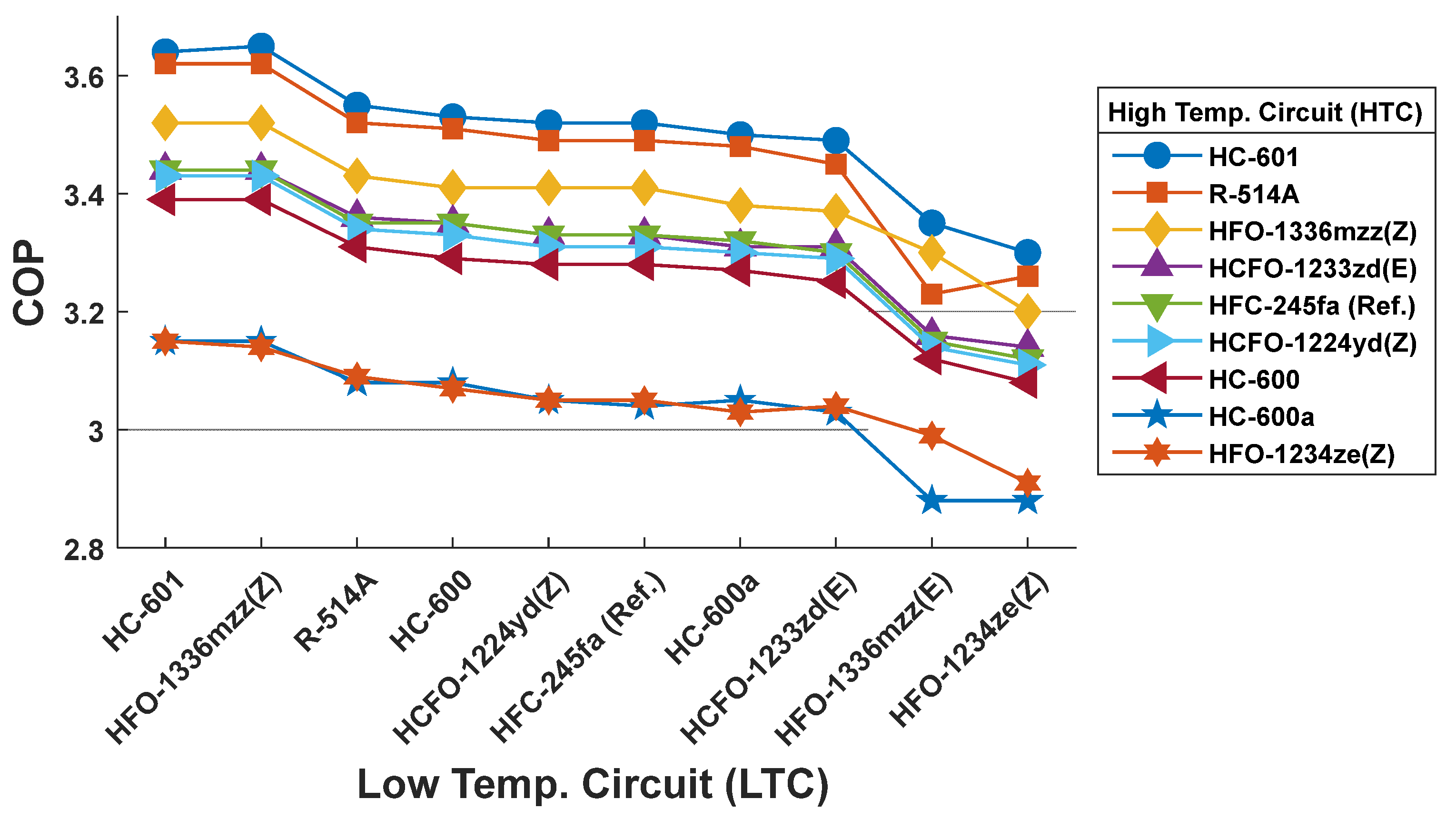
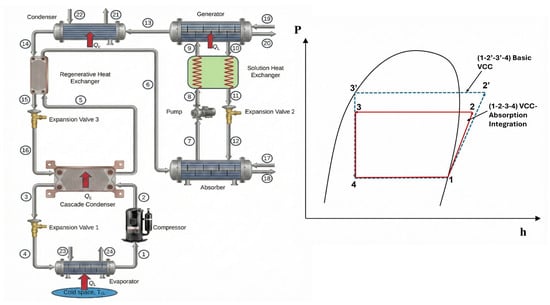
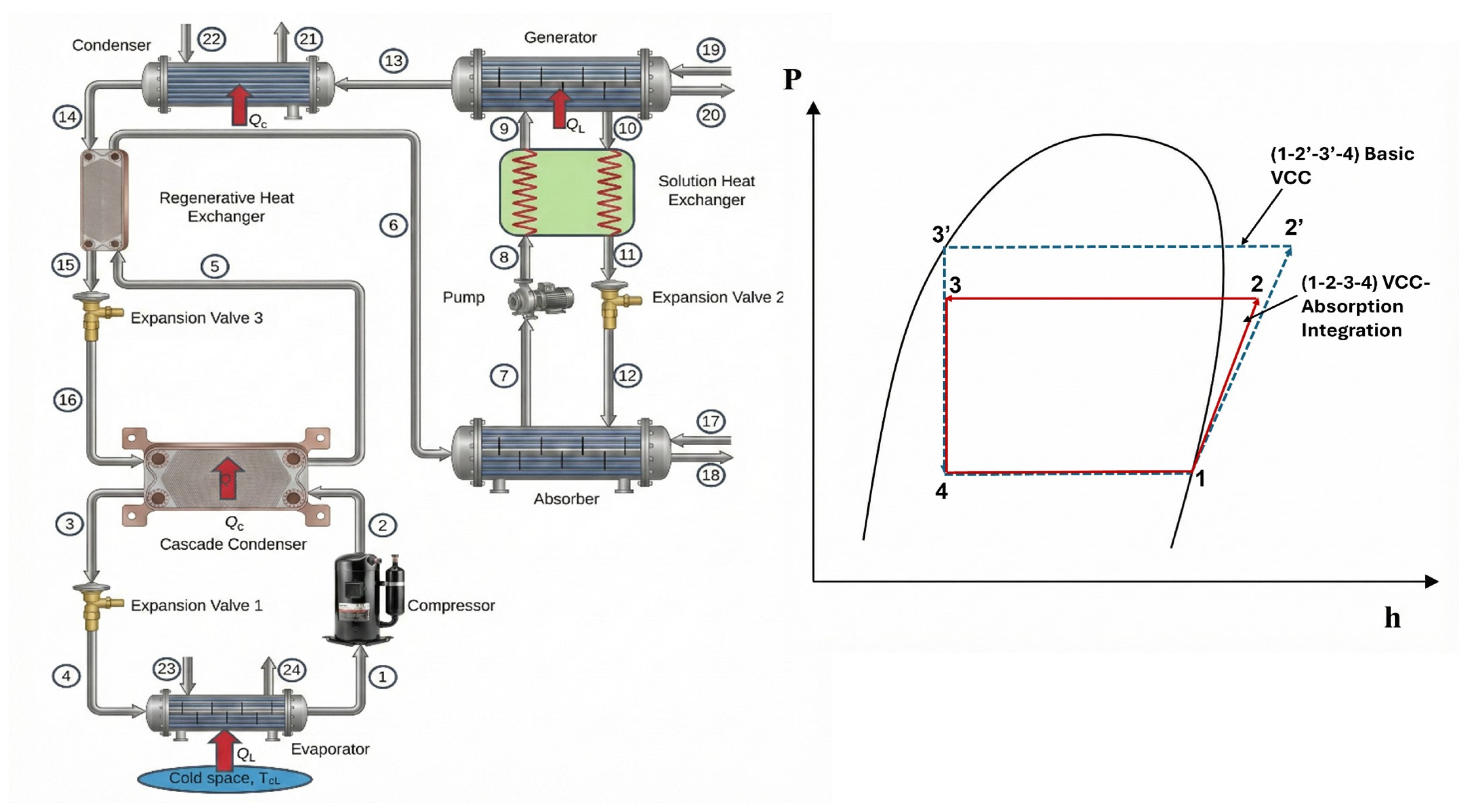
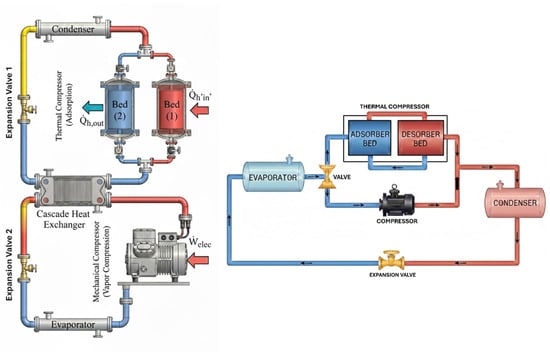
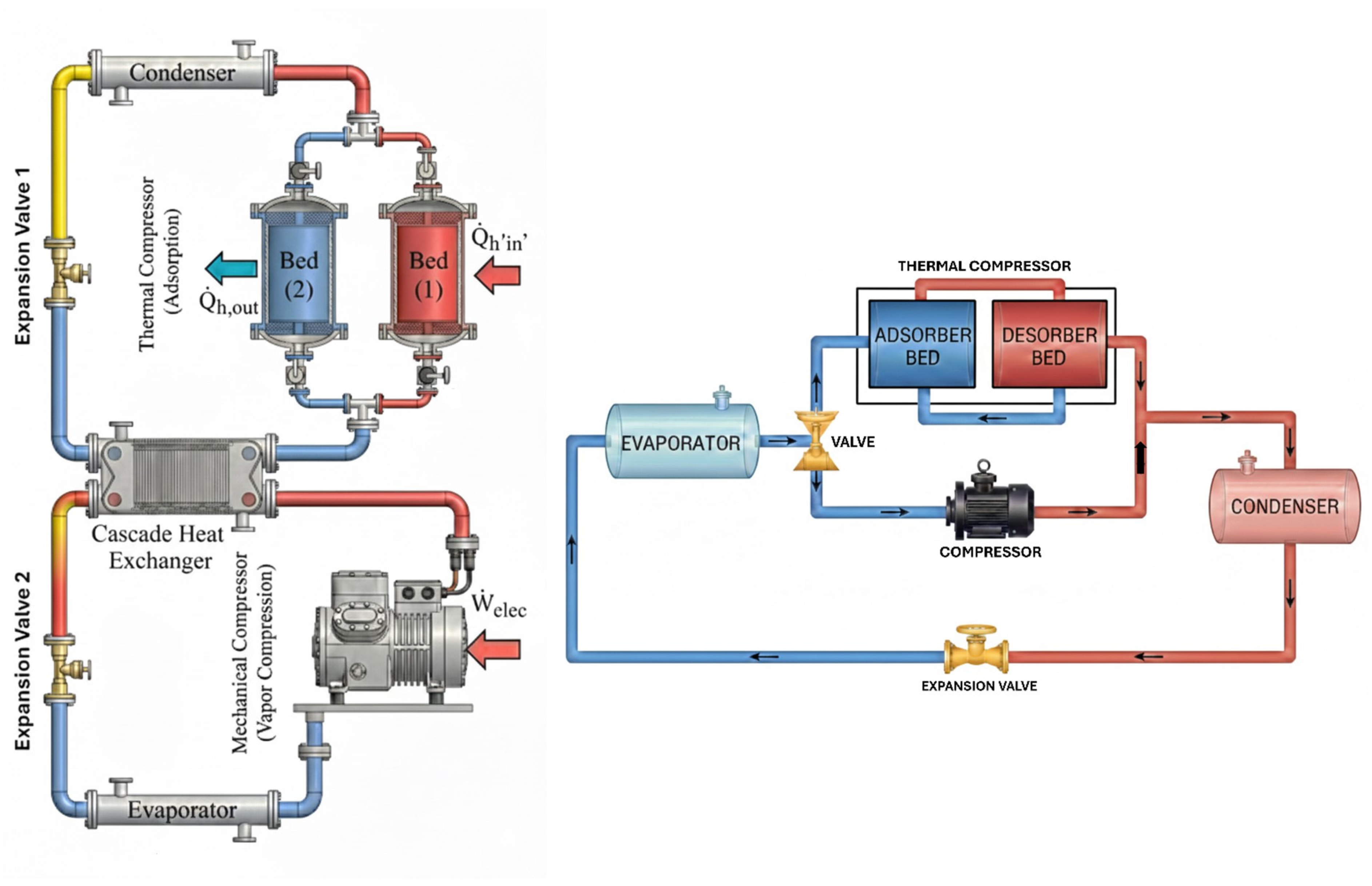
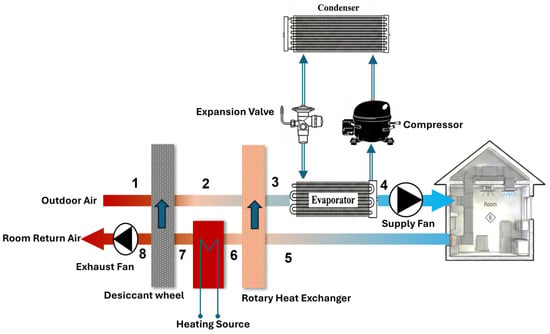
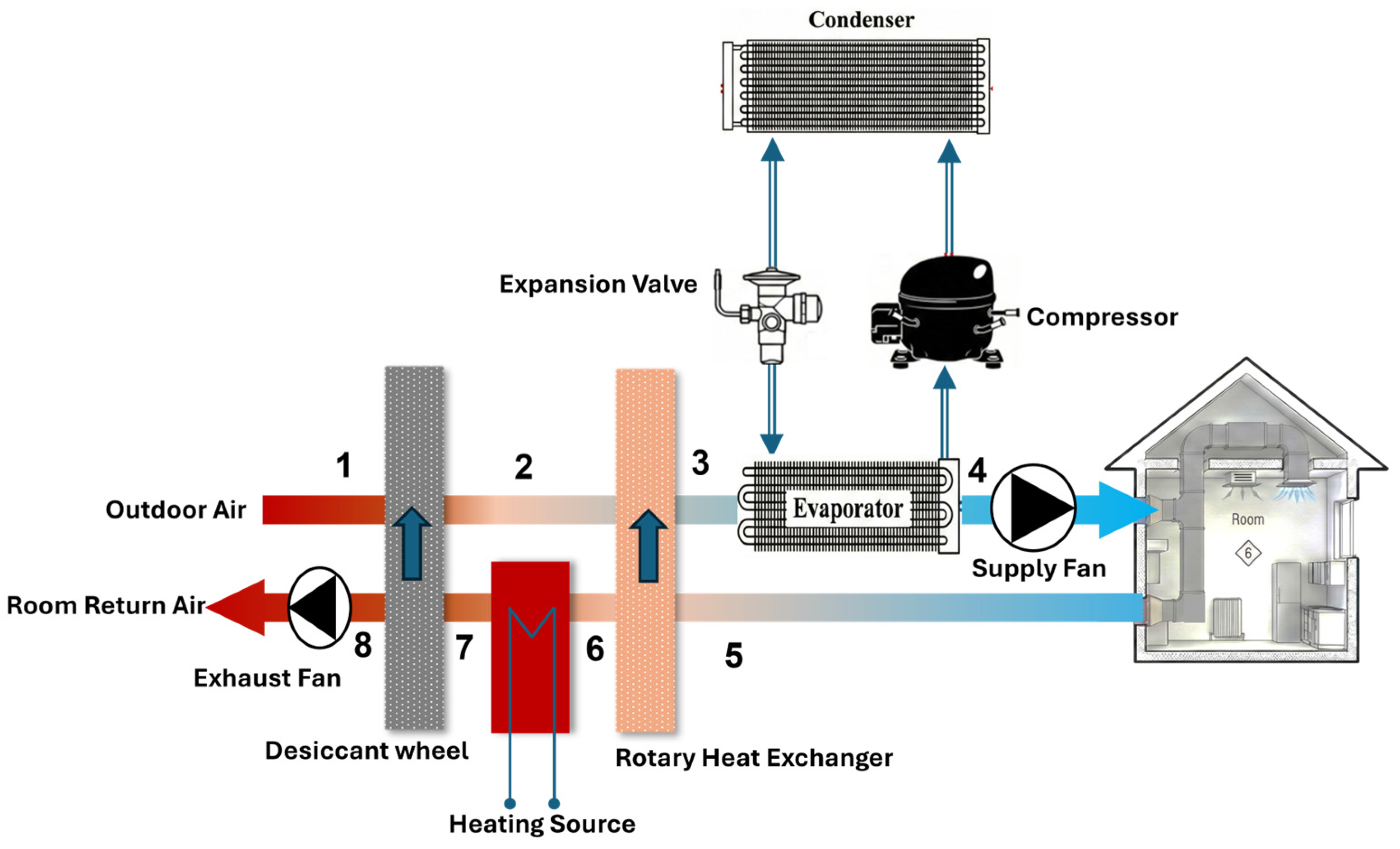
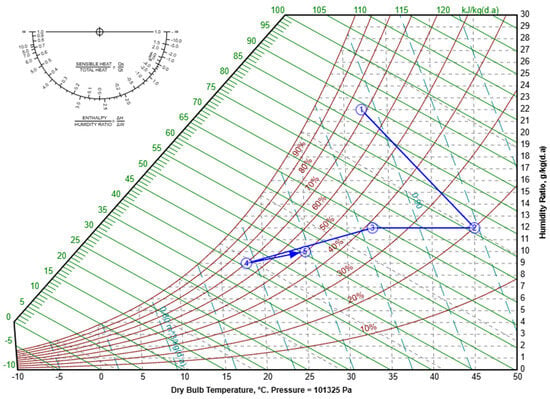
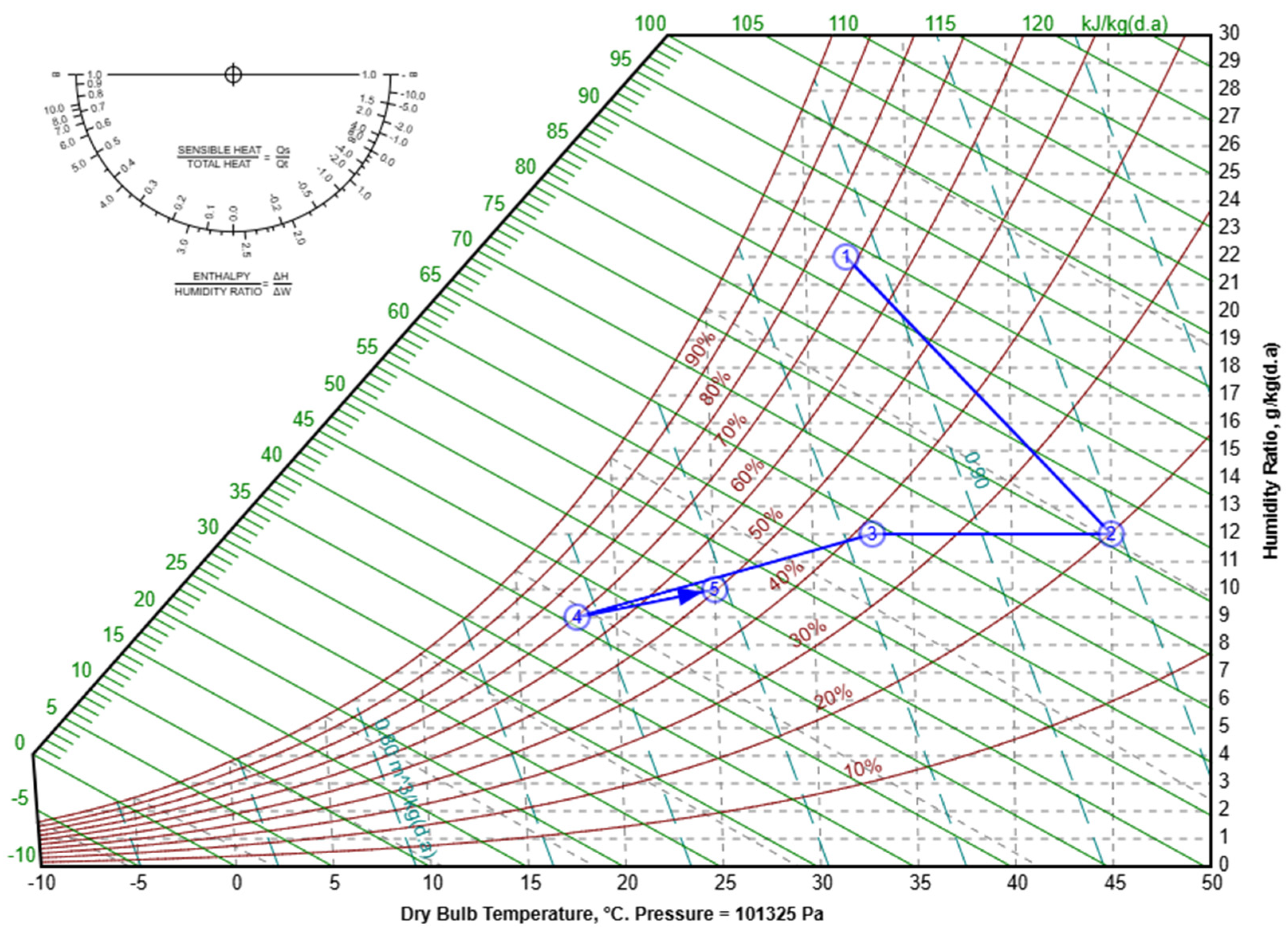
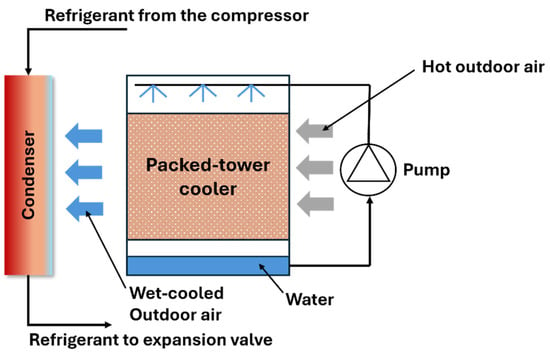
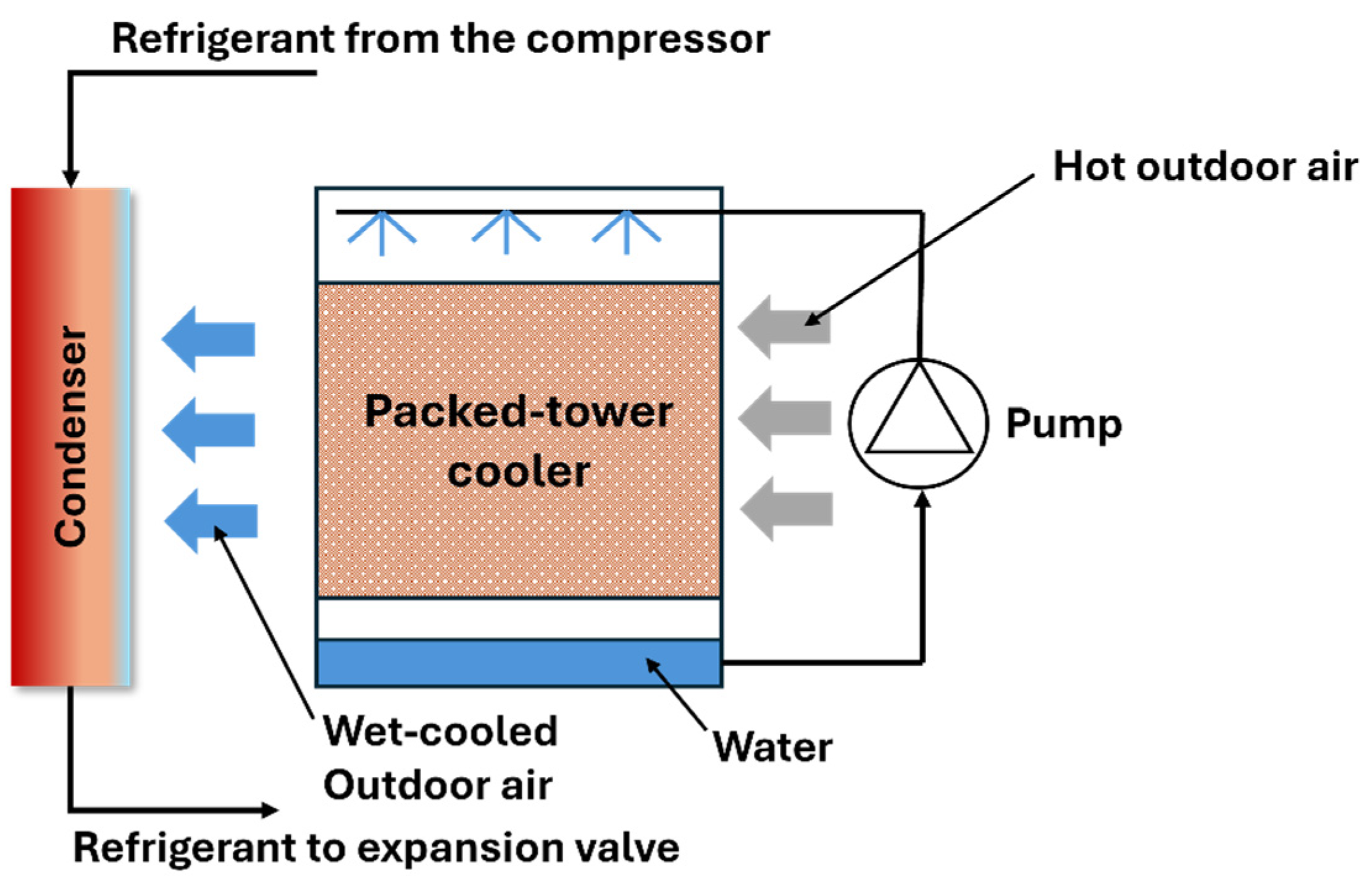
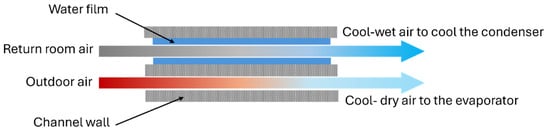
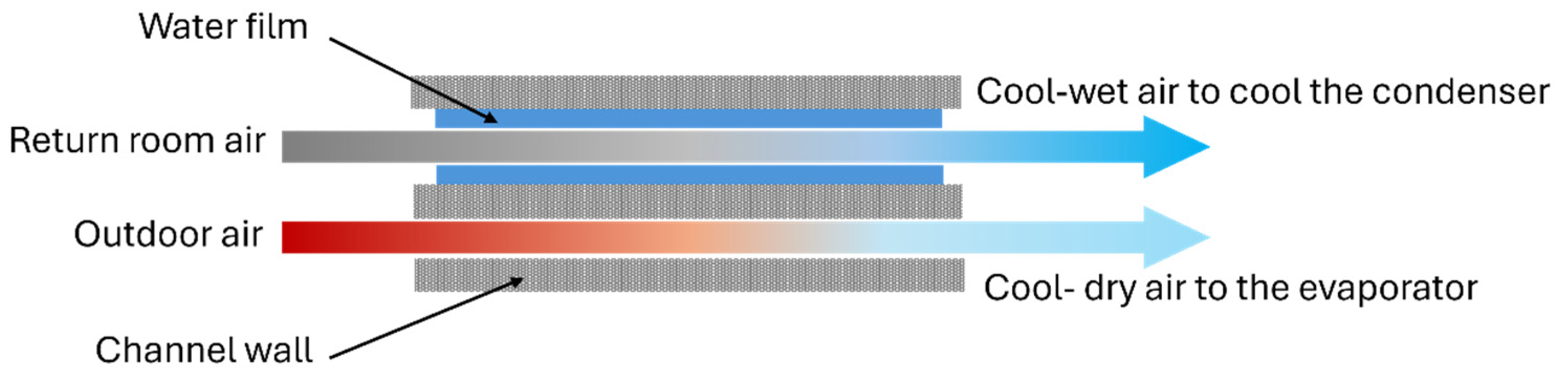
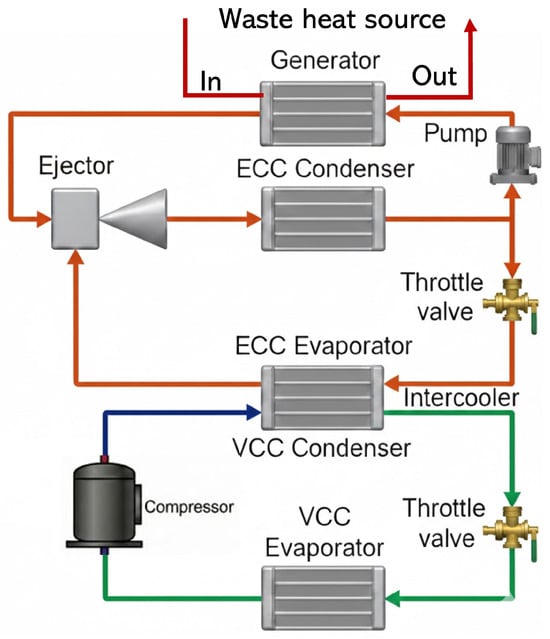
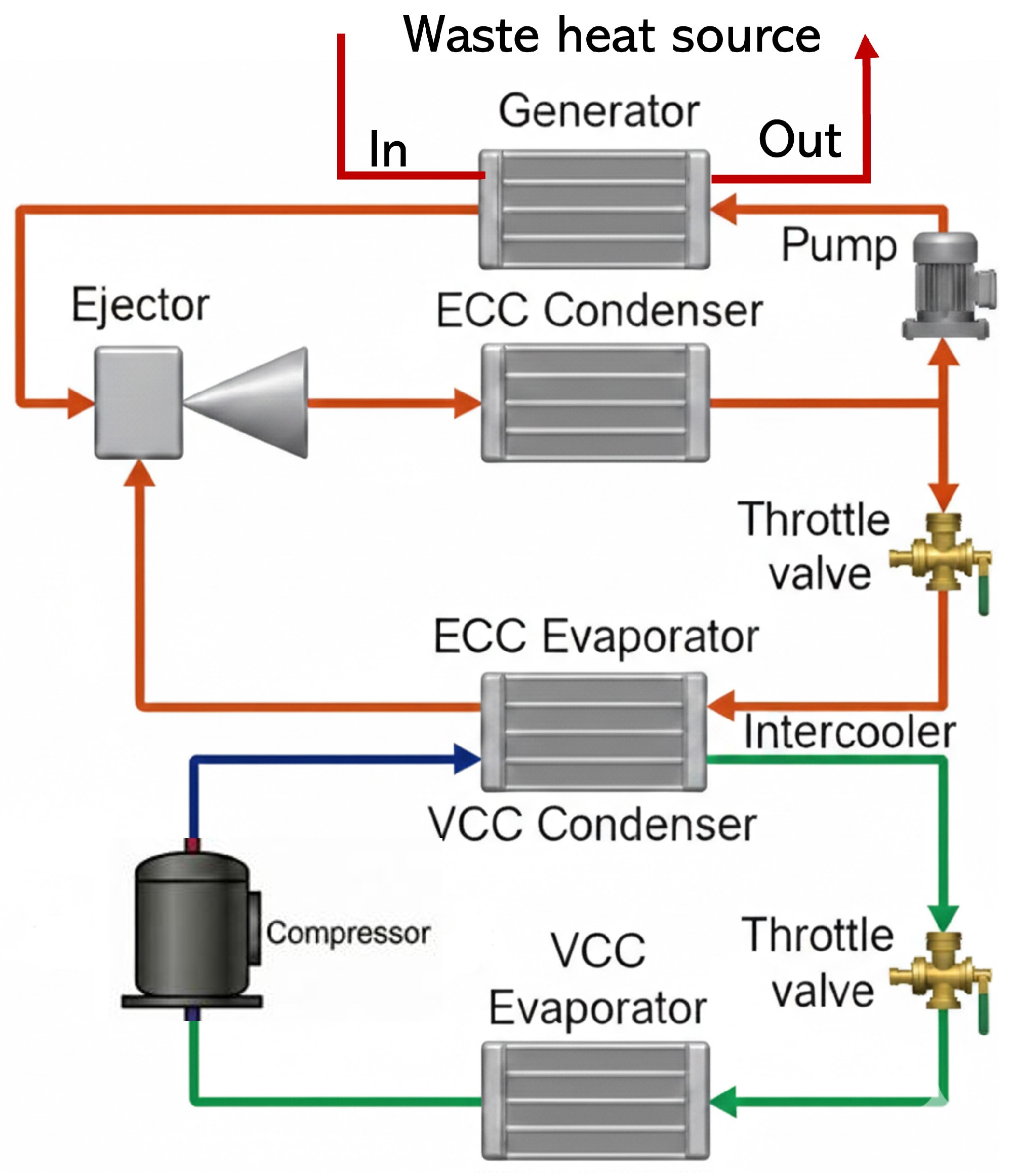
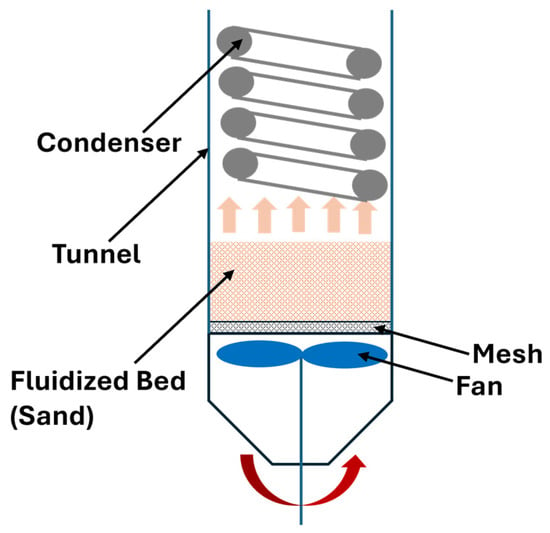
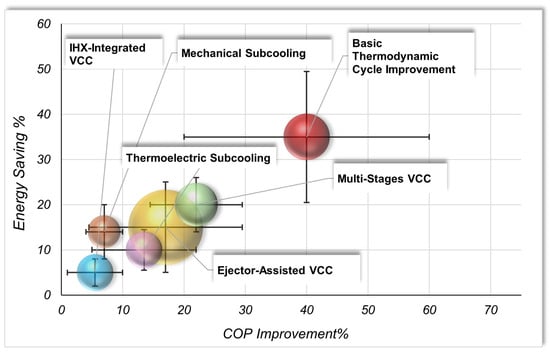
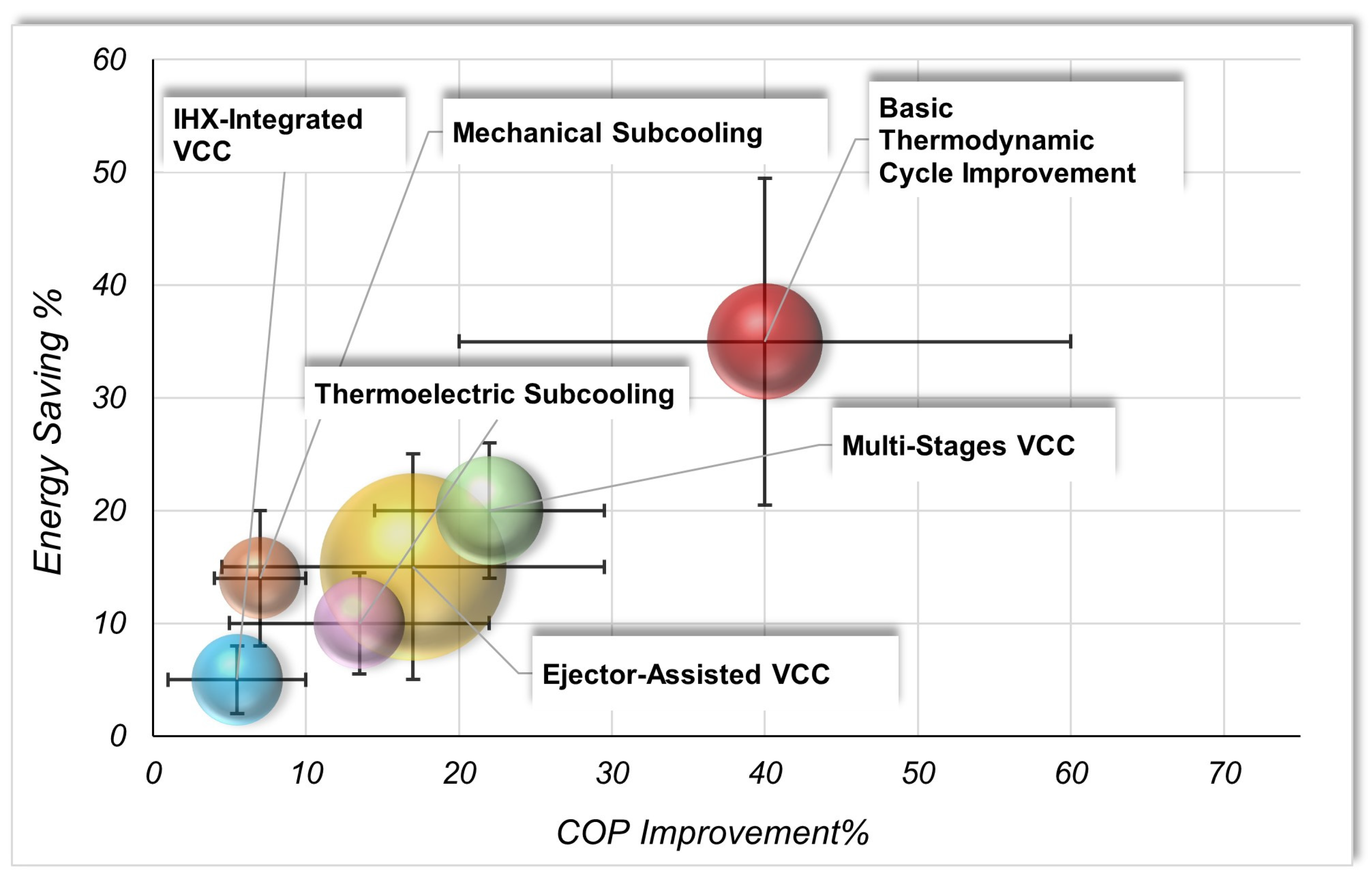
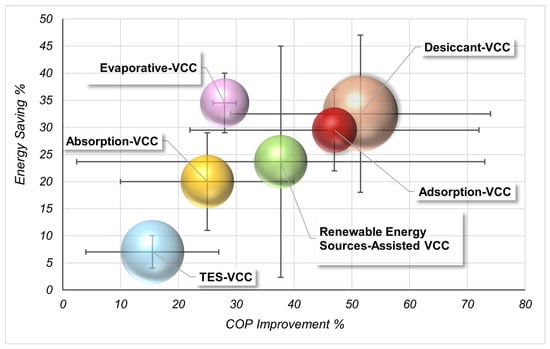
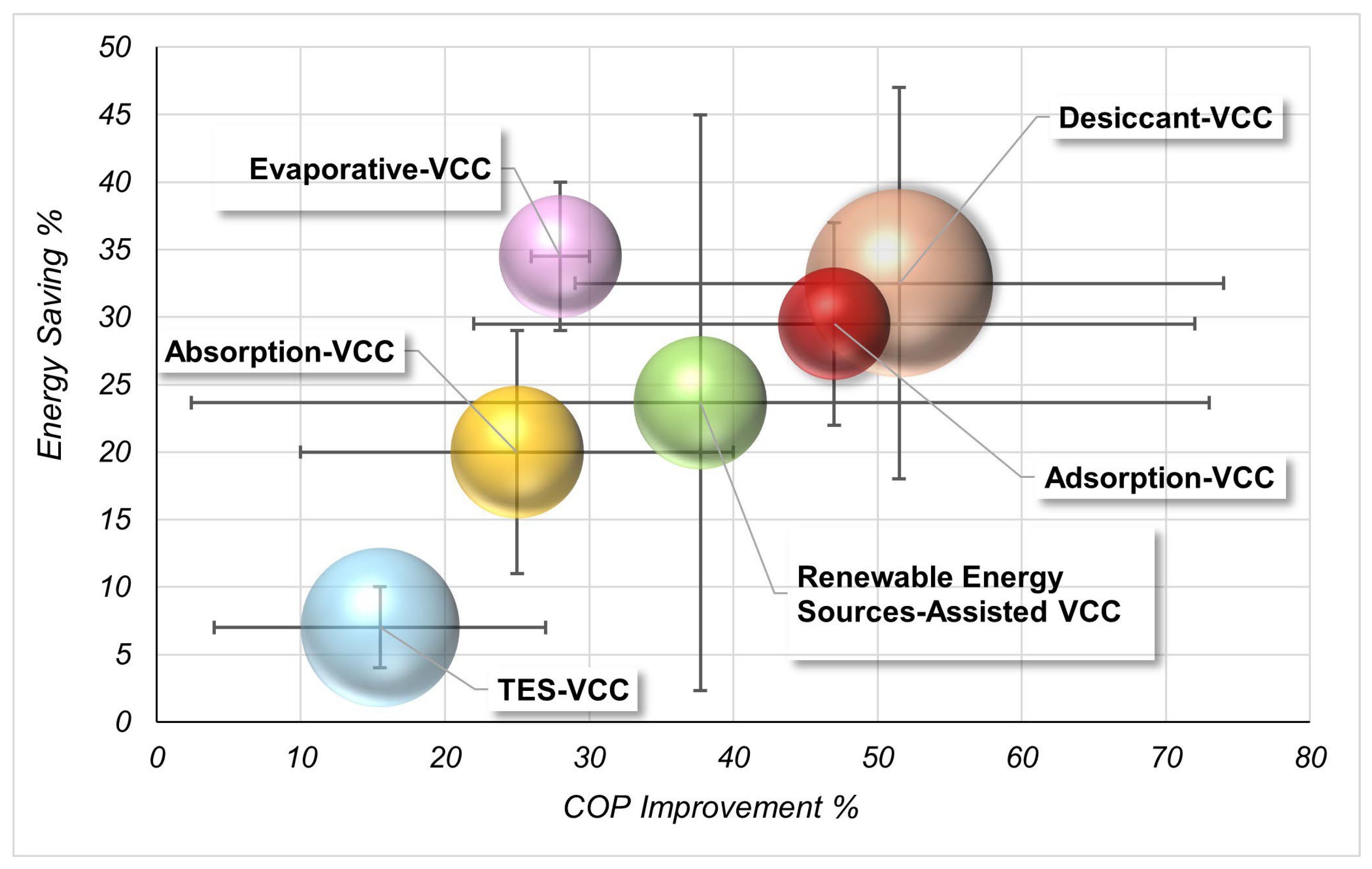
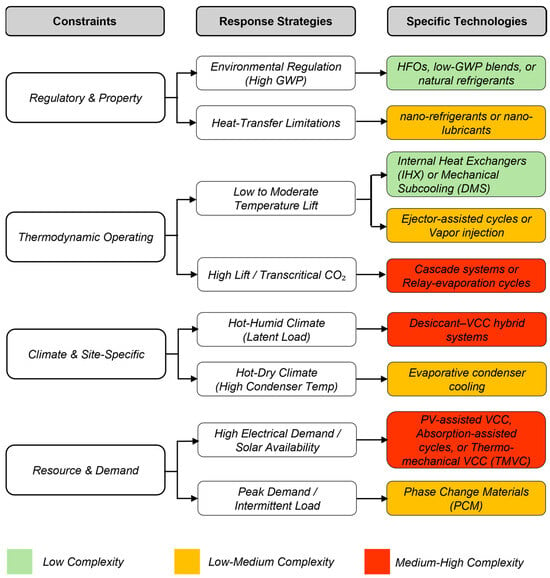
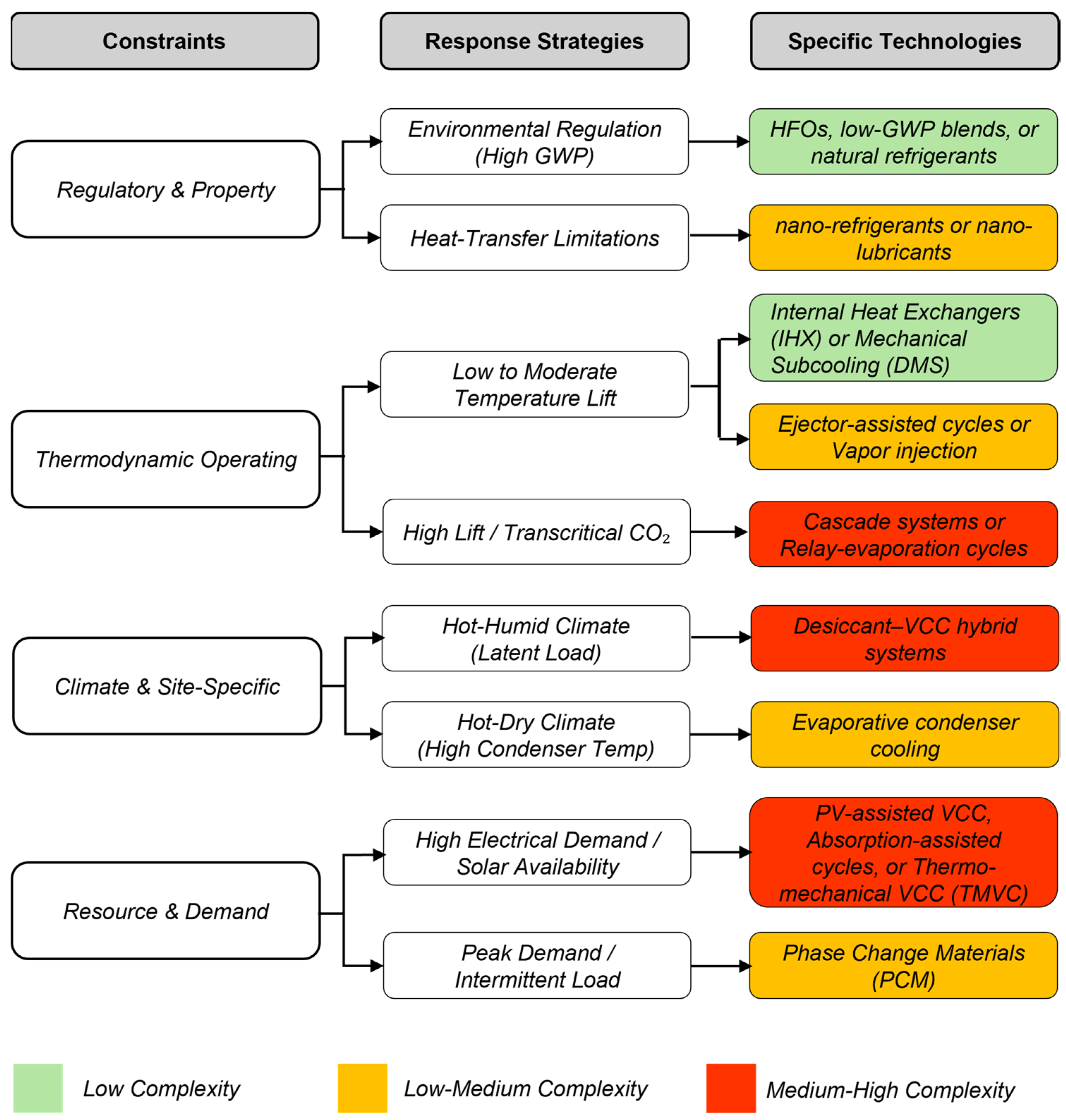

Disclaimer/Publisher’s Note: The statements, opinions and data contained in all publications are solely those of the individual author(s) and contributor(s) and not of MDPI and/or the editor(s). MDPI and/or the editor(s) disclaim responsibility for any injury to people or property resulting from any ideas, methods, instructions or products referred to in the content. |
© 2026 by the authors. Licensee MDPI, Basel, Switzerland. This article is an open access article distributed under the terms and conditions of the Creative Commons Attribution (CC BY) license.