


Abstract
This comprehensive review maps how China’s demand-side resources are aggregated, bid into markets, and monetized at the grid edge. We synthesize original studies and pilots to compare edge architectures for local estimation and privacy-preserving coordination, bidding frameworks that span deterministic, stochastic, chance-constrained, and robust designs, and retailer plan optimization that turns wholesale signals into simple user choices. Our headlined findings are fourfold. First, risk-aware bidding frameworks that use chance constraints or conditional value at risk (CVaR) reduce shortfalls without eroding expected revenue when penalties are strict and data are noisy. Second, joint design of retail prices with storage dispatch stabilizes delivery and consumer bills, raising participation and persistence. Third, intraday refresh of envelopes and redispatch improves balance and profit when provincial rules allow updates. Fourth, transparent baselines and settlement rules determine realized value and should be co-designed with aggregation and pricing. We organize reproducible metrics for revenue, reliability, latency, and consumer welfare, and provide simulation templates aligned with Chinese spot practice to enable head-to-head comparisons. The review closes with a research agenda on correlation modeling for heterogeneous portfolios, distribution-aware coordination, and long-run equipment impacts as areas where larger field trials and open data would unlock credible evaluation and faster deployment in China.
1. Introduction
Modern power systems are evolving rapidly as renewable generation expands and distributed devices proliferate at the grid edge. This transition increases supply-side volatility, but it also creates a critical opening for demand-side participation [1,2]. By mobilizing aggregated resources to provide balancing and capacity services, the demand side can lower system costs and improve the utilization of clean generation [3,4].
Consider a brief historical overview and a current snapshot of the field. Utilities previously used demand-side management through direct load control and interruptible contracts. Markets later adopted price-based demand response as metering and communication improved. Researchers then introduced aggregation to pool small flexible devices into market-sized portfolios, and they built bidding models to manage price risk and delivery risk at scale. The field now combines edge computing, privacy-preserving coordination, and risk-aware bidding, so aggregators can update forecasts and envelopes close to delivery. Recent studies also stress reproducible evaluation, because model accuracy, latency, and settlement rules jointly shape realized value. We cite foundational demand response taxonomies and recent review work to anchor this development and connect it to today’s Chinese pilots [5,6,7].
China has become a major center of these changes. Peak demand is rising, and renewable penetration is increasing in the national grid. Policymakers and system operators have opened markets and pilot projects that allow demand-side aggregation to participate in spot and ancillary markets. This creates a technical pathway for aggregators and retailers, as well as a commercial opportunity [8,9,10].
Most evidence in this review comes from active Chinese pilots, including those in Guangdong and Zhejiang, because they provide detailed market rules and field data. The framework remains transferable because its core steps are market-agnostic. These steps include envelope estimation, risk-limited bidding, and settlement-aligned valuation. Transfer to another market requires remapping three inputs. The inputs are product definitions, penalty and baseline rules, and the level of price volatility. We therefore summarize each method with its required market assumptions, and we highlight which parts change under different regulations. We also note that results from high-volatility pilots can overstate benefits in calm markets, so we recommend sensitivity tests across volatility levels when applying the framework elsewhere.
At the edge and device layers, new coordination approaches are implemented using real-time sensing and local computation. Edge computing can process consumption data near end devices, which lowers latency and supports privacy-preserving local control. These features enable rapid coordination of heterogeneous resources. They also support distributed bidding and make retail customization achievable [10,11].
Aggregation refers to the combination of a large number of small, flexible assets. These include commercial loads, industrial users, building HVAC, and fleet EV batteries. An aggregator must convert aggregate flexibility into market-grade products. This requires estimating available flexibility and quantifying uncertainty. It also requires optimization to determine how and when to bid in day-ahead and intraday trading [12].
Market participation raises several practical questions. First, the aggregator must create bids based on the physical constraints of its portfolio [13,14,15]. Second, it must manage risk from price changes and unstable device behavior. Third, it must design retail offers that align end-user incentives with system requirements [16,17]. Finally, it must comply with market regulations and settlement rules that differ by region. Chinese studies propose practical mechanisms to address these issues [8,12,18].
Edge algorithms are useful for prediction and control. Local prediction and high-rate state estimation reduce the need to transmit all data to a central server [15,19]. Local learning models can learn user patterns and support privacy-preserving distributed optimization routines [20,21]. In combination with a market layer, edge-based methods enable near-real-time bidding that captures short-run flexibility [10,22].
Economic design centers on retail in DR markets. Retailers and aggregators need to design tariffs and contracts that translate wholesale market signals into easy-to-choose user options [14,23]. Time-varying tariffs, block pricing, and incentive contracts can encourage storage dispatch and load shifting [14,24]. Chinese pilot studies indicate that tiered and dynamic retail products increase participation among industrial and commercial users. These products also help aggregate predictable slices of flexibility into market offers [9,11].
A fundamental requirement for bidding aggregated demand into spot markets is risk management [14,25]. Aggregators face market price risk and performance risk. Methods such as information-gap decision theory and scenario-based stochastic programming help price and control this risk [26,27]. These tools support trading strategies that match an aggregator’s risk appetite and its retail customers’ willingness to participate. Chinese implementations use these approaches to manage revenue variability and reliability [8,12].
Clear measurement and settlement are needed for monetization. Settlement must reflect the delivered response and fairly distribute revenue to participants. Blockchain and distributed-ledger pilots in China explore automated settlement and transparent proofs of service. These innovations aim to reduce transaction costs and speed market access for small customers [28].
The review provides a general map of demand-side participation at the grid edge in China, and key DR projects are shown in Figure 1. We bring together engineering models, market mechanisms, and field evidence. We compare alternative approaches to assess the strengths and weaknesses of different models. The paper reviews a diverse range of models related to DR potential in the Chinese grid. The review is structured around four connected themes. The first theme is edge aggregation, which covers sensing, local computation, and hierarchical coordination. The second theme is aggregate portfolio bidding. We draw parallels between deterministic, stochastic, and robust models using a common appraisal scale. The third theme is retail plan design. We examine tariffs and product menus that transform wholesale signals into simple user decisions. The fourth theme is monetization and valuation. We combine energy arbitrage, capacity, and ancillary service revenue sources into a consistent view of viability. Each theme integrates original Chinese research and pilot evidence. We assess all themes using common metrics for revenue, reliability, latency, and user outcomes.
Figure 1.
Demand response pilot projects in China.
This review has advantages over other systematic syntheses in this field. Many existing reviews focus on a single layer, such as virtual power plant architecture, demand response enabling technologies, or tariff design in isolation. In contrast, we connect device-level envelopes, edge coordination, bidding under uncertainty, and baseline and settlement design into one consistent pipeline that reflects how aggregators operate in practice. We also ground the synthesis in Chinese pilot conditions, and we translate results into comparable metrics for revenue, reliability, latency, and user outcomes. We explain our review methodology and make it reproducible by stating databases, keywords, and selection rules.
This paper is positioned as an integrated study rather than a summary. We benchmark methods against one another. We align assumptions and data where possible. We reconcile results that appear contradictory by tracing model scope, constraints, and risk settings. We report implementation details that matter for practice. We connect device-layer control to market clearing and retail design. We evaluate methods using transparent metrics that support replication. We highlight where choices about risk, baselines, and intraday updates change outcomes. We convert scattered findings into actionable guidance for researchers and practitioners in China.
1.1. Contributions
- 1.
- Unified synthesis across layers. We assemble edge architectures, portfolio models, and market mechanisms into a single framework. We show how device envelopes feed bidding and retail design. We explain how information from edge nodes improves market execution.
- 2.
- Head-to-head comparison of bidding models. We compare deterministic, stochastic, chance-constrained, and robust formulations under common metrics. We report how each choice shifts the revenue–reliability trade-off in Chinese pilots. We identify when simple models are enough and when data-driven risk control is needed.
- 3.
- Retail plan optimization grounded in evidence. We organize Chinese studies on time-varying prices, two-part tariffs, tiered incentives, and package menus. We map which instruments work for which user classes. We show how joint pricing and storage dispatch stabilize delivery and bills.
- 4.
- Valuation that spans timescales. We provide a practical valuation template that combines short-run arbitrage with capacity and ancillary revenue. We include penalties, baselines, and settlement details used in China. We show how these elements change net value by resource mix.
- 5.
- Evaluation protocol for replication. We define a metric set and simulation templates that reflect Chinese market data and event calendars. We recommend placebo checks for baselines. We add a simple placebo check protocol for baseline models. Before any event, run the same baseline and settlement pipeline on multiple non-event days and on randomly shifted event windows, then verify that the mean response is near zero and that the error dispersion matches historical residuals. Report the placebo distribution, pass-fail thresholds, and sensitivity to weather and calendar controls, so readers can replicate and detect bias. We report dispersion as well as level metrics for revenue and latency.
- 6.
- Decision guidance for practice. We distill clear actions for aggregators and retailers in China. Use risk-aware bids when penalties are strict. Refresh intraday when rules allow. Pair retail prices with storage policy. Calibrate baselines and communicate plan rules to users.
- 7.
- Research agenda with concrete gaps. We point to needs in correlation modeling for heterogeneous portfolios, network-aware aggregation at the distribution level, and long-run equipment impacts from frequent modulation. We outline data and pilot features that would close these gaps.
1.2. Review Methodology and Screening Workflow
Since this is a narrative comprehensive literature review instead of a Systematic Literature Review, PRISMA guidelines are not applicable here. We follow a structured review workflow as shown in Table 1 to ensure that other researchers can reproduce our research results. We searched major engineering and energy databases that index demand response, aggregation, and electricity market bidding research. We used query strings that combine demand response with aggregation, bidding, uncertainty, and settlement terminology. We restricted the window to recent market-oriented and edge-enabled work, while retaining key earlier foundations when they explain core concepts. We included peer-reviewed journal and conference papers that present models, algorithms, or pilot evidence for aggregation, bidding, retail plan design, baselines, or settlement. We excluded papers that only discuss general smart grid concepts without methods or evaluation, and we removed duplicates across databases. We then screened titles and abstracts and completed full-text eligibility checks [7].
Table 1.
Screening workflow and reproducibility details for the review corpus.
1.3. Structure of the Paper
The remainder of the paper proceeds as follows: Section 2 develops aggregation at the grid edge, covering sensing, local computation, and hierarchical coordination. Section 3 formalizes the calculation of demand-side potential with edge computing, including flexibility envelopes and time-coupled energy budgets. Section 4 reviews market participation and bidding for day-ahead and spot clearing with stochastic and robust formulations. Section 5 designs retail plans that convert wholesale signals into user actions, with tariff menus and storage-coupled pricing. Section 6 evaluates portfolios through revenue, reliability, latency, and consumer welfare, and sets out reproducible simulation setups for Chinese pilots. Section 7 concludes the paper.
2. Aggregation of Demand-Side Resources
2.1. Scope and Purpose
Aggregation bundles numerous small resources so they can act as a single, market-capable entity. The goal is to create volume and reliability for participation in day-ahead and intraday markets. Aggregation also opens retail paths to channel wholesale price signals to end users. Chinese pilots and models document both the technical steps and the commercial frameworks required for this role [12,29,30].
Aggregation faces two core tasks. The first is to represent portfolio capability with a tractable model. The second is to translate that model into bids and retail contracts. A tight representation must balance fidelity and computational tractability. The literature from China uses compact dynamical models and aggregated constraints to achieve this balance [22,29].
2.2. Architectures and Enabling Technologies
Aggregation architectures separate three layers as shown in Figure 2. The device layer implements local sensing and actuation. The edge layer computes short-horizon forecasts and local schedules. The market layer forms bids and manages settlement. Chinese engineering studies show hierarchical schemes where edge nodes produce reduced-order states for the market coordinator [10,31].
Figure 2.
Three-layer architecture for aggregation of demand-side resources at the grid edge.
A standard reduced-order model for a fleet of flexible loads or batteries is
where is the aggregated internal state, is the control vector submitted by the aggregator, and collects exogenous inputs. Papers implementing this structure use linear approximations for f when devices are homogeneous and simple aggregation rules when heterogeneous [12,32].
For behind-the-meter storage the state of charge evolves as
Bounds close the model
This SOC formulation is used directly in Chinese storage bidding models [12,33].
Edge nodes estimate the portfolio flexibility set . A frequently used projection is
where are time-dependent capacity bounds and encodes cumulative constraints, for example, energy limits or equipment cycles. This abstraction reduces communication and preserves privacy [10,29].
As shown in Table 2, Chinese studies converge on compact device models and envelope abstractions that pass only the bounds and simple energy budgets up to the coordinator [10,29]. Storage follows the SOC form in (2) and enters settlement with cycling costs where applicable [12,33]. Clustering reduces variance in realized delivery and supports simpler market offers [34,35]. Baseline practice relies on similar-day panels with explicit adjustments, which is critical for reliable settlement of aggregated actions [28].
Table 2.
Aggregation building blocks observed in recent Chinese original studies: layers, compact models, data needs, and representative sources.
2.3. Aggregation Methods and Market-Ready Models
The literature groups aggregation methods into deterministic, stochastic and robust approaches. Each class defines the aggregator decision variable x differently. The common objective is to maximize expected profit or to minimize expected cost while ensuring feasibility under uncertainty.
A baseline expected profit formulation reads [12,29]
where is market price, is offered quantity, c is operating cost, and denotes penalties for deviations. The form above is used in multi-stage models for aggregators in China [12,29].
Stochastic programming represents uncertainty with scenarios . The aggregator solves
subject to scenario-specific device dynamics and non-anticipativity constraints. Frontiers papers from China implement this structure for day-ahead and intraday markets [12,29].
Chance constrained formulations control delivery risk. A canonical chance constraint is
This inequality appears in Chinese robust and risk-aware bidding studies. It enforces that the probability of meeting contracted volume exceeds a target level [32,33].
Robust formulations remove the need for a full probabilistic model. They solve a min–max problem
where is an uncertainty set. Chinese work on distributed robust opportunity constraints uses variants of (10) to bound downside loss without precise distributions [33].
Table 3 shows that stochastic and chance-constrained designs dominate when penalties are strict or intraday updates are allowed [31,33]. Robust sets work well when distributional estimates are weak and price swings are large [33]. Deterministic bids remain useful as baselines once envelopes from edge nodes are tight [12,29]. Decomposition supports scale and privacy by keeping device details local while restoring global feasibility through coordination [32]. Clustering reduces bid variance. Let user index set be . Partition into clusters . For cluster k define representative profile . The aggregator forms cluster-level offers
with weighting calibrated to match observed responsiveness. Empirical Chinese studies show clustering improves clearing rates and lowers penalties [34,35].
Table 3.
Comparison of bidding formulations used by Chinese aggregators and VPPs: objective, uncertainty treatment, compute burden, and when each works best.
2.4. Market Participation and Bidding Strategies
Chinese pilots use two principal market entry modes. The first is the explicit call from system operators. The second is direct bidding in day-ahead and intraday markets. The dispatch method for industrial demand response under uncertainty is important, as explored in [37]. While the use of deep learning frameworks for baseline load estimation and demand response forecasting is discussed in [38] as one of the main DR market prospects. Aggregators must choose quantities and prices while managing execution risk.
A typical two-stage decision structure is
where is the day-ahead bid and is the intraday re-dispatch. This nested structure is standard in Chinese multi-stage market models [29,31].
Risk measures enter bidding directly. Conditional value at risk, CVaR, is used to cap downside exposure. CVaR at level for loss L is
Frontiers studies adopt CVaR-constrained objectives or penalized objectives to manage market and performance risk [12,39].
Price-taker bidding is a common assumption for distributed storage and aggregated loads. Under price-taking, optimizers assume exogenous price . Pei et al. implement price-taker strategies for distributed storage and derive closed-form dispatch bounds when battery efficiency and capacity are given [12].
Decomposition methods make large problems tractable. Pang et al. propose robust decomposition and tracking for virtual power plants. The decomposition splits the global problem into device subproblems and a coordination problem. Each device solves a local optimization and exchanges limited messages with the coordinator. The global feasibility is restored by Lagrangian or alternating direction multipliers [32].
2.5. Valuation, Settlement and Business Models
Valuation decomposes revenue streams. Let revenue components be energy arbitrage , capacity payments , and ancillary service revenue . Then
Chinese empirical work reports that capacity and ancillary streams can dominate arbitrage for industrial aggregations [34,40].
Settlement requires accurate metering and baseline calculation. A common baseline estimator uses a counterfactual forecast . The delivered response for customer i is . Disputes typically arise from baseline bias. Chinese pilots emphasize transparent baseline protocols and independent verification [28]. Because monetization relies on counterfactual baselines, settlement can face disputes or manipulation when behavior is highly stochastic. We add a settlement robustness protocol that combines transparent baseline selection, placebo checks, and audit trails. Baselines should use preregistered rules that specify similar day pools, weather or production adjustments, and data quality filters. Placebo checks should be run on non-event days to quantify false response and bias, and results should be reported with confidence intervals. To deter gaming, event selection can include randomization, and verification can use independent meters or third-party sampling. A dispute process with clear thresholds and evidence requirements reduces transaction costs and increases market trust.
Business models split revenue among the aggregator, aggregator investors and customers. One pragmatic split uses a parameter to pass a fraction of net market gains to customers. If is net revenue after costs, then customer share is . Field studies from Chinese utilities show that this simple contract increases recruitment and retention [29,34].
2.6. Operational Lessons and Research Gaps
Pilots and simulations converge on several operational lessons. Accurate short-horizon forecasts are essential. Distributed communications must be reliable to avoid penalty exposure. Contracts must align incentives and share downside risk.
Research gaps still exist in the literature. The paper identifies long-run equipment impacts as a gap, so the bidding framework should not encourage aggressive modulation that accelerates wear in batteries, HVAC, and industrial drives. We add a degradation-aware constraint set that limits cycling counts, ramp rates, and comfort band violations over rolling horizons, and we include a simple wear cost in the objective based on energy throughput and switching frequency. For batteries, this uses state-of-health proxies and maximum equivalent full cycles per day. For HVAC and industrial loads, it uses limits on starts per hour and minimum on/off times. These terms shift bids toward fewer but higher-value events, and they align portfolio value with asset lifetime and user retention.
Scalable uncertainty quantification for portfolios of heterogeneous devices is unresolved. Standard interfaces to harmonize retail offers with market bids are still emerging. Long-term impacts of frequent modulation on industrial equipment are not fully measured. Chinese studies call for larger field trials and open data to enable robust statistical validation [30,31,32].
Aggregation is both a control problem and a market design problem. The Chinese literature provides compact dynamical models, stochastic and robust bidding methods, and practical clustering and decomposition techniques. These contributions form the basis for reliable participation of demand-side resources at the grid edge.
3. Calculation and Analysis of Potential of Demand-Side Resources by Edge Computing
3.1. Objective and Framing
This section develops methods to quantify the flexible capacity that can be mobilized at the grid edge by combining device-level intelligence with edge computing. The goal is to estimate available power capacity, to characterize temporal availability, and to translate that potential into market-relevant quantities. Edge computing reduces latency and preserves privacy while enabling local estimation and aggregation of flexibility. Recent Chinese studies show that the calculation of potential is a layered process. The first layer maps device capabilities into local flexibility envelopes. The second layer aggregates envelopes across many devices. The third layer projects aggregate behavior into market time frames [41,42,43].
As summarized in Table 4, Chinese implementations move from device-level models to portfolio envelopes through edge computation that preserves privacy and lowers latency, then translate envelopes into market-ready offers through two-stage optimization [12,41,42]. The pipeline uses tractable outer bounds for aggregation, probabilistic availability for risk control, and feeder checks for network feasibility, which together yield firm and feeder-safe capacity estimates [22,32]. Scale metrics such as peak contribution and firmness allow comparison across feeders and user classes, while intraday refresh aligns offers with short-horizon availability under provincial rules [30,31,44,45].
Table 4.
Edge-computing pipeline for quantifying demand-side potential in Chinese studies: stages, mathematical objects, edge implementations, market-facing outputs, and representative sources.
3.2. Local Flexibility and Device Models
A fundamental building block is the device flexibility model. For a device or behind-the-meter storage unit indexed by i, with state , controllable power and exogenous inputs , we write
where is power injection (positive injection, negative consumption). For batteries the state reduces to state of charge and dynamics follow a discrete energy balance similar to
with box constraints on power and SOC. For thermostatically controlled loads (TCLs) the device model couples thermal dynamics with control setpoints. Chinese edge studies implement simplified linearized forms of to permit fast local optimization on resource-constrained edge nodes [41,42].
Define the instantaneous device flexibility set at time t as
where captures device-specific constraints such as temperature comfort bands or cycle limits. Edge computation allows each device or local gateway to compute or approximate quickly and to communicate concise summaries upward. Chinese implementations often exchange bounding statistics rather than raw trajectories to reduce bandwidth and preserve privacy [42].
3.3. Aggregation Primitives and Mathematical Aggregation
Let denote the set of enrolled devices in an edge domain. The instantaneous aggregate flexibility set is
Exact computation of is combinatorial. Chinese research therefore uses tractable outer approximations. A common approximation is the interval envelope
with cumulative constraints of the form
This envelope preserves feasibility for energy-limited devices and allows the market coordinator to form bids using only and energy ranges. Edge nodes compute these bounds by local optimization or by aggregating statistical forecasts of device availability [12,32]. Potential estimation requires probabilistic modeling. Let be a Bernoulli indicator that device i is available for control at time t. The expected available capacity is
where . Edge nodes estimate from local historical patterns augmented with short-term forecasts. When correlations among devices are relevant, the variance is
Chinese studies emphasize the role of spatial and behavioral correlations in portfolios dominated by residential loads and EV chargers. Edge-level clustering reduces correlation estimation error by grouping similar behavior and sharing local models [34,41].
A remaining risk is that simplified envelopes can hide tail dependence across devices that respond to the same external driver. Examples include weather, feeder events, or synchronized user routines. If these correlations are not surfaced to the market layer, bids can be feasible in expectation but fragile in stress periods. A practical mitigation is to report correlation summaries with the envelope. These summaries can be cluster covariance bounds, worst-case correlation stress tests, or scenario bundles that enforce simultaneous availability drops. This retains privacy while making portfolio-level failure risk visible to the bidding optimizer.
Many resources are energy constrained. Define the available energy window over horizon H as
The aggregate feasible energy region is the Minkowski sum of individual energy regions. Edge gateways use dynamic programming or convex relaxations to compute conservative energy budgets. A useful scalar metric is the time-integrated capacity
which yields the maximum deliverable energy over horizon H. Several Chinese empirical works compute for industrial clusters and EV fleets to size bids into capacity markets [42,43].
3.4. Edge Algorithms for Real-Time Estimation
Edge nodes implement lightweight predictors for device availability and short-term power. A standard architecture uses local models trained on device data. The edge node maintains parameter estimates and updates them with stochastic gradient steps as new data arrives. Forecast outputs are fused with the node’s prior to yield predictive distributions. Federated learning and model pooling reduce training cost and increase generalization across nodes while keeping raw data local. Chinese papers demonstrate federated and hybrid edge-cloud schemes that preserve forecast accuracy while lowering communication load [41,46].
3.5. From Potential to Market Offers
To convert potential into market offers, aggregators solve optimization problems that convert envelopes into schedules. A representative optimization under price uncertainty uses scenarios with probability ,
Here represents operating costs and penalty terms. Edge-provided envelopes feed directly into the constraints. Chinese multi-stage bidding papers implement similar scenario-based optimizations and show the importance of tight envelopes for revenue [12,31].
3.6. Quantifying Potential at Scale: Metrics
To compare regions and device mixes, practitioners use normalized metrics. Two common ones are as follows:
- Peak contribution ratio at time t: .
- Firmness index over horizon H: ,
where k reflects the risk tolerance and is a normalization constant such as installed capacity. Chinese analyses apply these metrics to industrial parks and residential clusters to assess the practical share of demand-side flexibility that can be counted as firm for planning [44,45].
Calculations must respect distribution constraints. Let A be the distribution power flow linearization matrix and v nodal voltage constraints approximated as . Aggregated offers must satisfy these linearized network limits. Edge-level coordination with distribution management systems enforces A constraints locally, avoiding adverse local overloads. Chinese pilot experiences emphasize embedding network feasibility checks within edge aggregation workflows [22,42]. Aggregation must respect feeder voltage limits, not only power balance. We state that envelopes sent to the market layer are conditioned on nodal voltage and thermal constraints, using linear screens such as plus locational caps. When a feeder has high DER penetration, the aggregator should validate shortlisted schedules with AC power flow or a tighter convex relaxation, then update caps for the next interval.
Network feasibility based only on linearized power flow constraints can miss voltage stability limits in feeders with high penetration of distributed resources. We therefore recommend a two-stage feasibility check. The first stage uses the existing linear constraints as a fast screen at the edge. The second stage validates shortlisted schedules with an AC power flow or an improved convex relaxation at the feeder or DSO level. When full AC checks are not available in real time, the aggregator can apply conservative voltage sensitivity margins and locational caps learned from offline studies.
3.7. Case Estimates and Empirical Findings from Chinese Studies
Published Chinese studies and technical reports provide empirical estimates for different end uses. Industrial loads show high per-site flexibility but lower frequency of participation. EV fleets show large energy budgets with diurnal availability patterns. Residential TCL fleets provide sub-hourly response but limited sustained energy. Aggregation across these categories increases overall firmness because different resources complement each other’s temporal profiles. Mixed portfolios benefit from diversity, but uncertainty is driven by cross correlations between EV charging, HVAC response, and industrial processes. We recommend multi-asset correlation models that share latent drivers such as weather, occupancy, and production schedules, then map them to joint availability scenarios for bidding. This improves reliability because the optimizer sees when different assets fail together, rather than assuming independent envelopes. The RMI China analysis and multiple academic papers quantify that well-designed aggregation can mobilize several percentage points of peak load as controllable flexibility in many provinces [30,43,44].
We extend the industrial demand discussion to include Power-to-X plants, since electrolyzers increasingly act as large, flexible loads that reshape distribution-level feasibility and bidding outcomes. PtX operation must respect ramp limits, minimum load, startup cost, and degradation under frequent cycling, and it also couples to hydrogen storage and logistics constraints. These features change which bidding models remain valid. Deterministic bidding can overcommit if it ignores minimum load and degradation limits, while stochastic and robust models can explicitly hedge renewable-driven price volatility and hydrogen demand uncertainty through scenarios, chance constraints, or CVaR objectives. Baseline design must also treat PtX as a process load with scheduled production windows and maintenance constraints, and settlement must verify delivered flexibility without forcing unsafe operating points. We cite recent PtX-focused studies to ground these constraints and their market implications [47,48,49].
Concluding this section, edge computing materially improves the fidelity of potential estimates. Edge nodes compute device envelopes. They supply aggregate bounds that support market optimization. Key open questions include scalable estimation of correlations, formal integration with distribution constraints and long-horizon degradation impacts on industrial equipment. The Chinese literature is actively addressing these questions with a mix of field pilots and algorithmic development. These lines of work form the basis for reliable quantification and monetization of demand-side potential at the grid edge.
4. Market Participation and Bidding: Stochastic and Robust Frameworks for Day-Ahead and Spot Markets
This section reviews original Chinese studies since 2020 on bidding by demand response aggregators, virtual power plants, and electric vehicle aggregators. The focus is on the design of stochastic and robust decision models for day-ahead and spot participation. Evidence is drawn from provincial pilots and market-oriented case studies in China [50,51,52]. The goal is not to list results. The goal is to compare modeling choices and show how these choices change profits, delivery risk, and feasibility in Chinese settings.
4.1. Problem Framing and Common Structure
Most Chinese studies cast bidding as a two-stage program over a short horizon. Day-ahead decisions set energy or capacity offers. Real-time or intraday decisions adjust schedules within technical limits. Let index time and let index scenarios. Price and renewable output are random. Portfolio flexibility is time-coupled. The profit under scenario is
where is the cleared price and is delivered quantity. The function reflects operation. The term with captures penalties for shortfalls relative to the day-ahead offer . Chinese implementations place device and network limits in a feasible set . The baseline stochastic model is
Liu et al. show this structure for a demand response aggregator in a regulation product that clears with spot pricing. They use dynamic recourse to track regulation signals while respecting user comfort limits [53]. Wang et al. separate intraday re-dispatch from day-ahead offers. They present a two-stage optimizer with edge-side availability forecasts that lowers imbalance charges in Chinese spot practice [31].
4.2. Risk Modeling in Chinese Markets
Price volatility and user response uncertainty are large in the Guangdong and Zhejiang pilots. Robust and risk-aware tools are common. Three tools appear repeatedly.
Chance constraints. Many teams bound the probability of shortfall. A typical form is
Here is the delivered response from resource i. Wang et al. build distributed chance constraints for user-side resources that participate in day-ahead energy and peak shaving. They show that a portfolio with more industrial customers needs a smaller to avoid high penalties in the peak shaving track [33]. Wang et al. also report that enforcing chance constraints at the cluster level gives tighter fits in intraday clearing with low computation [31].
Coherent risk measures. Conditional value at risk appears as either a constraint or an added cost. A standard form is
where L is a random loss variable. Lei et al. model an EV aggregator under Guangdong rules and show that adding a CVaR term cuts downside while preserving most expected profit. This is strongest when access to regulation or peak shaving payments exists in the same trading day [54]. Huang et al. couple joint pricing with bidding for load aggregators in the day-ahead demand response market. They find that CVaR penalization in the pricing layer stabilizes user recruitment and indirectly improves day-ahead execution rates [55].
Robust and distributionally robust sets. Robust models replace probability with uncertainty sets. A common min–max objective is
with built from price and availability bounds. Li et al. design a robust day-ahead strategy for a multi-energy VPP that participates in China’s peak regulation track. The design raises feasibility under forecast miss without undue conservatism when bounds are calibrated from recent weeks [56]. Ma et al. and Song et al. move to distributionally robust sets built from moments and Wasserstein balls. They show that ambiguity sets learned from Chinese spot data deliver higher realized profit than fixed-box sets at similar violation rates [57,58]. Dai et al. design a distributionally robust chance-constrained offer for DER aggregation and show improved firm delivery in provinces with more volatile solar [59].
4.3. Resources and Market Products in China
Studies differ by resource mix and product. EV fleets and industrial loads appear most often. EV fleets provide energy with firm windows in city clusters. Industrial loads provide peak shaving with strong persistence but limited daily frequency. Guangdong is a frequent testbed. Lei et al. and related work fit Guangdong price and product rules. They couple energy and regulation to increase revenue stacking [54]. Wang et al. design intraday re-dispatch with two-stage envelopes that match southern spot rules [31].
Load aggregators that sell energy and offer retail packages in China’s dual-tier environment have special constraints. Zhang et al. capture inter-provincial subsidy rules that change the effective purchase cost. They show that optimal purchase and sale decisions hinge on how the subsidy shifts marginal costs across hours and provinces [18]. Xiang et al. build a coordinated trading model with storage for a load aggregator that bids in the spot and a demand response market. They show that storage reduces curtailment risk and lets the aggregator keep stricter risk limits without giving up profit [60].
Virtual power plants with renewables and demand response are also common. Li et al. use robust optimization in a multi-energy setting and show that a careful set design can recover most of the stochastic model’s expected profit while cutting computational burden [56]. Shen et al. propose a multi-market schedule for a technical VPP and find that coordinated bidding across energy and ramping support increases fill rates for flexible demand [61]. Sun et al. develop a segmented bidding curve for day-ahead participation by a VPP with EV interaction. They show that multi-level energy exchange improves the tradeoff between imbalance cost and EV service metrics [62].
4.4. Modeling Choices and Chinese Evidence
Two-stage versus bi-level. Most day-ahead papers use two-stage stochastic programs. Some adopt bi-level structures to model market clearing or user response. Wang et al. designed a bi-level stochastic optimization for a load aggregator in energy and reserve markets. The lower level captures user selection under incentives, while the upper-level sets report higher acceptance rates when the lower level reflects realistic user opt-in [63]. Li et al. adopt a Stackelberg view for spot participation and find that explicit price–quantity coupling in a leader–follower form yields more stable profits than price-taking when the aggregator has a material share of local demand response [64].
Scenario generation. Many teams build price, renewable, and availability scenarios with bootstrap or short-term predictive models. Liu et al. design a dynamic bidding strategy where regulation signals are represented by Markovian scenarios and user flexibility is updated online [53]. Song et al. study discrete scenario generation within a distributionally robust envelope and report better out-of-sample revenue than with hand-tuned boxes [58].
Delivery risk and penalties. Chinese pilots impose significant penalties for under-delivery. Robust and chance-constrained formulations reduce penalties but can be conservative. Ma et al. propose data-driven interval sets that match empirical asymmetry in spot prices. They show this cuts conservatism while maintaining reserve for shocks [57]. Huang et al. and Xiang et al. show that tying bidding to pricing or storage policy reduces the need for large safety margins and raises realized profit [55,60].
Retail contracts and dual-track constraints. The dual-track environment introduces planned energy shares and retail package menus. Zhang et al. show that ignoring inter-provincial subsidy rules leads to biased bids and higher variance in daily profit. Their decision model endogenizes purchase and sale and improves user bills while keeping risk within set bounds [18].
Edge-informed availability. Several studies assume that availability envelopes are supplied by edge or feeder nodes. Wang et al. show that tighter intraday envelopes reduce shortfall by large margins in test cases based on southern system rules [31]. EV studies report similar gains when dispatchable windows from charging platforms are fed to the optimizer [54,62].
4.5. Mathematical Forms Used in China
Four patterns recur.
Scenario-based stochastic programming. The objective is expected profit. Constraints enforce feasibility scenario by scenario. The generic form is
Liu et al. show that dynamic recourse in the regulation product boosts profit versus static decisions in tests built on Chinese signals [53]. Wang et al. show similar gains for intraday re-dispatch with Chinese acceptance rules [31].
Chance-constrained optimization. Aggregate delivery is required with high probability. A convex safe approximation appears with Gaussian or Chebyshev assumptions. Wang et al. demonstrate that a distributed chance constraint with cluster variables delivers near-deterministic performance in peak shaving trials [33].
CVaR-based risk control. A common approach adds a loss term or sets . Lei et al. document improved downside performance at modest cost when is between 0.90 and 0.95 in Guangdong-style cases [54]. Huang et al. apply CVaR to the pricing layer and show system-level benefits through better user participation [55].
Robust and distributionally robust optimization. Robust sets are either boxes with temporal coupling or Wasserstein balls around scenario samples. Ma et al. find that interval sets trained from recent spot data give a profit–risk point close to the stochastic optimum while keeping computation low [57]. Song et al. and Dai et al. show that ambiguity-aware constraints increase firm delivery in provinces with volatile solar profiles [58,59].
4.6. Synthesis and Comparison of the Literature Findings
- 1.
- Risk-aware bidding is essential when penalties are strict. Chance constraints and CVaR both work in practice.
- 2.
- Distributionally robust sets learned from recent data reduce conservatism compared with fixed-box sets.
- 3.
- Coupling bidding with retail pricing or with storage control improves realized performance more than tightening constraints alone.
- 4.
- Coordinating day-ahead and intraday actions pays off where re-dispatch is allowed.
Advanced stochastic, chance-constrained, and distributionally robust models add the most value when price volatility is high and under-delivery penalties are strict. In periods of low volatility, a well-calibrated deterministic model with conservative envelopes can achieve similar realized revenue, while reducing solve time and tuning effort. The marginal gain from complex risk models can then be small, and it can be offset by model misspecification and parameter uncertainty. We therefore recommend a tiered strategy. Use deterministic bidding as a baseline in calm regimes, then activate risk-aware formulations when volatility or penalty exposure rises beyond defined thresholds.
These lessons hold across EV fleets, industrial clusters, and mixed VPPs.
Table 5 compares representative Chinese studies. The emphasis is on uncertainty treatment, product, data setting, and the reported impact. Across the set, three resource types appear most often. These are electric vehicle fleets, industrial load clusters, and mixed virtual power plants. The market tracks also differ. Some studies target day-ahead energy. Others look at peak shaving or regulation products. A few coordinate across tracks in the same day. When prices move a lot and penalties are strict, teams lean on risk limits that keep shortfalls rare. Some do this by capping the chance of missing the target. Others set a budget for worst-case losses. Several papers also add storage or better pricing to improve stability. That change cuts missed delivery without cutting expected earnings by much. Case data come from Guangdong and other active pilots. These settings have busy spot activity and enough volume to stress test methods.
Table 5.
Selected Chinese original studies on stochastic and robust bidding.
Model choices matter for results. Two-stage designs with an intraday update tend to lower imbalance charges. Studies that learn safety margins from recent data avoid bids that are too timid. A few papers build user behavior into the decision. That helps the offer match what users will accept. It also improves acceptance in real clearing. When the portfolio mixes resources with different time patterns, results improve. Fast loads cover short events. Storage and industrial sites cover longer events. This mix increases the share of firm delivery. Papers that align bidding with retail pricing report better user retention and steadier revenue. Where rules include local subsidies or dual tracks, models that include these rules beat simple cost models. The overall picture is clear. Simple tools with good data and a careful link to practice do well. Extra model detail helps when it reflects a real choice faced by the operator.
Table 6 highlights three moves that fit current Chinese rules and field practice. Risk-aware bids reduce costly shortfalls when data are limited and prices move fast. Coupling offers with retail pricing and storage improves delivery and keeps users engaged. A two-stage plan that updates intraday lowers imbalance and keeps revenue steady. These steps are simple to run and match evidence from provincial pilots.
Table 6.
Actionable implications for Chinese market participation and bidding.
5. Retail Plan Design: Retailer Tariff and Product Optimization to Incentivize Participation
This section reviews original studies from China since 2020 that design retail plans to unlock demand response. The focus is on how retailers and load aggregators choose tariffs and product menus that attract users and deliver reliable flexibility. We compare designs by three lenses. First, tariff instruments that shape user choices. Second, contract menus and the retailer’s optimization. Third, field and case evidence on uptake, delivery, and profit. We synthesize lessons that guide practical retail design under current Chinese rules and pilots.
5.1. Tariff Instruments and User Incentives in China
Chinese retailers rely on three price instruments to motivate response. These are time-varying energy prices, capacity or demand charges, and simple incentive payments tied to measured response. Evidence from provincial pilots shows that time-of-use (TOU) and tiered schemes can reduce peaks and improve cost pass-through when periods and levels are set using local data [68,69,70,71]. Empirical work on small industrial customers finds that TOU reduces peak usage and lowers bills if the peak window aligns with the actual local stress [72]. Studies that redesign TOU periods monthly or seasonally report better alignment with renewable patterns and a clearer signal for flexible users [71]. Observational work also points out that Chinese commercial and industrial tariffs often combine a TOU energy charge with a demand charge. This two-part structure is key for the economics of fast charging, cold storage, and other high-power uses [73].
Let be the per-kWh price in period t and let be the fixed demand charge per kW of ratcheted demand. The user solves
and the retailer sets to shape the load. It is also demonstrated in Chinese research that smaller gains in peak with a smaller value of can entice involvement with users whose power may shift but is greatly restrained by powerable control, whereas greater values of the values of the with a moderately larger spread of the TOU perform more effectively with the users with stable processes. Efforts to create tiered and packaged products for residential consumers suggest that the unstated form of overage penalties, through the use of simple blocks, implements predictable demand and facilitates settlement easier [74]. When the distribution areas have mixed users, transformer-level tiered incentive prices can enhance equity and scale participation to small users that do not act as the sole purchasers of regular TOU.
One of the recurring design themes is not to have one-size-fits-all prices. Distinguishing prices based on user type, process type or feeder increases response but does not alter perceived impartiality [69]. A number of different tariffs were fitted into learning models where several teams group users based on their elasticity and windows of operation. They have reported their rates of response to be including more certainty and reduced instability as compared to univariate prices alike delivery rates are reported to be stable as well as regulated when regarding renewable energy pricing and delivery at practically the same price points [69,75]. The changing rules of the Chinese market are not irrelevant. Effective marginal cost to a retailer can be moved around using the idea of dual-track retail settings, inter-provincial subsidies and capacity settlement practices. Retailer profits are reported to be more stable, and user bills are reported to be better in papers that internalize these rules in the retail plan design [18].
Table 7 is a survey of tariff instruments that are experimented with in the Chinese literature, the most common user segments to which they are aimed, and the key popularized effects. These studies, where the period is retuned with more recent data, as well as where the capacity charges should be linked to the simple energy price, attain the most reliable peak relief without damaging the user satisfaction. Hybrid designs that combine a package product to predictable users with TOU to opportunistic users result in increased aggregate response and reduced settlement conflicts [69,71,74].
Table 7.
Retail tariff instruments in recent Chinese studies: typical targets, design levers, and reported effects.
5.2. Contract Menus and Retailer Optimization
Retailers in China design contract menus to sort users by flexibility while maintaining simple choices. A common structure is a menu , where each option m specifies a price schedule, an overage penalty, and an incentive for verified response. Users choose m to maximize their private surplus. The retailer chooses to maximize expected profit subject to delivery and risk. The co-optimization of retail tariffs and storage dispatch assumes that an aggregator can execute control signals, but users may override actions for comfort or convenience. We therefore represent override behavior as a compliance rate that depends on time, device type, and user segment, and we treat it as an uncertainty in delivered response. Retail plans should include opt-out rules, clear notification windows, and a bounded number of events per week to preserve trust. The optimizer can then schedule with a conservative response factor and add fast corrective actions through intraday updates when compliance drops. Field deployment should log overrides and use them to update the compliance model and contract terms, so co-optimization remains practical rather than purely theoretical.
Following recent Chinese studies, the retailer solves
subject to predicted selections , portfolio feasibility, and simple risk limits on shortfall. The price and contract parameters in and are linked to forecast wholesale costs and penalties. Studies that embed user choice via logit or nested-logit models estimate from price sensitivities. They report that including a capped plan and a TOU plan, instead of only one plan, lifts participation across heterogeneous users and stabilizes delivery [69,74].
Stackelberg formulations appear when the retailer or aggregator leads on tariffs and the users respond. The leader chooses and the followers choose schedules or plan options. Chinese works use this structure to align retail prices with wholesale risk and to adapt to local rules. Studies show that adding a storage dispatch policy at the leader level further stabilizes delivery and allows less conservative retail prices [64,76]. For EV charging, tiered dynamic prices that allocate most volume at off-peak and mid-peak levels while reserving a smaller high-peak tier improve both user cost and network outcomes, provided that the retailer coordinates with station demand charges [73,77].
The retailer’s risk is usually handled by simple constraints rather than complex models. A practical device is a chance constraint that bounds the probability that the portfolio falls short of stated retail commitments
with tuned by pilot experience. Chinese case studies report that setting between 5% and 10% balances recruitment and penalty exposure for industrial-heavy portfolios. Portfolio storage helps reduce while keeping menu prices attractive [69,75]. When wholesale risk is high or inter-provincial subsidies change the effective cost of energy, endogenous purchase and sale within the day and across markets must be reflected in the retail menu. Models that internalize those linked costs yield steadier retailer profit and reduce bill volatility [18,78].
Table 8 compares representative Chinese studies that co-design retail plans and aggregator operations. We list the user segment, the retail instruments, the coupling with storage or bidding, and the reported impacts on recruitment, delivery, and profit. Studies that co-optimize retail prices and storage dispatch achieve stronger improvements than price-only designs, and they do so without raising settlement complexity [64,69,75].
Table 8.
Chinese studies on joint retail plan and operations: segment, design, and reported impacts.
5.3. Evidence from Pilots and Design Recommendations
Cross-study evidence supports four design moves. First, tune TOU periods with recent data and keep the ratio moderate. Studies that refresh periods monthly or seasonally achieve stronger peak shaving and better user acceptance than static designs [68,72]. Second, mix instruments to match user heterogeneity. Differentiated industrial prices and tiered incentives for smaller users increase participation and reduce the need for high penalty levels that can undermine trust [34,69]. Third, co-optimize retail prices with storage policy. Coupling lowers the safety margin needed for reliable delivery and lets the retailer offer simpler plans at attractive rates [64,75]. Fourth, internalize market linkages and local rules. Where inter-provincial subsidies or capacity settlement rules shift effective costs, models that include those factors outperform price-only designs on both profit and bill stability [18,78].
Simple math can guide these choices. Consider a two-part tariff with TOU energy prices. Let be aggregate demand under price , and let D be ratcheted demand as a function of the demand charge . The retailer’s expected margin over horizon is
where is the expected acquisition cost and captures penalty exposure at shortfall tolerance . Chinese results imply that shifting some revenue from to in peak periods raises flexibility for shiftable-energy users without hurting revenue, especially when the retailer dispatches behind-the-meter storage to cap D [69,75]. For residential feeders, a package with allowance A kWh and overage fee yields predictable usage if A matches typical monthly needs and is clear. The user’s monthly cost is with fixed. Field studies show that setting A by cluster medians and communicating openly reduces bill shocks and complaints [74].
Both tables support these conclusions. Table 7 shows that instrument choice is most effective when it matches the user’s process and the local network’s needs. Table 8 shows that joint design of retail plans and operations delivers steadier delivery and profit than price-only approaches, with EV charging as a clear case where two-part tariffs and coordination matter. For Chinese retailers building demand response portfolios, the practical path is straightforward. Start with a simple menu that includes a TOU plan and a capped package. Tune periods with local data and publish them on a fixed cadence. Add a storage policy on the retailer side to cap demand charges and smooth delivery. Finally, embed wholesale purchase and local policy rules directly into the retail optimization so that plan prices and incentives remain credible as market conditions change. These steps match field evidence and fit the rule environment faced by retailers and aggregators in China today.
6. Evaluation and Case Studies: Benchmarking Metrics and Simulation Setups
This section develops a coherent evaluation lens for demand response portfolios and aggregator strategies in China. We emphasize four measurable outcomes that appear across original Chinese studies since 2020. These are revenue, reliability, latency and consumer welfare. We also set out simulation templates that align with Chinese market practice. The focus is synthesis and comparison rather than narration. We contrast modeling choices, data settings and reported outcomes across provincial pilots and case-based studies that use Chinese price series, program rules and realistic device portfolios [18,31,53,55,56,64,70,72,76,77,79,80,81,82,83,84,85].
We add a unified benchmarking framework so readers can compare studies beyond qualitative narratives (Table 9). We define common dimensions that recur across the reviewed literature, including asset mix, market layer, uncertainty source, forecasting horizon, penalty design, baseline and verification approach, network feasibility handling, privacy mechanism, computational form, and scalability limits. We then summarize representative studies in a consistent matrix. This matrix highlights when a method depends on rich device telemetry, when it scales through decomposition, and when it relies on simplified network or settlement assumptions. The framework also lets readers map deterministic models to low-volatility regimes and map stochastic, robust, and CVaR-based approaches to high-penalty or high-uncertainty regimes. We place the matrix near the evaluation section so it directly supports the metric discussion and the replication setups.
Table 9.
Unified benchmarking dimensions for comparing reviewed bidding and aggregation methods.
6.1. Metrics and How They Are Computed in Chinese Settings
We begin from profit. Let be the settlement price for energy or demand response service in hour t and let be delivered quantity net of internal costs such as storage cycling and participation payments. A standard profit proxy over horizon is
with capturing operating and incentive costs under Chinese contracts [18,55]. Reliability measures the ability to meet offers. Many Chinese studies either count violation frequency or bound risk through chance constraints or conditional value at risk. A common reliability index is
where is the day-ahead offer and is metered delivery [31,53,56]. Latency captures the time from instruction to measurable response. Chinese pilots report device and feeder latencies in seconds to minutes. Practical evaluation aggregates them as the response delay distribution or as the 95th percentile of delay [53,82]. Consumer welfare enters through retail bills and service quality. Studies proxy welfare by bill change against a baseline, outage avoidance and comfort deviations for buildings or process constraints for industry [71,72,74,77].
Table 10 consolidates metric formulas and representative parameterizations reported in Chinese work. We include citations at the cell and note level to make the mapping precise. Revenue metrics use cleared spot or day-ahead prices from Guangdong, Zhejiang and other active provinces [79,81]. Reliability metrics link to penalty rules and acceptance checks in Chinese markets [31,56]. Latency metrics tie to measured feeder and device response for EV charging, building control and industrial load control [53,82]. Welfare metrics piggyback on retail plan experiments with time-varying rates, packages and demand charges [70,71,72,74,77].
Table 10.
Benchmarking metrics used in recent original Chinese studies with representative parameterizations and data sources. Studies include Guangdong and Zhejiang spot pilots and retail plan experiments. Cell-level citations refer to concrete implementations.
Three design choices have outsized effects on the metrics. First, whether bids are stochastic, chance constrained or robust changes the revenue–reliability balance. Chance constraints and CVaR penalties reduce violation frequency while preserving much of the expected profit in Chinese price environments [53,55,56]. Second, whether retail prices and storage dispatch are co-optimized shifts both welfare and reliability. Studies that co-design prices or packages with storage cuts show tighter delivery and lower bill volatility [55,72,77]. Third, whether intraday redispatch is used affects imbalance cost and violation risk. Two-stage setups that update envelopes with fresh availability narrow shortfalls in active pilots [31,79].
6.2. Comparative Evidence on Revenue and Reliability
We compare evidence from EV aggregators, building portfolios and industrial clusters. EV studies under Guangdong-style rules show that three-tier charging prices and dynamic incentives move most volume into off-peak and mid-peak windows without eroding station margins. Measured response is quick and reliable at the charger level, which improves both Rel and [53,77,82]. When EV aggregators add a CVaR term or enforce a shortfall chance constraint, they keep expected margins close to their unconstrained solutions yet reduce costly penalties when price volatility spikes. Industrial-focused studies report higher per-site flexible energy and slower ramp limits. Reliability is high once events begin, and sustained response is strong. However, penalties can be large if bids ignore process constraints. Adding robust bounds calibrated from recent days keeps delivery firm without over-cutting offers [56]. For mixed portfolios that include storage, joint price–storage control further improves delivery by bridging short windows and capping demand charges [55,72].
Revenue results match these patterns. In EV cases, dynamic menus with off-peak emphasis and small on-peak blocks hold revenue steady while raising Rel. In industrial cases, differentiated prices by class and co-optimized storage produce steadier revenue and lower violation rates. Mixed portfolios that integrate intraday refresh see fewer shortfalls and tighter realized profit variance versus single-stage decisions [18,31,78]. Spot market studies of Guangdong and Zhejiang confirm that models that learn safety margins from recent price distributions avoid over-conservative bids and retain upside in volatile hours [79,81].
6.3. Latency, Consumer Welfare and Reproducible Simulation Setups
Latency enters through device actuation, communications and aggregator coordination. EV chargers react within seconds. Building HVAC control reaches steady effect within a minute scale. Industrial plant adjustments are slower but persistent. Reported latency distributions cluster well under five minutes for portfolios where the aggregator has direct actuation links [53,82]. This supports the case for intraday refresh. It also underpins event-based prices that pre-announce windows, since measured delays fall within settlement tolerances in Chinese pilots [31,78].
Consumer welfare is tracked through bill changes and service outcomes. TOU experiments that retune periods monthly or seasonally show lower bills for flexible users and a clearer link to renewable output. Results are stronger when peak windows reflect local stress and when price spreads remain moderate to avoid rebound [70,71]. Package experiments in residential feeders reduce bill volatility and limit disputes if the allowance matches cluster medians and overage fees are clear. Retailers maintain margins when they couple package menus with storage dispatch to cap ratcheted demand [72,74]. For EV charging, three-tier dynamic menus shift about seventy percent of volume into off- and mid-peak tiers and keep site demand charges manageable under Chinese two-part tariffs [77].
Table 11 distills simulation templates that reproduce Chinese case settings. The templates include the provenance of prices, event calendars, device models and retail tariff settings with citations to the source studies. We outline how safety margins and risk budgets are tuned in practice. The goal is to make cross-paper comparisons repeatable.
- 1.
- Risk-aware bids are essential when penalties are strict and data are noisy. Chance constraints and CVaR both cut violation rates while keeping revenue high [53,56].
- 2.
- Joint design of retail prices and storage policy improves delivery and keeps bills steady. This supports long-run participation and improves welfare [55,72,74].
- 3.
- Intraday refresh reduces imbalance and protects profit in provinces that permit redispatch [31,79].
- 4.
- Simulation that mirrors Chinese pricing, events and retail instruments yields comparable results across studies and lowers the risk of mis-specified evaluations [71,74,79,81].
Table 11.
Simulation templates aligned to Chinese pilots. Each template lists price data, events, device mix, retail instruments and risk tuning with pointers to original studies.
7. Conclusions
China’s demand-side resources are becoming central to system flexibility and market efficiency. This review integrated original studies and pilot evidence to compare edge-centric aggregation, risk-aware bidding, retailer plan design, and valuation practice under Chinese rules. Three conclusions stand out. First, risk-aware bidding frameworks, chance-constrained, CVaR-based, and calibrated robust sets, consistently reduce costly shortfalls while preserving most expected revenue when penalties are strict and data are noisy. Second, coupling retail tariffs with storage dispatch and simple, transparent settlement raises delivery stability and consumer welfare, which improves participation and persistence across user classes. Third, intraday refresh of availability envelopes and redispatch narrows imbalance and profit variance where provincial markets allow updates, particularly when latency is controlled by edge computation and streamlined communications.
These findings imply clear actions for practice. Aggregators should benchmark offers against common revenue–reliability–latency metrics and adopt risk budgets that reflect local penalty regimes. Retailers should align TOU or package menus with storage policies and publish clear baselines to limit disputes. System operators should harmonize baseline protocols and acceptance rules across pilots to enable credible comparisons and scale.
Important gaps still exist in the literature. Portfolio correlation modeling for heterogeneous assets, distribution-aware feasibility checks embedded in aggregation, and long-run equipment impacts from frequent modulation require larger field trials and open datasets. For large portfolios, full covariance estimation scales poorly because pairwise terms grow with device count and data are sparse. Real-time bidding also needs updates every few minutes, so correlation models should use low-rank factors, sparse graphs, or sketching that can run on edge nodes. This clarifies why scalable correlation modeling is a key gap and why computation is often the limiting barrier. Standardized evaluation, with placebo-tested baselines, dispersion reporting for revenue and delay, and documented simulation inputs, would enable head-to-head comparisons across provinces. Uncertainty metrics such as variance and quantiles become unstable when portfolios are very large and device types are diverse. Scalable uncertainty estimation should use streaming updates, hierarchical aggregation of moments, and distributed resampling across edge clusters, rather than a single centralized Monte Carlo. This keeps accuracy while reducing computation and communication, which is critical for intraday refresh and large-scale market participation. Privacy-preserving data flows between device, edge, and market layers should be codified to support interoperability without eroding user trust.
We add a gap to evidence linkage so each claimed research gap connects to explicit evidence from the reviewed literature and to measurable evaluation setups (Table 12). For privacy, most bidding and aggregation studies assume full telemetry, and they omit privacy guarantees, while edge-focused works treat privacy but rarely quantify market impact [20,21]. For correlation modeling across heterogeneous portfolios, many bidding formulations assume independence or simple aggregation, and they do not validate cross-asset correlation under mixed EV, HVAC, and industrial fleets [29,31,33]. For distribution constraints, several market-focused papers ignore voltage and feeder limits, and they externalize feasibility to operators [12,29,33]. For baseline and settlement impacts, many optimization papers treat baselines as exogenous, and they do not test placebo robustness [31,33]. We also propose metrics and experimental designs so future work can verify progress under comparable conditions.
Table 12.
Gap to evidence linkage and measurable evaluation setups.
In conclusion, a pragmatic combination of edge-informed envelopes, risk-aware bidding, storage-coupled retail pricing, and transparent settlement offers a credible path to scale. With coordinated standards and richer field evidence, demand-side portfolios can deliver firm, fast, and verifiable flexibility that aligns power system needs with user value in China.
Author Contributions
Conceptualization, B.L., M.A. and A.M.; methodology, B.L., M.A. and M.A.K.; software, M.A., A.M. and M.A.K.; validation, Q.G., H.P. and B.L.; formal analysis, M.A., B.L. and M.A.K.; investigation, M.A.K., B.L. and M.A.; resources, B.L., Q.G. and H.P.; data curation, A.M. and H.P.; writing—original draft preparation, B.L., A.M. and M.A.; writing—review and editing, M.A.K., Q.G. and H.P.; visualization, B.L. and H.P.; supervision, B.L. and Q.G. and H.P.; project administration, B.L., Q.G. and H.P.; funding acquisition, B.L. All authors have read and agreed to the published version of the manuscript.
Funding
This work is supported by Beijing Changping District’s Special Program for Science and Technology Deputy Chief under the title “Construction of a Resource Pool for the New-Type Power Load Management System and Development of Interactive Simulation Software” (2023-806).
Data Availability Statement
Data will be available upon demand from corresponding authors.
Acknowledgments
The authors would like to thank the Beijing Changping District’s Special Program for Science and Technology.
Conflicts of Interest
Author Qi Guo and Hongfang Pan was employed by the company Inner Mongolia Power (Group) Company. The remaining authors declare that the research was conducted in the absence of any commercial or financial relationships that could be construed as a potential conflict of interest.
Nomenclature
| DR | Demand Response |
| VPP | Virtual Power Plant |
| HVAC | Heating, Ventilation and Air Conditioning |
| SOC | State of Charge (battery) |
| BMS | Building Management System |
| TOU | Time-of-Use (tariff) |
| DA | Day-Ahead (market or schedule) |
| ID | Intraday (redispatch) |
| CVaR | Conditional Value at Risk |
| IGDT | Information Gap Decision Theory |
| CBL | Customer Baseline Load |
| DLT | Distributed Ledger Technology (blockchain) |
| TSO | Transmission System Operator |
| PV | Photovoltaics |
| UC | Unit Commitment |
| DER | Distributed Energy Resources |
| EV | Electric Vehicle |
| BTM | Behind-the-Meter |
| SoH | State of Health (battery) |
| EMS | Energy Management System |
| RTP | Real-Time Pricing |
| RT | Real-Time (market or dispatch) |
| LMP | Locational Marginal Price |
| DRO | Distributionally Robust Optimization |
| ADMM | Alternating Direction Method of Multipliers |
| KPI | Key Performance Indicator |
| DSO | Distribution System Operator |
| C&I | Commercial and Industrial (customers) |
| SoE | State of Energy (aggregate) |
| OPF | Optimal Power Flow |
References
- Chen, Y.; Zhang, L.; Xu, P.; Di Gangi, A. Electricity demand response schemes in China: Pilot study and future outlook. Energy 2021, 224, 120042. [Google Scholar] [CrossRef] [Scilit]
- Li, Y.; Liu, Z.; Shao, C.; Lin, B.; Rong, J.; Dong, N.; Su, B.; Hong, Y. A Method for Evaluating Demand Response Potential of Industrial Loads Based on Fuzzy Control. Energies 2024, 17, 5146. [Google Scholar] [CrossRef] [Scilit]
- Zhang, Z.; Peng, J.; Xu, Z.; Wang, X.; Meersmans, J. Ecosystem services supply and demand response to urbanization: A case study of the Pearl River Delta, China. Ecosyst. Serv. 2021, 49, 101274. [Google Scholar] [CrossRef] [Scilit]
- Wei, Z.; Tang, Z.; Chen, S.; Zhang, Y.; Wang, Z.; Geng, Y.; Lin, B. Scalable evaluation of demand response potential of HVAC systems: Establishing comprehensive room-centric model library and surrogate models. In Proceedings of the Building Simulation; Springer: Berlin/Heidelberg, Germany, 2025; pp. 1–16. [Google Scholar]
- Albadi, M.H.; El-Saadany, E.F. A Summary of Demand Response in Electricity Markets. IEEE Trans. Power Syst. 2008, 23, 1989–1996. [Google Scholar] [CrossRef] [Scilit]
- Palensky, P.; Dietrich, D. Demand Side Management: Demand Response, Intelligent Energy Systems, and Smart Loads. IEEE Trans. Ind. Inform. 2011, 7, 381–388. [Google Scholar] [CrossRef] [Scilit]
- Page, M.J.; McKenzie, J.E.; Bossuyt, P.M.; Boutron, I.; Hoffmann, T.C.; Mulrow, C.D.; Shamseer, L.; Tetzlaff, J.M.; Akl, E.A.; Brennan, S.E.; et al. The PRISMA 2020 Statement: An Updated Guideline for Reporting Systematic Reviews. BMJ 2021, 372, n71. [Google Scholar] [CrossRef] [Scilit] [PubMed]
- Dong, J.; Dou, X.; Liu, D.; Bao, A.; Wang, D.; Zhang, Y. Energy Trading Strategy of Distributed Energy Resources Aggregator in Day-Ahead Market Considering Risk Preference Behaviors. Energies 2023, 16, 1629. [Google Scholar] [CrossRef] [Scilit]
- Hu, D.; Wang, T. Optimizing Power Demand Side Response Strategy: A Study Based on Double Master–Slave Game Model of Multi-Objective Multi-Universe Optimization. Energies 2023, 16, 4009. [Google Scholar] [CrossRef] [Scilit]
- Huang, J.; Zhou, S.; Li, G. Real-time Monitoring and Optimization Methods for User-Side Energy Management Based on Edge Computing. Sci. Rep. 2025, 15, 24890. [Google Scholar] [CrossRef] [Scilit] [PubMed]
- Yang, H.; Zhang, Z.; Liang, R.; Zhao, W. Research on time-of-use compensation pricing strategies for load aggregators based on user demand response. Front. Energy Res. 2024, 12, 1442194. [Google Scholar] [CrossRef] [Scilit]
- Pei, Z.; Fang, J.; Zhang, Z.; Chen, J.; Hong, S.; Peng, Z. Optimal price-taker bidding strategy of distributed energy storage systems in the electricity spot market. Front. Energy Res. 2024, 12, 1463286. [Google Scholar] [CrossRef] [Scilit]
- Anwar, M.B.; O’Malley, M. Strategic participation of residential thermal demand response in energy and capacity markets. IEEE Trans. Smart Grid 2021, 12, 3070–3085. [Google Scholar] [CrossRef] [Scilit]
- Stanelyte, D.; Radziukyniene, N.; Radziukynas, V. Overview of demand-response services: A review. Energies 2022, 15, 1659. [Google Scholar] [CrossRef] [Scilit]
- Chamandoust, H. Optimal hybrid participation of customers in a smart micro-grid based on day-ahead electrical market. Artif. Intell. Rev. 2022, 55, 5891–5915. [Google Scholar] [CrossRef] [Scilit]
- Ryu, J.; Kim, J. A prospect-theoretic game approach to demand response market participation through energy sharing in energy storage systems under uncertainty. Energy Rep. 2023, 9, 1093–1103. [Google Scholar] [CrossRef] [Scilit]
- Sridhar, A.; Honkapuro, S.; Ruiz, F.; Mohammadi-Ivatloo, B.; Annala, S.; Wolff, A. Aggregator decision analysis in residential demand response under uncertain consumer behavior. J. Clean. Prod. 2025, 495, 144997. [Google Scholar] [CrossRef] [Scilit]
- Zhang, H.; Tian, Y.; Liu, X.; Kuang, M.; Zhang, N. The electricity purchasing and selling strategy of load aggregators participating in China’s dual-tier electricity market considering inter-provincial subsidies. Sci. Rep. 2025, 15, 28227. [Google Scholar] [CrossRef] [Scilit]
- Chen, S.; Jiao, L.; Liu, F.; Wang, L. EdgeDR: An online mechanism design for demand response in edge clouds. IEEE Trans. Parallel Distrib. Syst. 2021, 33, 343–358. [Google Scholar] [CrossRef] [Scilit]
- Honarmand, M.E.; Hosseinnezhad, V.; Hayes, B.; Shafie-Khah, M.; Siano, P. An overview of demand response: From its origins to the smart energy community. IEEE Access 2021, 9, 96851–96876. [Google Scholar] [CrossRef] [Scilit]
- Tsaousoglou, G.; Soumplis, P.; Efthymiopoulos, N.; Steriotis, K.; Kretsis, A.; Makris, P.; Kokkinos, P.; Varvarigos, E. Demand response as a service: Clearing multiple distribution-level markets. IEEE Trans. Cloud Comput. 2021, 10, 82–96. [Google Scholar] [CrossRef] [Scilit]
- Li, Y.; Wang, B.; Yang, Z.; Li, J.; Li, G. Optimal scheduling of integrated demand response-enabled community-integrated energy systems in uncertain environments. IEEE Trans. Ind. Appl. 2021, 58, 2640–2651. [Google Scholar] [CrossRef] [Scilit]
- Chen, L.; Yang, Y.; Xu, Q. Retail dynamic pricing strategy design considering the fluctuations in day-ahead market using integrated demand response. Int. J. Electr. Power Energy Syst. 2021, 130, 106983. [Google Scholar] [CrossRef] [Scilit]
- Wan, Y.; Qin, J.; Yu, X.; Yang, T.; Kang, Y. Price-based residential demand response management in smart grids: A reinforcement learning-based approach. IEEE/CAA J. Autom. Sin. 2021, 9, 123–134. [Google Scholar] [CrossRef] [Scilit]
- Yuan, Z.P.; Li, P.; Li, Z.L.; Xia, J. Data-driven risk-adjusted robust energy management for microgrids integrating demand response aggregator and renewable energies. IEEE Trans. Smart Grid 2022, 14, 365–377. [Google Scholar] [CrossRef] [Scilit]
- Liu, J.; Hu, H.; Yu, S.S.; Trinh, H. Virtual power plant with renewable energy sources and energy storage systems for sustainable power grid-formation, control techniques and demand response. Energies 2023, 16, 3705. [Google Scholar] [CrossRef] [Scilit]
- Said, D. A survey on information communication technologies in modern demand-side management for smart grids: Challenges, solutions, and opportunities. IEEE Eng. Manag. Rev. 2022, 51, 76–107. [Google Scholar] [CrossRef] [Scilit]
- Zhu, X.; Liu, Y.; Cao, Y.; Jiao, Z. Demand response scheduling based on blockchain considering the priority of high load energy enterprises. Energy Rep. 2023, 9, 992–1000. [Google Scholar] [CrossRef] [Scilit]
- Wang, X.; Su, Y.; Xu, W.; Zhang, S.; Zhang, Y. A market decision-making model for load aggregators with flexible load. Front. Energy Res. 2023, 10, 1030076. [Google Scholar] [CrossRef] [Scilit]
- Qu, Y.; Xiao, Y.; Wang, X.; Wang, X.; Lu, Y.; Li, J. The equilibrium analysis and potential modifications on the China pilot electricity spot market. Energy Econ. 2023, 122, 106693. [Google Scholar] [CrossRef] [Scilit]
- Wang, L.; Liu, H.; Wang, Q.; Cao, B.; Cong, Y.; Ding, Y.; Zheng, X. An intraday dispatch strategy for demand-side flexible resources based on two-stage optimization. Front. Energy Res. 2024, 12, 1343728. [Google Scholar] [CrossRef] [Scilit]
- Pang, S.; Xu, Q.; Yang, Y.; Cheng, A.; Shi, Z.; Shi, Y. Robust decomposition and tracking strategy for demand response enhanced virtual power plants. Appl. Energy 2024, 373, 123944. [Google Scholar] [CrossRef] [Scilit]
- Wang, J.; Hu, J.; Bai, Z.; He, H.; Tang, M. Robust optimization bidding strategy for user-side resource-side participation in the market distribution of electrical energy and peaking ancillary services considering risk expectations and opportunity constraints. Front. Energy Res. 2024, 12, 1469739. [Google Scholar] [CrossRef] [Scilit]
- Tang, D.; Zhang, Q.; Ma, T.; Ou, Y.; Wu, L.; Tang, J. Aggregated demand-side response in residential distribution areas based on tiered incentive prices. Front. Energy Res. 2024, 12, 1352356. [Google Scholar]
- Lin, J.; Sun, J.; Feng, Y.; Zheng, M.; Yu, Z. Aggregate demand response strategies for smart communities with battery-charging/switching electric vehicles. J. Energy Storage 2023, 58, 106413. [Google Scholar] [CrossRef] [Scilit]
- Meng, Q.; Li, Y.; Ren, X.; Xiong, C.; Wang, W.; You, J. A demand-response method to balance electric power-grids via HVAC systems using active energy-storage: Simulation and on-site experiment. Energy Rep. 2021, 7, 762–777. [Google Scholar] [CrossRef] [Scilit]
- Li, M.; He, D. Dispatch Method of Industrial Demand Response Considering Uncertainty. IEEE Internet Things J. 2024, 11, 39195–39205. [Google Scholar] [CrossRef] [Scilit]
- Muqtadir, A.; Li, B.; Qi, B.; Chen, S.; Shi, K. DualDRNet: A Unified Deep Learning Framework for Customer Baseline Load Estimation and Demand Response Potential Forecasting for Load Aggregators. IEEE Access 2025, 13, 167280–167301. [Google Scholar] [CrossRef] [Scilit]
- Yang, C.; Mo, W.; Liu, X.; Dong, X.; Wang, Q. Joint game-theoretical optimization for load aggregators in demand response market considering the breach of residential consumers. Front. Energy Res. 2023, 11, 1071886. [Google Scholar] [CrossRef] [Scilit]
- Zhang, H.; Tian, Y.; Zhao, Y.; Liu, Q.; Zhang, N. Economic dispatch of generation load aggregators based on two-stage robust optimization. Front. Energy Res. 2023, 11, 1258689. [Google Scholar] [CrossRef] [Scilit]
- Wang, A.X.; Li, J.J. A novel cloud-edge collaboration based short-term load forecasting method for smart grid. Front. Energy Res. 2022, 10, 977026. [Google Scholar] [CrossRef] [Scilit]
- Han, J.; Liu, N.; Shi, J. Optimal scheduling of distribution system with edge computing and data-driven modeling of demand response. J. Mod. Power Syst. Clean Energy 2022, 10, 989–999. [Google Scholar] [CrossRef] [Scilit]
- Yuan, H.; Ma, M.; Zhou, N.; Xie, H.; Ma, Z.; Xiang, X.; Ma, X. Battery electric vehicle charging in China: Energy demand and emissions trends in the 2020s. Appl. Energy 2024, 365, 123153. [Google Scholar] [CrossRef] [Scilit]
- RMI. Unlocking Demand-Side Flexibility in China: Current Status and Potential of Demand Response in the Industrial Sector; RMI Report; RMI: Beijing, China, 2023. [Google Scholar]
- Liang, H.; Zhang, H.; Zhang, X.; Huang, J.; Zhang, D. Role of demand response in the decarbonisation of China’s power system. Environ. Impact Assess. Rev. 2024, 104, 107313. [Google Scholar] [CrossRef] [Scilit]
- Liu, D.; Liang, H.; Zeng, X.; Zhang, Q.; Zhang, Z.; Li, M. Edge computing application, architecture, and challenges in ubiquitous power internet of things. Front. Energy Res. 2022, 10, 850252. [Google Scholar] [CrossRef] [Scilit]
- Golmohamadi, H. Flexible Operation of Power-To-X Energy Systems in Transportation Networks. In Interconnected Modern Multi-Energy Networks and Intelligent Transportation Systems: Towards a Green Economy and Sustainable Development; Wiley: Hoboken, NJ, USA, 2024; pp. 117–164. [Google Scholar]
- Fathollahi, A.; Andresen, B. Power Quality Analysis and Improvement of Power-to-X Plants Using Digital Twins: A Practical Application in Denmark. IEEE Trans. Energy Convers. 2025, 40, 1909–1921. [Google Scholar] [CrossRef] [Scilit]
- Yang, Y.; Lee, J. Degradation-Aware Scheduling and Thermal Management of Solar–Battery-Powered Alkaline Water Electrolysis Systems. 2025. Available online: https://ssrn.com/abstract=5897306 (accessed on 15 November 2025). [CrossRef] [Scilit]
- Bahramara, S.; Sheikhahmadi, P.; Chicco, G.; Mazza, A.; Wang, F.; Catalão, J.P. Modeling the microgrid operator participation in day-ahead energy and reserve markets considering stochastic decisions in the real-time market. IEEE Trans. Ind. Appl. 2022, 58, 5747–5762. [Google Scholar] [CrossRef] [Scilit]
- Mirzapour-Kamanaj, A.; Talebi, A.; Zare, K.; Mohammadi-Ivatloo, B.; Abdul-Malek, Z.; Anvari-Moghaddam, A. Optimal look-ahead strategic bidding/offering of integrated renewable power plants and CAES with stochastic-robust approach. IEEE Access 2022, 10, 107901–107912. [Google Scholar] [CrossRef] [Scilit]
- Herding, R.; Ross, E.; Jones, W.R.; Charitopoulos, V.M.; Papageorgiou, L.G. Stochastic programming approach for optimal day-ahead market bidding curves of a microgrid. Appl. Energy 2023, 336. [Google Scholar] [CrossRef] [Scilit]
- Liu, X.; Li, Y.; Lin, X.; Guo, J.; Shi, Y.; Shen, Y. Dynamic bidding strategy for a demand response aggregator in the frequency regulation market. Appl. Energy 2022, 314, 118998. [Google Scholar] [CrossRef] [Scilit]
- Lei, X.; Yu, H.; Shao, Z.; Jian, L. Optimal bidding and coordinating strategy for maximal marginal revenue due to V2G operation: Distribution system operator as a key player in China’s uncertain electricity markets. Energy 2023, 283, 128354. [Google Scholar] [CrossRef] [Scilit]
- Huang, C.; Wang, R.; He, J. Strategic joint bidding and pricing of load aggregators in the day-ahead demand response market. Appl. Energy 2025, 377, 124552. [Google Scholar] [CrossRef] [Scilit]
- Li, Y.; Deng, Y.; Wang, Y.; Jiang, L.; Shahidehpour, M. Robust bidding strategy for multi-energy virtual power plant in peak-regulation ancillary service market considering uncertainties. Int. J. Electr. Power Energy Syst. 2023, 151, 109101. [Google Scholar] [CrossRef] [Scilit]
- Ma, Y.; Li, Z.; Liu, R.; Liu, B.; Yu, S.S.; Liao, X.; Shi, P. Data-Driven interval robust optimization method of VPP Bidding strategy in spot market under multiple uncertainties. Appl. Energy 2025, 384, 125366. [Google Scholar] [CrossRef] [Scilit]
- Song, C.; Yuan, Y.; Dai, L. Distributionally robust optimization of virtual power plant bidding strategies considering discrete scenario-based uncertainties in day-ahead market prices and wind powers. Electr. Power Syst. Res. 2025, 248, 111977. [Google Scholar] [CrossRef] [Scilit]
- Dai, X.; Chen, C.; Wang, J.; Fan, S.; Yin, S. A Distributionally Robust Chance-Constrained Offering Strategy for Distributed Energy Resources in Joint Energy and Frequency Regulation Markets. Electr. Power Syst. Res. 2025, 238, 111106. [Google Scholar] [CrossRef] [Scilit]
- Xiang, Z.; Huang, C.; Li, K.; Wang, C.; Siano, P. A risk-aware coordinated trading strategy for load aggregators with energy storage systems in the electricity spot market and demand response market. Int. J. Electr. Power Energy Syst. 2025, 4, 31–42. [Google Scholar] [CrossRef] [Scilit]
- Shen, Y.; Zhang, Q.; Li, D. A multi-market scheduling model for technical virtual power plants in China. Glob. Energy Interconnect. 2025; in press.
- Sun, H.; Liu, X.; Zhao, M. Day-ahead bidding of a virtual power plant with multi-level energy interaction with EV clusters under Chinese rules. Energies 2023, 16, 6760. [Google Scholar] [CrossRef] [Scilit]
- Wang, R.; Gu, B.; Sun, Z.; Liu, C.; Jiang, C.; Zhou, S.; Cao, Z. Bi-level stochastic optimization for load aggregator participating in energy and reserve markets based on conditional value at risk. Energy 2025, 170, 110892. [Google Scholar] [CrossRef] [Scilit]
- Li, Y.; Yang, Y.; Zhang, F.; Li, Y. A Stackelberg game-based approach to load aggregator bidding strategies in electricity spot markets. J. Energy Storage 2024, 95, 112509. [Google Scholar] [CrossRef] [Scilit]
- Wang, Y.; Zheng, Y.; Yang, Q. Day-ahead bidding strategy of regional integrated energy systems considering multiple uncertainties in electricity markets. Appl. Energy 2023, 348, 121511. [Google Scholar] [CrossRef] [Scilit]
- Kong, Y.; Chen, Y.; Du, J.; Yang, Y.; Xu, Q. A bidding strategy for virtual power plants in the day-ahead market. Energies 2025, 18, 4874. [Google Scholar] [CrossRef] [Scilit]
- Zheng, Y.; Yu, H.; Shao, Z.; Jian, L. Day-ahead bidding strategy for electric vehicle aggregator enabling multiple agent modes in uncertain electricity markets. Appl. Energy 2020, 280, 115977. [Google Scholar] [CrossRef] [Scilit]
- Dengfeng, L.; Zhonghao, L.; Xiaoju, L.; Juan, Y.; Mincai, Y.; Xinyu, L. Optimization method of time-of-use electricity price for the cost savings of power grid investment. Front. Energy Res. 2024, 12, 1361116. [Google Scholar] [CrossRef] [Scilit]
- Li, J.; Ji, C.; Zhang, W.; Hao, Y.; Yuan, C.; Meng, F. Dynamic pricing and user response optimization in retail electricity market based on reinforcement learning. In Proceedings of the 2024 Boao New Power System International Forum-Power System and New Energy Technology Innovation Forum (NPSIF); IEEE: New York, NY, USA, 2024; pp. 887–893. [Google Scholar]
- Lu, G.; Yuan, B.; Zhou, S.; Wei, L.; Wu, Z. Assessing the effectiveness of time-of-use pricing design: Provincial evidence from China. Energy Strategy Rev. 2025, 60, 101780. [Google Scholar] [CrossRef] [Scilit]
- You, P.; Li, S.; Li, C.; Zhang, C.; Zhou, H.; Wang, H.; Zhao, H.; Zhao, Y. Price-based demand response: A three-stage monthly time-of-use tariff optimization model. Energies 2023, 16, 7858. [Google Scholar] [CrossRef] [Scilit]
- Li, L.; Qiu, J.; Fang, G. The effect of electricity time-of-use plans: Evidence from the industrial sector in China. China Econ. Rev. 2025, 91, 102390. [Google Scholar] [CrossRef] [Scilit]
- Yu, Q.; Zhao, P.; Li, J.; Wang, H.; Yan, J.; Zhang, H. China’s urban EV ultra-fast charging distorts regulated price signals and elevates risk to grid stability. Nat. Commun. 2025, 16, 8451. [Google Scholar] [CrossRef] [Scilit]
- Zhou, X.; Dong, J.; Wang, G.; Chu, Y. Residential electricity package model considering load difference penalty in China. Front. Energy Res. 2023, 10, 1009510. [Google Scholar] [CrossRef] [Scilit]
- Huang, H.; Ning, Y.; Jiang, Y.; Tang, Z.; Qian, Y.; Zhang, X. Dynamic pricing optimization for commercial subcontracting power suppliers engaging demand response considering building virtual energy storage. Front. Energy Res. 2024, 11, 1329227. [Google Scholar] [CrossRef] [Scilit]
- Chen, L.; Ye, Q.; Wu, X.; Chen, Y.; Wang, W. Stackelberg game-based optimal electricity trading method for distribution networks with small-micro industrial parks. Front. Energy Res. 2024, 12, 1348823. [Google Scholar] [CrossRef] [Scilit]
- Liu, Y.; Zhu, J.; Sang, Y.; Sahraei-Ardakani, M.; Jing, T.; Zhao, Y.; Zheng, Y. An aggregator-based dynamic pricing mechanism and optimal scheduling scheme for the electric vehicle charging. Front. Energy Res. 2023, 10, 1037253. [Google Scholar] [CrossRef] [Scilit]
- Zhou, B.; Guo, Y.; Liu, X.; Li, G.; Gu, P.; Yang, B. Optimization strategy of power purchase and sale for electricity retailers in a two-tier market. Heliyon 2024, 10, e26333. [Google Scholar] [CrossRef] [Scilit] [PubMed]
- Liu, Y.; Jiang, Z.; Guo, B. Assessing China’s provincial electricity spot market pilot operations: Lessons from Guangdong province. Energy Policy 2022, 164, 112917. [Google Scholar] [CrossRef] [Scilit]
- Wang, Z.; Zhang, H. Customer baseline load estimation for virtual power plants in demand response: An attention mechanism-based generative adversarial networks approach. Appl. Energy 2024, 357, 122544. [Google Scholar] [CrossRef] [Scilit]
- Mao, X.; Chen, S.; Yu, H.; Duan, L.; He, Y.; Chu, Y. Simplicity in dynamic and competitive electricity markets: A case study on enhanced linear models versus complex deep-learning models for day-ahead electricity price forecasting. Appl. Energy 2025, 383, 125201. [Google Scholar] [CrossRef] [Scilit]
- Ren, L.; Yuan, M.; Jiao, X. Electric vehicle charging and discharging scheduling strategy based on dynamic electricity price. Eng. Appl. Artif. Intell. 2023, 123, 106320. [Google Scholar] [CrossRef] [Scilit]
- Lu, Z.; Yang, N.; Cui, Y.; Du, P.; Tian, X.; Hu, Z. Optimal pricing strategies for distribution system operator in coupled power-transportation system. Front. Energy Res. 2024, 11, 1343311. [Google Scholar] [CrossRef] [Scilit]
- Gao, B.; Han, X.; Ye, F.; Li, Y. Internet usage and household electricity consumption. Front. Energy Res. 2023, 11, 1323077. [Google Scholar] [CrossRef] [Scilit]
- Wang, T.; Zhao, Q.; Gao, W.; He, X. Subdividing end-use energy consumption based on household characteristics and climate conditions: Insights from urban China. Front. Energy Res. 2023, 11, 1267975. [Google Scholar] [CrossRef] [Scilit]
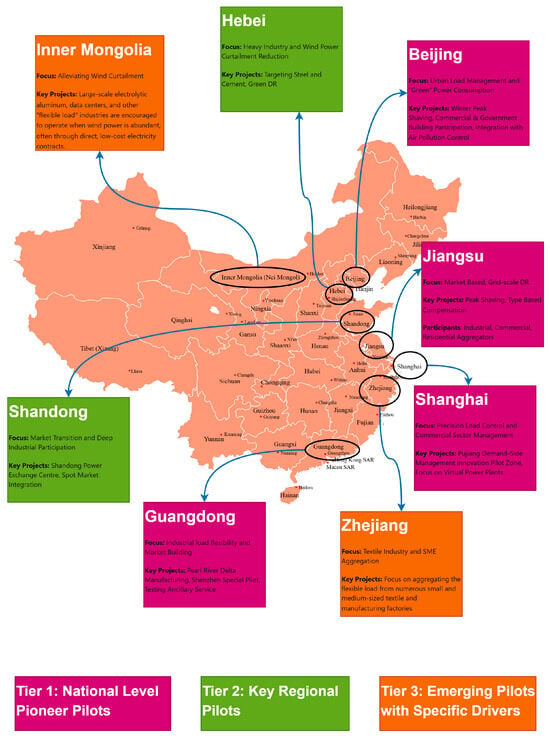
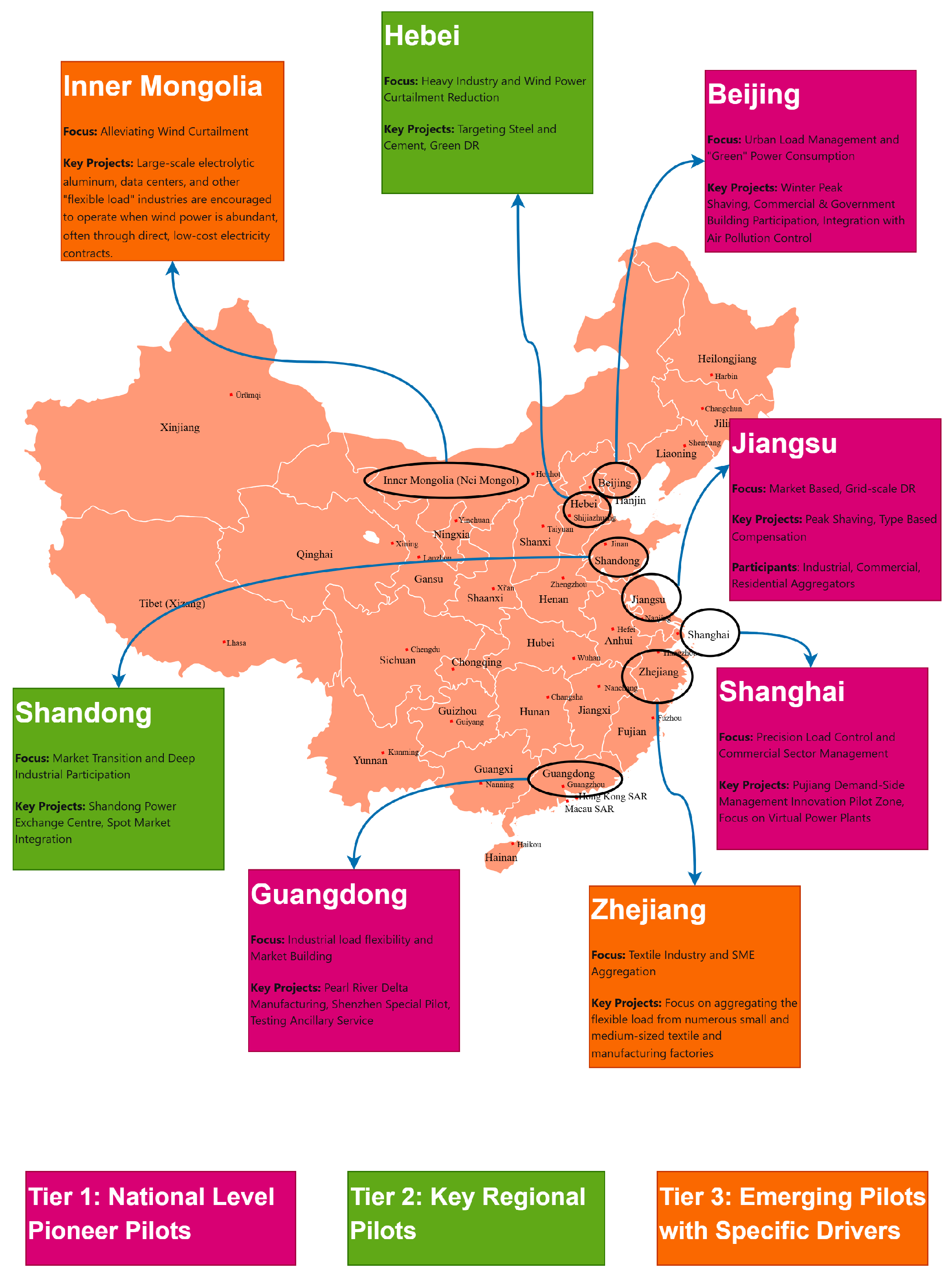
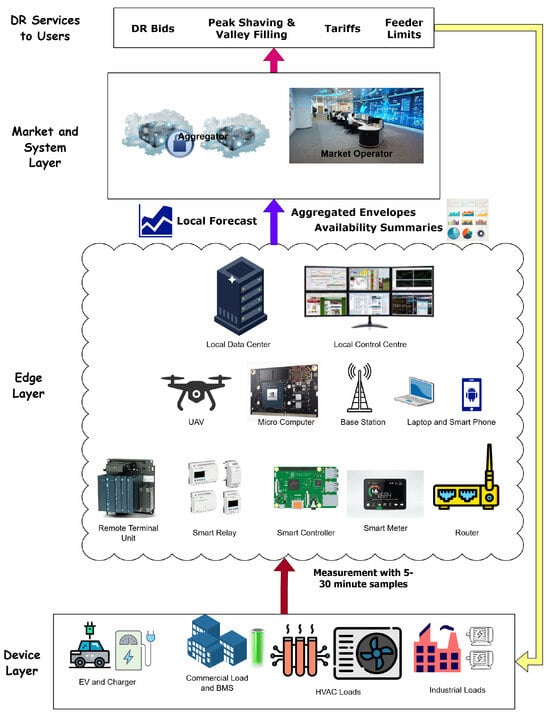
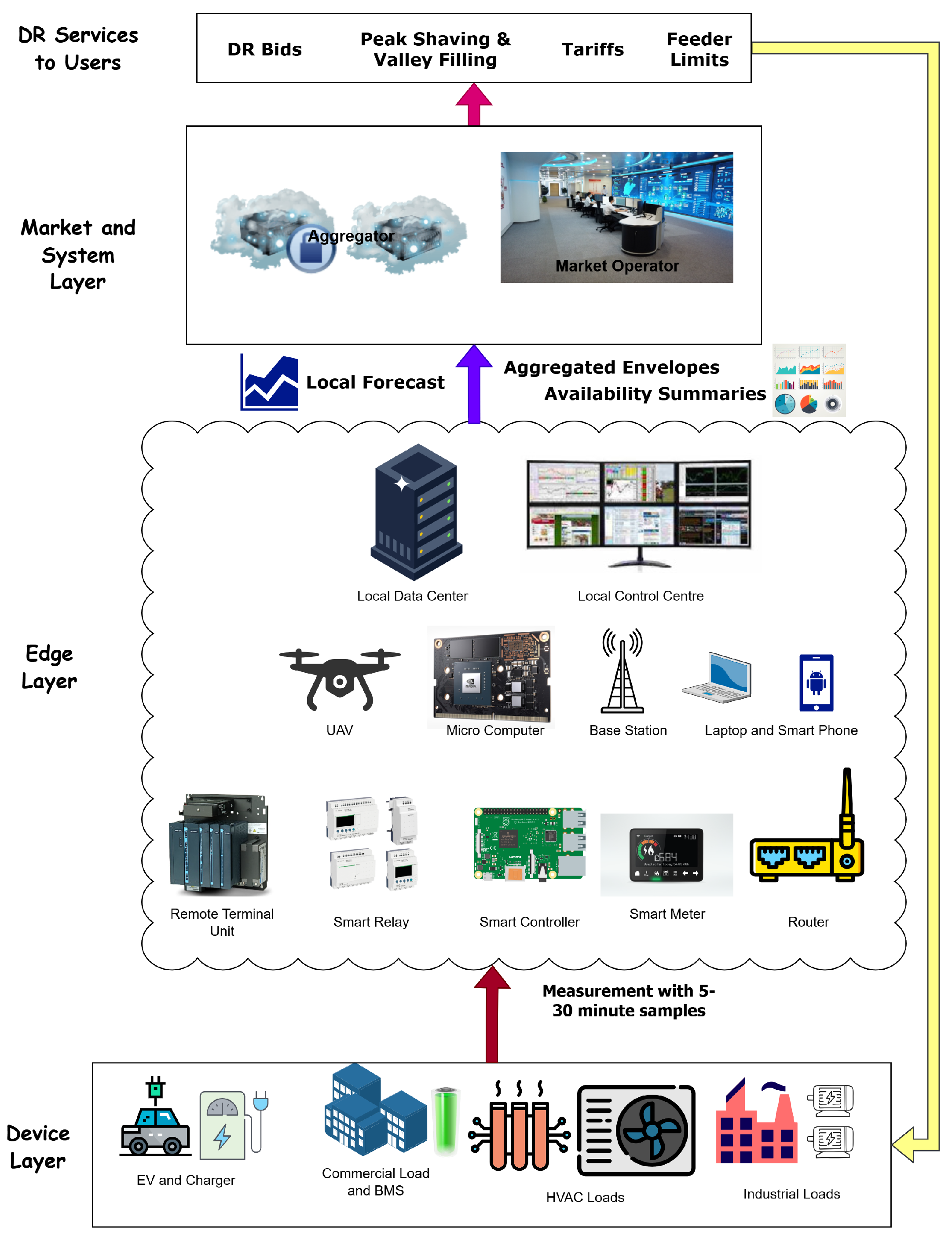

Disclaimer/Publisher’s Note: The statements, opinions and data contained in all publications are solely those of the individual author(s) and contributor(s) and not of MDPI and/or the editor(s). MDPI and/or the editor(s) disclaim responsibility for any injury to people or property resulting from any ideas, methods, instructions or products referred to in the content. |
© 2026 by the authors. Licensee MDPI, Basel, Switzerland. This article is an open access article distributed under the terms and conditions of the Creative Commons Attribution (CC BY) license.