


Abstract
This paper develops a theoretical model analyzing the optimal timing of switching from fossil-fuel-based energy to cleaner technologies in a stochastic environment. The economy consists of two interacting sectors: a backstop-production sector (e.g., solar panels), which uses both fossil fuels and backstop energy, and a consumption sector that initially relies exclusively on fossil fuels but can adopt a hybrid (cleaner) technology by incurring a fixed, irreversible investment cost. Both pollution accumulation and backstop accumulation are assumed to be stochastic. Our results indicate that the optimal timing for switching is significantly influenced by technological parameters, particularly the dependence on fossil fuels in post-switch production and the extent of technological gains in backstop manufacturing. Specifically, reducing fossil-fuel reliance and improving backstop technology both accelerate the adoption of cleaner technologies. We also find that uncertainty can either accelerate or delay adoption, depending on technological progress and intertemporal substitution preferences. These findings underscore the importance of policies that decrease fossil fuel dependence while fostering innovation in renewable energy technologies.
Keywords:
two-sector economy; clean energy transition; technology switching; investment under uncertainty; irreversible investment JEL Classification:
C63; D81; Q20; Q30; Q40
1. Introduction
The urgency of climate change mitigation has been a global priority for over two decades. However, while commitments to reducing greenhouse gas (GHG) emissions were once at the center of international policy, recent developments indicate a shift in priorities. The Intergovernmental Panel on Climate Change (IPCC) and the International Energy Agency (IEA) have consistently emphasized the need to curb emissions to limit the rise in global temperatures. For instance, the IPCC’s latest assessment stresses that global GHG emissions must peak before 2025 and be reduced by at least 43% by 2030 to meet the 1.5 °C target [1]. Despite these warnings, many nations have scaled back or postponed clean-energy transitions, partly due to geopolitical conflict, financial constraints, and shifting national interests [2,3].
One of the primary factors driving this retreat is geopolitical conflict. Tensions and economic sanctions can strain relationships between nations, leading governments to prioritize national security and immediate economic interests over long-term climate goals [3]. In countries such as Russia and China, foreign policy disputes have resulted in reevaluated climate strategies that often favor energy security over cooperative emissions reduction [4]. Similarly, the economic impacts of the COVID-19 pandemic have drastically shifted national priorities, redirecting funding away from climate initiatives to manage immediate healthcare and economic recovery needs [5].
Economic downturns also play a significant role in shaping climate policy. Financial constraints often push governments toward austerity measures, impacting environmental programs and reducing the appeal of long-term investments in clean technology [6]. This dynamic is particularly evident in fossil-fuel-rich economies, where political pressure from the energy sector complicates transitions to renewable alternatives [7]. Despite these challenges, subnational actors—including state and local governments—have taken steps to compensate for national-level climate policy setbacks [5]. However, fragmented approaches to climate action create uncertainty regarding the long-term feasibility of achieving global emission reduction targets.
At the same time, even as nations advocate for cleaner energy transitions, fossil fuels remain integral to the global energy mix. The extensive infrastructure developed for fossil fuel use creates a “lock-in” effect that makes large-scale transitions to renewable energy difficult and costly [8]. Additionally, geopolitical factors reinforce this reliance, as international conflicts and trade tensions disrupt global supply chains, prompting many nations to prioritize domestic fossil fuel production to safeguard energy security [9,10].
A further obstacle to achieving a full transition to clean energy is the financial constraints associated with investments in renewable energy. Developing, constructing, and maintaining renewable energy infrastructure requires significant initial capital, which poses major challenges, especially in developing countries where access to finance is limited [11,12,13]. These countries face increasing energy demands driven by economic growth and environmental pressures resulting from their dependence on fossil fuels, complicating their ability to adopt large-scale renewable solutions [13,14]. Thus, overcoming these financial barriers requires robust financial support mechanisms, including international financial assistance, policy incentives, and frameworks to attract private capital [11,14,15].
From a theoretical perspective, investment under uncertainty has been extensively studied in the economic literature, particularly in the works of Dixit and Pindyck [16]. Their framework emphasizes three key characteristics of investment decisions: (i) irreversibility, since most investments in clean energy infrastructure involve significant sunk costs; (ii) uncertainty, given that future energy prices, policy landscapes, and technological advancements remain unpredictable; and (iii) the value of waiting, as firms may choose to delay investment until they obtain clearer signals on regulatory frameworks and economic incentives [17,18]. More recent studies extend this approach to analyze renewable energy adoption, highlighting how option value considerations can delay or accelerate clean energy investments [19,20].
This paper builds upon this literature by explicitly incorporating uncertainty into the investment decision to switch from polluting to cleaner technologies. Unlike traditional deterministic models, we introduce a stochastic framework that accounts for both financial constraints and policy volatility, providing a more realistic representation of energy transition dynamics and a structured approach for understanding how economic and institutional risks influence the timing of technology adoption. While the model formalizes uncertainty through stochastic shocks to pollution accumulation and clean technology deployment, these sources can be interpreted more broadly as stylized representations of diverse real-world uncertainties. These include not only policy instability and financial volatility [21,22,23] but also fluctuations in renewable energy output [24,25], weaknesses in regulatory enforcement and technological reliability [26,27], and broader geopolitical risk [28,29]. In this sense, our modeling approach offers a tractable yet generalizable framework for analyzing clean technology adoption under uncertainty, which aligns closely with the complex, multidimensional nature of energy transition challenges.
Although the analysis developed in this paper is theoretical, its structure reflects the important dynamics observed in real-world energy transitions. Empirical studies on solar photovoltaic (PV) adoption highlight how uncertainty about long-term policy incentives, the irreversibility of installation costs, and ongoing technological improvements jointly influence investment decisions [30,31,32,33]. While our model uses solar PV as a concrete and policy-relevant example of cleaner technology, the framework is applicable to other renewable sources, such as wind, tidal, or geothermal energy, that exhibit similar characteristics: reliance on natural inputs, exposure to uncertainty, and non-negligible dependence on fossil fuels during deployment and manufacturing phases. This choice aligns with the empirical reality that even clean technologies are embedded in carbon-intensive production chains [27] and underscores the generalizability of the model beyond the specific case of solar panels. Similarly, recent studies have examined the deployment of clean technologies in a variety of settings: from thermoelectric systems driven by biomass and waste heat [34] to integrated solar and sustainability strategies implemented on university campuses [35], illustrating the broad relevance of models that account for uncertainty and structural constraints. Likewise, the regional adoption of hybrid energy technologies is shaped by exposure to environmental regulations, the presence of financial incentives, and local technological capabilities [36,37,38,39,40,41]. Recent reviews also emphasize the growing role of technological innovation in clean energy transitions, especially through improved forecasting, digital infrastructure, and system integration [42]. These empirical patterns and trends suggest that the stylized mechanisms in our model, namely, irreversibility, uncertainty, and technological asymmetries, may offer useful insights to understand the timing and heterogeneity of the adoption of clean technologies.
The rest of the paper is as follows: In Section 2 we describe the assumptions and equations that govern our economy. In Section 3, we develop the general equilibrium framework once the cleaner technology has been adopted by the consumption sector. In Section 4, we solve the model before the technological switch under the assumption of a zero discount rate and derive the socially optimal adoption timing. We also perform a comparative statics exercise in Section 5, including a sensitivity analysis with respect to key parameters such as the elasticity of intertemporal substitution and the intensity of fossil fuels of the post-switch production regime. In Section 6, we relax the assumption of a zero discount rate and solve the model numerically. This section includes a formal derivation of the discounted threshold and an extended sensitivity analysis exploring how the switching outcome responds to changes in and other structural parameters. We conclude in Section 8.
2. The Model
We formulate a dynamic model inspired by the literature on investment in real options under uncertainty [16,17,18], specifically adapted to the transition from a fossil-fuel-based economy to one partially reliant on cleaner technologies. The model explicitly considers two energy sources: a polluting fossil resource and a clean backstop resource (e.g., solar panels). As empirical evidence suggests, renewable energy technologies remain partially dependent on fossil fuels throughout their life cycle, particularly during the production, transportation, and maintenance phases [43,44,45,46]. Our approach thus captures an economy transitioning towards reduced but persistent fossil fuel dependency, mirroring real-world complexities of renewable energy deployment.
Following Dixit and Pindyck [16], our model integrates irreversibility through sunk investment costs, stochastic dynamics in backstop accumulation and pollution processes, and an endogenous decision regarding the optimal switching time. This “now-or-late” choice reflects the fundamental insight from real-options theory that uncertainty and irreversibility can justify delaying investment decisions [17,18].
2.1. Energy Sources and Production Sectors
We denote the flow rate of fossil resources by , interpreting it as a polluting energy input such as oil, coal, or natural gas. We do not explicitly assume exhaustibility; instead, represents the flow rate selected at each point in time. The backstop resource, denoted by , represents the cumulative stock of cleaner technology capacity (e.g., solar infrastructure). This stock evolves over time, subject to stochastic fluctuations. We assume that is given.
We consider two productive sectors within the economy:
- Consumption Sector: Initially dependent exclusively on fossil fuels, this sector operates with fixed capital stock. However, at some endogenously chosen time, T, this sector can incur a sunk cost to adopt a hybrid technology that relies on both fossil fuel and energy coming from, for instance, solar panels.
- Backstop-Manufacturing Sector: Produces additional units of the backstop resource, such as installing more solar panels. This sector continues to require fossil-fuel inputs even after adopting cleaner technologies, probably due to energy-intensive manufacturing and infrastructure processes [43,44].
2.2. Technology Before and After the Switch
Before the switch, the consumption sector produces according to
where is a technological parameter, is the constant capital stock, and indicates the fraction of extracted fossil resource allocated to consumption. We assume that any unallocated portion () is used by the other sector.
After paying a fixed, irreversible cost at time T, the consumption sector adopts a hybrid technology that uses both fossil fuels and solar panels:
where is another technological parameter, is the share of fossil fuel in production, and indicates the fraction of existing backstop allocated to consumption. Although this new technology is “cleaner”, it is not completely emissions-free because fossil fuels still enter the production function. This hybrid model captures the empirically documented partial dependency on fossil fuels [45,46].
2.3. Backstop Accumulation
The backstop manufacturing sector combines portions of fossil fuel and existing backstop to produce new units of . The accumulation dynamics of backstops is subject to significant uncertainties due to variability in renewable resource availability and fluctuating input costs [47,48,49]. Following Hugonnier et al. [50], we assume that uncertainties affecting follow a multiplicative (proportional) stochastic process. (While uncertainty introduces complexity, it does not preclude the characterization of meaningful policy rules or thresholds. As in other dynamic models of irreversible investment under uncertainty, well-established techniques allow for robust qualitative and quantitative analysis in stochastic environments [16,18]).
Before the switch, we have
where is productivity, is a parameter weighting the reliance on fossil vs. existing backstop, is the capital used in backstop production, scales the uncertainty, and is a standard Wiener process. Notice that the term indicates geometric-type (multiplicative) uncertainty: larger implies greater absolute volatility of the backstop accumulation. This multiplicative form captures proportional shocks to the backstop accumulation process, implying that uncertainty scales with the level of the stock itself—a realistic assumption in clean technology deployment where larger projects face proportionally greater exposure to input cost fluctuations, installation delays, and regulatory risk [50,51]. Similar formulations have been used in dynamic investment models to reflect endogenous volatility and risk-dependent behavior [16,18].
After the switch,
with potentially larger than , reflecting higher post-switch efficiency, and potentially less than , capturing a reduction in fossil-fuel dependence after adoption. Together, these two assumptions represent technological improvement: a more efficient panel production process and a cleaner supply chain. This formalization allows us to examine how exogenous changes in technological parameters affect the timing of adoption while keeping the model analytically tractable. (While the model assumes exogenous technological differences, these could in principle be modeled as outcomes of R&D investment decisions. Such an extension would introduce forward-looking incentives to innovate and may influence the timing of adoption.)
Notice that we treat (fossil flow) and (solar-panel stock) as separate inputs with different physical dimensions. Thus, parameters partially act as conversion coefficients that translate physically distinct inputs (fossil fuels and existing solar capacity) into comparable production inputs. For instance, can be interpreted as a composite input for building new panels, mixing fossil energy and existing solar capacity.
2.4. Pollution Dynamics and Utility
Pollution evolves proportionally to the fossil-fuel use, exhibiting multiplicative uncertainty reflective of natural assimilation processes [18,52,53,54,55]:
where , and is a Wiener process independent of . Modeling pollution accumulation as a multiplicative stochastic process reflects the idea that uncertainty in environmental dynamics, such as emission dispersion, atmospheric responses, or enforcement variability, increases with pollution levels. This formulation is consistent with previous studies modeling environmental risks under uncertainty [56], especially in settings where risk or entropy grows with the scale of environmental damage [57].
The social preferences derived from consumption and environmental quality can be represented by the lifetime expected utility:
where , and is the rate of time preference. This specification satisfies some conditions that are common in the literature, takes into account the fact that the combustion of fossil fuels is responsible for an important part of emissions and other pollutants, and provides a (negative) amenity to households. The cross derivative is negative, which means that utility exhibits a “distaste effect”, in the terminology of Michel and Rotillon [52]: a decrease in pollution increases the marginal utility of consumption and implies that households have a higher desire to consume. This is consistent with empirical evidence of pollution’s adverse effects on well-being and productivity [58,59,60].
Since there are two arguments in the utility function, it is not immediately obvious what risk aversion or intertemporal substitution means (e.g., [61,62]). Equation (6) can be rewritten as
Debreu [61] calls the function in the braces the “least concave utility function”. The exponents of this function may be interpreted as governing ordinal preferences between the two goods in the absence of risk. The transforming function can then be interpreted as governing aversion to risk. A simple calculation then reveals that the appropriate measure of risk relative aversion is . Then, following the terminology in Smith [63] or Pommeret and Schubert [56], we will call the effective coefficient of relative risk aversion and the inverse of the effective elasticity of intertemporal substitution. Since depends on , pollution changes risk aversion:
From now on, we keep the notation for the inverse of the effective elasticity of intertemporal substitution. We let denote the set of admissible plans, that is, the set and , extraction rates, and dates of adoption , , such that
2.5. The Planner’s Problem and the Switching Decision
Switching from (1)–(3) to (2)–(4) involves a sunk cost , where is a constant. The factor implies that higher pollution levels increase the effective transition cost measured in backstop units. This specification explicitly captures how elevated pollution amplifies compliance, mitigation, and adaptation costs, as empirically documented [64,65,66]. Formally, the planner’s backstop at the instant after adoption becomes . This irreversibility is characteristic of real-options settings: waiting can have value if the cost is sunk [16,17].
Hence, the planner solves
subject to (1), (3), and (5) for and (2), (4), and (5) for . The value function refers to the post-switch regime. Standard real-options arguments imply “value-matching” and “smooth-pasting” conditions at the optimal switching boundary [16,17].
Notice that, since both and are uncertain, the planner has to weigh the benefits of cleaner consumption technology against the wasted switching cost. Even if the new technology is eventually preferred, it can be optimal to delay while fossil fuels remain cheap or the backstop stock remains small [18]. As pollution increases, the incentive to switch increases, but also makes the switching cost more sensitive to . In the sections that follow, we derive the optimal paths of the controls and the endogenously determined adoption time T. We then illustrate how parameters such as uncertainty () and policy factors (I) influence the adoption threshold [50,51].
3. The Optimal Path After the Switch and the Case Without an Option to Switch
Once the economy adopts the new technology (that is, once ), the consumption sector uses both fossil fuels and solar panels, which are combined according to a Cobb–Douglas production function. This formulation realistically captures the fact that renewable energy technologies frequently integrate fossil fuels to mitigate intermittency and address infrastructural limitations [67,68,69,70,71,72,73,74]. At the same time, the backstop (solar panels) continues to be produced in a second sector that also requires the polluting resource. Below, we first characterize the post-switch equilibrium and then consider a hypothetical scenario without the possibility of switching, which serves as a baseline for welfare comparisons and clarifies the value of the switching option.
3.1. The After-the-Switch Case
Once the switch takes place, the consumption sector’s output is described by Equation (2), the backstop evolves as in Equation (4), and pollution evolves according to Equation (5). As after the switch the backstop energy is used actively in the economy, the set of admissible plans collapses to the set , , such that
Then, the value function for the planner is
The Hamilton–Jacobi–Bellman (HJB) equation for this problem can be written as
where follows from Itô’s lemma applied to .
After optimizing the right-hand side of Equation (9) and defining the following pollution-adjusted variables,
our problem simplifies to one of solving the following ordinary order differential equation in one variable:
where
and
Equation (11) has a closed-form solution, which is a power-law typical of CRRA utilities in continuous time, e.g., [18]:
This implies that the optimal consumption and fossil-fuel use in the consumption sector are the following constant fractions of :
where is the constant,
In other words, we find that the repartition of the stock of solar panels between the consumption sector and the backstop manufacturing sector is constant over time. Note that it is not necessarily the case for that governs the repartition of fossil fuel extraction between the two sectors. Moreover, (pollution-adjusted or not) consumption is a constant fraction of (pollution-adjusted or not) solar panels. The latter result follows from the fact that , i.e., the fossil fuel input in the consumption good process, is a constant fraction of .
Notice that is also required. So we impose
Finally, the transversality condition requires the convergence of the value function, i.e.,
This condition is satisfied as long as does not grow too fast in expectation. This requires that
Hence,
As , guaranteeing condition (14) to be satisfied requires the term inside the curly brackets to be strictly positive. We can show that sufficient conditions are
in the case of , and
otherwise.
3.2. The No-Option-to-Switch Case
In a hypothetical scenario where the adoption of cleaner technologies is permanently unavailable, the economy remains fossil-fuel-dependent. The consumption and backstop accumulation equations revert to the pre-switch Equations (1) and (3), respectively. This case is not intuitively relevant, but it is theoretically useful for what follows. We let be the value function of the planner in an economy with no clean energy available in the consumption sector, with
Following the above steps and definitions, we can show that the value function in this case can be written as
with
and
Solving the corresponding HJB problem yields
with
and
Notice that, in the problem above, we require that . We then impose
For any , the value function in Equation (15) cannot be greater than the lifetime utility of the agent in an economy with the clean energy available in the consumption sector. Then, we must have
This condition ensures that there exists an optimal switching date; that is, in the absence of costs of switching to cleaner energy, the central planner would choose to immediately switch for any current level of pollution-adjusted capital accumulation. A necessary and sufficient condition for Equation (17) to be satisfied is
which we impose.
4. The Optimal Switching Time in the Undiscounted Case
We now determine the socially optimal time to adopt the cleaner technology under the simplifying assumption of a zero discount rate (). Eliminating discounting allows us to derive explicit analytical solutions for the threshold of pollution-adjusted backstop stock triggering technology adoption. The results highlight how preferences, technology, and irreversibility combine to determine when switching occurs.
4.1. Setup and Boundary Conditions
Recall from Section 2 that before the switch, the consumption sector operates exclusively with fossil fuels, generating output as described in Equation (1), while the backstop accumulation follows Equation (3). The adoption decision involves an irreversible payment of , instantly transitioning consumption to the hybrid technology defined by Equation (2), with subsequent backstop evolution governed by Equation (4).
Following standard real-option methods [16,17,18], we separate the planner problem into pre-switch and post-switch value functions and , respectively. At the time of the switch, T, the following conditions must be satisfied:
where is the cost the planner must pay (or equivalently, the planner must lose I units of pollution-adjusted panels) in order to switch to the cleaner technology. Then, the planner’s problem becomes
subject to the dynamics of consumption, backstop, and pollution, as well as conditions (18) and (19). Notice that the value function before the switch depends on the current stock of solar panels even though these panels are not used before T. This is because solar panels have some value due to the existence of an opportunity to switch in the future.
Following the same procedure as in the previous section, we can show that, after maximization, the problem collapses to one of solving the following differential equation:
with
and the following boundary conditions
which represent the pollution-adjusted version of the value matching and smooth pasting conditions. In the problem above, is the level of the pollution-adjusted solar panels stock for which it is optimal to switch. This value implicitly determines the optimal switching time T. Additionally, given that the planner can always choose not to switch to the technology using panels to produce consumption, another condition that must be satisfied is
Naturally, given that , the Hamilton–Jacobi–Bellman (HJB) equation for simplifies to
which is a second-order ODE in [16].
4.2. General Solution and Threshold Determination
Solving (24) yields an expression for the marginal value :
where
and is a constant that must be determined using the smooth pasting condition, Equation (22). We can show that this is
We define
as the option component in the marginal value. Without the option to switch, we would have , recovering the “no-switch” marginal value . This may be positive or zero depending on preference parameters.
4.3. Case ε < 1
When , one can show that for all relevant , so the planner’s pre-switch marginal value strictly exceeds . Integrating (25) and then imposing boundary conditions (21) and (22) yield an implicit equation for the threshold :
which can be solved numerically to determine the optimal threshold [63].
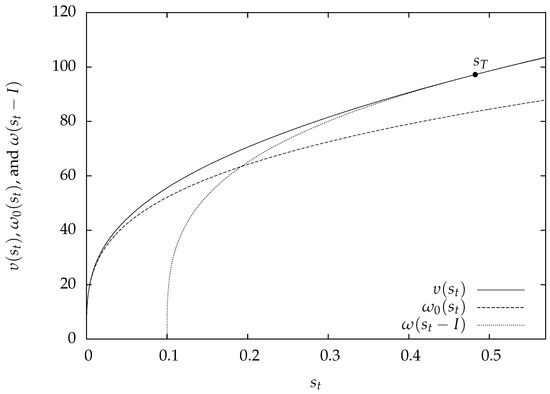
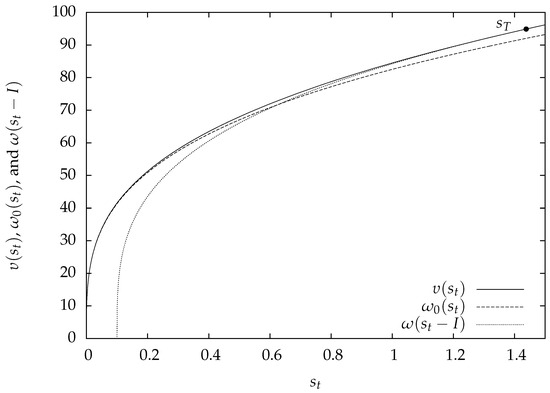
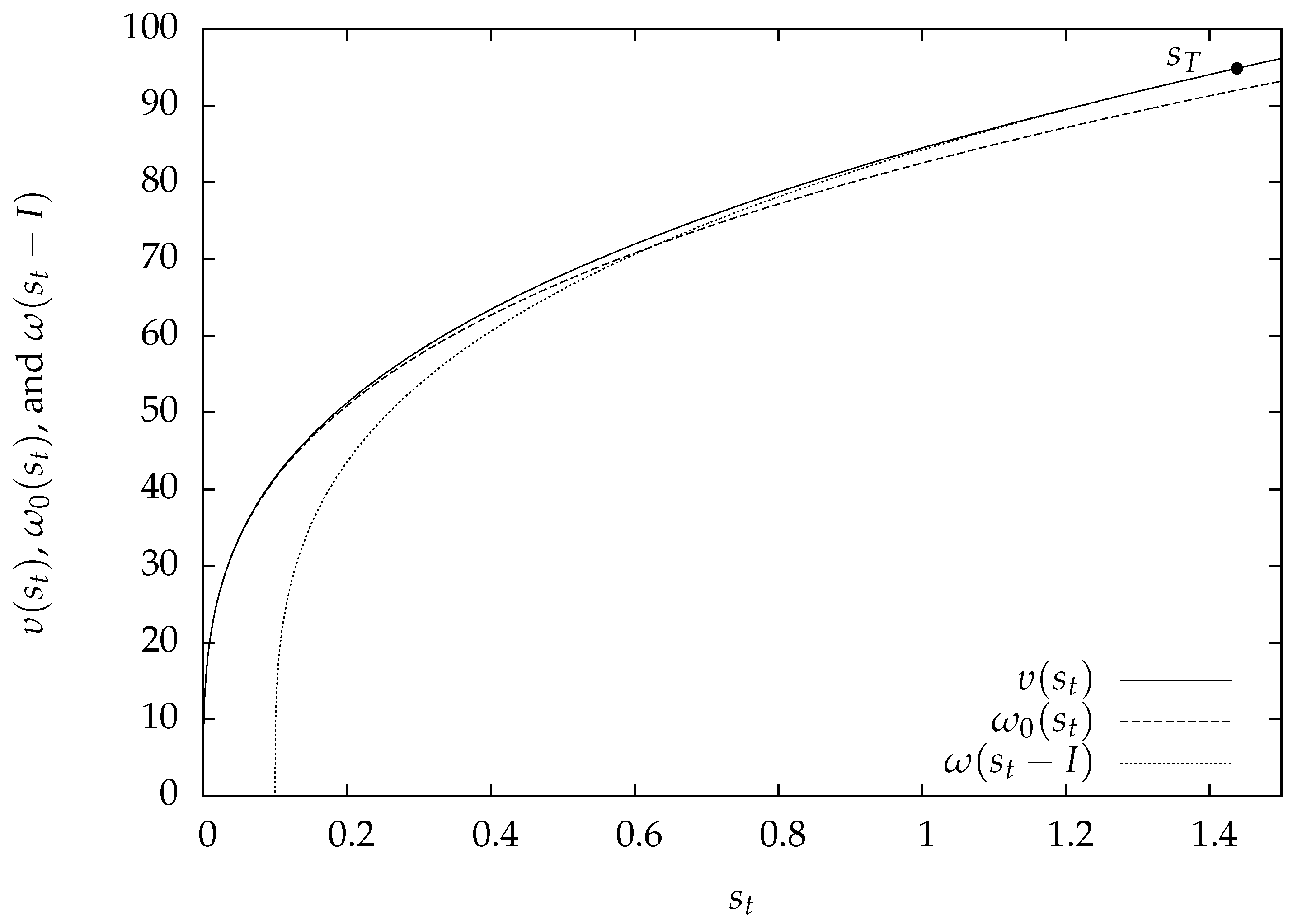
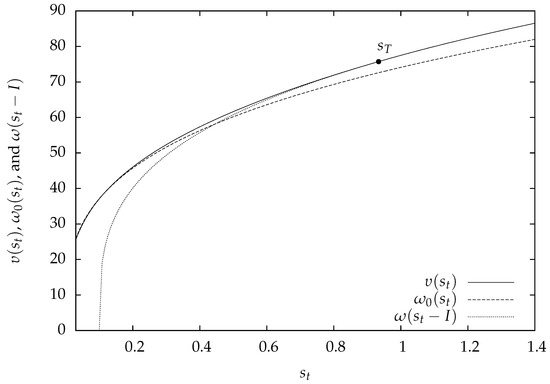
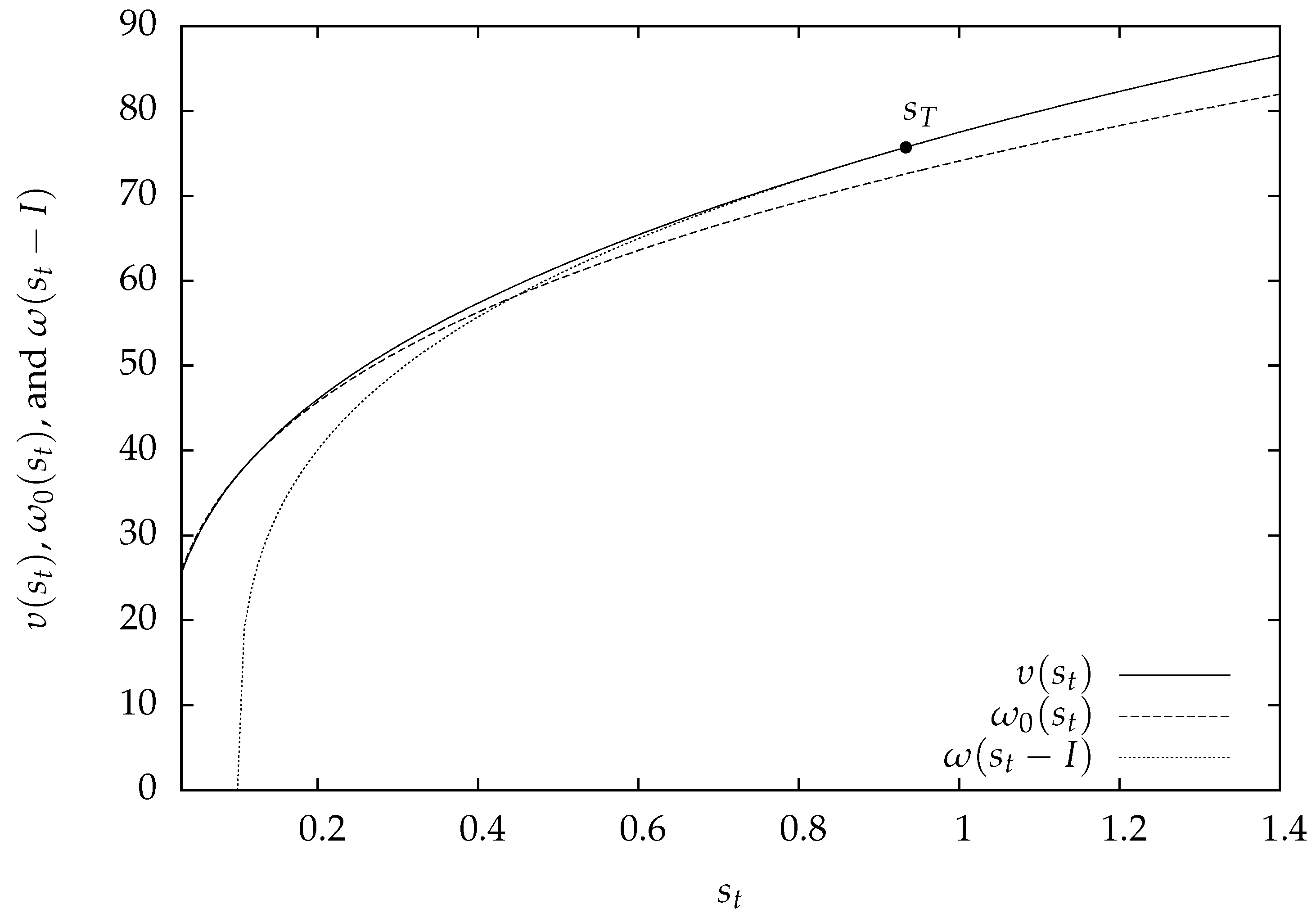
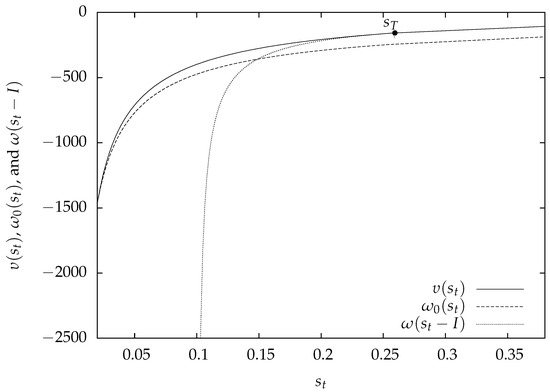
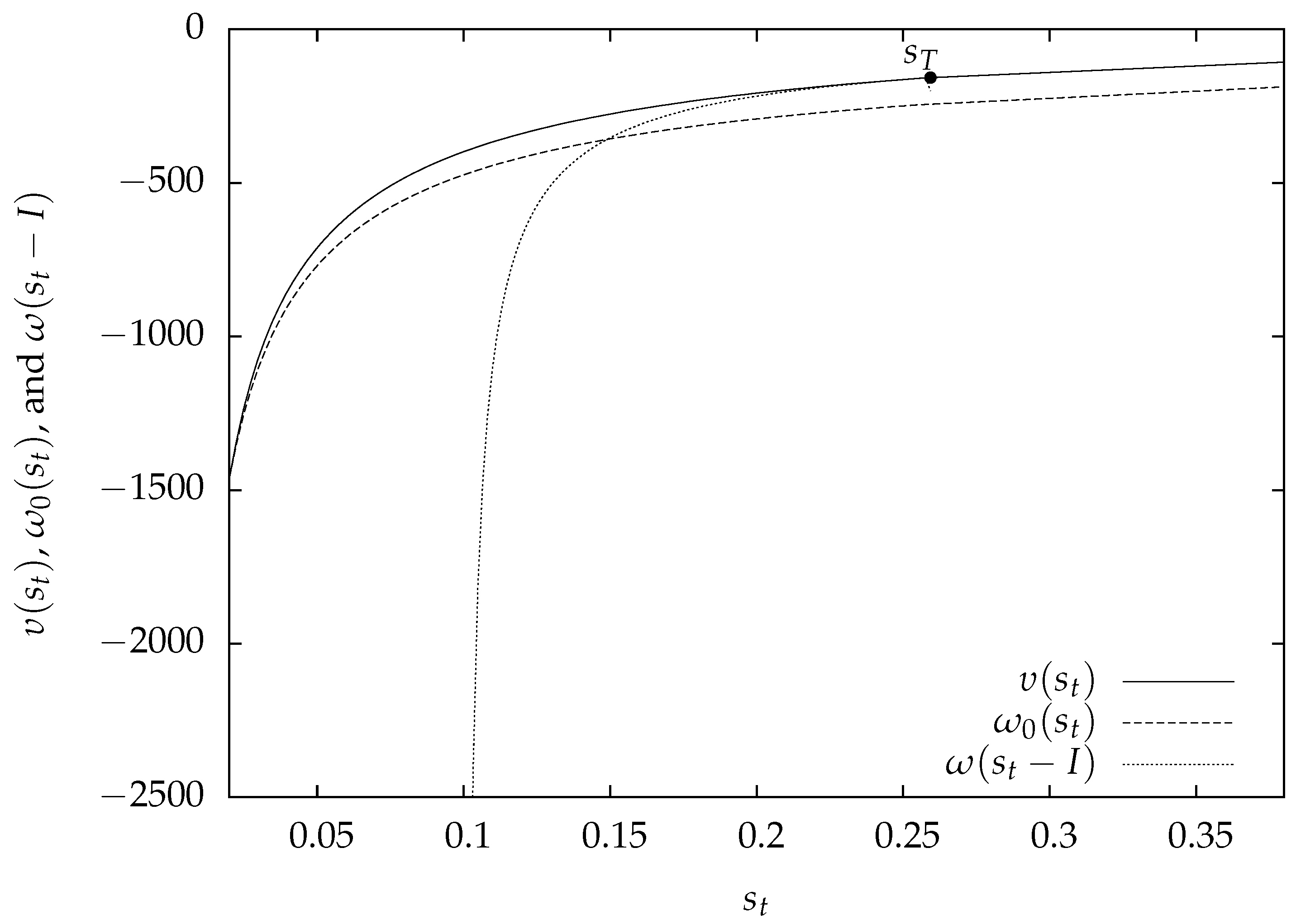
To illustrate, we drive a numerical example using the hypothetical parameters in Table 1. These parameters are chosen to reflect economically meaningful scenarios and fall within empirically observed or theoretically motivated ranges as discussed in Section 7. Figure 1 shows the three value functions: before the switch, , after the switch, , and without the option to switch, . The threshold that triggers the switch is .
Figure 1.
Value functions and optimal switching level for the case (high risk aversion/low intertemporal substitution). Threshold is determined numerically from Equation (26) using the Base Case Parameters.
4.4. Case ε > 1
When , smooth-pasting and finite marginal conditions imply . Consequently, the solution matches the no-option case, shifted by a constant:
for
This leads to an explicit closed-form threshold:
subject to ) [56].
The intuition behind this result is straightforward: higher effective risk aversion (larger ) reduces the option value to wait, causing an earlier adoption once net benefits outweigh the sunk cost.
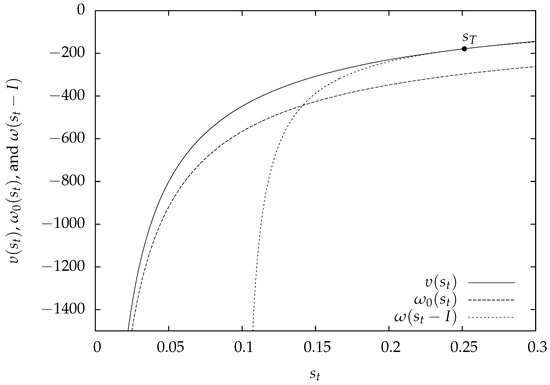
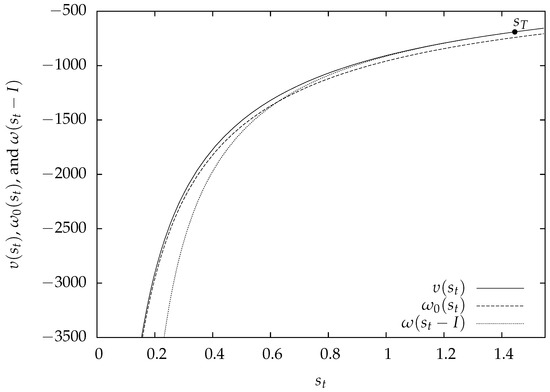
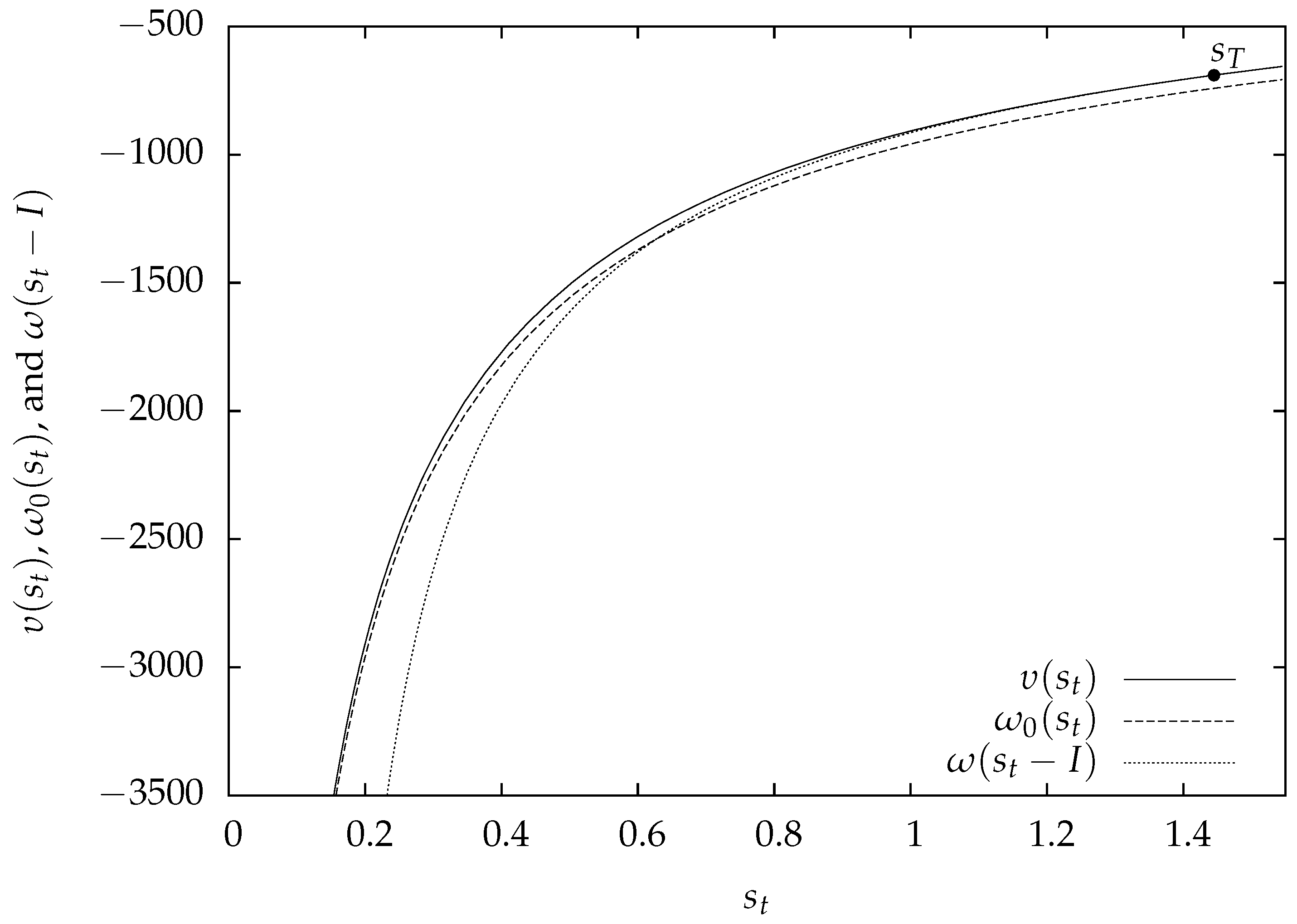
As an example, we drive a numerical resolution by using the values in Table 2. Figure 2 shows the three value functions: before the switch, , after the switch, , and without the option to switch, . The threshold that triggers the switch is .
Figure 2.
Value functions and optimal switching level for the case (low risk aversion/high intertemporal substitution). Threshold is found analytically from Equation (28) using the Base Case Parameters. In this regime, the option value vanishes and the switch occurs at a lower threshold.
The parameter , defined here as the inverse of the effective elasticity of intertemporal substitution, plays a central role in shaping the model’s qualitative dynamics. The values used in the numerical exercises are chosen to represent two distinct regimes: one with relatively high intertemporal substitution and another with lower substitution and stronger aversion to delay. These values fall within the empirically observed ranges reported in the literature. Studies using macroeconomic data and survey evidence often estimate to be between 0.5 and 1.5, depending on methodology, country, and economic context [75,76,77,78,79,80,81]. Selecting values on both sides of the threshold allows us to explore how alternative preference structures affect the timing of adoption and the emergence of an option value under uncertainty. As noted in Smith [63] and Pommeret and Schubert [56], the interaction between environmental quality and preferences can influence both risk aversion and substitution behavior, further motivating a flexible calibration of this parameter in stochastic environments.
In line with these considerations, our results show that in the undiscounted setting, the optimal switching threshold is highly sensitive to the value of . When , an explicit option value emerges, raising the threshold and thus delaying adoption. In contrast, for , the option value vanishes, leading to an earlier adoption characterized by a closed-form threshold. These findings highlight how irreversibility, uncertainty, and preferences jointly shape the optimal energy transition timing [16,18,56].
5. Comparative Statics
This section explores how key structural parameters affect the optimal switching threshold, , by examining their individual roles within the model. Although the analysis is conducted numerically, it is guided by the economic and policy relevant considerations described in Section 7. In particular, we analyze how environmental preferences, technological progress, investment irreversibility, and uncertainty influence the timing of adoption, the option value of waiting, and the robustness of the transition under alternative scenarios.
We begin our analysis by considering the simplifying assumptions of and . In this case, there is no technological improvement in the backstop production sector, nor a reinforcement of the “green effect” after the switch. By imposing these assumptions, the only advantage of the backstop production sector when switching is that solar panels are to be shared with the consumption sector. Next, we compare our results with those of the more general case of and .
5.1. No Technological Improvement in the Solar Panel Process
As a base case, we use the same parameters as in Table 1 and Table 2 in which it is already assumed that , and we set . Then we obtain that when (Figure 3), and when (Figure 4). We next consider the effect of each of the parameters on the optimal switching value of the pollution-adjusted panels.
Figure 3.
Value functions and optimal switching level when and there is no technological change across regimes. Threshold is computed numerically from Equation (26) using the Base Case Parameters. The absence of post-switch technological gains reduces the incentive to adopt, shifting to the right.
Figure 4.
Value functions and optimal switching level when and there is no technological change. Threshold is derived analytically from Equation (28). Even without technological gains, the low aversion to intertemporal risk promotes earlier adoption.
We first consider the effect of on the level of the stock of pollution-adjusted solar panels that triggers their adoption by the consumption sector. As we can deduce from Table 3, is a decreasing (and convex) function of : the larger (less negative) , the technology using solar panels is adopted by the consumption sector for a smaller pollution-adjusted panels stock. This is a priori counter-intuitive: more negative values of means that the central planner cares more about pollution affecting the utility of households and adoption should occur for a smaller solar panel stock. However, it has to be kept in mind that, from the definition of , more negative values of , and then smaller values of , may perfectly correspond to higher levels of non-pollution-adjusted panels, , since pollution may be smaller. Moreover, there exists another effect of through the effective risk aversion (see also Equation (11) in which the two effects of this parameter clearly appear through the constants and ). The larger , the smaller the risk aversion. This may explain that a smaller accumulated stock of pollution-adjusted solar panels is required to switch. In the case , the switch is triggered by the equality between the marginal values before and after the switch that depend in the same way from ; therefore, this parameter does not affect . Again, it does not mean that it does not affect .
Table 3.
Sensitivity of the switching threshold with respect to key parameters in the undiscounted case (). Note that , representing the fossil-fuel share in the post-switch regime, is varied alongside other parameters to examine robustness.
We now consider the effect of . This parameter is the inverse of the effective intertemporal elasticity of substitution. On the one hand, larger values of reduce the effective intertemporal elasticity of substitution. On the other hand, larger values of increase the effective coefficient of risk aversion. We deduce from Table 3 that the optimal level of the pollution-adjusted solar panels is a decreasing function of : less taste for intertemporal substitution erodes the option value to wait and, therefore, induces an adoption for a smaller stock of pollution adjusted panels.
Uncertainty plays an interesting role in the decision to switch, particularly in the case of . The level of the pollution-adjusted solar panels at which it is optimal to switch is a decreasing function of the uncertainty on the accumulation of solar panels. This result on “economic” uncertainty fully reverses that of the partial equilibrium literature (e.g., Pindyck [17]) in which higher levels of uncertainty increase the incentives to wait rather than adopt the policy now. What happens here is that this uncertainty reduces the value before the switch more than the value after it, therefore, reducing the level of pollution-adjusted panels stock that triggers the switch. In contrast, uncertainty in pollution accumulation is consistent with the usual partial equilibrium effect of uncertainty. The effect of both and disappears in the case of because uncertainties affect in the same way the marginal values before and after the switch and, therefore, do not affect (it does not mean that it does not affect ) as can be seen in Equations (11) and (27). This is a standard result in general equilibrium (e.g., [56]).
We also have that the level of the pollution-adjusted solar panels at which it is optimal to switch is a decreasing function of the technological parameter and an increasing function of the technological parameter : the larger the technology gain due to the switch, the smaller the pollution-adjusted panel stock that triggers adoption. Again this is due to an increase in the value after the switch compared to that before the switch. On the other hand, is an increasing function of : the more the level of technology in the solar panels production sector, the later the adoption. As , the larger the level of technology in this sector, the less the incentives to switch. Such an effect necessarily arises from the effect of solar panels technology on the option value to switch. This last effect, however, disappears in the case of because value functions before and after the switch are affected in the same way.
Our simulations show that is an increasing (and convex) function of : as the participation of the polluting resource in the production of the consumption good after the switch increases, the central planner will choose to adopt for a larger ; the larger this parameter is, the less the incentive to switch. On the opposite hand, the larger , the share of the polluting resource required to accumulate solar panels (before and after the switch), the most important it is to use less of the fossil fuel in the production of the consumption good and, therefore, the smaller the that triggers the switch. Finally, the central planner will decide to adopt for a higher if the irreversible investment cost is higher.
5.2. Technological Improvement in the Solar Panel Sector
We now relax the assumptions of and and see how much the results change in the presence of technological improvement, i.e., and , starting from the parameters of Table 1 and Table 2. Some effects are quite similar to those found in the previous section. For instance, the optimal level of the pollution-adjusted solar panels is still a decreasing (but now convex) function of , a decreasing function of , and an increasing function of . We also get that the central planner will decide to adopt for a higher the higher the irreversible investment cost. However, most of the results are inverted. Let us consider each of them.
As before, we first consider the effect of on the level of the pollution-adjusted solar panels stock triggering their adoption by the consumption sector. As we can see in Table 4, is an increasing function of : the larger (less negative) , the higher the value of the pollution-adjusted solar panels is in order for the technology using solar panels to be adopted by the consumption sector. This result seems to be more intuitive than previously observed. In this particular case, i.e., if the switch allows using less polluting resource for both consumption and solar panel accumulation, it is the direct effect of on the utility of the one that matters the most: more negative values of mean that the central planer cares more about pollution affecting the utility of households and can increase the intertemporal utility thanks to the technology improvement.
Table 4.
Sensitivity of the switching threshold with respect to key parameters in the discounted case ().
We now consider the effect of uncertainty. The role played by uncertainty on the accumulation of solar panels still depends on the value of relative to unity, and they are now reversed for To explain these new results, we can focus on the effect of the technological improvement after the switch. Whatever the effective intertemporal elasticity of substitution, the pollution-adjusted solar panel stock that triggers the switch is a decreasing function of the uncertainty on pollution accumulation. This comes from the fact that the central planner tries to mitigate the bad effect of an increasing pollution uncertainty by adopting the new technology sooner. Uncertainty on solar panel accumulation has a different effect. The role played by uncertainty on the accumulation of solar panels depends again on the value of relative to unity. In particular, for , a larger now leads to a larger and such a result is consistent with the existing literature on technology adoption under uncertainty in partial equilibrium. But the effect is reversed for . What happens is that more uncertainty on solar panel accumulation unambiguously reduces the value after the switch but may increase the value before the switch through the option part of the value. This should trigger adoption for a larger ; this is what occurs if the agent likes to substitute in time, but it is no longer the case for for which there is no option part in marginal value before the switch.
Moreover, the level of the pollution-adjusted solar panels at which it is optimal to switch is a decreasing function of and an increasing function of whatever : the more the gain in technology thanks to the switch, the smaller the adoption threshold . These results confirm that technological improvement in either sector is an important incentive (absent in the previous section) to switch. It is also clear that is an increasing function of and a decreasing function of . Therefore, the more important it is for the polluting resource to produce solar panels after the switch, the later the adoption. The more important it is for the polluting resource to produce solar panels before the switch, the sooner the adoption. Of course, the fact that is larger than and that provides the central planner with an additional incentive to switch as the solar panel production process is more efficient after the switch, and, in particular, it requires less of the polluting resource in their production process. In other words, this sector becomes “greener”.
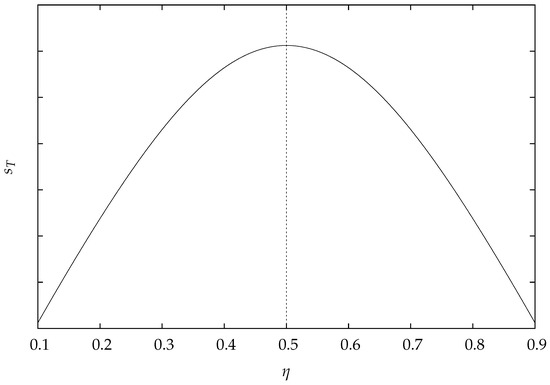
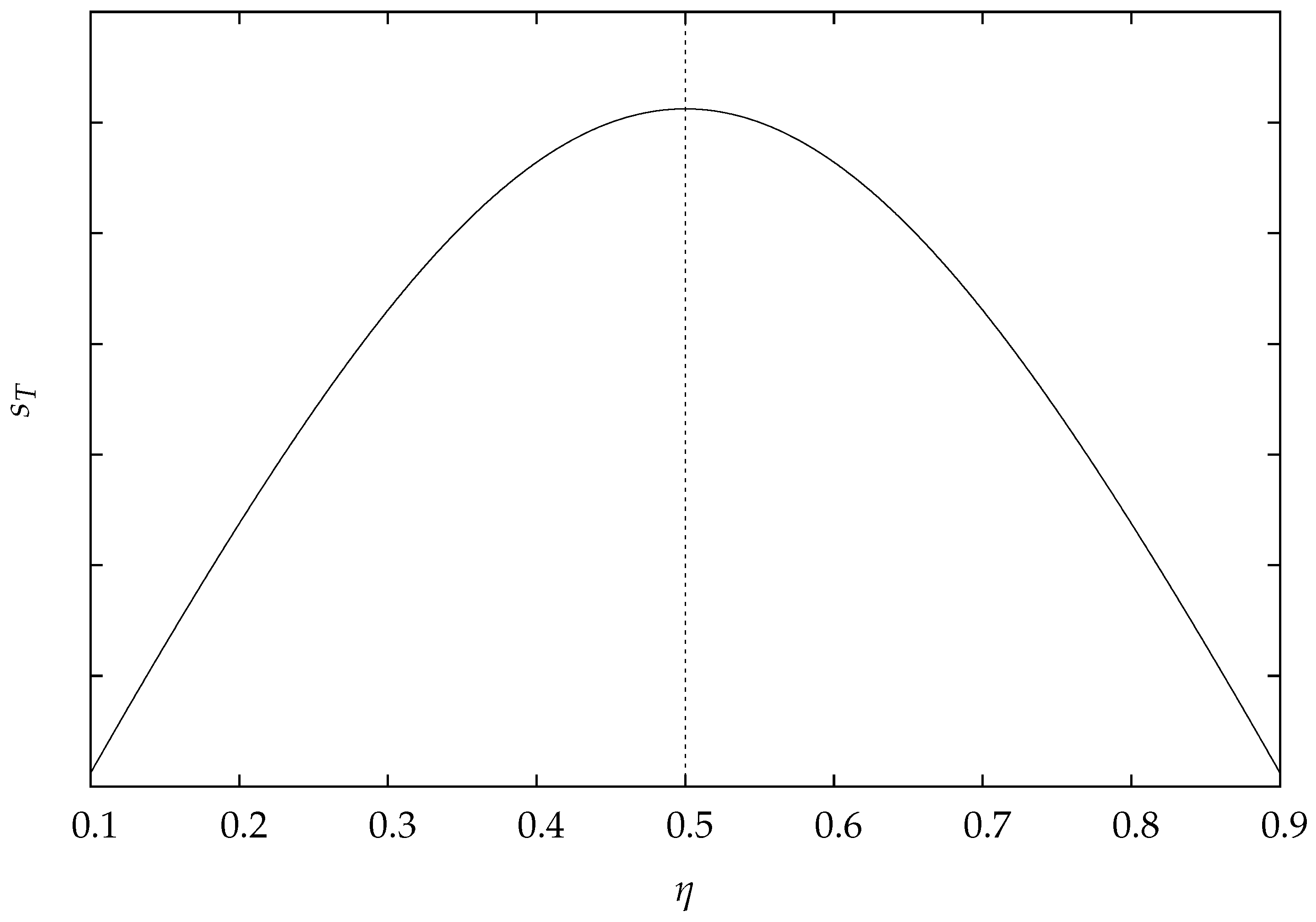
Our simulations on are as in Figure 5. Notice that is an increasing (decreasing) function of as long as (). This is the result of the constant returns to scale in the production of the consumption good after the switch. If fossil fuels are relatively less important than solar panels to produce consumption, the central planner tends to wait for a larger value of in order to switch to the new technology. This is because the solar panel sector needs to be sufficiently developed to not lose consumption once the new technology is adopted. But, if fossil fuels are relatively more important than solar panels to produce consumption, switching to the new technology is easier (smoother), and then the incentives to wait for the central planner start vanishing.
Figure 5.
Effect of the fossil share parameter on the optimal switching threshold . Higher values of indicate greater reliance on fossil fuels in the post-switch regime, reducing the environmental gain from adoption and shifting the threshold to the right.
The effect of all of the parameters on is summarized in Table 4.
5.3. Discussion of Interaction Effects
Although our comparative statics focus on one-parameter-at-a-time variations, the model’s nonlinear and stochastic structure implies that some parameters may interact in nontrivial ways. For example, the role of uncertainty, as captured by and , is closely related to the value of the intertemporal elasticity parameter . When , the option value of waiting becomes salient and is amplified or attenuated by changes in uncertainty. In contrast, when , this option value vanishes, and the switching threshold becomes largely insensitive to and .
Similar interactions may arise between , which governs the pollution sensitivity of utility, and the technological parameters and . A higher increases the welfare cost of pollution, which can magnify the welfare gains from technological improvements in clean energy, thus amplifying the effect of on . Interactions are also expected between and since both parameters influence the relative fossil dependence of solar panel production and post-switch consumption. When a clean supply chain (low ) is combined with a low post-switch fossil share (low ), they may reinforce each other in accelerating adoption.
While these interactions are not fully explored numerically in this paper, they highlight directions for future research and suggest that the optimal timing of energy transition may respond to policy bundles rather than isolated instruments.
6. The Optimal Switching Time, the Discounted Case
In real-world decision-making, time preferences play a central role. For this reason, we now turn to the case and derive the optimal switching condition under discounting. This extension allows us to explore how impatience or positive interest rates influence the adoption threshold, offering more policy-relevant insights.
However, when , there is no analytical solution to the problem described by Equations (20) to (23), and numerical methods become essential for computing the value function. Several numerical techniques are available for solving such problems, including Newton’s method, projection methods, and finite-difference approaches. Among these, Newton’s method provides an efficient means to approximate solutions to the Hamilton–Jacobi–Bellman equation associated with the switching decision (e.g., [82]). Interested readers are encouraged to consult the relevant literature for detailed algorithms and computational procedures (e.g., [51]).
The numerical computations presented below use the base-case parameters from Table 1 and Table 2. Table 5 summarizes the optimal switching thresholds obtained for different values of the discount rate , clearly illustrating its impact on the timing of adoption.
Table 5.
Optimal switching time—discounted case.
Figure 6 and Figure 7 illustrate numerical examples for the particular case of , taking into account technological improvement scenarios discussed earlier.
Figure 6.
Effect of introducing a positive discount rate () on the optimal switching threshold , under the case . Discounting reduces the present value of future benefits, making early adoption more attractive and lowering the threshold.
Figure 7.
Effect of a positive discount rate () on the optimal switching threshold for . Compared to the undiscounted case, the adoption occurs earlier.
Qualitatively, the comparative static results from Section 5 remain valid under discounting. Specifically, the optimal threshold for adopting cleaner technology increases with the discount rate (), indicating that a higher valuation of current utility postpones technology adoption. This finding contrasts with results in previous studies (e.g., [50,83]). The intuition behind this result is straightforward: when the planner places greater importance on present consumption, it becomes optimal to delay the transition until the backstop technology is sufficiently developed, thus benefiting from the higher productivity currently available through fossil fuels.
7. Policy Implications
Although the analysis developed in this paper is entirely theoretical, many of the structural parameters can be interpreted as reflecting actual policy instruments or institutional constraints. For example, the parameter , which determines the participation of the polluting resource in the production of the consumption good after the switch, can be understood as a measure of how dependent the post-switch economy remains on polluting energy sources. A high implies that fossil fuels continue to play a significant role even after the adoption of cleaner technologies due to technical limitations or the in-place infrastructure. Policy tools such as carbon pricing or emission standards help reduce this dependence by altering the relative cost structure of fossil fuels versus renewables [84,85,86]. Empirical evidence confirms that higher fossil fuel prices and stricter environmental regulations drive shifts towards greener energy mixes, accelerating the decarbonization of consumption and production processes [87,88,89].
The parameter I reflects the irreversibility of investment in clean technology, capturing the sunk cost associated with the switch from fossil-based to hybrid cleaner energy technology. In practice, this cost consists not only of the physical capital associated with solar panel installations or clean infrastructure upgrades but also of regulatory frictions, coordination failures, and informational asymmetries that inhibit timely adoption. Policy interventions such as public subsidies, tax incentives, and financial guarantees have proven to be effective in reducing these perceived or actual barriers. For example, studies show that targeted subsidies can significantly lower the upfront cost of photovoltaic systems, fostering large-scale adoption and triggering cost-reducing learning effects over time [90,91]. Tax credits, such as those historically implemented in the United States, have also played a substantial role in expanding household-level investments in solar energy, although their distributional implications require careful consideration [38]. Localized and differentiated subsidy schemes further enhance the adoption potential by aligning financial support with regional conditions and consumer responsiveness [92,93]. More broadly, these instruments reduce the effective value of I, thus raising the marginal value of cleaner technologies relative to the continued reliance on fossil fuels. As documented in the recent literature, such financial policies not only alleviate capital constraints but also signal long-term government commitment to the energy transition, improving investor confidence and accelerating market transformation [94,95].
The parameters and govern the dependence of solar panel production on fossil fuels before and after the technological switch. These coefficients reflect the carbon intensity embedded in the supply chain of clean technologies. A high value of relative to indicates that the production of solar panels becomes less dependent on fossil fuels after adoption, thus reinforcing the environmental benefits of cleaner consumption technology. In contrast, if remains high, the environmental gains from switching may be undermined by a persistently polluting supply chain. This insight is supported by a growing body of literature that emphasizes the importance of reducing the upstream carbon footprint of clean energy technologies. Studies have shown that the photovoltaic panel production phase and similar technologies can generate significant greenhouse gas emissions, potentially compensating for their operational benefits if not addressed through innovation and regulation [96,97,98].
Additional structural parameters in the model can also be mapped onto real-world policy levers. The discount rate , for example, captures how future utility is weighed against present utility. In applied contexts, this parameter reflects the implicit social discount rate adopted by policymakers when evaluating long-term investments in clean technologies or environmental programs. Lower values of are often recommended in climate policy to account for intergenerational equity and the persistent benefits of mitigation efforts [99,100]. Then, choosing a lower increases the present value of future benefits and encourages earlier adoption of cleaner technologies.
The intertemporal elasticity of substitution, captured by the parameter , governs the planner’s willingness to shift consumption across time and under uncertainty. In real-world terms, it can reflect institutional or behavioral factors such as household saving behavior, access to long-term credit, or macroeconomic stability. Empirical estimates vary considerably between settings, with studies reporting values below and above unity depending on the context [75,76,78,81]. Public policy can indirectly influence effective intertemporal substitution by enhancing financial inclusion or reducing income volatility.
Uncertainty parameters, and , govern the stochastic dynamics of solar panel accumulation and pollution, respectively. In empirical and policy terms, may reflect variability in clean energy deployment due to technological risk, policy inconsistency, or market volatility. These uncertainties can be mitigated through stable regulatory frameworks, long-term procurement contracts, or sustained investment in innovation [87,89,101]. Similarly, may capture uncertainty in environmental dynamics or enforcement outcomes, pointing to the importance of robust monitoring, reporting, and verification (MRV) systems to reduce informational noise and improve policy effectiveness [84,85,88].
Finally, although the threshold is a theoretical construct, it can be interpreted in practice as a tipping point in the relative value of continuing with fossil-based production versus adopting cleaner alternatives. Empirically, this threshold could be approximated using composite indicators that reflect the maturity and affordability of clean technologies, the marginal social cost of pollution, or the effective policy support for adoption. For example, a country approaching could exhibit high renewable penetration rates, decreasing marginal abatement costs, strong policy incentives, and increasing opportunity costs for maintaining fossil-fuel-based infrastructure. While precise calibration remains an empirical challenge, such indicators can guide policymakers in assessing proximity to transition thresholds under uncertainty.
8. Conclusions
This paper develops a dynamic framework to analyze the socially optimal timing for transitioning from a fossil-based production regime to a cleaner technology in an uncertain environment. The model accounts for both environmental and technological uncertainty and emphasizes the irreversible nature of the switching decision. It offers insights into how preferences, technological structure, and risk jointly shape the timing of clean technology adoption.
The analysis highlights how the value of waiting interacts with economic and policy conditions, often delaying adoption despite clear long-term benefits. It also shows that the structure of clean technologies and the perceived persistence of uncertainty play critical roles in determining when the transition becomes optimal. These findings help explain both hesitation and acceleration patterns observed in real-world energy transitions.
From a policy perspective, the results suggest that targeted interventions, such as subsidies for clean technologies, support for R&D, or mechanisms that reduce uncertainty, can significantly influence the timing of adoption. The framework thus offers a tool for evaluating how different policy instruments may alter the incentives faced by firms and governments when considering a shift to cleaner alternatives.
Future research may expand this framework by modeling technological progress as an endogenous outcome, allowing innovation and learning to respond to investment or policy choices. It would also be valuable to explore empirical validation of the model predictions using data from ongoing or historical energy transitions. Such developments would strengthen the empirical relevance of the model and help inform the design of more effective climate and energy policies under uncertainty. Moreover, future research could examine interaction effects between structural parameters, such as uncertainty, environmental preferences, and technological characteristics, which may jointly shape the timing and desirability of adoption in ways not captured by single-parameter analyses. In addition, incorporating heterogeneous real-world constraints, such as geopolitical tensions or limited access to finance in developing countries, would enhance the model’s ability to reflect the uneven feasibility of early adoption across different institutional contexts. These extensions would offer a richer perspective on the combined impact of policy instruments and structural limitations on the energy transition.
Our findings underscore that reducing uncertainty and investing in enabling conditions, both technological and institutional, can shift the balance in favor of earlier adoption, making cleaner technologies not only optimal but also more feasible across diverse economic and political settings.
Author Contributions
Conceptualization, A.M. and A.P.; methodology, A.M. and A.P.; software, A.M.; validation, A.M. and A.P.; formal analysis, A.M. and A.P.; investigation, A.M. and A.P.; resources, A.M. and A.P.; data curation, A.M. and A.P.; writing—original draft preparation, A.M., A.P. and A.M.; visualization, A.M. and A.P.; supervision, A.M. and A.P.; project administration, A.M.; funding acquisition, A.M. All authors have read and agreed to the published version of the manuscript.
Funding
This research received no external funding.
Data Availability Statement
The original contributions presented in this study are included in the article. Further inquiries can be directed to the corresponding author.
Conflicts of Interest
The authors declare no conflicts of interest.
References
- IPCC. AR6 Synthesis Report: Climate Change 2023; IPCC Publication: Geneva, Switzerland, 2023. [Google Scholar]
- Hultman, N.; Clarke, L.; Frisch, C.; Kennedy, K.; McJeon, H.; Cyrs, T.; Hansel, P.; Bodnar, P.; Manion, M.; Edwards, M.R.; et al. Fusing Subnational With National Climate Action Is Central to Decarbonization: The Case of the United States. Nat. Commun. 2020, 11, 5255. [Google Scholar] [CrossRef] [Scilit] [PubMed]
- Karatayev, V.A.; Vasconcelos, V.V.; Lafuite, A.S.; Levin, S.A.; Bauch, C.T.; Anand, M. A Well-Timed Shift From Local to Global Agreements Accelerates Climate Change Mitigation. Nat. Commun. 2021, 12, 2908. [Google Scholar] [CrossRef] [Scilit]
- Ward, D.S.; Mahowald, N.M. Contributions of Developed and Developing Countries to Global Climate Forcing and Surface Temperature Change. Environ. Res. Lett. 2014, 9, 074008. [Google Scholar] [CrossRef] [Scilit]
- Iverson, T.; Burgess, J.C.; Barbier, E.B. Are Sub-National Agreements for Carbon Abatement Effective? Energies 2020, 13, 3675. [Google Scholar] [CrossRef] [Scilit]
- Marcus, H.; Hanna, L. Understanding National Barriers to Climate Change Adaptation for Public Health: A Mixed-Methods Survey of National Public Health Representatives. Int. J. Health Gov. 2020, 25, 287–306. [Google Scholar] [CrossRef] [Scilit]
- Meckling, J.; Trachtman, S. The Home State Effect: How Subnational Governments Shape Climate Coalitions. Governance 2023, 37, 887–905. [Google Scholar] [CrossRef] [Scilit]
- Kuncoro, T.G.; Susanto, D.A. Evaluating the Nexus of Renewable Energy’s in Economic Growth Realities: Autoregressive Distributed Lag Approach. Jambura Equilib. J. 2024, 6, 24–36. [Google Scholar] [CrossRef] [Scilit]
- Billon, P.L.; Lujala, P.; Singh, D.; Culbert, V.; Kristoffersen, B. Fossil Fuels, Climate Change, and the COVID-19 Crisis: Pathways for a Just and Green Post-Pandemic Recovery. Climate Policy 2021, 21, 1347–1356. [Google Scholar] [CrossRef] [Scilit]
- Popescu, C.; Apostu, S.A.; Rădulescu, I.G.; Mureșan, J.D.; Brezoi, A.G. Energizing the Now: Navigating the Critical Landscape of Today’s Energy Challenges—An in-Depth Review. Energies 2024, 17, 675. [Google Scholar] [CrossRef] [Scilit]
- Karimi, K.; Karimi, A. The economic impacts of renewable energy adoption: A comparative analysis of developed and developing nations. Join 2024, 2, 32–47. [Google Scholar] [CrossRef] [Scilit]
- Kor, S.; Qamruzzaman, M. Nexus between FDI, financial development, capital formation and renewable energy consumption: Evidence from Bangladesh. Int. J. Energy Econ. Policy 2023, 13, 129–145. [Google Scholar] [CrossRef] [Scilit]
- Diallo, S.S.; Ouoba, Y. Financial development and renewable energy deployment in Sub-Saharan African countries. Int. J. Energy Sect. Manag. 2023, 18, 1305–1327. [Google Scholar] [CrossRef] [Scilit]
- Ragosa, G.; Warren, P. Unpacking the determinants of cross-border private investment in renewable energy in developing countries. J. Clean. Prod. 2019, 235, 854–865. [Google Scholar] [CrossRef] [Scilit]
- Rodríguez, M.C.; Haščič, I.; Johnstone, N.; Silva, J.; Ferey, A. Inducing Private Finance for Renewable Energy Projects; Technical Report 67, OECD Environment Working Papers; OECD Publishing: Paris, France, 2014. [Google Scholar] [CrossRef]
- Dixit, A.K.; Pindyck, R.S. Investment Under Uncertainty; Princeton University Press: Princeton, NJ, USA, 1994. [Google Scholar]
- Pindyck, R.S. Irreversibilities and the timing of environmental policy. Resour. Energy Econ. 2000, 22, 233–259. [Google Scholar] [CrossRef] [Scilit]
- Pindyck, R.S. Optimal timing problems in environmental economics. J. Econ. Dyn. Control 2002, 26, 1677–1697. [Google Scholar] [CrossRef] [Scilit]
- Cian, E.D.; Tavoni, M. Mitigation Portfolio and Policy Instruments When Hedging Against Climate Policy and Technology Uncertainty. Environ. Model. Assess. 2011, 17, 123–136. [Google Scholar] [CrossRef] [Scilit]
- Agaton, C.B. Real Options Analysis of Renewable Energy Investment Scenarios in the Philippines. Renew. Energy Sustain. Dev. 2017, 3, 284. [Google Scholar] [CrossRef] [Scilit]
- Adams, S.; Adedoyin, F.; Olaniran, E.; Bekun, F. Energy consumption, economic policy uncertainty and carbon emissions; causality evidence from resource rich economies. Econ. Anal. Policy 2020, 68, 179–190. [Google Scholar] [CrossRef] [Scilit]
- Chen, Y.; Shen, X.; Wang, L. The heterogeneity research of the impact of EPU on environmental pollution: Empirical evidence based on 15 countries. Sustainability 2021, 13, 4166. [Google Scholar] [CrossRef] [Scilit]
- Albrizio, S.; Costa, H. Policy uncertainty and investment in low-carbon technology. SSRN Electron. J. 2012. [Google Scholar] [CrossRef] [Scilit]
- Pellow, M.; Emmott, C.; Barnhart, C.; Benson, S. Hydrogen or batteries for grid storage? A net energy analysis. Energy Environ. Sci. 2015, 8, 1938–1952. [Google Scholar] [CrossRef] [Scilit]
- Zhou, Z.; Benbouzid, M.; Charpentier, J.; Scuiller, F.; Tang, T. A review of energy storage technologies for marine current energy systems. Renew. Sustain. Energy Rev. 2013, 18, 390–400. [Google Scholar] [CrossRef] [Scilit]
- Short, J.; Toffel, M. Making self-regulation more than merely symbolic: The critical role of the legal environment. Adm. Sci. Q. 2010, 55, 361–396. [Google Scholar] [CrossRef] [Scilit]
- Victoria, M.; Haegel, N.; Peters, I.; Sinton, R.; Jäger-Waldau, A.; Cañizo, C.; Smets, A. Solar photovoltaics is ready to power a sustainable future. Joule 2021, 5, 1041–1056. [Google Scholar] [CrossRef] [Scilit]
- Ghosh, S. COVID-19, clean energy stock market, interest rate, oil prices, volatility index, geopolitical risk nexus: Evidence from quantile regression. J. Econ. Dev. 2022, 24, 329–344. [Google Scholar] [CrossRef] [Scilit]
- Tran, M.; Vo, D. Can local and global geopolitical risk predict governments’ military spending behaviour? International evidence. Scott. J. Political Econ. 2024, 71, 588–603. [Google Scholar] [CrossRef] [Scilit]
- Assereto, M.; Byrne, J. The implications of policy uncertainty on solar photovoltaic investment. Energies 2020, 13, 6233. [Google Scholar] [CrossRef] [Scilit]
- Bauner, D.; Crago, C. Adoption of residential solar power under uncertainty: Implications for renewable energy incentives. Energy Policy 2015, 86, 27–35. [Google Scholar] [CrossRef] [Scilit]
- Bertsch, V.; Geldermann, J.; Lühn, T. What drives the profitability of household PV investments, self-consumption and self-sufficiency? Appl. Energy 2017, 204, 1–15. [Google Scholar] [CrossRef] [Scilit]
- Gahrooei, M.R.; Zhang, Y.; Ashuri, B.; Augenbroe, G. Timing residential photovoltaic investments in the presence of demand uncertainties. Sustain. Cities Soc. 2016, 20, 109–123. [Google Scholar] [CrossRef] [Scilit]
- Rebellon, A.; Martinez, C.; Velasquez, C. Thermoelectric generators driven by biomass and waste heat: Recent advances and design considerations. Environ. Sci. Adv. 2024, 3, 312–328. [Google Scholar] [CrossRef] [Scilit]
- Seilkhan, A.; Kalymbek, B.; Satybaldiyeva, G.; Akbota, B.; Zhang, S.; Xiaojiang, G.; Idrisheva, Z.; Issabayeva, S. Smart and green university campus for a sustainable environment: The case of the Eurasian National University. Environ. Sci. Ecotechnol. 2024, 19, 100338. [Google Scholar] [CrossRef] [Scilit]
- Wu, J.; Yang, J.; Zhou, Z. How does environmental regulation affect environmental performance? A case study of China’s regional energy efficiency. Expert Syst. 2018, 37, e12326. [Google Scholar] [CrossRef] [Scilit]
- Song, M.; Xie, Q.; Wang, S.; Zhou, L. Intensity of environmental regulation and environmentally biased technology in the employment market. Omega 2021, 100, 102201. [Google Scholar] [CrossRef] [Scilit]
- Borenstein, S.; Davis, L.W. The distributional effects of US clean energy tax credits. Tax Policy Econ. 2016, 30, 191–234. [Google Scholar] [CrossRef] [Scilit]
- Aba, M.; Ladeinde, A.; Afimia, E. Economic evaluation of hybrid renewable energy systems for electricity generation in Nigeria: A discounted cash flow analysis. J. Energy Res. Rev. 2019, 2, 1–10. [Google Scholar] [CrossRef] [Scilit]
- Jiang, L. Performance comparison between traditional internal combustion engines and hybrid powertrains. Highlights Sci. Eng. Technol. 2024, 114, 129–135. [Google Scholar] [CrossRef] [Scilit]
- Okundamiya, M.; Emagbetere, J.; Ogujor, E. Assessment of renewable energy technology and a case of sustainable energy in mobile telecommunication sector. Sci. World J. 2014, 2014, 947281. [Google Scholar] [CrossRef] [Scilit]
- Zhang, W.; Li, B.; Xue, R.; Wang, C.; Cao, W. A systematic bibliometric review of clean energy transition: Implications for low-carbon development. PLoS ONE 2021, 16, e0261091. [Google Scholar] [CrossRef] [Scilit]
- Ravetti, C.; Theoduloz, T.; Valacchi, G. Buy coal or kick-start green innovation? energy policies in an open economy. Environ. Resour. Econ. 2020, 77, 95–126. [Google Scholar] [CrossRef] [Scilit]
- Ravi, S.; Lobell, D.; Field, C. Tradeoffs and synergies between biofuel production and large solar infrastructure in deserts. Environ. Sci. Technol. 2014, 48, 3021–3030. [Google Scholar] [CrossRef] [Scilit]
- Bongers, A. Energy mix, technological change, and the environment. Environ. Econ. Policy Stud. 2021, 24, 341–364. [Google Scholar] [CrossRef] [Scilit]
- Holechek, J.; Geli, H.; Sawalhah, M.; Valdez, R. A global assessment: Can renewable energy replace fossil fuels by 2050? Sustainability 2022, 14, 4792. [Google Scholar] [CrossRef] [Scilit]
- Klousakou, E.; Chalakatevaki, M.; Dimitriadis, P.; Iliopoulou, T.; Ioannidis, R.; Karakatsanis, G.; Efstratiadis, A.; Mamasis, N.; Tomani, R.; Chardavellas, E.; et al. A Preliminary Stochastic Analysis of the Uncertainty of Natural Processes Related to Renewable Energy Resources. Adv. Geosci. 2018, 45, 193–199. [Google Scholar] [CrossRef] [Scilit]
- Sajid, Z.; Javaid, A. A Stochastic Approach to Energy Policy and Management: A Case Study of the Pakistan Energy Crisis. Energies 2018, 11, 2424. [Google Scholar] [CrossRef] [Scilit]
- Zakaria, A.A.; Ismail, F.B.; Hossain Lipu, M.S.; Hannan, M.A. Uncertainty Models for Stochastic Optimization in Renewable Energy Applications. Renew. Energy 2020, 145, 1543–1571. [Google Scholar] [CrossRef] [Scilit]
- Hugonnier, J.N.; Pelgrin, F.; Pommeret, A. Technology Adoption Under Uncertainty in General Equilibrium; Working paper; University of Lausanne: Lausanne, Switzerland, 2008. [Google Scholar]
- Dangl, T.; Wirl, F. Investment under uncertainty: Calculating the value function when the Bellman equation cannot be solved analytically. J. Econ. Dyn. Control 2004, 28, 1437–1460. [Google Scholar] [CrossRef] [Scilit]
- Michel, P.; Rotillon, G. Disutility of pollution and endogenous growth. Environ. Resour. Econ. 1995, 6, 279–300. [Google Scholar] [CrossRef] [Scilit]
- Huntzinger, D.N.; Michalak, A.M.; Schwalm, C.R.; Ciais, P.; King, A.W.; Fang, Y.; Schaefer, K.; Wei, Y.; Cook, R.B.; Fisher, J.B.; et al. Uncertainty in the Response of Terrestrial Carbon Sink to Environmental Drivers Undermines Carbon-Climate Feedback Predictions. Sci. Rep. 2017, 7, 4765. [Google Scholar] [CrossRef] [Scilit]
- Ridge, S.; McKinley, G.A. Ocean Carbon Uptake Under Aggressive Emission Mitigation. Biogeosciences 2021. [Google Scholar] [CrossRef] [Scilit]
- Stukel, M.R.; Décima, M.; Landry, M.R. Quantifying Biological Carbon Pump Pathways With a Data-Constrained Mechanistic Model Ensemble Approach. Biogeosciences 2022, 18, 2711–2725. [Google Scholar] [CrossRef] [Scilit]
- Pommeret, A.; Schubert, K. Abatement technology adoption under uncertainty. Macroecon. Dyn. 2009, 13, 493–525. [Google Scholar] [CrossRef] [Scilit]
- Halkos, G.; Kitsos, C. Uncertainty in environmental economics: The problem of entropy and model choice. Econ. Anal. Policy 2018, 60, 127–140. [Google Scholar] [CrossRef] [Scilit]
- Hill, A.; Burkhardt, J.; Bayham, J.; O’Dell, K.; Ford, B.; Fischer, E.V.; Pierce, J.R. Air Pollution, Weather, and Agricultural Worker Productivity. Am. J. Agric. Econ. 2023, 106, 1329–1353. [Google Scholar] [CrossRef] [Scilit]
- Yu, Y.; Shu, X.; Anwar, S.; Yang, S. Air Pollution, Heterogeneity, and Subjective Well-Being: Evidence From China’s Micro Survey Data. Res. Sq. Prepr. 2022. [Google Scholar] [CrossRef] [Scilit]
- Leng, P.; Zhu, Y.; Zhang, H.; Zhou, Q. Does Environmental Pollution Affect Resident Well-Being? ResearchGate 2022. [Google Scholar] [CrossRef] [Scilit]
- Debreu, G. Least concave utility functions. J. Math. Econ. 1976, 3, 121–129. [Google Scholar] [CrossRef] [Scilit]
- Kihlstrom, R.E.; Mirman, L.J. Risk Aversion with many commodities. J. Econ. Theory 1974, 8, 361–388. [Google Scholar] [CrossRef] [Scilit]
- Smith, W.T. Risk, the spirit of capitalism and growth: The implications of a preference for capital. J. Macroecon. 1999, 21, 241–262. [Google Scholar] [CrossRef] [Scilit]
- Tu, Z.; Cao, Y.; Liu, B. Can Environmental Regulations Promote Regional Industrial Transfer? Sustainability 2023, 15, 5780. [Google Scholar] [CrossRef] [Scilit]
- Ma, L.; Daixu, L.; Wang, P.; Ruiqi, M. Heterogeneous Environmental Regulation Tools and Green Economy Development: Evidence From China. Environ. Res. Commun. 2023, 5, 015007. [Google Scholar] [CrossRef] [Scilit]
- Ju, X.; Ge, X.; Yao, P. Cleaner Production Standards and Increased Technical Complexity for Textile Exporters. Math. Probl. Eng. 2022, 2022, 3646949. [Google Scholar] [CrossRef] [Scilit]
- Lazkano, I.; Pham, L. Do Fossil-Fuel Taxes Promote Innovation in Renewable Electricity Generation? SSRN Electron. J. 2016. [Google Scholar] [CrossRef] [Scilit]
- Teixeira, R.; Cerveira, A.; Solteiro Pires, E.J.; Baptista, J. Advancing Renewable Energy Forecasting: A Comprehensive Review of Renewable Energy Forecasting Methods. Energies 2024, 17, 3480. [Google Scholar] [CrossRef] [Scilit]
- de Cavalcanti, J.T.; de Lima, J.G.; do Melo, M.R.; Barreto Monteiro, E.C.; de Campos-Takaki, G.M. Fossil Fuels, Nuclear Energy and Renewable Energy. Seven Editora 2023. [Google Scholar] [CrossRef] [Scilit]
- Nagaraj, R.; Panigrahi, B.K. Simulation and Hardware Implementation of FPGA Based Controller for Hybrid Power System. Int. J. Electr. Energy 2015, 3, 86–93. [Google Scholar] [CrossRef] [Scilit]
- Kreps, B.H. Energy Sprawl in the Renewable-Energy Sector: Moving to Sufficiency in a Post-Growth Era. Am. J. Econ. Sociol. 2020, 79, 719–749. [Google Scholar] [CrossRef] [Scilit]
- Bortolini, M.; Gamberi, M.; Pilati, F.; Regattieri, A. Design and Management of Renewable Smart Energy Systems: An Optimization Model and Italian Case Study. In EngOpt 2018 Proceedings of the 6th International Conference on Engineering Optimization; Springer: Cham, Switzeland, 2018; Volume 14, p. 5377. [Google Scholar] [CrossRef] [Scilit]
- Al-Shereiqi, A.; Al-Hinai, A.; Albadi, M.; Abri, R.A. Optimal Sizing of Hybrid Wind-Solar Power Systems to Suppress Output Fluctuation. Energies 2021, 14, 5377. [Google Scholar] [CrossRef] [Scilit]
- Ekechukwu, D.E.; Daramola, G.O.; Kehinde Olanrewaju, O.I. Integrating Renewable Energy With Fuel Synthesis: Conceptual Framework and Future Directions. Eng. Sci. Technol. J. 2024, 5, 2065–2081. [Google Scholar] [CrossRef] [Scilit]
- García, R.; Luger, R.; Renault, E. Empirical Assessment of an Intertemporal Option Pricing Model With Latent Variables. J. Econom. 2003, 116, 49–83. [Google Scholar] [CrossRef] [Scilit]
- de Cruz, E.M.; Martínez-Cañete, A.R.; Aguilar, I.P.S. Intertemporal Preference Parameters for Some European Monetary Union Countries. Appl. Econ. 2007, 39, 997–1011. [Google Scholar] [CrossRef] [Scilit]
- Narain, U.; Hanemann, W.M.; Fisher, A.C. The Irreversibility Effect in Environmental Decisionmaking. Environ. Resour. Econ. 2007, 38, 391–405. [Google Scholar] [CrossRef] [Scilit]
- Alan, S.; Browning, M. Estimating Intertemporal Allocation Parameters using Synthetic Residual Estimation. Rev. Econ. Stud. 2010, 77, 1231–1261. [Google Scholar] [CrossRef] [Scilit]
- Brown, A.L.; Kim, H. Do Individuals Have Preferences Used in Macro-Finance Models? An Experimental Investigation. Manag. Sci. 2014, 60, iv–vii, 805–1081. [Google Scholar] [CrossRef] [Scilit]
- Kim, H.Y. Commodity Rates of Interest and Intertemporal Substitution in Commodity Demand and Consumption. Aust. Econ. Pap. 2004, 43, 228–247. [Google Scholar] [CrossRef] [Scilit]
- Drupp, M.A.; Hänsel, M. Relative Prices and Climate Policy: How the Scarcity of Nonmarket Goods Drives Policy Evaluation. Am. Econ. J. Econ. Policy 2021, 13, 168–201. [Google Scholar] [CrossRef] [Scilit]
- Judd, K.L. Numerical Methods in Economics; The MIT Press: Cambridge, MA, USA, 1998; Volume 1. [Google Scholar]
- Charlier, D.; Mosiño, A.; Pommeret, A. Energy Saving Technology Adoption under Uncertainty in the Residential Sector. Ann. D’ÉConomie Stat. 2011, 103/104, 43–70. [Google Scholar] [CrossRef] [Scilit]
- Klenert, D.; Mattauch, L.; Combet, E.; Edenhofer, O.; Hepburn, C.; Rafaty, R.; Stern, N. Making carbon pricing work for citizens. Nat. Clim. Chang. 2018, 8, 669–677. [Google Scholar] [CrossRef] [Scilit]
- Ma, Y.; Zhang, L.; Song, S.; Yu, S. Impacts of energy price on agricultural production, energy consumption, and carbon emission in China: A price endogenous partial equilibrium model analysis. Sustainability 2022, 14, 3002. [Google Scholar] [CrossRef] [Scilit]
- Sha, R.; Ge, T.; Li, J. How energy price distortions affect China’s economic growth and carbon emissions. Sustainability 2022, 14, 7312. [Google Scholar] [CrossRef] [Scilit]
- Bloch, H.; Rafiq, S.; Salim, R.A. Economic growth with coal, oil and renewable energy consumption in China: Prospects for fuel substitution. Econ. Model. 2015, 44, 104–115. [Google Scholar] [CrossRef] [Scilit]
- Krane, J. Climate Strategy for Producer Countries: The Case of Saudi Arabia. In When Can Oil Economies Be Deemed Sustainable? Springer: Singapore, 2021; pp. 301–327. [Google Scholar] [CrossRef] [Scilit]
- Murshed, M.; Tanha, M. Oil price shocks and renewable energy transition: Empirical evidence from net oil-importing South Asian economies. Energy Ecol. Environ. 2020, 6, 183–203. [Google Scholar] [CrossRef] [Scilit]
- Vaishnav, P.; Horner, N.; Azevedo, I. Was it worthwhile? Where have the benefits of rooftop solar photovoltaic generation exceeded the cost? Environ. Res. Lett. 2017, 12, 094015. [Google Scholar] [CrossRef] [Scilit]
- García-López, M.; Montaño, B.; Melgarejo, J. Household energy consumption and the financial feasibility of self-consumption through photovoltaic panels in Spain. Energy Effic. 2023, 16, 57. [Google Scholar] [CrossRef] [Scilit]
- Suh, J.; Yoon, S. Maximizing solar PV dissemination under differential subsidy policy across regions. Energies 2020, 13, 2763. [Google Scholar] [CrossRef] [Scilit]
- Choi, G.; Heo, E.; Lee, C. Dynamic economic analysis of subsidies for new and renewable energy in South Korea. Sustainability 2018, 10, 1832. [Google Scholar] [CrossRef] [Scilit]
- Feng, Z.; He, Q.; Ma, G. Mitigating poverty through solar panels adoption in developing economies. Decis. Sci. 2021, 53, 1003–1023. [Google Scholar] [CrossRef] [Scilit]
- Du, H.; Hu, J.; Wu, H.; Li, T.; Chen, L. Analysis of the threshold effect of renewable energy industry subsidies based on the perspective of industry life cycle. Sustainability 2023, 15, 15199. [Google Scholar] [CrossRef] [Scilit]
- Engel-Cox, J.; Wikoff, H.; Reese, S. Techno-economic, environmental, and social measurement of clean energy technology supply chains. J. Adv. Manuf. Process. 2022, 4, e10131. [Google Scholar] [CrossRef] [Scilit]
- Shen, X.; Liu, J. Global PV supply chains: Costs and energy savings, GHG emission reductions. Res. Sq. 2023. [Google Scholar] [CrossRef] [Scilit]
- Jones, E. Lithium supply chain optimization: A global analysis of critical minerals for batteries. Energies 2024, 17, 2685. [Google Scholar] [CrossRef] [Scilit]
- Stern, N. The Economics of Climate Change: The Stern Review; Cambridge University Press: Cambridge, UK, 2007. [Google Scholar]
- Arrow, K.J.; Cropper, M.L.; Gollier, C.; Groom, B.; Heal, G.M.; Newell, R.G.; Nordhaus, W.D.; Pindyck, R.S.; Pizer, W.A.; Portney, P.R.; et al. Determining Benefits and Costs for Future Generations. Science 2013, 341, 349–350. [Google Scholar] [CrossRef] [Scilit] [PubMed]
- Karacan, R.; Mukhtarov, S.; Barıs, İ.; İŞLEYEN, A.; YARDIMCI, M. The impact of oil price on transition toward renewable energy consumption? Evidence from Russia. Energies 2021, 14, 2947. [Google Scholar] [CrossRef] [Scilit]

Disclaimer/Publisher’s Note: The statements, opinions and data contained in all publications are solely those of the individual author(s) and contributor(s) and not of MDPI and/or the editor(s). MDPI and/or the editor(s) disclaim responsibility for any injury to people or property resulting from any ideas, methods, instructions or products referred to in the content. |
© 2026 by the authors. Licensee MDPI, Basel, Switzerland. This article is an open access article distributed under the terms and conditions of the Creative Commons Attribution (CC BY) license.