1. Introduction
The scientific community is increasingly focused on nanostructured materials and the technologies used to create them [
1,
2]. This growing interest stems from the potential to develop materials with diverse functional and hybrid properties, as well as the unique effects observed at the nanoscale [
3,
4]. Transitioning to the nanoscale enables the exploration of resonant electron characteristics, paving the way for innovative functional devices applicable in micro- and nanoelectronics. Notably, these advancements extend to non-electrochemical energy storage devices [
5,
6,
7,
8].
Miniaturization of energy storage systems to the nanoscale significantly increases the role of quantum effects in charge storage processes. Unlike classical supercapacitors, in such nanoscale systems capacitance is determined by discrete energy levels, Coulomb blockade, and the density of electronic states. Several theoretical models have been proposed to describe charge accumulation at the quantum level. The quantum supercapacitor model proposed in the patent [
6] is based on charge storage in nanostructured clusters with tunneling-permeable shells, where electrons are localized in quantum wells due to Coulomb blockade. The addition of a single electron impedes the addition of subsequent electrons, defining the system’s quantum capacitance. Advantages of this model include high power density, excellent cycle stability, and independence from ionic diffusion, though its practical realization requires precise nanoscale control and is sensitive to structural defects.
Subsequent work [
7,
8] introduced the concept of “digital quantum batteries” using nanovacuum tubes or three-plate nanocapacitors, in which charge accumulates via quantum effects in ultranarrow gaps, and Coulomb blockade forms discrete charge levels. Carbon-based quantum dot models have also been explored, where quantum confinement determines the energy spectrum and quantum capacitance [
9]. Magnetic supercapacitors, in which external magnetic fields modify the electronic structure and capacitance, represent another emerging approach [
10]. In most of these models, quantum capacitance is treated as a property of a homogeneous nanomaterial or low-dimensional structure, and charge storage arises from changes in the chemical potential of electrons at the nanoscale.
Such alternatives to traditional chemical power sources could significantly accelerate progress in autonomous energy systems and indirectly boost renewable energy development [
11,
12]. Furthermore, quantum-based mechanisms for electric energy storage are anticipated to achieve energy densities comparable to those derived from burning petroleum products [
6,
7].
In this context, the combination of organic and inorganic substances and the formation of nanohybridized structures is promising. Such a combination can be most effectively realized in clathrates with supramolecular bonding [
13,
14,
15]. Also, the clathrate organization of a substance makes it easy to form hierarchical architectures of varying complexity while maintaining the identity of each component.
Taking into account our experience in the study of nanostructured materials [
16,
17,
18], it is possible to form inorganic–organic clathrates with predetermined properties. Notably, these materials exhibit intriguing effects with significant potential for practical applications, including a dramatic enhancement of the dielectric constant [
19] and a substantial improvement in sensory sensitivity to external physical fields, driven by the quantum nature of the underlying processes [
17].
The results obtained in [
17] showed the first practical realization of the theoretical model of a quantum supercapacitor proposed in the patent [
6]. This underscores the importance of advancing research and developing improved materials capable of storing electric charge at interfaces. In this context, we have synthesized a clathrate with a hierarchical sub-host<host<guest>> architecture based on an inorganic dielectric matrix (SiO
2 matrix MCM-41), an organic photoelectret (CH
4N
2S, thiourea), and an inorganic compound containing a metal cation (CoCl
2), respectively. The formed clathrate was studied to analyze the mechanism of electrical conductivity and polarizability. Based on the properties of the initial components, namely the dielectric SiO
2 matrix, thiourea as a known organic photoelectrode, and cobalt chloride, which can change its valence from Co
2+ to Co
3+, it was interesting to see what superposition of all these properties we would get in the supramolecular clathrate. Preliminary impedance and voltammetric analyses confirmed the effectiveness of this structure for electric charge storage, as previously reported in [
20]. However, this study was subsequently extended to include a more comprehensive investigation of the effects and phenomena governing charge transfer and polarization. A deeper analysis revealed that the clathrate not only demonstrates the ability to accumulate electric charge, but also enables the practical realization of the mathematical model proposed in the previously patented concept [
6], achieving the parameters predicted therein.
2. Conceptual Framework and Methodology of the Experiment
As a host material, we used a silica hollow matrix (SiO
2), hereinafter referred to as SDM, commercially known on the market as MCM-41 (Mobil Composition of Matter No. 41, Sigma-Aldrich, Darmstadt, Germany). It has a hexagonal honeycomb-type structure with wall thickness of 0.6–0.8 nm and uniform, tunable pore diameters adjustable within the 3–10 nm range. The walls of the MSM-41 pores are amorphous, but on large scales, the molecular lattice has a long-range order [
21,
22]. The study of the pore size and its dispersion was described in detail in [
4,
17]. It has been shown that the material has a fairly high monoporous structure with a diameter of 2.84 nm. The choice of a silicon dioxide (SiO
2) matrix as the host material is motivated by its well-known chemical stability, high surface area, and tunable porosity, which are advantageous for hosting supramolecular structures and facilitating charge storage. The inert nature of SiO
2 ensures minimal interference with the electrochemical properties of the incorporated species, while its porous network supports ion transport and provides a mechanically robust framework for energy storage applications.
The organic cavitant thiourea (hereinafter THR) (CH
4N
2S, Sigma-Aldrich, Darmstadt, Germany) was chosen as the host. Thiourea, also known as thiocarbamide, 2-thiourea, or isothiourea [
16,
23], possesses a C=S bond length of approximately 1.71 Å and an average C–N bond length of 1.33 Å [
21]. The thiourea “host” framework is stabilized by hydrogen bonding and can encapsulate various “guest” molecules of suitable dimensions and geometry [
24]. Its ability to serve as a host arises from strong intermolecular hydrogen bonds formed between the acidic protons of the NH
2 groups and oxygen or sulfur atoms of neighboring molecules. Consequently, urea molecules can self-assemble into chiral, helical, hollow tubular structures with a minimum van der Waals diameter of about 5.5 ÷ 5.8 Å. The dipole moment of thiourea is 18.86 × 10
−30 C·m, the relative permittivity of thiourea is 2.224 [
25]. Thiourea is widely used in various electrochemical processes [
16,
26]. “Guests” with a small cross-section can enter this tube [
16,
27,
28,
29].
Cobalt dichloride (CoCl
2, Sigma-Aldrich, Darmstadt, Germany) was chosen as a guest compound containing a metal cation (hereinafter referred to as MCC) [
30,
31]. According to the literature, a small cobalt doping content of GaSe and InSe semiconductors allows to obtain a noticeable magnetoresistive effect.
The supramolecular structure based on thiourea and cobalt chloride was selected for its unique coordination chemistry and electronic properties. Thiourea acts as a versatile ligand capable of forming hydrogen-bonded networks, while cobalt ions provide redox-active centers that contribute to charge storage through reversible electron transfer processes. The combination of thiourea and CoCl2 within the SiO2 matrix allows for the formation of well-defined supramolecular assemblies, which facilitate controlled ion and electron transport and enhance the overall electrochemical performance of the composite material.
Together, the SiO2 matrix and the thiourea–CoCl2 supramolecular structure offer a synergistic platform: the matrix provides structural stability and ionic pathways, while the supramolecular network introduces active sites for quantum and redox-mediated energy storage mechanisms.
The guest content was introduced using the encapsulation technique as detailed in sources such as [
4,
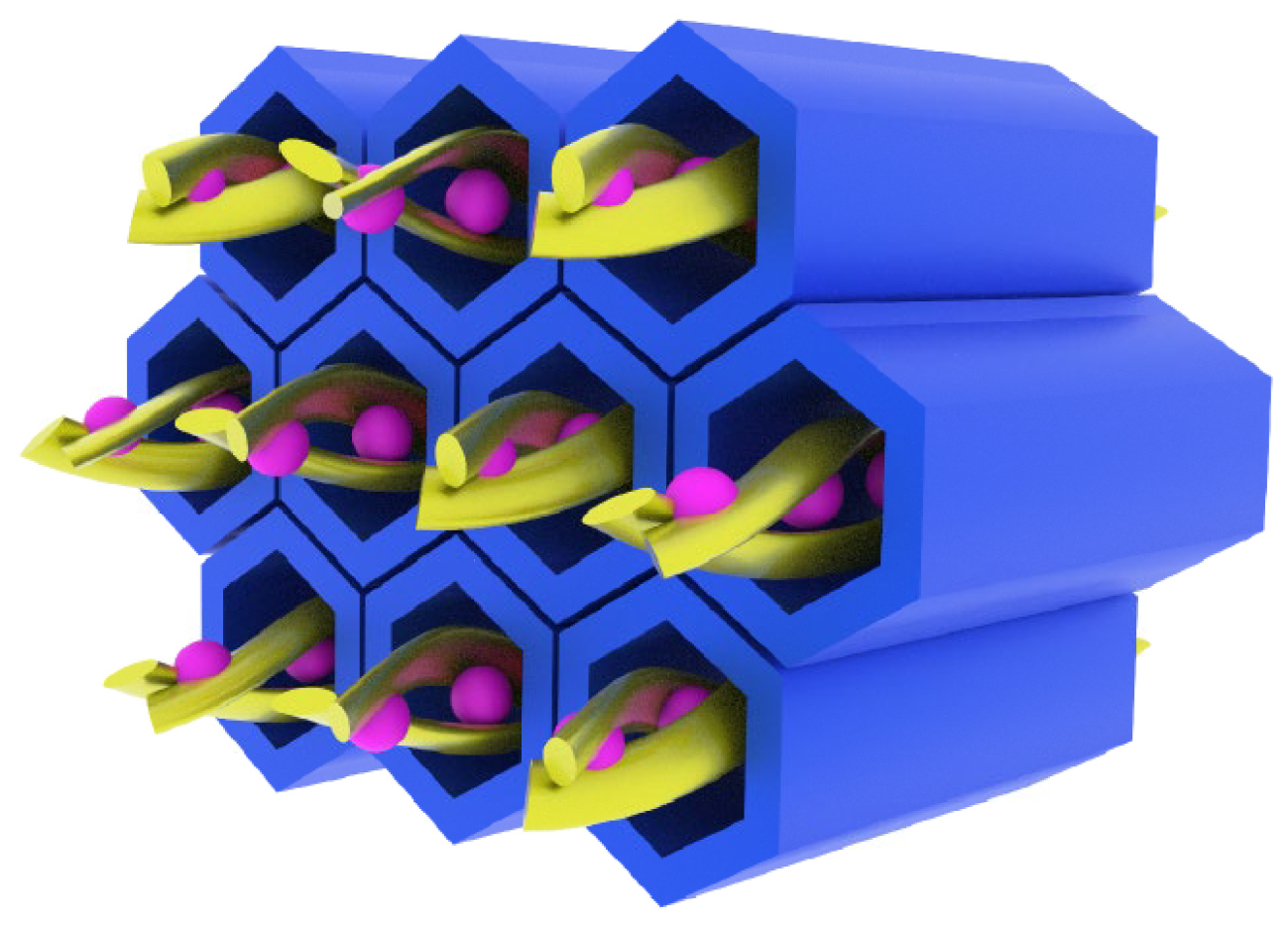
17]. In this process, the THR<MSS> cavitate was obtained by mixing saturated aqueous solutions of the corresponding components in a 1:1 molar ratio. A schematic representation of the formed supramolecular clathrate SDM<THR<MSS>> is presented in
Figure 1.
The macroscopic morphology of the SDM<THR<MSS>> clathrate particles was subsequently examined with a Phenom ProX scanning electron microscope (Thermo Fisher Scientific, Waltham, MA, USA).
X-ray diffraction studies was first performed to determine the phase composition and structural characteristics of the synthesized SDM<THR<MSS>> clathrate. The diffraction patterns were recorded in the ϑ–2ϑ scanning mode using Cu-K radiation (λ = 1.5419 Å), monochromatized by reflection from the (111) plane of a Ge single crystal in transmission geometry.
The Fourier transform infrared (FTIR) spectra of samples were recorded on a Spetrum Two spectrometer (PerkinElmer, High Wycombe, UK) using a diamond UATR single reflection accessory. The spectra (8 scans per spectrum) of the samples were collected in the midinfrared wavenumber range from 4000 to 400 cm−1, with a spectral resolution of 4 cm−1.
For impedance measurements, the synthesized SDM<THR<MSS>> clathrate powder was pressed into a pellet using a mold, yielding a tablet 6.2 mm in diameter, 0.92 mm thick, and weighing 45.4 mg. Ohmic contacts were then formed on the opposite flat surfaces of the pellet using a silver conductive paste.
In order to investigate the mechanisms of electrical conductivity and polarization of the SDM<THR<MSS>> clathrate, the impedance spectra were recorded using the AUTOLAB measurement system of ECO CHEMIE (Utrecht, The Netherlands) over a frequency range of 10−3 ÷ 106 Hz. For the impedance measurements, a sinusoidal excitation with an amplitude of 50 mV was applied. This amplitude was selected to be sufficiently small to ensure operation within the linear response regime of the system. Measurements were performed under three conditions: in the dark at room temperature (referred to as initial conditions, IC), in a constant magnetic field (220 kA/m) (referred to as MF), and under illumination (referred to as IL) with a standard AM 1.5G solar simulator providing a total irradiance of 982 W/m2. The applied physical fields were oriented along the direction of the measurement signal. This geometry ensured collinear alignment of the magnetic field and illumination relative to the current flow.
To characterize the electronic energy structure and impurity levels of the clathrate, thermally stimulated discharge spectra were recorded in short-circuit mode under linear heating at a rate of 5 °C min−1.
3. Results and Discussion
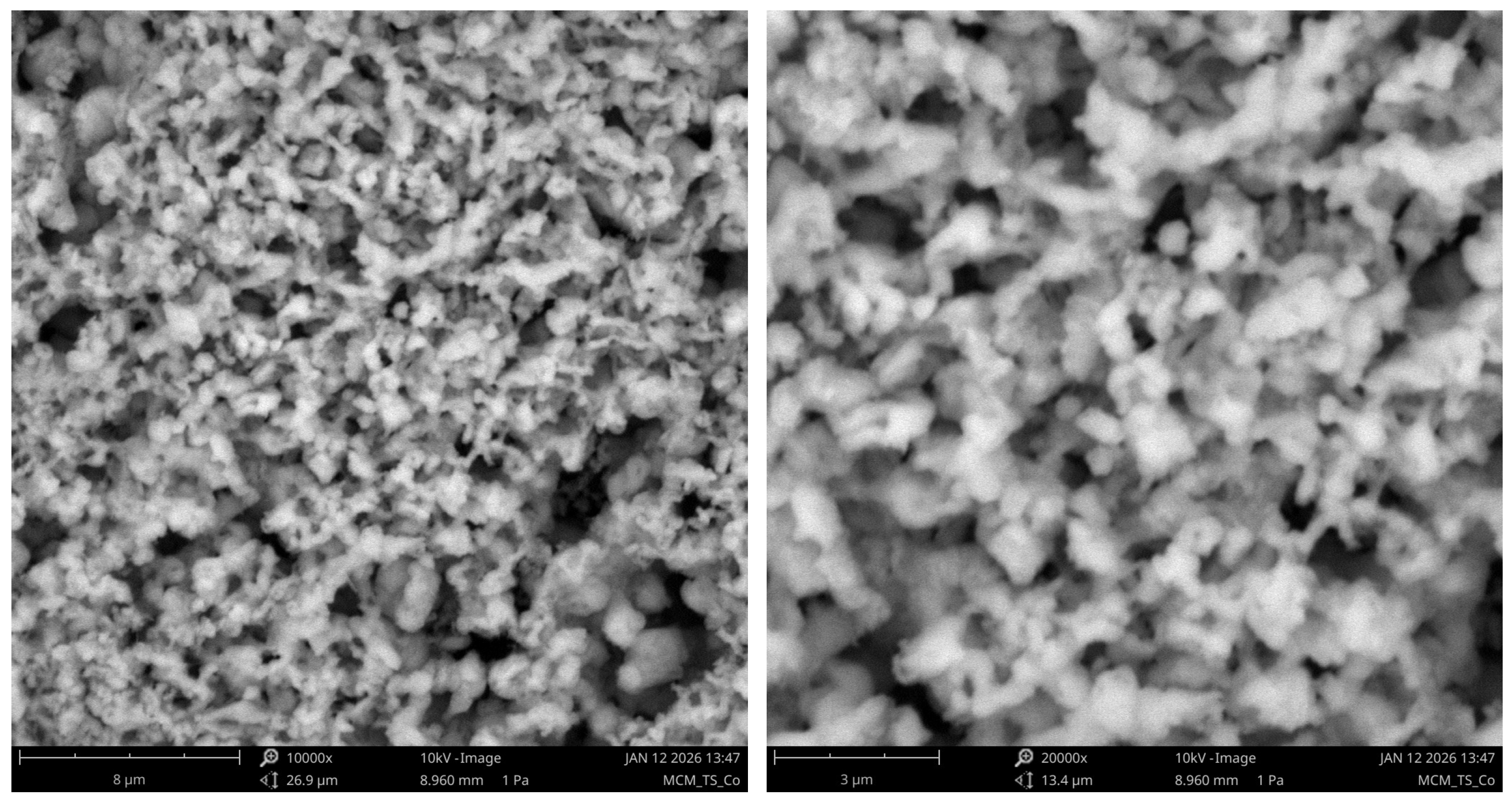
The morphology the synthesized SDM<THR<MSS>> clathrate was studied by scanning electron microscopy. Typical SEM images are given in
Figure 2. It can be seen that the synthesized SDM<THR<MSS>> clathrate has a homogeneous structure and consists of particles smaller than 1 μm with irregular shapes, probably due to agglomeration of particles.
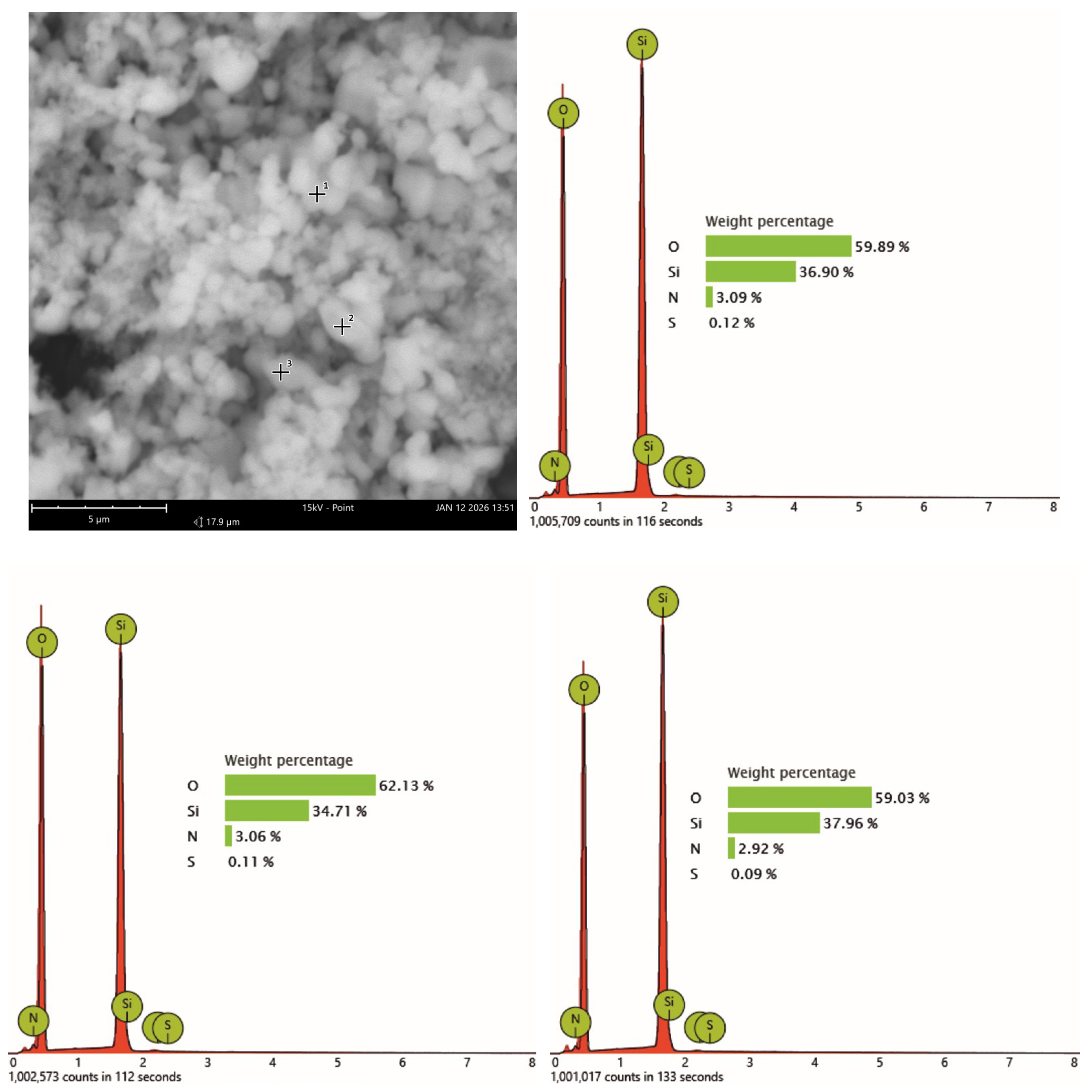
The determination of the elemental composition of the synthesised SDM<THR<MSS>> clathrate showed the presence of four elements—C, N, and O (
Figure 3). The element content is practically the same at three different points of the sample. The elements O and Si correspond to the silica hollow matrix (SiO
2), while the elements N and S correspond to thiourea (CS(NH
2)
2). The low concentration of N and S elements compared to O and Si indicates the location of thiourea in the pores of the matrix. The Co or Cl element was not detected by measurement, which may be due to its low content and supramolecular combination with thiourea.
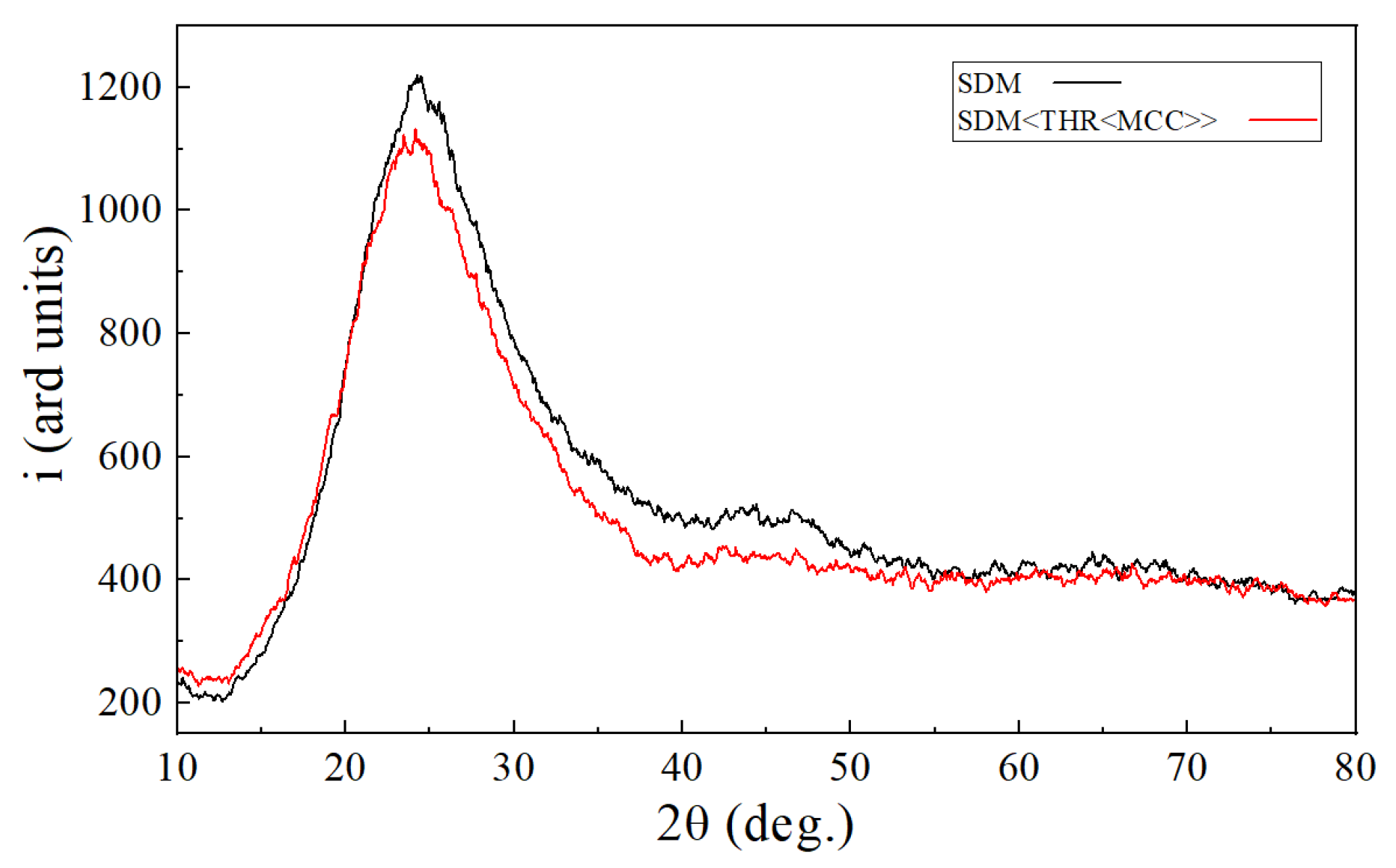
The X-ray diffraction (XRD) pattern of the SDM matrix (
Figure 4) exhibits a broad diffuse halo centered at 2θ ≈ 22–25°, which is characteristic of amorphous silica-based materials and indicates the absence of long-range crystalline order. A nearly identical diffraction pattern is observed for the SDM<THR<MSS>> clathrate (
Figure 2). The position and shape of the main diffuse maximum remain essentially unchanged after THR<MSS> encapsulation, although a slight decrease in intensity can be noted. No additional sharp diffraction peaks corresponding to crystalline THR<MSS> are detected in the SDM<THR<MSS>> sample. This absence of THR<MSS> reflections suggests that the encapsulated THR<MSS> exists in a nanodispersed or amorphous-like state within the SDM matrix. The small size of THR<MSS> domains, likely below the detection limit of XRD, together with their homogeneous distribution inside the mesoporous structure, results in weak diffraction signals that are masked by the intense diffuse scattering of the amorphous SDM framework. These results indicate that the encapsulation of THR<MSS> does not induce crystallization and does not significantly alter the structural characteristics of the SDM matrix.
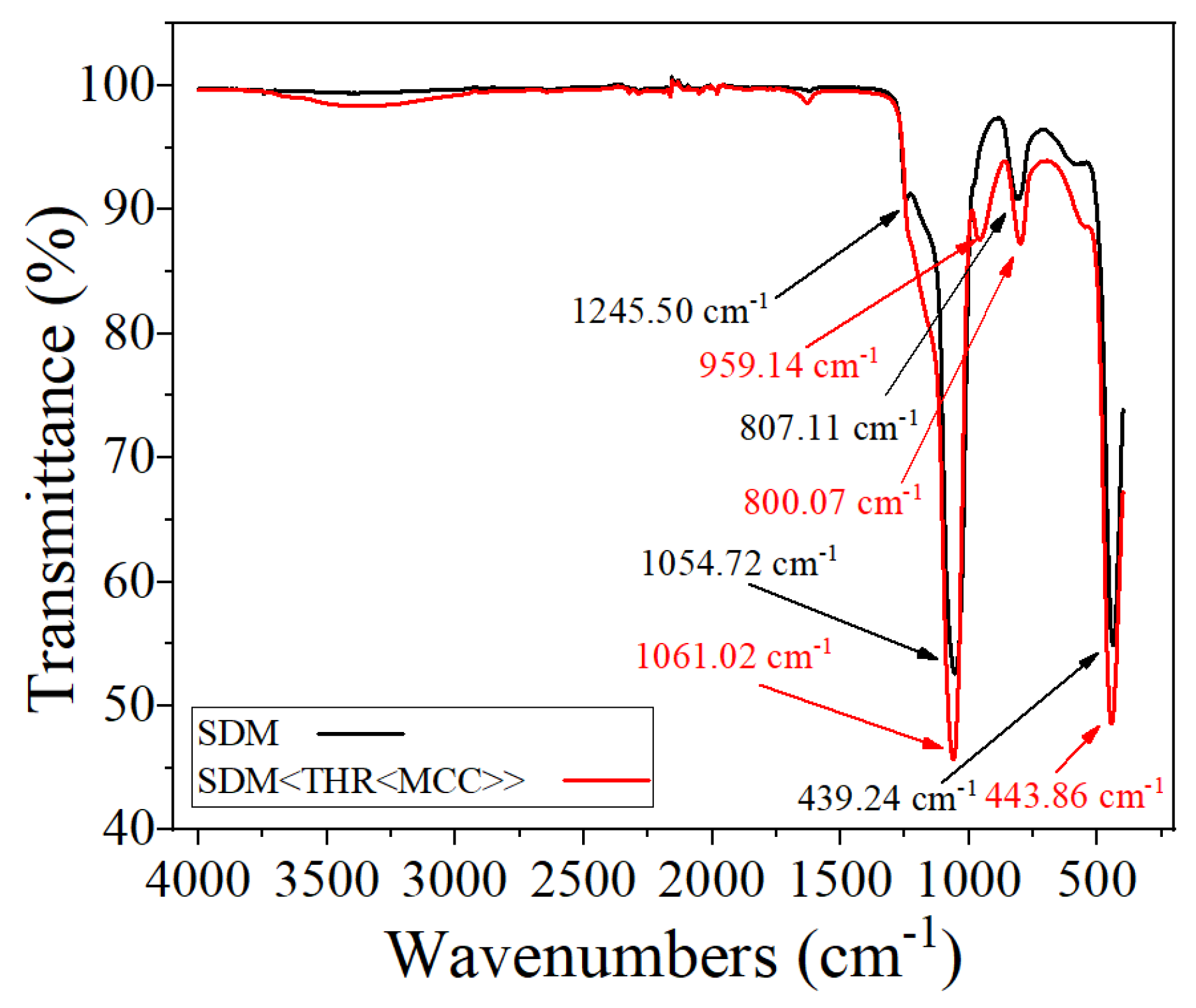
For a more detailed analysis of the structure of the material under study, FTIR spectroscopy results were analyzed.
Figure 5 shows the infrared spectra of the initial SDM matrix and the SDM<THR<MCC>> clathrate. The main difference is manifested in the range of asymmetric valence vibrations of the Si-O-Si bond at 1100–1000 cm
−1 and symmetric valence vibrations at 850–750 cm
−1. In the complex, there was a shift in the long-wave region of the asymmetric vibration band from 1054 cm
−1 in the initial material to 1061 cm
−1. This can be explained by an increase in the polarity of the Si-O-Si bond. The band of symmetric vibrations shifted towards short waves from 807 to 800 cm
−1. The absorption band in the complex at 959 cm
−1 may correspond to the OH group of bound water from cobalt chloride. In the complex, there was a shift in the long-wave region of the deformation vibration band from 439 cm
−1 in the initial material to 443 cm
−1. A low-intensity absorption band in the range of 3700–3000 cm
−1 may correspond to the valence vibrations of the NH
2 group. The described spectrum behavior may be the result of weak interaction between organic and inorganic components in the SDM<THR<MCC>> clathrate, as is the case in supramolecular complexes.
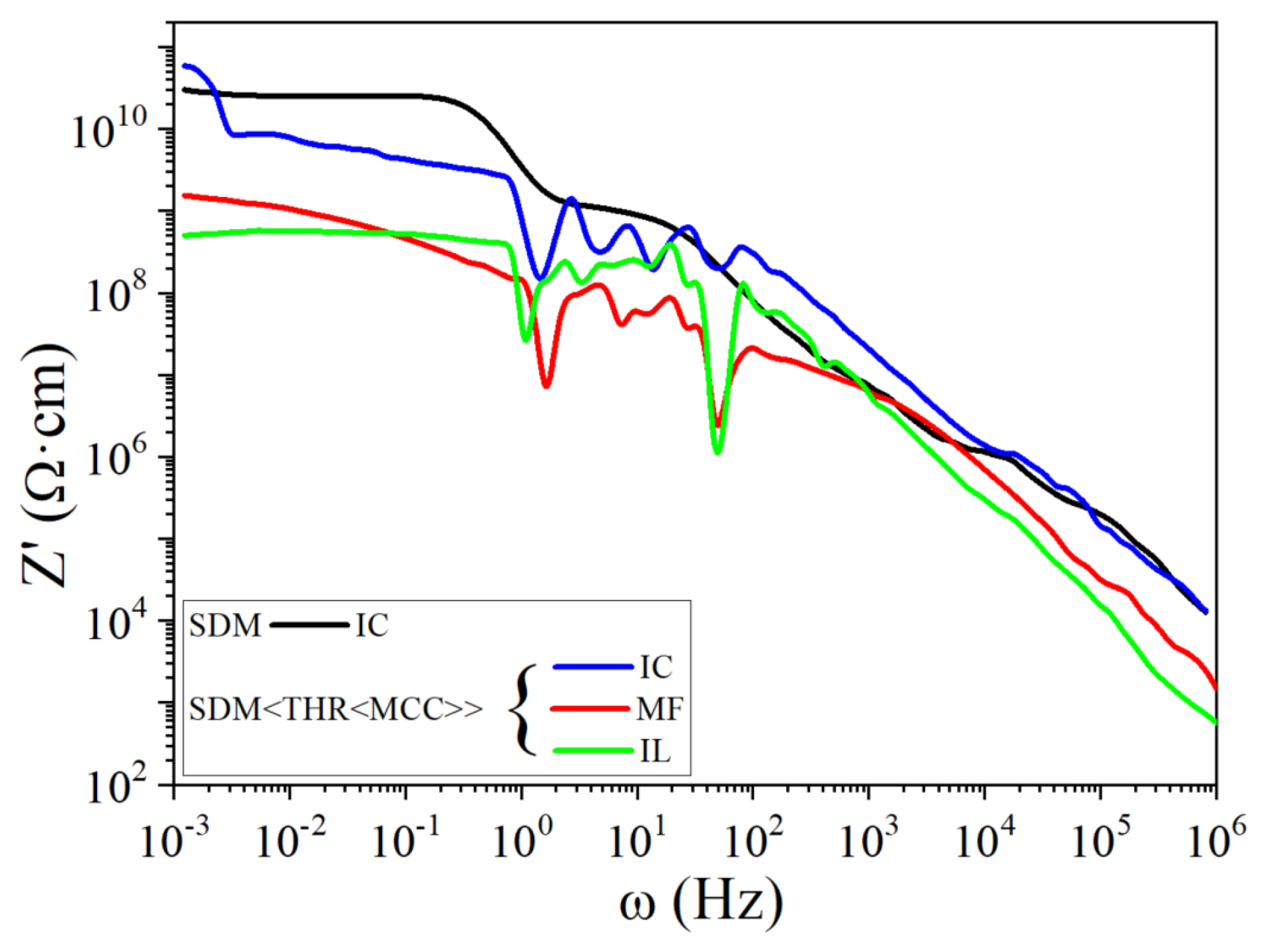
Impedance spectroscopy was used to study the charge transfer processes in the formed clathrate structure, including the phase boundaries, electrode boundaries, and microstructure elements. The frequency dependence of the real part of the complex resistance for both the original SDM matrix and the SDM<THR<MCC>> clathrate is shown in
Figure 6. For the original SDM matrix under the initial conditions, we obtain a decreasing behavior of Z′(ω), which is characterized by a frequency dependence over the entire studied range (
Figure 6).
This behavior of Z′(ω) is expected and suggests that the dominant contribution to the overall conductivity arises from carrier hopping between localized states near the Fermi level [
4,
17,
19,
20]. After the encapsulation of the supramolecular THR<MCC> complex, the behavior of Z′(ω) under initial conditions changes in an unusual way (
Figure 6). In the frequency range of 0.001 ÷ 0.002 Hz, a slight increase was recorded, followed by a 5-fold decrease. In the range of 0.003 ÷ 1 Hz, the Z′(ω) curve is almost parallel to the similar plot for the original SDM matrix. In the intermediate frequency range of 1 ÷ 200 Hz, the real part of the complex impedance acquires oscillatory behavior, which is characteristic of this type of clathrates [
4,
16]. These oscillations result from charge carriers being captured by adhesion centers and held for time intervals comparable to the signal period.
In the range of 200 ÷ 104 Hz, Z′(ω) increases by more than fourfold. This effect may be attributed to the fact that the presence of the supramolecular THR<MCC> complex leads to a restructuring of the impurity energy spectrum. Alongside the formation of broad energy level bands, this restructuring creates narrow bands with low adhesion levels and deep quantum wells within the forbidden energy gap.
In the presence of a constant magnetic field, the real part of the complex impedance decreases by approximately a factor of 40, as illustrated by curve 3 in
Figure 6. Furthermore, the unusual behavior of Z′(ω) in the low-frequency range is no longer observed. This phenomenon may be attributed to the energy spectrum shifting relative to the Fermi level under the influence of the magnetic field. Such a shift likely leads to the delocalization of a significant fraction of charge carriers, whose energy increases sufficiently to allow them to escape from confined states within deep quantum wells. This behavior appears to be influenced by the asymmetry in the density of states, which may be associated with the supramolecular THR<MCC> complex. This complex exhibit sensitivity to the magnetic field, in contrast to the original matrix, which remains unaffected by it. Importantly, the obtained negative magnetoresistive effect (
= 4000%) holds potential for practical applications, particularly in the development of ultra-sensitive magnetic field sensors.
During illumination, the real part of the complex resistance decreases by 2 orders of magnitude (
Figure 6), which can be caused by the presence of THR, which is a known organic photoelectret. Under the action of light, current carriers are released from small trap centers, which leads to smoothing of the low-frequency region of Z′(ω) and activation of deep quantum wells, thereby enhancing the amplitude of mid-frequency oscillations. The observed photoresistive effect (
= 10,000%) is also of great interest from the point of view of practical application.
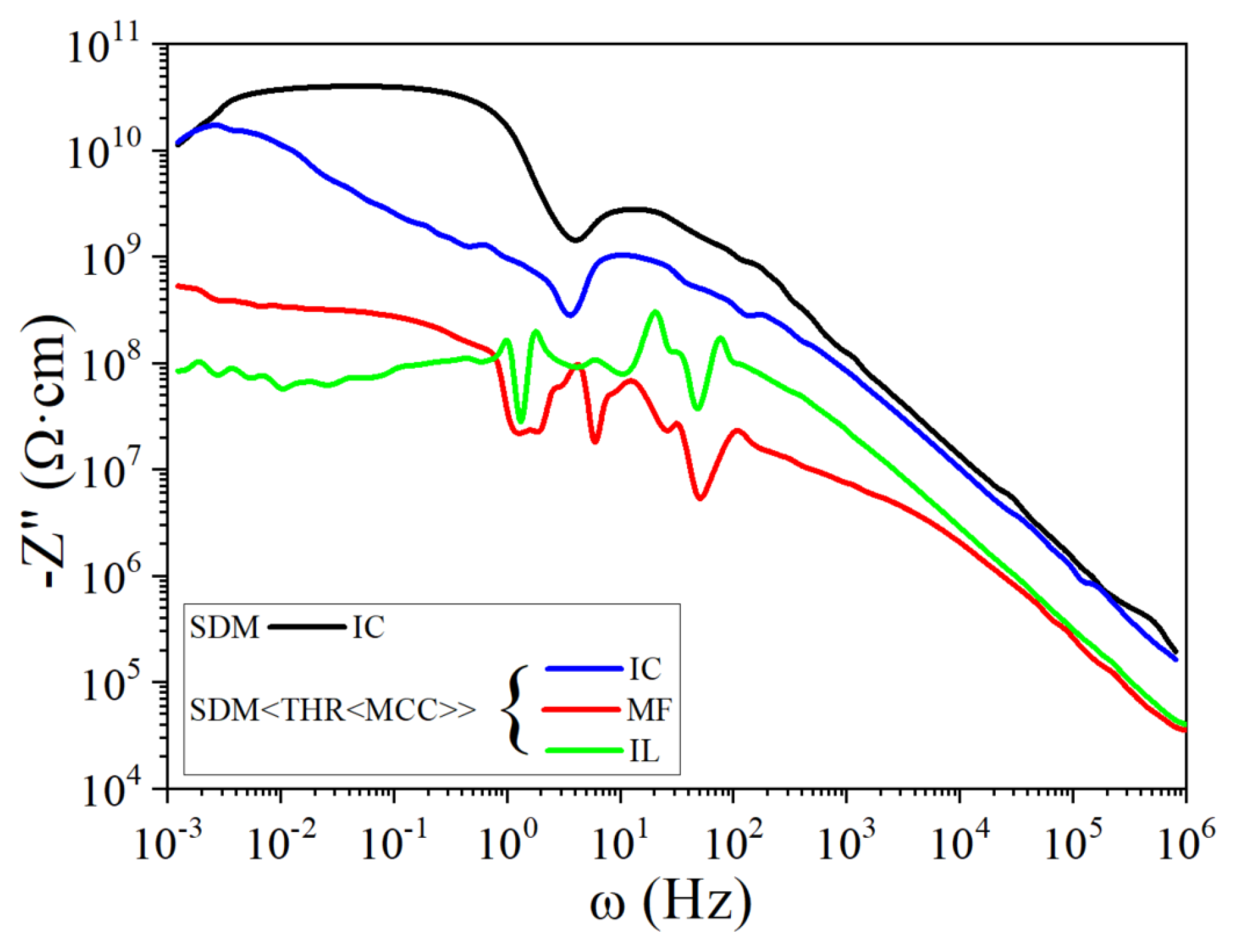
The previously described charge transfer processes are anticipated to affect the imaginary component of the complex impedance. Accordingly, the imaginary part Z″(ω) was analyzed in detail (
Figure 7).
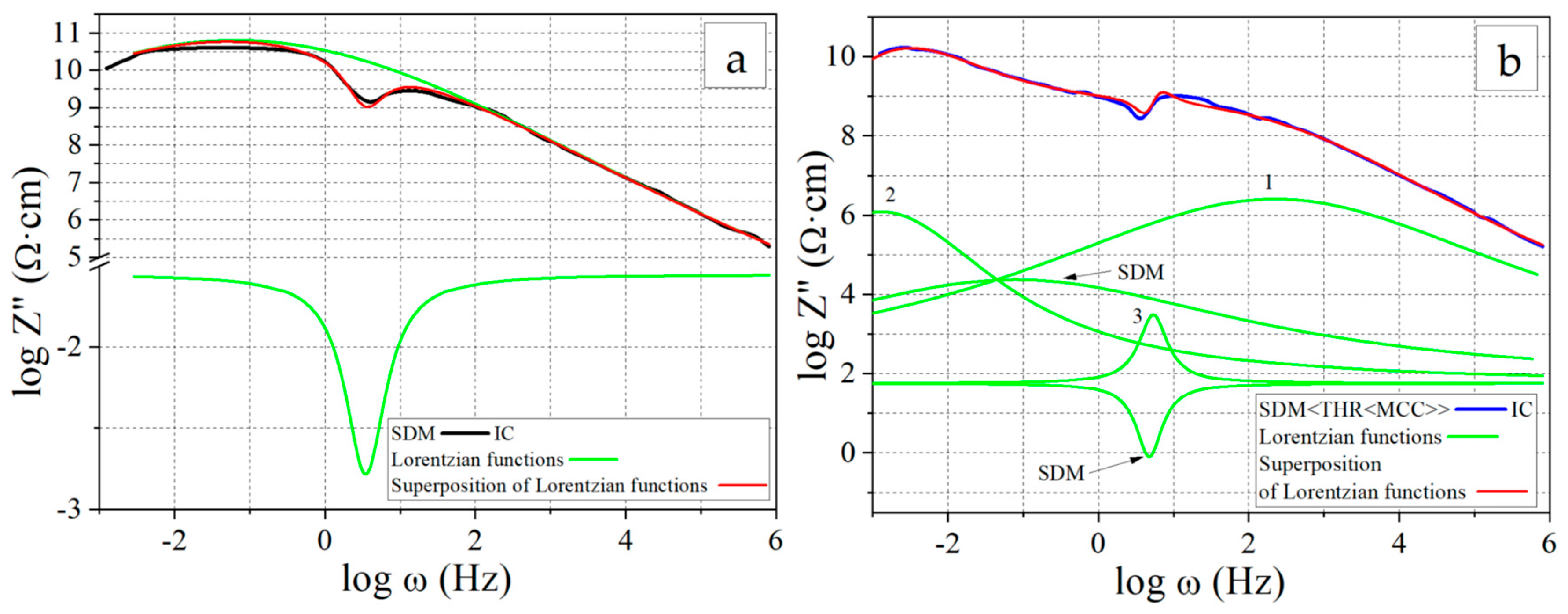
Analyzing the behavior of Z″(ω) for the initial SDM matrix under initial conditions, we observe a non-monotonic dependence without a clearly defined relaxation maximum, which would indicate the relaxation of minority charge carriers. For a more detailed analysis, the Z″(ω) dependence was approximated using a superposition of Lorentzian functions (
Figure 8a). The imaginary part of the complex impedance was approximated using a sum of Lorentzian functions. In the figure, the individual Lorentzians are shown in green, their combined superposition is shown in red, and the experimentally measured spectrum is plotted in black (
Figure 8a) and blue (
Figure 8b). The close agreement between the red curve and the experimental data demonstrates that the Lorentzian approximation effectively captures the main features of the spectrum.
As seen in
Figure 8a, the best fit for the Z″(ω) dependence is achieved with the superposition of two Lorentzians functions:
A broad maximum, reflecting the relaxation of minority charge carriers with varying nature and activation energy. In this case, it can be assumed that the observed relaxation corresponds to the delocalization of minority carriers from near-surface and intracrystalline impurity centers;
A narrow minimum, most likely associated with charge relaxation due to processes of trapping and retention of carriers in quantum wells. Based on the frequency position of this peak (in the range of a few Hertz), it can be inferred that the quantum wells are formed at intergrain barriers.
We observe two fundamentally different processes: capacitive accumulation of electric charge and inductive trapping of carriers in quantum wells, followed by their release over a time comparable to the period of the sinusoidal measurement signal [
32]. Considering the structure of the SDM matrix, it is highly likely that quantum capacitance
is involved in our case, which can be described by the equation [
33,
34]:
where
is electrons concentration,
is the energy position of the electronic quasi-Fermi level. Expression (1) demonstrates the dependence of the quantum capacitance on the change in electron concentration due to a change in the position of the Fermi level. The admittance in this case can be expressed as:
where
,
.
According to Equation (2), the impedance can be represented as an equivalent electrical circuit, as shown in
Figure 9. It is evident that, in this case, there will be a competition between the two quantities
and
.
The introduction of the supramolecular complex THR<MCC> into the pores of the SDM matrix under initial conditions slightly alters the high-frequency part of the spectrum but significantly deforms the low-frequency part (
Figure 7). For a more detailed analysis, the Z″(ω) dependence was approximated using a superposition of Lorentzian functions (
Figure 8b). As seen in
Figure 8b, the best approximation for Z″(ω) is achieved with the superposition of five Lorentzians functions. It should be noted that two Lorentzians functions remain, corresponding to the initial SDM matrix. It is logical to assume that the additional three Lorentzians functions correspond to the introduced supramolecular complex THR<MCC>. Among these, two broad maximum are observed: one at high frequencies and the other at the lowest frequencies of the measurement range. The first maximum most likely corresponds to the relaxation of minority carriers within the supramolecular complex, while the second corresponds to carrier relaxation at the interphase boundary surface. An interesting feature is the third maximum, which is almost a mirror image of the opposite-valued maximum characteristic of the initial dielectric SDM matrix. Its appearance is most likely due to the additional involvement of the supramolecular complex in establishing electrical contact between the grains of the SDM matrix.
The effect of a constant magnetic field leads to a decrease in the low-frequency and mid-frequency values Z″(ω) by more than an order of magnitude. The application of a constant magnetic field results in the blurring of the low-frequency relaxation maximum and the appearance of oscillations in the mid-frequency range. This effect causes a redistribution of the corresponding energy levels above and below the Fermi level, causing significant localization and delocalization of minority charge carriers depending on the frequency of the measurement signal. This is possible if we assume that resonant tunneling is occurring in this case.
A slightly different situation is obtained when illuminating the clathrate SDM<THR<MCC>>. The Z″(ω) decreases by about two orders of magnitude in the low-frequency range, as opposed to the mid-frequency range, where the decrease is much smaller. Also, the main relaxation maximum is blurred and some small oscillatory behavior is manifested. This can be explained by the devastation of the adhesion centers located in the surface layers by light. At the same time, deep quantum wells are activated inside the particles, which is visualized as an increase in the amplitude of the mid-frequency oscillations Z″(ω).
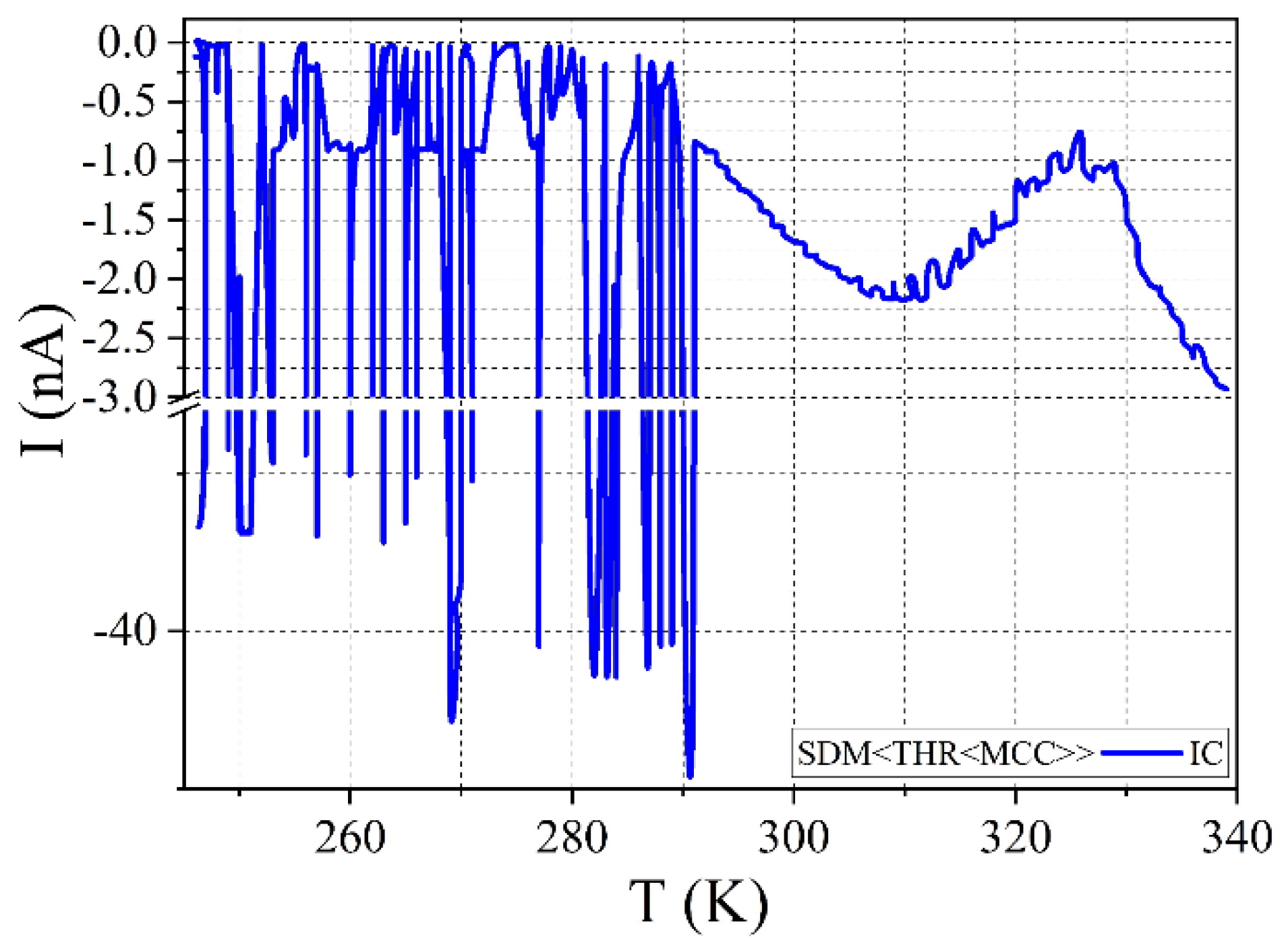
It is obvious that the structure of the impurity energy spectrum is decisive in the behavior of SDM<THR<MCC>> clathrate. In order to study the energy structure of impurity levels in more detail, we measured the currents of the thermally stimulated discharge (
Figure 10).
As we can see, at low temperatures, the spectrum is a narrow band with a significantly higher density of states and a distinct mini-band structure. However, at room temperature, the spectrum becomes quasi-continuous. In this case, the observed relaxation of the homo-charge is due to the jump mechanism of the change of configuration states or the reorientation of polar inclusions associated with the thermo-activation overcoming of potential barriers.
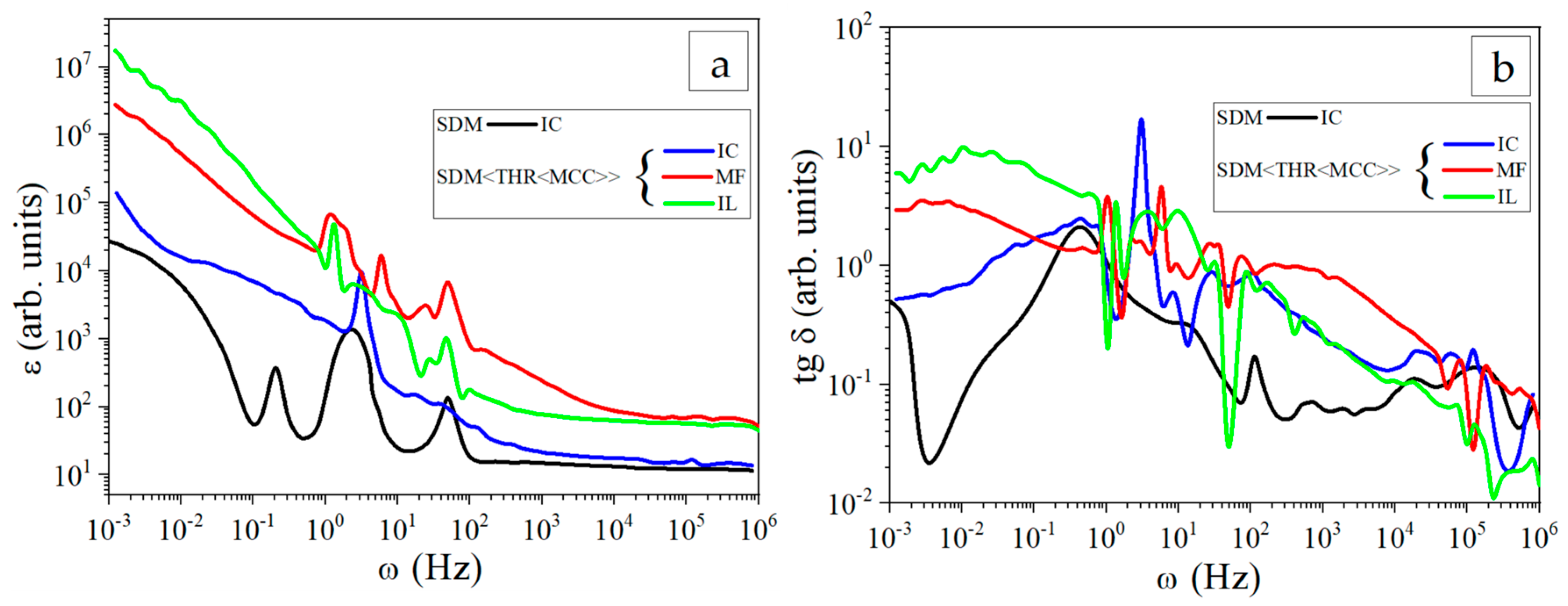
Taking into account the above results, one should expect extraordinary polarization properties of the formed clathrate SDM<THR<MCC>>. For this purpose, we consider the frequency dependence of the dielectric constant ε (
Figure 11).
From a practical standpoint, particular attention was given to the frequency ranges where the dielectric permittivity (ε) exhibits high values while the dielectric loss tangent remains below unity (
Figure 11). Such behavior occurs in the low-frequency domain of the spectrum for both the original SDM matrix and the SDM<THR<MCC>> clathrate when measured under the initial conditions. As shown in
Figure 11, the incorporation of the guest component results in increase in ε(ω) within the frequency range of 10
−3 ÷ 2·10
−2 Hz, taking maximum values greater than 2.8 × 10
5 (
Figure 11). This behavior of ε(ω) is most likely associated with Maxwell-Wagner segmental polarization, as well as additional polarization arising from charge carrier hopping between localized states near the Fermi level. Confirmation of this is obtained by applying a constant magnetic field, where ε increases significantly; however, the condition
ceases to be fulfilled (
Figure 11). The same is observed under illumination. This result indicates the possibility of practical implementation of the theoretical model of a quantum supercapacitor proposed in the patent [
6]. According to the presented model, the condition was set to achieve a dielectric constant higher than 10
5. At the same time, attention should be paid to the tangent of the dielectric loss angle, which was expected to remain below 1. Compared to our previous study [
17], in this case we managed to achieve more than an order of magnitude higher dielectric constant at the lowest studied frequencies in combination with
.
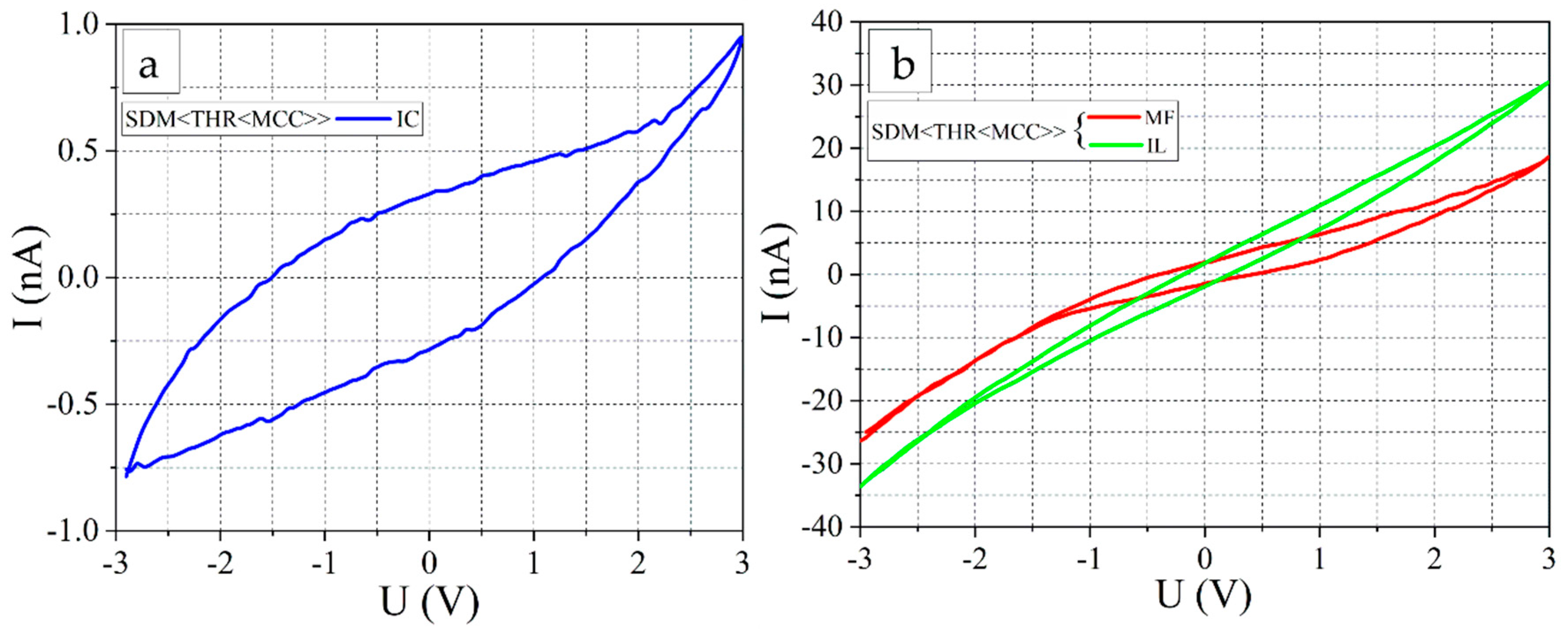
Confirmation of the ability of SDM<THR<MCC> clathrate to accumulate electrical energy is obtained by measuring the volt-ampere (V-A) characteristic (
Figure 12). The potential change rate was 50 mV/s.
In this case, the V-A characteristic is different from the linear one. The hysteresis of this type of V-A characteristic is typical for non-Faraday electric energy storage devices (
Figure 12). Such devices include, for example, supercapacitors that operate based on the electric double-layer effect, where charge separation occurs at the solid–electrolyte interface [
35]. Accordingly, in our system, charge accumulation takes place at the intergranular boundaries as a result of polarization phenomena. Exposure to illumination or a constant magnetic field increases the current in the current–voltage V-A characteristic by more than an order of magnitude (
Figure 12), while significantly narrowing the hysteresis loop.
Thus, based on the combined data presented, we can conclude that the dominant processes involved in charge transport in the studied structures are carrier tunneling and charge confinement by localized charge, similar to Coulomb blockade. From the perspective of energy topology, we have an array of quantum wells structurally connected to slow traps, which are localized both within the SDM matrix layers and near the interface in the surface layers of the SDM matrix and the supramolecular content of THR<MCC>. Minority charge carriers become trapped within quantum wells, thereby forming an energy barrier that impedes the movement of majority carriers. It is for such cases that unusual behavior of the dynamic current-voltage characteristic is typical, such as oscillatory behavior and a nonzero value of the current when crossing a voltage of zero, among other phenomena [
4,
36]. The observed oscillations can be attributed to the difference in rates between the “charging” and “discharging” processes of the host–barrier–guest nanocapacitor: charging occurs rapidly through the inertia-free process of delocalized carrier motion, whereas discharging proceeds via their emission into the trap state layer with a lifetime
. The interplay between these two processes, along with substantial non-equilibrium charge accumulation, defines the behavior of the current-voltage characteristic. It is evident that these effects become more pronounced as
increases.
To enable comparison with the model described in [
6], we estimated the specific capacitance for both systems. According to the patent, the specific energy is given as W = 1.66 MJ/kg when the voltage across the capacitor plates reaches U = 1.37 × 10
5 V. The energy stored in the capacitor is determined by the following expression:
where C denotes the capacitance of the capacitor and U is the potential difference applied across it.
From Equation (3), it is easy to express the capacitance:
As a result of straightforward calculations based on Equation (4), the specific capacitance was found to be C = 0.177 (μF/g).
Consequently, the specific capacitance of the studied material can be evaluated using the following relation:
where q denotes the charge accumulated on the capacitor plates, U is the potential difference across the capacitor, and
represents the mass of the tested sample.
Based on the current–voltage characteristics shown in
Figure 12, the accumulated charge
can be obtained by integrating the current over time:
for measurements carried out under initial conditions, in a constant magnetic field, and under illumination. By substituting the obtained
q values from Equation (6) into Equation (5), the corresponding specific capacitance values of the investigated material were calculated as follows:
= 0.168 μF/g,
= 4.509 μF/g,
= 6.735 μF/g. Thus, based on the obtained results, it can be concluded that the obtained clathrate SDM<THR<MCC>> exhibits a specific capacitance under initial conditions that is comparable to that predicted by the theoretical model [
6], and approximately three times greater than that of the material previously reported in [
17].
Table 1 shows comparative data. It is also worth emphasizing the functional hybridity of using this material in a quantum capacitor, since it significantly increases its capacitance in a constant magnetic field and under illumination.
This research result opens up new possibilities for developing non-electrochemical energy storage systems with significantly higher specific energy intensity, which can be directly incorporated into the architecture of micro- and nanoelectronics devices.
The SDM<THR<MCC>> system implements a mechanism that integrates both quantum-mechanical effects and interfacial relaxation processes within the clathrate structure. Quantum effects in this material are not solely determined by the electronic density of states but emerge from the complex interactions of localized THR and MCC molecules within the SDM pores. These interactions influence charge distribution and localization, while the porous architecture introduces multiple characteristic time- and energy-dependent relaxation regimes. Thus, charge storage in the SDM<THR<MCC>> clathrate reflects a synergistic combination of quantum confinement, electron trapping, structural relaxation, and hierarchical porosity, providing a richer and more versatile energy storage behavior than conventional quantum supercapacitor models.




 ,
,