


Abstract
The performance of active magnetic regenerators (AMRs) is strongly influenced by the thermophysical properties of the working fluid. While nanofluids have been proposed to enhance heat transfer, it remains unclear which nanofluid design parameters most strongly influence AMR performance. This study addresses this question using a one-dimensional numerical model of a gadolinium-based AMR. A parametric study investigates the effects of nanoparticle concentration, particle size and material using four water-based nanofluids (Al2O3, SiO2, TiO2 and CuO). Alternative thermophysical-property correlations, temperature-dependent property models and water–propylene glycol base fluids are also considered. Nanoparticle concentration and particle size exert the strongest influence on AMR performance. Under the reference correlation and investigated operating conditions, the model predicts cooling-power increases of up to 14% relative to water as concentration increases and particle diameter decreases, whereas the accompanying viscosity increase reduces the coefficient of performance by up to 26.9% at low temperature spans. The influence of nanoparticle material depends strongly on the adopted correlation, whereas constant nanoparticle properties have a negligible impact. An additional comparison with water–propylene glycol mixtures reveals substantial cooling-power reductions relative to water-based nanofluids. These numerical findings provide a comparative ranking of the investigated nanoparticle-related parameters and guidance for working-fluid selection and AMR modeling.
1. Introduction
1.1. Background
Vapor-compression systems are a mature and widely deployed technology, but their performance is constrained by thermodynamic irreversibilities and by the environmental and safety issues associated with some refrigerants [1,2]. Magnetic refrigeration is regarded as a promising alternative owing to its potentially higher efficiency and environmentally friendly working fluids [3,4]. It operates on the basis of the magnetocaloric effect (MCE), which manifests as a temperature variation, , in the material when the magnetic field acting upon it rapidly changes [5].
Owing to the near reversibility of the MCE, magnetic refrigeration enables higher efficiencies, resulting in lower energy consumption for the same cooling power, according to Zhang [2]. Its performance, however, strongly depends on the heat transfer and the pressure drop through the magnetocaloric matrix, making working fluid selection a key design issue for both cooling power and coefficient of performance (COP): higher thermal conductivity can improve heat exchange, but, if accompanied by increased viscosity, the resulting frictional losses may offset the gain.
1.2. State of the Art and Knowledge Gap
Nanofluids are colloidal suspensions obtained by dispersing solid nanoparticles in a liquid carrier. Their potential for heat-transfer enhancement was first explored in pioneering studies [6,7] and subsequently investigated under different flow conditions [8] and across various heat-transfer applications, including solar energy systems [9,10]. Several mechanisms have been proposed to explain the enhancement of effective thermal conductivity, including interfacial liquid layers [11], Brownian motion [12], and particle aggregation and interfacial thermal resistance [13]. The influence of nanoparticle aggregation has been further examined through multiscale approaches [14,15], while additional studies have addressed interfacial nanolayer effects [16]. Despite ongoing debate over the relative importance of these mechanisms, nanofluid thermal conductivity and viscosity are commonly represented through empirical correlations involving particle concentration, size, temperature, and material properties. The resulting heat-transfer enhancement must also be evaluated alongside the associated hydraulic penalties [17].
Using these correlations, Chiba et al. [18] performed a 1D numerical analysis of a reciprocating active magnetic regenerator (AMR) operating near room temperature with Al2O3-based nanofluids, reporting an increase in cooling power relative to water. Other studies, such as Mugica et al. [19], have shown that the additional hydraulic losses associated with nanoparticles may lead to poorer performance than pure water under certain operating conditions.
These and other studies [20,21,22,23,24] indicate that nanofluids can improve AMR performance, but they also show that the result is not governed by thermal conductivity alone. Particle loading and particle size affect both thermal and hydraulic properties. Cooling power and COP therefore depend on the operating conditions of the specific refrigeration machine.
Although numerous studies have evaluated specific nanofluids, it remains unclear which design parameters actually dominate AMR performance. In particular, the relative importance of particle loading, particle size, particle material, base-fluid selection and property modeling has not been systematically established.
1.3. Objectives and Contributions
The present study extends previous investigations of nanofluids in AMRs by comparing the relative influence of nanoparticle concentration, size, and material within a common modeling framework. Each configuration is evaluated at its maximum-cooling operating point, obtained by optimizing cycle frequency and utilization factor for each imposed temperature span. Particular attention is given to the dependence of the predicted material influence on the adopted thermophysical-property correlation, which is assessed through a comparison of Corcione’s and Garoosi’s formulations. The resulting comparative ranking is specific to the investigated parameter ranges and modeling assumptions, while additional analyses examine base-fluid selection and temperature-dependent properties.
2. Materials and Methods
2.1. Thermophysical Property Description
The AMR model requires the temperature-dependent thermophysical properties of water together with the effective properties of the water-based nanofluids considered in this study. The adopted property models are summarized below. Four water-based nanofluids are considered, obtained by dispersing Al2O3, SiO2, TiO2 and CuO nanoparticles in water. The four oxides were selected to assess the influence of nanoparticle material within a representative set of oxide–water nanofluids. They cover a broad range of thermal conductivity, density and specific heat (Table 1), allowing material sensitivity to be investigated under the same particle size, concentration and operating conditions. Al2O3 was also included to ensure continuity with the reference AMR study [22]. The aim is therefore not to identify the optimum nanoparticle among all possible materials, but to evaluate the effect of material selection within the considered oxide nanofluids.
The thermophysical properties of water were represented by a temperature-dependent function adapted from the SecCool Properties software tables [25], used as a reference, to obtain a simplified second-order polynomial expression valid over the temperature range from ≈0° to 40 °C, which is appropriate for magnetic refrigeration applications:
A simplified expression is required to limit the computational cost of evaluating temperature-dependent properties at every spatial node and time step, resulting in approximately 5 × 10⁵ times property evaluations per simulated second. Table A1 in Appendix A lists the coefficient values used to express the thermophysical properties of the water with reference to T0 = 20 °C. The inverse of dynamic viscosity has been considered since it is more suitable for a parabolic fitting. Table 1 lists the thermophysical properties, treated as constant in the present study, of the four materials selected for the nanoparticles. The thermal conductivity of CuO is taken from [26], whereas the other property values are obtained from the software COMSOL [27].
Table 1.
Thermophysical properties of the four investigated nanoparticle materials at room temperature. The thermal conductivity of CuO was taken from Vajjha et al. [26], while the remaining properties were obtained from COMSOL Multiphysics [27]. The temperature-dependent properties of Al2O3 are reported in Table A4.
The maximum percentage absolute error between the values calculated for each fluid property using Equation (1) and the reference values is reported in the final column of Table A1, Table A2, Table A3 and Table A4 in Appendix A. The thermophysical property expressions required by the AMR model are summarized in Table 2 and are primarily governed by the volume fraction of nanoparticles added to the base fluid, defined as
where is the particle volume and is the base-fluid volume.
Under the assumption of perfect homogeneity in particle dispersion within the fluid, without any interactions that could change the specific volume of the mixture, density and specific heat were evaluated through the classical mixture rule, Equation (3), [28,29] and by the mass-weighted average of the two phases, Equation (4), respectively.
The thermal conductivity is evaluated using Corcione’s correlation, Equation (5) [30], which was selected because it was derived from a broad experimental database covering particle concentrations, sizes and temperatures consistent with the ranges investigated in the present study [30]. Moreover, its explicit dependence on particle size and concentration makes it particularly suitable for the present parametric analysis.
Experimental investigations have also addressed the combined thermal and hydraulic performance of nanofluids in rectangular microchannels [31], while a review of thermal-conductivity models is provided in [32]. Dynamic viscosity is a critical parameter because it directly affects pressure losses and pumping requirements. A comprehensive review of the influence of nanoparticle characteristics on nanofluid viscosity is provided in [33]. The standard deviations of error reported by Corcione are 1.86% and 2.0% for thermal conductivity and dynamic viscosity, respectively. These values characterize the overall agreement with experimental data and do not represent guaranteed accuracy bounds for individual nanofluid configurations.
Since the choice of thermophysical-property correlation can significantly affect the predicted nanofluid behavior, sensitivity is also assessed using a second empirical correlation, as introduced in Section 3.3. In the reference model, dynamic viscosity is evaluated using Corcione’s semi-empirical correlation, Equation (6) [34], which accounts for the effects of particle concentration and particle size.
Table 2.
Thermophysical-property models adopted for the nanofluids investigated in this study.
Where is the Reynolds number of the nanoparticle and is the Brownian mean velocity
calculated in terms of the Boltzmann constant . is the mean particle diameter, expressed in meters in Equations (6) and (7), Pr represents the Prandtl number of the base fluid; and represent the temperature of the nanofluid and the freezing temperature of the base fluid, respectively, both of which are expressed in Kelvin; and represents the thermal conductivity of the particles.
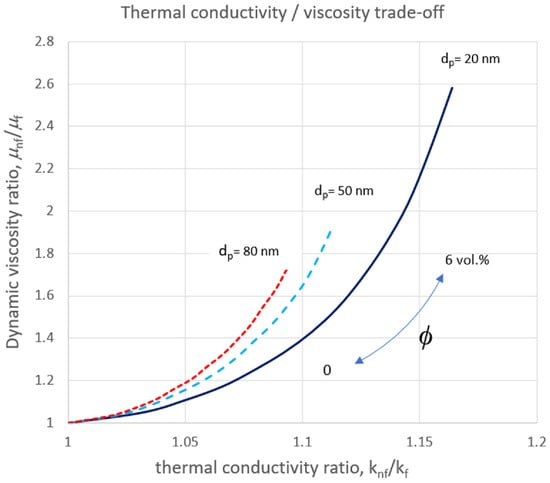
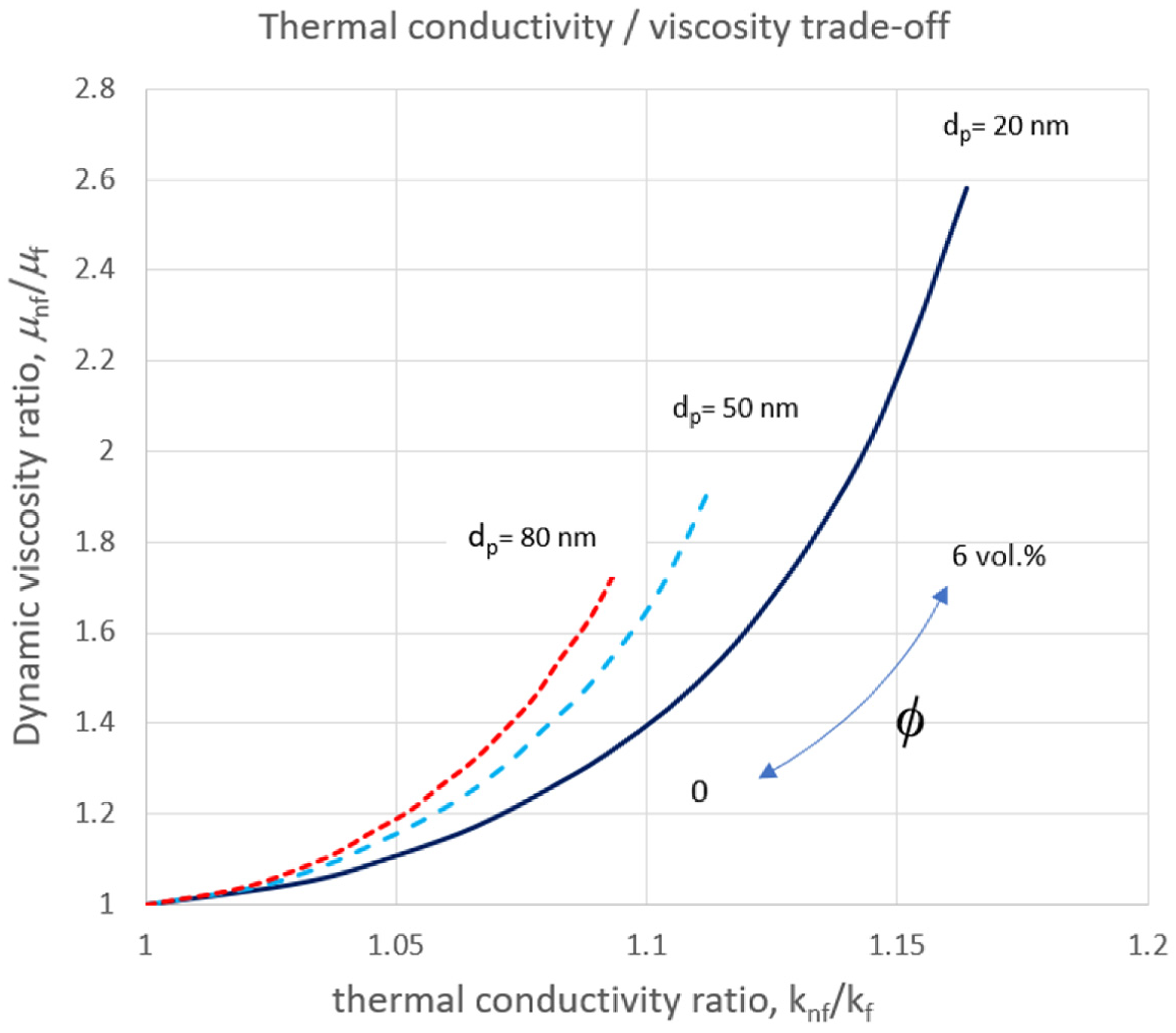
The effective thermal conductivity of the nanofluid increases with increasing temperature and volume fraction, and with decreasing particle size (see Figure 1 for CuO nanoparticles at T = 294 K). The normalized thermal conductivity is only slightly affected by the specific nanoparticle material due to the structure of Equation (5), particularly the 0.03 exponent of the term.
Figure 1.
Trade-off between normalized thermal conductivity and viscosity for CuO–water nanofluids at 294 K, as predicted by Corcione’s correlations. The curves correspond to three particle diameters, with nanoparticle volume fraction increasing from left to right.
Larger particle size reduces nanofluid viscosity at a constant volumetric concentration, whereas increasing concentration at a constant particle diameter raises it. Since thermal conductivity enhancement is generally accompanied by an increase in viscosity, the two properties should be considered simultaneously rather than independently. Figure 1 illustrates this trade-off for the adopted correlations (in the case of CuO nanoparticles and T = 294 K).
2.2. One-Dimensional Regenerator Model
The one-dimensional (1D) AMR framework [22] is used here to analyze the performance obtained with four different nanoparticle materials under the same geometric and operating conditions. The 1-D formulation was preferred because the objective of the present study is to compare the relative influence of nanofluid parameters under identical regenerator conditions, rather than to resolve local flow and temperature fields. For the parallel-plate geometry considered here, with laminar flow throughout the investigated operating range, the model captures the axial energy transport and fluid–solid heat exchange relevant to this comparison while avoiding the substantially higher computational cost of a two-dimensional (2D) analysis. Transverse gradients and other local 2D effects are therefore outside the scope of the present model.
Three mean particle diameters, 20, 50, and 80 nm, and two particle volume fractions, 3% and 6%, are considered. The ranges investigated were selected to represent values commonly reported for water-based nanofluids in AMR applications. The resulting performance is evaluated relative to water.
The thermofluid dynamic model adopts the following commonly used simplifying assumptions [35]:
- •
- Heat and fluid flow are resolved only along the axial direction: transverse temperature and velocity variations are represented through cross-section-averaged quantities and heat-transfer correlations.
- •
- The working fluid is incompressible and homogeneous. Nanofluids are treated as single-phase effective media, with no relative motion between the nanoparticles and the carrier fluid. Long-term sedimentation and agglomeration are therefore not explicitly resolved [36].
- •
- Heat transfer by radiation and heat losses to the surroundings are neglected.
- •
- Flow reversal is assumed to occur instantaneously.
- •
- Magnetization and demagnetization are assumed to occur instantaneously.
- •
- Irreversibilities directly associated with magnetic-field variation are neglected.
- •
- The applied magnetic induction is represented by a square-wave variation between 0 and 1 T.
- •
- Direct magnetic effects on the nanofluid are neglected. The selected oxide nanoparticles are treated as non-magnetic within the present modeling framework, and no field-dependent variation of the nanofluid properties is included.
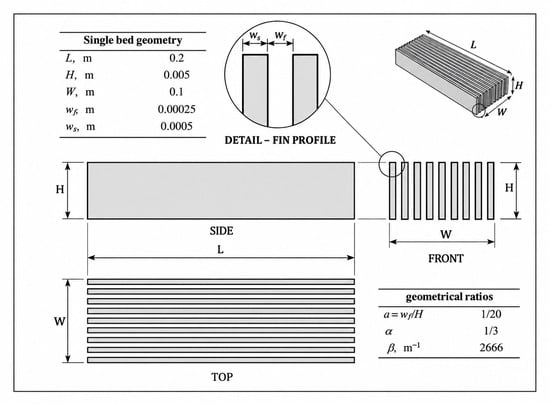
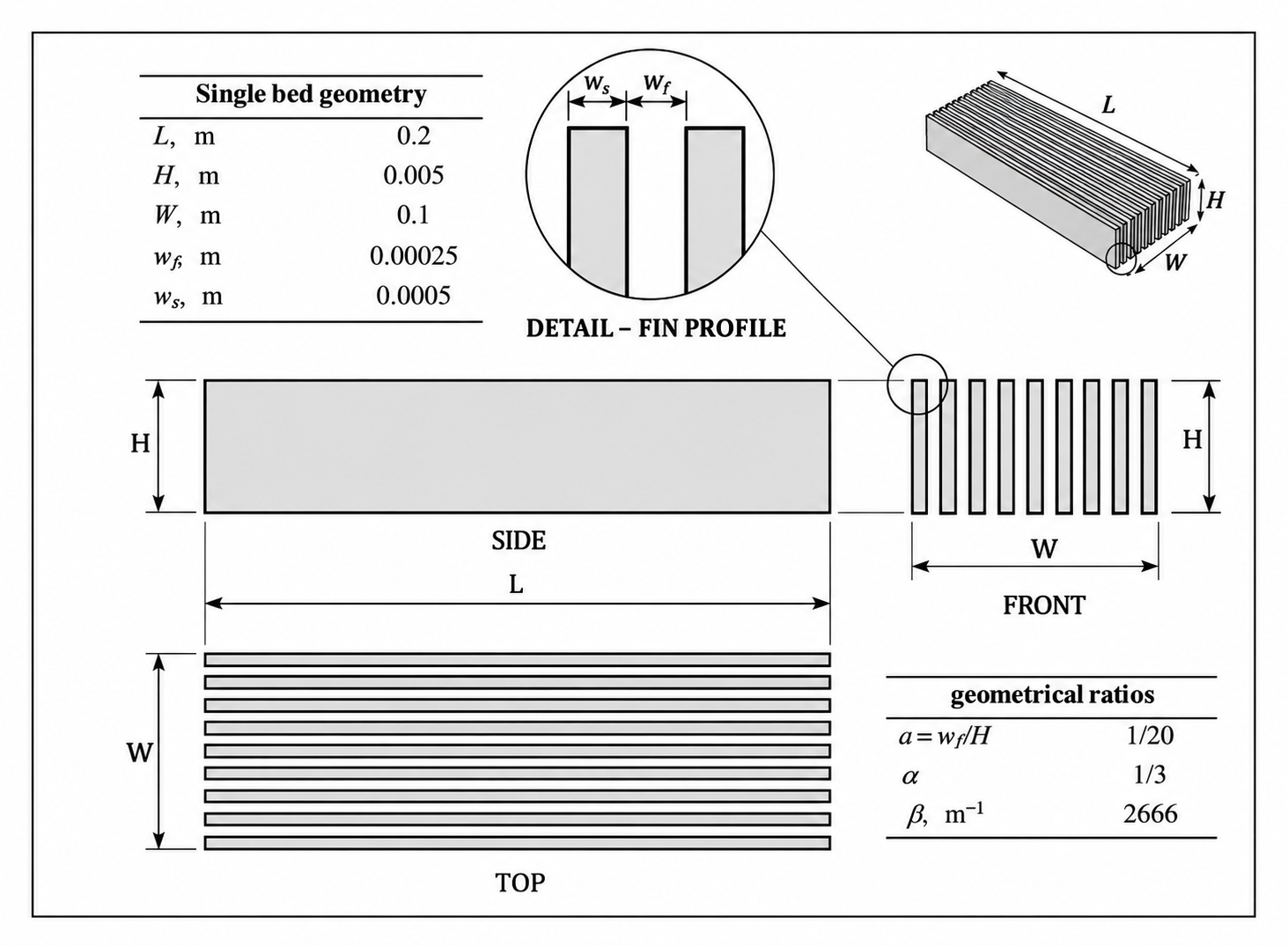
The magnetocaloric material (MCM) is gadolinium, arranged as thin parallel plates of height and thickness , separated by fluid channels of width . The core consists of two blocks, each with width and length , for a total gadolinium mass of 1 kg, as shown in Figure 2.
Figure 2.
Schematic of the parallel-plate gadolinium regenerator adopted in the 1D model, showing the main geometric dimensions and parameters. H, W and L are the height, width and length of the gadolinium bed.
The geometry of the bed is specified only with reference to its thermal and fluid dynamic properties. The demagnetization effect is not explicitly addressed, as it arises from the interaction between the unspecified magnetic structure and the MCM bed. Instead, it is assumed that this effect is inherently accounted for in the magnetic induction values mentioned above.
Based on this assumption, the system is governed by the following equations [35,37]:
The subscript “f” denotes the working fluid, either the base fluid or the nanofluid. α represents the liquid fraction relative to the MCM, refers to the heat exchange surface ratio, u represents the heat-transfer fluid velocity; and represents the convective heat-transfer coefficient.
Equations (8) and (9) express energy conservation in the solid matrix and in the fluid. The solid equation includes axial conduction, convective exchange with the fluid, and the magnetocaloric source term [38]. The fluid equation accounts for advection, axial conduction, convective exchange with the solid, and frictional heat generation. The regenerator is driven by two counterflow streams entering at and .
Simulations were performed over temperature spans ranging from 5 to 35 °C (in 5 °C increments) and cycle frequencies ranging from 0.3 to 2.3 Hz (in 0.1 Hz increments), covering the investigated operating range. Under all the operating conditions investigated, the Reynolds number remains below 350 for both water and nanofluids, and therefore, the flow remains laminar throughout the simulations.
This model, originally based on a reciprocating linear refrigerator analyzed in [39] (Gatti et al., 2014), can be extended to rotary coolers as well.
Although the flow periodically reverses direction, steady, fully developed laminar-flow correlations are commonly adopted in AMR modeling. Previous 2D finite element method (FEM) simulations performed with water under oscillating-flow conditions, at cycle frequencies comparable to those investigated here (Table A5), showed deviations within approximately 5% from the corresponding steady-flow Nusselt number and friction-factor coefficient (Poiseuille number) over Reynolds numbers ranging from 40 to 300. Although conducted with a different parallel-plate geometry, these results support the quasi-steady approximation adopted in the present model.
For rectangular ducts with constant heat flux, Nu and λ are given by [40]:
The convective heat-transfer coefficient, corrected by the degradation factor [41], and the friction term of Equation (9) were computed as follows:
Spatial and temporal discretization effects were assessed through a grid-refinement study performed with pure water at ΔTspan = 15 °C, as summarized in Table A10. The adopted resolution of 300 spatial nodes and a time step of 5 × 10⁻⁴ s yields deviations of approximately 1.0% in cooling power and below 1.0% in COP relative to the finest tested grid (600 nodes, 2.5 × 10⁻⁴ s). Based on the observed convergence trends, the residual cooling-power discretization error is conservatively estimated at approximately 2%. The relative performance variations are substantially less sensitive to discretization: for the Al2O3–water nanofluid (6 vol.%, 20 nm), the cooling-power enhancement relative to water changes from 13.80% to 13.66%, while the COP variation shifts from −5.3% to −5.6%. Further details regarding the numerical implementation can be found in [41].
2.3. Performance Evaluation
The performance indicators adopted in this study follow those introduced in [22] and are summarized here for completeness.
The maximum cycle-averaged cooling power is used to evaluate regenerator performance, as defined in Equation (13). All power quantities are calculated in absolute terms (W) and subsequently reported per unit mass of gadolinium (W kg−1), unless otherwise specified. Since the regenerator contains 1 kg of gadolinium, absolute and specific power values are numerically identical.
The cooling power is quantified and reported with the corresponding coefficient of performance (COP), which is the ratio of the useful cooling, , to the total work needed:
At periodic steady state, the total power input, , to the modeled regenerator is obtained from the difference between the cycle-averaged heat-rejection and cooling rates, according to the first law of thermodynamics. This power includes the magnetic work and the pumping work required to overcome friction within the regenerator, with the latter being represented by the dissipation term in Equation (9). An ideal circulation pump is assumed, with no additional mechanical or electrical losses. External hydraulic components and heat exchangers are not included in the model. The calculated COP therefore refers to the regenerator alone and should not be interpreted as the overall COP of a complete refrigeration system.
The second-law efficiency is given by:
The operating conditions are described by the cycle frequency f and the utilization factor φ:
defined as the ratio between the thermal capacity rate of the fluid and that of the solid.
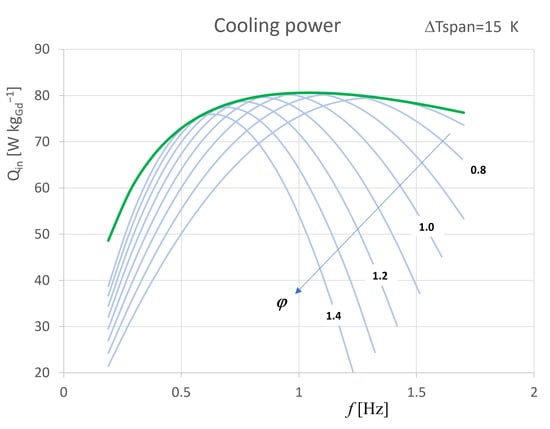
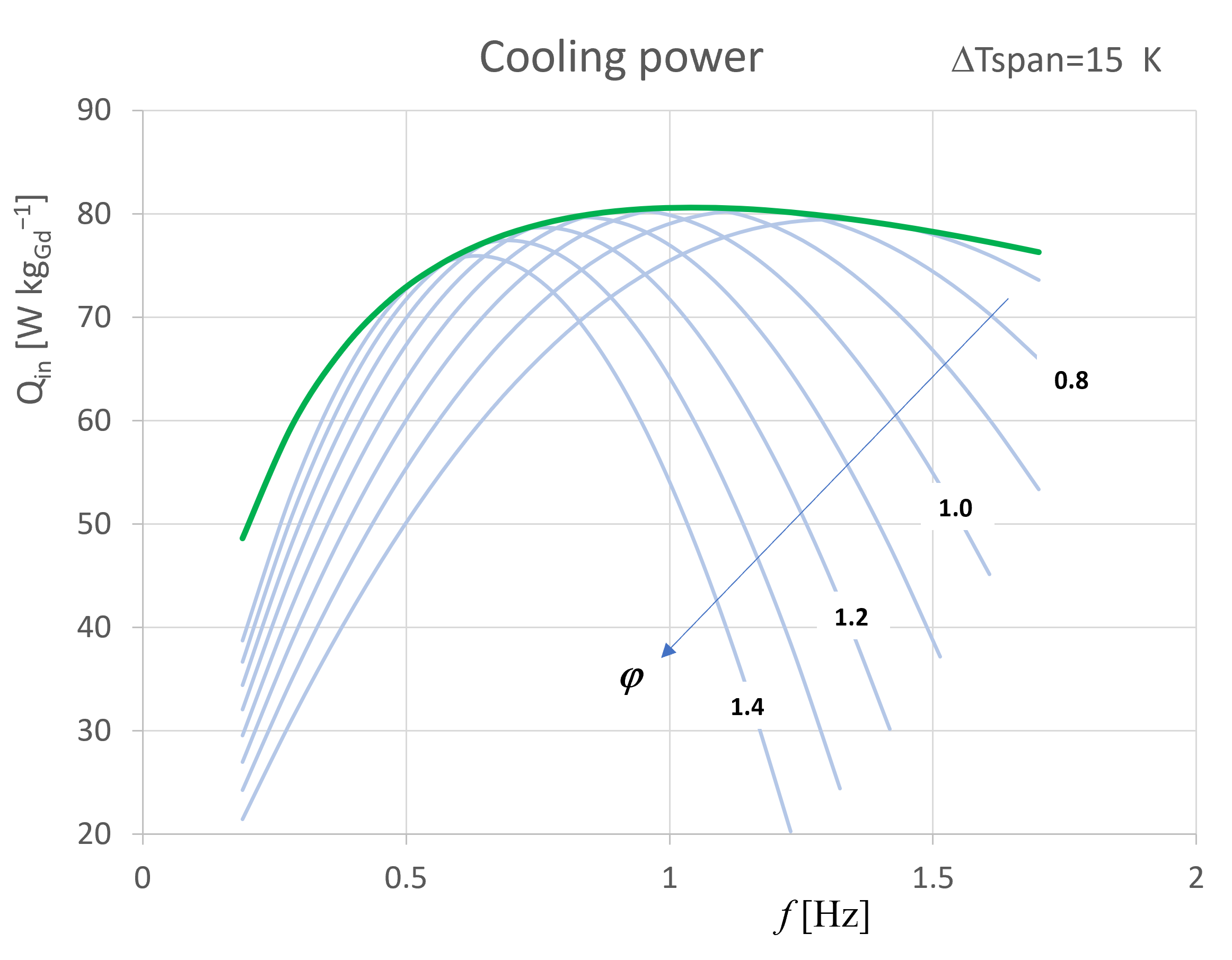
For every imposed temperature span, both quantities are varied until the refrigeration capacity reaches its maximum (Figure 3). The maximum-cooling criterion was selected to compare different nanofluid configurations under their respective optimal operating conditions, rather than at arbitrarily fixed cycle frequency and flow rate. This choice reflects the current emphasis on achieving competitive cooling capacities in magnetic refrigeration. Since maximizing COP may lead to different operating conditions, the resulting parameter ranking is specifically associated with cooling-power optimization. All comparisons presented in the following sections therefore refer to the maximum-cooling criterion.
Figure 3.
Cooling-power optimization for the water-based reference regenerator as a function of cycle frequency and utilization factor. Data adapted from [41].
While a full experimental validation of the nanofluid–AMR coupling is beyond the scope of this study, the predicted qualitative trends—increased cooling power with concentration and decreasing particle size, accompanied by a COP penalty at low —are consistent with those reported in previous numerical investigations of nanofluid-based AMRs by Chiba et al. [18] and Mugica et al. [19], providing additional support for the qualitative behavior observed in the present study.
3. Results and Discussion
This section presents the simulation results and discusses the relative influence of the investigated design parameters on AMR performance, including nanoparticle concentration, particle size, particle material, base-fluid selection and the adopted thermophysical-property models.
3.1. Water Baseline
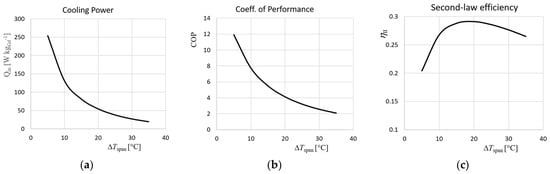
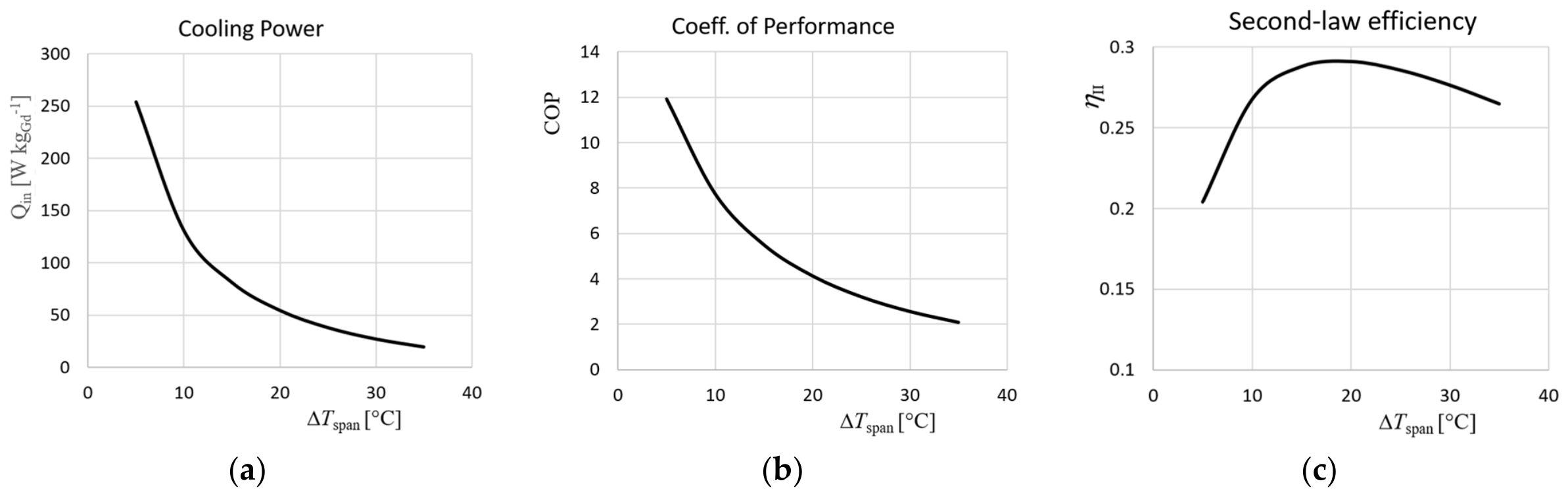
Water is used as the baseline for all subsequent comparisons. The operating points and performance values are reported in Table A5 in the Appendix A, while Figure 4 summarizes the corresponding trends of cooling power, COP and second-law efficiency. At low , the maximum-cooling condition requires higher flow rates and fluid velocities. Regarding the trend of the coefficient of performance, as shown in Figure 4b, an increase of leads to a reduction in , as per Equation (15), resulting mainly in a decrease in the refrigerator’s effective COP.
Figure 4.
Performance of the water-based reference regenerator as a function of temperature span: (a) maximum cooling power, (b) corresponding COP, and (c) second-law efficiency.
Figure 4c shows that second-law efficiency exhibits a maximum at an intermediate . The decreasing values noted at a low are mainly due to the higher friction losses associated with higher fluid velocity. In any case, it is necessary to consider that each point in Figure 4 corresponds to the pair of cycle frequency and utilization factor, which maximizes cooling power for the imposed temperature span, so that the observed behavior is linked to this choice. A more detailed discussion of this behavior for the reference AMR framework is given in [22].
3.2. Influence of Nanoparticle Concentration and Particle Size
Because all investigated nanofluids exhibit the same qualitative behavior, Al2O3 is used as a representative example to illustrate the influence of nanoparticle concentration and particle diameter. Performance changes relative to water are expressed as:
The percentage variation of is not reported, as it is, by definition, equal to that of the coefficient of performance (COP).
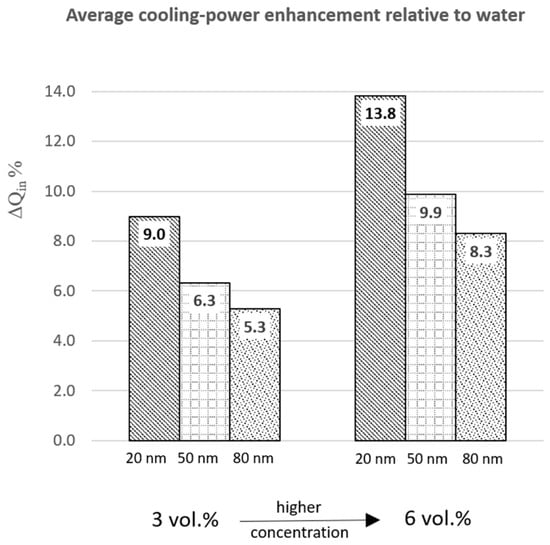
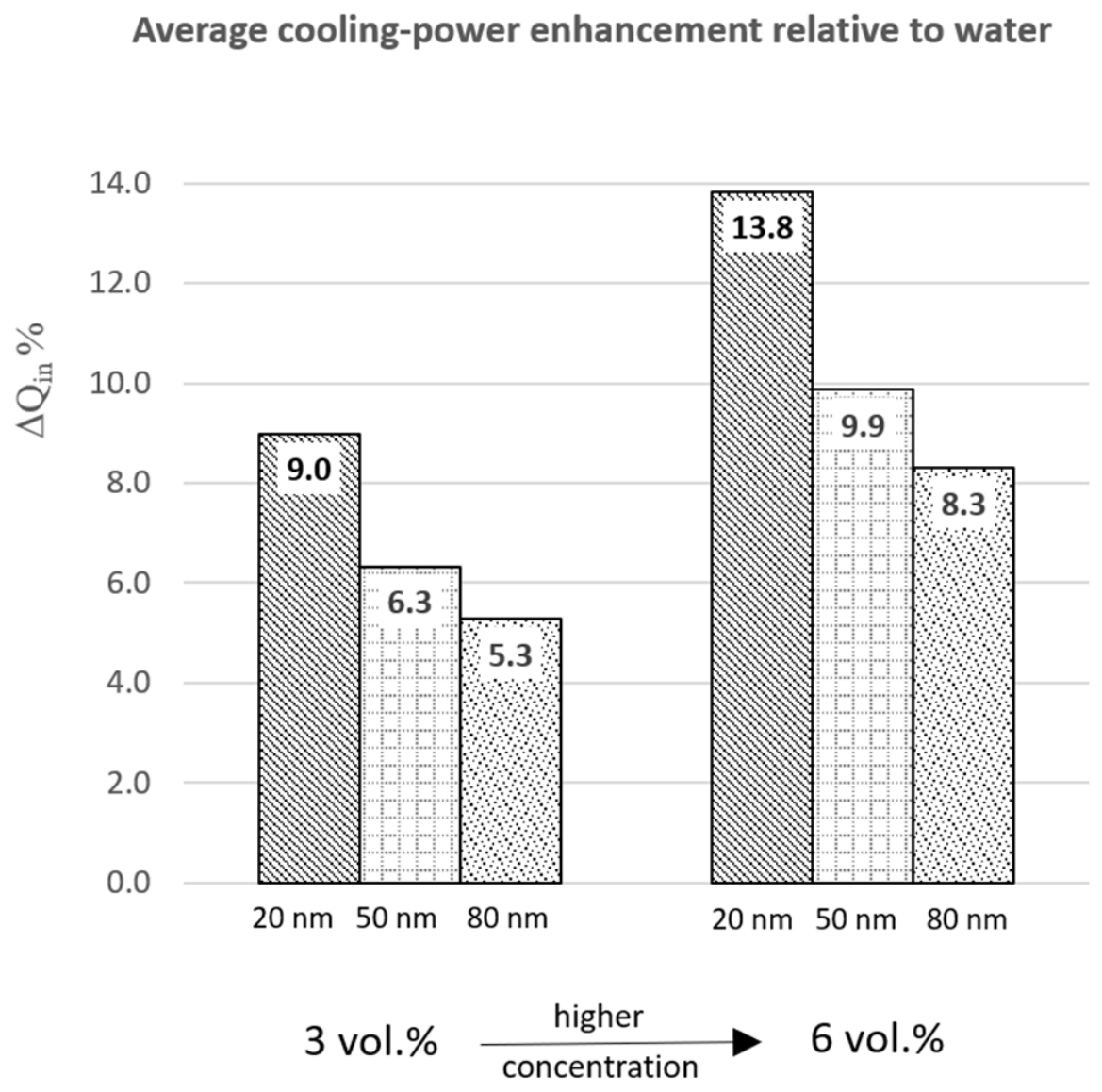
Because the influence of the imposed temperature span was weak, Figure 5 summarizes the average cooling-power enhancement over the investigated range. Both nanoparticle concentration and particle diameter have a significant effect [17,42] on the effective thermal conductivity of the nanofluid and, consequently, the heat exchange between the fluid and the magnetocaloric matrix. The largest increase, just below 14%, is obtained for the Al2O3–water nanofluid with a volume fraction of 6% and a mean particle diameter of 20 nm. The corresponding performance values are reported in Table A6 in Appendix A, including for the other nanofluids.
Figure 5.
Average cooling-power enhancement relative to pure water as a function of nanoparticle concentration and diameter for Al2O3–water nanofluids. Corcione’s correlations.
For the Al2O3–water nanofluid at 6 vol.% and 20 nm, Corcione’s correlations predict a 16.3% increase in thermal conductivity and a 158.3% increase in viscosity at 294 K. While the average cooling-power enhancement reaches 13.8%, the corresponding COP penalty strongly depends on the imposed temperature span, as discussed below.
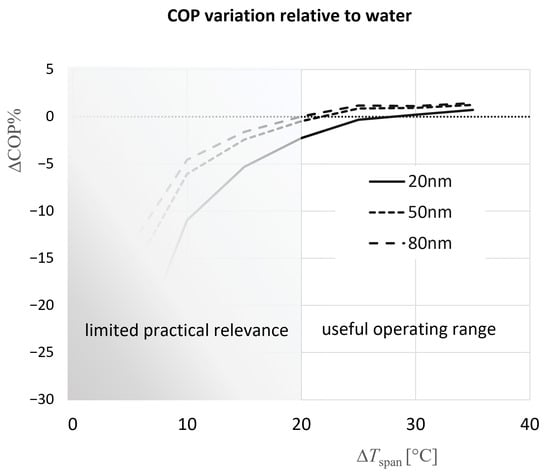
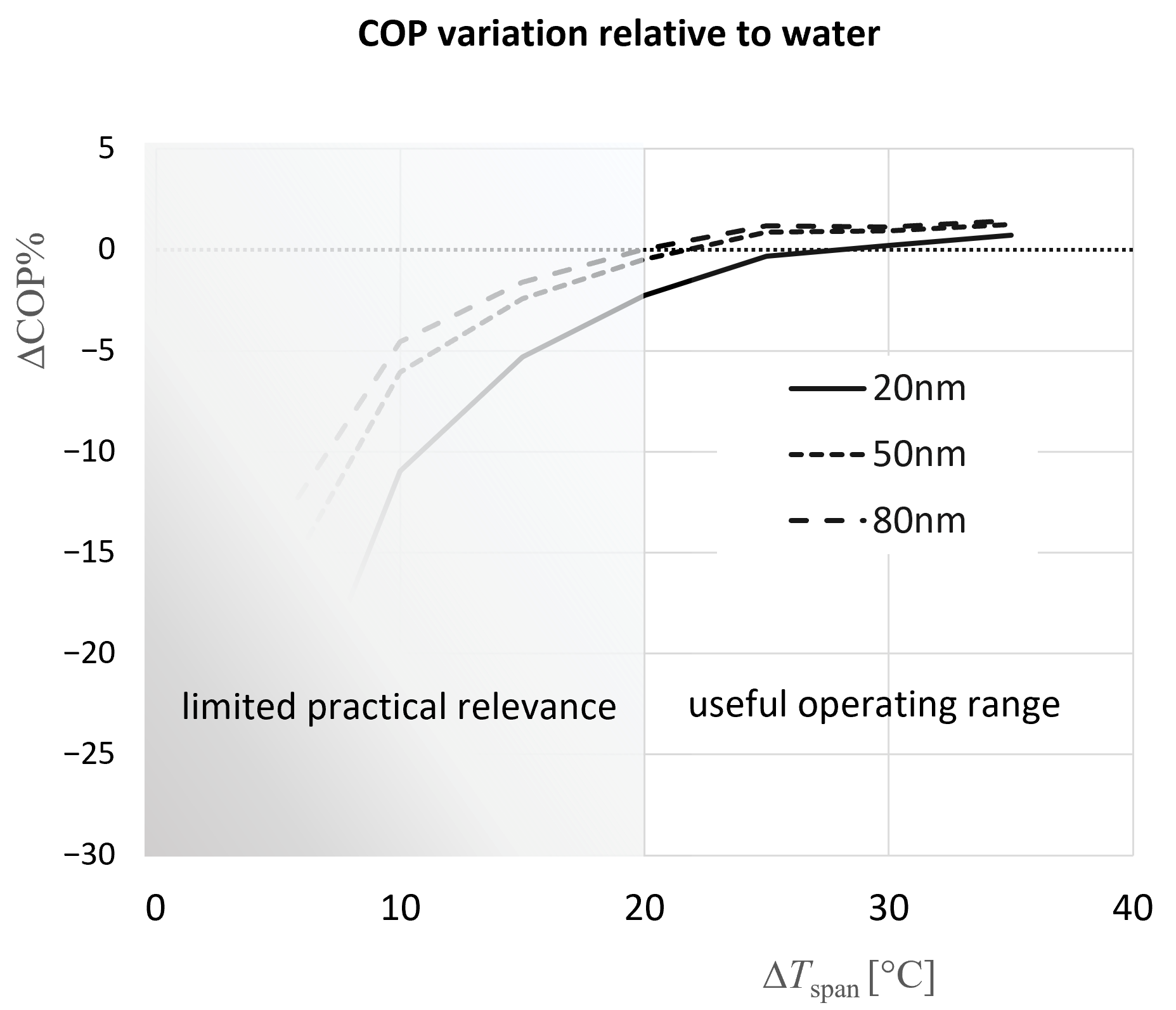
Figure 6 shows the variation in COP relative to water as a function of the imposed temperature span. Only the 6 vol.% configurations are reported, since this concentration provides the largest cooling-power enhancement (Figure 5). The corresponding second-law efficiency follows the same trend by definition.
Figure 6.
COP variation relative to pure water as a function of temperature span for Al2O3–water nanofluids with three particle diameters at a concentration of 6 vol.%. Corcione’s correlations. Shaded regions distinguish temperature spans of limited practical interest from those more relevant to room-temperature refrigeration.
At low temperature spans, nanofluids exhibit a lower COP than water because the operating point corresponding to maximum cooling power requires high flow rates, increasing pressure losses and pumping power. As the imposed temperature span increases, the optimal flow rate decreases, reducing hydraulic losses while preserving the benefit of the enhanced heat transfer. Consequently, the COP progressively approaches, and for the largest particle diameters slightly exceeds, the reference value for water. Larger particles achieve this crossover at lower temperature spans because they combine improved thermal conductivity with a smaller viscosity increase.
From a practical perspective, the largest COP penalties occur at low temperature spans, where AMR operation is of limited practical interest. At temperature spans of 20 °C and above, the COP reduction becomes substantially smaller, remaining below approximately 3% for the configurations reported in Table 3. At higher temperature spans, some nanofluids even provide slightly higher COP values than water, while maintaining an increased cooling capacity.
Table 3.
Percentage COP variation relative to pure water as a function of temperature span for the four nanofluids at a concentration of 6 vol.% and a particle diameter of 20 nm, using Corcione’s and Garoosi’s correlations.
3.3. Influence of Nanoparticle Material
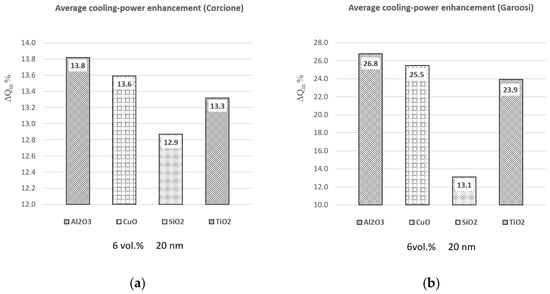
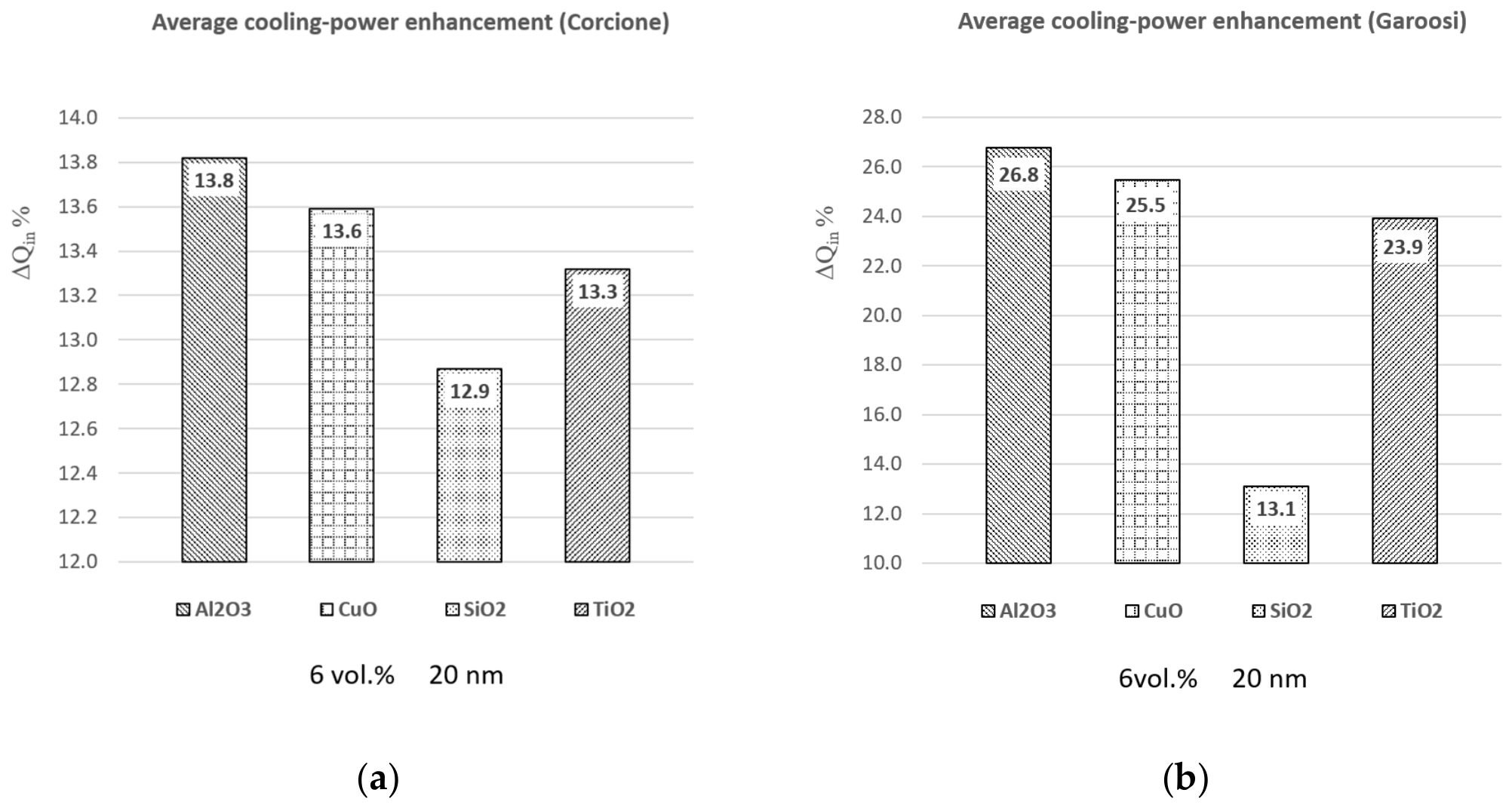
Because all four nanofluids exhibit nearly identical trends, only a direct comparison of their representative performance is reported in Figure 7 and Table 3 for an average particle size of 20 nm and a volumetric concentration of 6%, the selection characterized by the highest cooling power. Again, the values are averaged over the temperature span range, while the findings for each are reported in Appendix A, Table A6 (Corcione’s correlation) and Table A7 (Garoosi’s correlation), for all four nanofluids.
Figure 7.
Average cooling-power enhancement relative to pure water for the four investigated nanofluids at a concentration of 6 vol.% and a particle diameter of 20 nm: (a) Corcione’s correlation and (b) Garoosi’s correlation.
Under Corcione’s correlation, switching the nanoparticle material produces only marginal differences in cooling power (Figure 7a). Al2O3 yields the largest average increase in cooling power (13.8%), followed by CuO (slightly higher than TiO2), while SiO2 shows the smallest increase (12.9%). This weak dependence on particle material is consistent with the way in which the thermophysical properties enter the adopted correlation: in Corcione’s formulation, the particle thermal conductivity affects the effective conductivity through a very small exponent (0.03 in the kp/kbf term of Equation (5)), which inherently limits the leverage of kp on the final nanofluid properties and, therefore, on system performance.
To verify whether this weak sensitivity is physically meaningful or results from the specific correlation adopted, the same comparison was repeated using Garoosi’s correlation [43] (Figure 7b and Table A7). For Al2O3 and CuO, the predicted trends remain qualitatively consistent with Corcione’s, though Garoosi’s correlation yields a systematically larger cooling capacity relative to pure water (26.8% and 25.5%, respectively, versus 13.8% and 13.6% under Corcione). However, Garoosi’s formulation features a substantially larger exponent (>0.8) on the kp/kbf ratio compared with Corcione’s (0.03), giving the particle thermal conductivity a much stronger leverage on the effective nanofluid conductivity. As a result, under Garoosi’s correlation, the SiO2-based nanofluid—characterized by the lowest particle thermal conductivity among the four materials considered (Table 1)—shows a cooling power about 10% lower than Al2O3 (TiO2 about 2.5% lower), a difference no longer negligible compared with the sub-1% spread observed under Corcione’s correlation. Materials with high thermal conductivity are most significantly affected by the choice of correlation.
While all tested nanofluids provide a substantial increase in Qin relative to water under both correlations, the corresponding COP behavior reflects the competing influence of enhanced heat transfer and increased pumping work. When COP is compared against the water baseline at the same , a pronounced penalty appears at low temperature spans, confirming the behavior shown in Figure 6. Table 3 reports these variations for Corcione’s and Garoosi correlations (6%, 20 nm). COP values are present in Table A6 and Table A7. For each nanofluid, the COP difference between Corcione’s and Garoosi’s correlation is within 0.1 (excluding the case = 5 °C), indicating that, unlike cooling power, COP is only weakly affected by the correlation choice.
Taken together, these results show that the predicted influence of nanoparticle material on AMR cooling power is strongly dependent on the adopted correlation. Within the Corcione-based framework adopted as the reference throughout this study, material choice has only a negligible effect on cooling power, whereas under correlations assigning greater weight to the intrinsic particle thermal conductivity, such as Garoosi’s, the effect becomes appreciable, particularly for SiO2 particles. This difference primarily reflects the mathematical structure of the adopted correlations and should not be interpreted as a measure of the actual physical sensitivity to nanoparticle material. This finding underscores that the choice of thermophysical-property correlation is itself a key modeling decision whenever nanoparticle material is treated as a design variable. It also emphasizes the need for further experimental investigations aimed at developing more reliable and broadly validated thermophysical-property correlations for nanofluids, thereby reducing the uncertainty associated with material selection in AMR design.
3.4. Influence of the Base Fluid
Changing the carrier fluid modifies the balance between heat transfer and pumping losses. The use of water–propylene glycol mixtures as carrier fluids in magnetic refrigeration has also been investigated by Misale et al. [44], considering various nanoparticle materials at relatively low concentrations (0.5–1 vol.%) in a 30 wt.% propylene glycol solution. Their results showed modest cooling-power improvements, a limited influence of nanoparticle material, and a reduction in COP associated with increased viscosity and pumping losses. In the present study, replacing water with propylene glycol mixtures (30 and 50 wt.%) while keeping Al2O3 at 6% and 20 nm leads to higher density and a marked viscosity increase, alongside reduced specific heat and thermal conductivity. The net result is a substantial rise in the Prandtl number, driven primarily by viscosity.
The thermophysical properties of water and the two water–glycol mixtures investigated are reported in Table A1, Table A2 and Table A3 in Appendix A, with reference to Equation (1). The corresponding results are provided in Table A6 (first block) and Table A8.
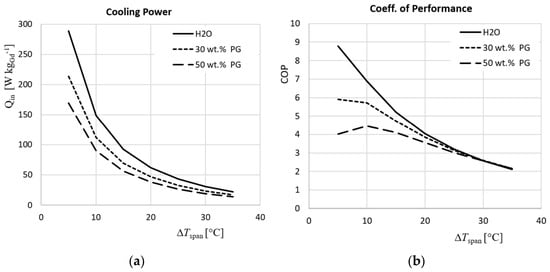
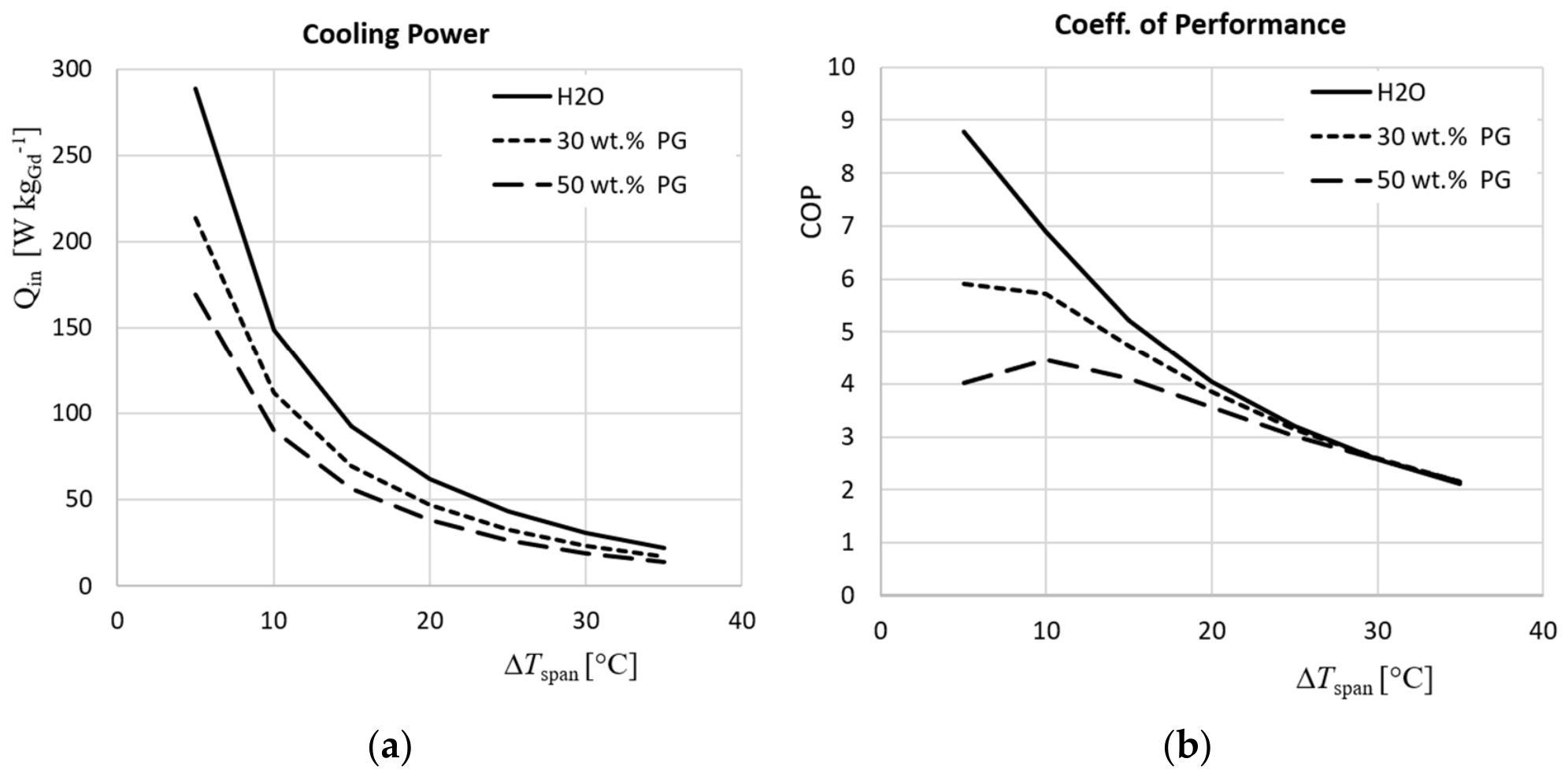
Figure 8a compares the maximum cooling power obtained with the three base fluids, with water consistently providing the highest cooling capacity. Figure 8b compares the corresponding COP values for the three base fluids.
Figure 8.
Effect of base-fluid composition on (a) maximum cooling power and (b) corresponding COP as a function of temperature span. Al2O3 nanoparticles at 6 vol.% and 20 nm; water and water–propylene glycol mixtures at 30 and 50 wt.%. PG = propylene glycol.
Adding glycol reduces cooling capacity: the average maximum cooling power decreases by 25% for the 30 wt.% mixture and by 39% for the 50 wt.% mixture over the investigated temperature-span range. The effect on efficiency is more complex. At low temperature spans, glycol reduces COP and second-law efficiency because of increased viscosity, pressure losses, and pumping work. At temperature spans above 30 °C, both efficiency measures can improve slightly, as the higher Prandtl number shifts the cooling-power optimum toward lower flow rates and velocities, reducing pumping requirements. Nevertheless, cooling capacity remains lower than in the water-based case.
Accordingly, water provides the highest cooling capacity under the investigated conditions, although practical base-fluid selection must also account for freezing protection, corrosion, suspension stability, and operating-temperature requirements.
3.5. Influence of Property Temperature Dependence
A separate source of uncertainty is how temperature dependence is assigned to the properties of the phases. Two modeling choices are made to test the sensitivity of the results to this parameter. First, incorporating temperature-dependent nanoparticle properties (through parameters reported in Table A4 of the Appendix A with reference to Equation (1)), while retaining temperature dependence for the base fluid, produces essentially no practical change: the difference relative to the constant-nanoparticle-property assumption is at most 0.003% for both cooling power and COP, meaning that, within the range analyzed, the nanoparticle properties can be treated as constant, with negligible loss of accuracy. The results are the same whether using Corcione’s correlations or Garoosi’s.
Second, treating both nanoparticle and nanofluid properties as constant (by evaluating the nanofluid formulas at 20 °C) introduces a non-negligible deviation at the upper end of the investigated temperature spans. The results obtained are presented below in Table A9 and are compared with those shown in Table A6, both of which are in Appendix A. In that case, at high the error can reach 3% for cooling power and 1.3% for COP. Therefore, if higher quantitative precision is required, it is preferable to retain temperature-dependent nanofluid properties, while keeping nanoparticle properties constant to reduce computational cost.
3.6. Overall Ranking
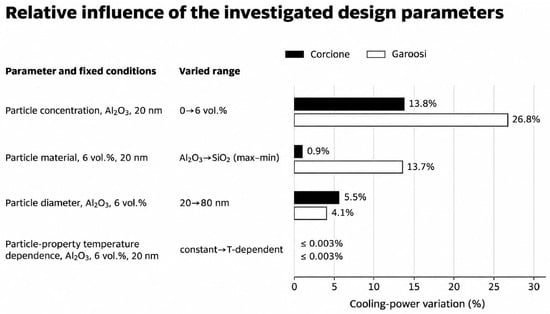
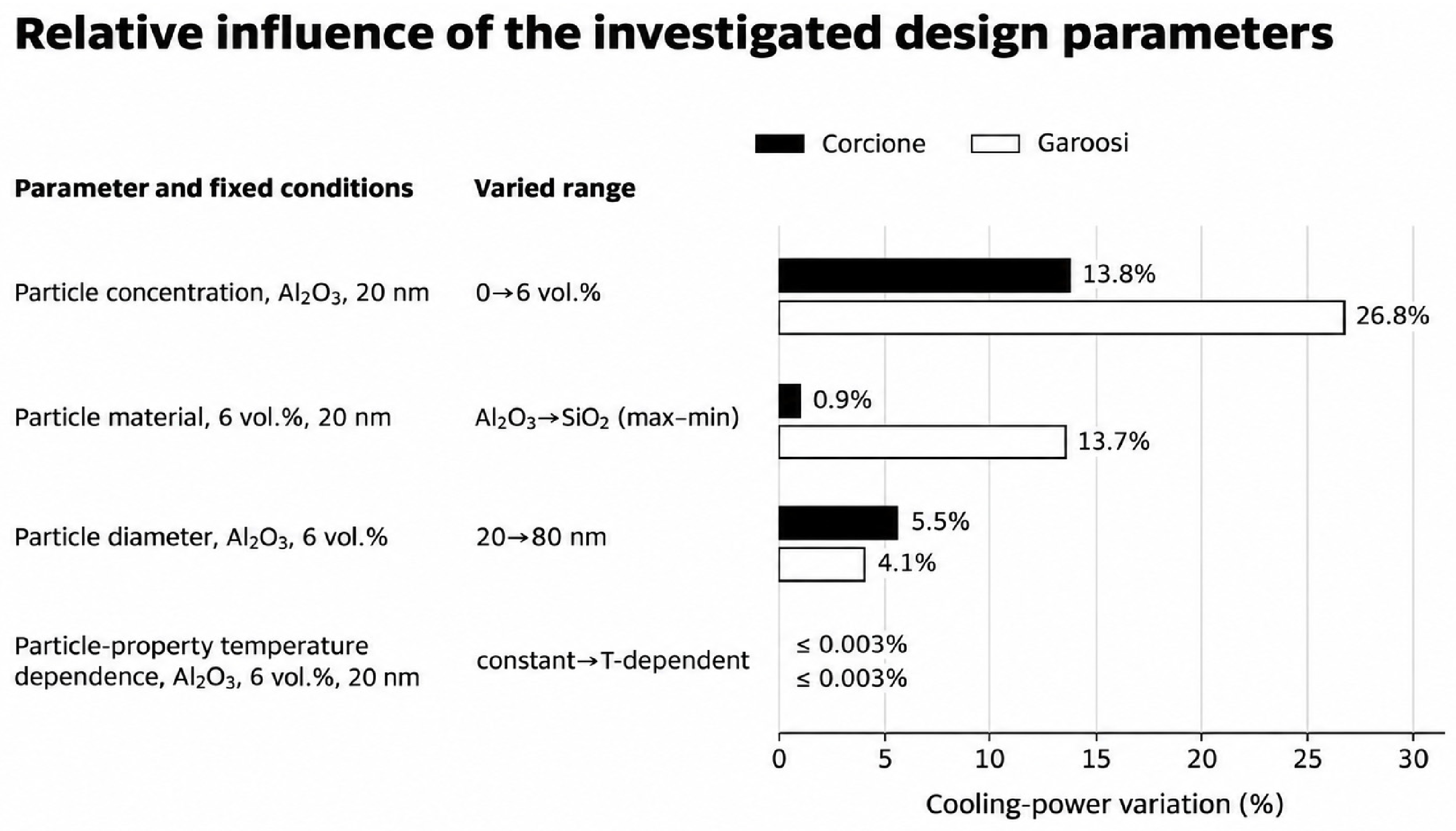
The findings consistently show that the design parameters investigated have different impacts on AMR performance over the range of values here considered. Based on the preceding analyses and additional simulations using Garoosi’s correlation, a comparative ranking of the investigated nanoparticle-related parameters is presented in Figure 9. Unlike a normalized local sensitivity analysis, this comparison measures the maximum performance variation associated with each parameter over its investigated range. Since these ranges differ in nature and extent, the resulting ranking is design-space-dependent and should not be interpreted as a universal measure of parameter sensitivity.
Figure 9.
Relative influence of nanoparticle-related parameters on cooling power, quantified by the maximum performance variation within the investigated design space. Results are shown separately for Corcione’s and Garoosi’s correlations.
Base-fluid selection is excluded from this ranking, as it is not a nanoparticle-specific parameter and was investigated separately in Section 3.4. To facilitate comparison among parameters of different natures (continuous and discrete), the influence of each parameter is quantified as the maximum variation in cooling power produced over its investigated range. For nanoparticle concentration, the reference state is pure water (0 vol.% nanoparticles), whereas particle diameter and nanoparticle material are evaluated over their respective investigated ranges.
The ranking is conditional on the adopted thermophysical-property correlations and the investigated parameter ranges. In particular, the substantially different influence of nanoparticle material predicted by Corcione’s and Garoosi’s formulations prevents the identification of a unique, correlation-independent hierarchy. This model dependence is itself a significant finding, highlighting the importance of property-correlation selection in AMR performance predictions.
3.7. Limitations of the Present Framework
The findings of this study are specific to the investigated parallel-plate gadolinium regenerator, the selected parameter ranges, and the maximum-cooling-power optimization criterion. Their extension to other regenerator geometries, magnetocaloric materials, or optimization objectives should therefore be considered with caution.
The predicted performance is also affected by the adopted thermophysical-property correlations, as demonstrated by the different material sensitivities obtained with Corcione’s and Garoosi’s formulations. The 1D, homogeneous single-phase model does not explicitly resolve local transport phenomena, nanoparticle aggregation, sedimentation, or spatial variations in particle concentration. Although some particle-interaction effects may be implicitly incorporated into the empirical property correlations, these phenomena can alter thermal conductivity and viscosity, potentially affecting the balance between heat-transfer enhancement and hydraulic losses, particularly at higher concentrations and during prolonged operation. Related numerical studies have examined nanofluid heat transfer under applied magnetic fields [45] and the influence of nanoparticle aggregation on convective heat transfer [46], although in different physical configurations from the AMR considered here.
Instantaneous magnetic-field changes and flow reversal, together with negligible magnetic irreversibilities, are assumed to avoid introducing machine-specific parameters. These simplifications may affect the predicted performance, while their detailed treatment would require additional information on the actuation systems and magnetic losses.
Consequently, the proposed ranking should be interpreted as a model-based comparison within the investigated design space rather than a universally applicable hierarchy. Experimental validation remains necessary to establish the quantitative reliability of the predictions and assess their applicability to practical AMR systems.
4. Conclusions
A one-dimensional AMR model was used to compare the influence of nanofluid design parameters on cooling power and COP at maximum-cooling operating conditions (ΔTspan = 5–35 °C).
Nanoparticle concentration and size are the dominant nanoparticle-related parameters. Under Corcione’s correlation, Al2O3–water at 6 vol.% and 20 nm raises cooling power by up to about 14% relative to water, while the viscosity increase lowers COP by up to about 26% at ΔTspan = 5 °C. For ΔTspan ≥ 20 °C, the COP variation remains within approximately 3%, indicating that the cooling-power enhancement is accompanied by a relatively small efficiency penalty under the investigated conditions.
The effect of particle material is negligible under Corcione’s correlation but becomes appreciable under Garoosi’s, particularly for SiO2. It is therefore controlled by the correlation adopted and not established as a physical result. Temperature dependence of particle properties is negligible. In the additional comparison, replacing water with a water–propylene glycol mixture as the base fluid reduces the average cooling power of the Al2O3 nanofluid by about 25% (30 wt.% glycol) and 39% (50 wt.% glycol), confirming the cooling-power advantage of water within the investigated operating conditions.
These findings are numerical predictions, limited to the investigated geometry, parameter ranges, maximum-cooling criterion, and adopted thermophysical-property correlations, without direct experimental validation of the complete nanofluid–AMR system. Future work could investigate additional property correlations to assess the robustness of the proposed ranking and consider alternative performance optimization criteria.
Author Contributions
Conceptualization, G.V. and F.S.; methodology, G.V.; software, F.S.; validation, F.S.; investigation, G.V.; writing—original draft, G.V.; writing—review and editing, F.S. All authors have read and agreed to the published version of the manuscript.
Funding
This research was funded by the Italian Ministry of University and Research (MUR) under grant number FISR2019_04798 SUSSTAINEBLE.
Data Availability Statement
The data supporting the findings of this study will be made available upon reasonable request.
Conflicts of Interest
The authors declare no conflicts of interest.
Nomenclature
| Abbreviations | |
| AMR | active magnetic regenerator |
| COP | coefficient of performance |
| FEM | finite element method |
| MCE | magnetocaloric effect |
| MCM | magnetocaloric material |
| Symbols | |
| a | channel side ratio |
| c | specific heat, J kg−1K−1 |
| d | diameter, m |
| f | frequency, Hz |
| h | convective heat-transfer coeff., Wm−2K−1 |
| H | bed height |
| k | thermal conductivity, W m−1K−1 |
| L | bed length |
| mass flow rate, kgs−1 | |
| M | mass, kg |
| Nu | Nusselt number |
| thermal power, W or W kg−1 | |
| thermal power, W m−3 | |
| p | pressure, Pa |
| Pr | Prandtl number |
| Re | Reynolds number |
| T | temperature, °C |
| t | time, s |
| u | velocity, m s−1 |
| V | Volume, m3 |
| w | width |
| W | single bed width |
| power, W | |
| x | space coordinate, m |
| Greek Symbols | |
| α | liquid fraction |
| bS | exchange surface to volume ratio, m−1 |
| efficiency | |
| l | friction factor |
| volumetric fraction | |
| φ | utilization factor |
| m | dynamic viscosity, kg m−1s−1 |
| ρ | density, kg m−3 |
| Subscripts | |
| 0 | reference |
| ad | adiabatic |
| bf | base fluid |
| c | cold |
| eff | effective |
| eq | equivalent |
| f | fluid |
| Gd | gadolinium |
| in | transferred into |
| II | second law |
| m | mean value |
| nf | nanofluid |
| out | transferred from |
| p | nanoparticle |
| s | solid |
Appendix A
In Table A1, Table A2, Table A3 and Table A4, the thermophysical property coefficients with reference to Equation (1) for water, propylene glycol mixtures, and Al2O3 particles are reported. The maximum relative values of error, in the temperature range of 0–40 °C, are reported in the last column. The subsequent tables, up to Table A10, refer to performance results cited in the text.
Table A1.
Thermophysical properties of water. Polynomial coefficients for Equation (1), obtained from SecCool [25] based on Schmidt [47].
Table A2.
Thermophysical properties of the 30 wt.% water–propylene glycol mixture. Polynomial coefficients for Equation (1), obtained from SecCool [25] based on Melinder [48].
Table A3.
Thermophysical properties of the 50 wt.% water–propylene glycol mixture. Polynomial coefficients for Equation (1), obtained from SecCool [25] based on Melinder [48].
Table A4.
Temperature-dependent thermophysical properties of Al2O3 nanoparticles. Polynomial coefficients for Equation (1), adapted from COMSOL Multiphysics [27].
Table A5.
Cooling power, COP, second-law efficiency, and corresponding operating conditions for the pure-water reference case.
Table A6.
Cooling power, COP, and second-law efficiency for the four investigated nanofluids at 6 vol.% concentration and 20 nm particle diameter, using Corcione’s correlations.
Table A7.
Cooling power, COP, and second-law efficiency for the four investigated nanofluids at 6 vol.% concentration and 20 nm particle diameter, using Garoosi’s correlation.
Table A8.
Cooling power, COP, and second-law efficiency for Al2O3 nanofluids at 6 vol.% concentration and 20 nm particle diameter, using water–propylene glycol mixtures at 30 and 50 wt.% as base fluids.
Table A9.
Performance of the Al2O3–water nanofluid at 6 vol.% concentration and 20 nm particle diameter, assuming temperature-independent thermophysical properties.
Table A10.
Spatial and temporal discretization study for pure water at ΔTspan = 15 °C. Cooling power and COP for different spatial resolutions and time steps. The adopted discretization and finest tested grid are highlighted in bold.
References
- Purohit, P.; Höglund-Isaksson, L.; Dulac, J.; Shah, N.; Wei, M.; Rafaj, P.; Schöpp, W. Electricity savings and greenhouse gas emission reductions from global phase-down of hydrofluorocarbons. Atmos. Chem. Phys. 2020, 20, 11305–11327. [Google Scholar] [CrossRef] [Scilit]
- Zhang, Y.; Wu, J.; He, J.; Wang, K.; Yu, G. Solutions to obstacles in the commercialization of room-temperature magnetic refrigeration. Renew. Sustain. Energy Rev. 2021, 143, 110933. [Google Scholar] [CrossRef] [Scilit]
- IIF-IIR. The Role of Refrigeration in the Global Economy, 29th Note on Refrigeration Technologies. 2015. Available online: https://iifiir.org/en/fridoc/the-role-of-refrigeration-in-the-global-economy-2015-138763 (accessed on 23 September 2026).
- Alahmer, A.; Al-Amayreh, M.; Mostafa, A.O.; Al-Dabbas, M.; Rezk, H. Magnetic refrigeration design technologies: State of the art and general perspectives. Energies 2021, 14, 4662. [Google Scholar] [CrossRef] [Scilit]
- Benford, S.M.; Brown, G.V. TS diagram for gadolinium near the Curie temperature. J. Appl. Phys. 1981, 52, 2110–2112. [Google Scholar] [CrossRef] [Scilit]
- Choi, S.U.S.; Eastman, J.A. Enhancing thermal conductivity of fluids with nanoparticles. In Proceedings of the 1995 ASME International Mechanical Engineering Congress and Exposition, San Francisco, CA, USA, 12–17 November 1995; OSTI ID 196525. Available online: https://www.researchgate.net/publication/236353373_Enhancing_thermal_conductivity_of_fluids_with_nanoparticles (accessed on 23 September 2026).
- Xuan, Y.; Li, Q. Heat transfer enhancement of nanofluids. Int. J. Heat Fluid Flow 2000, 21, 58–64. [Google Scholar] [CrossRef] [Scilit]
- Sivakumar, V.; Visagavel, K.; Kumaraswamy, J.; Balaji, E.; Khalkar, V.; Gnanavel, C.; Chakravarthy, P.R.K.; Baskar, S.; Vijayan, V. Performance study and analysis of Al2O3 Nanofluid under different flow conditions. Interactions 2024, 245, 213. [Google Scholar] [CrossRef] [Scilit]
- Hussain, Z.; Lee, M.; Cho, H. Thermophysical advancements and stability dynamics in nanofluids for solar energy harvesting: A comprehensive review. Renew. Energy 2025, 248, 123052. [Google Scholar] [CrossRef] [Scilit]
- Okonkwo, E.C.; Wole-Osho, I.; Almanassra, I.W.; Abdullatif, Y.M.; Al-Ansari, T. An updated review of nanofluids in various heat transfer devices. J. Therm. Anal. Calorim. 2021, 145, 2817–2872. [Google Scholar] [CrossRef] [Scilit]
- Yu, W.; Choi, S.U.S. U.S. The role of interfacial layers in the enhanced thermal conductivity of nanofluids—A renovated maxwell model. J. Nanopart. Res. 2003, 5, 167–171. [Google Scholar] [CrossRef] [Scilit]
- Jang, S.P.; Choi, S.U.S. U.S. Role of Brownian motion in the enhanced thermal conductivity of nanofluids. Appl. Phys. Lett. 2004, 84, 4316. [Google Scholar] [CrossRef] [Scilit]
- Evans, W.; Prasher, R.; Fish, J.; Meakin, P.; Phelan, P.; Keblinski, P. Effect of aggregation and interfacial thermal resistance on thermal conductivity of nanocomposites and colloidal nanofluids. Int. J. Heat Mass Transf. 2008, 51, 1431–1438. [Google Scholar] [CrossRef] [Scilit]
- Yu, Q.; Song, Y.; Cui, C.; Cao, F. Effects of nanoparticle aggregation on the thermal conductivity of nanofluids: A comprehensive review based on multiscale methods. Renew. Sustain. Energy Rev. 2026, 226, 116306. [Google Scholar] [CrossRef] [Scilit]
- Huang, C.; Cui, L.; Qiu, L.; Zhang, Y.; Wei, G.; Du, X. Impact of nanoparticle agglomeration on thermal conductivity of molten salt based nanofluids: Insights from molecular dynamics and lattice Boltzmann methods. Sol. Energy Mater. Sol. Cells 2024, 266, 112691. [Google Scholar] [CrossRef] [Scilit]
- Xie, H.; Fujii, M.; Zhang, X. Effect of interfacial nanolayer on the effective thermal conductivity of nanoparticle-fluid mixture. Int. J. Heat Mass Transf. 2005, 48, 2926–2932. [Google Scholar] [CrossRef] [Scilit]
- Ambreen, T.; Kim, M.-H. Heat transfer and pressure drop correlations of nanofluids: A state of art review. Renew. Sustain. Energy Rev. 2018, 91, 564–583. [Google Scholar] [CrossRef] [Scilit]
- Chiba, Y.; Smaili, A.; Sari, O. Enhancements of thermal performances of an active magnetic refrigeration device based on nanofluids. Mechanika 2017, 23, 31–38. [Google Scholar] [CrossRef] [Scilit]
- Mugica, I.; Roy, S.; Poncet, S.; Bouchard, J.; Nesreddine, H. Exergy analysis of a parallel-plate active magnetic regenerator with nanofluids. Entropy 2017, 19, 464. [Google Scholar] [CrossRef] [Scilit]
- Greco, A.; Aprea, C.; Maiorino, A.; Masselli, C. On the Utilization of Nanofluids as Secondary Fluid for Heat Transfer in a Magnetocaloric Cooler. Tec. Ital.–Ital. J. Eng. Sci. 2019, 63, 52–58. [Google Scholar] [CrossRef] [Scilit]
- Aprea, C.; Greco, A.; Maiorino, A.; Masselli, C. A Numerical Investigation on a Caloric Heat Pump Employing Nanofluids. Int. J. Heat Technol. 2019, 37, 675–681. [Google Scholar] [CrossRef] [Scilit]
- Scarpa, F.; Bianco, V. Improving the performance of room temperature magnetic regenerators using Al2O3-water nanofluid. Appl. Therm. Eng. 2024, 236, 121711. [Google Scholar] [CrossRef] [Scilit]
- Singh, S.K.; Lee, J.S. Performance analysis of an Active Magnetic Regenerative system using Al2O3 nanofluids. Int. J. Air-Cond. Refrig. 2024, 32, 14. [Google Scholar] [CrossRef] [Scilit]
- Singh, S.K.; Lee, J.S. Comparative performance study of active magnetic regenerative system using mono/hybrid nanofluids. J. Mech. Sci. Technol. 2024, 38, 7019–7026. [Google Scholar] [CrossRef] [Scilit]
- Skovrup, M.J. SecCool Properties Software, version 2.0.2. 2024. Available online: https://www.ipu.dk/refrigeration-software/seccool (accessed on 23 September 2026).
- Vajjha, S.; Das, D.K.; Kulkarni, D.P. Development of new correlations for convective heat transfer and friction factor in turbulent regime for nanofluids. Int. J. Heat Mass Transf. 2010, 53, 4607–4618. [Google Scholar] [CrossRef] [Scilit]
- COMSOL Multiphysics®, version 6.2; COMSOL AB: Stockholm, Sweden. Available online: https://www.comsol.jp/ (accessed on 23 September 2026).
- Khanafer, K.; Vafai, K. A critical synthesis of thermophysical characteristics of nanofluids. Int. J. Heat Mass Transf. 2011, 54, 4410–4428. [Google Scholar] [CrossRef] [Scilit]
- Pak, B.C.; Cho, Y.I. Hydrodynamic and heat transfer study of dispersed fluids with submicron metallic oxide particles. Exp. Heat Transf. 1998, 11, 151–170. [Google Scholar] [CrossRef] [Scilit]
- Corcione, M. Empirical correlating equations for predicting the effective thermal conductivity and dynamic viscosity of nanofluids. Energy Convers. Manag. 2011, 52, 789–793. [Google Scholar] [CrossRef] [Scilit]
- Ho, C.J.; Wei, L.C.; Li, Z.W. An experimental investigation of forced convective cooling performance of a microchannel heat sink with Al2O3/water nanofluid. Appl. Therm. Eng. 2010, 30, 96–103. [Google Scholar] [CrossRef] [Scilit]
- Aybar, H.Ş.; Sharifpur, M.; Azizian, M.R.; Mehrabi, M.; Meyer, J.P. A Review of Thermal Conductivity Models for Nanofluids. Heat Transf. Eng. 2015, 36, 1085–1110. [Google Scholar] [CrossRef] [Scilit]
- Apmann, K.; Fulmer, R.; Soto, A.; Vafaei, S. Thermal conductivity and viscosity: Review and optimization of effects of nanoparticles. Materials 2021, 14, 1291. [Google Scholar] [CrossRef] [Scilit] [PubMed]
- Corcione, M. A Semi-Empirical Model for Predicting the Effective Dynamic Viscosity of Nanoparticle Suspensions. Heat Transf. Eng. 2012, 33, 575–583. [Google Scholar] [CrossRef] [Scilit]
- Bocanegra, A.J.; Scarpa, F.; Bianco, V.; Tagliafico, L.A. The Effect of Dead Volumes on the Performance of Magnetic Refrigerators. Int. J. Refrig. 2023, 151, 26–38. [Google Scholar] [CrossRef] [Scilit]
- Chakraborty, S.; Panigrahi, P.K. Stability of nanofluid: A review. Appl. Therm. Eng. 2020, 174, 115259. [Google Scholar] [CrossRef] [Scilit]
- Engelbrecht, K.L.; Nellis, G.F.; Klein, S.A. A Numerical Model of an Active Magnetic Regenerator Refrigeration System. In Cryocoolers 13; Ross, R.G., Ed.; Springer: Boston, MA, USA, 2005; Volume 13, pp. 471–480. [Google Scholar] [CrossRef] [Scilit]
- Dan’kov, S.Y.; Tishin, A.M.; Pecharsky, V.K.; Gschneidner, K.A. Magnetic phase transitions and the magnetothermal properties of gadolinium. Phys. Rev. 1998, 57, 3478–3490. [Google Scholar] [CrossRef] [Scilit]
- Gatti, J.M.; Muller, C.; Vasile, C.; Brumpter, G.; Haegel, P.; Lorkin, T. Magnetic heat pumps—Configurable hydraulic distribution for a magnetic cooling system. Int. J. Refrig. 2014, 37, 165–175. [Google Scholar] [CrossRef] [Scilit]
- Rohsenow, W.M.; Hartnett, J.P.; Cho, Y.L. Handbook of Heat Transfer, 3rd ed.; McGraw-Hill: New York, NY, USA, 1998. [Google Scholar]
- Scarpa, F.; Slimani, S. Galinstan liquid metal as the heat transfer fluid in magnetic refrigeration. Appl. Therm. Eng. 2023, 232, 120971. [Google Scholar] [CrossRef] [Scilit]
- Qin, J.; Tao, Y.; Liu, Q.; Li, Z.; Zhu, Z.; He, N. Experimental and Theoretical Studies of Different Parameters on the Thermal Conductivity of Nanofluids. Micromachines 2023, 14, 964. [Google Scholar] [CrossRef] [Scilit] [PubMed]
- Garoosi, F. Presenting two new empirical models for calculating the effective dynamic viscosity and thermal conductivity of nanofluids. Powder Technol. 2020, 366, 788–820. [Google Scholar] [CrossRef] [Scilit]
- Misale, M.; Scarpa, F.; Bocanegra, J.A. Performance analysis of magnetic refrigeration systems using nanofluids. In Proceedings of the 11th IIR Conference on Solid-State Cooling, Heating and Energy Harvesting (Thermag 2026), Ljubljana, Slovenia, 7–11 June 2026. [Google Scholar] [CrossRef]
- Selimefendigil, F.; Hadrich, B.; Kriaa, K.; Maatki, C.; Kolsi, L. Ternary nanofluid cooling of an elastic plate by using double sinusoidal wavy channels under different magnetic fields. Arch. Appl. Mech. 2024, 94, 3339–3357. [Google Scholar] [CrossRef] [Scilit]
- Almeshaal, M.A.; Maatki, C.; Kolsi, L.; Ghachem, K.; Chamkha, A. 3D Rayleigh-Bénard-type natural convection in MWCNT-nanofluid-filled L-shaped enclosures with consideration of aggregation effect. Math. Methods Appl. Sci. 2026, 49, 4781–4797. [Google Scholar] [CrossRef] [Scilit]
- Schmidt, E. Properties of Water and Steam in SI Units, 2nd revised and updated ed.; Grigull, U., Ed.; Springer: Berlin/Heidelberg, Germany; New York, NY, USA; R Oldenbourg: Munich, Germany, 1979. [Google Scholar]
- Melinder, Å. Properties of Secondary Working Fluids (Secondary Refrigerants or Coolants, Heat Transfer Fluids) for Indirect Systems, 2nd ed.; IIF-IIR: Paris, France, 2010. [Google Scholar]

Disclaimer/Publisher’s Note: The statements, opinions and data contained in all publications are solely those of the individual author(s) and contributor(s) and not of MDPI and/or the editor(s). MDPI and/or the editor(s) disclaim responsibility for any injury to people or property resulting from any ideas, methods, instructions or products referred to in the content. |
© 2026 by the authors. Licensee MDPI, Basel, Switzerland. This article is an open access article distributed under the terms and conditions of the Creative Commons Attribution (CC BY) license.