


Abstract
Internal combustion engine-powered working machines often operate under rapidly varying loads, while conventional controllers typically infer operator demand from mechanical inputs and machine sensors. This review examines whether electromyography (EMG), which records electrical activity generated by skeletal muscles, could provide earlier indications of operator intention to improve engine operation and reduce fuel consumption and exhaust emissions. A structured narrative review of scientific publications and patent documents was conducted, covering EMG-based machine interfaces, intention recognition, engine–machine power management, and environmental performance. Four potential control architectures were identified: EMG-derived commands, EMG-based power-demand prediction, multimodal adaptive control, and predictive supervisory optimization. Experimental studies of engine-control strategies that did not use EMG reported a 12.5% reduction in the overall fuel consumption rate of a bulldozer and a 33% reduction in fuel consumption for a wood chipper using adaptive engine-speed control. In the latter study, CO, CO2, and NOx emissions decreased by 30%, 37%, and 33%, respectively, whereas hydrocarbon emissions increased by 290%, highlighting important environmental trade-offs. Although EMG-based systems have demonstrated the feasibility of recognizing operator actions and controlling machine functions, none of the reviewed studies directly demonstrated reductions in fuel consumption or emissions from EMG-informed internal combustion engine control. Future research should determine whether EMG provides a measurable prediction advantage over conventional machine sensors and improves fuel efficiency and environmental performance without compromising productivity or safety.
1. Introduction
Internal combustion engines remain widely used as power sources in mobile [1] and stationary [2] machinery, including agricultural tractors [3], construction equipment [4], forestry machines [5], material-handling equipment [6], portable working machines, and other non-road applications [7]. Despite the ongoing electrification of drive systems, combustion-powered machines continue to consume substantial amounts of fuel and produce exhaust emissions, particularly in sectors characterized by high power demand, long operating periods, variable loads, and limited access to charging infrastructure [8,9]. Non-road mobile machinery therefore represents an important target for improving energy efficiency and reducing environmental impacts [10]. For combustion engines operating on fossil fuels, reducing the amount of fuel required to perform a given task is also directly associated with a reduction in carbon dioxide emissions [11,12], while engine and vehicle operating conditions strongly affect the formation of other exhaust pollutants [13,14]. Consequently, increasing the efficiency of engine-powered machines requires not only improvements in combustion processes and exhaust aftertreatment systems but also better control of the engine operating point in response to instantaneous power demand [15].
Modern internal combustion engine control systems use information from numerous sensors to regulate fuel injection [16], ignition [17], air supply [18], exhaust gas recirculation [19], boost pressure [20], thermal management [21], and other parameters. Increasingly advanced control methods, including model predictive control, adaptive algorithms, and data-driven techniques, make it possible to optimize engine operation under dynamically changing conditions and to balance requirements related to torque production, fuel consumption, emissions, and system constraints [22]. A recent review classified the methods of determining demanded engine torque into four groups: direct operator input, indirect operating state input, automatic determination, and predictive or autonomous determination [23]. However, in operator-controlled machines, the required power and torque are ultimately determined to a large extent by human actions transmitted through conventional interfaces such as accelerator pedals, levers, joysticks, switches, or handles. The engine control unit can optimize the response to a requested operating condition, but the command is usually generated without direct information about the operator’s muscle activation or motor intention. Thus, the human operator remains an essential but only indirectly observed element of the machine control loop, as schematically illustrated in Figure 1.
Figure 1.
Human-in-the-loop architecture of a conventional internal combustion engine-powered machine control system (generated with artificial intelligence (AI)).
This aspect is particularly important in machines characterized by rapidly varying loads and repeated transitions between idle, partial-load, and high-load operation. The operator may continuously modify the required speed, torque, direction of motion, or intensity of the working process. These commands generate transient states of the engine and drivetrain that may considerably influence instantaneous fuel consumption and emissions. Studies on energy-efficient driving have demonstrated that human control behavior, including acceleration, deceleration, speed selection, and pedal operation, is closely related to vehicle energy demand and can therefore become an input to intelligent energy-management strategies [24]. The potential benefits of anticipatory control are further supported by studies of predictive cruise control, in which advance knowledge of vehicle operating conditions enabled measurable reductions in fuel consumption [25]. For example, Skrúcaný et al. [25] experimentally investigated predictive cruise control in a heavy-duty truck and reported a reduction in fuel consumption from 37.4 to 31.0 L/100 km (17.1%) in one travel direction and from 26.4 to 24.4 L/100 km (7.6%) in the opposite direction. These findings quantitatively demonstrate that anticipatory adjustment of vehicle operating parameters can improve fuel efficiency, although the investigated control strategy did not employ physiological signals. Although road-vehicle operation differs from the operation of many working machines, the general principle is similar: information describing the operator’s intended action may provide an additional basis for adapting the response of the power system. This creates an opportunity to extend conventional machine control architectures toward human-in-the-loop systems in which physiological information complements mechanical and electronic control inputs.
EMG provides information on the electrical activity associated with skeletal muscle activation. In particular, surface electromyography (sEMG) allows neuromuscular activity to be recorded non-invasively using electrodes placed on the skin. Advances in wearable electrodes, wireless acquisition systems, signal processing, feature extraction, pattern recognition, and machine-learning methods have considerably expanded the possibilities of using sEMG beyond clinical diagnostics and biomechanical assessment. The signal can be processed to identify muscle activation, estimate muscular effort, recognize gestures, classify intended actions, or continuously estimate movement-related variables. Consequently, sEMG has become an important candidate for natural human–machine interfaces capable of translating physiological activity into control commands [26]. Compared with conventional interfaces, an EMG-based interface also allows muscular activation to be detected during the formation and execution of a motor action and can therefore provide information directly associated with the operator’s physical intention.
Autonomous driving systems rely on environmental perception, vehicle-state estimation, trajectory planning, and predictive control to regulate vehicle motion [27,28,29]. Energy-efficient implementations also optimize speed trajectories and powertrain operation using anticipated driving conditions and vehicle energy models [30,31,32]. In contrast, EMG signals capture muscular activation and developing motor intention, potentially enabling actions to be recognized before conventional control inputs are fully executed [33]. Although EMG has limited relevance to fully autonomous operation without human intervention, it may contribute predictive information to shared-control and operator-controlled systems [34]. Its potential lies in complementing sensor-based and autonomous control architectures with physiological information, allowing operator-induced power demand to be anticipated and engine operation to be adapted accordingly. However, whether EMG provides additional predictive value beyond existing sensors and yields measurable reductions in fuel consumption or exhaust emissions remains experimentally unverified.
The application of EMG signals to machine control has been investigated primarily in prostheses, rehabilitation devices, robotic manipulators, exoskeletons, powered wheelchairs, and other assistive systems. Nevertheless, several studies demonstrate that EMG-based interfaces are also technically applicable to vehicle and mobile-machine control. An early example was the use of EMG signals for steering an agricultural tractor [35]. More recent studies investigated sEMG-controlled steering assistance and automobile steering, demonstrating the feasibility of transforming muscular activity into commands affecting vehicle motion [36,37]. Quantitative results confirm the technical feasibility of such interfaces. Gomez-Gil et al. [35] evaluated EMG-based tractor steering and reported a mean lateral deviation of 10.6 cm from the desired trajectory, compared with 2.9 cm for conventional manual steering during a 50 m straight-line test. The corresponding standard deviations were 15.8 and 8.7 cm, respectively. Nacpil et al. [36] subsequently demonstrated that an sEMG-based steering interface achieved a median lateral tracking error of 0.5 m during a simulated U-turn with a radius of 3.6 m, compared with 1.2 m using a conventional steering-wheel interface. These findings provide measurable evidence of EMG-based machine-control performance, although neither study quantified effects on engine torque, fuel consumption, or exhaust emissions. EMG information has also been investigated in multimodal systems for identifying steering and braking intentions and in experimental driving interfaces [38,39]. These studies confirm that myoelectric information can be incorporated into control systems operating in dynamic machine environments. However, the primary controlled functions considered in this field have generally been related to steering, maneuvering, assistive control, gesture recognition, or replacement of conventional human–machine interfaces rather than to the management of the energy source itself.
This distinction is particularly important for machines powered by internal combustion engines. In such systems, EMG does not necessarily need to replace the accelerator, joystick, or conventional engine control unit to have an effect on engine operation. Instead, muscular activity can potentially constitute an additional input to a supervisory controller. Information derived from the amplitude, timing, activation pattern, or classification of EMG signals could be used to identify the operator’s intention or estimate the expected intensity of a working action before or during execution. In principle, such information could support the adjustment of requested engine speed or torque, selection of operating modes, management of transient power demand, activation or deactivation of auxiliary functions, or coordination between the engine and machine working system. In hybrid architectures, EMG-derived information could also be combined with conventional machine variables such as engine speed, engine load, accelerator position, hydraulic pressure, vehicle speed, or working-tool resistance. The objective would not be to control combustion directly from a biological signal, but to improve the correspondence between the actual power demand of the human–machine task and the power generated by the engine, as illustrated in Figure 2.
Figure 2.
Hybrid supervisory control architecture with EMG-derived input for an internal combustion engine-powered machine (generated with AI).
From an environmental perspective, this concept is relevant because the efficiency and emission characteristics of an internal combustion engine depend strongly on engine speed, engine load, transient conditions, and control strategy [22,40]. Advanced control methods already demonstrate that modification of engine and powertrain operation can reduce fuel consumption and improve emission-related performance [22]. Quantitative experimental evidence of these effects has been reported for combustion-engine-powered working machines. Warguła et al. [41] demonstrated that adaptive engine-speed control in a wood chipper powered by a 9.5 kW spark-ignition engine reduced fuel consumption from 1.38 to 0.91 L/h (approximately 34%) and CO2 emissions from 2.91 to 1.79 kg/h compared with the conventional carburetor-based configuration. In a subsequent study, Warguła et al. [42] reported that reducing unnecessary high-speed operation from approximately 3600 to 1350 rpm decreased fuel consumption by 33% and increased energy efficiency by 28%. Reductions of 37%, 30%, and 33% were also obtained for CO2, CO, and NOx emissions, respectively, although hydrocarbon (HC) emissions increased by 290%. These results confirm that engine operating strategies can substantially influence energy efficiency and environmental performance, but the reported benefits were achieved without EMG-informed control. The use of EMG should therefore be considered as a potential extension of the information available to such controllers rather than as an alternative to existing engine-management technologies. If information about operator intention enables unnecessary increases in engine speed, excessive power reserve, prolonged low-efficiency operation, or inappropriate transient responses to be reduced, an indirect environmental benefit may be achieved through lower fuel demand and associated emissions. However, evidence supporting this chain of effects is currently dispersed among research fields dealing with biomechanics, myoelectric interfaces, robotics, vehicle control, machine control, engine management, and energy efficiency, and has not yet been comprehensively evaluated from the perspective of combustion-engine-powered working machines. The hypothesized pathway linking EMG-derived operator-intention information with improved engine operation and potential environmental benefits is summarized in Figure 3.
Figure 3.
Potential energy and environmental effects of EMG-informed supervisory control in an internal combustion engine-powered machine (generated with AI).
Patent documents can complement scientific literature by revealing control concepts and application-oriented developments that may not yet be fully represented in academic publications. This approach has been used in research on intelligent eco-driving and energy-management systems [43]. Therefore, the present review considers both scientific publications and patents to assess whether EMG-based control concepts have progressed toward propulsion and engine-management applications.
Against this background, a clear research gap can be identified at the intersection of three rapidly developing areas: EMG-based human–machine interaction, intelligent machine control, and energy-efficient control of internal combustion engine-powered systems. Existing research demonstrates the feasibility of deriving control information from muscle activity and using it to influence the operation of vehicles and machines. At the same time, advanced engine control offers increasingly sophisticated possibilities for adapting engine output to changing operating requirements. The extent to which these two fields have been connected, particularly with the explicit objective of reducing energy consumption and environmental impact, remains insufficiently characterized.
Therefore, the aim of this literature review is to critically evaluate the current state of scientific and patented solutions employing electromyographic signals in the control of machines and drive systems, with particular emphasis on their applicability to machines powered by internal combustion engines. The review focuses on the methods used to acquire and process EMG signals, the information extracted from muscular activity, the controlled machine functions, and the architecture through which EMG-derived information is introduced into the control loop. Particular attention is given to distinguishing between direct control of propulsion-related parameters and indirect control in which EMG affects machine operation and consequently changes engine power demand. The review further examines whether the reported solutions provide evidence of effects on energy demand, fuel consumption, engine operating conditions, or exhaust emissions. By integrating scientific literature with relevant patent documentation, the study aims to identify existing technological approaches, determine the current limitations of EMG-based control for combustion-engine-powered machines, and establish the extent of the research gap between myoelectric human–machine interfaces and environmentally oriented engine and machine control.
2. Literature Review Methodology
During the preparation of this manuscript, the authors used ChatGPT (OpenAI, GPT-5.6) solely to assist in the preparation of selected graphical elements and figures (Figure 1, Figure 2, Figure 3, Figure 4, Figure 5, Figure 6, Figure 7, Figure 8, Figure 9, Figure 10, Figure 11, Figure 12, Figure 13, Figure 14, Figure 15, Figure 16, Figure 17, Figure 18, Figure 19, Figure 20, Figure 21, Figure 22, Figure 23, Figure 24, Figure 25 and Figure 26) based on the authors’ instructions and source materials. The tool was not used for data analysis, interpretation of results, or formulation of scientific conclusions. All AI-assisted graphical outputs were reviewed, verified, and edited by the authors, who take full responsibility for the content of this publication.
2.1. Scientific Literature Search Strategy
Scientific literature was searched using major multidisciplinary and engineering databases and publisher platforms, including Scopus, Web of Science, IEEE Xplore, ScienceDirect, and SpringerLink. The main search covered publications from 2016 to 2026 to emphasize recent developments in electromyographic interfaces, intelligent control, and engine-management technologies. Earlier publications were also included when they described pioneering or technically important applications directly related to EMG-based machine or vehicle control.
The search strategy combined three groups of keywords referring to the physiological signal, the controlled system, and the control-related function. The first group included the terms “electromyography”, “electromyographic signal”, “EMG”, “surface electromyography”, and “sEMG”. The second group included “machine”, “vehicle”, “tractor”, “mobile machinery”, “working machine”, “construction machine”, “agricultural machine”, “drive system”, “powertrain”, “engine”, and “internal combustion engine”. The third group included “control”, “human–machine interface”, “human–machine interaction”, “operator intention”, “intent recognition”, “adaptive control”, “assistive control”, “steering”, “speed control”, “torque control”, “power control”, and “energy management”.
A general search expression was formulated according to the following structure: (“electromyography” OR “electromyographic signal” OR “EMG” OR “surface electromyography” OR “sEMG”) AND (“machine” OR “vehicle” OR “tractor” OR “mobile machinery” OR “drive system” OR “powertrain” OR “engine” OR “internal combustion engine”) AND (“control” OR “human–machine interface” OR “operator intention” OR “adaptive control” OR “steering” OR “speed control” OR “torque control” OR “power control”).
Additional targeted searches were performed to identify publications concerning the relationship between operator behavior, machine operating conditions, energy demand, fuel consumption, and exhaust emissions. For this purpose, the terms “fuel consumption”, “energy consumption”, “energy efficiency”, “engine load”, “engine speed”, “exhaust emissions”, “eco-driving”, and “energy management” were combined with terms related to operator control and human–machine interaction.
Because direct applications of EMG to internal combustion engine control were expected to be limited, the search was intentionally extended to adjacent application areas. These included robotic systems, powered wheelchairs, exoskeletons, prostheses, vehicle steering systems, and other mechatronic devices in which EMG was used as a control or intention-recognition signal. Such studies were included when the reported control architecture, signal-processing method, or human–machine interaction principle could potentially be transferred to combustion-engine-powered machines.
The literature search was last updated on 1 August 2026. Search expressions were adapted to the syntax and search-field options available in the individual bibliographic databases and publisher platforms.
2.2. Patent Search Strategy
Patent documents were analyzed as a complementary source of technological information. This approach was adopted because industrial control concepts, human–machine interfaces, and machine-control architectures may be protected by patents without being described in detail in scientific publications. Patent searches were conducted using Espacenet, WIPO PATENTSCOPE, and Google Patents.
The patent search used combinations of terms corresponding to the scientific literature search, including “EMG”, “electromyography”, “muscle signal”, “muscle activity”, “bioelectric signal”, “human–machine interface”, “machine control”, “vehicle control”, “engine control”, “powertrain control”, “operator intention”, and “adaptive control”. Particular attention was given to patents describing systems in which muscular activity was used to generate or modify commands related to vehicle movement, machine operation, engine speed, demanded torque, power output, propulsion control, or energy-management functions.
The patent analysis focused primarily on patent families rather than individual national documents in order to avoid multiple counting of the same invention. When multiple documents described the same technological solution, the earliest priority document and the most informative family member were used for analysis. Patent status was recorded where available; however, the presence of a patent document was interpreted as evidence of a proposed technological concept rather than evidence of commercial implementation.
2.3. Eligibility Criteria
Publications and patent documents were included when EMG or sEMG signals constituted an input to a control, decision-support, intention-recognition, or adaptive human–machine interface system. Studies were considered relevant when the physiological signal directly controlled a machine function or was processed to derive information subsequently used by a controller.
To determine whether non-engine applications were sufficiently analogous to internal combustion engine-powered machinery, similarity was assessed at the level of control functions rather than the type of power source. Two criteria had to be met: (i) EMG-derived information had to contribute to an operational control command or intention-based decision, rather than being used solely for physiological monitoring; and (ii) the demonstrated function had to be transferable to at least one relevant operator–machine control task, such as action initiation, operating-mode selection, proportional actuator demand, or anticipation of changes in mechanical power demand. Transferability was further assessed based on the control architecture, response timing, real-time implementation, and integration with other sensor signals, where reported. Accordingly, applications involving prostheses, exoskeletons, robotic systems, or electrically powered vehicles were considered functional or methodological analogues, rather than evidence of equivalent engine dynamics or experimentally demonstrated reductions in fuel consumption and exhaust emissions.
The transferability of these findings is limited by differences in control objectives, actuator dynamics, permissible response delays, environmental disturbances, and functional-safety requirements. Prosthetic devices and exoskeletons typically aim to reproduce or assist human movement, whereas combustion-engine-powered working machines require the coordination of operator demand with engine torque availability, transient combustion behavior, hydraulic or mechanical loading, and emission-control constraints. Consequently, recognition accuracy or response time reported for an assistive device cannot be directly interpreted as equivalent control performance in working machinery. In this review, evidence from non-engine applications was therefore used only to assess the feasibility of particular EMG processing, intention-recognition, and sensor-fusion methods, while conclusions concerning fuel consumption, exhaust emissions, and engine operating conditions were based on studies directly addressing combustion-engine-powered systems.
The review included solutions belonging to the following categories:
- -
- Direct control of machine or vehicle motion using EMG;
- -
- Control of steering, speed, torque, force, or other operating parameters;
- -
- Recognition of operator intention used as a control input;
- -
- Adaptive human–machine interfaces using muscle activity;
- -
- Multimodal control systems combining EMG with mechanical, inertial, physiological, or vehicle signals;
- -
- Control architectures potentially transferable to internal combustion engine-powered machines;
- -
- Systems in which operator behavior affected power or energy demand;
- -
- Patented concepts linking biological signals with vehicle, machine, propulsion, or engine-control functions.
Publications were excluded when EMG was used exclusively for clinical diagnosis, rehabilitation assessment, ergonomics, muscle-fatigue evaluation, or biomechanical analysis without any relationship to machine control or operator–machine interaction. Studies using EMG solely to assess muscular load during machine operation were also excluded unless the measured signal was additionally incorporated into a control or decision-making algorithm. Studies concerning purely physiological interpretation of EMG without a technical control application were not considered.
For the analysis of environmental and energetic effects, only studies that reported or discussed parameters related to energy demand, power demand, fuel consumption, engine operating conditions, efficiency, or exhaust emissions were classified as providing direct energy- or environment-related evidence. Studies demonstrating only the feasibility of EMG-based control were retained in the technological analysis but were distinguished from studies reporting energy or environmental effects.
2.4. Classification of Identified Solutions
The identified scientific publications and patent documents were classified according to the functional role of the EMG signal in the control system. Three principal control levels were distinguished.
The first category comprised direct control, in which EMG-derived information was converted directly into a command affecting a machine, vehicle, propulsion, or engine-related parameter. Examples include steering commands, speed requests, actuator activation, or demanded torque. The second category comprised machine-demand control, in which EMG affected the operation of a working mechanism or vehicle function and consequently influenced the power required from the drive system. In this configuration, the EMG signal did not directly control the engine but could indirectly modify engine load and operating conditions. The third category comprised adaptive human-in-the-loop control, in which EMG-derived information describing operator intention, muscular activation, or effort was combined with conventional machine signals and used by a supervisory or adaptive controller. This category was considered particularly relevant to future internal combustion engine applications because it enables physiological information to complement, rather than replace, conventional control inputs.
For each identified solution, the following information was extracted where available:
- -
- Publication or patent year;
- -
- Type of machine or controlled system;
- -
- Propulsion or drive-system type;
- -
- Muscles and EMG acquisition method;
- -
- Signal-processing procedure;
- -
- EMG features used for control;
- -
- Method of normalization;
- -
- Classification or regression algorithm;
- -
- Type of generated control command;
- -
- Controlled machine or drive parameter;
- -
- Use of additional sensors;
- -
- Control-system architecture;
- -
- Experimental validation method;
- -
- Reported control performance;
- -
- Effect on machine power demand;
- -
- Effect on energy or fuel consumption;
- -
- Effect on engine operating conditions;
- -
- Effect on exhaust emissions;
- -
- Limitations reported by the authors.
Drive systems were classified as electric, hydraulic, pneumatic, internal combustion engine, hybrid, or unspecified. This classification was introduced to determine whether EMG-based control technologies developed primarily for electrically powered systems have been transferred to combustion-engine-powered machines.
2.5. Comparative Analysis of Scientific and Patent Literature
Scientific publications and patent documents were analyzed separately at the initial stage and subsequently compared at the technological-concept level. The comparison was intended to identify control solutions present in both academic research and protected industrial inventions, as well as concepts appearing only in patent documentation or only in scientific literature.
Particular attention was given to identifying solutions in which EMG-derived information influenced propulsion-related parameters, demanded power, engine load, vehicle speed, working-tool operation, or energy-management functions. The analysis also examined whether reported solutions explicitly considered fuel consumption, energy efficiency, or emissions, or whether their potential environmental relevance could only be inferred from the proposed control architecture.
The synthesis was qualitative and focused on engineering considerations. Rather than ranking publications or patents by citation counts or statistical indicators, the review focused on functional relationships between muscle activation, signal processing, operator-intention recognition, machine control, power demand, and propulsion-system operation. This approach made it possible to assess the technological maturity of EMG-based control and to determine which existing concepts could potentially be adapted to internal combustion engine-powered machines.
The present study was conducted as a narrative literature review rather than a systematic review. To improve methodological transparency, the presentation and interpretation of the reviewed evidence were considered in relation to the six domains of the Scale for the Assessment of Narrative Review Articles (SANRA), proposed by Baethge et al. [44]: justification of the review’s importance, statement of its aims, description of the literature search, appropriate referencing, scientific reasoning, and presentation of relevant quantitative data. These aspects are addressed through the definition of the research problem and objectives, description of literature and patent searches, specification of eligibility criteria, comparative analysis of control architectures, and discussion of experimentally reported performance indicators.
The review was intended to provide a qualitative technological synthesis rather than an exhaustive systematic identification and statistical aggregation of all available studies. Consequently, a PRISMA-based screening flow diagram and quantitative record-selection statistics were not produced. A formal study-level risk-of-bias assessment was also not performed. Instead, the interpretation of the evidence explicitly distinguished experimentally validated systems, simulation-based investigations, and patent concepts. Particular attention was given to whether the reported findings concerned actual engine performance, machine-control functionality, or only the feasibility of EMG-based intention recognition. These methodological characteristics should be considered when interpreting the completeness and generalizability of the review’s findings.
The review was designed as a qualitative narrative synthesis rather than a systematic review. Consequently, a PRISMA-based screening diagram and quantitative record-selection statistics were not produced, and a formal study-level risk-of-bias assessment was not performed. To improve the transparency of evidence interpretation, the reviewed material was differentiated according to the nature and directness of the available evidence: (i) experimental investigations involving internal combustion engine-powered machines; (ii) numerical simulations and control-system models; (iii) experimental studies of EMG-based control in other technological domains; and (iv) patent documents describing proposed technical solutions. These categories were used to distinguish experimentally demonstrated effects from model-based predictions, transferable control principles, and unvalidated technological concepts. Quantitative findings concerning fuel consumption, energy efficiency, and exhaust emissions were interpreted in relation to the investigated machine configuration, control strategy, and operating conditions. Results from different studies were not statistically pooled because of differences in system architecture, test procedures, and reported performance indicators. Furthermore, findings from EMG-controlled assistive or electrically powered devices were not treated as direct evidence of equivalent energetic or environmental effects in combustion-engine-powered machinery. The absence of systematic screening records and formal study-level risk-of-bias assessment is acknowledged as a methodological limitation that may affect the completeness and generalizability of the evidence synthesis.
The final manuscript was additionally evaluated using the six-item SANRA instrument, with each item rated on a three-point scale (0–2). The item-level ratings, supporting manuscript sections, and assessment results are provided in Table A1. This evaluation concerns the reporting and scientific quality of the narrative review as a whole and does not constitute a risk-of-bias assessment of the individual studies.
2.6. Identification of Research Gaps
The final stage of the review consisted of comparing the capabilities of existing EMG-based human–machine interfaces with the requirements of modern internal combustion engine and machine-control systems. Research gaps were identified where technologies were well developed in EMG-controlled electric or assistive systems but were absent or insufficiently investigated in combustion-engine-powered machinery.
The gap analysis focused particularly on the availability of solutions allowing EMG-derived operator intention to influence demanded engine speed, torque, power, or operating mode; the integration of EMG with conventional engine and machine sensors; the ability to predict short-term power demand from muscular activity; and the reported effects of such control strategies on fuel consumption and exhaust emissions. Technical barriers including signal variability, electrode positioning, muscle fatigue, signal-processing delay, operator-specific calibration, reliability, and functional safety were also considered.
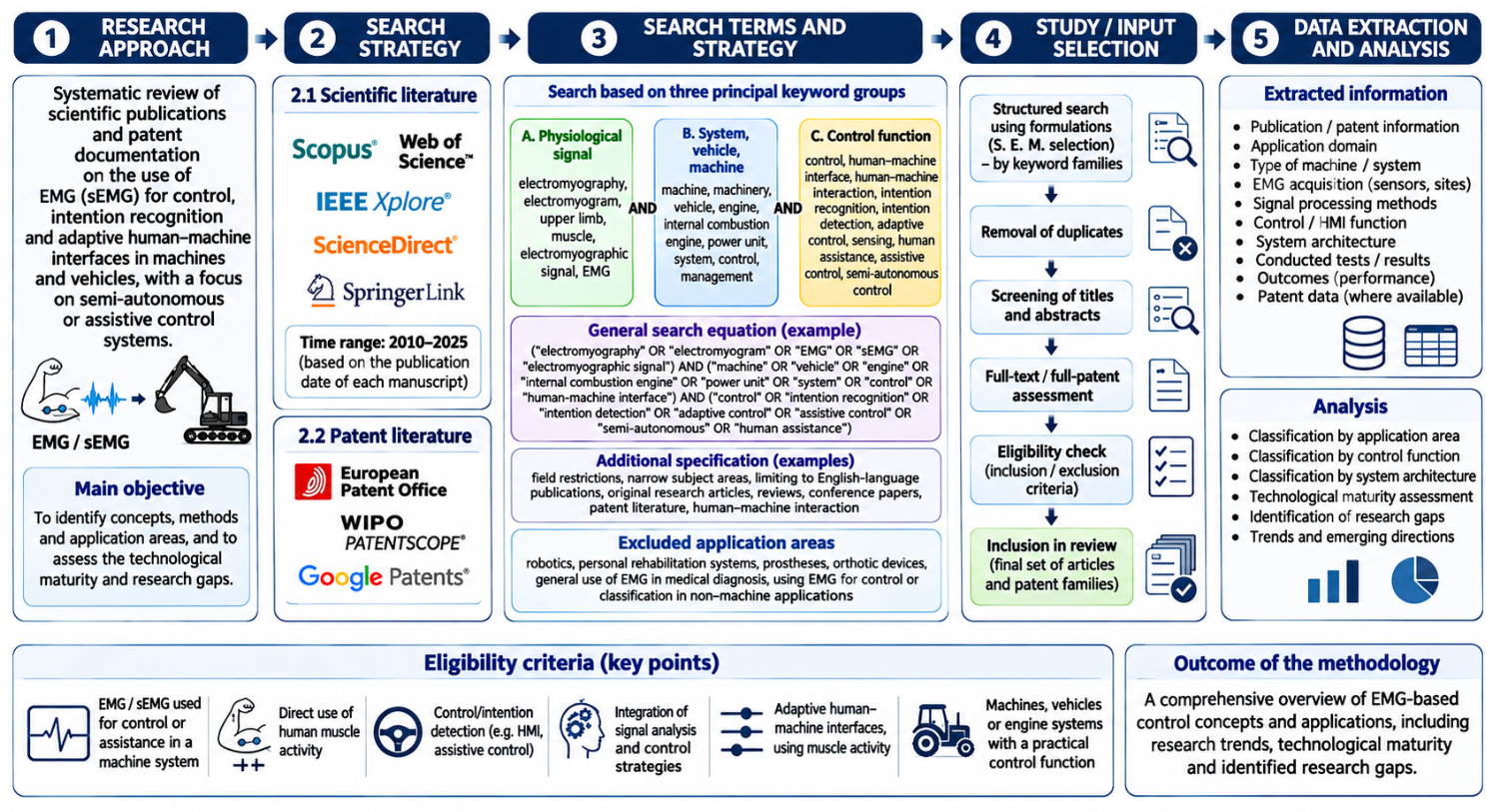
On this basis, the reviewed solutions were used to assess the feasibility of incorporating EMG-derived information into supervisory human-in-the-loop control architectures for internal combustion engine-powered machines and to identify the most promising directions for future development. The overall methodological framework is presented in Figure 4.
Figure 4.
Methodological framework for the review of scientific literature and patents on EMG-based machine control (generated with AI).
3. Electromyographic Signals as Human–Machine Interface Inputs
3.1. Role, Physiological Basis, and Acquisition of EMG Signals in Human–Machine Interfaces
Electromyographic signals differ from other physiological signals used in human–machine interfaces (HMIs). In contrast to signals describing the physiological state of the operator, such as heart rate or skin conductance, EMG is directly associated with activation of the motor system and therefore contains information related to an intended or executed muscular action. sEMG records the electrical potentials generated by active motor units through electrodes positioned on the skin. The resulting signal contains information on the timing and intensity of muscle activation and, when several muscles or spatially distributed electrodes are considered simultaneously, on characteristic activation patterns associated with particular movements. This relationship has made sEMG particularly attractive for interfaces in which voluntary human activity must be translated into commands for an external device [26,45]. Recent developments demonstrate that sEMG can support not only simple activation detection but also discrete gesture recognition, continuous movement estimation, proportional control, and prediction of intended actions.
From the perspective of machine control, this distinction is important. An EMG signal does not need to be interpreted as a precise biomechanical measurement of muscle force to serve as a useful control input. Depending on the architecture of the HMI, the signal may be used to detect whether an operator intends to initiate an action, identify which action is intended, estimate the magnitude of the requested action, or continuously reconstruct a movement-related variable. Consequently, EMG-based interfaces can operate at different information levels, ranging from binary activation commands to multidimensional continuous control. This flexibility is particularly relevant to machines in which conventional operator inputs currently provide commands such as start/stop, direction, speed, torque demand, tool activation, or working intensity.
Skeletal muscle contraction results from neural excitation transmitted through motor neurons to muscle fibers. The action potentials generated by activated muscle fibers produce spatially and temporally overlapping electrical fields. Surface electrodes record the superposition of these motor-unit action potentials after they propagate through muscle, connective tissue, subcutaneous fat, and skin. Accordingly, sEMG should not be interpreted as a direct measurement of muscle force or motor-neuron discharge. Signal amplitude is influenced by recruitment and discharge characteristics of motor units as well as by anatomical, physiological, and measurement-related factors. Nevertheless, sEMG contains sufficient information about neural drive and muscular activation to provide a practical basis for myoelectric control [45].
Two general approaches can be distinguished: intramuscular EMG and surface EMG. Intramuscular methods offer access to activity from individual or relatively small groups of motor units and can reduce some problems associated with signal superposition. Their invasive character, however, makes them unsuitable for most routine operator–machine interfaces. For wearable HMIs intended for repeated use by healthy machine operators, sEMG is therefore the more suitable approach for practical applications. Contemporary reviews of myography-based interfaces similarly identify surface acquisition as the dominant EMG modality for wearable HMI applications.
Traditional sEMG acquisition uses a limited number of bipolar electrodes positioned over selected muscles. Such an approach remains attractive for machine control because it limits hardware complexity, computational demand, cabling, and preparation time. However, it requires relatively reproducible electrode placement and prior knowledge of which muscles contain information relevant to the intended command. This creates a trade-off between simplicity and robustness.
An alternative approach is high-density surface electromyography (HD-sEMG or HDEMG), in which arrays of electrodes acquire spatial distributions of myoelectric activity. High-density systems reduce dependence on precise selection of individual muscles and provide substantially more spatial information for pattern-recognition algorithms. Tacca et al. in 2024 [46] developed a wearable forearm sleeve containing up to 150 electrodes and reported classification of 37 hand movements with an accuracy of approximately 97% in sequential trials. The same system also estimated joint angles continuously, achieving coefficients of determination of approximately 0.88 under sequential conditions. These results demonstrate that EMG can simultaneously provide categorical information about the type of intended movement and continuous information about its magnitude or trajectory.
A related approach was recently demonstrated for mobile robot control. Yang et al. (2025) [47] used high-density EMG as the control input for an eight-degree-of-freedom mobile manipulator. The wearable interface was designed to translate myoelectric activity into commands enabling users to perform household and assistive tasks. Of particular relevance to machine-control applications is the reduced requirement for precise electrode placement offered by spatially distributed sensing [47].
The development of wearable hardware has further changed the practical feasibility of EMG-HMIs. Kaifosh et al. (2025) [48] demonstrated a wrist-worn device incorporating 48 dry electrode contacts arranged into 16 bipolar channels, integrated analog electronics, wireless Bluetooth communication, and real-time signal processing. The device operated at a sampling frequency of 2 kHz and was designed for rapid donning without laboratory-style electrode preparation. Using data obtained from thousands of participants, the authors demonstrated generic models capable of decoding both discrete and continuous commands without subject-specific calibration for new users [48].
For working machinery, wearable dry-electrode systems are particularly important because interfaces requiring careful skin preparation, conductive gel, and individually positioned electrodes are unlikely to be accepted in routine field operation. Therefore, the technological trajectory from individually positioned wet electrodes toward dry multi-electrode bands, sleeves, or integrated workwear is likely to be critical for transferring EMG control from laboratory environments to agricultural, forestry, construction, or industrial machinery.
3.2. EMG Signal Processing, Normalization, and Feature Extraction
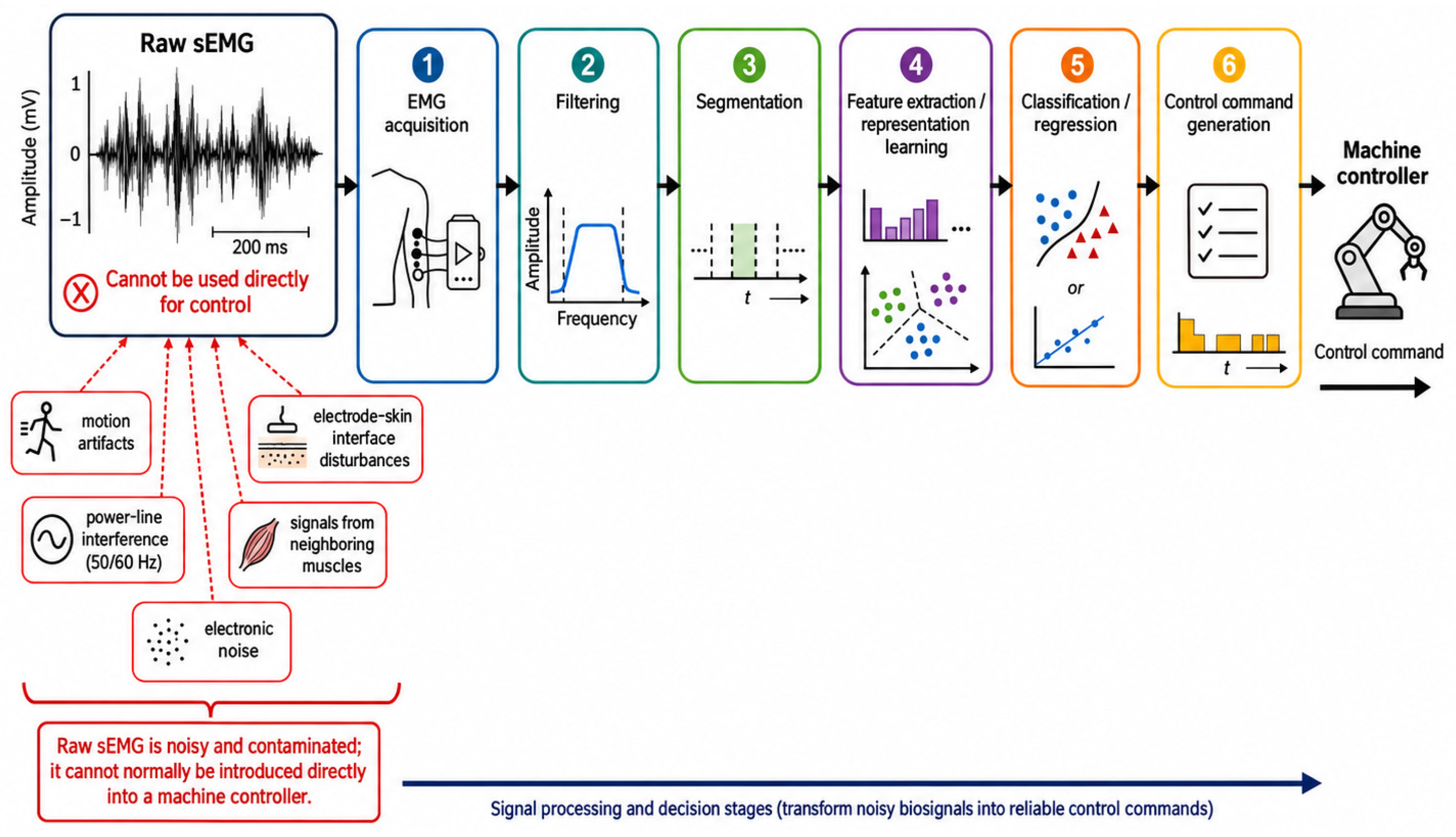
Raw sEMG cannot normally be introduced directly into a machine controller. The myoelectric signal is affected by motion artifacts, power-line interference, electronic noise, electrode–skin interface disturbances, and signals originating from neighboring muscles. Therefore, a typical EMG-based HMI comprises a sequence of processing stages, including EMG acquisition, filtering, segmentation, feature extraction or representation learning, classification or regression, and generation of the control command (Figure 5).
Figure 5.
Typical processing pipeline in an EMG-based human–machine interface, from raw sEMG acquisition to generation of the machine-control command (generated with AI).
The exact filtering parameters depend on the acquisition hardware and application. High-pass filtering is commonly used to attenuate low-frequency motion artifacts, whereas low-pass filtering and hardware bandwidth limitation reduce high-frequency noise. Notch filtering may additionally be applied when power-line interference is significant. Contemporary wearable implementations demonstrate that preprocessing can increasingly be integrated directly into the sensing device. For example, the neuromotor wrist interface described by Kaifosh et al. in 2025 [48] incorporated analog 20-Hz high-pass and 850-Hz low-pass filtering, while subsequent processing for the decoding pipeline included additional high-pass filtering and spectral processing [48].
For conventional amplitude-based control, the rectified signal may be smoothed or transformed into an envelope. Root mean square (RMS) and mean absolute value (MAV) are particularly common indicators of short-term activation magnitude. Pattern-recognition approaches generally segment the signal using overlapping windows and extract several features from each channel. Window duration introduces an important trade-off in control-system design: longer windows provide more information and may improve classification robustness, whereas shorter windows reduce response delay. In applications involving engine or machine control, latency must therefore be considered together with classification accuracy because excessive processing delay can make the physiological input less useful than the conventional mechanical command.
Normalization constitutes a separate methodological issue. In biomechanical studies, EMG amplitude is frequently expressed relative to a maximum voluntary contraction (MVC) or another reference contraction in order to improve comparisons among participants, muscles, or measurement sessions. Consensus recommendations emphasize that the choice of normalization procedure depends on the purpose of the measurement and that no reference method is universally optimal [49].
The role of normalization is different in an EMG-based controller. A controller does not necessarily require physiologically standardized EMG amplitudes; it requires a stable mapping between the measured signal and the intended output. Consequently, systems may employ MVC-based normalization, task-specific reference contractions, statistical scaling, per-channel normalization, calibration gestures, or representation-learning methods that internally compensate for amplitude differences. This distinction is fundamental for the application considered in this review. A research system intended to compare muscular load between operators benefits from physiological normalization, whereas a control system may prioritize repeatability and robustness of the input–output mapping.
The selection of an appropriate EMG normalization method depends on the application field, the purpose of signal interpretation, and the requirements of the control system. Table 1 compares the main normalization approaches and identifies the preferred solutions for different application areas based on their functional requirements and reported limitations. Particular attention is given to distinguishing physiological amplitude normalization from statistical feature standardization and adaptive calibration used in real-time control.
Table 1.
Comparison of EMG normalization approaches across application fields and their suitability for machine-control applications.
Recent studies confirm that EMG normalization should be selected according to the measurement or control objective. MVC-based methods remain useful for biomechanical comparisons and activation-based control, whereas z-score and min–max normalization are widely applied in machine-learning-based intention recognition. Sliding-window normalization additionally offers a promising approach for reducing the effects of electrode displacement and signal variability. For combustion-engine-powered machines, combining task-specific calibration with adaptive normalization appears particularly relevant; however, its effectiveness in predicting engine power demand requires experimental validation.
The most recent developments indicate a shift away from mandatory user-specific calibration. Large-scale generic models can learn representations that are partly invariant to individual anatomy and sensor placement. In the Nature study by Kaifosh et al. in 2025 [48], substantial differences were nevertheless observed between participants and between repeated donning sessions. The same gesture produced different sEMG patterns as a result of sensor location, anatomical characteristics, physiology, and behavioral execution. Increasing the diversity and volume of training data substantially improved cross-user performance [48].
This issue is directly relevant to machine operators. An industrially useful EMG interface should ideally tolerate removal and replacement of the sensor, different operators, arm position changes, sweating, vibration, and long-term use. Current research identifies electrode displacement, signal noise, contraction-force variation, fatigue, and inter-session variability as major sources of performance degradation. Recent algorithms specifically address electrode shift and loosening, while calibration-free and few-shot adaptation methods attempt to reduce the requirement for repeated user-specific training.
For internal combustion engine-powered working machines, the selection of preprocessing and normalization methods is particularly important for ensuring reliable recognition of operator intention under variable operating conditions. Stable signal interpretation and sufficiently low processing latency are essential if EMG-derived information is to support early prediction of machine power demand and anticipatory adjustment of engine speed or torque. Therefore, the suitability of these methods should be evaluated not only in terms of signal classification performance but also their robustness and response time during actual machine operation.
The transformation of an EMG recording into a machine command depends strongly on the representation of the signal. Three broad categories can be distinguished: time-domain features, frequency-domain or time–frequency features, and features learned automatically by machine-learning models.
Time-domain parameters are computationally inexpensive and are therefore particularly attractive for embedded real-time control. Frequently used parameters include mean absolute value (MAV), root mean square (RMS), waveform length (WL), zero crossings (ZC), and slope sign changes (SSC). Different combinations of these features have repeatedly been applied in myoelectric pattern-recognition systems because they jointly describe signal amplitude, complexity, and changes in waveform structure.
Frequency-domain variables contain information related to the distribution of signal power. Mean frequency, median frequency, power spectral density, and spectral moments are among the commonly used parameters. These features can be particularly useful when changes in muscular state, including fatigue, have to be distinguished from intended changes in control input. This is relevant to long-duration machine operation because fatigue-induced alterations in the EMG spectrum may otherwise be interpreted incorrectly as changes in operator command. Recent research confirms that muscle fatigue can materially affect the performance of models estimating movement-related variables from sEMG.
Time–frequency transformations and spatial features become more important as the number of electrodes increases. HD-sEMG creates a spatial map of electrical activity that can be processed similarly to multidimensional image or time-series data [64]. Convolutional neural networks, recurrent neural networks, long short-term memory networks, transformers, and combinations of these architectures are increasingly used to learn discriminative representations directly from raw or minimally processed EMG data. Deep-learning approaches reduce dependence on manually selected features, although their higher computational burden and requirement for extensive training data remain relevant constraints for embedded machine controllers.
For a combustion-engine-powered machine, this trade-off deserves particular attention. A controller intended only to recognize a small number of operator states, such as low-, medium-, and high-demand conditions, may not require a complex deep neural network. Conversely, predicting continuous future torque demand from multiple muscles may justify a considerably more advanced decoder. Therefore, selection of the EMG representation should be driven by the control variable and required response time rather than by classification accuracy alone.
In combustion-engine-powered machinery, relatively simple time-domain features could support rapid detection of intended working actions, whereas more advanced temporal and multichannel representations may enable continuous prediction of short-term machine power demand. This distinction is important because the selected EMG features should provide information that allows the supervisory controller to anticipate changes in engine load and adjust the operating state accordingly. The potential advantage of more complex models should therefore be assessed against their computational requirements, processing latency, and incremental predictive value compared with conventional machine sensors.
3.3. Operator-Intention Recognition and EMG-Based Control
The most important feature of EMG from the perspective of adaptive machine control is its ability to provide information associated with motor intention. Electrical muscle activation occurs as part of the motor command chain and can therefore precede completion of the corresponding mechanical action. Patent and experimental research has explicitly exploited this temporal relationship to infer actions before they are fully executed. The CTRL-labs patent family [65], for example, describes the use of trained statistical models to analyze neuromuscular signals and predict onset of a motor task, emphasizing that EMG can contain detectable information before observable motion occurs.
Vehicle research provides particularly relevant evidence. Ju et al. (2021) [33] investigated EMG signals of the lower limb to distinguish emergency braking, soft braking, and normal driving. Spectral and temporal EMG characteristics were processed using common spatial patterns, feature selection, and regularized linear discriminant analysis. Emergency braking intention was detected, on average, approximately 156 ms before the actual braking behavior, with an accuracy of approximately 95.7% when spectral features were used. This result is important because it demonstrates that EMG can provide not only information on what the operator is doing but also information useful for anticipating an imminent machine-control action [33].
The same concept has been explored in steering. Nacpil et al. in 2019 and 2020 [36,37] demonstrated sEMG-based steering assistance using muscle activity from the driver’s arm, whereas subsequent research evaluated EMG-controlled automobile steering. These studies show that the muscular signal can be mapped onto a continuously changing vehicle-control variable rather than being limited to simple binary switching [36,37].
Earlier work by Gomez-Gil et al. (2011) [35] demonstrated an EMG-based HMI for steering an agricultural tractor. Although the sensing and processing technology available at that time was substantially less advanced than contemporary wearable systems, the study remains significant because it confirms the feasibility of applying muscular signals directly in the control loop of a combustion-engine-powered agricultural machine. The EMG-controlled function was steering rather than engine operation, but the work establishes an important technological precedent for integrating physiological control inputs into real working machinery [35].
From the perspective of engine control, early recognition of operator intention represents a potentially more important capability than replacement of a conventional joystick or accelerator. If muscular activation predicts an imminent working action before the mechanical control reaches its final position or before load at the working tool changes, a supervisory controller may have additional time to prepare the engine–powertrain system for the expected demand. This could theoretically include pre-emptive adjustment of engine speed, torque reserve, transmission state, hydraulic pump displacement, hybrid power assistance, or transient engine-control parameters. Such an application differs fundamentally from using EMG merely as an alternative switch.
For internal combustion engine-powered machines, the practical significance of EMG-based intention recognition depends on whether muscular activity can predict operator-induced power demand earlier than conventional control and machine-state signals. The prediction advantage demonstrated in vehicle braking studies [33] cannot be directly generalized to working-machine applications because operator actions, mechanical loads, and engine response characteristics differ. Consequently, future research should determine whether the additional prediction time provided by EMG is sufficient to improve engine power matching and reduce fuel consumption or exhaust emissions without compromising machine productivity and operational safety.
Existing EMG-HMI solutions can be divided into two principal control paradigms: discrete classification and continuous or proportional estimation.
In discrete control, the decoder assigns each signal window to a predefined class. Examples include rest, left, right, start, stop, grasp, release, or activation of a specific machine function. This approach is relatively robust and naturally compatible with functions that are normally controlled by switches or buttons. The disadvantage is the loss of information about the magnitude of the operator’s intended action.
Continuous control instead estimates a continuously varying variable from EMG. Regression-based approaches have been used to estimate joint angles, force, velocity, or simultaneous movement of multiple degrees of freedom. This approach more closely resembles conventional proportional machine interfaces such as accelerator pedals and joysticks. Current research demonstrates simultaneous and proportional control of multiple degrees of freedom from EMG, including regression frameworks that continuously estimate human motor intention.
The distinction has direct consequences for future combustion-engine control. Discrete EMG commands could select an engine operating mode, activate an implement, enable a temporary boost mode, or initiate an automatic working sequence. Continuous EMG information could instead contribute to demanded engine torque, engine speed, hydraulic flow, vehicle velocity, or another power-related reference value.
A third approach, increasingly important in current HMI research, combines the two concepts. A classifier identifies the intended action, whereas a regression- or amplitude-based estimator determines its intensity. For example, Tacca et al. (2024) [46] demonstrated both accurate gesture classification and continuous joint-angle estimation using the same HD-sEMG platform [46].
Large-scale neuromotor interfaces demonstrate that these modes can coexist in a single wearable device. Kaifosh et al. in 2025 [48] reported closed-loop performance of 0.88 gesture detections per second for discrete input and 0.66 target acquisitions per second for continuous navigation, together with handwriting decoding at 20.9 words per minute. Personalization further improved handwriting performance by 16%. These results illustrate the substantial information bandwidth potentially available from sEMG and show that the signal is not intrinsically limited to simple on/off control [48].
3.4. Multimodal and Adaptive Interfaces
An important direction in EMG-based HMI development is the combination of myoelectric information with other signals. EMG can be complemented by inertial measurement units (IMUs), force sensors, vision-based systems, electroencephalography (EEG), joint-angle measurements, or conventional machine sensors. The objective is to compensate for limitations inherent to any single sensing modality.
This approach is highly relevant to machine applications. EMG alone may indicate muscular activation but does not provide complete information about the state of the machine or its environment. Conversely, machine sensors provide information about engine speed, engine load, hydraulic pressure, vehicle motion, or working resistance but normally do not directly measure the operator’s physiological preparation for an action. Sensor fusion can therefore combine operator intention with machine state.
Experimental research supports the advantage of such fusion. Multimodal combinations of EMG and visual information have improved recognition of intended grasping actions compared with either modality alone, while hybrid EMG–EEG interfaces have been investigated for robust intention detection.
Adaptive control introduces another layer. In a conventional EMG interface, the user must learn how to generate signals that the fixed decoder recognizes. In an adaptive interface, the decoder can also change in response to the user. This creates a co-adaptive human–machine system. Recent work has demonstrated that both user adaptation and decoder adaptation affect closed-loop performance and that the decoder can be optimized to shape the resulting human–machine interaction.
For an internal combustion engine-powered machine, the most promising architecture is therefore unlikely to rely on a direct EMG-to-engine-actuator pathway, but rather on the integration of EMG signals, conventional operator controls, machine state, and engine state within a supervisory controller that determines the demanded operating state of the engine–machine system (Figure 6).
Figure 6.
Conceptual supervisory control architecture in which EMG supplements conventional operator, machine-state, and engine-state signals without directly controlling engine actuators (generated with AI).
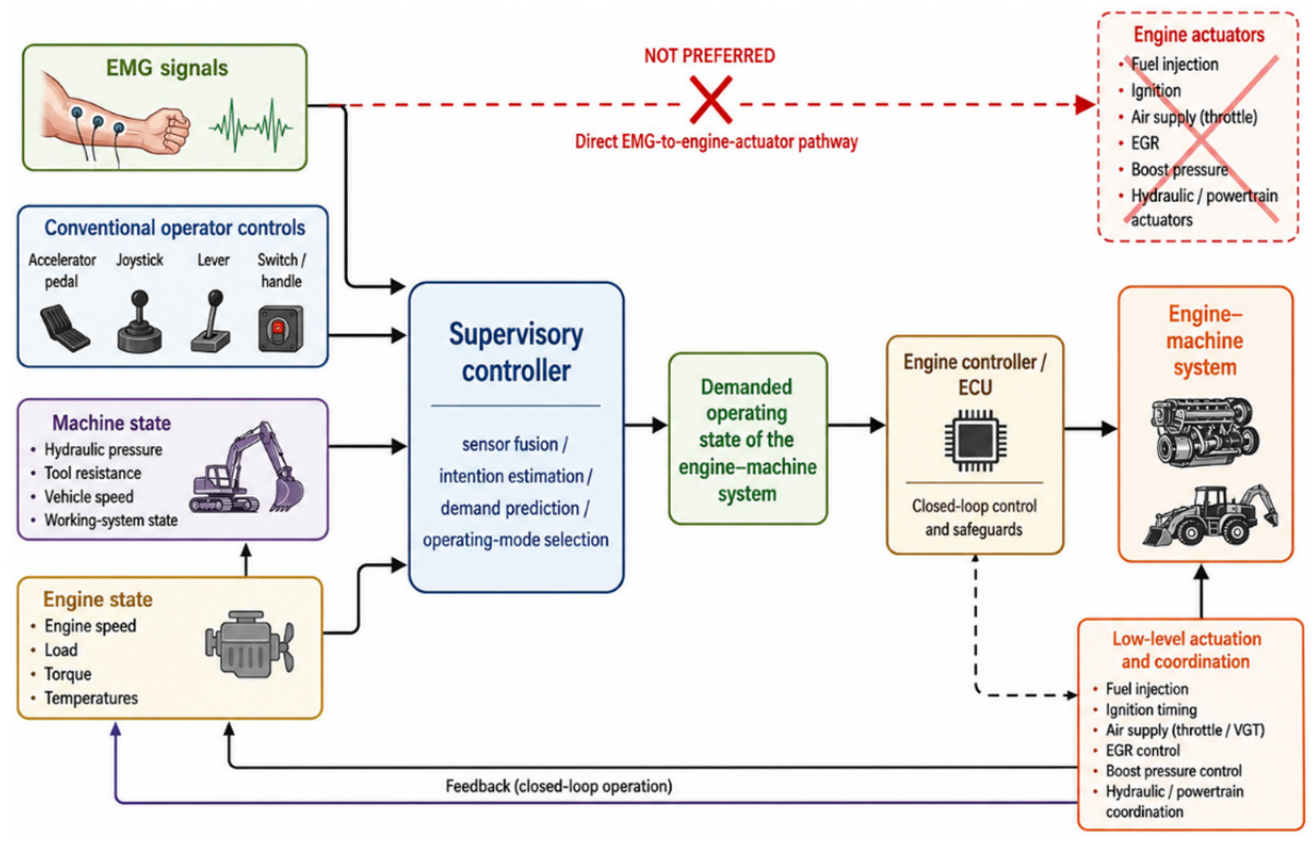
This architecture retains conventional controls as a safety-critical reference while allowing EMG to provide anticipatory or supplementary information.
3.5. Patent Landscape of EMG-Based Human–Machine Interfaces
The reviewed patents demonstrate several technological approaches potentially transferable to combustion-engine-powered machinery. Wearable EMG interfaces with adaptive sensor selection and gesture recognition are described in US8170656B2 [66] and US20180153430A1 [67], whereas US9278453B2 [68] introduces multimodal sensing combining EMG with inertial measurements. The CTRL-labs patent family US10409371B2 [65] further extends these concepts toward predicting motor intention from neuromuscular activity. Vehicle-oriented solutions, including CN105522986B/KR102234955B1 [69] and US10426370B2 [70], demonstrate the proposed use of EMG-derived information for steering, braking, and motion control. From the perspective of the present review, these developments are relevant primarily as examples of sensing, intention recognition, and control architectures that could be integrated into supervisory machine-control systems. However, they do not provide direct experimental evidence of improved fuel efficiency or reduced exhaust emissions through EMG-informed engine control. Their functional characteristics and implementation requirements are summarized in Table 2.
Table 2.
Overview of selected patent concepts involving EMG-based machine and vehicle control.
Table 2 summarizes the selected patent concepts, their use of EMG signals, and their relevance to machine and vehicle control.
The implementation costs of the reviewed patented solutions depend primarily on the number and type of EMG sensors, additional sensing modalities, signal-processing requirements, software complexity, and integration with the controlled system. Solutions employing compact EMG interfaces may involve moderate implementation costs, whereas multimodal wearable systems and vehicle-control architectures are expected to require greater investment, particularly due to hardware integration and functional-safety requirements. However, the patent documents do not provide sufficient standardized economic data for a quantitative cost comparison. Therefore, the cost levels presented in Table 2 should be interpreted as qualitative engineering estimates rather than verified manufacturing or commercialization costs. A reliable economic assessment would require detailed hardware specifications, production volumes, development expenditures, and system-validation costs.
The comparison between patents and scientific literature reveals a consistent technological progression. Early systems primarily translated easily distinguishable muscular contractions into discrete commands. Subsequent solutions introduced multichannel sensing, pattern recognition, sensor fusion, and proportional control. Current developments increasingly focus on user-intention prediction, generic cross-user models, high-density acquisition, continuous estimation, and adaptive decoding. The patent literature mirrors this development and, importantly, confirms industrial interest in transferring EMG from medical and assistive applications to general device, machine, and vehicle control.
However, neither the reviewed scientific studies nor the identified patent families provide strong evidence that EMG-derived information has been systematically integrated into the engine-management layer of an internal combustion engine-powered machine for the purpose of reducing fuel consumption or emissions. Existing vehicle solutions primarily use EMG to replace or supplement steering, braking, gesture, or general interface functions. Thus, the technological capability to acquire muscular activity, recognize operator intention, and convert it into reliable machine commands is comparatively well established, whereas its connection to power-demand prediction and energy-oriented internal combustion engine control remains largely unexplored.
This distinction defines a critical transition for the present review. The question is no longer whether an EMG signal can serve as a human–machine interface input—the literature and patent evidence clearly demonstrate that it can. The relevant question is whether information available from this signal can be used at a higher supervisory level to improve the interaction between operator demand, machine workload, and the operating state of an internal combustion engine.
4. EMG-Based Control of Machines and Drive Systems
4.1. Robotic Manipulators and Human–Robot Interaction
Studies of robotic manipulators demonstrate two functions of EMG-based control that may be transferable to working machinery. First, muscular activation patterns can be classified into discrete commands for mobile and industrial inspection robots [47,72]. Second, EMG-derived estimates of voluntary effort or joint torque can be incorporated into cooperative and model-predictive controllers to adjust actuator assistance according to human demand [61,73].
The second approach is particularly relevant to internal combustion engine-powered machines because a similar supervisory controller could use EMG-derived operator-demand estimates to anticipate hydraulic or mechanical power requirements. However, the reviewed robotic applications primarily demonstrate control feasibility and task performance rather than improvements in power-source efficiency. Consequently, their results support the technological feasibility of EMG-informed control architectures but do not provide direct evidence of reduced fuel consumption or exhaust emissions.
4.2. EMG-Based Control of Powered Wheelchairs and Assistive Mobile Machines
Powered wheelchairs represent another important group of mobile machines in which EMG has been used as a direct control input. Unlike robotic manipulators, wheelchair systems require simultaneous control of propulsion and steering, which makes them particularly valuable as examples of EMG-based control of a complete mobile platform. Different studies have demonstrated commands corresponding to forward and reverse motion, left and right turning, stopping, and in some systems continuous regulation of speed and direction [58,59].
Manero et al. (2022) [59] evaluated surface-EMG control of motorized wheelchairs with particular emphasis on users with amyotrophic lateral sclerosis. Their study is significant because it investigated EMG as a practical alternative control modality for users whose ability to operate conventional wheelchair interfaces may deteriorate. The work therefore provides evidence that myoelectric signals can be integrated into the command layer of an electrically driven mobility platform rather than being used solely for offline movement classification [59].
Iqbal et al. in 2024 [58] developed a hand-gesture control system for an electrically powered wheelchair using sEMG signals recorded with a Myo armband. Five states were mapped onto the principal wheelchair commands: forward, reverse, left, right, and stop. The authors compared user-dependent linear regression and regularized linear regression models with user-independent decision-tree and multi-class support-vector-machine classifiers. The user-independent MC-SVM achieved approximately 99.05% accuracy and precision, while all six participants successfully controlled the wheelchair without collisions during the experimental trials [58].
The wheelchair example illustrates an important difference between machine-function control and power-source control. EMG determines the desired movement of the machine, while the low-level controller subsequently translates the command into electrical motor operation. Therefore, the biological signal indirectly determines propulsion demand, but it does not normally optimize motor efficiency or energy consumption. The reviewed wheelchair studies were primarily designed to improve accessibility, autonomy, and control feasibility rather than to minimize the energy required to perform the requested movement [58,59].
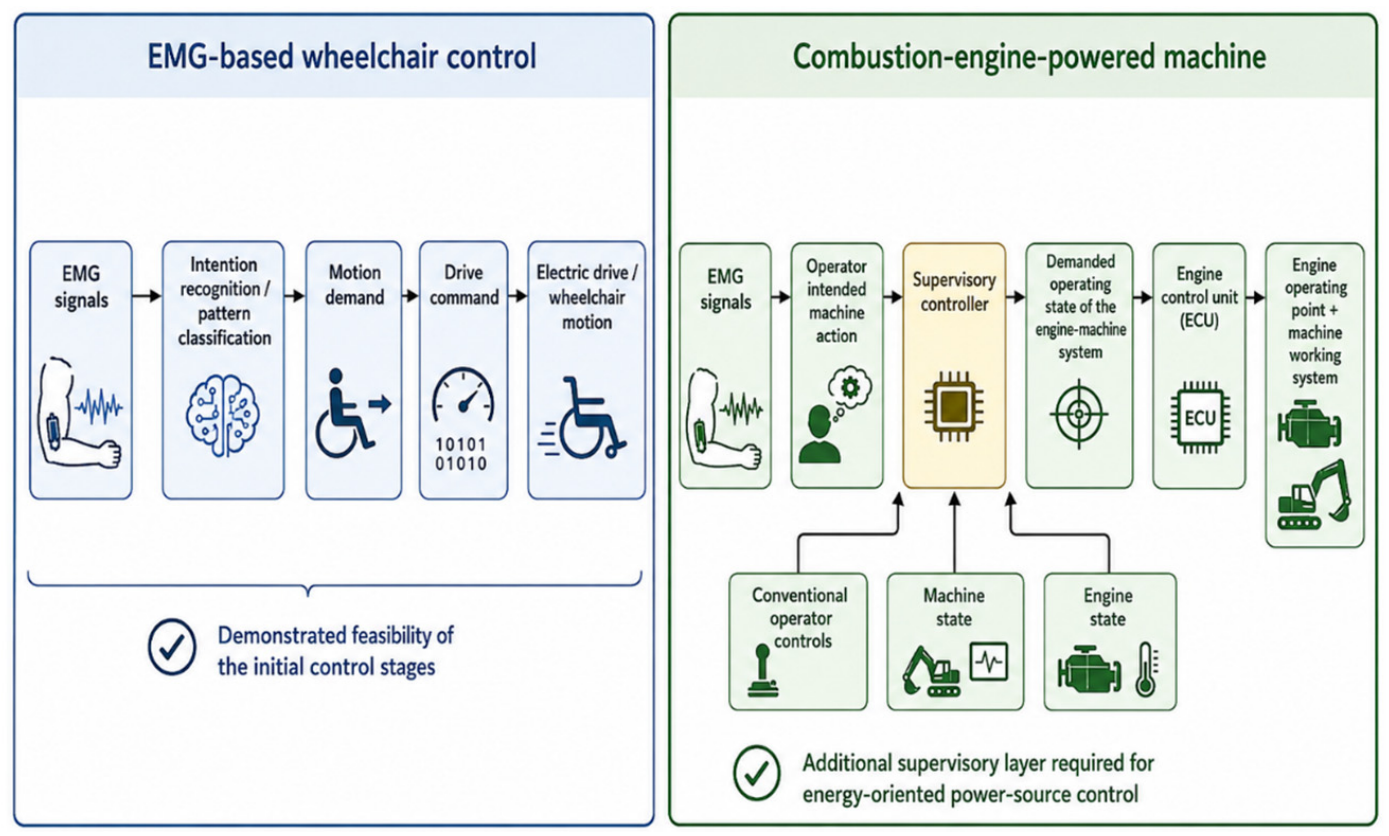
This distinction is relevant to combustion-engine-powered machinery. An analogous system could use EMG to determine the operator’s intended machine action, but an additional supervisory layer would be required if this information were to influence the operating point of the power source. Thus, wheelchair research demonstrates the feasibility of the initial stages of the control chain, in which EMG signals are translated into motion demand and subsequently into drive commands, but it does not yet address energy-oriented optimization of the drive system itself [58,59] (Figure 7).
Figure 7.
Comparison between EMG-based wheelchair control and a proposed supervisory architecture for combustion-engine-powered machinery (generated with AI).
4.3. EMG-Controlled Exoskeletons and Power-Assist Systems
Research on EMG-controlled exoskeletons demonstrates that muscular activation can be used to continuously adjust actuator assistance, estimate required torque, and adapt movement-related control parameters [51,70,71,72]. Young et al. [55] reported a 13% reduction in human metabolic cost using proportional myoelectric control, while other studies demonstrated EMG-based adaptation of movement speed, torque estimation, and assistive actuator output [54,74,75]. These findings are relevant to combustion-engine-powered machinery because they establish the principle of adapting externally supplied mechanical assistance to information derived from human muscular activity. A comparable approach could be used to anticipate operator-induced power demand and support supervisory engine control. However, reductions in human metabolic cost and improvements in biomechanical performance cannot be directly interpreted as reductions in fuel consumption or exhaust emissions.
4.4. EMG-Based Vehicle Control
Vehicle-related applications demonstrate that EMG can also be used in systems with substantially greater inertia, safety requirements, and operating complexity than laboratory robots or rehabilitation devices. Reported applications include control of automotive functions, steering assistance, detection of braking intention, and adaptive shared steering [33,34,37,74].
De Freitas et al. (2019) [74] developed a proof-of-concept system in which automotive functions were controlled using gestures identified from sEMG. The signals were processed using low-cost embedded hardware based on Arduino and Raspberry Pi platforms, while an Extreme Learning Machine classifier translated the detected muscular patterns into vehicle-related commands. The work demonstrated real-time feasibility but remained primarily a prototype intended to show the possibility of replacing or supplementing conventional hand-operated vehicle controls [74].
Nacpil and Nakano (2020) [37] advanced this concept by experimentally evaluating an sEMG-controlled steering-assistance system on an actual automobile. A Myo armband with eight dry electrodes recorded forearm activity, predefined gestures were translated into steering commands, and a closed-loop electromechanical system controlled steering-wheel angle. During low-speed tests, the EMG interface showed overall path-following performance comparable with conventional steering, although performance depended on the specific maneuver. The study therefore demonstrated physical vehicle steering based on a commercially available wearable sEMG interface rather than only simulated vehicle control [37].
From the perspective of adaptive drive control, EMG-based prediction of driver intention may be more important than substitution of the steering wheel. Ju et al. in 2021 [33] analyzed lower-limb EMG to distinguish emergency braking, soft braking, and normal driving. Their method combined temporal and spectral characteristics of EMG with common spatial pattern processing and classification. The authors reported that emergency braking intention could be identified before execution of the corresponding mechanical braking action, demonstrating that muscular signals can provide anticipatory information to an advanced driver-assistance system [33].
Wang et al. in 2021 [34] demonstrated another architecture in which sEMG was not used as the sole steering command but was incorporated into an adaptive shared-control strategy. Driver muscular activity was used in the assessment and adaptation of steering assistance, while the final vehicle-control action resulted from interaction between the driver and the automated system. This architecture is particularly relevant to the present review because EMG supplements conventional control rather than replacing it, which is more compatible with safety-critical machine applications [34].
The available vehicle studies therefore reveal a progression from EMG as an alternative control switch toward EMG as an anticipatory and adaptive input to supervisory control. However, the reported objectives have primarily concerned accessibility, steering performance, driver workload, and safety. Direct optimization of propulsion energy or fuel consumption using EMG-derived information has not been demonstrated in these studies [33,34,37,74].
4.5. Agricultural, Mining, and Material-Handling Machines
Applications involving working machinery are especially important for assessing the feasibility of EMG-based control in internal combustion engine-powered systems. In contrast to rehabilitation robots and electrically powered wheelchairs, agricultural, construction, mining, and material-handling machines frequently combine propulsion with high-power working actuators and strongly variable external loads. Nevertheless, published experimental studies directly concerning EMG-based control of such machines remain limited [35,72].
An early example was reported by Gomez-Gil et al. (2011) [35], who developed an EMG-based human–machine interface for steering an agricultural tractor. The work demonstrated that muscular activity could be translated into steering commands for a real agricultural machine. Although the EMG interface controlled the steering function rather than the internal combustion engine, the study established that myoelectric signals can be integrated into the control architecture of a conventional working vehicle operating outside the typical medical or laboratory context [35].
A more recent example in the mining sector is the system proposed by Tong et al. in 2023 [72] for controlling a coal-mine inspection manipulator using sEMG-based gesture recognition. Six-channel sEMG acquisition combined with a multistream convolutional neural network (CNN) enabled the recognition of operator commands intended for the inspection manipulator. This application indicates that EMG-based interfaces can be considered for remote machine control in environments where conventional direct operation may be difficult or undesirable [72].
Patent literature indicates broader industrial interest than is currently visible in journal publications. Deere & Company’s patent US10162422B2 [75], entitled Control of Machines Through Detection of Gestures by Optical and Muscle Sensors, describes control of material-handling equipment using wearable gesture sensors that can include EMG electrodes together with gyroscopes, accelerometers, and magnetometers. The disclosed commands include opening and closing a bucket and swinging working equipment to either side. The system also incorporates command-validation and safety functions, including distance monitoring, geofencing, and interruption of actuator movement when safety criteria are violated [75].
The Deere & Company concept is particularly relevant because it represents a multimodal, safety-supervised EMG control architecture for heavy working machinery. Muscle activation is not connected directly to a hydraulic valve or engine actuator. Instead, EMG and other wearable-sensor data are interpreted as a command, evaluated by supervisory software, checked against safety conditions, and only then converted into actuator actions. Such an architecture is substantially more applicable to industrial machinery than unrestricted direct myoelectric actuation [75].
4.6. Implications for EMG-Based Drive-System Control
The reviewed applications show that EMG has already been successfully connected with multiple levels of machine control. At the simplest level, a muscular pattern is classified and converted into a discrete machine command, as demonstrated in wheelchair, vehicle, robotic, and industrial-manipulator applications. At an intermediate level, EMG determines continuous variables such as speed or actuator assistance. At the most advanced level, the signal is used to estimate human torque or intention and is incorporated into an adaptive or predictive supervisory controller [47,54,61,76].
From the perspective of drive systems, the most significant evidence is provided by proportional exoskeleton control. In these systems, EMG-derived information affects the instantaneous torque and mechanical power delivered by an actuator. Thus, the functional relationship linking muscle activity to estimated human demand, required machine torque, and ultimately actuator output power has already been experimentally demonstrated [54,55,77] (Figure 8).
A similar principle appears in mobile systems, although at a different control level. In wheelchairs, EMG determines propulsion direction and motion commands; in automobiles, it can determine steering actions or predict braking intention; and in working machinery, it can command actuators such as buckets or manipulators. In all these cases, muscular information ultimately changes the instantaneous demand imposed on one or more machine actuators [33,37,58,75].
However, an important technological gap becomes apparent when the reviewed control architectures are compared. In electrically powered assistive machines, EMG information is commonly connected relatively directly with electric actuator commands. In the identified agricultural and vehicle applications, EMG primarily affects steering, braking, working mechanisms, or other secondary machine functions. Within the literature analyzed in this review, no well-documented experimental study was identified in which an EMG-derived variable was incorporated directly into the supervisory control of an internal combustion engine to optimize engine speed, requested torque, throttle position, fuel consumption, or exhaust emissions. This conclusion concerns the corpus identified by the present search and should therefore be interpreted as a research-gap finding rather than as proof that no such technical concept has ever been proposed [33,35,37,74].
Figure 8.
Functional relationship between muscle activity, estimated human demand, required assistive torque, and actuator output in an EMG-controlled exoskeleton (generated with AI).
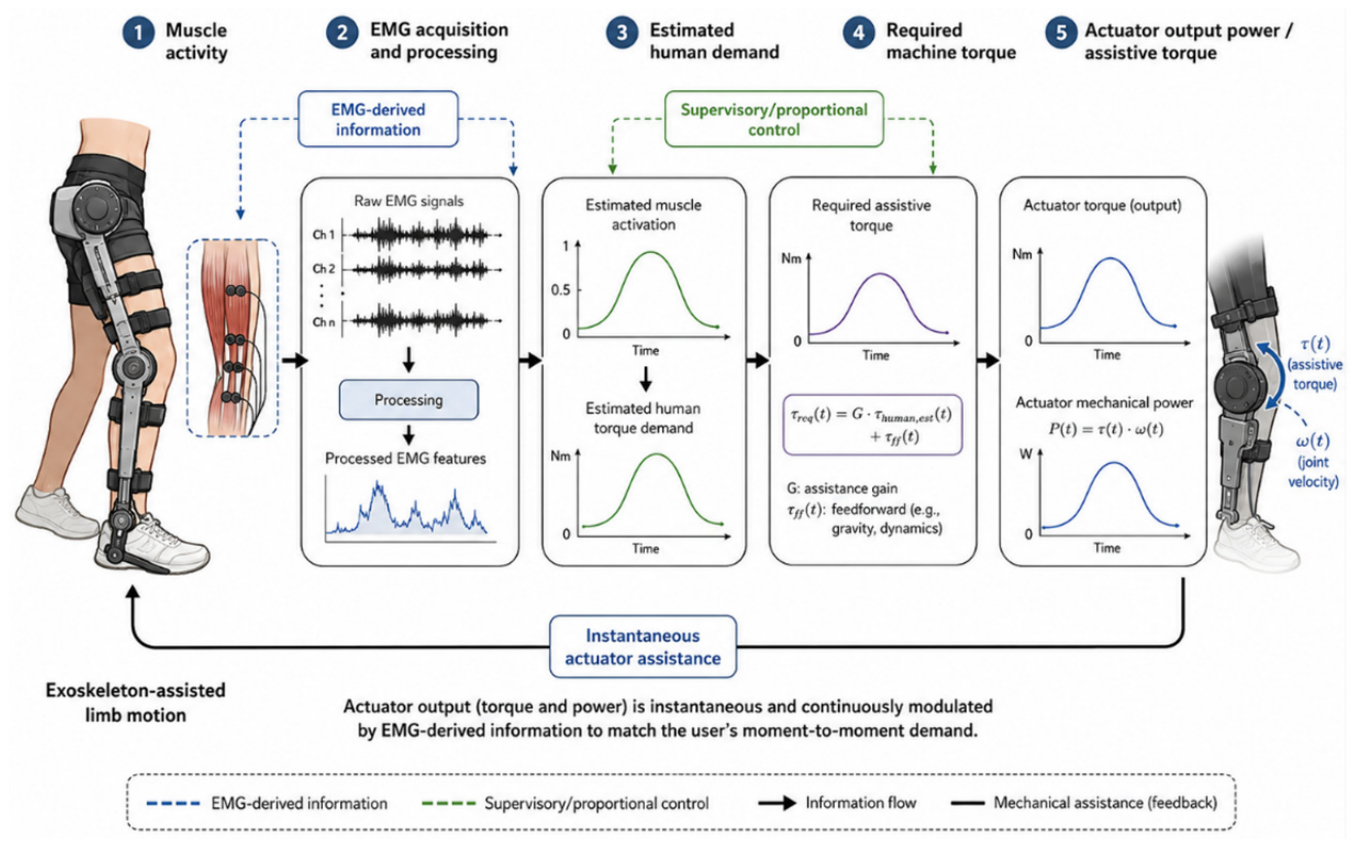
The technological evidence nevertheless indicates that most of the components required for such an architecture already exist independently. EMG can provide information on intended action and muscular demand; machine-learning algorithms can convert these signals into discrete or continuous control variables; adaptive controllers can determine the amount of actuator assistance required; and supervisory systems can combine physiological inputs with conventional machine and safety information before generating final commands [47,54,61,75].
Consequently, the critical research question for combustion-engine-powered machinery is not whether EMG can control a machine, because this capability is already supported by substantial experimental evidence. The unresolved question is whether the information contained in EMG can be used to predict or quantify the operator’s impending power demand sufficiently early and reliably to improve coordination between the working process and the power source. Such an approach would extend the established control chain from EMG-based machine command generation and actuator response toward a more comprehensive architecture in which EMG signals are used to estimate operator demand, translate it into machine power demand, and subsequently regulate the power source, thereby providing a basis for energy-oriented human-in-the-loop control of internal combustion engine-powered machines [33,54,61] (Figure 9).
Figure 9.
Extension of EMG-based machine control toward supervisory power-demand regulation of an internal combustion engine-powered machine (generated with AI).
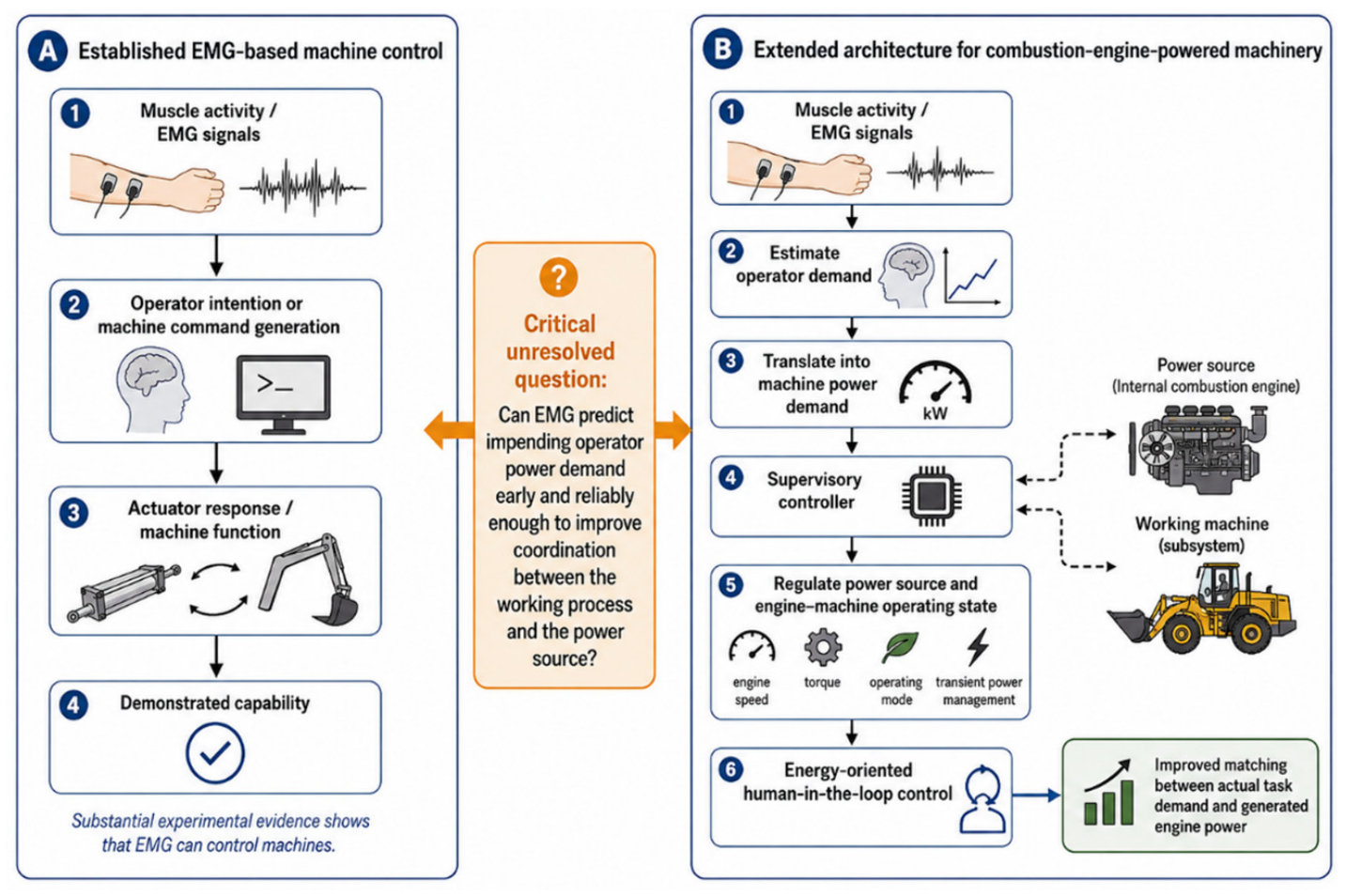
5. Internal Combustion Engine-Powered Machines as Human-in-the-Loop Systems
5.1. Human Operator and Conventional Engine Control Architecture
Internal combustion engine-powered working machines differ from many stationary engine applications because their operating state is continuously influenced by the human operator. In excavators, loaders, agricultural machines, forestry equipment, and similar non-road mobile machinery, the operator determines not only vehicle motion but also the timing, direction, and intensity of working-tool movements. These actions are translated through pedals, joysticks, levers, switches, or electronic interfaces into demands imposed on propulsion, hydraulic, mechanical, or auxiliary systems. Consequently, the instantaneous load applied to the engine is partly determined by the operator’s decisions and motor actions. For this reason, off-road machines should be considered human-in-the-loop systems in which the operator forms an external supervisory component of the overall powertrain control architecture [15,78,79].
The importance of the human contribution is particularly evident in hydraulic construction machinery. A diesel engine commonly provides mechanical power to one or more hydraulic pumps, while the operator determines actuator motion using joysticks or other command devices. The resulting hydraulic flow and pressure demand depend on both the requested movement and the resistance encountered by the working equipment. Therefore, relatively small differences in control timing, simultaneous actuator operation, digging trajectory, bucket filling, engine-speed setting, and cycle organization can alter the engine load history even when the same nominal task is performed [15,78,80].
Padovani et al. in 2024 [15], in their review of energy-efficient and low-pollutant off-road hydraulic machinery, emphasized that operator behavior can have a major influence on both fuel consumption and productivity. This observation is important because it indicates that energetic performance cannot be considered solely as a property of the engine or hydraulic architecture. The operating strategy imposed by the human operator determines how frequently the machine works at favorable or unfavorable combinations of engine speed, engine load, hydraulic pressure, and actuator demand [15].
Experimental and operator-training studies support this interpretation. Ng et al. in 2016 [78] showed that excavator productivity and fuel efficiency depended on controllable operating variables, including engine speed and digging conditions, and proposed an eco-operating approach intended to help operators achieve high productivity without unnecessary fuel use. Vahdatikhaki et al. in 2022 [80] similarly demonstrated that characteristics of excavator operation such as smoothness and execution of the digging cycle are relevant to productivity and fuel consumption and can be incorporated into feedback systems for operator training [78,80].
The conventional operator–machine relationship can therefore be represented as a cause-and-effect chain linking operator intent, physical control action, controller command, machine actuator demand, engine load, and the response of the engine control system (Figure 10).
Figure 10.
Conventional cause-and-effect chain in operator-controlled machinery, linking operator intent and physical control action with controller command, machine actuator demand, engine load, and the resulting response of the engine control system (generated with AI).
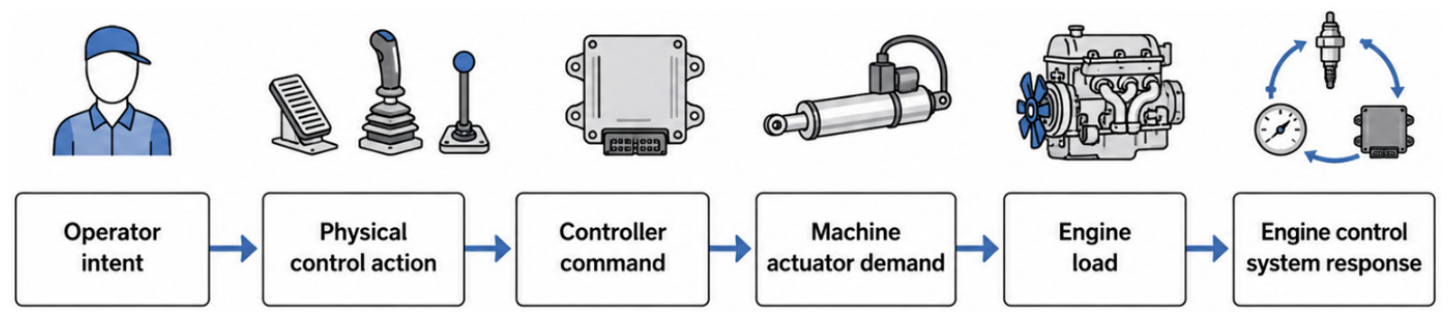
In this architecture, the engine-management system responds to a demand that has already propagated through one or more mechanical or electronic stages. From a human-in-the-loop perspective, however, the origin of the demand is the operator’s intended action. This distinction creates the theoretical basis for introducing physiological information into the control loop, because EMG can potentially provide information about an action before or during the generation of the conventional mechanical command [33,61]. The established capability of EMG to identify motor intention and estimate human torque therefore provides a potential means of observing an earlier stage of the same demand-generation process discussed in Chapters 3 and 4.
In modern engine-powered machines, the operator does not normally control fuel injection directly. Instead, the operator generates a reference or demand that is interpreted by electronic controllers. Depending on machine architecture, this may be an accelerator-pedal position, selected engine-speed setting, joystick displacement, requested hydraulic flow, commanded implement motion, transmission request, or selected operating mode. Electronic control units subsequently coordinate the engine and machine subsystems to satisfy this demand while maintaining constraints related to engine speed, engine torque, emissions, thermal conditions, and component protection [15,22].
Modern internal combustion engine control involves multiple mutually coupled actuators. Depending on engine type and configuration, these may include injected fuel quantity and timing, throttle position, boost-pressure control, variable-geometry turbocharger position, exhaust-gas recirculation, ignition timing, valve actuation, and aftertreatment thermal-management functions. Advanced model-based and model-predictive control strategies increasingly coordinate several of these variables simultaneously rather than optimizing them independently [22].
For a working machine, however, engine control is additionally coupled with the transmission or hydraulic power system. A hydraulic excavator provides a representative example. The engine supplies mechanical power to variable-displacement pumps, which convert it into hydraulic power for the boom, arm, bucket, swing mechanism, travel system, and auxiliary implements. Vukovic et al. in 2017 [79] showed that considerable fuel-saving potential is associated not only with improving the engine itself but also with matching engine operation, pump control, hydraulic-system efficiency, and machine duty requirements. Padovani et al. in 2024 reached a similar conclusion, emphasizing that system-level optimization is required because losses and control decisions are distributed throughout the complete energy-conversion chain [15,79].
Energy-flow analyses illustrate the magnitude of these interactions. An et al. in 2020 [81] developed an excavator energy flow-down methodology and showed that fuel energy passes through several conversion stages before useful work is performed. To obtain these results, An et al. instrumented a hydraulic excavator to record fuel consumption, engine operating parameters, hydraulic pressures and flow rates, and actuator motion during repeated dig-and-dump cycles, and combined the measurements with component-level energy-flow models [81]. Their analysis assigned 59.8% of total fuel-energy consumption to losses or energy use associated with the engine system, 17.0% to the hydraulic system, and 23.2% to the remaining downstream working-system contribution under the investigated operating conditions. Subsequent energy-flow studies similarly demonstrated that only a fraction of fuel energy ultimately reaches individual actuators such as the boom, stick, bucket, and swing mechanism [81,82].
This means that an operator command influences a sequence of subsystems rather than one isolated actuator. An unnecessarily high engine-speed request, abrupt joystick movement, poorly coordinated simultaneous actuator motion, or excessive hydraulic-flow demand can therefore propagate through the complete power chain and influence fuel consumption even when the final useful mechanical work remains unchanged. Conversely, improved coordination between operator demand, hydraulic flow, pump displacement, and engine operating state can reduce unnecessary conversion losses [15,79].
5.2. Operator Demand, Machine Load, and Engine Power Matching
The instantaneous engine power requirement of a working machine results from the combination of requested actuator motion and external resistance. In an excavator, for example, the same joystick command may produce different power demands depending on soil properties, digging depth, bucket filling, actuator position, simultaneous movements, and hydraulic pressure. Consequently, operator commands provide important information about intended demand, while pressure, pump displacement, engine torque, and machine-response signals provide information about the actual load that develops after the command is executed [15,83].
This distinction between requested demand and actual load is important for predictive control. Conventional control architectures often react to the latter only after the load has begun to affect the machine. However, work-machine controllers can also monitor the operator command itself as an early indicator of impending demand. A particularly relevant example is the patented Intelligent Engine and Pump Controls architecture, US12055107B2 [63]. In this system, changes in engine loading can be detected from variations in the implement joystick signal, pump outlet pressure, pump displacement, or clutch engagement. When an increasing load is detected, the controller can increase fuel delivery and air or boost pressure to improve transient engine response; during decreasing or sustained low load, it can reduce engine speed and alter pump displacement to improve fuel efficiency.
This patent is particularly significant for the present review because it demonstrates that operator input is already treated as a predictor of future engine load in contemporary machine-control concepts. The control system does not need to wait for a large engine-speed reduction before responding; a variation in the joystick command may itself initiate a preparatory change in fueling or air handling. The architecture therefore establishes a direct technological relationship between operator command, predicted implement demand, and engine-management actions.
The same principle is visible in research on operating-cycle identification. Shi et al. in 2020 [84] developed methods for recognizing individual excavator working-cycle stages because different phases of the cycle are associated with different energy requirements and can therefore support stage-dependent energy-saving control. Such results indicate that knowledge about what the machine is about to do can be valuable for power-management purposes, not only knowledge of the instantaneous engine state [84].
For EMG-based control, the logical extension is clear. A joystick provides information after the operator has generated muscular force and physically moved the control device. EMG is generated earlier in the human motor-action chain. If the relevant muscular activation can be detected and interpreted reliably, it may theoretically provide an additional anticipatory variable representing an impending change in joystick position, pedal operation, or working-tool demand. This does not imply that EMG should replace the joystick. Rather, EMG could be fused with the joystick and machine-state signals already used by load-prediction architectures to improve detection confidence or extend the available prediction horizon [33,34].
The efficiency of an internal combustion engine depends strongly on its operating point. Engine speed and torque determine brake power, while their combination influences brake-specific fuel consumption, exhaust temperature, air-flow requirements, pollutant formation, and the operating state of aftertreatment systems. Consequently, producing a required mechanical power at one speed–torque combination may require a different fuel rate than producing approximately the same power at another operating point [22,85].
This characteristic is especially important in machines traditionally operated at relatively high or quasi-constant engine speeds to ensure rapid hydraulic response. Maintaining high engine speed provides a power reserve and allows pumps to deliver large flow rates rapidly, but it may cause unnecessary fuel consumption when the actual hydraulic demand is low. Vukovic et al. in 2017 therefore identified reduction in engine speed combined with appropriate adaptation of pump displacement as one of the relevant pathways for improving excavator fuel efficiency. More recent reviews similarly emphasize coordinated engine–hydraulic control as an important component of energy-efficient off-road machinery [15,79].
Ng et al. in 2016 [78] experimentally investigated the influence of engine speed and bucket cut depth on the productivity and fuel efficiency of a hydraulic excavator. The tests were conducted using a 22-tonne excavator operated by an experienced operator under controlled site and material conditions. The experimental programme included 16 test series, each comprising 10 loading cycles, with four engine-speed settings and two bucket cut depths (50% and 100%). Excavated material was loaded into a dump truck and weighed, while cycle time and fuel consumption were recorded to evaluate productivity and fuel efficiency. Based on the experimental results, an engine-speed setting of approximately 1660 rpm combined with a 50% bucket cut depth was proposed as a favorable operating strategy for the investigated conditions. These findings demonstrate the importance of matching engine operation to actual working demand, although the identified settings are machine- and task-specific.
A similar principle is implemented in the US12055107B2 [63] patent, where reduced load may trigger a decrease in engine speed together with an increase in hydraulic-pump displacement. The objective is to maintain useful hydraulic performance while operating the engine more efficiently. Conversely, increasing demand can trigger increased fueling, air flow, or boost pressure to preserve transient performance. This demonstrates that machine-level energy optimization may involve coordinated adjustment of both the power source and the energy-conversion subsystem, rather than independent engine-speed control.
Such coordination is directly relevant to the proposed use of EMG. A physiological signal should not be interpreted as a direct command specifying fuel quantity. A more realistic function would be to contribute to the estimation of anticipated demanded power. The supervisory controller could then determine whether the expected operation requires a change in engine speed, allowable torque, pump displacement, transmission state, or another machine parameter. In this architecture, EMG influences power matching indirectly and remains separated from the combustion-control layer by conventional electronic control and safety constraints.
5.3. Transient and Low-Load Operating Conditions
Working machines frequently operate under highly transient conditions. Excavator digging, lifting, swinging, dumping, and repositioning occur sequentially and often overlap. Agricultural and forestry machines encounter spatially varying material resistance, while mobile machines repeatedly accelerate, decelerate, engage implements, and modify hydraulic demand. These operations generate rapid changes in engine torque requirement and engine speed and therefore differ fundamentally from steady-state operation [15,79].
Transient engine operation is particularly important from an environmental perspective because air-path and fuel-path dynamics do not respond instantaneously to sudden load changes. Turbocharger inertia, intake-manifold dynamics, exhaust-gas recirculation, fuel injection, combustion limits, and aftertreatment temperature interact during rapid changes in torque demand. Consequently, transient states may produce temporarily unfavorable combinations of air–fuel ratio, boost pressure, combustion conditions, fuel consumption, and pollutant emissions [22,86,87]. More recent real-world heavy-duty analysis also confirms that dynamic operating conditions remain particularly challenging for fuel efficiency and emissions control [88].
For non-road diesel engines, transient operation has long been recognized as materially different from stationary testing. Lindgren et al. in 2004 [87] quantified the effects of changes in engine speed and torque on fuel consumption and emissions from non-road diesel engines, while later studies of non-road transient cycles have confirmed substantial variation in energy flow and emissions during dynamic engine operation [87,89].
The importance of prediction follows directly from these dynamics. If a controller detects increased power demand only after engine speed begins to decrease, its response is inherently reactive. If impending demand can instead be identified from operator input or other predictive information, engine preparation can begin earlier. The intelligent engine–pump architecture disclosed in US12055107B2 [63] explicitly follows this principle: detection of impending load may initiate increased fueling and increased air or boost supply, including pre-spooling of the turbocharger in some embodiments, to reduce transient engine-speed drop.
This is arguably the strongest technical justification for investigating EMG in combustion-engine-powered machines. Research on braking-intention detection has already shown that EMG can reveal an intended human action before completion of the corresponding mechanical control movement [33]. If a similar temporal advantage can be demonstrated for joystick, pedal, or implement-control actions in working machines, EMG could theoretically extend the prediction horizon available to the engine supervisory controller. The expected environmental benefit would not result from EMG itself, but from earlier and better coordinated management of transient power demand.
Not all losses in working machines result from high-load operation. Significant fuel consumption may also occur during periods in which the engine remains running while little or no useful work is performed. Idling, waiting, machine repositioning, low-load auxiliary operation, and maintaining unnecessarily high engine speed between working actions can reduce task-level fuel efficiency because fuel is consumed without a proportional increase in useful output [15,78,79].
Modern control concepts address this problem through automatic idle, variable engine-speed control, engine-speed reduction under low demand, and coordinated pump control. The US12055107B2 [63] architecture, for example, identifies sustained low-load conditions from joystick commands, pump pressure, pump displacement, or clutch status and can respond by decreasing engine speed, fuel supply, air supply, or boost while modifying pump displacement. The objective is explicitly to increase fuel efficiency without compromising the ability to restore performance when demand returns.
The human-in-the-loop problem is therefore bidirectional. The controller must predict not only when more power will soon be required, but also when the operator has completed an action and the available engine power can safely be reduced. An EMG signal may contribute to both decisions because termination of muscle activation or transition toward another muscular pattern can indicate completion or preparation of a task. However, this possibility requires experimental verification under real working-machine conditions and should not be assumed directly from existing laboratory EMG-control studies.
From an environmental perspective, reducing unnecessary engine speed or shortening operation at unfavorable low-load conditions can affect more than fuel use alone. Engine load and engine speed also determine exhaust-gas mass flow and temperature and therefore influence the operating conditions of aftertreatment systems. Recent studies of non-road diesel engines demonstrate that thermal conditions and control parameters substantially affect regulated emissions, meaning that energy-oriented speed reduction must be coordinated with emission-control requirements rather than optimized exclusively for minimum instantaneous fuel flow [90,91].
Experimental studies provide quantitative evidence that engine operating-point selection, transient loading, and low-load management can substantially influence fuel consumption and exhaust emissions. Selected results relevant to these three aspects are summarized in Table 3. Although the investigated systems did not employ EMG-based control, the findings indicate potential areas in which anticipatory information about operator intention could support more efficient engine-management strategies.
Table 3.
Quantitative findings from experimental studies relevant to engine power matching, transient operation, and low-load management in combustion-engine-powered working machines.
These findings support the potential value of predictive engine control; however, the additional energy and environmental benefits achievable specifically through EMG-derived information remain to be experimentally demonstrated.
5.4. From Conventional Human-in-the-Loop Control to EMG-Informed Power Management
The reviewed literature shows that internal combustion engine-powered working machines already possess several characteristics of human-in-the-loop systems. Operator commands determine machine actions; machine actions determine hydraulic or mechanical power demand; controllers estimate changes in engine load; and modern engine-management systems adapt fueling, air handling, engine speed, and other variables in response to these demands [15,22,79].
The crucial observation is that contemporary systems already exploit signals located at different positions along the demand-generation chain. Joystick position represents the operator command; pump displacement and pressure represent hydraulic demand; engine speed and torque represent power-source response. The patent literature demonstrates that these signals can be fused to detect an impending increase or decrease in engine load and to modify fuel, air, boost, engine speed, and pump operation accordingly.
EMG would add an additional upstream signal to the conventional control interface, extending the control chain from muscle activation and operator intention through joystick or pedal movement and implement command to the resulting hydraulic or mechanical load and, ultimately, engine load (Figure 11).
Figure 11.
Extension of the conventional operator–machine control chain by an upstream EMG-derived signal, enabling earlier estimation of operator intention and anticipated machine power demand before the resulting hydraulic or mechanical load reaches the internal combustion engine (generated with AI).
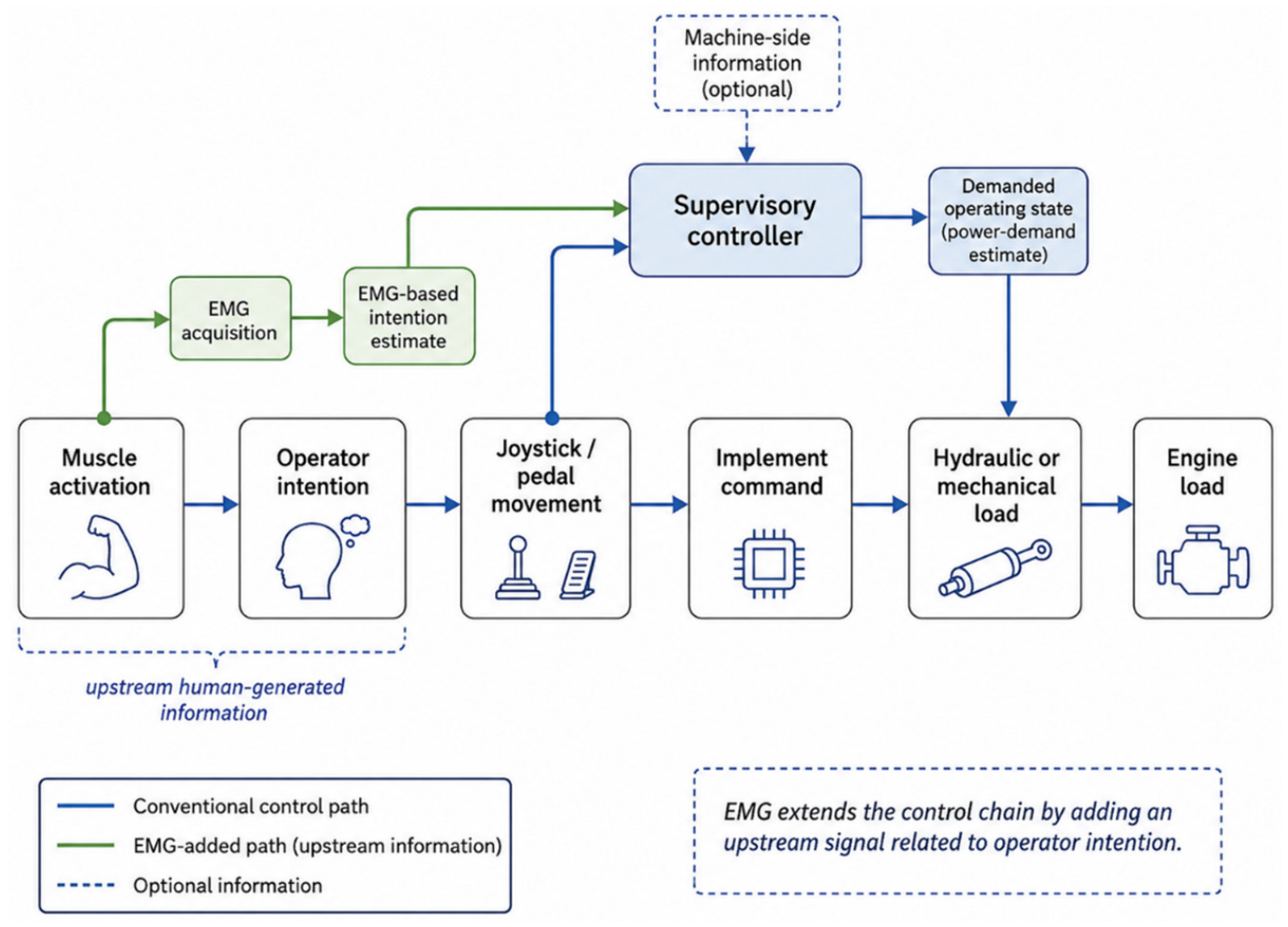
The potential benefit of this upstream position is temporal rather than merely functional. EMG may contain information before a conventional mechanical command has fully developed, as demonstrated in motor-intention and braking-intention studies [33,97]. Thus, the most promising application of EMG in combustion-engine-powered machinery is unlikely to be direct control of fuel injection, throttle position, or turbocharger geometry. Instead, EMG may provide an anticipatory input to a supervisory controller that predicts power demand and prepares the engine–machine system for the expected operating state.
Such an architecture would preserve conventional operator controls and engine-control functions while adding a physiological information channel. The final engine command would still be calculated using established machine parameters and constrained by engine performance, emission limits, functional safety, and actuator capabilities. EMG would therefore act as a supplementary predictive variable, rather than as an unrestricted actuator command. This concept is consistent with the development of adaptive shared-control systems in vehicles and assistive machines, in which physiological signals supplement conventional control rather than replace it entirely [34,61].
The evidence discussed in this section therefore indicates a specific technological opportunity. Conventional working machines already implement a control relationship in which operator commands are translated into predicted machine demand and a corresponding engine response, while EMG-based studies have independently demonstrated the feasibility of estimating operator intention from muscle activation. Integrating these two established concepts would enable an extended control architecture in which EMG signals are used to predict operator demand, translate it into anticipated machine power demand, and subsequently coordinate the control of both the engine and the machine. However, the reviewed literature provides no direct experimental evidence that such an architecture reduces fuel consumption or exhaust emissions in internal combustion engine-powered machines. This lack of evidence constitutes one of the principal research gaps addressed in the following sections (Figure 12).
Figure 12.
Integration of two independently established control concepts—conventional operator-command-based machine control and EMG-based operator-intention estimation—into a proposed architecture for predicting machine power demand and coordinating engine–machine control; the absence of direct experimental evidence for fuel-consumption and emission reductions defines the principal research gap (generated with AI).
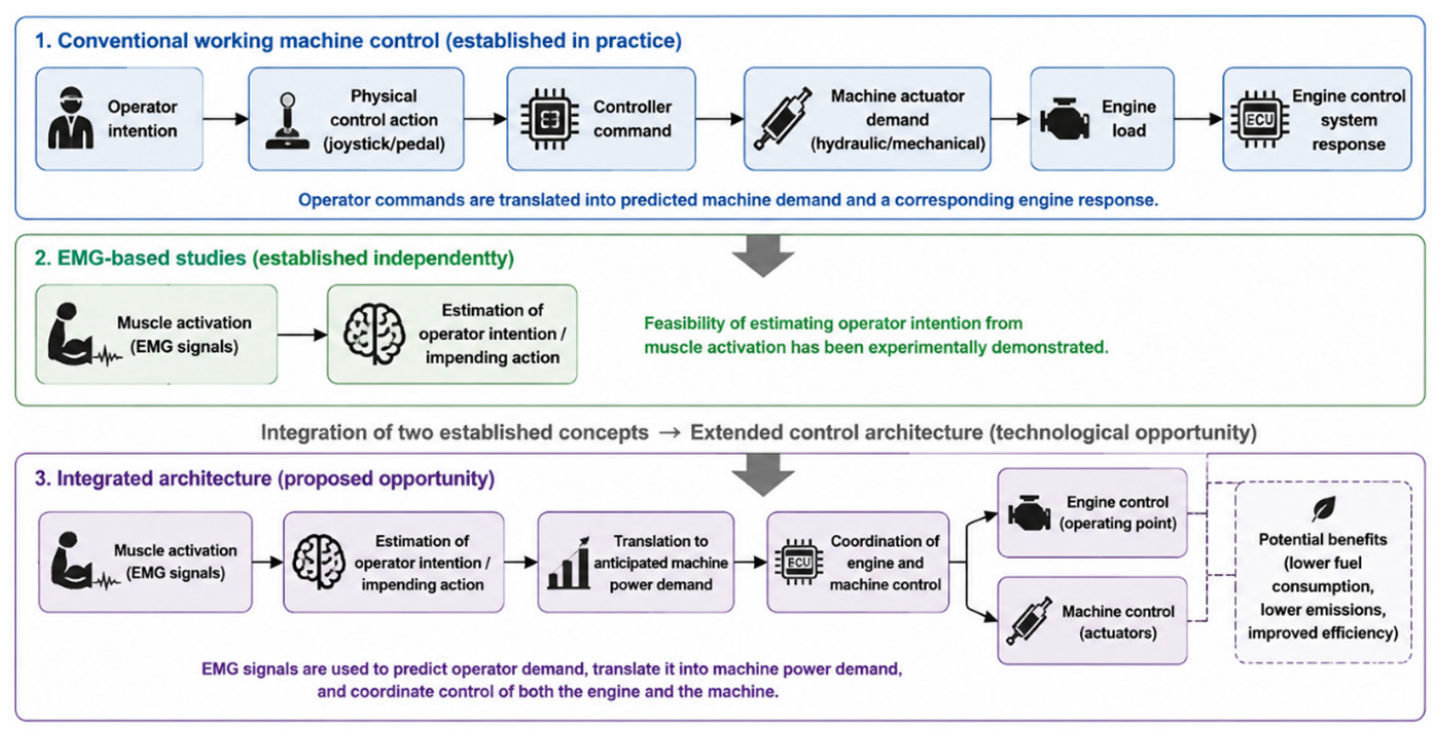
6. Potential Architectures of EMG-Based Internal Combustion Engine Control
6.1. Conceptual Framework for EMG-Informed Engine Control
The literature reviewed in the preceding sections demonstrates that the main components needed to develop an EMG-informed control system for an internal combustion engine-powered machine already exist independently. EMG signals can be used to identify operator actions, predict the onset of motor tasks, estimate continuously varying human inputs, and adapt the level of machine assistance [33,61]. At the same time, contemporary machine controllers can use joystick commands, hydraulic pressure, pump displacement, and other variables to detect changes in machine demand and coordinate engine and hydraulic-system operation [63,79]. Modern internal combustion engine controllers also provide sufficient authority to coordinate fueling, air handling, boost pressure, torque production, and other engine variables using model-based and predictive strategies [22].
However, the reviewed evidence does not demonstrate that these three technological domains have yet been integrated into a single experimentally validated system in which EMG-derived operator information is explicitly used to reduce fuel consumption or exhaust emissions from a combustion-engine-powered working machine. Therefore, the architectures presented in this section should be regarded as potential control architectures synthesized from technologies that have been demonstrated separately, rather than as established EMG-based engine-management systems.
Four principal control architectures can be distinguished according to the position and function of EMG information within the overall control chain: (I) EMG-derived engine or machine command, (II) EMG-based prediction of machine power demand, (III) multimodal EMG-assisted adaptive control, and (IV) predictive supervisory optimization of the engine–machine system (Figure 13).
Figure 13.
Four principal architectures for integrating EMG-derived information into the control of internal combustion engine-powered machines: (I) EMG-derived engine or machine command, (II) EMG-based prediction of machine power demand, (III) multimodal EMG-assisted adaptive control, and (IV) predictive supervisory optimization of the engine–machine system. The architectures represent increasing levels of integration, sensor fusion, prediction, and supervisory control (generated with AI).
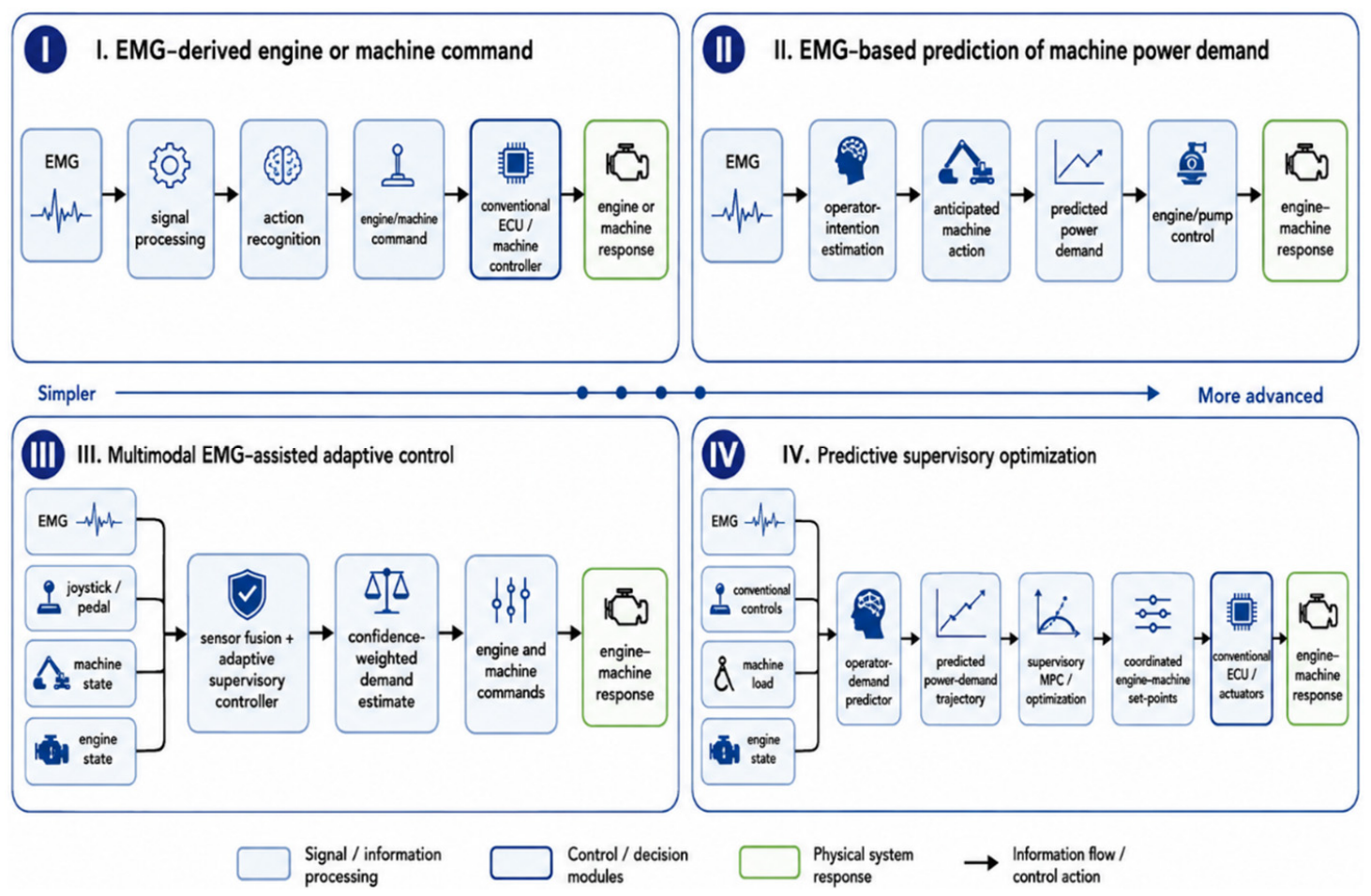
The architectures differ primarily in the degree to which EMG influences the final engine command and in the amount of conventional machine-state information incorporated into the decision process.
6.2. Architecture I: EMG-Derived Engine or Machine Command
The simplest architecture would convert a recognized muscular action into a predefined machine or engine operating request. The corresponding information flow can be represented as a sequence in which EMG signals are processed to recognize the operator’s action, map it to an appropriate control command, generate the required engine or machine set-point, and subsequently execute it through the conventional engine control unit (ECU) (Figure 14).
Figure 14.
Architecture I: EMG-derived engine or machine command, in which processed EMG signals are used to recognize operator action and generate a predefined engine or machine set-point that is subsequently executed by the conventional ECU or machine controller (generated with AI).
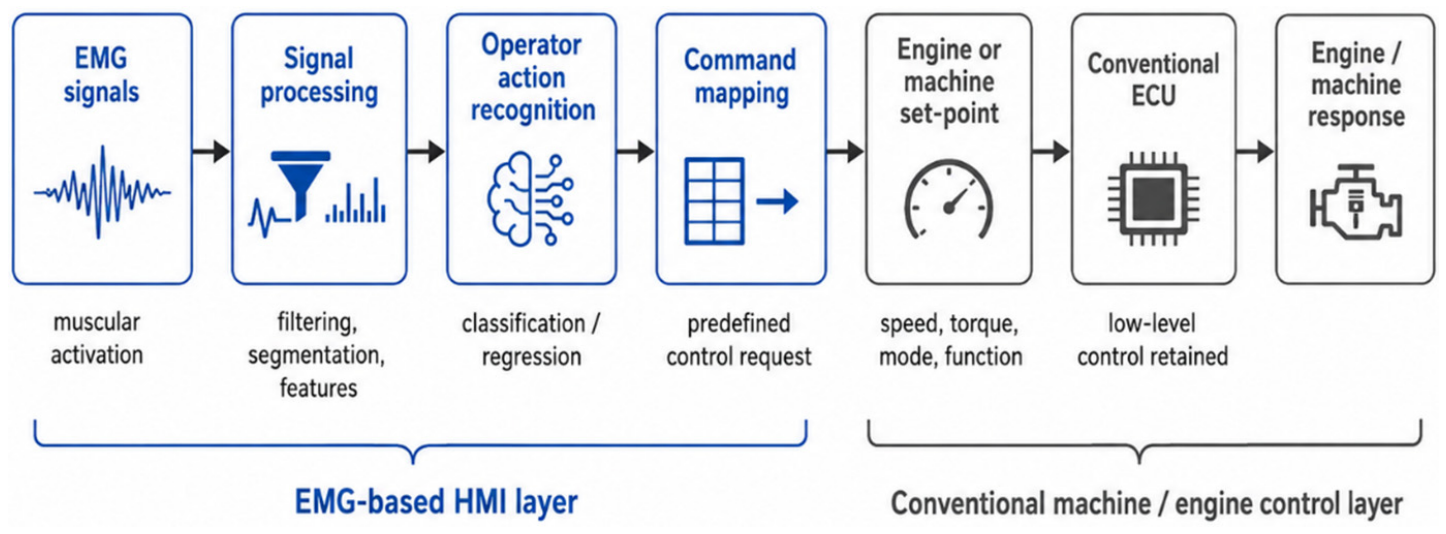
The technical feasibility of the first part of this chain has already been demonstrated in several machine and vehicle applications. EMG has been used to control vehicle steering, machine functions, robotic actuators, and other electromechanical systems. Patent literature similarly describes EMG-based vehicle control and gesture-based control of heavy working machines. The Hyundai Mobis [98] patent family, for example, describes the recognition of forearm actions from EMG for controlling vehicle functions, whereas the Deere & Company [75] patent describes machine commands derived from gestures detected by muscle and other wearable sensors.
Applied to an internal combustion engine-powered machine, a recognized EMG pattern could theoretically be mapped to discrete operating requests such as idle/working mode, low/high power mode, temporary engine-speed increase, activation of an implement, or selection of a predefined engine–hydraulic operating strategy. Continuous EMG decoding could similarly generate a proportional reference for demanded speed or torque, because continuous human contribution and torque estimation from EMG have already been demonstrated in robotic and assistive control applications [61].
Nevertheless, direct conversion of EMG into low-level combustion actuators such as injection duration, injection timing, throttle position, exhaust gas recirculation (EGR) position, or turbocharger-vane position would be neither necessary nor technically justified by the currently available evidence. Contemporary engine-management systems already calculate these actuator commands using closed-loop control strategies that simultaneously account for torque demand, combustion stability, emissions, thermal conditions, and actuator limitations [22]. Therefore, even in the most direct architecture, EMG should provide a requested operating state, while the existing ECU should retain responsibility for low-level engine control.
This distinction is important because it separates operator-intention interpretation from combustion control. The physiological signal would answer the question “what does the operator intend the machine to do?”, whereas the ECU would continue to determine “how should the engine achieve the required engine torque and engine speed?”. Such separation would preserve established engine-control functions while introducing EMG only at the command-generation level.
The principal advantage of Architecture I is simplicity. It requires relatively few additional interfaces and could potentially be implemented using a wearable EMG sensor, an intention classifier, and communication with the existing machine controller. Its main limitation is that it uses only a small part of the information available from EMG. A discrete command issued after intention classification may offer little energy-efficiency benefit over an existing joystick or switch unless the EMG signal becomes available sufficiently earlier or provides information unavailable from the conventional interface. The research on neuromuscular intention prediction confirms that such an anticipatory interval can exist, but its magnitude and repeatability depend on the task and require application-specific validation. The CTRL-Labs patent family explicitly describes statistical models designed to predict the onset of motor actions from neuromuscular signals before completion of the corresponding motor task.
6.3. Architecture II: EMG-Based Prediction of Machine Power Demand
A more technologically significant architecture would use EMG not primarily as a replacement for a joystick or pedal but as an early predictor of impending machine power demand. The corresponding information chain would therefore involve processing EMG signals to estimate operator intention, anticipate the resulting machine action, predict the associated power demand, and subsequently adjust engine and/or pump control accordingly (Figure 15).
Figure 15.
Architecture II: EMG-based prediction of machine power demand, in which EMG-derived operator-intention information is used to anticipate forthcoming machine action, estimate the associated power demand, and adjust engine and/or pump operation to improve matching between generated power and task requirements (generated with AI).
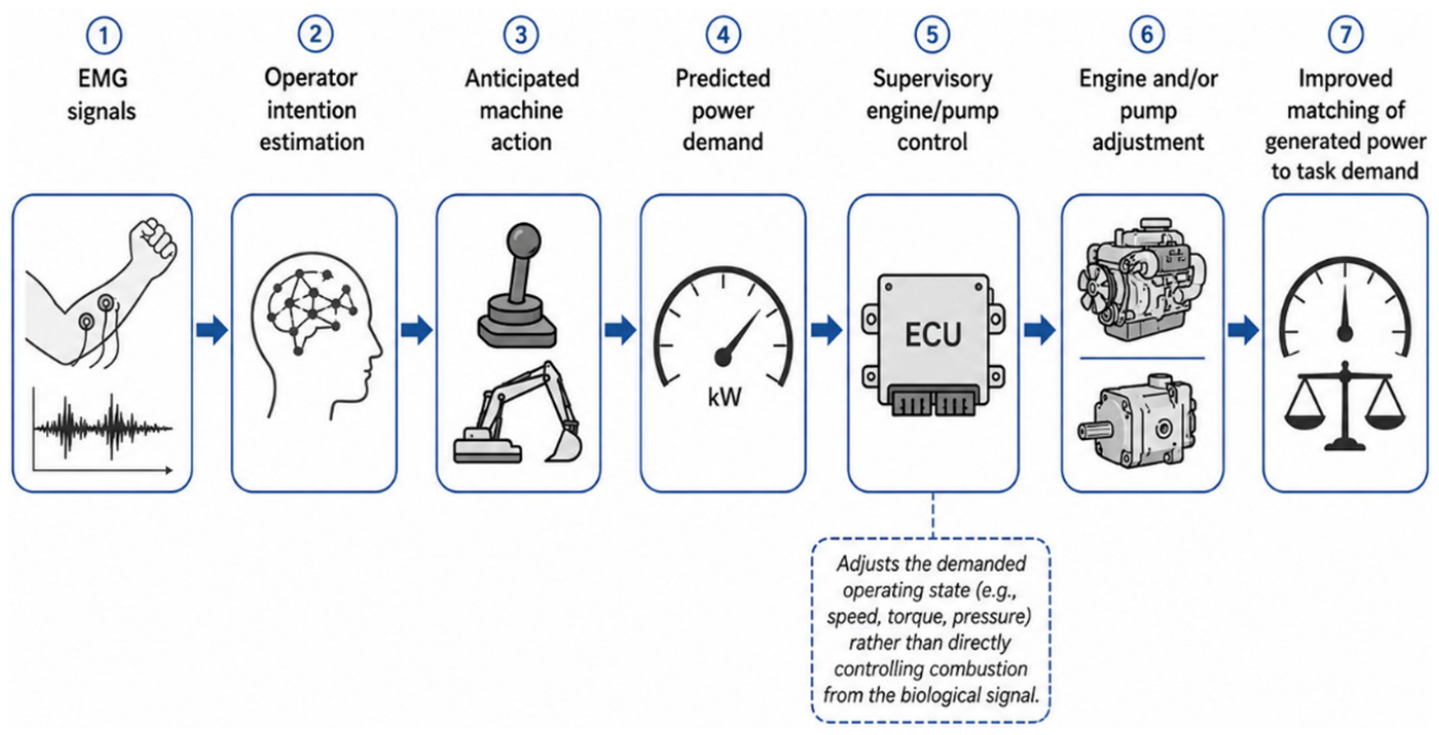
This architecture is directly supported by two independently established technological concepts. First, EMG research demonstrates that muscular signals can reveal intended actions before their mechanical execution. Ju et al. in 2021 [33], for example, demonstrated discrimination of emergency braking intention from soft braking and normal driving using lower-limb EMG, showing that physiological information can precede the corresponding conventional control action. Neuromuscular-intention patents similarly describe prediction of motor-action onset before the user completes the action [33].
Second, existing working-machine control systems already use operator commands to anticipate changes in engine load. The Cummins Intelligent Engine and Pump Controls patent is particularly important in this context. It describes detecting a change in machine loading using, among other variables, a change in the joystick command controlling an implement. Detection of increasing demand can trigger increases in fuel delivery and air or boost supply, whereas decreasing demand can trigger engine-speed reduction and increased pump displacement to improve efficiency. The control architecture can also combine joystick information with pump pressure, pump displacement, and clutch state.
Architecture II therefore extends the established relationship in which a joystick command is used to predict engine load and determine the corresponding engine response by introducing EMG as an upstream predictive signal for anticipating the joystick or implement command, estimating the resulting engine load, and adjusting the engine response accordingly.
The potential advantage is a longer prediction horizon. A joystick command can only be detected once physical movement of the operator’s hand or foot has already generated a change in the control interface. Muscle activation necessarily participates in producing that movement and can therefore, under suitable conditions, provide information earlier in the action sequence. The practical energetic benefit would depend on whether this additional time is sufficient to improve engine transient preparation.
This possibility is particularly relevant to turbocharged diesel engines. Sudden increases in implement demand can cause rapid increases in required engine torque while the air path and turbocharger require time to respond. Existing engine–pump control concepts therefore use predictive signals to initiate changes in fueling and air handling before a severe engine-speed drop occurs. The Cummins patent specifically describes increasing air or boost pressure following detection of increasing load, together with increased fueling when required.
A corresponding EMG-informed architecture could use muscular activation to estimate the probability and magnitude of an impending working action. For example, activation patterns associated with rapid joystick displacement could indicate imminent high hydraulic demand, while smaller or slower activation patterns might indicate a low-intensity maneuver. The controller would then estimate the expected power requirement rather than directly converting EMG amplitude into fuel quantity.
Such an approach is consistent with current energy-efficient hydraulic-machine research, which emphasizes improved matching between engine output, pump demand, hydraulic flow, and actual working requirements. In conventional excavators, pump flow is strongly related to operator command, whereas system pressure depends on external load. Coordinated engine–hydraulic control therefore offers significant potential for reducing unnecessary power generation and fuel consumption [15,79].
Of the four architectures considered here, Architecture II represents one of the most direct extensions of currently demonstrated technology because it does not require EMG to replace conventional controls. It introduces EMG only as an additional predictive variable upstream of an engine-load prediction function that already exists in contemporary control concepts.
6.4. Architecture III: Multimodal EMG-Assisted Adaptive Control
Reliance on EMG as a single control variable would expose the system to variability associated with electrode displacement, muscle fatigue, contraction intensity, inter-user differences, environmental conditions, and unintended muscular activity. A more robust architecture would therefore combine EMG-derived information with conventional operator and machine signals.
The proposed information structure would integrate EMG signals with joystick or pedal position, machine state, hydraulic or drivetrain state, and engine state through a sensor-fusion layer, which would provide inputs to an adaptive supervisory controller responsible for generating coordinated engine and machine commands (Figure 16).
Figure 16.
Architecture III: multimodal EMG-assisted adaptive control, in which EMG signals are integrated with conventional operator inputs, machine state, hydraulic or drivetrain state, and engine state through a sensor-fusion layer, while an adaptive supervisory controller generates coordinated engine and machine commands (generated with AI).
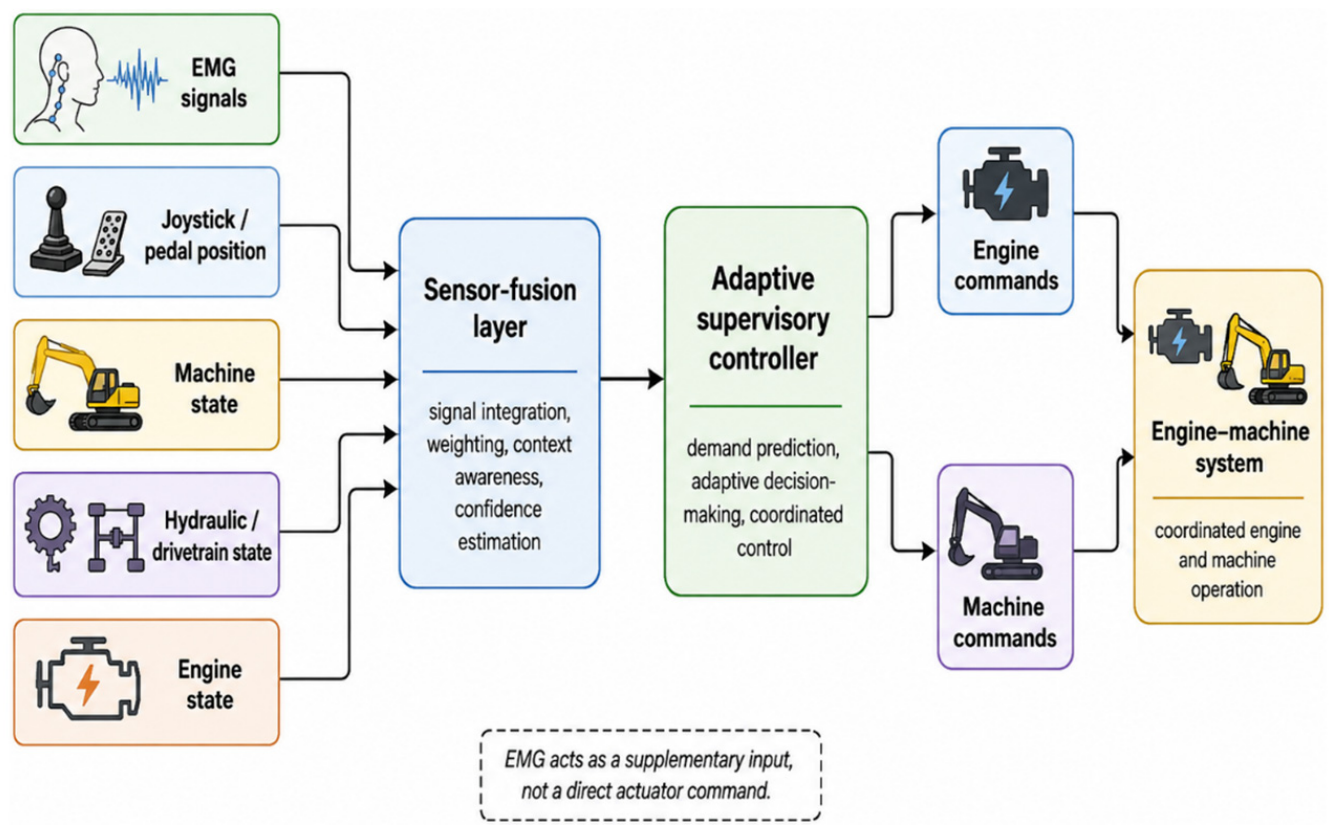
This architecture follows the principles of adaptive and shared control already demonstrated in vehicle applications. Wang et al. in 2021 [34] investigated sEMG-based adaptive shared steering in which muscular activity was not treated as an unrestricted independent vehicle-control signal but was incorporated into a shared-control strategy. Such an approach demonstrates that physiological information can modify control authority or assistance while conventional vehicle control remains part of the closed loop [34].
A comparable principle appears in existing engine–pump control technology. The Cummins architecture does not rely on a single indicator of load but may combine operator commands with pump pressure, displacement, and clutch signals when determining whether engine loading is increasing or decreasing. This demonstrates the technical rationale for multimodal load detection in working machines.
In an EMG-assisted implementation, the physiological signal would therefore be treated as one element of a confidence-weighted demand estimate. If EMG, joystick displacement, and hydraulic measurements indicated the same impending high-load operation, the supervisory controller could assign high confidence to the predicted demand. If EMG indicated muscular activation but the joystick and machine signals remained unchanged, the controller could delay or limit intervention until additional evidence became available.
This concept also addresses false activations. A machine operator frequently performs muscular actions that are unrelated to machine control, including repositioning the hand, gripping the seat or handle, adjusting clothing, or reacting to vibration. An EMG-only controller could incorrectly interpret such activity as a command. Multimodal fusion enables the controller to assess whether physiological information is consistent with the operating context.
The architecture could also accommodate operator-specific adaptation. Neuromuscular-control research has shown that statistical models can be trained to recognize individual motor actions and that adaptive systems can derive control signals from changing neuromuscular patterns. Patent developments in this field explicitly describe prediction and adaptation based on neuromuscular activity rather than dependence on fixed amplitude thresholds.
For working machines, adaptation could include recalibration of EMG thresholds, recognition of operator-specific movement strategies, modification of confidence assigned to particular muscles, or learning of the relationship between muscular activation and subsequent joystick movement. Consequently, the system could progressively develop an operator-specific mapping in which characteristic EMG patterns are associated with likely control actions and the corresponding expected machine demand (Figure 17).
Figure 17.
Development and use of an operator-specific EMG mapping model, in which characteristic EMG patterns are progressively associated with likely control actions and the corresponding expected machine power demand to support adaptive prediction during machine operation (generated with AI).
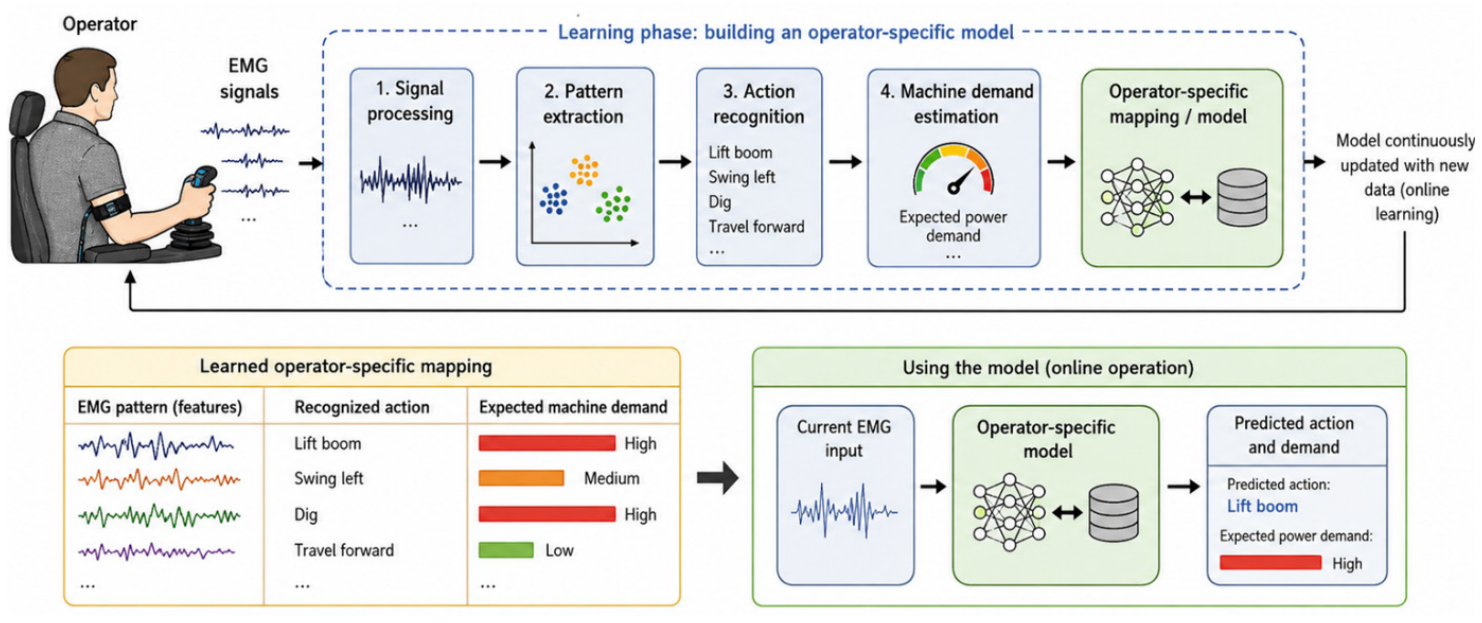
The principal advantage of Architecture III is its robustness. Unlike Architecture I, the machine would not depend on the physiological signal for basic operation. If EMG quality deteriorated, the system could progressively reduce the weighting of EMG and revert to conventional joystick, pedal, hydraulic, and engine signals. This characteristic makes multimodal shared control more compatible with the reliability requirements of working machinery than an architecture in which EMG constitutes the sole control channel.
An application-oriented example of this multimodal approach is described in Polish patent application No. P.455043 [71], concerning predictive engine-speed control in a combustion-engine-powered wood chipper. The proposed architecture combines optical detection of the operator with upper-limb EMG signals to anticipate material feeding before wood reaches the cutting mechanism. Based on the detected operator activity, the supervisory controller may initiate an appropriate engine-speed request, while a time-based hold function or vibration-based feedback can prevent premature return to low-speed idle during material processing [99]. Unlike conventional wood-detection-based systems, this approach attempts to identify working demand at an earlier stage of the operator–machine interaction. However, the proposed concept has not yet been experimentally validated in terms of its prediction performance, fuel consumption, or exhaust emissions.
The proposed concept would therefore integrate EMG signals with optical operator detection to anticipate material feeding, predict the resulting cutting demand, determine the required rotational-speed set-point, and subsequently execute this demand through the conventional engine control system (Figure 18).
Figure 18.
Proposed predictive control concept for a combustion-engine-powered wood chipper, in which optical operator detection and upper-limb EMG signals are fused to anticipate material feeding, estimate the forthcoming cutting demand, determine the required engine rotational-speed set-point, and execute the demand through the conventional engine control system (generated with AI).
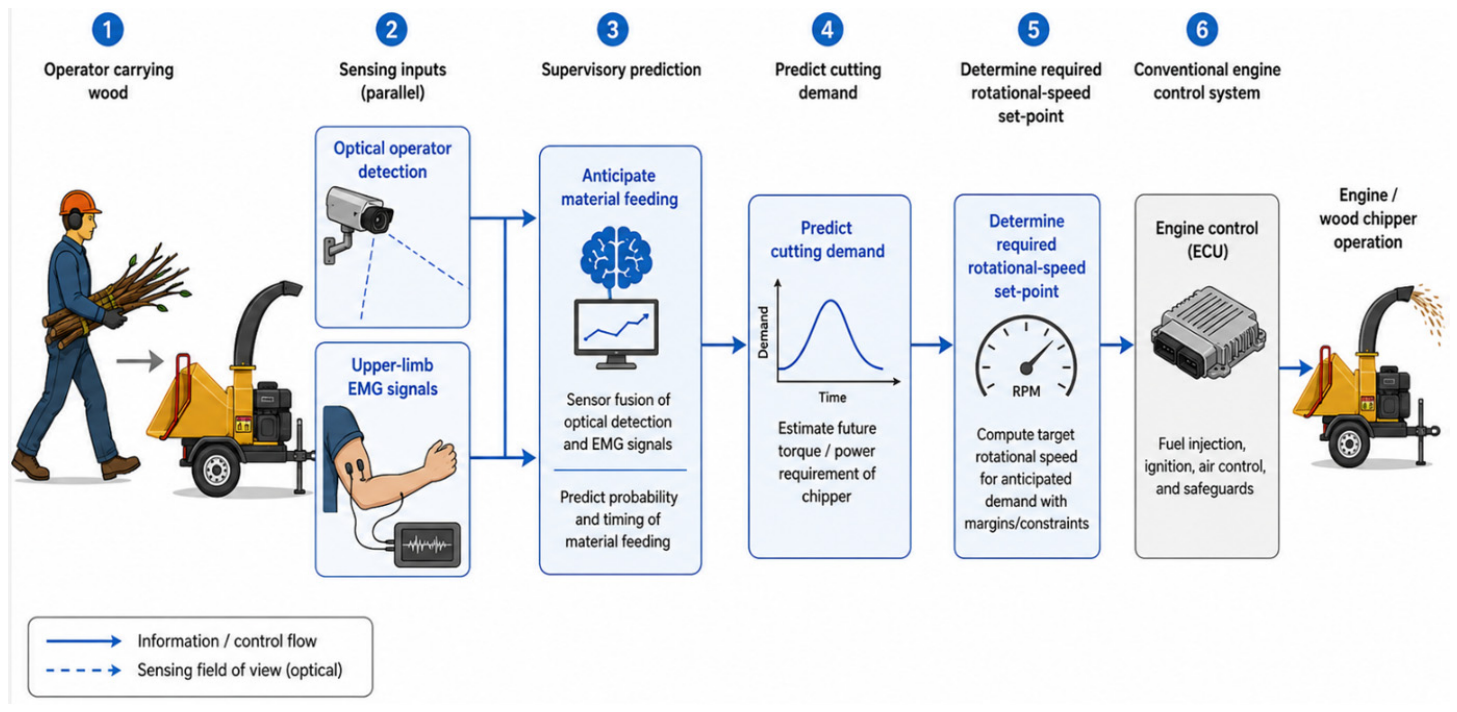
6.5. Architecture IV: Predictive Supervisory Optimization of the Engine–Machine System
The most advanced architecture would use EMG within a model-based predictive supervisory controller. In this configuration, EMG would not directly determine a command. Instead, it would provide information about the future disturbance or future power demand acting on the engine–machine system.
The proposed architecture would integrate EMG signals with conventional control inputs, machine load, and engine state to predict operator demand and the corresponding power-demand trajectory, which would then be processed by a supervisory model predictive control (MPC) or optimization layer to generate coordinated engine and machine set-points for execution by the conventional ECU and actuator controllers (Figure 19).
Figure 19.
Architecture IV: predictive supervisory optimization, in which EMG signals, conventional operator inputs, machine load, and engine state are combined to predict operator demand and the future power-demand trajectory, which is subsequently processed by a supervisory MPC or optimization layer to generate coordinated engine and machine set-points for execution by conventional ECU and actuator controllers (generated with AI).
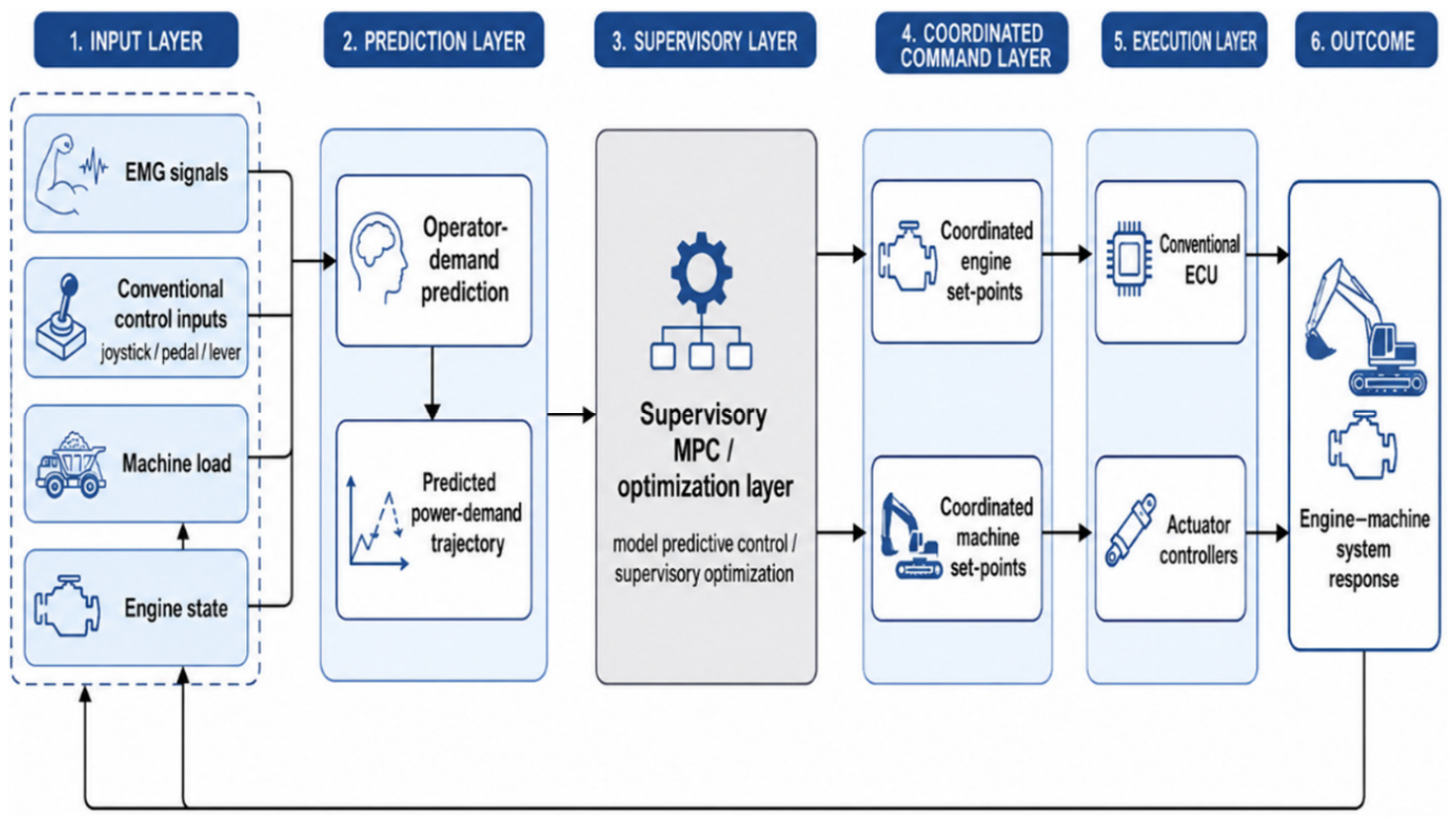
Two independent research directions provide the technological foundation for this architecture. Teramae et al. in 2018 [61] demonstrated that EMG-derived information can be incorporated into model predictive control of physical human–robot interaction, where the estimated human contribution is used to determine the assistance required from the machine [61]. Separately, MPC is already an established research framework for internal combustion engine management because it can consider future system behavior, multivariable coupling, actuator constraints, fuel consumption, emissions, and dynamic response within a unified optimization problem [22].
Combining these approaches would allow predicted operator demand to be incorporated directly into the optimization horizon of the engine supervisory controller. Instead of reacting exclusively to current engine speed, torque, pump pressure, or joystick position, the controller could optimize operating variables using an estimate of the power likely to be required over the near-term prediction horizon.
The optimized variables would depend on the machine architecture but could include engine-speed reference, allowable engine torque, pump displacement, transmission ratio, hydraulic-flow allocation, and engine operating mode. At the lower control level, the ECU would continue to determine appropriate fueling, air handling, injection, EGR, and turbocharging actions required to realize the requested engine operating state [22].
The optimization objective could simultaneously penalize several quantities: fuel consumption, deviation between available and demanded power, excessive engine-speed variation, high transient loading, pollutant-emission proxies, and unnecessary hydraulic throttling losses. Such multivariable optimization is consistent with contemporary MPC approaches for engine and powertrain control and with the broader development of energy-efficient hydraulic machinery [15,22,79].
Architecture IV offers two potential environmental mechanisms. During an impending increase in load, early demand information could allow the engine–machine system to prepare more gradually and avoid excessive transient deviations. During an impending decrease in demand, the same information could allow unnecessary power availability to be reduced earlier by decreasing engine speed or modifying pump operation. The environmental benefit would therefore arise from improved temporal matching of generated power to required power, rather than from EMG processing itself.
This distinction is fundamental. EMG should not be considered an energy-saving technology in isolation. Its potential value lies in increasing the amount and temporal resolution of information available to an energy-management controller.
6.6. Hierarchical Control and Separation of Safety-Critical Functions
All four architectures require a hierarchical separation between physiological information processing and safety-critical engine control. The EMG subsystem should generate a command, estimate, probability, or predicted demand rather than directly manipulate combustion actuators. Existing engine-control architectures already contain low-level closed-loop functions responsible for maintaining engine speed, torque, combustion conditions, air-path operation, and actuator constraints; replacing these functions with a physiological controller would provide no evident advantage and would substantially increase control uncertainty [22].
A suitable hierarchical control structure would therefore comprise at least three levels. The first level would be responsible for physiological interpretation, including EMG acquisition, signal-quality assessment, feature extraction, intention classification or regression, and confidence estimation. The second level would perform supervisory machine control by fusing EMG-derived information with conventional control inputs, predicting machine demand, selecting the appropriate operating mode, and determining the required engine speed, torque, or machine power. The third level would retain conventional engine and actuator control functions, including fuel injection, air handling, boost and exhaust gas recirculation (EGR) control, pump control, transmission control, and other low-level control tasks (Figure 20).
Such separation is consistent with existing technological developments. Neuromuscular-intention systems produce predicted actions rather than directly controlling the physical energy source, while working-machine systems use operator commands and load indicators as inputs to a supervisory engine–pump controller.
An important additional requirement is graceful degradation. Loss of usable EMG should not imply loss of conventional machine control. Instead, low signal quality, disagreement among sensors, or classifier uncertainty should reduce the influence assigned to the physiological channel. Conventional joystick, pedal, hydraulic, and engine signals would remain sufficient to operate the machine. This approach is conceptually consistent with shared-control systems in which the authority of automated assistance changes according to the estimated state of the human operator rather than replacing the human control channel completely [34].
A further safeguard would be confirmation of EMG-derived predictions by conventional inputs. For example, early muscular activation could cause the controller to prepare for increased power demand, but the transition to the requested high-power state could require confirmation from joystick displacement, hydraulic pressure, or another machine variable. Existing predictive engine–pump patents already use threshold durations and combinations of load indicators to prevent inappropriate reactions to short or insignificant command changes.
Figure 20.
Proposed three-level hierarchical control structure for EMG-informed internal combustion engine-powered machinery, comprising: (1) physiological interpretation of EMG signals and operator intention, (2) supervisory fusion, demand prediction, operating-mode selection, and set-point generation, and (3) conventional ECU and actuator control responsible for low-level engine and machine execution (generated with AI).
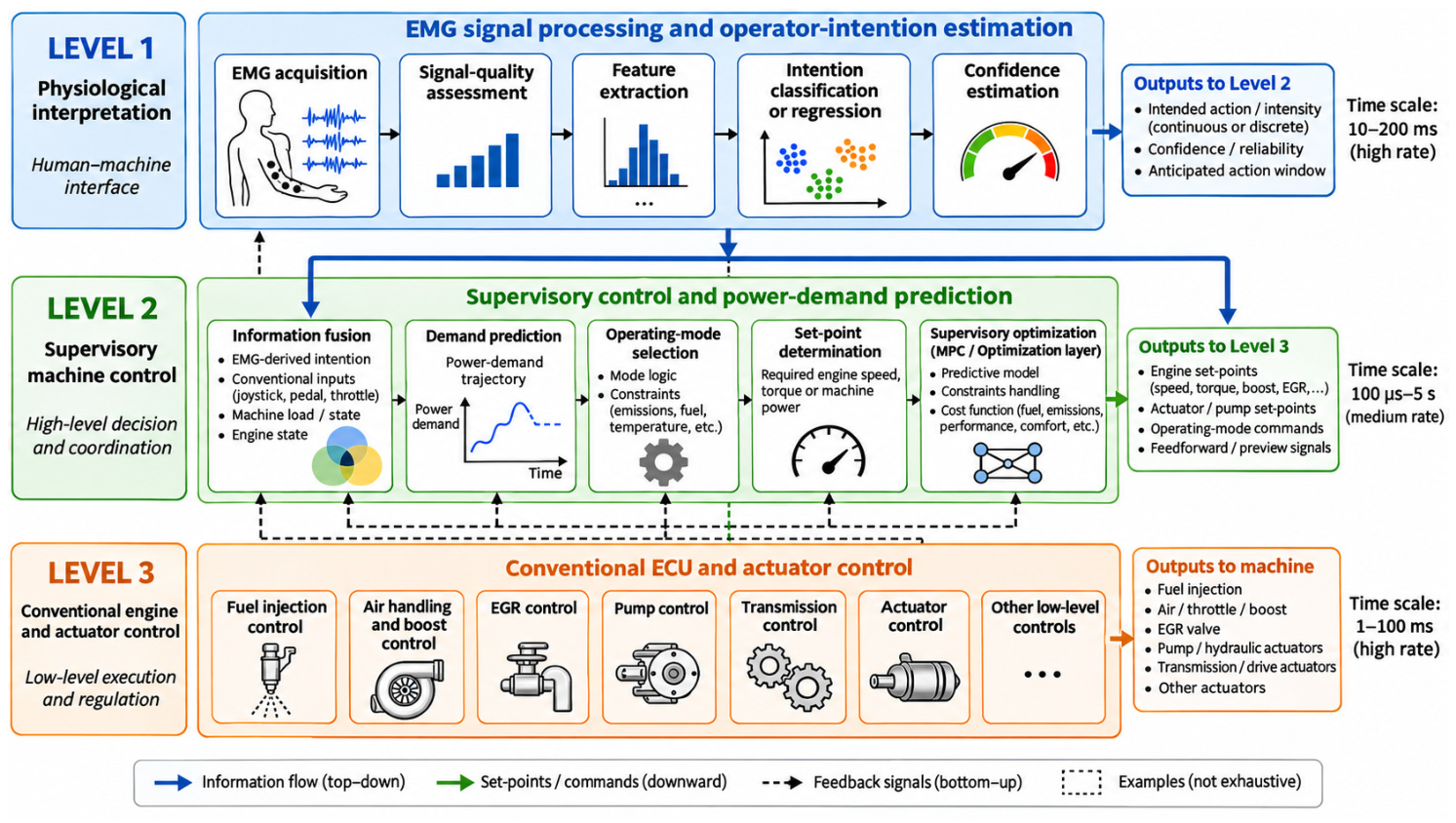
6.7. Comparative Assessment of the Proposed Architectures
As summarized in Table 4, the four architectures represent increasing levels of integration between the operator and the power-management system.
Table 4.
Comparison of proposed EMG-informed control architectures, their potential energy and environmental effects, and recommended verification methods.
Table 4 identifies the potential energy-saving mechanisms and environmental implications associated with each of the four proposed architectures. Their effects depend primarily on how EMG-derived information modifies engine operating conditions and machine power demand. Architecture I may influence fuel consumption through operating-mode selection, while Architecture II introduces the possibility of anticipating transient load changes. Architecture III extends this approach by combining physiological and machine-state information to improve demand estimation and control robustness. Architecture IV additionally enables coordinated optimization of engine and machine operating parameters, potentially accounting for both fuel consumption and pollutant emissions. However, the relative environmental performance of these architectures cannot currently be quantified because experimental studies directly evaluating EMG-informed internal combustion engine control have not been identified. Consequently, their environmental relevance should be assessed through measurable changes in engine operation, fuel consumption, productivity, and exhaust emissions rather than through EMG classification performance alone.
The literature and patent evidence suggests that Architectures II–IV are more promising than direct EMG engine control. Existing working-machine technology already demonstrates that anticipatory operator-command information can be useful for coordinating fuel, air, boost, engine speed, and hydraulic-pump operation, while EMG research demonstrates that neuromuscular activity can provide information about motor intention before completion of a physical control action [33,63].
The resulting research opportunity can therefore be formulated as an extension of an already established control chain. Conventional intelligent machines translate operator commands into predicted machine demand and a coordinated engine response, whereas EMG-based human–machine interfaces enable muscle activation to be interpreted as an estimate of operator intention. Integrating these two approaches would extend the control chain toward a predictive architecture in which muscle activation is used to anticipate operator action, estimate the resulting machine power demand, and determine an optimized operating state of the engine–machine system (Figure 21).
Figure 21.
Integration of two established concepts—conventional intelligent machine control and EMG-based operator-intention estimation—into a proposed predictive architecture in which muscle activation is used to anticipate operator action, estimate future machine power demand, and determine an optimized operating state of the engine–machine system (generated with AI).
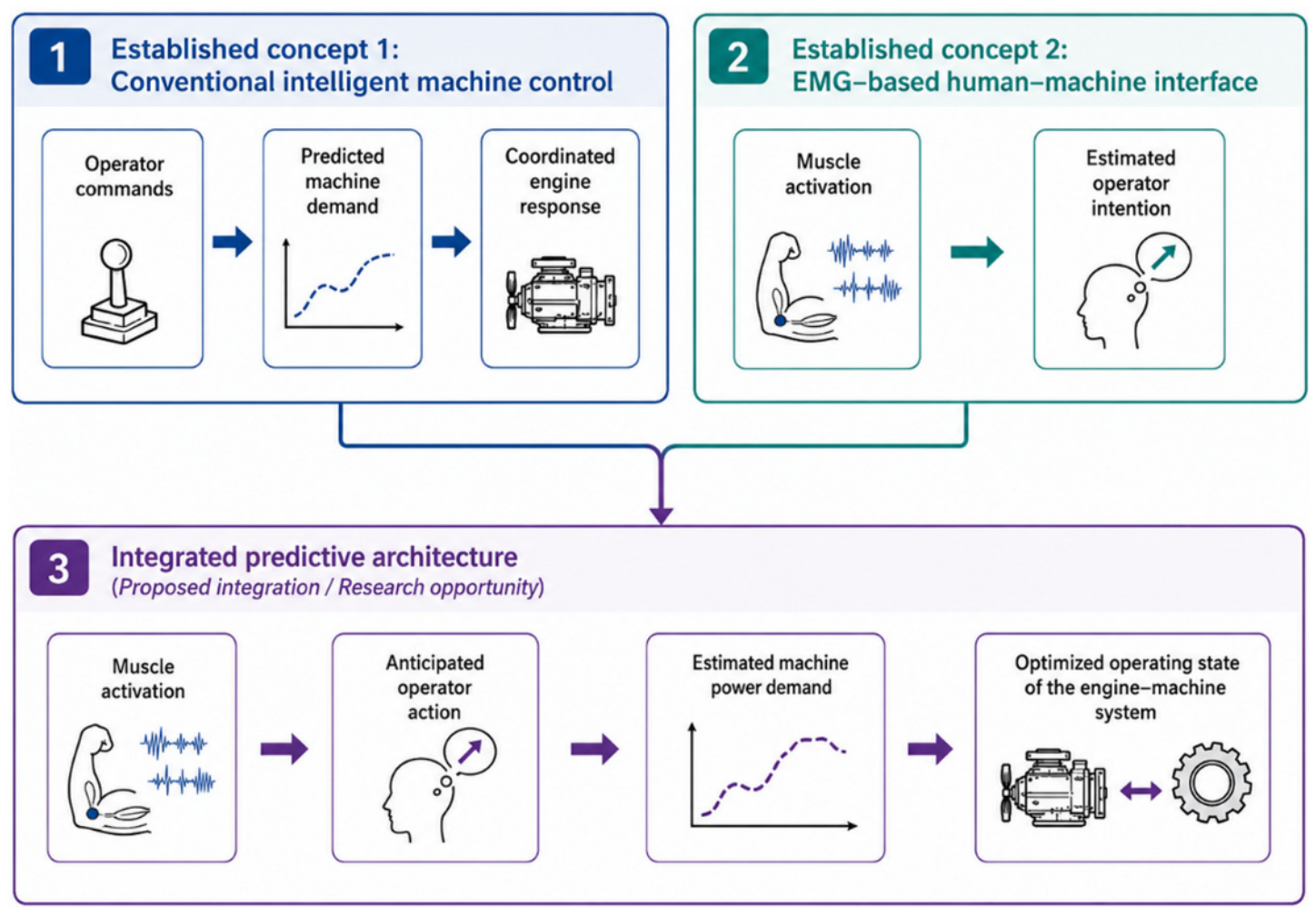
The key hypothesis requiring experimental validation is that EMG provides additional information sufficiently reliably and early to change the transient operation of the power system in a way that measurably reduces fuel consumption or exhaust emissions without degrading machine productivity, response, or safety. Existing literature supports each principal component of this architecture individually, but direct evidence for the complete causal chain has not yet been identified.
7. Fuel Consumption and Exhaust Emissions of Internal Combustion Engines: Experimental Evidence and Potential Implications of EMG-Informed Control
7.1. Evidence Linking EMG-Based Control with Energy Effects
The potential environmental benefits of EMG-based control should be distinguished from its demonstrated ability to control machine functions. Existing studies provide strong evidence that myoelectric information can modify actuator commands, assistance torque, movement trajectories, and machine functions; however, direct evidence linking EMG control with reduced fuel consumption or exhaust emissions from an internal combustion engine-powered machine has not been identified in the literature reviewed in this study. Consequently, the environmental relevance of the proposed architectures must currently be evaluated through the mechanisms by which EMG-informed control could modify machine power demand and engine operating conditions rather than through directly measured emission reductions.
The environmental assessment in this section focuses on the operational effects of internal combustion engine control, particularly fuel consumption, engine operating conditions, and exhaust emissions. Although EMG-based interfaces have demonstrated the feasibility of recognizing operator intention and modifying machine-control commands, their influence on internal combustion engine efficiency has not yet been experimentally established. Therefore, quantitative results obtained from conventional and adaptive engine-control systems are used to identify potential mechanisms through which EMG-derived information could contribute to improved engine operation. These results should be interpreted as evidence supporting the proposed control concept rather than as experimentally demonstrated energy or environmental benefits of EMG itself.
This distinction is fundamental to the present review. In an exoskeleton, EMG directly influences actuator assistance and consequently modifies the mechanical work performed by the human. In a combustion-engine-powered working machine, the expected causal chain is more complex, with EMG signals used to anticipate operator action, predict the resulting machine power demand, modify the operating state of the engine–machine system, and ultimately influence fuel consumption and exhaust emissions (Figure 22).
Figure 22.
Comparison of the causal pathways of EMG-based control in exoskeletons and combustion-engine-powered working machines. In exoskeletons, EMG directly influences actuator assistance and human mechanical work, whereas in combustion-engine-powered machines the effect is indirect and multi-stage, involving operator-action anticipation, machine power-demand prediction, adjustment of the engine–machine operating state, and potential changes in fuel consumption and exhaust emissions (generated with AI).
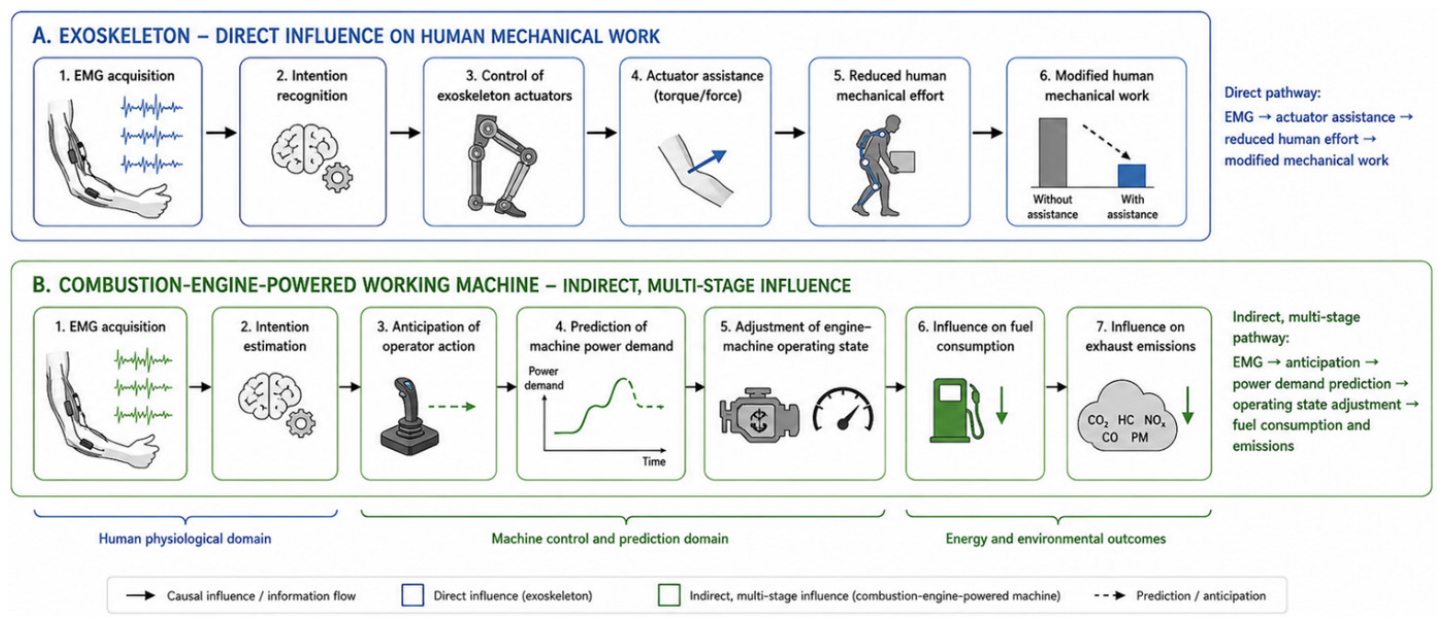
Therefore, any energetic or environmental benefit attributed to EMG in an internal combustion engine (ICE)-powered machine must ultimately be demonstrated through changes in engine and machine operation, not merely through improvements in EMG classification accuracy or operator muscular effort.
7.2. Fuel Consumption and Engine Efficiency Through Improved Power-Demand Matching
One potential mechanism by which EMG-informed control could reduce fuel consumption is better matching of engine output to the instantaneous power demand of the working process. Experimental studies of hydraulic excavators demonstrate that a large proportion of fuel energy is lost before being converted into useful mechanical work. An et al. in 2020 [81] developed an energy flow-down methodology using measurements from an actual excavator during dig-and-dump operations. They reported that 59.8% of the total fuel energy was consumed within the engine system, 17.0% within the hydraulic system, and 23.2% within the hydraulic actuation system. Only part of the initial fuel energy was ultimately converted into useful actuator work [81].
These results indicate that reducing fuel consumption cannot be achieved solely by modifying the combustion process. The complete power chain must be considered, because the amount of engine power requested by the operator determines subsequent pump flow, hydraulic pressure, actuator operation, and associated losses. Experimental work by Ng et al. in 2016 [78] demonstrated that excavator operating parameters, including engine rotational speed and bucket cut depth, influence the balance between fuel efficiency and productivity. This supports the concept that the most energy-efficient machine state is not necessarily obtained by continuously maintaining maximum engine speed or maximum available power [78].
The relevance to EMG follows from the temporal position of muscle activation within this demand-generation process. Conventional intelligent machine control may identify a change in required power from joystick movement, hydraulic pressure, pump displacement, or other machine variables. The Cummins Intelligent Engine and Pump Controls patent explicitly describes detection of changes in engine loading from joystick commands and hydraulic-system parameters and, during reduced demand, reduction in engine speed combined with an increase in pump displacement to improve engine efficiency [63].
An EMG-informed system could potentially move this detection point further upstream. Instead of identifying increased demand only after joystick displacement, the controller could use muscular activation associated with an impending joystick action as an additional predictive variable. The environmental significance would therefore depend on whether the physiological signal allows the engine and hydraulic system to generate closer to the amount of power actually required, at the time at which it is required.
The appropriate energy-performance metric should therefore be task-oriented rather than limited to instantaneous fuel flow. Fuel consumption expressed per working cycle, transported mass, excavated volume, or another unit of useful production would allow improvements in efficiency to be separated from simple reductions in machine performance. Ng et al. in 2016 explicitly considered the interaction between productivity and fuel efficiency in excavator operation, demonstrating why both variables must be evaluated simultaneously when assessing an energy-saving control strategy [78].
A second potential mechanism is redistribution of engine operation toward more favorable engine speed–engine load combinations. The operator of a conventional working machine may maintain an elevated engine speed to ensure sufficient power reserve and rapid actuator response even when the instantaneous working demand is substantially lower. Such operation can provide satisfactory responsiveness but does not necessarily maximize task-level fuel efficiency [78].
The Cummins engine–pump control concept provides a practical example of this principle. During decreasing or sustained low load, the controller may reduce engine speed while increasing hydraulic-pump displacement, thereby maintaining useful hydraulic output while improving engine-system efficiency. Conversely, when increased load is detected, the controller can increase fueling and air or boost supply to increase available torque and improve transient response [63].
For an EMG-informed controller, the objective should therefore not be to minimize engine speed under all conditions. Rather, EMG-derived information could contribute to selecting the engine–pump operating combination appropriate for the expected working action. A low-intensity maneuver could permit operation at a lower engine-speed reference, whereas an anticipated high-power action could justify temporarily increasing available power before substantial load reaches the engine.
This approach would convert EMG from a conventional human-interface signal into a power-management input. However, the relevant relationship would be indirect. EMG amplitude itself should not be assumed to correspond linearly to engine torque or fuel rate. The required intermediate stages are recognition of the intended machine action, estimation of its expected mechanical or hydraulic demand, and selection of an appropriate engine operating point. The energetic benefit would therefore depend on the quality of this complete prediction chain.
Quantitative experimental studies confirm that selecting appropriate engine operating conditions can substantially influence fuel consumption and environmental performance. Ng et al. [78] demonstrated that optimizing engine speed and bucket cut depth in a hydraulic excavator increased productivity by up to 30%, reduced greenhouse gas emissions by 24%, and increased the amount of excavated material moved per hour per liter of fuel by 62%. More recently, Qiang et al. [93] experimentally demonstrated a 12.5% reduction in the overall fuel consumption rate of a bulldozer using an optimized engine speed–load control strategy compared with constant-speed operation. Although these improvements were achieved without EMG, they provide quantitative evidence that appropriate adjustment of engine operating conditions to machine demand can produce measurable energetic benefits. The potential contribution of EMG would be to improve the prediction of forthcoming demand rather than to modify engine efficiency directly.
7.3. Transient Operation and Low-Load Management
Transient operation represents one of the most promising areas for EMG-informed power management. Working machines are characterized by frequent transitions between digging, lifting, swinging, unloading, travelling, positioning, and low-demand phases. These changes impose rapid variations in torque demand on the engine. A conventional controller must respond through fuel delivery, air-path control, turbocharger response, pump operation, and other coupled processes.
The engine–pump control strategy disclosed by Ambaliya et al. in 2024 [63] was developed specifically to address this problem. The patent describes detection of increasing loading from joystick commands, pump pressure, pump displacement, or clutch state and subsequent increases in fueling and/or air and boost pressure to prevent substantial engine-speed reduction during sudden load application. This demonstrates that earlier knowledge of impending load is already considered valuable for improving transient behavior in large machinery [63].
Experimental studies of non-road diesel engines further demonstrate that transient operation has important energy and emission consequences. Hu et al. in 2021 [89] investigated energy flow and emissions from a turbocharged EGR non-road diesel engine equipped with diesel oxidation catalyst (DOC) and diesel particulate filter (DPF) during the Non-Road Transient Cycle (NRTC). Their results showed that engine and exhaust-system thermal behavior develops dynamically during the cycle and that aftertreatment performance is affected by this transient energy-flow behawior [89].
The transient response of supercharged internal combustion engines can also be investigated using engine-dynamometer test benches combined with numerical simulation and hardware-in-the-loop (HIL) techniques. Mirzaeian and Langridge [100] developed a coupled GT-SUITE and Simulink model of an 11 L turbocharged diesel engine, integrating boost-pressure control, exhaust gas recirculation, fuel injection, and exhaust-system management. The model was validated using experimental engine measurements over a speed range of 550–2200 rpm, while transient tests involving a rapid increase in accelerator demand from 0% to 100% at 900 and 1900 rpm were used to investigate turbocharger response. Nazari et al. [101] investigated an alternative electrically assisted supercharging system using a 1.6 L spark-ignition engine, a transient dynamometer, an electric supercharger, exhaust-emission measurement equipment, and real-time vehicle simulation. The combined supercharging and hybrid energy-management system reduced fuel consumption by 18.4% over the FTP75 cycle compared with the baseline turbocharged configuration. These studies demonstrate the complexity of supercharging-system simulation and experimental validation, particularly regarding boost-pressure dynamics, engine torque response, fuel consumption, and exhaust emissions. For future EMG-informed control, such validated models and test-bench configurations could be used to determine whether earlier recognition of operator demand improves engine transient response and environmental performance beyond conventional predictive control.
The principal potential role of EMG is therefore to anticipate demand. If the operator’s muscular activation can indicate an impending high-load joystick or pedal action before the corresponding hydraulic or drivetrain load reaches the engine, the available prediction interval could be used to prepare the power system. Depending on engine architecture, this could involve adjustment of engine-speed reference, pump displacement, fueling limits, boost-pressure target, or another supervisory variable.
The expected environmental benefit would arise if this anticipation reduced unnecessary over-fueling, excessive engine-speed excursions, prolonged operation with excess power reserve, or other inefficient transient responses. These outcomes remain hypotheses requiring experimental verification. The key comparison should therefore be between a conventional controller and the same controller supplemented with EMG-derived future-demand information, rather than between an EMG-controlled and an uncontrolled engine.
Reduction in unnecessary power availability during low-demand phases represents a complementary mechanism. In working machines, periods of intensive operation are interspersed with positioning, waiting, tool repositioning, or temporary absence of hydraulic demand. If high engine speed is maintained throughout these phases, fuel continues to be consumed despite limited useful power output. Experimental analyses of excavator operation confirm that control strategy and engine-speed selection influence task-level fuel efficiency [78].
Previous field studies of manually fed wood chippers demonstrated that machine operating conditions are strongly influenced by operator activity and work organization. For a single operator, the mean proportion of idling time increased from approximately 42.8% at a branch-pile distance of 3 m to 70.8% at 15 m [102]. These findings indicate that operator-dependent working cycles create opportunities for adaptive engine-speed management. Experimental studies have subsequently demonstrated that such strategies can reduce fuel consumption and modify exhaust emissions [41,42,92], although these improvements were obtained without EMG-based control.
Warguła et al. [42] quantified the effects of adaptive engine-speed control in experimental tests of a wood-reduction machine powered by a 9.5 kW spark-ignition engine. Compared with conventional control, the adaptive strategy reduced fuel consumption by 33%, CO emissions by 30%, CO2 emissions by 37%, and NOx emissions by 33%. However, HC emissions increased by approximately 290%. These results demonstrate that reducing unnecessary high-speed engine operation during low-demand periods can improve fuel efficiency while introducing unfavorable changes in selected pollutant emissions. Accordingly, an EMG-informed engine controller should be evaluated using both fuel-consumption and emission-related indicators rather than energy efficiency alone.
Contemporary intelligent engine–pump control already addresses this problem. Ambaliya et al. (2024) [63] describe identification of a sustained low-loading condition and subsequent reduction in engine speed, optionally accompanied by increased pump displacement. The patent therefore establishes a direct link between demand detection and reduction in unnecessary engine power availability [63].
EMG could potentially supplement such strategies by helping distinguish a temporary low-load interval from the completion of an operator action. For example, loss of muscular activation associated with a working-tool command could indicate that the operator is finishing an operation, whereas development of another characteristic activation pattern could indicate that another high-demand action will shortly follow. A predictive controller could then decide whether reducing engine speed is energetically justified or whether maintaining power availability for a short interval would avoid an immediate subsequent acceleration.
However, operating an internal combustion engine at low idle speed also introduces technical and environmental challenges. Even in the absence of useful mechanical output, fuel is continuously consumed to overcome internal friction and auxiliary loads. At reduced rotational speeds, the available torque reserve and the ability of the speed governor to compensate for sudden load increases may become insufficient, resulting in fluctuations in engine speed, torque, and power output, or even engine stalling. Combustion stability is another important consideration. Szpica and Kluczyński [40] reported a coefficient of variation in indicated mean effective pressure of 6.92% under idling conditions, compared with values below 1% at several moderate-load operating points of the investigated diesel engine. Environmental effects are also not necessarily proportional to fuel savings. Warguła et al. (2023) [42] demonstrated that adaptive engine-speed reduction decreased fuel consumption by 33%, while HC emissions increased by approximately 290%. Furthermore, prolonged low-load operation may reduce exhaust-gas temperatures and adversely affect exhaust aftertreatment efficiency in engines equipped with temperature-dependent emission-control systems [89,91]. Therefore, idle-speed management should consider not only fuel consumption but also combustion stability, transient torque availability, engine-speed fluctuations, and individual pollutant emissions. These factors are particularly relevant to EMG-informed predictive control, which should anticipate upcoming load changes while avoiding excessive idle-speed reduction and unnecessary engine acceleration.
This creates a particularly important control problem: an energy-saving controller should not continuously reduce engine speed whenever instantaneous load decreases. Excessive speed changes may themselves generate additional transient events and degrade machine responsiveness. The value of an EMG signal would therefore lie in distinguishing expected persistent low demand from a short transition between two high-demand actions, not simply detecting low load.
7.4. Exhaust Emissions, CO2 Effects, and Aftertreatment Constraints
Fuel consumption and exhaust emissions do not necessarily respond in the same way to changes in engine operating strategy. Experimental non-road diesel research demonstrates that modifications capable of reducing one pollutant may increase another and that emission behavior depends strongly on engine speed, engine load, combustion calibration, and transient conditions.
Feng et al. in 2023 [90] experimentally investigated a turbocharged non-road diesel engine under steady-state and NRTC conditions. Modifications including pre-injection, smoke-limit control, and intake-throttle strategies reduced PM and NOx emissions by 5.2% and 5.5%, respectively, over the NRTC, while fuel consumption remained nearly unchanged. At some low-load conditions, however, the optimized strategy increased NOx even while substantially reducing PM. This result demonstrates that fuel consumption, PM, and NOx must be treated as separate control objectives rather than assuming that an energy-efficient operating strategy automatically minimizes all pollutants [90].
The thermal state of the aftertreatment system introduces an additional constraint. Feng et al. in 2022 [91] compared cold- and hot-start transient operation of a non-road diesel engine equipped with aftertreatment. Cold-start conversion efficiencies were markedly lower than during hot operation; for example, PM conversion efficiency during the investigated cold-start condition was reported at approximately 33%, while the conversion efficiencies for NOx, HC, and CO were 86%, 79%, and 63%, respectively. The authors identified exhaust temperature and exhaust flow as important determinants of aftertreatment conversion performance [91].
Further quantitative evidence was provided by Lee et al. [95], who experimentally investigated a 110 PS non-road diesel engine equipped with an electrically heated catalyst during Non-Road Transient Cycle (NRTC) tests. Under the investigated conditions, the optimized exhaust thermal-management strategy reduced NOx emissions by 58.6% during the cold cycle and by 88.4% during the hot cycle compared with operation without catalyst heating. However, these improvements were accompanied by an equivalent fuel-consumption penalty of approximately 1.68% over the weighted cycle. Although this study did not involve EMG, it demonstrates that changes in engine and aftertreatment control can produce substantial environmental effects, including trade-offs between fuel consumption and pollutant emissions. These constraints would need to be incorporated into any future EMG-informed supervisory engine-control strategy.
Hu et al. in 2021 [89] similarly demonstrated under NRTC conditions that energy-flow characteristics, exhaust temperature, and aftertreatment operation are dynamically coupled. Therefore, reducing engine load or rotational speed solely to minimize instantaneous fuel use could under some circumstances decrease exhaust temperature and negatively affect the conversion efficiency of DOC, DPF, or selective catalytic reduction (SCR) systems [89].
Research on Stage V off-road engines reinforces this trade-off. Lauren et al. in 2020 [103] experimentally investigated several measures for increasing exhaust-gas temperature during transient cycles because sufficient temperature is required for aftertreatment operation and particulate-filter regeneration. Their results showed that different thermal-management strategies produced different combinations of exhaust temperature, fuel economy, and emissions, illustrating that aftertreatment thermal requirements must be included in an energy-oriented control strategy [103].
Consequently, an EMG-informed supervisory controller should not use a single objective such as minimum predicted fuel rate. It should account simultaneously for demanded machine power, engine efficiency, transient response, exhaust temperature, and emission-control requirements. In a practical system, EMG would only modify the prediction of future demand; emission constraints would still be enforced by conventional ECU and supervisory engine-control functions.
For a machine powered by a fossil hydrocarbon fuel, a sustained reduction in total fuel consumed to perform the same useful task would also reduce direct fuel-related carbon dioxide emissions. For this reason, fuel consumption per unit of productive work is an appropriate first environmental indicator for evaluating a future EMG-informed machine controller. Studies of construction-equipment operation consistently treat fuel use as a central determinant of task-level environmental performance, while experimental excavator research demonstrates that operator-related operating conditions can influence this quantity [78,81].
However, environmental assessment should be normalized to equivalent productivity. A controller that lowers fuel consumption by reducing engine power but simultaneously increases cycle time or decreases material throughput may provide little or no genuine environmental improvement. Therefore, the comparison should include fuel consumption per cycle together with task productivity and, where possible, fuel consumed per unit mass or volume of material processed [78].
The same principle applies to regulated emissions. Reporting only instantaneous NOx or PM concentrations could be misleading if the controller changes cycle duration or exhaust mass flow. Mass emissions should therefore be integrated over a standardized work cycle and, where appropriate, expressed per unit of useful work or productivity.
Experimental evidence of the environmental consequences of adaptive engine control is provided by Warguła et al. [82], who compared conventional and adaptive engine-speed management strategies in a combustion-engine-powered wood chipper. Using portable emissions measurement equipment, the authors evaluated fuel consumption and mass emissions of individual exhaust pollutants during machine operation. Adaptive control reduced fuel consumption from 1.38 to 0.91 L/h and CO2 emissions from 2.91 to 1.79 kg/h compared with the conventional carburetor-based configuration. However, HC emissions increased from 0.013 to 0.017 kg/h. These findings demonstrate that improved engine operating strategies can reduce fuel consumption and selected emissions while simultaneously increasing other pollutants. Accordingly, the environmental assessment of EMG-informed engine control should consider individual emission components and operating-cycle characteristics rather than assuming that reduced fuel consumption necessarily results in an overall reduction in environmental impact.
7.5. Operator and Environmental Benefits: Evaluation Indicators
A relevant methodological distinction arises between operator-energy efficiency and machine-energy efficiency. Existing myoelectric exoskeleton studies demonstrate that EMG-based proportional control can reduce muscular activation and human metabolic cost. Young et al. in 2017 [55], for example, demonstrated the previously noted 13% reduction in metabolic cost with proportional EMG control. This is a genuine energetic benefit, but the energy is saved by the human biological system and cannot be equated with reduced electricity or fuel consumed by the powered device [55].
For working machinery, both effects could potentially coexist. An adaptive control system may reduce operator effort by making the machine respond more naturally while simultaneously reducing unnecessary engine power generation. Nevertheless, these effects must be evaluated independently. EMG amplitude, muscle activation, and operator workload are biomechanical or human-factor outcomes, whereas fuel consumption, engine energy efficiency, and emissions are power-system and environmental outcomes.
This distinction is particularly important for the interpretation of future experimental results. A reduction in operator EMG amplitude after activating an adaptive controller would demonstrate reduced muscular demand but would not establish an environmental improvement. Conversely, a reduction in fuel consumption with unchanged operator EMG could still represent a successful energy-management strategy.
Based on the energy-flow, engine-control, and EMG literature reviewed above, future experimental validation should simultaneously consider three groups of indicators.
The first group should characterize prediction and control performance, including EMG intention-recognition accuracy, prediction lead time, false-positive rate, controller latency, engine-speed deviation during load application, and accuracy of predicted power demand. The relevance of prediction lead time follows directly from intelligent engine–pump strategies that use early load indicators to prepare engine fueling and air handling before transient loading fully develops [63].
The second group should characterize energy performance, including instantaneous fuel consumption, total fuel consumed per working cycle, brake-specific fuel consumption where directly measurable, engine speed and torque distributions, hydraulic energy demand, useful mechanical work, and fuel consumed per unit of productivity. Energy-flow measurements similar to those proposed by An et al. in 2020 [81] would be particularly useful because they make it possible to determine whether an improvement originates in the engine, hydraulic system, or working actuator rather than attributing every energy difference directly to the EMG controller [81].
The third group should characterize environmental performance, including cycle-integrated CO2, NOx, CO, HC, PM and, where instrumentation permits, particle number. Exhaust-gas temperature and aftertreatment temperature should also be measured because changes in the operating strategy may affect catalyst and filter effectiveness independently of engine-out emissions [89,91].
Ideally, experimental comparisons should use the same operator, machine, work cycle, and external load under at least two control conditions: conventional machine control and conventional control supplemented with EMG-informed demand prediction. A third configuration using machine-side prediction without EMG would be particularly valuable because it would determine whether EMG provides additional information beyond joystick, pressure, pump, and drivetrain signals already available to intelligent machine controllers.
To quantify the specific contribution of EMG-derived information to energy efficiency and environmental performance, future experimental studies should compare three control configurations: (A) conventional machine control, (B) predictive control based exclusively on conventional machine-state and operator-command signals, and (C) the same predictive controller supplemented with EMG-derived operator-intention information. Measurements should be performed over equivalent working cycles, with comparable external loads and productivity requirements. Fuel consumption should be determined using direct fuel-flow measurements or a validated carbon-balance method. Exhaust emissions should be evaluated using appropriate laboratory instrumentation or portable emissions measurement systems (PEMS), with pollutant mass emissions integrated over the complete working cycle. The principal indicators should include fuel consumption per unit of productive work and mass emissions of CO2, NOx, CO, HC, and PM per working cycle or unit of productivity. Additional measurements of engine speed, torque, hydraulic demand, exhaust temperature, and aftertreatment conditions would help explain the physical mechanisms responsible for any observed changes. Comparing configurations B and C would establish whether EMG provides a measurable energy or environmental benefit beyond existing predictive machine-control methods. Repeated trials and statistical analysis would be required to distinguish control-related effects from normal operational variability.
7.6. Overall Energy and Environmental Assessment
The literature reviewed in this study supports a plausible but currently unverified pathway from EMG information to improved environmental performance of combustion-engine-powered machines. The available evidence does not directly demonstrate reduced diesel consumption through EMG control. Instead, it consists of several independently established findings.
First, EMG-based proportional control can successfully modify machine assistance in response to muscular activation and can produce measurable energetic effects in human–machine systems [55]. Second, operator-related operating parameters and engine-speed selection influence fuel efficiency and productivity in hydraulic working machinery [78], while detailed excavator energy-flow measurements demonstrate substantial losses throughout the engine–hydraulic–actuator energy chain [81]. Third, intelligent machine controllers already use joystick and hydraulic signals to detect impending changes in engine loading and coordinate engine fueling, air handling, engine speed, and pump displacement [63]. Finally, experimental non-road diesel research demonstrates that transient operating state and thermal history materially influence PM, NOx, fuel consumption, and aftertreatment performance [89,90,91].
Taken together, these findings indicate that the principal environmental opportunity offered by EMG lies not in directly optimizing combustion but in improving the information available to the supervisory controller. If muscular activity provides a reliable and sufficiently early indication of impending operator demand, it could allow engine and machine power availability to be adjusted more closely to future rather than only current operating requirements.
The central hypothesis can therefore be formulated as follows: earlier and more accurate information about operator demand may improve the matching of engine output to machine demand, thereby reducing unfavorable operating states and unnecessary power reserves and, consequently, lowering task-specific fuel consumption and potentially exhaust emissions (Figure 23).
Figure 23.
Conceptual hypothesis linking earlier and more accurate operator-demand information from EMG with improved matching between engine output and machine power demand, fewer unfavorable operating states and unnecessary power reserves, and consequently lower task-specific fuel consumption and potentially reduced exhaust emissions (generated with AI).
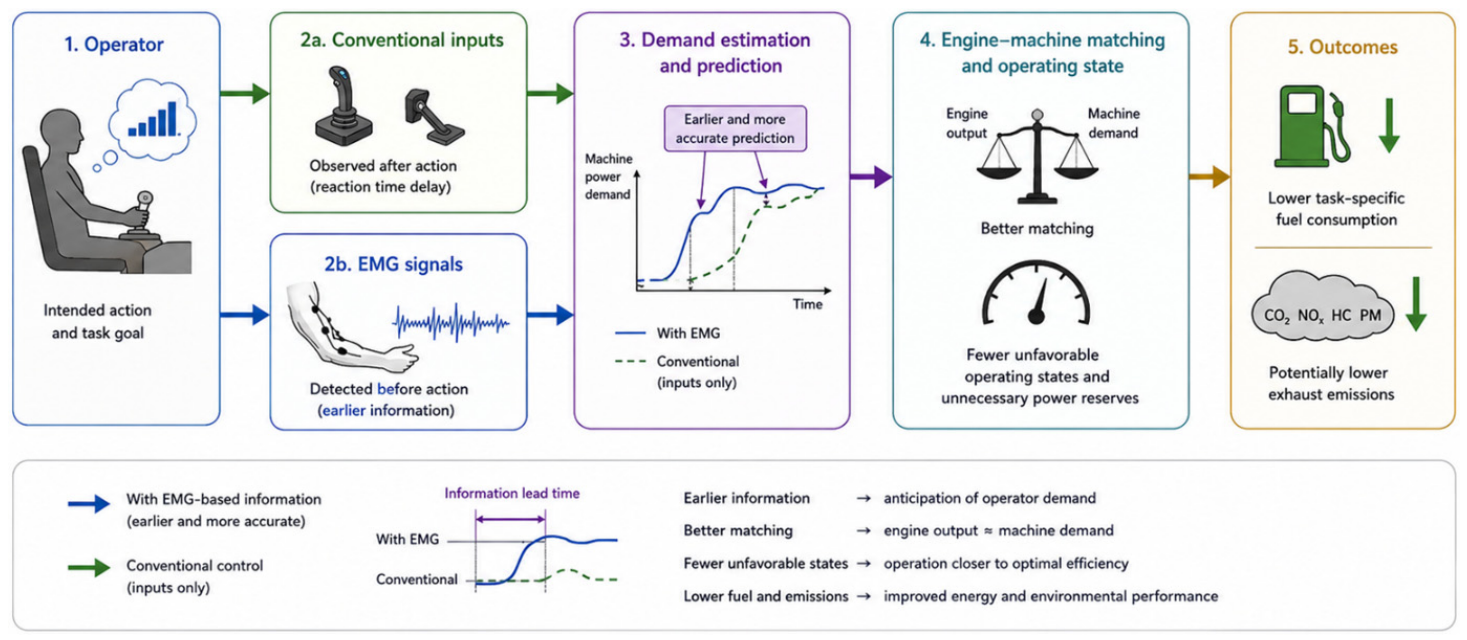
The final step in this causal chain remains to be demonstrated experimentally. Until such validation is available, reduced fuel consumption and exhaust emissions should be treated as potential outcomes of EMG-informed control, whereas the established evidence concerns the feasibility of EMG-based human–machine interaction and the independent energetic benefits of advanced engine–machine power-management strategies.
8. Limitations and Research Challenges
8.1. EMG Signal Variability, Electrode Placement, and Operator-Related Factors
A key limitation of EMG-informed machine control is the nonstationary nature of the physiological signal. Surface EMG depends on muscle recruitment, contraction intensity, electrode position, limb posture, anatomical differences, and measurement conditions. Consequently, the same intended action may produce different signal patterns across operators, measurement sessions, and repeated trials [49,64].
For real-time control, such variability is more critical than in conventional biomechanical analysis because changes in signal characteristics can directly affect classification or regression outputs. Therefore, EMG should not be interpreted using a simple relationship such as a higher EMG amplitude directly indicating greater engine power demand. More robust approaches should identify temporal and spatial patterns of operator intention and provide a confidence estimate together with the predicted command [48,104].
Electrode shift, loosening, and changes in skin contact significantly affect sEMG characteristics and may reduce recognition accuracy. This problem becomes particularly important when wearable sensors are repeatedly removed and replaced or move during prolonged operation [65,104].
Working machinery additionally exposes operators to vibration, shocks, posture changes, sweating, temperature variation, and repeated gripping movements. These factors may generate motion artifacts and changes in electrode–skin impedance [105,106]. Adaptive algorithms and high-density electrode arrays can partly compensate for these effects, although they increase hardware and computational complexity [47,107].
A practical system should therefore continuously evaluate EMG signal quality and reduce the influence of unreliable channels rather than assume constant measurement quality.
Muscle fatigue changes both the amplitude and spectral characteristics of EMG and may reduce the performance of models trained under non-fatigued conditions. This creates a particular problem for power-demand estimation because greater muscular activation during fatigue does not necessarily indicate greater intended machine demand [108].
Large differences also occur between operators because of anatomy, movement strategy, subcutaneous tissue, and individual muscle-recruitment patterns. User-specific calibration can improve performance but may be impractical in machines operated by multiple users. Recent large-scale and adaptive EMG systems indicate that generalized models combined with rapid user adaptation may reduce this requirement [48,107].
A promising approach would therefore be to continuously learn the relationship between characteristic EMG patterns, subsequent joystick or pedal actions, and the resulting machine demand during normal machine operation (Figure 24).
8.2. Prediction Reliability, Processing Delay, and Multimodal Control
The main justification for introducing EMG into engine control is its potential to provide information before a conventional joystick or pedal command. However, the physiological advantage is partly consumed by acquisition, signal-windowing, preprocessing, classification, communication, and controller latency. Longer analysis windows may improve classification accuracy but increase response delay [51].
The key parameter is therefore the effective prediction horizon, defined as the temporal lead of the EMG signal over the conventional control command minus the total processing latency of the EMG-based prediction system (Figure 25).
Figure 24.
Concept of continuous operator-specific learning during normal machine operation, in which characteristic EMG patterns are associated with observed joystick or pedal actions and the resulting measured machine demand to progressively improve prediction of future control actions and power demand (generated with AI).
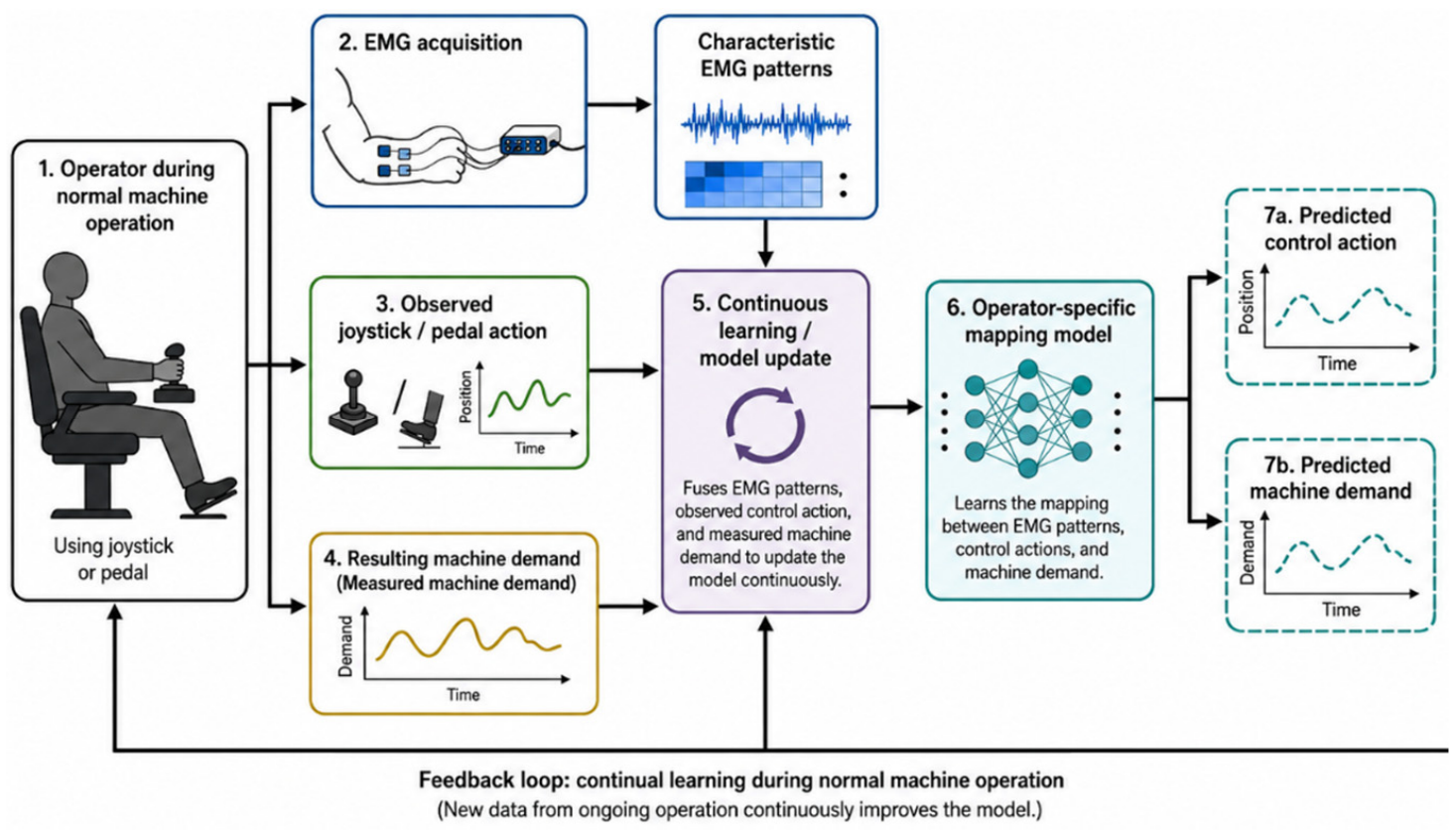
Figure 25.
Definition of the effective EMG prediction horizon as the temporal lead of EMG-derived information over the conventional joystick or pedal command minus the total processing latency of the EMG-based prediction system. A positive effective horizon indicates a usable anticipatory advantage for supervisory machine and engine control (generated with AI).
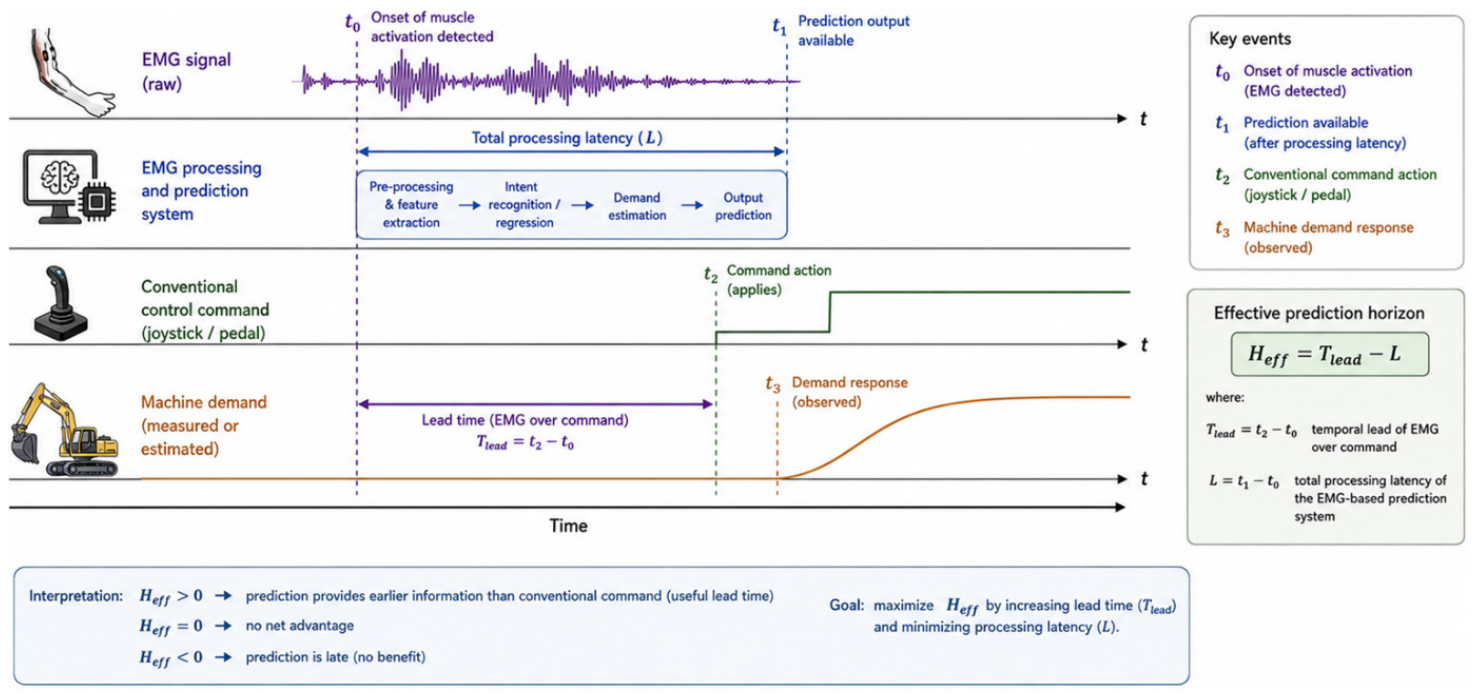
EMG is useful for engine power management only if this remaining interval is sufficiently long relative to the dynamics of the engine, turbocharger, hydraulic system, or transmission.
Future studies should therefore compare EMG with the earliest conventional indicators already available in the machine, including joystick displacement, pump pressure, and pump displacement. Existing engine–pump controllers already use these signals to anticipate changes in engine load [63].
Published experimental studies provide quantitative indications of the possible temporal advantage of EMG-based intention recognition. Ju et al. [33] reported that an EMG-based emergency-braking detection system identified the intended action approximately 155.7 ms before the corresponding behavioral response, with a detection accuracy of 95.72%. Chen et al. [109] investigated upper-limb EMG for predicting joystick movements and found that predictive information generally became distinguishable approximately 100 ms before movement onset, reaching approximately 200 ms in some participants. These findings suggest that EMG may provide anticipatory information on the order of tens to hundreds of milliseconds under specific experimental conditions. However, these values do not represent a demonstrated additional prediction horizon for internal combustion engine control. The effective advantage must be determined relative to the earliest prediction already available from conventional operator-command or machine-state signals, while accounting for EMG acquisition, processing, classification, and communication delays. Moreover, the prediction interval must be sufficiently long to influence the dynamic response of the engine, turbocharger, or hydraulic system. Therefore, the reported results establish the plausibility of an anticipatory physiological input, but its incremental contribution to machine power-demand prediction and energy efficiency remains unverified.
Muscle activation does not always correspond to an intended machine command. Grip adjustment, posture stabilization, vibration compensation, or reaching for another control may generate substantial EMG signals. Therefore, EMG-only control could produce false demand predictions.
A more robust solution would employ multimodal sensor fusion, combining EMG signals with joystick or pedal inputs, machine state, and hydraulic or drivetrain signals to generate a confidence-weighted prediction of operator and machine demand (Figure 26).
Figure 26.
Conceptual multimodal sensor-fusion architecture in which EMG signals are combined with joystick or pedal inputs, machine-state variables, and hydraulic or drivetrain signals to generate a confidence-weighted prediction of operator action and machine power demand for supervisory engine–machine control (generated with AI).
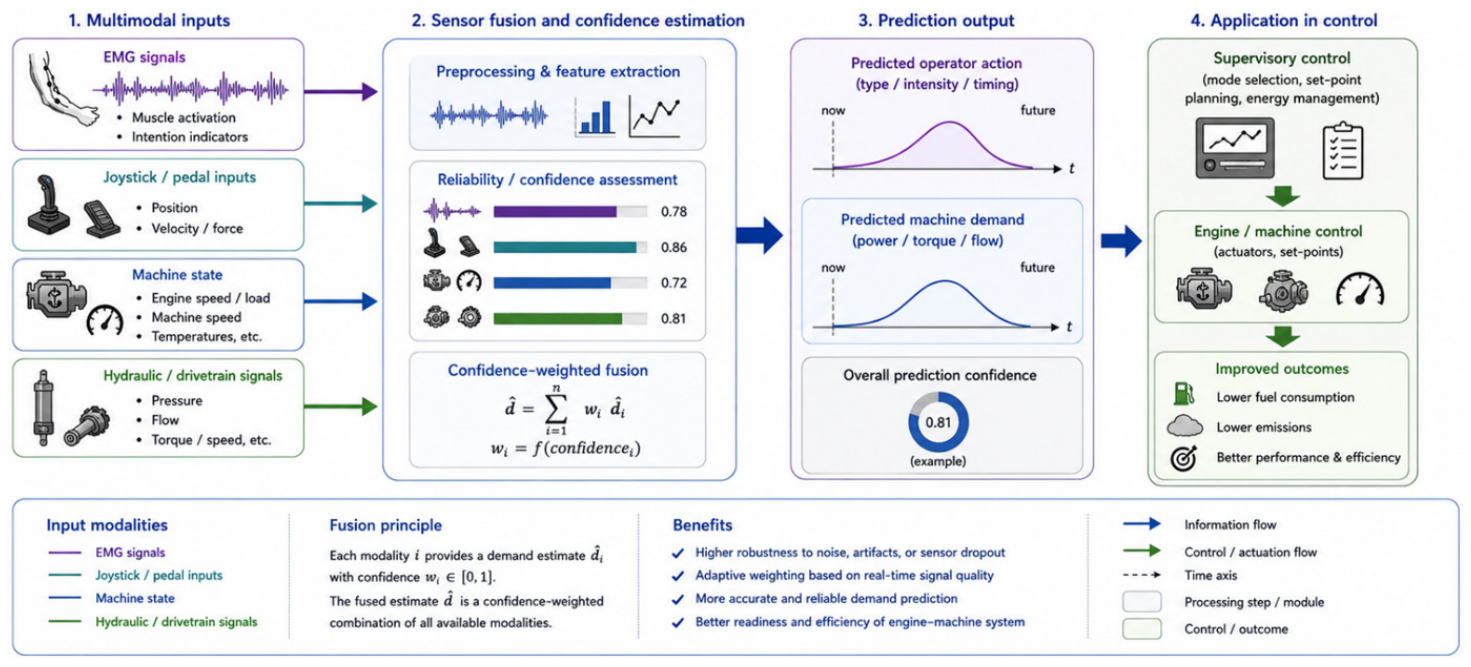
If physiological and conventional signals indicate the same future action, the prediction confidence may be increased. If they disagree, EMG influence should be reduced or rejected. Such adaptive and multimodal approaches are consistent with existing myoelectric interfaces and intelligent engine–pump control architectures [64,106].
8.3. Functional Safety and Experimental Validation
EMG should not directly control safety-critical combustion or machine actuators. A more appropriate architecture is hierarchical, in which EMG provides supplementary information about future demand while conventional controllers retain authority over engine torque, fueling, air handling, hydraulic systems, and machine movement.
If EMG quality deteriorates or communication is lost, the machine should automatically revert to conventional control. This graceful-degradation strategy is consistent with functional-safety requirements applicable to earth-moving machinery, including the ISO 19014 [110] series addressing safety-related control architectures, hardware, software, and data transmission.
A deterministic safety layer should also constrain permissible engine speed, torque, hydraulic flow, and actuator movements independently of the adaptive EMG model.
The key question is not simply whether EMG can predict operator actions, but whether it provides earlier or more informative predictions than existing machine sensors.
Future experiments should therefore compare three control strategies: conventional reactive control, predictive control based exclusively on machine-side signals, and predictive control supplemented with EMG-derived information.
This comparison is necessary to determine the incremental value of EMG itself. Validation should include multiple operators, repeated sensor placement, prolonged operation, vibration, fatigue, and representative working cycles [48,108].
The most important variables should include prediction accuracy, false-positive rate, effective prediction lead time, engine-speed deviation, task-specific fuel consumption, machine productivity, and exhaust emissions.
The reviewed evidence indicates that the main barrier to EMG-informed control of internal combustion engine-powered machinery is no longer the ability to measure muscular activity or recognize simple gestures. The critical challenge is demonstrating that EMG provides robust, repeatable, sufficiently early, and safety-compatible information about future machine power demand under real operating conditions.
The additional complexity of physiological sensing can be justified only if EMG provides measurable predictive information beyond that available from joystick, hydraulic, drivetrain, and engine sensors. Subsequent research should therefore focus first on quantifying this incremental prediction advantage and only then on evaluating its potential effect on fuel consumption and exhaust emissions.
9. Conclusions
This review examined whether electromyographic signals can provide useful operator-intention information for the control of internal combustion engine-powered machines and whether such information could improve the matching of engine output to machine power demand. The reviewed scientific literature and patent documentation demonstrate that EMG can be successfully used for gesture recognition, intention detection, proportional control, adaptive assistance, and control of robots, vehicles, wheelchairs, exoskeletons, and working-machine functions. At the same time, modern engine–machine control systems already use operator commands and machine-state signals to predict changes in load and coordinate engine speed, torque availability, fueling, air handling, and hydraulic-system operation.
The principal finding is that the individual technological elements required for EMG-informed engine control already exist, but their integration for the explicit purpose of reducing fuel consumption and exhaust emissions in combustion-engine-powered working machines has not yet been experimentally demonstrated. The main contribution of this review is therefore the identification of not yet been experimentally demonstrated. The main contribution of this review is therefore the identification of this research gap and the proposal of a structured control framework ranging from direct EMG-derived commands to multimodal and predictive supervisory control. The concept disclosed in Polish patent application P.455043 illustrates a proposed implementation of this approach, in which upper-limb EMG and optical operator detection are used to anticipate material feeding and adjust the engine-speed setpoint of a combustion-engine-powered wood chipper.
Key limitations include EMG variability, electrode displacement, fatigue, motion artifacts, inter-operator differences, processing latency, and functional-safety requirements. In addition, the environmental benefit of EMG-informed control remains hypothetical until direct measurements confirm that the additional prediction horizon provided by EMG exceeds that available from conventional machine sensors and produces measurable reductions in task-specific fuel consumption and emissions without reducing productivity. Future research should therefore focus on synchronized EMG–machine measurements under real operating conditions, quantification of prediction lead time, multimodal sensor fusion, confidence-based control, and comparative testing of conventional, machine-side predictive, and EMG-assisted predictive control strategies.
Author Contributions
Conceptualization, A.Ś. and Ł.W.; methodology, A.Ś. and Ł.W.; software, A.Ś. and Ł.W.; validation, A.Ś., W.W., B.W. and Ł.W.; formal analysis, A.Ś. and Ł.W.; investigation, A.Ś. and Ł.W.; resources, A.Ś., W.W., B.W. and Ł.W.; data curation, A.Ś., W.W., B.W. and Ł.W.; writing—original draft preparation, A.Ś. and Ł.W.; writing—review and editing, A.Ś. and Ł.W.; visualization, A.Ś. and Ł.W.; supervision, A.Ś. and Ł.W.; project administration, A.Ś. and Ł.W.; funding acquisition, Ł.W. All authors have read and agreed to the published version of the manuscript.
Funding
This research received no external funding.
Data Availability Statement
The original contributions presented in this study are included in the article. Further inquiries can be directed to the corresponding author.
Acknowledgments
During the preparation of this manuscript, the authors used ChatGPT (OpenAI, GPT-5.6) solely to assist in the preparation of selected graphical elements and figures (Figure 1, Figure 2, Figure 3, Figure 4, Figure 5, Figure 6, Figure 7, Figure 8, Figure 9, Figure 10, Figure 11, Figure 12, Figure 13, Figure 14, Figure 15, Figure 16, Figure 17, Figure 18, Figure 19, Figure 20, Figure 21, Figure 22, Figure 23, Figure 24, Figure 25 and Figure 26) based on the authors’ instructions and source materials. The tool was not used for data analysis, interpretation of results, or formulation of scientific conclusions. All AI-assisted graphical outputs were reviewed, verified, and edited by the authors, who take full responsibility for the content of this publication.
Conflicts of Interest
The authors declare no conflicts of interest.
Appendix A
Table A1.
SANRA-Based Quality Assessment of the Narrative Review Manuscript.
References
- Warguła, Ł.; Lijewski, P.; Kukla, M. Influence of Non-Commercial Fuel Supply Systems on Small Engine SI Exhaust Emissions in Relation to European Approval Regulations. Environ. Sci. Pollut. Res. 2022, 29, 55928–55943. [Google Scholar] [CrossRef] [Scilit]
- Warguła, Ł.; Kadirov, A.; Aimukhanov, D.; Ulbrich, D.; Kaczmarzyk, P.; Bąk, D.; Wieczorek, B. Ecological Paradox in the Reuse of Internal Combustion Engines from Scrapped Vehicles for Electric Power Generation—Circular Economy Potential Versus Emission Certification Barriers. Sustainability 2025, 17, 10435. [Google Scholar] [CrossRef] [Scilit]
- Rymaniak, Ł.; Lijewski, P.; Kamińska, M.; Fuć, P.; Kurc, B.; Siedlecki, M.; Kalociński, T.; Jagielski, A. The Role of Real Power Output from Farm Tractor Engines in Determining Their Environmental Performance in Actual Operating Conditions. Comput. Electron. Agric. 2020, 173, 105405. [Google Scholar] [CrossRef] [Scilit]
- Fan, H. A Critical Review and Analysis of Construction Equipment Emission Factors. Procedia Eng. 2017, 196, 351–358. [Google Scholar] [CrossRef] [Scilit]
- Lijewski, P.; Merkisz, J.; Fuć, P. Research of Exhaust Emissions from a Harvester Diesel Engine with the Use of Portable Emission Measurement System. Croat. J. For. Eng. J. Theory Appl. For. Eng. 2013, 34, 113–122. [Google Scholar]
- Fuc, P.; Kurczewski, P.; Lewandowska, A.; Nowak, E.; Selech, J.; Ziolkowski, A. An Environmental Life Cycle Assessment of Forklift Operation: A Well-to-Wheel Analysis. Int. J. Life Cycle Assess. 2016, 21, 1438–1451. [Google Scholar] [CrossRef] [Scilit]
- Warguła, Ł.; Kaczmarzyk, P. Legal Regulations of Restrictions of Air Pollution Made by Mobile Positive Pressure Fans—The Case Study for Europe: A Review. Energies 2022, 15, 7672. [Google Scholar] [CrossRef] [Scilit]
- Caban, J.; Seńko, J.; Słowik, T.; Dowkontt, S.; Górnicka, D. Analysis of the Influence of Fuel Dose on the Electrical Parameters of the Starting Process of a Single-Cylinder Diesel Engine. Adv. Sci. Technol. Res. J. 2024, 18, 55–65. [Google Scholar] [CrossRef] [Scilit]
- Caban, J.; Seńko, J.; Ignaciuk, P. Laboratory Tests of Electrical Parameters of the Start-Up Process of Single-Cylinder Diesel Engines. Energies 2024, 17, 2155. [Google Scholar] [CrossRef] [Scilit]
- Hagan, R.; Markey, E.; Clancy, J.; Keating, M.; Donnelly, A.; O’Connor, D.J.; Morrison, L.; McGillicuddy, E.J. Non-Road Mobile Machinery Emissions and Regulations: A Review. Air 2023, 1, 14–36. [Google Scholar] [CrossRef] [Scilit]
- Bruno, F. Relationship Between Power Output, Fuel Consumption and Specific CO2 Emissions in Agricultural Tractors Using OECD Code 2 Test Reports. Agriculture 2026, 16, 1425. [Google Scholar] [CrossRef] [Scilit]
- Orynycz, O.; Zimakowska-Laskowska, M.; Kulesza, E. CO2 Emission and Energy Consumption Estimates in the COPERT Model—Conclusions from Chassis Dynamometer Tests and SANN Artificial Neural Network Models and Their Meaning for Transport Management. Energies 2025, 18, 3457. [Google Scholar] [CrossRef] [Scilit]
- Kim, W.-S.; Baek, S.-M.; Baek, S.-Y.; Jeon, H.-H.; Siddique, M.A.A.; Kim, T.-J.; Lim, R.-G.; Kim, Y.-J. Evaluation of Exhaust Emissions of Agricultural Tractors Using Portable Emissions Measurement System in Korean Paddy Field. Sci. Rep. 2024, 14, 3491. [Google Scholar] [CrossRef] [Scilit]
- Zimakowska-Laskowska, M.; Kozłowski, E.; Laskowski, P.; Wiśniowski, P.; Świderski, A.; Orynycz, O. Vehicle Exhaust Emissions in the Light of Modern Research Tools: Synergy of Chassis Dynamometers and Computational Models. Combust. Engines 2025, 200, 145–154. [Google Scholar] [CrossRef] [Scilit]
- Padovani, D.; Dimitriou, P.; Minav, T. Challenges and Solutions for Designing Energy-Efficient and Low-Pollutant Machines in Off-Road Hydraulics. Energy Convers. Manag. X 2024, 21, 100526. [Google Scholar] [CrossRef] [Scilit]
- Zamboni, G.; Capobianco, M. Effects of Rail Pressure Control on Fuel Consumption, Emissions and Combustion Parameters in a Turbocharged Diesel Engine. Cogent Eng. 2020, 7, 1724848. [Google Scholar] [CrossRef] [Scilit]
- Himmelseher, K.; Lampkowski, A.; Sterlepper, S.; Müller, V.; Querel, C.; Schaub, J.; Lorei, D.; Brüning, O.; Conée, C.; Ruhland, H.; et al. Control Strategy for a Hydrogen Combustion Engine with Lean and Stoichiometric Combustion System. Automot. Engine Technol. 2025, 10, 15. [Google Scholar] [CrossRef] [Scilit]
- Lai, F.; Sun, B.; Zhang, Z.; Zhang, S.; Wang, K.; Ju, X.; Luo, Q.; Bao, L.; Leach, F. Experimental Investigation of the Matching Boundary and Optimization Strategy of a Variable Geometry Turbocharged Direct-Injected Hydrogen Engine. Fuel 2024, 373, 132288. [Google Scholar] [CrossRef] [Scilit]
- Feyijimi, C.; Depcik, C. Predictive Zero-Dimensional Combustion Modeling in Internal Combustion Engines With Residual Fraction and Exhaust Gas Recirculation. J. Eng. Gas Turbines Power 2025, 147, 071012. [Google Scholar] [CrossRef] [Scilit]
- Zamboni, G.; Moggia, S.; Capobianco, M. Hybrid EGR and Turbocharging Systems Control for Low NOX and Fuel Consumption in an Automotive Diesel Engine. Appl. Energy 2016, 165, 839–848. [Google Scholar] [CrossRef] [Scilit]
- Li, K.; Chen, H.; Zhao, J.; Eriksson, L.; Gao, J. An Advanced Control Strategy for Engine Thermal Management Systems with Large Pure Time Delay. Appl. Therm. Eng. 2023, 224, 120084. [Google Scholar] [CrossRef] [Scilit]
- Norouzi, A.; Heidarifar, H.; Shahbakhti, M.; Koch, C.R.; Borhan, H. Model Predictive Control of Internal Combustion Engines: A Review and Future Directions. Energies 2021, 14, 6251. [Google Scholar] [CrossRef] [Scilit]
- Świadek, A.; Warguła, Ł.; Wiatrowska, W.; Wieczorek, B. Systems and Devices for Setting the Demanded Torque of Internal Combustion Engines in Vehicles and Machinery. Energies 2026, 19, 4934. [Google Scholar] [CrossRef] [Scilit]
- Ma, Z.; Jørgensen, B.N.; Ma, Z. A Scoping Review of Energy-Efficient Driving Behaviors and Applied State-of-the-Art AI Methods. Energies 2024, 17, 500. [Google Scholar] [CrossRef] [Scilit]
- Skrúcaný, T.; Vrábel, J.; Rakyta, A.; Kassai, F.; Caban, J. Impact of the Use of Predictive Cruise Control in Freight Transport on Energy Consumption. Energies 2025, 18, 6171. [Google Scholar] [CrossRef] [Scilit]
- Zheng, M.; Crouch, M.S.; Eggleston, M.S. Surface Electromyography as a Natural Human–Machine Interface: A Review. IEEE Sens. J. 2022, 22, 9198–9214. [Google Scholar] [CrossRef] [Scilit]
- Paden, B.; Čáp, M.; Yong, S.Z.; Yershov, D.; Frazzoli, E. A Survey of Motion Planning and Control Techniques for Self-Driving Urban Vehicles. IEEE Trans. Intell. Veh. 2016, 1, 33–55. [Google Scholar] [CrossRef] [Scilit]
- Kuutti, S.; Bowden, R.; Jin, Y.; Barber, P.; Fallah, S. A Survey of Deep Learning Applications to Autonomous Vehicle Control. IEEE Trans. Intell. Transp. Syst. 2021, 22, 712–733. [Google Scholar] [CrossRef] [Scilit]
- Charest-Finn, M.; Pejhan, S. Model Predictive Control Used in Passenger Vehicles: An Overview. Machines 2024, 12, 773. [Google Scholar] [CrossRef] [Scilit]
- Meng, X.; Cassandras, C.G. Eco-Driving of Autonomous Vehicles for Nonstop Crossing of Signalized Intersections. IEEE Trans. Autom. Sci. Eng. 2022, 19, 320–331. [Google Scholar] [CrossRef] [Scilit]
- Xu, Y.; Yang, C.; Gong, X. A Robust and Energy-Efficient Control Policy for Autonomous Vehicles with Auxiliary Tasks. Electronics 2025, 14, 2919. [Google Scholar] [CrossRef] [Scilit]
- Hua, L.; Tang, J.; Zhu, G. A Survey of Vehicle System and Energy Models. Actuators 2025, 14, 10. [Google Scholar] [CrossRef] [Scilit]
- Ju, J.; Bi, L.; Feleke, A.G. Detection of Emergency Braking Intention From Soft Braking and Normal Driving Intentions Using EMG Signals. IEEE Access 2021, 9, 131637–131647. [Google Scholar] [CrossRef] [Scilit]
- Wang, Z.; Suga, S.; Nacpil, E.J.C.; Yang, B.; Nakano, K. Effect of Fixed and sEMG-Based Adaptive Shared Steering Control on Distracted Driver Behavior. Sensors 2021, 21, 7691. [Google Scholar] [CrossRef] [Scilit]
- Gomez-Gil, J.; San-Jose-Gonzalez, I.; Nicolas-Alonso, L.F.; Alonso-Garcia, S. Steering a Tractor by Means of an EMG-Based Human-Machine Interface. Sensors 2011, 11, 7110–7126. [Google Scholar] [CrossRef] [Scilit]
- Nacpil, E.J.C.; Wang, Z.; Zheng, R.; Kaizuka, T.; Nakano, K. Design and Evaluation of a Surface Electromyography-Controlled Steering Assistance Interface. Sensors 2019, 19, 1308. [Google Scholar] [CrossRef] [Scilit]
- Nacpil, E.J.C.; Nakano, K. Surface Electromyography-Controlled Automobile Steering Assistance. Sensors 2020, 20, 809. [Google Scholar] [CrossRef] [Scilit]
- Basnet, N.; Allahvirdi, S.; Nadri, C.; Park, J.; Zahabi, M. Evaluating the Feasibility of EMG-Based Human–Machine Interfaces for Driving. Hum. Factors 2026, 68, 123–141. [Google Scholar] [CrossRef] [Scilit]
- Vecchiato, G.; Del Vecchio, M.; Ambeck-Madsen, J.; Ascari, L.; Avanzini, P. EEG–EMG Coupling as a Hybrid Method for Steering Detection in Car Driving Settings. Cogn. Neurodyn. 2022, 16, 987–1002. [Google Scholar] [CrossRef] [Scilit]
- Szpica, D.; Kluczyński, K. An Assessment of the Non-Repeatability of a Diesel Engine Cycle-by-Cycle Operation Under Variable Load and Speed Conditions. Energies 2026, 19, 1343. [Google Scholar] [CrossRef] [Scilit]
- Warguła, Ł.; Kukla, M.; Lijewski, P.; Dobrzyński, M.; Markiewicz, F. Influence of Innovative Woodchipper Speed Control Systems on Exhaust Gas Emissions and Fuel Consumption in Urban Areas. Energies 2020, 13, 3330. [Google Scholar] [CrossRef] [Scilit]
- Warguła, Ł.; Lijewski, P.; Kukla, M. Effects of Changing Drive Control Method of Idling Wood Size Reduction Machines on Fuel Consumption and Exhaust Emissions. Croat. J. For. Eng. J. Theory Appl. For. Eng. 2023, 44, 137–151. [Google Scholar] [CrossRef] [Scilit]
- Ma, Z.; Jørgensen, B.N.; Ma, Z.G. Eco-Driving Intelligent Systems and Algorithms: A Patent Review. In Proceedings of the 2023 8th International Conference on Power and Renewable Energy (ICPRE); IEEE: Piscataway, NJ, USA, 2023; pp. 285–290. [Google Scholar]
- Baethge, C.; Goldbeck-Wood, S.; Mertens, S. SANRA—A Scale for the Quality Assessment of Narrative Review Articles. Res. Integr. Peer Rev. 2019, 4, 5. [Google Scholar] [CrossRef] [Scilit]
- Farina, D.; Merletti, R.; Enoka, R.M. The Extraction of Neural Strategies from the Surface EMG: An Update. J. Appl. Physiol. 2014, 117, 1215–1230. [Google Scholar] [CrossRef] [Scilit]
- Tacca, N.; Dunlap, C.; Donegan, S.P.; Hardin, J.O.; Meyers, E.; Darrow, M.J.; Colachis, S., IV; Gillman, A.; Friedenberg, D.A. Wearable High-Density EMG Sleeve for Complex Hand Gesture Classification and Continuous Joint Angle Estimation. Sci. Rep. 2024, 14, 18564. [Google Scholar] [CrossRef] [Scilit]
- Yang, J.; Shibata, K.; Weber, D.; Erickson, Z. High-Density Electromyography for Effective Gesture-Based Control of Physically Assistive Mobile Manipulators. npj Robot. 2025, 3, 2. [Google Scholar] [CrossRef] [Scilit]
- Kaifosh, P.; Reardon, T.R. A Generic Non-Invasive Neuromotor Interface for Human-Computer Interaction. Nature 2025, 645, 702–711. [Google Scholar] [CrossRef] [Scilit]
- Besomi, M.; Hodges, P.W.; Clancy, E.A.; Van Dieën, J.; Hug, F.; Lowery, M.; Merletti, R.; Søgaard, K.; Wrigley, T.; Besier, T.; et al. Consensus for Experimental Design in Electromyography (CEDE) Project: Amplitude Normalization Matrix. J. Electromyogr. Kinesiol. 2020, 53, 102438. [Google Scholar] [CrossRef] [Scilit]
- Fuentes del Toro, S.; Aranda-Ruiz, J. The Impact of Normalization Procedures on Surface Electromyography (sEMG) Data Integrity: A Study of Bicep and Tricep Muscle Signal Analysis. Sensors 2025, 25, 2668. [Google Scholar] [CrossRef] [Scilit]
- Menon, R.; Di Caterina, G.; Lakany, H.; Petropoulakis, L.; Conway, B.A.; Soraghan, J.J. Study on Interaction Between Temporal and Spatial Information in Classification of EMG Signals for Myoelectric Prostheses. IEEE Trans. Neural Syst. Rehabil. Eng. 2017, 25, 1832–1842. [Google Scholar] [CrossRef] [Scilit]
- Fratti, R.; Marini, N.; Atzori, M.; Müller, H.; Tiengo, C.; Bassetto, F. A Multi-Scale CNN for Transfer Learning in sEMG-Based Hand Gesture Recognition for Prosthetic Devices. Sensors 2024, 24, 7147. [Google Scholar] [CrossRef] [Scilit]
- Tanaka, T.; Nambu, I.; Wada, Y. Mitigating the Impact of Electrode Shift on Classification Performance in Electromyography Applications Using Sliding-Window Normalization. Sensors 2025, 25, 4119. [Google Scholar] [CrossRef] [Scilit]
- George, J.A.; Gunnell, A.J.; Archangeli, D.; Hunt, G.; Ishmael, M.; Foreman, K.B.; Lenzi, T. Robust Torque Predictions From Electromyography Across Multiple Levels of Active Exoskeleton Assistance Despite Non-Linear Reorganization of Locomotor Output. Front. Neurorobot. 2021, 15, 700823. [Google Scholar] [CrossRef] [Scilit]
- Young, A.J.; Gannon, H.; Ferris, D.P. A Biomechanical Comparison of Proportional Electromyography Control to Biological Torque Control Using a Powered Hip Exoskeleton. Front. Bioeng. Biotechnol. 2017, 5, 37. [Google Scholar] [CrossRef] [Scilit]
- Zhao, H.; Li, W.; Yin, K.; Xue, Y.; Chen, Y. Powered Ankle Exoskeleton Control Based on sEMG-Driven Model Through Adaptive Fuzzy Inference. Mathematics 2025, 13, 3839. [Google Scholar] [CrossRef] [Scilit]
- Song, Z.; Zhao, P.; Wu, X.; Yang, R.; Gao, X. An Active Control Method for a Lower Limb Rehabilitation Robot with Human Motion Intention Recognition. Sensors 2025, 25, 713. [Google Scholar] [CrossRef] [Scilit]
- Iqbal, H.; Zheng, J.; Chai, R.; Chandrasekaran, S. Electric Powered Wheelchair Control Using User-Independent Classification Methods Based on Surface Electromyography Signals. Med. Biol. Eng. Comput. 2024, 62, 167–182. [Google Scholar] [CrossRef] [Scilit]
- Manero, A.C.; McLinden, S.L.; Sparkman, J.; Oskarsson, B. Evaluating Surface EMG Control of Motorized Wheelchairs for Amyotrophic Lateral Sclerosis Patients. J. NeuroEng. Rehabil. 2022, 19, 88. [Google Scholar] [CrossRef] [Scilit]
- Smith, P.; Dombrowski, M.; Rivera, V.; Pradeep, M.; Gunnell, D.; Sparkman, J.; Manero, A. Analysis of a Novel Training Game with Eye Tracking and Electromyography for Autonomous Wheelchair Control. Appl. Sci. 2025, 15, 5268. [Google Scholar] [CrossRef] [Scilit]
- Teramae, T.; Noda, T.; Morimoto, J. EMG-Based Model Predictive Control for Physical Human–Robot Interaction: Application for Assist-As-Needed Control. IEEE Robot. Autom. Lett. 2018, 3, 210–217. [Google Scholar] [CrossRef] [Scilit]
- Kim, E.; Shin, J.; Kwon, Y.; Park, B. EMG-Based Dynamic Hand Gesture Recognition Using Edge AI for Human–Robot Interaction. Electronics 2023, 12, 1541. [Google Scholar] [CrossRef] [Scilit]
- Ambaliya, C.D.; Bergstedt, R.L.; Dhulipati, S.; Donepudi, H.; Saha, R.; Singh, J.I.; Tripathi, S. Intelligent Engine and Pump Controls. U.S. Patent 12,055,107 B2, 6 August 2024. [Google Scholar]
- Gallina, A.; Disselhorst-Klug, C.; Farina, D.; Merletti, R.; Besomi, M.; Holobar, A.; Enoka, R.M.; Hug, F.; Falla, D.; Søgaard, K.; et al. Consensus for Experimental Design in Electromyography (CEDE) Project: High-Density Surface Electromyography Matrix. J. Electromyogr. Kinesiol. 2022, 64, 102656. [Google Scholar] [CrossRef] [Scilit]
- Kaifosh, P.; Machado, T.; Reardon, T.; Schomburg, E. Methods and Apparatus for Inferring User Intent Based on Neuromuscular Signals. U.S. Patent 10,409,371 B2, 10 September 2019. [Google Scholar]
- Tan, D.; Saponas, T.S.; Morris, D.; Turner, J. Wearable Electromyography-Based Controllers for Human-Computer Interface. U.S. Patent 8,170,656 B2, 1 May 2012. [Google Scholar]
- Ang, D.W.; Cipoletta, D.O.; Karnes, S.J.; Kowalczyk, M.; Srikumar, S. Detecting and Using Body Tissue Electrical Signals. U.S. Patent 10,070,799 B2, 11 September 2018. [Google Scholar]
- Assad, C. Biosleeve Human-Machine Interface. U.S. Patent 9,278,453 B2, 8 March 2016. [Google Scholar]
- Yu, S.-H. Apparatus and Method for Controlling a Vehicle Using Electromyographic Signal. Korean Patent KR 10-2234955 B1, 2 April 2021. [Google Scholar]
- Jones, B.; Manero, I.A.; Sparkman, J. Electromyographic Controlled Vehicles and Chairs. U.S. Patent 10,426,370 B2, 1 October 2019. [Google Scholar]
- Warguła, Ł.; Wieczorek, B.; Zharkevich, O. Układ Sterowania Prędkością Obrotową Napędu Rębaka Do Drewna z Silnikiem Spalinowym. Polish Patent PL 249200 B1, 9 March 2026. [Google Scholar]
- Tong, L.; Zhang, M.; Ma, H.; Wang, C.; Peng, L. sEMG-Based Gesture Recognition Method for Coal Mine Inspection Manipulator Using Multistream CNN. IEEE Sens. J. 2023, 23, 11082–11090. [Google Scholar] [CrossRef] [Scilit]
- Peternel, L.; Tsagarakis, N.; Ajoudani, A. A Human–Robot Co-Manipulation Approach Based on Human Sensorimotor Information. IEEE Trans. Neural Syst. Rehabil. Eng. 2017, 25, 811–822. [Google Scholar] [CrossRef] [Scilit]
- De Freitas, R.C.; Alves, R.; da Silva Filho, A.G.; de Souza, R.E.; Bezerra, B.L.D.; dos Santos, W.P. Electromyography-Controlled Car: A Proof of Concept Based on Surface Electromyography, Extreme Learning Machines and Low-Cost Open Hardware. Comput. Electr. Eng. 2019, 73, 167–179. [Google Scholar] [CrossRef] [Scilit]
- Bodensteiner, Z.; Johnson, J.J.; Miller, K.F.; Jarvie, A.Z.; Murphy, D.F. Control of Machines through Detection of Gestures by Optical and Muscle Sensors. U.S. Patent 10,162,422 B2, 25 December 2018. [Google Scholar]
- Yin, G.; Zhang, X.; Chen, D.; Li, H.; Chen, J.; Chen, C.; Lemos, S. Processing Surface EMG Signals for Exoskeleton Motion Control. Front. Neurorobot. 2020, 14, 40. [Google Scholar] [CrossRef] [Scilit]
- Gunnell, A.J.; Sarkisian, S.V.; Hayes, H.A.; Foreman, K.B.; Gabert, L.; Lenzi, T. Powered Knee Exoskeleton Improves Sit-to-Stand Transitions in Stroke Patients Using Electromyographic Control. Commun. Eng. 2025, 4, 104. [Google Scholar] [CrossRef] [Scilit]
- Ng, F.; Harding, J.A.; Glass, J. An Eco-Approach to Optimise Efficiency and Productivity of a Hydraulic Excavator. J. Clean. Prod. 2016, 112, 3966–3976. [Google Scholar] [CrossRef] [Scilit]
- Vukovic, M.; Leifeld, R.; Murrenhoff, H. Reducing Fuel Consumption in Hydraulic Excavators—A Comprehensive Analysis. Energies 2017, 10, 687. [Google Scholar] [CrossRef] [Scilit]
- Vahdatikhaki, F.; Langroodi, A.K.; Scholtenhuis, L.O.; Dorée, A. Feedback Support System for Training of Excavator Operators. Autom. Constr. 2022, 136, 104188. [Google Scholar] [CrossRef] [Scilit]
- An, K.; Kang, H.; An, Y.; Park, J.; Lee, J. Methodology of Excavator System Energy Flow-Down. Energies 2020, 13, 951. [Google Scholar] [CrossRef] [Scilit]
- Su, D.; Hou, L.; Wang, S.; Bu, X.; Xia, X. Energy Flow Analysis of Excavator System Based on Typical Working Condition Load. Electronics 2022, 11, 1987. [Google Scholar] [CrossRef] [Scilit]
- Huo, D.; Chen, J.; Zhang, H.; Shi, Y.; Wang, T. Intelligent Prediction for Digging Load of Hydraulic Excavators Based on RBF Neural Network. Measurement 2023, 206, 112210. [Google Scholar] [CrossRef] [Scilit]
- Shi, Y.; Xia, Y.; Zhang, Y.; Yao, Z. Intelligent Identification for Working-Cycle Stages of Excavator Based on Main Pump Pressure. Autom. Constr. 2020, 109, 102991. [Google Scholar] [CrossRef] [Scilit]
- Dahham, R.Y.; Wei, H.; Pan, J. Improving Thermal Efficiency of Internal Combustion Engines: Recent Progress and Remaining Challenges. Energies 2022, 15, 6222. [Google Scholar] [CrossRef] [Scilit]
- Giakoumis, E.G.; Rakopoulos, C.D.; Dimaratos, A.M.; Rakopoulos, D.C. Exhaust Emissions of Diesel Engines Operating under Transient Conditions with Biodiesel Fuel Blends. Prog. Energy Combust. Sci. 2012, 38, 691–715. [Google Scholar] [CrossRef] [Scilit]
- Lindgren, M.; Hansson, P.-A. Effects of Transient Conditions on Exhaust Emissions from Two Non-Road Diesel Engines. Biosyst. Eng. 2004, 87, 57–66. [Google Scholar] [CrossRef] [Scilit]
- Donateo, T.; Mujahid, T.; Morrone, P.; Algieri, A. Analysis and Simulation of Fuel Consumption and Emissions in a Heavy-Duty Diesel Truck under Real-World Driving Conditions for Hybridization and Waste Heat Recovery. In Proceedings of the 17th International Conference on Engines and Vehicles for Sustainable Transport; SAE International: Warrendale, PA, USA, 2025. [Google Scholar]
- Hu, S.; Deng, B.; Wu, D.; Hou, K. Energy Flow Behavior and Emission Reduction of a Turbo-Charging and EGR Non-Road Diesel Engine Equipped with DOC and DPF under NRTC (Non-Road Transient Cycle). Fuel 2021, 305, 121571. [Google Scholar] [CrossRef] [Scilit]
- Feng, R.; Li, G.; Sun, Z.; Hu, X.; Deng, B.; Fu, J. Potential of Emission Reduction of a Turbo-Charged Non-Road Diesel Engine without Aftertreatment under Multiple Operating Scenarios. Energy 2023, 263, 125832. [Google Scholar] [CrossRef] [Scilit]
- Feng, R.; Sun, Z.; Li, G.; Hu, X.; Deng, B.; Xiong, S. The Impact of Thermal Status on Emissions of a Non-Road Diesel Engine Equipped with Aftertreatment System under Transient Operation. Case Stud. Therm. Eng. 2022, 36, 102244. [Google Scholar] [CrossRef] [Scilit]
- Warguła, Ł.; Krawiec, P.; Waluś, K.J.; Kukla, M. Fuel Consumption Test Results for a Self-Adaptive, Maintenance-Free Wood Chipper Drive Control System. Appl. Sci. 2020, 10, 2727. [Google Scholar] [CrossRef] [Scilit]
- Qiang, H.; Li, H.; Kang, S.; Liu, K.; Yang, J.; Wang, L. Research into Energy-Saving Control Strategies of a Bulldozer Driven by a Torque Converter Based on the Minimum Fuel Consumption Rate of the Whole Machine. Sustainability 2024, 16, 10111. [Google Scholar] [CrossRef] [Scilit]
- Ramos, M.d.F.; Brandao, D.A.d.L.; Galo, D.P.V.; Cardoso Filho, B.d.J.; Pires, I.A.; Maia, T.A.C. A Study on the Performance of the Electrification of Hydraulic Implements in a Compact Non-Road Mobile Machine: A Case Applied to a Backhoe Loader. World Electr. Veh. J. 2024, 15, 127. [Google Scholar] [CrossRef] [Scilit]
- Lee, K.; Lee, J.; Lee, S.; Oh, K.; Jang, S. Fuel Consumption and Emission Reduction for Non-Road Diesel Engines with Electrically Heated Catalysts. Catalysts 2023, 13, 950. [Google Scholar] [CrossRef] [Scilit]
- Innocenzi, S.; Lippiello, D. The Fuel Handling Index (FHI): A Telemetry 4.0-Based Indicator for Hybrid Transition and Idle Management in Marble Quarries. Mining 2026, 6, 16. [Google Scholar] [CrossRef] [Scilit]
- Trigili, E.; Grazi, L.; Crea, S.; Accogli, A.; Carpaneto, J.; Micera, S.; Vitiello, N.; Panarese, A. Detection of Movement Onset Using EMG Signals for Upper-Limb Exoskeletons in Reaching Tasks. J. NeuroEng. Rehabil. 2019, 16, 45. [Google Scholar] [CrossRef] [Scilit]
- Liu, S.-H. Utilize the Controller of Vehicle and Method of Electromyographic Signal. Chinese Patent CN 105522986 B, 6 March 2018. [Google Scholar]
- Kończak, M.; Kukla, M.; Warguła, Ł.; Talaśka, K. Determination of the Vibration Emission Level for a Chipper with Combustion Engine. IOP Conf. Ser. Mater. Sci. Eng. 2020, 776, 012007. [Google Scholar] [CrossRef] [Scilit]
- Mirzaeian, M.; Langridge, S. Creating a Virtual Test Bed Using a Dynamic Engine Model with Integrated Controls to Support In-the-Loop Hardware and Software Optimization and Calibration. Energies 2021, 14, 652. [Google Scholar] [CrossRef] [Scilit]
- Nazari, S.; Siegel, J.; Middleton, R.; Stefanopoulou, A. Power Split Supercharging: A Mild Hybrid Approach to Boost Fuel Economy. Energies 2020, 13, 6580. [Google Scholar] [CrossRef] [Scilit]
- Warguła, Ł.; Kukla, M.; Krawiec, P.; Wieczorek, B. Impact of Number of Operators and Distance to Branch Piles on Woodchipper Operation. Forests 2020, 11, 598. [Google Scholar] [CrossRef] [Scilit]
- Lauren, M.; Karhu, T.; Niemi, S.; Laivola, M.; Ekman, J.; Spoof-Tuomi, K. Different Methods to Improve the Exhaust Gas Temperature in Modern Stage V Off-Road Diesel Engine over Transient Emission Cycles. In Proceedings of the WCX SAE World Congress Experience 2020; SAE International: Warrendale, PA, USA, 2020. [Google Scholar]
- Gao, G.; Zhang, X.; Chen, X.; Chen, Z. Mitigating the Concurrent Interference of Electrode Shift and Loosening in Myoelectric Pattern Recognition Using Siamese Autoencoder Network. IEEE Trans. Neural Syst. Rehabil. Eng. 2024, 32, 3388–3398. [Google Scholar] [CrossRef] [Scilit]
- Cheng, L.; Li, J.; Guo, A.; Zhang, J. Recent Advances in Flexible Noninvasive Electrodes for Surface Electromyography Acquisition. npj Flex. Electron. 2023, 7, 39. [Google Scholar] [CrossRef] [Scilit]
- Fratini, A.; Cesarelli, M.; Bifulco, P.; Romano, M. Relevance of Motion Artifact in Electromyography Recordings during Vibration Treatment. J. Electromyogr. Kinesiol. 2009, 19, 710–718. [Google Scholar] [CrossRef] [Scilit]
- Moin, A.; Zhou, A.; Rahimi, A.; Menon, A.; Benatti, S.; Alexandrov, G.; Tamakloe, S.; Ting, J.; Yamamoto, N.; Khan, Y.; et al. A Wearable Biosensing System with In-Sensor Adaptive Machine Learning for Hand Gesture Recognition. Nat. Electron. 2021, 4, 54–63. [Google Scholar] [CrossRef] [Scilit]
- Ao, J.; Liang, S.; Yan, T.; Hou, R.; Zheng, Z.; Ryu, J. Overcoming the Effect of Muscle Fatigue on Gesture Recognition Based on sEMG via Generative Adversarial Networks. Expert Syst. Appl. 2024, 238, 122304. [Google Scholar] [CrossRef] [Scilit]
- Chen, Y.; Zhang, H.; Wang, C.; Ang, K.K.; Ng, S.H.; Jin, H.; Lin, Z. A Hierarchical Dynamic Bayesian Learning Network for EMG-Based Early Prediction of Voluntary Movement Intention. Sci. Rep. 2023, 13, 4730. [Google Scholar] [CrossRef] [Scilit]
- ISO 19014-1:2026; Earth-Moving Machinery—Functional Safety—Part 1: Methodology to Determine Safety-Related Parts of the Control System and Performance Requirements. International Organization for Standardization (ISO): Geneva, Switzerland, 2026.
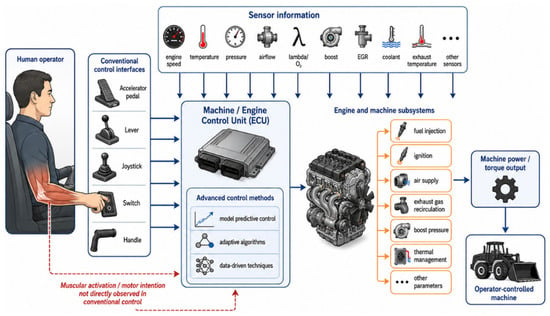
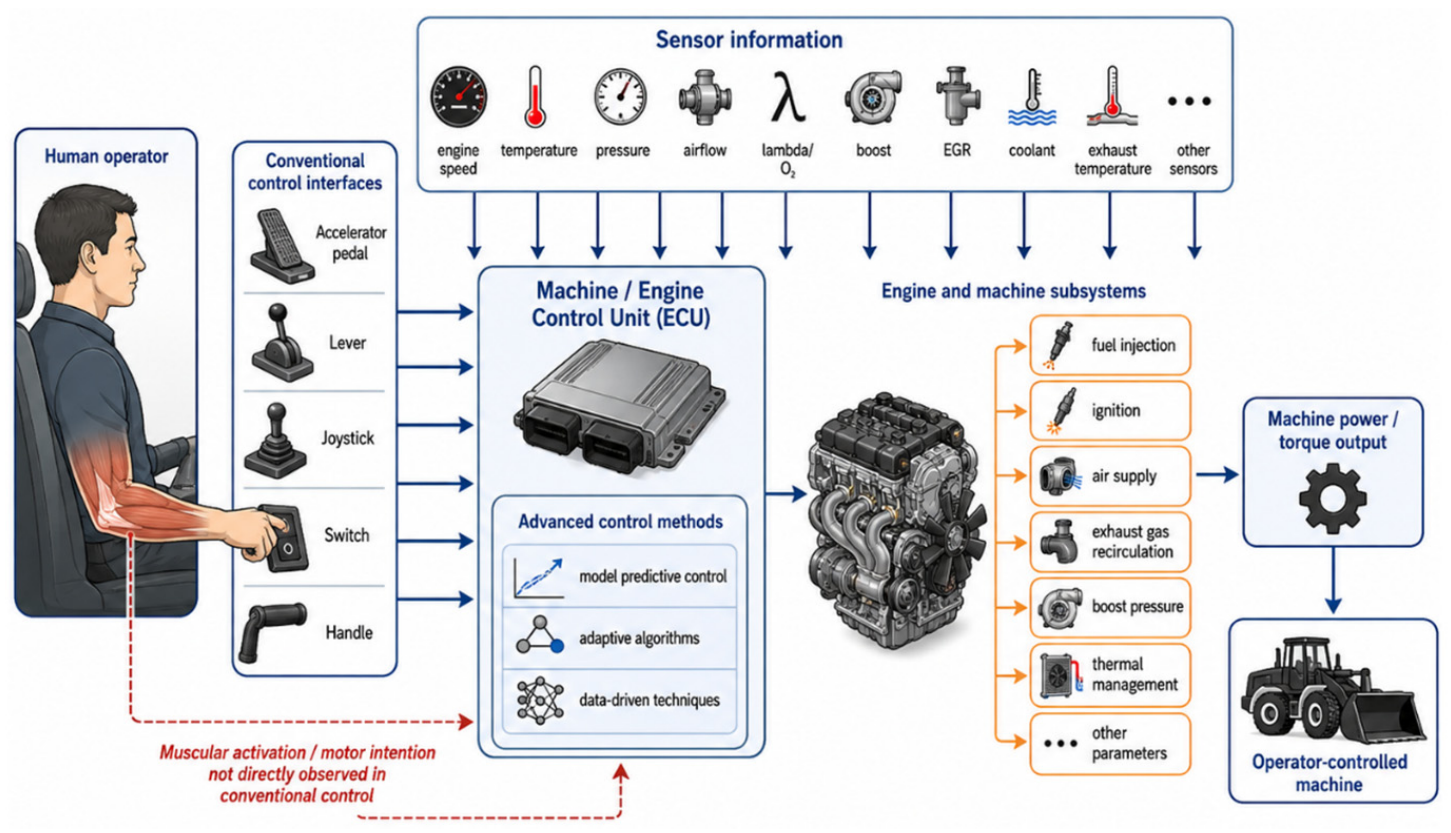
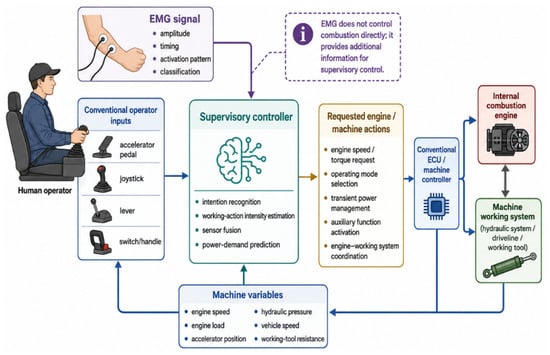
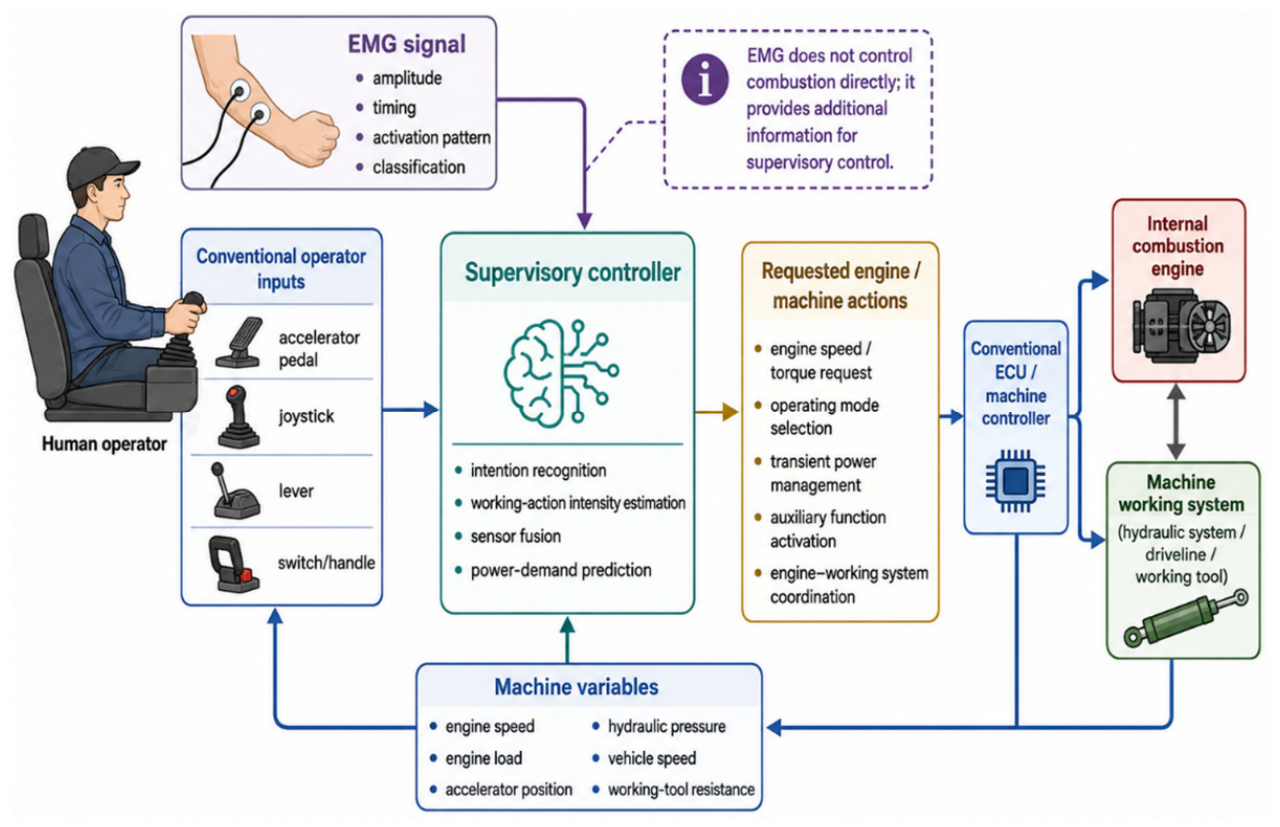
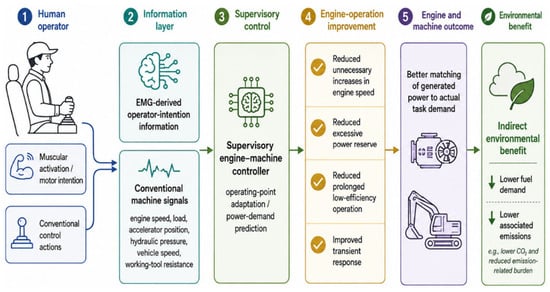
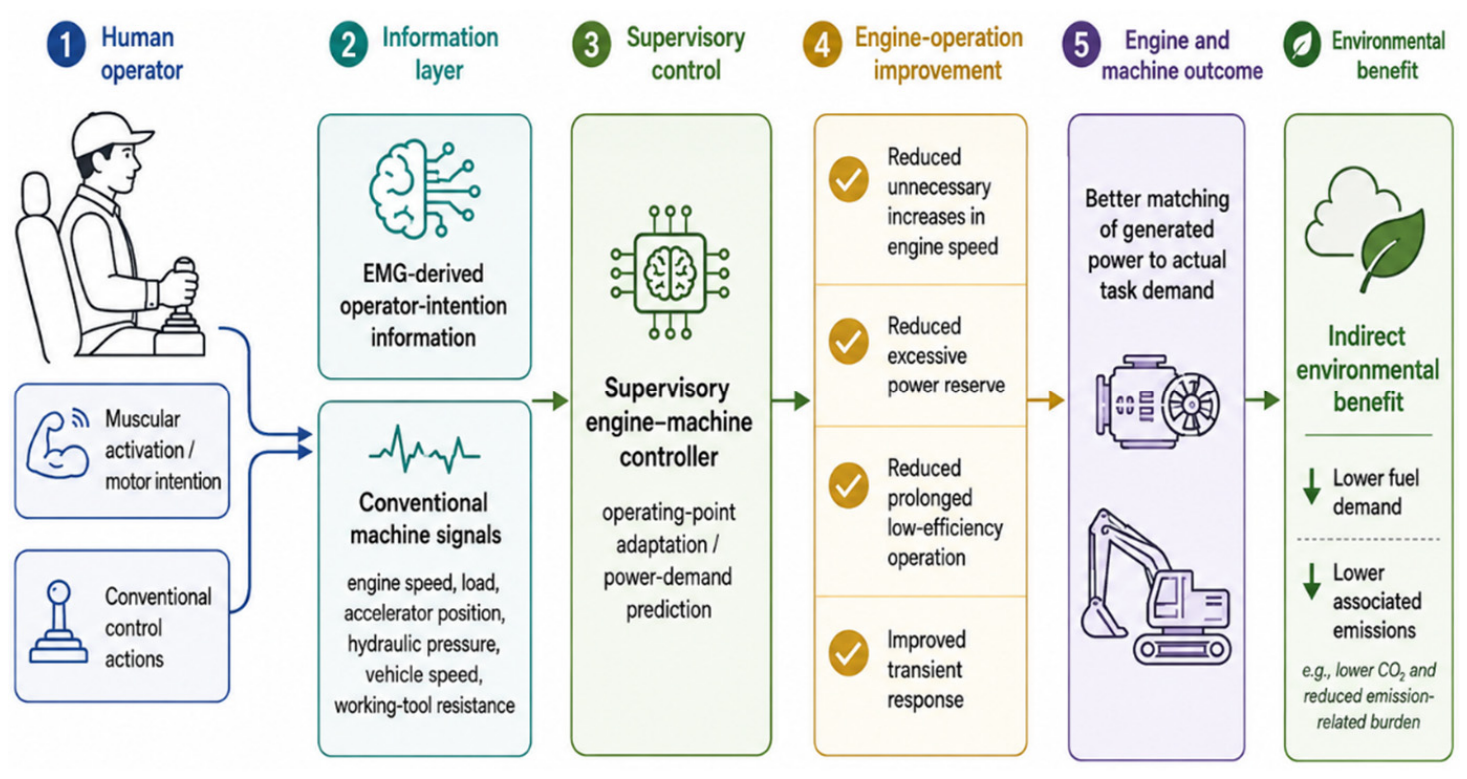

Disclaimer/Publisher’s Note: The statements, opinions and data contained in all publications are solely those of the individual author(s) and contributor(s) and not of MDPI and/or the editor(s). MDPI and/or the editor(s) disclaim responsibility for any injury to people or property resulting from any ideas, methods, instructions or products referred to in the content. |
© 2026 by the authors. Licensee MDPI, Basel, Switzerland. This article is an open access article distributed under the terms and conditions of the Creative Commons Attribution (CC BY) license.