


Abstract
Freshwater scarcity is a pressing global challenge, particularly in arid and semi-arid regions, necessitating sustainable and cost-effective desalination solutions. This study experimentally investigates the performance enhancement of a single-slope solar distiller using date pits and walnut shells as low-cost sensible thermal-energy-storage media. Two experimental cases were conducted under nearly identical weather conditions: a conventional distiller versus a date-pits-modified distiller, and a conventional distiller versus a walnut-shells-modified distiller. The incorporation of both storage media enhanced thermal performance by increasing the temperature difference between the basin water and glass cover and sustaining heat release during periods of declining solar radiation. Cumulative daily productivity improved by 18.32% for date pits and 17.14% for walnut shells, reaching 2637.5 mL/m2 and 2562.5 mL/m2, respectively. Energy efficiency increased by 17.96% and 16.93%, while exergy efficiency improved by 27.34% and 25.60% for date pits and walnut shells, respectively. Economic analysis revealed cost reductions of 14.92% and 14.06%. Date pits exhibited slightly higher overall performance, consistent with their higher reported thermal conductivity and specific heat capacity. The results demonstrate the potential of agricultural waste materials as sustainable sensible thermal-energy-storage media for improving the thermal and energetic performance of solar-desalination systems.
1. Introduction
Freshwater scarcity has become one of the most pressing global challenges, driven by population growth, industrialization, and climate-induced shifts in precipitation patterns [1]. Arid and semi-arid regions are particularly vulnerable, with projections indicating that a substantial portion of the global population will face severe water deficits within the coming decades [2]. This crisis necessitates the deployment of sustainable, decentralized water purification solutions that operate with minimal reliance on fossil fuels. Solar distillation, through the use of single-slope solar distillers (SDs), presents a compelling answer to this need, offering a straightforward, low-cost, and environmentally benign approach to producing potable water [3,4]. The inherent simplicity of SDs—requiring no moving parts, minimal maintenance, and operating passively—renders them exceptionally suitable for off-grid and rural applications [5].
Despite these inherent benefits, the widespread adoption of conventional single-slope SDs is hindered by their characteristically low thermal efficiency and modest productivity. This limitation stems from inadequate evaporation rates and substantial thermal losses to the surroundings [6,7]. Consequently, considerable research efforts have been directed toward performance enhancement. Strategies explored to date include basin geometry modifications [8], active cooling of the glass cover [9], integration of reflective elements [10], coupling with external solar collectors [11], and the incorporation of phase change materials (PCMs) for latent heat storage [12]. However, the practical application of PCMs in resource-constrained settings is often impeded by high material costs, leakage concerns, and long-term thermal-stability issues [13,14].
For this reason, sensible thermal storage materials have taken up space in the field of solar distillation. Brihmat et al. [15] compared date and olive kernels as sensible heat storage in SDs, finding olive kernels superior—achieving 226% higher yield, 38.01% thermal efficiency, and 8.4% exergy efficiency at 500 g/5 L concentration. Date kernels delivered 176% yield improvement with 30.7% thermal and 3.1% exergy efficiency. Mankai et al. [16] investigated red-brick sensible heat storage in single-slope SDs, achieving optimal 6-cm brick height with 33.84% productivity improvement, 100-day energy payback, and 94.26 tons of CO2 mitigation over 10 years. Kumar et al. [17] evaluated black gravel and cylindrical cement fins as sensible heat storage in single-slope SDs at varying water depths (2–6 cm) in Northeast India. The cement fin configuration achieved the highest yield (4462.4 mL/m2) and 41.5% efficiency at 2 cm depth, with 23% lower cost per Liter and 110.87% better CO2 mitigation. Results confirm cement-based storage as economically and ecologically effective for solar desalination. Yugbodh et al. [18] evaluated four sensible heat-storage materials (aluminum fins, iron wick, marble pieces, and stainless-steel curls) in a modified semi-cylindrical SD. Stainless-steel curls delivered the best performance: 47.08% higher productivity than aluminum fins, 32.96% efficiency gain, lowest cost (USD 0.00832/L), and 12.44% CO2 reduction. Furthermore, Yugbodh et al. [19] evaluated gravel as sensible heat storage in stepped-tray semi-cylindrical SDs. The gravel-integrated design achieved 60.24% energy efficiency, 13.54% exergy efficiency, and a cost of USD 0.0106/L, significantly outperforming the plain tray (37.84% energy, 11.23% exergy). Ben Bacha et al. [20] investigated natural and black sand as sensible heat storage in SDs coupled with alkaline electrolyzers for cogeneration of freshwater and hydrogen. Black sand achieved the highest water production (4645 mL, 45.26% energy efficiency, 3.72% exergy efficiency), reduced TDS to 60–61 mg/L, and produced 0.736 gH2/h at 10.91% efficiency with a cost of USD 0.0111/L. The system demonstrated significant decarbonization potential (1.69 ton-CO2/year). Sibagariang et al. [21] utilized palm kernels as sensible heat-storage material in double-slope SDs with varying masses (1–5 kg). The optimal configuration achieved 30.1% productivity improvement, 4.9–15.9% energy efficiency gain, and 23.17% reduction in freshwater production cost. Palm kernels effectively increased basin temperature and evaporation rates, confirming their viability as a low-cost agro-waste sensible-storage medium. Jeevadason et al. [22] investigated a twin wedge SD using M-sand, river sand, and red sand as sensible heat-storage materials, combined with cotton or bamboo wicks. The optimal combination—cotton wick with M-sand—achieved the highest performance: 5.84 L/day yield, 67.1% energy efficiency, 5.29% exergy efficiency, and a cost of 0.012 USD/L with a 4.6-month payback period. Khelifi et al. [23] compared date and olive kernels as sensible heat-storage materials in hemispherical SDs. Olive kernels achieved superior performance: 8.00 kg/m2/day yield (13.54% efficiency improvement) and cost of USD 3.89/m3, outperforming date kernels (6.66 kg/m2/day, 10.87% efficiency, USD 4.65/m3) and the conventional system (USD 7.83/m3). Both kernels significantly reduced water production costs by 40–50%, confirming agricultural by-products as effective, sustainable sensible storage media due to their high thermal conductivity and specific heat capacities. Manokar et al. [24] experimentally investigated conical SDs integrated with walnut shells as a bio-waste sensible heat storage material, achieving daily yield improvements of 33.3% and 48.9% for downward- and upward-facing shell configurations, respectively. Energy efficiency reached 50.88% and exergy efficiency 1.78% for the upward-facing design, demonstrating superior thermal utilization. Abdel-Aziz et al. [25] integrated walnut shells of varying sizes (3 and 6 mm) into hemispherical SDs, achieving 51.06% and 36.17% productivity improvements, respectively. The 3-mm configuration delivered the best 4E performance: 50.50% energy efficiency, 118.30% exergy efficiency gain, cost reduction to USD 0.0051/L, and 2.049 tons CO2 mitigation over 10 years.
In this context, the present study experimentally investigates two locally available agro-industrial wastes, date pits and walnut shells, as sensible thermal-energy-storage media in a conventional single-slope SD. While these materials have been examined individually in prior works, the originality of this study lies in the following contributions: (i) it provides the first direct, side-by-side comparative assessment of date pits and walnut shells as sensible thermal-energy-storage media within the same experimental framework, under nearly identical meteorological conditions, using identical single-slope SD geometries, and at the same water depth and storage configuration, thereby isolating the effect of the storage material from confounding factors such as weather, geometry, and operational parameters; (ii) it introduces a paired experimental protocol that eliminates climatic and structural variability, enabling a rigorous and fair material-to-material comparison; (iii) it provides a detailed mechanistic analysis of the thermal lag during the morning charging phase and the sustained heat release during the afternoon discharge phase, quantified through the temporal evolution of the water-to-glass temperature difference (ΔT), which is the primary driving force for evaporation; (iv) it applies a consistent 4E (energy, exergy, economic, and environmental) assessment framework to both materials, yielding directly comparable performance metrics that are not available in the existing literature; and (v) it employs both materials in their native, minimally processed form (washing and sun-drying only), without chemical treatment, encapsulation, or structural modification, making the proposed enhancement directly deployable in resource-constrained, water-scarce regions. The specific objectives are: (i) to directly compare the thermal behavior, water-to-glass temperature difference, freshwater productivity, energy efficiency, exergy efficiency, and cost of date pits and walnut shells under nearly identical weather conditions; (ii) to quantify the thermal lag during the morning charging phase and the sustained heat release during the afternoon discharge phase; and (iii) to assess the economic viability of both modifications through cost-per-liter analysis. By integrating waste-derived sensible thermal-energy storage with solar desalination, this study provides an application-focused assessment of sustainable heat storage and heat-transfer enhancement for renewable-energy-based water production, directly contributing to freshwater-scarcity mitigation efforts.
The remainder of this paper is organized as follows. Section 2 describes the experimental arrangement, including the design of the single-slope SDs, the preparation and characterization of the date pits and walnut shells, the instrumentation, and the experimental procedure. Section 3 presents the mathematical analysis, covering the energy, exergy, and economic formulations used to evaluate performance. Section 4 details the uncertainty analysis. Section 5 presents the results and discussion, including the weather conditions, temperature profiles, water-to-glass temperature difference, hourly and cumulative productivity, energy efficiency, exergy efficiency, and economic analysis. Finally, Section 6 summarizes the key conclusions and outlines potential directions for future work.
2. Experimental Arrangement
2.1. Experimental Setup
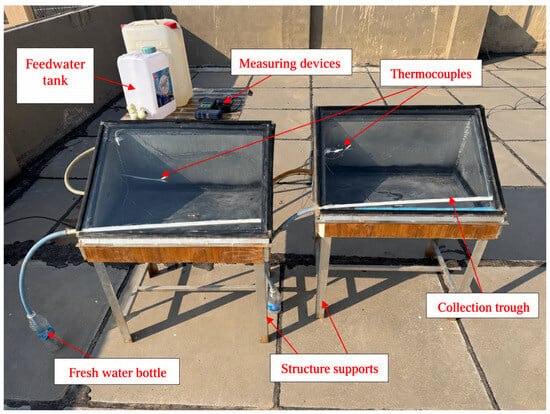
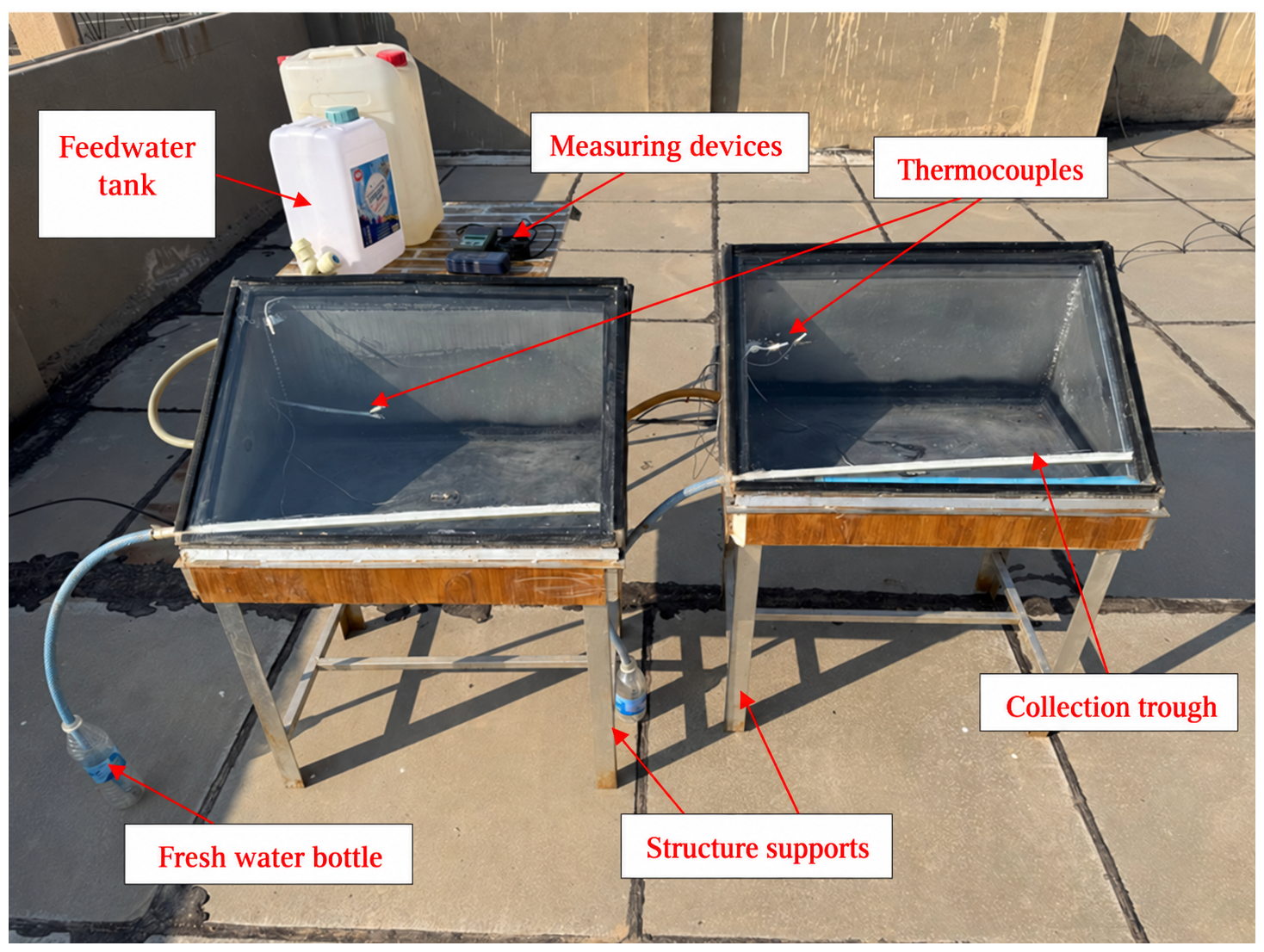
The experimental work was conducted using two identically designed single-slope SDs. One unit served as the reference conventional SD, while the other was designated as the modified SD, where either date pits or walnut shells were introduced into the basin across separate testing phases. The complete experimental configuration is illustrated in Figure 1. The experiments were carried out at the University of Technology, Baghdad, Iraq, located at a latitude of 33.31° N, a longitude of 44.36° E, and an elevation of approximately 34 m above sea level. Each SD featured a basin area of 0.2501 m2 (61 cm × 41 cm), with a depth increasing from 5 cm at the lower edge to 31.6 cm at the higher edge, yielding a glass cover inclination of 33°, which aligns with the optimal tilt angle established for Baghdad’s latitude [26]. The basins were constructed from 2-mm galvanized steel sheets with fully welded seams to prevent any leakage. Three ports were incorporated into each basin: one for saline water feeding, one for draining, and one for thermocouple access. To maximize solar absorption, the basin floor received a black matte coating, while the sidewalls were finished with silver paint to redirect incoming radiation toward the water body. Thermal insulation was achieved through a composite layer comprising 2 cm of white cork followed by 0.4 cm of wooden board, bonded with high-temperature silicone adhesive. A 4-mm transparent glass sheet (67 cm × 48 cm) was sealed atop each unit using silicone and an insulating strip to ensure vapor-tight operation. A plastic condensate trough, inclined at 4°, was affixed along the inner lower perimeter of the glass to facilitate distillate collection and drainage. Both SDs were mounted on identical steel frames (63 cm × 43 cm × 52 cm) and oriented southward to optimize solar exposure throughout the day [27].
Figure 1.
Schematic diagram of the experimental setup: (1) freshwater-collection bottle, (2) thermocouple positions, (3) data-acquisition devices, (4) saline water-supply tank, (5) distillate-collection channel, (6) support structure.
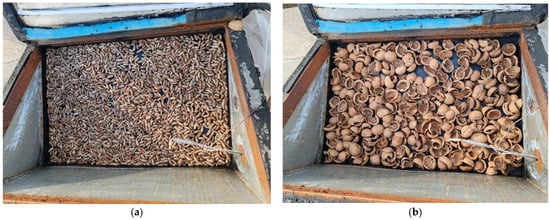
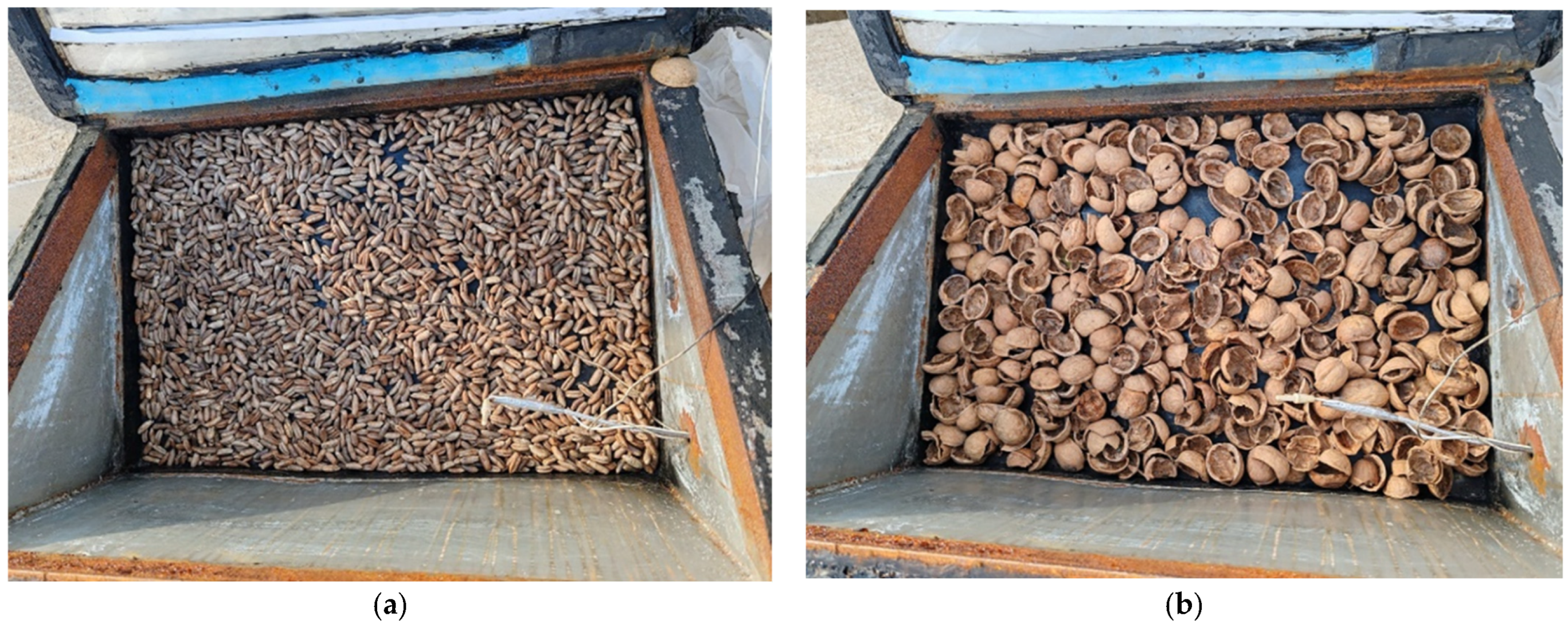
During the modified runs, the modified SD basin accommodated one of two sensible heat-storage media: date pits or walnut shells, as depicted in Figure 2a,b, respectively. The date pits (Figure 2a) were procured from local date-processing plants and underwent a simple preparation protocol involving washing with tap water to eliminate surface contaminants, followed by sun-drying for 48 h to remove residual moisture. These pits exhibited average dimensions of approximately 4 mm in diameter and 9 mm in length. A quantity sufficient to form a single, continuous covering layer across the entire basin floor was employed, as visualized in Figure 2a. The walnut shells (Figure 2b) were sourced from nearby nut processing facilities and subjected to identical cleaning and drying procedures. Each shell was split into two dome-shaped halves, with an average dome base diameter of roughly 19 mm. Similar to the date pits, the walnut shells were arranged in a single layer covering the complete basin surface, as shown in Figure 2b.
Figure 2.
SD basin contains: (a) date pits, (b) walnut shells.
The physical characteristics of the two media were determined as follows. The particle dimensions were measured directly: the date pits had an average diameter of approximately 4 mm and an average length of approximately 9 mm, and the walnut shells had an average dome base diameter of approximately 19 mm. The porosity values reported in Table 1 (45–55% for date pits and 50–60% for walnut shells) are literature-derived ranges rather than measurements of the specific samples used here. The moisture content of the media after the 48-h sun-drying period and the packing density of the single-layer bed were not quantified in this work and are therefore not reported. These quantities affect the effective thermal capacity of the storage layer and the rate of heat transfer between the bed and the water, and their measurement is recommended for future work so that the storage mass and the effective bed properties can be determined more precisely.
A fixed clear-water depth of 3 cm was maintained across all experiments, measured from the top of the storage layer in the modified SD and from the black absorber plate in the conventional SD, so that the water level relative to the glass cover—and hence the vapor-space height and the evaporation–condensation geometry—remained identical in all three configurations. Because the storage material displaces part of the basin volume, the actual water volume in the modified SD is smaller than in the conventional SD for the same 3-cm clear-water depth. The displaced volume corresponds approximately to the bulk volume of the single-layer storage bed: about 9-mm thickness at roughly 50% porosity for the date pits, and about 19-mm thickness at roughly 55% porosity for the walnut shells, giving an estimated reduction in water volume of approximately 10–15% for the date-pits configuration and 20–25% for the walnut-shells configuration. The modified SDs therefore operate with less water in the basin while producing more distillate, so the productivity improvement is achieved despite the smaller water inventory. The storage material is fully submerged and does not protrude through the water surface; the top of the water remains an unobstructed free liquid–vapor interface across the whole basin. Consequently, the free evaporation area is unchanged at the full basin cross-section of 0.2501 m2 in both the conventional and the modified SDs, which confirms that the observed improvements in productivity and in the water-to-glass temperature difference are attributable to the thermal storage and heat-release behavior of the material and to the enhanced heat transfer between the storage bed and the water, and not to any change in the evaporating surface area. A 3-cm clear-water depth was selected because previous research has identified this depth as optimal for balancing rapid thermal response during high-insolation periods with adequate heat retention during lower-radiation intervals [28].
The thermophysical characteristics of the date pits and walnut shells used in this study are compiled in Table 1. It should be emphasized that these values are not measured in the present work; they are compiled from the published literature [29,30] and are presented as ranges because the reported properties vary with moisture content, particle size, cultivar, growing conditions, and measurement technique. The ranges reported in Table 1 reflect this spread. For the calculations performed in this study, a single representative value was adopted for each property, taken as the midpoint of the reported range, and these representative values are listed in the final column of Table 1. Only the particle dimensions and the packing arrangement (a single continuous covering layer across the basin floor) were determined experimentally in this work. It is acknowledged that the use of literature-derived properties introduces uncertainty into the analysis.
Table 1.
Thermophysical properties of date pits and walnut shells. Values are compiled from the literature [29,30], and are not measured in this study.
2.2. Instrumentation and Procedure
The instrumentation setup comprised all necessary sensors for monitoring thermal and meteorological parameters. Temperature measurements were acquired at four critical locations using K-type thermocouples connected to YOWEXA YET-640 digital thermometer (reader accurancy ±(0.003|T|+0.40)°C): the basin absorber plate, the basin water, the internal vapor space, and the outer glass surface. Ambient air temperature was recorded with a mercury-in-glass thermometer (±0.1 °C accuracy). Incident solar radiation was measured using a solar power meter (SM206-SOLAR, ±50 W/m2 accuracy), while wind speed was determined with a digital anemometer (AM-4826, ±0.2 m/s accuracy). Hourly distillate production was quantified using a graduated volumetric cylinder with a resolution of ±0.01 mL. The measurement instruments were sourced from Shenzhen Yowexa Sensor System Co., Ltd. (Shenzhen, China) for the YET-640 digital thermometer, Tianjin Glass Instrument Factory (Tianjin, China) for the mercury-in-glass thermometer, Shenzhen Sanpo Instrument Co., Ltd. (Shenzhen, China) for the SM206-SOLAR solar power meter, and Guangzhou Landtek Instruments Co., Ltd. (Guangzhou, China) for the AM-4826 digital anemometer. The measurement devices, their specifications, and their associated accuracies are summarized in Table 2.
Table 2.
Specifications and accuracies of the measurement instruments used in the experiments.
All experimental runs were performed under cloudless sky conditions, spanning from dawn to dusk. The conventional SD and modified SD were operated concurrently to guarantee identical ambient exposure. Recordings of temperature, solar flux, wind speed, and freshwater output were taken at 60-min intervals. Prior to each test, all sensors underwent calibration verification, and the designated storage material was uniformly positioned within the modified SD basin. The experimental campaign was conducted on clear days in 17 and 19 April 2026, corresponding to the conventional SD, date pits, and walnut-shells configurations, respectively. The hourly solar radiation and wind speed measurements are presented in Table 3. The average solar irradiance was 521 W/m2 and 503 W/m2 for Cases 1 and 2, respectively, while the corresponding average wind speeds were 1.65 and 1.37 m/s. Although the meteorological conditions were not identical between the two experimental days, the simultaneous operation of the conventional and modified SDs within each case enabled direct performance comparisons under the same ambient conditions.
Table 3.
Hourly weather conditions recorded during the two experimental cases: Case 1 (17 April 2026, conventional SD and date-pits-modified SD) and Case 2 (19 April 2026, conventional SD and walnut-shells-modified SD).
3. Mathematical Analysis
The performance assessment of the conventional and modified SDs was conducted through energy, exergy, and economic analyses. The following subsections present the governing equations and calculation procedures employed in this study.
3.1. Energy Analysis
The energy efficiency of an SD represents the ratio of the thermal energy utilized for evaporation to the incident solar energy received by the system. For a single-slope SD, the instantaneous energy efficiency (ηen) is calculated as follows [31]:
where mw: hourly distillate production rate (kg), A: aperture area (m2), H: solar radiation intensity (W/m2) Ffg: latent heat of vaporization of water (J/kg). It can be calculated from Equation (2) [28]:
where Tw: water temperature in basin (°C).
3.2. Exergy Analysis
Exergy analysis provides a thermodynamic assessment by quantifying the maximum useful work extractable from the system. Unlike energy analysis, exergy analysis accounts for the quality of energy and identifies irreversibilities within the system.
The exergy input to the SD (EXin) is calculated using Petela’s expression for the exergy of solar radiation [32]:
where Ta: ambient temperature (°C), Ts: apparent sun temperature, taken as 5800 K [33].
The exergy output (EXout) associated with the distilled water production is given by [34]:
The exergy efficiency (ηex) is then defined as the ratio of exergy output to exergy input:
3.3. Economic Analysis
The economic viability of the proposed modifications was assessed through the cost per liter (CPL) of distilled water produced. The CPL was calculated using the life-cycle cost (LCC) method, which accounts for all expenses incurred throughout the system’s lifetime [35,36].
The CPL is determined from:
where LCC: life-cycle cost (USD), AYD: average daily yield (L/day), i: number of operational days per year (assumed as 300 days), LT: system lifetime (estimated as 10 years)
The LCC is expressed as:
where Coc: capital cost (USD) (USD 76.39 for conventional SD, USD 77 for modified SD); Coo: operating cost (USD)—assumed negligible; Com: maintenance cost (USD) (USD 10 for both SDs); Cor: replacement cost (USD) (USD 5 for both SDs); SV: salvage value (USD)—assumed zero. It should be noted that Equation (7) contains no discounting; the USD 0.61 difference between the conventional and modified capital costs is therefore attributable entirely to the cost of the storage material and not to any financial discounting.
LCC = Coc + Coo + Com + Cor − SV
For completeness, the discounted cost per liter is obtained from:
with the discounted life-cycle cost given by:
where d is the discount rate, taken as 10%, and k is the year index.
The capital cost includes the material and fabrication costs of construction, together with the cost of the sensible storage material. For the conventional SD, the capital cost is USD 76.39. For the modified SD, the capital cost is USD 77.00, the additional USD 0.61 being the collection, washing, and sun-drying cost of the date pits or walnut shells. Because both media are agricultural by-products, their purchase cost is negligible; the small additional expense reflects only handling and preparation labor.
4. Uncertainty Analysis
To establish the credibility of the experimental findings, a comprehensive uncertainty assessment was carried out. This evaluation quantifies the potential deviations in both directly measured quantities and the derived performance metrics. The root-sum-square (RSS) method, a widely accepted approach for error propagation, was adopted for this purpose [37]. For a calculated parameter R that is a function of several independently measured variables x1, x2, ..., xn, the overall uncertainty UR is expressed as:
where represents the individual uncertainty associated with each measured variable.
The precision limits of the various sensors employed in the experimental setup are detailed as follows:
- Temperature readings (K-type thermocouples): ±(0.003|T| + 0.40) °C
- Ambient temperature (mercury thermometer): ±0.1 °C
- Solar irradiance (SM206-SOLAR power meter): ±(0.10H + 0.2) W/m2
- Wind velocity (AM-4826 anemometer): ±0.2 m/s
- Distillate volume (graduated cylinder): ±0.01 mL
By applying the RSS propagation method to the governing equations for energy and exergy efficiencies (Equations (1)–(5)), the combined uncertainties were estimated using the revised instrument accuracy specifications. The analysis yielded estimated maximum hourly relative uncertainties of approximately ±10.14% for energy efficiency and ±10.86% for exergy efficiency. These values represent approximate uncertainty estimates based on the available experimental data and should be interpreted with consideration of the additional measurement uncertainties not included in the analysis.
5. Results and Discussion
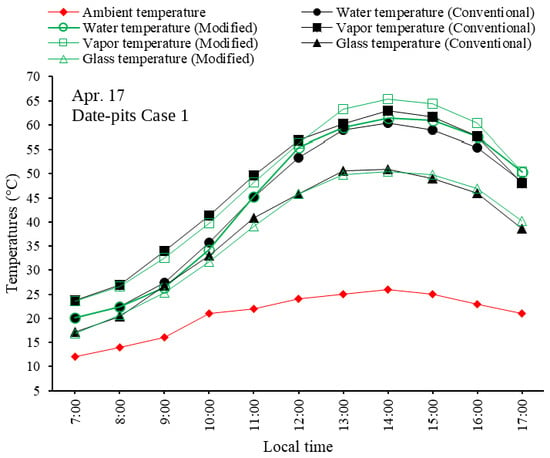
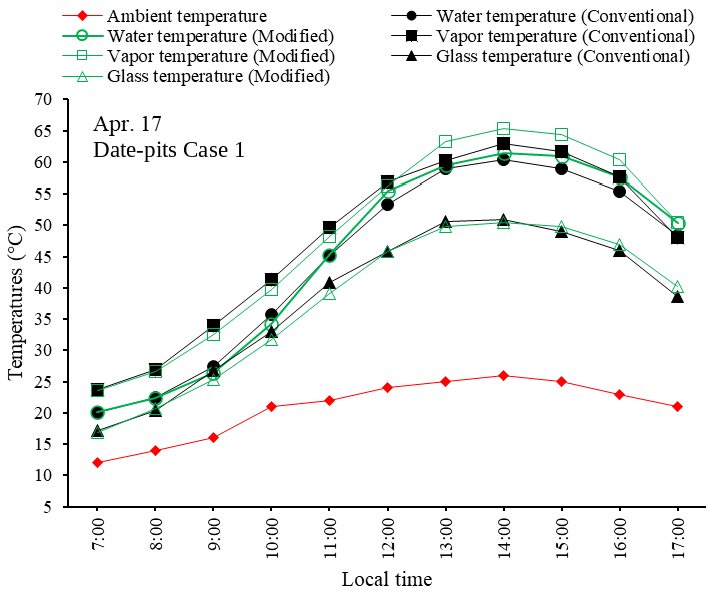
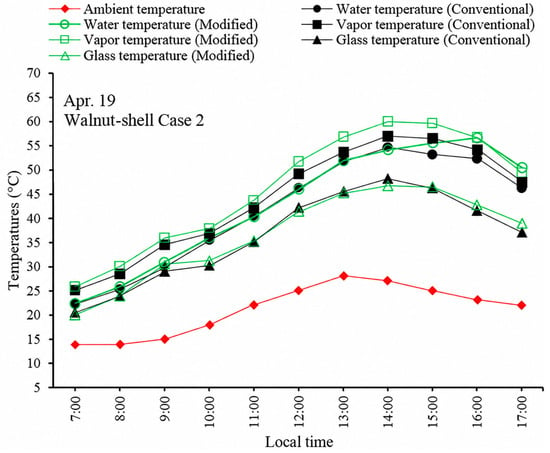
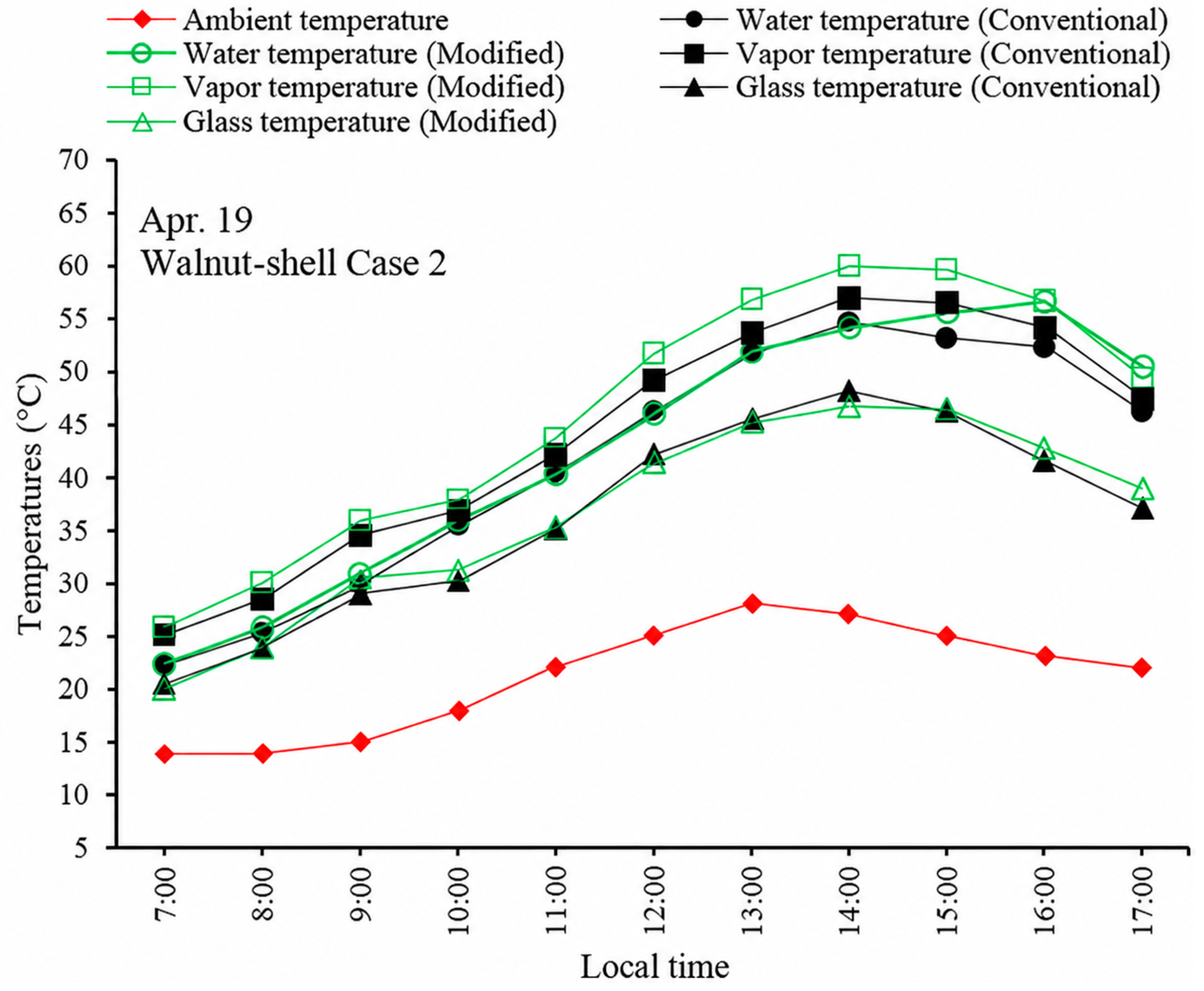
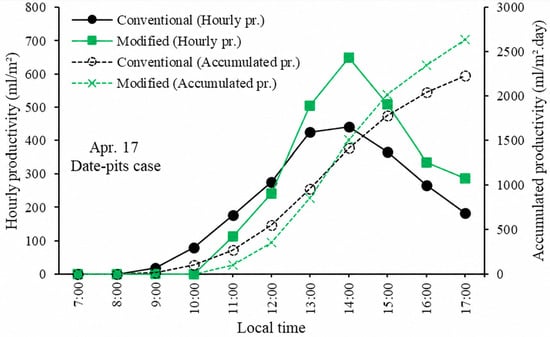
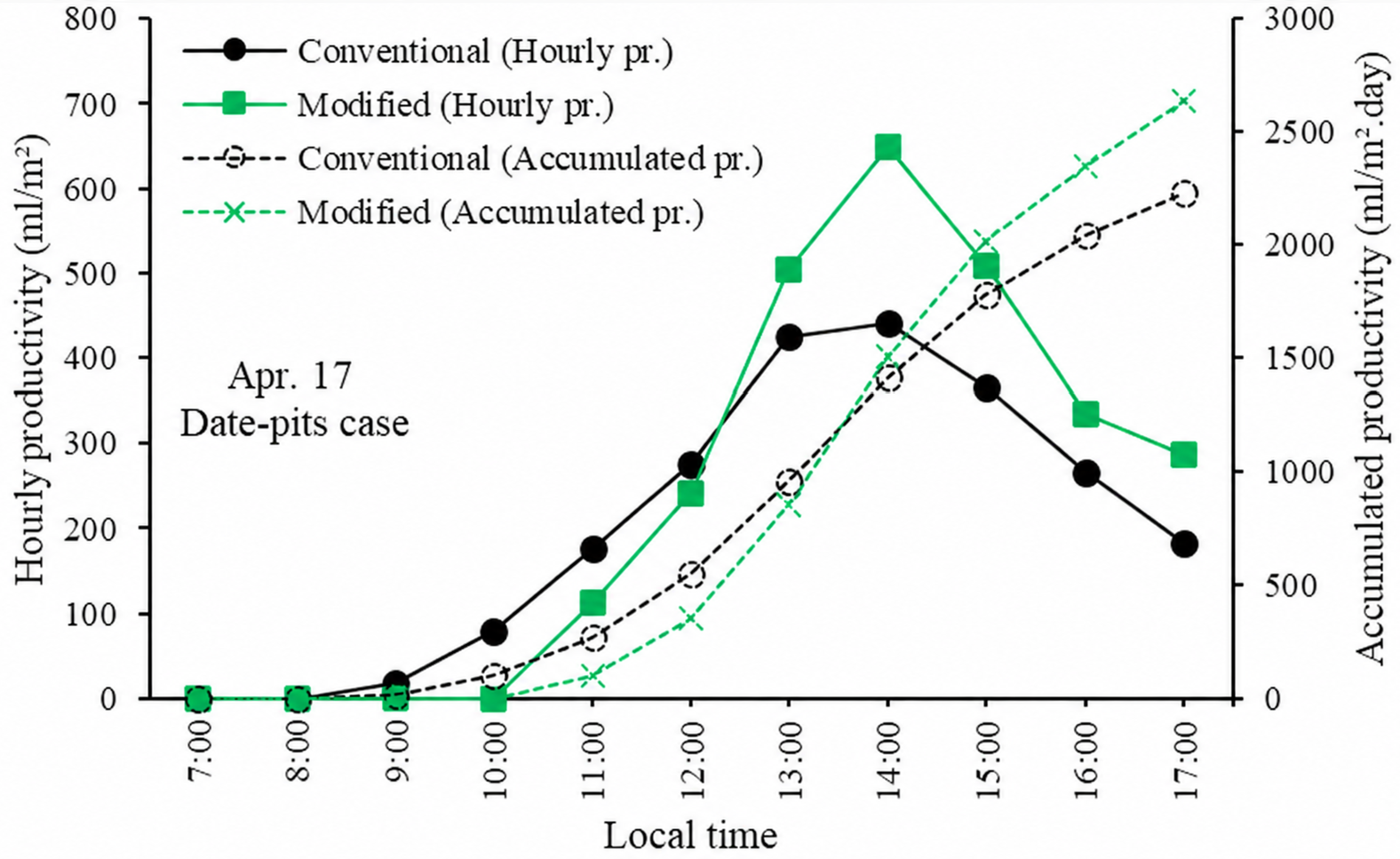
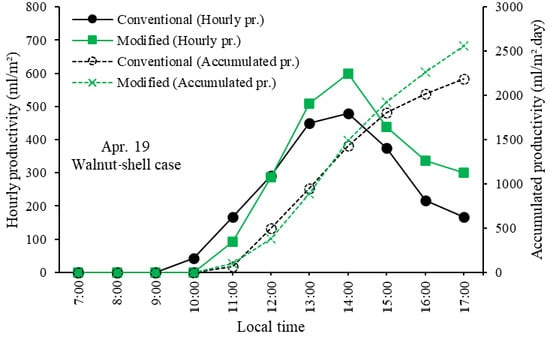
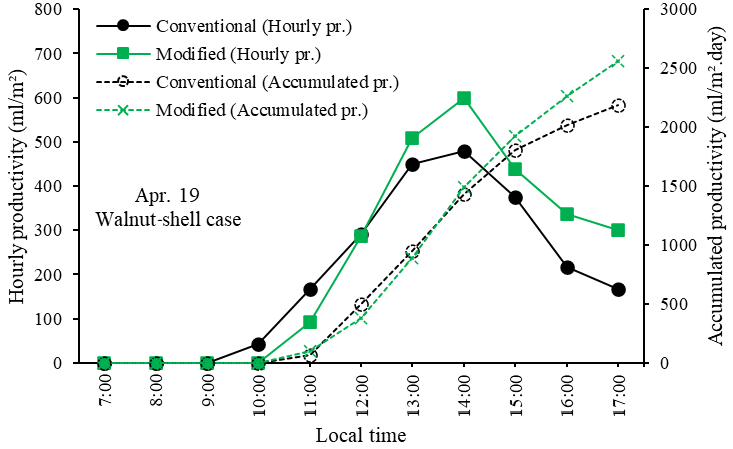
The enhancement in the modified SDs is based on sensible heat storage, in which thermal energy is stored by raising the temperature of the material without any phase change. The date pits or walnut shells form a single continuous layer on the basin floor, fully submerged beneath the 3-cm clear-water layer. During the morning and midday hours, part of the energy absorbed by the black absorber plate is transferred to the storage bed rather than being used immediately to raise the water temperature, so the bed temperature rises more slowly than the water in the conventional SD; this charging phase produces the morning thermal lag seen in Figure 3 and Figure 4. As solar radiation declines in the afternoon, the bed remains warmer than the surrounding water and discharges its stored heat to the basin water, slowing the rate at which the water temperature falls and thereby sustaining a larger water-to-glass temperature difference for longer, as shown in Figure 5 and Figure 6, which extends distillate production into the late afternoon and produces the cumulative productivity gains in Figure 7 and Figure 8. The amount of heat stored is governed by the mass and specific heat capacity of the bed, while the rate at which it is released is governed by its thermal conductivity and by the contact area with the water; the higher reported thermal conductivity and specific heat capacity of date pits are therefore consistent with their slightly higher energy and exergy efficiencies. The mechanism is purely sensible, with no phase change, chemical reaction, or latent heat effect, and requires no encapsulation, chemical treatment, or auxiliary equipment, which makes it directly applicable in resource-constrained settings.
Figure 3.
Hourly variation of temperatures for Case 1 (17 April 2026): conventional SD vs. date-pits-modified SD.
Figure 4.
Hourly variation of temperatures for Case 2 (19 April 2026): conventional SD vs. walnut-shells-modified SD.
Figure 5.
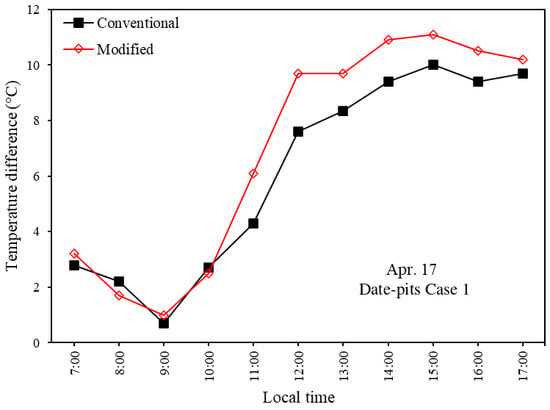
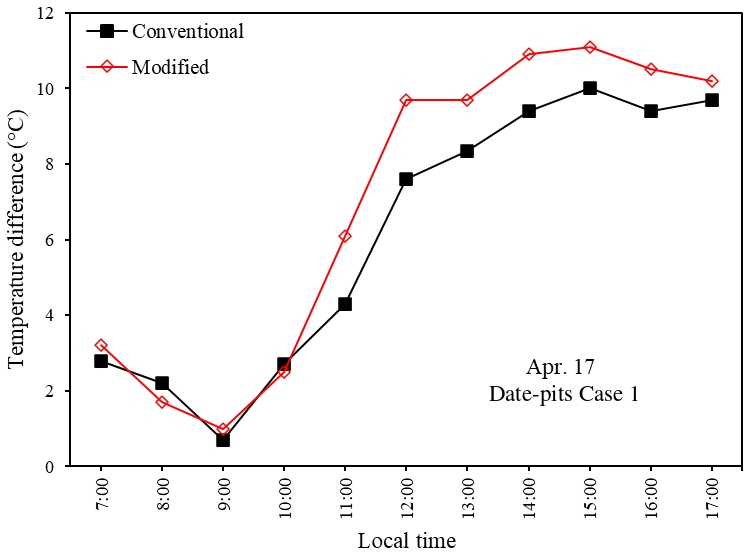
Hourly variation of temperature difference (ΔT = Tw − Tg) for Case 1 (17 April 2026): conventional SD vs. date-pits-modified SD.
Figure 6.
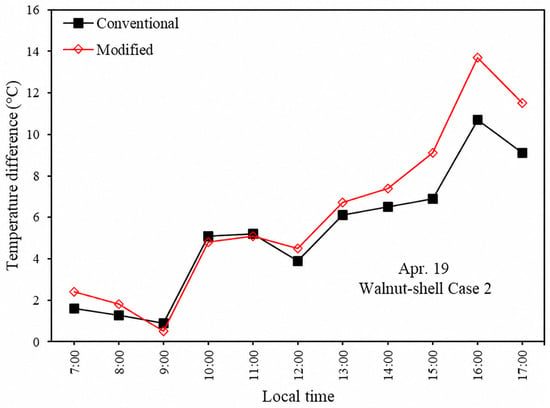
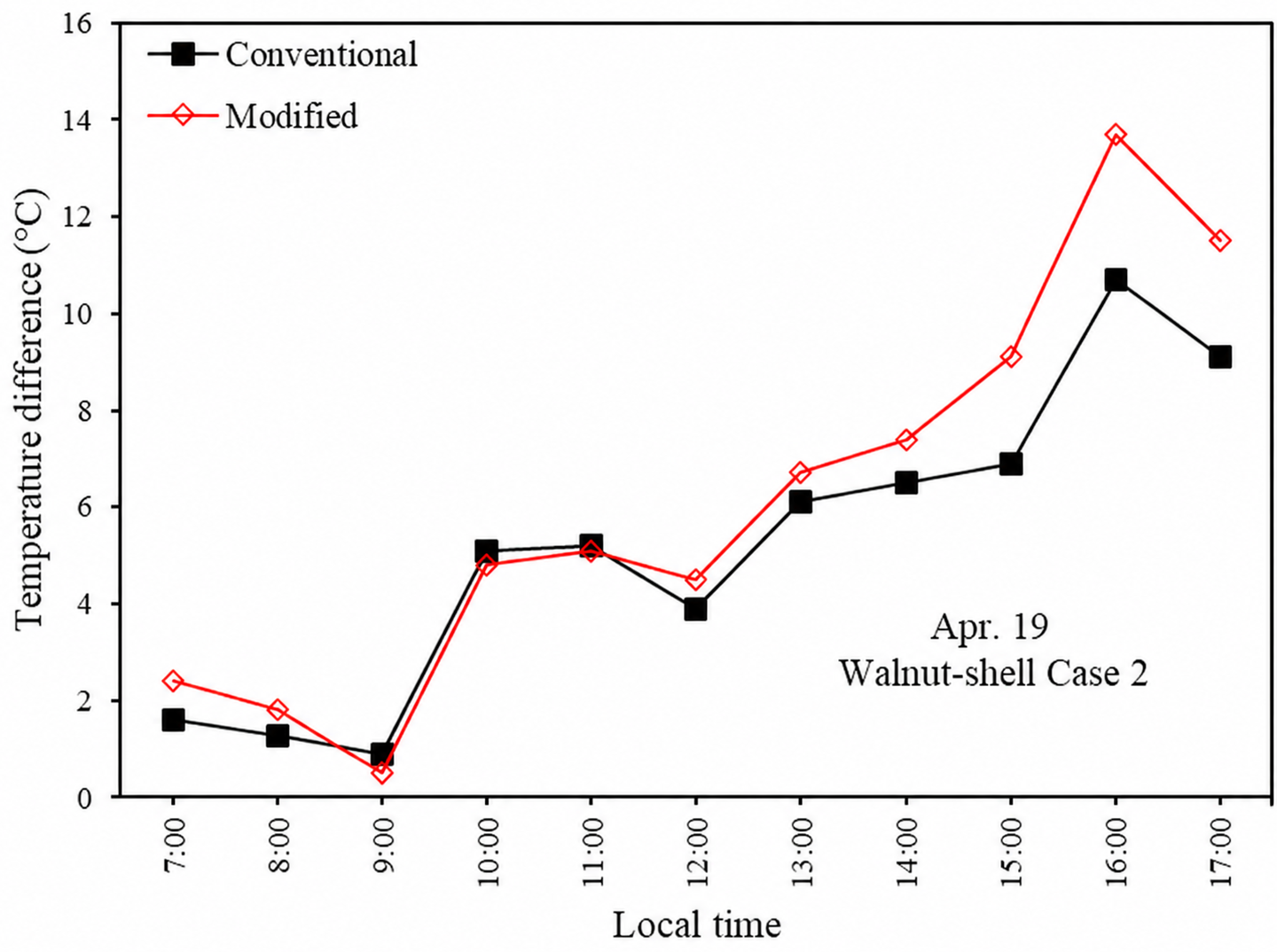
Hourly variation of temperature difference (ΔT = Tw − Tg) for Case 2 (19 April 2026): conventional SD vs. walnut-shells-modified SD.
Figure 7.
Hourly and cumulative productivity for Case 1 (17 April 2026): conventional SD vs. date-pits-modified SD.
Figure 8.
Hourly and cumulative productivity for Case 2 (19 April 2026): conventional SD vs. walnut-shells-modified SD.
The temperature evolution throughout the day provides critical insights into the thermal performance of both SDs. As illustrated in Figure 3, all temperatures exhibited a progressive rise from morning hours, peaking around 14:00, and then gradually declining toward sunset, closely following the solar radiation pattern shown in Figure 3. In the early morning hours (7:00–9:00), the conventional SD exhibited slightly higher temperatures than the date-pits-modified SD. This behavior is attributed to the thermal inertia of the date pits, which require additional time to absorb sufficient solar energy before becoming effective heat-storage media. During this initial period, the heat absorbed by the date pits is partially retained within the material rather than being immediately transferred to the surrounding water, resulting in a slight thermal lag compared to the conventional SD where the basin water heats up more directly. However, as solar intensity increased toward noon, the date-pits-modified SD began to outperform the conventional SD across all measured temperatures. The basin water temperature reached a maximum of 61.4 °C for the date-pits configuration at 14:00, compared to 60.4 °C for the conventional SD, attributed to the sensible heat-storage capability of the date pits, which absorb and retain thermal energy during peak radiation hours and release it gradually. The vapor space temperature followed a similar trend, with the date-pits-modified SD reaching 65.4 °C compared to 63.0 °C for the conventional SD at 14:00, indicating improved evaporation rates.
The temperature evolution for Case 2 (walnut-shells-modified SD vs. conventional SD) is presented in Figure 4. Similar to Case 1, all temperatures exhibited a progressive rise from morning to peak around 14:00, then gradually declined toward sunset, following the solar radiation pattern in Figure 3. In the early morning (7:00–9:00), the conventional SD showed slightly higher temperatures due to the thermal inertia of the walnut shells, which required time to absorb sufficient solar energy before becoming effective storage media. However, as solar intensity increased toward midday, the walnut-shells-modified SD began to outperform the conventional SD across most temperatures. The basin water temperature reached a maximum of 56.5 °C at 16:00 for the walnut-shells configuration, compared to 54.7 °C at 14:00 for the conventional SD, indicating effective heat retention and gradual release that sustained higher temperatures into the late afternoon. The vapor space temperature followed a similar trend, with the walnut-shells-modified SD reaching 59.9 °C compared to 57.0 °C for the conventional SD at 14:00. Compared to date pits from Case 1, walnut shells exhibited slightly lower overall temperatures, consistent with their lower thermal conductivity (0.15–0.22 W/m·K) and specific heat capacity (1350–1500 J/kg·K). The early morning thermal lag is typical of sensible storage materials and does not detract from the overall performance advantage, as stored heat is effectively utilized during later hours when solar radiation declines.
The temperature difference between the basin water and the inner glass surface (ΔT = Tw − Tg) is a key thermal parameter governing the coupled evaporation and condensation processes in SDs. Because ΔT is determined jointly by the basin-water temperature and the glass-cover temperature, its interpretation requires reference to the corresponding temperature profiles presented in Figure 3 and Figure 4 and to the solar-radiation and ambient-temperature data in Table 3.
Figure 5 presents the hourly variation of ΔT for Case 1 (date pits). In the early morning (07:00–09:00), the conventional SD exhibited slightly higher ΔT values than the modified SD. This is directly explained by the temperature profiles in Figure 3: the basin-water temperature of the modified SD rises more slowly than that of the conventional SD during this period because the date pits absorb part of the incoming solar energy before releasing it to the water, whereas the glass-cover temperatures of the two SDs are nearly identical because the glass temperature is governed mainly by the incident solar radiation and the ambient conditions, which were the same for both units on the same day. The morning ΔT deficit for the modified SD is therefore a water-side effect, not a glass-side effect.
As solar intensity increased toward midday (10:00–14:00), the date-pits-modified SD began to demonstrate superior ΔT values, with the gap widening progressively through the afternoon. The temperature profiles in Figure 3 show that this divergence is again dominated by the water side: the glass-cover temperatures of the conventional and modified SDs remain within about 1 °C of each other throughout this period, whereas the basin-water temperature of the modified SD exceeds that of the conventional SD by up to about 1.5–2 °C. The average ΔT over the entire daytime period was 6.96 °C for the date-pits-modified SD, compared to 6.10 °C for the conventional SD, representing a 14.1% improvement. Quantitatively, this average ΔT increase of 0.86 °C is accompanied by an average basin-water temperature increase of approximately 1.0 °C and an average glass-cover temperature change of approximately +0.1 °C, confirming that the enhanced ΔT originates predominantly from the higher water temperature rather than from any reduction in the glass temperature. The higher water temperature is a direct consequence of the sensible heat-storage capability of the date pits, which absorb and retain thermal energy during peak radiation hours and release it gradually during lower-insolation periods, thereby sustaining a stronger thermal driving force for evaporation throughout the day.
The temperature difference for Case 2 (walnut shells) is presented in Figure 6. In the early morning (07:00–09:00), the conventional SD again exhibited slightly higher ΔT values. As shown in Figure 4, the basin-water temperature of the walnut-shells-modified SD rises more slowly than that of the conventional SD during this period because the shells require time to charge thermally, while the glass-cover temperatures of the two units are again nearly identical, since both experience the same solar radiation and ambient conditions on the same day. As solar intensity increased, the walnut-shells-modified SD demonstrated superior ΔT values, with the gap widening progressively through the afternoon. The average ΔT was 6.14 °C for the walnut-shells-modified SD compared to 5.21 °C for the conventional SD, representing a 17.8% improvement. Quantitatively, this average ΔT increase of 0.93 °C is accompanied by an average basin-water temperature increase of approximately 1.1 °C and an average glass-cover temperature change of approximately +0.2 °C, so the enhancement is again water-side dominated. The late-afternoon advantage is particularly notable, with ΔT reaching 13.7 °C for the walnut-shells configuration at 16:00 versus 10.7 °C for the conventional SD. This peak coincides with the period in which the basin-water temperature of the modified SD remains elevated after the solar radiation has declined, while the glass-cover temperature falls more rapidly because it is no longer receiving strong solar input and is losing heat to the ambient by convection and radiation. The widening ΔT gap in the late afternoon is therefore produced by the combination of a sustained water temperature and a declining glass temperature, and is visible in Figure 4 as a divergence between the modified and conventional water-temperature curves after 15:00 while the corresponding glass-cover curves converge.
Finally, the ambient-temperature profile explains the difference in absolute ΔT values between the two test days. The ambient temperature on 17 April 2026 (Case 1) was slightly higher than on 19 April 2026 (Case 2), which contributes to the higher absolute water and glass temperatures in Case 1 and hence to its higher absolute ΔT values. The average solar irradiance was 521 W/m2 on 17 April 2026 and 503 W/m2 on 19 April 2026 (Table 3). Therefore, variations in solar input and ambient temperature may have contributed to the differences in absolute ΔT between the two experimental cases.
Taking the results together, the ΔT behavior in both cases is consistent with the sensible heat storage and release mechanism: the morning deficit reflects the thermal charging of the storage bed, the midday and late-afternoon gains reflect the release of the stored heat to the water, and in both cases the enhancement is dominated by the water-side temperature rise rather than by any change in the glass-cover temperature.
Taken together, the results in Figure 5 and Figure 6 demonstrate that both storage media strengthen and prolong the water-to-glass thermal gradient, linking sensible thermal-energy storage to improved thermal conditions for evaporation and condensation. The hourly and cumulative productivity for Case 1 (conventional SD vs. date-pits-modified SD) is presented in Figure 7. The conventional SD began producing distillate at 9:00 with 16.67 mL/m2, while the date-pits-modified SD started at 11:00 with 112.5 mL/m2, indicating that the modified SD experienced a delayed onset of production due to the thermal inertia of the date pits, which require time to absorb sufficient solar energy before becoming effective storage media. The peak hourly productivity occurred at 14:00 for the date-pits-modified SD, reaching 650 mL/m2 compared to 441.67 mL/m2 for the conventional SD at the same hour, while the conventional SD peaked at 13:00 with 425 mL/m2. The cumulative productivity curves reveal a progressively widening gap between the two configurations as the day advanced. By the end of the day at 17:00, the date-pits-modified SD achieved a cumulative yield of 2637.5 mL/m2, compared to 2229.17 mL/m2 for the conventional SD, representing an 18.32% improvement. The delayed onset of production reflects the initial thermal charging of the date pits. Once sufficient thermal energy had been stored, the modified SD exhibited a pronounced increase in hourly productivity, reaching 650 mL/m2 at 14:00. The higher cumulative yield indicates that this initial thermal lag was more than compensated for by improved heat retention and sustained evaporation during the later hours of operation.
The hourly and cumulative productivity for Case 2 (conventional SD vs. walnut-shells-modified SD) is presented in Figure 8. The conventional SD began producing distillate at 10:00 with 41.67 mL/m2, while the walnut-shells-modified SD started at 11:00 with 91.67 mL/m2, indicating a delayed onset of production due to the thermal inertia of the walnut shells, which require time to absorb sufficient solar energy before becoming effective storage media. The peak hourly productivity occurred at 14:00 for the walnut-shells-modified SD, reaching 600 mL/m2 compared to 479.17 mL/m2 for the conventional SD at the same hour, while the conventional SD peaked at 13:00 with 450 mL/m2. The cumulative productivity curves reveal a progressively widening gap between the two configurations as the day advanced. By the end of the day at 17:00, the walnut-shells-modified SD achieved a cumulative yield of 2562.5 mL/m2, compared to 2187.5 mL/m2 for the conventional SD, representing a 17.14% improvement. The walnut-shell configuration exhibited a similar initial thermal lag; however, the cumulative productivity gap widened progressively as the day advanced. This behavior is consistent with the enhanced late-afternoon water-to-glass temperature difference observed for this configuration, indicating that the stored thermal energy helped maintain favorable evaporation conditions as solar radiation declined. Consequently, the walnut-shells-modified SD achieved a 17.14% higher cumulative daily yield despite the delayed onset of production.
The consistent direction of these differences across all four performance indicators—productivity, energy efficiency, exergy efficiency, and cost—suggests a slight performance advantage for date pits; however, variations in meteorological conditions and storage-bed geometry prevent attributing this advantage solely to the material properties. This interpretation is supported by the thermophysical properties of the two media: date pits have higher reported thermal conductivity (0.18–0.25 vs. 0.15–0.22 W/m·K) and higher specific heat capacity (1600–1750 vs. 1350–1500 J/kg·K) than walnut shells, which means that the date-pit bed can both store more sensible heat per unit temperature rise and release it more rapidly to the water during the afternoon discharge phase. The finer packing of the date pits (particle size ~4 mm × 9 mm, layer thickness ~9 mm, porosity ~50%) compared with the larger walnut-shell domes (diameter ~19 mm, layer thickness ~19 mm, porosity ~55%) also provides a higher surface-area-to-volume ratio and therefore better thermal contact with the water, which acts in the same direction. It should nevertheless be emphasized that the increments are small (1.18 percentage points in productivity, 1.03 in energy efficiency, 1.74 in exergy efficiency, and 0.86 in cost reduction) and lie within the propagated measurement uncertainty; the date-pits advantage is therefore presented here as a consistent trend supported by the material properties and bed geometry, rather than as a statistically established superiority, and confirming it would require the multi-day, three-SD comparison recommended.
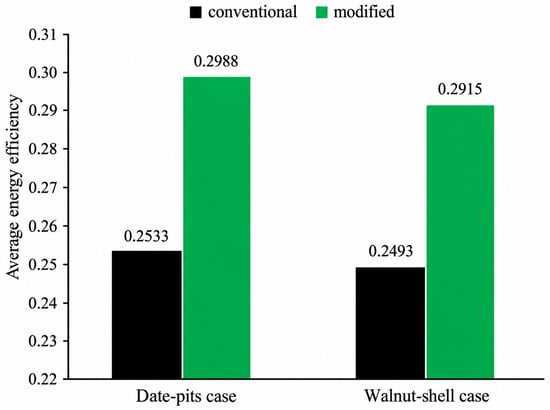
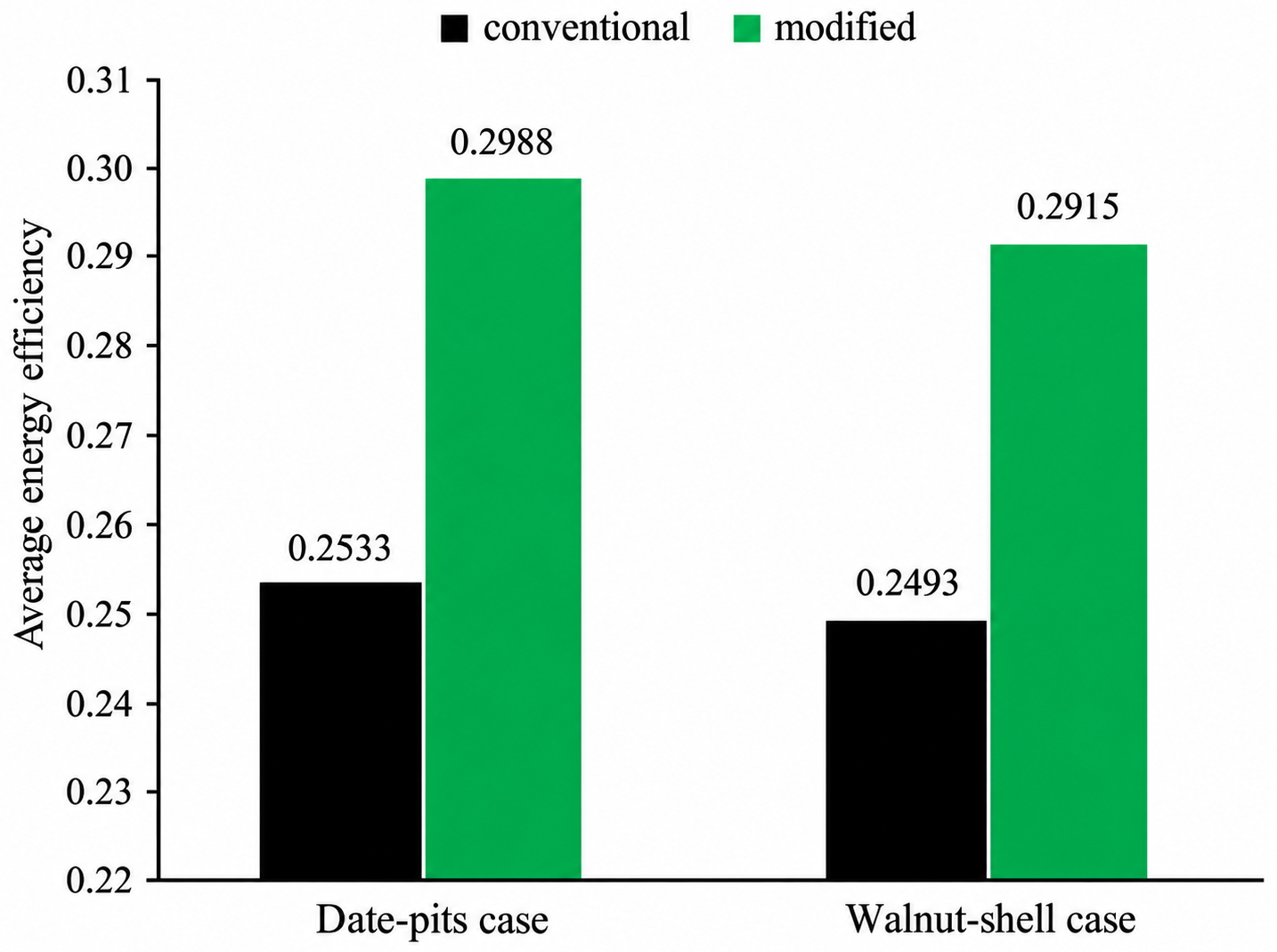
The average energy efficiency for both experimental cases is presented in Figure 9, and the corresponding numerical values are summarized in Table 4. For Case 1 (date-pits-modified SD), the conventional SD achieved an average energy efficiency of 0.2533, while the date-pits-modified SD achieved 0.2988, representing a 17.96% improvement. For Case 2 (walnut-shells-modified SD), the conventional SD achieved 0.2493, while the walnut-shells-modified SD achieved 0.2915, representing a 16.93% improvement. The enhancement in energy efficiency for both modified configurations is directly attributed to the sensible heat-storage capability of the date pits and walnut shells, which absorb and retain thermal energy during peak radiation hours and release it gradually during periods of lower insolation, thereby sustaining higher water temperatures and extending the effective distillation period. The slightly higher improvement observed for the date-pits configuration (17.96%) compared to walnut shells (16.93%) is consistent with the superior thermophysical properties of date pits, including higher thermal conductivity (0.18–0.25 W/m·K) and specific heat capacity (1600–1750 J/kg·K) relative to walnut shells (0.15–0.22 W/m·K and 1350–1500 J/kg·K). These results confirm that both agro-waste materials are effective sensible thermal-energy-storage media for enhancing the thermal performance of single-slope SDs, with date pits providing slightly higher performance.
Figure 9.
Average energy efficiency of conventional and modified SDs for both experimental cases.
Table 4.
Summary of average energy and exergy efficiencies for the conventional and modified SDs in both experimental cases.
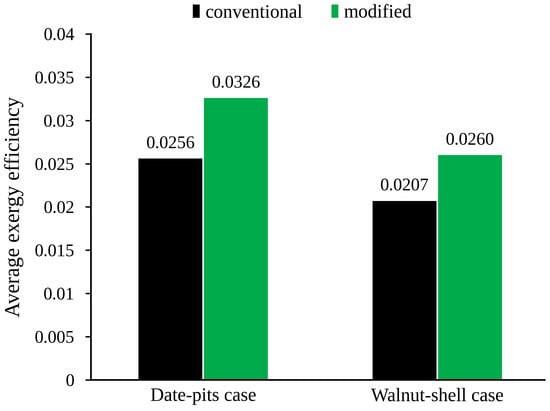
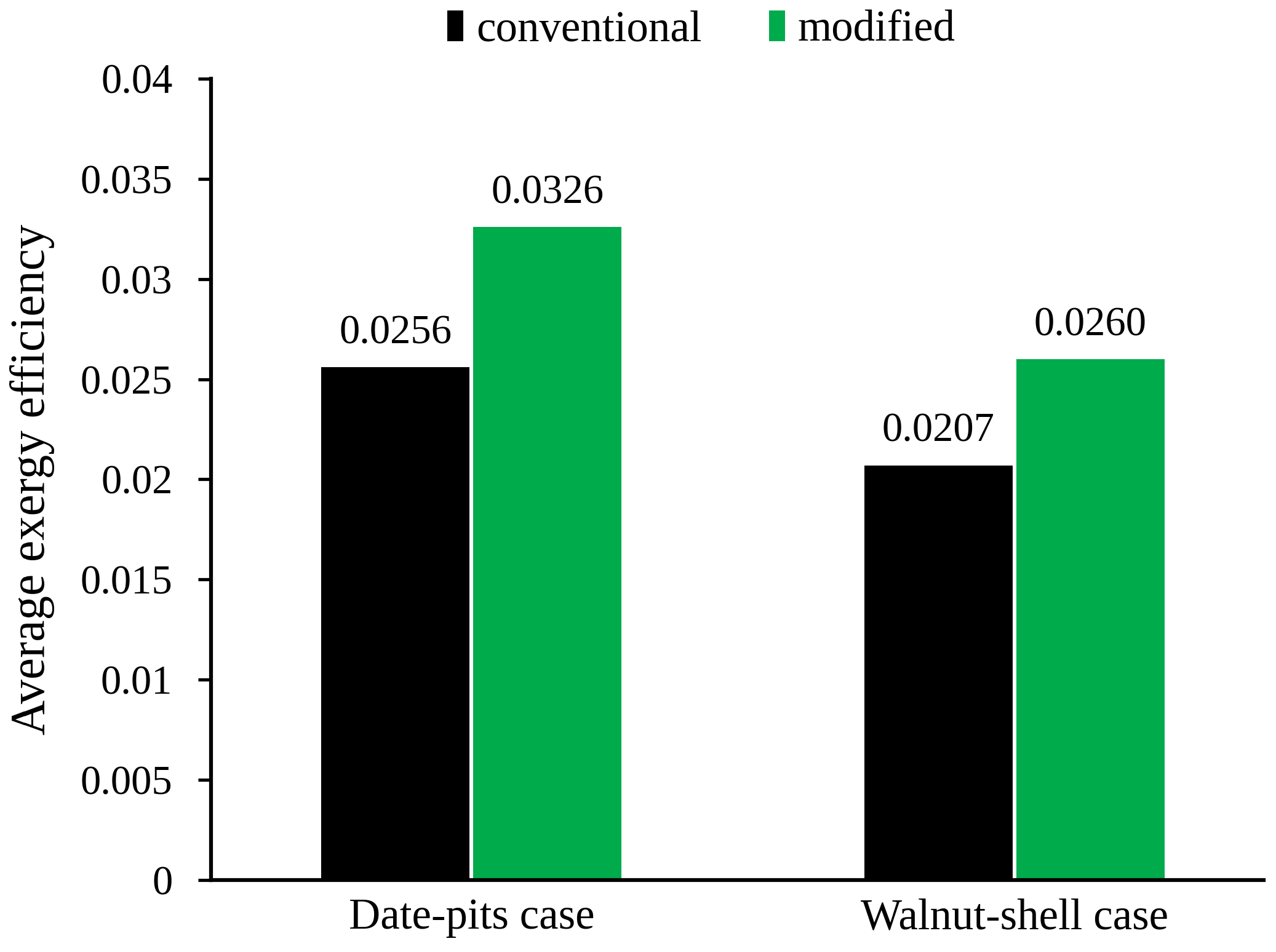
The average exergy efficiency for both experimental cases is presented in Figure 10, and the numerical values are included in Table 4. For Case 1 (date-pits-modified SD), the conventional SD achieved an average exergy efficiency of 0.0256, while the date-pits-modified SD achieved 0.0326, representing a 27.34% improvement. For Case 2 (walnut-shells-modified SD), the conventional SD achieved 0.0207, while the walnut-shells-modified SD achieved 0.0260, representing a 25.60% improvement. The enhancement in exergy efficiency for both modified configurations indicates that the sensible thermal-energy-storage media not only increase freshwater production but also improve the exergetic utilization of the supplied solar energy. The higher improvement observed for the date-pits configuration (27.34%) compared to walnut shells (25.60%) is consistent with the superior thermophysical properties of date pits, which facilitate more efficient heat absorption, storage, and release, thereby maintaining higher water-to-ambient temperature ratios and reducing irreversibilities. These results confirm that both date pits and walnut shells are effective sensible heat-storage media for enhancing the exergetic performance of single-slope SDs.
Figure 10.
Average exergy efficiency of conventional and modified SDs for both experimental cases.
The temporal evolution of the exergy efficiency provides additional insight into the mechanism by which the storage media improve performance. During the morning charging phase (07:00–10:00), the exergy efficiency of all configurations remained low, in the range of 0.008–0.015, because the incident solar radiation was still moderate while the basin water temperature had not yet risen sufficiently to establish a favorable water-to-ambient temperature ratio. As solar radiation approached its peak (11:00–14:00), the exergy efficiency of the modified SDs increased more rapidly than that of the conventional SD, reaching maximum hourly values of approximately 0.048 for the date-pits configuration and 0.044 for the walnut-shells configuration, compared with approximately 0.038 for the conventional SD. This divergence is attributed to the fact that the storage media absorb part of the incoming exergy during the charging phase and release it as useful thermal exergy during the afternoon, thereby reducing the exergy destruction associated with the large temperature differences between the absorber and the water during peak radiation. During the afternoon discharge phase (15:00–17:00), the exergy efficiency of the modified SDs declined more slowly than that of the conventional SD, remaining above 0.030 until 17:00 for the date-pits case and above 0.026 for the walnut-shells case, whereas the conventional SD fell below 0.020 over the same interval. The cumulative effect of this sustained exergetic performance is the 27.34% and 25.60% improvements in average exergy efficiency reported above. The slightly higher exergy efficiency of the date-pits configuration throughout the discharge phase is consistent with its higher thermal conductivity and specific heat capacity, which allow a larger fraction of the stored exergy to be recovered as useful evaporation rather than being lost to the surroundings.
The economic performance of the conventional and modified SDs was assessed through the cost per liter (CPL) of distilled water produced. The detailed capital-cost breakdown is presented in Table 5. The conventional SD has a capital cost of USD 76.39, and the modified SD has a capital cost of USD 77.00, the additional USD 0.61 being solely the collection, washing, and sun-drying cost of the storage material, which is obtained free of charge as an agricultural by-product. No discounting is involved in these figures. The difference in capital cost between the two systems is therefore only 0.8%, which confirms that the economic benefit of the modification does not arise from a reduction in capital expenditure.
Table 5.
Detailed capital-cost breakdown for the conventional and modified SDs.
The life-cycle cost and the resulting cost per liter are presented in Table 6, for both the undiscounted and discounted approaches. For the date-pits case, the undiscounted CPL decreased from USD 0.05694/L for the conventional SD to USD 0.04845/L for the modified SD, representing a 14.92% reduction; with discounting at 10%, the corresponding values were USD 0.04471/L and USD 0.03805/L, a reduction of 14.90%. For the walnut-shells case, the undiscounted CPL decreased from USD 0.05803/L to USD 0.04986/L, a reduction of 14.06%; with discounting, the values were USD 0.04557/L and USD 0.03916/L, a reduction of 14.07%. The close agreement between the undiscounted and discounted results confirms that the economic conclusion is robust and is not an artefact of neglecting the time value of money.
Table 6.
Cost per liter results and percentage reductions for both experimental cases.
The reduction in CPL for both modified configurations is directly attributed to the significant productivity enhancement achieved through sensible heat storage, which outweighs the modest additional capital cost of the materials. Because the capital cost increases by only USD 0.61 (0.8%) while the average daily yield increases by 18.3% for date pits and 17.1% for walnut shells, the net effect is a clear reduction in the cost per liter of distilled water. The date-pits configuration achieved a slightly higher cost reduction (14.92%) compared to walnut shells (14.06%), consistent with its superior productivity improvement and its marginally lower preparation cost. The payback period for the additional investment in both materials is expected to be very short, on the order of a few days of operation, making these modifications economically attractive for practical applications. These findings confirm that both date pits and walnut shells are cost-effective sensible thermal-energy-storage materials for enhancing single-slope SD performance, with date pits offering marginally better economic returns.
6. Conclusions
This experimental study investigated the performance enhancement of a single-slope SD using date pits and walnut shells as sustainable sensible thermal-energy-storage media for freshwater-scarcity mitigation. Both materials increased freshwater productivity, with the date-pits-modified SD achieving an 18.32% increase in cumulative yield (2637.5 mL/m2 vs. 2229.17 mL/m2) and the walnut-shells-modified SD achieving a 17.14% increase (2562.5 mL/m2 vs. 2187.5 mL/m2). The water-to-glass temperature difference increased by 14.1% for date pits (6.96 °C vs. 6.10 °C) and by 17.8% for walnut shells (6.14 °C vs. 5.21 °C), confirming the enhanced thermal driving force. Energy efficiency improved by 17.96% for date pits (0.2988 vs. 0.2533) and by 16.93% for walnut shells (0.2915 vs. 0.2493), while exergy efficiency improved by 27.34% (0.0326 vs. 0.0256) and 25.60% (0.0260 vs. 0.0207), respectively. Economic analysis showed cost reductions of 14.92% and 14.06%. Both storage materials demonstrated improvements relative to their corresponding conventional SD configurations. However, the statistical significance of these improvements cannot be established from single-day experiments, and the estimated measurement uncertainties should be considered when interpreting the results. Date pits exhibited slightly higher performance improvements than walnut shells, with differences of 1.03 percentage points in energy-efficiency improvement, 1.18 percentage points in productivity improvement, and 1.74 percentage points in exergy-efficiency improvement. Since the two materials were tested on different days, with average solar irradiance values of 521 W/m2 and 503 W/m2, respectively, these differences may also reflect variations in meteorological conditions and storage-bed geometry. Therefore, the apparent superiority of date pits should be interpreted as an observed trend rather than a statistically established result. Each configuration was tested on a single day, and the two experimental cases were conducted on separate days. Although the conventional reference SD exhibited similar cumulative freshwater yields of 2229.17 mL/m2 on 17 April 2026 and 2187.5 mL/m2 on 19 April 2026, corresponding to a difference of approximately 1.9%, these observations alone do not establish experimental repeatability. The results confirm that both agro-wastes are effective, low-cost, locally available sensible storage media and that agricultural waste valorization offers a sustainable pathway for integrating thermal-energy storage with solar desalination in water-scarce regions.
Several insights emerge from this work and point to future research directions. The consistent ranking of date pits above walnut shells, together with the morning thermal lag and afternoon heat release observed for both materials, indicates that thermal conductivity and specific heat capacity govern material selection, and that sensible storage involves a trade-off: a morning lag that delays distillate production, offset by afternoon heat release that extends the effective distillation period. To strengthen the statistical basis of these findings, future work should repeat each configuration over multiple consecutive days, report mean values with standard deviations, and test all three configurations simultaneously using three identical SDs. The long-term stability of these biomass media was not assessed here: although the literature reports no biological degradation, and their lignocellulosic composition, low moisture content, and daily thermal cycling should limit microbial growth, prolonged immersion in warm saline water may still cause gradual rotting, softening, or loss of structural integrity. Since the material adds only USD 0.61 (0.8%) to the capital cost, even periodic replacement would remain negligible against the productivity gains and few-day payback; however, the degradation rate and replacement interval must be quantified before multi-year operating costs can be evaluated. Future work should therefore test accelerated aging and repeated thermal cycling, measure mass loss, dimensional change, and property changes over time, and include the resulting replacement schedule in the life-cycle cost analysis; measure the properties of the actual samples rather than relying on literature values; examine storage mass, particle size, and bed configuration; investigate the water-depth–material interaction; explore hybridization with phase-change materials, reflective elements, or glass cooling; develop and validate transient packed-bed models; perform full life-cycle techno-economic and environmental assessment; test with real saline water under diverse climates; verify distillate quality; and demonstrate the enhancement at pilot scale in off-grid communities.
Author Contributions
Conceptualization, O.A.A.-M.I., S.A.K., and A.M.A.; methodology, O.A.A.-M.I., S.A.K., A.M.A., and F.L.R.; validation, O.A.A.-M.I., S.A.K., and A.M.A.; formal analysis, O.A.A.-M.I., F.L.R., A.A., and A.B.; investigation, O.A.A.-M.I., S.A.K., and A.M.A.; data curation, O.A.A.-M.I. and S.A.K.; writing—original draft preparation, O.A.A.-M.I.; writing—review and editing, S.A.K., A.M.A., F.L.R., A.A., and A.B.; visualization, O.A.A.-M.I. and S.A.K.; supervision, F.L.R., A.A., and A.B.; project administration, A.A. All authors have read and agreed to the published version of the manuscript.
Funding
This research received no external funding.
Data Availability Statement
Data is contained within the article.
Conflicts of Interest
The authors declare no conflicts of interest.
References
- Matta, G.; Pant, G.; Kumar, P.; Pal, R. Navigating Water Scarcity for Global Climate Change and Ramifications. World Water Policy 2026, 12, e70055. [Google Scholar] [CrossRef] [Scilit]
- Jain, S.; Srivastava, A.; Khadke, L.; Chatterjee, U.; Elbeltagi, A. Global-scale water security and desertification management amidst climate change. Environ. Sci. Pollut. Res. 2024, 31, 58720–58744. [Google Scholar] [CrossRef] [Scilit] [PubMed]
- Kaushal, A.; Varun. Solar stills: A review. Renew. Sustain. Energy Rev. 2010, 14, 446–453. [Google Scholar] [CrossRef] [Scilit]
- Rashid, F.L.; Alkhekany, Z.A.K.; Hammoodi, K.A.; Eleiwi, M.A.; Kadhim, S.A.; Agyekum, E.B.; Chibani, A.; Bouabidi, A. Finned-absorber solar stills for enhanced desalination: A systematic review of geometric optimization, hybrid integration, and future pathways. Chem. Eng. Process. Process Intensif. 2026, 228, 110993. [Google Scholar] [CrossRef] [Scilit]
- Ahmed, F.; Lakkimsetty, N.R.; Sundar, L.S. Recent progress in solar distillation stills for sustainable water desalination: Design, performance improvement and future prospects. Interactions 2026, 247, 180. [Google Scholar] [CrossRef] [Scilit]
- Rahman, M.A. Solar desalination Frontiers: Innovations in renewable integration and efficiency optimization. Environ. Prog. Sustain. Energy 2026, e70553. [Google Scholar] [CrossRef] [Scilit]
- Tayel, A.F.; Abou-Taleb, F.S.; Omara, Z.M.; Baz, F.B.; Marzouk, S.A. Comprehensive review of conical solar stills: Progress, challenges, and future perspectives. J. Therm. Anal. Calorim. 2026, 151, 17429–17495. [Google Scholar] [CrossRef] [Scilit]
- Kadhim, S.A.; Rasheed, R.H.; Ashour, A.M.; Alsayah, A.M.; Rashid, F.L.; Bouabidi, A.; Aich, W. Exploratory review of innovations in basin geometry of a hemispherical solar stills to increase productivity. Process Saf. Environ. Prot. 2025, 203, 107943. [Google Scholar] [CrossRef] [Scilit]
- Rashid, F.L.; Kadhim, S.A.; Al-Maimuri, N.M.L.; Al-Ghezi, M.K.S.; Abdalrahem, M.K.; Bouabidi, A.; Hussein, A.K.; Homod, R.Z.; Ashour, A.M. Solar Stills with Glass Cooling Techniques: A Systematic Review of Multi-method Efficiency Enhancements, Hybrid Systems, and Practical Barriers. Water Conserv. Sci. Eng. 2025, 10, 100. [Google Scholar] [CrossRef] [Scilit]
- Bait, O. Boosting solar–thermal desalination stills employing solar reflective materials—A review. Therm. Adv. 2026, 7, 100129. [Google Scholar] [CrossRef] [Scilit]
- Patel, R.V.; Singh, G.; Bharti, K.; Kumar, R.; Singh, D.B. A mini review on single slope solar desalination unit augmented with different types of collectors. Mater. Today Proc. 2021, 38, 204–210. [Google Scholar] [CrossRef] [Scilit]
- Mekki, N.; Saidi, H.; Bouabidi, A.; Kadhim, S.A.; Rashid, F.L.; Ashour, A.M.; Khezami, L. Study and optimization of phase change materials-filled square fins for improving pyramid solar stills: Comprehensive 8E analysis. Process Saf. Environ. Prot. 2026, 209, 108626. [Google Scholar] [CrossRef] [Scilit]
- Mohamed, S.A.; Al-Sulaiman, F.A.; Ibrahim, N.I.; Zahir, M.H.; Al-Ahmed, A.; Saidur, R.; Yılbaş, B.S.; Şahin, A.Z. A review on current status and challenges of inorganic phase change materials for thermal energy storage systems. Renew. Sustain. Energy Rev. 2017, 70, 1072–1089. [Google Scholar] [CrossRef] [Scilit]
- Zahir, M.H.; Irshad, K.; Shafiullah, M.; Ibrahim, N.I.; Kausarul Islam, A.K.M.; Mohaisen, K.O.; Al-Sulaiman, F.A.A. Challenges of the application of PCMs to achieve zero energy buildings under hot weather conditions: A review. J. Energy Storage 2023, 64, 107156. [Google Scholar] [CrossRef] [Scilit]
- Brihmat, A.; Mahcene, H.; Bechki, D.; Bouguettaia, H.; Khechekhouche, A.; Boughali, S. Energy Performance Improvement of a Solar Still System Using Date and Olive Kernels: Experimental Study. CLEAN Soil Air Water 2023, 51, 2200384. [Google Scholar] [CrossRef] [Scilit]
- Mankai, S.; Chemkhi, S.; Madiouli, J.; Ouled Saad, F.; Shigidi, I.; Sghaier, J. Performance optimization of solar still employing red-bricks as sensible heat storage material and interfacial evaporation area. Case Stud. Therm. Eng. 2025, 66, 105798. [Google Scholar] [CrossRef] [Scilit]
- Kumar, V.; Das, B.; Gupta, R. Performance Enhancement of Single Slope Solar Still with Sensible Heat Storage System: An Experimental Investigation Under Climatic Conditions of Northeast India. J. Sol. Energy Eng. 2025, 147, 031013. [Google Scholar] [CrossRef] [Scilit]
- Yugbodh, K.; Agrawal, R.; Jain, E.; Sarangapani, K.; Singh, S.K.; Kacker, R. Comprehensive 8E and 2C Analysis of a Modified Semi-Cylindrical Solar Still with Sensible Heat Storage Materials. Int. J. Environ. Res. 2025, 19, 109. [Google Scholar] [CrossRef] [Scilit]
- Yugbodh, K.; Agrawal, R.; Jain, E.; Sarangapani, K.; Ahirwar, B.K. Comprehensive 6E analysis of stepped tray semi-cylindrical solar still with sensible and latent heat storage materials. J. Therm. Anal. Calorim. 2025, 150, 18789–18802. [Google Scholar] [CrossRef] [Scilit]
- Ben Bacha, H.; Joseph, A.; Abdullah, A.S.; Sharshir, S.W. Synergizing water desalination and hydrogen production using solar stills with novel sensible heat storage and an alkaline electrolyzer. Case Stud. Therm. Eng. 2025, 65, 105663. [Google Scholar] [CrossRef] [Scilit]
- Sibagariang, Y.P.; Rosyid, O.A.; Ambarita, H.; Sudrajat, A.; Ridlo, M.R.; Lande, N.M.; Hasan, M.; Fudholi, A. Solar still double slope evaporation improvement using palm kernel as sensible heat storage material. Case Stud. Therm. Eng. 2025, 66, 105705. [Google Scholar] [CrossRef] [Scilit]
- Jeevadason, A.W.; Vijayakumar, R.; Azhagumurugan, R.; Gopinath, N.P.; Chanda, J. Performance improvement of twin wedge solar still with diverse wick materials and sensible heat storage mediums towards sustainable desalination for clean water production. J. Energy Storage 2025, 132, 117682. [Google Scholar] [CrossRef] [Scilit]
- Khelifi, R.; Chekifi, T.; Belaid, A.; Guermoui, M.; Rabehi, A.; Ferkous, K.; Adouane, M.; Al-Qattan, A.; Agajie, T.F. Comparative performance analysis of hemispherical solar stills using date and olive kernels as heat storage material. Sci. Rep. 2025, 15, 7128. [Google Scholar] [CrossRef] [Scilit] [PubMed]
- Manokar, A.M.; Attia, M.E.H.; Bouabidi, A. Walnut Shell Bio-Waste as Sustainable Thermal Storage in Solar Stills: Performance and Economic Evaluation. Energy Storage 2026, 8, e70433. [Google Scholar] [CrossRef] [Scilit]
- Abdel-Aziz, M.M.; Attia, M.E.H.; Sahnoune, D. A Comprehensive 4E Study on the Performance of Hemispherical Solar Stills Utilizing Walnut Shells. Heat Transf. 2026, 55, 420–435. [Google Scholar] [CrossRef] [Scilit]
- Kadhim, S.A.; Al-Ghezi, M.K.S.; Shehab, W.Y. Optimum Orientation of Non-Tracking Solar Applications in Baghdad City. Int. J. Heat Technol. 2023, 41, 125–134. [Google Scholar] [CrossRef] [Scilit]
- Al-Ghezi, M.K.S.; Mahmoud, B.K.; Alnasser, T.M.A.; Chaichan, M.T. A Comparative Study of Regression Models and Meteorological Parameters to Estimate the Global Solar Radiation on a Horizontal Surface for Baghdad City, Iraq. Int. J. Renew. Energy Dev. 2022, 11, 71–81. [Google Scholar] [CrossRef] [Scilit]
- Khafaji, H.Q.A.; Abdul Wahhab, H.A.; Al-Maliki, W.A.K.; Alobaid, F.; Epple, B. Energy and Exergy Analysis for Single Slope Passive Solar Still with Different Water Depth Located in Baghdad Center. Appl. Sci. 2022, 12, 8561. [Google Scholar] [CrossRef] [Scilit]
- Mlhem, A.; Teklebrhan, T.; Bokuretsion, E.; Abu-Jdayil, B. Development of sustainable thermal insulation based on bio-polyester filled with date pits. J. Bioresour. Bioprod. 2024, 9, 74–89. [Google Scholar] [CrossRef] [Scilit]
- Karagöz, İ.; Duyar, H.İ.; Çavuşoğlu, A.; Sepetcioglu, H. Synergistic Effects on the Mechanical, Thermal, and Morphological Properties of HDPE Composites Reinforced with Walnut Shell and Nano-Calcium Carbonate. J. Appl. Polym. Sci. 2025, 142, e57464. [Google Scholar] [CrossRef] [Scilit]
- Hameed, H.G.; Abdullah, D.A.; Saeed, M.M.A.; Abdulridha, H.O.; Al-Quraishi, B.A.J. Performance Evaluation Investigation for Conventional Solar Still with Different Additives. Int. J. Mech. Sustain. Eng. Technol. 2025, 4, 13–25. Available online: https://uniexpertsacademy.com/index.php/IJMSET/article/view/17 (accessed on 25 September 2026).
- Petela, R. Exergy of undiluted thermal radiation. Sol. Energy 2003, 74, 469–488. [Google Scholar] [CrossRef] [Scilit]
- LoPresto, M.C.; Hagoort, N. Determining Planetary Temperatures with the Stefan–Boltzmann Law. Phys. Teach. 2011, 49, 113–116. [Google Scholar] [CrossRef] [Scilit]
- Kumar, N.; Kumar, A. Performance enhancement of conventional solar still using water depth variation and external reflector: An experimental study with energy, exergy, environ-economic analysis. J. Water Process Eng. 2024, 68, 106460. [Google Scholar] [CrossRef] [Scilit]
- Kabeel, A.E.; Hamed, A.M.; El-Agouz, S.A. Cost analysis of different solar still configurations. Energy 2010, 35, 2901–2908. [Google Scholar] [CrossRef] [Scilit]
- El-Bialy, E.; Shalaby, S.M.; Kabeel, A.E.; Fathy, A.M. Cost analysis for several solar desalination systems. Desalination 2016, 384, 12–30. [Google Scholar] [CrossRef] [Scilit]
- Moffat, R.J. Describing the uncertainties in experimental results. Exp. Therm. Fluid Sci. 1988, 1, 3–17. [Google Scholar] [CrossRef] [Scilit]

Disclaimer/Publisher’s Note: The statements, opinions and data contained in all publications are solely those of the individual author(s) and contributor(s) and not of MDPI and/or the editor(s). MDPI and/or the editor(s) disclaim responsibility for any injury to people or property resulting from any ideas, methods, instructions or products referred to in the content. |
© 2026 by the authors. Licensee MDPI, Basel, Switzerland. This article is an open access article distributed under the terms and conditions of the Creative Commons Attribution (CC BY) license.