


Abstract
The rapid expansion of electric vehicles (EVs) introduces highly dynamic, unpredictable load profiles that threaten power grid stability and complicate operation across distribution systems and battery swapping facilities. Accurately forecasting EV charging demand is critical for dynamic load management, infrastructure planning, and risk mitigation. This paper presents a comprehensive, systematic review of the operational pipeline and predictive methodologies for EV charging power and energy demand. We analyze the complete data processing workflow, including examining data sources, spatial–temporal resolution trade-offs, advanced imputation, denoising, and anomaly detection techniques. Furthermore, we establish a structured taxonomy of forecasting methods, critically evaluating classical time-series models, machine learning, deep architectures, graph spatiotemporal networks, large language models (LLMs), hybrid ensembles, and fuzzy-logic systems. By offering detailed comparative syntheses across methodologies, this review provides a solid foundational framework for risk assessment, smart grid management, and operational decision-making in evolving electromobility ecosystems.
1. Introduction
The dynamic development of electromobility (Electric Vehicles, EV) constitutes one of the main pillars of the global energy transition and the pursuit of climate neutrality. However, the mass substitution of internal combustion engine vehicles with electric vehicles leads to a fundamental change in the load characteristics of power systems. Unlike traditional energy consumers, EV charging stations are characterized by a high degree of randomness, high power consumption dynamics, sudden load spikes, and pronounced spatial–temporal variability determined by driver mobility patterns. Consequently, highly dynamic vehicle charging poses a direct threat to distribution grid stability, leading to local overloads of transformers and supply lines, voltage drops, increased transmission losses, and accelerated degradation of grid infrastructure. Additionally, in alternative models, such as the rapidly developing battery swapping system [1], notably in China, a key challenge lies in precisely forecasting demand to ensure that a station never runs out of fully charged and ready-to-issue battery packs at any given moment. Ensuring the continuous availability of charged batteries while optimizing their background charging process represents a critical prerequisite for service continuity and balanced local grid loading.
From the perspective of distribution system operators, transmission system operators, charge point operators, and flexibility of service, accurately forecasting EV energy and charging power demand is becoming a paramount challenge. Precise short-term and ultra-short-term forecasts serve as the direct input stream for downstream grid optimization and control frameworks, enabling dynamic load management (Smart Charging), peak-load shaving, microgrid energy balance, renewable energy source (RES) integration, and Vehicle-to-Grid (V2G) flexibility services. Conversely, medium- and long-term spatio-temporal forecasts are essential for location–allocation planning, sizing stationary energy storage systems (BESS), and optimizing charging station deployment. Crucially, the practical utility of any forecasting model depends on how its outputs—whether point predictions, prediction intervals, or generated spatial–temporal scenarios—are integrated into decision-making models.
Furthermore, forecasting requirements, demand profiles, and operational objectives vary substantially across different charging contexts—such as residential, workplace, public fast-charging, highway, and fleet/depot charging systems. While short-term forecasts in these environments guide real-time dynamic load management and smart charging, medium- and long-term demand predictions serve as essential inputs for broader infrastructure planning, sizing, and charging station placement models designed to preserve network reliability under operational disruptions (e.g., [2]).
Despite intensive research progress in this field, predicting EV charging demand remains an exceptionally complex task. This stems from the fact that the load generated by EVs is the resultant of numerous diverse sub-factors: random and behavioral factors (arrival/departure times, initial battery state of charge [SoC], and driving style), technical parameters (charger power rating, battery capacity, and charging curve), environmental and atmospheric conditions (ambient temperature affecting energy consumption and cell efficiency), as well as market and urban environment variables (tariff structures, spatial planning, traffic density, and mass public events).
An additional obstacle in the practical implementation of predictive models is input data quality. Data acquired from real-world charging environments are frequently plagued by measurement gaps, noise, synchronization errors, and anomalies caused by hardware failures and communication disruptions. Furthermore, the rapid expansion of infrastructure induces the cold-start problem for newly established stations, alongside time-series non-stationarity driven by evolving user behavior.
Several reviews have examined EV charging-demand forecasting from complementary perspectives. Amara-Ouali et al. [3] reviewed open datasets and load models, analysed the quality and characteristics of six charging datasets, and suggested how datasets could be matched to modelling approaches. Marzbnai et al. [4] critically compared linear, nonlinear and hybrid approaches to EV energy-demand prediction. Yaghoubi et al. [5] organized research on charging behaviour and related prediction tasks around machine learning, deep learning and ensemble methods. Jia et al. [6] examined forecasting together with coordinated charging and V2G optimization, explicitly discussing uncertainty and load-mismatch risk.
Two more recent reviews substantially overlap with the scope of the present study. Rashid et al. [7] presented a broad taxonomy of forecasting techniques together with a workflow covering data sources, preprocessing, feature engineering and aggregation. Alaraj et al. [8] synthesized 162 studies on ML-based charging-session demand forecasting, jointly considering input data, algorithms, charging scenarios, aggregation levels and prediction horizons. These contributions already establish connections between data characteristics, forecasting methods and practical applications. Consequently, the contribution of the present review lies in extending and integrating this evidence rather than in introducing such connections for the first time.
Kim et al. [9] further developed model selection by organizing forecasting approaches according to prediction horizon and applying TOPSIS with criteria describing prediction error, data-collection period and station-scale suitability. The present review complements this quantitative selection perspective with a qualitative assessment of methodological trade-offs. As summarized in Table 1, the comparison addresses how data preparation, model assumptions, forecast uncertainty and operational requirements affect the applicability of different approaches.
Table 1.
Comparison of existing reviews of EV charging-demand forecasting and the contribution of the present review.
Building on these reviews, this study provides an integrated synthesis with several specific extensions. Section 3.4 distinguishes missing-data reconstruction, limited-data learning, denoising, anomaly detection and distribution shifts, examining their implications for subsequent forecasting and the preservation of demand peaks. Section 4 places established statistical and learning approaches alongside probabilistic, fuzzy, expert-system and graph-based methods, with dedicated coverage of recent LLM-based EV forecasting in Section 4.5. This coverage concerns the use of pretrained language models for charging-demand prediction, which is distinct from the conventional time-series transformers discussed in earlier reviews. Section 6 relates model applicability to forecasting horizon, temporal resolution, spatial granularity, data availability and uncertainty requirements. Its synthesis supports conditional model selection without deriving a universal performance ranking from heterogeneous studies. Finally, the findings are interpreted through the cybernetic risk-analysis perspective introduced below. This perspective explains the informational role of forecasts in operational decisions; reductions in system risk require separate evaluation within the relevant control and decision-making settings.
From this operational perspective, the demand forecasting process itself—regardless of the sophistication of the predictive algorithm used—does not constitute an end in itself. From the perspective of modern power systems engineering, a forecast is merely a key information stream within a broader framework of risk management and power system stability assurance. Moving beyond the traditional statistical framework where risk is reduced strictly to historical frequency analysis or financial metrics such as Value at Risk (VaR), this review draws upon the cybernetic concept of risk analysis in the energy industry based on Marian Mazur’s theory of autonomous systems, as introduced in the authors’ previous work [10].
According to this theory, every entity and object within the energy sector (from an individual charger or station to a power plant, up to the entire transmission system and energy market) can be treated as an autonomous system possessing distinct information and energy channels, as well as functional modules: receptor, alimentator, accumulator, correlator, homeostat, and effector. The primary thesis of this cybernetic approach asserts that the level of risk is strictly tied to system controllability – the higher the controllability and homeostatic capacity to compensate for adverse environmental impacts, the lower the operational, technological, and economic risks. As a result, it can serve as a solid starting point for risk analysis in smart grid management regarding controllability, particularly in the context of dynamic management of electric vehicle charging stations.
This review addresses the following research questions:
RQ1: How do data sources, aggregation levels, temporal resolution, and data quality affect EV charging demand forecasting?
RQ2: Which methodological approaches are used to forecast EV charging demand, and what are their main strengths and limitations?
RQ3: Under which conditions are different forecasting approaches most suitable, considering the forecast horizon, spatial scale, and data availability?
RQ4: What limitations of existing studies and research gaps hinder the practical deployment of EV charging demand forecasting models?
RQ1 is addressed in Section 3 and Section 5, RQ2 in Section 4, RQ3 in Section 4, Section 6 and Section 7, and RQ4 in Section 4 and Section 7. Section 8 synthesizes the answers to all four research questions.
It should be stressed that to address the need for a rigorous comparative framework, this review evaluates predictive approaches not by direct numerical cross-comparison of reported metrics—which are inherently non-comparable due to distinct datasets, error metrics, and spatial–temporal scales—but through a multi-dimensional conditional matrix. Specifically, models are critically compared based on their assumptions, input variables, forecasting horizons (ultra-short, short, medium, long), spatial and temporal resolutions, computational overhead, uncertainty management, and domain generalizability under specific grid-operational constraints.
The remainder of this article is organized as follows. Section 2 describes the review methodology, including the literature search strategy, eligibility criteria, and methodological classification. Section 3 examines data acquisition and preprocessing, focusing on data sources, aggregation levels, temporal resolution, and missing-data treatment. Section 4 presents a taxonomy and critical analysis of methods for forecasting EV charging demand. Section 5 synthesizes the findings on data sources and fusion, while Section 6 discusses the evolution and comparative performance of prediction methods. Section 7 provides a critical comparison between models as well as a dedicated analysis of how distinct operational environments fundamentally alter forecasting requirements. Finally, Section 8 provides concluding remarks and outlines future research directions.
2. Review Methodology
2.1. Literature Search Strategy
The literature review was conducted using the Web of Science and IEEE Xplore databases. The search covered publications published between 2010 and 2026. This time frame was selected to capture the period of rapid development in electromobility and methods for forecasting electric vehicle charging demand.
The literature search consisted of two complementary search strategies. The primary search was designed to identify studies addressing the forecasting or prediction of electric vehicle charging load and demand. In both databases, combinations of keywords related to electric vehicles, charging infrastructure, and forecasting were used. The main search query included the following terms:
(“electric vehicle charging load” OR “electric vehicle charging demand” OR “EV charging load” OR “EV charging demand” OR “charging station load” OR “charging station demand”) AND (forecast* OR predict*)
In Web of Science, the search was conducted using the Query Builder, while an equivalent query was used in the advanced search mode in IEEE Xplore. In both databases, the publication year was restricted to the period 2010–2026. The primary search identified 1107 records, including 595 records from Web of Science and 512 records from IEEE Xplore.
Since the scope of the review also covers data acquisition, data quality, and missing-data treatment, a supplementary search was performed to identify publications specifically addressing these aspects. The supplementary search used combinations of terms related to EV charging data acquisition, charging datasets, missing data, and data imputation. The Web of Science query was formulated as follows:
(“electric vehicle charging” OR “EV charging”) AND (“data acquisition” OR “charging session dataset*” OR “charging transaction dataset*” OR “charging dataset*” OR “missing data” OR “missing value*” OR imputation)
An equivalent query, with wildcard expressions replaced by their singular and plural forms where necessary, was used in IEEE Xplore. The same publication-year restriction of 2010–2026 was applied. The supplementary search identified 252 records, including 148 records from Web of Science and 104 records from IEEE Xplore.
Records retrieved through the two search strategies were combined and duplicate publications occurring within and across the database searches were removed before screening. The remaining publications were screened based on their titles and abstracts, followed by full-text assessment according to the predefined inclusion and exclusion criteria. The complete selection procedure, including the final set of 166 studies included in the review, is summarized in the PRISMA-style flow diagram shown in Figure 1.
Figure 1.
PRISMA flow diagram of the literature search and study selection process.
2.2. Inclusion and Exclusion Criteria
The study selection process was guided by predefined inclusion and exclusion criteria aligned with the two main components of the review: EV charging load and demand forecasting, and the acquisition and preprocessing of EV charging data.
Studies were included in the forecasting part of the review if they proposed, applied, or evaluated a method for forecasting or predicting electric vehicle charging load, charging demand, charging power, charging profiles, or closely related quantities. Studies conducted at different spatial and aggregation levels were considered, including individual charging stations, groups of stations, regional or city-wide charging demand, and aggregated EV charging systems. Both deterministic and probabilistic forecasting approaches were eligible, as were simulation-based approaches when they were used to estimate future charging demand.
The review also included publications relevant to the data-related part of the study. These covered the acquisition and characteristics of EV charging data, including charging-session and transaction data, temporal and spatial resolution, aggregation level, data quality, missing observations, and methods for missing-data imputation. Publications were therefore eligible even if forecasting was not their primary objective, provided that they contributed directly to understanding, preparing, or improving data used for EV charging demand analysis or forecasting.
Original research articles and conference papers published between 2010 and 2026 were considered. Studies were required to provide sufficient methodological information to identify the forecasting, data-processing, or imputation approach being investigated. For forecasting studies, the analyzed method had to be directly related to EV charging demand rather than to a broader energy-system prediction problem.
Studies were excluded when electric vehicles or charging infrastructure were only a peripheral application context and the main contribution was unrelated to EV charging demand forecasting or charging-data analysis. In particular, studies focused exclusively on charging scheduling, energy management, control, infrastructure siting or sizing, pricing strategies, or grid-impact assessment were excluded when they did not contain a relevant forecasting or data-analysis component.
Studies concerned solely with battery state-of-charge estimation, battery degradation, vehicle energy consumption during driving, traffic-flow prediction, EV adoption forecasting, or general power-system load forecasting were also excluded unless their results were directly incorporated into the estimation or prediction of EV charging demand. Review articles, surveys, and other secondary studies were not included in the final methodological corpus, although they could be used to support background discussion and to identify additional relevant literature.
2.3. Data Extraction and Methodological Classification
For studies addressing data acquisition, data quality, and missing-data treatment, the extracted information included the data source, type of charging data, level of aggregation, temporal and spatial resolution, data availability, identified data-quality issues, and the methods used for preprocessing and imputation. These studies were analysed primarily with respect to how EV charging data were collected, structured, processed, and prepared for further analysis or forecasting.
For studies focused on EV charging load and demand forecasting, information was extracted on the forecasting target, prediction horizon, input variables, preprocessing procedures, and the principal predictive method. These studies were subsequently classified according to the main modelling approach used to generate the final forecast. The adopted categories comprised statistical methods, classical machine learning, artificial neural networks, deep learning, large language models, hybrid and ensemble models, simulation and probabilistic models, fuzzy methods, expert systems, and graph-based methods.
The methodological classification was based on the principal forecasting mechanism and the organization of the predictive framework. Hybrid approaches included combinations of distinct predictive models, as well as multi-stage frameworks integrating signal decomposition or feature fusion with forecasting models. Ensemble approaches combined the outputs of multiple predictors. Auxiliary techniques, such as feature selection or metaheuristic hyperparameter optimization, did not by themselves determine assignment to the hybrid category. Since these categories are not mutually exclusive, integrated architectures could also be discussed within the sections devoted to their principal model family.
3. Data Acquisition and Imputation
Accurate forecasting of electric vehicle (EV) charging demand relies fundamentally on the quality, structure, and pre-processing of the underlying data. The raw observations collected from charging environments are shaped by diverse acquisition sources, spatial aggregation levels, and sampling frequencies, while frequently being subject to real-world data quality issues such as missing values, noise, and structural shifts. This section provides a systematic review of the operational pipeline preceding the modeling stage. Specifically, it examines the primary sources of charging and contextual data, the impact of spatial aggregation and temporal resolution on demand profile stability, and the state-of-the-art imputation, denoising, and anomaly detection techniques employed to ensure data integrity.
3.1. Data Sources
Data used for forecasting electric vehicle charging demand may originate from several complementary sources. These include direct field measurements, data acquisition systems and operator platforms, charging-session and transaction records, and open-access databases. Charging data are also frequently enriched with external information, such as weather conditions, electricity prices, traffic intensity, the characteristics of the station surroundings, and user behaviour. The scope and acquisition method of the data affect the type of target variable, the set of available explanatory variables, and the ability to generalize the results.
Direct field measurements may include power, energy, voltage, current, and power-quality parameters recorded at the level of an individual charger or an entire station [11]. Leou et al. used measurements from the main switchboard and individual charging points at an operational charging station to derive the number of charging sessions initiated in successive time intervals and the distributions of parameters describing load behaviour [12]. Measurement data provide the most direct representation of the instantaneous impact of EV charging on the power system; however, their acquisition requires dedicated measurement devices, communication infrastructure, and data storage systems.
In larger charging networks, data are typically collected through centralized acquisition and management platforms. Such systems integrate information transmitted by individual chargers and support the analysis of energy consumption and equipment status [13]. Lee et al. presented a solution based on an open-data portal from which XML files were retrieved every five minutes. The files contained station and charger identifiers, location, charger type, timestamp, and current operating status [14]. These status data can be used to estimate infrastructure occupancy and the number of active charging points, but they do not necessarily provide information on the actual charging power or energy consumed by the vehicles.
Charging-session and transaction records constitute a richer source of information. Zhang et al. published a dataset containing 441,077 transactions recorded over two years at 13 charging stations in China [15]. In addition to charging start and end times and the energy delivered, the dataset includes anonymized user identifiers, charging-point identifiers, electricity prices, service fees, payment amounts, charging termination reasons, and weather data. Transaction records support the analysis of user behaviour and the construction of aggregated demand profiles, but they do not necessarily capture the instantaneous power trajectory within an individual session. Their use is also constrained by privacy requirements, and personally identifiable information is therefore typically anonymized.
The primary charging data are often supplemented with external information describing the conditions that influence user decisions. Kuang et al. combined five-minute occupancy and price data from 18,061 public charging points with a division of Shenzhen into traffic zones and spatial relationships between neighbouring areas [16]. Yan et al. used transaction data together with travel information, road congestion, station locations, points of interest, and user-profile characteristics, including charging frequency, session start time, energy consumption, and initial battery state of charge [17]. Weather, pricing, calendar, traffic, and land-use information can improve the ability of forecasting models to explain demand variability, but these variables must be properly aligned with the charging observations in both time and space. It is important to emphasize that demand profiles and forecasting specifications are strongly shaped by the operational context. For instance, residential and workplace charging exhibit distinct daily arrival patterns and relatively long parking durations. Highway fast-charging is characterized by high charging power and variable arrivals, whereas fleet and depot charging is constrained by vehicle schedules and the required state of charge before departure. These differences affect the choice of predictive features and operational objectives; for electric-bus systems, demand estimates also support robust infrastructure planning [2].
Consequently, the data source should be selected according to the variable being forecast. Electrical measurements are most suitable for representing power demand and grid loading, whereas session records are better suited to describing energy consumption and user behaviour. Infrastructure occupancy, in turn, can be derived from charger-status data. Although these quantities are related, they should not be treated as interchangeable.
3.2. Level of Aggregation
The aggregation level determines whether charging demand is analysed for an individual vehicle or charging point, an entire station, a group of stations, or a larger power-system area. Increasing the aggregation level generally smooths the load profile because the irregular behaviour of individual users is partially offset. At the same time, aggregation reduces the ability to identify local patterns, peak values, and differences between user groups and locations.
The effect of aggregation on load regularity was directly analysed by Jee and Kim [18] using data from 873 charging stations on Jeju Island. Individual station profiles exhibited high variability, whereas combining multiple resources considerably reduced customer baseline load estimation errors and the differences between the applied methods. The authors found that aggregation to at least 4 MW of installed capacity or 200 kWh of average hourly consumption was sufficient to achieve a relative root mean square error (RRMSE) threshold of 30%. For the more restrictive threshold of 20%, the required values increased to 10 MW and 500 kWh, respectively. These results confirm that a sufficiently large group of charging stations can form a more stable and predictable resource, although the specific thresholds depend on the characteristics of the analysed network.
Aggregated profiles may also be constructed using bottom-up models of individual vehicles. Zhou et al. [19] considered vehicle type, usage pattern, initial state of charge, charging start time, and charging method, and then aggregated the loads generated through Monte Carlo simulation to the area and distribution-network levels. A similar probabilistic approach can be applied to determine the required number and capacity of charging points, as demonstrated by the infrastructure planning model based on normal-distribution sampling and Monte Carlo simulation [20]. Bottom-up methods preserve information about user heterogeneity, but their results strongly depend on the assumed probability distributions and behavioural assumptions.
Aggregation may also serve an operational purpose. Meng et al. [21] represented a large group of vehicles connected to a charging station through an aggregate feasible power region, effectively modelling the station as a virtual energy storage system. This approach reduces the number of decision variables, limits the need to disclose individual user data, and enables charging-station flexibility to be incorporated into distribution-system management. Excessive spatial aggregation presents the opposite problem. Alonso-Cepeda et al. [22] showed that two stations operating under similar technical and institutional conditions may exhibit different but recurring charging profiles shaped by local user behaviour and operating conditions.
The aggregation level should therefore be selected according to the forecasting objective. Individual-station models are appropriate for local infrastructure planning, whereas profiles representing groups of stations or larger areas are more suitable for grid management and electricity-market participation. Greater aggregation improves statistical stability but may conceal local congestion and location-specific demand patterns.
3.3. Data Resolution
Temporal resolution determines the length of the interval over which charging demand is recorded, aggregated, or forecast. The literature employs both high-frequency data, including second- and minute-level intervals, and profiles with 15-min or hourly resolution. Selecting an appropriate resolution involves a trade-off between preserving short-term power variations and limiting dataset size, computational cost, and model complexity. Temporal resolution should also be distinguished from the forecast horizon and the length of the historical input window.
The effect of temporal resolution on load representation was directly analysed by Thiapwong et al. [23]. One-minute fast-charging profiles were aggregated into 5-, 15-, 30-, and 60-min intervals while preserving the total energy delivered during each session. However, increasing the interval length smoothed short-duration peaks and increased errors in the representation of line and transformer loading. This effect was particularly pronounced for high-power chargers and local low-voltage network studies, for which the authors indicated that a resolution of 5–15 min was more appropriate. Thus, preserving energy during temporal aggregation does not guarantee that maximum power or the actual impact of charging on grid components will also be preserved.
Minute-level data can be used for super-short-term forecasting. Zhu et al. [24] employed real-world minute-level load profiles and compared deep learning models using historical input windows containing 1, 5, and 15 consecutive observations. The LSTM model achieved the best results, highlighting the importance of modelling short-term temporal dependencies. In this case, however, the number of time steps referred to the length of the input history rather than to a change in data resolution. An even higher sampling frequency was used by Jovanovic et al. [25], who recorded individual charging-session parameters every 10 s. The authors observed that many consecutive records contained similar information, suggesting that a lower sampling frequency could reduce training time without a substantial loss of accuracy. This demonstrates that very high temporal resolution increases the number of observations, but not necessarily their diversity.
It is also important to distinguish temporal resolution from the forecast horizon. Unterluggauer et al. [26] converted event-based charging data into a time series with a 15-min resolution and then compared a four-step forecast, corresponding to one hour, with a 96-step forecast covering an entire day. The shorter horizon produced substantially lower errors, even though the output resolution remained unchanged. Huang et al. [27] demonstrated the operational relevance of combining different time scales by integrating day-ahead scheduling with 15-min rolling optimisation. Such an approach allows longer-horizon forecasts to support planning while more frequent updates are used to adjust decisions during operation.
The temporal resolution should therefore be selected according to the purpose of the analysis. Second- and minute-level intervals are useful for modelling individual charging sessions, real-time control, and peak-power identification, whereas a resolution of 5–15 min is often sufficient for short-term management of charging stations and local distribution networks. Hourly profiles reduce computational complexity but may conceal short-duration overloads and should not be used in applications that require an accurate representation of peak demand.
3.4. Data Quality Issues and Data Imputation
Data quality is one of the fundamental factors determining the reliability of electric vehicle charging demand forecasting models. Data collected from charging stations are prone to missing measurements, communication interruptions, recording errors, limited numbers of observations, noise, outliers, and changes in user behaviour. These issues may occur both at the level of an individual charging session or charging point and in aggregated time series describing the load of a station, an area, or the entire network. Their impact depends not only on the number of erroneous observations, but also on their temporal distribution, the duration of consecutive data gaps, and the dependencies between the missing variables.
The literature identifies several main groups of methods for improving data quality. These include conventional imputation methods, reconstruction using generative models, data augmentation, transfer learning, signal filtering and decomposition, as well as anomaly and distribution-shift detection. However, individual methods address different types of problems. For example, interpolation may be sufficient for short and isolated gaps, whereas prolonged recording interruptions require the use of historical information, calendar-related context, or data from other charging stations. Similarly, an unusual charging profile does not necessarily indicate a measurement error, as it may result from equipment failure, a cyberattack, or an actual change in user behaviour.
3.4.1. Missing Data and Classical Imputation Methods
Missing values in charging data may be caused by failures of measurement devices, loss of communication with the central system, database errors, or the temporary shutdown of a charging point. The mechanism underlying the occurrence of missing values is particularly important. Individual missing samples can usually be reconstructed based on neighbouring observations, whereas when an entire record, day, or set of correlated variables is missing, the available information is considerably more limited.
One of the first comparisons of imputation methods for charging station data was conducted by Majidpour et al. [28]. The authors applied zero-value, mean, median, maximum-likelihood, and multiple imputation, and subsequently used the imputed dataset to forecast the load of individual charging points over a 24-h horizon. In the analysed dataset, all variables describing a given observation were frequently missing. Consequently, advanced multivariate methods did not achieve a clear advantage over simple median imputation because no observed predictors were available to reconstruct the missing values. This result indicates that the selection of an imputation method should depend not only on the proportion of missing values but also on their structure.
A more comprehensive approach was presented by Lee et al. [29]. The proposed QEM method combines quadratic spline interpolation with the expectation–maximization algorithm. In the first stage, the target variable, namely the daily peak station load, is reconstructed. The reconstructed variable is then used as a predictor during the multivariate imputation of the remaining features. This approach addresses situations in which all variables describing station activity are unavailable for the days with missing data. The authors demonstrated that the application of imputation can reduce the error of subsequent forecasts by up to approximately 9.8%. However, the benefits were evident primarily in datasets with a high proportion of missing values. For nearly complete datasets, additional imputation occasionally produced worse results than a model trained without completing the missing values.
Simple methods such as last observation carried forward, next observation carried backward, and linear interpolation are computationally inexpensive but rely on the assumption of local continuity in the time series. This assumption may be inappropriate for charging station loads, in which adjacent intervals may differ substantially because of the stochastic nature of vehicle arrivals. These methods are particularly prone to errors in the presence of long consecutive gaps. Smoothing the load profile may then shift the timing of the maximum value or lead to an underestimation of peak values.
Classical imputation procedures continue to be used as components of broader data-processing systems. Yang et al. [30] used linear interpolation for numerical variables recorded in a microgrid system, the mode for categorical variables, and the removal of records containing an excessive number of missing values. Similarly, Sajjad et al. [31] applied outlier removal, smoothing, and temporal alignment of weather and load data. These studies demonstrate the importance of consistent processing of data obtained from multiple sources, while also indicating that the performance of a forecasting model may depend on arbitrary decisions concerning record removal and the degree of smoothing.
3.4.2. Generative and Probabilistic Data Reconstruction
A common limitation of classical imputation is its insufficient ability to capture nonlinear temporal dependencies and the variability characteristic of charging station loads. For this reason, generative models are increasingly being applied, as they learn the distribution of entire sequences rather than reconstructing missing points solely on the basis of their immediate neighbours.
Shen et al. [32] presented a framework designed for forecasting in low-quality data environments. The proposed GRU-GAN performs two functions simultaneously: it replaces missing values and outliers and generates additional sequences to increase the size of the training dataset. GRU units were employed in both the generator and the discriminator, enabling the model to account for temporal dependencies characteristic of load profiles. The imputed dataset is subsequently used by a Mogrifier-LSTM model. Compared with mean imputation, interpolation, and the k-nearest-neighbours method, GRU-GAN achieved lower reconstruction errors for different proportions of missing observations.
The results of this study also highlight the limitations of generative augmentation. Increasing the number of synthetic samples improved forecasting accuracy only up to a certain point. Further expansion of the dataset did not result in a proportional reduction in error because the generated sequences primarily contained information already present in the source data. Moreover, the model experienced greater difficulty in reproducing local peaks and plateau segments. This indicates that synthetic data should not be evaluated solely on the basis of the similarity of average profiles. It is also necessary to assess their ability to reproduce rare and extreme events.
A similar architecture was proposed by Ge et al. [33], who combined a SeqGAN network with a multivariate LSTM model. SeqGAN generates missing sequence segments in accordance with the distribution of the observed data, whereas the LSTM forecasts the load on the basis of the reconstructed dataset. As the proportion of missing data increased, the errors of classical RNN and LSTM models grew considerably faster than that of the SeqGAN-LSTM model. This result confirms that explicitly addressing missing data during the data-preparation stage can improve the robustness of a forecasting model.
The most comprehensive approach to probabilistic imputation was proposed by Li and Wang [34]. The PRAIM framework integrates a variational imputation architecture, LLM-derived representations, and retrieval-augmented memory. Data concerning demand, calendar information, location, and missingness patterns are encoded within a shared representation space. The retrieval memory enables the use of similar cases from across the entire network, eliminating the need to train a separate model for each station.
An important feature of PRAIM is the probabilistic nature of its output. In addition to a point estimate, the model generates a distribution that enables the uncertainty of the imputation to be quantified. The authors evaluated not only the reconstruction MAE but also the preservation of the mean, coefficient of variation, and the entire distribution using the Wasserstein distance and the Kolmogorov–Smirnov and Mann–Whitney tests. The calibration of prediction intervals was also analysed. Such an approach is particularly important for long recording interruptions, for which a single imputed value may imply an unjustified degree of certainty. From the perspective of demand forecasting, uncertainty information can be used to weight observations, construct prediction intervals, or flag records requiring additional verification.
Diffusion models constitute an alternative to GANs for generating synthetic data. DiffCharge [35] generates charging scenarios at both the battery and station levels by transforming Gaussian noise into realistic temporal profiles. The model incorporates conditions related to battery or station type and captures temporal dependencies using a self-attention mechanism. This approach should primarily be interpreted as a method of scenario-based augmentation rather than classical imputation. The generated profiles can broaden the range of training conditions, support uncertainty analysis, and enable models to be tested under situations that rarely occur in historical data.
3.4.3. Limited Numbers of Observations and Knowledge Transfer
Data scarcity is particularly important for newly established stations that have been operating for too short a period to allow stable seasonal patterns to be identified. This problem can be partially mitigated through transfer learning, in which knowledge acquired from a larger source dataset is transferred to a target domain with a limited number of observations.
Henriques et al. [36] used weekday data to improve weekend forecasts for an individual station. Weekdays represented the domain with a larger number of observations, whereas weekends were treated as the target domain with limited data availability. Transfer improved the results primarily for random forest and gradient boosting models, although the observed differences were relatively small. For the LSTM model, MAE decreased, whereas RMSE increased slightly. These results indicate that the effectiveness of transfer learning depends on the similarity between the source and target domains. When substantial differences exist between station profiles, user types, or seasonal structures, negative transfer may occur.
In the context of small datasets, transfer may take place between weekdays and non-working days, stations serving similar purposes, neighbouring areas, or successive stages of network development. However, it is necessary to compare the transfer-based model with a model trained exclusively on target-domain data and to verify whether the improvement is limited to a single forecasting horizon or error metric. A similar function may be performed by retrieving examples from other stations, as implemented in PRAIM [34], and by generative augmentation [32,35]. However, these methods differ in how they use external data: transfer learning modifies model parameters, retrieval provides contextual information during imputation, and generative models create additional observations.
3.4.4. Noise, Outliers, and Denoising
Noise may originate from measurement systems, communication systems, synchronization errors, or the inaccurate integration of data obtained from different platforms. It should be distinguished from the natural variability of the charging process. Sudden increases in power may be a valid consequence of the simultaneous initiation of multiple charging sessions and should not automatically be treated as disturbances.
Alam et al. [37] investigated the robustness of multivariate models by introducing Gaussian noise into metadata describing charging sessions. The addition of noise worsened the performance of all the models analysed, although the GRU model maintained the highest accuracy. The experiment demonstrates the usefulness of controlled robustness testing; however, Gaussian noise is a simplified approximation of real-world problems, which are often asymmetric, impulsive, or dependent on the measured value.
Another approach involves transforming the time series into a representation that is less sensitive to local perturbations. Majidpour et al. [38] proposed modified pattern sequence forecasting, in which continuous values are replaced by a sequence of symbols representing classes or patterns. Discretization increases robustness to minor disturbances because similar values are assigned to the same category. However, it may also result in the loss of information regarding the amplitude and precise shape of peaks.
Advanced denoising methods frequently employ signal decomposition. In the EV-STLLM model [39], variational mode decomposition was used for denoising, ICEEMDAN for separating components with different frequencies, and fuzzy information granulation for extracting information at multiple scales. Ablation experiments demonstrated that removing the multi-frequency and multi-scale modules increased forecasting errors. This indicates that separating trends, seasonality, and local fluctuations may facilitate the identification of temporal dependencies by the model.
Robust filtering of outliers was also applied by Munirathnam et al. [40], who used a Maximum Correntropy Quaternion Kalman Filter before the forecasting model. Correntropy-based filters are designed to address non-Gaussian and impulsive disturbances. However, their effectiveness depends on the appropriate selection of parameters and on whether abrupt changes in the signal are genuinely errors rather than valid operational events.
Another important issue, although not always classified as a data-quality problem, is insufficient temporal resolution. Lappalainen and Kleissl [41] demonstrated that averaging charging power data over intervals ranging from one second to one hour may lead to an underestimation of observed peaks and, consequently, of the required power capacity and energy storage capacity. The loss of information caused by sparse sampling is not equivalent to an ordinary data gap. If the behaviour of the signal within an interval has not been recorded, it cannot be reconstructed unambiguously through interpolation. Denoising and aggregation should therefore preserve the characteristics relevant to the target application, particularly maximum values and the rate of change in load.
3.4.5. Anomaly and Distribution-Shift Detection
Anomalies in charging data can be defined at different levels. A point anomaly is an individual measurement that differs substantially from its surrounding observations. A contextual anomaly is unusual only at a specific time or under particular conditions, whereas a collective anomaly concerns the shape of an entire session or a longer segment of a time series. Furthermore, it is necessary to distinguish between data errors, hardware faults, malicious activities, and genuine changes in user behaviour.
Sakwa et al. [42] used an autoencoder with LSTM layers to detect unusual EVSE power profiles. A model trained on normal sequences reconstructs typical charging curves, whereas a high reconstruction error indicates an anomalous profile. Analysing the entire curve enables the detection of power instability and abnormal trends that may not be visible when individual points are considered. This approach is useful for both data quality control and predictive maintenance. A remaining limitation is the lack of unambiguous labels for real-world failures, as a result of which decision thresholds are often calibrated using a manually labelled subset.
Kern et al. [43] analysed anomalies from a cyber–physical security perspective. The proposed system combines regression-based forecasting of session trajectories with the classification of known attacks and novelty detection based on the local outlier factor. Forecasting the expected behaviour of a session enables the analysis of residuals between actual and predicted values. The ensemble approach makes it possible to detect known attack scenarios while preserving the ability to generalize to previously unseen events. For demand forecasting models, this means that anomalies can be identified not only before training but also during model operation by monitoring forecast residuals.
A particularly important problem is a shift in the data distribution. Grgic et al. [44] analysed the behaviour of the Croatian charging network before the COVID-19 pandemic, during mobility restrictions, and after those restrictions were relaxed. The framework was based on forecasting model residuals, dimensionality reduction using PCA, and detection with Isolation Forest. The lockdown period was correctly identified as anomalous because demand, the number of sessions, and charging duration differed from the distributions observed in the training dataset.
In this case, however, the unusual observations were not measurement errors. They represented a genuine and significant change in user behaviour. Automatically removing them or replacing them with historical values would result in the loss of information about the system’s new operating regime. In such situations, the appropriate response is to flag the distribution shift, update the model parameters, increase the weight assigned to recent observations, or retrain the model. Anomaly detection should therefore precede the decision on how to repair the data rather than automatically result in their removal.
Data integrity problems also occur in distributed systems. Kumar and Al-Masri [45] presented the FLCMed-TAD framework for federated learning, which uses median-based aggregation of parameter updates and temporal anomaly detection to limit the influence of clients performing data poisoning or weight poisoning. Although this approach does not directly address missing values in raw load time series, it demonstrates that data quality also encompasses the reliability of information transmitted between charging stations and the aggregation server. In distributed forecasting systems, anomalies may occur both in observations and in model updates.
3.4.6. Evaluation of Data Quality Improvement Methods
Data repair methods should be evaluated not only on the basis of the reconstruction error of missing observations, but primarily in terms of their impact on forecasting accuracy. It is also important to reproduce the missingness mechanism realistically, since randomly removed individual samples are easier to reconstruct than long communication interruptions or entirely missing records. The preservation of variability, seasonality, and peak values should also be assessed, as these characteristics may be excessively smoothed by imputation or denoising. The results reported by Lee et al. [29] further demonstrate that imputation does not always improve forecasting performance, particularly when the proportion of missing values is small. Therefore, each method should be compared with simple baselines and with a model trained without imputation, while preventing information leakage from future observations.
4. Review of Prediction Methods
The reviewed studies are compared in terms of forecasting target, data characteristics and temporal resolution, forecast horizon, evaluation procedure, and reported performance metrics, where this information is available. Error measures are presented with their units or percentage conventions when specified in the original studies. Numerical results are interpreted within the respective experimental settings, and comparisons between studies account for differences in datasets, forecasting tasks, and evaluation protocols. A quantitative meta-analysis was not performed because the studies differed in datasets, forecasting targets, horizons, and evaluation protocols. Reported reductions in prediction error should not be interpreted as statistically significant improvements unless supported by appropriate tests in the original studies.
4.1. Statistical Methods
Statistical approaches to EV charging demand forecasting can be divided into three main categories: classical time-series models, dynamically weighted combinations of statistical and pattern-based models, and spatial forecasting methods. These categories address different forecasting objectives. Time-series models estimate the future temporal evolution of charging demand, whereas spatial models identify the locations at which demand growth may require additional charging or grid infrastructure. Consequently, their outputs and performance measures are not directly comparable.
4.1.1. Classical Time-Series Models
Models from the autoregressive integrated moving average family remain among the most frequently applied statistical approaches to EV charging demand forecasting. Their advantages include a transparent mathematical structure, relatively low computational complexity, and the ability to represent autoregressive dependencies, trends, and seasonal patterns. The reviewed studies demonstrate, however, that the formulation of an appropriate ARIMA model depends strongly on the aggregation level, tariff structure, forecast horizon, and whether EV charging demand is modelled separately from conventional electricity demand. Amini et al. [46] proposed a decoupled ARIMA-based approach for day-ahead forecasting of conventional electrical load (CEL) and EV charging demand (CDE). Instead of fitting a single model to the combined load, separate ARIMA models were constructed for CEL and CDE, and their forecasts were subsequently added. This distinction was motivated by the different temporal characteristics of the two components: conventional demand exhibited a seasonally changing load profile, whereas EV charging was primarily determined by daily driving and charging patterns. The orders of integration and autoregression were selected by minimising the mean squared error. The decoupled approach achieved a MAPE of 1.44% and an MAE of 1.277 MW, compared with 7.25% and 6.078 MW, respectively, for the integrated model developed by the same authors. Thus, separating the two components reduced both errors by approximately 80%. The resulting forecasts were also incorporated into chance-constrained day-ahead power-system scheduling. In the simulated scenarios, the decoupled forecasts reduced total operating costs by approximately 2.9% for a six-bus system and 23.8% for the IEEE 24-bus system. These results demonstrate the potential benefit of modelling EV demand separately from conventional load. Nevertheless, the charging demand was generated from probabilistic assumptions concerning driving distance and arrival and departure times rather than measured at operational charging stations. Furthermore, the evaluation was limited to a 24-h forecast period, which restricts the generalisability of the reported error reduction.
Louie [47] developed seasonal ARIMA models using approximately two years of hourly measurements from more than 2400 charging stations in Washington State and San Diego. Separate models were fitted for weekdays and weekends to account for differences in charging patterns, while 24-h seasonal differencing was used to remove the daily periodicity and the increasing load level. The comparison between the two regions also demonstrated the influence of time-of-use tariffs, which produced pronounced and predictable load changes in San Diego during the lowest-price period.
The models were evaluated for forecast horizons of 1, 2, and 24 h. For weekdays, the corresponding MAPE values were 9.3%, 13.3%, and 15.5%, whereas the weekend forecasts produced errors of 9.6%, 13.9%, and 17.3%. Seasonal ARIMA outperformed persistence forecasts and, for the 24-h horizon, Modified Pattern Sequence Forecasting. Residual analysis indicated that forecast errors were better represented by a Student’s t-distribution than by a Gaussian distribution, suggesting an increased probability of extreme errors. Although the study provides a detailed statistical analysis based on real charging data, the forecasts were evaluated over only 14 days, including four weekend days. Consequently, the reported accuracy should be confirmed using longer and more diverse test periods.
Kim and Kim [48] compared the TBATS model—combining a trigonometric representation of seasonality, a Box-Cox transformation, ARMA errors, and trend components—with ARIMA, feed-forward artificial neural networks, and LSTM models using measured charging data from Korea in 2018–2019. Forecasts were generated at three aggregation levels: national, city, and individual charging station, and for horizons ranging from one day to one month. Weather and calendar variables were included as external predictors in the multivariate models. Regression with ARIMA errors (Reg-ARIMA) achieved the best results for aggregated demand. Its one-day-ahead MAPE was 4.7% at the national level and 7.8% at the city level. At an individual station, the error increased to 20.6%, while LSTM produced the best result for the one-month horizon, with a MAPE of 23.6%. These results show that classical statistical models can outperform more complex neural approaches for regular aggregated series. They also demonstrate that forecasting accuracy decreases substantially at finer spatial scales, where individual charging decisions have a greater influence on demand.
4.1.2. Dynamically Weighted Statistical and Pattern-Based Models
Individual statistical models may perform inconsistently when the charging-demand series changes over time. Dynamically weighted ensembles address this problem by combining forecasts from complementary models and updating their contribution according to recent performance. Gomez-Quiles et al. [49] proposed a dynamically weighted ensemble combining ARIMA, Generalized Autoregressive Conditional Heteroskedasticity (GARCH), and Pattern Sequence Forecasting (PSF). The method was evaluated using real aggregated EV charging data from Spain and was designed to address the non-stationarity caused by the rapidly evolving EV charging infrastructure. Model weights were updated according to their recent forecasting performance. For 48-h forecasts issued hourly from March to May 2016, the ensemble achieved a WAPE of 0.378, compared with 1.148 for ARIMA, 0.398 for GARCH, and 0.394 for PSF. These values are expressed as ratios and correspond to 37.8%, 114.8%, 39.8%, and 39.4%, respectively; they represent averages of the three monthly mean WAPE values. The ensemble substantially reduced the error relative to ARIMA, while improvements over GARCH and PSF were modest. Its average monthly WAPE standard deviation was also lower, indicating more consistent performance. However, PSF achieved lower mean errors in March and May, and evaluation over only three months limits conclusions about performance across seasons and longer-term changes in charging demand.
4.1.3. Spatial Forecasting and Diffusion-Based Approaches
Temporal forecasting models estimate when charging demand will occur, but distribution-system planning also requires information on where future demand will be concentrated. Spatial forecasting methods therefore combine statistical models with geographical, socioeconomic, and grid data. Their outputs generally represent spatial demand scenarios rather than point forecasts for a specified future time.
Heymann et al. [50] proposed a spatial forecasting approach combining multiple linear regression, diffusion theory, and Geographic Information Systems (GIS). Socioeconomic characteristics were used to identify areas of Porto with a high potential for EV adoption. The resulting spatial distribution of charging demand was then compared with the available capacity of local substations under different EV penetration levels and charging powers.
The results revealed substantial spatial clustering of future charging demand. With 7.4-kW charging, local capacity constraints could occur at EV penetration levels as low as 25%, while 40-kW charging resulted in substation overloads at 50% penetration. Although full vehicle electrification increased the municipality’s total daily energy demand by only approximately 16%, the concentration of simultaneous charging created significant local power constraints. The study therefore demonstrates the importance of complementing temporal demand forecasting with spatial analysis when planning charging infrastructure and distribution-grid expansion.
4.1.4. Summary
Table 2 summarises the objectives, data sources, methods, and principal results of the reviewed statistical forecasting studies. Several general conclusions emerge from this comparison. First, the aggregation level has a fundamental influence on forecast accuracy. Country- and city-level demand exhibits more regular temporal patterns than individual-station load because aggregation partially offsets random differences between user behaviour. This is most clearly demonstrated by the results of Kim and Kim [48], where MAPE increased from approximately 5% at the national level to more than 20% at the station level.
Table 2.
Comparison of the reviewed statistical approaches to EV charging demand forecasting.
Second, ARIMA-based models remain competitive despite their relatively simple structure. Seasonal ARIMA and Reg-ARIMA outperformed persistence, pattern-based methods, ANN, and LSTM in several of the reviewed experiments. Their performance was particularly strong when demand exhibited stable daily or weekly seasonality, tariff-induced patterns, or interpretable relationships with weather and calendar variables.
Third, model structure should reflect the physical and behavioural composition of the forecast target. Separating conventional electricity demand from EV charging demand substantially improved the results reported by Amini et al. [46]. Similarly, constructing different models for weekdays and weekends allowed Louie [47] to represent distinct charging profiles. Dynamic ensembles offer an alternative when the best-performing model changes over time, although the improvement over the strongest individual model may be modest.
Finally, temporal and spatial forecasts address complementary planning requirements. Time-series models support operational scheduling and short- to medium-term power procurement, whereas regression and GIS-based methods indicate where future charging demand may exceed local grid capacity. The latter should not be assessed solely with conventional temporal error measures; however, spatial forecasts still require out-of-sample validation and explicit uncertainty quantification.
Overall, the reviewed literature supports the use of parsimonious statistical models as strong forecasting baselines. Their transparent structure and competitive accuracy make them particularly valuable for aggregated demand. Their limitations become more pronounced at individual stations, where intermittent charging events and heterogeneous user behaviour reduce temporal regularity. Future statistical models should therefore combine rigorous rolling validation with probabilistic forecasts, explicit treatment of infrastructure growth, and, where appropriate, spatially resolved explanatory variables.
4.2. Classical Machine Learning
Classical machine learning methods have also been used to address load prediction of charging stations. The surveyed literature demonstrates that early studies focused primarily on point forecasting at individual charging stations using single optimization-enhanced regression models [51,52]. As datasets expanded, research evolved to encompass ensemble learning [53], spatiotemporal clustering [54,55], and additional outcomes such as grid service optimization such as Vehicle-to-Grid idle-time estimation [56].
Lu et al. [51] propose a hybrid artificial intelligence framework designed to predict the power load of electric vehicle charging stations. To overcome the local optima entrapment common in classical Support Vector Regression (SVR) parameter selection, the authors integrate Genetic Algorithms (GA) with Particle Swarm Optimization (PSO). The hybrid GA-PSO algorithm optimizes both the regularization parameter and kernel parameters of the SVR.
By leveraging GA’s global exploration capabilities and PSO’s local one, the optimization procedure significantly improves prediction accuracy and reduces training overhead. The proposed model effectively captures non-linear, multi-variable charging patterns influenced by temporal factors and station utilization dynamics.
Li et al. [55] address the critical challenge of regional EV charging load forecasting under conditions characterized by small sample sizes and discontinuous data sequences. The authors introduce a framework utilizing Local Dynamic Time Warping (LDTW) distance to group daily load profiles and establish Feature Correlation Weights (FCWs) via eXtreme Gradient Boosting (XGBoost) with one-hot encoding to quantify the impact of external context variables, including regional land-use attributes and meteorological factors.
Daily load categories are determined using Hamming distance calculated over the weighted feature space, followed by an intra-class weighted fitting process. Experimental results demonstrate that this structured approach effectively handles data sparsity and non-continuous observation sequences, achieving superior stability and lower estimation error compared to standard non-linearly aggregated regression baselines.
Liao et al. [52] propose a short-term load forecasting and early warning framework for charging stations. The authors employ Particle Swarm Optimization (PSO) to systematically adjust the penalty parameter and kernel bandwidth of a Support Vector Machine (SVM) regression model. In a sense this approach is similar to that of [51].
Alaraj and Getachew [54] present an evaluation framework that compares a baseline provided by AutoRegressive Integrated Moving Average (ARIMA) with XGBoost, Long Short-Term Memory (LSTM) networks, Graph Convolutional Networks (GCNs), and a unified GCN+LSTM.
By employing K-means clustering, the authors categorize urban regions into functional zones (e.g., commercial, residential, and workplace hubs) to add spatial-related insights. However it turned out that it has minimal impact on the quality of the predictions. XGBoost achieved the best forecasting performance among the models compared in this study.
Sreekumar and Lekshmi [57] address the high noise, non-linearity, and frequent zero-charging intervals prevalent in raw charging session logs by introducing a systematic “data slotting” pre-processing technique. The methodology evaluates multiple temporal aggregation windows (1-h, 2-h, 3-h, and 4-h slots) to construct feature vectors with reduced overall variance.
The authors benchmark several tree-based ensemble algorithms, including Random Forest, XGBoost, LightGBM, and CatBoost. Their empirical evaluation reveals that a 4-h data slotting window paired with a Categorical Boosting (CatBoost) regression model achieves the lowest overall forecasting error, successfully smoothing temporal sparsity while preserving essential load demand trends.
Almaghrebi et al. [53] conduct an empirical evaluation of Gradient Boosting (XGBoost), Random Forest (RF), and Support Vector Machine (SVM), utilizing real-world transactional datasets collected from public charging infrastructure. The findings confirms that XGBoost outperforms other methods.
Rajagopalan et al. [56] extend standard load forecasting paradigms by simultaneously predicting short-term charging energy demand and estimating vehicle idle time for Vehicle-to-Grid (V2G) integration. Seasonal Auto-Regressive Integrated Moving Average (SARIMA), Random Forest, and Neural Networks (NN) models are compared for short term demand prediction while logistic regression (LR) and linear support vector machine (SVM) are used for V2G. The Random Forest yields better results over other methods, while SVM performs better in estimating idle time.
Table 3 presents a comparison of the reviewed papers across identified analytical dimensions.
Table 3.
Comparative Synthesis of EV Charging Demand Forecasting with Classical Machine Learning Methods.
From this comparative synthesis, the following major domain trends emerge.
- Leading models: SVM and gradient boosted trees. Early works relied on single kernel methods optimized by metaheuristics (e.g., GA-PSO-SVR [51] and PSO-SVM [52]). Modern frameworks favor gradient-boosted trees (CatBoost and XGBoost) paired with contextual feature weighting [55,57]. In some of the reviewed experiments, tree-based ensemble methods achieved better forecasting performance than the neural network models included in the comparisons.
- Addressing real-world data imperfections, recent papers move beyond synthetic assumptions, introducing solutions for intermittent data, small samples, and zero-charging periods via temporal slotting [57] and dynamic time warping distance metrics [55].
- Coupling spatial and temporal dimensions. Spatial awareness has evolved from localized station modeling to comprehensive city-wide distribution network planning using spatial-related features [54].
Since the above research indicates promising outcomes from using hybrid or ensemble methods these approaches will be investigated further in Section 4.6.
4.3. Artificial Neural Networks
Artificial neural networks can learn complex nonlinear relationships from data without requiring an explicit mathematical model of the underlying process. Their predictive performance depends on the quality and representativeness of the training data, the network architecture, and the training procedure. A common limitation is their limited interpretability, although explainability techniques can help assess the contributions of individual input variables. Currently, various types of neural networks are used both as standalone systems and as modules of larger systems, e.g., as knowledge base modules in expert systems (cf. Section 4.9).
Study [40] proposes a multiresolution sinusoidal neural network optimised using the Addax Optimization Algorithm, with charging data preprocessed using a maximum correntropy quaternion Kalman filter. The authors report better performance than the LSTMNN, HSTGNN, and ANN baselines. However, the reported accuracy and precision use classification-based definitions, while the percentage RMSE is not directly comparable with conventional load-forecasting error measures. These differences in metric reporting should be considered when interpreting the results and comparing them with other studies.
Study [58] compares a wavelet neural network (WNN) with a backpropagation neural network for forecasting electric-bus charging-station load using measured data with a 15-min resolution. Across four selected evaluation days, the reported mean absolute percentage error was 6.3% for WNN and 7.77% for the BP network. The average number of training epochs was also lower for WNN (288 versus 493). These results indicate improved forecasting performance and fewer training epochs in the investigated setting, with evaluation covering one charging station and four selected days.
Study [59] investigates EV charging-station load forecasting and orderly charging under time-of-use pricing. Using data collected at 15-min intervals, a wavelet neural network (WNN) was trained on the first 21 days and evaluated on the 22nd day. The WNN achieved an MAE of 25.07 kW and an R2 of 0.97, compared with 32.91 kW and 0.94 for a backpropagation neural network. These results indicate improved forecasting performance for the investigated station and evaluation day. In a separate Monte Carlo simulation of orderly charging, user charging costs decreased, and the peak–valley load difference fell from 809.07 to 782.47 kW, corresponding to a reduction of approximately 3.3%.
The paper [60] proposes a hybrid framework combining Variational Mode Decomposition (VMD), the Whale Optimization Algorithm (WOA), and a multi-channel 1DCNN–GRU network for EV charging load forecasting. Evaluated using one year of daily observations from ten charging piles, the model achieved the lowest reported RMSE (195.853) and MAPE (0.354), and the highest R2 (0.965) among the compared methods, including SVM, random forest, GRU, and alternative CNN–GRU configurations. These results demonstrate the benefits of combining signal decomposition and hyperparameter optimization within the reported experiment. However, the unspecified RMSE unit and MAPE reporting convention limit direct numerical comparison with other studies.
The reviewed studies illustrate the potential of neural networks to model nonlinear relationships in EV charging demand, including architectures combined with signal decomposition and parameter optimisation. However, the reported results were obtained using different datasets, forecasting targets, and evaluation procedures and therefore do not establish a general advantage over statistical or other machine-learning methods. Further evaluation across forecast horizons and charging locations is needed to assess their robustness and generalisability.
4.4. Deep Learning
To synthesize the literature concisely, the articles are grouped below according to their core technological methodologies and features utilized by predictive frameworks.
4.4.1. Recurrent, Convolutional, and Meta-Optimized Networks
A substantial research focuses on enhancing standard recurrent neural network (RNN) topologies, such as LSTMs and GRUs, through structural modifications, bio-inspired parameter optimization, and hybrid convolutional feature extraction. To capture localized temporal patterns and multi-variate correlations, 1D Convolutional Neural Networks (CNNs) or Temporal Convolutional Networks (TCNs) are frequently cascaded with recurrent layers [61,62,63,64,65,66,67]. Furthermore, global optimization algorithms – including Genetic Algorithms (GA), Particle Swarm Optimization (PSO), Niche Immunity Lion Algorithms, and RIME optimization – are integrated to automate hyperparameter selection and prevent local minima convergence [63,66,68,69]. The reviewed studies report improved forecasting performance for gated architectures, such as LSTM and GRU, combined with attention mechanisms or moving-average filtering, relative to the feedforward models used as baselines [70,71,72,73,74,75,76,77]. These findings apply to the datasets and evaluation settings considered in the respective studies and do not establish a general ranking of recurrent, feedforward, and ensemble approaches.
4.4.2. Transformer Paradigms and Attention Mechanisms
To overcome the sequential processing bottlenecks of recurrent networks and model long-range temporal dependencies, recent contributions leverage Transformer-based architectures and specialized attention channels. Multi-scale fusion Transformers, inverted Transformers (iTransformer), context-aware Transformers, and sparse periodic Transformers process global temporal context and multi-frequency periodicities while preserving variate-centric representations [78,79,80,81,82,83,84]. Additionally, change-point aware attention mechanisms dynamically adjust importance weights during structural regime shifts, such as grid disruptions or fleet arrivals [85]. These models show improvement in long-horizon forecasting and multi-variate interaction modeling across extended temporal steps.
4.4.3. Spatial–Temporal Modeling and Exogenous Context Integration
Because EV charging demand is strongly coupled with human mobility, urban dynamics, and environment, several approaches embed spatial–temporal graph structures and multi-source exogenous factors. It enriches feature set that leads to improved predictions. Examples include graph Neural Networks (GNNs) and cross-attention fusion modules map regional road topologies and station interactions [86,87,88,89]. Additionally, integrating heterogeneous features including weather conditions, regional special events, highway traffic volumes, calendar day-types, dynamic tariff structures, and travel motifs [90,91,92,93,94,95,96] have also been researched.
4.4.4. Data Scarcity, Generative Modeling, and Transfer/Meta-Learning
Real-world deployment frequently encounters incomplete data logs, intermittent charging sessions, and cold-start scenarios at newly built stations. To mitigate data sparsity and noise, generative approaches utilizing Sequence GANs (SeqGAN), Conditional GANs (CGAN), and VAE-GAN pipelines are deployed for sequence imputation, scenario generation, and data cleaning [33,97,98]. To address zero-load inflation during off-peak periods, zero-inflated neural networks decouple forecasting into classification (event occurrence) and regression (load magnitude) sub-tasks [99]. Furthermore, transfer learning, meta-learning algorithms, spatial domain adaptation, and Parameter-Efficient Fine-Tuning (PEFT) on time-series foundation models enable rapid generalization to target stations with minimal historical data [100,101,102,103]. Also feature upscaling and downscaling algorithm is proposed for the hierarchical high-resolution data processing [104].
4.4.5. Decomposition and Clustering Hybrid Frameworks
To resolve the non-stationary, non-linear, and high-frequency volatility inherent in electric vehicle charging profiles, several studies integrate pre-processing clustering or signal decomposition techniques with deep learning estimators. Signal decomposition methods, such as Variational Mode Decomposition (VMD), Seasonal-Trend decomposition using Loess (STL), and composite modal decomposition, are employed to isolate stationary sub-frequencies prior to neural network modeling [105,106,107,108,109,110,111]. Also, unsupervised clustering algorithms such as K-Medoids, Self-Organizing Maps (SOM), spectral clustering, and hierarchical clustering, are used to partition heterogeneous charging patterns or station topologies into coherent sub-groups to reduce intra-class variance [105,112,113,114,115]. These hybrid frameworks achieved lower forecasting errors than the single-stage baselines evaluated in several reviewed studies by decoupling underlying macro-trends from stochastic micro-fluctuations.
4.4.6. Comparison
The reviewed deep learning approaches address complementary forecasting needs: recurrent–convolutional models capture temporal patterns, attention mechanisms model long-range dependencies, and graph architectures represent relationships between charging locations. Decomposition and clustering support modelling of heterogeneous load profiles, while transfer learning, meta-learning, and generative methods help address limited or incomplete data. Table 4 summarizes their methodological strengths and limitations. Their suitability depends on the forecasting task, data availability, and computational requirements; reported improvements should be interpreted within the evaluation settings of each study.
Table 4.
Methodological Comparison of Deep Learning Paradigms for EV Load Forecasting.
Classical ML and tree-based ensembles (XGBoost, CatBoost) are often computationally efficient choices for short-term forecasting with tabular and contextual inputs. Deep learning architectures (Transformers, GNNs) can capture long-range temporal dependencies and multi-station spatial interactions, but may require greater computational resources. Their relative performance depends on data availability, model complexity, and the forecasting task. Transfer learning and related adaptation techniques may improve performance under data scarcity or cold-start conditions.
4.5. LLMs
Recent advances in Large Language Models (LLMs) have enabled new approaches to forecast electric vehicle (EV) charging demand by leveraging open-world knowledge, and multimodal data fusion. In order to be able to predict the load the problem has to be conceptualized with natural language. The study by Qu et al. [116] presents ChatEV, an LLM-empowered predictor built upon the Sentence-T5 backbone fine-tuned within a meta-learning framework. By converting time-series charging data and heterogeneous contextual variables into standardized text-to-text instructions, ChatEV aligns diverse features in a unified semantic space, demonstrating superior generalization in zero-shot and few-shot demand prediction scenarios. It outperforms presented classical machine learning approaches and those based on neural networks. Similarly, Wang et al. [117] propose an LLM-based EV charging demand prediction scheme that leverages pre-trained language representations to capture non-linear demand trends across charging networks. Both approaches highlight how transforming continuous time-series forecasting into textual prompt-driven reasoning allows models to tap into open-world semantic relationships, thereby mitigating data scarcity issues in newly established charging infrastructure.
To capture complex spatial dependencies and dynamic environmental impacts, another direction focuses on integrating LLMs into spatiotemporal and multimodal data fusion architectures. Applying them improves estimation. Shang et al. [118] introduce EV-STLLM, a dual-level fusion framework designed for urban-scale short-term EV charging demand prediction. At the data level, a multi-source embedding module processes temporal features, spatial attributes, and charging behavior; at the model level, an LLM fine-tuned via Low-Rank Adaptation (LoRA) captures dynamic spatiotemporal dependencies across geographical locations, districts and subdistricts. Lu and Shi [119] present that by leveraging its contextual understanding and reasoning capabilities, the LLM can integrate heterogeneous data, including electricity pricing, real-time weather conditions, and network topology, to effectively capture complex spatiotemporal charging demands. Complementing spatio-attribute data with visual context, Song and Hu [120] propose VisionEV, a multimodal large language model framework that incorporates satellite imagery to introduce spatial awareness into EV charging demand forecasting. By extracting built-environment and land-use context directly from overhead imagery, VisionEV provides spatial grounding for predicting demand in areas where historical charging records are sparse or absent. Fan at al. [121] also proposes to use LLM for spatio-temporal feature extraction which, with combination with GCNs, leads to improved effectiveness.
LLMs are also used as a tool to adjust LSTM residuals based on recent statistics and calendar cues [122]. The resulting hybrid predictor outperforms graph-, sequence-, and tree-based models. Its design addresses scale mismatch, cross-zone heterogeneity, and peak sensitivity by confining language-driven corrections to high-risk hours and leveraging a numeric anchor for routine behavior.
LLM-based forecasting is an emerging research direction that complements numerical time-series modelling with semantic representations and contextual information. The reviewed studies explore its potential for forecasting when historical charging data are limited, as well as for integrating heterogeneous data sources. Their findings should be interpreted within the datasets, baseline comparisons, and evaluation settings of each study. The following themes emerge from the reviewed literature:
- Textual Reformulation for Limited-Data Forecasting: Converting numerical time series and contextual attributes into natural-language representations allows models to draw on pre-trained language representations. Studies [116,117] report improvements over the baselines considered in their experiments, including settings with limited historical data. These results suggest potential benefits for cold-start applications but do not establish that textual reformulation generally resolves data scarcity.
- Multimodal Grounding Enhances Spatial Awareness: Combining high-dimensional text representations with visual inputs (such as satellite imagery) or multi-source spatial embeddings bridges the gap between physical urban topographies and temporal demand patterns [118,119,120,121].
- Parameter-Efficient Spatiotemporal Adapters:Parameter-Efficient fine-tuning methods, such as LoRA, reduce the number of trainable parameters when adapting pre-trained LLMs to spatiotemporal forecasting [118]. However, the memory requirements and inference latency of the resulting system still depend on the backbone model, input length, and deployment configuration.
- Network Tuning: Selective, context-aware residual correction triggered only during critical periods (such as sudden surges or daily peaks identified by a risk localizer), evaluating recent statistics alongside temporal and calendar context cues to adjust baseline predictions generated by a global LSTM, addressing abrupt distribution shifts, station heterogeneity, and peak sensitivities [122].
4.6. Hybrid and Ensemble Models
Hybrid and ensemble frameworks combine complementary modelling approaches to address nonlinear relationships, non-stationarity, and spatiotemporal variability in EV charging demand. Several reviewed studies report improvements over their selected baselines, although these results do not establish a universal advantage over individual models.
4.6.1. Decomposition-Driven Hybrid Architectures
A major class of hybrid forecasting models integrates signal decomposition techniques with deep sequence learning to handle non-stationary load fluctuations. Akil et al. [123] propose a framework combining Monte Carlo simulation with Empirical Mode Decomposition (EMD), Bayesian Optimization (BO), and Long Short-Term Memory (LSTM) networks. EMD isolates multi-frequency intrinsic mode functions from non-linear load signals, while BO automatically fine-tunes LSTM hyperparameters, enabling accurate capture of high-frequency stochastic charging behaviors. Similarly, Cheng et al. [124] implement Variational Mode Decomposition (VMD) paired with a Prophet-LSTM hybrid model. VMD mitigates mode mixing issues found in standard EMD, allowing Prophet to capture long-term linear trends and macroeconomic seasonalities while LSTM models the remaining non-linear temporal dependencies. Addressing complex multi-type charging station profiles, Guo et al. [125] introduce a secondary decomposition strategy combined with feature selection. By executing successive decomposition steps, the framework isolates noise from structural periodic signals, outperforming single-decomposition and standalone deep learning architectures across diverse station deployment scenarios.
4.6.2. Hybrid Learning and Feature-Fusion Models
Combining diverse machine learning algorithms and multi-source feature fusion enables models to capture both local dynamics and macroeconomic influences. Mansour et al. [126] present a hybrid XGBoost-BiLSTM framework, where XGBoost extracts tabular feature interactions (e.g., weather and time-of-day) while Bidirectional LSTM (BiLSTM) learns past and future contextual dependencies across sequence windows. In a related multi-stage approach, Shang and Ma [127] propose a K-Means++-GRU-KSVR model. K-Means++ partitions user behavior patterns into clusters, Gated Recurrent Units (GRU) process sequential temporal dynamics within clusters, and Kernel Support Vector Regression (KSVR) refines residual error boundaries, achieving strong generalization.
Addressing data uncertainty and multi-source context, Feng et al. [128] combine Grey System Theory with artificial neural networks, demonstrating high accuracy under sparse or small-sample data regimes where standard deep learning tends to overfit. Deng et al. [129] develop a hybrid intelligence mining algorithm that dynamically selects and integrates optimal weak predictors based on real-time data characterization. Complementing these, Aduama et al. [130] present a multi-feature data fusion deep learning network, incorporating spatial context, traffic density, and temporal indicators to construct comprehensive spatio-temporal representations for station-level forecasting.
4.6.3. Gradient Boosting and Custom Ensemble Frameworks
Ensemble techniques leverage model diversity to lower variance and prevent overfitting across heterogeneous charging infrastructure. Hussain et al. [131] develop a meta-optimized ensemble model using gradient boosting, employing meta-heuristic optimization to dynamically reweight base predictors under changing load regimes. Siddiqui et al. [132] introduce DeepBoost, an integrated deep ensemble merging deep neural networks with gradient boosted decision trees to simultaneously extract high-level feature representations and robust decision rules.
Mao et al. [133] propose a data-driven integrated learning architecture optimized for multi-horizon demand forecasting. Huang et al. [134] evaluate stacking and blending ensemble strategies over single tree-based models, establishing that stacked generalization consistently surpasses standalone regressors in capturing sudden demand spikes. Focusing on multi-objective load metrics, Akshayaa et al. [135] formulate a custom weighted ensemble framework specifically tailored to perform joint session duration and total energy consumption forecasting at individual charging hubs.
4.6.4. Main Paradigms
The reviewed hybrid and ensemble models can be grouped into three main paradigms:
- Decomposition-based frameworks combine methods such as VMD, EMD, or secondary decomposition with forecasting models. Separating components with different temporal characteristics supports the modelling of volatile, non-stationary charging loads, although additional processing stages may increase computational complexity.
- Feature-fusion architectures combine complementary representations of charging demand. Tree-based and clustering methods capture tabular feature interactions or behavioural patterns, while recurrent networks model temporal dependencies. These combinations integrate contextual information with sequential forecasting.
- Optimized ensembles combine predictions from multiple learners using parameter optimization, stacking, blending, or custom weighting. They aim to reduce prediction variance and combine the strengths of individual models under changing operating conditions.
Several reviewed studies report improvements over their selected baselines. However, the gains depend on the dataset, forecast horizon, preprocessing, and hyperparameter configuration. Comparisons with otherwise equivalent models and ablation experiments help distinguish the contribution of each component from the effects of data processing and parameter tuning.
4.7. Probabilistic Models
Probabilistic models are used when there is uncertainty, randomness, lack of complete data, or complex systems of variables that cannot be described by a deterministic formula. Depending on the nature of this uncertainty, different types of probabilistic models can be applied. They are also effectively used in forecasting EV charging demand.
The article [136] presents a novel system for forecasting electric vehicle charging station load. It uses operational data from the ACN-Data dataset collected on the Caltech campus over an approximately two-year period between 2018 and 2020. The system takes time-series, calendar, and weather factors into account. The proposed inference system combines the LSTM network with Bayesian probability theory (LSTM-BDL), where the BDL module is responsible for capturing uncertainty by replacing fixed network weights and biases with probability distributions and estimating the posterior distribution using variational inference. The best performance was achieved for a model depth of 5 layers. The results demonstrate a significant advantage of LSTM-BDL over other point and probabilistic methods, achieving an RMSE of 4.367 kWh, an MAE of 2.782 kWh, and an R2 score of 0.918. Compared to Support Vector Regression, a reduction of approximately 39.3% in RMSE and 42.4% in MAE was achieved, while compared to Quantile Regression, the Pinball loss and Winkler score values improved by 74.4% and 73.0%, respectively.
Study [137] proposes MBQFN, a deep-learning model for probabilistic EV charging demand forecasting with a 5-min lead time. Inspired by the Machine Theory of Mind paradigm, the architecture comprises a habit net, a trend net, and a forecast net. It estimates quantiles of future charging demand to describe uncertainty and construct prediction intervals without assuming a predefined distribution family. The model was evaluated on real-world data from the Caltech and JPL charging stations collected in 2019–2020. Using CRPS, MBQFN achieved better results than the evaluated benchmarks, including Persistence, ARX-GARCH, DeepAR, T-CKDE, and DLQR. These findings support its performance in the investigated setting but do not establish a general advantage of non-parametric over parametric probabilistic methods.
Study [138] presents the CUP-EV framework and DLinear-Res-Prob, a lightweight hybrid model for probabilistic EV charging demand forecasting at horizons of 1, 3, 6, and 24 h. The architecture combines linear trend decomposition with a nonlinear residual MLP through a learnable mixing coefficient. It outputs seven quantiles ranging from 0.05 to 0.95, supporting prediction intervals and decisions under asymmetric costs of under- and over-forecasting. Calibration was assessed using PIT analysis and coverage curves, while split conformal quantile regression (CQR) adjusted interval coverage without model retraining. Experiments on datasets from Jiaxing, China, and Palo Alto, USA, compared the model with eight baselines, including BiLSTM, TCN, TFT, PatchTST, Crossformer, and TimesNet. The authors report reductions of up to 9.76% in MAE and improvements of up to 17.86% in asymmetric costs, together with high computational efficiency.
DiffPLF [139] is a conditional diffusion model for probabilistic EV charging load forecasting at day-ahead and short-term horizons, including 1–12 h. Its architecture combines a denoising diffusion model, cross-attention, and LSTM and linear encoders to integrate historical load with exogenous variables. The model generates samples of future load trajectories, enabling the construction of prediction intervals and median point forecasts without assuming a predefined error distribution. Task-informed fine-tuning using a quantile deviation minimization (QDM) loss further improves forecasting performance. Experiments on real-world Palo Alto data showed improvements of 39.58% in MAE and 49.87% in CRPS relative to the compared classical quantile regression methods. The framework also supports charging-profile generation conditioned on EV numbers and weather factors.
Studies [140,141] combine Markov chains and Monte Carlo simulation to model spatiotemporal EV charging demand. The highway framework [140] links traffic flow, battery state of charge, and driver decisions, incorporating range anxiety and queuing effects. The urban framework [133] represents functional zones and incorporates traffic flows from neighbouring cities and weather-dependent HVAC energy consumption. The highway model achieved a MAPE of 5.01%, while the urban model reduced RMSE by 26.3% relative to the compared TCN–LSTM models. Markov transitions represent temporal dependencies between successive states, while Monte Carlo simulation captures variability in charging behaviour. Both frameworks support analysis of charging demand for infrastructure planning and grid management.
Study [142] compares direct probabilistic forecasting using QGAM/GAMLSS with bottom-up approaches based on Gaussian mixture models and Monte Carlo simulation of individual charging sessions. Adaptive conformal prediction adjusts prediction sets over time to address changes in the data distribution. The framework provides quantiles from 0.1 to 0.9 and prediction sets with a target coverage of 80%. Evaluation on real-world Palo Alto data showed that QGAM achieved the lowest reported Pinball loss and RPS among the evaluated methods. Combining probabilistic forecasting with adaptive recalibration supports uncertainty assessment for grid operation and smart charging.
To sum up, probabilistic approaches represent uncertainty in EV charging demand through prediction intervals, quantiles, predictive distributions, or simulated demand scenarios. Several reviewed methods combine probabilistic modelling with neural networks, signal decomposition, or recalibration procedures, while others use statistical models or bottom-up simulation. These combinations offer different ways to capture demand variability, but the reviewed results do not establish that complex hybrid architectures are necessary for reliable uncertainty estimation. Their suitability depends on the forecasting task, data availability, and computational requirements. Evaluation should consider calibration and sharpness alongside point-forecast accuracy and, where relevant, the costs of decisions based on the forecasts. Further testing under distribution shifts is needed to assess whether the estimated uncertainty remains reliable as charging behaviour and infrastructure change.
4.8. Fuzzy-Logic-Based Methods
Fuzzy-logic-based approaches to EV charging demand forecasting can be divided into three groups according to their main objective: behaviour-based reconstruction of charging profiles, short-term forecasting from measured load, and spatial demand estimation for infrastructure planning. Fuzzy logic serves different purposes in these groups. It may represent charging decisions through interpretable rules, perform data-driven forecasting, support training-sample selection, or connect simulated demand with planning decisions. Therefore, the results reported across these studies are not directly comparable.
4.8.1. Behaviour-Based Reconstruction of Daily Charging Demand
Behaviour-based models use a fuzzy inference system (FIS) to determine charging propensity from variables describing vehicle use. Monte Carlo simulation then aggregates individual decisions into a daily load profile. These approaches are particularly useful when mobility statistics are available but historical charging-load measurements are limited. Yang et al. [143] determined charging propensity from the distance travelled and parking duration. Beijing mobility statistics and projected EV populations were used to generate future charging profiles with two daily peaks and maximum demand at night. However, the results were based on behavioural and EV-penetration assumptions and were not validated against measured charging load.
Wan et al. [144] combined fuzzy inference with a trip-chain model describing movements between residential, workplace, and commercial areas. Charging decisions depended on SOC, parking duration, and the distance of the next trip. The model produced location-specific demand patterns, including a morning workplace peak and an evening residential peak. Allowing multiple charging events resulted in a smoother profile than models assuming one charging event per day. Nevertheless, the reported difference between the compared methods concerned simulated daily energy rather than an error calculated against observations.
Figure 2 illustrates the daily charging-load profiles obtained in the simulation of Wan et al. [144], showing how charging demand in different functional areas contributes to the aggregate load.
Figure 2.
Daily EV charging-load profiles for different functional areas in the simulation of Wan et al. [144] (10,000 EVs; charging power: 7 kW). Total load values are taken from Table 5, and location-specific profiles are approximately digitized from Figure 6 of the cited study.
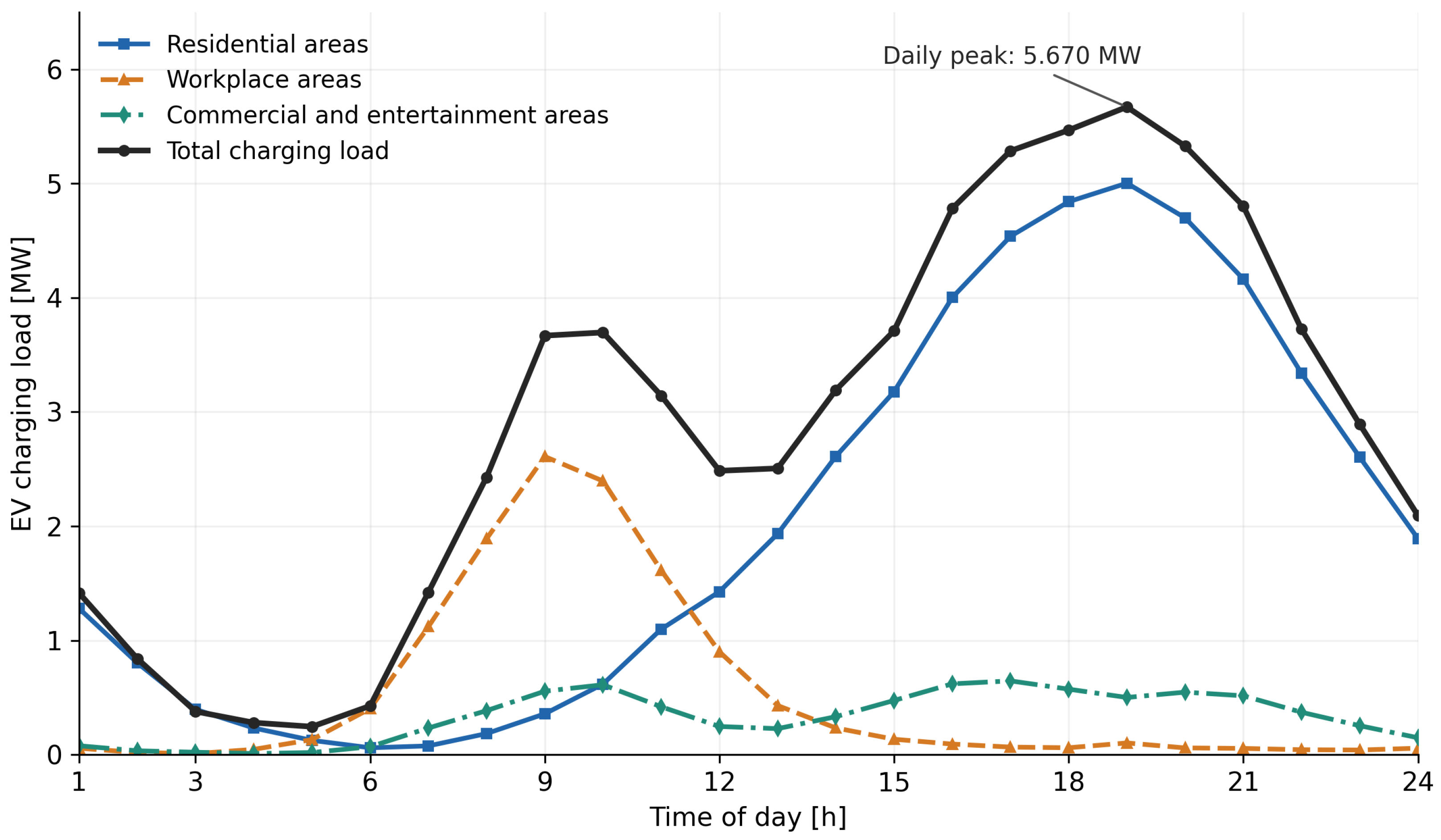
Table 5.
Summary of Data Sources for EV Charging Demand Forecasting.
Workplace charging contributes to the morning demand peak, while residential charging dominates the evening peak. The aggregate load reaches 5.670 MW at 19:00. These profiles illustrate why behaviour-based demand reconstruction needs to account for trip timing, parking location, and charging decisions throughout the day. They represent the specific simulation assumptions of [144] and should not be interpreted as universal charging patterns.
Huang et al. [145] additionally considered traffic-dependent energy consumption. A neural network forecast vehicle speed, a physical model estimated energy use, and an FIS determined charging propensity from SOC, parking duration, and the duration of the next trip. The speed forecast achieved absolute errors below 6 km/h, but the resulting charging-load profile was evaluated only against other simulation models.
These studies demonstrate that fuzzy inference can integrate mobility, parking, and vehicle-energy characteristics when direct charging measurements are unavailable. Their results, however, depend strongly on the assumed membership functions, inference rules, and simulation parameters.
4.8.2. Short-Term Forecasting from Measured Load Data
In data-driven applications, fuzzy methods forecast future demand from historical load or support the selection of suitable training observations. Unlike simulation-based models, they can be evaluated using conventional error measures.
Li and Li [146] proposed an interval type-2 Takagi–Sugeno fuzzy logic system optimised using the Whale Optimisation Algorithm. The model was evaluated using measured charging-station load from a Chinese city and achieved an RMSE of 42.89 kW, an MAE of 31.86 kW, and an R2 of 0.9791. It outperformed the investigated type-1 systems and type-2 models trained using backpropagation. However, the analysis was limited to one dataset, and neither the forecast horizon nor the input variables were described clearly. Comparisons with standard statistical and machine-learning methods were also absent.
Zhang [147] used fuzzy clustering to identify historical days similar to the forecast day. The selected samples were used to train an LSSVM model whose parameters were optimised by the Wolf Pack Algorithm. Based on measured load from two electric-bus charging stations, the model achieved a MAPE of 2.09% in the first case study and 1.92–2.35% in the second, outperforming LSSVM, WPA-LSSVM, and BPNN. This study provides strong empirical evidence, although the regular operation of electric-bus stations may limit generalisation to less predictable public charging facilities.
4.8.3. Spatial Demand Estimation and Infrastructure Planning
Planning-oriented models estimate charging demand under future EV-adoption scenarios and use the resulting profiles to support microgrid design or charging-facility placement.
Yasmeena et al. [148] developed a four-input FIS based on SOC, arrival time, next-trip distance, and parking duration. Using Luxmobil travel data, the model estimated a weekday peak of approximately 5.8 MW, increasing to 8.4 MW under the scenario with 84% EV adoption. Because the reference load and error calculation were insufficiently documented, the study should primarily be interpreted as a scenario-based planning analysis.
Bao et al. [149] combined operational data from 50 EVs with fuzzy inference and Monte Carlo simulation to estimate spatial demand in a model road network. Demand was concentrated in residential areas and reached an evening peak of 5.23 MW. The predicted distribution was subsequently used in a fuzzy bi-objective model balancing user waiting time and operator profit. However, the spatial load profile was not validated against network-level measurements, and the optimisation stage should be distinguished from the forecasting method itself.
4.8.4. Comparative Synthesis
Fuzzy logic is particularly useful when charging behaviour depends on qualitative, nonlinear, or partially observed factors such as SOC, parking duration, expected travel demand, arrival time, and electricity price. It provides an interpretable way to incorporate such information without requiring a large labelled dataset. This makes it well suited to scenario-based and spatial demand estimation.
The empirical evidence is nevertheless uneven. Low errors reported for the type-2 fuzzy model and the fuzzy-clustering-based LSSVM show that fuzzy methods can be competitive when evaluated on measured load. In contrast, FIS–Monte Carlo models mainly demonstrate the implications of behavioural assumptions and cannot establish forecasting accuracy without comparison against observations. Future work should calibrate fuzzy rules using real charging decisions, apply rolling and cross-site validation, quantify forecast uncertainty, and compare fuzzy approaches with strong statistical and machine-learning baselines.
4.9. Expert Systems
Expert systems represent knowledge explicitly, which can facilitate the interpretation of their inference process. Their specific nature lies in the fact that knowledge is explicitly modeled in a so-called knowledge base, which is one of the two main modules of an expert system. The second one is the inference engine. The model residing in the knowledge base can take a structural form, e.g., semantic networks, frame systems, scripts, or decision trees, or it can be in the form of set of rules described using a formal logic system [150], including fuzzy ones, discussed in Section 4.8. It should be noted that creating a good knowledge base is a difficult task, which is why expert systems are used less frequently than other types of AI systems. In particular, there are very few papers that presents expert systems applications to prediction of EVs charge demand.
The publication [151] describes an advanced expert system that simultaneously predicts energy demand over both a short-term horizon (every 15 min) and a medium-term horizon (monthly basis). The model differentiates charging characteristics across three types of stations–public, highway, and electric bus–and three Time-of-Use (TOU) tariff zones: peak, sharp/super-peak, and valley. The knowledge base is organized modularly: the time series is decomposed via the STL algorithm into trend, seasonality, and remainder components. Seasonal daily profiles are grouped using multivariate K-Means clustering to maintain trend consistency across station types and pricing zones. The inference module for the short-term horizon employs a Stacking Ensemble Learning strategy combining four neural networks of different architectures: TSMixer (MLP-based), SegRNN (RNN-based), PatchMixer (CNN-based), and iTransformer. The inference module for the medium-term horizon introduces a novel Multi-Matrix Elastic Net model solved via blockwise coordinate descent, which integrates aggregated trends, cluster labels, and residual forecasts passed from the short-term engine. The system exhibits high prediction performance: in 15-min forecasting, the model achieved an NMAPE error rate of approximately 3.17–3.48%, outperforming standalone deep learning models and traditional machine learning methods. Transferring outputs from the short-term module to monthly forecasts significantly enhanced medium-term accuracy, reducing the total demand MAPE to a mere 1.55%.
In another paper [152], the concept of an expert system based on multi-valued logic decision trees is presented, aimed at optimizing driver decision-making and providing support to reduce an electric vehicle’s energy consumption. It should be emphasized that the implementation of such systems can have a significant, positive impact on the accuracy of energy demand forecasting. Although the cited article focuses primarily on real-time control and suggesting optimal driving styles, the underlying mechanism addresses one of the most critical challenges in forecasting energy consumption for EVs. By linking operational parameters–such as ambient temperature, average speed, route profile, and engine characteristics–into logical decision rules, onboard algorithms can predict energy consumption across a planned route under specific weather conditions with substantially higher accuracy. For transport companies or taxi fleets, standardizing energy consumption through expert systems enables precise fleet charging scheduling and operational cost optimization. Implementing optimizing expert systems in electric vehicles transforms energy consumption forecasting from passive estimation (based on historical data) into active management.
Expert systems can combine explicit knowledge representations with predictive modules to support forecasting across different time scales and charging-station types. However, the interpretability of the overall system depends on its components: an explicit knowledge base does not make embedded neural networks fully explainable. The results reported in the reviewed studies should therefore be assessed within their specific evaluation settings rather than interpreted as evidence of general superiority over other forecasting approaches. However, as it has been said, due to the significant complexity involved in building and maintaining the knowledge base, they are rarely applied.
4.10. Graph-Based Spatio-Temporal Methods
Graph-based methods have become an important direction in electric-vehicle (EV) charging-demand forecasting because they represent charging stations or urban zones as interconnected components rather than independent time series. Nodes usually correspond to stations or regions, while edges describe geographical proximity, road connectivity, similarity of demand profiles, mobility flows, land use, or price interactions. Graph-based spatial modelling is then combined with a temporal module, such as a gated recurrent unit (GRU), temporal convolution, attention mechanism, or Transformer.
The reviewed studies differ in their prediction targets, spatial resolution, and forecast horizons. Some forecast station load or energy, whereas others estimate the number of charging vehicles, pile occupancy, charging duration, or several outcomes simultaneously. Consequently, numerical errors reported across studies are not directly comparable. The more informative questions concern how station relationships are represented, whether these relationships vary over time, and whether the model design corresponds to the intended operational application.
4.10.1. Evolution of Graph Representations
Early graph-based models generally relied on fixed graphs constructed from geographical distance, road connections, or historical demand similarity. Shi et al. [153], Kim and Kim [154] demonstrated that jointly modelling temporal patterns and relationships between stations can improve multi-station forecasting compared with treating each station separately. Fixed graphs remain appropriate when the network structure is stable, the forecast horizon is short, and the assumed relationships have a clear physical or operational interpretation. Their main limitation is that geographical proximity does not necessarily correspond to predictive similarity.
This limitation motivated multi-graph models, which represent different relationships separately. Xie et al. [155] combined distance, road-network, and traffic-density graphs, while Zheng and Lee [156] distinguished geographical adjacency from functional similarity based on points of interest. Other models introduced operational relationships associated with prices, station characteristics, and known future variables [157]. Such approaches are useful when several reliable data sources describe genuinely different mechanisms. However, additional graphs and covariates do not automatically improve prediction and should be evaluated through single-graph, feature-ablation, and no-graph comparisons.
The strongest recent trend is adaptive and dynamic graph learning. Instead of defining station connections entirely in advance, these models infer predictive relationships from data. Wang et al. [158] showed that an adaptively learned graph outperformed several competing models and that imposing a geographical adjacency matrix could even reduce accuracy. This result indicates that physical distance and predictive dependence should not be treated as equivalent.
Adaptive models usually learn a common relational structure from the training data, whereas dynamic models allow relationships to change according to the current system state. Jiang et al. [159] demonstrated the value of dynamic graph learning for large-scale demand prediction, where mobility, congestion, and user behaviour may alter regional dependencies during the day. Adaptive graph learning has also been applied to interactions among explanatory variables rather than physical stations [160].
Overall, learned graph structures appear to be the most promising choice for operational station-level forecasting when sufficiently large datasets are available. Dynamic graphs are particularly useful when relationships change with congestion, mobility, price, or station occupancy. For smaller datasets and stable networks, however, a sparse fixed graph combined with a compact temporal model may provide better interpretability and lower computational cost.
4.10.2. Temporal and Structural Extensions
EV charging demand contains short-term fluctuations, intraday cycles, weekday–weekend differences, and longer periodic patterns. Recent models therefore increasingly use multi-scale attention, spectral decomposition, Transformers, and hypergraphs. Multi-scale graph-attention models combine local fluctuations with broader temporal and spatial patterns [161]. CityEVCP [162] uses a hypergraph to represent groups of urban areas with similar functions, while STFT-GAT [163] separates periodic temporal components through a frequency-domain representation. KASTAR [164] combines graph attention with a recurrent decoder and was evaluated for forecasting horizons of up to four hours, including tests under noise and missing observations.
These more elaborate architectures are most justified for longer horizons, large multivariate datasets, or relationships that cannot be represented adequately by pairwise station connections. Hypergraphs are useful when several regions form a common functional group, while Transformers and multi-scale attention are appropriate when long-range temporal dependencies are important. For very short horizons or moderate datasets, a graph-recurrent model based on a GRU or temporal convolution may remain competitive and easier to deploy.
A particularly important development is the transition from point to probabilistic forecasting. Zhang et al. [165] jointly modelled charging power and station occupancy and estimated their predictive distribution using an adaptive graph and a Copula-based decoder. This approach provides prediction intervals and joint risk information that can support reserve allocation, overload prevention, and stochastic scheduling. For grid operation, reliable uncertainty estimates may be more valuable than a small improvement in point-forecast accuracy.
Another emerging direction incorporates domain knowledge into graph learning. Qu et al. [166] introduced information concerning the price elasticity of charging demand to reduce the risk of learning operationally implausible relationships. Huang et al. [167] used directed dependencies and the evolving influence of critical stations. Such methods are promising for pricing, control, and grid-security applications, although a graph inferred from observational data should not automatically be interpreted as causal. Learned adjacency matrices and attention weights indicate predictive relationships, not proof of causation.
4.10.3. Deployment-Oriented Graph Learning
Some graph-based methods address deployment constraints rather than only forecasting accuracy. Federated models allow several cities or organisations to train a shared model without directly exchanging raw observations. FMGCN [168] combines federated graph learning with meta-learning to support adaptation across cities, while FedMSG [169] incorporates multi-scale spatial and temporal representations. Vertical federated learning can be used when transportation and power-system organisations hold different variables describing the same charging infrastructure [170]. These approaches are appropriate when privacy, ownership, or organisational data silos prevent centralised training, but their evaluation should also include communication costs, client heterogeneity, and performance for new cities or stations.
Multi-task graph learning is useful when charging management requires several related predictions. Shang et al. [171] jointly forecast pile occupancy, charging volume, and charging duration, obtaining better results than separate single-task models. EVCha [172] extends this idea by combining multiple charging outcomes, vehicle categories, and heterogeneous relationships derived from demand similarity, mobility, and points of interest. Multi-task learning is therefore promising for integrated charging services, although it may produce negative transfer when the predicted outcomes are only weakly related.
Explainability mechanisms can help identify influential stations and variables, but their interpretation requires caution. Shapley values, attention weights, and masking analyses describe model contribution or sensitivity. They should not be presented as evidence that a variable or station causes a particular charging response.
4.10.4. Comparative Assessment and Research Directions
The literature shows a clear progression from fixed geographical graphs to heterogeneous multi-graph representations, adaptive and dynamic topology learning, and models addressing uncertainty, domain constraints, privacy, and multiple operational targets. The most promising general design is therefore not one specific architecture but a modular combination of a validated relational structure, a temporal encoder matched to the forecast horizon, and an output layer matched to the decision problem.
For routine short-term point forecasting, an adaptive graph combined with a compact GRU or attention-based encoder provides a strong starting point. Fixed graphs remain suitable for stable networks and limited datasets. Multi-graph models are justified when reliable mobility, traffic, land-use, or price data describe distinct relationships. Transformers, spectral modules, and hypergraphs are more appropriate for longer horizons, multiple temporal scales, or group-based urban dependencies. Probabilistic graph models are relevant when grid-management decisions require uncertainty estimates, while physics- or economics-informed models may be useful when forecasts support pricing or control decisions and the incorporated constraints reflect the application. Federated and multi-task extensions should be selected only when privacy constraints or multiple operational targets are genuinely present.
The main weakness of the current evidence concerns evaluation rather than a lack of architectural variety. Many models are tested on one city, one short observation period, or a single train–test split. Hung [173] showed that, for the investigated EV dataset, additional variables did not necessarily improve performance and the resulting forecasts remained close to persistence. Although the paper’s stronger graph-versus-no-graph analysis concerned road-flow data, it illustrates the need for careful ablation studies.
Future research should compare graph models with persistence, strong temporal-only models, and no-graph variants. Evaluation should use rolling-origin and cross-site testing, repeated runs, missing-data experiments, and explicit analysis of distribution shift and new stations. When forecasts support grid decisions, probabilistic calibration should accompany conventional point-error measures. Under these conditions, adaptive or dynamic graph models with uncertainty-aware outputs appear to offer the most promising general direction, while additional architectural complexity should be introduced only when it addresses a clearly identified operational problem.
5. Data Sources and Fusion
This section synthesizes the findings on data acquisition and imputation presented in Section 3. EV charging demand forecasting relies on the quality and richness of input data. There are diverse data sources available which impact prediction quality depending on how they are fused.
5.1. Data Preparation
The core data types for EV charging prediction originate from direct measurements, operational platforms, and transaction records. These are frequently augmented with external contextual information to capture influencing factors which impacts prediction quality. They are summarized in Table 5.
5.2. Data Fusion Methods
Data fusion combines charging observations with contextual information through feature engineering and model design. External variables, such as weather, electricity prices, calendar information, traffic, and land-use attributes, are aligned with charging data in both time and space.
In deep learning and LLM-based approaches, temporal, spatial, and behavioural features can be processed through separate embedding modules and subsequently combined. Examples include the multi-source embedding module in EV-STLLM and cross-attention fusion in graph-based models.
Graph-based methods integrate spatial relationships, such as geographical proximity, road connectivity, and demand similarity, with temporal demand series. This enables predictive models to capture dependencies between charging locations alongside changes in demand over time.
Clustering and signal decomposition support this process by grouping stations or demand profiles with similar characteristics and separating signals into components representing trends, seasonality, and residual variation. These components are then supplied to predictive models to represent different temporal characteristics.
6. Evolution and Comparison of Prediction Methods
This section synthesizes the methods reviewed in Section 4, focusing on their development, comparative performance, and hybrid architectures. In particular, it is discussed in the context opf their evolution and hybrid aspect.
It can be observed that predictive methods have moved from simpler statistical models to complex deep learning architectures, hybrid systems, and the emerging capabilities of Large Language Models.
6.1. Recapitulation of Statistical Methods
Initially, classical time-series models like ARIMA and TBATS served as foundational methods.
- Evolution Started with single ARIMA models (e.g., decoupled ARIMA for conventional vs. EV load, seasonal ARIMA for daily/weekly patterns) to dynamically weighted ensembles (ARIMA-GARCH-PSF) for improved robustness against non-stationarity. Enhanced with spatial forecasting (through linear regression and diffusion theory) provide means for infrastructure planning.
- Performance Statistical models remain competitive for aggregated demand, especially with stable seasonality. Reg-ARIMA often outperforms more complex neural approaches at national/city levels. Their interpretability is a key advantage. However, accuracy decreases significantly at finer spatial scales due to stochastic individual behaviors.
6.2. Recapitulation of Classical Machine Learning
Classical ML methods introduced the ability to capture non-linear relationships.
- Evolution Early studies used SVM/SVR models, often with metaheuristic hyperparameter optimization (GA-PSO-SVR and PSO-SVM). Subsequent studies increasingly explored tree-based ensembles, including Random Forest, XGBoost, LightGBM, and CatBoost. Clustering and contextual feature weighting were also incorporated to represent heterogeneous charging patterns and exploit additional input information.
- Performance Tree-based ensembles, including XGBoost and CatBoost, achieved strong forecasting results in several reviewed studies, particularly when combined with suitable preprocessing and contextual features. SVMs also performed well with tuned hyperparameters. The best-performing method varied across datasets, forecasting targets, and experimental settings.
6.3. Redcapitulation of Artificial Neural Networks
ANNs offered solutions with minimal prior knowledge.
- Evolution Started with basic Backpropagation (BP) Neural Networks and evolved to more specialized architectures like Wavelet Neural Networks (WNN) for better accuracy and faster convergence, and multiresolution sinusoidal neural networks. Many ANNs were integrated with optimization algorithms (e.g., Whale Optimization Algorithm) or decomposition techniques (VMD) to handle non-stationarity.
- Performance WNNs achieved lower forecasting errors than BP networks in the reviewed comparisons. Neural architectures incorporating signal decomposition or parameter optimization also showed improved performance relative to the evaluated baselines. These findings support their usefulness for modelling nonlinear charging demand, with performance depending on the dataset, forecasting task, and evaluation settings.
6.4. Recapitulation of Deep Learning
Deep learning models significantly advanced the ability to capture complex temporal and spatial patterns.
- Evolution
- Recurrent and Convolutional Networks. From basic LSTMs and GRUs to hybrid CNN-LSTM and TCN-GRU, often enhanced with meta-optimization (GA and PSO).
- Transformers and Attention Mechanisms. Emerged to overcome RNN’s sequential bottlenecks, modeling long-range dependencies (Multi-scale fusion Transformers, iTransformer, context-aware Transformers, and sparse periodic Transformers) and dynamic shifts (change-point aware attention).
- Spatial-Temporal Modeling. Integration of Graph Neural Networks (GNNs) and cross-attention fusion modules to map road topologies and station interactions, alongside heterogeneous exogenous features (weather, traffic, and calendar).
- Addressing Data Challenges. Generative models (SeqGAN, CGAN, and VAE-GAN) for imputation and augmentation; zero-inflated networks for sparse data; transfer/meta-learning and PEFT for cold-start stations.
- Decomposition/Clustering Hybrids. Integrating VMD, STL, and K-Medoids with DL estimators to mitigate non-stationarity and high-frequency volatility.
- Performance Deep learning models offer architectures for capturing long-range temporal dependencies and spatial relationships across charging networks. In the reviewed experiments, several models incorporating attention, graph structures, signal decomposition, or clustering achieved better forecasting results than the evaluated baselines. Their suitability depends on data availability, the forecasting task, and computational requirements.
6.5. Large Language Models (LLMs)
LLMs represent a novel and rapidly developing paradigm. They may provide data interpretation, data fusion or prediction.
- Evolution A very recent development, moving from traditional numerical time-series to semantic- and vision-augmented models. Techniques like ChatEV (Sentence-T5 backbone with meta-learning) conceptualize forecasting as natural language processing. EV-STLLM integrates LLMs with spatio-temporal features, and VisionEV incorporates satellite imagery for spatial awareness. PAR-LLM uses LLMs as residual correctors for baseline models.
- Performance Several reviewed LLM-based approaches achieved better forecasting results than the baselines evaluated in their respective studies, including zero-shot and few-shot settings. Semantic representations and multimodal inputs offer potential benefits when historical charging data are limited or contextual information is important. However, broader cross-site validation and assessment of computational requirements are needed to establish their practical advantages over simpler forecasting models.
6.6. Recapitulation of Hybrid and Ensemble Models
Hybrid and ensemble approaches combine complementary models to address different aspects of EV charging demand, including nonlinearity, non-stationarity, and variability in charging behaviour.
- Evolution From simple combinations to sophisticated multi-stage architectures.
- Decomposition-Driven Hybrids. Integrating signal decomposition (EMD and VMD) with deep sequence learning (LSTM and Prophet-LSTM) for non-stationary load.
- Hybrid Learning and Feature Fusion. Combining diverse algorithms (XGBoost-BiLSTM, and K-Means++-GRU-KSVR) and multi-source features to capture both local dynamics and macroeconomic influences.
- Gradient Boosting and Custom Ensembles. Meta-optimized ensembles (gradient boosting, DeepBoost, stacking, and custom weighted ensembles) for variance reduction and robustness across fluctuating regimes.
- Performance Several reviewed hybrid and ensemble models achieved lower forecasting errors than the standalone models used as baselines in the respective studies. Signal decomposition supported forecasting of volatile load profiles, while combinations of tree-based and recurrent models integrated contextual features with temporal dependencies. The reported gains depend on the dataset, forecast horizon, and baseline configuration.
6.7. Recapitulation of Probabilistic Models
These models quantify uncertainty, crucial for risk management.
- Evolution Shift from point forecasts to estimating full probability distributions and prediction intervals. Early approaches used Bayesian probability with LSTMs (LSTM-BDL) or quantile regression. More advanced models include MBQFN (deep-learning-based with Machine Theory of Mind for quantile estimation), DLinear-Res-Prob (hybrid linear/non-linear for multi-horizon quantile forecasting), DiffPLF (conditional diffusion model for load trajectories), and Markov chains with Monte Carlo for spatio-temporal dynamics. Adaptive Conformal Prediction is used for real-time recalibration.
- Performance Probabilistic models complement point forecasts by providing prediction intervals, quantiles, or full predictive distributions. This additional information supports risk-aware grid management, reserve allocation, and scheduling under asymmetric costs. Their evaluation should consider both calibration and sharpness rather than assume lower point-forecast errors. Many reviewed approaches combine probabilistic forecasting with deep learning or time-series decomposition.
6.8. Recapitulation of Fuzzy-Logic-Based Methods
Fuzzy logic provides interpretability and handles qualitative factors.
- Evolution Began with behaviour-based reconstruction of charging profiles (FIS + Monte Carlo) for scenario planning when direct measurements were scarce. Evolved to data-driven short-term forecasting using optimized Type-2 Takagi-Sugeno fuzzy logic systems and fuzzy clustering for similar-day selection.
- Performance Useful for integrating qualitative factors and generating interpretable rules. Can be competitive in data-driven applications (e.g., fuzzy clustering + LSSVM outperformed other ML baselines for bus stations) but require careful calibration of membership functions and rules. Less empirical evidence compared to DL or hybrid methods, often lacking comparisons with strong baselines.
6.9. Recapitulation of Expert Systems
Expert systems represent knowledge explicitly, which can facilitate the interpretation of rules and inference procedures.
- Evolution While less frequently applied due to complexity, modern expert systems (e.g., Dong et al.’s framework) integrate sophisticated modules like STL decomposition, K-Means clustering, and advanced ensemble deep learning (TSMixer, SegRNN, PatchMixer, iTransformer, and Multi-Matrix Elastic Net) within a structured knowledge base and inference engine.
- Performance The reviewed framework combining explicit knowledge representation with predictive modules achieved strong forecasting results across different time scales and charging-station types. However, these results concern a specific evaluation setting and do not establish general superiority over other approaches. The interpretability of the overall system depends on its components; embedded deep-learning models are not made fully explainable by an explicit knowledge base.
6.10. Overall Evolution and Representative Methods
EV charging demand forecasting has evolved from relying on single, simpler models to increasingly complex, multi-stage, and integrated frameworks.
- From Single Models to Ensembles/Hybrids There’s a clear progression from standalone statistical (ARIMA), classical ML (SVR/SVM), or basic neural networks (BPNN) to sophisticated hybrid and ensemble models. These combinations leverage the strengths of different paradigms (e.g., decomposition for non-stationarity, tree-based models for feature interaction, and recurrent/attention networks for temporal dynamics).
- Embracing Deep Learning Paradigms Deep learning, especially Transformer-based architectures and Graph Neural Networks, has become central for capturing long-range temporal dependencies and complex spatio-temporal interactions.
- Addressing Real-world Data Challenges Significant effort has been put into robust data preprocessing, imputation (generative models), handling data scarcity (transfer/meta-learning), and managing non-stationarity (decomposition and clustering).
- Quantifying Uncertainty The shift from point forecasting to probabilistic forecasting (Bayesian DL, quantile regression, and diffusion models) is critical for risk-aware operational decision-making in power grids.
- Emergence of LLMs Large Language Models are a nascent but highly promising area, offering unique capabilities in contextual understanding, multimodal data fusion, and addressing cold-start problems by leveraging pre-trained knowledge.
- Explainability and Deployment Focus Tree-based models can support the interpretation of predictions through feature-importance measures and other explanation techniques, although complex ensembles are not inherently transparent. Expert systems make their knowledge representations and inference rules explicit, but the interpretability of embedded predictive modules must be assessed separately. Practical deployment also requires consideration of computational costs, forecast latency, robustness to data-quality problems, and adaptation to changing operating conditions.
Table 6 summarizes representative models, their development trends, and applications.
Table 6.
Summary of Reviewed Methods, Their Evolution, and Applications.
7. Critical Discussion: Model Selection and Operational Requirements
The preceding sections reviewed forecasting approaches and their methodological development. This section compares their suitability across forecasting tasks and examines how charging environments alter prediction targets, data requirements, and evaluation criteria. The discussion links the evidence reviewed above to conditional model selection and operational decision-making.
7.1. Critical Comparison and Conditional Model Selection
The reviewed evidence does not support a universal ranking of forecasting models. Comparisons should distinguish improvements demonstrated under a common experimental protocol from differences between studies using different targets, aggregation levels, horizons, and datasets. A lower reported error is not necessarily evidence of a better model if the underlying forecasting task is easier. The following comparison therefore identifies conditions under which additional model complexity is justified.
For regular aggregated demand, statistical models offer a favourable balance between accuracy, interpretability, and estimation complexity. The comparison in [48] shows that Reg-ARIMA can outperform neural alternatives at national and city levels, whereas the preferred model changes with spatial scale and forecast horizon. For station-level forecasting with informative calendar, weather, and charging-session features, tree-based ensembles provide a stronger nonlinear alternative. In [54], XGBoost outperformed the evaluated temporal and graph-based neural models. These findings challenge the assumption that increasingly complex architectures necessarily improve forecasting. Recurrent and attention-based models should demonstrate gains over both seasonal statistical models and well-tuned tree-based baselines under equivalent information availability.
The principal distinction between temporal and graph-based models is whether relationships between locations provide predictive information beyond local histories and contextual variables. Graph models are justified when such information is available and improves out-of-sample performance. Their additional data-integration and graph-maintenance requirements are harder to justify when spatial relationships are weak, unstable, or obscured by aggregation. Consequently, comparisons should include temporal-only and no-graph variants with comparable inputs; geographical proximity alone does not establish the usefulness of graph learning.
Hybrid architectures introduce a different trade-off: improved representation of heterogeneous dynamics versus additional tuning, maintenance, and failure points. Their benefit should be assessed against the strongest component, rather than only a weak standalone baseline. For example, the ensemble in [49] substantially improved on ARIMA but only modestly improved on GARCH and PSF, and PSF performed better in two evaluated months. Decomposition-based models additionally require preprocessing that uses only information available at the forecast origin. Otherwise, apparent improvements may partly reflect information leakage.
Probabilistic forecasting is an output-design choice that can complement statistical, tree-based, or neural models. Its advantage should be evaluated through calibration, sharpness, and decision consequences, rather than assumed improvements in point accuracy. Quantile models may suffice when decisions depend on specific demand thresholds, whereas scenario-generating models require justification through applications needing joint temporal or spatial uncertainty. Similarly, transfer-learning and LLM-based approaches should demonstrate benefits at genuinely unseen stations, accounting for source-data requirements and total inference costs, not merely the number of locally available training samples.
Overall, model selection should favour the least complex approach that satisfies the required accuracy, uncertainty representation, and operational latency. More elaborate architectures are warranted when their additional components provide reproducible benefits under rolling-origin and cross-site evaluation, including peak-demand periods and changes in operating conditions.
7.2. How Charging Environments Alter Forecasting Requirements
Charging environments determine not only the explanatory variables relevant to forecasting, but also the prediction target, temporal resolution, and operational consequences of forecast errors. Energy requirements, charger occupancy, and electrical power are related but distinct quantities. Under managed charging, the realised power profile additionally depends on the charging policy. Consequently, forecasting historical load alone may be insufficient when the objective is to modify charging schedules: the decision-making system also needs information about energy requirements and the time available to satisfy them.
In residential charging, relatively long overnight connection periods often provide flexibility to shift electricity consumption. For scheduling purposes, the relevant targets therefore include energy required before departure and connection availability, alongside aggregate power demand. Seasonal statistical models and tree-based ensembles using calendar, tariff, and historical charging information provide reasonable starting points. However, regular individual behaviour does not necessarily imply a smooth aggregate profile, because common tariff incentives can synchronise charging. Evaluation should therefore consider local peak underestimation and energy shortfalls at departure, rather than only average forecasting error. Where charging remains uncontrolled, predicting the timing and coincidence of charging events becomes more important than estimating scheduling flexibility.
Workplace charging also offers flexibility, but within a different operational window. Demand is shaped by work schedules, attendance patterns, and departures concentrated towards the end of the working day. Where photovoltaic generation is available, daytime charging creates opportunities for local renewable-energy utilisation. Forecasting session energy without connection duration cannot fully support these decisions: similar energy requirements may imply different feasible schedules when departure times differ. Calendar- and session-aware models, potentially with joint prediction of energy and availability, are therefore appropriate candidates. Their usefulness should be assessed through departure-energy satisfaction and, where relevant, renewable-energy utilisation, in addition to conventional prediction errors [21,56].
Urban public fast charging places greater emphasis on short-term arrival uncertainty and high-power events. Compared with residential and workplace charging, operators generally have less freedom to defer charging without affecting service quality. Forecasts of arrivals, session energy or duration, occupancy, and power consequently serve complementary purposes. Event-based, probabilistic, and multi-task approaches are candidates when these quantities must be considered together. Temporal resolution is particularly consequential: aggregation may preserve session energy while concealing short-duration peaks relevant to network loading [23]. Thus, improved forecasting accuracy after coarse data slotting [57] does not by itself demonstrate suitability for fast-charging control. Evaluation should include peak magnitude and timing; waiting-time consequences require an explicit service or queueing model.
Highway fast charging is a particular public-charging context in which corridor traffic, holiday travel, and disruptions can produce concentrated arrivals. Unlike workplace charging, recurring calendar patterns may be insufficient without information about current traffic conditions. Day-ahead forecasts support operational preparation, while frequent updates support responses to evolving demand. Traffic-informed temporal models provide a baseline, and graph-based approaches become justified when interactions or substitution between stations add predictive information. Their value should be established against models using the same traffic inputs without graph coupling. Evaluation should distinguish ordinary periods from travel peaks, since acceptable average errors can conceal poor performance precisely when congestion and capacity constraints are most severe.
Fleet and depot charging differs because vehicle duties and departure deadlines provide explicit operational structure. The principal uncertain quantities include return times, arrival SoC, and energy required for subsequent duties. Forecast horizons should therefore follow the scheduling problem, with updates after delays or changes in vehicle assignments. Schedule-conditioned statistical, machine-learning, or hybrid models can exploit information that is typically unavailable at public stations. The favourable results obtained for fuzzy-clustering-based forecasting at electric-bus stations [147] illustrate the potential benefits of operational regularity, but do not establish equivalent performance under irregular public charging. For depots, the decisive criteria include departure readiness, unmet energy, and grid-capacity violations; robustness to disrupted schedules should be evaluated separately from routine operation.
Battery swapping introduces a further distinction because charged-battery inventory partly decouples customer service from electrical charging demand [1]. A forecast of swap arrivals is therefore not equivalent to a forecast of instantaneous grid load. Arrival forecasts and estimates of returned-battery SoC must be linked to inventory availability, charging times, and the replenishment policy. The relevant horizon should cover demand during the period required to replenish charged batteries. Forecasting methods should consequently be evaluated within the inventory-and-charging system, considering stockouts, service availability, and electrical peaks. Low average error in swap demand may still be operationally inadequate if concentrated arrivals exhaust the available inventory.
These comparisons show why model suitability cannot be inferred from forecasting accuracy independently of the operating environment. Flexible charging requires predictions of energy needs and availability; fast charging prioritises arrival uncertainty and short-duration peaks; depot operation introduces duty constraints; and battery swapping requires inventory-aware forecasting. Across these settings, model complexity should be justified by improvements in the predictions needed for the actual decision. Short-term evaluation should match the controller’s temporal resolution and update frequency, whereas infrastructure planning additionally requires scenarios for EV adoption, station deployment, and changing travel behaviour. Where forecast errors have asymmetric consequences, conventional error measures should be supplemented by uncertainty calibration and evaluation within the corresponding operational decision model.
8. Concluding Remarks
Increasing number of electric vehicles (EVs) fundamentally reshapes power system dynamics, introducing complex, stochastic load profiles that demand sophisticated forecasting solutions. Precise, reliable forecasts are not merely an academic pursuit but a critical prerequisite for maintaining distribution grid stability, optimizing smart charging strategies, facilitating renewable energy integration, and ensuring efficient infrastructure planning in a rapidly evolving electromobility landscape.
Regarding RQ1, the review shows that forecasting performance depends on data sources, aggregation levels, temporal resolution, and data quality. Aggregation generally produces more regular demand profiles, whereas individual-station forecasts must account for intermittent charging and heterogeneous user behaviour. Temporal resolution should match the operational objective: coarse intervals can obscure peaks, while finer sampling does not necessarily provide additional predictive information. Missing-data treatment and the integration of weather, calendar, pricing, and mobility variables should therefore be evaluated for the specific forecasting task.
Regarding RQ2, the reviewed methods offer complementary strengths. Statistical models provide transparent baselines and remain competitive for regular aggregated demand. Classical machine-learning methods capture nonlinear interactions in tabular and contextual features, while neural and deep-learning architectures represent temporal dependencies and spatial relationships. Hybrid and ensemble models combine these capabilities, and probabilistic approaches additionally quantify uncertainty. Their reported improvements over selected baselines do not establish a universal ranking across datasets and forecasting tasks.
Regarding RQ3, statistical models are suitable starting points for national- or city-level demand with stable seasonal patterns. Tree-based ensembles and tuned kernel methods are useful candidates for station-level prediction based on charging records and contextual variables. Recurrent and attention-based models are appropriate when sufficient historical data support learning sequential dependencies; graph-based models are particularly relevant to multi-station forecasting where interactions between locations matter. Transfer learning and meta-learning offer options for stations with limited historical data, while LLM-based approaches remain an emerging direction requiring broader validation. Probabilistic forecasts are especially useful for reserve allocation and scheduling under uncertainty, whereas spatial regression and diffusion-based methods support longer-term infrastructure planning.
Regarding RQ4, remaining gaps include inconsistent metric reporting, heterogeneous evaluation protocols, and limited evidence of performance across locations, seasons, and changing operating conditions. Shared benchmarks, clearly defined forecast horizons, and temporal and cross-site evaluation would improve comparability. Further research should assess peak-demand prediction, adaptation to behavioural and infrastructure changes, uncertainty calibration, and the computational costs of deployment. Ablation studies and comparisons with strong, simpler baselines are needed to establish when additional model complexity provides practical benefits. Furthermore, accurate load and demand forecasts serve as an essential input layer for downstream infrastructure optimization, where spatial and temporal predictions directly feed into robust location–allocation and backup routing models for electric vehicle networks (e.g., [2]).
Policy-driven changes in EV adoption should also be considered in long-term charging-demand projections. The European Union’s CO2 emission standards for new passenger cars and vans illustrate how regulatory measures can influence fleet electrification and future charging needs [174]. Future studies should therefore assess alternative EV-adoption scenarios reflecting evolving policies and examine their implications for charging energy demand, peak loads, and infrastructure capacity, rather than relying solely on historical charging patterns.
More broadly, the output characteristics of predictive models determine how they bridge into downstream decision-making and control paradigms:
- Deterministic Optimization (e.g., MILP, QP): Point forecasts are directly embedded as fixed input parameters for baseline scheduling, charger sizing, and tariff-based cost minimization.
- Stochastic and Robust Optimization (SO/RO): Probabilistic outputs, quantile distributions, and scenario sets (e.g., from GANs, diffusions, or Monte Carlo sampling) construct uncertainty sets and scenario trees to protect grid infrastructure against extreme demand spikes and operational disruptions.
- Model Predictive Control (MPC): High-frequency rolling-horizon forecasts (5–15 min resolution) dynamically update closed-loop control states, enabling real-time dynamic load management, transformer overload prevention, and RES buffering.
- Learning-Based Frameworks (e.g., DRL): Deep neural networks and LLMs serve as surrogate environment models, allowing reinforcement learning agents to optimize dynamic pricing, storage coordination, and V2G flexibility services.
Connecting these predictive outputs with optimization models directly links forecasting quality with operational controllability and cybernetic risk management.
These findings can be interpreted within the cybernetic risk-analysis perspective introduced in Section 1, in which forecasts provide information supporting operational decisions and system controllability. Selecting forecasting methods according to data availability, spatial scale, forecast horizon, and decision requirements can support smart charging and infrastructure planning. However, the reviewed forecasting results do not directly quantify improvements in controllability or reductions in operational, technological, and economic risks; establishing these effects requires evaluation within the corresponding control and decision-making systems.
Author Contributions
Conceptualization, A.B., M.B., P.B. and I.W.; methodology, A.B., M.B. and I.W.; formal analysis, A.B., M.B. and I.W.; investigation, A.B. and P.B.; writing—original draft preparation, A.B., M.B., P.B. and I.W.; writing-review and editing, A.B. and M.B.; supervision, A.B. and I.W.; project administration, A.B. All authors have read and agreed to the published version of the manuscript.
Funding
This work was created as a result of research financed by a subsidy from the Ministry of Science and Higher Education, conducted at the Faculty of Electrical Engineering, Automation, Computer Science and Biomedical Engineering and at the Faculty of Geology, Geophysics and Environmental Protection, AGH University of Krakow.
Data Availability Statement
No new research data were generated in this study. The information supporting this review is included in the article and the cited references.
Acknowledgments
This work was carried out within the framework of the “Excellence Initiative—Research University” programme at AGH University of Krakow.
Conflicts of Interest
The authors declare that there are no conflicts of interest.
Abbreviations
The following abbreviations are used in this manuscript:
| AI | Artificial intelligence |
| ANN | Artificial neural network |
| ARIMA | Autoregressive integrated moving average |
| ARMA | Autoregressive moving average |
| ARX | Autoregressive model with exogenous inputs |
| BDL | Bayesian deep learning |
| BiLSTM | Bidirectional long short-term memory |
| BO | Bayesian optimization |
| BP | Backpropagation |
| BPNN | Backpropagation neural network |
| BESS | Battery energy storage system |
| CatBoost | Categorical boosting |
| CDE | Electric vehicle charging demand |
| CEL | Conventional electrical load |
| CGAN | Conditional generative adversarial network |
| CNN | Convolutional neural network |
| CQR | Conformal quantile regression |
| CRPS | Continuous ranked probability score |
| DL | Deep learning |
| DRL | Deep reinforcement learning |
| EMD | Empirical mode decomposition |
| EV | Electric vehicle |
| EVSE | Electric vehicle supply equipment |
| FCW | Feature correlation weight |
| FIS | Fuzzy inference system |
| GA | Genetic algorithm |
| GAMLSS | Generalized additive models for location, scale, and shape |
| GAN | Generative adversarial network |
| GARCH | Generalized autoregressive conditional heteroskedasticity |
| GCN | Graph convolutional network |
| GIS | Geographic information system |
| GNN | Graph neural network |
| GRU | Gated recurrent unit |
| HVAC | Heating, ventilation, and air conditioning |
| KSVR | Kernel support vector regression |
| LDTW | Local dynamic time warping |
| LightGBM | Light gradient boosting machine |
| LLM | Large language model |
| LoRA | Low-rank adaptation |
| LR | Logistic regression |
| LSSVM | Least-squares support vector machine |
| LSTM | Long short-term memory |
| MAE | Mean absolute error |
| MAPE | Mean absolute percentage error |
| ML | Machine learning |
| MLP | Multilayer perceptron |
| NMAPE | Normalized mean absolute percentage error |
| MILP | Mixed-integer linear programming |
| MPC | Model predictive control |
| NN | Neural network |
| PCA | Principal component analysis |
| PEFT | Parameter-efficient fine-tuning |
| PIT | Probability integral transform |
| PRISMA | Preferred Reporting Items for Systematic Reviews and Meta-Analyses |
| PSF | Pattern sequence forecasting |
| PSO | Particle swarm optimization |
| QDM | Quantile deviation minimization |
| QGAM | Quantile generalized additive model |
| QP | Quadratic programming |
| Reg-ARIMA | Regression with ARIMA errors |
| RES | Renewable energy sources |
| RF | Random forest |
| RMSE | Root mean square error |
| RNN | Recurrent neural network |
| RPS | Ranked probability score |
| RQ | Research question |
| RRMSE | Relative root mean square error |
| RO | Robust optimization |
| SARIMA | Seasonal autoregressive integrated moving average |
| SeqGAN | Sequence generative adversarial network |
| SoC | State of charge |
| SOM | Self-organizing map |
| SO | Stochastic optimization |
| STL | Seasonal-trend decomposition using LOESS |
| SVM | Support vector machine |
| SVR | Support vector regression |
| TCN | Temporal convolutional network |
| TOU | Time-of-use |
| V2G | Vehicle-to-grid |
| VAE | Variational autoencoder |
| VaR | Value at risk |
| VMD | Variational mode decomposition |
| WAPE | Weighted absolute percentage error |
| WNN | Wavelet neural network |
| WOA | Whale optimization algorithm |
| WPA | Wolf pack algorithm |
| XGBoost | Extreme gradient boosting |
| XML | Extensible Markup Language |
References
- Adegbohun, F.; Jouanne, A.; Lee, K. Autonomous Battery Swapping System and Methodologies of Electric Vehicles. Energies 2019, 12, 667. [Google Scholar] [CrossRef] [Scilit]
- Quintana, C.L.; Climent, L.; Arbelaez, A. A Robust Optimization Framework for eBus Charging Infrastructure Planning. J. Heuristics 2026, 32, 12. [Google Scholar] [CrossRef] [Scilit]
- Amara-Ouali, Y.; Goude, Y.; Massart, P.; Poggi, J.M.; Yan, H. A Review of Electric Vehicle Load Open Data and Models. Energies 2021, 14, 2233. [Google Scholar] [CrossRef] [Scilit]
- Marzbnai, F.; Osman, A.; Hassan, M.S. Electric Vehicle Energy Demand Prediction Techniques: An In-Depth and Critical Systematic Review. IEEE Access 2023, 11, 96242–96255. [Google Scholar] [CrossRef] [Scilit]
- Yaghoubi, E.; Yaghoubi, E.; Khamees, A.; Razmi, D.; Lu, T. A systematic review and meta-analysis of machine learning, deep learning, and ensemble learning approaches in predicting EV charging behavior. Eng. Appl. Artif. Intell. 2024, 135, 108789. [Google Scholar] [CrossRef] [Scilit]
- Jia, Z.; Li, J.; Zhang, X.P.; Zhang, R. Review on Optimization of Forecasting and Coordination Strategies for Electric Vehicle Charging. J. Mod. Power Syst. Clean Energy 2023, 11, 389–400. [Google Scholar] [CrossRef] [Scilit]
- Rashid, M.; Elfouly, T.; Chen, N. A Comprehensive Survey of Electric Vehicle Charging Demand Forecasting Techniques. IEEE Open J. Veh. Technol. 2024, 5, 1348–1373. [Google Scholar] [CrossRef] [Scilit]
- Alaraj, M.; Radi, M.; Alsisi, E.; Majdalawieh, M.; Darwish, M. Machine Learning-Based Electric Vehicle Charging Demand Forecasting: A Systematized Literature Review. Energies 2025, 18, 4779. [Google Scholar] [CrossRef] [Scilit]
- Kim, M.; Park, W.Y.; Moon, H.S.; Kim, Y.S. A Review of Electric Vehicle Charging Demand Forecasting Models by Prediction Horizon: A Multi-Criteria Decision Analysis Approach. J. Electr. Eng. Technol. 2026, 21, 1457–1476. [Google Scholar] [CrossRef] [Scilit]
- Gołȩbiewski, D.; Barszcz, T.; Skrodzka, W.; Wojnicki, I.; Andrzej, B. A New Approach to Risk Management in the Power Industry Based on Systems Theory. Energies 2022, 15, 9003. [Google Scholar] [CrossRef] [Scilit]
- Liu, Y.J.; Chang, T.P.; Chen, H.W.; Chang, T.K.; Lan, P.H. Power Quality Measurements of Low-Voltage Distribution System with Smart Electric Vehicle Charging Infrastructures. In Proceedings of the 2014 IEEE 16th International Conference on Harmonics and Quality of Power (ICHQP), Bucharest, Romania, 25–28 May 2014; pp. 631–635. [Google Scholar]
- Leou, R.C.; Teng, J.H.; Su, C.L. Modelling and verifying the load behaviour of electric vehicle charging stations based on field measurements. IET Gener. Transm. Distrib. 2015, 9, 1112–1119. [Google Scholar] [CrossRef] [Scilit]
- Liu, Q.; Liu, J.; Chen, C.; Wang, X.; Liu, W. Research on Energy Consumption Analysis and Data Acquisition Platform for Electric Vehicle Charging and Discharging Facilities. In Proceedings of the 2017 Chinese Automation Congress (CAC), Jinan, China, 20–22 October 2017; pp. 5332–5336. [Google Scholar]
- Lee, J.; Park, G.L.; Han, Y.; Yoo, S. Big data analysis for an electric vehicle charging infrastructure using open data and software. In Proceedings of the 8th International Conference on Future Energy Systems (E-Energy’17), Hong Kong, 16–19 May 2017; pp. 252–253. [Google Scholar] [CrossRef] [Scilit]
- Zhang, Y.; Xu, T.; Chen, T.; Hu, Q.; Chen, H.; Hu, X.; Jiang, Z. A high-resolution electric vehicle charging transaction dataset with multidimensional features in China. Sci. Data 2025, 12, 643. [Google Scholar] [CrossRef] [Scilit] [PubMed]
- Kuang, H.; Zhang, X.; Qu, H.; You, L.; Zhu, R.; Li, J. Unraveling the effect of electricity price on electric vehicle charging behavior: A case study in Shenzhen, China. Sustain. Cities Soc. 2024, 115, 105836. [Google Scholar] [CrossRef] [Scilit]
- Yan, D.; Ji, X.; Wang, R.; Zhu, B.; Zhang, K.; Yu, J. Optimizing Electric Vehicle Charging Networks: A Multidimensional User-Centric Approach. In Proceedings of the 2025 7TH Asia Energy and Electrical Engineering Symposium, AEEES, Chengdu, China, 28–31 March 2025; pp. 1009–1014. [Google Scholar] [CrossRef] [Scilit]
- Jee, Y.; Kim, J. Minimum EVCS Aggregation Requirements for Reliable Customer Baseline Load in Electricity Markets. IEEE Access 2025, 13, 144678–144688. [Google Scholar] [CrossRef] [Scilit]
- Zhou, N.; Xiong, X.; Wang, Q. Probability Model and Simulation Method of Electric Vehicle Charging Load on Distribution Network. Electr. Power Compon. Syst. 2014, 42, 879–888. [Google Scholar] [CrossRef] [Scilit]
- Zhang, C.; Shen, H.; Tao, P.; Zhang, Y.; Han, G. Electric vehicle charging pile capacity planning based on normal distribution Monte Carlo sampling model. Int. J. Emerg. Electr. Power Syst. 2024, 25, 189–196. [Google Scholar] [CrossRef] [Scilit]
- Meng, W.; Song, D.; Huang, L.; Chen, X.; Yang, J.; Dong, M.; Talaat, M.; Elkholy, M.H. Distributed energy management of electric vehicle charging stations based on hierarchical pricing mechanism and aggregate feasible regions. Energy 2024, 291, 130332. [Google Scholar] [CrossRef] [Scilit]
- Alonso-Cepeda, A.; Villena-Ruiz, R.; Honrubia-Escribano, A.; Gomez-Lazaro, E. Unveiling electric vehicle charging demand patterns in medium-sized urban areas through detailed and comprehensive statistical analysis of empirical data to support efficient infrastructure planning. Energy Convers. Manag. 2026, 364, 121674. [Google Scholar] [CrossRef] [Scilit]
- Thiapwong, P.; Boonyapakdee, N.; Klairuang, N.; Laoonual, Y.; Supatti, U.; Siratarnsophon, P. Quantitative Assessment of Time Resolution Effects on Power System Analysis Accuracy with Fast EV Charging Technology. In Proceedings of the 28th International Conference on Electrical Machines and Systems-ICEMS-Annual, Busan, Republic of Korea, 16–19 November 2025; pp. 3789–3794. [Google Scholar]
- Zhu, J.; Yang, Z.; Mourshed, M.; Guo, Y.; Zhou, Y.; Chang, Y.; Wei, Y.; Feng, S. Electric Vehicle Charging Load Forecasting: A Comparative Study of Deep Learning Approaches. Energies 2019, 12, 2692. [Google Scholar] [CrossRef] [Scilit]
- Jovanovic, R.; Bayhan, S.; Bayram, I.S. Exploring the Potential of Machine Learning Methods for Predicting Charging Power Curves. In Proceedings of the 10th International Workshop on Electronic Power Grid-EGRID-Annual, Glasgow, UK, 30 September–2 October 2025. [Google Scholar] [CrossRef] [Scilit]
- Unterluggauer, T.; Rauma, K.; Jarventausta, P.; Rehtanz, C. Short-term load forecasting at electric vehicle charging sites using a multivariate multi-step long short-term memory: A case study from Finland. IET Electr. Syst. Transp. 2021, 11, 405–419. [Google Scholar] [CrossRef] [Scilit]
- Huang, W.; Chang, X.; Xue, Y.; Fan, X.; Yi, Z.; Liu, J.; Sun, H. Multiple-Time-Scale energy management strategy for virtual power plants considering dynamic weights and a Data-Model driven prediction model. Int. J. Electr. Power Energy Syst. 2025, 172, 111229. [Google Scholar] [CrossRef] [Scilit]
- Majidpour, M.; Chu, P.; Gadh, R.; Pota, H.R. Incomplete Data in Smart Grid: Treatment of Missing Values in Electric Vehicle Charging Data. In Proceedings of the 2014 International Conference on Connected Vehicles and Expo (ICCVE), Vienna, Austria, 3–7 November 2014; pp. 1041–1042. [Google Scholar] [CrossRef] [Scilit]
- Lee, B.; Lee, H.; Ahn, H. Improving Load Forecasting of Electric Vehicle Charging Stations Through Missing Data Imputation. Energies 2020, 13, 4893. [Google Scholar] [CrossRef] [Scilit]
- Yang, Y.; Wang, W.; Qin, J.; Xu, K.; Zu, G.; Li, P.; Wang, M.; Wu, F. Deep learning-based power quality enhancement in microgrids with hybrid energy storage and photovoltaic EV charging stations. Nondestruct. Test. Eval. 2026, 41, 2640219. [Google Scholar] [CrossRef] [Scilit]
- Sajjad, H.B.; Malik, F.H.; Abid, M.I.; Khan, M.O.; Haider, Z.M.; Arshad, M.J. Data-Driven AI Modeling of Renewable Energy-Based Smart EV Charging Stations Using Historical Weather and Load Data. World Electr. Veh. J. 2026, 17, 37. [Google Scholar] [CrossRef] [Scilit]
- Shen, X.; Zhao, H.; Xiang, Y.; Lan, P.; Liu, J. Short-term electric vehicles charging load forecasting based on deep learning in low-quality data environments. Electr. Power Syst. Res. 2022, 212, 108247. [Google Scholar] [CrossRef] [Scilit]
- Ge, X.; Zhang, X.; Xu, D. A Novel SeqGAN-LSTM Load Forecasting Framework for Electric Vehicle Charging Stations with Missing Data. In Proceedings of the IEEE 15th International Symposium on Power Electronics for Distributed Generation Systems (PEDG), Luxembourg, 23–26 June 2024. [Google Scholar] [CrossRef] [Scilit]
- Li, J.; Wang, H. A Unified Variational Imputation Framework for Electric Vehicle Charging Data Using Retrieval-Augmented Language Model. IEEE Trans. Smart Grid 2026, 17, 3531–3545. [Google Scholar] [CrossRef] [Scilit]
- Li, S.; Xiong, H.; Chen, Y. DiffCharge: Generating EV Charging Scenarios via a Denoising Diffusion Model. IEEE Trans. Smart Grid 2024, 15, 3936–3949. [Google Scholar] [CrossRef] [Scilit]
- Henriques, C.; Pinto, T.; Morals, H. Contextual prediction of electric vehicles charging using transfer learning. In Proceedings of the 2025 Power and Energy Society General Meeting-PESGM-Annual, Austin, TX, USA, 27–31 July 2025. [Google Scholar] [CrossRef] [Scilit]
- Alam, N.; Rahman, M.A.; Islam, M.R.; Hossain, M.J. Machine learning-based multivariate forecasting of electric vehicle charging station demand. Electron. Lett. 2024, 60, e70104. [Google Scholar] [CrossRef] [Scilit]
- Majidpour, M.; Qiu, C.; Chu, P.; Gadh, R.; Pota, H.R. Modified Pattern Sequence-based Forecasting for Electric Vehicle Charging Stations. In Proceedings of the 2014 IEEE International Conference on Smart Grid Communications (SmartGridComm), Venice, Italy, 3–6 November 2014; pp. 710–715. [Google Scholar]
- Fan, H.; Chai, Y.; Liu, C.; Liu, W.; Zhang, Z.; Run, W.; Liu, D. EV-STLLM: Electric vehicle charging forecasting based on spatio-temporal large language models with multi-frequency and multi-scale information fusion. Expert Syst. Appl. 2026, 313, 131620. [Google Scholar] [CrossRef] [Scilit]
- Munirathnam, R.; Jadhav, R.P.; Mahajan, N.M.; Barve, A.; Kumar, M.E.S.; Natrayan, L. Electric Vehicle Charging Demand Prediction using Multiresolution Sinusoidal Neural Network Optimized with Addax Optimization. In Proceedings of the 5th International Conference on Trends in Material Science and Inventive Materials-ICTMIM, Kanyakumari, India, 7–9 April 2025; pp. 604–609. [Google Scholar] [CrossRef] [Scilit]
- Lappalainen, K.; Kleissl, J. Sizing of stationary energy storage systems for electric vehicle charging plazas. Appl. Energy 2023, 347, 121496. [Google Scholar] [CrossRef] [Scilit]
- Sakwa, M.; Nespoli, A.; Matrone, S.; Leva, S.; Guerini, A.; Demartini, A.; Ogliari, E. Electric vehicle supply equipment monitoring and early fault detection through autoencoders. Sustain. Energy Grids Netw. 2024, 40, 101497. [Google Scholar] [CrossRef] [Scilit]
- Kern, D.; Krauss, C.; Hollick, M. Detection of Anomalies in Electric Vehicle Charging Sessions. In Proceedings of the 39th Annual Computer Security Applications Conference (ACSAC), Austin, TX, USA, 4–8 December 2023; pp. 298–309. [Google Scholar] [CrossRef] [Scilit]
- Grgic, D.; Podobnik, V.; Capuder, T. EV charging station monitoring framework-A case study of Croatia: Performance analysis and anomaly detection under pandemic situation. Int. J. Electr. Power Energy Syst. 2022, 141, 108095. [Google Scholar] [CrossRef] [Scilit]
- Kumar, S.; Al-Masri, E. FLCMed-TAD: An Anomaly-Aware Federated Learning Approach for EV Load Forecasting. In Proceedings of the 22nd International Conference on Computer Systems and Applications-AICCSA, Doha, Qatar, 19–22 October 2025. [Google Scholar] [CrossRef] [Scilit]
- Amini, M.H.; Kargarian, A.; Karabasoglu, O. ARIMA-based decoupled time series forecasting of electric vehicle charging demand for stochastic power system operation. Electr. Power Syst. Res. 2016, 140, 378–390. [Google Scholar] [CrossRef] [Scilit]
- Louie, H.M. Time-Series Modeling of Aggregated Electric Vehicle Charging Station Load. Electr. Power Compon. Syst. 2017, 45, 1498–1511. [Google Scholar] [CrossRef] [Scilit]
- Kim, Y.; Kim, S. Forecasting charging demand of electric vehicles using time-series models. Energies 2021, 14, 1487. [Google Scholar] [CrossRef] [Scilit]
- Gomez-Quiles, C.; Asencio-Cortes, G.; Gastalver-Rubio, A.; Martinez-Alvarez, F.; Troncoso, A.; Manresa, J.; Riquelme, J.C.; Riquelme-Santos, J.M. A novel ensemble method for electric vehicle power consumption forecasting: Application to the Spanish system. IEEE Access 2019, 7, 120840–120856. [Google Scholar] [CrossRef] [Scilit]
- Heymann, F.; Pereira, C.; Miranda, V.; Soares, F.J. Spatial Load Forecasting of Electric Vehicle Charging using GIS and Diffusion Theory. In Proceedings of the IEEE PES Innovative Smart Grid Technologies Conference Europe (ISGT-Europe), Torino, Italy, 26–29 September 2017. [Google Scholar]
- Lu, K.; Sun, W.; Ma, C.; Yang, S.; Zhu, Z.; Zhao, P.; Zhao, X.; Xu, N. Load forecast method of electric vehicle charging station using SVR based on GA-PSO. In Proceedings of the 3rd International Conference on Advances in Energy, Environment and Chemical Engineering (AEECE), Chengdu, China, 26–28 May 2017. [Google Scholar] [CrossRef] [Scilit]
- Xiaoqun, L.; Xiaofan, K.; Li, M.; Nanlan, C. Short Term Load Forecasting and Early Warning of Charging Station Based on PSO-SVM. In Proceedings of the International Conference on Intelligent Transportation, Big Data & Smart City (ICITBS), Changsha, China, 12–13 January 2019; pp. 305–308. [Google Scholar] [CrossRef] [Scilit]
- Almaghrebi, A.; Aljuheshi, F.; Rafaie, M.; James, K.; Alahmad, M. Data-Driven Charging Demand Prediction at Public Charging Stations Using Supervised Machine Learning Regression Methods. Energies 2020, 13, 4231. [Google Scholar] [CrossRef] [Scilit]
- Alaraj, M.; Getachew, E.S. Deployment-oriented evaluation of temporal and spatial forecasting approaches for electric vehicle charging demand in energy systems. Energy Convers. Manag.-X 2026, 31, 102081. [Google Scholar] [CrossRef] [Scilit]
- Li, T.; Zhang, H.; Liu, J.; Li, B.; Tang, X.; Zha, W. Regional EV Charging Load Forecasting Based on SCLD and FCW. World Electr. Veh. J. 2026, 17, 288. [Google Scholar] [CrossRef] [Scilit]
- Rajagopalan, P.; Thornby, J.; Ranganathan, P. Short-Term Electric Vehicle Demand Forecasts and Vehicle-to-Grid (V2G) Idle-Time Estimation Using Machine Learning. In Proceedings of the 2023 IEEE 13th Annual Computing and Communication Workshop and Conference (CCWC), Las Vegas, NV, USA, 8–11 March 2023; pp. 1272–1279. [Google Scholar] [CrossRef] [Scilit]
- Sreekumar, A.V.; Lekshmi, R.R. Electric vehicle charging station demand prediction model deploying data slotting. Results Eng. 2024, 24, 103095. [Google Scholar] [CrossRef] [Scilit]
- Zhang, L.; Huang, C.; Yu, H. Study of Charging Station Short-Term Load Forecast Based on Wavelet Neural Networks for Electric Buses. In Proceedings of the 6th Chinese Conference on Pattern Recognition (CCPR), Changsha, China, 17–19 November 2014; pp. 555–564. [Google Scholar]
- Zhang, Z.; Shi, H.; Zhu, R.; Zhao, H.; Zhu, Y. Research on electric vehicle charging load prediction and charging mode optimization. Arch. Electr. Eng. 2021, 70, 399–414. [Google Scholar] [CrossRef]
- Wang, C.; Kang, W.; Deng, F. Research on Electric Vehicle Charging Load Forecasting Method Based on Variable Mode Decomposition and one Dimensional Convolutional Neural Network. In Proceedings of the 2024 IEEE the 8th Conference on Energy Internet and Energy System Integration, Shenyang, China, 29 November–2 December 2024. [Google Scholar]
- Tian, J.; Liu, H.; Gan, W.; Zhou, Y.; Wang, N.; Ma, S. Short-term electric vehicle charging load forecasting based on TCN-LSTM network with comprehensive similar day identification. Appl. Energy 2025, 381, 125174. [Google Scholar] [CrossRef] [Scilit]
- Wang, Y.; Yan, D.; Xu, X.; Gao, P.; Yang, H.; Zhao, Y. Research on Electric Vehicle Charging Load Forecasting Based on the MCBDL-TCN Model. In Proceedings of the 2024 Asia Conference on Advances in Electrical and Power Engineering, Suzhou, China, 13–15 December 2024; pp. 62–68. [Google Scholar] [CrossRef] [Scilit]
- Wu, K.; Lu, S. Multi-Timescale Electric Vehicle Charging Load Forecasting Using RCEL-Net: A Residual CNN-EA-LSTM Network. In Proceedings of the 2024 6th International Conference on Artificial Intelligence and Computer Applications, Dalian, China, 28–30 November 2024; pp. 159–163. [Google Scholar] [CrossRef] [Scilit]
- Zhang, J.; Liu, C.; Ge, L. Short-Term Load Forecasting Model of Electric Vehicle Charging Load Based on MCCNN-TCN. Energies 2022, 15, 2633. [Google Scholar] [CrossRef] [Scilit]
- Tsalikidis, N.; Koukaras, P.; Ioannidis, D.; Tzovaras, D. Hybrid CNN-LSTM Forecasting Model for Electric Vehicle Charging Demand in Smart Buildings. In Proceedings of the 6th Global Power, Energy and Communication Conference (GPECOM), Budapest, Hungary, 4–7 June 2024; pp. 590–595. [Google Scholar] [CrossRef] [Scilit]
- Yang, M.; Li, W.; Sun, P.; Su, X.; Huang, T.; Zheng, T. Charging-Load Prediction for Electric Vehicle Stations Using Correlation Analysis and RIME-CNN-LSTM-Attention Model. IET Gener. Transm. Distrib. 2026, 20, e70219. [Google Scholar] [CrossRef] [Scilit]
- Yan, X.; Huang, D.; Zheng, Z.; Zheng, W.; Chen, P. Load Forecasting Method for Electric Vehicles Based on CNN-GRU-Attention Model. In Proceedings of the 2024 5th IEEE International Conference on Advanced Electrical and Energy Systems, Lanzhou, China, 29 November–1 December 2024; pp. 461–467. [Google Scholar] [CrossRef] [Scilit]
- Li, Y.; Huang, Y.; Zhang, M. Short-Term Load Forecasting for Electric Vehicle Charging Station Based on Niche Immunity Lion Algorithm and Convolutional Neural Network. Energies 2018, 11, 1253. [Google Scholar] [CrossRef] [Scilit]
- Yang, X.; Zhang, L.; Han, X. Electric Vehicle Charging Load Forecasting Method Based on Improved Long Short-Term Memory Model with Particle Swarm Optimization. World Electr. Veh. J. 2025, 16, 150. [Google Scholar] [CrossRef] [Scilit]
- Zhang, W.; Chen, C.; Zhou, H.; Ni, Y.; Qi, Z.; Yang, S.; Xu, M.; Li, J. EV Charging Prediction in Residential Area Based on SE-GRU-MA Model Consider Multi-Source Data Feature Mining. IEEJ Trans. Electr. Electron. Eng. 2025, 20, 767–778. [Google Scholar] [CrossRef] [Scilit]
- Xu, Z.; Cao, K.; Liu, Y.; Wang, C. Short-Term Load Prediction of EV Charging Station Based on LSTM Recursion. In Proceedings of the2024 IEEE 2nd International Conference on Power Science and Technology (ICPST), Dali, China, 9–11 May 2024; pp. 2068–2073. [Google Scholar] [CrossRef] [Scilit]
- Wang, C.; Wang, Y.; Song, F. Research on Electric Vehicle Charging Load Forecasting Method Based on Improved LSTM Neural Network. World Electr. Veh. J. 2025, 16, 265. [Google Scholar] [CrossRef] [Scilit]
- Kumar, N.; Kumar, D.; Dwivedi, P. Load Forecasting for EV Charging Stations Based on Artificial Neural Network and Long Short Term Memory. In Proceedings of the 1st International Conference on Advanced Network Technologies and Intelligent Computing (ANTIC 2021), Varanasi, India, 17–18 December 2021; pp. 473–485. [Google Scholar] [CrossRef] [Scilit]
- Zhu, J.; Yang, Z.; Guo, Y.; Zhang, J.; Yang, H. Short-Term Load Forecasting for Electric Vehicle Charging Stations Based on Deep Learning Approaches. Appl. Sci. 2019, 9, 1723. [Google Scholar] [CrossRef] [Scilit]
- Buvanesan, V.; Venugopal, M.; Murugan, K.; Senthilkumar, V.V. An Optimised Deep Learning Model for Load Forecasting in Electric Vehicle Charging Stations. Econ. Comput. Econ. Cybern. Stud. Res. 2025, 59, 324–340. [Google Scholar] [CrossRef] [Scilit]
- Huang, W.; Ru, C.; Qin, J.; Lin, Y.; Cai, Q.; Song, B. Electric Load Prediction of Electric Vehicle Charging Stations Based on Moving Average-Gated Recurrent Unit. Processes 2025, 13, 706. [Google Scholar] [CrossRef] [Scilit]
- Suresh, T.; Shukla, A.; Utkarsh; Shah, V.A. An LSTM and SVR Based Data Driven EV Charging Load Forecasting: A Palo Alto Case Study. In Proceedings of the 2026 Electric Power and Renewable Energy Conference-EPREC, Durg, India, 2–4 January 2026. [Google Scholar] [CrossRef] [Scilit]
- Liu, W.; Qiao, J.; Wang, W.; Zhao, X. Multi-scale fusion transformer for EV charging station load prediction. Sci. Rep. 2026, 16, 8609. [Google Scholar] [CrossRef] [Scilit] [PubMed]
- Shen, X.; Shen, J.; Zhang, Y.; Wu, H.; Wang, Y. A multi-source feature engineering-enhanced framework for mid-to-long-term EV charging load forecasting: Integrating self-adaptive optimization and BiLSTM-iTransformer predictor. Energy 2025, 339, 139020. [Google Scholar] [CrossRef] [Scilit]
- Ke, F.; Wang, H. Divide-Conquer Transformer Learning for Predicting Electric Vehicle Charging Events Using Smart Meter Data. In Proceedings of the IEEE-Power-and-Energy-Society General Meeting (PESGM), Seattle, WA, USA, 21–25 July 2024. [Google Scholar] [CrossRef] [Scilit]
- Hussain, A.; Lu, Q.C.; Rizvi, S.S.; Wang, S.; Kwon, S.J. Short term demand forecasting of electric vehicle charging stations using context aware temporal transformer model. Sci. Rep. 2025, 15, 36652. [Google Scholar] [CrossRef] [Scilit] [PubMed]
- Koohfar, S.; Woldemariam, W.; Kumar, A. Prediction of Electric Vehicles Charging Demand: A Transformer-Based Deep Learning Approach. Sustainability 2023, 15, 2105. [Google Scholar] [CrossRef] [Scilit]
- Shi, L.; Lei, X.; Gao, R. A Convolutional Sparse Periodic Transformer Network for Electric Vehicle Charging Demand Forecasting. Appl. Sci. 2025, 15, 2982. [Google Scholar] [CrossRef] [Scilit]
- Hussain, A.; Eswarakrishnan, V.; Aslam, A.; Tripura, S. Charging stations demand forecasting using LSTM based hybrid transformer model. Sci. Rep. 2025, 15, 36639. [Google Scholar] [CrossRef] [Scilit] [PubMed]
- Zhang, Q. Enhancing EV Charging Load Forecasting with Change-Point Aware Attention Mechanism. In Proceedings of the 6th International Conference on Computing, Networks and Internet of Things-CNIOT, Shanghai, China, 23–25 May 2025; pp. 194–198. [Google Scholar] [CrossRef] [Scilit]
- Zhou, Z.; Jiang, B.; Wang, Q. A novel multi-source spatial-temporal forecasting network for power prediction of electric vehicle charging stations. Electr. Power Syst. Res. 2026, 259, 113149. [Google Scholar] [CrossRef] [Scilit]
- Kuang, H.; Qu, H.; Deng, K.; Li, J. A physics-informed graph learning approach for citywide electric vehicle charging demand prediction and pricing. Appl. Energy 2024, 363, 123059. [Google Scholar] [CrossRef] [Scilit]
- Fang, W.; Lin, X.; Zhang, J.; Hu, J.; Huang, L.; Yuan, G. Spatiotemporal charging demand forecasting for EV stations via cross-attention fusion. Appl. Soft Comput. 2026, 189, 114475. [Google Scholar] [CrossRef] [Scilit]
- Chen, Y.; Wang, M.; Wei, Y.; Huang, X.; Gao, S. Multi-Encoder Spatio-Temporal Feature Fusion Network for Electric Vehicle Charging Load Prediction. J. Intell. Robot. Syst. 2024, 110, 94. [Google Scholar] [CrossRef] [Scilit]
- Chen, P.; Qin, J.; Dong, J.; Ling, L.; Lin, X.; Ding, H. Electric vehicle charging demand forecasting at charging stations under climate influence for electricity dispatching. IET Power Electron. 2025, 18, e12833. [Google Scholar] [CrossRef] [Scilit]
- Xie, T.; Zhang, Y.; Zhang, G.; Zhang, K.; Li, H.; He, X. Research on electric vehicle load forecasting considering regional special event characteristics. Front. Energy Res. 2024, 12, 1341246. [Google Scholar] [CrossRef] [Scilit]
- Lee, Y.; Kim, B.; Kim, D.; Hwang, E.; Choi, J.; Kim, H. Enhancing EV Charging Demand Forecasting for Highway Rest Area Stations: Integrating Day Type, Traffic Volume, and Weather Conditions. In Proceedings of the 2024 IEEE International Conference on Big Data, Washington, DC, USA, 15–18 December 2024; pp. 8745–8747. [Google Scholar] [CrossRef] [Scilit]
- Das, R.; Debnath, S.; Kandil, T.; Mia, M.U. Spatio-Temporal Forecasting of Municipal EV Charging Load Using Weather-Aware Transformer-LSTM Hybrid Models. AI 2026, 7, 191. [Google Scholar] [CrossRef] [Scilit]
- Yu, Y.; He, L.; Yu, Z.; Tu, Y.; Jing, X.; Luo, W. A multi-dimensional feature aggregation network for electric vehicle charging demand prediction. Sci. Rep. 2026, 16, 13181. [Google Scholar] [CrossRef] [Scilit] [PubMed]
- Rashid, M.; Elfouly, T.; Chen, N. Travel Motif-Based Learning Scheme for Electric Vehicle Charging Demand Forecasting. In Proceedings of the 20th IEEE Vehicle Power and Propulsion Conference (IEEE VPPC), Milan, Italy, 24–27 October 2023. [Google Scholar] [CrossRef] [Scilit]
- El-Azab, H.A.I.; Swief, R.; El-Amary, N.H.; Temraz, H. Seasonal electric vehicle forecasting model based on machine learning and deep learning techniques. Energy AI 2023, 14, 100285. [Google Scholar] [CrossRef] [Scilit]
- He, W.; Wang, X.; Zhang, Y.; Hua, R. Short-term load prediction of electric vehicle charging stations based on conditional generative adversarial networks. Int. J. Environ. Technol. Manag. 2025, 28, 144505. [Google Scholar] [CrossRef] [Scilit]
- Zhang, W.; Lei, S.; Jiang, Y.; Yao, T.; Wang, Y.; Sun, Z. Enhancing Load Forecasting with VAE-GAN-Based Data Cleaning for Electric Vehicle Charging Loads. In Proceedings of the 29th International Conference on Database Systems for Advanced Applications (DASFAA), Gifu, Japan, 2–5 July 2024; pp. 110–125. [Google Scholar] [CrossRef] [Scilit]
- Xiang, H.; Li, Z.; Liu, L.; Yang, Y.; Lu, L.; Zhu, B. Addressing Data Sparsity in EV Charging Load Forecasting: A Novel Zero-Inflated Neural Network Approach. Energies 2026, 19, 2068. [Google Scholar] [CrossRef] [Scilit]
- Gowda, S.N.; Nath, K.; Zhang, C.; Gowda, R.; Gadh, R. Short-term aggregate electric vehicle charging load forecasting in diverse conditions with minimal data using transfer and meta-learning. Energy-Syst.-Optim. Model. Simul. Econ. Asp. 2026, 17, 347–366. [Google Scholar] [CrossRef] [Scilit]
- Li, Y.; Gao, P.; Li, X. Parameter-Efficient Fine-Tuning of Time-Series Foundation Models for Electric Vehicle Charging Load Forecasting. IEEE Access 2026, 14, 83852–83868. [Google Scholar] [CrossRef] [Scilit]
- Kambale, W.V.; D’Ambrosi, D.; El Bahnasawi, M.; Kayisu, A.K.; Fasouli, P.; Kyamakya, K. A Meta-Learning Approach for Electric Vehicles’ Charging Load Demand Forecasting. In Proceedings of the 31st Conference on Electronics Circuits and Systems, Nancy, France, 18–20 November 2024. [Google Scholar] [CrossRef] [Scilit]
- Zheng, J.; Zhang, J.; Jia, R.; Song, P.; Zhao, S. Demand Prediction of New Electric Vehicle Charging Stations: A Deep Learning Approach. Energies 2026, 19, 378. [Google Scholar] [CrossRef] [Scilit]
- Yang, Z.; Hu, T.; Zhu, J.; Shang, W.; Guo, Y.; Foley, A. Hierarchical High-Resolution Load Forecasting for Electric Vehicle Charging: A Deep Learning Approach. IEEE J. Emerg. Sel. Top. Ind. Electron. 2023, 4, 118–127. [Google Scholar] [CrossRef] [Scilit]
- Li, H.; Tang, M.; Cao, J.; Yang, T.; Wang, C.; Jiang, Y. Short-term charging load prediction study of electric vehicle charging stations based on K-Medoids clustering and multi-factor optimization decomposition. Sci. Rep. 2025, 15, 35953. [Google Scholar] [CrossRef] [Scilit] [PubMed]
- Zhong, A.; Li, H.; Tang, Z.; Zhang, Z. Enhanced Deep Representation Learning Extreme Learning Machines for EV Charging Load Forecasting by Improved Artemisinin Optimization and Multivariate Variational Mode Decomposition. Energies 2025, 18, 6061. [Google Scholar] [CrossRef] [Scilit]
- Guan, Q.; Liu, Q.; Zhou, D.; Xu, Y.; Tan, X. Short-Term EV Charging Load Predicting Based on Adaptive VMD and LSTM Methods. In Proceedings of the 49th Conference of the Industrial Electronics Society-IECON-Annual, Singapore, 16–19 October 2023. [Google Scholar] [CrossRef] [Scilit]
- Wei, X.; Jiang, Q.; Xia, H.; Kong, X. Improved MNet-Atten Electric Vehicle Charging Load Forecasting Based on Composite Decomposition and Evolutionary Predator-Prey and Strategy. World Electr. Veh. J. 2025, 16, 564. [Google Scholar] [CrossRef] [Scilit]
- Xu, Z.; Liu, Y.; Wang, C.; Yang, Y. Load Forecasting for Electric Vehicle Charging Stations Using Sequence Decomposition and Deep Learning Techniques. IEEE Trans. Instrum. Meas. 2025, 74, 2542111. [Google Scholar] [CrossRef] [Scilit]
- Wu, S.; Xiao, Y.; Fu, S.; Choi, J.; Zheng, C. A hybrid deep learning model for load forecasting of electric vehicle charging stations using time series decomposition. J. Power Sources 2025, 655, 237882. [Google Scholar] [CrossRef] [Scilit]
- Salleh, S.; Zakaria, R.; Yaziz, S.R. Battery Electric Vehicle Charging Load Forecasting Using LSTM on STL Trend, Seasonality, and Residual Decomposition. In Proceedings of the 6th International Conference on Soft Computing and Data Mining (SCDM), Online, 21–22 August 2024; pp. 327–336. [Google Scholar] [CrossRef] [Scilit]
- Li, J.; Gao, S.; Xu, M. EV Charging Load Forecasting Based on Improved SOM Clustering and ECA-LSTM-SA Model. IEEJ Trans. Electr. Electron. Eng. 2026, 21, 77–86. [Google Scholar] [CrossRef] [Scilit]
- Fang, X.; Xie, Y.; Wang, B.; Xu, R.; Mei, F.; Zheng, J. Research on electric vehicle charging load prediction method based on spectral clustering and deep learning network. Front. Energy Res. 2024, 12, 1294453. [Google Scholar] [CrossRef] [Scilit]
- Yuan, L.; Zhong, J.; Liu, Y.; Liu, X.; Wang, Y.; Dong, Z.Y. A two-stage hierarchical clustering and transformer-BiLSTM hybrid framework for electric vehicle charging load forecasting. Int. J. Electr. Power Energy Syst. 2026, 174, 111461. [Google Scholar] [CrossRef] [Scilit]
- Nahid, F.A.; Ongsakul, W.; Singh, J.G.; Roy, J. Forecasting and Optimal Scheduling of Electric Vehicle Charging Demand: A Cluster and Decomposition-Based Optimized Hybrid Approach. Arab. J. Sci. Eng. 2026, 51, 8011–8044. [Google Scholar] [CrossRef] [Scilit]
- Qu, H.; Li, H.; You, L.; Zhu, R.; Yan, J.; Santi, P.; Ratti, C.; Yuen, C. ChatEV: Predicting electric vehicle charging demand as natural language processing. Transp. Res. Part-D-Transp. Environ. 2024, 136, 104470. [Google Scholar] [CrossRef] [Scilit]
- Wang, H.; Zhao, Y.; Lin, G.; Ren, Z.; Ren, S.; Zhang, L. A LLM based Electric Vehicle Charging Demand Prediction Scheme. In Proceedings of the 2025 IEEE Transportation Electrification Conference and Expo, Asia-Pacific-ITEC Asia-Pacific, Singapore, 25–28 November 2025. [Google Scholar] [CrossRef] [Scilit]
- Shang, Y.; Shang, W.L.; Cui, D.; Liu, P.; Chen, H.; Zhang, D.; Zhang, R.; Xu, C.; Liu, Y.; Wang, C.; et al. Spatio-temporal data fusion framework based on large language model for enhanced prediction of electric vehicle charging demand in smart grid management. Inf. Fusion 2026, 126, 103692. [Google Scholar] [CrossRef] [Scilit]
- Lu, Y.; Shi, L. An enhanced explainable large language model-based framework for electric vehicle charging station occupancy prediction. Energy AI 2026, 24, 100733. [Google Scholar] [CrossRef] [Scilit]
- Song, Y.; Hu, X. VisionEV: Multimodal large language models for spatially aware electric vehicle charging demand prediction using satellite imagery. Transp. Res. Part D.-Transp. Environ. 2026, 150, 105069. [Google Scholar] [CrossRef] [Scilit]
- Fan, H.; Li, M.; Cui, J.; Zhang, Z.; Run, W.; Liu, D. Spatiotemporal prediction of electric vehicle charging load based on large language models. In Proceedings of the 2026 IEEE PES International Meeting (PES IM), Hong Kong, 18–21 January 2026; pp. 1–5. [Google Scholar]
- Hwang, J.; Suh, D. PAR-LLM: Peak-Aware Residual LLM over Anchor for EV Charging Station Demand. IEEE Access 2026, 14, 52360–52370. [Google Scholar] [CrossRef] [Scilit]
- Akil, M.; Dokur, E.; Bayindir, R. Analysis of Electric Vehicle Charging Demand Forecasting Model based on Monte Carlo Simulation and EMD-BO-LSTM. In Proceedings of the 2022 10th International Conference on Smart Grid (icSmartGrid), Istanbul, Turkey, 27–29 June 2022; pp. 356–362. [Google Scholar] [CrossRef] [Scilit]
- Cheng, N.; Zheng, P.; Ruan, X.; Zhu, Z. Electric vehicle charging load prediction based on variational mode decomposition and Prophet-LSTM. Front. Energy Res. 2023, 11, 1297849. [Google Scholar] [CrossRef] [Scilit]
- Guo, X.; Jia, R.; Zhang, G.; Zhang, Y.; Xie, T. Load prediction of multi-type electric vehicle charging stations based on secondary decomposition and feature selection. Int. J. Energy Res. 2022, 46, 18342–18362. [Google Scholar] [CrossRef] [Scilit]
- Mansour, H.S.E.; Mohamed, A.S.; Abdel-Aziz, M. Electric vehicles charging stations load forecasting based on hybrid XGBoost-BiLSTM model. Sci. Rep. 2026, 16, 374. [Google Scholar] [CrossRef] [Scilit] [PubMed]
- Shang, R.; Ma, Y. Electric Vehicle Charging Load Forecasting Based on K-Means plus plus -GRU-KSVR. World Electr. Veh. J. 2024, 15, 582. [Google Scholar] [CrossRef] [Scilit]
- Feng, J.; Yang, J.; Li, Y.; Wang, H.; Ji, H.; Yang, W.; Wang, K. Load forecasting of electric vehicle charging station based on grey theory and neural network. Energy Rep. 2021, 7, 487–492. [Google Scholar] [CrossRef] [Scilit]
- Deng, S.; Wang, J.; Tao, L.; Zhang, S.; Sun, H. EV charging load forecasting model mining algorithm based on hybrid intelligence. Comput. Electr. Eng. 2023, 112, 109010. [Google Scholar] [CrossRef] [Scilit]
- Aduama, P.; Zhang, Z.; Al-Sumaiti, A.S. Multi-Feature Data Fusion-Based Load Forecasting of Electric Vehicle Charging Stations Using a Deep Learning Model. Energies 2023, 16, 1309. [Google Scholar] [CrossRef] [Scilit]
- Hussain, I.; Ching, K.B.; Uttraphan, C.; Tay, K.G.; Memon, S.A.; Aslam, M. Meta-Optimized Ensemble Learning with Gradient Boosting for Electric Vehicle Charging Demand Forecasting. Int. J. Energy Res. 2026, 2026, 9363437. [Google Scholar] [CrossRef] [Scilit]
- Siddiqui, J.; Ahmed, U.; Amin, A.; Alharbi, L.; Alharbi, A.; Aziz, I.; Khan, A.R.; Mahmood, A. Electric Vehicle charging station load forecasting with an integrated DeepBoost approach. Alex. Eng. J. 2025, 116, 331–341. [Google Scholar] [CrossRef] [Scilit]
- Mao, Y.; Yu, X.; Wang, F.; Zhu, J. Electric vehicle charging demand forecasting: A data-driven integrated learning approach. Renew. Energy 2026, 256, 124141. [Google Scholar] [CrossRef] [Scilit]
- Huang, X.; Wu, D.; Boulet, B. Ensemble Learning for Charging Load Forecasting of Electric Vehicle Charging Stations. In Proceedings of the IEEE Electric Power and Energy Conference (EPEC), Edmonton, AB, Canada, 9–10 November 2020. [Google Scholar] [CrossRef] [Scilit]
- Akshayaa, R.N.; Sajidha, S.A.; Radha, R. Session and energy forecasting for electric vehicle charging station using custom weighted ensemble machine learning. Results Eng. 2025, 26, 105104. [Google Scholar] [CrossRef] [Scilit]
- Zhou, D.; Guo, Z.; Xie, Y.; Hu, Y.; Jiang, D.; Feng, Y.; Liu, D. Using Bayesian Deep Learning for Electric Vehicle Charging Station Load Forecasting. Energies 2022, 15, 6195. [Google Scholar] [CrossRef] [Scilit]
- Hu, T.; Liu, K.; Ma, H. Probabilistic Electric Vehicle Charging Demand Forecast Based on Deep Learning and Machine Theory of Mind. In Proceedings of the IEEE Transportation Electrification Conference and Expo (ITEC), Chicago, IL, USA, 21–25 June 2021; pp. 795–799. [Google Scholar] [CrossRef] [Scilit]
- Waqar, M.; Kim, Y.W.; Byun, Y.C. CUP-EV: Hybrid DLinear-based cost and uncertainty-aware probabilistic multi-horizon electric vehicle charging forecasting. Inf. Sci. 2026, 754, 123681. [Google Scholar] [CrossRef] [Scilit]
- Li, S.; Xiong, H.; Chen, Y. DiffPLF: A conditional diffusion model for probabilistic forecasting of EV charging load. Electr. Power Syst. Res. 2024, 235, 110723. [Google Scholar] [CrossRef] [Scilit]
- Zheng, X.; Zhu, Y.; Wang, M.; Lv, B.; Lv, Y. Hierarchical Markov Chain Monte Carlo Framework for Spatiotemporal EV Charging Load Forecasting. Appl. Sci. 2025, 15, 11094. [Google Scholar] [CrossRef] [Scilit]
- Qiu, Z.; Li, S.; Cui, Y.; Yang, L.; Kang, Y.; Ma, X. Stochastic urban EV load forecasting: Integrating markov-monte carlo simulation with spatio-temporal and traffic-weather dynamics. Int. J. Electr. Power Energy Syst. 2026, 174, 111510. [Google Scholar] [CrossRef] [Scilit]
- Amara-Ouali, Y.; Hamrouche, B.; Principato, G.; Goude, Y. Quantifying the Uncertainty of Electric Vehicle Charging with Probabilistic Load Forecasting. World Electr. Veh. J. 2025, 16, 88. [Google Scholar] [CrossRef] [Scilit]
- Yang, J.; Luo, D.; Yang, S.; Hu, S. Charging load forecasting for electric vehicles based on fuzzy inference. In Proceedings of the Chinese Conference on Pattern Recognition; Springer: Berlin/Heidelberg, Germany, 2014; pp. 585–594. [Google Scholar]
- Wan, Y.; Cao, W.; Wang, L. A prediction method for EV charging load based on fuzzy inference algorithm. In Proceedings of the 2019 Chinese Control Conference (CCC); IEEE: Piscataway, NJ, USA, 2019; pp. 2803–2808. [Google Scholar]
- Huang, W.; Wan, Y.; Xiao, Y.; Chen, Z.; Wang, Y. A prediction method for ev charging load considering driving energy consumption under speed forecasting. In Proceedings of the 2023 42nd Chinese Control Conference (CCC); IEEE: Piscataway, NJ, USA, 2023; pp. 6399–6403. [Google Scholar]
- Li, Z.; Li, J. Application of WOA-based Interval Type-2 Fuzzy Logic System in Electric Vehicle Load Forecasting. In Proceedings of the 2025 IEEE 2nd International Conference on Big Data Science and Engineering (ICBDSE); IEEE: Piscataway, NJ, USA, 2025; pp. 1–5. [Google Scholar]
- Zhang, X. Short-Term Load Forecasting for Electric Bus Charging Stations Based on Fuzzy Clustering and Least Squares Support Vector Machine Optimized by Wolf Pack Algorithm. Energies 2018, 11, 1449. [Google Scholar] [CrossRef] [Scilit]
- Yasmeena; Lakshmi, S.; Tewari, S.V.; Mahto, T.; Lellaa, V. Daily EV Load Prediction Using Fuzzy Inference: A Microgrid Planning Perspective. In Proceedings of the 2025 IEEE 1st International Conference on Smart and Sustainable Developments in Electrical Engineering (SSDEE); IEEE: Piscataway, NJ, USA, 2025; pp. 1–6. [Google Scholar] [CrossRef] [Scilit]
- Bao, Q.; Gao, M.; Chen, J.; Tan, X. Location and Size Planning of Charging Parking Lots Based on EV Charging Demand Prediction and Fuzzy Bi-Objective Optimization. Mathematics 2024, 12, 3143. [Google Scholar] [CrossRef] [Scilit]
- Flasiński, M. Introduction to Artificial Intelligence; Springer: Berlin/Heidelberg, Germany, 2016. [Google Scholar]
- Dong, H.; Li, S.; Wen, X.; Liang, Z.; Yang, H.; Chung, C.Y.; Zhu, J. Multiple Time Scale Deep Expert System for Load Forecasting of Electric Vehicle Charging Stations. IEEE Trans. Smart Grid 2025, 16, 4015–4031. [Google Scholar] [CrossRef] [Scilit]
- Deptuła, A.; Augustynowicz, A.; Stosiak, M.; Towarnicki, K.; Karpenko, M. The concept of using an expert system and multi-valued logic trees to assess the energy consumption of an electric car in selected driving cycles. Energies 2022, 15, 4631. [Google Scholar] [CrossRef] [Scilit]
- Shi, J.; Zhang, W.; Bao, Y.; Gao, D.W.; Wang, Z. Load Forecasting of Electric Vehicle Charging Stations: Attention Based Spatiotemporal Multi Graph Convolutional Networks. IEEE Trans. Smart Grid 2024, 15, 3016–3027. [Google Scholar] [CrossRef] [Scilit]
- Kim, H.J.; Kim, M.K. Spatial-Temporal Graph Convolutional-Based Recurrent Network for Electric Vehicle Charging Stations Demand Forecasting in Energy Market. IEEE Trans. Smart Grid 2024, 15, 3979–3993. [Google Scholar] [CrossRef] [Scilit]
- Xie, T.; Yun, X.; Zhang, G.; Li, H.; Zhang, K.; Wang, R. Charging station cluster load prediction: Spatiotemporal multi-graph fusion technology. Renew. Sustain. Energy Rev. 2024, 206, 114855. [Google Scholar] [CrossRef] [Scilit]
- Zheng, W.; Lee, D.H. Electric vehicle charging demand prediction using spatio-temporal graph attention network. Transp. B-Transp. Dyn. 2025, 13, 2516193. [Google Scholar] [CrossRef] [Scilit]
- Dai, Y.; Shi, B. Multi-source spatio-temporal model for station-level electric vehicle charging demand forecasting. Pervasive Mob. Comput. 2026, 122, 102251. [Google Scholar] [CrossRef] [Scilit]
- Wang, S.; Li, Y.; Shao, C.; Wang, P.; Wang, A.; Zhuge, C. An adaptive spatio-temporal graph recurrent network for short-term electric vehicle charging demand prediction. Appl. Energy 2025, 383, 125320. [Google Scholar] [CrossRef] [Scilit]
- Jiang, W.; Fan, X.; Ameer, H.; Wang, Y. Large-scale electric vehicle charging group demand prediction with attention-enhanced dynamic graph learning network. Sustain. Energy Grids Netw. 2026, 46, 102204. [Google Scholar] [CrossRef] [Scilit]
- Xiong, Z.; Sun, G. A Feature-Interaction-Aware Adaptive Graph Recurrent Network for Urban Electric Vehicle Charging-Load Forecasting. Sustainability 2026, 18, 5743. [Google Scholar] [CrossRef] [Scilit]
- Tian, R.; Wang, J.; Sun, Z.; Wu, J.; Lu, X.; Chang, L. Multi-Scale Spatial-Temporal Graph Attention Network for Charging Station Load Prediction. IEEE Access 2025, 13, 29000–29017. [Google Scholar] [CrossRef] [Scilit]
- Kuang, H.; Deng, K.; You, L.; Li, J. Citywide electric vehicle charging demand prediction approach considering urban region and dynamic influences. Energy 2025, 320, 135170. [Google Scholar] [CrossRef] [Scilit]
- Lu, Y.; Dong, H.; Wang, Z.; Zou, S.; Yang, Y.; Cui, Y. STFT-GAT: Short Time Fourier Transform and Graph Attention Network-based Electric Vehicle Charging Demand Prediction. In Proceedings of the 2025 102nd Vehicular Technology Conference (VTC-Fall), Chengdu, China, 19–22 October 2025. [Google Scholar] [CrossRef] [Scilit]
- Tu, M.; Liu, J.; Tang, Z.; Su, T.; Zeng, P. A Short-Term EV Charging Load Forecast Method Based on Kolmogorov-Arnold Spatiotemporal Attention Recurrent Network. IEEE Trans. Transp. Electrif. 2026, 12, 5511–5525. [Google Scholar] [CrossRef] [Scilit]
- Zhang, L.; Jiao, Z.; Zhao, C. Load probabilistic forecasting for electric vehicle charging station cluster: Adaptive multivariate spatiotemporal graph fusion technology. Int. J. Electr. Power Energy Syst. 2025, 173, 111387. [Google Scholar] [CrossRef] [Scilit]
- Qu, H.; Kuang, H.; Wang, Q.; Li, J.; You, L. A Physics-Informed and Attention-Based Graph Learning Approach for Regional Electric Vehicle Charging Demand Prediction. IEEE Trans. Intell. Transp. Syst. 2024, 25, 14284–14297. [Google Scholar] [CrossRef] [Scilit]
- Huang, Y.; Wu, S.; Wang, Z.; Liu, X.; Li, C.; Hu, Y. Causality-Aware Multi-Graph Convolutional Networks with Critical Node Dynamics for Electric Vehicle Charging Station Load Forecasting. IEEE Trans. Smart Grid 2025, 16, 3210–3225. [Google Scholar] [CrossRef] [Scilit]
- You, L.; Chen, Q.; Qu, H.; Zhu, R.; Yan, J.; Santi, P.; Ratti, C. FMGCN: Federated Meta Learning-Augmented Graph Convolutional Network for EV Charging Demand Forecasting. IEEE Internet Things J. 2024, 11, 24452–24466. [Google Scholar] [CrossRef] [Scilit]
- Lan, H.; Huang, X.; Xiao, S.; Tang, Y.; Chen, Q. FedMSG: Federated Multi-scale Spatio-temporal Graph Neural Network for EV Charging Demand Forecasting. In Proceedings of the 17th International Conference on Wireless Communications and Signal Processing-WCSP-Annual, Chongqing, China, 23–25 October 2025; pp. 277–281. [Google Scholar] [CrossRef] [Scilit]
- Han, Q.; Li, X. A Vertical Federated Learning Method for Electric Vehicle Charging Station Load Prediction in Coupled Transportation and Power Distribution Systems. Processes 2025, 13, 468. [Google Scholar] [CrossRef] [Scilit]
- Shang, Y.; Li, D.; Li, Y.; Li, S. Explainable Spatiotemporal Multi-Task Learning for EV Charging Demand Prediction. Appl. Energy 2025, 384, 125460. [Google Scholar] [CrossRef] [Scilit]
- Lyu, F.; Wu, S.; Duan, S.; Tang, Z.; Liu, M.; Liu, M.; Rao, W.; Li, Y. EVCha: A Multi-Task Learning Framework with Heterogeneous Multi-Graph Fusion for Electric Vehicle Charging Demand Prediction. IEEE Trans. Intell. Transp. Syst. 2026, 27, 12216–12232. [Google Scholar] [CrossRef] [Scilit]
- Hung, R.J. Graph Neural Networks for City-Scale Electric Vehicle Charging Demand and Road-Network Flow Forecasting: Empirical Ablations on Graph Structure and Exogenous Features. Electronics 2026, 15, 859. [Google Scholar] [CrossRef] [Scilit]
- European Commission. Cars and Vans. Available online: https://climate.ec.europa.eu/areas-action/transport-decarbonisation/road-transport/cars-and-vans_en (accessed on 21 October 2026).
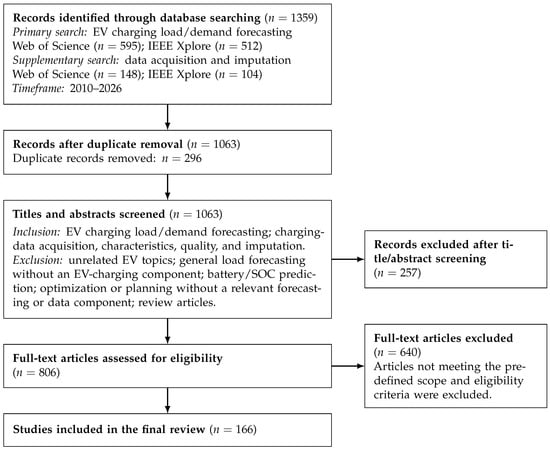

Disclaimer/Publisher’s Note: The statements, opinions and data contained in all publications are solely those of the individual author(s) and contributor(s) and not of MDPI and/or the editor(s). MDPI and/or the editor(s) disclaim responsibility for any injury to people or property resulting from any ideas, methods, instructions or products referred to in the content. |
© 2026 by the authors. Licensee MDPI, Basel, Switzerland. This article is an open access article distributed under the terms and conditions of the Creative Commons Attribution (CC BY) license.