


Abstract
This study investigates the effects of secondary air supply on the combustion characteristics of briquettes with different moisture contents using a coupled FLIC–Fluent framework. FLIC was employed to simulate drying, pyrolysis, volatile release, and char oxidation in the fixed bed, and the resulting bed outlet temperature, velocity, and gas composition were transferred to Fluent as inlet boundary conditions for three-dimensional furnace simulations. At a constant total air supply, all-primary-air operation was compared with staged primary–secondary air supply for briquettes with moisture contents of 10%, 20%, and 30%. Increasing moisture content prolonged drying and preheating, reduced the bed outlet temperature and gas velocity, and weakened fixed-bed combustion. Without secondary air, the furnace’s high-temperature region progressively decreased, while relatively low-temperature regions expanded, and the mean furnace temperature declined from 1125 to 960 K as moisture content increased from 10% to 30%. Although CO release from the fuel bed decreased at higher moisture content, lower furnace temperatures and insufficient gas mixing suppressed subsequent CO oxidation, increasing furnace outlet CO from 820 to 1780 ppm. Redistributing 23.6% of the total combustion air as secondary air improved oxygen–fuel mixing and gas-phase burnout, with a stronger effect at higher moisture content. At 30% moisture, secondary air increased the mean furnace temperature from 960 to 1045 K, reduced outlet CO from 1780 to 980 ppm by 44.9%, and increased the volume fraction above 900 K by approximately 21%. Model validation showed relative errors below 1.0% for mean furnace temperature and below 5.0% for outlet CO and O2, confirming the reliability of the coupled model. These results demonstrate that the investigated air-staging configuration can effectively mitigate the deterioration of furnace combustion caused by high briquette moisture content.
1. Introduction
Briquettes are characterized by high density, convenient storage and transportation, and relatively stable combustion and are widely used for residential heating and in small industrial furnaces. Briquetting changes the pore structure and heat and mass transfer conditions of the fuel; consequently, its ignition, volatile release, and pollutant formation characteristics differ markedly from those of loose pulverized coal [1,2,3]. During production and storage, briquettes are also readily affected by the degree of feedstock drying and ambient humidity, so their actual as-fired moisture content often varies substantially [4,5,6]. Moisture entering the furnace with the fuel must absorb heat for warming and evaporation, thereby lowering the fuel-bed temperature and delaying pyrolysis, ignition, and char oxidation. Previous studies have shown that higher moisture content reduces the lower heating value and combustion temperature of solid fuels, prolongs volatile release, and increases the emissions of CO and unburned species [7,8,9]. For relatively dense briquettes, resistance to the outward transport of water vapor and volatiles is high, and the deterioration in combustion caused by added moisture may therefore be more pronounced [10,11,12].
Conventional briquette stoves generally supply air from below the grate, with all air passing through the fuel bed as primary air. Although primary air can meet the requirements of fuel drying and char combustion, much of its oxygen is consumed while passing through the bed, potentially leaving the region above the fuel bed oxygen-deficient. Moreover, the primary air and the gases released from the bed flow in similar directions, making strong transverse mixing difficult and often preventing the complete combustion of CO, H2, and hydrocarbon volatiles. Providing secondary air above the fuel bed allows part of the air to be delivered directly to the gas-phase combustion region. Secondary air jets entrain hot flue gas and combustible species, enhance turbulent mixing in the furnace, and accelerate the oxidation of CO and volatiles [13,14,15]. Studies have shown that appropriately configured secondary air can enlarge the high-temperature combustion region, improve temperature uniformity, and reduce CO and particulate emissions [16,17,18].
The effectiveness of secondary air depends on how the total air is divided between primary and secondary streams. At a fixed total air flow, increasing the secondary air fraction reduces the primary air flow. Too little secondary air cannot remedy oxygen deficiency in the upper furnace, whereas too much may deprive the fuel bed of oxygen, reduce char burnout, or cause local cooling. The secondary air fraction, injection location, and jet velocity must therefore be matched to the fuel release characteristics [19,20,21]. Briquettes with different moisture contents may have substantially different secondary air requirements. Low-moisture briquettes ignite rapidly and produce a relatively high fuel-bed outlet temperature, so secondary air mainly improves flame distribution. High-moisture briquettes require more heat for drying and release volatiles later. If all air is supplied as primary air, combustible gases released at a later stage may not burn completely because of oxygen deficiency in the upper furnace. In this situation, secondary air can supplement oxygen above the fuel bed and intensify mixing and may therefore provide a greater benefit for wet briquettes.
Existing research on secondary air has focused mainly on biomass pellets, densified fuels, gasifiers, and grate-fired incineration equipment [22,23,24], whereas briquettes with different moisture contents have received relatively limited attention. In some studies, changing the secondary air flow also changed the total air supply, making it difficult to distinguish the effect of increased total oxygen from that of altered air distribution. It is therefore necessary to compare all-primary-air operation with staged primary–secondary air supply while keeping the total air flow constant. Briquette combustion involves drying, pyrolysis, and char reactions within the fuel bed, as well as turbulent mixing and gas-phase combustion in the furnace. Fixed-bed models can describe fuel-bed temperature, mass loss, and gas release [25,26,27], whereas Fluent can provide the three-dimensional distributions of temperature, velocity, and species in the furnace [28,29,30]. Coupling the two reduces empirical assumptions concerning fuel-bed boundary conditions and improves the physical basis of furnace combustion simulations.
Accordingly, this study uses a coupled FLIC–Fluent method to investigate the effects of secondary air on the combustion characteristics of briquettes with different moisture contents. FLIC is first used to calculate drying, pyrolysis, and char reactions in the briquette bed and to obtain fuel-bed outlet temperature, gas flow rate, and composition; these results are then used as inlet boundary conditions for the Fluent model. At each moisture content, an all-primary-air configuration is compared with a staged primary–secondary air configuration while maintaining the same total air supply, thereby isolating the effect of air redistribution from changes in the total oxygen supply. The main contribution of this work is to couple moisture-dependent fixed-bed conversion with three-dimensional furnace combustion and thereby clarify how increasing briquette moisture alters the effectiveness of secondary air staging.
2. Numerical Model and Computational Methods
2.1. Furnace Structure and Computational Domain
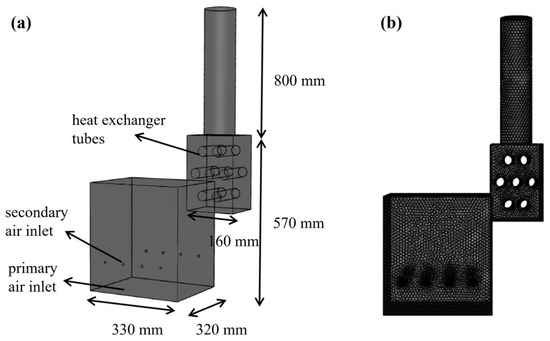
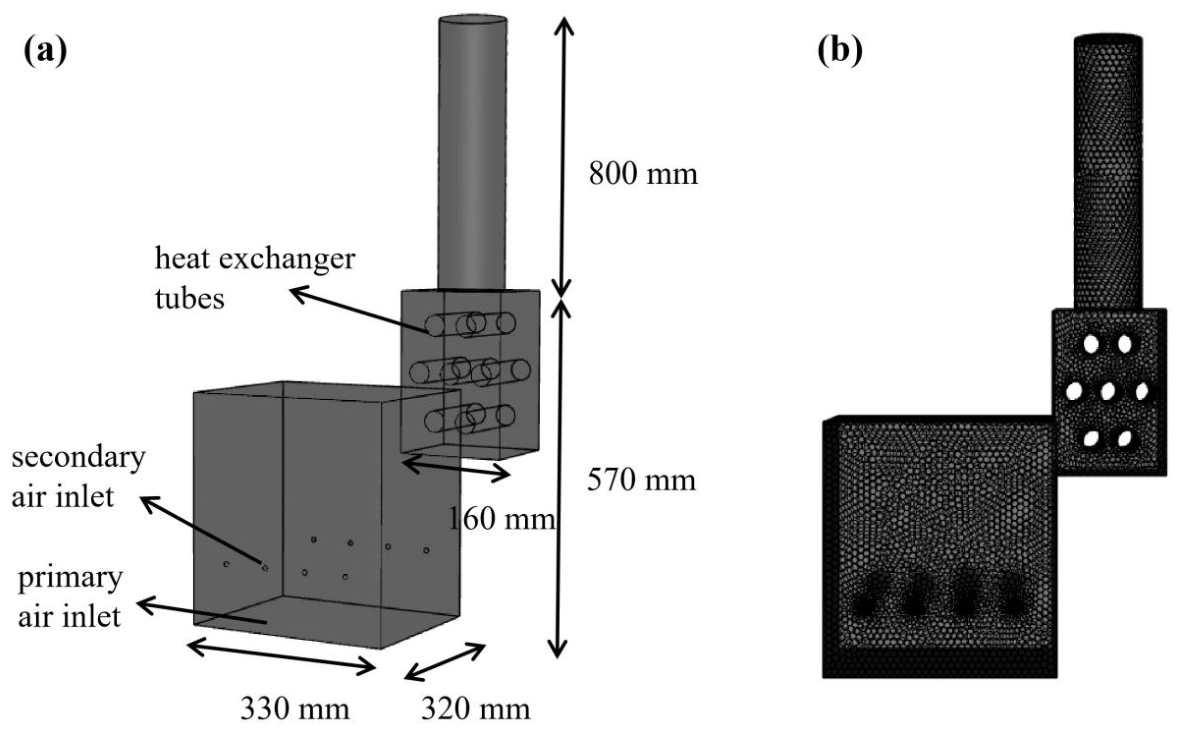
The object of study is a fixed-bed furnace for briquette combustion. Its principal components are the fuel bed, primary air chamber, furnace chamber, secondary air ports, heat transfer walls, and flue gas outlet, as illustrated in Figure 1. Briquettes are placed above the grate, and primary air enters the fuel bed from below the grate to provide the reactant required for briquette drying, pyrolysis, and char oxidation. Secondary air ports are arranged in the furnace sidewall above the fuel bed to supply air to the region where volatiles burn intensively.
Figure 1.
Structure and computational mesh of briquette furnace: (a) furnace structure and main components; (b) computational mesh.
To isolate the effect of introducing secondary air at the investigated fraction, furnace dimensions, fuel loading, flue gas outlet conditions, and wall heat transfer conditions were kept unchanged in the numerical model; only the division between primary and secondary air was adjusted. The principal furnace dimensions are listed in Table 1.
Table 1.
Principal structural parameters of furnace.
2.2. Briquette Properties and Moisture Content Cases
The same reference briquette was used throughout this study. According to the manufacturer, the briquette preparation process is described as follows: Raw coal was crushed and sieved to a particle size below 3 mm, then homogeneously blended with approximately 5 wt.% bentonite binder. The mixture was cold-pressed at around 20 MPa to form cylindrical briquettes with a diameter of 40 mm and height of 30 mm. Green briquettes were naturally air-dried at ambient temperature for 72 h. Target as-received moisture contents were subsequently achieved by adjusting the water addition amount followed by sealed moisture equilibration. Dry briquettes had a cold compressive strength of 1098 N per briquette, a drop strength of 94.0%, and an undersize fraction of 4.75% through a 25 mm sieve, indicating the good mechanical integrity of the briquette fuel. Three moisture content cases with measured as-received moisture contents of 10.03%, 20.12%, and 30.09% were prepared and designated M1, M2, and M3, respectively. For simplicity, these cases are hereafter referred to as the approximately 10%, 20%, and 30% moisture cases, respectively. These three cases were deliberately selected to represent low, intermediate, and high moisture levels for comparative analysis, rather than three universally typical operating conditions or manufacturer-recommended moisture limits. The approximately 10% intervals provide a systematic basis for evaluating the progressive influence of increasing fuel moisture, while the 30% case was included to characterize combustion deterioration under an unfavorable high-moisture condition. The elemental analysis data of the reference briquette were experimentally determined by the briquette manufacturer and provided to the authors as part of the fuel characterization data. To enable the direct comparison of the intrinsic fuel composition, both the elemental analysis and the combustible fractions of the proximate analysis in Table 2 are reported on a dry and ash-free (daf) basis, while moisture is retained on an as-received (ar) basis.
Table 2.
Properties of briquettes with different moisture contents.
Accordingly, the daf volatile matter and fixed carbon contents remain constant among the three cases. The dry basis ash composition and all other intrinsic fuel properties were also unchanged; therefore, moisture content was the only independent variable.
An increase in briquette moisture content has two effects. First, moisture occupies a larger fraction of each unit mass of fuel, reducing the as-received proportions of effective combustible components such as fixed carbon and volatile matter and consequently lowering the as-received lower heating value. Second, after the fuel enters the furnace, the moisture absorbs sensible heat as its temperature rises and latent heat during phase-change evaporation, thereby creating a pronounced heat-sink effect. This directly slows fuel-bed heating, delays pyrolysis and ignition, weakens char oxidation and gas-phase combustion, and significantly inhibits the overall progress of combustion.
2.3. FLIC Fixed-Bed Combustion Model
FLIC was used to establish a fixed-bed briquette combustion model and calculate heat transfer, mass transfer, and chemical reactions in the fuel bed. The model principally accounts for briquette drying, volatile release, the transport of volatiles through the fuel layer, char oxidation, and ash residue by solving appropriate combustion models and solid-phase governing equations.
- (1)
- Moisture evaporation model
Fuel moisture is heated and evaporated primarily by two heat transfer modes: thermal radiation from the hot flue gas above the bed and convection from the primary air and hot flue gas in the furnace. The moisture evaporation rate is given by the following:
where Ap is the surface area of a fuel particle (m2); hm is the convective mass transfer coefficient between the fuel particle and air (m/s); Tp is the fuel particle temperature (K); Cm,g is the moisture concentration in air (kg/m3); Cm,p is the moisture content of the fuel particle; h is the solid–gas convective heat transfer coefficient; and Hevap is the latent heat of evaporation of the fuel particle (J/kg).
- (2)
- Volatile release
The release rate of volatile gas is assumed to be proportional to the volatile matter re-maining in the solid phase and to temperature. The volatile release rate is given by the fol-lowing:
where Rv is the volatile release rate (s−1), and V0 is the initial volatile mass fraction of the fuel (%).
V is the current volatile mass fraction of the fuel (%), and Ev is the activation energy (J/mol).
- (3)
- Volatile combustion
The actual composition of fuel volatiles is complex. To simplify the calculation while retaining the principal behavior, the volatiles are assumed to consist of only three components: CmHn, H2, and CO. The gas-phase reaction equations and rate equations are as follows:
Rmix is the mixing rate of air and volatiles; Cmix is the mixing rate constant; Dg is gas diffusivity (m2/s); dp is the fuel particle diameter (m); ε is bed porosity; Cfuel is the fuel volume fraction (%); and Sfuel is the fuel equivalence ratio.
- (4)
- Char gasification model
Char is formed after moisture and volatiles have been released from the fuel. The char combustion reaction is as follows:
Within a specified temperature range, the CO-to-CO2 ratio is as follows:
The char combustion rate is as follows:
where kr is the chemical reaction rate of char, and kd is the mixing rate between char and gas.
The principal input parameters of the FLIC model include the proximate and ultimate analyses of the briquette, particle size, bulk density, bed porosity, and initial fuel-bed temperature. Across the different moisture content cases, only the fuel moisture content and the resulting as-received component proportions and lower heating value were adjusted by basis conversion. Combustible matter composition, ash characteristics, dry ash-free ultimate analysis values, and bed structural parameters were kept constant, ensuring that moisture content was the sole independent variable.
During the calculation, gas temperature, velocity, and the mass fractions of the major species at the fuel-bed surface were monitored continuously. To represent the actual outlet gas composition of the fixed-bed furnace as closely as possible, time-averaged values from the stable char combustion stage after the complete depletion of volatiles were selected as Fluent inlet boundary conditions. The selected intervals were 1500–3000 s for the 10% moisture case, 1600–2500 s for the 20% case, and 2250–3250 s for the 30% case; temperature fluctuations within each interval remained within an acceptable range. The nitrogen mass fraction was calculated by the difference. The boundary parameters transferred to Fluent included gas temperature and velocity and the mass fractions of CO2, O2, CO, H2, CmHn, H2O, and other volatile species.
In this study, FLIC describes the drying, pyrolysis, and char reactions of briquettes with different moisture contents in the fixed bed. The calculated fuel-bed outlet parameters are used as inlet boundary conditions for the three-dimensional Fluent furnace model. The effects of secondary air jets on flow mixing, gas-phase burnout, and species distributions in the furnace are analyzed in detail using the three-dimensional Fluent simulation.
2.4. Fluent Furnace Gas-Phase Combustion Model
A three-dimensional computational model was established from the actual furnace geometry, and meshes were generated for the furnace chamber, primary air passage, secondary air passage, and flue gas outlet. The upper surface of the fuel bed was specified as a mass flow inlet, with temperature, flow rate, and gas composition taken from the FLIC results.
In view of the structural, combustion, and heat transfer characteristics of the fixed-bed briquette furnace, the selected model combination provides a suitable balance between accuracy and computational efficiency and is well matched to the coupled multiphysics processes in the furnace. Gas-phase flow was described using the Realizable k-epsilon turbulence model, which represents turbulent mixing between the fuel-bed outlet gas obtained from FLIC and the secondary air jets and predicts the velocity field and flow organization. The species transport model was used to track the transport and spatial distributions of O2, CO, CO2, H2O, and other gas species. Gas-phase reactions were coupled with the eddy dissipation model, in which reaction rates are controlled by the turbulent eddy mixing rate. This model is suitable for representing the turbulent diffusion combustion of briquette volatiles and can reasonably reproduce the evolution of temperature and species fields without a complex detailed chemical mechanism, thereby providing both reliability and computational economy. Radiative heat transfer was modeled using the P-1 model. Because the furnace gas is rich in participating media such as CO2 and H2O, the P-1 spherical harmonic approximation to the radiative transfer equation provides stable accuracy, high solution efficiency, and good convergence under these conditions and can capture radiative heat transfer among the hot flue gas, heat transfer walls, and fuel bed. Wall boundaries were specified as either constant-temperature or convective heat transfer walls according to the actual furnace heat transfer mode. Constant-temperature walls represent surfaces coupled to a thermostatic heat transfer medium, whereas convective walls represent heat loss to the surroundings. These boundary settings are consistent with the actual furnace heat transfer configuration. The flue gas outlet was specified as a pressure outlet, consistent with the slight positive- or negative-pressure operation of fixed-bed furnaces and conducive to convergence and realistic results.
A steady-state solution method was used. Convergence was considered achieved when the residuals of all governing equations met the prescribed criteria and the furnace outlet temperature and O2 and CO concentrations became essentially stable. The specific physical models and boundary conditions are listed in Table 3.
Table 3.
Physical models and boundary conditions.
2.5. Operating Conditions
To investigate the effect of secondary air supply at the selected fraction, cases with and without secondary air were established at each briquette moisture content. The total air supply was identical for the two air distribution modes.
In the cases without secondary air, all combustion air was supplied through the primary air inlet below the grate:
Qtotal = Qprimary
In the cases with secondary air, part of the total air flow was introduced through the secondary air ports in the furnace sidewall:
Qtotal = Qprimary + Qsecondary
At a given moisture content, the total air supply, air temperature, and fuel feed conditions were identical in the cases with and without secondary air; only the spatial division between primary and secondary air was changed. This configuration ensures that differences between the two types of cases arise primarily from the spatial distribution of air rather than from a change in total oxygen supply.
To study the effect of secondary air allocation on briquette combustion, cases with and without secondary air were established for each of the three moisture contents, as shown in Table 4. The total air supply was fixed at 0.60 m3/min for all cases. Secondary air was injected through ports in the furnace sidewall above the fuel bed, with a total port area of 0.0003934 m2. The primary air flow was the difference between the total and secondary air flows, namely 0.458 m3/min or 76.4% of the total air flow.
Table 4.
Summary of computational cases.
In the case designations, M1, M2, and M3 correspond to briquettes with moisture contents of 10%, 20%, and 30%, respectively. P denotes the baseline case in which all air is supplied as primary air and no secondary air is used; S denotes staged primary–secondary air supply, with secondary air injected through the furnace sidewall ports. The total air supply is identical for both modes, and the only difference is the spatial division of air between the region below the grate and the furnace sidewall. The fuel-bed calculation in FLIC uses the primary air flow for the corresponding case, and the secondary air inlet boundary in the Fluent furnace calculation is specified accordingly.
Because FLIC simulates transient batch combustion in the fixed bed rather than continuous fuel feeding, a constant fuel feed rate is not prescribed. For reference, an equivalent fuel consumption rate was estimated from the fuel conversion during the stable char combustion interval used for FLIC–Fluent coupling. Taking the 30% moisture case as an example, the estimated fuel consumption rate was approximately 3.4 kg/h. With the total air flow fixed at 0.60 m3/min, this corresponds to an apparent air-to-fuel ratio of approximately 10.6 m3/kg and an apparent excess air coefficient of approximately 2.9–3.0, equivalent to an equivalence ratio of approximately 0.34. The relatively high excess air coefficient mainly results from the reduced combustion rate under the high-moisture condition while the total air supply is kept constant. Therefore, the present operating conditions are intended to isolate the effects of fuel moisture and air redistribution rather than to optimize the excess air coefficient for each moisture level.
3. Results and Discussion
3.1. Fixed-Bed Combustion Characteristics of Briquettes with Different Moisture Contents
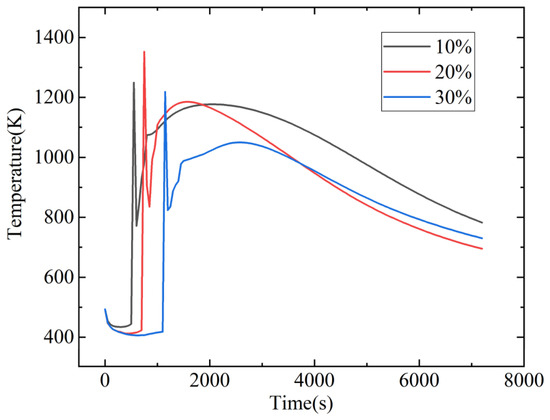
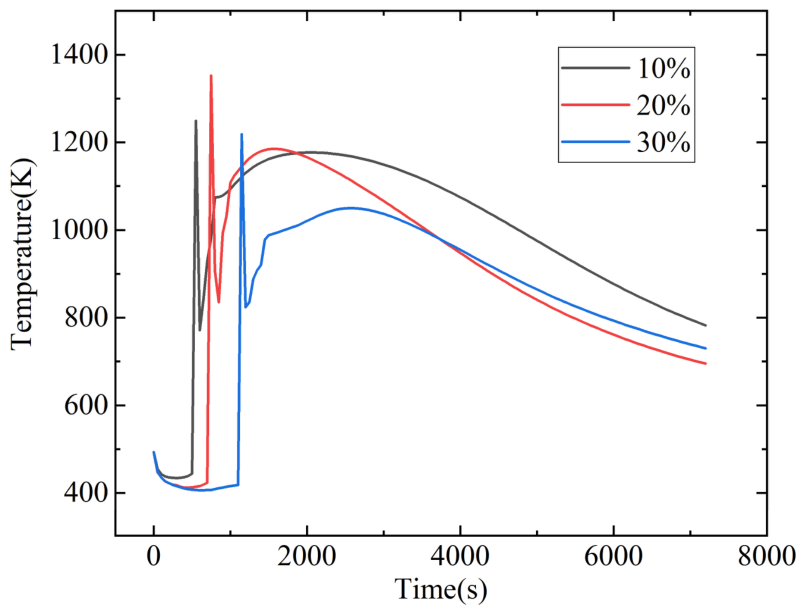
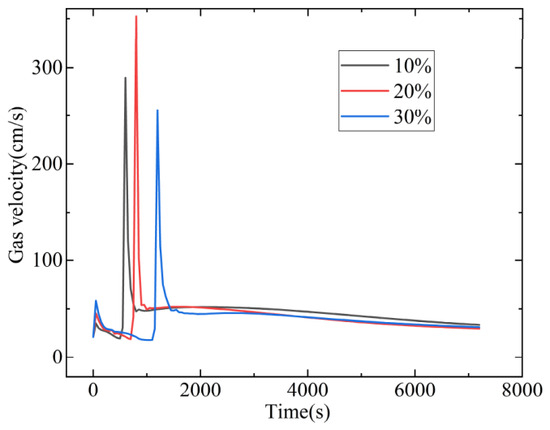
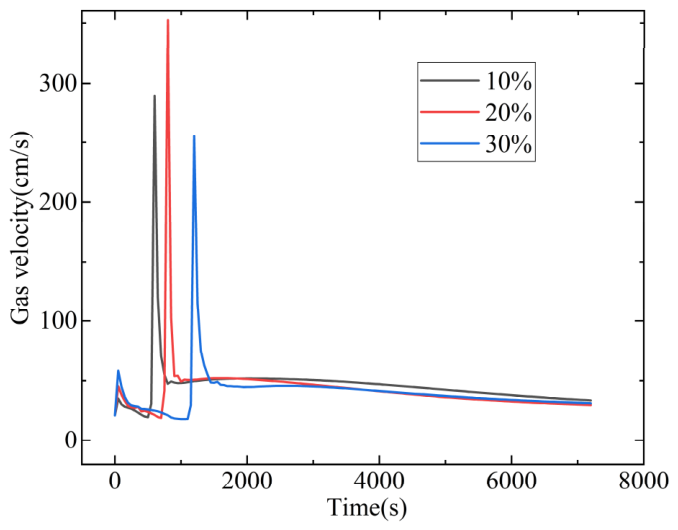
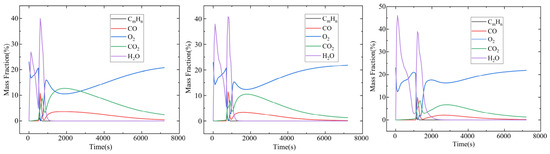
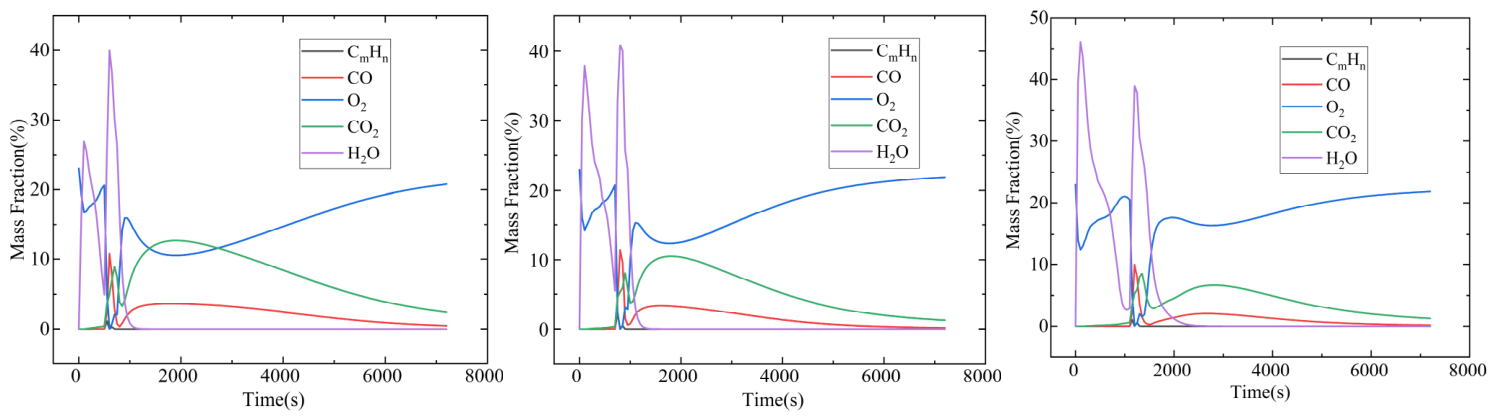
Transient FLIC calculations were performed for the fixed-bed combustion of briquettes with different moisture contents. The resulting temporal variations in fuel-bed outlet temperature, gas velocity, and major gas-phase species are shown in Figure 2, Figure 3 and Figure 4, respectively. Overall, briquettes with moisture contents of 10%, 20%, and 30% all undergo drying and preheating, volatile release and rapid reaction, and stable char oxidation. However, the duration of each stage and the fuel-bed outlet parameters change markedly as moisture content increases, demonstrating that moisture significantly affects heat and mass transfer and combustion reactions in the fixed bed.
Figure 2.
Fuel-bed outlet temperature versus time for briquettes with different moisture contents.
Figure 3.
Fuel-bed outlet gas velocity versus time for briquettes with different moisture contents.
Figure 4.
Mass fractions of major gas-phase species at fuel-bed outlet versus time for briquettes with different moisture contents.
As shown in Figure 2, the first effect of added moisture is the substantial extension of drying and preheating. The main moisture evaporation process ends at approximately 550 s in the 10% moisture case, is delayed to approximately 750 s in the 20% case, and is further delayed to approximately 1150 s in the 30% case. The bed outlet temperature at the end of drying also decreases as moisture content increases, from 444 K in the 10% case to 418 K in the 30% case, indicating that the heat-sink effect associated with moisture heating and vaporization significantly suppresses early fuel-bed heating. During intensive volatile release, the temperature rises rapidly in all three cases. The peak temperature in the 20% moisture case reaches 1352 K, higher than the 1249 and 1218 K observed in the 10% and 30% cases. This nonmonotonic variation may be related to pyrolysis delay and the transient accumulation of combustible gases during drying at intermediate moisture content, causing a concentrated reaction shortly after ignition. By contrast, the larger evaporation heat demand at 30% moisture suppresses the temperature peak. During stable char oxidation, the adverse effect of moisture becomes clearer: mean bed outlet temperatures are 1169, 1159, and 1041 K for the 10%, 20%, and 30% cases, respectively, with the temperature of the 30% case being 128 K lower than that of the 10% case.
The fuel-bed outlet gas velocity corresponds closely to temperature and gas release. As shown in Figure 3, a pronounced velocity peak occurs during intensive volatile release. Peak velocities are 2.89, 3.52, and 2.55 m/s for the 10%, 20%, and 30% moisture cases, respectively; the highest value in the 20% case corresponds to its higher transient temperature peak. During stable char oxidation, velocity gradually stabilizes at mean values of 0.52, 0.51, and 0.45 m/s, respectively. The value for the 30% case is approximately 13.5% lower than that for the 10% case. This is attributable both to the smaller as-received proportions of fixed carbon and volatile matter at higher moisture content, which reduce the production of gaseous reaction products, and to the lower bed outlet temperature, which weakens the thermal expansion of the flue gas.
Figure 4 further illustrates the dynamic changes in bed outlet composition at different moisture contents. During intensive volatile reaction, O2 is rapidly consumed, and its minimum mass fractions fall to 0.01%, 0.04%, and 0.06% in the 10%, 20%, and 30% moisture cases, respectively. Meanwhile, the CO concentration rises rapidly and peaks shortly after ignition, reaching 11.43% in the 20% case and 10.80% and 9.99% in the 10% and 30% cases, respectively. The intense oxygen consumption and transient CO accumulation during this stage indicate strong heterogeneous reactions and incomplete oxidation within the fuel bed over a short period. As volatile release ends, the gas-phase composition gradually reaches a stable state.
To provide representative stable boundary conditions for the subsequent Fluent furnace calculation, the intervals 1500–3000 s, 1600–2500 s, and 2250–3250 s were selected as the stable combustion periods for the 10%, 20%, and 30% moisture cases, respectively. The corresponding mean mass fractions of CO2, CO, and O2 were 12.13%, 3.52%, and 11.06%; 10.16%, 3.15%, and 12.87%; and 6.41%, 2.00%, and 16.57%, respectively. As moisture content increases, the bed outlet concentrations of CO2 and CO decrease continuously, whereas residual O2 rises markedly. Thus, high moisture does not increase oxygen consumption in the bed; rather, it weakens char oxidation by increasing evaporative heat demand and reducing the proportion of effective combustible matter per unit mass of fuel, thereby lowering overall oxygen consumption. This result provides an important basis for understanding the subsequent coexistence of high O2 and high CO at the furnace outlet.
The effects of increasing moisture content on fixed-bed combustion can therefore be summarized in two related aspects. First, moisture evaporation significantly prolongs drying and preheating and lowers the bed temperature. Second, the lower reaction temperature and lower as-received proportion of combustible matter jointly weaken stable char combustion, reducing the temperature and velocity of the gas entering the furnace and the concentrations of carbonaceous species such as CO2 and CO while increasing residual O2. The resulting low-temperature, low-momentum, oxygen-rich flue gas further alters gas-phase reactions and oxygen utilization in the furnace.
3.2. Simulation Results Without Secondary Air
3.2.1. Furnace Temperature Field Distribution Without Secondary Air
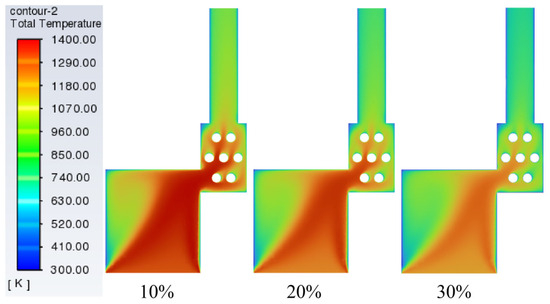
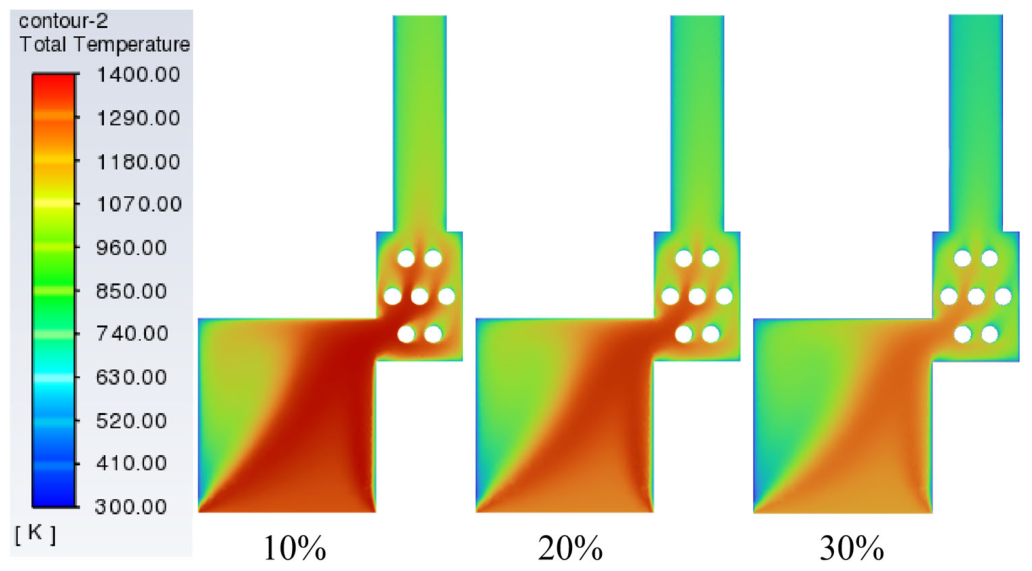
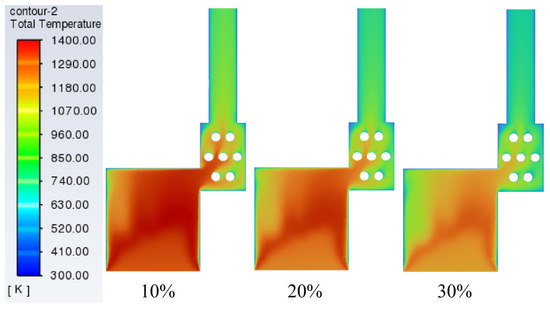
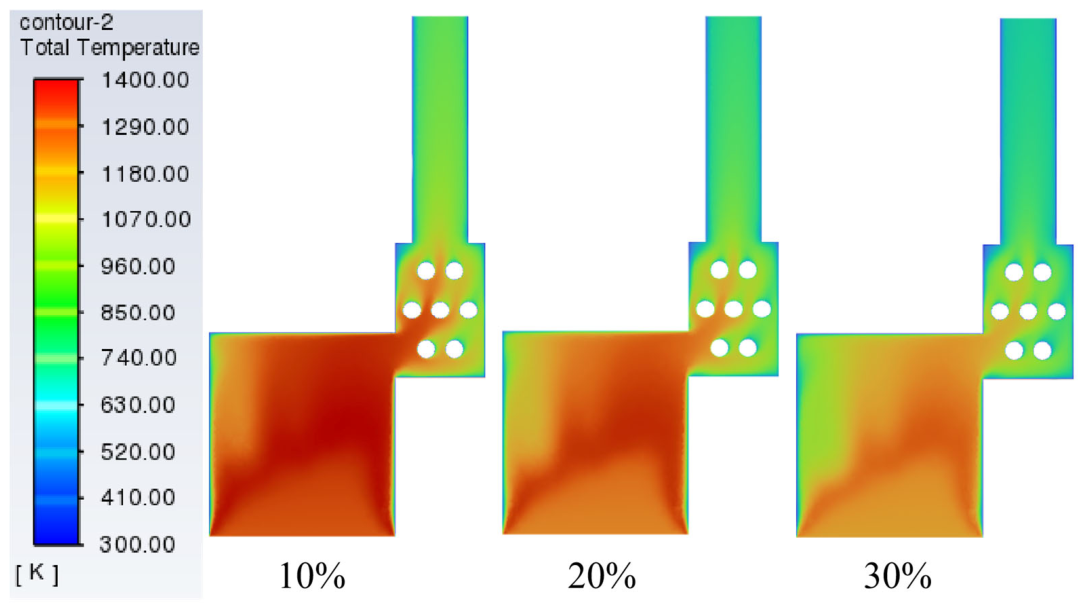
The following Fluent results correspond to the stable combustion stage obtained from the FLIC calculations. Without secondary air, all combustion air is supplied through the primary air inlet below the grate, and the resulting furnace temperature fields are shown in Figure 5. For all three moisture content cases, the high-temperature region is mainly located within the main furnace chamber, while the downstream flue gas passage remains at a comparatively lower temperature. A distinct temperature gradient develops across the main combustion region, indicating that the heat release from gas-phase combustion is spatially nonuniform when only primary air is supplied.
Figure 5.
Furnace temperature fields for briquettes with different moisture contents without secondary air.
As the briquette moisture content increases from 10% to 30%, the overall furnace temperature decreases, and the high-temperature region progressively contracts. At 10% moisture, a relatively large high-temperature region occupies most of the main furnace chamber, indicating comparatively strong combustion. At 20% moisture, the lower-temperature region expands, and the high-temperature region becomes less extensive. When the moisture content reaches 30%, the reduction in furnace temperature becomes more pronounced, with a larger portion of the main chamber and downstream flue gas passage remaining at relatively low temperature. The mean furnace temperatures are 1125, 1035, and 960 K for the 10%, 20%, and 30% moisture cases, respectively. Thus, increasing the moisture content from 10% to 30% decreases the mean furnace temperature by 165 K, corresponding to a reduction of approximately 14.7%.
This deterioration in the temperature field is mainly associated with the changes in the fuel-bed outlet conditions caused by increasing moisture content. As shown by the FLIC results, higher moisture content increases the energy required for fuel drying and evaporation and lowers the temperature of the gas leaving the fuel bed. At the same time, the concentrations of combustible carbonaceous species at the bed outlet decrease, reducing both the sensible enthalpy and the chemical energy available for subsequent gas-phase combustion.
In addition, when all combustion air is introduced from below the grate, the oxygen distribution in the furnace is governed largely by reactions within the fuel bed and by the subsequent flue gas flow. No independent transverse air jet is available to promote mixing between oxygen and combustible species in the furnace chamber. Consequently, the lower gas temperature caused by increasing fuel moisture cannot be effectively compensated by intensified gas-phase oxidation, leading to a progressive reduction in combustion intensity and a larger low-temperature region within the furnace.
3.2.2. Species Distributions in the Baseline Cases Without Secondary Air
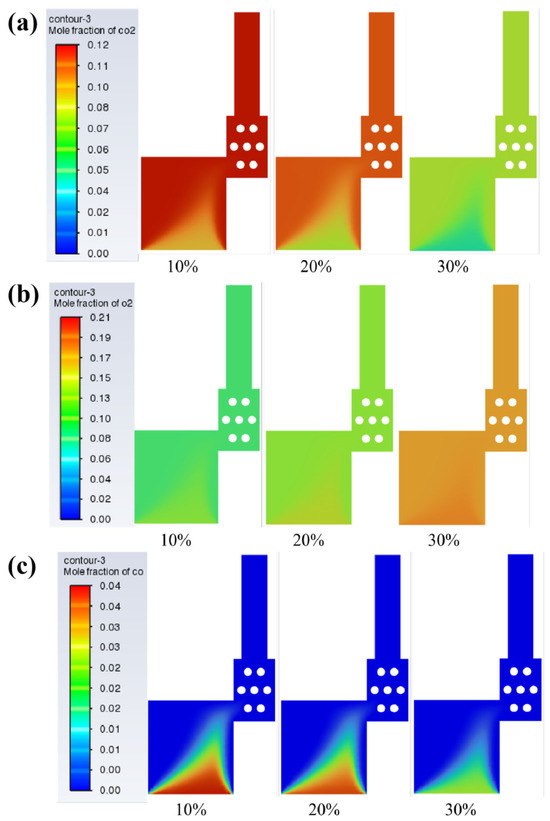
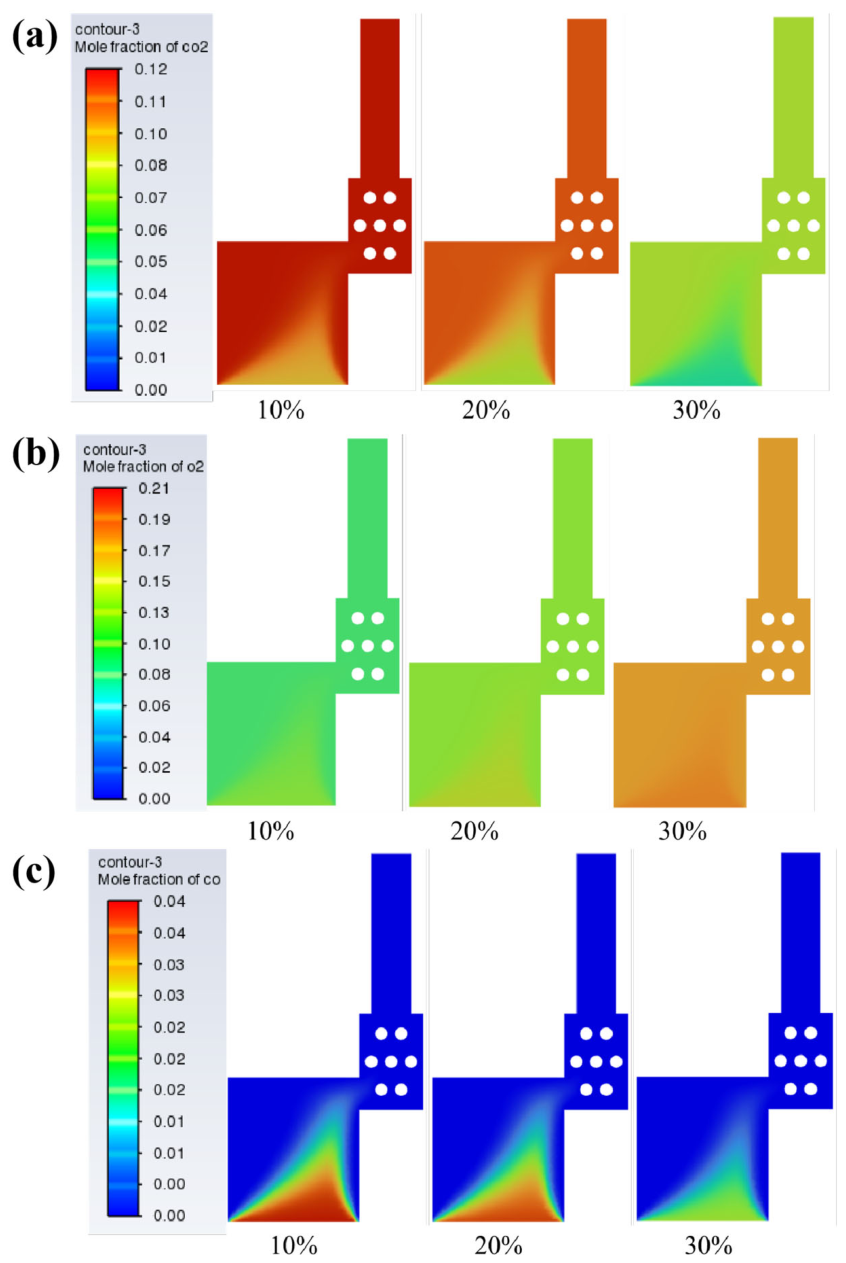
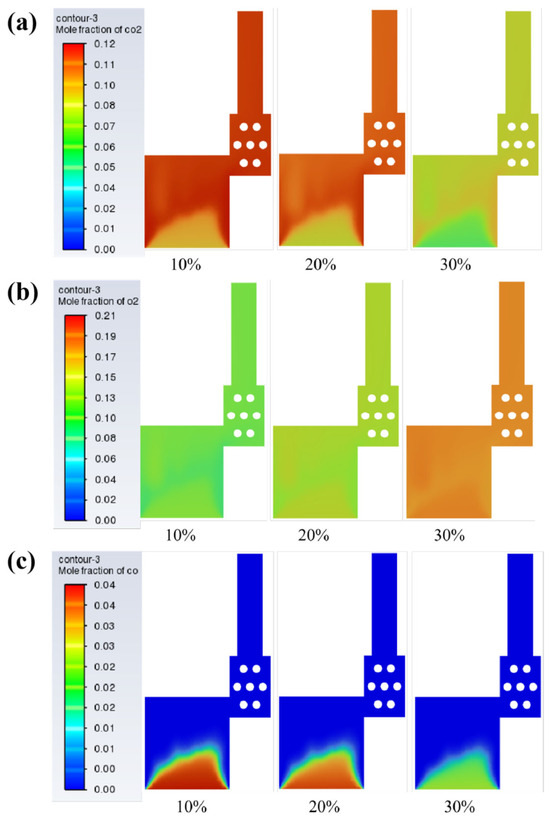
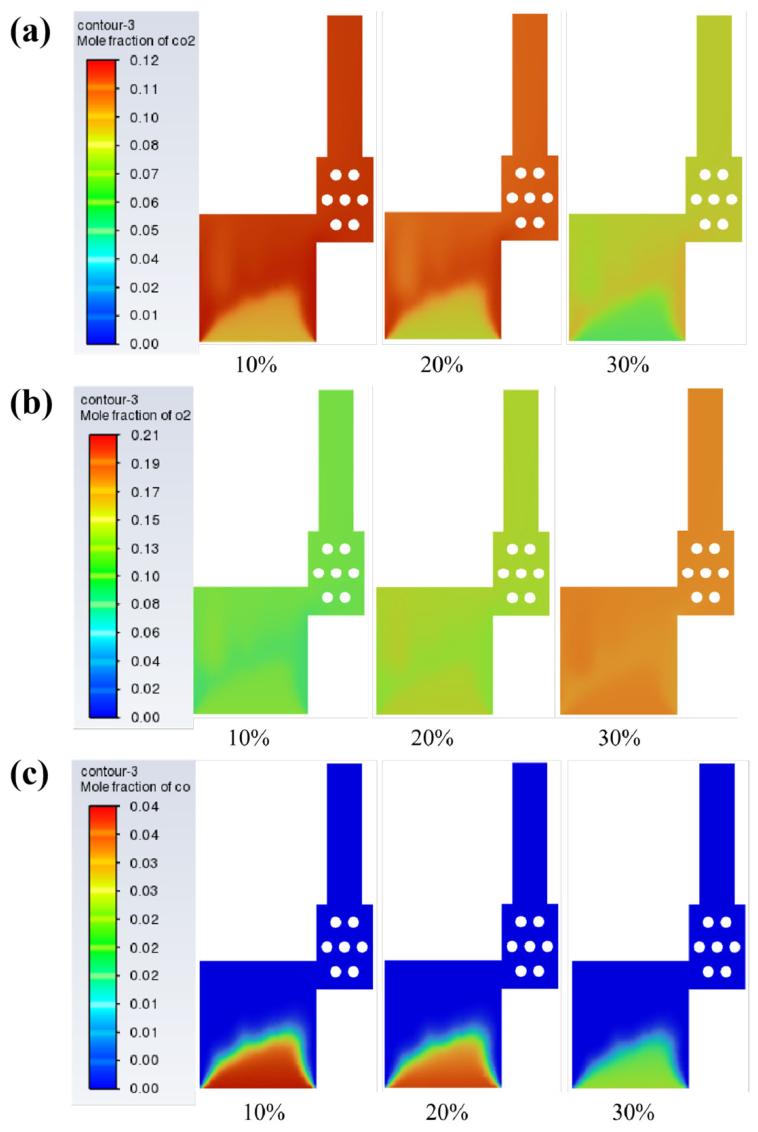
The mole fraction distributions of CO2, O2, and CO for briquettes with different moisture contents without secondary air are shown in Figure 6. Figure 6a and Figure 6b, and Figure 6c correspond to CO2, O2, and CO, respectively.
Figure 6.
Mole fraction distributions of major gas-phase species for briquettes with different moisture contents without secondary air. (a) CO2 mole fraction; (b) O2 mole fraction; (c) CO mole fraction.
Without secondary air, the axial distributions of gas-phase species are strongly coupled to the temperature field. Combustion reactions are concentrated in the fuel-bed region, and gas-phase mass transfer and oxidation intensity decay rapidly with furnace height. The region of the high CO2 mole fraction coincides closely with the high-temperature zone and is concentrated in the core combustion region of the fuel bed. As briquette moisture increases from 10% to 30%, the thermal inhibition caused by moisture evaporation progressively weakens combustion, CO2 production declines, and the high-concentration region contracts toward the bed surface. The persistently low CO2 mole fraction in the middle and upper furnace indicates the extremely incomplete oxidation of combustible species there. O2 exhibits a typical pattern of low values below and high values above and low values at the center and high values near the periphery. Oxygen carried by the primary air is consumed extensively by char oxidation while penetrating the fuel bed, creating a pronounced oxygen-deficient reducing zone above the bed. Because strong turbulent mixing is absent, oxygen cannot readily diffuse toward the furnace center and upper region, resulting in a highly nonuniform axial distribution. Although higher moisture reduces the reaction rate and oxygen consumption and thus increases the residual oxygen mole fraction, it does not resolve the structural nonuniformity of oxygen distribution. Instead, the contraction of the combustion region aggravates the mismatch between concentrated local oxygen demand at the bed and excess oxygen in the upper furnace. High CO concentrations occur mainly in the oxygen-deficient region above the bed. The FLIC results show that stable-stage CO release from the bed decreases as moisture increases, indicating that high moisture suppresses carbon oxidation in the fixed bed. However, evaporative heat absorption also substantially lowers the gas temperature entering the furnace and worsens the temperature and mixing conditions required for the further gas-phase oxidation of CO. Therefore, although the initial bed outlet CO concentration is lower under high moisture, subsequent CO oxidation in the furnace is less complete, producing a higher furnace outlet CO concentration. At 30% moisture, outlet CO reaches 1780 ppm, approximately 117% higher than the 820 ppm at 10% moisture, indicating that incomplete combustion under high moisture is manifested principally as diminished gas-phase burnout in the furnace.
Mechanistically, the low combustion efficiency without secondary air is caused not by insufficient total oxygen supply but by a spatial mismatch between oxygen supply and combustion demand. Supplying all air from the furnace bottom as primary air causes excessive oxygen consumption during fixed-bed char combustion, while the middle and upper furnace—where the gas-phase combustion of volatiles dominates—lack effective oxygen replenishment. For high-moisture briquettes, heat absorption by moisture evaporation further lowers the bed temperature, suppressing both the char oxidation rate and the gas-phase oxidation kinetics of CO and volatiles. Consequently, combustible species cannot burn out within the limited flue gas residence time, and incomplete combustion increases substantially.
3.3. Effects of Secondary Air on In-Furnace Combustion at Different Briquette Moisture Contents
3.3.1. Effects of Secondary Air on Furnace Temperature Field
The furnace temperature fields after the introduction of secondary air are shown in Figure 7. Compared with the corresponding cases without secondary air in Figure 5, secondary air injection improves the spatial distribution of temperature within the main furnace chamber. The temperature field becomes more continuous and uniform, while the extent of the relatively low-temperature region is reduced. This effect indicates that secondary air jets enhance mixing between the combustible gases released from the fuel bed and the available oxygen, thereby promoting gas-phase combustion within the furnace.
Figure 7.
Furnace temperature fields for briquettes with different moisture contents with secondary air.
For the 10% moisture case, the briquettes already provide relatively favorable combustion conditions because of their lower drying heat demand and higher fuel-bed outlet temperature. Consequently, introducing secondary air produces only a limited increase in the overall furnace temperature. The mean furnace temperature increases from 1125 to 1140 K, while the principal improvement is observed in the spatial uniformity of the temperature field rather than in a substantial increase in the maximum temperature. The high-temperature region within the main furnace chamber becomes more continuous, indicating that secondary air promotes the more complete utilization of combustible gases away from the immediate fuel-bed region.
At 20% moisture, the beneficial effect of secondary air becomes more evident. Compared with the case without secondary air, the low-temperature region within the main chamber decreases, and the temperature distribution becomes more uniform. The mean furnace temperature increases from 1035 to 1085 K. This result suggests that, as the adverse effect of moisture becomes stronger, the redistribution of part of the combustion air to the furnace chamber increasingly contributes to maintaining gas-phase combustion.
The most pronounced improvement occurs at 30% moisture. Without secondary air, the high moisture content substantially suppresses the furnace temperature field and produces an extended relatively low-temperature region. After secondary air is introduced, the high-temperature region becomes more developed within the main chamber, and the temperature distribution becomes noticeably more uniform. The mean furnace temperature increases from 960 to 1045 K, corresponding to an increase of approximately 8.9%. Using 900 K as the threshold, the volume fraction of the high-temperature region increases by approximately 21%.
The improvement produced by secondary air results from the combined effects of enhanced mixing and staged oxygen supply. For high-moisture briquettes, the lower fuel-bed outlet temperature and reduced combustion intensity make subsequent gas-phase oxidation more sensitive to local mixing conditions. Secondary air jets introduce oxygen directly into the furnace combustion region and increase momentum exchange between the air and the combustible gas stream. The resulting turbulence and entrainment promote contact between oxygen and combustible species such as CO, H2, and hydrocarbons, allowing these species to continue oxidizing and releasing heat within the furnace.
Because the total air supply remains unchanged, secondary air injection represents a redistribution rather than an increase in the total amount of combustion air. Part of the air originally supplied through the fuel bed is transferred to the gas-phase combustion region, improving the spatial matching between oxygen supply and combustion demand. This effect becomes increasingly important as briquette moisture content rises, explaining why secondary air produces a more pronounced temperature field improvement for the 30% moisture case than for the 10% moisture case.
3.3.2. Effects of Secondary Air on Distributions of Major Gas-Phase Species
The mole fraction distributions of CO2, O2, and CO with secondary air are shown in Figure 8. Figure 8a and Figure 8b, and Figure 8c correspond to CO2, O2, and CO, respectively. Compared with Figure 6, the introduction of secondary air markedly weakens the axial stratification of the species fields and extends the gas-phase combustion region farther along the furnace height.
Figure 8.
Mole fraction distributions of major gas-phase species for briquettes with different moisture contents with secondary air. (a) CO2 mole fraction; (b) O2 mole fraction; (c) CO mole fraction.
Introducing secondary air significantly improves the spatial supply of oxygen and its mixing with flue gas. The axial stratification of the species fields is weakened, the combustion region extends effectively along the furnace height, and overall uniformity improves substantially. The high-CO2 region is no longer confined near the bed but extends upward, and the CO2 mole fraction in the middle and upper furnace increases and becomes more continuous and uniform. This indicates that oxygen supplied by the secondary air activates combustion in the upper furnace and promotes the further burnout of combustible volatiles and intermediate oxidation products. Although the overall CO2 concentration still decreases with increasing moisture content, the decrease is smaller than without secondary air, and differences in combustion intensity among the moisture cases are reduced. The secondary air jets diffuse from the furnace sidewall toward the center and upper region under their own momentum, directly supplementing oxygen in the middle and upper furnace. This breaks the baseline pattern of concentrated oxygen consumption in the bed and persistent oxygen deficiency above it, substantially improving both axial and transverse oxygen uniformity. Local oxygen-rich zones near the secondary air ports intersect regions rich in combustible species and are rapidly consumed by the reaction, thereby matching oxygen supply spatially to combustion demand. Correspondingly, CO formation and emission are significantly suppressed: at a given moisture content, both the peak CO mole fraction and the extent of the high-CO region decrease markedly, and furnace outlet CO falls substantially. The greatest improvement occurs in the 30% moisture case, where outlet CO decreases from 1780 ppm without secondary air to 980 ppm with secondary air, a reduction of 44.9%, demonstrating the particular advantage of secondary air in improving combustion completeness for high-moisture fuel.
The beneficial effect of secondary air on furnace species arises from the combined regulation of staged oxygen supply and turbulent mixing. First, secondary air delivers part of the combustion air directly to the core gas-phase volatile combustion region, thereby staging the air supplied to fixed-bed char combustion and furnace volatile combustion and optimizing the spatial oxygen allocation. Second, the intense turbulence generated by the secondary air jets enhances momentum, mass, and energy exchange in the flue gas; increases the contact probability and mixing rate between oxygen and combustible species such as CO; and promotes the further oxidation of incomplete combustion products. In addition, because the total air supply is held constant, introducing secondary air reduces the primary air flow. This can mitigate the cooling of the fuel bed by excess cold air, prevent excessive bed temperature reduction, and reduce ineffective oxygen surplus within the bed. The resulting improvement in the match between air supplied to bed combustion and furnace gas-phase combustion increases the gas-phase oxidation of incomplete combustion products such as CO.
From a practical perspective, fuel moisture control should remain the primary measure for avoiding combustion deterioration. Briquettes exceeding the recommended moisture limit should be identified through moisture inspection before feeding and appropriately dried, blended with lower-moisture fuel, or withheld from combustion. Meanwhile, the observed variations in furnace temperature and outlet CO and O2 suggest that these measurable parameters could assist in identifying combustion deterioration associated with increased fuel moisture and guide the adjustment of the primary-to-secondary air distribution when necessary. Such adaptive air control should therefore be regarded as a supplementary operational measure rather than a substitute for proper fuel moisture control.
Although the present air-staging strategy has some similarities to staged gasification–combustion, a dedicated gasification mode was not considered in this study, which remained focused on combustion under constant total air supply. The potential application of gasification to high-moisture briquettes deserves separate investigation in future work.
3.4. Validation Against Experimental Data
To verify the accuracy and reliability of the numerical model, the simulation results were benchmarked against test rig measurements. Mean furnace temperature, furnace outlet CO volume fraction, and furnace outlet O2 volume fraction were selected as the three principal combustion indicators. These parameters cover all representative cases with and without secondary air for briquettes at moisture contents of 10%, 20%, and 30%. The experiments were carried out in the same fixed-bed briquette furnace adopted in the numerical simulation. Furnace temperatures were measured using K-type thermocouples arranged at the furnace outlet and three representative locations inside the main combustion chamber. The average furnace temperature was acquired by time-averaging the readings during the stable combustion period, and the temperature measurement accuracy was ±0.75% of the reading. Flue gas samples were extracted from the furnace outlet to determine the concentrations of CO and O2 with a portable infrared gas analyzer, whose measurement accuracy was ±2% of the reading. Each operating condition was tested in triplicate. The comparison is presented in Table 5.
Table 5.
Comparison of simulation results and experimental measurements.
As shown in the table, the simulation results agree well with the experimental measurements for all cases and satisfy the accuracy requirements of engineering numerical simulations. The relative error between simulated and measured mean furnace temperatures remains below 1.0%, and the relative errors in outlet CO and O2 volume fractions are below 5.0%. In terms of trends, the simulation accurately reproduces the reduction in furnace combustion intensity and increase in incomplete combustion products caused by increasing briquette moisture content. It also correctly captures the improvement in combustion produced by secondary air oxygen supplementation, with trends in all parameters fully consistent with the experimental results. The numerical model is therefore reliable and accurately represents combustion reactions in the briquette furnace and can be used for the subsequent analysis of furnace combustion characteristics and optimization of operating conditions.
4. Conclusions
- (1)
- Increasing briquette moisture content significantly prolongs the drying and preheating stages and delays subsequent combustion in the fixed bed. As the moisture content increases from 10% to 30%, the bed outlet temperature and gas velocity during stable combustion decrease overall, while the concentrations of carbonaceous species such as CO2 and CO decrease, and the residual O2 fraction increases. These results indicate that the additional heat demand for moisture evaporation, together with the reduced as-received fraction of combustible matter, progressively weakens fixed-bed combustion.
- (2)
- Without secondary air, the furnace temperature field becomes increasingly unfavorable as the briquette moisture content increases. The high-temperature region within the main furnace chamber progressively shrinks, while the relatively low-temperature region expands. The mean furnace temperature decreases from 1125 K at 10% moisture to 960 K at 30% moisture. Although CO release from the fuel bed decreases with increasing moisture content, the lower gas temperature and insufficient mixing in the furnace suppress further CO oxidation, causing the furnace outlet CO concentration to increase from 820 to 1780 ppm. Therefore, the deterioration in combustion at high moisture content is governed not only by weaker fixed-bed combustion but also by reduced gas-phase burnout in the furnace.
- (3)
- With the total air supply held constant, reallocating 23.6% of the combustion air from primary to secondary air improves the spatial matching between oxygen supply and gas-phase combustion demand. Secondary air injection enhances turbulent mixing, makes the furnace temperature field more continuous and uniform, reduces the extent of relatively low-temperature regions, and promotes the further oxidation of incomplete combustion products. The enhancement becomes more pronounced as the briquette moisture content increases. For the 30% moisture case, secondary air increases the mean furnace temperature from 960 to 1045 K, reduces the outlet CO concentration from 1780 to 980 ppm by 44.9%, and increases the volume fraction of the region above 900 K by approximately 21%. These results demonstrate that the investigated air-staging configuration can effectively mitigate the adverse effects of high fuel moisture on furnace combustion.
- (4)
- The coupled FLIC–Fluent model shows good agreement with the experimental measurements over all investigated moisture contents and air distribution conditions. The relative error in mean furnace temperature remains below 1.0%, while the relative errors in furnace outlet CO and O2 concentrations remain below 5.0%. The model therefore reliably captures the effects of briquette moisture content and the investigated secondary air configuration on furnace combustion and provides a suitable numerical framework for further evaluating air-staging strategies and furnace operating conditions.
A number of limitations of the present study should be acknowledged. The reported results are derived from a single furnace geometry, a single briquette fuel, three moisture levels, and one fixed secondary air configuration. Accordingly, the quantitative conclusions should not be directly generalized to other furnaces, fuels, or air-staging ratios without further verification. Future work should extend the analysis to a broader range of fuel properties, furnace configurations, moisture levels, and secondary air fractions.
Author Contributions
Conceptualization, Q.L.; Methodology, Q.L.; Software, X.S.; Validation, X.Z.; Data curation, D.L.; Writing—original draft, M.L.; Writing—review & editing, D.L., L.L. and X.R. All authors have read and agreed to the published version of the manuscript.
Funding
This research was funded by the S&T Program of Hebei, grant number 242S3703Z.
Data Availability Statement
The original contributions presented in this study are included in the article. Further inquiries can be directed to the corresponding author.
Conflicts of Interest
The authors declare no conflict of interest.
References
- Kebede, T.; Berhe, D.T.; Zergaw, Y. Combustion characteristics of briquette fuel produced from biomass residues and binding materials. J. Energy 2022, 2022, 4222205. [Google Scholar] [CrossRef] [Scilit]
- Schobing, J.; Meyer, A.; Leyssens, G.; Zouaoui, N.; Allgaier, O.; Cazier, F.; Dewaele, D.; Genevray, P.; Pusca, C.; Goutier, F. Inventory of the French densified log market: Characterization and emission factors measurement of twenty commercial briquettes. Fuel 2023, 335, 127060. [Google Scholar] [CrossRef] [Scilit]
- Zha, Z.; Ge, Z.; Wang, S.; Li, F.; Ma, Y.; Wu, Y.; Zeng, M.; Huang, C.; Zhang, H. Biomass combustion behaviors based on online monitoring system: Morphological, thermodynamic and kinetic analysis. Combust. Flame 2023, 252, 112750. [Google Scholar] [CrossRef] [Scilit]
- He, K.; Shen, Z.; Yang, Y.; Zhang, B.; Sun, J.; Xu, H.; Ho, S.S.H.; Qu, L.; Cao, J. Insight into emission reduction effect of coal and biomass mixed briquette fuel. J. Clean. Prod. 2024, 471, 143419. [Google Scholar] [CrossRef] [Scilit]
- Lomunyak, G.; Osodo, B.; Njoka, F.; Kombe, E. Characterization, optimization and emission analysis of manually-made charcoal dust briquettes with starch, paper and algae binders. Heliyon 2024, 10, e40991. [Google Scholar] [CrossRef] [Scilit] [PubMed]
- Umeocho, C.E.; Ezidi, C.O.; Nwosu, E.N.; Nwankwo, C.I.; Ezejiegu, K.C.; Onuegbu, T.U. Comparative study of the combustion properties of briquettes produced from blends of mung beans shell, uncarbonized and carbonized sawdust. Chem. Rep. 2024, 5, 285–290. [Google Scholar] [CrossRef] [Scilit]
- Paramonova, K.; Ivanova, T.A.; Muntean, A.; Passian, L.; Malaťák, J.; Hutla, P.; Ribintev, I. Assessment of quality and combustion characteristics of briquettes derived from giant hogweed biomass. Agronomy 2025, 15, 2213. [Google Scholar] [CrossRef] [Scilit]
- Mack, R.; Schön, C.; Kuptz, D.; Hartmann, H.; Brunner, T.; Obernberger, I.; Behr, H.M. Influence of pellet length, content of fines, and moisture content on emission behavior of wood pellets in a residential pellet stove and pellet boiler. Biomass Convers. Biorefinery 2024, 14, 26827–26844. [Google Scholar] [CrossRef] [Scilit]
- Morin, B.; Allen, G.; Marin, A.; Rector, L.; Ahmadi, M. Impacts of wood species and moisture content on emissions from residential wood heaters. J. Air Waste Manag. Assoc. 2022, 72, 647–661. [Google Scholar] [CrossRef] [Scilit] [PubMed]
- Lai, Y.; Liu, X.; Davies, M.; Fisk, C.; Holliday, M.; King, D.; Zhang, Y.; Willmott, J. Characterisation of wood combustion and emission under varying moisture contents using multiple imaging techniques. Fuel 2024, 373, 132397. [Google Scholar] [CrossRef] [Scilit]
- Milijašević, M.; Stojiljković, D.; Manić, N. Computational fluid dynamics study of biomass moisture content impact on particle matter emissions. Environ. Model. Assess. 2025, 30, 193–218. [Google Scholar] [CrossRef] [Scilit]
- Dickinson-Craig, E.; Bartington, S.E.; Watts, R.; Mandakhbayar, O.; Khurelbaatar, E.-O.; Ochir, C.; Boldbaatar, D.; Warburton, D.; Thomas, G.N.; Pope, F.D.; et al. Carbon monoxide levels in households using coal-briquette fuelled stoves exceed WHO air quality guidelines in Ulaanbaatar, Mongolia. Int. J. Environ. Health Res. 2023, 33, 1760–1771. [Google Scholar] [CrossRef] [Scilit] [PubMed]
- Junejo, A.; Al-Abdeli, Y.M.; Porteiro, J. Role of air staging in a batch-type fixed bed biomass combustor under constant primary air. J. Therm. Sci. 2024, 33, 284–299. [Google Scholar] [CrossRef] [Scilit]
- Junejo, A.; Chapela, S.; Porteiro, J.; Al-Abdeli, Y.M. Secondary air induced flow structures and mixing in a fixed bed combustor. Proc. Inst. Mech. Eng. Part A J. Power Energy 2023, 237, 1479–1492. [Google Scholar] [CrossRef] [Scilit]
- Kshirsagar, M.P.; Kalamkar, V.R. Hybrid draft direct-combustion with secondary air jets in cross-flow for reducing CO and PM2.5 emissions in biomass cookstoves. Sustain. Energy Technol. Assess. 2022, 51, 101913. [Google Scholar] [CrossRef] [Scilit]
- Muñoz, D.F.; Gutiérrez, J.; Pérez, J.F. Effect of the air flows ratio on energy behavior and NOx emissions from a top-lit updraft biomass cookstove. J. Braz. Soc. Mech. Sci. Eng. 2023, 45, 573. [Google Scholar] [CrossRef] [Scilit]
- Holubčík, M.; Kantová, N.Č.; Jandačka, J.; Čaja, A. The performance and emission parameters based on the redis-tribution of the amount of combustion air of the wood stove. Processes 2022, 10, 1570. [Google Scholar] [CrossRef] [Scilit]
- Kardaś, D.; Wantuła, M.; Pieter, S.; Kazimierski, P. Effect of separating air into primary and secondary in an integrated burner housing on biomass combustion. Energies 2024, 17, 4648. [Google Scholar] [CrossRef] [Scilit]
- Elsebaie, A.; Zhu, M.; Al-Abdeli, Y.M. Operational and design factors in air staging and their effects on fouling from biomass combustion. Sustainability 2024, 16, 8584. [Google Scholar] [CrossRef] [Scilit]
- Karlström, O.; Vainio, E.; Engblom, M.; Brink, A.; Hupa, M. Effect of air staging on NOx emissions in biomass combustion in a bubbling fluidized bed. Fuel 2022, 330, 125565. [Google Scholar] [CrossRef] [Scilit]
- Ghiwe, S.S.; Kalamkar, V.R.; Sharma, S.K.; Sawarkar, P.D. Numerical and experimental study on the performance of a hybrid draft biomass cookstove. Renew. Energy 2023, 205, 53–65. [Google Scholar] [CrossRef] [Scilit]
- Himanshu; Kurmi, O.; Jain, S.; Tyagi, S. Performance assessment of an improved gasifier stove using biomass pellets: An experimental and numerical investigation. Sustain. Energy Technol. Assess. 2022, 53, 102432. [Google Scholar] [CrossRef] [Scilit]
- Dutta, P.P.; Gohain, R.B.; Dutta, P.P. Performance assessment of an efficient biomass fired cook stove as a standby unit for community cooking. Biomass Convers. Biorefinery 2023, 13, 11609–11620. [Google Scholar] [CrossRef] [Scilit]
- Kashyap, S.R.; Pramanik, S.; Ravikrishna, R. A review of energy-efficient domestic cookstoves. Appl. Therm. Eng. 2024, 236, 121510. [Google Scholar] [CrossRef] [Scilit]
- Blank, M.; Obernberger, I. Novel packed-bed CFD model for pellet combustion: Validation and application to a stove. Biomass Bioenergy 2024, 190, 107362. [Google Scholar] [CrossRef] [Scilit]
- Zhang, J.; Li, T.; Ström, H.; Løvås, T. Computationally efficient coarse-graining XDEM/CFD modeling of fixed-bed combustion of biomass. Combust. Flame 2022, 238, 111876. [Google Scholar] [CrossRef] [Scilit]
- Álvarez-Bermúdez, C.; Anca-Couce, A.; Chapela, S.; Scharler, R.; Buchmayr, M.; Gómez, M.Á.; Porteiro, J. Validation of a biomass conversion mechanism by Eulerian modelling of a fixed-bed system under low primary air conditions. Renew. Energy 2023, 215, 119003. [Google Scholar] [CrossRef] [Scilit]
- Huang, Z.; Gong, D.; Peng, C.; Chen, J.; Luo, J.; Xu, Y.; Yang, L. Numerical simulation study on combustion of low calorific value waste blended with biomass. ACS Omega 2024, 9, 14297–14309. [Google Scholar] [CrossRef] [Scilit] [PubMed]
- Luo, H.; Du, Y.; Lin, W. CFD modeling of a modern wood stove—Soot formation. Renew. Energy 2024, 232, 121054. [Google Scholar] [CrossRef] [Scilit]
- Liu, J.; Xie, Z.; Guo, B.; Xu, Y.; Wang, Q.; Guo, X.; Bai, L.; Long, J. The effect of air distribution on the characteristics of waste combustion and NO generation in a grate incinerator. J. Energy Inst. 2024, 117, 101827. [Google Scholar] [CrossRef] [Scilit]

Disclaimer/Publisher’s Note: The statements, opinions and data contained in all publications are solely those of the individual author(s) and contributor(s) and not of MDPI and/or the editor(s). MDPI and/or the editor(s) disclaim responsibility for any injury to people or property resulting from any ideas, methods, instructions or products referred to in the content. |
© 2026 by the authors. Licensee MDPI, Basel, Switzerland. This article is an open access article distributed under the terms and conditions of the Creative Commons Attribution (CC BY) license.