


Abstract
Rapid urbanization of the human population and the escalating threat of climate change are the main global crises of the 21st century. When cities densify to accommodate the growth, they face critical shortage of urban space and intense competition between gray infrastructure, ecological preservation, and the urgent need for renewable energy generation, calling for effective urban planning as well as management. Traditionally, urban planning operates in isolated departments without cooperation; they simply separate nature into parks, energy into peripheral power plants, and water into underground pipes, leading to more and more vigorous competition for space utilization. This perspective argues that such a fragmented approach is no longer viable, while a new paradigm of spatial synergy integrating blue–green infrastructure (BGI) and renewable energy sources (RES) possesses encouraging potential and is gaining increasing attention. After discussing the mechanics, the planning methodologies, and the operational frameworks of the spatial synergy, the critical challenges and specific barriers in the synergistic integration are summarized in the dimensions of spatial planning, operation and techniques, socio-economics and governance, and the interconnected pathways, spanning good planning, honest financing, and inclusive governance are proposed to provide a clear roadmap for achieving tangible sustainable urbanism.
1. Introduction
Cities are major drivers of the global economy, but this role comes with a significant environmental burden. Although they cover only a small part of the Earth’s land, cities consume far more than their share of global energy and are responsible for around 70% of energy-related greenhouse gas (mainly CO2) emissions [1,2,3]. The way cities are physically built enhances these problems at a local level. The dense surface of concrete and asphalt absorbs and retains heat, raising the urban temperature well beyond that in nearby rural areas and leading to the Urban Heat Island (UHI) effects [4]. Moreover, the hard ground surface also prevents rainwater from being absorbed naturally into soil, which disrupts the local water cycles and increases the possibility of flash floods and unpredictable rainfalls in cities [5].
Designing cities to achieve sustainable development is a tough and complex task, and planners generally face the difficulty that the optimal strategy for one goal contradicts that for another. For instance, densifying urban areas can help to reduce transport emissions, but it depletes the open spaces for nature and convenient daily life as well as infrastructures, putting residential areas, leisure parks, blue–green infrastructures and renewable energy systems in direct competition for land [6]. This situation is more severe in developing countries, where rapid and unplanned growth with limited resources adversely exposes cities to extreme weather events and vulnerable living conditions. As a result, the administrative focus is shifted toward immediate recovery rather than long-term sustainability planning [7]. To overcome these multifaceted urban weaknesses and promote the sustainable development, the planners are increasingly turning to nature-based solutions as a more unified and robust mitigation strategy.
Blue–green infrastructure (BGI) is a network of natural and semi-natural areas designed to provide various benefits to people and the environment, including the protection of biodiversity across urban settings [8,9]. Its value to society can be assessed from the various ecosystem services, which are crucial for developing urban resilience and long-term sustainability [10]. (1) Regulating service: The most important service of BGI is the regulation to climate. By releasing water vapor into the air, the evapotranspiration of vegetation cools the environment and mitigates the UHI effects that makes cities dangerously hot during heatwaves [11]. BGI can also manage rainwater more effectively than conventional infrastructures with permeable pavements, bioswales, and retention ponds, consequently preventing urban floods, absorbing stormwater, and reducing the load on sewer systems [5]. (2) Provisioning service: The smooth operation of BGI can offer more opportunities to agriculture, food production, fresh water, and biomass, ensuring the food security and resource independence from supply chain disruptions. This is strongly critical, especially to communities that rely heavily on local supply chains [12,13]. (3) Cultural service: BGI can enhance urban life by providing non-material benefits, such as spiritual enrichment, cognitive development, recreation, and esthetic experiences [14]. The green spaces and parks in particular have demonstrated the essential functions in improving mental health [15] and serving as communal areas that foster social cohesion in densely populated cities [16]. (4) Supporting service: The primary processes of BGI, such as soil formation, photosynthesis, and nutrient cycling, establish the substantial foundation for all the above-discussed regulating, provisioning and cultural services. Without them, all the remaining functions of BGI would collapse [17].
Although BGI addresses the ecological resilience, cities still face growing pressure from significant carbon emissions. With the fast global urbanization, cities have become the largest consumers of energy and the biggest source of greenhouse gas (GHG) emissions. Therefore, energy transition from fossil fuels to renewable energy sources (RES) has become an urgent priority in today’s society, since RES are widely regarded as one of the most reliable and economical solutions to traditional power grids [18,19], and the applications of RES can reduce environmental impacts [20] and support a more dependable and fairly distributed energy system [21]. The shift to RES is strongly supported by various global frameworks, including the European Union’s target of climate neutrality by 2050 [22], China’s “Dual Carbon” goal [23], and India’s target of 500 GW of installed renewable capacity by 2030 [24]. It is also supported by the agreement of COP28 (UNFCCC) to triple the global renewable energy capacity to at least 11,000 GW by 2030 [25], and the net-zero economy-wide GHG reduction goals by 2050 outlined in the Long-Term Strategies of the United States and Canada [26]. Moreover, this transition has also been accelerated by growing concerns about national security as well as energy independence, pushing different countries to promote the deployment of decentralized renewable energy sources [27]. However, rapid RES incorporation has raised real contradictions between conservationists and civil society, because prioritizing RES projects might sacrifice public interest, degrading the biodiversity, cultural landscapes, and community inputs [28]. In dense cities, these barriers are especially magnified by a severe spatial problem, as there is not enough room to accommodate RES infrastructures alongside housing, green parks, and other urban needs. Therefore, to develop a sustainable urbanism, city planners should overcome this spatial challenge and design successful deployment of RES without deteriorating local ecosystems. A feasible solution with high practical and spatial efficiency is to functionally integrate RES with BGI to generate mutual benefits, instead of forcing them to compete for the limited urban space, and using a co-planned BGI-RES system with intelligent designs can allow them to complement each other with improved services.
In this article, the mechanisms of spatial synergy between BGI and RES are summarized, followed by a discussion of strategic planning methodologies. Building on this, the Integrated Operational Framework (IOF) is proposed as an AI-coordinated management system that uses real-time environmental and energy data to dynamically optimize the performance of integrated BGI-RES systems. The challenges and barriers to achieve this integration are then critically discussed, and several future directions for regenerative urbanism are proposed. The primary novelty of this perspective lies not in single synergy or technology that has been individually documented in the literature, but in proposing the IOF as a coordination framework for the physical synergy between BGI and RES, which has not been previously treated as an integrated system.
2. The Mechanics of Spatial Synergy
Based on the underlying environmental and mechanical interactions driving the mutual benefits of physical and functional integration of BGI and RES, this perspective classifies the spatial synergy into five distinct types to cover most of the studied synergies: (1) thermodynamic synergy managing thermal exchange on building envelopes; (2) aquatic and kinetic synergy leveraging water bodies and flow dynamics; (3) metabolic synergy creating closed-loop biomass and waste-to-energy systems; (4) aerodynamic synergy managing urban airflows; and (5) geothermal synergy optimizing soil thermal conductivity. However, the practical synergy is not limited to one category, and some real systems combine more than one type at once.
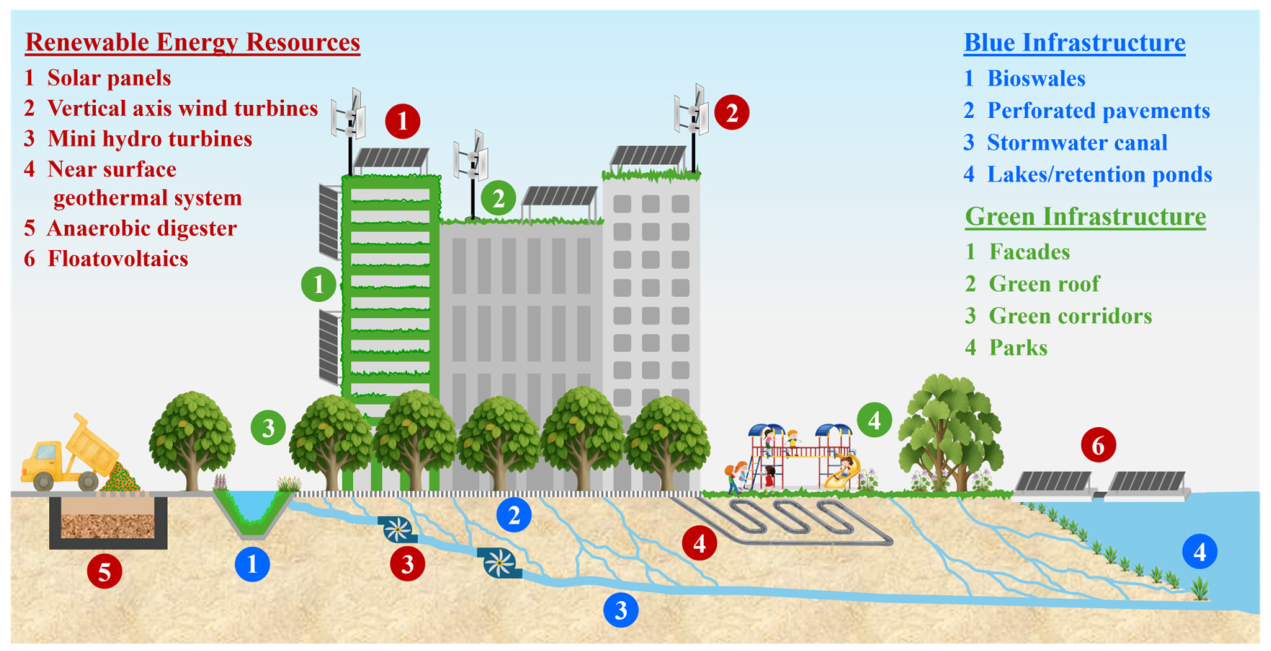
A conceptual overview mapping the spatial synergy and integration of BGI and RES is illustrated in Figure 1.
Figure 1.
Schematic cross-section of a spatially integrated blue–green infrastructure (BGI) and renewable energy resources (RES).
2.1. Thermodynamic Synergy
Thermodynamic synergy means the thermal behavior of BGI directly enhances the energy efficiency of RES in a co-located integration system. One of the most practical and well-studied examples of thermodynamic synergy in BGI-RES systems is the Photovoltaic–Green Roof (PV-GR) configuration, which combines greenery and solar panels on the same rooftop. Because the photovoltaic panels are sensitive to heat and their electrical efficiency drops when operating temperature rises [29], the vegetation in a PV-GR system does much more than just being greenery for esthetics. It cools the surrounding microclimate through evapotranspiration, thereby lowering the surface temperature of the panels, leading directly to enhanced electrical efficiency and measurable gains in energy output. Huang et al. [30] conducted a three-day comparative field experiment in Shenzhen, China, with a subtropical climate, and evaluated different rooftop configurations combining green roofs with photovoltaic systems. They observed that the presence of vegetation reduces the surface temperature of PV modules by 4.31–4.91 °C because of the evapotranspiration, as compared to the panels installed without greenery, and this temperature difference has a direct positive effect on the power conversion efficiency of the panels.
This type of synergy is not limited to rooftops and can equally be applied to vertical surfaces by combining vertical gardens with building integrated photovoltaics (BIPV), which replaces standard building materials with energy-generating alternatives, such as solar cladding and semi-transparent photovoltaic glass, used in facades and windows. In this configuration, the transpiration from the plants cools the immediate microclimate and decreases the operating temperature of the BIPV modules, consequently boosting their efficiency, while the panels in return provide shade that benefits shade-loving plant species during intense sunlight [31,32].
2.2. Aquatic and Kinetic Synergy
Aquatic and kinetic synergy discusses the cooling properties of water bodies and the kinetic energy of flowing water to drive turbines and optimize renewable energy systems. In this case, floating photovoltaics (Floatovoltaics) offer a compelling practical example, where the solar arrays are installed on the surface of water bodies such as reservoirs, retention ponds, or wastewater treatment lagoons [33]. The water naturally cools the panels from below and improves their energy conversion efficiency. In return, the panels provide shade to the water surface, reduce the amount of sunlight reaching the water surface, and decrease the evaporation of water. It is revealed by Santafé et al. [34], based on a full-scale 300 kWp floating photovoltaic system covering an entire 4490 m2 irrigation reservoir in Alicante, Spain, that this shading effect can reduce water loss through evaporation by up to 25%, making Floatovoltaics a particularly attractive option for drought-prone cities where water conservation is a pressing concern.
Mini-hydro systems represent another practical integration of blue infrastructure with RES. Rather than relying on large-scale dams, these systems use small turbines installed in stormwater canals, bioswales, or wastewater pipelines to harness energy from water channels managed by BGI [35]. A study by Tuapetel et al. modeled gravitational vortex turbines for a commercial building drainage system [36]. Based on a minimum one-hour operating time, it was calculated that drainage channels could generate 6.26 kWh from processed wastewater and 37.56 kWh from intermittent rainwater flow. Compared to the electricity demand of 75.12 kWh for the building’s external utility, the turbines are capable of supplying approximately 50% of the needs or serve as a dependable backup power source. The generated electricity can also power the on-site facilities such as water pumps and quality sensors, giving the BGI systems a degree of operational independence and reducing the external energy input. Moreover, the spinning turbines can also raise dissolved oxygen levels in the water in addition to energy generation, which improves the water quality and supports the aquatic ecosystem within the canal [37].
2.3. Metabolic Synergy
Metabolic integration of BGI and RES works on a simple but powerful principle, where waste from one system becomes fuel for another. Green infrastructure such as parks and green corridors produces significant amounts of biomass in the form of pruning, grass clippings, and leaves, while blue infrastructure in cities simultaneously generates large volumes of organic wastewater. Rather than being treated as disposal problems, the biomass and municipal wastewater can be fed into anaerobic digesters to produce biogas as fuel for heat or electricity generation, and the digestate left over from the process can be returned directly to green infrastructure as an effective fertilizer, closing the loop and reducing the dependence on chemical fertilizers [38,39].
The potential of metabolic synergy is considerable. For instance, the abundant invasive weeds like Parthenium hysterophorus are commonly found spreading across urban green spaces and vacant lots, and they need removal at a substantial cost. However, when they are utilized as feedstock for anaerobic digestors, biogas can be produced for further energy generation without weed disposal. Saha et al. disclosed that thermal pretreatment of this species at 110 °C increases solubilization by over 50% and boosts methane production by nearly 35%, reaching a yield of 4239 mL CH4 g−1 VS. compared to 3148 mL CH4 g−1 VS. for untreated biomass [40]. This work implies that the weeds that urban managers routinely spend resources to control or dispose can instead be converted into a useful renewable energy source.
2.4. Aerodynamic Synergy
Rooftop installations offer another avenue for BGI and RES synergy, particularly through the placement of Vertical Axis Wind Turbines (VAWTs) on high-rise buildings to capture the turbulent airflow. Different from the conventional horizontal turbines, VAWTs are much quieter and able to capture wind from any direction [41]. When they are co-located with green roofs, the vegetation helps dampen mechanical noise and vibration, improving the social acceptance in dense residential areas [42]. The investigation by Besir et al. on an optimized three-blade VAWT design using a NACA 0022 profile confirms that such rooftop systems can operate at a low cut-in speed of 2.25 m/s and produce a power output of 143.02 W at an average wind speed of 8.48 m/s [43].
Therefore, aerodynamic clean power systems can be meaningfully integrated into green buildings, with the rooftop VAWT-green roof combination offering a robust and replicable model for spatial synergy of BGI and RES in dense urban areas.
2.5. Geothermal Synergy
At the ground level, a BGI-RES synergy can be created through the integration of near-surface geothermal systems with urban parks. The geothermal loops are installed horizontally beneath public green spaces, where the natural irrigation of the green spaces keeps the soil consistently moist, raising its thermal conductivity and improving the performance of ground-source heat pumps. This geothermal synergy creates a dual-function system that serves as a recreational space above the ground, while quietly operating as a renewable heating and cooling system beneath the ground [44].
To validate the different synergies discussed above, Table 1 summarizes various case studies, ranging from individual buildings to entire eco-districts, where BGI and RES have been successfully integrated to enhance urban resilience.
Table 1.
Case studies of BGI and RES integration by spatial scale.
A comparison of the five synergy types reveals several patterns. Thermodynamic and aquatic synergies, including PV-GR, BIPV, and floatovoltaics, currently offer the clearest energy gains for the effort involved. The cooling effect directly boosts photovoltaic efficiency, and the underlying technology is mature and widely deployed. Aerodynamic synergy through rooftop VAWTs contributes a smaller output, yet it requires very little space and performs well on buildings with limited solar access. Metabolic synergy holds strong potential where biomass and wastewater streams are present at a site, while depending on a consistent feedstock supply and dedicated digestion infrastructure, which makes it better suited to district- or city-scale projects than to individual buildings. Geothermal synergy operates underground to provide steady heating and cooling performance with minimal visible footprint, while it requires a larger area of accessible green space for the horizontal loop field and entails a higher upfront installation cost. Taken together, building-scale synergies, including thermodynamic, aquatic, and aerodynamic synergies, appear to be the most technologically mature and can be deployed rapidly, while metabolic and geothermal synergies require greater infrastructure investment and are better aligned with neighborhood- and district-scale implementation. In practical applications, the choice among these approaches should be guided by the spatial scale, existing resources and target energy output.
3. The Planning Methodologies of Spatial Synergy
While the technological potential for these synergies is clear, putting them into practical implementation is often complicated by the reality of urban land use. Deciding where to fabricate the BGI-RES systems, whether to preserve a valued landscape view or install a wind turbine, or how to balance the competing community needs, is not a purely technical question; there are rarely straightforward answers. Therefore, advanced decision-support methodologies become essential in order to assist the planners to navigate the urban development more effectively.
3.1. Sensitivity Mapping
Sensitivity mapping is one of the most useful tools available for planning the effective integration of BGI and RES, as demonstrated by a national-scale planning study in Slovenia [59,60]. Essentially, it is a spatial analysis technique that brings multiple layers of data together to identify where renewable energy development is both feasible and unlikely to conflict with important societal values. The process starts with an assessment of the technical potential for renewable energy at a given site, looking at factors such as wind flow and direction, sunlight intensity, and the availability of hydro resources, followed by subsequent screening through a set of filters and sensitivity parameters that reflect the existing protection regimes, such as Natura 2000 biodiversity sites, cultural heritage zones, water protection areas, and key wildlife migration corridors.
In the Slovenian case study [60], the available land was categorized into different risk levels ranging from ‘No Risk’ (0) to ‘Very High Risk’ (3), and the results were illuminating. It was revealed that a significant portion of the technical capacity for wind and large hydropower falls within ‘High Risk’ areas, suggesting that pursuing these projects would likely come at a cost to natural ecosystems. While solar energy demonstrates unique advantages, its mapping identifies considerable conflict-free potential on rooftops, degraded lands, road margins, and parking lots, where PV systems could be deployed without threatening biodiversity. This kind of spatial clarity has proven valuable for policymakers [59], as it allows development in suitable areas with greater confidence, reducing the risk of mid-project delays caused by environmental objections.
3.2. ReGenWest Design
ReGenWest design provides a framework for district-level design of BGI-RES integration, and has been specifically developed and tested in the western metropolitan area of Thessaloniki, Greece [44]. It is built around Design Thinking and works through three iterative phases. The first phase is largely about understanding the problem, mapping the renovation area, identifying the possible solutions, and reviewing the relevant cases from the literature, all of which shape a renovation model tailored to the specific area. The second phase opens the proposed model to the people who matter most, bringing the stakeholders, users, and investors to identify financial opportunities and barriers, and ensure that all the questions of diversity and community access are genuinely considered rather than isolated from the core design. In the third and final phase, the focus shifts to making the plan work in practice, optimizing the proposed solutions for cost and carbon emissions, codifying the renovation master plan, and putting an environmental monitoring system in place to track the environmental impact.
A key part of this methodology is the mapping of specific open-space typologies, which moves away from considering the city as a uniform surface, and instead recognizes that different kinds of spaces require different solutions. Thus, the planners identify distinct space types, such as schoolyards, unused flat roofs, road medians and post-industrial brownfields, and pair each with a tailored BGI-RES protocol. For example, a schoolyard could be upgraded with a porous playground surface to manage water runoff and a solar canopy to generate energy while increasing the area for outdoor classroom. Likewise, a road median could accommodate a bioswale alongside solar street lighting. This context-specific approach ensures that the integrations are not only technically effective, but also socially relevant and spatially appropriate [44].
3.3. Design-Brief Approach
In cities where data is limited and governance is fragmented, a Design-Brief approach offers a practical alternative. Rather than relying on top-down technical planning, this strategy focuses on forming multi-departmental task forces that bring experts from science, technology, and policy together from the beginning to restructure the planning around shared goals [61]. This is essential because fragmented governance often leads to siloed decision-making, where one department, such as drainage, might pour concrete over a canal that another department, such as ecology, is actively trying to restore. This coordination problem is well documented empirically in a comparative governance study which found that BGI implementation in Mexico City was hindered primarily by institutional fragmentation and acute resource scarcity across administrative departments, reinforcing the risk fragmented planning poses to project outcomes [62]. Starting with shared objectives helps prevent complications by establishing clear goals, such as flood mitigation or heat reduction, before selecting the BGI-RES combination [63].
Comparing these three methodologies demonstrates that each of them aligns with a distinct type of planning framework. Sensitivity mapping works well where reliable spatial data exists and the priority is screening large areas quickly for conflict-free renewable energy potential. The ReGenWest design fits contexts where a project has moved past initial screening and needs a structured, phased process for adapting BGI-RES combinations to specific site typologies. The Design-Brief approach addresses a different kind of barrier that is rooted in institutional fragmentation rather than technical uncertainty, and is most valuable where coordination across departments is the main obstacle to BGI-RES integration. Rather than competing approaches, these three methodologies address different stages or dimensions of the planning challenge, and a city’s starting point, such as data availability, site-level design complexity, or governance fragmentation, likely determines which is the most appropriate methodology.
4. The Operational Frameworks of Spatial Synergy
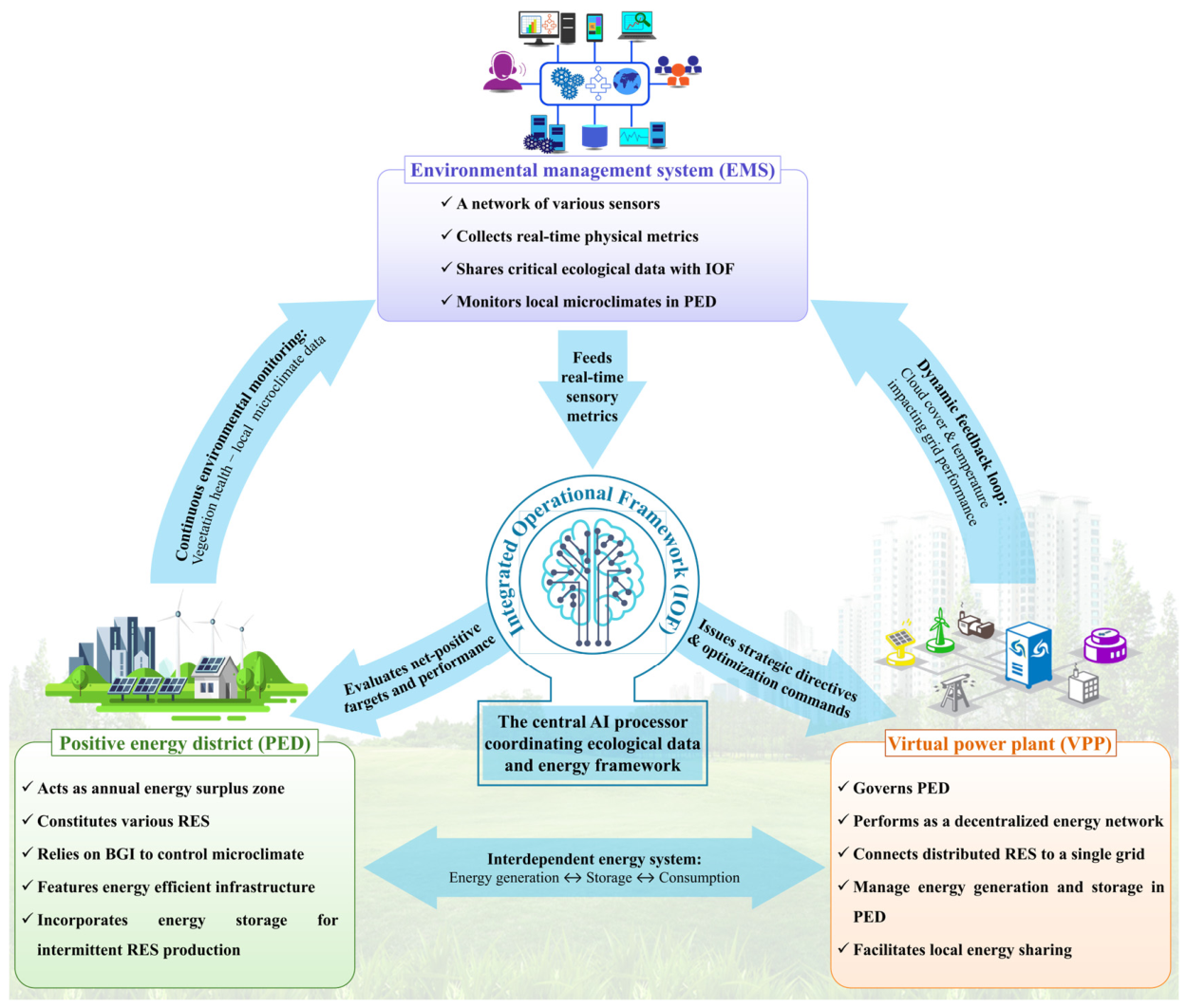
Physical co-location or spatial integration of BGI and RES alone does not ensure that these systems will collectively operate efficiently; a highly responsive management system is required to supervise and actively control the synergy to realize its full potential. As a central brain of this system, the integrated operational framework (IOF) which is an intelligent AI processor coordinates ecological data and energy management by connecting the BGI with the RES around them. As described in Figure 2, it manages the system through a continuous feedback loop involving three pillars, namely the physical generation of energy in a positive energy district (PED), the smart digital coordination via a virtual power plant (VPP), and the continuous ecological tracking provided by an environmental monitoring system (EMS). By analyzing the real-time ecological data from EMS, the IOF can command the VPP and manage the physical infrastructure in PED, creating synergy that can move cities beyond simply co-locating BGI and RES systems to dynamically optimizing them in real time (Figure 2). This physical synergy between BGI and RES is fundamentally an urban planning problem rather than an AI systems research question. The IOF therefore functions as a coordination mechanism rather than a novel AI architecture, adopting the real-time and predictive coordination logic found in more technically developed frameworks such as Urban Brain and Urban Digital Twin platforms [64]. Applying this logic specifically to the physical interaction between BGI and RES is a domain the existing smart-city AI frameworks managing transportation or waste do not address.
Figure 2.
Integrated operational framework for spatial BGI-RES synergy. EMS, PED, and VPP are individually established technologies, whereas the IOF and the connecting feedback loop (in blue) represent the proposed concepts for future developments.
4.1. Positive Energy District as the Physical Foundation
A positive energy district (PED) is the physical foundation of the integrated operational framework (IOF), and it is designed to generate surplus energy and achieve net positive targets [44]. Different from traditional ‘Net Zero’ models that focus on balancing emissions only, PED works as an active hub that integrates energy efficiency measures with local energy production and storage strategies to produce an annual energy surplus through a continuous supervision of the distributed physical resources and balance energy flow between local generation, storage, and end-user consumption [65]. BGI plays a significant role in PED by lowering the district’s minimum energy demand through natural cooling and thermal insulation, making excess renewable energy production a realistic rather than aspirational target [42,66,67]. As the physical resources operate, the IOF continuously monitors their performance to ensure that the implemented spatial strategies (such as conflict-free solar zoning and open-space typologies) successfully generate and export energy to achieve net-positive targets. This approach transforms urban areas into active, net-positive hubs rather than passive, energy-consuming neighborhoods.
4.2. Virtual Power Plant and the Smart Grids
To monitor and manage the physical complexities of the PED, the IOF depends on a virtual power plant (VPP) which serves as the digital command center that turns strategic directives into on-ground action. After evaluating the energy requirements, the IOF sends optimized operational commands to the VPP to control the RES hardware accordingly in the PED, so that when the forecast predicts extreme heat, for instance, the VPP could instruct buildings to pre-cool during peak solar generation rather than waiting for the energy demand to increase. Beyond implementing the strategic directives from the IOF, such as energy targets or peak load reduction, the VPP also manages the smart grid infrastructure by connecting distributed resources including rooftop solar arrays, localized battery storage, and heat pumps, while stabilizing the intermittent nature of the renewable energy supply [68,69]. It could also enable energy sharing within the community. For example, a school with a large solar roof could in principle supply its excess power directly to a nearby hospital with a high energy demand. This kind of energy-sharing model illustrates how the district could gradually shift away from centralized energy dependence, making residents and institutions active energy prosumers rather than passive consumers [68].
4.3. Environmental Monitoring System
The accuracy of VPP’s energy demand management and the efficiency of the PED significantly depend on the real-time data acquired from the physical environment by the environmental monitoring system (EMS). It utilizes a web of IoT (internet of things) sensors, geographic information systems (GIS) and remote sensing to continuously track ecological and environmental parameters [70,71], such as CO2 levels, air quality, soil moisture and vegetation health. Moreover, the EMS collects anticipated or observed environmental changes, such as cloud cover and temperature, and also quantifies natural cooling effects from integrated BGI by monitoring local microclimates and transpiration rates. With these data, a digital representation of the environmental status is created and fed into Agent-Based Models (ABMs) in the IOF to simulate how different interventions, such as planting more trees or adding solar panels, would contribute to the district’s carbon neutrality targets [71]. After computing the inputs from EMS, the IOF alerts the VPP of fluctuations in grid performance and maintains the dynamic feedback loop that keeps the whole system responsive. On the other hand, the RES infrastructure powers the monitoring sensors, establishing a truly synergistic operational relationship between the man-made structures and natural environments [72]. This ABM-based simulation could be extended using machine learning to identify sensor patterns, reinforcement learning for adaptive control, digital twins for higher-fidelity simulation, and predictive analytics to anticipate rather than react to environmental change. Such extensions may raise practical issues like computational load and explainability, which fall outside this perspective’s scope but mark a direction for future technical research.
5. Challenges in Synergistic Integration
While the spatial synergy between BGI and RES has shown real promise in some demonstrations, there are still significant barriers hindering its widescale implementation. Table 2 summarizes the primary challenges, in terms of spatial planning, operations and techniques, socio-economics, and governance, along with the identified specific barriers and ranked challenge levels.
Table 2.
Challenges and barriers in spatial BGI-RES integration.
5.1. The Barriers in Spatial Planning
Spatial planning is an overriding factor in designing a synergistic integration of BGI and RES, and the competitions between land uses and landscape appearance enforce substantial influence on the feasibility and performance of the integrated systems. As an important and useful tool for planning the effective integration of BGI and RES, sensitivity mapping was performed in the national-scale Slovenian case study [59], and it was revealed that conflict-free zones also have their limitations. Even if all the available ‘no-risk’ land (such as rooftops and parking lots) are utilized for solar energy, only 31% of renewable energy share could be achieved, falling short of the targets of the European Union for 2050 [59]. This inevitably pushes the planners toward contentious decisions, such as encroaching on environmentally sensitive areas to meet deep decarbonization targets, which could lead to building a wind farm near bird migration routes or a hydro plant within a protected watershed. Therefore, the trade-off between environment improvement, climate mitigation and local conservation illustrates that a perfect solution for spatial synergy does not exist at the current stage, and spatial planning is still a significant challenge for efficient BGI-RES integration [73].
5.2. The Barriers in Operation and Techniques
Although synergic integration of BGI-RES is theoretically feasible, there are many challenges in practical implementation in terms of operation as well as techniques. For example, if vegetation is not carefully selected and properly maintained in biosolar systems, rapid plant proliferation can cast shadows and create ‘hot spots’ on PV panels [30], leading to permanent damage of the silicon cells and significant reduction in the system’s output. In a VAWT–green roof system, greenery helps preserve the local microenvironment including the climate, yet it might be harmful to the hardware because increased local humidity due to evapotranspiration can accelerate corrosion of the mounting structures and cables if they are not designed for damp environments. Similarly, in a geothermal integration, the exposure of hardware to organic soil and greenery might corrode the facilities. In addition, the maintenance presents another practical predicament. Repairing a roof leak in a PV-GR system, for instance, requires dismantling both the solar arrays and the vegetation layers before solving the primary issue, which not only increases the expenses, but also causes significantly more functional disruption than a similar repair on a conventional roof [42]. To resolve these conflicts, some careful design choices might be helpful [84]. For example, low-growing drought-tolerant species, like Sedum, could be selected for biosolar systems, because they can survive harsh, exposed rooftop conditions without casting shade on panels and require much less maintenance than alternative species; modular structural designs allow solar panels and vegetation layers to be accessed, repaired, or replaced independently without disrupting the entire system.
5.3. The Barriers in Socio-Economics
Socio-economic acceptance is another key challenge of BGI-RES integration. Green cities are generally desired because of the better and healthier environment. But on the other hand, they can lead to Green Gentrification, which is a phenomenon in which neighborhoods with improved BGI and RES infrastructures attract wealthier people and raise property values, ultimately displacing the low-income communities that the improvements were originally intended to serve and widening the gap between rich and poor in urban areas [76]. Alongside these equity concerns, BGI-RES integration often encounters another form of social resistance known as NIMBY (Not In My Backyard) [77]. For example, the residents may support the ideas of wind energy in general, but oppose the installation of turbines near their residential areas because of the concern about noise pollution and local scenery disruption. So, the socio-economics should be well-managed through early and genuine community engagement to give residents a sense of ownership and ensure the benefits are shared fairly.
5.4. The Barriers in Governance
The siloed or fragmented nature of urban governance is a major challenge for the practical implementation of BGI-RES integration. Specifically, individual departments operate in isolation, and different departments do not share resources or information. The energy department manages grids, the landscape and urban appearance department looks after trees and vegetation, and the water department handles flooding separately. No single department or interdepartmental division takes full responsibility for overseeing everything as a whole [81]. As a result, the incentives for one department may unintentionally create hurdles for another due to the absence of cross-sectoral policy frameworks [82]. For instance, subsidies in the energy sector might prioritize maximum solar coverage, while neglecting the space required for urban drainage or biodiversity corridors. Therefore, interdepartmental cooperation should be established to govern the synergistic BGI-RES integration with abundant benefits.
6. Pathways Promoting the Spatial Synergy
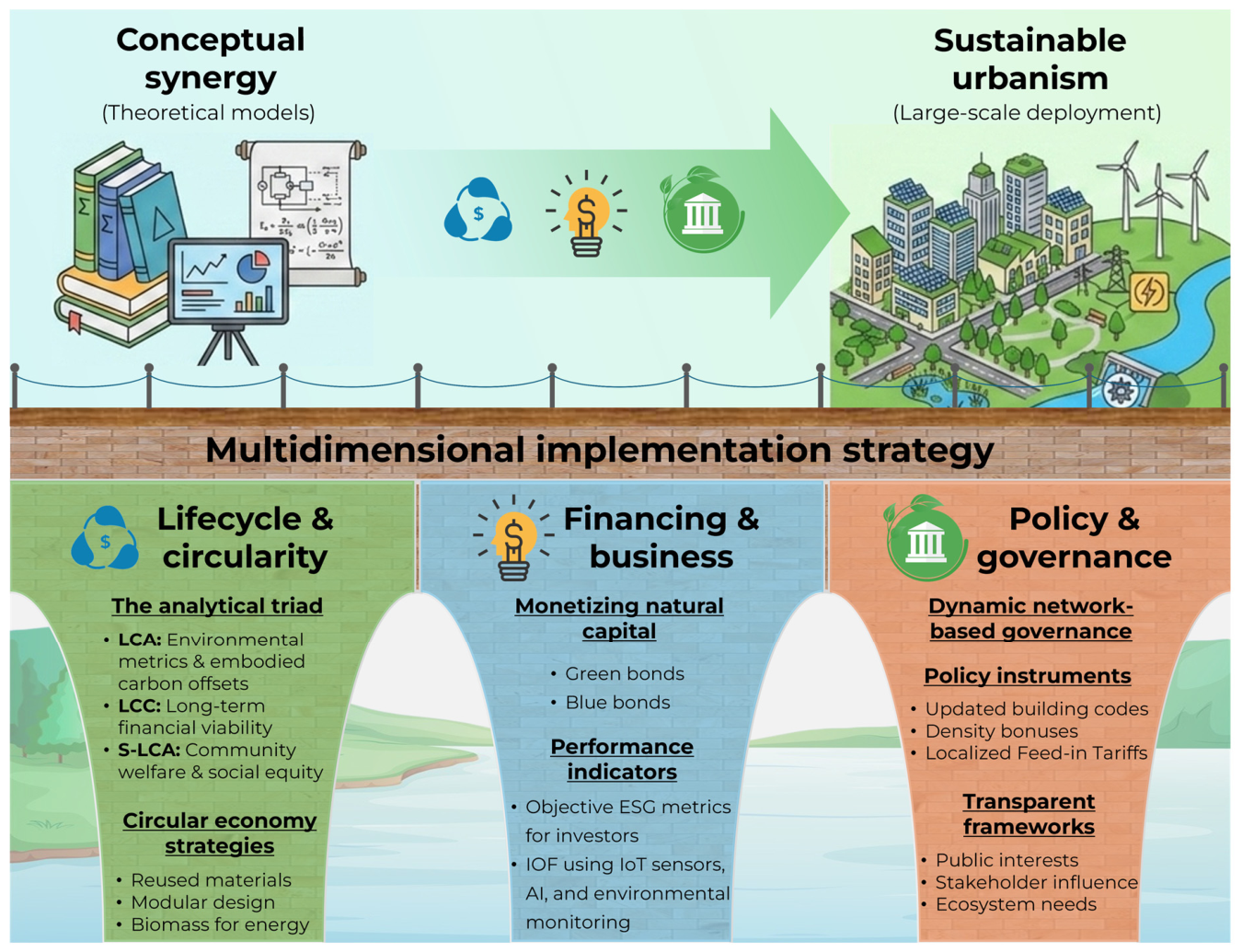
Even though there are huge challenges and barriers as discussed above for the spatial synergy of BGI and RES, moving from conceptual synergy to large-scale urban deployment can be achieved with a multidimensional strategy (Figure 3) that goes beyond purely technical engineering by implementing comprehensive lifecycle assessments to resolve hardware and ecological conflicts, leveraging innovative financing and business models to overcome valuation constraints, and transitioning to collaborative governance frameworks to break down institutional silos. These interconnected pathways, spanning lifecycle and circularity, financing and business, and policy and governance, provide a clear roadmap to transform theoretical models into tangible urban realities.
Figure 3.
The multidimensional implementation strategy transforming conceptual models into tangible regenerative urbanism.
6.1. Lifecycle Assessment and Circularity
Truly sustainable urban planning must balance ecological, financial, and societal priorities [85,86]. Although PED effectively lowers operational emissions under the management of IOF along with the directive of VPP, the production of renewable systems and their disposal still produce large carbon footprints. Therefore, instead of using basic environmental metrics, a multidimensional evaluation framework integrating traditional Life Cycle Assessment (LCA) with Life Cycle Costing (LCC) and Social Life Cycle Assessment (S-LCA) is required, in order to provide a more holistic estimation [87]. In practice, this framework gives planners the tools to assess lifecycle circularity. LCA reveals how vegetation offsets the carbon footprint of manufacturing RES components, LCC evaluates the long-term financial viability of the infrastructure, and S-LCA measures the broad impacts of BGI-RES integration on community welfare and equity. One practical case application is the evaluation of Hungary’s “Green City” program [88], which employed environmental impact as the operational carbon footprint, economic performance as the extended net present value, and social value as the accessibility and recreational benefit to assess 198 implemented blue–green infrastructure projects using real municipal data. This study found that shifting from tap water to rainwater-based irrigation could reduce both operating costs and lifetime carbon emissions by more than 25%, directly demonstrating the value of the integrated LCA, LCC, and S-LCA approach.
Furthermore, circular economy strategies are necessary to work along with the advanced assessment tools to develop integrated urban systems that remain economically sound and fully sustainable. These strategies could ensure sustainable urbanism by recycling and repurposing materials in urban structures such as buildings or bioswales, designing modular assemblies for easy replacement without disrupting the wider system, as well as utilizing biomass for energy generation.
6.2. Innovative Financing and Business Models
RES generates quantifiable and immediate financial returns through energy generation, while the natural capital and the long-term benefits of BGI [89], such as flood mitigation and microclimate regulation, are undervalued by the current economic system. Therefore, there is a great financial inequality between technological and ecological infrastructures, which makes it difficult to attract private investment [90] and creates a vast disparity between public and private financing for BGI [91]. To resolve this predicament, urban planners must introduce innovative financial plans to bridge this funding gap by monetizing ecological benefits. Municipalities can issue Green Bonds to fund integrated PV-Green Roof systems, which leverages the high investor demand for certified climate projects [92]. Moreover, Blue Bonds provide a great way to fund sustainable water infrastructure [93], especially for aquatic projects like floating solar panels and small-scale hydro systems. These bonds function as specialized city loans that allow the local government to raise large amounts of capital from private investors who want to preserve the environment.
In order to secure funds, rigorous proof of performance is required, since the investors and regulators demand objective environmental, social, and governance (ESG) metrics, serving as a standardized framework [94], to fully evaluate the project in terms of environmental protection, social equality and transparent management practices. In this regard, the deployment of the Integrated Operational Framework (IOF) is valuable as it utilizes IoT sensors, artificial intelligence, and continuous environmental monitoring to provide transparent and data-driven evidence to mitigate risk, satisfy investors, and scale private funding for BGI-RES projects.
Some governments have put these ideas into practice. For example, Chile issued sovereign Green Bonds that fund solar thermal and photovoltaic installations [95], while Seychelles issued the world’s first sovereign Blue Bond to help expand its marine protected areas [96]. Whether these instruments end up delivering on their promised outcomes is still being evaluated, but their implementation at least shows that such financing mechanisms are operational, rather than merely theoretical.
6.3. Policy Instruments and Governance
Technological and financial models cannot be implemented without robust legal and administrative frameworks. Therefore, a fundamental shift from traditional hierarchical approaches to dynamic and network-based governance is urgently required [97,98]. This is because traditional government relies on formal authority and rigid zoning laws, and is often incapable of handling the complexities of BGI-RES integration, while effective governance depends on trust, shared objectives, and close relationships among different stakeholders whose roles and power dynamics continuously evolve from project initiation to its completion. A successful example is the Vauban eco-district in Freiburg, Germany, where the administration uses community-led energy cooperatives and participatory forums to allow citizens to co-own renewable energy infrastructure while bypassing traditional rigid planning limits [99].
In addition, regulations and policy instruments are also needed for successful governance. Cities can update various building codes for BGI, RES and their integration on new developments, and also offer helpful incentives like density bonuses or localized feed-in tariffs. Simultaneously, urban authorities must manage these policies through a transparent framework that understands public interests and stakeholder influence, and this framework should also be flexible to the changing needs of urban ecosystems. Thus, the spatial synergy between BGI and RES can be successfully promoted as a permanent part of urban planning.
6.4. Lessons from Schoonschip, Amsterdam
The Schoonschip floating neighborhood in Amsterdam [100] offers a documented example of how the synergies interact in practice, and of the barriers that emerge when they are implemented together at the scale of an actual community. The 46-household development combined rooftop solar panels cooled by green roofs, a canal-based heat pump system, and a shared smart grid platform that let residents choose and trade their own energy supply, illustrating thermodynamic and metabolic synergies operating side by side within a single site. However, it was revealed that the benefits came with real costs. Unlike publicly funded circular neighborhood projects, Schoonschip was predominantly privately financed, and the resulting costs excluded low-income housing entirely, with unit access largely limited to friends and acquaintances of existing residents before public listing. The bottom-up, resident-led governance model, while central to the project’s identity, also made collective decisions such as purchasing shared sustainable materials that were difficult to coordinate, since individual households favored different suppliers and timelines. More importantly, the project’s energy-sharing arrangements worked well, merely owing to a 2016 legal exemption from Dutch energy law; the national grid regulations are designed around centralized energy systems and do not accommodate the community-level energy autonomy demonstrated by Schoonschip [101]. Overall, these findings suggest that the technical feasibility of spatial synergy at the community scale is well established, but its wider replication depends on solving cost, equity, and regulatory barriers that are institutional rather than technical in nature.
6.5. Readiness Gaps and Research Priorities
Technological readiness, cost, and scalability remain open questions for this emerging field; fully answering them requires primary data that has not yet been generated for most of the systems discussed here. For readiness, most demonstrated BGI-RES synergies have only been proven at the building or district scale, and the coordination of these components through a closed AI-driven feedback loop, as illustrated in Figure 2, has rarely been conducted as a complete operating system at city scale, directing toward pilot-scale demonstrations of the IOF as the necessary next step. With regard to cost, the financing examples discussed in Section 6.2 remain modest relative to the capital required for city-wide deployment, and the cost for installation as well as long-term maintenance of integrated systems are rarely published, creating a gap that should be addressed during the future techno-economic studies. For scalability, issues such as the mechanical and biological degradation summarized in Table 2, along with uncertainty from variable climate conditions, fluctuating renewable generation, shifting economics, and evolving policy environments, may behave differently as systems expand from a single building to an entire district or city. This is a question that long-term monitoring of the existing pilot projects could begin to answer.
7. Conclusions
In efficient urban development, BGI and RES are not competing land users, but complementary systems that enhance mutual efficacy. The spatial integration of BGI and RES is more effective than isolated systems, and their intelligent co-design has potential to ease problems like urban land scarcity, rather than treating it as a fixed constraint. The BGI-RES integration could be conducted in thermodynamic, aquatic and kinetic, metabolic, aerodynamic and geothermal synergies. Within these synergies, vegetation cools solar panels and improves their output by as much as 4.31 to 4.91 °C, water bodies host floating photovoltaics while reducing evaporation by up to 25% through the shade they cast, organic waste from green corridors feeds anaerobic digesters that power the district with raised methane yield by nearly 35%, green roofs help dampen mechanical noise and vibration of VAWTs that can generate up to 143.02 W, and geothermal loops draw efficiency from the moist soils beneath irrigated parks. In practical implementation, various methodologies, including sensitivity mapping, the ReGenWest methodology and the Design-Brief approach, could be consulted in addition to technical knowledge. At the operational level, the IOF, which is an intelligent AI processor, ties the physical systems together through real-time data, smart grid coordination, and environmental monitoring, giving cities a possible path toward becoming active energy producers rather than passive consumers.
Even though some real-case BGI-RES integration demonstrations have been achieved with encouraging prospects, there are still substantial challenges impeding the wide scale implementation, in terms of spatial planning, operations and techniques, socio-economics, and governance. In order to overcome the barriers and promote the spatial synergy of BGI-RES integration, interconnected pathways spanning lifecycle and circularity, financing and business, and policy and governance should be simultaneously deployed. The assessment frameworks go beyond quantifying the carbon footprint and incorporate the full lifecycle costs and social impacts of the integrated systems; an approach has been shown to cut operating costs and lifetime emissions by more than 25% in real implemented projects. The financing evolves so that the long-term value of ecological infrastructure is recognized and rewarded, with tools like Green and Blue Bonds, which have already funded real solar and marine conservation projects, playing a great role in bridging the gap between public ambition and private investment. The governance shifts from rigid hierarchies toward collaborative networks where departments, communities, investors, and planners share both responsibility and ownership, as demonstrated by community-led energy cooperatives operated in Vauban. With these efforts, sustainable urbanism becomes a more achievable goal, supported by good planning, honest financing, and inclusive governance. To move from this conceptual pathway toward practice, future work should prioritize pilot-scale demonstration of the Integrated Operational Framework, techno-economic study of long-term maintenance costs, and continuous monitoring of the existing projects.
Author Contributions
Conceptualization, Z.L., Q.S. and D.C.; formal analysis, Z.L., K.Q., Q.S. and D.C.; investigation, Z.L., K.Q., Q.S. and D.C.; resources, Z.L. and K.Q.; writing—original draft preparation, Z.L. and K.Q.; writing—review and editing, Q.S. and D.C.; supervision, Q.S. and D.C.; project administration, D.C.; funding acquisition, D.C. All authors have read and agreed to the published version of the manuscript.
Funding
This research received no external funding.
Data Availability Statement
No new data were created or analyzed in this study. Data sharing is not applicable to this article.
Conflicts of Interest
The authors declare no conflicts of interest.
References
- Seto, K.C.; Dhakal, S.; Bigio, A.; Blanco, H.; Delgado, G.C.; Dewar, D.; Huang, L.; Inaba, A.; Kansal, A.; Lwasa, S. Human settlements, infrastructure, and spatial planning. In Climate Change 2014: Mitigation of Climate Change; Edenhofer, O., Pichs-Madruga, R., Sokona, Y., Farahani, E., Kadner, S., Seyboth, K., Adler, A., Baum, I., Brunner, S., Eickemeier, P., et al., Eds.; Cambridge University Press: Cambridge, UK, 2014; pp. 923–1000. [Google Scholar]
- Luqman, M.; Rayner, P.J.; Gurney, K.R. On the impact of urbanisation on CO2 emissions. npj Urban Sustain. 2023, 3, 6. [Google Scholar] [CrossRef] [Scilit]
- Ning, Y.; Lou, Y.; Liu, Y. The scaling law of CO2 emissions in Chinese urban agglomerations: A Zipf’s law perspective and its policy implications. Sustain. Cities Soc. 2026, 145, 107500. [Google Scholar] [CrossRef] [Scilit]
- Zheng, Z.; Fong, C.S.; Aghamohammadi, N.; Law, Y.K. A Systematic Review of Urban Heat Island (UHI) Impacts and Mitigation: Health, Equity, and Policy. Systems 2026, 14, 82. [Google Scholar] [CrossRef] [Scilit]
- Stephenson, J.; Newman, K.; Mayhew, S. Population dynamics and climate change: What are the links? J. Public Health 2010, 32, 150–156. [Google Scholar] [CrossRef] [Scilit] [PubMed]
- Xia, Y.; Zheng, D.; Zhang, Y.; Deng, W.; Yang, T. Balancing urban environmental and societal performance in high-density cities: Morphological trade-offs and optimization strategies in Shenzhen and Hong Kong. Sustain. Cities Soc. 2026, 143, 107383. [Google Scholar] [CrossRef] [Scilit]
- Govindarajulu, D.; Sánchez, F.G.; Chaudhry, P. Redeveloping Open and Urban Green Spaces for Climate Resilience; A Case Study of Chennai. In Blue-Green Infrastructure for Sustainable Urban Settlements: Implications for Developing Countries Under Climate Change; Joshi, P.K., Rao, K.S., Bhadouria, R., Tripathi, S., Singh, R., Eds.; Springer: Cham, Switzerland, 2024; pp. 299–317. [Google Scholar]
- Henderson, H.; Bush, J.; Kozak, D. Mainstreaming Blue Green Infrastructure in Cities: Barriers, Blind Spots, and Facilitators. In The Palgrave Encyclopedia of Urban and Regional Futures; Brears, R.C., Ed.; Springer: Cham, Switzerland, 2022; pp. 1003–1020. [Google Scholar]
- Sánchez, F.G.; Govindarajulu, D. Integrating blue-green infrastructure in urban planning for climate adaptation: Lessons from Chennai and Kochi, India. Land Use Policy 2023, 124, 106455. [Google Scholar] [CrossRef] [Scilit]
- Ranganathan, J.; Raudsepp-Hearne, C.; Lucas, N.; Irwin, F.; Zurek, M.; Bennett, K.; Ash, N.; West, P. Ecosystem Services—A Guide for Decision Makers; World Resources Institute: Washington, DC, USA, 2008. [Google Scholar]
- Kousis, I.; Pigliautile, I.; Pisello, A.L. Intra-urban microclimate investigation in urban heat island through a novel mobile monitoring system. Sci. Rep. 2021, 11, 9732. [Google Scholar] [CrossRef] [Scilit] [PubMed]
- Tobias, S. Preserving ecosystem services in urban regions: Challenges for planning and best practice examples from Switzerland. Integr. Environ. Assess. Manag. 2013, 9, 243–251. [Google Scholar] [CrossRef] [Scilit] [PubMed]
- Chaurasia, M.; Patel, K.; Singh, R.; Bhadouria, R.; Rao, K.S. Integrating Blue-Green as Next-Generation Urban Infrastructure in Developing Countries. In Blue-Green Infrastructure for Sustainable Urban Settlements: Implications for Developing Countries Under Climate Change; Joshi, P.K., Rao, K.S., Bhadouria, R., Tripathi, S., Singh, R., Eds.; Springer Nature: Cham, Switzerland, 2024; pp. 57–82. [Google Scholar]
- Satz, D.; Gould, R.K.; Chan, K.M.; Guerry, A.; Norton, B.; Satterfield, T.; Halpern, B.S.; Levine, J.; Woodside, U.; Hannahs, N.; et al. The challenges of incorporating cultural ecosystem services into environmental assessment. Ambio 2013, 42, 675–684. [Google Scholar] [CrossRef] [Scilit] [PubMed]
- Chiabai, A.; Quiroga, S.; Martinez-Juarez, P.; Higgins, S.; Taylor, T. The nexus between climate change, ecosystem services and human health: Towards a conceptual framework. Sci. Total Environ. 2018, 635, 1191–1204. [Google Scholar] [CrossRef] [Scilit] [PubMed]
- Well, F.; Ludwig, F. Development of an Integrated Design Strategy for Blue-Green Architecture. Sustainability 2021, 13, 7944. [Google Scholar] [CrossRef] [Scilit]
- Baskent, E.Z. A Framework for Characterizing and Regulating Ecosystem Services in a Management Planning Context. Forests 2020, 11, 102. [Google Scholar] [CrossRef] [Scilit]
- Kamran, M. Current status and future success of renewable energy in Pakistan. Renew. Sustain. Energy Rev. 2018, 82, 609–617. [Google Scholar] [CrossRef] [Scilit]
- Shaikh, A.M.; Shaikh, M.F.; Shaikh, S.A.; Krichen, M.; Rahimoon, R.A.; Qadir, A. Comparative analysis of different MPPT techniques using boost converter for photovoltaic systems under dynamic shading conditions. Sustain. Energy Technol. Assess. 2023, 57, 103259. [Google Scholar] [CrossRef] [Scilit]
- Materi, S.; D’Angola, A.; Enescu, D.; Renna, P. Reducing energy costs and CO2 emissions by production system energy flexibility through the integration of renewable energy. Prod. Eng. 2021, 15, 667–681. [Google Scholar] [CrossRef] [Scilit]
- Shaikh, S.; Katyara, S.; Majeed, A.; Khand, Z.H.; Staszewski, L.; Shah, M.; Shaikh, M.F.; Bhan, V.; Memon, Q.; Majeed, U. Holistic and scientific perspectives of energy sector in Pakistan: Progression, challenges and opportunities. IEEE Access 2020, 8, 227232–227246. [Google Scholar] [CrossRef] [Scilit]
- Dupont, C.; Moore, B.; Boasson, E.L.; Gravey, V.; Jordan, A.; Kivimaa, P.; Kulovesi, K.; Kuzemko, C.; Oberthür, S.; Panchuk, D.; et al. Three decades of EU climate policy: Racing toward climate neutrality? Wiley Interdiscip. Rev. Clim. Change 2024, 15, e863. [Google Scholar] [CrossRef] [Scilit]
- Jiang, Q.; Yin, Z. The optimal path for China to achieve the “Dual Carbon” target from the perspective of energy structure optimization. Sustainability 2023, 15, 10305. [Google Scholar] [CrossRef] [Scilit]
- Prajapati, P.; Guo, R.; Cai, A.; Prashad, R. Navigating the energy transition in India: Challenges and opportunities towards sustainable energy goal. Water-Energy Nexus 2026, 9, 1–18. [Google Scholar] [CrossRef] [Scilit]
- Olasehinde, D.O.; Bamisile, O.; Acen, C.; Ejiyi, C.; Huang, Q.; Obiora, S. Socio-Economic Implications of COP28 Pledged Negative Emission Technologies’ Deployment. Carbon Capture Sci. Technol. 2026, 18, 100590. [Google Scholar] [CrossRef] [Scilit]
- Browning, M.; McFarland, J.; Bistline, J.; Boyd, G.; Muratori, M.; Binsted, M.; Harris, C.; Mai, T.; Blanford, G.; Edmonds, J. Net-zero by 2050 scenarios for the United States in the energy modelling forum 37 study. Energy Clim. Change 2023, 4, 100104. [Google Scholar] [CrossRef] [Scilit] [PubMed]
- Mišík, M. The EU needs to improve its external energy security. Energy Policy 2022, 165, 112930. [Google Scholar] [CrossRef] [Scilit]
- Trouwborst, A. Waking up Bats, Hazing Wolves and Draining Snake Lakes—Exploring the EU Habitats Directive’s Prohibition of “Deliberate Disturbance”. J. Eur. Environ. Plan. Law 2023, 20, 217–235. [Google Scholar] [CrossRef] [Scilit]
- Kumar, T.A.; Murthy, C.S.N.; Mangalpady, A. Performance analysis of PV panel under varying surface temperature. MATEC Web Conf. 2018, 144, 04004. [Google Scholar] [CrossRef] [Scilit]
- Huang, G.; Li, C.; Tan, J.; Tang, H.; Wan, W.; Xie, J.; Zhu, X. Enhancing energy performance and thermal regulation through the integration of green roofs and photovoltaics under a subtropical climate. J. Build. Eng. 2025, 112, 113730. [Google Scholar] [CrossRef] [Scilit]
- Bustami, R.A.; Beecham, S.; Hopeward, J. Evaporative Cooling Effect of Water-Sensitive Urban Design: Comparing a Living Wall with a Porous Concrete Pavement System. Water 2022, 14, 3759. [Google Scholar] [CrossRef] [Scilit]
- Zheng, Y.; Miao, J.; Yu, H.; Liu, F.; Cai, Q. Thermal Analysis of Air-Cooled Channels of Different Sizes in Naturally Ventilated Photovoltaic Wall Panels. Buildings 2023, 13, 3002. [Google Scholar] [CrossRef] [Scilit]
- Ayyad, A.; Golroodbari, S.; van Sark, W. Floating Offshore Photovoltaics across Geographies: An Enhanced Model of Water Cooling. Energies 2024, 17, 1131. [Google Scholar] [CrossRef] [Scilit]
- Santafé, M.R.; Soler, J.B.T.; Romero, F.J.S.; Gisbert, P.S.F.; Gozálvez, J.J.F.; Gisbert, C.M.F. Theoretical and experimental analysis of a floating photovoltaic cover for water irrigation reservoirs. Energy 2014, 67, 246–255. [Google Scholar] [CrossRef] [Scilit]
- Shamsuddeen, M.M.; Shahzer, M.A.; Roh, M.S.; Kim, J.H. Feasibility study of ultra-low-head hydro turbines for energy extraction from shallow waterways. Heliyon 2024, 10, e35008. [Google Scholar] [CrossRef] [Scilit] [PubMed]
- Tuapetel, J.V.; Priyawan, P.; Rasyid, M.K.; Ichsan, D.K.; Pangestu, R. Innovative study on utilizing drainage channels for renewable energy with gravitational vortex turbines. J. Mech. Eng. 2025, 22, 111–131. [Google Scholar] [CrossRef] [Scilit]
- Bunea, F.; Dan Ciocan, G.; Nedelcu, A.; Bucur, D.M.; Dunca, G.; Chihaia, R. Experimental Setup for The Study of New Aeration Devices in Hydraulic Turbines. Environ. Eng. Manag. J. 2017, 16, 1033–1040. [Google Scholar] [CrossRef] [Scilit]
- Ali, G.; Nitivattananon, V.; Abbas, S.; Sabir, M. Green waste to biogas: Renewable energy possibilities for Thailand’s green markets. Renew. Sustain. Energy Rev. 2012, 16, 5423–5429. [Google Scholar] [CrossRef] [Scilit]
- Vrabie, C. Converting Municipal Waste to Energy through the Biomass Chain, a Key Technology for Environmental Issues in (Smart) Cities. Sustainability 2021, 13, 4633. [Google Scholar] [CrossRef] [Scilit]
- Saha, B.; Barua, V.B.; Khwairakpam, M.; Kalamdhad, A.; Sharma, P.; Ullah, H.; Sriariyanun, M. Optimising Biogas Production from Parthenium hysterophorus Biomass Through Thermal Pretreatment and Batch Anaerobic Digestion. Fermentation 2026, 12, 135. [Google Scholar] [CrossRef] [Scilit]
- Kumar, R.; Raahemifar, K.; Fung, A.S. A critical review of vertical axis wind turbines for urban applications. Renew. Sustain. Energy Rev. 2018, 89, 281–291. [Google Scholar] [CrossRef] [Scilit]
- Besir, A.B.; Cuce, E. Green roofs and facades: A comprehensive review. Renew. Sustain. Energy Rev. 2018, 82, 915–939. [Google Scholar] [CrossRef] [Scilit]
- Toor, Z.; Bahaidarah, H.M.; Zayed, M.E.; Rehman, S.; Khanna, V.; Shalaby, S. Experimental investigation and CFD modeling on rooftop vertical axis wind turbine for sustainable residential buildings: Development of core design optimization and advanced performance analysis. Energy Build. 2025, 353, 116901. [Google Scholar] [CrossRef] [Scilit]
- Panori, A.; Komninos, N.; Latinopoulos, D.; Papadaki, I.; Gkitsa, E.; Tarani, P. Blending Nature with Technology: Integrating NBSs with RESs to Foster Carbon-Neutral Cities. Designs 2025, 9, 60. [Google Scholar] [CrossRef] [Scilit]
- Giacomello, E. Case study: Bosco verticale, milan: A new urban forest rises in Milan. CTBUH J. 2015, 1, 12–18. Available online: https://hdl.handle.net/11578/255663 (accessed on 20 August 2026).
- Al-Kodmany, K. Greenery-covered tall buildings: A review. Buildings 2023, 13, 2362. [Google Scholar] [CrossRef] [Scilit]
- Davey, M.; Bellew, P.; Er, K.; Kwek, A.; Lim, J. Gardens by the Bay: High performance through design optimization and integration. Intell. Build. Int. 2010, 2, 140–157. [Google Scholar]
- Baczyńska, E.; Lorenc, M.W. Eden Project-the Cornwall Peninsula peculiarity. Geotourism 2012, 1–2, 23–36. [Google Scholar] [CrossRef] [Scilit]
- Jacobsen, N.B. Industrial Symbiosis in Kalundborg, Denmark: A Quantitative Assessment of Economic and Environmental Aspects. J. Ind. Ecol. 2006, 10, 239–255. [Google Scholar] [CrossRef] [Scilit]
- Moral, B. Future Cities: Exploring Circularity for Sustainable Urban Cities. Arch. Plan. J. 2025, 31, 3. [Google Scholar] [CrossRef] [Scilit]
- Coates, G.J. The sustainable urban district of Vauban in Freiburg, Germany. Int. J. Des. Nat. Ecodyn. 2013, 8, 265–286. [Google Scholar] [CrossRef] [Scilit]
- Jóźwik, R. Rainwater Management Solutions and their Impact on Shaping Inner City Areas Undergoing Transformation (Case Study of the ZAC Clichy-Batignolles Area in Paris). J. Ecol. Eng. 2020, 21, 209–219. [Google Scholar] [CrossRef] [Scilit]
- Trojanowska, M. Importance of architectural design of health-affirming urban places. Assessment of therapeutic qualities of ZAC Clichy-Batignolles in Paris. J. Civ. Eng. Environ. Archit. 2019, 36, 49–63. [Google Scholar]
- Iverot, S.P.; Brandt, N. The development of a sustainable urban district in Hammarby Sjöstad, Stockholm, Sweden? Environ. Dev. Sustain. 2011, 13, 1043–1064. [Google Scholar] [CrossRef] [Scilit]
- Cabling, L.P.B.; Kobayashi, Y.; Davies, E.G.; Ashbolt, N.J.; Liu, Y. Life cycle assessment of community-based sewer mining: Integrated heat recovery and fit-for-purpose water reuse. Environments 2020, 7, 36. [Google Scholar] [CrossRef] [Scilit]
- McLean, A.; Bulkeley, H.; Crang, M. Negotiating the urban smart grid: Socio-technical experimentation in the city of Austin. Urban Stud. 2016, 53, 3246–3263. [Google Scholar] [CrossRef] [Scilit]
- Rhodes, J.D.; Upshaw, C.R.; Harris, C.B.; Meehan, C.M.; Walling, D.A.; Navrátil, P.A.; Beck, A.L.; Nagasawa, K.; Fares, R.L.; Cole, W.J.; et al. Experimental and data collection methods for a large-scale smart grid deployment: Methods and first results. Energy 2014, 65, 462–471. [Google Scholar] [CrossRef] [Scilit]
- Sankaran, V.; Chopra, A. Creating global sustainable smart cities (a case study of Masdar City). J. Phys. Conf. Ser. 2020, 1706, 012141. [Google Scholar] [CrossRef] [Scilit]
- Penca, J.; Crnčec, D.; Lovec, M. Planning for renewable energy without conflict: The potential of using sensitivity mapping as a decision-support tool. J. Environ. Policy Plan. 2025, 27, 524–542. [Google Scholar] [CrossRef] [Scilit]
- European Commission. Facilitating Renewable Energy Deployment in Electricity Sector of Slovenia: Inception Report (Final Version); Report No. REFORM/SC2021/091; Directorate-General for Structural Reform Support: Brussels, Belgium, 2024. [Google Scholar]
- Bozovic, R.; Maksimovic, C.; Mijic, A.; Smith, K.M.; Suter, I.; Reeuwijk, M.V. Blue Green Solutions, a Systems Approach to Sustainable, Resilient and Cost-Efficient Urban Development; Imperial College London: London, UK, 2017. [Google Scholar]
- Ibarraran, M.E.; Flores, C.C.; Perez-Garcia, T.; Vazquez, S.A. Understanding the governance context for Blue-Green Infrastructure in public space: The cases of Valencia and Mexico City. City Environ. Interact. 2026, 30, 100353. [Google Scholar] [CrossRef] [Scilit]
- Kaluarachchi, Y. Potential advantages in combining smart and green infrastructure over silo approaches for future cities. Front. Eng. Manag. 2021, 8, 98–108. [Google Scholar] [CrossRef] [Scilit]
- Bibri, S.E.; Huang, J. Artificial intelligence of things for sustainable smart city brain and digital twin systems: Pioneering Environmental synergies between real-time management and predictive planning. Environ. Sci. Ecotechnol. 2025, 26, 100591. [Google Scholar] [CrossRef] [Scilit] [PubMed]
- Derkenbaeva, E.; Halleck Vega, S.; Hofstede, G.J.; van Leeuwen, E. Positive energy districts: Mainstreaming energy transition in urban areas. Renew. Sustain. Energy Rev. 2022, 153, 111782. [Google Scholar] [CrossRef] [Scilit]
- Salas, J.; Yepes, V. Enhancing Sustainability and Resilience through Multi-Level Infrastructure Planning. Int. J. Environ. Res. Public Health 2020, 17, 962. [Google Scholar] [CrossRef] [Scilit] [PubMed]
- Gouveia, J.P.; Seixas, J.; Palma, P.; Duarte, H.; Luz, H.; Cavadini, G.B. Positive Energy District: A Model for Historic Districts to Address Energy Poverty. Front. Sustain. Cities 2021, 3, 648473. [Google Scholar] [CrossRef] [Scilit]
- Saboori, H.; Mohammadi, M.; Taghe, R. Virtual Power Plant (VPP), Definition, Concept, Components and Types. In Proceedings of the 2011 Asia-Pacific Power and Energy Engineering Conference, Wuhan, China, 25–28 March 2011; pp. 1–4. [Google Scholar]
- Nikonowicz, Ł.B.; Milewski, J. Virtual Power Plants—General review: Structure, application and optimization. J. Power Technol. 2012, 92, 135–149. [Google Scholar]
- Chrysoulakis, N.; Somarakis, G.; Stagakis, S.; Mitraka, Z.; Wong, M.-S.; Ho, H.-C. Monitoring and Evaluating Nature-Based Solutions Implementation in Urban Areas by Means of Earth Observation. Remote Sens. 2021, 13, 1503. [Google Scholar] [CrossRef] [Scilit]
- Kumar, P.; Debele, S.E.; Sahani, J.; Rawat, N.; Marti-Cardona, B.; Alfieri, S.M.; Basu, B.; Basu, A.S.; Bowyer, P.; Charizopoulos, N.; et al. An overview of monitoring methods for assessing the performance of nature-based solutions against natural hazards. Earth-Sci. Rev. 2021, 217, 103603. [Google Scholar] [CrossRef] [Scilit]
- Salam, A. Internet of Things for Sustainable Community Development: Introduction and Overview. In Internet of Things for Sustainable Community Development: Wireless Communications, Sensing, and Systems; Springer International Publishing: Cham, Switzerland, 2024; pp. 1–31. [Google Scholar]
- Hainsch, K.; Löffler, K.; Burandt, T.; Auer, H.; del Granado, P.C.; Pisciella, P.; Zwickl-Bernhard, S. Energy transition scenarios: What policies, societal attitudes, and technology developments will realize the EU Green Deal? Energy 2022, 239, 122067. [Google Scholar] [CrossRef] [Scilit]
- Jones, L.; Anderson, S.; Læssøe, J.; Banzhaf, E.; Jensen, A.; Bird, D.N.; Miller, J.; Hutchins, M.G.; Yang, J.; Garrett, J. A typology for urban Green Infrastructure to guide multifunctional planning of nature-based solutions. Nat.-Based Solut. 2022, 2, 100041. [Google Scholar] [CrossRef] [Scilit]
- Zarei, M.; Shahab, S. Nature-based solutions in urban green infrastructure: A systematic review of success factors and implementation challenges. Land 2025, 14, 818. [Google Scholar] [CrossRef] [Scilit]
- Wolch, J.R.; Byrne, J.; Newell, J.P. Urban green space, public health, and environmental justice: The challenge of making cities ‘just green enough’. Landsc. Urban Plan. 2014, 125, 234–244. [Google Scholar] [CrossRef] [Scilit]
- Burke, M.J.; Stephens, J.C. Political power and renewable energy futures: A critical review. Energy Res. Soc. Sci. 2018, 35, 78–93. [Google Scholar] [CrossRef] [Scilit]
- Li, Y.; Zhai, W.; Huang, H.; Bai, X.; Tang, J.; Qin, H. A systematic review of nature-based solutions to urban hazards through the lens of environmental justice. Hum. Settl. Sustain. 2025, 1, 1–14. [Google Scholar] [CrossRef] [Scilit]
- Tate, C.; Tran, N.; Longo, A.; Barry, J.; Taylor, T.; O’Neill, C.; Hunter, R. Economic evaluations of urban green and blue space interventions: A scoping review. Ecol. Econ. 2024, 222, 108217. [Google Scholar] [CrossRef] [Scilit]
- Choi, C.; Berry, P.; Smith, A. The climate benefits, co-benefits, and trade-offs of green infrastructure: A systematic literature review. J. Environ. Manag. 2021, 291, 112583. [Google Scholar] [CrossRef] [Scilit] [PubMed]
- Hansen, R.; Frantzeskaki, N.; McPhearson, T.; Rall, E.; Kabisch, N.; Kaczorowska, A.; Kain, J.-H.; Artmann, M.; Pauleit, S. The uptake of the ecosystem services concept in planning discourses of European and American cities. Ecosyst. Serv. 2015, 12, 228–246. [Google Scholar] [CrossRef] [Scilit]
- Chau, H.-W.; Abuseif, M.; Geng, S.; Jamei, E. Key Barriers and Challenges to Green Infrastructure Implementation: Policy Insights from the Melbourne Case. Land 2025, 14, 961. [Google Scholar] [CrossRef] [Scilit]
- Bellezoni, R.A.; Meng, F.; He, P.; Seto, K.C. Understanding and conceptualizing how urban green and blue infrastructure affects the food, water, and energy nexus: A synthesis of the literature. J. Clean. Prod. 2021, 289, 125825. [Google Scholar] [CrossRef] [Scilit]
- Feng, X.T.; Deng, W.; Prasad, D.; He, B.J. Photovoltaic-Green Roof: A Review of Decarbonization, Cooling, and Ecological Performance, Key Factors, and Optimization Strategies. Adv. Sustain. Syst. 2026, 10, e01656. [Google Scholar] [CrossRef] [Scilit]
- Wang, D.; Xu, P.-Y. Urban green infrastructure: Bridging biodiversity conservation and sustainable urban development through adaptive management approach. Front. Ecol. Evol. 2024, 12, 1440477. [Google Scholar] [CrossRef] [Scilit]
- Dobrinić, D.; Miler, M.; Medak, D. Mapping the Green Urban: A Comprehensive Review of Materials and Learning Methods for Green Infrastructure Mapping. Sensors 2025, 25, 464. [Google Scholar] [CrossRef] [Scilit] [PubMed]
- Khalifi, N.B.; Avgoustaki, D.D.; Bartzanas, T. Integrating life cycle assessment into green infrastructure: A systematic review and meta-analysis of urban sustainability strategies. Front. Sustain. Cities 2025, 7, 1601091. [Google Scholar] [CrossRef] [Scilit]
- Kálmán, A.; Bene, K. Evaluating the role of blue-green infrastructures in mitigating climate change: A case study of the Hungarian “Green City” program. Clean Technol. Environ. Policy 2026, 28, 144. [Google Scholar] [CrossRef] [Scilit]
- Dasgupta, P. The Economics of Biodiversity: The Dasgupta; HM Treasury: London, UK, 2021.
- Buchanan, B.; Silvola, H.; Vähämaa, E. Sustainability and private investors. Eur. J. Financ. 2025, 31, 174–201. [Google Scholar] [CrossRef] [Scilit]
- Kumar, P.; Perez, K.C.; Biswal, A.; Sun, H.; Dwivedi, A.K.; Hama, S.; Khalili, S.; Ahlawat, A.; de Fatima Andrade, M.; Alves, R.A.; et al. Overlooked considerations in prescribing green and blue infrastructure solutions for urban environments. Innovation 2025, 7, 101184. [Google Scholar] [CrossRef] [Scilit] [PubMed]
- Flammer, C. Green bonds: Effectiveness and implications for public policy. Environ. Energy Policy Econ. 2020, 1, 95–128. [Google Scholar] [CrossRef] [Scilit] [PubMed]
- Field, A. How The Nature Conservancy’s Blue Bond helped Belize restructure its debt and conserve its oceans. Forbes. 24 June 2022. Available online: https://perma.cc/272V-CQXK (accessed on 1 July 2026).
- Aksoy, L.; Buoye, A.J.; Fors, M.; Keiningham, T.L.; Rosengren, S. Environmental, Social and Governance (ESG) metrics do not serve services customers: A missing link between sustainability metrics and customer perceptions of social innovation. J. Serv. Manag. 2022, 33, 565–577. [Google Scholar] [CrossRef] [Scilit]
- Owusu-Mante, S.; Chi, K.H.K.; Gopalakrishnan, T. Sovereign green bonds in practice: Effectiveness as a climate finance instrument in emerging economies. Clim. Policy 2025, 1–15. [Google Scholar] [CrossRef] [Scilit]
- Hunt, A.; Hilborn, R. Seychelles’ blue finance: A blueprint for marine conservation? Mar. Policy 2025, 179, 106717. [Google Scholar] [CrossRef] [Scilit]
- Krangsås, S.G.; Steemers, K.; Konstantinou, T.; Soutullo, S.; Liu, M.; Giancola, E.; Prebreza, B.; Ashrafian, T.; Murauskaitė, L.; Maas, N. Positive energy districts: Identifying challenges and interdependencies. Sustainability 2021, 13, 10551. [Google Scholar] [CrossRef] [Scilit]
- Jordan, A. The governance of sustainable development: Taking stock and looking forwards. Environ. Plan. C Gov. Policy 2008, 26, 17–33. [Google Scholar] [CrossRef] [Scilit]
- Thaorey, P.; Khan, A.M. Role of Participatory Approach and Local Governance in Achieving Climate Justice for Cities. In Urban Climate: Volume 2: A Comprehensive Assessment of Climate Solutions in Cities; Springer: Cham, Switzerland, 2026; pp. 157–183. [Google Scholar]
- Hubmann, G. The socio-spatial effects of circular urban systems. IOP Conf. Ser. Earth Environ. Sci. 2022, 1078, 012010. [Google Scholar] [CrossRef] [Scilit]
- Affordable Housing Initiative European Partnership. Schoonschip—A Pioneering Floating Energy Community. Available online: https://shape-affordablehousing.eu/project/1798/ (accessed on 20 August 2026).

Disclaimer/Publisher’s Note: The statements, opinions and data contained in all publications are solely those of the individual author(s) and contributor(s) and not of MDPI and/or the editor(s). MDPI and/or the editor(s) disclaim responsibility for any injury to people or property resulting from any ideas, methods, instructions or products referred to in the content. |
© 2026 by the authors. Licensee MDPI, Basel, Switzerland. This article is an open access article distributed under the terms and conditions of the Creative Commons Attribution (CC BY) license.