


Abstract
The increasing penetration of renewable energy has significantly intensified the demand for flexible operation of thermal power plants, making dynamic simulation an essential tool for understanding transient behaviors and developing advanced operational strategies for circulating fluidized bed (CFB) power plants. This review critically examines the existing dynamic modeling approaches for industrial-scale CFB power plants, with particular emphasis on their applicability to flexibility studies. Existing CFB flue-gas side models are systematically classified into three categories: 3D physics-based CFD models, behavioral/data-driven models, and semi-empirical mechanistic models. Their characteristics are critically compared in terms of spatial and temporal scales, empirical dependence, model generality, computational and implementation burden, and applicability to CFB flexibility studies. Dynamic modeling of the steam–water cycle is also reviewed, showing that it has reached a relatively mature stage owing to well-established thermo-hydraulic theories and standardized modeling platforms. The current research bottleneck is therefore identified as the dynamic coupling between the flue-gas side and the steam–water cycle for integrated CFB whole-plant simulation. Based on the comparative analysis, semi-empirical mechanistic models are identified as a particularly suitable framework for industrial-scale CFB flexibility studies requiring minute-to-hour transient simulation, physical interpretability, and whole-plant coupling. Finally, future research directions are discussed, highlighting how integrated dynamic models can support CFB flexibility-enhancement technologies and the development of new-generation coal-fired power plants.
1. Introduction
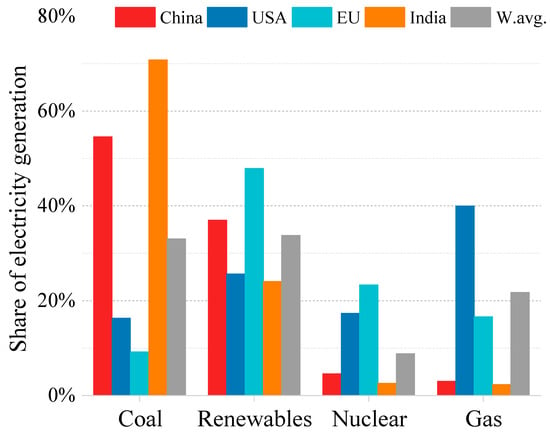
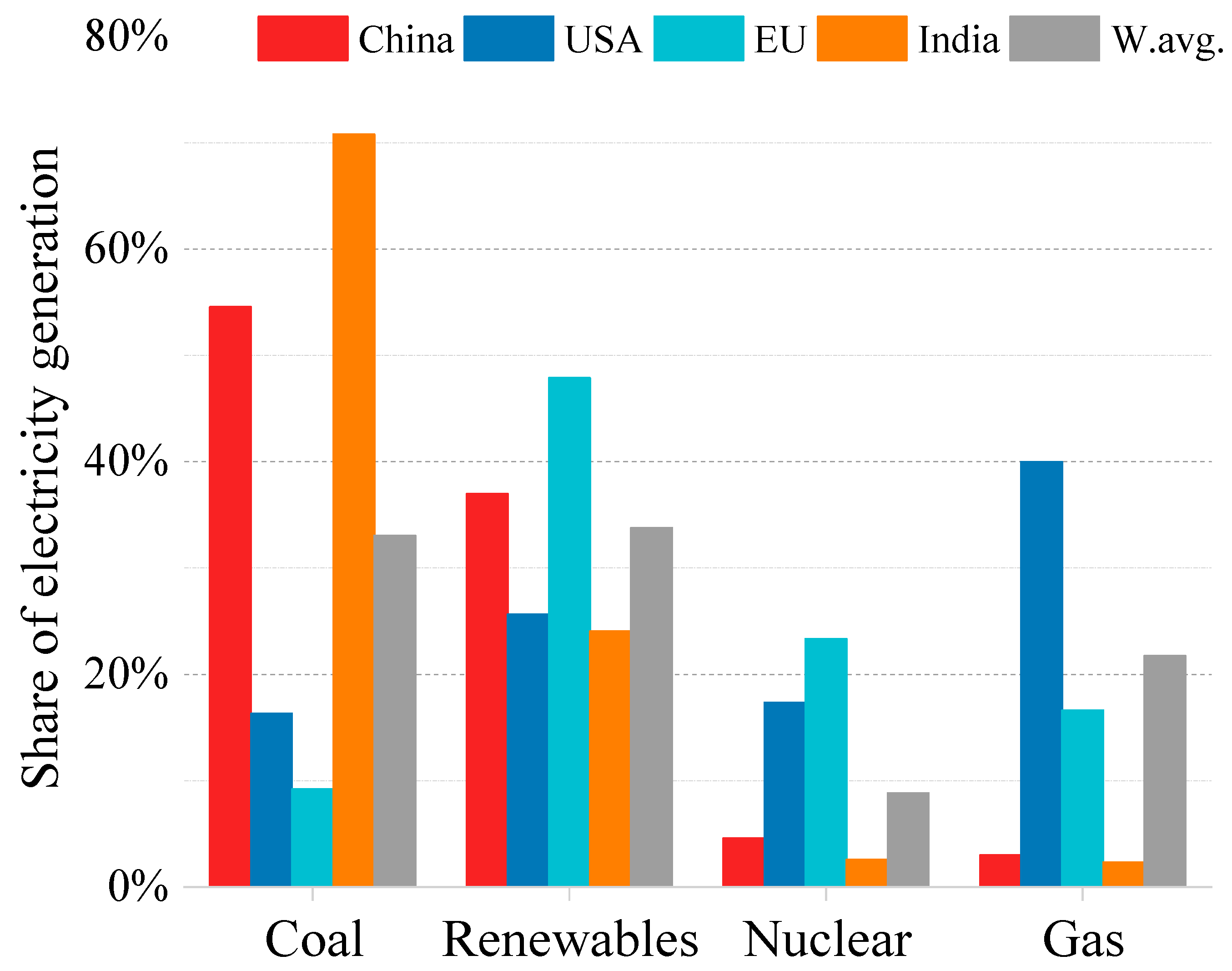
The rapid deployment of renewable energy has fundamentally changed the operating characteristics of modern power systems. With the increasing penetration of wind and photovoltaic generation, conventional coal-fired power plants are no longer required to operate under stable baseload conditions, but instead undertake frequent load-following, deep peak-shaving, and rapid ramping to compensate for the intermittency of renewable energy sources. As shown in Figure 1, although renewable energy has become an important component of electricity generation worldwide, coal-fired power generation still accounts for nearly 55% of China’s electricity supply in 2025, which is significantly higher than that of most major economies. Consequently, coal-fired units continue to provide the majority of the system’s peak-regulation capability and operational flexibility. Therefore, improving the flexibility of coal-fired power plants has become an inevitable requirement for ensuring the secure and stable operation of future power systems.
Figure 1.
Comparison of electricity generation mix between China and other major economies in 2025.
Among various coal-fired generation technologies, circulating fluidized bed (CFB) boilers possess unique advantages [1], including excellent fuel flexibility, low pollutant emissions, and uniform furnace temperature distribution. These characteristics make CFB power plants promising candidates for flexible operation under future low-carbon energy systems. However, the transient behavior of CFB boilers is governed by highly coupled gas–solid hydrodynamics, combustion, heat transfer, and steam–water thermodynamics, making flexibility enhancement considerably more challenging than that of conventional pulverized coal boilers [2].
Understanding these transient characteristics is essential for improving operational flexibility, optimizing control strategies, and evaluating new flexibility-enhancement technologies. Dynamic simulation has become an indispensable tool for investigating the transient behavior of CFB power plants. Over the past decades, various modeling approaches have been developed for different research objectives, ranging from high-fidelity CFD models and behavioral models to semi-empirical mechanistic models.
Several review papers have substantially advanced the understanding of individual aspects of CFB technology. Chew et al. [3] comprehensively reviewed correlations for predicting particle entrainment in gas–solid fluidization, covering monodisperse, binary, and continuous particle size distributions, and highlighted the need for more physically grounded models to improve predictions of entrainment and elutriation. Basu [4] reviewed the understanding of coal combustion in CFB boilers, discussed possible char-combustion modes, and summarized simplified approaches for predicting in-furnace sulfur capture and NOx control. Basu and Nag [5] critically reviewed heat transfer to water walls in CFB furnaces and identified uncertainties in solids suspension density as a major source of error when correlations derived from laboratory-scale facilities are applied to large industrial CFB boilers, eventually proposing empirical correlations for engineering design. Arjunwadkar et al. [6], in contrast, focused on practical operation and maintenance issues of CFB boilers and discussed approaches for mitigating these problems.
Despite these valuable contributions, the existing reviews are predominantly process-oriented, focusing on individual phenomena or specific aspects of CFB technology, rather than application-oriented dynamic modeling for flexible operation. Several important gaps therefore remain. First, the available modeling approaches differ substantially in their spatial and temporal scales, dependence on empirical information, model generality, and computational and implementation burden, yet they have not been systematically assessed against the requirements of industrial-scale CFB flexibility studies. Consequently, there is still no clear framework for selecting an appropriate modeling approach for different transient research tasks. Second, most CFB modeling reviews concentrate on the flue-gas side, whereas the steam–water cycle and, more importantly, its dynamic interaction with gas–solid flow, combustion, and heat transfer have received much less attention. A systematic understanding of how subsystem models can be extended toward fully coupled whole-plant dynamic simulation is therefore still lacking.
To address these gaps, this review provides an application-oriented assessment of dynamic modeling approaches (rather than a systematic bibliometric review) for industrial-scale CFB power plants under flexible operating conditions. The literature included in this study was selected according to three main considerations: direct relevance to transient or dynamic modeling of CFB boilers and power plants; methodological representativeness for the modeling approaches or coupling strategies discussed; and, where available, evidence from pilot- or industrial-scale application and validation. Seminal steady-state studies were retained when they established physical closures or modeling frameworks subsequently used in dynamic models. The review framework and workflow can be summarized as follows. The flue-gas-side models are classified into three major categories: 3-D physics-based CFD models, 0-D behavioral/data-driven models, and X-D semi-empirical mechanistic models—and compared within a unified framework considering spatial scale, applicable simulation time, empirical dependence, generality, computational and implementation burden, and suitability for flexibility studies. Representative implementation environments and validation practices are also summarized to further clarify the engineering maturity of the different approaches. The review then extends beyond the flue-gas side to examine established steam–water-cycle modeling methods and the evolution from sequential coupling to fully coupled whole-plant dynamic simulation. Based on the gaps revealed by this comparison, the key research questions for future integrated dynamic models are finally identified, with particular emphasis on their application to flexibility enhancement, operational optimization, and emerging flexibility technologies in CFB power plants. Through this framework, the review aims to connect model selection, subsystem coupling, and engineering application, thereby providing guidance for the development of dynamic modeling technologies for flexible and new-generation coal-fired power plants.
2. Why Modeling Is Necessary
2.1. Experimental Investigations
Experimental investigations have long been the primary approach for understanding the dynamic characteristics of CFB boilers. Such studies are typically conducted using laboratory-scale facilities, pilot-scale test rigs, or industrial demonstration units, providing valuable operational data for validating theoretical analyses and numerical models. With the widespread application of distributed control systems (DCS), increasing attention has also been paid to analyzing transient operating data collected from industrial power plants during load regulation processes. These data enable researchers to investigate the dynamic responses of key variables, including bed temperature, furnace pressure drop, steam temperature, oxygen concentration, and pollutant emission.
Despite these advantages, experimental studies on CFB boilers still face several inherent limitations. Since CFB boilers are large-scale gas–solid multiphase reactive systems, laboratory-scale experiments must simultaneously satisfy multiple similarity criteria [7], including hydrodynamic similarity (e.g., Froude number, Reynolds number, and Archimedes number), heat transfer similarity (e.g., Biot number), and thermal inertia similarity. However, in practice, it is extremely difficult to satisfy all these similarity requirements simultaneously in scaled-down experimental facilities. Furthermore, industrial-scale transient tests involving rapid load changes, deep peak shaving, emergency disturbances, or abnormal operating conditions are not only costly and time-consuming but may also introduce considerable operational risks to power plants. Consequently, plant operators are generally reluctant to conduct such experiments, resulting in a severe lack of high-quality transient data under flexible operating conditions. In addition, measurements in industrial power plants are usually limited to a small number of accessible locations, making it difficult to capture the spatial distributions of gas–solid flow, combustion heat release, and heat transfer throughout the CFB furnace. Therefore, although experiments remain indispensable for model validation, they alone cannot provide a comprehensive understanding of the complex transient mechanisms governing the flexible operation of CFB power plants.
2.2. Modeling and Simulation
The inherent limitations of experimental approaches have promoted the rapid development of numerical simulation methods for investigating the flexible operation of CFB power plants. Compared with experiments, dynamic simulation provides a controllable and reproducible research platform [8], allowing researchers to investigate the transient responses of individual physical processes without interfering with actual plant operation. It enables access to internal state variables that are difficult or even impossible to measure experimentally, such as local solid concentration, combustion intensity, heat flux distribution, and energy storage within different components. Consequently, dynamic simulation allows researchers to identify dominant influencing factors and quantify their individual contributions to overall system dynamics.
Dynamic simulation also possesses unique advantages in studying large-scale and long-duration transient processes. Flexible operation of CFB power plants generally involves load variations lasting from several minutes to several hours, during which the dynamic response is governed not only by gas–solid flow behavior but also by the thermal inertia of bed inventory, refractory materials, heat exchangers, and the overall thermal system. Dynamic simulation is capable of accurately capturing these system-level mass and energy storage effects, making it particularly suitable for describing transient load-changing processes over engineering time scales.
Once validated against experimental measurements or operational data from power plants, dynamic models can be repeatedly applied to investigate various operating scenarios, including rapid load variations, fuel switching, air distribution optimization, control strategy design, fault diagnosis, and equipment modification, without interrupting normal plant operation. Therefore, dynamic simulation has evolved from a simple analytical tool into an indispensable platform for mechanism investigation, performance prediction, system optimization, and advanced control development.
However, the reliability and applicability of dynamic simulation ultimately depend on the adopted modeling methodology. The substantial differences among existing approaches motivate the application-oriented comparison of flue-gas-side dynamic models presented in the following section.
3. Dynamic Modeling Approaches for Flue-Gas Side
To satisfy different research objectives, modeling approaches for the flue-gas side of CFB boilers exhibit significant differences in terms of governing equations, spatial resolution, computational requirements, and applicable time scales. In general, existing flue-gas-side models can be classified into three categories: computational fluid dynamics (CFD) models (collectively referred to as 3-D models), behavioral/machine-learning models (including grey-box and black-box models, collectively referred to as 0-D models), and semi-empirical mechanistic models (referred to as X-D models). The following sections review the characteristics of each approach and discuss their applicability for flexible operation studies. From a process perspective, the flue-gas side of a CFB boiler involves several strongly coupled phenomena. Air distribution establishes gas–solid fluidization and solids circulation; fuel devolatilization and char conversion determine heat release and species conversion; particle entrainment, separation, and return govern solids inventory and residence time; and heat and mass transfer among gas, solids, and walls determine the furnace temperature field and the heat flux transferred to the steam–water cycle. The three model families reviewed below differ mainly in how explicitly these processes are represented: CFD models resolve local fields, semi-empirical mechanistic models retain conservation laws while representing unresolved structures through closure relationships, and behavioral/data-driven models describe their aggregated input–output responses. Additional phenomena such as erosion or ash-related deposition and slagging may be important for specific applications, but they are generally treated as application-specific sub-models rather than defining features of flexibility-oriented dynamic modeling frameworks.
3.1. Three-Dimensional Physics-Based Models
Three-dimensional CFD models provide the highest level of physical fidelity for simulating gas–solid flow, combustion, and heat transfer processes in CFB boilers. By numerically solving conservation equations for mass, momentum, energy, and chemical species, CFD models can resolve detailed spatial distributions of gas velocity, solids concentration, temperature, pressure, and reaction rates within the furnace [9]. Therefore, they have become indispensable tools for investigating local flow structures, combustion characteristics, erosion behavior, pollutant formation, and heat transfer mechanisms.
According to the treatment of gas and solid phases, existing CFD models can generally be classified into the Eulerian–Eulerian and Eulerian–Lagrangian approaches. The Eulerian–Eulerian framework treats both gas and solid phases as interpenetrating continua and is currently the most widely adopted approach for industrial-scale CFB simulations. A typical implementation is the two-fluid model coupled with the kinetic theory of granular flow [10], which has been extensively applied in commercial CFD platforms such as ANSYS (2022 R1) Fluent. In contrast, the Eulerian–Lagrangian approach treats the gas phase as a continuum while explicitly tracking the trajectories of individual particles. Representative methods include the discrete element method [11], computational particle fluid dynamics (CPFD), and the multiphase particle-in-cell method implemented in Barracuda VR [12]. Although Eulerian–Lagrangian methods generally require significantly higher computational costs, they can provide a more detailed description of particle motion and particle–particle interactions.
A large number of studies have employed CFD simulations to investigate particle circulation [13], wall effect [14], anti-wear [15], and combustion characteristics [16]. The insights obtained from these simulations have greatly contributed to the optimization of boiler design and operating conditions.
Despite their excellent predictive capability at local scales, CFD models still exhibit several inherent limitations when applied to flexibility studies of CFB power plants. Due to the large number of computational cells required, the computational cost remains extremely high. For example, simulating the cold-state gas–solid flow behavior in a riser with dimensions of 0.25 m × 0.25 m × 3 m using approximately 250,000 computational cells requires around 5 h of simulation time for only 15 s of physical time. For industrial-scale boilers, simulations typically involve millions of computational cells, resulting in computational times ranging from several days to several weeks even on high-performance computing platforms. Furthermore, to satisfy numerical stability requirements, transient CFD simulations usually employ time steps on the order of milliseconds, making it impractical to simulate engineering-scale transient processes lasting tens of minutes or hours. More importantly, CFD models generally focus primarily on the flue-gas side and rarely incorporate the dynamic responses of the steam–water cycle and plant control systems.
3.2. Zero-Dimensional Behavioral and Data-Driven Models
Unlike CFD models, which explicitly resolve underlying physical processes, behavioral and data-driven models describe the dynamic response of CFB boilers by establishing mathematical relationships between system inputs and outputs without explicitly considering internal mechanisms such as gas–solid flow, combustion, or heat transfer. Due to their highly simplified representation of the physical system, these models are generally regarded as zero-dimensional (0-D) models, in which the entire boiler is treated as a lumped-parameter dynamic system. Depending on the degree of incorporated physical knowledge, these models can be further classified into black-box and grey-box models.
Black-box models rely entirely on measured operational data to identify the dynamic characteristics of the system. Early studies mainly employed classical system identification techniques, including transfer functions, autoregressive models with exogenous inputs, nonlinear autoregressive models with exogenous inputs, and state-space models. In recent years, with the rapid development of artificial intelligence, machine learning algorithms have been increasingly applied to dynamic prediction and control of CFB power plants, including artificial neural networks [17], long short-term memory networks [18], support vector machines [19], Gaussian process regression [20], and ensemble learning methods. Benefiting from their strong nonlinear fitting capabilities, these approaches generally achieve high prediction accuracy within the operating conditions represented by the training datasets.
Grey-box models attempt to combine simplified physical knowledge with data-driven parameter identification. Rather than relying solely on statistical relationships, grey-box approaches incorporate fundamental conservation laws or simplified dynamic equations into the model structure, while uncertain parameters are identified using operational data [21,22]. Therefore, compared with purely black-box approaches, grey-box models generally exhibit stronger extrapolation capability and improved physical interpretability while maintaining relatively low computational complexity.
Behavioral and data-driven models possess several significant advantages. Their extremely low computational cost enables real-time simulation, online prediction, digital twin applications, and advanced control [23]. Furthermore, because model complexity is largely independent of boiler geometrical details, these models can be rapidly developed using available operational data from power plants. However, these approaches also exhibit important limitations. Their predictive capability strongly depends on the quality and coverage of training data, which limits their generalization ability to different units or different operating conditions of the same unit. More importantly, behavioral models provide limited physical interpretation of the coupled mechanisms governing system dynamics, making them unsuitable for investigating the impacts of CFB boiler retrofits, fuel switching, or newly developed operational strategies.
3.3. Semi-Empirical Mechanistic Models (X-D Fluidization Models)
Between high-fidelity CFD models and behavioral models, semi-empirical mechanistic models provide a compromise between physical fidelity and computational efficiency. These models are also referred to as fluidization models (FMs) [24] or reduced-order physical models (ROPMs). By introducing experimentally derived correlations and theoretical assumptions, they simplify the complex multiphase flow behavior in CFB boilers while retaining the dominant physical mechanisms governing gas–solid flow, combustion, and heat transfer. The fundamental concept of ROPMs is based on the observation that, although the detailed three-dimensional structure of gas–solid flow is highly complex, the dominant characteristics of industrial-scale CFB operation can be represented using simplified flow regimes and distributed control volumes. Therefore, the furnace is usually discretized vertically into multiple computational cells (compartments), and mass and energy conservation equations for both gas and solid phases are established within each cell. These equations can be written generally as:
where Mk,i is the gas/solids total mass in cell i, kg; is the mass inflow rate of cell i, kg/s; is the mass outflow rate of cell i, kg/s; is the net mass generation rate of gas/solids in cell i, kg/s; Ui is the total energy in cell i, J; is the specific enthalpy of inflow for cell i, J/kg; is the specific enthalpy of outflow for cell i, J/kg; is the heat generation by reactions, W; is the bed-to-wall heat flux, W.
Subsequently, empirical or semi-empirical correlations are introduced to describe key parameters, including particle entrainment rate (Gs,i), solids suspension density (Cs,i), heat transfer coefficients (hw,i), and reaction rates (Rr,i), thereby representing complex gas–solid interactions like the equations below:
where ug is gas velocity, m/s; ut is particle terminal velocity, m/s; ds is particle diameter, m; is solids density, kg/m3; is gas density, kg/m3; zi is the height of cell i, m; is average temperature of cell i, K; uclus is the cluster velocity in the wall-layer, m/s; Yj,i is the gas concentration, %; k0 is acceleration factor; Ea is activation energy, kJ/mol.
Depending on the spatial discretization level adopted to describe the flow field, these models can be further classified into 0-D, 1-D, 1.5-D, and 2-D models, which are listed in Table 1. Essentially, increasing spatial resolution enables the mathematical representation to progressively approach the actual hydrodynamic behavior of CFB boilers.
Table 1.
Summary of dynamic modeling work for CFB based on the X-D fluidization model.
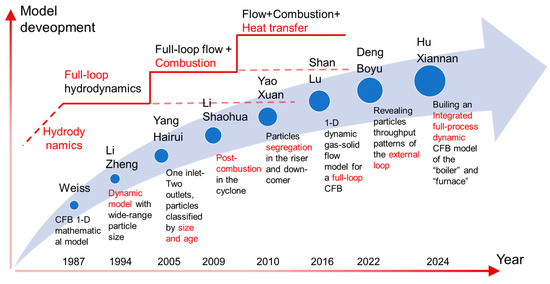
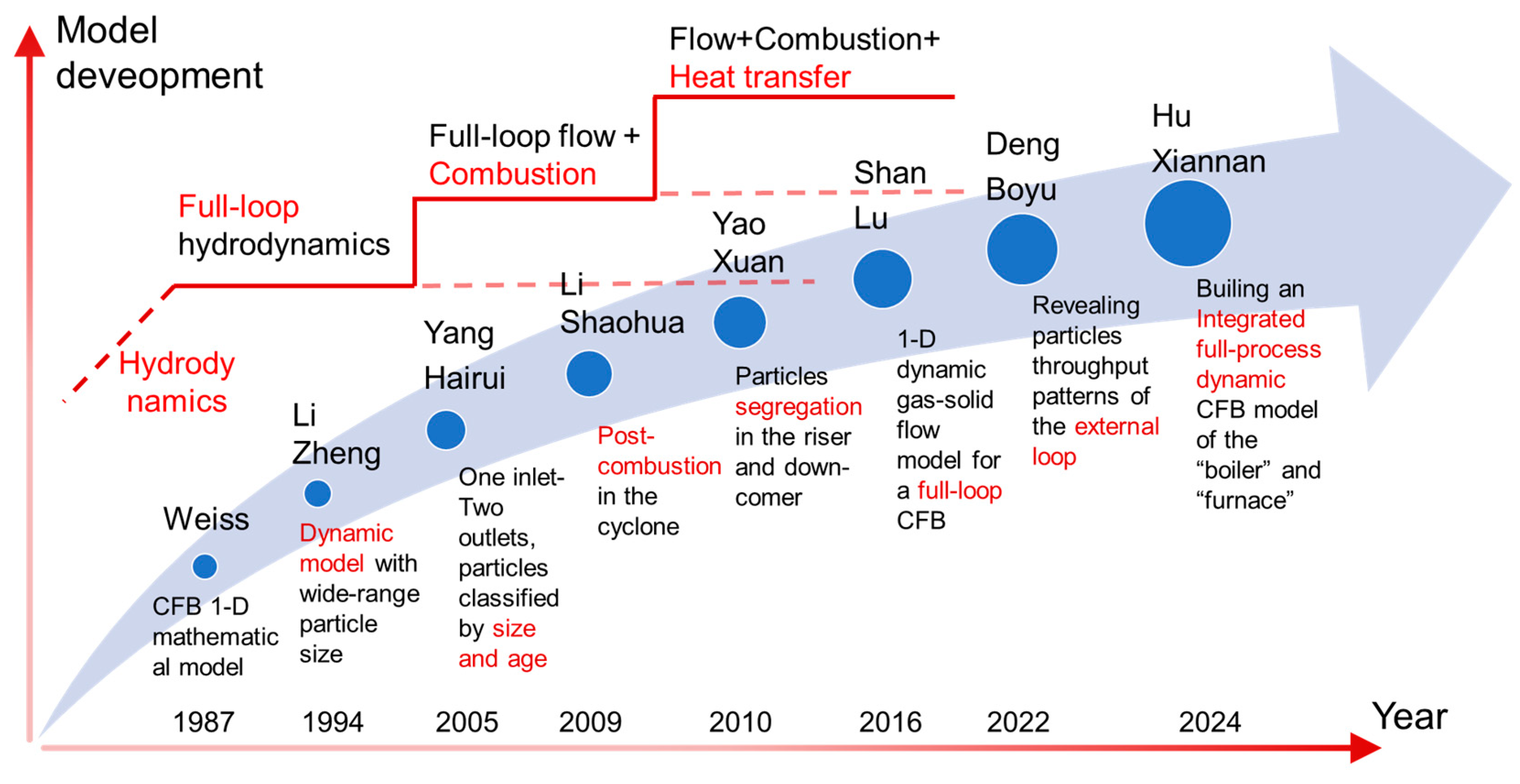
Most researchers have adopted 1-D or 1.5-D FMs for both steady-state and dynamic simulations. The earliest and most mature 1-D model was developed by Rajan [37] at West Virginia University. Using a mechanistic approach, Rajan established a bubbling fluidized bed model that comprehensively considered coal devolatilization, char combustion kinetics, limestone sulfation for SO2 capture, NOx emissions, particle attrition and entrainment, gas–solid flow dynamics, and heat transfer between suspended particles and furnace walls. The model was validated in a combustor with a cross-sectional area of 0.9 m × 0.45 m and demonstrated satisfactory prediction capability for particle size distribution and the axial concentration profiles of O2, CO, CO2, SO2, and NOx. Building upon Rajan’s work, Weiss at the University of Siegen [38] developed a mathematical model for a 170 kW coal-fired CFB pilot power plant and performed transient validation using a relaxation–Newton–Raphson integration algorithm. Researchers at Tsinghua University, as shown in Figure 2, further inherited and extended this framework into a full-loop dynamic compartment model suitable for CFB boilers under Chinese operating conditions.
Figure 2.
The development of 1-D cell dynamic model for CFB boiler at Tsinghua University.
Li Zheng [26] further refined the fluidization sub-model by dividing the CFB combustor into a lower dense bed region and an upper dilute region based on the theories of Rhodes and Geldart. A wide particle-size distribution model was established and applied for performance prediction of a 220 t/h CFB boiler. Yang Hairui [39], addressing the role of particle attrition in the material balance, proposed that particles should be classified not only by size but also by age. He deduced that the residence time of particles in CFB is the average residence time of particles of the same size but different ages, and ultimately established a comprehensive material balance model for CFB. Regarding the impact of CFB particle segregation on bottom ash size, a semi-empirical model was established using terminal velocity as an indicator of particle segregation intensity. Through model calculations and calibration with test data from three boilers (75 t/h, 130 t/h, and 220 t/h), empirical parameters affecting the material balance within the bed were determined. Li Shaohua [40] researched and developed computational models for the average particle residence time and the pressure drop across the cyclone in the CFB cold-state test rig. Based on this, he established a particle combustion model and estimated particle combustion in different regions within the cyclone, subsequently developed a one-dimensional overall combustion model for CFB boilers that accounts for post-combustion in the cyclone. This model was validated under steady-state conditions at 90%, 70%, and 57% load for a 135 MW combined heat and power CFB boiler. Yao Xuan [41] considered solids distribution between the riser and standpipe and developed a hydrodynamic model with wide-size-distribution particles, describing particle segregation characteristics based on a cold-flow CFB test facility (riser dimensions: 0.1 m × 0.1 m × 4.5 m), also providing a deeper understanding of pressure balance within the CFB circulation loop. Shan Lu [42] further incorporated gas–solid flow behavior inside the cyclone and loop seal, especially considering the inventory and the residence time of solids in the cyclone and the circulating rate in the loop-seal. Finally, a full-loop dynamic gas–solid flow model was established against the field data of a 350 MW supercritical CFB boiler under load-up condition. Based on this model, Deng Boyu [32] further considered the flow inertia and interactions among different components throughout the CFB circulation loop and systematically revealed the solids throughput behavior during load-changing processes. This full-loop flue-gas-side framework was subsequently extended toward coupled boiler and steam–water dynamic simulation [35], as discussed further in Section 5.2.
With the continuous development of measurement techniques, the understanding of gas–solid flow behavior in large-scale CFB boilers has been significantly improved. Consequently, many assumptions inherited from bubbling fluidized bed theories in early 1-D models [43] are no longer applicable, such as the concept of saturated particle entrainment above the transport disengaging height (TDH) [44]. In the freeboard region of CFB furnaces, the core–annulus model, characterized by an upward-flowing core region and a downward-flowing near-wall region, has been widely adopted to describe the radial non-uniformity of solids distribution. Based on this concept, researchers have developed 1.5-D models by combining axial discretization with simplified radial flow assumptions. For example, empirical correlations describing solids concentration decay [45], solid back-mixing [46], and downward cluster velocity near the wall [47] have been incorporated to describe the dynamic behavior of industrial-scale CFB boilers. Subsequently, these models have been further extended by integrating combustion kinetics, furnace-side heat transfer, cyclone/standpipe/loop seal dynamics, and external solids circulation, enabling simulation of the entire solids loop.
Although semi-empirical mechanistic models sacrifice detailed local flow information, they provide several significant advantages for flexibility studies. First, their computational requirements are several orders of magnitude lower than those of three-dimensional CFD models, allowing simulations over engineering time scales ranging from several minutes to several hours. This capability is particularly important for analyzing load-changing processes in CFB power plants, where the thermal inertia of bed inventory, refractory materials, and heat exchangers determines the transient response of the entire system. Second, because these models are constructed based on first-principles conservation laws, they can capture the influence of operating parameters, such as fuel input, particle size distribution, solids circulation rate, and heat transfer coefficients, thereby providing valuable insights into mechanisms affecting flexible operation. Furthermore, benefiting from advances in computational technologies and simulation platforms, these models can be effectively coupled with steam–water cycle models and plant control systems, making them suitable for whole-plant dynamic simulations.
Nevertheless, since many closure relationships for model parameters and variables are derived from laboratory-scale experiments or specific operating conditions, their applicability to different boiler designs, fuel types, and operating ranges requires careful validation. Moreover, model prediction accuracy strongly depends on the selection of empirical correlations and the appropriate level of spatial discretization. Excessive simplification may neglect important transient phenomena, whereas excessive discretization increases computational cost and model complexity. Therefore, developing reliable semi-empirical models requires a balance among physical representation, parameter identification, and computational efficiency.
3.4. Comparative Assessment and Implications for Flexible Operation
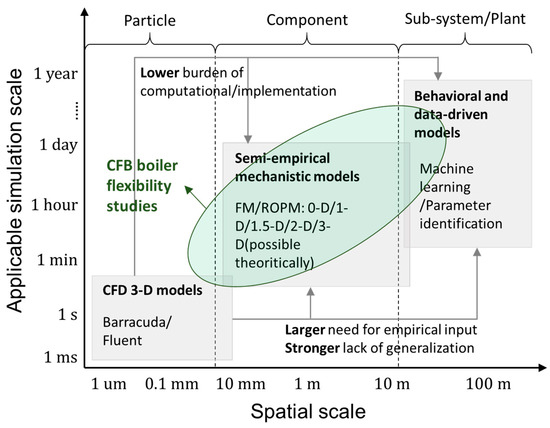
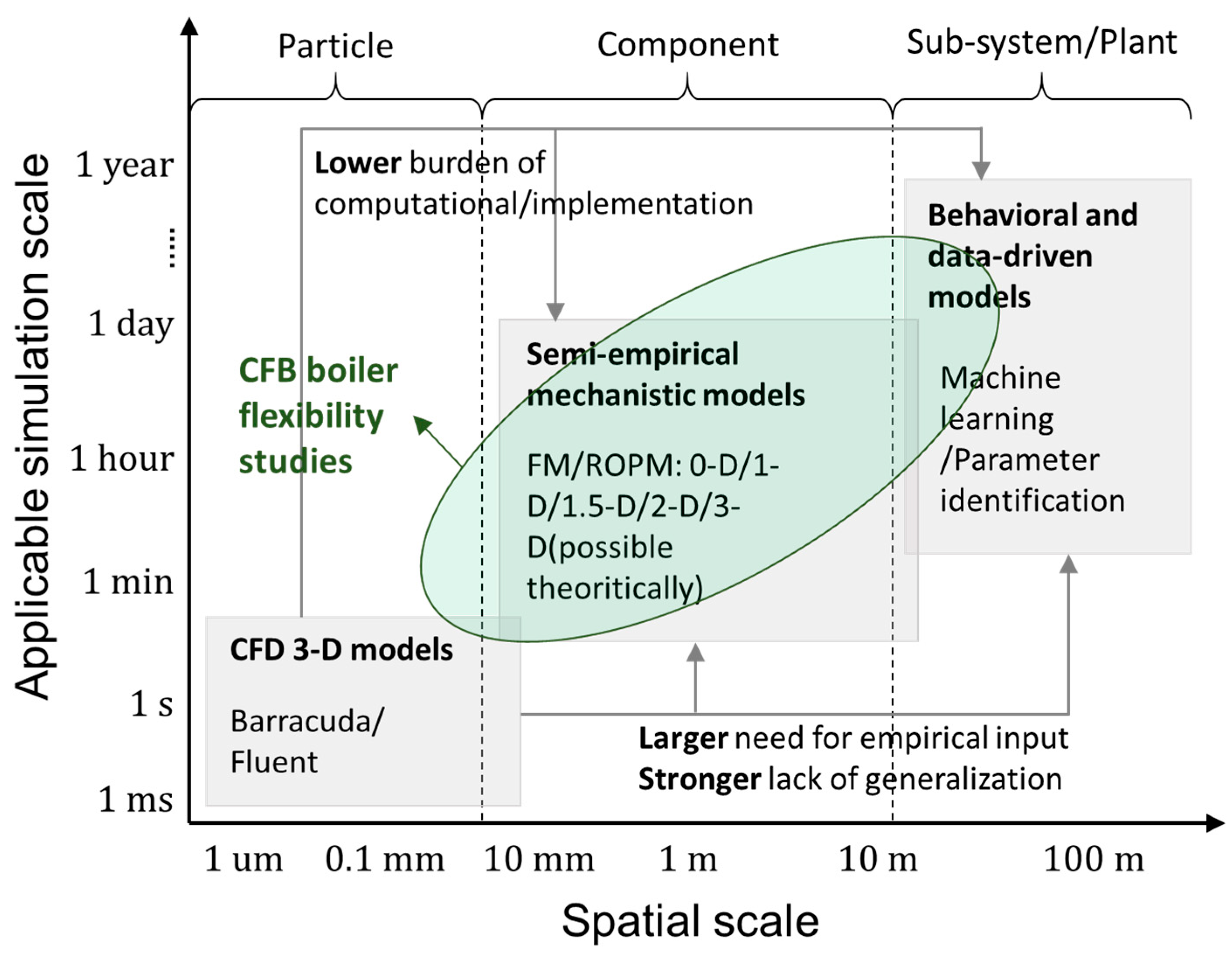
The above review indicates that no single modeling approach is universally optimal, and model selection should instead depend on the intended spatial and temporal scales of the application. As summarized in Figure 3, increasing model simplification from three-dimensional CFD toward semi-empirical mechanistic and behavioral/data-driven models generally enables larger system boundaries and longer simulation time scales while substantially reducing computational requirements. This simplification is accompanied by increasing reliance on empirical correlations, calibrated parameters, or operational data, and consequently may reduce model generality and transferability. Therefore, the three approaches should be regarded as complementary modeling levels rather than competing alternatives.
Figure 3.
Relationship between spatial scale, simulation time scale, and applicability of different modeling approaches for CFB boilers.
These trade-offs are particularly important for CFB flexibility studies, which require minute-to-hour simulation while retaining sufficient information on solids inventory, combustion, heat transfer, and thermal inertia. As highlighted in Figure 3, this application domain is most closely matched by semi-empirical mechanistic models, while CFD and behavioral/data-driven models remain complementary for local mechanism analysis and online prediction/control, respectively.
It should be noted that the numerical solver is generally implementation-specific rather than an intrinsic characteristic of a modeling approach. Therefore, representative solution environments are summarized in Table 2, while specific platforms used for steam–water and whole-plant simulations are further discussed in Section 4 and Section 5.
Table 2.
Application-oriented comparison of major flue-gas-side modeling approaches for CFB flexibility studies.
Validation strategies should be matched to model purpose and scale. As summarized in Table 2, different model families rely on different validation information; for flexibility-oriented mechanistic and whole-plant models, both steady-state and transient validation are required. Industrial transient data are particularly valuable because they test not only output accuracy but also the coupled time constants associated with solids inventory, thermal storage, steam–water dynamics, and control responses.
The computational requirement is also closely associated with the economic burden over the modeling lifecycle. Model simplification generally reduces the direct computational cost of repeated simulations, but the total modeling cost also includes model development, software and hardware requirements, parameter calibration, data acquisition, adaptation, and maintenance. CFD models usually require substantial computational resources, preprocessing effort, specialist expertise, and often commercial software, whereas semi-empirical models involve relatively high initial development effort but much lower recurring simulation costs. Behavioral and data-driven models have very low execution costs, although their development and transfer may require extensive operational data and retraining. Thus, the economic attractiveness of a modeling approach should be assessed over its complete lifecycle rather than solely by simulation time.
Model selection can also influence pollutant-emission analysis, particularly under flexible operation. Emissions such as NOx, SO2, and CO depend not only on the adopted chemical reaction mechanisms but also on the representation of gas–solid hydrodynamics, because solids circulation, particle residence time, air distribution, temperature, and local oxidizing/reducing conditions directly affect pollutant formation and removal. Consequently, higher hydrodynamic resolution does not necessarily guarantee more accurate emission prediction if the associated chemical kinetics remain strongly simplified. Conversely, semi-empirical mechanistic models incorporating appropriate species balances and validated reaction sub-models can provide an effective approach for investigating transient emissions over plant-relevant time scales. This becomes particularly important during load changes, where competing effects of furnace temperature, excess oxygen, air staging, and solids circulation may produce emission responses that cannot be inferred from steady-state operating points alone [48].
Overall, the appropriate dynamic model should balance physical fidelity, applicable spatial and temporal scales, empirical dependence, generality, computational and economic burden, and the intended engineering application. Taken together, these considerations position semi-empirical mechanistic models as the most practical current choice for mechanism-oriented, minute-to-hour CFB flexibility studies requiring subsequent coupling with steam–water and control systems.
4. Dynamic Modeling Approaches for Steam-Water Cycle
Dynamic modeling of the steam–water cycle in CFB power plants is highly similar to that of pulverized coal (PC) power plants. Major components, including the economizer, drum–water wall evaporation system, superheaters, reheaters, steam turbines, condensers, feedwater heaters, and auxiliary equipment, exhibit almost identical structures, with differences mainly arising from the specific arrangement of heat transfer surfaces. Over the past several decades, transient governing equations for steam–water systems have been well established based on mass, momentum, and energy conservation principles, combined with accurate thermophysical property descriptions of water and steam [49]. Therefore, various mature modeling approaches and simulation platforms are currently available for accurately predicting the transient responses of thermal power plants during load-changing processes.
4.1. Physics-Based Dynamic Models
Physics-based models represent the mainstream approach for dynamic simulation of steam–water systems. These models mainly involve single-phase and two-phase thermohydraulic processes and are generally established by applying mass, momentum, and energy conservation equations to individual control volumes [50], together with accurate thermodynamic property libraries, such as the IAPWS-IF97 formulation, to calculate water and steam properties. Depending on the required level of detail, heat transfer components can be modeled using lumped-parameter approaches [51], finite-volume discretization, moving-boundary models [52], or distributed-parameter models.
Among these approaches, the finite-volume method has become one of the most widely adopted techniques in engineering applications because it provides a balance between computational efficiency and numerical stability. These models discretize fluid flow paths and heat exchangers into multiple control volumes, allowing the representation of metal wall thermal inertia, fluid compressibility, phase transition processes, and transient heat transfer characteristics during load changes. In addition, more detailed distributed-parameter models have been developed. Although they introduce additional computational complexity, they can improve prediction accuracy under rapid load-changing conditions [53].
4.2. Modeling Platforms and Engineering Applications
Since the governing equations and thermodynamic properties of steam–water systems are well understood, dynamic component models for thermal power systems have gradually become standardized and are widely available in both commercial and open-source simulation libraries. The maturity of steam–water system modeling is also reflected in the availability of advanced simulation platforms. Software packages such as Advanced Process Simulation (APROS), Aspen Plus Dynamics, Generalised PROcess Modelling System (gPROMS), and Dymola (Dynamic Modeling Lab, typically combined with the ThermalPower library developed by Modelon) and OpenModelica provide comprehensive component libraries for rapidly constructing dynamic thermal power plant models. Furthermore, several open-source Modelica libraries for thermal system simulation, including ThermoPower, ThermosysPro, and Clara, have further improved the reproducibility and accessibility of dynamic modeling studies.
These platforms have been extensively applied in dynamic simulation, coordinated control design, start-up optimization, fault diagnosis, operator training simulators, and model predictive control of thermal power plants. Benefiting from their highly modular structure and component reusability, researchers can easily assemble different steam–water cycle configurations according to specific research objectives without developing component models from scratch.
4.3. Summary
Overall, the principal challenge for CFB flexibility studies no longer lies in the formulation of individual steam–water components, but in their dynamic integration with the flue-gas side and plant control system.
5. Coupled Modeling of the Whole CFB Power Plant
In practical CFB plants, the flue-gas side and the steam–water cycle are strongly coupled through heat transfer across furnace walls and heat exchanger surfaces. Variations in combustion intensity, solids circulation, and gas–solid heat transfer directly influence the heat absorption of water walls and convective heat transfer surfaces, thereby affecting steam generation, steam temperature, and turbine performance. Conversely, changes in steam flow rate, working fluid temperature, and metal wall temperature modify the heat transfer boundary conditions on the flue-gas side, subsequently influencing combustion behavior and furnace thermal characteristics. Therefore, accurate prediction of flexible operation requires simultaneous dynamic simulation of these two subsystems rather than independent analyses.
Despite this strong physical coupling, integrated dynamic simulation of industrial-scale CFB power plants remains far less mature than individual subsystem modeling. Existing studies can generally be classified into two categories: sequential coupling approaches and fully coupled dynamic simulation frameworks.
5.1. Sequential Coupling Steady-State Models
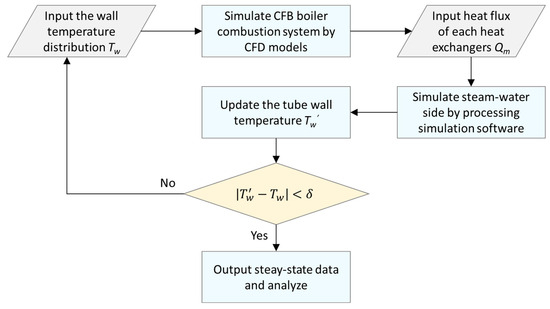
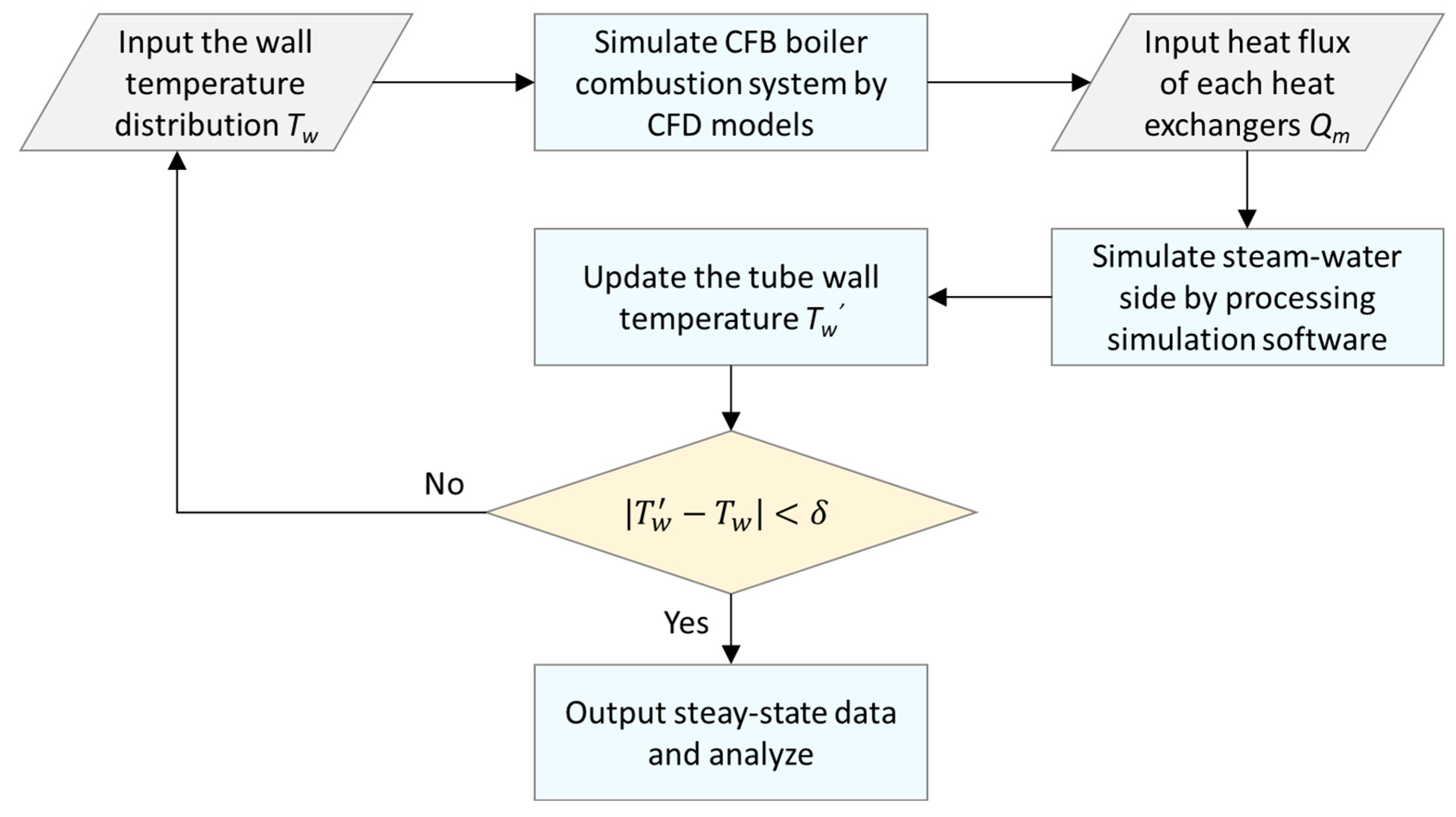
Some studies [54,55] have attempted to couple CFB combustion systems with steam–water cycle models, mainly relying on sequential coupling between dedicated commercial software packages. As illustrated in Figure 4, CFD software such as ANSYS Fluent or Barracuda VR is first employed to calculate gas–solid flow, combustion, and furnace-side heat transfer under assumed boundary conditions. The obtained wall heat flux is then transferred through OPC communication protocols to process simulation platforms (e.g., APROS or other thermal system simulators) for steam–water-side calculations. Subsequently, the updated wall temperature is fed back to the CFD model, and the procedure is repeated until convergence of the wall temperature is achieved. This strategy enables researchers to combine the advantages of different simulation platforms while avoiding the considerable effort required to develop an integrated simulation environment from scratch. Therefore, sequential coupling approaches have been successfully applied to calculate steady-state or quasi-steady-state behaviors under multiple specified load conditions.
Figure 4.
Schematic diagram of sequential coupling steady-state models.
However, the information exchange between the flue-gas side and the steam–water cycle in these approaches is generally achieved through iterative manual or semi-automatic procedures based on converged boundary conditions. Essentially, these methods represent a series of coupled steady-state calculations rather than true transient load-changing simulations. They cannot accurately reproduce the continuous evolution of gas–solid flow, thermal inertia effects, and steam–water-side responses during rapid load variations.
5.2. Fully Coupled Dynamic Models
To overcome the limitations of sequential coupling, several researchers have attempted to establish fully coupled dynamic simulation platforms capable of simultaneously solving the governing equations of both the flue-gas side and the steam–water cycle.
One of the most representative contributions was made by Castilla et al. [33] at Chalmers University of Technology. Based on the object-oriented Modelica language and the commercial Dymola simulation environment, they integrated self-developed gas–solid flow sub-models with the ThermalPower library for thermo-hydraulic components, developing dynamic models for a 100 MW (80 MWth + 20 MWel) biomass-fired CFB combined heat and power (CHP) plant and a 130 MW bubbling fluidized bed (BFB) CHP plant [56]. Their work demonstrated the feasibility of whole-plant dynamic simulation and provided valuable insights into transient load-following characteristics and control strategies of fluidized bed power plants. Nevertheless, this modeling approach still faces several challenges. The commercial ThermalPower library mainly provides component models for steam–water systems and does not include dedicated gas–solid flow models for CFB combustion systems, requiring researchers to independently develop such models within the same simulation environment. Furthermore, dependence on commercial software and proprietary model libraries significantly increases research costs and limits the reproducibility and accessibility of the proposed methodology for broader applications.
In addition, Hu Xiannan et al. [35] from Tsinghua University developed a detailed steam–water-side model based on an existing full-loop dynamic model of the CFB flue-gas side. The evaporation section, superheating section, and preheating section of the boiler were modeled using general modular components, which were further modified and linearized. A cascade quasi-four-input control strategy was introduced to connect the evaporation system and superheaters. The integrated model was then combined with the flue-gas-side model and implemented within an IMSL solver based on Fortran programming, enabling adaptive simulation under varying load conditions. The model was validated under both steady-state and transient conditions using a 135 MW CFB boiler [57]. However, system-level model development based on traditional programming languages exhibits limited scalability and makes integration with dynamic models of turbine regenerative systems and reheating systems more challenging.
To address these limitations, recently, Hu Xiannan et al. [58] developed an integrated dynamic simulation framework based on the open-source Modelica 4.0 language and the MWorks simulation platform. Within a unified modeling environment, detailed modeling procedures for the CFB flue-gas side were established. A 1.5-D core–annulus gas–solid flow model was adopted as the foundation, while different sub-models, including coal combustion, wall heat transfer, and spatial discretization strategies, were systematically evaluated to balance model complexity and computational efficiency. Dynamic processes throughout the entire CFB circulation loop were considered. Based on a fluid dynamic pipe, a generalized distributed-parameter heat exchanger model was developed using dynamic arrays to exchange heat flux information from the flue-gas side and temperature information from the steam–water side. The turbine regenerative system was also modeled dynamically. Finally, these subsystems were seamlessly coupled through the Fluid and HeatPort interfaces provided by the Modelica Standard Library, establishing a fully integrated, fully mechanistic, and fully dynamic simulation platform for CFB power plants (called Omni CFB) [58].
5.3. Challenges and Opportunities
To date, only a limited number of studies have reported fully coupled dynamic models capable of simultaneously describing gas–solid flow, combustion, heat transfer, steam–water circulation, and power plant control systems in industrial-scale CFB plants. Most existing studies remain focused on individual subsystems or simplified coupling strategies.
The limited development of integrated CFB dynamic simulation is not only caused by modeling complexity but also reflects the interdisciplinary nature of CFB power plant flexibility research. The flue-gas side originates primarily from chemical engineering and gas–solid multiphase flow disciplines, whereas the steam–water cycle traditionally belongs to thermal engineering and power system research. These two fields differ significantly in modeling philosophy, characteristic time scales, and software ecosystems, creating substantial barriers to the development of integrated models.
From a technical perspective, current integrated models face three fundamental barriers: numerical stiffness arising from multi-timescale coupling, limited transferability of empirical gas–solid closures beyond their calibrated conditions, and the difficulty of simultaneously achieving physical fidelity, numerical robustness, and engineering-level computational efficiency. These limitations currently constrain the wider application of fully coupled CFB dynamic models.
6. Future Research Directions for Integrated Dynamic Models
Future research should move from identifying these limitations toward developing transferable closure formulations for different boilers and fuels, coupling and solution strategies specifically designed for disparate subsystem time scales, and adaptive model-reduction or hybrid approaches that reduce computational burden while preserving the physical states governing flexible operation. Their value should ultimately be evaluated by their ability to support deep peak shaving, rapid load ramping, start-up and shutdown optimization, coordinated combustion–steam control, transient efficiency–emission assessment, and emerging flexibility-enhancement technologies.
Data-driven and artificial-intelligence methods can assist integrated mechanistic models through parameter calibration, surrogate modeling, online updating, and state estimation, but their transfer across scales requires particular caution. Models trained only on laboratory-scale experiments or small-scale simulation data should not be directly extrapolated to utility-scale CFB units because differences in geometry, hydrodynamic similarity, fuel properties, and operating domains may invalidate the learned relationships. A more defensible pathway is to use small-scale or mechanistic-model data for pre-training or surrogate construction, and subsequently constrain or update the model using plant-scale physics and operational data, followed by independent transient validation. In this role, AI, real-time simulation, and digital twins should be regarded as enabling tools for translating integrated dynamic models into practical engineering platforms rather than as substitutes for plant-scale physical validation.
7. Conclusions
This review assessed dynamic modeling approaches for CFB power plants from the perspective of flexible operation, covering flue-gas-side models, steam–water cycle models, and whole-plant coupling. The comparison shows that model selection should be application-driven rather than fidelity-driven. For industrial-scale minute-to-hour flexibility studies, semi-empirical mechanistic models provide a particularly effective compromise between mechanistic interpretability, computational tractability, and coupling capability, while CFD and behavioral/data-driven models remain complementary for local mechanism analysis and online prediction/control, respectively.
The steam–water cycle is comparatively mature, and the major methodological bottleneck has shifted toward robust whole-plant integration across gas–solid flow, combustion, heat transfer, steam–water dynamics, and plant control. For such integrated models, generality over wide operating ranges, computational and implementation burden, transient validation, and appropriate representation of pollutant chemistry are as important as nominal model detail.
Future development should therefore be driven by the flexibility requirements of new-generation coal-fired power plants, with priority given to transferable reduced-order sub-models, robust multi-timescale coupling, and validated hybrid mechanistic–data-driven approaches.
Author Contributions
Conceptualization, X.H.; methodology, X.H.; investigation, X.H.; writing—original draft preparation, X.H.; writing—review and editing, H.Y., M.Z. and T.Z.; visualization, H.W., R.B. and T.W.; supervision, H.Y., M.Z. and T.Z.; project administration, M.Z. All authors have read and agreed to the published version of the manuscript.
Funding
This research was funded by the Key Research and Development Program of Yunnan Province, China, grant number 202503AR080001.
Data Availability Statement
The data presented in this study are available on request from the corresponding author.
Conflicts of Interest
The authors declare no conflicts of interest.
References
- Yue, G.; Cai, R.; Lu, J.; Zhang, H. From a CFB reactor to a CFB boiler–The review of R&D progress of CFB coal combustion technology in China. Powder Technol. 2017, 316, 18–28. [Google Scholar] [CrossRef] [Scilit]
- Hu, X.; Deng, B.; Liu, H.; Yang, D.; Yang, H. Status and development trend of rapid load regulation technology for circulating fluidized bed boiler. Clean Coal Technol. 2023, 29, 11–23. (In Chinese) [Google Scholar] [CrossRef]
- Chew, J.W.; Cahyadi, A.; Hrenya, C.M.; Karri, R.; Cocco, R.A. Review of entrainment correlations in gas–solid fluidization. Chem. Eng. J. 2015, 260, 152–171. [Google Scholar] [CrossRef] [Scilit]
- Basu, P. Combustion of coal in circulating fluidized-bed boilers: A review. Chem. Eng. Sci. 1999, 54, 5547–5557. [Google Scholar] [CrossRef] [Scilit]
- Basu, P.; Nag, P.K. Heat transfer to walls of a circulating fluidized-bed furnace. Chem. Eng. Sci. 1996, 51, 1–26. [Google Scholar] [CrossRef] [Scilit]
- Arjunwadkar, A.; Basu, P.; Acharya, B. A review of some operation and maintenance issues of CFBC boilers. Appl. Therm. Eng. 2016, 102, 672–694. [Google Scholar] [CrossRef] [Scilit]
- Glicksman, L.R. Scaling relationships for fluidized beds. Chem. Eng. Sci. 1984, 39, 1373–1379. [Google Scholar] [CrossRef] [Scilit]
- Majanne, Y. Simulation as a tool for process design and disturbance analysis in industrial power plants. IFAC Proc. Vol. 2006, 39, 321–326. [Google Scholar] [CrossRef]
- Wang, W.; Lu, B.; Zhang, N.; Shi, Z.; Li, J. A review of multiscale CFD for gas–solid CFB modeling. Int. J. Multiph. Flow 2010, 36, 109–118. [Google Scholar] [CrossRef] [Scilit]
- Yu, L.; Lu, J.; Zhang, X.; Zhang, S. Numerical simulation of the bubbling fluidized bed coal gasification by the kinetic theory of granular flow (KTGF). Fuel 2007, 86, 722–734. [Google Scholar] [CrossRef] [Scilit]
- Ostermeier, P.; DeYoung, S.; Vandersickel, A.; Gleis, S.; Spliethoff, H. Comprehensive investigation and comparison of TFM, DenseDPM and CFD-DEM for dense fluidized beds. Chem. Eng. Sci. 2019, 196, 291–309. [Google Scholar] [CrossRef] [Scilit]
- Andrews, M.J.; O’Rourke, P.J. The multiphase particle-in-cell (MP-PIC) method for dense particulate flows. Int. J. Multiph. Flow 1996, 22, 379–402. [Google Scholar] [CrossRef] [Scilit]
- Xu, Y.; Musser, J.; Li, T.; Gopalan, B.; Panday, R.; Tucker, J.; Breault, G.; Clarke, M.A.; Rogers, W.A. Numerical simulation and experimental study of the gas–solid flow behavior inside a full-loop circulating fluidized bed: Evaluation of different drag models. Ind. Eng. Chem. Res. 2018, 57, 740–750. [Google Scholar] [CrossRef] [Scilit]
- Zhou, X.; Gao, J.; Xu, C.; Lan, X. Effect of wall boundary condition on CFD simulation of CFB risers. Particuology 2013, 11, 556–565. [Google Scholar] [CrossRef] [Scilit]
- Xia, Y.; Cheng, L.; Yu, C.; Xu, L.; Wang, Q.; Fang, M. Anti-wear beam effects on gas–solid hydrodynamics in a circulating fluidized bed. Particuology 2015, 19, 173–184. [Google Scholar] [CrossRef] [Scilit]
- Liu, H.; Li, S.; Xiang, X.; Gong, S.; Jia, C.; Wang, Q.; Sun, B. Simulation of biogas co-combustion in CFB boiler: Combustion analysis using the CPFD method. Case Stud. Therm. Eng. 2024, 59, 104610. [Google Scholar] [CrossRef] [Scilit]
- Krzywanski, J.; Czakiert, T.; Blaszczuk, A.; Rajczyk, R.; Muskala, W.; Nowak, W. A generalized model of SO2 emissions from large-and small-scale CFB boilers by artificial neural network approach: Part 1. The mathematical model of SO2 emissions in air-firing, oxygen-enriched and oxycombustion CFB conditions. Fuel Process. Technol. 2015, 137, 66–74. [Google Scholar] [CrossRef] [Scilit]
- Hong, F.; Long, D.; Chen, J.; Gao, M. Modeling for the bed temperature 2D-interval prediction of CFB boilers based on long-short term memory network. Energy 2020, 194, 116733. [Google Scholar] [CrossRef] [Scilit]
- Adams, D.; Oh, D.H.; Kim, D.W.; Lee, C.H.; Oh, M. Prediction of SOx–NOx emission from a coal-fired CFB power plant with machine learning: Plant data learned by deep neural network and least square support vector machine. J. Clean. Prod. 2020, 270, 122310. [Google Scholar] [CrossRef] [Scilit]
- Mohammadi, K.; Immonen, J.; Blackburn, L.D.; Tuttle, J.F.; Andersson, K.; Powell, K.M. A review on the application of machine learning for combustion in power generation applications. Rev. Chem. Eng. 2023, 39, 1027–1059. [Google Scholar] [CrossRef] [Scilit]
- Zhang, H.; Gao, M.; Yue, G.; Zhang, J. Dynamic model for subcritical circulating fluidized bed boiler-turbine units operated in a wide-load range. Appl. Therm. Eng. 2022, 213, 118742. [Google Scholar] [CrossRef] [Scilit]
- Jiang, X.; Liu, P.; Li, Z. Data reconciliation and gross error detection for operational data in power plants. Energy 2014, 75, 14–23. [Google Scholar] [CrossRef] [Scilit]
- Gao, M.; Hong, F.; Liu, J. Investigation on energy storage and quick load change control of subcritical circulating fluidized bed boiler units. Appl. Energy 2017, 185, 463–471. [Google Scholar] [CrossRef] [Scilit]
- Gómez-Barea, A.; Leckner, B. Modeling of biomass gasification in fluidized bed. Prog. Energy Combust. Sci. 2010, 36, 444–509. [Google Scholar] [CrossRef] [Scilit]
- Saastamoinen, J. Modelling of dynamics of combustion of biomass in fluidized beds. Therm. Sci. 2004, 8, 107–126. [Google Scholar] [CrossRef] [Scilit]
- Li, Z. Modeling, Simulation and Performance Prediction of a Complete CFBC Boiler. Doctoral Dissertation, Tsinghua University, Beijing, China, 1994. (In Chinese) [Google Scholar]
- Park, C.; Basu, P. A model for prediction of transient response to the change of fuel feed rate to a circulating fluidized bed boiler furnace. Chem. Eng. Sci. 1997, 52, 3499–3509. [Google Scholar] [CrossRef] [Scilit]
- Yang, C.; Gou, X. Dynamic modeling and simulation of a 410 t/h Pyroflow CFB boiler. Comput. Chem. Eng. 2006, 31, 21–31. [Google Scholar] [CrossRef] [Scilit]
- Majanne, Y.; Koykka, P. Dynamic model of a circulating fluidized bed boiler. IFAC Proc. Vol. 2009, 42, 255–260. [Google Scholar] [CrossRef] [Scilit]
- Kim, S.; Choi, S.; Lappalainen, J.; Song, T.H. Dynamic simulation of the circulating fluidized bed loop performance under the various operating conditions. Proc. Inst. Mech. Eng. Part A 2019, 233, 901–913. [Google Scholar] [CrossRef] [Scilit]
- Stefanitsis, D.; Nesiadis, A.; Koutita, K.; Nikolopoulos, A.; Nikolopoulos, N.; Peters, J.; Ströhle, J.; Epple, B. Simulation of a CFB boiler integrated with a thermal energy storage system during transient operation. Front. Energy Res. 2020, 8, 169. [Google Scholar] [CrossRef] [Scilit]
- Deng, B. Study on Dynamic Response Characteristics and Model of Circulating Fluidized Bed under Load Regulation. Doctoral Dissertation, Tsinghua University, Beijing, China, 2023. (In Chinese) [Google Scholar]
- Castilla, G.M.; Montañés, R.M.; Pallares, D.; Johnsson, F. Dynamics and control of large-scale fluidized bed plants for renewable heat and power generation. Appl. Therm. Eng. 2023, 219, 119591. [Google Scholar] [CrossRef] [Scilit]
- Sładek, S.; Melka, B.; Klimanek, A.; Czarnowska, L.; Widuch, A.; Ryfa, A.; Nowak, A.J.; Ostrowski, Z.; Pawlak, S.; Morkisz, P.; et al. Hybrid modeling of a circulating fluidized bed boiler for development of a prediction and prescription system for power plant operation. Fuel 2024, 365, 131258. [Google Scholar] [CrossRef] [Scilit]
- Hu, X.; Zhou, T.; Wang, T.; Fang, R.; Zhang, M.; Song, Q.; Yang, H. Dynamic modeling and transient simulation of circulating fluidized bed boilers during variable loads. Chem. Eng. J. 2025, 506, 159754. [Google Scholar] [CrossRef] [Scilit]
- Gungor, A.; Eskin, N. Two-dimensional coal combustion modeling of CFB. Int. J. Therm. Sci. 2008, 47, 157–174. [Google Scholar] [CrossRef] [Scilit]
- Rajan, R.R.; Wen, C.Y. A comprehensive model for fluidized bed coal combustors. AIChE J. 1980, 26, 642–655. [Google Scholar] [CrossRef] [Scilit]
- Weiβ, V.; Fett, F.N.; Helmrich, H.; Janssen, K. Mathematical modelling of circulating fluidized bed reactors by reference to a solids decomposition reaction and coal combustion. Chem. Eng. Process. 1987, 22, 79–90. [Google Scholar] [CrossRef] [Scilit]
- Yang, H. Research on Mass Balance in Circulating Fluidized Bed Boiler. Doctoral Dissertation, Tsinghua University, Beijing, China, 2003. (In Chinese) [Google Scholar]
- Li, S. Researches on Post Combustion in the Cyclone of Circulating Fluidized Bed Boiler. Doctoral Dissertation, Tsinghua University, Beijing, China, 2009. (In Chinese) [Google Scholar]
- Yao, X. Study on Hydrodynamic and Particles Segregation in the Loop of Circulating Fluidized Bed. Master’s Thesis, Tsinghua University, Beijing, China, 2010. (In Chinese) [Google Scholar]
- Shan, L. Research on One-Dimensional Dynamic Gas-Solid Flow Model and Dynamic Characteristics for a Full-Loop CFB. Master’s Thesis, Tsinghua University, Beijing, China, 2020. (In Chinese) [Google Scholar]
- Zenz, F.A.; Weil, N.A. A theoretical-empirical approach to the mechanism of particle entrainment from fluidized beds. AIChE J. 1958, 4, 472–479. [Google Scholar] [CrossRef] [Scilit]
- Wen, C.Y.; Chen, L.H. Fluidized bed freeboard phenomena: Entrainment and elutriation. AIChE J. 1982, 28, 117–128. [Google Scholar] [CrossRef] [Scilit]
- Johnsson, F.; Leckner, B. Vertical Distribution of Solids in a CFB-Furnace; American Society of Mechanical Engineers: New York, NY, USA, 1995; Available online: https://research.chalmers.se/en/publication/238090 (accessed on 27 July 2026).
- Djerf, T.; Pallares, D.; Johnsson, F.; Sardina, G.; Ström, H. Solids back-mixing in the transport zone of circulating fluidized bed boilers. Chem. Eng. J. 2022, 428, 130976. [Google Scholar] [CrossRef] [Scilit]
- Noymer, P.D.; Glicksman, L.R. Descent velocities of particle clusters at the wall of a circulating fluidized bed. Chem. Eng. Sci. 2000, 55, 5283–5289. [Google Scholar] [CrossRef] [Scilit]
- Ke, X. Comprehensive Modeling Study on NOx Emission Characteristics of Circulating Fluidized Bed Combustion. Doctoral Dissertation, Tsinghua University, Beijing, China, 2021. (In Chinese) [Google Scholar]
- Alobaid, F.; Mertens, N.; Starkloff, R.; Lanz, T.; Heinze, C.; Epple, B. Progress in dynamic simulation of thermal power plants. Prog. Energy Combust. Sci. 2017, 59, 79–162. [Google Scholar] [CrossRef] [Scilit]
- Hänninen, M. Phenomenological extensions to APROS six-equation model. Doctoral Dissertation, Lappeenranta-Lahti University of Technology, Lappeenranta, Finland, 2009. [Google Scholar]
- Bogdanovic, S.S.; Jovanovic, S.M. Simulation and Modelling of Once-through Benson and Sulzer Steam Generators. IFAC Proc. Vol. 1988, 21, 115–121. [Google Scholar] [CrossRef] [Scilit]
- Yli-Fossi, T.; Köykkä, P.; Majanne, Y. A generalized dynamic water side model for a once-through benson boiler. IFAC Proc. Vol. 2011, 44, 7049–7054. [Google Scholar] [CrossRef] [Scilit]
- Zima, W.; Grądziel, S.; Cebula, A.; Rerak, M.; Kozak-Jagieła, E.; Pilarczyk, M. Mathematical model of a power boiler operation under rapid thermal load changes. Energy 2023, 263, 125836. [Google Scholar] [CrossRef] [Scilit]
- Yang, D.L.; Tang, G.H.; Fan, Y.H.; Li, X.L.; Wang, S.Q. Arrangement and three-dimensional analysis of cooling wall in 1000 MW S–CO2 coal-fired boiler. Energy 2020, 197, 117168. [Google Scholar] [CrossRef] [Scilit]
- Cui, Y. Investigation on Combustion Characteristics and Scaling of Supercritical CO2 Circulating Fluidized Bed Boiler. Doctoral Dissertation, Southeast University, Nanjing, China, 2022. (In Chinese) [Google Scholar]
- Castilla, G.M.; Montañés, R.M.; Pallares, D.; Johnsson, F. Dynamics of large-scale bubbling fluidized bed combustion plants for heat and power production. Fuel 2023, 341, 127748. [Google Scholar] [CrossRef] [Scilit]
- Hu, X.; Zhou, T.; Wang, T.; Fang, R.; Zhang, M.; Song, Q.; Yang, H. Validation and transients of a circulating fluidized bed boiler: Load-peaking and response mechanisms. Chem. Eng. J. 2025, 506, 159873. [Google Scholar] [CrossRef] [Scilit]
- Hu, X.; Pallarès, D.; Guío-Pérez, D.C.; Wu, H.; Zhou, T.; Zhang, M.; Yang, H. An Omni-Mechanistic Dynamic Model Framework for Circulating Fluidized Bed Power Plants. SSRN. Available online: https://ssrn.com/abstract=7191683 (accessed on 27 July 2026).

Disclaimer/Publisher’s Note: The statements, opinions and data contained in all publications are solely those of the individual author(s) and contributor(s) and not of MDPI and/or the editor(s). MDPI and/or the editor(s) disclaim responsibility for any injury to people or property resulting from any ideas, methods, instructions or products referred to in the content. |
© 2026 by the authors. Licensee MDPI, Basel, Switzerland. This article is an open access article distributed under the terms and conditions of the Creative Commons Attribution (CC BY) license.