


Abstract
Energy storage systems play a pivotal role in the green energy transition by integrating renewable energy generation and balancing supply and demand in modern power systems. Placement decisions are strategic and interact with other decisions, such as sizing, scheduling, and technology selection. Some interrelationships are more significant than others, making it advantageous to optimize their decision variables simultaneously. This comprehensive review begins with mapping the decision variables that interact with placement. The practical objectives and considerations for co-optimization are then identified. The study continues by prioritizing the integration alternatives based on reviews and experts’ opinions. We found that improving investment costs and profit/revenue are central in the choice of co-optimization variables, followed by externalities, reliability, congestion, and renewable curtailment. Integrating planning decisions related to transmission capacity expansion, assignment of the established energy storage facilities to demand nodes, and controller settings with placement remains an understudied area. This review concludes with an actionable discussion for researchers and practical implications for practitioners. While results are discussed in exemplary situations with cold climates and a community-protective profile, the framework can be generalized to other geographies or mathematical optimization problems.
1. Introduction
Renewable Energy Sources (RES) are low-carbon and abundant, yet their intermittent nature makes it difficult to ensure a balance between electricity supply and demand [1]. Maintaining power-system reliability and stability remains a challenge for a widespread shift towards renewables [2]. On the other hand, a significant portion of renewables goes unutilized because of infrastructure limitations and operational requirements, with projections indicating that a considerable portion could be curtailed owing to the increases in renewable energy generation [3]. Eight countries with the highest renewable penetration collectively saw 755.86 TWh of power generation curtailed in the past decade [4]. Energy storage is pivotal for improving power system reliability and stability, enhancing overall grid flexibility [5], and reducing the curtailment of renewables [6]. The advantages of deploying Energy Storage Systems (ESS) significantly contribute to the green transition.
Global ESS deployments reached 45 GW and 100 GWh in 2023, a record-breaking 162% increase compared to 2022 [7]. Despite the well-established contribution of ESSs to achieving renewable-powered grids, their widespread deployment remains constrained. Strategic planning and decision-making help address challenges related to technical [8], economic [9], regulatory and policy [10], environmental [11], and social [12] aspects. As a prime example, well-informed placement of ESSs improves power quality, reliability, and more effective voltage and frequency regulation [13], addressing the major technical challenges. Effective transformation of modern energy systems highlights the use of energy storage co-located with RES or the grid [14].
Decision support systems provide decision-makers with actionable insights into the best course of managerial decisions. The mathematical models behind decision support systems involve identifying the best decision variable(s) to minimize or maximize certain performance objectives. In the case of ESS placement, the decision variable(s) is the location(s) of the storage facility in the network. Integrating decision variables that interact with placement has been shown to result in better optimization outcomes. For example, the integrated placement and sizing of ESSs in renewable energy-based systems enhances power system stability [15]. On the other hand, stability enhancement can also be achieved through the integrated placement and operations planning of ESSs [16]. In another example, ref. [17] suggested that joint optimization of ESS placement, operation, and technology selection reduces network energy losses, while co-optimization of placement, sizing, and scheduling is deemed necessary by [18] to achieve the same objective. In these examples, different integrations were considered to pursue shared goals. However, their effectiveness may differ across circumstances. Given the trade-off between computational costs and performance improvements, selecting the right variables to co-optimize placement may improve strategic planning and decision-making.
Several reviews explored ESS deployment in different contexts. Ref. [13] reviewed the use of placement for alleviating power-quality concerns. Control strategies integrated with ESS placement were reviewed by [19]. Ref. [20] investigated the placement of ESSs to identify the key issues and challenges in Distribution Networks (DN). The scope of these reviews is narrowed to DNs. The integrated placement of Distributed Generation (DG) and ESSs was explored by [21]. Placement and sizing of DGs and ESSs were also surveyed by [22]. These studies reviewed objective functions and constraints in Micro-Grids (MGs). In the most relevant study, ref. [23] reviewed optimal sizing and placement of ESSs across all power-grid types (DNs, MGs, and Transmission Networks-TNs), with a focus on categorizing research methods (i.e., analytical, mathematical, probabilistic, metaheuristics, neural network, and hybrid methods). In these reviews, placement has not been treated as the central consideration, nor have its interrelationships with other decision variables been investigated. Besides, the effects of these interrelationships have not been synthesized. Table 1 compares the scope of previous ESS placement-related reviews to clarify the contribution of the present study.
Table 1.
Comparative summary of the previous ESS placement-related reviews and the contribution of the present study.
The following Research Questions (RQs) are defined to address this gap:
- RQ1. Which decision variables interact with ESS placement decisions?
- RQ2. How do performance objectives correlate with the choice of co-optimization variables?
- RQ3. How should the integration alternatives be prioritized, considering the trade-off between computational costs and co-optimization benefits?
This article is structured in six sections. Section 2 provides preliminaries on the problem background and the research method. In Section 3, a placement-centric interrelationship map is presented, where the performance objectives are systematized and their importance is discussed. Section 4 reviews the major optimization objectives within the STEEP (i.e., Social, Technical, Economic, Environmental, Policy) framework. Integration practices are synthesized, and their prioritization is investigated using scenario-based guidance in Section 5, followed by the practical implications of the findings. Finally, Section 6 summarizes the major findings and limitations of this study.
2. Materials and Methods
2.1. Review Framework
Limited energy density, efficiency, and system lifespan continue to constrain large-scale deployment of ESSs. The reliability and scalability issues remain the main technical obstacles. From the economic standpoint, the substantial initial investment costs and uncertainty surrounding long-term returns discourage investors. Furthermore, weak market structures and limited financial incentives slow down the commercialization process. Regarding policy and regulation, inconsistent national frameworks, insufficient safety requirements, and the lack of unified international standards create uncertainty for both developers and investors. Last, but not least, environmental factors, such as material extraction, waste and recycling management, land use, and fair resource allocation, all pose ongoing sustainability and equity challenges [24].
ESS placement refers to the strategic positioning of the storage infrastructure within a power grid. Our preliminary investigations revealed that placement decisions can address several of the challenges mentioned. Siting, location planning, and positioning are used interchangeably in the literature to refer to the placement of ESSs in power networks. Grid stability, operational and investment costs, and RES incorporation into the power networks depend largely on optimal placement decisions. Furthermore, informed placement decisions may help reduce peak demand, maintain voltage, and relieve congestion.
The literature was systematically screened and analyzed to identify the most relevant studies on ESS placement and integration. For this purpose, the Preferred Reporting Items for Systematic Reviews and Meta-Analyses (PRISMA) framework served as a guide for selecting scholarly-reviewed items. Following [25], every step of the literature search is documented in Figure 1.
Figure 1.
The preparation process of the review database.
The Web of Science Core Collection was queried using the following keywords: Title = (“storage”) AND Title = (“placement” OR “siting” OR “location” OR “positioning”) AND Topic = (“energy”). The initial search resulted in 1144 records. After applying database filters, including publication years 2013–2025, document type is paper, and excluding review articles and retracted publications, 771 items remained for initial screening. During the screening stage, 94 records were excluded because they were conference articles, non-English articles, or papers outside the current research areas. Therefore, 677 items were assessed for eligibility. From this, 548 items were excluded because they were unrelated to the review theme or did not directly address ESS placement. Finally, 129 articles were included in the review and used for full synthesis. In this database, placement is the central decision variable, and the decision variables that interact with placement are subsequently reviewed.
Subsequently, the integration cost/benefit is systematically derived from the optimization and/or comparison objectives in each article. Drawing on this information, structured interviews are used to incorporate critical reasoning and expert assessment to answer RQ3.
2.2. Decision Variables Interacting with Placement
In a placement-only optimization problem, the objective is to minimize the technical impacts of ESSs’ location in a power system, which is predominantly about minimizing voltage profile deviation and active power losses. In a representative case with battery and hydrogen storage systems, the placement decision variable can be expressed by . In this representation, is the set of location variables for a hybrid ESS, including locations of BESS, electrolyzer, fuel cell, and hydrogen storage tank, respectively. Considering placement as the only decision variable, the parameters include a fixed energy storage capacity and scheduling, along with network data, such as bus data, line data, resistance and reactance, and load demand profiles. The constraints address active and reactive power via electrical network power flows, bus voltage, and line current, along with constraints on voltage and current, and constraints related to the balance of supply and demand for hydrogen-based ESS. The main assumption is that energy storage capacity and schedules are already given, and the ‘placement’ variables represent the best locations of various ESS facilities under given network data, RES/load profiles, and simplified gas-network operation. A representative formulation for the ‘placement-only’ problem, which is borrowed from [26], is presented below. In this formulation, i, j, and k denote buses (nodes) in the electrical network; ij represents the branch between buses i and j, and t denotes the time slot; and are the voltage magnitudes at buses i and j, respectively, while is the current flowing through branch ij; and represent the active and reactive power flows through branches, and and are the resistance and reactance between two buses. Additionally, active/reactive power of the bus i at time t is denoted by and , respectively. Active/reactive power generated at bus i at time t are indicated by and , and and to represent active/reactive power consumed at bus i at time t. The variables are continuous, while the discrete integer decision is limited to the placement/location variable ‘.
Equations (1)–(6) describe the power flow analysis in the electrical grid that determine bus voltages, line currents, active power, and reactive power as well as the limitations on voltage and current. Also, the active power and reactive power of the bus are described as the load and generated power at the bus on Equations (7) and (8), respectively. Finally, the hydrogen-balance Equation (9) ensures that the hydrogen charged into the tank and the hydrogen used by the fuel cell are balanced by the hydrogen released from the storage tank and the hydrogen generated by the electrolyzer.
These equations provide a general placement-only network formulation in which the candidate ESS locations are assessed under electrical power-flow limits and hydrogen-balance conditions.
- Placement and Sizing
The sizing variables determine the capacity of each storage unit. That is, the storage capacity of the BESS and hydrogen storage, and the rated power capacities of the electrolyzer and fuel cell, which are assumed to be fixed in the base model. From a theoretical point of view, adding sizing (as a decision variable) to the model changes the problem from simply selecting the optimal locations to jointly determining both placement and capacities of hybrid ESS facilities; therefore, the objective function should also include investment, operation and maintenance, power purchase, and curtailment costs, while additional capacity, charging/discharging states, and operating constraints may be considered. From a practical point of view, sizing directly impacts placement decisions because a large ESS may need to be located on a more congested bus to provide greater voltage support or loss reduction, while a smaller ESS may be sufficient near a local RES or demand center.
- Placement and Scheduling
The scheduling variables determine the time-dependent operation of storage, including when the ESS charges, discharges, converts electricity to hydrogen, or supplies power back to the power system. Theoretically, adding scheduling decisions to the placement-only model changes the problem from selecting locations under fixed operation to selecting locations together with time-dependent operating decisions; therefore, the objective may include power purchase, curtailment, and operating costs, while additional constraints, such as charging/discharging limits, operating status, power balance, and hydrogen balance, must be included. Practically, scheduling affects placement because the optimal location depends on when and why the ESS is used; for example, if the ESS largely charges from surplus RES generation at midday and discharges during evening peak load, its optimal location may shift from near the RES buses to a bus closer to high demand or congestion.
- Placement and Controller Settings
Controller settings of ESS refer to frequency-stability-related control parameters that define how the storage system responds to grid frequency deviations, such as virtual inertia or droop-control settings. In theory, adding controller settings to the placement-only model changes the problem from only selecting ESS locations to jointly selecting locations and frequency-response parameters; therefore, the objective may include frequency stability metrics, while other constraints related to control-gain limits, converter limits, ramp limits, and dynamic operating limits should be considered. In practice, controller settings affect placement because the optimal ESS positioning depends on where a given frequency response provides the highest stability benefit; for example, if higher virtual inertia or a specific droop setting is required, placement may move to points where those settings improve frequency stability indices the most.
- Placement and Technology Selection
Technology choice variables select the most suitable storage technology from available options, such as mechanical, electrical, chemical, or thermal storage, based on cost, efficiency, scalability, operating requirements, regulatory conditions, and the intended application. From a theoretical point of view, adding technology selection to the placement-only model changes the problem from only selecting ESS locations to jointly selecting both locations and storage types; therefore, the objective may include technology-dependent investment cost, efficiency, operational costs, lifetime, and performance indicators, while additional constraints related to technology feasibility, capacity limits, conversion efficiency, safety, and site-specific operating requirements should be included. Practically, technology selection affects placement because different storage technologies have different site requirements; for example, Li-ion batteries are geographically flexible and are mainly limited by grid interconnection and safety constraints, whereas hydrogen storage is more site-dependent due to water availability, suitable storage infrastructure, and geological or space and infrastructure requirements.
- Placement and Assignment
Assignment of the established ESS to demand nodes means allocating energy storage resources to specific load or demand points in the grid to serve local demand, improve reliability, and support RES use more effectively. Notably, adding the ESS assignment to the placement-only model changes the problem from simply selecting storage locations to jointly determining where ESSs are installed and which demand nodes they serve. With co-optimization of placement and assignment variables, the objective may include local demand satisfaction, reliability improvement, congestion reduction, and cost minimization, while additional constraints related to demand-node coverage, ESS capacity, and assignment feasibility should be included. In practice, assignment affects placement because the best ESS location depends on the demand nodes it is expected to support; for example, an ESS located near a solar farm can store midday surplus energy and later be assigned to supply a nearby industrial park, helping to smooth evening peak demand.
- Placement and Transmission Capacity
Transmission line capacity refers to the maximum amount of power that a transmission line can safely transfer. From a theoretical perspective, adding transmission line capacity to the placement-only model modifies the problem from only selecting ESS locations to jointly determining ESS locations and required line transfer capacity; therefore, the objective may include transmission investment and operational costs, congestion reduction, and renewable curtailment reduction, while constraints related to transmission line-flow limits, network capacity expansion, power balance, and voltage/current limits should be included. From a practical perspective, transmission line capacity affects placement because ESS can be located where it decreases the need for additional line capacity; for example, an ESS placed at the end of a transmission line in a remote area can store surplus solar power during the day and release it during evening peak hours, reducing congestion and deferring line reinforcement.
These definitions of the co-optimization variables are the basis for the categorization of the reviewed articles. The definitions and classification are supported by [13,26,27,28] and have been used in several articles.
3. Review of the Co-Optimization Methods
Co-optimizing all of the variables presented in Section 2.2, together with the placement, although ideal, yields a high-dimensional problem with computational complexity. Given that certain choices may have higher interrelationships and varying outcomes, their co-optimization should be prioritized. This section reviews the literature, considering the integration of the most relevant variables with placement. Moreover, the reviewed articles are classified by five grid levels at which ESS placement is optimized. These five levels include transmission systems, distribution systems, coupled transmission and distribution systems, microgrids, and urban-scale energy systems.
3.1. Sizing
Articles in which ESS placement and sizing interact are classified into the five above-mentioned levels as follows:
3.1.1. Transmission Level
Ref. [29] investigated the optimal capacity and placement of Battery Energy Storage Systems (BESS) for increasing RES penetration, concerning Demand Response (DR) flexibility. They showed that daily costs and renewable curtailment can be reduced through this integration, concluding that the best placement alternatives are regions with high power demand or near large generators.
Ref. [30] presented a method for determining ESS sites in a TN for effective spatio-temporal arbitrage and for optimizing their capacities. The siting decisions were shown to be robust to renewable-spillage penalties, ESS size limits, higher marginal costs of conventional generation, and increases in renewable output.
A two-stage procedure for optimizing ESS location and size, which depends on transmission-grid control strategies, was presented in [31].
In [32], the location of batteries was co-optimized with sizing, where location was impacted by variables that influence the system’s frequency response and capacity. Based on [33], the correlation between BESS placement and sizing for frequency stability was examined, considering stochastic generation sources, contingency sites, and system generation and demand uncertainties.
The interrelationship between the placement and sizing of batteries was demonstrated in [34] within a transmission grid, so that prediction errors from day-ahead schedules to real-time operations were accommodated, while network feasibility was maintained.
BESS placement and sizing were simultaneously addressed by [35], with the enhancement of weak-grid stability being the objective, subject to constraints on bus voltages, line loadings, and frequency metrics.
Ref. [36] linked placement to grid-flexibility needs by region, sizing, and network partitioning. The location of a unit was determined by the framework’s net-load-fluctuation decline in the area when storage was installed there, the dynamic programming trade-offs across stages, and the cost structure (capacity cost, power cost, and fixed cost) that scales with location and size.
Ref. [37] suggested that the capacity of storage stations is affected by bus selection. In their study, placement was also shown to be influenced by the network topology and wind penetration. The multi-objective weights were used to regulate the trade-off between voltage deviation, peak-demand relief, and power-loss cost. According to [38], placement cannot be chosen in isolation as it is anchored to frequency-security signals. They placed the BESS at the transmission bus, showing the maximum transient frequency fluctuation under the worst generation-outage contingency. They concluded that placement emerges from the system’s contingency frequency behavior, co-optimized with sizing/control, and the chosen optimization setup.
Under stochastic RES/load scenarios, storage placement co-varied with sizing and is shaped by Dynamic Thermal Rating (DTR) upgrades, limits on load curtailment, and the investment/operating cost split for both DTR and ESS [39].
In [40], Hydrogen Energy Storage (HES) placement and capacity were coupled, where it is shown that areas with high transmission capability and multiple interconnections are preferred. Additionally, proximity to generators and load nodes was shown to be important, since new lines were routed from the HES and generators toward load nodes.
In ref. [41], the location decisions were co-determined with capacity under the renewable variability of PVs. This was achieved considering fuel and start-up costs, a penalty for energy-not-served, and BESS costs.
According to [42], ESS sizing and placement are correlated in the transmission grid context, with both economic and technical aspects being the impacted factors.
According to [43], the placement of second-hand BESS is interrelated with sizing as a price maker in the electricity market.
Placement was combined with storage size and market-driven operation in [44] with the aim of wind curtailment. In particular, they aimed at exploring the bus location changes relative to load centers versus the wind plant in terms of profitability and dispatch metrics.
In a two-stage Alternating Current (AC) multi-period Optimal Power Flow (OPF) problem, placement was co-optimized with the sizes of HES and renewables to minimize probable daily operating cost by ref. [45].
The coherency index of each bus, its contribution to the Center of Inertia (COI) frequency of the system during and after transients, determines placement, according to [46]. In their study, the preferred locations were buses that show low coherence (i.e., weakly connected to COI oscillations). Additionally, the BESS size (power rating) was shown to be impacted by the resulting low coherency.
Ref. [47] suggested that capacity should be allocated among the sites to reduce expected solar energy curtailment while approaching placement. The resulting improvement was confirmed by minimizing the BESS count under network-connectivity constraints.
3.1.2. Distribution Level
Beyond placement and capacity optimization, ref. [48]’s study considered integration with Photovoltaic (PV) generation and system adaptability to net load variations, highlighting how renewable variability influences storage decisions. Additionally, the study captured the interplay between placement, sizing, and system flexibility in a computationally tractable way. In [49], placement and sizing of distributed ESS were integrated, considering two coupled lenses: a node-wise comprehensive sensitivity coefficient for grid impacts, and a battery life-cycle cost for economics. In a sequential scheme, placement was guided by node sensitivity, and sizing was validated against life-cycle costs.
In [50], the interrelationship between placement and ESS sizing pattern (measured as uniform vs. non-uniform capacities across buses) was investigated. ESS placement using a uniform-size technique was employed with better flexibility.
Placement and sizing variables were also linked in [51], where it was demonstrated that the ideal location of several batteries more effectively impacts lowering the system losses than the optimal placement of a single battery, when the total capacity was the same. In [52], placement and sizing were co-optimized to enhance reliability; location appeared to correlate with the Cost of Energy Not Supplied (CENS), grid losses, and ESS life-cycle costs.
According to [53], placement decisions should be jointly optimized with sizing, with the preferred sites impacting the minimization of voltage variations and congestion. The decision was shown to be influenced by economic factors, including operating and investment expenses, as well as the price of electricity acquired from the external grid.
According to [54], placement is closely associated with capacity, correlating it with reliability through the Energy Not Supplied (ENS) term. This integration is bound to economics through operating expenses and investment. Ref. [55] demonstrated how placement is related to feeder operating conditions, specifically voltage profile limits and active and reactive loss levels on a power network, technology pairing (co-locating BESS with Wind Turbines-WT), the system’s reactive-power support capabilities, and sizing (of both BESS and WT). Ref. [56] addressed HES placement in conjunction with capacity. In their study, placement is further aligned with the operating strategy (including potential off-grid/end-use of stored hydrogen), the underlying topology that determines where those technical and economic conditions can be met, and network-operation targets.
Ref. [57] co-optimized placement and sizing, and compared with- and without-PV cases, as well as simultaneous vs. sequential siting–sizing. In [58], the placement of resources is suggested to be inseparable from sizing (PV and WT, ESS, and multiple Electrical Vehicle (EV)-charging station types), the technology mix, ESS penetration level, and the time-varying profiles of DG production and other loads.
Ref. [59] showed that BESS placement is coupled with sizing, the deployment structure, deployment sequence (simultaneous vs. sequential siting), and PV siting/variability. In their study, optimization was guided by active power losses, Power Stability Index (PSI), and Voltage Stability Index (VSI). According to [60], the best bus for establishing BESS is not always the PV bus when the system is large. According to this study, capacity and lifecycle economics impact placement decisions. Considering these interrelationships, the ideal bus was varied depending on the size selected, the location and penetration of PV/EV, and the cost/constraint environment.
Ref. [61]’s research demonstrated that network-operation constraints and BESS deployment in a power network are interrelated. They confirmed that the combined objectives and constraints (voltage deviation, loss, and peak-demand costs) are dependent on the location and size of the ESS.
Based on the findings in [62], placement in unbalanced distribution systems is interrelated with sizing and should simultaneously satisfy technical quality targets while meeting economic objectives. To co-optimize ESS siting and sizing, ref. [63] considered the grid’s real-power loss, the voltage stability margin, and the application cost of ESSs. In this approach, the bus that is co-located with capacity, under DG-integrated grid circumstances, best balances network losses, voltage-profile robustness, and deployment cost.
Placement was co-decided with sizing, economic considerations (i.e., power-purchase cost, ESS operating cost, and network loss cost), and network-quality constraints jointly shaped placement in [64]. Cluster partitioning of the distribution network appeared to add spatial structure by limiting the number of potential buses. Location, net cost of ESS per cluster, cluster voltage states and their control, power distribution between layers (i.e., upper-level clusters and lower-level nodes), and node-level minimization were jointly optimized by [65]. The result of this integration was that grid losses and voltage deviations are influenced by both variables.
In ref. [66], placement was coupled with sizing and the co-location of Low Voltage (LV) capacitor banks. The integration was driven by high PV penetration because informed siting of BESS (i.e., to flatten transformer loading and improve the voltage profile) can result in greater system benefit. Ref. [67] argued that the System Average Interruption Duration Index (SAIDI)-based reliability target, energy-not-supplied, customer-interruption expenditures, DR, and capital costs of ESS and automatic switches influence location decisions for ESS, where automatic switches between locations appeared to interact with sizing.
Ref. [68] evaluated placement decisions considering their impact on energy losses and power-quality indices, i.e., flicker emission, voltage deviation, and Total Harmonic Distortion (THD), and concluded that siting decisions have notable interrelationships with sizing.
In [69], placement and sizing of DGs and ESSs (on radial feeders) were co-optimized. Location planning was combined with the sizing of renewables with BESS and capacitor banks under different load conditions [70]. The integration was evaluated against voltage-regulation targets, network losses, total cost, and renewable energy utilization.
Considering [71]’s findings, one can suggest that BESS locations should be selected jointly with capacities and model predictive control-based operation to reduce grid losses and increase PV utilization.
In [72], storage location was determined jointly with capacity and linked to feeder power losses and the reliability shortfall measured by Expected Energy Not Supplied (EENS). Consequently, buses with larger contributions to EENS were preferred as storage locations. In [73], placement was co-optimized with storage sizing and evaluated against a grid-reinforcement alternative, with the decision minimizing installation cost under distribution-grid limits and using a spatiotemporal PV generation profile that creates local strain.
Based on [74], storage placement should be combined with sizing, and the choice of candidate grid-connected nodes should be obtained from a weighted voltage-sensitivity screening. In their study, the location decisions were evaluated against voltage-deviation targets and active power-loss performance.
According to [75], siting should be co-optimized with the sizes of PV generation and the BESS. Placement decisions were further investigated, considering network performance metrics as well as economic terms. In [76], positioning of ESS was done together with sizing under stressed loading scenarios on a medium-voltage radial grid, targeting congestion relief.
Placement of High Voltage–Medium Voltage (HV/MV) substation and BESS linked with sizing was investigated, considering total investment, operation costs, and peak-shaving benefits by [77]. Placement was suggested by [78] to be in conjunction with the storage rating, configuration, and topology. Therefore, the ideal location for storage was concluded to be influenced by voltage limits and the degree of PV penetration.
Ref. [79] optimized BESS placement and sizing, comparing scenarios with one vs. two BESS and with vs. without PV, to assess power loss reduction. In [80], placement was co-optimized with the size of the storage units and On-Load Tap Changer (OLTC) transformers. The integrated approach was guided by voltage-regulation needs and power-flow limits, considering the trade-off between investment and operating costs against technical considerations. Finally, ref. [81] introduced a simulation-optimization procedure to determine the siting and sizing of distributed ESSs based on maximum power-loss sensitivity and the capacity of each location.
3.1.3. Transmission–Distribution Level
In [82], placement and sizing decisions were co-optimized on a coordinated distribution–transmission network; both appeared to depend on ESS capital cost and on whether the Distribution System Operator (DSO) could engage in bidirectional coordination with the Transmission System Operator (TSO). Ref. [83] determined the location and capacity of a multi-purpose BESS across transmission and distribution parts. In their study, the siting decision was driven by contingency and frequency-regulation objectives on the transmission side.
3.1.4. Microgrid Studies
Ref. [84] aimed at the integrated optimization of placement and capacity of ESSs and concluded that an ESS most effectively enhances transient stability when the interplay between placement and operating disturbance scenarios is taken into consideration.
Ref. [85] treated placement together with ESS sizing and capacitor-bank allocation. In their study, the bus for the ESS was decided in conjunction with ESS size and reactive-power support siting/sizing. As a result, grid constraints, capacity, reactive-power assets, and the uncertainty model appeared to impact placement. According to [86], placement should be decided where the voltage is most sensitive. In their study, the site and the required capacity were both influenced by variations in voltage stability as well as the estimated levels of operational uncertainty.
Ref. [87] co-optimized ESS location and sizing in the context of DR. DR and load shifting were shown to be beneficial, where placement was determined by a cost-reliability trade-off that minimizes the microgrid’s overall investment and running costs while simultaneously decreasing the loss of load expectation.
Ref. [88] co-optimized ESS placement and sizing with smart switch locations and Dynamic Micro Grid (DMG) operating modes. As a result, the integrated placement decision achieved most of the operating flexibility provided by the DMG operational paradigm to improve system resilience.
Ref. [89] suggested coupling placement with the variables regulating the amount of virtual inertia each ESS provides, under frequency-stability metrics. In a multi-area test system, the chosen areas for placement were decided jointly with those stability targets and inertia gains, so better locations allow meeting stability measures with less ESS capacity.
3.1.5. Urban/Community-Scale
Ref. [90] explored the optimal location and capacity of shared BESS in urban energy communities using a multi-objective optimization approach. The optimization was conducted to increase energy self-sufficiency rates and Net Present Value (NPV) while reducing peak load. In [91], the number of storage units, their capacity, and the spatial clustering of load were all taken into consideration while optimizing placement.
3.2. Controller Settings
The interrelationship between ESS placement and controller settings is addressed at both the transmission and distribution system levels.
3.2.1. Transmission Level
BESS placement, capacity, and control settings in large-scale TNs were investigated by [92]; optimal locations were shown to efficiently decrease power fluctuations and enhance power flows. Ref. [93] showed how the placement decisions are impacted by how capacity and control settings (i.e., virtual inertia and droop) satisfy security constraints at minimum cost. Ref. [94] integrated a BESS as a Virtual Synchronous Generator (VSG) and jointly optimized its placement and control setting parameters (i.e., synthetic inertia control). They showed that siting is driven by frequency-security objectives (i.e., minimizing post-disturbance frequency deviation and keeping the Rate of Change of Frequency–RoCoF–within acceptable bounds) under a low-inertia power grid.
3.2.2. Distribution Level
Considering daily load profiles, ref. [95] suggested that ESS placement should be determined together with fuzzy control settings for active/reactive power and discrete storage type selection to enhance voltage regulation and lower total costs.
3.3. Scheduling
The reviewed articles in which scheduling and placement are observed interactively are classified into four levels: transmission systems, distribution systems, coupled transmission and distribution systems, and microgrids.
3.3.1. Transmission Level
In a recent development, the location of a hybrid ESS was determined in conjunction with the charge/discharge power of storage, considering size and technology mix [15]. The optimal locations were selected such that the capacity–technology mix could be used with the fleet of generators to alleviate limitations and work with clusters of RES.
Ref. [96] extended beyond simple placement to also include sizing and charge/discharge rules and showed that storage deployment interacts with both capacity allocation and operational decisions. In [97], a comparative analysis of centralized and distributed ESS locations was conducted. It was shown that siting is shaped not only by network topology but also by how effectively installations can respond to localized load variations and frequency constraints through informed scheduling (i.e., power dispatch).
According to [98], the placement of BESSs should be considered in conjunction with the sizing and scheduling of the load and BESS to reduce operating and investment costs.
Placement should be optimized in combination with scheduling, as demonstrated by [99]. The additional factors are the location and degree of wind penetration, co-location versus separation from wind power plants, the storage architecture, and market/revenue assumptions. In [100], ESS placement was combined with scheduling under a security-constrained stochastic unit commitment-based Monte-Carlo simulation. The preferred site was determined mainly by contingency profile, wind uncertainty, and ramping capacity.
Ref. [101] claimed that the location of BESS must be determined in conjunction with the energy time-shift strategy and daily varying operating conditions, considering the minimization of total power losses.
To increase the use of RES in TN with the help of ESS, a tri-level model was developed by [102], which linked placement of ESS to capacity decisions at the planning level, storage dispatch (schedules) at the mid-level, and price and social-welfare decisions at the market-clearing level.
In another study, placement was decided jointly by the storage schedule of ESS, along with transmission-switching by [16]. The model was constrained by network power-flow limits and voltage-stability margin targets, and it co-varied with spillage, load-shedding risk, and total system welfare.
3.3.2. Distribution Level
Ref. [26] proposed an integrated framework for the capacity, location, and energy management of hybrid ESS in RES-based power grids. The best possible placement, sizing, and scheduling were chosen, considering RES and load changes. Ref. [103] co-optimized placement, charge/discharge scheduling, and sizing of ESS in distribution power grids. Their analysis demonstrated that placement decisions were shaped by network structure and the interrelationship with sizing variables.
Ref. [104] suggested that placement of BESS interacts with sizing and charge/discharge schedules, and that integration can be conditioned by the investment price as well as the technical elements.
The correlation of location, capacity, and daily charge/discharge schedules of BESS was explored by [105], aiming to mitigate the duck curve issue while minimizing total system losses. In [106], capacity sizing was co-optimized with placement and hourly BESS charge/discharge scheduling in a multi-objective planning scheme. In another study, the location of BESS was shown to be influenced by its capacity, the operational level, i.e., the planning of the stochastic load, State-of-Charge (SOC), and renewable generation in [107]. In their analysis, placement was further linked to voltage regulation through Conservation Voltage Reduction (CVR), investment, and operating costs.
Placement was linked with the charge/discharge schedule by [18], concluding that the co-optimization decision depends on the aggregation of storage units. Moreover, placement was shown to have interacted with grid characteristics and the demand and generation of the power network.
Ref. [108] suggested that placement is naturally linked to the scheduling of BESS operations. The location of the BESS was impacted by its capacity to minimize power losses, voltage variations, and peak demand. According to [109], placement should be decided in combination with the charge/discharge scheduling of the ESSs and their capacity. In their study, nodes were selected based on the lowest viable system cost as determined by the combination of size, curtailment option, and cost. According to [110], placement is closely related to the capacity of the distributed ESS and hourly charge/discharge operations. The topology and per-phase voltage-deviation limits influenced the location of storage to improve profiles due to the network’s phase imbalance.
Based on [111]’s findings, placement interacts closely with the hourly scheduling of thermal and electric storage and the capacity. Thus, locations were selected along with the location of the optimal multi-energy mix employed within the grid. Ref. [112] demonstrated that storage placement is coupled with scheduling, sizing, and PV penetration. In their framework, placement decisions that reduce voltage fluctuation were effective when paired with the right capacities and operating schedules, so the optimal locations emerge from the joint optimization of size, operation, PV-induced variability, and demand dynamics.
Ref. [113] showed that PV–BESS placement co-varies with the optimized daily injected-power profile (i.e., schedule), with the component sizes derived from that profile, and the performance objectives of loss reduction and voltage-profile improvement. In [114], placement was guided by a vulnerability pre-screen method based on a global vulnerability index, then co-determined with operational planning and sizing. Their model was constrained by grid vulnerability and security considerations.
Placement in [115] was combined with operational security and voltage profile at nodes, activation power of BESS, frequency containment reserve for normal operation, and capacity variables. In their study, placement depended first on where the lowest flexibility was needed to maintain network security, then on the profitability of services and operating costs that determine the eventual size, with the underlying network topology shaping candidate sites.
In [116], BESS locations and SOC schedules were optimized in a DG-integrated distribution grid against three objectives: grid power losses, voltage fluctuations, and total BESS energy capacity. Besides, single-versus-dual BESS layouts were compared. Ref. [117] co-optimized location with the size and SOC schedules of electrical storage (within DR programs) in a bi-level model, where the master level chooses location and capacity, while the slave level determines the point of operation for the storage and generating units.
WT and ESS siting and capacity were coupled by [118]. They stated that placement impacts yearly configuration expenses (planning) and, through dispatch, operating costs and network reliability (operation). Storage’s SOC coordination under the power output of WTs and load unpredictability was another consideration in placement selection. According to [119], placement correlates with the BESS’s capacity, the daily charge/discharge scheduling, and the penetration of PV and its spatial distribution, which caused reversal power flows and local voltage increases.
In [120], the storage location was first selected using a power-loss sensitivity method; thereafter, charge/discharge scheduling was completed considering the battery characteristics, feeder topology, and time-varying load profile. In [121], a novel method of placement of ESS was developed in DG from the DSO viewpoint, where ESS location correlated with size and storage schedules. Ref. [122] considered placement integrated with charge/discharge scheduling, along with the size of renewable DG. Stochastic demand, renewable output, and network operating constraints all influenced this integration.
In a high-RES network, placement was found to interact with the capacity and scheduling of the mobile-static storage mix in [123]. Additionally, the authors linked the optimal decisions to the load profile and network constraints, which manifested as power-loss minimization. BESS placement influences the feeder’s operational restrictions, capacity, and the charge/discharge schedules during peak, standard, and off-peak hours, according to [124]. They stated that the cost terms (e.g., bought energy and network-loss cost) are impacted by this integration. Ref. [125] confirmed that placement can be driven by charge/discharge schedules, scenario-dependent PV generation, and demand profiles, all of which impact network losses and voltage feasibility, as well as the storage’s life-cycle cost characteristics. According to [126], the placement of PV and BESS should be co-optimized with their sizes and storage schedules to reduce losses while enhancing voltage stability. Ref. [127] suggested that the siting decisions are to be coupled with the power scheduling of the BESS under prevailing load/DG conditions to minimize daily energy purchase costs.
According to [128], the energy Distribution Companies (DISCOs) should co-optimize BESS placement, discrete storage type selection, and multi-period operations planning (i.e., SOC) together to maximize arbitrage profit (i.e., reduce net cost). Ref. [129] showed that placement interacts with the size and daily operating schedules of the electric-thermal ESSs and the heat-demand profile at each candidate bus. They claimed that integration is linked to power-quality targets, including total harmonic distortion and voltage fluctuations. Ref. [130] integrated placement with the operating schedule and sizing of a hybrid ESS in a peer-to-peer supported joint energy distribution network within energy hubs. The ESS was located where it best meets the grid-support goals (i.e., power loss/voltage improvement) while minimizing the planning and operating costs of the storage–hub system. Finally, ref. [131] suggested that optimal ESS and wind siting, together with ESS charging/discharging operation, may improve distribution costs under network constraints and uncertainties in wind, load, and price.
3.3.3. Transmission–Distribution Level
Ref. [132] combined the location, BESS sizing, and power schedule, while including services, such as reserve provision to the TSO and local grid control (congestion management and voltage regulation).
3.3.4. Microgrid
In [133], placement was co-determined with the charging/discharging strategy, operational regime, and dispatch. The researchers showed that coordinated DG–ESS–EV dispatch was the lever that ties these variables together; so, siting should be linked with sizing and dispatch decisions. In [134], placement was co-determined with sizing and daily operations scheduling, minimizing the total planning cost under three-phase unbalanced constraints (e.g., bus-voltage limits, voltage-unbalance factor, line currents) and Time of Use (ToU) tariff.
In [135], Battery Swap Station (BSS) placement was shown to be related to its peak charging power and capacity, and that BSS size and grid constraints impact the cost and feasibility at each candidate node. The study made clear that the BSS schedule and the maximum charge/discharge power of Pump Hydro Storage (PHS) do not materially shift the optimal BSS site. In [136], the location of BESS was co-optimized with storage schedules, as well as market decisions (i.e., energy bought from conventional generators/spot market, considering time-varying price) and the network operating variables of the Direct Current (DC) microgrid (i.e., associated energy losses in all branches of the power grid).
3.4. Technology Selection
Reviewed papers that jointly consider ESS technology choice and location are classified into three system levels: transmission systems, distribution systems, and microgrids.
3.4.1. Transmission Level
In an early study, placement was co-optimized with technology selection, storage capacity, and grid allocation by [137]. Operating and allocating storage across the network was optimized first, given a fixed technology portfolio, followed by optimizing the storage portfolio (sizing, technology selection, and grid allocation) under transmission constraints. As a result, siting decisions were shaped by transmission constraints and power grid properties as well as life-cycle payments.
Ref. [138] co-optimized location with technology selection, sizing, and the management of daily operations in a TN. Moreover, placement was found to interact with daily arbitrage revenue and investment costs. According to [139], placement is driven by the trade-off among investment cost, operational benefit, and degradation cost, rather than by topology alone. This requires co-optimization of placement with technology selection and capacity variables. They suggested accounting for the lifecycle cost–benefit objectives that incorporate degradation dependent on SOC and depth of discharge.
3.4.2. Distribution Level
In [140], the bus location of storage was decided together with the decision on which technology to install (e.g., ESS and/or capacitor banks) and what operating settings to use to meet feeder constraints and loss/voltage targets.
3.4.3. Microgrid
Ref. [141] suggested that placement of ESSs should be decided together with technology selection, sizing, and scheduling. They claimed that renewable variability, load management, and DR decisions are directly impacted by placement decisions, determining the operational relationship with the upstream grid. Considering the combined goals of reducing energy losses and Carbon dioxide (CO2) emissions, the BESS siting in [17] was coupled with technology selection and operational scheduling, all under unpredictable DG output and energy demand profiles and standard network constraints.
3.5. Assignment
Regarding the interrelationship between ESS placement and the assignment of an existing/established ESS to demand nodes, one paper is identified at the microgrid level:
In an islanded microgrid study [27], the siting of ESSs and PVs was decided together with the sizing and assignment of the storage infrastructure to demand nodes, considering an hourly scheduling strategy. These decisions were simultaneously made by the budget cap and the objective to maximize served energy demand while minimizing cost.
3.6. Transmission Line Capacity
A few studies integrated placement with transmission capacity variables. Ref. [142] suggested combining ESS placement with transmission line capacity expansion planning, storage sizing/power ratings, and scheduling, under network power-flow constraints. The resulting locations had to satisfy security and reliability objectives, specifically, reducing curtailed load, EENS, and operating costs. Therefore, transmission power grid line expansion and storage location influenced each other. Ref. [28] approached the optimization of ESS placement collaboratively with transmission-network structure, as well as capacity, scheduling, and technology selection decisions. They argued that the placement model should decompose activities to reduce total investment and system-wide operating costs for networks connected to wind farms.
3.7. Other Decision Variables
The remainder of the studies integrated ESS placement with other technical aspects and are classified under the transmission, distribution, and microgrid levels.
3.7.1. Transmission Level
BESS location was examined from commercial and project-feasibility perspectives in [143], and interrelationships with grid levels (medium and low voltage) and the connection, operation, and disposal phases were analyzed. Ref. [144] suggested that optimal placement should be determined together with the contingency location and that transient-frequency metrics were prioritized. The best bus was shifted as the metric responses varied with distance from the tripped generator. In another study, the spatial concentration and location of variable renewable energy, the geography and magnitude of load, the locations of other storage assets, and the transmission accessibility all work together to shape long-duration energy storage siting, as demonstrated by [145].
According to [146], placement is driven by dynamics in the system: the locations of credible disturbances, the spatial distribution of inertia, and the underlying network topology/electrical distance. The optimization tool targeted the maximum frequency deviation, so buses whose dynamics influence that metric (i.e., near disturbance buses and at high-inertia sites) became the preferred locations. Ref. [147] carried out optimal location planning of the static synchronous compensator with and without BESS to enhance stability via oscillation damping.
3.7.2. Distribution Level
In [148], the ESS location was determined by a voltage-quality index in grids with unlicensed PVs, and the system’s technical–economic drivers were captured through power-loss–related energy cost. It was shown that choosing a bus for the ESS impacts power losses and the entire voltage profile. Ref. [149] explored placement considering network energy losses, voltage deviation, and economic metrics such as annualized storage cost and energy-rate benefit. They showed that the optimal location shifts with the battery’s dispatch pattern, considering the trade-off between technical and economic objectives.
3.7.3. Microgrid
In [150], it was shown that siting is driven by the grid’s topology and time-varying voltages. They proved that nodes with low eigenvector centrality emerge as the best candidates with voltage fluctuations caused by renewable variability, using reactive/active power compensation from the ESS.
The percentages and distributions reported in this section were planned from the article-level classifications presented in Table A1, where each reviewed study was assigned according to its integration type, associated decision variables, and optimization objectives. Figure 2 summarizes how integration choices appeared across the reviewed studies. Co-optimization of placement with sizing (P + S) is dominant (approximately 47%), and co-design with sizing and scheduling (P + S + Sch) is also widespread (around 28%). A smaller but notable share considers placement with scheduling only (P + Sch) (nearly 9%). The remaining 10% is split among sparsely represented integration patterns (e.g., adding controller settings, technology selection, transmission capacity, or assignment), each appearing at just around 1–3%. These patterns are rarely used because they require higher modeling and computational complexity, and consequently, multiple decision variables should be co-optimized (often with time coupling, integer siting/binary assignment, and nonlinear network constraints), which increases problem size and reduces computational efficiency. Therefore, while such integrations may be more realistic, they are harder to solve on a large scale and thus less common in the literature. Table 2 summarizes the review’s findings for RQ1, demonstrating that placement co-determines system value with several other decision variables rather than being a stand-alone decision.
Figure 2.
Distribution of the co-optimization variables (P: Integrated placement of ESSs and other technical variables, S: Sizing, Sch: Scheduling, Ts: Technology selection, Tc: Transmission capacity, A: Assignment, Cs: Controller settings).
Table 2.
Variables that interact with placement.
The results indicate that ESS placement in most cases is not a standalone decision but is systematically co-determined with other planning and operational decision variables. Most frequently, it is coupled with sizing (capacity allocation), scheduling (time-coupled operation), technology selection (portfolio and device type), controller settings (e.g., inertia and damping parameters), assignment of the established ESS to demand nodes, and network-planning variables (e.g., transmission capacity and expansion planning). These interrelationships jointly shaped technical outcomes, including losses, voltage quality, frequency stability, congestion relief, and renewable utilization, as well as economic performance, including investment and operating costs and revenue capture. Moreover, the preferred locations emerge endogenously from system context (renewable siting and variability, topology and constraints, contingency profiles, market conditions, and multi-energy couplings). Accordingly, the criticality of placement resides in its structural coupling with capacity, operation, technology, and network decisions; robust system benefits are realized only when placement is jointly optimized with these complementary variables.
4. Performance Objectives and Their Correlation with the Choice of Co-Optimization Variables
In this section, the performance objectives that influence the choice of co-optimization variables in placement are reviewed (whether they are minimized, maximized, or otherwise improved). Numerical experiments explicitly showing that the improvements are the direct cause of integrating decision variables are quite scarce. However, papers in which the reported improvements are directly or indirectly attributable to the integration of decision variables or to their co-optimization in the model have been reviewed. The performance objectives most frequently and consistently employed across the literature will be considered as the potential gains of co-optimizing placement decision variables.
The integration assessment in [26] was guided by economic and technical considerations. Economically, total system costs (including investment, Operational & Maintenance, power purchases, and curtailment compensation costs) were minimized. Technical indices, such as the Voltage Profile Deviation Index (VPDI) and Active Power Loss Index (APLI), were also included to improve system stability. Ref. [48] presented a benchmark for enhancing PV hosting capacity with a grid-load fluctuation constraint. Better ramping flexibility was achieved with modest ESS placement spending, whereas the hierarchical positioning of the ESS scheme (substation-centralized plus local ESSs) was found to be costly.
Integrated sizing and siting of BESS were evaluated considering cost-related and operational performance objectives [98]. The operating and investment costs were minimized, renewable-energy utilization was improved, and the need for transmission upgrades or power curtailment was reduced. In [32], co-optimization is driven by the technical frequency-stability objectives (i.e., the enhancement of the frequency nadir and RoCoF) across the evaluated situations. To minimize daily investment, operational and maintenance, and expected operation costs, ref. [107] presented a cost-driven integration, with the results highlighting energy savings/power reduction from combining CVR plus BESS, indicating a voltage-regulation benefit. Hourly Social Cost (HSC) minimization and economic viability are the main factors influencing the mathematical integration in ref. [99]. They found that both centralized and distributed solutions become feasible at high wind penetration, and that when revenue capture is given priority, the integration moves toward distributed placement since distributed storage boosts net arbitrage income.
According to [15], the placement of hybrid ESSs coordinated with renewable aggregation stations is beneficial in terms of reducing curtailment and investment pressure while enhancing economic efficiency. In [55], minimizing total cost (WT and BESS costs), system losses (active and reactive), satisfying voltage constraints, and meeting load demand with improved service quality for operators and end-users were carried out. These performance objectives collectively select coordinated optimization rather than treating placement and sizing in isolation. In [111], system-level benefits, including reduced curtailed energy, lower purchased electricity, and greater economy from coordinating power and heat, reinforce the choice of a co-optimized siting–sizing decision over single-technology siting.
Mathematical integration in [57] is motivated by operational coupling and loss-minimization efficiency. Since grid losses are determined by both location and storage size, simultaneous placement and sizing optimization results in a lower total power loss than a sequential (step-by-step) approach, particularly when PV generation is connected to the grid. The decrease in total distribution power loss, interrelationship with PV injections, and attaining a higher overall optimization efficiency under realistic network limits are hence the decisive factors.
In [58], the choice of co-optimization variables was driven by three objectives: (i) ESS availability, (ii) the operative performance, and (iii) expansion goals (how much DG/EV/ESS capacity). It was found that when ESS is available and the objective is to minimize losses while maximizing DG/EV/ESS capacity, the network achieves the best combined outcome across DNs. Ref. [66] sought to maximize utility NPV while improving voltage and reducing transformer loading under high-PV conditions. Those requirements necessitate optimizing locations and capacities together and coordinating BESS with LV capacitor placement, rather than using a placement-only model.
In [68], co-optimization reduced flicker, THD, and enhanced network performance by allowing locations and capacities to be adjusted in tandem to fulfill power-quality requirements. The integrated approach in [118] increased network reliability, reduced operating costs, boosted operational flexibility through coordinated WT–ESS dispatch, and synchronized storage’s SOC to alleviate divergence. Ref. [137] suggested that addressing location, sizing, scheduling, and technology together enables matching of each storage type with the nodes where it works best (i.e., energy-based storage tending to demand centers, power-based storage co-located with wind, etc.). This integration can also adjust to congestion and provide both fast power and energy-shifting services.
Technical (i.e., limit-over-voltage/reverse power flow, cutting energy losses) and economic (i.e., increasing net profit) factors influenced the choice of co-optimization variables in [119]. Networks gained from reduced losses, reverse flows, and emissions, increased PV utilization, and cost effectiveness when they integrate. Sizing and siting of DG and ESS are considered in [69] to decrease network real-power losses while maintaining an appropriate bus voltage profile. The system exhibited improved voltage as well as reduced real power losses because of this integration. In [142], while capital expenditures are equivalent to a conventional transmission expansion method, the system’s reliability (lower EENS and less curtailment) and daily operating expenses were improved with the integrated treatment of placement and transmission capacity decisions.
With the integrated placement in [16], wind power spillage dropped at the affected wind buses, load shedding was removed, losses declined, and voltage stability margin rose. The study found that joint planning of HV/MV substation locations and sizes with co-located BESS in [77] results in improved asset utilization and significantly lower total planning and operating costs. ESS’s integrated placement in [123] improved the distribution grid’s resilience and economic profitability, in addition to reducing ramp rates, peak demand, reverse power flow, and energy losses. With the suggested integration in [125], the grid achieved better voltage compliance, lower losses, and greater PV hosting capacity. A joint optimization of ESS placement and controller parameters for setting the active and reactive power setpoints in [95], voltage deviations shrinking toward the reference, and total operating costs were reduced.
According to [45], joint optimization of placement variables yields significant reductions in expected diurnal operational cost and a more cost-efficient low-carbon dispatch. With the integrated placement in [79], lower total losses and less required transmitted power were achieved. Besides, using simultaneous optimization of sizing and location improved design efficiency and reduced the total loss of the system as compared to optimizing them separately. When PV is coupled with BESS at the optimal power factor, the study in [126] found that energy losses and voltage variation are reduced the most, yielding better voltage stability gain compared to PV alone. Co-optimization in [127] resulted in lower electricity costs in networks with and without DGs, thereby enhancing voltage and current profiles after establishing storage. While adhering to MV–LV limitations restricts transformer power flows, the DISCO reduces network energy-loss costs and increases arbitrage profit (i.e., lower energy purchase cost) through integrated planning–operation strategies [128].
Ref. [130] reported that optimizing the siting, sizing, and operation of hybrid ESS in a peer-to-peer context and energy hubs reduced network losses and improved voltage profiles; and resulted in less curtailment of renewable energy sources with higher overall energy utilization; and increased operational flexibility for coordinated charge/discharge across carriers. With the joint optimization of the location–selection–operation scheme for ESS and capacitor banks, the feeder showed lower losses and markedly better voltage profiles than with ESS alone, improving the overall operating state of the network in [140]. Finally, the joint optimization of the siting–sizing decisions for ESS and OLTCs in [80] yielded a more affordable and flexible planning strategy with better voltage-control capability across the distribution network.
Table 3 synthesizes the performance objectives considered for ESS placement following the STEEP framework. Screening of the performance objectives resulted in the following shortlist for comparative assessment: improving reliability indices; improving frequency stability; minimizing power losses; minimizing voltage deviation; relieving congestion; minimizing investment cost; maximizing profit/revenue; reducing renewable curtailment; and minimizing externalities (CO2 emissions, land use, noise pollution, etc.). Selection was guided by their direct linkage to core grid services, the availability of standard and reproducible indices across the literature, and their collective coverage of technical, economic, environmental, and societal effects, while overlap between metrics was minimized to avoid redundancy.
Table 3.
Performance objectives considered for the co-optimization of placement variables.
Overall, these studies demonstrate that the type of co-optimization is primarily governed by a combination of economic and technical objectives, with inferior influence from operational, environmental, and system-planning considerations. Economic drivers such as investment, operation, and maintenance expenses, as well as the total system cost, are regularly used to evaluate the integration feasibility and cost-effectiveness. Technical indices related to voltage and frequency stability, power losses, congestion relief, and renewable utilization serve as dominant decision factors.
Table 4 indicates the correlation between integration type and performance objectives and, accordingly, economic objectives in most studies lead to the co-optimization of placement with sizing, scheduling, technology selection, and transmission capacity, while stability-related objectives are more closely associated with controller settings. Assignment decisions are linked to demand coverage and cost minimization, showing that the selected co-optimization variables rely on whether the study prioritizes cost efficiency, system stability, infrastructure planning, or demand satisfaction.
Table 4.
Correlation between placement-based integration types and dominant performance objectives.
The review further revealed that joint optimization approaches for placement are often associated with improvements in reliability, efficiency, and flexibility while reducing costs and emissions. Integration decisions are shaped by trade-offs between cost efficiency and technical performance, reflecting the need to balance economic viability with operational reliability and sustainability. It can be concluded that the integration type is determined by a multi-objective trade-off that balances technical performance metrics with economic, environmental, and policy-driven objectives, in which integrating placement with other variables emerges as the most effective strategy for achieving system-wide benefits.
5. Discussions and Implications
Given placement as the core decision variable, major alternatives for co-optimization are sizing, scheduling, technology selection, assignment, controller settings, and transmission line capacity. The performance objectives that are most frequently considered in the literature for these integrations include, but are not limited to, the improvement of reliability indices, enhancement of frequency stability, minimization of power losses, minimization of voltage deviations, relief of congestion, minimization of investment cost, maximization of profit/revenue, reduction in renewable-energy curtailment, and minimization of externalities. The decision variables that interact with placement and the key co-optimization objectives are now consolidated to form the foundation for critical reasoning. To translate the theoretical findings into practical and actionable insights, the co-optimization recommendations are refined through discussion with experts. The relative importance of the performance objectives is first assessed using the Likert Scale. The relationships between placement and other ESS-related decision variables are then considered to identify the variables with the highest relevance for joint optimization.
5.1. On the Importance of the Performance Objectives
Ratings of the performance objectives based on discussion with experts are summarized in Figure 3a. The ranking is shaped according to the relative importance of the performance objectives considered in this study.
Figure 3.
(a) Importance ranking of the nine optimization objectives under the considered study conditions; (b) radar plots showing the relative influence of the ESS design variables—P: Placement, S: Sizing, Sch: Scheduling, Ts: Technology selection, A: Assignment, Cs: Controller settings, Tc: Transmission capacity—on each optimization objective.
Figure 3a shows that minimizing total costs and maximizing profit/revenue received the highest importance, followed by the minimization of externalities (e.g., CO2 emissions, noise, land use). This rating reflects integration priorities for European conditions. Priorities may change in other circumstances, considering different geographies (i.e., resource mix, climate severity, network topology) and temporal/time-dependent conditions (season, time of day, and disturbance events). Considering actors’ perspectives, DSOs may be concerned about the reliability of the distribution system, voltage deviation, and technical power losses; TSOs emphasize congestion management and frequency stability in transmission grids; market operators focus on profitability and cost and better social welfare in day-ahead, intraday, and ancillary-service auctions; and regulators and communities may prioritize externalities and affordability in comparison with other factors.
Figure 3b shows the expert evaluation of the ESS decision variables’ role in achieving the optimization objectives. Under the study conditions, the technology selection of ESS has the strongest influence on improving reliability. The reason is that factors like response speed, start-up time, and deliverable duration are technology-dependent. For example, PHS provides reliable, long-lasting support, but batteries provide faster response with limited durability. Therefore, choosing technology that poorly matches the requirements decreases the reliability of the system. Moreover, technology has the strongest influence on improving frequency stability.
Reducing power losses is driven primarily by correct sizing and targeted assignment of ESS to demand nodes, which decreases feeder currents and copper losses by serving demand locally. In terms of reducing voltage fluctuations, scheduling, technology selection, assignment, and transmission capacity are most influential. Transmission capacity is the principal decision variable for relieving congestion, followed by the type of storage technology.
The investment cost can be most effectively reduced through technology selection decisions, while the assignment of ESSs, transmission capacity, and sizing come in second place. This is because ESS-related infrastructure is predominantly state-owned in Northern European countries. From an operational perspective, scheduling, assignment to critical demand nodes, and controller settings are the main variables for improving profitability.
Transmission capacity is the main decision to reduce renewable curtailment, followed by storage sizing and technology selection. To minimize externalities, technology selection has the largest impact, while placement is found to be crucial, too. This reflects that externalities are driven mainly by inherent technology qualities (materials and manufacturing footprint, acoustic/thermal profile, safety risk) and by siting context, whereas operational levers like scheduling or controller tuning only marginally change those impacts.
Considering that utilities in Northern European countries are public and the climate is cold, the objective weights reflect a community-protective profile where consumer costs and externalities are of high importance in decision-making. Regarding optimization of placement decisions, locating ESS downstream of bottlenecks or near weak feeders and critical loads changes flows and voltages, while losses and revenue depend more on size, dispatch, and scheduling of ESS than the exact location.
Overall, the theoretical synthesis in Section 4 showed that economic objectives are commonly linked to the co-optimization of placement with sizing, scheduling, technology selection, and transmission line investment. In contrast, stability-related objectives are associated with controller settings, and demand-oriented objectives with the assignment of ESS to demand-node decision variables. This pattern is consistent with the expert-based assessment, where investment cost and profit/revenue were ranked as highly important objectives under the considered European context. Both the literature review and expert evaluation suggest that ESS placement should not be treated as an isolated decision. Instead, the most relevant variables to integrate with placement depend on the dominant planning objective: economic objectives require stronger links with sizing, scheduling, technology choice, and infrastructure planning, while reliability, frequency stability, curtailment reduction, and demand satisfaction may require additional technical or operational variables. The general finding is that effective ESS planning requires a context-dependent integration strategy in which the selected co-optimization variables reflect the objectives, stakeholders, and system conditions being prioritized.
5.2. On the Choice of the Co-Optimization Variables
The relationships between placement and other ESS-related decisions should be taken into consideration for prioritizing the alternatives for joint optimization. That is, a cost-benefit analysis to balance mathematical complexity and computational efficiency.
- Placement and sizing are found to be highly intertwined. The selection of the site determines the required power and energy, while the planned size constrains feasible sites. Thus, when placement changes, the optimal size typically changes and vice versa.
- The placement–scheduling interrelationship is relatively weak. Scheduling of charging and discharging is mainly driven by system-wide load/price and RES profiles. Day-to-day scheduling depends little on siting.
- The interrelation between placement and technology selection is perceived as moderate. Location conditions (e.g., temperature, grid strength, noise/space) impact feasible chemistries and power-conversion options (e.g., cold-rated ESS, enclosure/thermal design, etc.). Standard utility designs and robust enclosures limit how strongly siting dictates technology.
- Considering placement and assignment, feasible assignments are largely determined by where assets connect, constrained by power/energy ratings and SOC scheduling. However, the assignment of ESS to demand points becomes relevant when placement, sizing, and scheduling variables are to be co-optimized.
- Co-optimizing placement with controller settings may result in negligible added value because commissioning settings can be regulated after installation and are mainly bound by technology, not by the exact location.
- The interrelationship between placement and transmission capacity is perceived as significant. ESS can be positioned strategically to decrease the requirement for transmission line capacity infrastructure, required for absorbing extra power locally and smoothing the output of intermittent RES.
Overall, the interrelationship between sizing, transmission capacity, and technology selection (where site conditions warrant) with ESS placement was identified as significant, and hence their joint optimization should be prioritized. Although all objectives are relevant, the European importance weights are characterized by a cost-first, community-protective profile. That is, investment cost and profit/revenue are rated highest, followed by externalities, reliability, relieving congestion, and reducing RES curtailment. Frequency stability and power losses appeared to be marginally correlated with the co-optimization of ESS placement variables. Integrating scheduling, assignment, and controller setting decisions with placement is beneficial but is associated with higher combinatorial complexity. Therefore, the integration alternatives were prioritized based on their expected marginal benefit relative to the supplementary modeling and mathematical complexity introduced by joint optimization.
Regarding the choice of co-optimization variables, placement–sizing and placement–scheduling indicate proper alignment between literature and practice, as they are frequently studied and are found to be highly related to cost and operational performance. In contrast, integrations such as placement with controller settings, technology selection, transmission capacity investment, or assignment are less common in the literature, although experts suggested that they can be important for frequency stability, technology feasibility, grid reinforcement, and demand coverage. This mismatch underscores the integration types that should be studied in future research.
5.3. Practical Implications
ESSs are critical for balancing supply and demand in modern power systems, shifting energy across hours to avoid overloads and curtailment. They discharge energy to cover sudden demand spikes and charge to absorb excess generation. Taking data/AI centers as an example of a heavy load, an ESS can be employed to meet the short-term increase in electricity consumption without stressing feeders or prices. In this situation, situating ESS downstream of the data centers’ feeder improves reliability, relieves congestion, stabilizes voltage, and helps frequency stability, provided it has sufficient capacity. On the other hand, during months with surplus power generation from wind, hydro, or solar, an ESS can charge to capture energy that would otherwise be curtailed and release it later. Therefore, co-locating ESS at the curtailed RES node helps reduce renewable curtailment.
Placement is found to have a great influence on both reliability and frequency stability indices. To achieve the objective of reliability improvement, ESS should be placed beside critical loads (e.g., hospitals, fire stations) so that ride-through (i.e., continuing operations through a disturbance, without disconnecting) during power outages can be provided. Concerning frequency stability, ESS should be placed near variable RES or large industrial users so that sudden swings can be smoothed.
Informed placement of ESS is also important to reduce voltage deviations and relieve congestion in a power network. To manage voltage deviation, ESS should be positioned at the end of a long feeder so that it can inject or absorb power locally and respond to voltage issues, improving the overall voltage profile for end-users. Further, ESS can be located upstream of overloaded lines to reduce congestion. Through discharging power during peak loads, the ESS can absorb extra demand, decreasing the thermal overloading of the line.
Finally, decreasing renewable curtailment can be achieved through the integrated placement of ESS and RES. In terms of externalities, a low-impact site should be selected (quiet, visually screened, safe setbacks, with potential for waste-heat recovery), while ESSs should be situated close to the main load center to minimize power losses. On the other hand, placing the ESS near loads reduces the distance electricity needs to travel, resulting in less power loss (which is a square function of current). This lowers the amount of energy losses during transmission over long distances. Besides, space and interconnections at an existing substation should be reused to minimize cost, while nodes with large peak/off-peak spreads or demand charges should be targeted to maximize revenue. Overall, cost minimization and revenue maximization depend on multiple external decisions (e.g., sizing, scheduling, etc.), and hence, their connection to placement is moderate.
Overall, ESSs should be located closer to critical loads when achieving a higher reliability is a priority. In this situation, ESS should be configured together with cold-rate equipment (to ensure functionality in cold environments) so that supply can be maintained during disturbances. On the other hand, when curtailment reduction is a priority, the ESS should be placed at the RES power plant and sized for longer durations to more effectively store excess energy. Considering that the location and size that best support ride-through are usually different from those that best absorb extra renewables, a compromise between reliability and curtailment can be achieved through the integration of related variables.
ESS units should ideally be located close to large industrial users or RES power plants if frequency stability is essential. They should also be sized for high power rather than long-duration storage, which is suitable for improving the reliability of the grid. Besides, storage technologies with fast frequency responses should be selected, which may require local transmission reinforcements. Under such circumstances, reliability gains at remote critical loads are diminished. Therefore, frequency and reliability goals can be balanced through the integration of placement, sizing, technology selection, and transmission capacity decisions.
From the optimization perspective, placement and technology selection introduce discrete (i.e., binary/integer) variables, turning the planning task into a combinatorial problem. The resulting problem is typically Non-deterministic Polynomial-time hard (NP-hard problem) due to the need to search over candidate buses and technology options. In contrast, sizing and transmission line-capacity decisions increase the number of continuous variables and network constraints. This often preserves a tractable mathematical formulation under common linear or convex power-flow approximations. Finally, multi-period scheduling decisions include time steps and uncertainty scenarios, expanding variable and constraint sets, potentially worsening scalability and solution time. In the case of integrating placement, sizing, transmission-line capacity, and technology type, much of the achievable system value can be captured. Avoiding the increasing computational burden induced by time-coupled scheduling may represent a favorable complexity–gain trade-off in the exemplary case. Hence, ESS placement should be treated as a system-specific optimization problem, and the suggested locations should be interpreted as candidate sites that necessitate validation through detailed power-flow analysis, optimization, and sensitivity assessment.
6. Conclusions
The interrelationships between placement and other planning variables make their co-optimization beneficial. This review paper considered a placement-centric lens to structure the evidence around variables that interact with placement and the objectives that drive integration choices. The major findings of this study include (i) the decision variables that co-determine value with placement are mapped; (ii) the objectives that correlate with the choice of co-optimization variables are systematized under the STEEP framework; and (iii) integration options for a representative scenario are discussed based on expert input.
This study confirmed that placement covaries most consistently with sizing, scheduling, technology selection, assignment, controller settings, and transmission capacity. Nine performance objectives were perceived as significant, providing a basis for evaluating the choice of co-optimization variables: reliability and frequency stability metrics, power losses, voltage deviation, congestion, investment cost, profit/revenue, renewable curtailment, and externalities. Considering an exemplary case in Europe, the objective weights indicated a cost-first, community-protective profile where externalities, reliability/congestion/curtailment matter most.
For the representative European case with cold-climate public-utility context considered in this study, the integration of placement with sizing, transmission capacity, and, where site conditions are relevant, technology selection appears to offer a favorable balance between expected planning benefit and added model complexity. This ranking should not be interpreted as universally valid; rather, it is context-dependent and may change under different market designs, climate conditions, grid constraints, and objective-weighting assumptions.
Incorporating tactical decisions on transmission capacity, assignment, and controller settings with placement remains limited, presenting a potential direction for future research. These prioritization outcomes reflect a Nordic/cold-climate public-utility context and may change in liberalized or warm-climate regions (e.g., Texas or coastal China), where scheduling and market-driven services can be more valuable; applying the framework with region-specific data is needed to test transferability and update the ranking.
This study relied on Web of Science records, where 129 studies were comprehensively reviewed to address the RQs. The practical implications of the findings were illustrated by referring to modern power-system challenges, including the consideration of data centers as intensive loads, high renewable penetration, grid congestion, etc.
Extending the review to study other geographies, market designs, and network conditions should be conducted to provide tailored answers to the formulated RQs. Different contexts may reorder the ranking and priorities of integration of various decision variables and their interrelationships. Other applications should be adapted considering region-specific data (load/RES profiles, outage statistics, nodal prices, and line ratings) and sensitivity analysis across credible variation scenarios. Besides, this study emphasized pairwise interrelationships, rather than full joint optimization, to preserve tractability. Although this choice clarifies dominant couplings, higher-order interrelationships may be necessary and should be investigated in future work.
Finally, this review highlighted the need to expand placement-centric planning toward uncertainty-resilient formulations, degradation, and multi-service-aware ESS models. The new models can be validated against dynamic security constraints (e.g., voltage/frequency stability) in transmission-distribution-coupled simulations. Findings from such studies will help establish computational benchmarks (e.g., IEEE feeders with shared datasets) to quantify the scalability/optimality trade-offs of the integration patterns.
Author Contributions
Conceptualization, A.N. and P.P.; methodology, A.N.; software, P.P.; validation, P.P.; formal analysis, A.N.; investigation, A.N.; resources, P.P.; data curation, A.N.; writing—original draft preparation, A.N. and P.P.; writing—review and editing, A.N. and P.P.; visualization, A.N.; supervision, P.P.; project administration, P.P.; funding acquisition, P.P. All All authors have read and agreed to the published version of the manuscript.
Funding
This study was funded by the Interreg Aurora Program for Energy Storage to Enable the Resilient Electrified Society with grant reference number 20366468 (RESILIFY project).
Data Availability Statement
This study is based exclusively on secondary data drawn from published literature. No new datasets were generated or analyzed. The data that support the findings of this study are available in the Appendix A.
Acknowledgments
The authors declare that generative AI was used solely to improve writing and figures. After using this tool/service, the authors reviewed and edited the content as needed and take full responsibility for the content of the published article.
Conflicts of Interest
The authors declare no conflicts of interest.
Abbreviations
| AC | Alternating Current |
| APLI | Active Power Loss Index |
| BESS | Battery Energy Storage Systems |
| BSS | Battery Swap Station |
| CENS | Cost of Energy Not Supplied |
| CO2 | Carbon dioxide |
| COI | Center of Inertia |
| CVR | Conservation Voltage Reduction |
| DC | Direct Current |
| DG | Distributed Generation |
| DISCO | Distribution Companies |
| DMG | Dynamic Micro Grid |
| DN | Distribution Networks |
| DR | Demand Response |
| DSO | Distribution System Operator |
| DTR | Dynamic Thermal Rating |
| EENS | Expected Energy Not Supplied |
| ENS | Energy Not Supplied |
| ESS | Energy Storage Systems |
| EV | Electrical Vehicle |
| HES | Hydrogen Energy Storage |
| HSC | Hourly Social Cost |
| HV/MV | High Voltage-Medium Voltage |
| LV | Low Voltage |
| MGs | Micro-Grids |
| NP-hard problem | Non-deterministic Polynomial-time hard problem |
| NPV | Net Present Value |
| OLTC | On-Load Tap Changer |
| OPF | Optimal Power Flow |
| PHS | Pump Hydro Storage |
| PRISMA | Preferred Reporting Items for Systematic Reviews and Meta-Analyses |
| PSI | Power Stability Index |
| PV | Photovoltaic |
| RES | Renewable Energy Sources |
| RoCoF | Rate of Change of Frequency |
| RQs | Research Questions |
| SAIDI | System Average Interruption Duration Index |
| SOC | State-of-Charge |
| STEEP | Social, Technical, Economic, Environmental, Policy |
| THD | Total Harmonic Distortion |
| TN | Transmission Networks |
| ToU | Time of Use |
| TSO | Transmission System Operator |
| VPDI | Voltage Profile Deviation Index |
| VSG | Virtual Synchronous Generator |
| VSI | Voltage Stability Index |
| WT | Wind Turbines |
Appendix A
Table A1.
Placement-centric optimization of ESS: objectives and integration types.
References
- Shen, B.; Hove, A.; Hu, J.; Dupuy, M.; Bregnbæk, L.; Zhang, Y.; Zhang, N. Coping with Power Crises under Decarbonization: The Case of China. Renew. Sustain. Energy Rev. 2024, 193, 114294. [Google Scholar] [CrossRef] [Scilit]
- Ayesha; Numan, M.; Baig, M.F.; Yousif, M. Reliability Evaluation of Energy Storage Systems Combined with Other Grid Flexibility Options: A Review. J. Energy Storage 2023, 63, 107022. [Google Scholar] [CrossRef] [Scilit]
- Noh, J.; Kim, J.; Kim, Y.-J.; Lee, K.Y.; Beak, S.-M.; Park, J.-W. Compensation Strategies for Renewable Energy Curtailment in South Korea. Energy Policy 2025, 199, 114501. [Google Scholar] [CrossRef] [Scilit]
- Asghari, M.; Afshari, H.; Jaber, M.Y.; Searcy, C. Enhancing Grid Stability: A Weather-Adaptive Robust Optimization to Mitigating Renewables Curtailment. Renew. Sustain. Energy Rev. 2025, 219, 115874. [Google Scholar] [CrossRef] [Scilit]
- Muzammal Islam, M.; Yu, T.; Giannoccaro, G.; Mi, Y.; la Scala, M.; Rajabi Nasab, M.; Wang, J. Improving Reliability and Stability of the Power Systems: A Comprehensive Review on the Role of Energy Storage Systems to Enhance Flexibility. IEEE Access 2024, 12, 152738–152765. [Google Scholar] [CrossRef] [Scilit]
- Caralis, G.; Christakopoulos, T.; Karellas, S.; Gao, Z. Analysis of Energy Storage Systems to Exploit Wind Energy Curtailment in Crete. Renew. Sustain. Energy Rev. 2019, 103, 122–139. [Google Scholar] [CrossRef] [Scilit]
- Zhang, Z.; Chen, Y.; Ma, T.; Tian, H.; Liu, J.; Zhou, M.; Wang, W. Multi-Type Energy Storage Expansion Planning: A Review for High-Penetration Renewable Energy Integration. Renew. Sustain. Energy Rev. 2025, 219, 115853. [Google Scholar] [CrossRef] [Scilit]
- Tong, Z.; Cheng, Z.; Tong, S. A Review on the Development of Compressed Air Energy Storage in China: Technical and Economic Challenges to Commercialization. Renew. Sustain. Energy Rev. 2021, 135, 110178. [Google Scholar] [CrossRef] [Scilit]
- Castagneto Gissey, G.; Dodds, P.E.; Radcliffe, J. Market and Regulatory Barriers to Electrical Energy Storage Innovation. Renew. Sustain. Energy Rev. 2018, 82, 781–790. [Google Scholar] [CrossRef] [Scilit]
- Gailani, A.; Crosbie, T.; Al-Greer, M.; Short, M.; Dawood, N. On the Role of Regulatory Policy on the Business Case for Energy Storage in Both EU and UK Energy Systems: Barriers and Enablers. Energies 2020, 13, 1080. [Google Scholar] [CrossRef] [Scilit]
- Pellow, M.A.; Ambrose, H.; Mulvaney, D.; Betita, R.; Shaw, S. Research Gaps in Environmental Life Cycle Assessments of Lithium Ion Batteries for Grid-Scale Stationary Energy Storage Systems: End-of-Life Options and Other Issues. Sustain. Mater. Technol. 2020, 23, e00120. [Google Scholar] [CrossRef] [Scilit]
- Sträter, R.; Lüchinger, R.; Zumofen, G. Exploring the Market and Community Acceptance of Seasonal Thermal Energy Storage Technologies: Insights from a Population Survey in Switzerland. Energy Res. Soc. Sci. 2025, 121, 103954. [Google Scholar] [CrossRef] [Scilit]
- Das, C.K.; Bass, O.; Kothapalli, G.; Mahmoud, T.S.; Habibi, D. Overview of Energy Storage Systems in Distribution Networks: Placement, Sizing, Operation, and Power Quality. Renew. Sustain. Energy Rev. 2018, 91, 1205–1230. [Google Scholar] [CrossRef] [Scilit]
- Hassler, M. Heuristic Decision Rules for Short-Term Trading of Renewable Energy with Co-Located Energy Storage. Comput. Oper. Res. 2017, 83, 199–213. [Google Scholar] [CrossRef] [Scilit]
- Ruan, P.; Su, Q.; Zhang, L.; Luo, J.; Diao, Y.; Xie, L.; Zheng, H. Optimal Siting and Sizing of Hybrid Energy Storage Systems in High-Penetration Renewable Energy Systems. Energies 2025, 18, 2196. [Google Scholar] [CrossRef] [Scilit]
- Fawzy, S.; Abd-Raboh, E.E.; El-Afifi, M.I.; Eladl, A.A. Optimal Location and Operation of Energy Storage and Transmission Switching for Minimizing Wind Power Spillage. J. Energy Storage 2024, 90, 111925. [Google Scholar] [CrossRef] [Scilit]
- Cortés-Caicedo, B.; Grisales-Noreña, L.F.; Montoya, O.D.; Bolaños, R.I. Optimization of BESS Placement, Technology Selection, and Operation in Microgrids for Minimizing Energy Losses and CO2 Emissions: A Hybrid Approach. J. Energy Storage 2023, 73, 108975. [Google Scholar] [CrossRef] [Scilit]
- Binini, G.M.; Munda, J.L.; Popoola, O.M. Optimal Location, Sizing and Scheduling of Distributed Energy Storage in a Radial Distribution Network. J. Energy Storage 2024, 94, 112499. [Google Scholar] [CrossRef] [Scilit]
- Wong, L.A.; Ramachandaramurthy, V.K.; Taylor, P.; Ekanayake, J.B.; Walker, S.L.; Padmanaban, S. Review on the Optimal Placement, Sizing and Control of an Energy Storage System in the Distribution Network. J. Energy Storage 2019, 21, 489–504. [Google Scholar] [CrossRef] [Scilit]
- Zidar, M.; Georgilakis, P.S.; Hatziargyriou, N.D.; Capuder, T.; Škrlec, D. Review of Energy Storage Allocation in Power Distribution Networks: Applications, Methods and Future Research. IET Gener. Transm. Distrib. 2016, 10, 645–652. [Google Scholar] [CrossRef] [Scilit]
- Malika, B.K.; Pattanaik, V.; Panda, S.; Rout, P.K.; Sahu, B.K.; Bajaj, M.; Blazek, V.; Prokop, L. A Critical Review of Distribution System Planning: Optimal Placement and Sizing of Distributed Generation and Energy Storage Devices in Microgrids. Energy Strategy Rev. 2025, 62, 101947. [Google Scholar] [CrossRef] [Scilit]
- Grisales-Noreña, L.; Restrepo-Cuestas, B.; Cortés-Caicedo, B.; Montano, J.; Rosales-Muñoz, A.; Rivera, M. Optimal Location and Sizing of Distributed Generators and Energy Storage Systems in Microgrids: A Review. Energies 2022, 16, 106. [Google Scholar] [CrossRef] [Scilit]
- Yang, B.; Wang, J.; Chen, Y.; Li, D.; Zeng, C.; Chen, Y.; Guo, Z.; Shu, H.; Zhang, X.; Yu, T.; et al. Optimal Sizing and Placement of Energy Storage System in Power Grids: A State-of-the-Art One-Stop Handbook. J. Energy Storage 2020, 32, 101814. [Google Scholar] [CrossRef] [Scilit]
- Suraparaju, S.K.; Samykano, M.; Vennapusa, J.R.; Rajamony, R.K.; Balasubramanian, D.; Said, Z.; Pandey, A.K. Challenges and Prospectives of Energy Storage Integration in Renewable Energy Systems for Net Zero Transition. J. Energy Storage 2025, 125, 116923. [Google Scholar] [CrossRef] [Scilit]
- O’Dea, R.E.; Lagisz, M.; Jennions, M.D.; Koricheva, J.; Noble, D.W.A.; Parker, T.H.; Gurevitch, J.; Page, M.J.; Stewart, G.; Moher, D.; et al. Preferred Reporting Items for Systematic Reviews and Meta-analyses in Ecology and Evolutionary Biology: A PRISMA Extension. Biol. Rev. 2021, 96, 1695–1722. [Google Scholar] [CrossRef] [Scilit] [PubMed]
- Jeon, S.; Bae, S. Integrated Optimization for Sizing, Placement, and Energy Management of Hybrid Energy Storage Systems in Renewable Power Systems. J. Energy Storage 2025, 106, 114793. [Google Scholar] [CrossRef] [Scilit]
- Li, X.; Jones, G. Optimal Sizing, Location, and Assignment of Photovoltaic Distributed Generators with an Energy Storage System for Islanded Microgrids. Energies 2022, 15, 6630. [Google Scholar] [CrossRef] [Scilit]
- Misiç, A.S.; Karatas, M.; Dasci, A. Optimal Sizing and Location of Energy Storage Systems for Transmission Grids Connected to Wind Farms. Omega 2025, 134, 103301. [Google Scholar] [CrossRef] [Scilit]
- Apribowo, C.H.B.; Hadi, S.P.; Danang Wijaya, F.; Setyonegoro, M.I.B. Sarjiya Optimal Sizing and Placement of Battery Energy Storage System for Maximum Variable Renewable Energy Penetration Considering Demand Response Flexibility: A Case in Lombok Power System, Indonesia. Energy Convers. Manag. X 2024, 23, 100620. [Google Scholar] [CrossRef] [Scilit]
- Fernandez-Blanco, R.; Dvorkin, Y.; Xu, B.; Wang, Y.; Kirschen, D.S. Optimal Energy Storage Siting and Sizing: A WECC Case Study. IEEE Trans. Sustain. Energy 2017, 8, 733–743. [Google Scholar] [CrossRef] [Scilit]
- Adeodu, O.; Chmielewski, D.J. A Two-Stage Procedure for the Optimal Sizing and Placement of Grid-Level Energy Storage. Comput. Chem. Eng. 2018, 114, 265–272. [Google Scholar] [CrossRef] [Scilit]
- Parajuli, A.; Gurung, S.; Chapagain, K. Optimal Placement and Sizing of Battery Energy Storage Systems for Improvement of System Frequency Stability. Electricity 2024, 5, 662–683. [Google Scholar] [CrossRef] [Scilit]
- Alsharif, H.; Jalili, M.; Hasan, K.N. Power System Frequency Stability Using Optimal Sizing and Placement of Battery Energy Storage System under Uncertainty. J. Energy Storage 2022, 50, 104610. [Google Scholar] [CrossRef] [Scilit]
- Tricarico, G.; Gonzalez-Longatt, F.; Marasciuolo, F.; Ishchenko, O.; Dicorato, M.; Forte, G. Sizing and Siting of Energy Storage Systems for Mitigating Forecast Mismatch in Transmission Grid. IEEE Trans. Ind. Appl. 2025, 61, 1946–1957. [Google Scholar] [CrossRef] [Scilit]
- Ramos, A.F.; Ahmad, I.; Habibi, D.; Mahmoud, T.S. Placement and Sizing of Utility-Size Battery Energy Storage Systems to Improve the Stability of Weak Grids. Int. J. Electr. Power Energy Syst. 2023, 144, 108427. [Google Scholar] [CrossRef] [Scilit]
- Zhao, Y.; Bi, Y.; Xu, Y.; Gao, Y.; Hu, S.; Guo, Y.; Yang, J. Dynamic Programming-Based Energy Storage Siting and Sizing: Application to Enhance Flexibility of Large-Scale Power Grid. J. Energy Storage 2025, 106, 114734. [Google Scholar] [CrossRef] [Scilit]
- Fayek, H.H.; Fayek, F.H.; Rusu, E. Pharmacophore-Modeling-Based Optimal Placement and Sizing of Large-Scale Energy Storage Stations in a Power System Including Wind Farms. Appl. Sci. 2023, 13, 6175. [Google Scholar] [CrossRef] [Scilit]
- Ramírez, M.; Castellanos, R.; Calderón, G.; Malik, O. Placement and Sizing of Battery Energy Storage for Primary Frequency Control in an Isolated Section of the Mexican Power System. Electr. Power Syst. Res. 2018, 160, 142–150. [Google Scholar] [CrossRef] [Scilit]
- Numan, M.; Asif, M.; Khan, M.W.; Malik, S.M.; Khilji, F.U. Impact of Dynamic Thermal Rating on Optimal Siting and Sizing of Energy Storage Systems under Renewable Portfolio Standards Requirements. Sustain. Energy Grids Netw. 2022, 32, 100881. [Google Scholar] [CrossRef] [Scilit]
- Lin, H.; Zhao, X.; Zhang, R. Hydrogen Energy Storage Siting, Capacity Optimization, and Grid Planning Analysis under the Background of Large-Scale Development of Renewable Energy. J. Renew. Sustain. Energy 2025, 17, 024702. [Google Scholar] [CrossRef] [Scilit]
- Aoyagi, H.; Isomura, R.; Mandal, P.; Krishna, N.; Senjyu, T.; Takahashi, H. Optimum Capacity and Placement of Storage Batteries Considering Photovoltaics. Sustainability 2019, 11, 2556. [Google Scholar] [CrossRef] [Scilit]
- Pandzic, H.; Wang, Y.; Qiu, T.; Dvorkin, Y.; Kirschen, D.S. Near-Optimal Method for Siting and Sizing of Distributed Storage in a Transmission Network. IEEE Trans. Power Syst. 2015, 30, 2288–2300. [Google Scholar] [CrossRef] [Scilit]
- Chen, D.; Jing, Z.; Tan, H. Optimal Siting and Sizing of Used Battery Energy Storage Based on Accelerating Benders Decomposition. IEEE Access 2019, 7, 42993–43003. [Google Scholar] [CrossRef] [Scilit]
- Xu, G.; Cheng, H.; Fang, S.; Ma, Z.; Zeng, P.; Yao, L. Optimal Size and Location of Battery Energy Storage Systems for Reducing the Wind Power Curtailments. Electr. Power Compon. Syst. 2018, 46, 342–352. [Google Scholar] [CrossRef] [Scilit]
- Kayacık, S.E.; Schrotenboer, A.H.; Ursavas, E.; Vis, I.F.A. Towards Low-Carbon Power Networks: Optimal Location and Sizing of Renewable Energy Sources and Hydrogen Storage. Sustain. Energy Grids Netw. 2024, 38, 101394. [Google Scholar] [CrossRef] [Scilit]
- Saleh, S.A.; Ozkop, E.; Meng, R.J.; Sanchez, Z.G.; Betancourt, O.A.A. Selecting Locations and Sizes of Battery Storage Systems Based on the Frequency of the Center of Inertia and Principle Component Analysis. IEEE Trans. Ind. Appl. 2020, 56, 1040–1051. [Google Scholar] [CrossRef]
- Mohamad, F.; Teh, J.; Lai, C.-M. Optimum Allocation of Battery Energy Storage Systems for Power Grid Enhanced with Solar Energy. Energy 2021, 223, 120105. [Google Scholar] [CrossRef] [Scilit]
- Jing, Z.; Gao, L.; Mu, Y.; Liang, D. Flexibility-Constrained Energy Storage System Placement for Flexible Interconnected Distribution Networks. Sustainability 2024, 16, 9129. [Google Scholar] [CrossRef] [Scilit]
- Hong, L.; Li, Y.; Gu, Y.; Ji, G. A New Sequential Optimal Placement Method for Distributed Grid Energy Storage Systems. Int. Trans. Electr. Energy Syst. 2021, 31, e13130. [Google Scholar] [CrossRef] [Scilit]
- Das, C.K.; Bass, O.; Kothapalli, G.; Mahmoud, T.S.; Habibi, D. Optimal Placement of Distributed Energy Storage Systems in Distribution Networks Using Artificial Bee Colony Algorithm. Appl. Energy 2018, 232, 212–228. [Google Scholar] [CrossRef] [Scilit]
- Wong, L.A.; Ramachandaramurthy, V.K.; Walker, S.L.; Taylor, P.; Sanjari, M.J. Optimal Placement and Sizing of Battery Energy Storage System for Losses Reduction Using Whale Optimization Algorithm. J. Energy Storage 2019, 26, 100892. [Google Scholar] [CrossRef] [Scilit]
- Lata, P.; Vadhera, S. Reliability Improvement of Radial Distribution System by Optimal Placement and Sizing of Energy Storage System Using TLBO. J. Energy Storage 2020, 30, 101492. [Google Scholar] [CrossRef] [Scilit]
- Nick, M.; Cherkaoui, R.; Paolone, M. Optimal Siting and Sizing of Distributed Energy Storage Systems via Alternating Direction Method of Multipliers. Int. J. Electr. Power Energy Syst. 2015, 72, 33–39. [Google Scholar] [CrossRef] [Scilit]
- Fathy, A.; Abdelaziz, A.Y. Grey Wolf Optimizer for Optimal Sizing and Siting of Energy Storage System in Electric Distribution Network. Electr. Power Compon. Syst. 2017, 45, 601–614. [Google Scholar] [CrossRef] [Scilit]
- Khaki, B. Joint Sizing and Placement of Battery Energy Storage Systems and Wind Turbines Considering Reactive Power Support of the System. J. Energy Storage 2021, 35, 102264. [Google Scholar] [CrossRef] [Scilit]
- Ufa, R.A.; Malkova, Y.Y.; Bay, Y.D.; Kievets, A.V. Analysis of the Problem of Optimal Placement and Capacity of the Hydrogen Energy Storage System in the Power System. Int. J. Hydrogen Energy 2023, 48, 4665–4675. [Google Scholar] [CrossRef] [Scilit]
- Bai, K.; Yildizbasi, A. Optimal Siting and Sizing of Battery Energy Storage System for Distribution Loss Reduction Based on Meta-Heuristics. J. Control. Autom. Electr. Syst. 2020, 31, 1469–1480. [Google Scholar] [CrossRef] [Scilit]
- Erdinc, O.; Tascikaraoglu, A.; Paterakis, N.G.; Dursun, I.; Sinim, M.C.; Catalao, J.P.S. Comprehensive Optimization Model for Sizing and Siting of DG Units, EV Charging Stations, and Energy Storage Systems. IEEE Trans. Smart Grid 2018, 9, 3871–3882. [Google Scholar] [CrossRef] [Scilit]
- Karve, G.M.; Thakare, M.S.; Vaidya, G.A. Optimal Siting and Sizing of Battery Energy Storage System in Distribution System in View of Resource Uncertainty. Energies 2025, 18, 2340. [Google Scholar] [CrossRef] [Scilit]
- Pompern, N.; Premrudeepreechacharn, S.; Siritaratiwat, A.; Khunkitti, S. Optimal Placement and Capacity of Battery Energy Storage System in Distribution Networks Integrated with PV and EVs Using Metaheuristic Algorithms. IEEE Access 2023, 11, 68379–68394. [Google Scholar] [CrossRef] [Scilit]
- Boonluk, P.; Khunkitti, S.; Fuangfoo, P.; Siritaratiwat, A. Optimal Siting and Sizing of Battery Energy Storage: Case Study Seventh Feeder at Nakhon Phanom Substation in Thailand. Energies 2021, 14, 1458. [Google Scholar] [CrossRef] [Scilit]
- Carpinelli, G.; Noce, C.; Russo, A.; Varilone, P.; Verde, P. Optimal Siting and Sizing of Battery Energy Storage Systems in Unbalanced Distribution Systems: A Multi Objective Problem under Uncertainty. Int. J. Electr. Power Energy Syst. 2024, 162, 110316. [Google Scholar] [CrossRef] [Scilit]
- Sun, T.; Zeng, L.; Zheng, F.; Zhang, P.; Xiang, X.; Chen, Y. Two-Layer Optimization Model for the Siting and Sizing of Energy Storage Systems in Distribution Networks. Processes 2020, 8, 559. [Google Scholar] [CrossRef] [Scilit]
- Liu, X.; Zhao, P.; Qu, H.; Liu, N.; Zhao, K.; Xiao, C. Optimal Placement and Sizing of Distributed PV-Storage in Distribution Networks Using Cluster-Based Partitioning. Processes 2025, 13, 1765. [Google Scholar] [CrossRef] [Scilit]
- Li, J.; Zhao, T.; Sun, D.; Ma, J.; Yu, H.; Yan, G.; Zhu, X.; Li, C. Multi-Layer Optimization Method for Siting and Sizing of Distributed Energy Storage in Distribution Networks Based on Cluster Partition. J. Clean. Prod. 2025, 501, 145260. [Google Scholar] [CrossRef] [Scilit]
- Khaboot, N.; Srithapon, C.; Siritaratiwat, A.; Khunkitti, P. Increasing Benefits in High PV Penetration Distribution System by Using Battery Enegy Storage and Capacitor Placement Based on Salp Swarm Algorithm. Energies 2019, 12, 4817. [Google Scholar] [CrossRef] [Scilit]
- Asadi, M.; Abedi, S.M.; Siahkali, H. Providing an Optimal Demand Response Program through Placement of Automatic Switches and Energy Storage Systems to Improve the Reliability of Power Distribution Networks. IET Gener. Transm. Distrib. 2023, 17, 2115–2129. [Google Scholar] [CrossRef] [Scilit]
- Ghaffari, A.; Askarzadeh, A.; Fadaeinedjad, R.; Siano, P. Mitigation of Total Harmonic Distortion and Flicker Emission in the Presence of Harmonic Loads by Optimal Siting and Sizing of Wind Turbines and Energy Storage Systems. J. Energy Storage 2024, 86, 111312. [Google Scholar] [CrossRef] [Scilit]
- Munisekhar, P.; Jayakrishna, G.; Visali, N. Optimal Placement of Multiple DG Units with Energy Storage in Radial Distribution System by Hybrid Techniques. Int. J. Softw. Innov. 2022, 11, 1–24. [Google Scholar] [CrossRef] [Scilit]
- Al-Mahammedi, M.T.F.; Onat, M. Optimal Siting, Sizing, and Energy Management of Distributed Renewable Generation and Storage Under Atmospheric Conditions. Sustainability 2025, 17, 300. [Google Scholar] [CrossRef] [Scilit]
- Fortenbacher, P.; Ulbig, A.; Andersson, G. Optimal Placement and Sizing of Distributed Battery Storage in Low Voltage Grids Using Receding Horizon Control Strategies. IEEE Trans. Power Syst. 2018, 33, 2383–2394. [Google Scholar] [CrossRef] [Scilit]
- Delgado-Antillón, C.P.; Domínguez-Navarro, J.A. Probabilistic Siting and Sizing of Energy Storage Systems in Distribution Power Systems Based on the Islanding Feature. Electr. Power Syst. Res. 2018, 155, 225–235. [Google Scholar] [CrossRef] [Scilit]
- Matthiss, B.; Momenifarahani, A.; Binder, J. Storage Placement and Sizing in a Distribution Grid with High PV Generation. Energies 2021, 14, 303. [Google Scholar] [CrossRef] [Scilit]
- Tang, X.; Deng, K.; Wu, Q.; Feng, Y. Optimal Location and Capacity of the Distributed Energy Storage System in a Distribution Network. IEEE Access 2020, 8, 15576–15585. [Google Scholar] [CrossRef] [Scilit]
- Chiang, M.-Y.; Huang, S.-C.; Hsiao, T.-C.; Zhan, T.-S.; Hou, J.-C. Optimal Sizing and Location of Photovoltaic Generation and Energy Storage Systems in an Unbalanced Distribution System. Energies 2022, 15, 6682. [Google Scholar] [CrossRef] [Scilit]
- Divasson-J, A.; Santamaria, I.A.; Landaribar, M.T.B.; Aguirre, P.C. Analysis of the Applicability and Results of Swarm Intelligence Tools for the Positioning of Energy Storage Systems. Int. J. Electr. Power Energy Syst. 2024, 163, 110343. [Google Scholar] [CrossRef] [Scilit]
- Lu, X.; Ouyang, W.; Wang, Z.; Zhou, J. Optimal Planning of HV/MV Substation Locations and Sizes Considering Battery Energy Storage Systems for Peak Shaving. Electr. Eng. 2024, 106, 7633–7641. [Google Scholar] [CrossRef] [Scilit]
- Crossland, A.F.; Jones, D.; Wade, N.S. Planning the Location and Rating of Distributed Energy Storage in LV Networks Using a Genetic Algorithm with Simulated Annealing. Int. J. Electr. Power Energy Syst. 2014, 59, 103–110. [Google Scholar] [CrossRef] [Scilit]
- Yuan, Z.; Wang, W.; Wang, H.; Yildizbasi, A. A New Methodology for Optimal Location and Sizing of Battery Energy Storage System in Distribution Networks for Loss Reduction. J. Energy Storage 2020, 29, 101368. [Google Scholar] [CrossRef] [Scilit]
- Iria, J.; Heleno, M.; Cardoso, G. Optimal Sizing and Placement of Energy Storage Systems and On-Load Tap Changer Transformers in Distribution Networks. Appl. Energy 2019, 250, 1147–1157. [Google Scholar] [CrossRef] [Scilit]
- Jin, R.; Song, J.; Liu, J.; Li, W.; Lu, C. Location and Capacity Optimization of Distributed Energy Storage System in Peak-Shaving. Energies 2020, 13, 513. [Google Scholar] [CrossRef] [Scilit]
- Hassan, A.; Dvorkin, Y. Energy Storage Siting and Sizing in Coordinated Distribution and Transmission Systems. IEEE Trans. Sustain. Energy 2018, 9, 1692–1701. [Google Scholar] [CrossRef] [Scilit]
- Motalleb, M.; Reihani, E.; Ghorbani, R. Optimal Placement and Sizing of the Storage Supporting Transmission and Distribution Networks. Renew. Energy 2016, 94, 651–659. [Google Scholar] [CrossRef] [Scilit]
- Sun, Q.; Huang, B.; Li, D.; Ma, D.; Zhang, Y. Optimal Placement of Energy Storage Devices in Microgrids via Structure Preserving Energy Function. IEEE Trans. Ind. Inform. 2016, 12, 1166–1179. [Google Scholar] [CrossRef] [Scilit]
- Rajamand, S. Loss Cost Reduction and Power Quality Improvement with applying Robust Optimization Algorithm for Optimum Energy Storage System Placement and Capacitor Bank Allocation. Int. J. Energy Res. 2020, 44, 11973–11984. [Google Scholar] [CrossRef] [Scilit]
- Kim, D.; Yoon, K.; Lee, S.H.; Park, J.-W. Optimal Placement and Sizing of an Energy Storage System Using a Power Sensitivity Analysis in a Practical Stand-Alone Microgrid. Electronics 2021, 10, 1598. [Google Scholar] [CrossRef] [Scilit]
- Nojavan, S.; Majidi, M.; Esfetanaj, N.N. An Efficient Cost-Reliability Optimization Model for Optimal Siting and Sizing of Energy Storage System in a Microgrid in the Presence of Responsible Load Management. Energy 2017, 139, 89–97. [Google Scholar] [CrossRef] [Scilit]
- Wu, X.; Liu, J.; Men, Y.; Chen, B.; Lu, X. Optimal Energy Storage System and Smart Switch Placement in Dynamic Microgrids with Applications to Marine Energy Integration. IEEE Trans. Sustain. Energy 2023, 14, 1205–1216. [Google Scholar] [CrossRef] [Scilit]
- Golpîra, H.; Atarodi, A.; Amini, S.; Messina, A.R.; Francois, B.; Bevrani, H. Optimal Energy Storage System-Based Virtual Inertia Placement: A Frequency Stability Point of View. IEEE Trans. Power Syst. 2020, 35, 4824–4835. [Google Scholar] [CrossRef] [Scilit]
- An, J.; Hong, T. Multi-Objective Optimization for Optimal Placement of Shared Battery Energy Storage Systems in Urban Energy Communities. Sustain. Cities Soc. 2025, 120, 106178. [Google Scholar] [CrossRef] [Scilit]
- An, J.; Hong, T. Optimizing Battery Energy Storage System Placement in Energy Intensive Cities for Sustainable Urban Development Considering Multiple Objectives. Sustain. Cities Soc. 2025, 118, 106036. [Google Scholar] [CrossRef] [Scilit]
- Zhang, J.; Zhang, N.; Ge, Y. Energy Storage Placements for Renewable Energy Fluctuations: A Practical Study. IEEE Trans. Power Syst. 2023, 38, 4916–4927. [Google Scholar] [CrossRef] [Scilit]
- Liu, D.; Yang, Q.; Chen, Y.; Chen, X.; Wen, J. Optimal Parameters and Placement of Hybrid Energy Storage Systems for Frequency Stability Improvement. Prot. Control. Mod. Power Syst. 2025, 10, 40–53. [Google Scholar] [CrossRef] [Scilit]
- Rahman, F.S.; Israjuddin; Hariyanto, N.; Liu, C. Swarm-based Mean-variance Mapping Optimization for Optimal Placement of Energy Storage with Synthetic Inertia Control on a Low Inertia Power Grid. IET Gener. Transm. Distrib. 2021, 15, 2527–2537. [Google Scholar] [CrossRef] [Scilit]
- Szultka, A.; Szultka, S.; Czapp, S.; Lubosny, Z.; Malkowski, R. Integrated Algorithm for Selecting the Location and Control of Energy Storage Units to Improve the Voltage Level in Distribution Grids. Energies 2020, 13, 6720. [Google Scholar] [CrossRef] [Scilit]
- Thrampoulidis, C.; Bose, S.; Hassibi, B. Optimal Placement of Distributed Energy Storage in Power Networks. IEEE Trans. Autom. Contr. 2016, 61, 416–429. [Google Scholar] [CrossRef] [Scilit]
- Yan, S.; Zheng, Y.; Hill, D.J. Frequency Constrained Optimal Siting and Sizing of Energy Storage. IEEE Access 2019, 7, 91785–91798. [Google Scholar] [CrossRef] [Scilit]
- Avendano Pena, A.; Romero-Quete, D.; Cortes, C.A. Sizing and Siting of Battery Energy Storage Systems: A Colombian Case. J. Mod. Power Syst. Clean Energy 2022, 10, 700–709. [Google Scholar] [CrossRef] [Scilit]
- Ghofrani, M.; Arabali, A.; Etezadi-Amoli, M.; Fadali, M.S. A Framework for Optimal Placement of Energy Storage Units Within a Power System with High Wind Penetration. IEEE Trans. Sustain. Energy 2013, 4, 434–442. [Google Scholar] [CrossRef] [Scilit]
- Panda, D.K.; Das, S. Economic Operational Analytics for Energy Storage Placement at Different Grid Locations and Contingency Scenarios with Stochastic Wind Profiles. Renew. Sustain. Energy Rev. 2021, 137, 110474. [Google Scholar] [CrossRef] [Scilit]
- Castro, L.M.; Espinoza-Trejo, D.R. Optimal Placement of Battery Energy Storage Systems with Energy Time Shift Strategy in Power Networks with High Penetration of Photovoltaic Plants. Sustain. Energy Grids Netw. 2023, 35, 101093. [Google Scholar] [CrossRef] [Scilit]
- Wang, B.; Wang, X.; Zhu, Z.; Wu, X. Siting and Sizing of Energy Storage for Renewable Generation Utilization with Multi-Stage Dispatch under Uncertainty: A Tri-Level Model and Decomposition Approach. Appl. Energy 2023, 344, 121286. [Google Scholar] [CrossRef] [Scilit]
- Tang, Y.; Low, S.H. Optimal Placement of Energy Storage in Distribution Networks. IEEE Trans. Smart Grid 2017, 8, 3094–3103. [Google Scholar] [CrossRef] [Scilit]
- Kayal, P.; Kumar, B.; Samantary, S. Allocation of Battery Energy Storage in Power Distribution Network: Placement, Sizing, and Scheduling. Energy Sources Part A Recovery Util. Environ. Eff. 2022, 44, 7544–7563. [Google Scholar] [CrossRef] [Scilit]
- Wong, L.A.; Ramachandaramurthy, V.K.; Walker, S.L.; Ekanayake, J.B. Optimal Placement and Sizing of Battery Energy Storage System Considering the Duck Curve Phenomenon. IEEE Access 2020, 8, 197236–197248. [Google Scholar] [CrossRef] [Scilit]
- Su, R.; He, G.; Su, S.; Duan, Y.; Cheng, J.; Chen, H.; Wang, K.; Zhang, C. Optimal Placement and Capacity Sizing of Energy Storage Systems via NSGA-II in Active Distribution Network. Front. Energy Res. 2023, 10, 3194. [Google Scholar] [CrossRef] [Scilit]
- Zhang, Y.; Ren, S.; Dong, Z.Y.; Xu, Y.; Meng, K.; Zheng, Y. Optimal Placement of Battery Energy Storage in Distribution Networks Considering Conservation Voltage Reduction and Stochastic Load Composition. IET Gener. Transm. Distrib. 2017, 11, 3862–3870. [Google Scholar] [CrossRef] [Scilit]
- Boonluk, P.; Siritaratiwat, A.; Fuangfoo, P.; Khunkitti, S. Optimal Siting and Sizing of Battery Energy Storage Systems for Distribution Network of Distribution System Operators. Batteries 2020, 6, 56. [Google Scholar] [CrossRef] [Scilit]
- Gupta, R.; Sossan, F. Optimal Sizing and Siting of Energy Storage Systems Considering Curtailable Photovoltaic Generation in Power Distribution Networks. Appl. Energy 2023, 339, 120955. [Google Scholar] [CrossRef] [Scilit]
- Li, Y.; Cai, H. Improving Voltage Profile of Unbalanced Low-Voltage Distribution Networks via Optimal Placement and Operation of Distributed Energy Storage Systems. IET Renew. Power Gener. 2022, 16, 2748–2761. [Google Scholar] [CrossRef] [Scilit]
- Wang, J.; Deng, H.; Qi, X. Cost-Based Site and Capacity Optimization of Multi-Energy Storage System in the Regional Integrated Energy Networks. Energy 2022, 261, 125240. [Google Scholar] [CrossRef] [Scilit]
- Babacan, O.; Torre, W.; Kleissl, J. Siting and Sizing of Distributed Energy Storage to Mitigate Voltage Impact by Solar PV in Distribution Systems. Sol. Energy 2017, 146, 199–208. [Google Scholar] [CrossRef] [Scilit]
- Krstic, N.N.; Tasic, D.S.; Klimenta, D.O.; Milovanovic, M.J. Improving the Operation of a Distribution Network by Optimal Siting and Sizing of Photovoltaic-Battery Energy Storage Systems. Elektron. Elektrotech. 2024, 30, 70–82. [Google Scholar] [CrossRef] [Scilit]
- Zhao, Z.; Shang, Y.; Qi, B.; Wang, Y.; Zhang, Q. Optimal Sizing and Siting of Energy Storage Systems Based on Power Grid Vulnerability Analysis: A Trilevel Optimization Model. Energy Strategy Rev. 2025, 59, 101720. [Google Scholar] [CrossRef] [Scilit]
- Khajeh, H.; Parthasarathy, C.; Doroudchi, E.; Laaksonen, H. Optimized Siting and Sizing of Distribution-Network-Connected Battery Energy Storage System Providing Flexibility Services for System Operators. Energy 2023, 285, 129490. [Google Scholar] [CrossRef] [Scilit]
- Gu, T.; Wang, P.; Liang, F.; Xie, G.; Guo, L.; Zhang, X.-P.; Shi, F. Placement and Capacity Selection of Battery Energy Storage System in the Distributed Generation Integrated Distribution Network Based on Improved NSGA-II Optimization. J. Energy Storage 2022, 52, 104716. [Google Scholar] [CrossRef] [Scilit]
- Javadi, M.S.; Gough, M.; Mansouri, S.A.; Ahmarinejad, A.; Nematbakhsh, E.; Santos, S.F.; Catalão, J.P.S. A Two-Stage Joint Operation and Planning Model for Sizing and Siting of Electrical Energy Storage Devices Considering Demand Response Programs. Int. J. Electr. Power Energy Syst. 2022, 138, 107912. [Google Scholar] [CrossRef] [Scilit]
- Song, D.; Chen, K.; Chen, R.; Fan, X.; Yang, J.; Dong, M.; Talaat, M.; Elkholy, M.H. A Bi-Level Optimization Approach for Siting and Sizing of Distributed Wind-Storage Power Systems in Rural Areas Based on MCTS and IPSO Algorithms. Energy Convers. Manag. 2025, 342, 120173. [Google Scholar] [CrossRef] [Scilit]
- Jannesar, M.R.; Sedighi, A.; Savaghebi, M.; Guerrero, J.M. Optimal Placement, Sizing, and Daily Charge/Discharge of Battery Energy Storage in Low Voltage Distribution Network with High Photovoltaic Penetration. Appl. Energy 2018, 226, 957–966. [Google Scholar] [CrossRef] [Scilit]
- Stevanovic, M.; Janjic, A.; Stojanovic, S.; Tasic, D. Optimal Battery Storage Location and Control in Distribution Network. Facta Univ. Ser. Electron. Energ. 2022, 35, 121–136. [Google Scholar] [CrossRef] [Scilit]
- Chowdhury, N.; Pilo, F.; Pisano, G. Optimal Energy Storage System Positioning and Sizing with Robust Optimization. Energies 2020, 13, 512. [Google Scholar] [CrossRef] [Scilit]
- Home-Ortiz, J.M.; Pourakbari-Kasmaei, M.; Lehtonen, M.; Sanches Mantovani, J.R. Optimal Location-Allocation of Storage Devices and Renewable-Based DG in Distribution Systems. Electr. Power Syst. Res. 2019, 172, 11–21. [Google Scholar] [CrossRef] [Scilit]
- Ganivada, P.K.; El-Fouly, T.H.M.; Zeineldin, H.H.; Al-Durra, A. Optimal Siting and Sizing of Mobile-Static Storage Mix in Distribution Systems with High Renewable Energy Resources Penetration. Electr. Power Syst. Res. 2024, 226, 109860. [Google Scholar] [CrossRef] [Scilit]
- Ton, T.N.; Nguyen, T.T.; Truong, V.A.; Vu, P. Optimal Location and Operation of Battery Energy Storage System in the Distribution System for Reducing Energy Cost in 24-hour Period. Int. Trans. Electr. Energy Syst. 2021, 31, e12861. [Google Scholar] [CrossRef] [Scilit]
- Lei, G.; Baina, H.; Jingru, Z.; Chenxu, L.; Zuyuan, L.; Weihan, D.; Ye, L.; Moqian, W. Location and Sizing of Distributed Energy Storage in Distribution Substations under Multiple Scenarios Based on Improved Affinity Propagation Clustering. Electr. Power Syst. Res. 2025, 248, 111898. [Google Scholar] [CrossRef] [Scilit]
- Khalil, M.A.; Elkhodragy, T.M.; Salem, W.A.A. A Novel Hybrid Algorithm Based on Optimal Size and Location of Photovoltaic with Battery Energy Storage Systems for Voltage Stability Enhancement. Electr. Eng. 2025, 107, 1009–1034. [Google Scholar] [CrossRef] [Scilit]
- Thanh Nguyen, T.; Trung Nguyen, T.; Le, B. Artificial Ecosystem Optimization for Optimizing of Position and Operational Power of Battery Energy Storage System on the Distribution Network Considering Distributed Generations. Expert Syst. Appl. 2022, 208, 118127. [Google Scholar] [CrossRef] [Scilit]
- Valencia, A.; Hincapie, R.A.; Gallego, R.A. Optimal Location, Selection, and Operation of Battery Energy Storage Systems and Renewable Distributed Generation in Medium–Low Voltage Distribution Networks. J. Energy Storage 2021, 34, 102158. [Google Scholar] [CrossRef] [Scilit]
- Liu, X.-R.; Zhang, F.-J.; Sun, Q.-Y.; Jin, P. Location and Capacity Selection Method for Electric Thermal Storage Heating Equipment Connected to Distribution Network Considering Load Characteristics and Power Quality Management. Appl. Sci. 2020, 10, 2666. [Google Scholar] [CrossRef] [Scilit]
- Rowe, K.; Mokryani, G.; Cooke, K.; Campean, F.; Chambers, T. Bi-Level Optimal Sizing, Siting and Operation of Utility-Scale Multi-Energy Storage System to Reduce Power Losses with Peer-to-Peer Trading in an Electricity/Heat/Gas Integrated Network. J. Energy Storage 2024, 83, 110738. [Google Scholar] [CrossRef] [Scilit]
- Meneses de Quevedo, P.; Contreras, J. Optimal Placement of Energy Storage and Wind Power under Uncertainty. Energies 2016, 9, 528. [Google Scholar] [CrossRef] [Scilit]
- Massucco, S.; Pongiglione, P.; Silvestro, F.; Paolone, M.; Sossan, F. Siting and Sizing of Energy Storage Systems: Towards a Unified Approach for Transmission and Distribution System Operators for Reserve Provision and Grid Support. Electr. Power Syst. Res. 2021, 190, 106660. [Google Scholar] [CrossRef] [Scilit]
- Zhang, M.; Gan, M.; Li, L. Sizing and Siting of Distributed Generators and Energy Storage in a Microgrid Considering Plug-in Electric Vehicles. Energies 2019, 12, 2293. [Google Scholar] [CrossRef] [Scilit]
- Carpinelli, G.; Mottola, F.; Proto, D.; Russo, A.; Varilone, P. A Hybrid Method for Optimal Siting and Sizing of Battery Energy Storage Systems in Unbalanced Low Voltage Microgrids. Appl. Sci. 2018, 8, 455. [Google Scholar] [CrossRef] [Scilit]
- Rezaee Jordehi, A.; Javadi, M.S.; Catalão, J.P.S. Optimal Placement of Battery Swap Stations in Microgrids with Micro Pumped Hydro Storage Systems, Photovoltaic, Wind and Geothermal Distributed Generators. Int. J. Electr. Power Energy Syst. 2021, 125, 106483. [Google Scholar] [CrossRef] [Scilit]
- Montoya, O.D.; Gil-González, W.; Rivas-Trujillo, E. Optimal Location-Reallocation of Battery Energy Storage Systems in DC Microgrids. Energies 2020, 13, 2289. [Google Scholar] [CrossRef] [Scilit]
- Wogrin, S.; Gayme, D.F. Optimizing Storage Siting, Sizing, and Technology Portfolios in Transmission-Constrained Networks. IEEE Trans. Power Syst. 2015, 30, 3304–3313. [Google Scholar] [CrossRef] [Scilit]
- Sayfutdinov, T.; Ali, M.; Khamisov, O. Alternating Direction Method of Multipliers for the Optimal Siting, Sizing, and Technology Selection of Li-Ion Battery Storage. Electr. Power Syst. Res. 2020, 185, 106388. [Google Scholar] [CrossRef] [Scilit]
- Sayfutdinov, T.; Patsios, C.; Vorobev, P.; Gryazina, E.; Greenwood, D.M.; Bialek, J.W.; Taylor, P.C. Degradation and Operation-Aware Framework for the Optimal Siting, Sizing, and Technology Selection of Battery Storage. IEEE Trans. Sustain. Energy 2020, 11, 2130–2140. [Google Scholar] [CrossRef] [Scilit]
- Grisales-Noreña, L.F.; Montoya, O.D.; Gil-González, W. Integration of Energy Storage Systems in AC Distribution Networks: Optimal Location, Selecting, and Operation Approach Based on Genetic Algorithms. J. Energy Storage 2019, 25, 100891. [Google Scholar] [CrossRef] [Scilit]
- Miao, D.; Hossain, S. Improved Gray Wolf Optimization Algorithm for Solving Placement and Sizing of Electrical Energy Storage System in Micro-Grids. ISA Trans. 2020, 102, 376–387. [Google Scholar] [CrossRef] [Scilit] [PubMed]
- Kazemi, M.; Ansari, M.R. An Integrated Transmission Expansion Planning and Battery Storage Systems Placement-A Security and Reliability Perspective. Int. J. Electr. Power Energy Syst. 2022, 134, 107329. [Google Scholar] [CrossRef] [Scilit]
- Hameed, Z.; Hashemi, S.; Ipsen, H.H.; Træholt, C. A Business-Oriented Approach for Battery Energy Storage Placement in Power Systems. Appl. Energy 2021, 298, 117186. [Google Scholar] [CrossRef] [Scilit]
- Shams, S.; Chowdhury, A.H.; Islam, M.; Shafiullah, M.; Ustun, T.S.; Nahar, S.; Muttaqi, K.M.; Sutanto, D. A Hierarchical Optimization Technique for Placement of Battery Energy Storage System to Improve Grid Transient Stability. Energy Storage 2024, 6, e659. [Google Scholar] [CrossRef] [Scilit]
- Cole, D.L.; Dalvi, S.; Zavala, V.M.; Guerra, O.J. Toward Understanding the Complexity of Long-Duration Energy Storage Siting in High Renewable Power Grids. iScience 2025, 28, 112571. [Google Scholar] [CrossRef] [Scilit] [PubMed]
- Machlev, R.; Chowdhury, N.R.; Belikov, J.; Levron, Y. Distributed Storage Placement Policy for Minimizing Frequency Deviations: A Combinatorial Optimization Approach Based on Enhanced Cross-Entropy Method. Int. J. Electr. Power Energy Syst. 2022, 134, 107332. [Google Scholar] [CrossRef] [Scilit]
- Tu, G.; Li, Y.; Xiang, J. Analysis, Control and Optimal Placement of Static Synchronous Compensator with/without Battery Energy Storage. Energies 2019, 12, 4715. [Google Scholar] [CrossRef] [Scilit]
- Bahceci, S.; Dogan, A.; Yalcinoz, T.; Daldaban, F. Energy Storage System Location Selection for Smart Grid Applications on Distribution Networks. Electr. Eng. 2017, 99, 357–366. [Google Scholar] [CrossRef] [Scilit]
- Gonçalves, J.; Martins, A.; Neves, L. Methodology for Real Impact Assessment of the Best Location of Distributed Electric Energy Storage. Sustain. Cities Soc. 2016, 26, 531–542. [Google Scholar] [CrossRef] [Scilit]
- Korjani, S.; Facchini, A.; Mureddu, M.; Caldarelli, G.; Damiano, A. Optimal Positioning of Storage Systems in Microgrids Based on Complex Networks Centrality Measures. Sci. Rep. 2018, 8, 16658. [Google Scholar] [CrossRef] [Scilit] [PubMed]
- Bamisile, O.; Cai, D.; Adun, H.; Dagbasi, M.; Ukwuoma, C.C.; Huang, Q.; Johnson, N.; Bamisile, O. Towards Renewables Development: Review of Optimization Techniques for Energy Storage and Hybrid Renewable Energy Systems. Heliyon 2024, 10, e37482. [Google Scholar] [CrossRef] [Scilit] [PubMed]
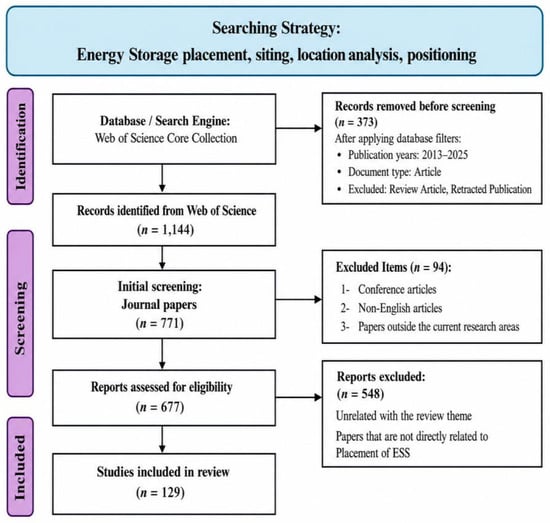
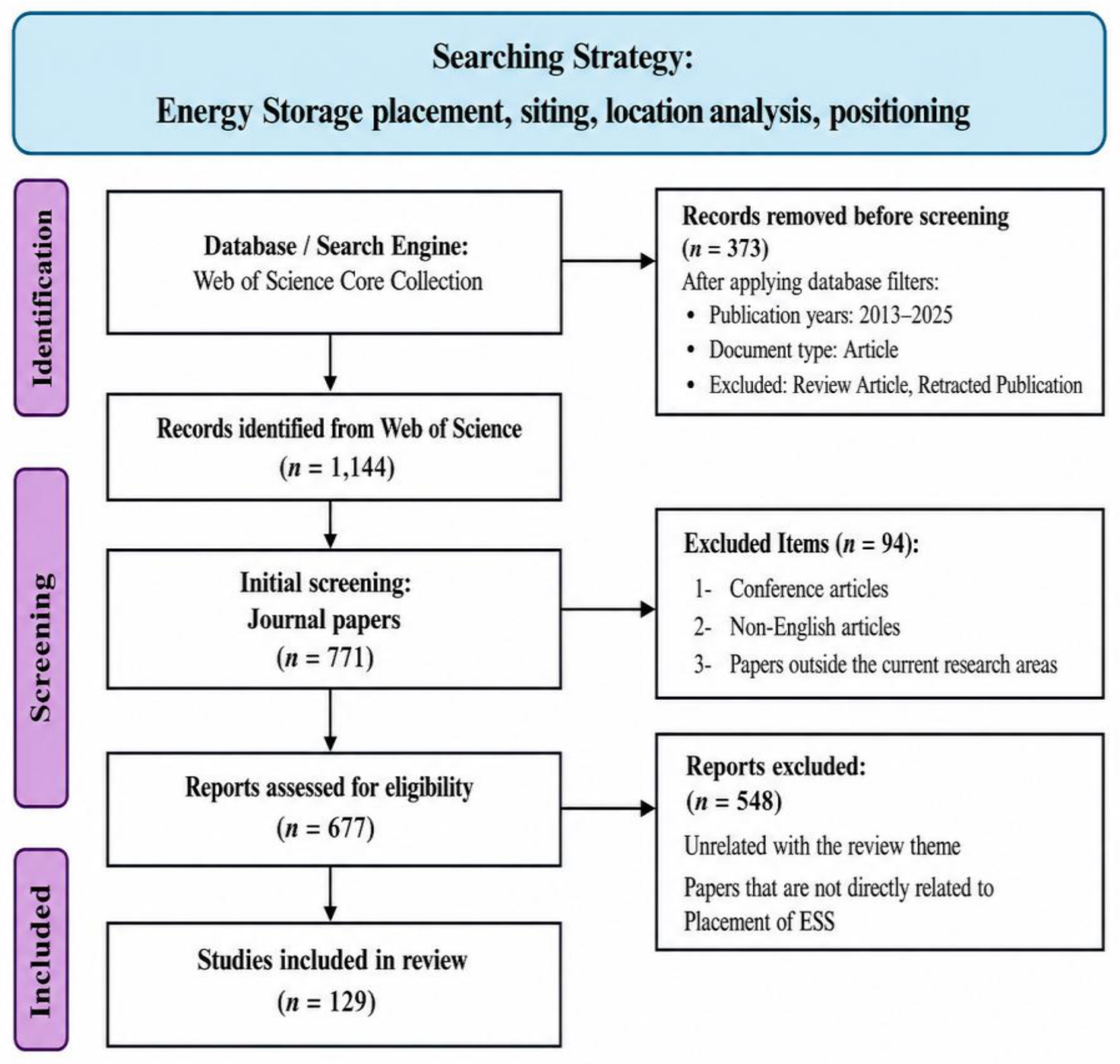
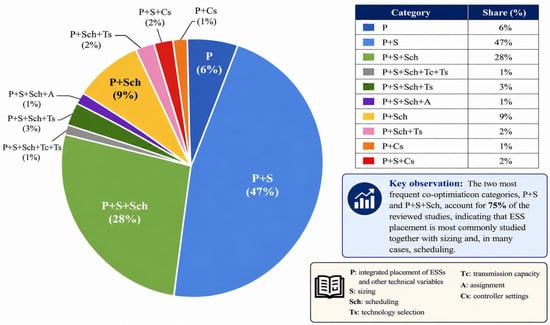
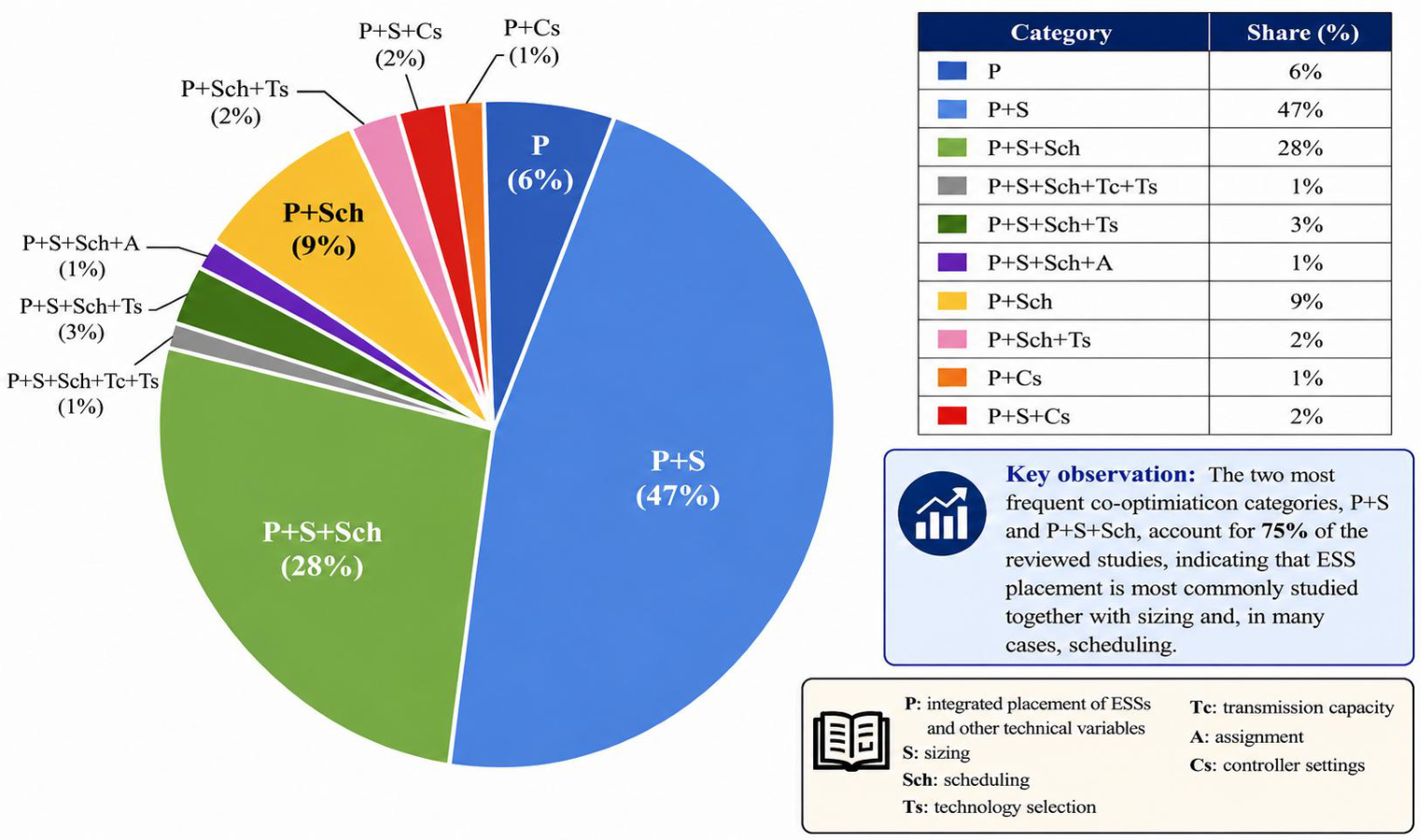
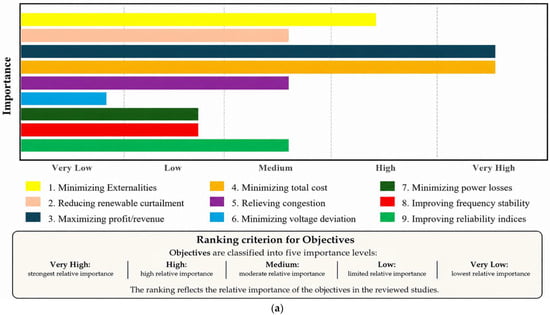
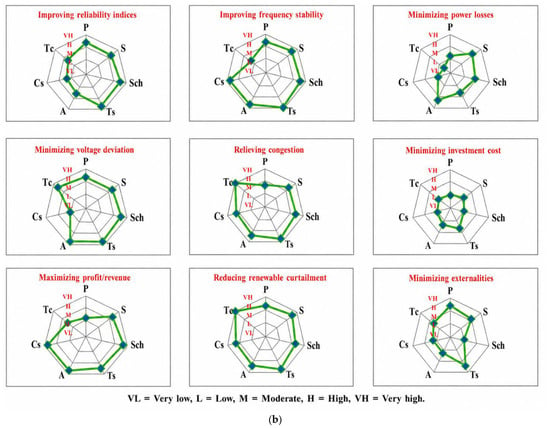
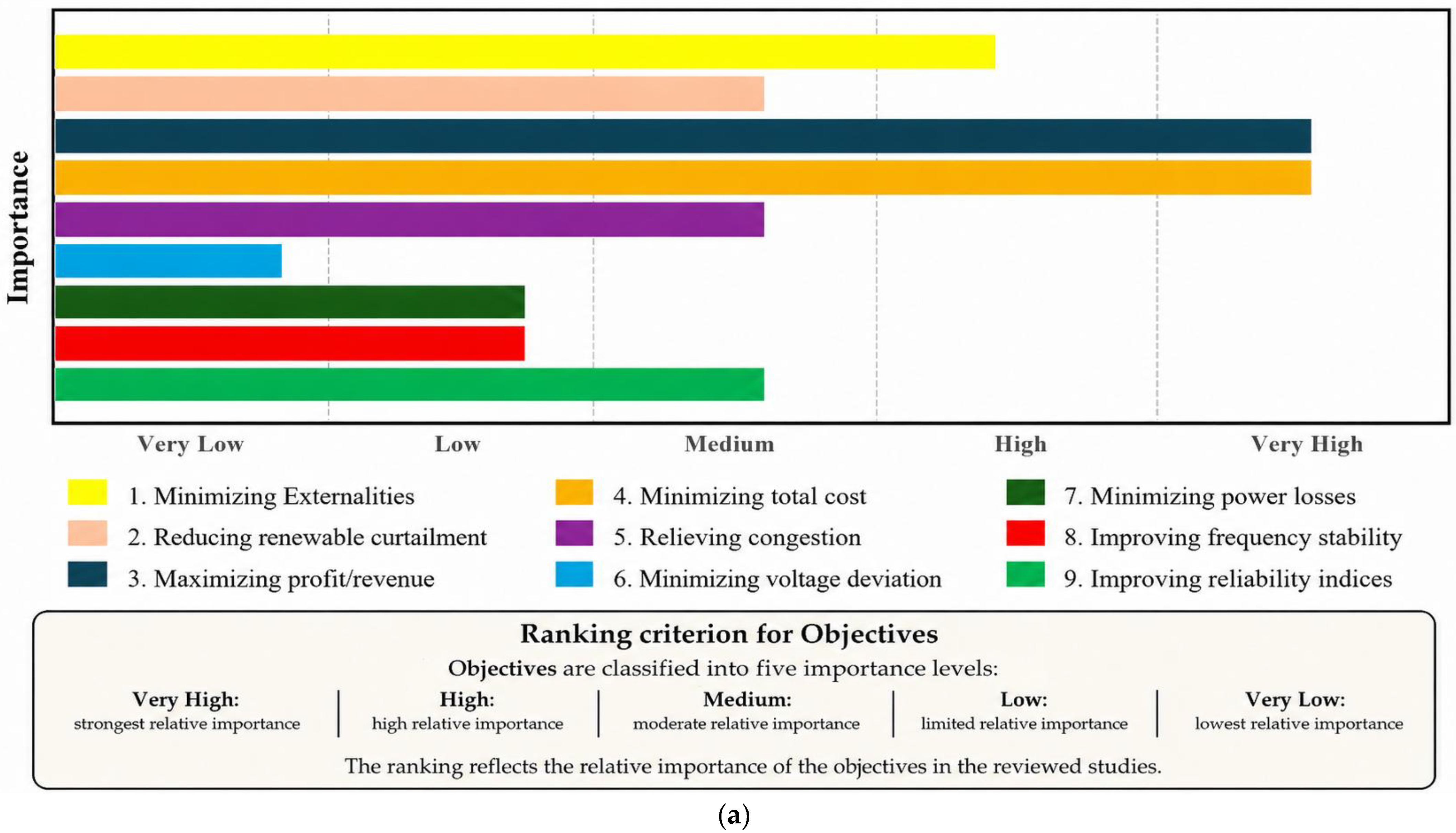
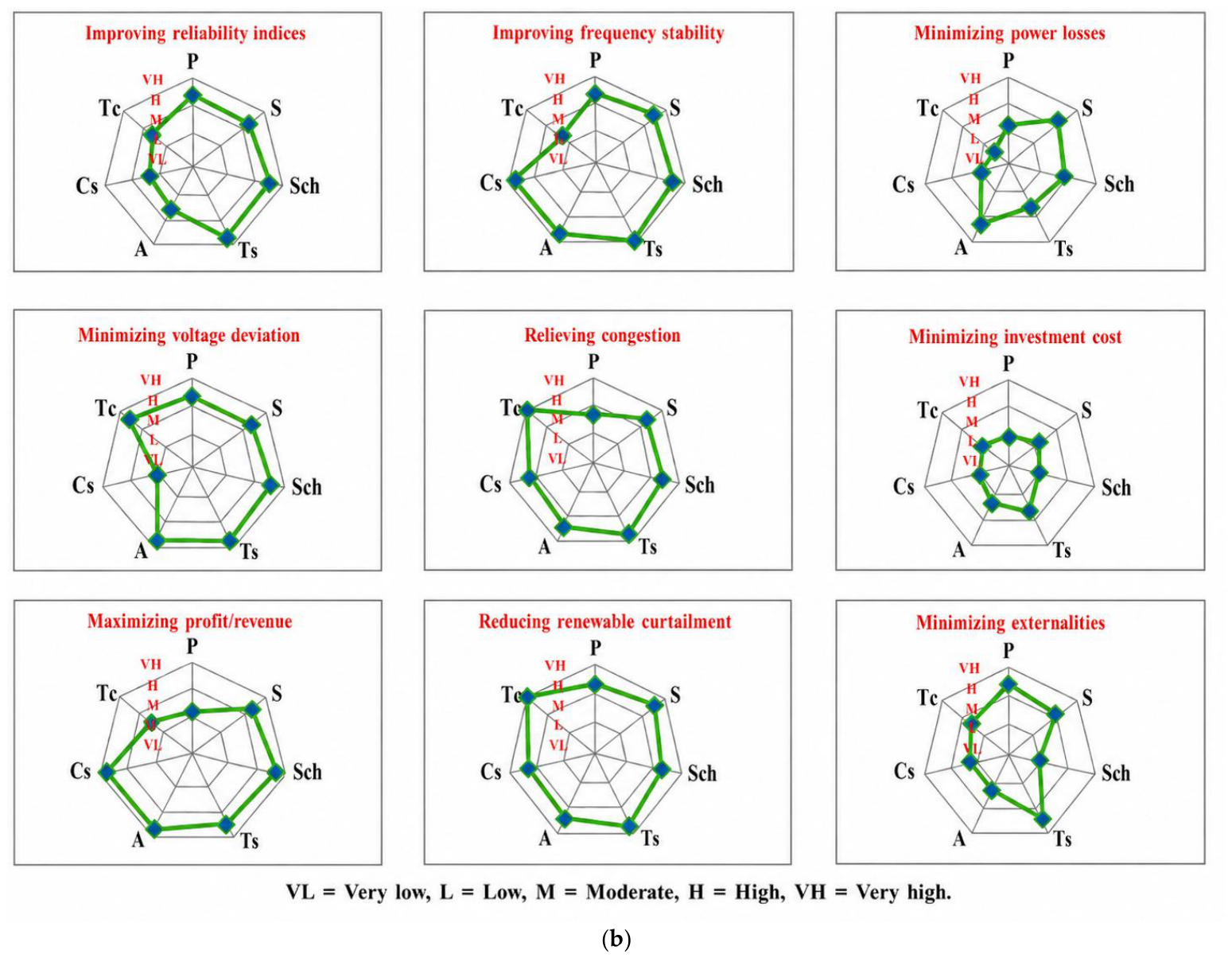

Disclaimer/Publisher’s Note: The statements, opinions and data contained in all publications are solely those of the individual author(s) and contributor(s) and not of MDPI and/or the editor(s). MDPI and/or the editor(s) disclaim responsibility for any injury to people or property resulting from any ideas, methods, instructions or products referred to in the content. |
© 2026 by the authors. Licensee MDPI, Basel, Switzerland. This article is an open access article distributed under the terms and conditions of the Creative Commons Attribution (CC BY) license.