


Abstract
Energy communities represent a potential mechanism for Europe’s decentralized energy transition. However, empirical evidence regarding how Small- and Medium-sized Enterprises (SMEs)—key economic stakeholders—perceive or engage with this model remains scarce. This study examines the awareness, perceptions, and participation levels of 219 Spanish SMEs. By applying a quantitative CAWI survey and a four-stage engagement framework (awareness, perception, motivation, and participation), this research maps the factors associated with organizational adoption. The results indicate a significant ‘awareness gap’: only 34% of respondents are familiar with the concept, and participation appears predominantly passive. That is, information gaps and difficulties with communication within institutions, as well as funding, are the main challenges identified, supporting the proposed sequential engagement framework. Given the gap between policy goals and current engagement of SMEs, this paper offers a diagnostic framework to policymakers to identify and address information barriers to SME energy transition.
1. Introduction
Energy communities have come to represent one of the most important and relevant innovations in the ecological transition of the modern world. They tend to introduce a profound shift in the way energy is generated, administered and used, allowing citizens, small- and medium-sized enterprises (SMEs) and local institutions to be placed at the very core of the system [1]. By participating in the larger distributed production system that is mostly grounded in renewable sources such as photovoltaic and wind power, these collective initiatives are able to broaden democratic access to energy, reducing the reliance on traditional utility providers and encouraging a more decentralized and fair distribution of both decision-making and the advantages that can originate from it [2].
1.1. Energy Communities
An energy community is an emerging configuration that operates in the energy landscape, allowing citizens, local administrations and small- and medium-sized enterprises to be more active in the production, consumption, storage and management of renewable energy. Although the European Union has established regulatory categories such as Renewable Energy Communities (RECs) and Citizen Energy Communities (CECs), a degree of conceptual ambiguity persists within both academic scholarship and policy discourse [3]. The definition of an energy community remains an evolving and, in many respects, conceptually contested construct. This lack of definitional consensus stems partly from the heterogeneous nature of energy communities, which may adopt diverse organizational configurations, technological arrangements, governance models, and social objectives [3]. This ambiguity may also affect investment decisions. If managers are unclear about the governance structure, ownership arrangements, expected benefits, or regulatory framework of an energy community, they may struggle to evaluate the viability of participation. As a result, uncertainty can increase perceived risk and reduce the willingness of SMEs to invest time, resources, or capital in such initiatives. Walker and Devine-Wright (2008) argue that this ambiguity arises because energy communities can be conceptualized along multiple analytical dimensions: the identity and composition of participants, the structure of governance and ownership, the spatial scale of operation, and the range of intended outcomes, whether environmental, economic, social, or integrative [4].
The lack of analogy between the different kinds of legal forms and the coexistence of other governance models (cooperatives, associations, municipalities or public–private partnerships) across Europe makes the situation particularly complex. While energy cooperatives, for instance, still play a major role in countries such as Germany and Denmark, this is not the case in other countries (e.g., Spain or France), where hybrid forms involving municipalities or private actors have multiplied. These differences in institutional design translate into the heterogeneity of the development of energy communities. In Spain, the transposition of Directive (EU) 2018/2001 [5] and the design of the regulatory framework for the implementation of the National Integrated Energy and Climate Plan (PNIEC) have resulted in the creation and development of different types of energy communities in the country. Given the pluralistic legal and institutional framework in the Spanish context, the following study does not focus on only one type of energy community but on all types of energy communities and hybrid forms currently existing in Spain, such as cooperatives, associations, municipalities and public–private collaborations.
1.2. SMEs and Energy Communities
Energy communities represent a strategic mechanism for advancing towards a more democratic, sustainable, and resilient energy system by promoting the active involvement of citizens, local authorities, and small- and medium-sized enterprises (SMEs) in the generation, management, and consumption of energy. This decentralized governance model not only contributes to the decarbonization of the energy sector but also strengthens social cohesion, supports local economic development, and reduces external energy dependence [6]. Within this framework, SMEs play a pivotal role as locally rooted economic stakeholders. Their participation in energy communities facilitates access to renewable energy at more stable and predictable prices, thereby reducing operational costs and enhancing long-term competitiveness [6]. In addition, engagement in such initiatives enables SMEs to align with sustainability objectives and corporate social responsibility commitments, which are increasingly relevant in regulatory frameworks and market dynamics shaped by environmental, social, and governance (ESG) criteria [7]. This is illustrated by the Rubí Clean Energy Transition (“Rubí Brilla”) initiative in Catalonia, Spain, where the municipality has promoted local energy community schemes based on collective self-consumption in industrial areas such as the Can Jardí industrial estate. Within this framework, local SMEs have been able to share rooftop photovoltaic installations and distribute generated electricity among participating businesses.
Furthermore, the involvement of SMEs in energy communities can act as a driving force for territorial innovation and forms of collaboration that cut across different sectors. Cooperative governance structures and shared ownership arrangements create spaces in which businesses, civil society actors, and public institutions can develop productive synergies, encouraging new entrepreneurial models, supporting local employment, and advancing a fairer and more inclusive energy transition [8]. Drawing on Rogers’ Diffusion of Innovation theory, this study conceptualizes the adoption of energy communities as a multi-stage process that begins with the initial knowledge of the innovation. Within this framework, the lack of awareness identified among Spanish SMEs represents a critical bottleneck in the early stages of the diffusion process. However, the research goes beyond mere familiarity measurement and focuses on the cognitive and perception-based mechanisms underlying collective value interpretation and organizational fit evaluation that explain the further uptake of these new energy models. Contrary to earlier descriptive approaches based on familiar categories of an awareness–perception–motivation–participation pathway, the study also addresses the more process-oriented aspects of internal sense-making and the innovation-decision process of SMEs as a requisite for successful participation in the energy transition.
The engagement model devolved in this study is one that is sequential where SME engagement follows the pathway of awareness, perception, motivation, and participation. Each stage is not taken separately; rather, the steps are adopted in a sequential manner, and SMEs move from knowing about energy communities to participating in energy communities. Awareness, perception, motivation and participation are the four pillars through which information is processed. In this case, awareness is the filter, perception is the structure, motivation is the engine, and participation is the result. This is similar to Rogers’ Diffusion of Innovations theory and its Knowledge–Persuasion–Decision process. Awareness corresponds to Knowledge, where an initial understanding of often fragmented information is acquired. The Perception stage (Persuasion) is when an attitude is formed based on the perceived consistency or credibility of the messages received. The Motivation construct corresponds to the Decision phase, when attitudes are converted into the intention to adopt. Consequently, we are now at the Participation stage of the adoption process. As mentioned before, there seems to be a clear relationship between the variables included in the questionnaire such as fragmented information.
2. Purpose of Study
Although academic and institutional interest in Energy Communities has increased, existing research has primarily focused on technical and regulatory aspects, as well as on participation by citizens and public administrations [9,10]. In contrast, SMEs represent a distinct category of actor, as engagement of for-profit organizations is shaped not only by environmental and social considerations but also by productivity constraints, investment logic, and risk–return assessments. These differences imply that the pathways, motivations, and barriers faced by SMEs when accessing Energy Communities are not necessarily equivalent to those of household or citizen participants. As a result, despite their economic relevance and potential contribution to decentralized energy systems, the role, expectations, and perceptions of SMEs remain comparatively underexplored in the literature [11].
The study covers the three research questions (RQs) listed below, which are motivated by the limited availability of empirical evidence on how this business group understands and evaluates an emerging energy model that is increasingly prominent in European policy agendas [12].
- RQ1: What is the current level of knowledge and understanding of Energy Communities among SMEs in Spain?
- RQ2: How do perceived barriers influence the different stages of the SMEs’ engagement journey?
- RQ3: To what extent does the size of the firm correlate with its ability to overcome the initial awareness “blockage”?
From a theoretical perspective, the study positions itself within the literature on sustainable energy transitions and organizational adoption of innovation. These fields highlight that the uptake of new energy models depends not only on regulatory or technological factors but also on how organizations interpret, evaluate, and internalize emerging opportunities [13,14]. By examining SME awareness, perceptions, and attitudes, the study contributes to this body of work by identifying the cognitive and perceptual mechanisms that shape early-stage engagement with Energy Communities. This theoretical positioning underpins the development of the study’s conceptual framework, which conceptualizes SME engagement as a sequential pathway moving from awareness to perception, motivation, and ultimately participation [15].
Given that SMEs represent a fundamental part of Spain’s economic structure and can play a significant role in the development and expansion of Energy Communities, it is important to understand their level of knowledge, as well as the attitudes, expectations, and potential barriers they perceive regarding this model (European Commission, 2020) [1]. The lack of empirical evidence on these issues limits the ability to design public policies, dissemination strategies, and participation mechanisms tailored to the real needs of this group. Therefore, analyzing these perceptions helps fill a gap in the existing literature and provides insights into the behavioral and informational conditions that shape SME involvement in the energy transition [16].
Moreover, SMEs’ participation in Energy Communities is characterized by a set of organizational characteristics differentiating them from other relevant actors in the energy system. SMEs are characterized by a resource-constrained and short-term economic focus, and lack systematized sustainability governance arrangements compared to other actors. This is most likely reflected in the way SMEs absorb knowledge and assess opportunities related to their engagement with new configurations in the energy system. It may also manifest in additional cognitive and organizational barriers for SMEs in their interpretation and utilization of new, complicated policy artifacts. Understanding these specificities is important to understanding the extent to which SMEs are aware of and engaged with emerging configurations in the energy transition, and for tailoring research and policy responses to their needs.
The novelty of this study lies in its explicit focus on small- and medium-sized enterprises (SMEs) as key but still underexplored actors in the development of energy communities in Spain. While existing research has primarily addressed regulatory, technical, and citizen-oriented dimensions, empirical evidence on SME perceptions and engagement remains limited [9,10]. Building on this gap, the study draws on original survey data (n = 219) to examine SME awareness, motivations, and perceived barriers. Rather than restating the research objectives, this contribution is framed within Rogers’ Diffusion of Innovation theory [13], which conceptualizes adoption as a staged process shaped by awareness, perceived attributes, and contextual conditions. From this perspective, SME engagement with energy communities is interpreted as part of a broader diffusion pathway influenced by information availability, perceived benefits, and institutional support. This theoretical framing clarifies how the study contributes beyond describing the research gap by offering an analytical lens to understand the mechanisms underlying SME adoption dynamics.
The results provide one of the first quantitative assessments of SME engagement with energy communities in Spain, identifying limited access to information and weak institutional communication as key barriers, and cost considerations as the primary driver of potential participation. Comparable quantitative evidence on SMEs engaging in energy communities is sparse. Research on energy communities in other European countries (Germany and Italy) predominantly focused on citizen engagement, community/community model, governance structures, implementation pathways and case studies rather than national surveys of SMEs on energy communities. Within this context, the lessons presented in this paper contribute original empirical evidence to the gap between policy and engagement, with implications for the design of dissemination and participation policies for energy communities.
3. Materials and Methods
The aim of this research is to provide a thorough overview of Spanish SMEs’ awareness, perceptions, and participation in Energy Communities. Although prior studies have largely focused on regulatory, technological, and citizen engagement aspects of Energy Communities, we identified a lack of empirical literature on the subject matter in this context. While SMEs are meaningful stakeholders in the energy transition, there is little empirical evidence regarding SME owners’ knowledge, perceptions, and participation in Energy Communities. The SME survey was designed as a complement to the still limited literature on the involvement of organizations in decentralized energy systems: an ad hoc questionnaire (see Appendix A) was provided to collect original and easy-to-process information on the sociodemographic characteristics of the SMEs interviewed, their awareness and understanding of Energy Communities, their involvement and experience with ECs, their motivations and barriers to participation in ECs. The aim was to provide information on the factors that most directly affect the involvement of SMEs. Such insights are particularly relevant in a research and policy context and would allow for better tailored dissemination and participation strategies to account for the needs and constraints of the SME sector more generally.
3.1. Research Design and Data Collection
The study adopts a quantitative research design based on a structured, self-administered online survey implemented through a Computer-Assisted Web Interviewing (CAWI) system. This methodology ensures full standardization of the questionnaire, reduces interviewer-induced bias, and enhances the reliability and internal consistency of responses. The use of CAWI is widely recognized as appropriate for business-oriented research involving geographically dispersed populations, as it enables efficient data collection while maintaining strict control over questionnaire logic, routing, and response validation [17,18]. Moreover, online survey methods have been shown to provide comparable data quality to traditional modes when properly designed, particularly in studies targeting organizational respondents [1].
Data were collected using a two-pronged recruitment approach, balancing between access to the population of interest and its heterogeneity. First, the link was widely disseminated within a university network. Second, respondents were recruited through a professional online panel provider in Spain using a stratified sampling approach. To ensure comparability between both recruitment channels, stratification was applied primarily on firm size, which served as the main balancing criterion across subsamples. While both groups were ultimately analyzed jointly, this procedure helped reduce structural imbalances in the final sample composition. In line with established practice in business and social research, online panels provide access to pre-profiled respondents and allow targeted sampling, whereas university-based dissemination typically relies on voluntary participation through professional contacts [19]. We acknowledge that these two recruitment routes may differ in their respondent profiles—for instance, firms responding via university networks may be somewhat more engaged with research or sustainability-related topics. However, no systematic differences in key observed variables were identified that would justify treating the groups separately in the analysis. The combination of both channels was therefore intended to improve coverage of heterogeneous SME profiles and strengthen external validity, while recognizing that self-selection bias cannot be fully eliminated in voluntary survey-based research.
The target population comprised owners, managers, and senior executives of small- and medium-sized enterprises (SMEs), defined in accordance with the European Commission classification as firms employing between 2 and 250 employees. Sole proprietors and self-employed individuals were explicitly excluded to ensure that responses reflect organizational-level perspectives rather than individual economic activity. The geographical scope of the study is limited to Spain, and a total of 219 valid responses were obtained following data cleaning and consistency checks. An ad hoc questionnaire was developed to collect the required information. It was structured around the following specific objectives:
- Sociodemographic profile—characteristics of the company and respondent;
- Level of knowledge—familiarity with Energy Communities;
- Degree of participation—current involvement and experience with Energy Communities.
To reflect the size distribution of the overall SME population, indicative quotas were defined using only the size of the business, i.e., 90% of the sample is made up of microenterprises (less than 10 employees) and 10% is made up of small- and medium-sized enterprises (more than 10 employees), which corresponds to the distribution of SMEs in Spain. Microenterprises were the most common business type in Spain, with 94–95% of all businesses having fewer than 10 employees. No quotas based on enterprise sector or origin region were set, providing more variability in responses but impacting the statistical generalizability of the results. Prior to data collection, a trial run was carried out with a small sample of SMEs. This involved a pilot study to review the wording, context and overall clarity of the questionnaire, with minor changes made to improve the validity of the questions and the understanding of respondents.
Although respondents were recruited through two different channels (a professional panel and a university network), no apparent systematic differences were observed during the data collection process. However, no formal statistical comparisons (e.g., t-tests or Chi-square tests) were conducted between these recruitment groups, as such analyses were beyond the original scope of the study. Therefore, this observation should be interpreted descriptively rather than as evidence of statistical equivalence, and caution should be exercised when generalizing the findings.
3.2. Survey Instrument
Data were collected using a structured questionnaire specifically designed to capture SME perceptions of Energy Communities across multiple analytical dimensions, including awareness, attitudes, and degree of engagement. The instrument was developed following established survey design principles to ensure clarity, construct validity, and response reliability [17]. Particular attention was given to minimizing respondent burden, resulting in a concise questionnaire with an average completion time of approximately five minutes. This design choice is consistent with best practices in online survey research, which highlight the importance of brevity in reducing item non-response and survey dropout rates, especially among time-constrained professional respondents such as SME managers [20].
The survey instrument comprised 12 items, predominantly formulated as closed-ended questions with predefined response categories, including both single-choice and multiple-response formats. This structure facilitates quantitative analysis and enhances comparability across observations. Where appropriate, an “Other” response option was included to capture unanticipated answers and reduce measurement error associated with forced-choice formats. The questionnaire was organized around three core analytical dimensions—including (i) firm characteristics, (ii) level of awareness and understanding of Energy Communities, and (iii) degree of participation and experience—reflecting key constructs identified in the literature on stakeholder engagement in community energy initiatives [4,8]. The survey was designed to balance standardization with sufficient flexibility to capture variability in SME experiences, thereby supporting both descriptive and exploratory analysis. The full questionnaire is provided in Appendix A to ensure transparency and replicability of the research design.
3.3. Data Processing and Analysis
The questionnaire was programmed using Microsoft Forms, with additional panel administration and survey programming conducted through the Quest Design platform of Netquest. The selection of indicators and the questionnaire design were theoretically grounded in the established literature on energy-related consumer behavior and technology adoption. In particular, the development of measurement scales followed widely accepted procedures for construct operationalization and validation [21,22], ensuring content validity and internal consistency.
Fieldwork was conducted between December 2025 and January 2026. For the sample size achieved, the estimated margin of error is ±6.7%, assuming a 95.5% confidence level under the most conservative sampling scenario (p = q = 0.5), which is a standard assumption in survey-based energy research to ensure maximum variability and conservative estimation [23]. Data processing and statistical analysis were performed using Barbwin Statistics (version 7). Survey responses were analyzed using descriptive statistical techniques, which are commonly employed in exploratory studies within the energy domain to identify patterns in user perceptions and behaviors [23]. Results are reported as percentages of total responses for each question, facilitating interpretability and comparison across variables.
4. Results
The objective of this research was to assess and analyze the level of knowledge, as well as the opinions and perceptions, that small- and medium-sized business owners held regarding Energy Communities in Spain. To achieve this aim, an ad hoc questionnaire was developed to collect the required information. The instrument was designed to examine three key dimensions: the sociodemographic and descriptive profile of the companies, the level of knowledge about Energy Communities, and the degree of participation in and experience with this model among SMEs.
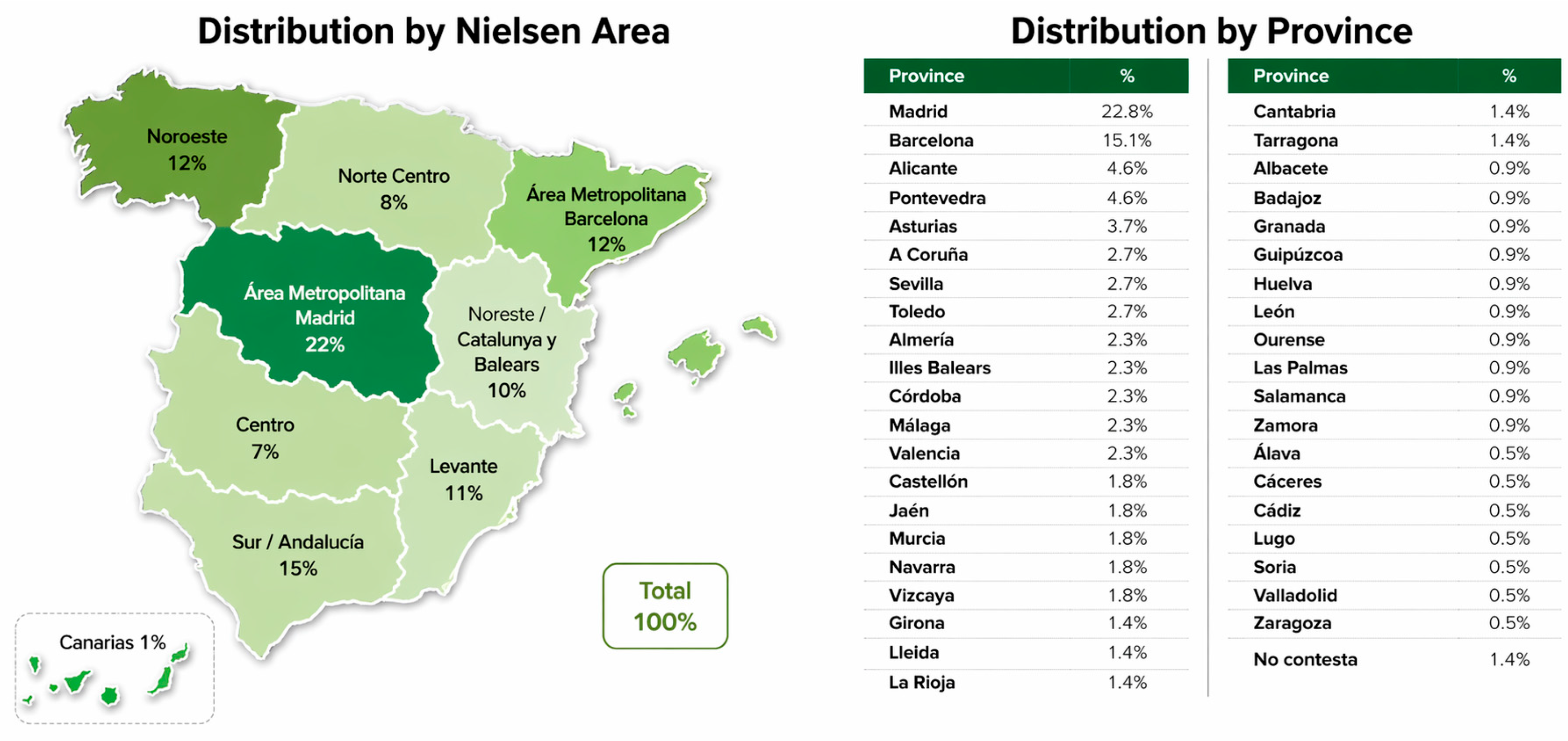
A total of 219 surveys were conducted with SMEs across Spain (i.e., across all 52 provinces). As shown in Figure 1, the majority of the interviews were carried out in the provinces of Madrid (22.8%) and Barcelona (15.1%).
Figure 1.
Geographic distribution of completed interviews.
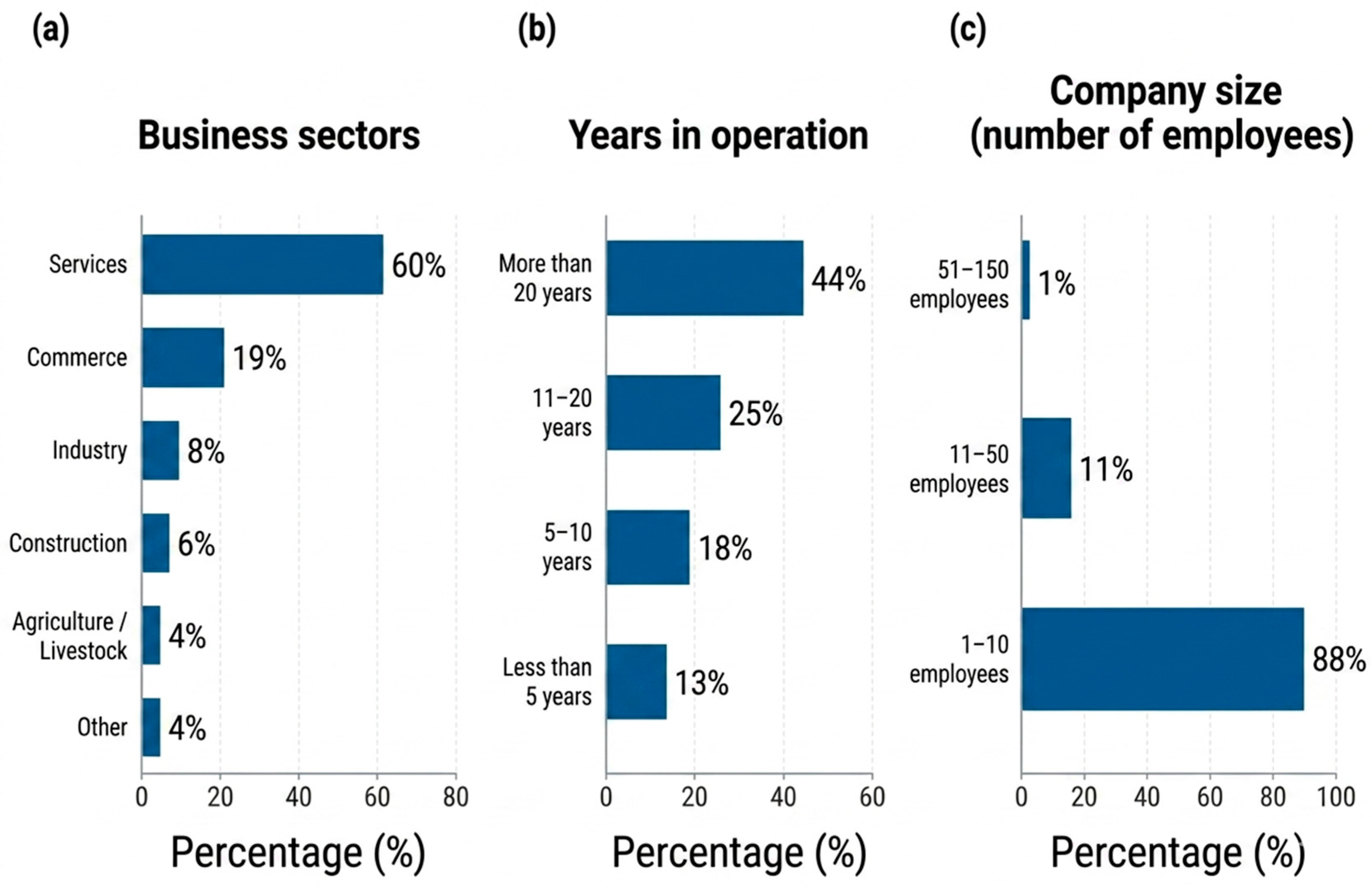
Most of the SMEs surveyed were well established, with nearly 70% having been in operation for more than ten years. The majority of firms (88%) were micro-enterprises with fewer than 10 employees (Figure 2), and the main sectors of activity were concentrated in services and commerce, consistent with the general structural patterns of SME populations at both national and international levels [24,25]. Regarding geographical distribution, responses were collected across 52 provinces in Spain. While no formal regional quotas were applied, the sample shows a higher concentration of firms located in economically dense areas such as Madrid and Barcelona, consistent with the territorial distribution of economic activity and SME concentration in Spain, and this should be interpreted in light of the well-known urban bias in voluntary survey responses rather than as a fully stratified national sample.
Figure 2.
Sector of activity, years in operation, and number of employees of the surveyed SMEs (a) Business sectors, (b) Years in operation, (c) Company size
To address potential bias associated with the predominance of micro-enterprises (88% of the sample), it is important to note that this distribution broadly reflects the actual structure of the SME population in Spain, where micro-firms constitute the vast majority of enterprises; accordingly, firm size was considered in the sampling design through indicative quotas to ensure basic structural alignment with national patterns. Nevertheless, given the exploratory nature of the study and the absence of additional stratification criteria, some degree of sample bias cannot be fully ruled out and is acknowledged as a limitation. Another important point when interpreting results is the difference between micro-enterprises and larger SMEs. Even if informational and awareness barriers are particularly important in aggregate, financial barriers may play a key role in deciding whether to invest in energy efficiency technologies for micro-enterprises, while lack of awareness and information may mean that a firm does not even get to the stage where costs and benefits can be considered. On the other hand, larger SMEs may be at a more advanced stage where finances are better structured. Overall, the sample is similar to typical SME structures found in other studies, in particular the dominance of micro-enterprises and the high proportion of service and commerce activities. Some of the characteristics of the sample, such as its overrepresentation of firms from the largest economic centers and relatively large share of long-standing firms, do not necessarily reflect patterns in the population.
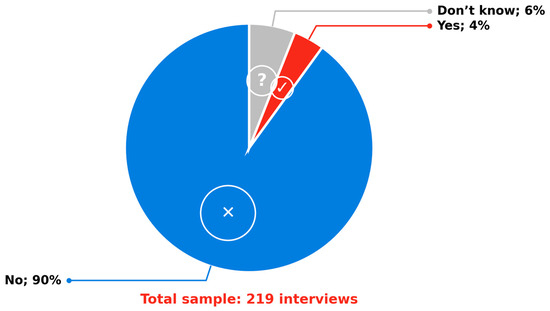
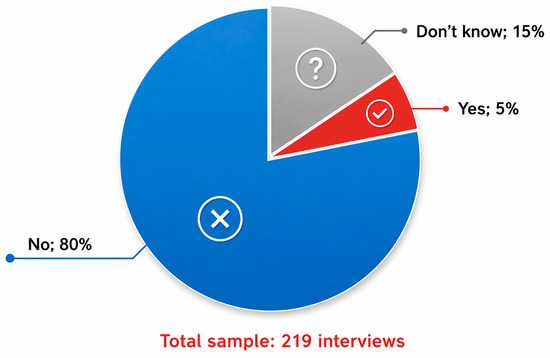
What is especially interesting to analyze are the SMEs that are currently part of an Energy Community. The findings suggest that SME involvement in energy communities remains limited overall, with only a small proportion of surveyed firms reporting participation in such initiatives (Figure 3).
Figure 3.
Proportion of SMEs that are members of Energy Communities.
The second section of the survey focused on respondents’ general awareness and understanding of the concept of Energy Communities, exploring prior knowledge of the concept, perceived definitions and characteristics, channels through which information had been received, awareness of local initiatives, and perceptions regarding the dissemination of the concept among small- and medium-sized enterprises (SMEs) in Spain, while the third section addressed companies’ levels of participation and experience with Energy Communities, including current or potential involvement, roles within such initiatives, and the principal motivations driving participation, such as reducing energy costs, promoting renewable energy use, improving corporate image, accessing funding opportunities, or strengthening collaboration with local communities.
The above figures also lead to a gradual finding within the awareness, perception, motivation, and participation of SMEs in Energy Communities: First, knowledge of the Energy Community concept is rather low, as a lot of firms have little or no familiarity with it, and only a small part of them can spontaneously identify it. This limited knowledge is reflected in SMEs’ perception of Energy Communities, with only those with a thorough understanding of the concept seeing it as collaborative and local. Most SMEs held the view that Energy Communities have not been disseminated enough in Spain. While recognizing these benefits (cost savings, collecting subsidies, and/or gaining a better image of their corporation in the community) positively affects SMEs’ motivation to participate in Energy Communities, this has not been reflected in the user experience, as the vast majority of Energy Community users remain in a passive consumer role concerning production and governance of Energy Community platforms.
Based on the results of the applied qualitative research study, the research presents a theoretical model in the form of a pathway, as shown in Figure 4, which illustrates the stages in which awareness plays a fundamental role in determining how SMEs interpret and assess the notion of Energy Communities. In this regard, when the firm has this initial awareness, it influences its perception and thus its ability to identify potential gains and build up a favorable motivation to participate, manifesting as whether the SMEs’ support extends beyond mere interest. Thus, the model explains how awareness limitations impair perception, which, when improved, further increases the users’ motivation to participate, and, simultaneously, the probability that they indeed will. These mechanisms can be merged into a holistic model, therefore improving the understanding on the drivers for SMEs’ participation in Energy Communities. It should be noted that the framework has not been statistically tested (e.g., via structural equation modeling) and as such represents a conceptual framework used in the exploratory analysis, rather than an empirically derived structure.
Figure 4.
Proposed framework linking Awareness, Perception, Motivation and Participation.
The different elements comprising this framework are described in detail below, outlining the specific role each stage plays within the sequential pathway. By unpacking these components individually, it becomes possible to understand how awareness, perception, motivation, and participation interact, reinforce one another, and ultimately shape SMEs’ engagement with Energy Communities. The following sections therefore elaborate on each element, clarifying both its conceptual meaning and its empirical relevance within the progression identified in the study.
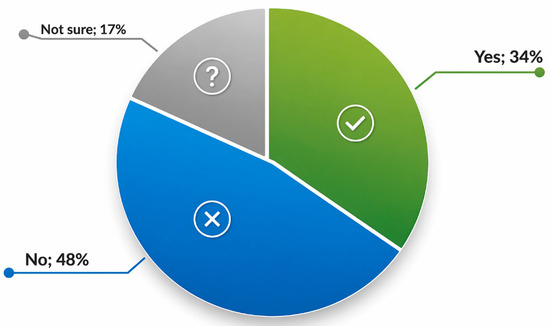
Awareness: SME awareness of Energy Communities was found to be low, with only 34% spontaneously recognizing the term and many firms reporting little or no communication from official sources. Among larger SMEs, with more than 10 employees, the level of knowledge was significantly higher than among smaller firms. These results are consistent with existing evidence, which indicates generally low levels of awareness of energy communities and related concepts among SMEs and the wider public. Previous policy and analytical reports have identified limited familiarity as a key barrier to participation, even in contexts where supportive regulatory frameworks are in place.
In other words, considering the interdependencies between organizational capacity and conceptual awareness, spontaneous recognition is expected to be more pronounced in micro-organizations (less than 10 employees). By contrast, larger SMEs have been shown to develop a more integrated knowledge base, and firm size thus appears to be key in overcoming the initial ‘bottleneck’ of the diffusion trajectory.
Perception: Once aware, SMEs form judgments about the value, clarity, and credibility of Energy Communities, with perceptions strongly shaped by how well the concept is understood, disseminated, and whether it is seen as local, collaborative, and practically relevant. The survey results indicate that most SMEs have not received information from official or institutional channels, and among those who have been informed, communication pathways are highly fragmented with no clearly identifiable leading actor responsible for dissemination; as shown in Figure 5, the majority report little or no exposure to information, highlighting a clear awareness gap. This pattern is consistent with existing evidence showing generally low levels of awareness among SMEs and the broader public, even in supportive policy contexts [25], and it underscores the need for more coordinated and targeted communication strategies to improve understanding and foster engagement.
Figure 5.
Chart showing the breakdown of SMEs that were familiar or unfamiliar with the term “Energy Community”.
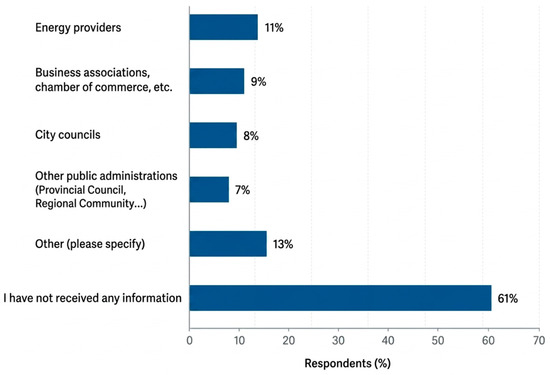
An important aspect to examine is the source of information through which business owners have become aware of Energy Communities. The findings reveal that the majority of SMEs have not received information from official or institutional sources (Figure 6). Among those who reported being informed, the channels were highly fragmented, spanning a variety of media with no clearly identifiable actor leading the communication and promotion of this energy model. This dispersion suggests a lack of coordinated outreach and structured dissemination strategies. As illustrated in Figure 7, most business owners report having received little to no communication regarding Energy Communities, highlighting a significant gap in awareness and engagement.
Figure 6.
Perception of effective dissemination of the Energy Community concept in Spain among SMEs.
Figure 7.
Communication channels through which business owners received information about Energy Communities.
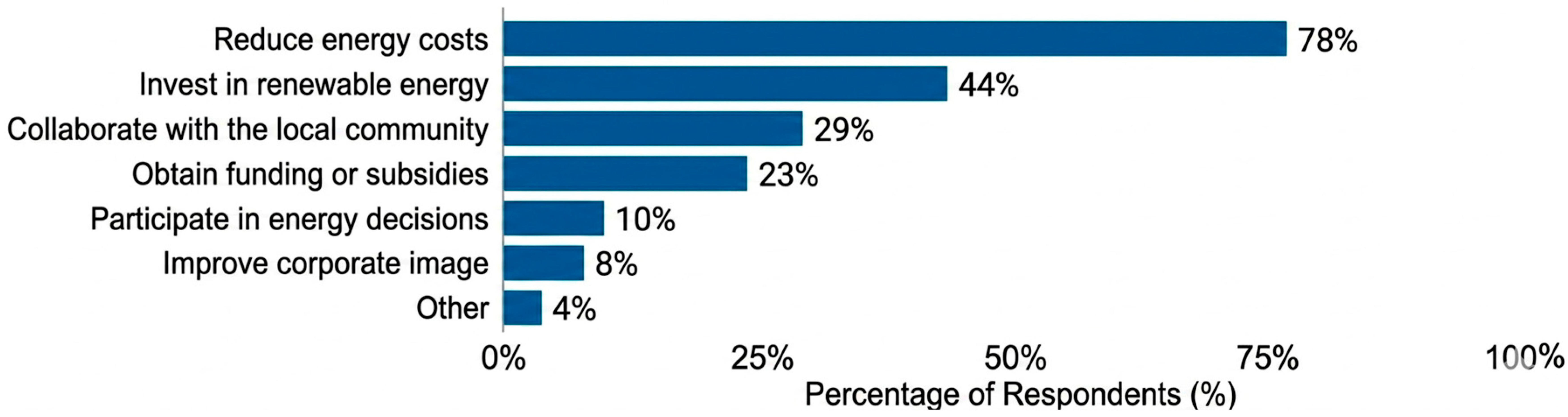
Motivation: Perception then translates into willingness to engage (Figure 4), especially when SMEs see concrete benefits such as cost savings, subsidies, or reputational gains. In the study, cost savings were the most common motivation, while larger SMEs also emphasized subsidies and corporate image. The motivations of SMEs for participating in Energy Communities were also analyzed (Figure 8). It was found that cost savings emerged as the most frequently cited motivation across the sample. Larger SMEs, however, appeared to place relatively greater emphasis on access to subsidies, as well as on the potential to enhance their corporate image. It is important to note that these findings should be interpreted with caution, as the study is exploratory in nature and based on a limited sample. As such, the results are intended to highlight general trends rather than to provide definitive or generalizable conclusions, with greater importance given to access to subsidies to encourage participation, as well as enhancing their corporate image.
Figure 8.
Types of motivation for SMEs to participate in Energy Communities.
Participation: If, as suggested, motivation does indeed lead to participation, this participation remains modest in practice. First of all, with respect to SMEs, the results show that their participation remains limited. Second, if it does occur, it takes the form of a passive consumer role and not an active participant role. This suggests that, although firms may recognize the possible benefits, they are not yet sufficiently motivated to realize more substantive or deeper forms of participation.
For the second section of the questionnaire, SMEs were provided with the following definition of an energy community: “Energy Communities are local initiatives in which citizens, businesses, and institutions collaborate to produce, manage, and consume renewable energy collectively and sustainably. For example, an Energy Community may take shape in a neighborhood where residents and businesses establish a dedicated entity and install solar panels on rooftops to share the electricity generated, thereby lowering costs and promoting a cleaner and more participatory energy model.” In this study, this simplified definition (“a group organized to produce and consume its own energy”) was adopted to ensure clarity and accessibility for respondents. This definition was explicitly provided within the survey to align respondents’ understanding and ensure greater consistency in the interpretation of subsequent questions. However, it is important to acknowledge that the concept encompasses a broader range of organizational, legal, and governance structures in both policy and academic literature. This potential definitional ambiguity may influence how SMEs interpret the term and, consequently, affect reported levels of awareness.
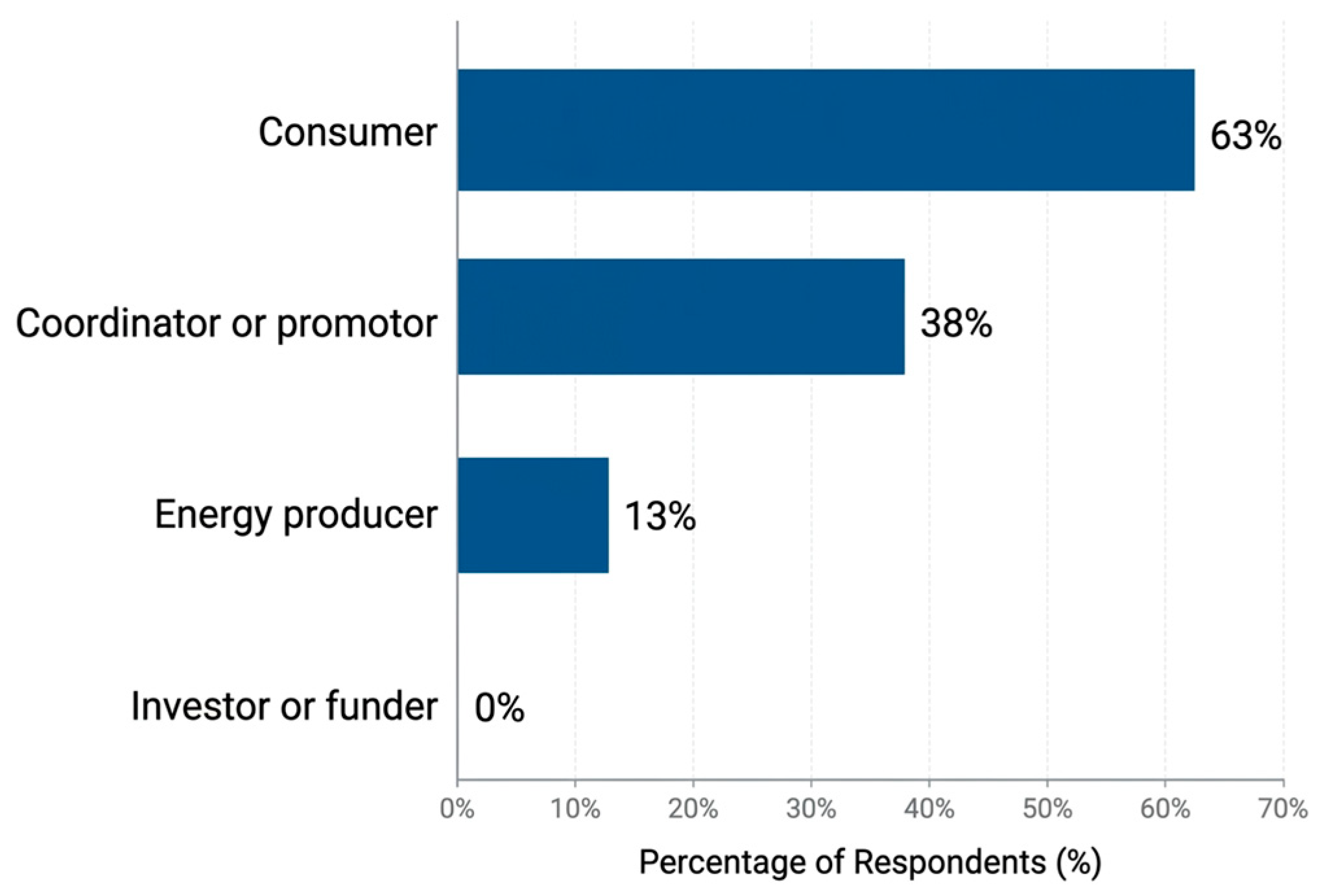
While only 34% of SMEs were familiar with the concept of an Energy Community (Figure 5), the proportion of those who could identify a specific example dropped to 11% of all SMEs surveyed. Again, larger SMEs were more likely to report awareness of concrete examples. Within the limited participation of SMEs in Energy Communities, the primary role observed has been that of energy consumers, as shown in Figure 9. Specifically, 63% of the SMEs identified participated mainly as consumers of energy within the community.
Figure 9.
The role of SMEs within Energy Communities.
Various barriers to participation were identified, with a lack of clear information emerging as the most significant obstacle. SMEs that do not consider joining an Energy Community tend to perceive limited financial resources as a key constraint, whereas this is less prominent among those more inclined to engage with the model. These findings are consistent with the existing literature, which highlights that participation in energy communities is often hindered by a combination of informational, financial, regulatory, and technical barriers. In particular, lack of awareness and accessible information, as well as funding constraints and high upfront investment requirements, are frequently identified as key challenges limiting engagement [26,27].
5. Discussion
The study meets its objective of analyzing SME engagement with Energy Communities in Spain by examining awareness levels, perceived barriers across the engagement process, and the role of firm size in overcoming early-stage constraints. The results highlight two key findings. First, the so-called “awareness gap” reflects not a lack of interest but an institutional disconnect marked by fragmented communication and limited access to clear, reliable information, which constrains SMEs’ progression through the innovation-decision process. Second, while cost reduction is the main driver of engagement, financial incentives alone are insufficient to trigger participation when regulatory complexity, limited guidance, and information barriers persist.
These findings suggest that policies aimed at promoting SME participation in Energy Communities should extend beyond economic support measures and place greater emphasis on structured communication, accessible information, and institutional guidance. In the Spanish context, actors such as national and regional energy agencies (e.g., IDAE), chambers of commerce, local authorities, and business associations could play a more active role in providing targeted outreach and practical support. More broadly, the results are consistent with research on community energy governance, which highlights the importance of coherent communication strategies, clearly defined institutional responsibilities, and trust-building mechanisms for fostering stakeholder engagement. Taken together, the findings provide new empirical insights into the factors shaping SME participation in Energy Communities and support the usefulness of the proposed Awareness–Perception–Motivation–Participation framework as a conceptual tool for understanding this engagement process. Nevertheless, the framework should be interpreted as an explanatory model derived from the empirical patterns observed in this study rather than as a longitudinally validated or deterministic sequence. It is intended to represent the relationships identified among the different stages of engagement and to offer a useful basis for future research and policy design, rather than to establish causal or strictly time-ordered pathways.
From a policy perspective, the findings point to several practical implications that follow directly from the sequential pathway identified in the framework. Since SMEs report low and fragmented awareness, the results suggest that coordinated outreach—led by public energy agencies, local administrations, and established business networks—could help address the awareness gap and support the transition from initial exposure to clearer perceptions [12,15]. Likewise, the lack of accessible and centralized information identified in the survey indicates that SMEs would benefit from clearer guidance on legal, technical, and financial aspects of participation. Strengthening these early stages is essential, as the framework shows that weak awareness and unclear perceptions limit motivation and ultimately reduce the likelihood of participation. These implications are consistent with the empirical patterns observed, though they should be interpreted cautiously given the exploratory nature of the study.
The analysis of motivations further reinforces the structure of the framework. Economic considerations—particularly expected reductions in energy costs—emerge as the strongest driver of potential participation, confirming that motivation is primarily shaped by perceived financial benefits. Respondents frequently highlight savings from shared self-consumption, reduced exposure to price volatility, and collective investment in local renewable systems, in line with broader evidence that cost-related incentives dominate the early stages of SME engagement with energy initiatives [10,13]. Non-economic motivations, such as environmental contribution or reputational gains, appear less prominent at this stage, suggesting a secondary role within the motivational pathway and reinforcing that strengthened awareness and more positive perceptions are necessary precursors for these drivers to translate into participation. Among SMEs already involved or seriously considering participation, however, motivations become more diversified, extending beyond cost reduction to include closer collaboration with local actors through municipal or industrial-park schemes, as illustrated by initiatives such as Rubí Brilla in Catalonia [28] or similar programs supported by local authorities in Valencia [29], as well as cooperative governance models like Som Energia [8], which enable firms to engage more directly in local energy decision-making. In these cases, participation is also associated with reputational benefits and alignment with sustainability and ESG-oriented initiatives [30]. Taken together, these findings suggest that while economic drivers dominate initial interest, motivational complexity increases once awareness and perceptions are more developed, highlighting the importance of strengthening the earlier stages of the engagement pathway.
This study shows a set of barriers that appear to constrain SME participation in energy communities and the most prominent obstacle that gets identified by respondents is the absence of clear, accessible information about the functioning of these initiatives and about the actual participation. A reduced understanding of governance structures, participation procedures and potential benefits can generate uncertainty that might discourage engagement. It is interesting to note that financial limitations that tend to be highlighted as a major impediment to the adoption of renewable technologies seem less decisive for firms that are already showing interest in energy communities. Instead, the regulatory ambiguity and the perceived complexity of organizational and operational arrangements tend to emerge as more influential deterrents. All of these patterns go on to align with existing research that consistently points to informational deficits, to institutional uncertainty and to administrative burdens, considering them key factors that limit broader stakeholder involvement in community-energy initiatives [30,31].
The findings indicate a need to strengthen institutional support mechanisms for SMEs within the broader energy transition agenda. Given their economic relevance in Spain and Europe, greater SME involvement could accelerate the deployment of decentralized renewable energy systems and contribute to European Green Deal objectives [16]. In Spain, Royal Decree 244/2019 provides a regulatory framework for collective self-consumption, enabling schemes in which SMEs can jointly install rooftop photovoltaic systems and share locally generated electricity. While this policy represents an important enabling step and has supported early initiatives in regions such as the Basque Country and Catalonia—where coordinated local projects have demonstrated potential to reduce energy costs and enhance renewable self-sufficiency —its practical uptake among SMEs remains limited. The findings of this study suggest that, beyond the existence of subsidies and regulatory provisions, implementation is often constrained by administrative complexity, fragmented information, and procedural burdens that may be particularly challenging for small firms with limited managerial capacity. As the dominant enterprise group in the European economy, SMEs could therefore play a more substantial role in distributed generation and local energy resilience [9], provided that policy instruments are complemented by simplified procedures and more accessible, SME-oriented support mechanisms.
Realizing this potential requires clearer communication, more stable regulatory signals, and policy tools adapted to SME capacities. The empirical results suggest that SMEs would benefit from simplified information platforms outlining legal requirements, funding opportunities, and technical steps for joining energy communities. Targeted outreach through chambers of commerce, sectoral associations, and local energy agencies could help address existing information gaps, while practical workshops in industrial parks may enhance understanding and trust [16]. This is consistent with the recent literature on energy communities, which highlights that participation barriers are not only informational but also institutional and governance-related, including administrative complexity, fragmented responsibilities, and the need for trusted intermediary actors to facilitate coordination between local authorities, energy providers, and SMEs [32]. Within this perspective, “one-stop-shop” type support structures and locally embedded facilitators are identified as particularly effective in translating regulatory frameworks into actionable pathways for smaller firms. Within the proposed framework, these measures directly address the early stages—awareness and perception—which the study identifies as key bottlenecks limiting motivation and participation, while also responding to the broader need for institutional simplification and coordination highlighted in the literature.
The findings of this study are broadly consistent with evidence reported in other European countries, where participation in Energy Communities remains below its theoretical potential despite increasingly supportive regulatory frameworks. Although most European studies examine community energy participation more broadly rather than focusing specifically on SMEs, the barriers and drivers identified provide a useful basis for contextualizing the findings of the present study. Research from Germany, the Netherlands, Denmark, and Belgium indicates that while Energy Communities have achieved greater institutional maturity and visibility than in Spain, participation is still constrained by informational, organizational, and governance-related challenges [26]. Similar to the results presented here, awareness and understanding of the model are often uneven, particularly among smaller organizations with limited managerial and technical resources [27]. This suggests that regulatory recognition alone is insufficient to ensure widespread adoption and that intermediary organizations play a critical role in translating policy frameworks into practical opportunities for businesses.
At the same time, the Spanish case appears to reflect a more pronounced awareness gap than that reported in several Northern and Central European countries, where longer traditions of energy cooperatives and community-led renewable initiatives have contributed to greater public visibility and institutional support [26]. In countries such as Germany and Denmark, community energy models have benefited from stronger local governance structures, established cooperative networks, and sustained stakeholder engagement, facilitating broader participation among local actors, including SMEs [4,8]. Nevertheless, the barriers identified in this study—fragmented information, administrative complexity, regulatory uncertainty, and difficulties understanding participation mechanisms—are frequently reported across Europe [26,27]. Likewise, the predominance of economic motivations observed among Spanish SMEs aligns with findings from other European contexts, where expected reductions in energy costs and protection from energy-price volatility are consistently identified as primary incentives for participation, while environmental and social motivations tend to play a complementary role [4,8]. Taken together, these similarities suggest that the challenges identified in Spain are not unique but form part of a broader European pattern, although the relatively low levels of awareness observed in this study indicate that additional efforts in communication, institutional coordination, and SME-targeted support may be particularly important in the Spanish context.
Finally, it was found that micro-enterprises (i.e., which constitute the majority of the sample) are particularly constrained by limited managerial time, staffing capacity, and specialized expertise, all of which exacerbate difficulties in accessing and interpreting complex information about Energy Communities. In this context, digitalization can function as a critical enabling infrastructure that lowers both informational and cognitive barriers along the awareness–perception–motivation–participation pathway. Beyond merely increasing information availability, well-designed digital ecosystems—such as integrated one-stop-shop platforms hosted by public administrations, energy agencies, or sectoral associations—can streamline fragmented legal, technical, and financial content into coherent and user-friendly formats tailored to non-expert audiences. Complementary digital outreach strategies, including targeted social media campaigns, webinars, and interactive engagement tools, can further improve the reach and clarity of communication, particularly for firms with limited access to traditional advisory services. Moreover, emerging digital decision-support systems, such as automated feasibility assessments, guided templates, and simplified energy and cost calculators, can translate complex regulatory and technical requirements into actionable, context-specific insights. Taken together, these digital instruments do not merely facilitate information dissemination but actively reduce complexity, thereby helping to overcome the information “blockage” identified in the study and enabling micro-enterprises to engage more effectively with Energy Community initiatives.
5.1. Study Limitations
Several limitations of this study should be acknowledged. Although the survey provides valuable insights into SME perceptions of Energy Communities, the relatively small sample size and the voluntary nature of participation limit the extent to which the findings can be generalized to the broader SME population in Spain. Firms that chose to respond to the survey may already have a greater interest in energy issues or sustainability initiatives, which could introduce a degree of self-selection bias in the results. Moreover, the diversity of SMEs in terms of sector, size, and energy intensity means that the experiences and motivations captured in this study may not fully reflect the heterogeneity of the wider business landscape. In addition, the cross-sectional design of the study captures perceptions at a specific moment in time, within a regulatory and institutional context that continues to evolve. Energy Communities remain a relatively recent policy and organizational innovation in Europe, particularly following the introduction of the framework established by the European Union through the Clean Energy for All Europeans Package. As national regulations, support schemes, and governance models continue to develop, SME awareness and participation patterns may also change over time. Consequently, the findings presented here should be interpreted as a snapshot and with caution of an emerging phenomenon rather than a definitive assessment of long-term trends.
A further limitation of this study is that respondents were recruited through two different channels, namely a professional panel and a university network. Although no apparent systematic differences were observed during the recruitment process, no formal statistical comparisons were made between these groups. Consequently, the potential influence of the recruitment source on respondents’ sustainability awareness cannot be ruled out and should be considered when interpreting the results. In addition, the concentration of responses in Madrid and Barcelona may introduce a geographical bias, as these economic hubs may differ from less densely populated provinces in terms of sustainability awareness, access to resources, and organizational practices. Since no formal sensitivity analysis was performed, caution should be exercised when generalizing the findings to the broader Spanish SME population.
These limitations do not diminish the value of the study but rather highlight the exploratory nature of the findings and the need for further research to deepen, validate, and refine the insights presented here. In particular, future studies would benefit from employing larger and more representative samples that capture a broader range of SME characteristics, sectors, and regional contexts, thereby improving the generalizability of the results. In addition, mixed-method approaches combining quantitative surveys with qualitative techniques such as interviews or case studies could provide a more nuanced understanding of the mechanisms underlying SME decision-making, especially in relation to how informational and perceptual barriers are experienced in practice. Longitudinal research designs would be especially valuable in tracking how awareness, attitudes, and engagement evolve over time, allowing for a more robust assessment of the sequential engagement pathway and its assumed progression from awareness to participation. Finally, comparative studies across different national or policy contexts could help determine the extent to which the proposed framework is context-dependent or whether it can be applied more broadly to understand SME engagement in Energy Communities under varying institutional and regulatory conditions.
5.2. Future Research
Future research could build upon these findings by incorporating larger and more representative samples, as well as by adopting longitudinal research designs capable of tracking how SME attitudes and participation evolve as policy frameworks mature. In addition, qualitative approaches—such as in-depth interviews, focus groups, or detailed case studies of existing Energy Communities—could provide richer insights into the organizational dynamics, decision-making processes, and contextual factors that facilitate or hinder SME engagement in community energy initiatives. Such approaches would complement the survey results and contribute to a more comprehensive understanding of the role that SMEs may play in the development of decentralized and participatory energy systems.
Moreover, future research should seek to empirically validate the proposed framework through longitudinal designs and advanced modelling approaches capable of testing the sequential relationships between awareness, perception, motivation, and participation. In particular, studies could operationalize and examine constructs such as knowledge of Energy Communities, perceived benefits and barriers, trust in governance structures, financial expectations, perceived complexity, and actual participation intentions or behaviors. Structural Equation Modelling (SEM) may be particularly appropriate for assessing both the strength and directionality of these relationships. Based on the present findings, a plausible hypothesis is that the transition from awareness to perception constitutes the principal bottleneck in the decision-making process. Although many SMEs express an initial interest in Energy Communities, fragmented information and uncertainty regarding governance arrangements, legal requirements, and operational procedures appear to impede the development of favorable perceptions and, consequently, the emergence of participation-related motivations. Future studies should therefore investigate whether targeted institutional communication strategies and improved information provision can generate measurable improvements in perceptions, motivational drivers, and ultimately participation rates.
In addition, the scope of the research could go beyond the analysis of Energy Communities to examine the role of industrial prosumers within renewable energy investments more generally. Comparative qualitative and quantitative studies could determine whether the barriers identified in this study—particularly informational constraints, regulatory complexity, and perceived economic risks—are specific to the collective governance structures of Energy Communities or are also characteristic of more conventional, individualized forms of prosumer participation. Such comparisons would help distinguish community-specific barriers from those associated with renewable energy adoption in industrial settings more broadly. This, in turn, would contribute to a more nuanced understanding of how collective action frameworks influence organizational decision-making and whether they mitigate or exacerbate existing adoption challenges. Ultimately, this line of research could generate more targeted policy and managerial recommendations to accelerate industrial decarbonization and foster wider SME engagement in the energy transition.
6. Conclusions
As the exploratory analysis of the survey results above shows, there was limited awareness of Energy Communities among the SMEs that were included in the sample. A meaningful proportion of the respondents had little or no familiarity with the concept of Energy Communities, reflecting the fact that the concept has not yet gained wide recognition. This result is in line with other studies on the diffusion of innovative energy market products and services in general, in which gradual adoption in the early market is the norm and active consideration or engagement among those who are aware of the innovation is not that common. The gap between knowledge and action has been previously found in sustainable energy transition studies, where barriers might be related to information, organization, or risk perception, and influence the adoption of knowledge into practice. However, since this is a descriptive cross-sectional study, these results should only be interpreted as suggestive.
From the participants’ perspective, there is a clear scope for improving the communication and dissemination of information on Energy Communities. Most respondents report that information is fragmented and difficult to access, which contrasts with previous research emphasizing the importance of coordinated institutional support for participation in collective schemes. While these perceptions should be interpreted with caution, they nonetheless provide a consistent signal regarding informational frictions in the current ecosystem. Building on these patterns, the study proposes a conceptual model structured around a sequential relationship between awareness, perception, motivation, and participation. In this framework, awareness shapes perception, perception influences motivation, and motivation ultimately conditions participation. The model helps explain why weak or diffuse perceptions are common when knowledge is limited, why stronger perceptions tend to reinforce motivational drivers, and why motivation does not always translate into actual participation. Overall, it offers a structured lens through which SME engagement can be understood, while underscoring the importance of addressing informational barriers early in the adoption process.
Furthermore, motivation is understood as a mediator in this process, with anticipated savings on energy bills often mentioned as a reason why energy Communities attract potential participants. This is in line with other empirical studies on technical energy innovation that found economic considerations as central. Other motives identified in the interviews include local environmental stewardship, increased agency in energy decision-making, and the potential for reputational benefits. These motives are also observed in other works in the pro-environmental behavior literature and the corporate sustainability literature, but the importance of these different motives may be contingent on industry and institutional context, making them less certain findings.
The main contribution of the paper is the diagnostic framework that can be used by policymakers to identify where SME engagement in the adoption pipeline is failing and in need of intervention. The sequential engagement pathway is a progression beyond the singular focus on technology and finance towards a more advanced understanding that incorporates the behavioral and perceptual as well as the financial and technical. The sample size of 219 SMEs and the cross-sectional design of the study could be perceived as limitations. However, these SMEs should be considered mainly as an opportunity for further validation of the model, which has proven to be theoretically strong and shows consistent patterns. This also indicates the potential for the framework to be empirically tested in larger-scale studies and nationally representative and longitudinal datasets to generate further evidence and understanding of its generalizability and applicability.
For policy, this means that while policies which provide financial and technical assistance will be needed, they are unlikely to be sufficient to motivate SME involvement in Energy Communities. This is because the financial and technical barriers are not the core barriers for SMEs but rather more upstream in the adoption process. The same applies to the policy for SMEs; it should focus on familiarity, understanding and trust. More concrete measures can include: outreach to SMEs, providing easy-to-read, non-technical information materials and a centralized ‘one-stop-shop’ point of access covering the whole engagement process. Intermediary organizations (chambers of commerce, local, regional and national organizations for economic development, business representative organizations, etc.) should be included in a more structured way in the implementation of policies, since they can translate difficult regimes and complex rules into useful recommendations for businesses. For Energy Communities to be successful and for SMEs to move from awareness-raising to action, an improvement in economic attractiveness is not enough: a supportive information and institutional environment is also needed.
Author Contributions
Conceptualization, E.B., C.M. (Concha Maza), N.P.-G., P.U.-I. and C.M. (Clara Matutano); methodology, E.B., C.M. (Concha Maza), N.P.-G. and P.U.-I.; formal analysis, E.B. and C.M. (Clara Matutano); investigation, E.B.; data curation, C.M. (Clara Matutano); writing—original draft preparation, E.B., C.M. (Concha Maza), N.P.-G., P.U.-I. and C.M. (Clara Matutano); writing—review and editing, E.B., C.M. (Concha Maza), N.P.-G., P.U.-I. and C.M. (Clara Matutano); supervision, E.B.; funding acquisition, E.B. All authors have read and agreed to the published version of the manuscript.
Funding
This research was funded by the “Cátedra ENGIE-Nebrija de Energía y Transición Justa”.
Institutional Review Board Statement
Ethical review and approval were waived for this study because it involved an anonymous, voluntary survey of adult participants, and no personal, sensitive, or identifiable data were collected. Prior to participation, respondents were informed about the purpose of the research, the voluntary nature of their participation, and the anonymous treatment of all responses. Completion of the questionnaire was considered to constitute informed consent. The study was conducted in accordance with the principles of the General Data Protection Regulation (EU) 2016/679 (GDPR) and the Spanish Organic Law 3/2018 of 5 December on the Protection of Personal Data and Guarantee of Digital Rights (LOPDGDD).
Informed Consent Statement
Informed consent was obtained from all subjects involved in the study.
Data Availability Statement
The original contributions presented in this study are included in the article. Further inquiries can be directed to the corresponding author.
Conflicts of Interest
The authors declare no conflict of interest.
Appendix A
PART I: COMPANY PROFILE
1. In which sector does your company primarily operate?
• Industry
• Services
• Trade
• Construction
• Agriculture/Livestock
• Other
2. Approximately how many employees does your company have?
• 1–9 (microenterprise)
• 10–49 (small enterprise)
• 50–249 (medium-sized enterprise)
• 250 or more (large enterprise)
3. How long has your company been operating?
• Less than 5 years
• Between 5 and 10 years
• Between 11 and 20 years
• More than 20 years
4. Where is your company primarily located?
• Province: ____________
• Municipality: ____________
PART II: GENERAL AWARENESS OF ENERGY COMMUNITIES
5. Had you heard of the concept of an “Energy Community” before?
• Yes
• No
• Not sure
6. What do you think an “Energy Community” is? (you may select more than one option)
• A group of citizens, companies, or public entities that produce and consume their own energy
• A model for sharing renewable energy locally and collaboratively
• A cooperative or non-profit association linked to self-consumption
• A government-led initiative to distribute energy in rural areas
• Not sure
• Other: ________________
To facilitate the flow of the rest of the survey, we provide the following definition of Energy Communities: local initiatives in which citizens, companies, and institutions collaborate to produce, manage, and consume renewable energy collectively and sustainably. For example, an energy community may be organized within a neighbourhood where residents and businesses form a specific entity (Energy Community) and install solar panels on rooftops to share the electricity generated, reducing costs and promoting a cleaner and more participatory model.
7. Through which channels have you received information about energy communities? (multiple choice)
• Municipalities
• Other public administrations (provincial councils, regional governments, etc.)
• Business associations, chambers of commerce, etc.
• Energy providers
• Others (please specify): ____________
• I have not received any information
8. Are you aware of any Energy Community near you (in your municipality or province)?
• Yes
• No
• Not sure
9. Do you think the concept is well known among small- and medium-sized enterprises in Spain?
• Yes
• No
• Not sure
PART III: PARTICIPATION AND EXPERIENCE
10. Is your company part of an Energy Community?
• Yes, actively
• No, but we are in the evaluation process
• No
• Not sure
11. If yes, what is your company’s role within the community? (select all that apply)
• Energy producer
• Consumer
• Investor or financier
• Coordinator or promoter
• Other: ________________
• Not applicable
12. What motivated or would motivate your company to participate in an Energy Community? (select up to 3)
• Reduce energy costs
• Commit to renewable energy
• Access to funding or subsidies
• Improve corporate image
• Collaborate with the local community
• Participate in energy-related decision-making
• Other: ________________
References
- European Commission. Clean Energy for All Europeans Package; Publications Office of the European Union: Brussels, Belgium, 2020; Available online: https://energy.ec.europa.eu (accessed on 9 May 2026).
- International Renewable Energy Agency (IRENA). Renewable Energy and Jobs—Annual Review 2020; IRENA: Abu Dhabi, United Arab Emirates, 2020; Available online: https://www.irena.org (accessed on 9 May 2026).
- Lăzăroiu, A.C.; Roscia, M.; Lăzăroiu, G.C.; Siano, P. Review of energy communities: Definitions, regulations, topologies, and technologies. Smart Cities 2025, 8, 8. [Google Scholar] [CrossRef] [Scilit]
- Walker, G.; Devine-Wright, P. Community renewable energy: What should it mean? Energy Policy 2008, 36, 497–500. [Google Scholar] [CrossRef] [Scilit]
- European Parliament and Council of the European Union. Directive (EU) 2018/2001 of the European Parliament and of the Council of 11 December 2018 on the Promotion of the Use of Energy from Renewable Sources (Recast). Off. J. Eur. Union 2018, L328, 82–209. Available online: https://eur-lex.europa.eu/eli/dir/2018/2001/oj/eng (accessed on 8 May 2026).
- European Commission. Energy Communities. Available online: https://energy.ec.europa.eu/topics/markets-and-consumers/energy-consumers-and-prosumers/energy-communities_en (accessed on 9 May 2026).
- International Energy Agency (IEA). World Energy Outlook 2022; IEA: Paris, France, 2022; Available online: https://www.iea.org (accessed on 9 May 2026).
- Bauwens, T.; Gotchev, B.; Holstenkamp, L. What drives the development of community energy in Europe? The case of wind power cooperatives. Energy Res. Soc. Sci. 2016, 13, 136–147. [Google Scholar] [CrossRef] [Scilit]
- Inês, C.; Guilherme, P.L.; Esther, M.G.; Swantje, G.; Stephen, H.; Lars, H. Regulatory challenges and opportunities for collective renewable energy prosumers in the EU. Energy Policy 2020, 138, 111212. [Google Scholar] [CrossRef] [Scilit]
- Caramizaru, A.; Uihlein, A. Energy Communities: An Overview of Energy and Social Innovation; Publications Office of the European Union: Luxembourg, 2020. [Google Scholar]
- Gui, E.M.; MacGill, I. Typology of future clean energy communities: An exploratory structure, opportunities, and challenges. Energy Res. Soc. Sci. 2018, 35, 94–107. [Google Scholar] [CrossRef] [Scilit]
- Wierling, A.; Schwanitz, V.J.; Zeiß, J.P.; Bout, C.; Candelise, C.; Gilcrease, W.; Gregg, J.S. Statistical evidence on the role of energy cooperatives for the energy transition in European countries. Sustainability 2018, 10, 3339. [Google Scholar] [CrossRef] [Scilit]
- Rogers, E.M. Diffusion of Innovations, 5th ed.; Free Press: New York, NY, USA, 2003. [Google Scholar]
- Geels, F.W. The multi-level perspective on sustainability transitions: Responses to seven criticisms. Environ. Innov. Soc. Transit. 2011, 1, 24–40. [Google Scholar] [CrossRef] [Scilit]
- Van der Schoor, T.; Scholtens, B. Community Energy: A Critical Review of the Literature. DEMAND Centre Working Paper No. 133. 2016. Available online: https://www.demand.ac.uk/wp-content/uploads/2016/03/DEMAND2016_Full_paper_133-Van-der-Schoor.pdf (accessed on 2 May 2026).
- IDAE. Guía para el Desarrollo de Comunidades Energéticas Locales; Instituto para la Diversificación y Ahorro de la Energía: Madrid, Spain, 2021. [Google Scholar]
- Dillman, D.A.; Smyth, J.D.; Christian, L.M. Internet, Phone, Mail, and Mixed-Mode Surveys: The Tailored Design Method, 4th ed.; Wiley: Hoboken, NJ, USA, 2014. [Google Scholar]
- Evans, J.R.; Mathur, A. The value of online surveys. Internet Res. 2018, 28, 854–887. [Google Scholar] [CrossRef] [Scilit]
- Callegaro, M.; Baker, R.; Bethlehem, J.; Göritz, A.S.; Krosnick, J.A.; Lavrakas, P.J. (Eds.) Online Panel Research: A Data Quality Perspective; Wiley: Hoboken, NJ, USA, 2015. [Google Scholar]
- Galesic, M.; Bosnjak, M. Effects of questionnaire length on participation and indicators of response quality in a web survey. Public Opin. Q. 2009, 73, 349–360. [Google Scholar] [CrossRef] [Scilit]
- Churchill, G.A. A paradigm for developing better measures of marketing constructs. J. Mark. Res. 1979, 16, 64–73. [Google Scholar] [CrossRef] [Scilit]
- DeVellis, R.F. Scale Development: Theory and Applications, 4th ed.; Sage: Thousand Oaks, CA, USA, 2016. [Google Scholar]
- Malhotra, N.K. Marketing Research: An Applied Orientation, 7th ed.; Pearson: Harlow, UK, 2020. [Google Scholar]
- European Commission. Annual Report on European SMEs 2022/2023: SME Performance Review 2022/2023; European Commission: Brussels, Belgium, 2023. [Google Scholar]
- OECD. OECD SME and Entrepreneurship Outlook 2021; OECD Publishing: Paris, France, 2021. [Google Scholar]
- Brummer, V. Community Energy—Benefits and Barriers: A Comparative Literature Review of Community Energy in the UK, Germany and the USA, the Benefits It Provides for Society and the Barriers It Faces. Renew. Sustain. Energy Rev. 2018, 94, 187–196. [Google Scholar] [CrossRef] [Scilit]
- Koukoufikis, G.; Schockaert, H.; Paci, D.; Filippidou, F.; Caramizaru, A.; Della Valle, N.; Candelise, C.; Murauskaite-Bull, I.; Uihlein, A. Energy Communities and Energy Poverty; Publications Office of the European Union: Luxembourg, 2023. [Google Scholar] [CrossRef] [PubMed]
- Som Energia. Informe Anual y Modelo de Gobernanza Cooperativa; Som Energia: Girona, Spain, 2022. [Google Scholar]
- García-Sánchez, I.-M.; Hussain, N.; Khan, S.-A.; Martínez-Ferrero, J. Do Markets Punish or Reward Corporate Social Responsibility Decoupling? Bus. Soc. 2021, 60, 1431–1467. [Google Scholar] [CrossRef] [Scilit]
- European Commission. The European Green Deal; Publications Office of the European Union: Brussels, Belgium, 2020. [Google Scholar]
- Lowitzsch, J.; Hoicka, C.E.; van Tulder, F.J. Renewable energy communities under the 2019 European Clean Energy Package—Governance model for the energy clusters of the future? Sustain. Energy Rev. 2020, 122, 109489. [Google Scholar] [CrossRef] [Scilit]
- Stoenoiu, C.E.; Jäntschi, L. Sustainable Development of the Economy—A Case Study of the Impacts of the Size of Enterprises and Factors Affecting Performance. Sustainability 2024, 16, 5376. [Google Scholar] [CrossRef] [Scilit]


Disclaimer/Publisher’s Note: The statements, opinions and data contained in all publications are solely those of the individual author(s) and contributor(s) and not of MDPI and/or the editor(s). MDPI and/or the editor(s) disclaim responsibility for any injury to people or property resulting from any ideas, methods, instructions or products referred to in the content. |
© 2026 by the authors. Licensee MDPI, Basel, Switzerland. This article is an open access article distributed under the terms and conditions of the Creative Commons Attribution (CC BY) license.