


Abstract
Accurate prediction of air conditioning (AC) loads at the feeder level is imperative for the effective implementation of targeted demand response and effective peak load management. However, it is challenged by data heterogeneity and scarcity, especially for new feeders. Traditional methods often fail under such conditions. This paper proposes a meta-learning-based Dynamic Hierarchical Forecasting Framework (DHFF) explicitly designed for efficient few-shot load forecasting. A core gating network dynamically fuses predictions from a global unified model and a feeder specific model, adapting based on context. The framework’s effectiveness was validated through dual testing scenarios. Outstanding performance was achieved in data-rich environments, with an RMSE of 0.0135, improving upon a strong LSTM baseline by nearly 80%. Furthermore, rigorous few-shot experiments confirmed its primary design goal: under extreme data scarcity (e.g., 5% data), DHFF demonstrated superior accuracy, improving up to 7.01% over standard approaches by intelligently leveraging generalized knowledge. These results validate DHFF as an adaptive, high-performing solution across both data-scarce and data-rich feeder forecasting scenarios.
1. Introduction
The global energy system is undergoing rapid transformation driven by electrification and decarbonization; accurate short-term load forecasting at the feeder level is therefore essential for secure operation, economic dispatch, and fine-grained demand-response programs. Among load components, air-conditioning (AC) demand is a major contributor to peak consumption and is highly sensitive to meteorological drivers, which makes reliable AC forecasting particularly valuable for reserve scheduling and congestion management [1,2].
A central modeling challenge at feeder granularity is the coexistence of system-level commonality and feeder-level heterogeneity. Macroscopic drivers such as temperature or a city-wide heatwave often induce correlated responses across many feeders, whereas building stock, occupancy patterns and local control strategies produce idiosyncratic load signatures (e.g., shifts in peak timing, ramp rates, or intraday shapes). Pooled (globally trained) models exploit cross-feeder commonalities but risk negative transfer in the presence of strong local heterogeneity. Conversely, fully per-feeder models capture local idiosyncrasies but require abundant historical data. Therefore, they are impractical for newly commissioned or intermittently instrumented feeders.
Existing forecasting toolkits include classical statistical models (ARIMA, exponential smoothing) [3], tree-based ensemble learners (e.g., XGBoost [4]), and a range of deep sequence models (LSTM, TCN, Transformer variants [5,6]). Modern forecasting-specific architectures such as N-BEATS have also shown strong performance across benchmarks [7]. However, most such approaches are trained in a pooled fashion and do not by themselves resolve the personalization problem when series-specific history is scarce.
Several methodological families address multi-series forecasting more directly. Hierarchical reconciliation enforces cross-level coherence but operates as a post-processing step and does not provide fast per-series personalization [8]. Multi-task and transfer learning approaches share information via parameter tying or warm-starts, but they can suffer from conflicting gradients or poor transfer when task relatedness varies substantially across feeders. A complementary strategy is to combine structurally independent experts (e.g., a pooled expert and per-feeder experts) and learn a meta-policy that dynamically fuses their outputs; this avoids forcing all series to share the same base parameters while still leveraging global information.
Meta-learning, broadly framed as “learning to learn”, offers principled tools for few-shot adaptation by leveraging experience across many tasks to produce models or initializations that adapt rapidly on small support sets [9]. In time-series forecasting, meta-learning and task-aware conditioning mechanisms have been applied to enable fast adaptation and robust transfer; recent works have specifically targeted few-shot load/energy forecasting and report tangible gains in data-scarce regimes [10,11,12,13,14]. Specifically, model-agnostic meta-learning (MAML) has been utilized to find optimal initial parameters for rapid fine-tuning on new households [10] or smart grid assets [13]. Other notable approaches include employing meta-learners for automatic forecasting model selection [11], utilizing ensemble clustering to extract transferable patterns from historical load records [12], and applying multi-task learning to exploit relatedness across different prediction horizons [14]. Moreover, the rapidly evolving landscape of load forecasting and energy management systems provides a broader context for this work. Recent advancements in intelligent load characteristic analysis [15], AI-driven multi-scale household forecasting [16], optimization-based HVAC disaggregation [17], and deep learning augmented renewable energy integration [18] underscore the necessity of robust, adaptable frameworks in modern power systems. Within this context, these studies indicate that when few-shot constraints are central to the application, explicitly designed meta-learning or task-conditioning procedures outperform naive pooled or per-task approaches. However, while these foundational works offer valuable tools, such as adapting a single model’s initial parameters (e.g., via MAML) or clustering features to transfer knowledge, direct fine-tuning or adapting a single model’s weights risks catastrophic forgetting under extreme data scarcity.
Despite this progress, a practical gap remains for distribution-scale feeder forecasting: operators require methods that (i) learn robust global dynamics from well-sampled feeders, (ii) retain the capacity to model feeder-specific idiosyncrasies, and (iii) enable fast, low-cost personalization for newly commissioned or intermittently instrumented feeders with only days or weeks of history.
To address this requirement, the Dynamic Hierarchical Forecasting Framework (DHFF) is proposed. This proposed method differs fundamentally from existing few-shot methods by adopting a dynamic hierarchical fusion approach. Instead of direct fine-tuning, DHFF continuously fuses the outputs of frozen generalized and localized expert models using a separately meta-trained gating network. The framework is structured around an intuitive two-stage decomposition. In the first stage, both pooled and per-feeder expert models are trained. The second stage involves the training of a compact gating policy on a meta-dataset, which is constructed from expert predictions using a rolling out-of-fold procedure. The main contributions of this paper are as follows:
- A novel two-stage meta-learning architecture, the Dynamic Hierarchical Forecasting Framework (DHFF), is proposed. The framework is composed of pre-trained expert predictors and a lightweight gating network; the gating network is conditioned on compact feeder embeddings and real-time contextual features and is trained to output sample-wise fusion weights that dynamically combine expert forecasts.
- The long-standing trade-off between cross-feeder commonality and feeder-level heterogeneity is addressed by the proposed framework. It is demonstrated on a real-world feeder dataset that DHFF, when equipped with LSTM experts, yields substantially lower forecast error than strong pooled baselines.
- The critical “cold-start” problem for newly commissioned or sparsely instrumented feeders is explicitly targeted and mitigated. A rigorous few-shot evaluation protocol (including a split-within-a-split meta-training procedure and OOF meta-data construction) is introduced, and it is shown that DHFF provides robust and sample-efficient personalization, overcoming the high-variance failures commonly seen in specific-only models.
2. The Proposed Dynamic Hierarchical AC Load Forecasting Framework
To resolve the conflict between commonality and heterogeneity in multi-feeder scenarios, especially the “cold-start” problem for new feeders, a Dynamic Hierarchical Forecasting Framework (DHFF) based on meta-learning is proposed. This section details its core theoretical underpinnings, the framework architecture, and the specific procedures for few-shot adaptation and inference.
2.1. Formal Problem Definition
Let a set of N feeders in a regional grid be denoted by . For an arbitrary feeder , its AC load value at time t is . Each data point corresponds to a feature vector . The objective is to learn a forecasting model f that minimizes the expected error between the predicted value, , and the actual value, . Formally, the goal is to minimize the overall Root Mean Square Error (RMSE):
2.2. Theoretical Motivation: The Bias-Variance Tradeoff
The theoretical cornerstone of the DHFF is the flexible application of the classic Bias-Variance Tradeoff. For any regression task, the expected generalization error can be decomposed as:
Here, y is the true value, is the model prediction, and is the irreducible noise. In the context of multi-feeder forecasting, the two basic modeling paradigms exhibit distinct characteristics within this tradeoff:
- Unified Model : This model is trained on pooled data from all feeders to learn generalized, cross-feeder “commonality” knowledge. For a new or data-scarce feeder, it acts as a typical low-variance, high-bias predictor. Its variance is low because training on a massive dataset makes its predictions stable. However, its bias can be high, as the general patterns learned may not fully capture the unique characteristics of the new feeder.
- Specific Models : This model is trained exclusively on a single feeder’s own (and often limited) data to learn highly localized “heterogeneity” knowledge. In a few-shot scenario, it is a typical low-bias, high-variance predictor. Its bias is low because it is optimized entirely on local data. However, its variance can be extremely high; training on a very small dataset makes the model highly sensitive to noise and prone to overfitting, resulting in unstable predictions.
To address this challenge of dynamically balancing bias and variance, the principles of meta-learning has been introduced [19]. Meta-learning shifts the objective from learning a single task to learning a transferable strategy across multiple related tasks [20]. In this work, the forecast for each feeder is considered a distinct task. The defined meta-task is to learn a fusion strategy that, based on real-time context, can determine how to optimally combine the predictions of a “global expert” (the unified model) and a “local expert” (the specific model). The DHFF framework implements this meta-learning paradigm through a specific two-stage architecture designed to train this gating network effectively, as detailed below.
2.3. The DHFF Framework: A Two-Stage Meta-Learning Strategy
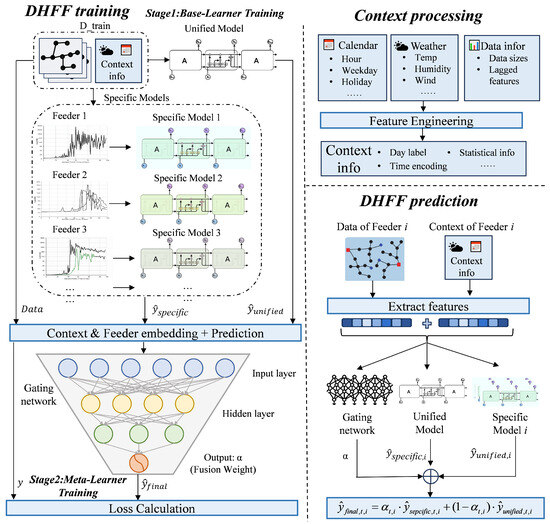
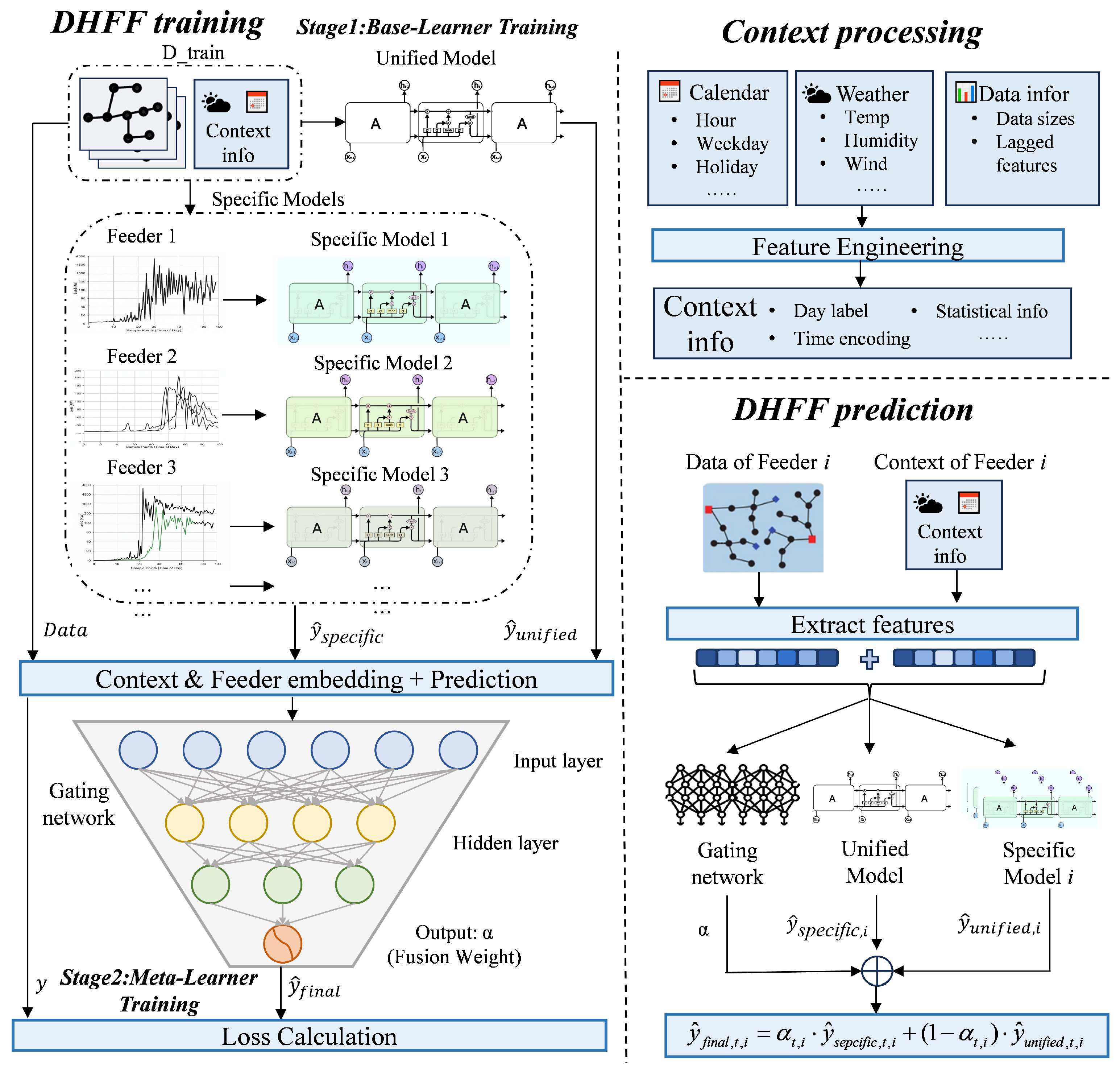
The core idea of DHFF is to decouple the forecasting task into two independent stages: Base-Learner Training and Meta-Learner Training, as illustrated in Figure 1.
Figure 1.
The overall architecture of DHFF framework.
2.3.1. Stage 1: Base-Learner Training
In this first stage, the two types of expert predictors, which are theoretically defined in Section 2.2, are trained. The base learning algorithm is flexible; in this work, Long Short-Term Memory (LSTM) networks are explored for their ability to capture long-term dependencies in time-series data [21,22]. The Unified Model () is trained on the pooled data from all feeders in the meta-train set, while a distinct Specific Model () is trained for each of these feeders.
2.3.2. Stage 2: Meta-Learner (Gating Network) Training
In this stage, the gating network is trained to intelligently fuse the predictions from the experts. To formalize this task, we first derive the optimal fusion weight from an oracle perspective. The final prediction, , is a linear combination of the two base predictions:
The goal is to find an that minimizes the Mean Squared Error, . By taking the derivative with respect to and setting it to zero, we derive the closed-form solution for the optimal fusion weight :
It should be acknowledged that this closed-form solution assumes the two expert predictions are fixed and independent, which is a theoretical approximation. In practice, while utilizing an MLP to approximate this oracle weight allows for real-time non-linear context mapping, it may introduce a degree of sub-optimality. However, this is an acceptable engineering tradeoff for effectively managing bias and variance. This derivation proves that an ideal, dynamically changing fusion weight exists for each sample point. Since is unobservable in practice (as it depends on the unknown true value y), the core task of the gating network is to function as a regression model that approximates this oracle weight. It uses all available context features as input to learn this optimal decision-making process.
The implementation details are as follows:
- Input Feature Rationale: The inputs to the gating network are carefully chosen to provide the necessary information for making an informed fusion decision, including the context features and feeder embedding.
Context Features (): These include temporal features (hour, day of week, month), meteorological features [23] and data features (e.g., data sizes). In our implementation, is a 12-dimensional vector. These features describe the situation or context of the prediction point. The network uses them to learn, for example, whether to trust the global weather-driven model more during a heatwave, or the local behavior-driven model more during a holiday.
Feeder Embedding (): To distinguish between feeders, each feeder is assigned a learnable, low-dimensional embedding vector, . Specifically, is defined as an 8-dimensional vector. This embedding acts as a “digital identity” or a latent representation of the feeder’s intrinsic properties. During training, the backpropagation process automatically adjusts these embeddings, such that feeders with similar load patterns (e.g., two different residential feeders) will have similar embedding vectors. This allows the gating network to apply similar fusion strategies to similar types of feeders.
- 2.
- Gating Network Architecture: An MLP is selected for the Gating network, owing to its capability as a universal function approximator. Its input is a concatenation of the context features and the feeder embedding , resulting in a 20-dimensional input vector. A Sigmoid activation function is used in the output layer to ensure the fusion weight is bounded in the range [0, 1].
- 3.
- Loss Function: The final prediction, , is defined as a weighted sum of the expert predictions:
Here, the weight is generated by the gating network, . The training objective is to minimize the Mean Squared Error (MSE) on the meta-dataset. Therefore, the loss function is formulated as:
During this stage, the expert predictions are treated as fixed targets. Consequently, only the parameters of the gating network G and the embedding vectors e are optimized.
2.4. Theoretical Motivation for the Two-Stage Paradigm
A two-stage approach is deliberately chosen over a joint end-to-end optimization. An end-to-end system would require backpropagation of gradients through three separate model branches, which can lead to conflicting gradients and training instability. In contrast, our decoupled approach provides a stable learning environment for the meta-learner. Specifically, the predictions from the expert models are fixed during the second stage. This simplifies the task of the gating network to learning a nonlinear mapping in a static, well-defined optimization landscape. This design choice therefore enhances modularity, scalability, and training stability. The complete process is detailed in Algorithm 1 below.
| Algorithm 1 DHFF: Two-stage training algorithm |
|
2.5. Few-Shot Learning
The plug-and-play capability of DHFF for a new, data-scarce feeder is realized through the “fast adaptation” or “few-shot learning” process. This process is designed to be computationally inexpensive and highly sample-efficient.
When a new feeder is introduced with a small support set of historical data, , the personalization proceeds in the following steps:
- Task-Difficulty Quantification: First, the framework quantifies the task’s difficulty by calculating the ratio of available data, r. This value serves as an explicit prior for the gating network, directly informing it about the potential reliability of the local expert.
- Hold-out for Meta-Learner: To ensure the gating network learns a robust fusion strategy, the small support set is partitioned into two disjoint subsets: a set for training the local expert, , and a hold-out set for training the meta-learner, . This “split-within-a-split” is crucial to prevent information leakage, as it forces the gating network to learn from data that the local expert has not been trained on.
- Local Expert Training: A lightweight Specific Model, , is trained from scratch using only the subset. This process is fast due to the small size of the training data.
- Meta-Learner Training: With the global and the new local available, their predictions are generated on the hold-out set . These predictions, along with the context features and the true labels from , form a meta-dataset. A new, small gating network, is then trained on this meta-dataset to learn the optimal fusion strategy for this specific feeder.
- Inference: Once personalized, the framework makes future predictions by feeding new context data to all three components. and provide their expert opinions, while G acts as the final decision-maker, outputting the dynamic weight to produce the final, fused forecast.
This entire adaptation process is automated and computationally efficient, as only the small and models are trained, while the large remains frozen.
2.6. Inference Pipeline
Once the two-stage training process is complete, the resulting expert models ( and ) and the gating network (G) are deployed in a streamlined inference pipeline to generate predictions for new, unseen data points. This process, illustrated in the right panel of Figure 1, can be broken down into three key steps:
- Feature Extraction: For a given prediction task at time t for feeder i, the system first receives the corresponding input feature vector . From this vector, the relevant Context Features (e.g., time, weather) are extracted. Simultaneously, the pre-trained Feeder Embedding corresponding to feeder i is retrieved.
- Parallel Prediction: The input feature vector is then processed in parallel by the three core components of the trained framework. First, the Unified Model takes as input and generates the global prediction, . Then, the corresponding Specific Model takes as input and generates the local prediction, . Finally, the gating network takes the concatenated context features and feeder embedding as input and outputs the dynamic fusion weight, .
- Dynamic Fusion: In the final step, the predictions from the two expert models are dynamically fused using the weight generated by the gating network. The final prediction, , is calculated according to (5), yielding the optimized multi-step forecast.
This inference architecture ensures that for every time step and every feeder, the final prediction is an adaptive synthesis of global patterns and local characteristics, orchestrated by the context-aware gating network, as shown in Algorithm 2.
| Algorithm 2 DHFF: Inference Algorithm |
|
3. Experimental Setup and Results
This section presents a comprehensive empirical evaluation of the proposed DHFF framework. The analysis is structured into two main parts. First, the overall performance of DHFF is benchmarked against a suite of baseline models under standard, data-rich conditions to establish its maximum predictive power. Second, a series of targeted few-shot learning experiments are conducted to rigorously assess the framework’s primary design goal: its ability to achieve rapid adaptation and robust performance for data-scarce feeders.
A real-world regional grid dataset was utilized for this study. The distribution network under study operates within a fast-growing urban energy system primarily comprising residential and commercial areas. During the summer period, the AC load accounts for approximately 50% of the total grid load, soaring to as high as 70% during peak hours. Such excessive, highly concentrated AC demand frequently causes severe overloading and overheating of lines and equipment, posing significant safety hazards. Therefore, accurately forecasting these AC loads is of immense practical value. It empowers grid operators to proactively implement load transfers or network upgrades, and facilitates the aggregated dispatch of controllable demand-response resources, thereby fundamentally enhancing the reliability and safety of the power supply. The target projection variable is the actual air-conditioning (AC) load extracted from the feeder-level data. The dataset contains 15-min resolution actual AC load data for 13 feeders (10 kV), spanning from 1 January 2021, to 31 May 2024. Prior to model training, all load data for each feeder was normalized using standard scaling (zero mean, unit variance) to ensure consistency across feeders with different load magnitudes. Although all feeders lie within the same utility service region, they are geographically dispersed and represent different local service areas and land-use types (e.g., residential, commercial, mixed-use), which gives rise to diverse load dynamics.
The forecast horizon is set to four steps ahead (i.e., projecting the subsequent 1-h interval), utilizing a historical sliding window of 96 steps (24 h). Continuous rolling forecasts are performed to generate longer-term profiles. To ensure the reproducibility of the results and rigorous evaluation, the dataset for each feeder was strictly partitioned chronologically: the first 70% of the data was assigned as the training set, the subsequent 10% as the validation set, and the final 20% as the test set.
3.1. Overall Performance Comparison (Data-Rich Scenario)
3.1.1. Prediction Results
Several baseline models were selected for comparison. All models were implemented in Python 3.9, with deep learning models built using PyTorch 1.12.1. Key hyperparameters, listed in Table 1, were determined through grid search on a validation set.
Table 1.
Model Hyperparameter Settings.
The overall performance of all evaluated models on the unseen test set is summarized in Table 2. A clear narrative emerges from a step-by-step comparison of the results, starting with the justification for advanced modeling. The poor performance of the ARIMA model (RMSE 0.6087) establishes a baseline and highlights the complex, non-linear dependencies in the data that necessitate more sophisticated approaches.
Table 2.
Overall performance comparison of all models.
Within the tree-based models, comparing the Specific LGBM (RMSE 0.1267) to the Unified LGBM (RMSE 0.1929) confirms the significant heterogeneity among feeders and reveals the inherent limitation of a simple pooling strategy. Crucially, the Static-H LGBM model, which uses a naive 50/50 blend, performs even worse (RMSE 0.1528), demonstrating that a simple fusion can be detrimental. In sharp contrast, the DHFF (LGBM) model achieves an RMSE of 0.1267, perfectly matching the performance of the Specific LGBM. This is a vital initial finding: the meta-learner, even with simpler GBDT experts, correctly learned a dynamic policy to almost exclusively trust the specific models, thereby identifying the optimal strategy on its own and proving the necessity of an intelligent gating mechanism.
Having validated the DHFF concept with LGBM, the transition to deep learning models marks a significant leap in performance. The standard LSTM (Pooled) model (RMSE 0.0660) substantially outperforms all GBDT-based approaches, highlighting the superior capacity of neural networks to capture complex temporal dependencies. Finally, the most critical comparison shows that the proposed DHFF (LSTM) model, with an RMSE of 0.0135, dramatically improves upon the already strong LSTM (Pooled) baseline. This core result demonstrates that the dynamic fusion strategy is not redundant; instead, it provides a substantial, additional performance gain on top of a powerful deep learning model, reducing the final prediction error by nearly 80%.
3.1.2. Qualitative Case Study
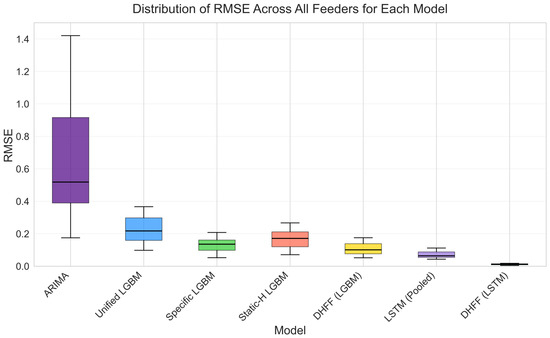
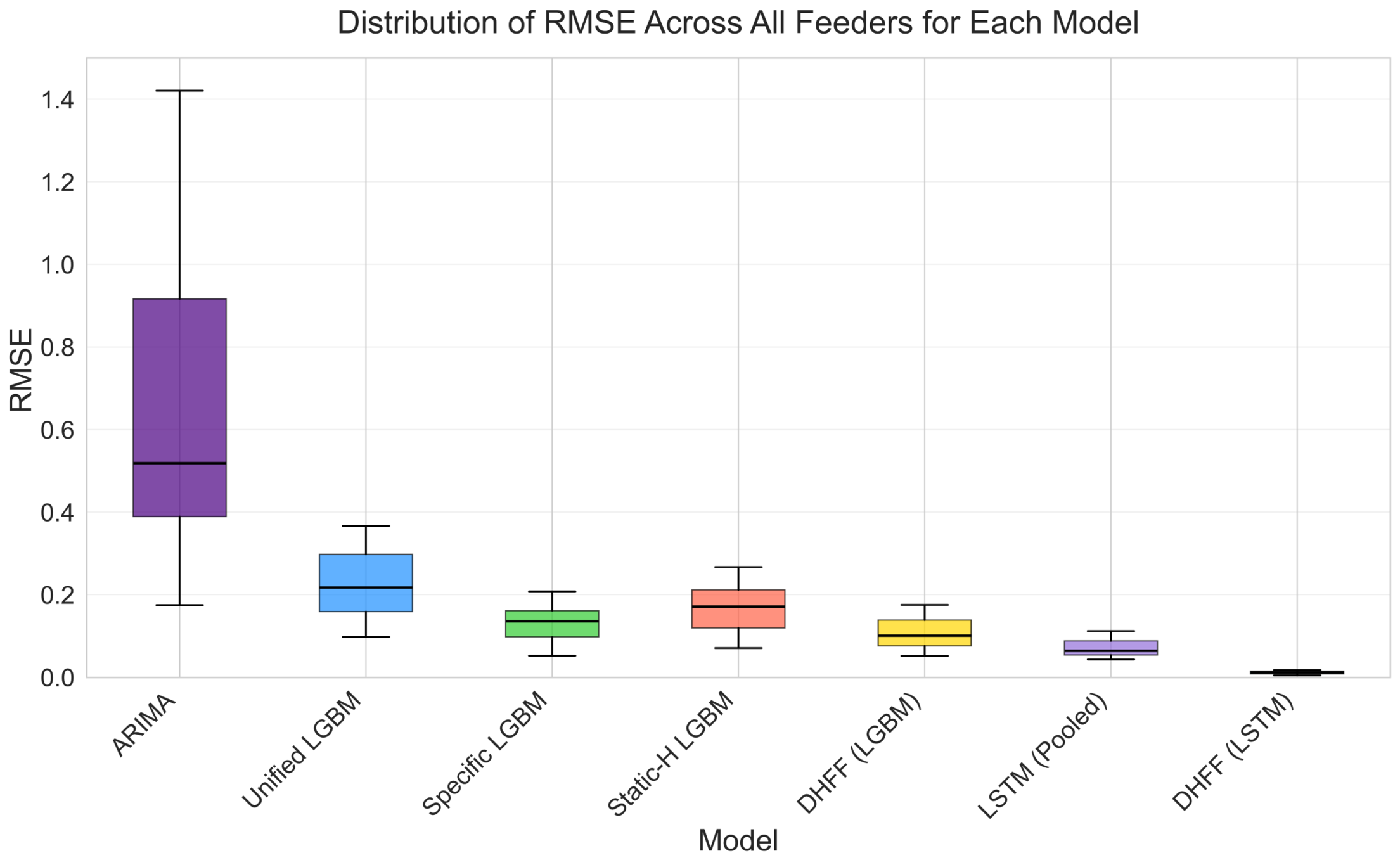
First, the distribution of prediction errors across all 13 feeders was examined, as shown in the box plot in Figure 2.
Figure 2.
Box plot of RMSE distributions for each model across all feeders.
This figure provides a clear overview of each model’s average performance and consistency. The DHFF (LSTM) model is not only better on average, indicated by the lowest median RMSE, but it is also the most consistent. Its highly compact error distribution (the smallest box and whiskers) demonstrates its superior robustness, performing with reliably high accuracy across different types of feeders.
This overall superiority is further clarified by a per-feeder performance breakdown, detailed in Table 3. The results show that the performance gains are not uniform, highlighting the framework’s ability to adapt to individual feeder characteristics. For instance:
Table 3.
Per-feeder performance breakdown for key models.
For Feeder-A, the DHFF (LSTM) achieves an RMSE of 0.0179, a remarkable 71.5% improvement over the already strong LSTM (Pooled) baseline (0.0629).
For Feeder-B, the improvement is even more pronounced. The DHFF (LSTM) reduces the RMSE to 0.0242, an 78% improvement over the LSTM (Pooled) baseline (0.1100).
This strongly suggests that the dynamic fusion strategy successfully learned to apply different, tailored strategies for each feeder, yielding particularly large gains where they were most needed.
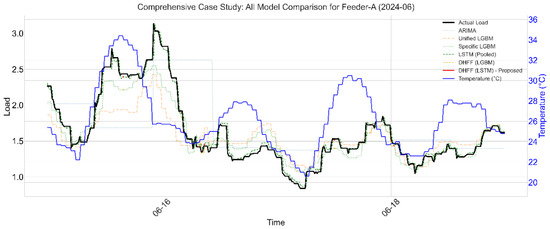
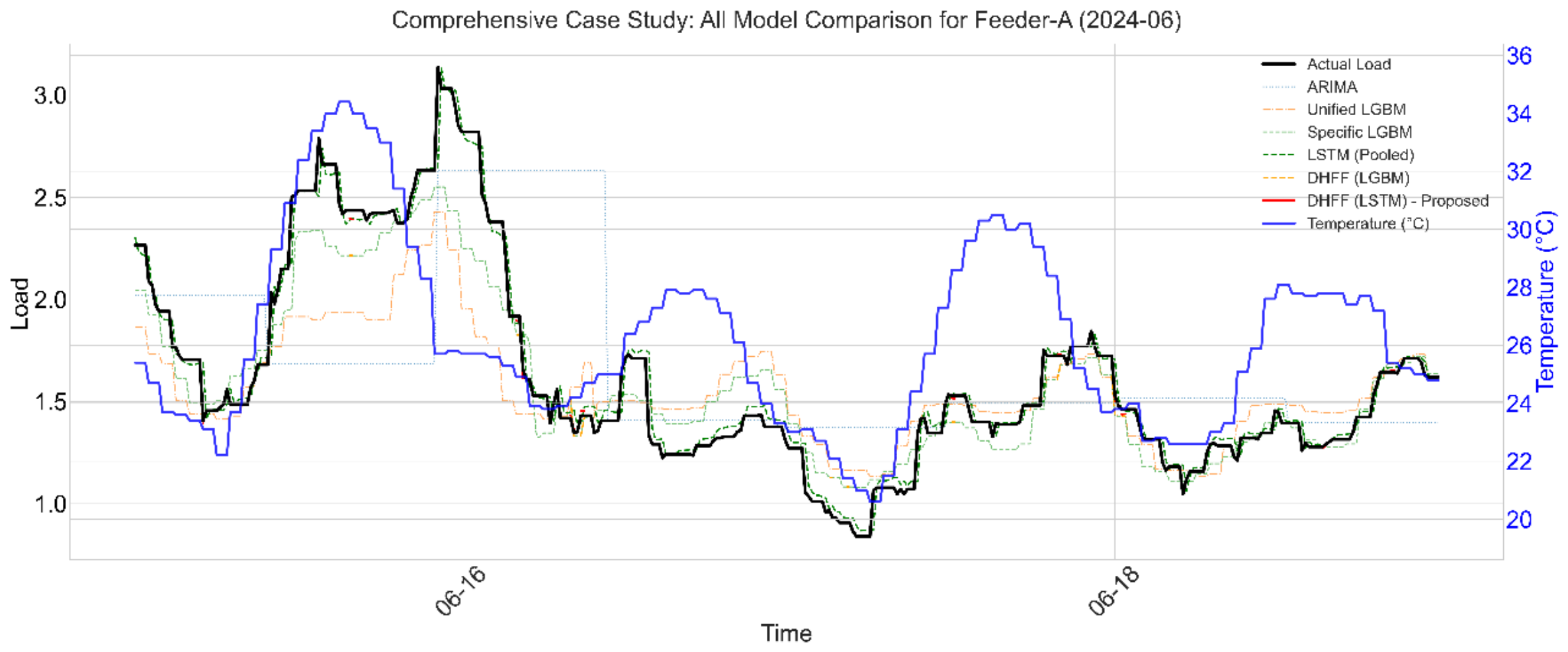
To qualitatively visualize these performance differences, Figure 3 presents a detailed case study for Feeder-A, comparing the predictions of all models against the actual load. This plot offers a powerful visual confirmation of the DHFF’s capabilities.
Figure 3.
Enhanced case study comparison for Feeder-A.
While several models, including LSTM (Pooled) (dashed green line), capture the general trend, the DHFF (LSTM) (solid red line) tracks the Actual Load (thick black line) with visibly higher fidelity. This improved accuracy is particularly evident during the volatile peaks and troughs, where the DHFF model exhibits less overshoot and more precisely captures the magnitude of load changes, correlating well with observed temperature fluctuations. This visual evidence powerfully demonstrates the framework’s enhanced adaptability and its ability to produce more precise and reliable forecasts.
3.2. Analysis of the Fusion Strategy
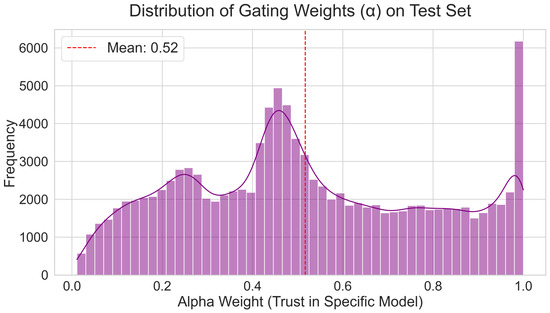
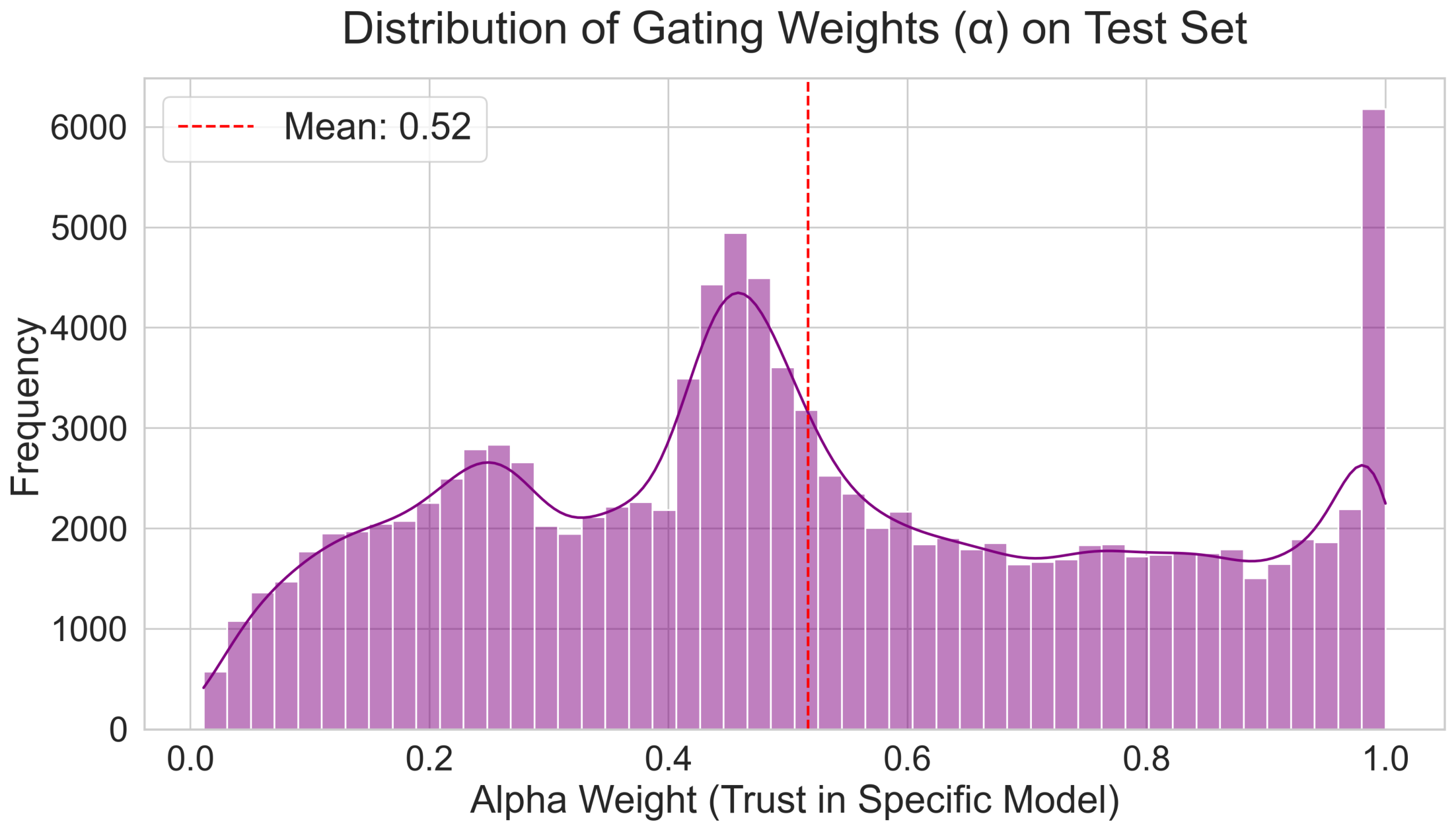
The overall decision-making strategy of the meta-learner was investigated by analyzing the distribution of its output weights (), as shown in Figure 4. The histogram includes the values obtained for all individual 15-min observation points across the entire test set (encompassing all 13 feeders), without any temporal or spatial averaging. The histogram reveals a strong bimodal distribution, with weights heavily concentrated near 0 and 1. This finding is highly significant, as it implies that the meta-learner has learned a “decisive” or “switch-like” strategy. Rather than simply blending the two expert predictions, the gating network makes a confident choice, based on the context, to almost fully trust either the global expert or the local expert.
Figure 4.
Histogram of the gating weights () on the test set. The purple line represents the Kernel Density Estimate (KDE) showing the distribution trend.
3.3. Analysis of Context-Dependency
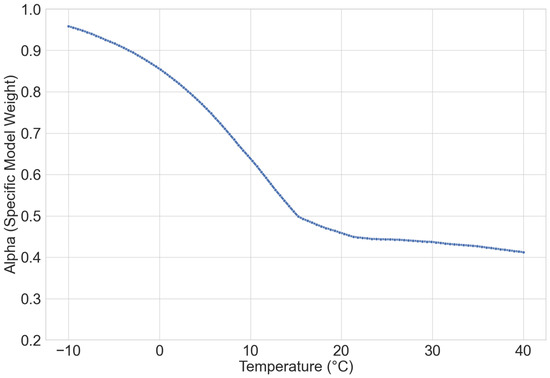
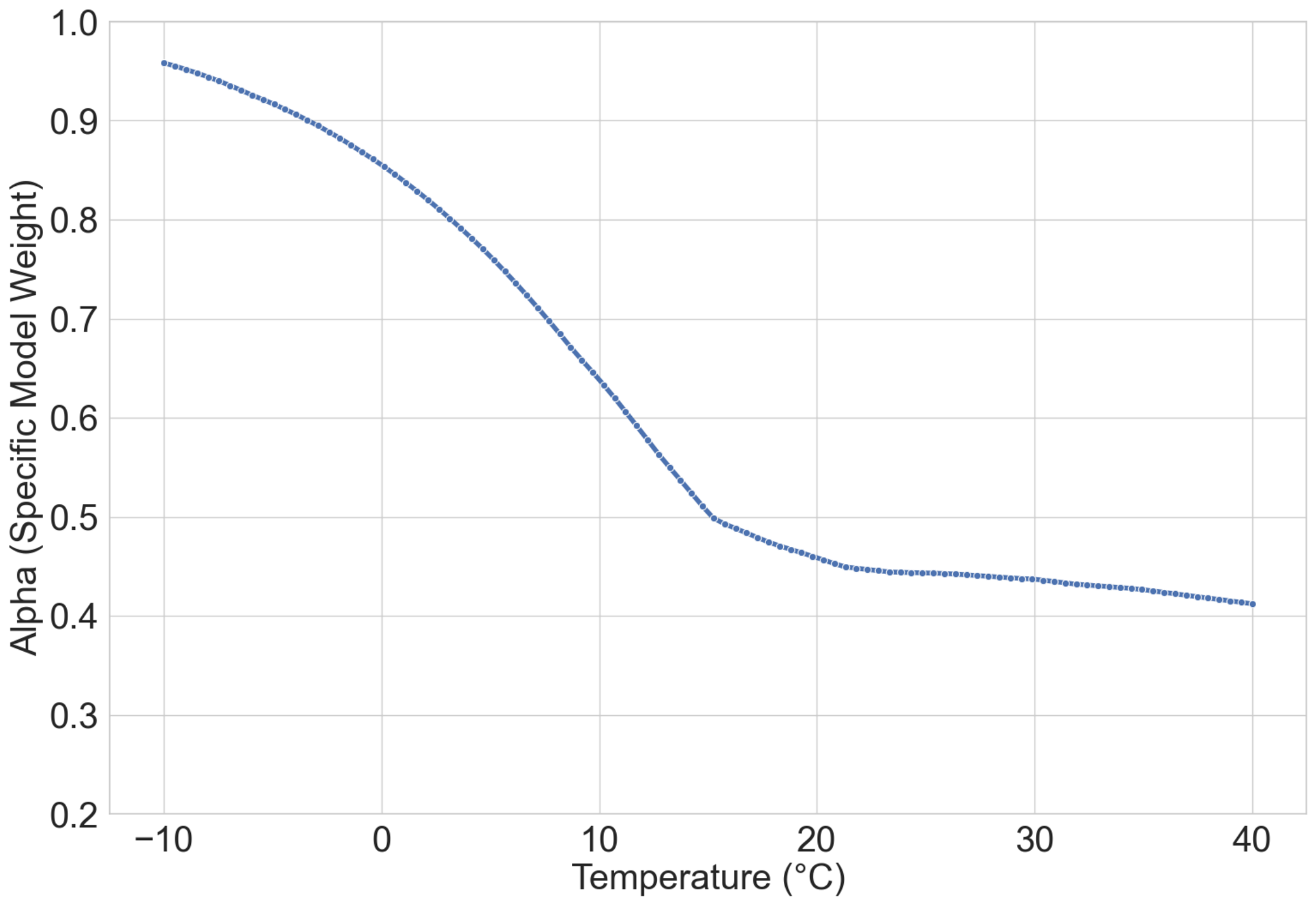
To understand what drives this switching behavior, the relationship between the gating weight and temperature was examined, as shown in Figure 5. This curve was constructed by aggregating the generated sample-wise weights from the test set into discrete temperature bins and calculating the mean weight for each bin. This averaging filters out individual sample noise and clearly reveals the underlying macroscopic dependency trend. This plot provides a concrete example of the model’s adaptive behavior. It shows how the model’s trust in the specific expert () dynamically changes as the temperature varies, confirming that the fusion strategy is not static but responds directly to meteorological conditions, increasingly relying on the global generalized model during extreme high temperatures.
Figure 5.
Gating Weight () vs. Temperature.
3.4. Few-Shot Performance Analysis (Data-Scarce Scenario)
Having established the framework’s superior performance in a data-rich setting, this section evaluates its capabilities under the more challenging and practical “cold-start” problem. This is the central hypothesis of the proposed work: that the DHFF’s meta-learning design enables rapid and robust adaptation to new, data-scarce feeders.
This analysis focuses on the 4 hold-out feeders (A, B, C, D) constituting the unseen meta-test set. To simulate their cold-start integration, a growth process was modeled by creating 11 training scenarios, sampling from 5% (representing extreme scarcity) up to 100% of each feeder’s training data. To rigorously evaluate performance under this “data budget” constraint, three strong baselines were established:
- Specific-Only (Early-Stopping): This baseline provides a fair and direct comparison against the DHFF’s adaptation process. For a given data fraction (e.g., 5%), the data is split 50/50. A standard LSTM model, denoted as , is trained only on the first 50% split. This ensures the baseline model is trained on the exact same amount of data that DHFF uses for its gating network adaptation, eliminating any advantage from data volume and isolating the benefit of the meta-learning framework itself.
- Specific-Full (Upper Bound): This baseline serves as a practical upper bound for performance at each data fraction. It trains a standard LSTM model on the entire available data sample (e.g., the full 10%). This contrasts with Specific-Matched and DHFF, which operate on a smaller subset of this data for training or adaptation. This baseline thus quantifies the maximum performance achievable by a standard model using the entirety of the scarce data available at that stage.
- Unified (Zero-Shot): This baseline uses the powerful model (pre-trained on all meta-training feeders) to make predictions directly on the new feeder without any fine-tuning. It represents a zero-shot learning approach, relying purely on generalized knowledge.
The proposed DHFF method is evaluated using a protocol designed to maximize the utility of the scarce data. For a given data fraction, the two training stages would be conducted:
- Local Expert Training: A final local expert model is trained on the entire available data fraction. This provides DHFF with the strongest possible local expert for the given data budget, in contrast to the baseline which only sees half the data.
- Gating Network Adaptation: The data fraction is split 50/50. The second half is used not to train a new gating network from scratch, but to perform rapid, embedding-only fine-tuning of the pre-trained global gating network. This adaptation efficiently adjusts the gate’s behavior to the specific characteristics of the new feeder by only updating a small set of parameters corresponding to that feeder’s identity.
Critically, the gating network is also fed a prior feature (the data fraction, e.g., 0.05) to explicitly inform it of the task’s data scarcity. This allows it to learn an intelligent fusion policy that manages the bias-variance tradeoff by deciding how much to trust the high-variance versus the high-bias based on the amount of available evidence.
3.4.1. Macro-Level Analysis: Average Learning Curves
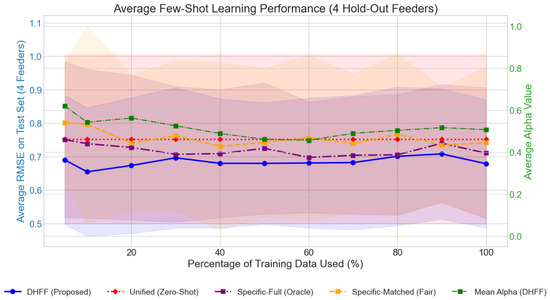
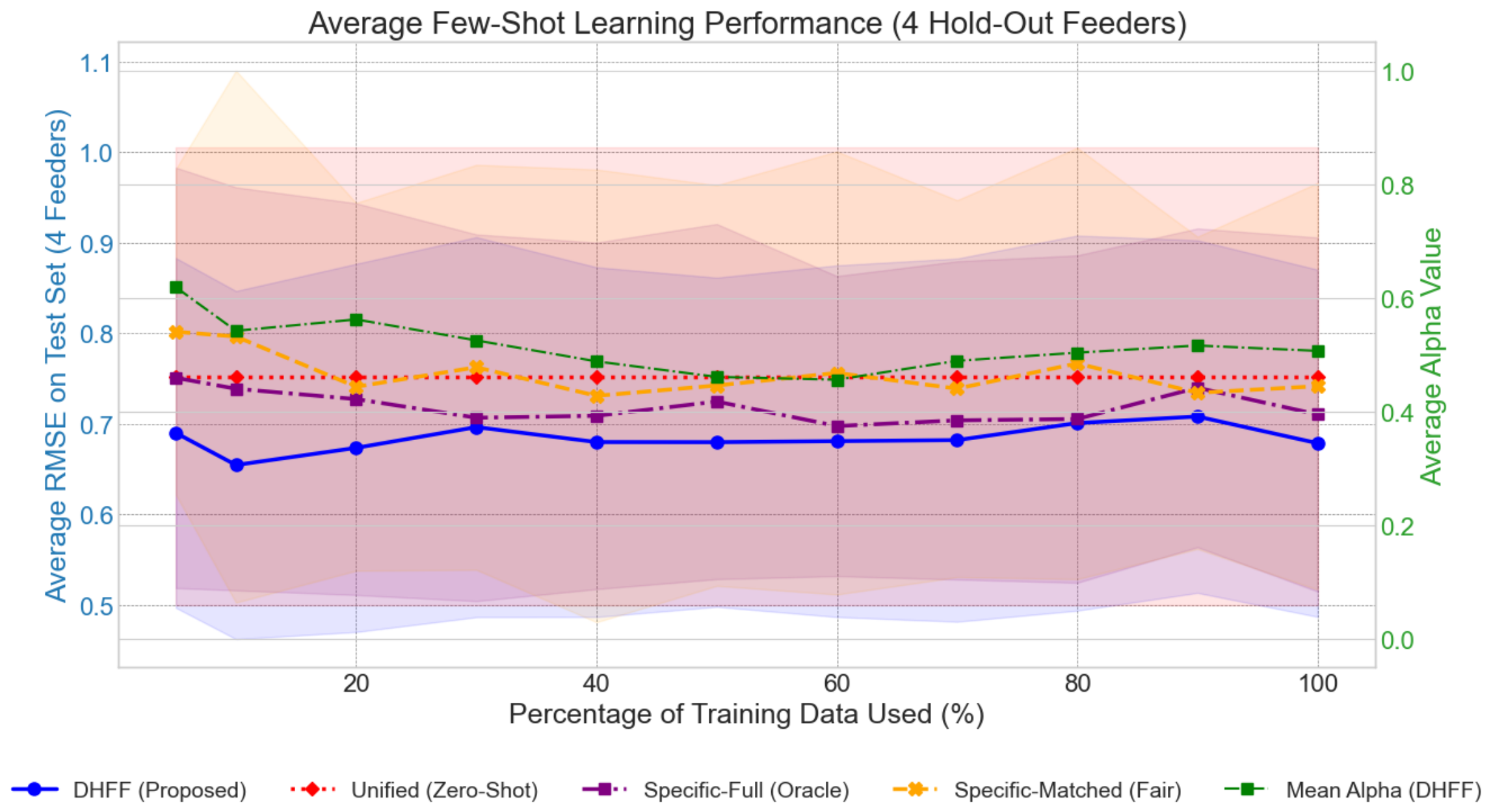
Figure 6 presents the primary results of the few-shot analysis, plotting the average RMSE across all hold-out feeders against the data fraction (from 5% to 100%). The learning curves for the three strategies reveal a clear narrative:
Figure 6.
Average few-shot learning performance of 4 hold-out feeders. The shaded colored areas represent the standard deviation across the feeders for each data fraction.
- At extreme scarcity (5–10%): The Specific-Full and Specific-Matched baselines perform poorly, suffering from high variance and overfitting despite early stopping. The Unified (Zero-Shot) model provides a stable, but high-bias, error. Critically, the DHFF model clearly yields the lowest RMSE across all feeders in this low-data regime. This demonstrates that its meta-learned policy is immediately effective, successfully leveraging the best attributes of both experts.
- During rapid adaptation (20–60%): The most striking finding is the comparison between DHFF and Specific-Full. In this matchup, both strategies utilize 100% of the available data fraction to train their respective local expert model. The Specific-Full baseline is the final output of this overfit, high-variance model. The DHFF, in contrast, employs a more sophisticated strategy. It reserves 50% of that data not for expert training, but for rapid, embedding-only fine-tuning of the pre-trained gating network.
- At data saturation (70–100%): The Specific-Only and the Specific-Full baseline, while more trained, does not consistently catch up to the DHFF. In many cases, the DHFF’s dynamic fusion strategy retains a clear performance edge even when 100% of the training data is available. This finding is perfectly consistent with the outstanding performance observed in the data-rich scenario.
In summary, this average performance curve provides strong quantitative evidence that the DHFF framework is the superior strategy for the entire “cold-start” to “data-rich” lifecycle. It offers the best and most reliable performance, particularly in the critical low-data regime.
3.4.2. Micro-Level Case Study: Interpreting the Gating Decision
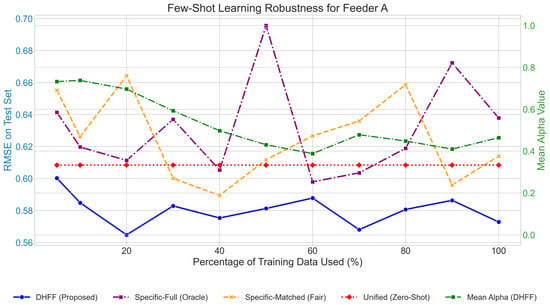
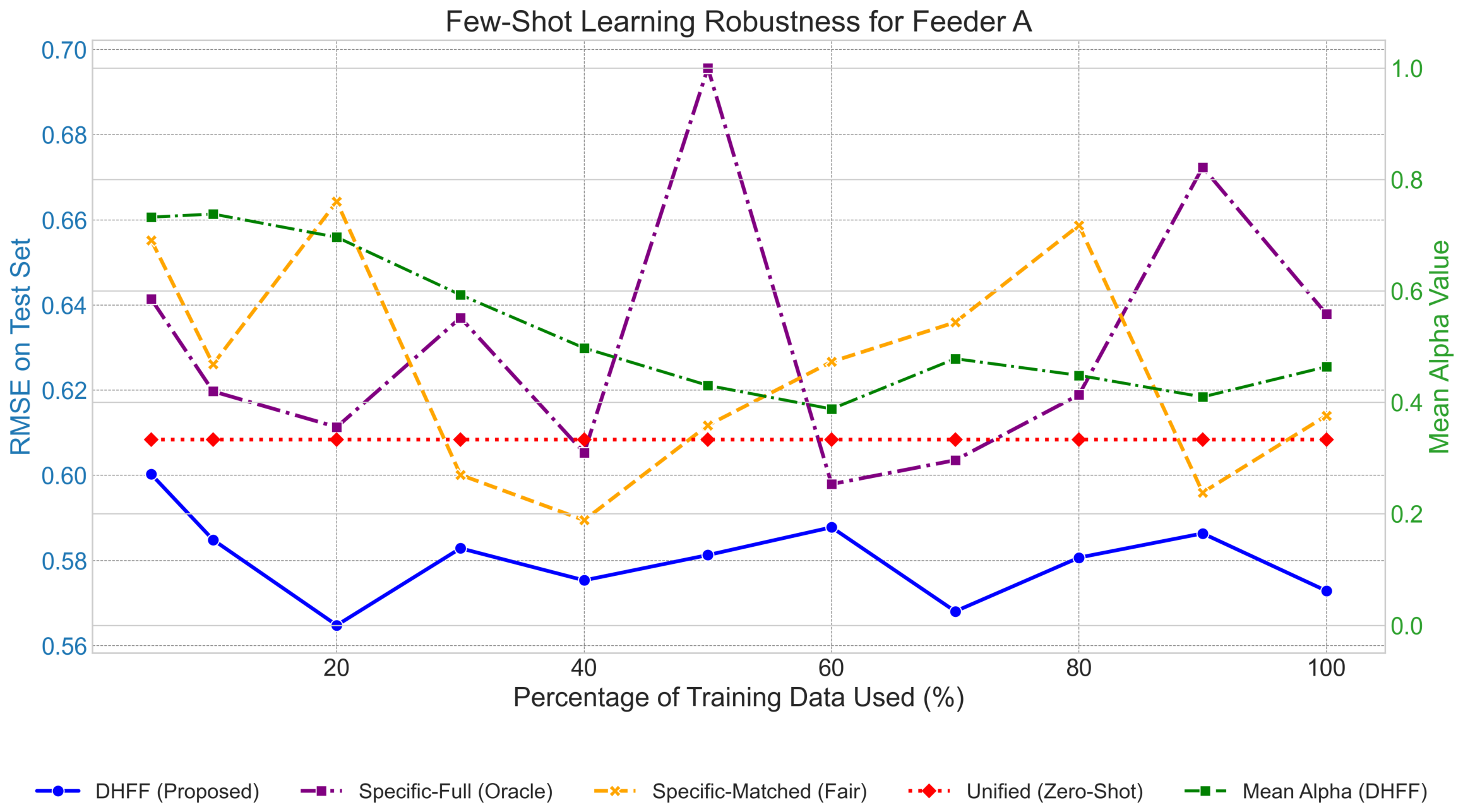
To understand why the DHFF framework is so effective, a micro-level case study on a representative hold-out feeder (Feeder-A) is conducted, as shown in Figure 7. This figure consists of two interconnected plots: (a) the performance learning curves for this specific feeder, and (b) the corresponding mean Alpha () output by the gating network at each data fraction. The Alpha plot provides a direct, interpretable view into the model’s decision-making process, where Alpha represents the trust placed in the local model.
Figure 7.
Few-shot learning performance of Feeder-A.
The results revealed a more sophisticated strategy than a simple linear increase in trust. More specifically, at 5% the mean is substantially non-zero, indicating that the gate can detect and exploit informative local structure even from very small samples. As the data fraction increases, the Alpha value does not simply increase. For Feeder-A, for instance, the trust in the local model decreases from 0.73 (at 5%) to 0.39 (at 60%) before rising again. This complex, non-monotonic behavior demonstrates that the gating network has learned a sophisticated policy. It appears to dynamically reduce its trust in the local expert during phases where the model may be transitioning between overfit states, showcasing a truly adaptive mechanism.
These per-feeder dynamics explain the macro trends: DHFF performs well because the gating policy is data-dependent and feeder-aware rather than fixed and dynamically manages the bias-variance tradeoff in direct response to data scarcity.
4. Discussion
The experimental results confirm the central hypothesis: our meta-learning framework, DHFF, provides a robust and sample-efficient solution to the dual challenges of heterogeneity and data scarcity in multi-feeder load forecasting.
The core value of this research is illuminated by the targeted few-shot analysis. As demonstrated in Section 3.4, the DHFF strategy proved superior in extreme low-data regimes, providing stable forecasts where the Specific-Only baseline failed due to high variance. The mechanism for this success, revealed in Section 3.4, is the gating network’s interpretable decision-making. The weight, representing trust in the local expert, reflected a complex, non-monotonic policy, proving that DHFF actively manages the bias-variance tradeoff in response to data scarcity.
The outstanding performance observed in the data-rich scenario (Section 3.1), where DHFF (LSTM) achieved an 80% RMSE reduction over a strong LSTM (Pooled) baseline, serves as a crucial prerequisite. This result validates the power of the expert models, particularly the model. The framework’s success in the few-shot setting is therefore enabled by its ability to lean on this high-quality, pre-trained global expert when local data is untrustworthy.
The practical implications of this dual capability are significant. The true value of the DHFF framework is operational agility. Grid operators are no longer required to wait months to gather sufficient data for a new feeder. This framework provides a pathway to generating reliable, accurate forecasts from day one, suggesting a move toward more efficient grid scheduling and sustainable operations.
Finally, the framework’s limitations must be acknowledged. Its few-shot capability is contingent on the existence of a diverse, data-rich set of feeders to pre-train a high-quality model. Furthermore, the initial Stage 1 training of all experts is a computationally expensive, one-time cost.
5. Conclusions and Future Work
This paper addressed the dual challenge of heterogeneous, multi-feeder AC load forecasting: managing diverse load patterns while also solving the critical cold-start problem for data-scarce new feeders. To solve this, a novel Dynamic Hierarchical Meta-Learning Framework was proposed.
The framework’s dual effectiveness was validated through a two-part empirical evaluation. First, its primary contribution that helps solve the cold-start problem, was confirmed via rigorous K-day adaptation experiments. It was demonstrated that DHFF provides robust and accurate forecasts in extreme low-data regimes (e.g., 5% data), where traditional Specific-Only models fail. Second, in data-rich scenarios, the framework’s architecture was shown to achieve outstanding performance, reducing the RMSE by nearly 80% compared to a strong LSTM (Pooled) baseline.
The DHFF framework is thus presented as a robust, interpretable, and practical solution effective across the entire lifecycle of a feeder—from its initial cold-start deployment to its data-rich maturity. Future work will proceed in three main directions:
- (1)
- integrating more advanced expert models, such as Transformer-based architectures;
- (2)
- fusing unstructured data by leveraging Large Language Models (LLMs);
- (3)
- extending the framework to an integrated forecasting and control system for demand response applications.
Author Contributions
Conceptualization, C.L. and H.Y.; methodology, C.L.; software, C.L. and Y.S.; validation, W.Z., X.Y. and L.Z.; formal analysis, F.L.; investigation, W.C.; resources, W.Z.; data curation, Y.S.; writing—original draft preparation, C.L.; writing—review and editing, H.Y.; visualization, C.L.; supervision, H.Y.; project administration, W.Z.; funding acquisition, W.Z. All authors have read and agreed to the published version of the manuscript.
Funding
This work was supported by the Science and Technology Project of State Grid Sichuan Electric Power Company: 521996240005.
Institutional Review Board Statement
Not applicable.
Informed Consent Statement
Not applicable.
Data Availability Statement
The data presented in this study are available on request from the corresponding author.
Acknowledgments
The authors would like to thank State Grid Sichuan Electric Power Company for providing the data and support for this research.
Conflicts of Interest
Authors Chuan Long, Yunche Su, Xinting Yang, Fang Liu and Wei Chen were employed by the State Grid Sichuan Economic Research Institute. Wenhua Zhang and Ling Zhang are affiliated with State Grid Sichuan Electric Power Company. The remaining authors declare that the research was conducted in the absence of any commercial or financial relationships that could be construed as a potential conflict of interest. The authors declare that this study receivedfundingfrom State Grid Sichuan Electric Power Company. The funder was not involved in the study design, collection, analysis, interpretation of data, the writing of this article or the decision to submit it for publication.
References
- IEA. World Energy Outlook 2023; International Energy Agency: Paris, France, 2023; Available online: https://www.iea.org/reports/world-energy-outlook-2023 (accessed on 8 May 2026).
- Hyndman, R.J.; Athanasopoulos, G. Forecasting: Principles and Practice, 2nd ed.; OTexts: Melbourne, Australia, 2018; Available online: https://otexts.com/fpp2/ (accessed on 8 May 2026).
- Box, G.E.P.; Jenkins, G.M.; Reinsel, G.C.; Ljung, G.M. Time Series Analysis: Forecasting and Control, 5th ed.; John Wiley & Sons: Hoboken, NJ, USA, 2015. [Google Scholar]
- Chen, T.; Guestrin, C. XGBoost: A Scalable Tree Boosting System. In Proceedings of the 22nd ACM SIGKDD International Conference on Knowledge Discovery and Data Mining, San Francisco, CA, USA, 13–17 August 2016; Association for Computing Machinery: New York, NY, USA, 2016; pp. 785–794. [Google Scholar] [CrossRef] [Scilit]
- Hochreiter, S.; Schmidhuber, J. Long Short-Term Memory. Neural Comput. 1997, 9, 1735–1780. [Google Scholar] [CrossRef] [Scilit]
- Vaswani, A.; Shazeer, N.; Parmar, N.; Uszkoreit, J.; Jones, L.; Gomez, A.N.; Kaiser, L.; Polosukhin, I. Attention Is All You Need. In Advances in Neural Information Processing Systems; Curran Associates Inc.: Red Hook, NY, USA, 2017; Volume 30. [Google Scholar]
- Oreshkin, B.N.; Carpov, D.; Chapados, N.; Bengio, Y. N-BEATS: Neural Basis Expansion Analysis for Interpretable Time Series Forecasting. In Proceedings of the International Conference on Learning Representations, Addis Ababa, Ethiopia, 26–30 April 2020. [Google Scholar]
- Hyndman, R.J.; Ahmed, R.A.; Athanasopoulos, G.; Shang, H.L. Optimal Combination Forecasts for Hierarchical Time Series. Comput. Stat. Data Anal. 2011, 55, 2579–2589. [Google Scholar] [CrossRef] [Scilit]
- Finn, C.; Abbeel, P.; Levine, S. Model-Agnostic Meta-Learning for Fast Adaptation of Deep Networks. In Proceedings of the 34th International Conference on Machine Learning, Sydney, Australia, 6–11 August 2017; JMLR: Sydney, Australia, 2017; pp. 1126–1135. [Google Scholar]
- He, Y.; Luo, F.; Ranzi, G. Transferrable Model-Agnostic Meta-Learning for Short-Term Household Load Forecasting with Limited Training Data. IEEE Trans. Power Syst. 2022, 37, 3177–3180. [Google Scholar] [CrossRef] [Scilit]
- Li, Y.; Zhang, S.; Hu, R.; Lu, N. A Meta-Learning Based Distribution System Load Forecasting Model Selection Framework. Appl. Energy 2021, 294, 116991. [Google Scholar] [CrossRef] [Scilit]
- Wang, Q.; Chen, Z.; Wu, C. Clustering Enabled Few-Shot Load Forecasting. arXiv 2022, arXiv:2202.07939. [Google Scholar] [CrossRef] [Scilit]
- Tsoumplekas, G.; Athanasiadis, C.L.; Doukas, D.I.; Chrysopoulos, A.; Mitkas, P.A. Few-Shot Load Forecasting under Data Scarcity in Smart Grids: A Meta-Learning Approach. Energies 2025, 18, 742. [Google Scholar] [CrossRef] [Scilit]
- Ye, R.; Dai, Q. MultiTL-KELM: A Multi-Task Learning Algorithm for Multi-Step-Ahead Time Series Prediction. Appl. Soft Comput. 2019, 79, 227–253. [Google Scholar] [CrossRef] [Scilit]
- Xu, Z.; Yang, Z.; Gao, C.; Cheng, R.; Li, F.; Zhang, H.; Hu, X.; Luo, Q.; Yu, T. A Review of Intelligent Analysis and Applications of Load Characteristics in Modern Power Systems. Energies 2026, 19, 1927. [Google Scholar] [CrossRef] [Scilit]
- Ehtsham, M.; Rotilio, M.; Cucchiella, F. Multi-scale energy forecasting in smart households: Leveraging AI and remotely sensed climate data for sustainable energy management. Results Eng. 2025, 28, 108281. [Google Scholar] [CrossRef] [Scilit]
- Kim, H.; Ye, K.; Lee, D.; Lu, N. A Contextually Supervised Optimization-Based HVAC Load Disaggregation Methodology. IEEE Trans. Smart Grid 2024, 15, 3852–3863. [Google Scholar] [CrossRef] [Scilit]
- Ehtsham, M.; Rotilio, M.; Cucchiella, F. Deep learning augmented medium-term photovoltaic energy forecasting: A coupled approach using PVGIS and numerical weather model data. Energy Rep. 2025, 13, 4299–4317. [Google Scholar] [CrossRef] [Scilit]
- Vanschoren, J. Meta-Learning: A Survey. arXiv 2018, arXiv:1810.03548. [Google Scholar] [CrossRef] [Scilit]
- Hospedales, T.; Antoniou, A.; Micaelli, P.; Storkey, A. Meta-Learning in Neural Networks: A Survey. IEEE Trans. Pattern Anal. Mach. Intell. 2022, 44, 5149–5169. [Google Scholar] [CrossRef] [Scilit] [PubMed]
- Asghar Majeed, M.; Phichaisawat, S.; Asghar, F.; Hussan, U. Data-Driven Optimized Load Forecasting: An LSTM-Based RNN Approach for Smart Grids. IEEE Access 2025, 13, 99018–99031. [Google Scholar] [CrossRef] [Scilit]
- Kong, W.; Dong, Z.Y.; Jia, Y.; Hill, D.J.; Xu, Y.; Zhang, Y. Short-Term Residential Load Forecasting Based on LSTM Recurrent Neural Network. IEEE Trans. Smart Grid 2019, 10, 841–851. [Google Scholar] [CrossRef] [Scilit]
- Habib, M.A.; Hossain, M.J.; Alam, M.M.; Islam, M.T. A hybrid optimized data-driven intelligent model for predicting short-term demand of distribution network. Sustain. Energy Technol. Assess. 2024, 67, 103818. [Google Scholar] [CrossRef] [Scilit]

Disclaimer/Publisher’s Note: The statements, opinions and data contained in all publications are solely those of the individual author(s) and contributor(s) and not of MDPI and/or the editor(s). MDPI and/or the editor(s) disclaim responsibility for any injury to people or property resulting from any ideas, methods, instructions or products referred to in the content. |
© 2026 by the authors. Licensee MDPI, Basel, Switzerland. This article is an open access article distributed under the terms and conditions of the Creative Commons Attribution (CC BY) license.