Article

Large-Scale Coating Methods for Improving Heat Transfer and Stress Management of Metal Hydrides

by
Jan Warfsmann
1,2,
Julián Puszkiel Sladivar
1,2,3,*,
Phillip Sebastian Krause
1,2,
Eike Wienken
1,2,
Thomas Klassen
1,2 and
Julian Jepsen
1,2
1
Institute of Hydrogen Technology, Helmholtz-Zentrum Hereon, Max-Planck-Straße 1, 21502 Geesthacht, Germany
2
Institute of Applied Materials Engineering, Helmut-Schmidt University, University of the Federal Armed Forces Hamburg, Holstenhofweg 85, 22043 Hamburg, Germany
3
Solid-State Chemistry and Catalysis, Materials Science and Metallurgical Engineering, and Inorganic Chemistry, Faculty of Sciences, Puerto Real Campus, University of Cádiz, 11510 Puerto Real, Spain
*
Author to whom correspondence should be addressed.
Energies 2026, 19(10), 2451; https://doi.org/10.3390/en19102451
Submission received: 28 March 2026 / Revised: 13 May 2026 / Accepted: 14 May 2026 / Published: 20 May 2026

Abstract

Storing hydrogen in interstitial metal hydrides has several advantages. These include high volumetric capacity (50–100 kg/m3), fast kinetics, and safer conditions due to mild operating temperatures (<100 °C) and pressures (<50 bar). However, thermal management and stress development remain challenges to be overcome. There have already been promising methods to improve the performance of metal hydrides, but most are only proof of concept. They have only been investigated on a lab-scale with a few grams of sample. In this work, a commercially available AB2-metal alloy is coated with 10 wt% expanded natural graphite (ENG) and 10 wt% elastomeric binder. The focus is on methods that can easily be scaled up. Two methods (wash-coating and spray-coating) have been successfully applied to prepare hydride-forming materials on a kilogram scale. The performance of the coated material in terms of heat management, stress development, hydrogen capacity, and kinetics is evaluated to be over 50 cycles of hydrogen absorption/desorption. The results are confirmed by a larger-scale set of experiments with ≈0.5 kg of sample. The spray-coating method shows promising results, combining fast preparation, reasonable hydrogen capacity, and the potential to compensate for the bulk of the expansion stress.

1. Introduction

Over the past few years, several countries (e.g., the EU [1], New Zealand [2], Australia [3], or China [4]) have implemented dedicated hydrogen technology pathways. The common goal is to reduce dependency on fossil fuels, with all their negative impacts (e.g., CO2 emissions that drive climate change and economic risks). These pathways are mostly focused on the production of green hydrogen (hydrogen produced from renewable energy via electrolysis), hydrogen distribution [5], and conversion of industrial sectors with high energy demand, like steel production [6]. While there is much potential for a hydrogen economy, the bottleneck remains storage. Hydrogen has a very low volumetric energy density (0.00299 kWh/Nm3) [7] under standard pressure and temperature conditions. The pressure has to be increased drastically to reach a feasible storage capacity. For pressurized hydrogen storage, a volumetric density of ≈1.2 kWh/L at 700 bar is possible [7]. Even higher volumetric capacities (≈2.4 kWh/L) [8] can be reached by liquefying the hydrogen at −253 °C. However, a large energy penalty during condensation (up to 30% of hydrogen’s lower heating value) and boil-off losses (up to 3% per day) [9] make this concept feasible only in specific applications, such as aviation [10]. Storing hydrogen in solid-state materials offers an alternative. While there are different materials, this work emphasizes storage in metals or metal alloys. Here, the hydrogen will be stored in an atomic state inside the metal lattice after a chemical reaction. Thus, the volumetric storage capacity can be greatly increased (up to ≈4.1 kWh/L) [11], while retaining reasonable working temperatures (<100 °C) and pressures (<50 bar). Hence, this type of storage material is also called room-temperature (RT) or interstitial (metal) hydrides. Various metal alloys for hydrogen storage exist, but this work will focus on AB2-metal alloys. They combine several advantages, e.g., fast kinetics, straightforward activation, and safe handling prior to contact with hydrogen [12,13,14]. However, there are still challenges to overcome. One of them is the development of stress on the tank walls during hydrogen storage. The stress induced by swelling is a direct and inevitable consequence of the interstitial nature of the storage materials [15]. The loaded form (the metal hydride) has a larger unit-cell volume than the pristine metal compound. The volume difference can reach up to 30% [16], posing another challenge: pulverization [17]. The volume difference between the hydride phase at the surface and the metal phase in the bulk leads to large stresses within individual particles. Metal alloys are often brittle, and cycling (repeated hydrogen absorption and desorption) can further disintegrate the particles. They become µm-sized particles regardless of their initial size [13]. Another aspect of stress development is friction, in which two adjacent particles are wedged together during the expansion phase. This effect becomes more pronounced as the cycle count increases. The small particles begin to agglomerate at the bottom of the tank, further increasing stress [18]. The stress can become so large that tanks bend or even rupture [19]. Therefore, this effect must be considered during tank development. The degree of stress development can be influenced by constructive measures such as tank orientation (vertical vs. horizontal) [20] and tank “slimness” (the ratio of diameter to length) [16]. Other methods include adding gliding agents to reduce particle friction [21] or preventing pulverization by embedding the metal alloy in a polymer matrix [22]. However, the most common method is to simply leave free volume in the storage tank [23].
Another direct consequence of pulverization is a reduction in the effective thermal conductivity. Hydrogen storage in metal alloys is an exothermic process, releasing heat (and vice versa for desorption). Fine powders generally have a low effective thermal conductivity of <1 W/(m K) [24], and the heat released during hydrogen absorption cannot be dissipated in a reasonable time. The equilibrium pressure for hydrogen absorption is temperature dependent. A heated-up system has slower kinetics and reduced hydrogen capacity. Heat transport is known to be the limiting factor for system performance from the gram scale onwards [25]. Consequently, considerable effort has been devoted to investigating heat management in metal hydride tank systems to predict their behavior and, ultimately, improve performance [26,27]. The problem of heat management is often solved by increasing the internal contact area, e.g., by adding aluminum fins [28,29,30,31] or by installing internal cooling systems [29,30,32]. Often, a complex system (e.g., a capillary system) can greatly improve kinetic performance by increasing the overall effective thermal conductivity. However, a more complex system might be economically infeasible. All constructive improvements add non-reactive weight, and the systematic hydrogen capacity can drop far below 1 wt% [33]. The ecological impact is another important aspect. Life-Cycle Assessment (LCA) investigations have shown that most of the energy consumption (and consequently CO2 emission) for the construction of a metal hydride tank system can be attributed to the steel for piping and the tank hull. Even though most interstitial metal hydrides are composed of metals that need a lot of energy for production (e.g., Ti or V [13]), they only make up a fraction (≈15%) of the total storage system weight [34]. The additional mass might have further implications for the overall operation. Optimized hydrogen storage performance requires changing the tank system temperature between absorption and desorption. A larger auxiliary mass (e.g., due to thicker walls or internal cooling systems) increases the energy demand to operate a metal hydride tank and may result in slower performance. Slow system response can be a severe disadvantage for time-critical systems, e.g., emergency power supplies [35]. The mass of the metal hydride cannot be reduced because it is directly correlated to the system’s projected hydrogen capacity. Energy savings are therefore only possible by reducing the mass of the tank hull or the extent of additional constructive parts.
Trade-offs are therefore necessary: From an economic perspective, a less complex system with thin-walled tanks is preferred. However, a certain level of complexity is needed to achieve reasonable kinetic performance.
Another challenge for hydrogen storage in metal hydrides remains scaling. A direct jump from the lab towards a pilot plant is not possible due to potentially significant differences in mass and heat transfer. Several steps are needed between the lab and the final plant. While scaling is a challenge for chemical plants in general [36], it is particularly complex for hydrogen storage systems. Results from hydrogen storage systems and materials are often presented only for small lab-scale systems. Possible reasons include the high cost of materials or funding challenges after the initial phase of research projects. In the field of metal hydride research, there is a considerable gap between lab-scale and large-scale systems. About 63% of the reported results concern lab-scale systems (without specifying the boundary between lab-scale and large-scale systems) [29]. The lack of larger-scale systems also applies to other metal hydride technologies, such as metal hydride compressors [37]. Such a gap between laboratory-scale and large-scale systems is challenging to bridge and might explain the considerable number of delayed or even canceled hydrogen projects [38].
At this point, it seems ambitious to address the main challenges of metal hydride materials (heat management and stress development) solely through vessel design. Hence, as an alternative, we have aimed to improve the properties of metal hydride storage systems on a material level. By reducing expected stress, the tank wall thickness can be reduced. By improving thermal conductivity, fewer built-in components (e.g., internal cooling systems or fins) are needed, thus enabling simpler systems. Hence, we present here an easy-to-scale approach that improves heat and stress management through a coating composed of expanded natural graphite (ENG; a graphite modification with improved heat conductivity) and an elastomeric binder (Ethylene-Vinyl Acetate Copolymer, EVA). The coating method was designed with potential scalability in mind, and we have successfully established a coating process at the kg scale. Furthermore, we have compared results at the lab-scale (≈10 g) and an intermediate scale (≈0.5 kg) to fill the gap between lab-scale and larger-scale measurements, and analyzed them with respect to hydrogen capacity, kinetic behavior, heat management, and expansion stress development.

2. Experimental Section

2.1. Materials

The AB2-metal alloy Ti0.95Zr0.05Mn1.46V0.45Fe0.09 (brand name: HydralloyC5®; referred to as HyC5 hereafter) was purchased from GfE (Gesellschaft für Elektrometalurgie, Höfener Str. 45, Nürnberg, Germany) with a particle size of 2–10 mm in an amount of 1.2 t. The particle size of HyC5 was reduced before the experiments using a Retsch BB50 jaw crusher with a jaw distance of 4 mm, resulting in a sample with a particle size of 0–4 mm. ENG (Expanded natural graphite, particle size 5 µm; SGL Carbon, Wiesbaden, Germany), hexane (VWR Chemicals, USA), cyclohexane (Sigma Aldrich, Sigma-Aldrich Chemie GmbH, Eschenstr. 5, Taufkirchen, Germany), and EVA (Ethylene-vinyl acetate copolymer with 28% of vinyl acetate; Westlake Elevite EM2800AA, 2801 Post Oak Boulevard, Suite 600, Houston, TX, USA) were used as received. The role of the individual compounds is further clarified in Table A2.

2.2. Sample Preparation

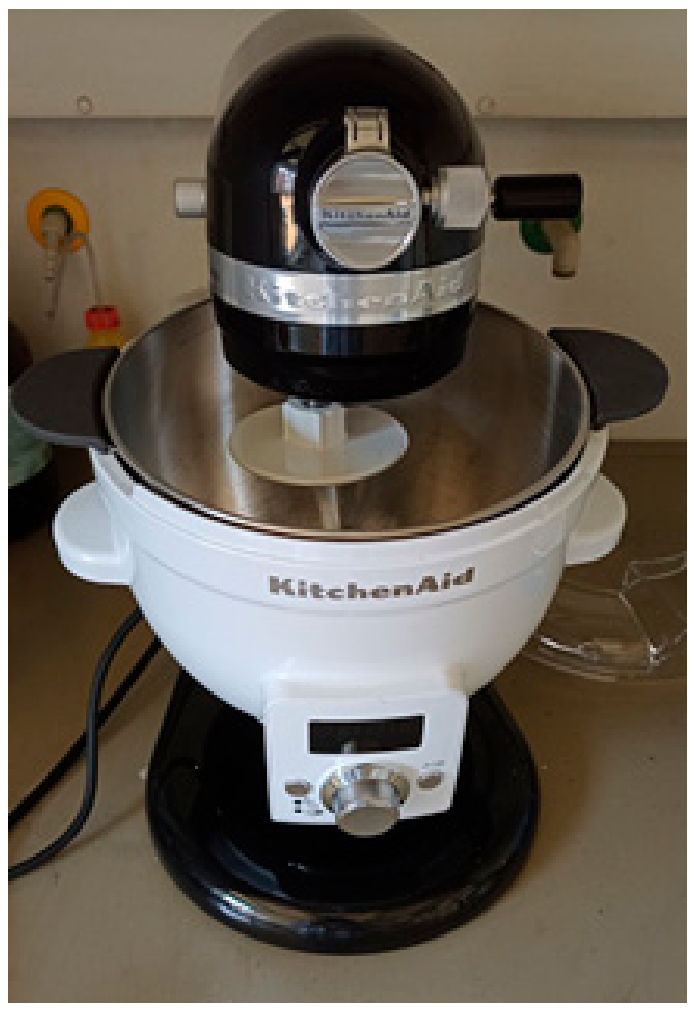
The preparation of the lab-scale sample was reported in our previous work [39]. Briefly, 10 g of crushed HyC5 was coated with a suspension containing 1 g of EVA and 1 g of ENG dissolved in hexane (80 mL). The solvent evaporated during mechanical stirring at 85 °C. The residual solvent was removed by heating the sample at 85 °C. The larger-scale wash-coating process was done in a household stand mixer with a heatable mixing bowl (see Figure A1). In a typical experiment, 1 kg of crushed HyC5 was coated. For the coating suspension, 100 g of EVA and 100 g of ENG were added to 2.5 L of hexane, and the mixture was heated to 55 °C until the EVA dissolved (≈3 h). After the EVA had been dissolved, the HyC5 was added to the mixture, and the temperature was set to 85 °C to evaporate the solvent. The residual solvent was removed by heating the sample at 85 °C for 5 h in an electric oven. Spray-coating was performed using a commercially available paint spray pistol (Stahlwerk DG-600 ST, STAHLWERK Schweissgeraete GmbH, Mainstraße 4, Bornheim, Germany). A larger nozzle (1.7 mm) was needed to prevent the system from clogging. For the spray-coating, 100 g of EVA and 100 g of ENG were dissolved in 2.5 L of cyclohexane at 80 °C, and the mixture was slowly sprayed onto 1 kg of HyC5 while manually moving the metal alloy to ensure an even coating. The solvent residue was removed after coating with a hot air flow (hot-air gun) while the sample was manually moved. The different coated samples will be referred to as HyC5 + ENG + EVA-Lab, HyC5 + ENG + EVA-Wash, and HyC5 + ENG + EVA-Spray.

2.3. Sample Characterization

The lab-scale samples were investigated with an in-house-built Sieverts-type apparatus. In addition to the hydrogen capacity, the temperature and strain were also measured in situ by attaching a strain gauge (Series M strain gauge, Type 1-LM15-6/350GE, measurement error ≈ 0.3%, Hottinger Brüel & Kjaer GmbH, Im Tiefen See 45, Darmstadt, Germany) and a thermocouple (self-adhesive K-Type thermocouple, class 1 with a deviation limit of ±1.5 °C, Therma GmbH, Schreinerweg, Lindlar, Germany) to the sample holder. More information about the measurement principle and the sample holder was reported before [39].
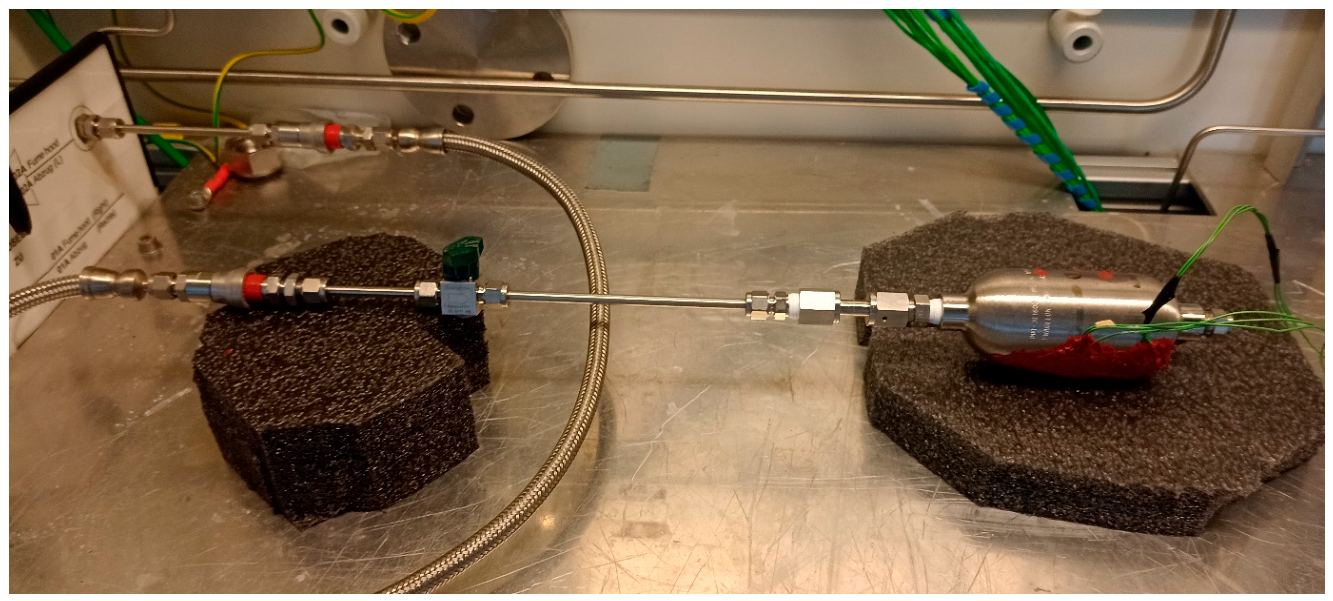
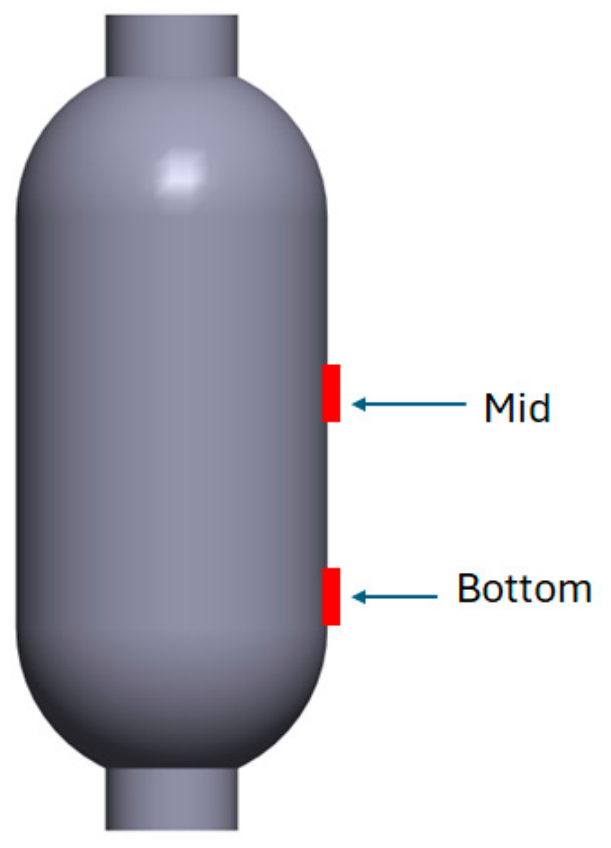
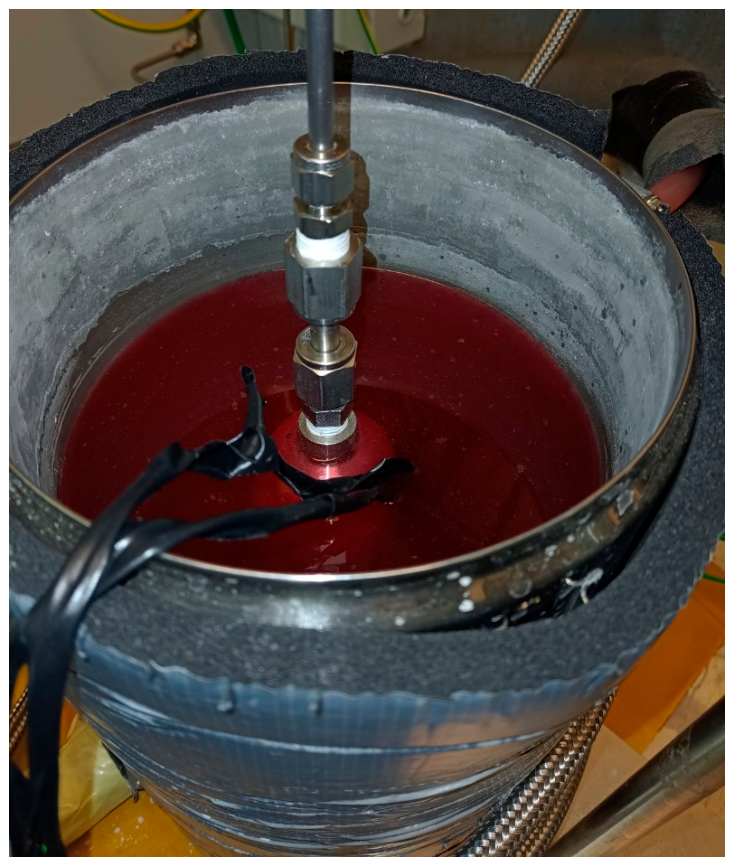
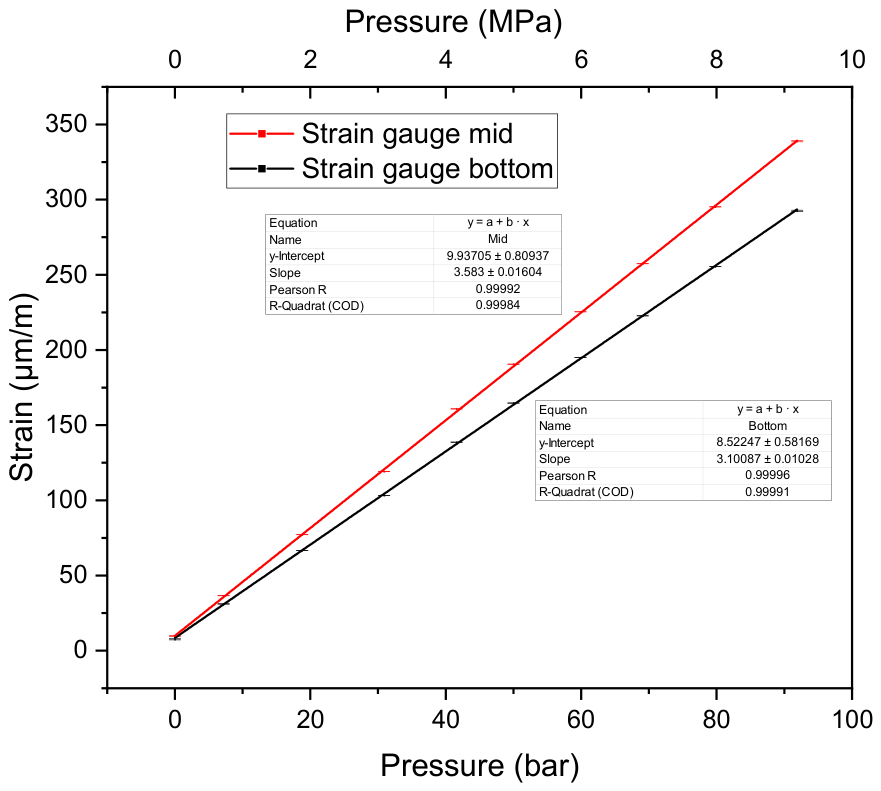
The intermediate-scale hydrogen storage investigation was conducted at an in-house test station [40]. The measurement is based on the quantitative evaluation of the hydrogen gas mass balance during the absorption/desorption. With knowledge of the following parameter, the hydrogen capacity of the sample can be calculated from the hydrogen mass balance: mass of the hydride material, specific hydrogen flow (from a gas flow meter), hydrogen density, hydrogen temperature, and volume of the gaseous phase. A commercially available pressure cylinder (Swagelok 304L-HDF4-150, Best Fluid Systems GmbH, Swagelok Hamburg, Germany) was used as a sample holder (see Figure A4). Two strain gauges (Series M strain gauge, Type 1-LM15-6/350GE, HBM; measurement error ≈0.3%) were attached to the surface of the cylinder. One was attached at the middle and one at the bottom of the cylinder, where the highest stress is expected (see Figure A5). The measured strain was converted to a pressure equivalent using a calibration curve (see Figure A10) and was obtained by filling the empty cylinder with hydrogen at varying pressures at 40 °C and measuring the corresponding strain. This methodology assumes a uniform loading of the cylinder for stress development. Temperature control during the experiment was achieved by immersing the cylinder in a thermobath containing a 1:1 water–glycol mixture (see Figure A6) and connecting the system to a temperature controller (Julabo FL1703, JULABO GmbH, Gerhard-Juchheim-Strasse, Seelbach, Germany).
All hydrogen capacities (lab-scale measurements and intermediate-scale measurements) were given in correlation to the total mass of the sample (HyC5 + ENG + EVA). The density of the samples was measured at 20 °C with a Micrometrics AccuPyc II 1340 (Micromeritics GmbH, Einsteinstraße, Unterschleißheim, Germany) pycnometer with helium as sample gas, with 20 purge cycles at 1.14 bar and 30 test cycles at the same pressure. With knowledge of the sample mass, the sample density (Table A1), and the volume of the sample holder, the packing fraction can be calculated. Heat conductivity was measured using the Transient Plane Source method with a Hot Disk TPS 1500 system, and the measured heat conductivities are the averages of 15 consecutive runs at RT in air. Scanning electron microscopy (SEM) was used to characterize the coverage and morphology of the samples. The measurements were conducted with a FEI Quanta 650. The samples were attached to an aluminum pin using adhesive carbon tape and sputtered with gold prior to measurements to increase conductivity. The cross-sectional images of the coated samples were prepared by embedding the samples in EpoFix resin with EpoDye as a fluorescent additive, grinding them with sandpaper, and polishing them with a diamond suspension. The images were captured with a Keyence VHX-7000 light microscope (KEYENCE DEUTSCHLAND GmbH, De-Saint-Exupéry-Straße, Frankfurt am Main, Germany).

3. Results and Discussion

3.1. Lab-Scale Measurements

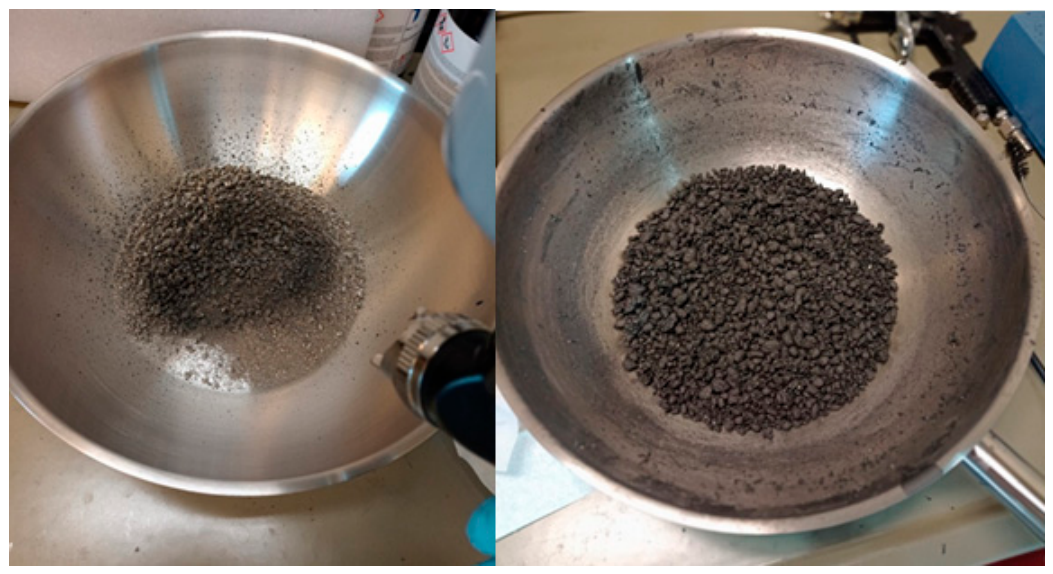
To improve thermal conductivity and reduce stress on the tank walls, a coating containing 10 wt% ENG and 10 wt% EVA showed the best performance [39]. While our earlier results were conducted on the lab-scale with a wash-coating process, the investigations in this work focus on scalability. Two different coating approaches have been developed in the scope of this research. The first one was the direct application of the wash-coating process on a larger scale, where a household stand mixer with a heatable bowl was used to stir the mixture of the metal alloy and coating suspension as the solvent slowly evaporated (Figure A1). The second method was a newly investigated approach in which the functional coating was applied by spray-coating onto the surface of the metal alloy (Figure A2). To our knowledge, such an approach has not been used before for metal hydrides. Only El-Eskandarany [41] has used spraying in metal hydride research, employing cold spraying to attach nickel powder to a magnesium surface.
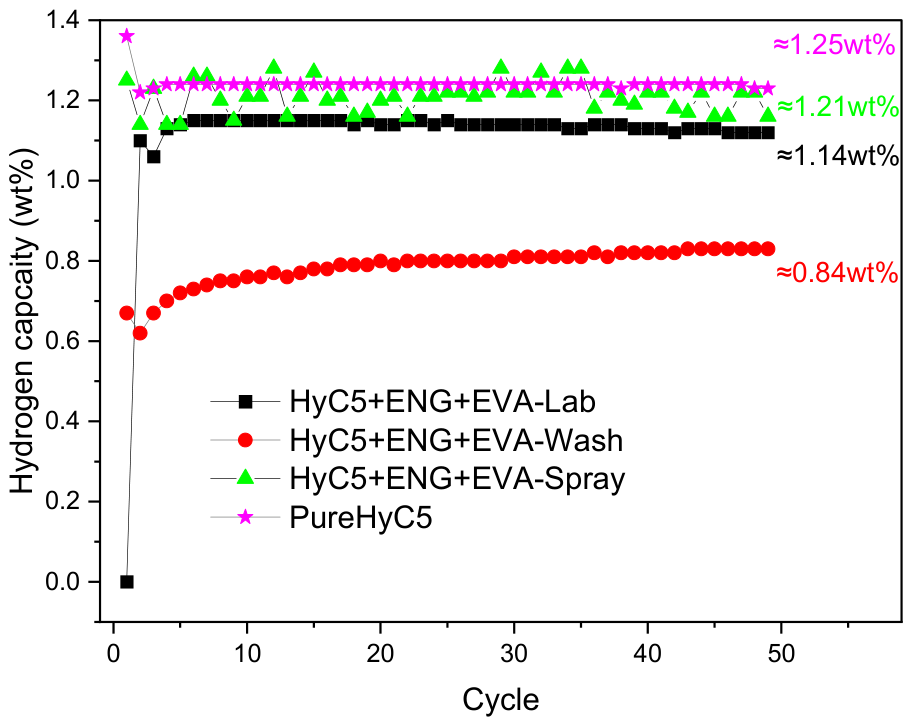
To investigate the long-term stability and activation behavior of the different samples, we have studied the hydrogen capacity over 50 cycles. The results are shown in Figure 1, where the sample coated with 10 wt% ENG and 10 wt% EVA at a smaller lab-scale (HyC5 + ENG + EVA-Lab) acts as a benchmark [39]. The cycling was conducted at 40 °C with hydrogen pressures of 40 bar for absorption and 5 bar for desorption, conditions compatible with possible coupling to electrolyzers or fuel cells [13,42]. The samples have been added to the sample holder without further preparation or prior contact with hydrogen. Therefore, the samples are activated and reach full capacity during cycling. The clear performance difference between the samples investigated is evident in Figure 1. The lab-scale coated sample reaches its maximum hydrogen capacity of 1.14 wt% during the fifth cycle, demonstrating acceptable hydrogen capacity and activation behavior.
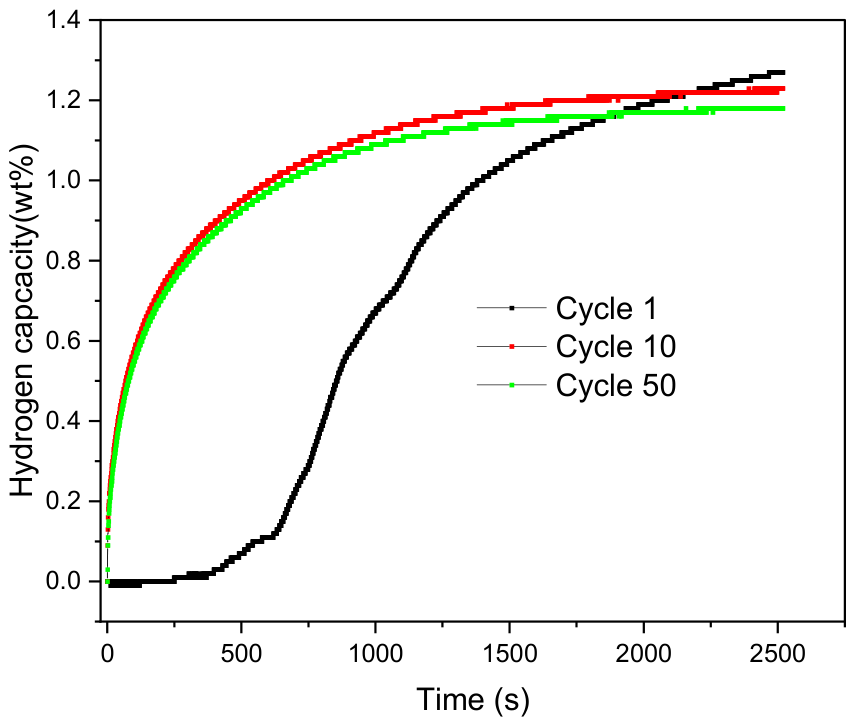
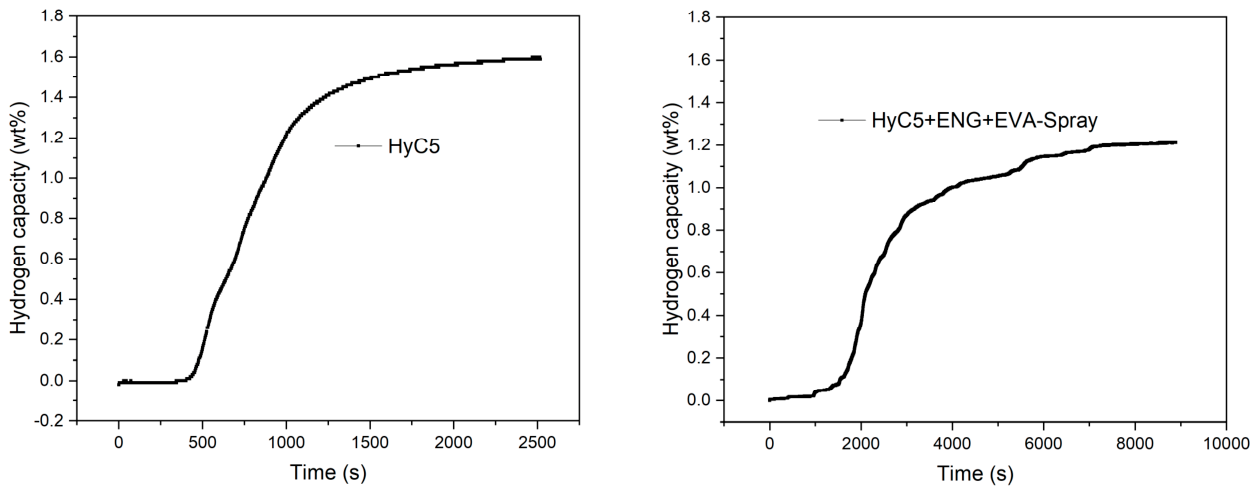
In contrast to this benchmark sample, the performance of the larger-scale wash-coat sample is far inferior. While it reached some hydrogen capacity during the first cycle (≈0.64 wt%), it took about 20 cycles to reach its full capacity of ≈0.84 wt%, which is lower than that of the lab-scale sample. On the contrary, the spray-coated sample performed even better. It could be fully activated even during the first cycle (Figure A3) and reached a capacity of ≈1.21 wt%. The activation behavior of the lab-scale and spray-coated samples is comparable to that of pure HyC5, which is fully activated after 3 cycles and serves as a further benchmark in Figure 1. However, it should be clarified here that the measured capacity of the pure HyC5 is not the true capacity, which is expected to be ≈1.6 wt% at these conditions [37,43,44,45,46]. The Sieverts technique has limitations for samples with very fast kinetics, such as HyC5, and cannot track hydrogen absorbed in the first few seconds of the measurement [13]. The capacity of the coated samples, however, can be assumed to be their true capacity, given the coatings’ slight influence on absorption kinetics. The capacity values for the coated samples lie within the expected range, considering the additional mass of the coating. Such behavior, referred to as the reached capacity, is further highlighted by the investigation of material activation. During the first cycle, the oxide layer slows down the hydrogen absorption. HyC5 reaches the expected capacity of 1.60 wt%, while HyC5 + ENG + EVA-Spray shows a capacity of 1.21 wt% (see Figure A11).
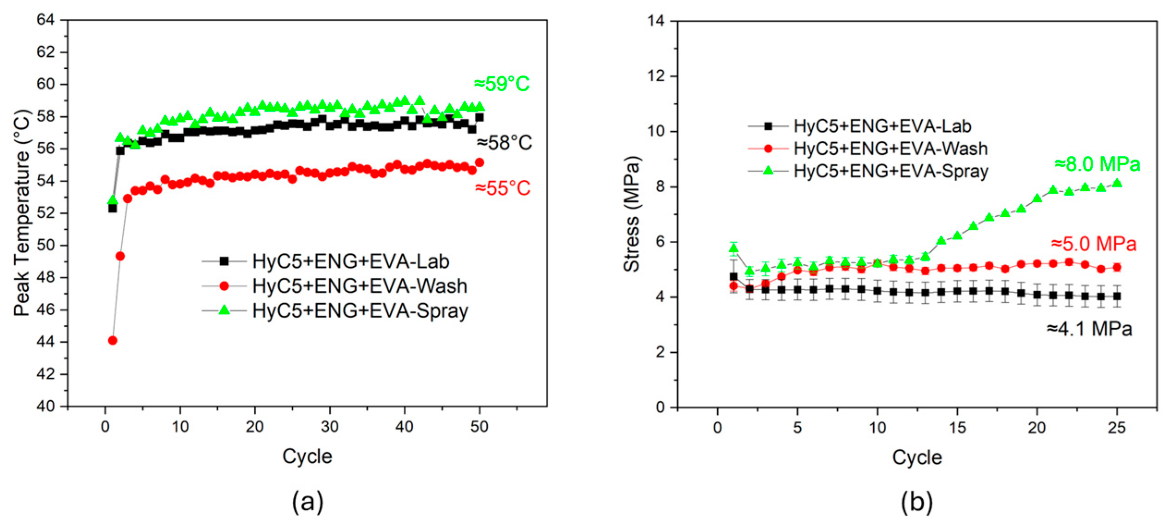
Heat management and stress development (Figure 2a) show similar tendencies. The measured peak temperatures for the lab-scale sample (≈58 °C) and the spray-coated sample (≈59 °C) are very similar, and the spray-coated sample’s higher hydrogen capacity could account for the slightly higher measured temperature. Larger amounts of absorbed hydrogen most likely led to more heat development during cycling. Furthermore, the effective thermal conductivity of HyC5 + ENG + EVA-Lab is 0.620 ± 0.02 W/(m K), slightly higher than that of the spray-coated sample (0.541 ± 0.01 W/(m K)). The measured peak temperature of the wash-coated sample is ≈55 °C lower than the other two. The lower-temperature peak of the wash-coated sample can be attributed to its reduced capacity, since its effective thermal conductivity is similar to the other samples (0.523 ± 0.02 W/(m K)). Still, all coated samples show a significant improvement in thermal conductivity compared to pure HyC5 (see Table A4).
Another important parameter is the stress development during material expansion. An additional set of experiments was conducted to obtain this data, in which a high solid fraction, exceeding the critical value of 0.61 [47], was applied to the different samples in the sample holder, as seen in Figure 2b. However, due to experimental limitations [39], quantifying hydrogen capacity at higher packing fractions was no longer possible [39]. The measured stress for both the lab-scale sample and the wash-coated sample remain constant throughout the measurement at ≈4.1 MPa and ≈5.0 MPa, respectively, close to the expected equivalent stress due to the absorption pressure of 40 bar. Interestingly, the spray-coated sample shows a slightly different behavior. The measured stress remains within the same range as that of the other two samples until cycle 12, then increases to a plateau at ≈8.0 MPa.
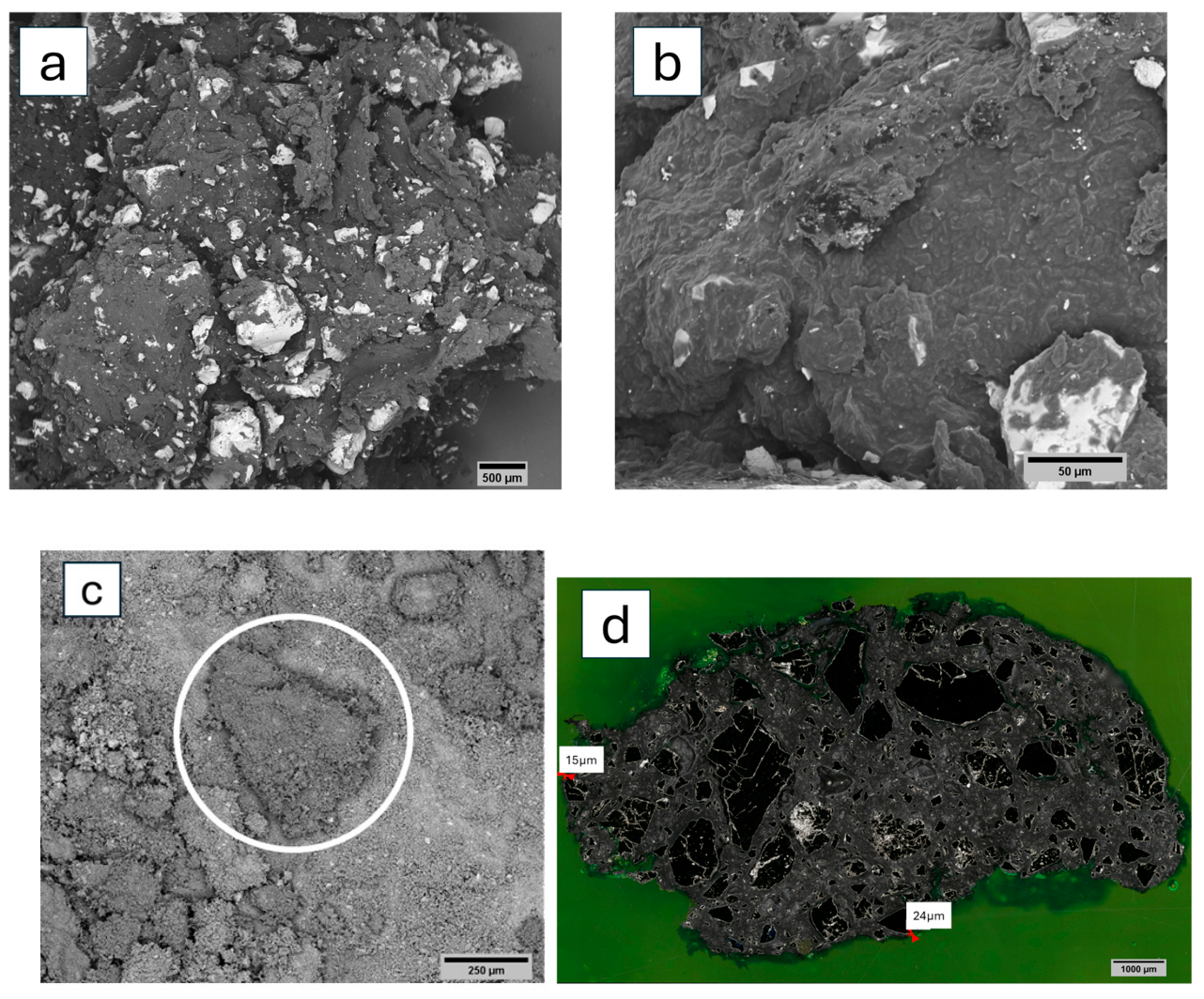
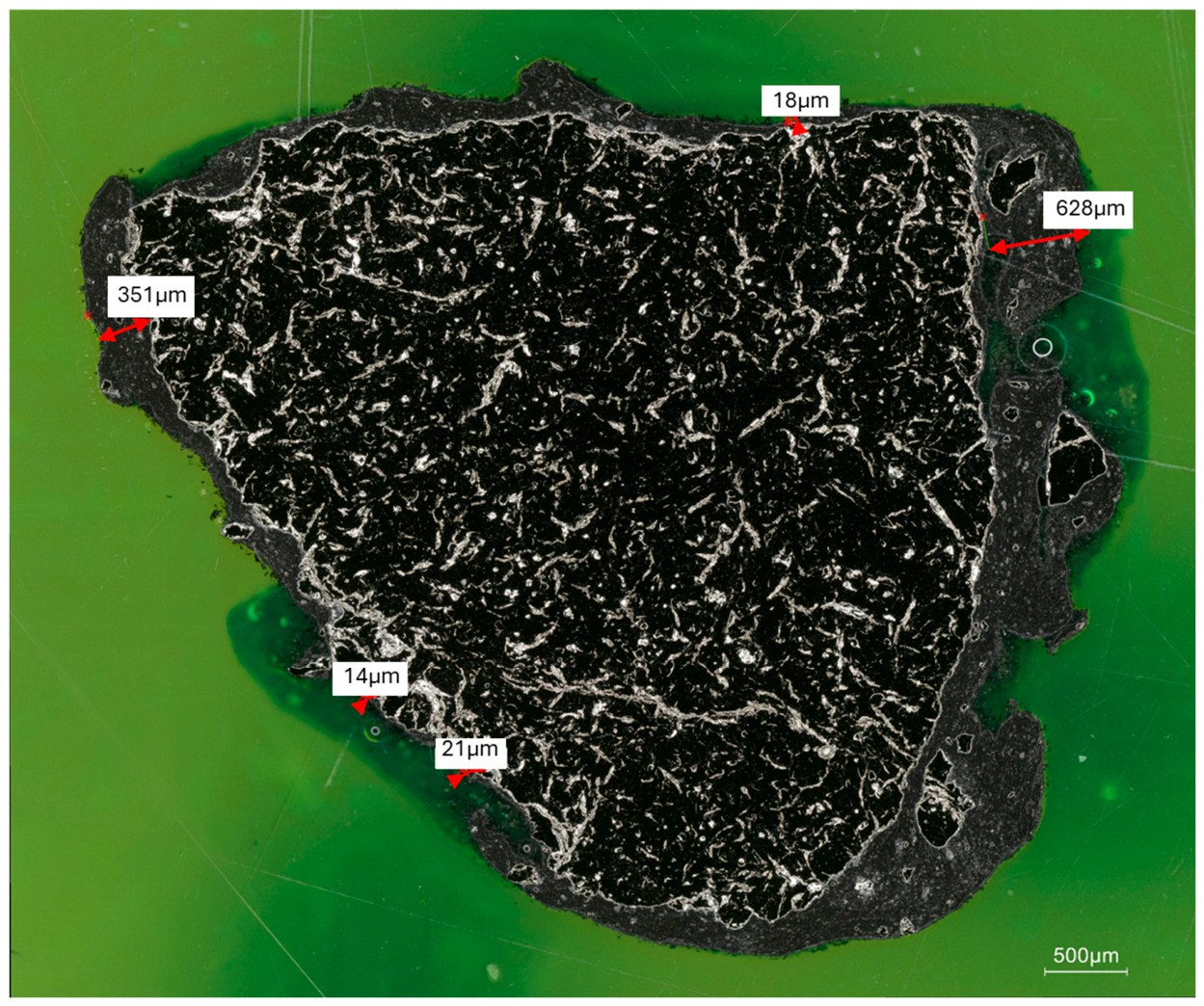
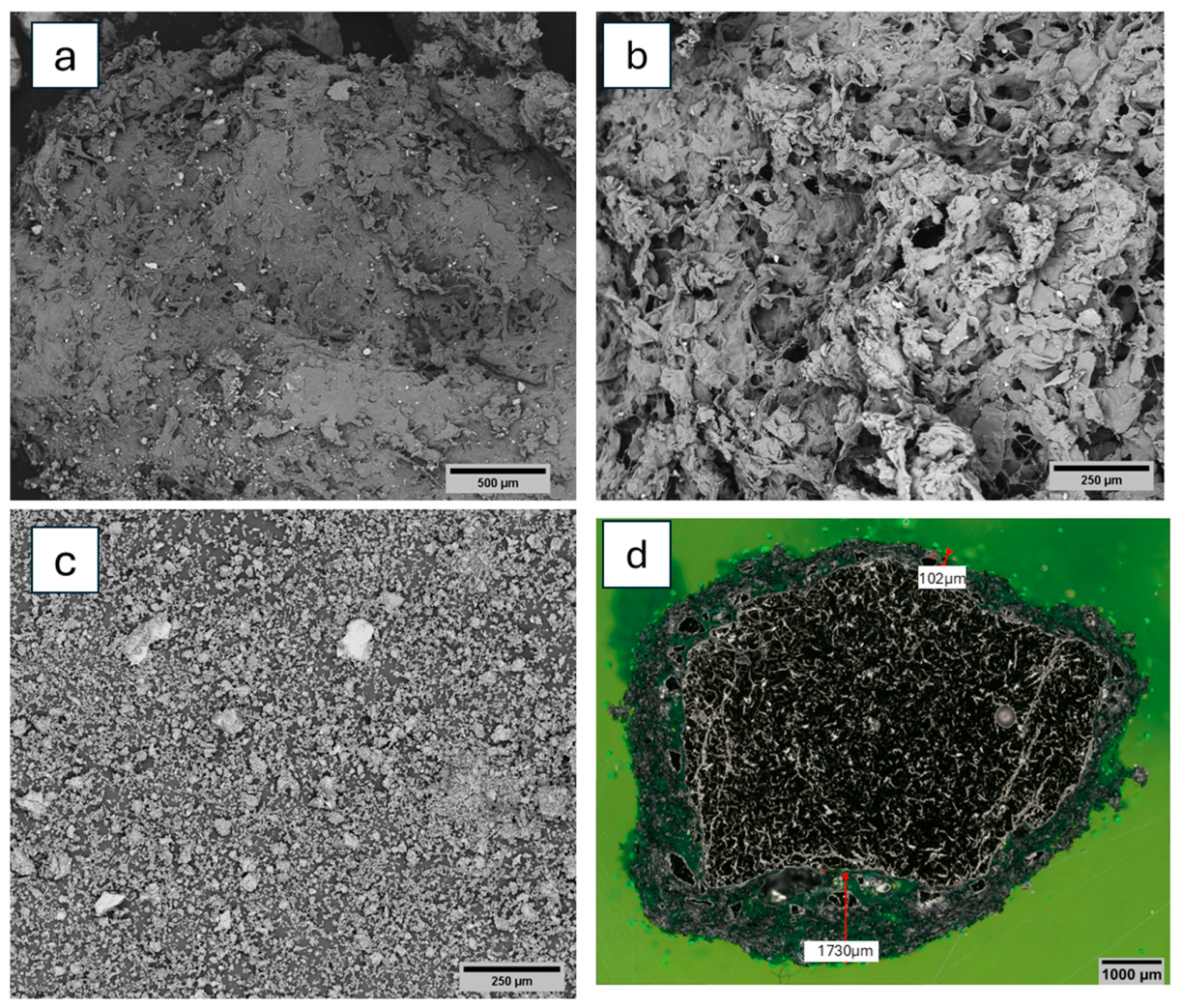
Figure 3 shows the morphology of the samples coated by the larger-scale wash-coating process. The images were generated using the backscatter detector, which is sensitive to changes in atomic number. The HyC5, which contains heavy metals, appears brighter than ENG or EVA. An overview image of the sample at low magnification (Figure 3a) shows that the coating is nonhomogeneous. Several bright surfaces show incomplete surface coating, while other areas show a highly dense coating. The rotating hooks are likely the main cause of the incomplete coating. They have shaved off parts of the coating during the mixing and solvent evaporation. The compact coating is visible at higher magnification (Figure 3b), where the flake-like shape of ENG is no longer apparent. We assume that only partially covered particles with an accessible surface could be activated and disintegrated into a powder, while larger unreacted particles (e.g., Figure 3c; highlighted in white) remain in the sample. This observation is further supported by a cross-sectional analysis of the particles (Figure 3d). They are not individual particles, but an agglomerate of several particles. This agglomeration complicates the quantification of the thickness of the coating. Some particles at the outer layer of the agglomerate have no coating or only a very thin coating (≈20 µm). In contrast, other HyC5 particles are embedded in the middle of the agglomerates, resulting in a coating thickness of >2500 µm. Due to the dense, inhomogeneous coating, hydrogen diffusion to the inner particles is severely hindered. These inner particles cannot react with hydrogen, reducing the overall hydrogen capacity of this sample.
For comparison, the morphology of the spray-coated sample is shown in Figure 4. The overview image (Figure 4a) shows that the surface coating is more homogeneous. The few small bright spots on the surface are likely very small particles from the crushing process that may not be properly embedded into the coating [13]. The most significant difference is visible at higher magnification (Figure 4b): Compared to the wash-coating process, the coating structure is much more porous. Even the individual flake-shaped ENG particles can still be identified. This suggests that the open-pored structure improves performance compared to the wash-coated samples. Hydrogen can more readily access the metal alloy particles, thereby improving both activation time and capacity. This observation was also supported by analysis of the cross-section image of the sample (Figure 4d).
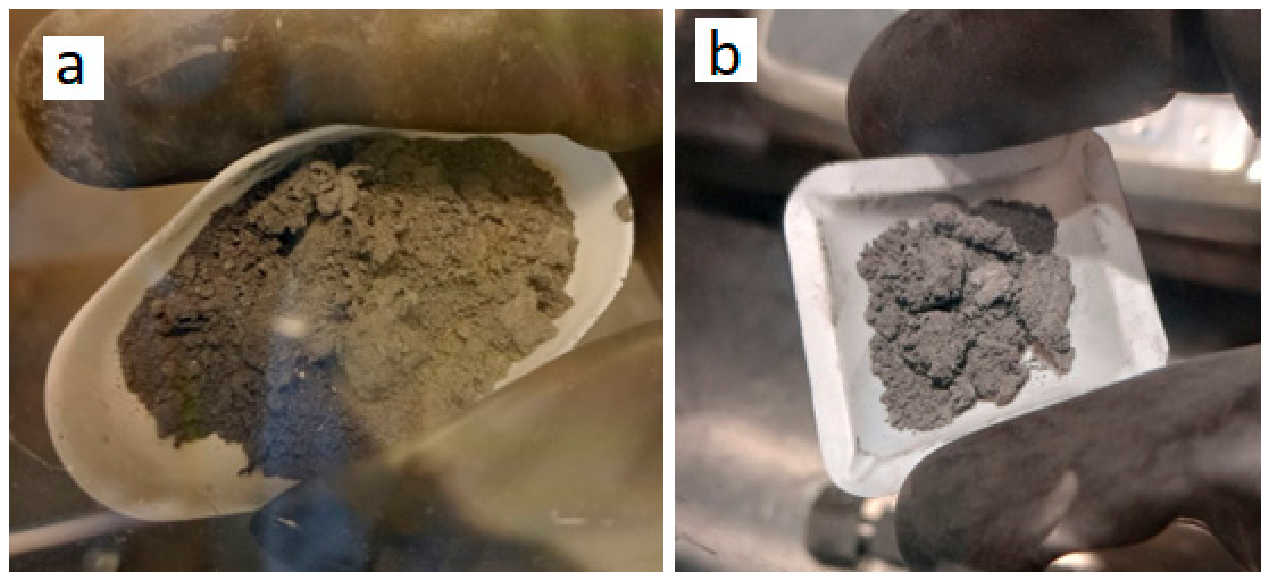
Compared with the sample HyC5 + ENG + EVA-Lab (see Figure A12), the particle coating is less homogeneous and shows a large deviation (551 ± 391 µm; ranging from 100 µm to 1700 µm), but the porous structure is still clearly identifiable. The sample was fully activated and disintegrated into a fine powder, leaving no unreacted larger particles (Figure 4c). While enhancing kinetic performance, this porous structure may also lead to a slight decline in stress compensation. Exothermic hydrogen absorption (softening the EVA binder at higher temperatures) and internal expansion, which presses the individual particles against each other, lead to the formation of pellets in situ [39]. Due to the open structure, the contact area between individual particles is not as good as in the sample HyC5 + ENG + EVA-Lab, and an in situ pellet formation is incomplete. Only some larger crumbs are formed (Figure A7a). At the same time, smaller, pulverized particles might pass through the coating’s porous network. They agglomerate at the bottom of the sample holder, generating friction. This might explain the slight increase in measured stress observed in the spray-coated sample after a certain number of cycles (see Figure 2b).
As with the spray-coating approach, pellet formation in the wash-coating process was incomplete, and only crumbs formed (Figure A7b). These observations suggest that, due to reduced capacity and slower kinetics, the cycling temperature is lower than that of the other samples investigated. However, as just mentioned, specific temperatures and pressures are needed to soften the EVA coating and enable pellet formation. This incomplete pellet formation might also explain why some degree of stress was measured (≈5.0 MPa at 40 bar hydrogen pressure) despite the greatly reduced hydrogen capacity.
The results show that the wash-coating approach applied at a larger scale produces denser coating than the lab-scale process, and agglomerates are forming. We assume this is mainly due to the higher viscosity of the coating suspension. Compared to the lab-scale coating, the relative surface area of the reaction vessel for the wash-coating process was smaller. This results in much longer evaporation times for the entire solvent (a few hours) and a viscous “slurry” during the coating process.
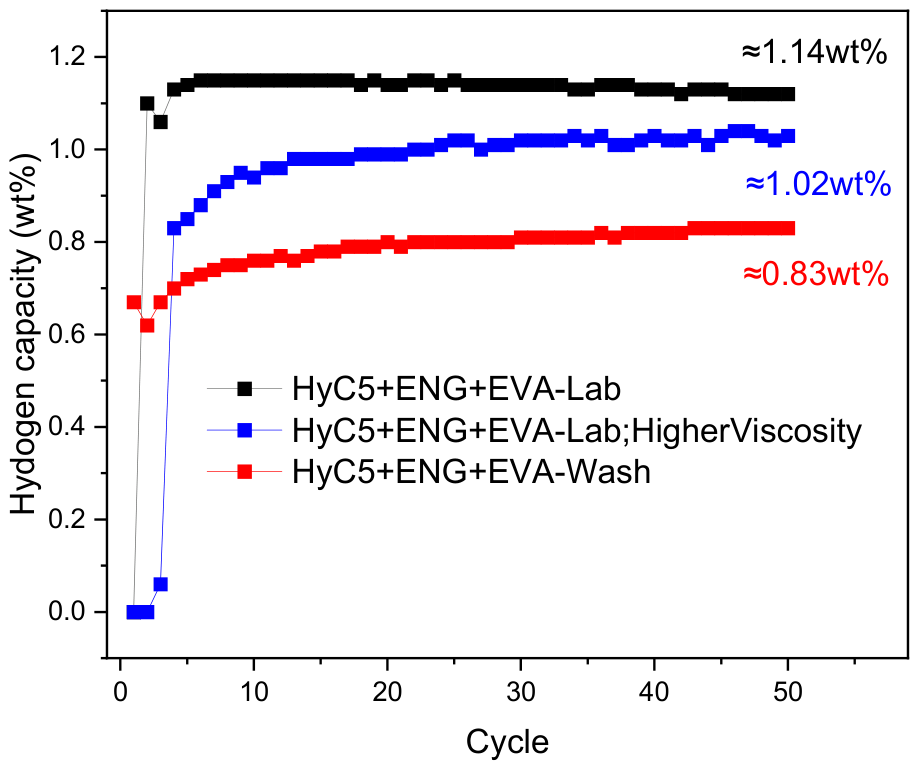
To investigate the scaling-up approach, we have also prepared a sample with the lab-scale set-up but with a larger sample mass (30 g instead of 10 g) and, consequently, a larger amount of ENG and EVA for the coating, while retaining the amount of solvent (75 mL), to reach the same ratio as in the larger-scale wash-coating process. This results in a coating slurry with higher viscosity than the standard lab approach and a longer evaporation time. The resulting sample has reduced capacity compared to the tested HyC5 + ENG + EVA-Lab sample (Figure 5). The capacity is still higher than that of the samples from the larger-scale synthesis. Different parameters, e.g., the viscosity of the coating suspension, mixing quality, agglomerate formation, or the time required to evaporate the solvent, appear to affect the hydrogen capacity of the samples. The viscosity can therefore be only one part of the whole system, and a round-bottom flask cannot perfectly mimic the setup conditions used for the larger-scale wash-coating process.

3.2. Intermediate-Scale Measurements

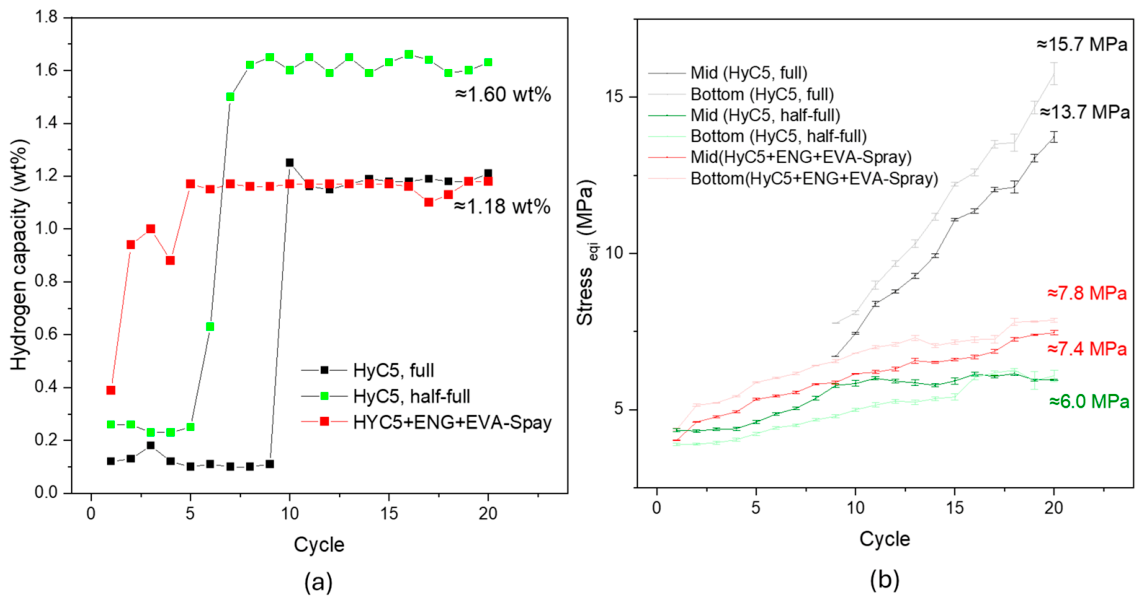
The results from Section 3.1 show that coating metal alloys with EVA and ENG via spray-coating is a promising method for improving their hydrogen-storage performance. However, to date, the performance of the sample has been investigated only at a sample size of ≈10 g, and earlier results have shown considerable differences in performance across the scale [48]. To gain a better understanding of a larger scale (e.g., a stationary hydrogen storage system or specialized mobile applications [49]), the performance of the samples from Section 3.1 was tested with a larger sample size of ≈0.5 kg. To measure these larger samples, we have used an in-house built test system for larger tanks [40]. Unlike the previously used Sieverts apparatus, this system operates on mass flow rather than pressure differences. The slower hydrogen absorption, caused by the larger mass and cumulative hydrogen-flow measurement, leads to a more precise measurement of hydrogen capacity. As mentioned before, overly fast kinetics can lead to unregistered capacity during measurement, resulting in a lower-than-expected hydrogen capacity due to a delayed response in the Sieverts apparatus. This problem does not occur during the mass-flow measurement. We used a commercially available pressure cylinder for this test and attached two strain gauges. One is in the middle of the cylinder, and the other is near the bottom at the expected point of maximum stress (see Figure A5). As a benchmark, we have done two preliminary tests. In one test, the cylinder was filled to about half-full with HyC5. The standard approach is to partially fill a tank system with a metal alloy to introduce free volume and compensate for expansion-induced stress. The pure HyC5 sample in the lab-scale measurements (see Figure 1) was further in a similar half-full state. This sample connects the lab-scale and intermediate-scale measurements. In the second test, the cylinder was filled with HyC5 until a packing fraction of 67% was reached, to ensure that the stress caused by material expansion could no longer be compensated for by interparticle volume [47]. The results will be directly compared with a measurement in which the cylinder was filled with the sample HyC5 + ENG + EVA-Spray, with a high packing fraction (>67%). This was done to reach a state in which stress is expected to develop under normal circumstances. The results for the intermediate-scale measurements regarding hydrogen capacity and stress development are shown in Figure 6. As a side note, we also recorded the temperature during the experiments; however, due to the chosen experimental setup (a water bath to control the temperature; Figure A6), the recorded temperature did not yield reasonable results, as attributed to some signal-recording problems and/or misleading position of the thermocouples (Figure A8).
The importance of the packing fraction regarding activation, hydrogen capacity, and stress development becomes apparent. About seven cycles are needed for the half-full sample to be fully activated. Until then, only negligible hydrogen absorption could be observed, which was mostly attributed to hydrogen in the gas phase rather than to absorption as a metal hydride. After the activation, the samples reach a capacity of ≈1.63 wt%. This value is much higher than the capacity observed in measurements with the Sieverts apparatus and, as mentioned before, is consistent with the capacities previously reported for HyC5 [37,43,44,45,46]. Furthermore, since the free space of the half-filled cylinder was sufficient to compensate for potential stress development, only ≈6.0 MPa of stress was measured in both the middle and bottom parts of the cylinder. It should be noted that the methodology used assumes uniform loading of the tank. However, the swelling of the metal hydride may be non-uniform. While the strain gauges exhibit a small measurement error (Δ ≈ 0.3%) and the measured stress values show very little deviation, the non-uniform stress distribution in metal hydrides introduces an uncertainty in the measured stress that is difficult to quantify.
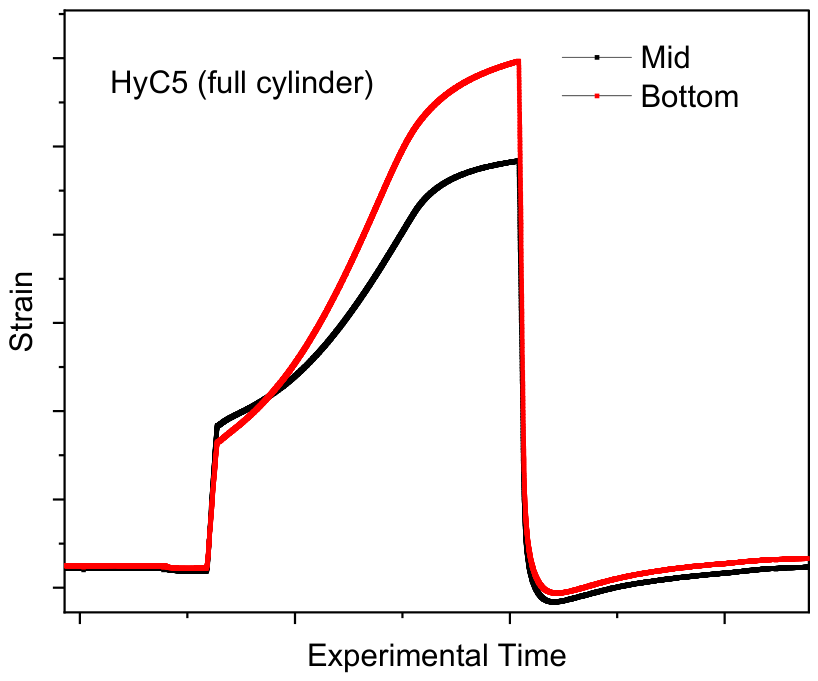
Interestingly, the progress in stress development can also be observed during the measurement. According to Figure A9, a sudden increase in stress was observed at the start of absorption, which is mostly correlated to the hydrogen pressure during absorption. For a short time (≈16 min), the measured stress at the middle position of the cylinder is higher than at the bottom, while the reaction front travels from the top of the cylinder. After the reaction front reaches the bottom of the cylinder, the stress at the bottom begins to exceed that in the middle because frictional effects are larger there [18].
The performance is reduced if the sample lacks free volume to compensate for the expansion during hydrogen absorption. Not only are more cycles needed to activate the sample (10 cycles), but the resulting capacity is also reduced to only 1.18 wt%. We assume that this is a direct consequence of the high packing fraction and the resulting internal stress of the sample. The observation that stress reduces the capacity of metal hydrides has been reported previously [50,51]. After 20 cycles, the packed sample has reached a stress of 13.7 MPa at the middle of the cylinder and up to 15.7 MPa at the bottom. This internal stress seems high enough that the β-phase cannot fully form, reducing the overall hydrogen capacity.
The performance of HyC5 + ENG + EVA-Spray was reproducible in this intermediate-scale experiment. The spray-coated sample could be activated even faster than the pure metal alloy. It was fully activated after five cycles and reached ≈1.18 wt%, the same hydrogen capacity as the filled cylinder, despite additional mass in ENG and EVA. The measured stress started at ≈4 MPa, which correlates to the hydrogen pressure during the absorption (40 bar). Stress increases with the number of cycles but plateaus after 17 cycles, at 7.4 MPa in the middle section of the cylinder and 7.8 MPa at the bottom. This is even a slight reduction compared to the small-scale experiment from Section 3.1. We assume this difference is due to differences in shape between the lab-scale and intermediate-scale sample holders. The commercially available cylinder from the intermediate-scale experiments is bulkier than the sample holder of the lab-scale measurements, and a slim sample holder is more prone to stress development [16].

4. Conclusions

A commercially available RT-metal hydride has been coated with 10 wt% ENG and 10 wt% EVA. Previous investigations have shown that this mixture can compensate for stress-induced expansion and improve thermal conductivity [39]. These are the main challenges for hydrogen storage in metal hydrides. No stress was measured at the outer shell of the sample, and the measured peak temperature (used as a heat-management qualifier) could be reduced by 2 °C while retaining acceptable hydrogen capacity. The aim was now to find a method that could be easily scaled to the kilogram or even larger ranges.
A wash-coating approach has been investigated previously and shown promising results in lab-scale synthesis, but it has been less successful during scale-up. The capacity of samples prepared by wash-coating at a larger scale decreased significantly (from 1.14 wt% to 0.84 wt%), and more cycles were required for activation (5 vs. 20). Further investigations have shown that the performance decline might have been caused by slow solvent evaporation, the formation of a very viscous slurry during large-scale synthesis, and particle agglomeration. This leads to dense coating and slow kinetics for the sample. Spray-coating was a promising alternative for large-scale coating. The hydrogen capacity was even larger than that of the other investigated samples (≈1.21 wt%), while it compensated for most of the stress caused by the hydrogen absorption (≈ 8 MPa stress equivalent at 40 bar hydrogen pressure was measured). Another aspect of this investigation was to compare results from a lab-scale sample (a few grams) with those from an intermediate-scale measurement (≈0.5 kg). Such a comparison has a great impact on a commercial hydrogen storage system, that must store at least several kilograms of hydrogen. The promising lab-scale results of the spray-coated sample could be reproduced at the larger intermediate scale. The spray-coated sample compensated for the expansion stress (7.8 MPa, compared to 15.7 MPa for an uncoated sample at the bottom of the sample holder) while retaining acceptable hydrogen capacity at ≈1.18 wt%. The intermediate-scale measurements have been conducted over 20 cycles. Even this relatively small number of cycles has already shown clear tendencies. The stress in the sample holder which was filled with HyC5 approached the mechanical limit of the cylinder used, and the spray-coated sample largely compensated for the resulting stress.
Nevertheless, commercially used storage systems are designed to operate over many more cycles (>1000), and the properties of the samples (e.g., kinetics, capacity, stress development) might continue to change during prolonged operation. However, such a long-term measurement was beyond the scope of this research and might be part of future work. While there may still be room for improvement in the wash-coating approach (e.g., optimizing the stirrer setup), the spray-coating approach has shown superior performance. The coating process was faster, the samples required fewer activation cycles (five), and the hydrogen capacity was higher (1.18 wt% even after 50 cycles). While the spray-coating method offers significant potential for scaling up and operation at a several-kilogram scale, this work is still in the proof-of-concept stage. On a larger industrial scale, several additional metrics (e.g., solvent recovery, energy consumption during the drying process, and improvements to the spray-coating system) must be considered.

Author Contributions

Conceptualization, J.W.; methodology, J.W.; validation, J.W. and J.P.S.; formal analysis, J.W.; investigation, J.W.; resources, J.P.S., T.K. and J.J.; data curation, J.J. and J.P.S.; writing—original draft preparation, J.W.; writing—review and editing, J.W., J.P.S., P.S.K., E.W., T.K. and J.J.; visualization, J.W.; supervision, J.P.S. and J.J.; project administration, J.P.S., J.J. and T.K.; funding acquisition, T.K. and J.J. All authors have read and agreed to the published version of the manuscript.

Funding

The authors gratefully acknowledge the funding by Bundesministerium für Wirtschaft und Klimaschutz in the frame of the “HyReflexS “project (Funding code: 03El3020A and 03EI3020C). This research work is also in the frame of the project Digi-HyPro, funded by dtec.bw—Digitalization and Technology Research Center of the Bundeswehr, which the authors gratefully acknowledge. dtec.bw is funded by the European Union—NextGenerationEU. The authors also acknowledge RYC2024-048171-I funded by MICIU/AEI/10.13039/501100011033 and FSE+. The authors thank Matthias Schulze (Helmut-Schmidt Universität) for preparing and measuring cross-section images.

Data Availability Statement

The raw data supporting the conclusions of this article will be made available by the authors on request. The data are not publicly available due to internal data management.

Conflicts of Interest

The authors declare no conflicts of interest.

Abbreviations

The following abbreviations are used in this manuscript:
ENGExpanded Natural Graphite
EVAEthylene-Vinyl Acetate Copolymer
LCALife-Cycle Assessment
SEMScanning Electron Microscopy
RTRoom-Temperature

Appendix A

Figure A1. Image of the experimental set-up used for the larger-scale wash-coating process in a household stand mixer with a heatable bowl.
Energies 19 02451 g0a1
Figure A2. Comparison of the metal alloy at the beginning of the spray-coating process (left) and after the coating process is finished (right).
Energies 19 02451 g0a2
Figure A3. Activation behavior of HyC5 + ENG + EVA-Spray. The sample could be activated during the first cycle. The kinetic behavior of the sample remains stable across consecutive cycles.
Energies 19 02451 g0a3
Figure A4. Image of the Swagelok tank used for the intermediate-scale hydrogen storage investigation. The sensors on the surface of the Swagelok tank are covered with a watertight coating (in red).
Energies 19 02451 g0a4
Figure A5. Schematic image of the used Swagelok cylinder for the intermediate size measurements. The positions of the attached stress sensors at the middle of the sample holder (“Mid”) and close to the bottom of the sample holder (“Bottom”) are highlighted. The bottom position was chosen for reproducible results and to prevent erroneous measurements due to differences in wall thickness and a sloped surface.
Energies 19 02451 g0a5
Figure A6. During the measurements, the sample cylinder is immersed in a thermobath containing a 1:1 water/glycol mixture and connected to a Julabo FL1703 temperature controller.
Energies 19 02451 g0a6
Table A1. Density of the coated samples.
SampleDensity (g/cm3)
HyC5 + ENG + EVA-Lab3.16
HyC5 + ENG + EVA-Wash3.87
HyC5 + ENG + EVA-Spray3.74
Figure A7. HyC5 + ENG-EVA-Spray after cycling (a). The sample has not formed a complete pellet; only several smaller clumps have formed. HyC5-ENG-EVA-Wash also showed incomplete pellet formation (b).
Energies 19 02451 g0a7
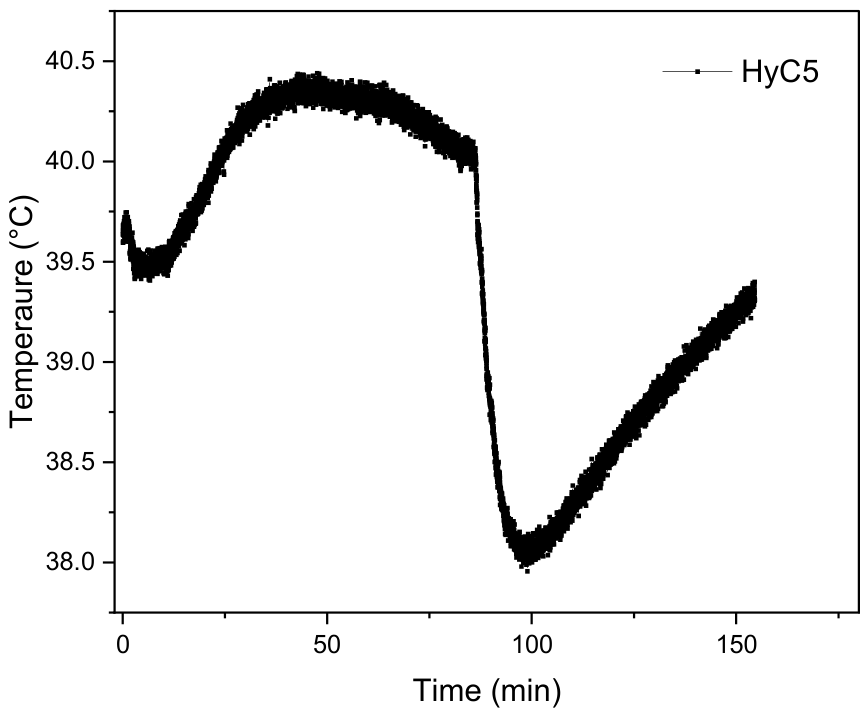
Figure A8. The measured cylinder temperature was filled to half-full volume with HyC5 outside the sample holder. Using a water–glycol mixture has led to a much faster temperature transfer than electric heating with an oven during the lab-scale experiments. The temperature changes during the larger-scale experiments are therefore not significant.
Energies 19 02451 g0a8
Figure A9. Stress behavior during hydrogen absorption in intermediate-scale experiments during one absorption cycle. The tank was filled completely with HyC5.
Energies 19 02451 g0a9
Figure A10. Calibration of the strain gauges attached to the larger Swagelok cylinder to convert the measured strain (µm/m) into a pressure equivalent (bar or MPa). For this measurement, the empty Swagelok cylinder was filled with hydrogen at varying pressures. The temperature was stabilized with a thermobath at 40 °C. The data show a linear relationship between strain and the equivalent pressure.
Energies 19 02451 g0a10
Table A2. Clarification of the role of the materials used. In addition to HydralloyC5®, all materials were used as received from the supplier, without any modifications or purifications.
MaterialRole
HydralloyC5® (HyC5)Commercially available metal alloy for hydrogen storage
ENGImproves thermal conductivity and hydrogen diffusivity through the coating
HexaneSolvent used for the wash-coating process
CyclohexaneSolvent used for the spray-coating process. Hexane has evaporated too fast and blocked the nozzle during spray-coating.
EVAElastomer, which buffers internal stress
Figure A11. Comparison of the activation behavior for pure HyC5 (left) and HyC5 + ENG + EVA-Spray (right). The measurement was done at 40 °C and 40 bar hydrogen pressure.
Energies 19 02451 g0a11
Table A3. Summary of the total measured hydrogen capacities (active mass and additives) and normalized hydrogen capacity (correlated to the active mass only) for the samples during the lab-scale measurements by the Sieverts technique.
SampleTotal Hydrogen Capacity (wt%)Normalized Hydrogen
Capacity (wt%)
HyC5 + ENG + EVA-Lab1.141.37
HyC5 + ENG + EVA-Wash0.841.01
HyC5 + ENG + EVA-Spray1.211.45
Table A4. Thermal conductivity of the investigated samples.
SampleThermal Conductivity (W/(m K))Change to Pure HyC5
pureHyC5 (0–4 mm) [39]0.297 ± 0.01-
HyC5 + ENG + EVA-Lab0.620 ± 0.02+109%
HyC5 + ENG + EVA-Wash0.523 ± 0.02+76%
HyC5 + ENG + EVA-Spray0.541 ± 0.01+82%
Figure A12. Cross-section image of HyC5 + ENG + EVA-Lab. Scale bar: 500 µm. Coating thickness: 212 ± 175 µm.
Energies 19 02451 g0a12

References

  1. Hydrogen Europe Research. Advancing Hydrogen Technologies: Key Research and Innovation Priorities. 2024. Available online: https://hydrogeneuroperesearch.eu/content/uploads/2024/11/HydrogenEuropeResearch_ResearchPositionPaper_Nov24_ONLINE.pdf (accessed on 27 October 2025).
  2. New Zeeland Hydrogen Council. Hydrogen Action Plan. 2024. Available online: https://www.nzhydrogen.org (accessed on 4 April 2025).
  3. Australian Government. National Hydrogen Strategy 2024. 2024. Available online: https://www.dcceew.gov.au/energy/publications/australias-national-hydrogen-strategy (accessed on 27 October 2025).
  4. Liu, W.; Wan, Y.; Xiong, Y.; Gao, P. Green Hydrogen Standard in China: Standard and Evaluation of Low-Carbon Hydrogen, Clean Hydrogen, and Renewable Hydrogen. Int. J. Hydrogen Energy 2022, 47, 24584–24591. [Google Scholar] [CrossRef]
  5. Mahajan, D.; Tan, K.; Venkatesh, T.; Kileti, P.; Clayton, C.R. Hydrogen Blending in Gas Pipeline Networks—A Review. Energies 2022, 15, 3582. [Google Scholar] [CrossRef]
  6. Bararzadeh Ledari, M.; Khajehpour, H.; Akbarnavasi, H.; Edalati, S. Greening Steel Industry by Hydrogen: Lessons Learned for the Developing World. Int. J. Hydrogen Energy 2023, 48, 36623–36649. [Google Scholar] [CrossRef]
  7. Rivarolo, M.; Riveros-Godoy, G.; Magistri, L.; Massardo, A.F. Clean Hydrogen and Ammonia Synthesis in Paraguay from the Itaipu 14 GW Hydroelectric Plant. ChemEngineering 2019, 3, 87. [Google Scholar] [CrossRef]
  8. Zhang, F.; Zhao, P.; Niu, M.; Maddy, J. The Survey of Key Technologies in Hydrogen Energy Storage. Int. J. Hydrogen Energy 2016, 41, 14535–14552. [Google Scholar] [CrossRef]
  9. Zhang, T.; Uratani, J.; Huang, Y.; Xu, L.; Griffiths, S.; Ding, Y. Hydrogen Liquefaction and Storage: Recent Progress and Perspectives. Renew. Sustain. Energy Rev. 2023, 176, 113204. [Google Scholar] [CrossRef]
  10. Adler, E.J.; Martins, J.R.R.A. Hydrogen-Powered Aircraft: Fundamental Concepts, Key Technologies, and Environmental Impacts. Prog. Aerosp. Sci. 2023, 141, 100922. [Google Scholar] [CrossRef]
  11. Klopčič, N.; Grimmer, I.; Winkler, F.; Sartory, M.; Trattner, A. A Review on Metal Hydride Materials for Hydrogen Storage. J. Energy Storage 2023, 72, 108456. [Google Scholar] [CrossRef]
  12. Modi, P.; Aguey-Zinsou, K.-F. Room Temperature Metal Hydrides for Stationary and Heat Storage Applications: A Review. Front. Energy Res. 2021, 9, 616115. [Google Scholar] [CrossRef]
  13. Puszkiel, J.A.; Neves, A.M.; Warfsmann, J.; Krause, P.S.; Kaufmann, T.F.J.; Hoberg, A.R.; Hegen, O.; Kötter, A.; Klassen, T.; Jepsen, J. On the Hydrogen Storage Properties and Life Cycle Evaluation of a Room Temperature Hydride for Scale-up Applications: The Case of an AB2-Alloy. Int. J. Hydrogen Energy 2025, 118, 482–499. [Google Scholar] [CrossRef]
  14. Sharma, V.K.; Anil Kumar, E. Metal Hydrides for Energy Applications—Classification, PCI Characterisation and Simulation. Int. J. Energy Res. 2017, 41, 901–923. [Google Scholar] [CrossRef]
  15. Stahlkopf, G.; Passing, M.; Puszkiel, J.A.; Moosmann, J.; Beckmann, F.; Warfsmann, J.; Karimi, F.; Kulvait, V.; Klassen, T.; Jepsen, J. Insights on Mechanical and Morphological Metal Hydride Powder Characteristics during Hydrogen Interaction and Stress Mitigation Strategies for Hydrogen Storage Vessels. Int. J. Hydrogen Energy 2026, 215, 153776. [Google Scholar] [CrossRef]
  16. Charlas, B.; Gillia, O.; Doremus, P.; Imbault, D. Experimental Investigation of the Swelling/Shrinkage of a Hydride Bed in a Cell during Hydrogen Absorption/Desorption Cycles. Int. J. Hydrogen Energy 2012, 37, 16031–16041. [Google Scholar] [CrossRef]
  17. Okumura, M.; Ikado, A.; Saito, Y.; Aoki, H.; Miura, T.; Kawakami, Y. Pulverization Mechanism of Hydrogen Storage Alloys on Microscale Packing Structure. Int. J. Hydrogen Energy 2012, 37, 10715–10723. [Google Scholar] [CrossRef]
  18. Okumura, M.; Ikado, A.; Saito, Y.; Matsushita, Y.; Aoki, H.; Kiwakami, Y. The Stress Developed on the Side Wall of the Pressure Vessel for the Packed Bed of the Hydrogen Storage Alloy and the Change in the Packing State. J. Jpn. Inst. Energy 2021, 100, 5–12. [Google Scholar] [CrossRef]
  19. Qin, F.; Chen, J.; Chen, Z. The Hydriding-Dehydriding Characteristics of La0.6Y0.4Ni4.8Mn0.2 and Their Influences in the Surface Strain on Small-Scale, Thin-Wall and Vertical Containers. Mater. Des. 2008, 29, 1926–1933. [Google Scholar] [CrossRef]
  20. Saito, T.; Suwa, K.; Kawamura, T. Influence of Expansion of Metal Hydride during Hydriding-Dehydriding Cycles. J. Alloys. Comp. 1997, 253, 682–685. [Google Scholar] [CrossRef]
  21. Cuscueta, D.J.; Silin, N.; Melnichuk, M. Stress Reduction in a Hydride Container by the Addition of a Glidant Agent. Int. J. Hydrogen Energy 2020, 45, 27452–27456. [Google Scholar] [CrossRef]
  22. Cao, H.; Georgopanos, P.; Capurso, G.; Pistidda, C.; Weigelt, F.; Chaudhary, A.-L.; Filiz, V.; Tseng, J.-C.; Wharmby, M.T.; Dornheim, M.; et al. Air-Stable Metal Hydride-Polymer Composites of Mg(NH2)2–LiH and TPXTM. Mater. Today Energy 2018, 10, 98–107. [Google Scholar] [CrossRef]
  23. Heubner, F.; Pohlmann, C.; Mauermann, S.; Kieback, B.; Röntzsch, L. Mechanical Stresses Originating from Metal Hydride Composites during Cyclic Hydrogenation. Int. J. Hydrogen Energy 2015, 40, 10123–10130. [Google Scholar] [CrossRef]
  24. Dornheim, M.; Baetcke, L.; Akiba, E.; Ares, J.R.; Autrey, T.; Barale, J.; Baricco, M.; Brooks, K.; Chalkiadakis, N.; Charbonnier, V.; et al. Research and Development of Hydrogen Carrier Based Solutions for Hydrogen Compression and Storage. Prog. Energy 2022, 4, 042005. [Google Scholar] [CrossRef]
  25. Bellosta von Colbe, J.; Ares, J.R.; Barale, J.; Baricco, M.; Buckley, C.; Capurso, G.; Gallandat, N.; Grant, D.M.; Guzik, M.N.; Jacob, I.; et al. Application of Hydrides in Hydrogen Storage and Compression: Achievements, Outlook and Perspectives. Int. J. Hydrogen Energy 2019, 44, 7780–7808. [Google Scholar] [CrossRef]
  26. Scarpati, G.; Puszkiel, J.A.; Warfsmann, J.; Karimi, F.; Jannelli, E.; Pistidda, C.; Klassen, T.; Jepsen, J. Comprehensive Overview of the Effective Thermal Conductivity for Hydride Materials: Experimental and Modeling Approaches. Energies 2025, 18, 194. [Google Scholar] [CrossRef]
  27. Ye, J.; Li, Z.; Zhang, L.; Wang, S.; Jiang, L. Measurement and the Improvement of Effective Thermal Conductivity for a Metal Hydride Bed—A Review. RSC Adv. 2022, 12, 25722–25743. [Google Scholar] [CrossRef]
  28. Srinivasa Murthy, S. Heat and Mass Transfer in Solid State Hydrogen Storage: A Review. J. Heat Transf. 2012, 134, 031020. [Google Scholar] [CrossRef]
  29. Afzal, M.; Mane, R.; Sharma, P. Heat Transfer Techniques in Metal Hydride Hydrogen Storage: A Review. Int. J. Hydrogen Energy 2017, 42, 30661–30682. [Google Scholar] [CrossRef]
  30. Su, J.W.; Tang, X.Y.; Bai, X.S.; Yang, W.W.; Zhang, J.F.; Qu, Z.G. Review on Thermal Design and Thermal Management for Metal Hydride Reactors: Current Status and Future Development. Int. J. Hydrogen Energy 2025, 114, 295–311. [Google Scholar] [CrossRef]
  31. Krause, P.S.; Puszkiel, J.; Wienken, E.; Warfsmann, J.; Bellosta von Colbe, J.; Klassen, T.; Jepsen, J. Numerical Optimization of a Passive Internal Heat Exchanger for Stationary MH-Storage Applications. Int. J. Hydrogen Energy 2026, 237, 155293. [Google Scholar] [CrossRef]
  32. Satya Sekhar, B.; Lototskyy, M.; Kolesnikov, A.; Moropeng, M.L.; Tarasov, B.P.; Pollet, B.G. Performance Analysis of Cylindrical Metal Hydride Beds with Various Heat Exchange Options. J. Alloys Compd. 2015, 645, S89–S95. [Google Scholar] [CrossRef]
  33. Afzal, M.; Sharma, P. Design of a Large-Scale Metal Hydride Based Hydrogen Storage Reactor: Simulation and Heat Transfer Optimization. Int. J. Hydrogen Energy 2018, 43, 13356–13372. [Google Scholar] [CrossRef]
  34. Costamagna, M.; Barale, J.; Carbone, C.; Luetto, C.; Agostini, A.; Baricco, M.; Rizzi, P. Environmental and Economic Assessment of Hydrogen Compression with the Metal Hydride Technology. Int. J. Hydrogen Energy 2022, 47, 10122–10136. [Google Scholar] [CrossRef]
  35. Zhang, Z.; Sato, K.; Nagasaki, Y.; Tsuda, M.; Miyagi, D.; Komagome, T.; Tsukada, K.; Hamajima, T.; Ishii, Y.; Yonekura, D. Continuous Operation in an Electric and Hydrogen Hybrid Energy Storage System for Renewable Power Generation and Autonomous Emergency Power Supply. Int. J. Hydrogen Energy 2019, 44, 23384–23395. [Google Scholar] [CrossRef]
  36. McCabe, W.L.; Smith, J.C.; Harriot, P. Unit Operations of Chemical Engineering, 5th ed.; McGraw Hill: New York, NY, USA, 1993. [Google Scholar]
  37. Barale, J.; Nastro, F.; Violi, D.; Rizzi, P.; Luetto, C.; Baricco, M. A Metal Hydride Compressor for a Small Scale H2 Refuelling Station. Int. J. Hydrogen Energy 2023, 48, 34105–34119. [Google Scholar] [CrossRef]
  38. Odenweller, A.; Ueckerdt, F. The Green Hydrogen Ambition and Implementation Gap. Nat. Energy 2025, 10, 110–123. [Google Scholar] [CrossRef]
  39. Warfsmann, J.; Puszkiel, J.A.; Passing, M.; Krause, P.S.; Wienken, E.; Taube, K.; Klassen, T.; Pistidda, C.; Jepsen, J. Applying Wash Coating Techniques for Swelling-Induced Stress Reduction and Thermal Improvement in Metal Hydrides. J. Alloys Compd. 2023, 950, 169814. [Google Scholar] [CrossRef]
  40. Capurso, G.; Schiavo, B.; Jepsen, J.; Lozano, G.; Metz, O.; Saccone, A.; De Negri, S.; Bellosta von Colbe, J.M.; Klassen, T.; Dornheim, M. Development of a Modular Room-Temperature Hydride Storage System for Vehicular Applications. Appl. Phys. A 2016, 122, 236. [Google Scholar] [CrossRef]
  41. El-Eskandarany, M.S.; Ali, N.; Banyan, M.; Al-Ajmi, F. Cold Gas-Dynamic Spray for Catalyzation of Plastically Deformed Mg-Strips with Ni Powder. Nanomaterials 2021, 11, 1169. [Google Scholar] [CrossRef]
  42. Puszkiel, J.; Covarrubis Guraneros, M.; Fleming, L.; Kaufmann, T.F.J.; Krause, P.; Warfsmann, J.; Wienken, E.; Wildner, L.; Kutzner, H.; Schulze, M.; et al. Hydrogen in Stationary Applications: Coupling the Electricity, Gas and Mobility Sectors (Digi-HyPro). Detect.-Pap, 2022; in press.
  43. Herbrig, K.; Röntzsch, L.; Pohlmann, C.; Weißgärber, T.; Kieback, B. Hydrogen Storage Systems Based on Hydride-Graphite Composites: Computer Simulation and Experimental Validation. Int. J. Hydrogen Energy 2013, 38, 7026–7036. [Google Scholar] [CrossRef]
  44. Eberle, U.; Felderhoff, M.; Schüth, F. Chemical and Physical Solutions for Hydrogen Storage. Angew. Chem. Int. Ed. 2009, 48, 6608–6630. [Google Scholar] [CrossRef]
  45. Heubner, F.; Hilger, A.; Kardjilov, N.; Manke, I.; Kieback, B.; Gondek, Ł.; Banhart, J.; Röntzsch, L. In-Operando Stress Measurement and Neutron Imaging of Metal Hydride Composites for Solid-State Hydrogen Storage. J. Power Sources 2018, 397, 262–270. [Google Scholar] [CrossRef]
  46. Kölbig, M.; Bürger, I.; Linder, M. Characterization of Metal Hydrides for Thermal Applications in Vehicles below 0 °C. Int. J. Hydrogen Energy 2019, 44, 4878–4888. [Google Scholar] [CrossRef]
  47. Nasako, K.; Ito, Y.; Hiro, N.; Osumi, M. Stress on a Reaction Vessel by the Swelling of a Hydrogen Absorbing Alloy. J. Alloy. Comp. 1998, 264, 271–276. [Google Scholar] [CrossRef]
  48. Jensen, E.H.; Dornheim, M.; Sartori, S. Scaling up Metal Hydrides for Real-Scale Applications: Achievements, Challenges and Outlook. Inorganics 2021, 9, 37. [Google Scholar] [CrossRef]
  49. Yartys, V.A.; Lototskyy, M.V.; Tolj, I.; von Colbe, J.B.; Denys, R.V.; Davids, M.W.; Nyamsi, S.N.; Swanepoel, D.; Berezovets, V.V.; Zavaliy, I.Y.; et al. HYDRIDE4MOBILITY: An EU Project on Hydrogen Powered Forklift Using Metal Hydrides for Hydrogen Storage and H2 Compression. J. Energy Storage 2025, 109, 115192. [Google Scholar] [CrossRef]
  50. Haas, I.; Scutjrr, E. The Effect of Mechanical Stress on the Absoprtion of Hydrogen by Metal Hydrides. Int. J. Hydrogen Engergy 1991, 16, 815–820. [Google Scholar] [CrossRef]
  51. Charlas, B.; Chaise, A.; Gillia, O.; Doremus, P.; Imbault, D. Investigation of Hydride Powder Bed Swelling and Shrinking during Hydrogen Absorption/Desorption Cycles under Different Compressive Stresses. J. Alloys Compd. 2013, 580, S149–S152. [Google Scholar] [CrossRef]
Figure 1. Comparison of the hydrogen capacity for the pure HyC5 (pink [39]) and the HyC5 + 10 wt% ENG + 10 wt% EVA samples for the lab-scale wash-coating process (black [39]), the larger-scale wash-coating process (red), and the spray-coated samples (green).
Energies 19 02451 g001
Figure 2. Comparison of the measured peak temperature in the absorption step (a) and the measured equivalent stress outside the sample holder (b). The measurement conditions were set to 40 °C and 40 bar for absorption, and 40 °C and 5 bar for desorption.
Energies 19 02451 g002
Figure 3. Comparison of SEM images of HyC5 + ENG + EVA-Wash. The samples are shown before cycling at lower magnification (a) scale bar: 500 µm; and higher magnification (b) scale bar: 50 µm. The sample after cycling at (c) scale bar: 250 µm, with larger unreacted particles highlighted in white; and a cross-section image of a particle at (d) scale bar: 1000 µm are also shown.
Energies 19 02451 g003
Figure 4. Comparison of SEM images of HyC5 + ENG + EVA-Spray. The samples are shown before cycling at lower magnification (a) scale bar: 500 µm; and higher magnification (b) scale bar: 250 µm. The sample after cycling at (c) scale bar: 250 µm; and a cross-section image of a particle at (d) scale bar: 1000 µm are also shown.
Energies 19 02451 g004
Figure 5. Comparison of the hydrogen capacity for the samples coated in the before-applied lab-scale approach (black), the modified lab-scale approach with higher viscosity of the coating suspension (blue), and the larger-scale wash-coating approach (red).
Energies 19 02451 g005
Figure 6. Results for the intermediate-scale measurements of (a) capacity; (b) stress with the full HyC5 cylinder (black; packing fraction > 67%), the half-filled cylinder (green; packing fraction ≈33%), and the spray-coated sample HyC5 + ENG + EVA-Spray (red, packing fraction > 67%). Due to technical problems, stress data for the full sample holder with HyC5 during cycles 1–8 were not recorded.
Energies 19 02451 g006
Disclaimer/Publisher’s Note: The statements, opinions and data contained in all publications are solely those of the individual author(s) and contributor(s) and not of MDPI and/or the editor(s). MDPI and/or the editor(s) disclaim responsibility for any injury to people or property resulting from any ideas, methods, instructions or products referred to in the content.