


Abstract
This study explores the potential of deliberative and polycentric governance models to address the complex challenges of the energy transition trilemma, balancing energy security, environmental sustainability, and energy equity. The article aims to develop an integrated deliberative–polycentric framework for managing the energy transition trilemma and to illustrate its implementation relevance through an applied example of heat pump deployment. The analysis primarily draws on evidence and examples from Europe and the United States, reflecting the regions most frequently discussed in the reviewed literature and policy materials. Drawing on an extensive literature review and desk-based analysis, the research adopts a non-empirical, theory-building approach grounded in interpretive policy analysis. The study synthesizes insights from scholarly works and policy documents to construct an integrated analytical framework. It argues that hybrid governance, merging the inclusivity and transparency of deliberative democracy with the flexibility and redundancy of polycentric systems—can enhance legitimacy, adaptability, and effectiveness in energy policymaking. Through thematic synthesis, key governance principles are identified, including multilevel coordination, stakeholder participation, transparency, and justice. The findings highlight that the synergy between deliberation and polycentricity offers a promising path toward more resilient, participatory, and just energy systems, while acknowledging the implementation challenges of such models.
1. Introduction
The transition to a low-carbon economy has emerged as one of the most pressing and multifaceted imperatives in contemporary academic discourse and policymaking agendas. Far from representing a purely technological shift, this transformation constitutes a profound reconfiguration of socio-technical systems, governance arrangements, and societal norms [1]. Central to this process is the progressive phasing out of fossil fuels, the large-scale deployment of renewable energy sources (RES), advancements in energy efficiency, and the systemic restructuring of industrial production, infrastructure, and consumer behaviour. Increasingly, the energy transition is framed as a multidimensional and multilevel challenge that intersects with broader objectives of climate change mitigation, sustainable development, economic justice, and social equity [2].
Recent scholarship emphasises that the effectiveness and democratic legitimacy of the energy transition hinge not only on technological innovation and cost-efficiency, but also on the design and implementation of robust institutional frameworks that accommodate a plurality of actors, interests, and governance levels [3]. In this regard, governance—the coordination of actors, institutions, and resources across spatial and sectoral boundaries—has become a central analytical lens [4]. In this article, governance is understood not simply as government action, but as the broader set of formal and informal arrangements through which public and private actors coordinate decision-making, allocate resources, and steer socio-technical change. In energy transitions, this includes the design of rules and incentives, the distribution of authority across levels (local–regional–national–international), and the mechanisms through which stakeholders participate, contest, and legitimize policy choices. Governance therefore directly shapes implementation capacity—i.e., whether technological options can be translated into feasible projects under real-world constraints—and how transition costs and benefits are distributed across society. This broader understanding is particularly relevant for the energy trilemma, where security, sustainability, and equity objectives must be managed simultaneously rather than sequentially. Traditional governance paradigms, grounded in centralised and hierarchical state control, are proving inadequate for managing the uncertainties and complexities of the Anthropocene. Consequently, there is growing momentum toward more decentralised, participatory, and adaptive forms of governance [5].
Historically, energy policy was shaped by a monocentric governance model in which national governments and vertically integrated utilities exerted primary authority over energy production, distribution, and regulation [6]. This top-down approach marginalised civil society, relegating citizens to the role of passive consumers with minimal influence over strategic energy decisions. However, the intensification of the climate crisis, the proliferation of decentralised energy technologies (e.g., rooftop solar, battery storage), the digitalisation of energy infrastructures (e.g., smart grids), and the increasing volatility of global energy markets have exposed the structural limitations of centralised governance [7].
Among decentralized low-carbon technologies, heat pumps provide a useful illustrative example for examining the governance of heating-sector decarbonisation, particularly in residential buildings and retrofit initiatives [8]. Their deployment depends not only on technical performance, but also on subsidy design, electricity tariffs, grid readiness, installer capacity, building conditions, household-level decision-making, and affordability considerations [9,10]. For this reason, heat pumps are treated in this article as an implementation-sensitive technology through which the relevance of deliberative and polycentric governance can be illustrated. This example also reflects a broader shift in energy systems toward decentralised technologies whose effective deployment depends on governance capacity, institutional coordination, and public acceptance. The International Energy Agency (2023) reports that decentralised renewables now account for more than 30% of global electricity generation, underscoring the urgency of revisiting legacy governance arrangements [11]. In response, scholars and practitioners have turned to alternative governance models better suited to dynamic and uncertain policy environments.
One such model is polycentric governance, a concept most notably elaborated by Elinor Ostrom. Polycentric governance denotes the coexistence and interdependence of multiple centres of decision-making operating at different spatial and functional scales—from local cooperatives and municipal governments to national agencies and transnational institutions such as the European Union (EU) and the United Nations Framework Convention on Climate Change (UNFCCC) [12,13]. Polycentric systems enhance institutional redundancy, promote resilience, and foster policy innovation by enabling localised experimentation. Empirical evidence from Germany’s Energiewende (“energy transition” in German) and Denmark’s community wind cooperatives illustrates how subnational actors and grassroots initiatives can play a catalytic role in accelerating renewable deployment and fostering public trust [14]. However, the distribution of authority across multiple centres does not by itself guarantee legitimacy, inclusion, or social acceptance. For this reason, polycentric governance needs to be complemented by attention to the procedural quality of decision-making. Concurrently, the rise of deliberative democratic theory has brought renewed attention to the procedural dimensions of governance. Deliberative democracy emphasises inclusive, transparent, and reflexive processes of collective reasoning as essential to legitimate and effective decision-making, especially in high-stakes domains such as energy transitions [15]. It posits that legitimacy stems not merely from electoral mandates or legal authority, but from the quality of argumentation and the extent to which all affected stakeholders are meaningfully engaged in shaping outcomes. Deliberation is thus conceived not simply as a mechanism for consensus-building but as a civic practice that nurtures democratic competence, mutual respect, and shared responsibility. Citizens’ assemblies on climate change in the UK and France, along with participatory planning processes in the Netherlands, exemplify how deliberative formats can enhance policy responsiveness and social acceptance (OECD, 2020) [16]. These normative and analytical developments converge in the conceptual framework of the energy trilemma, as articulated by the World Energy Council [17]. The trilemma identifies three core and often competing objectives of energy policy: (1) energy security (the uninterrupted availability of energy at affordable prices), (2) environmental sustainability (minimising ecological and climate-related impacts), and (3) energy equity (ensuring fair and affordable access to energy services). Historically, policymakers have often prioritised one objective at the expense of others—for example, promoting energy equity through fossil fuel subsidies at the cost of environmental degradation [18]. Recent events, such as the energy price volatility following the 2022 Russian invasion of Ukraine, have highlighted the persistent trade-offs and the urgent need for integrated solutions (IEA, 2023) [19].
Despite the growing recognition of both deliberative and polycentric governance in the energy transition literature, important gaps remain in how these approaches are theorised and operationalised in relation to the energy trilemma. Existing studies often examine deliberative mechanisms (e.g., participation, legitimacy, social acceptance) and polycentric arrangements (e.g., multilevel coordination, experimentation, redundancy) as parallel or loosely connected strands, with limited integration into a single analytical framework that explicitly addresses security, sustainability, and equity simultaneously. Moreover, the governance implications of implementation-intensive decarbonisation measures in the heating sector—where distributional effects, building conditions, and local capacity strongly shape outcomes—are still underrepresented compared to electricity-focused transition debates. This limits the ability of research and policy to understand when trilemma synergies can be realised in practice and when they are likely to produce trade-offs or inequities. This article contends that a hybrid governance architecture—integrating the structural flexibility of polycentric organisation with the procedural strengths of deliberative engagement—holds promise for reconciling the tensions inherent in the energy trilemma. Such an approach can diversify centres of authority, promote institutional learning, and embed participatory norms in energy policymaking.
The main aim of this work is to develop an integrated deliberative–polycentric governance framework for managing the energy transition trilemma—balancing energy security, environmental sustainability, and energy equity. To illustrate the framework’s implementation relevance, the article applies it to an applied example of heat pump deployment as an implementation-sensitive low-carbon heating technology. The originality of this study lies in developing an integrated deliberative–polycentric governance framework that explicitly connects procedural dimensions of legitimacy, participation, and public reasoning with structural dimensions of multilevel coordination, institutional diversity, and local experimentation. In contrast to studies that examine deliberative and polycentric governance as separate approaches, this article shows how their integration can support the simultaneous analysis of energy security, environmental sustainability, and energy equity. The contribution is further advanced by applying the framework to heat pump deployment, thereby demonstrating its relevance for implementation-intensive low-carbon heating technologies and extending energy transition governance debates beyond electricity-centred examples.
2. Materials and Methods
This study adopts a qualitative, exploratory research design based primarily on an extensive literature review and desk-based analysis. Given the conceptual and normative nature of the inquiry—focusing on governance models for managing the energy transition trilemma—the methodology is situated within the tradition of interpretive policy analysis and critical governance studies. The research design follows a non-empirical, theory-building approach. In addition to the desk-based theoretical analysis, the study incorporates an illustrative case study focusing on the deployment of heat pumps as a governance-relevant technology. The case study follows an analytical–descriptive approach and is used to demonstrate how principles of deliberative and polycentric governance may operate in practice within the context of heating-sector transformation. This approach remains qualitative and does not aim to test hypotheses; rather, it is intended to strengthen the applied dimension and the policy relevance of the study’s conclusions. The rationale for selecting heat pump deployment as the illustrative case study is threefold. First, heat pumps represent an implementation-intensive low-carbon technology whose outcomes depend not only on technical efficiency, but also on subsidy design, electricity pricing, grid readiness, installer capacity, building conditions, and household-level decision-making. Second, they directly intersect with the energy transition trilemma, as their outcomes depend on the interaction between decarbonisation objectives, energy security concerns, and distributional effects. Third, their deployment requires coordination among multiple centres of authority and action, including national regulators, municipalities, utilities, installers, housing organisations, and households, while also depending on deliberative mechanisms such as consultation, trusted advice, transparency, and social acceptance. For this reason, the heat pump case is considered analytically suitable for illustrating the implementation relevance of the proposed deliberative–polycentric framework. However, the case is not treated as a basis for empirical generalisation; rather, it serves as a theoretically informed illustrative case that supports the framework developed through the literature-based Track A and demonstrates how it can be applied to a concrete governance problem. Accordingly, the main conceptual basis of the study remains the synthesis of secondary literature and policy documents, while the case study provides an applied illustration of the resulting framework. The core of the analysis draws from peer-reviewed academic literature, institutional policy reports, and strategic documents from international organizations. The literature search was conducted using Scopus (Elsevier B.V., Amsterdam, The Netherlands), Web of Science Core Collection (Clarivate Analytics, Philadelphia, PA, USA), Google Scholar (Google LLC, Mountain View, CA, USA), and ScienceDirect (Elsevier B.V., Amsterdam, The Netherlands), complemented by institutional websites of the European Union, the International Energy Agency, the World Energy Council, and selected national or governmental bodies. As these are web-based bibliographic databases and search platforms, no fixed software version numbers are applicable; the platforms were accessed through their official websites. The search combined keywords such as “polycentric governance”, “deliberative governance”, “deliberative democracy”, “energy trilemma”, “energy justice”, “energy transition governance”, “heat pumps”, “heating decarbonisation”, “social acceptance”, and “multi-level governance”. Sources were included if they were conceptually relevant to the study, published in peer-reviewed journals, scholarly books, or recognised institutional reports, and provided evidence or arguments related to governance, policy design, social acceptance, equity, or implementation of low-carbon energy transitions. Sources were excluded if they focused exclusively on technical performance without a governance or policy dimension, addressed unrelated technologies, or lacked sufficient methodological or institutional credibility. The review was limited to English-language sources and selected policy documents, which is acknowledged as a limitation of the study. In terms of territorial focus, the review and illustrative examples predominantly cover Europe and the United States, as these contexts provide the most substantial and comparable governance evidence for the trilemma-oriented discussion. Key sources include: scholarly works on polycentric governance, deliberative democracy, energy justice, and sustainability transitions. Policy frameworks and reports from the European Union, the International Energy Agency (IEA), and the World Energy Council. Empirical case studies on national and subnational energy transitions, with particular reference to Central and Eastern Europe. In total, 72 sources were reviewed. These included 52 peer-reviewed academic studies and scholarly books/chapters, 13 institutional and strategic policy documents issued by international or governmental organisations, and 7 empirical or case-oriented sources addressing national, regional, or local energy transition experiences. The reviewed literature was grouped into five main thematic areas: polycentric governance, deliberative democracy and participation, energy justice and the energy trilemma, heat pump deployment and heating-sector decarbonisation, and national or subnational energy transition case studies. This categorisation enabled the analysis to connect theoretical governance debates with policy-oriented and implementation-focused evidence.
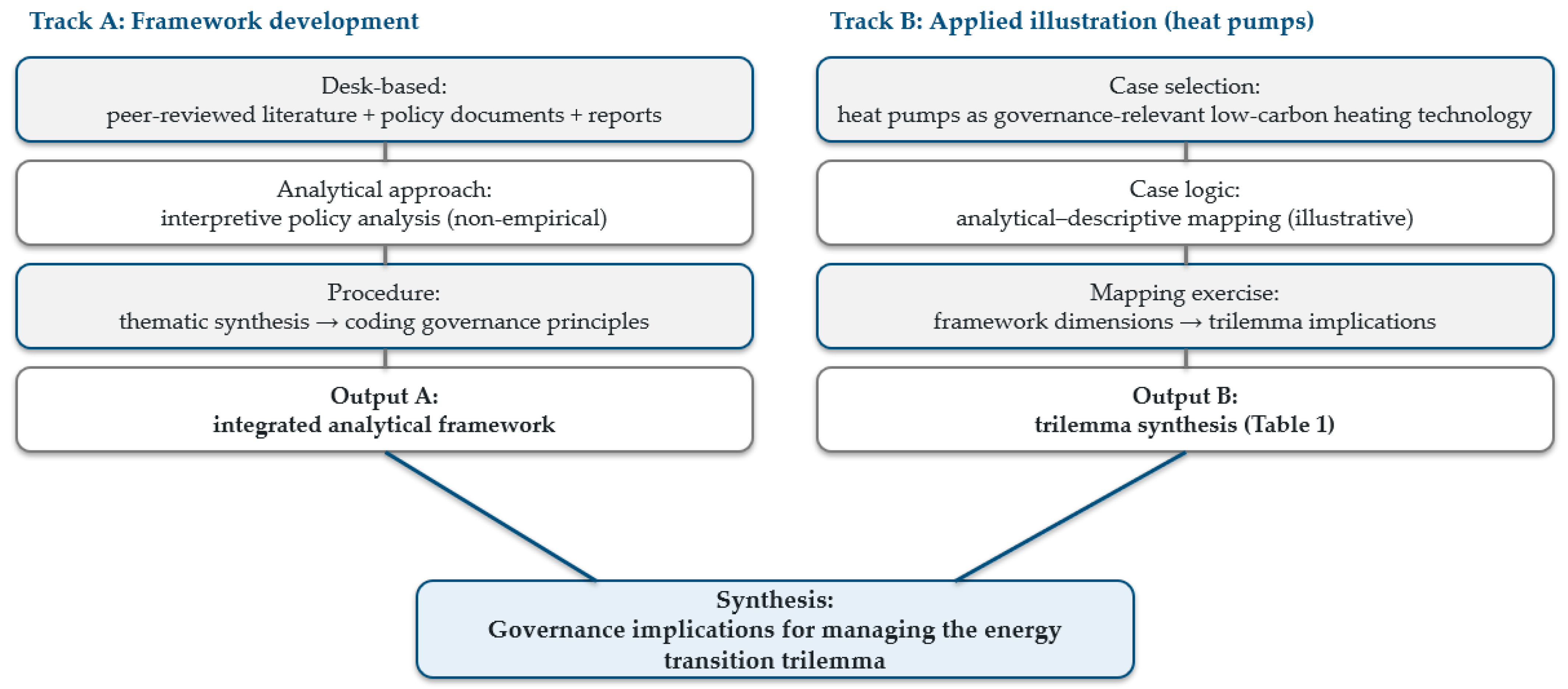
Sources were selected based on their conceptual relevance, empirical richness, and citation frequency in the academic literature. A purposive sampling strategy was employed to ensure balanced representation across disciplines, geographic contexts, and methodological orientations. The analysis was guided by two interrelated theoretical perspectives: polycentric governance theory and deliberative democratic theory. These frameworks provided a lens through which to examine institutional dynamics, participatory mechanisms, and the normative underpinnings of energy governance. Key analytical dimensions included: multilevel institutional coordination, stakeholder participation and inclusivity, transparency and access to knowledge, equity and justice considerations. A thematic synthesis approach was employed to identify patterns, divergences, and synergies across the reviewed literature. The approach was informed primarily by the methodology developed by Thomas and Harden [20], who conceptualised thematic synthesis as a structured method for integrating qualitative evidence through three stages: line-by-line coding of text, development of descriptive themes, and generation of analytical themes. Its conceptual and procedural foundations are also consistent with broader work on thematic analysis, particularly Braun and Clarke’s approach to identifying and interpreting patterns of meaning within qualitative material [21], as well as Barnett-Page and Thomas’s comparative discussion of qualitative synthesis methods [22]. In this study, the procedure involved: (i) coding relevant arguments, concepts, and empirical observations from the reviewed sources; (ii) grouping them into descriptive themes such as multilevel coordination, participation, legitimacy, equity, institutional redundancy, and implementation capacity; and (iii) developing analytical themes that linked deliberative and polycentric governance to the three dimensions of the energy trilemma. This method enabled the development of a coherent conceptual model that integrates procedural and structural aspects of governance in the context of the energy trilemma. The overall methodological workflow is summarised in Figure 1. The figure supports the analysis by visualising the sequence of methodological steps used in the study: identification of relevant literature and policy documents, thematic grouping of sources, synthesis of governance concepts, development of the integrated deliberative–polycentric framework, and its application to the heat pump example. In this way, the figure clarifies how the literature review and desk-based analysis were translated into the analytical framework and how the illustrative case was used to demonstrate the framework’s implementation relevance. Track A therefore provides the primary conceptual basis for developing the integrated framework, while Track B has an illustrative and application-oriented function. The purpose of Track B is not to produce empirical generalisation, but to examine whether the framework can structure the analysis of a concrete implementation-sensitive technology and reveal governance conditions relevant to the energy trilemma.
Figure 1.
Overview of analytical steps and applied illustration using heat pump deployment. Source: own study.
3. Results
As discussed in the Introduction, the energy transition trilemma provides a useful analytical lens for examining the tensions among energy security, environmental sustainability, and energy equity. In practice, these tensions emerge across different governance levels and policy contexts, often requiring trade-offs between affordability, reliability, decarbonisation, and social justice [23].
Historically, energy systems have tended to prioritize short-term energy security and economic affordability, frequently at the expense of long-term environmental stewardship and inclusive development [24]. Global reliance on fossil fuels remains entrenched: as of 2022, over 80% of the world’s primary energy consumption was derived from coal, oil, and natural gas, despite increasing investments in renewables [25,26].
The reviewed literature shows that the energy trilemma is most useful not as a static classification of policy objectives, but as an analytical lens for identifying tensions among reliability, decarbonisation, affordability, and justice. This synthesis indicates that trilemma-related trade-offs are context-dependent and shaped by governance capacity, institutional coordination, and distributional safeguards [27,28].
Manifestations of the trilemma are context-specific and shaped by socio-political and geographic factors. At the project level, utility-scale renewable energy installations—such as wind farms or solar parks—may trigger local resistance due to land-use conflicts, perceived procedural injustices, or insufficient community engagement. Empirical studies have documented cases where wind projects in the United States, the United Kingdom, and India were delayed or halted due to opposition rooted in inadequate consultation processes. At the systemic level, the accelerated phase-out of coal and nuclear energy, as seen in countries like Germany, may advance sustainability goals but simultaneously raise concerns about grid reliability and job displacement [24]. Germany’s decision to shut down its last nuclear plant in 2023, alongside coal phase-outs, has sparked debate over increased natural gas imports and energy price volatility [25]. Globally, the surging demand for critical raw materials—including lithium, cobalt, and rare earth elements—required for battery storage and clean energy infrastructure has intensified geopolitical competition [29]. In the German context, renewable energy expansion has also been shaped by policy support mechanisms and citizen ownership models, illustrating the interaction between national frameworks and decentralised participation [30,31]. In response to the complexity of the trilemma, international organizations such as the International Energy Agency (IEA) and the World Energy Council have developed quantitative tools to monitor national performance. While these indices offer valuable macro-level insights, they frequently obscure intra-national disparities, such as regional energy poverty, infrastructure deficits, and socio-economic inequalities [32,33]. For instance, in the European Union, although overall energy access is nearly universal, an estimated 35 million citizens are unable to keep their homes adequately warm during winter. As a result, there is increasing academic and policy consensus on the need for finer-grained analytical tools that integrate distributional justice, institutional resilience, and socio-technical feasibility into national and regional assessments [34]. The synthesis further indicates that trilemma-related tensions require governance arrangements capable of coordinating multiple actors, managing trade-offs, and adapting to uncertainty [35]. In this context, polycentric arrangements are relevant because they distribute implementation responsibilities across overlapping jurisdictions and policy arenas, creating opportunities for experimentation, learning, and local adaptation [33].
Deliberative democratic practices can serve as a critical complement to polycentric governance by embedding inclusivity, transparency, and accountability into the policymaking process. Participatory mechanisms—such as citizens’ assemblies on climate, which have been implemented in France, Ireland, and the United Kingdom—have demonstrated the capacity to generate socially accepted and politically feasible recommendations. Empirical research highlights the potential of such forums to enhance policy legitimacy, mediate stakeholder conflicts, and foster collective learning, all of which are essential for stable and equitable energy transitions [35]. Comparative case studies further illuminate the divergent approaches countries adopt in navigating the energy trilemma. Germany’s Energiewende emphasizes decarbonization, backed by feed-in tariffs and an ambitious renewable energy rollout. However, the simultaneous phase-out of coal and nuclear has heightened dependency on natural gas and imported electricity, raising concerns about security and affordability [36]. In contrast, Poland has maintained a strong reliance on domestic coal, citing energy independence and cost considerations, though mounting EU regulatory pressure and local community energy projects are gradually reshaping its trajectory [37]. The Netherlands exemplifies a consensus-driven approach through its sectoral climate agreements and the polder model of deliberation, facilitating alignment among governmental, industrial, and civil society actors around shared decarbonization objectives [38].
At the international level, effective energy governance requires enhanced multilateral cooperation. Regional integration initiatives—such as the European Union’s Energy Union—aim to harmonize energy markets, reduce import dependency, and coordinate climate goals. Globally, frameworks like the United Nations’ Sustainable Energy for All (SEforALL) and the Clean Energy Ministerial provide platforms for joint research, investment mobilization, and capacity-building, particularly in developing economies [39]. Ensuring sustainable and ethical supply chains for critical materials, facilitating cross-border infrastructure development, and promoting equitable access to finance and technology transfer remain pressing challenges. The energy trilemma offers a valuable analytical lens for understanding the complex and interdependent challenges associated with global energy transitions. Its resolution necessitates governance systems that are not only integrative and adaptive but also deeply participatory and just [40]. When effectively designed and implemented, polycentric and deliberative governance models provide complementary and mutually reinforcing mechanisms that can guide energy transitions toward outcomes that are secure, sustainable, and socially equitable. To illustrate how these governance principles operate in relation to a concrete implementation challenge, the following section applies the proposed deliberative–polycentric perspective to heat pump deployment. This applied example shows how trilemma objectives are mediated by governance conditions rather than by technology characteristics alone.
3.1. Applied Context: Heat Pumps as an Implementation-Sensitive Technology
To make the analytical use of the proposed framework more explicit, the heat pump example was examined in four consecutive steps. First, the technology was positioned within the three dimensions of the energy trilemma by identifying its potential implications for energy security, environmental sustainability, and energy equity. Second, the relevant governance actors and levels were mapped, including national regulators, municipalities, utilities, installers, housing organisations, and households. Third, the polycentric dimension was analysed by examining how responsibilities, implementation capacities, and policy instruments are distributed across these multiple centres of action. Fourth, the deliberative dimension was assessed by identifying mechanisms through which stakeholder participation, trusted advice, transparency, and local consultation can reduce implementation barriers and improve legitimacy. This step-by-step application provides the analytical basis for the subsequent synthesis presented in Table 1 and Figure 2. Heating constitutes a central yet often underestimated component of the energy transition trilemma, as it combines high climate relevance with pronounced distributional sensitivity and strong dependence on local infrastructure and building characteristics [41]. Heat pumps are well suited for illustrating deliberative–polycentric governance because they are decentralised, deployment-intensive technologies: they are adopted building-by-building, depend on housing conditions (e.g., insulation levels and heat distribution systems), and require coordination with electricity networks and tariff structures [42,43]. They therefore create a clear interface between system-level climate objectives and place-based implementation choices made by municipalities, housing organisations, households/prosumers, and installers.
Table 1.
Illustrative synthesis of heat pumps’ contribution to the energy transition trilemma.
3.2. Governance Dimension: Multi-Level Coordination and Local Implementation
Heat pump deployment is shaped by polycentric governance arrangements in which multiple centres of authority and action interact [44]. At national and regional levels, uptake is influenced by regulatory frameworks, financial incentives, renovation programmes, training and certification standards, and electricity pricing structures that can either accelerate or slow down heating electrification. At the local level, municipalities and local intermediaries can play enabling roles even when they do not control subsidy budgets. They can bundle renovation measures, organise one-stop-shops, coordinate upgrades in municipal or social housing, facilitate permitting and local planning, and co-produce information services with utilities and civil society actors [45]. This architecture reflects polycentric logic: different jurisdictions and organisations can pursue diverse implementation pathways, while learning and best practices can diffuse across local networks.
At the same time, heat pump deployment highlights governance frictions that are typical for implementation-sensitive technologies: uncertainty created by changing support schemes, uneven access to skilled installers, limited grid capacity in specific areas, and administrative complexity [43]. These constraints illustrate how the effectiveness of low-carbon technologies depends not only on technical performance, but also on institutional design and coordination across governance levels.
3.3. Deliberation and Social Acceptance: Mechanisms for Legitimacy and Coordination
Heat pump transitions often generate social tensions not because of a single “acceptance” variable, but due to how costs, benefits, and perceived risks are distributed across households and neighbourhoods [46]. Deliberative governance mechanisms can reduce these tensions by improving transparency, building trust, and enabling co-designed solutions that reflect local conditions [47]. Relevant instruments include community consultations for renovation strategies, structured stakeholder forums linking municipal authorities with installers and grid operators, and trusted advisory services that support households in navigating technical options and financing. Deliberation also matters because heat pumps are tightly coupled with building renovation and energy literacy. Households may face uncertainty about performance in older buildings, concerns related to noise or aesthetics, and fear of cost overruns [48].
3.4. Mapping the Technology onto the Energy Trilemma (Synthesis)
This applied illustration demonstrates how a single technology can affect all three pillars of the energy trilemma, while also showing the governance conditions under which synergies are realized. First, in terms of energy security, heat pumps can reduce dependence on imported fossil fuels used for space and water heating by substituting direct fuel combustion with electrification, thereby lowering exposure to fuel-price volatility and supply disruptions [49]. Second, regarding environmental sustainability, heat pumps support emissions reductions in buildings, particularly as the electricity mix decarbonises; their contribution is thus shaped by both device-level efficiency and system-level electricity generation pathways [50]. Third, for energy equity, impacts are conditional: without appropriate governance, heating electrification may intensify inequality through high upfront costs, uneven access to credit, and unequal renovation capacity. With targeted subsidies, renovation support for vulnerable households, and accessible advisory services, heat pumps can contribute to improved thermal comfort and long-term cost stability [51].
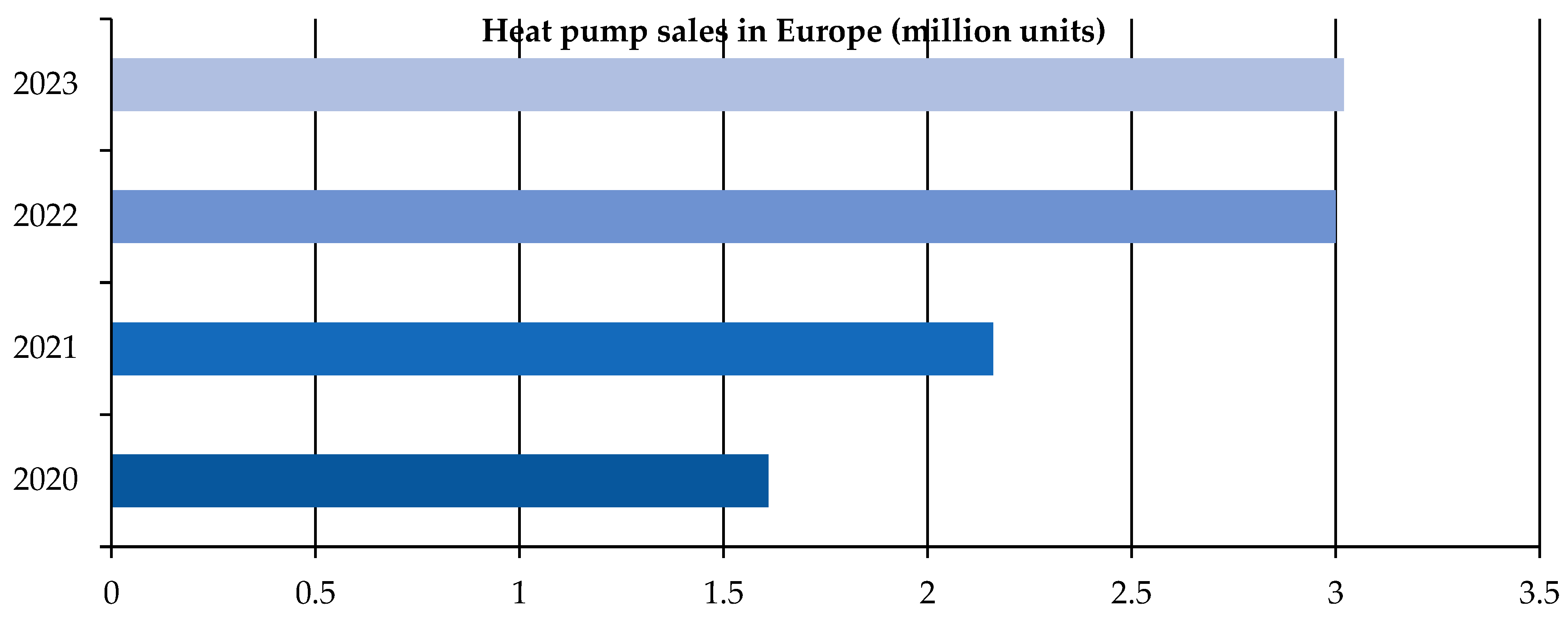
An illustrative mapping of these effects across the energy trilemma, together with the associated governance risks, is presented in Table 1. Figure 2 complements this qualitative governance mapping by providing a concise quantitative perspective on recent heat pump sales dynamics in Europe (2020–2023). This trend underscores that deployment trajectories are sensitive to policy design, market conditions, and implementation capacity, thereby reinforcing the governance focus of this study.
Figure 2.
European heat pump sales (2020–2023). Source: authors’ elaboration based on publicly reported market data.
Concrete policy instruments already demonstrate how implementation-intensive low-carbon heating can be advanced through multi-level governance arrangements. Case 1 (Poland): The national “Clean Air” programme supports the replacement of high-emission household heating devices and building energy-efficiency upgrades in single-family homes, illustrating how central funding rules interact with local implementation capacity and household-level affordability constraints (including stronger support for lower-income beneficiaries). This case exemplifies how equity considerations and administrative accessibility shape technology uptake under real-world conditions [52,53]. Case 2 (The Netherlands): The Sustainable Energy Investment Subsidy Scheme (ISDE) partially compensates the upfront investment costs of measures such as heat pumps, demonstrating how national incentive design can reduce capital barriers while enabling locally embedded renovation pathways supported by municipalities and intermediaries. Together, these cases reinforce the article’s core claim: trilemma outcomes depend on governance design features—particularly affordability mechanisms, implementation support infrastructures, and multi-level coordination—rather than technology characteristics alone [54].
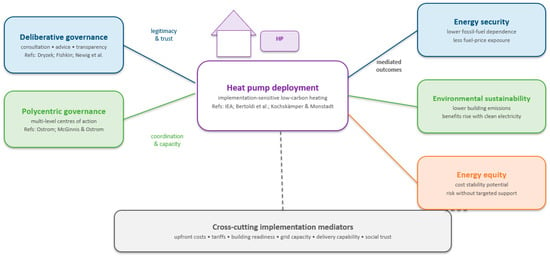
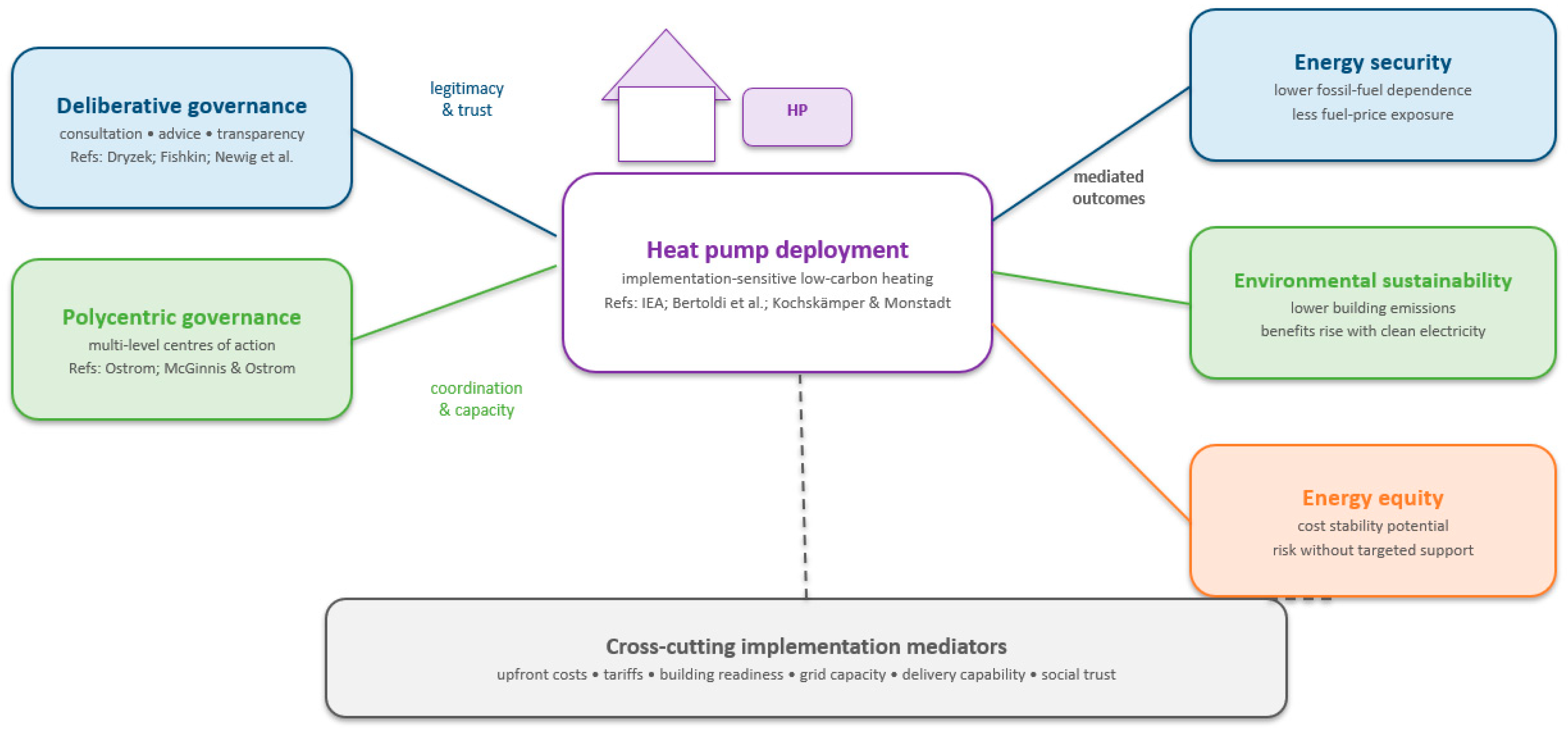
To make the analytical logic of this mapping more explicit, Figure 3 presents a revised conceptual model showing how heat pump deployment interacts with the three dimensions of the energy trilemma and how deliberative–polycentric governance conditions shape these outcomes. The model draws on seminal contributions to polycentric governance, particularly Ostrom’s work on multiple centres of decision-making, as well as key deliberative governance literature emphasising participation, legitimacy, and public reasoning in complex policy processes.
Figure 3.
Conceptual model of how governance conditions mediate trilemma outcomes Source: own elaboration based on the concepts of polycentric governance and deliberative governance [12,15].
4. Discussion
Building on the thematic synthesis and the applied heat pump example presented above, the Discussion interprets the deliberative–polycentric framework as a governance response to the tensions of the energy transition trilemma. As discussed above, the energy trilemma constitutes a defining governance challenge because its interconnected dimensions often pull in different directions, generating tensions that demand sophisticated, inclusive, and resilient governance solutions. The deliberative and polycentric model of governance has emerged as an increasingly recognized approach for navigating this complexity [55]. It offers a strategic pathway that merges public reasoning with decentralized institutional structures to create more just, sustainable, and adaptive energy systems [56].
In the context of heat pump deployment, the deliberative dimension should be interpreted less as a general democratic ideal and more as a practical mechanism for improving legitimacy, trust, and implementation quality. Public consultations, local forums, advisory services, and deliberative polling can help identify household-level concerns, clarify technical and financial options, and reduce resistance caused by uncertainty or perceived unfairness [57,58,59]. Such engagement is particularly important where heating choices directly affect living costs, renovation decisions, and perceptions of risk, making informed public dialogue a condition for more robust policy outcomes [60].
The heat pump example illustrates that implementation outcomes are shaped by governance design rather than by technology characteristics alone. In practice, deployment requires coordination between national subsidy schemes, electricity tariff design, municipal advisory services, grid planning, installer capacity, and household-level decision-making. If these elements are weakly coordinated, heating electrification may produce uneven outcomes, including exclusion of vulnerable households, poor-quality installations, or increased exposure to electricity price volatility. This confirms that low-carbon technologies should be analysed as governance-sensitive instruments whose trilemma effects depend on institutional capacity, social trust, and corrective policy mechanisms.
A critical implication of this analysis is that the deliberative–polycentric model involves inherent trade-offs. More deliberation may improve legitimacy but can also increase transaction costs and delay implementation. Greater polycentricity may enable experimentation and local adaptation but can also lead to policy inconsistency, fragmented responsibilities, and unequal access to institutional capacity. These tensions are particularly important in heating-sector transformation, where households differ substantially in income, building conditions, technical knowledge, and ability to absorb investment risks. The framework should therefore not be understood as a universal solution, but as an analytical tool for identifying where coordination, participation, and corrective mechanisms are needed most.
Importantly, the configuration of trilemma tensions and the feasibility of deliberative–polycentric responses vary across countries and levels of socio-economic development. In higher-income contexts with relatively stronger administrative capacity, key constraints for heating electrification often relate to grid readiness, installer capacity, and tariff structures that shape operating costs and public acceptance. In middle-income and transition economies, distributional sensitivity is typically more pronounced due to higher energy poverty risk, constrained access to finance, and a larger share of older, less efficient building stock—making equity-sensitive programme design and administrative simplification especially important. In lower-income contexts, affordability and access barriers tend to dominate, and local polycentric experimentation usually requires stronger enabling national frameworks (e.g., stable incentives, consumer protection, and minimum quality standards) to prevent fragmented or inequitable outcomes. Consequently, the heat pump illustration should be interpreted as a governance-relevant example whose success conditions depend on institutional capacity, socio-economic vulnerability, and energy price structures that differ substantially across contexts.
In addition to security and environmental considerations, purely economic factors have a direct influence on how the trilemma is perceived and on the feasibility of implementation. For households and municipalities, the adoption of heat pumps depends not only on technical suitability, but also on upfront investment costs, access to affordable financing, and the relative operating costs determined by electricity prices and tariff structures. These economic drivers are closely intertwined with equity: high capital requirements and credit constraints can concentrate benefits among higher-income groups unless policy design explicitly targets vulnerable households and reduces administrative barriers. Importantly, economic conditions are not exogenous to governance—subsidy stability and predictability, the administrative costs of participation, consumer protection, and tariff design can determine whether electrified heating is experienced as a cost-stabilising transition or as an affordability shock. Making these economic mechanisms explicit strengthens the deliberative–polycentric argument by showing how market signals are mediated by institutions and can be corrected through inclusive design, transparent information, and adaptive policy learning.
From an application-oriented perspective, the polycentric dimension highlights the need to coordinate heat pump deployment across multiple centres of authority and action. National authorities may define regulatory frameworks, subsidy schemes, and decarbonisation targets, while municipalities, utilities, installers, housing organisations, and civil society actors translate these objectives into locally feasible implementation pathways [61,62]. This distributed arrangement can support experimentation, local adaptation, and institutional resilience, but it also requires mechanisms to avoid fragmented responsibilities, unequal access to support, and inconsistent delivery quality [63,64].
The synergy between deliberation and polycentricity is particularly powerful in addressing the energy trilemma. While polycentricity enables flexibility and innovation through multiple autonomous initiatives, deliberation serves as a mechanism to coordinate those efforts, resolve conflicts, and forge consensus. Together, they provide a governance infrastructure that is both participatory and adaptive [65]. The energy transition requires collective decisions about trade-offs between affordability, reliability, and ecological impact. Deliberative forums help stakeholders weigh these trade-offs, share knowledge, and co-design policies. Meanwhile, polycentric structures ensure that diverse experiments and approaches can be pursued simultaneously, with successful models being scaled or adapted elsewhere [66]. This combined model also helps bridge the gap between top-down national mandates and bottom-up community initiatives, encouraging mutual learning and the diffusion of best practices across regions and governance levels [66].
Operationalizing this model involves several critical components. Information and education are foundational [67]. Citizens must have access to clear, transparent, and relevant data about energy systems, costs, benefits, and risks. Establishing open-access databases and knowledge-sharing platforms can empower communities to engage effectively in energy debates. Institutionalizing dialogue is equally vital [68]. Permanent or regularly convened energy councils at national and local levels can create ongoing venues for inclusive deliberation, where government representatives, scientists, industry actors, and civil society organizations collaboratively monitor progress and adjust strategies. These councils can serve as dynamic policy incubators, fostering a feedback loop between the public and policymakers and helping tailor policies to changing local and global conditions [69]. Corrective mechanisms are also essential. Participatory budgeting and other co-decision tools enable citizens to direct public funds toward initiatives that align with multiple goals of the trilemma, such as low-cost clean energy solutions that also enhance system reliability [70]. Additionally, transnational learning networks and partnerships among cities, regions, and international bodies facilitate the dissemination of best practices and innovations across borders, thereby accelerating the global energy transition. Such networks foster mutual accountability and stimulate innovation by exposing local policymakers to diverse perspectives, technologies, and governance models.
To translate the deliberative–polycentric framework into actionable guidance, we outline a practical pathway for formulating and implementing trilemma-oriented strategies (illustrated for heat pump deployment):
- Diagnose the local trilemma profile: map building stock, grid constraints, energy poverty, and renovation readiness to identify dominant security–sustainability–equity tensions.
- Set multi-level objectives and roles: align national targets and funding rules with municipal implementation capacity; define responsibilities for regulators, municipalities, utilities, and market actors.
- Co-design instruments through deliberation: use local forums/consultations and stakeholder panels to identify barriers, acceptable trade-offs, and programme design preferences.
- Lower upfront barriers and protect equity: implement targeted subsidies, simplified application routes, and complementary renovation support for vulnerable households; ensure consumer protection and transparency.
- Ensure delivery capacity and quality: invest in installer training/certification, quality assurance, and trusted intermediaries (e.g., one-stop-shops, municipal energy advisory) to reduce performance gaps and build trust.
- Align price signals with electrified heat: adjust tariff structures and flexibility incentives to avoid penalising heat pump users and to mitigate electricity price volatility risks.
- Institutionalise coordination and learning: create cross-actor coordination platforms and translocal networks to share best practices and replicate successful approaches.
- Monitor outcomes and apply corrective mechanisms: track uptake, distributional effects, and user experience; revise programme parameters through feedback loops (adaptive governance).
Nevertheless, this model is not without challenges [71]. Coordinating multiple centres of authority can be cumbersome, and deliberative processes may require considerable time and resources [72]. Furthermore, unequal access to expertise, disparities in civic capacity, and political polarization can undermine the quality of public reasoning [73]. Economically dominant stakeholders may also skew deliberative processes unless safeguards—such as equitable representation, neutral facilitation, and structured access to expert knowledge—are firmly in place [74]. It is also important to ensure that deliberative outcomes are meaningfully integrated into actual policymaking processes, rather than serving as symbolic gestures [75]. Achieving meaningful integration may require institutional reform, the development of legal mandates for public engagement, and sustained political commitment to transparency and accountability. The values underpinning the deliberative and polycentric model align closely with broader principles of climate and energy justice, human rights, and democratic participation (Table 2). This approach affirms the right of individuals and communities to be involved in shaping energy policies that affect their lives. It also acknowledges the responsibilities of current generations to address the needs of future ones and to cooperate across borders in pursuit of a stable and liveable planet. The model encourages a shift away from narrowly defined economic efficiency metrics toward a holistic vision of social well-being and ecological stewardship, elevating ethics and equity as central components of energy governance.
Table 2.
Principles of Deliberative-Polycentric Governance Model.
5. Conclusions
The main contribution of this study is the development of an integrated deliberative–polycentric governance framework for addressing the energy transition trilemma. The originality of the framework lies in combining two governance traditions that are often discussed separately: deliberative approaches focused on inclusion, transparency, legitimacy, and public reasoning, and polycentric approaches focused on multilevel coordination, institutional diversity, and local experimentation. By linking these perspectives, the article advances the existing literature by showing how energy security, environmental sustainability, and energy equity can be analysed as interdependent governance outcomes rather than as separate policy objectives.
Deliberative governance enhances the legitimacy, transparency, and responsiveness of energy policy by institutionalising inclusive and reasoned public discourse. It enables the articulation and negotiation of diverse stakeholder interests, fosters mutual learning, and cultivates democratic competencies essential for navigating contested policy terrains. Concurrently, polycentric governance facilitates decentralised experimentation, local adaptation, and institutional redundancy by dispersing authority across multiple, overlapping decision-making arenas. This distributed configuration increases systemic resilience and allows for context-specific solutions that are responsive to regional socio-technical conditions.
The illustrative case of heat pump deployment confirms the practical value of the deliberative–polycentric framework for analysing implementation-intensive low-carbon technologies. Rather than restating the technology’s contribution to each trilemma dimension, the case shows that these contributions depend on coordinated policy packages, stable support schemes, trusted advisory infrastructures, and equity-sensitive design. In this sense, heat pumps function as a governance-sensitive instrument that helps identify the conditions under which decentralised heating technologies can support locally feasible and socially legitimate transition pathways.
The practical implication of the analysis is that heat pump deployment should not be treated as a purely technological or market-driven process. It requires coordinated policy packages combining financial support, renovation measures, grid readiness, installer capacity, transparent information, and trusted advisory services. Equity-sensitive design is particularly important, as high upfront costs, administrative complexity, and unequal renovation capacity may otherwise limit access for vulnerable households.
The synergistic integration of these governance modalities holds considerable promise for addressing the structural and procedural deficits of legacy energy governance systems. It enables both vertical and horizontal coordination, enhances the capacity for adaptive learning, and embeds normative commitments to justice and participation within institutional design. Nonetheless, realising the full potential of this model requires deliberate investment in institutional infrastructure, civic capacity, and mechanisms that ensure the equitable distribution of deliberative opportunities and decision-making authority.
Deliberative-polycentric governance model constitutes a forward-looking and ethically grounded framework for steering energy transitions. By reconciling competing imperatives and bridging the gap between technocratic rationality and democratic legitimacy, it provides a pathway toward energy systems that are not only more sustainable and secure, but also more socially just and democratically accountable.
Author Contributions
Conceptualization, O.J.; software, O.J.; validation, O.J.; formal analysis, O.J.; resources, O.J. and N.G.-C.; data curation, O.J., N.G.-C. and J.K.; writing—original draft preparation, O.J.; writing—review and editing, O.J., N.G.-C. and J.K.; supervision, O.J.; project administration, O.J. and J.K.; funding acquisition, J.K. and O.J. All authors have read and agreed to the published version of the manuscript.
Funding
This research received no external funding.
Data Availability Statement
The original contributions presented in the study are included in the article, further inquiries can be directed to the corresponding author.
Conflicts of Interest
The authors declare no conflict of interest.
References
- Goldthau, A. Rethinking the governance of energy infrastructure: Scale, decentralization and polycentrism. Energy Res. Soc. Sci. 2014, 1, 134–140. [Google Scholar] [CrossRef] [Scilit]
- Jenkins, K. Setting energy justice apart from the crowd: Lessons from environmental and climate justice. Energy Res. Soc. Sci. 2018, 39, 117–121. [Google Scholar] [CrossRef] [Scilit]
- Kola-Bezka, M. Think global, act local: In search for ways to increase the engagement of local communities in energy transition. Energy Rep. 2023, 9, 1668–1683. [Google Scholar] [CrossRef] [Scilit]
- Martínez-Reyes, A.; Lieu, J.; de Vries, G.; Hoppe, T. Introducing a typology of energy regions: A systematic literature review. Renew. Sustain. Energy Rev. 2025, 207, 114961. [Google Scholar] [CrossRef] [Scilit]
- Petrovics, D.; Huitema, D.; Jordan, A. Polycentric energy governance: Under what conditions do energy communities scale? Environ. Policy Gov. 2022, 32, 438–449. [Google Scholar] [CrossRef] [Scilit]
- Topaloglou, E.; Kouskoura, A.; Janikowska, O.; Grozeva, R.; Nikolaidou, K.; Karagiannis, I.; Kulczycka, J. The interplay between just energy transition and community engagement: Assessing collaborative pathways in Greece, Poland and Bulgaria. Energy Res. Soc. Sci. 2024, 116, 103708. [Google Scholar] [CrossRef] [Scilit]
- Wahlund, M.; Palm, J. The role of energy democracy and energy citizenship for participatory energy transitions: A comprehensive review. Energy Res. Soc. Sci. 2022, 87, 102482. [Google Scholar] [CrossRef] [Scilit]
- IEA. The Future of Heat Pumps; International Energy Agency (IEA): Paris, France, 2022; Available online: https://www.iea.org/reports/the-future-of-heat-pumps (accessed on 15 January 2026).
- Eurostat. 10.6% of EU Population Struggled to Keep Homes Warm. News Articles. 23 January 2025. Available online: https://ec.europa.eu/eurostat/web/products-eurostat-news/w/ddn-20250123-2 (accessed on 15 January 2026).
- Kochskämper, E.; Monstadt, J. Decarbonizing urban heating systems in Europe: Navigating governance challenges in seven pioneering cities. Energy Res. Soc. Sci. 2025, 130, 104438. [Google Scholar] [CrossRef] [Scilit]
- International Energy Agency (IEA). Renewables 2024: Analysis and Forecast to 2029; IEA: Paris, France, 2024. Available online: https://iea.blob.core.windows.net/assets/17033b62-07a5-4144-8dd0-651cdb6caa24/Renewables2024.pdf (accessed on 4 July 2025).
- McGinnis, M.D.; Ostrom, E. Polycentric governance systems: Multiple centers of decision-making authority. In Polycentricity and Governance; Indiana University Press: Bloomington, IN, USA, 2011. [Google Scholar]
- Jordan, A.; Huitema, D. Polycentric governance disperses political authority to bodies with overlapping jurisdictions that are not hierarchical. In Polycentric Governance; Wageningen Environmental Policy Series; Taylor & Francis: Milton Park, UK, 2023. [Google Scholar]
- Eloy, Á.P.; Iñigo, O.M.; Jaime, M.S. The German Energy Transition (Energiewende)—Policy, Energy Transformation and Industrial Development; Cuadernos Orkestra: San Sebastian, Spain, 2016; Volume 2016/15_ENG. Available online: http://www.orkestra.deusto.es/images/investigacion/publicaciones/cuadernos/Energiewende_English.pdf (accessed on 21 March 2025).
- Dryzek, J.S. Deliberative democracy in divided societies. Political Theory 2005, 33, 218–242. [Google Scholar] [CrossRef] [Scilit]
- Bedford, T.; Catney, P.; Robinson, Z. Going down the local: The challenges of place-based net zero governance. J. Br. Acad. 2023, 11, 125–156. [Google Scholar] [CrossRef] [Scilit]
- World Energy Council. World Energy Trilemma Index 2019: Balancing Energy Security, Equity, and Sustainability; World Energy Council: London, UK, 2019; Available online: https://www.worldenergy.org/publications/entry/world-energy-trilemma-index-2019 (accessed on 8 January 2025).
- Fishkin, J.S. Response to critics of When the people speak: The deliberative deficit and what to do about it. Good Soc. 2010, 19, 68–76. [Google Scholar] [CrossRef] [Scilit]
- IEA. Fossil Fuel Consumption Subsidies 2022; International Energy Agency: Paris, France, 2023; Available online: https://www.iea.org/reports/fossil-fuels-consumption-subsidies-2022 (accessed on 4 July 2025).
- Thomas, J.; Harden, A. Methods for the thematic synthesis of qualitative research in systematic reviews. BMC Med. Res. Methodol. 2008, 8, 45. [Google Scholar] [CrossRef] [Scilit]
- Braun, V.; Clarke, V. Using thematic analysis in psychology. Qual. Res. Psychol. 2006, 3, 77–101. [Google Scholar] [CrossRef] [Scilit]
- Barnett-Page, E.; Thomas, J. Methods for the synthesis of qualitative research: A critical review. BMC Med. Res. Methodol. 2009, 9, 59. [Google Scholar] [CrossRef] [Scilit] [PubMed]
- Tol, R.S.J. Navigating the energy trilemma during geopolitical and environmental crises. arXiv 2023. [Google Scholar] [CrossRef] [Scilit]
- Matthes, F.C. Energy transition in Germany: A case study on a policy-driven structural change of the energy system. Evol. Institutional Econ. Rev. 2017, 14, 141–169. [Google Scholar] [CrossRef] [Scilit]
- IMF. Fossil Fuel Subsidies Data: 2023 Update; Working Paper No. 2023/172; International Monetary Fund: Washington, DC, USA, 2023; Available online: https://www.imf.org/en/Publications/WP/Issues/2023/08/22/IMF-Fossil-Fuel-Subsidies-Data-2023-Update-537281 (accessed on 4 July 2025).
- IPCC. Climate Change 2022: Mitigation of Climate Change; Contribution of Working Group III to the Sixth Assessment Report of the Intergovernmental Panel on Climate Change; Shukla, P.R., Skea, J., Slade, R., Fradera, R., Pathak, M., Al Khourdajie, A., Belkacemi, M., van Diemen, R., Hasija, A., Lisboa, G., et al., Eds.; Cambridge University Press: Cambridge, UK, 2022; Available online: https://www.ipcc.ch/report/ar6/wg3/ (accessed on 4 July 2025).
- Nacke, L.; Vinichenko, V.; Cherp, A.; Jakhmola, A.; Jewell, J. Compensating affected parties necessary for rapid coal phase-out but expensive if extended to major emitters. Nat. Commun. 2024, 15, 3742. [Google Scholar] [CrossRef] [Scilit]
- McCauley, D. Energy Justice: Re-Balancing the Trilemma of Security, Poverty and Climate Change; Palgrave Macmillan: London, UK, 2017. [Google Scholar]
- Meadows, D.H.; Meadows, D.L.; Randers, J.; Behrens, W.W., III. The Limits to Growth; Universe Books: New York, NY, USA, 1972. [Google Scholar]
- Bundesministerium für Wirtschaft und Energie (BMWK). EEG 2023—Ziele und Fördermechanismen; BMWK: Berlin, Germany, 2023; Available online: https://www.bmwk.de (accessed on 21 March 2025).
- Morris, C. Citizens Own Half of German Renewable Energy. Energy Transition—The Global Energiewende. 29 October 2013. Available online: https://energytransition.org/2013/10/citizens-own-half-of-german-renewables/ (accessed on 11 March 2018).
- International Energy Agency (IEA). Global Critical Minerals Outlook 2024; IEA: Paris, France, 2024; Available online: https://www.iea.org/reports/global-critical-minerals-outlook-2024 (accessed on 4 July 2025).
- Busch, H.; Ramasar, V.; Avila, S.; Roy, B.; van Ryneveld, T.; Mandinic, A.; Brandstedt, E. Mining coal while digging for justice: Investigating justice claims against a coal-phase out in five countries. Extr. Ind. Soc. 2023, 15, 101275. [Google Scholar] [CrossRef] [Scilit]
- Sovacool, B.K.; Hook, A.; Martiskainen, M.; Baker, L. The whole systems energy injustice of four European low-carbon transitions. Glob. Environ. Change 2021, 69, 101958. [Google Scholar] [CrossRef] [Scilit]
- Khan, I. The Energy Trilemma: An Overview of Balancing Security, Sustainability, and Affordability. Habitable Planet J. 2025, 1, 56–68. [Google Scholar] [CrossRef] [Scilit]
- Marquardt, J.; Dasgupta, S.; Höhne, C.; Sankhyayan, P. Promises and pitfalls of polycentric federalism: The case of solar power in India. Glob. Environ. Politics 2024, 24, 75–99. [Google Scholar] [CrossRef] [Scilit]
- Renn, O.; Marshall, J.P. History of the energy transition in Germany: From the 1950s to 2019. In The Role of Public Participation in Energy Transitions; Renn, O., Ulmer, F., Deckert, A., Eds.; Academic Press: Cambridge, MA, USA, 2020; pp. 9–38. [Google Scholar]
- Kolde, L.; Wagner, O. Governance policies for a “just transition”—A case study in the Rhineland lignite mining district. J. Sustain. Dev. Energy Water Environ. Syst. 2021, 10, 1080383. [Google Scholar] [CrossRef] [Scilit]
- Agora Energiewende. Understanding the Energiewende: FAQ on the Ongoing Transition of the German Power System. 2015. Available online: http://www.agora-energiewende.de (accessed on 21 March 2025).
- Tarasova, E. Rethinking justice as recognition in energy transitions and planned coal phase-out in Poland. Energy Res. Soc. Sci. 2024, 112, 103507. [Google Scholar] [CrossRef] [Scilit]
- Bouw, K.; Wiekens, C.J.; Tigchelaar, C.; Faaij, A. Involving Citizens in Heat Planning: A Participatory Process Design for Informed Decision-Making. Sustainability 2023, 15, 1937. [Google Scholar] [CrossRef] [Scilit]
- Hirsch, P.D.; Norton, B.G. Enabling system-level trust: Polycentric governance for complex, many-scaled environmental problems. Environ. Sci. Policy 2026, 176, 104302. [Google Scholar] [CrossRef] [Scilit]
- Nadalipour Kaldeh, S.; Yousefi, H.; Noorollahi, Y.; Abdoos, M. Integration of renewable sources in buildings: A review of energy savings, feasibility, and challenges. Energy Rep. 2025, 14, 3905–3934. [Google Scholar] [CrossRef] [Scilit]
- Fouché, E.; Brent, A. Explore, Design and Act for Sustainability: A Participatory Planning Approach for Local Energy Sustainability. Sustainability 2020, 12, 862. [Google Scholar] [CrossRef] [Scilit]
- Bertoldi, P.; Boza-Kiss, B.; Della Valle, N.; Economidou, M. The role of one-stop shops in energy renovation—A comparative analysis of OSSs cases in Europe. Energy Build. 2021, 250, 111273. [Google Scholar] [CrossRef] [Scilit]
- Savage, T.; Akroyd, J.; Mosbach, S.; Hillman, M.; Sielker, F.; Kraft, M. Universal Digital Twin—The impact of heat pumps on social inequality. Adv. Appl. Energy 2022, 5, 100079. [Google Scholar] [CrossRef] [Scilit]
- Druta, R.M.; Lakatos, E.S.; Munteanu, R.A.; Cioca, L.-I.; Ferenci, S.; Barnisca, M.; Puiac, A.V. Bridging the Gap in Renewable Energy Participation: A Case Study on Energy Communities. Processes 2025, 13, 2632. [Google Scholar] [CrossRef] [Scilit]
- Generowicz, N. Analysis of emission of pollutants from selected heat sources for a single-family building. Przem. Chem. 2020, 99, 1309–1311. [Google Scholar]
- Noorollahi, Y.; Moshtaghi, M.; Golkar, M.; Tahsinpour, H.; Noorollahi, M. Techno-economic assessment of energy savings and CO2 emission reductions from replacing conventional HVAC systems with ground source heat pumps in Iran. Energy Convers. Manag. X 2026, 29, 101530. [Google Scholar] [CrossRef] [Scilit]
- Menegatto, M.; Bobbio, A.; Freschi, G.; Zamperini, A. The Social Acceptance of Renewable Energy Communities: The Role of Socio-Political Control and Impure Altruism. Climate 2025, 13, 55. [Google Scholar] [CrossRef] [Scilit]
- Gao, X.; Chang, P.; Zhao, Q.; Lin, H.-C.; Sun, H.; Xu, S.; Xiao, H. Operational optimization for electric heat pump clusters based on demand response considering user comfort. Energy Build. 2025, 347, 116272. [Google Scholar] [CrossRef] [Scilit]
- International Energy Agency (IEA). Poland’s Clean Air Programme—IEA Policies Database. 2018. Last Updated 11 April 2026. Available online: https://www.iea.org/policies/11538-polands-clean-air-programme (accessed on 27 April 2026).
- National Fund for Environmental Protection and Water Management (NFOŚiGW). Clean Air Programme (Czyste Powietrze). Available online: https://czystepowietrze.gov.pl/ (accessed on 27 April 2026).
- Government of the Netherlands. Sustainable Energy Investment Subsidy Scheme (ISDE). Available online: https://business.gov.nl/subsidies-and-schemes/sustainable-energy-investment-subsidy-isde/ (accessed on 27 April 2026).
- Janikowska, O.; Słodczyk, J. (Eds.) Global Justice; Wydawnictwo Uniwersytetu Opolskiego: Opole, Poland, 2016; 235p, ISBN 978-83-7395-711-4. (In Polish) [Google Scholar]
- Hobson, K. On the modern and the nonmodern in deliberative environmental democracy. Glob. Environ. Politics 2009, 9, 64–80. [Google Scholar] [CrossRef] [Scilit]
- Carcasson, M.; Sprain, L. Beyond problem solving: Reconceptualizing the work of public deliberation as deliberative inquiry. Commun. Theory 2010, 20, 515–535. [Google Scholar] [CrossRef] [Scilit]
- Rhodes, R.A.W. Understanding Governance: Policy Networks, Governance, Reflexivity and Accountability; Open University Press: Buckingham, UK, 1997. [Google Scholar]
- Chilvers, J.; Kearnes, M. (Eds.) Remaking Participation: Science, Environment and Emergent Publics; Routledge: London, UK, 2016. [Google Scholar]
- Armstead, R. Carrots, Sticks, Tigers and Wheels: A Case Study of Municipal Governance for Energy Efficiency in New Buildings in the Öresund Region. Master’s Thesis, Lund University, Lund, Sweden, 2012. [Google Scholar]
- Newig, J.; Jager, N.W.; Challies, E.; Kochskämper, E. Does stakeholder participation improve environmental governance? Evidence from a meta-analysis of 305 case studies. Glob. Environ. Change 2023, 82, 102705. [Google Scholar] [CrossRef] [Scilit] [PubMed]
- Anfinson, K.; Laes, E.; Bombaerts, G.; Standal, K.; Krug, M.; Di Nucci, M.R.; Schwarz, L. Does polycentrism deliver? A case study of energy community governance in Europe. Energy Res. Soc. Sci. 2023, 100, 103093. [Google Scholar] [CrossRef] [Scilit]
- Roddis, P.; Carver, S.; Dallimer, M.; Ziv, G. Accounting for Taste? Analysing Diverging Public Support for Energy Sources in Great Britain. Energy Res. Soc. Sci. 2019, 56, 101226. [Google Scholar] [CrossRef] [Scilit]
- Lennon, B.; Dunphy, N.; Sanvicente, E. Community acceptability and the energy transition: A citizens’ perspective. Energy Sustain. Soc. 2019, 9, 35. [Google Scholar] [CrossRef] [Scilit]
- Jordan, A.J.; Schout, A. The Coordination of the European Union: Exploring the Capacities of Networked Governance; Oxford University Press: Oxford, UK, 2006. [Google Scholar]
- Hendriks, C.; Psarra, I.; van der Schoor, T.; Tjahja, C. Energy transition in Northern Netherlands: Seeking a balance between top-down and bottom-up initiatives. Open Res. Eur. 2024, 4, 139. [Google Scholar]
- Kiewra, D.; Szpor, A.; Witajewski-Baltvilks, J. Sprawiedliwa Transformacja Węglowa w Regionie Śląskim. Implikacje dla Rynku Pracy; IBS Research Reports 2019; Instytut Badań Strukturalnych: Warszawa, Poland, 2019; pp. 32–39. [Google Scholar]
- Dryzek, J.S. Democratization as Deliberative Capacity Building. Comp. Political Stud. 2009, 42, 1379–1402. [Google Scholar] [CrossRef] [Scilit]
- Friedman, W. Deliberative democracy and the problem of scope. J. Public Delib. 2006, 2, 1. [Google Scholar] [CrossRef] [Scilit]
- Mansbridge, J.; Hartz-Karp, J.; Amengual, M.; Gastil, J. Norms of deliberation: An inductive study. J. Public Deliber. 2006, 2, 6–9. [Google Scholar] [CrossRef] [Scilit]
- Cheung, G.; Davies, P.J.; Bassen, A. In the transition of energy systems: What lessons can be learnt from the German achievement? Energy Policy 2019, 132, 633–646. [Google Scholar] [CrossRef] [Scilit]
- Devine-Wright, P. Reconsidering public attitudes and public acceptance of renewable energy technologies: A critical review. In Delivering a Low Carbon Electricity System: Technologies, Economics and Policy; Cambridge University Press: Cambridge, UK, 2007. [Google Scholar]
- Bondaruk, J. Achieving carbon neutrality in the UNECE region—Upper Silesia, Poland. In Proceedings of the Sustainable Energy Week: Accelerating and Deepening the Transition to Sustainable Energy Systems, Geneva, Switzerland, 25–27 September 2019. [Google Scholar]
- Limbeek, T.; Pearce, B.J.; Pesch, U. A Perspective on Energy Citizenship and Transitions in Europe. Energy Res. Soc. Sci. 2025, 126, 104144. [Google Scholar] [CrossRef] [Scilit]
- Ostrom, E. Beyond markets and states: Polycentric governance of complex economic systems. Am. Econ. Rev. 2010, 100, 641–672. [Google Scholar] [CrossRef] [Scilit]

Disclaimer/Publisher’s Note: The statements, opinions and data contained in all publications are solely those of the individual author(s) and contributor(s) and not of MDPI and/or the editor(s). MDPI and/or the editor(s) disclaim responsibility for any injury to people or property resulting from any ideas, methods, instructions or products referred to in the content. |
© 2026 by the authors. Licensee MDPI, Basel, Switzerland. This article is an open access article distributed under the terms and conditions of the Creative Commons Attribution (CC BY) license.